RD Sharma Class 9 Solutions Chapter 15 Areas of Parallelograms and Triangles Ex 15.4

RD Sharma Class 9 Solutions Chapter 15 Areas of Parallelograms and Triangles Ex 15.4

These Solutions are part of RD Sharma Class 9 Solutions. Here we have given RD Sharma Class 9 Solutions Chapter 15 Areas of Parallelograms and Triangles Ex 15.4

Other Exercises

Question 1.
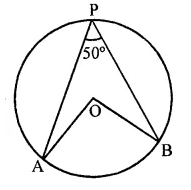
In the figure, O is the centre of the circle. If ∠APB = 50°, find ∠AOB and ∠OAB.
RD Sharma Class 9 Solutions Chapter 15 Areas of Parallelograms and Triangles Ex 15.4 Q1.1
Solution:
Arc AB, subtends ∠AOB at the centre and ∠APB at the remaining part of the circle
∴∠AOB = 2∠APB = 2 x 50° = 100°
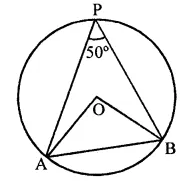
Join AB
RD Sharma Class 9 Solutions Chapter 15 Areas of Parallelograms and Triangles Ex 15.4 Q1.2
∆AOB is an isosceles triangle in which
OA = OB
∴ ∠OAB = ∠OBA But ∠AOB = 100°
∴∠OAB + ∠OBA = 180° – 100° = 80°
⇒ 2∠OAB = 80°
80°
∴∠OAB = \(\frac { { 80 }^{ \circ } }{ 2 }\)  = 40°

Question 2.
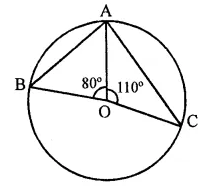
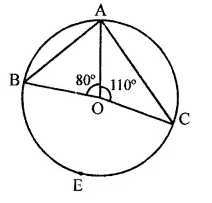
In the figure, O is the centre of the circle. Find ∠BAC.
RD Sharma Class 9 Solutions Chapter 15 Areas of Parallelograms and Triangles Ex 15.4 Q2.1
Solution:
In the circle with centre O
∠AOB = 80° and ∠AOC =110°
∴ ∠BOC = ∠AOB + ∠AOC
= 80°+ 110°= 190°
∴ Reflex ∠BOC = 360° – 190° = 170°
Now arc BEC subtends ∠BOC at the centre and ∠BAC at the remaining part of the circle.
RD Sharma Class 9 Solutions Chapter 15 Areas of Parallelograms and Triangles Ex 15.4 Q2.2
∴ ∠BOC = 2∠BAC
⇒ 170° = 2∠BAC
⇒ ∠BAC = \(\frac { { 170 }^{ \circ } }{ 2 }\) = 85°
∴ ∠BAC = 85°

Question 3.
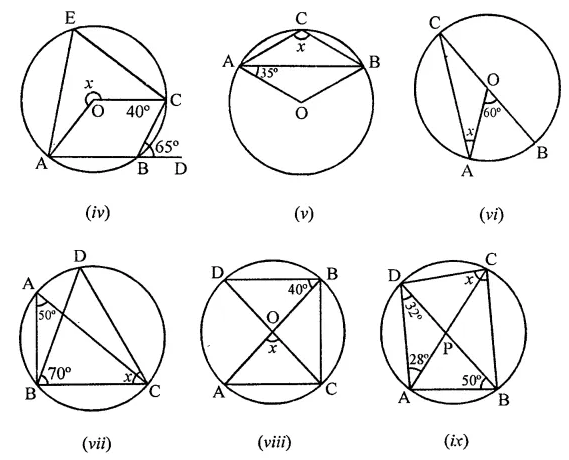
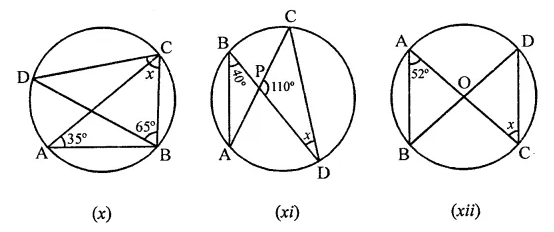
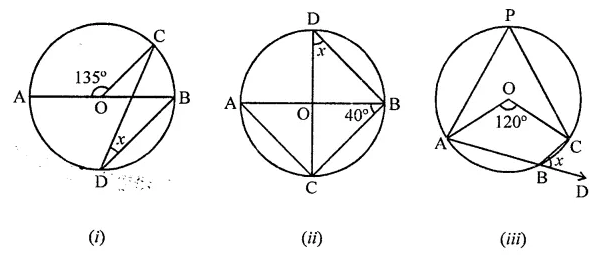
If O is the centre of the circle, find the value of x in each of the following figures:
RD Sharma Class 9 Solutions Chapter 15 Areas of Parallelograms and Triangles Ex 15.4 Q3.1
RD Sharma Class 9 Solutions Chapter 15 Areas of Parallelograms and Triangles Ex 15.4 Q3.2
RD Sharma Class 9 Solutions Chapter 15 Areas of Parallelograms and Triangles Ex 15.4 Q3.3
Solution:
(i) A circle with centre O
∠AOC = 135°
But ∠AOC + ∠COB = 180° (Linear pair)
⇒ 135° + ∠COB = 180°
⇒ ∠COB = 180°- 135° = 45°
Now arc BC subtends ∠BOC at the centre and ∠BPC at the remaining part of the circle
∴ ∠BOC = 2∠BPC
⇒ ∠BPC = \(\frac { 1 }{ 2 }\)∠BOC = \(\frac { 1 }{ 2 }\) x 45° = \(\frac { { 45 }^{ \circ } }{ 2 }\)
∴ ∠BPC = 22 \(\frac { 1 }{ 2 }\)° or x = 22 \(\frac { 1 }{ 2 }\)°
(ii) ∵ CD and AB are the diameters of the circle with centre O
∠ABC = 40°
But in ∆OBC,
OB = OC (Radii of the circle)
∠OCB = ∠OBC – 40°
Now in ABCD,
∠ODB + ∠OCB + ∠CBD = 180° (Angles of a triangle)
⇒ x + 40° + 90° = 180°
⇒ x + 130° = 180°
⇒ x = 180° – 130° = 50°
∴ x = 50°
(iii) In circle with centre O,
∠AOC = 120°, AB is produced to D
∵ ∠AOC = 120°
and ∠AOC + convex ∠AOC = 360°
⇒ 120° + convex ∠AOC = 360°
∴ Convex ∠AOC = 360° – 120° = 240°
∴ Arc APC Subtends ∠AOC at the centre and ∠ABC at the remaining part of the circle
∴ ∠ABC = \(\frac { 1 }{ 2 }\)∠AOC = \(\frac { 1 }{ 2 }\)x 240° = 120°
But ∠ABC + ∠CBD = 180° (Linear pair)
⇒ 120° + x = 180°
⇒ x = 180° – 120° = 60°
∴ x = 60°
(iv) A circle with centre O and ∠CBD = 65°
But ∠ABC + ∠CBD = 180° (Linear pair)
⇒ ∠ABC + 65° = 180°
⇒ ∠ABC = 180°-65°= 115°
Now arc AEC subtends ∠x at the centre and ∠ABC at the remaining part of the circle
∴ ∠AOC = 2∠ABC
⇒ x = 2 x 115° = 230°
∴ x = 230°
(v) In circle with centre O
AB is chord of the circle, ∠OAB = 35°
In ∆OAB,
OA = OB (Radii of the circle)
∠OBA = ∠OAB = 35°
But in ∆OAB,
∠OAB + ∠OBA + ∠AOB = 180° (Angles of a triangle)
⇒ 35° + 35° + ∠AOB = 180°
⇒ 70° + ∠AOB = 180°
⇒ ∠AOB = 180°-70°= 110°
∴ Convex ∠AOB = 360° -110° = 250°
But arc AB subtends ∠AOB at the centre and ∠ACB at the remaining part of the circle.
∴∠ACB = \(\frac { 1 }{ 2 }\)∠AOB
⇒ x = \(\frac { 1 }{ 2 }\) x 250° = 125°
∴ x= 125°
(vi) In the circle with centre O,
BOC is its diameter, ∠AOB = 60°
Arc AB subtends ∠AOB at the centre of the circle and ∠ACB at the remaining part of the circle
∴ ∠ACB = \(\frac { 1 }{ 2 }\) ∠AOB
= \(\frac { 1 }{ 2 }\) x 60° = 30°
But in ∆OAC,
OC = OA (Radii of the circle)
∴ ∠OAC = ∠OCA = ∠ACB
⇒ x = 30°
(vii) In the circle, ∠BAC and ∠BDC are in the same segment
∴ ∠BDC = ∠BAC = 50°
Now in ABCD,
∠DBC + ∠BCD + ∠BDC = 180° (Angles of a triangle)
⇒ 70° + x + 50° = 180°
⇒ x + 120° = 180° ⇒ x = 180° – 120° = 60°
∴ x = 60°
(viii) In circle with centre O,
∠OBD = 40°
AB and CD are diameters of the circle
∠DBA and ∠ACD are in the same segment
∴ ∠ACD = ∠DBA = 40°
In AOAC, OA = OC (Radii of the circle)
∴ ∠OAC = ∠OCA = 40°
and ∠OAC + ∠OCA + ∠AOC = 180° (Angles in a triangle)
⇒ 40° + 40° + x = 180°
⇒ x + 80° = 180° ⇒ x = 180° – 80° = 100°
∴ x = 100°
(ix) In the circle, ABCD is a cyclic quadrilateral ∠ADB = 32°, ∠DAC = 28° and ∠ABD = 50°
∠ABD and ∠ACD are in the same segment of a circle
∴ ∠ABD = ∠ACD ⇒ ∠ACD = 50°
Similarly, ∠ADB = ∠ACB
⇒ ∠ACB = 32°
Now, ∠DCB = ∠ACD + ∠ACB
= 50° + 32° = 82°
∴ x = 82°
(x) In a circle,
∠BAC = 35°, ∠CBD = 65°
∠BAC and ∠BDC are in the same segment
∴ ∠BAC = ∠BDC = 35°
In ∆BCD,
∠BDC + ∠BCD + ∠CBD = 180° (Angles in a triangle)
⇒ 35° + x + 65° = 180°
⇒ x + 100° = 180°
⇒ x = 180° – 100° = 80°
∴ x = 80°
(xi) In the circle,
∠ABD and ∠ACD are in the same segment of a circle
∴ ∠ABD = ∠ACD = 40°
Now in ∆CPD,
∠CPD + ∠PCD + ∠PDC = 180° (Angles of a triangle)
110° + 40° + x = 180°
⇒ x + 150° = 180°
∴ x= 180°- 150° = 30°
(xii) In the circle, two diameters AC and BD intersect each other at O
∠BAC = 50°
In ∆OAB,
OA = OB (Radii of the circle)
∴ ∠OBA = ∠OAB = 52°
⇒ ∠ABD = 52°
But ∠ABD and ∠ACD are in the same segment of the circle
∴ ∠ABD = ∠ACD ⇒ 52° = x
∴ x = 52°

Question 4.
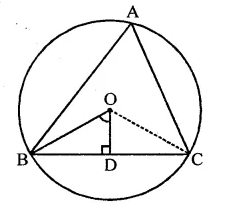
O is the circumcentre of the triangle ABC and OD is perpendicular on BC. Prove that ∠BOD = ∠A.
Solution:
Given : O is the circumcentre of ∆ABC.
OD ⊥ BC
OB is joined
To prove : ∠BOD = ∠A
Construction : Join OC.
RD Sharma Class 9 Solutions Chapter 15 Areas of Parallelograms and Triangles Ex 15.4 Q4.1
Proof : Arc BC subtends ∠BOC at the centre and ∠BAC at the remaining part of the circle
∴ ∠BOC = 2∠A …(i)
In right ∆OBD and ∆OCD Side OD = OD (Common)
Hyp. OB = OC (Radii of the circle)
∴ ∆OBD ≅ ∆OCD (RHS criterion)
∴ ∠BOD = ∠COD = \(\frac { 1 }{ 2 }\) ∠BOC
⇒ ∠BOC = 2∠BOD …(ii)
From (i) and (ii)
2∠BOD = 2∠A
∴∠BOD = ∠A

Question 5.
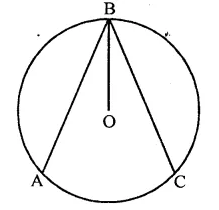
In the figure, O is the centre of the circle, BO is the bisector of ∠ABC. Show that AB = BC.
RD Sharma Class 9 Solutions Chapter 15 Areas of Parallelograms and Triangles Ex 15.4 Q5.1
Solution:
Given : In the figure, a circle with centre O OB is the bisector of ∠ABC
To prove : AB = BC
Construction : Draw OL ⊥ AB and OM ⊥ BC
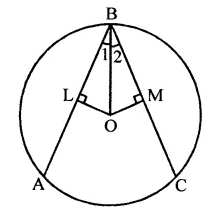
RD Sharma Class 9 Solutions Chapter 15 Areas of Parallelograms and Triangles Ex 15.4 Q5.2
Proof: In ∆OLB and ∆OMB,
∠1 = ∠2 (Given)
∠L = ∠M (Each = 90°)
OB = OB (Common)
∴ ∆OLB ≅ ∆OMB (AAS criterion)
∴ OL = OM (c.p.c.t.)
But these are distance from the centre and chords equidistant from the centre are equal
∴ Chord BA = BC
Hence AB = BC

Question 6.
In the figure, O and O’ are centres of two circles intersecting at B and C. ACD is a straight line, find x.
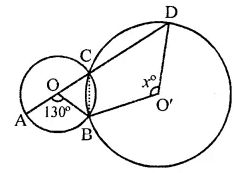
RD Sharma Class 9 Solutions Chapter 15 Areas of Parallelograms and Triangles Ex 15.4 Q6.1
Solution:
In the figure, two circles with centres O and O’ intersect each other at B and C.
ACD is a line, ∠AOB = 130°
Arc AB subtends ∠AOB at the centre O and ∠ACB at the remaining part of the circle.
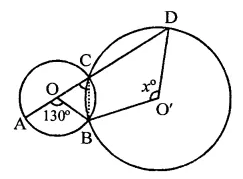
RD Sharma Class 9 Solutions Chapter 15 Areas of Parallelograms and Triangles Ex 15.4 Q6.2
∴ ∠ACB =\(\frac { 1 }{ 2 }\)∠AOB
= \(\frac { 1 }{ 2 }\) x 130° = 65°
But ∠ACB + ∠BCD = 180° (Linear pair)
⇒ 65° + ∠BCD = 180°
⇒ ∠BCD = 180°-65°= 115°
Now, arc BD subtends reflex ∠BO’D at the centre and ∠BCD at the remaining part of the circle
∴ ∠BO’D = 2∠BCD = 2 x 115° = 230°
But ∠BO’D + reflex ∠BO’D = 360° (Angles at a point)
⇒ x + 230° = 360°
⇒ x = 360° -230°= 130°
Hence x = 130°

Question 7.
In the figure, if ∠ACB = 40°, ∠DPB = 120°, find ∠CBD.
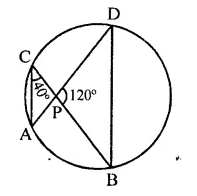
RD Sharma Class 9 Solutions Chapter 15 Areas of Parallelograms and Triangles Ex 15.4 Q7.1
Solution:
Arc AB subtend ∠ACB and ∠ADB in the same segment of a circle
∴ ∠ACB = ∠ADB = 40°
In ∆PDB,
∠DPB + ∠PBD + ∠ADB = 180° (Sum of angles of a triangle)
⇒ 120° + ∠PBD + 40° = 180°
⇒ 160° + ∠PBD = 180°
⇒ ∠PBD = 180° – 160° = 20°
⇒ ∠CBD = 20°

Question 8.
A chord of a circle is equal to the radius of the circle. Find the angle subtended by the chord at a point on the minor arc and also at a point on the major arc.
Solution:
A circle with centre O, a chord AB = radius of the circle C and D are points on the minor and major arcs of the circle
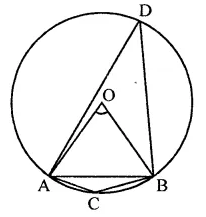
RD Sharma Class 9 Solutions Chapter 15 Areas of Parallelograms and Triangles Ex 15.4 Q8.1
∴ ∠ACB and ∠ADB are formed Now in ∆AOB,
OA = OB = AB (∵ AB = radii of the circle)
∴ ∆AOB is an equilateral triangle,
∴ ∠AOB = 60°
Now arc AB subtends ∠AOB at the centre and ∠ADB at the remainder part of the circle.
∴ ∠ADB = \(\frac { 1 }{ 2 }\) ∠AOB = \(\frac { 1 }{ 2 }\)x 60° = 30°
Now ACBD is a cyclic quadrilateral,
∴ ∠ADB + ∠ACB = 180° (Sum of opposite angles of cyclic quad.)
⇒ 30° + ∠ACB = 180°
⇒ ∠ACB = 180° – 30° = 150°
∴ ∠ACB = 150°
Hence angles are 150° and 30°

Question 9.
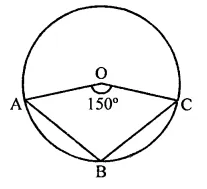
In the figure, it is given that O is the centre of the circle and ∠AOC = 150°. Find ∠ABC.
RD Sharma Class 9 Solutions Chapter 15 Areas of Parallelograms and Triangles Ex 15.4 Q9.1
Solution:
In circle with centre O and ∠AOC = 150°
But ∠AOC + reflex ∠AOC = 360°
∴ 150° + reflex ∠AOC = 360°
⇒ Reflex ∠AOC = 360° – 150° = 210°
Now arc AEC subtends ∠AOC at the centre and ∠ABC at the remaining part of the circle.
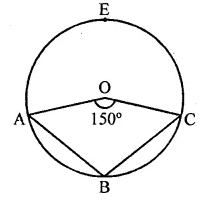
RD Sharma Class 9 Solutions Chapter 15 Areas of Parallelograms and Triangles Ex 15.4 Q9.2
Reflex ∠AOC = 2∠ABC
⇒ 210° = 2∠ABC
∴ ∠ABC = \(\frac { { 210 }^{ \circ } }{ 2 }\)  = 105°

Question 10.
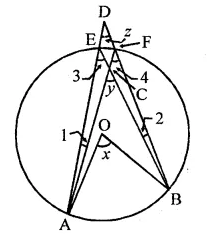
In the figure, O is the centre of the circle, prove that ∠x = ∠y + ∠z.
Solution:
Given : In circle, O is centre
RD Sharma Class 9 Solutions Chapter 15 Areas of Parallelograms and Triangles Ex 15.4 Q10.1
To prove : ∠x = ∠y + ∠z
Proof : ∵ ∠3 and ∠4 are in the same segment of the circle
∴ ∠3 = ∠4 …(i)
∵ Arc AB subtends ∠AOB at the centre and ∠3 at the remaining part of the circle
∴ ∠x = 2∠3 = ∠3 + ∠3 = ∠3 + ∠4 (∵ ∠3 = ∠4) …(ii)
In ∆ACE,
Ext. ∠y = ∠3 + ∠1
(Ext. is equal to sum of its interior opposite angles)
⇒ ∠3 – ∠y – ∠1 …(ii)
From (i) and (ii),
∠x = ∠y – ∠1 + ∠4 …(iii)
Similarly in ∆ADF,
Ext. ∠4 = ∠1 + ∠z …(iv)
From (iii) and (iv)
∠x = ∠y-∠l + (∠1 + ∠z)
= ∠y – ∠1 + ∠1 + ∠z = ∠y + ∠z
Hence ∠x = ∠y + ∠z

Question 11.
In the figure, O is the centre of a circle and PQ is a diameter. If ∠ROS = 40°, find ∠RTS.
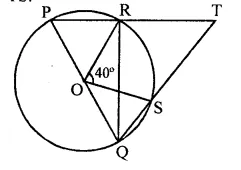
RD Sharma Class 9 Solutions Chapter 15 Areas of Parallelograms and Triangles Ex 15.4 Q11.1
Solution:
In the figure, O is the centre of the circle,
PQ is the diameter and ∠ROS = 40°
Now we have to find ∠RTS
Arc RS subtends ∠ROS at the centre and ∠RQS at the remaining part of the circle
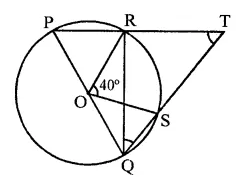
RD Sharma Class 9 Solutions Chapter 15 Areas of Parallelograms and Triangles Ex 15.4 Q11.2
∴ ∠RQS = \(\frac { 1 }{ 2 }\) ∠ROS
= \(\frac { 1 }{ 2 }\) x 40° = 20°
∵ ∠PRQ = 90° (Angle in a semi circle)
∴ ∠QRT = 180° – 90° = 90° (∵ PRT is a straight line)
Now in ∆RQT,
∠RQT + ∠QRT + ∠RTQ = 180° (Angles of a triangle)
⇒ 20° + 90° + ∠RTQ = 180°
⇒ ∠RTQ = 180° – 20° – 90° = 70° or ∠RTS = 70°
Hence ∠RTS = 70°

Hope given RD Sharma Class 9 Solutions Chapter 15 Areas of Parallelograms and Triangles Ex 15.4 are helpful to complete your math homework.

If you have any doubts, please comment below. Learn Insta try to provide online math tutoring for you.
RS Aggarwal Class 8 Solutions Chapter 11 Compound Interest Ex 11B

RS Aggarwal Class 8 Solutions Chapter 11 Compound Interest Ex 11B

These Solutions are part of RS Aggarwal Solutions Class 8. Here we have given RS Aggarwal Solutions Class 8 Chapter 11 Compound Interest Ex 11B.

Other Exercises

By using the formula, find the amount and compound interest on :

Question 1.
Solution:
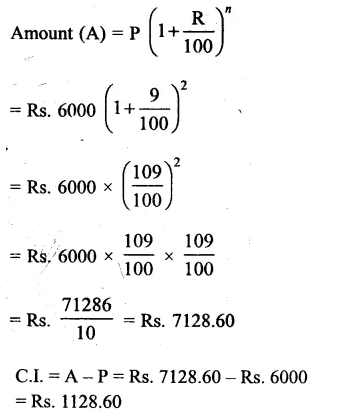
Principal (P) = Rs. 6000
Rate (R) = 9% p.a.
Period (n) = 2 years
RS Aggarwal Class 8 Solutions Chapter 11 Compound Interest Ex 11B 1.1

Question 2.
Solution:
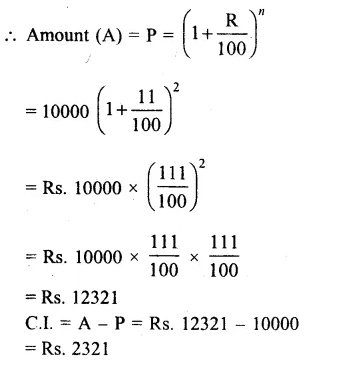
Principal (P) = Rs. 10000
Rate (R) = 11% p.a.
Period (n) = 2 years
RS Aggarwal Class 8 Solutions Chapter 11 Compound Interest Ex 11B 2.1

You can also Download NCERT Solutions for Class 8 Maths to help you to revise complete Syllabus and score more marks in your examinations.

Question 3.
Solution:
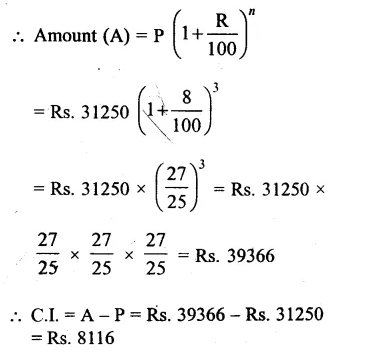
Principal (P) = Rs. 31250
Rate (R) = 8% p.a.
Period (n) = 3 years
RS Aggarwal Class 8 Solutions Chapter 11 Compound Interest Ex 11B 3.1

Question 4.
Solution:
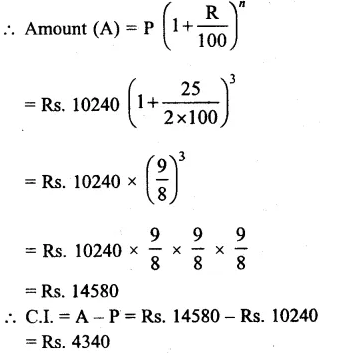
Principal (P) = Rs. 10240
Rate (R) = \(12\frac { 1 }{ 2 } \)% = \(\\ \frac { 25 }{ 2 } \)% p.a.
Period (n) = 3 years
RS Aggarwal Class 8 Solutions Chapter 11 Compound Interest Ex 11B 4.1

Question 5.
Solution:
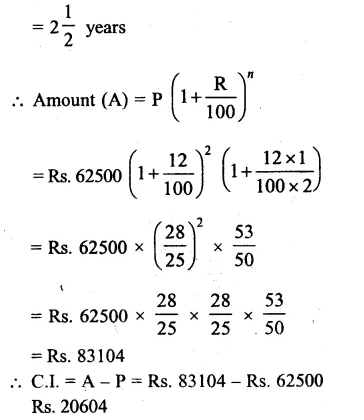
Principal (P) = Rs. 62500
Rate (R) = 12% p.a.
Period (n) = 2 years 6 months
RS Aggarwal Class 8 Solutions Chapter 11 Compound Interest Ex 11B 5.1

Question 6.
Solution:
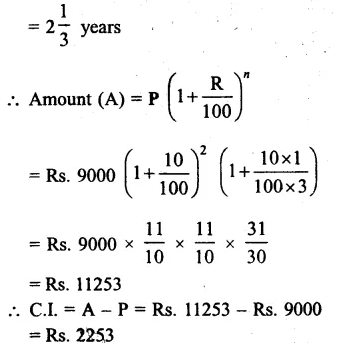
Principal (P) = Rs. 9000
Rate (R) = 10% p.a.
Period (n) = 2 years 4 months
RS Aggarwal Class 8 Solutions Chapter 11 Compound Interest Ex 11B 6.1

Question 7.
Solution:
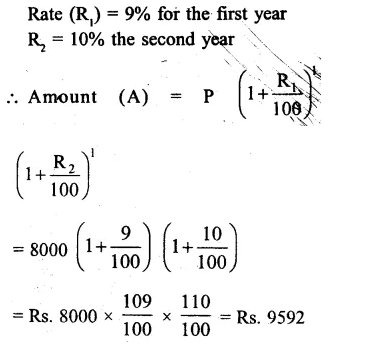
Principal (P) = Rs. 8000
Period (n) = 2 years
RS Aggarwal Class 8 Solutions Chapter 11 Compound Interest Ex 11B 7.1

Question 8.
Solution:
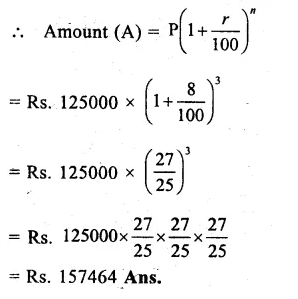
Principal (p) = Rs. 1, 25,000
Rate of interest (r) = 8% p.a.
Period (n) = 3 years
RS Aggarwal Class 8 Solutions Chapter 11 Compound Interest Ex 11B 8.1

Question 9.
Solution:
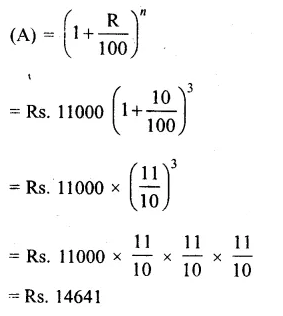
Price of a buffalo (P) = Rs. 11000
Rate of interest (R) = 10% p.a.
Period (n) = 3 years
Price of buffalo at present
RS Aggarwal Class 8 Solutions Chapter 11 Compound Interest Ex 11B 9.1

Question 10.
Solution:
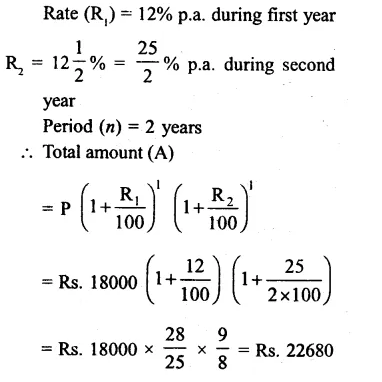
Amount of loan taken (P)
= Rs. 18000
RS Aggarwal Class 8 Solutions Chapter 11 Compound Interest Ex 11B 10.1

Question 11.
Solution:
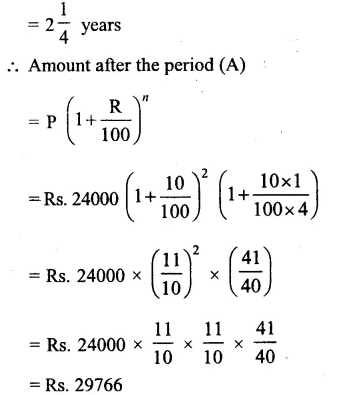
Amount borrowed from Bank (P) = Rs. 24000
Rate (R) = 10% p.a.
Period (n) = 2 years 3 months
RS Aggarwal Class 8 Solutions Chapter 11 Compound Interest Ex 11B 11.1

Question 12.
Solution:
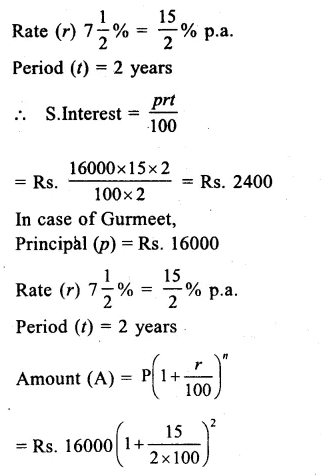
In case of Abhay,
Principal (p) = Rs. 16000
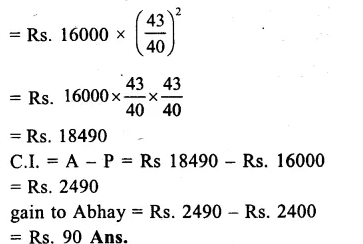
RS Aggarwal Class 8 Solutions Chapter 11 Compound Interest Ex 11B 12.1
RS Aggarwal Class 8 Solutions Chapter 11 Compound Interest Ex 11B 12.2

Question 13.
Solution:
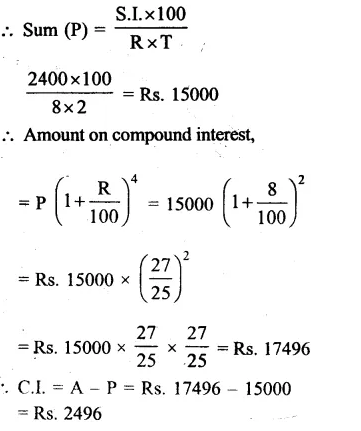
Simple interest (S.I.) = Rs. 2400
Rate (R) = 8% p.a.
Period (T) = 2 years
RS Aggarwal Class 8 Solutions Chapter 11 Compound Interest Ex 11B 13.1

Question 14.
Solution:
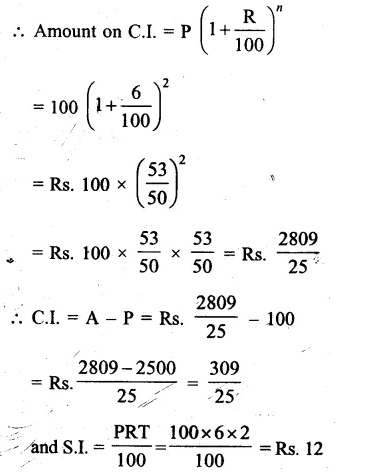
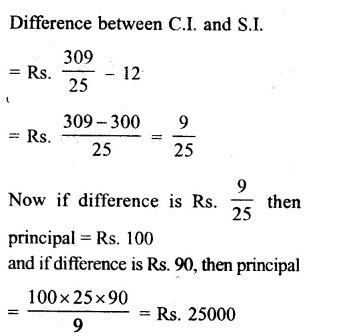
Difference between C.I. and S.I.
= Rs. 90
Rate (R) = 6% p.a.
Period (n) = 2 years
Let principal (P) = Rs. 100
RS Aggarwal Class 8 Solutions Chapter 11 Compound Interest Ex 11B 14.1
RS Aggarwal Class 8 Solutions Chapter 11 Compound Interest Ex 11B 14.2

Question 15.
Solution:
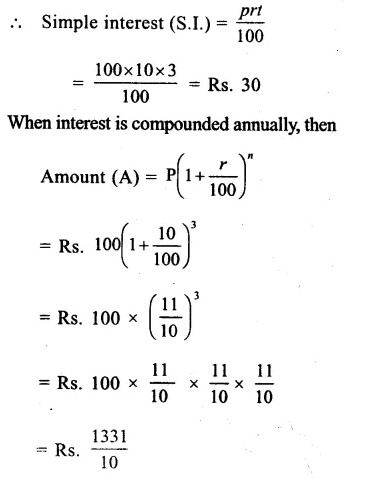
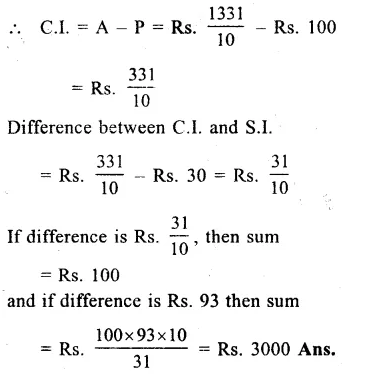
Let sum (p) = Rs. 100
Rate (r) 10% p.a.
Period (t) = 3 years.
RS Aggarwal Class 8 Solutions Chapter 11 Compound Interest Ex 11B 15.1
RS Aggarwal Class 8 Solutions Chapter 11 Compound Interest Ex 11B 15.2

Question 16.
Solution:
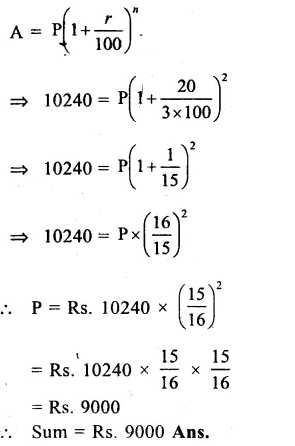
Amount (A) = Rs. 10240
Rate (r) = \(6\frac { 2 }{ 3 } \)% = \(\\ \frac { 20 }{ 3 } \)% p.a.
Period (n) = 2 years
Let sum = P, then
RS Aggarwal Class 8 Solutions Chapter 11 Compound Interest Ex 11B 16.1

Question 17.
Solution:
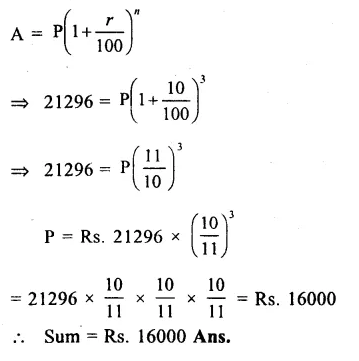
Amount (A) = Rs. 21296
Rate (r) = 10% p.a.
Period (n) = 3 years.
Let P be the sum, Then
RS Aggarwal Class 8 Solutions Chapter 11 Compound Interest Ex 11B 17.1

Question 18.
Solution:
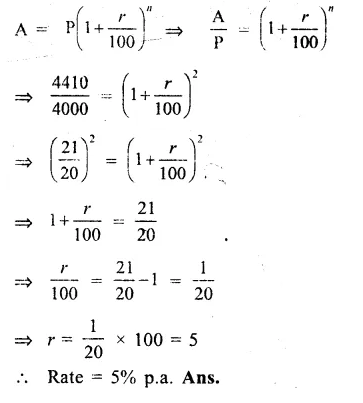
Principal (P) = 4000
Amount (A) = Rs. 4410
Period (n) = 2 years
Let r be the rate per cent per annum
We know that,
RS Aggarwal Class 8 Solutions Chapter 11 Compound Interest Ex 11B 18.1

Question 19.
Solution:
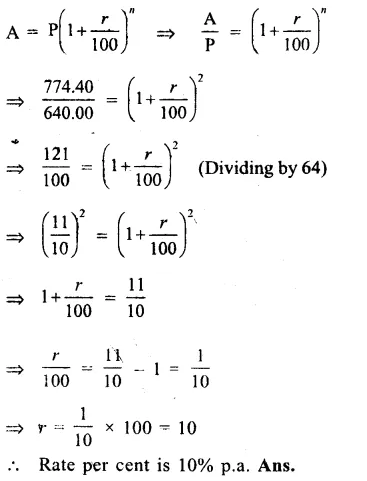
Principal (P) = Rs. 640
Amount (A) = Rs. 774.40
Period (n) = 2 years
Let r be the rate per cent per annum.
We know that
RS Aggarwal Class 8 Solutions Chapter 11 Compound Interest Ex 11B 19.1

Question 20.
Solution:
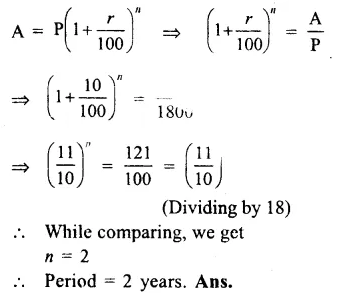
Principal (P) = Rs. 1800
Amount (A) = Rs. 2178
Rate (r) = 10% p.a.
Let n be the number of years,
We know that
RS Aggarwal Class 8 Solutions Chapter 11 Compound Interest Ex 11B 20.1

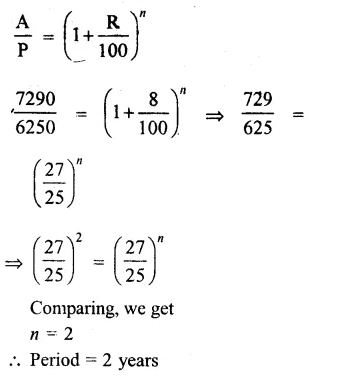
Question 21.
Solution:
Principal (P) = Rs. 6250
Amount (A) = Rs. 7290
Rate (R) = 8% p.a.
Let n be the time, then
RS Aggarwal Class 8 Solutions Chapter 11 Compound Interest Ex 11B 21.1

Question 22.
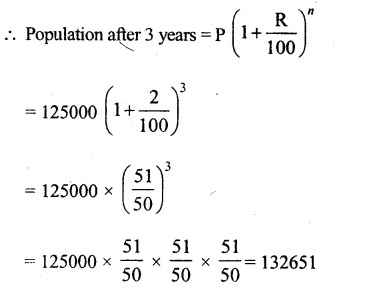
Solution:
Present population (P) = 125000
Rate of increasing (R) = 2% p.a.
Period (n) = 3 years
RS Aggarwal Class 8 Solutions Chapter 11 Compound Interest Ex 11B 22.1

Question 23.
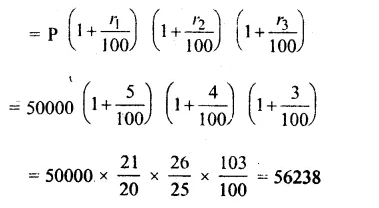
Solution:
3 years ago, the population was = 50000
Rate of increase successively (r1, r2, r3) = 4%, 5% and 3% p.a.
Period (n) = 3 years
Present Population
RS Aggarwal Class 8 Solutions Chapter 11 Compound Interest Ex 11B 23.1

Question 24.
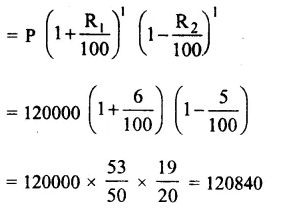
Solution:
Population of a city in 2013 = 120000
Increase in next year = 6%
and decrease in the following year = 5%
Population in 2015
RS Aggarwal Class 8 Solutions Chapter 11 Compound Interest Ex 11B 24.1

Question 25.
Solution:
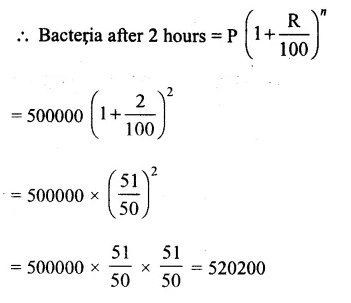
Initially bacteria = 500000
Increase in bacteria = 2% per hour
Period (n) = 2 hours
RS Aggarwal Class 8 Solutions Chapter 11 Compound Interest Ex 11B 25.1

Question 26.
Solution:
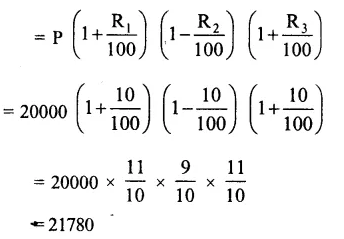
Growth of bacteria in a culture (R1) = 10% in first hour
Decrease in next hour (R2) = 10%
Increase in the third hour (R3) = 10%
Bacteria in the beginning = 20000
Bacteria after 3 hours
RS Aggarwal Class 8 Solutions Chapter 11 Compound Interest Ex 11B 26.1

Question 27.
Solution:
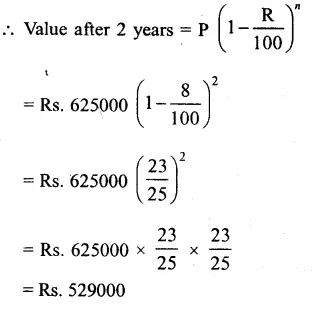
Value of machine (P) = Rs. 625000
Rate of depreciation (R) = 8% p.a.
Period (n) = 2 years
RS Aggarwal Class 8 Solutions Chapter 11 Compound Interest Ex 11B 27.1

Question 28.
Solution:
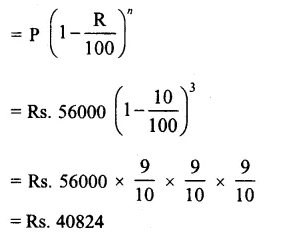
Value of scooter (P) = Rs. 56000
Rate of depreciation (R) = 10% p.a.
Period = 3 years
Value of scooter after 3 years
RS Aggarwal Class 8 Solutions Chapter 11 Compound Interest Ex 11B 28.1

Question 29.
Solution:
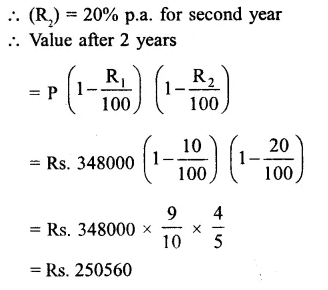
Cost of car = Rs. 34800
Rate of depreciation (R1) = 10% p.a. for first year
RS Aggarwal Class 8 Solutions Chapter 11 Compound Interest Ex 11B 29.1

Question 30.
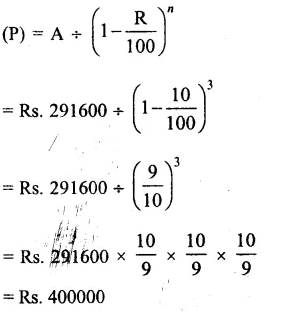
Solution:
Rate of depreciation (R) = 10% p.a.
Period (n) = 3 years
Present value (A) = Rs. 291600
Value of machine 3 years ago
RS Aggarwal Class 8 Solutions Chapter 11 Compound Interest Ex 11B 30.1

Hope given RS Aggarwal Solutions Class 8 Chapter 11 Compound Interest Ex 11B are helpful to complete your math homework.

If you have any doubts, please comment below. Learn Insta try to provide online math tutoring for you.
RS Aggarwal Class 8 Solutions Chapter 11 Compound Interest Ex 11A

RS Aggarwal Class 8 Solutions Chapter 11 Compound Interest Ex 11A

These Solutions are part of RS Aggarwal Solutions Class 8. Here we have given RS Aggarwal Solutions Class 8 Chapter 11 Compound Interest Ex 11A.

Other Exercises

Question 1.
Solution:
Principal (p) = Rs. 2500
Rate (r) = 10% p.a.
Period (t) = 2 years
Interest for the first year = \(\\ \frac { prt }{ 100 } \)
= \(\\ \frac { 2500X10X1 }{ 100 } \)
= Rs. 250
Amount at the end of first year = Rs. 2500 + Rs. 250
= Rs 2750
Principal for the second year = Rs 2750
Interest for the second year = Rs \(\\ \frac { 2750X10X1 }{ 100 } \)
= Rs. 275
Amount at the end of second year = Rs 2750 + Rs. 275
= Rs. 305
and compound interest for the 2 years = Rs. 3025 – Rs. 2500
= Rs 525 Ans.

Question 2.
Solution:
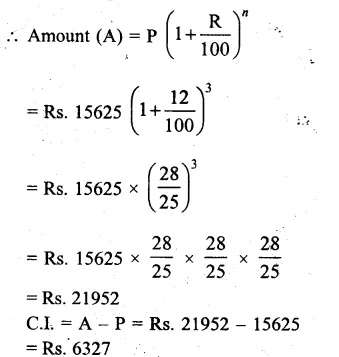
Principal (P) = Rs. 15625 Rate
(R) = 12% p.a.
Period (n) = 3 years
RS Aggarwal Class 8 Solutions Chapter 11 Compound Interest Ex 11A 2.1

Question 3.
Solution:
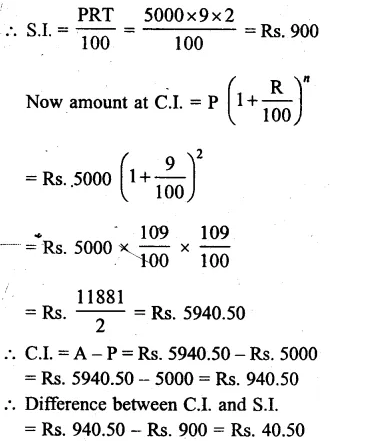
Principal (P) = Rs. 5000
Rate (R) = 9% p.a.
Time (n) = 2 years
RS Aggarwal Class 8 Solutions Chapter 11 Compound Interest Ex 11A 3.1

Question 4.
Solution:
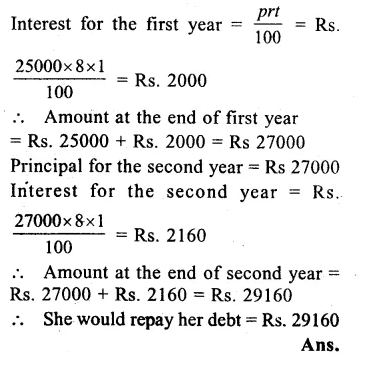
Amount of loan (p) = Rs. 25000
Rate of interest (r) = 8% p.a.
Period (t) = 2 years
RS Aggarwal Class 8 Solutions Chapter 11 Compound Interest Ex 11A 4.1

Question 5.
Solution:
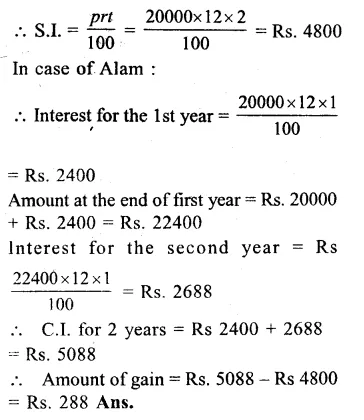
In case of Harpreet :
Amount borrowed by Harpreet (P) = Rs. 20000
Rate (r) = 12%
Period (t) = 2 Years
RS Aggarwal Class 8 Solutions Chapter 11 Compound Interest Ex 11A 5.1

Question 6.
Solution:
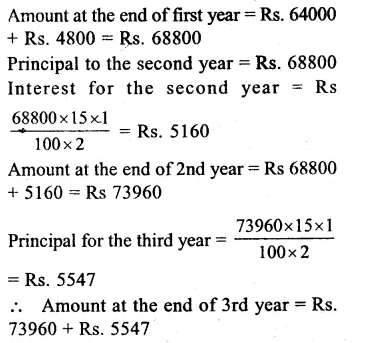
Principal (p) = Rs. 64000
Rate (r) = \(7\frac { 1 }{ 2 } \) = \(\\ \frac { 15 }{ 2 } \)%
Period (t) = 3 years
Interest for the first year = \(\\ \frac { prt }{ 100 } \)
= Rs \(\\ \frac { 64000X15X1 }{ 100X2 } \)
= Rs 4800
RS Aggarwal Class 8 Solutions Chapter 11 Compound Interest Ex 11A 6.1
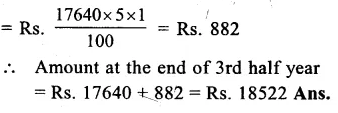
= Rs 79507

Question 7.
Solution:
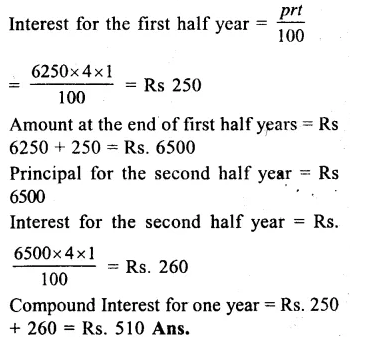
Principal (p) = Rs 6250
Rate (r) 8% p.a. or 4% half yearly
Period (t) = 1 year = 2 half years
RS Aggarwal Class 8 Solutions Chapter 11 Compound Interest Ex 11A 7.1

Question 8.
Solution:
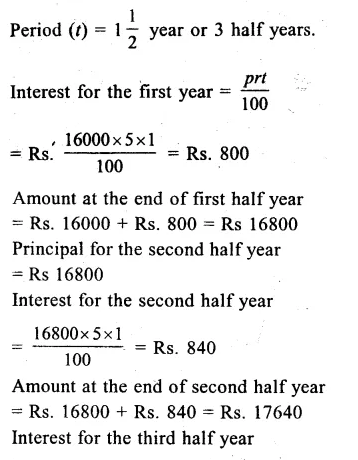
Principal (p) = Rs. = 16000
Rate (r) = 10% p.a. or 5% half yearly
RS Aggarwal Class 8 Solutions Chapter 11 Compound Interest Ex 11A 8.1
RS Aggarwal Class 8 Solutions Chapter 11 Compound Interest Ex 11A 8.2


Hope given RS Aggarwal Solutions Class 8 Chapter 11 Compound Interest Ex 11A are helpful to complete your math homework.

If you have any doubts, please comment below. Learn Insta try to provide online math tutoring for you.
RD Sharma Class 9 Solutions Chapter 15 Areas of Parallelograms and Triangles Ex 15.3

RD Sharma Class 9 Solutions Chapter 15 Areas of Parallelograms and Triangles Ex 15.3

These Solutions are part of RD Sharma Class 9 Solutions. Here we have given RD Sharma Class 9 Solutions Chapter 15 Areas of Parallelograms and Triangles Ex 15.3

Other Exercises

Question 1.
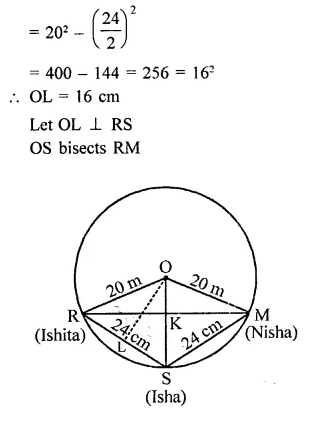
Three girls Ishita, Isha and Nisha are playing a game by standing on a circle of radius 20 m drawn in a park. Ishita throws a ball to Isha, Isha to Nisha and Nisha to Ishita. If the distance between Ishita and Isha and between Isha and Nisha is 24 m each, what is the distance between Ishita and Nisha. [NCERT]
Solution:
∵ Distance between Isha and Ishita and Ishita and Nisha is same
∴ RS = SM = 24 m
∴They are equidistant from the centre
In right ∆ORL,
OL² = OR² – RL²
RD Sharma Class 9 Solutions Chapter 15 Areas of Parallelograms and Triangles Ex 15.3 Q1.1
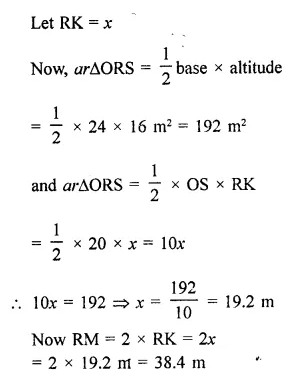
RD Sharma Class 9 Solutions Chapter 15 Areas of Parallelograms and Triangles Ex 15.3 Q1.2
Hence distance between Ishita and Nisha = 38.4 m

Question 2.
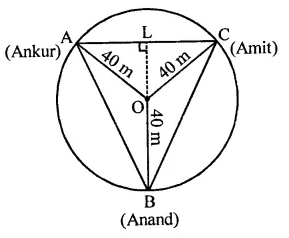
A circular park of radius 40 m is situated in a colony. Three beys Ankur, Amit and Anand are sitting at equal distance on its boundary each having a toy telephone in his hands to talk to each other. Find thelength of the string of each phone. [NCERT]
Solution:
Radius of circular park = 40 m
Ankur, Amit and Anand are sitting at equal distance to each other By joining them, an equilateral triangle ABC is formed produce BO to L which is perpendicular bisector of AC
RD Sharma Class 9 Solutions Chapter 15 Areas of Parallelograms and Triangles Ex 15.3 Q2.1
∴ BL = 40 + 20 = 60 m (∵ O is centroid of ∆ABC also)
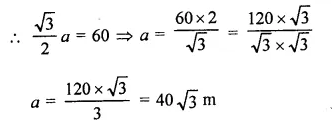
Let a be the side of ∆ABC
RD Sharma Class 9 Solutions Chapter 15 Areas of Parallelograms and Triangles Ex 15.3 Q2.2
Hence the distance between each other = 40\(\sqrt { 3 } \) m

Hope given RD Sharma Class 9 Solutions Chapter 15 Areas of Parallelograms and Triangles Ex 15.3 are helpful to complete your math homework.

If you have any doubts, please comment below. Learn Insta try to provide online math tutoring for you.
RD Sharma Class 9 Solutions Chapter 15 Areas of Parallelograms and Triangles Ex 15.2

RD Sharma Class 9 Solutions Chapter 15 Areas of Parallelograms and Triangles Ex 15.2

These Solutions are part of RD Sharma Class 9 Solutions. Here we have given RD Sharma Class 9 Solutions Chapter 15 Areas of Parallelograms and Triangles Ex 15.2
Other Exercises

Question 1.
The radius of a circle is 8 cm and the length of one of its chords is 12 cm. Find the distance of the chord from the centre.
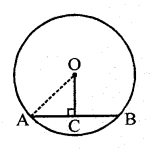
Solution:
Radius of circle with centre O is OA = 8 cm
Length of chord AB = 12 cm
OC ⊥ AB which bisects AB at C
RD Sharma Class 9 Solutions Chapter 15 Areas of Parallelograms and Triangles Ex 15.2 Q1.1
∴ AC = CB = 12 x \(\frac { 1 }{ 2 }\) = 6 cm
In ∆OAC,
OA2 = OC2 + AC2 (Pythagoras Theorem)
⇒ (8)2 = OC2 + (6)2
⇒ 64 = OC2 + 36
OC2 = 64 – 36 = 28
∴ OC = \(\sqrt { 28 } \) = \(\sqrt { 4×7 } \) cm
= 2 x 2.6457 = 5.291 cm

Question 2.
Find the length of a chord which is at a distance of 5 cm from the centre of a circle of radius 10 cm.
Solution:
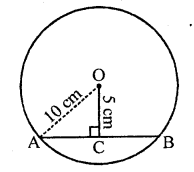
Let AB be a chord of a circle with radius 10 cm. OC ⊥ AB
∴ OA = 10 cm
OC = 5 cm
RD Sharma Class 9 Solutions Chapter 15 Areas of Parallelograms and Triangles Ex 15.2 Q2.1
∵ OC divides AB into two equal parts
i.e. AC = CB
Now in right AOAC,
OA2 = OC2 + AC2 (Pythagoras Theorem)
⇒ (10)2 = (5)2 + AC2
⇒ 100 = 25 + AC2
⇒ AC2 = 100 – 25 = 75
∴ AC = \(\sqrt { 75 } \)= \(\sqrt { 25×3 } \) = 5 x 1.732
∴ AB = 2 x AC = 2 x 5 x 1.732 = 10 x 1.732 = 17.32 cm

Question 3.
Find the length of a chord which is at a distance of 4 cm from the centre of the circle of radius 6 cm.
Solution:
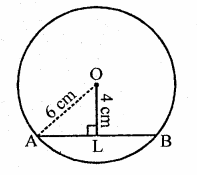
In a circle with centre O and radius 6 cm and a chord AB at a distance of 4 cm from the centre of the circle
i.e. OA = 6 cm and OL ⊥ AB, OL = 4 cm
RD Sharma Class 9 Solutions Chapter 15 Areas of Parallelograms and Triangles Ex 15.2 Q3.1
∵ Perpendicular OL bisects the chord AB at L 1
∴ AL = LB=\(\frac { 1 }{ 2 }\) AB
Now in right ∆OAL,
OA2 = OL2 + AL2 (Pythagoras Theorem)
(6)2 = (4)2 + AL2
⇒ 36=16+AL2
⇒ AL2 = 36 – 16 = 20
∴ AL = \(\sqrt { 20 } \) = \(\sqrt { 4×5 } \) = 2 x 2.236 = 4.472 cm
∴ Chord AB = 4.472 x 2 = 8.944 = 8.94 cm

Question 4.
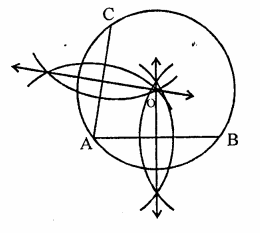
Give a method to find the centre of a given circle.
Solution:
Steps of construction :
RD Sharma Class 9 Solutions Chapter 15 Areas of Parallelograms and Triangles Ex 15.2 Q4.1
(i) Take three distinct points on the circle say A, B and C.
(ii) Join AB and AC.
(iii) Draw the perpendicular bisectors of AB and AC which intersect each other at O.
O is the required centre of the given circle

Question 5.
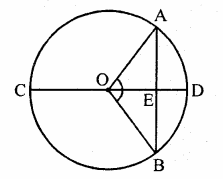
Prove that a diameter of a circle which bisects a chord of the circle also bisects the angle subtended by the chord at the centre of the circle.
Solution:
Given : In circle with centre O
CD is the diameter and AB is the chord
which is bisected by diameter at E
OA and OB are joined
RD Sharma Class 9 Solutions Chapter 15 Areas of Parallelograms and Triangles Ex 15.2 Q5.1
To prove : ∠AOB = ∠BOA
Proof : In ∆OAE and ∆OBE
OA = OB (Radii of the circle)
OE = OE (Common)
AE = EB (Given)
∴ ∆OAE = ∆OBE (SSS criterian)
∴ ∠AOE = ∠BOE (c.p.c.t.)
Hence diameter bisect the angle subtended by the chord AB.

Question 6.
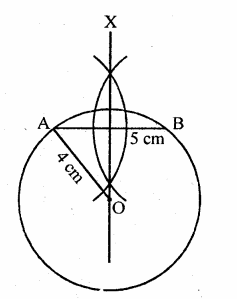
A line segment AB is of length 5 cm. Draw a circle of radius 4 cm passing through A and B. Can you draw a circle of radius 2 cm passing through A and B? Give reason in support of your answer.
Solution:
Steps of construction :
(i) Draw a line segment AB = 5 cm.
(ii) Draw a perpendicular bisector of AB.
(iii) With centre A and radius 4 cm, draw an arc which intersects the perpendicular bisector at O.
(iv) With centre O and radius 4 cm, draw a circle which passes through A and B.
With radius 2 cm, we cannot draw the circle passing through A and B as diameter
i. e. 2 + 2 = 4 cm is shorder than 5 cm.
RD Sharma Class 9 Solutions Chapter 15 Areas of Parallelograms and Triangles Ex 15.2 Q6.1

Question 7.
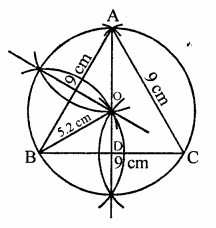
An equilateral triangle of side 9 cm is inscribed in a circle. Find the radius of the circle.
Solution:
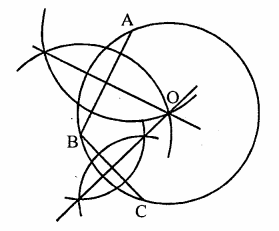
Steps of construction :
(i) Draw a line segment BC = 9 cm.
(ii) With centres B and C, draw arcs of 9 cm radius which intersect each other at A.
(iii) Join AB and AC.
∆ABC is the required triangle.
(iv) Draw perpendicular bisectors of sides AB and BC which intersect each other at O.
(v) With centre O and radius OB, draw a circle which passes through A, B and C.
This is the require circle in which ∆ABC is inscribed.
RD Sharma Class 9 Solutions Chapter 15 Areas of Parallelograms and Triangles Ex 15.2 Q7.1
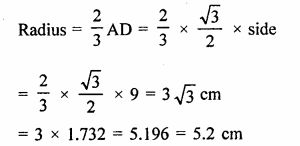
On measuring its radius, it is 5.2 cm
RD Sharma Class 9 Solutions Chapter 15 Areas of Parallelograms and Triangles Ex 15.2 Q7.2

Question 8.
Given an arc of a circle, complete the circle.
Solution:
Steps of construction :
(i) Take three points A, B and C on the arc and join AB and BC.
(ii) Draw the perpendicular bisector of AB and BC which intersect each other at O.
RD Sharma Class 9 Solutions Chapter 15 Areas of Parallelograms and Triangles Ex 15.2 Q8.1
(iii) With centre O and radius OA or OB, complete the circle.
This is the required circle.

Question 9.
Draw different pairs of circles. How many points does each pair have in common? What is the maximum number of common points?
Solution:
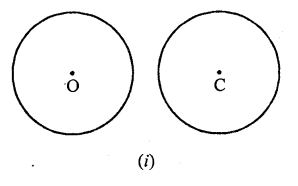
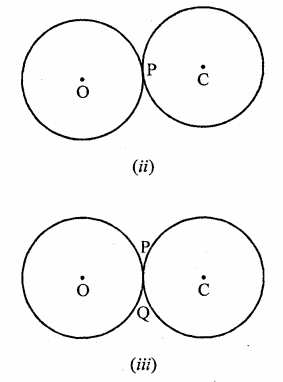
Below, three different pairs of circles are drawn:
RD Sharma Class 9 Solutions Chapter 15 Areas of Parallelograms and Triangles Ex 15.2 Q9.1
RD Sharma Class 9 Solutions Chapter 15 Areas of Parallelograms and Triangles Ex 15.2 Q9.2
(i) In the first pair, two circles do not intersect each other. Therefore they have no point in common. .
(ii) In the second pair, two circles intersect (touch) each other at one point P. Therefore they have one point in common.
(iii) In the third pair, two circles intersect each other at two points. Therefore they have two points in common.
There is no other possibility of two circles intersecting each other.
Therefore, two circles have at the most two points in common.

Question 10.
Suppose you are given a circle. Give a construction to find its centre.
Solution:
See Q. No. 4 of this exercise.

Question 11.
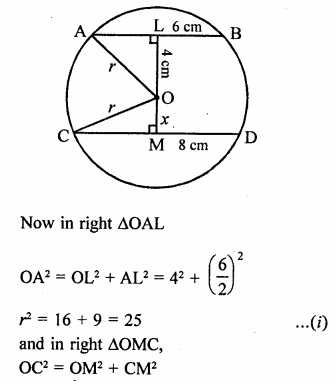
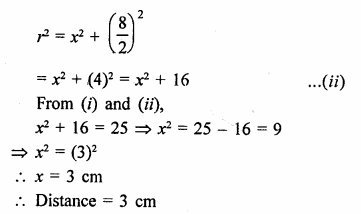
The length of two parallel chords of a circle are 6 cm and 8 cm. If the smaller chord is at a distance of 4 cm from the centre, what is the distance of the other chord from the centre? [NCERT]
Solution:
A circle with centre O and two parallel chords
AB and CD are AB = 6 cm, CD = 8 cm
Let OL ⊥ AB and OM ⊥ CD
∴ OL = 4 cm
Let OM = x cm
Let r be the radius of the circle
RD Sharma Class 9 Solutions Chapter 15 Areas of Parallelograms and Triangles Ex 15.2 Q11.1
RD Sharma Class 9 Solutions Chapter 15 Areas of Parallelograms and Triangles Ex 15.2 Q11.2

Question 12.
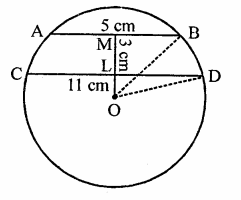
Two chords AB, CD of lengths 5 cm and 11 cm respectively of a circle are parallel. If the distance between AB and CD is 3 cm, find the radius of the circle.
Solution:
Let two chords AB and CD of length 5 cm and 11 cm are parallel to each other AB = 5 cm, CD = 11 cm
Distance between AB and LM = 3 cm
Join OB and OD
OL and OM are the perpendicular on CD and AB respectively. Which bisects AB and CD.
Let OL = x, then OM = (x + 3)
RD Sharma Class 9 Solutions Chapter 15 Areas of Parallelograms and Triangles Ex 15.2 Q12.1
Now in right ∆OLD,
OD2 = OL2 + LD2
= x2 + (5.5)2
Similarly in right ∆OMB,
OB2 = OM2 + MB2 = (x + 3)2 + (2.5)2
But OD = OB (Radii of the circle)
∴ (x + 3)2 + (2.5)2 = x2 + (5.5)2
x2 + 6x + 9 + 6.25 = x2 + 30.25
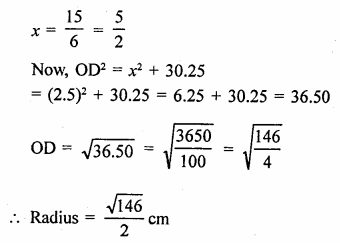
6x = 30.25 – 6.25 – 9 = 15
RD Sharma Class 9 Solutions Chapter 15 Areas of Parallelograms and Triangles Ex 15.2 Q12.2

Question 13.
Prove that the line joining the mid-point of a chord to the centre of the circle passes through the mid-point of the corresponding minor arc.
Solution:
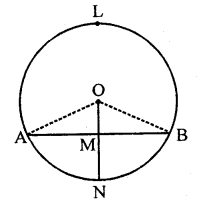
Given : A circle with centre O and a chord AB
Let M be the mid point of AB and OM is joined and produced to meet the minor arc AB at N
To prove : M is the mid point of arc AB
Construction : Join OA, OB
RD Sharma Class 9 Solutions Chapter 15 Areas of Parallelograms and Triangles Ex 15.2 Q13.1
Proof: ∵ M is mid point of AB
∴ OM ⊥ AB
In AOAM and OBM,
OA = OB (Radii of the circle)
OM = OM (common)
AM = BM (M is mid point of AB)
∴ ∆OAM = ∆OBM (SSS criterian)
∴ ∠AOM = ∠BOM (c.p.c.t.)
⇒ ∠AOM = ∠BOM
But these are centre angles at the centre made by arcs AN and BN
∴ Arc AN = Arc BN
Hence N divides the arc in two equal parts

Question 14.
Prove that two different circles cannot intersect each other at more than two points.
Solution:
Given : Two circles
To prove : They cannot intersect each other more than two points
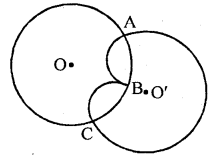
Construction : Let two circles intersect each other at three points A, B and C
RD Sharma Class 9 Solutions Chapter 15 Areas of Parallelograms and Triangles Ex 15.2 Q14.1
Proof : Since two circles with centres O and O’ intersect at A, B and C
∴ A, B and C are non-collinear points
∴ Circle with centre O passes through three points A, B and C
and circle with centre O’ also passes through three points A, B and C
But one and only one circle can be drawn through three points
∴Our supposition is wrong
∴ Two circle cannot intersect each other not more than two points.

Question 15.
Two chords AB and CD of lengths 5 cm and 11 cm respectively of a circle are parallel to each other and are opposite side of its centre. If the distance between AB and CD is 6 cm, find the radius of the circle. [NCERT]
Solution:
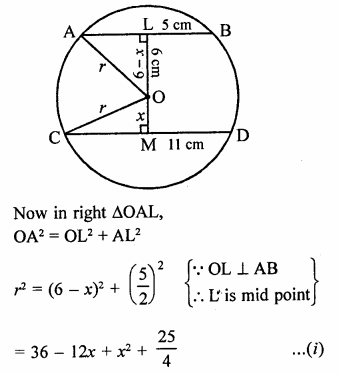
Let r be the radius of the circle with centre O.
Two parallel chords AB = 5 cm, CD = 11 cm
Let OL ⊥ AB and OM ⊥CD
∴ LM = 6 cm
Let OM = x, then
OL = 6 – x
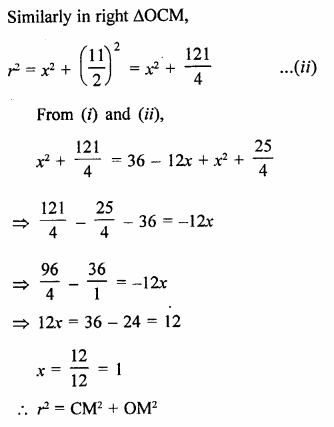
RD Sharma Class 9 Solutions Chapter 15 Areas of Parallelograms and Triangles Ex 15.2 Q15.1
RD Sharma Class 9 Solutions Chapter 15 Areas of Parallelograms and Triangles Ex 15.2 Q15.2
RD Sharma Class 9 Solutions Chapter 15 Areas of Parallelograms and Triangles Ex 15.2 Q15.3

Hope given RD Sharma Class 9 Solutions Chapter 15 Areas of Parallelograms and Triangles Ex 15.2 are helpful to complete your math homework.

If you have any doubts, please comment below. Learn Insta try to provide online math tutoring for you.