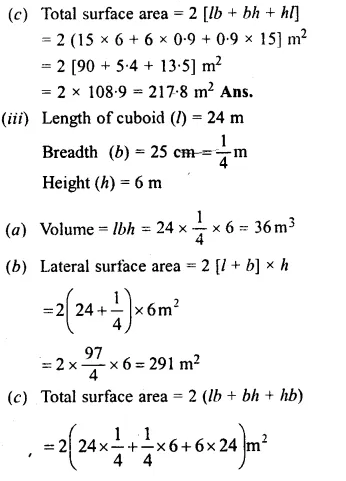
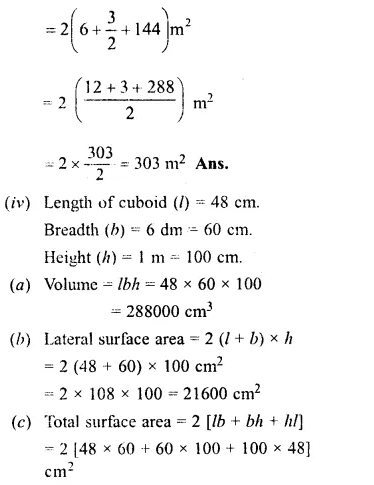
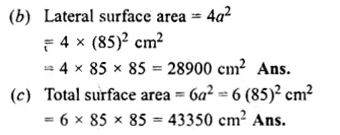
RS Aggarwal Class 8 Solutions Chapter 20 Volume and Surface Area of Solids Ex 20B

RS Aggarwal Class 8 Solutions Chapter 20 Volume and Surface Area of Solids Ex 20B

These Solutions are part of RS Aggarwal Solutions Class 8. Here we have given RS Aggarwal Solutions Class 8 Chapter 20 Volume and Surface Area of Solids Ex 20B.

Other Exercises

Question 1.
Solution:
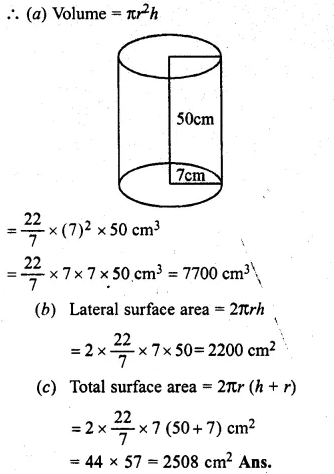
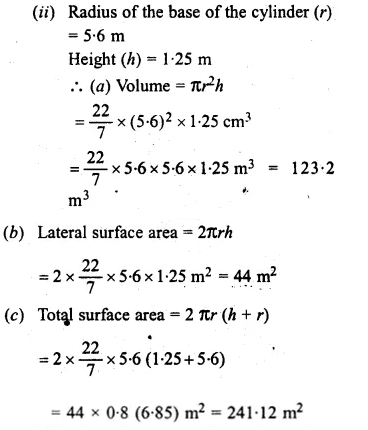
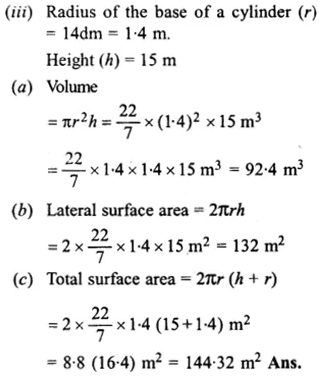
(i) Radius of the base of the cylinder (r) = 7 cm.
Height (h) = 50 cm.
RS Aggarwal Class 8 Solutions Chapter 20 Volume and Surface Area of Solids Ex 20B 1.1
RS Aggarwal Class 8 Solutions Chapter 20 Volume and Surface Area of Solids Ex 20B 1.2
RS Aggarwal Class 8 Solutions Chapter 20 Volume and Surface Area of Solids Ex 20B 1.3

Question 2.
Solution:
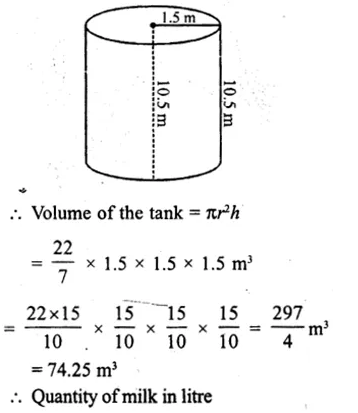
Radius of cylindrical tank (r) = 1.5 m
and height (h) = 10.5 m
RS Aggarwal Class 8 Solutions Chapter 20 Volume and Surface Area of Solids Ex 20B 2.1
= 74.25 x 1000l
= 74250 l

Question 3.
Solution:
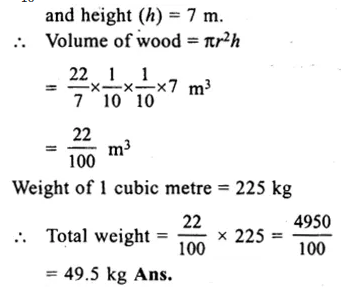
Radius of the base of pole (r)
= 10 dm
= \(\\ \frac { 10 }{ 100 } \) m
= \(\\ \frac { 1 }{ 10 } \) m
RS Aggarwal Class 8 Solutions Chapter 20 Volume and Surface Area of Solids Ex 20B 3.1

Question 4.
Solution:
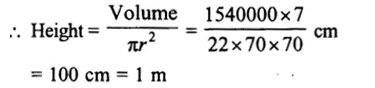
Volume of cylinder = 1.54 m³
= 1540000 cm³
Diameter of its base = 140 cm
Radius (r) = 70 cm
RS Aggarwal Class 8 Solutions Chapter 20 Volume and Surface Area of Solids Ex 20B 4.1

Question 5.
Solution:
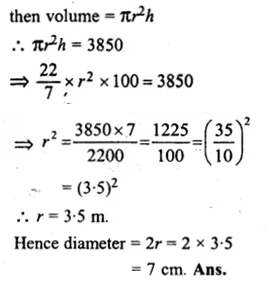
Volume of cylindrical rod = 3850 cm³
Length of rod (h) = 1 m = 100 cm
Let radius of the base of the rod = r
RS Aggarwal Class 8 Solutions Chapter 20 Volume and Surface Area of Solids Ex 20B 5.1

Question 6.
Solution:
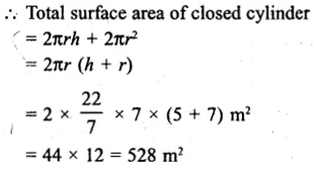
Diameter of closed cylinder = 14 m
Radius = \(\\ \frac { 14 }{ 2 } \)
= 7 m
Height = 5
RS Aggarwal Class 8 Solutions Chapter 20 Volume and Surface Area of Solids Ex 20B 6.1

Question 7.
Solution:
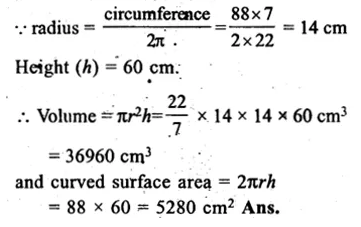
Circumference of the base of cylinder = 88 cm.
RS Aggarwal Class 8 Solutions Chapter 20 Volume and Surface Area of Solids Ex 20B 7.1

Question 8.
Solution:
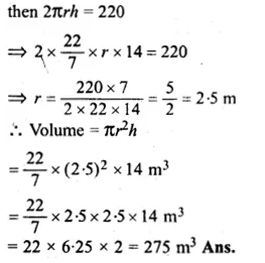
Lateral surface of cylinder = 220 m²
Height (h) = 14 m
Let radius of cylinder = r
RS Aggarwal Class 8 Solutions Chapter 20 Volume and Surface Area of Solids Ex 20B 8.1

Question 9.
Solution:
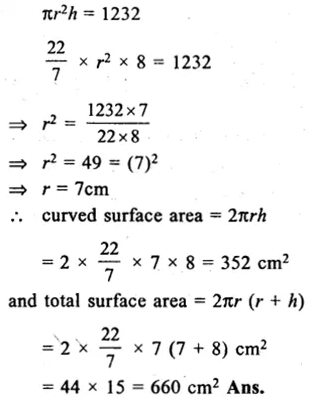
Volume of cylinder = 1232 cm³
height (h) = 8cm
Let r be the radius, then
RS Aggarwal Class 8 Solutions Chapter 20 Volume and Surface Area of Solids Ex 20B 9.1

Question 10.
Solution:
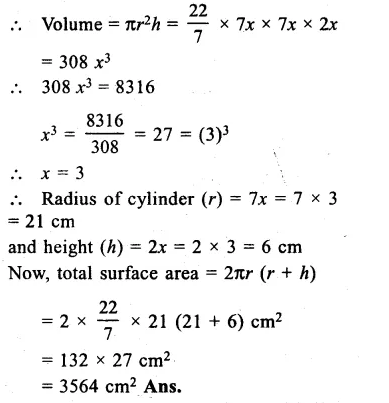
Ratio in radius and height of a cylinder = 7 : 2
Let radius = 7x
then height = 2x
RS Aggarwal Class 8 Solutions Chapter 20 Volume and Surface Area of Solids Ex 20B 10.1

Question 11.
Solution:
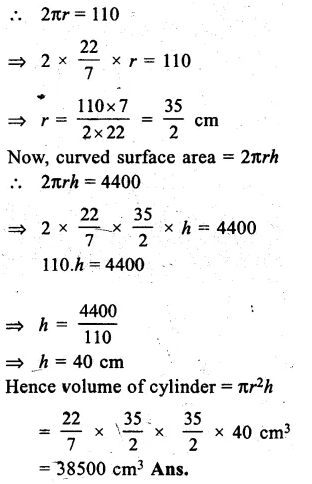
Curved surface area = 4400 cm²
circumference of base = 110 cm
Let r be the radius
RS Aggarwal Class 8 Solutions Chapter 20 Volume and Surface Area of Solids Ex 20B 11.1

Question 12.
Solution:
In first case,
Side of square base (a) = 5 cm.
and height (h) = 14 cm.
Volume = 5 x 5 x 14 = 350 cm³
In second case,
Radius of the circular base (r) = 3.5 cm.
Height (h) = 12 cm.
Volume = πr²h
= \(\\ \frac { 22 }{ 7 } \) x 3.5 x 3.5 x 12 cm³
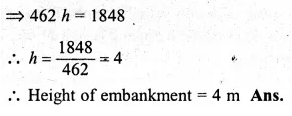
= 462 cm²
Hence second type of circular plastic can has greater capacity.
Difference = 462 – 350
= 112 cm³

Question 13.
Solution:
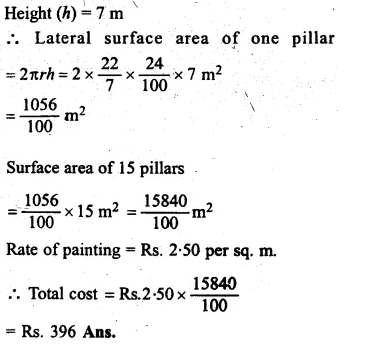
Diameter of a cylindrical pillar = 48 cm.
Radius (r) = \(\\ \frac { 48 }{ 2 } \) = 24 cm.
\(\\ \frac { 24 }{ 100 } \) m
RS Aggarwal Class 8 Solutions Chapter 20 Volume and Surface Area of Solids Ex 20B 13.1

Question 14.
Solution:
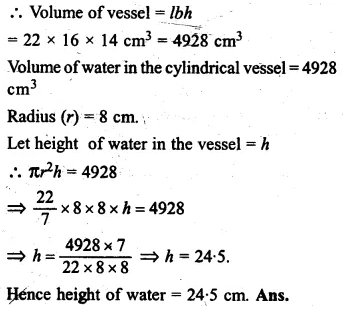
Length of rectangular vessel (l) = 22 cm.
Breadth (A) = 16 cm.
and height (A) = 14 cm.
RS Aggarwal Class 8 Solutions Chapter 20 Volume and Surface Area of Solids Ex 20B 14.1

Question 15.
Solution:
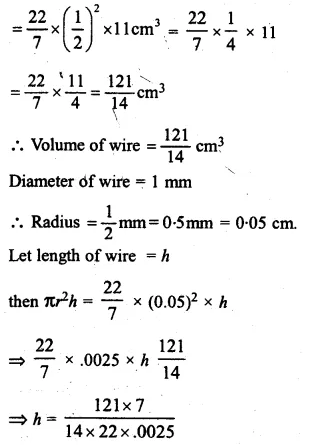
Diameter of cylindrical metal = 1 cm.
Radius (r) = \(\\ \frac { 1 }{ 2 } \) cm.
Length. (A) = 11 cm.
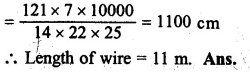
Volume = πr²h
RS Aggarwal Class 8 Solutions Chapter 20 Volume and Surface Area of Solids Ex 20B 15.1
RS Aggarwal Class 8 Solutions Chapter 20 Volume and Surface Area of Solids Ex 20B 15.2

Question 16.
Solution:
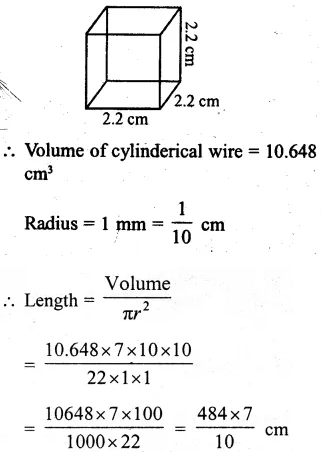
Side of a solid cube = 2.2 cm
Volume = (side)³
= (2.2)³
= 10.648 cm³
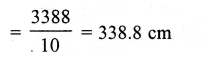
RS Aggarwal Class 8 Solutions Chapter 20 Volume and Surface Area of Solids Ex 20B 16.1
RS Aggarwal Class 8 Solutions Chapter 20 Volume and Surface Area of Solids Ex 20B 16.2

Question 17.
Solution:
Diameter of a well = 7 m
Radius (r) = \(\\ \frac { 7 }{ 2 } \) m
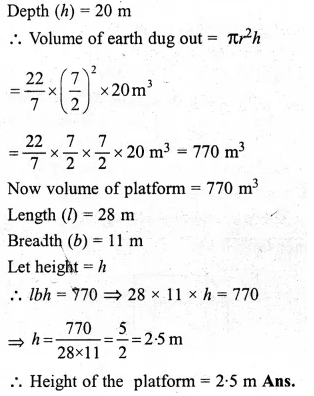
RS Aggarwal Class 8 Solutions Chapter 20 Volume and Surface Area of Solids Ex 20B 17.1

Question 18.
Solution:
Inner diameter of well = 14 m
Inner radius = \(\\ \frac { 14 }{ 2 } \) = 7 m
Depth (h) = 12 m
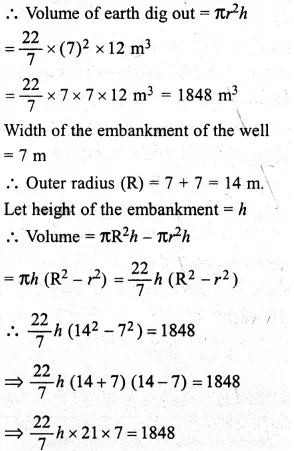
RS Aggarwal Class 8 Solutions Chapter 20 Volume and Surface Area of Solids Ex 20B 18.1
RS Aggarwal Class 8 Solutions Chapter 20 Volume and Surface Area of Solids Ex 20B 18.2

Question 19.
Solution:
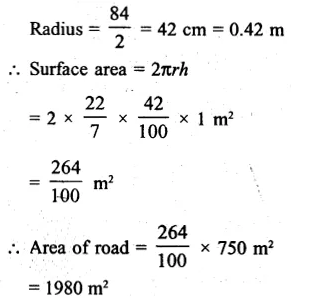
No. of revolutions = 750
Diameter of road roller = 84 cm
Length (h) = 1 m
RS Aggarwal Class 8 Solutions Chapter 20 Volume and Surface Area of Solids Ex 20B 19.1

Question 20.
Solution:
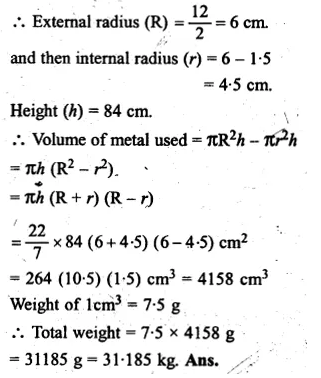
Thickness of the metal = 1.5 cm.
External diameter = 12 cm.
RS Aggarwal Class 8 Solutions Chapter 20 Volume and Surface Area of Solids Ex 20B 20.1

Question 21.
Solution:
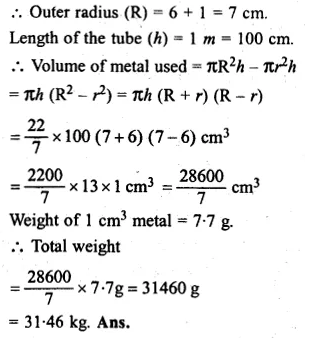
Inner diameter of tube = 12 cm.
Inner radius (r) = \(\\ \frac { 12 }{ 2 } \) = 6 cm.
Thickness of metal = 1 m.
RS Aggarwal Class 8 Solutions Chapter 20 Volume and Surface Area of Solids Ex 20B 21.1

Hope given RS Aggarwal Solutions Class 8 Chapter 20 Volume and Surface Area of Solids Ex 20B are helpful to complete your math homework.

If you have any doubts, please comment below. Learn Insta try to provide online math tutoring for you.

Value Based Questions in Science for Class 9 Chapter 16 Floatation

Value Based Questions in Science for Class 9 Chapter 16 Floatation

These Solutions are part of Value Based Questions in Science for Class 9. Here we have given Value Based Questions in Science for Class 9 Chapter 16 Floatation

VALUE BASED QUESTIONS

Question 1.
Anita and Suneeta were good friends. They had gone to a coastal side for walking. Anita was wearing flat surfaces chapal and Suneeta was wearing a high heel chapal. On the sandy surface, Suneeta was feeling uncomfortable while walking. Anita helped her to walk for some time on the sandy surface. Thereafter, both of them returned back. Anita asked Suneeta not to wear high heel chapal while walking on a sandy surface.
Answer the following questions based on the above paragraph.

  1. Why was Suneeta feeling uncomfortable while walking on the sandy surface ?
  2. Comment on the attitude of Anita.

Answer:

  1. The pressure exerted by Suneeta on the sandy surface was large as pressure = weight of Suneeta/area of heel of the chapal. Due to large pressure, her feet were sinking in sand. Therefore, she was feeling uncomfortable while walking.
  2. Anita is concerned about Suneeta. She was a good friend. Anita had high degree of general awareness.

More Resources

Question 2.
Amit is a student of class IX. His neighbour used to complain that he was not getting pure milk. But the man, who was supplying the milk said that the milk was pure. Amit knew how to test the purity of milk. He brought the lactometer and tested the milk. He told the man supplying milk not to cheat his neighbour.
Answer the following questions based on the above paragraph.

  1. On what principle, lactometer works ?
  2. What values are shown by Amit ?

Answer:

  1. Archimedes principle.
  2. Amit has high degree of general awareness. He is concerned about his neighbour. On the basis of his knowledge, he proved that the man supplying milk was wrong.

Question 3.
Some students were swimming in a swimming pool. Aayan, a student of class V was sitting sad near the swimming pool. Suneel came to Aayan and asked the reason of his sadness. Aayan told Suneel that he did not know how to swim. However, he also wanted to swim. Suneel asked Aayan to wear the life saving jacket. Then Suneel helped Aayan to swim.
Answer the following questions based on the above paragraph.

  1. What is the basic principle, on which life saving jacket works ?
  2. Comment on the attitude of Suneel.

Answer:

  1. When a person wears a life saving jacket and enters into water, the weight of water displaced by jacket is more than the weight of the person. Hence, the person can float in water easily.
  2. Suneel feels concerned for others. He could not see the sadness of Aayan. He is helpful. He used his knowledge to fulfill the desire of Aayan.

Question 4.
A milkman used to sell milk in the city and always carried lactometer with him. The customers trusted him and his business flourished.

  1. What is lactometer ?
  2. What is the principle of lactometer ?
  3. Carrying a lactometer by a milkman shows high values. List any two. (CBSE 2015)

Answer:

  1. Lactometer is a device used to test the purity of milk.
  2. Lactometer is based on Archimedes principle.
    1. Milkman is honest,
    2. He is a good business man.
    3. He is concerned with the health of his customers.

Hope given Value Based Questions in Science for Class 9 Chapter 16 Floatation are helpful to complete your science homework.

If you have any doubts, please comment below. Learn Insta try to provide online science tutoring for you.

RD Sharma Class 9 Solutions Chapter 20 Surface Areas and Volume of A Right Circular Cone MCQS

RD Sharma Class 9 Solutions Chapter 20 Surface Areas and Volume of A Right Circular Cone MCQS

These Solutions are part of RD Sharma Class 9 Solutions. Here we have given RD Sharma Class 9 Solutions Chapter 20 Surface Areas and Volume of A Right Circular Cone MCQS

Other Exercises

Mark the correct alternative in each of the following:
Question 1.
The number of surfaces of a cone has, is
(a) 1
(b) 2
(c) 3
(d) 4
Solution:
Number of surfaces of a cone are 2 (b)

Question 2.
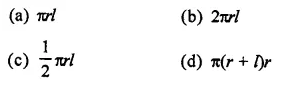
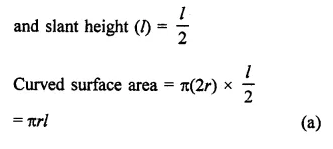
The area of the curved surface of a cone of radius 2r and slant height \(\frac { 1 }{ 2 }\), is
RD Sharma Class 9 Solutions Chapter 20 Surface Areas and Volume of A Right Circular Cone MCQS Q2.1
Solution:
Radius of a cone = 2r
RD Sharma Class 9 Solutions Chapter 20 Surface Areas and Volume of A Right Circular Cone MCQS Q2.2

Question 3.
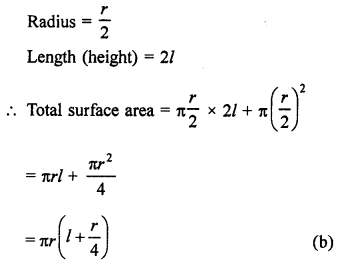
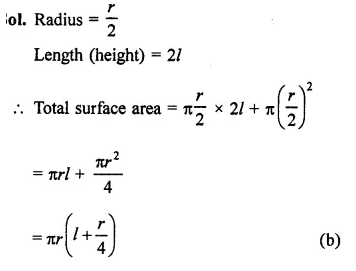
The total surface area of a cone of radius \(\frac { r }{ 2 }\) and length 2l, is
RD Sharma Class 9 Solutions Chapter 20 Surface Areas and Volume of A Right Circular Cone MCQS Q3.1
Solution:
RD Sharma Class 9 Solutions Chapter 20 Surface Areas and Volume of A Right Circular Cone MCQS Q3.2

Question 4.
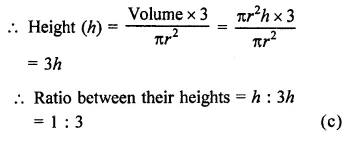
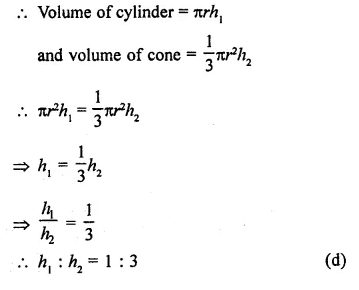
A solid cylinder is melted and cast into a cone of same radius. The heights of the cone and cylinder are in the ratio
(a) 9 : 1
(b) 1 : 9
(c) 3 : 1
(d) 1 : 3
Solution:
Let r be the radius and h be the height of cylinder, then volume = πr2h
Now volume of cone = πr2h
r is the radius
RD Sharma Class 9 Solutions Chapter 20 Surface Areas and Volume of A Right Circular Cone MCQS Q4.1

Question 5.
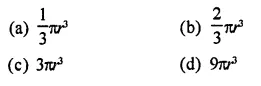
If the radius of the base of a right circular cone is 3r and its height is equal to the radius of the base, then its volume is
RD Sharma Class 9 Solutions Chapter 20 Surface Areas and Volume of A Right Circular Cone MCQS Q5.1
Solution:
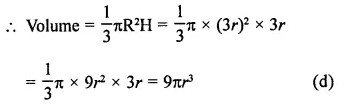
Radius of the base of a cone (R) = 3r
and height (H) = 3r
RD Sharma Class 9 Solutions Chapter 20 Surface Areas and Volume of A Right Circular Cone MCQS Q5.2

Question 6.
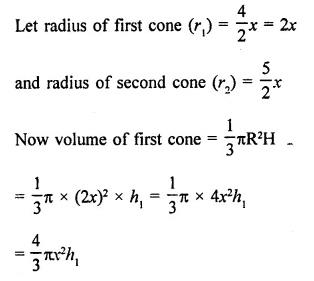
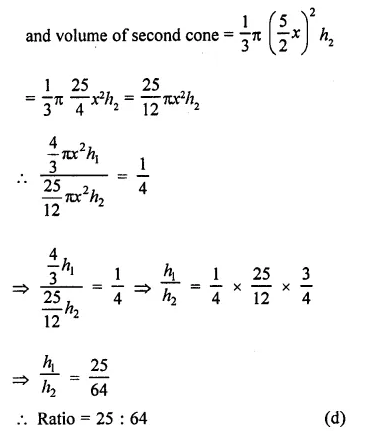
If the volumes of two cones are in the ratio 1 : 4 and their diameters are in the ratio 4 : 5, then the ratio of their heights, is
(a) 1 : 5
(b) 5 : 4
(c) 5 : 16
(d) 25 : 64
Solution:
Ratio in the volumes of two cones =1:4
and ratio in their diameter = 4:5
Let h1, h2 be their heights
RD Sharma Class 9 Solutions Chapter 20 Surface Areas and Volume of A Right Circular Cone MCQS Q6.1
RD Sharma Class 9 Solutions Chapter 20 Surface Areas and Volume of A Right Circular Cone MCQS Q6.2

Question 7.
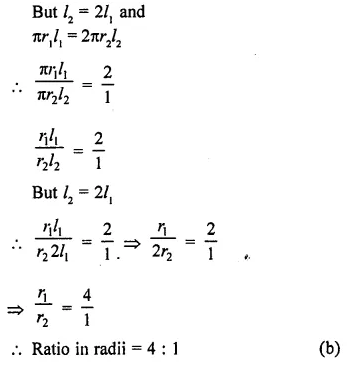
The curved surface area of one cone is twice that of the other while the slant height of the latter is twice that of the former. The ratio of their radii is
(a) 2 : 1
(b) 4 : 1
(c) 8 : 1
(d) 1 : 1
Solution:
Let r be the radius and l be the slant height
∴ Curved surface area of first cone = πr1l1
and let curved surface area of second cone = πr2l2
RD Sharma Class 9 Solutions Chapter 20 Surface Areas and Volume of A Right Circular Cone MCQS Q7.1

Question 8.
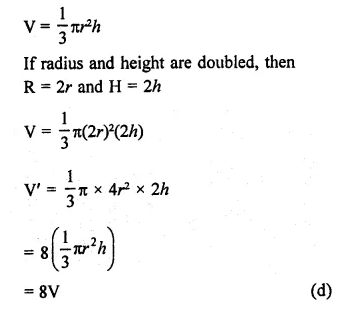
If the height and radius of a cone of volume V are doubled, then the volume of the cone, is
(a) 3V
(b) 4V
(c) 6V
(d) 8V
Solution:
Let r and h be the radius and height of a cone, then
RD Sharma Class 9 Solutions Chapter 20 Surface Areas and Volume of A Right Circular Cone MCQS Q8.1

Question 9.
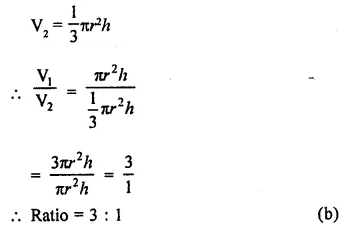
The ratio of the volume of a right circular cylinder and a right circular cone of the same base and height, is
(a) 1 : 3
(b) 3 : 1
(c) 4 : 3
(d) 3 : 4
Solution:
Let r be the radius and h be the height of a right circular cylinder and a right circular cone, and V1 and V2 are their volumes, the V1 =  πr2h and
RD Sharma Class 9 Solutions Chapter 20 Surface Areas and Volume of A Right Circular Cone MCQS Q9.1

Question 10.
A right cylinder and a right circular cone have the same radius and same volumes. The ratio of the height of the cylinder to that of the cone is
(a) 3 : 5
(b) 2 : 5
(c) 3 : 1
(d) 1 : 3
Solution:
Let r be the radius of cylinder and cone and volumes are equal
and h1, and h2 be their have h2 is respectively
RD Sharma Class 9 Solutions Chapter 20 Surface Areas and Volume of A Right Circular Cone MCQS Q10.1

Question 11.
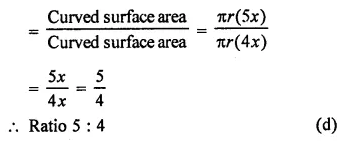
The diameters of two cones are equal. If their slant heights are in the ratio 5 : 4, the ratio of their curved surface areas, is
(a) 4 : 5
(b) 25 : 16
(c) 16 : 25
(d) 5 : 4
Solution:
∵ Diameters of two cones are equal
∴ Their radii are also be equal
Let r be their radius of each cone,
and ratio in their slant heights = 5:4
Let slant height of first cone (h1) = 5x
Then height of second cone (h2) = 4x
RD Sharma Class 9 Solutions Chapter 20 Surface Areas and Volume of A Right Circular Cone MCQS Q11.1

Question 12.
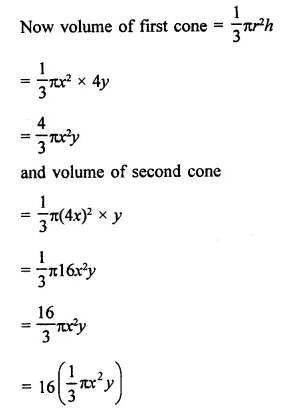
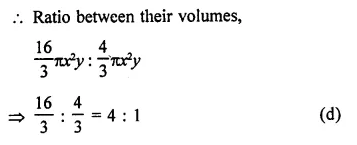
If the heights of two cones are in the ratio of 1 : 4 and the radii of their bases are in the ratio 4 : 1, then the ratio of their volumes is
(a) 1 : 2
(b) 2 : 3
(c) 3 : 4
(d) 4 : 1
Solution:
Ratio in the heights of two cones =1 : 4
and ratio in their radii of their bases = 4 : 1
Let height of the first cone = x
and height of the second cone = 4x
Radius of the first cone = 4y
and radius of the second cone = y
RD Sharma Class 9 Solutions Chapter 20 Surface Areas and Volume of A Right Circular Cone MCQS Q12.1
RD Sharma Class 9 Solutions Chapter 20 Surface Areas and Volume of A Right Circular Cone MCQS Q12.2

Question 13.
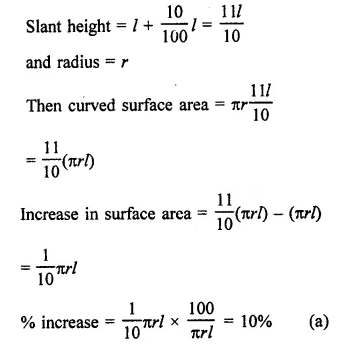
The slant height of a cone is increased by 10%. If the radius remains the same, the curved surface area is increased by
(a) 10%
(b) 12.1%
(c) 20%
(d) 21%
Solution:
Let r be radius and l be the slant height of a cone, then curved surface area = πrl
If slant height is increased by 10%, then
RD Sharma Class 9 Solutions Chapter 20 Surface Areas and Volume of A Right Circular Cone MCQS Q13.1

Question 14.
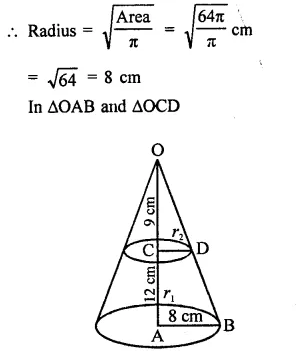
The height of a solid cone is 12 cm and the area of the circular base is 6471 cm2. A plane parallel to the base of the cone cuts through the cone 9 cm above the vertex of the cone, the area of the base of the new cone so formed is
(a) 9π cm2
(b) 16π cm2
(c) 25π cm2
(d) 36π cm2
Solution:
Height of a solid cone (h) = 12 cm
Area of circular base = 64π cm2
RD Sharma Class 9 Solutions Chapter 20 Surface Areas and Volume of A Right Circular Cone MCQS Q14.1
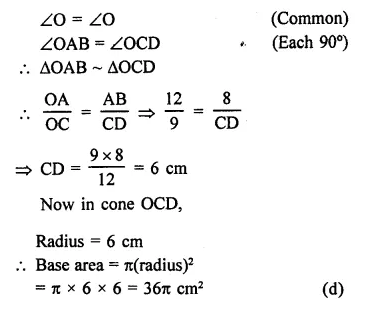
RD Sharma Class 9 Solutions Chapter 20 Surface Areas and Volume of A Right Circular Cone MCQS Q14.2

Question 15.
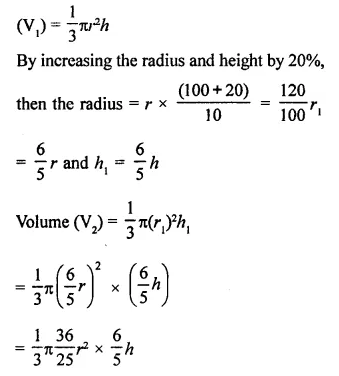
If the base radius and the height of a right circular cone are increased by 20%, then the percentage increase in volume is approximately
(a) 60
(b) 68
(c) 73
(d) 78
Solution:
In first case,
Let r be radius and h be height, in volume
RD Sharma Class 9 Solutions Chapter 20 Surface Areas and Volume of A Right Circular Cone MCQS Q15.1
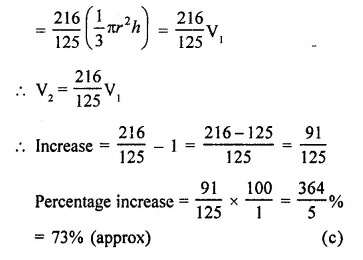
RD Sharma Class 9 Solutions Chapter 20 Surface Areas and Volume of A Right Circular Cone MCQS Q15.2

Question 16.
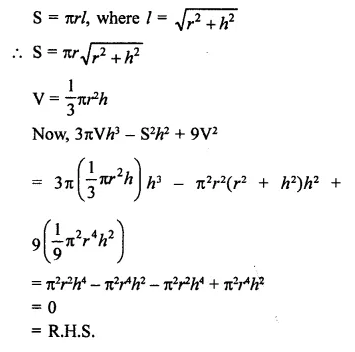
If h, S and V denote respectively the height, curved surface area and volume of a right circular cone, then 3πVh3 – S2h2 + 9V2 is equal to
(a) 8
(b) 0
(c) 4π
(d) 32π2
Solution:
h = height, S = curved surface area
V = volume of a cone
Let r be the radius of the cone, then
RD Sharma Class 9 Solutions Chapter 20 Surface Areas and Volume of A Right Circular Cone MCQS Q16.1

Question 17.
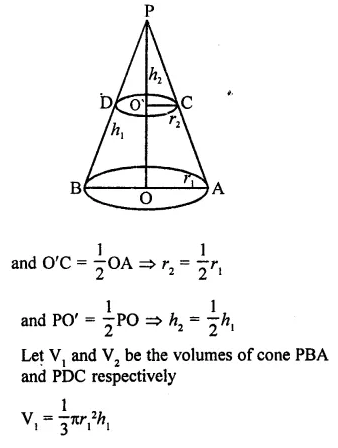
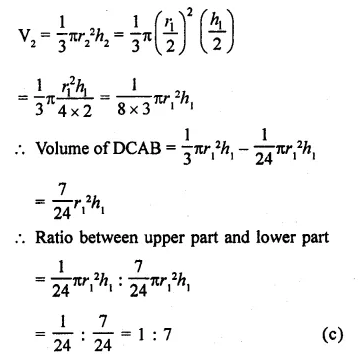
If a cone is cut into two parts by a horizontal plane passing through the mid¬point of its axis, the ratio of the volumes of upper and lower part is
(a) 1 : 2
(b) 2 : 1
(c) 1 : 7
(d) 1 : 8
Solution:
∴ ∆PDC ~ ∆PBA (AA axiom)
and O’ is mid point of PO
RD Sharma Class 9 Solutions Chapter 20 Surface Areas and Volume of A Right Circular Cone MCQS Q17.1
RD Sharma Class 9 Solutions Chapter 20 Surface Areas and Volume of A Right Circular Cone MCQS Q17.2

Hope given RD Sharma Class 9 Solutions Chapter 20 Surface Areas and Volume of A Right Circular Cone MCQS are helpful to complete your math homework.

If you have any doubts, please comment below. Learn Insta try to provide online math tutoring for you.

NCERT Exemplar Solutions for Class 9 Science Chapter 12 Sound

NCERT Exemplar Solutions for Class 9 Science Chapter 12 Sound

These Solutions are part of NCERT Exemplar Solutions for Class 9 Science . Here we have given NCERT Exemplar Solutions for Class 9 Science Chapter 12 Sound

Question 1.
Note is a sound
(a) of mixture of several frequencies
(b) of mixture of two frequencies only
(c) of a single frequency
(d) always unpleasant to listen
Answer:
(a).

More Resources

Question 2.
A key of a mechanical piano struck gently and then struck again but much harder this time. In the second case
(a) sound will be louder but pitch will not be different
(b) sound will be louder and pitch
(c) sound will be louder but pitch will be lower
(d) both loudness and pitch will remain unaffected
Answer:
(a). Loudness depends on the amplitude of vibration.

Question 3.
In SONAR, we use
(a) ultrasonic waves
(b) infrasonic waves
(c) radio waves
(d) audible sound waves
Answer:
(a).

Question 4.
Sound travels in air if
(a) particles of medium travel from one place to another
(b) there is no moisture in the atmosphere
(c) disturbance moves
(d) both particles as well as disturbance travel from one place to another.
Answer:
(c).

Question 5.
When we change feeble sound to loud sound we increase its
(a) frequency
(b) amplitude
(c) velocity
(d) wavelength
Answer:
(b). Loudness depends on the amplitude of vibration.

Question 6.
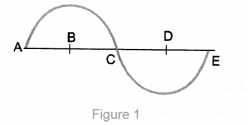
In the curve (Fig. 1) half the wavelength is
NCERT Exemplar Solutions for Class 9 Science Chapter 12 Sound image - 1
(a) A B
(b) B D
(c) D E
(d) A E
Answer:
(b).

Question 7.
Earthquake produces which kind of sound before the main shock wave begins
(a) ultrasound
(b) infrasound
(c) audible sound
(d) none of the above
Answer:
(b).

Question 8.
Infrasound can be heard by
(a) dog
(b) bat
(c) rhinoceros
(d) human beings.
Answer:
(c).

Question 9.
Before playing the orchestra in a musical concert, a sitarist tries to adjust the tension and pluck the string suitably. By doing so, he is adjusting
(a) intensity of sound only
(b) amplitude of sound only
(c) frequency of the sitar string with the frequency of other musical instruments
(d) loudness of sound.
Answer:
(c).

SHORT ANSWER QUESTIONS

Question 10.
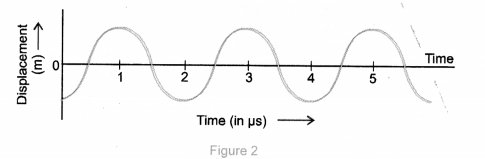
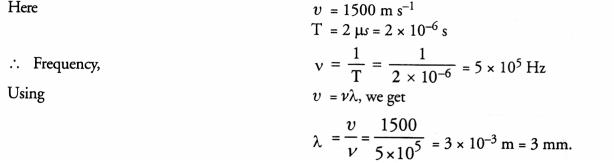
The given graph (Fig. 2) shows the displacement versus time relation for a disturbance travelling with velocity of 1500 the wavelength of the disturbance.
NCERT Exemplar Solutions for Class 9 Science Chapter 12 Sound image - 2
Answer:
NCERT Exemplar Solutions for Class 9 Science Chapter 12 Sound image - 3

Question 11.
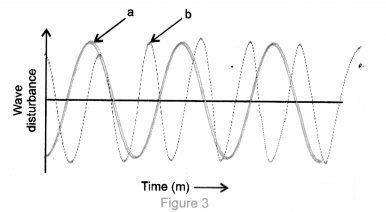
Which of the above two graphs (a) and (b) (Fig. 3) representing the human voice is likely to be the male voice ? Give reason for your answer.
NCERT Exemplar Solutions for Class 9 Science Chapter 12 Sound image - 4
Answer:
Frequency of male voice is lesser than that of female voice. So, graph (a) represents the human voice.

Question 12.
A girl is sitting in the middle of a park of dimension 12 m x 12 m. On the left side of it, there is a building adjoining the park and on the right side of the park, there is a road adjoining by park. A sound is produced on the road by a cracker. Is it possible for the girl to hear the echo of this sound ? Explain your answer.
Answer:
To hear echo, the distance between the source of sound and the obstacle (i.e., building) should be more than 17 m. In this case, distance between source of sound (i.e., cracker) and the obstacle (i.e., building) is 12 m i.e., less than 17 m. Hence, girl cannot hear the echo of the sound of the cracker.

Question 13.
Why do we hear the sound produced by the humming bees while the sound of vibrations of pendulum is not heard ?
Answer:
This is because the frequency of sound produced by humming bees lies in audible range (20 Hz to 20,000 Hz) and frequency of the sound of vibrations of pendulum lies in infrasonic region. ( 1 Hz to 19 Hz)

Question 14.
If any explosion takes place at the bottom of a lake, what type of shock waves in water will take place ?
Answer:
Longitudinal wave as transverse wave cannot travel in water.

Question 15.
Sound produced by a thunderstorm is heard 10 s after the lightning is seen. Calculate the approximate distance of the thunder cloud. (Given speed of sound = 340 m s-1).
Answer:
Distance of thunder cloud = speed of sound x time = 340 x 10 = 3400 m = 3.4 km.

Question 16.
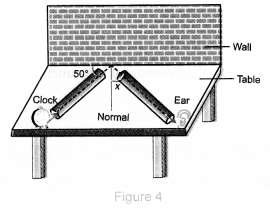
For hearing the loudest ticking sound heard by the ear, find the angle x in the Fig. 4.
NCERT Exemplar Solutions for Class 9 Science Chapter 12 Sound image - 5
Answer:

Question 17.
Why is the ceiling and wall behind the stage of good conference halls or concert halls made curved ?
Answer:
So that sound after reflection reach to every audience.

Question 18.
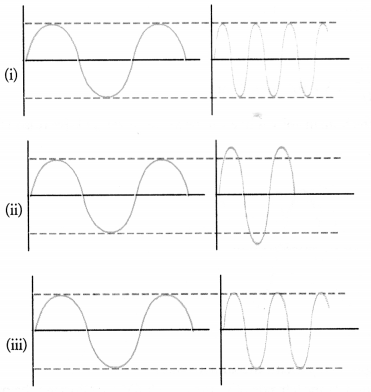
Represent graphically by two separate diagrams in each case :
(i) Two sound waves having the same amplitude but different frequencies ?
(ii) Two sound waves having the same frequency but different amplitudes.
(iii) Two sound waves having the different amplitude but different wavelengths.
Answer:
NCERT Exemplar Solutions for Class 9 Science Chapter 12 Sound image - 6

Question 19.
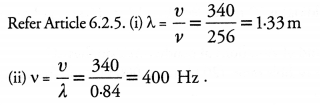
Establish the relationship between speed of sound, its wavelength and frequency. If velocity of sound in air is 340 m s-1, calculate
(i) wavelength when frequency is 256 Hz.
(ii) frequency when wavelength is 0.85 m. (CBSE 2012)
Answer:
Answer:
NCERT Exemplar Solutions for Class 9 Science Chapter 12 Sound image - 7

Question 20.
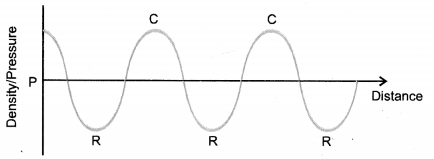
Draw a curve showing density or pressure variations with respect to distance for a disturbance produced by sound. Mark the position of compression and rarefaction on this curve. Also define wavelengths and time period using this curve. (CBSE 2012)
Answer:
NCERT Exemplar Solutions for Class 9 Science Chapter 12 Sound image - 8
Wavelength : Distance between two successive compressions or two successive rarefactions.
Time Period : Time taken by the disturabnce to travel between two successive compressions or between two successive rarefaction.

Hope given NCERT Exemplar Solutions for Class 9 Science Chapter 12 Sound are helpful to complete your science homework.

If you have any doubts, please comment below. Learn Insta try to provide online science tutoring for you.

RS Aggarwal Class 8 Solutions Chapter 20 Volume and Surface Area of Solids Ex 20A

RS Aggarwal Class 8 Solutions Chapter 20 Volume and Surface Area of Solids Ex 20A

These Solutions are part of RS Aggarwal Solutions Class 8. Here we have given RS Aggarwal Solutions Class 8 Chapter 20 Volume and Surface Area of Solids Ex 20A.

Other Exercises

Question 1.
Solution:
(i)
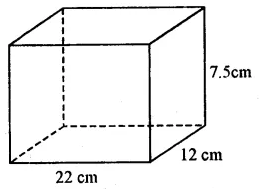
RS Aggarwal Class 8 Solutions Chapter 20 Volume and Surface Area of Solids Ex 20A 1.1
Length of cuboid (l) = 22 cm.
Breadth (b) = 12 cm
and height (h) = 7.5 cm.
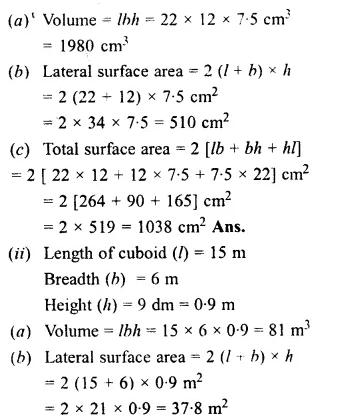
RS Aggarwal Class 8 Solutions Chapter 20 Volume and Surface Area of Solids Ex 20A 1.2
RS Aggarwal Class 8 Solutions Chapter 20 Volume and Surface Area of Solids Ex 20A 1.3
RS Aggarwal Class 8 Solutions Chapter 20 Volume and Surface Area of Solids Ex 20A 1.4
RS Aggarwal Class 8 Solutions Chapter 20 Volume and Surface Area of Solids Ex 20A 1.5

Question 2.
Solution:
Length of water tank (l) = 2 m
75cm = 2.75 m
breadth (b) = 1 m 80cm = 1.80 m
and height (h) = 1 m 40 cm = 1.40 m
Volume of water filled in it = l.b.h = 2.75 x 1.80 x 1.40 m³
= 6.93 m³
Water in litres = 6.93 x 1000
= 6930 litres (1 m³ = 1000 litres) Ans.

Question 3.
Solution:
Length of iron (l) = 1.05 m
= 105 cm
breadth (b) = 70 cm and height (h) = 1.5 cm
volume of iron = l x b x h = 105 x 70 x 1.5 cm³
= 11025 cm³
weight of 1cm³ iron = 8 gram
Total weight = 11025 x g = 88200 g
= \(\\ \frac { 88200 }{ 1000 } \) kg
= 88.2 kg Ans.

Question 4.
Solution:
Area of courtyard = 3750 m²
Height of gravel = 1 cm.
Volume of gravel = 3750 x \(\\ \frac { 1 }{ 100 } \) m³
= 37.50 m³
Cost of 1 m³ gravel = Rs. 6.40
Total cost = Rs. 6.40 x 37.50
= Rs. 240 Ans.

Question 5.
Solution:
Length of hall (l) = 16 m
Breadth (b) = 12.5 m
height (h) = 4.5 m
Volume of air in it = l x b x h
= 16 x 12.5 x 4.5 m3
= 900 m³
Air for one person is required = 3.6 m³
Number of person which can be accommodated in the hall = 900 ÷ 3.6
= \(\\ \frac { 900\times 10 }{ 36 } \)
= 250

Question 6.
Solution:
Length of cardboard box (l)
= 1.2 m = 120 cm.
breadth (b) = 72 cm.
Height (h) = 54 cm.
Volume of box = l x b x h
= 120 x 72 x 54 cm³
= 466560 cm³
Volume of one soap bar = 6 x 4.5 x 4 cm³
= 108 cm³
No. of bars to be kept in it = \(\\ \frac { 466560 }{ 108 } \)
= 4320 Ans.

Question 7.
Solution:
Volume of one match box = 4 x 2.5 x 1.5 cm³ = 15 cm³
Volume of 144 matchboxes = 15 x 144 cm³
or volume of one packet = 2160 cm³
Length of carton (l) = 1.5 m = 150 cm
Breadth (b) = 84 cm
and height (h) = 60 cm.
Volume of one carton = l x b x h
= 150 x 84 x 60 cm³
= 756000 cm³
No. of packets = 756000 ÷ 2160
= 350 Ans.

Question 8.
Solution:
Length of one plank = 2m
= 200 cm
Breadth (b) = 25 cm
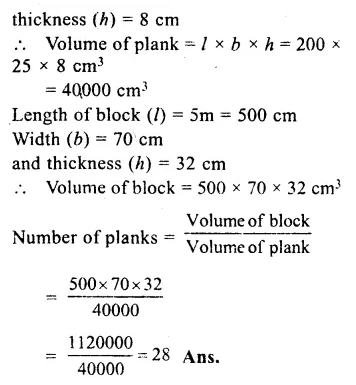
RS Aggarwal Class 8 Solutions Chapter 20 Volume and Surface Area of Solids Ex 20A 8.1

Question 9.
Solution:
Length of wall (l) = 8m = 800 cm
Height (h) = 5.4 m = 540 cm
Width (b) = 33 cm
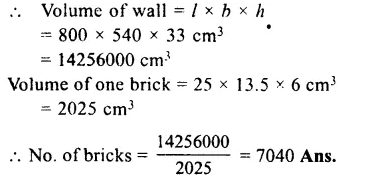
RS Aggarwal Class 8 Solutions Chapter 20 Volume and Surface Area of Solids Ex 20A 9.1

Question 10.
Solution:
Length of wall (l) = 15 m
Width (b) = 30 cm = 0.3 m
Height (h) = 4 m
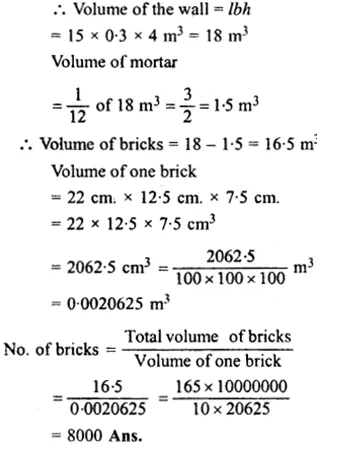
RS Aggarwal Class 8 Solutions Chapter 20 Volume and Surface Area of Solids Ex 20A 10.1

Question 11.
Solution:
Length of rectangular cistern (l) = 11.2 m
Breadth (b) = 6 m
Height (h) = 5.8 m
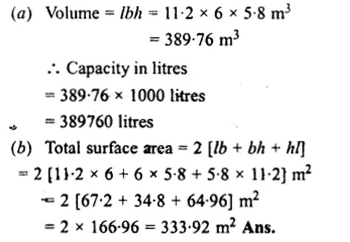
RS Aggarwal Class 8 Solutions Chapter 20 Volume and Surface Area of Solids Ex 20A 11.1

Question 12.
Solution:
Volume of block of gold = 0.5 m³
= 0.5 x 1000000 cm³
= 500000 cm³
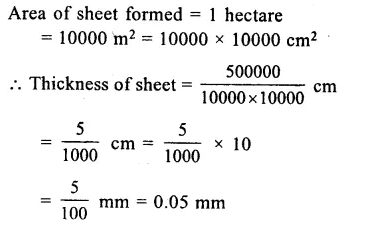
RS Aggarwal Class 8 Solutions Chapter 20 Volume and Surface Area of Solids Ex 20A 12.1

Question 13.
Solution:
Area of field = 2 hectare
= 20000 m²
Rainfall = 5 cm. = 0.05 m
Volume of water of rainfall
= Area of field x height of rainfall water
= 20000 x 0.05 m³
= 1000 m³ Ans.

Question 14.
Solution:
Speed of water = 3 km/h
Length of water flow in 1 minute
= \(\\ \frac { 3km }{ 60m } \)
= \(\\ \frac { 3000 }{ 60 } \)
= 50 m
Width of river = 45 m
Depth of river = 2 m
Volume of water in 1 minute
= 45 x 2 x 50 m³
= 4500 m³ Ans.

Question 15.
Solution:
Length of pit (l) = 5m
Width (b) = 3.5 m
Let depth of pit = h
then volume of earth dug out
= l.b.h = 5 x 3.5 x h = 17.5 h m³
But volume of earth = 14 m³
17.5 h = 14
h = \(\\ \frac { 14 }{ 17.5 } \) = \(\\ \frac { 140 }{ 175 } \)
=> h = \(\\ \frac { 4 }{ 5 } \) m
= \(\\ \frac { 4 }{ 5 } \) x 100
= 80 cm Ans.

Question 16.
Solution:
Width of tank = 90 cm = \(\\ \frac { 90 }{ 100 } \) m
Depth = 40 cm = \(\\ \frac { 40 }{ 100 } \) m
Water = 576 litre
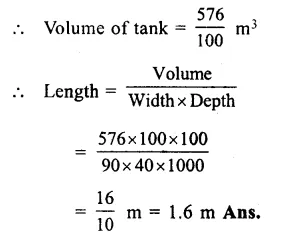
RS Aggarwal Class 8 Solutions Chapter 20 Volume and Surface Area of Solids Ex 20A 16.1

Question 17.
Solution:
Volume of wood = 1.35 m³
Length of beam = 5m
Thickness = 36 cm = \(\\ \frac { 36 }{ 100 } \) m.
Width = \(\\ \frac { Volume }{ length\times thickness } \)
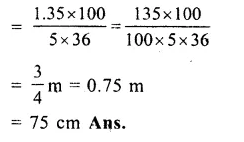
RS Aggarwal Class 8 Solutions Chapter 20 Volume and Surface Area of Solids Ex 20A 7.1

Question 18.
Solution:
Volume of a room = 378 m³
Area of its floor = 84 m²
Height = \(\\ \frac { Volume }{ Area } \)
= \(\\ \frac { 378 }{ 84 } \) m
= 4.5 m Ans.

Question 19.
Solution:
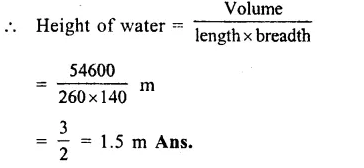
Length of pool = 260 m
and width = 140 m.
Volume of water = 54600 m³
RS Aggarwal Class 8 Solutions Chapter 20 Volume and Surface Area of Solids Ex 20A 19.1

Question 20.
Solution:
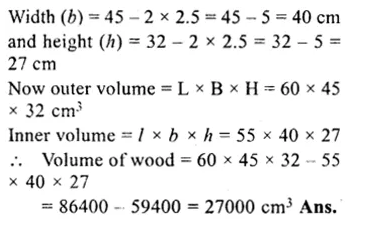
Outer length of wooden box (L) = 60 cm
Width (B) = 45 cm
and height (H) = 32 cm.
Thickness of wood used = 2.5 cm.
Inner length (l) = 60 – 2 x 2.5
= 60 – 5
= 55 cm
RS Aggarwal Class 8 Solutions Chapter 20 Volume and Surface Area of Solids Ex 20A 20.1

Question 21.
Solution:
Outer length of open box = 36 cm
breadth = 25 cm
and height = 16.5 cm
thickness of iron = 1.5 cm.
∴ Inner length = 36 – 2 x 1.5
= 36 – 3
= 33 cm
breadth = 25 – 2 x 1.5
= 25 – 3
= 22 cm
and height = 16.5 – 1.5
= 15 cm .
∴ Volume of iron used in it = Outer volume – Inner volume
= 36 x 25 x 16.5 cm3 – 33 x 22 x 15 cm³
= 14850 – 10890
= 3960 cm³
weight of 1 cm³ = 8.5 gram
∴ Total weight = 3960 x 8.5 g
= 33660 g
= 33.660 kg
= 33.66 kg Ans.

Question 22.
Solution:
Outer length of the box = 56 cm
Width = 39 cm
and height = 30 cm
Volume = 56 x 39 x 30
= 65520 cm³
Thickness of wood used = 3cm.
∴ Inner length = 56 – 2 x 3
= 56 – 6
= 50 cm
Width = 39 – 2 x 3
= 39 – 6
= 33 cm
and height = 30 – 2 x 3
= 30 – 6
= 24 cm
∴ Inner volume of the box = 50 x 33 x 24 cm³
= 39600 cm³
and volume of wood used = Outer volume – Inner volume
= (65520 – 39600)cm³
= 25920 cm³ Ans.

Question 23.
Solution:
Outer length of box = 62 cm.
Outer width = 30 cm.
Outer height = 18 cm.
Thickness of wood = 2 cm.
∴ Internal length = 62 – 2 x 2
= 58 cm.
Internal width = 30 – 2 x 2
= 26 cm.
Internal height =18 – 2 x 2
= 14 cm.
Capacity of the box = lbh
= 58 x 26 x 14 cm³
= 21112 cm³ Ans.

Question 24.
Solution:
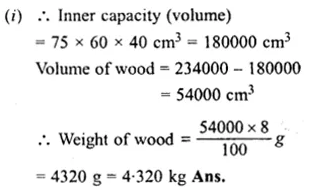
Outer length = 80 cm.
Outer width = 65 cm.
Outer height = 45 cm.
Total volume = 80 x 65 x 45 cm³
= 234000 cm³
Thickness of wood = 2.5 cm.
∴ Inner length = 80 – 2 x 2.5 = 75 cm.
Inner width = 65 – 2 x 2.5 = 60 cm.
Inner height = 45 – 2 x 2.5 = 40 cm.
RS Aggarwal Class 8 Solutions Chapter 20 Volume and Surface Area of Solids Ex 20A 24.1

Question 25.
Solution:
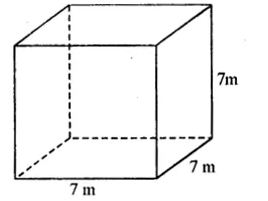
(i) Edge of cube (a) = 7 m
RS Aggarwal Class 8 Solutions Chapter 20 Volume and Surface Area of Solids Ex 20A 25.1
(a) Volume = a³ = (7)³
= 7 x 7 x 7 m³
= 343 m³ Ans.
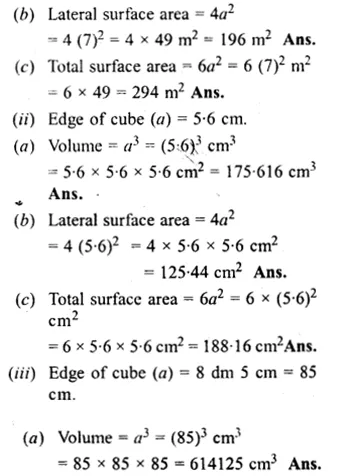
RS Aggarwal Class 8 Solutions Chapter 20 Volume and Surface Area of Solids Ex 20A 25.2
RS Aggarwal Class 8 Solutions Chapter 20 Volume and Surface Area of Solids Ex 20A 25.3

Question 26.
Solution:
Surface area of a cube = 1176 cm²
Let edge of the cube = a
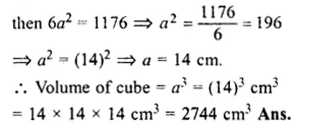
RS Aggarwal Class 8 Solutions Chapter 20 Volume and Surface Area of Solids Ex 20A 26.1

Question 27.
Solution:
Volume of a cube = 729 cm³
Let edge of cube = a
then a³ = 729 = (9)³
a = 9 cm.
Hence surface area = 6a² = 6 (9)² cm²
= 6 x 81
= 486 cm² Ans.

Question 28.
Solution:
Length of metal block (l) = 2.25 m = 225 cm
Width (b) = 1.5 m = 150 cm
and height (h) = 27 cm
Volume of block = l x b x h
= 225 x 150 x 27 cm³
= 911250 cm³
Side of each cube = 45 cm.
Volume of each cube = a³
= 45 x 45 x 45
= 94125 cm³
Number of cubes = \(\\ \frac { 911250 }{ 91125 } \)
= 10 Ans.

Question 29.
Solution:
Let edge of given cube = a
Volume = a³
and surface area = 6a²
By doubling the edge of cube3 the side of new cube = a x 2 = 2a
Volume (2a)³ = 8a³
and surface area = 6 (2a)² = 6 x 4a²
= 24a² = 4 x 6a²
It is clear from the above that
Volume is increased 8 times and surface area is 4 times. Ans.

Question 30.
Solution:
Total cost of wood = Rs. 256
Rate = Rs.,500 per m³
Volume of wood = \(\\ \frac { 256 }{ 500 } \) = 0.512 m³
= 0.512 x 100 x 100 x 100 cm³
= 512000 cm³
Let length of each side = a
then a³ = 512000 = (80)³
a = 80
Hence length of each side = 80 cm. Ans.


Hope given RS Aggarwal Solutions Class 8 Chapter 20 Volume and Surface Area of Solids Ex 20A are helpful to complete your math homework.

If you have any doubts, please comment below. Learn Insta try to provide online math tutoring for you.