RD Sharma Class 9 Solutions Chapter 22 Tabular Representation of Statistical Data Ex 22.2

RD Sharma Class 9 Solutions Chapter 22 Tabular Representation of Statistical Data Ex 22.2

These Solutions are part of RD Sharma Class 9 Solutions. Here we have given RD Sharma Class 9 Solutions Chapter 22 Tabular Representation of Statistical Data Ex 22.2

Other Exercises

Question 1.
Define cumulative frequency distribution.
Solution:
Cumulative frequency : In a discrete frequency distribution, the cumulative frequency of a particular value of the variable is the total of all the frequencies of the values of the variable which are less than or equal to the particular value.

Question 2.
Explain the difference between a frequency distribution and a cumulative frequency distribution.
Solution:
The number of times an observation occurs in the given data, is called frequency of the
observation while a cumulative frequency of a particular value of the variable is the total of all the frequencies of the values of the variable which are less than or equal to the particular value.

Question 3.
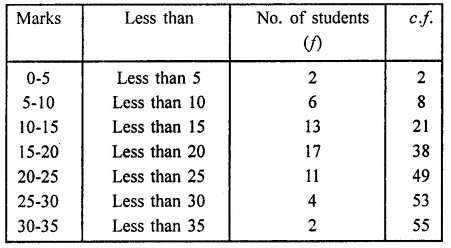
The marks scored by 55 students in a test are given below:
RD Sharma Class 9 Solutions Chapter 22 Tabular Representation of Statistical Data Ex 22.2 3.1
Prepare a cumulative frequency table.
Solution:
Cumulative frequency table is given below:
RD Sharma Class 9 Solutions Chapter 22 Tabular Representation of Statistical Data Ex 22.2 3.2

Question 4.
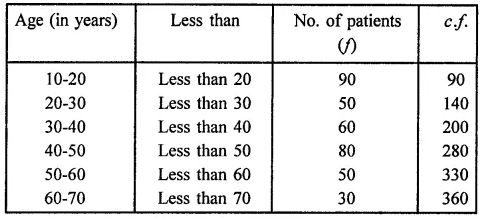
Following are the ages of 360 patients getting medical treatment in a hospital on a day:
RD Sharma Class 9 Solutions Chapter 22 Tabular Representation of Statistical Data Ex 22.2 4.1
Construct a cumulative frequency distribution.
Solution:
Cumulative frequency distribution table (less than) is given below:
RD Sharma Class 9 Solutions Chapter 22 Tabular Representation of Statistical Data Ex 22.2 4.2

Question 5.
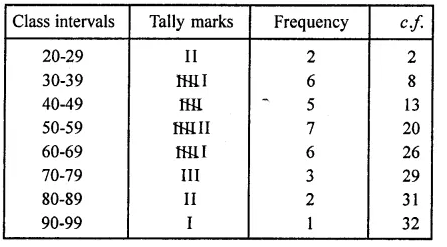
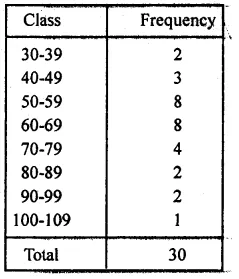
The water bills (in rupees) of 32 houses in a certain street for the period 1.1.98 to 31.3.98 are given below:
56, 43, 32, 38, 56, 24, 68, 85, 52, 47, 35, 58, 63, 74, 27, 84, 69, 35, 44, 75, 55, 30, 54, 65, 45, 67, 95, 72, 43, 65, 35, 59.
Tabulate the data and present the data as a cumulative frequency table using 70-79 as one of the class intervals.
Solution:
Highest bill = 95 Lowest bill = 24
Range = 95 – 24 = 71
Cumulative frequency table is given below:
RD Sharma Class 9 Solutions Chapter 22 Tabular Representation of Statistical Data Ex 22.2 5.1

Question 6.
The number of books in different shelves of a library are as follows:
30, 32, 28, 24, 20, 25, 38, 37, 40, 45, 16, 20, 19, 24, 27, 30, 32, 34, 35, 42, 27, 28, 19, 34,
38, 39, 42, 29, 24, 27, 22, 29, 31, 19, 27, 25, 28, 23, 24, 32, 34, 18, 27, 25, 37, 31, 24, 23,
43, 32, 28, 31, 24, 23, 26, 36, 32, 29, 28, 21.
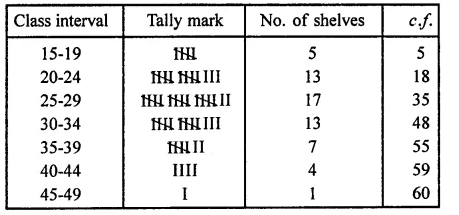
Prepare a cumulative frequency distribution table using 45-49 as the last class interval.
Solution:
Greatest number = 43
Lowest number =16
Range = 43 – 16 = 27
Cumulative frequency table is given below:
RD Sharma Class 9 Solutions Chapter 22 Tabular Representation of Statistical Data Ex 22.2 6.1

Question 7.
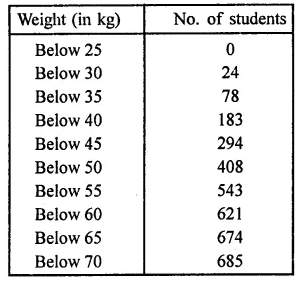
Given below are the cumulative frequencies showing the weights of 685 students of a school. Prepare a frequency distribution table.
RD Sharma Class 9 Solutions Chapter 22 Tabular Representation of Statistical Data Ex 22.2 7.1
Solution:
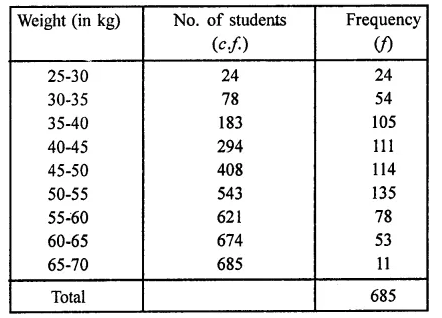
The frequency table of the given cumulative frequency is given below:
RD Sharma Class 9 Solutions Chapter 22 Tabular Representation of Statistical Data Ex 22.2 7.2

Question 8.
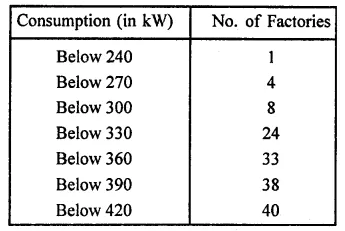
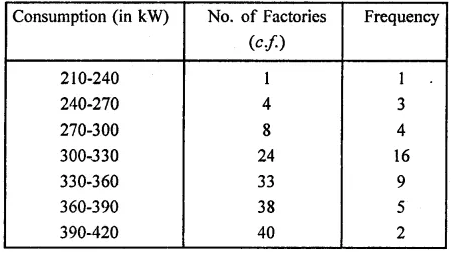
The following cumulative frequency distribution table shows the daily electricity consumption (in kW) of 40 factories in an industrial state:
RD Sharma Class 9 Solutions Chapter 22 Tabular Representation of Statistical Data Ex 22.2 8.1
(i) Represent this as a frequency distribution table.
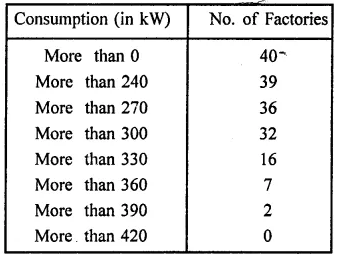
(ii) Prepare a cumulative frequency table.
Solution:
(i) The frequency distribution table is given below:
RD Sharma Class 9 Solutions Chapter 22 Tabular Representation of Statistical Data Ex 22.2 8.2
(ii) Now cumulative frequency table (more then)
RD Sharma Class 9 Solutions Chapter 22 Tabular Representation of Statistical Data Ex 22.2 8.3

Question 9.
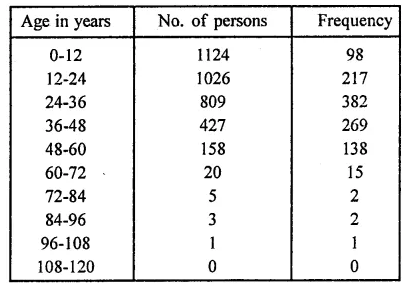
Given below is a cumulative frequency distribution table showing the ages of people living in a locality.
RD Sharma Class 9 Solutions Chapter 22 Tabular Representation of Statistical Data Ex 22.2 9.1
Prepare a frequency distribution table.
Solution:
Frequency distribution table is given below:
RD Sharma Class 9 Solutions Chapter 22 Tabular Representation of Statistical Data Ex 22.2 9.2

Hope given RD Sharma Class 9 Solutions Chapter 22 Tabular Representation of Statistical Data Ex 22.2 are helpful to complete your math homework.

If you have any doubts, please comment below. Learn Insta try to provide online math tutoring for you.

RS Aggarwal Class 8 Solutions Chapter 24 Probability Ex 24A

RS Aggarwal Class 8 Solutions Chapter 24 Probability Ex 24A

These Solutions are part of RS Aggarwal Solutions Class 8. Here we have given RS Aggarwal Solutions Class 8 Chapter 24 Probability Ex 24A.

Other Exercises

Question 1.
Solution:
(i) When a coin is tossed, we get outcomes 2 as H or T (Head or Tail)
(ii) When two coins are tossed together, we get possible four outcomes as HH, HT, TH, TT
(iii) A die is thrown, we get possible outcomes as 1,2, 3, 4, 5, 6
(iv) From a well – shuffled deck of 52 cards, 0ne card is at random drawn, we get the possible outcomes is 52

Question 2.
Solution:
Possible outcomes = 2
In a single throw of a coin, we get
probability of getting a tail = \(\\ \frac { 1 }{ 2 } \)

Question 3.
Solution:
In a single throw of two coins, possible outcomes = 4
(i) Probability of getting both tails = \(\\ \frac { 1 }{ 4 } \)
(ii) Probability of getting at least one tail = \(\\ \frac { 3 }{ 4 } \)
(iii) Probability of getting at the most one tail = \(\\ \frac { 2 }{ 4 } \) = \(\\ \frac { 1 }{ 2 } \)

Question 4.
Solution:
In a bag, there are 4 white and 5 blue balls ,
Possible outcomes = 4 + 5 = 9
One ball is drawn at random, then
(i) the probability of a white ball = \(\\ \frac { 4 }{ 9 } \)
(ii) the probability of a blue ball = \(\\ \frac { 5 }{ 9 } \)

Question 5.
Solution:
In a bag, there are 5 white, 6 red and 4 green balls
Possible outcome is 5 + 6 + 4 = 15
One ball is drawn at random, then
(i) Probability of a green ball = \(\\ \frac { 4 }{ 15 } \)
(ii) Probability of a white ball = \(\\ \frac { 5 }{ 15 } \) = \(\\ \frac { 1 }{ 3 } \)
(iii) Probability of a non-red ball = \(\\ \frac { 5+4 }{ 15 } \)
= \(\\ \frac { 9 }{ 15 } \)
= \(\\ \frac { 3 }{ 5 } \)
(5 white and 4 green balls are non-red balls)

Question 6.
Solution:
In a lottery, there are 10 prizes and 20 blanks
Possible outcomes = 10 + 20 = 30
A ticket is chosen at random, then
probability of getting a prize = \(\\ \frac { 10 }{ 30 } \) = \(\\ \frac { 1 }{ 3 } \)

Question 7.
Solution:
In a ,box of 100 electric bulb, 8 are defective
Then non-defective bulbs = 100 – 8 = 92
Now possible outcomes = 100
(i) Probability of a drawn bulb, which is defective = \(\\ \frac { 8 }{ 100 } \) = \(\\ \frac { 2 }{ 25 } \)
(ii) Probability of a drawn bulb which is non defective = \(\\ \frac { 92 }{ 100 } \) = \(\\ \frac { 23 }{ 25 } \)

Question 8.
Solution:
A die is thrown, then
Possible outcomes = 6
(i) Now probability of getting 2 = \(\\ \frac { 1 }{ 6 } \)
(ii) Probability of a number less than 3 (which are 1 and 2) = \(\\ \frac { 2 }{ 6 } \) = \(\\ \frac { 1 }{ 3 } \)
(iii) Probability of a composite number (a composite number is a number which is not a prime number which are 4, 6) = \(\\ \frac { 2 }{ 6 } \) = \(\\ \frac { 1 }{ 3 } \)
(iv) Probability of a number not less than 4 (which are 5, 6) = \(\\ \frac { 2 }{ 6 } \) = \(\\ \frac { 1 }{ 3 } \)

Question 9.
Solution:
Total number of ladies = 200
Those who like coffee = 82
Those who dislike coffee = 118
Possible number of outcomes = 200
One lady is chosen at random, then
(i) Probability of a lady who dislikes coffee = \(\\ \frac { 118 }{ 200 } \)
= \(\\ \frac { 59 }{ 100 } \)

Question 10.
Solution:
19 ball bearing numbers, 1, 2, 3,…19
possible outcomes = 19
A ball is drawn at random from the box, then
(i) Probability of a ball which bears a prime numbers which are 2, 3, 5, 7, 11, 13, 17 and 19 = 8 = \(\\ \frac { 8 }{ 19 } \)
(ii) Probability of a ball which bears an even number which are 2, 4, 6, 8, 10, 12, 14, 16, 18 = 9 = \(\\ \frac { 9 }{ 19 } \)
(iii) Probability of a number which bears a number divisible by 3 which are 3, 6, 9, 12, 15, 18 = 6 = \(\\ \frac { 6 }{ 19 } \)

Question 11.
Solution:
A card’s drawn at random from a deck
of well-shuffled deck of 52 cards Probability = 52
(i) Probability of a card being a king = \(\\ \frac { 4 }{ 52 } \) = \(\\ \frac { 1 }{ 13 } \)
(ii) Probability of a card being spade = \(\\ \frac { 13 }{ 52 } \) = \(\\ \frac { 1 }{ 4 } \)
(iii) Probability of a card being a red queen = \(\\ \frac { 2 }{ 52 } \) = \(\\ \frac { 1 }{ 26 } \)
(iv) Probability of a card being a black 8 = \(\\ \frac { 2 }{ 52 } \) = \(\\ \frac { 1 }{ 26 } \)

Question 12.
Solution:
One card is drawn at random from a deck of well shuffled deck of 52 cards
Possible outcomes = 52
(i) Probability of a card being a 4 = \(\\ \frac { 4 }{ 52 } \) = \(\\ \frac { 1 }{ 13 } \)
(ii) Probability of a card being a queen = \(\\ \frac { 4 }{ 52 } \) = \(\\ \frac { 1 }{ 13 } \)
(iii) Probability of a card being a black card = \(\\ \frac { 26 }{ 52 } \) = \(\\ \frac { 1 }{ 2 } \)


Hope given RS Aggarwal Solutions Class 8 Chapter 24 Probability Ex 24A are helpful to complete your math homework.

If you have any doubts, please comment below. Learn Insta try to provide online math tutoring for you.

RS Aggarwal Class 8 Solutions Chapter 23 Pie Charts Ex 23B

RS Aggarwal Class 8 Solutions Chapter 23 Pie Charts Ex 23B

These Solutions are part of RS Aggarwal Solutions Class 8. Here we have given RS Aggarwal Solutions Class 8 Chapter 23 Pie Charts Ex 23B.

Other Exercises

OBJECTIVE QUESTIONS :
Tick the correct answer in each of the following:

Question 1.
Solution:
Answer = (b)
Central angles = \(\\ \frac { 250 }{ 2400 } \) x 360°
= \(\\ \frac { 75 }{ 2 } \)
= \(37{ \frac { 1 }{ 2 } }^{ o } \)

Question 2.
Solution:
Answer (c)
Central angle = \(\\ \frac { 35 }{ 100 } \) x 360°
= 126°

Question 3.
Solution:
Answer = (a)
Total number of strength = 1650
Arts stream’s central angle = 48°
No. of students of Arts stream
= \(\\ \frac { 48 }{ 360 } \) x 1650
= 220

Question 4.
Solution:
Answer = (c)
Central angle of students reading novels = 81°
\(\\ \frac { 81 }{ 360 } \) x 100
= \(\\ \frac { 45 }{ 2 } \)
= \(22{ \frac { 1 }{ 2 } } \)%

Hope given RS Aggarwal Solutions Class 8 Chapter 23 Pie Charts Ex 23B are helpful to complete your math homework.

If you have any doubts, please comment below. Learn Insta try to provide online math tutoring for you.

RD Sharma Class 9 Solutions Chapter 22 Tabular Representation of Statistical Data Ex 22.1

RD Sharma Class 9 Solutions Chapter 22 Tabular Representation of Statistical Data Ex 22.1

These Solutions are part of RD Sharma Class 9 Solutions. Here we have given RD Sharma Class 9 Solutions Chapter 22 Tabular Representation of Statistical Data Ex 22.1

Other Exercises

Question 1.
What do you understand by the word ‘statistics’ in (i) singular form, (ii) plural forms.
Solution:
The word ‘statistics’ is used in both its singular as well as its plural senses.
In singular sense, statistics piay be defined as the science of collection, presentation, analysis and interpretation of numerical data.
In plural sense, statistics means numerical facts or observations collected with definite purpose.
For example, income and expenditure of persons in a particular locality, number of males and females in a particular town are statistics.

Question 2.
Describe some fundamental characteristics of statistics.
Solution:
Statistics in plural sense have the following characteristics:
(i) A single observation does not form statistics. Statistics are a sum total of observations.
(ii) Statistics are expressed quantitatively and not qualitatively.
(iii) Statistics are collected with a definite purpose.
(iv) Statistics in an experiment are comparable and can be classified into various groups.

Question 3.
What are (i) primary data? (ii) secondary data? Which of the two – the primary or the secondary data – is more reliable and why?
Solution:
(i) Primary data : When an investigator collects the data himself with a definite plan Or design in his mind, it is called primary data.
(ii) Secondary data : Data which are not originally collected rather obtained from the published or unpublished, sources are called secondary data.
Primary data are reliable and relevent because they are original in character and are collected by some individuals or by some institutions or by research bodies.

Question 4.
Why do we group data?
Solution:
When the number of observations is large, then arranging data in ascending or descending order is tedius job and it does not tell us much except minimum or maximum(s) of data. So, to make it easily understandable and clear, we tabulate data in the form of a table.

Question 5.
Explain the meaning of the following terms:
(i) variate
(ii) class intervals
(iii) class size
(iv) class mark
(v) frequency
(vi) class limits
(vii) true class limits.
Solution:
(i) Variate : The observations of a data are called variate.
(ii) Class intervals : When the presentations of data in classes, or groups, then groups are called classes or class intervals.
(iii) Class size : The difference between upper limit and lower limit is called class size.
(iv) Class mark : The mean of lower limit and upper limit is called class mark or mid value. Therefore class mark
= \(\frac { lower limit + upper limit }{ 2 }\)
(v) Frequency : The number of times an observation occurs in the given data, is called frequency of that observation.
(vi) Class limits : Every class has two limits : lower limit and upper limit.
(vii) True class limits : Whenever inclusive method is used, it is necessary tp make an adjustment to determine the correct class intervals, and to have continuity. If a-b is a class in inclusive method, then in order to change it into exclusive method, it becomes
a – \(\frac { h }{ 2 }\) – b + \(\frac { h }{ 2 }\) where h = \(\frac { 1 }{ 2 }\) [lower limit of a class – upper limit of previous class]

Question 6.
The ages of ten students of a group are given below. The ages have been recorded in years and months.
8-6, 9-0, 8-4, 9-3, 7-8, 8-11, 8-7, 9-2, 7¬10, 8-8
(i) What is the lowest age?
(ii) What is the highest age?
(iii) Determine the range?
Solution:
From the given data
(i) Lowest age is 7 years 8 months
(ii) The highest age is 9 years, 3 months
(iii) Range = Highest term – Lowest term
= 9 years 3 months – 7 years 8 months
= 1 years 7 months

Question 7.
The monthly pocket money of six friends is given below:
₹45, ₹30, ₹40, ₹50, ₹25, ₹45
(i) What is the highest pocket money?
(ii) What is the lowest pocket money?
(iii) What is the range?
(iv) Arrange the amounts of pocket money in ascending order.
Solution:
From the given data
(i) Highest pocket money = ₹50
(ii) Lowest pocket money = ₹25
(iii) Range = Highest term – Lowest term = ₹50-₹25 = ₹25
(iv) In ascending order : ₹25, ₹30, ₹40, ₹45, ₹45, ₹50

Question 8.
Write the class-size in each of the following:
(i) 0-4,5-9,10-14
(ii) 10-19, 20-29, 30-39
(iii) 100-120, 120-140, 160-180
(iv) 0-0.25, 0.25-0.50, 0.50-0.75
(v) 5-5,01, 5.01-5.02, 5.02-5.03
Solution:
(i) In 0-4, 5-9, 10-14
0-4 means from 0 to 4, similarly 5-9 means 5 to 9 and 10-14 means 10 to 14
class-size is 5
(ii) In 10-19, 20-29, 30-39
Here 10-19, means 10 to 19, 20-29 means 20 to 29 and 30-39 means 30 to 39
Class-size = 10
(iii) 100-120, 120-140, 160-180
Here 100-120, 120-140, 160-180
Then 120 – 100 = 20, 140 – 120 = 20, 180 – 160 = 20 is class-size = 20
(iv) 0-0.25, 0.25-0.50, 0.50-0.75
Here 0.25 – 0 = 0.25, 0.50 – 0.25 = 0.25 and 0.75 – 0.50 = 0.25
∴ Class-size = 0.25
(v) 5-5.01, 5.01-5.02, 5.02-5.03
Here 5.01 – 5 = 0.01, 5.02 – 5.01 = 0.01 and 5.03 – 5.02 = 0.01
∴ Class-size = 0.01

Question 9.
The final marks in mathematics of 30 students are as follows:
53, 61, 48, 60, 78, 68, 55, 100, 67, 90
75, 88, 77, 37, 84, 58, 60, 48, 62, 56
44, 58, 52, 64, 98, 59, 70, 39, 50, 60
(i) Arrange these marks in the ascending order,30 to 39 one group, 40 to 49 second group, etc.
Now answer the following:
(ii) What is the highest score?
(iii) What is the lowest score?
(iv) What is the range?
(v) If 40 is the pass mark how many have failed?
(vi) How many have scored 75 or more?
(vii) Which observations between 50 and 60 have not actually appeared?
(viii)How many have scored less than 50?
Solution:
(i) Arranging in ascending order:
37, 39, 44, 48, 48, 50, 52, 53, 55, 56, 58, 58, 59, 60, 60, 60, 61, 62, 64, 67, 68, 70, 75, 77, 78, 84, 88, 90, 98, 100
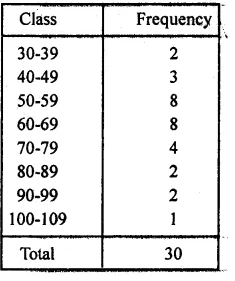
RD Sharma Class 9 Solutions Chapter 22 Tabular Representation of Statistical Data Ex 22.1 9.1
(ii) Highest score =100
(iii) Lowest score = 37
(iv) Range =  Highest score – Lowest score = 100 – 37 = 63
(v) If 40 is marks, then the number of students who failed = 2
(vi) No. of students who scored 75 or more = 8
(vii) Between 50 and 60, the scores which are missing 51, 54, 57
(viii) Number of students who scored less then 50 = 2 + 3 = 5

Question 10.
The weights of new born babies (in kg) in a hospital on a particular day are as follows:
2.3, 2.2, 2.1, 2.7, 2.6, 3.0, 2.5, 2.9, 2.8, 3.1, 2.5, 2.8, 2.7, 2.9, 2.4
(i) Rearrange the weights in descending order.
(ii) Determine the highest weight.
(iii) Determine the lowest weight.
(iv) Determine the range.
(v) How many babies were bom on that day?
(vi) How many babies weigh below 2.5 kg?
(vii) How many babies weigh more than 2.8 kg?
(viii)How many babies weigh 2.8 kg?
Solution:
(i) Weights in descending order are
3.1, 3.0, 2.9, 2.9, 2.8, 2.8, 2.7, 2.7, 2.6, 2.5, 2.5, 2.4, 2.3, 2.2, 2.1
(ii) Highest weight = 3.1
(iii) Lowest weight = 2.1
(iv) Range = Highest weight – Lowest wight = 3.1 – 2.1 = 1.0
(v) No. of babies who bom = 15
(vi) No. of babies whose weights are below 2.5 kg = 4
(vii) No. of babies whose weight are more than 2.8 kg = 4.
(viii) No. of babies whose weight is 2.8 kg = 2

Question 11.
The number of runs scored by a cricket player in 25 innings are as follows:
26, 35, 94, 48, 82, 105, 53, 0, 39, 42, 71, 0, 64, 15, 34, 67, 0, 42, 124, 84, 54, 48, 139, 64, 47.
(i) Rearrange these runs in ascending order.
(ii) Determine the player, is highest score.
(ii) How many times did the player not score a run?
(iv) How many centuries did he score?
(v) How many times did he score more than 50 runs?
Solution:
(i) Arranging in ascending order
0, 0, 0, 15, 26, 34, 35, 39, 42, 42, 47, 48, 48, 53, 54, 64, 64, 67, 71, 82, 84, 94, 105, 124, 139
(ii) Highest score is 139
(iii) 3 times when his score is 0
(iv) No. of times, he made century = 3
(v) No. of times his score more then 50 runs = 12

Question 12.
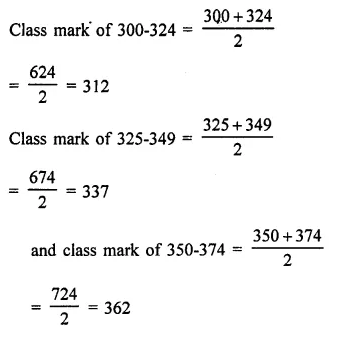
The class size of a distribution is 25 and the first class-interval is 200-224. There are seven class-intervals.
(i) Write the class-intervals.
(ii) Write the class-marks of each interval
Solution:
Class size = 25
First class is 200-224
∴ Number of class = 7
∴ Class interval will be
(i) 200-224, 225-249, 250-274, 275-299, 300-324, 325-349, 350-374
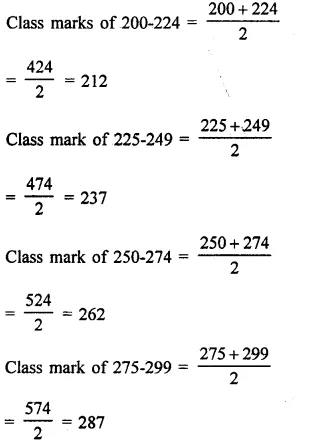
RD Sharma Class 9 Solutions Chapter 22 Tabular Representation of Statistical Data Ex 22.1 12.1
RD Sharma Class 9 Solutions Chapter 22 Tabular Representation of Statistical Data Ex 22.1 12.2

Question 13.
Write the class size and class limits in each of the following:
(i) 104, 114, 124, 134, 144, 154 and 164
(ii) 47, 52, 57, 62, 67, 72, 77, 82, 87, 92, 97 and 102
(iii) 12.5, 17.5, 22.5, 27.5, 32.5, 37.5, 42.5, 47.5
Solution:
(i) 104, 114, 124, 134, 144, 154 and 164
Here class size = 114 – 104 = 10
Here in first class, 104 – \(\frac { 10 }{ 2 }\)
= 104 – 5 = 99 and 104 + 5 = 109
∴ Class will be 99-109
In this way other classes will be 109-119, 119-129, 129-139, 139-149, 149-159, 159¬169
(ii) In 47, 52, 57, 62, 67, 72, 77, 82, 87, 92, 97, 102
Here class size = 52 – 47 = 5
∴ In first class, 47 – \(\frac { 5 }{ 2 }\) and 47 + \(\frac { 5 }{ 2 }\)
= 44.5-49.5
In this way other classes will be = 49.5-54.5, 54.5-59.5, 59.5-64.5, 64.5-69.5,69.5-74.5, 74.5-79.5, 79.5-84.5, 84.5-89.5, 89.5-94.5,94.5-99.5, 99.5-104.5 070 12.5, 17.5, 22.5, 27.5, 32.5, 37.5, 42.5, 47.5
Here class interval (size) = 17.5 – 12.5 = 5
In the class = 12.5 – \(\frac { 5 }{ 2 }\) , 12.5 + \(\frac { 5 }{ 2 }\)
⇒ 12.5 – 2.5, 12.5 + 2.5
⇒ 10, 15
∴ First class will be 10-15
In this way other classes 15-20, 20-25, 25-30, 30-35, 35-40, 40-45, 45-50

Question 14.
Following data gives the number of children in 41 families:
1, 2, 6, 5, 1, 5, 1, 3, 2, 6, 2, 3, 4, 2, 0, 0, 4, 4, 3, 2, 2, 0, 0, 1, 2, 2, 4, 3, 2, 1, 0, 5, 1, 2, 4, 3, 4, 1, 6, 2, 2.
Represent it in the form of a frequency distribution.
Solution:
Frequency distribution table is given below:
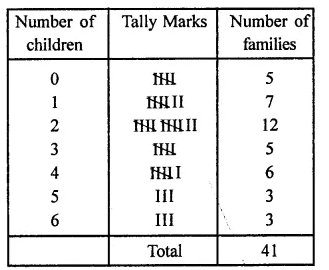
RD Sharma Class 9 Solutions Chapter 22 Tabular Representation of Statistical Data Ex 22.1 14.1

Question 15.
The marks scored by 40 students of class IX in mathematics are given below:
81, 55, 68, 79, 85, 43, 29, 68, 54, 73, 47, 35, 72, 64, 95, 44, 50, 77, 64, 35, 79, 52, 45, 54, 70, 83, 62, 64, 72, 92, 84, 76, 63, 43, 54, 38, 73, 68, 52, 54.
Prepare a frequency distribution with class size of 10 marks.
Solution:
Maximum marks = 95,
minimum marks = 29,
range = 95 – 29 = 66
Frequency distribution is given below
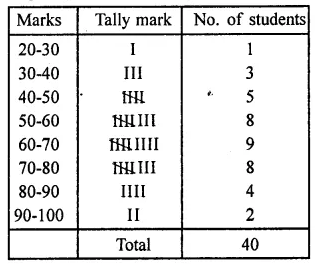
RD Sharma Class 9 Solutions Chapter 22 Tabular Representation of Statistical Data Ex 22.1 15.1

Question 16.
The heights (in cm) of 30 students of class IX are given below:155, 158, 154, 158, 160, 148, 149, 150, 153, 159, 161, 148, 157, 153, 157, 162, 159, 151, 154, 156, 152, 156, 160, 152, 147, 155, 163, 155, 157, 153.
Prepare a frequency distribution table with 160-164 as one of the class intervals.
Solution:
Maximum height = 163 cm,
minimum height = 147 cm,
range 163 – 147 = 16
Frequency distribution of the given data is given below
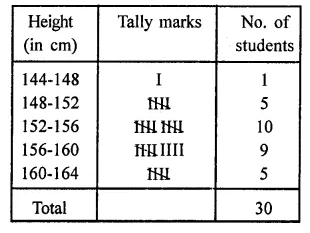
RD Sharma Class 9 Solutions Chapter 22 Tabular Representation of Statistical Data Ex 22.1 16.1

Question 17.
The monthly wages of 30 workers in a factory are given below:
830, 835, 890, 810, 835, 836, 869, 845, 898, 890, 820, 860, 832, 833, 855, 845, 804, 808, 812, 840, 885, 835, 836, 878,840, 868, 890, 806, 840, 890.
Represent the data in the form of a frequency distribution with class size 10.
Solution:
Highest wage = ₹890,
lower wage = ₹804,
range = 890 – 804 = 86
Frequency distribution table is given below
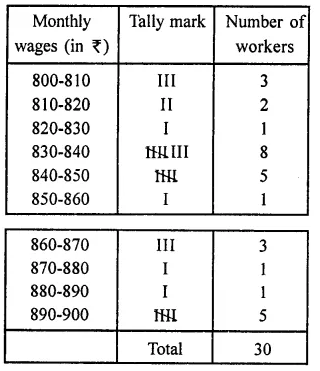
RD Sharma Class 9 Solutions Chapter 22 Tabular Representation of Statistical Data Ex 22.1 17.1

Question 18.
The daily maximum temperatures (in degree Celsius) recorded in a certain city during the month of November are as follows:
25.8, 24.5, 25.6, 20.7, 21.8, 20.5, 20.6, 20.9, 22.3, 22.7, 23.1, 22.8, 22.9, 21.7, 21.3, 20.5, 20.9, 23.1, 22.4, 21.5, 22.7, 22.8, 22.0, 23.9, 24.7, 22.8, 23.8, 24.6, 23.9, 21.1
Represent them as a frequency distribution table with class size 1°C.
Solution:
Maximum temperature = 25.8
Minimum temperature = 20.5
Range = 25.8 – 20.5 = 5.3
Frequency distribution table is given below:
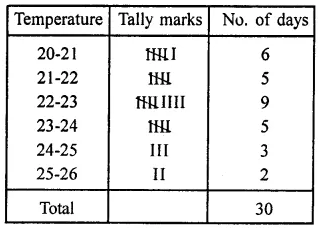
RD Sharma Class 9 Solutions Chapter 22 Tabular Representation of Statistical Data Ex 22.1 18.1

Question 19.
Construct a frequency table with equal class intervals from the following data on the monthly wages (in rupees) of 28 labourers working in a factory, taking* one of the class intervals as 210-230 (230 not included):
220, 268, 258, 242, 210, 268, 272, 242, 311, 290, 300, 320, 319, 304, 302, 318, 306, 292, 254, 278, 210, 240, 280, 316, 306, 215, 256, 236.
Solution:
Maximum wages = ₹320
Minimum wages = ₹210
Range = 320 – 210 = 110
Required frequency table is given below:
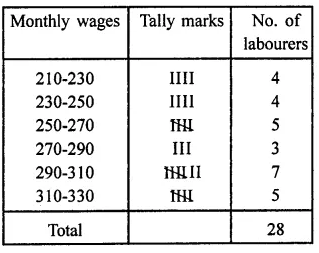
RD Sharma Class 9 Solutions Chapter 22 Tabular Representation of Statistical Data Ex 22.1 19.1

Question 20.
The blood groups of 30 students of class VIII are recorded as follows:
A, B, O, O, AB, O, A, O, B, A, O, B, A, O, O, A, AB, O, A, A, O, O, AB, B, A, O, B, A, B, O
Represent this data in the form of a frequency distribution table. Find out which is the most common and which is the rarest blood group among these students. (NCERT)
Solution:
Frequency distribution table is given below:
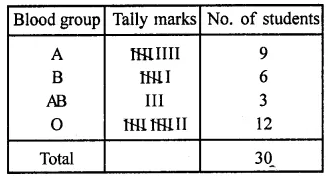
RD Sharma Class 9 Solutions Chapter 22 Tabular Representation of Statistical Data Ex 22.1 20.1

Question 21.
Three coins were tossed 30 times. Each time the number of heads occuring was noted down as follow:
0 1 2 2 1 2 3 1 3 0
1 3 1 1 2 2 0 1 2 1
3 0 0 1 1 2 3 2 2 0
Prepare a frequency distribution table for the data given above. (NCERT)
Solution:
Frequency distribution table is given below:
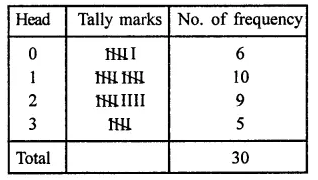
RD Sharma Class 9 Solutions Chapter 22 Tabular Representation of Statistical Data Ex 22.1 21.1

Question 22.
Thirty children were asked about the number of hours they watched T.V. programmes in the previous week. The results were found as follows:
1 6 2 35 12 5 8 4 8
10 3 4 12 2 8 15 1 17 6
3 2 8 5 9 6 8 7 14 12
(i) Make a grouped frequency distribution table for this data, taking class width 5 and one of the class intervals as 5-10.
(ii) How many children watched television for 15 or more hours a week? (NCERT)
Solution:
Highest number of hours = 17
Lowest number of hours = 1
(i) The frequency table is given below:
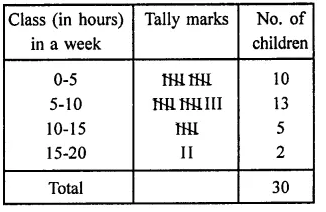
RD Sharma Class 9 Solutions Chapter 22 Tabular Representation of Statistical Data Ex 22.1 22.1
(ii) No. of children watching T.V. for 15 or more hours a week = 2

Question 23.
The daily minimum temperatures in degrees Celsius recorded in a certain Arctic region are as follows:
-12.5, -10.8, -18.6, -8.4, -10.8, -4.2, -4.8, -6.7, -13.2, -11.8, -2.3, 1.2, 2.6, 0, 2.4, 0, 3.2, 2.7, 3.4, 0, -2.4, -2.4, 0, 3.2, 2.7, 3.4, 0, -2.4, -5.8, -8.9, -14.6, -12.3, -11.5,-7.8,-2.9.
Represent them as frequency distribution table taking -19.9 to -15 as the first class interval.
Solution:
Maximum temperature = -18.6
Minimum temperature = 3.4
Range = 3.4 – (-18.6) = 3.4 + 18.6 = 22
The required frequency distribution table is given below:
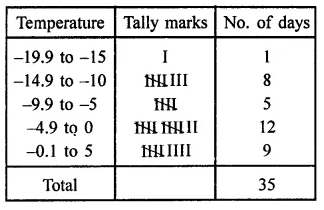
RD Sharma Class 9 Solutions Chapter 22 Tabular Representation of Statistical Data Ex 22.1 23.1
Hope given RD Sharma Class 9 Solutions Chapter 22 Tabular Representation of Statistical Data Ex 22.1 are helpful to complete your math homework.

If you have any doubts, please comment below. Learn Insta try to provide online math tutoring for you.


RS Aggarwal Class 8 Solutions Chapter 23 Pie Charts Ex 23A

RS Aggarwal Class 8 Solutions Chapter 23 Pie Charts Ex 23A

These Solutions are part of RS Aggarwal Solutions Class 8. Here we have given RS Aggarwal Solutions Class 8 Chapter 23 Pie Charts Ex 23A.

Other Exercises

Question 1.
Solution:
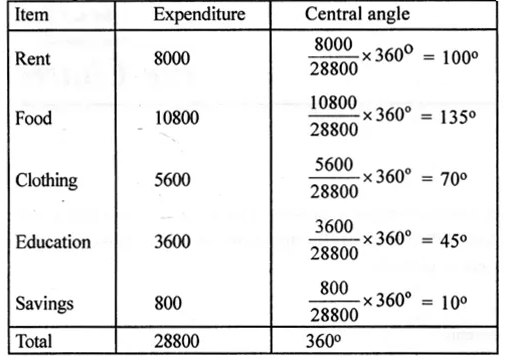
Total expenditure = Rs. 4000 + 5400 + 2800 + 1800 + 400 = Rs. 14400
RS Aggarwal Class 8 Solutions Chapter 23 Pie Charts Ex 23A 1.1
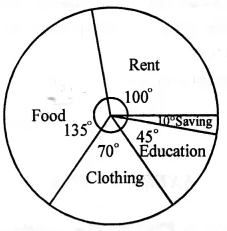
Construction of pie chart :
1. Draw a circle of any convenient radius.
2. Draw a horizontal radius.
3. Staring from this radius, draw sectors of central angle 100°, 135°, 70°, 45° and 10° respectively.
4. Shade these sectors with different colors or designs as shown in the figure.
This is the required pie chart.
RS Aggarwal Class 8 Solutions Chapter 23 Pie Charts Ex 23A 1.2

Question 2.
Solution:
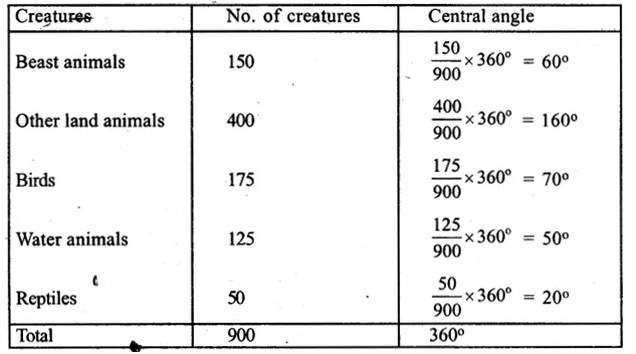
Total number of creatures 900
RS Aggarwal Class 8 Solutions Chapter 23 Pie Charts Ex 23A 2.1
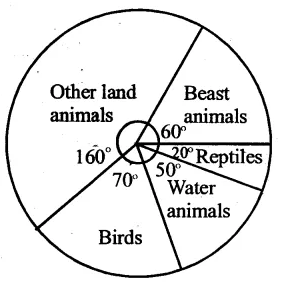
(i) Draw a circle with a suitable radius.
(ii) Draw a horizontal radius.
(iii) Starting from this radius, draw sectors whose central angles are 60°, 160°, 70°, 50° and 20° respectively.
(iv) Now shade each sector with different colours or designs as shown in the figure.
RS Aggarwal Class 8 Solutions Chapter 23 Pie Charts Ex 23A 2.2

Question 3.
Solution:
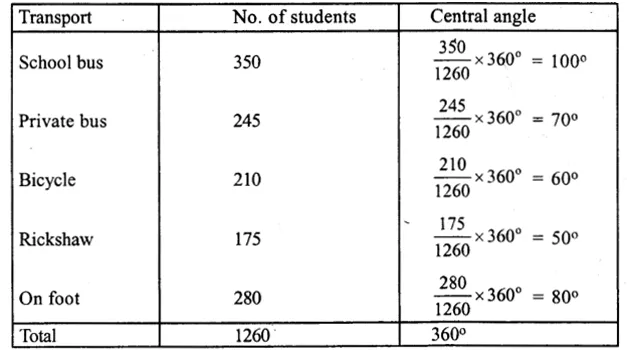
Total number of students = 350 + 245 + 210 + 175 + 280 = 1260
RS Aggarwal Class 8 Solutions Chapter 23 Pie Charts Ex 23A 3.1
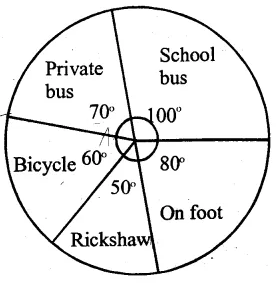
(i) Draw a circle with a suitable radius.
(ii) Draw a horizontal radius.
(iii) Starting from this radius draw sectors whose central angles are 100°, 70°, 60°, 50° and 80° respectively.
(iv) Now shade each sector with different colours or designs as shown in the figure.
RS Aggarwal Class 8 Solutions Chapter 23 Pie Charts Ex 23A 3.2

Question 4.
Solution:
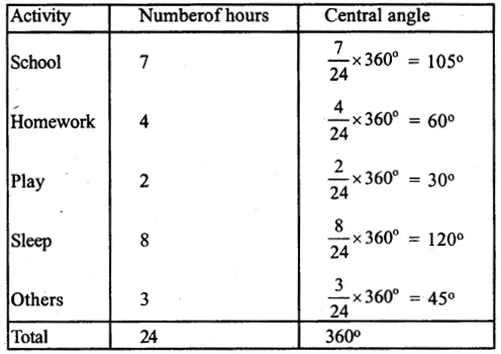
RS Aggarwal Class 8 Solutions Chapter 23 Pie Charts Ex 23A 4.1
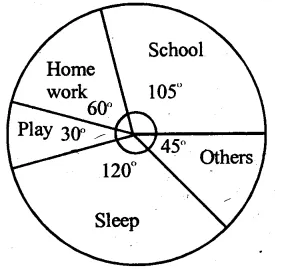
(i) Draw a circle with a suitable radius.
(ii) Draw a horizontal radius.
(iii) Starting from this radius, draw sectors whose actual angles are 105°, 60°, 30°, 120° and 45° respectively.
(iv) Now shade each sector with different colours or design as shown in the figure.
RS Aggarwal Class 8 Solutions Chapter 23 Pie Charts Ex 23A 4.2

Question 5.
Solution:
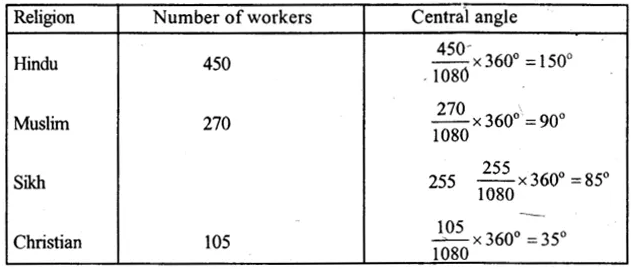
Here total number of workers = 1080
RS Aggarwal Class 8 Solutions Chapter 23 Pie Charts Ex 23A 5.1
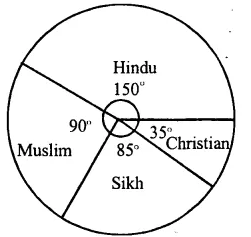
Now (i) Draw a circle with a suitable radius
(ii) Draw a horizontal radius
(iii) Starting from this radius, draw sectors whose central angle are 150°, 90°, 85°, 35° respectively.
(iv) Now shade the sectors with different colours or designs as shown in the figure.
RS Aggarwal Class 8 Solutions Chapter 23 Pie Charts Ex 23A 5.2

Question 6.
Solution:
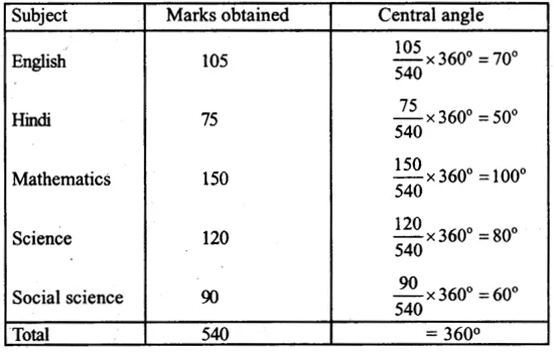
Total marks obtained by Sudhir
= 105 + 75 + 150 + 120 + 90 = 540
RS Aggarwal Class 8 Solutions Chapter 23 Pie Charts Ex 23A 6.1
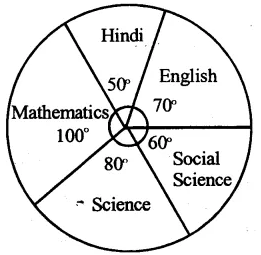
(i) Draw a circle with a suitable radius
(ii) Draw a horizontal radius
(iii) Starting from this radius, draw sectors whose central angles are 70°, 50°, 100°, 80° and 60° respectively
(iv) Now shade these sectors with different colours or designs as shown in the figure.
RS Aggarwal Class 8 Solutions Chapter 23 Pie Charts Ex 23A 6.2

Question 7.
Solution:
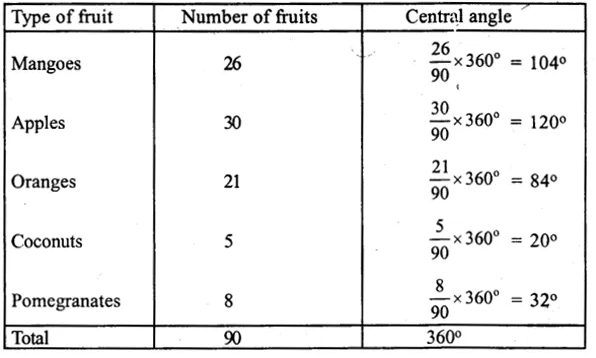
Total number of fruits = 26 + 30 + 21 + 5 + 8 = 90
RS Aggarwal Class 8 Solutions Chapter 23 Pie Charts Ex 23A 7.1
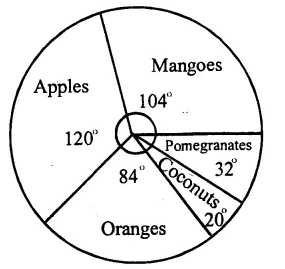
(i) Draw a circle with a suitable radius.
(ii) Draw a horizontal radius.
(iii) Starting from this radius, draw sectors of central angles 104°, 120°, 84°, 20° and 32° respectively.
(iv) Shade these sectors with different colours or designs as shown in the figure.
RS Aggarwal Class 8 Solutions Chapter 23 Pie Charts Ex 23A 7.2

Question 8.
Solution:
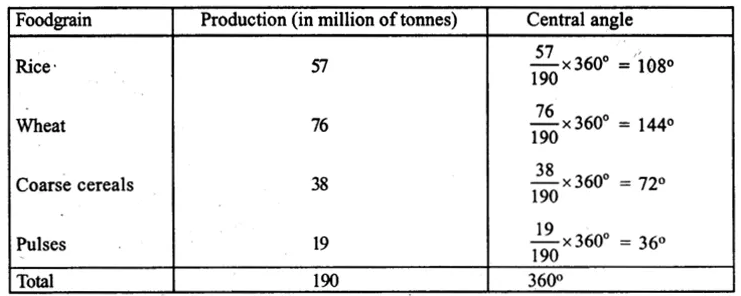
Total number of million of tonnes of food grains = 57 + 76 + 38 + 19 = 190 million of tonnes
RS Aggarwal Class 8 Solutions Chapter 23 Pie Charts Ex 23A 8.1
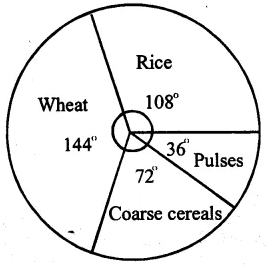
(i) Draw a circle with suitable radius.
(ii) Draw a horizontal radius.
(iii) Starting with this radius, draw sectors of central angles 108°, 144°, 72° and 366 respectively.
(iv) Shade these sectors with different colours or designs as shown in the figure.
RS Aggarwal Class 8 Solutions Chapter 23 Pie Charts Ex 23A 8.2

Question 9.
Solution:
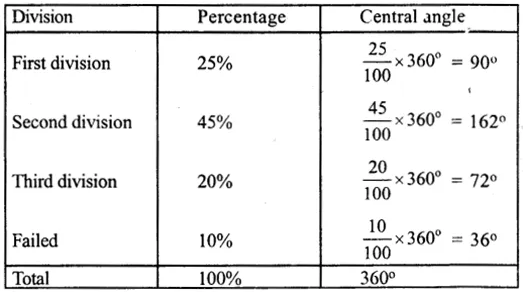
Total percentage = 25 + 45 + 20 + 10 = 100%
RS Aggarwal Class 8 Solutions Chapter 23 Pie Charts Ex 23A 9.1
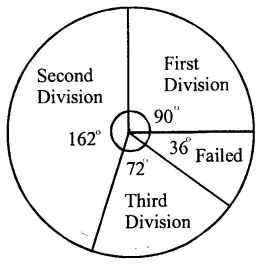
(i) Draw a circle with a suitable radius.
(ii) Draw a horizontal radius.
(iii) Starting from this radius, draw sectors of central angles 90°, 162°, 72° and 36° respectively.
(iv) Shade these sectors with different colours or designs as shown in the figure.
RS Aggarwal Class 8 Solutions Chapter 23 Pie Charts Ex 23A 9.2

Question 10.
Solution:
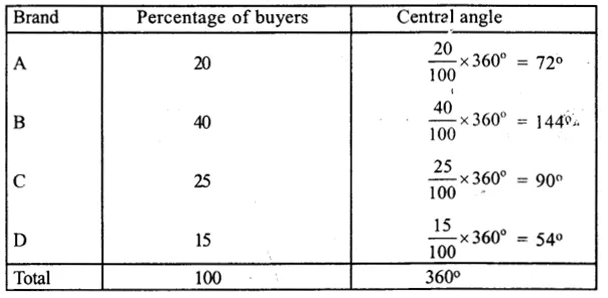
Total percentage = 20 + 40 + 25 + 15 = 100%
RS Aggarwal Class 8 Solutions Chapter 23 Pie Charts Ex 23A 10.1
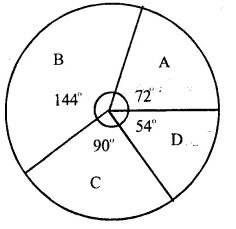
(i) Draw a circle with a suitable radius.
(ii) Draw a horizontal radius.
(iii) Starting from this radius, draw sectors of central angles 72°, 144°, 90° and 54° respectively.
(iv) Now shade these sectors with different colours or designs as shown in the figure.
RS Aggarwal Class 8 Solutions Chapter 23 Pie Charts Ex 23A 10.2


Hope given RS Aggarwal Solutions Class 8 Chapter 23 Pie Charts Ex 23A are helpful to complete your math homework.

If you have any doubts, please comment below. Learn Insta try to provide online math tutoring for you.