RD Sharma Class 8 Solutions Chapter 25 Data Handling III Ex 25.1

RD Sharma Class 8 Solutions Chapter 25 Data Handling III (Pictorial Representation of Data as Pie Charts or Circle Graphs) Ex 25.1

These Solutions are part of RD Sharma Class 8 Solutions. Here we have given RD Sharma Class 8 Solutions Chapter 25 Data Handling III Ex 25.1

Other Exercises

Question 1.
The number of hours, spent by a school boy on different activities in a working day, is given below:
RD Sharma Class 8 Solutions Chapter 25 Data Handling III Ex 25.1 1
Present the information in the form of a pie-chart .
Solution:
Total = 24
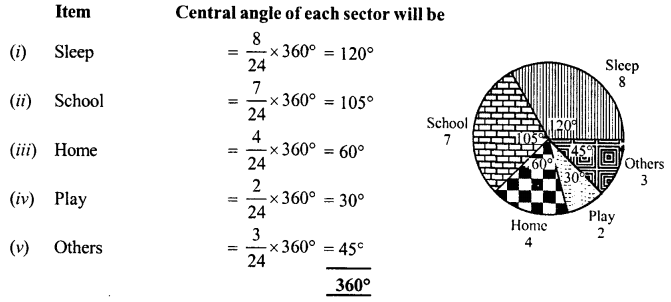
RD Sharma Class 8 Solutions Chapter 25 Data Handling III Ex 25.1 2
Now we draw a circle and divide it in the sectors having above central angles as shown in the figure.

Question 2.
Employees of a company have been categorized according to their religions as given below:
RD Sharma Class 8 Solutions Chapter 25 Data Handling III Ex 25.1 3
Draw a pie-chart to represent the above information.
Solution:
Total =1080
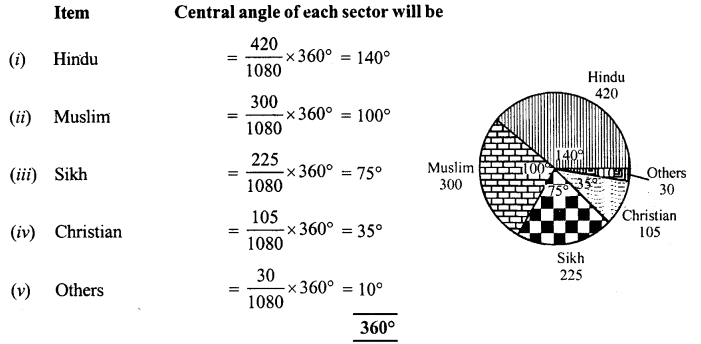
RD Sharma Class 8 Solutions Chapter 25 Data Handling III Ex 25.1 4
Now draw a circle and divided it into sectors having the above central angles as shown in the figure.

Question 3.
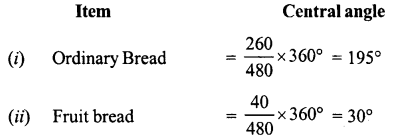
In one day the sales (in rupees) of different items of a baker’s shop are given below :
RD Sharma Class 8 Solutions Chapter 25 Data Handling III Ex 25.1 5
Draw pie-chart representing the above sales.
Solution:
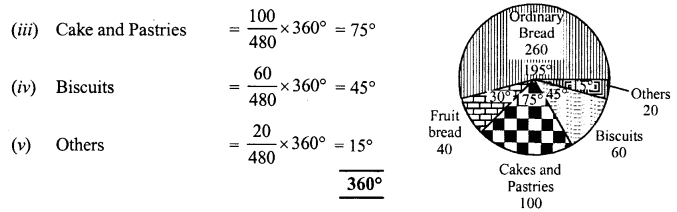
Total = 480
RD Sharma Class 8 Solutions Chapter 25 Data Handling III Ex 25.1 6
RD Sharma Class 8 Solutions Chapter 25 Data Handling III Ex 25.1 7
Now draw a circle and divide it into sectors having the above central angles as shown in the figure.

Question 4.
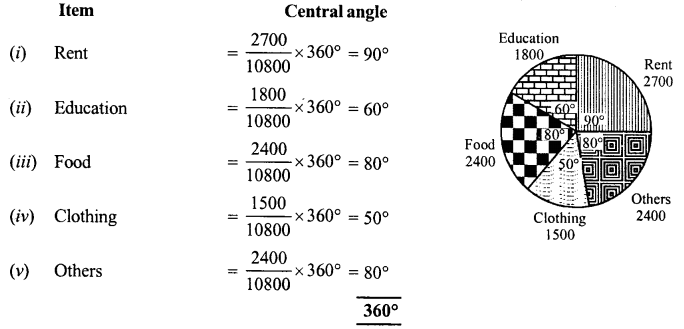
The following data shows the expenditure of a person on different items during a month. Represent the data by a pie-chart.
RD Sharma Class 8 Solutions Chapter 25 Data Handling III Ex 25.8
Solution:
Total = 10800
RD Sharma Class 8 Solutions Chapter 25 Data Handling III Ex 25.9
Now we draw a circle and divide it into sector having the above central angles as shown in figure.

Question 5.
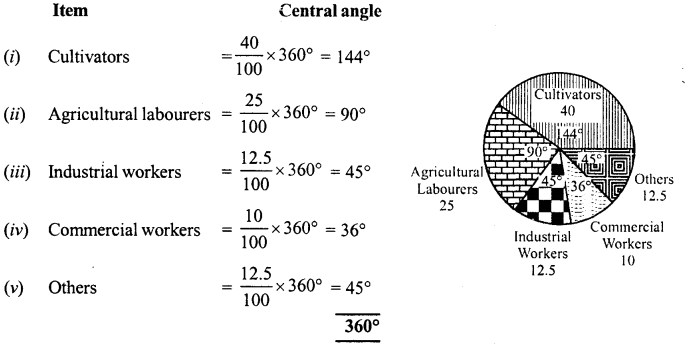
The percentages of various categories of workers in a state are given in the following table:
RD Sharma Class 8 Solutions Chapter 25 Data Handling III Ex 25.10
Present the information in the form of a pie-chart.
Solution:
Total = 100
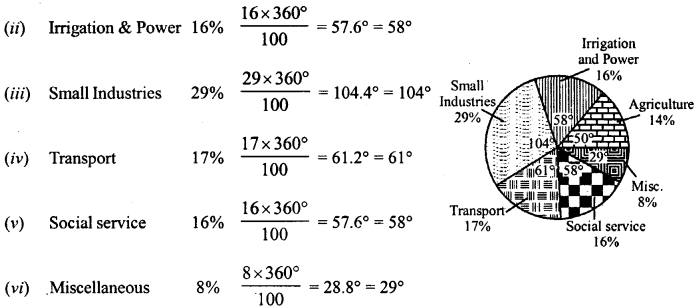
RD Sharma Class 8 Solutions Chapter 25 Data Handling III Ex 25.11

Now, we draw a circle and divide it into sectors having the above central angles as shown in the figure.

Question 6.
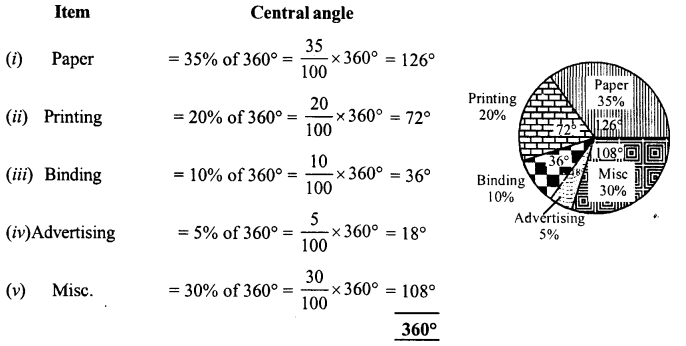
The following table shows the expenditure incurred by a publisher in publishing a book:
RD Sharma Class 8 Solutions Chapter 25 Data Handling III Ex 25.12
Present the above data in the form of a pie-chart.
Solution:
Total = 100% = 100
RD Sharma Class 8 Solutions Chapter 25 Data Handling III Ex 25.13
Now, we draw a circle and divide it into sectors having the above central angles as shown in the figure

Question 7.
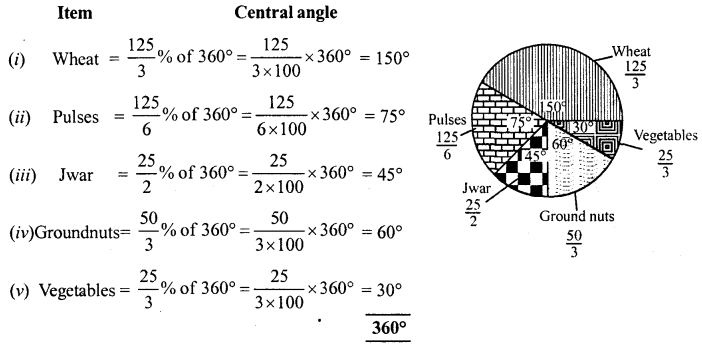
Percentage of the different products of a village in a particular district are given below. Draw a pie-chart representing this information.
RD Sharma Class 8 Solutions Chapter 25 Data Handling III Ex 25.14
Solution:
Total = 100
RD Sharma Class 8 Solutions Chapter 25 Data Handling III Ex 25.15
Now, we draw a circle and divided it into sectors having the above central angles as shown in the figure.

Question 8.
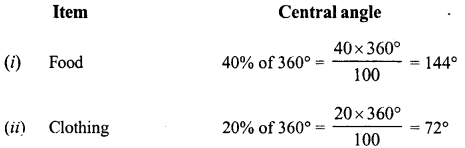
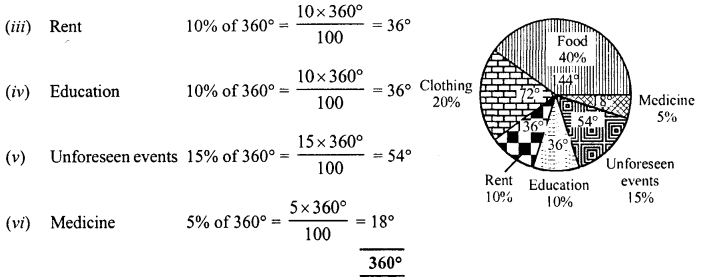
Draw a pie-diagram for the following data of expenditure pattern in a family.
RD Sharma Class 8 Solutions Chapter 25 Data Handling III Ex 25.16
Solution:
Total =100
RD Sharma Class 8 Solutions Chapter 25 Data Handling III Ex 25.17
RD Sharma Class 8 Solutions Chapter 25 Data Handling III Ex 25.18
Now we draw a circle and divide it into sectors having the above central angles as shown in the figure.

Question 9.
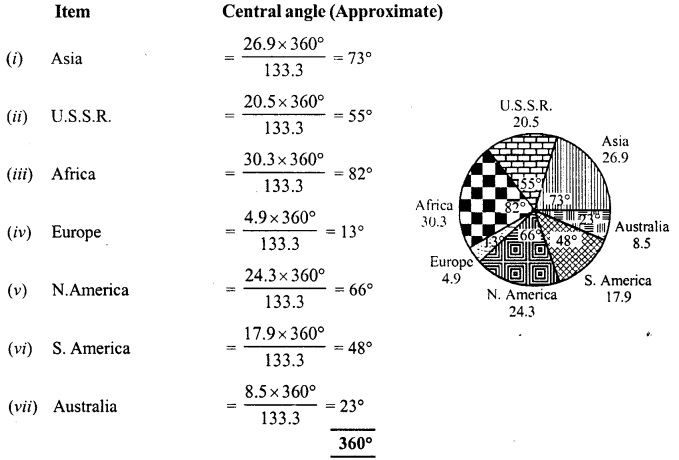
Draw a pie-diagram of the areas of continents cf the world given in the following table :
RD Sharma Class 8 Solutions Chapter 25 Data Handling III Ex 25.19
Solution:
Total = 133.3
RD Sharma Class 8 Solutions Chapter 25 Data Handling III Ex 25.20
Now, we draw a circle and divide it into sectors having the above given central angles as shown in the figure.

Question 10.
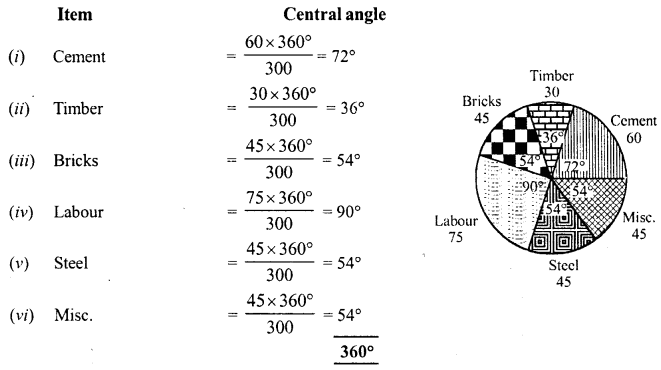
The following data gives the amount spent of the construction of a house. Draw a pie diagram.
RD Sharma Class 8 Solutions Chapter 25 Data Handling III Ex 25.21
Solution:
Total = 300 (in thousands)
RD Sharma Class 8 Solutions Chapter 25 Data Handling III Ex 25.22
Now, we draw a circle and divide it into sectors having the above given central angles as shown in the figure.

Question 11.
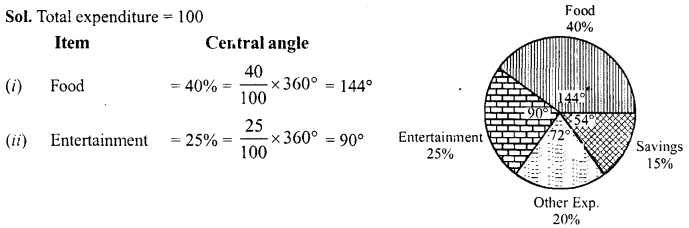
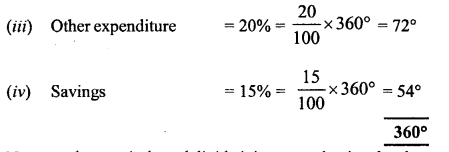
The following table shows how a student spends his pocket money during the course of a month. Represent it by a pie-diagram.
RD Sharma Class 8 Solutions Chapter 25 Data Handling III Ex 25.23
Solution:
Total expenditure = 100
RD Sharma Class 8 Solutions Chapter 25 Data Handling III Ex 25.24
RD Sharma Class 8 Solutions Chapter 25 Data Handling III Ex 25.25
Now, we draw a circle and divide it into sectors having the above given central angles as shown in the figure.

Question 12.
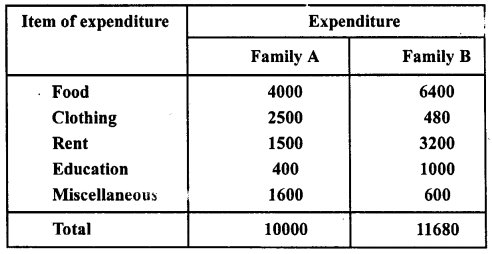
Represent the following data by a pie-diagram :
RD Sharma Class 8 Solutions Chapter 25 Data Handling III Ex 25.26
Solution:
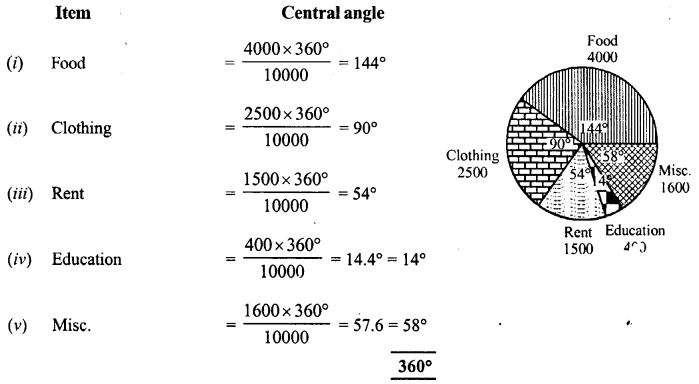
1. For family A
Total = 10000
RD Sharma Class 8 Solutions Chapter 25 Data Handling III Ex 25.27
Now, we draw a circle and divide it in sectors having the above central angles as shown in the figure.
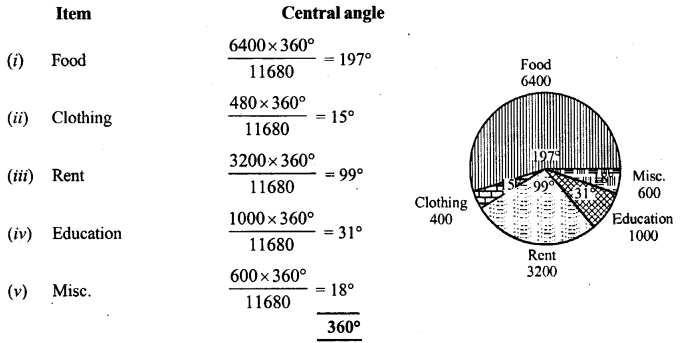
(2) For family B
Total = 11680
RD Sharma Class 8 Solutions Chapter 25 Data Handling III Ex 25.28
Now, we draw a circle and divide it into sectors having the above central angles as shown in the figure.

Question 13.
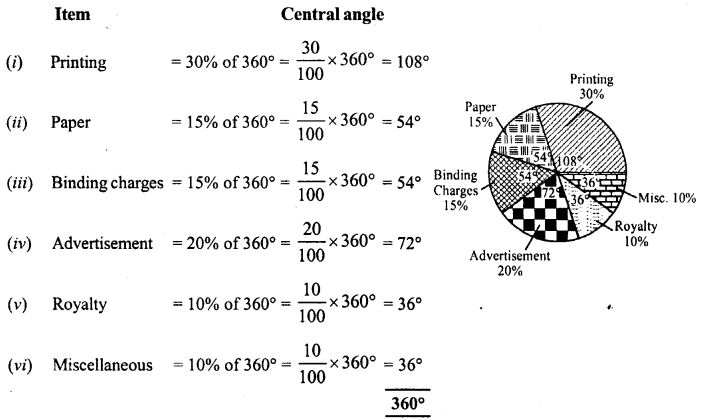
Following data gives the break up of the cost of production of a book:
RD Sharma Class 8 Solutions Chapter 25 Data Handling III Ex 25.29
Draw a pie – diagram depicting the above information.
Solution:
Total = 100
RD Sharma Class 8 Solutions Chapter 25 Data Handling III Ex 25.30
Now, we draw a circle and divide it into sectors of above central angles as shown in the figure.

Question 14.
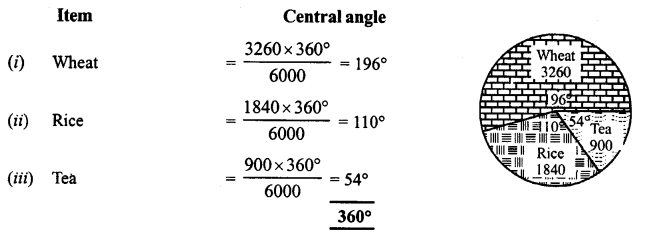
Represent the following data with the help of pie-diagram.
RD Sharma Class 8 Solutions Chapter 25 Data Handling III Ex 25.31
Solution:
Total = 6000 tons
RD Sharma Class 8 Solutions Chapter 25 Data Handling III Ex 25.32
Now, we draw a circle and divide it into sectors having the above central angles as shown in the figure.

Question 15.
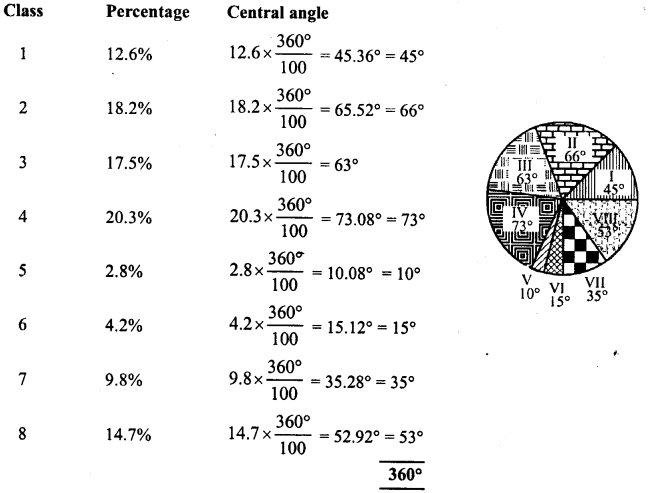
Draw a pie-diagram representing the relative frequencies (expressed as percentage) of the eight classes as given below :
12.6,18.2,17.5,20.3,2.8,4.2,9.8,14.7
Solution:
Total =100
RD Sharma Class 8 Solutions Chapter 25 Data Handling III Ex 25.33
Now, we draw a circle and divide it into sectors having the above central angles as shown in the figure given.

Question 16.
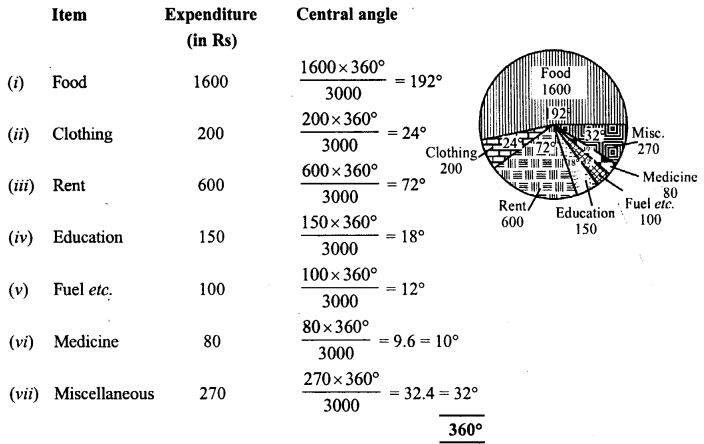
Following is the break up of the expenditure of a family on different items of consumption :
RD Sharma Class 8 Solutions Chapter 25 Data Handling III Ex 25.34
Draw a a pie – diagram to represent the above data.
Solution:
Total = Rs. 3000
RD Sharma Class 8 Solutions Chapter 25 Data Handling III Ex 25.35
Now, we draw a circle and divide it into sectors having the above central angles as shown in the figure.

Question 17.
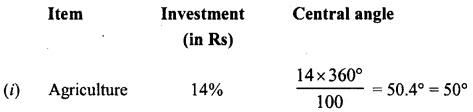
Draw a pie-diagram for the following data of the investment pattern in five year plan :
RD Sharma Class 8 Solutions Chapter 25 Data Handling III Ex 25.36
Solution:
Total = 100
RD Sharma Class 8 Solutions Chapter 25 Data Handling III Ex 25.37
RD Sharma Class 8 Solutions Chapter 25 Data Handling III Ex 25.38
Now, we draw a circle and divide it into sectors having the above central angles as shown in the figure.

Hope given RD Sharma Class 8 Solutions Chapter 25 Data Handling III Ex 25.1 are helpful to complete your math homework.

If you have any doubts, please comment below. Learn Insta try to provide online math tutoring for you.


RS Aggarwal Class 6 Solutions Chapter 2 Factors and Multiples Ex 2C

RS Aggarwal Class 6 Solutions Chapter 2 Factors and Multiples Ex 2C

These Solutions are part of RS Aggarwal Solutions Class 6. Here we have given RS Aggarwal Solutions Class 6 Chapter 2 Factors and Multiples Ex 2C.

Other Exercises

Give the prime factorization of each of the following numbers.

Question 1.
Solution:
We have
RS Aggarwal Class 6 Solutions Chapter 2 Factors and Multiples Ex 2C 1.1
∴12 = 2 x 2 x 3 = 22 x 3.

Question 2.
Solution:
We have
RS Aggarwal Class 6 Solutions Chapter 2 Factors and Multiples Ex 2C 2.1
∴18 = 2 x 3 x 3 = 2 x 32

Question 3.
Solution:
We have
RS Aggarwal Class 6 Solutions Chapter 2 Factors and Multiples Ex 2C 3.1
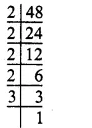
∴ 48 = 2 x 2 x 2 x 2 x 3
= 24 x 3.

Question 4.
Solution:
We have
RS Aggarwal Class 6 Solutions Chapter 2 Factors and Multiples Ex 2C 4.1
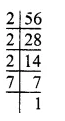
∴ 56 = 2 x 2 x 2 x 7
= 23 x 7.

Question 5.
Solution:
We have
RS Aggarwal Class 6 Solutions Chapter 2 Factors and Multiples Ex 2C 5.1
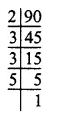
∴ 90 = 2 x 3 x 3 x 5
= 2 x 32 x 5.

Question 6.
Solution:
We have
RS Aggarwal Class 6 Solutions Chapter 2 Factors and Multiples Ex 2C 6.1
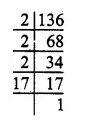
136 = 2 x 2 x 2 x 17
= 23 x 17.

Question 7.
Solution:
We have
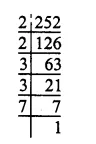
RS Aggarwal Class 6 Solutions Chapter 2 Factors and Multiples Ex 2C 7.1
∴ 252 = 2 x 2 x 3 x 3 x 7
= 22 x 32 x 7.

Question 8.
Solution:
We have
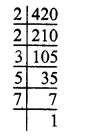
RS Aggarwal Class 6 Solutions Chapter 2 Factors and Multiples Ex 2C 8.1
∴ 420 = 2 x 2 x 3 x 5 x 7
= 22 x 3 x 5 x 7.

Question 9.
Solution:
We have
RS Aggarwal Class 6 Solutions Chapter 2 Factors and Multiples Ex 2C 9.1
∴ 637 = 7 x 7 x 13
= 72 x 13.

Question 10.
Solution:
We have
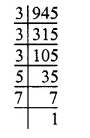
RS Aggarwal Class 6 Solutions Chapter 2 Factors and Multiples Ex 2C 10.1
∴ 945 = 3 x 3 x 3 x 5 x 7
= 33 x 5 x 7.

Question 11.
Solution:
We have
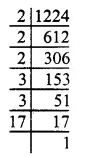
RS Aggarwal Class 6 Solutions Chapter 2 Factors and Multiples Ex 2C 11.1
∴ 1224 = 2 x 2 x 2 x 3 x 3 x 17
= 23 x 32 x 17.

Question 12.
Solution:
We have
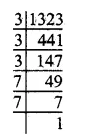
RS Aggarwal Class 6 Solutions Chapter 2 Factors and Multiples Ex 2C 12.1
∴ 1323 = 3 x 3 x 3 x 7 x 7
= 33 x 72

Question 13.
Solution:
We have
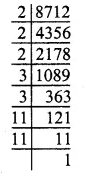
RS Aggarwal Class 6 Solutions Chapter 2 Factors and Multiples Ex 2C 13.1
∴ 8712 = 2 x 2 x 2 x 3 x 3 x 11 x 11
= 23 x 32 x 112.

Question 14.
Solution:
We have
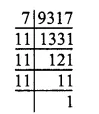
RS Aggarwal Class 6 Solutions Chapter 2 Factors and Multiples Ex 2C 14.1
∴9317 = 7 x 11 x 11 x 11
= 7 x 113

Question 15.
Solution:
We have
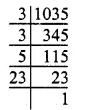
RS Aggarwal Class 6 Solutions Chapter 2 Factors and Multiples Ex 2C 15.1
∴ 1035 = 3 x 3 x 5 x 23
= 32 x 5 x 23

Question 16.
Solution:
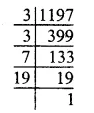
We have
RS Aggarwal Class 6 Solutions Chapter 2 Factors and Multiples Ex 2C 16.1
∴ 1197 = 3 x 3 x 7 x 19
= 32 x 7 x 19

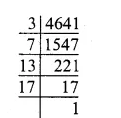
Question 17.
Solution:
We have
RS Aggarwal Class 6 Solutions Chapter 2 Factors and Multiples Ex 2C 17.1
∴ 4641 = 3 x 7 x 13 x 17.

Question 18.
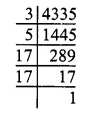
Solution:
We have
RS Aggarwal Class 6 Solutions Chapter 2 Factors and Multiples Ex 2C 18.1
∴ 4335 = 3 x 5 x 17 x 17
= 3 x 5 x 172

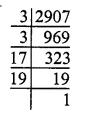
Question 19.
Solution:
We have
RS Aggarwal Class 6 Solutions Chapter 2 Factors and Multiples Ex 2C 19.1
∴ 2907 = 3 x 3 x 17 x 19
= 32 x 17 x 19.

Question 20.
Solution:
We have
RS Aggarwal Class 6 Solutions Chapter 2 Factors and Multiples Ex 2C 20.1
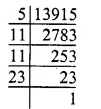
∴ 13915 = 5 x 11 x 11 x 23 = 5 x 112 x 23

Hope given RS Aggarwal Solutions Class 6 Chapter 2 Factors and Multiples Ex 2C are helpful to complete your math homework.

If you have any doubts, please comment below. Learn Insta try to provide online math tutoring for you.
RD Sharma Class 8 Solutions Chapter 26 Data Handling IV (probability) Ex 26.1

RD Sharma Class 8 Solutions Chapter 26 Data Handling IV (probability) Ex 26.1

These Solutions are part of RD Sharma Class 8 Solutions. Here we have given RD Sharma Class 8 Solutions Chapter 26 Data Handling IV (probability) Ex 26.1

Question 1.
The probability that it will rain to morrow is 0.85. What is the probability that it will not rain tomorrow ?
Solution:
Total number of possible events = 1
∴ P (\(\bar { A }\) ) = 0.85
∴ P (\(\bar { A }\) ) = 1-0.85 = 0.15

Question 2.
A die is thrown. Find the probability of getting (i) a prime number (ii) 2 or 4 (iii) a multiple of 2 or 3.
Solution:
Total number of possible events = 6 (1 to 6)
(i) Let A be the favourable occurrence which are prime number i.e., 2,3,5
∴ P(A) = \(\frac { 3 }{ 6 }\) = \(\frac { 1 }{ 2 }\)
(ii) Let B be the favourable occurrence which are 2 or 4
∴ P(B) = \(\frac { 2 }{ 6 }\) = \(\frac { 1 }{ 3 }\)
(iii) Let C be the favourable occurrence which are multiple of 2 or 3 i.e., 2, 3, 4, 6.
∴ P(C) = \(\frac { 4 }{ 6 }\) = \(\frac { 2 }{ 3 }\)

Question 3.
In a simultaneous throw of a pair of dice, find the probability of getting:
(i) 8 as the sum
(ii) a doublet
(iii) a doublet, of prime numbers
(iv) a doublet of odd numbers
(v) a sum greater than 9
(vi) an even number on first
(vii) an even number on one and a multiple of 3 on the other
(viii) neither 9 nor 11 as the sum of the numbers on the faces
(ix) a sum less than 6
(x) a sum less than 7
(xi) a sum more than 7
(xii) at least once
(xiii) a number other than 5 on any dice.
Solution:
By throwing of a pair of dice, total number of possible events = 6 × 6 = 36
(i) Let A be the occurrence of favourable events whose sum is 8 i.e. (2,6), (3,5), (4,4), (5,3) , (6,2) which are 5
∴ P(A) = \(\frac { 5 }{ 36 }\)
(ii) Let B be the occurrence of favourable events which are doublets i.e. (1, 1), (2, 2), (3, 3), (4,4), (5, 5) and (6, 6).
∴ P(B) = \(\frac { 6 }{ 36 }\) = \(\frac { 1 }{ 6 }\)
(iii) Let C be the occurrence of favourable events which are doublet of prime numbers which are (2, 2), (3,3), (5, 5)
∴ P(C) = \(\frac { 3 }{ 36 }\) = \(\frac { 1 }{ 12 }\)
(iv) Let D be the occurrence of favourable events which are doublets of odd numbers which are (1, 1), (3, 3) and (5, 5)
∴ P(D) = \(\frac { 3 }{ 36 }\) = \(\frac { 1 }{ 12 }\)
(v) Let E be the occurrence of favourable events whose sum is greater than 8 i.e, (3,6), (4, 5), (4, 6), (5, 4), (5, 5), (5, 6) which are 6 in numbers
∴ P(E) = \(\frac { 6 }{ 36 }\) = \(\frac { 1 }{ 6 }\)
(vi) Let F be the occurrence of favourable events in which is an even number is on first i.e (2, 1), (2, 2), (2, 3), (2, 4), (2, 5), (2, 6), (4, 1),(4,2), (4,3) (4,4), (4,5), (4,6), (6,1), (6,2), (6, 3), (6,4 ), (6, 5), (6,6) which are 18 in numbers.
∴ P(F) = \(\frac { 18 }{ 36 }\) = \(\frac { 1 }{ 2 }\)
(vii) Let G be the occurrence of favourable events in which an even number on the one and a multiple of 3 on the other which are (2,3), (2,6), (4, 3), (4, 6), (6, 3), (6, 6), (3, 2), (3, 4), (3, 6), (6,2), (6,4) = which are 11th number
∴ P(G) = \(\frac { 11 }{ 36 }\)
(viii) Let H be the occurrence of favourable events in which neither 9 or 11 as the sum of the numbers on the faces which are (1,1), (1,2), (1,3) , (1, 4), (1, 5), (1, 6), (2, 1), (2, 2), (2, 3), (2,4) , (2, 5), (2, 6), (3, 1), (3, 2), (3, 3), (3, 4), (3,5) , (4, 1), (4, 2), (4, 3), (4, 4), (4, 6), (5, 1), (5,2), (5,3), (5,5), (6,1), (6,2), (6,4), (6,6) which are 30
∴ P(H) = \(\frac { 30 }{ 36 }\) = \(\frac { 5 }{ 6 }\)
(ix) Let I be the occurrence of favourable events, such that a sum less than 6, which are (1, 1), (1, 2), (1, 3), (1, 4), (2, 1), (2, 2), (2, 3), (3, 1), (3, 2), (4,1) which are 10
∴ P(I) = \(\frac { 10 }{ 36 }\) = \(\frac { 5 }{ 18 }\)
(x) Let J be the occurrence of favourable events such that a sum is less than 7, which are
(1.1) , (1,2), (1,3), (1,4), (1,5), (2, 1), (2, 2), (2, 3), (2, 4), (3, 1), (3, 2), (3, 3), (4, 1), (4, 2), (5.1) which are 15
∴ P(J) = \(\frac { 15 }{ 36 }\) = \(\frac { 5 }{ 6 }\)
(xi) Let K be the occurrence of favourable events such that the sum is more than 7, which are (2, 6), (3, 5), (3, 6), (4, 4), (4, 5), (4, 6), (5, 3), (5, 4), (5, 5), (5, 6), (6, 2), (6, 3), (6, 4), (6, 5), (6, 6) which 15
∴ P(K) = \(\frac { 15 }{ 36 }\) = \(\frac { 5 }{ 12 }\)
(xii) Let L be the occurrence of favourable events such that at least P (L) one is black card
∴ P(L) = \(\frac { 26 }{ 52 }\) = \(\frac { 1 }{ 2 }\)
(xiii) Let M is the occurrence of favourable events such that a number other than 5 on any dice which can be (1,1), (1,2), (1,3), (1,4), (1,6), (2, 1), (2, 2), (2, 3), (2, 4), (2, 6), (3,1), (3,2), (3, 3), (3,4), (3,6), (4,1), (4, 2), (4, 3), (4,4), (4,6), (6, 1), (6,2), (6, 3), (6,4), (6, 6) which are 25
∴ P(M) = \(\frac { 25 }{ 36 }\)

Question 4.
Three coins are tossed together. Find the probability of getting:
(i) exactly two heads
(ii) at least two heads
(iii) at least one head and one tail
(iv) no tails
Solution:
Total number of events tossed by 3 coins each having one head and one tail = 2x2x2 = 8
(i) Let A be the occurrence of favourable events which is exactly two heads, which can be 3 in number which are HTH, HHT, THH.
∴ P(A) = \(\frac { 3 }{ 8 }\)
(ii) Let B be the occurrence of favourable events which is at least two heads, which will be 4 which are HHT, HTH, THH, and HHH.
∴ P(B) = \(\frac { 4 }{ 8 }\) = \(\frac { 1 }{ 2 }\)
(iii) Let C be the occurrence 6f favourable events which is at least one head and one tail which are 6 which can be HHT, HTH, THH, TTH, THT, HTT
∴ P(C) = \(\frac { 6 }{ 8 }\) = \(\frac { 3 }{ 4 }\)
(iv) Let D be the occurrence of favourable events in which there is no tail which is only 1 (HHH)
∴ P(D) = \(\frac { 1 }{ 8 }\)

Question 5.
A card is drawn at random from a pack of 52 cards. Find the probability that the card drawn is:
(i) a black king
(ii) either a black card or a king
(iii) black and a king
(iv) a jack, queen or a king
(v) neither a heart nor a king
(vi) spade or an ace
(vii) neither an ace nor a king
(viii) neither a red card nor a queen
(ix) other than an ace
(x) a ten
(xi) a spade
(xii) a black card
(xiii) the seven of clubs
(xiv) jack
(xv) the ace of spades
(xvi) a queen
(xvii) a heart
(xviii) a red card
Solution:
A pack of cards have 52 cards, 26 black and 26 red and four kinds each of 13 cards from 2 to 10, one ace, one jack, one queen and one king.
∴ Total number of possible events = 52
(i) Let A be the occurrence of favourable events which is a black king which are 2.
∴ P(A) = \(\frac { 2 }{ 52 }\) = \(\frac { 1 }{ 26 }\)
(ii) Let B be the occurrence of favourable events such that it is either a black card or a king.
Total = number of black cards = 26 + 2 red kings = 28
∴ P(B) = \(\frac { 28 }{ 52 }\) = \(\frac { 7 }{ 13 }\)
(iii) Let C be the occurrence of favourable events such that it is black and a king which can be 2.
∴ P(C) = \(\frac { 2 }{ 52 }\) = \(\frac { 1 }{ 26 }\)
(iv) Let D be the occurrence of favourable events such that it is a jack, queen or a king which will be4 + 4 + 4 = 12
∴ P(D) = \(\frac { 12 }{ 52 }\) = \(\frac { 3 }{ 13 }\)
(v) Let E be the occurrence of favourable events such that it is neither a heart nor a king.
∴ Number of favourable event will be 13 x 3 -3 = 39 – 3 = 36
∴ P(E) = \(\frac { 36 }{ 52 }\) = \(\frac { 9 }{ 13 }\)
(vi) Let F be the occurrence of favourable events such that it is a spade or an ace.
∴ Number of events = 13 + 3 = 16
∴ P(F) = \(\frac { 16 }{ 52 }\) = \(\frac { 4 }{ 13 }\)
(vii) Let G be the occurrence of favourable events such that it neither an ace nor a king.
∴Number of events = 52 – 4 – 4 = 44
∴ P(G) = \(\frac { 44 }{ 52 }\) = \(\frac { 11 }{ 13 }\)
(viii) Let H be the occurrence of favourable events such that it is neither a red card nor a queen.
∴Number of events = 26 – 2 = 24,
∴ P(H) = \(\frac { 24 }{ 52 }\) = \(\frac { 6 }{ 13 }\)
(ix) Let 1 be the occurrence of favourable events such that it is other than an ace.
∴ Number of events = 52 – 4 = 48
∴ P(I) = \(\frac { 48 }{ 52 }\) = \(\frac { 12 }{ 13 }\)
(x) Let J be the occurrence of favourable event such that it is ten
∴ Number of events = 4
∴ P(J) = \(\frac { 4 }{ 52 }\) = \(\frac { 1 }{ 13 }\)
(xi) Let K be the occurrence of favourable event such that it is a spade.
∴ Number of events =13
∴ P(K) = \(\frac { 13 }{ 52 }\) = \(\frac { 1 }{ 4 }\)
(xii) Let L be the occurrence of favourable event such that it is a black card.
∴ Number of events = 26
∴ P(L) = \(\frac { 26 }{ 52 }\) = \(\frac { 1 }{ 2 }\)
(xiii) Let M be the occurrence of favourable event such that it is the seven of clubs.
∴ Number of events = 1
∴ P(M) = \(\frac { 1 }{ 52 }\)
(xiv) Let N be the occurrence of favourable event such that it is a jack.
∴ Number of events = 1
∴ P(N) = \(\frac { 4 }{ 52 }\) = \(\frac { 1 }{ 13 }\)
(xv) Let O be the occurrence of favourable event such that it is an ace of spades.
∴ Number of events = 1
∴ P(O) = \(\frac { 1 }{ 52 }\)
(xvi) Let Q be the occurrence of favourable event such that it is a queen.
∴ VNumber of events = 4
∴ P(P) = \(\frac { 4 }{ 52 }\) = \(\frac { 1 }{ 13 }\)
(xvii) Let R be the occurrence of favourable event such that it is a heart card.
∴ Number of events =13
∴ P(P) = \(\frac { 13 }{ 52 }\) = \(\frac { 1 }{ 4 }\)
(xviii) Let S be the occurrence of favourable event such that it is a red card
∴ Number of events = 26
∴ P(P) = \(\frac { 26 }{ 52 }\) = \(\frac { 1 }{ 2 }\)

Question 6.
An urn contains 10 red and 8 white balls. One ball is drawn at random. Find the probability that the ball drawn is white.
Solution:
Number of possible events = 10 + 8 = 18
Let A be the occurrence of favourable event such that it is a white ball.
∴ Number of events = 8
∴ P(A) = \(\frac { 8 }{ 18 }\) = \(\frac { 4 }{ 9 }\)

Question 7.
A bag contains 3 red balls, 5 black balls and 4 white balls. A ball is drawn at random from the bag. What is the probability that the ball drawn is (i) white ? (ii) red ? (iii) black ? (iv) not red ?
Solution:
Number of possible events = 3 + 5 + 4 = 12 balls
(i) Let A be the favourable event such that it is a white ball.
∴ P(A) = \(\frac { 4 }{ 12 }\) = \(\frac { 1 }{ 3 }\)
(ii) Let B be the favourable event such that it is a red ball.
∴ P(B) = \(\frac { 3 }{ 12 }\) = \(\frac { 1 }{ 4 }\)
(iii) Let C be the favourable event such that it is a black ball.
∴ P(C) = \(\frac { 5 }{ 12 }\)
(iv) Let D be the favourable event such that it is not red.
∴ Number of favourable events = 5 + 4 = 9
∴ P(D) = \(\frac { 9 }{ 12 }\) = \(\frac { 3 }{ 4 }\)

Question 8.
What is the probability that a number selected from the numbers 1,2,3,…………, 15 is a multiple of 4 ?
Solution:
Number of possible events =15
Let A be the favourable event such that it is a multiple of 4 which are 4, 8, 12
∴ P(A) = \(\frac { 3 }{ 15 }\) = \(\frac { 1 }{ 5 }\)

Question 9.
A bag contains 6 red, 8 black and 4 white balls. A ball is drawn at random. What is the probability that ball drawn is not black ?
Solution:
Number of possible events = 6 + 8 + 4 = 18 balls
Let A be the favourable event such that it is not a black
∴ Number of favourable events = 6 + 4=10
∴ P(A) = \(\frac { 10 }{ 18 }\) = \(\frac { 5 }{ 9 }\)

Question 10.
A bag contains 5 white and 7 red balls. One ball is drawn at random, what is the probability that ball drawn is white ?
Solution:
Number of possible events = 5 + 7 = 12
Let A be the favourable event such that it is a while which are 5.
∴ P(A) = \(\frac { 5 }{ 12 }\)

Question 11.
A bag contains 4 red, 5 black and 6 white balls. A ball is drawn from the bag at random. Find the probability that the ball drawn is (i) white (if) red (iii) not black (iv) red or white.
Solution:
Number of possible events = 4 + 5 + 6 = 15
(i) Let A be the favourable events such that it is a white.
∴ P(A) = \(\frac { 6 }{ 15 }\) = \(\frac { 2 }{ 5 }\)
(ii) Let B be the favourable event such that it is a red
∴ P(B) = \(\frac { 4 }{ 15 }\)
(iii) Let C be the favourable event such that it is not black.
∴ Number of favourable events = 4 + 6=10
∴ P(C) = \(\frac { 10 }{ 15 }\) = \(\frac { 2 }{ 3 }\)

Question 12.
A bag contains 3 red balls and 5 black balls. A ball is drawn at random from the bag. What is the probability that the ball drawn is: (i) red (ii) black.
Solution:
Number of possible events = 3 + 5 = 8
(i) Let A be the favourable events such that it is red.
∴ P(A) = \(\frac { 3 }{ 8 }\)
(ii) Let B be the favourable event such that it is black.
∴ P(B) = \(\frac { 5 }{ 8 }\)

Question 13.
A bag contains 5 red marbles, 8 white marbles, 4 green marbles. What is the probability that if one marble is taken out of the bag at random, it will be
(i) red
(ii) white
(iii) not green.
Solution:
Total number of possible events = 5 + 8+4=17
(i) Let A be the favourable event such that it is red.
∴ P(A) = \(\frac { 5 }{ 7 }\)
(ii) Let B be the favourable event such that it is white
Then P (B) = \(\frac { 8 }{ 7 }\)
(iii) Let C be the favourable event such that it is not green.
∴ Number of favourable events = 5 + 8 = 13
∴ P(C) = \(\frac { 13 }{ 17 }\)

Question 14.
If you put 21 consonants and 5 vowels in a bag. What would carry greater probability ? Getting a consonant or a vowel ? Find each probability.
Solution:
Total number of possible events = 21 + 5 = 26
(i) Probability of getting a consonant is greater as to number is greater than the other.
(ii) Let A be the favourable event such that it is a consonant.
∴ P(A) = \(\frac { 21 }{ 26 }\)
(iii) Let B be the favourable event such that it is a vowel.
∴ P(B) = \(\frac { 5 }{ 26 }\)

Question 15.
If we have 15 boys and 5 girls in a class which carries a higher probability ? Getting a copy belonging to a boy or a girl ? Can you give it a value ?
Solution:
Number of possible outcome (events) = 15 + 5 = 20
∵ The number of boys is greater than the girls
∴ The possibility of getting a copy belonging to a boy is greater.
Let A be the favourable outcome (event) then
P(A) = \(\frac { 15 }{ 20 }\) = \(\frac { 3 }{ 4 }\)

Question 16.
If you have a collection of 6 pairs of white socks and 3 pairs of black socks. What is the probability that a pair you pick without looking is (i) white ? (if) black ?
Solution:
Total number of possible outcomes =6+3=9
(i) Let A be the favourable outcome which is white pair.
∴ P(A) = \(\frac { 6 }{ 9 }\) = \(\frac { 2 }{ 3 }\)
(ii) Let B be the favourable outcome which is a black pair.
∴ P(B) = \(\frac { 3 }{ 9 }\) = \(\frac { 1 }{ 3 }\)

Question 17.
If you have a spinning wheel with 3 green sectors, 1-blue sector and 1-red sector, what is the probability of getting a green sector ? Is it the maximum ?
Solution:
Total number of possible outcomes = 3 + 1 + 1 =5
Let A be the favourable outcome which is green sector
∴ P(A) = \(\frac { 3 }{ 5 }\)
∴ Number of green sectors is greater.
∴ It’s probability is greater.

Question 18.
When two dice are rolled :
(i) List the outcomes for the event that the total is odd.
(ii) Find probability of getting an odd total.
(iii) List the outcomes for the event that total is less than 5.
(iv) Find the probability for getting a total less than 5.
Solution:
∵ Every dice has 6 number from 1 to 6.
∴ Total outcomes = 6 x 6 = 36.
(i) List of outcomes for event then the total is odd will be (1,2), (1,4), (1,6), (2,1), (2, 3), (2, 5), (3, 2), (3, 4), (3, 6), (4, 1), (4, 3), (4, 5), (5, 2), (5, 4), (5, 6), (6,1), (6, 3), (6, 5)
(ii) Probability of getting an odd total
Let A be the favourable outcomes which are
P(A) = \(\frac { 18 }{ 36 }\) = \(\frac { 1 }{ 2 }\)
(iii) List of outcomes for the event that total is less than 5 are (1, 1), (1, 2), (1, 3), (2, 1), (2, 2), (2,1), which are 6.
(iv) Probability of getting a total less than 5 Let B be the favourable outcome,
Then P (B) = \(\frac { 6 }{ 36 }\) = \(\frac { 1 }{ 6 }\)


Hope given RD Sharma Class 8 Solutions Chapter 26 Data Handling IV (probability) Ex 26.1 are helpful to complete your math homework.

If you have any doubts, please comment below. Learn Insta try to provide online math tutoring for you.

RS Aggarwal Class 6 Solutions Chapter 2 Factors and Multiples Ex 2B

RS Aggarwal Class 6 Solutions Chapter 2 Factors and Multiples Ex 2B

These Solutions are part of RS Aggarwal Solutions Class 6. Here we have given RS Aggarwal Solutions Class 6 Chapter 2 Factors and Multiples Ex 2B.

Other Exercises

Question 1.
Solution:
(i) The given number = 2650
Digit at unit’s place = 0
It is divisible by 2.
(ii) The given number = 69435
Digit at unit’s place = 5
It is not divisible by 2.
(iii) The given number = 59628
Digit at unit’s place = 8
It is divisible by 2.
(iv) The given number = 789403
Digit at unit’s place = 3
It is not divisible by 2.
(v) The given number = 357986
Digit at unit’s place = 6
It is divisible by 2.
(vi) The given number = 367314
Digit at unit’s place = 4
It is divisible by 2.

Question 2.
Solution:
(i) The given number = 733
Sum of its digits = 7 + 3 + 3 = 13,
which is not divisible by 3.
∴ 733 is not divisible by 3.
(ii) The given number = 10038
Sum of its digits = 1 + 0 + 0 + 3 + 8 = 12,
which is divisible by 3
∴ 10038 is divisible by 3.
(iii) The given number = 20701
Sum of its digits = 2 + 0 + 7 + 0 + 1 = 10,
which is not divisible by 3
∴ 20701 is not divisible by 3.
(iv) The given number = 524781
Sum of its digits = 5 + 2 + 4 + 7 + 8 + 1 = 27,
which is divisible by 3
∴ 524781 is divisible by 3.
(v) The given number = 79124
Sum of its digits = 7 + 9 + 1 + 2 + 4 = 23,
which is not divisible by 3
∴ 79124 is not divisible by 3.
(vi) The given number = 872645
Sum of its digits = 8 + 7 + 2 + 6 + 4 + 5 = 32,
which is not divisible by 3
∴ 872645 is not divisible by 3.

Question 3.
Solution:
(i) The given number = 618
The number formed by ten’s and unit’s digits is 18, which is not divisible by 4.
∴ 618 is not divisible by 4.
(ii) The given number = 2314
The number formed by ten’s and unit’s digits is 14, which is not divisible by 4.
∴ 2314 is not divisible by 4.
(iii) The given number = 63712
The number formed by ten’s and unit’s digits is 12, which is divisible by 4
∴ 63712 is divisible by 4.
(iv) The given number = 35056
The number formed by ten’s and unit’s digits is 56, which is divisible by 4.
∴ 35056 is divisible by 4.
(v) The given number = 946126
The number formed by ten’s and unit’s digits is 26, which is not divisible by 4.
∴ 946126 is not divisible by 4.
(vi) The given number = 810524
The number formed by ten’s and unit’s digits is 24, which is divisible by 4.
∴ 810524 is divisible by 4.

Question 4.
Solution:
We know that a number is divisible by 5 if its ones digit is 0 or 5
(i) 4965, (ii) 23590 (iv) 723405 and (vi) 438750 are divisible by 5

Question 5.
Solution:
(i) The given number = 2070
Its unit’s digit = 0
So, it is divisible by 2
Sum of its digits = 2 + 0 + 7 + 0 = 9,
which is divisible by 3
∴ The given number is divisible by 3.
So, 2070 is divisible by both 2 and 3.
Hence it is divisible by 6.
(ii) The given number = 46523
Its unit’s digit = 3
So, it is not divisible by 2
Hence 46523 is not divisible by 6.
(iii) The given number = 71232
Its unit’s digit = 2
So, it is divisible by 2
Sum of its digits = 7 + 1 + 2 + 3 + 2
= 15, which is divisible by 3
∴ 71232 is divisible by both 2 and 3
Hence it is divisible by 6.
(iv) The given number = 934706
Its unit’s digit = 6 So,
it is divisible by 2
Sum of its digits = 9 + 3 + 4 + 7 + 0 + 6 = 29,
which is not divisible by 3
Hence 934706 is not divisible by 6.
(v) The given number = 251780
Its unit’s digit = 0
So, it is divisible by 2
Sum of its digits = 2 + 5 + 1 + 7 + 8 + 0 = 23,
which is not divisible by 3
251780 is not divisible 6
(vi) 872536 is not divisible by 6 as sum of its digits is 8 + 7 + 2 + 5 + 3 + 6 = 31 which is not divisible by 3

Question 6.
Solution:
We know that a number is divisible by 7 if the difference between twice the ones digit and the number formed by the other digits is either 0 or a multiple of 7
(i) 826, 6 x 2 = 12 and 82
Difference between 82 and 12 = 70
Which is divisible by 7
∴ 826 is divisible by 7
(ii) In 117, 7 x 2 = 14, 11
Difference between 14 and 11 = 14 – 11 = 3
Which is not divisible by 7
∴ 117 is not divisible by 7
(iii) In 2345, 5 x 2 = 10 and 234
Difference between 234 – 10 = 224
which is divisible by 7
∴ 2345 is divisible by 7
(iv) In 6021, 1 x 2 = 2, and 602
Difference between 602 and 2 = 600
which is not divisible by 7
∴ 6021 is not divisible by 7
(v) In 14126, 6 x 2 = 12 and 1412
Difference between 1412 – 12 = 1400
which 8 is divisible by 7
∴ 14126 is divisible by 7
(vi) In 25368, 8 x 2 = 16 and 2536
Difference between 2536 and 16 = 2520
which is divisible by 7
∴ 25368 is divisible by 7

Question 7.
Solution:
(i) The given number = 9364
The number formed by hundred’s, ten’s and unit’s digits is 364, which is not divisible by 8.
∴ 9364 is not divisible by 8.
(ii) The given number = 2138
The number formed by hundred’s, ten’s and unit’s digits is 138, which is not divisible by 8.
∴ 2138 is not divisible by 8.
(iii) The given number = 36792
The number formed by hundred’s, ten’s and unit’s digits is 792, which is divisible by 8.
∴ 36792 is divisible by 8.
(iv) The given number = 901674
The number formed by hundred’s, ten’s and unit’s digits is 674, which is not divisible by 8.
∴ 901674 is not divisible by 8.
(v) The given number = 136976
The number formed by hundred’s, ten’s and unit’s digits is 976, which is divisible by 8.
∴ 136976 is divisible by 8.
(vi) The given number = 1790184
The number formed by hundred’s, ten’s and unit’s digits is 184, which is divisible by 8.
∴ 1790184 is divisible by 8.

Question 8.
Solution:
We know that a number is divisible by 9, if the sum of its digits is divisible by 9
(i) In 2358
Sum of digits : 2 + 3 + 5 + 8 = 18
which is divisible by 9
∴ 2358 is divisible by 9
(ii) In 3333
Sum of digits 3 + 3 + 3 + 3 = 12
which is not divisible by 9
∴ 3333 is not divisible by 9
(iii) In 98712
Sum of digits = 9 + 8 + 7 + 1 + 2 = 27
Which is divisible by 9
∴ 98712 is divisible by 9
(iv) In 257106
Sum of digits = 2 + 5 + 7 + 1 + 0 + 6 = 21
which is not divisible by 9
∴ 257106 is not divisible by 9
(v) In 647514
Sum of digits = 6 + 4 + 7 + 5 + 1 + 4 = 27
which is divisible by 9
∴ 647514 is divisible by 9
(v) In 326999
Sum of digits = 3 + 2 + 6 + 9 + 9 + 9 = 38
which is not divisible by 9
∴ 326999 is divisible by 9

Question 9.
Solution:
We know that a number is divisible by 10 if its ones digit is 0
∴(i) 5790 is divisible by 10

Question 10.
Solution:
(i) The given number = 4334
Sum of its digits in odd places = 4 + 3 =7
Sum of its digits in even places = 3 + 4 = 7
Difference of the two sums = 7 – 7 = 0
∴4334 is divisible by 11.
(ii) The given number = 83721
Sum of its digits in odd places = 1 + 7 + 8 = 16
Sum of its digits in even places = 2 + 3 = 5
Difference of the two sums = 16 – 5 = 11,
which is multiple of 11.
∴ 83721 is divisible by 11.
(iii) The given number = 66311
Sum of its digits in odd places = 1 + 3 + 6 = 10
Sum of its digits in even places = 1 + 6 = 7
Difference of the two sums = 10 – 7 = 3,
which is not a multiple of 11.
∴ 66311 is not divisible by 11.
(iv) The given number = 137269
Sum of its digits in odd places = 9 + 2 + 3 = 14
Sum of its digits in even places = 6 + 7 + 1 = 14
Difference of the two sums = 14 – 14 = 0
∴ 137269 is divisible by 11.
(v) The given number = 901351
Sum of its digits in odd places = 1 + 3 + 0 = 4
Sum of its digits in even places = 5 + 1 + 9 = 15
Difference of the two sums = 15 – 4 = 11,
which is a multiple of 11.
∴ 901351 is divisible by 11.
(vi) The given number = 8790322
Sum of its digits in odd places = 2 + 3 + 9 + 8 = 22
Sum of its digits in even places = 2 + 0 + 7 = 9
Difference of the two sums = 22 – 9 = 13,
which is not a multiple of 11.
∴ 8790322 is not divisible by 11.

Question 11.
Solution:
(i) The given number = 27*4
Sum of its digits = 2 + 7 + 4 = 13
The number next to 13 which is divisible by 3 is 15.
∴ Required smallest number = 15 – 13
= 2.
(ii) The given number = 53*46
Sum of the given digits = 5 + 3 + 4 + 6 = 18,
which is divisible by 3.
∴ Required smallest number = 0.
(iii) The given number = 8*711
Sum of the given digits = 8 + 7 + 1 + 1 = 17
The number next to 17,
which is divisible by 3 is 18.
∴ Required smallest number =18 – 17 = 1
(iv) The given number = 62*35
Sum of the given digits = 6 + 2 + 3 + 5 = 16
The number next to 16,
which is divisible by 3 is 18.
∴ Required smallest number =18 – 16 = 2
(v) The given number = 234*17
Sum of the given digits = 2 + 3+ 4 + 1 + 7 = 17
The number next to 17, which is divisible by 3 is 18.
Required smallest number = 18 – 17 = 1.
(vi) The given number = 6* 1054
Sum of the given digits = 6 + 1+ 0 + 5 + 4 = 16
The number next to 16,
which is divisible by 3 is 18.
Required smallest number = 18 – 16 = 2.

Question 12.
Solution:
(i) The given number = 65*5
Sum of its given digits = 6 + 5 + 5 = 16
The number next to 16, which is divisible by 9 is 18.
∴ Required smallest number =18 – 16 = 2
(ii) The given number = 2*135
Sum of its given digits = 2 + 1 + 3 + 5
The number next to 11, which is divisible by 9 is 18.
∴ Required smallest number = 18 – 11 =7.
(iii) The given number = 6702*
Sum of its given digits = 6 + 7 + 0 + 2 = 15
The number next to 15, which is divisible by 9 is 18.
∴ Required smallest number = 18 – 15 = 3
(iv) The given number = 91*67
Sum of its given digits = 9 + 1 + 6 + 7 =23
The number next to 23, which is divisible by 9 is 27.
∴ Required smallest number = 27 – 23 = 4.
(v) The given number = 6678*1
Sum of its given digits= 6 + 6 + 7 + 8 + 1 = 28
The number next to 28, which is divisible by 9 is 36.
∴ Required smallest number = 36 – 28 = 8.
(vi) The given number = 835*86
Sum of its given digits = 8 + 3 + 5 + 8 + 6 = 30
The number next to 30, which is divisible by 9 is 36.
∴ Required smallest number = 36 – 30 = 6.

Question 13.
Solution:
(i) The given number = 26*5
Sum of its digits is odd places = 5 + 6 = 11
Sum of its digits in even places = * + 2
Difference of the two sums = 11 – (* + 2)
The given number will be divisible by 11 if the difference of the two sums = 0.
∴ 11 – (* + 2) = 0
11 = * + 2
11 – 2 = *
9 = *
Required smallest number = 9.
(ii) The given number = 39*43
Sum of its digits in odd places
=3 + * + 3 = * + 6
Sum of its digits in even places = 4 + 9 = 13
Difference of the two sums = * + 6 – 13 = * – 7
The given number will be divisible by 11, if the difference of the two sums = 0.
∴ * – 7 = 0
* = 7
∴ Required smallest number = 7.
(iii) The given number = 86*72
Sum of its digits in odd places
= 2 + * + 8 = * + 10
Sum of its digits in even places = 7 + 6 = 13
Difference of the two sums = * + 10 – 13 = * – 3
The given number will be divisible by 11, if the difference of the two sums = 0.
∴ * – 3 = 0
* = 3
∴ Required smallest number = 3.
(iv) The given number = 467*91
Sum of its digits in odd places = 1 + * + 6 = * + 7
Sum of its digits in even places = 9 + 7 + 4 = 20
Difference of the two sums
= 20 – (* + 7)
= 20 – * – 7 = 13 – *
Clearly the difference of the two sums will be multiple of 11 if 13 – * = 11
∴ 13 – 11 = *
2 = *
* = 2 .
∴ Required smallest number = 2.
(v) The given number = 1723*4
Sum of its digits in odd places = 4 + 3 + 7 = 14
Sum of its digits in even places = * + 2 + 1 = * + 3
Difference cf the two sums = * + 3 – 14 = * – 11
The given number will be divisible by 11,if *- 11 is a multiple of 11,which is possible if * = 0.
Required smallest number = 0.
(vi) The given number = 9*8071
Sum of its digits in odd places = 1 + 0 + * = 1 + *
Sum of its digits in even places = 7 + 8 + 9 = 24
Difference of the two sums = 24 – 1 – * = 23 – *
∴ The given number will be divisible by 11, if 23 – * is a multiple of 11, which is possible if * = 1.
∴ Required smallest number = 1.

Question 14.
Solution:
(i) The given number = 10000001
Sum of its digits in odd places
= 1 + 0 + 0 + 0 = 1
Sum of its digits in even places = 0 + 0 + 0 + 1 = 1
Difference of the two sums = 1 – 1 = 0
∴ The number 10000001 is divisible by 11.
(ii) The given number = 19083625
Sum of its digits in odd places
= 5 + 6 + 8 + 9 = 28
Sum of its digits in even places = 2 + 3 +0 + 1 = 6
Difference of the two sums = 28 – 6 = 22,
which is divisible by 11.
∴ The number 19083625 is divisible by 11.
(iii) The given number = 2134563
Sum of its digits
= 2 + 1 + 3 + 4 + 5 + 6 + 3 = 24,
which is not divisible by 9.
∴ The number 2134563 is not divisible by 9.
(iv) The given number = 10001001
Sum of its digits
= 1 + 0 + 0 + 0 + 1 + 0 + 0 + 1 = 3,
which is divisible by 3.
∴ The number 10001001 is divisible by 3.
(v) The given number = 10203574
The number formed by its ten Is and unit’s digits is 74, which is not divisible by 4.
The number 10203574 is not divisible by 4.
(vi) The given number = 12030624
The number formed by its hundred’s, ten’s and unit’s digits = 624,
which is divisible by 8.
∴ The number 12030624 is divisible by

Question 15.
Solution:
103, 137, 179, 277, 331, 397 are prime numbers.

Question 16.
Solution:
(i) 154
(ii) 612
(iii) 5112, 3816 etc.
(iv) 3426, 5142 etc.

Question 17.
Solution:
(i) False
(ii) True
(iii) False
(iv) True
(v) False
(vi) True
(vii) True
(viii) True

Hope given RS Aggarwal Solutions Class 6 Chapter 2 Factors and Multiples Ex 2B are helpful to complete your math homework.

If you have any doubts, please comment below. Learn Insta try to provide online math tutoring for you.
RS Aggarwal Class 6 Solutions Chapter 2 Factors and Multiples Ex 2A

RS Aggarwal Class 6 Solutions Chapter 2 Factors and Multiples Ex 2A

These Solutions are part of RS Aggarwal Solutions Class 6. Here we have given RS Aggarwal Solutions Class 6 Chapter 2 Factors and Multiples Ex 2A.
Other Exercises

Question 1.
Solution:
(i) A factor of a number is an exact divisor of that number.
Examples : 1. 2 is a factor of 8
2. 5 is a factor of 15
3. 9 is a factor of 27
4. 4 is a factor of 20
5. 3 is a factor of 12.
(ii) Multiple. A number is said to be a multiple of any of its factors.
Examples : 1. 15 is a multiple of 3
2. 8 is a multiple of 4
3. 10 is a multiple of 2
4. 25 is a multiple of 5
5.18 is a multiple of 9.

Question 2.
Solution:
(i) We know that
20 = 1 x 20, 20 = 2 x 10, 20 = 4 x 5
which shows that the numbers 1, 2, 4, 5, 10, 20 exactly divide 20.
1, 2, 4, 5, 10 and 20 are all factors of 20
(ii) We know that
36 = 1 x 36, 36 = 2 x 18, 36 = 3 x 12, 36 = 4 x 9, 36 = 6 x 6
This shows that each of the numbers 1, 2, 3, 4, 6, 9, 12, 18, 36 exactly divides 36.
1, 2, 3, 4, 6, 9, 12, 18, 36 are the factors of 36.
(iii) We know that
60 = 1 x 60, 60 = 2 x 30, 60 = 3 x 20, 60 = 4 x 15, 60 = 5 x 12, 60 = 6 x 10
This shows that each of the numbers 1, 2, 3, 4, 5, 6, 10, 12, 15, 20, 30, 60 exactly divides 60.
1, 2, 3, 4, 5, 6, 10, 12, 15, 20, 30, 60 are all the factors of 60.
(iv) We know that
75 = 1 x 73, 75 = 3 x 25, 75 = 5 x 15
This shows that each of the numbers 1, 3, 5, 15, 25, 75 exactly divides 75.
1, 3, 5, 15, 25, 75 are all the factors of 75.

Question 3.
Solution:
(i) First five multiples of 17 are :
17 x 1 = 17
17 x 2 = 34
17 x 3 = 51
17 x 4 = 68
17 x 5 = 85
(ii) First five multiples of 23 are :
23 x 1 = 23
23 x 2 = 46
23 x 3 = 69
23 x 4 = 92
23 x 5 = 115
(iii) First five multiples of 65 are :
65 x 1 = 65
65 x 2 = 130
65 x 3 = 195
65 x 4 = 260
65 x 5 = 325
(iv) First five multiples of 70 are :
70 x 1 = 70
70 x 2 = 140
70 x 3 = 210
70 x 4 = 280
70 x 5 = 350

Question 4.
Solution:
(i) 32 is a multiple of 2, so it is an even number.
(ii) 37 is not a multiple of 2, so it is an odd number.
(iii) 50 is a multiple of 2, so it is an even number.
(iv) 58 is a multiple of 2, so it is an even number.
(v) 69 is not a multiple of 2, so it is an odd number.
(vi) 144 is a multiple of 2, so it is an even number.
(vii) 321 is not a multiple of 2, so it is an odd number.
(viii) 253 is not a multiple of 2, so it is an odd number.

Question 5.
Solution:
Prime Numbers. Each of the numbers which has exactly two factors, namely 1 and itself, is called a prime number.
Examples. The numbers 2, 3, 5, 7, 11, 13, 17, 19, 23, 29 are all prime numbers.

Question 6.
Solution:
(i) Prime numbers between 10 and 40 are: 11, 13, 17, 19, 23, 29, 31, 37.
(ii) Prime numbers between 80 and 100 are : 83, 89, 97.
(iii) Prime numbers between 40 and 80 are : 41, 43, 47, 53, 59, 61, 67, 71, 73, 79
(iv) Prime numbers between 30 and 40 are : 31, 37.

Question 7.
Solution:
(i) 2 is the smallest prime number.
(ii) 2 is the only even prime number.
(iii) 3 is the smallest odd prime number.

Question 8.
Solution:
(i) We know that
87 = 1 x 87, 87 = 3 x 29
This shows that 1, 3, 29, 87 are the factors of 87.
The number 87 is not a prime number as it has more than 2 factors.
(ii) We have 89 = 1 x 89
The number 89 is a prime number as it has only 2 factors.
(iii) We have 63 = 1 x 63, 63 = 3 x 21,
63 = 7 x 9
This shows that the number 63 has more than 2 factors namely 1, 3, 7, 9, 21,63. So, it is not a prime number.
(iv) We have 91 = 1 x 91, 91 = 7 x 13 This shows that the number 91 has more than 2 factors namely 1, 7, 13, 91.
So, it is not a prime number.

Question 9.
Solution:
From the Sieve of Eratosthenes, we see that the seven consecutive numbers are 90, 91, 92, 93, 94, 95 and 96

Question 10.
Solution:
(i) There is no counting number having no factor at all.
(ii) The number 1 has exactly one factor.
(iii) The numbers between 1 and 100 having exactly three factors are : 4, 9, 25, 49.

Question 11.
Solution:
Composite Numbers. Numbers having more than two factors are called composite numbers. A composite number can be an odd number. The smallest odd composite number is 9.

Question 12.
Solution:
Twin-primes. Two consecutive odd prime numbers are known as twin- primes.
The prime numbers between 50 and 100 are:
53, 59, 61, 67, 71, 73, 79, 83, 89, 97
From above pairs of twin-primes are (59, 61), (71, 73)

Question 13.
Solution:
Co-primes. Two numbers are said to
be co-prime if they do not have a common factor.
Examples. Five pairs of co-primes are:
(i) 2, 3
(ii) 3, 4
(iii) 4, 5
(iv) 8, 15
(v) 9, 16
Co-primes are not always prime.
Illustration. In the pair (3, 4) of co-primes, 3 is a prime number whereas 4 is a composite number.

Question 14.
Solution:
(i) 36 = 7 + 29
(ii) 42 = 5 + 37
(iii) 84= 17 + 67
(iv) 98 = 19 + 79

Question 15.
Solution:
(i) 31 = 5 + 7 + 19
(ii) 35 = 5 + 7 + 23
(iii) 49 = 3 + 5 + 41
(iv) 63 = 7+ 13 +43

Question 16.
Solution:
(i) 36 = 17 + 19
(ii) 84 = 41 + 43
(iii) 120 = 59 + 61
(iv) 144 = 71+73

Question 17.
Solution:
(i) to (iv). None of the given statements is true.


Hope given RS Aggarwal Solutions Class 6 Chapter 2 Factors and Multiples Ex 2A are helpful to complete your math homework.

If you have any doubts, please comment below. Learn Insta try to provide online math tutoring for you.