RD Sharma Class 8 Solutions Chapter 22 Mensuration III Ex 22.1

RD Sharma Class 8 Solutions Chapter 22 Mensuration III (Surface Area and Volume of a Right Circular Cylinder) Ex 22.1

These Solutions are part of RD Sharma Class 8 Solutions. Here we have given RD Sharma Class 8 Solutions Chapter 22 Mensuration III Ex 22.1

Other Exercises

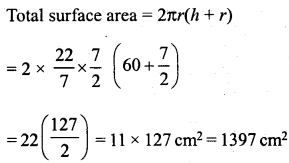
Question 1.
Find the curved surface area and total surface area of a cylinder, the diameter of whose base is 7 cm and height is 60 cm.
Solution:
Diameter of the base of cylinder = 7 cm
∴ Radius (r) = \(\frac { 7 }{ 2 }\) cm
Height (h) = 60m
∴ carved surface area = 2πh
= 2 x \(\frac { 22 }{ 7 }\) x \(\frac { 7 }{ 2 }\) x 60cm2 = 1320cm2
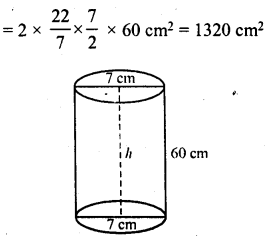
RD Sharma Class 8 Solutions Chapter 22 Mensuration III Ex 22.1 1
RD Sharma Class 8 Solutions Chapter 22 Mensuration III Ex 22.1 2

Question 2.
The curved surface area of a cylindrical road is 132 cm2. Find its length if the radius is 0.35 cm.
Solution:
Curved surface area =132 cm2
Radius (r) = 0.35 cm
Let h be the length of the rod Then 2πrh = 132
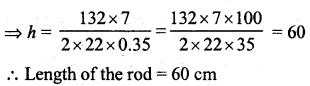
RD Sharma Class 8 Solutions Chapter 22 Mensuration III Ex 22.1 3

Question 3.
The area of the base of a right circular cylinder is 616 cm2 and its height is 2.5 cm. Find the curved surface area of the cylinder.
Solution:
Let r be the radius of the base of the cylinder, then
Area of the base = πr2
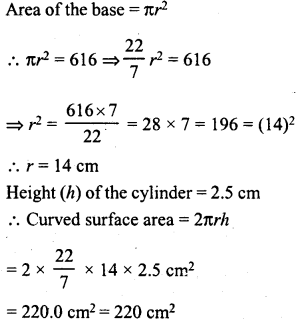
RD Sharma Class 8 Solutions Chapter 22 Mensuration III Ex 22.1 4

Question 4.
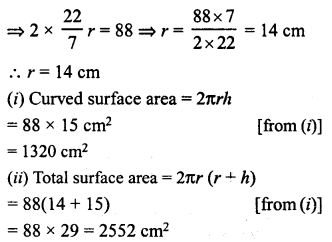
The circumference of the base of a cylinder is 88 cm and its height is 15 cm. Find its curved surface area and total surface area.
Solution:
Height of the cylinder (h) = 15 cm
Circumference of the base = 88 cm
Let r be the radius of the base, the circumference = 2πr
∴ 2πr = 88 cm …(i)
RD Sharma Class 8 Solutions Chapter 22 Mensuration III Ex 22.1 5

Question 5.
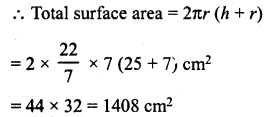
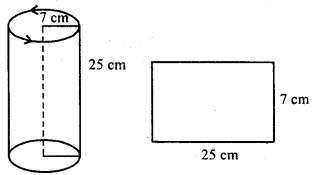
A rectangular strip 25 cm x 7 cm is rotated about the longer side. Find the total surface area of the solid thus generated.
Solution:
Dimensions of rectangular strip = 25 cm x 7 cm
By rotating the strip along longer side, a solid is formed whose radius = 7 cm
and height = 25 cm
RD Sharma Class 8 Solutions Chapter 22 Mensuration III Ex 22.1 6
RD Sharma Class 8 Solutions Chapter 22 Mensuration III Ex 22.1 7

Question 6.
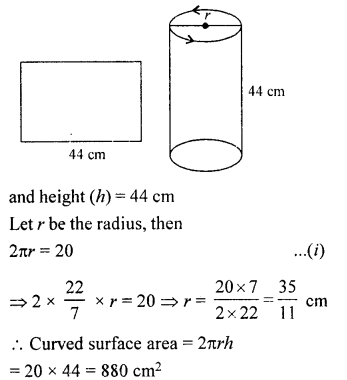
A rectangular sheet of paper 44 cm x 20 cm, is rolled along its length to form a cylinder. Find the the total surface area of the cylinder thus generated.
Solution:
By rolling along length wire, we get a cylinder whose circumference of its base = 20 cm
RD Sharma Class 8 Solutions Chapter 22 Mensuration III Ex 22.1 8

Question 7.
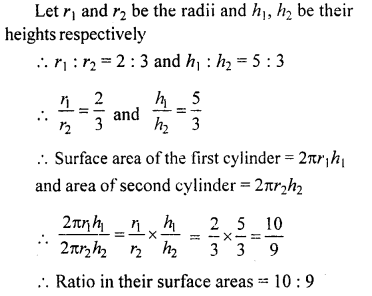
The radii of two cylinders are in the ratio of 2 : 3 and their heights are in the ratio 5 : 3. Calculate the ratio of their curved surface areas.
Solution:
Ratio in radii of two cylinders = 2:3
and ratio in their heights = 5:3
RD Sharma Class 8 Solutions Chapter 22 Mensuration III Ex 22.1 9

Question 8.
The ratio between the curved surface area and the total surface area of a right circular cylinder is 1: 2. Prove that its height and radius are equal.
Solution:
Let r be the radius and h be the height of a right circular cylinder, then Curved surface area = 2πrh
and total surface area = 2πrh x 2πr2 = 2πr (h + r)
But their ratio is 1 : 2
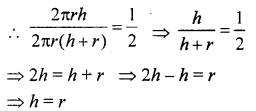
RD Sharma Class 8 Solutions Chapter 22 Mensuration III Ex 22.1 10
Hence their radius and height are equal.

Question 9.
The curved surface area of a cylinder is 1320 cm2 and its base has diameter 21 cm. Find the height of the cylinder.
Solution:
Curved surface area of a cylinder = 1320 cm2
Diameter of its base (d) = 21 cm 21
Radius (r) = \(\frac { 21 }{ 2 }\) cm
Let h be the height of the cylinder
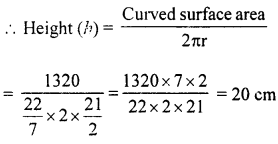
RD Sharma Class 8 Solutions Chapter 22 Mensuration III Ex 22.1 11

Question 10.
The height of a right circular, cylinder is 10.5 m. If three times the sum of the areas of its two circular faces is twice the area of the curved surface area. Find the radius of its base.
Solution:
Height of cylinder = 10.5 m
Let r be the radius and h be the height of a right circular cylinder, then Area of its two circular faces = 2π2
and area of curved surface = 2πrh
Now, according to the condition:
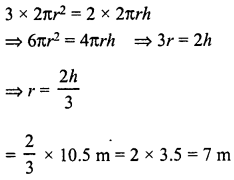
RD Sharma Class 8 Solutions Chapter 22 Mensuration III Ex 22.1 12

Question 11.
Find the cost of plastering the inner surface of a well at Rs 9.50 per m2, if it is 21 m deep and diameter of its top is 6 m.
Solution:
Diameter of the top of a cylindrical well = 6m
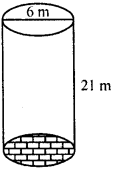
RD Sharma Class 8 Solutions Chapter 22 Mensuration III Ex 22.1 13
∴ Radius (r) = \(\frac { 6 }{ 2 }\) = 3 m
and depth (h) = 21 m
∴ Curved surface area = 2πrh = 2 x \(\frac { 22 }{ 7 }\) x 3 x 21 m2 = 396 m2
Rate of plastering = Rs 9.50 per m2
∴ Total cost of plastering = Rs 9.50 x 396 = Rs 3,762

Question 12.
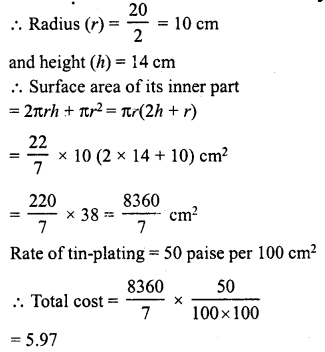
A cylindrical vessel open at the top has diameter 20 cm and height 14 cm. Find the cost of the tin-plating it on the inside at the rate of 50 paise per hundred square centimetre.
Solution:
Diameter of the vessel = 20 cm
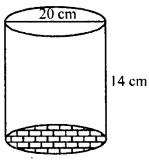
RD Sharma Class 8 Solutions Chapter 22 Mensuration III Ex 22.1 14
RD Sharma Class 8 Solutions Chapter 22 Mensuration III Ex 22.1 15

Question 13.
The inner diameter of a circular well is 3.5 m. It is 10 m deep. Find the cost of plastering its inner curved surface at Rs 4 per square metre.
Solution:
Diameter of the well = 3.5 m
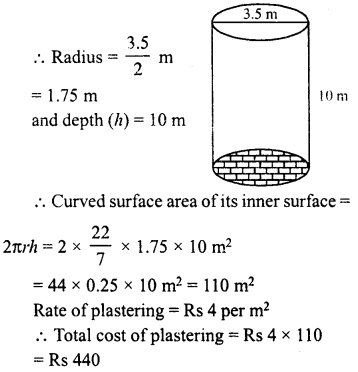
RD Sharma Class 8 Solutions Chapter 22 Mensuration III Ex 22.1 16

Question 14.
The diameter of a roller is 84 cm and its length is T20 cm. It takes 500 complete revolutions moving once over to level a playground. What is the area of the playground ?
Solution:
Diameter of the roller = 84 cm
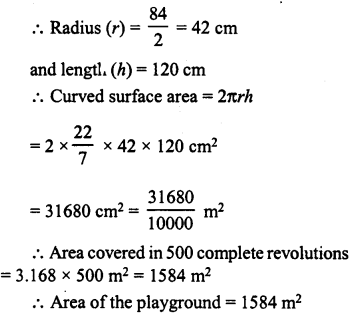
RD Sharma Class 8 Solutions Chapter 22 Mensuration III Ex 22.1 17

Question 15.
Twenty cylindrical pillars of the Parliament House are to be cleaned. If the diameter of each pillar is 0.50 m and height is 4 m, what will be the cost of cleaning them at the rate of Rs 2.50 per square metre ?
Solution:
Diameter of each pillar = 0.50 m
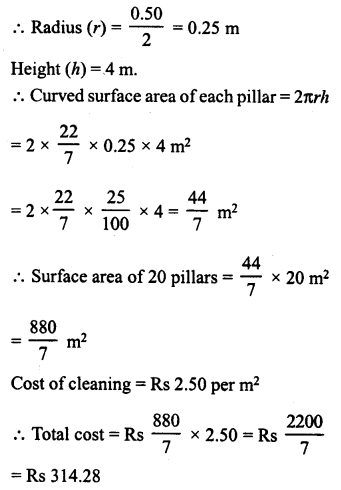
RD Sharma Class 8 Solutions Chapter 22 Mensuration III Ex 22.1 18

Question 16.
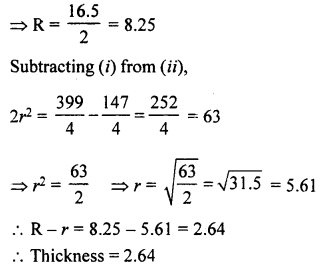
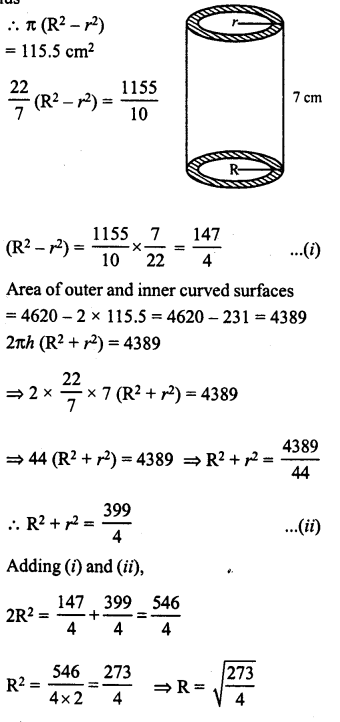
The total surface area of a hollow cylinder which is open from both sides is 4620 sq. cm, area of the base ring is 115.5 sq. cm and height 7 cm. Find the thickness of the cylinder.
Solution:
Total surface area of a hollow cylinder opened from both sides = 4620 cm2
Area of base ring = 115.5 cm2
Height of cylinder (h) = 7 cm
Let R be the outer radius and r be the inner radius
RD Sharma Class 8 Solutions Chapter 22 Mensuration III Ex 22.1 19
RD Sharma Class 8 Solutions Chapter 22 Mensuration III Ex 22.1 20

Question 17.
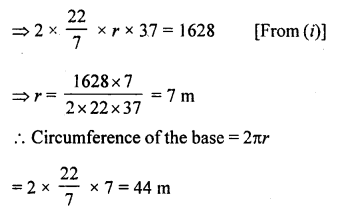
The sum of the radius of the base and height of a solid cylinder is 37 m, if the total surface area of the solid cylinder is 1628 m2, find the circumference of its base.
Solution:
Let r be the radius and h be the height of the solid cylinder, then r + h = 37 m …(i)
Total surface area = 1628
⇒ 2πr (r + h) = 1628
RD Sharma Class 8 Solutions Chapter 22 Mensuration III Ex 22.1 21

Question 18.
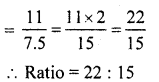
Find the ratio between the total surface area of a cylinder to is curved surface area,given that its height and radius are 7.5 cm and 3.5 cm.
Solution:
Radius (r) of cylinder = 3.5 cm
and height (h) = 7.5 cm
∴ Curved surface area = 2πrh
and total surface area = 2πr (h + r)
∴ Ratio = 2πr (h + r)- 2πrh = (h + r): h = 7.5 + 3.5 : 7.5
⇒ 11 : 7.5
RD Sharma Class 8 Solutions Chapter 22 Mensuration III Ex 22.1 22

Question 19.
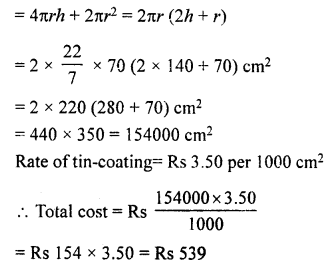
A cylindrical vessel, without lid, has to be tin-coated on its both sides. If the radius of the base is 70 cm and its height is 1.4 m, calculate the cost of tin-coating at the rate of Rs 3.50 per 1000 cm2.
Solution:
Radius of the vessel (r) = 70 cm
and height (h) = 1.4 m = 140 cm
∴ Area of inner and outer curved surfaces and bases = 2 x 2πrh + 2πr2
RD Sharma Class 8 Solutions Chapter 22 Mensuration III Ex 22.1 23


Hope given RD Sharma Class 8 Solutions Chapter 22 Mensuration III Ex 22.1 are helpful to complete your math homework.

If you have any doubts, please comment below. Learn Insta try to provide online math tutoring for you.
RS Aggarwal Class 6 Solutions Chapter 3 Whole Numbers Ex 3B

RS Aggarwal Class 6 Solutions Chapter 3 Whole Numbers Ex 3B

These Solutions are part of RS Aggarwal Solutions Class 6. Here we have given RS Aggarwal Solutions Class 6 Chapter 3 Whole Numbers Ex 3B.

Other Exercises

Question 1.
Solution:
(i) 458 + 639 = 639 + 458 (Commulative law)
(ii) 864 + 2006 = 2006 + 864 (Commulative law)
(iii) 1946 + 984 = 984 + 1946 (Commulative law)
(iv) 8063 + 0 = 8063 (Additive property of zero)
(v) 53501 + (574 + 799) = 574 + (53501 + 799) (Associative law)

Question 2.
Solution:
(i) 16509 + 114 = 16623
Check : 16623 – 114 = 16509 which is given.
(ii) 2359 + 548 = 2907
Check: 2907 – 2359 = 548 which is given
(iii) 19753 + 2867 = 22620
Check : 22620 – 19753 = 2867 which is given

Question 3.
Solution:
(1546 + 498) + 3589
= 2044 + 3589
= 5633
and 1546 + (498 + 3589)
= 1546 + 4087
= 5633
Yes, the above two sum are equal.
The property used is associative law of addition.

Question 4.
Solution:
(i) 953 + 707 + 647
= (953 + 647) + 707
(by associative law)
= 1600 + 707
= 2307
(ii) 1983 + 647 + 217 + 353
= (1983 + 217) + (647 + 353)
= 2200 + 1000 = 3200
(iii) 15409 + 278 + 691 + 422
= (15409 + 691) + (278 + 422)
(by associative law)
= 16100 + 700
= 16800
(iv) 3259 + 10001 + 2641 + 9999
= (3259 + 2641) + (10001 + 9999)
(by associative law)
= 5900 + 20000
= 25900
(v) 1 +2 + 3 +4 + 96 + 97 + 98 + 99
= (1 +99) + (2 + 98) + (3 + 97) + (4 + 96)
= (100+ 100) + (100 +100)
= 200 + 200
= 400
(vi) 2 + 3 + 4 + 5 + 45 + 46 + 47 + 48
= (2 + 48) + (3 + 47) + (4 + 46) + (5 + 45)
= (50 + 50) + (50 + 50)
= 100 + 100 = 209

Question 5.
Solution:
(i) 6784 + 9999 = (6784 – 1) + (9999 + 1)
(Adding and subtracting 1)
= 6783 + 10000
= 16783
(ii) 10578 + 99999
(Adding and subtracting 1)
= (10578 – 1) + (99999 + 1)
= 10577 + 100000
= 110577

Question 6.
Solution:
Yes it is true, by the property of associative law of addition.

Question 7.
Solution:
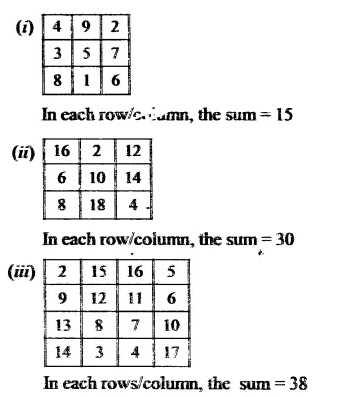
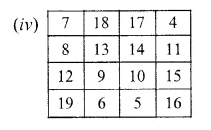
The magic squares given are completed as under:
RS Aggarwal Class 6 Solutions Chapter 3 Whole Numbers Ex 3B 7.1
RS Aggarwal Class 6 Solutions Chapter 3 Whole Numbers Ex 3B 7.2
In each row/column, the sum = 46

Question 8.
Solution:
(i) The sum of two odd numbers is an odd number (F)
As sum of two odd numbers is alway an even number
(ii) The sum of two even number is an even number (T)
(iii) The sum of an even number and an odd number is an odd number (T)

Hope given RS Aggarwal Solutions Class 6 Chapter 3 Whole Numbers Ex 3B are helpful to complete your math homework.

If you have any doubts, please comment below. Learn Insta try to provide online math tutoring for you.
RS Aggarwal Class 6 Solutions Chapter 3 Whole Numbers Ex 3A

RS Aggarwal Class 6 Solutions Chapter 3 Whole Numbers Ex 3A

These Solutions are part of RS Aggarwal Solutions Class 6. Here we have given RS Aggarwal Solutions Class 6 Chapter 3 Whole Numbers Ex 3A.

Other Exercises

Question 1.
Solution:
After 30999, three whole numbers will be
30999 + 1 = 31000
31000 + 1 = 31001
31001 + 1 = 31002
i.e., 31000, 31001 and 31002

Question 2.
Solution:
Before 10001, three whole numbers will be 10001 – 1 = 10000
10000 – 1 = 9999
9999 – 1 = 9998
i.e., 10000, 9999, 9998

Question 3.
Solution:
Between 1032 and 1209, whole number are 1209 – 1031
= 178

Question 4.
Solution:
The smallest whole number is 0

Question 5.
Solution:
The successor of
(i) 2540801 is 2540801 + 1 = 2540802
(ii) 9999 is 9999 + 1 = 10000
(iii) 50904 is 50904 + 1 = 50905
(iv) 61639 is 61639 + 1 = 61640
(v) 687890 is 687890 + 1 = 687891
(vi) 5386700 is 5386700 + 1 = 5386701
(vii) 6475999 is 6475999 + 1 = 6476000
(viii) 9999999 is 9999999 + 1 = 10000000

Question 6.
Solution:
Predecessor of
(i) 97 is 97 – 1 = 96
(ii) 10000 is 10000 – 1 = 9999
(iii) 36900 is 36900 – 1 = 36899
(iv) 7684320 is 7684320 – 1 = 7684319
(v) 1566391 is 1566391 – 1 = 1566390
(vi) 2456800 is 2456800 – 1 = 2456799
(vii) 100000 is 100000 – 1 = 99999
(viii) 1000000 is 1000000 – 1 = 999999

Question 7.
Solution:
Three consecutive whole numbers just preceding 7510001 are (7510001 – 1), (7510001 – 2), (7510001 – 3)
i.e. 7510000, 7509999, 7509998.

Question 8.
Solution:
(i) Zero is not a natural number. (F)
(ii) Zero is the smallest whole number (T)
(iii) No, it is false, as zero is not a natural number but it is a whole number.
(iv) Yes, it is true, as set of natural numbers is a subset of whole numbers.
(v) False, zero is the smallest whole number.
(vi) The natural number 1 has no predecessor as 0 is the predecessor of 1 (T)
Which is not a natural number
(vii) The whole number 1 has no predecessor (F)
Predecessor of 1 is 0 which is a whole number
(viii) The whole number 0 has no predecessor (T)
(ix) The predecessor of a two-digit number is never a single-digit number (F)
As predecessor of two digit number say 99 is 99 – 1 = 98
Which is also a two-digit number and of 10 is 10 – 1 = 9
which is single-digit number
(x) The successor of a two-digit number is always a two-digit number (F)
The successor of a two-digit number 99 is 99 + 1 = 100 which is a three digit number
(xi) 500 is the predecessor of 499 (F)
As predecessor of 499 is 499 – 1 = 498 not 500 as 500 is the successor of 499
(xii) 7000 is the successor of 6999 (T)


Hope given RS Aggarwal Solutions Class 6 Chapter 3 Whole Numbers Ex 3A are helpful to complete your math homework.

If you have any doubts, please comment below. Learn Insta try to provide online math tutoring for you.
RS Aggarwal Class 6 Solutions Chapter 2 Factors and Multiples Ex 2F

RS Aggarwal Class 6 Solutions Chapter 2 Factors and Multiples Ex 2F

These Solutions are part of RS Aggarwal Solutions Class 6. Here we have given RS Aggarwal Solutions Class 6 Chapter 2 Factors and Multiples Ex 2F.

Other Exercises

Objective Questions
Tick the correct answer in each of the following :

Question 1.
Solution:
(c) Because sum of its digits is 8 + 3 + 4 + 7 + 9 + 5 + 6 + 0 = 42 which is divisible by 3.

Question 2.
Solution:
(a) Because sum of its digits is 8 + 5 + 7 + 6 + 9 + 0 + 1 = 36 which is divisible by 9.

Question 3.
Solution:
(d) Because the number formed by tens and ones digits is divisible by 4 i.e. 32 ÷ 4 = 8.

Question 4.
Solution:
(b) Because the number formed by hundred, tens and ones digits is divisible by 8 i.e. 176 ÷ 8 = 22.

Question 5.
Solution:
(a) Because its one digit is divisible by 2 and sum of its digits is 8 + 7 + 9 + 0 + 4 + 3 + 2 = 33,
which is divisible by 3. Hence it is divisible by 6.

Question 6.
Solution:
(c) Because the difference of the sums of its odd places digits and of its even places digits is (2 + 2 + 2 + 2) – (2 + 2 + 2 + 2) i.e. 8 – 8 = 0, which is zero and is divisible by 11.

Question 7.
Solution:
(d) Because 97 has no factors other than 1 and itself.

Question 8.
Solution:
(c) Because 179 has no factors other than 1 and itself.

Question 9.
Solution:
(c) Because 263 has no factors other than 1 and itself.

Question 10.
Solution:
(a), (b) Because the common factors of 9 and 10 are none but 1.

Question 11.
Solution:
(c) Because 32 has factors which are 2, 2, 2, 2, 2.

Question 12.
Solution:
(d) Because 18 is the highest common factor of 144 and 198.

Question 13.
Solution:
(a) Because 12 is the highest common factors of these numbers 144, 180 and 192.

Question 14.
Solution:
(b) Because 161 and 192 have no common factor other than 1, i.e., HCF of 161 and 192 is 1.

Question 15.
Solution:
(d) Because HCF of 289 and 391 is 289
and \(\frac { 289\div 17 }{ 391\div 17 } \) = \(\\ \frac { 17 }{ 23 } \)

Question 16.
Solution:
(d) Because dividing 134 and 167 by 33 remainder is 2 in each case.

Question 17.
Solution:
(c) Because 360 is the least multiple of 24, 36 and 40.

Question 18.
Solution:
(d) Because 540 is the least multiple of 12, 15, 20 and 27

Question 19.
Solution:
(c) Because 1263 – 3 = 1260 is divisible by 14, 28, 36 and 45.

Question 20.
Solution:
(c) Because HCF of two co-prime number is always 1.

Question 21.
Solution:
(c) Because HCF of a and b, two co-primes is 1.
LCM = a x b = ab.

Question 22.
Solution:
(c) Because LCM of two numbers = Product of these number ÷ their HCF i.e 2160 ÷ 12 = 180.

Question 23.
Solution:
(b) Because second number
= \( \frac { LCM\times HCF }{ 1st\quad number } \)
i.e., \(\\ \frac { 145\times 2175 }{ 725 } \)
= 435

Question 24.
Solution:
(c) Because LCM of 15, 20, 24. 32 and 36 = 1440.

Question 25.
Solution:
(d) Because LCM of 9, 12, 15 is 180. 180
180 minutes = \(\\ \frac { 180 }{ 60 } \)
= 3 hours.

Hope given RS Aggarwal Solutions Class 6 Chapter 2 Factors and Multiples Ex 2F are helpful to complete your math homework.

If you have any doubts, please comment below. Learn Insta try to provide online math tutoring for you.
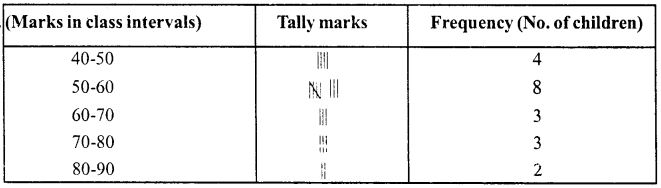
RD Sharma Class 8 Solutions Chapter 23 Data Handling I Ex 23.2

RD Sharma Class 8 Solutions Chapter 23 Data Handling I Ex 23.2

These Solutions are part of RD Sharma Class 8 Solutions. Here we have given RD Sharma Class 8 Solutions Chapter 23 Data Handling I Ex 23.2

Other Exercises

Question 1.
The marks obtained by 40 students of class VIII in an examination are given below :
16, 17, 18, 3, 7, 23, 18, 13, 10, 21, 7, 1, 13,
21, 13, 15, 19, 24, 16, 3, 23, 5, 12, 18, 8, 12, 6,
8, 16, 5, 3, 5, 0, 7, 9, 12, 20, 10, 2, 23.
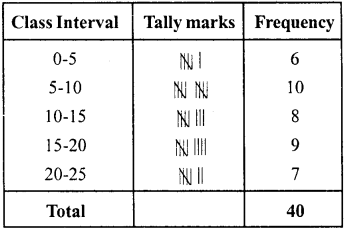
Divide the data into five groups, namely 0-5,5-10,10-15,15-20 and 20-25 and prepare a grouped frequency table.
Solution:
Frequency distribution table
RD Sharma Class 8 Solutions Chapter 23 Data Handling I Ex 23.2 1

Question 2.
The marks scored by 20 students in a test are given below :
54, 42, 68, 56, 62, 71, 78, 51, 72, 53, 44, 58, 47, 64, 41, 57, 89, 53, 84, 57.
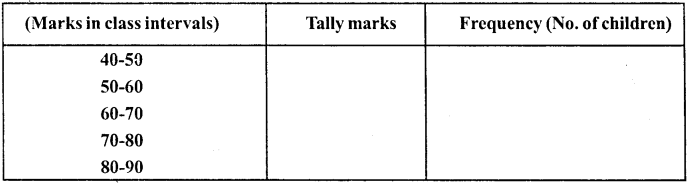
Complete the following frequency table :
RD Sharma Class 8 Solutions Chapter 23 Data Handling I Ex 23.2 2
What is the class interval in which the greatest frequency occurs ?
Solution:
RD Sharma Class 8 Solutions Chapter 23 Data Handling I Ex 23.2 3
The class in which the greatest frequency is 50-60

Question 3.
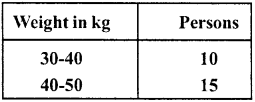
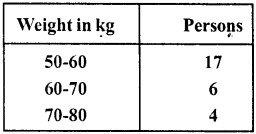
The following is the distribution of weights (in kg) of 52 persons :
RD Sharma Class 8 Solutions Chapter 23 Data Handling I Ex 23.2 4
RD Sharma Class 8 Solutions Chapter 23 Data Handling I Ex 23.2 5
(i) What is the lower limit of class 50-60 ?
(ii) Find the class marks of the classes 40-50, 50-60.
(iii) What is the class size ?
Solution:
(i) Lower limit of class 50-60 = 50
(ii) Class marks of 40-50 = \(\frac { 40+50 }{ 2 }\) = \(\frac { 90 }{ 2 }\)
= 45 and of 50-60 = \(\frac { 50+60 }{ 2 }\) = \(\frac { 110 }{ 2 }\) =55
(iii) Class size is 10

Question 4.
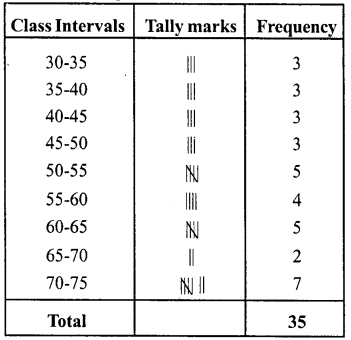
Construct a frequency table for the following weights (in gm) of 35 mangoes using the equal class intervals, one of them is 40-45 (45 not included):
30,40,45,32,43,50,55,62,70,70,61,62, 53,52, 50,42,35,37,53,55,65,70, 73, 74,45, 46, 58, 59, 60, 62, 74, 34, 35, 70 ,68.
(i) What is the class mark of the class interval 40-45 ?
(ii) What is the range of the above weights ?
(iii) How many classes are there ?
Solution:
Smallest observation = 30
Greatest observation = 74
Range = 74 – 30 = 44
Now forming the distribution table
RD Sharma Class 8 Solutions Chapter 23 Data Handling I Ex 23.2 6
(i) Class mark of 40-45
= \(\frac { 40+45 }{ 2 }\) = \(\frac { 85 }{ 2 }\) = 42.5
(ii) Range = 74 – 30 = 44
(iii) Number of classes are 9

Question 5.
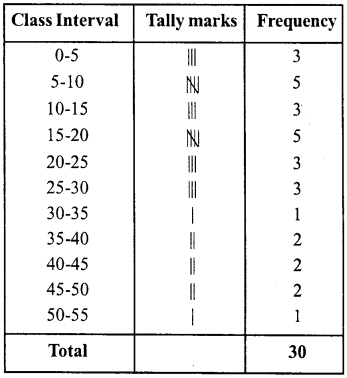
Construct a frequency table with class-intervals 0-5 (5 not included) of the following marks obtained by a group of 30 students in an examination :
0, 5, 7,10, 12,15, 20, 22, 25, 27, 8, 11, 17,3, 6, 9,17,19, 21, 29, 31,35,37,40,42, 45, 49, 4, 50, 16.
Solution:
Frequency distribution table.
RD Sharma Class 8 Solutions Chapter 23 Data Handling I Ex 23.2 7

Question 6.
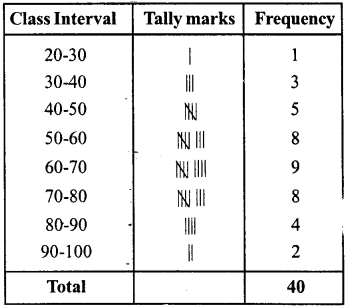
The marks scored by 40 students of class VIII in mathematics are given below:
81,55, 68, 79,85,43,29,68,54,73,47, 35, 72,64,95,44,50, 77,64,35,79, 52, 45,54,70,83, 62′, 64,72,92,84,76,63, 43, 54, 38, 73, 68, 52, 54.
Prepare a frequency distribution with class size of 10 marks.
Solution:
Largest marks = 95
Lowest marks = 29
Range = 95 – 29 = 66
Frequency distribution table
RD Sharma Class 8 Solutions Chapter 23 Data Handling I Ex 23.2 8

Question 7.
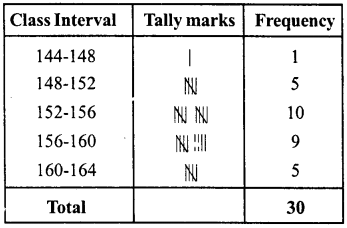
The heights (in cm) of 30 students of class VIII are given below :
155.158.154.158.160.148.149.150.153, 159,161,148,157,153,157,162,159,151, 154,156,152,156,160,152,147,155,163,155,157,153.
Prepare a frequency distribution table with 160-164 as one of the class intervals.
Solution:
Largest height =163
Lowest height =147
Range = 163- 147 = 16
RD Sharma Class 8 Solutions Chapter 23 Data Handling I Ex 23.2 9

Question 8.
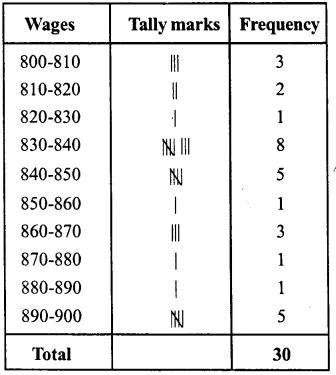
The monthly wages of 30 workers in a factory are given below :
830,835,890,810,835,836,869,845,898, 890, 820, 860, 832, 833, 855, 845, 804, 808, 812, 840, 885, 835, 836, 878, 840, 868, 890, 806, 840, 890.
Represent the data in the form of a frequency distribution with class size 10.
Solution:
Highest wage = 898
Lowest wage = 804
Range = 898 – 804 = 94
Frequency distribution table
RD Sharma Class 8 Solutions Chapter 23 Data Handling I Ex 23.2 10

Question 9.
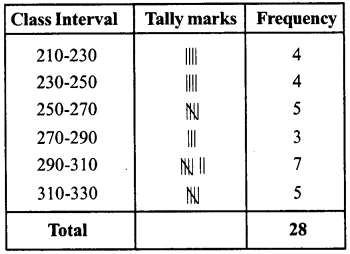
Construct a frequency table with equal class intervals from the following data on the monthly wages (in rupees) at 28 labourers working in a factory, taking one of the class intervals as 210-230 (230 not included):
220, 268, 258, 242, 210, 268, 272,242, 311, 290, 300, 320,319,304,302,318,306,292, 254, 278, 210,240, 280,316,306, 215, 256, 236.
Solution:
Highest wages = 320
Lowest wages = 210
Range = 320-210= 110
Frequency distribution table
RD Sharma Class 8 Solutions Chapter 23 Data Handling I Ex 23.2 11

Question 10.
The daily minimum temperatures in degrees Celsius recorded in a certain Arctic region are as follows :
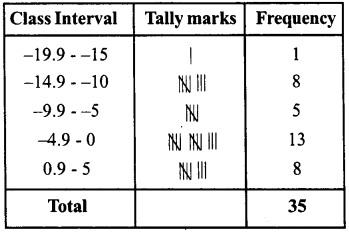
-12.5, -10.8, -18.6, -8.4, -10.8, -4.2, -4.8, -6.7, -13.2, -11.8, -2.3,1.2, 2.6, 0, -2.4, 0, 3.2, 2.7,3.4,0, -2.4, -2.4, 0,3.2, 2.7,3.4, 0,2.4, -5.8, -8.9, -14.6, -12.3, -11.5, -7.8, – 2.9
Represent them as frequency distribution table taking -19.9 to -15 as the first class interval.
Solution:
Lowest temperature = -19.9
Highest temperature = 3.4
Frequency distribution table
RD Sharma Class 8 Solutions Chapter 23 Data Handling I Ex 23.2 12

Hope given RD Sharma Class 8 Solutions Chapter 23 Data Handling I Ex 23.2 are helpful to complete your math homework.

If you have any doubts, please comment below. Learn Insta try to provide online math tutoring for you.