CA Foundation Business & Commercial Knowledge Study Material – Economic and Non-Economic Activities

CA Foundation Business & Commercial Knowledge Study Material Chapter 1 Introduction to Business – Economic and Non-Economic Activities

Every human being is busy in some activity or the other throughout the day. Every person gets up from bed in the morning, brushes his/her teeth, takes bath and eats breakfast. Then a child goes to School or College to study. An adult goes to work on the job and a housewife works at home. In the evening a person comes back home, watches television, eats dinner and goes to bed at night. All these activities in which a person engages from morning to evening are known as ‘human activities’.

ECONOMIC AND NON-ECONOMIC ACTIVITIES

All human activities may broadly be classified into two categories:

  1. Economic activities and
  2. Non-economic activities

Economic activities are undertaken with the object of earning money and acquiring wealth. These activities result in the production of economic goods and services. Business is an economic activity but it differs from other economic activities such as those of an employee, and self employed persons like doctors, lawyers, chartered accountants, etc.

ca-foundation-business-commercial-knowledge-study-material-economic-and-non-economic-activities-1

Non-economic activities are inspired by sentiments and emotions such as love for the family, desire to help the poor and love for the country. These activities are not undertaken for monetary gain but for one’s satisfaction and happiness.

Economic Activities

Economic activities refer to all those human activities which are undertaken to earn a living and thereby satisfy human wants. The main object of these activities is to earn income and create wealth. The money earned through work is used to satisfy wants. For example, a teacher teaches in a school or college, a doctor attends to patients in his clinic and a shopkeeper sells goods to his customers. Economic activities are concerned with the production, distribution and exchange of goods and services. These activities create utilities and result in the production of wealth. Economic activities are also called occupations.

The main characteristics of economic activities are as follows:

  1. Economic motive – Economic activities are undertaken to earn money and acquire wealth The main motive behind these activities is to make an economic gain. These activities are performed by human beings for earning livelihood.
  2. Productive – Economic activities involve production, distribution and exchange of goods and services for satisfying human wants. These activities are directly related to creation of wealth.
  3. Economic resources – Economic activities make use of economic resources such as land, labour, capital, etc.
  4. Rational use – Economic activities require proper allocation of scarce resources so as to obtain maximum output from them. These activities involve optimum utilisation of land, labour, capital and other factors of production. Welfare of society can be maximised when best possible use of resources is made.
  5. Economic growth – Economic activities determine the level of economic development of a country and the standard of living of its citizens.
  6. Legally valid – Human activities performed for economic gain are called economic activities only when they are lawful. Unlawful activities such as gambling, black marketing, theft, dacoity, smuggling etc., are opposed to public interest. Therefore, these activities cannot be called economic activities.
  7. Socially desirable – Economic activities are desirable for society. They must be in accordance with the expectations and norms of society.

Examples of economic activities

  • Production of goods by a manufacturer in a factory.
  • Distribution of goods by a wholesaler to retailers.
  • Selling of goods by a retailer to customers.
  • Transportation of goods and passengers by railways/roadways/airlines/ships.
  • Storage of goods by a warehouse keeper.
  • Acceptance of deposits and lending of money by a banker.
  • Insurance of risks by an insurance company.
  • Advertising and publicity of goods by an advertising agency.
  • A clinic run by a doctor.
  • Legal services provided by a lawyer in a court.
  • Audit services provided by a chartered accountant in his office.
  • Working of a Government officer.
  • Services of a teacher in a school/college.
  • Working of a farmer in his fields to self his produce.
  • Working of a nurse in a hospital.

Economic Activities at a Glance Characteristics

  1. Economic motive
  2. Productive
  3. Rational use
  4. Economic resources
  5. Economic growth
  6. Legally valid
  7. Socially desirable

Examples

  1. Manufacturing goods in a factory.
  2. Selling goods in a shop.
  3. A doctor treating patients in his clinic.
  4. A lawyer providing legal advice in his own office.
  5. A professor teaching in a university.
  6. A clerk working in a Government office.

Non-Economic Activities

Activities which are undertaken to satisfy social, religious, cultural and sentimental requirements are called non-economic activities. The object of these activities is not to earn monetary gain or reward. People engage in non-economic activities for reasons of love, sympathy, religion, patriotism, etc. For example, a mother looks after her children, a student donates blood, an old man goes to temple daily, a rich man donates money to Prime Minister Relief Fund, a young man helps a blind girl to cross the road, etc.

It is the object of any activity that distinguishes between economic and non-economic activities. The primary objective of economic activities is to earn livelihood and create wealth. On the other hand, the main objective of non-economic activities is to get some sort of social, cultural, religious or recreational satisfaction. The output of economic activities can be measured in terms of money e.g., the salary of a teacher, the fee of a doctor and the profits of a businessman. But the result of non-economic activities cannot be measured in terms of money.

The same activity may be economic as well as non-economic. For example, a nurse attending a patient in a hospital is an economic activity as the nurse works for a salary. But when the same nurse attends to her sick mother at home it is a non-economic activity because the object is not to earn money. Thus, the activity of the same person may be economic at one-time or place and non-economic at another time or place. The dividing line is not the activity or the person who is doing it but the objective for which it is undertaken.

Thus, non-economic activities are undertaken due to the following considerations :

  1. Love and affection – for example taking dinner with the family, cooking food for family.
  2. Personal satisfaction – for example meditating in a park.
  3. Physical needs – for example morning walk by a person.
  4. Religious obligation – for example praying in a temple.
  5. Social obligations – for example helping victims of an accident, flood or earthquake.
  6. Patriotism – donating blood for injured army men.

DISTINCTION BETWEEN ECONOMIC AND NON-ECONOMIC ACTIVITIES

S.No.Point of DistinctionEconomic ActivitiesMon-Economic Activities
1.ObjectiveEconomic objective – To earn a living and acquire wealthSentimental and emotional objectives – To obtain some sort of personal satisfaction.
2.ExpectationMoney income is expected from these activitiesMoney income is not expected from these activities
3.RelationshipDirectly related to income and wealthNot related to income and wealth.
4.Measurement of outcomeResult can be measured in terms of moneyResult cannot be measured in terms of Money
5.LogicGuided by rational considerations of cost and benefitGuided by sentiments and emotions without regard to gain or sacrifice
6.ResourcesInvolve proper allocation and optimum use of resourcesOptimum allocation and use of resources not essential
7.Types or examplesBusiness, Profession and employmentFamily-oriented, religious, social, cultural and national.

Economic activities are also known as ‘occupations’. Economic activities or occupations may be classified into three broad categories as follows:

ca-foundation-business-commercial-knowledge-study-material-economic-and-non-economic-activities-2

RS Aggarwal Class 10 Solutions Chapter 3 Linear equations in two variables Test Yourself

RS Aggarwal Class 10 Solutions Chapter 3 Linear equations in two variables Test Yourself

These Solutions are part of RS Aggarwal Solutions Class 10. Here we have given RS Aggarwal Solutions Class 10 Chapter 3 Linear equations in two variables Test Yourself.

RS Aggarwal Solutions Class 10 Chapter 3

MCQ
Question 1.
Solution:
(a)
RS Aggarwal Class 10 Solutions Chapter 3 Linear equations in two variables Test Yourself 1

Question 2.
Solution:
(d)
RS Aggarwal Class 10 Solutions Chapter 3 Linear equations in two variables Test Yourself 2
RS Aggarwal Class 10 Solutions Chapter 3 Linear equations in two variables Test Yourself 3

Question 3.
Solution:
(a)
RS Aggarwal Class 10 Solutions Chapter 3 Linear equations in two variables Test Yourself 4

Question 4.
Solution:
(d)
RS Aggarwal Class 10 Solutions Chapter 3 Linear equations in two variables Test Yourself 5

Short-Answer Questions
Question 5.
Solution:
RS Aggarwal Class 10 Solutions Chapter 3 Linear equations in two variables Test Yourself 6

Question 6.
Solution:
RS Aggarwal Class 10 Solutions Chapter 3 Linear equations in two variables Test Yourself 7

Question 7.
Solution:
RS Aggarwal Class 10 Solutions Chapter 3 Linear equations in two variables Test Yourself 8
RS Aggarwal Class 10 Solutions Chapter 3 Linear equations in two variables Test Yourself 9

Question 8.
Solution:
RS Aggarwal Class 10 Solutions Chapter 3 Linear equations in two variables Test Yourself 10

Question 9.
Solution:
RS Aggarwal Class 10 Solutions Chapter 3 Linear equations in two variables Test Yourself 11

Question 10.
Solution:
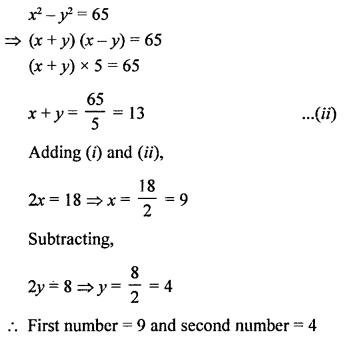
Let first number = x
and second number = y
According to the conditions, x – y = 26 …(i)
and x = 3y …..(ii)
From (i),
3y – y = 26
⇒ 2y = 26
⇒ y = 13
and x = 3 x 13 = 39
Numbers are 39 and 13

Short-Answer Questions (3 marks)
Question 11.
Solution:
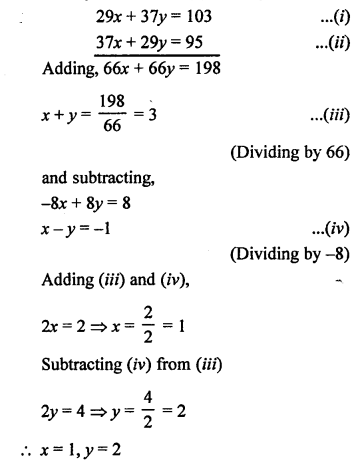
23x + 29y = 98 …..(i)
29x + 23y = 110 …..(ii)
Adding, we get 52x + 52y = 208
x + y = 4 …..(iii) (Dividing by 52)
and subtracting,
-6x + 6y = -12
x – y = 2. …..(iv) (Dividing by -6)
Adding (iii) and (iv),
2x = 6 ⇒ x = 3
Subtracting,
2x = 2 ⇒ y = 1
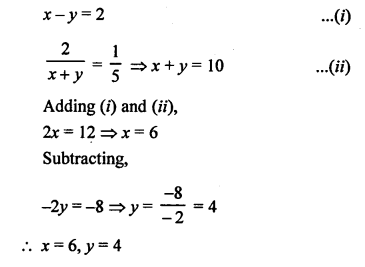
Hence, x = 3, y = 1

Question 12.
Solution:
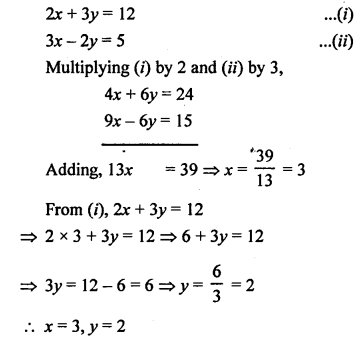
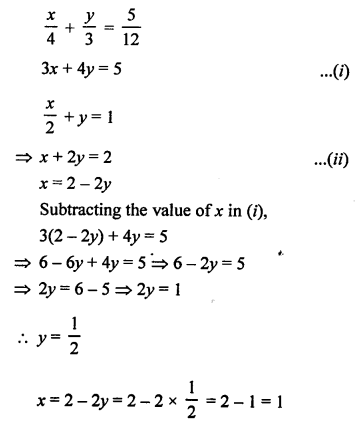
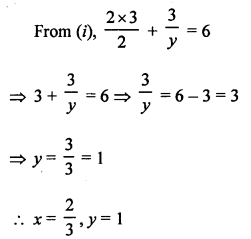
RS Aggarwal Class 10 Solutions Chapter 3 Linear equations in two variables Test Yourself 12
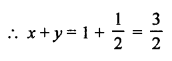
RS Aggarwal Class 10 Solutions Chapter 3 Linear equations in two variables Test Yourself 13
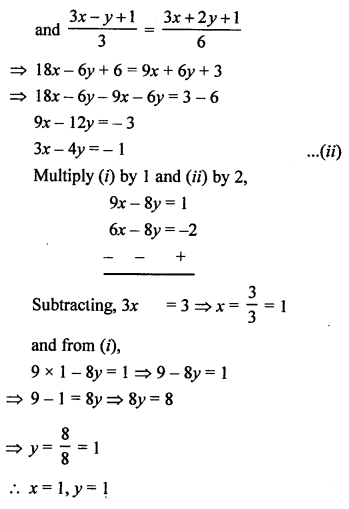
x = 1, y = \(\frac { 3 }{ 2 }\)

Question 13.
Solution:
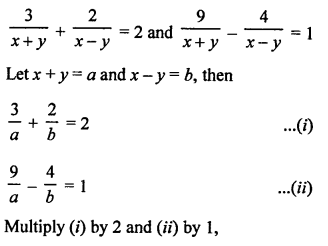
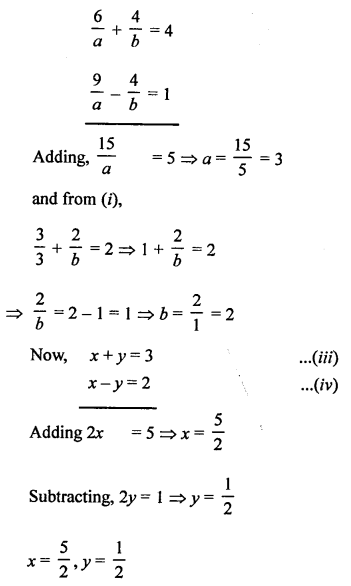
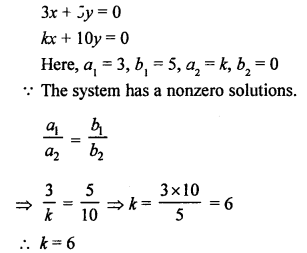
RS Aggarwal Class 10 Solutions Chapter 3 Linear equations in two variables Test Yourself 14
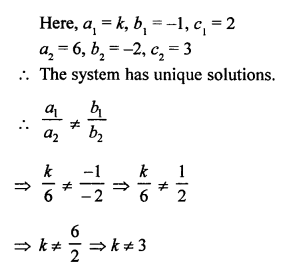
RS Aggarwal Class 10 Solutions Chapter 3 Linear equations in two variables Test Yourself 15

Question 14.
Solution:
RS Aggarwal Class 10 Solutions Chapter 3 Linear equations in two variables Test Yourself 16

Question 15.
Solution:
Let cost of one pencil = ₹ x
and cost of one pen = ₹ y
According to the condition,
5x + 7y = 195 …(i)
7x + 5y= 153 …(ii)
Adding, (i) and (ii)
12x + 12y = 348
x + y = 29 ….(iii) (Dividing by 12)
and subtracting,
-2x + 2y = 42
-x + y = 21 …..(iv) (Dividing by -2)
Now, Adding (iii) and (iv),
2y = 50 ⇒ y = 25
and from (iv),
-x + 25 = 21 ⇒ -x = 21 – 25 = -4
x = 4
Cost of one pencil = ₹ 4
and cost of one pen = ₹ 25

Question 16.
Solution:
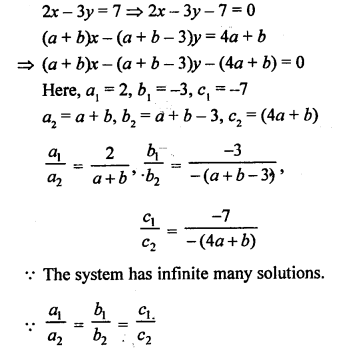
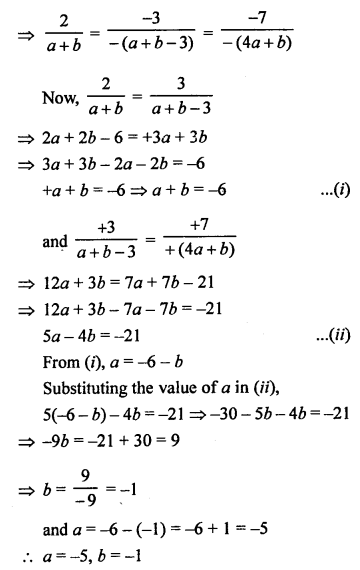
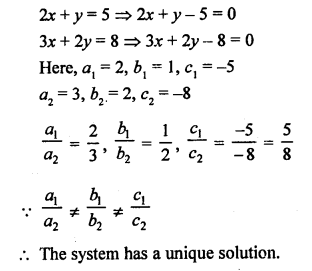
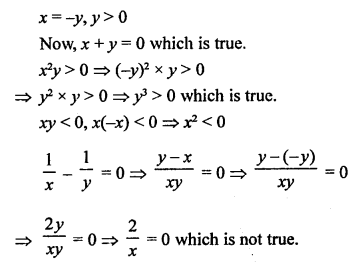
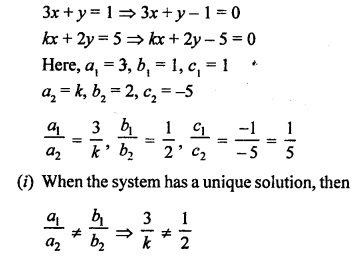
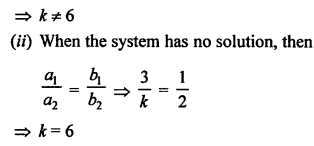
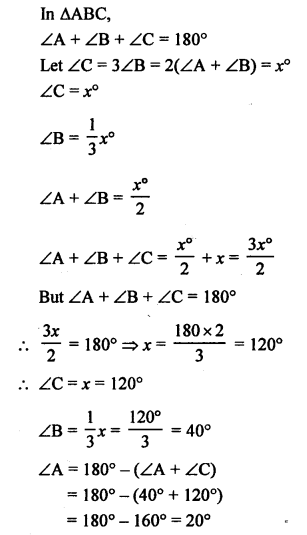
2x – 3y = 1, 4x – 3y + 1 = 0
2x – 3y = 1
2x = 1 + 3y
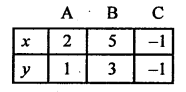
x = \(\frac { 1 + 3y }{ 2 }\)
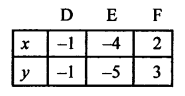
Giving some different values to y, we get corresponding values of x as given below
RS Aggarwal Class 10 Solutions Chapter 3 Linear equations in two variables Test Yourself 17
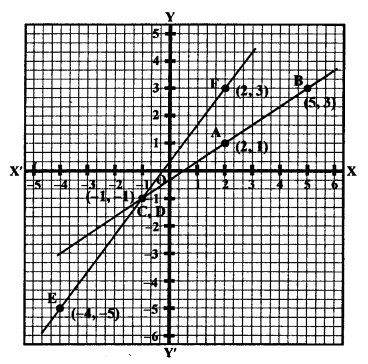
Now plot the points (2, 1), (5, 3) and (-1, -1) on the graph and join them to get a line.
Similarly,
4x – 3y + 1 = 0
⇒ 4x = 3y – 1
⇒ x = \(\frac { 3y – 1 }{ 4 }\)
RS Aggarwal Class 10 Solutions Chapter 3 Linear equations in two variables Test Yourself 18
Now plot the points (-1, -1), (-4, -5) and (2, 3) on the graph and join them to get another line which intersects the first line at the point (-1, -1).
Hence, x = -1, y = -1
RS Aggarwal Class 10 Solutions Chapter 3 Linear equations in two variables Test Yourself 19

Long-Answer Questions
Question 17.
Solution:
We know that opposite angles of a cyclic quadrilateral are supplementary.
∠A + ∠C = 180° and ∠B + ∠D = 180°
Now, ∠A = 4x° + 20°, ∠B = 3x° – 5°, ∠C = 4y° and ∠D = 7y° + 5°
But ∠A + ∠C = 180°
4x + 20° + 4y° = 180°
⇒ 4x + 4y = 180° – 20 = 160°
x + y = 40° …(i) (Dividing by 4)
and ∠B + ∠D = 180°
⇒ 3x – 5 + 7y + 5 = 180°
⇒ 3x + 7y = 180° …(ii)
From (i), x = 40° – y
Substituting the value of x in (ii),
3(40° – y) + 7y = 180°
⇒ 120° – 3y + 7y = 180°
⇒ 4y = 180°- 120° = 60°
y = 15°
and x = 40° – y = 40° – 15° = 25°
∠A = 4x + 20 = 4 x 25 + 20 = 100 + 20= 120°
∠B = 3x – 5 = 3 x 25 – 5 = 75 – 5 = 70°
∠C = 4y = 4 x 15 = 60°
∠D = 7y + 5 = 7 x 15 + 5 = 105 + 5 = 110°

Question 18.
Solution:
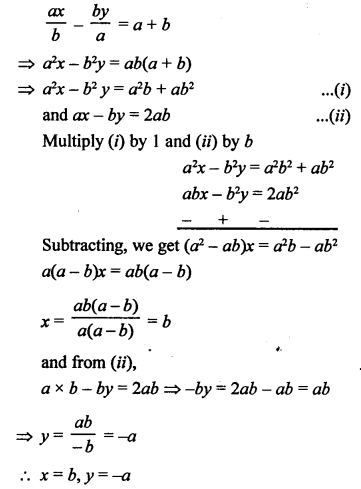
RS Aggarwal Class 10 Solutions Chapter 3 Linear equations in two variables Test Yourself 20
RS Aggarwal Class 10 Solutions Chapter 3 Linear equations in two variables Test Yourself 21

Question 19.
Solution:
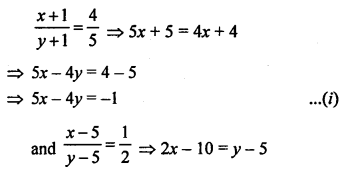
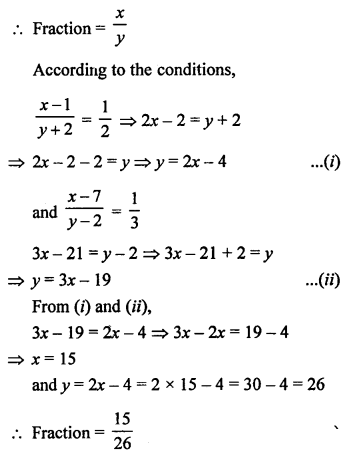
Let numerator of a fraction = x
and denominator = y
Fraction = \(\frac { x }{ y }\)
According to the conditions,
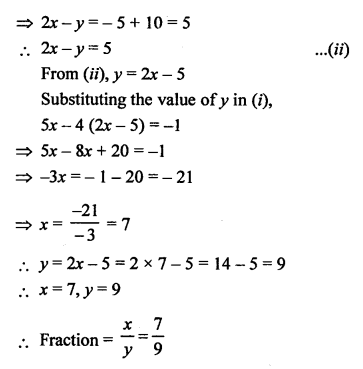
RS Aggarwal Class 10 Solutions Chapter 3 Linear equations in two variables Test Yourself 22
RS Aggarwal Class 10 Solutions Chapter 3 Linear equations in two variables Test Yourself 23

Question 20.
Solution:
RS Aggarwal Class 10 Solutions Chapter 3 Linear equations in two variables Test Yourself 24

Hope given RS Aggarwal Solutions Class 10 Chapter 3 Linear equations in two variables Test Yourself are helpful to complete your math homework.

If you have any doubts, please comment below. Learn Insta try to provide online math tutoring for you.

RS Aggarwal Class 10 Solutions Chapter 3 Linear equations in two variables MCQS

RS Aggarwal Class 10 Solutions Chapter 3 Linear equations in two variables MCQS

These Solutions are part of RS Aggarwal Solutions Class 10. Here we have given RS Aggarwal Solutions Class 10 Chapter 3 Linear equations in two variables MCQS.

RS Aggarwal Solutions Class 10 Chapter 3

Choose the correct answer in each of the following questions.
Question 1.
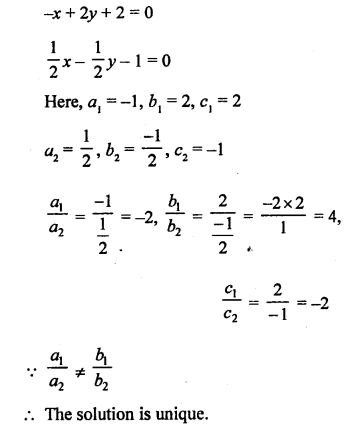
Solution:
(c)
RS Aggarwal Class 10 Solutions Chapter 3 Linear equations in two variables MCQS 1

Question 2.
Solution:
(c)
RS Aggarwal Class 10 Solutions Chapter 3 Linear equations in two variables MCQS 2

Question 3.
Solution:
(a)
RS Aggarwal Class 10 Solutions Chapter 3 Linear equations in two variables MCQS 3

Question 4.
Solution:
(d)
RS Aggarwal Class 10 Solutions Chapter 3 Linear equations in two variables MCQS 4

Question 5.
Solution:
(a)
RS Aggarwal Class 10 Solutions Chapter 3 Linear equations in two variables MCQS 5
RS Aggarwal Class 10 Solutions Chapter 3 Linear equations in two variables MCQS 6

Question 6.
Solution:
(b)
RS Aggarwal Class 10 Solutions Chapter 3 Linear equations in two variables MCQS 7
RS Aggarwal Class 10 Solutions Chapter 3 Linear equations in two variables MCQS 8

Question 7.
Solution:
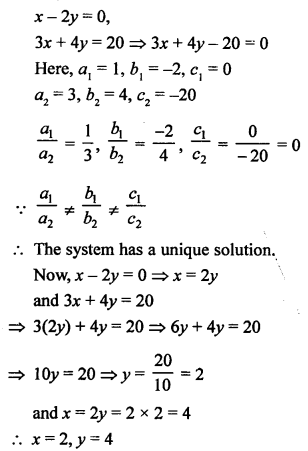
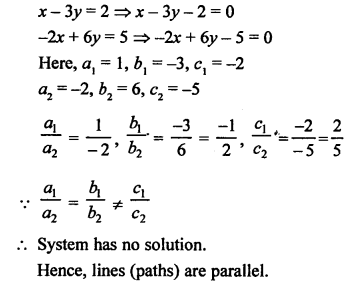
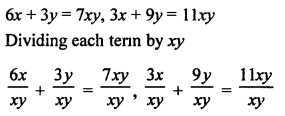
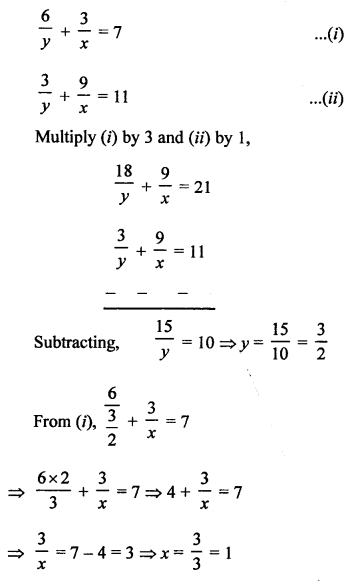
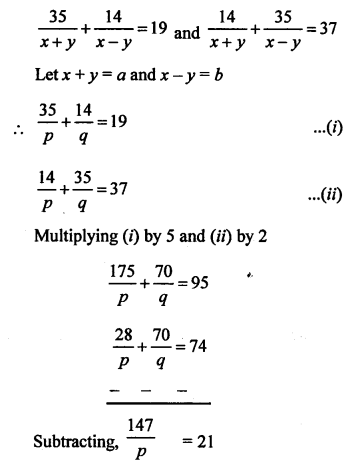
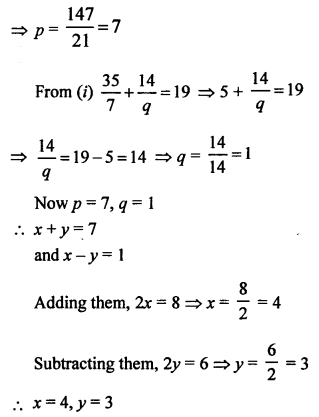
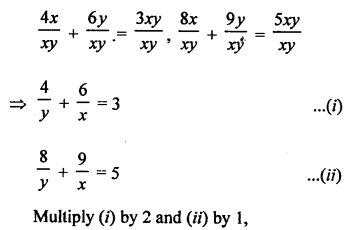
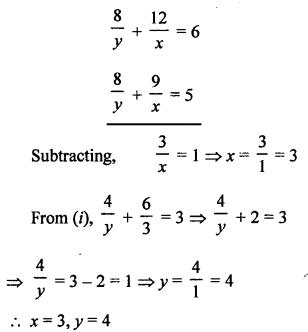
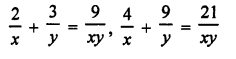
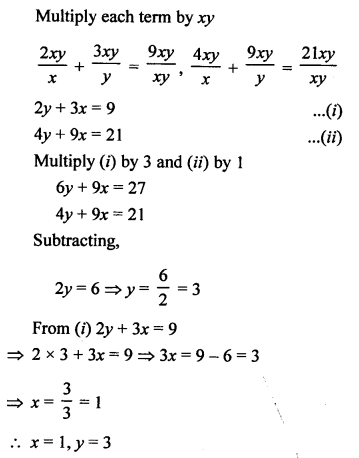
(c) 4x + 6y = 3xy, 8x + 9y = 5xy
Dividing each term by xy,
RS Aggarwal Class 10 Solutions Chapter 3 Linear equations in two variables MCQS 9
RS Aggarwal Class 10 Solutions Chapter 3 Linear equations in two variables MCQS 10

Question 8.
Solution:
(a)
RS Aggarwal Class 10 Solutions Chapter 3 Linear equations in two variables MCQS 11

Question 9.
Solution:
(c)
RS Aggarwal Class 10 Solutions Chapter 3 Linear equations in two variables MCQS 12

Question 10.
Solution:
(b)
RS Aggarwal Class 10 Solutions Chapter 3 Linear equations in two variables MCQS 13
RS Aggarwal Class 10 Solutions Chapter 3 Linear equations in two variables MCQS 14

Question 11.
Solution:
(d)
RS Aggarwal Class 10 Solutions Chapter 3 Linear equations in two variables MCQS 15

Question 12.
Solution:
(b)
RS Aggarwal Class 10 Solutions Chapter 3 Linear equations in two variables MCQS 16
RS AggarRS Aggarwal Class 10 Solutions Chapter 3 Linear equations in two variables MCQS 17wal Class 10 Solutions Chapter 3 Linear equations in two variables MCQS 16

Question 13.
Solution:
(a)
RS Aggarwal Class 10 Solutions Chapter 3 Linear equations in two variables MCQS 18

Question 14.
Solution:
(d)
RS Aggarwal Class 10 Solutions Chapter 3 Linear equations in two variables MCQS 19
RS Aggarwal Class 10 Solutions Chapter 3 Linear equations in two variables MCQS 20

Question 15.
Solution:
(d)
RS Aggarwal Class 10 Solutions Chapter 3 Linear equations in two variables MCQS 21

Question 16.
Solution:
(d)
RS Aggarwal Class 10 Solutions Chapter 3 Linear equations in two variables MCQS 22
RS Aggarwal Class 10 Solutions Chapter 3 Linear equations in two variables MCQS 23

Question 17.
Solution:
(d)
RS Aggarwal Class 10 Solutions Chapter 3 Linear equations in two variables MCQS 24

Question 18.
Solution:
(d) The system of equations is consistent then their graph lines will be either intersecting or coincident.

Question 19.
Solution:
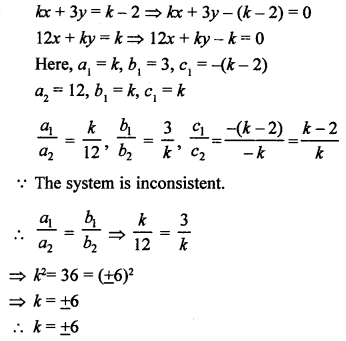
(a) The pair of lines of equation is inconsistent then the system will not have no solution i.e., their lines will be parallel.

Question 20.
Solution:
(b)
RS Aggarwal Class 10 Solutions Chapter 3 Linear equations in two variables MCQS 25

Question 21.
Solution:
(b) ABCD is a cyclic quadrilateral
∠A = (x + y + 10)°, ∠B = (y + 20)°, ∠C = (x + y – 30)° and ∠D = (x + y)°
∠A + ∠C = 180°
Now, x + y + 10°+ x + y – 30° = 180°
⇒ 2x + 2y – 20 = 180°
⇒ 2x + 2y = 180° + 20° = 200°
⇒ x + y = 100° …(i)
and ∠B + ∠D = 180°
⇒ y + 20° + x + y = 180°
⇒ x + 2y = 180° – 20° = 160° …(ii)
Subtracting,
-y = -60° ⇒ y = 60°
and x + 60° = 100°
⇒ x = 100° – 60° = 40°
Now, ∠B = y + 20° = 60° + 20° = 80°

Question 22.
Solution:
(d) Let one’s digit of a two digit number = x
and ten’s digit = y
Number = x + 10y
By interchanging the digits,
One’s digit = y
and ten’s digit = x
Number = y + 10x
According to the conditions,
x + y = 15 …(i)
y + 10x = x + 10y + 9
⇒ y + 10x – x – 10y = 9
⇒ 9x – 9y = 9
⇒ x – y = 1 …(ii)
Adding (i) and (ii),
2x = 16 ⇒ x = 8
and x + y = 15
⇒ 8 + y = 15
⇒ y = 15 – 8 = 7
Number = x + 10y = 8 + 10 x 7 = 8 + 70 = 78

Question 23.
Solution:
(b) Let the numerator of a fractions = x
and denominator = y
RS Aggarwal Class 10 Solutions Chapter 3 Linear equations in two variables MCQS 26

Question 24.
Solution:
(d) Let present age of man = x years
and age of his son = y years
5 years hence,
Age of man = (x + 5) years
and age of son = y + 5 years
(x + 5) = 3 (y + 5)
⇒ x + 5 = 3y + 15
x = 3y + 15 – 5
x = 3y + 10 ……(i)
and 5 years earlier
Age of man = x – 5 years
and age of son = y – 5 years
x – 5 = 7 (y – 5)
x – 5 = 7y – 35
⇒ x = 7y – 35 + 5
x = 7y – 30 ……….(ii)
From (i) and (ii),
7y – 30 = 3y + 10
⇒ 7y – 3y = 10 + 30
⇒ 4y = 40
y = 10
x = 3y + 10 = 3 x 10 + 10 = 30 + 10 = 40
Present age of father = 40 years

Question 25.
Solution:
(b)
RS Aggarwal Class 10 Solutions Chapter 3 Linear equations in two variables MCQS 27

Question 26.
Solution:
(c)
RS Aggarwal Class 10 Solutions Chapter 3 Linear equations in two variables MCQS 28

Question 27.
Solution:
(a)
RS Aggarwal Class 10 Solutions Chapter 3 Linear equations in two variables MCQS 29
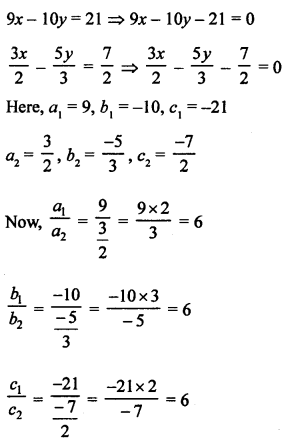
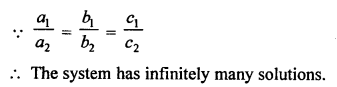
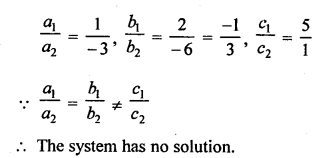
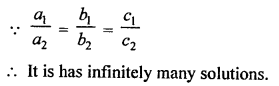
The system has infinitely many solutions.
The lines are coincident.

Hope given RS Aggarwal Solutions Class 10 Chapter 3 Linear equations in two variables MCQS are helpful to complete your math homework.

If you have any doubts, please comment below. Learn Insta try to provide online math tutoring for you.

RS Aggarwal Class 10 Solutions Chapter 3 Linear equations in two variables Ex 3F

RS Aggarwal Class 10 Solutions Chapter 3 Linear equations in two variables Ex 3F

These Solutions are part of RS Aggarwal Solutions Class 10. Here we have given RS Aggarwal Solutions Class 10 Chapter 3 Linear equations in two variables Ex 3F.

RS Aggarwal Solutions Class 10 Chapter 3

Very-Short and Short-Answer Questions
Question 1.
Solution:
RS Aggarwal Class 10 Solutions Chapter 3 Linear equations in two variables Ex 3F 1
RS Aggarwal Class 10 Solutions Chapter 3 Linear equations in two variables Ex 3F 2

Question 2.
Solution:
RS Aggarwal Class 10 Solutions Chapter 3 Linear equations in two variables Ex 3F 3
RS Aggarwal Class 10 Solutions Chapter 3 Linear equations in two variables Ex 3F 4

Question 3.
Solution:
RS Aggarwal Class 10 Solutions Chapter 3 Linear equations in two variables Ex 3F 5

Question 4.
Solution:
RS Aggarwal Class 10 Solutions Chapter 3 Linear equations in two variables Ex 3F 6
RS Aggarwal Class 10 Solutions Chapter 3 Linear equations in two variables Ex 3F 7

Question 5.
Solution:
RS Aggarwal Class 10 Solutions Chapter 3 Linear equations in two variables Ex 3F 8

Question 6.
Solution:
RS Aggarwal Class 10 Solutions Chapter 3 Linear equations in two variables Ex 3F 9

Question 7.
Solution:
Let first, number = x
and second number = y
x – y = 5
RS Aggarwal Class 10 Solutions Chapter 3 Linear equations in two variables Ex 3F 10

Question 8.
Solution:
Let cost of one pen = ₹ x
and cost of one pencil = ₹ y
According to the conditions,
5x + 8y = 120 …(i)
8x + 5y = 153 …(ii)
Adding, we get
13x + 13y = 273
x + y = 21 …(iii) (Dividing by 13)
and subtracting (i) from (ii),
3x – 3y = 33
⇒ x – y = 11 …….(iv) (Dividing by 3)
Again adding (iii) and (iv),
2x = 32 ⇒ x = 16
Subtracting,
2y = 10 ⇒ y = 5
Cost of 1 pen = ₹ 16
and cost of 1 pencil = ₹ 5

Question 9.
Solution:
Let first number = x
and second number = y
According to the conditions,
RS Aggarwal Class 10 Solutions Chapter 3 Linear equations in two variables Ex 3F 11
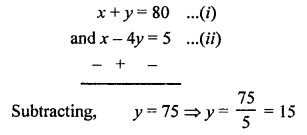
and x + y = 80
⇒ x + 15 = 80
x = 80 – 15 = 65
Numbers are : 65, 15

Question 10.
Solution:
Let one’s digit of a two digits number = x
and ten’s digit = y
Number = x + 10y
By reversing its digits One’s digit = y
and ten’s digit = x
Then number = y + 10x
According to the conditions,
x + y = 10 …(i)
x + 10y – 18 = y + 10x
x+ 10y – y – 10x = 18
⇒ -9x + 9y = 18
⇒ x – y = -2 (Dividing by -9) …..(ii)
Adding (i) and (ii),
2x = 8 ⇒ x = 4
and by subtracting,
2y = 12 ⇒ y = 6
Number = x + 10y = 4 + 10 x 6 = 4 + 60 = 64

Question 11.
Solution:
Let number of stamps of 20p = x
and stamps of 25 p = y
According to the conditions,
x + y = 47 …..(i)
20x + 25y = 1000
4x + 5y = 200 …(ii)
From (i), x = 47 – y
Substituting the value of x in (ii),
4 (47 – y) + 5y = 200
188 – 4y + 5y = 200
⇒ y = 200 – 188 = 12
and x + y = 47
⇒ x + 12 = 47
⇒ x = 47 – 12 = 35
Hence, number of stamps of 20 p = 35
and number of stamps of 25 p = 12

Question 12.
Solution:
Let number of hens = x
and number of cows = y
According to the conditions,
x + y = 48 …..(i)
x x 2 + y x 4 = 140
⇒ 2x + 4y = 140
⇒ x + 2y = 70 ……(ii)
Subtracting (i) from (ii),
y = 22
and x + y = 48
⇒ x + 22 = 48
⇒ x = 48 – 22 = 26
Number of hens = 26
and number of cows = 22

Question 13.
Solution:
RS Aggarwal Class 10 Solutions Chapter 3 Linear equations in two variables Ex 3F 12
RS Aggarwal Class 10 Solutions Chapter 3 Linear equations in two variables Ex 3F 13

Question 14.
Solution:
RS Aggarwal Class 10 Solutions Chapter 3 Linear equations in two variables Ex 3F 14
RS Aggarwal Class 10 Solutions Chapter 3 Linear equations in two variables Ex 3F 15

Question 15.
Solution:
12x + 17y = 53 …(i)
17x + 12y = 63 …(ii)
Adding, 29x + 29y = 116
Dividing by 29,
x + y = 4 …(iii)
Subtracting,
-5x + 5y = -10
⇒ x – y = 2 …(iv) (Dividing by -5)
Adding (iii) and (iv)
2x = 6 ⇒ x = 3
Subtracting,
2y = 2 ⇒ y = 1
x = 3, y = 1
x + y = 3 + 1 = 4

Question 16.
Solution:
RS Aggarwal Class 10 Solutions Chapter 3 Linear equations in two variables Ex 3F 16

Question 17.
Solution:
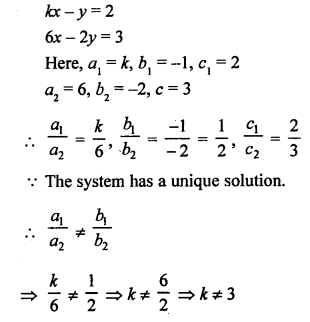
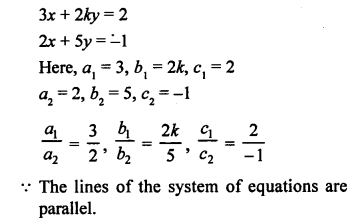
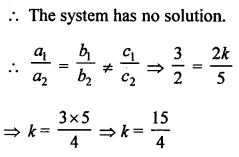
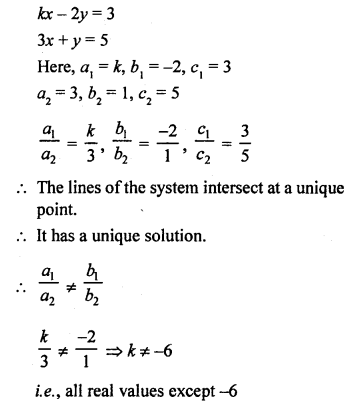
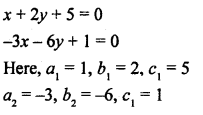
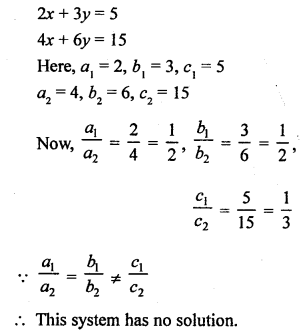
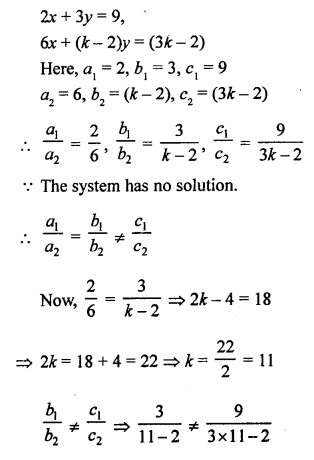
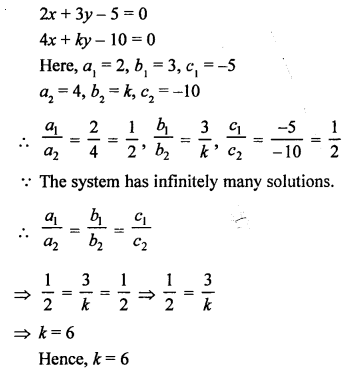
kx – y = 2
6x – 2y = 3
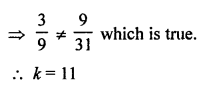
RS Aggarwal Class 10 Solutions Chapter 3 Linear equations in two variables Ex 3F 17

Question 18.
Solution:
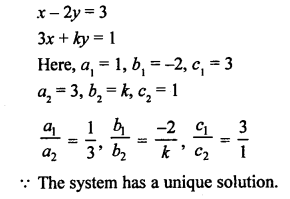
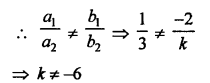
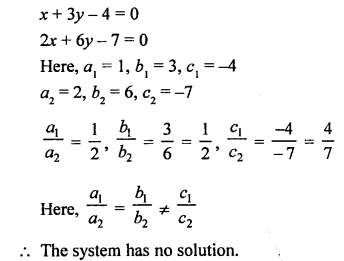
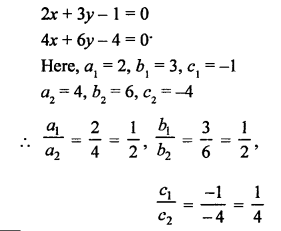
RS Aggarwal Class 10 Solutions Chapter 3 Linear equations in two variables Ex 3F 18

Question 19.
Solution:
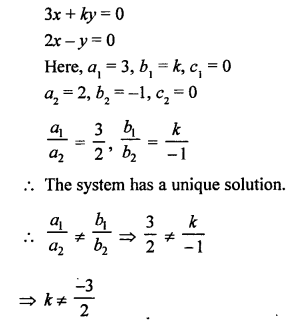
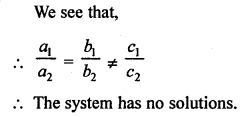
RS Aggarwal Class 10 Solutions Chapter 3 Linear equations in two variables Ex 3F 19
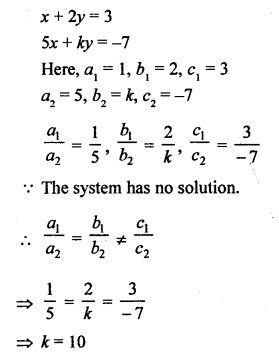
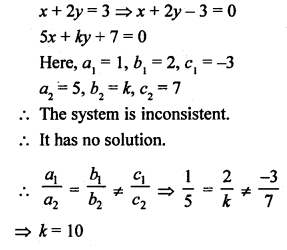
RS Aggarwal Class 10 Solutions Chapter 3 Linear equations in two variables Ex 3F 20

Question 20.
Solution:
RS Aggarwal Class 10 Solutions Chapter 3 Linear equations in two variables Ex 3F 21

Question 21.
Solution:
RS Aggarwal Class 10 Solutions Chapter 3 Linear equations in two variables Ex 3F 22
RS Aggarwal Class 10 Solutions Chapter 3 Linear equations in two variables Ex 3F 23

Hope given RS Aggarwal Solutions Class 10 Chapter 3 Linear equations in two variables Ex 3F are helpful to complete your math homework.

If you have any doubts, please comment below. Learn Insta try to provide online math tutoring for you.

RS Aggarwal Class 10 Solutions Chapter 3 Linear equations in two variables Ex 3C

RS Aggarwal Class 10 Solutions Chapter 3 Linear equations in two variables Ex 3C

These Solutions are part of RS Aggarwal Solutions Class 10. Here we have given RS Aggarwal Solutions Class 10 Chapter 3 Linear equations in two variables Ex 3C.

RS Aggarwal Solutions Class 10 Chapter 3

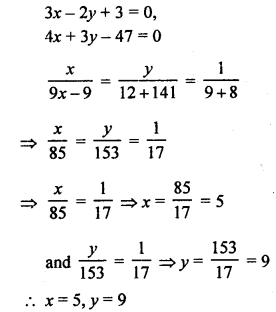
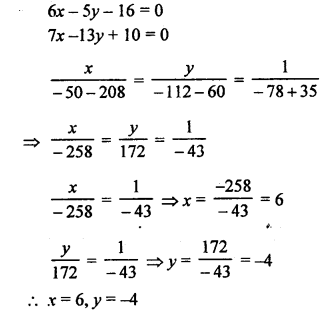
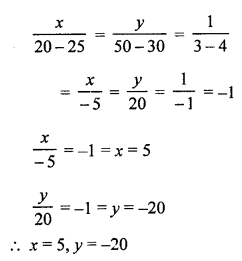
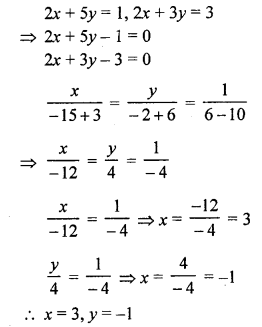
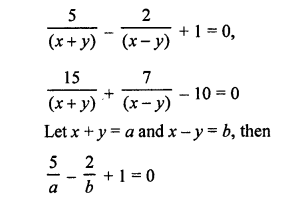
Solve each of the following systems of equations by using the method of cross multiplication:
Question 1.
Solution:
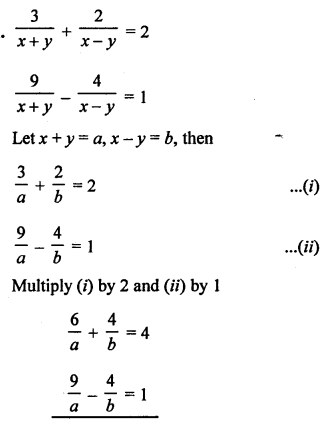
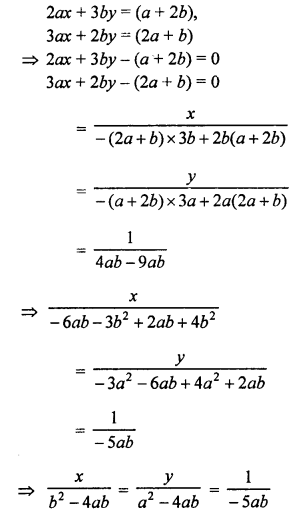
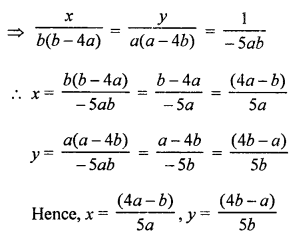
RS Aggarwal Class 10 Solutions Chapter 3 Linear equations in two variables Ex 3C 1
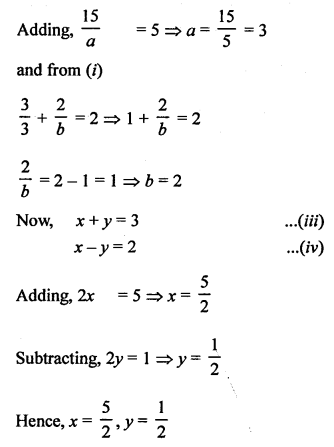
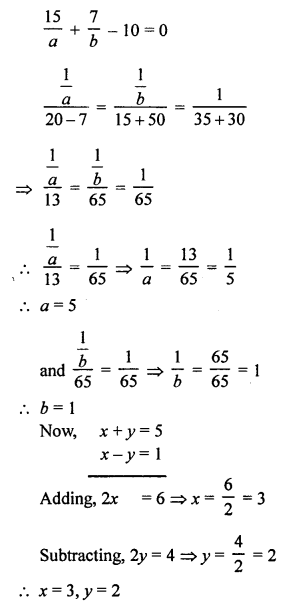
RS Aggarwal Class 10 Solutions Chapter 3 Linear equations in two variables Ex 3C 2

Question 2.
Solution:
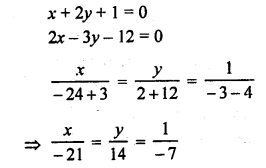
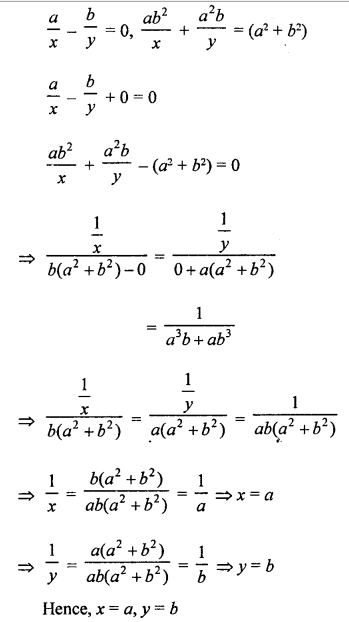
RS Aggarwal Class 10 Solutions Chapter 3 Linear equations in two variables Ex 3C 3

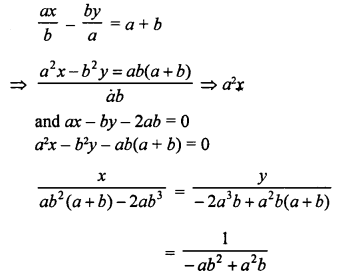
Question 3.
Solution:
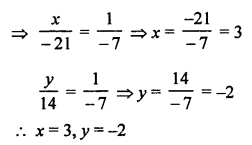
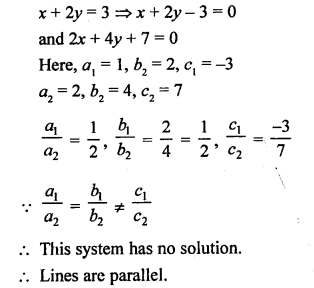
RS Aggarwal Class 10 Solutions Chapter 3 Linear equations in two variables Ex 3C 4

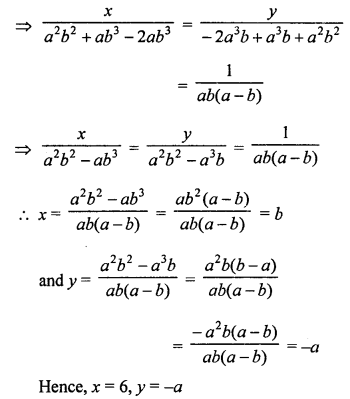
Question 4.
Solution:
RS Aggarwal Class 10 Solutions Chapter 3 Linear equations in two variables Ex 3C 5

Question 5.
Solution:
RS Aggarwal Class 10 Solutions Chapter 3 Linear equations in two variables Ex 3C 6

Question 6.
Solution:
RS Aggarwal Class 10 Solutions Chapter 3 Linear equations in two variables Ex 3C 7
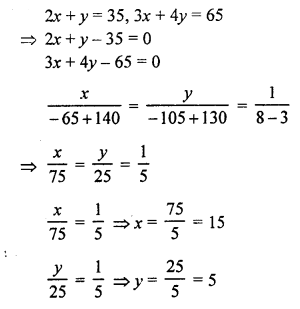
x = 15, y= 5

Question 7.
Solution:
RS Aggarwal Class 10 Solutions Chapter 3 Linear equations in two variables Ex 3C 8

Question 8.
Solution:
RS Aggarwal Class 10 Solutions Chapter 3 Linear equations in two variables Ex 3C 9

Question 9.
Solution:
RS Aggarwal Class 10 Solutions Chapter 3 Linear equations in two variables Ex 3C 10

Question 10.
Solution:
RS Aggarwal Class 10 Solutions Chapter 3 Linear equations in two variables Ex 3C 11
RS Aggarwal Class 10 Solutions Chapter 3 Linear equations in two variables Ex 3C 12

Question 11.
Solution:
RS Aggarwal Class 10 Solutions Chapter 3 Linear equations in two variables Ex 3C 13
RS Aggarwal Class 10 Solutions Chapter 3 Linear equations in two variables Ex 3C 14

Question 12.
Solution:
RS Aggarwal Class 10 Solutions Chapter 3 Linear equations in two variables Ex 3C 15
RS Aggarwal Class 10 Solutions Chapter 3 Linear equations in two variables Ex 3C 16

Question 13.
Solution:
RS Aggarwal Class 10 Solutions Chapter 3 Linear equations in two variables Ex 3C 17

Hope given RS Aggarwal Solutions Class 10 Chapter 3 Linear equations in two variables Ex 3C are helpful to complete your math homework.

If you have any doubts, please comment below. Learn Insta try to provide online math tutoring for you.