NCERT Exemplar Solutions for Class 10 Science Chapter 7 Control and Coordination

NCERT Exemplar Solutions for Class 10 Science Chapter 7 Control and Coordination

These Solutions are part of NCERT Exemplar Solutions for Class 10 Science. Here we have given NCERT Exemplar Solutions for Class 10 Science Chapter 7 Control and Coordination

NCERT Exemplar Solutions for Class 10 Science Chapter 7 Short Answer Questions

Question 1.

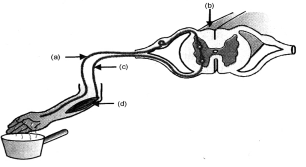
  1. Label the parts a, b, c and d and show the direction of electrical signals in the figure. (CBSE 2010)
    NCERT Exemplar Solutions for Class 10 Science Chapter 7 Control and Coordination image - 1
  2. Draw the figure shown here and label motor neuron, relay neuron and spinal cord. What is the name of this connection ?
    (CCE 2011)

More Resources

Answer:

  1. a – Sensory neuron.
    b – Spinal cord (CNS).
    c – Mortor neuron.
    d – Effector (muscle in arm)
  2. Name — Reflex arc.
    Direction :

    1. Receptor (hand) to spinal cord through sensory neuron,
    2. Sensory neuron to motor neuron through Spinal cord to effector through motor neuron.

Question 2.
Name the plant hormone responsible for the following :
(a) Elongation of cells
(b) Growth of stem
(c) Promotion of cell division
(d) Falling of senescent leaves.
Answer:
(a) Elongation of Cells. Auxin.
(b) Growth of Stem. Gibberellin.
(c) Promotion of Cell Division. Cytokinin.
(d) Falling of Senescent Leaves. Abscisic acid.

Question 3.
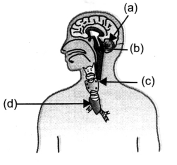
Label the endocrine glands in the figure
NCERT Exemplar Solutions for Class 10 Science Chapter 7 Control and Coordination image - 2
Answer:
a – Pineal gland.
b – Pituitary gland.
c – Thyroid
d – Thymus.

Question 4.
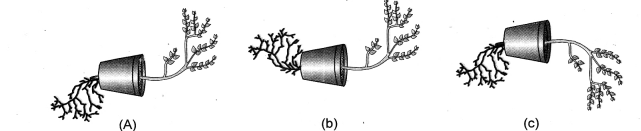
In the figures (a), (b) and (c) which appears more accurate and why ?
NCERT Exemplar Solutions for Class 10 Science Chapter 7 Control and Coordination image - 3
Answer:
Figure (a) is more accurate as it shows appropriate response of both shoot and root to the vector of gravity. Shoot is negatively geotropic. It, therefore, bends upwardly. Root is positively geotropic. It, therefore, bends downwardly.

Question 5.
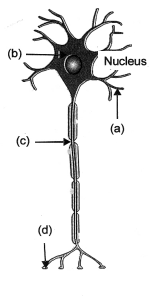
Label the parts of a neuron shown in the figure.
NCERT Exemplar Solutions for Class 10 Science Chapter 7 Control and Coordination image - 4
Answer:
a – Dendrite.
b – Cyton (Cell body).
c – Axon.
d – Axon terminal (bouton).

Question 6.
Match the terms of column A with those of column B.

AB

(a)   Olfactory receptors

(b)  Thermoreceptors (temperature receptors)

(c)  Gustatoreceptors

(d)  Photoreceptors

(I) Tongue

(ii) Eye

(iiî) Nose

(iv) Skin


Answer:
a – IIi,
b — iv,
c — i,
d — ii.

Question 7.
What is a tropic movement ? Explain with an example. (CCE 2011)
Answer:
Tropic Movement: It is directional paratonie growth movement of curvature in which direction of movement is determined by the direction of the stimulus. They mostly occur in cylindrical organs. Growth response occurs due to differences in the distribution of auxin.
Example. On unidirectional exposure to light, shoots bend towards the source of light (positive phototropism) while roots may bend away from the source of light (negative phototropism).

Question 8.
What will happen if intake of iodine in our diet is low ?
Answer:

  1. Low intake of iodine will affect production of thyroxine. Reduced thyroxine reduces metabolism of protein, carbohydrate and fat. Physical activity and consumption of energy are impaired.
  2. With continued reduced intake of iodine, thyroid gland enlarges (in order to produce more thyroxine). It results in swelling of neck called goitre.

Question 9.
What happens at the synapse between the neurons ?

                                                   Or

State the events in sequence that take place when an electrical impulse travels from a dendritic tip of a nerve cell to another nerve cell. (CCE 2011, 2012, 2013)
Answer:
At synapse, axon terminal is expanded to form presynaptic knob. The dendrite terminal that lies close to it is slightly broadened and depreseed to form post-synaptic depression. A fluid filled narrow space, called synaptic cleft, occurs between the two. When an impulse reaches the presynaptic knob, it stimulates the release of neurotransmitter into synaptic cleft. Neurotransmitter comes in contact with chemoreceptor sites of the membrane of postsynaptic depression. This generates an electrochemical signal or impulse in the dendrite part of second neuron.

Question 10.
Answer the following :
(a) Which hormone is responsible for the changes noticed in female at puberty ?
(b) Dwarfism results due to deficiency of which hormone ?
(c) Blood sugar level rises due to deficiency of which hormone ?
(d) Iodine is necessary for synthesis of which hormone ?
Answer:
(a) Puberty Changes in Females. Oestrogen.
(b) Dwarfism. Growth hormone.
(c) Blood Sugar. Insulin.
(d) Iodine Hormone. Thyroxine

Question 11.
Answer the following :
(a) Name the endocrine gland associated with brain.
(b) Which gland secrets digestive enzymes as well as hormones ?
(c) Name the endocrine gland associated with kidney.
(d) Which endocrine gland is present in males but not in females ?
Answer:
(a) Endocrine Gland Associated with Brain. Pituitary.
(b) Gland with Digestive Enzymes and Hormones. Pancreas.
(c) Endocrine Gland Associated with Kidneys. Adrenal glands.
(d) Endocrine Gland in Males only. Testis.

NCERT Exemplar Solutions for Class 10 Science Chapter 7 Long Answer Questions

Question 12.
Draw the structure of a neuron and explain its function. (CCE 2011)
Answer:
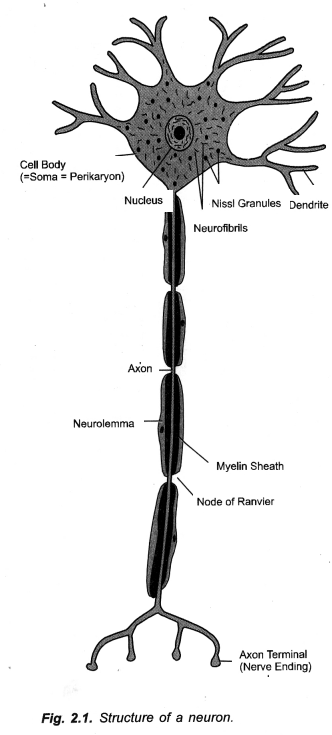
NCERT Exemplar Solutions for Class 10 Science Chapter 7 Control and Coordination image - 5
Functions:

  1. Dendrites: Picking up sensations and transmitting the same to cell body.
  2. Cell Body:
    1. Sustaining structure and function of dendrites and axon,
    2. Functioning as passage¬way for transmission of sensation or impulse to axon.
  3. Axon: Carrying impulse to another neuron, muscle, gland and organ. A single impulse can be transmitted to several structures with the help of axon terminals.

Question 13.
What are the major parts of the brain ? Mention the function of different parts.
Answer:
Major Parts of Brain
Fore-Brain: Olfactory lobes (2), Cerebral hemispheres (2) or cerebrum, Diencephalon.
Mid-Brain: Cerebral peduncles, Corpora quadrigemina.
Hind Brain: Pons, Cerebellum, Medulla oblongata.
Functions

  1. Olfactory Lobes: Receive sensation of smell from olfactory epithelium and relay the same to temporal lobes of cerebral hemispheres.
  2. Cerebral Hemispheres:
    1. Frontal Lobes: Centres of intelligence, control of movements and facial muscles, speech.
    2. Parietal Lobes: Taste and cutaneous sensations with some components of speech.
    3. Temporal Lobes: Hearing, smell, recall of audiovisual memory, some components of speech.
    4. Occipital Lobes: Sight.
  3. Diencephalon: Hypothalamus part regulates activity of smooth muscles and functions as control centre for hunger, thirst, fatigue, sleep, sweating, temperature and emotions. Pituitary gland and pineal gland are components of diencephalon.
  4. Corpora Quadrigemina: Superior – sight reflexes. Inferior – auditory reflexes.
  5. Cerebellum: Controls posture and equilibrium.
  6. Pons: Part of respiratory centre.
  7. Medulla Oblongata: Centre for reflexes, blood pressure, heart beat, breathing.

Question 14.
What constitutes the central and peripheral nervous systems ? How are the components of central nervous system protected?
(CCE 2012)
Answer:
Central Nervous System (CNS): It is hollowed part of nervous system that lies along the mid-dorsal part of the body. It has two parts, brain (located in the head) and spinal cord (located in the trunk).
Peripheral Nervous System (PNS): It is soild lateral part of nervous system that develops from CNS and connects different parts of the body with CNS. Peripheral nervous system has two components, voluntary and involuntary. Voluntary peripheral nerous system is under the control of will. It consists of cranial nerves from brain and spinal nerves from spinal cord. Involuntary peripheral nervous system works independent of will. It develops from some cranial and spinal nerves. Involuntary peripheral nervous system is also called autonomic nervous system. It has two parts, sympathetic (for emergency) and parasympathetic (for moderation). They control the functioning of various internal body parts.
Protection of Brain: Brain box or Cranium, meninges and cerebrospinal fluid.
Protection of Spinal Cord: Vertebral Column, meninges and cerebrospinal fluid.

Question 15.
Mention one function for each of these hormones.
(a) Thyroxine
(b) Insulin
(c) Adrenaline
(d) Growth hormone
(e) Testosterone. (CCE 2010, 2013, 2015)
Answer:
(a) Thyroxine: Regulates metabolism of carbohydrates, fats and proteins, release of energy and body activity.
(b) Insulin: Regulates blood glucose by its absorption in liver, muscles (for formation of glycogen) and individual cells (for metabolic activity).
(c) Adrenaline: For meeting an emergency by increasing heart rate and supply of blood to various concerned organs.
(d) Growth Hormone (GH) or Somatotrophic Hormone: Regulates growth and development of the body through anabolic activity for growth of bones, muscles and visceral organs.
(e) Testosterone (Male Sex Hormone): Controls changes in body associated with puberty in males (beard, moustache, low pitch voice, increased growth of bones and muscles).

Question 16.
Name the various plant hormones. Also give their physiological effects on plant growth and development. (CCE 2016)
Answer:
Five types — auxin, gibberelin, cytokinin, ethylene and abscisic acid.
Auxin: Cell enlargement, root formation, apical dominance, inhibition of abscission, fruit growth.
Gibberellin: Growth in stem and leaves, higher fruit yield, overcoming dormancy.
Cytokinin: Essential for cell division, differentiation, prevention of senescence and overcoming apical dominance.
Ethylene: Promotes transverse growth, fruit ripening and overcoming dormancy of some parts.
Abscisic Acid (ABA): Induces dormancy, senescence and abscission, checking excessive activity of growth promoting hormones, closure of stomata under water stress.

Question 17.
What are reflex actions ? Give two examples. Explain a reflex arc.
Answer:
Definition: Reflex actions seem to have evolved quite early in the physiology of animals when complex neuron network for processing had not been evolved. Even after evolution of processing centres, reflex actions have continued to persist because of their more efficiency for quick responses.
Two Examples:

  1. On being pricked or coming in contact with hot surface, hand is withdrawn even before pain is perceived (by brain),
  2. Wider openin0 of pupil in dim light and its narrowing in strong light.
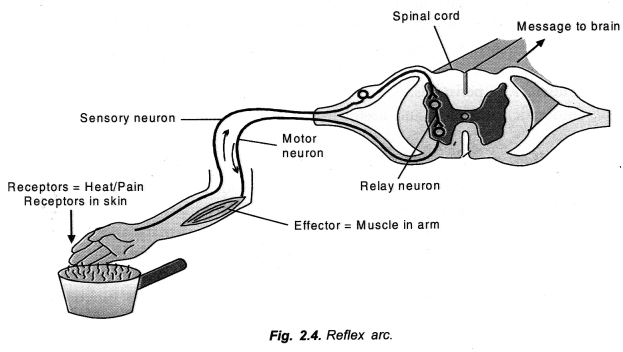
    NCERT Exemplar Solutions for Class 10 Science Chapter 7 Control and Coordination image - 6

Question 18.
“Nervous and hormonal systems together perform the function of control and coordination in human being.” Justify the statement.
Answer:
Both nervous system and hormonal (or endocrine) system are involved in control, regulation and coordination of body parts. Nervous system is connected to receptors of all senses. Information obtained from sensory organs is passed rapidly to CNS for interpretation.
On the basis of interpretation, a message is sent to effector organ or organs (muscles, glands, etc.). The rate of information or impulse transfer is very high, some 100m/sec. Every action and activity is well coordinated as the information is sent to all the regions required for that action. The action can be voluntary (under the will) or involuntary. Passage of food in the alimentary canal is due to an involuntary movement of alimentary canal called peristalsis. Picking up food and placing it inside the mouth is a voluntary movement. Both these movements are highly coordinated by nervous system.
Nervous system is also connected with the functioning of endocrine or hormonal system. The endocrine system functions at the biochemical level while nervous system functions at the physical and physiological level. For their functioning endocrine glands pour their secretion into blood which transports them to all parts of the body. Target cells have receptors for picking up the hormones and working as per hormonal stimulus. There is a feedback system which determines the requirement of hormones and the activity of endocrine glands. Other stimuli are also involved for coordinated functioning. Presence of food in the stomach stimulates its wall to secrete hormone gastrin. Gastrin stimulates gastric glands to pour gastric juice over the food. As the partially digested food passes into duodenum, the latter forms hormone secretin which induces passage of bile and pancreatic juice into duodenum.
Joint working of both the systems is observed during an emergency. Both sympathetic nervous system and adrenal glands prepare the body for meeting the emergency. There is higher rate of heart beat, more blood supply to cardiac and skeletal muscles and higher rate of breathing for quicker oxygenation of blood.

Question 19.
How does chemical co-ordination take place in animals ?
Answer:
In animals, chemical coordination is achieved through the agency of hormones which function as chemical messengers or informational molecules. Hormones are secreted by ductless glands in response to specific conditions or nervous stimulation. Timing and amount of a hormone released are regulated by feed-back mechanism. After a meal, sugar level of blood rises. It is detected by pancreas. Pancreas responds by producing hormone insulin from (3-cells of islets of Langerhans. Insulin causes glucose to be absorbed by all cells as well as get stored in liver and muscles in the form of glycogen. As the level of glucose falls in blood, insulin secretion is reduced.

Question 20.
Why the flow of signals in a synapse is from axonal end of one neuron to dendrite end of another neuron but not the reverse ?
Answer:
As the electrical impulse reaches the axon terminal in the region of axon-dendrite synapse, it stimulates the exocytosis of vesicles containing neurotransmitter (e.g. acetylcholine). Neurotransmitter attaches to the chemoreceptor sites of the membrane covering the dendrite end of synapse. It creates a new impulse that travels through cell body and axon of the second neuron. At synapse, the axon end does not contain any chemoreceptor sites so that reverse flow of electrochemical impulses is not possible.

Hope given NCERT Exemplar Solutions for Class 10 Science Chapter 7 Control and Coordination are helpful to complete your science homework.

If you have any doubts, please comment below. Learn Insta try to provide online science tutoring for you.
RD Sharma Class 8 Solutions Chapter 4 Cubes and Cube Roots Ex 4.5

RD Sharma Class 8 Solutions Chapter 4 Cubes and Cube Roots Ex 4.5

These Solutions are part of RD Sharma Class 8 Solutions. Here we have given RD Sharma Class 8 Solutions Chapter 4 Cubes and Cube Roots Ex 4.5

Other Exercises

Making use of the cube root table, find the cubes root of the following (correct to three decimal places) 
Question 1.
7
Solution:
\(\sqrt [ 3 ]{ 7 }\) =1.913 (From the table)

Question 2.
70
Solution:
\(\sqrt [ 3 ]{ 70 }\) =4.121 (From the table)

Question 3.
700
Solution:
\(\sqrt [ 3 ]{ 700 } =\sqrt [ 3 ]{ 7\times 100 } \)= 8.879 (from \(\sqrt [ 3 ]{ 10x }\))

Question 4.
7000
Solution:
\(\sqrt [ 3 ]{ 7000 } =\sqrt [ 3 ]{ 70\times 100 }\) = 19.13 (from \(\sqrt [ 3 ]{ 100x }\))

Question 5.
1100
Solution:
\(\sqrt [ 3 ]{ 1100 } =\sqrt [ 3 ]{ 11\times 100 }\) = 10.32 (from \(\sqrt [ 3 ]{ 100x }\))

Question 6.
780
Solution:
\(\sqrt [ 3 ]{ 780 } =\sqrt [ 3 ]{ 78\times 100 }\) = 9.205 (from \(\sqrt [ 3 ]{ 10x }\))

Question 7.
7800
Solution:
\(\sqrt [ 3 ]{ 7800 } =\sqrt [ 3 ]{ 78\times 100 }\) = 19.83 (from \(\sqrt [ 3 ]{ 100x }\))

Question 8.
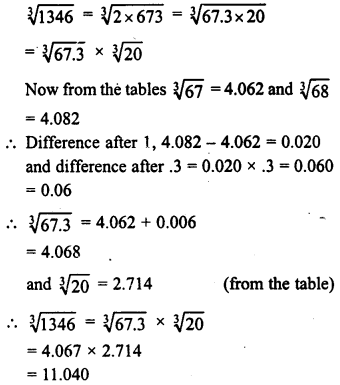
1346
Solution:
RD Sharma Class 8 Solutions Chapter 4 Cubes and Cube Roots Ex 4.5 1

Question 9.
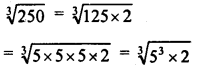
250
Solution:
RD Sharma Class 8 Solutions Chapter 4 Cubes and Cube Roots Ex 4.5 2
RD Sharma Class 8 Solutions Chapter 4 Cubes and Cube Roots Ex 4.5 3

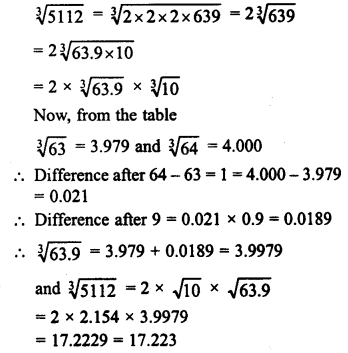
Question 10.
5112
Solution:
RD Sharma Class 8 Solutions Chapter 4 Cubes and Cube Roots Ex 4.5 4

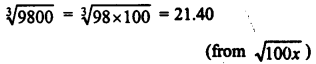
Question 11.
9800
Solution:
RD Sharma Class 8 Solutions Chapter 4 Cubes and Cube Roots Ex 4.5 5

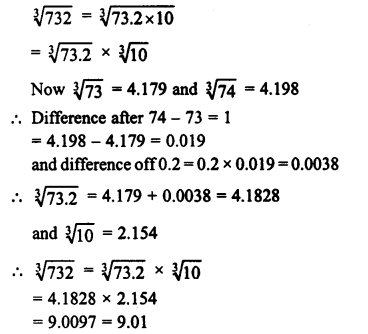
Question 12.
732
Solution:
RD Sharma Class 8 Solutions Chapter 4 Cubes and Cube Roots Ex 4.5 6

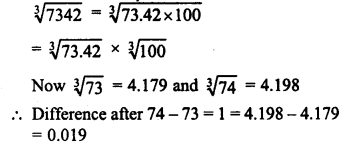
Question 13.
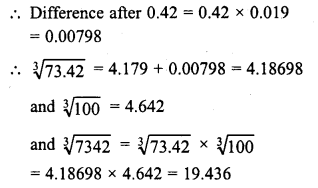
7342
Solution:
RD Sharma Class 8 Solutions Chapter 4 Cubes and Cube Roots Ex 4.5 7
RD Sharma Class 8 Solutions Chapter 4 Cubes and Cube Roots Ex 4.5 8

Question 14.
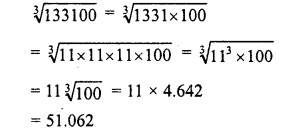
133100
Solution:
RD Sharma Class 8 Solutions Chapter 4 Cubes and Cube Roots Ex 4.5 9

Question 15.
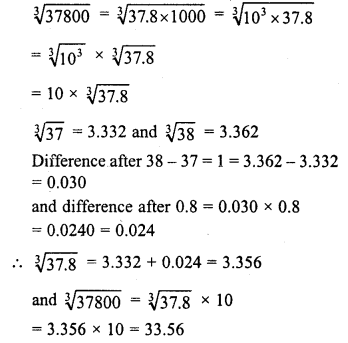
37800
Solution:
RD Sharma Class 8 Solutions Chapter 4 Cubes and Cube Roots Ex 4.5 10

Question 16.
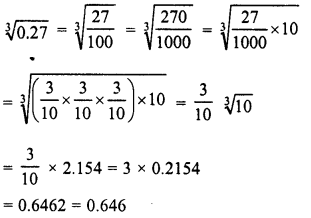
0.27
Solution:
RD Sharma Class 8 Solutions Chapter 4 Cubes and Cube Roots Ex 4.5 11

Question 17.
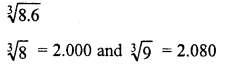
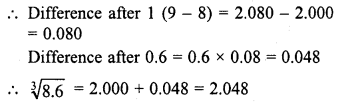
8.6
Solution:
RD Sharma Class 8 Solutions Chapter 4 Cubes and Cube Roots Ex 4.5 12
RD Sharma Class 8 Solutions Chapter 4 Cubes and Cube Roots Ex 4.5 13

Question 18.
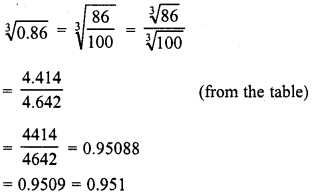
0.86
Solution:
RD Sharma Class 8 Solutions Chapter 4 Cubes and Cube Roots Ex 4.5 14

Question 19.
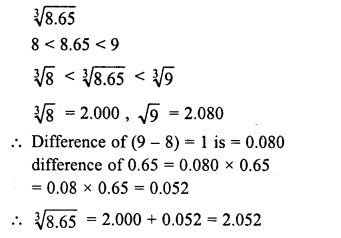
8.65
Solution:
RD Sharma Class 8 Solutions Chapter 4 Cubes and Cube Roots Ex 4.5 15

Question 20.
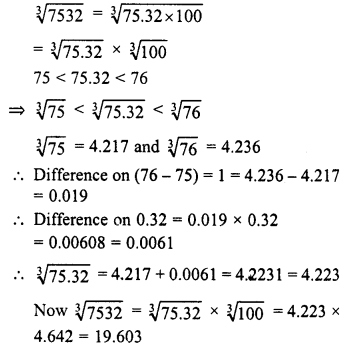
7532
Solution:
RD Sharma Class 8 Solutions Chapter 4 Cubes and Cube Roots Ex 4.5 16

Question 21.
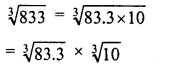
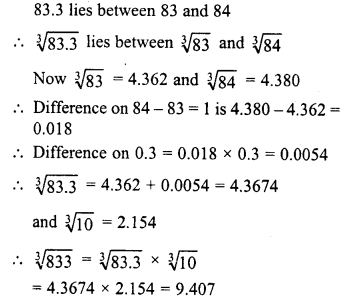
833
Solution:
RD Sharma Class 8 Solutions Chapter 4 Cubes and Cube Roots Ex 4.5 17
RD Sharma Class 8 Solutions Chapter 4 Cubes and Cube Roots Ex 4.5 18

Question 22.
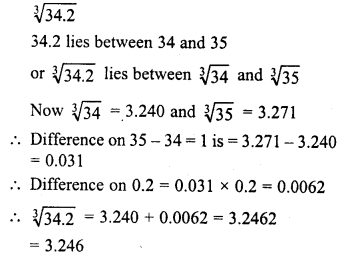
34.2
Solution:
RD Sharma Class 8 Solutions Chapter 4 Cubes and Cube Roots Ex 4.5 19

Question 23.
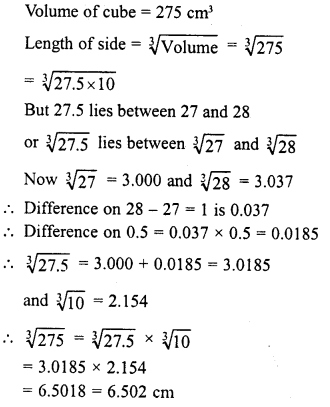
What is the length of the side of a cube whose volume is 275 cm3. Make use of the table for the cube root.
Solution:
RD Sharma Class 8 Solutions Chapter 4 Cubes and Cube Roots Ex 4.5 20

Hope given RD Sharma Class 8 Solutions Chapter 4 Cubes and Cube Roots Ex 4.5 are helpful to complete your math homework.

If you have any doubts, please comment below. Learn Insta try to provide online math tutoring for you.
RS Aggarwal Class 6 Solutions Chapter 5 Fractions Ex 5G

RS Aggarwal Class 6 Solutions Chapter 5 Fractions Ex 5G

These Solutions are part of RS Aggarwal Solutions Class 6. Here we have given RS Aggarwal Solutions Class 6 Chapter 5 Fractions Ex 5G.

Other Exercises

Objective Questions :
Tick the correct answer in each of the following :

Question 1.
Solution:
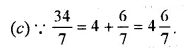
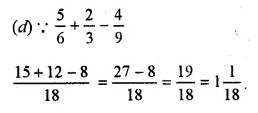
(c) ∴ canceling the common factor 2, we get \(\\ \frac { 3 }{ 5 } \)

Question 2.
Solution:
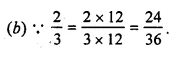
(c) ∴ multiplying numerator and denominator by 4, we get \(\\ \frac { 8 }{ 12 } \)

Question 3.
Solution:
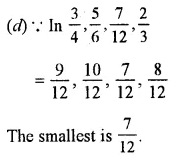
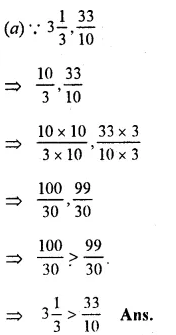
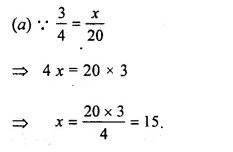
RS Aggarwal Class 6 Solutions Chapter 5 Fractions Ex 5G 3.1

Question 4.
Solution:
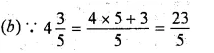
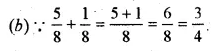
RS Aggarwal Class 6 Solutions Chapter 5 Fractions Ex 5G 4.1

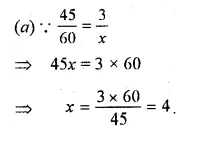
Question 5.
Solution:
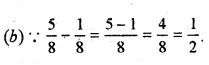
RS Aggarwal Class 6 Solutions Chapter 5 Fractions Ex 5G 5.1

Question 6.
Solution:
(c) each of the fractions has the same denominator.

Question 7.
Solution:
(d) none of these has greater denominator than its numerator.

Question 8.
Solution:
(a) its denominator is greater than its numerator.

Question 9.
Solution:
(b) their numerators are same and 4 < 5 , \(\frac { 3 }{ 4 } >\frac { 3 }{ 5 } \)

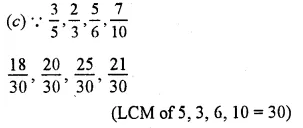
Question 10.
Solution:
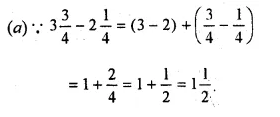
RS Aggarwal Class 6 Solutions Chapter 5 Fractions Ex 5G 10.1

Question 11.
Solution:
(b) In \(\frac { 4 }{ 5 } ,\frac { 2 }{ 7 } ,\frac { 4 }{ 9 } ,\frac { 4 }{ 11 } \) numerator is same then the smallest denominator’s fraction is greater.

Question 12.
Solution:
(a) Denominators are same, then fraction of smallest numerator will be smallest.

Question 13.
Solution:
RS Aggarwal Class 6 Solutions Chapter 5 Fractions Ex 5G 13.1

Question 14.
Solution:
RS Aggarwal Class 6 Solutions Chapter 5 Fractions Ex 5G 14.1

Question 15.
Solution:
RS Aggarwal Class 6 Solutions Chapter 5 Fractions Ex 5G 15.1

Question 16.
Solution:
RS Aggarwal Class 6 Solutions Chapter 5 Fractions Ex 5G 16.1

Question 17.
Solution:
RS Aggarwal Class 6 Solutions Chapter 5 Fractions Ex 5G 17.1

Question 18.
Solution:
RS Aggarwal Class 6 Solutions Chapter 5 Fractions Ex 5G 18.1

Question 19.
Solution:
RS Aggarwal Class 6 Solutions Chapter 5 Fractions Ex 5G 19.1

Question 20.
Solution:
RS Aggarwal Class 6 Solutions Chapter 5 Fractions Ex 5G 20.1

Hope given RS Aggarwal Solutions Class 6 Chapter 5 Fractions Ex 5G are helpful to complete your math homework.

If you have any doubts, please comment below. Learn Insta try to provide online math tutoring for you.
ML Aggarwal Class 10 Solutions for ICSE Maths Chapter 15 Circles MCQS

ML Aggarwal Class 10 Solutions for ICSE Maths Chapter 15 Circles MCQS

These Solutions are part of ML Aggarwal Class 10 Solutions for ICSE Maths. Here we have given ML Aggarwal Class 10 Solutions for ICSE Maths Chapter 15 Circles MCQS

More Exercises

Question 1.
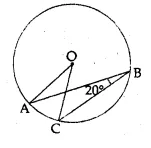
In the given figure, O is the centre of the circle. If ∠ABC = 20°, then ∠AOC is equal to
(a) 20°
(b) 40°
(c) 60°
(d) 10°
ML Aggarwal Class 10 Solutions for ICSE Maths Chapter 15 Circles MCQS Q1.1
Solution:
In the given figure,
Arc AC subtends ∠AOC at the centre
and ∠ABC at the remaining part of the circle
∠AOC = 2∠ABC = 2 × 20° = 40° (b)

Question 2.
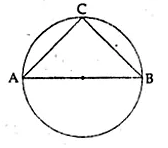
In the given figure, AB is a diameter of the circle. If AC = BC, then ∠CAB is. equal to
(a) 30°
(b) 60°
(c) 90°
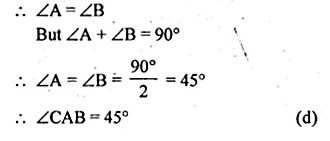
(d) 45°
ML Aggarwal Class 10 Solutions for ICSE Maths Chapter 15 Circles MCQS Q2.1
Solution:
In the given figure,
AB is the diameter of the circle and AC = BC
∠ACB = 90° (angle in a semi-circle)
AC = BC
ML Aggarwal Class 10 Solutions for ICSE Maths Chapter 15 Circles MCQS Q2.2

Question 3.
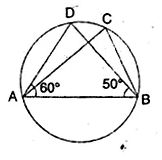
In the given figure, if ∠DAB = 60° and ∠ABD = 50° then ∠ACB is equal to
(a) 60°
(b) 50°
(c) 70°
(d) 80°
ML Aggarwal Class 10 Solutions for ICSE Maths Chapter 15 Circles MCQS Q3.1
Solution:
In the given figure,
∠DAB = 60°, ∠ABD = 50°
In ∆ADB, ∆ADB = 180° – (60° + 50°)
= 180° – 110° = 70°
∠ACB = ∠ADB
(angles in the same segment) = 70° (c)

Question 4.
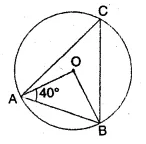
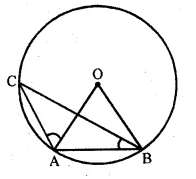
In the given figure, O is the centre of the circle. If ∠OAB = 40°, then ∠ACB is equal to
(a) 50°
(b) 40°
(c) 60°
(d) 70°
ML Aggarwal Class 10 Solutions for ICSE Maths Chapter 15 Circles MCQS Q4.1
Solution:
In the given figure, O is the centre of the circle.
In ∆OAB,
∠OAB = 40°
But ∠OBA = ∠OAB = 40°
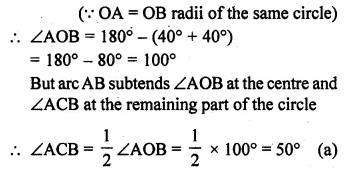
ML Aggarwal Class 10 Solutions for ICSE Maths Chapter 15 Circles MCQS Q4.2

Question 5.
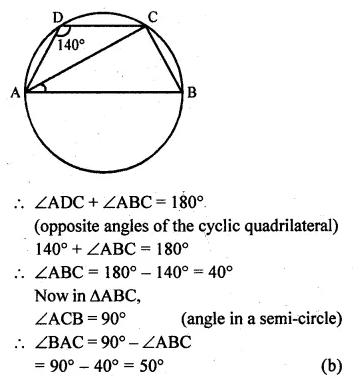
ABCD is a cyclic quadrilateral such that AB is a diameter of the circle circumscribing it and ∠ADC = 140°, then ∠BAC is equal to
(a) 80°
(b) 50°
(c) 40°
(d) 30°
Solution:
ABCD is a cyclic quadrilateral,
AB is the diameter of the circle circumscribing it
∠ADC = 140°, ∠BAC = Join AC
ML Aggarwal Class 10 Solutions for ICSE Maths Chapter 15 Circles MCQS Q5.1

Question 6.
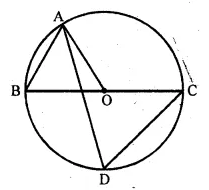
In the given figure, O is the centre of the circle. If ∠BAO = 60°, then ∠ADC is equal to
(a) 30°
(b) 45°
(c) 60°
(d) 120°
ML Aggarwal Class 10 Solutions for ICSE Maths Chapter 15 Circles MCQS Q6.1
Solution:
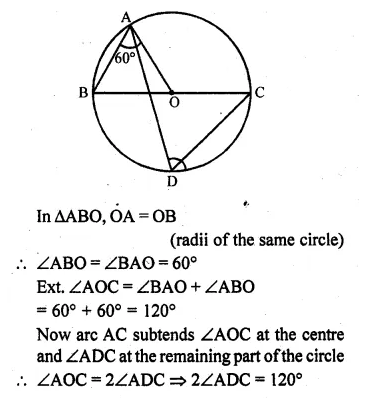
In the given figure, O is the centre of the circle ∠BAO = 60°
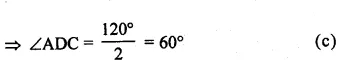
ML Aggarwal Class 10 Solutions for ICSE Maths Chapter 15 Circles MCQS Q6.2
ML Aggarwal Class 10 Solutions for ICSE Maths Chapter 15 Circles MCQS Q6.3

Question 7.
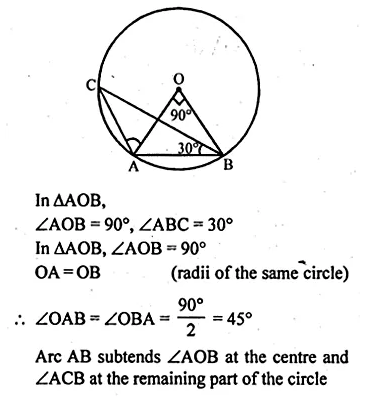
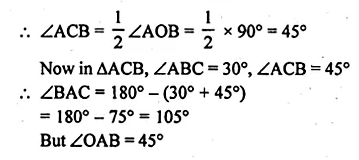
In the given figure, O is the centre of the circle. If ∠AOB = 90° and ∠ABC = 30°, then ∠CAO is equal to
(a) 30°
(b) 45°
(c) 90°
(d) 60°
ML Aggarwal Class 10 Solutions for ICSE Maths Chapter 15 Circles MCQS Q7.1
Solution:
In the given figure, O is the centre of the circle
ML Aggarwal Class 10 Solutions for ICSE Maths Chapter 15 Circles MCQS Q7.2
ML Aggarwal Class 10 Solutions for ICSE Maths Chapter 15 Circles MCQS Q7.3
∠CAO = 105° – 45° = 60° (d)

Question 8.
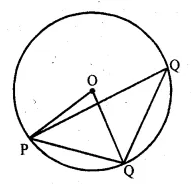
In the given figure, O is the centre of a circle. If the length of chord PQ is equal to the radius of the circle, then ∠PRQ is
(a) 60°
(b) 45°
(c) 30°
(d) 15°
ML Aggarwal Class 10 Solutions for ICSE Maths Chapter 15 Circles MCQS Q8.1
Solution:
In the given figure, O is the centre of the circle
Chord PQ = radius of the circle
∆OPQ is an equilateral triangle
∴∠POQ = 60°
Arc PQ subtends ∠POQ at the centre and
∴∠PRQ at the remaining part of the circle
∴∠PRQ = \(\\ \frac { 1 }{ 2 } \) ∠POQ = \(\\ \frac { 1 }{ 2 } \) x 60° = 30° (c)

Question 9.
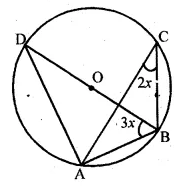
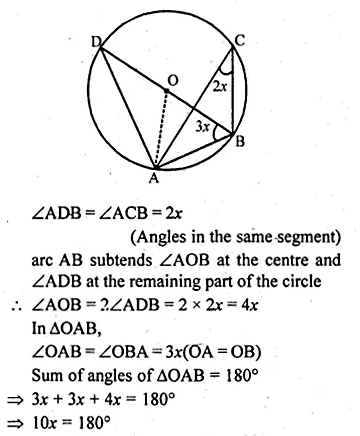
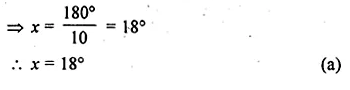
In the given figure, if O is the centre of the circle then the value of x is
(a) 18°
(b) 20°
(c) 24°
(d) 36°
ML Aggarwal Class 10 Solutions for ICSE Maths Chapter 15 Circles MCQS Q9.1
Solution:
In the given figure, O is the centre of the circle.
Join OA.
ML Aggarwal Class 10 Solutions for ICSE Maths Chapter 15 Circles MCQS Q9.2
ML Aggarwal Class 10 Solutions for ICSE Maths Chapter 15 Circles MCQS Q9.3

Question 10.
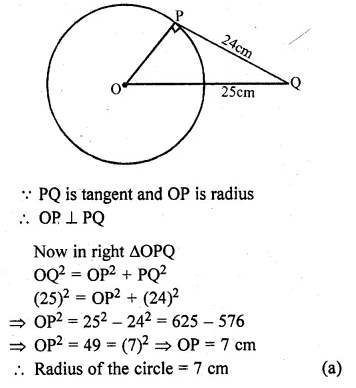
From a point Q, the length of the tangent to a circle is 24 cm and the distance of Q from the centre is 25 cm. The radius of the circle is
(a) 7 cm
(b) 12 cm
(c) 15 cm
(d) 24.5 cm
Solution:
From Q, length of tangent PQ to the circle = 24 cm
and QO = 25 cm
ML Aggarwal Class 10 Solutions for ICSE Maths Chapter 15 Circles MCQS Q10.1

Question 11.
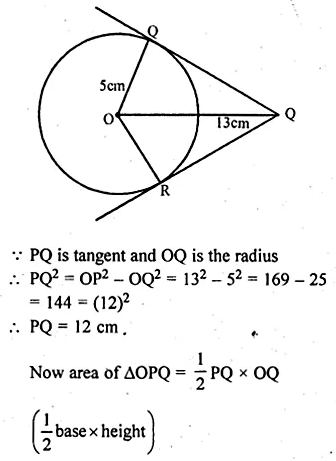
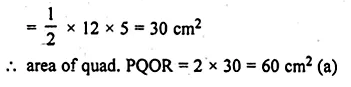
From a point which is at a distance of 13 cm from the centre O of a circle of radius 5 cm, the pair of tangents PQ and PR to the circle are drawn. Then the area of the quadrilateral PQOR is
(a) 60 cm²
(b) 65 cm²
(c) 30 cm²
(d) 32.5 cm²
Solution:
Let point P is 13 cm from O, the centre of the circle
Radius of the circle (OQ) = 5 cm
PQ and PR are tangents from P to the circle
Join OQ and OR
ML Aggarwal Class 10 Solutions for ICSE Maths Chapter 15 Circles MCQS Q11.1
ML Aggarwal Class 10 Solutions for ICSE Maths Chapter 15 Circles MCQS Q11.2

Question 12.
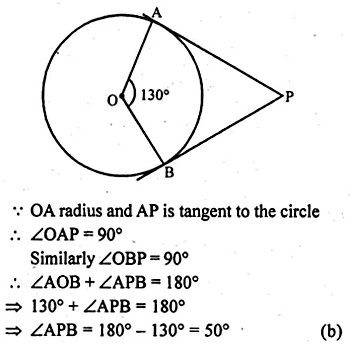
If angle between two radii of a circle is 130°, the angle between the tangents at the ends of the radii is
(a) 90°
(b) 50°
(c) 70°
(d) 40°
Solution:
Angles between two radii OA and OB = 130°
From A and B, tangents are drawn which meet at P
ML Aggarwal Class 10 Solutions for ICSE Maths Chapter 15 Circles MCQS Q12.1

Question 13.
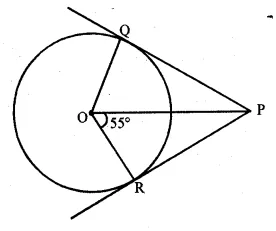
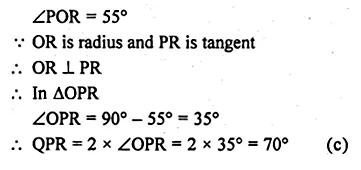
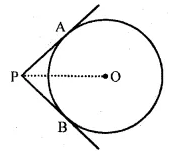
In the given figure, PQ and PR are tangents from P to a circle with centre O. If ∠POR = 55°, then ∠QPR is
(a) 35°
(b) 55°
(c) 70°
(d) 80°
ML Aggarwal Class 10 Solutions for ICSE Maths Chapter 15 Circles MCQS Q13.1
Solution:
In the given figure,
PQ and PR are the tangents to the circle from a point P outside it
ML Aggarwal Class 10 Solutions for ICSE Maths Chapter 15 Circles MCQS Q13.2

Question 14.
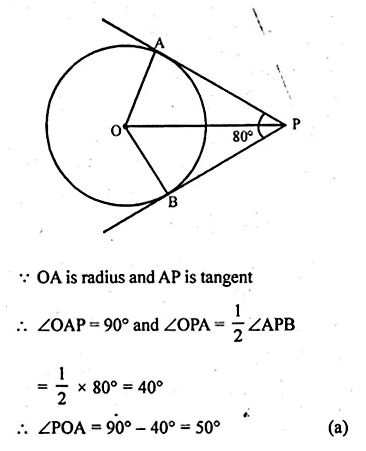
If tangents PA and PB from an exterior point P to a circle with centre O are inclined to each other at an angle of 80°, then ∠POA is equal to
(a) 50°
(b) 60°
(c) 70°
(d) 100°
Solution:
Length of tangents PA and PB to the circle from a point P
outside the circle with centre O, and inclined an angle of 80°
ML Aggarwal Class 10 Solutions for ICSE Maths Chapter 15 Circles MCQS Q14.1

Question 15.
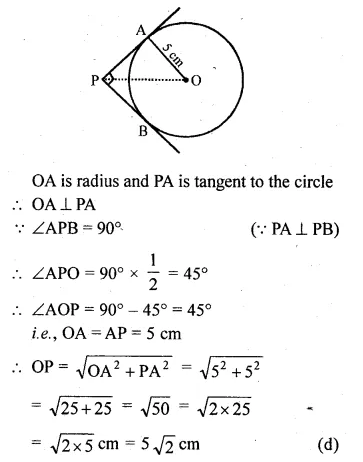
In the given figure, PA and PB are tangents from point P to a circle with centre O. If the radius of the circle is 5 cm and PA ⊥ PB, then the length OP is equal to
(a) 5 cm
(b) 10 cm
(c) 7.5 cm
(d) 5√2 cm
ML Aggarwal Class 10 Solutions for ICSE Maths Chapter 15 Circles MCQS Q15.1
Solution:
In the given figure,
PA and PB are tangents to the circle with centre O.
Radius of the circle is 5 cm, PA ⊥ PB.
ML Aggarwal Class 10 Solutions for ICSE Maths Chapter 15 Circles MCQS Q15.2

Question 16.
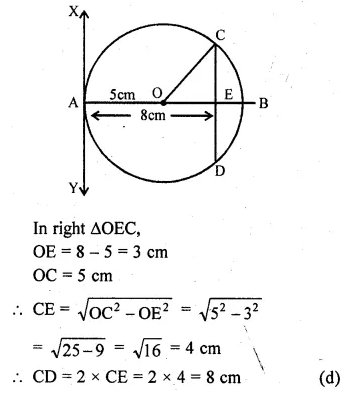
At one end A of a diameter AB of a circle of radius 5 cm, tangent XAY is drawn to the circle. The length of the chord CD parallel to XY and at a distance 8 cm from A is
(a) 4 cm
(b) 5 cm
(c) 6 cm
(d) 8 cm
Solution:
AB is the diameter of a circle with radius 5 cm
At A, XAY is a tangent to the circle
CD || XAY at a distance of 8 cm from A
Join OC
ML Aggarwal Class 10 Solutions for ICSE Maths Chapter 15 Circles MCQS Q16.1

Question 17.
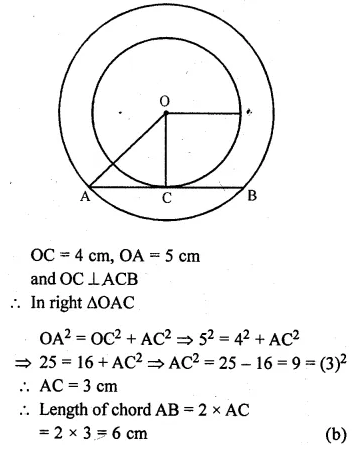
If radii of two concentric circles are 4 cm and 5 cm, then the length of each chord of one circle which is tangent to the other is
(a) 3 cm
(b) 6 cm
(c) 9 cm
(d) 1 cm
Solution:
Radii of two concentric circles are 4 cm and 5 cm
AB is a chord of the bigger circle
which is tangent to the smaller circle at C.
Join OA, OC
ML Aggarwal Class 10 Solutions for ICSE Maths Chapter 15 Circles MCQS Q17.1

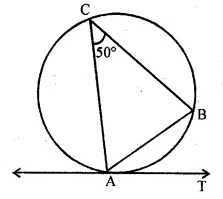
Question 18.
In the given figure, AB is a chord of the circle such that ∠ACB = 50°. If AT is tangent to the circle at the point A, then ∠BAT is equal to
(a) 65°
(b) 60°
(c) 50°
(d) 40°
ML Aggarwal Class 10 Solutions for ICSE Maths Chapter 15 Circles MCQS Q18.1
Solution:
In the given figure, AB is a chord of the circle
such that ∠ACB = 50°
AT is tangent to the circle at A
AT is tangent and AB is a chord
∠ACB = ∠BAT = 50°
(Angles in the alternate segments) (c)

Question 19.
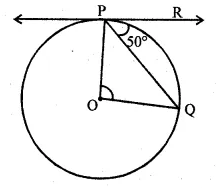
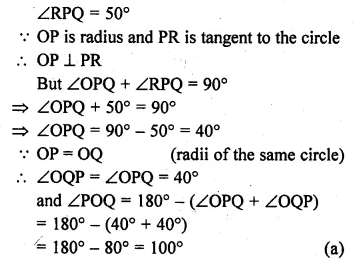
In the given figure, O is the centre of a circle and PQ is a chord. If the tangent PR at P makes an angle of 50° with PQ, then ∠POQ is
(a) 100°
(b) 80°
(c) 90°
(d) 75°
ML Aggarwal Class 10 Solutions for ICSE Maths Chapter 15 Circles MCQS Q19.1
Solution:
In the given figure, O is the centre of the circle.
PR is tangent and PQ is chord ∠RPQ = 50°
OP is radius and PR is tangent to the circle
ML Aggarwal Class 10 Solutions for ICSE Maths Chapter 15 Circles MCQS Q19.2

Question 20.
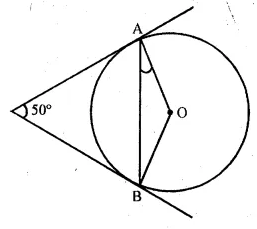
In the given figure, PA and PB are tangents to a circle with centre O. If ∠APB = 50°, then ∠OAB is equal to
(a) 25°
(b) 30°
(c) 40°
(d) 50°
ML Aggarwal Class 10 Solutions for ICSE Maths Chapter 15 Circles MCQS Q20.1
Solution:
In the given figure,
PA and PB are tangents to the circle with centre O.
∠APB = 50°
But ∠AOB + ∠APB = 180°
∠AOB + 50° = 180°
⇒ ∠AOB = 180° – 50° = 130°
In ∆OAB,
OA = OB (radii of the same circle)
∠OAB = ∠OBA
But ∠OAB + ∠OBA = 180° – ∠AOB
= 180° – 130° = 50°
∠OAB = \(\frac { { 50 }^{ 0 } }{ 2 } \) = 25° (a)

Question 21.
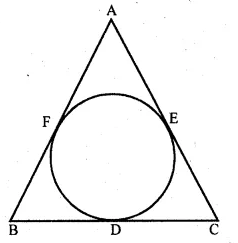
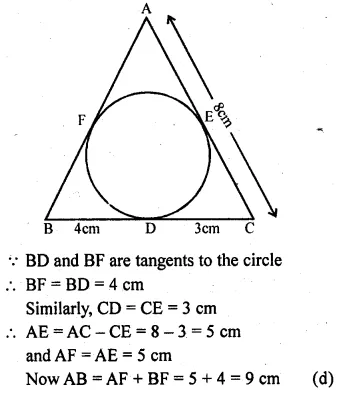
In the given figure, sides BC, CA and AB of ∆ABC touch a circle at point D, E and F respectively. If BD = 4 cm, DC = 3 cm and CA = 8 cm, then the length of side AB is
(a) 12 cm
(b) 11 cm
(c) 10 cm
(d) 9 cm
ML Aggarwal Class 10 Solutions for ICSE Maths Chapter 15 Circles MCQS Q21.1
Solution:
In the given figure,
sides BC, CA and AB of ∆ABC touch a circle at D, E and F respectively.
BD = 4 cm, DC = 3 cm and CA = 8 cm
ML Aggarwal Class 10 Solutions for ICSE Maths Chapter 15 Circles MCQS Q21.2

Question 22.
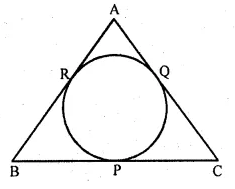
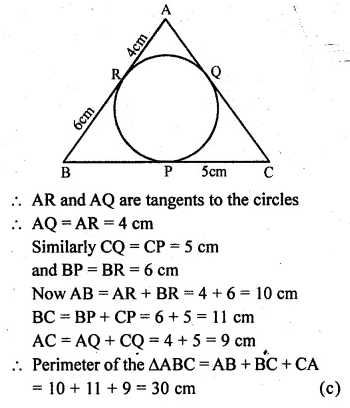
In the given figure, sides BC, CA and AB of ∆ABC touch a circle at the points P, Q and R respectively. If PC = 5 cm, AR = 4 cm and RB = 6 cm, then the perimeter of ∆ABC is
(a) 60 cm
(b) 45 cm
(c) 30 cm
(d) 15 cm
ML Aggarwal Class 10 Solutions for ICSE Maths Chapter 15 Circles MCQS Q22.1
Solution:
In the given figure, sides BC, CA and AB of ∆ABC
touch a circle at P, Q and R respectively
PC = 5 cm, AR = 4 cm, RB = 6 cm
ML Aggarwal Class 10 Solutions for ICSE Maths Chapter 15 Circles MCQS Q22.2

Question 23.
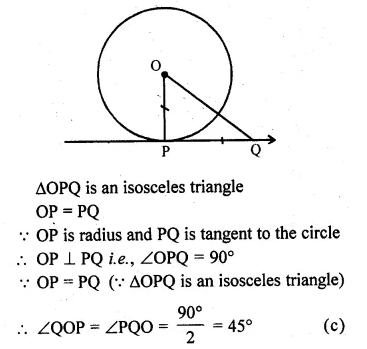
PQ is a tangent to a circle at point P. Centre of circle is O. If ∆OPQ is an isosceles triangle, then ∠QOP is equal to
(a) 30°
(b) 60°
(c) 45°
(d) 90°
Solution:
PQ is tangent to the circle at point P centre of the circle is O.
ML Aggarwal Class 10 Solutions for ICSE Maths Chapter 15 Circles MCQS Q23.1

Question 24.
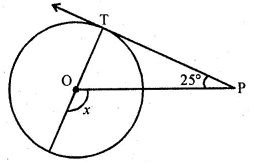
In the given figure, PT is a tangent at T to the circle with centre O. If ∠TPO = 25°, then the value of x is
(a) 25°
(b) 65°
(c) 115°
(d) 90°
ML Aggarwal Class 10 Solutions for ICSE Maths Chapter 15 Circles MCQS Q24.1
Solution:
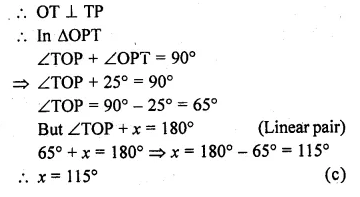
In the given figure, PT is the tangent at T to the circle with centre O.
∠TPO = 25°
OT is the radius and TP is the tangent
ML Aggarwal Class 10 Solutions for ICSE Maths Chapter 15 Circles MCQS Q24.2

Question 25.
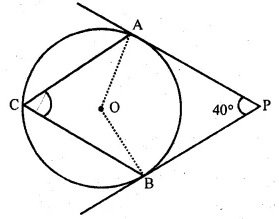
In the given figure, PA and PB are tangents at ponits A and B respectively to a circle with centre O. If C is a point on the circle and ∠APB = 40°, then ∠ACB is equal to
(a) 80°
(b) 70°
(c) 90°
(d) 140°
ML Aggarwal Class 10 Solutions for ICSE Maths Chapter 15 Circles MCQS Q25.1
Solution:
In the given figure,
PA and PB are tangents to the circle at A and B respectively
C is a point on the circle and ∠APB = 40°
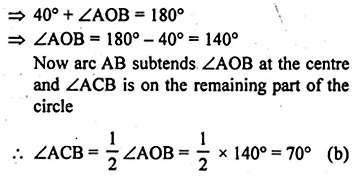
But ∠APB + ∠AOB = 180°
ML Aggarwal Class 10 Solutions for ICSE Maths Chapter 15 Circles MCQS Q25.2

Question 26.
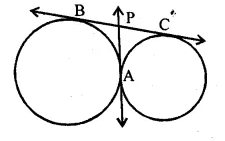
In the given figure, two circles touch each other at A. BC and AP are common tangents to these circles. If BP = 3.8 cm, then the length of BC is equal to
(a) 7.6 cm
(b) 1.9 cm
(c) 11.4 cm
(d) 5.7 cm
ML Aggarwal Class 10 Solutions for ICSE Maths Chapter 15 Circles MCQS Q26.1
Solution:
In the given figure, two circles touch each other at A.
BC and AP are common tangents to these circles
BP = 3.8 cm
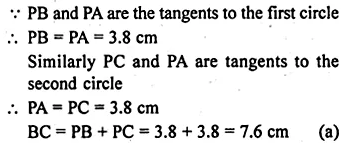
ML Aggarwal Class 10 Solutions for ICSE Maths Chapter 15 Circles MCQS Q26.2

Question 27.
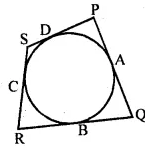
In the given figure, if sides PQ, QR, RS and SP of a quadrilateral PQRS touch a circle at points A, B, C and D respectively, then PD + BQ is equal to
(a) PQ
(b) QR
(c) PS
(d) SR
ML Aggarwal Class 10 Solutions for ICSE Maths Chapter 15 Circles MCQS Q27.1
Solution:
In the given figure,
sides PQ, QR, RS and SP of a quadrilateral PQRS
touch a circle at the points A, B, C and D respectively
PD and PA are the tangents to the circle
∴ PA = PD …(i)
Similarly, QA and QB are the tangents
∴ QA = QB …(ii)
Now PD + BQ = PA + QA = PQ (a)
[From (i) and (ii)]

Question 28.
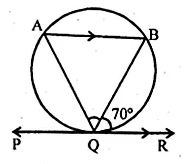
In the given figure, PQR is a tangent at Q to a circle. If AB is a chord parallel to PR and ∠BQR = 70°, then ∠AQB is equal to
(a) 20°
(b) 40°
(b) 35°
(d) 45°
ML Aggarwal Class 10 Solutions for ICSE Maths Chapter 15 Circles MCQS Q28.1
Solution:
In the given figure, PQR is a tangent at Q to a circle.
Chord AB || PR and ∠BQR = 70°
BQ is chord and PQR is a tangent
∠BQR = ∠A
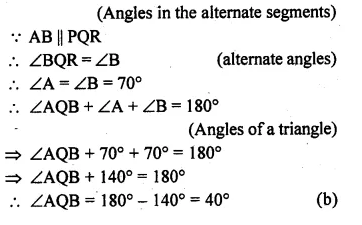
ML Aggarwal Class 10 Solutions for ICSE Maths Chapter 15 Circles MCQS Q28.2

Question 29.
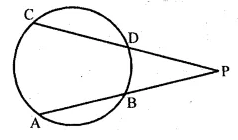
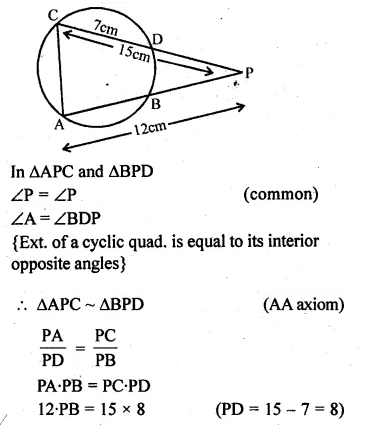
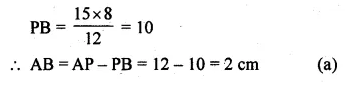
Two chords AB and CD of a circle intersect externally at a point P. If PC = 15 cm, CD = 7 cm and AP = 12 cm, then AB is
(a) 2 cm
(b) 4 cm
(c) 6 cm
(d) none of these
ML Aggarwal Class 10 Solutions for ICSE Maths Chapter 15 Circles MCQS Q29.1
Solution:
In the given figure,
two chords AB and CD of a circle intersect externally at P.
PC = 15 cm, CD = 7 cm, AP = 12 cm
Join AC and BD
ML Aggarwal Class 10 Solutions for ICSE Maths Chapter 15 Circles MCQS Q29.2
ML Aggarwal Class 10 Solutions for ICSE Maths Chapter 15 Circles MCQS Q29.3

Hope given ML Aggarwal Class 10 Solutions for ICSE Maths Chapter 15 Circles MCQS are helpful to complete your math homework.

If you have any doubts, please comment below. Learn Insta try to provide online math tutoring for you.
ML Aggarwal Class 10 Solutions for ICSE Maths Chapter 15 Circles Chapter Test

ML Aggarwal Class 10 Solutions for ICSE Maths Chapter 15 Circles Chapter Test

These Solutions are part of ML Aggarwal Class 10 Solutions for ICSE Maths. Here we have given ML Aggarwal Class 10 Solutions for ICSE Maths Chapter 15 Circles Chapter Test
More Exercises

Question 1.
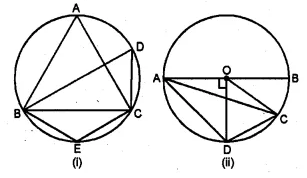
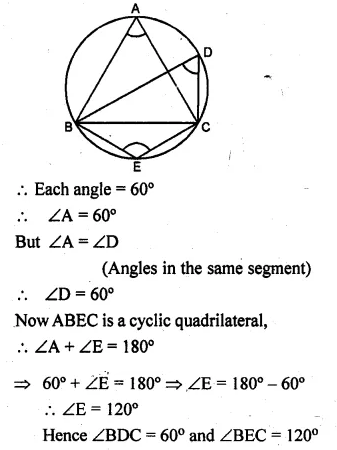
(a) In the figure (i) given below, triangle ABC is equilateral. Find ∠BDC and ∠BEC.
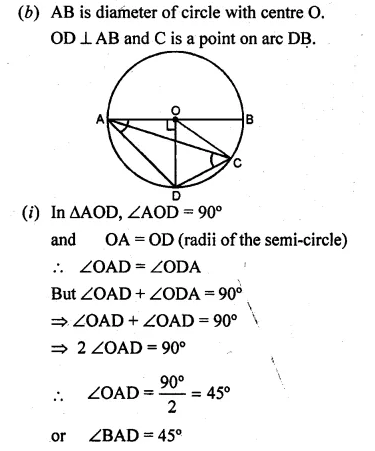
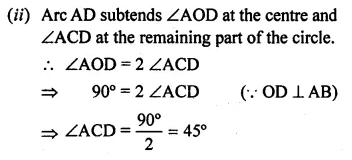
(b) In the figure (ii) given below, AB is a diameter of a circle with centre O. OD is perpendicular to AB and C is a point on the arc DB. Find ∠BAD and ∠ACD
ML Aggarwal Class 10 Solutions for ICSE Maths Chapter 15 Circles Chapter Test Q1.1
Solution:
(a) ∆ABC is an equilateral triangle.
ML Aggarwal Class 10 Solutions for ICSE Maths Chapter 15 Circles Chapter Test Q1.2
ML Aggarwal Class 10 Solutions for ICSE Maths Chapter 15 Circles Chapter Test Q1.3
ML Aggarwal Class 10 Solutions for ICSE Maths Chapter 15 Circles Chapter Test Q1.4

Question 2.
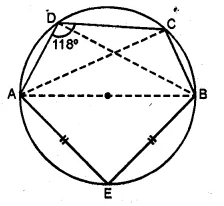
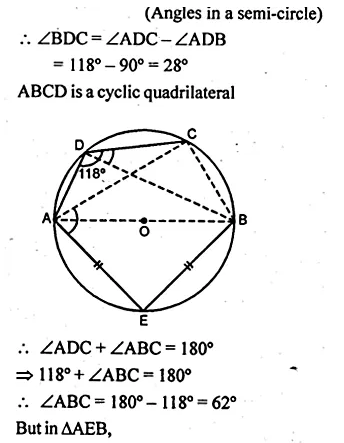
(a) In the figure given below, AB is a diameter of the circle. If AE = BE and ∠ADC = 118°, find
(i) ∠BDC (ii) ∠CAE.
ML Aggarwal Class 10 Solutions for ICSE Maths Chapter 15 Circles Chapter Test Q2.1
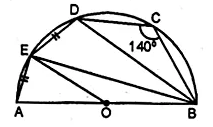
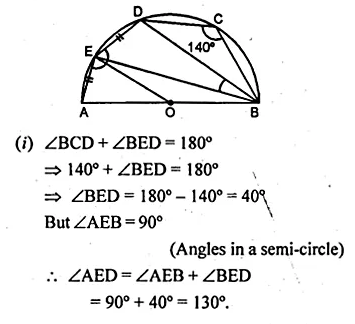
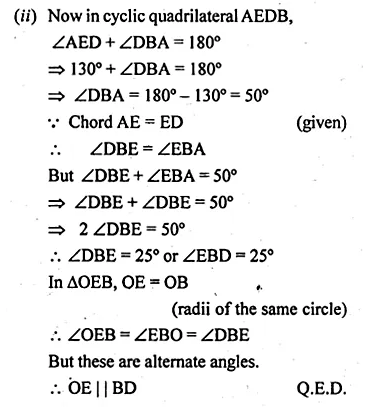
(b) In the figure given below, AB is the diameter of the semi-circle ABCDE with centre O. If AE = ED and ∠BCD = 140°, find ∠AED and ∠EBD. Also Prove that OE is parallel to BD.
ML Aggarwal Class 10 Solutions for ICSE Maths Chapter 15 Circles Chapter Test Q2.2
Solution:
(a) Join DB, CA and CB.
∠ADC = 118° (given)
and ∠ADB = 90°
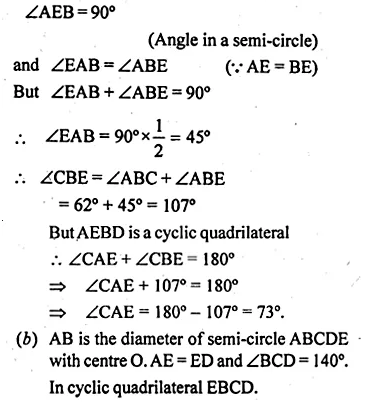
ML Aggarwal Class 10 Solutions for ICSE Maths Chapter 15 Circles Chapter Test Q2.3
ML Aggarwal Class 10 Solutions for ICSE Maths Chapter 15 Circles Chapter Test Q2.4
ML Aggarwal Class 10 Solutions for ICSE Maths Chapter 15 Circles Chapter Test Q2.5
ML Aggarwal Class 10 Solutions for ICSE Maths Chapter 15 Circles Chapter Test Q2.6

Question 3.
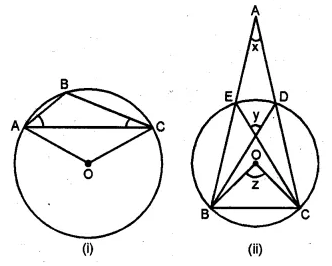
(a) In the figure (i) given below, O is the centre of the circle. Prove that ∠AOC = 2 (∠ACB + ∠BAC).
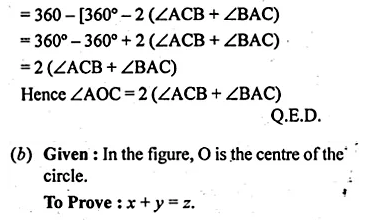
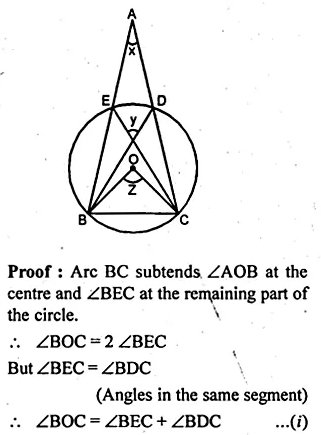
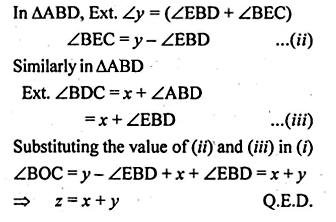
(b) In the figure (ii) given below, O is the centre of the circle. Prove that x + y = z.
ML Aggarwal Class 10 Solutions for ICSE Maths Chapter 15 Circles Chapter Test Q3.1
Solution:
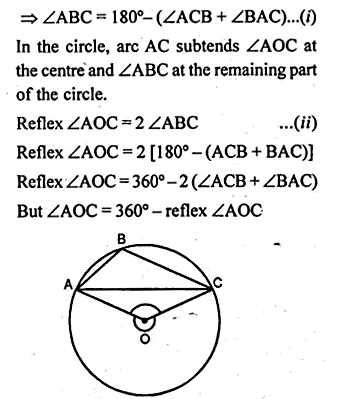
(a) Given: O is the centre of the circle.
To Prove : ∠AOC = 2 (∠ACB + ∠BAC).
Proof: In ∆ABC,
∠ACB + ∠BAC + ∠ABC = 180° (Angles of a triangle)
ML Aggarwal Class 10 Solutions for ICSE Maths Chapter 15 Circles Chapter Test Q3.2
ML Aggarwal Class 10 Solutions for ICSE Maths Chapter 15 Circles Chapter Test Q3.3
ML Aggarwal Class 10 Solutions for ICSE Maths Chapter 15 Circles Chapter Test Q3.4
ML Aggarwal Class 10 Solutions for ICSE Maths Chapter 15 Circles Chapter Test Q3.5

Question 4.
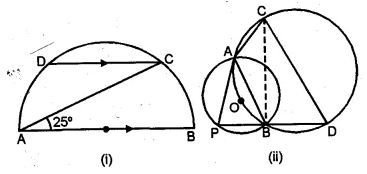
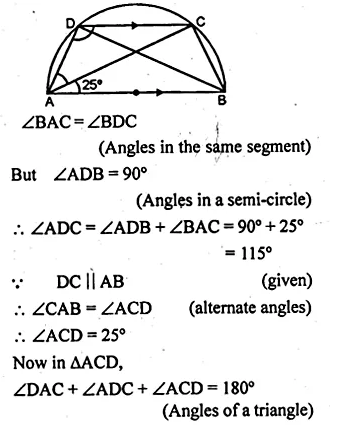
(a) In the figure (i) given below, AB is the diameter of a circle. If DC is parallel to AB and ∠CAB = 25°, find :
(i)∠ADC (ii) ∠DAC.
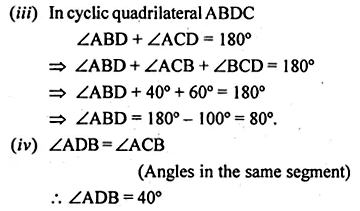
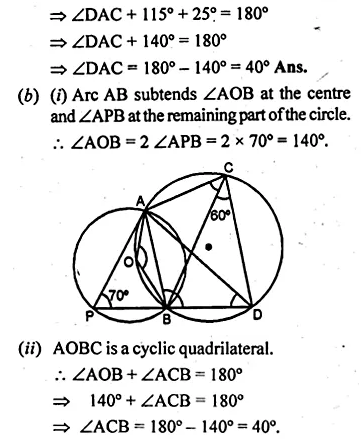
(b) In the figure (ii) given below, the centre O of the smaller circle lies on the circumference of the bigger circle. If ∠APB = 70° and ∠BCD = 60°, find :
(i) ∠AOB (ii) ∠ACB
(iii) ∠ABD (iv) ∠ADB.
ML Aggarwal Class 10 Solutions for ICSE Maths Chapter 15 Circles Chapter Test Q4.1
Solution:
(a) AB is diameter and DC || AB,
∠CAB = 25°, join AD,BD
ML Aggarwal Class 10 Solutions for ICSE Maths Chapter 15 Circles Chapter Test Q4.2
ML Aggarwal Class 10 Solutions for ICSE Maths Chapter 15 Circles Chapter Test Q4.3
ML Aggarwal Class 10 Solutions for ICSE Maths Chapter 15 Circles Chapter Test Q4.4

Question 5.
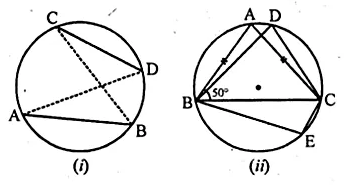
(a) In the figure (i) given below, ABCD is a cyclic quadrilateral. If AB = CD, Prove that AD = BC.
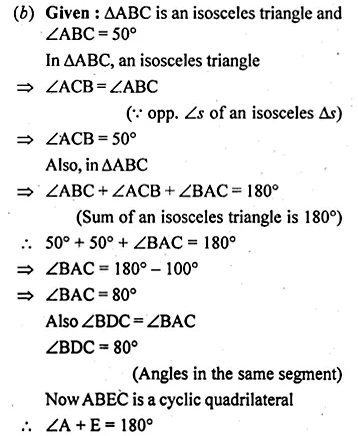
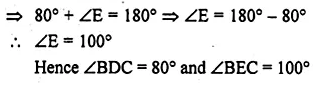
(b) In the figure (ii) given below, ABC is an isosceles triangle with AB = AC. If ∠ABC = 50°, find ∠BDC and ∠BEC.
ML Aggarwal Class 10 Solutions for ICSE Maths Chapter 15 Circles Chapter Test Q5.1
Solution:
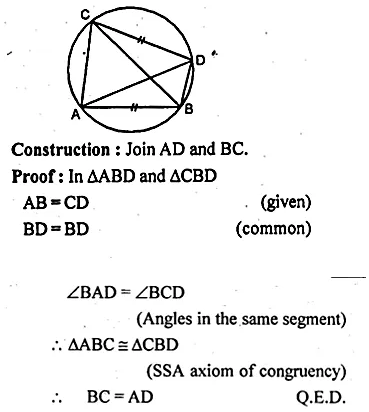
(a) Given : ABDC is a cyclic quadrilateral AB = CD.
To Prove: AD = BC.
ML Aggarwal Class 10 Solutions for ICSE Maths Chapter 15 Circles Chapter Test Q5.2
ML Aggarwal Class 10 Solutions for ICSE Maths Chapter 15 Circles Chapter Test Q5.3
ML Aggarwal Class 10 Solutions for ICSE Maths Chapter 15 Circles Chapter Test Q5.4

Question 6.
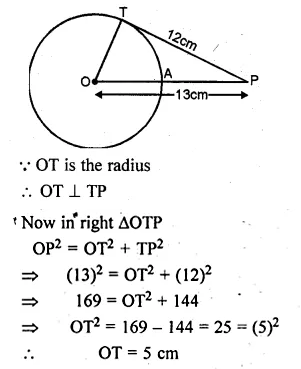
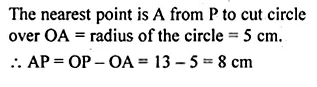
A point P is 13 cm from the centre of a circle. The length of the tangent drawn from P to the circle is 12 cm. Find the distance of P from the nearest point of the circle.
Solution:
Join OT, OP = 13 cm and TP = 12 cm
ML Aggarwal Class 10 Solutions for ICSE Maths Chapter 15 Circles Chapter Test Q6.1
ML Aggarwal Class 10 Solutions for ICSE Maths Chapter 15 Circles Chapter Test Q6.2

Question 7.
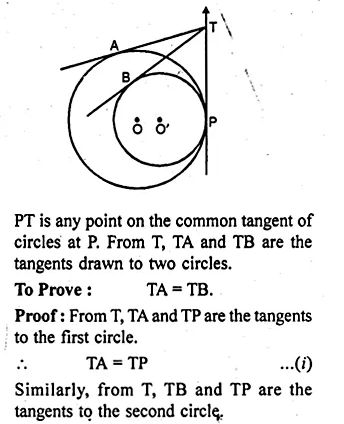
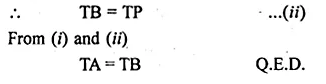
Two circles touch each other internally. Prove that the tangents drawn to the two circles from any point on the common tangent are equal in length.
Solution:
Given: Two circles with centre O and O’
touch each other internally at P.
ML Aggarwal Class 10 Solutions for ICSE Maths Chapter 15 Circles Chapter Test Q7.1
ML Aggarwal Class 10 Solutions for ICSE Maths Chapter 15 Circles Chapter Test Q7.2

Question 8.
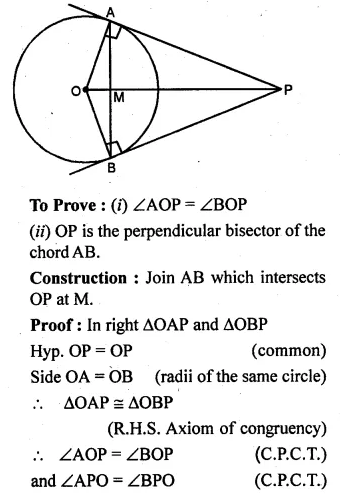
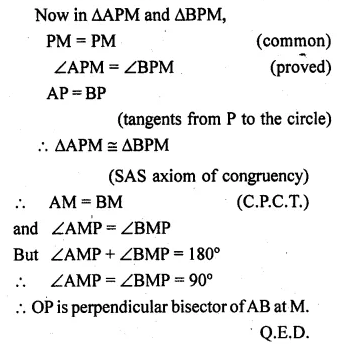
From a point outside a circle, with centre O, tangents PA and PB are drawn. Prove that
(i) ∠AOP = ∠BOP.
(ii) OP is the perpendicular bisector of the chord AB.
Solution:
Given: From a point P, outside the circle with centre O.
PA and PB are the tangents to the circle,
OA, OB and OP are joined.
ML Aggarwal Class 10 Solutions for ICSE Maths Chapter 15 Circles Chapter Test Q8.1
ML Aggarwal Class 10 Solutions for ICSE Maths Chapter 15 Circles Chapter Test Q8.2

Question 9.
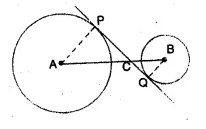
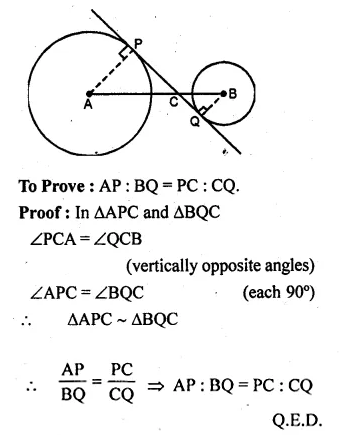
(a) The figure given below shows two circles with centres A, B and a transverse common tangent to these circles meet the straight line AB in C. Prove that:
AP : BQ = PC : CQ.
ML Aggarwal Class 10 Solutions for ICSE Maths Chapter 15 Circles Chapter Test Q9.1
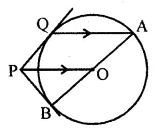
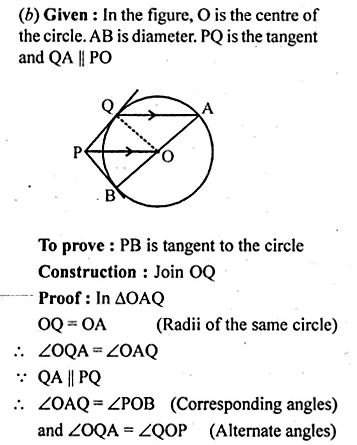
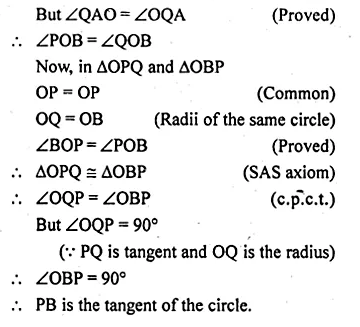
(b) In the figure (ii) given below, PQ is a tangent to the circle with centre O and AB is a diameter of the circle. If QA is parallel to PO, prove that PB is tangent to the circle.
ML Aggarwal Class 10 Solutions for ICSE Maths Chapter 15 Circles Chapter Test Q9.2
Solution:
(a) Given: Two circles with centres A and B
and a transverse common tangent to these circles meets AB at C.
ML Aggarwal Class 10 Solutions for ICSE Maths Chapter 15 Circles Chapter Test Q9.3
ML Aggarwal Class 10 Solutions for ICSE Maths Chapter 15 Circles Chapter Test Q9.4
ML Aggarwal Class 10 Solutions for ICSE Maths Chapter 15 Circles Chapter Test Q9.5

Question 10.
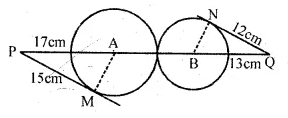
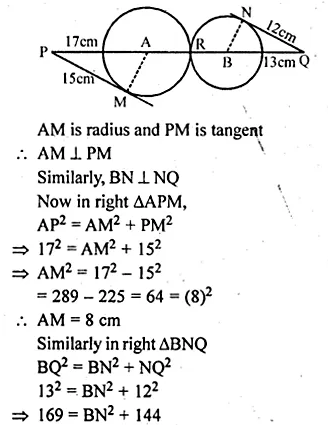
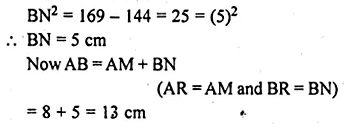
In the figure given below, two circles with centres A and B touch externally. PM is a tangent to the circle with centre A and QN is a tangent to the circle with centre B. If PM = 15 cm, QN = 12 cm, PA = 17 cm and QB = 13 cm, then find the distance between the centres A and B of the circles.
ML Aggarwal Class 10 Solutions for ICSE Maths Chapter 15 Circles Chapter Test Q10.1
Solution:
In the given figure, two chords with centre A and B touch externally.
PM is a tangent to the circle with centre A
and QN is tangent to the circle with centre B.
PM = 15 cm, QN = 12 cm, PA = 17 cm, QB = 13 cm.
We have to find AB.
ML Aggarwal Class 10 Solutions for ICSE Maths Chapter 15 Circles Chapter Test Q10.2
ML Aggarwal Class 10 Solutions for ICSE Maths Chapter 15 Circles Chapter Test Q10.3

Question 11.
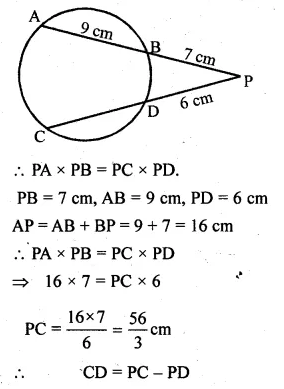
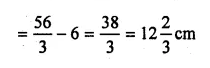
Two chords AB, CD of a circle intersect externally at a point P. If PB = 7 cm, AB = 9 cm and PD = 6 cm, find CD.
Solution:
∵ AB and CD are two chords of a circle
which intersect each other at P, outside the circle.
ML Aggarwal Class 10 Solutions for ICSE Maths Chapter 15 Circles Chapter Test Q11.1
ML Aggarwal Class 10 Solutions for ICSE Maths Chapter 15 Circles Chapter Test Q11.2

Question 12.
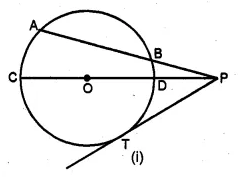
(a) In the figure (i) given below, chord AB and diameter CD of a circle with centre O meet at P. PT is tangent to the circle at T. If AP = 16 cm, AB = 12 cm and DP = 2 cm, find the length of PT and the radius of the circle
ML Aggarwal Class 10 Solutions for ICSE Maths Chapter 15 Circles Chapter Test Q12.1
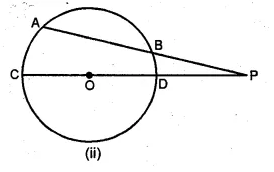
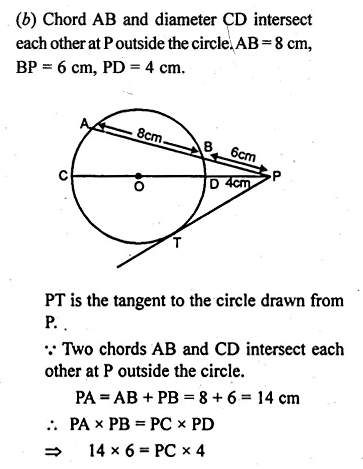
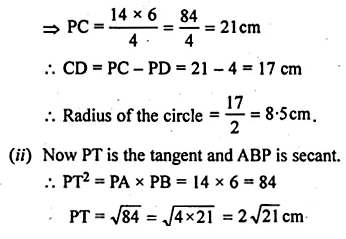
(b) In the figure (ii) given below, chord AB and diameter CD of a circle meet at P. If AB = 8 cm, BP = 6 cm and PD = 4 cm, find the radius of the circle. Also, find the length of the tangent drawn from P to the circle. .
ML Aggarwal Class 10 Solutions for ICSE Maths Chapter 15 Circles Chapter Test Q12.2
Solution:
Given : (a) AB is a chord of a circle with centre O
and PT is tangent and CD is the diameter of the circle
which meet at P.
AP = 16 cm, AB = 12 cm, OP = 2 cm
∴PB = PA – AB = 16 – 12 = 4 cm
∵ABP is a secant and PT is tangent.
∴PT² = PA × PB.
ML Aggarwal Class 10 Solutions for ICSE Maths Chapter 15 Circles Chapter Test Q12.3
ML Aggarwal Class 10 Solutions for ICSE Maths Chapter 15 Circles Chapter Test Q12.4
ML Aggarwal Class 10 Solutions for ICSE Maths Chapter 15 Circles Chapter Test Q12.5

Question 13.
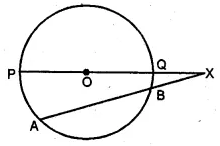
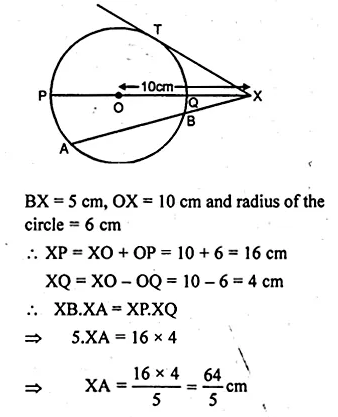
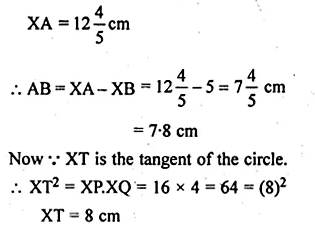
In the figure given below, chord AB and diameter PQ of a circle with centre O meet at X. If BX = 5 cm, OX = 10 cm and.the radius of the circle is 6 cm, compute the length of AB. Also, find the length of tangent drawn from X to the circle.
ML Aggarwal Class 10 Solutions for ICSE Maths Chapter 15 Circles Chapter Test Q13.1
Solution:
Chord AB and diameter PQ meet at X
on producing outside the circle
ML Aggarwal Class 10 Solutions for ICSE Maths Chapter 15 Circles Chapter Test Q13.2
ML Aggarwal Class 10 Solutions for ICSE Maths Chapter 15 Circles Chapter Test Q13.3

Question 14.
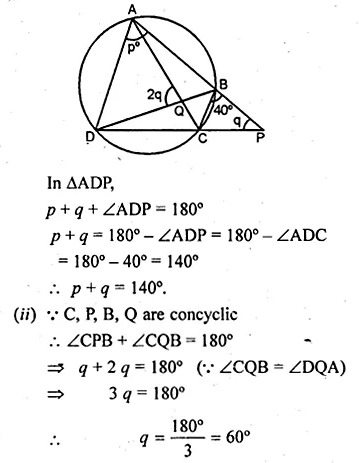
(a) In the figure (i) given below, ∠CBP = 40°, ∠CPB = q° and ∠DAB = p°. Obtain an equation connecting p and q. If AC and BD meet at Q so that ∠AQD = 2 q° and the points C, P, B and Q are concyclic, find the values of p and q.
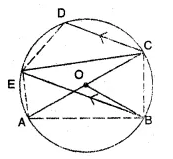
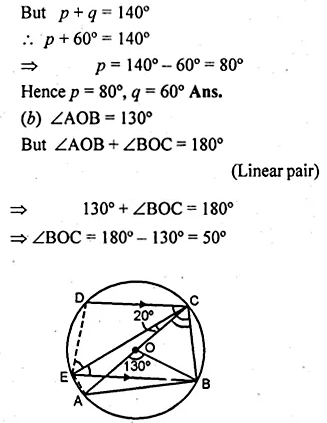
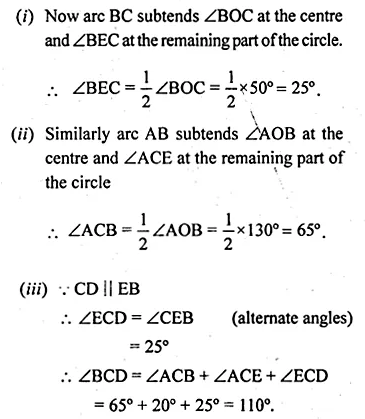
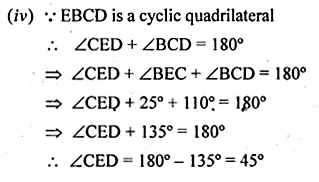
(b) In the figure (ii) given below, AC is a diameter of the circle with centre O. If CD || BE, ∠AOB = 130° and ∠ACE = 20°, find:
(i)∠BEC (ii) ∠ACB
(iii) ∠BCD (iv) ∠CED.
ML Aggarwal Class 10 Solutions for ICSE Maths Chapter 15 Circles Chapter Test Q14.1
Solution:
(a) (i) Given : ABCD is a cyclic quadrilateral.
Ext. ∠PBC = ∠ADC
⇒ 40° = ∠ADC
ML Aggarwal Class 10 Solutions for ICSE Maths Chapter 15 Circles Chapter Test Q14.2
ML Aggarwal Class 10 Solutions for ICSE Maths Chapter 15 Circles Chapter Test Q14.3
ML Aggarwal Class 10 Solutions for ICSE Maths Chapter 15 Circles Chapter Test Q14.4
ML Aggarwal Class 10 Solutions for ICSE Maths Chapter 15 Circles Chapter Test Q14.5

Question 15.
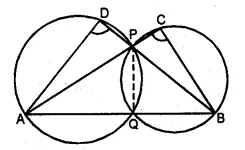
(a) In the figure (i) given below, APC, AQB and BPD are straight lines.
(i) Prove that ∠ADB + ∠ACB = 180°.
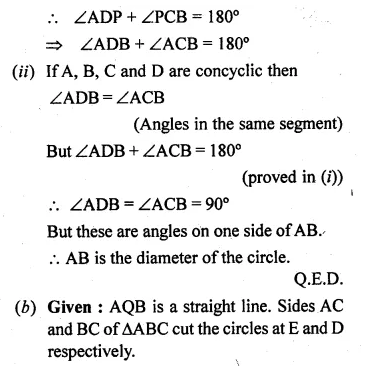
(ii) If a circle can be drawn through A, B, C and D, Prove that it has AB as a diameter
ML Aggarwal Class 10 Solutions for ICSE Maths Chapter 15 Circles Chapter Test Q15.1
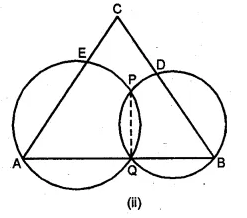
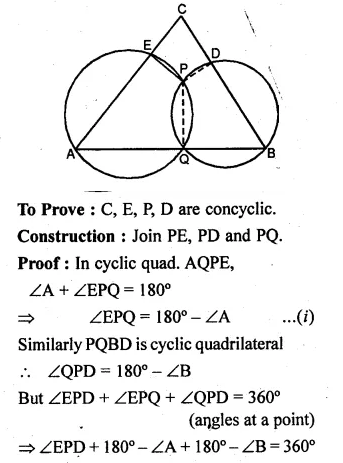
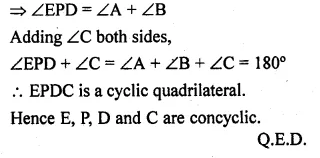
(b) In the figure (ii) given below, AQB is a straight line. Sides AC and BC of ∆ABC cut the circles at E and D respectively. Prove that the points C, E, P and D are concyclic.
ML Aggarwal Class 10 Solutions for ICSE Maths Chapter 15 Circles Chapter Test Q15.2
Solution:
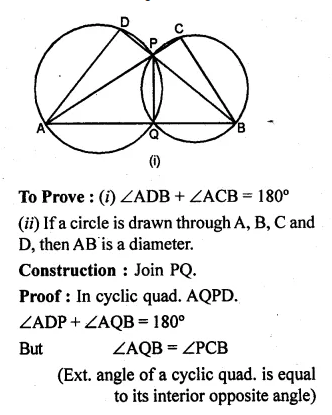
(a) Given: In the figure, APC,
AQB and BPD are straight lines.
ML Aggarwal Class 10 Solutions for ICSE Maths Chapter 15 Circles Chapter Test Q15.3
ML Aggarwal Class 10 Solutions for ICSE Maths Chapter 15 Circles Chapter Test Q15.4
ML Aggarwal Class 10 Solutions for ICSE Maths Chapter 15 Circles Chapter Test Q15.5
ML Aggarwal Class 10 Solutions for ICSE Maths Chapter 15 Circles Chapter Test Q15.6

Question 16.
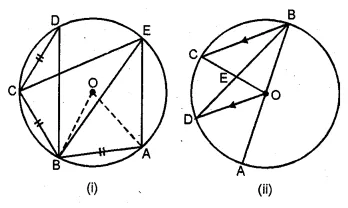
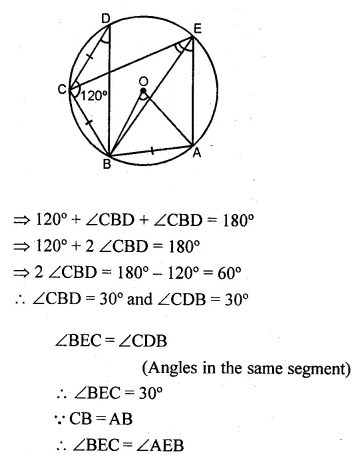
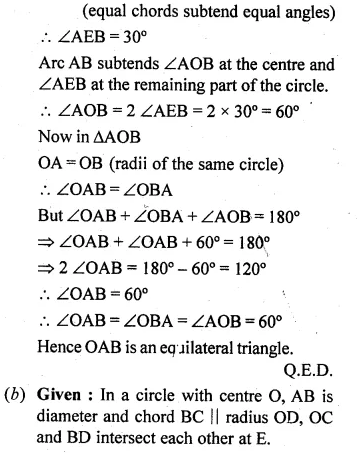
(a) In the figure (i) given below, chords AB, BC and CD of a circle with centre O are equal. If ∠BCD = 120°, find
(i) ∠BDC (ii) ∠BEC
(iii) ∠AEC (iv) ∠AOB.
Hence Prove that AOAB is equilateral.
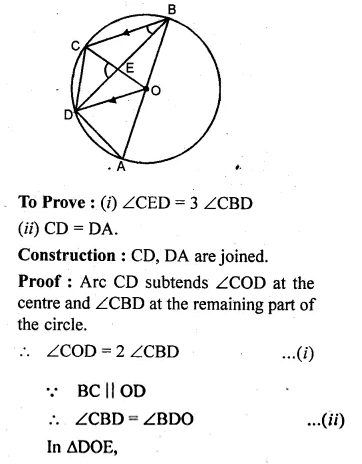
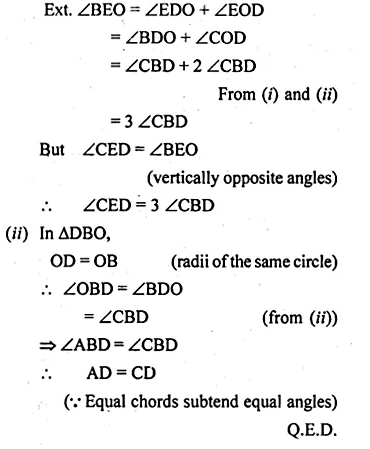
(b) In the figure (ii) given below, AB is a diameter of a circle with centre O. The chord BC of the circle is parallel to the radius OD and the lines OC and BD meet at E. Prove that
(i) ∠CED = 3 ∠CBD (ii) CD = DA.
ML Aggarwal Class 10 Solutions for ICSE Maths Chapter 15 Circles Chapter Test Q16.1
Solution:
(a) In ∆BCD, BC = CD
∠CBD = ∠CDB
But ∠BCD + ∠CBD + ∠CDB = 180°
(∵ Angles of a triangle)
ML Aggarwal Class 10 Solutions for ICSE Maths Chapter 15 Circles Chapter Test Q16.2
ML Aggarwal Class 10 Solutions for ICSE Maths Chapter 15 Circles Chapter Test Q16.3
ML Aggarwal Class 10 Solutions for ICSE Maths Chapter 15 Circles Chapter Test Q16.4
ML Aggarwal Class 10 Solutions for ICSE Maths Chapter 15 Circles Chapter Test Q16.5

Question 17.
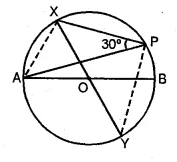
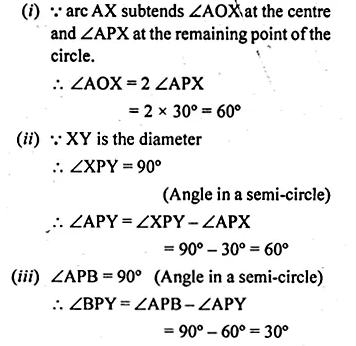
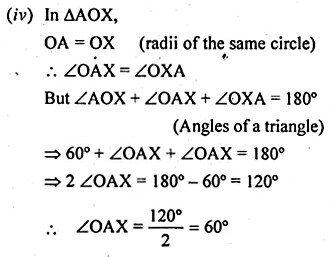
(a) In the adjoining figure, (i) given below AB and XY are diameters of a circle with centre O. If ∠APX = 30°, find
(i) ∠AOX (ii) ∠APY (iii) ∠BPY (iv) ∠OAX.
ML Aggarwal Class 10 Solutions for ICSE Maths Chapter 15 Circles Chapter Test Q17.1
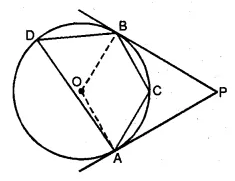
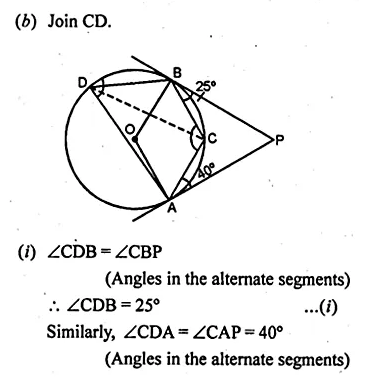
(b) In the figure (ii) given below, AP and BP are tangents to the circle with centre O. If ∠CBP = 25° and ∠CAP = 40°, find :
(i) ∠ADB (ii) ∠AOB (iii) ∠ACB (iv) ∠APB.
ML Aggarwal Class 10 Solutions for ICSE Maths Chapter 15 Circles Chapter Test Q17.2
Solution:
(a) AB and XY are diameters of a circle with centre O.
∠APX = 30°.
To find :
(i) ∠AOX (ii) ∠APY
(iii) ∠BPY (iv) ∠OAX
ML Aggarwal Class 10 Solutions for ICSE Maths Chapter 15 Circles Chapter Test Q17.3
ML Aggarwal Class 10 Solutions for ICSE Maths Chapter 15 Circles Chapter Test Q17.4
ML Aggarwal Class 10 Solutions for ICSE Maths Chapter 15 Circles Chapter Test Q17.5
ML Aggarwal Class 10 Solutions for ICSE Maths Chapter 15 Circles Chapter Test Q17.6

Hope given ML Aggarwal Class 10 Solutions for ICSE Maths Chapter 15 Circles Chapter Test are helpful to complete your math homework.

If you have any doubts, please comment below. Learn Insta try to provide online math tutoring for you.