Weathering the Storm in Ersama Extra Questions and Answers Class 9 English Moments

Here we are providing Weathering the Storm in Ersama Extra Questions and Answers Class 9 English Moments, Extra Questions for Class 9 English was designed by subject expert teachers.

Weathering the Storm in Ersama Extra Questions and Answers Class 9 English Moments

Weathering the Storm in Ersama Extra Questions and Answers Short Answer Type

Question 1.
Why had Prashant gone to Ersama? What happened there?
Answer:
He had gone to Ersama to spend a day with a friend. He was caught in a terrible cyclonic storm, the likes of which he had never been a witness to.

Question 2.
Describe the storm that hit Ersama on the 27th of October, 1999?
Answer:
It was a dark and menacing storm which had a terrific wind velocity of 350kms/hr. It was accompanied by heavy and incessant rain flooding the whole area.

Question 3.
How long did the cyclone last? How did Prashant and his friend’s family spend the stormy night?
Answer:
The cyclone continued for almost thirty six hours. They spent the night sitting on the roof of the house in the open, because water had filled into the house.

Question 4.
How was his friend’s family luckier than the rest of the villagers?
Answer:
His friend’s family had a strong house made of brick and mortar which was able to withstand the fury of the wind, even though coconut trees had fallen onto the roof, damaging it. However, these trees provided the family with food till they were rescued.

Question 5.
Describe the scene that met Prashant’s horrified eyes in the morning at Ersama?
Answer:
It was a devastating sight. A raging, deadly brown sheet of water covered everything as far as the eye could see. Only a few fractured cement houses still stood. Bloated human corpses and animal carcasses floated in every direction.

Question 6.
How long did Prashant stay at his friend’s house? What were the thoughts that kept disturbing him?
Answer:
He stayed at his friend’s house for two more days. The only thought that kept disturbing him was whether his family had survived the calamity or if he was going to lose his loved ones once again.

Question 7.
Why did the two days seem like two years to Prashant?
Answer:
As he sat on the rooftop of his friend’s damaged house, unable to venture back home through the rain and flooded roads, he felt helpless and worried about his family back in his village. He was so keen to return to them that the two days seemed like two years to him.

Question 8.
What made Prashant venture out from the safety of his friend’s house in the dangerous situation?
Answer:
Prashant was worried that his family may have been swept away in his village, and he was determined to find out what had happened to them without any further delay.

Question 9.
How did Prashant prepare himself for the long trek home?
Answer:
He took a sturdy stick and then started on his eighteen kilometre long expedition back to his village, wading through the swollen flood waters.

Question 10.
What were the dangers faced by Prashant on his way back to his village? How did he face them?
Answer:
The whole path back to his village was under water. He used his stick to determine the shallow parts that he could walk on. At places, he had to wade through waist deep water.

Question 11.
What did Prashant see on his way back home?
Answer:
He saw a number of dead bodies of humans and animals floating in the flood water. He also saw that several villages had been entirely destroyed, where not even a single house remained standing.

Question 12.
Why did Prashant’s heart sink on reaching his village?
Answer:
His heart sank on seeing the extent of damage that his village had sustained. He saw only the remains of the roof of his house in place of the house. Some of the family belongings were caught in the nearby branches of trees. His family was nowhere to be seen.

Question 13.
Where did Prashant go to look for his family? Who did he spot first?
Answer:
Prashant went to the Red Cross shelter to look for his family. He spotted his grandmother first.

Question 14.
Why did his grandmother rush towards Prashant?
Answer:
She rushed towards him out of joy at seeing him alive. She considered it a miracle that he was safe and sound and had been restored to the family.

Question 15.
Who were the family members that Prashant found at the shelter?
Answer:
He found his grandmother, his brother, sister, his uncles and aunts at the shelter.

Question 16.
What was the extent of damage caused by the storm in Prashant’s village?
Answer:
Eighty six lives had been lost in the village, and ninety six houses had been washed away in the village.

Question 17.
Why did Prashant decide to step in and lead the villagers?
Answer:
Prashant realised that the people at the shelter were being engulfed by a deathly grief and there wasn’t enough food for the survivors. He also realised that someone had to show the people a way out of the situation and gain control over their feelings and emotions.

Question 18.
What was the first successful mission organised by the group of villagers under Prashant’s leadership?
Answer:
The first mission was to pressurise the village merchant to part with his rice so that the hungry villagers could be fed.

Question 19.
After feeding the survivors, what was the next task organised and fulfilled by Prashant?
Answer:
He organised a team of volunteers to clean the shelter of filth, urine, vomit and floating carcasses, and to take care of the wounds nad fractures of the many who had been injured.

Question20.
What was the event that took place on the fourth day at the camp?
Answer:
On this day, a military helicopter flew over the shelter and dropped some food parcels on the ground close to the shelter.

Question 21.
Why did Prashant ask the children to lie on the sand with utensils on their stomachs?
Answer:
He did this so that the helicopter pilots would see them and drop down the food packets for them.

Question 22.
How did Prashant help the orphaned children?
Answer:
He brought them together and put up a polythene sheet shelter for them. Women were mobilised to look after them while the men got food and materials to build the shelter.

Question 23.
How did Prashant help the women to overcome their grief?
Answer:
He did this by persuading them to start working in the food-for-work programme started by an NGO.

Question 24.
Why was Prashant not keen to send the orphans and widows to government institutions?
Answer:
He was against this idea as he felt that in such institutions, children would grow up without love, and widows would suffer from stigma and loneliness.

Question 25.
How did Prashant’s wounded spirit heal?
Answer:
It healed because he was so busy making sure that the victims were taken care of by various government agencies and NGOs that he had no time to worry about his own loss and pain.

Weathering the Storm in Ersama Extra Questions and Answers Long Answer Type

Question 1.
What havoc had the super cyclone wrecked in the lives of the people of Orissa?
Answer:
The super cyclone caused great damage and destruction, leaving hundreds of men, women, children and animals dead or injured. It blew away houses, brought down trees and wiped out entire villages. The whole area was submerged in water. Family members were separated and it left behind many orphans and widows. In addition, people had to go without food for days together.

Question 2.
How has Prashant, a teenager, been able to help the people of his village?
Answer:
Prashant took over the responsibility of leading the village. He was instrumental in organising the survivors into groups to cook, clean, and rebuild the village from scratch. He supervised the building of shelters and made sure that people who were wounded and injured received adequate medical help.

He also made sure that the orphans and widows were not packed off to impersonal foster care at government institutions, but resettled them in their own community, in new foster families made up of widows taking care of the orphans. He also organised cricket matches and other sports events to bring some joy into the lives of the children and persuaded the women to work in the food-for-work programme started by an NGO.

Question 3.
How did the people of the community help one another? What role did the women of Kalikuda play during these days?
Answer:
First of all, they worked as a team under the leadership of Prashant. They helped him in pressurising the local merchant to part with rice to feed the survivors. They cooked food by collecting branches from fallen trees. They cleaned the shelter of filth, urine, vomit and floating carcasses and took care of the people with wounds and injuries. They also helped to create new foster families made up of childless widows and children without adult care. The women also worked with an NGO in their food-for-work programme.

Question 4.
Why did Prashant and the other volunteers resist the plan to set up institutions for orphans and widows? What alternatives did they consider?
Answer:
Prashant and the other volunteers were aware of the stigma attached to being sent to the government institutions, and the loneliness that the widows would have to suffer there. Similarly, the orphans would have to live a life away from their roots, at the mercy of people who would not be sensitive to their emotional needs. To solve this problem, they came up with the brilliant idea of creating foster families where the childless widows would care for the orphaned children, thereby fulfilling their mutual emotional needs.

Question 5.
Do you think Prashant is a good leader? Do you think young people can get together to help people during natural calamities?
Answer:
Undoubtedly, Prashant is a born leader, which he proves by helping the people of Kalikuda village. He helps them to literally rise from the debris of a super cyclonic storm that had almost wiped out the whole village. He leads by example, selflessly identifying the most urgent needs and working to fulfil them. In the process, he puts aside his own grief and suffering, in trying to find relief and help for the other survivors.

He gauges the falling spirits of the village people and gets them to work manually to remove the debris, rebuild structures, and ensure that the people get something to eat. In a bid to help his people, he even forgets about his own loss, pain and grief. He finds a brilliant solution for the care of those left widowed or orphaned, by creating foster families with childless widows looking after orphaned children. From his example, we can see that it is possible for young people to work together and make a huge difference to the entire community in situations like natural calamities.
RS Aggarwal Class 10 Solutions Chapter 3 Linear equations in two variables Ex 3E

NCERT Maths Solutions for Ex 3.5 class 10 Linear equations is the perfect guide to boost up your preparation during CBSE 10th Class Maths Examination.

RS Aggarwal Class 10 Solutions Chapter 3 Linear equations in two variables Ex 3E

These Solutions are part of RS Aggarwal Solutions Class 10. Here we have given RS Aggarwal Solutions Class 10 Chapter 3 Linear equations in two variables Ex 3E. You must go through NCERT Solutions for Class 10 Maths to get better score in CBSE Board exams along with RS Aggarwal Class 10 Solutions.

Question 1.
Solution:
Let cost of one chair = ₹ x
and cost of one table = ₹ y
According to the conditions,
5x + 4y = ₹ 5600 …(i)
4x + 3y = ₹ 4340 …(ii)
RS Aggarwal Class 10 Solutions Chapter 3 Linear equations in two variables Ex 3E 1

x = -560
and from (i)
5 x 560 + 4y = 5600
2800 + 4y = 5600
⇒ 4y = 5600 – 2800
⇒ 4y = 2800
⇒ y = 700
Cost of one chair = ₹ 560
and cost of one table = ₹ 700

Question 2.
Solution:
Let the cost of one spoon = ₹ x and cost of one fork = ₹ y
According to the conditions,
23x + 17y = 1770 …(i)
17x + 23y = 1830 …(ii)
Adding, we get
40x + 40y = 3600
Dividing by 40,
x + y = 90 …(iii)
and subtracting,
6x – 6y = -60
Dividing by 6,
x – y = -10 …(iv)
Adding (iii) and (iv)
2x = 80 ⇒ x = 40
and subtracting,
2y = 100 ⇒ y = 50
Cost of one spoon = ₹ 40
and cost of one fork = ₹ 50

Question 3.
Solution:
Let number of 25-paisa coins = x
and number 50-paisa coins = y
Total number of coins = 50
and total amount = ₹ 19.50 = 1950 paisa
x + y = 50 …(i)
25x + 50y = 1950
⇒ x + 2y = 78 …(ii)
Subtracting (i) from (ii), y = 28
x = 50 – y = 50 – 28 = 22
Number of 25-paisa coins = 22
and 50-paisa coins = 28

Question 4.
Solution:
Sum of two numbers = 137
and difference = 43
Let first number = x
and second number = y
x + y = 137 …..(i)
x – y = 43 ……(ii)
Adding, we get
2x = 180 ⇒ x = 90
and subtracting,
2y = 94
y = 47
First number = 90
and second number = 47

Question 5.
Solution:
Let first number = x
and second number = y
According to the conditions,
2x + 3y = 92 …(i)
4x – 7y = 2 …(ii)
Multiply (i) by 2 and (ii) by 1
4x + 6y = 184 …..(iii)
4x – 7y = 2 …….(iv)
Subtracting (iii) from (iv),
13y = 182
y = 14
From (i), 2x + 3y = 92
2x + 3 x 14 = 92
⇒ 2x + 42 = 92
⇒ 2x = 92 – 42 = 50
⇒ x = 25
First number = 25
Second number = 14

Question 6.
Solution:
Let first number = x
and second number = y
According to the conditions,
3x + y=142 …(i)
4x – y = 138 …(ii)
Adding, we get
7x = 280
⇒ x = 40
and from (i)
3 x 40 + y = 142
⇒ 120 + y = 142
⇒ y = 142 – 120 = 22
First number = 40,
second number = 22

Question 7.
Solution:
Let first greater number = x
and second smaller number = y
According to the conditions,
2x – 45 = y …(i)
2y – 21 = x …(ii)
Substituting the value of y in (ii),
2 (2x – 45) – 21 = x
⇒ 4x – 90 – 21 = x
⇒ 4x – x = 111
⇒ 3x = 111
⇒ x = 37
From (i),
y = 2 x 37 – 45 = 74 – 45 = 29
The numbers are 37, 29

Question 8.
Solution:
Let larger number = x
and smaller number = y
According to the conditions,
3x = 4 x y + 8 ⇒ 3x = 4y + 8 …….(i)
5y = x x 3 + 5 ⇒ 5y = 3x + 5 …(ii)
Substitute the value of 3x in (ii),
5y = 4y + 8 + 5
⇒ 5y – 4y = 13
⇒ y = 13
and 3x = 4 x 13 + 8 = 60
⇒ x = 20
Larger number = 20
and smaller number = 13

Question 9.
Solution:
Let first number = x and
second number = y
According to the conditions,
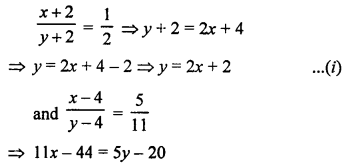
RS Aggarwal Class 10 Solutions Chapter 3 Linear equations in two variables Ex 3E 2
⇒ 11x – 44 = 5(2x + 2) – 20
⇒ 11x – 44 = 10x + 10 – 20
⇒ 11x – 10x = 10 – 20 + 44
⇒ x = 34
and y = 2 x 34 + 2 = 68 + 2 = 70
Numbers are 34 and 70

Question 10.
Solution:
Let first number = x
and second number (smaller) = y
According to the conditions,
x – y = 14
and x² – y² = 448
⇒ (x + y) (x – y) = 448
⇒ (x + y) x 14 = 448
⇒ x + y = 32 ……(i)
and x – y = 14 ……(ii)
Adding (i) and (ii),
2x = 46 ⇒ x = 23
and subtracting (i) and (ii),
2y = 18 ⇒ y = 9
Numbers are 23, 9

Question 11.
Solution:
Let ones digit of a two digit number = x
and tens digit = y
Number = x + 10y
By interchanging the digits,
Ones digit = y
and tens digit = x
Number = y + 10x
According to the conditions,
x + y = 12 ………. (i)
y + 10x = x + 10y + 18
⇒ y + 10x – x – 10y = 18
⇒ 9x – 9y = 18
⇒ x – y = 2 …(ii) (Dividing by 9)
Adding (i) and (ii),
2x = 14 ⇒ x = 7
and subtracting,
2y = 10 ⇒ y = 5
Number = 7 + 10 x 5 = 7 + 50 = 57

Question 12.
Solution:
Let one’s digit of a two digit number = x
and ten’s digit = y
Then number = x + 10y
After reversing the digits,
Ones digit = y
and ten’s digit = x
and number = y + 10x
According to the conditions,
x + 10y – 27 = y + 10x
⇒ y + 10x – x – 10y = -27
⇒ 9x – 9y = -27
⇒ x – y = -3 …(i)
and 7 (x + y) = x + 10y
7x + 7y = x+ 10y
⇒ 7x – x = 10y – 7y
⇒ 6x = 3y
⇒ 2x = y …(ii)
Substituting the value of y in (i)
x – 2x = -3
⇒ -x = -3
⇒ x = 3
y = 2x = 2 x 3 = 6
Number = x + 10y = 3 + 10 x 6 = 3 + 60 = 63

Question 13.
Solution:
Let one’s digit of a two digit number = x
and ten’s digit = y
Then number = x + 10y
After interchanging the digits,
One’s digit = y
and ten’s digit = x
Then number = y + 10x
According to the conditions,
y + 10x = x + 10y + 9
⇒ y + 10x – x – 10y = 9
⇒ 9x – 9y = 9
⇒ x – y = 1 …(i)
and x + y= 15 …(ii)
Adding, we get
2x = 16
x = 8
and subtracting,
2y = 14
⇒ y = 7
Number = x + 10y = 8 + 10 x 7 = 8 + 70 = 78

Question 14.
Solution:
Let one’s digit of the two digit number = x
and ten’s digit = y
Then number = x + 10y
By reversing the digits,
One’s digit = y
and ten’s digit = x
Then number = y + 10x
Now, according to the conditions,
x + 10y + 18 = y + 10x
⇒ 18 = y + 10x – x – 10y
⇒ 9x – 9y = 18
⇒ x – y = 2 …(i)
and 4(x + y) + 3 = x + 10y
4x + 4y + 3 = x + 10y
⇒ 4x + 4y – x – 10y = -3
3x – 6y = -3
⇒ x – 2y = -1 ……..(ii)
Subtracting,
y = 3
and x = 2y – 1 = 2 x 3 – 1 = 6 – 1 = 5
Number = x + 10y = 5 + 10 x 3 = 5 + 30 = 35

Question 15.
Solution:
Let ones digit of a two digit number = x
and tens digit = y
Then number = x + 10y
By reversing the digits,
One’s digit = y
and ten’s digit = x
and number = y + 10x
According to the conditions,
x + 10y – 9 = y + 10x
⇒ x + 10y – y – 10x = 9
⇒ -9x + 9y = 9
⇒x – y = -1 …(i) (Dividing by -9)
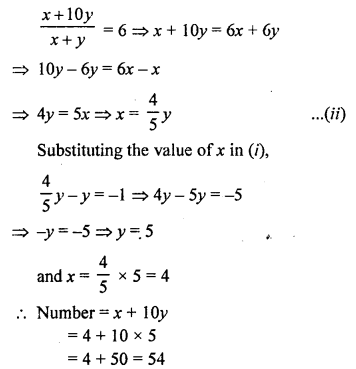
RS Aggarwal Class 10 Solutions Chapter 3 Linear equations in two variables Ex 3E 3

Question 16.
Solution:
Let the one’s digit of a two digit number = x
and ten’s digit = y
Then number = x + 10y
By interchanging the digits,
One’s digit = y
and ten’s digit = x
Then number = y + 10x
According to the conditions,
x + 10y + 18 = y + 10x
⇒ 18 = y + 10x – x – 10y
⇒ 9x – 9y = 18
⇒ x – y = 2 …(i)
and xy = 35 …(ii)
Now, (x + y)² = (x – y)² + 4xy = (2)² + 4 x 35 = 4 + 140 = 144 = (12)²
⇒ (x + y) = 12 …(iii)
Subtracting (i) from (iii), we get
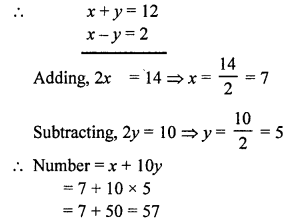
RS Aggarwal Class 10 Solutions Chapter 3 Linear equations in two variables Ex 3E 4

Question 17.
Solution:
Let one’s digit of a two digit number = x
and ten’s digit = y
Then number = x + 10y
After interchanging the digits One’s digit = y
Ten’s digit = x
Then number = y + 10x
According to the conditions,
x + 10y – 63 = y + 10x
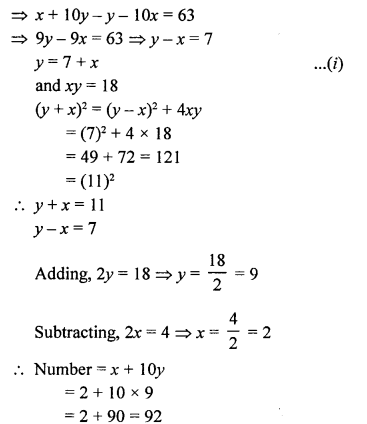
RS Aggarwal Class 10 Solutions Chapter 3 Linear equations in two variables Ex 3E 5

Question 18.
Solution:
Let one’s digit of a two digit number = x
and ten’s digit = y
Number = x + 10y
By reversing the digits,
One’s digit = y
and ten’s digit = x
Number = y + 10x
According to the conditions,
x + 10y + y + 10x = 121
⇒ 11x + 11y = 121
⇒ x + y = 11 …(i)
x – y = 3 …(ii)
Adding, we get
2x = 14 ⇒ x = 7
Subtracting,
2y = 8 ⇒ y = 4
Number = 7 + 10 x 4 = 7 + 40 = 47
or 4 + 10 x 7 = 4 + 70 = 74

Question 19.
Solution:
Let numerator of a fraction = x
and denominator = y
Then fraction = \(\frac { x }{ y }\)
According to the conditions,
x + y = 8 …(i)
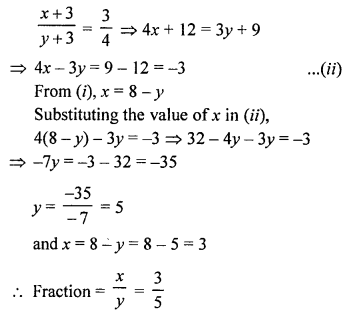
RS Aggarwal Class 10 Solutions Chapter 3 Linear equations in two variables Ex 3E 6

Question 20.
Solution:
Let numerator of a fraction = x
and denominator = y
Then fraction = \(\frac { x }{ y }\)
According to the conditions,
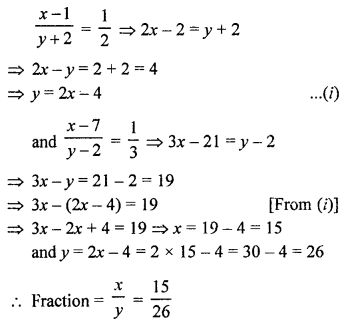
\(\frac { x + 2 }{ y }\) = \(\frac { 1 }{ 2 }\)
\(\frac { x }{ y – 1 }\) = \(\frac { 1 }{ 3 }\)
⇒ 2x + 4 = y …(i)
3x = y – 1 …(ii)
⇒ 3x = 2x + 4 – 1
⇒ 3x = 2x + 3
⇒ 3x – 2x = 3
⇒ x = 3
and y = 2x + 4 = 2 x 3 + 4 = 6 + 4 = 10
Fraction = \(\frac { 3 }{ 10 }\)

Question 21.
Solution:
Let numerator of a fraction = x
and denominator = y
Then fraction = \(\frac { x }{ y }\)
According to the conditions,
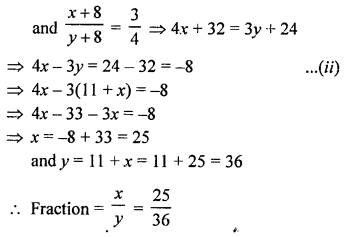
y – x = 11
y = 11 + x …(i)
RS Aggarwal Class 10 Solutions Chapter 3 Linear equations in two variables Ex 3E 7

Question 22.
Solution:
Let numerator of a fraction = x
and denominator = y
Then fraction = \(\frac { x }{ y }\)
According to the conditions,
RS Aggarwal Class 10 Solutions Chapter 3 Linear equations in two variables Ex 3E 8

Question 23.
Solution:
Let numerator of a fraction = x
and denominator = y
Then fraction =
According to the conditions,
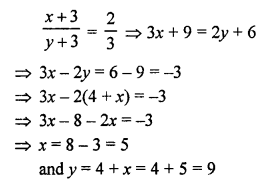
x + y = 4 + 2x
⇒ y = 4 + x …(i)
RS Aggarwal Class 10 Solutions Chapter 3 Linear equations in two variables Ex 3E 9
Fraction = \(\frac { x }{ y }\) = \(\frac { 5 }{ 9 }\)

Question 24.
Solution:
Let first number = x
and second number = y
According to the conditions,
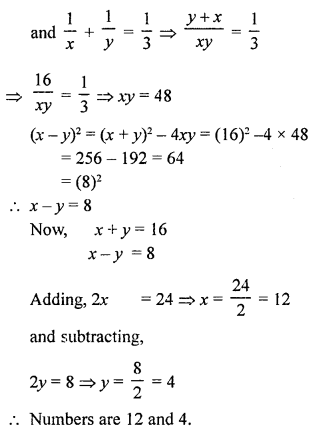
x + y = 16
RS Aggarwal Class 10 Solutions Chapter 3 Linear equations in two variables Ex 3E 10

Question 25.
Solution:
Let in classroom A, the number of students = x
and in classroom B = y
According to the conditions,
x – 10 = y + 10
⇒ x – y = 10 + 10 = 20
⇒ x – y = 20 …(i)
and x + 20 = 2 (y – 20)
⇒ x + 20 = 2y – 40
⇒ x – 2y = -(40 + 20) = -60
x – 2y = -60 …(ii)
Subtracting, y = 80
and x – y = 20
⇒ x – 80 = 20
⇒ x = 20 + 80 = 100
Number of students in classroom A = 100 and in B = 80

Question 26.
Solution:
Let fixed charges = ₹ x
and other charges = ₹ y per km
According to the conditions,
For 80 km,
x + 80y = ₹ 1330 …(i)
and x + 90y = ₹ 1490 …(ii)
Subtracting (i) from (ii),
10y = 160 ⇒ y = 16
and from (i)
x + 80 x 16 = 1330
⇒ x + 1280 = 1330
⇒ x = 1330 – 1280 = 50
Fixed charges = ₹ 50
and rate per km = ₹ 16

Question 27.
Solution:
Let fixed charges of the hostel = ₹ x
and other charges per day = ₹ y
According to the conditions,
x + 25y = 4500 ……..(i)
x + 30y = 5200 ……(ii)
Subtracting (i) from (ii),
5y = 700
y = 140
and from (i),
x + 25 x 140 = 4500
⇒ x + 3500 = 4500
⇒ x = 4500 – 3500 = 1000
Fixed charges = ₹ 1000
and per day charges = ₹ 140

Question 28.
Solution:
Let first investment = ₹ x
and second investment = ₹ y
Rate of interest = 10% p.a. for first kind and 8% per second
Interest is for the first investment = ₹ 1350
and for the second = ₹ 1350 – ₹45 = ₹ 1305
According to the conditions,
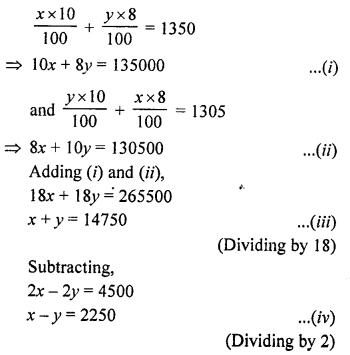
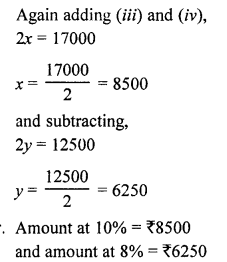
RS Aggarwal Class 10 Solutions Chapter 3 Linear equations in two variables Ex 3E 11
RS Aggarwal Class 10 Solutions Chapter 3 Linear equations in two variables Ex 3E 12

Question 29.
Solution:
Ratio in the income of A and B = 5 : 4
Let A’s income = ₹ 5x and
B’s income = ₹ 4x
and ratio in their expenditures = 7 : 5
Let A’s expenditure = 7y
and B’s expenditure = 5y
According to the conditions,
5x – 7y = 9000 …(i)
and 4x – 5y = 9000 …(ii)
Multiply (i) by 5 and (ii) by 7,
25x – 35y = 45000
28x – 37y = 63000
Subtracting, we get
3x = 18000
⇒ x = 6000
A’s income = 5x = 5 x 6000 = ₹ 30000
and B’s income = 4x = 4 x 6000 = ₹ 24000

Question 30.
Solution:
Let cost of one chair = ₹ x
and cost of one table = ₹ y
In first case,
Profit on chair = 25%
and on table = 10%
and selling price = ₹ 1520
According to the conditions,
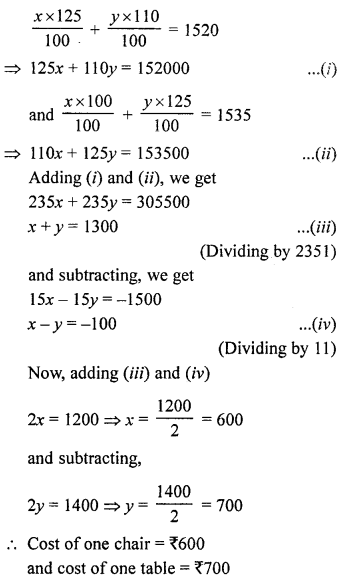
RS Aggarwal Class 10 Solutions Chapter 3 Linear equations in two variables Ex 3E 13

Question 31.
Solution:
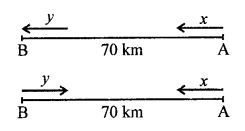
Distance between two stations A and B = 70 km
Let speed of first car (starting from A) = x km/hr
and speed of second car = y km/hr
RS Aggarwal Class 10 Solutions Chapter 3 Linear equations in two variables Ex 3E 14
According to the conditions,
7x – 7y = 70
⇒ x – y = 10 …(i)
and x + y = 70 …(ii)
Adding (i) and (ii),
2x = 80 ⇒ x = 40
Subtracting (i) and (ii),
2y = 60 ⇒ y = 30
Speed of car A = 40 km/hr
and speed of car B = 30 km/hr

Question 32.
Solution:
Let uniform speed of the train = x km/hr
and time taken = y hours
Distance = x x y = xy km
Case I:
Speed = (x + 5) km/hr
and Time = (y – 3) hours
Distance = (x + 5) (y – 3)
(x + 5) (y – 3) = xy
⇒ xy – 3x + 5y – 15 = xy
-3x + 5y = 15 …(i)
Case II:
Speed = (x – 4) km/hr
and Time = (y + 3) hours
Distance = (x – 4) (y + 3)
(x – 4) (y + 3) = xy
⇒ xy + 3x – 4y – 12 = xy
3x – 4y = 12 …(ii)
Adding (i) and (ii),
y = 27
and from (i),
-3x + 5 x 27 = 15
⇒ -3x + 135 = 15
⇒ -3x = 15 – 135 = -120
⇒ x = 40
Speed of the train = 40 km/hr
and distance = 27 x 40 = 1080 km

Question 33.
Solution:
Let the speed of the train = x km/hr
and speed of taxi = y km/hr
According to the conditions,
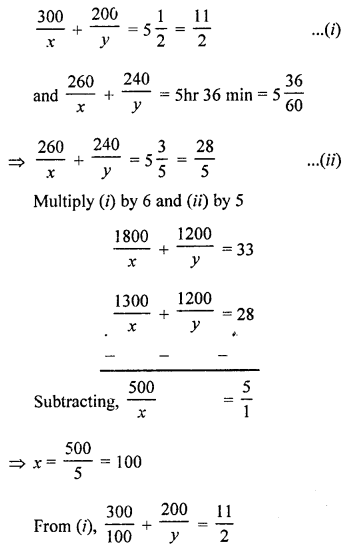
RS Aggarwal Class 10 Solutions Chapter 3 Linear equations in two variables Ex 3E 15
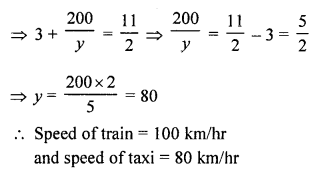
RS Aggarwal Class 10 Solutions Chapter 3 Linear equations in two variables Ex 3E 16

Question 34.
Solution:
Distance between stations A and B = 160 km
Let the speed of the car starts from A = x km/hr
and speed of car starts from B = y km/hr
8x – 8y = 160
⇒ x – y = 20 …(i)
and 2x + 2y = 160
⇒ x + y = 80 …(ii)
Adding (i) and (ii)
2x = 100 ⇒ x = 50
and subtracting,
2y = 60 ⇒ y = 30
Speed of car starting from A = 50 km/hr
and from B = 30 km/hr

Question 35.
Solution:
Distance = 8 km
Let speed of sailor in still water = x km/hr
and speed of water = y km/hr
According to the conditions,
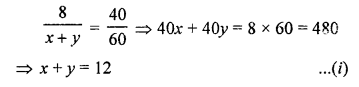
RS Aggarwal Class 10 Solutions Chapter 3 Linear equations in two variables Ex 3E 17
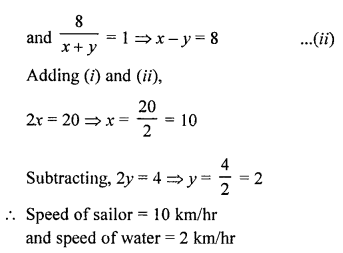
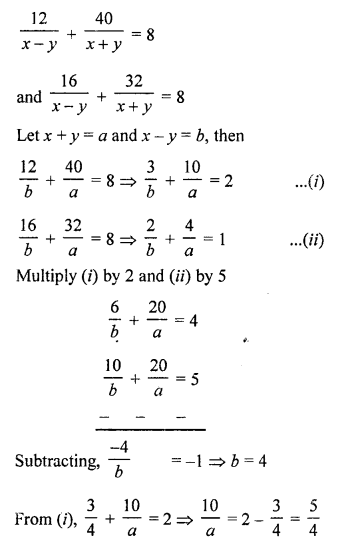
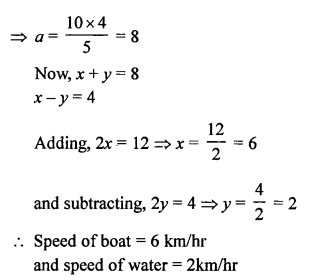
RS Aggarwal Class 10 Solutions Chapter 3 Linear equations in two variables Ex 3E 18

Question 36.
Solution:
Let speed of a boat = x km/hr
and speed of stream = y km/hr
According to the conditions,
RS Aggarwal Class 10 Solutions Chapter 3 Linear equations in two variables Ex 3E 19
RS Aggarwal Class 10 Solutions Chapter 3 Linear equations in two variables Ex 3E 20

Question 37.
Solution:
Let a man can do a work in x days
His 1 day’s work = \(\frac { 1 }{ x }\)
and a boy can do a work in y days
His 1 day’s work = \(\frac { 1 }{ y }\)
According to the conditions,
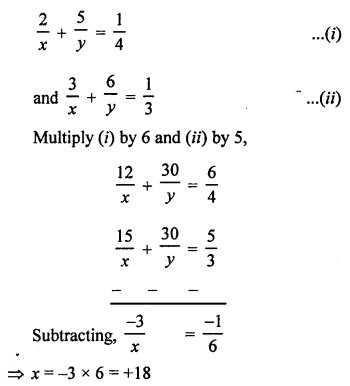
RS Aggarwal Class 10 Solutions Chapter 3 Linear equations in two variables Ex 3E 21
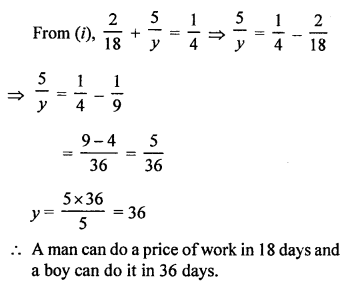
RS Aggarwal Class 10 Solutions Chapter 3 Linear equations in two variables Ex 3E 22

Question 38.
Solution:
Let length of a room = x m
and breadth = y m
and area = xy m²
According to the conditions,
x = y + 3 …(i)
(x + 3) (y – 2) = xy
xy – 2x + 3y – 6 = xy
-2x + 3y = 6 …(ii)
-2 (y + 3) + 3y = 6 [From (i)]
-2y – 6 + 3y = 6
⇒ y = 6 + 6 = 12
x = y + 3 = 12 + 3 = 15 …(ii)
Length of room = 15 m
and breadth = 12 m

Question 39.
Solution:
Let length of a rectangle = x m
and breadth = y m
Then area = x x y = xy m²
According to the conditions,
(x – 5) (y + 3) = xy – 8
⇒ xy + 3x – 5y – 15 = xy – 8
⇒ 3x – 5y = -8 + 15 = 7 …..(i)
and (x + 3) (y + 2) = xy + 74
⇒ xy + 2x + 3y + 6 = xy + 74
⇒ 2x + 3y = 74 – 6 = 68 …(ii)
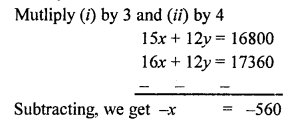
Multiply (i) by 3 and (ii) by 5
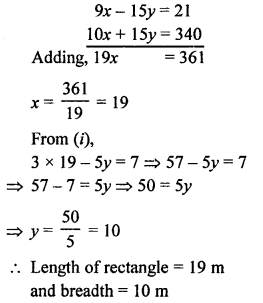
RS Aggarwal Class 10 Solutions Chapter 3 Linear equations in two variables Ex 3E 23

Question 40.
Solution:
Let length of a rectangle = x m
and breadth = y m
Then area = xy m²
According to the conditions,
(x + 3) (y – 4) = xy – 67
⇒ xy – 4x + 3y – 12 = xy – 67
⇒ -4x + 3y = -67 + 12 = -55
⇒ 4x – 3y = 55 …(i)
and (x – 1) (y + 4) = xy + 89
⇒ xy + 4x – y – 4 = xy + 89
⇒ 4x – y = 89 + 4 = 93 ….(ii)
⇒ y = 4x – 93
Substituting the value of y in (i),
4x – 3(4x – 93) = 55
⇒ 4x – 12x + 279 = 55
⇒ -8x = 55 – 279 = -224
⇒ x = 28
and y = 4x – 93 = 4 x 28 – 93 = 112 – 93 = 19
Length of rectangle = 28 m
and breadth = 19 m

Question 41.
Solution:
Let reservation charges = ₹ x
and cost of full ticket from Mumbai to Delhi
According to the conditions,
x + y = 4150 …(i)
2x + \(\frac { 3 }{ 2 }\) y = 6255
⇒ 4x + 3y = 12510 …(ii)
From (i), x = 4150 – y
Substituting the value of x in (ii),
4 (4150 – y) + 3y = 12510
⇒ 16600 – 4y + 3y = 12510
-y = 12510 – 16600
-y = -4090
⇒ y = 4090
and x = 4150 – y = 4150 – 4090 = 60
Reservation charges = ₹ 60
and cost of 1 ticket = ₹ 4090

Question 42.
Solution:
Let present age of a man = x years
and age of a son = y years
5 year’s hence,
Man’s age = x + 5 years
and son’s age = y + 5 years
x + 5 = 3 (y + 5) = 3y + 15
⇒ x – 3y = 15 – 5 = 10
x = 10 + 3y …(i)
and 5 years ago,
Man’s age = x – 5 years
and son’s age = y – 5 years
x – 5 = 7 (y – 5) = 7y – 35
x = 7y – 35 + 5 = 7y – 30 …(ii)
From (i) and (ii),
10 + 3y = 7y – 30
⇒ 7y – 3y = 10 + 30
⇒ 4y = 40
⇒ y = 10
and x = 10 + 3y = 10 + 3 x 10 = 10 + 30 = 40
Present age of a man = 40 years
and of son’s age = 10 years

Question 43.
Solution:
Let present age of a man = x years
and age of his son = y years
2 years ago,
Man’s age = x – 2 years
Son’s age = y – 2 years
x – 2 = 5 (y – 2)
⇒ x – 2 = 5y – 10
x = 5y – 10 + 2 = 5y – 8 …(i)
2 years later,
Man’s age = x + 2 years
and son’s age = y + 2 years
x + 2 = 3(y + 2) + 8
x + 2 = 3y + 6 + 8
⇒ x = 3y + 6 + 8 – 2 = 3y + 12 …(ii)
From (i) and (ii),
5y – 8 = 3y + 12
⇒ 5y – 3y = 12 + 8
⇒ 2y = 20
⇒ y = 10
and x = 5y – 8 = 5 x 10 – 8 = 50 – 8 = 42
Present age of man = 42 years
and age of son = 10 years

Question 44.
Solution:
Let age of father = x years
and age of his son = y years
According to the conditions,
2y + x = 10 …(i)
2x + y = 95 …(ii)
From (i),
x = 70 – 2y
Substituting the value of x in (ii),
2 (70 – 2y) + y = 95
⇒ 140 – 4y + y = 95
⇒ -3y = 95 – 140 = -45
⇒ -3y = -45
⇒ y = 15
and x = 70 – 2y = 70 – 2 x 15 = 70 – 30 = 40
Age of father = 40 years
and age of his son = 15 years

Question 45.
Solution:
Let present age of a woman = x years
and age of her daughter = y years
According to the conditions,
x = 3y + 3 …(i)
3 years hence,
Age of woman = x + 3 years
and age of her daughter = y + 3 years
x + 3 = 2 (y + 3) + 10
⇒ x + 3 = 2y + 6 + 10
⇒x = 2y + 16 – 3 = 2y + 13 …(ii)
From (i),
3y + 3 = 2y + 13
⇒ 3y – 2y = 13 – 3
⇒ y = 10
and x = 3y + 3 = 3 x 10 + 3 = 30 + 3 = 33
Present age of woman = 33 years
and age of her daughter = 10 years

Question 46.
Solution:
Let cost price of tea set = ₹ x
and of lemon set = ₹ y
According to the conditions,
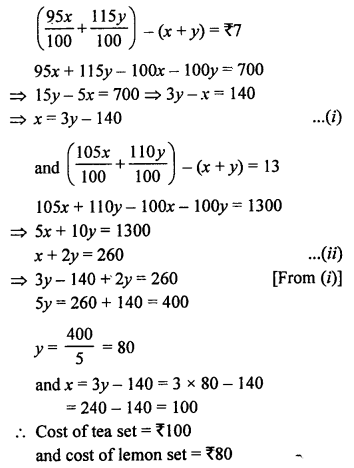
RS Aggarwal Class 10 Solutions Chapter 3 Linear equations in two variables Ex 3E 24

Question 47.
Solution:
Let fixed charges = ₹ x (for first three days)
and then additional charges for each day = ₹ y
According to the conditions,
Mona paid ₹ 27 for 7 dyas
x + (7 – 3) x y = 27
⇒ x + 4y = 27
and Tanvy paid ₹ 21 for 5 days
x + (5 – 3) y = 21
⇒ x + 2y = 21 …(ii)
Subtracting,
2y = 6 ⇒ y = 3
But x + 2y = 21
⇒ x + 2 x 3 = 21
⇒ x + 6 = 21
⇒ x = 21 – 6 = 15
Fixed charges = ₹ 15
and additional charges per day = ₹ 3

Question 48.
Solution:
Let x litres of 50% solution be mixed with y litres of 25% solution, then
x + y = 10 …(i)
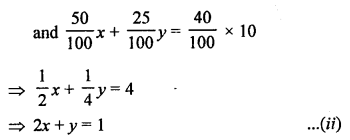
RS Aggarwal Class 10 Solutions Chapter 3 Linear equations in two variables Ex 3E 25
Subtracting (i) from (ii),
x = 6
and x + y = 10
⇒ 6 + y = 10
⇒ y = 10 – 6 = 4
50% solution = 6 litres
and 25% solution = 4 litres

Question 49.
Solution:
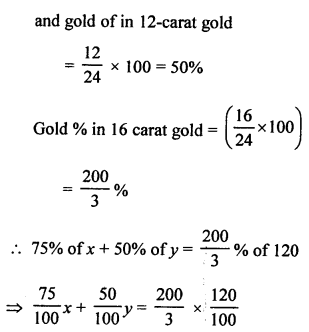
Let x g of 18 carat be mixed with y g of 12 carat gold to get 120 g of 16 carat gold, then
x + y = 120 …(i)
Now, gold % in 18-carat gold = \(\frac { 18 }{ 24 }\) x 100 = 75%
RS Aggarwal Class 10 Solutions Chapter 3 Linear equations in two variables Ex 3E 26
⇒ 3x + 2y = 320 …(ii)
From (i),
x = 120 – y
Substituting the value of x in (ii),
3 (120 – y) + 2y = 320
⇒ 360 – 3y + 2y = 320
⇒ -y = 320 – 360
⇒ -y = -40
⇒ y = 40
and 40 + x = 120
⇒ x = 120 – 40 = 80
Hence, 18 carat gold = 80 g
and 12-carat gold = 40 g

Question 50.
Solution:
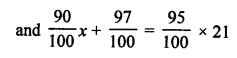
Let x litres of 90% pure solution be mixed withy litres of 97% pure solution to get 21 litres of 95% pure solution. Then,
x + y = 21 …(i)
RS Aggarwal Class 10 Solutions Chapter 3 Linear equations in two variables Ex 3E 27
⇒ 90x + 97y = 1995
From (i), x = 21 – y
Substituting the value of x in (ii),
90 (21 – y) + 97y = 1995
⇒ 1890 – 90y + 97y = 1995
⇒ 7y = 1995 – 1890 = 105
⇒ y =15
and x = 21 – y = 21 – 15 = 6
90% pure solution = 6 litres
and 97% pure solution = 15 litres

Question 51.
Solution:
Let larger supplementary angle = x°
and smaller angle = y°
According to the conditions,
x + y = 180° …(i)
x = y + 18° …(ii)
From (i),
y + 18° + y = 180°
⇒ 2y = 180° – 18° = 162°
⇒ 2y = 162°
⇒ y = 81°
and x= 180°- 81° = 99°
Hence, angles are 99° and 81°

Question 52.
Solution:
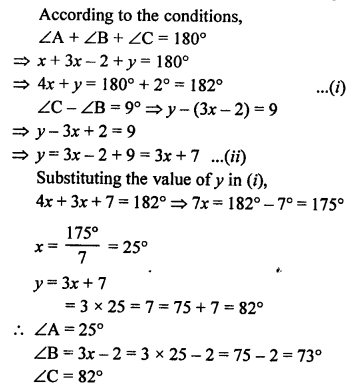
In ∆ABC,
∠A = x, ∠B = (3x – 2)°, ∠C = y°, ∠C – ∠B = 9°
RS Aggarwal Class 10 Solutions Chapter 3 Linear equations in two variables Ex 3E 28

Question 53.
Solution:
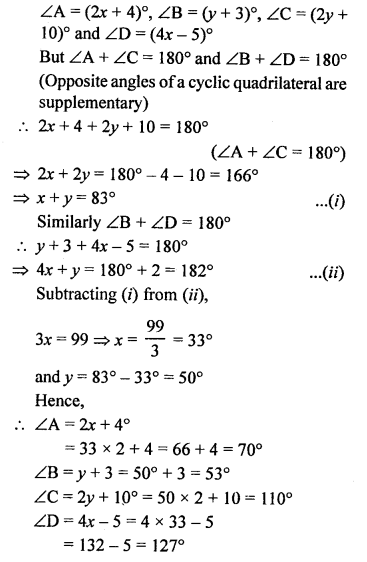
In a cyclic quadrilateral ABCD,
RS Aggarwal Class 10 Solutions Chapter 3 Linear equations in two variables Ex 3E 29

Hope given RS Aggarwal Solutions Class 10 Chapter 3 Linear equations in two variables Ex 3E are helpful to complete your math homework.

If you have any doubts, please comment below. Learn Insta try to provide online math tutoring for you.

The Happy Prince Extra Questions and Answers Class 9 English Moments

Here we are providing The Happy Prince Extra Questions and Answers Class 9 English Moments, Extra Questions for Class 9 English was designed by subject expert teachers.

The Happy Prince Extra Questions and Answers Class 9 English Moments

The Happy Prince Extra Questions and Answers Short Answer Type

Question 1.
Describe the statue of the Happy Prince.
Answer:
The statue stood high above the city on a tall column. He was gilded all over with thin leaves of fine gold with two bright sapphires for eyes. A large red ruby glowed on his sword hilt.

Question 2.
Did the swallow belong to the city? How can you tell? Where was it going?
Answer:
No, the swallow did not belong to the city, as it is written that it flew over the city on its way to Egypt.

Question 3.
Where did the bird decide to stay for the night? Why?
Answer:
The bird decided to stay near the statue of the prince, because it was located on a tall column and the bird felt he would get plenty of fresh air there.

Question 4.
Why did the bird think he had a ‘golden bedroom’?
Answer:
The bird alighted near the feel of the statue of the Happy Prince, which was gilded all over with thin leaves of fine gold. That is why he felt that he had got a ‘golden bedroom’ to sleep in.

Question 5.
Why was the bird not able to sleep peacefully that first night?
Answer:
Just as the bird was about to sleep, he was disturbed by three tear drops that fell from the eyes of the statue. When he saw the tears running down the cheeks of the statue, he looked so beautiful in the moonlight that the bird was filled with pity and could not sleep.

Question 6.
Why was the statue of the Happy Prince weeping?
Answer:
The statue of the Happy Prince was weeping because when he had been alive, he had not known any sorrow. But after his statue had been erected, he was able to see all the ugliness and misery of the city, and even though he now had a heart of lead, he could still feel the pain, which made him cry.

Question7.
Who does the Prince ask the swallow to deliver the red ruby to?
Answer:
The Prince asked the swallow to deliver the ruby to a poor seamstress whose son was very ill. The child was asking his mother for oranges, but she had nothing to give him but water. Since the statue’s feet were fixed to the pedestal, he could not deliver it himself, so he asked the swallow to do so.

Question 8.
Why did the swallow agree to deliver the ruby even though he wanted to join his friends in Egypt?
Answer:
The Prince looked so sad that the little swallow felt sorry for him and agreed to stay one night and be his messenger.

Question 9.
What were the things that the swallow saw on his journey to deliver the ruby?
Answer:
He saw the cathedral tower, the palace, the river, and the ships before coming to the poor woman’s house.

Question 10.
What made the sick boy fall into a deep, restful sleep?
Answer:
When the bird delivered the ruby, he flew gently around the bed of the sick boy, fanning the boy’s forehead with his wings. This soothed the boy and he fell into a deep, restful sleep.

Question 11.
Though it was cold, the bird felt warm. Why did this happen?
Answer:
This happened because he had done a good deed by delivering the ruby to the seamstress’ house, which made him feel warm and happy from inside.

Question 12.
Why did the swallow delay his departure for the second time?
Answer:
He delayed his departure for the second time because the Prince asked him to deliver one of his sapphire eyes to a poor young man in a garret who was trying to finish a play for the Director of the theatre, but who was too hungry and cold to write anymore.

Question 13.
What did the Prince expect the young playwright to do with the sapphire? Did the swallow willingly agree to the Prince’s request?
Answer:
The Prince expected him to sell it to the jeweller and buy firewood so he could complete writing his play. No, the swallow protested at first, as he wanted to continue on his journey. However, he finally agreed to help the Prince again.

Question 14.
Where did the playwright find the sapphire, and where did he think it had come from?
Answer:
He found it lying on the withered violets, and thought it must have been left there by an admirer.

Question 15.
Where did the swallow go after dropping the sapphire at the playwright’s?
Answer:
He flew down to the harbour where he sat on the mast of a large ship and watched the sailors working.

Question 16.
Why did the swallow want to fly to Egypt?
Answer:
He wanted to do so because it was a warm country where the sum shone on green palm trees and crocodiles lay in the mud. Moreover, all his friends had already gone there to escape the cold weather.

Question 17.
Why was the match girl crying?
Answer:
She was crying because her matches had fallen into the gutter and were all spoilt. Now her father would beat her for not bringing home any money.

Question 18.
How does the Happy Prince help the match girl, and why?
Answer:
He asks the swallow to pluck out his remaining sapphire eye and give it to her. He does this to save her from her father’s beating.

Question 19.
After helping the Prince, when he had the freedom to fly to Egypt, why did the swallow change his mind? What does it reveal about his character?
Answer:
He decided to stay with the statue as it had become blind now. This shows that the bird was very loyal and caring.

Question 20.
Why did the Prince ask the swallow to fly over his city?
Answer:
The Prince said that the suffering of men and women was the greatest misery of all, and asked the swallow to fly over the city so that he could come back and tell him about all that he saw there.

Question 21.
What did the swallow see in the city?
Answer:
He saw the rich making merry in their beautiful homes, while the beggars sat at their gates. He saw the starving children and two little boys hugging each other to keep warm. They were hungry as well, and were forced out into the rain by a watchman.

Question 22.
How did the Prince react to the bird’s report on all that he had seen in the city?
Answer:
He asked the swallow to remove all the gold covering his body, leaf by leaf, and give it to the poor people.

Question 23.
How did the swallow make the poor starving children happy?
Answer:
He did so by dropping the gold from the statue among the poor, who used it to buy bread and drive away their hunger.

Question 24.
How did the coming of the cold weather affect the swallow?
Answer:
He grew colder by the day, but did not leave the statue of the Happy Prince, which he had come to love dearly. He ate the crumbs he found outside the baker’s door and tried to keep warm by flapping his wings.

Question 25.
Why did the heart of the statue snap into two?
Answer:
The moment the swallow died at the feet of the statue, there was a curious crack inside the statue, as if something had broken. It was the leaden heart of the statue, which had broken as soon as its friend died.

The Happy Prince Extra Questions and Answers Long Answer Type

Question 1.
Why is the frost called a ‘dreadfully hard frost’?
Answer:
The frost has been called hard because the snow had hardened due to the cold. Further, it also refers to the swallow had wanted to migrate to a wanner climate in Egypt, he had stayed back, at first unwillingly, to help the poor people by delivering the ruby, sapphire and gold leaf that had covered the statue of the Prince. Later, once the Prince was left without eyes to see, he decided to stay to keep him company. In the process, he succumbed to the cold weather and lost his life. On finding his friend dead, the statue broke, revealing his leaden heart. Thus, the death of these two selfless heroes cast a gloomy atmosphere.

Question 2.
What are the two most precious things that the Angels find in the city?
Answer:
The two most precious things that the Angels pick up from the city are the dead swallow and the lead heart of the Happy Prince. They picked these two because both the bird and the statue had gone beyond their selfish interest and lost their lives serving the poor and down-trodden. The bird had cancelled his plans to migrate to warmer climes for the winter, staying back to help deliver valuables as directed by the statue, to those who were in dire need.

After the statue gave away his sapphire eyes and became blind, he did not have the heart to fly away from his friend. Instead, he died in his attempt to keep him company. Similarly, the statue had selflessly given away all the valuables that covered his body to help the poor and hungry people in the city. It made him extremely sad to see their misery, so he chose to give them everything he had. When at last his friend the swallow died, he was completely broken, and his heart cracked into two. The angels valued their sacrifice and charitable acts, and chose them as the most precious things.

Question 3.
Why did the courtiers call the prince the ‘Happy Prince’? Was he really happy? What does he see all around him?
Answer:
The prince had been called a Happy Prince when he had been alive. At that time, he lived a sheltered and privileged life, with no inkling of the suffering faced by the common people. After his death, when his statue was placed on a high column overlooking the city, he was able to see the misery and unhappiness of the people. The poverty and ugliness all around made him extremely unhappy. Therefore, with the help of the swallow, he tried to compensate for the neglect which he had shown his subjects while he had been alive. Thus, he was not happy looking at the misery of the people, but by giving away all his valuables and helping the poor people, his sadness would have been somewhat abated.

Question 4.
Comment on the title of the story. Was the prince really happy?
Answer:
The title is an ironical one, as it suggests that the story is about a Prince who is happy. However, the readers soon realise that the Prince is not a human, but a statue. The prince had been called a Happy Prince when he had been alive. At that time, he lived a sheltered and privileged life, with no inkling of the suffering faced by the common people. After his death, his statue was placed on a high column overlooking the city. Since the statue was placed at a high point, he could see all the misery and sadness in the city, which made him sad.

Question 5.
How do the councillors and Mayor react on seeing the broken statue?
Answer:
The councillors and Mayor called the statue shabby because all the gold and precious stones no longer decorated it. They felt that without these embellishments, the statue looked like that of a beggar. Moreover, they felt that the dead swallow at its feet added to the shabby condition of the statue. Thus, since the statue was no longer beautiful or useful, it should be pulled down and melted in the furnace. However, its lead heart did not melt, which was finally thrown onto the garbage heap with the dead swallow’s body.

Question 6.
Men melt down the statue, yet the Angels proclaim it one of the most precious things in the city. Comment on the divergent viewpoints of the Angels and humans with reference to the story The Happy Prince.
Answer:
Humans are attracted to material things, and tend to appreciate only outer beauty. Thus, the statue was considered beautiful when it was covered with gold leaf and precious stones like rubies and sapphires. However, when it was stripped of the gold and jewels, they declared that it was shabby and should be pulled down. On the other hand, the Angels looked into the mind and heart of all creatures, and valued qualities like charity, selflessness and kindness above any external materials.

In this story, we have two very noble characters—the swallow and the statue—who together help out several poor people in the city quietly, without expecting praise or acclaim. The statue gives every valuable part that can help someone, even though it makes him look shabby and he goes blind. The swallow also risks his life by staying on in the cold weather instead of flying to warmer climes like its friends. Instead, it stays back and helps the prince alleviate the suffering of several people in the city. Thus, their actions make them the most precious things in the city.

In the Kingdom of Fools Extra Questions and Answers Class 9 English Moments

Here we are providingIn the Kingdom of Fools Extra Questions and Answers Class 9 English Moments, Extra Questions for Class 9 English was designed by subject expert teachers.

In the Kingdom of Fools Extra Questions and Answers Class 9 English Moments

In the Kingdom of Fools Extra Questions and Answers Short Answer Type

Question 1.
What are the two strange things the guru and his disciple find in the kingdom of fools?
Answer:
Firstly, they find that the whole town, including the animals, slept by day and stayed awake through the night running their businesses. Secondly, everything costs the same, whether it was a measure of rice or a bunch of bananas—they all cost a duddu.

Question 2.
Why was the kingdom called the Kingdom of Fools?
Answer:
It was called so because the Kind and the minister were idiots. They decided to change night into day and day into night, and ordered everyone to wake at night to till their fields, and sleep during the day.

Question 3.
Why did the people follow the orders of the foolish King?
Answer:
They were forced to do so because they knew that if they disobeyed his orders, they would be punished with death.

Question 4.
What astonished the guru and disciple at the grocer’s shop?
Answer:
They were astonished that everything at the shop whether a measure of rice or a bunch of bananas cost the same, i.e., a duddu.

Question 5.
Compare and contrast the feelings of the guru and the disciple about the kingdom they found themselves in.
Answer:
The guru felt that it would not be a great idea to stay in the kingdom, and they should leave the place. On the -other hand, the disciple refused to leave, because he felt that everything was so cheap and good, that he could eat to his heart’s content.

Question 6.
Why did the guru leave the disciple and go away from the Kingdom of Fools?
Answer:
Since the disciple refused to listen to his guru’s wisdom and insisted on staying there, the guru gave up and left.

Question 7.
What made the disciple grow fat?
Answer:
The disciple ate his fill of bananas, ghee, rice, and wheat, which cost only one duddu. As a result, he grew fatter and fatter.

Question 8.
Why does the writer say that ‘one bright day a thief broke into a rich merchant’s house’? What is strange about this statement?
Answer:
The strange thing is that the theft took place during the daylight hours. In any other place, theft would typically take place during the dark of night. However, the people in the Kingdom of Fools slept during the day and woke at night.

Question 9.
Why did the thief s brother run to the King?
Answer:
He ran to the King to complain about the fact that his brother had been killed because the wall of the house he had gone to rob had fallen on him.”

Question 10.
Do you think the plea made by the thief s brother was strange? Give reasons for your answer.
Answer:
Yes, it was strange, because instead of hiding the fact that his brother was a thief, and had died trying to rob the merchant’s house, he went to the King without any fear and demanded justice.

Question 11.
Do you think it was normal for the King to have demanded an explanation from the merchant for the death of the thief? Give reasons for your answer.
Answer:
No, because the thief had been doing something illegal, and yet the man he had tried to rob was being put on trial. Even though the thief died because of the wall collapsing, the merchant was not responsible for the death.

Question 12.
How does the merchant try to save his life?
Answer:
He tries to do so by blaming the brick-layer for building a wall that was so weak that it collapsed on the thief, killing him.

Question 13.
Who does the brick-layer blame for the weak wall that he had built?
Answer:
The brick-layer blames the dancing girl for distracting him by walking up and down the road in front of him with her anklets jingling.

Question 14.
Who does the dancing girl blame for her going up and down the road in front of the brick-layer?
Answer:
The dancing girl blames the goldsmith, who had to make some jewellery for her, but had not made it in time. Because of this, she had to visit him several times, thereby walking up and down the street in front of the brick-layer, disturbing him.

Question 15.
How does the goldsmith save himself from the wrath of the King?
Answer:
The goldsmith blamed a rich merchant for pressurising him to make some jewellery for him, thereby not leaving him with any time to complete the dancing girl’s jewellery. Therefore, he blames the rich merchant for being indirectly responsible for the thief’s death.

Question 16.
How does the blame come back to the rich merchant who had been accused in the first place?
Answer:
On investigating the identity of the rich merchant who had asked the goldsmith to make jewellery for him, it was found to be the father of the merchant who had been blamed for the thief’s death in the first place. However, as the father was now dead and the son had inherited his riches, the King decided that the son would also be responsible for taking his punishment.

Question 17.
Why did the King not decide to execute the merchant even though he found him responsible for the death of the thief?
Answer:
He decided not to execute the merchant because he felt he was too thin to be properly executed on the stake. He felt they needed someone fatter to fit the stake.

Question 18.
How did the guru divine that his disciple was in trouble? What did he do?
Answer:
The guru had magical powers. He could see far into the future, the past and the present. When the disciple prayed to him in his heart, he heard him and appeared before him to help him.

Question 19.
Why did the guru pretend to fight with his disciple?
Answer:
He did this to confuse the King about the reason for his eagerness to die instead of the disciple. He knew that the King was stupid and could be fooled into taking his own life.

Question 20.
What reason does the guru give for his eagerness to die?
Answer:
The guru said that if he was the first person to die at the new stake, he would be reborn as the next King of the kingdom.

Question 21.
Why did the King and the minister decide to take the place of the guru and the disciple?
Answer:
The King was not keen to lose his kingdom to someone else, even in the next life. Thus, he decided to die instead of the guru. He then made his minister agree to go along with him so he could continue to be his minister in the next life as well.

Question 22.
Why did the King and minister disguise themselves as the guru and disciple?
Answer:
They did this so that the executioner would mistake them for the condemned and kill them at the stake.

Question 23.
Why did the people of the kingdom panic at the sight of the bodies of the two executed men?
Answer:
They panicked because they realised that the two who had been executed were the King and the minister, and not the two who had been condemned to death.

Question 24.
Why did the people approach the guru and his disciple?
Answer:
The people realised that they needed a new King and a minister for the kingdom, and approached the guru and his disciple because they had proved to be smarter than the previous King.

Question 25.
On what conditions did the guru and disciple agree to rule the kingdom?
Answer:
They agreed to become the King and minister on the condition that they could change all the old laws. They also insisted that night would be night, day would be day, and one could no longer get everything for one duddu.

In the Kingdom of Fools Extra Questions and Answers Long Answer Type

Question 1.
Why did the disciple decide to stay in the Kingdom of Fools? Was this a good idea? What does it reveal about his character?
Answer:
The disciple decided to stay in the kingdom because he was tempted by the fact that the place had good and cheap food, and he could eat his fill every day. This was not a good idea, because he grew So fat with all the food he ate that he almost lost his life when the King decided to put him on the stake because he was the right size for it. This shows that the disciple was immature and his greed had overcome his good sense. It also shows that he placed his body’s craving for food above his loyalty and obedience to his guru.

Question 2.
Name all the people who are tried in the King’s court, and give reasons for each of their trials.
Answer:
A large number of people are tried in the King’s court, starting with the rich merchant. It was his house that the thief tried to enter, but died when a wall collapsed on him. He was called for trial when the thief’s brother blamed him for the thief’s death.

The next person to be tried was the brick-layer, who had built the house. He was put on trial for having built such a weak wall that had collapsed. After that, a dancing girl was put on trial, because the brick-layer accused her of distracting him by walking up and down the street with her anklets jingling while he was building the wall. The girl, however, blamed the goldsmith for not having made her ornaments on time, which caused her to go up and down the street.

The goldsmith was then put on trial, but blamed a rich merchant for pressurising him to make ornaments, because of which he could not complete the dancing girl’s jewellery. This rich merchant turned out to be the father of the merchant whose house had been broken into.

Question 3.
Who is the real culprit according to the King? Why does he escape punishment?
Answer:
According to the King, the real culprit was the rich merchant’s father, who had ordered the goldsmith to make jewellery. However, since he was dead, his son would have to be punished in his place. He escaped punishment because when the stake for impaling the criminal was sharpened and ready, the minister felt that the merchant was somehow too thin to be properly executed on the stake. He appealed to the King, who agreed with this observation. They thus decided that they needed to find a man fat enough to fit the stake.

Question 4.
What were the guru’s words of wisdom? When does the disciple remember them?
Answer:
The guru’s wise words were: ‘This is a city of fools. You don’t know what they will do next.The disciple remembers these words when he is imprisoned just because he was fat enough to fit the stake which had been prepared as a punishment for a crime he had no knowledge about.

Question 5.
How did the guru manage to save his disciple’s life? What does it reveal about the King and his minister?
Answer:
The guru appeared at his disciple’s prayers, and took control of the situation. He asked the’king to put him in the stake before his disciple, because he was the guru and therefore greater than the disciple. The disciple jumped into the fray and started arguing that he should be put on the stake first. The king was puzzled by their behaviour and asked the guru why he wanted to die instead of his disciple. The guru refused to answer, and continued to ask that he be executed first. The King insisted on being told the reason, until at last the guru took him aside and told him that the stake was actually the stake of justice, and whoever died on it first would be reborn as the king of that country, and the next person to die on it would become the minister.

The king was troubled as he didn’t want to lose the kingdom even in the next life. Therefore, he postponed the execution and decided that he and his minister would take the place of the guru and the disciple. This shows how foolish and gullible the king and his minister were, and how easily they were fooled by the guru. It also shows the intelligence of the guru, who not only saved his disciple’s life, but also improved the lot of the kingdom.

Iswaran the Storyteller Extra Questions and Answers Class 9 English Moments

Here we are providing Iswaran the Storyteller Extra Questions and Answers Class 9 English Moments, Extra Questions for Class 9 English was designed by subject expert teachers.

Iswaran the Storyteller Extra Questions and Answers Class 9 English Moments

Iswaran the Storyteller Extra Questions and Answers Short Answer Type

Question 1.
In what way is Iswaran an asset to Mahendra?
Answer:
He is an asset because he not only cooks delicious meals for Mahendra, but also follows him around uncomplainingly to his various postings. He washes his clothes, tidies up his shed and entertained him with stories and anecdotes on varied subjects.

Question 2.
How does Iswaran describe the uprooted tree on the highway?
Answer:
He describes it as an enormous bushy beast lying sprawled across the road.

Question 3.
How does Iswaran narrate the story of the tusker? Does it appear to be plausible?
Answer:
He narrates the story with a lot of drama and excitement, jumping about and stamping his feet in imitation of the mad elephant.
[The second part of the question is subjective, and either option is acceptable.]
If Yes: Yes, the story seems plausible because there are vulnerable points in the body that can be used to control a wild animal if one has knowledge of them.
If No: No, it seems to be a typical exaggerated story that Iswaran was fond of telling.

Question 4.
Why does the author say that Iswaran seemed to more than make up for the absence of a TV in Mahendra’s living quarters?
Answer:
Iswaran’s stories were so dramatic and enthralling that Mahendra was completely captivated by them. As these stories were an everyday affair, he never missed the presence of a TV in his living quarters.

Question 5.
Mahendra calls ghosts or spirits a figment of the imagination. What happens to him on a full moon night?
Answer:
Earlier, Mahendra would always look out of the window to admire the landscape on full moon nights. However, after hearing the ghost story, he avoided looking out of his window altogether in such nights.

Question 6.
Can you think of any other ending for the story?
Answer:
Instead of giving in to his fear, Mahendra could have decided to check on the ‘ghost’, and found out that it was Iswaran who had been acting as a ghost to justify his story.

Question 7.
What work did Mahendra do?
Answer:
Mahendra was a junior supervisor in a firm that supplied supervisors on hire at various construction sites, factories, bridges, dams, etc. His work was to keep an eye on the activities at these sites.

Question 8.
Do you think Mahendra was a fussy man? Give reasons for your answer.
Answer:
No, Mahendra wasn’t a fussy man, because it is written that his needs were simple and he was able to adjust to all kinds of odd conditions whether living in a tent in a stone quarry, or an ill-equipped circuit house.

Question 9.
Why has Iswaran been called an asset? Who was he an asset to?
Answer:
Iswaran has been called an asset to his master, Mahendra, because he took care of all his master’s needs, from cooking and cleaning, to washing his clothes. He also could cook the most delicious meals in the most desolate places where resources were difficult to get. Also, he entertained his master with wonderful stories and anecdotes at meal times.

Question 10.
How did Iswaran spend his day after his master left for work?
Answer:
Iswaran would tidy up the shed, wash the clothes, have a leisurely bath while muttering his prayers. After lunch, he .would read for a while before dozing off to sleep.

Question 11.
Do you think his choice of literature had anything to do with his storytelling abilities? Give reasons for your answer.
Answer:
Yes, in my opinion the fact that his favourite crime thrillers in Tamil were filled with imaginative descriptions and narrative flourishes added to his narration, as he would try to work in suspense and a surprising ending into the account.

Question 12.
Why according to Iswaran, had the tusker escaped from the timber yard?
Answer:
According to Iswaran the tusker had escaped from the timber yard because it had gone mad.

Question 13.
Why did Iswaran decide that the tusker had gone mad?
Answer:
Iswaran decided that the tusker had gone mad because it began to roam around, stamping on bushes, tearing up wild creepers and breaking branches at will.

Question 14.
How had Iswaran controlled the elephant?
Answer:
He did so by hitting him hard on the third toenail, which had temporarily paralysed its nervous system. He called it the Japanese art of karate or ju-jitsu.

Question 15.
What were the types of stories that Iswaran liked to recount? Why did Mahendra like them so much?
Answer:
He recounted stories packed with adventure, horror and suspense, and Mahendra enjoyed them because of the way in which they were told.

Question 16.
Why did Iswaran prepare a special dinner one night?
Answer:
He did so because according to him it was the auspicious day on which traditionally delicacies were prepared to feed the spirits of one’s ancestors.

Question 17.
How had Iswaran stumbled upon the fact that the entire factory area that they were occupying had been a burial ground?
Answer:
He had seen a human skull lying on the path and came across a number of skulls and bones in that area. He claimed that he had also seen ghosts at night.

Question 18.
Do you think Mahendra was fearful of ghosts? Give reasons for your answer.
Answer:
Yes, Mahendra seems to be fearful of ghosts for several reasons. Firstly, he shivered in response to Iswaran’s description of the woman ghost, and then started feeling a sense of unease at night. He kept peering into the darkness outside the window to make sure there was no movement of dark shapes. He also lost his fascination for looking out at the milky-white landscape on moonlit nights.

Question 19.
What made Mahendra look out of his window even though he had started avoiding doing so?
Answer:
The low, guttural moaning sound coming from just outside his window woke him up from his sleep, and as the sound became louder he could not resist the temptation of looking out of the window.

Question 20.
What did Mahendra see outside his window one dark night when he was woken up by a moaning sound? How did it affect him?
Answer:
He saw a dark, cloudy form clutching a bundle. He broke into a cold sweat and fell back on his pillow, panting. However, on reasoning with himself, he calmed himself and concluded that it had probably been some kind of auto-suggestion or a trick played by his subconscious mind.

Question 21.
How did Iswaran remind Mahendra of the supernatural experience he had had the previous night?
Answer:
He told Mahendra that he had seen the ghost the previous night, when he had come running after hearing the moaning coming from his master’s room.

Question 22.
How did Mahendra react to his ghostly misadventure?
Answer:
He handed in his papers at the office and resolved to leave the haunted place the very next day.

Question 23.
How did Mahendra react to Iswaran’s comment about the factory being built on a burial ground?
Answer:
Mahendra shivered with fear, called him crazy and scolded him for talking nonsense.

Question 24.
Why was Mahendra surprised at Iswaran’s behaviour the morning after he had scolded him?
Answer:
Mahendra was surprised to see that instead of sulking, Iswaran was his usual cheerful self, and did not show any sign of anger or resentment at having been scolded the previous night.

Question 25.
Do you think Iswaran had started the supernatural drama outside Mahendra’s window? Give reasons for your answer. [Subjective answer]
Answer:
Yes, it appears to have been staged, because he probably wanted to teach Mahendra a lesson for having scolded him for making up the story about the woman and the ghosts the previous night.
No, he couldn’t have staged it because had seen skulls and bones in the area and had found out that it had been a burial ground in the past. He truly believed in these facts, and would not stage such a drama since he actually believed in the ghosts.

Iswaran the Storyteller Extra Questions and Answers Long Answer Type

Question 1.
Do you think the title ‘Iswaran the Storyteller’ is appropriate?
Answer:
Yes, I feel the title is appropriate for the story as the story revolves around the anecdotes and stories told by the mainhero or protagonist of the story, Iswaran. Iswaran works for his master Mahendra, a bachelor who is a junior supervisor working in remote construction sites. The only source of entertainment for him is the stories that Iswaran tells him every day at dinnertime.

Not only are his stories exciting, thrilling and dramatic—heavily influenced by the Tamil thrillers Iswaran loves to read—his method of presenting his stories is also unique. He expresses himself with a lot of drama and often leaves the listener wanting more at crucial moments, thereby increasing their interest in the story. Even recounting simple, everyday occurrences like seeing a fallen tree on the road is an occasion for him to create stories where the tree is described as a fallen animal.

Question 2.
Describe the incident with the tusker. What does it reveal about Iswaran’s character?
Answer:
The story about the tusker was one of the real life incidents that Iswaran recounted to entertain his master. According to Iswaran, the tusker had escaped from the timber yard where he worked, and began roaming around stomping on bushes, breaking branches and tearing up creepers. Upon reaching town, it had broken down fences, smashed all the fruit stalls, mud pots and clothes. People ran helter-skelter in panic, when finally it entered the school ground where children were playing. All the children ran into the classrooms and shut the door tightly.

The elephant pulled out the football goalpost, tore down the volleyball net and kicked and flattened the drum kept for water, before uprooting the shrubs growing around the ground. There was no one to be seen on the roads, when young Iswaran jumped up, grabbed a cane from one ofthis teachers and ran down to face the rampaging elephant. The elephant looked at the approaching boy, lifted its trunk and trumpeted loudly.

At that moment, the boy moved forward and mustering all his force, whacked him on its third toenail. The beast looked stunned for a moment, shivered from head to foot and then collapsed. This story revealed Iswaran’s talent as a storyteller and the fanfare and drama with which he recounted his stories. It also reveals that Iswaran was fond of embellishing his stories.

Question 3.
Iswaran was a fantastic storyteller. Comment.
Answer:
Iswaran was definitely a fantastic storyteller and knew how to engage the complete attention and interest of his listeners. He knew how to make even an ordinary event like a fallen tree sound exciting by describing it as if it was an enormous bushy beast lying sprawled across the road. Moreover, he could weave endless stories and anecdotes on varied subjects. His vivid descriptions were greatly influenced by the Tamil thrillers that he liked to read. Even when narrating the most trivial incident, he would try to work in an element of suspense and a surprise ending.

At the most interesting points of the story, he would often stop, leaving the tale unfinished and thereby increasing the listener’s interest. Finally, he would take his own time to conclude the story, In fact, his vivid description of the supernatural was so realistic that it forced his master Mahendra to resign and move away from the place that he came to believe was haunted.

Question 4.
Discuss the character of Mahendra.
Answer:
He was a bachelor who earned his living as a junior supervisor working at construction sites. He worked for a firm that supplied supervisors to remote sites. He was a simple man with simple tastes, and did not even feel the need to own a TV, even though he spent most of his time in remote areas far from sources of entertainment. He was very adjusting and accommodating, and could live wherever he was posted, whether in a tent or a dilapidated building. He was a kind and caring master, and his servant Iswaran was happy to follow him around wherever he was posted.

Mahendra seems to have enjoyed listening to stories, and would spend his evenings listening to the tales recounted by Iswaran. He was somewhat naive and gullible, and believed the stories Iswaran recounted. In fact, Iswaran’s stories about ghosts and spirits had such an effect on him that he even resigned from his job because he believed the area was haunted. He was convinced that he had seen the spirit of a woman with a foetus that Iswaran had told him about in one of his tales.

Question 5.
Describe the supernatural story recounted by Iswaran. What was its effect on Mahendra?
Answer:
Iswaran related a story about the supernatural on the day when, according to tradition, the spirits of one’s ancestors had to be fed. He started by informing his master Mahendra that the entire factory area had once been a burial ground. He added that he had seen a human skull lying on the path, and had come across a number of skulls and bones.

He further narrated how he had seen ghosts sometimes at night, and he described one particular ghost, an ugly creature with matted hair, shrivelled face like a skeleton, holding a foetus in its arms. Mahendra had shivered at the descriptions and had interrupted him sharply, calling him crazy and emphasising that ghosts did not exist. He insisted that ghosts were a figment of his imagination and that he was talking nonsense.