Wind Extra Questions and Answers Class 9 English Beehive

Here we are providing Wind Extra Questions and Answers Class 9 English Beehive, Extra Questions for Class 9 English was designed by subject expert teachers.

Wind Questions and Answers Class 9 English Beehive

Wind Extra Questions and Answers Short Answer Type

Question 1.
Why does the poet ask wind to blow softly?
Answer:
The poet asks wind to blow softly because he knows that a strong wind will causes a lot of damage to structures that are not very strong. It will break the shutters of windows, throw the books from the shelves, and tear their pages and bring rain.

Question 2.
What damage does wind cause in the poet’s room?
Answer:
Wind breaks the shutters of the windows, it scatters the poet’s papers. It even throws down his books and tears the pages. Then it brings rain and disturbs everything.

Question 3.
What is winnowing? What, according to the poet, does the wind god winnow?
Answer:
Winnowing refers to blowing away or removing the chaff from grain before it can be used as food. It thus implies segregating people or things by judging their quality. The poet says that the wind god separates the weak from the strong like the chaff from grain.

Question 4.
How does wind make fun of weaklings?
Answer:
Wind makes fun of the weaklings by separating them from the strong and then crushing them by its force. Wind who is very strong does not behave in a friendly way with the weak. It destroys the weak things.

Question 5.
What harm does wind do when it blows hard?
Answer:
When a strong wind blows, it destroys everything. It breaks the shutters of the windows, scatters the papers, throws the books off the shelves, and tears the pages of the books.

Question 6.
What kinds of houses should we build to withstand the power of wind?
Answer:
We should make strong houses with doors that have firm joints as wind will not be able to crumble those.

Question 7.
What does ‘crumbling’ suggests in the poem ‘Wind’?
Answer:
The word ‘crumbling’ in the poem ‘Wind’ suggests fragile or frail. He feels that wind separates the frail
or
derelict houses, doors, rafters, wood, and weak bodies, lives, and hearts from those that are strong and crushes them all.

Question 8.
Explain what the poet means by ‘Make the heart steadfast’.
Answer:
The poet advises that while facing difficulties and challenges in life, one should have strong determination and courage. Wind causes weak structures to crumble and puts out a weak fire, but has no effect on a strong structure, in fact, it causes a strong fire to bum more intensely. Similarly, a resolute heart can face all adversities.

Question 9.
What should we do to make friends with the winds?
Answer:
The wind makes fun of weak things. Thus, wind teaches us to be strong and determined, as a time friend should. We should make ourselves physically and mentally strong to overcome the troubles and turmoil we may face in life.

Question 10.
‘He won’t do what you tell him’. Who is ‘he’? Why does he not obey others?
Answer:
In this line, ‘he’ stands for the wind god. The wind god does not obey man because it is so powerful that it cannot be controlled.

Question 11.
Explain the meaning of ‘We praise him every day’.
Answer:
Here ‘him’ stands for the wind god. We praise the wind every day because it provides us strength and life. As long as wind is our friend, it helps us flourish. Therefore, we must sing his praises.

Question 12.
What does the wind symbolise?
Answer:
In the first stanza, wind represents destruction. Wind destroys the weak by throwing books down from the shelves, tearing pages from books and by bringing rain. Wind, especially strong and gusty wind symbolizes the difficulties and turmoils we face in life. Strong people face difficulties bravely while weak people are broken.

Question 13.
How does the poet describe the wind in the poem ‘Wind’?
Answer:
The poet describes wind in two forms. One is fierce and violent wind that destroys everything. It is not friendly with the weak structures or characters. It makes them crumble. The second form of wind is the nurturing one. It brings comfort and happiness to the strong. It makes the strong fire to bum brighter.

Question 14.
What is the central idea of the poem ‘Wind’?
Answer:
In Wind Subramania Bharati advises us to face challenges and obstacles in life with grit and determination. For this we must be strong in mind and body. Only then will wind be our friend. Wind represents the difficulties and challenges we encounter in life. We should encounter them boldly.

Question 15.
What kind of people are disturbed by wind?
Answer:
Wind disturbs only those people who are weak and vulnerable. People who are determined and self-confident are able to overcome the hardships caused by wind. The wind is not able to disturb their equanimity or peace of mind. The wind blows out weak fires and makes strong fires roar and flourish.

Wind Extra Questions and Answers Long Answer Type

Question 1.
What challenges are posed by wind in the life of the poet and the common man?
Answer:
According to the poet, wind disrupts our everyday life. Wind, and accompanying rain, are forces of nature that are perceived as the tempest forces which create impediments in a man’s life. Just as our problems which can arise from nowhere, wind can hit us at any time of our life It mocks the weak and the frail. For frail people, literally and metaphorically, wind creates barriers. Winds do not let a frail body or a frail mind survive but on the other hand If you are strong, you have the power and the will to survive and fight back, wind can never be a threat to your being.

Question 2.
What advice does the poet offer the people? Write your answer in the context of the poem, ‘Wind’.
Answer:
According to the poet, the wind is very powerful. It can break the shutters of the windows, scatter the papers, throw the books down from the shelves and tear their pages. When it blows violently, it brings the clouds. It mocks at the weak and destroys their homes. But the poet is not dismayed. He realises thinks that when the people build strong houses, they can challenge the wind. The poet suggests that we should face the challenges and hardships with courage, grit and firm determination. The wind is a symbol of problems and obstacles which are to be dealt without fear.

Wind Extra Questions and Answers Reference to Context

Read the extracts given below and answer the questions that follow.

Question 1.
Wind, come softly.
Don’t break the shutters of the windows.
Don’t scatter the papers.
Don’t throw down the books on the shelf.

(a) Who is the poet addressing in the above lines?
Answer:
The poet is addressing the wind in the above lines.

(b) How does the poet want the wind to blow?
Answer:
The poet wants the wind to blow gently without causing destruction

(c) What has the wind done to the books?
Answer:
Wind has thrown the books down from the shelves/tom their pages.

(d) Name the poetic device used in the above lines.
Answer:
Apostrophe: Wind, come softly.
Anaphora: Don’t break the shutters of the windows.
Don’t scatter the papers.
Don’t throw down the books on the shelf.

Question 2.
There, look what you did – you threw them all down.
You tore the pages of the books.
You brought rain again.

(a) What is the poet’s tone in the above lines?
Answer:
The poet remonstrates with the wind. He accuses the wind of making a mess.

(b) What has the wind done?
Answer:
Wind has thrown down his books from the shelves and has tom them.

(c) What has wind brought with it?
Answer:
Wind has brought rain with it.

(d) Name a poetic device used in the lines above.
Answer:
Personification: The poet addresses the wind like a mischief maker.

Question 3.
There, look what you did-you threw them all down
You tore the pages of the books.
You brought rain again.
You are very clever at poking fun at weaklings

(a) Whom are these lines addressed to? What is the figure of speech?
Answer:
These lines are addressed to the wind; personification

(b) What kind of destruction does wind cause when it blows hard?
Answer:
When wind blows hard, it destroys everything. It breaks the shutters, scatters the papers, throws the books, and tears the pages of the books.

(c) What word is repeated and why?
Answer:
You is repeated as the poet accuses the wind of wreaking chaos

(d) What does the wind symbolise?
Answer:
Wind symbolises the challenges and hardships we face in life.

Question 4.
You ’re very clever at poking fun at weaklings.
Frail crumbling houses, crumbling doors, crumbling rafters,
Crumbling wood, crumbling bodies, crumbling lives,
Crumbling hearts—

the wind god winnows and crushes them all.

(a) Who is very clever? What is it clever at?
Answer:
The wind is very clever. It makes fun of weaklings.

(b) How does wind make fun of weaklings?
Answer:
Wind makes fun of the weak by making them crumble.

(c) What does the wind god do to the weak?
Answer:
The wind god separates the weak from the strong and crushes them.

(d) What should we do to make friends with the wind?
Answer:
To make friends with wind we need to build strong homes with firm doors. We should also make ourselves physically and mentally strong by building strong, firm bodies and having steadfast hearts.

Question 5.
He won’t do what you tell him.
So, come, let’s build strong homes,
Let’s joint the doors firmly.
Practise to firm the body.
Make the heart steadfast.

(a) Who is referred to as ‘He’ in the above lines?
Answer:
He in the above lines refers to the wind.

(b) What is he being told to do?
Answer:
He is being told to blow softly and not break the shutters of the windows, scatter the papers or throw down the books from the shelves.

(c) What advice does the poet give the reader?
Answer:
The poet asks people to build strong houses and firm doors and keep our bodies and hearts strong unyielding.

(d) What does wind do to the strong?
Answer:
Wind befriends those who are strong.

Question 6.
He won’t do what you tell him.
So, come, let’s build strong homes,
Let’s joint the doors firmly.
Practise to firm the body.
Make the heart steadfast.

(a) Who is the ‘you’ in the above lines?
Answer:
You refers to the listener/reader/mankind in general.

(b) What does the poet imply when he says ‘He won’t do what you tell him’?
Answer:
The poet implies that difficulties and troubles do not listen to entreaties; they have to be faced boldly.

(c) Why should we make the heart steadfast?
Answer:
The poet says that the wind makes fun of the weaklings only. Therefore, it is necessary for us to be strong.

(d) What does the poet mean by ‘make the heart steadfast’?
Answer:
We must be determined and resolute.

Question 7.
He won 7 do what you tell him.
So, come, let’s build strong homes,
Let’s joint the doors firmly.
Practise to firm the body.
Make the heart steadfast.

(a) Who does the poet advise?
Answer:
The poet advises the listener/reader/mankind in general.

(b) What advice does he offer?
Answer:
The poet advises to build strong houses, join doors firmly and to make ourselves firm and strong in body and mind.

(c) What quality of ‘his’ character is revealed in these lines?
Answer:
He, the wind, does not listen to anyone’s pleadings or entreaties. He does what he wants to do.

(d) Write any two destructive actions of the wind?
Answer:
Scatters papers/ throws books down from the shelf/breaks the shutters of the windows/tears pages from books.

Question 8.
Do this, and the wind will be friends with us.
The wind blows out weak fires.
He makes strong fires roar and flourish.
His friendship is good.
We praise him every day.

(a) What does the poet mean when he says ‘do this’?
Answer:
By saying do this the poet says we must build strong houses and have firm doors. We must be strong in mind and body.

(b) How does wind affect fires?
Answer:
Wind blows out weak fires, but it makes strong fires bum more fiercely.

(c) Who is referred to as ‘He’? Why does the poet say ‘his friendship is good’?
Answer:
He refers to wind. The poet says so because its friendship gives us strength and makes us flourish.

(d) What message do we get from the poem?
Answer:
We grow stronger when we face challenges in life with courage and confidence.
The Road Not Taken Extra Questions and Answers Class 9 English Beehive

Here we are providing The Road Not Taken Extra Questions and Answers Class 9 English Beehive, Extra Questions for Class 9 English was designed by subject expert teachers.

The Road Not Taken Extra Questions and Answers Class 9 English Beehive

The Road Not Taken Extra Questions and Answers Short Answer Type

Question 1.
What is the setting of the poem?
Answer:
The setting of the poem is a wood where the poet, Robert Frost, has gone for a walk. He comes to a fork in the woods and does not know which path to take. Both the roads are equally attractive and inviting. While one of the roads is the more frequented and easy, the other is less travelled and full of challenges. The poet decides to take the less frequented road.

Question 2.
What is a wood? What did the narrator see in the wood? Were the paths similar?
Answer:
Wood means a forest. He saw two paths diverging from a fork in the road and disappearing in the undergrowth. The roads were not similar as one was less used and so had more grass and seemed less used than the other.

Question 3.
Which of the two roads did the narrator take? Why?
Answer:
The narrator took the road that not many people had taken. It was a grassy road and so more inviting as not many people had walked on it. Also, the poet was more adventurous and wanted to take a route not many had taken. He wanted the challenge of the unknown.

Question 4.
What did the narrator hope that he would do one day? Was he sure of doing so?
Answer:
The narrator hoped to come back and try the other path someday. No, he did not think he would do so because he knew that one path would lead to another and it would be difficult for him to come back.

Question 5.
Does one road seem to be more appealing than the other? Use examples from the poem to support your answer.
Answer:
When the narrator comes to a fork in the road, he is not able to decide which path to take. One of the roads looks more frequented by people while the second road appears to be less travelled on. Though he is tempted to walk on both, he decides to take the second path with the intention of walking on the other one sometime in the future.

Question 6.
Why did the poet leave the first path?
Answer:
The poet left the first path because it was well-trodden. Many people had walked on that path. He wanted the excitement and adventure of choosing to walk a path that was not frequented by too many people. It would offer him challenges to face.

Question 7.
What does the poet mean when he says, ‘worn them really about the same’?
Answer:
The poet means to relay to the readers that both the roads that diverged in a yellow wood seemed similar and both of them looked as if they people had walked on them, though one was less frequented. However, on that particular autumn morning, they were covered with fallen leaves and appeared as if they were not been used for a while.

Question 8.
If you were the speaker/poet, which road would you choose? Why would you do so?
Answer:
If I were the speaker/ poet I would choose the road that seemed relatively unused because I am an adventurous person and like challenges.
OR
I would choose that one that seemed to be more trodden upon because I prefer safety to adventure. A road used by more people indicates the certainty of it leading somewhere.

Question 9.
Do you think the narrator regrets his decision later? What makes you think so?
OR
Do you think the speaker is happy with his choice or not? Why?
Answer:
The speaker of this poem is not unhappy with his choice, and wonders where the other path, the road he did not take, would have led him. He thinks about a future time when he will look back at his decision with a sigh of regret as he thinks of the opportunities he may have lost by not taking the other road.
OR
The speaker of this poem is happy with his choice, though he knows he will not be able to return to take the more frequented path. He thinks about a future time when he will look back at his decision with a sigh of contentment and he will think of all that he has achieved by taking this road that is not normally taken.

Question 10.
Discuss the imagery in the poem.
Answer:
A very important, element in this poem is its use of natural imagery. The poem is about someone alone in the woods, on an autumn morning. The season is autumn, when the trees are beginning to shed their yellowing leaves, which cover the ground.

Question 11.
What do you think the differences between the two roads in this poem are, if any?
Answer:
One day while walking in a wooded area full of trees with yellow leaves, the poet comes to a fork in the place and he has to decide which road he should take. While both the roads are about the same and equally – inviting with fallen leaves on both look pretty fresh, one of the roads is less frequented and so more grassy.

Question 12.
What does the title of the poem suggest about how the speaker feels about his decision?
Answer:
The speaker makes a choice of taking the path that is less walked on after much deliberation, and leaves the well-trodden path for another day. But he wants to walk down the other road at a later date though he knows that he will never be able to return to take the other path. He knows that sometime in the future he will regret, or at the very least he will wonder, about the opportunities he may have lost by not taking the other road.

Question 13.
How sure do you think the speaker is that he will never come back to try the other road?
Answer:
The speaker chooses one of the paths in the wood which is less travelled and so more grassy, telling himself that he will take the other another day. Yet he knows it is unlikely that he will have the opportunity to do so because of the manner in which one path leads on to the other, taking the traveller far away from the other path.

Question 14.
What season do you think this poem takes place in? Why?
Answer:
The speaker tells us the woods are yellow, so we can infer that it’s autumn. The leaves have freshly fallen covering both paths – the one that is much travelled and worn and the road less taken and grassy.

Question 15.
Bring out the relevance of the poem The Road Not Taken.
Answer:
The Road Not Taken is a poem relevant for all times as it is a poem that deals with facing dilemmas in life.
At times the decisions we have to take may not be easy, at other times we may take a wrong decision. The poet, however, suggest that once we have taken a decision, we must move on and leave all second thoughts and regrets behind.

Question 16.
Why does the last stanza of the poem start with a sigh?
Answer:
The last stanza of the poem begins with a sigh of regret. The title, too, suggests the poem is about the road the poet did not travel on. The poet had left the road more frequented for another day. However, as one path led to another, he was not able to come back and walk on the other road.
OR
The poet’s sigh is one of relief and satisfaction. He is satisfied with all that he has achieved in life. His decision of taking the path not frequented by many has brought to him success and glory not many have known. He breathes a sigh of relief that on that day he took the road less travelled and that has made all the difference to his life.

Question 17.
What is the theme of the poem The Road Not Taken?
Answer:
The poet suggests that we may face dilemmas in life, but one should be ready for challenges. We must take risks and take the more difficult path. Walking on a path not many have taken is more challenging, but it may lead to better results.

Question 18.
Robert Frost did not feel dejected or disappointed in taking the road that was less tavelled. Justify.
Answer:
Robert Frost says he took the road less travelled because to him it appeared more inviting. The poet’s sigh of pride with his decision that has made all the difference to his life and his repition of the pronoun “I” shows his pride in exercising his individualism.

Question 19.
What do you learn about the poet from his decision to take the road he chose?
Answer:
The poet is an individualist. He likes to make his own choices and is not guided by others in doing so. He is adventurous and accepts challenges. He is a risk-taker and takes difficult decisions easily. He wants to stand out in a crowd.

Question 20.
Why did the poet doubt he would ever reach the same intersection again?
Answer:
The poet is pragmatic enough to know he may not be able to retrace his steps as one way leads to another. The path he has chosen will probably take him so far from the trodden path that he may find it difficult to return.

The Road Not Taken Extra Questions and Answers Long Answer Type

Question 1.
Discuss the title of the poem “The Road Not Taken”. Is it appropriate for the poem?
Answer:
The poem has an apt title. ‘The road’ is the symbol of the choices made by us in life. Many times, we regret the choice made by us but what is done once cannot be undone. Or, we may be happy for having taken the decisions we did. Even as the speaker makes a choice of taking the path that is less walked on, and leaves the well-trodden path for another day, the speaker knows that he will never be able to return to take the other path.

He knows that sometime in the future he will regret, or at the very least he will wonder, at the other path that is irrevocably lost. He realises that there is no Right Path—just the chosen path and the other path. Ages hence, he will sigh over the decisions taken. Hence, the poet has given his poem the title “The Road Not Taken”.

Question 2.
Why does the poet say he shall tell people “this with a sigh”? Why do you think the final stanza starts with a sigh?
Answer:
The poet comes to a fork in the road and decides to walk on the path that looks less walked on. He is however wishful of walking on the other road on some other day. He is not sure if his choice has been the right one and feels that if someone asks him to justify his choice he would probably answer him with a sigh. The sigh could signify two things. Either it is a sigh of happiness and contentment at having achieved success in life because of the right choices made at the right time or it could be interpreted to mean that the sigh is one of regret and sorrow at having made the wrong choice and lost out on a golden opportunity.

Question 3.
Bring out the symbolism in the poem “The Road Not Taken”.
Answer:
The poem is about something more than the choice of paths in a wood. We can interpret the narrator’s choice of a road as a symbol for any choice in life between alternatives that appear almost equally attractive. It is only after the passage of years, that we can really evaluate the decisions and choices that we make based on the result of these choices. If we find success, the choice is the right one but if the result is failure and pain then the choice has obviously not been the right one.

Question 4.
What do you think the fork in the road could represent in the speaker’s life?
Answer:
The fork could represent a time in the speaker’s life when he has reached a point in his life when he is facing a big dilemma; the road he’s walking on, and the life he’s leading, is forking into two separate roads up ahead. He has to decide on the future course of his life.

The decision he’s up against could be something like changing careers or moving to a different place. However, he knows that the choices he makes at this time would be final. It would probably too late to go back and change his mind after he makes big decisions; he knows that he probably will never have time. Whatever the decision is, it must be major, because he knows that he’ll still be talking about it far in the future, saying that it made a big difference in his life.

Question 5.
Debate the topic ‘The speaker is purposefully ambiguous about whether or not he’s -happy with his choice.’
Answer:
“The Road Not Taken” is a poem about the other road or the choices one makes. When he has to make a choice, the speaker takes the road that many people have avoided, or the road less taken. The other road is the road the speaker did not take. He does want to return to the road at some point, but knows he will not be able to come back to take that road. There is something about his decision of not taking the other road that causes the speaker to sigh in remembrance of not leaving it. The sigh seems to be a sad sigh, simply because he could not take both roads.

The speaker feels his decision has made all the difference. In a sense, the speaker is trying to convince himself that he took the right road. However, the fact that the speaker is still thinking about the other road is an indication that he will forever have a doubt. Truly, this poem is about the other road, the road the speaker did not take. Seeing as how “way leads on to way,” the speaker doubts that he shall ever go back. Therefore, he visits the idea of taking the other road only in his memory.
The Road Not Taken Extra Questions and Answers Reference to Context

Read the extracts given below and answer the questions that follow.

Question 1.
‘‘Two roads diverged in a yellow wood,
And sorry I could not travel both
And be one traveller, long I stood
And looked down one as far as I could
To where it bent in the undergrowth; ”

(a) What does the narrator mean by “a yellow wood”?
Answer:
By “yellow wood” the poet means a forest where the trees have yellowing and falling leaves.

(b) What choice did the narrator have to make?
Answer:
The narrator had to choose between the two roads.

(c) Which road did the narrator take?
Answer:
He took the road that was less travelled upon.

(d) What does the narrator regret?
Answer:
The narrator regrets the fact that he cannot travel on both the paths. He also regrets the fact that he cannot come back to the start once he makes a choice.

Question 2.
“Two roads diverged in a yellow wood,
And sorry, I could not travel both
And be one traveller, long I stood
And looked down one as far I could;
To where it bent in the undergrowth, ”

(a) What did the narrator see in the wood?
Answer:
The narrator saw two paths diverging in the forest.

(b) Why did the narrator stand there for “long”?
Answer:
The narrator stood there for long because he could not make up his mind which path to take.

(c) How were the two roads different?
Answer:
While one of the roads was frequently taken, the second road appeared to be less travelled

(d) The poet here is using “roads” as symbols of:
Answer:
Choices one makes in life.

Question 3.
“Then took the other, as just as fair, ‘
And having perhaps the better claim,
Because it was grassy and wanted wear;
Though as for that the passing there
Had worn them really about the same, ”

(a) What does “other” refer to in the above lines?
Answer:
In the above lines “other” refers to the road that was grassy and less travelled upon.

(b) Which road did the narrator choose?
Answer:
The narrator chose the one that was grassy and less travelled upon.

(c) Explain “grassy and wanted wear”?
Answer:
The road was covered with grass as not many people had walked this road so it was more inviting.

(d) What did the narrator decide about the road he did not take?
Answer:
He decided to walk down that road another day.

Question 4.
‘And both that morning equally lay
In leaves no step had trodden black.
Oh, I kept the first for another day!
Yet knowing how way leads on to way;
I doubted if I should ever come back. ”

(a) What does “both” refer to?
Answer:
In the given lines “both” refers to the two roads that forked out in different directions.

(b) Explain the line “In leaves no step had trodden back”.
Answer:
The given line means a path not commonly used so the dried leaves that lay on the ground and had not been trampled upon.

(c) Why did the narrator wish to come back?
Answer:
He wanted to walk down the road he had left.

(d) What made the narrator doubt whether he “should ever come back”?
Answer:
The fact that one road generally leads to another made the narrator doubt that he should ever come back.

Question 5.
“I shall be telling this with a sigh
Somewhere ages and ages hence:
Two roads diverged in a wood, and
I took the one less travelled by,
And that has made all the difference ”

(a) Where was the narrator walking one day?
Answer:
He was walking in the woods

(b) Which road did the narrator leave?
Answer:
The narrator left the road on which most people travelled.

(c) When will the narrator look back on his life?
Answer:
The narrator will look back on his life after a very long time – when he is an old man.

(d) Why do you think the narrator says this “with a sigh”?
Answer:
The narrator is regretful; he could not return and take the road he had left behind to travel on another day. OR He is content as the road he took him led him on to glory and a better life (Choose either)

Question 6.
“I shall be telling this with a sigh
Somewhere ages and ages hence:
Two roads diverged in a wood, and I—
I took the one less travelled by,
And that has made all the difference ”

(a) Where is the narrator standing?
Answer:
The narrator is standing at a place where the road forked into two.

(b) Why was the narrator sorry?
Answer:
The narrator was sorry because he could not travel both roads.

(c) Which road did the narrator finally decide to take and why?
Answer:
Encourage the students to think creatively and formulate their own answers.
The narrator finally decided to take the road that not many people had walked on because it seemed more adventurous than the route everyone seemed to take.

(d) Whom will he tell this with a sigh?
Answer:
The narrator will tell this to the people with whom he is sharing the story of his life.

Question 7.
“I shall be telling this with a sigh
Somewhere ages and ages hence:
Two roads diverged in a wood, and I—
I took the one less travelled by,
And that has made all the difference. ”
(a) What will the narrator tell “with a sigh”?
Answer:
The narrator will tell about the fork that he had come to in the woods and the choice he had to make; the fact that he had taken the road less frequented by people.
(b) Why does the narrator say, “And that has made all the difference”?
Answer:
The narrator said that later in life he shall be retrospectively telling people how his life has been different due to the choices he had made long ago.
(c) What did the narrator wish to do when he takes the road that he has not been able to do?
Answer:
The narrator wanted to come back and take the other road.

(d) What difference did the road he took make to his life?
Answer:
The road he took him led him on to glory and a better life.
Question 8.
“I shall be telling this with a sigh
Somewhere ages and ages hence:
Two roads diverged in a wood, and I—
I took the one less travelled by,
And that has made all the difference “

(a) What is the theme of the poem?
Answer:
The theme of the poem is the various problems we face in life and the choices we make.

(b) Which poetic device defines the roads in the wood?
Answer:
A metaphor has been used to define the two roads in the wood.

(c) What is the tone of the narrator in the last stanza?
Answer:
The narrator adopts a reflective tone in the last stanza.

(d) Where is the narrator when he makes the choice?
Answer:
While out for a walk in the woods, the narrator comes to a fork in the road and has to decide which path to take.

RS Aggarwal Class 10 Solutions Chapter 3 Linear equations in two variables Ex 3D

NCERT Maths Solutions for Chapter 3 Ex 3.4 Class 10 acts as the best resource during your learning and helps you score well in your board exams.

RS Aggarwal Class 10 Solutions Chapter 3 Linear equations in two variables Ex 3D

These Solutions are part of RS Aggarwal Solutions Class 10. Here we have given RS Aggarwal Solutions Class 10 Chapter 3 Linear equations in two variables Ex 3D. You must go through NCERT Solutions for Class 10 Maths to get better score in CBSE Board exams along with RS Aggarwal Class 10 Solutions.

RS Aggarwal Solutions Class 10 Chapter 3

Show that each of the following systems of equations has a unique solution and solve it:
Question 1.
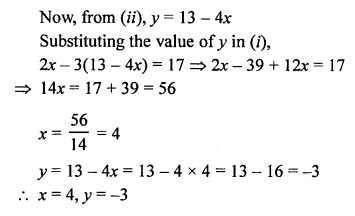
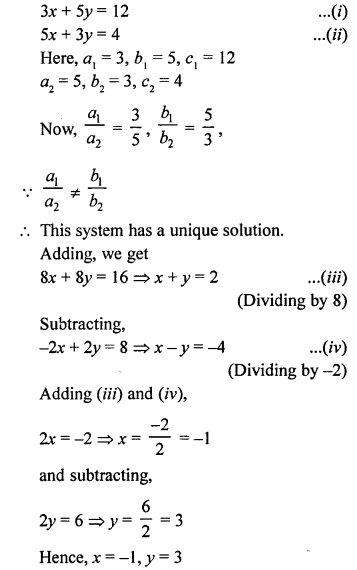
Solution:
RS Aggarwal Class 10 Solutions Chapter 3 Linear equations in two variables Ex 3D 1

Question 2.
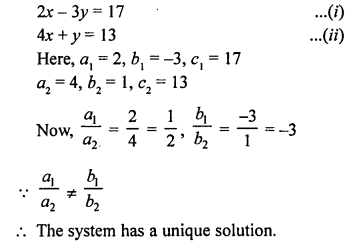
Solution:
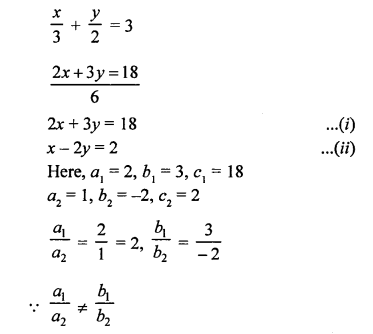
RS Aggarwal Class 10 Solutions Chapter 3 Linear equations in two variables Ex 3D 2
RS Aggarwal Class 10 Solutions Chapter 3 Linear equations in two variables Ex 3D 3

Question 3.
Solution:
RS Aggarwal Class 10 Solutions Chapter 3 Linear equations in two variables Ex 3D 4
This system has a unique solution.
From (ii), x = 2 + 2y
Substituting the value of x in (i),
2(2 + 2y) + 3y = 18
=> 4 + 4y + 3y = 18
=> 7y = 18 – 4 = 14
=> y = 2
and x = 2 + 2 x 2 = 2 + 4 = 6
x = 6, y = 2

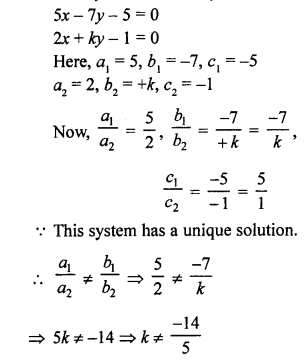
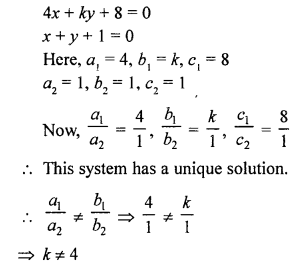
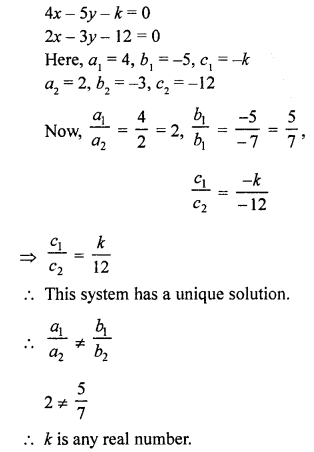
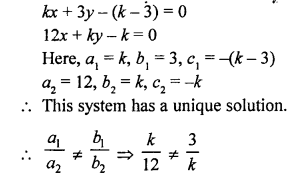
Find the value of k for which each of the following systems of equations has a unique solution:
Question 4.
Solution:
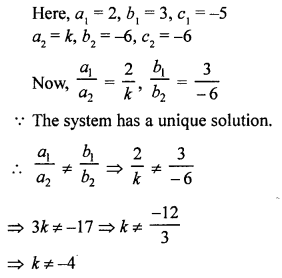
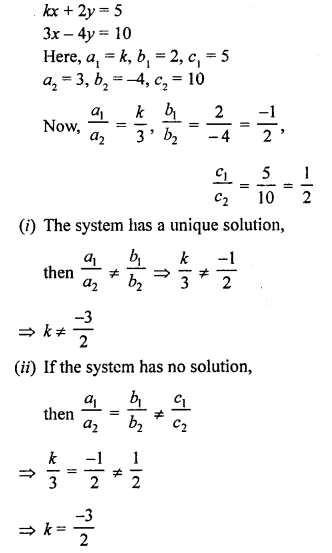
RS Aggarwal Class 10 Solutions Chapter 3 Linear equations in two variables Ex 3D 5

Question 5.
Solution:
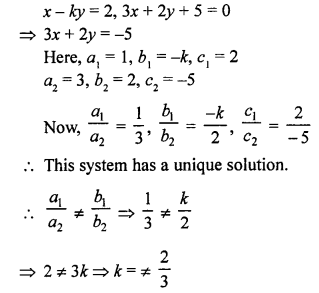
RS Aggarwal Class 10 Solutions Chapter 3 Linear equations in two variables Ex 3D 6

Question 6.
Solution:
RS Aggarwal Class 10 Solutions Chapter 3 Linear equations in two variables Ex 3D 7

Question 7.
Solution:
RS Aggarwal Class 10 Solutions Chapter 3 Linear equations in two variables Ex 3D 8

Question 8.
Solution:
RS Aggarwal Class 10 Solutions Chapter 3 Linear equations in two variables Ex 3D 9

Question 9.
Solution:
RS Aggarwal Class 10 Solutions Chapter 3 Linear equations in two variables Ex 3D 10
RS Aggarwal Class 10 Solutions Chapter 3 Linear equations in two variables Ex 3D 11

Question 10.
Solution:
RS Aggarwal Class 10 Solutions Chapter 3 Linear equations in two variables Ex 3D 12

Question 11.
Solution:
RS Aggarwal Class 10 Solutions Chapter 3 Linear equations in two variables Ex 3D 13

Question 12.
Solution:
RS Aggarwal Class 10 Solutions Chapter 3 Linear equations in two variables Ex 3D 14

Question 13.
Solution:
RS Aggarwal Class 10 Solutions Chapter 3 Linear equations in two variables Ex 3D 15
RS Aggarwal Class 10 Solutions Chapter 3 Linear equations in two variables Ex 3D 16

Question 14.
Solution:
RS Aggarwal Class 10 Solutions Chapter 3 Linear equations in two variables Ex 3D 17

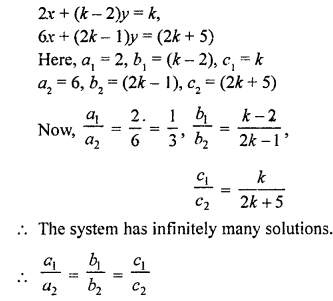
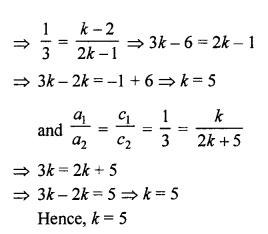
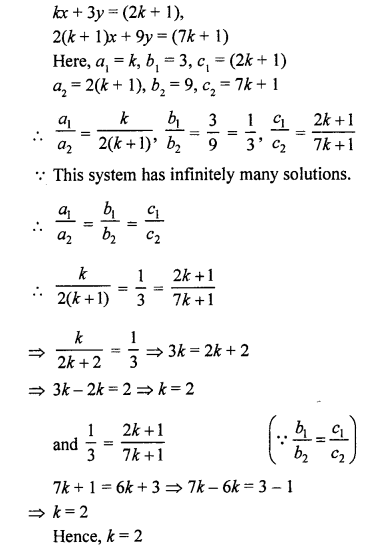
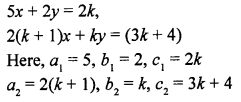
Find the value of k for which each of the following systems of linear equations has an infinite number of solutions:
Question 15.
Solution:
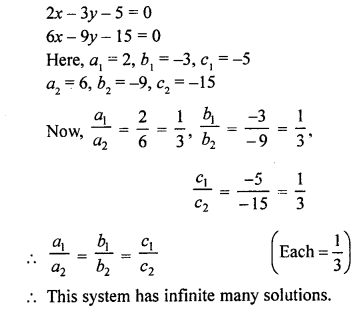
RS Aggarwal Class 10 Solutions Chapter 3 Linear equations in two variables Ex 3D 18

Question 16.
Solution:
RS Aggarwal Class 10 Solutions Chapter 3 Linear equations in two variables Ex 3D 19
RS Aggarwal Class 10 Solutions Chapter 3 Linear equations in two variables Ex 3D 20

Question 17.
Solution:
RS Aggarwal Class 10 Solutions Chapter 3 Linear equations in two variables Ex 3D 21

Question 18.
Solution:
RS Aggarwal Class 10 Solutions Chapter 3 Linear equations in two variables Ex 3D 22
RS Aggarwal Class 10 Solutions Chapter 3 Linear equations in two variables Ex 3D 23

Question 19.
Solution:
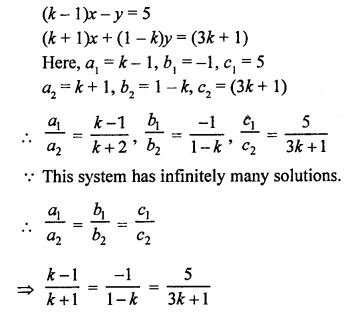
RS Aggarwal Class 10 Solutions Chapter 3 Linear equations in two variables Ex 3D 24
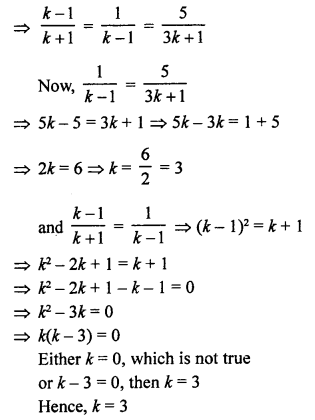
RS Aggarwal Class 10 Solutions Chapter 3 Linear equations in two variables Ex 3D 25

Question 20.
Solution:
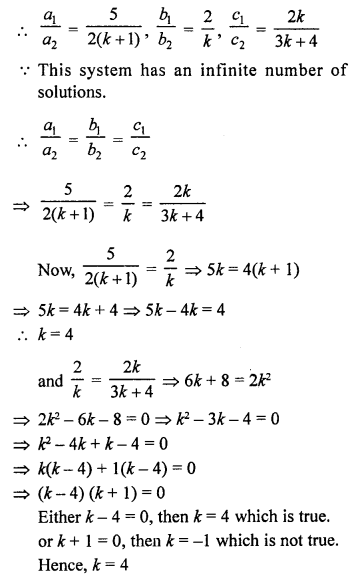
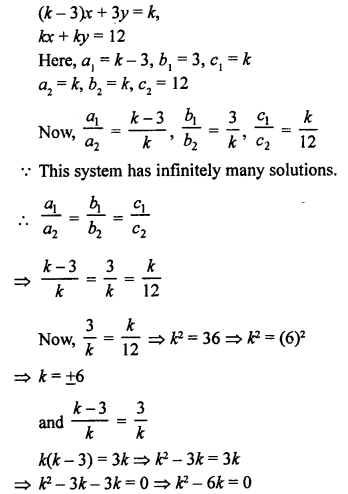
RS Aggarwal Class 10 Solutions Chapter 3 Linear equations in two variables Ex 3D 26
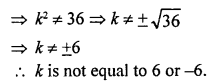
=> k (k – 6) = 0
Either k = 0, which is not true, or k – 6 = 0, then k = 6
k = 6

Find the values of a and b for which each of the following systems of linear equations has an infinite number of solutions:
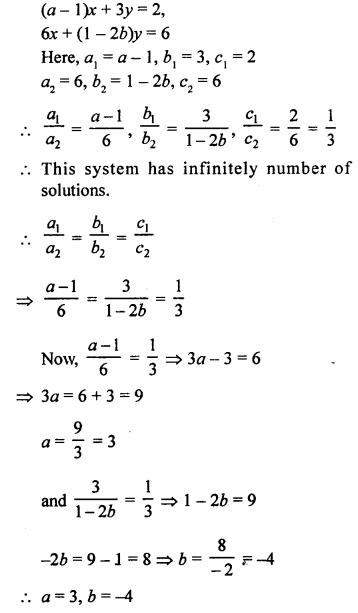
Question 21.
Solution:
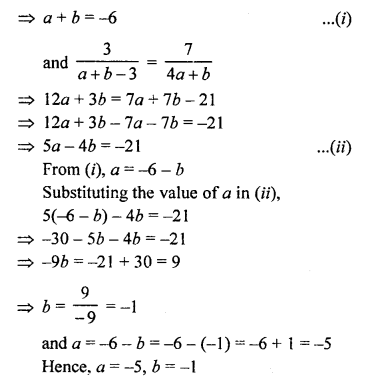
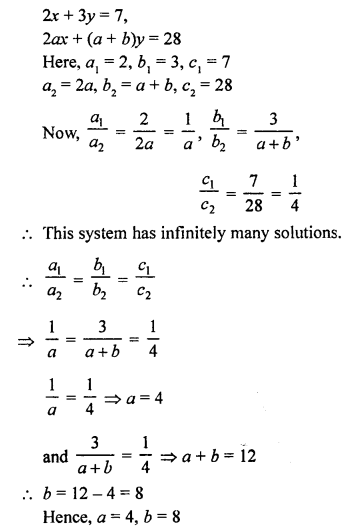
RS Aggarwal Class 10 Solutions Chapter 3 Linear equations in two variables Ex 3D 27

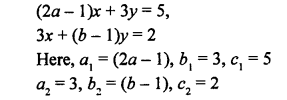
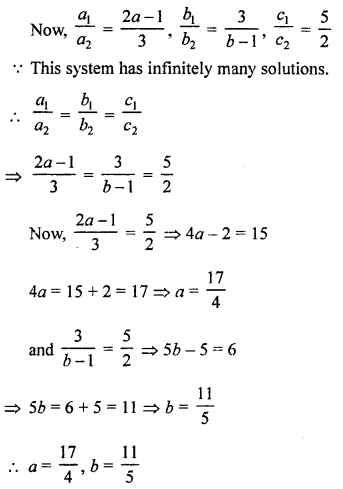
Question 22.
Solution:
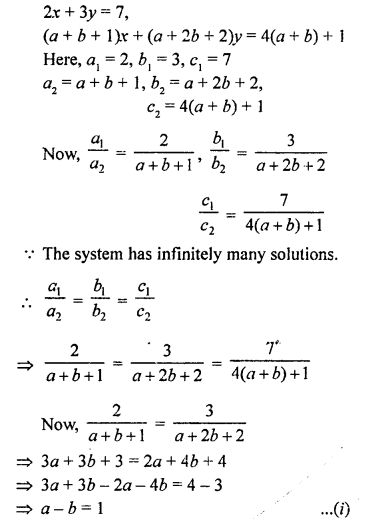
RS Aggarwal Class 10 Solutions Chapter 3 Linear equations in two variables Ex 3D 28
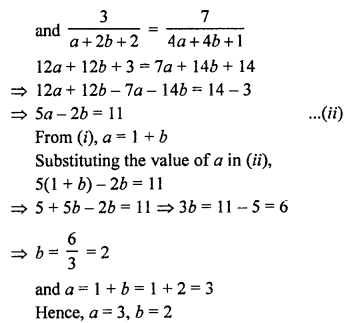
RS Aggarwal Class 10 Solutions Chapter 3 Linear equations in two variables Ex 3D 29

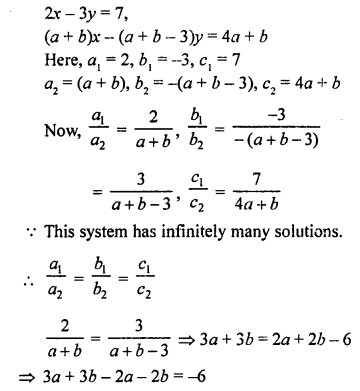
Question 23.
Solution:
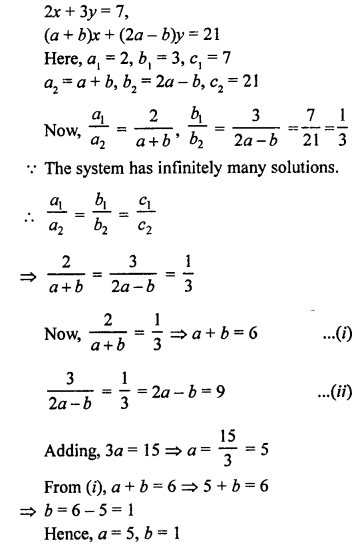
RS Aggarwal Class 10 Solutions Chapter 3 Linear equations in two variables Ex 3D 30
RS Aggarwal Class 10 Solutions Chapter 3 Linear equations in two variables Ex 3D 31

Question 24.
Solution:
RS Aggarwal Class 10 Solutions Chapter 3 Linear equations in two variables Ex 3D 32
RS Aggarwal Class 10 Solutions Chapter 3 Linear equations in two variables Ex 3D 33

Question 25.
Solution:
RS Aggarwal Class 10 Solutions Chapter 3 Linear equations in two variables Ex 3D 34

Question 26.
Solution:
RS Aggarwal Class 10 Solutions Chapter 3 Linear equations in two variables Ex 3D 35

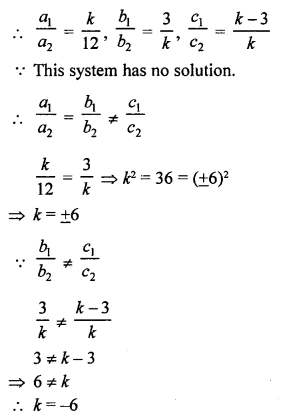
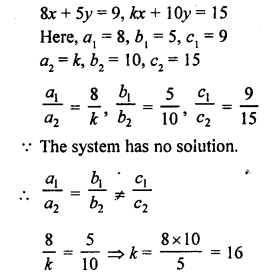
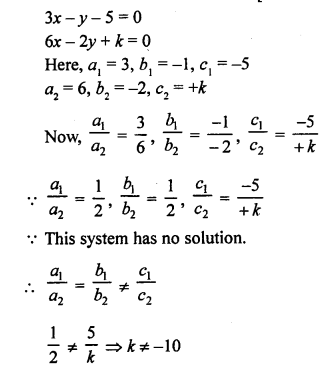
Find the value of k for which each of the following systems of equations has no solution:
Question 27.
Solution:
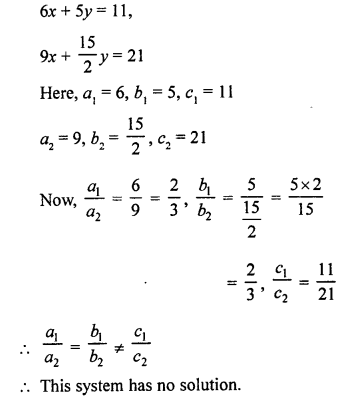
RS Aggarwal Class 10 Solutions Chapter 3 Linear equations in two variables Ex 3D 36

Question 28.
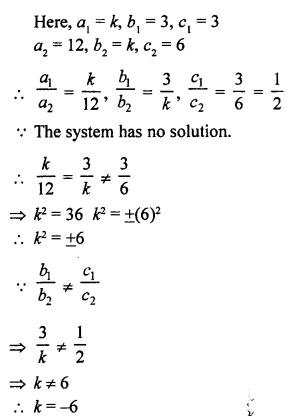
Solution:
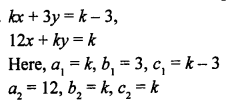
kx + 3y = 3
12x + ky = 6
RS Aggarwal Class 10 Solutions Chapter 3 Linear equations in two variables Ex 3D 37

Question 29.
Solution:
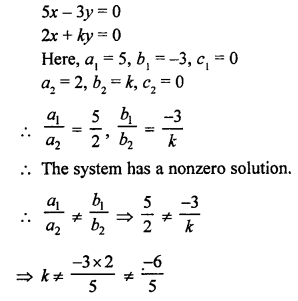
RS Aggarwal Class 10 Solutions Chapter 3 Linear equations in two variables Ex 3D 38

Question 30.
Solution:
RS Aggarwal Class 10 Solutions Chapter 3 Linear equations in two variables Ex 3D 39
RS Aggarwal Class 10 Solutions Chapter 3 Linear equations in two variables Ex 3D 40

Question 31.
Solution:
RS Aggarwal Class 10 Solutions Chapter 3 Linear equations in two variables Ex 3D 41

Hope given RS Aggarwal Solutions Class 10 Chapter 3 Linear equations in two variables Ex 3D are helpful to complete your math homework.

If you have any doubts, please comment below. Learn Insta try to provide online math tutoring for you.

RS Aggarwal Class 10 Solutions Chapter 10 Quadratic Equations Ex 10A

NCERT Maths Solutions for Ex 4.1 class 10 Quadratic Equations is the perfect guide to boost up your preparation during CBSE 10th Class Maths Examination.

RS Aggarwal Class 10 Solutions Chapter 10 Quadratic Equations Ex 10A

These Solutions are part of RS Aggarwal Solutions Class 10. Here we have given RS Aggarwal Solutions Class 10 Chapter 10 Quadratic Equations Ex 10A.

Other Exercises

Question 1.
Solution:
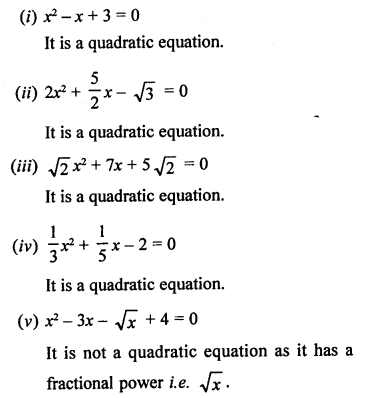
We know that a second degree of equation is called a quadratic equation. Therefore,
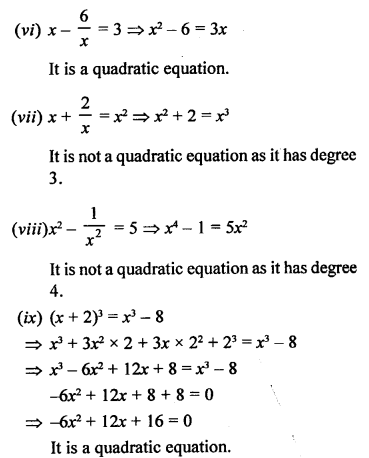
RS Aggarwal Class 10 Solutions Chapter 10 Quadratic Equations Ex 10A 1
RS Aggarwal Class 10 Solutions Chapter 10 Quadratic Equations Ex 10A 2
RS Aggarwal Class 10 Solutions Chapter 10 Quadratic Equations Ex 10A 3
It is not a quadratic equation. It is of degree 5.
So, (i), (ii), (iii), (iv), (vi) and (ix) are quadratic equations.

Question 2.
Solution:
3x² + 2x – 1
= 3x² + 3x – x – 1
= 3x (x + 1) – 1 (x + 1)
= (x + 1) (3x – 1)
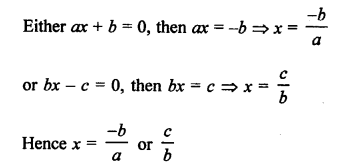
Either, x + 1 = 0 ⇒ x = -1
or 3x – 1 =0
⇒ 3x = 1
⇒ x = \(\frac { 1 }{ 3 }\)
Hence, (-1) and \(\frac { 1 }{ 3 }\) are its roots.

Question 3.
Solution:
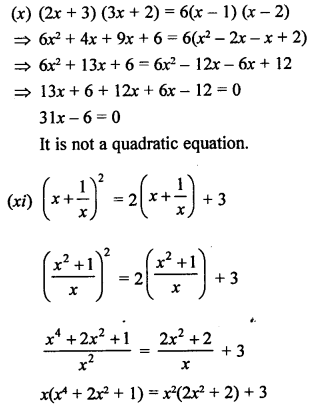
RS Aggarwal Class 10 Solutions Chapter 10 Quadratic Equations Ex 10A 4
RS Aggarwal Class 10 Solutions Chapter 10 Quadratic Equations Ex 10A 5

Question 4.
Solution:
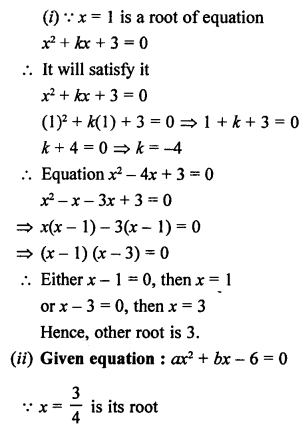
RS Aggarwal Class 10 Solutions Chapter 10 Quadratic Equations Ex 10A 6
RS Aggarwal Class 10 Solutions Chapter 10 Quadratic Equations Ex 10A 7

Solve each of the following quadratic equations.

Question 5.
Solution:
Given : (2x – 3)(3x + 1) = 0
Either 2x – 3 = 0, then 2x = 3 ⇒ x = \(\frac { 3 }{ 2 }\)
or 3x + 1 = 0, then 3x = -1 ⇒ x = \(\frac { -1 }{ 3 }\)
x = \(\frac { 3 }{ 2 }\) , \(\frac { -1 }{ 3 }\)

Question 6.
Solution:
4×2 + 5x = 0 ⇒ x (4x + 5) = 0
Either x = 0
or 4x + 5 = 0, then 4x = -5 ⇒ x = \(\frac { -5 }{ 4 }\)
x = \(\frac { -5 }{ 4 }\) or 0

Question 7.
Solution:
3x² – 243 = 0
x² – 81 =0 (Dividing by 3)
⇒ (x)² – (9)² = 0
⇒ (x + 9) (x – 9) = 0
Either, x + 9 = 0, then x = -9
or x – 9 = 0, then x = 9
Hence, x = 9 or -9

Question 8.
Solution:
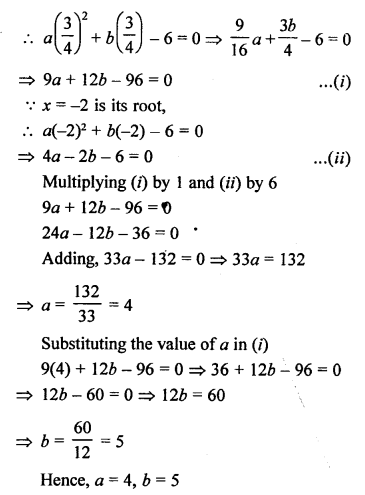
RS Aggarwal Class 10 Solutions Chapter 10 Quadratic Equations Ex 10A 8

Question 9.
Solution:
RS Aggarwal Class 10 Solutions Chapter 10 Quadratic Equations Ex 10A 9

Question 10.
Solution:
RS Aggarwal Class 10 Solutions Chapter 10 Quadratic Equations Ex 10A 10
RS Aggarwal Class 10 Solutions Chapter 10 Quadratic Equations Ex 10A 11

Question 11.
Solution:
RS Aggarwal Class 10 Solutions Chapter 10 Quadratic Equations Ex 10A 12

Question 12.
Solution:
RS Aggarwal Class 10 Solutions Chapter 10 Quadratic Equations Ex 10A 13

Question 13.
Solution:
RS Aggarwal Class 10 Solutions Chapter 10 Quadratic Equations Ex 10A 14
RS Aggarwal Class 10 Solutions Chapter 10 Quadratic Equations Ex 10A 15

Question 14.
Solution:
RS Aggarwal Class 10 Solutions Chapter 10 Quadratic Equations Ex 10A 16

Question 15.
Solution:
RS Aggarwal Class 10 Solutions Chapter 10 Quadratic Equations Ex 10A 17

Question 16.
Solution:
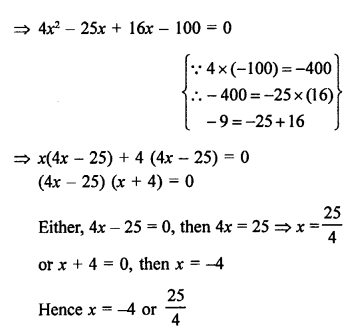
4x² – 9x = 100
4x² – 9x – 100 = 0
RS Aggarwal Class 10 Solutions Chapter 10 Quadratic Equations Ex 10A 18

Question 17.
Solution:
RS Aggarwal Class 10 Solutions Chapter 10 Quadratic Equations Ex 10A 19

Question 18.
Solution:
RS Aggarwal Class 10 Solutions Chapter 10 Quadratic Equations Ex 10A 20
RS Aggarwal Class 10 Solutions Chapter 10 Quadratic Equations Ex 10A 21

Question 19.
Solution:
RS Aggarwal Class 10 Solutions Chapter 10 Quadratic Equations Ex 10A 22

Question 20.
Solution:
RS Aggarwal Class 10 Solutions Chapter 10 Quadratic Equations Ex 10A 23

Question 21.
Solution:
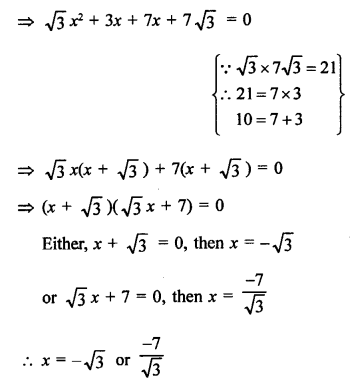
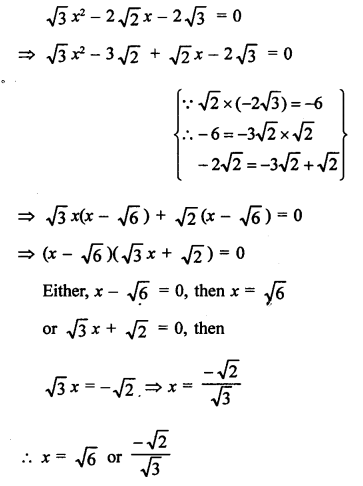
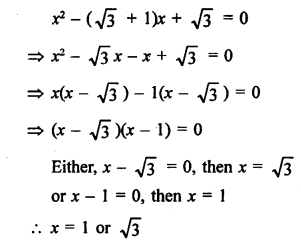
√3 x² + 10x + 7√3 = 0
RS Aggarwal Class 10 Solutions Chapter 10 Quadratic Equations Ex 10A 24

Question 22.
Solution:
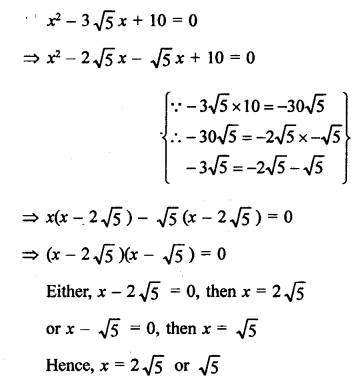
RS Aggarwal Class 10 Solutions Chapter 10 Quadratic Equations Ex 10A 25

Question 23.
Solution:
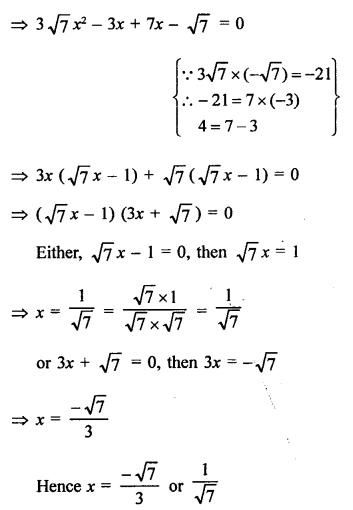
3√7 x² + 4x + √7 = 0
RS Aggarwal Class 10 Solutions Chapter 10 Quadratic Equations Ex 10A 26

Question 24.
Solution:
RS Aggarwal Class 10 Solutions Chapter 10 Quadratic Equations Ex 10A 27
RS Aggarwal Class 10 Solutions Chapter 10 Quadratic Equations Ex 10A 28

Question 25.
Solution:
RS Aggarwal Class 10 Solutions Chapter 10 Quadratic Equations Ex 10A 29
RS Aggarwal Class 10 Solutions Chapter 10 Quadratic Equations Ex 10A 30

Question 26.
Solution:
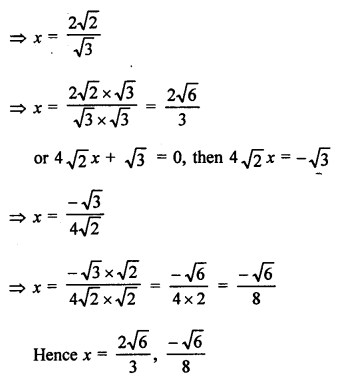
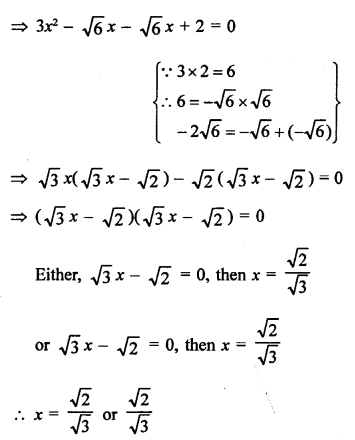
3x² – 2√6x + 2 = 0
RS Aggarwal Class 10 Solutions Chapter 10 Quadratic Equations Ex 10A 31

Question 27.
Solution:
RS Aggarwal Class 10 Solutions Chapter 10 Quadratic Equations Ex 10A 32

Question 28.
Solution:
RS Aggarwal Class 10 Solutions Chapter 10 Quadratic Equations Ex 10A 33

Question 29.
Solution:
RS Aggarwal Class 10 Solutions Chapter 10 Quadratic Equations Ex 10A 34

Question 30.
Solution:
RS Aggarwal Class 10 Solutions Chapter 10 Quadratic Equations Ex 10A 35
RS Aggarwal Class 10 Solutions Chapter 10 Quadratic Equations Ex 10A 36

Question 31.
Solution:
RS Aggarwal Class 10 Solutions Chapter 10 Quadratic Equations Ex 10A 37

Question 32.
Solution:
RS Aggarwal Class 10 Solutions Chapter 10 Quadratic Equations Ex 10A 38

Question 33.
Solution:
RS Aggarwal Class 10 Solutions Chapter 10 Quadratic Equations Ex 10A 39

Question 34.
Solution:
RS Aggarwal Class 10 Solutions Chapter 10 Quadratic Equations Ex 10A 40

Question 35.
Solution:
RS Aggarwal Class 10 Solutions Chapter 10 Quadratic Equations Ex 10A 41

Question 36.
Solution:
RS Aggarwal Class 10 Solutions Chapter 10 Quadratic Equations Ex 10A 42

Question 37.
Solution:
RS Aggarwal Class 10 Solutions Chapter 10 Quadratic Equations Ex 10A 43

Question 38.
Solution:
RS Aggarwal Class 10 Solutions Chapter 10 Quadratic Equations Ex 10A 44

Question 39.
Solution:
RS Aggarwal Class 10 Solutions Chapter 10 Quadratic Equations Ex 10A 45

Question 40.
Solution:
RS Aggarwal Class 10 Solutions Chapter 10 Quadratic Equations Ex 10A 46
RS Aggarwal Class 10 Solutions Chapter 10 Quadratic Equations Ex 10A 47

Question 41.
Solution:
RS Aggarwal Class 10 Solutions Chapter 10 Quadratic Equations Ex 10A 48

Question 42.
Solution:
RS Aggarwal Class 10 Solutions Chapter 10 Quadratic Equations Ex 10A 49
RS Aggarwal Class 10 Solutions Chapter 10 Quadratic Equations Ex 10A 50

Question 43.
Solution:
RS Aggarwal Class 10 Solutions Chapter 10 Quadratic Equations Ex 10A 51

Question 44.
Solution:
RS Aggarwal Class 10 Solutions Chapter 10 Quadratic Equations Ex 10A 52

Question 45.
Solution:
RS Aggarwal Class 10 Solutions Chapter 10 Quadratic Equations Ex 10A 53

Question 46.
Solution:
RS Aggarwal Class 10 Solutions Chapter 10 Quadratic Equations Ex 10A 54
RS Aggarwal Class 10 Solutions Chapter 10 Quadratic Equations Ex 10A 55

Question 47.
Solution:
RS Aggarwal Class 10 Solutions Chapter 10 Quadratic Equations Ex 10A 56

Question 48.
Solution:
RS Aggarwal Class 10 Solutions Chapter 10 Quadratic Equations Ex 10A 57

Question 49.
Solution:
RS Aggarwal Class 10 Solutions Chapter 10 Quadratic Equations Ex 10A 58
RS Aggarwal Class 10 Solutions Chapter 10 Quadratic Equations Ex 10A 59

Question 50.
Solution:
RS Aggarwal Class 10 Solutions Chapter 10 Quadratic Equations Ex 10A 60

Question 51.
Solution:
RS Aggarwal Class 10 Solutions Chapter 10 Quadratic Equations Ex 10A 61

Question 52.
Solution:
RS Aggarwal Class 10 Solutions Chapter 10 Quadratic Equations Ex 10A 62

Question 53.
Solution:
RS Aggarwal Class 10 Solutions Chapter 10 Quadratic Equations Ex 10A 63

Question 54.
Solution:
RS Aggarwal Class 10 Solutions Chapter 10 Quadratic Equations Ex 10A 64
RS Aggarwal Class 10 Solutions Chapter 10 Quadratic Equations Ex 10A 65

Question 55.
Solution:
RS Aggarwal Class 10 Solutions Chapter 10 Quadratic Equations Ex 10A 66
RS Aggarwal Class 10 Solutions Chapter 10 Quadratic Equations Ex 10A 67
RS Aggarwal Class 10 Solutions Chapter 10 Quadratic Equations Ex 10A 68

Question 56.
Solution:
RS Aggarwal Class 10 Solutions Chapter 10 Quadratic Equations Ex 10A 69

Question 57.
Solution:
RS Aggarwal Class 10 Solutions Chapter 10 Quadratic Equations Ex 10A 70
RS Aggarwal Class 10 Solutions Chapter 10 Quadratic Equations Ex 10A 71

Question 58.
Solution:
RS Aggarwal Class 10 Solutions Chapter 10 Quadratic Equations Ex 10A 72
RS Aggarwal Class 10 Solutions Chapter 10 Quadratic Equations Ex 10A 73
RS Aggarwal Class 10 Solutions Chapter 10 Quadratic Equations Ex 10A 74

Question 59.
Solution:
RS Aggarwal Class 10 Solutions Chapter 10 Quadratic Equations Ex 10A 75
RS Aggarwal Class 10 Solutions Chapter 10 Quadratic Equations Ex 10A 76
RS Aggarwal Class 10 Solutions Chapter 10 Quadratic Equations Ex 10A 77
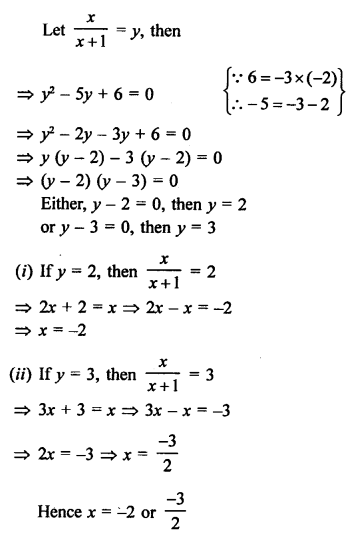
⇒ x = -2
Roots, x = -2

Question 60.
Solution:
RS Aggarwal Class 10 Solutions Chapter 10 Quadratic Equations Ex 10A 78
RS Aggarwal Class 10 Solutions Chapter 10 Quadratic Equations Ex 10A 79

Question 61.
Solution:
RS Aggarwal Class 10 Solutions Chapter 10 Quadratic Equations Ex 10A 80

Question 62.
Solution:
RS Aggarwal Class 10 Solutions Chapter 10 Quadratic Equations Ex 10A 81
RS Aggarwal Class 10 Solutions Chapter 10 Quadratic Equations Ex 10A 82

Question 63.
Solution:
RS Aggarwal Class 10 Solutions Chapter 10 Quadratic Equations Ex 10A 83
RS Aggarwal Class 10 Solutions Chapter 10 Quadratic Equations Ex 10A 84

Question 64.
Solution:
RS Aggarwal Class 10 Solutions Chapter 10 Quadratic Equations Ex 10A 85
RS Aggarwal Class 10 Solutions Chapter 10 Quadratic Equations Ex 10A 86
RS Aggarwal Class 10 Solutions Chapter 10 Quadratic Equations Ex 10A 87

Question 65.
Solution:
RS Aggarwal Class 10 Solutions Chapter 10 Quadratic Equations Ex 10A 88
RS Aggarwal Class 10 Solutions Chapter 10 Quadratic Equations Ex 10A 89

Question 66.
Solution:
RS Aggarwal Class 10 Solutions Chapter 10 Quadratic Equations Ex 10A 90
RS Aggarwal Class 10 Solutions Chapter 10 Quadratic Equations Ex 10A 91

Question 67.
Solution:
RS Aggarwal Class 10 Solutions Chapter 10 Quadratic Equations Ex 10A 92
RS Aggarwal Class 10 Solutions Chapter 10 Quadratic Equations Ex 10A 93

Question 68.
Solution:
RS Aggarwal Class 10 Solutions Chapter 10 Quadratic Equations Ex 10A 94

Question 69.
Solution:
RS Aggarwal Class 10 Solutions Chapter 10 Quadratic Equations Ex 10A 95
RS Aggarwal Class 10 Solutions Chapter 10 Quadratic Equations Ex 10A 96

Question 70.
Solution:
RS Aggarwal Class 10 Solutions Chapter 10 Quadratic Equations Ex 10A 97
RS Aggarwal Class 10 Solutions Chapter 10 Quadratic Equations Ex 10A 98

Question 71.
Solution:
RS Aggarwal Class 10 Solutions Chapter 10 Quadratic Equations Ex 10A 99

Question 72.
Solution:
RS Aggarwal Class 10 Solutions Chapter 10 Quadratic Equations Ex 10A 100
RS Aggarwal Class 10 Solutions Chapter 10 Quadratic Equations Ex 10A 101

Question 73.
Solution:
RS Aggarwal Class 10 Solutions Chapter 10 Quadratic Equations Ex 10A 102

Hope given RS Aggarwal Solutions Class 10 Chapter 10 Quadratic Equations Ex 10A are helpful to complete your math homework.

If you have any doubts, please comment below. Learn Insta try to provide online math tutoring for you.

RS Aggarwal Class 10 Solutions Chapter 2 Polynomials Ex 2A

NCERT Maths Solutions for Ex 2.1 class 10 Polynomials is the perfect guide to boost up your preparation during CBSE 10th Class Maths Examination.

RS Aggarwal Class 10 Solutions Chapter 2 Polynomials Ex 2A

These Solutions are part of RS Aggarwal Solutions Class 10. Here we have given RS Aggarwal Class 10 Solutions Chapter 2 Polynomials Ex 2A

Other Exercises

Find the zeros of the following quadratic polynomials and verify the relationship between the zeros and the coefficients:
Question 1.
Solution:
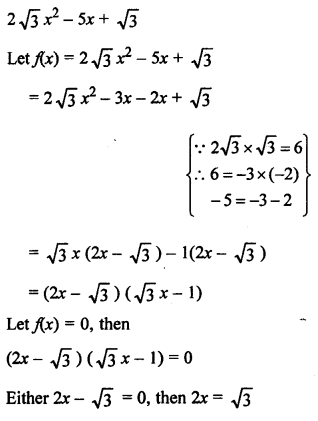
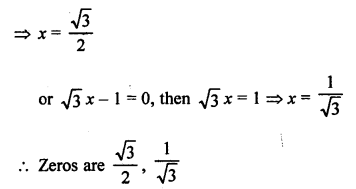
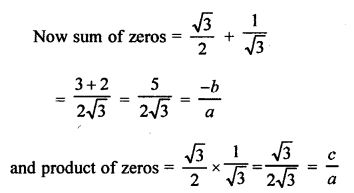
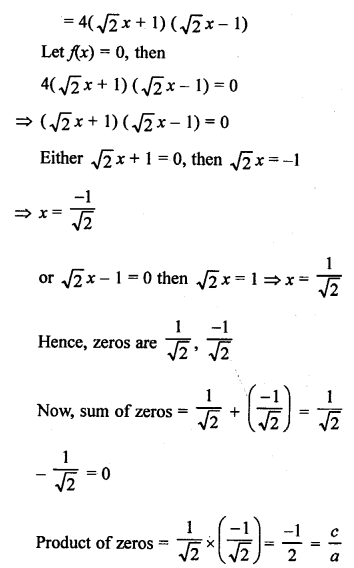
RS Aggarwal Class 10 Solutions Chapter 2 Polynomials Ex 2A 1

Question 2.
Solution:
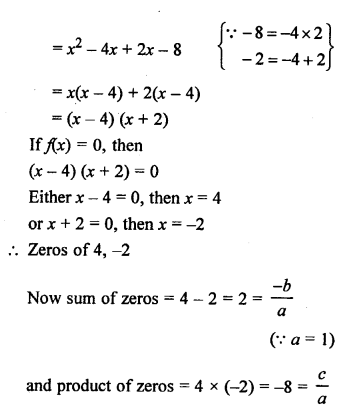
x² – 2x – 8
Let f(x) = x² – 2x – 8
RS Aggarwal Class 10 Solutions Chapter 2 Polynomials Ex 2A 2

Question 3.
Solution:
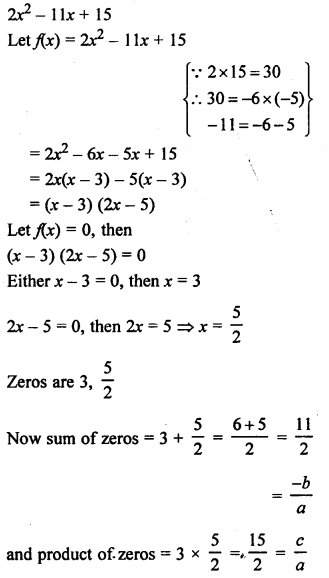
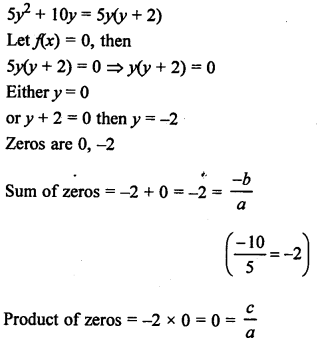
RS Aggarwal Class 10 Solutions Chapter 2 Polynomials Ex 2A 3

Question 4.
Solution:
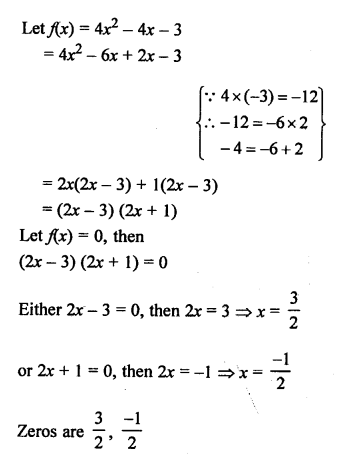
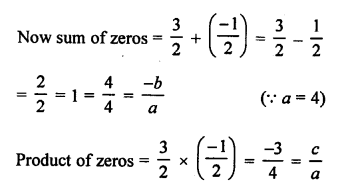
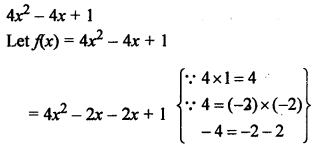
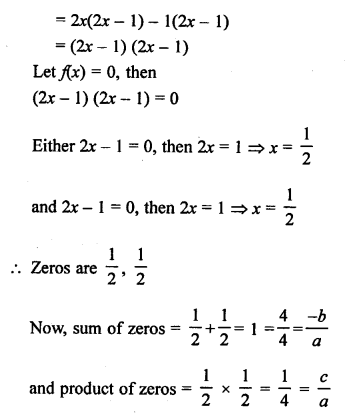
4x² – 4x – 3
RS Aggarwal Class 10 Solutions Chapter 2 Polynomials Ex 2A 4
RS Aggarwal Class 10 Solutions Chapter 2 Polynomials Ex 2A 5

Question 5.
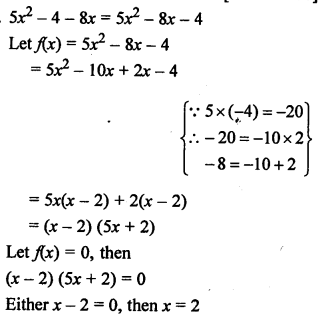
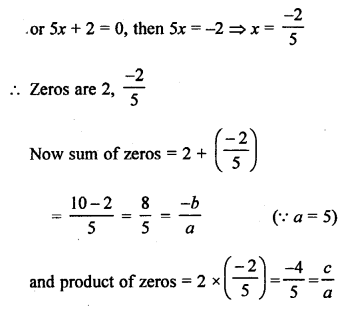
Solution:
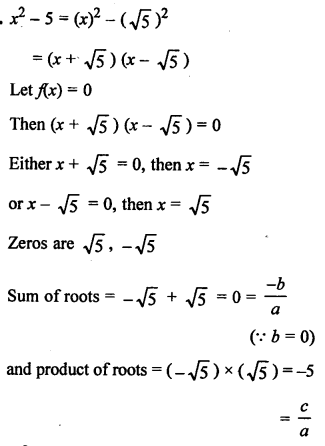
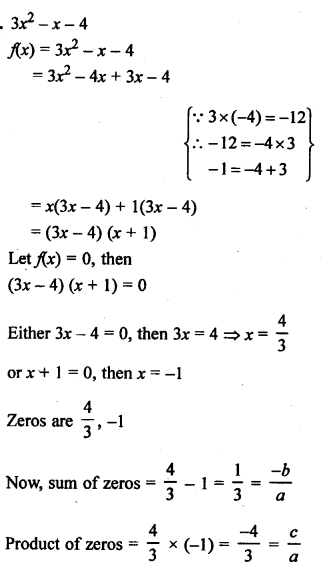
RS Aggarwal Class 10 Solutions Chapter 2 Polynomials Ex 2A 6
RS Aggarwal Class 10 Solutions Chapter 2 Polynomials Ex 2A 7

Question 6.
Solution:
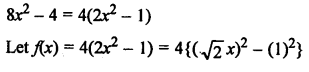
RS Aggarwal Class 10 Solutions Chapter 2 Polynomials Ex 2A 8
RS Aggarwal Class 10 Solutions Chapter 2 Polynomials Ex 2A 9
RS Aggarwal Class 10 Solutions Chapter 2 Polynomials Ex 2A 10

Question 7.
Solution:
RS Aggarwal Class 10 Solutions Chapter 2 Polynomials Ex 2A 11

Question 8.
Solution:
RS Aggarwal Class 10 Solutions Chapter 2 Polynomials Ex 2A 12
RS Aggarwal Class 10 Solutions Chapter 2 Polynomials Ex 2A 13

Question 9.
Solution:
RS Aggarwal Class 10 Solutions Chapter 2 Polynomials Ex 2A 14

Question 10.
Solution:
RS Aggarwal Class 10 Solutions Chapter 2 Polynomials Ex 2A 15
RS Aggarwal Class 10 Solutions Chapter 2 Polynomials Ex 2A 16

Question 11.
Solution:
RS Aggarwal Class 10 Solutions Chapter 2 Polynomials Ex 2A 17

Question 12.
Solution:
RS Aggarwal Class 10 Solutions Chapter 2 Polynomials Ex 2A 18

Question 13.
Solution:
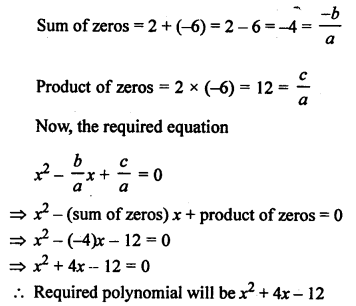
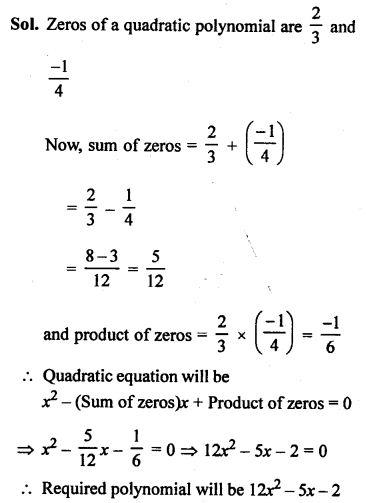
Zeros of a quadratic polynomial are 2, -6
RS Aggarwal Class 10 Solutions Chapter 2 Polynomials Ex 2A 19

Question 14.
Solution:
RS Aggarwal Class 10 Solutions Chapter 2 Polynomials Ex 2A 20

Question 15.
Solution:
Sum of zeros = 8
Product of zeros = 12
Quadratic equation will be x² – (Sum of zeros) x + Product of zeros = 0
=> x² – 8x + 12 = 0
=> x² – 6x – 2x + 12 = 0
=> x (x – 6) – 2 (x – 6) = 0
=> (x – 6) (x – 2) = 0
Either x – 6 = 0, then x = 6
or x – 2 = 0, then x = 2
Zeros are 6, 2
and quadratic polynomial is x² – 8x + 12

Question 16.
Solution:
Sum of zeros = 0
and product of zeros = -1
Quadratic equation will be
x² – (Sum of zeros) x + Product of zeros = 0
=> x² – 0x – 1 = 0
=> x² – 1= 0
(x + 1)(x – 1) = 0
Either x + 1 = 0, then x = -1 or x – 1 =0, then x = 1
Zeros are 1, -1
and quadratic polynomial is x² – 1

Question 17.
Solution:
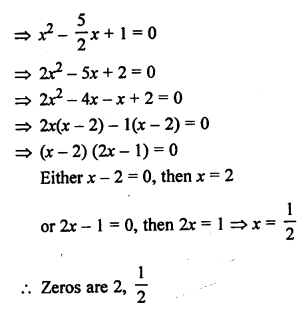
Sum of zeros = \(\frac { 5 }{ 2 }\)
Product of zeros = 1
Quadratic equation will be
x² – (Sum of zeros) x + Product of zeros = 0
RS Aggarwal Class 10 Solutions Chapter 2 Polynomials Ex 2A 21
and quadratic polynomial is 2x² – 5x + 2

Question 18.
Solution:
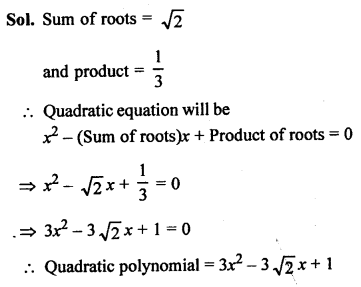
RS Aggarwal Class 10 Solutions Chapter 2 Polynomials Ex 2A 22

Question 19.
Solution:
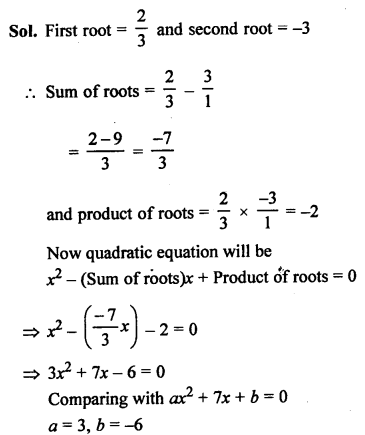
RS Aggarwal Class 10 Solutions Chapter 2 Polynomials Ex 2A 23

Question 20.
Solution:
RS Aggarwal Class 10 Solutions Chapter 2 Polynomials Ex 2A 24

Question 21.
Solution:
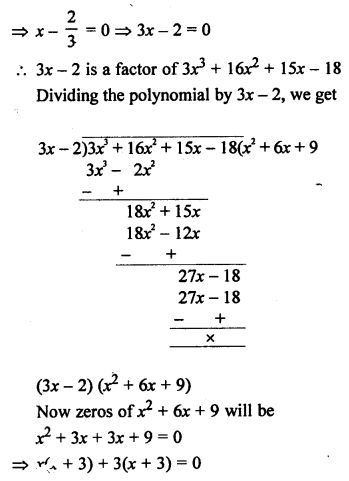
One zero of the given polynomial is \(\frac { 2 }{ 3 }\)
RS Aggarwal Class 10 Solutions Chapter 2 Polynomials Ex 2A 25
=> (x + 3) (x + 3) = 0
x = -3, -3
Hence, other zeros are -3, -3

Hope given RS Aggarwal Solutions Class 10 Chapter 2 Polynomials Ex 2A are helpful to complete your math homework.

If you have any doubts, please comment below. Learn Insta try to provide online math tutoring for you.