Sound Class 9 Important Questions Science Chapter 12

Chapter 12 Sound Class 9 Science Important Questions with Answers PDF will help you in scoring more marks in your exams.

Sound Class 9 Important Questions and Answers Science Chapter 12

VERY SHORT ANSWER QUESTIONS

Based on waves and sound

Question 1.
What is sound ?
Answer:
Sound is a form of energy which produces the sensation of hearing in our ears.

More Resources

Question 2.
What does wave transfer ?
Answer:
Wave transfers energy.

Question 3.
What is a mechanical wave ?
Answer:
A waves that are characterised by the motion of particles of a medium are called mechanical waves. These waves require material medium for their propagation.

Question 4.
What is a transverse wave ? (CBSE 2011)
Answer:
If the particles of the medium vibrate about their mean positions at right angles to the direction of propagation of the disturbance, then the wave is called transverse wave. Light is a transverse wave.

Question 5.
Differentiate between crest and trough. (CBSE 2013)
Answer:
The highest point on the elevation of the medium through which transverse wave travels is called crest.
The lowest point on the depression of the medium through which transverse wave travels is called trough.

Question 6.
What is a longitudinal wave ? (CBSE 2011)
Answer:
If the particles of a medium vibrate or oscillate to and fro about their mean positions along the direction of propagation of the disturbance, then the wave is called longitudinal wave. Sound wave is a longitudinal wave.

Question 7.
Name a wave which does not require a material medium for its propagation. (CBSE 2012)
Answer:
Electromagnetic wave.

Question 8.
What do you understand by the terms “compression” and “rarefaction” ? (CBSE 2012)
Answer:
A region of high pressure of a medium when sound wave travels through it is called compression. A region of low pressure of a medium when sound wave travels through it is called rarefaction.

Question 9.
What happens to the medium through which sound travels ?
Answer:
A medium is divided into the regions of high pressure or high density and regions of low pressure or low density called compressions and rarefactions respectively.

Question 10.
Define time period. (CBSE 2011, 2013, 2017)
Answer:
Time Taken by two consecutive compressions or rarefactions to cross a fixed point is called time period.

Question 11.
State SI unit of time period.
Answer:
second(s)

Question 12.
What do you understand by the frequency of a sound wave ? (CBSE 2011)
Answer:
The number of compressions or rarefactions crossing a point in one second is called the frequency of a sound wave.

Question 13.
State SI unit of frequency compressions or rarefactions crossing a point, hertz (Hz).
Answer:

Question 14.
Write relation between time period (T) and frequency (v).
Answer:
Sound Class 9 Important Questions Science Chapter 12 image - 1

Question 15.
What do you understand by the wavelength of a sound wave ? (CBSE 2015, 2017)
Answer:
Distance between two successive compressions or successive rarefactions is called wavelength of a sound wave.

Question 16.
State SI unit of wavelength. (CBSE 2012)
Answer:
metre (m).

Question 17.
State the meaning of the term “amplitude with reference to a wave. Mention its SI unit. (CBSE 2013)
Answer:
Maximum displacement of a particle of the medium from its mean position when wave travels through the medium. It SI unit is metre.

Question 18.
What type of wave is represented by density-distance graph ? (CBSE 2011)
Answer:
Longitudinal wave.

Question 19.
Name the physical quantity whose unit is ‘hertz’. (CBSE 2015)
Answer:
Frequency.

Question 20.
What do you understand by the pitch of a sound ? (CBSE 2012)
Answer:
Pitch of a sound is the characteristic of sound that depends on the frequency received by a human ear.

Question 21.
Name the physical quantity which determines the pitch of a sound.
Answer:
Frequency of a sound wave.

Question 22.
Write factor on which pitch of a sound depends ? (CBSE 2011, 2012)
Answer:
Pitch of a sound depends on the frequency of the wave.

Question 23.
What do you understand by the loudness of a sound ? (CBSE 2012)
Answer:
Amplitude of the vibrating body determines the loudness of the sound. Large is the amplitude of vibration, large is the loudness of the sound produced.

Question 24.
What do you mean by the intensity of sound ? (CBSE 2011)
Answer:
Sound energy per unit time per unit area is known as the intensity of sound.

Question 25.
Write the S.I. unit of intensity of sound.
Answer:
Js-1 m2 or Wm-2.

Question 26.
Out of which of the following media, the speed of sound is maximum : solid, liquid, gas.
Answer:
The speed of sound is maximum in solid medium.

Question 27.
Draw diagram to represent sound of high pitch and (b) low pitch, of the same loudness. (CBSE 2011, 2012)
Answer:
Sound Class 9 Important Questions Science Chapter 12 image - 2

Question 28.
Name the physical quantity which determines the loudness of a sound.
Answer:
Amplitude of the vibrating body.

Question 29.
Define the characteristic “timbre” or “quality” of a sound. (CBSE 2012, 2015)
Answer:
Quality or timbre is a characteristic of a sound which enables us to distinguish between two sounds of some loudness and pitch.

Question 30.
Speed of sound is more on hotter day. Explain. Why ? (CBSE 2013)
Answer:
Speed of sound increases with increase in temperature.

Based on Reflection of sound

Question 31.
What is an echo ? (CBSE Sample Paper 2010, 2011, 2012, 2015)
Answer:
Echo is a repetition of sound due to the reflection of original sound by a large and hard obstacle.

Question 32.
What should be the minimum distance between the source of sound and the obstacle to hear an echo ?
(CBSE 2011)
Answer:
17 metres.

Question 33.
Give one application where principle of echo is utilised. (CBSE 2011)
Answer:
Hearing aid.

Question 34.
Give example of multiple echoes. (CBSE 2014)
Answer:

  1. Rolling of thunder,
  2. Whispering galleries.

Question 35.
What do you understand by the reverberation ? (CBSE 2011, 2012, 2013)
Answer:
The penomenon of prolongation of original sound due to the multiple reflection of sound waves even after the source of sound stops producing sound is called reberberation.

Question 36.
What is reverberation time ?
Answer:
The time interval during which original sound appears to prolong.

Question 37.
What are infrasonic waves ? (CBSE 2012, 2013)
Answer:
The waves of frequency less than 20 Hz are called infrasonic waves.

Question 38.
What are ultrasonic waves ?  (CBSE 2012, 2013)

                             Or

What is ultrasound ? (CBSE 2012, 2015, 2017)
Answer:
The waves of frequency greater than 20,000 Hz are called ultrasonic waves or ultra sound.

Question 39.
What type of waves are produced by bats ?
Answer:
Ultrasonic waves.

Question 40.
State one important use of ultra sounds in industries.
Answer:
Ultra sounds are used to find faults and cracks in metals.

Question 41.
State two important uses of ultrasounds for medical purpose. (CBSE 2011, 2012, 2013, 2014)
Answer:

  1. Diagnosing the diseases in human body
  2. To analyse the development of an unborn child.

Question 42.
If 20 waves are produced per second, what is the frequency in Hertz ? {CBSE 2011)
Answer:
Frequency = 20 Hz.

Question 43.
What is echocardiography ? {CBSE 2012)
Answer:
It is the technique to construct the image of heart using ultrasonic waves.

Question 44.
Echoes can’t be heard in a small room. Explain. (CBSE 2013)
Answer:
The minimum distance between source of sound and the obstacle! to hear an echo should be 17m.

Question 45.
Therefore, echoes can’t be heard in a small room.

                                    Or

Write the hill form of “SONAR”. (CBSE 2011, 2015)

                                    Or

What is the acronym of SONAR ? (CBSE 2012)
Answer:
SONAR stands for Sound Navigation And Ranging.

Question 46.
What is the basic principle on which SONAR works ? (CBSE 2011, 2016)
Answer:
SONAR works on the principle of reflection of waves (i.e. echo).

Question 47.
Write one application of SONAR. (CBSE 2011, 2012)
Answer:
It is used to measure the depth of a sea.

Question 48.
What is the function of a detector in a SONAR ? (CBSE 2011)
Answer:
It detects the echo received to find the time taken by the wave to reach the SONAR from the bed of sea.

SHORT ANSWER QUESTIONS

Based on waves and sound

Question 1.
Mention the types of mechanical waves. Identify the type which can be produced in solids, liquids and gases. (CBSE 2015)
Answer:
Types of mechanical waves :

  1. Transverse wave,
  2. Longitudinal wave

Longitudinal wave can be produced in solids, liquids and gases.

Question 2.
Describe an activity to show that sound waves need medium to travel. (CBSE 2011, 2012)
Answer:
Sound Needs a Medium to Travel:
We have learnt that sound travels from one place to another place when the energy is transferred from one particle to another particle of a medium like air or gas, liquid, solid etc. It means, sound needs a material medium for its propagation. In other words, sound cannot travel through vacuum.
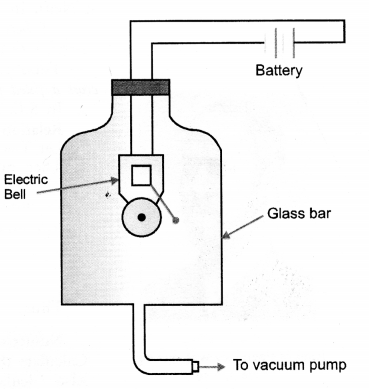
Demonstration to show that sound waves cannot travel through vacuum:
Put an electric bell inside a closed glass jar connected with a vacuum pump. Initially, air from the jar is not taken out. Connect the electric bell with a battery (Figure 10). It rings and the sound produced is heard by us.
Sound Class 9 Important Questions Science Chapter 12 image - 3
Now start evacuating the air from a glass jar using a vacuum pump, we will hear less and less sound, i.e. the loudness of the sound decreases. When there is no air in the glass jar, we do not hear sound. This activity demonstrates that sound waves require material medium (in this case air) for its propagation.

Question 3.
Sound cannot travel through vacuum. How will you demonstrate this fact ?
Answer:
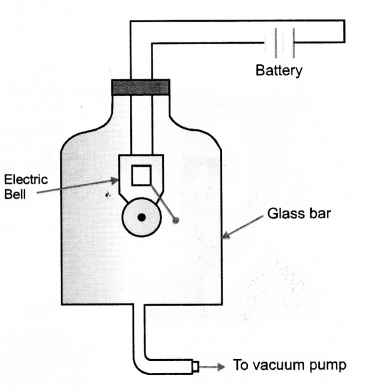
Demonstration to show that sound waves cannot travel through vacuum:
Put an electric bell inside a closed glass jar connected with a vacuum pump. Initially, air from the jar is not taken out. Connect the electric bell with a battery (Figure 10). It rings and the sound produced is heard by us.
Sound Class 9 Important Questions Science Chapter 12 image - 4
Now start evacuating the air from a glass jar using a vacuum pump, we will hear less and less sound, i.e. the loudness of the sound decreases. When there is no air in the glass jar, we do not hear sound. This activity demonstrates that sound waves require material medium (in this case air) for its propagation.

Question 4.
Write any three differences between transverse and longitudinal waves. (CBSE 2012, 2013)
Answer:

Transverse WaveLongitudinal Wave
1. In transverse wave propagation, the particles of the medium vibrate about their mean or equilibrium position at right angles to the direction of the propagation of the wave.In longitudinal wave, particles of the medium vibrate about their equilibrium position along the direction of the propagation of the wave.
2. When transverse wave travels through a medium, the shape of the medium changes.When longitudinal wave travels through a medium, medium is divided into the regions of high and low pressures.
3. Traverse wave can travel in solids and on the surface of liquids.Longitudinal waves can travel in solids, liquids and gases.

 Question 5.
Show that v = λv, where symbols have usual meanings.

                                                 Or

Establish relationship between speed of sound, its wavelength and frequency.
(NCERT Question Bank,CBSE 2012)
Answer:
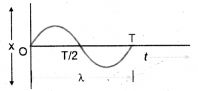
Let the time period of a vibrating body be T. It means, the vibrating body completes one oscillation in time T. One oscillation of a body is represented by a wave of wavelength λ as shown in figure 15.
Sound Class 9 Important Questions Science Chapter 12 image - 5
Sound Class 9 Important Questions Science Chapter 12 image - 6
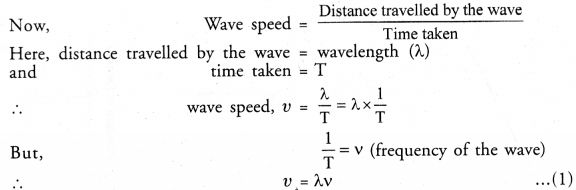
Thus, speed of wave= wavelength x frequency
Note : The speed of a mechanical wave (i.e. sound wave) is constant in a given medium. If sound of large frequency is produced by a vibrating body, then the wavelength of this sound wave will be small, so that speed = wavelength x frequency is constant
The speed of a sound wave differs only when the sound wave goes from one medium to another medium.

Question 6.
Sounds of same loudness and pitch but produced by different musical instruments like a violin and flute are distinguishable. Explain, why ? (CBSE 2012)

                                                                      Or

In an orchestra, violin and flute are played at the same time but still these are distinctly recognizable. Name the characteristic that makes it possible. (CBSE 2012)

                                                                      Or

Name the characteristic of sound that helps us to distinguish a note played on a sitar and a violin.
(CBSE 2012)
Answer:
This is due to the quality or timbre of sound waves.

Question 7.
A vibrating body produces sound. However, no sound is heard when a simple pendulum oscillates in air.
Explain the reason. (NCERT Question Bank)
Answer:
Sound is heard only if the body vibrates with a frequency more than 20 Hz and less than 20,000 Hz. The pendulum oscillates or vibrates with a frequency less than 20 Hz. Hence, no sound is heard when the pendulum vibrates or oscillates in air.

Question 8.
A boy strikes one end of a long iron pipe with a stone. Another boy who keeps his ear close to the other end of the pipe heard two sounds in a short interval of time. Explain, why? (CBSE 2011)
Answer:
When a boy strikes an iron pipe, sound is produced. The sound waves travel through air and the pipe. Since speed of sound in iron is greater than the speed of sound in air, so the sound travels faster through iron pipe than air. Hence, another boy hears two sounds, one travelling through iron pipe and the other travelling through the air.

Question 9.
Sound travels faster in summer season than in winter season. Explain, why ?
Answer:
This is because, speed of sound increases with increase in temperature.

Question 10.
Why is the speed of sound greater in solids than in gases ?
Answer:
This is because particle of solids are closer than the particles of gases.

Question 11.
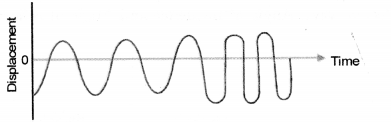
Draw a graph for a wave representing wave distrubance and time for a sound changing from low pitch to
high pitch, keeping amplitude of the sound same. (CBSE Sample Paper; 2011)
Answer:
Sound Class 9 Important Questions Science Chapter 12 image - 7

Question 12.
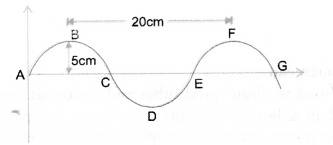
Waves of frequency 100 Hz are produced in a string as shown in figure. Give its :
(a) amplitude,
(b) wavelength
(c) velocity
(CBSE 2011, Similar CBSE 2014, 2015)
Sound Class 9 Important Questions Science Chapter 12 image - 8
Answer:
Here, v = 100 Hz
(a) Amplitude = 5 cm
(b) Wavelength = distance between two successive crests or troughs = 20 cm.
(c) Velocity, u = vλ = 100 Hz x 0.2 m = 20 m s-1

Question 13.
State the factors on which speed of sound depends. (CBSE 2011, 2012)
Answer:
Speed of sound depends on :

  1. nature of medium and
  2. temperature of the medium.

Speed of sound in solids is greater than in liquids and speed of sound in liquids in greater than in gases. Speed of sound increases with the increase in temperature of the medium and it decreases with the decrease in temperature of the medium.

Question 14.
The sound of an explosion on the surface of a lake is heard by a boatman 100m away and a diver 100m
below the point of explosion. Of the two presons mentioned (boatman or diver) who would hear the sound first ? And why ? {CBSE 2011, 2015)
Answer:
Since velocity of sound in water is more than the velocity of the sound in air, so the diver in the water will hear the sound of explosion earlier than the boatman.

Based on Reflection of sound

Question 15.
State two conditions for echo to be heard. (CBSE Sample Paper 2010, 2011, 2012, 2015)
Answer:
Echo can be heard if

  1. the minimum distance between the source of sound and the obstacle is 17 m.
  2. the obstacle is rigid and hard.

Question 16.
The reverberation time of a hall used for speeches should be very short. Explain why?
Answer:
If the reverberation time of a hall is long, then the multiple echoes will interfere with the original sound. Hence nothing will be heard distinctly. For this reason, the reverberation time of the hall should be very short.

Question 17.
Explain, how can you demonstrate the reflection of sound.
Answer:
When a sound wave travelling in a medium bounces back to the same medium after striking the second medium (which is solid), reflection of sound wave is said to take place. The reflection of sound wave is similar to the bouncing back of a rubber ball after striking a wall or the surface of a floor.
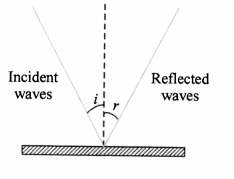
Just like light, sound is reflected by the solid and liquid surfaces. The reflection of sound obeys the laws of reflection. The laws of reflection of sound are as follows :

  1. Incident angle = Reflected angle and
  2. The incident direction of sound, reflected direction of sound and the normal to the point of incidence all lie in the same plane.

Question 18.
Describe multiple echoes. Write any two of their important applications. (CBSE 2011)
Answer:
When a sound wave is reflected many times by an obstacle, multiple echoes are heard. Multiple echoes are heard in whispering galleries.

Question 19.
State the laws of reflection of sound. (CBSE 2011)
Answer:

  1. Incident angle = reflected angle of sound wave
  2. Incident direction of sound, reflected direction of sound and the normal to the point of incidence all lie in the same plane.

Question 20.
Why we cannot hear an echo in a small room ? (CBSE 2011, 2012)
Answer:
To hear an echo, the minimum distance between the source of sound and the obstacle reflecting sound
waves must be 17m. However, the size of the room (i.e. the distance between two opposite walls) is less than 17m. Hence, we cannot hear an echo in a small room.

Question 21.
Mention one advantage and one disadvantage of reverberation. (CBSE 2013)
Answer:
A certain amount of reverberation improves the quality of sound of orchestral and choral music. However,
excessive reverberation makes the speech or music indistinct.

Question 22.
Draw a diagram showing laws of reflection followed by sound waves and label the following :
Incident wave, Reflected wave, Angle of incidence and Angle of reflection. (CBSE 2013)
Answer:
Sound Class 9 Important Questions Science Chapter 12 image - 9

Based on ultra sound, sonar and human ear

Question 23.
Explain how ultra sound is used to clean spiral tubes and electronic components ? (CBSE 2011, 2014)
Answer:
The spiral tubes are dipped in a liquid. The ultrasonic waves are passed through this liquid. These waves force the dirt or any other impurity out from the spiral tube and hence the tube is cleaned.

Question 24.
Waves of special frequencies are used for cleaning hard to reach places.
(a) Name the waves
(b) What is the frequency of these waves ?
(c) Explain how do these waves perform this work. (CBSE 2015)
Answer:
(a) Ultrasonic waves
(b) Frequency of ultrasonic waves is greater than 20,000 Hz and less than or equal to 10HZ.
(c) The spiral tubes are dipped in a liquid. The ultrasonic waves are passed through this liquid. These waves force the dirt or any other impurity out from the spiral tube and hence the tube is cleaned.

Question 25.
Give three medical uses of ultrasound. (CBSE 2014)
Answer:

  1. Diagnosing diseases in human body,
  2. To study the development of an unborn baby
  3. In echocardiography.

Question 26.
Why do we hear sound produced by the humming bees while the sound of vibrations of pendulum is not heard ? (CBSE 2011, 2013, 2015, 2016)
Answer:
Humming bees produces waves of frequency greater than 20 Hz, which are audible to us. On the other hand, frequency of vibration of pendulum is less than 20 Hz, which is not audible to us.

Question 27.
List three points which an engineer should use while designing an auditorium. (CBSE 2013)
Answer:

  1. Reverberation time should be small (or short).
  2. The ceiling of the auditorium should be curved.
  3. The ceiling of the auditorium should be made up of sound absorbing material.

Question 28.
A man fires a rifle in front of a cliff and hears the echo after 3 seconds. Calculate the distant of man from the cliff if velocity of sound in air is 340 m/s. (CBSE 2013)
Answer:
Time taken by sound to travel a distance between man and cliff, t = 3/2 = 1.5 s.
Distance of man from the cliff, S = vt = 340 x 1.5 = 510 m.

Question 29.
A detector installed on a ship receives an ultrasonic signal sent to underwater object after v seconds of its transmission. If the speed of sound in water is ‘v’ what is the depth of object. (CBSE 2015)
Answer:
Time taken by the signal to reach detector from the depth of object = t/2.
Speed of signal in water = v
∴ Depth of the object = vt/2.

Question 30.
What is ultra sound ? Explain how defects in a metal block can be detected using ultra sound.
(CBSE 2011, 2012)
Answer:
The waves of frequency range greater than 20,000 Hz and equal to 107 Hz are known as ultrasound.
A beam of ultrasound is thrown on the metal block under investigation. The picture of the metal block produced by the reflected ultrasound is taken on the screen or the monitor of the computer. The position of the crack or fault in the metal block can be detected by analysing the picture.

Question 31.
How is the pressure variation in a sound wave amplified in human ear ? (CBSE 2011)

                                                                 Or

How does the ear drum of human ear vibrate ? (CBSE 2012)
Answer:
The sound wave in the form of high pressure (compressions) and low pressure (rarefactions) reach the ear drum. When sound waves fall on ear drum, it begins to vibrate. The vibrations produced by the ear drum are amplifed by the three ossicles (i.e. hammer, anvil and the stirrup) in the middle of the ear.

LONG ANSWER QUESTIONS

Question 1.
Describe with the help of a diagram, how compressions and rarefactions are produced in air near a source of sound.
Answer:
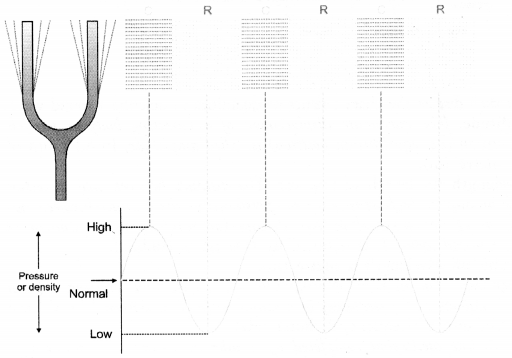
When a body vibrates, then the particles of the medium (say air) around the vibrating body are set into vibrations. The particles of the medium which are very close to the vibrating body are pushed away from the body. These particles of the medium strike against the neighbouring particles. Hence the number of particles of the medium in the region where the displaced particles strike against the neighbouring particles is large. This region is known as  compression (C).
Since pressure is directly proportional to the number of particles, so the compression is a region of high pressure or high density. When the vibrating body moves backward, a region of emptiness known as rarefaction (R) or a region of low pressure or low density is created. The displaced particles of the medium rebound into the region of low pressure or rarefaction. At the same time, compression is followed outwards.
Therefore, when a body vibrates to produce sound, compressions and rarefactions follow one another as the sound travel through the medium away from the vibrating body. Thus, propagation of sound can be visualised as the propagation of pressure variations or density variations in the medium.
Figure 9 represents the regions of compressions (or high pressures) and rarefactions (or low pressures) as the sound propagates in the medium.
Sound Class 9 Important Questions Science Chapter 12 image - 10

Question 2.
What is reflection of sound ? State laws of reflection of sound.
Answer:

When a sound wave travelling in a medium bounces back to the same medium after striking the second medium (which is solid), reflection of sound wave is said to take place. The reflection of sound wave is similar to the bouncing back of a rubber ball after striking a wall or the surface of a floor.
Just like light, sound is reflected by the solid and liquid surfaces. The reflection of sound obeys the laws of reflection. The laws of reflection of sound are as follows :

  1. Incident angle = Reflected angle and
  2. The incident direction of sound, reflected direction of sound and the normal to the point of incidence all lie in the same plane.

Question 3.
Give five practical applications of reflection of sound.
Answer:

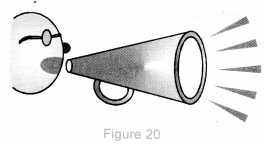
  1. Megaphone is a device used to address public meetings. It is a horn-shaped. When we speak through megaphone, sound waves .are reflected by the megaphone. These reflected sound waves are directed towards the people (or audience) without much spreading (Figure 20).
    Sound Class 9 Important Questions Science Chapter 12 image - 11
  2. Hearing Aid: Hearing aid is used by a person who is hard of hearing. It is an electronic device which is designed to amplify sound for the wearer to make the speech understandable. The microphone of hearing aid converts sound into electrical signals. These signals are amplified by the amplifier and then fed to the speaker. The speaker converts electrical signal to sound and then feed it into the ear as a narrow beam of sound waves. This narrow beam of sound waves fall on the diaphragm of the ear. Hence, the diaphragm of the ear vibrates with large amplitude. Therefore, the hearing power of the person is improved.
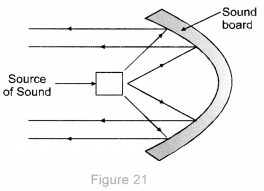
  3. Sound waves from the speaker are reflected by the sound board and these reflected waves are directed towards the people (or audience).
    Sound boards. Sound boards are curved surfaces (concave) which are used in a big hall to direct the sound waves towards the people sitting in a hall. The speaker is (i.e. source of sound) placed at the focus of the sound board as shown in figure 21.
    Sound Class 9 Important Questions Science Chapter 12 image - 12
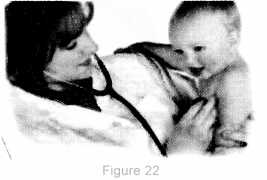
  4. Stethoscope: Stethoscope is a device used by doctors to listen the sound produced by heart and lungs. The sound produced by heart beat and lungs of a patient reaches the ears of a doctor due to multiple reflection of sound (Figure 22).
    Sound Class 9 Important Questions Science Chapter 12 image - 13
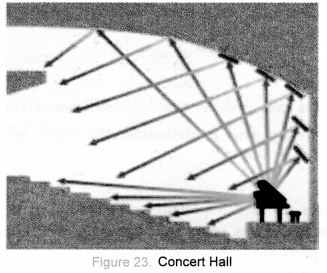
  5. Ceilings of concert halls are curved. The ceilings of concert halls and auditoriums are made curved. This is done so that the sound reaches all the parts of the hall after reflecting from the ceiling of the hall as shown in figure 23.
    Sound Class 9 Important Questions Science Chapter 12 image - 14
    Moreover, these ceilings are made up of sound absorbing materials to reduce the reverberation.

Question 4.
Give five practical applications of ultrasonic waves. (CBSE 2011)

                                               Or

Explain the technique of ultrasonography. (CBSE 2016)
Answer:
Ultrasonic waves have number of uses :

  1. For Communication
    1. Ultrasonic waves are used to establish underwater communication.
    2. Ultrasonic waves are used to determine the depth of a sea. It is done with the help of a SONAR.
  2. Industrial uses
    1. Ultrasonic waves are used for cleaning the hidden parts of an instrument. The process is known as ultrasonic cleaning. The instrument or device whose hidden parts are to be cleaned is dipped in a liquid. The ultrasonic waves are passed through this liquid. These waves forces the dirt or any other impurity out from the parts of the instrument which otherwise cannot be approached directly.
    2. Ultrasonic waves are used for welding plastic. Two plastic surfaces are pressed against each other. Then ultrasonic waves are allowed to fall at a point where plastic surfaces are in contact. These waves produces heat energy. This heat energy binds the two plastic surfaces together.
    3. Ultrasonic waves are used to find faults and cracks in metals. Ultrasonic waves are thrown on a metal under investigation. The beam of ultrasonic waves reflected by the metal is investigated. The intensity of the ultrasonic waves reflected from the fault or a crack is different from the intensity of the waves reflected from the other part of metal. Thus, the position of the fault or a crack in the metal can be easily located. In fact, the picture of the metal produced by the reflection of ultrasonic waves is taken on the screen or the monitor. By analysing this picture, the position and size of the crack or fault in the metal is detected.
  3. Medical uses
    1. Ultrasonic waves are used for diagnosing the diseases in human body. Different parts of the body like bone, fat, muscles and liquid have different reflective properties. Ultrasonic waves are allowed to fall on the portion of the body of a patient to be diagnosed. These waves are reflected back by the different parts (like bones, tissues, liquids and muscles etc.) of that portion of the body in different manners. The varying echoes are recorded for analysing that part of the body.
      The method used for diagnosing the different part of a human body with the help of the ultrasonic waves is known as ultrasonography.
    2. Ultrasonic waves are used to kill bacteria in liquids. Thus, the liquids like milk can be preserved for a longer period of time.
    3. Ultrasonic waves are also used to study the development of an unborn child. Any abnormality in the growth of an unborn child can be detected by the observing the picture taken by ultrasound.
    4. Echocardiography. It is medical diagnostic technique in which ultrasonic waves are used to construct the image of heart.

Question 5.
Write the full name of SONAR. How will you determine the depth of a sea using echo ranging ?
(CBSE 2011, 2012)

                                              Or

Explain the working of SONAR. (CBSE 2014)
Answer:
SONAR stands for Sound Navigation and Ranging.
It is a device which is used in the ships to locate rocks, icebergs, submarines, old ships sank in sea etc. It is also used to measure the depth of a sea.
Principle: It is based on the principle of the reflection of sound wave (i.e. echo).
Determination of the Depth of a Sea using Sonar
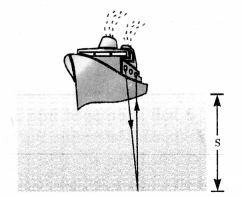
A beam of ultrasonic waves from the transmitter of a SONAR fitted on the ship is sent towards the bottom of the sea (Figure 25).
Sound Class 9 Important Questions Science Chapter 12 image - 15
This beam is reflected back from the bottom of the sea and is received by the receiver or detector of the SONAR on the ship.
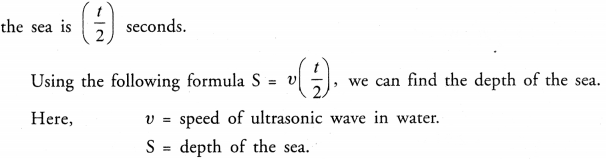
The time taken by the ultrasonic waves to go from the ship to the bottom of the sea and then back to the ship is noted. Let it be V seconds. Therefore, the time taken by the ultrasonic waves to go from the ship to the bottom of
Sound Class 9 Important Questions Science Chapter 12 image - 16
The method of finding the distance of object using echo is called echo­ranging. While, the method of finding the depth of the sea using echo is called echo-depth ranging. In this case, SONAR is called fathometer.

Question 6.
Explain by drawing a diagram, how the human ear works.

                                                       Or

Explain how human ear works in the transmission of sound waves to the brain. (CBSE 2011, 2013)

                                                       Or

Draw labelled diagram of auditory part of human ear and explain how the human ear works. (CBSE 2012)
Answer:
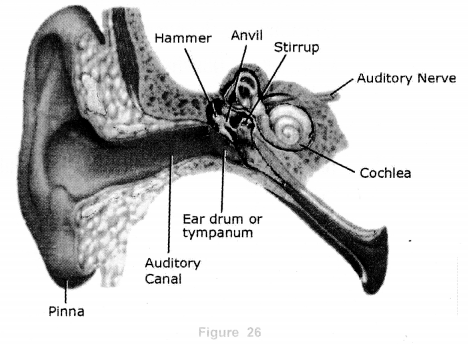
The human ear is divided into three parts— the external ear, the middle ear and the inner ear (Figure 26).
Sound Class 9 Important Questions Science Chapter 12 image - 17
We shall discuss only the auditory aspect of the ear and not its detailed structure.
The external ear which we see is known as Pinna. This part collects the sound and sends it to the auditory canal.
The sound in the form of compressions (high pressure) and rarefaction (low pressure) reaches the ear drum or tympanum. When the compressions and rarefactions strike the ear drum, the ear drum begins to vibrate. These vibrations are transmitted across the middle ear by the three ossicles (the hammer, the anvil and the stirrup). The vibrations produced by the eardrum are amplified (i.e., their amplitude is increased) by the hammer, anvil and the stirrup.
The amplified vibrations are then transmitted to the cochlea. Cochlea is a coiled and fluid filled tube having the sense organ of hearing. The movement of the fluid in the cochlea due to the vibrations stimulates the auditory nerve. The impression (in the form of electrical signals) is carried by the auditory nerve to the brain. This impression is interpreted as sound by the brain.

Question 7.
Explain the technique of ultrasonography.
Answer:
Ultrasonics or Ultrasound
The waves of frequency greater than 20,000 Hz are known as ultrosonic waves or ultrasound. The frequency of ultrasonic wave is greater than 20,000 Hz and equal to 107 Hz. These waves are not audible to a human ear but they can be heard by animals and birds.
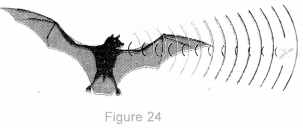
Bats can produce ultrasonic waves by flapping their wings. They can also detect these waves. The ultrasonic waves produced by the bats after reflection from the obstacles like buildings guide them to remain away from the obstacles during their flights. Hence, they can fly during night without hitting the obstacles. Bats also catch their prey during night with the help of ultrasonic waves. The ultrasonic waves produced by a bat spread out. These waves after reflecting from a prey say an insect reach the bat. Hence, the bat can easily locate its prey (Figure 24).
Sound Class 9 Important Questions Science Chapter 12 image - 18
Dolphins also produce ultrasonic waves. Dolphins can also detect the ultrasonic waves. They catch their prey like a fish due to their ability to detect the ultrasonic waves reaching them after reflecting’ from a fish.

Hope given Previous Year Question Papers for CBSE Class 9 Science Chapter 12 Sound are helpful to complete your science homework.

If you have any doubts, please comment below. Learn Insta try to provide online science tutoring for you.

Motion Class 9 Important Questions Science Chapter 8

Chapter 8 Motion Class 9 Science Important Questions with Answers PDF will help you in scoring more marks in your exams.

Motion Class 9 Important Questions and Answers Science Chapter 8

VERY SHORT ANSWER QUESTIONS

Based on Motion of an object along a straight line

Question 1.
What do you understand by the motion of an object ?
Answer:
An object is said to be in motion if its position change:, with time.

More Resources

Question 2.
What is a reference point ?
Answer:
A fixed point with respect to which the given object changes its position.

Question 3.
Is it possible that the train in which you are sitting appears to move while it is at rest ?
Answer:
Yes. The train at rest in which we are sitting appears to move when we look at another train moving parallel to the track on which our train is standing.

Question 4.
Define the term “distance”. –
Answer:
The length of actual path travelled by an object in the given time is called the distance travelled by the object.

Question 5.
Is distance a scalar or a vector quantity ?
Answer:
Distance is a scalar quantity’.

Question 6.
Define the term “displacement”.
Answer:
The shortest distance between the initial and final positions of the object in a particular direction.

Question 7.
Is displacement of an object a scalar or a vector quantity ?
Answer:
Displacement is a vector quantity.

Question 8.
Under what condition is distance and the magnitude of the displacement equal ?
(CBSE 2010, 2013, 2014, 2015)
Answer:
Distance and magnitude of the displacement are equal if an object moves along a straight line in one direction.

Question 9.
A particle is moving in a circle of diameter 5 m. What is its displacement when it completes 1 ~ revolutions ?
Answer:
After 1 revolution, particle is diametrically opposite to its initial position. Therefore, its displacement = diameter of the circle = 5 m.

Question 10.
What do you mean by uniform motion ? (CBSE 2010, 2012)
Answer:
The motion of an object is uniform motion if it travels equal distances in equal intervals of time along a straight line.

Question 11.
What is non-uniform motion ? (CBSE 2012)
Answer:
The motion of an object is non-uniform if it travels unequal distances in equal intervals of time.

Question 12.
Give one example of non-uniform motion. (CBSE 2012)
Answer:
A bus moving on a hilly road or on a zig-zag road.

Question 13.
What is the shape of the path of a body when it is in uniform motion ?
Answer:
Straight line.

Based on Speed and Velocity

Question 14.
Define the term “speed”.
Answer:
The distance travelled by an object per unit time is known as speed of the object.

Question 15.
State SI unit of speed.
Answer:
metre/second (ms-1)

Question 16.
Is speed a scalar or a vector quantity ?
Answer:
Speed is a scalar quantity.

Question 17.
Define uniform speed.
Answer:
The speed of an object is said to be uniform speed if it travels equal distances in equal intervals of time.

Question 18.
Define average speed. (CBSE 2012)
Answer:
Average speed is the ratio of the total distance travelled by an object to the total time taken by it.

Question 19.
What does speedometer of an automobile measure ?
Answer:
Speedometer of a vehicle measures its instantaneous speed.

Question 20.
Define the term “velocity”.
Answer:
Velocity is defined as the ratio of the displacement of an object to the time taken by it.

Question 21.
What do you understand by a uniform velocity ?

Or

When is a body said to have uniform velocity ? (CBSE 2011, 2012, 2013)
Answer:
Velocity of an object is uniform if it has equal displacements in equal intervals of time.

Question 22.
What do you understand by a non-uniform velocity ?

Or

When is a body said to have non-uniform velocity ? (CBSE 2011)
Answer:
Velocity of an object is non-uniform if it has unequal displacements in equal intervals of time.

Question 23.
Define average velocity.
Answer:
Average velocity is the ratio of the total displacement of an object to the total time taken by it.

Question 24.
Is velocity a scalar or a vector quantity ?
Answer:
Velocity is a vector quantity.

Question 25.
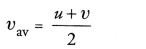
An object starts with initial velocity u and attains final velocity V. The velocity is changing at a uniform rate.
What is the formula for calculating average speed in this situation ? (CBSE 2011)
Answer:
Motion Class 9 Important Questions Science Chapter 8 image - 32

Question 26.
A physical quantity measured is -10 m s-1. Is it a speed or velocity ?
Answer:
It is velocity because velocity can be positive or negative. On the other hand, speed is always positive.

Question 27.
What is the numerical ratio of average velocity to average speed of an object when it is moving along a straight path ? (CBSE 2014)
Answer:
In this case, both are equal, so ratio is 1.
Based on Acceleration

Question 28.
Define acceleration of a body.
Answer:
Acceleration is defined as the change in velocity per unit time.

Question 29.
State SI unit of acceleration.
Answer:

Question 30.
Is acceleration a scalar or a vector quantity ?
Answer:
It is a vector quantity.

Question 31.
Why does (second)in the unit of acceleration ?
Answer:
change in velocity change in displacement
Motion Class 9 Important Questions Science Chapter 8 image - 1

Question 32.
Name the physical quantity that corresponds to the rate of change of velocity.
Answer:
Acceleration.

Question 33.
What do you mean by positive acceleration ? (CBSE 2013, 2015)
Answer:
When the change in velocity of a body takes place in the direction of motion of the body, then the acceleration is positive.

Question 34.
Give one example of positive acceleration.
Answer:
The acceleration of a body is positive, when it falls from certain height.

Question 35.
What do you mean by negative acceleration ? (CBSE 2015)
Answer:
When the change in velocity of a body takes place in a direction opposite to the direction of motion of the body, then the acceleration is negative.

Question 36.
Give one example of retardation or negative acceleration. (CBSE 2013)
Answer:
When the velocity of a train decreases before entering the platform.

Question 37.
When do you say that a body is in uniform acceleration ? (CBSE 2010, 2013)

Or

Define uniform acceleration. (CBSE 2010, 2013, 2014, 2015)
Answer:
When the velocity of a body changes by an equal amount in equal intervals of time, then the body is in uniform . acceleration.

Question 38.
When do you say that a body has non-uniform acceleration ? (CBSE 2013)
Answer:
When the velocity of a body changes by unequal amount in equal intervals of time, then the body is in non¬uniform acceleration.

Question 39.
Give an example of a motion in which the acceleration is in the direction of motion.
Answer:
When a body (say a ball) falls from the roof of a house, then the acceleration of the body is in the direction of motion.

Question 40.
Give an example of a motion in which the acceleration is against the direction of motion.
Answer:
When a ball rolling over a horizontal surface slows down due to the force of friction between the ball and the horizontal surface, then acceleration is against the direction of motion.

Or

When a body is thrown upward, then the acceleration is against the direction of motion of the body.

Question 41.
What is the acceleration of a body moving with uniform velocity in a straight line ? (CBSE 2014)
Answer:
Motion Class 9 Important Questions Science Chapter 8 image - 2
Since velocity is uniform, so change in velocity = 0. Hence, acceleration of body = 0.
Based on distance-time and velocity-time graphs

Question 42.
Draw a distance-time graph for an object at rest.
Motion Class 9 Important Questions Science Chapter 8 image - 3

Question 43.
What will you say about the motion of a body if its distance-time graph is a straight line having a constant angle with time axis ? (CBSE 2010)
Answer:
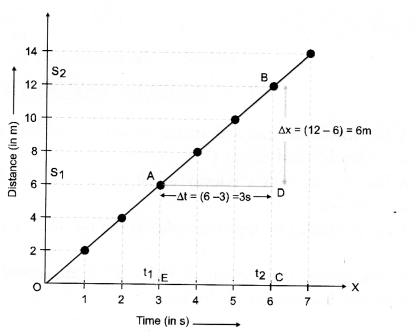
If distance-time graph is a straight line having a constant angle with time axis, then the distance travelled by the body increases in equal amount in equal intervals of time. It means, the motion of the body is a uniform motion.
Motion Class 9 Important Questions Science Chapter 8 image - 4

Question 44.
If the displacement-time graph for a particle is parallel to time axis, how much is the velocity of the particle.
(CBSE 2013)
Answer:
Velocity is zero as there is no change in displacement with time.

Question 45.
What does the slope of a velocity-time graph represent ?
(CBSE 2010, Term I)
Answer:
It represents the acceleration of the body.

Question 46.
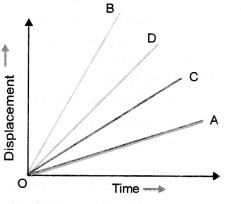
Figure shows the displacement-time graph of four children A, B, C and D. Which child has the highest velocity ? (CBSE 2010, 2012, 2013)
Motion Class 9 Important Questions Science Chapter 8 image - 5
Answer:
Velocity = Slope of displacement – time graph.
Since slope of displacement-time graph for the child B is greater than all other children. Hence, child B has the highest velocity.

Question 47.
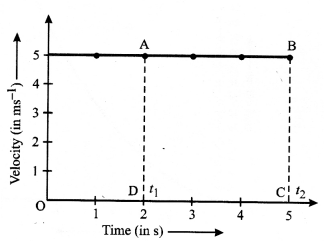
What can you say about the motion of a body if its velocity-time graph is a straight line parallel to time axis ?
(CBSE 2012)
Answer:
When velocity-time graph of the motion of a body is a straight line parallel to time axis, then the velocity of the body does not change with time. So the body is said to move with constant velocity.
Motion Class 9 Important Questions Science Chapter 8 image - 6

Question 48.
Name the physical quantity measured by the area occupied below velocity-time graph for uniform motion.
(CBSE2012, 2014)
Answer:
Magnitude of displacement of the body = area under v-t graph.

Question 49.
Plot velocity-time graph of a body moving with constant or uniform velocity. (CBSE 2012, 2014)
Answer:
Motion Class 9 Important Questions Science Chapter 8 image - 7

Question 50.
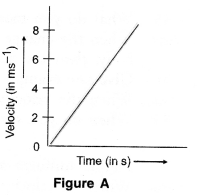
Velocity-time graph of a body is shown in figure A.
Motion Class 9 Important Questions Science Chapter 8 image - 8
What conclusion can be drawn about the type of motion ? (CBSE 2010, 2011, 2012)
Answer:
Motion of the body is uniform motion.

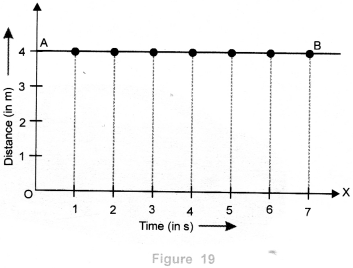
Question 51.
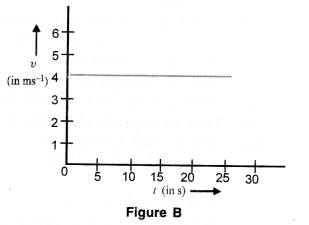
Velocity-time graph of a body is shown in figure B.
Motion Class 9 Important Questions Science Chapter 8 image - 9
What conclusion can be drawn about the velocity of the body from this graph ?
(CBSE Sample Paper 2010, 2011)
Answer:
Body is moving with constant velocity = 4 m s-1.

Based on circular motion

Question 52.
Define circular motion. (CBSE 2011, 2012)
Answer:
The motion of a body moving around a fixed point in a circular path.

Question 53.
State the meaning of uniform circular motion.
(CBSE 2010, 2012, 2013, 2014, 2015)
Answer:
The circular motion of a body having constant speed is called uniform circular motion.

Question 54.
Give an example of a uniform circular motion. (CBSE 2014)
Answer:
A cyclist travelling with constant speed on a circular path.

Question 55.
Is uniform circular motion accelerated motion ?
(CBSE 2012, 2013)
Answer:
Uniform circular motion of a body is accelerated because its direction of motion changes continuously although its speed is constant.

Question 56.
If the acceleration of the particle is constant in magnitude but not in direction, what type of path does the particle follow.
Answer:
Circular path.

Question 57.
Why is the motion of an athlete moving along the circular path an accelerated motion ?
Answer:
The direction of motion of the athlete is changing continuously, so his velocity is also changing continuously. Due to change in velocity along the circular path, his motion is accelerated motion.

SHORT ANSWER QUESTIONS

Based on motion of an object along a straight line

Question 1.
Can a body exist in a state of absolute rest or of absolute motion ? Explain with example. (CBSE 2015)
Answer:
A state of rest or state of motion is not absolute but it is a relative term. A body at rest in one frame of reference
may be in motion in other frame of reference. For example, a passenger sitting in a moving bus is at rest with respect to the bus or other co-passengers. However, the same passenger is in motion with respect to a person standing on a road side. Thus, rest and motion are relative terms.

Question 2.
Distinguish between distance and displacement. (CBSE 2010, 2012, 2013)
Answer:

DistanceDisplacement
1. Distance is the length of the actual path travelled by an object in a given interval of time.1. Displacement is the shortest distance between the initial and final positions of a moving object in a particular direction.
2. Distance travelled by an object depends upon the shape of the path followed by the object in going from initial position to the final position.
Distance travelled by an object in a given interval of time is always positive.
Distance is a scalar quantity.
2. The displacement of an object between initial and final positions of the object does not depend upon shape of the path followed by it.
Displacement of an object in a given interval of time may be positive, negative or zero. Displacement is a vector quantity.


Question 3.

Mention two differences between speed and velocity. (CBSE 2013, 2015)
Answer:

Speed

Velocity

1. Distance travelled by an object per unit time is known as its speed.The distance travelled by an object in a particular direction (i.e. displacement) per unit time is known as its velocity.
2. Average speed of a moving object cannot be zero.Average velocity of a moving object can be zero.
3. Speed tells how fast an object moves.Velocity tells how fast an object moves and in which direction it moves.
4. Speed is a scalar quantity.Velocity is a vector quantity.
5. Speed of an object is always positive.Velocity of an object can be positive or negative.

Question 4.
Give one example each to differentiate between uniform acceleration and non-uniform acceleration.
(CBSE 2010, 2012)
Answer:
Object has uniform acceleration if its velocity changes by an equal amount in equal intervals of time. For example, motion of an object falling freely from the top of a building.
On the other hand if velocity of an object changes by an unequal amount in equal intervals of time, then it has non-uniform acceleration. For example, the motion of a bus on a hilly track or on a circular track.

Question 5.
Differentiate acceleration from velocity.
Answer:

AccelerationVelocity
1.      Acceleration of an object is defined as the change in velocity of the object per unit time.

2.       SI unit of a acceleration is m s-2.

1.     Velocity of an object is defined as the change in displacement of the object per unit time.

2.      SI unit of velocity is m s-1.

Based on distance-time and velocity-time graph

Question 6.
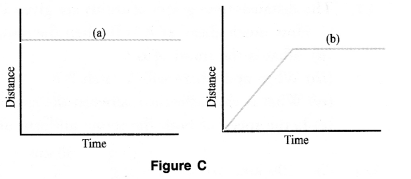
What kind of motion of a body is represented by the graphs shown in figure C ?
Motion Class 9 Important Questions Science Chapter 8 image - 10
Answer:
(a) Body is at rest because its distance does not change with time.
(b) Body has uniform motion and then comes to rest.

Question 7.
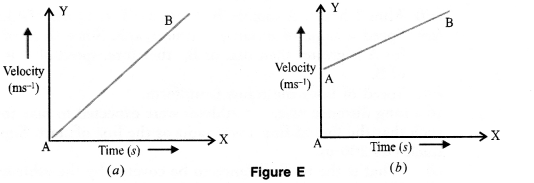
Explain the differences between the two graphs shown in figure E.
Motion Class 9 Important Questions Science Chapter 8 image - 11
Answer:
Graph (a) shows that body starts from rest and then accelerates uniformly.
Graph (b) shows that body starts with some initial velocity (≠0) and then accelerates uniformly

Question 8.
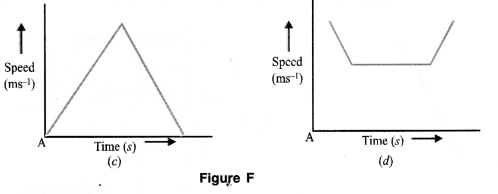
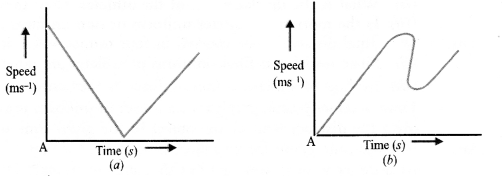
Four speed-time graphs are shown in figure F :
Motion Class 9 Important Questions Science Chapter 8 image - 12
Which graph represents the following cases ?
(a) A ball thrown vertically upwards and returning to the hand of the thrower.
(b) A body decelerating to a constant speed and then accelerating.
Motion Class 9 Important Questions Science Chapter 8 image - 13
Answer:
(a) Graph (a)
(b) Graph (d).

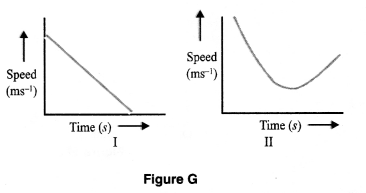
Question 9.
What do the graphs (I and II) shown in figure G indicate ?
Motion Class 9 Important Questions Science Chapter 8 image - 14
Answer:
Graph I indicates that a body has certain initial speed and then its speed decreases to zero. In other words, this graph shows the retarded motion of a body.
Graph II shows that a body first retards and then accelerates.

Question 10.
A person travelling in a bus noted the timings and the corresponding distances as indicated on the km stones.
(a) Name this type of table.
(b) What conclusion do you draw from this table ?
Answer:
(a) The table gives distance-time data.

TimeDistance
8:00 am10 km
8:15 am20 km
8:30 am30 km
8:45 am40 km
9:00 am50 km

(b) As the bus is travelling equal distances in equal intervals of time, so the motion of the bus is uniform motion.

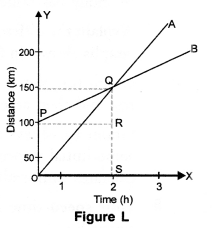
Question 11.
The distance-time graph of trains are given in figure L.
Motion Class 9 Important Questions Science Chapter 8 image - 15
The trains start simultaneously in the same direction.
(i) How much ahead of A is B when the motion starts ?
(ii) What is the speed of B ?
(iii) When and where will A catch B ?
(iv) What is the difference between the speeds of A and B ?
(v) Is the speed of both the trains uniform or non-uniform ? Justify your answer.
Answer:
(i)
Motion Class 9 Important Questions Science Chapter 8 image - 16
(iii) After 2 hours, A catches B. A catches B at Q i.e. 150 km from origin O.
(iv) Speed = slope of distance – time graph. Since slope of distance – time graph for A is greater than that of B, therefore, speed of A is greater than the speed of B.
(v) Speed of both the trains is uniform.

Question 12.
In a long distance race, the athletes were expected to take four rounds of the track such that the line of finish was same as the line of start. Suppose the length of the track was 200 m.

  1. What is the total distance to be covered by the athletes ?
  2. What is the displacement of the athletes when they touch the finish line ?
  3. Is the motion of athletes uniform or non-uniform ?

Answer:

  1. Total distance to be covered in four rounds = 4 x length of track = 4 x 200 = 800 m.
  2. Since initial and final positions of athletes are same, so displacement of athletes = 0.
  3. Motion of athletes is non-uniform as they cover unequal distances in equal intervals of time.

Question 13.
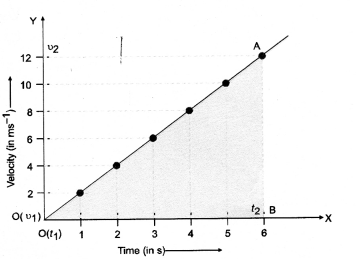
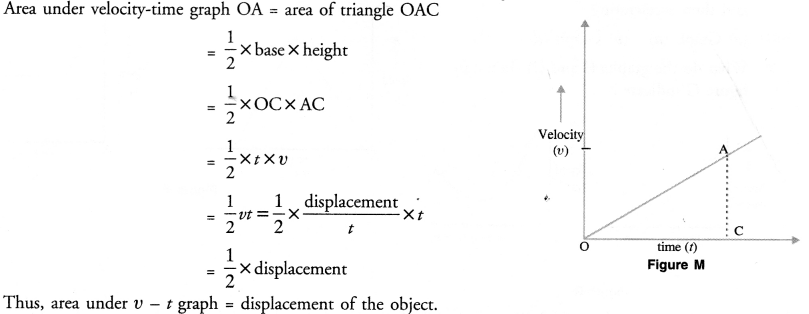
Draw a velocity-time graph for an object in uniform motion. Show that the area under the velocity-time graph gives the displacement of the object in the given time interval.
Answer:
Velocity-time graph for an object in uniform motion is shown in figure M.
Motion Class 9 Important Questions Science Chapter 8 image - 17

Question 14.
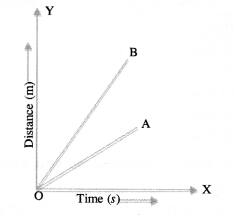
Which of the two bodies A and B in the following graph is moving with higher speed and why ?
(CBSE 2015)
Motion Class 9 Important Questions Science Chapter 8 image - 18
Answer:
Speed of a body = slope of distance-time graph.
Since slope of distance-time graph for body B is greater than the slope of distance-time graph for body A. Therefore, body B is moving with higher speed than body A.

Question 15.
Which of the two bodies A and B in the following graph is moving with a greater acceleration and why ?
(CBSE 2015)
Motion Class 9 Important Questions Science Chapter 8 image - 19
Answer:
Acceleration of a body = slope of V — t graph. Since slope of V — t graph for body B is greater than the slope of V – t graph for body A, therefore, body B is moving with a greater acceleration than the body A.

Based on equation of motion

Question 16.
State three equations of motion. Which of them describes :
(i) velocity-time relation
(ii) position-time relation ?
(CBSE 2013, 2015)
Answer:
Motion Class 9 Important Questions Science Chapter 8 image - 20

Question 17.
Write any two equations of motion for a body having uniform acceleration.
Answer:
Motion Class 9 Important Questions Science Chapter 8 image - 21

Based on circular motion

Question 18.
What is uniform circular motion ? How is uniform circular motion regarded as an accelerated motion ? Explain. (CBSE 2010, 2011)
Answer:
Circular motion of a body having constant speed is known as uniform circular motion.
When a body has uniform circular motion, its velocity changes due to the continuous change in the direction of its motion. Hence, the motion of the body is accelerated motion.

Question 19.
What is the difference between uniform motion in a straight line and uniform circular motion ?
(CBSE 2010, 2012, 2013)
Answer:

Uniform motion in a straight line

Uniform motion in a straight line

1. The direction of motion of an object does not change.1. direction of motion of an object changes continuously.
2. If an object moves with constant velocity, acceleration of the object is zero.2. uniform circular motion, object moves with constant speed but its direction of motion changes continuously. Therefore, velocity of an object having uniform circular motion changes. Hence, the motion.

Question 20.
An object is moving with uniform speed in a circle of radius r. Calculate the distance and displacement
(a) When it completes half the circle,
(b) When it completes full circle,
(c) What type of motion does the object possess ?
Answer:
(a) When object completes half the circle,
distance travelled by the object = ½ x circumference of the circle = ½ x 2πr
= πr. Displacement of the object = 2r  ( object is just at opposite position from its original position).
(b) Distance travelled by the object = circumference of the circle = 2πr. Displacement of the object = zero ( object’s initial and final positions are same).
(c) Since the direction of motion of the object changes continuously in the circle, hence its velocity changes and its motion is accelerated motion.

LONG ANSWER QUESTIONS

Question 1.
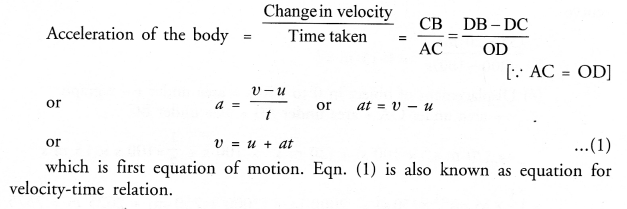
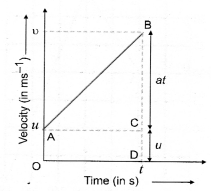
Draw velocity-time graph for an uniformly accelerated object. Using velocity-time graph, derive v = u + at.

Or

Derive the equation of motion V = u + at using graphical method. (CBSE 2011, 2013, 2015)
Answer:
Derivation of First Equation of Motion From Velocity-Time Graph (Equation for Velocity-time Relation)
The velocity-time graph of a uniformly accelerated motion of the body having initial velocity (u) is shown in figure .
The velocity-time graph is a straight line AB.
Motion Class 9 Important Questions Science Chapter 8 image - 22
Motion Class 9 Important Questions Science Chapter 8 image - 23

Question 2.
Draw velocity-time graph for an uniformly accelerated object. Using velocity-time graph, derive S = ut + ½ at² .
(CBSE 2010, 2011, 2013, 2015)

Or

From velocity-time graph of a body, derive equation for “position-time” relation (II equation of motion) for a body. (CBSE 2012)
Answer:
Motion Class 9 Important Questions Science Chapter 8 image - 24

Question 3.
Draw velocity-time graph for an uniformly accelerated object. Using velocity-time graph, derive v2 – u2 = 2aS.
(CBSE 2010, 2011, 2013)
Answer:
Motion Class 9 Important Questions Science Chapter 8 image - 25

Question 4.
Write the three equations for the uniformly accelerated motion. Also derive the second and third equations
by graphical method. (CBSE 2013)
Answer:
Derivation of First Equation of Motion From Velocity-Time Graph (Equation for Velocity-time Relation)
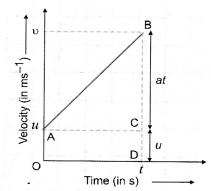
The velocity-time graph of a uniformly accelerated motion of the body having initial velocity (u) is shown in figure 28.
The velocity-time graph is a straight line AB.
Motion Class 9 Important Questions Science Chapter 8 image - 26
Motion Class 9 Important Questions Science Chapter 8 image - 27
Motion Class 9 Important Questions Science Chapter 8 image - 28
Motion Class 9 Important Questions Science Chapter 8 image - 29

Question 5.
An object starts a linear motion with velocity ‘u’ and with acceleration ‘a’ It acquires a velocity ‘v’ in time ‘t’.
(i) Draw its velocity-time graph
(ii) Obtain 1st equation of motion, v = u + at for velocity time relation using this graph. (CBSE 2013)
Answer:
(i)
Motion Class 9 Important Questions Science Chapter 8 image - 30
(ii)
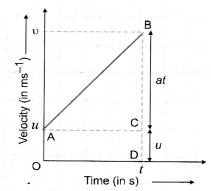
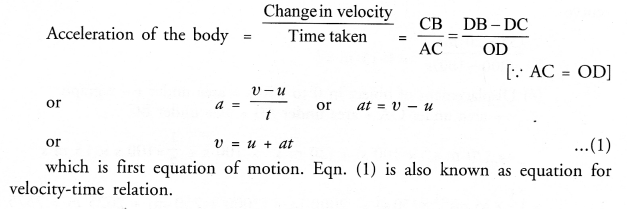
Derivation of First Equation of Motion From Velocity-Time Graph (Equation for Velocity-time Relation)
The velocity-time graph of a uniformly accelerated motion of the body having initial velocity (u) is shown in figure 28.
The velocity-time graph is a straight line AB.
Motion Class 9 Important Questions Science Chapter 8 image - 31

Hope given Previous Year Question Papers for CBSE Class 9 Science Chapter 8 Motion are helpful to complete your science homework.

If you have any doubts, please comment below. Learn Insta try to provide online science tutoring for you.

Diversity in Living Organisms Class 9 Important Questions Science Chapter 7

Chapter 7 Diversity in Living Organisms Class 9 Science Important Questions with Answers PDF will help you in scoring more marks in your exams.

Diversity in Living Organisms Class 9 Important Questions and Answers Science Chapter 7

Very Short Answer Questions

Question 1.
Give technical term : A flowering plant whose embryo possesses a single cotyledon. (CCE 2011)
Answer:
Monocot.

More Resources

Question 2.
Name the kingdom: A unicellular eukaryotic aquatic organism. (CCE 2011)
Answer:
Protista.

Question 3.
Rewrite the scientific name correctly

  1. panthera tigris
  2. Periplaneta Americana. (CCE 2012)

Answer:

  1. Panthera tigris
  2. Periplaneta americana.

Question 4.
Name the term used for

  1. Left and right halves of the body having the same design
  2. Animals where tissues develop from three germinal layers. (CCE 2012)

Answer:

  1. Bilateral Symmetry
  2. Triploblastic.

Question 5.
State the phylum to which Centipede, Scorpion and Prawn belong. (CCE 2012)
Answer:
Arthropoda.

Question 6.
State the phylum to which Liverfluke and Planaria belong.
(CCE 2012)
Answer:
Platyhelminthes.

Question 7.
State the phylum to which Antedon (Feather Star) and Asterias (Star Fish) belong. (CCE 2012)
Answer:
Echinodermata.

Question 8.
State the system in poriferans that helps in circulating water throughout the body to bring in food and oxygen.
(CCE 2012)
Answer:
Canal system.

Question 9.
What is the common feature between bryophytes and frogs ? (CCE 2012, 2013)
Answer:
Both are amphibians with bryophytes living in moist cool habitats and frogs living both on land and water.

Question 10.
Shyam knew the correct name of Mango but did not follow the conventions while writing it and wrote it as Mangifera Indica. Rewrite the scientific name as per conventions. (CCE 2012)
Answer:
Mangifera indica.

Question 11.
Name the group of plants which produces seeds but not fruits. (CCE 2012)
Answer:
Gymnosperms ( = Gymnospermae).

Question 12.
Give reason why blue green algae are classified alongwith bacteria and placed in kingdom monera. (CCE 2012)
Answer:
Blue-green algae are prokaryotic like bacteria.

Question 13.
Mention the location and function of notochord.(CCE 2012)
Answer:
It lies dorsally, ventral to nerve cord, and provides attachment to muscles.

Question 14.
Write difference between bryophytes and pteridophytes. (CCE 2012)
Answer:
Bryophytes are non-vascular cryptogams with dominant gametophyte while pteridophytes are vascular cryptogams with dominant sporophytic plant body.

Question 15.
Name the kingdom having organisms with holes or pores all over the body. (CCE 2012)
Answer:
Animalia (phylum porifera).

Question 16.
How would you call the symbiotic relationship between fungi and certain blue-green algae ? (CCE 2012)
Answer:
Lichen.

Question 17.
Name an organism whose heart is two-chambered. (CCE 2012)
Answer:
Fish.

Question 18.
Explain the term symbiosis. (CCE 2012, 2013)
Answer:
Symbiosis is mutually beneficial obligatory relationship between two organisms, e.g, lichen.

Question 19.
Name the phylum of animal kingdom to which parasitic worms causing diseases such as filarial worm, round worm belong. (CCE 2012)
Answer:
Nemathelminthes.

Question 20.
Name one reptile with four chambered heart. (CCE 2012)
Answer:
Crocodile.

Question 21.
Write the scientific name of common frog. (CCE 2012)
Answer:
Rana tigrina.

Question 22.
Name animal phylum which exclusively has free living marine animals. (CCE 2012)
Answer:
Echinodermata.

Question 23.
Name one mammal that lays eggs. (CCE 2012)
Answer:
Echidna.

Question 24.
Write the name of phylum to which Hydra and Sea Anemone belong. (CCE 2012)
Answer:
Coelenterata (Cnidaria).

Question 25.
Name the phylum to which Sycon and Euplectella belong.
(CCE 2012)
Answer:
Porifera.

Question 26.
Name an organism which is called saprophyte. Why is it called so ? (CCE 2012)
Answer:
Rhizopus. The organism is called saprophyte because it obtains nourishment from organic remains.

Question 27.
What is the habitat of poriferans ? (CCE 2012)
Answer:
Aquatic, sedentary, attached to solid substratum, mostly in sea but a few fresh water forms as well.

Question 28.
Which is the lowermost category in the hierarchy of classification of groups of organisms ? (CCE 2012, 2013)
Answer:
Species.

Question 29.
In the hierarchy of classification

  1. which grouping will have smallest number of organisms with a maximum number of common characteristics and
  2. which will have the largest number of organisms. (CCE 2011, 2012)

Answer:

  1. Species
  2. Kingdom.

Question 30.
Name a division of plants which can be classified as cryptogamae. (CCE 2012)
Answer:
Thallophyta/Bryophyta/Pteridophyta.

Question 31.
Write one difference between echinodermata and chordata.
(CCE 2012)
Answer:
In echinoderms a notochord is absent while the same is present in chordates.

Question 32.
In which Kingdom would you place an organism which is multicellular and without cell wall ? (CCE 2012)
Answer:
Animalia.

Question 33.
Write the name of a species belonging to coelenterata which lives in colonies. (CCE 2012)
Answer:
Obelia, Coral.

Question 34.
Write the two words that constitute binomial nomenclature.(CCE 2012)
Answer:
Genus (generic name) and species (specific epithet).

Question 35.
To which group in the hierarchy of classification saprophytes belong ? (CCE 2012)
Answer:
Saprophytes mosdy belong to kingdom fungi.

Question 36.
Name the phylum to which turtle and king cobra belong.
(CCE 2012)
Answer:
Chordata ( Class Reptilia).

Question 37.
Name the phylum to which Leech and Earthworm belong.
(CCE 2012)
Answer:
Annelida.

Question 38.
Name the phylum to which Octopus and Unio/Pila belong.
(CCE 2012, 2013)
Answer:
Mollusca.

Question 39.
Write one point of difference between radial and bilateral symmetry. (CCE 2012, 2013)
Answer:
In radial symmetry body can be divided into two equal halves by any vertical plane passing through central axis while in bilateral symmetry body is divisible into two equal halves by only midsagittal plane.

Question 40.
Mention three animal phyla that possess true coelom. (CCE 2012)
Answer:
Annelida, Arthropoda, Chordata.

Question 41.
Identify the given specimen and write its characteristic features. (CCE 2012)

Diversity in Living Organisms Class 9 Important Questions Science Chapter 7 image - 1
Answer:
Moss (Funaria): It has leaf like and stem-like structures. The plant is a gametophyte bearing rhizoids and dependent sporophyte.

Question 42.
In which kingdom will you place an organism which is single-celled, eukaryotic and photosynthetic ? (CCE 2013)
Answer:
Protista.

Question 43.
Explain the term angiosperm. (CCE 2013)
Answer:
Angiosperms are seed plants in which the seeds are produced inside fruits and the sporophylls are aggregated to form flowers.

Question 44.
Poriferans have holes or pores all over the body that lead to a system that helps in circulating water to bring in food and oxygen. Name the system. (CCE 2013)
Answer:
Canal system.

Question 45.
Which division amongst plants has the simplest organisms? (CCE 2013)
Answer:
Thallophyta.

Question 46.
Write two points of difference between Protozoa and Porifera. (CCE 2014)
Answer:

  1. Protozoa are unicellular while Porifera are multicellular.
  2. Protozoa are moslty motile. Porifera are sedentary in the mature state.

Question 47.
Where are seeds of gymnosperms formed ? (CCE 2014)
Answer:
On the megasporophylls found in female cones.

Question 48.
Why is it difficult to classify bacteria ? Give two reasons.
(CCE 2014)
Answer:

  1. Bacteria are microscopic,
  2. There are limited differences in structure and functions.

Question 49.
Relate the given plant with its division in the scheme of classification (CCE 2014)

Diversity in Living Organisms Class 9 Important Questions Science Chapter 7 image - 2
Answer:
Spermatophyta-Angiospermae- Dicotyledoneae.

Question 50.
Name the substance which makes the cell wall of fungi.
(CCE 2014)
Answer:
Chitin (=fungus cellulose), a complex carbohydrate.

Question 51.
What do you understand by diploblastic ? Give one example of an organism which is diploblastic. (CCE 2015)
Answer:
Diploblastic are animals having two germinal layers, ectoderm and endoderm, e.g. Sycon.

Question 52.
An amoeba and a worm are very different in their body design. State the basic difference between them.
(CCE 2015)
Answer:
Amoeba is a unicellular organism while worm is a multicellular organism.

Question 53.
Arrange the following groups from lower to higher level : Genus, Class, Division, Family, order. (CCE 2015)
Answer:
Genus – Family – Order – Class – Division.

Question 54.
Pick the odd one from the following :
(a) Amoeba, Sponge, Euglena, Frog,
(b) Snail, Slug, Squid, Snake. (CCE 2015)
Answer:
(a) Sponge
(b) Snake.

Question 55.
How many chambers do most of the reptiles have in their heart ? Name one reptile which has four chambered heart.
(CCE 2015)
Answer:
Incomplete four chambers. Complete four chambers occur in crocodile.

Question 56.
A pore bearing organism like creature ‘A’ belongs to phylum ‘B’ of kingdom animalia. Identify ‘A’ and ‘B’.(CCE2016)
Answer:
A—Sponge.
B—Porifera.

Question 57.
What are lichens ? (CCE 2017)
Answer:
Licherns are dual organisms which have been formed by permanent symbiotic association between an alga and a fungus.

Question 58.
What is symbiotic relationship ? Give an example.
(CCE 2017)
Answer:
Symbiosis is mutually beneficial obligatory relationship between two organisms, e.g, lichen.

Short Answer Questions (2 marks)

Question 1.

  1. Write one main characteristic feature that differentiates gymnosperms from angiosperms.
  2. Give one example each of a gymnosperm and an angiosperm. (CCE 2011, 2013)

Answer:

  1. Gymnosperms possess naked seeds while angiosperms contain seeds enclosed inside the fruit.
  2. Example of Gymnosperm. Pinus. Example of Angiosperm. Mango.

Question 2.
(i) Identify the class of animals having the following characteristics features :
(a) Warm blooded animals that lay eggs and have four chambered heart and a covering of feathers.
(b) Cold blooded animals having scales and they breathe through lungs.
(ii) Give an example of an animal belonging to each of these classes. (CCE 2011)
Answer:
(i)
(a) Aves
(b) Reptilia
(ii) Example of Aves. Pigeon. Example of Reptilia. Snake.

Question 3.
What are the four main characteristics of chordates ? (CCE 2011,2012,2013, 2014)
Answer:
Presence of

  1. Notochord which in higher forms is transformed into cranium and vertebral column,
  2. Dorsal Hollow Nerve Cord. In higher chordates, it is transformed into brain and spinal cord.
  3. Pharyngeal Gill Slits. Present at some stage of life cycle,
  4. Post-anal tail.

Question 4.
(a) Give one characteristic difference between primitive and advanced organisms.
(b) Name the phylum to which the following are included :

  1. Spider
  2. Cockroach
  3. Prawn
  4. Housefly. (CCE 2011)

Answer:
(a) Primitive organisms have simple basic body design while advanced organisms have more complex body structure with specialisations.
(b) Arthropoda.

Question 5.
What is binomial nomenclature ? Who introduced it ? (CCE 2011, 2012, 2013)
Answer:
Binomial nomenclature is a scientific system of poviding distinct and proper names to organisms where each name consists of two words, generic and specific epithet. It was introduced by Carolus Linnaeus (1751).

Question 6.
(a) What are the two adaptive features of birds ?
(b) What is the scientific name of Ostrich ? (CCE 2011)
Answer:
(a) Adaptive Features of Birds,

  1. Body covered by feathers,
  2. Fore limbs modified into wings.

(b) Ostrich. Struthio camelus.

Question 7.
(a) List two features which differentiate chordates from non-chordates.
(b) In which phylum will you place the organisms which have

  1. Calcareous spines on their body,
  2. Presence of holes or pores all over the body. (CCE 2011 )

Answer:
(a) Chordate Features.

  1. Occurrence of notochord that is transformed into cranium and vertebral column in higher chordates.
  2. Presence of dorsal hollow nerve cord above the notochord which in higher chordates is transformed into brain and spinal cord.

(b)

  1. Echinodermata.
  2. Porifera.

Question 8.
How do saprophytes get their food ? Give two examples of saprophytes. (CCE 2011)
Answer:
Saprophytes are organisms that feed on organic remains by the process of external digestion.
Examples. Mushroom, Rhizopus.

Question 9.
Characters of some organisms are given. Identify their group and give an example of each
(a) Single-celled, eukaryotic and photosynthetic.
(b) The body is divided into segments, may be unisexual or hermaphrodite. (CCE 2011, 2012)
Answer:
(a) Protista – diatoms.
(b) Annelida – Nereis, Pheretima.

Question 10.
(a) How many chambers do the heart of fish, amphibians and mammals have ?
(b) Name the classes of vertebrates which lay eggs with shells. (CCE (2011)
Answer:
(a)

  1. Heart of Fish – Two chambered.
  2. Heart of Amphibians – Three chambered.
  3. Heart of Mammals – Four chambered.

(b) Reptilia, Aves.

Question 11.
List the major divisions in kingdom plantae. Write the characteristic features of any one of them. (CCE (2011)
Answer:
Divisions of Kingdom Plantae. Thallophyta, Bryophyta, Pteridophyta, Spermatophyta (Gymnosperms, Angiosperms).
Characteristic Features of Bryophyta.

  1. Absence of vascular tissues.
  2. Simple vegetative structure.
  3. Amphibians.
  4. Plant body gametophyte.
  5. Sporophyte parasitic over gametophyte.
  6. Sex organs are multicellular and’jacketed.
  7. An embryo stage present in the life cycle.

Question 12.
(a) Explain binomial nomenclature. What are its conventions ?
(b) Name the scientist who has given it.
(c) Write its advantage. (CCE 2011, 2012, 2016)
Answer:
(a) Binomial nomenclature is a scientific system of providing distinct and proper two word name to each and every organism.
Conventions.

  1. It consists of two words, first generic (like noun) and second specific (species).
  2. Generic name has first letter capital while specific word begins with small letter.
  3. Both are derived from latin language or are latinised.
  4. They are printed in italics or are underlined separately in hand-written form.

(b) Binomial nomenclature was given by Carolus Linnaeus (1751).
(c) Advantage:

  1. It is universal, being the same in all languages and conntries.
  2. It is distinct and sepcific with no two organisms having the same name.

Question 13.
Why is there a need for classification and systematic naming of living organisms ? (CCE 2011, 2012)
Answer:
Need for Classification. A good system of classification is required for

  1. Identification of organisms.
  2. Study of organisms of other regions.
  3. Study of whole range of organisms, choosing one or a few from each group.
  4. Find similarities and dissimilarities, relationships and evolutionary trends.

Need for Systematic Naming. It is scientific naming of groups and subgroups and arranging them in a hierarchy with each taxon having some characteristics of its own.
This helps in locating the position of an organism.

Question 14.
Why bryophytes are called the amphibians of the plant j kingdom? (CCE2011, 2013)
Answer:
Bryophytes are called amphibians of plant kingdom as they live in moist, damp and shady places. A layer of water is required on the soil surface for

  1. Sexual reproduction.
  2. Protection from transpiration and hence desiccation
  3. Supply of water to all parts in the absence of vascular tissues.

Question15.
Some reptiles live in water and yet lay eggs with tough covering unlike the amphibians. Why ? (CCE 2011)
Answer:
Reptiles evolved over land where hard shelled eggs occur for protecting the embryo surrounded by extra-embryonic membranes. Some reptiles went back into aquatic habitats, However, they did not lose their hard shelled eggs which are usually laid over the banks of water bodies.

Question 16.
(a) Define cryptogams.
(b) Name the division of plant kingdom having amphibian plants. (CCE 2011, 2012)
Answer:
(a) Cryptogams. They are seedless lower plants where reproductive organs are inconspicuous requiring an external water for fertilization.
(b) Bryophyta.

Question 17.
Bats can fly. Still they are placed in mammals. Why ? (CCE 2011)
Answer:
Bats are

  1. Viviparous giving birth to young ones.
  2. They possess mammae for feeding the young ones.
  3. The body is covered by hair.

Question 18.
How are fungi

  1. Similar and
  2. dissimilar to plants ? (CCE 2011)

Answer:
Similarity. Presence of cell wall. Dissimilarity. Presence of chitin in cell wall (instead of cellulose) and glycogen (instead of starch) as reserve food.

Question 19.
How do thallophytes and pteridophytes differ from each other ? Write two differences. (CCE 2011)
Answer:

  1. Thallophytes are the simplest plants with little differentiation while pteridophytes have a well differentiated body design.
  2. Reproductive organs are single celled with no embryo stage in thallophytes. In pteridophytes the reproductive organs are multicellular and jacketed with an embryo stage being present in the life cycle.

Question 20.
(a) What is biodiversity ? (CCE 2013)
(b) List three/four features of vertebrates.
(CCE 2011, 2012)
Answer:
(a) Biodiversity. It is the occurrence of different types of organisms and their variants adapted to different environmental conditions and formation of different types of communities.
(b) Features ofVertebrates.

  1. Notochord replaced by cranium and vertebral column,
  2. Dorsal nerve cord transformed into brain and spinal cord.
  3. Presence of paired gill pouches replaced by lungs in land animals.
  4. A chambered ventral heart is present.

Question 21.
Give reasons for each of the following :
(a) “Blue-green algae are placed in Monera and not in Plantae”.
(b) “Bryophytes and pteridophytes grow in moist and shady places.” (CCE 2011)
Answer:
(a) Blue-green algae are prokaryotes. They are, therefore, placed in Monera. Plantae includes eukaryotes.
(b) Bryophytes and pteridophytes occur in moist and shady places as they require a film of water over the surface of soil for the liberation and passage of sperms to the archegonia.

Question 22.
(a) Write any two important features that are present in all chordates.
(b) Mention one difference between triploblastic and diploblastic animals. (CCE 2011)
Answer:
(a) Chordate Features.

  1. Occurrence of notochord that is transformed into cranium and vertebral column in higher chordates.
  2. Presence of dorsal hollow nerve cord above the notochord which in higher chordates is transformed into brain and spinal cord.

(b) Difference Between Triploblastic and Diploblastic Animals. Triploblastic animals have three germ layers (ectoderm, mesoderm and endoderm), while diplablastic animals have only two germ layers (ectoderm and endoderm).

Question 23.
Write two peculiar characters of sponges. (CCE 2011)
Answer:

  1. Occurrence of a canal system and two types of pores.
  2. Presence of flagellated collar cells or choanocytes.

Question 24.
(a) Give one difference between lizards and snakes.
(b) Name the type of nutrition in fungi. (CCE 2011)
Answer:
(a) Lizards have limbs and fixed jaw with limited gape while snakes are limbless with movable jaws for wide gape.
(b) Fungi have heterotrophic absorptive nutrition (saprophytic, parastic).

Question 25.
How can we say that Sea Horse is a fish while Jelly Fish is not a fish but a coelenterate ? (CCE 2011)
Answer:
Jelly Fish (Aurelia) is a diploblastic animal with tissue level organisation, a single opening and tentacles with nematoblasts like coelenterates.
Sea Horse (Hippocampus) possesses fins and gills covered by operculum like other bony fishes.

Question 26.

  1. Which group of plants is known as flowering plants ?
  2. On the basis of seed, how a maize plant is different from a pea plant ? (CCE 2011)

Answer:

  1. Angiosperms (angiospermae).
  2. Seed of Maize has a single cotyledon (monocotyledoneae) while the seed of Pea has two cotyledons (dicotyledoneae).

Question 27.
(a) What are saprophytes ?
(b) Name the kingdom to which they belong.
(c) What is the cell wall of fungi made of ? (CCE 2011)
Answer:
(a) Saprophytes. They are organisms that feed on dead or decaying organic matter by first secreting digestive enzymes and then absorbing the digested materials.
(b) Kingdom. Fungi.
(c) Cell Wall of Fungi. It is made up of aminosugar polymer called chitin or fungus cellulose.

Question 28.
(a) Identify the class of the following organism having following features,

  1. Slimy skin and three chambered heart.
  2. Covering of feathers and four chambered heart.

(b) List two important characteristics of phylum Nematoda.
(CCE 2011, 2013)
Answer:
(a)

  1. Amphibian (e.g. Frog)
  2. Bird (e.g. Pigeon).

(b) Nematoda.

  1. Cylindrical body with bilateral symmetry
  2. Triploblastic nature with pseudocoelom, digestive system with mouth and anus.

Question 29.
Give any two reasons why mosses are found in moist and humid places. (CCE 2011)
Answer:

  1. Mosses are prone to get dried up because of the absence of cuticle over their surface. Water can be absorbed by the whole surface.
  2. Sperms require a thin layer of water on the soil to reach the opened archegonia.

Question 30.
Write the names of parts A, B, C and D. (CCE 2011)
Diversity in Living Organisms Class 9 Important Questions Science Chapter 7 image - 3
Answer:
A – Mouth.
B – Pectoral fin.
C – Dorsal fin.
D – Brood pouch.

Question 31.
What are gymnosperms ? Give two characteristics. (CCE 2011)
Answer:
Gymnosperms are phanerogams which possess exposed (naked) seeds and where the sporophylls are aggregated to form cones.

  1. Sporophylls are aggregated to form separate male and female cones.
  2. Seeds do not occur inside fruits but develop exposed over the surface of megasporophylls.

Question 32.
(a) State two characterisics of nematodes.
(b) Identify the phylum with the help of following feactures :

  1. Spiny-skinned, radial symmetrical and have tube feet,
  2. Triploblastic, worm-like having segmented body (CCE 2011)

Answer:
(a)

  1. Cylindrical body with bilateral symmetry
  2. Triploblastic nature with pseudocoelom, digestive system with mouth and anus.

(b)

  1. Echinodermata
  2. Annelida.

Question 33.
Who proposed the five kingdom classification ? What is the basis of this classification ? (CCE 2011)
Answer:
Whittaker (1969). Four criteria have been used for grouping of organisms into five kingdoms—

  1. Procaryotic and eukaryotic nature
  2. Unicellular and multicellular nature
  3. Nutrition

Question 34.
Label X and Y in the given diagram. (CCE 2011)
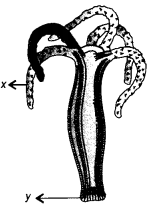
Diversity in Living Organisms Class 9 Important Questions Science Chapter 7 image - 4
Answer:
X — Stinging cell,
Y — Foot.

Question 35.
Write the major features of fungi (CCE 2011, 2012)
Answer:

  1. The body called mycelium is made of achlorophyllous threads.
  2. Cell wall contains chitin.
  3. Nutrition is heterotrophic and absorptive,
  4. Reserve food is glycogen and oil.

Question 36.
Enlist four main features of organisms placed in protista.
(CCE 2011)
Answer:

  1. Unicellular or colonial, mostly aquatic, constituting plankton.
  2. Eukaryotic organisation with nucleus and membrane bound cell organelles.
  3. Locomotion present in many with the help of cilia, j flagella and pseudopodia.
  4. Both asexual and sexual reproduction present. Sexual reproduction without an embryo stage.

Question 37.
Give four main features of phylum coelenterata.
(CCE 2011)
Answer:

  1. Diploblastic animals with tissue level organisation.
  2. Body has a single opening for both feeding and elimination.
  3. Tentacles with cnidoblasts or nematoblasts.
  4. Nerve cells present but nerve plexus absent.

Question 38.
Give one example of each of
(a) Reptile which has four chambered heart
(b) Egg laying mammal
(c) Parasitic platyhelminthes
(d) Division among plants which has the simplest organisms. (CCE 2011)
Answer:
(a) Crocodile
(b) Platypus
(c) Liver-fluke
(d) Uhthrix (thallophyta-algae).

Question 39.
Identify the phylum for the following characteristics given :
(a) Organisms with jointed appendages
(b) Organisms are generally flat worms
(c) Body is segmented
(d) Skin of organisms is full of spines. (CCE 2011)
Answer:
(a) Arthropoda
(b) Platyhelminthes
(c) Annelida
(d) Echinodermata.

Question 40.
Write any two characteristics of class mammalia.Name one egg laying mammal. (CCE 2011, 2012)
Answer:

  1. Presence of mammary glands in females
  2. Presence of body hair.

Egg Laying Mammal. Platypus, Echidna.

Question 41.
An animal is dorsoventrally flattened, has three embryonic germ layers and is acoelomate.
To which phylum does it belong ? What are they commonly called ? Give one example. (CCE 2012)
Answer:
Phylum. Platyhelminthes. Common Name Flatworms. Example. Planaria.

Question 42.
Write the name used for the following :
(a) Plants which bear naked seeds
(b) Animals which have pseudocoelom
(c) Animals which maintain a certain body temperature over a wide range of temperature in the environment.
(CCE 2012, 2015)
Answer:
(a) Gymnosperms
(b) Pseudocoelomates-Nemathelminthes
(c) Homoiotherms or warm blooded.

Question 43.
What is parasite ? Give two examples. (CCE 2012)
Answer:
Parasite is an organism which obtains its food from a living organism of another species called host. Examples. Fasciola (Liver Fluke), Ascaris (Common Roundworm).

Question 44.
(a) State the number of chambers in the heart of

  1. Fishes
  2. Frogs,

(b) Define

  1. Triploblastic and
  2. Bilateral Symmetry. (CCE 2012)

Answer:
(a)

  1. 2 chambers
  2. 3 chambers,

(b)

  1. Triploblastic: Animals having three germinal layers—ectoderm, mesoderm and endoderm, viz., platyhelminthes to chordates.
  2. Bilateral Symmetry: It is a symmetry in which organs are paired with each one of the pair lying on right and left sides of the body, e.g., chordates, arthropods.

Question 45.

  1. Cat, Platypus and Man are all mammals. Yet one of the most unique feature of mammals when considered helps to divide them’ into two groups. What is that feature ?
  2. Mention two other characteristic features which are common to all the three animals. (CCE 2012)

Answer:

  1. Vivipary: Platypus is egg laying mammal while the other two give birth to young ones,
    1. Presence of hair over the body
    2. Occurrence of mammary glands in females.

Question 46.
Fungi have cell wall but still they cannot be classified under kingdom plantae. Give two reasons. (CCE 2012)
Answer:
Cell wall of fungi contains chitin while in plantae it has cellulose. Further, the reserve carbohydrate food is glycogen in fungi and starch in plantae. Fungi are heterotrophic while most plants are autotrophic.

Question 47.
List two reasons why whales are not grouped with fishes ?
(CCE 2012)
Answer:
Whales are mammals which have

  1. Four chambered heart, pulmonary respiration and a diaphragm while fishes have two chambered heart, gill respiration and no diaphragm.
  2. Whales are warm blooded with mammary glands in females. Fishes are cold blooded. Mammary glands do not occur in them.

Question 48.
Jelly fish and Star Fish are not true fishes. To which group do they belong ? Give one characteristic features of each to say they belong to the respective groups. (CCE 2012)
Answer:
Jelly Fish: Coelenterata—diploblastic with cnidoblasts. Star Fish. Echinodermata—Spiny skinned with tube feet.

Question 49.
Write four characters of monerans. (CCE 2012)
Answer:

  1. Prokaryotic Nature. The genetic material is a single double stranded DNA coiled in the cytoplasm to form nucleoid. A nuclear mambrane is absent.
  2. Cell Organelles. Membrane covered cell organelles are absent.
  3. Flagella. If present, they are single stranded.
  4. Cell Wall. It is made of murein or peptidoglycan.

Question 50.
Give three features of butterfly to justify its classification in phylum arthropoda. Mention one more animal of the same phylum.
Answer:

  1. Chitinous exoskeleton,
  2. Jointed appendages
  3. Open circulatory System.
    Other Example. Prawn.

Question 51.
Some fungal species live in permanent mutually dependent relationship with blue-green algae. Name the relationship. Mention where these forms are grown and what they are called ? (CCE 2012)
Answer:
Symbiosis or mutualism. The dual organisms grow on rocks and tree trunks. They are called lichens.

Question 52.
Write one point of difference between bony fish and cartilaginous fish with one example of each. (CCE 2012)
Answer:
A bony fish has a bony endoskeleton with terminal mouth ‘‘find gill slits covered by operculum, e.g., Labeo. A cartilaginous fish has cartilaginous endoskeleton with ventral mouth and uncovered gill slits, e.g., Scoliodon.

Question 53.
Classify the following fishes as cartilaginous or bony,

  1. Sting Ray
  2. Scoliodon (Dog Fish)
  3. Labeo rohita (Rohu)
  4. Caulophrynejordani (Angler Fish). (CCE2012)

Answer:

  1. String Ray. Cartilaginous,
  2. Scoliodon. Cartilaginous.
  3. Labeo rohita. Bony,
  4. Caulophryne jordani. Bony. Cell wall of fungi is made of chitin.

Question 54.

  1. What is chemical nature of chitin ?
  2. What is the mode of nutrition in fungi ? (CCE 2012, 2013)

Answer:

  1. Chitin is polysaccharide made of N-acetyl glucosamine monomers,
  2. Absorptive heterotrophic.

Question 55.
Identify the class of animals having following characteristic
(a) Warm blooded having four chambered heart and modified fore limbs for flight,
(b) Organisms having mucous glands in the skin, lack scales, respire either through gills or lungs. (CCE 2012)
Answer:
(a) Aves
(b) Amphibia.

Question 56.
Select the odd one with respect to classification. Also give reason for your choice,
(a) Mango, Gram, Rice, Apple.
(b) Prawn, Scorpion, Octopus, Butterfly. (CCE 2012)
Answer:
(a) Rice: Rice is monocot while others are dicots,
(b) Octopus: Octopus belongs to mollusca while all others are arthrophods.

Question 57.
How do amphibians respire and reproduce ? (CCE 2012)
Answer:
Respiration: Amphibians respire through lungs, skin and in many cases gills.
Reproduction: Sexes are separate. Fertilization is external.

Question 58.
Name the phylum to which the following belong.
(a) Silver Fish
(b) Sea Horse,
(c) Star Fish
(d) Jelly Fish. (CCE 2012)
Answer:
(a) Silver Fish. Arthropoda.
(b) Sea Horse. Chordata.
(c) Star Fish. Echinodermata.
(d) Jelly Fish. Coelenterata.

Question 59.
Name the four categories used in hierarchical classification of organism. (CCE 2012)
Answer:
Kingdom, Division/Phylum, Class, Order.

Question 60.
Write three distinguishing features of phylum echinodermata. Give one example. (CCE 2012)
Answer:
Features

  1. Skin is spiny,
  2. A water vascular system connected with tube feet is present for helping in locomotion and respiration.
  3. Symmetry is radial in adults and bilateral in larva. Example. Asterias (Star Fish).

Question 61.
The scientific name for tiger is Pantbera tigris. What does Panthera and tigris represent in binomial nomenclature. Name the scientist who introduced this system of scientific naming of organisms. (CCE 2012)
Answer:

  1. Panthera: Genus or generic name, tigris. Species or specific epithet,
  2. Carolus Linnaeus.

Question 62.
Identify the group :
(a) Animals without tissues, body bearing pores.
(b) Plant body differentiated into roots, stems and leaves but do not produce seeds,
(c) Body dorsoventrally flattened without coelom,
(d) Segmented worms with the body cavity with extensive organ differentiation.
(CCE 2012)
Answer:
(a) Porifera
(b) Pteridophyta
(c) Platyhelminthes
(d) Annelida.

Question 63.
State the type of body cavity found in platyhelminthes. Write whether they are parasitic or free living. (CCE 2012)
Answer:
Parenchymatous body cavity is present but coelom is absent. Both free living (e.g., Planaria) and parasitic (e.g., Fasciola) forms occur in platyhelminthes.

Question 64.
Echinoderms have a system that they use for moving around. Name the system. What is their skeleton made of ? (CCE 2012)
Answer:

  1. Water vascular or ambulacral system.
  2. Calcareous plates.

Question 65.
List any two similarities and two differences between Amoeba ‘ and Paramoecium. (CCE 2012)
Answer:
Similarities :

  1. Unicellular nature
  2. Eukaryotic nature.
  3. Presence of contractile vacuoles.

Differences :

  1. Amoeba possesses pseudopodia while Paramoecium has cilia.
  2. Amoeba has a single nucleus. Paramoecium has two nuclei.

Question 66.
(a) What is scientific name of humans ?
(b) Find the odd one out of Riccia, Funaria, Fern, Marchanda. (CCE 2012)
Answer:
(a) Homo sapiens
(b) Fern: It is a pteridophyte while others are bryophytes.

Question 67.
Given below are two groups of organisms belonging to kingdom Animalia.
Write the name of phylum to which they belong.
(a) Octopus, Pita, Unio
(b) Centipede, Prawn, Scorpion.
(CCE 2013)
Answer:
(a) Mollusca
(b) Arthropoda.

Question 68.
Write two differences between pteridophyte and phanerogam. (CCE 2013)
Answer:
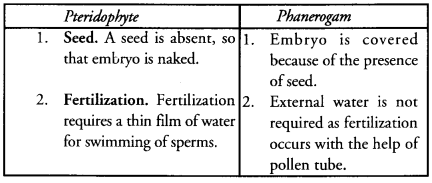
Diversity in Living Organisms Class 9 Important Questions Science Chapter 7 image - 5

Question 69.
Name the phyla to which the following animals belong :
(a) Star Fish
(b) Leech. (CCE 2013)
Answer:
(a) Star Fish-Echinodermata
(b) Leech-Annelida.

Question 70.
Identify the organisms :
(a) A unicellular organism that uses flagella for moving around
(b) An organism that uses pseudopodia for moving around. (CCE 2013)
Answer:
(a) Flagella-Euglena
(b) Pisedopodia-Amoeba.

Question 71.
We start classification of plants on the basis of differentiation of plant body,

  1. Which division lacks a well differentiated body design ?
  2. Where are such plants predominantly found ? (CCE 2014)

Answer:

  1. Thallophyta – algae,
  2. Occurrence. Aquatic (both fresh and marine).

Question 72.
Give two features of Cockroach due to which it is classified as arthropod. (CCE 2014)
Answer:

  1. Chitinous exoskeleton,
  2. Jointed appendages
  3. Open circulatory System.
    Other Example: Prawn.

Question 73.
Identify ‘X’ and ‘Y’ in the diagram of a part of earthworm. What function is performed by ‘X’. (CCE 2014)
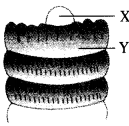
Diversity in Living Organisms Class 9 Important Questions Science Chapter 7 image - 6
Answer:
X- Prostomium.
Y-Peristomium.
Function of X: Sensory.

Question 74.
After observing an Earthworm, Samir decided to place it in phylum annelida. Which two features did he observe that helped him do so ? (CCE 2014)
Answer:

  1. Long, segmented (metameric segmentation) body
  2. Presence of rings of microscopic unjointed setae.

Question 75.
Give one function of gills in fishes. To which phylum do the fishes belong ? (CCE 2014)
Answer:
Gills: They are sites of respiration or exchange of gases between blood and water. Phylum. Chordata.

Question 76.
Mention two features adapted by birds which help them fly. (CCE 2014)
Answer:

  1. Fore limbs modified into wings,
  2. Stream-lined body, pneumatic bones.

Question 77.
Name the adaptation of fish which help them in
(a) Floating in water,
(b) Breathing. (CCE 2014)
Answer:
(a) Floating: Presence of air sac.
(b) Breathing: Occurrence of gills.

Question 78.
Name the habitat of earthworm and how is it useful to the animal. (CCE 2014)
Answer:
Earthworm lives in moist soil from which it can obtain food as decaying organic matter, keep the skin moist for respira¬tion and easily dig narrow burrows

Question 79.
(a) Why is the body of bony fishes stream-lined ?
(b) List two habitats of bony fishes. (CCE 2014)
Answer:
(a) Stream-Lined Body. For meeting little resistance during swimming.
(b) Habitats. Fresh and marine waters.

Question 80.
State any two specific features of earthworm. (CCE 2014)
Answer:

  1. Segmented cylindrical body,
  2. Occurrence of clitellum.

Question 81.
The body of an organism is stream-lined and has feathers on its body. Identify the organism and write one specific feature of it. (CCE 2014)
Answer:
Bird. Presence of wings and a toothless beak.

Question 82.
Why is it difficult to classify bacteria ? Give two reasons.
(CCE 2017)
Answer:

  1. Bacteria are microscopic,
  2. There are limited differences in structure and functions.

Question 83.
What is binomial nomenclature ? Explain it with the help of an example. (CCE 2017)
Answer:
Binomial nomenclature is scientific system of providing distinct and proper two word name to each and every organism. For example, the scientific name of Mango is Mangifera indica where Mangifera represents the genus while indica is the specific epithet.

Short Answer Questions (3 marks)

Question 1.

  1. Draw a neat diagram of Hydra,
  2. Label mesogloea and gastrovascular cavity,
  3. Name the group of animals it belongs to.
  4. Name one species of this group that lives in colonies. (CCE 2011, 2012)

Answer:
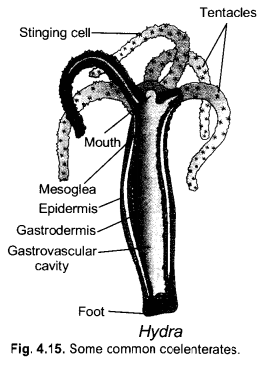
  1. Diversity in Living Organisms Class 9 Important Questions Science Chapter 7 image - 7
  2. Label the two parts.
  3. Phylum coelenterata.
  4. Corals.

Question 2.
Identify the plant bodies which are named as cryptogamae1. State and explain two characteristics which are exhibited by each category of these plant bodies. (CCE 2011)
Answer:
Cryptogamae, the subkingdom of seedless plants, consists of three groups-thallophyta, bryophyta and pteridophyta.

  1. Thallophyta: Simple, ill-differentiated plant body, e.g., algae like Ulothrix
    1. Unicellular and nonjacketed reproductive organs
    2. Embryo stage absent.
  2. Bryophyta: Simple thallus-like or differentiated into stem and leaf-like structures, e.g., Riccia, Marchantia, Funaria (moss),
    1. Simplest but amphibious land plants which are fixed by means of rhizoids.
    2. Plant body is gametophyte. Sporophyte lives on it as a parasite.
  3. Pteridophyta: Differentiated plant body consisting of true roots, stems and leaves, e.g., ferns,
    1. Dominant plant body is sporophyte. Gametophyte is small but independent.
    2. Vascular tissues present but seeds are absent.

Question 3.
List any three groups of plants, which are referred to as vascular plants. Out of these which group is further classified on the basis of number of cotyledons. State its two characteristics. (CCE 2011, 2012)
Answer:
Vascular plants are those plants which possess vascular tissues, xylem and phloem, for conduction of water and nutrients respectively. There are three groups of vascular plants or tracheophytes-pteridophytes, gymnosperms and angiosperms.
Angiosperms or flowering plants are classified on the basis of cotyledons present in their seeds, monocotyledoneae (single cotyledon) and dicotyledoneae (two cotyledons). Characteristics

  1. Sporophylls are organised into flowers.
  2. Seeds develop inside fruits.

Question 4.
(a) Draw a well labelled diagram of Euglena.
(b) Name the kingdom to which it belongs. (CCE 2011)
Answer:
(a)
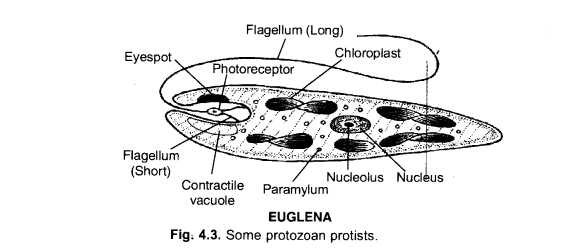
Diversity in Living Organisms Class 9 Important Questions Science Chapter 7 image - 8
(b) Protista.

Question 5.
Pick up the odd one out and justify your choice by giving reasons :
(a) Moss, Fern, Pinus, Spirogyra.
(b) Sea Cucumber, Octopus, Feather Star, Star Fish. (CCE 2011)
Answer:
(a) Pinus: The other three belong to cryptogamae while Pinus is a member of phanerogamae.
(b) Octopus: The other three belong to echinodermata while Octopus is a member of mollusca.

Question 6.
Write any three differences between Amphibia and Mammalia. (CCE 2011)
Answer:
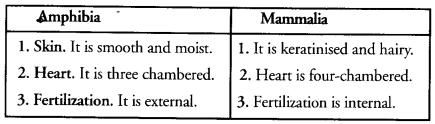
Diversity in Living Organisms Class 9 Important Questions Science Chapter 7 image - 9

Question 7.
(a) Write down four characteristic features of the members of class Aves.
(b) To which group do the following belong :
(t) Evergreen trees that bear naked seeds.
(it) Plants which have tap root system and two cotyledons in their seeds. (CCE 2011)
Answer:
(a) Aves is a class of warm-blooded vertebrates having fore-limbs modified into wings, body covered with feathers and jaws modified into horny toothless beak.
General Characters

  1. Birds are the flying animals, having exoskeleton of feathers. Skin is dry except for a preen gland for dressing of feathers.
  2. Body Temperature. Birds are warm blooded
  3. Body Divisions. Body is divided into head, neck, trunk and tail.
  4. Fore limbs are modified intowings while hind limbs have four clawed digits which are adapted for walking, running, perching or digging.
  5. 5. Bones. They are very light because of air spaces (pneumatic bones).
  6. Jaws are prolonged to form horny beak. Teeth are absent.
  7. Bird’s Milk. Oesophagus is modified to store and soften the food. It is source of bird’s milk which is used for feeding the young birds.
  8. Respiratory System. It possesses well-developed lungs which have air sacs attached to them for double respiration.

(b)

  1. Gymnospermae.
  2. Dicotyledoneae.

Question 8.
Identify the diagrams. Write the phylum do they belong to. Write down the characteristic features of each phylum.
(CCE 2011)
Answer:
(a) Wuchereria (Filarial worm). Phylum. Nematoda (nemathelminthes).
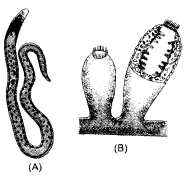
  1. Cylindrical body with bilateral symmetry.
  2. Triploblastic with pseudocoelom,
  3. With both mouth and anus, having primitive system level of organisation.

(b) Sponges. Phylum. Porifera.

  1. Sedentary adults with hard skeleton of spicules and fibres,
  2. Diploblasdc with cellular level of organisation,
  3. Canal system with ostia and osculum, flagellated choanocytes,

Question 9.
Differentiate between annelida and nematoda.
Answer:
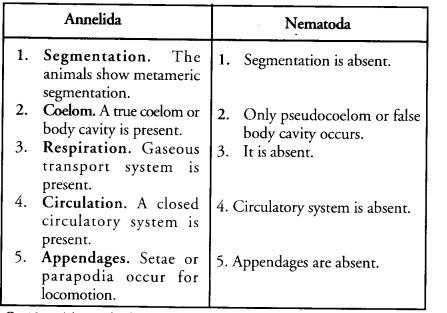
Diversity in Living Organisms Class 9 Important Questions Science Chapter 7 image - 11

Question 10.
(a) In which two ways amphibians are different from fishes,
(b) Identify the phylum of organisms having the following characteristics :

  1. Pore bearing animals and radial symmetry,
  2. Body spiny with radial symmetry,

(c) Why gymnosperms do not require water for fertilization ? (CCE 2011)
Answer:
(a)

  1. Amphibians have limbs while fishes possess fins,
  2. Amphibians have lungs while the same are absent in fishes.

(b)

  1. Porifera
  2. Echinodermata.

(c) In gymnosperms fertilization occurs through siphonogamy or pollen tube. Therefore, an external source of water is not required for carrying male gametes.

Question 11.
(a) Name the phylum to which each of the following animals belongs to – Silver Fish, Star Fish, Tapeworm, Leech.
(b) List two features of vertebrates. (CCE 2011 )
Answer:
(a)

  1. Silver Fish – Arthropoda
  2. Star Fish – Echinodermata.
  3. Tapeworm- Platyhelminthes.
  4. Leech – Annelida.

(b) Features of Vertebrates.

  1. Notochord replaced by cranium and vertebral column,
  2. Dorsal nerve cord transformed into brain and spinal cord.
  3. Presence of paired gill pouches replaced by lungs in land animals.
  4. A chambered ventral heart is present.

Question 12.
How do Aves differ from Mammals ? (three points). (CCE 2011, 2012, 2013)
Answer:

AvesMammalia
1. Wings. Forelimbs are modified into wings.Wings are absent except in bats.
2. Feathers and Scales. The body is covered with feathers and scales.Feathers and scales are absent.
3. Skin Glands. Skin is dry. Only a single preen gland is present.Skin bears a number of sweat and oil glands.
4. Mammary Glands. They are absent.Female possesses mammary glands for feeding the young
5. Diaphragm. A diaphragm is absent.A partition called diaphragm is present between abdomen and thorax.
6. Beak. A toothless beak is present.Jaws do not form a beak. Teeth are present.
7. Bones. They are hollow or pneumatic.Bones do not possess air cavities.
8. Larynx/Syrinx. Larynx is non-functional. Instead syrinx is present.Larynx is functional. Syrinx is absent.
External air sacs do not occur over lungs.
9. Air Sacs. Lungs possess external air sacs.
10. Yolk. Eggs possess a lot of yolk (macrolecithal).Eggs have little yolk (alecithal).
11. Reproduction. Birds are oviparous.Mammals are viviparous with the exception of a few species.

Question 13.
To which group do the following organisms belong and give one reason for each
(a) Cyanobacteria
(b) Euglena
(c) Ulothrix ? (CCE 2011)
Answer:
(a) Cyanobacteria – Monera. Prokaryotic nature.
(b) Euglena – Protista. Unicellular eukaryote.
(c) Ulothrix – Plantae. Thallophyta-Algae. Little

Question 14.
differentiated autotrophic body with unicellular, non- jacketed sex organs.

  1. What are vertebrates ?
  2. Name four subgroups of vertebrates. (CCE 2011, 2012)

Answer:

  1. Vertebrates. They are chordates in which notochord has been replaced by endoskeleton of vertebral column [ and cranium while dorsal nerve cord has been transformed into brain and spinal cord.
  2. Pisces, Amphibians, Reptiles, Aves, Mammals.

Question 15.
On the basis of the following features, identify the group and give one example of each :

  1. Presence of notochord at some stage of life,
  2. Unicellular microscopic and eukaryotic.
  3. Seeds are enclosed in fruits. (CCE 2011)

Answer:

  1. Notochord At Some Stage. Protochordata, e.g., Herdmania.
  2. Unicellular, Microscopic, Eukaryotic. Protista, e.g., Euglena, Amoeba.
  3. Seeds Enclosed in Fruits. Angiospermae, e.g, Mango, Tomato.

Question 16.
Write one difference for each of the following pairs

  1. Thallophyta and Bryophyta
  2. Nematoda and Annelida
  3. Amphibia and Pisces.
    (CCE 2011, 2012)

Answer:

  1. Thallophyta and Bryophyta. In thallophyta the reproductive organs are unicellular, non-jacketed with no embryo stage. In bryophyta the sex organs are multicellular, jacketed with an embryo stage.
  2. Nematoda and Annelida
    Diversity in Living Organisms Class 9 Important Questions Science Chapter 7 image - 12
PiscesAmphibians
1. Scales. The body is covered by scales.1. Scales are absent.
2. Mucous Glands. The skin does not possess mucous glands.2. The skin has mucous glands that keep the skin moist and slippery.
3. Fins. Pisces possess fins for locomotion and steering3. Fins may occur in larval stage. The adult does not possess fins. Limbs occur instead.
4. Heart. It is two chambered.4. Heart is 3-chambered.
3. Lungs. Pisces do not have lungs.5. Lungs are present.
Examples. Scoliodon, Labeo.Examples. Frog, Toad.

Question 17.
(a) List any two main characteristics of chordates.
(b) In which class would you place an organism which has

  1. Four chambered heart and lays eggs,
  2. Skeletons made of both bones and cartilage and are cold blooded.
    (CCE 2011)

Answer:
(a) Chordate Features:

  1. Occurrence of notochord that is transformed into cranium and vertebral column in higher chordates.
  2. Presence of dorsal hollow nerve cord above the notochord which in higher chordates is transformed into brain and spinal cord.

(b)

  1. Aves.
  2. Pisces.

Question 18.
Name the phylum to which this organism belongs. Write any two characteristic features of the phylum. (CCE 2011, 2012)
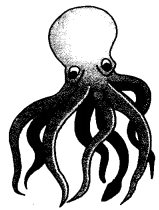
Diversity in Living Organisms Class 9 Important Questions Science Chapter 7 image - 13
Answer:
Mollusca (animal Octopus).

  1. Soft bodied animals with a shell,
  2. Unsegmented, triploblastic body with haemocoel. Both shell and haemocoel absent in Octopus.

Question 19.
Classify the following organisms based on the absence/ presence of true coelom, i.e., acoelomate, pseudocoelomate and coelomate :
(a) Scorpion
(b) Sea Anemone
(c) Ascaris
(d) Earthworm
(e) Wuchereria
(f) Nereis. (CCE 2011)
Answer:
(a) Scorpion – Coelomate (also haemocoelomate).
(b) Sea Anemone-Acoelomate.
(c) Attïzro-Pseudocoelomate.
(d) Earthworm- Coelomate.
(e) Wuchereria – Pseudocoelomate.
(f) Nereis-Coelomate.

Question20.
What is the most striking features of the following phyla :

  1. Arthropoda
  2. Amphibia
  3. Porifera.
    (CCE 2011, 2012)

Answer:

  1. Arthropoda: Chidnous exoskeleton and jointed appendages.
  2. Amphibia: Living in both water and on land with smooth skin having mucous glands and three chambered heart.
  3. Porifera: Diploblastic, acoelomate, sedentary animals with porous body and canal system.

Question 21.
Name the largest group of animals. Write the salient features of this group. Give two examples. (CCE 2012, 2013)
Answer:
Largest Group. Arthropoda.
Salient Features

  1. Presence of jointed appendages.
  2. Occurrence of chitinous exoskeleton,
  3. Presence of haemocoel and open circulatory system.
    Examples. Cockroach, Housefly, Mosquito.

Question 22.
Classify the following organisms on the presence of coelom— Spongilla, Planaria, Scorpion, Birds, Ascaris, Nerreis.
(CCE 2012)
Answer:
Spongilla—acoelomate. Planaria-acoelomate.
Scorpion— coelomate (haemocoelomate).
Birds—coelomate. Ascaris- pseudocoelomate.
Nereis—coelomate.

Question 23.
State the appropriate term for the following :

  1. Plants which bear seeds with two cotyledons.
  2. Animals which do not have coelom.
  3. Edible fungi. (CCE 2012)

Answer:

  1. Dicots,
  2. Acoelomate
  3. Mushrooms.

Question 24.
State the type of cells monerans have. State their structure and the type of nutrition they have (CCE 2012)
Answer:
Monerans have prokaryotic cells.
Structure: Monerans are basically unicellular. The cells possess peptidoglycan (= murein) cell wall, no membrane bound organelles, genetic material coiled to form nucleoid without any membranous covering.
Nutrition: Varied, both autotrophic and heterotrophic.

Question 25.
Define

  1. Lichens
  2. Cryptogams
  3. Phanerogams. (CCE 2012, 2013)

Answer:

  1. Lichens: They are dual organisms which have been formed by a permanent symbiotic association between an alga and a fungus, e.g. Graphis.
  2. Cryptogams: They are seedless lower plants where reproductive organs are inconspicuous requiring an external water for fertilization.
  3. Phanerogams: They are seed bearing higher plants which possess conspicuous reproductive organs like cones and flowers, e.g., Pinus, Wheat.

Question 26.
List three distinguishing features between annelid animals and arthropods. (CCE 2012)
Answer:
1. Exoskeleton. Annelids do not have a chitinous exoskeleton which is present in arthropods.
2. Circulatory System. Annelids have a closed circulatory system while arthrpods have open circulatory system.
3. Appendages. Appendages are unjointed in annelids and jointed in arthropods.

Question 27.
(a) On what basis does the embryo of cryptogams differ from that of phanerogams ?
(b) Describe the feature that divides the angiosperms in two groups
(c) State the two subgroups of angiosperms. (CCE 2012)
Answer:
(a) Embryo of cryptogams is naked while that of phanerogams is covered being present inside the seed.
(b) Number of cotyledons in the seed.
(c) Dicots and monocots.

Question 28.
(a) What is the function of notochord ?
(b) List out any four features that all chordates possess.
(CCE 2012)
Answer:
(a) Function of Notochord. It provides attachment to muscles. Phylogenetically it has given rise to jointed axial skeleton of cranium and vertebral column.
(b) Presence of

  1. Notochord which in higher forms is transformed into cranium and vertebral column,
  2. Dorsal Hollow Nerve Cord. In higher chordates, it is transformed into brain and spinal cord.
  3. Pharyngeal Gill Slits. Present at some stage of life cycle,
  4. Post-anal tail.

Question 29.
Draw a neat diagram of Spirogyra and label the following parts
(a) Outermost layer of cell
(b) Organelle that performs the function of photosynthesis,
(c) Jelly-like substance in the cell where all organelles are suspended.
(d) Darkly coloured and dot-like structrue generally present in the centre of the cell. (CCE 2012)
Answer:
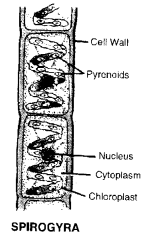
Diversity in Living Organisms Class 9 Important Questions Science Chapter 7 image - 14
(a) Cell wall (outermost layer of cell)
(b) Chloroplast (organelle that performs the function of photosyntheis)
(c) Cytoplasm (jelly-like substance in the cell).
(d) Nucleus (darkly stained dot-like structrue).

Question 30.
Give reasons for the following :
(a) Echidna and Platypus lay eggs but are considered mammals
(b) Crocodile has four chambered heart but still is a reptile.
(c) Birds have pneumatic bones. (CCE 2012)
Answer:
(a) Platypus and Echidna possess body hair and mammary glands like other mammals.
(b) Crocodiles are piokilothermic, lay cleidoic eggs, with body having cornified skin covered with scales and bony plates.
(c) Pneumatic bones are light and strong required for birds in their flight.

Question 31.
Name the phylum to which the following organisms belong :
(a) Organisms which have peculiar water driven tube feet system that they use for moving around.
(b) Organisms which have a foot that is used for moving around and have an open circulatory system.
(c) The organisms have holes or pores all over their body.
They lead to a canal system that helps in circulating water throughout the body. (CCE 2012)
Answer:
(a) Echinodermata
(b) Mollusca
(c) Porifera.

Question 32.
Identify and name the following :
(a) Organisms that use dead and decaying organic material as food.
(b) Cell walls of fungi are made of this type of sugar
(c) Kingdom to which Amoeba belongs
(d) An example of moneran
(e) An animal with a pseudocoelom.
(f) A group which has an open circulatory system.
(CCE 2012)
Answer:
(a) Saprophyte, e.g., Rbizopus.
(b) N-acetyl glucosamine (forms chitin).
(c) Protista (unicellular eukaryotes)
(d) Escherichia coli, a bacterium
(e) Pseudocoelomate, e.g., Ascaris.
(f) Arthropoda.

Question 33.
Classify the following and write one characteristic of each :
(a) Lichen
(b) Sponges
(c) Flatworm. (CCE 2012)
Answer:
(a) Lichen: Dual organism made of an alga and a fungus showing mutualism,
(b) Sponges: Porifera. Having inhalent pores or ostia and an exhalent pore or osculum connected by a canal system.
(c) Flatworm: Platyhelminthes. Triploblastic, acoelomate.

Question 34.
“Tapeworm is triploblastic”, what does it mean ? How is Hydra different from Tapeworm in this aspect ? Name the phylum to which Hydra and Tapeworm belong.
(CCE 2012)
Answer:
Tapeworm is triploblastic because it has three germinal layers (ectoderm, mesoderm and endoderm). Hydra is diploblastic as it has two germinal layers (ectoderm and endoderm). Hydra—coelenterata. Tapeworm-
Platyhelminthes.

Question 35.
(a) Write two distinct features by which vertebrates are differentiated from invertebrates
(b) What are protochordates ? Give two examples.
(CCE 2012)
Answer:
(a)
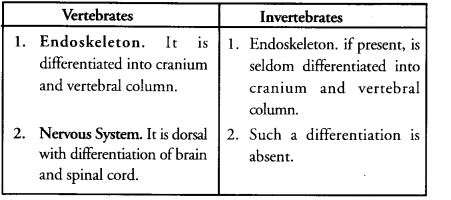
Diversity in Living Organisms Class 9 Important Questions Science Chapter 7 image - 15
(b) Protochordates are non-vertebrate chordates with a single layered epidermis, hollow dorsal but undifferentiated nerve cord as well as solid notochord in some stage of life cycle, e.g., Amphioxus.

Question 36.
Give other name to the category of plants that are called phanerogams. How are they further classified on the basis of their seeds ? Give example of each category. (CCE 2012)
Answer:
Seed plants or spermatophyta. Two categories

  1. Gymnosperms-naked seeds, e.g., Pinus.
  2. Angiosperms (Flowering Plants, seeds inside fruits).

Further of two types :

  1. Monocots—single cotyledon in seeds, e.g., Maize.
  2. Dicots—two cotyledons in seeds, e.g., Pea.

Question 37.
Write the names of the kingdom for the following organisms
(a) Single celled, eukaryotic and photosynethetic
(b) Multicellular, eukaryotic and photosynthetic
(c) Single-celled, prokaryotic and heterotrophic. (CCE2012)
Answer:
(a) Protista
(b) Plantae
(c) Monera.

Question 38.
(a) Name the kingdom to which Protozoa belong.
(b) Write one important characteristic of that kingdom.
(c) Name the appendages present in
(z) Euglena
{it) Paramoecium. (CCE 2012, 2013)
Answer:
(a) Protista
(b) Eukaryotic unicellular organisms.
(c) (t) Euglena-Ragellum
{iî} Paramoecium-cilia.

Question 39.
To which class do Salamander and Sparrow belong ?
Write any two differences between these classes.
(CCE 2012)
Answer:
Salamanader: Class Amphibia.
Sparrow: Class Aves.
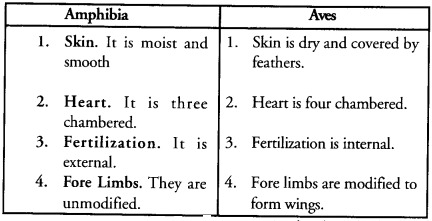
Diversity in Living Organisms Class 9 Important Questions Science Chapter 7 image - 16

Question 40.
(a) How are food and oxygen circulated in the body of organisms belonging to phylum porifera ?
(b) Why do fish have stream-lined body ?
(c) State the reason for birds having stream-lined body.
(CCE 2012)
Answer:
(a) By canal system which has many ostia or inhalent pores and one exhalent pore or ostium. Water circulates due to activity of flagellated collar cells or choanocytes.
(b) Fish have stream-lined body to meet minimum resistance while swimming in water
(c) Stream lined body provides least resistance to birds while flying.

Question 41.
Write one difference between
(a) Monera and Protista
(b) Platyhelminthes and Nematode. (CCE 2012)
Answer:
(a) Monera have prokaryotic nature while protista have eukaryotic nature.
(b) Platyhelminthes are acoelomate while nematodes are pseudocoelomate.

Question 42.
‘Snails are soft bodied shelled animal’. Identify the phylum to which they belong. Write any two distinguishing features of the phylum. (CCE 2012)
Answer:
Mollusca:

  1. Unsegmented body with open circulatory system.
  2. A muscular foot for locomotion.

Question 43.
What are cotyledons ? Name and discuss important features of two classes of angiosperms based on number of cotyledons. (CCE 2012)
Answer:
Cotyledons are seed leaves present over embryo axis below the plumule. On the basis of their number, angiosperms have been divided into two classes, monocots and dicots. Monocots. There is a single cotyledon. Monocots have parallel venation, fibrous root system and trimerous flowers.
Dicots: There are two cotyledons. Dicots have reticulate venation, tap root system and pentamerous or tetramerous flowers.

Question 44.
Write two examples of organisms belonging to.

  1. Nematoda
  2. Platyhelminthes
  3. Arthropoda
    (CCE 2012)

Answer:

  1. Nematoda: Ascaris, Wuchereria.
  2. Platyhelminthes Planaria (Dugesia), Liver Fluke (Fasciola).
  3. Arthropoda. Prawn (Palaeomon), centipede (Scolopendra).

Question 45.
Given below is a flow chart for classification of plants, Identify ‘a’, ‘b’, ‘c’, ‘d, ‘e’ and ‘f’ as an appropriate characteristic or plant group. (CCE 2012)
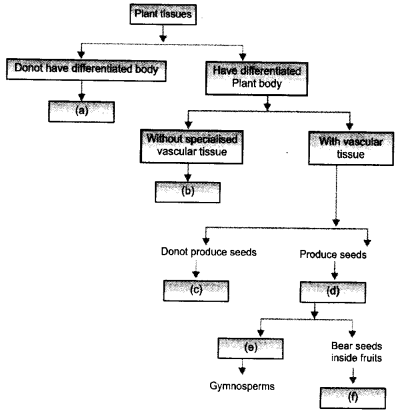
Diversity in Living Organisms Class 9 Important Questions Science Chapter 7 image - 17
Answer:
(a) Thallophyta
(b) Bryophyta
(c) Pteridophyta
(d) Spermatophyta
(e) Bear naked seeds
(f) Angisperms.

Question 46.
Write four main features of pteridophyta and give any two examples. (CCE 2012)
Answer:

  1. Sporophyte: Dominant sporophyte differentiated into stem, leaves and roots.
  2. Gametophyte: Small but independent.
  3. Vascular Tissues: Present.
  4. Seeds: Naked embryo, seeds absent.
    Examples. Selaginella, Dryopteris (Fern).

Question 47.
Is the given figure of a dicot or monocot ? Differentiate between dicots and monocots on the basis of venation and number of cotyledons in the seed. (CCE2012)
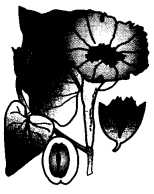
Diversity in Living Organisms Class 9 Important Questions Science Chapter 7 image - 18
Answer:
Dicot

  1. In dicots the leaves have reticulate venation. Venation is parallel in monocots.
  2. The seeds of dicots have two cotyledons. A single cotyledon is present in the seeds of monocots.

Question 48.
Draw and label any four parts of a bony fish.
(CCE 2012)
Answer:
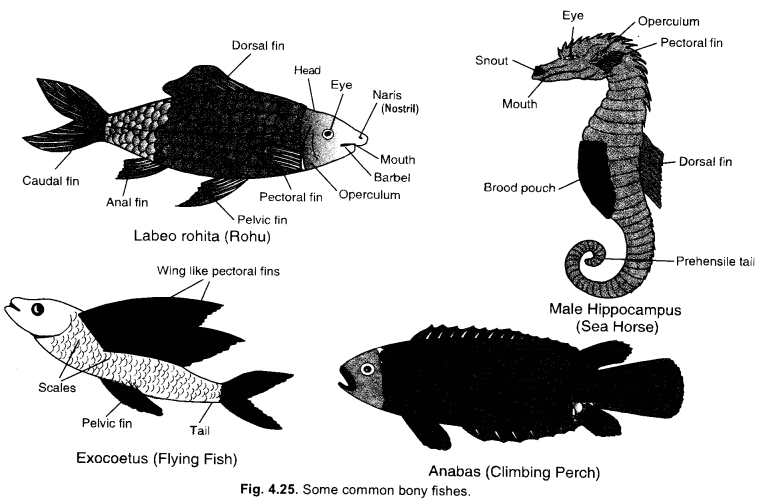
Diversity in Living Organisms Class 9 Important Questions Science Chapter 7 image - 19

Question 49.
Write one point of difference between the following :
(a) Annelids and arthropods
(b) Thallophytes and ; Pteridophytes
(c) Poriferans and coelenterates. (CCE 2013)
Answer:
(a) Annelids have unjointed appendages while arthropods possess jointed appendages.
(b) Thallophytes have simple undifferentiated and nonvascular plant body while it is differentiated and vascular in pteridophytes.
(c) Periferans have a number of inhalent pores and a single exhalent pore while coelenterates have a single opening.

Question 50.
Write one point of difference each between the j following :
(a) Amphibians and reptiles
(b) Aves and mammals
(c) Gymnosperms and angiosperms.(CCE 2013)
Answer:
(a) Skin is smooth, moist and non-cornified in amphibians while it is dry, scaly and cornified in reptiles.
(b) The body is covered by feathers and scales in aves. Hair occur in mammals.
(c) Gymnosperms possess naked seeds while angiosperms have seeds enclosed in fruits.

Question 51.
Write two examples of each

  1. Egg laying mammals
  2. Organisms with open circulatory system.
  3. Prokaryotic organisms. (CCE 2013)

Answer:

  1. Egg Laying Mammals. Platypus, Echidna.
  2. Organisms with Open Circulatory System. Arthropoda, Mollusca.
  3. Prokaryotic Organisms. Rhizobium, Escherichia.

Question 52.
State reasons for the following :
(a) Bryophytes are called amphibians of the plant kingdom
(b) Gymnosperms are called so.
(c) Birds have wings and feathers. (CCE 2013)
Answer:
(a) Bryophytes are called amphibians of plant kingdom as they live in moist, damp and shady places. A layer of water is required on the soil surface for

  1. Sexual reproduction.
  2. Protection from transpiration and hence desiccation
  3. Supply of water to all parts in the absence of vascular tissues.

(b) Gymnosperms are so called as they possess naked seeds (gymnos-naked, sperma—seed).
(c) Birds have wings for flight and feathers for insulation.

Question 53.
Write one characteristic feature of each of the following groups of organisms :

  1. Cryptogams
  2. Arthropods
  3. Mammals. (CCE 2013)

Answer:

  1. Cryptogams: Absence of seed so that embryo, if present, is always naked.
  2. Arthropoda: Presence of jointed appendages and legs.
  3. Mammals: Occurrence of mammary glands in females to nourish new borns.

Question 54.
“Lichens” show symbiotic life form between two organisms.

  1. Name the two organisms showing this relationship
  2. Write the kingdom to which each one belongs
  3. In such relationship, organisms are parasitic or mutually benefitted from each other or mutually dependent on one another. Explain. (CCE 2013)

Answer:

  1. Lichen: Lichen is formed by an obligate association between a fungus and an alga.
  2. Fungus-kingdom Fungi. Blue-green alga-kingdom Monera.
  3. Mutually dependent and mutually benefitted. In lichen, the alga manufactures food for itself as well as fungus. The fungus provides protection to alga, helps in fixation and absorption of water as well as minerals.

Question 55.
State reason for the following :
(a) Fungi are called saprophytes
(b) Platyhelminthes are called so. (CCE 2013)
Answer:
(a) Fungi are heterotrophs with absorptive type of nutrition. The free living fungi feed on organic remains. They secrete digestive enzymes into external medium. The organic matter solubilises. It is absorbed by fungi. Hence, fungi are called saprophytes (sapros-tottcn, phyton-phstx).
(b) Platyhelminthes (platy-flat, helminthes-worms) are called flat worms as they are dorsoventrally flattened.

Question 56.
Identify the organisms and write one characteristic feature of the phylum to which they belong. (CCE 2013)
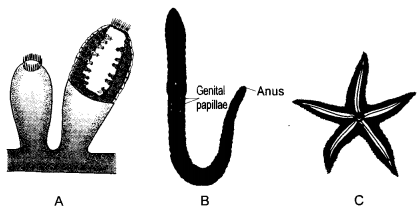
Diversity in Living Organisms Class 9 Important Questions Science Chapter 7 image - 20
Answer:
A- Sycon: Porifera. Presence of many inhalent pores (ostia) and one exhalent pore (osculum).
B- Earthworm: Annelida. Body is metamerically segmented.
C- Star Fish: Echinodermata. Radial symmetry with spiny exoskeleton.

Question 57.
(a) Give scientific name of human beings.
(b) Write two characteristic features of Aves and Mammals.
(CCE 2013)
Answer:
(a) Homo sapiens.
(b) Aves: Body covered with feathers, fore limbs modified into wings and jaws modified into horny toothless beak, e.g., Pigeon.
Mammalia: Hair covered body with integumentary glands, mammary glands in females, e.g., Tiger.

Question 58.
(a) Most mammals give birth to young ones. How do they nourish their young ?
(b) Name two egg laying mammals. (CCE 2014)
Answer:
(a) Through mammary glands by the females,
(b) Egg Laying Mammals. Platypus, Echidna.

Question 59.
Mr. Sharmas family had gone to visit a garden. Many beau¬tiful roses were there. Mr. Sharmas five year old son Himanshu wanted to pluck few roses. He was told not to do so by his elder sister Kanika who was in class IX.

  1. Rose belongs to which division of plant kingdom?
  2. State the number of cotyledons and type of root in rose plant.
  3. How can you contribute in the preservation of flora and fauna around you ? (CCE 2014)

Answer:

  1. Spermatophyta
  2. Cotyledons. 2. Root: Tap root.
  3. Preservation of flora and fauna,
    1. By not enroaching upon their habitat.
    2. By not damaging them through over exploitation or de-struction.

Question 60.
Write two examples each of the following :
(a) Animals which do not locomote.
(b) Flightless birds
(c) Molluscs without shell. (CCE 2014)
Answer:
(a) Sponges, corals,
(b) Emu, Ostrich, Kiwi
(c) Octopus, Banana Slug.

Question 61.
Write four conventions which are followed while writing the scientific names of organisms. Write the scientific name of tiger. (CCE 2014)
Answer:
Conventions.

  1. It consists of two words, first generic (like noun) and second specific (species).
  2. Generic name has first letter capital while specific word begins with small letter.
  3. Both are derived from latin language or are latinised.
  4. They are printed in italics or are underlined separately in hand-written form.

Tiger: Panthera tigris.

Question 62.
Carolus Linnaeus gave the two kingdom classification. Later ; it was changed by Ernst Haeckel (1894) and in 1969 ; Whittaker gave the five kingdom classification. Do you think that studying about the work done by earlier scientists or j their obsolete theories is useful for students of this genera- i tion ? Give three reasons. (CCE 2014)
Answer:
Science is a continuous search of truth. Search is based on the j knowledge previously gained and the appliances available, i As the appliances improve and the knowledge becomes wider and deeper, new truths become known. This changes the | previous concepts or theories.

  1. It is always rewarding to learn about the past obsolete j theories in the light of then known knowledge. This shall prompt the students to discover loop holes in the present knowledge and theories.
  2. As the gaps of present day knowledge become apparent, j a student will like to find yet hidden truths.
  3. Exceptions in the theories bring about their perusral by the students – the truth of yesterday has become fiction of today and truth of today shall become fiction of tomorrow.

Question 63.
Name the phylum to which the following organisms belong :
(a) Earthworm
(b) Planaria
(c) Sycon
(d) Starfish
(e) Housefly
(f) Octopus.
Answer:
(a) Earthworm-Annelida.
(b) Planaria-Platyhelminthes
(c) Sycon-Porifera.
(d) Starfish-Echinodermata.
(e) House- fly-Arthropoda.
(f) Octopus-Mollusca.

Question 64.

  1. Assign a group to an organism ‘X’ which has notochord in some larval forms,
  2. What would be the place of occur- rence of‘X’.
  3. What would be symmetry of‘X’ ? (CCE 2014)

Answer:

  1. ‘X’ — group Protochordata, subphylum Urochordata.
  2. Sea.
  3. Bilateral.

Question 65.
To study biodiversity, a group of students are taken to a zoo and another to a safari in the woods. Which is the better way S of learning and why ?
What more can you gain from such experiences ?
(CCE 2014)
Answer:
Safari in the woods is a better way of learning biodiversity j than a visit to Zoo.

  1. Woods are pieces of natural biodiversity of both plants and animals. Zoo contain only captured or endangered ani¬mals fed and cared by humans.
  2. Delicate balance of nature can be known only through a visit to the woods.

Question 66.
Learning. Nature should not be disturbed beyond its inbuilt regeneration capacity. Otherwise many organisms will become endangered and disappear for ever.
Will advanced organisms by the same as complex organisms ? If so why ? (CCE 2014, 2015)
Answer:
Yes. Advancement is based on development of specializations. Specialisation occurs where there is more elaboration and hence more complexity. However, there is likelihood of specialisation to lead to overspecialisation which becomes a hindrance to competitive nature of existence in the biosphere. Dinosaurs, giant crocodiles and mammoth have died down due to this reason. Therefore, advancement is possible only if specialisation leads to greater elaboration and efficiency.

Question 67.
Mention the problem which is associated with using local names of organisms. How was this resolved ? Name the scien-tist who had introduced the above solution.
(CCE 2015)
Answer:
Problem: All organisms do not have local names. Some or-ganisms have multiple local names while a local name is also used for two or more organisms. The problem was resolved through the development of binomial nomenclature of organisms. It was introduced by Carolus Linnaeus (1751).

Question 68.
Most mammals give birth to young ones,
(a) How do they nourish their young ones ?
(b) Name two egg laying mamamals. (CCE 2015)
Answer:
(a) Young ones are nourished inside the womb through pla-centa and by milk from mammary glands after birth.
(b) Duck-billed Platypus, Echidna.

Question 69.
Classify the following organisms on the basis of absence or presence of true coelom, i.e., coelomate, acoelomate and pseudocoelomate : Ascaris, Herdmania, Earthworm, Planaria, Fishes, Humans. (CCE 2015)
Answer:
Acoelomate. Planaria.
Pseudocoelomate. Ascaris.
Coelomate. Herdmania, Earthworm, Fishes, Humans.

Question 70.
Give three differences between monocotyledonous and di-cotyledonous plants. (CCE 2015)
Answer:

DicotyledoneaeMonocotyledoneae
1.      Cotyledons. In the seeds, the embryo bears two cotyledons.

2.       Venation. The leaves show reticulate venation.

3.       Vascular Bundles. Vascular bundles of the stem are open and arranged in a ring.

4.       Root System. The plants have tap root system.

5. Secondary Growth. Secondary growth occurs.

6. Flowers. Flowers are pentamerous (have five of each floral part) or tetramerous.

In the seeds, the embryo bears one
cotyledon.The leaves show parallel venation.Vascular bundles of the stem are closed and scattered in the ground tissue.The plants have fibrous root system.Secondary growth does not occur.Flowers are trimerous (have three of each floral part).

Question 71.
Name three plants under the group Thallophyta. Mention three characteristics of this group. (CCE 2015)
Answer:
Spirogyra, Ulothrix, Chara, Ulva.
Characteristics :

  1. Simple body design called thallus.
  2. Reproductive organs are unicellular and non-jacketed.
  3. An embryo stage is absent.

Question 72.
Give two examples of organisms belonging to the following phyla :
(a) Arthropoda
(b) Mollusca
(c) Protochordata.
(CCE 2015)
Answer:
(a) Arthropoda. Cockroach, Mosquito, Prawn.
(b) Mollusca. Pila, Pearl oyster, Octopus.
(c) Protochordata, Balanoglossus, Herdmania, Ampbioxus.

Question 73.
List any three characteristics of the phylum to which Hydra belongs. (CCE 2015)
Answer:
Hydra belongs to phylum Coelenterata (= Cnidaria).
Characteristics.

  1. Diploblastic animals with tissue level organisation.
  2. Body has a single opening for both feeding and elimination.
  3. Tentacles with cnidoblasts or nematoblasts.
  4. Nerve cells present but nerve plexus absent.

Question 74.
(a) What is the scientific name of human ?
(b) To which class of vertebrates does it belong ?
(c) Mention any two character-istics features of this group. ( CCE 2015, 2016)
Answer:
(a) Homo sapiens
(b) Mammalia
(c) Characteristics.

  1. Seven cervical vertebrae, a diaphragm dividing trunk and hair on the skin,
  2. Vivipary and nourishing the young one by milk from mammary galnds.

Question 75.
What is classification ? Why do we need to classify organisms ? Mention any two major characteristics used for classifying organisms. (CCE 2015)
Answer:
Classification. Classification is the arrangement of organisms into groups and sub-groups on the basis of their similarities and dissimilarities and placing them in a hierarchy that brings out their relationships.
Need for Classification:

  1. Identification is not possible without any system of classification.
  2. Classification helps in bringing out similarities and dissimilarities amongst organisms.
  3. Relationships are built up with the help of classification. They indicate the evolutionary pathways.
  4. Organisms of other localities and fossils can be studied only with the help of a system of classification.
  5. It is not possible to study every organism. Study of one or two organisms gives sufficient idea about other members of the group.
  6. Other branches of biology depend upon proper identification of the organism which is possible only through a system of classification.

Major Characteristics:

  1. Prokaryotic and eukaryotic nature.
  2. Unicellularity and multicelliuarity.
  3. Nutrition.

Question 76.
State reason for the following :
(a) Tapeworm does not have a digestive tract,
(b) Frogs use both skin and lungs for breathing,
(c) Birds have pneumatic / hollow bones.
(CCE 2015)
Answer:
(a) Tapeworm resides in the area of digestive tract where digested food is available.
(b) Frog lives both over moist land as well as inside water. Lungs are useful over land as well as after coming to the water surface. Moist skin is useful in respiration inside water and soil.
(c) Hollow or pneumatic bones are not only stronger than the solid bones but also make the body light weight for flight.

Question 77.
How do cnidarians (coelenterata) differ from porifera ?
(CCE 2015)
Answer:

PoriferansCoelenterates
1. Organisation. It is of cellular level.It is of tissue level.
2. Pores. A number of inhalent pores or ostia and a single exhalent pore or osculum are present.There is a single opening.
3. Digestion. It is intracellular.It is both intracellular and intercellular.
4. Muscle and Nerve Cells. They are absent.Primitive muscle and nerve cells appear for the first time in coelenterates.
5. Appendages. They are absent.Appendages are represented by tentacles.
6. Special Cells. The special cells are choanocytes or collar cells.Special cells are cnidoblasts.

Question 78.

  1. Draw the relevance of scientific naming of an organism.
  2. Who introduced this system of nomenclature ?
  3. Rana tigrina is the scientific name of common frog.
    What do these two terms imply ? (CCE 2015)

Answer:

  1. Advantage,
    1. It is universal, being the same in all languages and conntries.
    2. It is distinct and sepcific with no two organisms having the same name.
  2. Carolus Linnaeus.
  3. In Rana tigrina, the word Rana signifies genus or ge¬neric name while tigrina is a specific epithet or species.

Question 79.
Differentiate between gymnosperms and angiosperms.
(CCE 2016)
Answer:

GymnospermsAngiosperms
1. Sporophylls. They are aggregated to form cones.Sporophylls are aggregated to form flowers.
2. Seeds. The seeds are naked.The seeds are enclosed by fruit wall.
3. Microspores and Megaspores. The micro-spores and megaspores are produced by male and female cones.They are produced in the same or two different types of flowers.
4. Vascular Tissues. Xylem lacks vessels and phloem lacks companion cells.Xylem contains vessels and phloem contains companion cells.
5. Ovules. The ovules are not contained in the ovary.The ovules are enclosed in the ovary.
6. Endosperm. It is haploid.It is triploid.

Question 80.
State three bases for classification of organisms into five king-doms. (CCE 2016)
Answer:
Four criteria have been used for grouping of organisms into five kingdoms—

  1. Procaryotic and eukaryotic nature
  2. Unicellular and multicellular nature
  3. Nutrition

Question 81.
Name the scientist who proposed two kingdom classification of living organisms. Name those kingdoms. Write major drawbacks of the proposed classification. ( CCE 2016)
Answer:

  1. Carolus Linnaeus,
  2. Plant kingdom and Animal kingdom.

Drawbacks:

  1. Prokaryotes. Both prokaryotes and eukaryotes are placed in the same kingdom.
  2. Fungi are included amongst plants when they are structurally different from them,
  3. Organisms like Euglena are included in both the kingdoms,
  4. Viruses do not belong to either of the kingdom.

Question 82.
(a) Give any two important characteristics of kingdom Fungi.
(b) What is symbiotic relationship between blue-green algae and fungi called ? ( CCE 2016)
Answer:
(a) Protochordates are non-vertebrate chordates with a single layered epidermis, hollow dorsal but undifferentiated nerve cord as well as solid notochord in some stage of life cycle, e.g., Amphioxus.
(b) Lichen.

Question 83.
Classify the following organisms into their respective kingdoms as per Whittaker’s five kingdom classification : Amoeba, Euglena, Birds, Herbs, Cats, Lactobacillus. (CCE 2016)
Answer:
(a) Amoeba—Protista,
(b) Euglena—Protista,
(c) Birds— Chordata (class Aves).
(d) Herbs—Plantae.
(e) Cats — Chordata (class Mammalia),
(f) Lactobacillus—Monera.

Question 84.
State the advanced features present in and seen for the first time (according to evolution) in the following groups :

  1. Pteridophyta
  2. Gymnosperms
  3. Angiosperms.
    (CCE 2017)

Answer:

  1. Pteridophyta: Vascular tissues,
  2. Gymnosperms: Seeds.
  3. Angiosperms: Fruits.

Question 85.
Write the names of the following :

  1. Plants which bear naked seeds
  2. Animals which have pseudocoelom (any two)
  3. Animals which maintain a constant body temperature. (CCE 2017)

Answer:

  1. Gymnosperms
  2. Nematoda, e.g., Ascaris, Wuchereria.
  3. Homoeotherms.

Question 86.
Draw a neat labelled diagram of Paramecium and mention the group to which it belongs. (CCE 2017)
Answer:
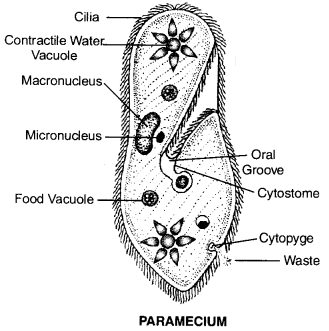
Diversity in Living Organisms Class 9 Important Questions Science Chapter 7 image - 21
Group Protista.

Question 87.
Write the difference between amphibians and Pisces.
(CCE 2017)
Answer:

PiscesAmphibians
1. Scales. The body is covered by scales.1. Scales are absent.
2. Mucous Glands. The skin does not possess mucous glands.2. The skin has mucous glands that keep the skin moist and slippery.
3. Fins. Pisces possess fins for locomotion and steering3. Fins may occur in larval stage. The adult does not possess fins. Limbs occur instead.
4. Heart. It is two chambered.4. Heart is 3-chambered.
3. Lungs. Pisces do not have lungs.5. Lungs are present.
Examples. Scoliodon, Labeo.Examples. Frog, Toad.

Question 88.
State any three differences between cryptogamae and phanerogamae. (CCE 2017)
Answer:

CryptogamaePhanerogamae
1.             It contains seedless plants.

2.              It has both vascular and non-vascular plants.

3.              An external water is required for fertilization.

It contains seed plants.

It possesses only vascular plants.

An external water is not required

Long Answer Questions (5 Marks)

Question 1.
Draw a flow chart to show different divisions of kingdom plantae and answer the following :

  1. Which division has the simplest plants ?
  2. To which division Pinus and Cycas belong ?
  3. What is the other name given to flowering plants. Classify them on the basis of number of cotyledons present in the seed. (CCE 2012)

Answer:
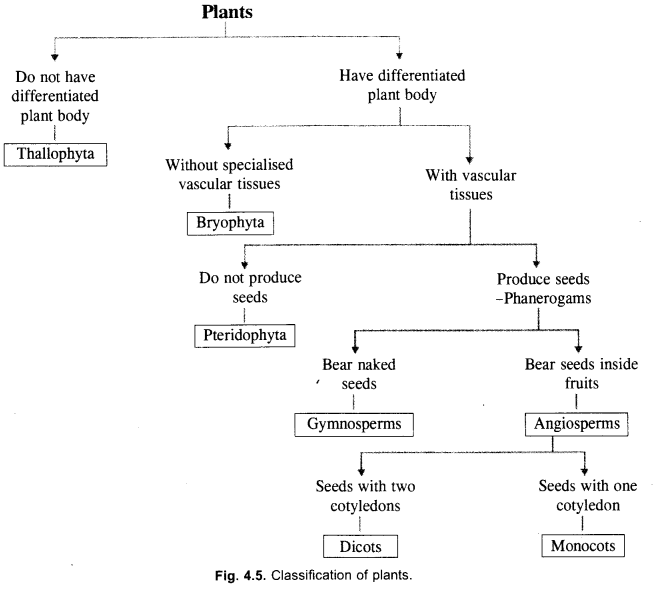
Diversity in Living Organisms Class 9 Important Questions Science Chapter 7 image - 22

  1. Simplest Plants: Thallophyta (Algae).
  2. Pinus and Cycas: Gymnospermae of spermatophyta.
  3. Angiosperms: Two groups, dicots (with two cotyledons in seeds) and monocots (with one cotyledon in seeds).

Question 2.

  1. What is the scientific name of human ?
  2. To which class of vertebrates does it belong ?
  3. Write five characteristic features of this group. Also mention the exceptions, if any. (CCE 2012)

Answer:

  1. Homo sapiens
  2. Class mammalia.
  3. Characteristics of Mammalia
    1. Presence of mammary glands in females.
    2. Occurrence of hair over the body.
    3. Cervical vertebrae are seven in number.
    4. A muscular diaphragm occurs between abdomen and thorax.
    5. Mammals are viviparous i.e., adult females give birth to young ones.

Exceptions:
Duck-billed Platypus and Echidna are egg laying mammals. Kangaroos and their relatives give birth to young ones in very early stage of development. They are nourished in mother’s marsupium,

Question 3.
(a) Name the group of plants which have unicellular undifferentiated body.
(b) Why are echinoderms named so ?
(c) Name plants not having well differentiated body design.
(d) Name the plants which are perennial, evergreen, woody and bear naked seeds.
Answer:
(a) Diatoms, dinoflagellates.
(b) The animals possess an exoskeleton of spines over the body.
(c) Bryophytes, thallophytes
(d) Gymnosperms.

Question 4.
(a) List two distinguishing features between poriferan and coelenterate animals.
(b) Give reason to justify the following statements

  1. Platypus and Echidna lay eggs but are considered mammals.
  2. Crocodiles have four chambered heart but are still reptiles.
  3. Fore limbs of birds are modified. (CCE 2012)

Answer:
(a) Poriferans and Coelenterates

  1. Pores: Poriferans have a canal system with a number of inhalent pores or ostia and a single exhalent pore or osculum. Coelenterates have a single opening.
  2. Special Cells: Poriferans possess choanocytes or collar cells. Coelenterates have enidoblasts or stinging cells.

(b)

  1. Platypus and Echidna possess body hair and mammary glands like other mammals.
  2. Crocodiles are piokilothermic, lay cleidoic eggs, with body having cornified skin covered with scales and bony plates.
  3. In birds the fore limbs are modified to form wings for flight.

Question 5.
(a) What is coelom ? State its significance.
(b) Pick out the organisms that have pseudocoelom from the following : Earthworm, Pinworm, Tapeworm and Roundworm
(c) What is peculiar about the coelom of arthropods ? What is such a condition called ? Explain.
(d) To which phylum of animalia do the following belong : Octopus, Pila, Chiton and Unio. Comment on their coelom. (CCE 2012)
Answer:
(a) Coelom. It is mesoderm lined fluid-filled space that occurs between alimentary canal and body wall. Significance. Coelom suspends and gives shock proof . environment to various body organs.
(b) Pseudocoelom. Pinworm, Roundworm.
(c) Coelom of Arthropods. True coelom is reduced. Sinuses or spaces in between the organs enlarge and fuse to form blood filled cavity called haemocoel. ‘
(d) Mollusca. They posses haemocoel.

Question 6.
(a) On the basis of characteristics given below, name the phyla :

  1. Soft bodied animal with muscular foot, mantle and calcareous shell.
  2. Animals which have double layers of cells, single opening and tentacles.
  3. Body simple, multicellular, vase-like with pores, opening at one end.
  4. Largest group of animals, bilaterally symmetrical, segmented, coelomic cavity is blood filled.

(b) “Star Fish cannot be placed under the phylum of pisces.” Explain. (CCE 2012)
Answer:
(a)

  1. Mollusca
  2. Coelenterata
  3. Porifera
  4. Arthropoda.

(b) Star Fish is an echinoderm with spiny exoskeleton, water vascular system and tube feet. It does not have any fish-like characters (fins, gills, lateral line organs).

Question 7.
(a) Write four characteristic features of protochordates.
(b) State reasons for the following :

  1. Tapeworms do not have digestive tract.
  2. Frogs have both skin and lungs for breathing.
  3. Whale is a mammal, not a fish. (CCE 2012)

Answer:
(a) Characteristic Features of Protochordates.

  1. Single layered epidermis,
  2. Occurrence of notochord at least in some stage.
  3. There is a dorsal hollow nerve cord,
  4. Gill slits are present,
  5. A post-anal tail is found.

(b)

  1. Tapeworm lives in that part of human intestine which contains digested absorbable food.
  2. Frog has a smooth moist skin richly supplied with blood vessels for cutaneous respiration. Being amphibian it also possesses lungs for breathing over land.
  3. Whale has pulmonary respiration, four-chambered heart, mammary glands and other traits of mammals. It appears fish like because it lives in water and has a body structure suitable for swimming.

Question 8.
Classify vertebrates in five classes giving two characteristics and an example for each. (CCE 2012)
Answer:
The five classes of vertebrates are pisces, amphibia, reptilia, aves and mammalia.
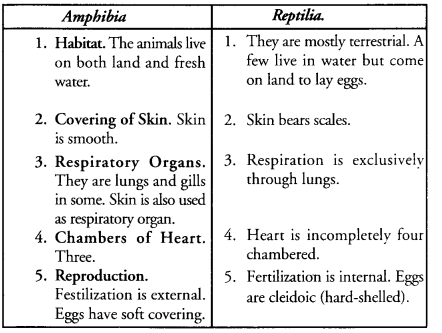
  1. Pisces: Stream-lined scale covered body with 2-chambered heart, gills and fins, e.g. Labeo.
  2. Amphibia: Smooth scale-less body surface with mucous glands, 3-chambered heart and two pairs of limbs, e.g., Frog.
  3. Reptilia: Dry scale covered skin, incompletely four chambered heart, e.g., Wall Lizard.
  4. Aves: Body covered with feathers, fore limbs modified into wings and jaws modified into horny toothless beak, e.g., Pigeon.
  5. Mammalia: Hair covered body with integumentary glands, mammary glands in females, e.g., Tiger.

Question 9.
Classify kingdom Plantae into five groups giving one characteristic feature and two examples of each group.
(CCE 2012, 2015)
Answer:
Plantae is divisible into five groups of thallophyta, bryophyta, pteridophyta, gymnosperms and angiosperms.

  1. Thallophyta: Simple undifferentiated plant body with unicellular reproductive organs lacking an embryo stage, e.g. Spirogyra, Chara.
  2. Bryophyta: Simple, amphibious with gametophytic plant body and parasitic sporophyte, e.g., Marchantia, Moss.
  3. Pteridophyta: Seedless, differentiated, vascular sporophytic plant body with small independent gametophyte, e.g. Lycopodium, Fern.
  4. Gymnosperms: Vascular plants with exposed or naked seeds, e.g., Pinus, Cycas.
  5. Angiosperms: Flowering plants with fruits enclosing seeds, e.g. Maize, Rose.

Question 10.
Cockroach, spider and prawn are placed under phylum arthropoda. State the reason for this. Write three other distinct features of this phylum. Give another example of an aquatic arthropod and terrestrial arthropod. (CCE 2012)
Answer:
Cockroach, spider and prawn are included in phylum arthropoda because they are segmented triploblastic bilaterally symmetrical animals having jointed appendages.
Other features.

  1. Chitnous exoskeleton,
  2. Body divided into head, thorax and abdomen with head and thorax fused in some groups.
  3. Coelom is reduced. Haemocoel with open circulatory system present.

Question 11.
Aquatic Arthropod. Cancer (Crab). Terrestrial arthropod, Silver Fish.
(a) What is the basis of major division of kingdom plantae ?
(b) What was the modification introduced by Woese in kingdom Monera ? (CCE 2012)
Answer:
(a) Presence or absence of seeds or distinct reproductive structures dividing plantae into phanerogamae (covered embryo) and cryptogamae (naked embryo or seeds absent),
(b) Woese (1977, 1994) has divided kingdom monera and created two independent kingdom of Eubacteria and Archaea (formerly archaebacteria) on the basis of cell wall, cell membrane and RNA structure.

Question 12.
The following is a list of invertebrates. Classify them into different phyla giving one characteristic morphological feature to justify your classification : (CCE 2012)
(a) Star Fish
(b) Nereis
(c) Housefly
(d) Sycon
(e) Planaria.
Answer:
(a) Star Fish: Echinodermata. Spiny skinned with tube j feet,
(b) Nereis: Annelida. Metameric segmentation, true j coelom with closed vascular system,
(c) Housefly, Arthropoda: Chitinous exoskeleton with jointed appendages,
(d) Sycon: Porifera. Sedentary diploblastic animals with ostia, osculum and canal system,
(e) Planaria: Platyhelminthes. Triploblastic, acoelomate.

Question 13.
What are the five kingdoms of Whittaker ? Give the most important characteristic feature of each kingdom.
(CCE 2012)
Answer:

  1. Monera: Prokaryotic organisms.
  2. Protista: Unicellular eukaryotic organisms.
  3. Fungi: Nonchlorophyllous, spore producing heterotrophs j with cell wall having chitin and glycogen as reserve food,
  4. Plantae: Photosynthetic organisms having plastids and cellulose cell wall.
  5. Animalia: Wall-less heterotrophic organisms with holozoic nutrition.

Question 14.
Name the five classes of vertebrates. Compare any two on the basis of their

  1. Habitat
  2. Covering of skin
  3. Respiratory organs
  4. Chambers of heart
  5. Reproduction. (CCE 2012)

Answer:
Pisces, amphibia, reptilia, aves and mammalia.
Diversity in Living Organisms Class 9 Important Questions Science Chapter 7 image - 23

Question 15.
(i) To which division of plantae do algae belong ? Write one characteristic of the division. Give two examples.
(ii) Name the group

(a) Which includes unicellular eukaryotic organisms.
(b) In which mode of nutrition is saprophytic
(c) In which seeds are not enclosed in fruit.

(iii) Write scientific names of

(a) Peacock
(b) Neem
(c) Potato.

(iv) Name the division whose members are called amphibians of plant kingdom,
(v) Write one difference between thallophytes and bryophytes with one example of each. (CCE 2012)
Answer:
(i) Algae belong to division thallophyta. Thallophyta is characterised by single celled non-jacketed reproductive structures without an embryo stage, e.g., Ulothrix, Chara.
(ii)

(a) Protista
(b) Fungi
(c) Gymnosperms.

(iii)

(a) Peacock. Pavo cristatus
(b) Neem. Azadirachta indica
(c) Potato. Sotanum tuberosum

(iv) Bryophyta
(v) Reproductive organs are nonjacketed and unicellular in thallophyta (e.g., Ulothrix). They are jacketed and multi-cellular in bryophyta, e.g., Marchantia.

Question 16.
(a) Differentiate between fungi and plantae
(b) Mention the basis of classification among plants to different levels. (CCE 2012, 2015)
Answer:
(a) Differences
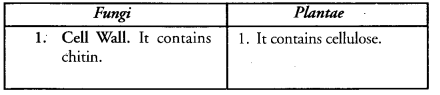
Diversity in Living Organisms Class 9 Important Questions Science Chapter 7 image - 24
Diversity in Living Organisms Class 9 Important Questions Science Chapter 7 image - 25
(b)

  1. Presence or absence of conspicuous reproductive organs— phanerogamae and cryptogamae.
  2. In cryptogamae, undifFerentiated plant body-thallophyta.
  3. In cryptogamae, plant body differentiated without vascular tissues-bryophyta while with vascular tissues-pteridophyta
  4. In phanerogamae, gymnosperms if seeds are naked and angiosperms if seeds are enclosed inside fruits.

Question 17.
(a) State two uses of classifying plants and animals into different categories,
(b) List two characteristic features of fungi. Some fungal species live in permanent mutually dependent relationship with cyanobacteria. What is this relationship called ? Where are they found ? (CCE 2013)
Answer:
(a)

  1. Classifying plants and animals into categories gives us an idea of whole range of diversity found in them
  2. It help in studying inter-relationships and evolution of various groups.

(b) Characteristics of Fungi.

  1. The body called mycelium is made of achlorophyllous threads.
  2. Cell wall contains chitin.
  3. Nutrition is heterotrophic and absorptive,
  4. Reserve food is glycogen and oil.

Fungal Relationship With Some Blue-Green Algae or Cyanobacteria.
Symbiosis or mutualism. The dual organisms grow on rocks and tree trunks. They are called lichens.
Occurrence. Rocks, bark of trees, ice.

Question 18.
(a) State four characteristic features of mammals.
(b) Identify the group to which the following belong :

  1. Plants with body differentiation into stem and leaf-like structures and hidden reproductive organs,
  2. Plants with tap root system and two cotyledons in the seed,
  3. Plants that do not have well differentiated body designs.
    (CCE 2013)

Answer:
(a) Mammals are viviparous i.e., adult females give birth to young ones.
(b)

  1. Bryophytes
  2. Dicotyledons
  3. Thallophytes.

Question 19.
(a) State two characteristic features of phylum arthropoda
(b) Identify the organisms on the basis of the following features :

  1. Egg laying mammal
  2. A reptile with four chambered heart
  3. A nematode causing elephantiasis. (CCE 2013)

Answer:
(a)

  1. Presence of jointed appendages.
  2. Occurrence of chitinous exoskeleton,

(b)

  1. Echidna
  2. Crocodile
  3. Wuchereria.

Question 20.
(a) How do poriferan animals differ from coelenterate animals ?
(b) Identify the kingdom on the basis of following features :

  1. Multicellular eukaryotes without cell wall
  2. Unicellular eukaryotes
  3. Multicellular eukaryotic autotrophs. (CCE 2013)

Answer:
(a)

PoriferansCoelenterates
1. Organisation. It is of cellular level.It is of tissue level.
2. Pores. A number of inhalent pores or ostia and a single exhalent pore or osculum are present.There is a single opening.
3. Digestion. It is intracellular.It is both intracellular and intercellular.
4. Muscle and Nerve Cells. They are absent.Primitive muscle and nerve cells appear for the first time in coelenterates.
5. Appendages. They are absent.Appendages are represented by tentacles.
6. Special Cells. The special cells are choanocytes or collar cells.Special cells are cnidoblasts.

(b)

  1. Animalia
  2. Protista
  3. Plantae.

A person enters a museum and observes animal specimens. He looks at one marked ‘Salamander’ and calls it a lizard.

Question 21.
How will you explain to him that salamanders and lizards belong to different classes by listing out at least four features and give one example each. (CCE 2013)
Answer:
Salamander belongs to amphibia and lizard to reptilia.

AmphibiaReptilia
1. Skin. It is glandular smooth and moist.Skin is non-glandular, dry and keratinised.
2. Scales. They are absent.Scales are present over the body.
3. Claws. Digits do not possess claws.Digits end in claws.
4. Heart. It is three chambered.Heart is incompletely four chambered.
5. Fertilization. It is external.Fertilization is internal.
6. Membranes. Extra-embryonic membranes are absent.Extra-embryonic membranes are present.
7. Eggs. They have a soft covering.They have a hard covering or shell.
Examples. Frog, Toad.Examples. Lizards, Snakes, Tortoise.

Question 22.
Create a flow chart to show the classification of four eukaryotic kingdom ? (CCE 2014)
Answer:
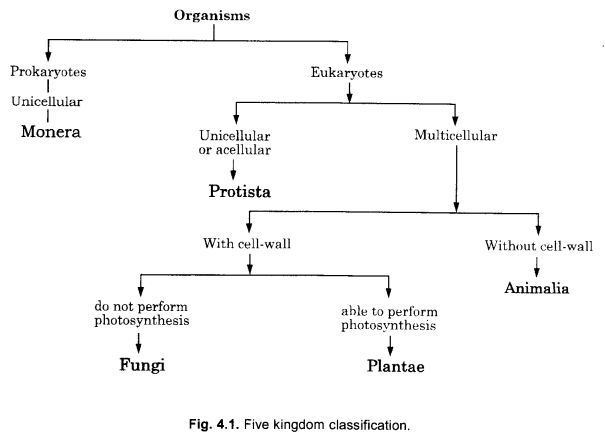
Diversity in Living Organisms Class 9 Important Questions Science Chapter 7 image - 26

Question 23.
Give the scientific and common name of an organism that possesses the following features :
(a) Are found both on land and water,
(b) Lay eggs on land.
(c) Skeleton made of cartilage,
(d) Hair on their body.
(e) Cold blooded. (CCE 2014)
Answer:
(a) Amphibians. Frog – Rana tigrina
(b) Aquatic Reptiles. Crocodile – Crocodylus.
(c) Chondrichthyes – Dog Fish – Scoliodon.
(d) Mammalia. Monkey – Macaca.
(e) Poikieothermous. Garden Lizard – Calntes.

Question 24.
Identify the phylum of animalia in which the animals have
(a) Apseudocoelons
(b) A water driven tube system.
(c) Jointed legs,
(d) Pores in the body leading to a canal system,
(e) Notochord at some stage of their life.
(CCE 2014, 2015)
Answer:
(a) Nemathelminthes
(b) Echinodermata
(c) Arthropoda
(d) Porifera
(e) Chordata (Protochordata).

Question 25.
Prove that Labeo rohita is a chordate. (CCE 2014)
Answer:
Labeo rohita is a chordate because it possesses all the chordate characters.
Diagnostic Characteristics:

  1. Notochord (Gk. noton—back, chorde—cord). It is a long rod-like structure that develops between dorsal nervous system and gut. Notochord functions as a support structure that provides points for attachment to muscles. In higher chordates, notochord is transformed into cranium and vertebral column.
  2. Dorsal Hollow Nerve Cord. It occurs above the notochord. In higher chordates it gets transformed into brain and spinal cord.
  3. Pharyngeal Gill Slits (Gill Pouches). They are paired respiratory structures which remain functional throughout life in fishes and some amphibians. In others they occur only in embryo.
  4. Post-anal Tail. It occurs in most chordates for balancing, protection of genital and anal regions.

Question 26.
Assign appropriate class/phylum/division to the following :
(a) Salamonder
(b) Flying lizard
(c) Ostrich
(d) Bat
(e) Herdmania
(f) Wuchereria
(g) Ulva
(h) Marchantia
(i) Marsilea
(j) Ipomoea. (CCE 2014)
Answer:
(a) Salamander. Chordata-Amphibia.
(b) Flying lizard. Chordata-Reptilia.
(c) Ostrich. Chordata-Aves
(d) Bat. Chordata—Mammalia,
(e) Herdmania. Chordata- Protochordata- Urochordata.
(f) Wuchereria. Nemathelm- inthes-Nematoda.
(g) Ulva. Thallop.hyta-Algae.
(h) Marchantia. Bryophyta
(i) Marsilea. Pteridophyta.
(j) Ipomoea. Spermatophyta – Angiospermae – Dicotyledoneae.

Question 27.
State one difference between each of the following :
(a) Thallophyta and Bryophyta
(b) Bryophyta and pteridophyta
(c) Pteridophyta and gymnosperms
(d) Gym¬nosperms and angiosperms
(e) Monocotyledonous and di¬cotyledonous plants. (CCE 2015)
Answer:
(a) Thallophyta and Bryophyta. In thallophyta the reproductive organs are unicellular, non-jacketed with no embryo stage. In bryophyta the sex organs are multicellular, jacketed with an embryo stage.
(b) Bryophyta and Pteridophyta. In bryophyta the plant body is non-vascular, gametophytic with parasitic sporophyte. In pteridophyta the plant body is vascular and sporophytic while gametophyte is small and independent.
(c) Pteridophyta and Gymnosperms. Pteridophyta has seedless vascular plants while gymnosperms have naked seeded vascular plants.
(d) Gymnosperms and Angiosperms: Thallophyta and Bryophyta In thallophyta the reproductive organs are unicellular, non-jacketed with no embryo stage. In bryophyta the sex organs are multicellular, jacketed with an embryo stage.
(e) Monocotyledonous and Dicotyledonous Plants. Mono- cotyledonous plants have parallel venation, fibrous roots and single cotyledon in seeds. Dicotyledonous plants have reticulate venation, tap roots and two cotyledons in seeds.

Question 28.
Explain the meaning of the terms and give an example in each of the following :
(a) Symbiotic relationship
(b) Cotyle¬dons
(c) Cryptogam
(d) Saprophytic
(e) Prokaryotic.
(CCE 2015)
Answer:
(a) Symbiotic Relationship. It is a mutually beneficial obligatory relationship between two organisms, e.g. Lichen.
(b) Cotyledons. They are seed leaves present over the embryo axis below the plumule in seeds. A single cotyledon occurs in the seeds of monocots (e.g., Maize) while two cotyledons occur in the seeds of dicots, (e.g., Pea).
(c) Cryptogam. It is a seedless plant with incospicuous reproductive organs and requiring external water for fertilization. e.g. : Ferns, Moss.
(d) Saprophytic. It is an organism that feeds on organic re-mains by the process of external diagestion, e.g., Rhizopus.
(e) Prokaryotic. It is a primitive organism that lacks membrane covered organelles and an organized nucleus, e.g., Escherichia coli.

Question 29.
Associate the following features with appropriate organisms and their kingdom (in ii and iv), division (in i) and phylum (in iii and v) :

  1. Presence of pyrenoids.
  2. Presence of heterocysts
  3. Presence of genital papillae and anus
  4. Presence of chloroplast and flagella
  5. Presence of palp and parapodia. (CCE 2015)

Answer:

  1. Presence of Pyrenoids. Spirogyra—Thallophyta (division).
  2. Presence of Heterocysts. Nostoc— Monera (kingdom).
  3. Presence of Genital Papillae and Anus. Earthworm— Annelida (phylum)
  4. Presence of Chloroplast and Flagella. Euglena—Protista (Kingdom)
  5. Presence of Palps and Parapodia. Nereis—Annelida (Phylum).

Question 30.
Study the figure and answer the following :
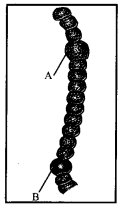
Diversity in Living Organisms Class 9 Important Questions Science Chapter 7 image - 27
(a) Label A and B.
(b) Identify the organism and its kingdom.
(c) Name two organisms (other the one shown here) belonging to same kingdom.
Answer:
(a) A – Akinete.
B – Heterocyst.
(b) Anabaena – Monera.
(c) Nostoc, Clostridium, Escherichia.

Question 31.
Differentiate between the following :
(a) Amphibia and Mammalia
(b) Arthropoda and Echinodermata
(c) Platyhelminthes and Nematoda.
(CCE 2015)
Answer:
(a) Amphibia and Mammalia:
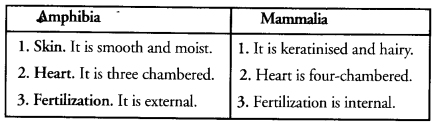
Diversity in Living Organisms Class 9 Important Questions Science Chapter 7 image - 28
(b) Difference between Arthropoda and Echinodermata :
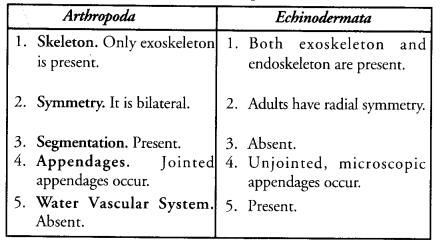
Diversity in Living Organisms Class 9 Important Questions Science Chapter 7 image - 29
(c) Platyhelminthus and Nematoda :

PlatyhelminthesNematheliminthes
1.      Form. They are flatworms.

2.      Coelom. Platyhelminthes are acoelomate.

3.      Digestive Tract. It is incomplete.

4.      Sexuality. Animals are hermaphrodite.

They are cylindrical in form and are called roundworms.

Nemathelminthes are pseudocoelomate.

It is complete.

Animals are unisexual.

Question 32.
(a) Identify the picture and mention the phylum and class of kingdom animalia to which it belongs. (CCE 2015)
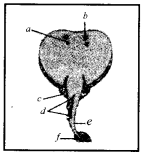
Diversity in Living Organisms Class 9 Important Questions Science Chapter 7 image - 30
(b) Label a, b, c, d, e, and f.
Answer:
(a) Torpedo (Electric Ray),
Phylum- Chordata,
Class- Chondrichthyes.
(b) a – Spiracle,
b – Eye,
c – Pelvic fin,
d— Dorsal fin,
e—Tail,
f— Caudal fin.

Question 33.
Give a comparative account of 5 classes of phylum vertebrata based on :
(a) Organ of breathing
(b) Chambers in heart.
(CCE 2015)
Answer:

  1. Pisces. Gills for breathing.
  2. Chambered heart.
  3. Amphibia. Gills, lungs and skin for breathing, 3-chambered heart.
  4. Reptilia. Lungs for breathing, incompletely 4-chambered heart.
  5. Aves. Lungs with air sacs for double respiration, four- chambered heart.
  6. Mammalia. Lungs for breathing, four-chambered heart.

Question 34.
Schematically illustrate the classification of phanerogams. Give two examples of plants with vascular tissues which do not produce seeds. (CCE 2015)
Answer:
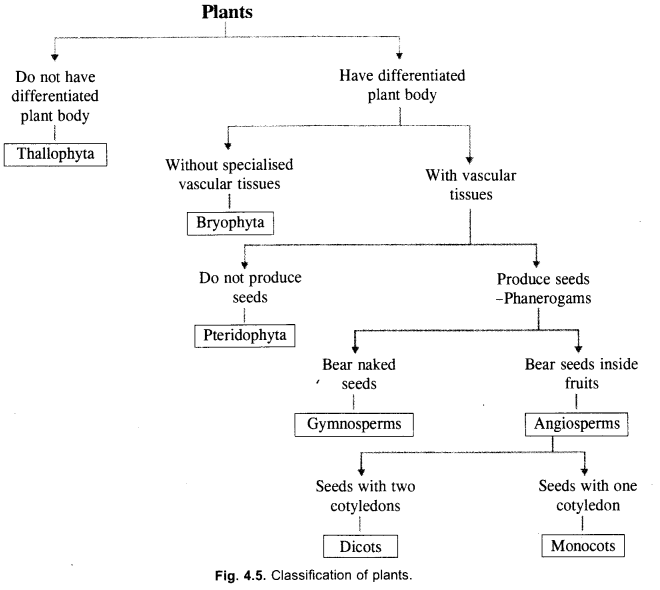
Diversity in Living Organisms Class 9 Important Questions Science Chapter 7 image - 31
Examples of Seedless Vascular Plants. Selaginella, Fern.

Question 35.
Give a comparative account of the following :
(a) Ulothrix and Funaria
(b) Marchantia and Marsilca
(c) Fern and Pinus,
(d) Cycas and Rose,
(e) Wheat and Gram. ( CCE 2015)
Answer:
(a) Ulothrix and Funaria. Ulothrix is a filamentous green alga with simple structure of thallophytes. Funaria is a leafy moss plant with differentiated but non-vascular stmcture of bryophytes.
(b) Marchantia is a non-vascular little differentiated bryophyte while Marsilea is a vascular plant of pteridophyta which is differentiated into stem, leaves and roots.
(c) Fern is a seedless vascular plant belonging to pteridophyta while Pinus is a naked seeded vascular plant belonging to gymnosperms.
(d) Cycas is a naked seeded plant belonging to gymnosperms while Rose is covered seeded or fruit bearing plant belonging to angiosperms.
(e) Wheat is a monocot while Gram is a dicot.

Question 36.
Draw a diagram of Euglena and label the following parts : Flagellum, Photoreceptor, Eye Spot, Chloroplast, Nucleus, Contractile Vacuole. ( CCE 2016)
Answer:
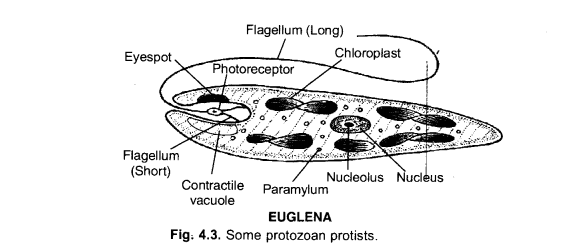
Diversity in Living Organisms Class 9 Important Questions Science Chapter 7 image - 32

Question 37.
(a) State three distinguishing features between the animals belonging to Aves group and those in the Mammalia group.
(b) List four conventions followed while writing the scientific names ofliving organisms. (CCE 2016)
Answer:
(a) Aves and Mammalia.

AvesMammalia
1. Wings. Forelimbs are modified into wings.Wings are absent except in bats.
2. Feathers and Scales. The body is covered with feathers and scales.Feathers and scales are absent.
3. Skin Glands. Skin is dry. Only a single preen gland is present.Skin bears a number of sweat and oil glands.
4. Mammary Glands. They are absent.Female possesses mammary glands for feeding the young
5. Diaphragm. A diaphragm is absent.A partition called diaphragm is present between abdomen and thorax.
6. Beak. A toothless beak is present.Jaws do not form a beak. Teeth are present.
7. Bones. They are hollow or pneumatic.Bones do not possess air cavities.
8. Larynx/Syrinx. Larynx is non-functional. Instead syrinx is present.Larynx is functional. Syrinx is absent.
External air sacs do not occur over lungs.
9. Air Sacs. Lungs possess external air sacs.
10. Yolk. Eggs possess a lot of yolk (macrolecithal).Eggs have little yolk (alecithal).
11. Reproduction. Birds are oviparous.Mammals are viviparous with the exception of a few species.

(b) Binomial nomenclature is a scientific system of providing distinct and proper two word name to each and every organism.
Conventions:

  1. It consists of two words, first generic (like noun) and second specific (species).
  2. Generic name has first letter capital while specific word begins with small letter.
  3. Both are derived from latin language or are latinised.
  4. They are printed in italics or are underlined separately in hand-written form.

Question 38.
Identify the phylum/division

  1. They have kidney like organs for excretion
  2. They reproduce by spores and have specialised tissue for conduction of water and other substances,
  3. Their body is dorsiventrally flattened.
    (CCE 2016)

Answer:

  1. Mollusca
  2. Pteridophyta
  3. Platyhelminthes.

Question 39.
A plant specimen was found with rhizoids instead of differentiated roots,
(a) Identify the group to which it belongs,
(b) Write any two characteristics of this group
(c) Draw the diagram of a plant belonging to this group.
(CCE 2016)
Answer:
(a) Bryophyta
(b) Aves, Reptilia
(c)
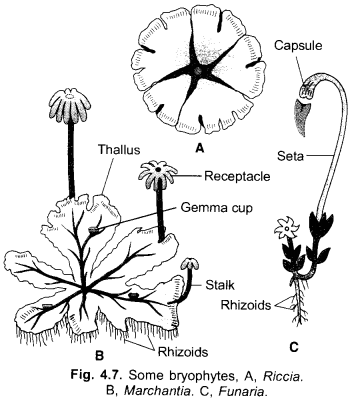
Diversity in Living Organisms Class 9 Important Questions Science Chapter 7 image - 33

Question 40.
Identify the phylum of kingdom animalia in which the animal has
(a) A pscudocoelom
(b) A water driven tube system
(c) Jointed legs
(d) Pores in the body leading to a canal system
(d) Notochord at some stages of their life. ( CCE 2017)
Answer:
(a) Pseudocoelom—Nematoda
(b) A water driven tube system—Echinodermata
(c) Jointed legs—Arthropoda
(d) Pores in the body leading to a canal system—Porifera
(e) Notochord at some stages of their life—Protochordata.

Question 41.
(a) Which division of plants is called the amphibians of plant kingdom ?
(b) What are characteristics of above division ? (any three)
(c) Give two examples of this division of plant kingdom. (CCE 2017)
Answer:
(a) Bryophyta
(b)

  1. Very simple nonvascular amphibious land plants
  2. Gametophytic plant body fixed by means of rhizoids
  3. Sporophyte parasitic over the gametophyte

(c) Marchantia, Funaria.

Question 42.
(a) What is the largest phylum of animal kingdom.
( b) You are given Leech, Nereis, Scolopendra, Prawn and Scorpion. All of them have segmented body organisation. Will you classify them in are group. ( CCE 2017)
Answer:
(a) Largest Phylum. Arthropoda.
(b) Nereis and Leech belong to annelids while the other three belong to arthropoda. Annelids have unjointed appendages. Arthropods have jointed appendages. They also possess chitinous exoskeleton and open circulatory system. Annelids do not possess chitinous exoskeleton. They have closed circulatory system.

Question 43.
Complete the flow chart using appropriate features of groups : (CCE 2017)
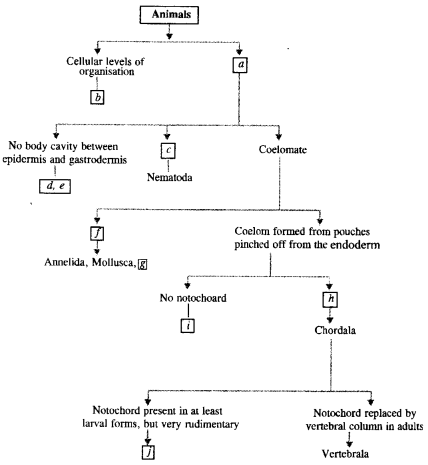
Diversity in Living Organisms Class 9 Important Questions Science Chapter 7 image - 34
Answer:
a—Tissue level of organisation,
b—Porifera.
c—Pseudocoelom,
d—Coelenterata.
e—Platyhelminthes.
f—Mesodermal cells develop from a single cell during growth of the embryo
g—Arthropoda.
h—Notochord present,
i—Echinodermata.
j—Protochoardata.

Hope given Previous Year Question Papers for CBSE Class 9 Science Chapter 7 Diversity in Living Organisms are helpful to complete your science homework.

If you have any doubts, please comment below. Learn Insta try to provide online science tutoring for you.

Tissues Class 9 Important Questions Science Chapter 6

Chapter 6 Tissues Class 9 Science Important Questions with Answers PDF will help you in scoring more marks in your exams.

Tissues Class 9 Important Questions and Answers Science Chapter 6

Very Short Answer Questions

Question 1.
Name the tissue present in soft parts of the plants like pith and cortex. (CCE 2010)
Answer:
Parenchyma

More Resources

Question 2.
Where is apical meristem found ? (CCE 2010)
Answer:
At the tips of main stem, main root and their branches.

Question 3.
State one function of parenchyma. (CCE 2010)
Answer:
Storage of food.

Question 4.
Which is the function of xylem ?
(CCE 2010)
Answer:
Transport of sap (water + minerals).

Question 5.
What is the function of phloem ? (CCE 2010)
Answer:
Translocation of food.

Question 6.
Identify the part marked ‘B’ in the diagram. (CCE 2013)
Tissues Class 9 Important Questions Science Chapter 6 image - 1
Answer:
Epidermal cell.

Question 7.
State the function of epidermal cells of roots. (CCE 2013)
Answer:
Absorption of water and minerals from soil.

Question 8.
Name the protein present in the muscles which is respon¬sible for movement. (CCE 2013)
Answer:
Myosin (moves over actin during contraction of muscle fi¬bre).

Question 9.
Name the tissue present under the skin and arranged in a pattern of layers. (CCE 2013)
Answer:
Muscular tissue.

Question 10.
Which meristem is responsible for transformation of stem of a plant into trunk when it grows into a tree ? (CCE 2013)
Answer:
Lateral meristem.

Question 11.
Name two elements of water conducting tissue which are re-sponsible for conduction. (CCE 2013)
Answer:
Tracheids and vessels, collectively called tracheary elements.

Question 12.
Name the chemical substance which gets deposited in the walls of sclerenchyma. (CCE 2013)
Answer:
Lignin.

Question 13.
Identify the part marked ‘X’ in the diagram. (CCE 2014)
Answer:
Lumen.

Question 14.
Write any one characteristic of meristematic tissue. (CCE2014)
Answer:
Immature, thin-walled compactly ar¬ranged cells capable of division.

Question 15.
State the role oflarge air cavities present in parenchyma of aquatic plants.
(CCE 2014)
Answer:
Storage of metabolic gases (CO2, O2) and providing buoyancy.

Question 16.
Name the complex permanent tissue in plants in which the materials can move in both directions. (CCE2014)
Tissues Class 9 Important Questions Science Chapter 6 image - 2Answer:
Phloem.

Question 17.
Name the type of tissue found in respiratory tract. (CCE 2014)
Answer:
Ciliated columnar epithelium.

Question 18.
State two functions ofthe adipose tissue. (CCE 2015)
Answer:

  1. Storage of fat
  2. Insulation
  3. Cushions around organs
  4. Body contours (rounding off).

Question 19.
Name the tissue which is responsible for increase in girth of stem and root. ( CCE 2015)
Answer:
Lateral meristem (vascular cambium and cork cambium).

Question 20.
Name the tissue that covers most of the organs and forms a barrier to keep different body systems separate. Write its one important function. (CCE 2016)
Answer:
Epithelium. Function. Protection by surface epithelium of skin from drying up, microbes, chemicals and injury.

Question 21.
Water hyacinth floats on water surface. Why ? (CCE 2016)
Answer:
Presence of aerenchyma and large air cavities in petioles.

Short Answer Questions (2 marks)

Question 1.
Identify the type of plant tissue given Label parts A and B. Where in the stem of a plant would you find this tissue ?
(CCE 2010, 2011, 2013)
Tissues Class 9 Important Questions Science Chapter 6 image - 3
Answer:
(a) Phloem. Outer side of vascular strand.
(b) A – Sieve tube cell.
B – Companion cell.

Question 2.
Differentiate between aerenchyma and chlorenchyma.
Answer:
Tissues Class 9 Important Questions Science Chapter 6 image - 4
Tissues Class 9 Important Questions Science Chapter 6 image - 5

Question 3.
(a) Identify the region of the stem marked A in the diagram and the type of simple permanent tissue found in this region
(b) Mention any two characteristic features of the cells found in this tissue. (CCE 2010)
Answer:
(a) A-Epidermis. The permanent tissue forming the epidermis is parenchyma.
(b) Characteristic
Tissues Class 9 Important Questions Science Chapter 6 image - 6
Features:

  1. Cells are elongated and com-pactly arranged without any intercellular spaces.
  2. Presence of a layer of non- cellular cuticle on the outer surface for protection and reduction of water loss.

Question 4.
List two characteristics of cork cells which help them to function as protective tissue. (CCE 2010, 2012)
Answer:

  1. Suberin: Cork cells are impermeable to water vapours due to deposition of suberin over their cells.
  2. Dead Cells: Cork cells are dead, filled with tannins, resins and air.

Question 5.
Why does growth of a plant occur in specific regions ? Where are the following found
(a) Intercalary meristem
(b) Lateral meristem? (CCE 2010)
Answer:
Meristem. Plants possess a special tissue or meristem for growth. It occurs at specific regions like apices, nodal areas and sides. Accordingly growth occurs only in those areas where meristematic tissue or meristem is present, viz., api¬ces, nodal regions and girth.
(a) Intercalary Meristem. It occurs above or below the nodes and the base of leaves.
{b) Lateral Meristem. It occurs on the sides, both in stem and root.

Question 6.
Name the connective tissue which helps is the repair of tissues. State where this tissue is found. Mention one more » fonction. (CCE 2010,2011,2012)
Answer:
Areolar tissue (a connective tissue).
Location: It occurs inside organs, around blood vessels, muscles and nerves, below skin (subcutaneous tissue) and joining various structures like muscles with skin.
Other Function: Filling, packing and covering organs.

Question 7.
List any four salient features of meristematic tissue.
(CCE 2010, 2011, 2012)
Answer:

  1. Cells: Cells are small, spherical or polygonal with thin elastic wall.
  2. Intercellular Spaces: They are absent.
  3. Cell Contents: Nucleus is large. Cytoplasm is dense while vacuoles are absent.
  4. Activity: The cells have high anabolic rate. They grow and divide repeatedly.

Question 8.
Which elements of xylem

  1. Help in transport of water and minerals,
  2. Store food and
  3. Provide mechanical support. (CCE 2010, 2011)

Answer:

  1. Transport: Vessels and tracheids.
  2. Food Storage: Xylem parenchyma
  3. Mechanical Support: Xylem fibres, tracheids and ves-sels.

Question 9.
Draw diagram of a neuron showing nucleus and cell body/dendrite, axon, nerve endings.
(CCE 2010, 2011, 2012)
Answer:
Tissues Class 9 Important Questions Science Chapter 6 image - 7

Question 10.
(a) In which connective tissue, matrix contains salts of calcium and phosphorus ?
(b) Which connective tissue is present in ear ?
(c) Which connective tissue connects two bones ?
(d) Which connective tissue is found in bone marrow ?
(CCE 2010, 2011)
Answer:
(a) Bone
(b) Cartilage
(c) Ligament (dense, yellow fibrous connective tissue)
(d) Areolar tissue.

Question 11.
Name four types of elements of phloem.
(CCE 2010, 2011)
Answer:

  1. Sieve tube cells
  2. Companion cells
  3. Phloem Paren-chyma
  4. Phloem fibres.

Question 12.
Name the tissue that smoothens bone surfaces at the joints. Describe its structure with the help of a diagram.
(CCE 2010, 2011)
Answer:
Cartilage. It has a covering of fibrous connective tissue called perichondrium. Blood supply is restricted to it. Internally there is a layer of cartilage forming cells or chondroblasts. Then there is a solid but flexible matrix of protein-sugar complex chondrin. Matrix contains lacunae having 1 -4 living cartilage cells called chondrocytes.
Tissues Class 9 Important Questions Science Chapter 6 image - 8

Question 13.
Name the simple permanent tissue which
(a) forms the basic packing tissue
(b) Provides flexibility in plants.
(CCE 2010, 2011)
Answer:
(a) Basic Packing Tissue: Parenchyma,
(b) Flexibility: Col- lenchyma.

Question 14.
In a temporary mount of leaf epidermis, we observe small pores.
(a) What are the pores present in leaf epidermis called ?
(b) How are these pores beneficial to the plant ?
(CCE 2011, 2012, 2015)
Answer:
{a) The pores found in the leaf epidermis are stomata.
{b) The epidermal pores or stomata are the sites of gaseous exchange and transpiration.

Question 15.
What are the two components of blood ? Why is blood considered a type of connective tissue ?
(CCE 2011, 2012)
Answer:
(a) Components. Plasma and blood cells.
(b)
(i) Blood is considered connective tissue as it contains cells suspended in a fluid matrix,
(ii) Further, it connects all parts of the body receiving and providing materials every where.

Question 16.
What is the chemical substance that makes the cells of sclerenchyma hard ? Mention where the tissue is likely to be present. (CCE 2011)
Answer:
(a) Lignin
(b) Around vascular bundles, hypodermis of monocot stem, bundle caps, hard covering of seeds and nuts, husk of coconut.

Question 17.
List any two differences between the structure and location of striated and unstriated muscles. (CCE 2011)
Answer:
Tissues Class 9 Important Questions Science Chapter 6 image - 9

Question 18.
List any two differences between striated and cardiac muscles with respect to their structure and location. (CCE 2011)
Answer:
Tissues Class 9 Important Questions Science Chapter 6 image - 10

Question 19.
State one function each of
(a) Areolar tissue
(b) Cuboidal epithelium. (CCE 2011, 2013)
Answer:
(a) Areolar Tissue: Binding, packing and covering of body organs besides providing materials for repair of injury.
(b) Cuboidal Epithelium: Stratified epithelium provides protection while simple one takes part in absorption, excretion, secretion and forming germinal layer.

Question 20.
(a) Mention the location of apical meristem in plants.
(b) Name the tissue responsible for movement of the body. (CCE 2011)
Answer:
(a) Tips of stems, roots and their branches
(b) Muscle tissue.

Question 21.
Write the function of bone, cartilage, ligament and tendon.
(CCE 2011, 2012)
Answer:
Bone: It forms supporting framework of body and protects vital organs like brain, heart and lungs.
Cartilage: It provides support, frictionless movement and flexibility to various body parts.
Ligament: It connects a bone to another bone and provides for movement at the joints.
Tendon: It attaches muscle to bone for movement of body parts.

Question 22.
(a) State two important functions of areolar tissue.
(b) Why are skeletal muscles known as striated muscles ?
(CCE 2011, 2013)
Answer:
(a) (i) Binding, packing and covering of body parts.
(ii) Providing materials for repair of injury.
(iii) Connecting skin with underlying muscles.
(b) Due to presence of alternate light and dark bands.

Question 23.
(a)
(i) Name the process by which meristematic tissue changes into permanent tissues.
(ii) Name the simple permanent tissue which contains chlorophyll in it.
(b) Aquatic plants float in water. Give reason for this act.
(CCE 2011)
Answer:
(a)
(i) Differentiation.
(ii) Chlorenchyma.
(b) Aerenchyma, that stores gases, provides buoyancy to aquatic plants and help them float over water.

Question 24.
(a) In the diagram of meristematic tissue in the plant body given here, identify the type of meristematic tissue found in the regions marked ‘A’ and ‘B’ of a stem,
(b) State one function of each. (CCE2011, 2012)
Tissues Class 9 Important Questions Science Chapter 6 image - 11
Answer:
(a) A – apical meristem.
B — lateral meristem.
(b) Function:
A – increase in length (stem, root).
B – increase in girth (stem, root).

Question 25:
(a) Give the other name of dividing cells in plants.
(b) In which part of plants, apical meristem is present ? Also mention its function. (CCE 2011)
Answer:
(a) Meristematic cells (meristematic tissue).
(b) Apices or growing points of stems, roots and their branches. Apical meristem takes part in growth in length.

Question 26.
A horse and a mango tree are both complex living organisms with specialised yet different tissue systems to perform the basic life processes. Give the reasons for possessing different tissues to perform similar functions. (CCE2012)
Answer:

  1. Support: In Mango which is fixed, the supportive tissue is dead and requires little maintenance. In horse, the supportive tissue is organised to provide mobility.
  2. Growth: Mango has to discard older organs as it does not have an excretory system. It, therefore, continues to grow throughout life with the help of meristems. Horse has an excretory system. It does not discard old structures. Therefore, it stops growing after attaining maturity.

Question 27.
Write two basic structural differences between parenchyma and collenchyma. (CCE 2012)
Answer:

  1. Shape: Parenchyma cells are isodiametric while collenchyma cells are elongated,
  2. Wall: It is thin in parenchyma and unevenly thickened (generally at corners) in collenchyma.
  3. Intercellular Spaces: They occur in parenchyma but are negligible in collenchyma.

Question 28.
(a) Voluntary muscles are also known as skeletal muscles. Justify.
(b) Give two structural characteristics of these voluntary muscles. (CCE 2012)
Answer:
(a) Voluntary muscles are also known as skeletal muscles as they are usually attached to bones and take part in their movements as per our will.
(b) Structural Characteristics.
(i) Presence of alternate dark bands,
(ii) Multinucleate nature.

Question 29.
Given is the diagram showing longitudinal section of parenchymatous tissue. Label the parts M, N, O and P in the given diagram. (CCE 2012)
Tissues Class 9 Important Questions Science Chapter 6 image - 12
Answer:
M- chloroplast.
N – nucleus.
O – cytoplasm.
P – intercellular space.

Question 30.
The epidermis in desert plants is covered by a waxy coating. Name the substance which constitutes the coating. State three advantages of this coating. (CCE 2012)
Answer:
Coating or cuticle is made of cutin and wax.
Advantages:

  1. Strength: Coating provides strength to epidermis,
  2. Protection: It protects the living surface cells against abrasive action of wind,
  3. Transpiration: The thick coating reduces transpiration.

Question 31.
List any two functions of epithelial tissue in human body.
(CCE 2012)
Answer:
(i) Protection: Being surface layer, epithelium protects the underlying structures from injury, microbes, toxins and desiccation.
(ii) Exchange: It takes part in exchange of gases in lungs (between alveoli and blood capillaries) and exchange of gases and materials in tissues (between blood capillaries and tissue fluid).

Question 32.
List four functions of blood.
Answer:

  1. Transport: Blood transports gases, nutrients, hormones and waste materials to various parts of the body.
  2. Heat: It distributes heat throughout the body.
  3. Tissue Fluid: It forms tissue fluid from its plasma.
  4. Immunocytes: Blood possesses immunocytes for fighting foreign microbes.

Question 33.
State two differences between chlorenchyma and parenchyma. (CCE 2012)
Answer:
Tissues Class 9 Important Questions Science Chapter 6 image - 13
Question 34.
Write two locations of
(i) Simple squamous epithelium
(ii) Cuboidal epithelium. (CCE 2012)
Answer:
(i) Simple Squamous Epithelium: Alveoli, blood capillaries.
(ii) Cuboidal Epithelium: Germinal epithelium, Kidney tubules.

Question 35.
Name the tisue that makes husk of coconut. Write three characteristics of this tissue. (CCE 2012)
Answer:
Sclerenchyma.
Three Characteristics:

  1. Long narrow spindle-shaped cells,
  2. Thick lignified wall with pits,
  3. Dead cells with narrow lumen.

Question 36.
(a) Name the connective tissue which connects two bones.
(b) Name the connective tissue present in external ear.
(CCE 2012)
Answer:
(a) Ligament,
(b) Cartilage.

Question 37.
List two points of difference between parenchyma and sclerenchyma.
Answer:
Tissues Class 9 Important Questions Science Chapter 6 image - 14

Question 38.
List two points of difference between parenchyma and collenchyma tissues. (CCE 2012)
Answer:

ParenchymaCollenchyma
1.      Shape. Cells are isodiametric.

2.      Wall. Cell wall is thin.

3.       Strength. Parenchyma provides turgidity to softer organs.

4.       Occurrence. It forms the packing tissue of all plant organs.                        ‘

Cells are elongated.

Cell wall is unevenly thickened generally over the corners.

It provides both mechanical strength as well as flexibility.

It occurs hypodermally in dicot stems and leaves only.

Question 39.
Name the simple permanent tissue which
(i) Forms the basic packing tissue
(ii) Provides flexibility in plants. (CCE 2012)
Answer:
(i) Parenchyma,
(ii) Collenchyma.

Question 40.
What is tissue ? Jutify that blood is a tissue. Identify the meristematic tissues which are located at
(i) Growing tip of stem of a plant
(ii) Base of leaves or internodes of twigs. (CCE 2012, 2013)
Answer:
Tissue: It is a group of cells having common origin similar or related structure and a common function.
Blood as Tissue: Blood is a complex of matrix and cells that performs the function of transport with all the contained cells derived from bone narrow.
(i) Apical meristem.
(ii) Intercalary meristem.

Question 41.
What is apical meristem ? Where is it located ? State its functions. (CCE 2012)
Answer:
Apical meristem is apical tissue where cells continue to divide producing daughter cells which grow out to form different types of mature cells.
Location. It occurs at the tip of stem, root and their branches.
Functions:

  1. It brings about growth in length,
  2. Part of stem apical meristem is left out to produce axiallary buds and intercalary meristem.

Question 42.
(a) Identify the tissue present over eye lid.
(b) Name the tissue that carries signals from various parts of the body to brain. (CCE 2012)
Answer:
(a) Stratified squamous epithelium over outer surface (like skin) and stratified columnar epithelium in conjunctiva.
(b) Nervous tissue made up of neurons.

Question 43.
Name the tissue that
(a) Connects muscle to bone in humans
(b) Forms inner lining of alveoli
(c) Stores fat in our body
(d) Transports water and minerals in plants
(e) Present in veins of leaves. (CCE 2012)
Answer:
(a) Tendon
(b) Squamous epithelium
(c) Adipose tissue
(d) Xylem
(e) Complex tissues xylem and phloem.

Question 44.
Identify the location of the following tissues.
(a) Tendon
(b) Cuboidal epithelium
(c) Alveolar tissue
(d) Aerenchyma plant tissue. (CCE 2012)
Answer:
(a) Tendon: Between muscle and bone,
(b) Cuboidal Epithelium: Germinal epithelium, Kidney tubules.
(c) Areolar tissue: a connective tissue.
(d) Aerenchyma: Aquatic plants.

Question 45.
How does matrix of bone differ from matrix of cartilage ?
(CCE 2012)
Answer:
Tissues Class 9 Important Questions Science Chapter 6 image - 15

Question 46.
Name the tissue which helps in transportation of oxygen that we inhale to various parts of our body. Write the composition of this tissue. (CCE 2012)
Answer:
Blood Composition: Plasma or matrix – 55%, Blood cells – 45%. Plasma has 90 – 92% water, 8 – 10% organic and inorganic substances. Blood cells are of two types, haemoglobin containing red blood corpuscles (RBCs) and colourless white blood corpuscles (WBCs). Blood platelets are cell fragments present in blood.

Question 47.
Distinguish between tendon and ligament. Write one characteristic of each. (CCE 2012, 2013)
Answer:
Tendon is an inelastic cord of dense white connective tissue between muscle and bone while ligament is an elastic cord of dense yellow connective tissue between two bone ends.
Characteristic of Tendon: It contains parallel bands of white collagen fibres with rows of flat, elongated fibroblasts in between them.
Characteristic of Ligament: It has abundant yellow elastin fibres, bundles of white collagen fibres arranged variously and scattered fibroblasts.

Question 48.
Growth in plants is restricted to certain regions. Give reason for this fact. Mention two growth regions in plants.
(CCE 2012)
Answer:
In plants growth is restricted to certain regions because they are
(i) Attached, requiring supportive vertical tissue which is mostly made of dead cells,
(ii) Continued growth as older parts have to be shed or become dead since there is no regular excretory system.

  1. Apical meristem at tips of stem, root and their branches.
  2. Lateral meristem.

Question 49.
Name the hardest connective tissue you have studied. What is its function ? (CCE 2013)
Answer:
Bone: It forms supporting framework of body and protects vital organs like brain, heart and lungs.

Question 50.
What is cuboidal epithetial tissue ? What is its function ? (CCE 2013)
Answer:
Definition: It is an epithelial tissue which is made of compactly arranged cells which appear squarish in V.S. and polygonal in surface view.
Function: Stratified epithelium provides protection while simple one takes part in absorption, excretion, secretion and forming germinal layer.

Question 51.
Name the following tissues :
(a) Connective tissue found between skin and muscles.
(b) Tissue which connects two bones,
(e) Epithelial tissue which forms lining of kidney tubules,
(d) Tissue which is present in the veins of leaves.
(CCE 2013)
Answer:
(a) Areolar tissue
(b) Ligament
(c) Cuboidal epithelium
(d) Complex vascular tissue (xylem and phloem).

Question 52.
Give one word for
(a) Group of cells of similar structure and designed to give highest efficiency of function
(b) Process of taking up a permanent shape, size and function,
(c) Animal tissue connecting muscles to bones
(d) Kidney-shaped cells enclose stomata. (CCE2013, 2014)
Answer:
(a) Simple tissue
(b) Differentiation
(c) Tendon
(d) Guard cells.

Question 53.
Mention the differnt components of blood.
Tissues Class 9 Important Questions Science Chapter 6 image - 16
Answer:
a — plasma
bred blood corpuscles (erythrocytes)
cwhite blood carpuscles (leucocytes)
dblood platelets (thrombocytes).

Question 54.
(a) On what basis is meristematic tissue classified ?
(b) Mention two characteristics of this tissue.
(c) Which amongst the meristems is called cambium ?
(CCE 2014, 2016)
Answer:
(a) On the basis of position —apical (tip of stem, root and their branches), intercalary (above or below nodes and leaf bases) and lateral (peripheral inside stem and root.
(b) Characteristics:

  1. Cells: Cells are small, spherical or polygonal with thin elastic wall.
  2. Intercellular Spaces: They are absent.
  3. Cell Contents: Nucleus is large. Cytoplasm is dense while vacuoles are absent.
  4. Activity: The cells have high anabolic rate. They grow and divide repeatedly.

(c) Cambium: Lateral meristem is called cambium. It is of two types, vascular cambium and cork cambium Gphellogen).

Question 55.
Which parts of our body are composed of nervous tissue ?
Name the cells that make up the nervous tissue.
(CCE 2012)
Answer:
(a) Brain, spinal cord and nerves are made of nervous tissue.
(b) Neurons or nerve cells constitute the nervous tissue

Question 56.
Write the location and function of collenchyma tissue in plants. (CCE 2014)
Answer:
Location: It occurs in hypodermis of herbaceous dicot stems, leaf midribs and leaf stalks.
Function: Collenchyma provides both mechanical strength and flexibility. Being living outer tissue. It may also help in photosynthesis and storage.

Question 57.
Draw diagram of phloem tissue and label on it all the three elements of phloem. (CCE 2014, 2016)
Answer:
Draw and label (except phloem fibre)
Tissues Class 9 Important Questions Science Chapter 6 image - 17

Question 58.
Name the type of tissue and its function present in the lining of kidney tubules. (CCE 2014)
Answer:
Epithelial cuboidal tissue. Secretion and absorption.

Question 59.
How is stratified squamous epithelium tissue different from simple squamous tissue ? (CCE 2015, 2016)
Answer:
Tissues Class 9 Important Questions Science Chapter 6 image - 18

Question 60.
Determine the location of the following tissues :

  1. Unstriated muscle fibres,
  2. Cuboidal epithelium.
  3. Adipose tissue,
  4. Striated muscle fibres.(CCE2015)

Answer:

  1. Unstriated Muscle Fibres: Inside visceral organs of the body like gastrointestinal tract, blood vessels, bronchi, urinary bladder, iris, etc.
  2. Cuboidal Epithelium: Germinal layer, kidney tubules, salivary mammary and pancreatic ducts, thyroid vesicles,
    Function: Gametes from germinal epithelium.
  3. Adipose Tissue: Below skin, cushion around heart, kidneys, eye ball, in between body organs.
  4. Striated Muscle Fibres: In limbs attached to bones, neck, face, bodywall, tongue, pharynx, diaphragm, upper part of oesophagus.

Question 61.
Give one word for the following :

  1. Group of cells with similar structure and designed to give highest efficiency of function,
  2. The process of taking up permanent shape, size and function,
  3. Animal tissue connecting muscle to bones,
  4. Kidney shaped cells that enclose stomata. (CCE 2015)

Answer:

  1. Tissue
  2. Differentiation
  3. Tendon
  4. Guard cells.

Question 62.
Name the muscular tissue which is present in the iris of  the eye. What is the shape of these cells ? (CCE 2016) ;
Answer:
Smooth or unstriated muscle fibres. Spindle shaped. :

Question 63.
Write the names of connective tissues—a, b, c and d.
Tissues Class 9 Important Questions Science Chapter 6 image - 19
Answer:
a— blood,
b—areolar tissue,
c—ligament,
d-—tendon.

Question 64.
Mention the different components of blood in the following | diagram
Tissues Class 9 Important Questions Science Chapter 6 image - 20
Answer:
a— plasma,
b—erythrocytes,
c—leucocytes,
d—blood platelets.

Question 65.
Differentiate between simple tissue and complex tissues in
Answer:
Tissues Class 9 Important Questions Science Chapter 6 image - 21

Question 66.
What is the function of sieve tube cells and how are they ! designed to carry out their function ? (CCE 2016)
Answer:
Function. Translocation of food (organic nutrients).
Design. The cells are vacuolate, nonnucleate and placed end to end in the form of tube called sieve tube. The septa between the sieve tube cells are porous (called sieve plates) for rapid transport.

Question 67.
Name the tissue in animals that carries out similar function as the following tissues do in plants :
(i) Epidermis
(ii) Vascular bundles. Also write their function.
(CCE 2016)
Answer:
(i) Epidermis: Epithelium in animals. Function. Protection from drying up, microbes, chemicals and injury.
(ii) Vascular Bundles: Blood vascular system. Function, Translocation of materials from source to individual cells and passage of materials given out by cells to the place of disposal.

Short Answer Questions (3 marks)

Question 1.
In the given figure
Tissues Class 9 Important Questions Science Chapter 6 image - 22
(a) Identify the tissue,
(b) In-fer the characteristic features of these cells,
(c) Suggest any two parts of the plant where such cells are present.
(CCE 2010)
Answer:
(a) Parenchyma.
(b) Characteristics.

  1. Thin-walled living cells.
  2. The cells have a large central vacuole and a peripheral cytoplasm which sends strands into the central vacuole.

(c) Location.

  1. Cortex and pith of stem and root.
  2. Major part ofleaves, flowers and fruits.

Question 2.
(a) Draw a labelled diagram of a neuron with three/four labellings.
(b) Identify the tissue which is made of these cells.
(c) Name one organ which is made of this tissue.
(CCE 2010, 2011, 2012, 2015)
Answer:
(a)
Tissues Class 9 Important Questions Science Chapter 6 image - 23
(b) Nervous tissue,
(c) Brain.

Question 3.
Observe the given figure
Tissues Class 9 Important Questions Science Chapter 6 image - 24
(a) Identify the tissue,
(b) Infer the charac-teristic features of these cells.
(c) Specify any two parts of the plant where such cells are present.
(CCE 2010, 2011)
Answer:
(a) Sclerenchyma.
(b) Features

  1. Thick walled cells,
  2. Empty dead cells,
  3. No intercellular spaces.

(c) Location

  1. Hypodermis of monocot stems,
  2. Around the vascular bundles and inside the vascular tissues.

Question 4.
(a) Draw adipose connective tissue.
(b) Mention one region of the body where this tissue is present and state one function of this tissue. (CCE 2010, 2012)
Answer:
(a)
Tissues Class 9 Important Questions Science Chapter 6 image - 25
(b)

  1. Location: Subcutaneous region of the body,
  2. Function: Insulation.

Question 5.
Name the tissue responsible for flexibility in plants. How would you differentiate it from other permanent tissues ?
(CCE 2010, 2011)
Answer:
Collenchyma provides flexibility in plants.
Collenchyma differs from other permanent tissues in having irregular wall thickenings, generally at the corners.

Question 6.
(a) Draw labelled diagram of striated muscles.
(b) Mention any two characteristic features of the cells that form the above muscular tissue. (CCE 2010, 2011)
Answer:
(a)
Tissues Class 9 Important Questions Science Chapter 6 image - 26
(b) Features:

  1. Presence of light and dark bands,
  2. Several oval nuclei present peripherally.

Question 7.
What is connective tissue ? State its any two basic components. Differentiate between ligament and tendon.
(CCE 2010, 2011)
Answer:
Connective Tissue: It is a fundamental animal tissue having abundant matrix with scattered living cells that takes part in connecting, binding, packing and supporting different structures of animal body.
Basic Components
(i) Abundant matrix
(ii) Scattered living cells.
Differences between Ligament and Tendon

TendonLigament
1.     Nature. It is tough and inelastic.

2.     White Fibres. Tendon contains parallel bundles aof white collagen fibres.

3.     Yellow Fibres. Yellow elastin fibres are absent.

4.     Fibroblasts. They occur in rows.

5.     Function. It connects a muscle to a bone.

It is strong but elastic.

Bundles of white collagen fibres are arranged in various directions.

Yellow elastin fibres occur in good number.

Fibroblasts lie scattered.

It joins a bone with another bone.

Question 8.
(a) Identify the given figures.
Tissues Class 9 Important Questions Science Chapter 6 image - 27
(b) State in brief their structure,
(c) Describe the role performed by the two.
(CCE2010, 2011)
Answer:
(a) Tracheid, vessel.
(b) Tracheid. It is an elongated lignified dead cell with wide lumen and pointed end walls.
Vessel: It is a long multicellular tubular structure having many short lignified dead cells with wide lumen and broad rup¬tured end walls arranged in a linear sequence.
Role: Both tracheids and vessels take part in transport of sap (water and mineral salts) alongwith providing mechanical strength.

Question 9.
List any six characteristics of parenchyma tissue.
(CCE2010, 2011, 2012, 2013)
Answer:

  1. Type: k is a living, simple permanent tissue.
  2. Cell Walls: The cell wall is thin and unlignified.
  3. Cell Shape: Cells are isodiamatric, oval, rounded or po-lygonal.
  4. Intercellular Spaces: Intercellular spaces are abundant so that cells are loosely packed.
  5. Storage: The tissue stores nutrients and water in its cells.
  6. Modifications: The tissue gets modified to form epidermis, chlorenchyma and aerenchyma.

Question 10.
From the accompanying diagram
Tissues Class 9 Important Questions Science Chapter 6 image - 28
(a) Identify the tissue
(b) Infer the characteristic features of these cells.
(c) Specify the function of the tissue
(d) Name any part of the plant where these cells are present.
(CCE2010, 2011, 2012)
Answer:
(a) Collenchyma
(b)

  1. Irregular Thickening: Cells possess irregular wall thickenings, generally at the corners,
  2. Intercellar Spaces:They are absent.
  3. Living Simple Tissue: It is living simple tissue having large central vacuoles in its cells.

(c) Function: The tissue provides both flexibility and me-chanical strength.
(d) Location: It occurs in hypodermis of herbaceous dicot stems, leaf stalks and leaf midrib.

Question 11.
(a) Name the following structures of a neuron :

  1. Single long part which arises from cell body
  2. Part of neuron which bears many short branched parts.

(b) What is nerve ?
(c) Name two involuntary muscles.
(CCE2010, 2011)
Answer:
(a)

  1. Axon
  2. Cell body bearing dendrons and dendrites.

(b) Nerve: It is a fibrous structure formed by aggregation and linking of neurons or nerve cells that transmits electrical sig-nals between central nervous system and body tissues.
(c) Involuntary Muscles:

  1. Smooth or unstriated muscles
  2. Cardiac muscles.

Question 12.
How is meristematic tissue classified on the basis of its loca¬tion ? Draw a well labelled diagram to show the location of meristematic tissue in the plant body. (CCE 2010)
Answer:
On the basis of location, meristematic tissue or meristem is of three types – apical, intercalary and lateral.
Tissues Class 9 Important Questions Science Chapter 6 image - 29

Question 13.
Which permanent tissue
(a) Forms husk of coconut
(b) Stores nutrients and water in stems and roots
(c) Is irregularly thickened at the corners. (CCE 2010)
Answer:
(a) Sclerenchyma
(b) Parenchyma
(c) Collenchyma.

Question 14.
Give the location and function of the following tissues :
(a) Cartilage
(b) Areolar tissue
(c) Adipose tissue.
(CCE 2011, 2012, 2013)
Answer:
(a) Cartilage:

  1. Location: Nose, ear, trachea, bronchi, larynx, bone ends.
  2. Function: Providing support and elasticity to nose, ear, trachea, bronchi, larynx. Smoothening and protecting bone ends at the joints.

(b) Areolar Tissue:

  1.  Location: Subcutaneous tissue between skin and muscles, inside bone marrow, binding packing and covering tissue of various body organs including blood vessels and nerves.
  2. Function: Binding, packing and covering of body organs, and providing materials for repair of injuries.

(c) Adipose Tissue:

  1. Location: Below skin, cushion around heart, kidneys, eye ball, in between body organs.
  2. Function: Storage of fat, shock absorption and insulation.

Question 15.
Give one reson for the following statements :
(a) Blood is called connective tissue.
(b) Muscles are able to contract and relax to bring about movements
(c) Muscles of heart are called involuntary muscles.
(CCE 2011)
Answer:
(a) Blood:

  1. Like other connective tissues, blood consists of living cells scattered in an abundant matrix. The matrix is liquid or plasma in blood.
  2. Blood circulates throughout the body, receiving and providing materials to all tissues and organs of the body. It thus connects all parts of the body.

(b) Muscles: Muscles possess contractile myofibrils made of protein filaments. Their contraction and relaxation produce movements.
(c) Muscles of Heart: They show rhythmic contraction and relaxation throughout life. They are not under the control of will.

Question 16.
(a) Name the connective tissue that is found between skin and muscles.
(b) Draw its diagram and label any three parts.
(CCE 2011, 2012)
Answer:
(a) Areolar tissue.
(b)
Tissues Class 9 Important Questions Science Chapter 6 image - 30

Question 17.
Show the diagrammatic representation of the location of intercalary meristem and lateral meristem in plant. Name the meristem which is responsible for increase in girth of root. (CCE 2011 )
Answer:
(a)
Tissues Class 9 Important Questions Science Chapter 6 image - 31
(b) Lateral meristem

Question 18.
Define the term tissue. Differentiate between simple and permanent tissues in plants. Name the tissue which
(a) allows aquatic plants to float
(b) provides flexibility to plants.
(CCE 2011)
Answer:
Tissue: Tissue is a group of related cells that have a common origin and perform a common function.
Differences:

Simple TissuesComplex Tissues
1. Cells: A simple tissue is formed of only one type of cells.A complex tissue is made of more than one type of cells.
2. Activity: All the cells perform the same function.The different cells perform different fractions of a function.
3. Types: There are three types of simple plant tissues— . parenchyma, collenchyma and sclerenchyma.There are two types of complex plant tissues— xylem and phloem.
4. Function: They form primary structure of the plant.They form transport system of the plant.

(a) Tissue for Floating: Aerenchyma
(b) Tissue for Flexibility: Collenchyma.

Question 19.
(a) Explain how bark/cork of a tree is formed.
(b) How does it act as protective tissue ?
(CCE 2011, 2012)
Answer:
(a) Bark is the outer dead tissue. It is mostly made of cork. It develops from outer secondary lateral meristem called phellogen or cork cambium. Cells formed on the outer side become suberised, dead and filled with tannin. They constitute cork. Cork is compact and several layers in thickness. Its outer part cracks and peels off at times.
(b) Function As Protective Tissue:

  1. Bark is made of compact, dead, ’empty’, impermeable, tannin and resin containing cells which repel microbes and animals,
  2. It is water proof
  3. It is shock proof,
  4. It provides insulation.

Question 20.
(a) Name the liquid matrix of blood,
(b) What does it contain ?
(c) List any two functions of blood.
(CCE 2011, 2012)
Answer:
(a) Plasma.
(b) It consists of water (92%), salts, proteins, nutrients (glucose, amino acids, fatty acids, vitamins), hormones and excretory products,
(c) Functions.

  1. Transport of gases, nutrients, hormones and waste materials,
  2. Distribution of heat.

Question 21.
Mention the type of tissue which
(a) Enables the plant to transport food materials from leaves to other parts of its body.
(b) Helps in the growth of girth of stem,
(c) Helps in the transport of water from root to other parts.
(d) Provides support to plants and also stores food.
(CCE 2011)
Answer:
(a) Phloem
(b) Lateral meristem (cambium)
(c) Xylem
(d) Parenchyma.

Question 22.
Draw the diagram of smooth muscle and cardiac muscle and label the parts. (CCE 2011)
Answer:
Tissues Class 9 Important Questions Science Chapter 6 image - 32
Tissues Class 9 Important Questions Science Chapter 6 image - 33

Question 23.

  1. What type of tissue is bone ?
  2. What is hard matrix made of ?
  3. Write the function of ligaments and tendon.
    (CCE 2011)

Answer:

  1. Bone is a skeletal connective tissue
  2. Calcium and magnesium carbonate and phosphate
  3. Ligament connects two bones while tendon connects a muscle to a bone.

Question 24.
Why is parenchyma called a permanent tissue ? Name two special types of parenchyma. Mention their specific roles in plants. (CCE 2011)
Answer:
Parenchyma is called permanent tissue as its cells are mature, unable to divide and have attained a permanent shape, size and function.

  1. Chlorenchyma. Manufacture of food
  2. Aerenchyma. Buoyancy to aquatic plants.

Question 25.
(a) Draw diagram of a muscle. Label in it

  1. Spindle shaped nucleus
  2. Striation

(b) List any two characteristics of this muscle. (CCE 2011)
Answer:
(a)

(b) Characteristics,

  1. Long cylindrical cells with blunt ends,
  2. Many peripheral nuclei.

Question 26.
What is meristematic tissue ? State its different types. Show their location in a diagram of a plant body. (CCE 2011)
Answer:
Meristematic tissue is a tissue of small thin-walled immature cells that have the ability to divide and form new cells. Location wise there are three types of meristematic tissues or meristams-apical, intercalary and lateral.

Question 27.
(a) Name the fat storing tissue of our body.
(b) Describe its structure and function with the help of a diagram. (CCE 2011, 2013)
Answer:
(a) Adipose tissue.
(b) Structure. It is a connective tissue in which there are large fat storing cells or adipocytes. Matrix is jelly like. Fibres and cells of connective tissue are also present.
Function:

  1. Storage of fat.
  2. Adipose tissue functions as a cushion around vital organs. It acts as an insulator.

Question 28.
What are the three main functions of areolar tissue ?
(CCE 2011, 2013)
Answer:

  1. Packing of organs
  2. Covering of organs
  3. Providing materials for repair of injury.

Question 29.
Make a table to show the differences between striated, unstriated and cardiac muscles on the basis of their structure and location in the body. (CCE 2011)
Answer:

Question 30.
Write one function of each of the following tissues and also name the chemicals present in them :
(a) Sclerenchyma
(b) Collenchyma
(c) Cork cells. (CCE 2011)
Answer:
(a) Sclerenchyma. Function. Providing mechanical strength. Chemical. Lignin.
(b) Collenchyma. Function. Providing strength with flexibility. Chemical. Pectocellulose.
(c) Cork Cells. Function. Protection of internal plant tissues. Chemical. Suberin (with tannin and resin).

Question 31.
Write the term for the following tissues :
(a) That joins muscle to bone
(b) Fat reservoir of our body
(c) Supporting, filling the space inside the organs and helps in repair of tissues. (CCE 2012)
Answer:
(a) Tendon
(b) Adipose tissue
(c) Areolar tissue.

Question 32.
Label the figure and give one function of each part labelled a, b and c.(CCE 2012, 2013)

Answer:
a. Apical Meristem: Growth in length.
b. Intercalary Meristem: Growth in intenodes and leaves, bending of lodged shoots.
c. Lateral Meristem: Growth in girth.

Question 33.
(a) State one point of difference between xylem and phloem,
(b) Draw a neat diagram of xylem vessel and a tracheid. (CCE 2012)
Answer:
(a) Xylem takes part in translocation of sap (water and minerals) while phloem translocates food materials in the plant.
(b) Draw a labelled diagram given in question 8 above.

Question 34.
(a) Draw a labelled diagram of a tissue that transmits stimulus in our body,
(b) How does this tissue enables animals to move rapidly in response to stimuli ?
Answer:
(a)

(b) Nervous system is specialised to receive stimulus and provide a response to the same by activating skeletal muscles to perform the quick movements.

Question 35.
(a) Uma started walking fast when she noticed that some unknown faces are following her. Name the type of tissues which facilitated the movement of her leg bones in response to the stimulus.
(b) Draw diagram of any of the above mentioned two tissues and label any two parts.
Answer:
(a) Striated muscles and tendons, ligaments.
(b)

Question 36.
State one distinguishing feature and one similarity between two types of transporting tissues in plants. (CCE 2012)
Answer:
Transporting Tissues : Xylem (transports water and minerals) and phloem (transports food or nutrients). Similarity. Both are complex tissue, each made up of four types of cells.
Dissimilarity: Conducting channels of phloem or sieve tubes are made of living cells while conducting channels of xylem or tracheids and vessels are made of dead and empty cells.

Question 37.
Identify the simple permanent tissue and mention the location :
(a) Cells have irregular wall thickenings
(b) Tissue with large air cavity
(c) Cells are long, narrow and dead.
(CCE 2012)
Answer:
(a) Collenchyma: Hypodermis of herbaceous dicot stems, leaf stalks and leaf midrib.
(b) Aerenchyma: Stems, leaves and roots of aquatic plants.
(c) Sclerenchyma: Hypodermis of monocot stem, bundle caps, around and inside vascular bundles.

Question 38.
Identify the animal tissues from the given description and also mention their location in the human body. Tissue a. Cells are filled with fat globules and the tissue acts as an insulator. Tissue b. Has cylindrical branched cells and the tissue shows rhythmic contraction and relaxation throughout life. (CCE 2012)
Answer:
(a) Adipose Tissue: Below skin and around important organs.
(b) Cardiac Muscles: Wall of heart.

Question 39.
Write the location and one function of each
(a) Cuboidal epithelium
(b) Glandular epithelium
(c) Columnar epithelium. (CCE 2012)
Answer:
(a) Cuboidal Epithelium :

  1. Location: Germinal layer, kidney tubules, salivary mammary and pancreatic ducts, thyroid vesicles,
  2. Function: Gametes from germinal epithelium.

(b) Glandular Epithelium :

  1. Location: Skin (sweat and oil glands), alimentary canal (digestive glands),
  2. Function: Secretion of enzymes and excretion of wastes.

(c) Columnar Epithelium :

  1. Location: Lining of stomach and intestine,
  2. Function: Absorption in intestine.

Question 40.
Mention three characteristic features and three functions of xylem. (CCE 2012, 2013)
Answer:
Characteristic features,

  1. It consists of four types of elements—tracheids, vessels, xylem parenchyma and xylem fibres.
  2. Only xylem parenchyma is living. The other three are dead and lignified.
  3. Tracheids and vessels are tracheary elements for which they have wide lumen and thin areas at places.

Functions,

  1. Xylem conducts sap (water and mineral salts) through its tracheary elements,
  2. It provides mechanical strength to the plant.
  3. Xylem parenchyma stores food and helps in sideways conduction of water.

Question 41.
Show the diagrammatic representation of the location of intercalary meristem and lateral meristem in plant. Name the meristem which is responsible for

  1. Increase in girth of root
  2. Increase in length of roots. (CCE 2012)

Answer:

Label the two meristems.

  1. Lateral meristem
  2. Apical meristems.

Question 42.
Explain in brief any three roles of epidermis in plants.
(CCE 2012)
Answer:

  1. Protection: Epidermis, being outer covering, protects the internal structures and prevents the entry of pathogens ‘ and pests.
  2. Water Loss: Cuticular covering of epidermis reduces the rate of water loss from exposed surface.
  3. Stomata: Stomata present in the epidermis regulate gaseous exchange and transpiration.

Question 43.
Make a labelled diagram to highlight two differences between striated and cardiac muscles. Write one function of striated muscles in our body. (CCE 2012)
Answer:
(a)


(b) Striated muscles being voluntary and attached to bones help in voluntary body movements including locomotion

Question 44.
Complete the following flow chart

Answer:
(a) Squamous
(b) Columnar
(c) Smooth
(d) Kidney tubules and ducts of salivary glands
(e) Attached to bones
(f) Wall of heart.

Question 45.
Name any three connective tissues. Give any one function of each. (CCE 2012)
Answer:

  1. Areolar Tissue: Packing, binding, covering and repair.
  2. Bone: Bony endoskeleton forms supportive framework of body.
  3. Blood: It transports nutrients, metabolic wastes, gases and hormones from one part to another inside the body.

Question 46.
Name the type of epithelial tissue that lines

  1. Oesophagus
  2. Respiratory tract
  3. Kidney tubules
  4. Inner lining of intestine
  5. Blood vessels
  6. Ducts of salivary glands. (CCE 2012)

Answer:

  1. Stratified squamous epithelium
  2. Ciliated columnar epithelium
  3. Cuboidal epithelium
  4. Columnar epithelium
  5. Squamous epithelium
  6. Cuboidal epithelium.

Question 47.
(i) Draw a labelled diagram of longitudinal section of sclerenchyma
(ii) Name any two regions in the plant where this tissue is present. (CCE 2012)
Answer:
(i)

(ii) Hypodermis of monocot stem, bundle cap of young dicot stem, around and inside vascular bundles.

Question 48.
(a) Name four different types of epithelial tissue,
(b) List two functions of epithelial tissue. (CCE 2012)
Answer:
(a) Squamous, cuboidal, columnar, glandular.
(b)

  1. Protection: Surface epithelium present over skin and lining of mouth protects the underlying tissues from chemicals, injury and desiccation,
  2. Secretion: Glandular epithelium produces secretions like tears, mucus, gastric, juice, intestinal juice, etc.

Question 49.
Name and differentiate the type of meristematic tissues on the basis of their function. (CCE 2012)
Answer:

  1. Growth in length of stem and root – apical meristem.
  2. Growth in internodes and leaves – intercalary meristem.
  3. Growth in girth of stem and root – lateral meristem.

Question 50.
(a) Write two differences between tendon and ligament.
(b) List any two regions of the body where cartilage is present. (CCE 2012)
Answer:
(a)

TendonLigament
1.     Nature. It is tough and inelastic.

2.     White Fibres. Tendon contains parallel bundles aof white collagen fibres.

3.     Yellow Fibres. Yellow elastin fibres are absent.

4.     Fibroblasts. They occur in rows.

5.     Function. It connects a muscle to a bone.

It is strong but elastic.

Bundles of white collagen fibres are arranged in various directions.

Yellow elastin fibres occur in good number.

Fibroblasts lie scattered.

It joins a bone with another bone.

(b) Tip of nose, pinna.

Question 51.
(a) Which element of phloem comprises dead cells ?
(b) Give one function each of tracheids and vessels and xylem parenchyma,
(c) Draw a diagram of xylem
parenchyma and label nucleus. (CCE 2012)
Answer:
(a) Phloem or bast fibres,
(b)

  1. Tracheids and vessels – transport of sap
  2. Xylem parenchyma – lateral transport of sap.

(c)

Question 52.
Write difference amongst striated muscles, smooth muscles and cardiac muscles on the basis of their shape and number of nuclei?
Answer:

Question 53.
Name the plant tissue which is associated with the conduction of water in the plant body. Why is this tissue called complex tissue, (CCE 2012)
Answer:

  1. Xylem.
  2. Xylem is called complex tissue because it is made of more than one type of cells.
  3. Components: Tracheids, vessels, xylem fibres and xylem parenchyma.

Question 54.
List three differences between striated/limb muscles and smooth/stomach muscles. (CCE 2012, 2013)
Answer:

Question 55.
(a) Why are complex tissues called so ?
(b) Write names of complex tissues.
(c) State the functions of these tissues.
(CCE 2013)
Answer:
(a) Complex Tissues. They are permanent plant tissues which are made of more than one type of cells which work together to perform a particular function,
(b) There are two types of complex tissues, xylem and pholem.
Functions:

  1. Transport of sap (water + minerals).
  2. Translocation of food.

Question 56.
Draw a diagram of smooth muscle fibre and label any three parts. Give one function of smooth muscles.
(CCE 2013)
Answer:

Function: Sustained involuntary contraction activity as in peristalsis.

Question 57.
(a) Name the tissue which joins :
(i) Muscle to bones
(ii) Bones to bones
(b) Which of the two is
(i) More elastic
(ii) Stronger ? (CCE 2013)
Answer:
(a) (i) Tendon
(ii) Ligament
(b) (i) Ligament
(ii) Tendon.

Question 58.
Animal tissues are different from plant tissues. State reason.
(CCE 2013, 2014)
Answer:

  1. Mobility: Plants are stationary. They have more of dead supportive tissues for mechanical strength. Animals are mobile. Most of their tissues are living, requiring more energy for maintenance.
  2. Growth: Plants continue to grow throughout life while animals stop growing after becoming mature. Plants have meristematic tissue which is absent in animals.
  3. Structural Organisation: Animals have more complex strucmral organisation due to higher level of specialisation.
    Plants have simpler organisation.

Question 59.
Write one term for the following tissues
(a) that joins muscle to bone
(b) fat reservoir of our body
(c) supporting, fills the space inside the organs and helps in repair of tissues. (CCE 2013)
Answer:
(a) Tendon
(b) Adipose tissue
(c) Areolar tissue.

Question 60.
Name the tissue found in the following locations,
(a) Haversian canal
(b) Chondrocyte
(c) Eosinophils. Give one function of each of these. (CCE 2013, 2015)
Answer:
(a) Haversian Canal. Bone. Forms supporting framework of body.
(b) Chondrocyte. Cartilage. Support with flexibility (as in pinna).
(c) Eosinophils. Blood. Transport of nutrients, metabolic j wastes, gases, hormones, etc.

Question 61.
Draw a well labelled diagram of phloem tissue.
(CCE 2013)
Answer:

Question 62.
Name the following and give one characteristic of each :
(a) Living tissue that provides mechanical support in plants.
(b) Highly specialised cells for being stimulated and then transmitting the stimulus very rapidly within the body of animais,
(c) Animal tissue with elongated cells and contractile proteins responsible for movement. (CCE 2013, 2015)
Answer:
(a) Collenchyma: Irregular thickening of pectocellulose generally at the corners.
(b) Neurons: Tree-like branching, have cell body with dendrites, axon with terminal arborisations,
(c) Muscle fibre: Cylindrical multinucleate cells with light and dark bands.

Question 63.
Name the permanent tissue which
(a) Forms husk of coconut
(b) Gives flexibility to the plant,
(c) Are loosely packed cells with presence of chlorophyll. (CCE 2013)
Answer:
(a) Sclerenchyma
(b) Collenchyma
(c) Chlorenchyma.

Question 64.
(a) Name the muscle :
(i) Which is present exclusively in the heart
(ii) Which is attached to the bones and helps in voluntary movement. )
(b) Write the structural differences between them
(c) Draw their neat and labelled diagram. (CCE 2013)
Answer:
(a)
(i) Cardiac
(ii) Striated or skeletal
(b)

(c)

Question 65.
Identify the type of tissues in the following :
(a) Vascular bundle
(b) Inner lining of intestine
(c) Lining of kidney tubule
(d) Iris of eye
(e) Muscles of heart
(f) Bronchi of lungs. (CCE 2013)
Answer:
(a) Vascular tissues, xylem and phloem.
(b) Columnar epithelium
(c) Cuboidal epithelium
(d) Smooth muscle
(e) Cardiac muscle
(f) Smooth muscles, cartilage, ciliated columnar epithelium.

Question 66.
(a) Why do sclerenchyma cells have a narrow lumen ?
(b) Where are these tissues present and why ?
(CCE 2014)
Answer:
(a) Due to excessive thickening and lignification of wall and degeneration of protoplasmic contents.
(b) Sclerenchyma occurs as hypodermis in monocot stem, around vascular bundles, inside vascular tissues, hard covering of seeds, etc., for mechanical strength and protection.

Question 67.
(d) Mention different types of blood cells.
(b) Which substances are transported by blood.
(CCE 2014)
Answer:
(a) Blood Cells. Three types.

  1. Biconcave enucleate coloured red blood corpuscles (erythrocytes, RBCs).
  2. Nucleated, colourless, white blood corpuscles capable of changing shape (leucocytes, WBCs).
  3. Nonnucleated small colourless cell fragments called blood platelets.

(b) Transport. Blood transports nutrients (e.g., glucose, amino acids, fatty acids), metabolic gases (02, C02), metabolic wastes (e.g., urea, uric acid), hormones, etc.

Question 68.
Differentiate between xylem and phloem tissues.
(CCE 2014, 2016)
Answer:

XylemPhloem
I. Conduction. It conducts water and minerals.Phloem conducts organic solutes or food materials.
2. Direction. Conduction is mostly unidirectional.Conduction can be bidirectional.
3. Channels. Conducting channels or tracheary elements are tracheids and vessels.Conducting channels are sieve tubes.
4. Components. Xylem consists of tracheids, vessels,xylem parenchyma and xylem fibres.Phloem consists of sieve tubes, companion cells, phloem parenchyma and phloem fibres.
5. Dead/Living Parts. Three of the four elements of xylem are dead (viz., tracheids, vessels and fibres).
Only xylem parenchyma is living.
Three of the four elements are living (viz., sieve tubes,companion cells and phloem parenchyma). Only phloem/fibres are dead.
6. Mechanical Strength. In addition to conduction, xylem provides mechanical strength to the plant.There is little mechanical function of phloem.

Question 69.
Establish the relationship between the structure, function and location in each case :
(a) Bone
(b) Areolar tissue
(c) Striated muscle. (CCE 2014, 2015)
Answer:
(a) Bone

  1. Structure: It is hard connective tissue having a matrix of collagenous protein ossein and mineral matter, mostly of calcium and phosphorus laid down in lamellae around Haversian canals, Living osteocytes are stellate and occur in branched fluid-filled lacunae.
  2. Function: Framework of body, movement and protection to vital organs.
  3. Location: Inside the body as endoskeleton.

(b) Areolar Tissue: It is a simple connective tissue that possesses a jelly-like matrix, both white and yellow elastin fibres, fibroblasts, mast cells, plasma cells, macrophages and immunocytes.
Location: Inside and outside organs and tissues and as subcutaneous tissue.
Functions:

  1. Binding: Packing and Covering. Areolar tissue functions as binding, packing and covering tissue around and inside various body organs,
  2. Repair: Areolar tissue provides materials for repair of injuries.

(c) Striated Muscle:

  1. Structure: Long, cylindrical cells with alternate light and dark bands and many oval peripheral nuclei,
  2. Function: Voluntary body movements including locomotion.
  3. Location: In limbs attached to bones, neck, face, bodywall, tongue, pharynx, diaphragm, upper part of oesophagus.

Question 70.
State the location and function of columnar epithelium. When and how is it modified ? Write the function of this modified tissue. (CCE 2014)
Answer:
(a) Location: Lining of stomach and intestine,
Function: Absorption in intestine.
(b) Modification
(i) Microvilli or tiny finger like projections on free surface (as in intestine) for increasing absorptive surface
(it) Cilia in respiratory tract and oviducts for producing slow pushing of materials.

Question 71.
Differentiate between different types of simple permanent tissues.
Answer:

Question 72.
Write two similarities and four differences between striated and cardiac muscles. (CCE 2014)
Answer:
(a) Similarities.
(i) Both are cylindrical cells with broad ends,
(ii) They contain striations or alternate light and dark bands.
(b) Differences

Question 73.
Differentiate between bone and cartilage with respect to structure, function and location. (CCE 2014)
Answer:

Question 74.
Classify permanent tissues in plants. (CCE 2014)
Answer:
Permanent tissues are of two types, simple (three in number)and complex (two in number).

Question 75.
Describe the structure, function and location of nervous tissue. (CCE 2014)
Answer:
Structure: Nervous tissue consists of neurons or nerve cells surrounded by special connective tissue cells. Each neuron consists of a nucleated cell body, small branched afferent dendrites and a long fibre-like efferent axon with terminal branches having knobs or boutons.
Function: Nervous tissues is specialised to pick up sensations, rapidly transmit the impulses, integrate and respond to the same.
Location: It occurs in brain, spinal cord and nerves.

Question 76.
Write six functions of the epithelial tissue.
(CCE 2015)
Answer:

  1. Protection of underlying tissues from drying up, microbes, chemicals and injury.
  2. Absorption in intestine.
  3. Excretion in uriniferous tubules.
  4. Exchange of gases in alveoli
  5. Secretion by glandular epithelium.
  6. Formation of gametes by germinal epithelium.

Question 77.
Explain the basic characteristics for classification of permanent tissues in plants. (CCE 2015, 2016)
Answer:
Basic characteristics for classification of permanent tissues are simple or complex nature and types of their specialisation. Simple Permanent Tissues. The tissues are made up of one type of cells. Depending upon their living or dead nature and thickening, simple permanent tissues are of 3 types :

  1. Parenchyma: Thin walled, living.
  2. Collenchyma: Uneven thickening of pectocellulose, living.
  3. Sclerenchyma: Thick walled, lignified, dead.

Complex Permanent Tissues. The tissues are made up of more than one type of cells. They are of two types.

  1. Xylem: Consists of tracheids, vessels, fibres and parenchyma,
  2. Phloem: Consists of sieve tubes, companion cells, parenchyma and fibres.

Question 78.

  1. What type of tissue is blood ?
  2. What are the types of muscle fibres ?
  3. Write the functions of ligaments and tendons. (CCE 2015)

Answer:

  1. Connective tissue,
  2. Unstriped (smooth), striped (striated) and cardiac,
  3. Ligament: Connecting bone to bone and allowing movement including rotational. Tendon. Connecting muscle to bone for body movements.

Question 79.
Give one important functional difference amongst the muscle tissues and draw a labelled diagram of the muscle tissue which never shows fatigue. (CCE 2015)
Answer:

  1. Muscle tissues are of three types – striated, smooth and cardiac.
  2. Striated (= skeletal) muscle brings about voluntary movements of body parts, e.g., movement of arms.
  3. Smooth (Unstriated) muscle performs involuntary movements like peristalsis for passage of food in the alimentary canal.
  4. Cardiac muscle performs involuntary non-fatigued movement of heart in pumping blood to all body parts.

Question 80.
Complete the following flow diagram : (CCE 2015)

Answer:
a – Permanent tissue.
b – Intercalary
c – Lateral
d – Complex
e – Sderenchyma
f – Phloem.

Question 81.
(a) Name the animal tissue which is present in the larynx,
(b) Write the chemical constituents of this tissue,
(c) What function does this tissue perform ? (CCE 2016)
Answer:
(a) Tissue Present in Larynx. Cartilage,
(b) Chemical Constituents. Its matrix is made of protein sugar complex called chondrin.
(c) Function. Providing both support and flexibility besides showing little wear and tear.

Question 82.
State the location and function of columnar epithelium. Where and how is it modified ? Write the function of this modified tissue. (CCE 2016)
Answer:
Location: Simple columnar epithelium occurs in the lining layer of stomach, intestine and their glands. Modified columnar epithelium called pseuddstratified epithelium occurs in the nasal and genital tracts. Stratified columnar epithelium forms covering layer of epiglottis.
Functions:

  1. Absorption: As lining layer of intestine, columnar epithelium is specialised to absorb nutrients.
  2. Mucus: Goblet cells, which are modfied columnar cells, produce mucus.
  3. Glandular Epithelium: It is a component of most glandular epithelia.
  4. Protection: Being a surface layer, it provides protection to underlying tissues.

Question 83.
(a) Name the following tissues :
(i) The tissue which gives flexibility to plants,
(ii) Tissue which gives support to the plants and also stores food.
(b) Write two structural differences between the above two tissues.
(c) In desert plants the epidermis has a thick waxy coating. Why ? (CCE 2016)
Answer:
(a)
(i) Collenchyma
(ii) Parenchyma.
(b)

(c) Waxy coating or cuticle (cutin + wax) also provides strength to epidermis, protection against abrasive action of wind, attack by microbes.

Question 84.
Write one important function of
(a) Xylem
(b) Phloem
(c) Meristematic tissue. (CCE 2016)
Answer:
(a) Xylem: Transport of sap.
(b) Phloem: Translocation of food (organic nutrients),
(c) Meristematic Tissue: Cell division, producing cells for growth and differentiation.

Question 85.
Name the tissue associated with the following :
(a) Haversian Canal
(b) Chondrocyte
(t) Eosinophils. Give one function of each of these. (CCE 2016)
Answer:
(a) Haversian Canal. Bone. Endoskeleton.
(b) Chondrocyte. Cartilage. Parts of endoskeleton as ends of long bones, support for softer organs, (c) Eosinophils. Blood. Transport and immunity.

Question 86.
Answer the following :

  1. Draw a labelled diagram of smooth muscle
  2. Differentiate between parenchyma and collenchyma
  3. Mention the constituents of blood.
  4. Name the epithelial tissue which has hair like projections on the outer surface
  5. Name the tissue that stores fat in the body. (CCE 2016)

Answer:

  1. Constituents of Blood: Plasma and blood cells. Blood cells are of three type—RBCs, WBCs and platelets,
  2. Ciliated: Ciliated Columnar and ciliated cuboidal.
  3. Adipose tissue.

Question 87.
(a) Mention two functions of stomata
(b) Which tissue surrounds stomata ? (CCE 2016)
Answer:
(a) Functions of Stomata:

  1. Gaseous Exchange: Stomata are sites where exchange of gases (carbon dioxide and oxygen) occurs between the plant interior and external environment.
  2. Transpiration: Major part of transpiration occurs through stomata. Transpiration removes excess water and keeps plant surfaces cool even in bright sun.
  3. Regulation: They regulate both gaseous exchange and transpiration.

(b) Epidermis.

Question 88.
(a) Blood is called fluid connective tissue. State reason.
(b) Name the various components of blood.
(c) State the main function of blood. (CCE 2016)
Answer:
(a) Blood as Fluid Connective Tissue:

  1. Blood is considered connective tissue as it contains cells suspended in a fluid matrix,
  2. Further, it connects all parts of the body receiving and providing materials every where.

(b) Components of Blood: Plasma or matrix – 55%, Blood cells – 45%. Plasma has 90 – 92% water, 8 – 10% organic and inorganic substances. Blood cells are of two types, haemoglobin containing red blood corpuscles (RBCs) and colourless white blood corpuscles (WBCs). Blood platelets are cell fragments present in blood.
(c) Main Function of Blood:
Transport: Blood transports gases, nutrients, hormones and waste materials to various parts of the body.

Long Answer Questions

Question 1.
(a) What is ligament ? Mention its function.
(b) What is areolar tissue and where is it formed ? Give its two functions. (CCE 2010, 2012)
Answer:
(a) Ligament: It is dense, cord-like fibrous connective tissue that binds a bone with another bone. Function. Because of its elasticity, ligament allows bending and rotational movements over a joint.
(b) Areolar Tissue: It is a simple connective tissue that possesses a jelly-like matrix, both white and yellow elastin fibres, fibroblasts, mast cells, plasma cells, macrophages and immunocytes.
Location: Inside and outside organs and tissues and as subcutaneous tissue.
Functions:

  1. Binding: Packing and Covering. Areolar tissue functions as binding, packing and covering tissue around and inside various body organs,
  2. Repair: Areolar tissue provides materials for repair of injuries.

Question 2.
(a) What is stratified squamous epithelium. State its functions.
(b) Name the type of tissue whose cells are filled with fat globules. State its functions. (CCE 2010, 2012, 2013)
Answer:
(a) Stratified Squamous Epithelium. It is a multilayered epithelial tissue whose basal layer lying in contact with basement membrane is capable of adding new cells to the outer layers.
Functions: It provides protection to underlying tissue from abrasion, mechanical stresses and irritating chemicals.
(b) Adipose tissue.
Functions:

  1. Storage of fat.
  2. Formation of shock absorbing cushions around important organs.
  3. Formation of insulation layer below the skin to protect from loss of body heat,
  4. Providing shape to body parts.

Question 3.
(a) Name four components of phloem.
(b) What is meristematic tissue ? State its different types. Show their locations in diagram of a plant body. Give classification of meristems. (CCE 2010)
Answer:
(a)

  1. Sieve tube cells
  2. Companion cells
  3. Phloem Paren­chyma
  4. Phloem fibres.

(b) On the basis of location, meristematic tissue or meristem is of three types – apical, intercalary and lateral.
Classification: Primary and secondary. Primary Meristems. Apical, intercalary Secondary Meristems. Lateral meristems (vascular cambium, cork cambium)

Question 4.
(i) Define tissue. What is utility of tissues in multicellular organisms ?
(ii) Are plants and animals made of same types of tissues ? If no, then write the points of difference. (CCE 2013)
Answer:
(i) Tissue is a group of related cells that have a common origin and perform a common function.
Utility of Tissues:

  1. Division of Labour: Tissues bring about division of labour in multicellular organisms. It increases efficiency.
  2. Higher Organisation: Tissues become organised to form organs and organ systems.
  3. Individual Cells: Work load of individual cells has decreased.
  4. Higher Survival: Because of division of labour, higher efficiency and organisation, the multicellular organisms have high survival.

(ii) Tissues in Plants and Animals. Plants and animals are not made of same type of tissues.
Differences:

Plant TissuesAnimal Tissues
1. Abundance. Dead supportive tissues are more
abundant as compared to living tissues.
Living tissues are more common as compared to
dead tissues.
2. Maintenance Energy. They require less maintenance energy.Animals require more maintenance energy.
3. Basic Nature. There is differentiation of meristematic and permanent tissues.Such a differentiation is absent.
4. Meristematic Tissue. Due to its activity plants continue to grow throughout life.It is absent. Animals do not show growth after reaching maturity. Reparative growth is, however, present.
5. Organisation. It is simple.Organisation is complex with the development of more
6. Purpose. Tissue organisation is towards stationary habit.specialised and localised organs and organ systems. Tissue organisation is towards high mobility.

Question 5.
(a) Analyse the reason behind the following statements :

  1. Epidermis is thicker in desert plants though it is usually single layered
  2. Presence of waxy layer (secreted by spidermis) on the outer surface of plants.

(b) Discuss the cell arrangement which supports the fact that epidermis is a protective tissue. (CCE 2013)
Answer:
(a)

  1. Thick epidermis is a device to provide extra protection to desert plants against excessive transpiration and loss of turgidity.
  2. Waxy coating or cuticle (cutin + wax) also provides strength to epidermis, protection against abrasive action of wind, attack by microbes.

(b) Epidermis forms a complete covering having closely packed elongated cells with no intercellular spaces.

Question 6.
Identify the following muscular tissues and draw their diagrams :
(a) This tissue is mostly attached to bones and helps in body movements.
(b) This tissue is found in the iris of eye and bronchi of lungs.
(c) This tissue contracts and relaxes rapidly and rhythmically throughout life. (CCE 2013)
Answer:
(a) Striated muscle.

(b) Smooth muscle.

(c) Cardiac muscle.

Question 7.
Name a connective tissue which is the hardest. What makes it so hard ? List any three important functions of this tissue. (CCE 2013)
Answer:
Bone: Bone is made hard by the deposition of carbonates and phosphates of calcium and magnesium in its matrix.

Functions,

  1. Attachment: Connective tissue binds different structures of the body, e.g., bone with bone, muscle with bone, muscle with skin.
  2. Packing: It forms the packing material in different organs.
  3. Various organs of the body are covered by protective sheaths of connective tissue.
  4. Connective tissue forms shock absorbing cushions around several organs, e.g., eye, heart, kidneys.
  5. Skeletal connective tissue (bones, cartilages) forms supportive framework of the body.
  6. Vascular tissue (fluid connective tissue) forms an internal transport system of the body.
  7. A number of cells present in the connective tissue provide protection against microbes and toxins.
  8. Storage: Fat is stored in connective tissue called adipose tissue.
  9. Formation of Blood Cells: Red bone marrow is a connective tissue specialised to form blood cells.
  10. Components of connective tissue are involved in repair of injuries.

Question 8.
(a) Draw a neat diagrams of transverse section of parenchyma tissue and label four parts on it.
(b) Write any two differences between parenchyma and collenchyma. (CCE 2013)
Answer:
(a)

(b)

Question 9.
The growth of plant occurs in specific regions.
(i) Name the tissue which is responsible for this growth,
(ii) State the different types of this tissue,
(iii) Write one function of each of the above mentioned tissue. (CCE 2014)

Answer:
(i) Tissue: The tissue responsible for growth in specific regions of the plant is called meristematic tissue or meristem.
(ii) Types: Depending upon the region of occurrence, meristems are of three types—apical, intercalary and lateral. Apical meristem occurs over the tips of stem, root and their branches. Intercalary meristem occurs at leaf bases and above or below stem nodes. Lateral meristem is peripheral in stem and root. It has two types, vascular cambium and cork cambium.
(iii) Function:

  1. Apical Meristem. Growth in length of stem and root,
  2. Intercalary Meristem. Elongation of internodes, upward bending of lodged stems.
  3. Lateral Meristem. Growth in girth of stem and root and formation of cork or bark on their outside for protection.

Question 10.
Draw a labelled diagram of section of phloem. Name the four types of elements found in phloem. With respect to conduction, what is the main difference between xylem and phloem. (CCE 2014)
Answer:

Four Elements. Sieve tubes, companion cells, phloem parenchyma and phloem fibres.
Differences in Conduction:

XylemPhloem
1. Conduction. Xylem conducts sap (water + minerals)1. It conducts organic solutes or nutrients.
2. Direction : Conduction is mostly unidirectional,
upwardly from roots to stem tips and leaves.
2. Conduction is often bidirectional from leaves to roots and stem tips.

Question 11.
Based upon their location and function differentiate amongst the three types of meristematic tissues. Draw a diagram to show the location of the three tissues in a plant. (CCE 2014)
Answer:
Types: Depending upon the region of occurrence, meristems are of three types—apical, intercalary and lateral. Apical meristem occurs over the tips of stem, root and their branches. Intercalary meristem occurs at leaf bases and above or below stem nodes. Lateral meristem is peripheral in stem and root. It has two types, vascular cambium and cork cambium.
Function:

  1. Apical Meristem. Growth in length of stem and root,
  2. Intercalary Meristem. Elongation of internodes, upward bending of lodged stems.
  3. Lateral Meristem. Growth in girth of stem and root and formation of cork or bark on their outside for protection.

Question 12.
Complete the following table for plants.

Answer:
A—xylem.
B—phloem.
C—vessels.
D— tracheids.
E—xylem fibres.
F—xylem parenchyma.
G—sieve tubes.
H—companion cells.
I—phloem, parenchyma.
J-phloem fibres.

Question 13.
(a) Show a diagrammatic representation of the location of lateral meristem and intercalary meristem in plant body.
(b) Name the meristem responsible for increase in girth of root or stem.
(c) Write two difference between meristematic and permanent tissues in a tabular form. (CCE 2014)
Answer:
(a)

(b) Lateral meristem.
(c)

Meristematic TissuePermanent Tissue
1. Nature. The cells are small, isodiametric and
undifferentiated.
The cells are large, differentiated with different shapes.
2. Spaces. Intercellular spaces are absent.Intercellular spaces are often present.
3. Vacuoles. They are nearly absent.Large central vacuole occurs in living permanent cells.
4. Nucleus. It is large and prominent.Nucleus is less conspicuous.
5. Wall. Cell wall is thin.Cell wall is thin or thick.
6. Divisions. The cells undergo regular divisions.The cells do not normally divide.
7. Metabolism. Rate of metabolism is high.Metabolic rate is comparatively slower.
8. Life. The cells are living.The cells may be living or dead.
9. Function. It takes part in growth.It provides protection, support, conduction,
photosynthesis, storage, etc.

Question 14.
(a) Draw diagram of neuron and label the following points on it

  1. Single long part of nerve cell
  2. Short branched parts
  3. Nucleus
  4. Cell body.

(b) Name two tissues whose combination enables animals to move rapidly in response to stimuli. (CCE 2014)
Answer:
(a)

  1. Axon
  2. Dendrons.

(b) Nervous and muscular.

Question 15.
(a) Explain the formation of complex permanent tissues in plants. Mention the two types of complex tissues and write their functions.
(b) How simple permanent tissues are different from complex permanent tissues ? (CCE 2014)
Answer:
(a) Terrestrial plants being large and fixed not only require supportive tissues but also conducting tissues. Conducting tissues are complex. They have both supportive and conducting elements. The two types of complex plant j tissues are xylem and phloem.
Functions:
Xylem—Transport of sap (water + minerals).
Phloem —Translocation of food.
(b) Differences:

Simple TissuesComplex Tissues
1. Cells: A simple tissue is formed of only one type of cells.A complex tissue is made of more than one type of cells.
2. Activity: All the cells perform the same function.The different cells perform different fractions of a function.
3. Types: There are three types of simple plant tissues— . parenchyma, collenchyma and sclerenchyma.There are two types of complex plant tissues— xylem and phloem.
4. Function: They form primary structure of the plant.They form transport system of the plant.

Question 16.
(a) Define epithelial tissue.
(b) Name the type of epithelial tissue found in the following j organs. Also draw the diagram of each tissue :

  1. Skin
  2. Inner lining of intestine
  3. Ducts of salivary glands, (CCE 2014)

Answer:
(a) Epithelial tissue or epithelium is unilayered or multilayered animal tissue of compacdy arranged cells that overlies a basement membrane and forms a covering over external and internal surfaces of body parts.
(b)

  1. Skin: Stratified squamous epithelium.
  2. Inner Lining of Intestine: Simple columnar epithelium, (but no cilia)
  3. Ducts of Salivary Glands: Stratified cuboidal epithelium.

Question 17.
(a) Draw a neat diagram of transverse section ot collenchyma tissue and label any four parts on it.
(b) Write two differences between parenchyma and collenchyma tissue. (CCE 2014)
Answer:
(a)

(b)

Question 18.
Draw a labelled diagram of unstriated muscle tissue and mention its occurrence, features and functions. (CCE 2014)
Answer:

Occurrence. Inside visceral organs of the body like gastrointestinal tract, blood vessels, bronchi, urinary bladder, iris, etc.
Features:

  1. Spindle shaped, unbranched,
  2. Contractile myofibrils present but do not form striations,
  3. A single central nucleus.

Functions: They perform sustained involuntary contractions without getting fatigued.

Question 19.
Complete the following table : (CCE 2015)

Answer:
Husk of coconut : Tissue – Simple. Types of Tissue – Sclerenchyma. Cells – Dead. Main function – Mechanical strength / protection.
In leaf stalk below epidermis : Tissue – Simple. Type of Tissue – Collenchyma. Cells – Living. Main function – Mechanical strength with flexibility.

Question 20.
Name the tissue whose cells are highly specialized for being stimulated and then transmitting the stimulus from one place to another within the body. Mention three organs in our body which are composed of this tissue. What are the cells of this tissue called ? Name two tissues in animals the combination of which enables animals to move rapidly in response to stimuli. (CCE 2015)
Answer:

  1. Tissue: Nervous tissue
  2. Organs: Brain, Spinal cord, Nerves
  3. Cells: Neurons
  4. Tissues for Mobility: Skeletal tissues, Muscular tissue.

Question 21.
Analyse the significance of specialised epithelial tissue present in the following :
(a) Ciliary columnar epithelium in respiratory tract
(b) Stratified squamous epithelium in skin
(c) Cuboidal epithelium in kidney tubules
(d) Columnar epithelium in inner lining of intestine
(e) Squamous epithelium in lining of oesophagus.
(CCE 2016)
Answer:
(a) Ciliary Columnar Epithelium in Respiratory Tract. Pushing out the trapped dust particles and microbes.
(b) Stratified Squamous Epithelium in Skin. Protection from injury, abrasion, irritating chemicals and entry of germs.
(c) Cuboidal Epithelium in Kidney Tubules. Secretion and reabsorption.
(d) Columnar Epithelium in Intestine. It is specialised to absorb nutrients.
(e) Squamous Epithelium in Oesophagus. Protection against abrasion, microbes and toxins.

Question 22.
Name two simple permanent tissues which have living cells. Write two distinguishing features of each. Mention their location and functions. (CCE 2016)
Answer:
Simple Permanent Tissues with Living Cells. Parenchyma, Collenchyma.
Parenchyma
Features:

  1. Thin-walled nearly isodiametric
  2. Cells are loosely packed with intercellular spaces.

Location:

  1. In all parts of the plant body (stem, root, leaves, flowers, fruits, seeds),
  2. Mesophyll of leaves.

Functions:

  1. Storage of food,
  2. Providing turgidity or rigidity to soft parts by remaining turgid.
  3. Chlorenchyma as seat of photosynthesis.
  4. Aerenchyma having large air cavities for providing buoyancy,
  5. Epidermis forming external covering of softer plant parts.

Collenchyma
Features: The cells possess uneven thickenings of pectocellulose.
Location: Below epidermis in herbaceous dicot stems, leaf stalks and midribs.
Functions:

  1. It is living mechanical tissue which provides both mechanical strength and flexibility
  2. The tissue allows growth,
  3. It takes part in storage,
  4. It may contain chloroplasts and take part in photosynthesis.

Question 23.
(a) Show the diagrammatic representation of location of lateral meristem and intercalary meristem in plant body
(b) Name the meristem responsible for increase in girth of < root or stem,
(c) Write two differences between meristematic and permanent tissues in a tabular form. (CCE 2016)
Answer:
(a)

(b) Lateral meristem (mainly vascular cambium).
(c)

Meristematic TissuePermanent Tissue
1. Nature. The cells are small, isodiametric and undifferentiated.The cells are large, differentiated with different shapes.
2. Spaces. Intercellular spaces are absent.Intercellular spaces are often present.
3. Vacuoles. They are nearly absent.Large central vacuole occurs in living permanent cells.
4. Nucleus. It is large and prominent.Nucleus is less conspicuous.
5. Wall. Cell wall is thin.Cell wall is thin or thick.
6. Divisions. The cells undergo regular divisions.The cells do not normally divide.
7. Metabolism. Rate of metabolism is high.Metabolic rate is comparatively slower.
8. Life. The cells are living.The cells may be living or dead.
9. Function. It takes part in growth.It provides protection, support, conduction,photosynthesis, storage, etc.

Question 24.
(a) Draw a neat diagram of transverse section of collenchyma tissue and label on it any four parts,
(b) Write , any two differences between parenchyma and collenchyma.
(CCE 2016)
Answer:
(a)

(b)

Hope given Previous Year Question Papers for CBSE Class 9 Science Chapter 6 Tissues are helpful to complete your science homework.

If you have any doubts, please comment below. Learn Insta try to provide online science tutoring for you.
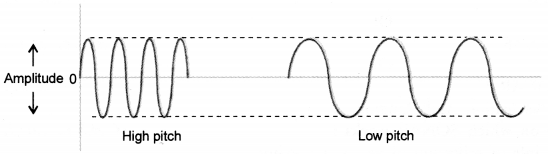
Gravitation Class 9 Important Questions Science Chapter 10

Chapter 10 Gravitation Class 9 Science Important Questions with Answers PDF will help you in scoring more marks in your exams.
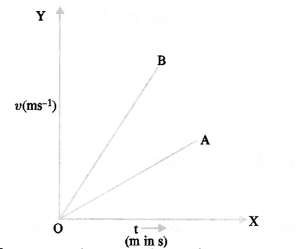
Gravitation Class 9 Important Questions and Answers Science Chapter 10

VERY SHORT ANSWER QUESTIONS

Based on gravitation and Newtons law of gravitation

Question 1.
What do you mean by gravitation ? (CBSE 2012)
Answer:
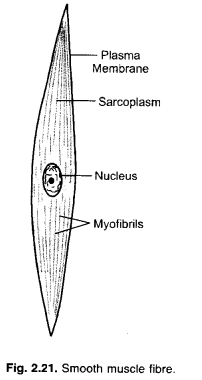
The force of attraction between any two particles in the universe is called gravitation.

More Resources

Question 2.
State Universal law of gravitation.

Or

How is the force of attraction dependent on the masses of objects and distance between them ?
(CBSE 2014)
Answer:
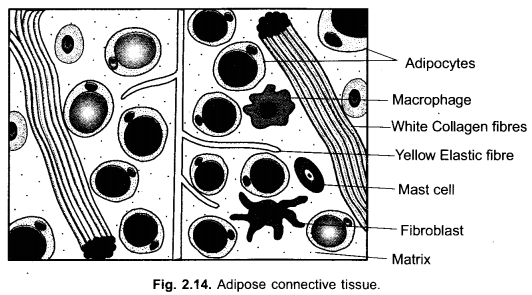
Each object on the universe attracts other object with a’ force known as gravitational force. The force of attraction between two objects is directly proportional to

  1. the product of masses of the objects and
  2. inversely proportional to the square of distance between them. That is,
    Gravitation Class 9 Important Questions Science Chapter 10 image - 1

Question 3.
The distance between two particles is decreased. Will the gravitational force between them increase or decrease ?
Answer:
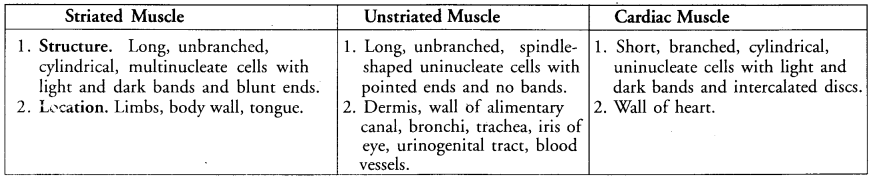
Gravitation Class 9 Important Questions Science Chapter 10 image - 2
So, gravitational force (F) increases when the distance (r) between two particles decreases. r

Question 4.
An iron ball exerts a force F on the rubber ball. How much force, the rubber ball will exert on the iron ball ?
Answer:
The rubber ball also exerts the same force F on the iron ball.

Question 5.
Define Universal gravitational constant (G).
Answer:
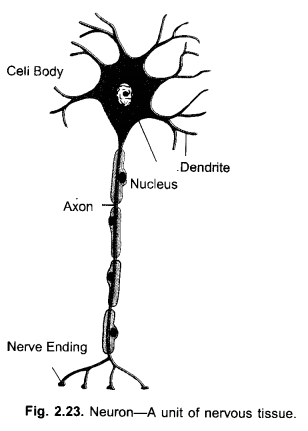
Universal gravitational constant is defined as the force of attraction between two objects of unit masses separated by unit distance.

Question 6.
Write down the unit of ‘G’ in S.I.
Answer:
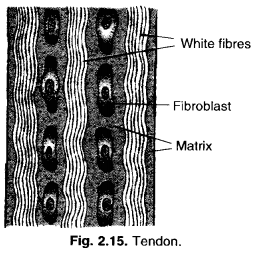
Nm2 kg-2.

Question 7.
What is the value of ‘G’ ?
Answer:
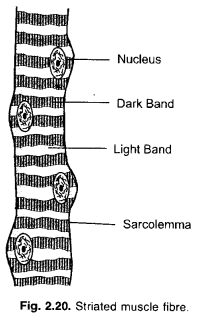
G = 6.673 x 10⁻¹¹ N m2 kg-2.

Question 8.
The value of G = 6.673 x 10⁻¹¹ Nm2 kg-2 on the surface of the earth. What is the value of G on the surface of the moon ? (CBSE Sample Paper; CBSE 2011, 2013, 2014)
Answer:
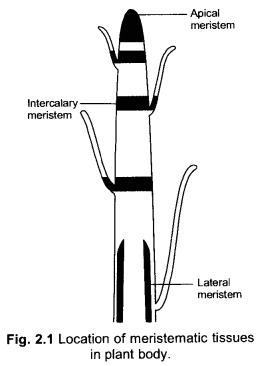
The value of G on the surface of the moon
= value of G on the surface of the earth (i.e., 6.673 x 10⁻¹¹ Nm2 kg-2).

Question 9.
The gravitational force between two objects on the earth is 2 N. What will be the gravitational force between these two objects on the surface of the moon ?
Answer:
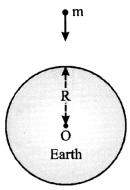
Same force i.e. 2 N.
Gravitation Class 9 Important Questions Science Chapter 10 image - 3
(∴ F and G has the same value on the surface of earth and on the surface of moon).

Question 10.
State one phenomena related to universal law of gravitation.
Answer:
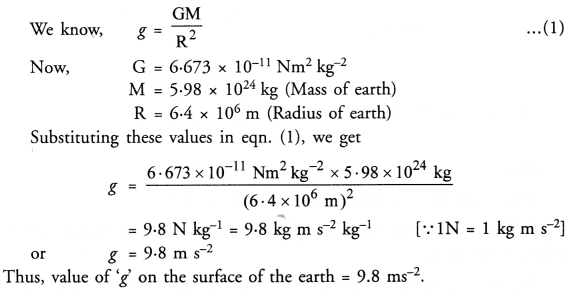
The atmosphere of earth is possible due to this law.

Question 11.
Name the force which is responsible for the revolution of planets around the sun. (CBSE 2015)
Answer:
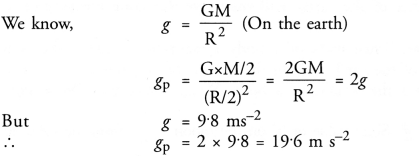
The gravitational force of attraction between the planet and the sun. This force provides the necessary centripetal force to the planet to move in a circular orbit around the sun.

Question 12.
Name the force which is responsible for the revolution of moon around the earth.
Answer:
The gravitational force between the earth and the moon provides the centripetal force to the moon to move in a circular path around the earth.

Question 13.
The earth is acted upon by the gravitational force of attraction due to the sun. Then why does the earth not fall towards the sun ?
Answer:
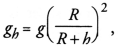
Gravitational force of attraction on the earth due to the sun provides the necessary centripetal force to the earth to move around the earth. Hence, earth does not fall towards the sun.

Question 14.
State two factors on which gravitational force between two objects depends.
Answer:

  1. Mass of the objects,
  2. distance between them.

Question 15.
The gravitational force between two objects is F. How will the force change when the distance between them is reduced to 1/4 th ?
Answer:
Gravitation Class 9 Important Questions Science Chapter 10 image - 4

Question 16.
Is the force of gravity stronger on a piece of iron than on a piece of wood if both have the same mass ?
(CBSE 2015)
Answer:

No. Force of gravity on a piece of iron is equal to the force of gravity on a piece of wood because F = mg.

Question 17.
When a stone is thrown vertically upwards, its velocity is continuously dedfeased. Why ? (CBSE 2015)
Answer:
When a stone is thrown vertically upwards, a force called gravitational force pulls the stone continuously in the downward direction. Hence, velocity of the stone is decreased continuously.

Based on free fall and acceleration due to gravity

Question 18.
The factor associated with the motion of an object are : Force, velocity, acceleration and momentum. Out of these four factors which one remains constant for all bodies large or small, undergoing a free fall.
(CBSE 2013, 2015)
Answer:
Acceleration of a freely falling object remains constant as it does not depend on the mass of the object.

Question 19.
Two objects of masses and M2 are dropped in vacuum from a height above the surface of earth (Mt> M2). Which one will fall the ground first, and why ?
Answer:
Both objects will fall on the ground simultaneously as the acceleration (known as acceleration due to gravity) with which an object falls towards the earth is constant irrespective of the mass of the object.

Question 20.
When an object is dropped from a height, it accelerates when it falls down. Name the force which accelerates the object.
Answer:
Gravitational force between object and earth (i.e., gravity).

Question 21.
State the type of motion shown by a freely falling stone. (CBSE 2015)
Answer:
Uniformly accelerated motion.

Question 22.
Write the expression for the acceleration due to gravity. GM
Answer:
Gravitation Class 9 Important Questions Science Chapter 10 image - 5

Question 23.
What is the SI unit of acceleration due to gravity (g) ?
Answer:
m s-2.

Question 24.
What is the value of acceleration due to gravity on the surface of earth ?
Answer:
g = 9.8 m s-2

Question 25.
What is the value of acceleration due to gravity on the surface of moon ?
Answer:
g = 1.6 m s-2 on the surface of moon.

Question 26.
What is the direction of acceleration due to gravity ?
Answer:
Towards the centre of the earth.

Question 27.
What will be the direction of acceleration due to gravity if the body is thrown vertically upward ?
Answer:
The direction of acceleration due to gravity is always towards the centre of the earth i.e. in the downward direction.

Question 28.
Is value of ‘g’ same at all ‘places on the earth ? Give reason for your answer. (CBSE 2011)
Answer:
No.
Gravitation Class 9 Important Questions Science Chapter 10 image - 6
Since polar radius (distance of pole from the centre of earth) is less than the equatorial
radius, therefore, the value of ‘g is more at poles than at equator.

Question 29.
Where is the value of ‘g’ equal to zero on earth ?
Answer:
At the centre of the earth.

Question 30.
An object of mass 2 kg falls with an acceleration of 9.8 m s-2 towards the ground. With what acceleration will an object of mass 4 kg fall ?
Answer:
9.8 m s-2. This is because acceleration due to gravity is independent of the mass of the object.

Based on mass and weight of a body

Question 31.
Define mass of a body. (CBSE 2010, 2012)
Answer:
Mass of a body is defined as the quantity of matter contained in the body.

Question 32.
What is the SI unit of mass ? (CBSE 2012)
Answer:
SI unit of mass is kilogram (kg).

Question 33.
Is mass of a body a scalar or a vector physical quantity ?
Answer:
Mass is a scalar physical quantity.

Question 34.
The mass of a body at the equator is 20 kg. What will be the mass of this body at the poles ?
Answer:
20 kg.

Question 35.
Define weight of a body. (CBSE 2012)
Answer:
The force with which a body is attracted by the earth is known as the weight of the body.

Question 36.
Write a relation between the mass and weight of the body. (CBSE 2013)
Answer:
W = mg

Question 37.
State the SI unit of weight. (CBSE 2012)
Answer:
S.I. unit of weight is newton (N).

Question 38.
What is the weight of an object at the centre of earth ?
Answer:
Zero.

Question 39.
The weight of a body on the earth is 60 N. What is the weight of the body on the moon ? (CBSE 2013)
Answer:
Weight of the body on the moon = (1/6) x 60 N=10 N.

Question 40.
Define 1 kg weight and express it in Newton.
Answer:
Force is said to be 1 kg weight if it produces acceleration equal to 9.8 m s-2 in a body of 1 kg mass.
1 kg wt = 1 kg x 9.8 ms-2 = 9.8 N

Question 41.
What is the mass of an object whose weight is 196 N ?
Answer:
Gravitation Class 9 Important Questions Science Chapter 10 image - 7

SHORT ANSWER QUESTIONS

Based on gravitation and newtons law of gravitation

Question 1.
State Newtons law of gravitation. Write the mathematical equation for Newton’s law of gravitation.
(CBSE 2010, 2011, 2014, 2015)
Answer:
According to this law, the force of attraction between two particles or bodies is

  1. directly proportional to the product of their masses and
  2. inversely proportional to the square of the distance between these particles or bodies

Relation between gravitational force between two bodies and the distance between them.
Consider two bodies A and B having masses m1 and m2 respectively. Let the distance between these bodies be r (Figure 6).
Gravitation Class 9 Important Questions Science Chapter 10 image - 8
According to the law of gravitation, the force of attraction (F) or force of gravitation between these bodies is directly proportional to (i) product of masses of bodies
i.e.,                                           F ∝ m1m2                                                                      …(1)
and (ii) inversely proportional to square of distance between bodies.
Gravitation Class 9 Important Questions Science Chapter 10 image - 9
Eqn. (3) gives the magnitude of gravitational force between two interacting bodies of masses m1 and m2 separated by a distance V.

Question 2.
Why is Newton’s law of gravitation known as universal law of gravitation ? (CBSE 2012)
Answer:
This is because this law is applicable to all the objects or particles in the universe.

Question 3.
Why is G called universal constant ? (CBSE 2010, 2011, 2013, 2014)
Answer:
Because the value of G = 6.673 x 10⁻¹¹ Nm2 kg-2 is same at all positions in the universe.

Question 4.
How does the gravitational force between two bodies change if the distance between them is tripled ? Explain. (CBSE 2010, 2011)
Answer:
Gravitational force between two bodies is given by
Gravitation Class 9 Important Questions Science Chapter 10 image - 10
Thus, the gravitational force between the bodies becomes 1/9 th times its original value.

Question 5.
State the source of centripetal force that a planet requires to revolve around the sun. On what factors does that force depend ? Suppose this force suddenly becomes zero, then in which direction will the planet begin to move if no other celestial body affects it ?
Answer:
Gravitational force of attraction between the sun and the earth is the source of the centripetal force that a planet requires to revolve around the sun.
It depends on

  1. the masses of the sun and the planet and
  2. distance between the sun and the planet. If this force suddenly becomes zero, the planet begins to move in a straight line along the tangent at the point on the circular path of the planet around the sun because of inertia of motion.

Question 6.
Mention any two phenomena which will successfully be explained on the basis of Universal law of gravitation.
Answer:

  1. Existence of earth’s atmosphere
  2. Revolution of planets around the sun.

Question 7.
The moon is acted by the gravitational pull of earth, still it does not fall onto the earth. Explain, why ?
(CBSE 2012, 2013)
Answer:
The gravitational pull of earth on the moon provides the necessary force to the moon to move around the earth. Therefore, moon does not fall on the earth.

Question 8.
What is the cause of ocean tides ?

Or

Name the type of force which is responsible for the formation of tides in the sea. (CBSE 2014)
Answer:
The earth exerts a large gravitational pull on the moon. According to Newton’s third law of motion, moon also exerts the same large gravitational pull on the earth. This large gravitational pull or force on the earth . due to moon causes ocean tides.

Question 9.
An apple attracts the earth and the earth also attracts the apple towards its centre. Then, why only apple falls towards the earth but earth is not moved towards the apple ?
(CBSE Sample Paper; CBSE 2010, 2011)

Or

A stone and the earth attract each other with an equal and opposite force, why then we see only the stone falling towards the earth, but not the earth rising towards the stone. (CBSE 2013)
Answer:
The gravitational forces acting on both the apple and the earth (or a stone and earth) are equal in accelaration produced in the apple or stone is very large and the acceleration produced in the earth magnitude. Since, the mass of the apple or stone is very small as compared to the mass of the earth, so the
is negligible. That is why, the motion of the earth is not noticed.

Based on free fall and acceleration due to gravity

Question 10.
Two boys drop a sheet of a paper from the top of the tower. One boy dropped his sheet of paper as such
but the second boy dropped it by changing it in the form of a ball. Which sheet of paper reaches the ground first and why ? Assume that air resistance is not negligible. (CBSE 2010, 2014)
Answer:
When a body falls through air, the air resistance or force of friction due to air opposes its motion. Since the surface area of sheet of paper is more than the surface area of the paper when it is in the form of a ball. Thus, the opposition offered by air to the paper sheet is more than the opposition offered to the ball shaped sheet. Hence, the sheet changed into the ball shape reaches the ground earlier than the paper sheet.

Question 11.
Study the diagrams below.
Gravitation Class 9 Important Questions Science Chapter 10 image - 11
A sheet of paper and a crumpled paper are thrown down from the same height and time is noted. Answer the following questions :
(a) Will the time taken to reach the bottom of the container be the same for the sheet of paper and crumpled paper ? Why ? Explain giving reason.
(b) What will happen in case (ii) ?
Answer:
(a) Since the area of a sheet of paper is more than the area of the paper crumpled into a small, therefore, a sheet of paper will experience a large opposing force due to air than the ball, while falling down. Hence, a sheet of paper falls slower than one that is crumpled into a ball.
(b) Both will take same time to reach the bottom as there is no air resistance.

Question 12.
Derive an expression for the acceleration due to gravity. (CBSE 2010, 2011, 2012, 2013, 2014)

Or

How is the value of ‘g’ on the earth related to the mass of the earth and its radius. Derive the expression.
(CBSE 2015)
Answer:
Consider a body of mass m near the surface of the earth (Figure 11). The force acting on the body is the gravitational force of the earth. The magnitude of the gravitational force acting on the body due to the earth is given
Gravitation Class 9 Important Questions Science Chapter 10 image - 12
where, M = mass of the earth
R = radius of the earth
[Here, height of the body from the surface of the earth is neglected as compared to the radius of the earth because R = 6400 km is very large.]
Gravitation Class 9 Important Questions Science Chapter 10 image - 13
Gravitation Class 9 Important Questions Science Chapter 10 image - 14
This gravitational force (F) produces acceleration equal to ‘g in the body of mass m. So according to Newton’s second law of motion, which is the expression for the acceleration due to gravity.
Eqn. (3) shows that acceleration due to gravity does not depend on the mass of the object or body. Thus, all objects hollow or solid, big or small should fall at the same rate.
Gravitation Class 9 Important Questions Science Chapter 10 image - 15

Question 13.
Suppose a planet exists whose mass and radius both are half of those of earth. Calculate acceleration due to gravity on the surface of this planet. lg on the surface of the earth = 9.8 m s-2. (CBSE  2010, 2012)
Answer:
Gravitation Class 9 Important Questions Science Chapter 10 image - 16

Question 14.
What is the difference between ‘g and ‘G’ ?
Answer:

Acceleration due to gravity (g)Universal gravitational constant (G)
1. The acceleration produced in a body falling freely under the action of gravitational pull of the earth is known as acceleration due to gravity.The gravitational force between two bodies of unit masses separated by a unit distance is known as universal gravitational constant.
2. The value of ‘g’ is different at different points on the earth.The value of ‘G’ is same at every point on the earth.
3. The value of ‘g’ decreases as we go higher from the surface of the earth or as we go deep into the earth.The value of ‘G’ does not change with height and depth from the surface of the earth.
4. The value of ‘g’ at the centre of the earth is zero.The value of ‘G’ is not zero at the centre of the earth or anywhere else.
5. The value of is different on the surfaces of different heavenly bodies like the sun, the moon, the planets.The value of ‘G’ is same throughout the universe.
6. The value of ‘g’ on the surface of the earth is 9.8 m s-2The value of G = 6.673 x10⁻¹¹ Nm2 kg-2, throughout the universe.

Question 15.
Why is the value of lg variable on the surface of earth ?
Answer:
Gravitation Class 9 Important Questions Science Chapter 10 image - 17
The earth is oval shaped. The distance (R) of equator of earth from the centre of earth is greater than the distance of poles from the centre of earth. Hence, value of ‘g is different at equator and poles.

Question 16.
Give reasons :

  1. The mass is constant everywhere whereas weight keeps changing.
  2. The value of ‘g’ keeps changing as we move away from the earth whereas value of ‘G’ remains constant all over the universe.

Answer:

  1. Mass is a quantity of matter contained in a body and remains constant everywhere. Weight = mg. Since value of ‘g’ changes from place to place, so weight keeps on changing from one place to another place.
  2. The value of ‘g with height is given by
    Gravitation Class 9 Important Questions Science Chapter 10 image - 18
    where h is the height from the surface of earth. As h increases, value of ‘g’ decreases. On the other hand, G is universal constant and its value remains constant all over the universe.

Question 17.
Where is the acceleration due to gravity minimum and maximum on the surface of the earth ? (CBSE 2015)
Answer:
Acceleration due to gravity on the surface of earth is given by
Gravitation Class 9 Important Questions Science Chapter 10 image - 19
Since equatorial radius (RE) is greater than the polar radius (RP) of the earth, therefore, acceleration due to gravity is minimum at the equator and maximum at the poles.

Based on Mass and weight of a body

Question 18.
State the factors on which weight of a body depends. (CBSE 2012)
Answer:
Since, weight, W = mg. So weight of a body depends on

  1. mass of the body and
  2. acceleration due to gravity (g) at the given place.

Question 19.
Why is the weight of a body less at equator than at poles ? (CBSE 2012, 2013, 2014)
Answer:
Weight, W = mg. Since the value of ‘g’ is less at equator than at poles, so weight of a body is less at equator than at poles.

Question 20.
Why is the weight of a man less on the surface of the moon than on the surface of the earth ?
Answer:
W = mg. Since value of ‘g’ on the moon is 1/6 times the value of ‘g’ on the earth. So weight of a body on moon is 1/6 times the weight of the body on earth.

Question 21.
Why is the weight of an object less on a mountain than at sea level ?
Answer:
Since value of g decreases as we go higher and higher, so weight (mg) of the object on the mountain is less than at the sea level.

Question 22.
Why is the weight of a body zero at the centre of the earth ?
Answer:
W = mg. Since g = 0 at centre of the earth.
∴ W = 0.

Question 23.
There are two kinds of balances i.e., a beam balance and a spring balance. If both the balances give the same measure of a given body on the surface of the earth, will they give the same measure on the surface of the moon ? Explain.
Answer:
Beam balance measures the mass of a body. Since mass of a body remains constant so the beam balance will give the same measures on the surface of the earth and on the surface of the moon.
On the other hand, spring balance measures the weight of a body. Weight of a body W = mg. It means, weight of a body depends upon the value of ‘g’. Since value of ‘g on the moon = 1/6 times the value of ‘g’ on the earth, so the spring balance shows 1/6 th times the weight of the body on the earth at the surface of the moon.

Question 24.
A bag of sugar weighs W at some place on the equator. Will it weigh same or more or less when taken to Antarctica ? Explain.
Answer:
Gravitation Class 9 Important Questions Science Chapter 10 image - 20
Equatorial radius is more than the polar radius, so the value of ‘g’ at pole is more than the value of ‘g’ at the equator. Hence, the sugar bag will weigh more at Antarctica (or poles).

Question 25.
A body of mass 10 kg is taken to the centre of earth. What will be its mass and weight there ?
Answer:
Mass remains the same. That is, mass of body at the centre of earth = 10 kg.
Weight of body at the centre of earth, W = mg = 10 x 0 = 0 (∴ g at the centre of earth = 0).

Question 26.
Gravitational force on an imaginary planet is 6 times stronger than the gravitational force of the earth. Determine the value of acceleration due to gravity and weight of an object of mass 50 kg on that planet.
Answer:
mgp = 6 mge
∴ gp = 6 ge = 6 x 9.8 = 58.8 ms-2
Weight of object on planet = mgp = 50 x 58.8 = 2940 N.

Question 27.
Find the weight of a 80 kg man on the surface of moon ? What should be his mass on the earth and on the moon ? (ge = 9.8 m/s2, gm = 1.63 m/s2).
Answer:
Weight of man on moon = mgm = 80 x 1.63 = 130.4 N
Mass of an object does not change, when taken to moon from earth. Therefore, mass of man on earth and moon is same i. e., 80 kg.

Question 28.
An object has mass 1 kg and weight 1.67 N on moon. Calculate its weight and mass on earth (ge =10 m s-2).
Answer:
Mass of object on earth = mass of object on moon = 1kg.
Weight of object on moon = (1/6) x weight of object on earth
Weight of object on earth = 6 Wm = 6 x 1.67 = 10.02 N

Question 29.
Find the weight of an object at a height 6400 km above the earth’s surface. The weight of the object at the surface of earth is 20 N and radius of earth is 6400 km.
Answer:
Gravitation Class 9 Important Questions Science Chapter 10 image - 21

Question 30.
A force of 20 N acts upon a body of weight 9.8 N. What is the mass of the body and how much is its acceleration ( g = 9.8 m s-2)?
Answer:
W = mg =9.8 N
Gravitation Class 9 Important Questions Science Chapter 10 image - 22

LONG ANSWER QUESTIONS

Question 1.
(a) State Universal law of gravitation. Write the expression for the gravitational force between the earth and an object lying on the surface of the earth.
(b) Gravitational force plays an important role in nature. Justify this statement.

Or

State universal law of gravitation. Derive an expression for gravitational force between two bodies.
(CBSE 2012)
Answer:
Definition of universal gravitational constant (G)
Gravitation Class 9 Important Questions Science Chapter 10 image - 23
If m1 = 1 unit, m2 = 1 unit and r = 1 unit, then G = F Thus, universal gravitational constant (G) is defined as the force of attraction between two bodies of unit masses separated by a unit distance.
Units of universal law of gravitation:
Gravitation Class 9 Important Questions Science Chapter 10 image - 24
Characteristics of Gravitational force

  1. Gravitational force between two bodies or objects does not need any contact between them. It means, gravitational force is action at a distance.
  2. Gravitational force between two bodies varies inversely proportional to the square of the distance between them. Hence, gravitational force is an inverse square force.
  3. The gravitational forces between two bodies or objects form an action-reaction pair. If object A attracts object B with a force F1 and the object B attracts object A with a force F2 (Figure 7), then
  4. Gravitational force between two small bodies is very small. On the other hand, gravitational force between two large bodies (say the sun and the earth) is large.
  5. Gravitational force between two objects is always attractive in nature.

Question 2.
What do you understand by free fall ? Derive an expression for the acceleration due to gravity. Write the factors on which “acceleration due to gravity” depends.
Answer:
Definition of Free Fall
The falling body on which only force of gravitation of the earth acts is known as freely falling body and such fall of a body is known as free fall. A freely falling body has constant acceleration equal to acceleration due to gravity (g), irrespective of its mass.
Gravitation Class 9 Important Questions Science Chapter 10 image - 25
Thus, all bodies irrespective of their masses fall down with constant acceleration.
Motion of a freely falling body is uniformly accelerated motion.
Consider a body of mass m near the surface of the earth (Figure 11). The force acting on the body is the gravitational force of the earth. The magnitude of the gravitational force acting on the body due to the earth is given
Gravitation Class 9 Important Questions Science Chapter 10 image - 26
where, M = mass of the earth
R = radius of the earth
[Here, height of the body from the surface of the earth is neglected as compared to the radius of the earth because R = 6400 km is very large.]
Gravitation Class 9 Important Questions Science Chapter 10 image - 27
Gravitation Class 9 Important Questions Science Chapter 10 image - 28
This gravitational force (F) produces acceleration equal to ‘g in the body of mass m. So according to Newton’s second law of motion, which is the expression for the acceleration due to gravity.
Eqn. (3) shows that acceleration due to gravity does not depend on the mass of the object or body. Thus, all objects hollow or solid, big or small should fall at the same rate.

Question 3.
Define the terms “mass” and “weight”. Write their SI units. Distinguish between mass and weight.
Answer:

MassWeight
The quantity of matter contained in a body is called the mass of the body.The force with which the earth attracts a body towards its centre is called the weight of the body.
Mass of a body remains constant.Weight of a body changes from place to place as it depends on the value ‘g’ and ‘g’ is different at different places.
Mass of a body is never zero.Weight of a body at the centre of the earth is zero.
Mass is a scalar quantity.Weight is a vector quantity.
Mass is measured in kg.Weight is measured in kg wt or N.
Mass is measured by a beam balance.Weight is measured by a weighing machine or a spring balance.

Hope given Previous Year Question Papers for CBSE Class 9 Science Chapter 10 Gravitation are helpful to complete your science homework.

If you have any doubts, please comment below. Learn Insta try to provide online science tutoring for you.