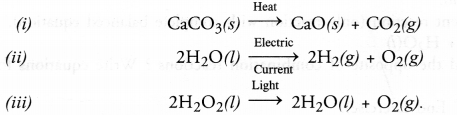
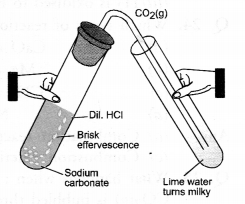
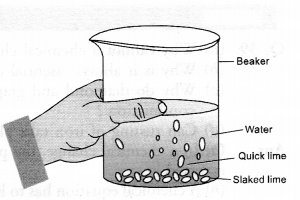
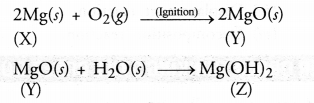
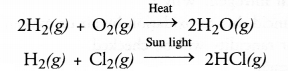
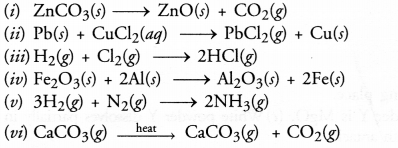
Atoms and Molecules Class 9 Important Questions Science Chapter 3

Chapter 3 Atoms and Molecules Class 9 Science Important Questions with Answers PDF will help you in scoring more marks in your exams.

Atoms and Molecules Class 9 Important Questions and Answers Science Chapter 3

Question 1.
What is cation ? Give one example.
Answer:
A cation is an atom or group of atoms carrying positive charge on it.

More Resources

Question 2.
Mention two postulates of Daltons atomic theory that explain :
(a) Law of conservation of mass.
(b) Law of constant proportions.
Answer:
(a) Law of conservation of mass: The total mass of the products in a physical change or a chemical reaction is equal to the total mass of the reactants that have combined.
(b) Law of constant proportions:  A pure chemical compound always consists of the same elements that are combined together in a fixed (or definite) proportion by mass.

Question 3.
Name the compound Al2(SO4), and mention the ions present in it.
Answer:
The compound is called aluminium sulphate; cation : Al3+ ; anion : (SO4)2-

Question 4.
Write the formulae and the names of the ions formed by the combination of
(i) Fe3+ and SO42-
(ii) NH4+ and CO32- . (CBSE 2011)
Answer:
(i) Fe2(SO4), : Ferric sulphate or Fe (III) sulphate.
(ii) (NH4)2CO3 : Ammonium carbonate or Ammonium(I)carbonate.

Question 5.
(a) Define ‘atomic mass unit’. How is it linked with relative atomic mass ?
(b) How do you know the presence of atoms if they do not exist independently for most of the elements ?
(CBSE 2011)
Answer:
(a) Atomic mass unit (u) is 1/12 of the mass of one atom of C-12. Relative atomic mass of the atom of an element is the average mass of the atom as compared to 1/12th of the mass of C-12 atom .
Atoms and Molecules Class 9 Important Questions Science Chapter 3 img 1
(b) Atoms of most of the elements do not exist independently. However, they combine in specific numbers to form molecules or ions which we can feel and know about their presence.
For example,
* A molecules of H2SO4 consists of 2 atoms of H + 1 atom of S + 4 atoms of O
* A molecules of C12H22O11 consists of 12 atoms of C + 22 atoms of H + 11 atoms of O
* Ammonium ion (NH4+) consists of 1 atom of N + 4 atoms of H

Question 6.
With the help of a labelled diagram describe an activity to demonstrate the law of conservation of mass.
(CBSE 2011)
Answer:
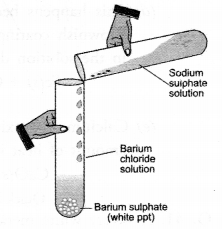
In order to illustrate the law of conservation of mass, let us carry the same chemical reaction in the laboratory. The procedure is quite simple. In a graduated cylinder, prepare about 10% solution of one of the reactants say barium chloride in water. For that, weigh accurately 10 gram of the sample and dissolve in water with stirring in the graduated cylinder. Add more of water so as to touch 100 mL mark. This is 10 percent solution of the reactant. Transfer a portion of this solution in a conical flask as shown in figure 3.1.
Atoms and Molecules Class 9 Important Questions Science Chapter 3 img 2
In a similar manner, prepare 10% solution of sodium sulphate also. Take a portion of this solution in a small glass tube. Place the tube carefully in the flask without disturbing it. Even a thread can be used for the purpose. Cork the flask and weigh it on a balance. Shake the flask for sometime by hand so that the two reactants mix together and react to form the products. Barium sulphate is in the form of a white precipitate. The other product sodium chloride is water soluble. Weigh the flask again and notice if there is any change in weight. No change will be noticed. This means that the mass of reactants is the same as the mass of the products and this verifies the law of conservation of mass.

Question 7.
(a) Define Avogadro’s number. Why is it also known as Avogadro’s constant ?
(b) Calculate the molar mass of Na2O.
(c) Find the mass of 10 moles of carbon dioxide. (CBSE 2011)
Answer:
(a) Avogadro’s number is the number of particles (atoms, ions, molecules etc.) present in one mole of any substance. It is denoted either as NA or as NQ. The number is also called Avogadro’s constant because its value is fixed (6.022 x 10²³) irrespective of the nature of the particles.
(b) Molar mass of Na2O = 2 x Atomic mass of Na + Atomic mass of O
= 2 x 23 u + 16 u = 62 u
(c) Mass of 10 moles of CO2= 10 x 44 u = 440 u.

Question 8.
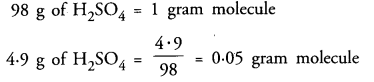
(a) How many gram molecules of H2SO4 are present in 4.9 g of the acid ?
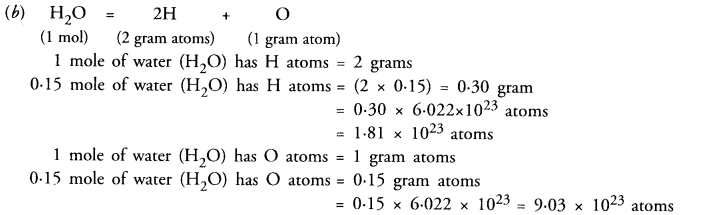
(b) How many atoms of hydrogen and oxygen are present in 0-15 mole of water (H2O) ? (CBSE 2011)
Answer:
(a) Gram molecular mass of H2SO4 = 2 x 1 + 32 + 4 x 16 = 98 g
Atoms and Molecules Class 9 Important Questions Science Chapter 3 img 3
Atoms and Molecules Class 9 Important Questions Science Chapter 3 img 4

Question 9.
(a) Calculate the formula unit mass of Na2SO4
(b) What is the mass of one mole of sulphur atoms ?
(c) Convert 12 g of oxygen into mole. (CBSE 2011)
Answer:
(a) Na2SO4 is an ionic compound. Therefore its formula unit mass is the same as its molecular mass
= 2 x 23 + 32 + 4 x 16 = 142 u
(b) The mass of one mole of sulphur atoms = 32 u.
(c) 32 g of sulphur = 1 mol
Atoms and Molecules Class 9 Important Questions Science Chapter 3 img 5

Question 10.
(a) Define atomic mass unit.
(b) Distinguish between molecular mass and molar mass.
Answer:
(a) Atomic mass unit (u) is 1/12 of the mass of one atom of C-12. Relative atomic mass of the atom of an element is the average mass of the atom as compared to 1/12th of the mass of C-12 atom.
(b) Molecular mass of a substance expressed in grams is known as its moles mass. This means that molecular mass is expressed in units ‘u’ while molar mass is expressed in units ‘grams’.

Question 11.
What is meant by the term chemical formula ? Write the chemical formula of calcium oxide. Calculate its formula unit mass. (Atomic mass of Ca = 40 u, O = 16 u).
Answer:
Molecule represents a group of two or more atoms (same or different) chemically bonded to each other and held tightly by strong attractive forces. Molecules are represented in terms of symbols of constituting atoms and it is known as chemical formula.
Chemical formula of calcium oxide = CaO.
Formula unit mass = Atomic mass of Ca + Atomic mass of O = (40 + 16) = 56 u.

Question 12.
Name a non-metal which is tetratomic. (CBSE 2012)
Answer:
The non-metal is phosphorus. It exists as molecule and is tetratomic.

Question 13.
Name the cation and anion which constitute the molecule of magnesium oxide. (CBSE 2012)
Answer:
The formula of magnesium oxide is MgO. The cation and anions which constitute the molecule are Mg2+ and O2- ions.
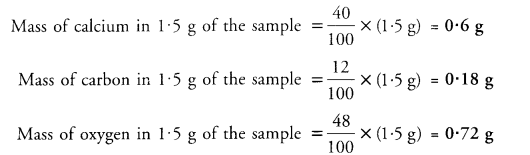
The percentage of three elements calcium , carbon and oxygen in a sample of calcium carbonate is given as : Calcium = 40% ; Carbon = 12.0% ; Oxygen = 48%

Question 14.
If the law of constant proportion is true, what weights of these elements will be present in 1.5 g of another sample of calcium. Carbonate ?
(Atomic mass of Ca = 40 u, C = 12 u, O = 16 u). (CBSE 2012)
Answer:
We have learnt that according to the law of constant proportions, the percentages of the elements present in different samples of a pure substance always remain the same. This means that in the second sample of calcium carbonate, the ratio of the different elements present will remain the same or will remain unchanged. Thus,
Atoms and Molecules Class 9 Important Questions Science Chapter 3 img 6

Question 15.
An element has valency 3. Write the formula of its oxide. (CBSE 2012)
Answer:
The valency of oxygen is 2 while that of element E is 3. The formula of the oxide of the element is : E2O3.

Question 16.
Calculate formula unit mass of Al2(SO4)3. (CBSE 2012)
Answer:
Formula unit mass of Al2(SO4)3 (Aluminium sulphate)
= (2 x Atomic mass of Al) + (3 x Atomic mass of S) + (12 x Atomic mass of O)
= (2 x 27) + (3 x 32) + (12 x 16)
= (54 + 96 + 192) = 342 u.

Question 17.
(a) State six postulates of Dalton’s atomic theory.
(b) A 0.24 g sample of compound of carbon and oxygen on analysis was found to contain 0.096 g of carbon and 0.144 g of oxygen. Find the percentage composition of the compound by weight. (CBSE 2012)
Answer:
(a) The important features of the Dalton’s Atomic Theory are listed :

  1. Every matter is made up of very small particles known as atoms.
  2. Atoms are the ultimate particles of matter and cannot be further sub-divided into smaller particles.
  3. Atoms can neither be created nor destroyed during a physical change or a chemical reaction.
  4. All atoms of a particular element are identical in all respects. This means that they have same mass, size and also same chemical properties.
  5. Atoms of different elements have different masses, sizes and also chemical properties.
  6. Atoms are the smallest particles of matter which can take part in chemical combination.
  7. Atoms of the same or different elements combine in small whole number ratios to form molecules of a compound.

Atoms and Molecules Class 9 Important Questions Science Chapter 3 img 7

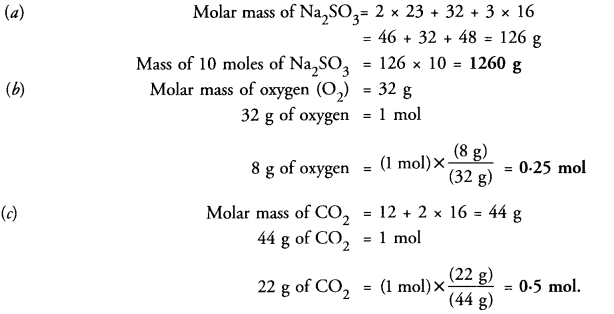
Question 18.
(a) Find the mass of 10 moles of sodium sulphite (Na2SO4).
(b) Calculate the number of molecules in 8 g of oxygen gas.
(c) Convert 22 g of CO2 into moles.
Answer:
Atoms and Molecules Class 9 Important Questions Science Chapter 3 img 8

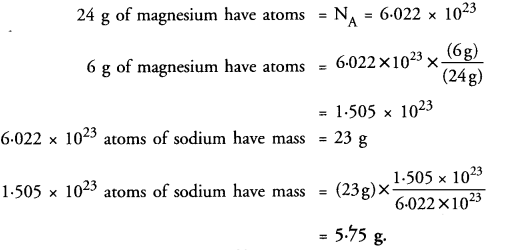
Question 19.
How many grams of sodium will have the same number of atoms as 6 grams of magnesium ?
(Given Na = 23 u, Mg = 24 u) ? (CBSE 2012, 2016)
Answer:
Atoms and Molecules Class 9 Important Questions Science Chapter 3 img 9

Question 20.
Calculate the mass of 1.2044 x 10²³ molecules of O2 (Atomic mass of O = 16 u).
Answer:
6.022 x 10²³ (NA) molecules of O2 have mass = 32 u
Atoms and Molecules Class 9 Important Questions Science Chapter 3 img 10

Question 21.
With the help of an activity, show that there is no change in mass when a chemical change (chemical reaction) takes place. (CBSE 2013)
Answer:
The mass can neither he created nor destroyed in a physical change or a chemical reaction.
In other words, the mass remains unchanged or conserved in a chemical reaction. The law is also known as the Law of Indestructibility of Matter.
Explanation : Let us try to analyse as to what happens in a chemical reaction. To understand the same, let us consider a chemical reaction between barium chloride and sodium sulphate. When the solutions of these reactants prepared separately in water are mixed, the following chemical reaction takes place :

Barium chloride + Sodium sulphate  ———– > Barium sulphate + Sodium chloride (white precipitate)

Question 22.
How are given mass, molar mass and number of moles related to each other ? (CBSE 2013)
Answer:
No. of moles = Mass/Molar mass.

Question 23.
(a) Define polyatomic ions. Write an example.
(b) Calculate the formula unit mass of CaCO3(Atomic mass of C = 12 u, Ca = 40 u, O = 16 u)
(c) Calculate the molecular mass of the following :
(i) HNO3
(ii) CH3COOH
Atomic mass of H = 14, N = 14 u, O = 16 u, C = 12 u) (CBSE 2013, 2015)
Answer:
(a) Polyatomic ions are the ions representing a group of atoms which carry either positive or negative charge. For example, SO4-2 ion.
(b) Formula unit mass of CaCO3 = (1 x Atomic mass of Ca) + (1 x Atomic mass of C) + (3 x Atomic mass of O)
= 4 (1 x 40 u) + (1 x 12 u) + (3 x 16 u) = 100 u .
(c) Molar mass of HNO3 = (1 x Atomic mass of H) + (1 x Atomic mass of N) + ( 3 x Atomic mass of O)
= (1 x 1 u) + (1 x 14 u) + (3 x 16 u) = 63 u.
Molecular mass of CH3COOH = (2 x Atomic mass of C) + (4 x Atomic mass of H) + (2 x Atomic mass of O) .
= (2 x 12 u) + (4 x 1 u) + (2 x 16 u) = 60u

Question 24.
What do you understand by 1 amu ? (CBSE 2013)
Answer:
1 amu (or lu) is l/12th of the mass of one atom of carbon taken as 12.

Question 25.
Write the molecular formulae of all the compounds that can be formed by the combination of the following ions : Cu2+, Na+, Fe3+, Cl, SO4-2 (CBSE 2013)
Answer:
In this case, the compounds can be formed by the combination of cations and anion. Therefore, the molecular formulae of different compounds are :
CuCl2, CuSO4, NaCl, Na2SO4, FeCl3, Fe2(SO4)3.

Question 26.
What are chemical reactions according to the Law of conservation of mass ? (CBSE 2013)

Answer:
According to law of conservation of mass, chemical reactions involve only the exchange of partners in the reactants to form products. That is why, there is no change in mass.

Question 27.
Write any five features of Dalton’s atomic theory. (CBSE 2013)
Answer:
The important features of the Dalton’s Atomic Theory are listed :

  1. Every matter is made up of very small particles known as atoms.
  2. Atoms are the ultimate particles of matter and cannot be further sub-divided into smaller particles.
  3. Atoms can neither be created nor destroyed during a physical change or a chemical reaction.
  4. All atoms of a particular element are identical in all respects. This means that they have same mass, size and also same chemical properties.
  5. Atoms of different elements have different masses, sizes and also chemical properties.

Question 28.
What is atomicity of an element ? Give two examples. (CBSE 2013)
Answer:
The atomicity of an element is the number of atoms present in one molecule of the element. For example,
Atomicity of oxygen in O2 = 2
Atomicity of oxygen in O3 = 3.

Question 29.
Write the chemical formulae of the following :
(a) Magnesium sulphate
(b) Calcium oxide
(c) Sodium sulphide
(d) Aluminium phosphate
(e) Potassium chloride
(f) Calcium carbonate. (CBSE 2013)
Answer:
(a) MgSO4
(b) CaO
(c) Na2S
(d) Al2(PO4)3
(e) KCl
(f) CaCO3.

Question 30.
A compound XH is formed by the combination of an element X with hydrogen. Find the valency of the element. State the formula of the compound formed by the combination of
(a) X with nitrogen
(b) X with oxygen. (CBSE 2014)
Answer:
In the compound XH, the valency of element X is 1.
(a) The valency of nitrogen is 3.
The valency of element X is 1.
The formula of the compound = NX3
(b) The valency of oxygen is 2.
The valency of element X is 1.
The formula of the compound = OX2

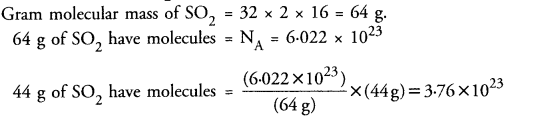
Question 31.
Calculate the number of molecules of SO2 present in 44 g of it.
Answer:
Atoms and Molecules Class 9 Important Questions Science Chapter 3 img 11

Question 32.
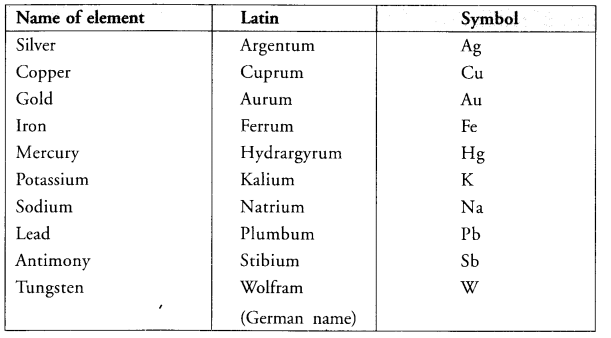
Write the Latin names of sodium and iron.
Answer:
Latin name of sodium (Na) = Natrium
Latin name of iron (Fe) = Ferrum.

Question 33.
Write the formula and names of the compounds formed by the following ions.
(a) Potassium ion and iodide ion.
(b) Sodium ion and sulphide ion.
(c) Aluminium ion and phosphate ion.
Answer:
The compounds are :
(a) KI (Potassium iodide)
(b) Na2S (Sodium sulphide)
(c) AlPO4  (Aluminium phosphate)

Question 34.
Calculate formula unit mass of Na2CO3.10H2O.
Answer:
Formula unit mass of Na2CO3.10H2O
= 2 x Atomic mass of Na + Atomic mass of C + 3 x Atomic mass of O + 10 x Molecular mass of H2O
= 2 x 23 + 12 +3 x 16 + 10 x 18 = 286 u.

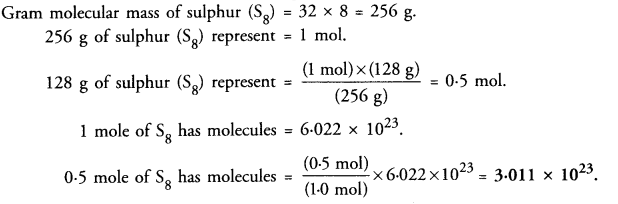
Question 35.
Calculate the number of molecules of sulphur (S8) present in 128 g of sulphur.
Answer:
Atoms and Molecules Class 9 Important Questions Science Chapter 3 img 12

Question 36.
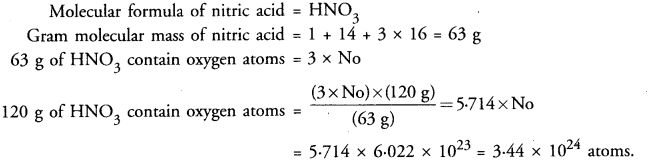
Calculate the number of oxygen atoms present in 120 g of nitric acid.
Answer:
Atoms and Molecules Class 9 Important Questions Science Chapter 3 img 13

Question 37.
What do you understand by the word ‘mole’ ? (CBSE 2015)
Answer:
A mole denotes Avogadro’s number of particles i.e., 6.022 x 10²³. These may be electrons, protons, neutrons, atoms, ions etc.

Question 38.
In a chemical reaction, 10.6 g of sodium carbonate reacted with 12 g of ethanoic acid. The products obtained were 4.4 g of carbon dioxide, 16.4 g of sodium ethanoate and 1.8 g of water.
(a) Write a word equation, clearly showing the reactants and products as given above.
(b) Also show that this data is in agreement with the law of conservation of mass. (CBSE 2015)
Answer:
(a) The word equation for the chemical reaction is :
Atoms and Molecules Class 9 Important Questions Science Chapter 3 img 14
(b) Mass of reactants = (10.6 + 12) = 22.6 g
Mass of products = (16.4 + 4.4 +1.8) = 22.6 g
Since the mass of reactant species is equal to the mass of the product species, the data illustrates the law of conservation of mass.

Question 39.
What is the name given to the number of 6.022 x 10²³ particles ? (CBSE 2015)
Answer:
It is called Avogadro’s number and is denoted by the sign NA or NQ.

Question 40.
Write the chemical names of the following compounds :
(a) K2SO4
(b) Mg3(PO4)2
(c) NH4Cl
(d) ZnS
(e) Na3N
(f) AgBr (CBSE 2015)
Answer:
(a) Potassium sulphate
(b) Magnesium phosphate
(c) Ammonium chloride
(d) Zinc sulphide
(e) Sodium nitride
(f) Silver bromide.

Question 41.
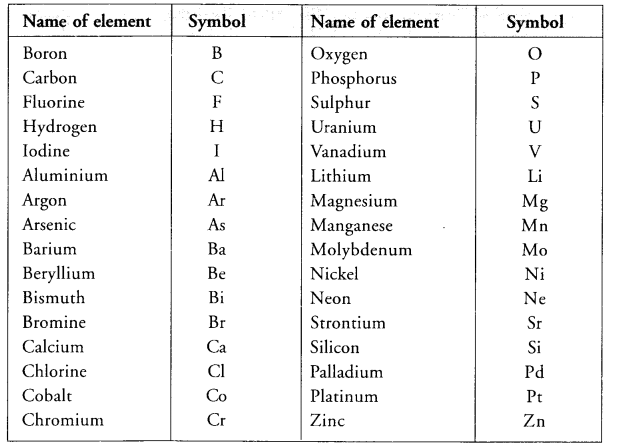
How did Berzelius assign symbols to the elements ? (CBSE 2016)
Answer:
Atoms and Molecules Class 9 Important Questions Science Chapter 3 img 15
Atoms and Molecules Class 9 Important Questions Science Chapter 3 img 16

Hope given Previous Year Question Papers for CBSE Class 9 Science Chapter 3 Atoms and Molecules are helpful to complete your science homework.

If you have any doubts, please comment below. Learn Insta try to provide online science tutoring for you.

Is Matter Around Us Pure Class 9 Important Questions Science Chapter 2

Chapter 2 Is Matter Around Us Pure Class 9 Science Important Questions with Answers PDF will help you in scoring more marks in your exams.

Is Matter Around Us Pure Class 9 Important Questions and Answers Science Chapter 2

Question 1.
List the two conditions essential for using distillation as a method for separation of the components from a mixture. (CBSE 2011)
Answer:

  1. The components of the mixture must be miscible with each other.
  2. In case, both the miscible components are liquids, they must differ in their boiling point by more than 25°C.

More Resources

Question 2.
Water is a compound and not a mixture. Justify the statement giving two reasons. (CBSE 2010, 2011)
Answer:

  1. The two elements hydrogen (H) and oxygen (O) are combined chemically to form water (H2O) which boils at a fixed temperature.
  2. The properties of water are altogether different from the constituting elements. For example, molecular hydrogen (H2) is combustible and molecular oxygen (O2) supports cumbustion. But water (H2O) extinguishes fire.

Question 3.
(a) Write one property of suspension.
(b) Identify solute and solvent in 80% solution of ethyl alcohol with water. (CBSE 2012)
Answer:
(a) Suspension is of heterogeneous nature. The solid particles represent one phase while the liquid in which these are present, represents the other phase.
(b) Water present in smaller amount is solute. Ethyl alcohol present in excess is solvent.

Question 4.
(a) Classify Brass and Diamond as element and mixture.
(b) How is a chemical change different from a physical change ? (CBSE 2011)
Answer:
(a) Brass is a homogeneous mixture also called alloy. The constituents are Cu and Zn.
Diamond is an element. It is an allotropie form of carbon.
(b) In a chemical change, a new substance is formed as a result of chemical reaction. No new substance is formed in a physical change.

Question 5.
Why particles in a true solution cannot be seen with a naked eye ? (CBSE 2011)
Answer:
Particle size in a true solution is less than 10-9 m or 1 nm. The particles are too small to scatter the beam of light and therefore, cannot be seen with naked eye.

Question 6.
(a) Identify the heterogeneous mixture from the following :
Air, soda water, soap solution, brass.
(b) Write two components of a colloidal solution. Give an example. (CBSE 2011)
Answer:
(a) Soap solution is a heterogeneous mixture while the rest are of homogeneous nature.
(b) The two components of a colloidal solution are dispersed phase and dispersion medium. For example, a colloidal solution of starch in water (Starch acts as dispersed phase and water as the dispersion medium).

Question 7.
Distinguish between elements and compounds with one example of each. (CBSE 2010)
Answer:
An element cannot be broken into simpler or smaller constituents but a compound can be broken as a result chemical reaction or by passing electric current (electro-chemical reaction). For example, sodium (element), sodium chloride (compound).

Question 8.
Suggest a suitable separation technique for the following :
(a) Mercury and water.
(b) Coloured components from blue ink,
(c) Ammonium chloride and potassium chloride
(d) Mixture of alcohol and water.
(CBSE 2010, 2011)
Answer:
(a) The separation can be done by the use of separating funnel. Mercury forms the lower layer (heavier) and water the upper layer (lighter).
(b) The separation can be done with the help of chromatography.
(c) Process of sublimation can be used. Ammonium chloride collects as the sublimate while potassium
chloride remains in the dish. .
(d) Process of fractional distillation can be used. Alcohol (ethyl alcohol) with lower boiling point (78°C or 351 K) gets distilled leaving behind water with higher boiling point (100°C or 373 K) in the distilla¬tion flask.

Question 9.
A solution contains 60 g of sugar in 480 g of water. Calculate the concentration of solution in terms of mass by mass percentage of the solution. (CBSE 2010, 2012)
Answer:
Is Matter Around Us Pure Class 9 Important Questions Science Chapter 2 image - 1

Question 10.
Identify the dispersed phase and dispersion medium in the following examples of colloids :
{a) Fog
(b) Cheese
(c) Coloured gem stone. (CBSE 2011)
Answer:
(a) Fog : Liquid (water drops) acts as dispersed phase and gas (air) as the dispersion medium.
(b) Cheese : Solid (fat) acts as the dispersed phase and water (liquid) as the dispersion medium.
(c) Coloured gem stone : Solids act as the dispersed phase as well as the dispersion medium.

Question 11.
Differentiate between simple distillation and fractional distillation.  (CBSE 2011, 2016)
Answer:
(a) In fractional distillation, a fractionating column is used while no such column is needed in simple distillation.
(b) Simple distillation can be used to separate two miscible liquids differing in their boiling points by more than 25°C. In case, the difference is less’than this, fractional distillation is used.

Question 12.
Define a solution. If 10 mL of H2SO4 are dissolved in 90 mL of water, calculate the concentration of solution. (CBSE 2011)
Answer:
For the definition of solution,
Volume of H2SO4 (solute) = 10 mL
Volume of water (solvent) = 90 mL
Volume of solution = (90 +10) mL
Is Matter Around Us Pure Class 9 Important Questions Science Chapter 2 image - 2

Question 13.

  1. Why is crystallisation technique better than evaporation ?
  2. Write any two physical properties each of metals and non-metals.
  3. Name the technique used to separate butter from curd. (CBSE 2010, 2011)

Answer:

  1. Both these techniques are used to separate the solid substances from their solutions. But crystallisation is considered better because during evaporation certain solids may decompose or some of them like sugar get charred when the solution is evaporated completely to dryness. As a result of crystallisation, even the shapes of the crystals donot change.
    1. Metals have a shining surface known as lustre.
    2. Metals are malleable and ductile.
    3. Non-metals are mostly poor conductors of electricity.
    4. Non-metals are generally soft.
  2. Butter can be separated from curd by the process of centrifugation. This is usually done by churning
    which is very common as well as convenient.

Question 14.
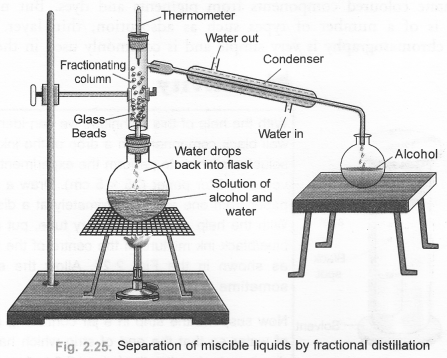
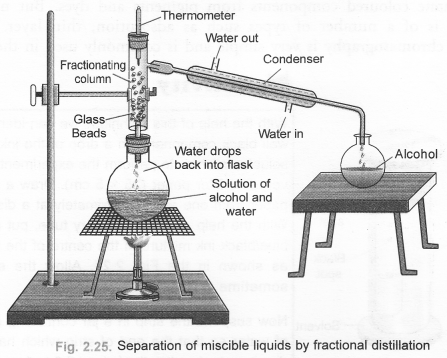
Define distillation. What type of mixtures can be separated by distillation ? Draw a labelled diagram of the apparatus used for fractional distillation. (CBSE 2010, 2011)
Answer:
For the definition of distillation, The process of distillation, also called simple distillation can be used :

  1. to separate two miscible liquids which differ in their boiling point temperature by 25°C or more.
  2. to purify an impure liquid containing soluble non-volatile impurities.
    For the labelled diagram of the apparatus used for fractional distillation,
    Is Matter Around Us Pure Class 9 Important Questions Science Chapter 2 image - 3

Question 15.
(a) 110 g of a solute are present in 550 g of solution. Calculate the concentration of solution.
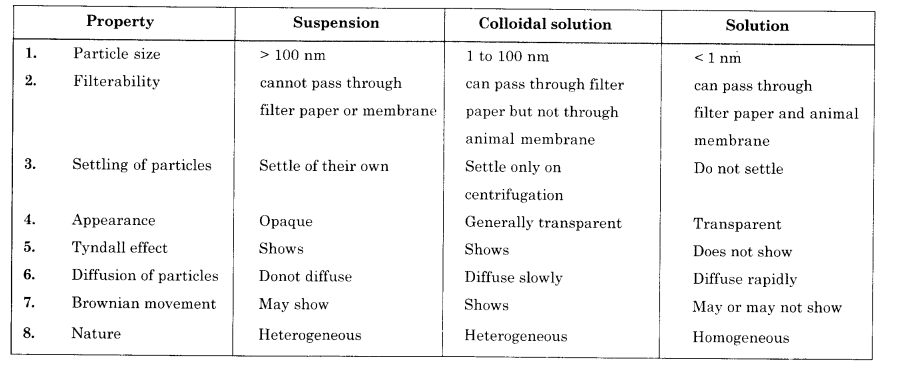
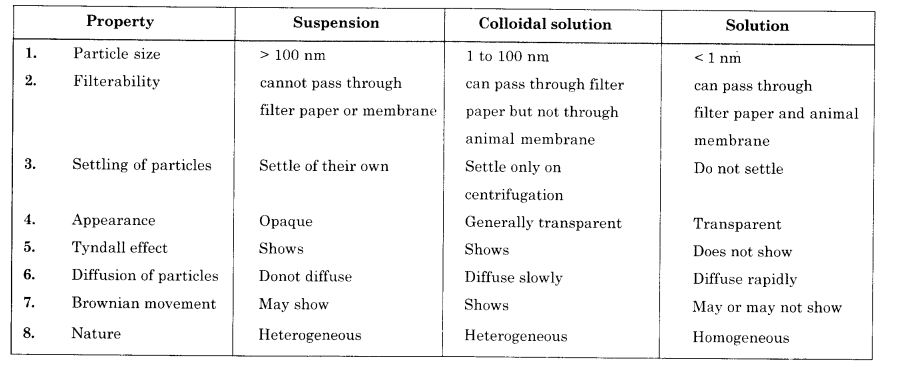
(b) Give any three points of difference between true solution, colloidal solution and suspension.
(CBSE 2011)
Answer:
Is Matter Around Us Pure Class 9 Important Questions Science Chapter 2 image - 4
(b)
Is Matter Around Us Pure Class 9 Important Questions Science Chapter 2 image - 5

Question 16.
State one instance where water undergoes a physical change and one in which it undergoes a chemical change.
(CBSE 2010)
Answer:
Physical change : Evaporation of water or freezing of water Chemical change : Electrolysis of water.

Question 17.
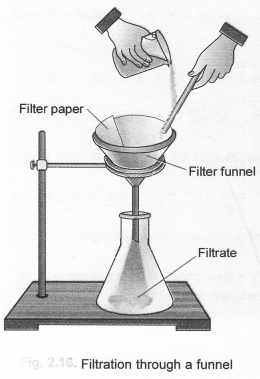
You are given a mixture of sand, water and mustard oil. How will you separate the components of this mixture ? Explain with the help of different separation methods involved in it. (CBSE 2010, 2011, 2016)
Answer:
The separation of the components from this heterogeneous mixture can be done in the following steps. Step I. Filter the mixture through a glass funnel.
Is Matter Around Us Pure Class 9 Important Questions Science Chapter 2 image - 6
Water and mustard will be collected as filtrate while sand particles will remain on the filter paper as residue.
Step II. Now transfer the mixture of water and mustard oil to a separating funnel and proceed as discussed in section. Water will form the lower layer in the funnel while mustard oil the upper layer. Separate the two layers.

Question 18.
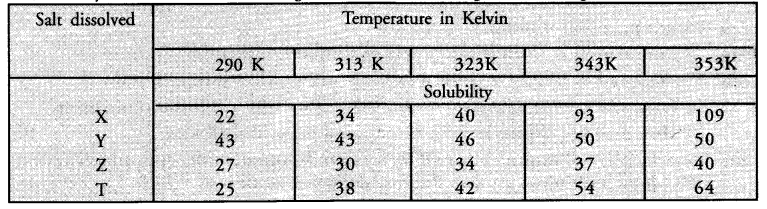
Sudha tested the solubility of four salts X, Y, Z and T at different temperatures and collected the following data. (Solubility refers to the amount in grams dissolved in 100 g of water to give a saturated solution.)
Is Matter Around Us Pure Class 9 Important Questions Science Chapter 2 image - 7
Answer the following questions from the table
(i) Which salt has the highest and lowest solubility at 323 K ?
(ii) A student prepared a saturated solution of X at 323 K and then added 25 g water to it. What mass of X must be added to again make the solution saturated ?
(iii)The solubility of which salt is least affected by increase in temperature ?
(iv) What mass of ‘T’ would be required to make saturated solution in 200 g of water at 290 K ?
(CBSE 2011)
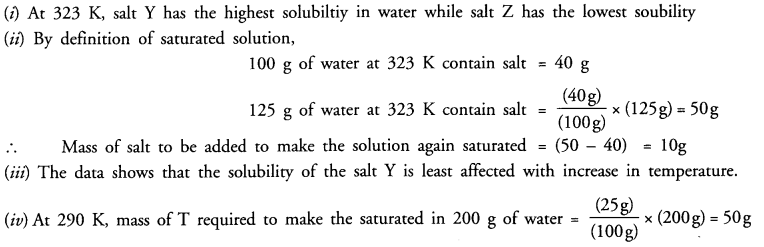
Answer:
Is Matter Around Us Pure Class 9 Important Questions Science Chapter 2 image - 8

Question 19.
State which of the following solutions exhibit Tyndall effect :
Starch solution, Sodium chloride solution, Tincture of iodine, Air.
Answer:

  1. Tyndall effect is shown both by starch solution and air which are heterogeneous mixtures and have the capacity to scatter beam of light as it passes through them.
  2. Sodium chloride solution and tincture of iodine (iodine crystals dissolved in ethyl alcohol) are both homogeneous in nature and donot exhibit any Tyndall effect.

Question 20.
Identify colloids from the following :
Copper sulphate solution, milk, smoke, muddy water, butter, sugar solution, face cream, lemonade.
(CBSE 2012)
Answer:
Colloids : milk, smoke, muddy water, butter, face cream, lemonade.

Question 21.
List any three differences between true solution and suspension. (CBSE 2012)
Answer:
Is Matter Around Us Pure Class 9 Important Questions Science Chapter 2 image - 9

Question 22.
12 mL of dettol is added to a beaker containing 500 mL of water and is stirred. State four observations that you make. (CBSE 2012)
Answer:
When dettol is added to a beaker containing of water, the following observations are made.

  1. An emulsion is formed which is of colloidal nature.
  2. The colour of emulsion is milky.
  3. It gives characteristic smell of dettol.
  4. The solution can pass through a filter paper.

Question 23.
Properties of a compound are different from its constituents, while a mixture shows the properties of its constituent elements. Justify this statement taking the example of iron and sulphur. (CBSE 2012)
Answer:
Take a small amount of the material from dish [A] in a glass tube and add a few drops of dilute hydrochloric acid to it. A colourless and odourless gas will evolve accompanied by brisk effervescence. This is hydrogen gas which can be confirmed by performing certain tests.
In a similar manner, add a few drops of the same acid to the material taken from the dish B. Immediately a gas with the smell similar to rotten eggs will evolve. It is hydrogen sulphide gas.
Conclusion: From the observations listed above, we conclude that in the china dish [A], both iron filings and powdered sulphur are in the form of a mixture. In the dish [B], a chemical reaction has resulted upon heating and the black mass of iron sulphide is formed. It is a compound.
Iron + Sulphur ———- > Iron sulphide

Question 24.
Give one example in which physical and chemical changes take place. (CBSE 2012)
Answer:
It is illustrated by burning of candle. One such example is the burning of candle. The wax present in the candle changes to liquid state. This means that the change is of physical nature. At the same time, the constituents carbon and hydrogen present in wax react with oxygen of air to form new substances. This means that a chemical reaction or change is also taking place.

Question 25.
(a) Enumerate any two differences between simple distillation and fractional distillation.
(b) Draw a labelled diagram showing the process of fractional distillation. (CBSE 2012)
Answer:
(a)

  1. Simple distillation can be used if the liquids to be separated differ in their boiling points by more than 25°C. If the difference is less, than fractional distillation can be used.
  2. A fractionating column is needed for fractional distillation but not for simple distillation.

(b) For process of fractional distillation,
Is Matter Around Us Pure Class 9 Important Questions Science Chapter 2 image - 10

Question 26.
On dissolving chalk powder in water, a suspension is obtained. Give any four reasons to support the fact that mixture so obtained is a suspension only. (CBSE 2012)
Answer:
It is supported by the following reasons

  1. White particles of chalk powder can be seen with naked eye.
  2. The particles can be separated by ordinary filter paper.
  3. Upon shaking, a white turbidity reappears in solution.
  4. Light cannot pass through the suspension which shows that it is of opaque nature.

Question 27.
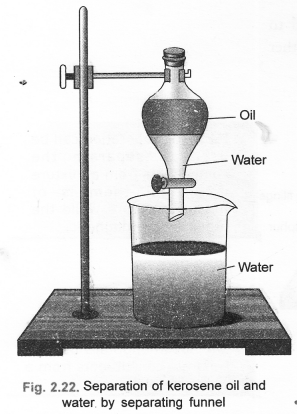
(a) Crystallization is a better technique than evaporation. Give one reason to justify the statement.
(b) Draw a labelled diagram to show the process of separation of two immiscible liquids. (CBSE 2012)
Answer:
(a) Crystallisation technique is always better than evaporation due to the following reasons.

  1. Some solids may decompose and some substances like sugar may get charred during direct heating.
  2. Some minute impurities of particles may still be associated in the solution obtained upon filtration. They will be present in the solid residue left after evaporation. In crystallisation, the crystals obtained are always pure.
  3. Direct heating or evaporation does not give crystals. Only a solid residue is left in the dish.

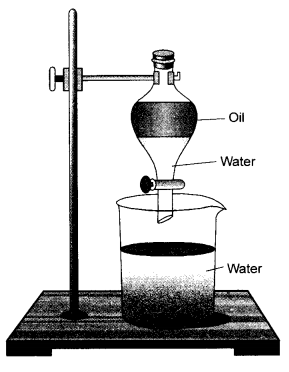
(b) The separation can be done by the use of separating funnel.
Is Matter Around Us Pure Class 9 Important Questions Science Chapter 2 image - 11

Question 28.
When a solution is said to be saturated ? How can you change a saturated solution to an unsaturated solution without adding any more solvent to it ? Explain in brief. (CBSE 2012)
Answer:
A solution is said to be saturated if it has the maximum amount of the solute dissolved in a given amount of the solvent at a given temperature.
Saturated solution can also be made unsaturated by increasing the temperature provided the process of dissolution of the solid solute is of endothermic nature i.e., it is accompanied by the absorption of heart.

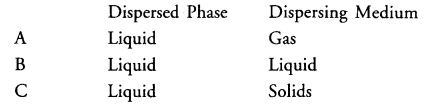
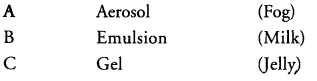
Question 29.
Name the type of colloids in each of the following giving an example of each.
Is Matter Around Us Pure Class 9 Important Questions Science Chapter 2 image - 12
Answer:
Is Matter Around Us Pure Class 9 Important Questions Science Chapter 2 image - 13

Question 30.
How are colloids different from suspensions ? . (CBSE 2013, 2016)
Answer:

  1. In a suspension the particles settle as precipitate when it is allowed to remain undisturbed for sometime.
  2. Colloidal solutions are of heterogeneous nature. They consist of two phases known as dispersed phase and dispersion medium.

Question 31.
Identify the colloids from the following :
Soda water, milk, sponge, clouds, mixture of alcohol and water, jelly. (CBSE 2013)
Answer:
Colloids : Soda water, milk, sponge, clouds, jelly.

Question 32.
How will you separate a mixture of common salt, camphor and iron filings ? Describe the process.
(CBSE 2013)
Answer:
Iron filings are first separated with the help of a magnet. Camphor is separated from the remaining mixture with the help of sublimation process leaving behind common salt.

  1. In a colloidal solution, the particle size is such (1 nm to 100 nm), that these particles scatter the light rays as they fall on them. Because of scattering, the path of the light as well as the particles become visible. But in a true solution, the particle size is so small (less than 1 nm) that these particles are not in a position to scatter the light. Therefore, true solution does not show any Tyndall effect.
  2. In dirty clothes, the dust particles are sticking on the oil drops present. Simple water cannot remove these oil drops from the clothes because water and oil as such do not form a stable emulsion. Soap plays the role of emulsifier and helps in forming a stable emulsion between the two. In other words, it helps in mixing oil and water. This means that soap helps in removing these oil drops along with the dirt sticking to them. The dirty clothes get washed by soap solution.

Question 33.
Give an example each for a mixture having following characteristics :

  1. Two or more coloured constituents soluble in a solvent.
  2. Two immiscible liquids.
  3. One of the components changes directly to the gaseous state.
    Suggest a suitable method to separate the components of these mixtures. (CBSE 2013)

Answer:

  1. Sulphur (a yellow solid) and iodine (a violet crystalline solid) are both soluble in carbon disulphide (CS2) solvent. Separation can be done by sublimation. Iodine sublimes on heating while sulphur does not.
  2. Turpentine oil and water. Separation can be done with a separating funnel.
  3. Ammonium chloride and common salt. Ammonium chloride directly changes to vapour state (sublimes).

Question 34.
Give an example for each of following :

  1. Solid-liquid homogeneous mixture
  2. Gas-Gas homogeneous mixture
  3. Liquid—Liquid heterogeneous mixture. (CBSE 2013)

Answer:

  1. Mixture of sodium chloride in water.
  2. Air: It is a homogeneous mixture of number of gases.
  3. Emulsion of oil and water.

Question 35.
List any two properties of metals which make them suitable to be used as :

  1. Utensils for cooking food.
  2. Wires for electrical connections. (CBSE 2013)

Answer:

  1. Metals are good conductors of heat.
  2. Metals are good conductors of electricity and also ductile in nature.

Question 36.
To make a saturated solution, 36 g of sodium chloride is dissolved in 100 g of water at 293 K. Find the concentration in terms of mass of solution at this temperature. (CBSE 2013)
Answer:
Mass of solution = Mass of solute + Mass of solvent = (36 + 100) = 136 g.

Question 37.
Which separation techniques you will apply for the separation of the following mixtures ?

  1. Oil from warter
  2. Camphor from sand
  3. Sodium chloride from its solution in water
  4. Cream from milk
  5. Metal pieces from engine oil of a car.

Answer:

  1. By the use of a separating funnel.
  2. With the help of sublimation technique.
  3. By crystallisation technique.
  4. By the use of a centrifugal machine.
  5. By the use of filtration technique.

Question 38.
‘Water is considered as a compound of hydrogen and oxygen and not a mixture of hydrogen and oxygen.’ Comment on it.
Differentiate between a compound and a mixture (any three points). (CBSE 2014)
Answer:
The properties of water are altogether different from those of the constituting gases. For example, water is a liquid at room temperature whereas the constituents are in the gaseous state. Water can extinguish fire whereas hydrogen is combustible in nature, oxygen supports combustion.

Question 39.
How will you separate a mixture containing kerosene and petrol (difference in their boiling point is less than 25 K) which are miscible with each other ? Explain. (CBSE 2014)
Answer:
Both are miscible liquids. Since the difference in the boiling points is less than 25 K, the separation can be done with the help of fractional distillation technique. Petrol with less boiling point distils first leaving behind kerosene in the distillation from flask. However, it is very difficult to apply this technique since both are highly flammable liquids and a great deal of precaution is needed.

Question 40.
List two differences between a pure substance and a mixture. Give an example of each. (CBSE 2014)
Answer:

  1. A pure substance is an element or compound in completely pure state while mixture may contain two or more elements/compounds.
  2. Constituents from a mixture can be separated while pure substance remains as a single substance. Example : Copper (pure substance); Air (Mixture).

Question 41.
Classify the following as compund and mixture. Saline water, water, air, carbon dioxide, hydrogen chloride, milk. (CBSE 2015)
Answer:
Compound : Water, carbon dioxide, hydrogen chloride.
Mixture : Saline water, air, milk.

Question 42.
Explain the terms dilute solution, concentrated solution and saturated solution. How would you determine the solubility of a solution ? What is the effect of change of temperature on the solubility ? (CBSE 2015)
Answer:
For dilute and concentrated solutions: We have read that a binary solution has two components or constituents. These are solute and solvent. The relative amounts of the solute and solvent in the solution either by mass or by volume, represent the concentration solution. Expressing the Concentration of a Solution.
The concentration of a solution is expressed as the amount of the solute present in a given amount of the solvent or solution. It is normally expressed as mass by mass percent or as volume by volume percent.
For saturated solutions: A solution becomes saturated if the solute starts separating at the bottom of the container in which the solution is being prepared at a given temperature. A saturated solution generally becomes unsaturated upon heating
For the determination of the solubility of a solution: The solubility of a solute in a solution is always expressed with respect to the saturated solution. It may be defined as : The maximum amount of the solute which can be dissolved in 100 g (0-1 kg) of the solvent to form a saturated solution at a given temperature.
For the effect of change in temperature on the solubility: The temperature at which the process of dissolution is carried is always mentioned. This means that the solubilities of salts in solvents (generally water) are influenced by the change in temperature. Actually, the effect of temperature depends upon the heat energy changes which accompany the process.

Question 43.
Why is crystallisation better than evaporation for the separation of mixtures ? (CBSE 2015)
Answer:

  1. Common salt and water. Since common salt (sodium chloride) is soluble in water, it can be separated by crystallisation. The process of distillation can also be used because sodium chloride is non-volatile and water is volatile in nature.
  2. Iodine and sand. Sublimation process can be used. Iodine will sublime on heating while sand will remain unaffected.
  3. Kerosene and water. The liquids are not miscible with each other. Separation can be done by using a separating funnel.

Question 44.
Sugar and sulphur. The mixture is dissolved in carbon disulphide in a beaker by stirring with a glass rod. Sulphur dissolves while sugar remains as such. On filtering, sugar separates as the residue. The filtrate upon concentration and cooling gives crystals of sulphur.
Give one example each of a mixture which shows the following characteristics.

  1. A mixture of two volatile component.
  2. A mixture of two volatile components with a boiling point difference less than 25 K.
  3. A mixture of a volatile and a non-volatile component. (CBSE 2015)

Answer:

  1. Iodine and camphor
  2. Acetone (b.p. = 319 K) and ethyl alcohol (b.p. = 341 K)
  3. Naphthalene and sodium chloride.

Question 45.
Differentiate between an element and a compound. Categorize the following substances into elements and compounds.
Sodium chloride, iodine, water, 24 carat gold, oxygen gas, carbon. (CBSE 2015)
Answer:
For distinction between element and compound,
Elements : Iodine, 24 carat gold, carbon.
Compounds : Sodium chloride, water, oxygen gas.

Question 46.
Air is considered to be a mixture and not a compound ? Explain. (CBSE 2015)
Answer:
Air is a homogeneous mixture of different gases which can be separated by suitable methods. Therefore, it is a mixture and not a compound.

Question 47.
Observe the apparatus shown and answer the following questions.
Is Matter Around Us Pure Class 9 Important Questions Science Chapter 2 image - 14

  1. Identify the apparatus
  2. Design an activity to use this apparatus to separate the mixture of mustard oil and water.
  3. Write the principle involved in this process. (CBSE 2015, 2016)

Answer:

  1. The apparatus is known as a separating funnel.
  2. For the details of the apparatus & activity.
  3. Two immiscible liquids can be separated if in case they differ in their densities. A separating funnel can be used to separate the components of an immiscible liquid mixture.

Question 48.
Compare suspension and colloidal solution on the basis of

  1. type of mixture
  2. particle size
  3. scattering of light
  4. stability. (CBSE 2015)

Answer:

  1. Both are heterogeneous mixture.
  2. In colloidal solution, particle size ranges between 10-9 m to 10-7 m whereas in suspension, the particle size is more than 10-7m.
  3. Colloidal solution has the capacity to scatter the path of light when made to pass through it whereas a suspension is unable to do so.
  4. A suspension is more stable than a colloidal solution.

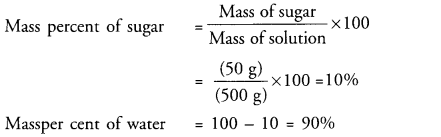
Question 49.
A solution contains 50 g of sugar in 450 g of water. Calculate the concentration in terms of mass by mass percentage of the solution. (CBSE 2015)
Answer:
Is Matter Around Us Pure Class 9 Important Questions Science Chapter 2 image - 15

Question 50.
What is ‘Tyndall effect’ ? Name two mixtures which show this effect. (CBSE 2015)
Answer:
For Tyndall effect, The scattering of the beam of light by the dispersed phase particles in a colloidal solution as it passes through it, is known as Tyndall effect.

  1. A colloidal solution of dust particles suspended in air.
  2. A colloidal solution of starch in water.

Question 51.
What is chromatography ? Write its two applications. (CBSE 2016)
Answer:
In Greek, the word ‘Kroma’ means colour and the word chromatography implies ‘writing, in colour’. Actually, this technique was initially used to separate coloured components from pigments and dyes. But now it has wide range of applications. Chromatography is of a number of types such as adsorption, thin layer, paper and gas chromatography etc. However, the paper chromatography is very simple and is commonly used in the laboratory.

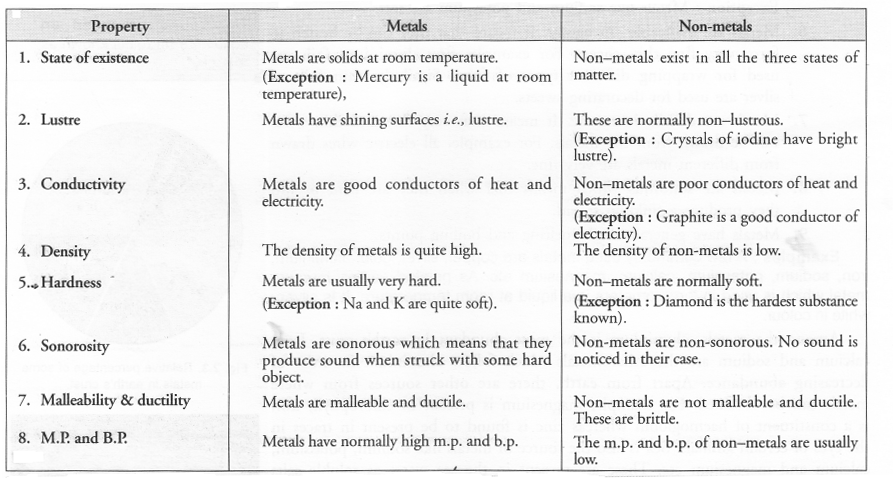
Question 52.
(a) Compare metals and non-metals based on their physical properties (any four).
(b) What are metalloids ? Give two examples.
(c) Identify metals from the following :
boron, sodium, mercury, carbon. (CBSE 2016)
Answer:
(a)
Is Matter Around Us Pure Class 9 Important Questions Science Chapter 2 image - 16
(b) Semi-Metals or Metalloids: There are a few elements which possess the characteristics of both metals and non-metals. These are actually border-line elements and are known as semi-metals. Semi-metals are also called metalloids. A few common examples are : Silicon, Arsenic, Antimony and Bismuth.
(c) Sodium and mercury are metals.

Question 53.
List six physical properties of metals. Name two metals. Name a metal which is liquid at room temperature.
(CBSE 2016)
Answer:
Is Matter Around Us Pure Class 9 Important Questions Science Chapter 2 image - 17

Question 54.
Give two differences between pure substances and mixtures. Give one example of each. (CBSE 2016)
Answer:

  1. A pure substance is always a single substance (element or compound). A mixture has two or more constituents.
  2. A pure substance has always sharp melting or boiling point. A mixture does not have sharp melting or boiling point.
    Examples : Copper sulphate (Pure substance), Air (Mixture)

Hope given Previous Year Question Papers for CBSE Class 9 Science Chapter 2 Is Matter Around Us Pure are helpful to complete your science homework.

If you have any doubts, please comment below. Learn Insta try to provide online science tutoring for you.

The Fundamental Unit of Life Class 9 Important Questions Science Chapter 5

Chapter 5 The Fundamental Unit of Life Class 9 Science Important Questions with Answers PDF will help you in scoring more marks in your exams.

The Fundamental Unit of Life Class 9 Important Questions and Answers Science Chapter 5

Very Short Answer Questions

Question 1.
Which organelles are called

  1. Power house
  2. Suicide bags of the cell ? (CCE 2010, 2011, 2013)

Answer.

  1. Power house of Cell-Mitochondria.
  2. Suicide Bags of Cell-Lysosomes.

More Resources

Question 2.
State two important functions of the nucleus of a cell.
(CCE 2011, 2013)
Answer:

  1. Genetic Information: Nucleus contains genetic information not only for the cell but also for the whole organism.
  2. Control Centre: Nucleus functions as control centre for cell metabolism and cell activities.

Question 3.
Name two cell organelles that have their own genetic material/DNA and ribosomes. (CCE 2010, 2012, 2013)
Answer:
Mitochondria, Plastids.

Question 4.
Name the plastid which stores starch, oils and protein granules. (CCE 2011, 2012)
Answer:
Leucoplasts – amyloplast for starch, elaioplast for oil and aleuroplast for protein.

Question 5.
Name the cell organelle which is able to destroy a damaged old/ and worn out cell. (CCE 2011, 2012)
Answer:
Lysosome.

Question 6.
Who discovered cells in organisms ? Give an example of unicellular organism. (CCE 2011, 2013)
Answer:
Robert Hooke (1665). Example. Amoeba, Paramoecium

Question 7.
Name the process in which diffusion takes places place through a selectively permeable membrane. (CCE 2011)
Answer:
Osmosis: It is diffusion ofwater from the side of its higher
concentration (dilute solution) to the side of its lower concentration (concentrated solution) through a semipermeable membrane.

Question 8.
Name the organelle of the cell which has membrane bound sac filled with powerful digestive enzymes. Write its any one function in the cells. (CCE 2011, 2012)
Answer:
Lysosome. Function. Intracellular digestion and disposal of worm out cell organelles.

Question 9.
State the full form of ATP. (CCE 2011)
Answer:
Adenosine triphosphate.

Question 10.
Name the cell organelle, other than mitochondria, which has its own DNA and ribosomes. (CCE 2011, 2012)
Answer:
Plastid.

Question 11.
Why do egg shells dissolve in dilute hydrochloric acid ?
(CCE 2011)
Answer:
Egg shells are made of calcium carbonate which reacts with HC1 and forms soluble calcium chloride.

Question 12.
Name the functional unit of DNA that carries genetic information. (CCE 2012)
Answer:
Gene.

Question 13.
Name the site organelle where proteins are synthesized in a cell. (CCE 2012)
Answer:
Ribosomes.

Question 14.
Name the cell organelle responsible for intracellular transport. (CCE 2012)
Answer:
Endoplasmic reticulum.

Question 15.
Name the process through which Amoeba acquires its food from external environment. (CCE 2012)
Answer:
Endocytosis.

Question 16.
Identify the cell organelle which is known as the power house of the cell. State reason. (CCE 2012, 2013)
Answer:
Mitochondrion. It is the major seat of production of ATP used as source of energy for various cell functions.

Question 17.
In what way a prokaryotic cell is different from eukaryotic cell with respect to nuclear membrane ? (CCE 2012)
Answer:
A nuclear membrane is absent in prokaryotic cell. It is present in eukaryotic cell.

Question 18.
Name the plastid involved in conversion of a green brinjal to violet. (CCE 2012)
Answer:
Non-green chromoplast.

Question 19.
Name the phenomenon of losing water by a living plant cell through osmosis. (CCE 2012)
Answer:
Exosmosis.

Question 20.
Name
(i) The cells which have changing shape,
(ii) The cells which have typical shape. (CCE 2012)
Answer:
(i) Leucocytes
(ii) Liver cell, parenchyma.

Question 21.
Identify single-celled organisms from the following : Cockroach, Chlamydomonas, Snake, Mosquito, Bacteria. (CCE 2012)
Answer:
Chlamydomonas, Bacteria.

Question 22.
Name two cell organelles having membrane envelope.(CCE 2012, 2016)
Answer:
Mitochondria (double membrane covering), lysosome (single membrane envelope).

Question 23.
Name the factor which decides the movement of water across the plasma membrane. (CCE 2012)
Answer:
Difference in the concentration of water inside the cell and outside solution.

Question 24.
State the significance of membrane biogenesis. (CCE 2012)
Answer:
It replaces the membrane depleted due to exocytosis and injury.

Question 25.
List the constituents of plasma membrane. (CCE 2012)
Answer:
Phospholipids, proteins and small carbohydrates.

Question 26.
State the reason for calling cell membrane as selectively permeable membrane. (CCE 2012)
Answer:
Cell membrane is called selectively permeable because it

  1. Allows diffusion of some substances including water
  2. Allows active passage of some solutes but
  3. Remains impermeable to others.

Question 27.
Name two components of chromosomes. (CCE 2012)
Answer:
DNA and proteins.

Question 28.
Name two cell organelles having double membrane envelope. (CCE 2012)
Answer:
Plastids, Mitochondria.

Question 29.
Mention the difference between prokaryotes and eukaryotes in terms of nuclear region present in them. (CCE 2012)
Answer:
Genetic material is enclosed inside the nucleus in eukaryotes while it lies coiled in the cytoplasm as nucleoid in prokaryotes.

Question 30.
Name the cell organelle that detoxifies poisons and drugs in the liver of vertebrates. (CCE 2012, 2015)
Answer:
Smooth endoplasmic reticulum.

Question 31.
Name the kind of plastid which is important for photosyntheis in leaves of plants. (CCE 2012)
Answer:
Chloroplasts (green chromoplasts).

Question 32.
Name the main constituent substance present in plant cell wall and state its function. (CCE 2012)
Answer:
Cellulose. It provides mechanical strength and rigidity to the cell wall.

Question 33.
Mention the change in human red blood cells when they are placed in hypotonic salt/sugar solution. (CCE 2012)
Answer:
RBCs will continue to swell and ultimately burst.

Question 34.
When a living plant cell loses water through osmois, there is contraction of contents of the cell away from the cell wall. What is this phenomenon called ? (CCE 2012, 2015, 2016)
Answer:
Plasmolysis.

Question 35.
Identify and name the following structures
(a) The undefined nuclear region of prokaryotic cell
(b) Site of energy release inside the cell. (CCE 2012)
Answer:
(a) Nucleoid
(b) Mitochondria.

Question 36.
What would happen if an animal cell is kept in distilled water for 24 hours ? (CCE 2012)
Answer:
It will swell up and burst.

Question 37.
State the function of chromosome in a cell.(CCE 2012, 2013)
Answer:
It contains genetic information in the form of genes and takes part in equitable distribution of the same at the time of cell division.

Question 38.
The raisins added to porridge swell after some time. Name the process involved. (CCE 2013)
Answer:
Osmosis.

Question 39.
Name the factor which decides the movement of water across the plasma membrane. (CCE 2013)
Answer:
Concentration of water.

Question 40.
What is nucleoid ? (CCE 2013)
Answer:
Genetic material of prokaryotes which is devoid of a nuclear envelope and consists of a single compacted DNA molecule (equal to a single chromosome) is called nucleoid.

Question 41.
Every multicellular organism has come from a single cell. Justify this statement. (CCE 2013)
Answer:
Every multicellular organism develops from a single cell called zygote, which is formed by fusion of two types of gametes.

Question 42.
Identify the single celled organisms from the following :
Cockroach, Amoeba, Snake, Mosquito, Bacteria. (CCE 2013)
Answer:
Amoeba, Bacteria.

Question 43.
Which part of the cell is called brain of the cell ? (CCE 2013)
Answer:
Nucleus, as it controls all the activities of the cell.

Question 44.
Who discovered cells in living organisms ? Give an example of a unicellular organism. (CCE 2013)
Answer:
Leeuwenhoek (1674). Amoeba.

Question 45.
Name the process of building of cell membrane. (CCE 2014, 2015)
Answer:
Membrane biosynthesis.

Question 46.
Mention the commonly used name of cell membrane.
(CCE 2014)
Answer:
Plasma membrane.

Question 47.
What is the name given to the components of the cell ? (CCE 2014)
Answer:
Cell organelles.

Question 48.
State the role of vacuole in a plant cell. ( CCE 2015)
Answer:
Vacuole: Storage, dumping and development of osmotic concentration.

Question 49.
Pick up the odd one out of ribosomes, Golgi apparatus, mitochondria, endoplasmic reticulum (ER) and give suitable reason. (CCE 2015)
Answer:
Ribosomes. Ribosomes have no membrane covering while covering membranes occur in others.

Question 50.
Which process plays an important role in gaseous exchange between cells ? (CCE 2016)
Answer:
Diffusion.

Question 51.
Name the process by which unicellular fresh water organisms and most plant cells tend to gain water. (CCE 2016)
Answer:
Osmosis.

Question 52.
Name the cell organelle which is commonly called “suicide bag” of the cell. (CCE 2016)
Answer:
Lysosome.

Question 53.
Why do chromatin fibres organise themselves into chromosomes? (CCE 2016)
Answer:
For equitable distribution of genetic material during cell division.

Question 54.
State the site of manufacture of fat molecules in a cell.
Answer:
Surface of smooth endoplasmic reticulum.

Short Answer Questions (2 Marks)

Question 1.
(a) What is DNA ? Where is it found ?
(b) Name the functional segment of DNA. (CCE 2010, 2011)
Answer:
(a) DNA or deoxyribonucleic acid is genetic material of living beings. It occurs as part of chromatin in nucleus and as such in mitochondria and plastids.
(b) Gene.

Question 2.
Name two similarities between mitochondria and plastids.
(CCE 2010, 2011)
Answer:
Both of them possess

  1. Double membrane covering
  2. Their own DNA.

Question 3.
Mention any two functions of endoplasmic reticulum.
(CCE 2010, 2011, 2013)
Answer:

  1. Biosynthesis: Endoplasmic reticulum is engaged in synthesis of lipids (SER) and proteins (RER).
  2. Support: It provides support to cytoplasm.

Question 4.
Give function of the following organelles

  1. Chloroplast
  2. Nucleus
  3. Ribosomes. (CCE 2010, 2011, 2012)

Answer:

  1. Chloroplast: Photosynthesis,
  2. Nucleus: Control of cellular activities and inheritance
  3. Ribosomes: Protein synthesis.

Question 5.
State cell theory. Name the scientist who presented it. (CCE 2010)
Answer:
Cell theory states that cells are the structural and functional units of bodies of all living beings. The theory was put forward by Schleiden and Schwann ( 1839).

Question 6.
What is plasmolysis ? Give one example. (CCE 2010, 2011)
Answer:
Plasmolysis is shrinkage of protoplasm from the cell wall due to continued exosmosis when cells are placed in hypertonic solution. A peeled carrot piece placed in salt solution will contract due to plasmolysis of its cells.

Question 7.
Write the names of two cell organelles that have their own DNA and ribosomes. (CCE 2010)
Answer:

  1. Plastids
  2. Mitochondria.

Question 8.
What is endocytosis ? Name an organism that feeds by this method. (CCE 2010, 2011, 2013)
Answer:
Endocytosis is the bulk transfer of materials from outside to inside of a cell with the help of special vesicles developed by plasma membrane. Organism (that feeds by endocytosis). Amoeba.

Question 9.
(a) What is plasma membrane made up of ?
(b) Name the process and also explain how food and other substances enter through plasma membrane. (CCE 2010)
Answer:
(a) Plasma membrane is made of a bilayer of lipids (or phospholipids) and proteins located inside and outside the same,
(b) Food passes through plasma membrane by endocytosis. Other bulk transports also occur through it. For soluble substances, plasma membrane shows selective permeability.

Question 10.
Two Rhoeo peels were taken. One peel was put in a petridish containing cold water and the other was put in a petridish containing hot water. After a while both were transferred to hypertonic solutions. If the peels were observed under the microscope, will there be any difference in the observation of both the peels. Yes or no. Give reason for your answer.
(CCE 2010)
Answer:
Yes. There is difference. The peel placed initially in hot water does not undergo plasmolysis. Plasmolysis occurs in cells of the peel initially kept in cold water. Hot water kills the cells. Dead cells do not show osmosis.

Question 11.
Give technical term for a medium which has exactly the same concentration as the cell ? Why does the size of the cell remain the same when placed in such a solution ?  (CCE 2010)
Answer:
Isotonic solution. A cell placed in isotonic solution neither gains water nor loses water as equal amount of water passes inwardly and outwardly in it.

Question 12.
Mention two functions of Golgi apparatus. (CCE 2011)
Answer:

  1. Formation of complex sugars,
  2. Formation of lysosomes.
  3. Storage, modification and packaging of various substances,
  4. Secretion and excretion.

Question 13.
How do substances like CO2 and water move in and out of cell? (CCE 2011)
Answer:
CO2 moves into and out of cell though diffusion or passage from the area of its higher concentration to the area of its lower concentration across the cell membrane.
Water moves into and out of cell through osmosis or passage of water from the area of higher concentration (e.g., dilute solution) to the area of lower concentration (e.g., strong solution) across the cell membrane which acts as a semipermeable membrane.

Question 14.
(a) In which form does mitochondria release energy ? Write its full form.
(b) The inner membrane of mitochondria is deeply folded. What is the advantage of these folds ? (CCE 2011, 2012)
Answer:
(a) As ATP or adenosine triphosphate.
(b) Folding of inner membrane creates a large surface area for ATP generating reactions.

Question 15.
Where are chromosomes located in a cell ? What are they composed of ? What important information they contain ? (CCE 2011)
Answer:
Location: Nucleus.
Composition: DNA and proteins.
Information: They carry genetic information for structural and functional traits in the form of genes.

Question 16.
Preetha was observing live cells of Onion in biology laboratory. She observed cell wall, cytoplasm and nucleus clearly. Suddenly her friend who was doing chemistry experiment spilled a few drops of salt water on the slide. After some time Preetha observed the slide and found some changes,
(a) What would have been the change in the live cells of Onion peel after adding salt water ?
(b) Name the type of process.
(CCE 2011)
Answer:
(a) There was shrinkage of cytoplasm away from cell wall.
(b) Plasmolysis.

Question 17.
How can plant cells withstand much greater changes in the surrounding medium than the animal cells ?
(CCE 2011)
Answer:
Plant cells are covered by a rigid wall. The cell wall allows the plant cells to withstand changes in the surrounding medium better than animal cells.

Question 18.
Write two characteristics of prokaryotic cells. (CCE 2011)
Answer:
(i) Genetic material is equal to a single chromosome which is not organised into a nucleus,
(ii) Membrane bound cell organelles absent.

Question 19.
What are unicellur organisms ? List two examples. (CCE 2011)
Answer:
Organisms made of single cells are called unicellular organisms. Examples. Amoeba, Paramoecium.

Question 20.
Which stain is used to prepare an Onion peel slide ? Why do we need a stain to be added ? (CCE 2013)
Answer:
Safranin. The stain is added to make the cellular components clearly visible under the microscope.

Question 21.
Name the process by which
(a) Oxygen moves in and out of the cell,
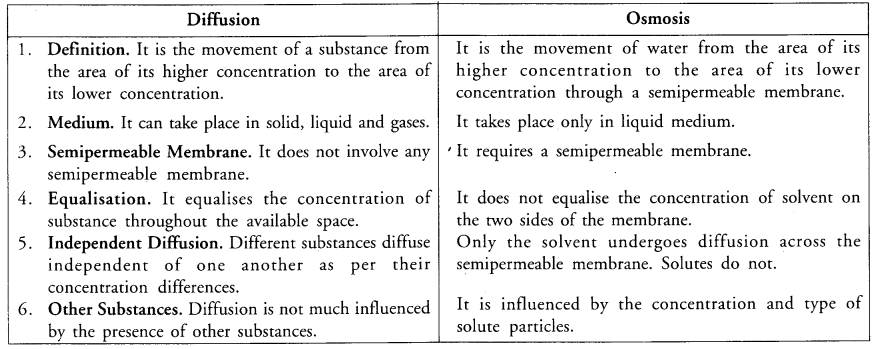
(b) Water moves in and out of the cell. Differentiate between the two processes. (CCE 2013)
Answer:
(a) Diffusion
(b) Osmosis.
The Fundamental Unit of Life Class 9 Important Questions Science Chapter 5 image - 1

Question 22.
What will happen if
(a) Almonds are soaked in water.
(b) Concentrated solution of fertilizer is applied to green grass lawn. Give suitable reason in support of your answer.
(CCE 2013)
Answer:
(a) Almond will swell up due to endosmosis. There is higher concentration of water around almonds than inside them.
(b) Grass will shrivel due to exosmosis. There is higher concentration of water inside grass plants than in outer concentrated fertilizer solution.

Question 23.
Give one function each of RER and SER. (CCE 2014)
Answer:
Function of RER. Synthesis of protein for export to Golgi apparatus.
Function of SER. Synthesis of lipids.

Question 24.
Name a cell organelle which lacks membrane. Where is it prepared ? (CCE 2014)
Answer:
(i) Ribosome,
(ii) It is synthesised in the form of subunits in nucleolus part of nucleus.

Question 25.
Differentiate between eukaryotic and prokaryotic cells, based on the size and number of chromosomes. (CCE 2014)
Answer:
The genetic material of a prokaryotic cell is equal to a small histone free chromosome and is often called prochromosome. A eukaryotic cell has two to several histone supported larger chromosomes.

Question 26.
What is the importance of osmosis in :
(a) Unicellular organisms
(b) Plants ? (CCE 2015)
Answer:
Osmosis in Unicellular Organisms. Absorption of water, osmoregulation.
Osmosis in Plants. Absorption of water from soil, cell to cell movement of water.

Question 27.
Which cell organelle is known as “suicide bags” of the cell ? Why? (CCE 2015)
Answer:
Lysosomes contain digestive enzymes against all types of organic materials. If their covering membrane breaks as it happens during injury to cell, the digestive enzymes will spill over the cell contents and digest the same. As lysosomes are organelles which on bursting can kill the cells possessing them, they are called suicide bags.

Question 28.
Describe the structure of mitochondria with reference to its membrane covering. (CCE 2015)
Answer:
Structure: Mitochondria are rod or sausage shaped colourless organelles of aerobic eukaryotes that have a double membrane covering. The outer membrane is porous. The inner membrane is folded. The folds are called cristae. They bear ATP generating elementary particles. The matrix contains enzymes of Krebs cycle,

Question 29.
(a) Name the cell organelle which helps in packaging and
dispatching the material synthesised over the endoplasmic reticulum to various targets inside and outside the cell.
(b) Name and write function of cell organelle formed by the above cell organelle. ( CCE 2016)
Answer:
(a) Golgi apparatus,
(b) Lysosome: Lysosomes possess digestive enzymes which help in intracellular digestion and removal of scenescent cellular structures.

Short Answer Questions (3 Marks)

Question 1.
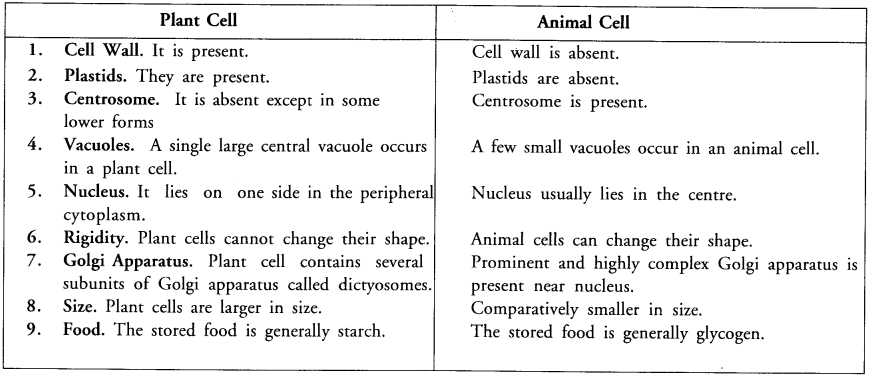
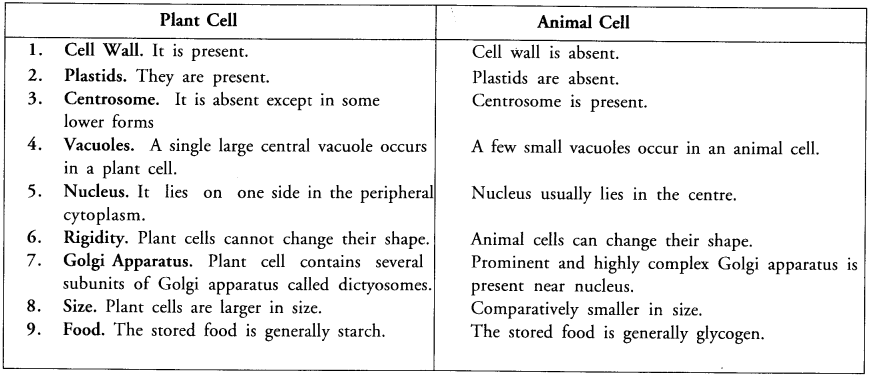
Write in a tabular form three differences between a plant cell and an animal cell. (CCE 2010, 2011, 2012)
Answer:
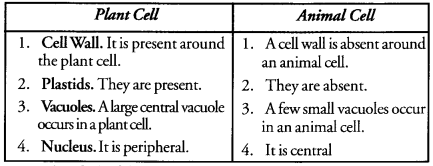
The Fundamental Unit of Life Class 9 Important Questions Science Chapter 5 image - 2

Question 2.
Classify the following as osmosis or diffusion :
(a) Aquatic animals using oxygen dissolved in water during respiration.
(b) Swelling up of raisins on keeping in water.
(c) Spreading of virus on sneezing. (CCE 2010)
Answer:
(a) Diffusion
(b) Osmosis (endosmosis)
(c) Diffusion.

Question 3.
(a) Which cell organelles are called power houses of the cell and why ? (CCE 2010, 2012)
(b) Why is ATP called energy currency of the cell ? (CCE 2010)
Answer:
(a) Mitochondrion is known as power house of the cell because it produces most of the molecules of ATP (adenosine triphosphate) which are required for providing energy for synthesis of new chemicals, mechanical and other cellular functions.
(b) ATP or adenosine triphosphate is called energy currency of the cell as it is built up when energy is available as from an * exothermic reaction and broken down to release the energy whernsver required for performing an activity or an endothermic reaction.

Question 4.
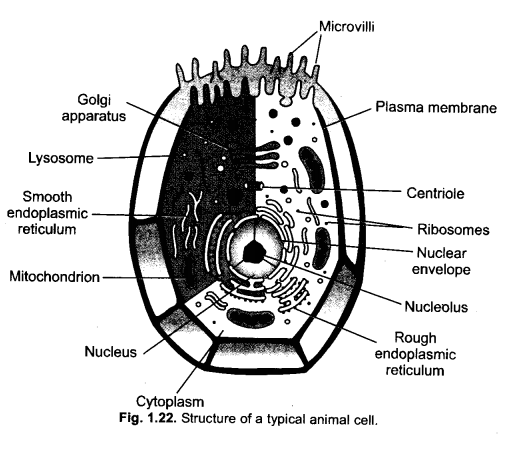
Draw a neat diagram of an animal cell and label on it the following :
Plasma membrane. Nucleus, Lysosome/RER, centriole, Lysosome. (CCE 2010, 2012)
Answer:
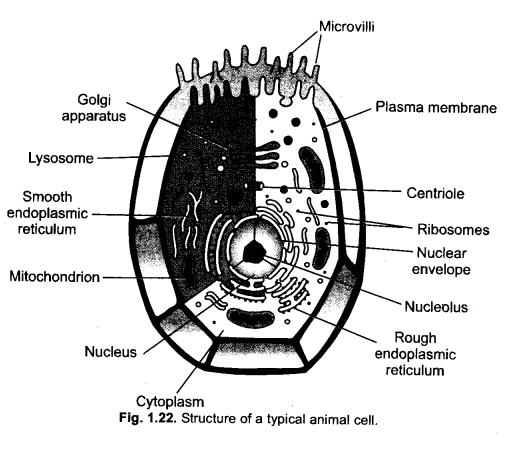
The Fundamental Unit of Life Class 9 Important Questions Science Chapter 5 image - 3

Question 5.
List any three functions performed by endoplasmic reticulum.
(CCE 2010)
Answer:

  1. Biosynthesis: Endoplasmic reticulum is engaged in synthesis of lipids (SER) and proteins (RER).
  2. Support: It provides support to cytoplasm.
  3. Transport: It helps in intracellular as well as intercellular transport of substances.

Question 6.

  1. State two types of plastids
  2. Write one function of each. (CCE 2010)

Answer:

  1. Chloroplasts and chromoplasts.
  2. Chloroplasts. Photosynthesis. Chromoplasts. Providing colouration to flowers and fruits for attracting animals to perform pollination and dispersal respectively.

Question 7.
What are chromosomes ? List their two functions.  (CCE 2010)
Answer:
Chromosomes are rod-like DNA containing stainable condensed chromatin units which become visible at the time of cell division.
Functions: 

  1. They carry genetic information in the form of genes arranged in a linear sequence.
  2. By their replication just before cell division and equitable distribution during cell division, chromosomes maintain the hereditary content of the cells.

Question 8.
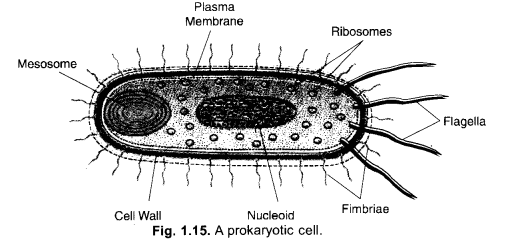
List three differences between prokaryotic and eukaryotic cells. (CCE 2010, 2011, 2012)
Answer:
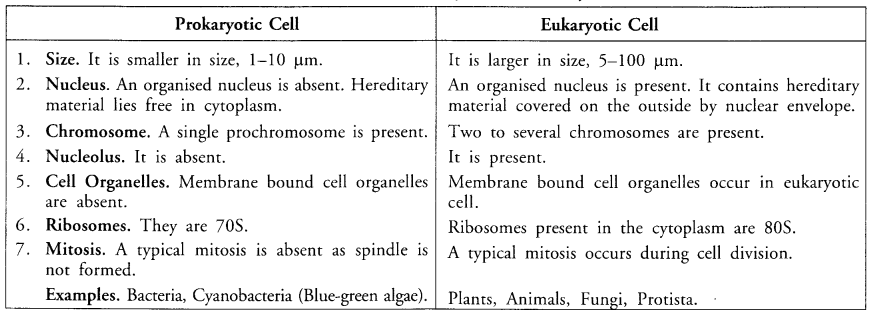
The Fundamental Unit of Life Class 9 Important Questions Science Chapter 5 image - 4

Question 9.
Describe the role played by lysosomes. Why are these termed as suicide bags ? How do they perform their function ?
(CCE 2011, 2012)
Answer:
Role: Lysosomes take part in

  1. Destruction of foreign particles.
  2. Intracellular digestion of food
  3. Digestion and removal of worn out cell organelles.

Suicide Bags: Lysosomes contain digestive enzymes against all types of organic materials. If their covering membrane breaks as it happens during injury to cell, the digestive enzymes will spill over the cell contents and digest the same. As lysosomes are organelles which on bursting can kill the cells possessing them, they are called suicide bags.
Working: Lysosomes are full of digestive enzymes. They fuse with foreign and worn out cell structures. Lysosomal enzymes bring about their digestion. The digested substances diffuse out into cell while the undigested materials are thrown out of the cell.

Question 10.
Explain your observation in the following with reason involved in the process : (a) Salt is applied to raw mango pieces (b) Dried raisins are kept in water for a few hours.
(CCE 2011)
Answer:
(a) Salt applied over raw mango pieces will kill the surface cells and prevent growth of microbes over them due to exosmosis.
(b) Raisins swell up due to endosmosis or entry of water into their cells due to osmosis.

Question 11.
Differentiate between diffusion and osmosis. Write any two examples where a living organism uses osmosis to absorb water. (CCE 2011, 2012)
Answer:
(a)
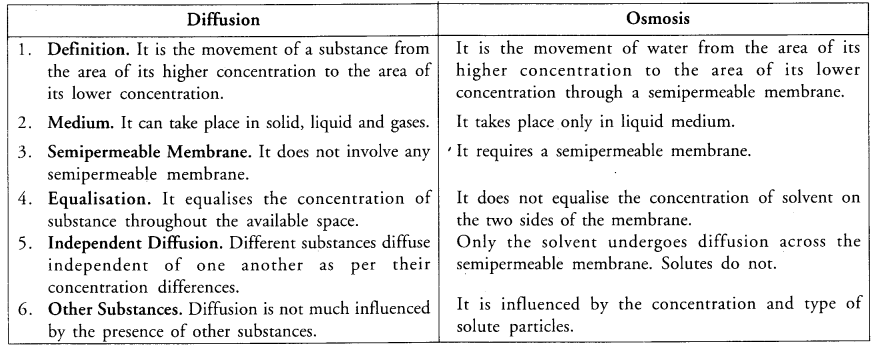
The Fundamental Unit of Life Class 9 Important Questions Science Chapter 5 image - 5
(b) Examples :
(i) Absorption of soil water by roots.
(ii) Gaining of water by guard cells during opening of stomata.

Question 12.
(a) Name the organelles which provide turgidity to the plant cell. Name any two substances which are present in it.
(b) How are they useful in unicellular organisms like Amoeba ?
(CCE 2011, 2014)
Answer:
(a) Vaculoes.

  1. Water,
  2. Dissolved storage and waste substances (Sugars, salts, amino acids, organic acids).

(b) In unicellular organisms vacuoles take part in

  1. Osmoregulation and excretion by contractile vacuoles,
  2. Digestion of food in food vacuoles.

Question 13.
Distirigush amongst hypotonic, isotonic and hypertonic solutions. (CCE 2011)
Answer:
Hypotonic solution has lower osmotic concentration and higher water concentration as compared to the cell. The cell gains water from Such external solution by osmosis. Isotonic solution is the one which has the same osmotic concentration and water concentration as that of the cell. The cell placed in such a solution will neither gain nor lose water.
Hypertonic solution has a higher osmotic concentration and lower water concentration as compared to the cell. The cell loses water to such an external solution and gets plasmolysed.

Question 14.
(a) What is osmosis ?
(b) What happens to cell when it is placed in hypotonic, isotonic and hypertonic solutions respectively ?
(c) What is plasmolysis ? (CCE 2011)
Answer:
(a) Osmosis is diffusion of water from the region of its higher concentration (pure water or dilute solution) to the region of its lower concentration (strong solution) through a semipermeable membrane.
(b)

  1. Cell in Hypotonic Solution. Swells up due to endosmosis and becomes turgid.
  2. Cell in Isotonic Solution. No change.
  3. Cell in Hypertonic Solution. Cell contents shrink due to exosmosis or outward passage of water.

(c) Plasmolysis is shrinkage of protoplasm from the cell wall due to continued exosmosis when cells are placed in hypertonic solution. A peeled carrot piece placed in salt solution will contract due to plasmolysis of its cells.

Question 15.
State main functions of the following :
(a) Mitochondria
(b) Golgi apparatus
(c) Vacuoles. (CCE 2011)
Answer:
(a) Mitochondria,

  1. Site of aerobic respiration.
  2. Liberation of energy as ATP (hence power house of cells).

(b) Golgi Apparatus.

  1. Formation of lysosomes.
  2. Complexing, packaging, secretion and excretion of substances.

(c) Vacuoles,

  1. Storage ofinorganic and organic substances.
  2. Dumping ofwastes.
  3. Developing osmotic concentration for absorption of water and maintenance of turgidity of cells.

Question 16.
Briefly explain the structure and function of nucleus.
(CCE 2011)
Answer:
Structure: Nucleus is oval or rounded dense cellular structure having four components :

  1. A double membrane porous envelope (nuclear envelope),
  2. Nuclear sap or nucleoplasm.
  3. Chromatin made of threads of DNA and protein which get converted into chromesomes at the time of cell division,
  4. Nucleolus, a rounded naked structure attached to chromatin and seat of ribosome formation.

Functions:

  1. Nucleus controls cellular activities.
  2. It contains genetic or hereditary information over its chromosomes for expression of various traits.
  3. Ribosomes are formed in its nucleolus.

Question 17.
What are the two types of endoplasmic reticulum ? Mention one function of each. (CCE 2011)
Answer:
Types: There are two types of endoplasmic reticulum, smooth endoplasmic reticulum (SER) and rough endoplasmic reticulum (RER). Rough endoplasmic reticulum bears ribosomes on its surface. The same are absent over SER.
Function of RER: Synthesis of proteins over its ribosomes.
Function of SER: Synthesis of lipids and steroids.

Question 18.
What are chromoplasts and leucoplasts ? Give an example of chromoplasts which has green pigment. ( CCE 2011)
Answer:
Chromoplasts. The coloured plastids are called chromoplasts. Leucoplasts. The colourless plastids are known as leucoplasts. Green Chromoplasts. Chloroplasts.

Question 19.
What will happen if the organisation of a cell is destroyed due to some physical or chemical influence ? (CCE 2011)
Answer:
Organisation is important for performing different functions of the cell. If organisation is destroyed, the cell will not be able to perform many of its functions. This will lead to senescence and death of the cell Bursting of lysosomes will quicken death of the cell.

Question 20.
Draw the diagram to show animal cell and label the following parts :
(a) Power house of the cell,
(b) Suicidal bag
(c) Organelle which helps in protein synthesis
(d) Organelle which helps during cell division.
(CCE 2011, 2012)
Answer:
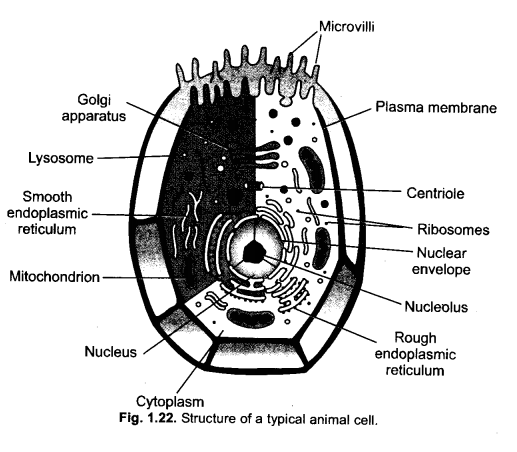
The Fundamental Unit of Life Class 9 Important Questions Science Chapter 5 image - 6
(a) Mitochondrion
(b) Lysosome
(c) Ribosome
(d) Centriole.

Question 21.
(a) State two types of plastids. Mention the function of each.
(b) How do vacuoles help in ingestion and egestion in single celled organisms ? (CCE 2011, 2012)
Answer:
(a) Leucoplasts and chromoplasts. Leucoplast. Storage of carbohydrates, proteins and fats. Chromoplast. Photosynthesis by chloroplasts (green chromoplasts) and attractive colouration in flowers and fruits by non-green chromoplasts.
(b) During ingestion of food, the plasma membrane invaginates in contact with food particle and pinches off as small food containing vacuole called phagosome. Phagosome fuses with lysosome to form food vacuole. Digestion occurs. The digested materials pass out into cytoplasm. The vacuole containing undigested food pieces rises to the surface, fuses with plasma membrane to perform egestion.

Question 22.
What is the relationship between chromatin material and chromosomes ? (CCE 2011, 2013)
Answer:
Chromatin is an intertwined mass of thread-like DNA- protein complex that occurs in the nucleus. At the time of cell division, chromatin condenses and gets organised into chromosomes.

Question 23.
(a) Explain the phenomenon of plasmolysis.
(b) Explain how do cell walls permit cells of fungi to withstand very dilute external media without bursting.
(CCE 2011)
Answer:
(a) Plasmolysis is shrinkage of protoplasm from the cell wall due to continued exosmosis when cells are placed in hypertonic solution. A peeled carrot piece placed in salt solution will contract due to plasmolysis of its cells.
(b) Despite being present in very dilute medium, the fungal cells do not undergo unlimited swelling. Swelling stops as soon as the limit of cell wall elasticity is reached. At this time, the cell wall exerts an opposite force that prevents further entry of water.

Question 24.
List the specific functions of the following :

  1. Rough endoplasmic reticulum
  2. Golgi apparatus
  3. Lysosomes
  4. Mitochondria
  5. Plastids
  6. Vacuoles in unicellular organisms. (CCE 2011)

Answer:
Rough Endoplasmic Reticulum.

  1. Protein synthesis,
  2. Golgi Apparatus.
    1. Formation of lysosomes.
    2. Complexing, packaging, secretion and excretion of substances.
  3. Lysosomes. Waste disposal, intracellular digestion,
  4. Mitochondria,
    1. Site of aerobic respiration.
    2. Liberation of energy as ATP (hence power house of cells).
  5. Plastids Photosynthesis (chloroplasts), storage (leucoplasts), colouration (non-green chromoplasts).
  6. Vacuoles in Unicellular Organisms. Osmoregulation, excretion, ingestion, digestion and egestion.

Question 25.
Describe the structure and write any two functions of Golgi apparatus. (CCE 2011)
Answer:
Golgi apparatus is a stack of curved membrane bound flat sacs called cisternae/cisterns that bear tubules and vesicles on the sides Functions.
Golgi Apparatus:
(a) Formation of lysosomes.
(b) Complexing, packaging, secretion and excretion of substances.

Question 26.
(a) Which organelles supply energy to a cell ? In what form it is stored ?
(b) Explain the structure of this organelle,
(c) Does this organelles contain DNA ? Why ? (CCE 2011)
Answer:
(a) Mitochondria. The energy is stored in the form of ATP.
(b) Structure. Mitochondria are rod or sausage shaped colourless organelles of aerobic eukaryotes that have a double membrane covering. The outer membrane is porous. The inner membrane is folded. The folds are called cristae. They bear ATP generating elementary particles. The matrix contains enzymes of Krebs cycle,
(c) Mitochondria possess DNA and ribosomes which help them in synthesis of a number of proteins for their functioning.

Question 27.
Mention the difference between prokaryotic and eukaryotic cells regarding
(i) Nuclear region
(ii) Cell organelles
(iii) Chlorophyll. (CCE2012)
Answer:
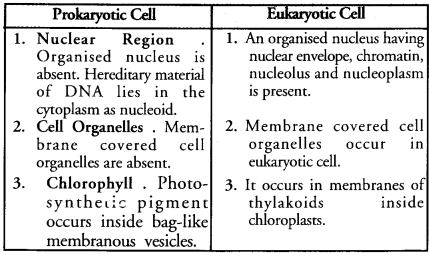
The Fundamental Unit of Life Class 9 Important Questions Science Chapter 5 image - 7

Question 28.
(a) What is membrane biogenesis ?
(b) Explain what happens when a drop of concentrated sugar solution is placed on a rheo leaf mounted on a glass slide. Name this phenomenon. Would the same happen if riieo leafwas boiled before mounting ? Give reason for your answer. (CCE 2012)
Answer:
(a) Membrane Biogenesis. It is formation, renewal and repair of biomembrane from its constituents (lipids and proteins) synthesised over smooth and rough endoplasmic membrane and their modification by Golgi apparatus.
(b)

  1. A concentrated sugar solution will cause exosmosis in cells of rheo peel mounted on a glass slide. The cytoplasm withdraws from cell wall. The phenomenon is called plasmolysis.
  2. Plamolysis does not occur in cells of rheo leaf peel if the latter has been boiled before mounting. It is because boiling kills the cells. Exosmosis can occur only in living cells.

Question 29.
(a) Which cell organelle would you associate with ATP production ? How is this organelle able to make its own protein ?
(ib) A student performed an experiment by placing a de- shelled egg in a concentrated salt solution for five minutes.
What change did he observe in the egg ? Give reason for the same. (CCE 2012)
Answer:
(a) Mitochondrion. The organelle is able to synthesise some of its proteins because it has its own DNA and ribosomes.
(b) The deshelled egg placed in salt solution contracts. The contraction is caused by exosmosis.

Question 30.
(a) Where are genes located in a cell ?
(b) Name the nucleic acids that are present in animal cell. (CCE 2012)
Answer:
(a) Genes are located in the chromatin/chromosomes inside the nucleus.
(b) Animal cell has two types of nucleic acids, DNA (deoxyribonucleic acid) and RNA (ribose nucleic acid). While RNA is mostly located in the cytoplasm, DNA is present inside nculeus (smaller quantity in mitochondria).

Question 31.
(a) State and explain the process by which Amoeba obtains its food. (CCE 2012)
(b) Why is the plasma membrane called a selectively permeable membrane ? (CCE 2012)
Answer:
(a) Amoeba obtains its food through endocytosis. Part of plasma membrane coming in contact with food particle
invaginâtes, engulfs the same and is pinched off into cytoplasm as phagosome. Phagosome fuses with a lysosome to produce a food vacuole. Digestion occurs in the food vacuole. The digested materials pass out into the cytoplasm. The vacuole having undigested matter rises to the surface and performs exocytosis to throw out the undigested matter.
(b) Cell membrane is semipermeable membrane for water. It permits the entry of gases through diffusion. Ions, sugar, amino acids, etc. pass through the plasma membrane by an active process. Plasma membrane is impermeable to certain other materials. Therefore, it is selectively permeable.

Question 32.
Two beakers A and B contain plain water and concentrated sugar solution respectively. Equal number of dried raisins are kept in them for a few hours and then taken out. (t) Explain the reason for the difference in the physical appearance of raisins which were taken out of the two beakers, (it) On the basis of above observation, categorise the two solutions as hypotonic and hypertonic. (CCE 2012)
Answer:

  1. Raisins placed in beaker A have swollen while those of beaker B remain shrivelled,
  2. Solution (here water) in beaker A is hypotonic (as it causes entry of water into raisins) while solution in beaker B is hypertonic as no water from this solution passes into raisins.

Question 33.
(a) How is flexible nature of plasma membrane useful to Amoeba. Name the process.
(b) Plastids are able to make their own protein. Explain.
(c) Why plant cells shrink when kept in hypertonic solution.
(CCE 2012)
Answer:
(a)Flexible nature of plasma membrane is useful to Amoeba in

  1. Engulfing food particles. The process is called endocytosis.
  2. Formation of pseudopodia for locomotion.

(b) Plastids possess DNA and ribosomes for formation of proteins as per information present in the former.
(c) Plant cells placed in hypertonic solution shrink due to passage of a part of their contained water into outer solution due to exosmosis.

Question 34.
(a) List two roles of nucleus of a cell,
(b) Name two substances stored in the vacuoles of a plant cell.
(CCE 2012)
Answer:
(a) Roles of Nucleus,

  1. Control: Nucleus controls cell metabolism and cell activities,
  2. Hereditary Information: Nucleus contains all the hereditary information not only for the cell but also the whole organism.

(b) Substances in Vacuoles,

  1. Water
  2. Salts and some organic substances.

Question 35.
(a) Who gave the term Golgi apparatus,
(b) Name one cell organelle formed by Golgi apparatus.
(c) Write any two functions of Golgi apparatus.
Answer:
(a) Cajal (1914).
(b) Lysosome
(c)
(i) Complexing, packages, secretion and exeretion of substances,
(ii) Membrane biosynthesis.

Question 36.
Distinguish leucoplast from chromoplast based on one feature. Give an example of chromoplast present in plant cell. What is the function of chromoplast in plant cell ?
(CCE 2012)
Answer:
Leucoplast is colourless plastid while chromoplast is coloured plastid. Chromoplast present in green aerial cells of the plant is called chloroplast. It takes part in photosynthesis.

Question 37.
Differentiate between rough and smooth endoplasmic reticulum. How is endoplasmic reticulum important for membrane biosynthesis ? (CCE 2012)
Answer:
Rough endoplasmic reticulum bears ribosomes over its surfaces while the same are absent over smooth endoplasmic reticulum. The two types of endoplasmic reticulum synthesise respectively proteins and lipids that are modified and complexed by Golgi apparatus for membrane biosynthesis.

Long Answer Questions

Question 1.
(a) What are lysosomes ? Why are they called “suicide bags of a cell” ?
(b) What happens to the dry raisins when we put them in plain water for some time ? State the reason for whatever is observed. What would happen if these raisins are now placed in concentrated salt solution ? (CCE2010, 2011)
Answer:
(a) Lysosomes. They are small, single membrane bound cell organelles which contain digestive enzymes for intracellular digestion and waste disposal.
Lysosomes contain digestive enzymes against all types of organic materials. If their covering membrane breaks as it happens during injury to cell, the digestive enzymes will spill over the cell contents and digest the same. As lysosomes are organelles which on bursting can kill the cells possessing them, they are called suicide bags.
(b) Dry raisins placed in water swell up due to endosmosis or osmotic entry ofwater into them. The swollen raisins placed in concentrated salt solution will shrink in size and become wrinkled due to exosmosis or osmotic expulsion of water from them.

Question 2.
(a) Distinguish between chloroplast and leucoplast with respect to their pigments and function.
(b) How would
(i) a plant cell
(ii) an animal cell behave when placed in a hypotonic solution of sodium chloride ? Explain giving reason. (CCE 2010, 2011)
Answer:
(a)
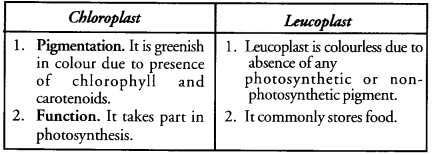
The Fundamental Unit of Life Class 9 Important Questions Science Chapter 5 image - 8
(b) Cells placed in hypotonic solution swell up due to endosmosis or osmotic entry of water into them. Swelling is limited in plant cells as they have rigid cell walls. Due to absence of a cell wall, an animal cell will continue to swell up till it bursts.

Question 3.
(a) What is endoplasmic reticulum ?
(b) Describe its structure.
(c) Name two types of endoplasmic reticulum.
(d) What crucial role does it play in the liver cells of vertebrates ?
(e) What is membrane biosynthesis ?
(CCE 2010)
Answer:
(a) Endoplasmic reticulum is a three dimensional interconnected network of membrane lined channels that run through the cytoplasm.
(b) Structure. Endoplasmic reticulum or ER has three components,
(i) Cistemae. They are interconnected flat sacs which run parallel to one another.
(ii) Tublues. They are tube-like extensions of cisternae.
(iii) Vesicles. They are oval or rounded sacs that are connected to cisternae and tubules. Membranes of endoplasmic reticulum are similar to plasma membrane but are thinner. The channels contain a fluid endoplasmic matrix.
(c) Types. There are two types of endoplasmic reticulum, smooth endoplasmic reticulum (SER) and rough endoplasmic reticulum (RER). Rough endoplasmic reticulum bears ribosomes on its surface. The same are absent over SER.
(d) Detoxification. SER present in vertebrate liver detoxifies poisons and drugs.
(e) Membrane Biosynthesis. It is synthesis of cell membrane from its constituent proteins and lipids synthesised over endoplasmic reticulum and complexed by Golgi apparatus.

Question 4.
(a) Differentiate between
(i) The functions of RER and SER
(ii) Plasma membrane and cell wall.
(b) What is endocytosis ? (CCE 2010)
Answer:
(a) (i)
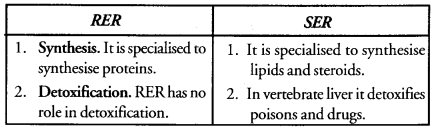
The Fundamental Unit of Life Class 9 Important Questions Science Chapter 5 image - 9
(ii) Differences between Plasma Membrane and Cell Wall.
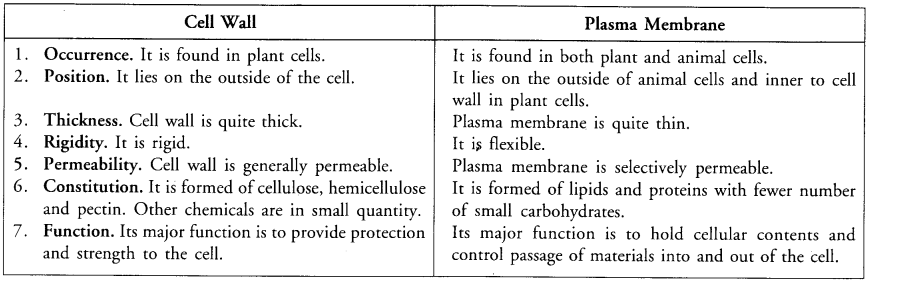
The Fundamental Unit of Life Class 9 Important Questions Science Chapter 5 image - 10
(b) Endocytosis is the bulk transfer of materials from outside to inside of a cell with the help of special vesicles developed by plasma membrane. Organism (that feeds by endocytosis). Amoeba.

Question 5.
(a) Differentiate between
(i) Nucleus and nucleoid.
(ii) Plant cell and animal cell,
(b) What is osmosis ?   (CCE 2010)
Answer:
(a) (i) Differences between Nucleus and Nucleoid.
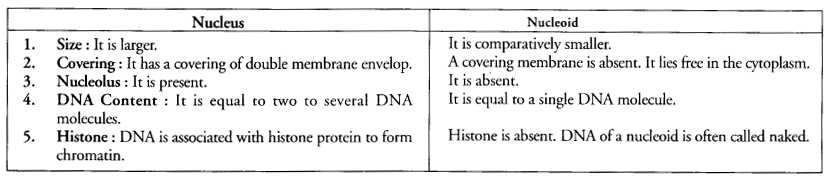
The Fundamental Unit of Life Class 9 Important Questions Science Chapter 5 image - 11
(ii) Plant Cell and Animal Cell.
The Fundamental Unit of Life Class 9 Important Questions Science Chapter 5 image - 12
(b) Osmosis: Diffusion of water through a semipermeable membrane from the region of its higher concentration (dilute solution) to the region of its lower concentration (concentrated solution) is known as osmosis.

Question 6.
(a) In the given diagram, identify the parts marked B and C.
(b) What are the substances that organelle A stores ?
(c) Mention one function of organelles B and C.
(d) What are cisterns ? (CCE 2010)
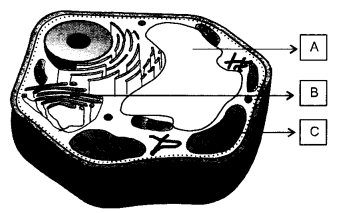
The Fundamental Unit of Life Class 9 Important Questions Science Chapter 5 image - 13
Answer:
(a) B —Golgi apparatus.
C — Chloroplast.
(b) A (Central Vacuole). It stores salts, sugar, amino acids, organic acids, some proteins and waste products. Recently lysosomal enzymes have also been detected in it.
(c) Function. :
(i) B — Secretion and excretion.
(ii) C — Photosynthesis.
(d) Cisterns. They are membrane bound curved flat stacks of Golgi bodies that bear tubules and vesicles on their periphery. Similar structures also occur in endoplasmic Ans. reticulum.

Question 7.
Observe the given figure and answer the questions.
(a) What has happened to cell A and B ? Explain.
(b) Identify the type of solution into which cells A and B are placed.
(c) Name and explain the process that has taken place in cells A and B. (CCE 2010)
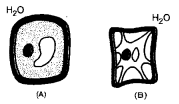
The Fundamental Unit of Life Class 9 Important Questions Science Chapter 5 image - 14
Answer:
(a) Cell A has become turgid while cell B has become plasmolysed (flaccid).
(b) Cell A is placed in hypotonic solution while cell B is dipped in hypertonic solution.
(c) A—Endosmosis or osmotic entry of water hasoccurred. It is because cell sap has lower concentration of water while the outer solution has higher concentration of water.
Water moves from its higher concentration to lower concentration across a semipermeable membrane.
B —Exosmosis or osmotic expulsion of water has occurred. The cell sap has higher concentration of water than the external solution. Therefore, water passes from inside the cell to the outside.

Question 8.
(a) Draw a neat and labelled diagram’ of a prokaryotic cell.
(b) Why organisms like bacteria are called prokaryotes ?
(CCE 2010)
Answer:
(a)
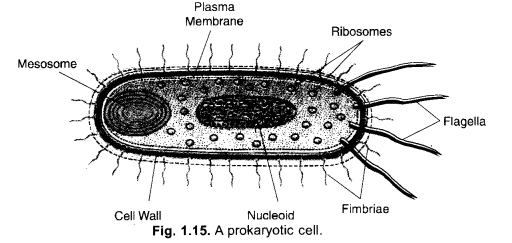
The Fundamental Unit of Life Class 9 Important Questions Science Chapter 5 image - 15
(b) Bacteria are called prokaryotes because their genetic material is not organised into a nucleus. Instead it lies directly inside cytoplasm as nucleoid.

Question 9.
(a) Categorise plastids based on their colour and function.
(b) Mention the strange similarity between plastids and mitochondria with reference to synthesis of their own materials. What do they synthesise ? (CCE 2010, 2012)
Answer:
(a) Plastids are of three types on the basis of their colour.

  1. Colourless Plastids or Leucoplasts. Depending upon their storage product, they are of three types — amyloplasts (storage of starch), aleuroplasts (storage of proteins), and elaioplasts (storage of oil).
  2. Brown-Red Plastids or Chromoplasts. They provide colouration to flowers and fruits for attracting pollinators and disseminators.
  3. Green Plastids or Chloroplasts. They perform photosynthesis.

(b) Similarity Between Plastids and Mitochondria. They have their own DNA and ribosomes. Ribosomes are used to synthesise a part of proteins and enzymes required by the organelles. Rest of the materials are obtained from the cytoplasm of the cell. DNA and ribosomes make the two organelles semi-autonomous.

Question 10.
(a) What is lacking in a virus which makes it dependent on a living cell to multiply ?
(b) Expand RER and SER. Differentiate between their structure and function. (CCE 2010, 2011)
Answer:
(a) Virus does not have a metabolic machinery as it lacks cytoplasm. Therefore, it is dependent upon the metabolic machinery of a living cell for multiplication.
(b) RER: Rough endoplasmic reticulum.
SER: Smooth endoplasmic reticulum.
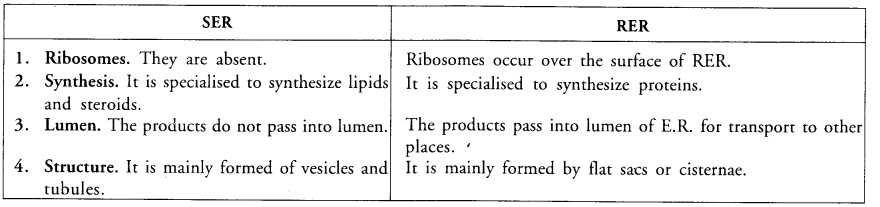
The Fundamental Unit of Life Class 9 Important Questions Science Chapter 5 image - 16

Question 11.
Draw a labelled diagram of an animal cell and label the following organelles :
(a) The organelle that contains powerful digestive enzymes.
(b) The organelle that has its own DNA.
(c) The organelle that forms cytoplasmic framework
(d) The organelle that helps in expelling excess water in Amoeba. (CCE 2010)
Answer:
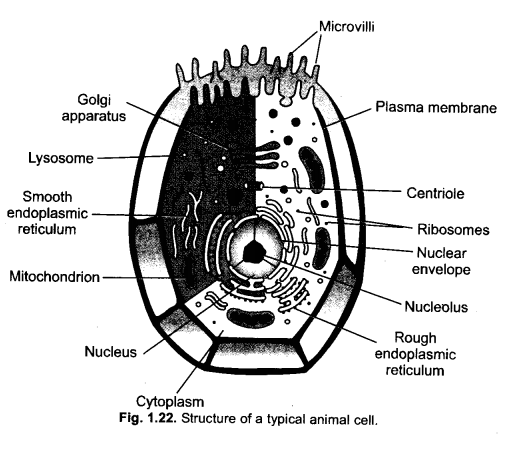
The Fundamental Unit of Life Class 9 Important Questions Science Chapter 5 image - 17
Labelling,
(a) Lysosome
(b) Mitochondrion
(c) Endoplasmic reticulum
(d) Vacuole (Contractile vacuole in Amoeba).

Question 12.
(a) Why does nuclear membrane have pores ?
(b) Why do chromosomes contain DNA in the nucleus ?
(c) Give two roles of nucleus in the cell. (CCE 2010)
Answer:
(a) Pores in Nuclear Membrane. For allowing and controlling the exchange of materials between the nucleus and cytoplasm.
(b) Chromosomes Contain DNA in Nucleus, (i) In order to protect DNA from influence of cytoplasmic enzymes, (it) For separating transcription machinery from translation machinery.
(c)

  1. Bodies of the living beings are made up of cells and their products.
  2. Activities of an organism are the sum total of activities of its cells.
  3. Cells develop from pre-existing cells.Viruses are an exception to cell theory.

Question 13.
(i) Draw a plant cell and label the parts which
(a) Is a dead layer and is permeable
(b) Is the kitchen of the cell
(c) Packages materials coming from endoplasmic reticulum
(d) Controls and regulates all the activities of the cell.
(ii) Identify the two structures which are present only in typical plant cell. (CCE 2013)
Answer:
(i)
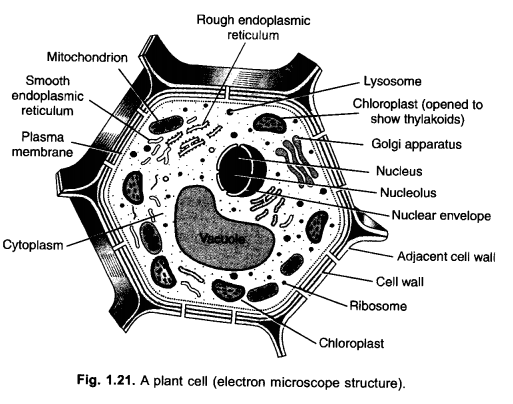
The Fundamental Unit of Life Class 9 Important Questions Science Chapter 5 image - 18
(a) Cell wall
(b) Chloroplast
(c) Golgi apparatus
(d) Nucleus.
(ii) (a) Cell wall (b) Chloroplast/plastid.

Question 14.
(a) Draw a neat diagram of an animal cell and label the parts whose functions are as follows :

  1. Flelps in storage, modification and packaging of products in vesicles.
  2. Helps in keeping the cell clean by digesting worn out cell organelles,
  3. Helps in oxidation of glucose to produce energy in the form of ATP.
  4. Allows the entry and exit of some materials into and out of cells.

(b) Define nucleoid. (CCE 2014)
Answer:
(a)
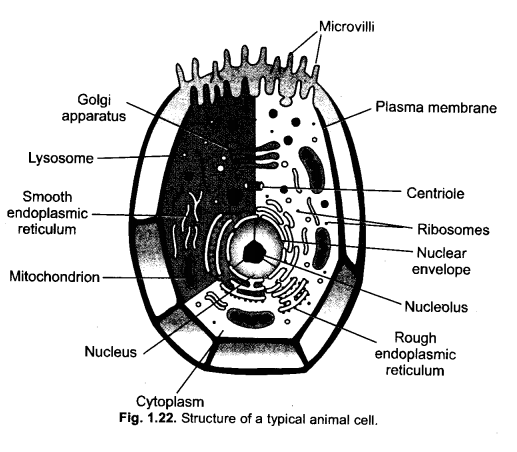
The Fundamental Unit of Life Class 9 Important Questions Science Chapter 5 image - 19

  1. Golgi apparatus
  2. Lysosome
  3. Mitochondrion
  4. Plasma membrane.

(b) Nucleoid: Genetic material of prokaryotes which is devoid of a nuclear envelope and consists of a single compacted DNA molecule (equal to a single chromosome) is called nucleoid.

Question 15.
Do all cells of our body look alike in terms of shape, size and structure ? What similarities do they have ? (CCE 2015, 2016)
Illustrate by drawing diagrams of various cells present in human body. (CCE 2015)
Answer:
No. Similarities,

  1. Covering of plasma membrane.
  2. Presence of centrally placed nucleus.
  3. Cytoplasm and different cell organelles,

e.g., Golgi apparatus, lysosomes, mitochondria, ribosomes, endoplasmic reticulum. (iv) Metabolic pathways.
Cells become differentiated to perform different functions. They also come to have different shapes and sizes, e.g., nerve cell, bone cell, fat cell, ovum, sperm, blood cells, muscle fibres.
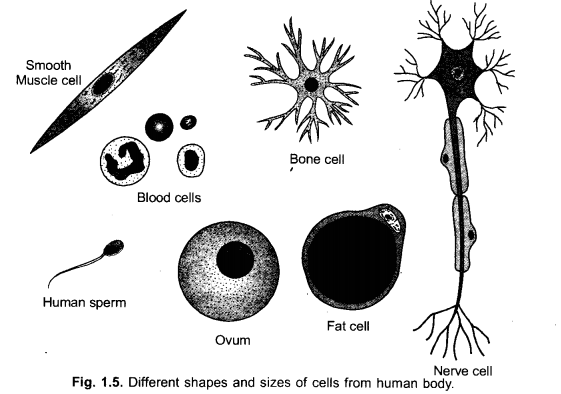
The Fundamental Unit of Life Class 9 Important Questions Science Chapter 5 image - 20

Question 16.
Draw and label a plant cell and write one main function of the following cell organelles :
(a) Chloroplast
(b) Plasma membrane
(c) Vacuole
(d) Lysosomes. (CCE 2015)
Answer:
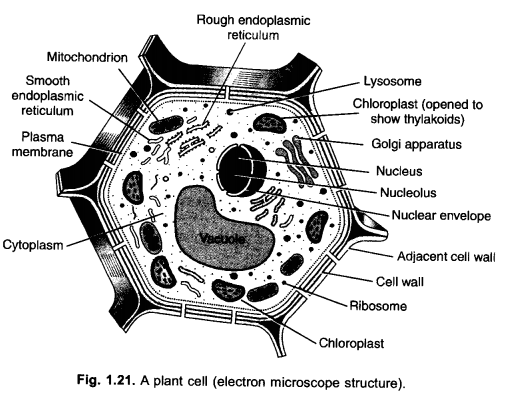
The Fundamental Unit of Life Class 9 Important Questions Science Chapter 5 image - 21
(a) Chloroplast. Photosynthesis.
(b) Plasma membrane. Holding the cell contents and selective^^” permeability.
(c) Vacuole. Storage, dumping and development of osmotic concentration.
(d) Lysosome. Scavenging, intracellular digestion and defence.

Question 17.
Write differences between prokaryotic and eukaryotic cells.
Draw diagram also. (CCE 2015)
Answer:
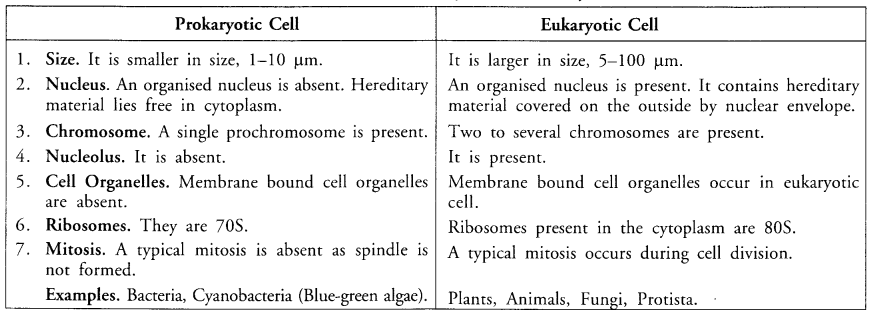
The Fundamental Unit of Life Class 9 Important Questions Science Chapter 5 image - 22
Diagrams :
The Fundamental Unit of Life Class 9 Important Questions Science Chapter 5 image - 23
The Fundamental Unit of Life Class 9 Important Questions Science Chapter 5 image - 24
The Fundamental Unit of Life Class 9 Important Questions Science Chapter 5 image - 25

Question 18.
(a) Why is the cell called structural and functional unit of life ?
(b) Explain the concept of division of labour in multicellular organisms giving an example. (CCE 2015)
Answer:
(a) Structural Unit: A living organism is made up of one or more cells. Therefore, cell is structural unit of life. Functional Unit. All life functions of an organism reside in its cells. Cells may also become specialised to perform specific functions like contraction in muscle cell or impulse transmission in nerve cell. Therefore, cells are functional units of life.
(b) Division of labour is the taking up of different functions of the system/body by different specialised components in a coordinated fashion so that the whole is benefitted without any part put to overwork. It increases efficiency. In multicellular organisms like humans there are a number of organs, tissues and cells performing different functions, e.g. contraction and movement by muscle cells, transmission of impulses by nerve cells, transport of oxygen by RBCs, protection from germs by white blood corpuscles, gamete formation by germ cells, pumping of blood by heart, extraction of wastes by kidneys, etc.

Question 19.
On the basis of number of cells living organisms are classified as unicellular and multicellular,
(a) Name two unicellular organisms
(b) What is meant by division of labour in multicellular organisms,
(c) Name one prokaryotic and one eukaryotic unicellular organism ?
(d) Every multicellular organism has come from a single cell. Justify this statement.
(e) Write one common feature between in Amoeba and white
blood cells of humans. (CCE 2015)
Answer:
(а) Amoeba, Paramecium.
(b) Division of labour is the taking up of different functions of the system/body by different specialised components in a coordinated fashion so that the whole is benefitted without any part put to overwork. It increases efficiency. In multicellular organisms like humans there are a number of organs, tissues and cells performing different functions, e.g. contraction and movement by muscle cells, transmission of impulses by nerve cells, transport of oxygen by RBCs, protection from germs by white blood corpuscles, gamete formation by germ cells, pumping of blood by heart, extraction of wastes by kidneys, etc.
(c) Bacterium (prokaryotic, e.g., Escherichia coli), Chlamydemortas (eukaryotic).
(d) Every multicellular organism develops from a single cell called zygote, which is formed by fusion of two types of gametes.
(e) Both have irregular shape and perform endocytosis.

Question 20.
(a) Draw a neat diagram of a typical plant cell and label chloroplast and plasma membrane.
(b) State main function of

  1. Mitochondria
  2. Chloroplast.

(c) Write two differences between a plant cell and an animal cell. (CCE 2016)
Answer:
(a)
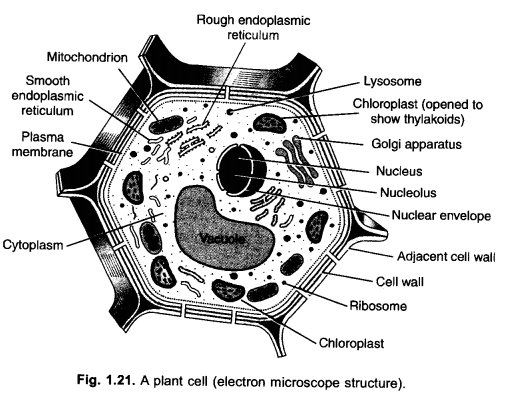
The Fundamental Unit of Life Class 9 Important Questions Science Chapter 5 image - 26
(b) Mian Function,

  1. Mitochondria: Aerobic respiration and energy release,
  2. Chloroplast: Photosynthesis.

(c)
The Fundamental Unit of Life Class 9 Important Questions Science Chapter 5 image - 27

Question 21.
What is meant by osmosis ? State the following conditions :
(a) When the cell loses water and shrinks
(b) When there is no overall movement of water. How can the plant cell withstand very dilute external media without bursting.
(CCE 2016)
Answer:
Osmosis is diffusion of water from the region of its higher concentration (pure water or dilute solution) to the region of its lower concentration (strong solution) through a semipermeable membrane.
(a) Plasmolysis due to external solution being hypertonic.
(b) External solution is isotonic.

Question 22.
A plant cell placed in very dilute solution swells up, becomes turgid but further endosmosis stops due to cell wall that begins to press the protoplasm inwardly.
(a) Differentiate between rough and smooth endoplasmic reticulum,
(b) How is endoplasmic reticulum important for membrane biosynthesis ? (CCE 2016)
Answer:
(a)
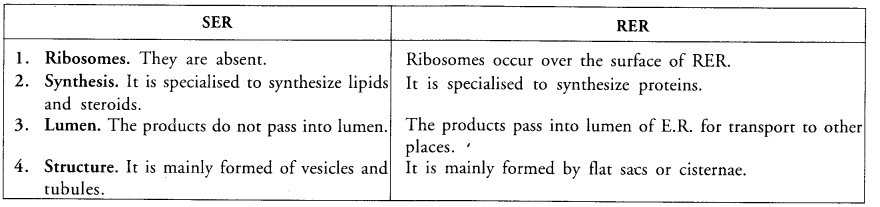
The Fundamental Unit of Life Class 9 Important Questions Science Chapter 5 image - 28
(b) Membrane Biosynthesis: It is synthesis of cell membrane from its constituent proteins and lipids synthesised over endoplasmic reticulum and complexed by Golgi apparatus.

Hope given Previous Year Question Papers for CBSE Class 9 Science Chapter 5 The Fundamental Unit of Life are helpful to complete your science homework.

If you have any doubts, please comment below. Learn Insta try to provide online science tutoring for you.


Matter in Our Surroundings Class 9 Important Questions Science Chapter 1

Chapter 1 Matter in Our Surroundings Class 9 Science Important Questions with Answers PDF will help you in scoring more marks in your exams.

Matter in Our Surroundings Class 9 Important Questions Science Chapter 1

Question 1:
Answer the following questions.

  1. Why is ice at 273 K more effective in cooling than water at the same temperature ?
  2. Name the two gases which are supplied in compressed form in homes and hospitals.
  3. What is dry ice ? (CBSE 2010, 2011)

Answer:

  1. The three states of matter are : solid, liquid and gas. Out of these, the solid state is the most rigid since the particles present are very closely packed and interparticle forces are quite strong.
  2. LPG (Liquid Petroleum Gas) is supplied in homes while liquefied oxygen in hospitals
  3. Solid carbon dioxide (CO2) is known as dry ice. It is so named as it does not wet a piece of paper or cloth.

More Resources

Question 2:
CO2 is a gas. Justify the given statement by two reasons. (CBSE 2011)
Answer:

  1. CO2 does not have a fixed volume. It can be compressed on applying pressure.
  2. CO2 does not have a fixed shape. It can take the shape of any container in which it is put.

Question 3:
What is a pure substance ? Give its one characteristic. (CBSE 2011)
Answer:
A pure substance is the one which cannot be separated into smaller parts by any physical methods. It may be either a pure element (e.g. sodium) or a pure compound (e.g. calcium carbonate).

Question 4:
What happens when you pour some acetone on your palm ? (CBSE 2010, 2011)
Answer:
Acetone is a very low boiling liquid. It immediately changes to vapours. The evaporation is an endothermic process. Acetone takes up heat energy from hand. Therefore, the palm immediately becomes cold or even numb.

Question 5:
Name SI unit of measuring temperature. The boiling point of water is 100°C under normal atmospheric pressure. Convert this temperature to SI Units. (CBSE 2011, 2016)
Answer:
SI units of temperature is Kelvin (K)
100°C = (100 + 273) = 373 K.

Question 6:
Give reasons for the following :
(a) Gases fill up completely the vessel in which they are kept.
(b) Gases exert pressure on the walls of the containing vessel. (CBSE 2011, 2012, 2014, 2016)
Answer:
(a) Particles constituting gases are very fast moving and diffuse at a fast speed. They therefore, readily fill up the vessel completely in which these are kept.
(b) Particles of gases collide against the walls of the containing vessel and impart momentum to them. This is responsible for the pressure of the gas.

Question 7:
Name three states of matter. Which state of matter is rigid and why ? (CBSE 2011, 2013)
Answer:
The three states of matter are : solid, liquid and gas. Out of these, the solid state is the most rigid since the particles present are very closely packed and interparticle forces are quite strong.

Question 8:
What is meant by particulate nature of matter ? List four characteristics of particle nature of matter.
Answer:
In order to illustrate the particle nature of matter, take some water in a glass beaker. To this add one spoon full of some salt (e.g., sodium chloride) and stir with a glass rod.
The important characteristics of the particulate nature of matter may be summed up as follows :

  1. Every matter is made up of particles.
  2. The particles constituting a matter are very small in size.
  3. The particles have empty or vacant spaces in them known as interparticle spaces.
  4. Particles are not stationary and are in a state of motion.
  5. Attractive forces are present in the particles of a substance. These are called interparticle forces.
  6. The particle motion increases with the rise in temperature.

Question 9:
Why do people sprinkle water on a roof after a hot summer day ? (CBSE 2011, 2016)
Answer:
Water has a large heat of vaporisation. In a hot summer day, the roof is quite hot. Water absorbs a large amount of heat from the roof for its vaporisation. The roof gets sufficiently cool and one can sleep comfortably.

Question 10:
List three characteristics of particles of matter. Describe one example for each characteristic to illustrate it.
Name the characteristics which are responsible for
(a) spreading of smell of scent in a room and
(b) water taking the shape of the vessel in which poured. (CBSE 2011)
Answer:
For the three characteristics of matter and their examples,
(a) Spreading of smell of scent in a room is because of diffusion of the gases. Scent consists of a number of sweet smelling gases or vapours.
(b) Water is a liquid and liquids take up the shape of any container in which these are kept.

Question 11:
The temperature-time graph given below shows the heating curve for pure wax. From the graph answer the following :
Matter in Our Surroundings Class 9 Important Questions Science Chapter 1 img 1

  1. What is the physical state of the substance at the points A, B, C and D ?
  2. What is the melting point of the substance ?
  3. What is its boiling point ?
  4. Which portions of the graph indicates that change of state is taking place.
  5. Name the terms used for heat absorbed during change of states involved in above processes. (CBSE 2011)

Answer:

  1. At point A : Wax is in the solid state.
    At point B : Wax has started melting and exists both in the solid as well as liquid states.
    At point C : Wax is in liquid state.
    At point D : Wax has started boiling. Therefore, it exists both in the liquid as well as gaseous states.
  2. Melting point of wax = 15°C
  3. Boiling point of wax = 110°C
  4. The change of state (solid to liquid) is represented by the portion A1 to B2 (straight line).
    The change of state (liquid to gas) is represented by the portion D1 to D2 (straight line).
  5. It is known as latent heat of fusion in case of solids and latent heat of vaporisation in case of liquids.

Question 12:
Explain which one will cause more severe burns—boiling water at 100°C or steam at 100°C. (CBSE 2011, 2012)
Answer:
In order to illustrate the particle nature of matter, take some water in a glass beaker. To this add one spoon full of some salt (e.g., sodium chloride) and stir with a glass rod.
The important characteristics of the particulate nature of matter may be summed up as follows :

  1. Every matter is made up of particles.
  2. The particles constituting a matter are very small in size.
  3. The particles have empty or vacant spaces in them known as interparticle spaces.
  4. Particles are not stationary and are in a state of motion.
  5. Attractive forces are present in the particles of a substance. These are called interparticle forces.
  6. The particle motion increases with the rise in temperature.

Question 13:
On suffering from high fever, which will lower your body temperature more; ice or ice cold water ?
(CBSE 2012, 2014)
Answer:
Ice will lower the body temperature more than ice cold water because latent heat of fusion of ice is quite high (335 kj kg-1). Ice is therefore, expected to absorb more heat energy from the body and will lower the body temperature more than ice cold water.

Question 14:
Flow will you change water from gaseous state to liquid state ? Suggest a simple activity. (CBSE 2011)
Answer:
Pass the water vapours or steam through a water condenser as used in case of simple distillation. It gets condensed to form liquid water.

Question 15:
Justify that melting of wax is a physical change. (CBSE 2011)
Answer:
It can be justified in two ways :

  1. No new substance is formed and there is no change in the chemical properties of wax as a result of melting.
  2. When the liquid wax is cooled for sometime, it again gets solidified.

Question 16:
Ramesh took two beakers A and B containing hot water and cold water respectively. In each beaker, he dropped a crystal of copper sulphate. He kept the beakers undisturbed. After sometime what did he observe and why ? (CBSE 2011, 2012)
Answer:
In both the beakers, the solutions became blue. However, this happened at a faster rate in the beaker B which contains hot water. This change has taken place because of the process of diffusion which proceeds at a faster rate in hot water as compared to cold water.

Question 17:
Archit dropped a crystal of potassium permanganate into two beakers A and B containing hot water and cold water respectively. After keeping the beakers undisturbed for some time what did he observe and why ?
(CBSE 2012)
Answer:
Potassium permanganate crystals have purple colour. In a beaker B containing hot water, the purple colour would spread more readily as compared to the beaker A which contains in it cold water. Actually the kinetic energy of the particles increases with the rise in temperature.

Question 18:
Account for the following ;

  1. When sugar crystals dissolve in water, the level of water does not rise appreciably.
  2. Naphthalene balls disappear with time without leaving any solid residue.
  3. A wooden table should be called a solid.
  4. Dogs generally hang out their tongue in summer. (CBSE 2012)

Answer:

  1. Since water is a liquid, there are intermolecular spaces. Sugar particles occupy these spaces. As a result, water
    level does not rise appreciably,
  2. A pure substance is the one which cannot be separated into smaller parts by any physical methods. It may be either a pure element (e.g. sodium) or a pure compound (e.g. calcium carbonate).
  3. For the three characteristics of matter and their examples,
    1. Spreading of smell of scent in a room is because of diffusion of the gases. Scent consists of a number of sweet smelling gases or vapours.
    2. Water is a liquid and liquids take up the shape of any container in which these are kept.
  4. In summer, dogs get exhausted due to the loss of persipiration from their body. Since they are always running most of the time, they hang out their tongue.

Question 19:
(a) 5 mL of water was taken in a test tube and china dish separately. These samples were then kept under different conditions as below :
(i) Both the samples are kept under a fan.
(ii) Both the samples are kept inside a cup board.
State in which case evaporation will be faster ? Give reason to support your answer.
(b) How will the rate of evaporation change if above activity is carried out on a rainy day. Justify your answer.
(CBSE 2012)
Answer:
(a) Evaporation will be faster under a fan. Since fan helps in the fast movement of the air, water will get more opportunity to evaporate under a fan than inside a cup board. In this case, the outside air will not come in contact with water.
(b) On a rainy day, there is humidity in air. As a result, evaporation of water will slow down.

Question 20:
A rubber band can change its shape on stretching; will you classify it as solid or not ? Justify your answer.
(CBSE 2012)
Answer:
Yes, it can be classified as a solid. It is an elastic solid which changes its shape on stretching and regains the same when the stretching force is removed.

Question 21:
When a solid melts, its temperature remains constant. Explain. (CBSE 2012)
Answer:
The heat energy supplied once the solid starts melting is used up as latent heat of fusion. The melting point temperature of a solid gives an idea of the interparticular forces which bind the constituents in a solid. Thus, greater the melting point temperature, more will be the magnitude of intermolecular forces. For example,
Melting point temperature of sodium = 370 K
Melting point temperature of potassium = 336 K
This means that the attractive forces in atoms of sodium in the solid state of the metal are more than the forces that are present in the atoms of potassium also in the same state.

Question 22:
State one similarity and two differences between boiling and evaporation. (CBSE 2012, 2014, 2015)
Answer:
Similarity : In both evaporation and boiling, liquid changes to vapour state.
Differences :

  1. Evaporation takes place from the surface while boiling occurs throughout the liquid.
  2. Liquid can evaporate at all temperatures while boiling occurs only at a fixed temperature known as the boiling point temperature.

Question 23:
Draw a flow sheet diagram to illustrate interconversion of three states of matter. Name the process of each interconversion. (CBSE 2012)
Answer:
It is because of the change in interparticle spaces and inter particle forces. If a solid is to be converted into liquid, the interparticle spaces have to be increased. Similarly, if a liquid is to change to the gas, these spaces have to be further increased.
Matter in Our Surroundings Class 9 Important Questions Science Chapter 1 img 2
In other words, we can say that one state of a substance can be converted into the other by changing interparticle spaces.They actually change interparticle forces of attraction. Please note that the process can be reversed also under suitable conditions. This is known as interconversion of states of matter. The obvious question which strikes the minds of everybody is to how to bring about the change of state. There are two ways to achieve this.
By changing the temperature
By changing thé pressure.

Question 24:

  1. You want to wear your favourite shirt in a party, but the problem is that it is still wet after a wash. Mention three steps with reason that you would take to dry it faster ?
  2. It is a hot summer day. Priyanshi and Ali are wearing cotton and nylon clothes respectively. Who do you
    think would be more comfortable and why ? (CBSE 2012, 2013, 2014, 2016)

Answer:

    1. Squeeze the shirt with force. By doing so, some of the moisture is removed.
    2. Spread the shirt on a stand. It provides greater surface area for evaporation.
    3. Iron the shirt. Increase in temperature helps in drying the shirt.
  1. Cotton clothes would be more comfortable than the nylon clothes since these are porous. Persipiration sticking to the skin can escape from the pores. Priyanshi would feel more comfortable.

Question 25:
Explain how three states of matter arise due to the variation in the characteristics of the particles.
(CBSE 2013)
Answer:
The three states of matter arise because of two characteristics

  1. Interparticle spaces : These are minimum in the solid state and maximum in the gaseous state.
  2. Interparticles forces of attraction : These are maximum in the solid state and minimum in the gaseous state.

Question 26:
List any two properties of liquids which are common to gases. (CBSE 2013)
Answer:

  1. Both of them do not have any definite shape. They can take up the shape of the container in which these are kept,
  2. Both of them show the property of diffusion. However, gases diffuse faster.

Question 27:
How is heating of sugar different from heating of ammonium chloride ? Explain your answer. (CBSE 2013)
Answer:
Sugar melts upon heating whereas ammonium chloride sublimes upon heating without leaving behind any residue.

Question 28:
To which physical state of matter, do the following statements apply ? (CBSE 2013)

  1. incompressible, no fixed shape
  2. incompressible, high melting point
  3. compressible, no definite volume
  4. incompressible, highly fluid.

Answer:

  1. Liquid state
  2. Solid state
  3. Gaseous state
  4. Liquid state.

Question 29:
A drop of ink and a drop of honey are placed in watel in different beakers. Which of the two will spread faster ? Give reason for your answer. (CBSE 2013)
Answer:
Ink drop will spread faster as compared to honey. The density of honey is more than that of ink. Therefore, particles in ink diffuse faster as compared to the particles in honey.

Question 30:
Suppose you want to convert a gas into a liquid. Which two methods can you apply ? (CBSE 2013, 2016)
Answer:

  1. By increasing the pressure or by compressing the gas.
  2. By lowering the temperature or by cooling the gas.

Question 31:
Describe an activity to determine the melting point of ice with a diagram. (CBSE 2013, 2016)
Answer:
We know that the melting point of ice and the freezing point of water in pure states are both zero. This means that at this temperature, both are present. Upon heating, the temperature would actually not change but heat energy supplied would be absorbed by the ice as latent heat of fusion. This would result in the melting of ice.
Matter in Our Surroundings Class 9 Important Questions Science Chapter 1 img 3
The temperature would remain zero degree till the whole of ice has melted. Further heating would increase the temperature of water till it starts boiling at 100°C. The curve (d) gives the correct representaton.

Question 32:
Explain why do wet clothes dry faster when we spread them out. (CBSE 2013)
Answer:
By spreading wet clothes, the surface area available for evaporation increases. Therefore, wet clothes dry faster.

Question 33:
Describe an activity to show that particles of matter have spaces between them. (CBSE 2014, 2015)
Answer:
The important characteristics of the particulate nature of matter may be summed up as follows :

  1. Every matter is made up of particles.
  2. The particles constituting a matter are very small in size.
  3. The particles have empty or vacant spaces in them known as interparticle spaces.
  4. Particles are not stationary and are in a state of motion.
  5. Attractive forces are present in the particles of a substance. These are called interparticle forces.
  6. The particle motion increases with the rise in temperature.

Question 34:
How will you separate a mixture of naphthalene balls powder and common salt ? Draw a neat and labelled diagram to show the process. (CBSE 2015)
Answer:
We have so far studied that upon heating, a solid initially changes to the liquid state and then to the gaseous state when the temperature is increased. The process or the change of state can be reversed when the temperature is decreased. However, there are some exceptions. Certain solids directly change to the gaseous state upon heating without passing through the liquid state. This is called sublimation. The substance obtained on cooling the vapours is known as sublimate. Sublimation may be defined as :
the change of solid directly into the gaseous state without passing through the liquid state upon heating.
Matter in Our Surroundings Class 9 Important Questions Science Chapter 1 img 4
Naphthalene balls, camphor, iodine, ammonium chloride are some common examples of the substances which undergo sublimation.

Question 35:
Define (a) Compressibility (b) Rigidity (c) Fluidity (CBSE 2015)
Answer:
(a) Compressibility: It is the property as a result of which the particles of any matter come closer on applying pressure.
(b) Rigidity: It is the capacity of the particles of a matter to resist a change in shape and size on applying stress.
(c) Fluidity: It is the property as a result of which particles of a matter have tendency to flow.

Question 36:
(a) Define the process of vaporisation.
(b) List four factors which affect the rate of evaporation. (CBSE 2015)
Answer:
(a) vaporisation and may be defined as the amount of heat energy that is needed to convert one kg of a liquid at its boiling point temperature into its vapour state without any rise in temperature.
Latent heat of vaporisation of water is 226 kj kg-1. It is the amount of heat that is absorbed when one kilogram of water at its boiling point temperature (100°C) changes to vapour state without any further rise in temperature.
(b)

  1. Surface area available for evaporation
  2. Increase in temperature
  3. Decrease in humidity
  4. Increase in the speed of wind

Question 37:
State the physical state of water as the following temperatures.
(a) 373 K
(b) 300 K
(c) 200 K (CBSE 2015)
Answer:
(a) Gas or Vapours
(b) Liquid
(c) Ice.

Question 38:
Why does perspiration keep our body cool ? (CBSE 2015)
Answer:
Actually, we perspire a lot in the hot and humid weather. Since cooling is caused during evaporation, the body temperature gets lowered. We feel more comfortable. Now, cotton is of porous nature and is a good absorber of water coming out of the pores as sweat. The synthetic clothes are less porous and donot absorb sweat so quickly. As the sweat evaporates, it absorbs some energy from the body since the clothes are in contact with our skin. The temperature of the body gets lowered and we feel more comfortable. We feel less comfortable in nylon and terylene clothes during summer.

Question 39:
Tabulate three differences between boiling and evaporation. (CBSE 2015)
Answer:
Matter in Our Surroundings Class 9 Important Questions Science Chapter 1 img 5

Question 40:
Give reasons for the following observations

  1. The smell of lighted incense stick spreads several metres away.
  2. A liquid has a fixed volume but not a fixed shape.
  3. Ice floats over water.
  4. A wooden table is called a solid at room temperature. (CBSE 2015)

Answer:

  1. This happens because of diffusion. For example, the smell of food particularly of fish being cooked in the kitchen spreads in the lobby and even in different rooms because of diffusion.
  2. Liquids do not have fixed shapes and take up the shape of any container in which these are put. A liquid cannot be compressed on applying pressure. Actually, the interparticle forces in the liquids are so strong that the pressure which is applied is not in a position to overcome these. Liquids therefore keep their volume.
  3. Ice (solid state) floats over water (liquid state). Both are chemically same and are made from H2O molecules. Actually, the structure of ice is more porous* as compared to that of water. Therefore, for a given mass, the volume of ice is more than that of water and its density is comparitively less. As a result, ice floats over water.
  4. different containers. For example, blue crystals of copper sulphate have needle like shape which they retain whether kept in a beaker or in a china dish or placed on the palm of our hand.

Question 41:
(a) When common salt is added to water, will there be any change in volume ? Give reason.
(b) Write any one similarity between three states of matter. (CBSE 2015, 2016)
Answer:
(a) No, there will be no change in volume. The particles of common salt will occupy inter particle empty spaces present in the molecules of water. The salt will dissolve in water and there will not be any change in the level of the solution thus formed.
(b) All the three states of matter consist of particles which have specific mass.

Question 42:
Out of boiling and evaporation, which is a surface phenomenon ? Explain. (CBSE 2015)
Answer:
Evaporation is a surface whereas boiling once started occurs throughout the liquid. In a liquid, the particles or molecules experience mutual forces of attraction. However, these are not stationary and have some kinetic energy at all temperatures. The particles of a liquid are also colliding with one another and exchanging energy during the collisions. Above the liquid surface, atmosphere or air is present which is a mixture of several gases. The particles of the liquid present on the surface have a tendency to come out from the surface so that they may acquire more freedom to move and become part of the atmosphere. This is also known as randomness. To overcome the interparticle forces of attraction, they need some energy which they take up from the rest of the particles or molecules of the liquid. As a result, their temperature gets lowered and cooling is caused.

Question 43:
Define boiling point. Write down the boiling point of water on Celcius scale and Kelvin scale. (CBSE 2016)
Answer:
The boiling point temperature of a liquid may be defined as :
the temperature at which a liquid starts boiling or the liquid state of a substance changes into gaseous/vapour state.
For example, the boiling point temperature of water is 100°C or 373 K. It is interesting to note that what we have noticed in the melting of a solid, also happens in the boiling of a liquid. It means that once the liquid starts boiling, its temperature does not change although it is still being heated. The explanation is also similar. As long as the liquid has not boiled, the heat energy which is supplied increases the kinetic energy of the particles (or H2O molecules) present in the liquid. As a result, the temperature rises. Once the liquid starts boiling, the heat energy is now being used to bring about a change in state from liquid to gas or vapours. It is known as latent heat of vaporisation and may be defined as :
the amount of heat energy that is needed to convert one kg of a liquid at its boiling point temperature into its vapour state without any rise in temperature.
Latent heat of vaporisation of water is 226 kj kg-1. It is the amount of heat that is absorbed when one kilogram of water at its boiling point temperature (100°C) changes to vapour state without any further rise in temperature.

Question 44:
Liquids and gases are commonly known as fluids. Compare their properties and show that they can flow easily.
(CBSE 2016)
Answer:
Unlike solids, the liquids have fluidity and not rigidity i.e., they have tendency to flow. This is due to lesser interparticle or intermolecular forces that are present in the liquid state as compared to the solid state. However, the liquids differ in their relative fluidity. For example, water flows at a faster rate than honey because in honey, the particles are heavier and also more closely packed.
Gases have maximum fluidity and least rigidity.
Since the interparticle spaces are the maximum in the gaseous state, the attractive forces are the least. As a result, the fluidity is very large while rigidity is negligible.

Question 45:
Tabulate the differences in the states of matter on the basis of the following characteristics :

  1. Rigidity
  2. Kinetic energy
  3. Density. (CBSE 2016)

Answer:

  1. Rigidity: We have seen that rigidity is maximum in the solid state and fluidity or particle motion is negligible. In the liquid state of a substance, both these characters are
    different. The liquids are less rigid than the solids and the molecular motion is also comparatively more.
  2. Kinetic energy: The kinetic energy is linked with movement of the particles from one place to the other. Since the constituents in the solid state are very closely packed, they have negligible kinetic energy. That is why solids do not flow.
  3. Density: Mass occupied by a solid per unit volume and is obtained by dividing the mass of a particular solid by the volume occupied by that mass of the solid.
    The unit of density : kg/L or kg/dm³.


Hope given Previous Year Question Papers for CBSE Class 9 Science Chapter 1 Matter in Our Surroundings are helpful to complete your science homework.

If you have any doubts, please comment below. Learn Insta try to provide online science tutoring for you.
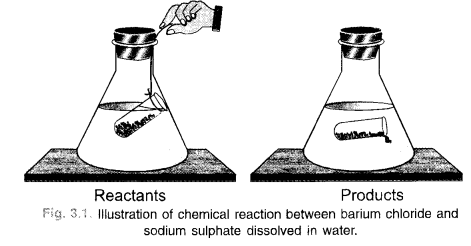
Chemical Reactions and Equations Class 10 Important Questions Science Chapter 1

Chapter 1 Chemical Reactions and Equations Class 10 Science Important Questions and Answers PDF will help you in scoring more marks. This consists of 1 mark Questions, 3 Mark Numericals Questions, 5 Marks Numerical Questions and previous year questions from Chemical Reactions and Equations Chapter.

Chemical Reactions and Equations Class 10 Important Questions and Answers Science Chapter 1

Very Short Answer Questions

Question 1.
Why does not a wall immediately acquire a white colour when a coating of slaked lime is applied on it ?
Answer:
Slaked lime as such is not very white. When applied on the wall, CO2 gas present in air reacts with calcium hydroxide to form calcium carbonate. It is quite white and therefore, imparts white look to the wall.
Ca(OH)2 + CO2(g) ———> CaCO3(s) + H2O(l).

More Resources

Question 2.
What is rust ?
Answer:
It is a brown mass known as hydrated ferric oxide. Its formula is Fe2O3.xH2O.

Question 3.
Identify the most reactive and least reactive metal : Al, K, Ca, Au.
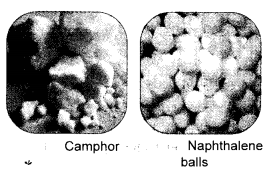
Answer:
Most reactive metal : K (potassium) ; Least reactive metal : Au (gold).
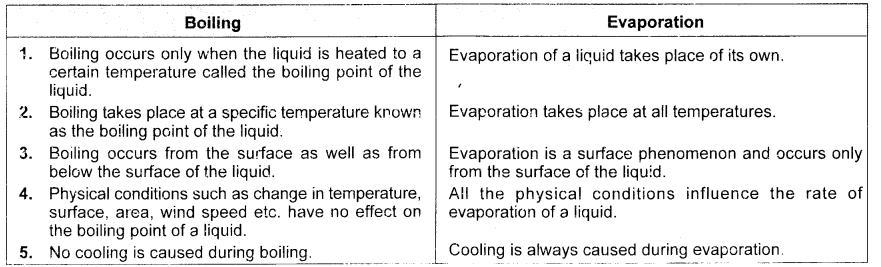
Question 4.
Which of the following is a combination reaction and which is a displacement reaction ?
(a) Cl2 + 2KI ——–> 2KCl + I2
(b) 2K + Cl2 ——–> 2KCl.
Answer:
(a) It is a displacement reaction,
(b) It is a combination reaction.

Question 5.
What is the difference between the following two reactions ?
(a) Mg + 2HCl ——–> MgCl2 + H2
(b) NaOH + HCl ——–> NaCl + H2O.
Answer:
(a) It is a single displacement reaction,
(b) It is a double displacement reaction also called neutralisation reaction.

Question 6.
Identify the compound which is oxidised in the following reaction
H2S + Br2 ———–> 2HBr + S.
Answer:
H2S is oxidised to S because H2S has lost hydrogen.

Question 7.
Suggest two ways to check the rancidity of food articles.
Answer:
(a) Keep the articles in airtight containers,
(b) Keep the articles in refrigerator.

Question 8.
Name two metals which donot get corroded.
Answer:
Gold (Au) and platinum (Pt) do not get corroded.

Question 9.
Identify the substance oxidised and reduced in the reaction :
CuO(s) + Zn(s) ———-> ZnO(s) + Cu(s).
Answer:
Zinc is oxidised to zinc oxide and copper oxide is reduced to copper.

Question 10.
How will you know whether a sample of cheese has become rancid or not ?
Answer:
If the cheese starts giving foul smell, it means that it has become rancid.

Question 11.
Why are eatables preferably packed in aluminium foils ?
Answer:
Aluminium foils donot corrode in atmosphere even if kept for a long time. Actually, a protective coating of aluminium oxide (Al2O3) is formed on the surface of the metal. It stops any further reaction of the metal with air (oxygen) and water. The eatables do not get spoiled.

Question 12.
What happens chemically when quick lime is added to water ?
Answer:
Calcium hydroxide (or slaked lime) is formed accompanied by a hissing sound. So much heat is evolved during the reaction that the reaction mixture starts boiling. The chemical equation for the reaction is :
Chemical Reactions and Equations Class 10 Important Questions Science Chapter 1 image - 1

Question 13.
Give an example of exothermic reaction.
Answer:
CH4(g) + 2CO2(g) ———-> CO2(g) + 2H2O(g) + heat, (evolved)

Question 14.
Give an example of endothermic reaction.
Answer:
N2(g) + O2(g) ———> 2NO(g) – heat, (absorbed).

Question 15.
Name the gas that can be used for the storage of fresh sample of chips for a long time.
Answer:
The gas is nitrogen (N2). It checks rancidity of food articles.

Question 16.
Name the type of reaction
N2(g) + 3H2(g) ———-> 2NH3(g)
Answer:
It is an example of combination reaction.

Question 17.
Give an example of a double displacement reaction (only reaction with complete balanced equation).
Answer:
HCl(aq) + NaOH(g) ——–> NaCl(aq) + H2O(l)

Question 18.
Why are decomposition reactions called the opposite of combination reactions ? Write equations for these reactions.
Answer:
A decomposition reaction may be defined as the reaction in which a single substance decomposes or splits into two or more substances under suitable conditions.
For example,
Chemical Reactions and Equations Class 10 Important Questions Science Chapter 1 image - 2
It may be concluded that a certain substance is formed or synthesised in combination reaction and it breaks or splits in decomposition reaction. Therefore, the two reactions oppose each other.

Question 19.
In the reaction MnO2 + 4HCl —————> MnCl2 + 2H2O + Cl2; identify which one is reduced and which one is oxidized ?
Answer:
In this reaction HCl is oxidised to Cl2 and MnO2 is reduced to MnCl2.

Question 20.
Take a small amount of calcium oxide or quick lime in a beaker and slowly add water to this. Is there any change in temperature ?
Answer:
Yes, the temperature increases since the process of dissolution of calcium oxide (CaO) in water is highly exothermic in nature.

Question 21.
Name two salts that are used in black and white photography.
Answer:
Both silver chloride and silver bromide are used in black and white photography.

Question 22.
State the chemical change that takes place when lime stone is heated
Answer:
Calcium carbonate decomposes on heating to give calcium oxide and carbon dioxide.
CaCO3(s) heat , CaO(s) + CO2(g)

Short Answer Questions

Question 23.
Identify the substance oxidised and substance reduced in the following reactions
(i) ZnO(s) + C(s) ———> Zn(s) + CO(g)
(ii) 2Na(s) + O2(g) ———> 2Na2O(s)
(iii) CuO(s) + H 2(g) ———> Cu(s) + H2O(l).
Answer:
(i) C is oxidised to CO and ZnO is reduced to Zn.
(ii) Na is oxidised to Na2O and O2 is reduced.
(iii) H2 is oxidised to H2O and CuO is reduced to Cu.

Question 24.
Which types of reactions are represented by the following equations ?
(a) CaO + CO2 ——-> CaCO3
(b) Mg + CuSO4 ——–> MgSO4 + Cu
(c) CH4 + 2O2 ———–> CO2 + 2H2O
(d) NH4NO2 ———-> N2 + 2H2O.
Answer:
(a) Combination reaction
(b) Displacement reaction
(c) Combustion reaction
(d) Decomposition reaction

Question 25.
What happens when :
CO2(g) is bubbled through lime water (i) in small amount (ii) in excess
Answer:
(i) Solution becomes milky due to the formation of calcium carbonate
Chemical Reactions and Equations Class 10 Important Questions Science Chapter 1 image - 3
(ii) Milkiness disappears because calcium carbonate changes to calcium hydrogen carbonate which is colourless in nature.
Chemical Reactions and Equations Class 10 Important Questions Science Chapter 1 image - 4

Question 26.
Aluminium is a reactive metal but is still used for packing food articles. Why ?
Answer:
From the position of the aluminium (Al) metal in the activity series, it seems to be quite reactive. However, it is not so reactive. Actually, when the metal is kept in air or oxygen for sometime, it is converted into its oxide called aluminum oxide (Al2O3). This gets deposited as the surface of the metal as a thin coating. It is rather passive which means that it is not reactive. Therefore, the metal is used for packing food articles which do not get spoiled under the foil.

Question 27.
Give one example each of :
(i) Thermal decomposition reaction
(ii) Electrolytic decomposition reaction
(iii) Photo decomposition reaction. (CBSE 2014)
Answer:
Chemical Reactions and Equations Class 10 Important Questions Science Chapter 1 image - 5

Question 28.
What are neutralisation reactions ? Why are they so named ? Give one example.
Answer:
A neutralisation reaction is a chemical reaction between an acid and base dissolved in water. For example,
KOH(aq) + HNO3(aq) ———-> KNO3(aq) + H2O (aq)
It is called neutralisation as both KN03 (salt) and H20 that are formed as the products, are of neutral nature.

Question 29.
(a) Why is combustion reaction an oxidation reaction ?
(b) How will you test whether the gas evolved in a reaction is hydrogen ?
(c) Why does not silver evolve hydrogen on reacting with dillute sulphuric acid ?
Answer:
(a) Combustion reaction is an oxidation reaction because it is always carried in the presence of air or oxygen. For example,
CH4(s) + 2O2(g) ——–> CO2(g) + 2H2O (l)
(b) Bring a burning match stick close to the mouth of the tube from which hydrogen gas escapes. The gas will immediately catch fire and this will be accompanied by pop sound.
(c) Silver is a less reactive metal in the sense that it occupies a place below hydrogen in the reactivity series. Therefore it does not evolve hydrogen gas on reacting with either dilute sulphuric acid or dilute hydrochloric acid.

Question 30.
What is an oxidation reaction ? Identify in the following reactions :
(i) the substance oxidised
(ii) the substance reduced.
Answer:
ZnO + C ———> Zn + CO
Oxidation involves the addition of oxygen or the removal of hydrogen in a chemical reaction. In the given reaction, carbon is oxidised to carbon monoxide while zinc oxide is reduced to zinc.

Question 31.
Identify the type of reaction in the following examples :
(i) Na2SO4(aq) + BaCl2(aq) ———-> BaSO4(s) + 2NaCl(aq)
(ii) Fe(s) + CuSO4(aq) ———-> FeSO4(aq) + Cu(s)
(iii) 2H2(g) + O2(g) ———> 2H2O(l)
Chemical Reactions and Equations Class 10 Important Questions Science Chapter 1 image - 6
Answer:
(i) It is an example of double displacement reaction.
(ii) It is an example of displacement reaction.
(iii) It is an example of combination reaction.

Question 32.
Solid calcium oxide was taken in a container and water was added slowly to
(i) State two observations made in the experiment.
(ii) Write the name of the chemical formula of the product.
Answer:
(i) Water will start boiling and hissing noise will be produced.
(ii) Calcium hydroxide (slaked lime) will be formed.
Chemical Reactions and Equations Class 10 Important Questions Science Chapter 1 image - 7

Question 33.
A house wife wanted her house to be white washed. She bought 10 kg of quick lime from the market and dissolved in 30 litres of water.
Chemical Reactions and Equations Class 10 Important Questions Science Chapter 1 image - 8
Answer:
She noticed that water started boiling even when it was not being heated. Give reason for her observation. Write the corresponding equation and name the product formed.
A suspension of slaked lime also called calcium hydroxide is formed when water is added to quick lime.
Chemical Reactions and Equations Class 10 Important Questions Science Chapter 1 image - 9
Since the reaction is highly exothermic, the solution started boiling although it was not being heated. The suspension of slaked lime is allowed to cool for sometime, preferably overnight. It is then decanted and the liquid obtained is used for white washing.

Question 34.
(i) What is observed when a solution of potassium iodide is added to a solution of lead nitrate taken in a test tube ?
(ii) What type of reaction is this ?
(iii)Write a balanced equation to represent the above reaction.
Answer:
(i) A yellow precipitate of lead iodide appears at the bottom of the test tube.
(ii) It is an example of double displacement reaction.
(iii) The balanced equation for the reaction is :
Chemical Reactions and Equations Class 10 Important Questions Science Chapter 1 image - 10

Question 35.
What change in colour is observed when white silver chloride is left exposed to sun light ? State the type of chemical reaction in this change.
Answer:
White colour of silver chloride changes to grey due to formation of metallic silver. The reaction is known as photochemical reaction. It is also a decomposition reaction.
Chemical Reactions and Equations Class 10 Important Questions Science Chapter 1 image - 11

Question 36.
What happens when an aqueous solution of sodium sulphate reacts with an aqueous solution of barium chloride ? State the physical conditions of reactants in which the reaction between them will not take place. Write the balanced chemical equation for the reaction and name the type of reaction. (CBSE 2016)
Answer:
A white precipitate of barium sulphate is immediately formed when the two aqueous solutions are mixed in a test tube. No reaction will be possible if the two reactants are in the solid state. The balanced chemical equation for the double displacement reaction is :
Chemical Reactions and Equations Class 10 Important Questions Science Chapter 1 image - 12

Question 37.
What is a redox reaction ? When a magnesium ribon burns in air with a dazzling flame and forms a white ash; is magnesium oxidised or reduced ? Why ?
Answer:
A redox reaction is a chemical reaction in which one of the reactants gets oxidised while the other is reduced simultaneously. In the reaction under study, magnesium is oxidised to magnesium oxide since the metal has gained oxygen.

Question 38.
(a) What happens chemically when quick lime is added to water ? (CBSE 2012)
(b) Write the chemical equation in balanced form.
MnO2 + HCl ———-> MnCl2 + Cl2 + H2O
(c) What is decomposition reaction ? Explain it with suitable example.
Answer:
(a) When quick lime (CaO) is added to water, slaked lime Ca(OH)2 is formed. The reaction is highly exothermic in nature.
(b) The balanced chemical equation is :
MnO2 + 4HCl ———-> MnCl2 + 2H2O + 2Cl2.
(c) Decomposition reaction is a chemical reaction in which a single substance splits or breaks into two or more substances under suitable conditions. For example,
Chemical Reactions and Equations Class 10 Important Questions Science Chapter 1 image - 13

Long Answer Questions

Question 39.
(a) Why cannot a chemical change be normally reversed ?
(b) Why is it always essential to balance a chemical equation ?
(c) Why do diamond and graphite, the two allotropie forms of carbon evolve different amounts of heats on combustion ?
(d) Can rusting of iron take place in distilled water ?
Answer:
(a) In a chemical change, the products are quite different from the reactants. Therefore, it cannot be normally reversed.
(b) A chemical equation has to be balanced to meet the requirement of the law of conservation of mass. According to the law, the total mass of the reacting species taking part in the reaction is the same as that of the products formed. Since there is a direct relationship between the mass of the different species and their number, it is always essential to balance a chemical equation.
(c) Because they differ in the arrangement of carbon atoms present and have different shapes. The attractive forces among the atoms in the two cases are not same. That is why they evolve different amount of heat.
C(diamond) + O2(g) ———–> CO2(g) + 393.5 kj
C(graphite) + O2(g) ———–> CO2(g) + 395.4 kj
Please note that diamond and graphite are the two allotropie forms of carbon.
(d) No, rusting of iron cannot take place in distilled water because it neither contains dissolved oxygen nor carbon dioxide. Both are essential for the rusting of iron.

Question 40.
You are given the following materials :
(i) Iron nails
(ii) Copper sulphate solution
(iii) Barium chloride solution
(iv) Copper powder
(v) Ferrous sulphate crystals
(vi) Quick lime.
Identify the type of chemical reaction taking place when :
(a) Barium chloride solution is mixed with copper sulphate solution and a white precipitate is observed.
(b) On heating, copper powder in air in a china dish, the surface of copper powder becomes black.
(c) On heating green ferrous sulphate crystals, reddish brown solid is left and a gas having smell of burning sulphur is noticed.
(d) Iron nails when left dipped in blue copper sulphate solution become brownish in colour and blue colour of copper sulphate solution fades away.
(e) Quick lime reacts vigorously with water releasing a large amount of heat.
Answer:
(a) The reaction is double displacement in nature. ‘
Chemical Reactions and Equations Class 10 Important Questions Science Chapter 1 image - 14
(b) It is an example of combination reaction.
Chemical Reactions and Equations Class 10 Important Questions Science Chapter 1 image - 15
(c) The green crystals of ferrous sulphate have the chemical formula FeS04.7H20. Upon heating, they lose molecules of water of crystallisation.
Chemical Reactions and Equations Class 10 Important Questions Science Chapter 1 image - 16
Upon further heating, ferrous sulphate undergoes decomposition reaction as follows :
Chemical Reactions and Equations Class 10 Important Questions Science Chapter 1 image - 17
Both the gases evolved have the smell of burning sulphur.
(d) This happens because of displacement reaction. Iron displaces copper form copper sulphate solution. Brownish coating of copper gets deposited on the iron nails. As the concentration of copper sulphate in the solution decreases, the blue colour of the solution slowly fades.
Chemical Reactions and Equations Class 10 Important Questions Science Chapter 1 image - 18
(e) Calcium hydroxide is formed as a result of combination reaction. It is highly exothermic. A large amount of heat is evolved accompanied by hissing sound.
Chemical Reactions and Equations Class 10 Important Questions Science Chapter 1 image - 19

Question 41.
A silvery white metal X is in the form of ribbons. Upon ignition, it burns with a dazzling white flame to form white powder Y. When water is added to the powder Y, it partially dissolves to form a substance Z which is used as an antacid.
(a) What is metal X ?
(b) Name the white powder Y.
(c) What is the substance Z ?
(d) Write the chemical reactions that are taking place.
Answer:
(a) The metal is X is Mg.
(b) The white powder Y is MgO.
(c) White powder Y dissolves partially in water to form substance Z. It is Mg(OH), and is used as an antacid.
(d) The chemical reactions that are taking place are :
Chemical Reactions and Equations Class 10 Important Questions Science Chapter 1 image - 20

Question 42.
(i) Account for the following :
(a) White silver chloride turns grey in sunlight.
(b) Brown coloured copper powder on heating in air turns into black coloured substance.
(ii) What do you mean by
(a) Displacement reaction
(b) Reduction reaction
(c) Combination reaction ? Write balanced chemical equation.
Answer:
(i) (a) White coloured silver chloride undergoes decomposition in the presence of sunlight and forms silver (grey in colour) and chlorine.
Chemical Reactions and Equations Class 10 Important Questions Science Chapter 1 image - 21
(b) Brown coloured copper powder on heating in air gets oxidised to copper oxide which is black in colour.
Chemical Reactions and Equations Class 10 Important Questions Science Chapter 1 image - 22
(ii) For the different types of reactions,
(a) In a displacement reaction, one element takes the place of another in a compound dissolved in a solution. For example,
Fe(s) + CuSO4 (aq) ———> FeSO4 (aq) + Cu(s)
(b) Combination reaction may be defined as the reaction in which two or more substances combine under suitable conditions to form a new substance. For example,
Chemical Reactions and Equations Class 10 Important Questions Science Chapter 1 image - 23
(c) A decomposition reaction may be defined as the reaction in which a single substance decomposes or splits into two or more substances under suitable conditions.
For example,
Chemical Reactions and Equations Class 10 Important Questions Science Chapter 1 image - 24
It may be concluded that a certain substance is formed or synthesised in combination reaction and it breaks or splits in decomposition reaction. Therefore, the two reactions oppose each other.

Question 43.
(a) Write the chemical equation in the balanced form.
Fe(s) + H2O(g) ———–> Fe3O4(s) + H2(g)
(b) Identify the type of reaction from the equation given below :
Na2SO4 (aq) + BaCl2 (aq) ———–> BaSO4(s) + NaCl(aq)
(c) You could have noted that when copper powder is heated in a china dish, the surface of copper powder gets coated with black coloured substance.
(i) Why is this black coloured substance formed ?
(ii) What is this black substance ?
(iii) Write the chemical equation of the reaction taking place.
Answer:
(a) 3Fe(s) + 4H2O(g) ————> Fe3O4(s) + 4H2(g)
(b) It is a double displacement reaction also called precipitation reaction. A white precipitate of BaSO4 is formed in the reaction.
(c)
(i) The black substance is formed due to the oxidation of copper.
(ii) The black substance is cupric oxide or copper (II) oxide with formula CuO.
Chemical Reactions and Equations Class 10 Important Questions Science Chapter 1 image - 25

Question 44.
Observe the given figure and answer the following questions.
Chemical Reactions and Equations Class 10 Important Questions Science Chapter 1 image - 26
(a) Write the complete balanced reaction for the reaction that takes place.
(b) Type of reaction involved.
(c) Is there any precipitate formed.
(d) If any precipitate formed, write the colour of the precipitate.
Answer:
Chemical Reactions and Equations Class 10 Important Questions Science Chapter 1 image - 27
(b) It is a double displacement reaction
(c) Yes, a precipitate of barium sulphate is formed.
(d) The precipitate is white in colour.

Question 45.
Select (i) combination reactions (ii) decomposition reactions and displacement reactions from the following
Chemical Reactions and Equations Class 10 Important Questions Science Chapter 1 image - 28
Answer:
(i) Decomposition reaction
(ii) Displacement reaction
(iii) Combination reaction
(iv) Displacement reaction
(v) Combination reaction
(vi) Decomposition reaction.

Hope given Previous Year Question Papers for CBSE Class 10 Science Chapter 1 Chemical Reactions and Equations are helpful to complete your science homework.

If you have any doubts, please comment below. Learn Insta try to provide online science tutoring for you.