Floatation Class 9 Important Questions Science Chapter 16

Chapter 16 Floatation Class 9 Science Important Questions with Answers PDF will help you in scoring more marks in your exams.

Floatation Class 9 Important Questions and Answers Science Chapter 16

VERY SHORT ANSWER QUESTIONS

Based on Thrust and Pressure

Question 1.
Define ‘thrust’. (CBSE 2011, 2014, 2016)
Answer:
The total force exerted by a body perpendicular to the surface is known as thrust.

More Resources

Question 2.
What is the unit of thrust in SI ? (CBSE 2013, 2016)
Answer:
S.I. unit of thrust is newton (N).

Question 3.
Define the term ‘pressure’. (CBSE 2011, 2013, 2014, 2016)
Answer:
Pressure is defined as the force acting perpendicular on unit area of the surface.

Question 4.
Name the SI unit of pressure. (CBSE 2013, 2016)
Answer:
S.I. unit of pressure is N/m2 or pascal.

Question 5.
State the relationship between thrust and pressure. (CBSE 2010, Term I, 2013, 2014)
Thrust
Answer:
Floatation Class 9 Important Questions Science Chapter 16 image - 2

Question 6.
Define 1 pascal. (CBSE 2014, 2015, 2016)
Answer:
1 pascal is defined as the pressure exerted by 1 N force acting perpendicular on the surface of 1 m2 area.

Based on Buoyant Force

Question 7.
Define upthrust or buoyant force. (CBSE 2010, 2011, 2012, 2016)
Answer:
The upward force exerted by a liquid on a body which is immersed in the liquid is known as upthrust or buoyant force.

Question 8.
State the factors on which upthrust or buoyant force depends. (CBSE 2010, 2011, 2012, 2016)
Answer:

  1. Size or volume of body immersed in a liquid,
  2. Density of the liquid in which the body is immersed and
  3. Acceleration due to gravity at the given place.

Question 9.
When an object is immersed in a fluid, name the two forces acting on it. (CBSE 2011, 2012, 2016)
Answer:

  1. Weight of object in the vertically downward direction,
  2. Upthrust or buoyant force in the vertically upward direction.

Question 10.
Name the force experienced by an object in a fluid when immersed in it. What is its direction ?
(CBSE 2011)
Answer:
Upthrust or Buoyant force. It acts on the object in upward direction.

Question 11.
Why does a block of wood held under water rise to the surface when released ? (CBSE 2011)
Answer:
This is because the buoyant force or upthrust acting on the wooden block due to water is greater than the weight of the block.

Question 12.
An object of weight 200 N is floating in a liquid. What is the magnitude of the buoyant force acting on it? (CBSE 2011)
Answer:
Magnitude of buoyant force = 200 N.

Question 13.
Explain the factors which determine whether an object floats or sinks when placed on the surface of water.
(CBSE 2011)
Answer:

  1. Volume of the object and
  2. density of the water.

Question 14.
Name the force acting on a body, when it is fully or partially immersed in a liquid. (CBSE 2011)
Answer:
Buoyant force.

Question 15.
What will be the direction of buoyant force when suppose the weight of an object is acting from north to south in the fluid ? (CBSE 2013)
Answer:
From south to north as buoyant force acts opposite to the direction of the weight of the object.

Question 16.
A body of weight 20 N floats half submerged in a liquid. What is the buoyant force on the body ?
Answer:
20 N

Based on Archimedes’ Principle

Question 17.
State Archimedes’ principle. (CBSE 2010, 2011, 2012, 2015)
Answer:
When a body is immersed partially or completely in a fluid (liquid or gas), it experiences an upthrust or buoyant force which is equal to the weight of the fluid displaced by the body. The weight of the body decreases due to the buoyant force acting on the body, when immersed in a fluid. In other words, a body loses its weight, when immersed completely or partially in a fluid. The loss of weight of a body in a fluid is equal to the upthrust or buoyant force.
The upthrust or buoyant force = weight of fluid displaced by a body = weight of body in air – weight of body in fluid.

Question 18.
Write the relationship between buoyant force acting on an object and weight of the liquid displaced by it. (CBSE 2010, 2012)
Answer:
Buoyant force = weight of liquid displaced by the object.

Question 19.
State the physical expression relating weight of the body in the liquid, actual weight of the body in air and the weight of the liquid displaced by the body. (CBSE 2011, 2013)
Answer:
Weight of a body in a liquid = actual weight of the body – weight of the liquid displaced by the body.

Question 20.
Give any two examples where Archimedes’ principle is applied . (CBSE 2011, 2012)

                                                  Or

List two applications of Archimedes’ principle. (CBSE 2012, 2016)
Answer:
Archimedes’ principle is applied in designing

  1. ships and submarines and
  2. lactometer used for testing the purity of milk.

Question 21.
State the principle on which working of hydrometer is based. (CBSE 2011)
Answer:
Archimedes’ principle:
A Greek scientist Archimedes conducted many experiments and concluded that when a body or an object is immersed partially or completely in a liquid or a gas (i.e., fluid), it experiences an upthrust or buoyant force. The upthrust or buoyant force is equal to the weight of the fluid displaced by the body. As a result of the buoyant force acting on an object, the weight of the object decreases, when immersed in a fluid. The finding of Archimedes is known as Archimedes’ principle.
Archimedes’ principle is used to design :

  1. the ships and submarines
  2. the hydrometers to find the densities of liquids
  3. the lactometers to test the purity of milk.

Based on Density and Relative density

Question 22.
Define density. Give SI unit of density. (CBSE 2011, 2012, 2014, 2015)
Answer:
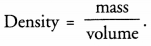
Density of an object is defined as mass per unit volume of the object. That is, density = mass/volume .
S.I. unit of density is kg/m3 (kg m-3).

Question 23.
Define relative density of a substance. (CBSE 2011, 2012, 2013, 2014, 2015)
Answer:
It is defined as the ratio of the density of the substance to the density of water.

Question 24.
If the relative density of a substance is less than 1, will it float or sink in water ? Support your answer.
(Density of water = 1000 kg/m3). (CBSE 2011)
Answer:
Floatation Class 9 Important Questions Science Chapter 16 image - 1
As relative density of substance is less than 1, so density of substance is less than the density of water. Hence, the substance will float in water.

Question 25.
Relative density of aluminium is 2.7. Explain this statement. (Similar CBSE 2011)
Answer:
Aluminium is 2.7 times heavier than the equal volume of water.

Question 26.
The density of a solid is 7.9 g cm-3 in air. What is the density of the solid in SI unit (kg m-3) ?
(CBSE 2016)
Answer:
Density = 7.9 g cm-3 = 7.9 x 1000 kg m-3 = 7.9 x 10³ kg m-3.

Question 27.
Relative density of gold is 19.3. The density of water is 1000 kg/m3. What is the density of gold in SI units ? (CBSE 2011, 2013, 2014, 2017)
Answer:
Density of gold = Relative density of gold x density of water = 19.3 x 1000 kg/m3 = 19300 kg/m3

SHORT ANSWER QUESTIONS

Based on thrust and pressure

Question 1.
Differentiate between thrust and pressure. State the unit in which they are measured.
Answer:
Thrust: The total force exerted by a body perpendicular to the surface is known as thrust.
Pressure: Pressure is defined as the force acting perpendicular on unit area of the surface.
S.I. unit of thrust is newton (N).
S.I. unit of pressure is N/m2 or pascal.

Question 2.
The wheels of an army tank rest on a steel belt. Give reason.

                                                   Or

Why an army tank weighing more than a thousand tonne rests upon a continuous chain. (CBSE 2012, 2015)
Answer:
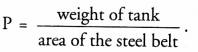
Pressure exerted by army tank on the ground is given
Floatation Class 9 Important Questions Science Chapter 16 image - 3
Since area of steel belt is more than the area of the wheels of the tank, so tank exerts less force on the ground. Hence, the ground under the tank does not sink under the weight of the tank.

Question 3.
Why are railway tracks laid on large sized concrete sleepers ? Explain. (CBSE 2011)
Answer:
The weight or thrust of the train is spread over large area of sleepers. Therefore, the pressure acting on the
ground under the sleepers is reduced. This prevents the sinking of the ground under the weight of the train.

Question 4.
Why do buildings have wide foundations ?
Answer:
So that the weight of the buiding is spread over a large area and hence less pressure is exerted on the ground. Hence, the building is prevanted to sink under its weight.

Question 5.
Which will exert more pressure, 100 kg mass on 10 m3 or 50 kg mass on 4 m2 ? Give reason.
(CBSE 2011, 2014, 2015)
Answer:
Floatation Class 9 Important Questions Science Chapter 16 image - 4
Thus, P1 > P2.

Question 6.
Explain, why a truck or a motor bus has much wider tyres ? (CBSE 2011, 2015, 2016)
Answer:
The weight of truck or motor bus spreads over large area on the surface of road or ground and hence less pressure is exerted by truck or a motor bus on the road. Therefore, the ground under them does not sink.

Question 7.
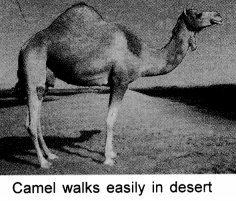
Account for the statement : “camel walks easily on sand but it is difficult for a man to walk on sand though a camel is much heavier than a man”. (CBSE 2011)
Answer:
A camel walks easily on the sandy surface than a man inspite of the fact that a camel is much heavier than a man.
This is because the area of camel’s feet is large as compared to the area of man’s feet. So the pressure exerted by camel on the sandy surface is very small as compared to the pressure exerted by man. Due to large pressure, sand under the feet of a man yields (i.e., sink) and hence he cannot walk easily on the sandy surface. On the other hand, sand under the feet of camel does not sink much due to small pressure. Hence camel can walk and run easily on the sandy surface.
Floatation Class 9 Important Questions Science Chapter 16 image - 5

Question 8.
A Sharp knife is more effective than a blunt knife. Why ? (CBSE 2012)

                                                 Or

Cutting and piercing tools are made sharp. Give reason. (CBSE 2015)
Answer:
Pressure (P = F/A) exerted by sharp knife on an object is more than the pressure exerted by a blunt knife. Therefore, sharp knife is more effective in cutting the object than a blunt knife.

Question 9.
Why does an iron nail sinks in water but a wooden cork floats on water ? (CBSE 2011, 2012, 2015, 2016)
Answer:
The weight of iron is greater than the upthrust of water on the iron nail, so iron nail sinks in water. On the other hand, the upthrust on cork is more than the weight of the cork. Hence wooden cork floats on water.

Question 10.
A balloon filled with hydrogen gas floats in air. Explain why ?
Answer:
The upthrust or buoyant force acting on hydrogen balloon is greater than the weight of the hydrogen balloon. So it floats in air.

Question 11.
An object of volume V is immersed in a liquid of density p. Calculate the magnitude of buoyant force acting on the object due to liquid.
Answer:
Magnitude of buoyant force acting on the object due to liquid = weight of liquid displaced
= mass of liquid displaced x g (∴ W = mg)
= Volume of body x density of liquid x g = Vρg
Thus, buoyant force depends upon

  1. the volume of the immersed portion of the object and
  2. density of the liquid.

Question 12.
An object is immersed in different liquids. Is same buoyant force acts on the object due to all liquids ?
(CBSE 2011)
Answer:
We know, buoyant force acting on an object due to a liquid is directly proportional to the density of the liquid. Since different liquids have different densities, so different buoyant forces act on the object due to different liquids. An iron sphere is suspended with an iron string.

Question 13.
The length of the string increases (i.e. string is stretched). Now the iron sphere is completely immersed in water and the increase in length of the string decreases. Explain why? (CBSE 2011)
Answer:
The length of the string increases due to the weight of the suspended iron sphere. When the sphere is immersed in water, buoyant force due to water acts on the sphere in the upward direction.
Now, the net force (or weight) acting on the string = actual weight of the sphere – buoyant force acting on it.
Since the net force acting on the string decreases and hence the extension of the string also decreases.

Question 14.
Two blocks, one of iron and other of wood are immersed in water at the same depth. Will both come upward ? Why ? (CBSE 2011)
Answer:
Wooden block will come upward. This is because upthrust of water on the wooden block is greater than its weight. In other words, density of wood is less than the density of water and density of iron is greater than the density of water.

Question 15.
Lead has greater density than iron and both are denser than water. Is the buoyant force on a lead object greater than or lesser than or equal to the buoyant force on an iron object of the same volume ? Explain your answer giving reason. (CBSE 2011)
Answer:
Buoyant force on an object depends upon

  1. the volume of the object and
  2. density of the liquid in which the object is immersed.

Since volume of both objects is same and both are immersed in water, therefore, buoyant force on lead object is equal to the buoyant force on iron object.

Question 16.
Explain, why a truck or a motor bus has much wider tyres ? (CBSE 2011, 2015, 2016)
Answer:
The weight of truck or motor bus spreads over large area on the surface of road or ground and hence less
pressure is exerted by truck or a motor bus on the road. Therefore, the ground under them does not sink.

Question 17.
A ship is loaded in sea water to maximum capacity. What will happen if this ship is moved to river water ? Why? (CBSE 2011)
Answer:
When ship is moved to river water from sea water, then upthrust acting on the ship decreases because density of river water is less than the density of sea water. Hence, the net weight of the ship will be more in river water than in sea water. Hence, more portion of the ship will be inside the river water.

Question 18.
Why do we feel lighter when we swim ?

                                        Or

When we jump into a swimming pool, we feel lighter. Why ? (CBSE 2011)
Answer:
When we swim in water, two forces acts on our body. One is the gravitational force equal to our weight in the downward direction and the other is the up thrust or buoyant force in the upward direction. Hence, the net downward force or the apparent weight of our body is less than our actual weight. Therefore, we feel lighter, when we swim.

Question 19.
An egg sinks in fresh water but floats in highly salty water. Give reason. (CBSE 2012)
Answer:
Upthrust acting on egg in fresh water is less than the weight of egg. Therefore, it sinks in fresh water. However,
the density of salty water is much greater than the density of fresh water, so upthrust acting on egg in salty water is greater than the weight of egg. Therefore, it floats in salty water.

Question 20.
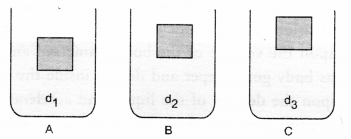
The following figure shows three identical blocks of wood floating in three different liquids A, B and C of densities d1, d2 and d3 respectively. Which of these has the highest density. Give reason to justify your answer.
(CBSE 2012)
Floatation Class 9 Important Questions Science Chapter 16 image - 6
Answer:
In case of liquid C, upthrust is maximum. Since upthrust depends on the density of liquid, therefore, density of liquid C (i.e., is the highest.

Question 21.
When an object is immersed into the fluid, two forces act on the object in the vertically opposite directions. Name them and also write the factors on which the magnitude of these forces depends on. (CBSE 2012, 2015)
Answer:

  1. Weight of object = mg. It depends on the mass (or volume and density of object) and acceleration due to gravity.
  2. Upthrust of fluid on the body = Vρg.
    It depends on the volume (V) of immersed portion of object, density (ρ) of fluid and acceleration due to gravity.

Question 22.
The density of turpentine at 293 K is given as 870 kg m-3 Identify and write the names of substances that sink in turpentine at the same temperature.

S.No.SubstancesDensity (kg)
1Wood690
2Ice920
3Rubber970
4Paraffin wax900
5Cork240
6Bone1850

Answer:
A substance sink in a liquid, if density of substance is greater than the density of liquid. Therefore, ice, rubber, paraffin wax and bone will sink in turpentine.

Question 23.
When a metallic block is immersed below the surface of a liquid, state and define the upward force acting on it. (CBSE 2014)
Answer:
It is a buoyant force. The upward force exerted by a liquid is known as buoyant force. Buoyant force = Vρg, where V on the metallic block immersed in the liquid is the volume of metallic block immersed in the liquid and ρ is the density of the liquid.

Question 24.
State the condition under which an object floats on the surface of a liquid. What is the volume of the liquid displaced by the object ? (CBSE 2014, 2015)
Answer:
An object floats on the surface of a liquid if upthrust on the body is greater than the weight of the object. Volume of the liquid displaced is equal to the volume of the body.

Question 25.
A cube of side 3 cm is immersed in water and then in saturated salt solution. In which case will it experience a greater buoyant force. If each side of the cube is reduced to 2 cm and then immersed in water, what will be the effect on the buoyant force experienced by the cube as compared to the first case for water. Give reason for each case. (CBSE 2015)
Answer:
Initial volume of cube, Vi = (3 cm)3= 27 cm3
Final volume of cube, Vf = (2 cm)2 = 8 cm3

  1. Buoyant force = Vρg, where p is the density of liquid. Since density of saturated salt solution is greater than the density of water, therefore, the cube will experience a greater buoyant force in saturated salt solution than in water.
  2. Since the volume of the cube decreases, so the cube will experience a less buoyant force in water as compared to the first case.

Based on Archimedes’s Principle

Question 26.
While drawing water from a well, a bucket of water appears to be heavier as it comes out of the water.
Explain giving reasons. (CBSE 2011)

                                                                   Or

Why is a bucket of water lighter when in water than when it is taken out of water ? (CBSE 2011)
Answer:
When the bucket is inside water, its weight is less than its weight in air due to the upthrust of water.

Question 27.
A student took solid bodies of different shapes, sizes and materials and noted down the apparent loss in weight on partially or fully immersing the bodies in different liquids. Based on the observations, he wrote the following conclusions. Which conclusion is incorrect and why ?
(a) Upthrust depends upon the volume of the body immersed and density of liquid.
(b) Upthrust increases as body goes deeper and deeper inside the liquid.
(c) Upthrust depends upon the density of the liquid and acceleration due to gravity.
(d) Upthrust does not depend upon the shape of the vessel in which liquid is filled. (CBSE 2014)
Answer:
Upthrust = Vρg, where V = volume of body immersed in liquid, ρ = density of liquid, g = acceleration due to gravity.
Therefore, conclusion (b) is incorrect as upthrust does not depend on the depth of the body inside the liquid.

Question 28.
If two equal weights of unequal volumes are balanced in air, what wil} happen when these are completely
dipped in water ? (CBSE 2011)
Answer:
When two weights of unequal volumes are dipped in water, buoyant force acting on the weight of larger volume is more than that on the weight of smaller volume. Hence, weight of smaller volume in water is more than the weight of larger volume. Therefore, these weights are not balanced in water.

Question 29.
An object of mass 500 gm is immersed into a measuring jar containing water. The initial level of water in the measuring jar is 50 cc. Due to the immersion of the object, the water level in the measuring jar reaches to 100 cc. Calculate the mass of the water displaced due to the immersion of the object. (CBSE 2012)
Answer:
Mass of water displaced = Volume of immersed portion of object x density of water
= (100 – 50) cm3 x 1 g cm-3 = 50 g.

Based on Density and Relative density

Question 30.
If a body is compressed to half its previous volume, what will be the effect on its density and why ?
(CBSE 2014)
Answer:
Floatation Class 9 Important Questions Science Chapter 16 image - 7
If volume of body becomes half its previous volume, then its density becomes double i.e., two times its previous value.

LONG ANSWER QUESTIONS

Question 1.
(a) State Pascal’s Law.
(b) Define upthrust or buoyant force. Describe an activity to show that a body loses its weight when immersed in a liquid.
Answer:
(a) Pascal’s Law
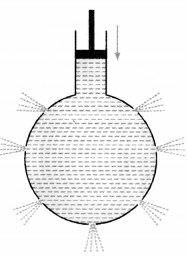
A great French physicist and mathematician, Blaise Pascal gave a law regarding the pressure exerted by a fluid enclosed in a container. According to this Taw :
“Pressure applied to an enclosed fluid is transmitted undiminished to every portion of the fluid and the walls of the containing vessel This fact is shown in figure .
Floatation Class 9 Important Questions Science Chapter 16 image - 8
The upward force exerted by a liquid on a body which is immersed in the liquid is known as the upthrust or buoyant force.
(b) Expression for Buoyant force or upthrust
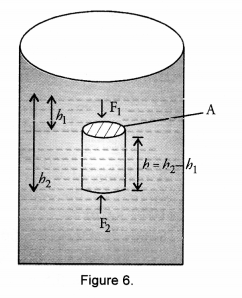
Consider a cylindrical object of height h and area of cross-section A immersed completely in a liquid of density ρ (Figure 6).
Floatation Class 9 Important Questions Science Chapter 16 image - 9
Let h1 be the depth of the upper face of the object from the free surface of liquid. h2 be the depth of the lower face of the object from the free surface of the liquid.
The height of object, h = h2 – h1.
Volume of the object, V= Ah                                  ,
The pressure acting on the upper face of the object, P1 = h1ρg.
This pressure acts vertically downward on the upper face of the object.
Therefore, force acting on the upper face of the object in vertically downward direction,
F2 = P2A = h2Aρg                                                                   …(1)
The pressure acting on the lower face of the object in vertically upward direction, P2 = h2ρg
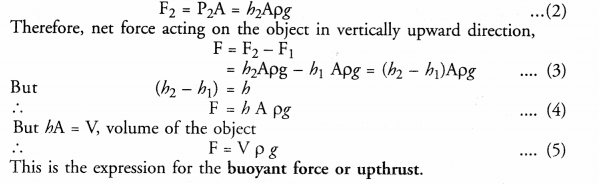
Therefore, force acting on the lower face of the object in vertically upward direction,
Floatation Class 9 Important Questions Science Chapter 16 image - 10
Factors on which buoyant force or upthrust depends
Buoyant force is directly proportional to

  1. the volume (V) of the object or body immersed in liquid
  2. the density (ρ) of the liquid in which the object or body is immersed.
  3. the acceleration due to gravity (g) at the given place.

Buoyancy: The tendency of an object to float in a liquid or the power of liquid to make an object float in it is called buoyancy.

Question 2.
Archimedes Principle has wide application in making ships and submarines. Explain. (CBSE 2013)
Answer:

  1. Floatation of Ships: Iron needle is solid and compact. The density of iron is greater than the density of the water. The weight of the needle is greater than the weight of water displaced by the needle. So iron needle sinks in water. On the other hand, iron ship is not solid. It is hollow and filled with air. So, the average density of the ship as a whole is less than the density of the water. Therefore, the immersed portion of the ship displaces water equal to its weight. Hence the ship floats on the surface of water.
  2. Floatation of Submarines: Submarines are just like ships. The difference between them is that submarines are provided with ballast tank [i.e., hot air tank in the form of a balloon to make it heavier). When ballast tank is empty, submarine acts as a ship. Under this condition, the submarine displaces more weight of sea water than its own weight. Hence, it floats in the sea water.
    When the submarine is to dive in water, the doors of the ballast tank are opened. The water enters into the ballast tank and increases the weight of the submarine. When the weight of the submarine becomes more than the weight of the water displaced by it ; it sinks in water.
    To take the submarine again on the surface of water, the compressed air is allowed to enter the ballast tank As a result of this, the water from the ballast tank is forced out. Therefore, the ballast tank is emptied. Again the submarine behaves as a ship and begins to float on the surface of the sea water.

Hope given Previous Year Question Papers for CBSE Class 9 Science Chapter 16 Floatation are helpful to complete your science homework.

If you have any doubts, please comment below. Learn Insta try to provide online science tutoring for you.

Force and Laws of Motion Class 9 Important Questions Science Chapter 9

Chapter 9 Force and Laws of Motion Class 9 Science Important Questions with Answers PDF will help you in scoring more marks in your exams.

Force and Laws of Motion Class 9 Important Questions and Answers Science Chapter 9

VERY SHORT ANSWER QUESTIONS

Based on force and inertia

Question 1.
Name the physical quantity, which changes the shape of a ball.
Answer:
Force.

More Resources

Question 2.
Define the term force. (CBSE 2011, 2012, 2014)
Answer:
A force is a physical quantity which causes or tends to cause a motion in an object at rest or changes or tends to change the direction of motion of a moving object or the shape or size of the object.

Question 3.
Define balanced forces. (CBSE 2013)

Or

State the meaning of balanced forces. (CBSE 2012)
Answer:
Two equal and opposite forces acting simultaneously on an object are known as balanced forces. The resultant force due to balanced forces is zero.

Question 4.
Define unbalanced forces. (CBSE 2013)
Answer:
Two forces of unequal magnitudes and acting in opposite directions on an object simultaneously are known as unbalanced forces. The resultant force due to unbalanced forces is non zero.

Question 5.
Name the force which is responsible for change in position or state of an object. (CBSE 2012, 2013)
Answer:
Unbalanced force.

Question 6.
A ball is moving over a horizontal smooth surface with a constant velocity. What type of forces are acting on the ball ?
Answer:
Balanced forces are acting on the ball.

Question 7.
An unbalanced force is acting on an object. List two possible effects that will be caused in the motion of object.
(CBSE 2011)
Answer:

  1. Object may be accelerated or retarded,
  2. Direction of motion of the object may change.

Question 8.
What do you mean by inertia ? (CBSE 2010, 2012)
Answer:
The tendency of a body to oppose any change in its state of rest or uniform motion is called inertia of the body.

Question 9.
Write the kinds of inertia. (CBSE 2012)
Answer:

  1. Inertia of rest,
  2. Inertia of motion
  3. Inertia of direction.

Question 10.
Name the physical quantity that measures inertia. (CBSE 2010, 2012, 2015)
Answer:
Mass of the body measures its inertia.

Question 11.
On which factor does inertia depend ? (CBSE 2013, 2015)
Answer:
It depends on the mass of the object.

Question 12.
Which has more inertia : a man or a child ?
Answer:
A man has more inertia than a child.

Question 13.
Which has highest inertia : solid made of aluminium, steel and wood oÇ same shape and same volume ?
(NCERT Question Bank, CBSE 2011, 2012)
Answer:
Solid made of steel has the highest inertia because its mass is greater than aluminium and wooden solids.

Question 14.
Name the property of bodies to resist a change in their velocity. (CBSE 2012, 2013, 2014)
Answer:
Inertia.

Question 15.
In a tug of war, the rope does not move in any direction. Why ? (CBSE 2013)
Answer:
Because balanced forces act on the rope. Both the teams apply equal and opposite forces on the rope.

Question 16.
Which one has greater inertia : a stone of mass 1 kg or a stone of mass 5 kg ?
Answer:
Inertia depends on the mass of the object. A stone of mass 5 kg has greater inertia than the stone of mass 1kg.

Question 17.
What kind of force is required to accelerate the motion of an object ?
Answer:
Unbalanced force.

Question 18.
A ball is moving over a horizontal smooth surface with a constant velocity. What type of forces are acting on the ball ?
Answer:
Balanced forces.

Question 19.
Name the forces (type of forces) when their resultant force acting on a body is not zero.
Answer:
Unbalanced forces.

Question 20.
Mention any two affects of force.
Answer:

  1. It changes the state of rest or motion of a body,
  2. It changes the shape of the body.

Question 21.
Is force a scalar or a vector quantity ?
Answer:
Force is a vector quantity.

Question 22.
State Newtons first law of motion.
                  Or
Define the first law of motion.
                 Or
State the law of inertia.
Answer:
Everybody continues in its state of rest or uniform motion in a straight line unless some external force acts on it.

Question 23.
Which law of motion defines the force ?
Answer:
First law of motion.

Question 24.
Define momentum and give its SI unit. (CBSE 2010, 2011, 2012, 2014, 2015)
Answer:
Momentum = mass x velocity.
SI unit of momentum is kg m s-1.

Question 25.
Name the factors on which momemtum of a body depends. (CBSE 2012, 2013, 2015)
Answer:

  1. Mass of the body and
  2. Velocity of the body.

Question 26.
Define momentum of a body. (CBSE 2010, 2011)
Answer:
Momentum of a body is defined as the product of the mass and velocity qf the body. Momentum of body = m x v.

Question 27.
Is momentum a scalar or a vector quantity ? (CBSE 2015)
Answer:
Momentum is a vector quantity.

Question 28.
What is the name given to the product of mass and velocity of a body ? (CBSE 2012)
Answer:
Linear momentum.

Question 29.
State Newtons second law of motion. Give its mathematical expression. (CBSE 2010, 2012, 2013)
Answer:
The rate of change of momentum of a body is directly proportional to the unbalanced force acting on it and the change in momentum takes place in the direction of the unbalanced force. F = ma.

Question 30.
Name the physical quantity which is determined by the rate of change of linear momentum.
(CBSE 2010, 2012, 2013)
Answer:
Force.

Question 31.
Define one unit of force. (CBSE 2010, 2011, 2013)
Answer:
A force is said to be unit force if it produces unit acceleration in a body of unit mass.

Question 32.
Name the unit of force in SI.
Answer:
newton (N).

Question 33.
Define SI unit of force. (CBSE 2011, 2014)
Or
Define one newton of force. (CBSE 2012)
Answer:
SI unit of force is newton. Force is said to be 1 newton if it produces 1 m s-2 acceleration in a body of 1 kg.

Question 34.
What is the relationship between force and acceleration ? (CBSE 2012, 2013)
Answer:
F = ma, where m is the mass of a body.

Question 35.
What is the name given to the product of mass and acceleration of a body ?
Answer:
Force ( F = ma)

Question 36.
How much force acts on a body whose momentum is constant (i.e. p = constant) ?
Answer:
F = dp/dt. If p = constant, then no force acts on the body.

Question 37.
Calculate the force required to produce an acceleration of 2.5 m s-2 in a body of 4 kg.
Answer:
F = ma = 4 x 2.5 = 10 N.

Question 38.
A body of mass 30 kg has a momentum of 150 kg m s-1. Find its velocity. (CBSE 2013, 2014)
Answer:
Force and Laws of Motion Class 9 Important Questions Science Chapter 9 image - 37

Question 39.
An athlete always runs some distance before taking a jump. Why ?
Answer:
To gain the momentum so that he may jump higher.

Question 40.
An object is thrown vertically upward. What is its momentum at the highest point ? (CBSE 2012)
Answer:
Momentum = mass x velocity.
Since velocity of the object at the highest point is zero, so momentum of the object is zero at the highest point.

Question 41.
What will happen to the momentum of a body whose velocity is doubled ?
Answer:
Momentum = mV. Therefore, momentum of a body is doubled if its velocity is doubled.

Question 42.
Name the physical quantity whose SI unit is “newton”.
Answer:
Force.

Question 43.
Which would require a gereater force — accelerating a 1kg mass at 10 m s or a 2 kg mass at 4 m s ?
Answer:
F = ma,
F1 = 1 x 10 = 10 N and
F2 = 2 x 4 = 8 N
So, 1 kg mass accelerating at 10 m s-2 requires greater force than the 2 kg mass at 4 m s-2.

Or

Which would require a greater force — accelerating a 2 kg mass at 5 m s-2 or a 5 kg mass at 3 ms-2 ?
Answer:
F1 = m1 x a1 =2 x 5 = 10 N,
F2 = m2 x a2 = 5 x 3 = 15 N
F2 > F1

Question 44.
If the mass of a body is doubled, what will happen to its acceleration, if the applied force remains constant ?
Answer:
a = F/m. If mass(m) is doubled, acceleration becomes half of its original value, if the applied force remains m constant.

Question 45.
State Newtons third law of motion.
Answer:
To every action, there is equal and opposite reaction.

Question 46.
State action and reaction while a person walks on a ground.
Answer:
Action : Force exerted by person on ground.
Reaction : Force exerted by ground on person.

Question 47.
Do action and reaction forces act on same body or different bodies ?
Answer:
Action and reaction act on the different bodies.

Question 48.
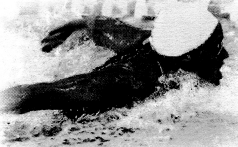
State action and reaction in the case when a person swims.
Answer:
Action : Force with which swimmer pushes the water in the backward direction with his hands.
Reaction : The force with which water pushes the swimmer in the forward direction.

Question 49.
State action and reaction in the case when a bullet is fired from the gun. (CBSE 2011)
Answer:
Action : Force exerted by a spring on the bullet.
Reaction : Force exerted on the gun.

Question 50.
State action and reaction when a bullet is fired from the gun.
Answer:
Force exerted on the bullet is action and the force exerted on the gun is reaction.

Question 51.
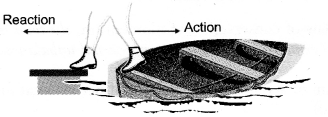
When a man jumps out from a boat to the bank of a river, the boat moves backwards. Identify the action and reaction in this situation. (CBSE 2015)
Answer:
Action = force with which the foot of the man pushes the boat in the backward direction.
Reaction = force exerted by the boat on the man.

Based on the law of conservation of momentum

Question 52.
State law of conservation of momentum. (CBSE 2010, 2012, 2013, 2015)
Answer:
The total momentum of a system remains constant if no external force acts on the system.

Question 53.
A fast moving truck loses momentum equal to 2 kg m s-1 after colliding with a stationary car.
Will the car lose or gain momentum ?
How much momentum is lost or gained by the car if the truck comes to the rest after collision ?
Answer:
The car will gain momentum. Momentum gained by the car = 2 kg m s-1

Question 54.
Name the principle on which a rocket works. (CBSE 2012, 2013)
Answer:
Law of conservation of linear momentum.

Question 55.
What do you mean by recoil velocity of a gun ?
Answer:
The velocity with which a gun moves backward after firing a bullet is called the recoil of the gun.

Question 56.
Is momentum a scalar or a vector quantity ? (CBSE 2015)
Answer:
Momentum is a vector quantity.

SHORT ANSWER QUESTIONS

Based on force and inertia

Question 1.
When are the forces acting on a body said to be balanced ? Give an example. What type of change can the balanced forces bring about in an object ? (CBSE 2010, 2015)
Answer:
Two forces of equal magnitude but acting in opposite directions on a body are said to be balanced forces. When we push a wall but the wall does not move at all, then balanced forces are acting on the wall. When balanced forces are -acting on an object, there is no change in the state of the object.

Question 2.
What are the changes that a force can bring about on a body?  Give examples. (CBSE 2010, 2011)

Or

Explain any three effects that can be produced by force with examples. (CBSE 2012, 2013, 2014)
Answer:
Force can change

  1. the shape of the body,
  2. direction of motion .of the body,
  3. the speed of the body and
  4. size of the body

Examples :

  1. The shape of a ball lying on a floor can be changed by pressing it.
  2. The direction of motion of moving ball can be changed by hitting it with a bat.
  3. A ball at rest can be set in motion if force is applied on it.
  4. The length of a spring tied at one end can be increased by pulling it.

Question 3.
Two balls A and B of masses m and 2m are in motion with velocities ‘2V’ and ‘V’ respectively.
Compare
(i) their inertia,
(ii) their momentum and
(iii) the force needed to stop them in the same time.
Answer:
Force and Laws of Motion Class 9 Important Questions Science Chapter 9 image - 1
(iii) Since momentum of both the balls is same, so same amount of force is needed to stop them in the same time.

Question 4.
Property of a body by virtue of which it opposes any change in state is called
(a) momentum
(b) energy
(c) inertia
(d) acceleration.
Answer:
(c)

Question 5.
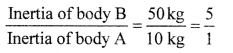
If A and B are two bodies with masses 10 kg and 50 kg respectively, then which body has more inertia ? Also calculate the ratio of the inertia of two bodies.
Answer:
Inertia of body B is more than the inertia of body A.
body A 10 kg and body B 50 kg.
If the time taken to bring a ball to rest from a certain velocity V is reduced to half, what will be the change in values ofForce and Laws of Motion Class 9 Important Questions Science Chapter 9 image - 2

Question 6.
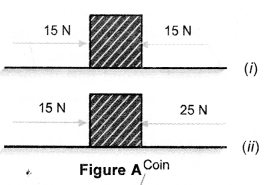
Look at the diagrams given (Figure A) and answer the following questions. In which case will the object move and in which direction ? Give reason in support of your answer.
Force and Laws of Motion Class 9 Important Questions Science Chapter 9 image - 3
Answer:
In case (ii) object moves in the direction of force of 25 N because in this case the net force acting on the object = 25N-15N=10N
In case (i), net force acting on the object is zero.

Question 7.
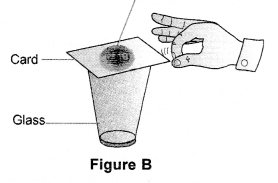
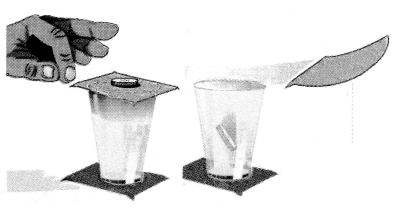
In the given experimental set-up (Figure B) a student gave the card a sharp, fast horizontal flick with a finger.
Force and Laws of Motion Class 9 Important Questions Science Chapter 9 image - 4

  1. What will happen to the coin ?
  2. Write reason for your answer.

Answer

  1. The coin will fall into the glass.
  2. The card will move, when a fast horizontal flick with a finger is given to it. On the other hand, coin remains at rest due to inertia of rest and hence falls into the glass.

Question 8.
State the effect of force in each of the following cases,

  1. A spring is stretched,
  2. A hockey player hits an incoming ball
  3. A football lying on the ground is kicked.

Answer:

  1. Length of spring increases and hence its shape is changed.
  2. The direction of the ball is changed.
  3. Football comes in motion from rest state.

Question 9.
(a) Initial and final momentum
(b) Change of momentum
(c) Rate of change of momentum.
Answer:
(a) Initial and final momentum remain the same as they do not depend on time.
(b) Change in momentum remains the same as change in momentum = Final momentum-initial momentum.
(c)
Force and Laws of Motion Class 9 Important Questions Science Chapter 9 image - 5
therefore, rate of change of momentum is Time taken doubled if time is reduced to half.

Question 10.
While riding on the bicycle if we stop paddling, why does the bicycle begin to slow down ?
Answer:
Bicycle begins to slow down as its motion is opposed by the unbalanced force known as force of friction between the types of bicycle and the road.

Based on Newton’s laws of motion

Question 11.
What happens when a wet piece of cloth is shaken ? (CBSE 2011)
Answer:
When a wet piece of cloth is shaken, fibres of the cloth come in motion and water droplets in the cloth fall down due to inertia of rest.

Question 12.
A person getting down from the moving bus falls in the direction of the bus. Explain, why ?

Or

A passenger has to run along with moving bus in the same direction of the bus while getting down from the bus. Explain.

Or

It is is dangerous to jump out of a moving bus. Why ? (CBSE 2011, 2013)
Answer:
As soon as the passenger gets down from a moving bus, his foot comes to rest but upper portion of his body remains in motion in the direction of the moving bus. He may fall down if he does not run along with the bus.

Question 13.
A stone tied to a string whirls in a horizontal circle. It flies off tangentially when the string breaks suddenly.
Answer:
The stone flies off tangentially due to inertia of direction of motion.

Question 14.
What happens to a person travelling in a bus when the bus takes a sharp turn ? Explain.(CBSE 2011)

Or

A passenger in a moving car slips to one side of the seat when the car takes a sharp turn. Give reason for it. (CBSE 2012)
Answer:
When car or bus takes a sharp turn, passenger slips to one side of the seat due to the inertia of motion.

Question 15.
It is difficult to balance our body when we accidendy step on a peel of banana. Explain, why ?(CBSE 2011)
Answer:
When we walk on the ground, our foot pushes the ground in the backward direction (Action). On the other
hand, ground pushes our foot in the forward direction (Reaction). This reaction of the ground helps us to move in the forward direction.
But, when our foot falls on a peel of banana, then our foot slips on the peel of banana and cannot push the ground in the backward direction. Consequently, no reaction force acts on our foot. Hence we lose the balance and fall down.

Question 16.
Why are the wheels of vehicle provided with mud gaurds ? (CBSE 2012)
Answer:
The rotating wheels of a vehicle throw out mud sticking to it tangentially due to inertia of direction. The mud
gaurds stop this mud to fall on another vehicle just moving behind the vehicle.

Question 17.
All the cars are provided with seat belts. Give reason. (CBSE 2012, 2013)
Answer:
When a car stops suddenly, driver and passengers continue to move due to inertia of motion. Hence, they may
be hurt due to the collision between them and the body of the car. Therefore, seat belts are provided to prevent their forward motion in case of an accident.

Question 18.
A heavy leather ball and a light tennis ball are kept on the floor of a moving train. When train is suddenly stopped, they are set in motion. In which direction will they move ? Which one of them will attain higher velocity ?
Answer:
They will move in the direction of the motion of the train due to inertia of motion. The mass, of leather ball is greater than that of tennis ball, so leather ball will resist more than the tennis ball to change its state of motion. Hence, tennis ball will attain higher velocity.

Question 19.
A bullet fired on a glass window makes a fine hole while a stone smashes when hits it. State the reason.
(CBSE 2015)
Answer:
A bullet fired from a gun makes a small hole in the window pane while passing through it, but the stone striking the window pane breaks it into pieces. When a bullet strikes the window pane, only a small portion of the window pane where the bullet strikes comes in motion because the bullet makes contact with the pane for a very short time due to its high speed. On the other hand, the remaining portion of the window pane remains at rest due to inertia of rest. Thus, a small hole is made by the bullet in the window pane.
The speed of the stone is very small compared to the speed of the bullet. So the stone makes contact with the window pane for longer period of time. During this-longer time, the whole window pane comes in motion and hence breaks into pieces.

Question 20.
If the net external force acting on a body is zero, then total momentum of the body is
(a) Zero
(b) Variable
(c) Constant
(d) Information not sufficient.
Answer:
Force and Laws of Motion Class 9 Important Questions Science Chapter 9 image - 6

Question 21.
A body of mass ‘m is moving with a velocity u. When a force is applied on it for time t, its velocity increases to ‘v’. Write expressions for
(a) Initial and final momentum,
(b) Change in momentum
(c) Rate of change of momentum. Also write SI unit for each
(CBSE 2015)
Answer:
(a) Initial momentum = mu
Final momentum = mv
(b) Change in momentum = final momentum – initial momentum = (mv – mu) = m(v – u)
Force and Laws of Motion Class 9 Important Questions Science Chapter 9 image - 7
SI unit of initial momentum, final momentum and change of momentum is kg m s-1
SI unit of rate of change of momentum is kg m s-2 or N.

Question 22.
If the time taken to bring a ball to rest from a certain velocity v is reduced to half, what will be the change in values of :
(a) Initial and final momentum
(b) Change of momentum
(c) Rate of change of momentum.
Answer:
(a) Initial and final momentum remain the same as they do not depend on time.
(b) Change in momentum remains the same as change in momentum = Final momentum – initial momentum
(c)
Force and Laws of Motion Class 9 Important Questions Science Chapter 9 image - 8
∴ Rare of change of momentum is doubled if time is reduced to half.

Question 23.
Derive First law of motion mathematically from the mathematical expression of Second law of motion.
Answer:
According to First law of motion, a body continues to move with uniform velocity or zero acceleration if no external force acts on it. Second law of motion is given by F= ma.
If F = 0, a = 0. This is the mathematical expression of first law of motion.

Question 24.
Why, no force is required to move an object with a constant velocity ? (CBSE 2011)
Answer:
We know, F = ma
When, velocity is constant, then acceleration, a = 0
Hence, F = 0

Question 25.
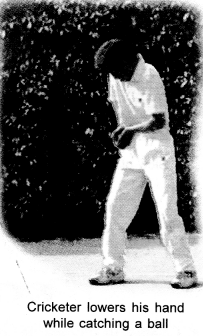
A cricket player lowers his hands while catching a fast moving ball. Explain. Why ?
(CBSE 2011, 2012, 2013)
Answer:
A cricket player lowers his hands while catching the ball.
F = dp/dt
If a player does not lower his hands while catching the ball, the time to stop the ball is very small. So a large force has to be applied to reduce the velocity of the ball to zero or to change the momentum of the ball. When a player lowers his hands, the time to stop the ball is increased and hence less force has to be applied to cause the same change in the momentum of the ball. Therefore, the hands of the player are not injured.
Force and Laws of Motion Class 9 Important Questions Science Chapter 9 image - 9

Question 26.
Explain, how can we walk easily on a hard and rough surface than on a slippery surface ?
Answer:
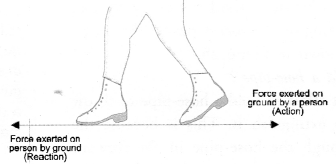
Walking of a person. When a person walks on the ground, he pushes the ground with his foot in the backward direction by pressing the ground. This push is known as action. According to Newtons third law of motion, an equal and opposite reaction acts on the foot of the person by the ground. This reaction (force) of the ground on the person pushes him forward (figure 21).
Thus, Action = force exerted on the ground by a person through his foot.
Force and Laws of Motion Class 9 Important Questions Science Chapter 9 image - 10

Question 27.
Two similar buses are moving with same velocity on the road. One of them is empty and the other is loaded with passengers. Which of the two will be stopped by the application of less force ? Explain.
(CBSE 2010, 2011, 2013)
Answer:
Momentum = m v. Loaded bus has greater mass than the empty bus. So loaded bus has greater momentum than the empty bus. The rate of change momentum is directly proportional to the force applied. Therefore, the empty bus will be stopped by applying less force.

Question 28.
A bullet fired from a gun is more dangerous than an air molecule hitting a person, though both bullet and air molecule are moving with same velocity. Explain.
Answer:
The momentum of a bullet is very large than the momentum of the air molecule as the mass of bullet is very large than that of air molecule. When bullet and air molecule hit a person, then the momentum transferred to person by a bullet is very large than the momentum transferred by the air molecule. Hence, large force is exerted on the person by the bullet.

Question 29.
When a force acts on an object, it accelerates ? What do you observe, when two equal and opposite forces act on an object ? (CBSE 2011)
Answer:
When two equal and opposite forces act on an object, then the net force acting on it is zero. Therefore, the object will remain at rest if it were at rest before the application of two equal and opposite forces. However, the object will continue to move with constant velocity if it were moving with constant velocity before the application of the forces.

Question 30.
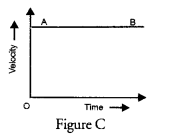
Draw velocity-time graph of a moving particle on which net external force acting is zero.
Answer:
Net external force = zero. It means, acceleration (a = F/m) of the particle is zero.
Force and Laws of Motion Class 9 Important Questions Science Chapter 9 image - 11
In other words, particle is moving with constant velocity. Velocity-time graph of such a particle is represented by a curve AB parallel to time-axis (Figure C)

Question 31.
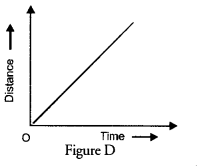
Draw distance-time graph of a moving object on which net external force acting is zero.
Answer:
Net external force = zero. It means, acceleration (a = F/m) of the particle is zero.
Force and Laws of Motion Class 9 Important Questions Science Chapter 9 image - 12
In other words, the object is moving with constant velocity. Therefore, the particle travels equal distances in equal intervals of time. Distance time graph of such an object is shown in figure D.

Question 32.
Glass wares are wrapped in straw during their transportation. Give reason.
(CBSE 2012)
Answer:
During transportation, the glass wares may break if they collide with each other in the event of jerks. When they are wrapped in straw, the force of jerk is transmitted to them through the pieces of straw in a longer period of time. Thus, the change in momentum of the glass wares takes place in a longer period of time. Therefore, a very small force is experienced by them in the event of jerks and hence they do not break.

Question 33.
When two bodies X and Y collide with each other, X exerts a force of 5 N on Y towards east direction. What
is the force exerted by Y on X ? Justify your answer stating the law. (CBSE 2012)
Answer:
Force exterted by Y on X = 5 N towards west direction as per Newton’s third law of motion.

Question 34.
Explain, how a Karate player can break a pile of tiles with a single blow of his hand. (CBSE 2012)
Answer:
A Karate player strikes the pile of tiles very fast so that change in the momentum of his hand takes place in
very small time interval. Hence, a very large force (F = dp/dt) is exerted on the pile of tiles, which is enough to break the pile of tiles.

Question 35.
Why a glass pane of a window is shattered when a flying pebble hits it ? (CBSE 2012)
Answer:
When a flying pebble hits the glass pane, its contact time with glass pane is large. During this large interval of time, it imparts its momentum to the entire glass pane, which in turn shattered.

Question 36.
A truck of mass M is moved under a force F. If the truck is loaded with an object equal to the mass of the truck and the driving force is halved, then how does the acceleration change ?
Answer:
Acceleration, a = F/m. When m is doubled and F is made half, acceleration becomes ¼ th of its initial value.

Question 37.
Why are road accidents at high speed very much worsen than accidents at low speeds ?
Answer:
When accidents at high speed occur, then large momentum is to be changed in small interval of time. Hence, large force is exerted on vehicles and they get damaged very badly as compared to when accidents occur at low speed.

Question 38.
Name the physical quanity whose unit is

  1. kg m s-2 and
  2. kg m s-1

Answer:

  1. Force,
  2. Linear momentum

Question 39.
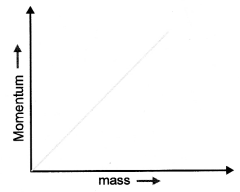
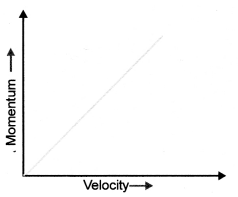
Represent the following graphically :
(a) momentum versus mass, when velocity is constant
(b) momentum versus velocity, when mass is constant.
Answer:
(a)
Force and Laws of Motion Class 9 Important Questions Science Chapter 9 image - 13
(b)
Force and Laws of Motion Class 9 Important Questions Science Chapter 9 image - 14.

Question 40.
Describe in brief an activity to illustrate the properly of inertia of rest.
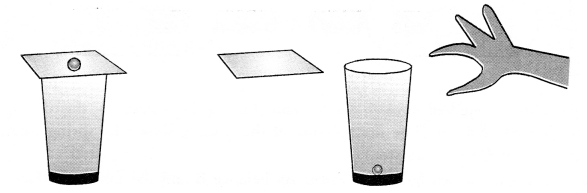
Answer:

  1. Describe an activity to demonstrate the property of inertia of rest of an object.
  2. Now place a fifty paisa coin on the card board.
  3. Strike the card board with a finger.

It is found that card board flies away and the coin falls into the glass. This is because, card board moves away due to the application of force of finger. However, coin remains at its position due to inertia of rest and hence falls into the glass.
This activity demonstrates the property of inertia of rest of an object. It is based on Newton’s first law of motion.
Force and Laws of Motion Class 9 Important Questions Science Chapter 9 image - 15

Question 41.
In the figure below, the card is flicked with a push.
Force and Laws of Motion Class 9 Important Questions Science Chapter 9 image - 16
(a) What do you observe in above case and why ?
(b) State the law involved in this case.
(c) What will be your observation if the above coin is replaced by a heavy five rupee coin. Justify your answer.
Answer:
(a) The coin falls into the glass. The card comes in motion due to push but coin on the card remains at rest. The coin falls into the glass due to inertia of rest.
(b) Law of inertia or First law of motion.
(c) Heavy coin will also fall into the glass. The heavy coin has more inertia than the lighter coin.

Question 42.
State Newton’s Third law of motion. Are the forces mentioned in the law balanced forces ? Why ? Will they always produce accelerations of equal magnitude ? Why ?
Answer:
For every action, there is equal and opposite reaction. Forces are not balanced forces because both the forces act on two different bodies. They do not produce the same acceleration because acceleration = ~~. Since masses (m) of both the bodies are different, so accelerations of both the bodies are different.

Question 43.
When a person hits a stone, his foot is injured. Why ? (CBSE 2011)
Answer:
When a person hits a stone, the stone exerts equal force on his foot. Due to this force, his foot gets injured.

Question 44.
According to Newton’s third law of motion, a ball falling towards earth exerts a force on the earth but the motion of earth towards the ball is not noticed. Explain why ?
Answer:
The acceleration produced in the earth is very small as its mass is very large. Hence, the motion of the earth towards ball is not noticed.

Question 45.
How a man can swim in water ?

Or

A swimmer is able to swim in a forward direction in a swimming pool only when he is pushing the water in the backward direction. Give reason for the above mentioned statement and justify the same. (CBSE 2013)
Answer:
When a swimmer pushes water in the backward direction with his hands, equal and opposite reaction by water on the man pushes him in the forward direction.

Question 46.
When a person jumps out of a boat, the boat moves backward. Explain, why ? (CBSE 2011, 2012)
Answer:
When a person jumps out of a boat, he pushes the boat in the backward direction (Action). According to Newtons third law of motion, the boat exerts an equal force (i.e. reaction) on the person in the forward direction. So, when the person jumps out of the boat, the boat moves backward (Figure 23). Thus, Action = force applied by the person on the boat through his foot. Reaction = force exerted on the person by the boat.
Force and Laws of Motion Class 9 Important Questions Science Chapter 9 image - 17

Question 47.
Why a boatman pushes the bank of the river with a pole to take his boat into the river ?
Answer:
A boatman pushes the river bank with a bamboo pole to take his boat into the river.
When the boatman pushes the river bank with a bamboo pole, the river bank offers an equal and opposite reaction. This reaction helps the boat to move into the river. In this case, action = force applied on the ground with a bamboo pole, and reaction = force exerted by the ground on the boat.
Force and Laws of Motion Class 9 Important Questions Science Chapter 9 image - 18

Question 48.
“Action and reaction are equal and opposite but even then they do not cancel each other.” Explain, why ?
(CBSE 2011)

Or

Why don’t, the forces of action and reaction cancel each other ? (CBSE 2013)
Answer:
Two equal and opposite forces can cancel each other if they act on the same body. But action and reaction do not act on the same body. Action acts on one body and the reaction acts on another body. Hence they cannot cancel each other.

Question 49.
Look at the diagram and answer the following questions :
Force and Laws of Motion Class 9 Important Questions Science Chapter 9 image - 19
(a) When a force is applied through the free end of the spring balance A, the reading on the spring balance A is 15 g wt. What will be the measure of the reading shown by spring balance B ?
(b) Write reasons for your answer.
(c) Name the force which balance A exerts on balance B and the force of balance B on balance A.
Answer:
(a) Reading shown by spring balance is 15 g wt.
(b) Every action has equal and opposite reaction.
(c) Force which balance A exerts on balance B is action. Force of balance B on balance A is reaction.

Question 50.
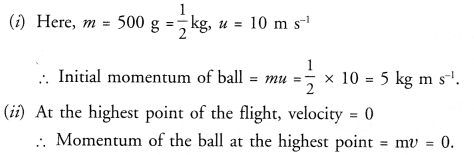
A man throws a ball weighing 500 g vertically upwards with a speed of 10 m s-1
(i) Find its initial momentum
(ii) Find its momentum at the highest point of its flight.
Answer:
Force and Laws of Motion Class 9 Important Questions Science Chapter 9 image - 20

Question 51.
A person is hit harder, when he falls on a hard floor than when he falls on the heap of sand or cotton. State the reason. (CBSE 2015)
Answer:
According to Newton’s second law of motion,
Force and Laws of Motion Class 9 Important Questions Science Chapter 9 image - 21
When a person falls on a hard floor, his change in momentum occurs in small interval of time because he comes to rest abruptly. Hence, a large force is exerted on the person by the floor. On the other hand, when the person falls on a heap of sand or cotton, the sand or cotton yields under his weight. Therefore, the change in momentum of the person occurs in a large interval of time. Hence, less force is exerted on the person by the heap of sand or cotton.

Question 52.
Mention any two examples which can be explained on the basis of Third law of motion.
Answer:

  1. Walking of a person on a road,
  2. Recoil of a gun.

Based on the law of conservation of momentum

Question 53.
Why does a gun recoil backward when a bullet is fired from it ?

Or

Firing a bullet from a gun, results in recoil of gun. Give reason. (CBSE 2011)
Answer:
A gun recoils, when a bullet is fired from it to conserve the linear momentum of the gun and the bullet.

Question 54.
A gun recoils backward with small speed than the bullet moving forward. Explain why ?
Answer:
Recoil speed of gun is inversely proportional to the mass of the gun. Mass of gun is much greater than the mass of bullet. Therefore, gun recoils backward with small speed than the bullet moving forward.

Question 55.
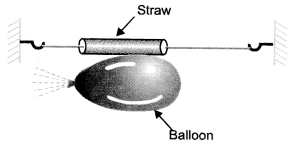
Explain, why an inflated balloon lying on the surface of a floor moves forward when pierced with a needle.
Answer:
When balloon is pierced with a needle, air inside the balloon rushes out with certain momentum. Therefore, the balloon moves in the opposite direction to conserve the linear momentum of the balloon.

Question 56.
When a bullet is fired, it exerts an equal and opposite force on the gun, yet hurt caused by the recoil of the
gun is much less than that by a bullet ? Give reason. (CBSE 2012)
Answer:
Recoil velocity of gun is much less than the velocity of bullet. Therefore, momentum imparted by gun is very small and hence it hurts less than that of the bullet.

Question 57.
Mention two examples from your daily life which can be explained on the basis of law of conservation of momentum. (CBSE 2013)
Answer:

  1. Recoil of a gun,
  2. Rocket propulsion.

Question 58.
Two friends on roller skates are standing 5m apart facing each other. One of them throws a ball of 2 kg towards the other, who catches it ? How will this activity affect the positions of the two ? Explain.
Answer:
Total initial linear momentum of the two friends is zero as both are at rest. When one person throws the ball towards the other and the other catches it, then the total linear momentum of both will have to be zero as no external force acts on them. Thus both friends must move in opposite direction. Hence, the distance between both friends will increase.

Question 59.
Observe the following diagram and answer the questions given below :
Force and Laws of Motion Class 9 Important Questions Science Chapter 9 image - 22
Which direction does the balloon move when the thread tied to its neck is removed and why ?
State the conclusion drawn from this activity.
Answer:
When the thread tied to its neck is removed, air inside the balloon rushes to the left side and the balloon moves to right side to conserve linear momentum.
Law of conservation of linear momentum is verified.

Question 60.
A gunman gets jerk in backward direction while firing a gun. State the reason. (CBSE 2015)
Answer:
The gun recoils backward to conserve the momentum of the system (gun + bullet). The backward motion of the gun exerts a force on the gunman and hence he gets a jerk in the backward direction.

LONG ANSWER QUESTIONS

Question 1.
State Newtons second law of motion. Use this law to find the method to measure force acting on an object.
(CBSE 2010, 2011)

Or

From Newton’s second law of motion, obtain a mathematical expression for force. (CBSE 2013)
Answer:
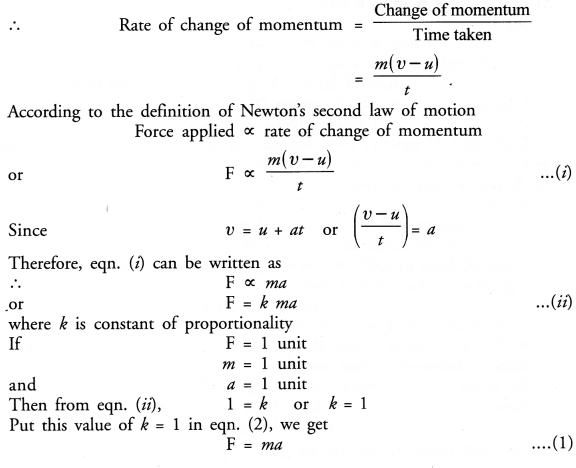
According to this law, the change in momentum of a body per unit time (i.e. rate of change of momentum) is directly proportional to the unbalanced force acting on the body and the change in momentum takes place in the direction of the unbalanced force on the body.
F ∞ dp/dt
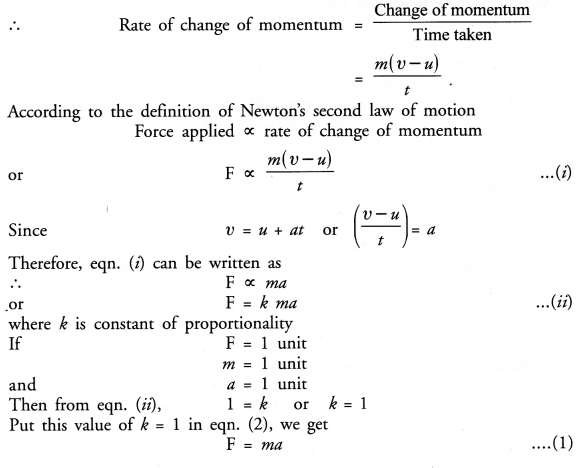
Consider a body of mass moving with initial velocity Let a force acts on the body for time so that the velocity of the body after time is .
Initial momentum of the body, pi = mu
Final momentum of the body, pf = mv
Now, change in momentum of the body = pf – p= mv – mu = m(v-u)
Force and Laws of Motion Class 9 Important Questions Science Chapter 9 image - 23
Thus, force acting on the body is directly proportional to (i) its mass (m) and (ii) its acceleration (a).
Eqn. (1) gives the mathematical form of Newtons second law of motion. The force given by eqn (1) acts on the body.
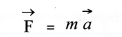
Newton’s second law of motion in vector form     
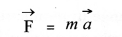
We know, force ( F ) and acceleration ( a ) are vector quantities, whereas mass ( m)  is a scalar quantity. Therefore, Newton’s second law of motion can be written in vector form as
Force and Laws of Motion Class 9 Important Questions Science Chapter 9 image - 24
This relation shows that the direction of force applied on the body is same as that of the acceleration produced in the body.

Question 2.
Define momentum of a body. Prove with the help of third law of motion that the total momentum of two bodies is conserved during collision provided no external force acts. (CBSE Sample Paper)
Answer:
According to the law of conservation of momentum, the total momentum of a system (or an object) remains constant if no net external unbalanced force acts on the system.
That is, momentum of a system, p = constant, if net external force acting on it is zero (i.e. F = 0).
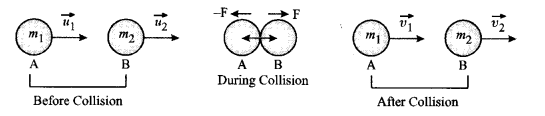
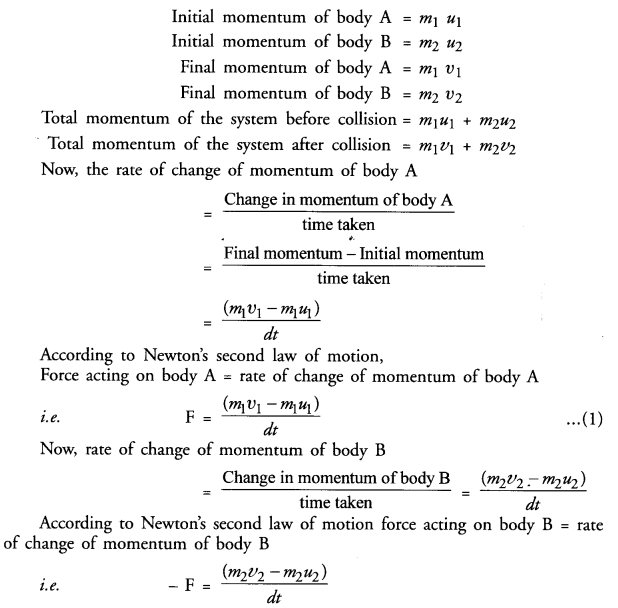
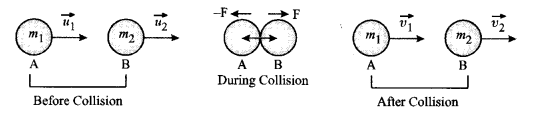
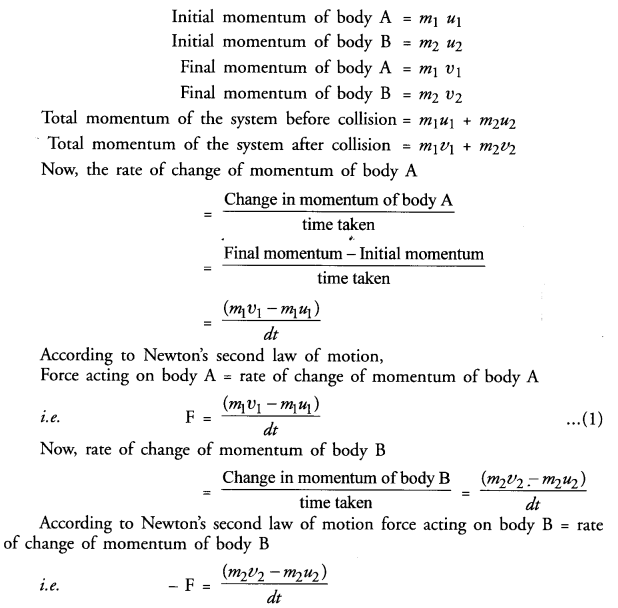
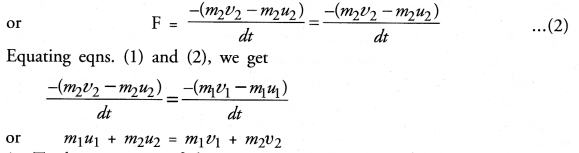
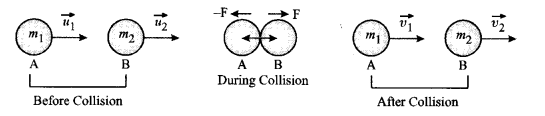
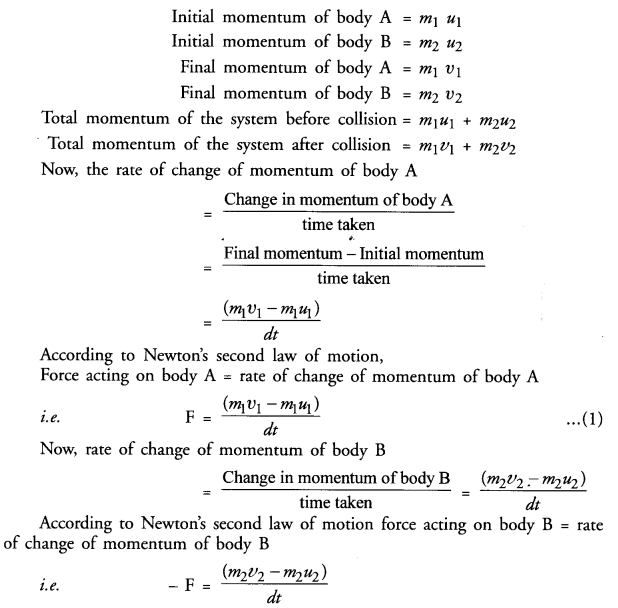
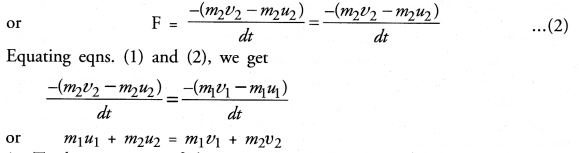
Consider a system consisting of two bodies A and B of (say glass spheres) masses m1 and m2 respectively. Let these bodies are moving with velocities uand u2 as shown in figure 26. Let u1 > u2 Let these bodies collide with each other for a small interval of time ‘dt’. At the time of collision, body A exerts a force F on body B and body B exerts equal and opposite force (- F) on body A. Due to these forces, the momentum of the bodies changes. Let v1 and v2 be the velocities of body A and body B respectively after the collision.
Force and Laws of Motion Class 9 Important Questions Science Chapter 9 image - 25
Force and Laws of Motion Class 9 Important Questions Science Chapter 9 image - 26
Force and Laws of Motion Class 9 Important Questions Science Chapter 9 image - 27
i.e. Total momentum of the system (i.e. bodies A and B) before collision = Total momentum of the system (i.e. bodies A and B) after collision. This is the law of conservation of linear momentum.

Question 3.
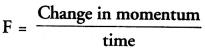
From Newton’s second law of motion,
Force and Laws of Motion Class 9 Important Questions Science Chapter 9 image - 28
From this establish F = ma, where m is mass and a is acceleration. (CBSE 2011)
Answer:
Consider a body of mass moving with initial velocity Let a force acts on the body for time so that the velocity of the body after time is .
Initial momentum of the body, pi = mu
Final momentum of the body, pf = mv
Now, change in momentum of the body = pf — p= mv – mu = m(v-u)
Force and Laws of Motion Class 9 Important Questions Science Chapter 9 image - 29
Thus, force acting on the body is directly proportional to (i) its mass (m) and (ii) its acceleration (a).
Eqn. (1) gives the mathematical form of Newtons second law of motion. The force given by eqn (1) acts on the body.
Newton’s second law of motion in vector form     
We know, force ( F ) and acceleration ( a ) are vector quantities, whereas mass ( m)  is a scalar quantity. Therefore, Newton’s second law of motion can be written in vector form as
Force and Laws of Motion Class 9 Important Questions Science Chapter 9 image - 30
This relation shows that the direction of force applied on the body is same as that of the acceleration produced in the body.

Question 4.
Derive the law of conservation of linear momentum.

Or

Total momentum of two bodies remains unchanged before and after the collision. Justify this statement.
(CBSE 2015)
Answer:
Let a moving ball collides with another stationary ball lying on a ground. Observe, what happens after collision. The moving ball will slow down i.e. its velocity decreases after colliding with the stationary ball. On the other hand, the stationary ball begins to move i.e. its velocity increases after collision.
Consider a system consisting of two bodies A and B of (say glass spheres) masses m1 and m2 respectively. Let these bodies are moving with velocities uand u2 as shown in figure 26. Let u1 > u2 Let these bodies collide with each other for a small interval of time ‘dt’. At the time of collision, body A exerts a force F on body B and body B exerts equal and opposite force (- F) on body A. Due to these forces, the momentum of the bodies changes. Let v1 and v2 be the velocities of body A and body B respectively after the collision.
Force and Laws of Motion Class 9 Important Questions Science Chapter 9 image - 31
Force and Laws of Motion Class 9 Important Questions Science Chapter 9 image - 32
Force and Laws of Motion Class 9 Important Questions Science Chapter 9 image - 33
i.e. Total momentum of the system (i.e. bodies A and B) before collision = Total momentum of the system (i.e. bodies A and B) after collision. This is the law of conservation of linear momentum.

Question 5.
State and verify law of conservation of momentum. (CBSE 2013)
Answer:
Consider a system consisting of two bodies A and B of (say glass spheres) masses m1 and m2 respectively. Let these bodies are moving with velocities uand u2 as shown in figure 26. Let u1 > u2 Let these bodies collide with each other for a small interval of time ‘dt’. At the time of collision, body A exerts a force F on body B and body B exerts equal and opposite force (- F) on body A. Due to these forces, the momentum of the bodies changes. Let v1 and v2 be the velocities of body A and body B respectively after the collision.
Force and Laws of Motion Class 9 Important Questions Science Chapter 9 image - 34
Force and Laws of Motion Class 9 Important Questions Science Chapter 9 image - 35
Force and Laws of Motion Class 9 Important Questions Science Chapter 9 image - 36
i.e. Total momentum of the system (i.e. bodies A and B) before collision = Total momentum of the system (i.e. bodies A and B) after collision. This is the law of conservation of linear momentum.

Hope given Previous Year Question Papers for CBSE Class 9 Science Chapter 9 Force and Laws of Motion are helpful to complete your science homework.

If you have any doubts, please comment below. Learn Insta try to provide online science tutoring for you.

Work, Power and Energy Class 9 Important Questions Science Chapter 11

Chapter 11 Work, Power and Energy Class 9 Science Important Questions with Answers PDF will help you in scoring more marks in your exams.

Work, Power and Energy Class 9 Important Questions and Answers Science Chapter 11

VERY SHORT ANSWER QUESTIONS

Based on work done

Question 1.
Define the term ‘work done’. (CBSE 2011, 2012, 2015)
Answer:
Definition: Work is said to be done by a force on a body or an object if the force applied causes a displacement in the body or the object.

More Resources

Question 2.
How much work is done by a man who tries to push the wall of a house but fails to do so.
(Similar CBSE 2011, 2013)
Answer:
W = FS = 0 (∴ S = 0)

Question 3.
A body of mass 2 kg is moving in a circular path of radius 2m. How much work is done on the body ?
(CBSE 2011)
Answer:
Zero. This is because centripetal force acting on the body is perpendicular to the displacement of the body (W = FS cos 90° = 0).

Question 4.
What would be the amount of work done on an object by a force, if the displacement of the object is zero ?
Answer:
W = FS = 0 (∴ S = 0)

Question 5.
What is the work done by the earth in moving around the sun ? (CBSE 2011)
Answer:
Zero.

Question 6.
When is work done by a force negative ? (CBSE 2011, 2012, 2014)
Answer:
Work done by a force is negative, when the displacement of the body is in the direction opposite to the direction of the force.

Question 7.
When is work done by a force positive ? (CBSE 2012)
Answer:
Work done by a force is positive, when the displacement of the body is in the direction of the force.

Question 8.
When is work done by a force zero ? (CBSE 2011)
Answer:
Work done by a force is zero, when body is not displaced from its position by the force or when force acting on the body is perpendicular to the direction of the displacement of the body.

Question 9.
Write two conditions under which work is said to be done. (CBSE 2011, 2012)
Answer:

  1. Force must act on the body and
  2. the body must be displaced from its position either in the direction of applied force or in a direction opposite to the direction of the applied force.

Question 10.
What is SI unit of work ? (CBSE 2015)
Answer:
S.I. unit of work is joule (J).

Question 11.
Write the expression for a work done by a force F acting on an object at an angle θ with the displacement S of the object.
Answer:
W = FS cos θ.

Question 12.
What should be the angle between force and displacement for maximum work ? (CBSE 2013)
Answer:
W = FS cos θ. Work will be maximum if cos θ = 1 or θ = 0°.

Question 13.
Does the work done depend upon how fast an object is raised ? Explain. (CBSE 2013)
Answer:
Work done depends on the force applied and distance travelled by an object. It does not depend on how
fast an object is raised.

Based on energy (Kinetic energy and Potential energy)

Question 14.
Define the “energy”.
Answer:
The capacity of doing work by an object is known as the energy of the object.

Question 15.
What is SI unit of energy ?
Answer:
S.I. unit of energy is joule (J).

Question 16.
Define mechanical energy.

                Or

Name two forms of mechanical energy.
Answer:
Mechanical energy is the sum of Kinetic energy and potential energy.

Question 17.
Define Kinetic energy.
Answer:
The energy possessed by a body by virtue of its motion is called kinetic energy..

Question 18.
What is SI unit of kinetic energy ? Define it.
Answer:
joule (J). Kinetic energy is said to be 1 J if a body of mass 1 kg moves with a speed of 1 ms-1.

Question 19.
What type of energy is possessed by a cricket ball just before being caught by a fielder ?
Answer:
Kinetic energy.

Question 20.
What type of energy is possessed by a flowing water ?
Answer:
Kinetic energy.

Question 21.
Identify the energy possessed by a rolling stone. (CBSE 2011)
Answer:
Kinetic energy.

Question 22.
Identify the kind of energy possessed by a running athlete. (CBSE 2011)
Answer:
Kinetic energy.

Question 23.
A car and a truck are moving with the same velocity of 60 km/hr. Which one has move kinetic energy ?
(Mass of truck > mass of car). (CBSE 2011)
Answer:
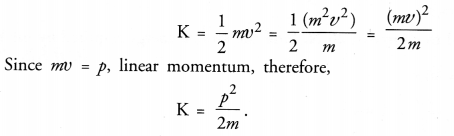
K.E = 1/2 mv2. Since mass of truck is greater than the mass of car and both have same velocity, therefore, K.E. of track > K.E. of car.

Question 24.
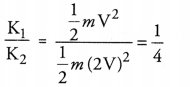
What will be the kinetic energy of a body when its mass is made four times and the velocity is doubled ?
(CBSE 2011)
Answer:
Work, Power and Energy Class 9 Important Questions Science Chapter 11 image - 1

Question 25.
If we lift a body of mass 7 kg vertically upwards 10 m, then calculate the force required to lift the body
(g = 10 ms-2). (CBSE 2011)
Answer:
Force = mg = 7 x 10 = 70 N.

Question 26.
Define potential energy of an object.
(CBSE Sample Paper 2010, CBSE 2011, 2012, 2014, 2016, 2017)
Answer:
The energy possessed by an object by virtue of its position or shape is known as potential energy.

Question 27.
Give an example of body having potential energy due to change of shape. (CBSE 2011)
Answer:
Spring of a watch or stretched bow and arrow.

Question 28.
Name the type of energy possessed by a raised hammer. (CBSE 2011)
Answer:
Potential energy.

Question 29.
State SI unit of potential energy. (CBSE Sample Paper 2010, CBSE 2011, 2014, 2016)
Answer:
joule (J)

Question 30.
Give an example of an object having elastic potential energy. (CBSE 2011)
Answer:
A stretched spring or a compressed spring has elastic potential energy.

Question 31.
In what form, energy is stored in a wrist watch ?
Answer:
Potential energy.

Based on transformation of energy

Question 32.
A torch cell converts one form of energy into another form. Name these two forms of energy.
(CBSE 2011)
Answer:
Chemical energy is converted into electric energy.

Question 33.
A log of wood cut by a saw becomes hot. From where this heat energy comes ?
Answer:
Mechanical energy is converted into heat energy.

Question 34.
When we switch on the electric bulbs, one form of energy is converted into another form. Name these forms of energy. (CBSE 2011)
Answer:
Electrical energy is converted into light and heat energy.

Question 35.
When a ball is thrown vertically upwards, its velocity goes on decreasing. What happens to its potential energy as its velocity becomes zero ? (CBSE 2011)
Answer:
Potential energy of the ball goes on increasing when its kinetic energy decreases. Potential energy becomes maximum and equal to initial kinetic energy when the velocity of the ball becomes zero (provided there is no air resistance).

Question 36.
Write the observed energy transformation that takes place at thermal power station. (CBSE 2011)
Answer:
Chemical energy into heat energy and then to electrical energy.

Question 37.
State the transformation of energy taking place when

  1. Green plants prepare their food
  2. Head of a nail is hammered hard and it becomes hot. (CBSE 2011)

Answer:

  1. Solar energy + Green leaves —> Food (chemical energy)
  2. Kinetic energy of hammer is convered into the heat energy (i.e. K.E. —> Heat energy)

Based on conservation of energy

Question 38.
State the law of conservation of energy. (CBSE 2011, 2012)
Answer:
Energy can neither be created nor be destroyed but can be changed from one form into another form.

Based on power and commercial unit of energy

Question 39.
State the physical quantity which will be affected by changing the rate of doing work. (CBSE 2013)
Answer:
Power ( = rate of doing work).

Question 40.
Establish a relationship between SI unit and commercial unit of energy.
                                             Or

Derive the relation between the commercial unit of energy and joules.
Answer:
SI unit of energy is joule and commençai unit of energy is kWh.
Work, Power and Energy Class 9 Important Questions Science Chapter 11 image - 2

Question 41.
Name the commercial unit of electric energy.
Answer:
The commercial unit of electric energy is kilowatt hour (kWh).

Question 42.
State the relation between commercial unit of energy and joule.

                                    Or

How many joules make one kilowatt hour ?
Answer:
Commercial unit of energy is kWh. 1 kWh = 3.6 x 10⁶ J.

SHORT ANSWER QUESTIONS

Based on work done

Question 1.
Distinguish between positive and negative work. When you lift an object, two forces act on it. Identify these forces. Which one of the two does,

  1. positive work
  2. negative work ? Justify your answer. (CBSE 2012)

Answer:
Work is said be positive if the body is displaced in the direction of the applied force. Work is said to be negative if the body is displaced in a direction opposite to the direction of applied force.
When we lift an object, the forces acting on the object are

  1. force of gravity and
  2. muscular force.

Force of gravity does negative work as force of gravity acts downwards and the object is displaced upwards. Muscular force does positive work as the object is displaced in the direction of the applied muscular force.

Question 2.
A boy throws a rubber ball vertically upwards. What kind of work is done;

  1. by the force applied by the boy,
  2. by the gravitational force. Support your answer with reason. (CBSE 2011, 2013)

Answer:

  1. Work done by the force applied by the boy is positive as both the applied force and the displacement of the ball are in the same direction.
  2. Work done by gravitational force is negative as the force and the displacement of the ball are in opposite direction.

Question 3.
A coolie holding a heavy box is waiting for someone at the bus stand for 15 minutes. How much work has been done by him ? (Similar CBSE 2011)

                                                                                   Or

A person holds a suitcase for 30 minutes and gets tired. Has he done some work or not ? Justify your answer.
(CBSE 2012)
Answer:
Since coolie is applying force on the heavy box to hold it but there is no displacement of the box (i.e. S = 0), therefore, work done by him is zero (∴ W = FS cos θ = 0).

Question 4.
Work done by a coolie on the luggage on his head while carrying it on horizontal road. (CBSE 2013)
Answer:
The force of gravity acting on the box acts vertically downward and the displacement is in the horizontal direction, so θ = 90°. Hence, W = FS cos θ = FS cos 90° = 0

Question 5.
In a tug of war, one team wins and the other team loses. Which team does positive work and which one does negative work ? Justify your answer. (CBSE 2011)
Answer:
Winning team does positive work on the rope because the force applied by the team on the rope acts in the direction of the displacement of the rope. On the other hand, losing team does negative work as the force applied by the team on the rope acts in the direction opposite to the direction of the displacement of the rope.

Based on Kinetic and potential energies

Question 6.
Establish the relationship between kinetic energy and momentum of body. (CBSE 2012)
Answer:
Relationship between kinetic energy and momentum of body
Work, Power and Energy Class 9 Important Questions Science Chapter 11 image - 3

Question 7.
Which would have greater effect on the kinetic energy of an object-doubling the mass or doubling the velocity ? (CBSE 2011
Answer:
K.E. = 1/2 mv2 . When mass is doubled, K.E. becomes 2 times its initial value. When velocity is doubled,
K.E. becomes 4 times its initial value. Thus, doubling the velocity would have greater effect on the kinetic energy than doubling the mass.

Question 8.
A bus and a car have same kinetic energy. Which of the two is moving fast ? Explain. (CBSE 2011)
Answer:
Work, Power and Energy Class 9 Important Questions Science Chapter 11 image - 4

Question 9.
Is it possible that an object is in the state of accelerated motion due to external force acting on it, but no work is being done by the force. Explain it with an example. (NCERT Question Bank, CBSE 2012)
Answer:
Work, Power and Energy Class 9 Important Questions Science Chapter 11 image - 5
When an object has uniform circular motion, the speed of the object remains the same i.e. v = u. Hence, work done by the force = zero.

Question 10.
The velocity of a body moving in a straight line is increased by applying a constant force F, for some distance in the direction of the motion. Prove that the increase in the kinetic energy of the body is equal to the work done by the force on the body. (CBSE 2011)
Answer:
Consider a body or an object of mass m moving with velocity u. Let a force F be applied on the body so that the velocity attained by the body after travelling a distance S is v (Figure 5).
Work, Power and Energy Class 9 Important Questions Science Chapter 11 image - 6
Work done by the force on the body is given by
W =      FS                                                                               …(i)
Since velocity of the body changes so the body is accelerated. Let a be the acceleration of the body. Therefore, according to Newton’s second law of motion,
F =     ma                                                                             …(ii)
Using eqn. (ii) in eqn. (i), we get
Work, Power and Energy Class 9 Important Questions Science Chapter 11 image - 7
Thus, work done by a force on a body is equal to the change in kinetic energy of the body This is known as work-energy theorem.

Question 11.
Two bodies of same mass start from rest and move with velocities of V and 2V respectively. Find the ratio of their kinetic energies. (CBSE 2012)
Answer:
Work, Power and Energy Class 9 Important Questions Science Chapter 11 image - 8

Question 12.
Two bodies of masses my and m2 have equal kinetic energies. What is the ratio of their linear momenta ?
(CBSE 2012)

                                                                  Or

Two balls have different masses but same kinetic energy. Which has the greater momentum ? Justify.
(CBSE 2013)
Answer:
Work, Power and Energy Class 9 Important Questions Science Chapter 11 image - 9
Thus, momentum of the ball of large mass is more.

Question 13.
Derive an expression for the potential energy of an object of mass m that has been raised to a height ‘h’ from the ground. (CBSE 2011, 2014, 2016)

                                                              Or

Derive an expression for potential energy.
Answer:
The potential energy stored in an object due to its vertical position with respect to the surface of the earth is called gravitational potential energy.
Gravitational potential energy of an object at a height h above the surface of earth is equal to the work done in raising the object through a height h against the gravitational force or gravity.
Consider an object of mass m raised to a height h against gravity (Figure 7).
Work, Power and Energy Class 9 Important Questions Science Chapter 11 image - 10
Minimum force required to lift the object, F = weight of body = mg
Distance travelled by the object, S = h
∴                        Work done, W = F x S = mgh
This work done against force of gravity is equal to the potential energy or gravitational potential energy of the object. i. e., P.E. = mgh
Thus, gravitational potential energy of an object depends upon

  1. the weight (mg) of the object and
  2. the height (h) of the object from the surface of the earth.
    SI Unit of potential energy is joule (J).

Question 14.
An object is dropped from a height h when is its

  1. Potential energy maximum,
  2. Kinetic energy maximum. (CBSE 2011)

Answer:

  1. Potential energy of the object is maximum, when it is at heigh h.
  2. Kinetic energy of the object is maximum, when it just touches the ground.

Based on transformation of energy

Question 15.
The head of a nail becomes warm when it is hammered into a plank of wood. Explain stating the scries of energy transformations taking place. (CBSE 2011)
Answer:
The potential energy of a raised hammer is converted into the kinetic energy when hammer falls down. Then this kinetic energy of the falling hammer is converted^hto heat energy when it strikes the head of a nail. Therefore, the head of the nail becomes warm.

Question 16.
Name the devices which

  1. convert chemical energy into electrical energy and
  2. light energy into electrical energy.

Answer:

  1. A thermal power plant
  2. A photocell.

Question 17.
Name the appliances which work under the following energy transformation.

  1. Sound energy into electrical energy.
  2. Heat energy into mechanical energy. (CBSE 2011)

Answer:

  1. Microphone
  2. Heat engine.

                                                           Or

Name the appliances which work under the following energy’ transformation :

  1. Mechanical energy into electrical energy
  2. electrical energy into mechanical energy.

Answer:

  1. Electric generator
  2. Electric motor.

Question 18.
When a body falls freely, its potential energy is converted into kinetic energy. But when the freely falling body reaches the ground, it comes to rest. What happens to the kinetic energy of the body when it stops on reaching the ground ? (CBSE 2011)
Answer:
When a freely falling body stops on reaching the ground, sound is heard and the ground becomes hot, where the body strikes. So kinetic energy of a freely falling body is converted into sound energy and heat energy. Based on power and commercial unit of energy

Question 19.
A boy and a girl do the same work in 5 minutes and 10 minutes respectively. Which of these two has more power and why ?
Answer:
P = W/t. As the boy takes less time to do the same work as compared to the girl, so power of the boy will be more than that of the girl.

Question 20.
Give mathematical relation between power, force and velocity. (CBSE 2011)
Answer:
P = Fv.

Question 21.
Express Kilowatt in terms of joules per second. (CBSE 2012)
Answer:
1 kilowatt = 1000 W
Since 1 W = 1 J s-1
∴ 1 kilowatt = 1000 J s-1

Question 22.
Differentiate between kilowatt and kilowatt hour. (CBSE 2011, 2012, 2014)
Answer:
Kilowatt is the unit of power. 1 kilowatt = 1000 J s-1
Kilowatt hour is the unit of electric energy. 1 kilowatt hour = 3.6 x 10⁶ J

Question 23.
In a house 3 bulbs of 25 W each are used for 5 hours a day. Calculate the units of electricity consumed in a month of 31 days. Also, find the total expenditure if 1 unit of electricity costs Rs. 2.50. (CBSE 2014)
Answer:
Electric energy consumed by 3 bulbs in a day = power x time = 3x 25 x5 = 375 Wh
Electricity consumed in 31 days = 375 x 31 = 11625 Wh =11.625 kWh =11.625 units
Cost of electricity consumed = 11.625 x 2.50 = Rs. 29.06

LONG ANSWER QUESTIONS

Question 1.
Define the term “Work”. State the factors on which work done depends. Derive an expression for the work done by a force applied on an object at an angle 9 with the horizontal direction.

                                                                 Or

Define work. State two factors on which the magnitude of work depends. (CBSE 2011)
Answer:
In our daily life, the word work means any kind of mental and physical activity. For example, we say that we are doing work while

  1. reading a book.
  2. cooking a food.
  3. walking on a level road with a box on our head.
  4. pushing a wall of a house but fails to do so.

Factors on which work done depends Work done by a force depends upon :

  1. The magnitude of the applied force. If a small force is applied on a body, less amount of work is done. On the other hand, if a large force is applied on the body, more amount of work is done on the body.
    Thus,                     W ∝ F, where F is magnitude of applied force.
  2. The distance travelled by the body on the application of force ( i. e., displacement S). If a body travels large distance on the application of force, large amount of work is done. If a body travels a small distance on the application of force, small amount of work is done.
    Thus,                     W ∝ S.

Question 2.
(a) Define the term “energy”. Write the names of different forms of energy.
(b) Define kinetic energy. Derive an expression for the kinetic energy of an object of mass m moving with a velocity V. (CBSE 2011, 2017)
Answer:
(a) Definition of energy : The capacity of doing work by a body or an object is known as the energy of the body or the object.
Unit of Energy: Unit of energy is same as that of the unit of work. So, SI unit of work is joule (J). When we say that energy of a body is 1 joule, it means, this body has the capacity to do 1 joule work.
The various forms of energy are :

  1. Mechanical Energy: The sum of kinetic energy and potential energy of a body is known as mechanical energy.
  2. Heat or Thermal Energy: The energy possessed by a body due to its temperature is known as heat or thermal energy.
  3. Chemical Energy: The energy released in chemical reactions is known as chemical energy.
  4. Sound Energy: The energy of a vibrating body producing sound is known as sound energy.
  5. Electrical Energy: The energy of moving electrons in a conductor connected with a battery is known as electrical energy.
  6. Nuclear Energy: The energy released when two nuclei of light elements combine with each other to form a heavy nucleus or when a heavy nucleus breaks into two light nuclei is known as nuclear energy.
  7. Solar Energy: The energy radiated by the sun is known as solar energy.

(b) Definition : The energy possessed by a body by virtue of its motion is known as kinetic energy. In other words, we can say that anything which moves has kinetic energy.
Consider a body of mass m lying at rest on a smooth floor. Let a force F be applied on the body so that the body attains a velocity v after travelling a distance S (Figure 4).
Work, Power and Energy Class 9 Important Questions Science Chapter 11 image - 11
Work done by the force on the body, W = FS                                                  …(i)
Since the velocity of the body changes from zero to v, so the body is accelerated. Let a be the acceleration of the body. Then according to Newton’s second law of motion.
F = ma
Substituting the value of F = ma in eqn.(î), we get
W = (ma)S
Work, Power and Energy Class 9 Important Questions Science Chapter 11 image - 12
K.E of a body is direcdy proportional to

  1. its mass and
  2. square of its speed. SI unit of kinetic energy is joule (J). Kinetic energy of a body is said to be 1 joule, if a body of 1 kg mass moves with a speed of 1 ms-2‘ Thus, 1 J = 1 kg m2s-2.

Question 3.
Define kinetic energy of an object. Show that work done by a force on an object is equal to the change in kinetic energy of the object. (CBSE 2011)
Answer:
Definition : The energy possessed by a body by virtue of its motion is known as kinetic energy. In other words, we can say that anything which moves has kinetic energy.
Consider a body or an object of mass m moving with velocity u. Let a force F be applied on the body so that the velocity attained by the body after travelling a distance S is v (Figure 5).
Work done by the force on the body is given by
W =      FS                                                                               …(i)
Since velocity of the body changes so the body is accelerated. Let a be the acceleration of the body. Therefore, according to Newton’s second law of motion,
F =     ma                                                                             …(ii)
Using eqn. (ii) in eqn. (i), we get
Thus, work done by a force on a body is equal to the change in kinetic energy of the body This is known as work-energy theorem.

Question 4.
State the law of conservation of energy. Show that the energy of a freely falling body is conserved.
(CBSE 2011, 2012)

                                                                  Or

State and prove the law of conservation of energy for a freely falling body. (CBSE 2012)
Answer:
According to this law, “energy can neither be created nor be destroyed, but can be changed from one form to another form. ”

                                                                Or

When one form ofenergji is changed or transformed into other forms of energy, the total energy of an isolated system remains the same i. e., the total energy before transformation = the sum of the different energies transformed.
Consider a body of mass m at a height h above the ground. Suppose this position of the body is A (Figure 11).
Work, Power and Energy Class 9 Important Questions Science Chapter 11 image - 13
Suppose the body at A is at rest i.e. v = 0.
At position A
Potential energy of the body, P.E. = mgh Kinetic energy of the body, K.E. = 0 Total energy (i.e., mechanical energy) of the body at A = P.E. + K.E. = mgh + 0 = mgh                                                       …(1)
Let the body falls freely under the action of gravity to position B through a height x. Now, the height of the body from the ground = (h-x)
At position B
Potential energy of the body, P.E. = mg (h – x)                                               ….(2)
Work, Power and Energy Class 9 Important Questions Science Chapter 11 image - 14
Total energy (i.e., mechanical energy) of the body at B= P.E. + K.E.
= mg (h – x) + mgx = mgh – mgx + mgx = mgh      …(5)
Finally, let the body touches the ground at C, so that the distance through which it falls = h.
At position C
Potential energy of body, P.E. = mg (0) = 0
Work, Power and Energy Class 9 Important Questions Science Chapter 11 image - 15
Total energy (i.e., mechanical energy) of the body at C = P.E. + K.E. = 0 + mgh = mgh      …(8)
From eqns. (1), (5) and (8), it is clear that the total energy (i.e., mechanical energy) of a body at any instant during free fall of the body remains constant. Hence, the law of conservation of energy is verified.

Question 5.
Show that when a body is dropped from a certain height, the sum of its kinetic and potential energy at any instant during its fall is constant. (CBSE 2011)
Answer:
Consider a body of mass m at a height h above the ground. Suppose this position of the body is A (Figure 11).
Work, Power and Energy Class 9 Important Questions Science Chapter 11 image - 16
Suppose the body at A is at rest i.e. v = 0.
At position A
Potential energy of the body, P.E. = mgh Kinetic energy of the body, K.E. = 0 Total energy (i.e., mechanical energy) of the body at A = P.E. + K.E. = mgh + 0 = mgh                                                       …(1)
Let the body falls freely under the action of gravity to position B through a height x. Now, the height of the body from the ground = (h-x)
At position B
Potential energy of the body, P.E. = mg (h – x)                                               ….(2)
Work, Power and Energy Class 9 Important Questions Science Chapter 11 image - 17
Total energy (i.e., mechanical energy) of the body at B= P.E. + K.E.
= mg (h – x) + mgx = mgh – mgx + mgx = mgh      …(5)
Finally, let the body touches the ground at C, so that the distance through which it falls = h.
At position C
Potential energy of body, P.E. = mg (0) = 0
Work, Power and Energy Class 9 Important Questions Science Chapter 11 image - 18
Total energy (i.e., mechanical energy) of the body at C = P.E. + K.E. = 0 + mgh = mgh      …(8)
From eqns. (1), (5) and (8), it is clear that the total energy (i.e., mechanical energy) of a body at any instant during free fall of the body remains constant. Hence, the law of conservation of energy is verified.

Hope given Previous Year Question Papers for CBSE Class 9 Science Chapter 11 Work, Power and Energy are helpful to complete your science homework.

If you have any doubts, please comment below. Learn Insta try to provide online science tutoring for you.

Improvement in Food Resources Class 9 Important Questions Science Chapter 15

Chapter 15 Improvement in Food Resources Class 9 Science Important Questions with Answers PDF will help you in scoring more marks in your exams.

Improvement in Food Resources Class 9 Important Questions and Answers Science Chapter 15

Very Short Answer Questions

Question 1.
From where do plants acquire the following nutrients— Nitrogen, Hydrogen. (CCE 2010)
Answer:
(a) Nitrogen. From soil (as nitrate, ammonia, urea)
(b) Hydrogen. From water.

More Resources

Question 2:
Give technical terms for milk producing females and farm labour animals. (CCE 2010)
Answer:
Milk Producing Females. Milch animals.
Farm Labour Animals. Draught animals.

Question 3.
Distinguish between a Mullet and Prawn.
(CCE 2010)
Answer:
Mullet is an edible fish while Prawn is an edible arthropod.

Question 4.
How does Catla differ from Mrigal ? (CCE 2010)
Answer:
Catla is a surface feeder that feeds on small animals. Mrigal is a bottom feeder that feeds on detritus and decaying vegetation.

Question 5.
State the reason for introducing Italian bee variety in bee farms. (CCE 2010)
Answer:
Italian Bee (Apis millifera) is high honey collecting gende bee with less swarming and with ability to protect itself from enemies.

Question 6.
How does Bombay Duck differ from Common Carp ?
(CCE 2010)
Answer:
Bombay Duck is a marine fish while common carp is a fresh water fish.

Question 7.
Name one micronutrient and one macronutrient which ( plants take from soil. (CCE 2010)
Answer:
Micronutrient: Iron/Zinc/Copper.
Macronutrient: Nitrogen/Phosphorus/Potassium.

Question 8.
How does Bos indicus differ from Bos bubalis ?
(CCE 2010)
Answer:
Bos indicus is cow while Bos bubalis is buffalo.

Question 9.
Name two vitamins which are added to poultry feed.
(CCE 2010)
Answer:
Vitamins A and K.

Question 10.
Why do we eat Pea and Groundnut ? (CCE 2010)
Answer:
They are rich in proteins. Groundnut is also rich in fat.

Question 11.
Name two breeds of cows selected for long lactation/ period. (CCE 2010)
Answer:
Jersey, Brown Swiss.

Question 12.
State the meaning of mixed cropping ? (CCE 2010)
Answer:
It is a method of growing two or more different crops simultaneously in the same field.

Question 13.
Define hybridisation. (CCE 2010)
Answer:
Hybridisation is crossing of two different varieties and breeds in order to obtain a progeny that has good traits of both of them.

Question 14.
What is vermicompost ? (CCE 2010)
Answer:
Vermicompost is a manure rich in worm castings and pulverised organic matter that is prepared by allowing earthworms, (e.g. Drawida willisi) to feed on organic remains.

Question 15.
Write four methods of weed control. (CCE 2010)
Answer:
Mechanical, cultural, chemical and biological.

Question 16.
Mention any two activities for improvement of crop yield. (CCE 2010)
Answer:

  1. Crop variety improvement,
  2. Crop production improvement by providing optimum nutrients.

Question 17.
State one importance of photoperiod in agriculture.
(CCE 2010)
Answer:
Photoperiod or duration of sunlight determines the timing of flowering of crop plants and hence distinction of kharif and rabi crops.

Question 18.
List two desirable traits of fodder crops. (CCE 2010)
Answer:

  1. Good height, juicy stems and profuse branching.
  2. Good growth of foliage.

Question 19.
State one demerit of composite fish culture system.
(CCE 2010)
Answer:
Only some selected high yielding and economically important breeds are reared. Other breeds, varieties and species are being ignored so that natural biodiversity has come under threat.

Question 20.
State the two major categories of dairy animal feed in animal husbandry. (CCE 2010, 2013)
Answer:

  1. Maintenance feed
  2. Lactation period feed.

Question 21.
Write two examples of rabi crop. (CCE 2013)
Answer:
Wheat, Gram, Mustard.

Question 22.
State the kinds of nutrients provided by vegetables and fruits. (CCE 2013)
Answer:
Vitamins, minerals, roughage, small quantity of carbohydrates, proteins and oils.

Question 23.
Based on photoperiod, what type of crops are Mustard and Wheat ? (CCE 2013)
Answer:
Rabi crops.

Question 24.
We have no major scope for increasing the area of land under cultivation in India. Why ? (CCE 2013)
Answer:
More land can be obtained only through deforestation which is already high causing large scale floods, landslides and soil erosion.

Question 25.
Distinguish between intervarietal and interspecific hybridisation of crop plants.
(CCE 2013)
Answer:
Intervarietal hybridisation is development of hybrid through crossing between two varieties of the same species. Interspecific hybridisation is development of hybrid through crossing between two species.

Question 26.
Mention two climatic conditions essential for different crops for growth and completion of their life cycle.
(CCE 2013)
Answer:
Temperature and photoperiod.

Question 27.
Mention any method of incorporating desirable characters into a crop variety. (CCE 2013)
Answer:
Hybridisation.

Question 28.
A farmer grows gram crop between two cereal crops. Which agricultural practice is being followed here ?
(CCE 2013)
Answer:
Crop rotation.

Question 29.
Fertilizers have disturbed the ecology upto a large extent. State two alternatives that may be practised to overcome this problem. (CCE 2013)
Answer:
Use of manures and biofertilizers.

Question 30.
Name a farming system with no use of chemical fertilizers.
(CCE 2013)
Answer:
Organic farming.

Short Answer Questions (2 Marks)

Question 1.
List any two advantages of crop rotation. (CCE 2010)
Answer:
1. Maintenance of Soil Health. Crop rotation maintains the health of the soil by leaving roots of harvested crops at different levels and withdrawal of nutrients by plants from different layers.
2. Weed and Pest Control. Crop specific weeds, pests and pathogens decline in number because of the longer interval between two similar crops.

Question 2.
The shorter the duration of the crop, the more economical is the variety. Justify the statement. (CCE2010, 2013)
Answer:
Shorter duration crops are more economical as
(i) They require lesser inputs (irrigation, nutrients, manure, fertilizer, pesticide),
(ii) The land becomes available for growing another crop.

Question 3.
What are rabi crops ? State any two examples.
(CCE 2010)
Answer:
Rabi crops are winter season crops that grow between November and April, e.g., Wheat, Gram, Mustard.
(a) Name any one bottom feeder that can be grown in composite fish culture.
(b) What are the problems faced in such a culture.

Question 4.
How are they overcome ? (CCE 2010)
Answer:
(a) Mrigal/Common Carp.
(b) Problems,

  1. Avoiding competition and fighting amongst different types of fish by selecting the ones which have different feeding habits and tolerance to other fish nearby,
  2. Maintenance of water fertility or food at different levels in the same pond.

Question 5.
What is the major problem in fish farming ? How is this problem overcome ? (CCE 2010, 2013)
Answer:
The major problem in fish farming is breeding of fish which occurs naturally during monsoon of technique of induced breeding by injecting pituitary hormones (hypophysation).

Question 6.
Farmers use beekeeping as an additional income generating activity. Give two reasons. (CCE 2010)
Answer:

  1. It requires low investment,
  2. Beekeeping helps in cross pollination of crops as honey bees transfer pollen grains from one flower to another while collecting nectar.

Question 7.
List two characteristics each of roughage and concentrate in relation to animal feed. (CCE 2010)
Answer:
Roughage:

  1. Coarse, fibrous feed that has low nutrient content,
  2. Roughage is mainly made of cellulose which is digested by catde and other herbivores with the help of cellulose digesting bacteria present in stomach of animals.
  3. They down grade the quality of produce.

Concentrate:

  1. It is nutrient rich component of animal feed,
  2. Concentrate has little fibrous matter.

Question 8.
What are weeds ? List two disadvantages of weeds.
(CCE 2010, 2015)
Answer:
Weeds are unwanted plants which grow along with cultivated crop plants in the same field.
Disadvantages:

  1. Weeds compete with and deprive crop plants of nutrients, water, space and light,
  2. They often spread crop pests and diseases,
  3. They down grade the quality of produce.

Question 9.
“Removal of weeds from cultivated fields during the early stages of growth of crops is essential for a good harvest.” Justify the statement. (CCE 2010)
Answer:

  1. Removal of weeds during the early stages of growth of crops is essential as it will allow the crop plants to grow and spread properly obtaining all the inputs (which are robbed by the weeds if they are present)
  2. Destruction of weeds in early stages prevent them to produce seeds and multiply.

Question 10.
List two demerits of the continuous use of fertilizers.
(CCE 2010, 2011)
Answer:

  1. Fertilizers change soil chemistry by making it either too alkaline or too acidic.
  2. They pollute both ground and surface waters. Surface waters receive fertilizers from runoff from fields. They undergo eutrophication (excessive growth of algae and other plants) that later kills aquatic animals and make water unfit for human consumption. .

Question 11.
List any two methods adopted in farming for the health of catde. (CCE 2010)
Answer:

  1. Vaccination against various diseases.
  2. A clean, spacious shelter, regular grooming of animals and good nutritive food.

Question 12.
Hari Ram wanted to add fertilizers in his vegetable garden to get healthy plants while his brother wanted to do organic farming.
(a) List two important differences between manure and fertilizers,
(b) What is organic farming system ? (CCE 2016)
Answer:
(a)
Improvement in Food Resources Class 9 Important Questions Science Chapter 15 image - 1
(b) Organic Fanning System. It is the practice of raising unpolluted crops through the use of manures, biofertilizers and biopesticides.

Short Answer Questions (3 Marks)

Question 1.
How is green manure prepared ? When is it added to the crop plants ? What is the advantage of this type of manure ? (CCE 2010)
Answer:
Green manure is prepared in situ by ploughing back young green crop plants into soil.
When Added. Green manure is added to the soil before seeding it for new crop.

  1. Organic Matter. Manure provides a lot of organic matter (like humus) to the soil which increases water retention capacity in sandy soils and drainage as well as aeration in clayey soils. It also improves the physical characteristics of the soil.
  2. Nutrients. Manure enriches the soil with nutrients.
  3. Soil Organisms. It provides food for soil organisms like soil friendly bacteria and earthworm. Earthworm helps in making soil porous and making nutrients available to plants.
  4. By using biological waste materials as a manure, we recycle the wastes and protect our environment from chemicals (fertilizers).
  5. It contains substances that stimulate plant growth and seed germination.

Question 2.
List six facilities that must be provided to cattle to ensure their good health and production of clean milk.
(CCE 2010)
Answer:

  1. It should be spacious enough to provide a proper space for each animal to stay comfortably and avoid overcrowding. A cow requires 6 square metre space while a buffalo needs little more space.
  2. The shelter should be clean, dry, airy and well-ventilated. It should get adequate sunlight during the day.
  3. There should be proper arrangement for the hygienic disposal of animal wastes (urine and excreta).
  4. It should have arrangement for fresh, clean drinking water. Water should also be available for cleaning the shelter and bathing of the animals. They require regular brushing to remove dirt and loose hairs.
  5. The shelter should protect the animals from rain, storm, heat, cold and predators. It should also safeguard animals from various diseases.
  6. Cattle shed should be properly covered, with cemented floors having slope for quick drainage. The shed is partitioned to house different categories of cattle (calves, bull, cows are kept separately).

Question 3.
(a) List three factors on which cultivation practices and crop yield are related.
(b) Name three stages involved in farming practices.
(CCE 2010, 2013)
Answer:
(a) Factors Controlling Cultivation Practices and Crop Yield.

  1. Climate
  2. Soil
  3. Genetic potentiality of crop variety.

(b) Stages Involved in Farming Practices.

  1. Crop variety improvement,
  2. Crop production improvement,
  3. Crop protection management.

Question 4.
(a) Black and blue dots in the picture below are an indication of two different types of crop plants. Identify the cropping pattern in figures A and B.

Improvement in Food Resources Class 9 Important Questions Science Chapter 15 image - 2
(b) Mention any two advantages of such cropping patterns. (CCE 2010, 2011)
Answer:
(a) A—Mixed cropping.
B—Inter-cropping.
(b) Advantages:

  1. Higher yield especially when a leguminous crop is sown alongwith a non-leguminous crop,
  2. Maintenance of soil health and reduced pest infestation.

Question 5.
Broiler production is indeed a solution to increase the , production of nutritious animal protein food. Enumerate the factors that need to be considered for broiler production. (CCE 2010)
Answer:

  1. A proper, spacious, airy, ventilated shelter/shed which is cleaned properly and regularly.
  2. Vaccination of the young birds.
  3. A proper quick growing breed
  4. Vitamin (A and K) and protein rich, some fat containing feed.

Question 6.
What is composite fish culture ? State one merit and demerit of such a system. (CCE 2010, 2012)
Answer:
Composite fish culture is a practice of growing 5-6 species , in the same culture pond with different food habits so that there is no competition amongst them, e.g., Catla (surface feeder on small animals). Silver Carp (surface feeder or phytoplankton) Rohu (middle zone), Grass Carp (water weeds), Mrigal (bottom feeder on detritus) and Common Carp (bottom feeder, omnivorous).
Merit. Yield is very high.
Demerit. Reduction in biodiversity.

Question 7.
What is manure ? How is it prepared ? State its role in changing the quality of soil of a field having excess of

  1. Sand
  2. Clay. (CCE 2010)

Answer:
Manure: It is a partially decomposed organic matter derived from plant and animal wastes which is added to the soil to increase its fertility.
Preparation: Organic remains (e.g., crop residue, excreta of animals, litter and other organic wastes) are dumped in pit. Microbial action causes decomposition. Organic matter is changed into dark amorphous mass in 1-3 months. It is called manure.

  1. Sandy Soil: Manure provides mineral nutrients and increases water retention capacity.
  2. Clay Soil: Manure improves drainage and aeration.

Question 8.
A farmer cultivated soyabean in the field of Maize in well planned rows. Name the method of cultivation ?
Explain the method. What are the advantages of this agricultural practice ? (CCE 2010)
Answer:

  1. It is taking a plant or new variety from an area where it grows naturally to a region where it does not occur before for
    1. Ornamental purposes.
    2. Increasing yield of food, fruit or economic product.
    3. Improvement in local varieties.
    4. New food or commercial product.
      Initial introduction is carried out in those areas which have similar climatic and soil conditions. Slowly its area is allowed to spread when it gets acclimitised to local conditions. Introduction is the oldest method of crop improvement.
  1. It is picking up plants with better traits for further multiplication. Selection by human beings is also called artificial selection.
  2. Crop improvement by developing better varieties of crop plants through hybridisation forms the backbone of modern agriculture. In order to obtain an improved variety, following steps should be taken :
    1. Choice of Parents. Two older varieities of crop having different desirable characteristics, are selected. For example, if we want to obtain a variety having higher yield as well as disease resistance, we should select two existing varieties of crops, one having higher yield and the other having more resistance to diseases.
    2. Cross-breeding The Two Parents. Pollen grains of plants of one variety are dusted over the stigmas of plants of the other variety and vice-versa. It produces a new variety which has good chacateristics of both the parents. The process of crossing plants of two varieties having different traits to produce a hybrid having good traits of both is called The crossing may be intervarietal (between different varieties), intergeneric (between different genera) or interspecific (between different species of the same genus). The most common type of breeding is intervarietal.

Question 9.
Artificial selection operating over long time spans can give rise to varieties strikingly different from starting generation. For example, broccoli, cabbage, cauliflower and other varieties have been obtained through artificial selection from Wild
(a) What suggestions can you give to an agriculturalist to combine fish culture in his crop field ?
(b) What is mariculture ? What can be grown by this method ?
(CCE 2010)
Answer:
(a) Quick growing edible fish (e.g., Mtigil, Lates, Mystus species) can be grown in paddy fields. Catching and marketing of fish would give an extra income to the farmer.
(b) Mariculture: Culture fisheries in sea water include fin fisheries (like mullets, pearl spots, bhetki, etc.), shell fisheries (like mussel, oysters, prawns, pearl culture) and sea weeds. Culture of marine fin fishes, shell fishes and sea weeds is called mariculture.

Question 10.
List any six factors for which variety improvement in crops is done. (CCE 2010)
Answer:

  1. Higher yield.
  2. Improved quality.
  3. Biotic and abiotic resistance.
  4. Change in maturity duration.
  5. Desirable agronomic traits.
  6. Wider adaptability.

Question 11.
A farmer observed Parthenium plant growing alongwith wheat crop. What is Parthenium ? What should he do to protea his crop ? Why ? (CCE 2010)
Answer:
Parthenium. (Gajar Ghas) is a serious weed of rabi crops which is also toxic to catde as well as humans.
Protection of Crop. Removal of Parthenium and burning it. Growth of Cassia near the field can prevent spreading of Parthenium.
Why ? Weeds rob the crop of its nutrients, water and other necessities. They are also toxic.

Question 12.
Explain mixed cropping method with the help of an example. Give any one advantage of using such a method.
Answer:
Mixed cropping is the technique of growing two or more different crops together in the same field, e.g., Groundnut and Sunflower, Wheat and Gram/Mustard. The component crops do not compete with each other as they have diffèrent growth patterns and root patterns which obtain their water and nutrients from different soil layers but otherwise requiring common type of fertilizers. Advantage. Mixed cropping eliminates chances of complete crop failure, reduces pest infestation, improves soil fertility and increases yield.

Question 13.
State three advantages of shorter duration of the crop from sowing to harvesting. (CCE 2010)
Answer:

  1. Change in sowing time reduces the chances of weed, pest and pathogen infestation.
  2. There is lesser requirement of inputs like irrigation and fertilizer.
  3. An early harvesting time ensures proper ripening of crop, reduced moisture content of seeds/grains, proper marketing and storage while giving enough time for preparing the field for the next crop.

Question 14.
Define manure. What are its three kinds ? State two limitations of manures. (CCE 2010)
Answer:
Manure: It is a partially decomposed organic matter derived from plant and animal wastes which is added to the soil to increase its fertility.
Kinds:

  1. Compost
  2. Vermicompost
  3. Green Manure.

Limitations:

  1. Bulk: Manure is quite bulky. It cannot be transported over long distances.
  2. Storage: Manure cannot be stored beyond 1 -2 months.

Question 15.
What are weeds ? Why is removal of weeds essential ? Name any two measures of weed control.
(CCE 2010, 2011)
Answer:
Weeds: Weeds are unwanted plants which grow alongwith cultivated crop plants in the same field.
Why Removal: Removal of weeds during the early stages of growth of crops is essential as it will allow the crop plants to grow and spread properly obtaining all the inputs (which are robbed by the weeds if they are present)
8 under disadvantages: Measures of Weed Control. Mechanical, cultural, chemical and biological method.

Question 16.
What is meant by bee-keeping ? Name
(a) The variety commonly used for commercial honey production,
(b) The variety having high honey collection capacity. State how is pasturage related to honey production. (CCE 2010, 2013)
Answer:
Bee Keeping or Apiculture. It is rearing, care and management of honey bees for obtaining honey, wax and other substances.
(a) Variety Commonly Liked. Apis mettifera. (Italian Bee)
(b) High Honey Collection. Apis mellifem (Italian Bee)
Pasturage. It is area covered by crops and other flowering plants from where honey bee can collect honey. The quantity and quality of honey depends upon pasturage.

Question 17.
Name any three methods of irrigation and briefly describe them. (CCE 2010, 2011)
Answer:
1. Canal system. 2. Wells. 3. Drip and Sprinkle system.

  1. Canal System. Canals take irrigation water from dams, barrages, lakes and rivers to agricultural lands. For irrigation, a canal divides into branch canals. Each branch canal divides into distributaries with each distributary passing into a group of fields.
  2. Wells. They can be dug wells or tube wells. Water is
    lifted from them by means of various devices. The lifted water is passed to the fields with the help of narrow channels.
  3. Drip and Sprinkler System. Water lifted from tube well is passed to over head pipes for spraying (drip system) or sprinkler system for spraying water over the fields.

Question 18.
What is animal husbandry ? Differentiate between milch and draught animals. What do the following supply to dairy animals :

  1. Roughage
  2. Concentrate ?
    (CCE2010, 2011, 2013)

Answer:
Animal husbandry is a branch of agriculture that deals with feeding, shelter, health, breeding and utilisation of domestic animals.
Milch animals are the ones which are raised mainly for milk as they are high milk yielders. They generally lack stamina and strength to do strenuous physical work, e.g., Sahiwal, Red Sindhi.
Draught animals are strong and sturdy animals that can undertake strenuous physical work like ploughing and transporting e.g., Halikar, Mahi.

  1. Roughage. It supplies cellulose rich fibrous diet to the dairy animal.
  2. Concentrate. It is nutrient rich low fibre component of catde feed.

Question 19.
Define hybridsation. List any two benefits.
(CCE 2010, 2011)
Answer:
Hybridisation is crossing of two different varieties and breeds in order to obtain a progeny that has good traits of both of them.
Benefits. Hybridization is a technique of crop variety improvement for

  1. Better yield (higher yield, improved quality),
  2. Disease resistance.

Question 20.
List any three ways by which insect pests attack the plants. (CCE 2010, 2011, 2012)
Answer:

  1. Chewing/Cutting, e.g., locusts, hoppers, caterpillars, grubs.
  2. Sucking plant sap, e.g., aphids, plant bugs, leaf hoppers.
  3. Boring into stem, roots, fruits and seeds, e.g., top borer, shoot borer, pod borer, boll weevil, gràin weevil.

Question 21.
Distinguish between intercropping and mixed cropping with examples. List any two advantages of intercropping over mixed cropping. (CCE 2010, 2011)
Answer:
Difference:
Improvement in Food Resources Class 9 Important Questions Science Chapter 15 image - 3
Advantages of Intercropping,
(i) Non-mixing. There is no mixing of the produce of different crops.
(ii) Easier Operations. Fertilizer and pesticide application, sowing and harvesting can be undertaken separately and easily for each crop.

Question 22.
What is green manuring ? List any two green manuring crops and name two macrenutrients provided by green manure. (CCE 2011, 2012)
Answer:
Green manuring is the practice of ploughing back young / green crop plants into soil for improving its fertility.
Green Manuring Crops. Guar (Cluster Bean), Sunn Hemp.
Macronutrients in Green Manure. Nitrogen, Phosphorus.

Question 23.
What is crop rotation ? Tabulate two differences between . intercropping and mixed cropping. (CCE 2010)
Answer:
(a) Crop Rotation. It is growing of different crops in a preplanned succession in the same field, e.g., Rice and Wheat ; Maize, Potato, Sugarcane and Pea.
(b)
Improvement in Food Resources Class 9 Important Questions Science Chapter 15 image - 4

Question 24.
Explain that livestock production needs to be improved. Why is there necessity of animal husbandry ?
(CCE 2011)
Answer:
With the increase in population and rise in living standards, the demand for milk, eggs, fish, meat and their preparations is growing up continuously. Therefore, there is a constant need to improve livestock production. This is achievable through scientific breeding programme, proper feeding, hygiene, regular grooming and disease control. Improvement, management, utilisation and care of animal livestock is called animal husbandry.
Necessity of Animal Husbandry. Being an important source of food products to humanity, improvement, care, management and utilisation of animal livestock or animal husbandry is necessary.

Question 25.
(a) Define macronutrients and micronutrients.
(b) Pick out two micronutrients : Zinc, Calcium, Iron, Nitrogen, Potassium.
(c) Name three processes in plants which are affected by deficiency of nutrients. (CCE2011, 2012, 2013, 2014)
Answer:
(a) Macronutrients are essential elements required for growth and reproduction of plants which are needed in larger quantities forming more than 1 mg/g of dry matter, e.g., nitrogen, potassium. Micronutrients are essential elements that are needed by plants in minute quantities forming quite less than lmg/g of dry matter.
(b) Micronutrients. Zn, Iron.
(c) Processes Affected by Deficiency,

  1. Formation of organic molecules like chlorophyll,
  2. Development of osmotic potential.
  3. Functioning of enzymes. Inorganic nutrients are. therefore, required in growth, metabolism and reproduction.

Question 26.
(a) Describe any two irrigation systems adopted in India to supply water to agricultural lands.
(b) Write two advantages of building check dams.
(CCE 2011)
Answer:
(a) Irrigation Systems.

  1. Canal System. Canals take irrigation water from dams, barrages, lakes and rivers to agricultural lands. For irrigation, a canal divides into branch canals. Each branch canal divides into distributaries with each distributary passing into a group of fields.
  2. Wells. They can be dug wells or tube wells. Water is
    lifted from them by means of various devices. The lifted water is passed to the fields with the help of narrow channels.
  3. Drip and Sprinkler System. Water lifted from tube well is passed to over head pipes for spraying (drip system) or sprinkler system for spraying water over the fields.

(b) Advantages of Building Check Dams. Check dams are small sediment storage dams built in channels to stabilise channel bed and stop the rain water from flowing away,

  1. Check dams prevent soil erosion,
  2. They increase ground water level.

Question 27.
Distinguish between
(a) Inland fishery and marine fishery.
(b) Culture fishery and capture fishery,
(c) Apiculture and aquaculture. – (CCE 2011, 2012)
Answer:
(a) Inland fishery is exploitation of fish resources of inland waters (fresh and brackish waters) while marine fishery is exploitation of fish resources of sea. Inland fishery is mosdy culture fishery while marine fishery is mosdy capture fishery.
(b) Culture fishery is raising of fish in ponds, tanks, sea enclosures, etc. and exploitation of the same. Capture fishery is catching of fish from natural water without seeding them.
(c) Apiculture is rearing of honey bees for obtaining honey and wax. Aquaculture is rearing and harvesting of fish, other animals and plants in water bodies.

Question 28.
Mention the type of Honey Bee you will prefer to rear if you are running an apiary. Give any three reasons for your choice. List any two factors on which the quality of honey depends. (CCE 2011, 2012)
Answer:
(a) Like Italian Bee, Apis mellifera.
(b) Reasons:

  1. Gentleness in nature,
  2. Good honey collection.
  3. Prolific queen,
  4. Less swarming,
  5. Ability to protect itself from enemies, e.g. Italian Honey Bee (Apis mellifera).

(c) Factors: Quality of honey depends upon

  1. Pasturage having flowers with nectar and pollen,
  2. Kind of flowers.

Question 29.
(a) What is the basis of classifying manure ?
(b) What are vernicompost and green manure ?
(c) Name the nutrients which are supplied by green manure to the soil. (CCE 2011)
Answer:
(a) Manure is classified on the basis of organic matter used and the process of its formation-farmyard manure, compost, vermicompost and green manure.
(b)

  1. Vermicompost is a manure rich in worm castings and pulverised organic matter that is prepared by allowing earthworms, (e.g. Drawida willisi) to feed on organic remains.
  2. Green Manure. It is manure formed in the soil by mulching of young green crop plants ploughed back into soil.

(c) Nitrogen, Phosphorus and minor quantities of other nutrients.

Question 30.
(a) Name the months during which khariff crop is grown
(b) List any four factors for which crop variety improvement is done. (CCE 2011)
Answer:
(a) June to October (rainy season), e.g., Maize, Cotton, Paddy, Soyabeen.
(b)

  1. Higher yield.
  2. Improved quality.
  3. Biotic and abiotic resistance.
  4. Change in maturity duration.

Question 31.
(a) Give an example of exotic and indigenous breeds of poultry and milch catde.
(b) Name two shell fish. (CCE 2011)
Answer:
(a) Poultry. Exotic-Leghorn. Indigenous-Aseel.
Milch Cattle. Exotic—Jersey. Indigenous-Sahiwal.
(b) Shell Fish. Crustaceans (e.g., prawn, crab) and molluscs (e.g. mussels and oysters).

Question 32.
State three preventive and control measures taken for storage of agricultural produce. (CCE 2011, 2014)
Answer:
Preventive Measures.

  1. Proper cleaning the produce before storage,
  2. Dry the produce first in sunlight and then in shade.
    Control Measures. Fumigation with methyl bromide or other fumigant.

Question 33.
(a) State three ways by which pests attack the plants.
(b) Name the chemical used to control pests,
(c) Explain why excessive use of these chemicals should be avoided.
(CCE 2011)
Answer:
(a)

  1. Chewing/Cutting, e.g., locusts, hoppers, caterpillars, grubs.
  2. Sucking plant sap, e.g., aphids, plant bugs, leaf hoppers.
  3. Boring into stem, roots, fruits and seeds, e.g., top borer, shoot borer, pod borer, boll weevil, gràin weevil.

(b) The pesticide used is malathion (cutting insects) or dimethoate (sucking insects).
(c) Excessive use of pesticides is harmful as they are toxic to humans, other animals and cause environmental pollution. They also make the crop produce toxic. Distinguish between fertilizers and manures.

Question 34.
Write any two advantages of manures and any two disadvantages of fertilizers. (CCE 2011, 2013)
Answer:
Fertilizers are chemical formulations that are added in small quantities to the soil for providing nutrients to crop plants. Manures are semidecomposed organic matter that are added in large quantity to the soil for enriching the soil with both inorganic nutrients as well as organic matter.
Advantages of Manure,

  1. Manure increases water holding capacity of soil, even in sandy soils,
  2. It improves soil aeration as in clay soils,
  3. It increases activity of soil microorganisms some of which are required for solubilisation of heavy minerals.

Disadvantages of Fertilizers,

  1. Repeated use of fertilizers tends to change pH of soil, making it acidic or alkaline.
  2. It destroys soil structure.
  3. It causes pollution of soil, crop plants, ground water and nearby surface waters.

Question 35.
A farmer wants to store his agriculture produce,
(a) What are the factors that he should check before storing it.
(b) What are the control measures that he should take ?
(CCE 2011)
Answer:
(a)

  1. Proper cleaning of the produce,
  2. Proper drying the produce in sun and shade,
  3. Disinfection of gunny bags.

(b) Control Measures,

  1. Cleaning and fumigation of godown.
  2. Periodic check of stored grains,
  3. Keeping temperature and humidity under check,
  4. Spray of insecticides, fungicides or fumigation if required.

Question 36.
Broiler production is indeed a solution to increase the production of nutritious animal protein food. List six factors that need to be considered for broiler production.
(CCE 2011)
Answer:
Broilers are fast growing young chicken of 6-10 weeks age which are known for the good quality and taste of their meat.
Layers are sexually mature hens which are raised for egg laying.
Broilers are given diet rich in protein, with adequate fat, vitamins A and K. They are provided with best of space, hygiene and temperature. Layers are given inferior quality feed. Light is required for good egg laying. Temperature variations may occur to some degree.
Factors,

  1. Diet rich in protein with adequate fat.
  2. Vitamin A and K supplement,
  3. Maintenance of feathering and carcass quality,
  4. Spacious hygienic rat proof shelter,
  5. Maintenance of temperature at 34° – 38° C.
  6. Vaccination against all important diseases.

Question 37.
(a) What are pesticides ?
(b) Why do excessive use of pesticides not advisable ?
(c) Name two preventive measures against pests.
(CCE 2011, 2012, 2013)
Answer:
(a) Pesticides. They are chemicals toxic to pests and eliminate them. Pesticides can be insecticides (against insects), fungicides (against fungi), weedicides (against weeds), rodenticides (against rats), etc.
(b) Excessive Use of Pesticides: Excessive use of pesticides is harmful as they are toxic to humans, other animals and cause environmental pollution. They also make the crop produce toxic. Distinguish between fertilizers and manures.
(c) Preventive Measures,

  1. Summer ploughing,
  2. Use of clean seeds.
  3. Use of resistant varieties.

Question 38.
List six facilities that must be provided to cattle to ensure their good health and production of clean milk.
(CCE 2011, 2013)
Answer:

  1. Grooming. Regular grooming removes dust, loose hair and external parasites.
  2. Shelter. It should be clean, dry, well ventilated, spacious with sloping floor and protection from rain.
  3. Separation of Sick Animals. There should be space to keep the sick animals separate from healthy ones. Provision for proper medical aid is also a must.
  4. Clean Drinking Water,
  5. Proper Feed.
  6. Vaccination against different bacterial and viral diseases.

Question 39.
What are kharif and rabi crops ? Name two kharif and two rabi crops. State two ways of incorporating desired characters in crop plants. (CCE 2011)
Answer:
Kharif Crops. They are summer or rainy season crops which grow between June and October, e.g., Maize, Cotton, Paddy, Onion.
Rabi Crops. They are winter or non-rainy season crops which grow between November and April, e.g., Wheat, Gram, Mustard.
Incorporation of Desired Characters. Two ways :

  1. Hybridisation
  2. Introduction of specific genes.

Question 40.
(a) List two characteristics each of roughage and concentrate in relation to animal feed. Give one example of each,
(b) Which method is commonly used for improving catde breeds ? (CCE 2011, 2012)
Answer:
(a) Roughage

  1. High fibre content rich in cellulose.
  2. Poor content of protein, fat and other nutrients.
    Example. Pounded straw, hay, silage, green and dry fodder.

Concentrate,

  1. It is rich in nutrients — proteins, carbohydrates, fats, vitamins, minerals.
  2. Fibre content is low. Example. Oil cakes, grains, bran.

(b) Improvement of Cattle Breeds: Excessive use of pesticides is harmful as they are toxic to humans, other animals and cause environmental pollution. They also make the crop produce toxic. Distinguish between fertilizers and manures.

Question 41.
(a) Why are manures and fertilizers used in the fields ?
(b) A farmer irrigated his field exessively just after applying fertilizers. Explain why this is not a correct practice.
(CCE 2011)
Answer:
(a) Manures and fertilizers are added to fields mainly to replenish minerals which get depleted due to withdrawal by crop plants and leaching down to lower strata of soil.

  1. Manures add small quantity of all minerals to the soil. They improve soil hydration, soil aeration and activity of soil micro-organisms, some of which are required for solubilisation of heavy minerals.
  2. Fertilizers are nutrient specific which contain one or more minerals in concentrated form. They meet the immediate and complete mineral requirement of high yielding varieties. However, they harm soil structure and cause pollution of crops, soil, ground water and nearby surface waters. A combination of both manure and fertilizer is highly useful.

(b) Excessive irrgation soon after application of fertilizer will be

  1. wastage of fertilizer as the same would be either washed away or percolate down into ground without being absorbed by the crop,
  2. It will lead to water pollution.

Question 42.
Define
(a) Cattle farming
(b) Composting
(c) Organic farming. (CCE 2011, 2012)
Answer:
(a) Cattle Farming (Cattle Husbandry). It is raising of cattle for yield of milk by females and draught labour by males.
(b) Composting. It is the process of preparing semidecomposed organic matter derived from all sources like garbage, vegetable waste, animal refuse, domestic waste, sewage sludge, eradicated weeds, etc by placing them in large pits, moistened and covered with thin layer of earth.
(c) Organic Farming. It is the practice of raising unpolluted crops by using only manures, biofertilizers and biopesticides for nutrient enrichment and control of pests and weeds.

Question 43.
Explain the meanings of desirable factors for crop improvement :
(a) Biodc and abiotic resistance
(b) Wider adaptability
(c) Desirable agronomic traits. (CCE 2011)
Answer:
(a) Biotic and Abiotic Resistance. It is resistance to living and non-living factors, which tend to decrease crop yield. Biotic Factors. Pathogens (bacterial, fungal, viral), nematodes, insects. Abiotic Factors. Flood, drought, water logging, frost, lodging.
(b) Wider Adaptability. Ability to grow and mature under different climatic, weather and soil conditions. Such plants are insensitive to variations in light duration and temperature.
(c) Desirable Agronomic Traits. They are plant traits which are most suitable to the crop, e.g., dwarfness in cereals, more pods and hence branching in pulses, more foliage branching and soft stems in fodder crops.

Question 44.
(a) What is crop rotation ? How is it different from intercropping ?
(b) What are the two main factors that decide the choice of crop to be cultivated after one harvest.
(CCE 2011, 2013)
Answer:
(a) Crop Rotation: It is growing of different crops in a preplanned succession in the same field, e.g., Rice and Wheat ; Maize, Potato, Sugarcane and Pea.
(b) Differences: In crop rotation only one crop is grown in the field at one time while in intercropping two or more crops are grown at the same time in the same field, of course, in different rows.
Availability of moisture, irrigation facility, soil fertility and season determine the crop to be sown after one harvest.

Question 45.
(a) From where do plants acquire
(i) Nitrogen
(ii) Hydrogen,
(b) Why should fertilizers be applied in proper dose and at proper time ? (CCE 2011)
Answer:
(a)
(i) Nitrogen from nitrate/ammonia/urea of soil.
(ii) Hydrogen from water.
(b) Fertilizers are commercially produced chemical formulations that immediately provide nutrients to crop plants. They should be applied to crops only at that time when they are required. The amount should be just enough that meets the need of crop. Any excess or wrong time application will pollute the soil, crop, ground water and surface water (due to run-off).

Question 46.
(a) What are the food requirements of dairy animals ?
(b) Why do external and internal parasites living on and in the cattle can be fatal ? (CCE 2011, 2013)
Answer:
(a) Food requirement of dairy animals is of two types

  1. Maintenance requirement for supporting metabolic activity and healthy life,
  2. Milk producing requirement for supporting and enhancing milk production during lactation period, e.g, feed additives like minerals, vitamins, more protein and fat.

(b) External parasites live on the skin and cause diseases. Internal parasites like worms live within the body and affect stomach and intestine while flukes damage liver. If untreated, the parasites may prove fatal because skin diseases often invite attack of other pathogens, especially of contagions diseases. Similarly, internal parasites not only reduce vitality of the animal themselves but make it more prone to other diseaes that are fatal.

Question 47.
(a) Give two examples of fodder crops raised as food for livestock.
(b) State any two advantages of using manure.
(CCE 2012)
Answer:
(a) Fodder Plants. Berseem, Sudan Grass, Sorghum.
(b) Uses of Manure. See under Advantages in question 36 above.

Question 48.
(a) Using the symbols given below make a diagrammatic representation of intercropping, Crop A – 0, Crop B-A.
(b) Give two examples of crops selected for intercropping. Mention two benefits that a farmer gets by following this cropping pattern.
Improvement in Food Resources Class 9 Important Questions Science Chapter 15 image - 5
Answer:
(a) Figure of intercropping –
(b) Examples. Soyabean and Maize;
Finger Millet and Cow Pea.
Benefits:

  1. Optimum Utilisation. It helps in optimum utilization of the soil.
  2. Reduced Pest Infestation. The chances of pest infestation are reduced because the pest of one crop rarely

Question 49.
Explain how compost is made. What makes it good manure ? What is vermicompost ? (CCE 2012)
Answer:
Preparation of Compost. Vegetable waste, galbage, sewage sludge, animal refuse, domestic waste, straw, eradicated weeds, etc. are dumped in large pits, moistened and covered by a thin layer of earth. Compost is ready within 3-6 months. Good Manure. Compost is a better manure as it is richer in minerals as compared to farmyard manure (1-4% instead of 0-5% N2O,1.0% instead of 0-2% P2O5, 1-4% instead of 0-5% K2O).
Vermicompost is a manure rich in worm castings and pulverised organic matter that is prepared by allowing earthworms, (e.g. Drawida willisi) to feed on organic remains.

Question 50.
(a) What are the difference between broilers and layers ?
(b) Which exotic breeds of fowl are popular in India ? (CCE 2012)
Answer:
(a)
Improvement in Food Resources Class 9 Important Questions Science Chapter 15 image - 6
(b) Exotic Breeds Popular in India. White Leghorn, Rhode Island Red, Plymouth, Black Minorca.

Question 51.
There is a water reservoir near the village and a river flows near the village. Due to insufficient rain, farmers are worried about their crops. Suggest and explain the irrigation practice that can be adopted to supply water to entire agriculture land in the village. (CCE 2012)
Answer:
Adoption of river lift system. Pumps are used to draw water from the river and pour the water either in the village reservoir or directly to the fields through narrow channels.

Question 52.
Name two exotic and two local breeds of cattle that the students have observed when they visited a livestock farm. List two desirable qualities that you would expect in the progeny when they undergo cross breeding.
(CCE 2012, 2013)
Answer:
Exotic Breeds. Jersey, Brown Swiss. Local Breeds. Sahiwal, Red Sindhi.
Desirable Qualities in Hybrid Progeny (e.g., Karan Swiss, Frieswal).

  1. Long lactation period with high milk yield.
  2. Disease resistance and acdimitisation to local climate.

Question 53.
In what way is green manure different from compost ?
(CCE 2012)
Answer:

  1. Green manure is prepared in situ while compost is prepared away from the field.
  2. Green manure does not contain any contaminant of sewage and other ingredients of composing.
  3. It is richer in nitrogen as green manure is generally prepared from leguminous plants.

Question 54.
Based on the kind of biological material used, what are the two kinds of manures ? How are they prepared ?
(CCE 2012)
Answer:
The two types of manures based on biological material used are (t) Green manure {it) Nongreen manure. Nongreen manure is of further two kinds, compost and verimicompost.
Green Manure. It is formed inside the soil from 6-8 week old green plants ploughed back into soil. Green manure becomes ready after 1-2 months.
Nongreen Manure. It is manure formed in pits or dumps from organic remains like farm waste, animal excreta, vegetable waste, domestic waste, sewage waste, straw, eradicated weeds, etc. Microbial action for its decomposition is called composting. Earthworms are used to hasten the process of composting when it is called vermicomposting. Manure prepared exclusively from farm refuse is called farmyard manure.

Question 55.
List two products of bee keeping and mention one use of each. (CCE 2012)
Answer:
1. Honey. It is viscous, sweet syrup used as sweetener in confectionary and other items besides helping in digestion, curing dysentery, vomiting, stomach and liver ailments.
2. Bees Wax. It is used in cosmetics, creams and ointments.

Question 56.
(a) Name two factors which bring about loss of food grains during storage. Write one example for each.
(b) List two preventive and control measures that are used before grains are stored for future use.
(CCE 2012, 2013)
Answer:
(a) (i) Humidity (Abiotic Factor). Higher humidity of godown or higher moisture content of stored grains causes discolouration and breaking due to growth of fungi and bacteria causing rise in temperature.
(à) Insects (Biotic Factor). They eat the grains causing their cutting, powdering and producing holes.
(b) Prevention and Control Measures.

  1. Cleaning of produce.
  2. Proper drying, first is sun and then in shade.
  3. Cleaning and disinfecting the godowns and stores.
  4. Disinfection of gunny bags and mixing dried grains with pesticides.

Question 57.
Give two examples of crops that yield source of carbohydrate, protein and fat respectively.
(CCE 2012)
Answer:
Carbohydrate. Rice, Wheat, Potato.
Protein. Gram, Soyabean, Pea.
Fat. Mustard, Sunflower, Groundnut (also protein).

Question 58.
Write two aims of poultry forming. Name one indigenous and one exotic breeds of hen. (CCE 2012, 2013)
Answer:

  1. To increase availability of eggs and meat both of which are cheap source of animal proteins,
  2. To increasingly convert low fibre food stuff unfit for human consumption into highly nutritions animal protein. Indigenous Breed. Aseel. Exotic Breed. Leghorn.

Question 59.
What is organic farming ? Write its four advantages. (CCE 2012, 2013)
Answer:
Organic farming is the practice of raising unpolluted crops (free from pesticides and excess salts) through use of manures, biofertilisers and biopesticides.
Advantages:

  1. There is no pollution of the environment.
  2. The food is free from chemicals and pesticides.
  3. The form wastes are recycled,
  4. It controls weeds and pests naturally through biocontrol measures.

Question 60.
Name the programme which contributed to increased food grain production in our country. What are its highlights? (CCE 2013)
Answer:
Green revolution. Highlights.

  1. Development of high yielding dwarf varieties of wheat (in Mexico) and semidwarf varieties of rice (in Philippines).
  2. Acclimitisation of these varieties to Indian conditions.
  3. Mutation breeding of triple dwarf Mexican wheat varieties to Indian liking
  4. Large scale supply of seeds to farmers,
  5. Higher inputs like fertilizers, manures and irrigation.

Question 61.
Why should we choose strains of crops with wider adaptability? (CCE 2013)
Answer:

  1. It will help in sowing the improved variety over wider area.
  2. Strain with wider adaptability is able to tolerate variations in soil, temperature, moisture and light conditions.
  3. The strain is insensitive to photoperiods and thermoperiods so that it can be grown in any season.

Question 62.
“The nutritional requirements of broilers are different from those of egg layers”. Mention the three different nutrient requirements. (CCE 2013)
Answer:
Broilers require

  1. Easily digestible clean poultry feed for quick growth,
  2. The feed should be rich in protein as well as good amount of fat.
  3. Feed additions rich in vitamins, trace minerals and anticoccidial drug are added.

Question 63.
“Efforts are always made to improve production from agriculture and animal husbandry. Why is it necessary? (CCE 2013)
Answer:

  1. Rise in Population. Human population is continuously rising. There is always a need to increase yield from agriculture and animal husbandry to feed the extra individuals being added to population.
  2. Checking Malnutrition. A large section of human population is suffering from malnutrition due to deficient food. Extra food is required to check malnutrition.
  3. Food Components. Food articles require improvement to provide all the ingredients required by humans (e.g., protein in Rice and Potato) and remove antinutritional chemicals.

Question 64.
“Cross breeding between indigenous breeds and exotic breeds of dairy animals is done on which three desired qualities of animals.” (CCE 2013, 2015)
Answer:

  1. Higher milk yield in exotic breeds
  2. Longer lactation period in exotic breeds.
  3. Acdimitation to local conditions and hardiness or disease resistance in local breeds.

Question 65.
(a) Name a crop which can be grown in combination of fish culture,
(b) Mention the feeding zones of Catla, Rohu, Mrigal and Common Carp. (CCE 2013, 2015)
Answer:
(a) Paddy,
(b) Catla (surface feeder on small animals),
Rohu (middle zone),
Mrigal (bottom feeder on detritus) and
Common Carp (bottom feeder, omnivorous).

Question 66.
List any three management practices while designing a shelter for catde. (CCE 2013)
Answer:

  1. Space. It should provide proper space to each animal and a small enclosure for sick animals.
  2. Protection. It should protea the animals from rain, storm, heat, cold and predators.
  3. Hygiene. There should be proper arrangement for hygienic disposal of urine and excreta like cemented floor with slope, drains and water supply.

Question 67.
“Green revolution” and “white revolution” indicate that our natural resources are getting used more intensively. What can be harmful effea of this ? (CCE 2013)
Answer:
Intensive use of natural resources is causing degradation of forests, soil and water.

  1. Ground water has depleted at several places so that arid conditions are spreading due to non-availability of water for irrigation and human use.
  2. Water bodies and soil have become polluted with chemicals.
  3. Soil is turning water-logged, saline and infertile.
  4. Forests have depleted. It is causing flash floods, landslides and soil erosion.

Question 68.
(a) Why is organic farming considered beneficial for crop production ?
(b) Why is it called ecofriendly process ? (CCE 2013)
Answer:
(a) Organic farming is the practice of raising unpolluted crops (free from pesticides and excess salts) through use of manures, biofertilisers and biopesticides.
Advantages:

  1. There is no pollution of the environment.
  2. The food is free from chemicals and pesticides.
  3. The form wastes are recycled,
  4. It controls weeds and pests naturally through biocontrol measures.

(b) Ecofriendly Process. Organic farming does not pollute the environment and crop because it does not use chemical fertiizers and pesticides. Rather it utilises the organic remains and cleanse the environment.

Question 69.
Compare the requirements of low cost farming and high cost farming in crop production. (CCE 2013)
Answer:
Improvement in Food Resources Class 9 Important Questions Science Chapter 15 image - 7

Question 70.
(a) How can poultry farming be integrated with crop production ?
(b) How improved poultry breeds are developed in poultry farming ?
(CCE 2013, 2015, 2016)
Answer:
(a) Farmers have sufficient time and materials to integrate agriculture with poultry (bee keeping and animal husbandry). A lot of agricultural waste can be used as poultry feed so that expenditure on poultry is reduced.
(b) Poultry breeds are improved for smaller size of parents, larger and more eggs, resistance to diseases and better conversion of low fibre organic matter. For this hybridisation is carried out between seleaed breeds and new varieties obtained, e.g., HH-260.

Question 71.
Ravi started poultry farming and brought few poultry fowls. Every year he added more and more poultry fowls. After some time, he observed that health of the birds started deteriorating and their egg production went down. Also very often the birds started suffering from diseases.
(a) Suggest three ways by which he can improve general health of birds.
(b) Suggest one measure to prevent the occurrence of infectious diseases.
(c) What values will Ravi learn if he follows your suggestions. (CCE 2013)
Answer:
(a) Proper space, nourishment and hygienic conditions for the fowls.
(b) Vaccination to immunise birds against common infections and diseases.
(c) Values,

  1. Overcrowded areas are unhealthy.
  2. Hygienic conditions are essential for healthy living and protection against diseases,
  3. A well balanced proper diet is essential for good health,
  4. A proper vaccination is essential for protection against outbreak of diseases.

Question 72.
Excessive use of chemicals such as insecticides and pesticides causes a threat to ecology. Explain with reason.
(CCE 2013)
Answer:
Chemical insecticides and pesticides are biocides which are capable of destroying most of the organisms. They disperse in air, soil and pass into water bodies. They enter the food chains and undergo biomagnification, becoming more and more toxic with rise in trophic level. The result is that most of the biota is harmed. Humans are harmed the maximum because we use all types of foods and from all trophic levels.

Question 73.
Name three Indian varieties of Honey Bee that are used in honey produaion. (CCE 2013)
Answer:
Apis cerana indica (Indian Bee). Apis dorsata (Rock Bee), Apis florae (Little Bee).

Question 74.
Kiran is a manager of a poultry farm. What steps will she take to enhance the produaion of eggs ?
(CCE 2013)
Answer:

  1. Selection of chicken variety which yields higher quantity and good quality eggs for maximum number of days.
  2. Hygienic condition of shelter with floor covered with dry litter, proper slope, proper illumination and temperature.
  3. Timely vaccination of birds.
  4. Proper low fibre feed rich in vitamins, minerals and micronutrients.
  5. Drinking water.

Question 75.
“Green revolution of 1960s is a boon by itself.” List three steps that may be initiated to increase crop production. (CCE 2013)
Answer:

  1. Continuous improvement of crop varieties for higher yield, better quality, biotic and abiotic resistance, desirable agronomic traits, etc.
  2. Proper nutrients in the form of manures and fertilizers
  3. Proper irrigation
  4. Protection from weeds and pests.

Question 76.
Karan’s father was practising apiculture with farming . On the advice of Karan, he introduced Italian bee which yields an average of 50-200 kg of honey per year. He encouraged others to adopt the same as he believed that the pasturage there was suitable for bee keeping.

  1. State two desirable traits of bee varieties suitable for honey production.
  2. Give the scientific name of Italian bee commonly used for commercial honey production.
  3. State two values shown by Karan.  (CCE 2014, 2016)

Answer:

    1. Gentleness in nature,
    2. Good honey collection.
    3. Prolific queen,
    4. Less swarming,
  1. Ability to protect itself from enemies, e.g. Italian Honey Bee (Apis mellifera).
  2. Apis mellifera.
    1. Every farmer can augment his income by adopting apiculture
    2. Apiculture helps in better yield of crops pollinated by bees.

Question 77.
Explain intensive fish farming with the help of one example. Write two advantages of this practice.
(CCE 2014)
Answer:
Intensive fish farming is a pisciculture practice which uses high stocking density of fish that take up maximum amount of feed from their environment. Water is replenished at intervals to maintain oxygen level and remove wastes. An example of intensive fish farming is composite fish farming.
Composite Fish Farming: Composite fish culture is a practice of growing 5-6 species , in the same culture pond with different food habits so that there is no competition amongst them, e.g., Catla (surface feeder on small animals). Silver Carp (surface feeder or phytoplankton) Rohu (middle zone), Grass Carp (water weeds), Mrigal (bottom feeder on detritus) and Common Carp (bottom feeder, omnivorous).
Advantages:

  1. The food available in all zones is fully utilized .
  2. Yield is high.

Question 78.
Ravi visited his village during vacation of school. He » observed that elders of the village always talked about different cropping systems like mixed cropping, intercropping and crop rotation. But they did not know the scientific reason behind these practices. Ravi explained them the scientific reason so that they could use the practices more gainfully.
(i) What do we call the kind of farming system with minimal or no use of chemical ?
(ii) Write the basis of selection of crops for intercropping
(iii) Village elders appreciated Ravi. Give two possible reasons. (CCE 2014)
Answer:
(i) Organic farming
(ii)

  1. Different nutrient requirement
  2. Different sowing and harvesting times e.g., Soya Bean and Maize.

(iii) Appreciation,

  1. Villagers became aware of the utility of different cropping patterns,
  2. They could understand how to maintain soil fertility and maximise output with minimum inputs.

Question 79.
State the difference between ‘mixed farming’ and ‘mixed cropping’ (CCE 2014)
Answer:
Improvement in Food Resources Class 9 Important Questions Science Chapter 15 image - 8

Question 80.
In summer vacation, the students of IX standard were given an investigating project. They were asked to visit a dairy farm and note down their observations. Vinay took information from internet and made the project. Sakshi visited a dairy, saw how and what cattle were fed with and how much milk they gave per day. She also learned about diseases they suffer from and how they are cleaned and taken care of.
(i) To increase the milk production, what kind of feed is given to cattle.
(ii) Write down two symptoms of a sick animal.
(iii) Write two values which Sakshi possesses while Vinay lacks. (CCE 2014)
Answer:
(i) Feed additives like minerals, vitamins, more proteins and fats.
(ii)

  1. The animal looks tired, inactive and tries to remain isolated,
  2. Urine is often coloured while dung is loose or watery. .

(iii) Values,

  1. Sakshi went in for knowing the ground reality which is a must for any investigatory project.
  2. The difference between theoretical and practical parameters are known, (c) With her knowledge of the project Sakshi could suggest improvement in the working of the dairy and care of the animals.

Question 81.
Spraying pesticides and fungicides on stored food grains should be avoided because these chemicals may enter the food chain.
(i) What are fungicides ?
(ii) What can be alternative to fungicides.
(iii) Mention any two advantages of the alternative.
(CCE 2014)
Answer:
(i) Fungicides are chemicals capable of killing and hence curing of fungal infestation.
(ii) Alternative. Fungi flourish in humid hot conditions. It is, therefore, essential that the godown of stored grains should be kept dry, air with low humidity and moderate temperature. Certain chemicals which are harmless to human beings are also . useful, e.g., calcium chloride, thyme oil.
(iii) Advantages:

  1. Fungal infestation is avoided
  2. Harmful effect of fungicides is avoided

Question 82.
“Application of fertilizers increases crop productivity but it destroys the soil fertility”. State three disadvantages of using fertilizers. (CCE 2014)
Answer:
Use of excess fertilisers will cause :

  1. Mineral loading of underground water.
  2. Excess minerals in the crop plants.
  3. Salination of soil.
  4. Run off from fertilizers rich soil, will cause eutrophication of water bodies.

Question 83.
Vishnu’s father had two healthy Sahiwal cows. Vishnu told that the lactation period of cows can be increased by cross breeding catde with foreign breeds and also it was possible artificially. In this way if villagers participated in cross breeding, they would have higher milk yield .

  1. What is meant by lactation period ?
  2. Name two exotic cattle breeds with long lactation period
  3. What values are exhibited by Vishnu. (CCE 2014)

Answer:

  1. Lactation Period. It is period of milk production after birth of a young one lasting generally upto next pregnancy.
  2. Exotic Breeds with Long Lactation Period. Holstein ffiesian (365 days), Jersey (351 day).
  3. Values
    1. Social Responsibility. Vishnu undertook his social responsibility of sharing useful knowledge with his father and other villagers,
    2. Artificial insemination protects the cattle from infection while making semen available in remote areas,
    3. Higher and better yield will give farmers more income.

Question 84.
What is necessity of proper cleaning, sanitation and , spraying disinfectants in poultry farms ? (CCE 2014)
Answer:
Cleaning, sanitation and spraying disinfectants are meant for providing a germ free, healthy, spacious environment to the poultry birds for their proper growth, activity
and functioning. Chances of catching diseases become minimum. Healthy birds are able to convert feed better and more efficiently into body mass and egg laying.

Question 85.
Teacher mentioned about organisms which enrich the soil with nutrients. Rahila was curious to know more about them. So she searched internet and came to know about Rhizobium bacteria and cyanobacteria,

  1. What are biofertilizers ?
  2. Explain how any one of the organisms mentioned above enrich the soil with nutrients.
  3. Write two values shown by Rahila. (CCE 2014)

Answer:

  1. Biofertilizers. They are microorganisms which enhance the availability of nutrients to the crop plants, e.g., nitrogen fixing bacteria and cyanobacteria, mycorrhiza.
  2. Rhizobium (a symbiotic bacterium in root nodules of legumes) and cyanobacteria are nitrogen fixing , microorganisms. They pick up gaseous nitrogen from their environment and convert it into ammonia and then amino acids. The fixed nitrogen later becomes available to soil partly or completely. Soil is thus enriched.
  3. Values,
    1. Use of biofertilizers will reduce the dependance on chemical fertilizers,
    2. Biofertilizers are nonpollutant
    3. Very little cost is involved in their use.

Question 86.
In Raghvan’s village there was a large pond. But he observed that villagers were not rearing fish in it. He gathered villagers and told them that by having selected species of fish they can get good yield of fish. His suggestion helped to eradicate malnutrition in the village.

  1. State the basis of selecting the different species of fish in this method of fishery,
  2. Name this method of intensive fish culture,
  3. What values of Raghvan helped to combat malnutrition in his village ? (Write any two). (CCE 2014)

Answer:

  1. Basis of Selection. Species which feed at different levels and do not compete with one another as they have different feeding habits.
  2. Composite fish culture is a practice of growing 5-6 species , in the same culture pond with different food habits so that there is no competition amongst them, e.g., Catla (surface feeder on small animals). Silver Carp (surface feeder or phytoplankton) Rohu (middle zone), Grass Carp (water weeds), Mrigal (bottom feeder on detritus) and Common Carp (bottom feeder, omnivorous).
  3. Values;
    1. Raghvan helped villagers to overcome malnutrition as they could get protein rich fish diet almost free,
    2. He used his knowledge to inculcate sense of cooperation amongst the villagers.

Question 87.
When the grains are harvested the disposal of agricultural byproducts which were unfit for human consumption was a problem. Trilok suggested his father that they should have a poultry farm. Farmers took a collective loan from a government bank to set up the poulty farm.

  1. What was the advantage of suggestion to set up a poultry farm ?
  2. Why is poultry farming done ? Give two reasons .
  3. Write two values of Trilok due to which he was motivated to help villagers. (CCE 2014)

Answer:

  1. Advantages of Suggestion. Utilisation of agricultural byproducts unfit for human consumption.
  2. Obtaining, (a) Eggs (b) Meat.
  3. Values:
    1. Increasing income of the farmers
    2. Utilisation of spare time of farmers,
    3. Preventing rotting of form byproducts unfit for human consumption.

Question 88.
Now-a-days incorporating desirable characters in plants or animals to improve the quality has become essential. Discuss three processes by which this can be facilitated.
Answer:
A number of desirable characters must be incorporated in crop plants and animals for meeting ever increasing human requirement, e.g., higher yield, improved quality, wider adaptation, shorter maturity duration, resistance to adverse abiotic and biotic factors, etc.
This is carried out by

  1. Hybridisation between selected varieties.
  2. Incorporation of traits from the wild
  3. Transfer of genes through DNA recombination technology.

Question 89.
A farmer had a plot just beside the bank of a river. Each time he planted kharif crop, the crop got damaged due to floods. He consulted the agricultural scientist who gave him a special variety of seeds and also advised him to practise fish farming,
(i) What was the speciality of seed grains ?
(ii) What name can be given to this type of fish farming ?
(iii) What is the benefit of mixing crop production with fish farming ?
(CCE 2014, 2015, 2016)
Answer:
(i) Paddy seeds
(ii) Rice-Fish culture,
(iii) It increases the income of the farmer.

Question 90.
Why is organic farming considered beneficial for crop production management ? Why is it called ecofriendly process ? (CCE 2014)
Answer:
The conventional foods are raised using chemical fertilizers and chemical pesticides. These agrochemicals pass into conventional foods in small traces. Repeated use of conventional foods increases the concentration of agrochemicals in our bodies. They become toxic. As a result a number of ailments and harms can occur to us.
On the other hand, organic foods are free from any traces ol agrochemicals as they are raised by using manures, biofertilizers and biopesticides. Being nontoxic, organic foods should be preferred over conventional foods. Agrochemicals used in raising conventional foods are highly pollutants. They pollute soil, ground water and surface waters. Eutrophication of ponds and lakes is due to them. Manure used in raising organic foods is environmentally clean method of disposing off and recycling organic wastes.

Question 91.
What are Xanthium, Parthenium and Cyperinus rotundus ? How do they harm the crop production ?
(CCE 2014)
Answer:
They are weeds or unwanted plants which grow alongwith cultivated crop plants in the same field. Harm.
Weeds are unwanted plants which grow alongwith cultivated crop plants in the same field.
Disadvantages:

  1. Weeds compete with and deprive crop plants of nutrients, water, space and light,
  2. They often spread crop pests and diseases,
  3. They down grade the quality of produce.

Question 92.
State the meaning of layers. Why limestone is added in their diet ? Name the other dietary requirement of poultry birds. (CCE 2014)
Answer:
Layers. They are female poultry birds which are raised for egg laying.
Limestone. It is added in the feed of layers to provide extra calcium for formation of egg shells.
Other dietary requirement of poultry birds is low fibre nutritions feed having all constituents of food, vitamins, minerals and water.

Question 93.
Define ‘rain water harvesting’ and ‘water shed management’. State one advantage of each.
(CCE 2014)
Answer:

  1. Rain Water Harvesting: It is use of rain water to either recharge the ground water or filling ponds.
  2. Water Shed Management: It is increasing percolation of water into ground by building small check dams in areas of run off.
    Increased availability of ground water and pond water is used for providing irrigation facility in nonrainy season.

Question 94.
State the conditions essential for production of best quality of honey. Name a product other than honey which is obtained through honey bee keeping. (CCE 2014)
Answer:
(i) Pasturage. Quality, taste and quantity of honey depends upon pasturage available for nectar and pollen collection,
(ii) Apiary Location. Number of beehives and distance from pasturage.
(iii) Honey Flow Period. Period when nectar is available,
(iv) Variety of Bee. It should be good collector and shows less swarming. Other Product. Bees wax. It is used in cosmetics, creams and ointments besides special candles.

Question 95.
Malti felt that women of her village need to be liberated so that they can also contribute to the society. Malti told them that they can increase the milk production of the cattle by mating them with species having long lactation period and taking care of the balanced ration of the catde.

  1. Which method is commonly used for improving cattle breed.
  2. One of the women asked Malti how it is possible to get their cattle mate with foreign breeds. Suggest how is it done ?
  3. What values are inculcated by Malti in the women of the village ? (CCE 2015)

Answer:

  1. The common method for improving cattle breed is cross breeding or hybridisation.
  2. Artificial insemination. Semen from males of high milk yielding and long lactation period is collected and cryopreserved. It is sent throughout the country for artificial insemination of low milk yielding and short lactation period cows.
  3. Values,
    1. Self awareness
    2. Co-operation
    3. Mutual respect
    4. Women empowerment.

Name the environmental factors related to cultivation practices and crop yield.

Question 96.
Explain how they are related to crop yield. (CCE 2015)
Answer:
Broadly there are two cultivation practices :
(i) Summer season or kharif (June to October) when water, temperature and fight are available in plenty, e.g., Paddy, Maize.
(ii) Winter season or rabi (November to April) when water availability is less, temperature is low and days are shorter, e.g., wheat, mustard. Crop yield is influenced by weather, water and soil conditions.

  1. Weather. Excess heat, frost and cold reduce the metabolic activities and therefore, yield of the crop. However, optimum temperature and photoperiod as per season and crop help in obtaining good yield.
  2. Water. Both excess water (water logging) and water scarcity reduce yield. Excess water or water logging reduces soil aeration and hence growth of roots. An optimum water with optimum aeration are required for good crop yield.
  3. Soil. Most crops require loam soils. However, some plants prefer sandy loams (e.g., Groundnut). Soil salinity, soil acidity and soil alkalinity reduce crop yield.

Question 97.
The practices involved in farming like the choice of seeds for planting, nurturing the crop plants and then protection of growing and harvested crops from loss are important. These all things were known to Guddi’s father but still he was facing a loss in crops. Guddi told him about a new TV channel. ‘Kisan Channel’ by which he was able to understand his problem. A lapse at any stage can have a major effect at the crop yield,
(i) List two useful characteristics of crops for which their hybridisation is done,
(ii) “Removal of weeds from cultivated fields during early stages of crop growth is essential for a good harvest”. Justify the statement.
(iii) How Guddi’s father found the solution of his problem ?
(CCE 2015)
Answer:
(i) Benefits.

  1. Hybridization is a technique of crop variety improvement for
  2. Better yield (higher yield, improved quality), (it) Disease resistance.

(ii)

  1. Removal of weeds during the early stages of growth of crops is essential as it will allow the crop plants to grow and spread properly obtaining all the inputs (which are robbed by the weeds if they are present)
  2. Destruction of weeds in early stages prevent them to produce seeds and multiply.

(iii) Guddi’s father found that he was not eradicating the weeds from the field. They not only decreased the yield but also deteriorated the quality of produce.

Question 98.
What are the desirable agronomic characteristics for crop improvement ?
Answer:
They are different for different crops.
Cereals should be dwarf but with large ears. Dwarfness makes their stem stronger. They can withstand lodging effect of strong winds. Nutrient requirement is also less. Large ears produce more grains.
Legumes should have more pods which generally develop in relation to stem branching. Therefore, more branching and good foliage increase their productivity.
Fodder crops meant for feeding catde must have profuse branching, good foliage, juicy stems and large size.

Question 99.
What management practices are common in dairy and poultry farming ? (CCE 2015)
Answer:

  1. Proper shelter, its hygiene, aeration and lighting.
  2. Proper feed and feed additives.
  3. Proper drinking water.
  4. Health care including vaccination.

Question 100.
Write three advantages of each inter-cropping and crop rotation. (CCE 2015)
Answer:
Advantages of Crop Rotation,

  1. Incidence of disease, pest infestation and growth of weeds is reduced.
  2. There is lesser requirement of nitrogen fertilizers,
  3. It improves soil fertility
  4. There is optimum use of soil nutrients as different crops remove the same from different layers,
  5. Yield is improved.

Question 101.
Shekhran was planning to transplant paddy. His son Raman told him that he can have fish along with paddy in the same field. He told him about the species of fish that are able to five in shallow water of paddy fields. His father, shared the information with his friend and both of them adopted this practice.
(i) Name this mode of obtaining fish,
(ii) Which method is used to get pure fish seed ?
(iii) Which values of Raman prompted his father adopt this practice ? (CCE 2015)
Answer:
(i) Mixed farming, agriculture with culture fishery.
(ii) Induced breeding through hypophysation can give pure seeds of fish.
(iii)
(a) Awareness
(b) Welfare of the family,
(c) Co-operation.

Question 102.
Differentiate between manure and fertilizers. Write any three points of difference. (CCE 2015)
Answer:

ManureFertilizer
Nature. Manure is semidecomposed organic matter.Fertilizer is a chemical formulation.
Preparation. It is prepared from natural materials like plant residues and animal residues.It is synthetic being formed from chemical salts.
Mineral Content. It contains only a small quantity of mineral salts.Fertilizers contain pure mineral salts or their precursors.
Specificity. It is not nutrient specific.It is nutrient specific.
Organic Matter. It adds organic matter to the soil.There is no addition oforganic matter.
Quantity. It is required in large quantity.It is required in small quantity.
Nutrient Availability. Nutrient availability is moderate. Nutrients are released slowly.Fertilizer possesses readily available plant nutrients.
Transport. Manure is bulky. It is very difficult to transport it to longer distances.It has smaller bulk. Fertilizers can, therefore, be transported easily to long distances.
Storage. Manure cannot be stored for long.Fertilizers can be stored for long duration.
Soil. It helps in maintaining soil texture, its hydration and aeration.It can harm soil texture and other soil characters.
Excess. Excess manure is not much harmful.Excess fertilizer is harmful to plants. It also causes pollution.

Question 103.
India is a country with three fourth of the population engaged in agriculture. Even though financial conditions of some farmers do allow them to take higher level of farming practices and improved agriculture technology, yet they are hesitant to use HYV seeds with traits such as resistance to disease and pests, high quality that would result finally in higher yield. The Government’s ‘Kisan channel’ solved all their apprehensions,
(i) What is meant by genetically modified crop ?
(ii) What are two desired agronomic characters for fodder and cereal crops ?
(iii) In your opinion what should be done so that the modern agriculture technology is adopted by most of farmers ?
(CCE 2015)
Answer:
(i) Genetically modified crops are crop varieties in which genes of other organisms have been incorporated so as to enhance their quality, yield and resistance to various biotic and abiotic stresses,
(ii)

  1. Fodder Crops. Tall plants, juicy stems, profuse branching and good foliage.
  2. Cereal Crops. Dwarfness so as ro consume less nutrients and prevent lodging, longer ears.

(iii) Wider publicity of technology, its uses, facilities for purchase and subsidies.

Question 104.
Explain river lift system. Where is this system applicable ? (CCE 2015)
Answer:
It is taking up water directly from river with the help of pumps and pouring the same into irrigation channel or canal. It is used in places where ground water is insufficient and canals do not occur. In areas, where the land is at a higher level than the irrigation channels, lift system is also used.

Question 105.
Dunichand was good in studies and his parents wanted him to continue further. When he came to the village during vacation he pursuaded villagers to adopt modern methods of irrigation and genetically modified seeds. And the villagers saw tremendous increase in the yield.
(i) Why the modern methods of irrigation are better than the traditional ones ?
(ii) What is meant by genetically modified seeds ?
(iii) Why Dunichand returned to his village in holidays ? (CCE 2015)
Answer:
(i) The modern method of irrigation is drip and sprinkler system. It is more natural, saves a lot of water and prevents water logging of soil,
(ii) Genetically modified crops are crop varieties in which genes of other organisms have been incorporated so as to enhance their quality, yield and resistance to various biotic and abiotic stresses.
(iii) Returning to village during vacation is keeping one’s roots intact, meeting and sharing the experiences with the family members and friends.

Question 106.
Define organic farming. Name two cropping system where organic farming is practiced. (CCE 2015)
Answer:
Organic farming is the practice of raising unpolluted crops through the use of manures, bio-fertilizers and biopesticides instead of chemical fertilizers and pesticides. Two cropping patterns where organic farming can be practised are crop rotation and intercropping.

Question 107.
Kishore’s mother treated their cattle as their family members. She took care of proper cleaning and shelter facilities, provided balanced ration but despite this one day she observed that one of the cows stopped taking food and did not have normal posture. She was sad and felt guilty. Kishore pacified her and explained to her that it was not her fault,
(i) Mention two possible reasons of illness of cattle,
(ii) State how farm animals can be protected against diseases,
(iii) State two values in Kishore’s mother’s behaviour that should be imbibed by all. (CCE 2015)
Answer:
(i)  Drinking polluted water during grazing.
Infected grass and other foliage.
(ii) Protection. Regular vaccination and grooming. Protection agianst entry of flies, ticks, mice and rats into
animal shelter.
(iii) Values,
(a) Compassion
(b) Analytical approach.

Question 108.
Mention three advantages of using manures and green manures over the use of fertilizers. (CCE 2015)
Answer:

  1. Organic Matter. Manure provides a lot of organic matter (like humus) to the soil which increases water retention capacity in sandy soils and drainage as well as aeration in clayey soils. It also improves the physical characteristics of the soil.
  2. Nutrients. Manure enriches the soil with nutrients.
  3. Soil Organisms. It provides food for soil organisms like soil friendly bacteria and earthworm. Earthworm helps in making soil porous and making nutrients available to plants.
  4. By using biological waste materials as a manure, we recycle the wastes and protect our environment from chemicals (fertilizers).
  5. It contains substances that stimulate plant growth and seed germination.

Question 109.
List the management practices needed for good production of poultry birds. (CCE 2016)
Answer:

  1. Shed. Poultry shed should be kept clean, dry, well ventilated, well spaced and well illuminated,. Rats and cats should not be able to enter the shed.
  2. Protection from Pests and Diseases. All the poultry birds should be vaccinated against common diseases, Disinfectants and insecticidal solutions are sprayed at intervals to prevent infestation by pests.
  3. Temperature, Temperature of the shed is maintained
    between 34°—38°C.
  4. Poultry Feed. It should contain all essential constituents of food including vitamins, minerals and clean water.
  5. Variety. A high yielding quick growing variety should be maintained.

Question 110.
Afzal was taking care of his poultry farm for years now.
His son Abdul visited central Poultry Breeding farm to seek advice on certain improved breeds. When he introduced HH 260 cross breed, the egg and meat production increased,
(i) List four desirable traits for which variety improvement or cross breeding is done
(ii) Why did Abdul obtain information on improved breeds. (CCE 2016)
Answer:
(i)

  1. High er Yield
  2. Limited cropping area.
  3. Improved Quality
  4. Biotic and Abiotic Resistance
  5. Change in Maturity Duration
  6. Desirable Agronomic Traits
  7. Wider Adaptability.

(ii) Abdul obtained information on improved breeds for increasing yield of poultry, summer adaptation and better immunity with low maintenance.

Question 111.
(a) The desirable agronomic characteristic in cereals is dwarfness of plants. Why ?
(b) Why do farmers prefer to grow crops with shorter maturity duration ?
(c) What are macronutrients ? Name any one macronutrient required by plants that is obtained from soil.
(CCE 2016)
Answer:
(a) Dwarfhess of Cereals. It reduces lodging and requires lesser inputs.
(b) Shorter duration crops are more economical as

  1. They require lesser inputs (irrigation, nutrients, manure, fertilizer, pesticide),
  2. The land becomes available for growing another crop.

(c) Macronutrients are essential elements required for growth and reproduction of plants which are needed in larger quantities forming more than 1 mg/g of dry matter, e.g., nitrogen, potassium. Micronutrients are essential elements that are needed by plants in minute quantities forming quite less than lmg/g of dry matter.

Question 112.
While teaching importance of food management, teacher , told her class that due to heavy rains in 2010, tonnes of grains got damaged because sufficient precaution was not taken for storage in government ware houses. Because of this, the prices of commodities went sky high. Shekhar felt very angry with the persons responsible for food storage.
(i) Write two factors that may be responsible for losses to grains during storage,
(ii) Governments decision to let the grains rot in the ware-houses was not right. What do you think should have been done at that time to reduce loss.
(iii) List any two values in the décision making officials that are required to avoid such situations again .(CCE 2016)
Answer:
(i)
(a) Seepage of rain water
(b) Excessive humidity of air
(c) Rotting of grains and infestation by insects, worms and microorganisms.
(ii) The government should have asked the officials to prevent wetting of grains by sealing the godowns, checking use of exhausts, raising the level of gunny bags by placing wooden platforms below them.
(iii) Values:
(a) Regular inspection of the godowns
(b) Efforts to save the grains from spoilage.
(c) Consciousness of their duty.

Question 113.
Bhola and Rajni, who are studying in class IX were travelling in a train. Rajni observed a field with two crops growing simultaneously in a definite pattern. While Bhola was busy in playing with video game, Rajni noticed that rows of Bajra and Lobia were grown in alternate rows. She asked her grand father why Bajra and Lobia are grown together ?
(i) On what basis are the two crops selected in this pattern ?
(ii) How does this practice benefit the farmer ?
(iii) State any two values in Rajni’s behaviour here that differentiate her from Bhola. (CCE 2016)
Answer:
The practice of growing two crops in alternate rows is called intercropping.
(i) Basis. Different nutrient requirements, different sowring and harvesting dates.
(ii) Advantages of Intercropping.

  1. It ensures higher productivity per unit area,
  2. Soil erosion is checked as field is seldom left uncovered.
  3. It saves time and labour of the farmer.
  4. Sowing and harvesting of different crops can be undertaken separately.
  5. Curiosity to know what is happening in our surroundings,

(iii) Utilising the spare time in nature study and enhancing knowlege.

Question 114.
Neetu was much distrurbed by reading a report that in 2010 fields of farmers in the Kathua district was hit by a swarm of crop destroying grasshoppers which damaged corn, paddy, fodder and barley crops. The agriculture department supplied pesticide spray at subsidised rate. Since she knew that excessive use of pesticide is harmful to human health and soil fertility, she decided to bring awareness about it amongst villagers,
(i) How do insect pests attack the plants ?
(ii) As chemical, pesticides can be harmful for human health, mention two biopesticides which can be used in their place
(iii) What do you learn from the above situation ? (CCE 2016)
Answer:
(i) Insects attack plants for feeding. (They can be chewing, sucking or borer).
(ii) Neem, pyrethrum.
(iii) We should resort to organic farming where pests are kept under control by their natural predators and use of biopesticides.

Question 115.
Mention two problems of culture fishing. How can they be overcome ? (CCE 2016)
Answer:
Culture fishing is raising of fish in ponds and other water bodies and exploitation of the same. The major problems of culture fishing.
Selection of fish. High yielding fish of 5-6 types which do not compete with one another have to be selected. These fish feed in different strata and on different articles. The phenomenon is called composite fish culture. Obtaining Seeds. In nature, fish breed in particular season (rainy season in inland fishery). To obtain fish seed throughout the year, suitable mates are selected,given injection of ovaprim, ovatide or nova and kept in breeding hapas. The eggs are collected, allowed to hatch, care of hatchlings, fries and fingerlings before introducing into fish ponds.

Question 116.
Ashok read a newspaper report that we in India have had the green revolution which contributed to increased food production, white revolution which led to increased availability of milk and blue revolution to increased fish yield. Yet after 69 years of independence in our country, problem of malnutrition and hunger persists. He was much agitated on reading the report.
(i) What does food security mean ?
(ii) “We should increase the food production without degrading the environment”. Give reasons to support the statement.
(iii) What can Ashok do at the individual level to combat the problem of hunger in our country ? (CCE 2016)
Answer:
(i) Food Security. It is ensuring availability of proper quantity and quality of food to every individuaal of the country. For this the government supplies cereals and pulses to poor persons at highly subsidised rate. Efforts are also afoot to provide employment to most of the people so that they can easily purchase their minimum requirements.
(ii) Nondegtadation of Environment. For increasing food output, more area is brought under agriculture by clearing forests, more canals are dug up, and more fertilizers and pesticides are used. All of these disturb the balance of nature and degrade the environment. Therefore, stress should be laid on genetic improvement of crop plants and adopting sustainable agriculture or organic forming.
(iii) Ashok should form an NGO who would see to it that all poor people get subsidised ration and minimum employment to sustain themselves.

Question 117.
Give the term used for rearing and caring of animal livestock. Explain three major aspects of this practice.
(CCE 2016)
Answer:
Animal husbandry.
Major Aspects. Shelter, vaccination and proper diet.
Good animal husbandry practices keep the animals healthy and more productive. There is higher yield of animal products— milk, eggs, meat.

  1. Shelter: Diseases spread if the animal shelters are dingy and crowded. If they are spacious, hygienic and well lighted, the animals remain healthy.
  2. Vaccination: Vaccination of young animals prevents the occurrence of common diseases.
  3. Segregation of Sick Animals: When sick animals are noticed, they are immediately segregated. Cleanliness drive is undertaken and the remaining animals are given prophylactic doses of medicines to prevent the spread of disease. The livestock remains healthy and productive.
  4. Proper Diet: A proper optimum diet with feed additives enhances growth and yield of animals.
  5. Breeding: Breeding for more milk, longer lactation period, more egg laying, better convertibility of food and other good characteristics have allowed various branches of animal husbandry to give better yield.

Long Answer Questions

Question 1.
(a) What are weeds ? Give an example.
(b) Why should weeds be removed from cultivated fields ?
(c) List five preventive methods that help in weed control. (CCE 2010, 2011, 2012)
Answer:
(a) Weeds. They are unwanted plants which grow alongwith cultivated crop plants in the same field, e.g., Phalaris, Convolvulus, Xanthium, Parthenium.
(b)

Removal of weeds during the early stages of growth of crops is essential as it will allow the crop plants to grow and spread properly obtaining all the inputs (which are robbed by the weeds if they are present)

  1. Destruction of weeds in early stages prevent them to produce seeds and multiply.
  2. Some weeds produce toxins.
  3. During harvesting, weeds get mixed with crop to downgrade its quality.

(c) Preventive Methods. Proper seed bed preparation. 2. Clean cultivation. 3. Summer ploughing. 4. Timely sowing of crops. 5. Crop rotation and inter-cropping.

Question 2.
(a) A former found that Xanthium and Parthenium are also growing alongwith paddy in the field. What are such plants called ? How the presence of these crops affect the crop yield ?
(b) List any four methods for controUing and preventing the growth of such plants. (CCE 2011, 2012, 2016)
Answer: 
(a) Weeds. They rob the crop of nutrients, water, space and light. Weeds also spread crop pests and pathogens. Therefore, crop yield is reduced. The quality of crop yield also becomes poor due to the presence of weed seeds.
(b) The four methods of preventing and controlling weeds are mechanical, cultural, chemical and biological

  1. Mechanical Methods. Removal of weeds as soon as they appear in the field by hand or trowel
  2. Cultural Methods. Summer ploughing, proper seed bed preparation, timely sowing of crop, inter-cropping and crop rotation.
  3. Chemical Methods. Spraying weedicides like 2, 4-D, butachlor, atrazine.
  4. Biological methods. Natural predator of weed, e.g., Mexican Beede for Parthenium.

Question 3.
(a) List the different ways in which biotic and abiotic factors affect stored food grains,
(b) What preventive and controlling measures need to be taken before and after storing the grains ? (CCE 2011, 2016)
Answer:
(a)

  1. Degradation of quality,
  2. Loss of weight.
  3. Discolouration,
  4. Poor germinability.
  5. Infestation and contamination.

(b) Preventive Measures,

  1. Cleaning of produce.
  2. Proper drying, first is sun and then in shade.
  3. Cleaning and disinfecting the godowns and stores.
  4. Disinfection of gunny bags and mixing dried grains with pesticides.

Control Measures,

  1. Spraying of pesticide over gunny bags,
  2. Fumigation of godown.
  3. Systematic management with periodic inspection.

Question 4.
(a) How is culture of Pomphret and Mackeral different from that of Cada and Rohu ?
(b) Give an example each of

  1. Fresh water prawn
  2. Marine water prawn. (CCE 2011)

Answer:
(a) Pomphret and Mackeral are marine fish which are reared in sea water or mariculture. Catla and Rohu are fresh water fish which are reared in inland fisheries (ponds, canals, rivers, reservoirs).
(b)

  1. Freash Water Prawn — Macrobrachium rosenbergii
  2. Water Prawn —Peneaus monodon.

Question 5.
(a) Define animal husbandry. List any three basic aspects covered by animal husbandry,
(b) Mention any two basic requirements of shelter facilities for animals so that their health is not affected,
(c) Give two examples of exotic breeds of cows which are selected for long lactation period. (CCE 2011, 2013),
Answer:
(a)
(i) Animal husbandry is a branch of agriculture that deals with scientific management of animal livestock.
(ii) The basic aspects of animal husbandry are rearing (feeding, shelter and breeding), health care and utilisation of animal livestock.
(b)
(i) The shelter should be clean, dry, well-ventilated, spacious with gentle slope.
(ii) It should protect the animals from rain, heat, cold.
(c) Jersey, Brown Swiss, Holstein-Friesian.

Question 6.
(a) Why is irrigation important for crops ?
(b) Describe in brief any four different kinds of irrigation systems adopted to supply water to agricultural lands. (CCE 2011, 2012)
Answer:
(a) Irrigation is the process of supplying water to crop plants as per their requirements through human efforts.
(b) Importance,
(i) Water is made available to crops throughout their development. There is no dependence on rainfall alone,
(ii) It has enabled humans to grow crops throughout the year.
Irrigation Systems:
1. Tanks. They are small reservoirs which store run-off rain.
2. Canal System. It takes water from reservoirs and rivers to agricultural fields by means of distributaries.
3. Wells. They are of two types, dug-wells and tube wells. Lifting devices are used to bring water to the surface for supply to fields.
4. Drip and Sprinkler Systems. Drip system uses overhead pipes while sprinkler system uses a rotating fountain system.

Question 7.
How are cultivation practices and crop yield related to weather ? Describe any three factors for which variety improvement is done.
Answer:
Different crops require different climatic conditions, water regimes, temperature and photoperiods for their growth, maturation and hence yield. Broadly speaking there are two seasons of crop growth, kharif and rabi. Kharif or summer season crops grow between June and October, e.g., Paddy, Maize, Groundnut. Rabi or winter season crops grow between November and April, e.g., Wheat,
Gram, Mustard.
Variety Improvement Factors:

  1. Improved quality and higher yield,
  2. Abiotic and biotic resistance,
  3. Wider adaptability.

Question 8.
(a) What is lactation period. Name two breeds of cattle which are selected for long lactation period. Why are they crossed with local breeds ?
(b) What are roughages and concentrates ? (CCE 2011)
Answer:
(a) Lactation Period. It is period of milk production after birth of a calf. Higher yield and longer lactation period are preferred traits of dairy animals, e.g., Brown Swiss,
Jersey. The cattle with long and high yield lactation period are exotic breeds which are not acdimitised to our climatic conditions. They are crossed with local breeds to produce hybrids having prolonged lactation, adopted to local environment and resistant to diseases, e.g. Frieswal.
(b) Roughage: It supplies cellulose rich fibrous diet to the dairy animal.
Concentrate: It is nutrient rich low fibre component of catde feed.

Question 9.
(a) A student visited a fish farm where he found Catla, Rohu, Mrigal, Common Carp and Grass Carp cultured in the same pond. Name the type of fish farming observed by the student.
(b) Mention the advantages of such farming system.
(c) What is the main problem in such fish farming ?
How do formers overcome such problem ? (CCE 2011)
Answer:
(a) Composite fish forming.
(b) Advantages:

  1. There is no competition and fighting among the fish,
  2. Food available in all parts of the pond is properly used,
  3. The yield is high,

(c) Problem.

  1. Avoiding competition and fighting amongst different types of fish by selecting the ones which have different feeding habits and tolerance to other fish nearby,
  2. Maintenance of water fertility or food at different levels in the same pond.

Question 10.
(a) How are new varieties of poultry birds with desired traits produced ?
(ib) Mention any four desirable traits for which new varieties are produced.
(c) List the management practices that are common between dairy and poultry farming.
(CCE 2011, 2012, 2013)
Answer:
(a) Varieties with requisite traits are first marked out. They are generally exotic and local or previously improved varieties. Birds of varieties having different desirable traits are crossed, self-bred and back crossed till a new variety with all desired traits is produced.
(b)

  1. Smaller sized birds with larger sized eggs.
  2. Ability to utilise more fibrous, cheaper diet using agricultural by products,
  3. Tolerance to higher temperature or summer adaptation.
  4. Develop dwarf broiler parents for commercial chick production.

(c)

  1. Proper shelter, its hygiene, aeration and lighting.
  2. Proper feed and feed additives.
  3. Proper drinking water.
  4. Health care including vaccination.

Question 11.
Explain five different factors for which varietal improvement is carried out by the farmers.
(CCE 2011, 2013, 2015)
Answer:

  1. Higher Yield. More grains in cereals, more seeds and pods in pulses, more tubers in tuber crops, etc.
  2. Improved Quality. More desirable characters like good baking and taste is wheat, more protein and vitamins in Rice, protein quality in pulses, more unsaturated oils in oil crops, better storage taste and flavour of fruits, etc.
  3. Biotic and Abiotic Resistance. Resistance to pests, pathogens, flooding, drought, firost, lodging, etc.
  4. Wider Adaptability. Development of insensitivity to photoperiods and thermoperiods.
  5. Desirable Agronomic Traits. Dwarf food plants that consume less nutrients and are resistant to lodging. Large and profuse branching with softer stems are required for fodder plants.

Question 12.
(a) Identify and define the cropping pattern shown in the figure.
Improvement in Food Resources Class 9 Important Questions Science Chapter 15 image - 9
(b) On. what basis the selection of different crop as shown in the figure carried out.
(c) List the advantages of growing crops in this pattern. (CCE 2011)
Answer:
(a) Intercropping.
(b)

Mixed croppingIntercropping
Seeds. Seeds of different crops are mixed before sowing.Seeds of different crops are not mixed. They are sown separately.
Pattern. There is no pattern of sowing.The different crops are sown in separate rows or strips.
Target. It minimises the risk of crop failure.It increases crop productivity per unit area.
Fertilizers. Only a common type of fertilizer can be added.Specific fertilizers can be provided to each crop.
Pesticides. Crop sepecific pesticides cannot be sprayed.Crop specific pesticides can be sprayed without difficulty.
Harvesting. Harvesting of early maturing crop provides a lot of difficulty.There is little difficulty in harvesting individual crops.
Produce. There is some mixing of the produce of different crops.There is no mixing of produce of different crops.
Inputs. Lesser inputs of irrigation and nutrients are required.Requirement of inputs is comparatively more.
Ex. Barley/wheat and gram/mustard.Ex. Soya bean and Maize, Finger Millet and Cow Pea.

(c)

  1. Attack by insects and fungi is minimized because different pests are associated with different crops. By varying the crops, the insects and fungi associated with a particular crop usually disappear.
  2. Rotation of crops helps in weed control. This is because weeds are associated with specific crops. When the crop is changed, the weeds associated with the previous crop usually disappear.
  3. Rotation of crops improves the fertility of the soil and hence brings about an increase in the production of food grains.
  4. It saves a lot of nitrogenous fertilizer, because growing leguminous crop during the rotation fixes atmospheric nitrogen with the help of their nitrogen fixing bacteria and there is no need to add nitrogenous fertilizer to the soil.
  5. The chemical nature of the soil is not altered as different crops require different types of fertilizers.

Question 13.
(a) What is meant by ‘sustainable agriculture’,
(b) Give an example to explain the meaning of integrated farming practice.
(c) List three major groups of activities to be followed to increase the crop yield. (CCE 2011, 2012, 2013)
Answer:
(a) Sustainable Agriculture. It is technique of farming that maximises agriculture yield without disturbing the balance of nature and degrading environment.
(b) Integrated Farming Practice. It is a combination of farming practices that includes raising of crop plants, livestock, poultry, fishery and beekeeping. The practice keeps the farmer busy throughout the year. One procedure supports the other. For example, bees help in pollination. Agriculture waste is used in poultry. Animal
excreta is source of manure and biogas. Manure enriches the crop fields.
(c) Activities for Increasing Crop Yield.

  1. Development of high yielding varieties (HYV).
  2. Proper crop production management with proper timely irrigation and nutrient supply while keeping the soil structure intact.
  3. Crop protection mangement by removing weeds, keeping pests and pathogens under check.

Question 14.
(a) A farmer wants to improve the catde breed for getting higher yield and for resistance to diseases. Name the method he should adopt to get animals of desired qualities. Illustrate it for cows.
(b) Name the two types of food requirements of dairy animals.
(c) Differendate roughage and concentrate in animal food.
(CCE 2011)
Answer:
(a) Cross-breeding high milk yielding long lactation period exotic breed animal (e.g., Jersey, Brown Swiss) with disease resistant local bread (e.g. Sahiwal, Red Sindhi). The hybrid (e.g. Frieswal, Karan-Swiss) has the desired traits required by the farmer.
(b) Food requirement of dairy animals is of two types

  1. Maintenance requirement for supporting metabolic activity and healthy life,
  2. Milk producing requirement for supporting and enhancing milk production during lactation period, e.g, feed additives like minerals, vitamins, more protein and fat.

(c) Roughage

  1. Fibre Content. It has high fibre content and is coarse in nature.
  2. Cellulose. Roughage is largely cellulose in nature.
  3. Nutrients. Carbohydrate content is good. Other nutrients are poor.
    Ex. Hay, pounded straw, green fodder.

Concentrate

  1. There is less fibre content. Coarseness is also low.
  2. Cellulose content is low.
  3. It is rich in carbohydrate, protein, fat, mineral and vitamins.
    Ex. Grains, seeds, oil cakes, bran.

Question 15.
(a) Give two types of food requirements of dairy animals.
(b) Mention two forms of animal feed.
(c) State the role of feed additives like micronutrients that are added in the food of dairy animals. (CCE 2011)
Answer:
(a)

  1. Maintenance requirement for supporting metabolic activity and healthy life,
  2. Milk producing requirement for supporting and enhancing milk production during lactation period, e.g, feed additives like minerals, vitamins, more protein and fat.

(b) Forms of Animal Feed. Two, fibre-rich nutrient poor roughage and fibre-poor, nutrient rich concentrate.
(c) Micronutrients. They are required in enhancing , metabolic activity connected with milk prodution and health of animals.

Question 16.
(a) Farmer ‘X’ planted Soya Bean + Maize + Cow Pea in the same field simultaneously in a set row pattern. Farmer ‘Y’ planted cereal crop in one season and leguminous crop is next season on the same piece of land in pre¬planned succession. Name the cropping patterns used by “X’ and ‘Y’.
(b) What are the advantages of different cropping patterns followed by the farmers ‘X’ and ‘Y’ (any four points).
(c) Differentiate between mixed cropping and mixed farming. (CCE 2011, 2013)
Answer:
Farmer’ X. Intercropping. Farmer ‘Y’ Crop rotation.
(b) Advantages of Intercropping.

  1. It ensures higher productivity per unit area,
  2. Soil erosion is checked as field is seldom left uncovered.
  3. It saves time and labour of the farmer.
  4. Sowing and harvesting of different crops can be undertaken separately.

Advantages of Crop Rotation,

  1. Incidence of disease, pest infestation and growth of weeds is reduced.
  2. There is lesser requirement of nitrogen fertilizers,
  3. It improves soil fertility
  4. There is optimum use of soil nutrients as different crops remove the same from different layers,
  5. Yield is improved.

(c) Mixed cropping is growing of two or more crops simultaneously in the same field at the same time. Mixed farming is the practice of raising of livestock as well as growing crops together on the same farm.

Question 17.
(a) Differentiate between broilers and layers including their management. (CCE 2013)
(b) Give an example each for indigenous and exotic breeds of poultry,
(c) What management practices are common in dairy and poultry farming ? (CCE 2011)
Answer:
(a) Differences.
Improvement in Food Resources Class 9 Important Questions Science Chapter 15 image - 10
(b) Indigenous. Aseel. Exotic. Leghorn.
(c)

  1. Proper shelter, its hygiene, aeration and lighting.
  2. Proper feed and feed additives.
  3. Proper drinking water.
  4. Health care including vaccination.

Question 18.
(a) Mention any two desirable agronomic characters for crop improvement,
(b) Explain how farmers get desired characters incorporated into new varieties produced,
(c) List two conditions necessary for the new varieties to be accepted. (CCE 2011)
Answer:
(a) Agronomic Characters for Improvement.
(i) Dwarfness in food crops (e.g. cereals) so that they do ‘ not undergo lodging with wind and consume lesser nutrients,
(it) Good height, profuse branching and softer stems in fodder plants.
(b) Incorporation of Desired Characters.
(c) Acceptance of New Varieties by Farmers.
(i) Availability of good quality pure seeds that show simultaneous germination,
(ii) Wider adaptability to weather and soil conditions.

Question 19.
(a) List any two benefits of using fertilizers. What will happen when they are used continuously and excessively ?
(b) What materials are used in organic farming instead of chemical fertilizers ? (CCE 2011)
Answer:
(a) Benefits of Fertilizers.

  1. Fertilizers are nutrient specific and readily absorbed so to benefit crop immediately.
  2. Being chemicals, they are compact, easily stored for long and transported to long distances.

(b) Materials Used in Organic Farming :

  1. Farmyard manure,
  2. Compost
  3. Vermioompost.
  4. Green manure.
  5. Biofertilizers like nitrogen fixing bacteria, cyanobacteria (blue-green algae) and mineral solubilising bacteria.

Question 20.
(a) How are cultivation practices and crop yield related to each other ?
(b) Describe any three factors for which variety improvement is done. (CCE 2011)
Answer:
(a) Cultivation practices depend upon climate, weather and soil conditions. Plants may require long moderate or short duration of sunlight, low moderate or high temperature, good more or low rainfall, loam clayey or sandy soil. A crop plant with good genetic potentiality will yield maximum if it is provided with optimum cultivation conditions. Early or late sowing will reduce the yield. Apple cannot be grown in plains. Rabi crop cannot be grown in summer. Groundnut yield will be poor in clayey or loam soil.
(b)

  1. Higher Yield: More grains in cereals, more seeds and pods in pulses, more tubers in tuber crops, etc.
  2. Improved Quality: More desirable characters like good baking and taste is wheat, more protein and vitamins in Rice, protein quality in pulses, more unsaturated oils in oil crops, better storage taste and flavour of fruits, etc.
  3. Biotic and Abiotic Resistance: Resistance to pests, pathogens, flooding, drought, firost, lodging, etc.

Question 21.
(a) Mention the different methods of growing crops to get maximum produce. Give one example of each method.
(b) List the characters which are taken into consideration while deciding the choice of crops for each method.
(CCE 2011, 2012)
Answer:
(a) Different Methods. Crop rotation, intercropping and mixed cropping.

  1. Crop Rotation: It is growing of different crops in a pre-planned succession in the same field, e.g., Rice and wheat, Maize, Potato Sugarcane and Pea. The choice is based on different requirements, availability of irrigation, nutrients and depth of the root system.
  2. Inter-cropping: It is growing of two or more crops simultaneously in the same field but in different row patterns. Crops are selected for intercropping on the basis of different nutrient requirement and different sowing and reaping times. eg. Soyabean.
  3. Mixed cropping: It is the technique of growing two or more different crops together in the same field, e.g., Groundnut and Sunflower.

(b) Characters for Selection of Crops,

  1. Timing of sowing and harvesting,
  2. Different depths of root systems,
  3. Types of crowns,
  4. Requirement of water.
  5. Requirment of nutrients,
  6. Different types of possible pests and pathogens.

Question 22.
(a) Define animal husbandry. Mention any two aspects.
(b) Specify the. two advantages that a farmer is looking
for when he crosses a Jersey cow (exotic breed) with a Sahiwal (local breed).
(c) Explain how parasites attack cattle. (CCE 2012)
Answer:
(a) Animal husbandry is branch of agriculture which deals with feeding, shelter, health and breeding of domesticated animals. Aspects,
(i) Proper feeding
(ii) Proper shelter
(iii) Proper breeding
(iv) Proper economic utilisation
(v) Proper health care.
(b) Develop hybrid breed having high yielding long lactation period with acclimitisation to local climate and resistance to common diseases, e.g., Karan Swiss, Frieswal.
(c) Parasites: External parasites live on the skin and cause diseases. Internal parasites like worms live within the body and affect stomach and intestine while flukes damage liver. If untreated, the parasites may prove fatal because skin diseases often invite attack of other pathogens, especially of contagions diseases. Similarly, internal parasites not only reduce vitality of the animal themselves but make it more prone to other diseaes that are fatal.

Question 23.
(a) Name any fresh water resource and one brackish water resource which are important fish reservoirs. Write the names of two scientific methods to detect large schools of fish.
(b) Explain composite fish culture system with example.
(CCE 2012)
Answer:
(a)

  1. Fresh water ponds and estuaries
  2. Echosounders and satellite receptors (electronic devices).

(b) Composite fish culture is a practice of growing 5-6 species , in the same culture pond with different food habits so that there is no competition amongst them, e.g., Catla (surface feeder on small animals).

Question 24.
While cross breeding Indian and foreign poultry, list any three desirable traits that can be developed in new variety. List factors due to which health of poultry fowls is affected and also mention two steps to be taken to prevent it. (CCE 2012)
Answer:
Desirable Traits: Varieties with requisite traits are first marked out. They are generally exotic and local or previously improved varieties. Birds of varieties having different desirable traits are crossed, self-bred and back crossed till a new variety with all desired traits is produced.
Factors Affecting Ffealth. Poultry feed, proper rat proof shelter, hygienic conditions, maintenance of temperature, proper light for layers, proper space, prevention and control of diseases and pests.
Steps,

  1. Quick and hygienic disposal of excreta and keeping the shelter bed dry, free from mosquitoes and pests,
  2. Vaccination.

Question 25.
(a) Mention one indigenous and exotic breed of cow
(b) Explain the food requirements of dairy animals
(c) Write two features of healthy cattle. (CCE 2012)
Answer:
(a) Indigenous Breed Sahiwal, Red Sindhi. Exotic Breed. Holstein-Friesian, Brown Swiss.
(b) Food requirement of dairy animals is of two types

  1. Maintenance requirement for supporting metabolic activity and healthy life,
  2. Milk producing requirement for supporting and enhancing milk production during lactation period, e.g, feed additives like minerals, vitamins, more protein and fat.

(c) Healthy Cattle.

  1. Feeds regularly
  2. Shows normal behaviour and posture.

Question 26.
(a) List six factors for which the variety improvement of crops is aimed at ? Explain two advantages of mixed cropping. (CCE 2012)
Answer:
(a) Factors

  1. Higher yield.
  2. Improved quality.
  3. Biotic and abiotic resistance.
  4. Change in maturity duration.
  5. Desirable agronomic traits.
  6. Wider adaptability.

(b) Advantages of Mixed Cropping

  1. There is no risk of complete crop failure,
  2. There is optimum utilisation of soil, besides improving its fertility,
  3. Pest infestation is low.
  4. Irrigation requirement is lower.

Question 27.
(a) Differentiate between capture fishery and culture fishery,
(b) Explain any two steps that are taken for increasing production in poultry, fisheries and bee keeping,
(c) Name any two Indian bees. (CCE 2012)
Answer:
(a) Differences.

Improvement in Food Resources Class 9 Important Questions Science Chapter 15 image - 11
(b) Steps for Increased Production

  1.  Poultry: Proper feed, vaccination, improved variety and hygienic shelter
  2. Fisheries: Composite fish culture, proper natural feed.
  3. Bee Keeping: Good pasturage and protection from enemies.

(c) Indian Bees. Apis cerana indica (Indian Bee), Apis dorsata (Rock Bee).

Question 28.
(a) Name the process used for developing improved poultry breeds. Give its one example. Write any three desirable traits for which new varieties are developed,
(b) In a pond Catlas, Rohus, Mrigals, Common Carps and Grass Carps are cultured together. What is this system of fish culture called ? Explain its advantages.
(CCE 2012)
Answer:
(a) Hybridisation of local breeds with exotic breeds, e.g, HH-260. Desirable Traits in Poultry

  1. Smaller size of birds,
  2. Increased number and larger size of eggs.
  3. Resistance to diseases.

(b) Composite Culture. Advantages,

  1. The different fishes do not compete with one another,
  2. The food available in all zones of pond is utilised,
  3. Only natural foods are consumed,
  4. As a number of fish are reared in the same pond, the yield is very high.

Question 29.
(a) Define composite or intensive fish culture, (b) State the advantage of this system by giving suitable examples.
(c) What is the major problem in composite fish farming ? How is this problem overcome ?
(CCE 2012, 2013)
Answer:
(a) Composite or Intensive Fish Culture. It is rearing of 5-6 different types of fish in the same pond. The different fish do not compete nor fight with one another as they have different feeding habits,
(b) Advantages:

  1. Only natural food is taken by the fish,
  2. The different fish feed at different levels, e.g., Cada (surface feeder on small animals). Silver Carp (surface feeder on phytoplankton). Rohu (middle zone), Grass Carp (feeds on water plants), Mrigal (bottom feeder on detritus) and Common Carp (bottom feeder, omnivorous). It prevents wastage of available water resources.
  3. The yield is very high.

(c) Major Problem. The fish used in composite culture breed only during monsoon. The seed collected from the wild is mixed with that of other species. The quality is also poor. The problem has been solved by Alikuhni (1957) by developing the technique of induced breeding. By this technique fish can be bred throughout the year. Through selection and hybridisation, the quality of fish has also been improved. For induced breeding fish are given pituitary hormone injections. The process is called hypophysation.

Question 30.
Define fumigation and fumigant. Give an example of fumigant. How does fumigation differ from spraying ? Give two points. (CCE 2012)
Answer:
(a) Fumigation. It is method of releasing lethal fumes (gas or smoke) in an enclosed area so as to kill all types of pests and pathogens.
Fumigant. It is a chemical compound which in its gaseous state acts as a pesticide or disinfectant. A fumigant can be solid (e.g,, aluminium phosphide), liquid (e.g., ethylene . dichlorine-carbon tetrachloride) or gas (e.g, methyl bromide).
Improvement in Food Resources Class 9 Important Questions Science Chapter 15 image - 12

Question 31.
What are pests ? How can pests be controlled ? In what way biopesticides are better than the chemical pesticides ? (CCE 2012, 2013)
Answer:
Pests. They are organisms (insects, rodents, nematodes, mites, weeds, pathogens) which cause damage to plants (and animals) and their products.
Control of Plant Pests. Plant pests can be controlled by either using chemical pesticides or biopesticides.

  1. Chemical Pesticides. They are chemical formulations which are toxic to pests and are used for killing them. Pesticides include insecticides (kill insects), weedicides (kill weeds), fungicides, rodenticides, nematicides, etc. Malathion, lindane and thiodon are sprayed over crops to control stem and leaf cutting insects. Sucking insects are controlled by systemic insecticides like dimethoate and metasystox. Roots are protected from pests by fumigants and insecticides like chloropyriphos.
  2. Biopesticides. They are biological agents or their products which are used to control pests. Beetle Zygogramma feeds selectively over Parthenium. Baculoviruses parasitise insect pests. Insect pests can also be killed by natural insecticides like azadirachtin and pyrethrum.
    Biopesticides Better Than Chemical Pesticides. Chemical pesticides can directly harm us as they are toxic. They are often nonbiodegradable. Chemical pesticides pass into soil, plants and water bodies harming living beings every where. Biopesticides are better as they eliminate the .pests without harming crops, soil, water bodies and * human beings.

Question 32.
(a) “Removal of weeds from the cultivated fields during the early stages of crop growth is essential for good harvest”.
(i) What are weeds ? Give one example,
(ii) List any two reasons due to which it is essential to remove them during early stage of crop growth.
(iii) Mention any two methods by which weed growth can be controlled,
(b) Apart from weeds, mention two other factors that may adversely affect crops and briefly state how these affect crop yield.
(CCE 2012)
Answer:
(a)
(i) Weeds: They are unwanted plants which grow alongwith cultivated crop plants in the same field, e.g., Phalaris, Convolvulus, Xanthium, Parthenium.
(ii) Removal in Early Stage.

  1. Removal of weeds during the early stages of growth of crops is essential as it will allow the crop plants to grow and spread properly obtaining all the inputs (which are robbed by the weeds if they are present)
  2. Destruction of weeds in early stages prevent them to produce seeds and multiply.

(iii) Methods:
The four methods of preventing and controlling weeds are mechanical, cultural, chemical and biological

  1. Mechanical Methods. Removal of weeds as soon as they appear in the field by hand or trowel
  2. Cultural Methods. Summer ploughing, proper seed bed preparation, timely sowing of crop, inter-cropping and crop rotation.
  3. Chemical Methods. Spraying weedicides like 2, 4-D, butachlor, atrazine.
  4. Biological methods. Natural predator of weed, e.g., Mexican Beede for Parthenium.

(b) Other Biotic Factors,

  1. Insect Pests. They damage and even destroy cultivated crop plants thus reducing quality and quantity of yield e.g., Gundhy Bug (Rice), Shoot Fly (Wheat), Shoot Borer (Sugarcane).
  2. Plant Pathogens. They cause diseases. The diseases reduce the growth and productivity of crops, e.g., Wheat Rust, Blast of Rice.

Question 33.
(a) Farmer A wants to grow fodder crops while farmer B wants to grow cereals. Mention the agronomic characteristics which the two farmers would desire in their respective crops,
(b) List any four other factors for which variety improvement is done,
(c) Name and define the process of incorporating desirable characteristics into crops. (CCE 2012)
Answer:
(a)

  1. Fodder Crops. Tall plants, juicy stems, profuse branching and good foliage.
  2. Cereal Crops. Dwarfness so as ro consume less nutrients and prevent lodging, longer ears.

(b) Other Factors,

  1. Higher yield
  2. Improved quality
  3. Biotic and abiotic resistance,
  4. Short duration
  5. Wider adaptability.

(c) Plant Breeding. Ir is the process of improving heredity of plants in relation to their economic use. Desirable characters can be incorporated into crops through

  1. Hybridisation
  2. Mutation breeding and
  3. DNA recombination technology.

Question 34.
(a) Explain four different kinds of irrigation systems adopted in India to supply water for agriculture.
(b) What is rain water harvesting and water shed management ? How are they useful for enhancing availability of water for agriculture. (CCE 2012)
Answer:
(a) Irrigation Systems: Irrigation is the process of supplying water to crop plants as per their requirements through human efforts.
(b)

  1. Rain Water Harvesting. It is use of rain water to either recharge the ground water or filling ponds.
  2. Water Shed Management. It is increasing percolation of water into ground by building small check dams in areas of run off.
  3. Increased availability of ground water and pond water is used for providing irrigation facility in nonrainy season.

Question 35.
How are manures different from fertilizers ? Give one example of each. What is poultry farming ? (CCE 2013)
Answer:
Manures and Fertilizers.

ManureFertilizer
Nature. Manure is semidecomposed organic matter.Fertilizer is a chemical formulation.
Preparation. It is prepared from natural materials like plant residues and animal residues.It is synthetic being formed from chemical salts.
Mineral Content. It contains only a small quantity of mineral salts.Fertilizers contain pure mineral salts or their precursors.
Specificity. It is not nutrient specific.It is nutrient specific.
Organic Matter. It adds organic matter to the soil.There is no addition oforganic matter.
Quantity. It is required in large quantity.It is required in small quantity.
Nutrient Availability. Nutrient availability is moderate. Nutrients are released slowly.Fertilizer possesses readily available plant nutrients.
Transport. Manure is bulky. It is very difficult to transport it to longer distances.It has smaller bulk. Fertilizers can, therefore, be transported easily to long distances.
Storage. Manure cannot be stored for long.Fertilizers can be stored for long duration.
Soil. It helps in maintaining soil texture, its hydration and aeration.It can harm soil texture and other soil characters.
Excess. Excess manure is not much harmful.Excess fertilizer is harmful to plants. It also causes pollution.

Example for Fertilizer. Urea, NPK fertilizer.
Poultry Farming. It is rearing of chicken, ducks, turkey and geese for their meat and eggs.

Question 36.
How is variety improvement being done in animals ? What is animal husbandry ? What are its four important steps? (CCE 2013)
Answer:
Variety Improvement in Animals. It is carried out through selective mating between animals of different breads like high milk yield and longer loctation period in Jersey and Brown Swiss cattle and disease resistance as well as acelimitisation to local conditions in Red Sindhi and Sahiwal cattle.
Animal Husbandly: Animal husbandry is a branch of agriculture that deals with scientific management of animal livestock.
Four Steps. Grooming, proper shelter, proper feeding and health care.

Question 37.
Define animal husbandary. Discuss feeding, breeding and controlling the diseases of cattle population in dairy farming. (CCE 2013)
Answer:
Animal Husbandry: Animal husbandry is a branch of agriculture that deals with scientific management of animal livestock.
Feeding and Breeding of Catde: Cross-breeding high milk yielding long lactation period exotic breed animal (e.g., Jersey, Brown Swiss) with disease resistant local bread (e.g. Sahiwal, Red Sindhi). The hybrid (e.g. Frieswal, Karan-Swiss) has the desired traits required by the farmer.
Controlling Diseases of Cattle:

  1. Provison of hygienic spacious shelter,
  2. Separation of sick animals,
  3. Prompt medical aid to sick animals,
  4. Vaccination against all important diseases.

Question 38.
(i) State two types of food requirements of dairy animals.
(ii) List the various constituents of food of dairy animals.
(iii) Why do cattle need a balanced diet ? (CCE 2013)
Answer:
(i) Food requirement of dairy animals is of two types

  1. Maintenance requirement for supporting metabolic activity and healthy life,
  2.  Milk producing requirement for supporting and enhancing milk production during lactation period, e.g, feed additives like minerals, vitamins, more protein and fat.

(ii) Roughage

  1. Fibre Content. It has high fibre content and is coarse in nature.
  2. Cellulose. Roughage is largely cellulose in nature.
  3. Nutrients. Carbohydrate content is good. Other nutrients are poor.
    Ex. Hay, pounded straw, green fodder.

Concentrate

  1. There is less fibre content. Coarseness is also low.
  2. Cellulose content is low.
  3. It is rich in carbohydrate, protein, fat, mineral and vitamins.

Ex. Grains, seeds, oil cakes, bran.
(iii) Balanced Diet. Every component of food is required in proper quantity and proportion for healthy living of cattle, their maximum milk yield and protection from deficiency diseases.

Question 39.
(i) How many nutrients are essential for plants ?
(ii) What are macronutrients and micronutrients ?
(iii) List the nutrients supplied by air, water and soil.
(CCE 2013)
Answer:
(i) 16
(ii)
(a) Macronutrients are essential elements required for growth and reproduction of plants which are needed in larger quantities forming more than 1 mg/g of dry matter, e.g., nitrogen, potassium. Micronutrients are essential elements that are needed by plants in minute quantities forming quite less than lmg/g of dry matter.
(b) Micronutrients: Zn, Iron.
(iiî)

SourceNutrientType
1 Air

2. Water

3. Soil

Carbon, Oxygen

Hydrogen

(i)  Nitrogen, phosphorus, potassium, calcium, magnesium, sulphur

(ii)  Iron, manganese, boron, zinc, copper, molybdenum, chlorine

Macronutrients

Macronutrient

Macronutrients

Micronutrients

Question 40.
(a) Mention the indications found in the grains that are stored in place of inappropriate moisture and temperature. State losses occurring due to these.
(b) State the preventive measures to be taken before the grains are stored for future use. (CCE 2013, 2014)
Answer:
(a) Moisture and temperature increase the respiration of grains, heat them up, reduce their keeping quality, invite microorganisms, fungi and insects to attack them. It causes rotting, discolouration, bad odour, damage to grains, contamination with webs, cocoons, excreta, dead remains and toxins of infesting organisms.
Loss. The infested grains lose their germination, get degraded in quality and become unfit for consumption or germination.
(b) Preventive Measure,

  1. Drying. The grains should be properly dried and cleaned prior to storage,
  2. Proper Godown. Godown should be cleaned, disinfected and dried before storing the grains,
  3. Gunny Bags. The containers and the gunny bags used for storing food grains should be clean, dry and properly funigated.
  4. Spray and fumigation of godown at intervals.

Question 41.
(a) What are milch and draught animals ? Give an example for each,
(b) Name two components of cattle feed,
(c) Name the method which is commonly used for improving cattle breed. Write name of one exotic breed which is selected. (CCE 2013)
Answer:
(a) Milch Animals. Animals where cows are high milk yielders and bullocks are poor draught animals, e.g., Sahiwal, Red Sindhi.
Draught Animals. They are animals where the males are strong and sturdy to carry out tough farming duties like ploughing, drawing water, carting, e.g., Halliker. j The females of draught animals yield less milk.
(b) Components of Cattle Feed. Two, roughage and j concentrate.
a) Roughage

  1. High fibre content rich in cellulose.
  2. Poor content of protein, fat and other nutrients.
  3. Example. Pounded straw, hay, silage, green and dry fodder.

Concentrate,

  1. It is rich in nutrients — proteins, carbohydrates, fats, vitamins, minerals.
  2.  Fibre content is low. Example. Oil cakes, grains, bran.

(c) Improving Cattle Breed: Cross breeding indigenous breeds with exotic breeds. Foreign or exotic breeds have higher milk yield and longer lactation period as compared to indigenous breeds. Therefore, indigenous breeds should be cross¬bred with exotic breeds. The local breeds are hardy and resistant to several diseases. There are two methods of cross breeding — natural and artificial insemination. Artificial insemination is preferred as frozen semen can be transported, required in small quantity and protects the cows from contagious diseases.

Question 42.
(a) List two desirable characteristics for which crop variety improvement is done,
(b) Name the Italian bee variety commonly used for commercial honey production. List its three advantages,
(c) Name and differentiate between two -components of food required by catde. (CCE 2013)
Answer:
(a) Higher yield, improved quality, wider adaptability.
(b) Apis mellifera.

  1. Gentle in nature
  2. Good honey collection ability,
  3. Less swarming.

(c) Roughage and concentrate.
Roughage

  1. Fibre Content. It has high fibre content and is coarse in nature.
  2. Cellulose. Roughage is largely cellulose in nature.
  3. Nutrients. Carbohydrate content is good. Other nutrients are poor.
    Ex. Hay, pounded straw, green fodder.

Concentrate

  1. There is less fibre content. Coarseness is also low.
  2. Cellulose content is low.
  3. It is rich in carbohydrate, protein, fat, mineral and vitamins.
    Ex. Grains, seeds, oil cakes, bran.

Question 43.
(a) Define weed. Give two examples.
(b) Why is it essential to remove weeds from agricultural fields ?
(c) What are weedicides ? (CCE 2013, 2014)
Answer:
(a) Weeds: They are unwanted plants which grow alongwith cultivated crop plants in the same field, e.g., Phalaris, Convolvulus, Xanthium, Parthenium.
(b)

  1. Removal of weeds during the early stages of growth of crops is essential as it will allow the crop plants to grow and spread properly obtaining all the inputs (which are robbed by the weeds if they are present)
  2. Destruction of weeds in early stages prevent them to produce seeds and multiply.
  3. Some weeds produce toxins.

(c) Weedicides. They are chemicals which specifically kill weeds without harming the crop plants, e.g., 2, 4-D, butachlor, atrazine, isoproturon.

Question 44.
“Biotic and abiotic factors both influence the productivity of crops in a particular geographical area”. Illustrate the statement with suitable examples. (CCE 2014)
Answer:
Biotic Factors. They are living organisms that reduce crop yield. Biotic factors are pests, pathogens and weeds. Weeds: They are unwanted plants which grow alongwith cultivated crop plants in the same field, e.g., Phalaris, Convolvulus, Xanthium, Parthenium.
Pests. They are small animals which damage cultivated plants, e.g, insects like aphids, hoppers.
Pathogens. A number of fungi, bacteria and viruses attack crop plants and cause diseases, e.g., rust of wheat, blast of Rice, mosaics.
Abiotic factors are non-living components of environment that affect growth of crop plants like excess of water (water-logging), scarcity of water (drought), salinity, heat, cold or frost. Water logging reduces aeration of soil which is harmful to growth and functioning of roots. In drought, water is not available to meet the requirement of the plants for transpiration, growth and photosynthesis. Frost, cold and heat reduce or inhibit metabolic activities and are, therefore, harmful.

Question 45.
Define genetically modified crops. How are they made ? Explain the significance of genetically modified crops with suitable example. (CCE 2014, 2015)
Answer:
Genetically modified crops are varieties that have been formed by taking genes form other organisms . They are also called transgenic crops.
The desired genes are searched. They are removed from their DNA with the help of special enzymes called restriction endonucleases. The genes are either incorporated into vectors like plasmids (e.g.,Ti) of bacteria or artificial chromosomes. They can also be injected directly into nuclei of cells of crop plant. The modified cells are multiplied and then made to develop into plants through tissue culture.
Examples of genetically modified crops are vitamin A rich Golden Rice, protein rich Potato and insect resistant Bt cotton. Bt cotton is grown extensively in India as it does not require costly insecticides to protect
the crop from bollworms.

Question 46.
List major factors for which the crop variety improvement is done. Illustrate any two of them. (CCE 2014)
Answer:

  1.  Higher Yield. More grains in cereals, more seeds and pods in pulses, more tubers in tuber crops, etc.
  2. Improved Quality. More desirable characters like good baking and taste is wheat, more protein and vitamins in Rice, protein quality in pulses, more unsaturated oils in oil crops, better storage taste and flavour of fruits, etc.
  3. Biotic and Abiotic Resistance. Resistance to pests, pathogens, flooding, drought, firost, lodging, etc.
  4. Wider Adaptability. Development of insensitivity to photoperiods and thermoperiods.
  5. Desirable Agronomic Traits. Dwarf food plants that consume less nutrients and are resistant to lodging. Large and profuse branching with softer stems are required for fodder plants.

Question 47.
Describe the different types of irrigation systems adopted in India to supply water to the fields, (b) Mention the modern initiative undertaken in this respect. (CCE 2014)
Answer:
(a) Irrigation Systems: Irrigation is the process of supplying water to crop plants as per their requirements through human efforts.
(b)

  1. Rain Water Harvesting. It is use of rain water to either recharge the ground water or filling ponds.
  2. Water Shed Management. It is increasing percolation of water into ground by building small check dams in areas of run off.
  3. Increased availability of ground water and pond water is used for providing irrigation facility in nonrainy season.

Question 48.
Write descriptive notes on
(i) Mariculture
(ii) Aquaculture
(iii) Inland fisheries. (CCE 2014)
Answer:
(i) Mariculture: It is rearing and harvesting of selected fin fishes, shell fishes and sea weeds in special enclosures in sea. The important fin fishes grown in mariculture are mullets, bhetki and pearl spots. Shell fishes include mussels, oysters and pearl oysters.
(ii) Aquaculture: Growing and harvesting of various types of aquatic organisms in water bodies is called aquaculture. It includes fin fish, shell fish,other aquatic animals and plants. Water body can be fresh water, brackish and coastal waters (mariculture).
(iii) Inland Fisheries: They are fisheries found in fresh and brackish waters over land. Fresh water occurs in rivers, canals, reservoirs, lakes and ponds. Brackish water is found in estuaries, lagoons and some lakes. Inland fisheries are again of two types, capture and culture. The yield from capture fisheries is not much. Inland culture fisheries provide more than 60% of our fish yield. Composite fish culture is quite popular amongst farmers.

Question 49.
Mention the basis of crop selection in intercropping and crop rotation. Write the advantages of these two types of cropping patterns. (CCE 2014)
Answer:
Inter-cropping: It is growing of two or more crops simultaneously in the same field but in different row patterns. Crops are selected for intercropping on the basis of different nutrient requirement and different sowing and reaping times. eg. Soyabean
Crop Rotation: It is growing of different crops in a pre-planned succession in the same field, e.g., Rice and wheat, Maize, Potato Sugarcane and Pea. The choice is based on different requirements, availability of irrigation, nutrients and depth of the root system.
Advantages of Intercropping:

  1. It ensures higher productivity per unit area,
  2. Soil erosion is checked as field is seldom left uncovered.
  3. It saves time and labour of the farmer.
  4. Sowing and harvesting of different crops can be undertaken separately.

Advantages of Crop Rotation:

  1. Incidence of disease, pest infestation and growth of weeds is reduced.
  2. There is lesser requirement of nitrogen fertilizers,
  3. It improves soil fertility
  4. There is optimum use of soil nutrients as different crops remove the same from different layers,
  5. Yield is improved.

Question 50.
Define crop rotation. How is it done to increase the yield of crops? Why is it called environment friendly ?
(CCE 2014)
Answer:
Rotation of crops is a method of crop production which ensures high yield. Crop rotation is growing of different crops on the same piece of land in a preplanned succession. Crop rotation is done for one year, two year and three year cycle. Crops chosen are such that they withdraw nutrients from different layers of the soil. Crop rotation involving a leguminous crop ensures that the soil gets naturally enriched with nitrogen.
Crop rotation is useful in

  1. Weed control,
  2. Reduction in pest infestation,
  3. Elimination of soil borne diseases,
  4. Saving of nitrogen fertilizer
  5. Improving soil structure and fertility,
  6. Raising of 2-4 crops in a year from the same land giving higher returns to the farmer,
  7. Yield of individual crops is also higher due to improved soil structure, soil fertility, fewer weeds, fewer insects and diseases.

One Year Rotation    :  Rice—Wheat, Maize—Mustard
Two Year Rotation    :  Maize-Potato-Sugarcane-Pea
Three Year Rotation  :  Rice-Wheat-Mung-Mustard-Sugarcane-Burseem
Environment Friendly. Crop rotation is ecoffiendly as it uses minimum weedicides, pesticides and very little amount of nitrogen fertilizers. It also improves soil structure.

Question 51.
Define weeds. Name two common weeds. Illustrate the different methods of controlling weeds in a crop field.
(CCE 2014)
Answer:
Weeds: They are unwanted plants which grow alongwith cultivated crop plants in the same field, e.g., Phalaris, Convolvulus, Xanthium, Parthenium.
The four methods of preventing and controlling weeds are mechanical, cultural, chemical and biological

  1. Mechanical Methods. Removal of weeds as soon as they appear in the field by hand or trowel
  2. Cultural Methods. Summer ploughing, proper seed bed preparation, timely sowing of crop, inter-cropping and crop rotation.
  3. Chemical Methods. Spraying weedicides like 2, 4-D, butachlor, atrazine.
  4. Biological methods. Natural predator of weed, e.g., Mexican Beede for Parthenium.

Question 52.
State the purpose for which cattle husbandry is done.
Name the method which is commonly used for improving cattle breeds and why ? Name one exotic and one , indigenous breed of cow with long lactation period.
(CCE 2014)
Answer:
Purpose of Cattle or Animal Husbandry:
Animal husbandry is branch of agriculture which deals with feeding, shelter, health and breeding of domesticated animals. Aspects,

  1. Proper feeding
  2. Proper shelter
  3. Proper breeding
  4. Proper economic utilisation
  5. Proper health care.

Methods for Improving Breeds: 
Variety Improvement in Animals. It is carried out through selective mating between animals of different breads like high milk yield and longer loctation period in Jersey and Brown Swiss cattle and disease resistance as well as acelimitisation to local conditions in Red Sindhi and Sahiwal cattle.
Long Lactation:

  1. Exotic Breed. Holstein freiesian — 365 days.
  2. Indigenous Breed. Sahiwal — 300 days.

Question 53.
In a fresh water composite fish culture, mention the basis of selection of varieties of fishes. Name any four varieties of fishes selected along with their zones. Write one advantage and one problem of composite fish culture. (CCE 2014)
Answer:
Basis and Varieties: Composite fish culture is a practice of growing 5-6 species , in the same culture pond with different food habits so that there is no competition amongst them, e.g., Catla (surface feeder on small animals). Silver Carp (surface feeder or phytoplankton) Rohu (middle zone), Grass Carp (water weeds), Mrigal (bottom feeder on detritus) and Common Carp (bottom feeder, omnivorous).
Advantages:

  1. Only natural food is taken by the fish,
  2. The different fish feed at different levels, e.g., Cada (surface feeder on small animals). Silver Carp (surface feeder on phytoplankton). Rohu (middle zone), Grass Carp (feeds on water plants), Mrigal (bottom feeder on detritus) and Common Carp (bottom feeder, omnivorous). It prevents wastage of available water resources.
  3. The yield is very high.

Question 54.
(a) Explain how biotic and abiotic factors influence storage of agricultural produce.
(b) Mention the preventive and control measures used before storing food grains for future use.
(CCE 2015)
Answer:
(a) Both abiotic and biotic factors damage stored grains.
Abiotic Factors

  1. Moisture Content of Grains: Moisture content of grains is generally higher than optimum 14%. Higher moisture content of grains increases their respiration, which heats the grains and reduces their keeping quality. Microorganisms, fungi and insects attack such grains.
  2. Dampness and Humidity of Air: Dampness of godowns and humidity of air cause growth ol moulds over and inside the grains.
  3. Temperature: Temperature of 30°C and above is harmful to stored grains due to activity of microorganisms, insects, pests and activation of enzymes of the grains.

Biotic Factors

  1. Rodents: Six rats consume food equivalent to an average human being. They damage 5-6 times more grains by cutting and contamination (by urine, hair and excreta).
  2. Birds: Birds are often seen in large number around godowns. They are able to puncture bags and eat the stored grains. The birds also contaminate the stored grains with their excreta and feathers. Bird excreta often contains Salmonella, the bacterium causing food poisoning.
  3. Insects and Worms: Insects and their larvae feed on stored grains either internally (internal feeders like Pulse Beetle, Rice Weevil, Lesser Grain Borer) or externally (external feeders, e.g., Khapra Beetle, Rust Red Flour Beetle). They damage the grains, decrease their quality and cause contamination with webs, cocoons, excreta, dead remains and toxins.
  4. Microorganisms: Bacteria, yeasts and moulds attack stored grains and cause their rotting. Rotting brings about discolouration, loss of weight, bad odour and aflatoxin contamination of grains which also lose their ability to germinate.

(b) Preventive Measures,

  1. Cleaning of produce.
  2. Proper drying, first is sun and then in shade.
  3. Cleaning and disinfecting the godowns and stores.
  4. Disinfection of gunny bags and mixing dried grains with pesticides.

Control Measures,

  1. Spraying of pesticide over gunny bags,
  2. Fumigation of godown.
  3. Systematic management with periodic inspection.

Question 55.
(a) What is meant by composite fish culture ?
(b) What is the basis of selecting the different species of fish? (CCE 2015)
Answer:
(a) Composite or Intensive Fish Culture. It is rearing of 5-6 different types of fish in the same pond. The different fish do not compete nor fight with one another as they have different feeding habits,
(b) Basis:

  1. Only natural food is taken by the fish,
  2. The different fish feed at different levels, e.g., Cada (surface feeder on small animals). Silver Carp (surface feeder on phytoplankton). Rohu (middle zone), Grass Carp (feeds on water plants), Mrigal (bottom feeder on detritus) and Common Carp (bottom feeder, omnivorous). It prevents wastage of available water resources.
  3. The yield is very high.

(c) Pure Seed: The fish used in composite culture breed only during monsoon. The seed collected from the wild is mixed with that of other species. The quality is also poor. The problem has been solved by Alikuhni (1957) by developing the technique of induced breeding. By this technique fish can be bred throughout the year. Through selection and hybridisation, the quality of fish has also been improved. For induced breeding fish are given pituitary hormone injections. The process is called hypophysation.

Question 56.
(a) Differentiate between roughage and concentrate as components of animal feed,
(b) Explain briefly any three factors for which variety improvement is done in crops. (CCE 2015)
Answer:
(a) Roughage

  1. Fibre Content. It has high fibre content and is coarse in nature.
  2. Cellulose. Roughage is largely cellulose in nature.
  3. Nutrients. Carbohydrate content is good. Other nutrients are poor.
    Ex. Hay, pounded straw, green fodder.

Concentrate

  1. There is less fibre content. Coarseness is also low.
  2. Cellulose content is low.
  3. It is rich in carbohydrate, protein, fat, mineral and vitamins.
    Ex. Grains, seeds, oil cakes, bran.

(b) Factors for Variety Improvement

  1. Higher yield.
  2. Improved quality.
  3. Biotic and abiotic resistance.
  4. Change in maturity duration.
  5. Desirable agronomic traits.
  6. Wider adaptability.

Question 57.
Excessive use of fertilizer and chemical pesticides is harmful-Justify the statement. How can this problem be solved ? (CCE 2015)
Answer:
Excessive Use of Fertilizers:

  1. They cause change in soil chemistry making it either too alkaline or too acidic.
  2. They harm soil micro-organisms.
  3. Crumb structure of soil is destroyed. It effects both hydration and aeration of soil.
  4. They cause nutrient enrichment of lakes and other water bodies due to run olf from fields. Eutrophication, water blooms and killing of aquatic animals occur.
  5. Fertilizers percolate alongwith the gravitational water into ground water causing salt enrichment of the ground water.
  6. There is excessive salt load in the farm produce.

Excessive Use of Chemical Pesticides:

  1. They are biocides and kill all types of living organisms including soil microbes.
  2. Pesticides enter plants and their seeds, causing harm to animals and humans who feed on them.
  3. They pollute both soil and ground water.
  4. During run off pesticides reach the water bodies, polluting water, aquatic plants and killing many animals.
  5. Pesticides enter food chains and cause harm to higher trophic level organisms.
  6. They directly harm the persons engaged in spraying pesticides.
    Remedy. More and more use of manure, biofertilizers and biopesticides, i.e., organic farming.

Question 58.
(a) Write two characteristics of good cattle shelter.
(b) What should be the components of balanced ration for catde ?
(c) Write two symptoms of a sick animal. ( CCE 2015)
Answer:
(a) Cattle Shelter

  1. Space. It should provide proper space to each animal and a small enclosure for sick animals.
  2. Protection. It should protea the animals from rain, storm, heat, cold and predators.
  3. Hygiene. There should be proper arrangement for hygienic disposal of urine and excreta like cemented floor with slope, drains and water supply.

(b) Balanced Ration. Roughage, concentrate and feed additives (minerals, vitamins, proteins, fat. if lacking in concentrate).
(c) Symptoms of Sick Animals

  1. Looks tired, inactive and tries to remain isolated,
  2. Little interest in taking food.

Question 59.
(i) What do you understand by genetically modified crops ?
(ii) What are the desired agronomic characters for fodder and cereal crops ?
(iii) What are the advantages of having improved varieties by hybridisation ? (CCE 2016)
Answer:
(i) Genetically modified crops are varieties that have been formed by taking genes form other organisms . They are also called transgenic crops.
The desired genes are searched. They are removed from their DNA with the help of special enzymes called restriction endonucleases. The genes are either incorporated into vectors like plasmids (e.g.,Ti) of bacteria or artificial chromosomes. They can also be injected directly into nuclei of cells of crop plant. The modified cells are multiplied and then made to develop into plants through tissue culture.
(ii)

  1. Fodder Crops. Tall plants, juicy stems, profuse branching and good foliage.
  2. Cereal Crops. Dwarfness so as ro consume less nutrients and prevent lodging, longer ears.

(iii) Benefits: Hybridization is a technique of crop variety improvement for

  1. Better yield (higher yield, improved quality),
  2. Disease resistance.

Question 60.
Name three cropping patterns which are ecofriendly and explain them. (CCE 2016)
Answer:
Crop rotation, intercropping and mixed cropping.

  1. Crop Rotation: It is growing of different crops in a pre-planned succession in the same field, e.g., Rice and wheat, Maize, Potato Sugarcane and Pea. The choice is based on different requirements, availability of irrigation, nutrients and depth of the root system.
  2. Inter-cropping: It is growing of two or more crops simultaneously in the same field but in different row patterns. Crops are selected for intercropping on the basis of different nutrient requirement and different sowing and reaping times. eg. Soyabean.
  3. Mixed cropping: It is the technique of growing two or more different crops together in the same field, e.g., Groundnut and Sunflower.

Question 61.
(a) How many plant nutrients are supplied by soil ?
How are these nutrients replenished in the soil ?
(b) What do you mean by green manure ? Which nutrients are supplied to the soil by it ? (CCE 2016)
Answer:
(a) 13 out of 16 chemical elements are supplied by soil. The nutrients are replenished in the soil by addition of manure and fertilizers.
Manures and fertilizers are added to fields mainly to replenish minerals which get depleted due to withdrawal by crop plants and leaching down to lower strata of soil.

  1. Manures add small quantity of all minerals to the soil. They improve soil hydration, soil aeration and activity of soil micro-organisms, some of which are required for solubilisation of heavy minerals.
  2. Fertilizers are nutrient specific which contain one or more minerals in concentrated form. They meet the immediate and complete mineral requirement of high yielding varieties. However, they harm soil structure and cause pollution of crops, soil, ground water and nearby surface waters. A combination of both manure and fertilizer is highly useful.

(b) Green Manure: It is manure formed inside soil from young green crop plants ploughed hack into soil. The green manure crops are generally quick growing legume crops which are mulched by ploughing them back into field in tender stage (about 6 — 8 weeks) only, generally at the time of flowering. These crops are completely decomposed in about 1—2 months when the next crop can be sown.

Question 62.
Explain the desirable traits obtained after cross-breeding an indigenous and and exotic breed of poultry birds.
(CCE 2016)
Answer:

  1. Breeding: The natural method involves the cross-breeding of the indigenous cows with the bulls of high ‘milk yielding foreign breeds by the mating process. This traditional method of breeding is carried out during the high fertility period (or heat) of the cow or buffalo.
  2. Artificial Insemination (Artificial Breeding): The process of storing semen of a desired male animal and then introducing it into the genital tract of a selected female animal by the use of suitable instruments to produce a better breed of the offspring animals is called artificial insemination. (More than 6000 artificial insemination centres have been established in different parts of our country).

Question 63.
(a) Mention the type of shelters which should be provided to cattle in dairy farming
(b) Mention the preventive measures taken to control diseases of dairy animals,
(c) What are the food requirements of daily animals.
(CCE 2016)
Answer:
(a)

  1. Space. It should provide proper space to each animal and a small enclosure for sick animals.
  2. Protection. It should protea the animals from rain, storm, heat, cold and predators.
  3. Hygiene. There should be proper arrangement for hygienic disposal of urine and excreta like cemented floor with slope, drains and water supply.

(b) Preventive Measures,

  1. Vaccination,
  2. Protection from external parasites
  3. Protection from flies
  4. Hygienic disposal of excreta
  5. Regular cleaning.

(c) Food requirement of dairy animals is of two types

  1. Maintenance requirement for supporting metabolic activity and healthy life,
  2. Milk producing requirement for supporting and enhancing milk production during lactation period, e.g, feed additives like minerals, vitamins, more protein and fat.

Roughage

  1. Fibre Content. It has high fibre content and is coarse in nature.
  2. Cellulose. Roughage is largely cellulose in nature.
  3. Nutrients. Carbohydrate content is good. Other nutrients are poor.
    Ex. Hay, pounded straw, green fodder.

Concentrate

  1. There is less fibre content. Coarseness is also low.
  2. Cellulose content is low.
  3. It is rich in carbohydrate, protein, fat, mineral and vitamins.
    Ex. Grains, seeds, oil cakes, bran.

Question 64.
Define hybridisation. Mention three basic types of cross¬breeding practices. Describe any one of them. (CCE 2016)
Answer:
Hybridisation: It is crossing two types of individuals having different types of superior traits in order to obtain offspring (called hybrids) having good traits of both the parents. Hybridisation is also called cross breeding. The three types of cross-breeding are intravarietal, intervarietal and interspecific. In plant breeding intervarietal hybridisation is the common method of variety improvement. It involves

  1. Choice of Parents. Two older varieities of crop having different desirable characteristics, are selected. For example, if we want to obtain a variety having higher yield as well as disease resistance, we should select two existing varieties of crops, one having higher yield and the other having more resistance to diseases.
  2. Cross-Breeding the Two Parents. Uncontaminated pollen grains of plants of one variety are dusted over the stigmas of the plants of other variety and vice versa. The offspring are hybrids with good characters of both the parents. However, all the desired traits rarely appear in them. Threrefore, back-crossing with one or the other parent and self fertilization are performed to bring out all the desired traits, preferably in homozygous state.

Hope given Previous Year Question Papers for CBSE Class 9 Science Chapter 15 Improvement in Food Resources are helpful to complete your science homework.

If you have any doubts, please comment below. Learn Insta try to provide online science tutoring for you.

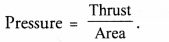
Natural Resources Class 9 Important Questions Science Chapter 14

Chapter 14 Natural Resources Class 9 Science Important Questions with Answers PDF will help you in scoring more marks in your exams.
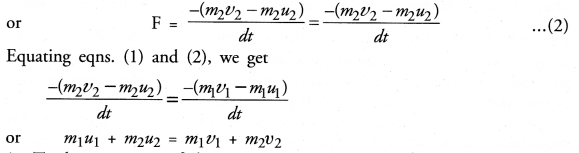
Natural Resources Class 9 Important Questions and Answers Science Chapter 14

Very Short Answer Questions

Question 1.
Name any two factors responsible for the formation of soil.
(CCE 2011)
Answer:
Abiotic (sun, water, wind) and biotic (living organisms).

More Resources

Question 2.
Write full form of CFC. (CCE 2011)
Answer:
Chloro-fluoro-carbon.

Question 3.
We are lucky that ozone is not stable near to the earth’s surface. Why ? Give appropriate answer. (CCE 2011)
Answer:
Ozone occurring near the surface of the earth is a strong oxidant causing corrosion of articles, hardening of rubber, respiratory distress and internal haemorrhages. Fortunately, it is not stable forming oxygen and oxides.

Question 4.
How is biosphere a dynamic and stable system ?
(CCE 2011)
Answer:
There is a regular circulation of biogeochemicals between the different components of biosphere which also receives regular supply of energy as well that is ultimately dissipated in the form of infra-red rays.

Question 5.
Name the carbon compounds responsible for causing ozone hole in the atmosphere. (CCE 2011, 2012)
Answer:
Chlorofluorocarbons (CFCs).

Question 6.
Name the bacteria responsible for nitrification in nature.
(CCE 2011)
Answer:
Nitrosomonas (ammonia to nitrite) and Nitrobacter (oxidises nitrite to nitrate).

Question 7.
Which gas is the major component of atmosphere of Vends and Mars ? (CCE 2011)
Answer:
Carbon dioxide, 95-97%, of their atmosphere.

Question 8.
In which part of legumes, nitrogen fixing bacteria are present ? (CCE 2011, 2012)
Answer:
In their root nodules.

Question 9.
What is the function of ozone which is present in the upper level of atmosphere ?
OR
State one use of ozone. (CCE 2011, 2012)
Answer:
Ozone present in the upper layer of atmosphere or stratosphere filters out harmful high energy ultraviolet radiations (100-320 nm) liberating heat in the process that warms up the stratosphere.

Question 10.
Name any one method by which water helps in the formation of soil. (CCE 2011)
Answer:
Passing into cracks of rock, expanding on cooling causing more cracks and widening the previous ones ultimately crushing the rock to form soil particles.

Question 11.
State the role of symbiotic bacteria in nitrogen cycle in nature. (CCE 2011)
Answer:
Symbiotic bacteria live in the root nodules of legumes where they pick up molecular nitrogen from the soil air and convert the same into salts of nitrogen (e.g., ammonium) for use by the host in building amino acids and proteins.

Question 12.
Name two nitrogen compounds obtained by industrial fixation. (CCE 2011)
Answer:
Ammonia, Urea.

Question 13.
Define biogeochemical cycle. Give examples also.
(CCE 2011, 2012)
Answer:
The repeated circulation of biogenetic nutrients or biogeochemicals between the abiotic and biotic components of biosphere is called biogeochemical cycle, e.g, Carbon cycle, Nitrogen cycle, Water cycle, Phosphorus cycle.

Question 14.
Name two biologically important compounds that contain both oxygen and nitrogen. (CCE 2011)
Answer:
Proteins, nucleic acids (DNA, RNA).

Question 15.
Write two methods adopted to control pollution.
(CCE 2011)
Answer:

  1. Use of CNG instead of gasoline (petrol, diesel) in automobiles,
  2. Non-discharge of effluents and other pollutants into water bodies and atmosphere by the industries.

Question 16.
Name the disease that can be caused by UV radiations.
(CCE 2011)
Answer:
Skin cancer, eye cataracts.

Question 17.
Name any two water pollutants. (CCE 2011)
Answer:

  1. Industrial effluents
  2. Untreated sewage
  3. Fertilizers, pesticides.

Question 18.
Give two causes of soil erosion. (CCE 2011)
Answer:
Deforestation, overgrazing followed by action of wind or water.

Question 19.
State one cause of depletion of ozone layer. (CCE 2011)
Answer:
Presence of chlorofluorocarbons/halons/nitrogen oxides/ chlorine.

Question 20.
What is soil erosion ? (CCE 2011)
Answer:
Removal of unprotected top soil as through the agency of wind or water is called soil erosion.

Question 21.
Name two factors that make soil/weathering of rocks.
(CCE 2011, 2012)
Answer:
Sun and water.

Question 22.
Mention causes of global warming. (CCE 2011)
Answer:

  1. Increased concentration of green house gases (e.g, CO2)
  2. Deforestation.

Question 23.
What is the importance of green house gases present in the atmosphere ? (CCE 2011, 2012)
Answer:
Green house gases do not allow the infra-red rays coming out of earth to escape but to reflect the same to earth making it warm (average temperature 15°C) and suitable for living beings to live comfortably on earth.

Question 24.
Write two biotic components of biosphere ?
(CCE 2011, 2012)
Answer:
Plants, animals, decomposers.

Question 25.
How is oxygen replenished in nature ? (CCE 2011)
Answer:
By photosynthesis.
6CO2 + 6H2O ———-> C6H12O6 + 6O2.

Question 26.
How is average temperature of earth made steady ?
(CCE 2011)
Answer:
Air/atmosphere/green house gases do not allow increase in day temperature and slow down escape of heat during the night.

Question 27.
List any two causes of increase in concentration of CO2 in the atmosphere. (CCE 2011, 2012)
Answer:

  1. Increasing use of fossil fuels,
  2. Reduction in vegetation cover.

Question 28.
‘Pesticides reduce soil fertility.’ Give two reasons for your answer. (CCE 2011)
Answer:

  1. Pesticides kill soil organisms and, therefore, reduce the decomposition of organic matter so that there is lesser release of minerals from the same,
  2. Decrease in soil organisms like earthworms decreases soil aeration.

Question 29.
What are resources available on earth for life to exist ?
(CCE 2011)
Answer:
Air, water, solar energy, minerals, soil.

Question 30.
Give the name of two air pollutants. (CCE 2011)
Answer:
(i) Suspended particulate matter (SPM).
(ii) Pollutant gases like SO2, nitrogen oxides, methane, carbon monoxide, hydrogen sulphide.

Question 31.
Why is air called breath of life ? (CCE 2011)
Answer:
Air is called breath of life as life cannot exist without air which not only forms a protective transparent envelope or atmosphere around the earth but also provides oxygen (for respiration) and CO2 (for photosynthesis) with a mechanism for their renewal.

Question 32.
How is CO2 fixed in the atmosphere ?
(CCE 2011, 2012)
Answer:
CO2 is being withdrawn continuously from atmosphere by photosynthetic activity of autotrophs. It is returned in nearly equal amount through respiration and combustion.

Question 33.
Which part of solar radiation is absorbed by ozone layer ?
(CCE 2011)
Answer:
Very high energy ultraviolet rays (100 – 320 nm) are absorbed by ozone layer.

Question 34.
What are the constituents of soil ? (CCE 2011)
Answer:
Rock or soil particles (45%), organic matter (humus, 5%), air (25%), water (25%) and different types of microbes (variable).

Question 35.
What is smog ? (CCE 2011)
Answer:
Smog is dark brown or greyish smoky mist that is formed in cold weather due to presence of suspended particles of unburnt carbon, oxides of nitrogen or sulphur in the air. It is suffocating and harmful causing irritation to eyes, nose and lungs besides injuring several internal organs.

Question 36.
Name the group of plants which contain nitrogen fixing bacteria in their root nodules. (CCE 2011, 2012)
Answer:
Legumes.

Question 37.
Name the winds which bring rain in India. (CCE 2011)
Answer:
South-west monsoon and north-east monsoon.

Question 38.
List any two factors that determine the soil type.
(CCE 2011)
Answer:

  1. Size of soil particles
  2. Amount of humus/air/water.

Question 39.
Why do lichens not occur in Mumbai whereas they occur in Manali and Ooty ? (CCE 2011)
Answer:
Lichens are very sensitive to air pollution which is quite heavy in Mumbai while air pollution is nearly absent in Manali and Ooty.

Question 40.
What are biodegradable pollutants ? (CCE 2011)
Answer:
Pollutants which can be broken down through the agency of micro-organisms are called biodegradable pollutants, e.g., garbage, sewage.

Question 41.
Give the major source of minerals present in the soil.
(CCE 2011)
Answer:
Rocky matter.

Question 42.
Name two industrial air pollutants. (CCE 2011)
Answer:

  1. Suspended particulate matter (SPM).
  2. Oxides of nitrogen and sulphur.

Question 43.
How are winds formed ? (CCE 2011, 2012)
Answer:

  1. Uneven heating of earth’s surface,
  2. Differences in heating and cooling of land and water bodies.

Question 44.
Write two methods adopted to control air pollution.
(CCE 2011)
Answer:

  1. Electronic precipitators,
  2. Scrubbers.

Question 45.
Name any two green house gases. (CCE 2012, 2013)
Answer:
Carbon dioxide, Methane.

Question 46.
Define the term ‘global warming’ in context to increase in carbon dioxide content of the atmosphere. (CCE 2012)
Answer:
Global warming is the rise in temperature of the surface of earth and its immediate atmosphere due to increase in concentration of green house gases, especially CO2.

Question 47.
What is ozone hole ? (CCE 2012)
Answer:
It is an area of excessive thinning out of ozone in the stratosphere from where high energy UV rays freely pass over to earth, e.g., over Antarctica in spring.

Question 48.
What are CFCs ? (CCE 2012)
Answer:
CFCs are chlorofluorocarbons which have been used extensively in aerosol propellents, refrigerants, formation of foams, spray agents, etc. They are strong ozone depleting substances (ODS).

Question 49.
Name the atmospheric gas that leads to global warming .
(CCE 2012)
Answer:
Carbon dioxide.

Question 50.
Suggest a way of bringing underground water to the surface of earth. (CCE 2012)
Answer:
By means of tube wells, dug wells, hand pumps.

Question 51.
State the percentage of nitrogen gas in the atmosphere.
(CCE 2012)
Answer:
78%.

Question 52.
Mention any one effect of increase in the amount of green house gases in the atmosphere. (CCE 2012)
Answer:
Rise in temperature (global warming).

Question 53.
“Water is essential for life”. Justify the statement.
(CCE 2012)
Answer:
Water is solvent, reaction medium and transport medium of biomolecules constituting living matter.

Question 54.
The large scale deforestation should be stopped. List two reasons to justify. (CCE 2012)
Answer:
Large scale deforestation should be stopped immediately as it is

  1. Raising CO2 concentration in the atmosphere resulting in global warming.
  2. Causing floods and soil erosion.

Question 55.
Name the compounds responsible for hole in ozone layer of atmosphere. (CCE 2012)
Answer:
Chlorofluorocarbons, halons, carbon tetrachloride, methyl bromide, methyl chloroform, nitrogen oxides, chlorine.

Question 56.
Name any two pollutants produced by burning of coal and petroleum. (CCE 2012)
Answer:
Suspended particulate matter (SPM), pollutant gases (e.g., sulphur dioxide, nitrogen oxides), hydrocarbons.

Question 57.
Mention two factors that influence the pattern of winds.
(CCE 2012)
Answer:

  1. Difference in heating and cooling of land and water bodies.
  2. Rotation of earth.
  3. Inclination to sun.

Question 58.
List two human activities that would lead to air pollution.
(CCE 2012)
Answer:

  1. Burning of fossil fuels.
  2. Gaseous emissions from industries.

Question 59.
Name two free living nitrogen fixing bacteria.
(CCE 2012)
Answer:
Azotobacter, Beijerinkia.

Question 60.
Name the process by which carbon is incorporated into life forms like plants. (CCE 2012)
Answer:
Photosynthesis.

Question 61.
Name the organism sensitive to SO2 in air. (CCE 2012)
Answer:
Lichens

Question 62.
Why do plants need nitrogen ? (CCE 2012)
Answer:
For building up amino acids, proteins, nucleotides, nucleic acids, enzymes, alkaloids and some vitamins.

Question 63.
Name any two physical agents that cause weathering of rocks. (CCE 2012)
Answer:
Atmospheric changes (heating-cooling, wetting-drying, frostraction),- mechanical forces (abrasion by sand, rain, hail,
rolling stones, wave action).

Question 64.
What is the conversion of ammonia to nitrates called ?
(CCE 2012)
Answer:
Nitrification.

Question 65.
List two activities of man which lead to environmental pollution. (CCE 2012)
Answer:

  1. Burning of fossil fuel
  2. Passage of sewage or municipal water into water bodies.

Question 66.
Name two chemicals present in living organisms having carbon, hydrogen and oxygen as main constituents.
(CCE 2012)
Answer:
Carbohydrates, fats. They are food articles which function as storage and source of energy.

Question 67.
Frozen water between cracked rocks causes the cracks to widen. How? (CCE 2013)
Answer:
Frozen water occupies more volume than liquid water. It exerts a large mechanical force on sides of rock cracks which, therefore, widen.

Question 68.
What does hydrosphere consist of ? (CCE 2013)
Answer:
Hydrosphere or water component of earth includes all the water present in, on and around the earth.

Question 69.
State any one difference between oxygen and ozone.
(CCE 2013)
Answer:
Oxygen is diatomic (O2) while ozone is triatomic (O3)

Question 70.
Name two elemental forms of carbon found on the earth ?
(CCE 2013)
Answer:
Graphite, Diamond.

Question 71.
State the percentage of nitrogen gas in the atmoshpere.
(CCE 2013)
Answer:
78%

Question 72.
Name the poisonous gas formed from oxygen gas in the atmosphere ? (CCE 2013)
Answer:
Ozone.

Question 73.
What is meant by the term biosphere ? (CCE 2013)
Answer:
Part of earth which supports life is called biosphere.

Question 74.
Name the factor responsible for rainfall patterns in India.
(CCE 2013)
Answer:
South-west monsoon and to a smaller extent north-east monsoon.

Question 75.
Name the stages of the life cycle of aquatic animals which are affected by change in temperature. (CCE 2014)
Answer:
Egg (hatching), larvae and young animals.

Question 76.
Write the name of triatomic molecule of oxygen.
(CCE 2014)
Answer:
Ozone (O3).

Question 77.
State the temperature range on the surface of moon.
(CCE 2014)
Answer:
-190°C (dark period) to 110°C (light period).

Question 78.
Mention the direction in which air flows at night in coastal areas. (CCE 2014)
Answer:
From land to sea.

Question 79.
Alongwith the natural resources available on the earth, what else is required to meet the basic requirement of all life forms on the earth ? (CCE 2014)
Answer:
Solar energy.

Question 80.
Name the gas produced when glucose molecules breakdown using oxygen. (CCE 2014)
Answer:
Carbon dioxide (CO2).

Question 81.
Name two natural resources available on earth.
(CCE 2014)
Answer:

  1. Renewable, exhaustible, e.g., forests,
  2. Non-renewable exhaustible, e.g., fossil fuels.

Short Answer Questions (2 Marks)

Question 1.
Mention two ways of fixing carbon dioxide.
(CCE 2011)
Answer:

  1. Photosynthesis, also called carbon assimilation, by autotrophic plants,
  2. Formation of shells and components of skeleton in marine animals.

Question 2.
How temperature/sun and water help in soil formation ?
(CCE 2011, 2013)
Answer:

  1. Temperature: Rocks expand on being heated up in the sun and contract on cooling during night. This alternate heating and cooling produces cracks that ultimately break up rocks into smaller pieces and particles.
  2. Water: Water entering cracks causes the cracks to widen on being frozen resulting in more cracks and breaking of rocks. Water carrying suspended particles flowing over the rocks corrodes the surface of the latter removing more particles that collect to form soil.

Question 3.
Give reason for the following :
(i) We are lucky that ozone is not stable near the earth’s surface,
(ii) The combustion of fossil fuels increases the amount of suspended particles in air. (CCE 2011)
Answer:
(i) Ozone occurring near the surface of the earth is a strong oxidant causing corrosion of articles, hardening of rubber, respiratory distress and internal haemorrhages. Fortunately, it is not stable forming oxygen and oxides.
(ii) Combustion of fossil fuels is never one hundred percent complete. A lot of unburnt carbon particles or hydrocarbons come out in fumes or exhausts and form suspended particles in the air.

Question 4.
(i) Why is water necessary for all living organisms ? Mention any two points in support of your answer.
(ii) Water is known as “wonder liquid”. Justify this statement by giving any two reasons.
(CCE 2011, 2012)
Answer:
(i) Necessity of Water:

  1. Component: Water is a major component (60-90%) of living matter and is a general solvent for various biochemicals which also react in the medium of water.
  2. Transport: Water is a medium of transport in the body of living organisms.
  3. Buffer: It also functions as a temperature buffer.

(ii) A Wonder Liquid: Water is liquid between 0° and 100°C. It forms solid ice below 0°C and vapours above 100°C. It becomes available at far off places as rain, rivers and springs. Underground water is source of fresh water at many places.

Question 5.
(i) Define the term smog,
(ii) Name two types of diseases caused by regularly breathing the polluted air.
(CCE 2011)
Answer:
(i) Smog is dark brown or greyish smoky mist that is formed in cold weather due to presence of suspended particles of unburnt carbon, oxides of nitrogen or sulphur in the air. It is suffocating and harmful causing irritation to eyes, nose and lungs besides injuring several internal organs.
(ii) Diseases. Pneumoconiasis, Asthma, Bronchitis, damage to liver, kidneys and cancer.

Question 6.
What is green house effect ? How is it caused ?
(CCE 2011, 2012, 2014)
Answer:
Green house effect is keeping an area warm by allowing the solar radiations to pass in but preventing long waves to escape due to presence of radiatively active gases and glass panes.
Certain gases present in the atmosphere of the earth provide a green house effect over earth, keeping it warm with an average temperature of 15°C, e.g., C02, methane, chlorofluoro-carbons, nitrous oxide.

Question 7.
Give the chemical formula of Ozone ? What is its role in atmosphere ? (CCE 2011)
Answer:
O3. Ozone is good ozone in stratosphere where it filters out very harmful ultraviolet radiations (100-320 nm) coming from sun. It is bad ozone near the surface of earth because of its highly oxidising nature.

Question 8.
(a) Why do terrestrial forms require fresh water ?
(b) Give two examples where fresh water can be found in the frozen form on earth. (CCE 2011)
Answer:
(a) The osmotic concentration of terrestrial forms is low. They can neither store nor eliminate high amounts of dissolved salt present in sea water. Therefore, they require fresh water.
(b) Ice caps over poles, Glaciers.

Question 9.
(a) What is soil erosion ? State any one way by which it can be prevented.
(b) What is humus ? What is the role of earthworms in increasing the quantity of humus. (CCE 2011)
Answer:
(a) Soil Erosion: Removal of unprotected top soil as through the agency of wind or water is called soil erosion.
Soil erosion can be prevented by covering the soil with vegetation.
(b) Semidecayed organic matter present in the soil is called humus. Earthworms bring about fragmentation of organic remains and add humus and mineral rich worm castings in the soil.

Question 10.
What is atmospheric fixation of nitrogen ? (CCE 2011)
Answer:
It is the formation of oxides of nitrogen from atmospheric dinitrogen (N2) in the presence of energy from electric storms, lightning and high energy ultraviolet rays. Nitrogen oxides dissolve in rain water as nitrous and nitric acids. They pass down to soil and water bodies forming nitrites and nitrates.

Question 11.
The heaps of solid waste are a menace. Give two reasons.
(CCE 2011)
Answer:
Solid waste is discarded solid material dumped over soil, e.g., municipal waste, industrial waste, mining waste.

  1. Municipal and industrial waste often gives a strinking bad smell.
  2. Toxic chemicals present in the solid waste often seep into ground water making the same unfit for human consumption.
  3. It makes the area of earth useless and infertile.

Question 12.
How is addition of undesirable substances and change in temperature affect the water life ? (CCE 2011, 2013)
Answer:

  1. Undesirable Substances: Fertilizers, pesticides, industrial effluents, municipal waste water when passed into water bodies cause eutrophication that later on kills most of the aquatic life due to depletion of oxygen and presence of toxic chemicals.
  2. Temperature: A change in temperature affects oxygen concentration. A high temperature reduces O2 content which reduces the rate of decomposition of organic matter, causes asphyxiation of aquatic animals, non-hatching of eggs and killing of larvae.

Question 13.
Name two measures that can be taken to reduce water pollution. (CCE 2011)
Answer:

  1. Treatment of municipal waste water before discharging it into water body.
  2. Treatment of industrial effluents before passing it into municipal sewers or water body.

Question 14.
(i) What is the role of atmosphere in climate control ?
(ii) What is the percentage of nitrogen and oxygen in the air ? (CCE 2011)
Answer:
(i) Atmosphere helps to maintain the climate of a place (which depends upon inclination and air currents) by acting as temperature buffer, preventing rise of temperature during the day and excessive cooling during the night. For this, the atmosphere is a bad conductor of heat.
(ii) Nitrogen – 78%, Oxygen – 21%.

Question 15.
Mention any two human activities which are responsible for water pollution. (CCE 2011)
Answer:

  1. Runoff of fertilizers and pesticides applied to crop fields.
  2. Passage of municipal waste water and industrial effluents into water bodies.

Question 16.
Differentiate between biodegradable and non- biodegradable pollutants. (CCE 2011)

Biodegradable PollutantsNon-biodegradable Pollutants
1. Nature. They are biological in origin which can be degraded by decomposer microo-rganisms.1. They are non-biological in origin which cannot be degraded by micro-organisms.
2. Accumulation. They do not accumulate2.They tend to accumulate and even show biomagnification.
Ex. Cowdung, Garbage,Sewage.Ex. Plastic, Mercury,DDT.

Answer:
Biodegradable Pollutants Non-biodegradable

Question 17.
(a) Name the process that returns oxygen to the atmosphere.
Natural Resources Class 9 Important Questions Science Chapter 14 image - 1
(b) Write the condition responsible for poor visibility in cold weather. (CCE 2011)
Answer:
(a) Photosynthesis is the metabolic process that brings about carbon assimilation and releases oxygen, energy
(b) In cold weather, water vapours condense over suspended particulate matter (dust, unburnt carbon) present in the air resulting in foggy conditions and poor visibility.

Question 18.
List two measures of conserving soil fertility.
(CCE 2011)
Answer:
Conservation of soil fertility is the maintenance of ability of the soil to support crops and vegetation. It is carried out by

  1. Crop rotation
  2. Green manuring
  3. Regular addition of farmyard manure.

Question 19.
What causes acid rain ? Mention any damage caused by it on living organisms. (CCE 2011)
Answer:
Acid rain is rainfall with a pH of less than 5. It is caused by the excess emission of SO2 and nitrogen oxides. The gases dissolve in water forming nitric acid and sulphuric acid. Acid rain causes chlorosis, defoliation, stunting and dieback of plants. It causes skin and lung irritation. Marble structures, metallic articles, jewellary, textiles and paintings are also spoiled by acid rain.

Question 20.
Which symbiotic life forms can grow on stones and help in formation of soil ? Write the mode of their action for making soil from rocks. (CCE 2011)
Answer:
Lichens are dual or composite forms which can grow on bare rocks and bring about biological weathering. The lichens secrete organic acids over the rock surface corroding the same and producing small crevices. Later on, the crevices grow into cracks producing soil.

Question 21.
Explain the role of atmosphere as a blanket. List the factors deciding the rainfall pattern. (CCE 2011)
Answer:

  1. Atmosphere as Blanket: Atmosphere is a bad conductor of heat. It does not allow over heating during daytime or excessive cooling during night. Instead, it helps to maintain the average temperature of the earth.
  2. Factors Deciding Rainfall Patterns :
    1. Availability of water vapours,
    2. Areas of low pressure or depression
    3. Prevailing wind
    4. Condensation of water vapours.
    5. Direction of mountains.

Question 22.
How do forests play an important role in maintaining water cycle ? (CCE 2011)
Answer:
Forests, being large areas of vegetation, transpire a large amount of water in the vapour form. The water vapours being lighter, rise in the air, cool down and form tiny water droplets around air borne particles producing clouds. In contact with cold air, clouds produce rain. Rain falling over a forest area mosdy percolates into the soil from where the same is absorbed by the forest plants.

Question 23.
What are green houses ? (CCE 2011)
Answer:
Green houses are enclosures with glass panes which allow the solar radiations to pass inwards but prevent the escape of infra-red heat waves. As a result, green houses remain warm. They are useful in growing tropical plants in colder areas.

Question 24.
List any four activities you think would lead to air pollution. (CCE 2011)
Answer:

  1. Excessive use of fossil fuels like coal and petroleum.
  2. Deforestation,
  3. Smoke from industries,
  4. Smoke from automobiles,
  5. Mining activities.

Question 25.
What is top soil ? Mention any two factors that decide which plants will thrive on that soil. (CCE 2011)
Answer:
Top soil is the upper mineral and humus rich layer of soil that supports vegetation.
Factors:

  1. Depth of top soil,
  2. Nutrient and humus content of soil,
  3. Soil particles,
  4. Soil pH.

Short Answer Questions (3 Marks)

Question 1.
(a) “The flow of energy is unidirectional whereas the biogeochemical transfer is cyclic.” Explain why.
(b) Justify the statement, “The nitrogen cycle is supposed to be an ideal cycle in the biosphere.” (CCE 2011)
Answer:
(a) Energy is regularly entering the biosphere from the sun. It is trapped by the producers from where it passes to herbivores and then to carnivores. The energy present in organic remains passes into decomposers. At every step of this transfer there is a lot of dissipation of energy which ultimately leaves the biosphere.
Biogeochemicals are components of biosphere which neither came from outside nor are lost. They are picked / up by producers, passed to consumers and returned to producers by the activity of decomposers. Therefore, flow
Natural Resources Class 9 Important Questions Science Chapter 14 image - 2
(b) Amount of nitrogen remains almost constant in the atmosphere as well as soil. No nitrogen is lost. It is because a part of nitrogen is being fixed regularly in the atmosphere while an equal part of nitrogen is being added to atmosphere through denitrification. Nitrogen salts are also undergoing biogeochemical cycling.

Question 2.
List any three ways to control soil pollution. (CCE 2011)
Answer:

  1. Minimum or no use of chemical fertilizers, insecticides and pesticides.
  2. Dumping of solid wastes only in sanitary fill.
  3. Proper disposal of garbage in composting, biogas plants and incineration.

Question 3.
“It is necessary to conserve natural resources.” Explain.
(CCE 2012)
Answer:
Natural resources (e.g., air, water, soil, forests, minerals, fossil fuels) are earth resources which are being used by human beings for meeting their requirements. However, due to their indiscriminate and excessive use, there is already shortage of these resources and causing harm to our welfare. Therefore, there is an urgent requirement of their conservation by controlling their use and measures to increase their availability through

  1. Rain water harvesting.
  2. Afforestation and reforestation along with controlled grazing and cutting.
  3. Restoration of soil fertility and prevention of soil erosion.
  4. Reuse, recycling and substitution of minerals.
  5. Judicious use of fossil fuels and finding of alternate sources of energy.

Question 4.
(a) What are different ways in which water gets polluted ?
(b) How does it affect life forms ? (CCE 2012)
Answer:
(a) Water pollution is caused by passage of

  1. Untreated or partially treated sewage.
  2. Runoff from argicultural fields treated with fertilizers and pesticides.
  3. Passage of untreated industrial effluents and hot water.
  4. Oil spills.

(b) Water pollution causes :

  1. Spread of water borne diseases (e.g., typhoid, cholera, jaundice)
  2. Eutrophication or nutrient enrichment followed by algal blooms, death of aquatic animals and organic loading leading to foul smell and taste.
  3. Industrial effluents having toxic chemicals causing diseases as minamata disease, itai itai disease, plumbism, methaemoglobinemia, fluorosis, black foot disease, cancer.

Question 5.
(a) How is soil formed ?
(b) What is soil erosion ?
(c) Write two steps to control soil erosion. (CCE 2012)
Answer:
(a) Soil Formation. Soil is formed by weathering (pulverisation) of rocks through physical (sun, water, air), chemical (hydration, oxidation, reduction) and biological (lichens, mosses, herbs) factors followed by humification.
(b) Soil Erosion: Removal of unprotected top soil as through the agency of wind or water is called soil erosion.
(c) Control of Soil Erosion,

  1. Afforestation.
  2. Wind breaks.
  3. Step cultivation on hills.

Question 6.
(a) List the causes that affect life forms found in water bodies in various ways.
(b) Name the element present in coal other than carbon that releases harmful gases during combustion of coal.
(CCE 2012)
Answer:
(a) Water pollutants like untreated sewage, industrial effluents, fertilizer and pesticide rich run off from agricultural fields. .
(b) Sulphur, producing sulphur oxides (e.g., S02) during combustion of coal.

Question 7.
(a) What are the two different states in which water is formed during the water cycle ?
(b) What is the major source of fresh water in the city/town/village where you live ?
(c) Do you know of any activity which may be polluting this water source ? (CCE 2012)
Answer:
(a) Water vapours, liquid water.
(b) The major source of fresh water is ground water in my locality. It is pumped out by tube wells.
(c) It is being polluted by leaching of heavy metals e.g., Nickel from industrial effluents.

Question 8.
How is ‘soil formation different from ‘soil erosion ? Write two factors responsible for each one of them. (CCE 2012)
Answer:
Soil formation (Paedogenesis) is formation of soil from rocky crust of earth while soil erosion is removal of top soil. Factors for Soil Formation: Sun (heating and cooling), water (wetting and drying, freezing, abrasion).
Factors for Soil Erosion. Absence of vegetation cover, heavy rain or strong wind.

Question 9.
(a) “An increase in temperature of water bodies would lead to water pollution”. Explain.
(b) Suggest any two methods to prevent water pollution.
(CCE 2012)
Answer:
(a) Increase in Temperature: A change in temperature affects oxygen concentration. A high temperature reduces O2 content which reduces the rate of decomposition of organic matter, causes asphyxiation of aquatic animals, non-hatching of eggs and killing of larvae.
(b) Prevention of Water Pollution:

  1. Sewage: Only fully treated sewage water should be allowed to pass into water body.
  2. Industrial Effluents: They should not be allowed to flow into water body without treatment.

Question 10.
(a) Ozone is poisonous and is found in the upper atmosphere of earth. Yet the world is worried about its depletion. Explain why ?
(b) Write any two methods to control ozone layer depletion.
Answer:
(a) Ozone present in the upper layer of atmosphere or stratosphere filters out harmful high energy ultraviolet radiations (100-320 nm) liberating heat in the process that warms up the stratosphere.
(b)

  1. Replacing chlorofluorocarbons and halons with ozone friendly chemicals.
  2. Use of jet fuel with little nitrogen.

Question 11.
(a) What are various components of soil.
(b) “Fertilizers and pesticides lead to soil pollution.” List two reasons to justify the statement. (CCE 2012, 2013)
Answer:
(a) Soil consists of mineral matter (45%), organic matter (5%), air (25%), water (25%) and variable number of soil organism. Mineral matter consists of gravel (size 2-10 mm), sand (0.02-2.0 mm), silt (0.002-0.02 mm) and clay (below 0.002 mm) Organic matter is in semidecayed form and is called humus.
(b) Both fertilizers and pesticides cause soil pollution by

  1. Killing or inhibiting the growth of soil micro- organisms.
  2. Destruction of soil crumbs.
  3. Their passage into crops and ground water causing toxic effects over humans and animals (e.g., producing methaemoglobin).

Question 12.
Name four main processes that are part of water cycle in nature. (CCE 2012)
Answer:

  1. Vaporisation
  2. Cloud formation
  3. Rain
  4. Infiltration and run-off.

Question 13.
What is smog ? List any two harmful effects of smog.
(CCE 2012)
Answer:
(a) Smog is dark brown or greyish smoky mist that is formed in cold weather due to presence of suspended particles of unburnt carbon, oxides of nitrogen or sulphur in the air. It is suffocating and harmful causing irritation to eyes, nose and lungs besides injuring several internal organs.
(b) Harmful Effects,

  1. Allergy, asthma, bronchitis and suffocaton in human beings and animals.
  2. Silvering, glazing and necrosis in plants.

Question 14.
Explain the formation of sea breeze and land breeze in coastal areas. (CCE 2012)
Answer:
Sea Breeze. It is flow of cooler breeze from sea towards the land during the day time. During day time, land gets heated faster. Air above land heats up, rises and creates an area of low pressure. Air above sea is cooler and has higher pressure. It moves towards land.
Land Breeze. During night, land cools rapidly while sea water remains warmer. Air above sea is warmer, rises and develops low pressure. Air above land is cooler and has higher pressure. It flows towards sea.

Question 15.
State any two sources of water pollution. Which type of pollution affects the breeding of aquatic animals.
(CCE 2012)
Answer:
Sources of Water Pollution,

  1. Sewage
  2. Fertilizers and pesticides
  3. Industrial effluents.

Temperature: Increase or decrease of temperature of water body affects breeding of most aquatic animals. A high temperature reduces the amount of oxygen dissolved in water.

Question 16.
(a) How does the atmosphere act as a blanket.
(b) The moon which is about the same distance from the sun as that of earth but still there is no atmosphere on moon. (CCE 2012)
Answer:
(a) Atmosphere as Blanket: Atmosphere is a bad conductor of heat. It does not allow over heating during daytime or excessive cooling during night. Instead, it helps to maintain the average temperature of the earth.
(b) Moon Has No Atmosphere: Atmosphere is maintained by gravity and circulation of its components. Moon has only 1/6 gravity as compared to earth. It does not hold any atmosphere. There is no living organisms which can produce and utilise camponents of atmosphere.

Question 17.
Name the constituents of abiotic component of the biosphere. Explain their major role in biosphere. (CCE 2012)
Answer:
Air, water and soil.

  1. Air/Atmosphere: It functions as a blanket, source of O2 and CO2, medium of dispersal, formation movement and precipitation of water vapours.
  2. Water: Water is a component of living beings (60-90%), solvent, transport medium, reaction medium for biomolecules, temperature buffer and bringing turgidity to living cells.
  3. Soil: It provides anchorage, water and minerals to plants, a place for microorganisms to dispose off organic remains and release of minerals.

Question 18.
(a) What is soil pollution ? What factors are responsible for it ?
(b) Suggest two methods of preventing or reducing soil pollution. (CCE 2012)
Answer:
(a) Soil Pollution. It is adverse alteradon in the soil caused by removal or addition of substances which reduce its fertility and quality.
(b) Factors. Addition of raw manure, excess fertilizers, pesticides, faulty irrigation and dumping of wastes as well as industrial effluents.
(c) Control of Soil Pollution.

  1. Minimum or no use of chemical fertilizers, insecticides and pesticides.
  2. Dumping of solid wastes only in sanitary fill.
  3. Proper disposal of garbage in composting, biogas plants and incineration.

Question 19.
Write one appropriate word for statements (1—3) given below and briefly explain them.

  1. The process by which carbon is incorporated into life forms.
  2. The process by which nitrates are converted into free nitrogen.
  3. The cyclic flow of nutrients like nitrogen and oxygen between nonliving environment and living organisms.
    (CCE 2012)

Answer:

  1. Photosynthesis: CO2 is taken up by plants from their environment and changed into organic form. Energy is taken from sun. Hydrogen is taken from water.
  2. Denitrification: Some bacteria present in water-logged soils take oxygen from nitrates for their activity. This changes nitrates into gaseous nitrogen.
  3. Biogeochemical Cycling: Biogeochemicals or nutrients are taken up by organisms for their structure and functioning. They are released later on when organic remains are decomposed. The same are picked up again by the organisms.

Question 20.
(a) Name two elemental forms in which carbon occurs.
(b) Name any two forms in which carbon is found in combined state with other elements in nature.
(c) Briefly explain how it can be said that all life forms are based on carbon containing molecules. (CCE 2012)
Answer:
(a) Elemental Forms. Diamond, Graphite.
(b) Combined State. Carbon dioxide, Carbohydrate.
(c) Life Forms. All life forms contain protoplasm, energy storing and energy liberating organic substances and enzymes for catalysing various metabolic reactions. All these are organic substances made of carbon, e.g, proteins, enzymes, carbohydrates.

Question 21.
(a) What is the role of bacteria in nitrogen cycle ?
(b) What happens to nitrate once it enters the plant ?
(CCE 2012)
Answer:
(a) Role of Bacteria,

  1. Biological nitrogen fixation, e.g., Azotobacter, Rhizobium.
  2. Decomposition, ammonification and nitrification, e.g., Bacillus ramosus, Nitrosomonas, Nitrobacter.
  3. Denitrification, e.g., Pseudomonas.

(b) Nitrogen Assimilation. Nitrate absorbed by plants is first reduced to ammonia level. Ammonia combines with organic acids to produce amino acids from which proteins and nucleotides are formed.

Question 22.
Give reason :
(a) Presence of high levels of suspended particles in the air is harmful.
(b) A sudden change in the temperature of water body is dangerous for aquatic life.
(c) The process of nitrogen fixation does not take place in the presence of oxygen. (CCE 2012)
Answer:
(a) Some of the suspended particles present in the air enter our lungs, reach alveoli and cause pulmonary ailments like asthma, bronchitis, emphysema, lung fibrosis, pneumoconiosis.
(b) Change in temperature changes the amount of oxygen dissolved in water and disturbs the breeding of aquatic animals.
(c) The enzyme for nitrogen fixation called nitrogenase is sensitive to oxygen as it is specialized to combine hydrogen with nitrogen.

Question 23.
What makes the biosphere dynamic but stable ?
(CCE 2012)
Answer:
The composition of atmosphere, the extent of hydrosphere and lithosphere remain stable in the biosphere. It is because of regular circulation of their constituents among different components and between biotic and abiotic parts of the biosphere. The phenomenon is called biogeochemical cyclling.

Question 24.
Design an activity to show how convective currents are set up in the air and what is the nature of these currents ?
(CCE 2012)
Answer:
Demonstration of Convectic Currents
Apparatus: A beaker or wide mouthed bottle, a candle, box of matches, incense stick (agarbatti).
Working: Fix a burning candle in a beaker or wide mouthed bottle. Light an incense stick. Take it first to edge of the beaker, then half way towards middle and finally above the candle flame.
Results: When kept near the edge, smoke from incense stick will move towards the flame. This will also occur when it is halfway towards the flame. However, when the incense stick is kept above the flame, the smoke will rise up. In all cases smoke flows towards the area of low air pressure.
Natural Resources Class 9 Important Questions Science Chapter 14 image - 3
During night, reverse flow of air occurs. Land cools down rapidly. Air over it becomes cooler. Sea water cools slowly. Air above it is hotter with lower air pressure as compared to air pressure over land. Therefore, cooler air present over land moves towards sea.
Factors Influencing Movements of Air. Depending upon the difference in energy levels and air pressure, there occurs diverse type of atmospheric phenomena like breeze, wind, storm, thunderstorm, monsoon rains, cyclones, etc. The factors controlling these phenomena are

  1. Uneven heating of land in different parts of earth
  2. Differences in heating and cooling of land and water.
  3. Barrier of mountains
  4. Rotation of earth.

Question 25.
State two consequences of global warming. (CCE 2012)
Answer:

  1. Melting of polar ice and glaciers will raise the water level of sea submerging many low level coastal areas.
  2. Atmosphere will shrink due to cooling caused by reduced passage of long wave radiations.
  3. Tropics will be converted into arid areas while floods will occur in higher latitudes.

Question 26.
Explain the role of atmosphere in keeping climate control.
(CCE 2012)
Answer:
Atmosphere helps in maintaining the climate of an area by retaining the heat over the area as it is a temperature buffer. There is neither excessive heating during day nor excessive cooling during night. The average temperature of a place remains steady as per inclination of the area towards sun.

Question 27.
Mention the importance of soil. How is it depleted? Write two ways to replenish soil. (CCE 2012)
Answer:
(a) Soil provides anchorage, minerals and water to terrestrial plants. It is also residence of microorganisms involved in decomposition of organic remains and release of minerals.
(b) Soil Depletion. It occurs through soil erosion, water logging and salination.
(c) Replenishment of Soil. Providing a vegetation cover, correction of water logging and salination, crop rotation and contour bunding.

Question 28.
Explain the following terms :

  1. Ammonification
  2. Nitrification
  3. Biosphere.
    (CCE 2012)

Answer:

  1. Ammonification: It is breakdown of proteins and deamination of amino acids to release ammonia.
  2. Nitrification: It is oxidation of ammonia released through ammonification to form nitrites and nitrates.
  3. Biosphere: It is living mande of earth comprising lower atmosphere, lithosphere and hydrosphere where living beings are present.

Question 29.
How has industrialisation led to air pollution ? Explain in three points. (CCE 2012)
Answer:

  1. Processing industries release a lot of air pollutants (e.g., cotton dust, iron mill dust, flour mill dust, cement industries, asbestos industry) that cause pneumoconiosis and other pulmonary problems.
  2. Fuel. Industries consume coal and other fossil fuels which send out smoke, pulluting gases and hydrocarbons,
  3. Chemical industries send out toxic chemicals into air that have a harmful effect on plants, animals and humans,

Question 30.
How is smog formed ? What does it indicate ? (CCE 2012)
Answer:
Smog is opaque fog which is formed due to noncirculation of air that results in accumulation of suspended particulate matter, pollutant gases, hydrocarbons and water vapours.
It indicates high level of pollution in the area due to industries and vehicular traffic.

Question 31.
Two similar plastic trays filled with soil and manure are taken. In tray A mustard seeds are sown and watered for 4-5 days until they germinate into seedlings and the seedlings grow into small plants. Watering of the tray A is stopped for the next 2-3 days and the small plants are allowed to grow. Trays A and B are placed over a brick in a tilted position. Now both the trays are watered with equal amount of water using a water can.
(a) Name the natural phenomenon indicated by tray B.
(b) Less of water flowing out is indicated by tray A. Give reason.
(c) Why is the top layer of soil considered the most important layer ? (CCE 2012)
Natural Resources Class 9 Important Questions Science Chapter 14 image - 4
Answer:
(a) Run off, which is high in soil not covered by vegetation.
(b) Most of the water is absorbed by soil as the latter is porous due to presence of plants. Run off is little.
(c) Top soil is important because it contains humus, air and decomposer microorganisms. Roots of most plants are restricted to it.

Question 32.
Explain the role played by lichens, moss and trees in the soil formation. (CCE 2012)
Answer:

Soil is formed through two processes of weathering and humification.
It is pulverisation of rocks or breaking of rocks into fine particles. There are three types of weathering — physical (atmospheric changes and mechanical forces), chemical and biological. Sun, water, wind and living organisms perform them.

  1. Sun: It causes expansion of rocks by heating. Cooling causes their contraction. Different parts of rocks expand and contract at different rates. Uneven expansion and contraction produces cracks leading to fragmentation of rocks.
  2. Water:
    1. Wetting and Drying: Certain rock components can pick up and lose moisture. They undergo swelling and contraction resulting in fragmentation of rocks.
    2. Frost Action: Water seeping in cracks would swell up and exert a great pressure if it freezes due to low temperature. The rock would undergo fragmentation.
    3. Abrasion: Running water carrying rock fragments would break and grind rocks occurring in the pathway. Rain and hail also cause rock breaking.
  3. Wind: Dust and fine sand carried by wind cause abrasion of the rock surface when wind strikes the same.
  4. Living Organisms: Lichens secrete chemicals to dissolve minerals from the rock surface. This produces crevices where dust collects. Mosses grow there. They cause deepening of crevices and development of small cracks. Roots of short lived plants widen these cracks. Roots of larger plants cause fragmentation of rocks by entering the cracks and growing in size.

Question 33.
How are clouds formed and bring us rain ? Explain briefly. (CCE 2012)
Answer:
Clouds are wet air masses that float in the direction of prevailing wind. They develop when water vapours are formed in large number. There is evaporation from the surface of water bodies and wet areas due to their heating during the daytime. Plants also give out water vapours in transpiration while animals do so in exhaled air and perspiration. Air also heats up during daytime. The hot air along with water vapour rises up. At a height, air expands and becomes cool. Cooling causes the water vapours to condense. Suspended particles of dust and other materials function as nuclei around which water vapours condense. When a large wet air mass collects, cloud is formed.
Clouds move along the prevailing direction of wind. Wherever they meet cool air or high mountains, further condensation of water droplets change the same into rain.

Question 34.
How do modern farming practices bring about conversion of fertile soil to barren soil ? Explain briefly (CCE 2012)
Answer:

  1. Clean Tilling: The exposed top soil layer gets dried and it is blown away by wind.
  2. Fertilizers: They are chemical formulations which are added to soil in order to provide specific nutrients to crop plants.
  3. Pesticides: They are broad spectrum formulations which are. used to kill pests and weeds. Some of these pesticides are slow to degrade. They undergo biomagnification and prove harmful to higher forms of life, e.g., chlorinated hydrocarbons.
  4. Excessive Irrigation: Faulty irrigation causes water logging and soil salination. Both of them reduce crop yield drastically.
    Therefore, indiscriminate use of fertilizers, pesticides and faulty irrigation can turn fertile crop fields into barren areas. It is important to adopt sustainable practices like organic farming and sprinkler irrigation.

Question 35.
What is soil ? How is it formed ? State the major factor that decides the structure of soil. What role does it play ?
(CCE 2012, 2013)
Answer:
Soil: It is upper weathered and mineral containing part of earth’s crust which supports plant life and contains numerous organisms and organic remains.
Soil Formation: Soil is formed by weathering (pulverisation) of rocks through physical (sun, water, air), chemical (hydration, oxidation, reduction) and biological (lichens, mosses, herbs) factors followed by humification.
Major Factor: Average particle size determines the structure of soil, e.g., clayey, loam, sandy. Soil particles determine j mineral availability, soil hydration and soil aeration.

Question 36.
Geeta visited her relatives living in a village. She found that many villagers were suffering from water borne disease like cholera and jaundice. She also noticed that the pond in the village used as a water source did not have any aquatic plants and animals.

  1. What could be the reason for mass illness ?
  2. Write two reasons for the pond to have been devoid of life. (CCE 2013)

Answer:

  1. Reason for Mass Illness. Contamination of pond water with sewage,
  2. Reasons for Absence of Aquatic Plants and Animals,
    1. Loading of water with sewage could cause increased activity of decomposers which deplete the pond of its dissolved oxygen.
    2. Absence of oxygen kills all the aquatic animals and plants.

Question 37.
Rajesh lived in a village which was pollution free. He visited j an industrial city during winter and found the visibility very poor. Many children were showing signs of allergy. What could have been the reason. Suggest any two ways which could have helped to improve the situation.
(CCE 2013)
Answer:
The industrial city was engulfed in smog. Smog contains components (e.g., smoke particles, S02, H2S, hydrocarbons, etc) which are injurious to human beings, causing allergy, suffocation and irritation.

  1. Switch over from coal-fired engines to gasoline and electric engines in industries,
  2. Tall chimneys and passing the smoke through precipitators and scrubbers,
  3. Strict enforcement of pollution control norms over vehicles.

Question 38.
(a) Where is the ozone layer found ?
(b) What is ozone hole and how is it caused ?
(c) State its harmful effects.
(CCE 2013, 2014)
Answer:
(a) Ozone layer is ozone (O3) rich upper part of atmosphere called stratosphere. It lies at a height of 23-25 km above equator and 11-16 km above poles.
(b) Ozone Hole. Ozone hole is area of excessive thinning of ozone in the stratosphere. It is mostly found over Antarctica and to a lesser extent over north pole during their spring times. Cause. Ozone depletion occurs due to certain chemicals called ozone depleting substances (ODS), e.g., chlorofluorocarbons (CFCs), halons, nitrogen oxides, chlorine. They react with 03 and change it to oxygen state,
(c) Harmful Effects. Thinning of ozone layer results in passing very high energy ultraviolet rays (100—320 nm) to the earth. They cause skin cancer, harm eye sight, weaken immune system, cause harmful mutations and reduce crop yield.

Question 39.
Describe the structure of a simple glass house mentioning the climatic conditions in which they are used. Name any two green house gases. (CCE 2013)
Answer:
Green house is an enclosure having glass panes in the direction where solar radiations fall inside. Green houses are built in cold climates for growing tropical plants even in winters. It is because the interior of glass house remains warm because glass panes (and water vapours, CO2 in the enclosure) allow solar radiations to enter but prevent passage of heat waves to the outside.
Green House Gases (GHGs). CO2, methane (CH4).

Question 40.
What are the two forms of oxygen found in the atmo¬sphere ? Write one importance of each. (CCE 2013)
Answer:
Diatomic oxygen (O2) and triatomic ozone (O3). Importance,

  1. Oxygen is essential for respiration and combustion,
  2. Ozone present in stratosphere protects earth from harmful short wave ultraviolet radiations (100-320 nm).

Question 41.
Draw carbon cycle in nature. (CCE 2013)
Answer:
Natural Resources Class 9 Important Questions Science Chapter 14 image - 5

Question 42.
Your school is less than a kilometre from your house. Your neighbourhood friend who attends the same school, comes to the school by a car every day.
How do you think he can contribute towards reduction of air pollution ? Write any three suggestions. (CCE 2013)
Answer:

  1. My friend can join a car pool for school.
  2. He can go to school in school bus.
  3. Since the distance is small, my friend can go to school by foot or on bicycle.

Question 43.
What are CFCs ? Why are they harmful ? (CCE 2013)
Answer:
CFCs are chlorofluorocarbons that have been in use as aerosol propellents, refrigerants, shaving foams, formation of foam sheets and mattresses, spray agents, etc. They pass into stratosphere and release chlorine. Chlorine destroys ozone molecules and convert them into oxygen. As a result ozone present in stratosphere gets depleted resulting in passage of harmful UV radiations on earth.

Question 44.
List any three human activities that you think would lead to increase in carbon dioxide content of atmosphere.
(CCE 2013)
Answer:

  1. Large scale deforestation that reduces assimilation of CO2 in photosynthesis,
  2. Combustion of fossil fuels in thermal plants, industries, transport etc. is throwing large amounts of CO2 into the atmosphere.
  3. Biomass or wood burning.

Raj at and five of his friends went for a picnic with a lot of food stuffs and game items to Gorewara lake from where the drinking water supply for the city is done. As they were playing, they saw a fish entangled in the twigs and injured itself. They helped to free it, nurtured it and put it back in water. Before leaving, they put all the left-over food in water.

Question 45.
Answer the following questions.

  1. What would have happened had they not saved the fish ?
  2. What do you think about their act of throwing the food into water ?
  3. Mention one way in which you will help your city authorities to cope with such problem. (CCE 2013)

Answer:

  1. The fish would have died. Saving and nurturing an animal is an act of love for nature.
  2. The act of throwing the left-over food in the lake is bad as it increases the organic loading of lake and can cause its eutrophication.
  3. To install two types of bins on the shore of the lake for placing left-overs by the visitors.

Question 46.
In coastal areas what is the direction of flow of air during the day ? Explain why ? (C. C.E. 2014)
Answer:
Sea Breeze: It is flow of cooler breeze from sea towards the land during the day time. During day time, land gets heated faster. Air above land heats up, rises and creates an area of low pressure. Air above sea is cooler and has higher pressure. It moves towards land.

Question 47.
What is the percentage of oxygen found in the atmosphere ?
Name two compounds of oxygen found in nature. Name any three processes in which oxygen is used up in atmosphere. (C.C.E. 2014)
Answer:
21% (20-94%). Diatomic O2(oxygen) and triatomic O3(ozone).
Uses:

  1. Respiration in most organisms,
  2. Combustion of fossil fuels,
  3. Formation of oxides,
    e.g., nitrogen oxides during atmospheric fixation of nitrogen,
  4. Decomposition of organic matter.

Question 48.
State three factors influencing wind movements which re-sult in diverse atmospheric phenomena. (C.C.E. 2014)
Answer:
Winds are basically caused by heating of air in certain parts. The hot air rises upwards. This creates an area of low pressure. Cooler air from adjacent higher pressure areas passes into this area. This creates wind. The factors which control movement of winds in different directions in different parts of the earth are

  1. Uneven heating of land in different parts of earth
  2. Differences in heating and cooling of land and water.
  3. Barrier of mountains
  4. Rotation of earth.

Question 49.
Explain the biological processes in nitrogen cycle.
(C.C.E. 2014)
Answer:
Biological processes in nitrogen cycle are :

  1. Biological Nitrogen Fixation: A number of free living and symbiotic bacteria and blue-green algae are capable of picking up of atmospheric nitrogen and converting it into ammonia that combines with organic acids to form amino acids. Rhizobium is the common symbiotic bacterium that occurs in the nodules of legume roots.
    Natural Resources Class 9 Important Questions Science Chapter 14 image - 6
  2. Nitrogen Assimilation: It is carried out by plants. Plants pick up nitrates or ammonium ions from their medium. Nitrate or nitrite is first changed into ammonium state. Ammonium ions combine with organic acids to form amino acids. Amino acids give rise to proteins and nucleotides. Nucleotides produce nucleic acids. Enzymes are derived from proteins.
    Natural Resources Class 9 Important Questions Science Chapter 14 image - 7
  3. Decomposition: Organic remains undergo decay and decomposition through the agency of decomposers. It releases carbon dioxide.
  4. Denitrification: It is the process of reduction of nitrates into gaseous nitrogen which escape into atmosphere. Denitrification is caused by bacteria present in water logged soils, g., Pseudomonas aeruginosa.

Question 50.
How is percentage of carbon dioxide maintained in the atmosphere ? Mention one human activity which adds carbon dioxide in the atmosphere. (C. C.E. 2014)
Answer:
Percentage of carbon dioxide is maintained in the atmosphere by its consumption in photosynthesis (carbon assimilation) being almost equal to its liberation in respiration and combustion.
However, with increasing use of fossil fuels, more carbon dioxide is being added to the tmosphere than its withdrawal.

Question 51.
Draw a labelled diagram of‘oxygen cycle’ occurring in nature. (C.C.E. 2014)
Answer:
Natural Resources Class 9 Important Questions Science Chapter 14 image - 8

Question 52.
Write the composition of soil. On what basis is the type of soil decided ? (C. C.E. 2014)
Answer:
Soil Composition: Soil consists of mineral matter (45%), organic matter (5%), air (25%), water (25%) and variable number of soil organism. Mineral matter consists of gravel (size 2-10 mm), sand (0.02-2.0 mm), silt (0.002-0.02 mm) and clay (below 0.002 mm) Organic matter is in semidecayed form and is called humus.
Type of Soil: Average particle size determines the structure j of soil, e.g., clayey, loam, sandy. Soil particles determine j mineral availability, soil hydration and soil aeration.

Question 53.
(a) What is the outermost layer of the earth called ?
(b) How is it important to life forms ?
(c) Name the factors that help in the formation of soil from rocks. (C. C.E. 2014)
Answer:
Answer:
(a) Lithosphere.
(b) Upper crust of earth forms soil which provides anchor¬age, water and minerals, to terrestrial plants. Aquatic organ¬isms also depend upon soil for supply of minerals.
(c) Soil is formed through two processes of weathering and humification.
Weathering
It is pulverisation of rocks or breaking of rocks into fine particles. There are three types of weathering — physical (atmospheric changes and mechanical forces), chemical and biological. Sun, water, wind and living organisms perform them.

  1. Sun: It causes expansion of rocks by heating. Cooling causes their contraction. Different parts of rocks expand and contract at different rates. Uneven expansion and contraction produces cracks leading to fragmentation of rocks.
  2. Water:
    1. Wetting and Drying: Certain rock components can pick up and lose moisture. They undergo swelling and contraction resulting in fragmentation of rocks.
    2. Frost Action: Water seeping in cracks would swell up and exert a great pressure if it freezes due to low temperature. The rock would undergo fragmentation.
    3. Abrasion: Running water carrying rock fragments would break and grind rocks occurring in the pathway. Rain and hail also cause rock breaking.
  3. Wind: Dust and fine sand carried by wind cause abrasion of the rock surface when wind strikes the same.
  4. Living Organisms: Lichens secrete chemicals to dissolve minerals from the rock surface. This produces crevices where dust collects. Mosses grow there. They cause deepening of crevices and development of small cracks. Roots of short lived plants widen these cracks. Roots of larger plants cause fragmentation of rocks by entering the cracks and growing in size.

Humification
Partially decomposed organic matter or humus mixes with weathered rock particles to form soil. Humus helps in formation of soil crumbs which are essential for maintaining proper hydration and aeration of soil.

Question 54.
(a) State the reason for the following :
(t) Excess burning of coal causes green house effect,
(it) Soil is a mixture.
(iii) Temperature ranges from -190° C to 110°C on the surface of the moon. (C.C.E. 2014)
Answer:
(a) Excess burning of coal adds lot of CO2 to the atmosphere. Carbon dioxide is a green house gas which allows the solar radiations to strike the earth’s surface but prevents the escape of long wave radiations from the earth’s atmosphere.
(b) Soil is a Mixture. Soil consists of particles (sand, silt, clay and humus) which do not get dissolved in water, neither they react with one another.
(c) Moon does not have an atmosphere. Its surface heats up to 110°C when solar radiations strike it. In the absence of solar radiations, the surface temperature of moon dips to -190°C.

Question 55.
State the different ways by which atmospheric nitrogen can be fixed into oxides of nitrogen. Explain in brief.
(C.C.E. 2014)
Answer:
Atmospheric Nitrogen Fixation: In the presence of lightning (energy and pressure), electric storm and high energy ultraviolet rays, small amounts of nitrogen and oxygen of the air react to form nitrogen oxides. The latter dissolve in rain water to form nitric and nitrous acids. They pass down to soil and water bodies forming nitrites and nitrates.

  1. Industrial Nitrogen Fixation: Nitrogen is made to combine with hydrogen under high temperature and pressure to form ammonia. Ammonia is often changed further to urea because the latter is less toxic.
  2. Nitrogen Assimilation: It is carried out by plants. Plants pick up nitrates or ammonium ions from their medium. Nitrate or nitrite is first changed into ammonium state. Ammonium ions combine with organic acids to form amino acids. Amino acids give rise to proteins and nucleotides. Nucleotides produce nucleic acids. Enzymes are derived from proteins.
    Natural Resources Class 9 Important Questions Science Chapter 14 image - 9
  3. Decomposition: Organic remains undergo decay and decomposition through the agency of decomposers. It releases carbon dioxide.
  4. Denitrification: It is the process of reduction of nitrates into gaseous nitrogen which escape into atmosphere. Denitrification is caused by bacteria present in water logged soils, g., Pseudomonas aeruginosa.

Question 56.
Describe how lichens and big trees influence the formation of soil.
Answer:
Living Organisms: Lichens secrete chemicals to dissolve minerals from the rock surface. This produces crevices where dust collects. Mosses grow there. They cause deepening of crevices and development of small cracks. Roots of short lived plants widen these cracks. Roots of larger plants cause fragmentation of rocks by entering the cracks and growing in size.

Question 57.
Mention six combined forms in which oxygen is found on the earth’s crust. (C. C.E. 2014)
Answer:
Carbonate, silicon oxides, sulphate, nitrate, phosphate, metal oxides.

Question 58.
Explain the following terms :
(i) Nitrogen Fixation
(ii) Nitrification
(iii) Denitrification. (C. C.E. 2014)
Answer:
(i) Nitrogen Fixation: It is conversion of inert gas into bio¬logically acceptable form. Nitrogen fixation is carried out abiologically in the atmosphere (through lightning, electric storms, UV radiations) and biologically by certain bacteria and cyanobacteria (= blue-green algae).
(ii) Nitrification : Conversion of ammonia to nitrites and nitrites to nitrates by bacteria.
(iii) Denitrification: Conversion of nitrates to gaseous nitrogen by bacteria.

Long Answer Questions (5 Marks)

Question 1.
(i) Make neat and labelled sketch of nitrogen cycle in nature.
(ii) Describe in brief the role of nitrogen fixing bacteria and lightning in fixing nitrogen. (CCE 2011, 2014)
Answer:
(i)
Natural Resources Class 9 Important Questions Science Chapter 14 image - 10
(ii)
(a) Nitrogen Fixing Bacteria (Biological Nitrogen Fixation). They live both freely (e.g., Azotobacter) as well as symbionts (e.g., Rhizobium in root nodules of legumes). The bacteria pick up nitrogen gas (N2) from soil atmosphere, reduce it to ammonia (NH3), then forming amino acids and proteins.
(b) Lightning (Physical Nitrogen Fixation). By its energy, it helps to combine a small quantity of nitrogen with oxygen of the atmosphere forming nitrogen oxides. The latter dissolve in rain water and enter the soil producing nitrite and nitrate.

Question 2.
(i) Draw a neat labelled sketch of carbon cycle in nature.
(ii) What is green house effect ? How does CO2 cause global warming in the atmosphere ?
(CCE 2011, 2012, 2013)
Answer:
(i)
Natural Resources Class 9 Important Questions Science Chapter 14 image - 11
(ii) Green house effect is keeping an area warm by allowing the solar radiations to pass in but preventing long waves to escape due to presence of radiatively active gases and glass panes.
CO2 is a green house gas. It permits the solar radiations to pass through and reach the surface of the earth. Infra-red (heat) waves emitted by the earth are, however, not allowed to pass out by CO2. They are reflected back to earth. This causes global warming.

Question 3.
(a) Mention the two forms of oxygen found in the atmosphere,
(b) Name the form of oxygen, absorbing UV radiations.
(c) Draw flow diagram of oxygen cycle. (CCE 2011)
Answer:
(a) O2, O3
(b) O3
(c)
Natural Resources Class 9 Important Questions Science Chapter 14 image - 12

Question 4.
Many human activities lead to increasing levels of pollution of air, water bodies and soil. “Isolating these activities to specific and limited areas would not help in reducing pollution.” Justify the statement giving at least five reasons. (CCE 2011, 2012)
Answer:
It is often suggested that all polluting units be asked to shift outside the city limits, so that there is not much effect on the residential area. This is, however, of not much help as

  1. Burning of fossil fuels lead to acid rain which spreads over large areas killing vegetation, water bodies and causing harm to human beings and their assets.
  2. Polluting units add green house gases into the atmosphere. They have global warming effect.
  3. A number of air pollutants pass into stratosphere causing depletion of protective ozone layer.
  4. Passage of sewage into water bodies makes the water unfit for consumption as it becomes a source of many water borne diseases. There is scum, foul odour and bad taste.
  5. Dumping of industrial effluents over the soil causes many of the toxic chemicals and heavy metals to slowly percolate down and get mixed with ground water.

Question 5.
(a) Mention three processes in which oxygen is used up from the atmosphere and the only process in which it is returned to the atmosphere.
(b) Describe briefly two processes by which carbon dioxide is returned back to the atmosphere.
(CCE 2011, 2012)
Answer:
(a)

  1. Consumption of Oxygen.
    1. Respiration
    2. Combustion
    3. Atmospheric fixation of nitrogen.
  2. Return of Oxygen. Photosynthesis,

(b) Return of CO2.

  1. Respiration
  2. Combustion.

Question 6.
(a) With the help of a well sketched diagram, explain water cycle in nature.
(b) How is green house effect related to global warming ? Explain. (CCE 2011, 2012)
Answer:
(a)
Natural Resources Class 9 Important Questions Science Chapter 14 image - 13
Water evaporates from the wet surfaces and plants (transpiration). The water vapours being light rise in the air, getting cooled and condensed over dust particles forming clouds. Clouds move along air currents, , cooling further and undergoing precipitation.
(b) Green house effect is keeping an area warm by allowing the solar radiations to pass in but preventing long waves to escape due to presence of radiatively active gases and glass panes.
Green house effect is shown by a number of radiately active gases, also called green house gases (GHGs), e.g., CO2, methane, chlorofluorocarbons, nitrous oxide. The gases allow the solar radiations to pass through and reach the surface of earth. However, heat waves (infra-red rays) coming from hot surfaces of earth are unable to pass out of the atmosphere as the higher concentration of green house gases reflect most of them back to earth. This raises the temperature of the earth. The phenomenon is called global warming.

Question 7.
(a) In coastal area, wind current moves from sea towards the land during the day but during night it moves from land to sea. Discuss the reason.
(b) How are CFCs harmful for the environment and living beings ? (CCE 2011, 2012)
Answer:
(a)

  1. During day, warmer land heats up the air above it which rises and creates an area of low pressure. Air above sea remains comparatively cool. It has a higher pressure and, therefore, cooler air moves towards the land,
  2. During night, land becomes cooler quickly while sea water remains comparatively warmer. Low air pressure area develops over sea. Cooler air from land, will therefore, flow towards sea.

(b) CFCs passing into stratosphere split up to release active chlorine under the impact of UV radiations. Chlorine catalyses the breakdown of ozone into oxygen. Depletion of ozone will allow more UV rays to pass down to earth causing skin cancers, blindness and weakening of immune system.

Question 8.
(a) What do you understand by ozone layer depletion ?
(b) What is air pollution ? How does air pollution affect animal and plant life ? (CCE 2011)
Answer:
(a) Ozone Layer Depletion: Ozone hole is formed during spring time over antarctica and to a small extent over north pole. Thinning of ozone layer or ozone hole increases the passage of harmful ultravoilet rays to earth. This has increased incidence of skin cancers, defective eye sight, reduced immunity, increased number of mutations and reduced crop yield in southern countries of southern hemisphere.
(b) Air Pollution: It is the addition of substances, gases and chemicals into the air that has the harmful effect on human beings, human assets, plants and animals. The major sources of air pollution are combustion of fossil fuels, industrial processes and agricultural burning. Air pollutants include suspended particulate matter (SPM), gases (e.g., sulphur dioxide, nitrogen oxides, carbon monoxide, hydrogen sulphide, methane, ammonia) and vapours of unburnt hydrocarbons. They also produce two harmful environmental products of acid rain and smog.
Effect on Animal Life. Respiratory disorders, allergies, eye and throat irritation, haemorrhages, frequent diarrhoea, reduced appetite and weakening of bones.
Effect on Plant Life. Chlorosis, necrosis, water soaked areas, defoliation and die back.

Question 9.
How do clouds form in the sky ? Draw the biogeochemical cycle involved in it. What are the different states in which water is found in the water cycle ?
(CCE 2011)
Answer:
(a) Clouds are wet air masses that float in the direction of prevailing wind. They develop when water vapours are formed in large number. There is evaporation from the surface of water bodies and wet areas due to their heating during the daytime. Plants also give out water vapours in transpiration while animals do so in exhaled air and perspiration. Air also heats up during daytime. The hot air along with water vapour rises up. At a height, air expands and becomes cool. Cooling causes the water vapours to condense. Suspended particles of dust and other materials function as nuclei around which water vapours condense. When a large wet air mass collects, cloud is formed.
(b)
Natural Resources Class 9 Important Questions Science Chapter 14 image - 14
(c) States of Water,

  1. Gaseous state – as vapour,
  2. Liquid state – as rain, flowing water, water bodies, underground or soil water.
  3. Solid state – as snow in cooler areas like polar regions, mountain tops, winter in subarctic and temperate areas.

Question 10.
(a) Draw a labelled diagram to show oxygen cycle in biosphere,
(b) Name the major process through which oxygen is returned to the atmosphere
(c) Enlist the various processes by which atmospheric oxygen and oxygen dissolved in water is consumed.
(CCE 2011)
Answer:
(a)
Natural Resources Class 9 Important Questions Science Chapter 14 image - 15
(b) Photosynthesis,
(c)

  1. Respiration (consumes both atmospheric oxygen and oxygen dissolved in water),
  2. Combustion.
  3. Decomposition.

Question 11.
(a) Describe briefly any two processes involved in the cycling of N2 in the environment.
(b) What is nitrogen fixation ? Why do plants need to fix nitrogen ? (CCE 2011)
Answer:
(a) Processes Involved in Cycling of N2 :

  1. Nitrogen fixation,
  2. Nitrogen assimilation
  3. Decomposition
  4. Denitrification.

(b) Nitrogen Fixation: It is conversion of inert nitrogen gas (N2) into biologically acceptable forms like NH3, NO2, NO3. Plants need nitrogen fixation because they cannot absorb and utilise nitrogen gas.

Question 12.
(a) What are biogeochemical cycles ?
(b) Why is circulation of water necessary in the environment ? Discuss any two human activities which are disturbing water cycle.
(CCE 2011)
Answer:
(a) The repeated circulation of biogeochemicals or biogenetic nutrients between abiotic and biotic components of the environment is called biogeochemical cycling, e.g., CO2 cycle, N2 cycle, Water cycle, O2 cycle.
(b)

  1. Circulation of water is necessary because land biota needs fresh water while the major reservoir of water is ocean. Land is regularly losing water through evaporation, flowing of rivers and ground water to the oceans. Therefore, land must receive fresh water regularly in the form of rain and snow.
    1. Excessive withdrawal of ground water.
    2. Polluting water bodies through sewage, industrial effluents, fertilizers and pesticides.

Question 13.
(a) Describe the role of photosynthesis and respiration in carbon cycle.
(b) What is meant by biogeochemical cycle ? Name two essentials which are transferred between different components of the biosphere. (CCE 2011)
Answer:
(a) (i) Photosynthesis. It assimilates CO2 and forms organic food like glucose and starch, proteins and fats. Organic food with its contained energy is passed from producers to herbivores and then to carnivores in the ecosystem.
(ii) Respiration. It oxidises glucose and other organic compounds-for releasing energy for body activities. CO2 is liberated.
(b) Biogeochemical Cycle: The repeated circulation of biogeochemicals or biogenetic nutrients between abiotic and biotic components of the environment is called biogeochemical cycling, e.g., CO2 cycle, N2 cycle, Water cycle, O2 cycle.
Biogeochemicals and Energy: Biogeochemicals are picked up by plants and made part of organic matter which also incorporates chemical energy during the process of photosynthesis. From plants, the biogeochemicals and energy contained in organic food pass into animals which feed on plants. Animals are eaten by other animals. The biogeochemicals and energy contained in organic matter pass into them. However, the whole of energy is not passed on the higher trophic levels. Energy is dissipated at every step of its transfer. Organic wastes and dead bodies of all organisms are acted upon by decomposers to release biogeochemicals back into abiotic environment.

Question 14.
(a) Fill in A, B, C, D and E
(b) What will happen if step A does not occur ?
(c) What is the role of nitrogen fixing bacteria in the biosphere ?
(d) Name two biologically important compounds that contain both oxygen and nitrogen. (CCE 2011)
Answer:
(a)
A – ammonification.
B – ammonia.
C – nitrites.
D – nitrates.
Natural Resources Class 9 Important Questions Science Chapter 14 image - 16
(b) Absence of Step A. No breakdown of proteins to release ammonia.
(c) Role of Nitrogen Fixing Bacteria. They add a lot of usable form of nitrogen in the soil which become available to plants for synthesis of organic matter.
(d) Nucleic acids (DNA and RNA) and proteins.

Question 15.
(a) What do the blanks 1, 2, 3, 4 and 5 in the given cycle stand for ?
(b) Name two natural and one man-made process by which CO2 returns to the atmosphere
(c) CO2 is necessary for plants but it is also a pollutant. Justify your answer.
(CCE 2011)
Natural Resources Class 9 Important Questions Science Chapter 14 image - 17
Answer:
(a)
1. – organic compounds (plants).
2. – Organic compounds (animals)
3. Inorganic carbonates (shells)
4. – carbonates in water.
5. – Limestone,
(b) Natural Processes of Return of CO2.

  1. Respiration,
  2. Decay and decomposition. Man-made Process of Return of C02. Combustion

(c) Besides being essential for photosynthesis, carbon dioxide is a green house gas. Upto 350 ppm, it is both a good raw material as well as essential for keeping the earth warm. However, when its concentration rises (as presently it is 400 ppm), it becomes pollutant because it results in global warming. The latter is quite dangerous because it will melt polar ice, raise the water level of oceans and submerge several coastal areas and islands.

Question 16.
(a) Why step farming is common in hills ?
(b) How is acid rain causing harm to ‘Taj Mahal’
(c) Name two leguminous plants which can fix nitrogen. (CCE 2011)
Answer:
(a) Step Farming in Hills. In hills, slope is divided into a number of flat fields. The process is called terracing or step farming. It helps in slowing down the flow of water, increasing water absorption by soil and decreasing soil erosion.
(b) Acid rain contains small quantities of sulphuric acid and nitric acid. They have a corrosive action on marble
(calcium carbonate) forming calcium sulphate and calcium nitrate that peels off. Taj Mahal being made of marble with specific engravings will lose its charm due to acid rain corrosion.
(c) Gram, Pea, Groundnut.

Question 17.
(a) How does energy enter the biosphere ?
(b) In the following biogeochemical cycle, name and define the process marked as (X), (Y) and (Z).
(c) What compounds of nitrogen cause air pollution and how are they released in air ? (CCE 2011)
Natural Resources Class 9 Important Questions Science Chapter 14 image - 18
Answer:
(a) Energy enetering the biosphere comes from sunlight. It is picked up by green plants (with the help of chlorophyll) and changed into chemical energy during photosynthesis when organic matter is built up.
6CO2 + 6H2O + Energy  ————> C6H12O6 + 6O2
(b) (X) – Nitrogen Fixation.
(Y) – Ammonification.
(Z) – Denitrification.
(c) Oxides of nitrogen cause air pollution. Most of them are released during combustion of fossil fuels.

Question 18.
(a) The circulation of carbon is important in nature. Give reasons for your answer,
(b) Explain any two processes involved in the cycling of nitrogen in the environment.
(CCE 2011, 2012)
Answer:
(a) Carbon is an essential component of all organic substances. However, its concentration in the atmosphere is very small. Therefore, circulation of carbon is important for the continuation of life on earth. Organic substances are formed from CO2 during the process of photosynthesis. Organic matter passes from plants to animals, animals to animals and ultimately to decomposers. It is regularly consumed in respiration by all living beings which releases CO2. CO2 is also released during decomposition of organic matter.
(b)

  1. Nitrogen fixation,
  2. Nitrogen assimilation
  3. Decomposition involving ammonification and nitrification,
  4. Denitrification.

Question 19.
(a) Explain two major processes that maintain CO2 percentage in the atmosphere,
(b) Draw carbon cycle.
(c) Mention two steps involved in carbon cycle.
(CCE 2011)
Answer:
(a) The two main process that maintain COpercentage in the atmosphere are photosynthesis (withdrawal of CO2) and respiration (release of CO2).
(b)
Natural Resources Class 9 Important Questions Science Chapter 14 image - 19
(c) Steps,

  1. Photosynthesis. It withdraws CO2 from environment and incorporates carbon into organic food along with energy.
  2. Passage. Organic food synthesised by plants becomes available to herbivores. From herbivores, it passes to carnivores.
  3. Respiration. Organic food not only builds up the body of organisms but also becomes substrate for respiration wherein it releases CO2 back into environment.
  4. Combustion. It is burning of organic matter including fossil fuels. Combustion releases CO2.
  5. Decay and Decomposition. Organic remains are acted upon by decomposers. The process releases CO2.
  6. Long Term Withdrawal and Return. Seepage of CO2 rich water forms carbonate rocks like limestone. Carbonate also gets incorporated inside shells and skeleton of animals.
    Large scale burying of organic life inside earth produces fossil fuels. Weathering of carbonate rocks and burning of fossil fuel release locked CO2 back to environment.

Question 20.
(a) Name any four carbon containing molecules which are essential to life forms.
(b) Mention the three processes in which oxygen is used up from the atmosphere and the only process in which it is returned to the atmosphere. (CCE 2011, 2012)
Answer:
(a) Proteins, Fats, Carbohydrates, Nucleic acids (DNA, RNA).
(b) Use Up of Oxygen. Respiration, Combustion, Atmospheric fixation of nitrogen, Return of oxygen. Photosynthesis.

Question 21.
Explain nitrogen cycle with the help of labelled diagram.
Name four processes which occur during nitrogen cycle.
(CCE 2012)
Answer:
Natural Resources Class 9 Important Questions Science Chapter 14 image - 20
Nitrogen occurs as inert gas (N2) in atmosphere (78% of total). A part of it is converted into useful compounds of nitrogen by atmospheric fixation, biological fixation and industrial fixation. The same are absorbed by plants and assimilated to form protoplasmic substances. Animals obtain the same from plants. Organic remains are acted upon by decomposers to release ammonia from which nitrite and nitrate are formed through activity of other groups of microbes. The same are picked up by plants again. A part of nitrate present in water-logged soils is changed to gaseous nitrogen by denitrifying bacteria.
Processes:

  1. Nitrogen fixation.
  2. Nitrogen assimilation.
  3. Decomposition.
  4. Denitrification.

Question 22.
(a) Name the gas which is used in the process of photosynthesis.
(b) Complete the cycle (as given in question 15) and explain. (CCE 2012)
Answer:
(a) CO2.
(b)
1 – organic compounds (plants).
2 – Organic compounds (animals)
3- Inorganic carbonates (shells)
4 – carbonates in water.
5 – Limestone,
CO2 present in atmosphere is picked up by photoautotrophs in their photosynthesis.
They form organic substances. Animals obtain the same from plants. Respiration of living beings and decomposition of organic matter return CO2 back to atmosphere. A part of carbon passes , into earth as carbonate forming limestone.
Some animals also form shells from their carbonaceous materials. Both the processes take out a part of CO2 from the cyclic pool.

Question 23.
(a) Draw a schematic diagram of nitrogen cycle in nature.
(b) Explain how the nitrogen molecules are converted into nitrates and nitrites by

  1. Biological process,
  2. Physical process.
    (CCE 2012, 2014)

Answer:
(a)
Natural Resources Class 9 Important Questions Science Chapter 14 image - 21
(b)

  1. Biological Process. N2 is fixed biologically by some free living (e.g, Azotobacter) and symbiotic (e.g., Rhizobium) prokaryotes to produce ammonia which is immediately fixed into amino acids from which proteins, nucleotides and other compounds are formed. After death of the organism, the proteins are decomposed to release ammonia (ammonification). Ammonia is oxidised to nitrite {e.g., Nitrosococcus) and then nitrate (e.g., Nitrobacter) in the process of nitrification.
  2. Physical Process. Ligthing, electric storm and high energy ultra-violet rays help combine small quantity of nitrogen with oxygen to form nitrogen oxides. The latter dissolve in rain water to produce nitrite and nitrate.

Question 24.
(a) Write any two uses of carbon dioxide gas.
(b) List the importance of oxygen gas and ozone gas present in the atmosphere.
(c) How atmosphere of earth differ from that of Mars and Venus ?
(d) Mention the percentage of earth covered by H2O.
(CCE 2012)
Answer:
(a) Uses of CO2.

  1. It is raw material for photosynthesis.
  2. Being a major green house gas, it keeps the earth comfortably warm for living beings.

(b)

  1. Importance of Oxygen. It is essential for respiration and combustion.
  2. Importance of Ozone. Ozone is harmful in trophosphere where it is unstable. It is useful in stratosphere where it forms a shield to protect the earth against very harmful high energy UV radiations.

(c)

Atmosphere over EarthAtmosphere over Venus and Mars
1.Nitrogen and Oxygen.It contains nitrogen and oxygen.The two are absent
2.Carbon Dioxide.Carbon dioxide content is little (0-03%).Carbon dioxide is the major component of atmosphere forming 95-97%.
3.Water Vapours.The atmosphere contains water vapours which form a component of water cycle.The atmosphere does not contain water vapours. Living beings, being absent, have no role in
4.living Beings.Composition of atmosphere is maintained by living beings.determining composition of atmosphere.

(d) 75%.

Question 25.
(a) Increased loading of nutrients in the water body results in algal bloom. How is it harmful to aquatic life ?
(b) What is acid rain ? Name the two gases which causes acid rain.
(c) List any two harmful effects of air pollution.
(CCE 2012)
Answer:
(a) Increased loading of nutrients in the water body results in eutrophication stimulating the growth of photoautorophic organisms, especially algae. The algae grow in such abundance as to cover the whole water surface. The phenomenon is called algal bloom. It shades the submerged plants which die. Decomposers become active but pick up most of the oxygen dissolved in water. Depletion of oxygen kills the animals, further increasing organic loading. Ultimately, anaerobic breakdown of organic matter begins which produces sulphides that form scum and sludge in the water body. Blue-green algae often invade such waters and release toxins.
(b) Acid rain is rainfall having a pH of less than 5. It is caused by dissolution of two gases, SO2 and nitrogen oxides, in rain water.
(c) Harmful Effects of Air Pollution,

  1. Suspended particulate matter or SPM causes asthma, bronchitis and allergic cold.
  2. Pollutant gases cause irritation in eyes, throat and lungs, damage liver, kidneys, spleen and nervous system.
  3. Hydrocarbons and some gases cause cancer.

Question 26.
(a) Name any four cycles in nature that form part of biogeochemical cycling.
(b) Name any four sources of fresh water.
(c) How does energy enter biosphere ?
(d) Name one natural and one man made process by which carbon dioxide returns to atmosphere.
Answer:
(a) Water cycle, nitrogen cycle, carbon cycle, oxygen cycle.
(b) Sources of Fresh Water,

  1. GroundWater: It is brought to the surface through water pumps, dug wells, tube- wells, etc.
  2. Water Reservoirs: They store run off and rain water.
  3. Rain: It brings fresh water every where that can be stored.
  4. Rivers: They develop through melting of snow and formation of springs in the catchment areas. Rivers supply fresh water all through their passage to sea.

(c) Energy enters the biosphere through trapping of solar energy by photcautotrophs during the process of photosynthesis.
(d)

  1. Natural Process Respiration
  2. Man-Made Process. Combustion.

Question 27.
(a) How is gaseous nitrogen fixed by the plants ?
(b) Mention one difference between nitrogen fixation and nitrification.
(c) Mention the percentage of oxygen content in the atmosphere.
(d) Name three combined forms of oxygen in which it is found. (CCE 2012)
Answer:
(a) Plants can fix gaseous nitrogen only with the help of certain bacteria and blue-green algae, e.g, Rhizobium inside root nodules of legumes.
(b) Nitrogen fixation is conversion of inert gaseous nitrogen into biologically usable salts of nitrogen (e.g., nitrite, nitrate, ammonia) by physical and biological methods. Nitrification is conversion of ammonia (released during decomposition of proteins) into nitrates with the help of certain bacteria (e.g., Nitrosococcus, Nitrobacter).
(c) 21%
(d) Carbon dioxide, sulphur dioxide, nitrogen oxides.

Question 28.
(a) Explain the biological and physical methods of nitrogen fixation.
(b) (i) Complete the nitrogen cycle by labelling ‘X’ and ‘Y in the biogeochemical cycle shown.
(ii) Explain the part marked ‘X’. (CCE 2012)
Natural Resources Class 9 Important Questions Science Chapter 14 image - 22
Answer:
(a) Nitrogen Fixation: It is conversion of inert gaseous nitrogen into usable form.

  1. Biological Nitrogen Fixation: It is carried out by free living (e.g., Azotobacter) and symbiotic (e.g., Rhizobium) bacteria. They pick up free nitrogen gas from soil air and convert it into ammonia state. The latter is used to change organic acids into amino acids.
  2. Physical Nitrogen Fixation: (Atmospheric Nitrogen Fixation). In the presence of lightning, electric storm and high energy UV rays, small amounts of nitrogen and oxygen combine to form nitrogen oxides. They dissolve in rain water and pass down to earth as nitrites and nitrates.

(b) Y-Ammonification.
X-Denitrification
(ii) Denitrification: Some bacteria present in water-logged soils take oxygen from nitrates for their activity. This changes nitrates into gaseous nitrogen.

Question 29.
(a) Observe the diagram. When the incense stick is kept near the edge of the mouth of beaker, in which direction will the smoke flow ? Give reason.
(b) What role does the sun play in formation of soil ?
(CCE 2012)
Natural Resources Class 9 Important Questions Science Chapter 14 image - 23
Answer:
(a) The incense will flow towards the flame because it is creating an area of low air pressure due to hot air rising upwards.
(b) Soil is formed through two processes of weathering and humification.
Weathering
It is pulverisation of rocks or breaking of rocks into fine particles. There are three types of weathering — physical (atmospheric changes and mechanical forces), chemical and biological. Sun, water, wind and living organisms perform them.

  1. Sun: It causes expansion of rocks by heating. Cooling causes their contraction. Different parts of rocks expand and contract at different rates. Uneven expansion and contraction produces cracks leading to fragmentation of rocks.
  2. Water:
    1. Wetting and Drying: Certain rock components can pick up and lose moisture. They undergo swelling and contraction resulting in fragmentation of rocks.
    2. Frost Action: Water seeping in cracks would swell up and exert a great pressure if it freezes due to low temperature. The rock would undergo fragmentation.
    3. Abrasion: Running water carrying rock fragments would break and grind rocks occurring in the pathway. Rain and hail also cause rock breaking.
  3. Wind: Dust and fine sand carried by wind cause abrasion of the rock surface when wind strikes the same.
  4. Living Organisms: Lichens secrete chemicals to dissolve minerals from the rock surface. This produces crevices where dust collects. Mosses grow there. They cause deepening of crevices and development of small cracks. Roots of short lived plants widen these cracks. Roots of larger plants cause fragmentation of rocks by entering the cracks and growing in size.

Humification
Partially decomposed organic matter or humus mixes with weathered rock particles to form soil. Humus helps in formation of soil crumbs which are essential for maintaining proper hydration and aeration of soil.

Question 30.
(a) Complete the given oxygen cycle.
(b) State four forms in which oxygen is found in the earth’s crust.
(c) Give an example where oxygen does not support life activities. (CCE 2012)
Natural Resources Class 9 Important Questions Science Chapter 14 image - 24
Answer:
(a) Organic molecules, Respiration, Photosynthesis.
(b) Carbonate, sulphate, nitrate, metal and silicon oxides.
(c) Anaerobic organisms and deep water forms, e.g, Clostridium botulinum.

Question 31.
“Urbanisation and industrialisation are mainly responsible for increase in environment pollution”. Justify this statement and suggest ways and means to check it. (CCE 2012)
Answer:
Urbanisation and industrialisation generate a lot of pollutants:

  1. Sewage: A lot of sewage is generated in urban areas. It contains organic matter and several pathogens.
  2. Industrial Effluents: They are produced by most industries like dyeing units, electroplating units, paper mills, leather processing units, sugar mills, chemical industries, etc. Like sewage , the industrial effluents are disposed off by passing into a water body.
  3. Fossil Fuels: Homes, industries, automobiles and thermal plants are burning fossil fuels that produce SPM, pullutant gases and hydrocarbon vapours.
  4. Processing Industries: They generate pollutant particulate matter like cotton dust, coal dust, iron dust, asbestos, etc.
  5. Garbage and Trash: They are wastes of residential and commercial areas.

Control

  1. Sewage Treatment: It removes most of the organic matter and kills the pathogens.
  2. Effluent Treatment: It removes toxic chemicals.
  3. Garbage: It can be used to produce manure or generate biogas and manure.
  4. Trash: It is partly recycled and partly dumped in land fills.
  5. Electrostatic Precipitators: They remove suspended particles.
  6. CNG: Use of CNG in vehicles reduces air pollution by automobiles.

Question 32.
(a) Define air pollution. What are the visible indications of air pollution ?
(b) Define acid rain,
(c) Mention any two adverse effects of acid rain. (CCE 2013)
Answer:
(a) Air Pollution: It is addition of particulate matter, gases and vapours into the air that have an adverse effect on humans, animals, vegetation and human assets.
Visible Indications of Air Pollution,

  1. Occurrence of suspended particulate matter (SPM).
  2. Common occurrence of asthma, bronchitis and allergic cold in the residents,
  3. Irritation in eyes, throat and lungs.
  4. Occurrence of smog during winter causing suffocation and uneasiness.

(b) Acid Rain: Sources of Fresh Water,

  1. GroundWater. It is brought to the surface through water pumps, dug wells, tube- wells, etc.
  2. Water Reservoirs. They store run off and rain water.
  3. Rain. It brings fresh water every where that can be stored.
  4. Rivers. They develop through melting of snow and formation of springs in the catchment areas. Rivers supply fresh water all through their passage to sea.

(c) Adverse Effects of Acid Rain:

  1. Corrosion and pitting of marble and limestone structures,
  2. Killing of vegetation and aquatic life.

Question 33.
(a) Give a schematic representation of oxygen cycle in nature,
(b) State the importance of oxygen cycle in nature.

Or

Explain in how many ways O2 is used up from the atmosphere and how it returns back to the atmosphere.
(CCE 2013, 2014)
Answer:
(a)
Natural Resources Class 9 Important Questions Science Chapter 14 image - 25
(b) Importance,

  1. It keeps the oxygen concentration of the atmosphere nearly constant,
  2. It makes regular supply of oxygen to all organisms for respiration, human beings for combustion, microorganisms for decay and atmosphere for fixation of some nitrogen,
  3. Oxygen is being regularly added to the atmosphere and aquatic habitats by photosynthetic activity of producers.

Question 34.
(a) In which layer of earth is water available ?
(b) Name the abiotic components of the biosphere.
(c) Name the gas which forms 95-97% of the atmosphere on Mars.
(d) At night which one is warmer, air over sea or air over land ?
( Answer:
(a) Water. It occurs in hydrosphere part of earth which extends from on, in and above earth.
(b) Abiotic Components of Biosphere. Air, water and soil.
(c) CO2
(d) Over sea as water cools down slowly as compared to land.
(e) Coal, petroleum.

Question 35.
(a) How is soil formed ?
(b) Name the four main processes that are part of the water cycle in nature,
(c) Name two compounds formed by nitrogen and oxygen in the nitrogen cycle. (CCE 2013)
Answer:
(a) Soil is formed through two processes of weathering and humification.
Weathering
It is pulverisation of rocks or breaking of rocks into fine particles. There are three types of weathering — physical (atmospheric changes and mechanical forces), chemical and biological. Sun, water, wind and living organisms perform them.

  1. Sun: It causes expansion of rocks by heating. Cooling causes their contraction. Different parts of rocks expand and contract at different rates. Uneven expansion and contraction produces cracks leading to fragmentation of rocks.
  2. Water:
    1. Wetting and Drying: Certain rock components can pick up and lose moisture. They undergo swelling and contraction resulting in fragmentation of rocks.
    2. Frost Action: Water seeping in cracks would swell up and exert a great pressure if it freezes due to low temperature. The rock would undergo fragmentation.
    3. Abrasion: Running water carrying rock fragments would break and grind rocks occurring in the pathway. Rain and hail also cause rock breaking.
  3. Wind: Dust and fine sand carried by wind cause abrasion of the rock surface when wind strikes the same.
  4. Living Organisms: Lichens secrete chemicals to dissolve minerals from the rock surface. This produces crevices where dust collects. Mosses grow there. They cause deepening of crevices and development of small cracks. Roots of short lived plants widen these cracks. Roots of larger plants cause fragmentation of rocks by entering the cracks and growing in size.

Humification
Partially decomposed organic matter or humus mixes with weathered rock particles to form soil. Humus helps in formation of soil crumbs which are essential for maintaining proper hydration and aeration of soil.
(b) Water Cycle Processes.

  1. Vaporisation
  2. Cloud formation
  3. Rain
  4. Infiltration and run-off.

(c) Nitrogen oxides (e.g., nitrate), proteins.

Question 36.
(a) Write names of two biologically important compounds that contain both oxygen and nitogen.
(b) (i) Give a schematic representation of nitrogen cycle.
(ii) Name the main processes involved in it. (CCE 2013)
Answer:
(a) Nucleic acids, Proteins.
(b) (i)
Natural Resources Class 9 Important Questions Science Chapter 14 image - 26
(ii) Main Processes: Processes Involved in Cycling of N2 :

  1. Nitrogen fixation,
  2. Nitrogen assimilation
  3. Decomposition
  4. Denitrification.

Question 37.
(a) List any two human activities which would lead to an increase in CO2 content of air.
(b) Draw a schematic diagram of carbon cycle in nature. (CCE 2013)
(a)

  1. Increased combustion of fossil fuels
  2. Deforestation,

(b)
Natural Resources Class 9 Important Questions Science Chapter 14 image - 27

Question 38.
(a) Expand CFC.
(b) Mention one important function of ozone,
(c) What is green house effect ?
(d) Name one green house gas. (CCE 2013)
Answer:
(a) CFC-Chlorofluorocarbon.
(b) Ozone. Filtering harmful high energy ultraviolet
radiations in the atmosphere,
(c) Green House Effect: Green house effect is keeping an area warm by allowing the solar radiations to pass in but preventing long waves to escape due to presence of radiatively active gases and glass panes.
(d) Green House Gas. Carbon dioxide.

Question 39.
(a) What is soil pollution ?
(b) What are the various factors that decide which plants will thrive on a particular kind of soil.
(c) Explain any two factors that cause soil erosion.
(CCE 2013)
Answer:
(a) Soil Pollution: It is adverse alteradon in the soil caused by removal or addition of substances which reduce its fertility and quality.
(b) Soil Factors Controlling Plants Thriving Over It.
Top soil is the upper mineral and humus rich layer of soil that supports vegetation.
Factors:

  1. Depth of top soil,
  2. Nutrient and humus content of soil,
  3. Soil particles,
  4. Soil pH.

(c) Soil Erosion,

  1. Absence of vegetation cover,
  2. Heavy rain, fast run off or strong wind.

Question 40.
(a) What percentage of elemental oxygen is found in earth’s atmosphere and by which process oxygen is returned back to atmosphere.
(b) Represent oxygen cycle that is operating in nature diagrammatically. (CCE 2013)
Answer:
(a)

  1. 21%
  2. Photosynthesis.

(b)
Natural Resources Class 9 Important Questions Science Chapter 14 image - 28

Question 41.
What is biogeochemical cycle ? Draw flow chart of nitrogen cycle in nature. (CCE 2013)
Answer:
Biogeochemical Cycle: The repeated circulation of biogeochemicals or biogenetic nutrients between abiotic and biotic components of the environment is called biogeochemical cycling, e.g., CO2 cycle, N2 cycle, Water cycle, O2 cycle.
Nitrogen Cycle.
Natural Resources Class 9 Important Questions Science Chapter 14 image - 29

Question 42.
(a) With the help of a neat labelled, diagram, depict the cycling of carbon in nature.
(b) Mention two ways in which carbon dioxide is fixed in nature. (CCE 2013)
Answer:
(a)
Natural Resources Class 9 Important Questions Science Chapter 14 image - 30
(b)

  1. Photosynthesis by photoautotrophs
  2. Animals for building their endoskeleton and shells.

Question 43.
What is meant by air pollution ? Explain any three human activities that cause air pollution. Mention any two harmful effects of air pollution. (C. C.E. 2014)
Answer:
Definition: Air pollution is addition of particulate matter, gases and vapours into the atmosphere that have an adverse effect on humans, animals, vegetation and human assets.
List any three human activities that you think would lead to air pollution.

  1. Burning of fossil fuels in industries, vehicles and thermal plants.
  2. Processing industries like textiles, asbestos, flour
  3. Stone crushing.

Harmful Effects: 
Effect on Animal Life: Respiratory disorders, allergies, eye and throat irritation, haemorrhages, frequent diarrhoea, reduced appetite and weakening of bones.
Effect on Plant Life: Chlorosis, necrosis, water soaked areas, defoliation and die back.

Question 44.
(a) Why is the atmosphere essential for life ?
(b) Explain how does atmosphere act as a blanket.
(C.C.E. 2014)
Answer:
(a)

  1. Oxygen: Atmosphere contains oxygen which is essential for combustion and respiration of most organisms.
  2. Carbon Dioxide: Atmosphere provides carbon dioxide for photosynthesis of plants.
  3. Protection: Atmosphere filters out lethal cosmic rays and high energy ultraviolet rays.
  4. Temperature Buffer: Atmosphere does not allow daytime temperature to rise abnormally nor does it allow night time temperature to fall down drastically. This provides favourable temperature for the living organisms.
  5. Other Functions: Air currents help in dispersal of spores and other dissemules. Water cycle operates through atmosphere and produces rain to replenish fresh water over land.

(b) Atmosphere or air is a bad conductor of heat. It, therefore, functions as a blanket.

  1. It does not allow sudden increase in temperature during the daylight hours when sun shines overhead.
  2. There is no sudden cooling during night. Atmosphere slows down the escape of heat to the outer space from the area of earth under darkness.
  3. Atmosphere maintains the average temperature of the earth fairly steady not only during the day but throughout the year.

Hope given Previous Year Question Papers for CBSE Class 9 Science Chapter 14 Natural Resources are helpful to complete your science homework.

If you have any doubts, please comment below. Learn Insta try to provide online science tutoring for you.