Sound Class 9 Extra Questions and Answers Science Chapter 12

In this page, we are providing Sound Class 9 Extra Questions and Answers Science Chapter 12 pdf download. NCERT Extra Questions for Class 9 Science Chapter 12 Sound with Answers will help to score more marks in your CBSE Board Exams.

Class 9 Science Chapter 12 Extra Questions and Answers Sound

Extra Questions for Class 9 Science Chapter 12 Sound with Answers Solutions

Sound Class 9 Extra Questions Very Short Answer Type

Question 1.
What are longitudinal waves?
Answer:
A wave in which the particles of the medium vibrate back and forth in the ‘same direction’ in which the wave is moving, is called as a longitudinal wave.

Question 2.
What are transverse waves?
Answer:
A wave in which the particles of the medium, vibrate up and down ‘at right angle’ to the direction in which the wave is moving, is called a transverse wave.

Question 3.
Define wavelength. What is its symbol and its SI unit?
Answer:
The distance between two consecutive compressions (C) or two consecutive rarefactions (R) is called the wavelength. The wavelength is denoted by (Greek letter ‘lambda’). Its SI unit is the metre (m).

Question 4.
Define frequency. What is its symbol and its SI unit?
Answer:
The number of complete waves (or cycles) produced per second is called a frequency of sound waves. It is denoted by f. The SI unit of frequency is hertz (Hz).

Question 5.
What is one hertz?
Answer:
A vibrating body producing 1 wave per second is said to have a frequency of 1 Hz.

Question 6.
Define amplitude. What is its symbol and its SI unit?
Answer:
The magnitude of the maximum disturbance in the medium on either side of the mean value is called the amplitude of wave. It is denoted by A. The SI unit is the metre (m).

Question 7.
What is ‘audible’ sound?
Answer:
The sound which we are able to hear is called ‘audible’ sound. The audible range of sound for human beings extends from about 20 Hz to 20000 Hz.

Question 8.
What do you mean by an echo?
Answer:
The repetition of sound caused by the reflection of sound waves is called an ‘echo’.

Question 9.
What do you understand by the terms “compression” and rarefaction?
Answer:
A region of high pressure of a medium when a sound wave travels through it is called compression.
A region of low pressure of a medium when a sound wave travels through it is called rarefaction.

Question 10.
What do you understand by the pitch of a sound?
Answer:
Pitch of a sound is the characteristic of sound that depends on the frequency received by a human ear.

Question 11.
What do you understand by the loudness of sound?
Answer:
The amplitude of the vibrating body determines the loudness of the sound. Larger the amplitude of vibration, larger the loudness of the sound produced.

Question 12.
Define the characteristic “timbre” or “quality” of a sound.
Answer:
Quality or timbre is a characteristic of a sound which enables us to distinguish between two sounds of the same loudness and pitch.

Question 13.
What is Sonar?
Answer:
Sonar is a device that uses ultrasonic wave to measure the distance, direction and speed of the underwater object.

Question 14.
What is Echocardiography?
Answer:
The technique of obtaining images of the heart by using the reflection of ultrasonic waves from various parts of the heart is called echocardiography.

Question 15.
What is ultrasonography?
Answer:
The technique of obtaining images of internal organs of the body by using echoes of ultrasonic waves is called ultrasonography.

Question 16.
What is a stethoscope?
Answer:
The stethoscope is a medical instrument used for listening sounds produced within the body, chiefly in the heart or lungs.

Question 17.
What are infrasonic waves?
Answer:
The waves of frequency less than 20 Hz are called infrasonic waves.

Question 18.
What is ultrasound?
Answer:
The waves of frequency greater than 20,000 Hz are called ultrasonic waves or ultrasound.

Question 19.
Speed of sound is more on a hotter day. Explain why.
Answer:
Speed of sound increases with increase in temperature.

Question 20.
WrIte down the SI unit of (i) frequency (ii) wavelength.
Answer:
SI unit of wavelength is m and frequency is Hz.

Sound Class 9 Extra Questions Numericals

Question 1.
The sound produced by a thunderstorm is heard 10 s after the lightning is seen. Calculate the approximate distance of the thunder cloud. (Given the speed of sound = 340 ms’).
Ans. Given, t = 10 s
υ = 340 m/s
distance, x = υ x t = 340 x 10 = 3400 m.

Question 2.
What is the frequency of wave with time period 0.025 s?
Answer:
Given, t = 0.025 s
frequency, v = \(\frac{1}{t}=\frac{1}{0.025}\) = 40 Hz.

Sound Class 9 Extra Questions Short Answer Type 1

Question 1.
What is sound? When is the sound produced? Give examples.
Answer:
The sensation felt by our ears is called sound. A sound is a form of energy which makes us hear. When an object is set into vibrations, the sound is produced. For example, the vibrating diaphragm of a drum produces sound, the vibrating string of a guitar produces sound, the vibrating diaphragm of speakers of a radio produce sound, the vibrating end of a drilling machine produces sound, etc.

Question 2.
State the conditions to hear an echo.
Answer:
The conditions to hear an echo are:

1. Echo can be heard only if it is produced at least \(\frac {1}{10}\) th of a second (0.1 s) after the original sound.

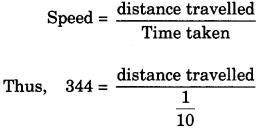
2. The speed of sound in air is 344 m/s. Let us calculate the minimum distance from the reflecting surface, which is necessary to hear an echo.
Sound Class 9 Extra Questions and Answers Science Chapter 12 img 1
∴ Distance travelled = 344 x \(\frac {1}{10}\) = 34.4 metres
Thus, the distance travelled by the sound in \(\frac {1}{10}\) th of a second is 34.4 m. This means that the minimum distance between the source of the sound and the listeners should be 17.2 metres.

3. Echo can be heard only if the reflecting surface is large.

Question 3.
Bats search out prey and fly in the dark night by emitting ultrasound. Explain.
Answer:
Bats search out prey and fly in the dark night by emitting and detecting reflections of ultrasonic waves. The high-pitched ultrasonic squeaks of the bat are reflected from the obstacles or prey and returned to bat’s ear. The nature of reflections tells the bat where the obstacle or prey is and what it is like.

Question 4.
Mention one advantage and one disadvantage of reverberation.
Answer:
A certain amount of reverberation improves the quality of sound of orchestral and choral music. However excessive reverberation makes the speech or music indistinct.

Question 5.
How does a megaphone works?
Answer:
A megaphone works on the principle of reflection of sound. In this instrument, a tube followed by a conical opening reflects sound successively to guide most of the sound from the source in the forward direction towards the audience.

Sound Class 9 Extra Questions Numericals

Question 1.
If the velocity of sound in air is 340 ms-1. Calculate
1. wavelength when the frequency is 256 Hz.
2. frequency when the wavelength is 0.85 m.
Answer:
Given,
velocity of sound, υ = 340 m/s
1. v = 256 Hz
using, υ = λ v
λ = \(\frac {υ}{λ}\) = \(\frac {340}{256}\) = 1.33m

2. λ = 0.85
using, u = λv
λ = \(\frac {υ}{λ}\) = \(\frac {340}{0.85}\) = 400Hz

Question 2.
30 waves pass through a point in 3 seconds. If the distance between two crests is 2 m. Calculate
(a) frequency
(b) wavelength.
Answer:
30 waves in 3 seconds
υ = \(\frac {30}{3}\) = 10Hz
∴ λ = 2m.

Sound Class 9 Extra Questions Short Answer Type 2

Question 1.
What is the reflection of sound? State the laws of reflection.
Answer:
The bouncing back of sound from a hard surface is called a reflection of sound. The laws of reflection are:
1. The incident sound wave, the reflected sound wave and the normal at the point of incidence, all lie in the same plane.
2. The angle of incidence of sound is always equal to the angle of reflection of sound.

Question 2.
On what factor does the speed of sound depend?
Answer:
The speed of sound depends upon the following:

  • The nature of the material (or medium) through which it travels. In general, sound travels fastest in solids, slower in liquids and slowest in gases.
  • The humidity of the air. As the humidity of air increases, sound travels faster. Sound has more speed in humid air than in dry air.
  • The temperature. The speed of sound in air at 0°C is 332 m/s whereas at 20°C, it is 344 m/s. Thus, as the temperature rises, the speed of sound also increases.

Question 3.
Write a note on ‘ultrasonic sounds’.
Answer:

  • The sounds of frequencies higher than 20,000 Hz are known as ‘ultrasonic sounds’ (or just‘ultrasounds’).
  • Human beings cannot hear ultrasonic sounds. Children under the age of five and some animals, such as dogs can hear sounds up to 25,000 Hz.
  • As people grow older, their hearing sensation for higher frequencies becomes weaker.
  • Ultrasonic sounds are used by dolphins, bats and porpoises to navigate in dark and to catch their prey.
  • Some moths can hear high-frequency ultrasonic squeaks of the bat and know when a bat is flying nearby and are able to escape capture. Rats also play games by producing ultrasound.

Question 4.
Write three differences between transverse and longitudinal waves.
Answer:
Transverse waves:

  • In the transverse waves, the particles of the medium vibrate perpendicular to the direction of wave motion.
  • These waves travel in the form of alternate crest and trough.
  • These waves can be transmitted through solid or liquid surfaces.

Longitudinal waves:

  • In longitudinal waves, the particles of the medium vibrate along the direction of wave motion.
  • These waves travel in the form of alternate compression and rarefactions.
  • These waves can be transmitted through all the three types of media viz., solid, liquid and gases.

Question 5.
Write down three differences between a sound wave and lightwave.
Answer:
Sound wave:

  • It travels in the form of longitudinal waves.
  • It requires a medium for its propagation.
  • It travels through air with a speed of 332 propagation. m/s at 0°C.

Lightwave:

  • It travels in the form of a transverse wave.
  • It does not require a medium for its propagation.
  •  It travels through air with a speed of nearly 3 x 10⁸ m/s.

Sound Class 9 Extra Questions Long Answer Type

Question 1.
State three applications of reflection of sound.
Answer:
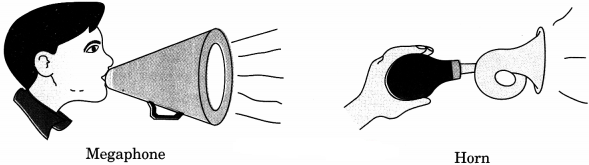
1. Megaphone and a bulb horn: Megaphones or loudhailers, horns, musical instruments such as trumpets and she Hana is, are all designed to send sound in a particular direction without spreading it in all directions, as shown in the figure. In these instruments, a tube followed by a conical opening reflects sound successively to guide most of the sound waves from the source in the forward direction towards the audience.
Sound Class 9 Extra Questions and Answers Science Chapter 12 img 2

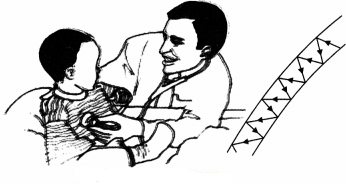
2. Stethoscope: Stethoscope is a medical instrument used for listening to sounds produced within the body, chiefly in the heart or lungs. In stethoscopes, the sound of the patient’s heartbeat reaches the doctor’s ears by multiple reflections of sound, as shown in the figure.
Sound Class 9 Extra Questions and Answers Science Chapter 12 img 3
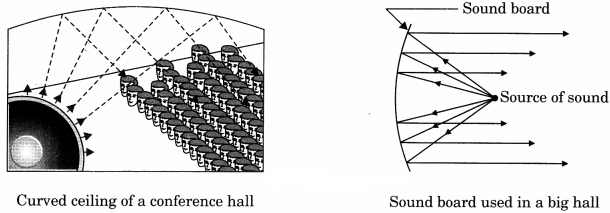
3. Soundboard: Generally the ceiling of concert halls, conference halls and cinema halls are curved so that sound after reflection reaches all corners of the hall, as shown in the figure. Sometimes a curved soundboard may be placed behind the stage so that the sound, after reflecting from the soundboard, spreads evenly across the width of the hail (Fig).
Sound Class 9 Extra Questions and Answers Science Chapter 12 img 4

Question 2.
State the applications of ultrasound.
Answer:
Ultrasounds are high-frequency waves. Ultrasounds are able to travel along well-defined paths even in the presence of obstacles. Ultrasounds are used extensively in industries and for medical purposes.

1. Ultrasound is generally used to clean parts located in hard-to-reach places, for example, spiral tube, odd-shaped parts, electronic components, etc. Objects to be cleaned are placed in a cleaning solution and ultrasonic waves are sent into the solution. Due to high frequency, the particles of dust, grease and dirt get detached and drop out. The objects thus get thoroughly cleaned.

2. Ultrasounds can be used to detect cracks and flaws in metal blocks. Metallic components are generally used in the construction of big structures like buildings, bridges, machines and also scientific equipment. The cracks or holes inside the metal blocks, which are invisible from outside reduces the strength of the structure.

Ultrasonic waves are allowed to pass through the metal block and detectors are used to detect the transmitted waves. If there is even a small defect, the ultrasound gets reflected back indicating the presence of the flaw or defect.

3. Ultrasonic waves are made to reflect from various parts of the heart and form the image of the heart. This technique is called ‘echocardiography’.

4. An ultrasound scanner is an instrument which uses ultrasonic waves from getting images of internal organs of the human body. A doctor may image the patient’s organs such as liver, gall bladder, uterus, kidney, etc. It helps the doctor to detect abnormalities, such as stones in the gall bladder and kidney or tumours in different organs.

In this technique, the ultrasonic waves travel through the tissues of the body and get reflected from a region where there is a change of tissue density. These waves are then converted into electrical signals that are used to generate images of the
organ.

These images are then displayed on a monitor or printed on a film. This technique is called ‘ultrasonography’. Ulträsonography is also used for examination of the foetus during pregnancy to detect congenital defects and growth abnormalities.

5. Ultrasound may be employed to break small ‘stones’ formed in the kidneys into fine grains. These grains later get flushed out with urine.

Sound Class 9 Extra Questions HOTS

Question 1.
Why do we hear the sound produced by the humming bees while the sound of vibrations of a pendulum is not heard?
Answer:
This is because the frequency of the sound produced by humming bees lies in audible range and frequency of the sound of vibrations of pendulum lies in the infrasonic region.

Question 2.
Sounds of same loudness and pitch but produced by different musical instruments like a violin and flute are distinguishable.
Answer:
It is the quality of sound which enables us to distinguish between two sounds of the same loudness and pitch.

Question 3.
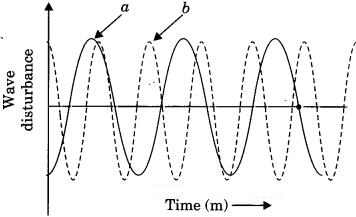
Which of the two graphs (a) and (b) shown in the figure below represents the human voice is likely to be the male voice? Give a reason for your answer. (NCERT Exemplar)
Sound Class 9 Extra Questions and Answers Science Chapter 12 img 5
Answer:
Graph a represents the male voice because the frequency of male voice is less than that of the female voice.

Question 4.
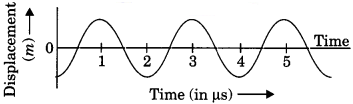
The given graph (Fig.) shows the displacement versus time relation for a disturbance travelling with velocity 1500 ms-1. Calculate the wavelength of the disturbance. (NCERT Exemplar)
Sound Class 9 Extra Questions and Answers Science Chapter 12 img 6
Answer:
Here, frequency, u = \(\frac {1}{T}\)
T = 2 ms = 2 x 10⁻⁶ s
Hence υ = \(\frac{1}{2 \times 10^{-6}}\) = 5 x 10⁵ Hz
using relation, λ. = \(\frac{v}{v}=\frac{1500}{5 \times 10^{5}}\) = 3 x 10⁻² m

Question 5.
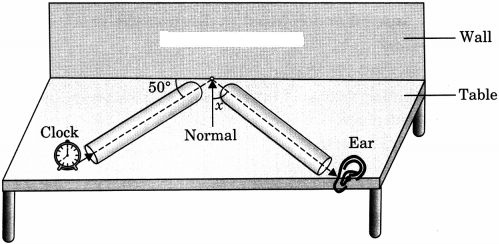
For hearing the loudest ticking sound heard by the ear, find the angle x in the Figure. (NCERT Exemplar)
Sound Class 9 Extra Questions and Answers Science Chapter 12 img 7
Answer:
Here angle of incidence,
i = 90° – 50° = 40°
Angle of incidence (i) or Angle of reflection (x)
x = i = 40°.

Sound Class 9 Extra Questions Value Based (VBQs)

Question 1.
Sumeet went to a hill station with his parents and elder sister Kirti. He was experiencing the scenic beauty of a hill station for the first time. One day they were walking in a forest area, Sumeet loudly called out ‘Kirti Didi’. He was surprised that he could distinctly hear the same sound twice. He discussed this with his sister and she explained the reason behind this echo.
Answer:
(a) The repetition of sound caused by the reflection of sound waves is called an echo.
(b) Kirti is intelligent and helpful.

Question 2.
Tinku studies in class 9th. Once he was suffering from cold and cough and was running a high temperature. His mother took him to a doctor. The doctor examined the chest and back of Tinku with the help of a device ‘stethoscope’. While examining with stethoscope doctor asked Tinku to take longer breaths. After examining Tinku, the doctor prescribed some drugs.

By regular use of these drugs, Tinku was normal within four days. But he could not understand the purpose of being examined by the use of a stethoscope. During winter break his cousin Honey, who was studying in a medical college, visited their place. On the request of Tinku, Honey explained the purpose of the stethoscope and its action.
(a) What is a stethoscope?
(b) What quality was shown by Honey?
Answer:
(a) The stethoscope is a medical instrument used for listening to sounds produced within the body, chiefly in the heart or lungs.
(b) Honey is intelligent and helpful.

Question 3.
On a hot summer afternoon, a man was shouting through a megaphone. He was ‘zip-repairer’. As Arshi was preparing for her examination, she got disturbed. She inquired her father about the instrument being used by the ‘zip-repairer’. The father told her that it was a megaphone also known as ‘loud hailer’.
(a) State the principle on which the megaphone works.
(b) Why did Arshi get disturbed?
Answer:
(a) Megaphone works on the principle of multiple reflections.
(b) Arshi got disturbed by noise pollution.

Question 4.
Reena’s grandmother took her mother to a doctor as she was four months pregnant for ultrasonography. But she showed her interest in determining whether the child is a boy or a girl. The doctor was annoyed and refused to disclose the gender of the child.
(a) What is ultrasonography?
(b) Write down the values shown by the doctor.
Answer:
(a) The technique of obtaining images of internal organs of the body by using echoes of ultrasound waves is called ultrasonography.
(b) A Doctor is a law-abiding person.

Work, Power And Energy Class 9 Extra Questions and Answers Science Chapter 11

In this page, we are providing Work, Power And Energy Class 9 Extra Questions and Answers Science Chapter 11 pdf download. NCERT Extra Questions for Class 9 Science Chapter 11 Work, Power And Energy with Answers will help to score more marks in your CBSE Board Exams.

Class 9 Science Chapter 11 Extra Questions and Answers Work, Power And Energy

Extra Questions for Class 9 Science Chapter 11 Work, Power And Energy with Answers Solutions

Work, Power And Energy Class 9 Extra Questions Very Short Answer Type

Question 1.
Define the following terms.
(a) Work was done
(b) Energy
(c) Mechanical energy
(d) Kinetic energy
(e) Potential energy
(f) Power
(g) Commercial unit of energy.
Answer:
(a) Work done: Work done by a force acting on an object is equal to the magnitude of the force multiplied by the distance moved in the direction of the force.
(b) Energy: Energy of a body is defined as the capacity or ability of the body to do work.
(c) Mechanical energy: Mechanical energy includes kinetic energy and potential energy.
(d) Kinetic energy: The energy possessed by a body by virtue of its motion.
(e) Potential energy: The energy possessed by a body due to its position or configuration.
(f) Power: Power is defined as the rate of doing work or the rate of transfer of energy.
(g) Commercial unit of energy: The energy used in households, industries, and commercial establishment are usually expressed in kilowatt-hour.
1 kWh 1 unit = 3.6 x 10⁶J

Question 2.
Write down the type of energy stored in
(a) spring of a watch
(b) flowing water
(c) rolling stone
(d) raised hammer
(e) running athlete
Answer:
(a) potential energy
(b) kinetic energy
(c) kinetic energy
(d) potential energy
(e) kinetic energy.

Question 3.
What will be the kinetic energy of a body when its mass is made four-time and the velocity is doubled?
Answer:
Initial kinetic energy,
\(E_{K_{i}}=\frac{1}{2} m v^{2}\)
Final kinetic energy,
\(E_{K_{f}}=\frac{1}{2}(4 m) \times(2 v)^{2}\)
= 16 x \(\frac {1}{2}\)mυ2
\(E_{K_{f}}=16 E_{K_{i}}\)

Question 4.
If we lift a body of 7 kg vertically upwards to a height of 10 m, calculate the work done in lifting the body.
Answer:
Given, m = 7 kg
s = 10m
Workdone, W = F x s
E = mg x s
W = 7 x 10 x 10 J
w = 7000 J

Question 5.
State the transformation of energy that takes place when

  • Green plants prepare their food.
  • Head of a nail hammered hard and it becomes hot.

Answer:

  • Solar energy of sun into chemical energy.
  • The kinetic energy of the hammer into heat energy.

Question 6.
How much work is done by a man who tries to push the wall of a house but fails to do so?
Answer:
W = Fs = 0
As there is no displacement.

Question 7.
Establish a relationship between SI unit and commercial unit of energy.
Answer:
SI unit of energy is joule and the commercial unit of energy is the joule.
1kWh = 1000 W x 3600 s = 3.6 x 10⁶J

Question 8.
Write down the energy transformation taking place
(a) In electric bulb
(b) In torch
(c) In the thermal power station
(d) In solar cell
(e) Electric heater
Answer:
(a) Electricity into light energy
(b) The chemical energy of the cell into light and heat energy
(c) The chemical energy of fuel into electricity
(d) Solar energy into electricity
(e) Electricity into heat energy.

Question 9.
A body of mass m is moving in a circular path of radius r. How much work is done on the body?
Answer:
Zero. This is because the centripetal force acting on the body is perpendicular to the displacement of the body.

Question 10.
A horse of mass 200 kg and a dog of mass 20 kg are running at the same speed. Which of the two possesses more kinetic energy? How?
Answer:
The kinetic energy of the horse is more as kinetic energy is directly proportional to mass.

Question 11.
What is the condition for work done to be positive?
Answer:
For positive work, the angle between force and displacement should be acute.

Question 12.
Write down the relation between kinetic energy and momentum of a body.
Answer:
\(E_{K}=\frac{p^{2}}{2 m}\)
Ek = kinetic energy of a body
p = momentum of the body
m = mass of the body.

Question 13.
A cyclist comes to a skidding stop at 50 m. During this process, the force on the cycle due to the road is 1000 N and is directed opposite to the motion. How much work does the road do on the cycle?
Answer:
Given,
Displacement, s = 50 m
Force, F = – 1000 N
Workdone, W = F x s
W = -1000 x 50J
W = 50000J

Question 14.
A boy pushes a book by applying a force of 40 N. Find the work done by this force as the book is displaced through 25 cm along the path.
Answer:
Given, Force (F) = 40 N
Displacement (s) = 25 cm = x 10-2 m
Workdone, W = F x s
= 40 x 25 x 10-2
= 10J
∴ W = 10J

Work, Power And Energy Class 9 Extra Questions Short Answer Type 1

Question 1.
State law of conservation of energy and law of conservation of mechanical energy.
Answer:
Law of conservation of energy: Energy can neither be created nor be destroyed, it can only be transformed from one form to another.
Conservation of mechanical energy: If there is no energy, then the mechanical energy of a system is always constant.

Question 2.
Define (a) 1 joule (b) 1 watt.
Answer:
(a) 1 joule is the amount of work done on an object when a force of 1 N displaces it by 1 m along the line of action of the force.
(b) 1 watt is the power of an agent, which does work at the rate of 1 joule per second.

Question 3.
Write down SI unit of the following quantities.
(a) work
(b) kinetic energy
(c) potential energy
(d) power
Answer:
(a) joule (J)
(b) joule (J)
(c) joule (J)
(d) watt (W).

Question 4.
What is the sequence of energy change that takes place in the production of electricity from adam?
Answer:
The potential energy of stored water is converted into the rotational kinetic energy of turbine blades. The rotational kinetic energy of turbine blades is finally converted into electric energy by the generator.

Question 5.
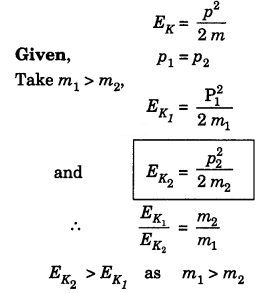
A light and a heavy object have the same momentum. Find out the ratio of their kinetic energies. Which one has larger kinetic energy?
Answer:
The relation between kinetic energy and momentum
Given,
Work, Power And Energy Class 9 Extra Questions and Answers Science Chapter 11 img 1

Question 6.
Why a man does not do work when he moves on a level road while carrying a box on his head?
Answer:
When a man carries a load on his head, the angle between displacement (s) and force (F) is 900. Therefore work done is zero.

Work, Power And Energy Class 9 Extra Questions Numericals

Question 7.
If an electric iron of 1200 W is used for 30 minutes every day, find electric energy consumed in the month of April.
Answer:
Given,
Power, P = 1200 W
time, t = 30 minutes
Power, p = \(\frac {W}{t}\) = \(\frac {E}{t}\)
E = P x t
Energy consumed, E = 1200 x 30 x 60
= 2.16 x 10⁶J = 2.16MJ

Question 8.
What is work done by a force of gravity in the following cases?
(a) Satellite moving around the Earth in a circular orbit of radius 35000 km.
(b) A stone of mass 250 g is thrown up through a height of 2.5 m.
Answer:
(a) Zero
(b) Given,
mass (m) = 250 g = 0.25 kg
height (h) = 2.5 m
Workdone, W = Fs = mgh
= 0.25 x 10 x 2.5
= 6.25 J
W = 625 J

Question 9.
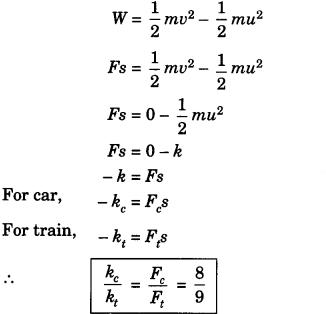
A car and a truck have kinetic energies of 8 x 10 J and 9 x 10 J respectively. If they are brought to a halt at the same distance, find the ratio of the force applied to both the vehicles.
Answer:
Given,
Kinetic energy of car, \(\frac {1}{2}\) = 8 x 10 J
Kinetic energy of truck, \(\frac {1}{2}\) = 9 x 10 J
W = Fs
Work done,
Work, Power And Energy Class 9 Extra Questions and Answers Science Chapter 11 img 2

Question 10.
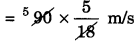
A bus of mass 10,000 kg is moving with a velocity 90 km/h. Calculate the work done to stop this bus.
Answer:
Given,
mass of object, m = 1000 kg
Initial velocity of object, u = 90 km/h
Work, Power And Energy Class 9 Extra Questions and Answers Science Chapter 11 img 3
= 25 m/s
Work done = \(\frac {1}{2}\) mυ2 – \(\frac {1}{2}\) mu2 = 0 – \(\frac {1}{2}\) x 10000 x (25)2 = 312.5 x 10⁴ J

Work, Power And Energy Class 9 Extra Questions Short Answer Type 2

Question 1.
The velocity of a body moving in a straight line is inereásed by applying constant force F, for some distance in the direction of motion. Prove that the increase ¡n the kinetic energy of the body is equal to the work done by the force on the body.
Answer:
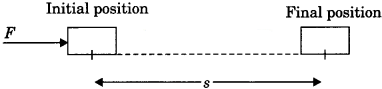
Let us consider an object lying on a frictionless surface having mass ‘m’.
Work, Power And Energy Class 9 Extra Questions and Answers Science Chapter 11 img 4 Work, Power And Energy Class 9 Extra Questions and Answers Science Chapter 11 img 5 Work, Power And Energy Class 9 Extra Questions and Answers Science Chapter 11 img 6 Work, Power And Energy Class 9 Extra Questions and Answers Science Chapter 11 img 7
A force of constant magnitude ‘F’ is acting on the body. Here initial velocity of the body is u and the final velocity is u. As there is no dissipative forces, work on the body will be stored in the form of a change in kinetic energy. It can be proved as
W = Fs …………(1)
and hence from the equation of motion
υ2 – u2 = 2as
s = \(\frac{v^{2}-u^{2}}{2 a}\) ………….(2)
Asweknowthat F = ma
Using (1), (2) and (3),
W = ma x \(\frac{v^{2}-u^{2}}{2 a}\)
= \(\frac {1}{2}\) m (υ2 – u2)
= \(\frac {1}{2}\)mυ2 – \(\frac {1}{2}\)mu2
= change in kinetic energy

Question 2.
Derive an expression for potential energy. Write Its SI unit.
Answer:
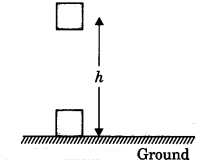
When work is done on the body, the work is stored in the form of energy. Consider an object of mass, m. Let it be raised through a height, h from the ground. A force is required to do this. The minimum force required to raise the object is equal to the weight of the object, mg. The object gains energy equal to the work done on it. Let the work done on the object against gravity h be W.
i.e., W = force x displacement = mgh
Work, Power And Energy Class 9 Extra Questions and Answers Science Chapter 11 img 8
Since work done on the object is equal to mgh, an energy equal to mgh units is gained by the object. This is the potential energy (Ep) of the object.
∴ Ep = mgh
SI unit of potential energy is the joule (J).

Work, Power And Energy Class 9 Extra Questions Numericals

Question 3.
A girl having a mass of 35 kg sits on a trolley of mass 5 kg. The trolley is given an initial velocity of 4 ms1 by applying a force. The trolley comes to rest after traversing a distance of 16 m.
(a) How much work is done on the trolley?
(b) How much work is done by the girl?
Answer:
Given, mass of girl, m = 35 kg
mass of trolley, m = 5 kg.
initial velocity of trolley, u = 4 m/s

(a) using work done = change in kinetic energy
W = \(E_{K_{f}}-E_{K_{i}}\)
= o – \(\frac {1}{2}\) x 40 x (4)2 = – 320
∴ W = 320 J_J
(b) Work done by the girl = 0.

Question 4.
Express kilowatt in terms of joule per second. A 150 kg car engine develops 500 W for each kg. What forces does it exert in moving the car at a speed of 20 ms-1?
Answer:
1 kW = iooo w = 103 J/S
Given, mass (m) = 150 kg
power (P) = 500 W
velocity (u) = 20 m/s
Using P = Fυ
or, 500 = F x 20
= F =\(\frac {500}{20}\) = 25
F= 25 N

Question 5.
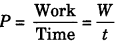
How is the power related to the speed at which a body can be lifted? How many kilogrims will a man working at the power of 100 W, be able to lift at constant speed of 1 mr1 vertically? (g = 10 ms-2)
Answer:
We know that,
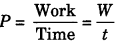
Work, Power And Energy Class 9 Extra Questions and Answers Science Chapter 11 img 9
or, p = \(\frac {F.s}{t}\) P = Fυ = mg.υ [F = mg]
where, F = force
s = displacement
υ = velocity
t = time
Given,
power (P) = 100 W
velocity (υ) = 1 m/s
g = 10 m/s2
or, 100 = m x 10 x 1
∴ m = 10 kg

Question 6.
A car of mass 2000 kg is lifted up a distance of 30 m by a crane in 1 minute. A second crane does the same job in 2 minutes. What is the power applied by each crane?
Answer:
Given, mass of the car to be lifted, m = 2000 kg
height through which the car is to be lifted, h = 30 m
Time taken by first crane, t1 = 1 minute = 60 s
time taken by second crane, t1 = 2 minutes = 120 s
Amount of work done by each crane,
W = mgh = 2000 x 10 x 30 J
W= 6 x 10⁶ J
Power of first crane, ‘
P1 = \(\frac{W_{1}}{t_{1}}=\frac{6 \times 10^{5} \mathrm{J}}{60 \mathrm{s}}\) = 10kW
Power of second crane
P2 = \(\frac{W_{2}}{t_{2}}=\frac{6 \times 10^{5} \mathrm{J}}{120 \mathrm{s}}\) = 10kW

Question 7.
Calculate the electricity bill amount for a month of June, if 6 bulbs of 100 W for5 hours, 4 tube lights of 60 W for 5 hours, a TV of 50 W for 6 hours are used per day. The cost per unit is ₹ 5.
Answer:
Total energy used in a day = (6 x 100 x 5 + 4 x 60 x 5 + 1 x 50 x 6) Wh
= (3000+ 1200 +300)Wh = 4500 Wh
Total energy = 4.5 kWh = 4.5 unit
Total energy used in 30 days = 4.5 x 30 = 135 units
Bill amount = 135 units x ₹ 5 unit = ₹ 675.

Work, Power And Energy Class 9 Extra Questions Long Answer Type

Question 1.
State the conditions for positive, negative, and zero work. Give at least one example of each.
Answer:
1. Zero work: If the angle between force and displacement is 90°, then work done is said to be zero work.
Example: When a man carries a load on his head and moves on a level road. Work done by the man on the load is zero.
Work, Power And Energy Class 9 Extra Questions and Answers Science Chapter 11 img 10
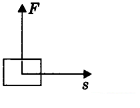
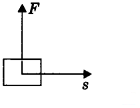
2. Positive work: Work done is said to be positive if the force applied on an object and displacement are in the same direction.
W = Fs
Work, Power And Energy Class 9 Extra Questions and Answers Science Chapter 11 img 11
Example: Work done by the force of gravity on a falling body is positive.
3. Negative work: Work done is said to be negative if the applied force on an object and displacement is in opposite direction.
W = -Fs
Her displacement is taken to be negative (- s).
Work, Power And Energy Class 9 Extra Questions and Answers Science Chapter 11 img 12
Example: Work done by friction force applied is negative on a moving body.

Question 2.
Give a reason for the following:
(a) A bullet is released on firing the pistol.
(b) An arrow moves forward when released from the stretched bow.
(c) Winding the spring of a toy car makes it to run on the ground.
(d) Falling water from a dam generates electricity.
(e) Winding the spring of our watch, the hands of the watch movement.
Answer:
(a) The chemical energy of gun powder is converted into kinetic energy of the bullet.
(b) The elastic potential energy in a stretched bow is converted into kinetic energy of the arrow.
(c) The potential energy of a spring is converted into kinetic energy of the toy.
(d) The kinetic energy of water is converted into electric energy.
(e) The potential energy of spring due to its windings is converted into mechanical energy of the watch.

Question 3.
State the law of conservation of energy. Show that the energy of a freely falling body is conserved.
Answer:
Energy can neither be created nor be destroyed, it can only be transformed ‘ m A from one form to another. The total energy before and after the transformation always remains constant.
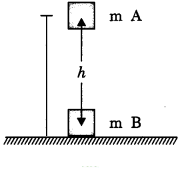
Let us consider an object of mass ‘m’ dropped from a height h.
Total energy at point A
Work, Power And Energy Class 9 Extra Questions and Answers Science Chapter 11 img 13

\(E_{T_{A}}=E_{K}+E_{P}\)
or, \(E_{T_{A}}=0+m g h\)
∴ \(E_{T_{A}}=m g h\)
Total energy at point B,
\(E_{T_{B}}=E_{T}+E_{p}\)
For finding out velocity at point B
apply υ2 – u2 = 2as
\(v_{\mathrm{B}}^{2}=2 g h\) = 2gh
Hence, \(E_{T_{B}}=\frac{1}{2} m \mathrm{V}_{\mathrm{B}}^{2}+m g\)
\(E_{T_{B}}=\frac{1}{2} m(2 g h)=m g h\)
Here, \(E_{T_{A}}=E_{T_{B}}\)
Hence if there is no energy loss, total energy is conserved.

Work, Power And Energy Class 9 Extra Questions HOTS

Question 1.
A running man has half the kinetic energy that a body of half of his mass has. The man speeds up by 1 m/s and then has the same kinetic energy as the boy. What are the original speeds of the man and the boy?
Answer:
Let us take
mass of boy = m
mass of man = M
velocity of boy = u
velocity of man = υ
Here, m = \(\frac {M}{2}\)
Initially
EKof man = \(\frac {1}{2}\) EK of boy
\(\frac {1}{2}\) Mυ2 = \(\frac {1}{2}\) mu2 x \(\frac {1}{2}\)
and \(\frac {1}{2}\) Mυ2 = \(\frac {1}{2}\) \(\frac{1}{2}\left(\frac{M}{2}\right) u^{2} \times \frac{1}{2}\)
∴ υ2 = \(\frac{u^{2}}{4}\) ………….(1)

Finally
EK of man = EK of boy
\(\frac {1}{2}\)M(υ +1)2 = \(\frac {1}{2}\) mu2
\(\frac {1}{2}\)M(υ +1)2 = \(\frac{1}{2}\left(\frac{M}{2}\right) u^{2}\)
(υ +1)2 = \(\frac{u^{2}}{2}\)
∴ υ +1 = \(\frac{u}{\sqrt{2}}\) …………(2)
υ = \({\sqrt{2}}\) + 1 = 2.41 m/s
and u = 4.82 m/s

Question 2.
Avinash can run with a speed of 8 m/s against the frictional force of 10 N, and Kapil can move with a speed of 3 m/s against the frictional force of 25 N. Who is more powerful and why?
Answer:
Power can be expressed as, P = Fu
Power of Avinash, P = Fu = 10 x 8 = 80 W
Power of Kapil, P = Fu = 25 x 3 = 75 W
Avinash is more powerful than Kapil.

Question 3.
The weight of a person on a planet A is about half that on the earth. He can jump up to 0.4 m height on the surface of the earth. How high can he can jump on planet A?
Answer:
For the case, of jump, the energy imparted by the person is converted into potential energy,
Hence,
(mAgA)hA = (mege)he ………(1)
Given, mAgA = \(\frac{m_{e} g_{e}}{2}\) ………….(2)
Using (1) and (2),
\(\frac{h_{\mathrm{A}}}{2}=h_{e}\)
∴ hA = 2he = 2 x 0.4 = 0.8m

Question 4.
A ball is dropped from a height of 10 m. If the energy of the bal] is reduced by 40% after striking the ground, how much high can the ball bounce back? (g 10 m/s2)
Answer:
Given,
height, h = 10
If the energy of the ball is reduced by 40%, the remaining energy of the ball is 60% of initial.
Hence ball will rebound to 60% of the initial height
h = \(\frac {60}{100}\) x 10 m
∴ h = 6m

Question 5.
Four men lift a 250 kg box to a height of 1 m and hold it. Without raising or lowering it
(a) How much work is done by men in lifting the box?
(b) How much work they do in just holding it?
Answer:
Given, mass of block, m = 250 kg
height, h = 1 m
(a) work done in lifting,
W = Fs = mgh = 250 x 10 x 1
W = 2500 J
(b) work done in holding, W = 0

Question 6.
What is power? How do you differentiate kilowatt from kilowatt-hour? The Jog falls in Karnataka state are nearly 20 m high. 2000 tonnes of water falls from it in a minute. Calculate the equivalent power if all this energy can be utilized. (g = 10 ms-2)
Answer:
1. Power is rate of doing work.
2. Kilowatt is the unit of power and kilowatt-hour is unit of energy.
3. Given, height, h = 20 m
Mass per unit time,
m/t = 2000 tonnes per minutes = \(\frac{2000 \times 10^{3}}{60}\) kg/s
Power P = \(\frac{W}{t}=\frac{m g h}{t}=\frac{2000 \times 10^{3}}{60}\) = 10 x 20
∴ P = 6.67 x 10⁶ W = 6.67 MW

Question 7.
What happens to the kinetic energy when:
1.  the mass of the body is doubled at constant velocity?
2. the velocity of the body is doubled at constant mass?
3. the mass of the body is doubled but velocity is reduced to one fourth?
Answer:
1. The kinetic energy of body is given by,
Ek = \(\frac {1}{2}\) mυ6, Ek ∝ m. If the mass of the body is doubled its kinetic energy is also doubled.

2. Kinetic energy, Ek ∝ u2
If velocity of the body is doubled, its kinetic energy becomes four times.

3. Initial kinetic energy,
\(E_{K_{i}}\)= \(\frac {1}{2}\) mu2
Final kinetic energy,
\(E_{K_{f}}\) = \(\frac {1}{2}\)(2m) \(\left(\frac{v}{4}\right)^{2}=\frac{m v^{2}}{16}\)
Kinetic Energy becomes one eighth.

Question 8.
Why is the water at the bottom of a waterfall warmer than the water on the top?
Answer:
When waterfalls, its potential energy is converted into kinetic energy of molecules, and the kinetic energy of molecules is converted into heat energy.

Work, Power And Energy Class 9 Extra Questions Value Based (VBQs)

Question 1.
Aman is a student of class IX. He saw an old man trying to keep his box on the roof of a bus but was unable to do so. Aman picked up his box and placed the box on the roof of the bus.
The old man thanked Aman.
Answer the following questions based on the given paragraph:

  • Is the work done by Aman while placing the box on the roof of the bus positive or negative?
  • Is the work done by gravity on the box positive or negative?
  • What values are shown by Aman?

Answer:

  • Positive
  • Negative
  • Aman is a kind and helpful person.

Question 2.
In the winter season, John gifted an electric heater to his grandfather. The electric heater uses electricity to increase room temperature.
Answer the following questions based on the above paragraph:

  • Write down the energy transformation in the electric heater.
  • What values are shown by John?

Answer:

  • Electric heater converts electricity into heat energy.
  • John is an intelligent and caring person.

Question 3.
The government of a state decided to construct dams on the river for power generation. Nowadays the demand of electricity is continuously increasing and therefore more generation is required.
Answer the following questions based on the above paragraph:
(a) Write down the type of energy conversion is taking place in dams.
(b) Write down the values shown by the state government.
Answer:
(a) The potential energy of stored water is converted into electricity.
(b) The state government is working efficiently and showing good governance.

Force and Laws of Motion Class 9 Extra Questions and Answers Science Chapter 9

In this page, we are providing Force and Laws of Motion Class 9 Extra Questions and Answers Science Chapter 9 pdf download. NCERT Extra Questions for Class 9 Science Chapter 9 Force and Laws of Motion with Answers will help to score more marks in your CBSE Board Exams.

Class 9 Science Chapter 9 Extra Questions and Answers Force and Laws of Motion

Extra Questions for Class 9 Science Chapter 9 Force and Laws of Motion with Answers Solutions

Force and Laws of Motion Class 9 Extra Questions Very Short Answer Type

Question 1.
Define the following terms

  1. Force
  2. Balanced forces
  3. Unbalanced forces
  4. Inertia
  5. Momentum
  6. Conservation of momentum.

Answer:

  1. Force: It is an entity which when applied on a body changes or tends to change its state of motion and shape.
  2. Balanced forces: When a number of forces acting simultaneously on a body do not bring about any change in the state of rest or of uniform motion along a straight line, then the forces acting on the body are said to be balanced.
  3. Unbalanced forces: When a number of forces acting simultaneously on a body bring about a change in its state of rest or of uniform motion along a straight line, then these forces acting on the body are said to be unbalanced forces.
  4. Inertia: Inertia is the natural tendency of an object to resist a change in its state of motion or rest.
  5. Momentum: Momentum of a body is the product of its mass and velocity.
  6. Conservation of momentum: In an isolated system, the total momentum remains conserved.

Question 2.
Name the physical quantity that measures inertia.
Answer:
Mass of body measures its inertia.

Question 3.
There are three solids made up of aluminum, steel, and wood, of the same shape and same volume. Which of them would have the highest inertia?
Answer:
Steel ball would have the highest inertia as steel is denser than the other two.

Question 4.
Name the factors on which the momentum of a body depends.
Answer:

  • Mass and
  • The velocity of the body.

Question 5.
Define one newton of force.
Answer:
Force is said to be 1 newton if it produces an acceleration of 1 rn/s2 in a body of 1 kg.

Question 6.
An object is thrown vertically upwards. What is its momentum at the highest point?
Answer:
Since the velocity at the highest point is zero, so the momentum of the object is zero at the highest point.

Question 7.
State action and reaction when a bullet is fired from the gun.
Answer:
Action: Force exerted by a spring on the bullet.
Reaction: Force exerted on the gun.

Question 8.
An athlete runs some distance before taking a jump. Why?
Answer:
To gain momentum so that he may jump higher.

Question 9.
Mention any two effects of force.
Answer:

  • It changes the state of rest or motion of a body.
  • It changes the shape of the body.

Question 10.
What happens to the momentum of a body whose velocity is halved?
Answer:
The momentum of the body becomes half.

Question 11.
Give the magnitude and the direction of the net force acting on the cork of mass 10 g floating on water.
Answer:
Zero.

Question 12.
A car of mass 1000 kg is moving with velocity 5 m/s. Calculate the momentum of the car.
Answer:
Given, mass, m = 1000 kg
Velocity, u = 5 m/s
Momentum, P = mυ
P= 1000 x 5 = 5000kg m/s
P= 5000 kg m/s

Question 13.
A meteorite burns in the atmosphere before it reaches the Earth’s surface. What happens to the linear momentum?
Answer:
Meteorite burns due to heat produced by frictional force. The linear momentum of the meteorite decreases as a frictional force acts on it.

Question 14.
Find the acceleration produced by a force of 2000 N acting on a car of mass 800 kg.
Answer:
Given,
Mass, m =800kg
Force, F = 2000 N
Using F = ma
a = \(\frac{F}{m}\)
a = \(\frac{2000}{800}\) = 2.5 m/s2

Force and Laws of Motion Class 9 Extra Questions Short Answer Type 1

Question 1.
Write down SI unit of (i) force (ii) momentum.
Answer:

  • newton (N)
  • kg rn/s.

Question 2.
When a person hits a stone, his foot is injured. Why?
Answer:
When a person hits a stone, the stone exerts an equal force on his foot. Due to this force, his foot gets injured.

Question 3.
Why no force is required to move an object with a constant velocity?
Answer;
We know, F = ma
When, velocity is constant, then acceleration, a = 0. Hence, F = 0.

Question 4.
Why is it easier to catch a table tennis ball than a cricket ball, even both are moving with the same velocity?
Answer:
It is easier to catch a table tennis ball because the table tennis ball has less mass (inertia).

Question 5.
Write down the expression for the recoil velocity of the gun.
Answer:
Recoil velocity of gun is given by,
\(\mathrm{V}_{\mathrm{G}}=\frac{m_{b} v_{b}}{\mathrm{M}_{\mathrm{G}}}\)
mb = mass of bullet
mG = mass of gun
υb = velocity of bullet
VG = recoil velocity of gun.

Force and Laws of Motion Class 9 Extra Questions Numericals

Question 6.
A car of mass 1000 kg moving with a velocity of 54 km/h hits a wall and comes to rest in 5 seconds. Find the force exerted by the car on the wall.
Answer:
Given, Mass = 1000 kg
Time = 5 s
Initial velocity, u = 54 km/h = 15 m/s
Final velocity, υ = 0 m/s
Time, t = 5s
using, F = m a
F = m\(\left(\frac{v-u}{t}\right)\) = 1000 \(\left(\frac{0-15}{5}\right)\) = -3000N

Question 7.
A body of mass 100g is at rest on a smooth surface. A force of 0.1-newton act on it for 5 seconds. Calculate the distance traveled by the body.
Answer:
Given, Mass of body = 100 g = 0.1 kg
Force, F = 0.1N
Time, t = 5s
Initial velocity, u = 0 m/s
Using formula, F = ma
⇒ a = \(\frac{F}{m}=\frac{0.1}{0.1}\) = 1 m/s2

Using formula, s = ut + at2
s = ut + \(\frac {1}{2}\)at2
⇒ s = 0 + \(\frac {1}{2}\) x 1 x (5)2
∴ s = 12.5 m

Question 8.
A bullet of mass 200 g is fired from a gun of mass 10 kg with a velocity of 100 m/s. Calculate the velocity of recoil.
Answer:
Given, Mass of bullet, m = 200 g = 0.2 kg
Massofgun, M = 10 kg
Velocity of bullet, Vb = 100 m/.s
Recoil velocity of gun, VG = \(\frac{m v_{b}}{\mathrm{M}}\)
VG = – \(\frac{0.2 \times 100}{10}\) = 2m/s
Recoil velocity of gun, VG = 2 m/s

Question 9.
Two spheres of masses 20 g and 40 g moving in a straight line in the same direction with velocities of 3 mIs and 2 m/s respectively. They collide with each other and after the collision, the sphere of mass 20 g moves with a velocity of 2.5 miles. Find the velocity of the second ball after confusion.
Answer:
Given, m1 = 20 g = 20 x 10-3 kg
m1 = 40g = 40g x 10-3kg
u1 = 3 m/s
u2 = 2 m/s
υ1 = 2.5 m/s
Applying conservation of linear momentum,
m1u1 + m2u2 = m1υ1 + m2υ2
20 x 10-3 x 3 + 40 x 10-3 x 2 = 20 x 10-3 x 2.5 + 40 x 10-3 x υ2
υ2 = 2.25m/s.

Force and Laws of Motion Class 9 Extra Questions Short Answer Type 2

Question 1.
Newton’s first, second, and third law of motion.
Answer:
Newton’s first law of motion: An object remains in a state of rest or of uniform motion along a straight line unless compelled to change that state by an applied force.

Newton’s second law of motion: The second law of motion states that the rate of change of momentum of an object is proportional to the applied unbalanced force in the direction of the force.

Newton’s third law of motion: According to the third law of motion to every action, there is an equal opposite reaction and they act on two different bodies.

Question 2.
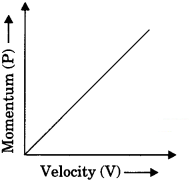
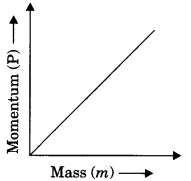
What is momentum? Write its SI unit. Interpret force in terms of momentum. Represent the following graphically.
(a) momentum versus velocity when mass is fixed.
(b) momentum versus mass when velocity is constant.
Answer:
Momentum gives an idea about the quantity of motion contained in a body.
The momentum of (P) of an object is defined as the product of its mass (m) and velocity (υ).
P = mυ
SI unit of momentum is kg ms-1
Graphs
(a) If m = constant
P ∝ υ
Force and Laws of Motion Class 9 Extra Questions and Answers Science Chapter 9 img 1

(b) If v = constant
P ∝ m
Force and Laws of Motion Class 9 Extra Questions and Answers Science Chapter 9 img 2

Question 3.
“Action and reaction are equal and opposite but even they do not cancel each other.” Explain, why?
Answer:
Two equal and opposite forces can cancel each other if they act on the same body. But action and reaction do not act on the same body. They act on two different bodies. Hence cannot cancel each other.

Question 4.
Why are the wheels of vehicles provided with mudguards?
Answer:
The rotating wheels of a vehicle throw out mud sticking to it tangentially due to the inertia of direction. The mudguards stop this mud to fall on another vehicle just moving behind the vehicle.

Question 5.
A car weighing 1600 kg moving with a velocity of 30 mIs retards uniformly coming to rest in 20 seconds. Calculate the
1. Initial and final momentum of the car.
2. Rate of change of linear momentum of the car.
3. Acceleration of the car.
Answer:
Given, mass, m = 1600 kg
Initial velocity, u = 30 m/s
Final velocity, υ = 0 m/s
Time, t = 20s
1. Initial momentum, Pi = mu = 1600 x 30
Pi = 4800 kg m/s
Final momentum, Pf = mυ = 1600 x 0
Pf = 0 kg m/s

2. Rate of change of linear momentum
= \(\frac{P_{f}-P_{i}}{t}\) = \(\frac{0-4800}{20}\) = – 240N
a = \(\frac{v-u}{t}\)

3.  Acceleration,
\(\frac{0 – 30}{20}\)
a = – 1.5 m/s2.

Question 6.
Using the second law of motion, derive the relation between force and acceleration. A bullet of 10 g strikes a sand-bag at a speed of 103 ms2 and gets embedded after traveling 5 cm. Calculate
1. the resistive force exerted by the sand on the bullet.
2. the time is taken by the bullet to come to rest.
Answer:
According to the second law of motion,
The rate of change of momentum is directly proportional to the force applied.
F ∝ \(\frac{m(v-u)}{t}\)
F = \(\frac{km(v-u)}{t}\)
∴ F = kma
Take k = 1 in SI system
∴ F = ma

1. Given, mass of bullet, m = 10g = 10 x 10-3kg
Initial velocity of the bullet, u = 103m/s
Distance travelled by the bullet, s = 5 cm = 5 x 10⁻² m
Final velocity of the bullet = 0
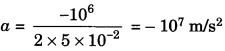
Using the formula, υ-2 – u-2 = 2as
⇒ 0 – (103)2 = 2 x a x 5 x 10⁻²
Force and Laws of Motion Class 9 Extra Questions and Answers Science Chapter 9 img 3
f = m x a = 10 x 10-3 x (107) = – 105 N

2. From the formula,
υ = u + at
⇒  t = \(\frac {υ – u}{a}\) = \(\frac{0-10^{3}}{-10^{7}}\) = 10-4 s = 0.0001 s

Question 7.
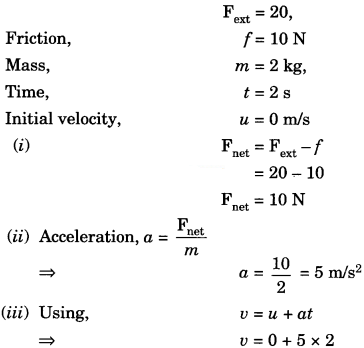
An object is placed on a rough surface. The external force of 20 N is acting on the body and 10 N frictional force is acting on the body.
Find
1. The net force on an object
2. Acceleration of an object if the mass of an object is 2 kg
3. The velocity of the object after 2 seconds if the object is started from rest.
Answer:
Given,
Force and Laws of Motion Class 9 Extra Questions and Answers Science Chapter 9 img 4
∴ υ = 10 m/s

Force and Laws of Motion Class 9 Extra Questions Long Answer Type

Question 1.
Explain why?
(a) A cricket player lowers his hands while catching the ball.
(b) The vehicles are fitted with shockers.
(c) A karate player breaks the pile of tiles or bricks with a single blow.
(d) In a high jump athletic event, the athletes are allowed to fall either on a sand bed or cushioned bed.
(e) In a moving car, the drivers and other passengers are advised to wear seat belts.
(f) China and glassware are packed with soft materials.
(g) Athletes are advised to come to a stop slowly after finishing a fast race.
Answer:
(a) if a player does not lower his hands while catching the ball, the time to stop the ball is very small. So a large force has to be applied to reduce the velocity of the ball to zero or to change the momentum of the ball. When a player lowers his hands, the time to stop the ball is increased and hence less force has to be applied to cause the same change in the momentum of the ball. Therefore, the hands of the player are not injured.

(b) The vehicles are fitted with shockers (i.e., springs)
The floor of a vehicle is cónnected to the lower part of the vehicle by springs or shockers. When the vehicle moves over a rough road, the force due to jerks is transmitted to the floor of the vehicle through the shockers. The shockers increase the time of transmission of the force of jerk to reach the floor of the vehicle. Hence less force is experienced by the passengers in the vehicles.

(c) A karate player can break a pile of tiles with a single blow of his hand because he strikes the pile of tiles with his hand very fast, during which the entire linear momentum of the fast-moving hand is reduced to zero in a very short interval of time. This exerts a very large force on the pile of tiles which is sufficient to break them, by a single blow of his hand.

(d) In a high jump athletic event., the athletes are allowed to fall either on a sand bed or cushioned bed: This is done to increase the time of athletes fall to stop after making the high jump, which decreases the rate of change of linear momentum and decreases the impact.

(e) In a moving car, the drivers and other passengers are advised to wear seat belts: When brakes are applied sudden1y, the passengers of the car fall forward due to the inertia of motion. The seat belt worn by passengers of the car prevents them from falling forward suddenly. This enables the entire linear momentum of the passengers to reduce to zero over a long interval of time, hence it prevents injury.

(f) China and glassware are packed with soft material: China and glassware are wrapped in paper before packing to avoid breakage while transporting. During transportation, there may be collisions due to ta jerks of the packed wares. Soft material like paper slows down their rate of change of linear momentum. As a result, the impact is reduced and items are not broken.

(g) Athletes are advised to come to stop slowly after finishing a fast race: By doing so, he decreases the rate of change of linear momentum by increasing the time interval and hence, reducing the impact, which reduces injury.

Question 2.
Explain
(a) How do we swim?
(b) Why does a gun recoil?
(c) It is difficult to walk on sand or ice.
(d) The motion of rocket.
(e) Why does a fireman struggle to hold a hose-pipe?
(f) Rowing of a boat.
(g) When a man jumps out from a boat, the boat moves backward.
(h) Walking of a person.
Answer:
(a) While swimming, a swimmer pushes the water backward with his hands (i.e., he applies force in the backward direction, which is known as action.) The reaction offered by the water to the swimmer pushes him forward.

(b) Recoiling of a gun: When a bullet is fired from a gun, it exerts a forward force on the bullet and the bullet exerts an equal (in magnitude) and opposite (in direction) force on the gun. Due to the high mass of the gun, it moves a little distance backward and gives a backward jerk to the shoulder of the gunman.

(c) It is difficult to walk on sand or ice: When our feet press the sandy ground in the backward direction, the sand gets pushed away and as a result, we get only a small reaction (forward) from the sandy ground making it difficult to walk.

(d) Rocket propulsion Before firing the rocket, the total linear momentum of the system is zero because the rocket is in the state of rest. When it is fired, chemical fuels inside the rocket are burnt and the hot gases are passed through a nozzle with great speed. According to the law of conservation of linear momentum, the total linear momentum after firing must be equal to zero. As the hot gases gain linear momentum to the rear on leaving the rocket, the rocket acquires equal linear momentum in the upward i.e., opposite direction.

(c) A fireman has to make a great effort to hold a hose-pipe to throw a stream of water on the fire to extinguish it. This is because the stream of water rushing through the hose-pipe in the forward direction with a large speed exerts a large force on the hose-pipe in the backward direction which is known as the reaction force. This reaction force tends to move the hose-pipe in the backward direction. Therefore, a fireman struggles to hold the hose-pipe strongly to keep it at rest.

(f) Rowing of a boat: The boatman during the rowing of a boat pushes the water backward with oars (this is an action of the boatman). According to the third law of motion, water exerts an equal (in magnitude) and opposite (in direction) push on the boat which moves it forward (this is a reaction by water). Thus, harder the boatman pushes back the water with oars (i.e., greater is the action), greater is the reaction force exerted by water, and faster the boat moves in the forward direction.

(g) When a man jumps out from a boat, the boat moves backward: When the passengers start jumping out of a rowing boat, they push the boat backward with their feet. The boat exerts an equal (in magnitude) and opposite (in direction) force on passengers in the forward direction which enables them to move forward.

(h) Walking of a person: When a person walks on the ground, he pushes the ground with his foot in the backward direction by pressing the ground. This push is known as the action, According to Newton’s third law of motion, an equal and opposite reaction acts on the foot of the person by the ground. This reaction (force) of the ground on the person pushes him forward.

Force and Laws of Motion Class 9 Extra Questions HOTS

Question 1.
Two balls of the same size but of different materials, rubber and iron are kept on the smooth floor of a moving train. The brakes are applied suddenly to stop the train. Will the balls start rolling? If so, in which direction? Will they move with the same speed? Give reasons for your answer
Answer:
Yes, both the balls will start rolling in the direction opposite to the motion of the train. The speed of two balls will be different as the inertia of the two balls are different.

Question 2.
Two identical bullets are fired on by a light rifle and another by a heavy rifle with the same force. Which rifle will hurt the shoulders more and why?
Answer:
The light rifles will hurt more as the recoil velocity of the light rifle will be greater.

Question 3.
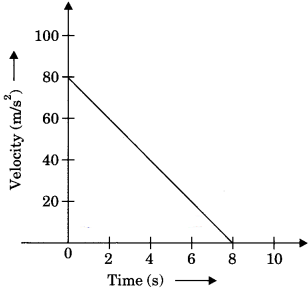
Velocity versus time graph of a ball of mass 50 g rolling on a concrete floor is shown in the figure. Calculate the acceleration and frictional force of the floor on the ball.
Force and Laws of Motion Class 9 Extra Questions and Answers Science Chapter 9 img 5
Answer:
Given, Mass of ball, m = 50 g = 50 x 10-3 kg
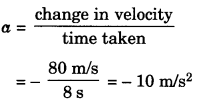
Acceleration can be calculated by υ – t graph,
Force and Laws of Motion Class 9 Extra Questions and Answers Science Chapter 9 img 6
= \(\frac{80 \mathrm{m} / \mathrm{s}}{8 \mathrm{s}}\) = – 10 m/s2
a = – 10 m/s2
Friction force, F = ma
F = 50 x 10-3 x 10
F = 0.5 N

Question 4.
A truck of mass M is moved under a force F. if the truck is then loaded with an object equal to the mass of the truck and the driving force is halved, then how does the acceleration change?
Answer:
Given, Initially
M1 = M and F1 = F
Finally
M2 = 2M and F2=\(\frac {F}{2}\)
Hence, a1 = \(\frac{F_{1}}{M_{1}}\)
a1 = \(\frac{F}{M}\)

and a2 = \(\frac{F_{2}}{M_{2}}\)
a2 = \(\frac{\mathrm{F}}{2 \times 2 \mathrm{M}}\) = \(\frac{F}{4M}\)
\(\frac{a_{1}}{a_{2}}=\frac{F / M}{F / 4 M}=4\)
a2 = \(\frac{a_{1}}{4}\)
Acceleration will become one fourth.

Question 5.
Derive the unit of force using the second law of motion. A force of 5 N produces an acceleration of 8 ms-2 on a mass m1 and an acceleration of 24 ms-2 on a mass m2. What acceleration would the same force provide if both the masses are tied together?
Answer:
Given, Force, F = 5N
a1 = 8 m/s2
and a1 = 24 m/s2
From formula
m1 = \(\frac{F}{a_{1}}\) = \(\frac{5}{8}\) kg
and m2 = \(\frac{F}{a_{2}}\) = \(\frac{5}{24}\) kg
When both the masses tied together
a =\(\frac{\mathrm{F}}{m_{1}+m_{2}}\)
a = \(\frac{5}{\frac{5}{8}+\frac{5}{24}}\) = 6m/s2
a = 6m/s2

Force and Laws of Motion Class 9 Extra Questions Value Based (VBQs)

Question 1.
During a cricket match, a new player Ayush injured his hand while catching the ball. His friend Rudra advised him to catch the ball by lowering his hands backward. When Ayush got another chance to catch the ball, he successfully caught the ball without injuring his hands.
Answer the following questions:
(a) A cricket player lowers his hands while catching the ball. Explain why.
(b) Write down the values shown by Rudra.
Answer:
(a) If a player does not lower his hands while catching the ball, the time to stop the ball will be very small. So a large force has to applied to reduce the velocity of the ball to zero or to change the momentum of the ball. When a player lowers his hands, the time to stop the ball is increased and hence less force has to be applied to cause the same change in momentum of the ball. Therefore, the hands of the player are not injured.

(b) Rudra is a good person as he helped his friend Ayush. He is a knowledgeable person.

Question 2.
During servicing his bike Aman advised the mechanic to oil the shockers for its proper functioning.
Answer the following questions:
(a) The vehicles are fitted with shockers. Explain why.
(b) Write down the values shown by Aman.
Answer:
(a) The floor of a vehicle is connected to the lower part of the vehicle by springs or shockers. When a vehicle moves over a rough road, the force due to jerks is transmitted to the floor of the vehicle through the shockers. The shockers increase the time of transmission of the force of the jerk to reach the floor of the vehicle. Hence less force is experienced by the passengers in the vehicles.
(b) Aman is an intelligent and careful person.

Question 3.
Ranjan advised his son Ayush to wear a seat belt while driving the car.
Answer the following questions
(a) While driving the car, the drivers and other passengers are advised to wear seat belts. Explain why.
(b) Write down the values shown by Ranjan.
Answer:
(a) When brakes are applied suddenly, the passengers of the car fall forward due to the inertia of motion. The seat belt worn by passengers of the car prevents them from falling forward suddenly. This enables the entire linear momentum of the passengers to reduce to zero over a long interval of time, hence it prevents injury.
(b) Ranjan is a noble, intelligent, and careful person.

Motion Class 9 Extra Questions and Answers Science Chapter 8

In this page, we are providing Motion Class 9 Extra Questions and Answers Science Chapter 8 pdf download. NCERT Extra Questions for Class 9 Science Chapter 8 Motion with Answers will help to score more marks in your CBSE Board Exams.

Class 9 Science Chapter 8 Extra Questions and Answers Motion

Extra Questions for Class 9 Science Chapter 8 Motion with Answers Solutions

Motion Class 9 Extra Questions Very Short Answer Type

Question 1.
Define the following terms:
(a) Distance
(b) Displacement
(c) Speed
(d) Velocity
(e) Acceleration
(f) Uniform motion
(g) Uniform circular motion
(h) Scalar quantity
(i) Vector quantity
Answer:
(a) Distance: The total path length traveled by a body in a given interval of time is called distance.
(b) Displacement: The shortest distance measured from the initial to the final position of an object is known as displacement.
(c) Speed: The speed of a body is defined as the distance traveled per unit time.
(d) Velocity: Velocity is defined as displacement per unit time.
(e) Acceleration: The rate of change of velocity with respect to time.
(f) Uniform motion: A body moving in a straight line has a uniform motion if it travels the equal distance in equal intervals of tune.
(g) Non-uniform motion: A body has a non-uniform motion if it travels unequal distances in equal intervals of time.
(h) Scalar quantity: A physical quantity which is described completely by its magnitude only, is called a scalar quantity.
(i) Vector quantity: A physical quantity that has magnitude as well as direction and obeys the vector addition is called a vector quantity.

Question 2.
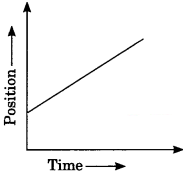
Draw position-time graph of a body that started from a position other than origin and moving with uniform speed.
Answer:
Motion Class 9 Extra Questions and Answers Science Chapter 8 img 1

Question 3.
Give one example where the displacement is zero but the distance traveled is not zero.
Answer:
When a body completes one rotation in a circular path its initial and final positions are the same and hence its displacement is zero.

Question 4.
The area under the velocity-time curve represents which physical quantity?
Answer:
Distance and displacement.

Question 5.
Under what conditions, distance, and magnitude of the displacement are equal?
Answer:
Distance and displacement are equal fan object move along a straight line in one direction.

Question 6.
What is the numerical ratio of average velocity to the average speed of an object when it is moving in a straight path?
Answer:
In this case, both are equal, so the ratio is 1.

Question 7.
What does the speedometer of an automobile measure?
Answer:
The speedometer of a vehicle measures its instantaneous speed.

Question 8.
Classify the following quantities on the basis of scalar quantities and vector quantities.
(a) Distance
(b) Displacement
(c) Speed
(d) Velocity
(e) Acceleration
Answer:
(a) Distance: Scalar quantity
(b) Displacement: vector quantity
(c) Speed: Scalar quantity
(d) Velocity: Vector quantity
(e) Acceleration: Vector quantity

Question 9.
An object starts with initial velocity y and attains a final velocity y. The velocity is changing at a uniform rate. What is the formula for calculating average speed in this situation?
Answer:
Motion Class 9 Extra Questions and Answers Science Chapter 8 img 2

Question 10.
What will you say about the motion of an object if its distance-time graph is a straight line with having a constant angle with a time axis?
Answer:
The motion of the body is uniform motion (constant speed).

Question 11.
What will you say about the motion of a body if its velocity-time graph is a straight line parallel to the time axis?
Answer:
The velocity of the body is constant.

Question 12.
A physical quantity measured is -20 ms-1 It is speed or velocity?
Answer:
It is velocity because velocity can be positive or negative while speed cannot be negative.

Question 13.
A motorcycle drives from A to B with a uniform speed of 30 kmh1 and returns hack with a speed of 20 kmh1. Find its average speed.
Answer:
Let distance AB = x km.
Time taken from going A to B; t1 = \(\frac {x}{30}\) h
Time taken from goingBto A; t2 = \(\frac {x}{20}\) h
Total time taken,t = t1 + t2 = \(\frac {x}{30}\) + \(\frac {x}{20}\) = \(\frac {x}{50}\) h
total distance = x + x = 2x km
Motion Class 9 Extra Questions and Answers Science Chapter 8 img 3
∴ Average speed = 24 km/h

Question 14.
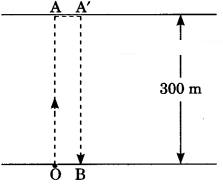
A man swims in a pool of width 300 m. He covers 600 m in 10 minutes by swimming from on end to the other, and back along the same path. Find the average speed and average velocity of the man for the entire journey.
Answer:
Total distance covered by the man in 10 minutes = OA + AB = 600 m
Displacement of man in 10 minutes = 0 m
Motion Class 9 Extra Questions and Answers Science Chapter 8 img 4
Average speed = 1 m/s
Motion Class 9 Extra Questions and Answers Science Chapter 8 img 5
Average velocity = 0 m/s

Motion Class 9 Extra Questions and Answers Science Chapter 8 img 6

Question 15.
What is the acceleration of a body moving with uniform velocity along a straight line?
Answer:
Acceleration of the body is zero as the velocity is constant.

Question 16.
Give an example of a uniform circular motion.
Answer:
An athlete running on a circular track with constant speed.

Question 17.
Convert speed 54 km in meter per second.
Answer:
Speed = 54 km/h =54 x \(\frac{1000 m}{3600}\) = 15 m/s

Question 18.
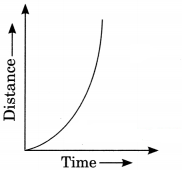
What ¡s the nature of the distance-time graph for accelerated motion?
Answer:
Motion Class 9 Extra Questions and Answers Science Chapter 8 img 7

Motion Class 9 Extra Questions Short Answer Type 1

Question 1.
Distinguish between speed and velocity.
Answer:
Speed:

  • Speed is the ratio of distance and time.
  • Speed is always positive
  • Speed is a scalar quantity.

Velocity:

  • Velocity is the ratio of displacement and time.
  • Velocity may be negative or positive.
  • Velocity is a vector quantity.

Question 2.
Distinguish between distance and displacement.
Answer:
Distance

  • It is the actual length of the path covered by a moving body.
  • It is always positive or zero.
  • It is a scalar quantity.

Displacement:

  • It is the shortest distance measured between the initial and final positions.
  • It may be positive, negative, or zero.
  • it is a vector quantity.

Question 3.
Write down the SI unit of the following quantities:
(a) Displacement
(b) Speed
(c) Velocity
(d) Acceleration
Answer:
(a) m
(b) m/s
(c) m/s
(d) m/s2

Question 4.
Distinguish between uniform motion and non-uniform motion.
Answer:
1. Uniform motion:
A body moving in a straight line has a uniform motion if it travels the equal distance in equal intervals of time

2. Non.uniform motion:
A body has a non-uniform motion if it travels the unequal distance in equal intervals of time

Question 5.
Distinguish speed at any instant and average speed.
Answer:
1. Instantaneous speed:
The speed at any particular instant is known as instantaneous speed.

2. Average speed:
Average speed is the ratio of total distance traveled by a body and time taken to travel that distance.

Question 6.
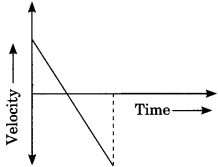
Draw a velocity versus time graph of a stone thrown vertically upwards and then coming downwards after attaining the maximum height.
Answer:
velocity-time graph
Motion Class 9 Extra Questions and Answers Science Chapter 8 img 8

Question 7.
What is uniform circular motion? How is uniform circular motion regarded as an acceleration motion? Explain.
Answer:
When an object is moving in a circular path with a constant speed, the motion of an object is said to be uniform circular motion. When a body has a uniform circular motion, its velocity changes due to the continuous change in the direction of its motion. Hence, the motion of the body is accelerated motion.

Motion Class 9 Extra Questions Numericals

Question 8.
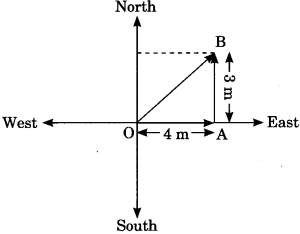
A person travels a distance of 4.0 m towards the east, then turns left and travels 3.0 m towards the north.
1. What is the total distance traveled by the person? North
2. What is his displacement?
Answer:
1. Total distance = OA + AB
= 4m + 3m
Total distance = 7m
Motion Class 9 Extra Questions and Answers Science Chapter 8 img 9

2. Total displacement = OB = \(\sqrt{(O A)^{2}+(A B)^{2}}\)
=\(\sqrt{(4)^{2}+(3)^{2}}\) = \(\sqrt{25}\) = 5
Displacement = 5 m

Question 9.
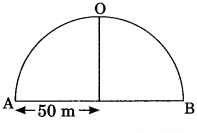
A person travels on a semi-circular track of radius 50 m during a morning walk. If he starts from one end of the track and reaches the other end, calculates the distance traveled and displacement of the person.
Answer:
Let the person start moving from A and reach B via O.
The distance travelled by the person
= Length of track = πr
= \(\frac{22}{7}\) x 50 m = 157.14m
Distance = 157.14 m
The displacement is equal to the diameter of the semi-circular track joining A to B via O.
= 2r = 2 x 50 m = 100m
∴ Displacement = 100 m
Motion Class 9 Extra Questions and Answers Science Chapter 8 1

Question 10.
Dinesh takes 20 minutes to cover a distance of 5 km on a bicycle. Calculate his average speed in
1. m/s
2. km/h
Answer:
1. Average speed in metre/second
Distance travelled by Dmesh = 5 km = 5 x 1000 m = 5000 m
time taken (t) = 20 min = 20 x 60 seconds = 1200 seconds
Motion Class 9 Extra Questions and Answers Science Chapter 8 img 11

2. Average speed in kilometre/hour
Average speed = \(\frac{5 \mathrm{km}}{\frac{20}{60} \mathrm{h}}\) = 15 km/h
∴  Average speed = 15 km/h

Question 11.
A train starting from a railway station and moving with uniform acceleration attains a speed of 20 m/s in 10 seconds. Find its acceleration.
Answer:
Given,
initial velocity, u = 0 m/s
Final velocity, υ = 20 m/s
time taken, t = 10 s
Acceleration, a = \(\frac{v-u}{t}=\frac{20-0}{10}\)
∴ a = 2 m/s2

Question 12.
A car moving with a speed of 72 km/h is brought to rest in 10 seconds by applying brakes. Find the magnitude of average retardation due to brakes and distance traveled by car after applying the brakes.
Answer:
Given, initial velocity = 72 km/h = 72 x \(\frac{5}{18}\) = 20 m/s
Final velocity = 0 m/s
Time taken = 10s.

1. Retardation
Acceleration, a = \(\frac{υ – u}{t}\)
a = \(\frac{0 – 20}{10}\) = -2m/s2
∴ Retardation = 2 m/s2

2. Distance travelled using equation, υ2 – u2 = 2as
(0)2 – (20)2 = 2 (-2)s
∴ s = 100 m

Question 13.
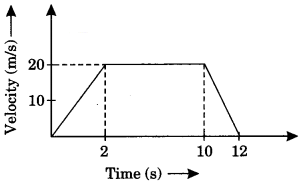
The velocity of a particle moving along a straight line in a certain time interval is shown below. What is the distance traveled during acceleration?
Motion Class 9 Extra Questions and Answers Science Chapter 8 img 12
Answer:
Here particle accelerates for 2 seconds.
Distance traveled during acceleration = area under υ – t graph for 2 sec.
\(\frac{1}{2}\) x Base x Height = \(\frac{1}{2}\) x 2 x 20 = 20m

Question 14.
A girl walks along a straight path to drop a letter in the letterbox and comes back to her initial position. Her displacement—
The time graph is shown in the figure. Plot a velocity-time graph for the same.
Answer:
Velocity-time graph
Motion Class 9 Extra Questions and Answers Science Chapter 8 img 13
Motion Class 9 Extra Questions and Answers Science Chapter 8 img 14

Question 15.
Obtain a relation for the distance traveled by an object moving with uniform acceleration in the time interval between the 4th and 5th seconds.
Answer:
Using equation, s = ut + \(\frac{1}{2}\) at2
Distance travelled in 5 s; s1 = u x 5 + \(\frac{1}{2}\) a(5)2
s1 = 5u + \(\frac{25a}{2}\)

Distance travelled in 4 s; s2 = u x 4 + \(\frac{1}{2}\) a(4)2
s2 = 4u x 8a
Distance travelled in the interval between 4th and 5th sec.
= s1 – s1 = (5u + \(\frac{25a}{2}\)) – (4u + 8a)
∴ Distance travelled = u + \(\frac{9a}{2}\)

Motion Class 9 Extra Questions Short Answer Type 2

Question 1.
Draw a position-time graph of for
(a) rest
(b) uniform motion
(c) Non-uniform motion
Answer:
(a) Position – time graph for rest
Motion Class 9 Extra Questions and Answers Science Chapter 8 img 15
(b) Position – time graph for uniform motion
Motion Class 9 Extra Questions and Answers Science Chapter 8 img 16
(c) Position – time graph for non-uniform motion
Motion Class 9 Extra Questions and Answers Science Chapter 8 img 17

Question 2.
A draw velocity-time graph for
(a) Uniform motion
(b) Uniform acceleration
(c) Uniform retardation
Answer:
(a) Velocity – time graph for uniform motion (Const. speed)
Motion Class 9 Extra Questions and Answers Science Chapter 8 img 18
(b) Velocity – time graph for uniform acceleration (Const. acceleration)
Motion Class 9 Extra Questions and Answers Science Chapter 8 img 19
(c) Velocity – time graph for uniform retardation
Motion Class 9 Extra Questions and Answers Science Chapter 8 img 20

Question 3.
Explain the difference between the two graphs.
Motion Class 9 Extra Questions and Answers Science Chapter 8 img 21
Answer:
(a) In the first graph, the body is starting its motion from origin but in the second graph, the body is starting its motion from any other point.
(b) In the first graph, the body has zero initial velocity but in the second graph the body has non-zero initial velocity.

Question 4.
Two stones are thrown vertically upwards simultaneously with their initial velocities u1 and u2 respectively. Prove that the heights reached by them would be in the ratio of \(\frac{1}{2}\)
(Assume upward acceleration is – g and downward acceleration to be +g).
Answer:
The maximum height reached by the stone can be calculated by the formula
υ2 – u2 = 2as
Here, υ = 0 and a= – g
Applying this equation for the first ball
Motion Class 9 Extra Questions and Answers Science Chapter 8 img 22

Motion Class 9 Extra Questions Numericals

Question 5.
Study the velocity-time graph of a traveling metro train as shown in the figure. What is the acceleration of the train
(a) during the first two seconds?
(b) between the second and tenth seconds?
(c) during the last two seconds?
Motion Class 9 Extra Questions and Answers Science Chapter 8 img 23
Answer:
(a) Acceleration, a = \(\frac {v – u}{t}\)
Here, u = 0, u = 20m/s and t = 2s
a = \(\frac {20 – 0}{2}\) = 10 m/s2

(b) Here, u = 20m/s, υ = 20m/s and t = 8s
a = \(\frac {20 – 0}{2}\) = 0 m/s2

(c) Here, u = 20 m/s, u = 0 m/s and t = 2s
a = 0 – 20 = – 10 m/s2

Question 6.
An electron moving with a velocity of 5 x 10 ms1 enters into a uniform electric field and acquires a uniform acceleration of 10 ms2 in the direction of its initial motion.
1. Calculate the time in which the electron would acquire a velocity double its initial velocity.
2. How much distance would the electron cover in this time?
Answer:
Given, u =5 x 10 m/s2
a = 104 m/s2

1. From υ = u + at
take υ = 2u
2u = u + at
u = at
5 x 104 = 104 x t
∴ t = 5s

2. From s = ut + \(\frac{1}{2}\) at2
s = 5 x 104 x 5 + \(\frac{1}{2}\) x 104 x (5)2
∴ s = 37.5 x 10⁴ m

Question 7.
The motion of a train is described by the velocity-time graph as shown in the figure given below.
Motion Class 9 Extra Questions and Answers Science Chapter 8 img 24
Find distance travelled by car between
1. 0 to 20 s
2. 20 s to 50 s
Answer:
Distance travelled = Area of velocity – time curve
1. For (0 to 20 s)
Distance = Area of ΔOAC = \(\frac{1}{2}\) x OC x AC = \(\frac{1}{2}\) x 20 x 10 = 100 m

2. For (20 s to 50 s)
Distance = Area of rectangle ABDC + Area of ΔBED
Distance = AC x CD + \(\frac{1}{2}\) DE x DB = 10 x (40 – 20) + \(\frac{1}{2}\) x 10 x 5 = 225m

Motion Class 9 Extra Questions Long Answer Type

Question 1.
Derive an expression for three equations of motion for uniform accelerated motion graphically.
Answer:
Equation of motion by graphical method
Let us consider a body is moving with acceleration where u is initial velocity and u is final velocity, s is the displacement of object and t is a time interval.
Motion Class 9 Extra Questions and Answers Science Chapter 8 img 25

1. υ = u + at
We know that slope of υ – t graph gives acceleration so slope
= a = \(\frac{v-u}{t-0}\)
a = \(\frac{v-u}{t}\)
∴ υ = u + at
Motion Class 9 Extra Questions and Answers Science Chapter 8 img 26

2. s = ut + \(\frac{1}{2}\) at2
We know that area under u – t graph gives the displacement.
Area = s = area of triangle CDE + area of rectangle ABCE
s = ut + \(\frac{1}{2}\) x t x (υ – u) from (υ – u = at)
Putting the value of υ – u
s = ut + \(\frac{1}{2}\) at2

3. υ2 – u2 = 2as
We know that area under υ – t graph gives displacement
Area = s = area of trapezium ABDE
s = \(\frac{1}{2}\) x (υ+u) x t From I (t = \(\frac{υ – u}{a}\))
Putting the value of t.
υ2 – u2 = 2as

Motion Class 9 Extra Questions HOTS

Question 1.
The distance-time graph of two trains is given below. The trains start simultaneously in the
same direction.
1. How much ahead of A is B when the motion starts?
2. What is the speed of B ?
3. When and where will A catch B?
4. What is the difference between speeds of A and B?

Motion Class 9 Extra Questions and Answers Science Chapter 8 img 27

5. Is the speed of both the trains uniform or non-uniform? Justify your answer.

Answer:

  1. 100km
  2. Speed of B, υ = \(\frac{x_{2}-x_{1}}{t}\) = \(\frac{150-100}{2-0}\) = 25 km/h
  3. After 2 hours, A catches B at 2. i.e.,150 km from origin 0.
  4. The slope of the distance-time graph of A is greater than that of B. Therefore, the speed of A is greater than
    speed B. Speed of A = Slope of OQ = \(\frac{150}{2}\) = 75 km/h
    Difference between speed of A and B =75 km/h – 25 km/h = 50 km/h
  5. The speed of both trains is uniform.

Question 2.
A car starts from rest and moves along the x-axis with constant acceleration 5 ms2 for 8 seconds. If it then continues with constant velocity, what distance will the car cover in 12 seconds since it started from rest?
Answer:
Given,
u = 0, a = 5ms-2, t1 = 8s and t2 = 12s.
Total distance = distance travelled during acceleration + distance travelled during constant velocity
s = s1 + s2

For S1
s1 = u1t1 + \(\frac{1}{2}\) \(a t_{1}^{2}\)
s1 = \(\frac{1}{2}\) x 5 x (8)2
s1 = 160 m

For S1
Applying υ = u + at
υ = 0 + (5 x 8)
u = 40 m/s
s1 = ut2
s2 = 40 x 12
s2 = 480 m
Total distance, s = s1 + s2
s = 160 + 480 = 640m

Question 3.
An object is dropped from rest at a height of 150 m and simultaneously another object is dropped from rest at a height 100 m. What is the difference in their heights after 2s if both the objects drop with the same acceleration? How does the difference in heights vary with time?
Answer:
At t = 0, difference in heights of two stones A and B
= 150 – 100 = 50 m
In t = 2s, distance through which each stone falls is –
s = ut + \(\frac{1}{2}\) at2 = 0 x \(\frac{1}{2}\) x 10 x (2)2 = 20m
∴ Difference in heights of two stones A and B
= (150 – 20) – (100 – 20) = 50
The difference in heights will remain the same at all times during their fall.

Question 4.
An object starting from rest travels 20 m in the first 2s and 160 m in the next 4s. What will be the velocity after 7s from the start?
Answer:
Given, the object travels 20 m first 2 s and 160 m in the next 4s.
From s = ut + \(\frac{1}{2}\) at2
In first 2 s, s = 20 m
20 = 0 + \(\frac{1}{2}\) a(2)2
20 = 2 a
∴ a = 10 m/s2
Velocity at the end of 2s is υ = u + at
υ = 0 + 10 x 2 = 20 m/s

In next 4 s,
s = ut + \(\frac{1}{2}\) a’t2
160 = 20 x 4 + \(\frac{1}{2}\) a’(4)2
80 = 8 a’
a’ = 10 m/s2

Motion Class 9 Extra Questions Value Based (VBQs)

Question 1.
Sumeet and Jaikishan are close friends. Sumeet is a science graduate and Jaikishan is a commerce graduate. Sumeet finds that while driving on a clear highway, Jaikishan often exceeds the speed limit and argues that there is no harm in doing so when the road is clear. Sumeet does not agree with him and tells him that with an increase in speed, the stopping distance of the car would increase and he would not be able to manage if someone appears suddenly on the way.
Read the above passage and answer the following questions:

  1. is Sumeet right in his statement?
  2. What values are displayed by Sumeet in his statement?
  3. How is stopping distance related to the speed of the vehicle?

Answer:

  1. Yes, Sumeet is absolutely right.
  2. Sumeet is an intelligent boy and he can apply his knowledge of science in daily life.
  3. Stopping distance (velocity)2

Question 2.
Raju and Raman are close friends. One day they went for a picnic. Raju was driving the car. When Raman saw the speedometer, he found that the speed of the car was more than the allowed speed limit. Raman advised Raju to reduce speed to avoid the punishment of Overspeed.
Answer the following questions:

  1. What is the function of the speedometer?
  2. What values are displayed by Raman?

Answer:

  1. Speedometer provides instantaneous speed. B
  2. Raman is a careful and law-abiding person.

Question 3.
Three friends Ram, Mohan, and Roy have to reach point B from point A. The path taken by them is shown in the figure.
Answer the following questions:

  1. Distinguish between distance and displacement.
  2. If all of them travel at the same speed, who will reach first at point B and why?
    Motion Class 9 Extra Questions and Answers Science Chapter 8 img 28

Answer:
1. Distance:

  1. It is the actual length of the path covered by a moving body.
  2. It is always positive or zero.
  3. It is a scalar quantity.

Displacement:

  1. It is the shortest measured distance between the initial and final positions.
  2. It may be positive, negative, or zero.
  3. It is a vector quantity.

2.  Mohan will reach first as he is traveling the shortest path.

Diversity in Living Organisms Class 9 Extra Questions and Answers Science Chapter 7

In this page, we are providing Diversity in Living Organisms Class 9 Extra Questions and Answers Science Chapter 7 pdf download. NCERT Extra Questions for Class 9 Science Chapter 7 Diversity in Living Organisms with Answers will help to score more marks in your CBSE Board Exams.

Class 9 Science Chapter 7 Extra Questions and Answers Diversity in Living Organisms

Extra Questions for Class 9 Science Chapter 7 Diversity in Living Organisms with Answers Solutions

Diversity in Living Organisms Class 9 Extra Questions Very Short Answer Type

Question 1.
Who proposed the two kingdom classification?
Answer:
Carolus Linnaeus.

Question 2.
What is biodiversity?
Answer:
The variety of life forms including plants, animals and microscopic organisms which inhabit this earth constitute biodiversity.

Question 3.
What is classification?
Answer:
The grouping of organisms on the basis of their similarities and differences is called classification.

Question 4.
What is the taxonomy?
Answer:
The branch of science which deals with the classification of organisms is called taxonomy.

Question 5.
Who proposed the five kingdom system of classification?
Answer:
R.H. Whittaker.

Question 6.
Name the fundamental unit of classification.
Or
Which is the lowermost category in the hierarchy of classification?
Answer:
Species.

Question 7.
Give one point of difference between gymnosperms and angiosperms.
Answer:
The seeds of gymnosperms are naked whereas the seeds of angiosperms are enclosed within a fruit.

Question 8.
Name the largest phylum of kingdom Animalia.
Answer:
Arthropoda.

Question 9.
Name the class to which the sea horse belongs.
Answer:
Sea horse belongs to class Pisces.

Question 10.
Which group of plants is referred to as vascular cryptogams?
Answer:
Pteridophytes.

Question 11.
Which phylum in animial kingdom consists of pseudocoelomate organisms?
Answer:
Nematoda

Question 12.
Which group of organisms are called as the ‘Amphibians of plant kingdom*?
Answer:
Bryophytes

Question 13.
Name the two classes of angiosperms with one example of each.
Answer:
The two classes are –

  • Monocots: Wheat
  • Dicots: Pea

Question 14.
Name the division of cryptogams to which algae belong.
Answer:
Thallophyta

Question 15.
Which is the highest unit of classification?
Answer:
Kingdom

Question 16.
What is the characteristic feature due to which echinoderms are named?
Answer:
Spiny skin (Echino- spiny; derm-skin)

Question 17.
Name the group which comprises of bacteria and blue green algae.
Answer:
Monera

Question 18.
Name an organism which is called saprophyte. Why is it called so?
Answer:
Yeast. It is called so as it feeds on dead and decaying matter to obtain its nutrition.

Question 19.
Identify the kingdom in which the organisms do not have a well-defined nucleus and are not able to show multicellular designs.
Answer:
Monera

Question 20.
Give reason, why blue green algae are classified along with bacteria and placed in the kingdom Monera.
Answer:
As the blue green algae are unicellular prokaryotes like bacteria.

Question 21.
Mention any one characteristic feature of saprophytes.
Answer:
The saprophytes feed on dead and decaying organic matter.

Question 22.
Write one point of difference between monocotyledonous and dicotyledonous plants.
Answer:
Monocots are plants which bear single cotyledon in their seeds. Dicots are the plants which bear two cotyledons in their seeds.

Question 23.
Poriferans have hole or pores all over the body that lead to a system that helps in circulating water to bring in food and oxygen. Name the system.
Answer:
The system is called as the canal system.

Question 24.
State the phylum to which liver fluke and Planaria belong.
Answer:
Phylum Platyhelminthes

Question 25.
Write the type of body cavity and symmetry possessed by nematodes.
Answer:
Body cavity is pseudocoelom and symmetry is bilateral symmetry.

Question 26.
Name one mammal that lays eggs.
Answer:
Platypus

Question 27.
Name the substance which Coelomic cavity of arthropods is filled with. What type of symmetry do they have?
Answer:
Coelomic cavity of arthropods is filled with blood. They show bilateral symmetry.

Question 28.
Name the phylum to which centipede and prawn belong.
Answer:
Phylum Arthropoda

Question 29.
Echinoderms are marine animals. What is their skeleton made up of?
Answer:
Their skeleton is made up of calcium carbonate.

Question 30.
Name one reptile with a four chambered heart.
Answer:
Crocodile

Question 31.
Shyam knew the correct scientific name of mango but did not follow the convention while writing it and wrote it as Mangifera Indica. Rewrite the scientific name as per the convention.
Answer:
Mangifera indica

Question 32.
Rewrite the scientific names correctly:
(a) Panthera tigris
(b) Periplaneta Americana
Answer:
(a) Panthera tigris
(b) Periplaneta americana

Diversity in Living Organisms Class 9 Extra Questions Short Answer Type 1

Question 1.
How can we say that classification of organisms is closely related to their evolution?
Answer:
We can say that classification of organisms is closely related to their evolution because the simple organisms have a primitive body design as they appeared earlier whereas the complex organisms have more advanced body designs as they are more recent. This shows that during the course of evolution more complex body designs were formed from simpler ones.

Question 2.
What is the difference between algae and fungi?
Answer:
Algae:

  • Have chlorophyll.
  • Autotrophic mode of nutrition.
  • Cell wall made of cellulose.
  • Food stored in the form of starch.
  • Examples: Chlamydomonas, Spirogyra, Ulo-thrix

Fungi:

  • Lack chlorophyll.
  • Heterotrophic mode of nutrition.
  • Cell wall made of chitin.
  • Food stored in the form of glycogen.
  • Examples: Rhizopus, Agaricus, Yeast

Question 3.
Pick the odd one out and justify your choice by giving reasons:
(a) Moss, Fern, Pinus, Spirogyra
(b) Sea cucumber, Octopus, Feather star, Star fish
Answer:
(a) The odd one out in this case is Pinus as it is a phanerogams having covered reproductive parts whereas the other three are cryptogams which bear hidden reproductive organs.

(b) The odd one out in this case is Octopus as it belongs to phylum Mollusca while others are the members of phylum Echinodermata.

Question 4.
Why were fungi and bacteria considered as plants even though they do not have chlorophyll?
Answer:
Fungi and bacteria were considered as plants as they have cell wall which is a characteristic feature of the plants. So, some earlier classification systems included them under plants.

Question 5.
Why do bryophytes and pteridophytes grow in moist and shady places?
Answer:
Bryophytes and pteridophytes grow in moist and shady places as they need water for their reproduction. Male gametes are carried towards the female gamete by water in order to bring about fertilisation in them.

Question 6.
Which divisions of the plant kingdom are called cryptogams? Why are they called so?
Answer:
Thallophyta, Bryophyla and Pteridophyta are considered as cryptogams. They are called so because they bear hidden and inconspicuous reproductive orgAnswer:

Question 7.
Characteristics of some organisms are given. Identify their group and give one example of each.
(а) Single celled, eukaryotic and photosynthetic
(b) The body is divided into segments, may be unisexual or hermaphrodite
Answer:
(a) Protista: Euglena
(b) Annelida: Earthworm

Question 8.
How do saprophytes get their food? Give one example of saprophyte.
Answer:
Saprophytes derive their nutrition from the dead and decaying materials. For example, Agaricus (Mushroom), Rhizopus (Bread mould), Yeast etc.

Question 9.
What are phanerogams? How are they classified?
Answer:
The phanerogams are the plants which produce seeds and have a well differentiated body with true roots, stem and leaves. They are advanced members of kingdom Plantae. It includes gymnosperms and angiosperms.

Question 10.
What are gymnosperms? Give two examples.
Answer:
The plants which bear naked seeds which are not enclosed in fruit are called gymnosperms. For example, Cycas, Pinus, etc.

Question 11.
Write two peculiar characters of sponges.
Answer:
The two peculiar features of sponges are:
(i) They have pores called ostia all over their body and a single large opening at the top, called osculum which helps to develop a canal system for water movement.

(ii) They have a skeleton made up of calcareous or siliceous spicules or spongin fibres which gives strength and support.

Question 12.
Classify the following in their respective phylum/class: Jellyfish, earthworm, cockroach, rat
Answer:

  • Jellyfish: Phylum Coelenterata
  • Earthworm: Phylum Annelida
  • Cockroach: Phylum Arthropoda
  • Rat: Phylum Vertebrata, Class: Mammalia

Question 13.
What are the two peculiar features of phylum Echinodermata?
Answer:
The phylum Echinodermata has organisms which have

  • spiny skin
  • water vascular system

Question 14.
What are the three germ layers present in the organisms? What are the two groups of organisms on the basis of germ layers?
Answer:
The three germ layers are ectoderm, mesoderm and endoderm. The groups are diploblastic and triploblastic.

Question 15.
How are vertebrates different from the other chordates?
Answer:
The notochord is present at any stage of their life cycle in the case of chordates. In the vertebrates the notochord gets replaced by the vertebral column.

Question 16.
How are pteridophytes are different form Phanerogams? Give one example for each group.
Answer:
Pteridophytes have hidden, inconspicuous reproductive organs example ferns.
Phanerogams have well differentiated reproductive organs which are not hidden, example rose, apple.

Question 17.
(a) Given below are few plant species. Identify the divisions to which they belong and write the major characteristic of each division.
(i) Spirogyra
(ii) Deodar
(iii) Moss
(b) What is the mode of nutrition for all of them?
Answer:
(a) (i) Thallophyta: Plant body is not well differentiated
(ii) Gymnosperms: have naked seeds
(iii) Bryophyta: have rhizoids for absorption of water, have stem-like and leaf-like structures.

(b) All of them are autotrophic organisms.

Question 18.
What do you understand by the term ‘naked embryo’? Name any two divisions in kingdom Plantae that have naked embryo. Give one example of each division.
Answer:
Naked embryo is the term which refers to an embryo which is not borne inside the seed. The pteridophytes and gymnosperms bear naked embryo. For example, Ferns and horsetail are pteridophytes. Pinus and Cycas are gymnosperms.

Question 19.
Write the difference between Gymnosperms and Angiosperms giving example of each type.
Or
What are gymnosperms? Give two characteristics.
Answer:
Gymnosperm:

  • Bear naked seeds.
  • Are woody, evergreen, perennials.
  • Examples: Pinus and Cycas

Angiosperm:

  • Bear seeds enclosed in fruit.
  • Can be woody, non-woody annual, biennial or perennials.
  • Examples: Mango, Neem

Question 20.
Thallophyta, bryophyta and pteridophyta are classified as cryptogams whereas gymnosperms and angiosperms are classified as phanerogams, why?
Answer:
Due to the presence of hidden and inconspicuous reproductive organs, thallophyta, bryophyta and pteridophyta are called as cryptogams. Gymnosperms and angiosperms are phanerogams as they have well developed and distinct reproductive organs, flowers, fruits and seeds.

Question 21.
State reasons for the following:
(а) Platyhelminthes are called so.
(b) Birds have hollow bones.
Answer:
(a) Platyhelminthes are called so because they have a dorsoventrally flattened body.
(b) Presence of hollow bones is an adaptation in birds which helps them to keep low body weight which is helpful in flight.

Question 22.
Identify the phylum of animals by the given characteristics and give an example of each.
(a) The coelomic cavity is blood-filled and the animals have jointed legs.
(b) The animals are called as flatworms and are either free living or parasitic.
Answer:
(a) Phylum arthropoda: eg., cockroach, butterfly, spider, etc.
(b) Phylum Platyhelminthes: Planaria, liver fluke, tapeworm, etc.

Question 23.
Write one point of difference between the following:
(а) Bilateral symmetry and radial symmetry
(b) Annelids and Nematodes
Answer:
(a) Bilateral symmetry – Body can be divided into two exact halves from one plane only.
Radial symmetry – Body can be divided into equal halves from any plane.

(b) Annelids – Have true coelom
Nematodes – Have pseudocoelom.

Question 24.
Give two examples of each:
(а) Egg laying mammals
(b) Organisms with open circulatory system.
Answer:
(а) Duck-billed platypus and Echidna are the egg laying mammals.
(b) Cockroach and Octopus have open circulatory system.

Question 25.
Select the odd one out with respect to classification. Also give reason for your choice: prawn, scorpion, octopus, butterfly.
Answer:
Octopus is the odd one out as it belongs to phylum Mollusca whereas others belong to phylum Arthropoda.

Question 26.
Given below are the two groups of organisms belonging to kingdom Animalia. Write the names of the phylum to which they belong.
(a) Octopus, Pila, Unio
(b) Centipede, prawn, scorpion
Answer:
(а) Octopus, Pila, Unio belong to Phylum Mollusca.
(b) Centipede, prawn, scorpion belong to phylum Arthropoda.

Question 27.
What is binomial nomenclature? Who introduced it?
Answer:
The system of scientific naming of the organism which consists of a generic name and a specific epithet is called as binomial nomenclature. It was introduced by Carolus Linnaeus.

Question 28.
Give two differences between bony fish and cartilaginous fish. Give one example of each.
Answer:
Bony Fish:

  • Endoskeleton is made up of bones.
  • Operculum covers the gill slits.
  • Terminal mouth Example: Rohu, sea horse

Cartilaginous Fish:

  • Endoskeleton is made up of cartilage.
  • Operculum absent.
  • Ventral mouth Example: Shark, saw fish

Question 29.
State any two characteristics of Mammalia. Name two egg laying mammals.
Answer:
Two characteristics of Mammalia are:

  • Presence of mammary glands, four chambered heart and are warm-blooded
  • Skin has hairs, sweat glands and oil glands Egg laying mammals are platypus and Echidna.

Question 30.
Write appropriate terms for the following.
(a) Animals which are able to maintain a certain body temperature over a wide range of temperature in the environment.
(b) Animals which have pseudocoelom.
Answer:
Kingdom Mammalia: Warm-blooded animals
Phylum Nematoda: Its members have pseudocoelom.

Diversity in Living Organisms Class 9 Extra Questions Short Answer Type 2

Question 1.
Explain the three basic features for grouping all organisms into five major kingdoms.
Answer:
The three basic features for grouping the organisms into five kingdoms are
(i) Cell structure: On the basis of this the two groups are prokaryotes and the eukaryotes which are distinguished on the basis of absence or presence of well defined nuclear membrane.

(ii) Thallus organisation: The organisms are grouped as unicellular or multicellular organisms on the basis of their being composed of a single cell or of many cells respectively.

(iii) Mode of nutrition: The organisms are grouped as autotrophs or heterotrophs on the basis of their ability to synthesise their own food or being dependent on other organisms for their food.

Question 2.
What are the steps in building a hierarchy of classification?
Answer:
The characteristics chosen for developing a hierarchy of classification should start with the characteristic which forms the broadest division and then the next characteristic chosen should be dependent on the previous characteristic and division, besides having its own new characteristic features.

This process should be continued for the next levels in order to build a hierarchy in classification. For example, the classification of organisms into two broad categories prokaryotes and eukaryotes forms the basis of further characteristics on which their classification is based.

Question 3.
Differentiate between Bryophyta and Pteridophyta. Give example of each group.
Or
Write four main features of pteridophyta and give two examples.
Answer:
Bryophyta:

  • They are called the ‘amphibians of the plant kingdom’.
  • They lack vascular tissues.
  • Body is not well-differentiated into true root, stem or leaves.
  • The dominant phase or the main plant body is gametophyte (haploid).
  • Sporophyte depends upon gametophyte for its support and nutrition.
  • Spores are formed in capsule of sporophyte.
  • Examples: Liverworts, Mosses

Pteridophyta:

  • They are the first land plants.
  • They have vascular tissues xylem and phloem.
  • Body is well-differentiated into true roots, stem and leaves.
  • The dominant phase or the main plant body is sporophyte (diploid).
  • Sporophyte and gametophyte are independent structures in them.
  • Spores are produced inside the sporangia borne on leaves or cones.
  • Examples: Ferns, Horsetail, Marsilea

Question 4.
Name three groups which are placed under Cryptogamae. State and explain two characteristics which are exhibited by each category of these plant bodies.
Answer:
The three groups placed under Cryptogamae are: Thallophyta, Bryophyta and Pteridophyta.

The two characteristic features of cryptogams are:

  • They have inconspicuous and hidden reproductive organs.
  • They produce naked embryos called spores.

Question 5.
Define the following: (a) Radial symmetry (b) Bilateral symmetry
Answer:
When any plane passing through the central axis can divide the organism into identical halves, it is called radial symmetry, example coelenterates and the adults of Echinoderms.

When only one plane can divide the body of the organism into identical right and left halves, the symmetry is called as bilateral symmetry, example annelids, arthropods and humans.

Question 6.
Give main features of phylum Chordata.
Answer:
The main features of phylum Chordata are presence of:

  • Notochord
  • Dorsal Central nervous system
  • Pharynx perforated by gill slits
  • Ventral heart
  • A post-anal tail

Question 7.
(a) Write any two features that are present in all chordates.
(b) Write one difference between pseudocoelom and true coelom.
Answer:
(a) The features present in all chordates are:

  • Dorsal central nervous system and dorsal nerve cord.
  • Triploblastic, coelomate with organ system level of organisation.

(b) If the body cavity of an organism is not lined by mesoderm and the space is filled with vacuolated cells, then the body cavity called pseudocoelom.

Question 8.
Define classification. Give any two of its significance.
Answer:
Grouping of organisms on the basis of their similarities and differences is called classification. Classification is important as it helps to make the study of vast variety of organisms easier and also helps us to understand the inter-relationships which occur among the organisms.

Question 9.
Classify the following plants into different plant divisions. Spirogyra, Fern, Funaria, Pinus, Apple tree, Mustard plant
Answer:
Spirogyra: Thallophyta, Fern: Pteridophyta, Funaria: Bryophyta, Pinus: Gymnosperm, Apple tree: Angiosperm, Mustard plant: Angiosperm

Question 10.
To which group do the following organisms belong and give one reason for each.
(a) Cyanobacteria
(b) Euglena
(c) Ulothrix
Answer:
(a) Cyanobacteria: Kingdom Monera; does not have a well-defined nucleus and lacks membrane bound cell organelles, prokaryotes.

(b) Euglena: Kingdom Protista; are aquatic, unicellular eukaryotes with well-defined nucleus and membrane bound cell organelles.

(c) Ulothrix: Kingdom Plantae, Thallophyta; Have a thalloid body, photosynthetic and eukaryotic.

Question 11.
Why are bryophytes called as ‘Amphibians of plant kingdom9?
Answer:
Bryophytes are called as ‘amphibians of plant kingdom’ because:

  • They live in moist, damp places in order to get water from soil either directly or with the help of their rhizoids.
  • They require water for the transfer of their gametes and are dependent on water for sexual reproduction.

Question 12.
(а) What is coelom?
(b) Presence of ‘coelom’ in an animal is considered advantageous. Why?
Answer:
(a) Coelom is a body cavity lined by mesodermal cells and lies between the body wall and alimentary canal (gut) of the organism.

(b) The coelom is considered advantageous as it helps to accommodate the various organs of the body in a proper way and gives a greater flexibility to the body of the organism.

Question 13.
(а) Write one characteristic each of amphibia and aves.
(b) Write the name of the class to which following belong:
(i) Sea-horse
(ii) King cobra
Answer:
(a) Amphibia: Can live both on land and in water, slimy to touch, cold blooded with three chambered heart.
Aves: Have forelimbs modified into wings for flight. Body covered with feathers, are warm-blooded with four-chambered heart

(b) Sea-horse: Class Pisces;
King cobra: Class Reptilia

Question 14.
Give the three characteristic features of Class Mammalia.
Answer:
The characteristic features of Class Mammalia are:

  • Presence of Mammary glands.
  • The skin has hairs.
  • Their body has sweat glands and oil glands.
  • They have a four-chambered heart, are warm-blooded.

Question 15.
Distinguish between monocots and dicots.
Answer:
Monocots:

  • Possess a single cotyledon.
  • Have fibrous roots.
  • Have parallel venation. Examples: Wheat, Maize

Dicots:

  • Possess two cotyledons.
  • Have tap root.
  • Have reticulate venation. Examples: Pea, gram

Question 16.
(a) What is symbiotic relationship?
(b) Name a symbiotic life form that grows on the bark of tree as large coloured patches.
Answer:
(a) The mutually dependent relationship between two organisms where both are benefitted is called symbiotic relationship.

(b) Lichen is a symbiotic life form that grows on the bark of trees as large coloured patches. It is symbiotic association between fungi and algae.

Question 17.
State the bases of classifying plants and animals into different categories.
Answer:
The bases for classifying animals and plants into different categories are:

  • Mode of nutrition – Plants are autotrophic whereas animals heterotrophic.
  • Presence or absences of cell wall – Plant cells have cell wall whereas animal cells do not have a cell wall.

Question 18.
(a) Differentiate between Fungi and Plantae.
(b) Mention the basis of classification among plants to different levels.
Answer:
Fungi:

  • They are non-chlorophyllous and heterotrophic.
  • Their cell wall is made of chitin.
  • They are mostly saprophytes or parasites.

Plantae:

  • They have chlorophyll and are autotrophic.
  • Their cell wall is made of cellulose.
  • They are autotrophs.

(b) The basis of classification of plants to different levels is –

  • Presence or absence of well-differentiated body tissues
  • Presence or absence of a well developed transport system for water, minerals and organic substances.
  • Seed bearing ability and presence of seeds enclosed in fruits or not.

Question 19.
Name the group which is called as Amphibian of the plant kingdom. Cite an example of this group, also mention one important feature of the same group.
Answer:
Bryophytes are called amphibians of the plant kingdom, example Marchantia, Funaria.

Characteristic feature: Plant body is thalloid, not well-differentiated and has root-like, stem-like and leaf-like structures.

Question 20.
Identify the following:
(a) Amphibians of the plant kingdom.
(b) Plants with hidden reproductive organs
(c) Mutually benefitted relationship between two organisms.
Answer:
(a) Bryophytes
(b) Phanerogams comprising of Algae, Bryophytes and Pteridophytes.
(c) Symbiotic relationship as shown by algae and fungi in Lichen.

Question 21.
Describe the following:
(a) Lichens
(b) Cryptogams
(c) Phanerogams
Answer:
(a) Lichen is a symbiotic relationship between an algae and fungi.
(b) Cryptogams have hidden or inconspicuous reproductive organs.
(c) Phanerogams have well differentiated reproductive tissues which result in formation of seed.

Question 22.
(а) Which group of plants is known as ‘flowering plants’?
(b) On the basis of seed how is a maize plant different from a pea plant?
Answer:
(a) Angiosperms are called the flowering plants.
(b) Maize is a monocot plant as it bears one cotyledon in its seed whereas pea is a dicot as it has two cotyledons in its seed.

Question 23.
Name the largest group of animals. Write the salient features of this group. Give two examples.
Answer:
Phylum Arthropoda is the largest group of animals. They have jointed legs, bilateral symmetry and a body cavity filled with fluid. For example, Cockroach, spider, butterfly, etc.

Question 24.
What is binomial nomenclature? Who gave it? Write its advantage.
Answer:
The system of scientific naming of organisms which consists of a generic name and a specific epithet is called binomial nomenclature. It was given by Carolus Linnaeus. Its advantage is that it helps in the systematic study and understanding of the living organisms.

Question 25.
List the conventions used for writing a scientific name. What is the importance of scientific name?
Answer:
Convention for writing the scientific names:

  • The name of the genus begins with a capital letter.
  • The name of the species begins with a small letter.
  • When printed, the scientific name is given in italics.
  • When written by hand, the genus name and the species name have to be underlined separately.

Common names cannot be used in the same way by the scientist world over and can often result in confusion. To avoid this, a system of scientific names has been proposed.

Question 26.
Write true (T) or false (F)
(а) Whittaker proposed five kingdom classification.
(b) Monera is divided into Archaebacteria and Eubacteria.
(c) Starting from Class, Species comes before the Genus.
(d) Anabaena belongs to the kingdom Monera.
(e) Blue-green algae belongs to the kingdom Protista.
(f) All prokaryotes are classified under Monera.
Answer:
(a) True
(b) True
(c) False
(d) True
(e) False
(f) True

Question 27.
Fill in the blanks:
(a) Fungi shows _______ mode of nutrition.
(b) Cell wall of fungi is made up of _______
(c) Association between blue-green algae and fungi is called as _______
(d) Chemical nature of chitin is _______
(e) _______ has smallest number of organisms with maximum number of similar characters.
(f) Plants without well differentiated stem, root and leaf are kept in _______
(g) _______ are called the amphibians of the plant kingdom.
Answer:
(a) saprophytic
(b) chitin
(c) lichens
(d) Carbohydrate
(e) Species
(f) Thallophyta
(g) Bryophytes

Question 28.
You are provided with the seeds of gram, wheat, rice, pumpkin, maize and pea. Classify them whether they are monocot or dicot.
Answer:
Gram – dicot
Wheat – monocot
Rice – monocot
Pumpkin – dicot
Maize – monocot
Pea -dicot

Question 29.
Match items of column (A) with items of column (B).
Diversity in Living Organisms Class 9 Extra Questions and Answers Science Chapter 7 img 1
Answer:
(a) (ii)
(b) (i)
(c) (iv)
(d) (iii)
(e) (vi)
(f) (u)
(g) (vii)

Question 30.
Match items of column (A) with items of column (B).
Diversity in Living Organisms Class 9 Extra Questions and Answers Science Chapter 7 img 2
Answer:
(a) (iii)
(b) (ii)
(c) (vi)
(d) (i)
(e) (v)
(f) (iv)

Question 31.
Classify the following organisms based on the absence/presence of true coelom (i.e., acoelomate, pseudocoelomate and coelomate) Spongilla, Sea anemone, Planaria, Liver fluke, Wuchereria, Ascaris, Nereis, Earthworm, Scorpion, Birds, Fishes, Horse.
Answer:

  • Spongilla: Acoelomate
  • Sea anemone: Acoelomate
  • Planaria: Acoelomate
  • Liver fluke: Acoelomate
  • Wuchereria: Pseudocoelomate
  • Ascaris: Pseudocoelomate
  • Nereis: Coelomate
  • Scorpion: Coelomate
  • Earthworm: Coelomate
  • Birds, Fishes and Horse: Coelomate

Question 32.
Endoskeleton of fishes are made up of cartilage and bone; classify the following fishes as cartilagenous or bony:
Torpedo, Sting ray, Dog fish, Rohu, Angler fish, Exocoetus.
Answer:

  • Torpedo: cartilagenous
  • Sting ray: cartilagenous
  • Dog fish: cartilagenous
  • Rohu: bony
  • Angler fish: cartilagenous
  • Exocoetus: bony

Question 33.
Classify the following based on number of chambers in their heart.
Rohu, Scoliodon, Frog, Salamander, Flying lizard, King Cobra, Crocodile, Ostrich, Pigeon, Bat, Whale
Answer:

  • Rohu, Scoliodon: 2 chambered,
  • Frog, Salamander, Flying lizard, King Cobra: 3 chambered,
  • Crocodile, Ostrich, Pigeon, Bat, Whale: 4 chambered

Question 34.
Classify Rohu, Scolidon, Flying lizard, King Cobra, Frog, Salamander, Ostrich, Pigeon, Bat, Crocodile and Whale into the cold-blooded/warm-blooded animals.
Answer:

  • Cold-blooded: Rohu, Scolidon, Flying lizard, King Cobra, Frog, Salamander Crocodile
  • Warm-blooded: Ostrich, Pigeon, Bat, Whale

Question 35.
Name two egg laying mammals.
Answer:

  • Platypus
  • Echidna.

Question 36.
Fill in the blanks:
(а) Five kingdom classification of living organisms is given by _______
(b) Basic smallest unit of classification is _______
(c) Prokaryotes are grouped in Kingdom _______
(d) Paramecium is a Protista because it is an _______
(e) Fungi do not contain _______
(f) A fungus _______ can be seen without microscope.
(g) Common fungi used in preparing bread is _______
(h) Algae and fungi form symbiotic association called _______
Answer:
(a) Robert Whittaker
(b) species
(c) Monera
(d) eukaryotic unicellular organism
(e) chlorophyll
(f) mushrooms
(g) yeast
(h) lichens

Question 37.
Give True (T) and False (F).
(а) Gymnosperms differ from Angiosperms in having covered seed.
(b) Non flowering plants are called Cryptogamae.
(c) Bryophytes have conducting tissue.
(d) Funaria is a moss.
(e) Compound leaves are found in many ferns.
(f) Seeds contain embryo.
Answer:
(a) False
(b) True
(c) False
(d) True
(e) True
(f) True

Question 38.
Give examples for the following.
(a) Bilateral, dorsiventral symmetry is found in _______
(b) Worms causing the disease elephantiasis is _______
(c) Open circulatory system is found in _______ where coelomic cavity is filled with blood.
(d) _______ are known to have pseudocoelom.
Answer:
(a) Liver Fluke
(b) Filarial worms
(c) Arthropods
(d) Nematodes

Question 39.
Label a, b, c and d, given in the figure below. Give the function of (b).
Answer:
Diversity in Living Organisms Class 9 Extra Questions and Answers Science Chapter 7 img 3
(a) Dorsal fin
(b) Caudal fin
(c) Pelvic fin
(d) Pectoral fin
Function of Caudal fins: Caudal fins help in streamlined movement in water.

Question 40.
Fill in the boxes given in figure with appropriate characteristics/plant groups.
Diversity in Living Organisms Class 9 Extra Questions and Answers Science Chapter 7 img 4
(a) Thallophyta
(b) Without specialized vascular tissue
(c) Pteridophyta
(d) Phanerogams
(e) Bear naked seeds
(f) Angiosperm
(g) Have seeds Thallophyta with two cotyledons
(h) Monocots

Diversity in Living Organisms Class 9 Extra Questions Long Answer Type

Question 1.
Explain the various categories of taxonomical hierarchy.
Answer:
The categories in taxonomical hierarchy are

  • Kingdom: The highest category of classification
  • Phylum (for animals) / Division (for plants): Group of related classes
  • Class: Group of related orders.
  • Order: Group of related families.
  • Family: Group of related genus.
  • Genus: Group of related species.
  • Species: Group of organisms which can interbreed among themselves to produce a fertile offspring.

Question 2.
(a) Draw labelled diagrams of three protozoa.
(b) Euglena is a dual organism. Why?
Answer:
(a)
Diversity in Living Organisms Class 9 Extra Questions and Answers Science Chapter 7 img 5
(b) Euglena is a dual organism as:

  • It does not have a cell wall and behaves as a heterotrophic organism in the absence of sunlight.
  • It contains chloroplast and can perform photosynthesis and behaves as autotroph in the presence of sunlight.

Question 3.
Mention the class to which they belong and give one characteristic feature of each. Frog, fish, lizard, pigeon, bat.
Answer:
(i) Fish: Class Pisces; Aquatic, respiration with gills, moist scales present on the body, two-chambered heart, cold-blooded

(ii) Frog: Class Amphibia; Can live both on land and in water, cold-blooded, three-chambered heart, slimy to touch

(iii) Lizard: Class Reptilia; Cold-blooded, three-chambered heart, hard covering present on eggs to prevent from desiccation

(iv) Pigeon: Class Aves; Forelimbs modified into wings for flight and have feathers, have beak, warm-blooded, four-chambered heart

(v) Bat: Class Mammalia; has mammary glands, warm-blooded, four-chambered heart.

Question 4.
(i) Draw a neat labelled diagram of Hydra.
(ii) Label mesoglea and gastro-vascular cavity.
(iii) Name the group of animals it belongs to.
(iv) Name one species of this group that lives in colonies.
Answer:
(i) and (ii)-See figure
Diversity in Living Organisms Class 9 Extra Questions and Answers Science Chapter 7 img 6
(iii) Phylum Coelenterata
(iv) Corals live in colonies.

Question 5.
Write one difference for each of the following pairs:
(i) Thallophyta and Bryophyta
(ii) Nematoda and Annelida
(iii) Amphibians and Reptiles
Answer:
(i)

  • Thallophyta Bryophyta – Plant body is not well differentiated into root, stem and leaves. It is a thalloid example – Spirogyra.
  • Bryophyta – Plant body slightly more differentiated than Thallophyta with root-like, stem-like and leaf-like structures, called as Amphibians of the plant kingdom.

(ii)

  • Nematoda – Called as roundworms, bilaterally symmetrical having pseudocoelom, example Ascaris
  • Annelida – Have a metamerically segmented body and a true coelom, example Earthworm

(iii) Amphibians

  • Can live both in land as well as water.
  • Lack scales on body and have slimy skin.
  • Lay eggs in water.
  • Eggs are devoid of tough covering.

Reptiles:

  • Most of them are terrestrial animals.
  • Have dry scales on body.
  • Lay their eggs mostly on land.
  • Eggs have a tough covering to protect from drying.

Question 6.
(a) In which two ways are amphibians different from fishes?
(b) Identify the phylum of organisms having the characteristics:
(i) Pore bearing animals and radial symmetry
(ii) Body spiny and radial symmetry
(c) Why do gymnosperms not require water for fertilisation?
Answer:
(a) Amphibians can live both on land as well as water, have three-chambered heart and have lungs for respiration in adult stage.
Fishes are aquatic, have two-chambered heart and have gills for respiration.

(b) (i) Phylum Porifera
(ii) Phylum Echinodermata

(c) Gymnosperms do not require water for fertilisation as they bear pollen grains which are carried away by agents like wind to cause pollination.

Question 7.
Give four features of phylum Coelenterata. Give two examples.
Answer:
The four distinguishing features of phylum Coelenterata are:

  • They have a radially symmetrical body.
  • The body is made of two layers of cells, so called diploblastic.
  • Has tentacles which surround their mouth. Tentacles bear cnidoblasts, stinging cells.
  • They have a characteristic cavity called as coelenteron.
  • They are solitary like Hydra and can be colonial like Obelia. example Hydra, Obelia, Jelly fish.

Question 8.
List the convention that is followed while writing the scientific names. Give scientific name of Mango and Tiger.
Answer:
The conventions followed while writing the scientific names are:

  • The name of the genus begins with a capital letter.
  • The name of the species begins with a small letter.
  • When printed, the scientific name is given in italics.
  • When written by hand, the genus name and the species name have to be underlined separately.

Scientific name of Mango is Mangifera indica and of Tiger is Panthera tigris.

Question 9.
Enlist the features of organisms placed in Protista. Give two examples.
Answer:
The members of the kingdom Protista have the following features:

  • All of them are unicellular and eukaryotic.
  • Their mode of nutrition is either autotrophic or heterotrophic.
  • They are usually aquatic but some of them are parasitic.
  • Have cilia, flagella or pseudopodia for movement. example Amoeba, Plasmodium

Question 10.
Give the general characteristics of fungi. Give two examples.
Answer:
The general characteristics of fungi are:

  • They are heterotrophic organisms which can occur as saprophytes, parasites or symbionts.
  • Their cell wall is made up of chitin and lack chlorophyll.
  • Food is stored in the form of glycogen in them instead of starch as stored in plants.
  • They are eukaryotes as they have membrane bound nucleus.
  • For example: Yeast, Rhizopus, Agaricus, Penicillium, etc.

Question 11.
What are the five kingdoms of Whittaker? Give the most important characteristic feature of each kingdom.
Answer:
The five kingdoms proposed by R. H. Whittaker comprises of – Monera, Protista, Fungi, Plantae and Animalia.

  • Kingdom Monera: Unicellular, prokaryotes
  • Kingdom Protista: Unicellular eukaryotes
  • Kingdom Fungi: Non-photosynthetic, chlorophyll absent, heterotrophic nutrition
  • Kingdom Plantae: Chlorophyll bearing, photosynthetic autotrophs
  • Kingdom Animalia: Heterotrophic nutrition, cell wall absent

Question 12.
(a) To which group do algae belong? Write one characteristic of the division. Give two examples.
(b) Name the group:
(i) Which includes unicellular eukaryotic organisms
(ii) In which mode of nutrition is saprophytic.
(iii) In which seeds are not enclosed in fruits.
(c) Classify flowering plants on the basis of number of cotyledons present in the seed.
Answer:
(a) Algae are members of division Thallophyta. Characteristic – Aquatic, chlorophyll bearing autotrophs.

(b) (i) Protista
(ii) Fungi
(iii) Gymnosperms

(c) The flowering plants are classified as monocots and dicots on the basis of presence of one cotyledon or two cotyledon respectively.

Question 13.
List three groups of plants and tell which plants are referred to as vascular plants? Also mention out of these which group is further classified on the basis of number of cotyledon? State its two characteristics.
Answer:
The pteridophytes, gymnosperms and angiosperms are the vascular plants. Out of these three, angiosperms are classified on the basis of number of cotyledon as – monocots having one cotyledon and dicots having two cotyledons.

Characteristic features of angiosperms are:

  • Their seeds are enclosed within fruit.
  • Embryo bears the cotyledons also called seed leaves which provide nutrition to the young plant/seedling on the germination of the seed.

Question 14.
(a) On what basis does the embryo of cryptogam differ from that of phanerogams?
(b) Describe the feature that divides the angiosperms into two groups.
(c) State the two sub-groups of angiosperms.
Answer:
(a) Cryptogams bear naked embryos whereas the phanerogams have embryos which are enclosed in seed.
(b) The feature that divides the angiosperms into two groups is the number of cotyledons present in their embryo.
(c) The two sub-groups of angiosperms are monocots (bear single cotyledon) and dicots (have two cotyledons).

Question 15.
Draw a neat diagram of Spirogyra and label the following parts:
(a) Outermost layer of the cell
(b) Organelle that performs the function of photosynthesis
(c) Jelly-like substance in the cell where all organelles are suspended.
(d) Dark coloured and dot-like structure generally present in the centre of the cell.
Answer:
Diversity in Living Organisms Class 9 Extra Questions and Answers Science Chapter 7 img 7
(а) Outermost layer of the cell – Cell wall
(b) Organelle that performs the function of photosynthesis – Chloroplast
(c) Jelly-like substance in the cell where all organelles are suspended – Cytoplasm
(d) Dark coloured and dot-like structure generally present in the centre of the cell – Nucleus

Question 16.
Thallophyta, bryophyta and pteridophyta are called as ‘Cryptogams’. Gymnosperms and Angiosperms are called as ‘phanerogams’. Discuss why. Draw one example of Gymnosperm.
Answer:
Thallophyta, bryophyta and pteridophyta are called as ‘Cryptogams’ because they have hidden or inconspicuous reproductive organs. Spores are formed in them instead of seeds. Gymnosperms and Angiosperms are called as ‘phanerogams’ as they have well differentiated reproductive tissue/organs. Seed harbours the embryo and provides it nourishment too.
Diversity in Living Organisms Class 9 Extra Questions and Answers Science Chapter 7 img 8

Question 17.
Define the terms and give one example of each
(a) Bilateral symmetry
(b) Coelom
(c) Triploblastic
Answer:
(a) If the organism can be divided exactly into two halves from one median plane only, the symmetry is called bilateral symmetry, example liver fluke.

(b) The internal body cavity present between visceral organs and body wall in which well developed organs can be accommodated is called as coelom, example butterfly.

(c) The organisms who have three embryonic layers are called as triploblastic organisms example star fish.
Diversity in Living Organisms Class 9 Extra Questions and Answers Science Chapter 7 img 9

Question 18.
You are given leech, Nereis, Scolopendra, prawn and scorpion; and all have segmented body organisation. Will you classify them in one group? If no, give the important characters based on which you will separate these organisms into different groups.
Answer:
No, all the organisms given in the question do not belong to one group.

Leech and Nereis belong to phylum Annelida because they have metamerically segmented body i.e., body is divided into many segments internally by septa. Body segments are lined up one after the other from head to tail.

The characteristic identifying feature of Scolopendra, prawn and scorpion are the jointed legs and open circulating system due to which they are placed in phylum Arthropoda.

Question 19.
Which organism is more complex and evolved among Bacteria, Mushroom and Mango tree? Give reasons.
Answer:
Mango tree is more complex and evolved because, it is eukaryotic, autotrophic, terrestrial sporophyte with covered seed. Bacteria is unicellular prokaryote and fungi are the heterotrophic, simple thallophyte with no tissue systems.

Question 20.
Differentiate between flying lizard and bird. Draw the diagram.
Answer:
Flying lizard belongs to the group reptiles and is characterised as cold-blooded, body covered with scales and have three-chambered heart, while birds belong to group aves and are characterised as warm¬blooded, having feather covered body, forelimbs modified as wings and having four-chambered heart.
Diversity in Living Organisms Class 9 Extra Questions and Answers Science Chapter 7 img 10

Question 21.
List out some common features in cat, rat and bat.
Answer:
Bat, rat and cat belong to the class Mammalia and have following common features:
(а) All have notochord at some stage of their life cycle.
(b) All are warm-blooded:
(c) All have four-chambered heart.
(d) All have skin covered with hair and with sweat and oil glands.

Question 22.
Why do we keep both snake and turtle in the same class?
Answer:
Because both are –

  • Cold-blooded
  • Have scales
  • Breathe through lungs
  • Have three-chambered heart
  • They lay eggs with tough covering.

Diversity in Living Organisms Class 9 Extra Questions HOTS

Question 1.
Which group among the Amphibia and Pisces is more advanced and why?
Answer:
The amphibians are more advanced than the Pisces as

  • Amphibians can survive both on land as well as in water whereas the members of Pisces can survive only in water.
  • Amphibians have a three-chambered heart compared to the two-chambered heart present in the Pisces.
  • Amphibians have the ability to respire through lungs but fishes respire through gills.

Question 2.
The protozoans have been included in Protista and not in kingdom Animalia. Give reason.
Answer:
Protozoans are unicellular, eukaryotes so they have been kept in the Kingdom Protista comprising of only the unicellular, eukaryotic organisms. Kingdom Animalia consists of multicellular eukaryotes.

Question 3.
Three types of animal specimen were collected by Rajeev and labelled as A, B and C. The specimen A had slimy skin, respired through lungs, B had dry scales with eggs having tough covering and the specimen C had moist scales with terminal mouth. Identify the class to which the specimens belong.
Answer:
A: Amphibia
B: Reptilia
C: Pisces

Question 4.
While playing near a pond Anmol experienced a pain on his feet. He saw a black coloured organism with metamerically segmented body was clinging to his foot and trying to suck blood from his foot. On the basis of this identify the organism and the phylum to which it may belong to. Name two other members of the phylum to which this organism belongs.
Answer:

  • Organism: Leech
  • Phylum: Annelida
  • Other members: Nereis, Earthworm

Question 5.
Shobha went for a school trip and was shown some organisms which were told by their teachers as the members of the second largest phylum of kingdom Animalia. The organisms had a shell on their body and moved around with their muscular foot. Name the phylum to which the mentioned organism will belong. Give one more characteristic feature and two examples of such organisms.
Answer:
Phylum : Mollusca
Feature : Reduced Coelomic cavity
Examples : Snails and mussels

Question 6.
Three types of plant specimen were observed by Renu and labelled as A, B and C. The specimen A had green colour with undifferentiated thalloid body, B had well differentiated body which formed spores and had a vascular system and the specimen C had cones which had seeds but no fruits were formed in them. Identify the class to which the specimens belong.
Answer:
A: Thallophyta
B: Pteridophyta
C: Gymnosperms

Diversity in Living Organisms Class 9 Extra Questions Value Based (VBQs)

Question 1.
Reena read an article in newspaper regarding the problems caused by the chemical fertilisers. She surfed through the internet and came to know that certain blue-green algae are a good source of fertilisers. She advised the farmers of the area to use them and helped them to stop using chemical fertilisers.
(a) Which group comprises of the blue-green algae?
(b) How do these blue-green algae increase soil fertility?
(c) What are the characteristic features of the group to which they belong?
(d) What values are shown by Reena by her work?
Answer:
(a) Kingdom Monera
(b) They fix atmospheric nitrogen and increase soil fertility
(c) They are unicellular prokaryotes which do not have a well defined nucleus.
(d) Values shown by Reena are concern for environment, helpfulness, eco-friendliness and scientific attitude.
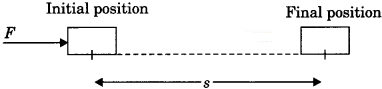
Question 2.
During their trip to a hill station, Shiksha observed some thalloid plants having little differentiation of body which were growing on the moist and damp surface in the form of dense mats. She asked her teacher about them and their role. Her teacher told her which group of organism they were and said that these dense mats were helpful in preventing soil erosion and need water for fertilisation.

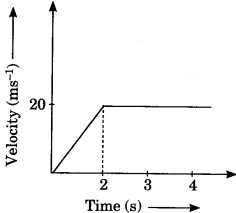
(a) What is the probable group of organisms which her teacher would have told her?
(b) What is the peculiar feature of this group of organisms?
(c) Give two examples of members of the group.
(d) What are the values shown by Shiksha?
Answer:
(a) Bryophytes
(b) Can live both on land and in water
(c) Marchantia, Funaria
(d) The values shown by Shiksha are keen observation and scientific attitude.