Interrogative Sentences Exercise for Class 5 CBSE with Answers

Interrogative Sentences Exercise For Class 5 CBSE With Answers

A sentence that asks something is called an asking sentence. These sentences are also called Questions. Asking sentences always end with question mark (?). Asking sentences begin with question words like What, Who, When, Where and Why.

This grammar section explains English Grammar in a clear and simple way. There are example sentences to show how the language is used.

Interrogative Sentences Exercise for Class 5 CBSE with Answers Pdf

Sometimes we form a question, by changing the order of the words in a sentence and placing the verb at the beginning of the sentence. We also use Do/Does/Did for forming questions. They convert the assertive sentences into interrogative sentences. Do/Does/ Did are helping verbs.

Do/Does/Did work where, is/am/are/was/were are not used as helping verb in the sentences. Do/Does are used in present tense to make Present interrogative sentence. They always comes with the base form of the main verb. Did is used in past tense to make Past interrogative sentence. It always comes with the base form of the verb.

Do/Does/Did are used in the beginning of the sentence while making questions. Do is used with I, We, you and Does is used with He, She, It. Did is used with I, We, you, He, she it, they. Has/Have/Had are used with the past participle of the main verb. While converting present perfect sentence into interrogative sentences, we use Has/Have before the subject or beginning of the sentence. While converting past perfect sentences into interrogative sentences, we use Had before the subject or beginning of the sentence.

Interrogative Sentences Exercises with Answers for Class 5 CBSE Pdf

Convert the following sentences into interrogative sentences. The first one has been done for you.

1. Poonam is leaving today.
Is Poonam leaving today.

2. Manu was accused of cheating.
________________________________
3. Sherry ate the last doughnut.
________________________________
4. The chicken crossed the road.
________________________________
5. Babita can play the saxophone.
________________________________
6. You can understand why I’m upset.
________________________________
7. There’s a doctor in the house.
________________________________
8. The geese are returning early this year.
________________________________
9. Your parents try to cheer you up when you’re sad.
________________________________
10. Dolly chose the most expensive items on the menu.
________________________________
11. You will take steps to correct this problem.
________________________________
12. The doctor told us to add cereal to the baby’s formula.
________________________________
13. Babbal’s teachers understand why he’s sleepy all the time.
________________________________
14. Lalita knows how to serve her customers effectively and efficiently.
________________________________
15. The prices in our cafeteria are reasonable.
________________________________
16. He will drive the children to swim practice.
________________________________
17. All the managers were taught how to use the new software.
________________________________
18. We have received a pay raise this year.
________________________________
19. Basketball is Mita’s favourite sport.
________________________________
20. Mohan is a big fan of Sachin Tendulkar.
________________________________

Interrogative Negative Sentence Definition

Fundamentals

  • Negative sentence is formed by putting ‘not’ in the sentence.
  • Interrogative – Negative sentence is formed by putting a helping verb before the subject and ‘not’ after the subject.
  • Interrogative negative sentence ends with question mark (?).

Presentation
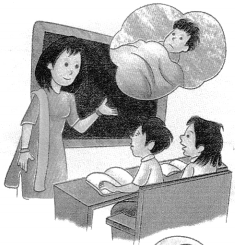
Read the picture story.
“Is Ravi not present in the class?” asks the teacher. “Yes madam, he is not present in the class as he has fallen sick.,” replies Riya. “Do you know why he falls sick so often?” asks the teacher. “No, Madam,” replies Riya.
Interrogative Sentences Exercise For Class 5 CBSE With Answers

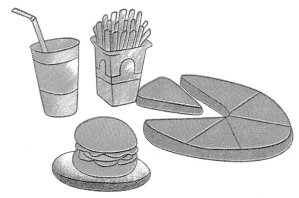
“It is because of junk food like burger, chowmein, ice-cream, etc,” explains the teacher. “Teacher, should we not eat them at all?” asks Tina. No, you can eat them but not everyday,” replies the teacher.
Interrogative Sentences Exercise For Class 5 CBSE With Answers

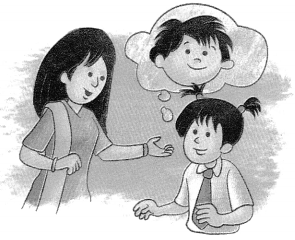
“Teacher, Is this food not nutritious for us?” asks Pooja. Yes, it is not nutritious as it makes you fat and does not give you any nourishment.
Interrogative Sentences Exercise For Class 5 CBSE With Answers

Interrogative Negative Sentence Examples With Answers for Class 5 CBSE Pdf

A. Answer the following questions as per the story.
1. What did the teacher ask to the students about Ravi?
2. What did Tina ask the teacher?.
3. What did Pooja ask the teacher?

B. Read the story again and answer the following questions in negative sentences.
1. Is Ravi present in the class?
2. Should we eat junk food at all?
3. Is junk food nutritious?

Interrogative Negative Sentence Examples for Class 5 CBSE Pdf

A. Convert the following interrogative sentences into negative interrogative sentences. The first one has been done for you.
1. Do I play?
Do I not play?

2. Does Ravi play?
_________________
3. Do boys play?
_________________
4. Is Ravi playing?
_________________
5. Have we gone there?
_________________
6. Did you play?
_________________
7. Were they playing?
_________________
8. Had he played?
_________________

B. Convert the following negative interrogative sentences into interrogative sentences.

1. Is he not your friend?
_________________
2. Do you not like pizza?
_________________
3. Will you not come alone?
_________________
4. Could you not go by taxi?
_________________
5. Are they not waiting for us?
_________________

C. Convert the following interrogative sentences into negative sentences. The first one has been done for you.

1. Has he been arrested?
He has not been arrested.

2. Is he reading now?
_________________
3. Will she be travelling?
_________________
4. Was it snowing?
_________________
5. Do they have a cat?
_________________
6. Did they see a movie?
_________________

Preposition Exercises for Class 5 CBSE With Answers

Preposition Exercises for Class 5 CBSE With AnswersDefinition: A preposition is a word placed before a noun or a pronoun to show in what relation the person or thing denoted by it stands in regard to something else.

This grammar section explains English Grammar in a clear and simple way. There are example sentences to show how the language is used.

Preposition Exercises for Class 5 CBSE With Answers Pdf

Words that show the relation between the naming words, describing words etc. are called prepositions. A preposition that tells where is something or someone is placed is called preposition of place. Across, around, between, in front of, next to, behind, over are some prepositions of place. A preposition that shows when things happen is called preposition of time.

In, On and At are prepositions of time. A preposition that shows some position and direction is called preposition of place and direction. Up, down, to, with, until, besides, near, from are the preposition of place and direction. A prepositional phrase is a group of words that begins with a preposition and ends with the object of the preposition.
For example:

  • John leaned against the tree.
  • Here, The preposition is against.
  • The object of the preposition is tree.
  • The prepositional phrase is against the tree.

Preposition Exercises with Answers for Class 5 CBSE Pdf

A. Fill in the blanks with in/on.
1. Some children are playing __________ the park while others are walking __________ the road.
2. I will be going to Mumbai __________ the summer vacations.
3. The lady sitting __________ the train fell asleep as the train moved __________ slowly.

B. Fill in the blanks with at/by.
1. My cricket coaching starts
3 p.m. so I must reach __________ then.
2. The painting was made __________ my grandmother __________ her Goa cottage.
3. I looked __________ the accident scene that had taken place the roadside.

C. Fill in the blanks with between/beside.
1. I sat __________ my friend who sat two strangers.
2. I placed the table lamp __________ the table which was __________ the beds.
3. Mr. Singh divided the money __________ his sons.

D. Fill in the blanks with for/from.
1. This is the man __________ whom I borrowed the money __________ you.
2. I bought these toys __________ the toy-shop __________ fifty rupees.
3. He works __________ morning to night __________ his family.
4. The courier that has come __________ Delhi is __________ my father.

E. Fill in the blanks with of/off.
1. He is very fond __________ watching T.V. and does not switch it __________ until he is told to.
2. The dog jumped __________ the roof __________ our aunt’s house.
3. My toy aeroplane can take __________ the ground because it is made __________ good quality.

F. Fill in the blanks with to/with.
1. I like __________ play cricket
2. I asked him __________ stay back the others.
3. My father did not want me __________ go to the movie __________ friends.

G. Fill in the blanks with through/till.
1. The boys walked __________ the dark tunnel __________ they reached the end.
2. He could not see __________ the fog, so he had to wait __________ it lifted.
3. She went __________ a difficult time __________ she got a good job.

H. Complete the notice given below by using suitable prepositions from the box. The first one has been done for you.

on, in, by, between, with, beside, at, for, from, of, off
Dav School, Patna
Notice

25 July 20xx

A picnic is being organized for students (a) __________ Class X (b) __________ August 10, 20xx. The bus will leave the school (c) __________ 8.00 a.m. sharp. The picnic hours are (d) __________ 8 a.m. to 3.00pm. Students must be dressed (e) __________ their school uniform. Those interested to go should give their names along (f) __________ a sum of Rs. 300/- to the undersigned latest (g) __________ August 01, 20xx.

Manik
(Head Boy)

I. Given below is a passage with blanks. Fill in each blank with appropriate prepositions.

It was Tuesday so (a) __________ 1.05 p.m. Madhav placed the bird’s cage (b) __________ the window. The cat was sleeping (c) __________ the table that was kept (d) __________ the sofas. Madhav was angry. “You always sleep (e) __________ the window, why are you here today?” The cat jumped (f) __________ the table and went away (g) __________ that room. Soon it was fast asleep (h) __________ the foot of Madhav’s bed.

J. Fill in the blanks with suitable prepositions. The first one has been done for you as an example.

One night I was very upset. I decided to go for a walk. I walked (a) __________ beside the lake for a long time. When I looked (b) __________ my watch I realised I had been walking for two hours. As I was (C) __________ my way back home without realising I started walking (d) __________ Sameer’s house. When I reached Sameer’s room, I switched (e) __________ the light. I saw Sameer sitting (f) __________ his bed. (g) __________ seeing me he raised his head. He looked very sick. I stood (h) __________ his bed and he grabbed me (l) __________ both arms. I could see tears (j) __________ his eyes.

K. Given below is a passage. There is a preposition missing in each line where a’s has been marked. Write the missing preposition in the space provided. The first one has been done as an example.

Kishor looked/the scene. He was at
fascinated/the beautiful hills. The __________
valley/two hills was green and __________
lively. The birds/the trees sang __________
sweet songs and the flowers/the __________
valley swayed/the breeze. The hut __________
/the river looked peaceful, far from __________
the noise/the city. __________

Compound Prepositions

Fundamentals
Compound prepositions are made up of two or more words. according to, as of, aside from, because of, by means of, in addition to, in front of, in place of, in spite of, instead of, on account of, out of, owing to, prior to, due to are some compound prepositions.

Presentation
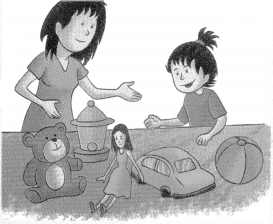
Read the picture story.

Out of five toys, Sarita prefers to buy a teddy bear for her daughter. She asks for the opinion of her daughter because she wants her to be happy.
Preposition Exercises for Class 5 CBSE With Answers 1

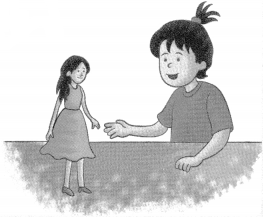
She keeps all the five toys in front of her daughter and allows her to choose one of them. Her daughter chooses a Barbie doll instead of a teddy bear.
Preposition Exercises for Class 5 CBSE With Answers 2

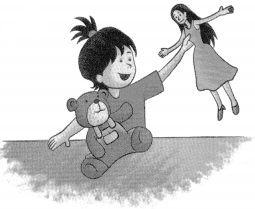
On account of her daughter’s opinion, Sarita decides to buy a Barbie doll in addition to a teddy bear. Sarita’s daughter becomes very happy after getting both the toys.
Preposition Exercises for Class 5 CBSE With Answers 3

Compound Prepositions Exercises With Answers Class 5 CBSE

A. Answer the following questions as per the story.

1. What does Sarita prefer to buy? __________
2. How does Sarita get the opinion of her little daughter? __________
3. What does Sarita decide to buy at the end of the story? __________

B. Fill in the blanks with suitable compound prepositions given in the box. The first one has been done for you.

1. Vijay has no pal aside from Arun.
2. Eat more fruit __________ candy.
3. My car is __________ a big van.
4. He is late __________ his car’s flat tyre.
5. The children go to school __________ a school bus. in front of,
6. We cancelled the picnic __________ the rain.
7. I am thin __________ being tall.
8. He left __________ my rudeness.
9. __________ 30 runners, he came in third.
10. __________ my wedding, I was busy.

Compound Prepositions Practice Exercises Class 5 CBSE Pdf

A. Fill in the blanks with suitable compound prepositions given in the box.
behalf, next, with, to, out, top

1. With respect __________ your order of 03/05/06, we regret to inform you that this book is no longer in print.
2. __________ reference to the question of overtime, the board of directors have decided that they cannot change their decision.
3. I’m afraid that Ms. Suman is __________ of the office at the moment.
4. On __________ of the pollution problem, it is also almost impossible to find somewhere to park.
5. May I thank you on __________ of the entire committee? We are really grateful for your hard work.
6. Who’s this standing __________ to your sister in this photo?

B. Choose the right compound preposition.
1. The weather will be great __________ the newspaper.
( ) according from
( ) according of
( ) according to

2. They arrived late __________ the heavy traffic.
( ) because to
( ) because from
( ) because of

3. Amir lives __________ his work.
( ) close to
( ) close of
( ) close from

4. There must have been an accident on the road __________ us.
( ) ahead from
( ) ahead to
( ) ahead of

5. He takes the train __________ his fear of driving.
( ) due for
( ) due from
( ) due to

6. We achieved our sales target __________ all your hard work.
( ) thanks from
( ) thanks with
( ) thanks to

7. It’s open every day __________ Sunday.
( ) except from
( ) except for
( ) except with

8. I’ll ride in the carriage __________ you and Natalie.
( ) along for
( ) along with
( ) along from

Improvement in Food Resources Class 9 Extra Questions and Answers Science Chapter 15

In this page, we are providing Improvement in Food Resources Class 9 Extra Questions and Answers Science Chapter 15 pdf download. NCERT Extra Questions for Class 9 Science Chapter 15 Improvement in Food Resources with Answers will help to score more marks in your CBSE Board Exams.

Class 9 Science Chapter 15 Extra Questions and Answers Improvement in Food Resources

Extra Questions for Class 9 Science Chapter 15 Improvement in Food Resources with Answers Solutions

Improvement in Food Resources Class 9 Extra Questions Very Short Answer Type

Question 1.
What is the advantage of selecting seeds of crops with wider adaptability for agriculture?
Answer:
Wider adaptability helps in stabilizing crop production under different environmental conditions.

Question 2.
Name the type of nutrient that we get from mustard seeds and linseed.
Answer:
Mustard seeds and linseed are oilseed crops that provide fats.

Question 3.
Mention any two abiotic factors that affect crop production.
Answer:
Drought, salinity, waterlogging, heat, cold and frost are the abiotic factors that affect crop production.

Question 4.
Students were asked to select one that is not a source of starch amongst the following rice, wheat, sunflower seeds, and potato tuber.
Answer:
Sunflower seeds are not a source of starch. They are a source of fats.

Question 5.
Improved varieties can be produced in both animals and plants. How?
Answer:
Improved varieties can be produced in both animals and plants by hybridization and genetic modification.

Question 6.
Name two protein-containing Rabi crops.
Answer:
Protein containing Rabi crops are gram and peas.

Question 7.
Identify two crops from the following which provide us carbohydrates for energy requirement. Black gram, wheat, lentil, and rice.
Answer:
Wheat and rice provide energy.

Question 8.
Name two plants which are used as biopesticide in organic farming.
Answer:
Turmeric and leaves of Neem plant are used as biopesticide in organic farming.

Question 9.
Name the two vitamins which are added in the poultry feed.
Answer:
Vitamin A and K are the vitamins that are added in the poultry feed.

Question 10.
Name the major nutrient which we get from fish.
Answer:
The major nutrient which we get from fish is protein.

Question 11.
How does Catla differ from Mrigal?
Answer:
Callas are surface feeders while Mrigals are bottom feeders.

Question 12.
What is mariculture?
Or
What do you mean by mariculture?
Answer:
Mariculture is a practice in which marine fishes like mullets, bhetki, and pearl spots are cultured in coastal waters on a commercial scale.

Question 13.
Give one example of local variety and foreign variety of bees.
Answer:
Local variety: Apis cerana Indica is commonly known as the Indian bee.
Foreign variety: Apis mellifera is the Italian variety of bee.

Question 14.
State one factor which affects the quality of honey produced.
Answer:
The quality of honey depends upon the pasturage or the flowers available to the bees for nectar and pollen collection.

Question 15.
Give two examples of exotic breeds of cows that are selected for a long lactation period.
Answer:
Exotic or foreign breeds like Jersey and Brown Swiss are selected for long lactation periods.

Question 16.
What is meant by beekeeping?
Answer:
Beekeeping is the practice of rearing the honeybees for obtaining honey and bee wax.

Question 17.
Which species of the honeybee is commonly used for commercial honey production throughout the country?
Answer:
Apis mellifera, the Italian variety of bee is commonly used for commercial honey production throughout the country.

Improvement in Food Resources Class 9 Extra Questions Short Answer Type 1

Question 1.
Mention the names of four marine fish of high economic value.
Answer:
Fishes like mullets, bhetki, pearl spots and prawns are of high economic value.

Question 2.
Give two examples of shellfishes.
Answer:
Shellfish include prawns, mussels and oysters.

Question 3.
Name two desirable traits for variety improvement in poultry farming.
Answer:
The two desirable traits for variety improvement in poultry farming are:

  • number and quality of chicks;
  • dwarf broiler parent for commercial chick production.

Question 4.
Which method is commonly used for improving cattle breeds and why?
Answer:
Crossbreeding between the indigenous and exotic breeds is commonly used for improving cattle breeds. This is done as it helps to incorporate the desirable qualities like a long lactation period of exotic breeds with the disease resistance of indigenous breeds in the progeny.

Question 5.
What are ‘Sahiwal’ and ‘Jersey’ breeds?
Answer:
Sahiwal is an indigenous breed of cow whereas Jersey is the exotic breed of cow.

Question 6.
State the food requirements of dairy animals.
Answer:
The food requirements of dairy animals are of two types:

  • Maintenance requirement, which is the food required to support the animal to live a healthy life.
  • Milk producing a requirement, which is the type of food required during the lactation period.

Question 7.
What is mixed cropping? How does it help a farmer?
Answer:
Mixed cropping is the practice of growing two or more crops simultaneously on the same piece of land. For example, wheat and gram, or wheat and mustard, or groundnut and sunflower. It helps the farmer as it reduces the risk and gives some insurance against the failure of one of the crops.

Question 8.
State two advantages of fertilizers over manure.
Answer:
Fertilizers are more advantageous than manure as:

  • Fertilizers are nutrient specific and provide the specific nutrients like N, P, K to the soil.
  • They are not bulky, so are easier to transport.

Question 9.
What do you mean by vermicompost?
Answer:
The compost prepared by using earthworms to hasten the process of decomposition of plant and animal refuse is called vermicompost.

Question 10.
What are the advantages of fish farming?
Answer:
The advantages of fish farming are:

  • It helps to get a large amount of desired fishes from a small area.
  • It enables a variety of improvement in a better way.

Question 11.
What is a GM crop? Name anyone such crop which is grown in India.
Answer:
GM crops are the crops obtained by introducing a gene that would provide the desired characteristic to the crop plant. Bt Cotton is a genetically modified (GM) crop which has been made insect-resistant by introducing a gene from bacteria.

Question 12.
Give any two differences between macronutrients and micronutrients.
Answer:
Macronutrient:

  1. Macronutrients are generally present and utilized by plant tissues in large amounts.
  2. Apart from carbon, hydrogen, oxygen, the macronutrients include six elements- nitrogen, phosphorous, sulfur, potassium, calcium, and magnesium.

Micronutrient

  1. The nutrients which are needed by plant tissues in small amounts are called micronutrients.
  2. These include seven elements: iron, manganese, copper, zinc, molybdenum, boron, and chlorine.

Question 13.
What is a green revolution?
Answer:
An increase in crop production (especially wheat and rice) due to the use of plant breeding techniques and better farming practices, is called the green revolution.

Question 14.
What are the weeds? How do they harm crop plants?
Or
How do they prevent the growth of crops?
Answer:
The unwanted plants which grow along with the crop in the cultivated field are called weeds. Weeds compete for food, space, and light with the crop plant and reduce the growth of the crop.

Question 15.

  1. What are many animals?
  2. Give two examples of such animals.

Answer:

  1. Milk: producing females of cattle are called many animals (dairy animals).
  2. Examples of such animals are: cows, buffaloes, goats etc.

Question 16.
Mention two advantages of animal husbandry.
Answer:
Animal husbandry is advantageous to get

  1. Higher milk production from cattle and higher egg production from poultry.
  2. Utilization of animal wastes in a beneficial way.

Question 17.
State two characteristics of a healthy animal.
Answer:
The two characteristics of a healthy animal are:

  1. A healthy animal feeds regularly.
  2. Healthy animals have a normal posture.

Question 18.
Why would a cattle breeder choose to cross-breed a Jersey cow with a Red Sindhi? State two reasons.
Answer:
Jersey cows have a longer lactation period while Red Sindhi are resistant to diseases. So, the two are cross-bred to get animals with

  • Long lactation period
  • Resistance to diseases.

Question 19.
How are new varieties of poultry birds with desired traits produced?
Answer:
Poultry birds with desired traits are produced by crossbreeding the indigenous variety like Aseel with the exotic variety like Leghorn.

Question 20.
What desirable traits are focussed to develop by cross-breeding indigenous and exotic breeds of fowl?
Or
Mention any four desirable traits for which new varieties are produced?
Answer:
Desirable traits of poultry are:

  • number and quality of chicks;
  • dwarf broiler parent for commercial chick production;
  • summer adaptation capacity/tolerance to high temperature;
  • low maintenance requirements;
  • reduction in the size of the egg-laying bird with the ability to utilize more fibrous cheaper diets formulated using agricultural by-products.

Question 21.
1. State one demerit with a composite fish culture system.
2. How can this problem be overcome?
Answer:
1. The demerit of composite fish culture system is:
(a) Many of the fishes used in the composite culture system breed only during monsoon.
(b) Lack of availability of good quality seed.
2. The problem is overcome by breeding these fish in ponds using hormonal stimulation. This ensures the supply of pure fish seed in desired quantities.

Improvement in Food Resources Class 9 Extra Questions Short Answer Type 2

Question 1.
(a) Suppose you are in charge of a grain store. How will you find out the presence of pests? Mention any two indicators.
(b) Which method is most effective for destroying insects in stored food grains, spraying or fumigation?
Answer:
(a) The indicators for the presence of pests in grain store are:
(i) Damaged or broken grains having perforations or holes.
(ii) Discoloration of grains, degraded quality of food grains.
(b) Fumigation is a better method than spraying of chemicals as the fumigants completely fill the area with gaseous particles that suffocate the pests and kill them.

Question 2.
Write a short note on marine fisheries.
Answer:
Marine fishery resources include 7500 km coastline and the deep seas beyond it. Some marine fish varieties are pomfret, mackerel, tuna, sardines, and Bombay duck. Fishes like mullets, bhetki, and pearl spots; shellfish such as prawns, mussels, and oysters as well as seaweed are of high economic value.

Question 3.
Differentiate between:
1. Inland fishery and marine fishery
2. Apiculture and aquaculture
Or
Distinguish between
1. Inland fishery and marine fishery
2. Culture fishery and capture fishery
3. Apiculture and aquaculture
Answer:
Inland Fishery:

  • Inland fishery resources include canals, ponds, reservoirs, rivers and brackish water resources like estuaries and lagoons.
  • Most fish production from these resources is through aquaculture.

Marine Fishery:

  • Marine fishery resources include 7500 km coastline and the deep seas beyond it.
  • Most fish production from these resources is through mariculture.

Apiculture:
The practice of rearing and maintenance of honeybees for obtaining honey and bee wax is called as apiculture.

Aquaculture:
The practice of breeding, rearing, and harvesting of plants and animals in all types of water environments including ponds, rivers, lakes, and the ocean.

Capture fishery:
Fish are obtained from natural resources in capture fishery.

Culture fishery:
Fish farming done in ponds or tanks is called culture fishery.

Question 4.
Differentiate between layers and broilers. What type of food should be given to broilers?
Answer:
Layers:

  • The egg-laying birds which are managed for egg production are called layers.
  • The layers start laying eggs at the age of 20 weeks. So, they are kept for longer periods of, around 500 days, called laying period.
  • They require enough space, proper light, and hygienic conditions.
  • Their feed consists of vitamins, minerals, and certain micronutrients that affect the hatchability of the eggs.

Broilers:

  • The birds maintained for meat production are called broilers.
  • The broilers are raised in poultry farms up to 6-7 weeks and usually weigh around 700 g to 1.5 kg.
  • More stress is given to maintain the feathering, carcass quality, and low levels of mortality.
  • The requirement of the broilers is protein and fat-rich food. The level of vitamin A and vitamin K is kept high in their feed.

Question 5.
What are the advantages of bee-keeping?
Answer:
The advantages of bee-keeping are:

  • It helps to obtain honey and bee wax which are used in medicines and many cosmetic preparations respectively.
  • It requires a very low amount of investment.
  •  It is less labor-intensive.
  • It helps to increase the pollination of flowers.

Question 6.
What is honey? What does the quality of honey depend upon?
Answer:
It is a sugary substance produced and stored by insects like bees in the bee-hives. It has a very high nutritional and medicinal value. The value or quality of honey depends upon the pasturage, or the flowers available to the bees for nectar and pollen collection.

Question 7.
Differentiate between the following:

  1. Capture fishery and culture fishery
  2. Beekeeping and Poultry farming

Answer:

  1. Capture fishery: Fish are obtained from natural resources in capture fishery.
    Culture fishery: Fish farming is called culture fishery.
  2. Beekeeping is the practice of rearing honeybees for obtaining honey and bee wax.
    Poultry farming is undertaken to raise domestic fowl called layers for egg production and the broilers for chicken meat.

Question 8.
Discuss various methods of weed control.
Answer:
The various methods of weed control are:
Mechanical removal, a spray of chemicals called weedicides, and preventive methods like proper seedbed preparation, timely sowing of crops, intercropping, and crop rotation.

question 9.
Discuss the role of hybridization in crop improvement.
Answer:
Hybridization is one of the methods of crop production which ensures high yield. Hybridization refers to crossing between two genetically dissimilar plants each of which possesses a particular desired character. The two varieties are cross-bred during the process to incorporate both the desirable characteristics in a single variety. This method of hybridization improves crops with respect to yield, disease resistance, pest resistance, etc.

Question 10.
What are the macro and micronutrients of plants? Name two of each kind.
Answer:
Macronutrients: The nutrients which are required in large quantities. They are six.
Example: Nitrogen, Phosphorus.
Micronutrients: The nutrients which are required in small quantities. They are seven.
Example: Iron, Copper.

Question 11.
Name any three processes in plants that are affected by deficiency in nutrients.
Answer:
Deficiency of nutrients affects the following things in plants:

  • reproduction
  • growth
  •  susceptibility to diseases.

Question 12.
Distinguish between intercropping and mixed cropping. List any two advantages of intercropping over mixed cropping.
Answer:
Mixed cropping Growing two or more crops simultaneously on the same piece of land.
Inter-cropping: Growing two or more crops simultaneously on the same field in a definite pattern.
Intercropping is better than mixed cropping because:

  • The application of pesticides to individual crop is easier and done as per the need of the crop.
  • Different crops can be separately harvested and threshed.

Question 13.
What is hybridization? How is it done?
Answer:
Hybridization refers to crossing between two genetically dissimilar plants each of which possesses a particular desired character. The two varieties are cross-bred during the process to incorporate both the desirable characteristics in a single variety. This method of hybridization improves crops with respect to yield, disease resistance, pest resistance, etc.

Question 14.
How are cultivation practices and crop yield related to weather?
Answer:
1. Agriculture in India is largely dependent on the monsoon. The success of crops in most areas is dependent on timely monsoons and sufficient rainfall spread through most of the growing season. Hence, poor monsoons cause crop failure.

2. The cultivation of different varieties of crops is dependent on abiotic stresses like droughts and floods situation in an area.

Question 15.
Name any three methods of irrigation and briefly describe them.
Or
(a) Describe any two irrigation systems adopted in India to supply water to agricultural lands.
(b) Write two advantages of building check dams.
Answer:
(a) The three different types of irrigation systems are:
Wells: There are two types of wells: dug wells and tube wells. In a dug well, water is collected from water-bearing strata. Tube wells can tap water from the deeper strata. From these wells, water is lifted by pumps for irrigation.

Canals: In this system canals receive water from one or more reservoirs or from rivers. The main canal is divided into branch canals having further distributaries to irrigate fields.

River Lift Systems: In this system, water is directly drawn from the rivers for supplementing irrigation in areas close to rivers.

The advantage of check dams are-

  • Leads to an increase in groundwater levels.
  • The check-dams stop the rainwater from flowing away and reduce soil erosion.

Question 16.
What factors may be responsible for losses of grains during storage? Give one example of both. Give one method/preventive measure to control such losses.
Or
What preventive and control measures should be taken before the storage of grains?
Answer:
Factors responsible for losses of grains during storage are:

  • Biotic: insects, rodents, fungi, mites, and bacteria
  • Abiotic: inappropriate moisture and temperatures in the place of storage.

Ways to reduce loss during storage of grains:

  1. Proper treatment and systematic management of warehouses.
  2. They include strict cleaning of the produce before storage.
  3. Proper drying of the product first in sunlight and then in shade.
  4. Fumigation using chemicals that can kill pests.

Question 17.
List six facilities that must be provided to cattle to ensure their good health and production of clean milk.
Answer:
Six facilities that must be provided to cattle to ensure their good health and production of clean milk are:

  • The cattle should be housed in well-ventilated sheds,
  • The floor of the cattle shed needs to be sloping so as to stay dry and to facilitate cleaning.
  • The feeding of cattle should be carried out in a scientific manner. The feed should have:

(a) Roughage, which is largely fiber and
(b) Concentrates, which are low in fiber and have high levels of proteins and other nutrients.

  • Leads to an increase in groundwater levels.
  • The check-dams stop the rainwater from flowing away and reduce soil erosion.

Question 18.
What is the lactation period? Name two breeds of cattle that are selected for their lactation period. Why are they crossed with local breeds?
Answer:
The period of milk production after the birth of a calf is called the lactation period. Milk production can be increased by increasing the lactation period. Exotic or foreign breeds like Jersey and Brown Swiss are selected for long lactation periods. They (exotic breeds) are crossed with local breeds to get animals with the desired qualities of both the animals.

Question 19.
Which variety of honeybee is advantageous – Apis cerana indica or Apis mellifera and why?
Answer:
Apis mellifera, the Italian variety of bee is better than Apis cerana indica. It has the following advantages:

  • They have high honey collection capacity.
  • They sting somewhat less.
  • They stay in a given beehive for long periods and breed very well.

Question 20.
Match the column A with column B
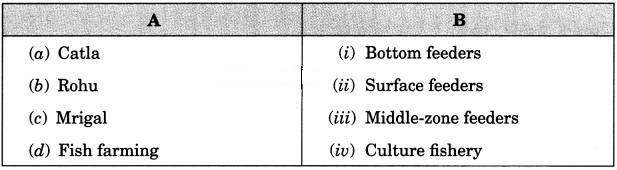
Improvement in Food Resources Class 9 Extra Questions and Answers Science Chapter 15 img 1
Answer:
(a) (ii) Surface feeders
(b) (iii) Middle-zone feeders
(c) (i) Bottom feeders
(d) (iv) Culture fishery

Question 21.
Fill in the blanks
(a) Pigeon pea is a good source of ………..
(b) Berseem is an important ………… crop.
(c) The crops which are grown in the rainy season are called ………… crops.
(d) ………… are rich in vitamins.
(e) ………… crop grows in the winter season.
Answer:
(a) protein
(b) fodder
(c) Kharif
(d) Vegetables
(e) Rabi

Question 22.
What is a GM crop? Name anyone such crop which is grown in India.
Answer:
GM crops are the crops obtained by introducing a gene that would provide the desired characteristic to the crop plant. Bt Cotton is a genetically modified (GM) crop which has been made insect-resistant by introducing a gene from bacteria.

Question 23.
List out some useful traits in the improved crop.
Answer:
Some useful traits of improved crops are:
(a) higher yield
(b) improved nutritional quality
(c) resistance to biotic and abiotic stresses
(d) change in maturity duration
(e) wide range of adaptability
(f) desired agronomic characteristics.

Question 24.
Why is organic matter important for crop production?
Answer:
Organic matter is important for crops production because:
(a) it helps in improving soil structure.
(b) it helps in increasing water holding capacity of sandy soil.
(c) It helps in drainage and in avoiding water logging in clayey soils.

Question 25.
Why is excess use of fertilizers detrimental for the environment?
Answer:
Excess use of fertilizers is detrimental for the environment as their residual and unused amounts become pollutants for air, water, and soil. The fertilizers get washed away in the nearby water bodies and cause excessive growth of algae and aquatic plants which can adversely affect the aquatic life and drain the oxygen from water bodies.

Question 26.
Give one word for the following:
(a) Farming without the use of chemicals as fertilizers, herbicides and pesticides is known as ……….
(b) Growing of wheat and groundnut on the same field is called as ……….
(c) Planting soybean and maize in alternate rows in the same field is called as ……….
(d) Growing different crops on a piece of land in pre-planned succession is known as ……….
(e) Xanthium and Parthenium are commonly known as ……….
(f) The causal organism of any disease is called as ……….
Answer:
(a) organic farming
(b) mixed cropping
(c) intercropping
(d) crop-rotation
(e) weeds
(f) pathogen

Question 27.
Match the following A and B
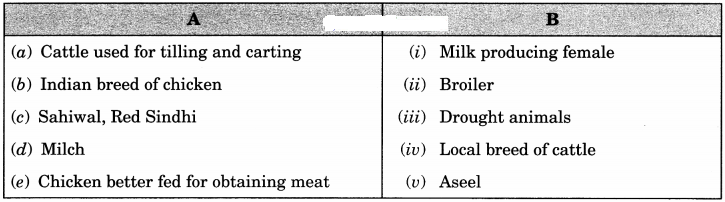
Improvement in Food Resources Class 9 Extra Questions and Answers Science Chapter 15 img 2
Answer:
(a) → (iii) Drought animals
(b) → (v) Aseel
(c) → (iv) The local breed of cattle
(d) → (i) Milk producing female
(e) → (ii) Broiler

Question 28.
If there is low rainfall in a village throughout the year, what measures will you suggest to the farmers for better cropping?
Answer:
If there is low rainfall in a village throughout the year, then the farmers will be suggested to:
(a) Cultivate crops varieties that are drought resistant and early maturing.
(b) Increase the humus content of the soil in order to increase its water holding capacity.

Question 29.
Group the following and tabulate them as energy-yielding, protein yielding, oil yielding, and fodder crop. Wheat, rice, berseem, maize, gram, oat, pigeon gram, sudangrass, lentil, soybean, groundnut, castor, and mustard.
Answer:

  1. Energy yielding: wheat, rice, maize
  2. Protein yielding: gram, pigeon gram, lentil, soybean
  3. Oil yielding: groundnut, castor, mustard, soybean
  4. Fodder crops: berseem, oat, sudangrass

Question 30.
Define the term hybridization and photoperiod.
Answer:
Hybridization is one of the methods of crop production which involves crossing between two genetically dissimilar plants each of which possesses a particular desired character. The photoperiod is the duration of sunlight available to the plant. It affects the growth, flowering, and maturation of crops.

Question 31.
Fill in the blanks
(a) Photoperiod affects the ………..
(b) Kharif crops are cultivated from ……….. to ………..
(c) Rabi crops are cultivated from ……….. to ………..
(d) Paddy, maize, green gram and black gram are ……….. crops.
(e) Wheat, gram, pea, mustard are ……….. crops.
Answer:
(a) Flowering of plants
(b) June to October
(c) November to April
(d) Khalil
(e) Rabi

Question 32.
Cultivation practices and crop yield are related to environmental conditions. Explain.
Answer:
Different crops and cultivation practices require different climatic conditions, temperature, photoperiod for their growth and completion of life cycle. Depending upon these conditions some crops called Kharif crops are grown in rainy season while others called as the Rabi crops are grown during winter season.

Question 33.
Fill in the blanks
(a) A total of ……….. nutrients are essential to plants.
(b) ……….. and ……….. are supplied by air to p1ants.
(c) ……….. is supplied by water to plants.
(d) Soil supply ……….. nutrients to plants.
(e) ……….. nutrients are required in large quantity and called.
(f) ……….. nutrients are needed in small quantity for plants and are called.
Answer:
(a) 16 (Sixteen)
(b) Carbon, oxygen
(c) Hydrogen
(d) 13 (Thirteen)
(e) Six, macro
(f) Seven, micro

Question 34.
Differentiate between compost and vermicompost.
Answer:
1. Compost: Compost is prepared by decomposition of the farm waste materials like livestock excreta (cow dung, etc.), vegetable waste, animal refuse, domestic waste, sewage waste, straw, eradicated weeds, etc., in pits.
2. Vermicompost: The compost is called as vermicompost if it is prepared by using earthworms to hasten the process of decomposition of plant and animal refuse.

Question 35.
Arrange these statements in the correct sequence of preparation of green manure.
(a) Green plants are decomposed in soil.
(b) Green plants are cultivated for preparing manure or crop plant parts are used.
(c) Plants are plowed and mixed into the soil.
(d) After decomposition, it becomes green manure.
Answer:
(b)→(c)→(a)→(d)

Question 36.
An Italian bee variety A. mellifera has been introduced in India for honey production. Write about its merits over other varieties.
Answer:
The Italian bee variety A. mellifera has the following advantages:

  • They have high honey collection capacity.
  • They sting somewhat less.
  • They stay in a given beehive for long periods and breed very well.

Question 37.
In agricultural practices, higher input gives a higher yield. Discuss how.
Answer:
The financial conditions of the farmers allow them to take up different farming practices and technologies. The cropping system and production practices of the farmer are decided by the farmer’s purchasing capacity for input. A higher money input helps to raise the yield. So, we can say that in agricultural practices, higher input gives a higher yield.

Improvement in Food Resources Class 9 Extra Questions Long Answer Type

Question 1.
Mention the modern initiatives undertaken in India to supply water to the fields.
Answer:
Indian agriculture is mainly dependent on the monsoons. The irregular or scarcity of rainfall often results in crop failure. To overcome the problem, different types of irrigation systems are in practice in India for the supply of water in agricultural fields. Wells, canals, river lift systems, tanks, etc. are used for irrigation. Some new initiatives like rainwater harvesting and watershed management are being used.

For this small check-dams are constructed to stop the rainwater from flowing and lead to an increase in groundwater levels. The different types of irrigation systems are:

1. Wells: There are two types of wells – dug wells and tube wells. In a dug well, water is collected from water-bearing strata. Tube wells can tap water from the deeper strata. From these wells, water is lifted by pumps for irrigation.

2. Canals: In this system canals receive water from one or more reservoirs or from rivers. The main canal is divided into branch canals having further distributed to irrigate fields.

3. River Lift Systems: In this system, water is directly drawn from the rivers for supplementing irrigation in areas close to rivers.

4. Tanks: These are small storage reservoirs, which intercept and store the run-off of smaller catchment areas.

Question 2.
What do you understand by composite fish culture? Describe in detail with advantages and disadvantages. What are the advantages of composite fish culture?
Answer:
A combination of five or six fish species is used in a single fish pond in the composite fish culture system. The selected species do not compete for food among them as they have different types of food habits.

The types of fishes used are:
Callas are surface feeders, Rohus feed in the middle-zone of the pond, Mrigals, and Common Carps are bottom feeders, and Grass Carps feed on the weeds. As a result, the food available in all the parts of the pond is used.

Advantages of Composite fish culture:

  • The species of fishes in the pond utilize all the food available in the pond.
  • The species do not compete with each other for food as they have different food habits.
  • The yield of fish is increased by such a culture system.

The disadvantage of Composite fish culture:
A major problem in fish farming is the lack of availability of good quality fish seeds.

Question 3.
How do plants get their nutrients?
Or
List the nutrients supplied by air, water, and soil.
Answer:
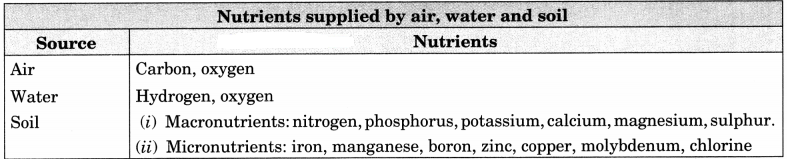
Improvement in Food Resources Class 9 Extra Questions and Answers Science Chapter 15 img 3

Question 4.
Define manures. What are its different kinds? State two limitations of manures.
Answer:
Manure is prepared by the decomposition of animal excreta and plant waste and contains a lot of organic matter which helps in enriching the soil with nutrients and increasing soil fertility. Manure is classified on the basis of kind of biological material used as:

1. Compost: Compost is prepared by decomposition of the farm waste materials like livestock excreta (cow dung etc.), vegetable waste, animal refuse, domestic waste, sewage waste, straw, eradicated weeds, etc., in pits.

2. Vermicompost: The compost is called vermicompost if it is prepared by using earthworms to hasten the proœss of decomposition of plant and animal refuse.

3. Green manure: Green plants like sun hemp or guar are grown and then mulched by plowing them into the soil prior to the sowing of the crop seeds to enrich the soil in nitrogen and phosphorus.

The limitations of manure are:

  1. They do not supply a specific nutrient.
  2. They are not readily soluble in water so their absorption by plants is slower.
  3. They are bulky in nature and difficult to be transported.
  4. Only small amounts of nutrients are supplied by the manure.

Question 5.
Differentiate between manures and fertilizers.
Or
Compare manure and fertilizer in three points.
Manure:

  1. Manure is prepared by the decomposition of animal excreta and plant waste.
  2. They are bulky and difficult to be transported.
  3. They are not nutrient-specific in nature.
  4. They are not readily soluble in water and thus absorbed slowly by plants.
  5. Manure contains a lot of organic matter.
  6. They are environment friendly in nature.
  7. Difficult to store.

Fertilizer:

  1. Fertilizers are commercially produced plant nutrients.
  2. They are not bulky, so easier to transport.
  3. They are nutrient-specific in nature.
  4. They are easily absorbed by the plants as they are soluble in water.
  5. They do not contain organic matter.
  6. The comparatively less environmentally friendly.
  7. Easier to store.

Question 6.
Mention the management practices that are common between dairy and poultry farming.
Answer:
Management practices which are common between dairy and poultry fanning are:

  • Should be housed in the well-ventilated shelter.
  • Proper cleanliness should be maintained.
  • Regular visits by a doctor and timely vaccination.
  • Balanced food should be provided with additives.
  • Regular inspections, with proper record keeping.

Question 7.
What are the differences between broilers and layers with respect to their purpose of breeding and daily requirement? What necessary steps have to be taken to prevent the occurrence of infectious diseases in poultry farms?
Answer:
The meat-producing birds are called broilers and the egg-laying birds are called layers. The housing, nutritional and environmental requirements of the broilers are different from the layers. The broilers are raised in poultry farms up to 6-7 weeks and usually weigh around 700 g to 1.5 kg.

The requirement of the broilers is protein and fat-rich food. The level of vitamin A and vitamin K is kept high in their feed. Care is taken to avoid mortality and to maintain the feathering and carcass quality. The layers start laying eggs at the age of 20 weeks. So, they are kept for longer periods of around 500 days, called laying period. They require enough space, proper light, and hygienic conditions.

heir feed consists of vitamins, minerals, and certain micronutrients that affect the hatchability of the eggs. Necessary steps for prevention of infectious diseases are:
1. Proper cleaning, sanitation, and spraying of disinfectants at regular intervals.
2. Appropriate vaccination to prevent the occurrence of infectious diseases.

Question 8.
Discuss the role of hybridization in crop improvement.
Answer:
Hybridization is one of the methods of crop production which ensures high yield. Hybridization refers to crossing between two genetically dissimilar plants each of which possesses a particular desired character. The two varieties are cross-bred during the process to incorporate both the desirable characteristics in a single variety. This method of hybridization improves crops with respect to yield, disease resistance, pest resistance, etc.

Question 9.
Define
1. Vermicompost
2. Green manure
3. Biofertilizer
Answer:
1. Vermicompost: The compost prepared by using earthworms to hasten the process of decomposition of plant and animal refuse.
2. Green manure: The manure which is prepared by decomposing green plants in field itself is called green manure. For example: sun hemp is grown in fields, mulched by plowing and allowed to
decompose infield for the preparation of green manure. It helps in enriching the soil in nitrogen and phosphorus.
3. Biofertiliser: Living organisms which are used as fertilizer to supply the nutrients to plants, are called as biofertilizers. For example, blue-green algae which fix nitrogen in soil, rice fields, are called biofertilizers.

Question 10.
Discuss various methods of weed control.
Answer:
The various methods of weed control are mechanical removal, a spray of chemicals called weedicides and preventive methods like proper seedbed preparation, timely sowing of crops, intercropping and crop rotation.

Question 11.
Differentiate between the following

  1. Capture fishery and Culture fishery
  2. Mixed cropping and Inter-cropping
  3. Beekeeping and Poultry farming

Answer:

  1. Capture fishery: Fish are obtained from natural resources in capture fishery. Culture fishery: Fish farming is called culture fishery.
  2. Mixed cropping: Growing two or more crops simultaneously on the same piece of land. Inter-cropping: Growing two or more crops simultaneously on the same field in a definite pattern.
  3. Beekeeping is the practice to rear honeybee for obtaining honey. Poultry farming is undertaken to raise domestic fowl called layers for egg production and the broilers for chicken meat.

Question 12.
Give the merits and demerits of fish culture.
Answer:
The merits and demerits of fish culture are:
Merits:

  • It helps to get a large amount of desired fishes from a small area.
  • It enables a variety of improvements in a better way.

Demerits:

  • It is a threat to bio-diversity as only selected varieties are cultured on a large scale.
  • It involves the culture of only economically important and valued fishes.

Question 13.
What do you understand by composite fish culture?
Answer:
A combination of five or six fish species is used in a single fish pond in the composite fish culture system. The selected species do not compete for food among them as they have different types of food habits.

The types of fishes used are:
Callas are surface feeders, Rohus feed in the middle-zone of the pond, Mrigals and Common Carps are bottom feeders, and Grass Carps feed on the weeds. As a result, the food available in all the parts of the pond is used.

Question 14.
Why should beekeeping be done in good pasturage?
Answer:
Beekeeping should be done in good pasturage as it:

  • Helps in increasing the honey yield.
  • Helps in increasing pollination efficiency.
  • Provides better quality and quantity of nectar for the honey bees.

Question 15.
Write the modes by which insects affect the crop yield.
Answer:
The modes by which insects affect the crop yield are

  • they cut the root, stem and leaf,
  • they suck the cell sap from various parts of the plant, and
  • they bore into stem and fruits.

Question 16.
Discuss why pesticides are used in very accurate concentration and in a very appropriate manner.
Answer:
Pesticides should be used in very accurate concentration and in a very appropriate manner because it
may have the following adverse effects:
(a) They harm the soil and causes loss of fertility
(b) They act as a check on the replenishment of organic matter
(c) They kill the microorganism of soil and destroy the soil structure
(d) They cause air, water and soil pollution.

Question 17.
Name two types of animal feed and write their functions.
Answer:
The two types of animal feed are:

  • Roughage, which is largely fiber.
  • Concentrates, which are low in fiber and have high levels of proteins and other nutrients.

Question 18.
What would happen if poultry birds are larger in size and have no summer adaptation capacity? In order to get small sized poultry birds, having summer adaptability, what method will be employed?
Answer:
Maintenance of temperature is needed for better egg production by poultry birds. The egg production is declined due to larger size (increase in surface area of the body) and no adaptability of summer in poultry birds. So, cross-breeding of poultry birds is done to obtain smaller size and higher summer adaptability in them. Small size is ais? needed for better housing and lower feed requirements.

Question 19.
Suggest some preventive measures for the diseases of poultry birds.
Answer:
Some preventive measures of poultry bird diseases are
(a) cleaning of poultry farms
(b) proper sanitation of poultry farms
(c) spraying of disinfectants at regular intervals
(d) appropriate vaccination of birds.

Question 20.
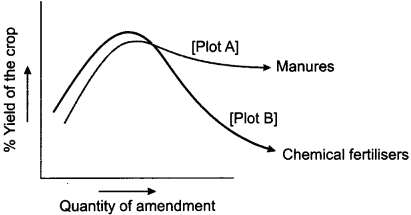
The figure shows the two crop fields [Plots A and BI have been treated by manures and chemical fertilizers respectively, keeping other environmental factors same. Observe the graph and answer the following questions.

  1. Why does plot B show a sudden increase and then a gradual decrease in yield?
  2. Why is the highest peak in plot A graph slightly delayed?
  3. What is the reason for the different patterns of the two graphs?Improvement in Food Resources Class 9 Extra Questions and Answers Science Chapter 15 img 4

Answer:
1. With the addition of chemical fertilizer, there is a sudden increase in yield due to the release of nutrients Nitrogen, Phosphorus, Potassium (NPK), etc. in high quantity. The gradual decline in the graph may be due to continuous use and a high quantity of chemicals that kill microbes useful for replenishing the organic matter in soil. This decreases soil fertility.

2. Manures supply small quantities of nutrients to the soil slowly as it contains large amounts of organic matter. It enriches soil with nutrients thereby increasing soil fertility continuously.

3. The difference in the two graphs indicates that use of manure is beneficial for a long duration in cropping as the yield tends to remain high when the number of manure increases.

4. In the case of Plot B the chemical fertilizers may cause various problems when used continuously for long time. Loss of microbial activity reduces the decomposition of organic matter and as a result, the soil fertility is lost that affects the yield.

Question 21.
Complete the crossword puzzle
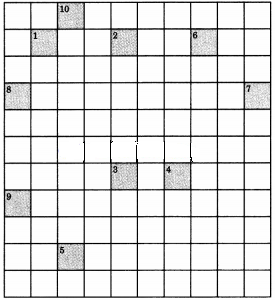
Improvement in Food Resources Class 9 Extra Questions and Answers Science Chapter 15 img 5
Across:
1. Oil yielding plant (9)
3. Crop grown in winter season (4)
5. Fixed by Rhizobium (8)
9. Common honey bee (4)

Down:
2. Animal feed (6)
4. A micronutrient (5)
6. Unwanted plant in crop fields (4)
7. An exotic breed of chicken(7)
8. Bottom feeders in fish pond(7)
10. A marine fish (4)
Answer:
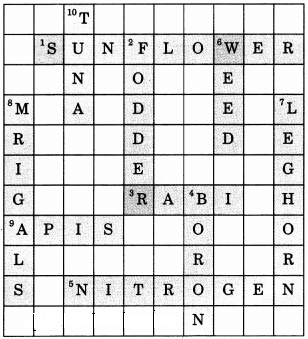
Improvement in Food Resources Class 9 Extra Questions and Answers Science Chapter 15 img 6

Improvement in Food Resources Class 9 Extra Questions HOTS

Question 1.
Irrigation systems are in practice in India for the supply of water in agricultural fields. Why?
Answer:
Most agriculture in India is rain-fed and the success of crops in most areas is dependent on timely monsoons and sufficient rainfall. Poor monsoons can cause crop failure. Hence, in order to ensure that the crops get water at the right stages during their growing season, irrigation systems are in practice in India for the supply of water to agricultural fields.

Question 2.
Nitrogenous fertilizers are usually not required by the leguminous crops. Why?
Answer:
The leguminous crops have root nodules that harbor nitrogen-fixing bacteria like Rhizobium in them. These bacteria convert the atmospheric nitrogen to nitrates for their utilization by plants. So, nitrogenous fertilizers are usually not required by the leguminous crops.

Question 3.
Why are crops like guar grown by some farmers before sowing the seeds of a crop?
Answer:
The crops like guar are grown by farmers before sowing the seeds of a crop as the guar crop is mulched by plowing. It turns into green manure which helps in enriching the soil in nitrogen and phosphorus.

Question 4.
Why is the enhancement of food production becoming a major necessity? Which group of activities are required for improving the crop yields?
Answer:
Enhancement of food production has become a major necessity because:
1. The population of the world is increasing at a faster rate, so it is needed to fulfill the food requirements of the population.
2. The land available for cultivation is limited, so the only option available is to increase crop production.

Major groups of activities for improving crop yields:

  • Crop variety improvement
  • Crop production improvement
  • Crop protection management

Question 5.
List some dairy farming practices needed to increase the milk yield potential of cattle.
Answer:
The dairy farming practices needed to increase the milk yield potential of cattle are:

  1. The cattle should be housed well and have adequate water.
  2. The cattle should be kept disease-free.
  3. The feeding of cattle should be carried out in a scientific manner with special emphasis on the quality and quantity of fodder.
  4. Stringent cleanliness and hygiene should be maintained.
  5. Regular inspections of cattle should be done with proper record keeping.
  6. Regular visits by a veterinary doctor should be ensured.

Improvement in Food Resources Class 9 Extra Questions Value Based (VBQs)

Question 1.
Aniket took admission in a dairy research institute and took an active interest in his studies. During the course, he got an opportunity to visit a village. He met the farmers there and advised them about dairy farm practices which can help to increase the milk yield of their cattle. The farmers were able to get an increased yield due to his advice.

  1. Name two species of cattle in India.
  2. List two measures that would have been suggested by Aniket to increase milk yield.
  3. What values are shown by Aniket?

Answer:
1. Indian cattle belong to two different species, Bos indicus, cows, and Bos bubble.s, buffaloes.
2. The measures which would have been suggested by Aniket to increase milk yield are:
(a) The cattle should be housed well and have adequate water.
(b) The cattle should be kept disease-free.
(c) The feeding of cattle should be carried out in a scientific manner with special emphasis on the quality and quantity of fodder.
3. The values shown by Aniket are a concern for others, caring nature, scientific approach, and knowledge.

Question 2.
Sonam got admission in a reputed institute engaged in agricultural research. After the completion of course she decided to go and serve the people of her village. Her village was suffering from a reduction in infertility of the soil and high salinity in soil. She called a meeting of farmers and told them that the use of fertilizers has increased the salinity of the soil. She suggested to them the use of manures and cropping patterns to get better yields.

  1. What are the different types of manures which can be used?
  2. Name the different cropping patterns which she would have suggested.
  3. What values are shown by Sonam?

Answer:

  1. The types of manures which can be used are: Compost, vermicompost, and green manure.
  2. The different cropping patterns can be inter-cropping, mixed cropping, and crop rotation.
  3. The values shown by Sonam are sincerity towards work, scientific aptitude, and concern for others.


Natural Resources Class 9 Extra Questions and Answers Science Chapter 14

In this page, we are providing Natural Resources Class 9 Extra Questions and Answers Science Chapter 14 pdf download. NCERT Extra Questions for Class 9 Science Chapter 14 Natural Resources with Answers will help to score more marks in your CBSE Board Exams.

Class 9 Science Chapter 14 Extra Questions and Answers Natural Resources

Extra Questions for Class 9 Science Chapter 14 Natural Resources with Answers Solutions

Natural Resources Class 9 Extra Questions Very Short Answer Type

Question 1.
What are the resources available on Earth for life to exist?
Answer:
Air, water and land are the resources available on the Earth which help life to exist.

Question 2.
Name the compound of carbon responsible for the ozone hole in the atmosphere.
Answer:
Chlorofluorocarbons (CFC’s) are responsible for the ozone hole in the atmosphere.

Question 3.
State the temperature range on the surface of the moon.
Answer:
The temperature ranges from -190°C to 110°C on the moon

Question 4.
State any one difference between oxygen and ozone.
Answer:
Oxygen is a diatomic molecule with formula 02 whereas ozone is a triatomic molecule-with formula 03.

Question 5.
Name the stage in the life cycle of aquatic animals which is affected by a change in temperature.
Answer:
The stage of animals which is affected by the change in the temperature is – the eggs at the hatching stage, the larvae and the young ones of the animals.

Question 6.
Along with the natural resources available on the Earth, what else is required to meet the basic requirements of all life forms on the Earth?
Answer:
Solar energy is required to meet the basic requirements of all life forms on Earth.

Question 7.
How is biosphere a dynamic and stable system?
Answer:
There is a constant interaction between the biotic and the abiotic components of the global ecosystem (biosphere) which makes it a stable system. The basic composition and the structure of the system do not change while carrying out the various processes. So, it is a stable system.

Question 8.
How do forests play a major role in maintaining the water cycle?
Answer:
The amount of water vapour in the atmosphere is dependent on the transpiration of water from the leaves of the plants present in a forest. Also, the storage of water in watershed is influenced by the forests. So, forests play a major role in maintaining the water cycle.

Question 9.
Why is step farming done in hills?
Answer:
Step farming is done in hills to prevent soil erosion by slowing down the speed of the water running down the slopes.

Question 10.
Why are root nodules useful for plants?
Answer:
The root nodules of leguminous plants contain nitrogen-fixing bacteria like the Rhizobium which help to increase the fertility of the soil by fixing atmospheric nitrogen.

Question 11.
What are the biotic and the abiotic components of the biosphere?
Answer:

  • Biotic component: comprises of living things.
  • Abiotic component: comprises of non-living things like temperature, rainfall, air, water and soil.

Question 12.
What percentage of oxygen and nitrogen are present in the atmosphere?
Answer:
The approximate percentage of oxygen and nitrogen in the atmosphere are:
Oxygen: 21%, Nitrogen: 78%

Question 13.
Give the major source of minerals in the soil.
Answer:
The minerals in the soil depend upon the rocks from which the soil is formed. So, the rocks are the major source of minerals in the soil.

Question 14.
Name the two gases given out during the burning of fossil fuels which dissolve in rain to form acid rain.
Answer:
Sulphur dioxide and oxides of nitrogen.

Question 15.
Name the group of compounds responsible for ozone layer depletion.
Answer:
Chlorofluorocarbons (CFCs) are responsible for ozone layer depletion.

Natural Resources Class 9 Extra Questions Short Answer Type 1

Question 1.
What are the sources of oxygen in the atmosphere?
Answer:
The sources of oxygen in the atmosphere are:

  • Oxygen released during photosynthesis by plants
  • The dissociation of oxides from their compounds
  • The disintegration of ozone in presence of UV rays
  • As the water in combined form

Question 2.

  1. What causes winds?
  2. List any two methods of preventing soil erosion.

Answer:

1. Due to the unequal heating of land and water, the land get heated up faster during the day, the air on land rises up and creates a region of low pressure. As a result, the air over the sea moves towards the region of low pressure formed on the land. This causes winds to flow.

2. (a) Overgrazing by cattle should be avoided.
(b) Large scale afforestation should be done as roots of plants prevent the soil from getting carried away.
(c) Increasing the vegetation cover on the ground reduces the impact of flowing water on soil and prevents it from getting washed away.
(d) Contour farming can be done by ploughing the land in furrows across the natural slope of the land to trap water flowing down.
(e) Step farming is practised in hilly regions which reduce the flow of water and give it more time to percolate into the soil.

Question 3.
List the importance of oxygen gas and ozone gas in the atmosphere.
Answer:
Role of Oxygen gas: It helps in the process of combustion, respiration and formation of many organic compounds.
Role of Ozone: It absorbs the harmful UV rays of the Sun which can cause skin diseases and cancer on reaching the Earth’s surface.

Question 4.
Mention one method by which living organisms influence the formation of soil.
Answer:
The living organisms like lichens and mosses are the initial colonisers of rocks which secrete certain chemical substances that dissolve the minerals of rock and cause the gradual weathering of rocks. The rocks get broken down into small, fine particles of soil. So, living organisms play an important role in the formation of soil.

Question 5.
Explain the occurrence of land breeze in coastal areas.
Answer:
During the day, in coastal regions, the air above land gets heated faster and warm air being lighter rises up thereby creating a region of low pressure. The air over the sea then moves towards the area of low pressure. The movement of air from one region to the other creates winds. At night, water cools down slower than the land, so the air above water would be warmer than the air above land. This causes air over the land to move towards the region of low pressure over water.

Question 6.
What are the two ways in which carbon dioxide is fixed in the environment?
Answer:
Carbon dioxide is fixed in the atmosphere when:

  1. Green plants utilise the carbon dioxide and convert it into glucose during photosynthesis.
  2. Carbon dioxide dissolved in seawater in the form of carbonates gets used up by the marine animals for the formation of their shells.

Question 7.

  1. Why do terrestrial forms require freshwater?
  2. Give two examples where freshwater can be found in the frozen form on the Earth.

Answer:

  1. The terrestrial organisms require freshwater as they face osmotic problems if kept in marine water because they have low osmotic concentration. In order to maintain the balance of the salts present in their body, freshwater organisms require a medium having less salt concentration i.e., freshwater.
  2. Freshwater can be found in a frozen form at polar ice-caps and the glaciers.

Question 8.
What is the role of the atmosphere in climate control?
Answer:
The atmosphere acts as a buffer which checks excessive rise in temperature during the day and prevents excessive cooling of the Earth during the night. The atmosphere helps to keep the average temperature of the Earth steady.

Question 9.
State any two harmful effects of air pollution.
Answer:
The two harmful effects of air pollution are:

  1. Respiratory problems and difficulty in breathing
  2. Acid rains

Question 10.
1. Define the term ‘smog’.
2. Name any two types of disease caused by regularly breathing polluted air.
Answer:
1. Smog is a kind of air pollution, named for the mixture of smoke and fog in the air. The thick cloud of water droplets having smoke particles suspended in the atmosphere which restricts visibility is called smog.
2. Diseases caused by breathing polluted air are:
(a) Allergy
(b) Respiratory disorders
(c) Heart-related problems

Question 11.
Mention a cause and a consequence of acid rain.
Answer:
Cause of acid rain: The oxides of nitrogen and sulphur like nitrogen dioxide and sulphur dioxide released from the burning of fossil fuels gets mixed with water vapour present in the atmosphere to form acids. These acids dissolve in the rainwater and fall as acid rain on the Earth.

A consequence of acid rain:

  1. The fertility of soil gets reduced due to the acidity created in the soil by the acid rains.
  2. Acid rain corrodes the historic monuments and structures made of marble, metals, painted surfaces, etc.
  3. The aquatic life is also harmed due to excess amount of acids which gets dissolved in water by acid rains.

Question 12.
What is meant by biogeochemical cycle? Name the two essentials which are transferred between different components of the biosphere.
Answer:
The movement of nutrient elements through the various components of an ecosystem i.e., biotic and the abiotic components, is called a biogeochemical cycle.
The two essentials which are transferred between different components of the biosphere are: Matter and energy,

Question 13.
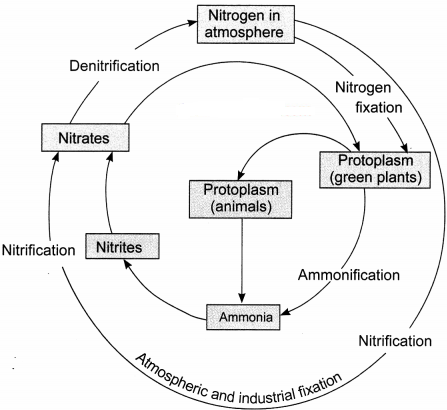
What is the difference between nitrification and denitrification?
Answer:
Nitrification:
The process by which ammonia or ammonium compounds is converted into nitrites by Nitrosomonas and nitrites into nitrates by the Nitrobacter is called nitrification.

Denitrification:
The process by which the nitrites or nitrates are broken down into elemental nitrogen (N2) by Pseudomonas or Thiobacillus is called denitrification.

Question 14.
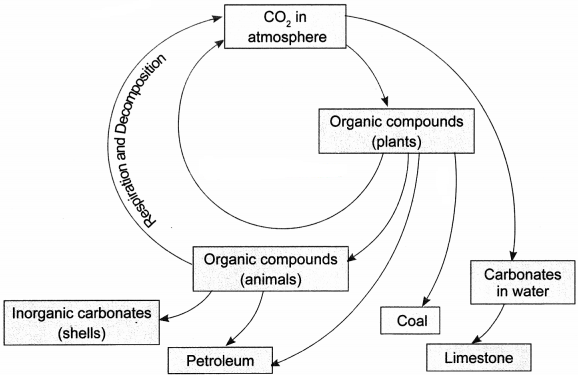
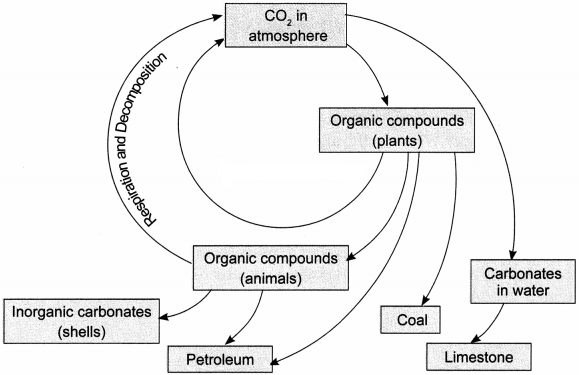
Draw a well-labelled diagram to show the carbon cycle in nature.
Answer:
Natural Resources Class 9 Extra Questions and Answers Science Chapter 14 img 1

Question 15.
State the role of photosynthesis and respiration in the carbon cycle.
Answer:
Photosynthesis: Carbon dioxide in the atmosphere is fixed by green plants during the process of photosynthesis and converted into glucose.

Respiration: Glucose is oxidised during respiration to obtain energy. Carbon dioxide gets released during the process and is returned to the atmosphere. In this way photosynthesis and respiration help in maintaining the carbon cycle in nature.

Question 16.
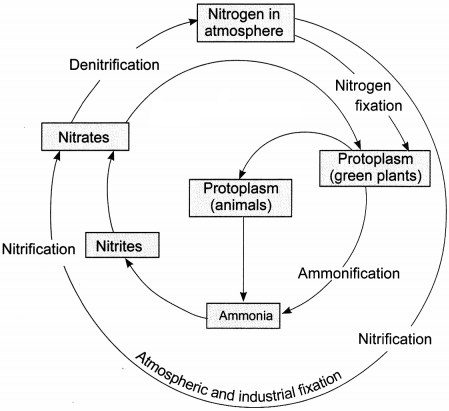
Draw a neat labelled diagram to show the nitrogen cycle.
Natural Resources Class 9 Extra Questions and Answers Science Chapter 14 img 2

Question 17.
Name any four carbon-containing molecules which are essential for human beings.
Answer:
The carbon-containing molecules essential for human beings are:

  1. Deoxyribonucleic acid-DNA
  2. Proteins
  3. Carbohydrates
  4.  Fats

Question 18.
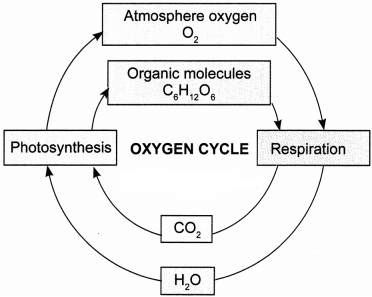
Draw a well-labelled diagram to show the oxygen cycle in nature.
Answer:
Natural Resources Class 9 Extra Questions and Answers Science Chapter 14 img 3

Question 19.
(a) Why do terrestrial forms require freshwater?
(b) Mention any two processes involved in the water cycle.
Answer:
(a) Terrestrial forms require water for carrying out the various cellular and metabolic process which occur in their body.
(b) Two processes involved in the water cycle are: Evaporation of water from water bodies and precipitation of water in the form of rain, hail or snow.

Question 20.
What is the importance of greenhouse gases present in the atmosphere?
Answer:
The greenhouse gases like carbon dioxide and methane prevent the escape of heat from the Earth. Thus, these gases play an important role of keeping the average temperature of the Earth constant.

Question 21.
What is the greenhouse effect? What will happen if the concentration of greenhouse gases increase in the air?
Answer:
The phenomenon in which the incoming sunlight is allowed to pass through the atmosphere but heat radiated back from the planet’s surface is trapped by the gases like carbon dioxide, water vapour and methane present in the atmosphere is called the greenhouse effect.

Increase in concentration of greenhouse gases would prevent the escape of heat from the Earth, increase the average temperature worldwide and result in global warming. Global warming will cause a rise in sea and odd climatic changes due to faster melting of glaciers and polar ice caps.

Natural Resources Class 9 Extra Questions Short Answer Type 2

Question 1.
1. The circulation of carbon is important in nature. Give reasons for your answer.
2. Explain any two processes involved in the cycling of nitrogen in the environment.
Answer:
1. The circulation of carbon dioxide is important in nature as it helps in maintaining the balance of carbon dioxide and oxygen in the atmosphere. Carbon dioxide is taken up by plants for photosynthesis and oxygen released during photosynthesis is utilised by the plants and animals for respiration.

Hence, it is necessary to maintain the balance of these gases. Carbon dioxide gas gets cycled between the atmosphere and the living organisms. An excess of carbon dioxide in the atmosphere causes global warming due to the greenhouse effect.

2. The two-process involved in the cycling of nitrogen in the environment are nitrogen fixation and ammonification.

(a) Nitrogen fixation in which the atmospheric nitrogen is converted into nitrites and nitrates which are water-soluble and are easily taken up the roots.

(b) Ammonification: Formation of ammonia due to the decomposition of dead organic matter is called as Ammonification.

Question 2.
State the reason for the following:
1. Excess burning of coal causes the greenhouse effect.
2. Soil is a mixture.
3. Temperature ranges from (-190°C -110°C) on the surface of the moon.
Answer:
1. Carbon dioxide gas is released during the burning of fuel like coal and petroleum. Carbon dioxide has a property due to which it allows rays of the Sun to pass through and reach the surface of the Earth but stops the long-wave infra-red radiations to pass through on being re-radiated from the surface of the Earth. Thus, carbon dioxide traps the heat rays of the Sun and causes the greenhouse effect.

2. Soil is a mixture of minerals, organic matter, gases, liquids, and the various organisms that together support life on Earth.

3. The moon does not have an atmosphere like that on the Earth which traps the heat rays of the Sun and keeps its warm. The atmosphere helps in checking rise in temperature during the day and the fall in temperature during night. So, in spite of being at the same distance from the Sun as the Earth, the temperature on moon ranges from (-190°C-110° C).

Question 3.
With the help of the diagram shows the carbon cycle in nature. What are the two ways in which carbon dioxide is fixed in the environment?
Answer:
The carbon cycle in nature can be depicted by the following diagram:
Natural Resources Class 9 Extra Questions and Answers Science Chapter 14 img 4
Carbon dioxide is fixed in the atmosphere by the following two ways:
1. Green plants utilise the carbon dioxide and convert it into glucose during photosynthesis.
2. Carbon dioxide dissolved in seawater in the form of carbonates gets used up by marine animals for the formation of their shells.

Question 4.
Sun as a natural factor helps in the formation of soil. Explain.
Answer:
The Sun helps in soil formation in the following ways:
Rocks expand when they get heated by the Sun during the day. During the night, the rocks cool down and contract. This results in the formation of cracks in the rocks as the rate of expansion and contraction are different. The rocks split and break into smaller pieces.

Question 5.
What is the percentage of oxygen in the atmosphere? Name any two compounds of oxygen found in nature. Name any three processes by which oxygen is used up in the atmosphere.
Answer:
The percentage of oxygen in the atmosphere is approximately 21%.
The diatomic form oxygen (O2) and the triatomic form ozone (O3) are the two forms in which oxygen is found in nature.
The three processes by which oxygen is used up in the atmosphere are:

  • Combustion of fossil fuels.
  • Respiration by living organisms.
  • Decomposition of organic matter.
  • Formation of oxides during fixation and other chemical reactions.

Question 6.
How is the greenhouse effect related to global warming? Explain.
Answer:
The phenomenon in which the incoming sunlight is allowed to pass through the atmosphere but heat radiated back from the planet’s surface is trapped by the gases like carbon dioxide, water vapour and methane present in the atmosphere is called the greenhouse effect.

An increase in the percentage of greenhouse gases like carbon dioxide and methane prevents the escape of heat from the Earth. So, the greenhouse effect is responsible for the increase in average temperature worldwide and is causing global warming. Global warming leads to melting of glaciers and polar ice caps at a faster rate which causes a rise of the sea and other odd climatic changes.

Question 7.
Why is water necessary for the living organisms?
Answer:
Water is necessary for living organisms because:

  • All cellular metabolic processes occur in the water medium.
  • The transportation of various substances from one part of the body to another occurs in dissolved form in water.
  • All the reactions taking place in the cells or in our body occur between substances which are dissolved in water.

Question 8.
How are various biological factors needed for soil formation?
Or
Which symbiotic life forms can grow on stones and help in the formation of soil? Write the model of their action for making soil from rocks.
Answer:
Lichens are the symbiotic association of algae and fungi. Lichens help in the formation of soil. The living organisms like lichens and mosses are the initial colonisers of the rocks which secrete certain chemical substances which dissolve the minerals of rock and cause the gradual weathering of rocks. The rocks get broken down into small, fine particles of soil. So, biological factors play an important role in the formation of soil.

Question 9.
What is topsoil? Mention two factors that decide which plants will thrive on that soil.
Answer:
Topsoil refers to the topmost layer of the soil which contains humus, soil particles and living organisms.
The two factors that decide which plants will thrive on that soil are:

  • The humus content and the type of microbes present in the soil.
  • The size and texture of soil particles along with the composition of the soil.

Question 10.
What are the causes of soil erosion?
Answer:
The causes of soil erosion are:

  1. Large scale deforestation
  2. Large scale overgrazing
  3. Industrialisation
  4. Urbanisation
  5. The land left uncultivated for a long time
  6. Mining and other human activities which lead to loss of topsoil

Question 11.
Rivers from land, add minerals to seawater. Discuss how.
Answer:
Yes, it is true because water has the ability to dissolve a large number of substances. When the river water flows over the rocks containing soluble minerals, some of the minerals from the rocks get dissolved in the water. These minerals are carried away by the river water into the sea. Thus, the nutrients from the land are carried away by the river into the sea.

Question12.
How can we prevent the loss of topsoil?
Answer:
The loss of the topsoil can be prevented by the following ways:

  1. Overgrazing by cattle should be avoided.
  2. Large scale afforestation should be done as roots of the plants prevent the soil from getting carried away.
  3. Increasing the vegetation cover on the ground reduces the impact of flowing water on soil and prevents it from getting washed away.
  4. Contour farming can be done by ploughing the land in furrows across the natural slope of the land to trap water flowing down.
  5. Step farming is practised in hilly regions which reduces the flow of water and gives it more time to percolate into the soil.

Question 13.
How is the life of organisms living in water affected when water gets polluted?
Answer:
When the water gets polluted, the life of organisms living in water gets affected in the following ways:

  1. The domestic wastewater contains detergents and nutrients which increase the growth of aquatic plants, algae, etc., and reduces the amount of dissolved oxygen in the water body. This adversely affects the aquatic animals as they die due to scarcity of oxygen.
  2. The fertilisers, pesticides, etc., which get washed into the water body from the agricultural fields also harm the aquatic organisms.
  3. Many disease-causing organisms are also released in the domestic wastewater which acts as a source of many water-borne diseases like cholera.
  4. The heated water released directly into the water bodies by some industries can cause the death of aquatic organisms which are not able to tolerate the sudden change in temperature.
  5. The heavy metals dissolved in polluted water is also harmful to the living organisms.

Question 14.
During summer, if you go near the lake, you feel relief from the heat, why?
Answer:
We feel relief from the heat when we go near a lake during summer because:
1. The Sunrays heat the land near the lakes more quickly than the water of the lake. The hot air rises up to create a region of low pressure on the land. Evaporation of the water causes cooling of the air above the lake and this cool air flows from the lake towards the region of low pressure on the land. The cool air gives relief to us from the heat.

Question 15.
In the coastal area, wind current moves from the sea towards the land during the day; but during the night
Answer:
During the day, in the coastal regions, the air above the land gets heated faster and the warm air being lighter rises up thereby creating a region of low pressure. The air over the sea then moves towards the area of low pressure. The movement of air from one region to the other creates winds. At night, water cools down slower than the land, so the air above the water would be warmer than the air above land. This causes air over the land to move towards the region of low pressure over water.

Question 16.
Following are a few organisms
(a) lichen
(b) mosses
(c) mango tree
(d) cactus.
Which among the above can grow on stones; and also help in the formation of soil? Write the model of their action for making soil.
Answer:
Lichens and the mosses can grow on stones and help in the formation of soil. The chemical substances secreted by the living organisms like lichens and mosses degrade the rocks and convert them into fine particles of soil. They also cause crevices and cracks in the rocks which help in the colonisation of rocks by bigger plants. The roots of these plants widen the cracks and cause the breakdown of large rocks.

Question 17.
Soil formation is done by both abiotic and biotic factors. List the names of these factors by classifying them as abiotic and biotic?
Answer:
The abiotic factors involved in soil formation are: Sun, water, wind.
The biotic factors involved in soil formation are: lichens, mosses and trees, microorganisms, etc.

Question 18.
All the living organisms are basically made up of C, N, S, P, H and O. How do they enter the living forms? Discuss.
Answer:
Elements like C, N, S, P, H and O enter the living forms through the process of photosynthesis and on getting absorbed from soil by the plants and living organisms.

Question 19.
Why does the percentage of gases like oxygen, nitrogen and carbon dioxide remain almost the same in the atmosphere?
Answer:
The biotic and the abiotic components of the biosphere interact with each other and continuously cycle the elements like nitrogen, oxygen and carbon through their respective cycles called as biogeochemical cycles. This helps to maintain the percentage of these gases almost constant in the atmosphere.

Question 20.
Why does the moon have very cold and very hot temperature variations e.g., from -190°C to 110°C even though it is at the same distance from the Sun as the Earth is?
Answer:
The moon does not have an atmosphere due to which very cold and very hot temperature variations from -190°C to 110°C occur on its surface. The atmosphere helps in maintaining the temperature as it prevents the excessive rise in temperature during daytime and prevents excessive cooling during the night by trapping heat energy of the Sun.

Question 21.
Why do people love to fly kites near the seashore?
Answer:
The wind blows from the sea towards the land during the daytime which helps in flying the kite higher. Also, the wind coming from the sea is cooler which makes the kite flyers feel comfortable. So, people love to fly kites near the seashore.

Question 22.
Why does Mathura refinery pose problems to the Taj Mahal?
Answer:
The harmful gases like sulphur dioxide released from the Mathura oil refinery get mixed with the water vapour present in the air and form acids like sulphuric acid. This acid falls along with the rains in the form of acid rain. The acid present in the acid rain is causing the corrosion of the marble used in the Taj Mahal. The colour (yellowing of marble was caused), as well as the quality of the marble, was getting degraded due to the acid rains. Thus, Mathura refinery posed a problem to the Taj Mahal.

Question 23.
Why do lichens not occur in Delhi whereas they commonly grow in Manali or Darjeeling?
Answer:
Lichens are bio-indicators as they help in assessing the level of pollution in the environment. They are highly sensitive to the gaseous pollutants like sulphur dioxide released from the vehicles and other sources. Delhi has a large number of vehicles and the industries which emit these gases compared to Manali or Darjeeling. So, lichens are unable to grow in Delhi.

Question 24.
Why does water need conservation even though large oceans surround the landmasses?
Answer:
The freshwater resources like river, ponds, lake, etc., are not evenly distributed on the Earth. Most part of the Earth is covered by the oceans and seas which have marine water (salty water) which is not fit for human consumption. So, there is a need to conserve the freshwater resources and the water available to us.

Question 25.
There is a mass mortality of fishes in a pond. What may be the reasons?
Answer:
The mass mortality of fishes in a pond can be the result of one or more of the following factors:

  1. Thermal pollution due to the heated water directly released into the water body which harms the organisms that are not able to withstand the sudden change in temperature.
  2. The release of heavy metals, poisonous substances like mercury or other harmful chemicals into the waterbody.
  3. Blockage of the gills of the fishes by the pollutants or the suspended particles released into the waterbody.
  4. Harmful pesticides or chemicals washed into the waterbody from the agricultural fields.
  5. Toxic wastes released into the water by the industries.

Question 26.
Lichens are called pioneer colonisers of bare rock. How can they help in the formation of soil?
Answer:
The chemicals released by the lichen cause the gradual weathering of the large particles of rock into smaller fine particles of soil. Thus, they help in the formation of soil.

Question 27.
“Soil is formed by water.” If you agree to this statement then give reasons.
Answer:
Yes, water helps in the formation of soil as it helps in the breakdown of large rocks into fine particles of soil by the following two ways:

  1. The water enters the cracks and crevices in the rocks, gets unevenly heated by the Sun and when it expands during freezing in the winter season, the rocks break down in smaller pieces.
  2. Also, the fast running water over the surface of the rocks causes weathering of rocks to form soil.

Question 28.
Fertile soil has lots of humus. Why?
Answer:
Fertile soil has a lot of hummus because

  1. Soil particles are bound in the form of crumbs by the humus which helps the soil in aeration as well as hydration.
  2. Humus contains many kinds of minerals dissolved in it.
  3. Growth of the plants is enhanced by the various chemicals present in humus.
  4. Soil becomes porous due to humus which facilitates the penetration of roots into the soil.

Question 29.
Why is step farming common in hills?
Answer:
Step farming is practised in hilly regions which reduce the flow of water or the rainwater and gives it more time to percolate into the soil.

Question 30.
Why are root nodules useful for the plants?
Answer:
The plants called legumes to harbour the nitrogen-fixing bacteria like Rhizobium in their roots in the form of root nodules. These bacteria convert the atmospheric nitrogen into nitrites or nitrates which can be assimilated by plants.

Natural Resources Class 9 Extra Questions Long Answer Type

Question 1.
1. Make a neat and labelled sketch of the nitrogen cycle in nature.
2. Describe in brief the role of nitrogen-fixing bacteria and lightning in fixing nitrogen.
Answer:
1. The nitrogen cycle is:
Natural Resources Class 9 Extra Questions and Answers Science Chapter 14 img 5
2. The atmospheric nitrogen can be fixed in the following ways:
By nitrogen-fixing bacteria: The nitrogen-fixing bacteria live either in a symbiotic association like the Rhizobium in the root nodules of the legumes or live freely like Azotobacter. The bacteria fix the atmospheric nitrogen into nitrates which are absorbed by the plants in soluble form and assimilated in their body.

By lightning: Lightning has enormous energy which breaks nitrogen molecules and enables their atoms to combine with oxygen present in the air to form nitrogen oxides. These oxides dissolve in rain, form nitrates and are carried to the Earth with the rains.

Question 2.
Explain the role of the atmosphere as a blanket. List the factors deciding the rainfall patterns.
Answer:
The atmosphere is a blanket of air around the Earth which acts as a buffer to prevent the excessive or
sudden rise of temperature during the day and also prevents excessive cooling of the Earth during the night. It slows down the escape of heat into the outer space during the night.

Thus, the atmosphere helps to keep the average temperature of the Earth fairly steady during the day and also during the whole year. The prevailing wind patterns decide the rainfall patterns. The South-West monsoon and the North-East monsoon cause rains in large parts of India.

Question 3.
1. Many municipal corporations are trying water harvesting to improve the availability of water. Give reason.
2. Rainwater sometimes contains traces of acid. Why? Explain in brief.
Answer:
1. The Municipal Corporations are trying water harvesting in order to recharge the underground water reservoirs and the underground water level. This ensures the availability of water during the scarcity of rainfall or water. Rainwater harvesting involves the collection of water from surfaces on which rain falls and stores this water for later use. Generally, the water is collected from the roofs of buildings and stored in rainwater tanks.

2. Combustion of fossil fuels releases oxides of nitrogen (NO2) and sulphur (SO2) which dissolve in rainwater to form their respective acids. These acids then fall along with rains and such rain is called acid rain. Due to the presence of such acids, the rainwater sometimes contains traces of acids.

Question 4.
How does the addition of undesirable substances and change in temperature affect water life?
Answer:
Addition of undesirable substances affects the water life in the following ways:

  1. Addition of harmful chemicals or metals like mercury, lead, etc., cause poisoning of water bodies and harm aquatic organisms.
  2. The pathogens released into the water bodies are the cause of many human diseases like cholera, typhoid, etc.
  3. Aquatic organisms are harmed and even killed due to deficiency of oxygen which occurs when the addition of sewage, fertilisers and nutrients in the water body resulting in excessive growth of algae. The algae drain out the oxygen from the water body.

The change in temperature can also affect water life because:

  1. The variation in temperature affects the breeding patterns of aquatic animals.
  2. The hatching of the eggs is adversely affected due to the changes in the temperature of the water.

Question 5.
What are the various factors or the processes that make soil?
Answer:
Soil is formed due to various physical, chemical and biological processes which result in the breakdown of rocks into fine particles of soil over millions of years. The formation of soil occurs due to factors and processes like Sun, water, wind, living organisms and lichens.

1. Sun: Rocks expand when they get heated by the Sun during the day. During the night, the rocks cool down and contract. This result in the formation of cracks in the rocks as the rate of expansion and contraction are different. The rocks split and break into smaller pieces.

2. Water: Water acts in two ways to break the large rocks into small pieces. Water enters the cracks and crevices in the rocks, gets unevenly heated by the Sun and when it expands during freezing in the winter season, the rocks break down into smaller pieces. Also, the fast running water over the surface of the rocks causes weathering of rocks to form soil.

3. Wind: The winds carry small rocks and sand from one place to another and these strong winds rub against the large rocks to erode them.

4. Living organisms (Lichens): The chemical substances secreted by the living organisms like lichens degrade the rocks and convert them into fine particles of soil.

Question 6.
How do fossil fuels cause air pollution?
Answer:
Fossil fuels like coal and petroleum produce oxides of nitrogen and sulphur on combustion. These gases react with water vapour present in the air to form acids which fall down along with rains on the Earth. Acid rain is very harmful to the plants, animals and the microorganisms present in the soil. Also, the suspended particulate matter released on the burning of fossil fuels cause respiratory problems to human beings and reduces visibility when it forms smog.

Question 7.
What are the causes of water pollution? Discuss how you can contribute in reducing water pollution. Ans. Addition of undesirable and harmful substances in water or the removal of useful substances from water
is referred to as water pollution. It is caused due to:

  1. Addition of fertilisers and pesticides washed away from the agricultural field into the nearby water bodies.
  2. Disposal of domestic sewage into the waterbody like rivers.
  3. The death of many aquatic organisms occurs when hot water from the industries is directly released into the water body. This also reduces the amount of dissolved oxygen in the waterbody.
  4.  Washing of the clothes in the waterbody using detergents.
  5. Many harmful radioactive substances released from the industries dumped into the waterbody.

Water pollution can be reduced by the following measures:

  1. The sewer lines should not be directly connected to the waterbody.
  2. Disposal of garbage and wastes into the waterbody should not be allowed.
  3. Toxic compounds released from the industries should not be dumped in the water bodies.
  4. Detergents increase the nutrient content of water which is harmful to aquatic organisms as the amount of dissolved oxygen gets reduced in water due to excessive algal growth. Therefore water containing detergents should not be allowed to run off into water bodies.
  5. Trees should be planted near the banks of the river to prevent soil erosion which leads to siltation in the water bodies.

Question 8.
A motor car, with its glass totally closed, is parked directly under the Sun. The inside temperature of the car rises very high. Explain why.
Answer:
Glass has a property due to which it allows the radiations of the Sun to pass through and enter the car. Infrared radiations also enter the car along with other radiations. Glass is transparent to infrared. radiation from the Sun having smaller wavelength but opaque to longer wavelength radiations that are emitted by the interior of the car.

The infrared radiations get re-radiated by upholstery and other inner parts of the car but cannot pass out of the glass like the other radiations. So, the heat trapped inside raises the temperature inside the car.

Question 9.
Justify “Dust is a pollutant”.
Answer:
Dust can be considered as a pollutant because:

  1. Suspended particles are present in the dust which can enter the respiratory systems of the organisms and can cause asthma, bronchitis, allergies or other respiratory diseases.
  2. When dust falls on the leaf surface, it can cause blocking of the stomata which adversely affects the process of photosynthesis and plant growth.
  3. Many heavy metals and toxic compounds are present in the dust which can harm living organisms.
  4. Dust can be harmful to the eyes of the organism as irritation and reddening of eyes can be caused due to it.

Question 10.
Explain the role of the Sun in the formation of soil.
Answer:
The Sun helps in soil formation in the following ways:
Rocks expand when they get heated by the Sun during the day. During the night, the rocks cool down and contract. This result in the formation of cracks in the rocks as the rate of expansion and contraction are different. The rocks split and break into smaller pieces.

Question 11.
Carbon dioxide is necessary for plants. Why do we consider it as a pollutant?
Answer:
Carbon dioxide is necessary for the plants, as it is utilised during the process of photosynthesis. It acts as a raw material for photosynthesis and helps in maintaining the temperature on the Earth. If the concentration of carbon dioxide increases in the atmosphere above a certain level, it traps more heat of the Sun because it is a greenhouse gas.

This ultimately results in an increase in the average temperature on Earth and causes global warming. Due to higher temperatures, the polar ice caps, glaciers and the snow of mountains melt faster. This can lead to floods and an increase in seawater level. So, carbon dioxide is considered a pollutant.

Natural Resources Class 9 Extra Questions HOTS

Question 1.
What is the fate of the glucose molecules formed in photosynthesis?
Answer:
The glucose molecules formed during photosynthesis are either stored in the form of starch in the green plants or get transported in the form of sucrose to the various parts of the plant. Glucose is also utilised by the plants during respiration to obtain energy.

Question 2.
What is the likely outcome if all the oxygen in the environment gets converted into ozone?
Answer:
If all the oxygen in the environment gets converted into ozone it will be harmful to the living organisms as ozone adversely affects the living organisms and would eventually kill them.

Question 3.
We are lucky that ozone is not stable near the Earth’s surface. Why?
Answer:
The ozone present in the lower atmosphere is called ‘bad ozone’ as it adversely affects the living organisms, corrodes metals, acts as a greenhouse gas and creates respiratory problems in animals. So, we are lucky that ozone is not stable near the Earth’s surface as it gets converted into oxygen or the various oxides.

Question 4.
1. Nitrogen-fixing bacteria are usually found only in the root nodules of leguminous plants. Why?
2. Name a non-leguminous plant which has nitrogen-fixing bacteria in root nodules and the microbe present in it.
Answer:
1. The nitrogen-fixing bacteria are usually found only in the leguminous plants as the roots of the leguminous plants provide shelter and the specific conditions required for such bacteria. The bacteria like Rhizobium live in symbiotic association with the roots of leguminous plants.

2.  Alnus is a non-leguminous plant which has a nitrogen-fixing bacteria called Frankia in its root nodules.

Question 5.
What will be the consequences if all the decomposers are removed from the Earth?
Answer:
Decomposers play a vital role in the recycling of various nutrients. The recycling of the nutrients would be hindered in the absence of decomposers. They also help in the decomposition of dead plants, animals and organic matter. In the absence of decomposers, the Earth would get covered by the remains of such organisms and it would become difficult for the organisms to survive on Earth.

Question 6.
Excessive use of pesticides in the fields can adversely affect the fishes living in the nearby ponds. How?
Answer:

  • The pesticides used in the fields can get washed into the nearby water bodies by the rains and flowing water.
  • These pesticides cause a phenomenon called biological magnification which adversely affects the fishes of the pond.

Question 7.
Excess use of fertilisers in the field is not advisable to the farmers. Give reasons.
Answer:
Excess use of fertilisers increases the food production for a short term but in the long term, it is not advisable to the farmers because
1. Excess use of fertilisers increases the salinity of the soil and reduces its fertility.
2. The fertilisers can get washed away into the nearby ponds where they cause excessive growth of algae due to nutrient enrichment. This depletes the dissolved oxygen from the water body and harms the other aquatic organisms.

Question 8.
The public transport like buses and the autos have shifted to CNG instead of petrol or diesel in Delhi. Why?
Answer:
The public transport like the buses and the autos have shifted to CNG instead of petrol or diesel in Delhi because the gases released from these vehicles cause a lot of pollution and harms the environment in following ways:

  • The oxides of nitrogen and sulphur released from the vehicles result in acid rains which is harmful to the living organisms.
  • The harmful gases from the exhaust result in several problems like asthma, respiratory disorders, cancer, etc.

Question 9.
Discharge of sewage into the water body decreases the amount of oxygen dissolved in water. How?
Answer:
The sewage water consists of a lot of organic matter which is decomposed by the microorganisms present in the water body. The microorganisms multiply at a rapid rate and consume a lot of dissolved oxygen in order to decompose the organic matter. This reduces the amount of dissolved oxygen in the water.

Question 10.
What will be the result if all the plants get eliminated from the Earth?
Answer:
Plants perform photosynthesis and release oxygen during the process which is used by the other organisms for survival. If all the plants become extinct, eventually all the oxygen requiring living organisms including us will get eliminated from the Earth.

Natural Resources Class 9 Extra Questions Value Based (VBQs)

Question 1.
Vijay is the son of a rich businessman. He lives in a very big house. He always insists and reminds the family members to switch off lights, fans, TVs, etc., of rooms when there is no one in the room, so that use of electricity is minimum. He realises that power generation on a large scale in thermal power plants produces a lot of carbon dioxide and fly ash.
Read the given passage and answer the following questions:

  1. How is carbon dioxide responsible for global warming?
  2. What measures will you take to reduce levels of carbon dioxide?
  3. What values are displayed by Vijay in his action and thoughts?

Answer:
1. Carbon dioxide has a property due to which it allows rays of Sun to pass through and reach the surface of the Earth but stops the rays from being re-radiated from the surface of Earth. The heat of the Sun rays gets trapped by carbon dioxide in this way and causes global warming.
2. The levels of carbon dioxide can be reduced in the atmosphere by increasing the efficiency of engines of vehicles, large scale afforestation, reducing the emission of carbon dioxide from the industries and using alternative sources of energy in place of fossil fuels.
3. The values shown by Vijay are a concern for the environment, intelligence, awareness and scientific attitude.

Question 2.
Due to the establishment of a petroleum refinery near the city, many people started suffering from respiratory problems and the marble used in their houses turned yellow. A survey carried out by Arpit and his colleagues attributed this to the gases released from the refinery. They consulted the Government agencies and suggested to shift the refinery away from the city.
Based on the above, answer the following questions:

  1. What can be the reason behind the yellowing of marble?
  2. What are the various harmful effects of air pollution?
  3. What values are depicted by the efforts of Arpit and his colleagues?

Answer:

  1. The oxides of nitrogen and sulphur released from the petroleum refinery dissolve in rainwater to form acids and fall on the Earth. When this acid rain falls on marble it causes yellowing of the marble.
  2. The other harmful effects of air pollution are:
    (a) Formation of smog which harms living organisms.
    (b) Respiratory problems, bronchitis, asthma, cancer, etc.
  3. The values depicted by Arpit and his colleagues are scientific aptitude, care for the environment and a responsible citizen.

Question 3.
Amrita saw that the farmers of her village use excessive fertilisers and pesticides on their crop. She searched the internet for the effect of such action on the environment. She came to know that their excessive use is harmful to the environment. She talked to the Head of the village and the farmers were motivated to use fertilisers and pesticides judiciously. They were also motivated to practice organic farming for better crop yield.
Based on the above, answer the following questions:
1. How is excessive use of fertilisers and pesticides harmful to the environment?
2. What is organic farming?
3. What values are shown by Amrita in solving the problem?
Answer:
1. The fertilisers and the pesticides get washed away into the nearby water bodies with rainwater or the flowing water.
Excess use of fertilisers causes uncontrolled growth of algae in water bodies which depletes the dissolved oxygen in the water and causes death other aquatic organisms. Excess use of pesticides causes biological magnification which leads to death of many fishes in the water bodies.
2. Organic farming is a method of crop production in which no chemical pesticides or fertilisers are used during the cultivation of crops.
3. The values shown by Amrita are curiosity, inquisitive nature, care for the environment and scientific attitude.

Question 4.
Zeenat and her sister were very happy when their father brought home a new refrigerator. She saw a sticker pasted on the refrigerator which read ‘CFC free’. She asked her father about it. Her father told her that the compounds called CFC are the cause of the ozone hole and so they are not used in the refrigerators to save our environment.
Read the above passage and answer the following:

  1.  What is ozone and why is it important?
  2. What are CFCs and why are they harmful?
  3. What values are shown by Zeenat and her father?

Answer:

  1. Ozone is a triatomic molecule of oxygen with formula 03. It traps the harmful rays of the Sun and protects the living organisms.
  2. The CFCs are the carbon compounds having both fluorine and chlorine which are very stable and not degraded by any biological process. They persist in the atmosphere and degrade the ozone layer.
  3. The quality shown by Zeenat is a curious nature. Her father shows the values of concern for the environment, patience and imparting right knowledge to children.

Question 5.
A farmer came for a consultation with Rajni who worked as ‘Kisan Mitra’ in the village. He told her that he was growing leguminous crop in the field, so what will by the right amount of nitrogenous fertilisers required in his field? Rajni told him that since he was growing leguminous crops in the field, he does not require adding more nitrogenous fertilisers in the field. She further suggested him to grow the leguminous crop alternately with maize or wheat.
Based on the above, answer the following questions:
1. Why did Rajni advise the farmer not to add more nitrogenous fertilisers in his field?
2. Why did she suggest him to grow leguminous crop alternately with maize or wheat?
3. What values are shown by Rajni?
Answer:
1. Rajni advised the farmer not to add more nitrogenous fertilisers as the leguminous plants which the farmer had sown in the field have root nodules which contain nitrogen-fixing bacteria. These nitrogen-fixing bacteria fix the atmospheric nitrogen and give it to the plant, so no additional nitrogen-containing fertilisers are required in the field.

2. Rajni advised the farmer to grow leguminous crop alternately with maize or wheat as the nutrients are taken up by the wheat or maize from the soil will be restored by the nitrogen-fixing bacteria present in the root nodules of the leguminous crop. In this way, the fertility of the soil will be restored and enriched again by the leguminous crop. The process is called crop rotation.

3. The values shown by Rajni are patience, knowledge, proper decision making, scientific aptitude, concern for the environment

Why Do we Fall Ill Class 9 Extra Questions and Answers Science Chapter 13

In this page, we are providing Why Do we Fall Ill Class 9 Extra Questions and Answers Science Chapter 13 pdf download. NCERT Extra Questions for Class 9 Science Chapter 13 Why Do we Fall Ill with Answers will help to score more marks in your CBSE Board Exams.

Class 9 Science Chapter 13 Extra Questions and Answers Why Do we Fall Ill

Extra Questions for Class 9 Science Chapter 13 Why Do we Fall Ill with Answers Solutions

Why Do we Fall Ill Class 9 Extra Questions Very Short Answer Type

Question 1.
What are infectious or communicable diseases?
Answer:
The diseases which are caused by infectious agents are called as infectious diseases as they can spread from one person to another through some medium or by direct contact.
Example: Pneumonia, common cold, tuberculosis, etc.

Question 2.
What are congenital diseases?
Answer:
The diseases which are present in a person since birth are called congenital diseases.
Example: colour blindness.

Question 3.
Give one local and one general effect of the inflammation process.
Answer:
Swelling or pain is a local effect. Fever or headache is a general effect.

Question 4.
Name the organism causing the following diseases:
(a) Kala-azar
(b) Sleeping sickness
Answer:
Kala-azar is caused by Leishmania; Sleeping sickness is caused by Trypanosoma.

Question 5.
It was diagnosed that a patient has lost the power of fighting any infection.
(i) Name the disease the patient is suffering from.
(ii) Name the pathogen responsible for the disease.
Answer:
(i) AIDS.
(iii) HIV is the causative organism of AIDS. [HIV-Human immunodeficiency virus]

Question 6.
What is immunity?
Answer:
The ability of the body of a person to fight against the disease causing organisms is called immunity. Name any disease that can be prevented by using vaccines.

Question 7.
The diseases which can be prevented by using vaccines.
Answer:
The diseases which can be prevented by using vaccines are polio, small pox, diphtheria, tetanus, measles, etc.

Question 8.
What are principles of treatment of a disease?
Answer:
The principles of treatment are:

  • reducing the effects of the disease.
  • to kill the cause of the disease.

Question 9.
How do children in many parts of India get immune to hepatitis-A by the time they are five year old?
Answer:
The children become immune to hepatitis A virus as they are exposed to hepatitis A virus present in the water they drink.

Question 10.
Name the causative organisms of tuberculosis and cholera.
Answer:
Tuberculosis: Caused by bacterium called as Mycobacterium tuberculosis.
Cholera is caused by a bacterium called as Vibrio cholera

Why Do we Fall Ill Class 9 Extra Questions Short Answer Type 1

Question 1.
What are the differences between acute and chronic diseases?
Answer:
Acute disease:

  • The disease which lasts for only very short periods of time is called acute disease.
  • They get over soon and do not get much time to affect the health more adversely. Example: Common cold

Chronic disease:

  • The disease which can last for a long time, even as much as a lifetime is called chronic disease.
  • They have a long-term effect on the health of a person. Example: Elephantiasis

Question 2.
What is a pandemic disease? Give one example.
Answer:
The disease which affects the health of human population all over the world is called a pandemic disease. For example, AIDS.

Question 3.
Mention the symptoms because of which you will visit a doctor and why?
Answer:
High fever, headache, tiredness, loose motion, cough and cold, loss of appetite and body weight are some of the symptoms for which we will visit a doctor because the doctor would be able to ascertain the disease caused on the basis of the symptoms produced and give medication accordingly.

Question 4.
Why is DPT called triple antigen?
Answer:
DPT is called as triple antigen as it affects three antigens to produce the antibodies against them. The diseases are: Diphtheria, Pertussis and Tetanus.

Question 5.
What are the symptoms shown by a person if the
(i) lungs get infected?
(ii) stomach is infected?
Answer:
(i) Cough, breathlessness, tiredness are the symptoms produced if the lungs of a person get affected by a disease.

(ii) Loose motion, vomiting and stomachache are the symptoms produced when the stomach of a person gets affected by a disease.

Question 6.
“In our country majority of children are already immune to hepatitis A without giving its vaccine to them.” Justify this statement giving reasons.
Answer:
Majority of the children are already exposed to the hepatitis A virus by the time they are five years old because the water which the children generally drink contains the hepatitis A virus. The immune system thus helps to develop immunity against the virus.

Question 7.
List any four factors that must be taken care of by an individual for keeping good health.
Answer:
The four factors which must be taken care by an individual for keeping good health are:

  • Proper nourishing balanced diet
  • Clean and hygienic environment
  • Good social environment
  • Proper sanitation and cleanliness

Question 8.
Why are antibiotics effective against bacteria?
Answer:
Antibiotics block the biochemical pathways of the bacteria which inhibit their growth and kill them. For example: Penicillin blocks the pathway involved in the synthesis of cell wall which protects the bacteria. This inhibits their growth and kills them.

Question 9.
Influenza or common cold spreads faster and is difficult to control. Explain.
Answer:
Influenza and common cold are infectious diseases which are spread through air, so it becomes difficult to control them.

Question 10.
Why are overcrowded and poorly ventilated areas, major factors in the spread of air-borne diseases?
Answer:
In poorly ventilated and overcrowded areas, the little droplets containing air-borne microbes thrown by an infected person on coughing or sneezing, can be easily inhaled by a healthy person standing close by. This can start a new infection in the healthy person. Hence, such areas are major factors in the spread of air-borne diseases.

Question 11.
(a) Name the organ into which the malarial parasite enters after a mosquito bite.
(b) Give two examples of air-borne diseases.
Answer:
(a) The malarial parasite enters the liver of the healthy person after mosquito bite.
(b) Common cold and pneumonia are some air-borne diseases.

Question 12.
What are non-infectious diseases? Give two examples of non-infectious diseases.
Answer:
The diseases which do not spread from one person to the other person in the community are called as non-infectious diseases. They are caused due to internal factors.
Example: Cancer, high blood pressure, diabetes, etc.

Question 13.
Identify infectious and non-infectious diseases from the diseases given below: Tuberculosis, goitre, marasmus and typhoid.
Answer:

  • Infectious diseases are tuberculosis and typhoid.
  • Non-infectious diseases are goitre and marasmus.

Question 14.
Write the symptoms and diseases associated with the following:
(a) when microbes attack the lungs
(b) when the virus enters the liver
Answer:
(a) Tuberculosis may occur when microbes attack the lungs. The symptoms would be persistent cough, blood in sputum, prolonged low fever.

(b) Jaundice may occur when the virus enters the liver. The symptoms would be headache, high fever, loss of appetite and dark yellow coloured urine.

Question 15.
Why does a person suffering from the disease HIV-AIDS dies even due to small infection?
Answer:
The HIV damages the immune system of the person suffering from AIDS. Due to this the body of the person is unable to fight against even the small infections. The immune system of the person becomes very weak and ultimately leads to the death of the person due to several infections.

Why Do we Fall Ill Class 9 Extra Questions Short Answer Type 2

Question 1.
(a) Define disease.
(b) Explain briefly the two groups of diseases.
Or
Differentiate between infectious and non-infectious diseases.
Answer:
(a) Disease refers to any condition that disturbs the normal functioning of the living organism. It is a condition of disturbed ease when an individual feels uncomfortable.

(b) The two groups of diseases are infectious diseases and the non-infectious diseases.
Infectious diseases:

  • These diseases are caused by infectious agents. These can spread from one person to another through some medium or by direct contact.
  • Example: Pneumonia, common cold, tuberculosis, etc.

Non-infectious diseases:

  • These do not spread form one person to the other person in the community. They are caused due to
  • internal factors.
    Example: Cancer, high blood pressure, diabetes, etc.

Question 2.
What are acute and chronic diseases? Which one of the two is more harmful and why? Give an example in support of your answer.
Answer:
Acute disease:

  • The disease which lasts for only very short periods of time is called acute disease.
  • They get over soon and do not get much time to affect the health more adversely. Example: Common cold

Chronic disease:

  • The disease which can last for a long time, even as much as a lifetime is called chronic disease.
  • They have a long-term effect on the health of a person. Example: Elephantiasis

Chronic diseases are more harmful as they persist for a long time and thus adversely affect the general health of the person suffering from them.

Question 3.
Giving reasons, justify that it is difficult to prepare antiviral medicines than antibiotics.
Or
Why is it difficult to prepare anti-viral medicines than antibiotics?
Or
Explain why antibiotics do not work against viruses but work against many group of bacteria.
Answer:
Antibiotics are the chemicals which usually block the biochemical pathways of the bacteria. This inhibits their growth and kills them. But, the viruses do not have their own biochemical pathways as present in the bacteria. Viruses use the host machinery to multiply themselves. So, it becomes difficult to prepare anti-viral vaccines in order to inhibit their growth.

Question 4.
How do diseases spread through air? Name two such diseases.
Answer:
The diseases spread through air when little droplets thrown out by an infected person who sneezes or coughs are inhaled by a healthy person. This results in a new infection in the healthy person.
Example: Common cold, pneumonia and tuberculosis.

Question 5.
Why does a person who has suffered once from small pox cannot suffer with it again?
Answer:
The immune system of our body responds against the disease causing small pox virus when it encounters it for the first time. This interaction is slower and less vigorous, but the immune system remembers the virus specifically. Whenever the immune system encounters the virus after this first response, the interaction is more vigorous and the immune system completely eliminates the virus. Thus, the small pox virus is not able to affect the person who has suffered from it once.

Question 6.
How is the principle of immunisation implemented for eliminating polio?
Answer:
The polio vaccine which is administered to the children in the form of polio drops contains the weakened polio causing pathogen which is not able to cause the disease but enables the immune system of the child to produce antibodies against the polio virus. Subsequent encounter of the child to the polio virus activates the immune system which kills the polio virus and protects the immunised child from the disease. Thus, principle of immunisation helps in eliminating polio.

Question 7.
Give the cause and the remedy of:
(a) Hepatitis
(b) AIDS
(c) Malaria
Answer:
Why Do we Fall Ill Class 9 Extra Questions and Answers Science Chapter 13 img 1

Question 8.
“Being disease free is not the same as being healthy.” Explain the statement by giving an example.
Answer:
Disease refers to any condition that disturbs the normal functioning of the living organism. It is a condition of disturbed ease when an individual feels uncomfortable. Being disease-free is a concept which applies to individual sufferer.

Even a disease free person can be considered as having a poor health if the person is unfit in terms of social and mental health. So, health is a concept which applies to societies and communities.

For example: a disease free person suffering from mental stress and tension cannot be considered as healthy.

Question 9.
A person was bitten by a stray dog. After some days his nature gets irritated, he started fearing water.
(a) Name the disease.
(b) Is there any vaccine available?
(c) Is there any plan of your local authority for the control of this disease?
Answer:
(a) The disease caused due to bite of a stray dog is rabies.
(b) Yes, anti-rabies vaccine is available.
(c) Local authorities have planned immunisation of the stray dogs against the disease.

Question 10.
It was diagnosed that the body of a patient had lost his power of fighting any infection. Name the disease the patient was suffering from. Which microbe is responsible for this disease? Give two ways by which it spreads from one person to another.
Answer:
The disease is called AIDS (Acquired immunodeficiency syndrome) and the microbe which is responsible for the disease is a virus called HIV (Human immunodeficiency virus). The ways to control the disease are:

  • Creating awareness among people regarding the modes of spread of the disease.
  • Use of disposable syringes in hospitals and clinics.
  • Avoiding sexual contact with multiple partners.

Question 11.
Give two examples for each of the following:
(a) Acute diseases
(b) Chronic diseases
(c) Infectious diseases
(d) Non-infectious diseases
Answer:
(a) Acute diseases: Common cold, eye flu
(b) Chronic diseases: Tuberculosis (TB), asthma
(c) Infectious diseases: Chicken pox, small pox
(d) Non-infectious diseases: Goitre, Cancer

Question 12.
Name two diseases caused by Protozoans. What are their causal organisms.
Answer:
Malaria is caused by Plasmodium and Kala-azar caused by Leishmania Symptoms of malaria are: high fever and shaking chills that can range from moderate to severe, profuse sweating, headache, nausea, vomiting, etc. Symptoms of Kala-azar are breathing difficulty, recurrent fever and skin sores.

Question 13.
Which bacterium causes peptic ulcers? Who discovered the above pathogen for the first time?
Answer:
Heliobacterium pylori cause peptic ulcers. This pathogen was discovered for the first time by Marshall and Warren.

Question 14.
What is an antibiotic? Give two examples.
Answer:
The chemicals secreted by some microorganisms which can kill the bacteria and other disease causing pathogens are called antibiotic. Example: Penicillin, Streptomycin

Question 15.
Fill in the blanks
(a) Pneumonia is an example of ________ disease.
(b) Many skin diseases are caused by ________
(c) Antibiotics commonly block biochemical pathways important for the growth of ________
(d) Living organisms carrying the infecting agents from one person to another are called ________
Answer:
(a) Communicable
(b) Fungi
(c) Bacteria
(d) Vector

Question 16.
Name the target organs for the following diseases
(a) Hepatitis targets ________
(b) Fits or unconsciousness targets ________
(c) Pneumonia targets ________
(d) Fungal disease targets ________
Answer:
(a) Liver
(b) Brain
(c) Lungs
(d) Skin

Question 17.
Who discovered Vaccine’ for the first time? Name two diseases which can be prevented by using vaccines.
Answer:
Edward Jenner discovered vaccine for the first time. Polio, small pox, typhoid, etc. can be prevented by vaccines.

Question 18.
Fill in the blanks:
(a) ________ disease continues for many days and causes effect the on body.
(b) ________ disease continues for a few days and causes short term effect on the body.
(c) ________ is defined as physical, mental and social well-being and comfort.
(d) Common cold is an ________ disease.
(e) Many skin diseases are caused by ________
Answer:
(a) Chronic, long-term
(b) Acute
(c) Health
(d) Infectious
(e) Fungi

Question 19.
Classify the following diseases as infectious or non-infectious.
(a) AIDS
(b) Tuberculosis
(c) Cholera
(d) High blood pressure
(e) Heart disease
(f) Pneumonia
(g) Cancer
Answer:
(a) infectious
(b) infectious
(c) infectious
(d) non-infectious
(e) non-infectious
(f) infectious
(g) non-infectious

Question 20.
Name any two groups of microorganisms from which antibiotics can be extracted.
Answer:
Bacteria and fungi are the microorganisms from which antibiotics can be extracted.

Question 21.
Name any three diseases transmitted through vectors.
Answer:
Filariasis, Dengue, Chikungunya, Malaria, Kala-azar

Why Do we Fall Ill Class 9 Extra Questions Long Answer Type

Question 1.
(a) Give definition of health.
(b) State and explain in brief the four major factors which cause disease.
Answer:
(a) ‘Health’ is defined as a state of physical, emotional, mental and social well being of a person.
(b) The four factors whose non availability or absence can cause disease are:
(i) Proper nourishing food: If the person does not get proper nourishing food and a balanced diet, then disease may affect the person.

(ii) Proper hygienic conditions and cleanliness: If the surroundings are not hygienic and the public cleanliness is ignored in a society, then the individuals living there become more prone to diseases.

(iii) Good social conditions: The society in which the person lives should cater towards a healthy mind set of the members of the society. A bad social environment makes the individuals of the society develop an unhealthy attitude.

(iv) Good economic conditions: Poverty is a major cause of diseases and poor economic conditions increase the chances of spread of diseases in the society due to inadequate food and unhygienic conditions.

Question 2.
(a) Doctors diagnosed that Radha was suffering from HIV-AIDS. List any two methods by which she might have come in contact with the disease. Name the organ affected by this disease.
(b) Why antibiotics cannot be used for its treatment? Justify your answer.
Answer:
(a) AIDS can spread by four ways: Sexual contact, Transfusion of AIDS infected blood, use of infected syringe and from an infected mother to her baby during pregnancy or through breast feeding.

(b) Antibiotics block the biochemical pathways of the microorganism in order to inhibit their growth and kill them. But, the viruses do not employ such biochemical pathways of their own. They utilise the host machinery to multiply themselves. So, antibiotics cannot be used for the treatment of the viral diseases like AIDS.

Question 3.
(a) If a person is suffering from jaundice, name the mode of its transmission and the organ affected by the disease.
(b) List one general mode of prevention of jaundice.
(c) It has been observed that despite the availability of the vaccine of Hepatitis A in the market, it may not be necessary to be given to children by the time they are 5 years old. Why?
Answer:
(a) Mode of transmission of Jaundice: Contaminated water Organ affected by Jaundice: Liver

(b) Access to pure drinking water can prevent jaundice.

(c) Most of the children of India are already exposed to the hepatitis A virus through the drinking water and their immune system helps to develop immunity against the disease by the time they are five years old. So, it is not necessary to give them the hepatitis A vaccine.

Question 4.
Give an account of malaria, giving its causative agent, symptoms and control measures.
Answer:
Malaria is a protozoan disease caused by Plasmodium species. It gets transmitted by a vector called as the female Anopheles mosquito. The symptoms of malaria are high fever and body ache. The patient feels chills and shivering at regular time intervals. The disease can be controlled by eliminating the breeding grounds of mosquitoes, using mosquito nets or mosquito repellents at home, taking a dose of quinine medicine as prescribed by the doctor.

Question 5.
(a) Name two air-borne diseases. How does the disease causing microbes spread through air?
(b) How does HIV virus spread from a patient to a healthy person?
(c) How does the immune system of our body function?
Answer:
(a) Common cold, tuberculosis, pneumonia are some air-borne infections. They spread from one person to another when an infected person releases droplets into air while coughing or sneezing and these droplets get inhaled by a healthy person standing close by. The microbes start a new infection in the healthy person.

(b) HIV can spread by the following ways: Sexual contact, transfusion of AIDS infected blood, from an infected mother to her baby during pregnancy or through breast feeding, use of infected syringe.

(c) The immune system gets activated on encountering a disease causing microbe or on infection and recruits many cells to the affected tissue by a process called as inflammation. This results in pain, swelling, fever, etc., but ultimately it results in killing the disease causing microbe and prevent spread of infection.

Question 6.
(a) Discuss briefly the principle of immunisation.
(b) Mention any two diseases that can be prevented by immunisation.
Answer:
(a) The process by which immunity or resistance to a disease is developed in an individual by administration of biological preparations called vaccines is known as immunisation. In this process, a harmless or dead pathogen is introduced in the body of the organism by vaccination. The immune system of the organism gets activated and produces antibodies against the pathogen to kill it.

These antibodies remain in the memory of the immune system of the individual and in the case of any subsequent infection by the same microbe, these antibodies act quickly and more vigorously to kill the microbe. In this way, the microbe is not able to infect the person and the person gets immunised against the disease.

(b) Two diseases prevented by immunisation are: Measles and polio. Some other diseases which can be prevented by vaccination are diphtheria, pertusis, whooping cough, hepatitis, tetanus, etc.

Question 7.
Explain giving reasons
(а) Balanced diet is necessary for maintaining healthy body.
(b) Health of an organism depends upon the surrounding environmental conditions.
(c) Our surrounding area should be free of stagnant water.
(d) Social harmony and good economic conditions are necessary for good health.
Answer:
(a) Balanced diet provides raw materials and energy in appropriate amount needed for the proper growth and development of the body. It contains the nutrients like the protein, carbohydrates, fats, minerals etc., in the right amount which helps in the proper growth and functions. This ensures a good health of the individual.

(b) The physical, mental and the social well being of a person is affected by the surrounding environmental conditions. Since, these factors determine the health of a person, we can say that the health of a person depends on the environmental conditions. For example, Unhygienic surroundings as breeding grounds for disease causing organisms and their vectors can harm our health.

(c) Stagnant water is a source of many water-borne diseases and acts as breeding place for many insect vectors which can cause diseases in human beings. So, our surrounding area should be free of stagnant water.

(d) Social harmony ensures that the mental tensions and problems do not surround a person and friendly relations are maintained among the individuals of the society. They strive for the growth and well being of each other and thus better health is maintained in such environment and surroundings. Better economic conditions enable a person to invest more to attain good health by eating nutritive food, ensure protection from diseases, get better medical facilities, etc. So, health of a person is better maintained if economic conditions are good.

Question 8.
What is a disease? How many types of diseases have you studied? Give examples.
Answer:
Any condition that disturbs the normal functioning of the organism or its organs is called a disease. Diseases can be classified as acute, chronic, infectious, non-infectious, etc. The diseases which are for short duration are called acute whereas the diseases which persist for a long time are called chronic diseases, example common cold (acute) and tuberculosis (chronic).

The diseases which can be transmitted from one person to another are called infectious diseases whereas the ones which cannot be transmitted are called non-infectious diseases, example cancer and goitre respectively.

Question 9.
What do you mean by disease symptoms? Explain giving two examples.
Answer:
The physical disturbances or the visual changes which indicate the existence of a disease are called the symptoms of the disease.
Example:

  • High fever and chills is a symptom of malaria.
  • Appearance of lesions on the skin is a symptom of chickenpox.

Question 10.
Why is the immune system essential for our health?
Answer:
Immune system is essential as it helps our body to fight against disease causing microbes. It protects our body by secreting chemicals called antibodies or other substances which protect us from harmful microbes.

Question 11.
What precautions will you take to justify “prevention is better than cure”?
Answer:
The precautions which can be taken to protect ourselves from the disease are:

  • Maintaining personal hygiene as well as clean surroundings.
  • Being aware about diseases, their symptqms and the organism which causes then.
  • Eating a balanced diet.
  • Timely vaccination and regular medical, check-up.

Question 12.
Why do some children fall ill more frequently than others living in the same locality?
Answer:
The reasons due to which some children fall ill more frequently than others living in the same locality can be:

  • Poor and inefficient immune system.
  • Unhealthy food habits and not taking balanced diet.
  • Not maintaining personal hygiene.

Question 13.
Why are antibiotics not effective for viral disease?
Answer:
The mode of action of the antibiotics is blocking the biosynthetic pathways of the bacteria and other microbes. However, viruses do not have such biochemical pathways or have very few biochemical mechanisms of their own, hence viruses are unaffected by antibiotics.

Question 14.
Becoming exposed to or infected with an infectious microbe does not necessarily mean developing noticeable disease. Explain.
Answer:
Becoming exposed to or infected with an infectious microbe does not necessarily mean developing noticeable disease because the immune system becomes active when it encounters a pathogen. If the immune system of the organism is able to ward off the disease causing microbe, then the disease will not occur and the person will remain disease-free. So, a strong immune system can ensure that we do not suffer from diseases even if we are exposed to infectious microbes.

Question 15.
Give any four factors necessary for a person to be healthy.
Answer:
The four factors necessary for a person to be healthy are:

  • Proper nourishment and a balanced diet which help to provide a strong immune system.
  • Maintaining personal hygiene to protect ourselves from infectious microbes.
  • Timely vaccination against various diseases.
  • Maintaining community hygiene and clean surroundings will to prevent the incidence of waterborne and the air-borne diseases.

Question 16.
Why is AIDS considered to be a ‘Syndrome’ and not a disease?
Answer:
The causative organism of AIDS is a virus called the HIV which gets transmitted through sexual contact, transfusion of contaminated blood, intravenous syringes used by drug addicts and from a mother suffering with AIDS to her child, spread to lymph nodes all over the body. The virus attacks the immune system of the organism and makes it so weak that it cannot fight against even the minor infections. Due to this even a small cold can develop into pneumonia or minor stomach infection may lead to severe diarrhoea and blood loss in stools.

Ultimately the immune system becomes very weak and leads to the death of the person suffering from AIDS. Many diseases simultaneously develop in such a person, so there is no specific disease symptom but a number of symptoms occur in the person. This group of symptoms are called as ‘syndrome’. So, AIDS is not a disease, it is a syndrome.

Why Do we Fall Ill Class 9 Extra Questions HOTS

Question 1.
The symptoms seen in a patient are high fever, constipation and stomach pain. A doctor wants to confirm whether the patient is suffering from Amoebiasis or typhoid. How can the doctor confirm it?
Answer:
The doctor can advise the patient to get a widal test done which helps to confirm the presence of typhoid causing microorganism in the body. If typhoid is ruled out then the patient is most likely to suffer from Amoebiasis.

Question 2.
Name the disease:
(a) that spreads by sexual contact but not by casual contact like handshake.
(b) that can be caused by virus, bacteria or protozoa.
(c) that can be caused due to bite of stray dog.
Answer:
(a) AIDS
(b) Diarrhoea
(c) Rabies

Question 3.
A mother who had suffered from chicken pox in her childhood, is now taking care of her child, who is suffering from the same disease. What are the chances of her mother having chicken pox? Explain.
Answer:
The mother will not suffer from chicken pox as she has become immune to chicken pox. During the first infection, her immune system develops antibodies against chicken pox. These antibodies respond with more vigour during the next infection, eliminate the microbe and thus prevent the person from the disease.

Question 4.
Name the disease:
(a) in which the liver of the person is the target.
(b) in which saliva of the infected animal spreads infection.
(c) against which BCG vaccine is given.
(d) for which widal test is done.
(e) in which sexual contact spreads the disease but not the physical contact in form of handshakes or hugging.
Answer:
(a) Jaundice and hepatitis
(b) Rabies
(c) Tuberculosis
(d) Typhoid
(e) AIDS

Question 5.
The immune system of a patient has been damaged by a virus. What is the probable disease which would have led to this effect on the immune system? What are the ways by which the pathogen would have been transferred into the individual?
Answer:
The disease is most likely to be AIDS caused by the HIV virus which damages the immune system of the person.

AIDS can be spread in four ways: Sexual contact, transfusion of AIDS infected blood, from an infected i mother to her baby during pregnancy or through breast feeding.

Question 6.
A patient bitten by a stray animal complained of excessive salivation, restlessness and a fear of water. What can be the probable disease and its cause? How can such disease be treated or controlled?
Answer:
The patient is probably suffering from rabies caused by the rabies virus. The disease can be controlled by ensuring proper vaccination of stray animals like dogs. The disease can be treated by timely administration of anti rabies vaccine.

Question 7.
A patient went to a doctor and complained of having a persistent cough, blood in sputum, breathlessness and loss of body weight. Name the disease and the causative microbe. How is the disease transmitted? Which vaccine is given to develop resistance against the disease?
Answer:
The disease from which the patient is suffering is Tuberculosis (T.B.) and the causative microbe is . a bacteria called Mycobacterium tuberculosis.. The disease gets transmitted when a healthy person inhales the droplets released by an infected person on coughing, sneezing or while talking. The vaccine i called BCG is given to develop resistance against the disease.

Question 8.
A child was suffering from loose motions, frequent vomiting, feeling of nausea and watery diarrhoea which led to an excessive loss of fluids from his body. Name the disease and its causative microbe. What measures, can be taken to treat this disease? How can one avoid getting infected by the disease?
Answer:
The person is infected with disease called cholera which is caused by a virus called Vibrio cholerae. The measures which can be taken for treatment of the disease are: Giving ORS-Oral rehydration solution to the patient and giving antibiotics prescribed by the doctor. The disease can be avoided by eating clean and hygienic food and timely immunisation against the disease.

Why Do we Fall Ill Class 9 Extra Questions Value Based (VBQs)

Question 1.
An HIV infected employee was dismissed from service by the employer. The colleagues of the employee in the office intervened and convinced the boss of the company to reinstate the services of the employee as HIV is not transmitted by mere physical contact. They told the employer that such person should not be made a victim of social stigma on contracting the disease.
(i) Name the disease which the employee was suffering from.
(ii) How does the disease get transmitted from one person to another?
(iii) What values are shown by the colleagues of the employee?
Answer:
(i) AIDS: Acquired immunodeficiency syndrome.

(ii) The disease gets transmitted by four ways:
(a) Sex with multiple partners.
(b) Transfusion of HIV contaminated blood.
(c) Use of HIV contaminated syringe.
(d) From infected mother to her child at the time of delivery of the baby.

(iii) The values shown by the colleague of the employee are: awareness, helpfulness, empathy and knowledge about their rights.

Question 2.
Rohit and’ Mayank are roommates in the hostel. Mayank is an avid reader of science magazines and articles. Mayank immediately took Rohit to a doctor when Rohit complained of tiredness, nausea, vomiting and pale eyes. What is the probable disease Rohit was suffering from? Name the causative microbe. What values are shown by Mayank?
Answer:
The symptoms of Rohit show that he was suffering from Jaundice. The microbe which causes the disease is virus. The values shown by Mayank are awareness, scientific temper, concern for others and helpful nature.

Question 3.
The parents of a new bom child were afraid to take their child for vaccination as someone told them that the vaccine contains harmful germs. However, when they consulted Dr. Shweta, she listened to them patiently and then cleared their doubts about vaccines. She told them that the vaccines only contain dead germs or inactivated germs which do not cause the disease. How do the dead germs in vaccines protect from diseases? What are the values shown by Dr. Shweta?
Answer:
The dead or the inactivated germs in the vaccines stimulate our immune system to develop antibodies against the disease causing microbes present in the vaccine and store the antibodies for action during any subsequent infection. In this way the vaccines provide immunity to the person against the disease. The values shown by Dr. Shweta are concern for others, helpfulness and patience.

Question 4.
Megha’s told her that he had been feeling tired, breathless, had persistent cough and blood was coming out in his sputum. She told him that these are symptoms of an infectious disease and advised him to consult a doctor. She also took him for diagnostic tests prescribed by the doctor. The helps was diagnosed as suffering from an infectious disease. He took the medicines prescribed by the doctor and got cured of the disease.
(i) Name the most likely disease and microbe from which the help suffered?
(ii) How does the disease get transmitted?
(iii) What are the values depicted by Megha?
Answer:
(i) The disease is most likely Tuberculosis caused by bacteria.

(ii) The disease gets transmitted when a healthy person inhales the droplets released into air by an infected person while coughing or sneezing.

(iii) Megha shows a helpful nature, scientific attitude, concern for others and sympathetic nature.

Question 5.
The municipality of an area advised the residents of the area to eliminate the breeding grounds of mosquitoes and use mosquito repellents in homes to avoid a disease which results in chills and recurring fever in patients. The children of the area formed teams which inspected the surrounding areas and put few drops of oil or petrol on stagnant water pools of the area.
(i) Name the disease, causative organism and the vector of the disease which was spreading in the area.
(ii) How do the drops of petrol or oil on stagnant water prevent the spread of the disease?
(iii) What are the values shown by the students?
Answer:
(i) The disease is Malaria caused by Plasmodium and transmitted by the vector female Anopheles mosquito.

(ii) The drops of oil or petrol in the stagnant water pools kill the larvae of the mosquito as they will not be able to breathe.

(iii) The values shown by the children are: public good, helpful attitude, scientific temper and work for social good.