Tissues Class 9 Extra Questions and Answers Science Chapter 6

In this page, we are providing Tissues Class 9 Extra Questions and Answers Science Chapter 6 pdf download. NCERT Extra Questions for Class 9 Science Chapter 6 Tissues with Answers will help to score more marks in your CBSE Board Exams.

Class 9 Science Chapter 6 Extra Questions and Answers Tissues

Extra Questions for Class 9 Science Chapter 6 Tissues with Answers Solutions

Tissues Class 9 Extra Questions Very Short Answer Type

Question 1.
Name any two types of simple permanent plant tissues.
Answer:
The simple permanent tissues of plants are: Parenchyma, collenchyma and sclerenchyma.

Question 2.
What are blood platelets?
Answer:
Blood platelets are the cell fragments present in the plasma of blood which help in the clotting of blood.

Question 3.
Name the connective tissue that is found between skin and muscles.
Answer:
Areolar tissue.

Question 4.
Name the tissue present in the brain.
Answer:
Nervous tissue which comprises of its basic unit called neurons.

Question 5.
In which of the simple plant tissue, deposition of lignin is found?
Answer:
Sclerenchyma.

Question 6.
Name the basic packing tissue of plant.
Answer:
Parenchyma.

Question 7.
Name the tissue which is present in the veins of leaves.
Answer:
Sclerenchyma.

Question 8.
Why is cork impervious to gases and water?
Answer:
Due to presence of a chemical substance called suberin.

Question 9.
What is the function of phloem?
Answer:
Phloem helps in the transport of food from leaves to the various parts of the plant.

Question 10.
Which body cell provides resistance against infections?
Answer:
White blood cells (WBC) provide resistance against infections.

Question 11.
Which biochemicals compose the solid matrix of cartilage?
Answer:
Proteins and sugars make up the solid matrix of cartilage.

Question 12.
Name the connective tissue which helps in the repair of tissues.
Answer:
Areolar connective tissue helps in the repair of tissue.

Question 13.
Which connective tissue is specialised for fat storage and acts as heat insulator?
Answer:
Adipose tissue helps in storage of fats and acts as heat insulator.

Question 14.
Which muscle has spindle-shaped cells?
Answer:
Smooth muscle cells have spindle shaped cells.

Question 15.
Which meristem is present at growing tips of stems and roots?
Answer:
Apical meristem is present at the growing tips of the stem and roots.

Tissues Class 9 Extra Questions Short Answer Type 1

Question 1.
List any four salient features of meristematic tissue.
Answer:
The salient features of meristematic tissue are:

  • This tissue consists of cells which continuously divide to produce new cells.
  • The cells of this tissue lack vacuoles.
  • The cells of this tissue have dense cytoplasm.
  • The cells of this tissue have thin cellulosic cell walls and prominent nuclei.

Question 2.
Write the four elements of xylem.
Answer:
The four elements of xylem are tracheids, vessels, xylem parenchyma and xylem fibres.

Question 3.
How is ligament different from tendons?
Or
Differentiate between tendon and ligament.
Answer:
Ligament is a connective tissue which joins bone to bone and is elastic in nature.

Tendons join bone to muscles and are less elastic as compared to the ligaments.

Question 4.
Write a short note on the different types of meristematic tissue with their location and functions in the plants.
Answer:
The meristematic tissues are classified as apical, lateral and intercalary meristematic tissue based on the region where they are present.

Apical meristem – It is present at the growing tips of stem and roots and results in increase in the length of the stem and the root. Lateral meristem (cambium): It is present on the lateral sides of stem and roots. It helps to increase the girth of the stem or root.

Intercalary meristem – It is present at the base of the leaves or internodes. It helps in the longitudinal growth of plants.

Question 5.
Show the diagrammatic representation of location of lateral meristem and intercalary meristem in plant body.
Answer:
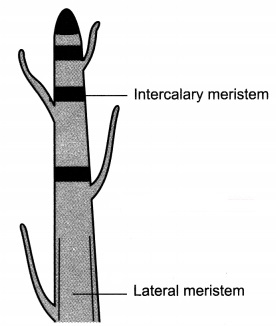
Tissues Class 9 Extra Questions and Answers Science Chapter 6 1

Question 6.
Differentiate between chlorenchyma and aerenchyma.
Or
Write the difference between aerenchyma and chlorenchyma.
Answer:
Chlorenchyma:

  • It is a type of parenchyma which contains chlorophyll.
  • It helps to perform photosynthesis.
  • It is present in green parts of plants like the leaves.

Aerenchyma:

  • This type of parenchyma that has large air cavities in it.
  • It helps to provide buoyancy to the plants.
  • It is present in the aquatic plants, example in their floating leaves.

Question 7.
Write the functions of collenchyma in plants.
Answer:
Collenchyma allows easy bending in various parts of a plant (leaf, stem) without breaking. It also provides mechanical support to plants like in the leaf stalks below the epidermis.

Question 8.
What are the roles of epidermis in plants?
Answer:
The functions of epidermis are:

  • Epidermis is usually made up of a single layer of cells and gives protection.
  • The epidermis may be thicker in some plants living in dry habitats or often secrete a waxy, water- resistant layer on their outer surface called cutin (chemical substance with waterproof quality) to prevent water loss.
  • The epidermis of leaves have small pores called as stomata which help in gaseous exchange and transpiration.
  • The epidermal cells of roots bear root hairs that greatly increase the total absorptive surface area of the roots for absorption of water.

Question 9.
Answer the following:
(i) How is the epidermis of the plants living in very dry habitats adapted?
(ii) Write functions of guard cells of stomata in the leaf.
Answer:
(i) The epidermis of plants living in dry habitats may be thicker or often secrete a waxy, water-resistant layer on their outer surface called cutin (chemical substance with waterproof quality) to prevent water loss.

(ii) The guard cells of stomata in the leaf help in gaseous exchange and transpiration.

Question 10.
What is the function of areolar tissues?
Answer:
The functions of areolar tissues are:

  • It fills the space inside the organs
  • It supports internal organs.
  • It helps in repair of tissues.

Question 11.
Determine the location of the following tissues:

  1. Unstriated muscle fibres
  2. Cuboidal epithelium
  3. Adipose tissue
  4. Striated muscle fibres

Answer:

  1. Unstriated muscle fibres: Present in iris of the eye, ureters, blood vessels, alimentary canal and bronchi of lungs.
  2. Cuboidal epithelium: Present in lining of kidney tubules and ducts of salivary glands.
  3. Adipose tissue: It is found below the skin and between internal orgAnswer:
  4. Striated muscle fibres: It is present in muscles of our limbs

Tissues Class 9 Extra Questions Short Answer Type 2

Question 1.
Explain how the bark of a tree is formed. How does it act as a protective tissue?
Answer:
In the older stem, a strip of secondary meristem replaces the epidermis. The secondary meristem cuts off cells towards outside to form a several-layer thick tissue; This is called the cork or the bark of the tree.

Cells of cork or bark are dead, compactly arranged without intercellular spaces and have a chemical called suberin in their walls that makes them impervious to gases and water. In this way it acts as a protective tissue.

Question 2.
Draw a diagrammatic labelled sketch of stem tip to show location of meristematic tissue. Mention the functions of different types of meristematic tissue.
Answer:
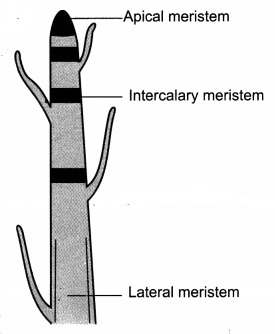
Tissues Class 9 Extra Questions and Answers Science Chapter 6 2
The types of meristematic tissue are:
(i) Apical meristem: It is present at the growing tips of stems and roots and results in increase in the length of the stem and the root.

(ii) Lateral meristem (cambium): It is present on the lateral sides of stems and roots. It helps to increase the girth of the stem or root.

(iii) Intercalary meristem: It is present at the base of the leaves or internodes. It helps in the longitudinal growth of plants.

Question 3.
What are the two main components of blood? Why is blood considered a type of connective tissue?
Answer:
Blood is a special connective tissue consisting of a fluid matrix, plasma, and formed elements. The formed elements are red blood cells (RBCs), white blood cells (WBCs) and blood platelets. Blood is considered as a type of connective tissue as they have the same origin as other types of connective tissue and helps to connect the different parts of the body to facilitate exchange of various components like nutrients and gases.

Question 4.
Give one function of each of the following.
(i) Stomata
(ii) Root nodules
(iii) Cardiac muscle fibres
Answer:
(i) Stomata: Help in exchange of gases in the plants.

(ii) Root nodules: In leguminous plants, the root nodules harbour nitrogen fixing bacteria which convert atmospheric nitrogen into nitrates.

(iii) Cardiac muscle fibres: They help in rhythmic contraction and relaxation of the heart.

Question 5.
Differentiate between bone and cartilage.
Or
Differentiate between bone and cartilage with respect to structure, function and location.
Answer:
Bone:

  • Bones have a hard and non-pliable ground substance.
  • Its matrix is rich in calcium salts and collagen fibres.
  • It is the main tissue that provides structural frame to the body.
  • The bone cells (Osteocytes) are present in the spaces called lacunae.
  • Bones are present in the limbs and form main skeletal framework of the body.

Cartilage:

  • Cartilage is pliable, flexible and resist compression.
  • Its matrix is rich in protein called chondrin and sugars.
  • It is present in bones of the vertebral column, limbs and hands in adults.
  • Cells of this tissue (chondrocytes) are enclosed in small cavities within the matrix secreted by them.
  • Cartilage is present in the tip of nose, outer ear joints, between adjacent bones of the vertebral column.

Question 6.
Explain the basic criteria for classification of permanent tissue in plants.
Answer:
The permanent tissues are classified on the basis of the following criteria:

  1. Simple (made of one type of cell) or complex (made of more than one type of cells)
  2. Cell wall: Thin or thick
  3. Type of cell: living or dead
  4. Type of function the tissue performs: epidermis is protective, parenchyma is packing or supportive tissue and sclerenchyma makes up conducting tissue.

Question 7.
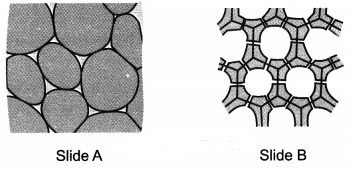
Identify the given two slides A and B as a parenchyma or sclerenchyma. Sclerenchyma can be identified by which characteristic?
Tissues Class 9 Extra Questions and Answers Science Chapter 6 3
Answer:
Slide A is parenchyma and Slide B is sclerenchyma.
Sclerenchyma can be identified by the type of cells which are long and narrow as the walls are thickened due to presence of lignin.

Question 8.
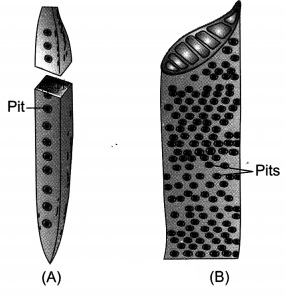
(i) Identify the given figures.
Tissues Class 9 Extra Questions and Answers Science Chapter 6 4
(ii) Give any two major differences between the structures identified.
(iii) Describe the role performed by these two in the plant body.
Answer:
(i) Structure (A) is a tracheid and structure (B) is a vessel.

(ii) Tracheid:

  • Tracheids are elongated or tube-like cells with thick and lignified walls and tapering ends.
  • They are in the form of single cells.

Vessel:

  • Vessel is a long cylindrical tube-like structure made up of many cells called vessel members.
  • They are composed of a number of cells fused together.

(iii) Tracheids and vessels help in vertical transport of water and minerals in the plants. They also help to provide mechanical strength to the plants.

Question 9.
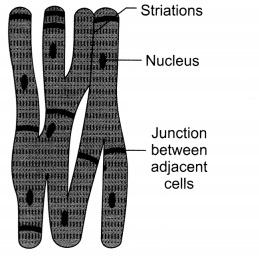
Draw a well labelled diagram of cardiac muscle found in the human body. Write two differences between striated and smooth muscles.
Answer:
Tissues Class 9 Extra Questions and Answers Science Chapter 6 5
Tissues Class 9 Extra Questions and Answers Science Chapter 6 6

Question 10.
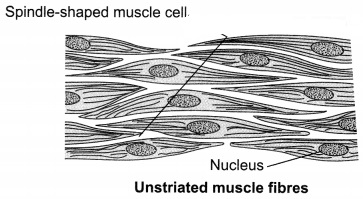
Draw a labelled diagram of unstriated muscle tissue and mention its occurrence, features and functions.
Answer:
Tissues Class 9 Extra Questions and Answers Science Chapter 6 7
(i) The cells are long and spindle-shaped.
(ii) They do not have striations.
(iii) Involuntary in nature as they are not under control of our will.
(iv) The cells of smooth muscles are uninucleate.
(v) Smooth muscle fibres are present in iris of the eye, ureters, blood vessels, alimentary canal and bronchi of lungs.

Question 11.
Name the kinds of muscles found in your limbs and lungs. How do they differ from each other structurally and functionally?
Answer:
Striated muscle fibres are found in limbs whereas smooth muscle fibres are present in lungs. The differences in their structure are:
(i) Striated muscle fibres have alternate light and dark bands which are not present in the smooth muscle fibres.

(ii) Striated muscle fibres are cylindrical and multinucleate whereas the smooth muscle fibres are spindle-shaped and uninucleate.

(iii) Striated muscles are voluntary in nature (under control of our will) whereas the smooth muscle fibres are involuntary in nature (not under control of our will).

Question 12.
What are neurons? Where are they found in the body? What function do they perform in the body of an organism?
Answer:
The cells of nervous tissue are called nerve cells or neurons. Neurons are the structural and functional unit of the nervous system. They are found in the brain, spinal cord and nerves.

Their functions are:

  • They are highly specialised for transmitting the stimulus from one place to another within the body on being stimulated.
  • They help to coordinate the various functions of the body.

Question 13.
Animals of colder regions and fishes of cold water have thicker layer of subcutaneous fat. Describe why?
Answer:
The thick layer of subcutaneous fat acts as insulator and prevents the heat of the body to escape out. The layer of fat acts as a subcutaneous insulation of body for thermoregulation.

Question 14.
Match the column (A) with the column (B).
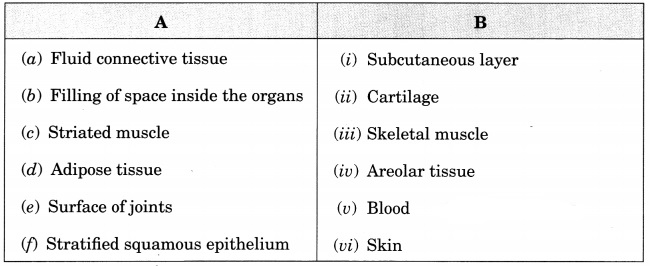
Tissues Class 9 Extra Questions and Answers Science Chapter 6 8
Answer:
(a) (v)
(b) (iv)
(c) (iii)
(d) (i)
(e) (ii)
(f) (vi)

Question 15.
Match the column (A) with the column (B).
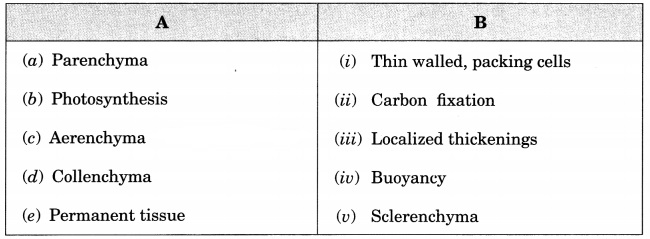
Tissues Class 9 Extra Questions and Answers Science Chapter 6 9
Answer:
(a) (i)
(b) (c)
(d) (iii)
(e) (iv)

Question 16.
If a potted plant is covered with a glass jar, water vapours appear on the wall of glass jar. Explain why.
Answer:
The water is lost by the plant in the form of water vapour due to the process of transpiration. These water vapours appear on the wall of the glass jar.

Question 17.
Name the different components of xylem and draw a living component.
Answer:
Xylem consists of four elements which are:
(a) tracheids
(b) vessels
(c) xylem parenchyma
(d) xylem fibres
The only living component of xylem is xylem parenchyma whose basic structure is shown below:
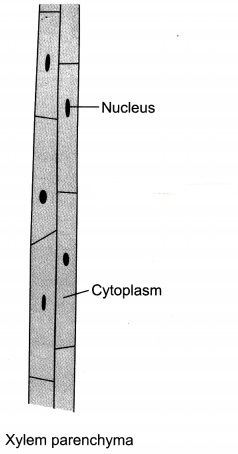
Tissues Class 9 Extra Questions and Answers Science Chapter 6 10

Question 18.
Draw and identify different elements of phloem.
Answer:
Phloem has four elements called sieve tubes, companion cells, phloem fibres and the phloem parenchyma.
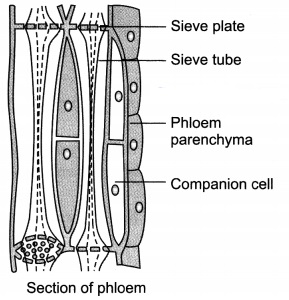
Tissues Class 9 Extra Questions and Answers Science Chapter 6 11

Question 19.
Write true (T) or false (F).
(a) Epithelial tissue is protective tissue in animal body.
(b) The lining of blood vessels, lung alveoli and kidney tubules are all made up of epithelial tissue.
(c) Epithelial cells have a lot of intercellular spaces.
(d) Epithelial layer is permeable layer.
(e) Epithelial layer does not allow regulation of materials between body and external environment.
Answer:
(a) True
(b) True
(c) False
(d) True
(e) False

Question 20.
Differentiate between voluntary and involuntary muscles. Give one example of each type.
Answer:
Voluntary muscles are present in our limbs as skeletal muscles and can be moved by our conscious will whenever we want. Involuntary muscles cannot function on their own. They cannot be controlled by our will or desire. The cardiac muscle and the smooth muscles are involuntary in nature.

Question 21.
Differentiate the following activities on the basis of voluntary (V) or involuntary (IV) muscles.
(a) Jumping of frog
(b) Pumping of the heart
(c) Writing with hand
(d) Movement of chocolate in your intestine
Answer:
(a) (V)
(b) (IV)
(c) (V)
(d) (IV)

Question 22.
Fill in the blanks.
(a) Lining of blood vessels is made up of _______
(b) Lining of small intestine is made up of _______
(c) Lining of kidney tubules is made up of _______
(d) Epithelial cells with cilia are found in _______ of our body.
Answer:
(a) Squamous epithelium
(b) Columnar epithelium
(c) Cuboidal epithelium
(d) Respiratory tract

Question 23.
Water hyacinth floats on water surface. Explain.
Answer:
The parenchyma present in the swollen petiole of water hyacinth is called aerenchyma which has large cavities to provide buoyancy and help them float on the water surface.

Question 24.
Which structure protects the plant body against the invasion of parasites?
Answer:
The epidermis of plants has thick cuticle and waxy substances to prevent the invasion of parasites.

Question 25.
Fill in the blanks.
(а) Cork cells possesses _______on their walls that makes it impervious to gases and water.
(b) _______ have tubular cells with perforated walls and are living in nature.
(c) Bone possesses a hard matrix composed of and _______ and _______
Answer:
(a) suberin
(b) sieve tubes
(c) calcium and phosphorus

Question 26.
Why is epidermis important for the plants?
Answer:
The outermost layer of cells covering an organism is called epidermis. It is usually made up of a single layer of cells and gives protection.

The epidermis may be thicker in some plants living in dry habitats or often secrete a waxy, water- resistant layer on their outer surface called cutin (chemical substance with waterproof quality) to prevent water loss.

The stomata present on the epidermis of leaves helps in gaseous exchange and the loss of water vapour by transpiration.

The epidermal cells of roots bear root hairs that greatly increase the total absorptive surface area of the roots for absorption of water.

Question 27.
Fill in the blanks.
(a) _______ are forms of complex tissue.
(b) _______ have guard cells.
(c) cells of cork contain a chemical called _______
(d) Husk of coconut is made of _______ tissue.
(e) _______ gives flexibility in plants.
(f) _______ and _______ are both conducting tissues.
(g) Xylem transports and _______ and _______ from soil.
(h) Phloem transport from _______ and _______ to other parts of the plant.
Answer:
(a) Xylem and phloem
(b) Stomata
(c) suberin
(d) sclerenchyma
(e) Collenchyma
(g) water; minerals
(h) Food; leaf

Tissues Class 9 Extra Questions Long Answer Type

Question 1.
Differentiate between
(i) Xylem and phloem
(ii) Vessel and sieve tube
(iii) Tracheid and vessel
Answer:
(i) Xylem and phloem –
Xylem:

  • Xylem consists of tracheids, vessels, xylem parenchyma and xylem fibres.
  • All the cells of xylem except the xylem parenchyma are dead.
  • Xylem helps to transport water and minerals.
  • The transport is unidirectional through xylem.

Phloem:

  • Phloem has four elements called sieve tubes, companion cells, phloem fibres and the phloem parenchyma.
  • All cells of phloem are living except the phloem fibres.
  • Phloem transports food from leaves to other parts of the plant.
  • The transport is bidirectional through the phloem.

(ii) Vessel and sieve tube –
Vessel:

  • They are tubular structures having a hollow lumen and composed of dead cells.
  • Vessel helps to conduct water and minerals in plants.
  • The walls of vessels are lignified.
  • They also provide mechanical strength to the plants.
  • Their end walls are completely dissolved.

Sieve Tube:

  • They are tubular structures having vacuolated cytoplasm and composed of living cells.
  • They help to transport food from leaves to other parts of the plant.
  • Their walls are not lignified.
  • They do not provide mechanical strength to the plants.
  • Their end walls have perforations in form of sieve plate.

(iii) Tracheid and vessel _
Tracheid:

  • Tracheids are elongated or tube-like cells with thick and lignified walls and tapering ends.
  • They are in the form of single cells.
  • The inner layers of the cell walls are more thickened.
  • They have narrow lumen.
  • They have pointed ends.

Vessel:

  • Vessel is a long cylindrical tube-like structure made up of many cells called vessel members.
  • They are composed of a number of cells fused together.
  • Their walls are less thickened.
  • They have wide lumen.
  • They have blunt ends.

Question 2.
Differentiate between striated, unstriated and cardiac muscle fibres.
Answer:
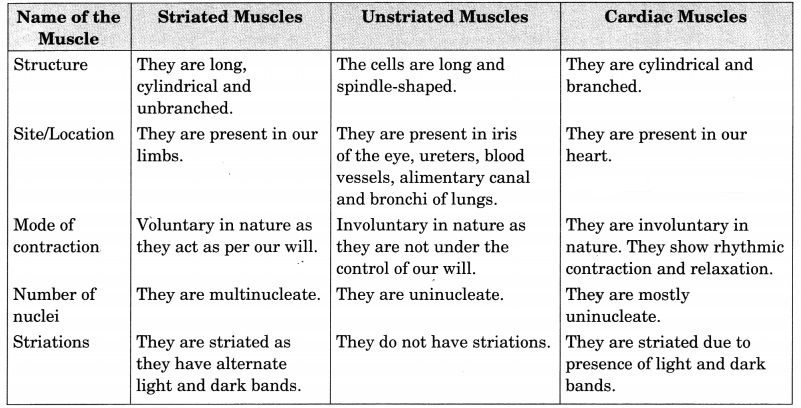
Tissues Class 9 Extra Questions and Answers Science Chapter 6 12

Question 3.
(i) What is nervous tissue?
(ii) Draw a well labelled diagram of neuron. (Label any 4 parts)
Answer:
Nervous tissue is a tissue made of neurons. It is divided into two parts: the central nervous system (CNS) consisting of the brain and spinal cord; and the peripheral nervous system (PNS) which regulates and controls the various functions and activities of the body.
Tissues Class 9 Extra Questions and Answers Science Chapter 6 13

Question 4.
Write the differences between animal tissue and plant tissue.
Answer:
Plant Tissue:

  • The tissue is well differentiated into meristematic tissue and permanent tissue.
  • The tissue can grow throughout life due to activity of meristematic tissue.
  • They are autotrophic in nature.
  • The tissue has more amount of dead tissue which provides mechanical strength to the plants.
  • The tissue organisation is comparatively simple.

Animal Tissue:

  • The tissue is not much differentiated like the plant tissue.
  • The tissue does not show growth throughout life.
  • They are heterotrophic in nature.
  • The tissue has more amount of living tissue than dead tissue.
  • The tissue is complex as it is organised into organs and organ systems.

Question 5.
Write a note on the protective tissue in plants. (Give appropriate diagram also)
Answer:
The protective tissues in plants are epidermis and the cork.
(i) Epidermis: The outermost layer of cells covering an organism is called epidermis. It is usually made up of a single layer of cells and gives protection.

The epidermis may be thicker in some plants living in dry habitats or often secrete a waxy, water- resistant layer on their outer surface called cutin to prevent water loss.

The epidermis of leaves have small pores called stomata which are enclosed by two kidney-shaped cells called guard cells. Stomata help in gaseous exchange and transpiration.

The epidermal cells of roots bear root hairs that greatly increase the total absorptive surface area of the roots for absorption of water.
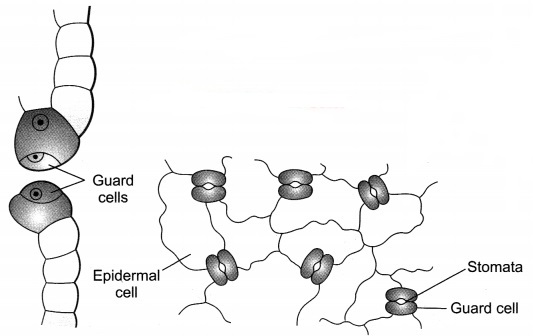
Tissues Class 9 Extra Questions and Answers Science Chapter 6 14

(ii) Cork: A strip of secondary meristem replaces the epidermis of the older stem and cuts off cells towards compactly arranged without intercellular spaces and have a chemical called suberin in their walls that makes them impervious to gases and water.
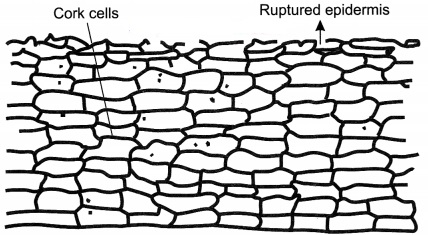
Tissues Class 9 Extra Questions and Answers Science Chapter 6 15

Question 6.
Explain the significance of the following:
(i) Hair-like structures on epidermal cells.
(ii) Epidermis has thick waxy coating of cutin in desert plants.
(iii) Small pores in epidermis of leaf.
(iv) Numerous layers of epidermis in cactus.
(v) Presence of a chemical suberin in cork cells.
Answer:
(i) To increase the total absorptive surface area for absorption of water.
(ii) To prevent water loss by transpiration and protection from pathogens.
(iii) To help in gaseous exchange and transpiration.
(iv) To prevent water loss by transpiration.
(v) To make tissue impervious to gases and water.

Question 7.
Differentiate between sclerenchyma and parenchyma tissues. Draw well labelled diagram.
Answer:
Parenchyma:

  • Cells are thin walled and thickened with cellulose.
  • It is made up of living cells.
  • Cells are usually loosely pac ked with large intercellular spaces.
  • Helps to store nutrients and water in stem and roots.
  • It is called chlorenchyma if it contains chlorophyll and performs photos ynthesis. The parenchyma of
  • aquatic plants have large cavities to provide buoyancy to the plants to help them float, it is then called aerenchyma.

Sclerenchyma:

  • Cells are thick and thickened with lignin.
  • This tissue is made up of dead cells.
  • There are no intercellular spaces between the cells.
  • Provides strength to the various parts of the plant.
  • The cells are long and narrow, make the plant hard and stiff. This tissue provides strength to the plants and is present in stems, around vascular bundles, in the veins of leaves and in the hard covering of seeds and nuts.

Tissues Class 9 Extra Questions and Answers Science Chapter 6 16

Question 8.
Describe the structure and function of different types of epithelial tissues. Draw diagram of each type of epithelial tissue.
Answer:
Epithelial tissues are the covering or protective tissues and cover most organs and cavities in the animal body. These cells are tightly packed, form a continuous sheet and are almost without any intercellular spaces between them. E.g., skin, the lining of the mouth, the lining of blood vessels, lung alveoli and kidney tubules are all made of epithelial tissue.

All epithelium is usually separated from the underlying tissue by an extracellular fibrous basement membrane. The types of epithelium on the basis of their structure and functions are:

(a) Squamous epithelium: Consists of flattened cells. Present in oesophagus and lining of the mouth. Skin epithelial cells are arranged in many layers to prevent wear and tear and are called stratified squamous epithelium.

(b) Columnar epithelium: Has tall or ‘pillar-like’ cells. It forms the inner lining of the intestine.

(c) Cuboidal epithelium: Has cube-shaped cells. It forms the lining of kidney tubules and ducts of salivary glands, where it provides mechanical support.

(d) Ciliated epithelium: Have cilia on the outer surfaces of epithelial cells. The cilia can move and their movement pushes the mucus in the respiratory tract forward to clear it.

(e) Glandular epithelium: Has gland cells which secrete substances at the epithelial surface.
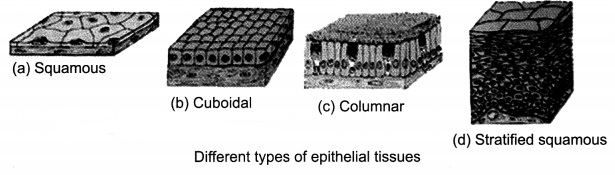
Tissues Class 9 Extra Questions and Answers Science Chapter 6 17

Question 9.
Give reasons for
(a) Meristematic cells have a prominent nucleus and dense cytoplasm but they lack vacuole.
(b) Intercellular spaces are absent in sclerenchymatous tissues.
(c) We get a crunchy and granular feeling, when we chew pear fruit.
(d) Branches of a tree move and bend freely in high wind velocity.
(e) It is difficult to pull out the husk of a coconut tree.
Answer:
(a) Because the meristematic cells are actively dividing cells and there is no need of storage.
(b) Because they have a thick deposition of lignin in them.
(c) Due to the presence of stone cells (sclerenchyma) in the pear fruit.
(d) Due to the presence of collenchyma which provides flexibility to the various parts of the plant.
(e) Due to the sclerenchyma present in the husk of the coconut.

Question 10.
List the characteristics of cork. How are they formed? Mention their role.
Answer:
The characteristics of cork are:

  • Cells of cork are dead at maturity.
  • These cells are compactly arranged.
  • Cells do not possess intercellular spaces.
  • Cells possess a chemical substance suberin in their walls.
  • They are several layers thick.

A strip of secondary meristem replaces the epidermis of the older stem and cuts off the outside cells to form a several-layer thick cork or the bark of the tree. Cells of cork are dead, compactly arranged without intercellular spaces and have a chemical called suberin in their walls that makes them protective in function and impervious to gases and water.

Question 11.
(a) Differentiate between meristematic and permanent tissues in plants.
(b) Define the process of differentiation.
(c) Name any two simple and two complex permanent tissues in plants.
Answer:
(a) Meristematic tissue:

  • This tissue consists of cells which continuously divide to produce new cells.
  • They are located at specific regions of the plant, i.e., apical, lateral and intercalary.
  • The cells of this tissue are very active, lack vacuoles, have dense cytoplasm, thin cell walls and prominent nuclei.

Permanent tissue:

  • Consists of cells which have taken up a specific role and lost the ability to divide.
  • They are distributed throughout the plant body.
  • They are vacuolated, vary in shape and size. Their cell wall may be thick.

(b) The process of taking up a permanent shape, size, and a function by the cells is called differentiation.

(c) Simple: Parenchyma/collenchyma/sclerenchyma Complex: Phloem/xylem

Tissues Class 9 Extra Questions HOTS

Question 1.
The walls of the sclerenchymatous cells are thickened and have narrow lumen. Which substance thickens it and what is its role?
Answer:
The walls of the sclerenchymatous cells are thickened due to presence of lignin. It helps in providing mechanical strength to the various parts of the plant.

Question 2.
Which type of muscle fibres will contract to remove your hands instantly when you touch a hot object?
Answer:
Striated muscle fibres will contract to remove our hands instantly when we touch a hot object.

Question 3.
Which tissue helps the leaves of lotus plant to float on water? Why?
Answer:
Aerenchyma helps the leaves of lotus plant to float on water. Aerenchyma has large cavities to provide buoyancy to the parts of aquatic plants.

Question 4.
A tissue present in plants helps in storing food and sideways conduction of water. Identify the type of tissue.
Answer:
The tissue is xylem parenchyma.

Question 5.
Which tissue enables the heart to pump blood to various parts of the body? Why?
Answer:
The cardiac muscles help the heart to pump blood to various parts of the body as they show rhythmic contraction and relaxation throughout their life.

Question 6.
What will be the consequence of
(i) removal of blood platelets from blood?
(ii) removal of cutin from the layer of epidermis?
Answer:
(i) Removal of blood platelets from blood will inhibit clotting of blood if an injury occurs and the person may bleed to death.

(ii) Removal of cutin would increase the amount of water loss from the leaves of the plants.

Question 7.
Some actions of our body are under our control but many of them are not under our control. Why is it so?
Answer:
The actions of our body are controlled by our muscles. The voluntary actions are under the control of our will and are caused by the activity of striated muscles, eg., movement of our limbs. The involuntary . actions are not under the control of our will and are performed by the smooth muscles, e.g., the activity of bronchi of lungs. Even the activity of cardiac muscles which helps in the rhythmic contraction and relaxation of heart are involuntary in nature.

Question 8.
Which kind of meristem can help grasses to regenerate parts removed by the grazing herbivores?
Answer:
Intercalary meristem can help grasses to regenerate parts removed by the grazing herbivores.

Question 9.
Name the tissue which replaces the epidermal tissue in older stem and is rich in suberin. What is the function of suberin?
Answer:
Cork is the tissue which replaces the epidermal tissue in older stem and is rich in suberin. Suberin present in the walls of cork cells makes them impervious to gases and water.

Question 10.
The process of transpiration does not occur properly when the leaves are covered by a layer of oily substance. Why? Which other functions will get affected due to this covering?
Answer:
The layer of oily substance will close the stomata present in leaves and this would decrease the rate of transpiration. The rate of exchange of gases decreases and consequently the rate of photosynthesis would also decrease.

Tissues Class 9 Extra Questions Value Based (VBQs)

Question 1.
Raman got injured while playing football. His injured leg started bleeding and his friends immediately rushed to take him to the doctor to give him first aid. The blood flowing from the wound stopped after some time and the doctor applied antiseptic on the wound.
(i) Why did the blood stop flowing after some time from the wound?
(ii) What kind of tissue is blood? Why?
(iii) What values are shown by Raman’s friends?
Answer:
(i) The blood stopped flowing after some time from the wound as the blood platelets present in blood helped in clotting of blood.

(ii) Blood is a connective tissue. Blood is considered as a type of connective tissue as they have the same origin as other types of
connective tissue and helps to connect the different parts of the body.

(iii) The values shown by Raman’s friends are presence of mind, helpful and a caring nature.

Question 2.
During a sports event, Shivani suffered a sprain due to which she was not able to run. Her teacher gave her support and told her that it was due to a ligament tear. She also called the doctor to give treatment to Shivani.
(i) What is a ligament? What kind of tissue is it?
(ii) Which type of fibrous tissue has great strength, limited flexibility and is similar to ligament?
(iii) What values are shown by Shivani’s teacher?
Answer:
(i) Ligament is the connective tissue which connects two bones. It is a kind of connective tissue.

(ii) Tendon is a fibrous tissue that has great strength, limited flexibility and is similar to ligament.

(iii) The values shown by her teacher are knowledge, scientific approach and a caring nature.

Question 3.
Rishi brought an aquatic plant which was floating on the surface to the science laboratory of water. He cut a section of the leaf of the plant and saw a tissue with lot of air cavities in it. He went to his teacher and discussed about the role of the air cavities in the leaves of the aquatic plant.
(i) Which type of tissue present in plants has air cavities?
(ii) What is the role of large air cavities in the leaves of such plants?
(iii) What values are shown by Rishi?
Answer:
(i) Aerenchyma is the tissue present in the plants and has large air cavities.

(ii) The large air cavities in the leaves of such plants help in providing buoyancy to the leaves to help them float on water.

(iii) Rishi shows a scientific attitude, inquisitive nature and empirical approach.
The Fundamental Unit of Life Class 9 Extra Questions and Answers Science Chapter 5

In this page, we are providing The Fundamental Unit of Life Class 9 Extra Questions and Answers Science Chapter 5 pdf download. NCERT Extra Questions for Class 9 Science Chapter 5 The Fundamental Unit of Life with Answers will help to score more marks in your CBSE Board Exams.

Class 9 Science Chapter 5 Extra Questions and Answers The Fundamental Unit of Life

Extra Questions for Class 9 Science Chapter 5 The Fundamental Unit of Life with Answers Solutions

The Fundamental Unit of Life Class 9 Extra Questions Very Short Answer Type

Question 1.
What process is involved in the movement of O2 in and out of the cell?
Answer:
Diffusion.

Question 2.
Which process is involved in the movement of water from outside into the cell?
Answer:
Osmosis.

Question 3.
Mention the process by which CO2 and water move in and out of the cell.
Answer:
Movement of CO2 occurs by diffusion whereas that of water occurs by osmosis.

Question 4.
Who discovered cells in living organisms? Give an example of a unicellular organism.
Answer:
A.V. Leeuwenhoek observed the.cells in living organisms. Example of a unicellular organism is Amoeba, Paramoecium, etc.

Question 5.
Give two examples of prokaryotic organisms.
Answer:
All the bacteria and cyanobacteria are prokaryotic. Example: Nostoc, Oscillatoria, etc.

Question 6.
Name the plastid which stores starch, oils and protein granules.
Answer:
Leucoplast

Question 7.
List the constituents of plasma membrane.
Answer:
The plasma membrane is composed of lipids and proteins.

Question 8.
Where do lipids and proteins constituting the cell membrane get synthesised?
Answer:
The lipids are synthesised in smooth endoplasmic reticulum (SER) and the proteins are synthesised in the rough endoplasmic reticulum (RER).

Question 9.
Name two unicellular organisms.
Answer:
Amoeba and Paramoecium are unicellular organisms.

Question 10.
Name the process by which unicellular freshwater organisms and most plant cells tend to . gain water.
Answer:
Endosmosis.

The Fundamental Unit of Life Class 9 Extra Questions Short Answer Type 1

Question 1.
Why is plasma membrane called selectively permeable membrane?
Answer:
Plasma membrane is called selectively permeable because it prevents the entry of some substances and allows the entry and exit of only some substances.

Question 2.
Define osmosis.
Answer:
The spontaneous movement of water molecules from a region of its high concentration to the region of its low concentration through a selectively permeable membrane is called osmosis.

Question 3.
What is membrane biogenesis?
Answer:
Some proteins and lipids made by smooth endoplasmic reticulum (SER) help in building the cell membrane of the cell and this process of making of plasma membrane is known as membrane biogenesis.

Question 4.
Why are mitochondria are referred to as strange organelles?
Answer:
Mitochondria are referred to as strange organelles as they have their own DNA and ribosomes so and can make some of their own proteins.

Question 5.
What is the function of Golgi body?
Answer:
The functions of Golgi body are: storage, modification and packaging of products in vesicles and the formation of lysosomes.

Question 6.
(i) In what form do mitochondria release energy? Write its full form.
(ii) The inner membrane of mitochondria is deeply folded. What is the advantage of these folds?
Answer:
(i) The energy is released by mitochondria in form of ATP. Full form of ATP is adenosine triphosphate.

(ii) The folds present on the inner membrane of mitochondria help to provide a large surface area for the ATP generation reactions.

Question 7.
Give three differences between plasma membrane and the cell wall.
Answer:
Plasma Membrane:

  • It is the outermost covering of the cell which separates the contents of the cell from its external environment.
  • It is mainly composed of lipids and proteins.
  • It is living, thin and elastic.

Cell Wall:

  • It is a rigid outer covering which lies outside the plasma membrane.
  • It is made of cellulose which provides structural strength to plants.
  • It is non-living and rigid.

Question 8.
Differentiate between nucleus and nucleoid.
Answer:
Nucleus:

  • It has a well defined nuclear membrane around it.
  • It has chromatin network and contains more than one chromosome.

Nucleoid:

  • It lacks a nuclear membrane.
  • It has a single chromosome only.

Question 9.
Write two statements to show that lysosomes are called as suicidal bags of the cell.
Answer:
Lysosomes are called as the suicidal bags of the cell as:

  1. They contain hydrolytic enzymes which can breakdown the organic material.
  2. If the cell gets damaged during disturbance in cellular metabolism, the lysosomes may burst and its enzymes digest their own cell.

Question 10.
Describe the structure of mitochondria with special reference to its membrane covering.
Answer:
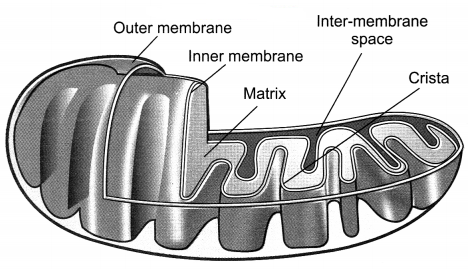
Mitochondrion is a double-membrane structure whose outer membrane is very porous while the inner membrane is deeply folded to form cristae. Cristae are folds which create a large surface area for ATP- generating chemical reactions.
The Fundamental Unit of Life Class 9 Extra Questions and Answers Science Chapter 5 1

The Fundamental Unit of Life Class 9 Extra Questions Short Answer Type 2

Question 1.
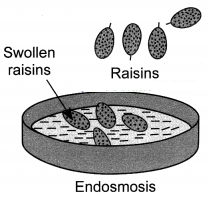
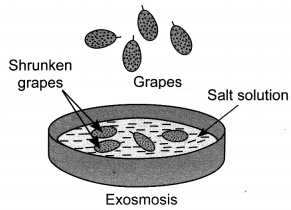
Describe an activity to demonstrate endosmosis and exosmosis. Draw a diagram also.
Answer:
Put dried raisins or apricots in plain water and leave them for some time. Then place them into a concentrated solution of sugar or salt. You will observe the following:

(a) Each of the raisins or apricots gains water and swells when placed in water.
Reason: The raisins or apricots swell up as water moves inside them from outside because the water concentration is less inside the cell as compared to the solution outside. Hence, water moves inside the cell by endosmosis.
The Fundamental Unit of Life Class 9 Extra Questions and Answers Science Chapter 5 2
(b) However, when placed in the concentrated solution they lose water, and consequently shrink.
Reason: The raisins or apricots shrink as water moves outside from them because the water concentration is more inside the cell as compared to the solution outside. Hence, water moves out of the cell by exosmosis.
The Fundamental Unit of Life Class 9 Extra Questions and Answers Science Chapter 5 3

Question 2.
Differentiate between diffusion and osmosis. Write any two examples where a living organism uses osmosis to absorb water.
Answer:
Diffusion – The movement of a substance from a region of its high concentration to the region of its low concentration is called diffusion.

Osmosis – The spontaneous movement of water molecules from a region of its high concentration to the region of its low concentration through a selectively permeable membrane is called osmosis.

Examples where a living organism uses osmosis to absorb water are:

  • Roots of plants absorb water by osmosis.
  • Unicellular organisms like Amoeba absorb water by osmosis.

Question 3.
Differentiate between a prokaryotic and eukaryotic cell.
Answer:
Prokaryotic cell:

  • Organisms whose cells lack a well defined nuclear membrane.
  • They lack membrane bound cell organelles.
  • Size is generally small (1-10 pm).
  • Have a single chromosome.

Eukaryotic cell:

  • Organisms with cells having a well defined nuclear membrane.
  • They have membrane bound cell organelles.
  • Size is generally large (5-100 pm).
  • Have more than one chromosome.

Question 4.
Which organisms are called as the (i) powerhouse of the cell (ii) suicide bags of the cell (iii) kitchen of the cell?
Answer:

  • Mitochondria
  • Lysosomes
  • Chloroplasts

Question 5.
(a) What would happen to the life of the cell if there was no Golgi apparatus?
(b) Which cell organelle detoxifies poisons and drugs in the liver of vertebrates?
Answer:
(a) If there was no golgi apparatus, then the following processes carried out by it would get affected:

  • The storage, modification and packaging of products in vesicles.
  • The packaging and dispatch of the material synthesised near the ER to various targets inside and outside the cell.
  • The formation of lysosomes.
  • The formation of cell plate during cell division.

So, in the absence of the Golgi apparatus, most of the functions of the cell would get disrupted.

(b) Smooth endoplasmic reticulum helps to detoxify poisons and drugs in the liver of vertebrates.

Question 6.
What are the functions of the Golgi apparatus?
Answer:
The Golgi apparatus is an important cell organelle as it performs several functions in the cell.

  1. Its functions include the storage, modification and packaging of products in vesicles.
  2. Golgi apparatus packages and dispatches the material synthesised near the ER to various targets inside and outside the cell.
  3. It is also involved in the formation of lysosomes.

Question 7.
What types of enzymes are present in the lysosomes? What is their function? Which cell organelle manufactures these enzymes?
Answer:
Lysosomes are membrane-bound sacs filled with hydrolytic and digestive enzymes. They help to keep the cell clean by digesting any foreign material as well as worn-out cell organelles. Rough endoplasmic reticulum (RER) manufactures these enzymes.

Question 8.
What are chromoplasts and leucoplasts? Give an example of chromoplast which has green pigment.
Answer:
The coloured plastids which have pigments of different colours are called chromoplasts. The colourless plastids which help to store starch, oils or protein granules are called leucoplasts. The green coloured plastid is called chloroplast and it contains a green coloured pigment called chlorophyll.

Question 9.
Write the functions of:
(i) Inner membrane of mitochondria
(ii) Nucleus of the cell
(iii) Ribosomes present in active cells.
Answer:
The functions are:
(i) Inner membrane of mitochondria are the site for the formation of ATP.

(ii) Nucleus of the cell are the control centre of the cell as it controls all the activities of the cell, plays a central role in cellular reproduction and contains DNA which helps to transfer the genetic information from parents to their offsprings.

(iii) Ribosomes present in active cells are the sites for protein synthesis.

Question 10.
What are the different types of endoplasmic reticulum? Write the functions of each.

Answer:
There are two types of endoplasmic reticulum – Rough endoplasmic reticulum and smooth endoplasmic reticulum. The functions of these are:

Rough endoplasmic reticulum – It looks rough as it has particles called ribosomes attached to its surface. Ribosomes are the site of protein synthesis.

Smooth endoplasmic reticulum:

  • It helps in the manufacture of fat molecules, or lipids, important for cell function.
  • Some proteins and lipids made by SER help in building the cell membrane and this process is known as membrane biogenesis.
  • Helps in detoxifying many poisons and drugs in the liver cells of the group of vertebrates.

Question 11.
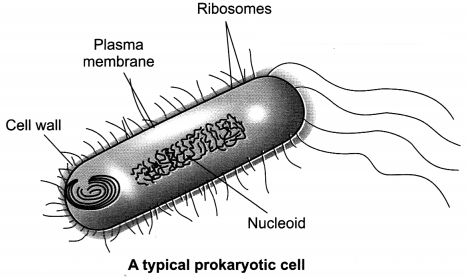
Draw a neat and labelled diagram of a typical prokaryotic cell.
Answer:
The Fundamental Unit of Life Class 9 Extra Questions and Answers Science Chapter 5 4

Question 12.
Why do plant cells possess large sized vacuole?
Answer:
Plant cells possess large sized vacuoles as the vacuoles help to store many important substances. They contain cell sap that gives turgidity and rigidity to the plant cell.

Question 13.
Describe the structural features of cell membrane and cell wall. Why is cell membrane called selectively permeable membrane?
Answer:
Cell wall:

  • It is a rigid outer covering which lies outside the plasma membrane.
  • It is made of cellulose which provides structural strength to plants.
  • The shrinkage or contraction of the contents of the cell away from the cell wall when a living plant cell loses water through osmosis is known as plasmolysis.

Cell membrane:

  • It is the outermost covering of the cell.
  • It separates the contents of the cell from its external environment.
  • It is mainly composed of lipids and proteins.

The cell membrane is called selectively permeable as it permits the entry and exit of only some materials in and out of the cell. It prevents the movement of the contents of the cell out of the cell.

Question 14.
Explain in detail what do you know about the structure of the nucleus.
Answer:
The nucleus was discovered by Robert Brown in 1831. The structure and the features of nucleus are:

  • It is a dark coloured, spherical or oval, dot-like structure near the centre of each cell.
  • It is the control centre of the cell as it controls all the activities of the cell.
  • It has a double layered covering called nuclear membrane.
  • The nuclear membrane has pores which allow the transfer of materials from inside the nucleus to the cytoplasm.
  • The nucleus plays a central role in cellular reproduction (process by which a single cell divides and forms two new cells).
  • Nucleus along with the environment directs the chemical activities of the cell to determine the way the cell will develop and the form it will exhibit at maturity.
  • Nuclear region of the cell may be poorly defined due to the absence of a nuclear membrane in some organisms like bacteria. Such an undefined nuclear region containing only nucleic acids is called a nucleoid.

Question 15.
Differentiate between rough and smooth endoplasmic reticulum. How is endoplasmic reticulum important for membrane biogenesis?
Answer:
The differences between smooth endoplasmic reticulum and the rough endoplasmic reticulum are:

Smooth Endoplasmic Reticulum (SER):

  • SER looks smooth as it does not have ribosomal particles on the surface.
  • SER helps in the manufacture of lipids and fat molecules and also in detoxifying many poisons and drugs in the liver cells of the group of vertebrates.

Rough Endoplasmic Reticulum (RER):

  • RER appears rough as it has particles of ribosomes on the surface.
  • Ribosomes present on RER are the sites of protein synthesis.

Ribosomes are the sites of protein synthesis in all active cells. Endoplasmic reticulum helps in transporting these proteins to various places. Some proteins and lipids made by SER help in building the cell membrane, this process is known as membrane biogenesis.

Question 16.
Describe the phenomenon of membrane biogenesis. Give one function of ER.
Answer:
Some proteins and lipids made by SER help in building the cell membrane and this process is known as membrane biogenesis.

ER serves as channels for the transport of materials (especially proteins) between various regions of the cytoplasm or between the cytoplasm and the nucleus. It also functions as a cytoplasmic framework providing a surface for some of the biochemical activities of the cell.

Question 17.
(i) Why are lysosomes known as ‘scavengers of the cell’?
(ii) Lysosomes are self-destructive. (True/False). Give reason.
Answer:
(i) The lysosomes are waste disposal system of the cell as they remove the debris and help to keep the cell clean by digesting any foreign material as well as worn-out cell organelles. Thus, they are known as the ‘scavengers of the cell’.

(ii) It is true that the lysosomes are self-destructive. They contain digestive enzymes. If the cell gets damaged during disturbance in cellular metabolism, the lysosomes may burst and its enzymes digest their own cell.

Question 18.
Name the organelle of the cell, which has membrane bound sac filled with powerful digestive enzymes. Write any four common functions it performs inside the cell.
Answer:
Lysosome is a membrane bound sac filled with powerful digestive enzymes.

The functions of lysosomes are:

  • They are waste disposal system of the cell as they help to keep the cell clean by digesting any foreign material as well as worn-out cell organelles.
  • They have digestive enzymes which are capable of breaking down all organic materials.
  • If any disturbance occurs in the cellular metabolism or the cell gets damaged, the lysosomes burst open and its digestive enzymes digest all the contents of the cell. So, they are also called as the ‘suicide bags’ of the cell.
  • During starvation they digest the food contents of the cell and provide energy to the cell.

Question 19.
State reasons for the following:
(i) Mitochondria are known as the powerhouse of the cell.
(ii) Plastids are able to make their own protein.
(iii) Plant cell shrinks when kept in hypertonic solution.
Answer:
(i) Mitochondria are known as the powerhouse of the cell as they are the site of storage of ATP which helps to provide energy for all the activities of the cell.

(ii) Plastids are able to make their own protein as they have their own DNA and ribosomes.

(iii) Hypertonic solution has a lower concentration of water than the cell. Due to this, the water moves out of the plant cell by exosmosis and results in shrinkage of the plant cell.

Question 20.
List the specific functions of the following:
(i) Endoplasmic reticulum
(ii) Golgi apparatus
(iii) Lysosomes
(iv) Plastids
(v) Mitochondria
(vi) Vacuoles.
Answer:
The specific functions are:
(i) Endoplasmic reticulum: Site of protein synthesis.

(ii) Golgi apparatus: Storage, modification and packaging of products in vesicles.

(iii) Lysosomes: Waste disposal system of the cell as they help to keep the cell clean by digesting any foreign material as well as worn-out cell organelles.

(iv) Plastids: Green coloured plastids are the site of photosynthesis.

(v) Mitochondria: They are called the powerhouse of the cell as they store energy required for the activities of the cell in the form of ATP.

(vi) Vacuoles: Provide turgidity and rigidity to the cell in plant cells. They also help in digestion of food and expulsion of excess water and waste from the cell in unicellular organisms like Amoeba.

Question 21.
Which types of plastids stores starch, oil and proteins?
Answer:
The leucoplasts help to store starch, oil and proteins in the amyloplasts, elaioplasts and aleuroplasts respectively.

Question 22.
How many membranes are present in mitochondria? Give the characteristic features of these membranes. What is the advantage of such features?
Answer:
Mitochondrion is a double-membrane structure whose outer membrane is very porous while the inner membrane is deeply folded to form cristae. The porous membrane helps in getting oxygen and food. Cristae present on the inner membrane are the folds which create a large surface area for ATP- generating chemical reactions.

Question 23.
Why are lysosomes known as ‘suicide-bags’ of a cell?
Answer:
Lysosomes are also known as the ‘suicide bags’ of a cell because if the cell gets damaged during disturbance in cellular metabolism, the lysosomes may burst and its enzymes digest their own cell.

Question 24.
Do you agree that “A cell is a building unit of an organism”. If yes, explain why?
Answer:
Yes, a cell is the building unit or the fundamental unit of an organism as the cells get organised to form tissues which in turn get organised into organs and further into organ system which organise to form an organism. It can be represented as:
Cell → tissue → organ → organ system organism

Question 25.
Why does the skin of your finger shrink when you wash clothes for a long time?
Answer:
The skin of our finger shrinks when we wash clothes for a long time because soap solution is a hypertonic solution i.e., very concentrated solution, so water moves out of our finger cells by the process of osmosis (called as exosmosis).

Question 26.
Why is endocytosis found in animals only?
Answer:
The plant cells have a rigid structure due to the presence of cell wall around their cell membrane whereas in the animals the cell membrane does not have a cell wall. So, endocytosis can occur only in the animal cells.

Question 27
A person takes concentrated solution of salt, after sometime, he starts vomiting. What is the phenomenon responsible for such situation? Explain.
Answer:
A concentrated solution of salt is hypertonic solution and causes dehydration. Water moves out of the cells and exosmosis in the parts of stomach and intestine make the person feel uncomfortable. Excessive dehydration results in anti-peristalsis due to which person starts vomiting.

Question 28.
Name any cell organelle which is non membranous.
Answer:
Ribosomes are non membranous organelles.

Question 29.
We eat food composed of all the nutrients like carbohydrates, proteins, fats, vitamins, minerals and water. After digestion, these are absorbed in the form of glucose, amino acids, fatty acids, glycerol, etc. What mechanisms are involved in absorption of digested food and water?
Answer:
Absorption of the nutrients takes place by diffusion and that of water occurs by the process of osmosis.

Question 30.
If you are provided with some vegetables to cook. You generally add salt into the vegetables during cooking process. After adding salt, vegetables release water. What mechanism is responsible for this?
Answer:
Adding salt into vegetables creates a hypertonic medium around them which results in exosmosis. Exosmosis causes release of water form vegetables.

Question 31.
If cells of onion peel and RBC are separately kept in hypotonic solution, what among the following will take place? Explain the reason for your answer.
(a) Both the cells will swell.
(b) RBC will burst easily while cells of onion peel will resist the bursting to some extent.
(c) a and b both are correct.
(d) RBC and onion peel cells will behave similarly.
Answer:
(b) RBC will burst easily while cells of onion peel will resist the bursting to some extent. This happens because the cells of onion peel have cell wall which prevents them from bursting. The RBC, being animal cells are devoid of cell wall and burst easily in hypotonic solution.

Question 32.
Bacteria do not have chloroplast but some bacteria are photo-autotrophic in nature and perform photosynthesis. Which part of bacterial cell performs this?
Answer:
The photo-autotrophic bacteria have small vesicles associated with plasma membrane which help in the process of photosynthesis.

Question 33.
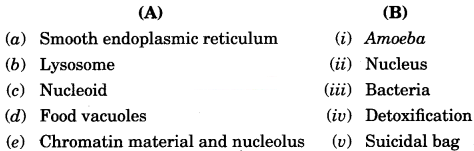
Match the following A and B
The Fundamental Unit of Life Class 9 Extra Questions and Answers Science Chapter 5 5
Answer:
(a) (iv)
(b) (v)
(c) (iii)
(d) (i)
(e) (ii)

Question 34.
Write the name of different plant parts in which chromoplast, chloroplast and leucoplast are present. Chromoplasts are present in the flower and fruit.
Answer:
Chloroplasts are present in the leaves of the plant. Leucoplasts are present in the root of the plant.

Question 35.
Name the organelles which show the analogy written as under
(a) Transporting channels of the cell _______
(b) Powerhouse of the cell _______
(c) Packaging and dispatching unit of the cell _______
(d) Digestive bag of the cell _______
(e) Storage sacs of the cell _______
(f) Kitchen of the cell _______
(g) Control room of the cell _______
Answer:
(a) Transporting channels of the cell _______ Endoplasmic reticulum
(b) Powerhouse of the cell _______ Mitochondria
(c) Packaging and dispatching unit of the cell _______ Golgi body
(d) Digestive bag of the cell _______ Lysosome
(e) Storage sacs of the cell _______ Vacuole
(f) Kitchen of the cell _______ Chloroplast
(g) Control room of the cell _______ Nucleus

Question 36.
How is a bacterial cell different from an onion peel cell?
Answer:
Bacterial cell is a prokaryote so, they are smaller in size, their nucleus does not have a well defined nuclear membrane, possess a single chromosome and the cell is devoid of any cell organelles. Onion peel cell is an eukaryotic cell which is comparatively bigger in size, nucleus has a well defined nuclear membrane, possess more than one chromosome and have well defined cell organelles.

Question 37.
How do substances like carbon dioxide (CO2) and water (H2O) move in and out of the cell?
Answer:
The movement of carbon dioxide occurs by the process of diffusion in and out of the cell whereas the movement of water in and out of the cell occurs by the process of osmosis.

Question 38.
How does Amoeba obtain its food?
Answer:
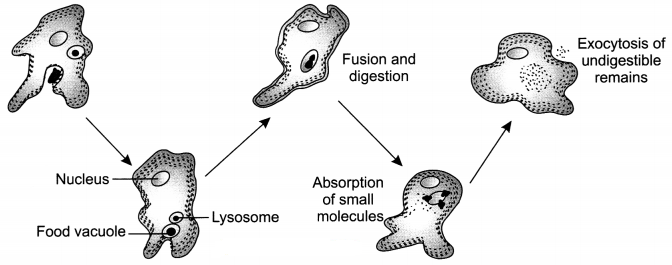
Amoeba takes in food with the help of finger like extensions called pseudopodia by the process called endocytosis. Pseudopodia help to engulf the food which gets enclosed in a food vacuole. The complex particles of the food get broken down into simpler substances inside the food vacuole and diffuse into the cytoplasm of Amoeba. The undigested food particles are removed from the cell by exocytosis.
The Fundamental Unit of Life Class 9 Extra Questions and Answers Science Chapter 5 6

Question 39.
Name the two organelles in a plant cell that contain their own genetic material and ribosomes.
Answer:
Mitochondria and plastids (e.g. chloroplasts) contain their own genetic material and ribosomes.

Question 40.
Why are lysosomes also known as “scavengers of the cells”?
Answer:
The lysosomes are waste disposal system of the cell as they remove the debris and help to keep the cell clean by digesting any foreign material as well as worn-out cell organelles.

Question 41.
Which cell organelle controls most of the activities of the cell?
Answer:
Nucleus is the control centre of the cell and controls most of the activities of the cell.

Question 42.
Which kind of plastid is more common in
(a) roots of the plant
(b) leaves of the plant
(c) flowers and fruits
Answer:
The plastid that is more common in
(a) roots of the plant is leucoplast.
(b) leaves of the plant is chloroplast.
(c) flowers and fruits is chromoplast.

Question 43.
Why do plant cells possess large sized vacuole?
Answer:
The plant cells possess large sized vacuoles as the vacuoles help to store many important substances. They contain cell sap that gives turgidity and rigidity to the plant cell.

Question 44.
How are chromatin, chromatid and chromosomes related to each other?
Answer:
The chromatin material forms chromatids, i.e., chromatids are made up of chromatin. The chromosomes are made up of thread like structures called as chromatids.

Question 45.
What are the consequences of the following conditions?
(a) A cell containing higher water concentration than the surrounding medium
(b) A cell having low water concentration than the surrounding medium.
(c) A cell having equal water concentration to its surrounding medium.
Answer:
The consequences of the following conditions are:
(a) A cell containing higher water concentration than the surrounding medium will undergo exosmosis.

(b) A cell having low water concentration than the surrounding medium will undergo endosmosis.

(c) A cell having equal water concentration to its surrounding medium will not be affected as there won’t be any net movement of water into or outside the cell.

The Fundamental Unit of Life Class 9 Extra Questions Long Answer Type

Question 1.
Distinguish between hypotonic solution, isotonic solution and hypertonic solution.
Answer:
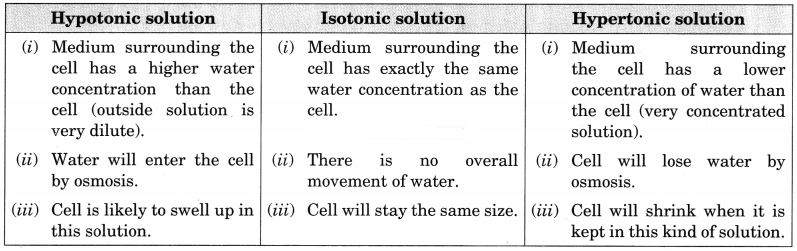
The differences between the three kinds of solutions are:
The Fundamental Unit of Life Class 9 Extra Questions and Answers Science Chapter 5 7

Question 2.
Describe the roles played by lysosomes. Why are they termed as suicidal bags? How do they perform their function?
Answer:
Roles played by lysosomes are:
(i) They are waste disposal system of the cell as they help to keep the cell clean by digesting any foreign material as well as worn-out cell organelles.

(ii) Lysosomes have powerful digestive enzymes capable of breaking down all organic materials. Lysosomes are also known as the ‘suicide bags’ of a cell because if the cell gets damaged during disturbance in cellular metabolism, the lysosomes may burst and its enzymes digest their own cell. They perform this function as they are membrane-bound sacs filled with hydrolytic and digestive enzymes made by rough endoplasmic reticulum (RER).

Question 3.
(a) Name the organelle which provides turgidity and rigidity to the plant cell. Name any two substances which are present in it.
(b) How are they useful in unicellular organisms?
Answer:
(a) The organelle which provides turgidity and rigidity to the plant cell is the large central vacuole which is filled with cell sap. The substances present in it are amino acids, sugars, various organic acids and some proteins.

(b ) They are very useful for the unicellular organisms in the form of food vacuole and contractile vacuole which perform the following functions:

Food vacuole found in Amoeba contains the food items that the Amoeba has consumed.
Contractile vacuole found in some unicellular organisms help in expelling excess water and some wastes from the cell.

Question 4.
What will happen if:
(i) Ribosomes are removed from the cell?
(ii) Golgi apparatus is removed from the cell?
(iii) Plasma membrane ruptures?
Answer:
(i) If ribosomes are removed from the cell, protein synthesis will not take place, enzymes will not be formed and ultimately death of cell will occur.

(ii) If golgi apparatus is removed from the cell, storage, modification and the packaging of substances in vesicles will not occur and lysosomes will not be formed.

(iii) Plasma membrane is a selectively permeable membrane, so in its absence, the entry and exit of the substances will not be regulated, contents of the cell will leak out and the cell will die.

Question 5.
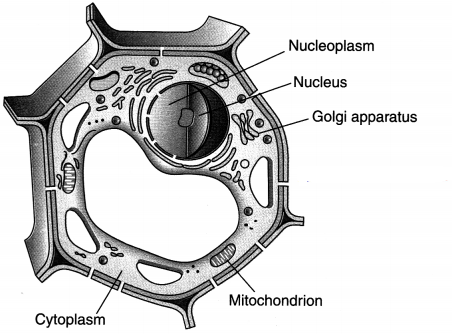
Draw a plant cell and label the parts which
(a) determines the function and development of the cell
(b) package materials coming, from the endoplasmic reticulum
(c) provides resistance to microbes to withstand hypotonic external media without bursting
(d) is site for many biochemical reactions necessary to sustain life
(e) is a fluid contained inside the nucleus
Answer:
(a) Nucleus
(b) Golgi apparatus
(c) Cell wall
(d) Cytoplasm
(e) Nucleoplasm
The Fundamental Unit of Life Class 9 Extra Questions and Answers Science Chapter 5 8

Question 6.
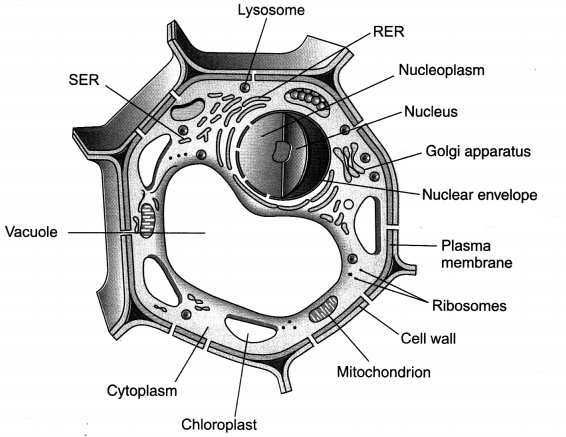
Illustrate only a plant cell as seen under electron microscope. How is it different from an animal cell?
Answer:
The Fundamental Unit of Life Class 9 Extra Questions and Answers Science Chapter 5 9
Plant Cell:

  • Cell wall is present.
  • Plastids are present.
  • A large central vacuole is present.
  • Centrioles are absent.

Animal Cell:

  • Cell wall is absent.
  • Plastids are absent.
  • Vacuoles are either absent or very small.
  • Centrioles are present.

Question 7.
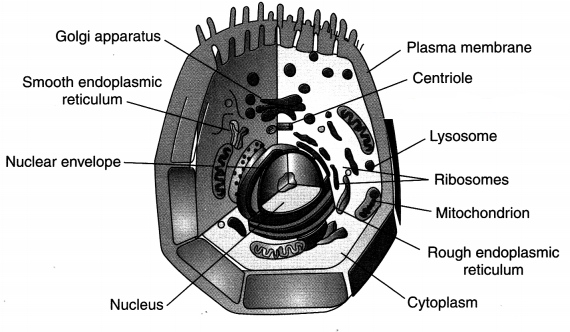
Draw a neat labelled diagram of an animal cell.
Answer:
The Fundamental Unit of Life Class 9 Extra Questions and Answers Science Chapter 5 10

Question 8.
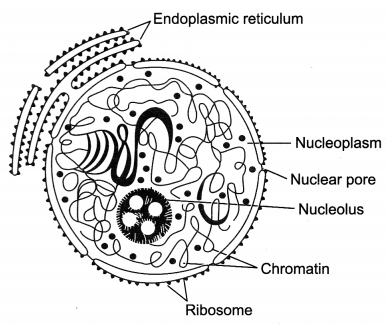
Draw a well labelled diagram of an eukaryotic nucleus. How is it different from a nucleoid?
Answer:
The Fundamental Unit of Life Class 9 Extra Questions and Answers Science Chapter 5 11
It is different from a nucleoid as it is a membrane bound organelle.

Question 9.
Differentiate between rough and smooth endoplasmic reticulum. How is endoplasmic reticulum important for membrane biogenesis?
Answer:
Smooth Endoplasmic Reticulum (SER):

  • SER looks smooth as it does not have ribosomal particles on its surface.
  • SER helps in the manufacture of lipids and fat molecules and also in detoxifying many poisons and drugs in the liver cells of the group of vertebrates.

Rough Endoplasmic Reticulum (RER):

  • RER appears rough as it has particles of ribosome on its surface.
  • Ribosomes present on RER are the sites of protein synthesis.

Ribosomes are the sites of protein synthesis in all active cells. Endoplasmic reticulum helps in transporting these proteins to various places. Some proteins and lipids made by SER help in building the cell membrane, this process is known as membrane biogenesis.

Question 10.
In brief state what happens when
(a) dry apricots are left for sometime in pure water and later transferred to sugar solution?
(b) a red blood cell is kept in concentrated saline solution?
(c) the plasma-membrane of a cell breaks down?
(d) Rhoeo leaves are boiled in water first and then a drop of sugar syrup is put on it?
(e) golgi apparatus is removed from the cell?
Answer:
(a) If dry apricots are left for sometime in pure water they swell up due to endosmosis and later when they are transferred to sugar solution exosmosis occurs and they shrink.

(b) If a red blood cell is kept in concentrated saline solution it will lose water and shrink.

(c) If the plasma-membrane of a cell breaks down, the cell will die.

(d) If Rhoeo leaves are boiled in water first and then a drop of sugar syrup is put on it, no plasmolysis occurs as the cells get killed on boiling.

(e) If the golgi apparatus is removed from the cell, all sorts of vesicle formation in the cell get stopped.

Question 11.
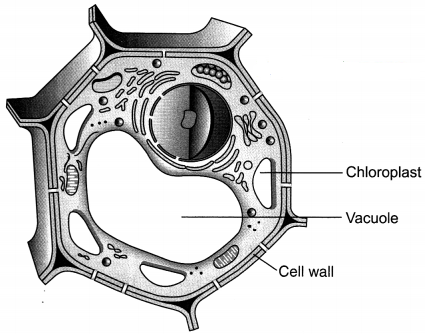
Draw a neat diagram of plant cell and label any three parts which differentiate it from animal cell.
Answer:
The plant cells have chloroplast, large central vacuole and the cell wall which are not present in animal cells.
The Fundamental Unit of Life Class 9 Extra Questions and Answers Science Chapter 5 12

The Fundamental Unit of Life Class 9 Extra Questions HOTS

Question 1.
Unicellular organisms like Amoeba and Paramoecium survive as a single cell. How?
Answer:
In Amoeba and Paramoecium all the activities like digestion, absorption, assimilation, etc., which are necessary for life are carried out by a single cell. This enables them to survive even as a single cell.

Question 2.
Explain how cell walls permit the cells of fungi to withstand very dilute external media without bursting.
Answer:
The fungal cells swell up in very dilute external media as they take in water by the process of endosmosis. The plasma membrane of the cell exerts pressure on the cell wall and the cell wall also exerts an equal pressure on the membrane which helps to prevent the cell from bursting.

Question 3.
Give the roles of the following:
(i) Lipids and proteins of plasma membrane
(ii) Cellulose in the cell wall
(iii) Flexible nature of the cell membrane
(iv) Hydrolytic enzymes of lysosomes
(v) Ribosomes present on the RER
Answer:
The roles are:
(i) Lipids and proteins of plasma membrane: Provide flexibility to cell membrane and make it selectively permeable in nature.

(ii) Cellulose in the cell wall: Provides structural strength to the plants and prevents bursting of the cell when the cell swells in a hypotonic solution.

(iii) Flexible nature of the cell membrane: It helps organisms like Amoeba to engulf food by endocytosis.

(iv) Hydrolytic enzymes of lysosomes: Helps in the process of cell digestion and act as ‘scavengers of cell’.

(v) Ribosomes present on the RER: Are the site of protein synthesis.

Question 4.
Which cell organelle will play a major role when a cell is damaged due to disturbance in cellular metabolism? How?
Answer:
Lysosomes will play a major role when a cell is damaged due to disturbance in cellular metabolism. The lysosomes burst open and its hydrolytic digestive enzymes digest their own cell contents. Thus, lysosomes are also called as the ‘suicidal bags’.

Question 5.
What will be the effect on the cell when:
(a) The cell is placed in a medium having lower water concentration.
(b) The cell is placed in a medium having higher water concentration.
(c) The cell is placed in a medium having water concentration which is equal to that inside the cell.
Answer:
The consequences of the following conditions are:
(a) The cell having low water concentration than the surrounding medium will undergo endosmosis.
(b) The cell containing higher water concentration than the surrounding medium will undergo exosmosis.
(c) The cell having equal water concentration to its surrounding medium will not be affected as there won’t be any net movement of water into or outside the cell.

The Fundamental Unit of Life Class 9 Extra Questions Value Based (VBQs)

Question 1.
Rajni was told by his teacher that cell is the structural and fundamental unit of life. She asked her teacher to give reasons to support her statement. She felt very happy when her teacher showed her the slide of onion peel with the help of a microscope. She was able to identify the various parts of the cells visible in the slide.
(i) Why is the cell called the structural and functional unit of life?
(ii) With the help of a suitable diagram show the cells observed in onion peel and label them.
(iii) What values are shown by Rajni?
Answer:
(i) The body of all living organisms is composed of one or more cells, so cell is called the structural unit of life. Also, the various life processes like digestion, respiration, excretion, etc., are performed by the cells, so the cell is called the functional unit of life.

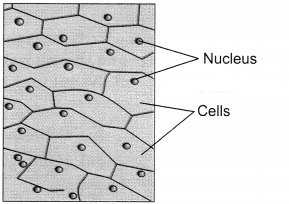
(ii) The cells of onion peel are shown in the diagram below.
The Fundamental Unit of Life Class 9 Extra Questions and Answers Science Chapter 5 13

(iii) Values shown by Rajni are curiosity, scientific temper, knowledge and sincerity towards her work.


Structure of the Atom Class 9 Extra Questions and Answers Science Chapter 4

In this page, we are providing Structure of the Atom Class 9 Extra Questions and Answers Science Chapter 4 pdf download. NCERT Extra Questions for Class 9 Science Chapter 4 Structure of the Atom with Answers will help to score more marks in your CBSE Board Exams.

Class 9 Science Chapter 4 Extra Questions and Answers Structure of the Atom

Extra Questions for Class 9 Science Chapter 4 Structure of the Atom with Answers Solutions

Structure of the Atom Class 9 Extra Questions Very Short Answer Type

Question 1.
Is it possible for the atom of an element to have one electron, one proton and no neutron? If so, name the element. [NCERT Exemplar]
Answer:
Yes, it is true for hydrogen atom which is represented as \(_{ 1 }^{ 1 }{ H }\)

Question 2.
Will 35Cl and 35Cl have different valencies? Justify your answer. [NCERT Exemplar]
Answer:
No, 35Cl and 35Cl are isotopes of an element.

Question 3.
Why did Rutherford select a gold foil in his a-ray scattering experiment? [NCERT Exemplar]
Answer:
Rutherford selected a gold foil in his a-ray scattering experiment because gold has high malleability.

Question 4.
One electron is present in the outermost shell of the atom of an element X. What would be the nature and value of charge on the ion formed if this electron is removed from the outermost shell? [NCERT Exemplar]
Answer:
+ 1.

Question 5.
Write any two observations which support the fact that atoms are divisible. [NCERT Exemplar]
Answer:
Discovery of electrons and protons.

Question 6.
Write down the electron distribution of chlorine atom. How many electrons are there in a L-shell? (Atomic number of chlorine is 17). [NCERT Exemplar]
Answer:
The electron distribution of chlorine atom is 2, 8, 7 and the L-shell has 8 electrons.

Question 7.
In the atom of an element X, 6 electrons are present in the outermost shell. If it acquires noble gas configuration by accepting requisite number of electrons, then what would be the charge on the ion so formed? [NCERT Exemplar]
Answer:
– 2.

Question 8.
Helium atom has 2 electrons in its valence shell but its valency is not 2, Explain.
Answer:
Helium atom has 2 electrons in its outermost shell and its duplet is complete. Hence the valency is zero.

Question 9.
An element X has a mass number 4 and atomic number 2. Write the valency of this element.
Answer:
Valency is zero, as K-shell is completely filled.

Question 10.
Who identified the sub-atomic particle electron?
Answer:
J.J. Thomson.

Question 11.
Name the rays discovered by E. Goldstein.
Answer:
Canal rays.

Question 12.
Give two examples from everyday life where we use cathode ray tubes.
Answer:
Television picture tube and Fluorescent light tubes.

Question 13.
What are the actual values of charge and mass of the electron?
Answer:
Charge = 1.60 x 10⁻¹⁹ C (one unit negative charge)
Mass = 9.11 x 10⁻³¹ kg (1/1840th of the mass of hydrogen atom).

Question 14.
Compare the radius of the nucleus with that of the atom.
Answer:
Radius of the atom is of the order of 10-10 m while that of the nucleus is of the order of 10-15 m. Thus, nucleus is 10-15/10-10 i.e., 1/100,000th of the size of the atom.

Question 15.
Why are Bohr’s orbits called stationary states?
Answer:
According to Bohr, the orbits in which the electrons revolve have fixed energies. Hence, they are called stationary states (stationary means fixed).

Question 16.
Who discovered neutron?
Answer:
Chadwick.

Question 17.
What are nucleons? What is their number called?
Answer:
Protons and neutrons present in the nucleus are collectively called nucleons. Their total number is called ‘mass number’.

Question 18.
What do you mean by ‘Atomic number’?
Answer:
Atomic number of an element is the number of protons present in the nucleus of the atom of that element.

Question 19.
Who discovered the nucleus of the atom?
Answer:
Rutherford.

Question 20.
What is the charge on alpha particle?
Answer:
+ 2.

Question 21.
The mass number of an element is 18. It contains 7 electrons. What is the number of protons and neutrons in it?
Answer:
Number of protons = 7 Number of neutrons = 11 ,

Question 22.
What is the maximum number of electrons that can be present in M-shell?
Answer:
M-shell means 3rd shell for which n = 3. Hence, maximum number of electrons that can be present in M-shell = 2n2 = 2 x 32 = 18.

Question 23.
Identify the isotopes out of A, B, C and D? 33A17, 40B20, 37C17, 38D19.
Answer:
33A14 and 37C17? are isotopes.

Question 24.
Represent the three isotopes of hydrogen and give their names.
Answer:
\(_{ 1 }^{ 1 }{ H }\) (Protium), \(_{ 2 }^{ 1 }{ H }\) (Deuterium), \(_{ 3 }^{ 1 }{ H }\) (Tritium).

Question 25.
How many electrons are present in the species He2+ ion? Suggest another name for it.
Answer:
He2+ ion has no electrons. It is also called alpha (α) particle.

Question 26.
What is the reason for the identical chemical properties of all the isotopes of an element?
Answer:
Isotopes have identical electronic configuration.

Question 27.
Give one similarity and one difference between a pair of isotopes.
Answer:
They have same number of protons but different number of neutrons in their nuclei.

Question 28.
Give the number of protons and neutrons in an atom of uranium (U-235) used in a nuclear reactor.
Answer:
In nuclear reactor U-235 is used. Atomic number of Uranium is 92.
∴ Number of protons = Atomic number = 92
Number of neutrons = Mass number – Atomic number = 235 – 92 = 143.

Question 29.
Out of proton and neutron, which is heavier?
Answer:
Neutron is slightly heavier (1.675 x 10⁻²⁷ kg) than proton (1.67 x 10⁻²⁷ kg).

Question 30.
If K and L shells of an atom are completely filled what will be its name?
Answer:
The atom will belong to the noble gas element neon (Ne).

Question 31.
Do isobars have also identical chemical characteristic like isotopes?
Answer:
No, these are not identical because the isobars have different atomic number as well as different electronic configuration.

Question 32.
What is the number of electrons in the valence shell of chlorine (Z = 17)?
Answer:
The electronic distribution of the element is:
K(2), L(8), M(7). This means that the valence shell of chlorine has 7 electrons.

Question 33.
Which radioisotope is used for the treatment of cancer?
Answer:
Radioisotope Co-60 is used for the treatment of cancer.

Question 34.
Out of C-12 and C-14 isotopes of carbon, which is of radioactive nature?
Answer:
C-14 isotope is of radioactive nature.

Question 35.
The electron configuration of an element is: 2(K), 8(L), 5(M). Predict its valency.
Answer:
The valency of the element is 3. It is calculated as: 8 – 5 = 3.

Question 36.
Will \(_{ 12 }^{ 6 }{ C }\) and \(_{ 14 }^{ 6 }{ C }\) have different valencies?
Answer:
Both the species are the isotopes of the same element i.e., the carbon. Since their atomic numbers Eire same, their electronic configurations as well as valencies will also be the same.

Question 37.
Do the elements \(_{ 3 }^{ 1 }{ X }\) and \(_{ 3 }^{ 2 }{ Y }\) represent pair of isotopes?
Answer:
No, they do not because the two elements differ in their atomic numbers. Isotopes have the same atomic numbers.

Structure of the Atom Class 9 Extra Questions Short Answer Type 1

Question 1.
In response to a question, a student stated that in an atom, the number of protons is greater than the number of neutrons, which in turn is greater than the number of electrons. Do you agree with the statement? Justify your answer. [NCERT Exemplar]
Answer:
No, the statement is incorrect. In an atom the number of protons and electrons is always equal.

Question 2.
Calculate the number of neutrons present in the nucleus of an element X which is represented as \(_{ 31 }^{ 15 }{ X }\). [NCERT Exemplar]
Answer:
Mass number = No. of protons + No. of neutrons = 31
∴ Number of neutrons = 31 – number of protons
= 31 – 15
= 16

Question 3.
The atomic number of calcium and argon are 20 and 18 respectively, but the mass number of both these elements is 40. What is the name given to such a pair of elements? [NCERT Exemplar]
Answer:
∴ They are isobars because isobars have different atomic numbers but same mass number.

Question 4.
Why do Helium, Neon and Argon have a zero valency?
Answer:
Helium has two electrons in its only energy shell, while Argon and Neon have 8 electrons in their valence shells. As these have maximum number of electrons in their valence shells, they do not have any tendency to combine with other elements. Hence, they have a valency equal to zero.

Question 5.
What are isobars? Give one example.
Answer:
Isobars are the atoms of different elements which have different atomic numbers but same mass number.
Example is \(_{ 40 }^{ 18 }{ Ar }\), \(_{ 40 }^{ 20 }{ Ca }\) .

Question 6.
What is the number of valence electron in:
(i) Sodium ion (Na+)
(ii) Oxide ion (O2-)?
Answer:
(i) Sodium ion (Na+)
No. of electrons: (11 – 1); Electronic configuration = 2, 8.
∴ Na+ ion has 8 valence electrons.

(ii) Oxide ion (O2-)
No. of electrons: (8 + 2) = 10; Electronic configuration = 2, 8.
∴ O2- ion has 8 valence electrons.

Question 7.
The number of electrons in the outermost ‘L’ shell of an atom is 5.
(a) Write its electronic configuration.
(b) What is its valency and why?
Answer:
(a) 2, 5
(b) 3, because it needs three more electrons to complete its octet.

Question 8.
Write two difference between isobars and isotopes.
Answer:
Isobars

  • Same mass number but different atomic numbers.
  • Different number of protons.

Isotopes:

  • Same atomic number but different mass numbers.
  • Same number of protons.

Question 9.
Mention the postulates Neils Bohr put forth to overcome the objections raised against Rutherford’s atomic model.
Answer:
Bohr put forward the following postulates in order to overcome the objections raised against Rutherford s atomic method: .

Only certain special orbits known as discrete orbits of electrons are allowed inside the atom.
While revolving in discrete orbits the electrons do not radiate energy. These orbits or shells are called energy levels.

Question 10.
Given that natural sample of iron has isotopes \(_{ 54 }^{ 28 }{ Fe }\), \(_{ 58 }^{ 28 }{ Fe }\) and \(_{ 57 }^{ 28 }{ Fe }\) in the ratio of 5%, 90% and 5% respectively. What will be the average atomic mass of iron (Fe)?
Answer:
Average atomic mass
= \(\frac { 54 × 5 + 56 × 90 + 57 × 5 }{ 100 }\)
= \(\frac { 270+5040+285 }{ 100 }\)
= 55.95 u.

Question 11.
(a) What are canal rays? Who discovered them?
What is the charge and mass of canal ray?
(b) How are the canal rays different from electron in terms of charge and mass?
Answer:
(a) New radiations in a gas discharge tube which are positively charged. E. Goldstein discovered them. Charge on canal rays is positive and mass is one unit.

(b) Electrons are negatively charged and their mass is approximately 1/2000 of that of canal rays.

Question 12.
The average atomic mass of a sample of an element y is 35.5 u. What are the percentages of isotopes \(_{ 37 }^{ 17 }{ y }\) and \(_{ 35 }^{ 17 }{ y }\), in the sample?
Answer:
Let the % composition of \(_{ 37 }^{ 17 }{ y }\) be x.
Then the % composition of \(_{ 37 }^{ 17 }{ y }\) will be 100 – x
Now,
Structure of the Atom Class 9 Extra Questions and Answers Science Chapter 4 img 1

Question 13.
(i) Write the postulates of Bohr model of atom.
(ii) Draw a sketch of Bohr model of an atom with atomic number 15.
Answer:
(i) Only certain special orbits-discrete orbits of electrons are allowed.

(ii) While revolving in discrete orbits, the electrons do not radiate energy.
Structure of the Atom Class 9 Extra Questions and Answers Science Chapter 4 img 2

Question 14.
List the main differences between an atom and an ion.
Answer:
Atom:

  • It is electrically natural.
  • The valence shell of atom may or may not have 8 electrons.
  • The atoms are less stable.
  • It may or may not exist freely in solution.

Ion:

  • It has positive or negative charge.
  • The valence shell of an ion has 8 electrons.
  • The ions are more stable.
  • It can exist freely in solution.

Question 15.
An ion has one neutron more than the number of protons but has one electron less than the number of protons. Which two ions are possible which satisfy this condition? Explain.
Answer:
(i) Na+ ion, because it has atomic number = 11 and mass number = 23. Thus, no. of protons = 11, no. of neutrons = 23 – 11 = 12 and number of electrons = 11 – 1 = 10.

(ii) K+ ion, because it has atomic number = 19 and mass number = 39. Thus, no. of protons = 19, No. of neutrons = 39 – 19 = 20 and no. of electrons = 19 – 1 = 18.

Question 16.
Give the main points of Dalton’s atomic theory.
Answer:

  • All matter is made up of a large number of extremely small indivisible particles called atoms.
  • Atoms of the different elements are different.
  • Atom is the smallest unit of matter which takes part in a chemical reaction.
  • Atoms can neither be created nor be destroyed.

Question 17.
The number of electrons, protons and neutrons in a species are equal to 18, 16 and 16 respectively. Assign proper symbol of the species.
Answer:
Number of electrons present = 18
Number of neutrons present = 16
Atomic number of the element = 16
The element with atomic number 16 is sulphur (S). Since it has 18 electrons and not 16, it is therefore, an anion (S2- ion).

Question 18.
An element with mass number 81 contains 31.7% more neutrons as compared to protons. Assign the atomic symbol. [NCERT Exemplar]
Answer:
We know
Mass number = No. of protons + No. of neutrons = 81
i.e., p + n = 81
Let number of protons = x
Structure of the Atom Class 9 Extra Questions and Answers Science Chapter 4 img 3

Structure of the Atom Class 9 Extra Questions Short Answer Type 2

Question 1.
Show diagrammatically the electron distributions in a sodium atom and a sodium ion and also given their atomic number. [NCERT Exemplar]
Answer:
Structure of the Atom Class 9 Extra Questions and Answers Science Chapter 4 img 4
Since the atomic number of sodium atom is 11, it has 11 electrons. A positively charged sodium ion (Na+) is formed by the removal of one electron from a sodium atom. So, a sodium ion has 11 – 1 = 10 electrons. Thus, electronic distribution of sodium ion will be 2, 8. The atomic number of an element is equal to the number of protons in its atom. Since, sodium atom and sodium ion contain the same number of protons, therefore, the atomic number of both is 11.

Question 2.
The ratio of the radii of hydrogen atom and its nucleus is ~ 105. Assuming the atom and the nucleus to be spherical. [NCERT Exemplar]
(i) What will be the ratio of their sizes?
(ii) If atom is represented by planet Earth ‘Re’ = 6.4 x 10⁵ m, estimate the size of the nucleus.
Answer:
(i) Volume of the sphere = \(\frac { 4 }{ 3 }\) πr3
Let R be the radius of the atom and r be that of the nucleus.
Structure of the Atom Class 9 Extra Questions and Answers Science Chapter 4 img 5

(ii) If the atom is represented by the planet earth (Re = 6.4 x 10⁶ m) then the radius of the nucleus
would be rn = \(\frac{\mathrm{R}_{e}}{10^{5}}\)
rn = \(\frac{6.4 \times 10^{6} \mathrm{m}}{10^{5}}\)
= 6.4 x 10 m = 64 m.

Question 3.
The number of protons, neutrons and electrons in particles from A to E are given below:
Structure of the Atom Class 9 Extra Questions and Answers Science Chapter 4 img 6
(i) Which one is a cation?
(ii) Which one is an anion?
(iii) Which represent pair of isotopes?
Answer:
(i) B is a monovalent cation (B+)
(ii) E is a monovalent anion (E)
(iii) A and D represent pair of isotopes.

Question 4.
Explain Bohr Bury rules for distribution of electrons into different shells. Write the distribution of electrons in sodium atom (Z = 11).
Answer:
Bohr Bury Rules:

  • The maximum no. of electrons present in a shell is given by the formula 2n2 (where n is shell number).
  • The maximum number of electrons that can be accommodated in the outermost orbit is 8.
  • Electrons are not accommodated in a given shell, unless the inner shells are filled.
  • Electronic configuration of Na = 2, 8, 1.

Question 5.
Atom A has a mass number 238 and atomic number 92 and atom B has mass number 235 and atomic number 92.
(i) How many protons, atoms A and B have?
(ii) How many neutrons, atoms A and B have?
(iii) Are atoms A and B isotopes of the same element? How?
Answer:
(i) Protons in atoms A and B = 92
(ii) Neutrons in atoms A and B = 146 and 143
(iii) Yes, atom A and B are isotopes of the element since they have the same atomic number or same electronic configuration.

Question 6.
State three features of the nuclear model of an atom put forward by Rutherford.
Answer:

  1. There is a positively charged centre in an atom called the nucleus. Nearly, all the mass of an atom resides in the nucleus.
  2. The electrons revolve around the nucleus in well-defined orbits.
  3. The size of the nucleus is very small as compared to the size of the atom.

Question 7.
The nucleus of an atom is found to have a total mass of nearly 20.088 x 10⁻²⁷ kg and a total charge of 9.612 x 10⁻¹⁹ coulombs. Calculate the atomic number and mass number of the atom. Name the element.
Answer:
Mass of a nucleon (proton or neutron)
= 1.674 x 10⁻²⁷ kg
Total mass of nucleus = 20.088 x 10⁻²⁷ kg
∴ No. of nucleons (protons + neutrons) present in the nucleus
= \(\frac{20.088 \times 10^{-27}}{1.674 \times 10^{-27}}\) = 12
∴ Mass number = 12u.
Charge on one proton = 1.602 x 10⁻¹⁹ coulombs; Total charge on the nuclear = 9.612 x 10⁻¹⁹
∴ No.of protons in the nucleus
= \(\frac{9.612 \times 10^{-19}}{1.602 \times 10^{-19}}\) = 6
Atomic number = 6. Thus, the element is carbon.

Question 8.
Give reasons why?
(а) Atom is electrically neutral.
(b) Atom as a whole is an empty space.
(c) Rutherford model of atom could not provide stability to the nucleus.
Answer:
(a) An atom is electrically neutral because the number of protons and number of electrons in it are equal.

(b) According to Rutherford’s experiment, the size of the nucleus is very small as compared to the size of an atom, therefore, atom as a whole is an empty space.

(c) According to Rutherford, the protons are present inside the nucleus and electrons revolve around the nucleus. According to the elecromagnetic theory, a charged particle moving in a circular path continuously loses energy in the form of electromagnetic radiations and finally falls into the nucleus.

Question 9.
Write the complete symbol for
(i) the nucleus with atomic number 56 and mass number 138.
(ii) the nucleus with atomic number 26 and mass number 55.
(iii) the nucleus with atomic number 4 and mass number 9.
Answer:
(i) The element with atomic number 56 is Ba. Its symbol is \(_{ 138 }^{ 56 }{ Ba }\)

(ii) The element with atomic number 26 is Fe. Its symbol is \(_{ 56 }^{ 26 }{ Fe }\)

(iii) The element with atomic number 4 is Be. Its symbol for \(_{ 9 }^{ 4 }{ Be }\)

Question 10.
How many protons, electrons and neutrons are there in the following nuclei?
(i) \(_{ 17 }^{ 8 }{ O }\)
(ii) \(_{ 25 }^{ 12 }{ Mg }\)
(iii) \(_{ 80 }^{ 35 }{ Br }\)
Answer:
(i) \(_{ 35 }^{ 79 }{ Br }\)
Atomic number, Z = 8
Mass number, A = 17
No. of protons = No. of electrons = Z = 8
No. of neutrons + No. of protons = A
No. of neutrons + 8 = 17
or No. of neutrons = 17 – 8 = 9

(ii) \(_{ 25 }^{ 12 }{ Mg }\)
Atomic number, Z = 12
Mass number, A = 25
No. of protons = No. of electrons = Z = 12
No. of neutrons = A – No. of protons = 25 – 12 = 13.

(iii) \(_{ 80 }^{ 35 }{ Br }\)
Atomic number, Z = 35
Mass number, A = 80
No. of protons = No. of electrons = Z = 35
No. of neutrons = A – No. of protons = 80 – 35 = 45.

Question 11.
An ion with mass number 56 contains 3 units of positive charge and 30.4% more neutrons than electrons. Assign the symbol for the ion.
Answer:
Since the iron carries 3 units of positive charge, it will have 3 electrons less than the number of protons. Let number of electrons = x
No. of protons = x + 3
No. of neutrons = x + \(\frac { x × 30.4 }{ 100 }\)
= x + 0.304x
= 1.304x
Now, No. of protons + No. of neutrons = 56
x + 3 + 1.304 x = 56
2.304 x = 53
x = \(\frac { 53 }{ 2.304 }\) = 23
No. of electrons = 23
No. of protons = 23 + 3 = 26
Symbol = \(_{ 56 }^{ 26 }{ Fe }\)3+.

Question 12.
The nuclear radius is of the order of 10-13 cm while atomic radius is of the order 10-8 cm. Assuming the nucleus and the atom to be spherical, what fraction of the atomic volume is occupied by the nucleus?
Answer:
The volume of a sphere = 4 πR3/3 where R is the radius of the sphere.
∴ Volume of the nucleus = 4 πr3/3 = 4π (10-13)3/3 cm3
Similarly,
Volume of the atom = 4 πR3/3 = 4π (10-8)3/3 cm3
∴ Fraction of the volume of atom occupied by the nucleus
= \(\frac{4 \pi\left(10^{-13}\right)^{3} / 3 \mathrm{cm}^{3}}{4 \pi\left(10^{-8}\right)^{3} / 3 \mathrm{cm}^{3}}\)
= 10-15.

Question 13.
Calculate the number of electrons, protons and neutrons in the following species:
(i) Phosphorus atom
(ii) Phosphide ion (P3-)
(iii) Magnesium ion (Mg2+)
Mass numbers: P = 31; Mg = 24
Atomic numbers: P = 15, Mg = 12.
Answer:
(i) Phosphorus atom
Number of electrons = Atomic number = 15
Number of protons = Atomic number = 15
Number of neutrons = Mass number – Atomic number
= 31 – 15 = 16.

(ii) Phosphide ion (P3-)
Phosphide ion (P3-)
= Phosphorus atom + 3 electrons
P3- = P + 3e
Thus, phosphide ion has same number of protons and neutrons as phosphorus atom but has three electrons more.
Number of electrons = 15 + 3 = 18
Number of protons = 15
Number of neutrons = 31 – 15 = 16

(iii) Magnesium ion (Mg2+)
Mg2+ ion is formed by loss of two electrons by Mg atom. Therefore, it has two electrons less than number of electrons in Mg atom.
Mg2+ = Mg – 2e
Number of electrons = 12 – 2 = 10
Number of protons = 12
Number of neutrons = (24 – 12) = 12

Structure of the Atom Class 9 Extra Questions Long Answer Type

Question 1.
(a) Enlist the conclusions drawn by Rutherford from his a-ray scattering experiment.
(b) In what way is the Rutherford’s atomic model different from that of Thomson’s atomic model?
Answer:
(a) Rutherford concluded from the a-particle scattering experiment that:

(i) Most of the space inside the atom is empty because the a-particles passed through the gold foil without getting deflected.

(ii) Very few particles were deflected from their path, indicating that the positive charge of the atom occupies very little space.

(iii) A very small fraction of a-particles were deflected by 180°, indicating that all the positive charges and mass of the gold atom were concentrated in a very small volume within the atom.

From the data he also calculated that the radius of the nucleus is about 105 times less than the radius of the atom.

(b) Rutherford proposed a model in which electrons revolve around the nucleus in well-defined orbits. There is a positively charged center in an atom called the nucleus. He also proposed that the size of the nucleus is very small as compared to the size of the atom and nearly all the mass of an atom is centred in the nucleus.

Whereas, Thomson proposed the model of an atom to be similar to a Christmas pudding. The electrons are studded like currants in a positively charged sphere like Christmas pudding and the mass of the atom was supposed to be uniformly distributed.

Question 2.
(a) What were the drawbacks of Rutherford’s model of an atom?
(b) What are the postulates of Bohr’s model of an atom?
Answer:
(a) The orbital revolution of the electron is not excepted to be stable. Any particle in a circular orbit would undergo an acceleration and the charged particles would radiate energy. Thus, the revolving electron would lose energy and finally fall into the nucleus. If this were so, the atom should be highly unstable and hence matter would not exist in the form that we know.

(b) The postulates put forth by Neils Bohr’s about the model of an atom:
(i) Only certain special orbits known as discrete orbits of electrons, are allowed inside the atom.

(ii) While revolving in discrete orbits the electrons do not radiate energy.
These orbits are called energy levels. Energy levels in Em atom are shown by circles.
These orbits are represented by the letters K, L, M, N, …………….. or the numbers, n = 1, 2, 3, 4, ………………

Question 3.
An atom of an element has three electrons in the third shell which is the outermost shell. Write
(a) the electronic configuration
(b) the atomic number
(c) number of protons
(d) valency
(e) the name of the element
(f) its nature whether metal or non-metal.
Answer:
The third shell is M-shell. If the atom of the element has three electrons in the third shell, this means that K and L shells are already filled.
(a) Electronic configuration: 2, 8, 3
(b) Atomic number = No. of electrons = 13
(c) Number of protons = No. of electrons = 13
(d) Valency of the element = 3
(e) The element with Z = 13 is aluminium (Al)
(f) It is a metal.

Question 4.
Answer the following in one line or two:
(a) What is the maximum number of electrons that can be accommodated in the outermost energy shell in an atom?
(b) On the basis of Thomson’s model of an atom, explain how an atom is neutral as a whole.
(c) How many neutrons are present in hydrogen atom?
(d) Do isobars belong to the same element?
(e) An element has five electrons in the M shell which is the outermost shell. Write its electronic configuration.
Answer:
(a) The outermost energy shell in an atom can have a maximum of eight electrons.

(b) According to Thomson’s model of an atom, all the protons in an atom are present in the positively charged sphere while negatively charged electrons are studded in this sphere. Since the electrons and protons are equal in number each carrying one unit charge, the atom as a whole is electrically neutral.

(c) Hydrogen atom has no neutron.

(d) No, isolars belong to different elements since they differ in their atomic numbers.

(e) The electronic configuration of the element is K(2), L(8), M(5).

Question 5.
Explain why did Rutherford select a gold foil in his alpha particle scattering experiments? What observations in a-scattering experiment led Rutherford to make the following observations:
(i) Most of the space in an atom is empty.
(ii) Nucleus is positively charged.
Mention any two drawbacks of Rutherford’s model.
Answer:
Rutherford selected a gold foil because he wanted a very thin layer as possible. This gold foil was about 1000 atoms thick.

(i) As most of the alpha particles passed through the foil undeviated, it means that they did not come across any obstruction in their part. Thus, most of the space in an atom was thought to be empty.

(ii) Very few particles deviated by small angles from their path which suggested that nucleus is positively charged.

The revolution of the electron in any circular orbit is not expected to be stable. Any particle in a circular orbit would undergo acceleration. During acceleration, charged particles would radiate energy. Thus, the revolving electrons would lose energy and finally fall into the nucleus. If this were so, the atom should be highly unstable and matter would not exist in the form that we know. We know that atoms are quite stable.

Question 6.
(a) Why are anode rays called canal rays?
(6) Mention two postulates of J.J. Thomson’s model.
(c) Compare the properties of protons and electrons.
Answer:
(a) The anode rays produced at the anode of the discharge tube are called canal rays because they pass through the holes of the cathode.

(b)

  • Atom consists of positively charged sphere and electrons are embedded in it.
  • The negative and positive charges are equal in magnitude.

(c) Protons:

  • Positively charged.
  • Mass of 1 proton is equal to mass of H atom.

Electrons:

  • Negatively charged.
  • Mass of electron is 1/1840 times that of a proton.

Question 7.
(a) What are isobars?

(b) Atomic number of an element Y is 17.
(i) Write its electronic configuration.
(ii) What is the number of valence electron in Y?
(iii) How many electrons are needed to complete the octet of Y?
(iv) Is it a metal or non-metal?

(c) The valency of Na is 1 and not 7. Give reason.
Answer:
(a) Atoms of different elements with different atomic numbers which have same mass number are called isobars.

(b) (i) 2,8, 7
(ii) 7
(iii) 1
(iv) Non-metal

(c) Electronic configuration of Na is 2, 8,1. It can lose one electron to attain the electronic configuration of neon. Therefore, the valency of Na is 1. The valency of Na may be 7 when it gains 7 electrons in its valence shell, but gain ring 7 electrons is difficult. Therefore, the valency of Na is not 7.

Question 8.
An atom of an element has 2 electrons in the M-shell i.e., third shell. What will be the atomic number of this element? Name this element. Find the valency of this element. Also, find the number of neutrons in the atom of this element.
Answer:
(i) Atomic number is 12
Structure of the Atom Class 9 Extra Questions and Answers Science Chapter 4 img 7
(ii) Element is magnesium.
(iii) Valency is 2 (+2)
(iv) No. of neutrons = Atomic mass – No. of protons = 24 – 12 = 12.

Structure of the Atom Class 9 Extra Questions HOTS

Question 1.
What information do you get from the figure given below about the atomic number, mass number and valency of atoms X, Y and Z? Give your answer in a tabular form. [NCERT Exemplar]
Structure of the Atom Class 9 Extra Questions and Answers Science Chapter 4 img 8
Answer:
Structure of the Atom Class 9 Extra Questions and Answers Science Chapter 4 img 9

Question 2.
In the Gold foil experiment of Geiger and Marsdein, that paved the way for Rutherford’s model of an atom, ~ 1.00% of the a-particles were found to deflect at angles > 50°. If one mole of α – particles were bombarded on the gold foil, compute the number of α – particles that would deflect at angles less than 50°. [NCERT Exemplar]
Answer:
% of α – particles deflected more than 50° = 1% of α – particles
% of α – particles deflected less than 50° = 100 – 1 = 99%
Number of α – particles bombarded = 1 mole = 6.022 x 10²³ particles
Number of particles that deflected at an angle less than 50°
= \(\frac { 99 }{ 100 }\) x 6.022 x 1023
= \(\frac { 596.178 }{ 100 }\) x 1023
= 5.96 x 10²³.

Question 3.
An ion Y3- contains 18 electrons and 16 neutrons. Calculate the atomic number and mass number of the element Y. Name the element Y.
Answer:
Number of electrons in Y3- ion = 18
Since negative charge is formed by gain of electrons by the neutral atom and the number of electrons gained is equal to the number of units of negative charge on the ion.
∴ Number of electrons in the neutral atom = 18-3 =15.
Now, for a neutral atom, Atomic number = Number of protons = Number of electrons.
∴ Atomic number of element Y = 15
Mass number of the element = Number of protons + Number of neutrons = 15 + 16 = 31
The given element Y with atomic number 15 is phosphorus.

Question 4.
The following data represent the distribution of electrons, protons and neutrons in atoms of four elements A, B, C, D.
Structure of the Atom Class 9 Extra Questions and Answers Science Chapter 4 img 10
Answer the following questions:
(a) Give the electronic distribution of element B.
(b) The valency of element A.
(c) The atomic number of element B.
(d) The mass number of element D.
Answer:
(а) Electronic distribution of elements B : 2, 8, 6.
(b) Valency of A is 1(-1).
(c) Atomic number of element B is 16.
(d) Mass number of element D is 39.

Question 5.
Give a reason to explain why:
(a) isotopes of an element show identical chemical properties?
(b) the atomic masses of elements are in fractions?
(c) atoms combine with other atoms?
Answer:
(a) Since all the isotopes of an element have identical electronic configuration containing the same number of valence electrons. Therefore all the isotopes of an element show identical chemical properties.

(b) The fractional atomic masses of elements are due to their isotopes having different masses.

(c) The atoms combine with other atoms to achieve the electronic configuration of the nearest noble gas and thus, become more stable.

Question 6.
(a) Describe the main features of Bohr’s model of an atom. Draw a neat and labelled diagram of energy levels.
(b) Which of the following pairs are isotopes and which are isobars?
(i) \(_{ 58 }^{ 26 }{ A }\), \(_{ 58 }^{ 28 }{ B }\)
(ii) \(_{ 79 }^{ 35 }{ X }\), \(_{ 80 }^{ 35 }{ Y }\)
Give reasons for your choice.
(c) Elements A and B have atomic numbers 18 and 16 respectively. Which of these two would be more reactive and why?
Answer:
(a) Features of Bohr’s Models:
(i) Electrons revolve in certain permitted orbits which are associated with fixed amount of energy. So they are called energy levels (K, L, M, N) or sub-shells.
(ii) As long as electron revolves in the same energy level, they do not lose energy.
(iii) The energy of orbit closest to the nucleus is lowest and farthest away is highest.
(iv) When we supply energy to an electron, it goes to a higher energy level and when it comes back to a lower level it radiates energy.
Structure of the Atom Class 9 Extra Questions and Answers Science Chapter 4 img 11

(b) \(_{ 79 }^{ 35 }{ X }\), \(_{ 80 }^{ 35 }{ Y }\) are isotopes because their atomic no. is same but mass no. is different. \(_{ 58 }^{ 26 }{ A }\), \(_{ 58 }^{ 28 }{ B }\) are iso¬bars, as mass no. is same but atomic no. is different.

(c) B would be more reactive as its electronic configuration is 2, 8, 6 and it requires two more electrons to complete its octet.

Question 7.
Choose the noble gases from the elements shown in the table below:
Structure of the Atom Class 9 Extra Questions and Answers Science Chapter 4 img 12
Answer:
Structure of the Atom Class 9 Extra Questions and Answers Science Chapter 4 img 13
A, B and D have completely filled valence shells, i.e., either 2 or 8 electrons in their valence shells.
∴ A, B and D are noble gases.

Question 8.
The mass number and electronic configuration of five elements A, B, C, D and E are as follows:
Structure of the Atom Class 9 Extra Questions and Answers Science Chapter 4 img 14
(а) Name the elements which has 22 neutrons in nucleus.
(b) What is atomic number of C?
(c) Name the elements which will form most stable ionic bond.
(d) Give the formation of the compound between B and D.
(e) Name the elements which will not take part in chemical combination.
Answer:
(a) E
(b) 11
(c) B and C
(d) DB4
(e) E

Question 9.
Write the electronic configurations of the following elements and write the number of valence electrons present in it.
(a) \(_{ 14 }^{ 7 }{ N }\)
(b) \(_{ 28 }^{ 14 }{ Si }\)
(c) \(_{ 40 }^{ 20 }{ Ca }\)
(d) \(_{ 40 }^{ 18 }{ Ar }\)
(e) \(_{ 9 }^{ 4 }{ Be }\)
Answer:
Structure of the Atom Class 9 Extra Questions and Answers Science Chapter 4 img 15

Question 10.
Complete the following table.
Structure of the Atom Class 9 Extra Questions and Answers Science Chapter 4 img 16
Answer:
For F atom
Atomic no. = 9 (Give)
No. of electrons = 9
No. of protons = 9
No. of neutrons = 10 (Given)
Mass no. = Z + n = 9 + 10 = 19

For Mg2+ ion
No. of protons = 12 (Given)
Atomic no. = 12
No. of electrons = 12 – 2 = 10
Mass no. = 24 (Give)
No. of neutrons = A – Z = 24 – 12 = 12

For S atom
No. of protons = 16 (Given)
Atomic no. = 16
No. of protons = 16
Mass no. = 32 (Given)
No. of neutrons = A – Z = 32 – 16 = 16

For P3- ion
No. of electrons = 18 (Given)
No. of protons = 18 – 3 = 15
Atomic no. = 15
No. of neutrons = 16 (Given)
Mass no. = Z + n = 15 + 16 = 31

The complete table is as follows:
Structure of the Atom Class 9 Extra Questions and Answers Science Chapter 4 img 17

Note: The value of positive charge on cation shows that the number of electrons in it are less than the number of protons by the same value. Similarly, the value of negative charge on anion shows that the number of electrons in it are more than the number of protons by the same value.

Metals and Non-metals Class 10 Extra Questions with Answers Science Chapter 3

In this page, we are providing Metals and Non-metals Class 10 Extra Questions and Answers Science Chapter 3 pdf download. NCERT Extra Questions for Class 10 Science Chapter 3 Metals and Non-metals with Answers will help to score more marks in your CBSE Board Exams.

Class 10 Science Chapter 3 Extra Questions and Answers Metals and Non-metals

Extra Questions for Class 10 Science Chapter 3 Metals and Non-metals with Answers Solutions

Extra Questions for Class 10 Science Chapter 3 Very Short Answer Type

Question 1.
Name the property due to which metals have a shining surface in their pure state.
Answer:
Metallic lustre.

Question 2.
Name two most malleable metals.
Answer:
Gold and silver.

Question 3.
Name the most ductile metal.
Answer:
Gold.

Question 4.
Name a metal which occurs in the free state.
Answer:
Gold.

Question 5.
Give an example of an elementary substance which is a good conductor of electricity but is not a metal.
Answer:
Graphite.

Question 6.
Name two metals which are both malleable and ductile.
Answer:
Silver and gold.

Question 7.
Name the non-metal which is a liquid.
Answer:
Bromine.

Question 8.
Expand PVC.
Answer:
Polyvinyl chloride.

Question 9.
Name a non-metal which is lustrous.
Answer:
Iodine.

Question 10.
Metal A can displace metal B from BO, the oxide of metal B. Metal B can displace C from solution of CSO4, the sulphate of metal C. Arrange metal A, B and C in the order of increasing reactivity.
Answer:
C < B < A.

Question 11.
Name two metals which can be cut with a knife.
Answer:
Lithium, sodium, potassium

Question 12.
An element forms an oxide A2O3 which is acidic in nature. Identify A as a metal or non-metal.  [NCERT Exemplar]
Answer:
Oxides of non-metals are acidic in nature while those of metals are basic in nature. Hence, A must be a non-metal.

Question 13.
Why does calcium float in water?
Answer:
Calcium reacts with water to form calcium hydroxide and hydrogen. Bubbles of hydrogen gas stick to the surface of calcium, hence it floats.

Question 14.
Arrange the following metals in the decreasing order of reactivity Na, K, Cu, Ag.
Answer:
K > Na > Cu > Ag.

Question 15.
Name the two metals which do not react with water at all.
Answer:
Lead, Copper, Silver and Gold

Question 16.
Name the element which shows non-metallic properties, but is also present in the activity series of metal.
Answer:
Hydrogen.

Question 17.
If X, Y, Z, W, A, B and C represents the metals in the decreasing order of their reactivity, which metal is most likely to occur in free state in nature?
Answer:
C is least reactive, hence .it is likely to occur in the free state.

Question 18.
Name any one metal which reacts neither with cold water nor with hot water, but reacts with heated steam to produce hydrogen gas.
Answer:
Iron
3Fe (s) + 4H2O (g) → Fe3O4 (s) + 4H2 (g)

Question 19.
Mention the composition of aqua regia.
Answer:
It is a freshly prepared mixture of concentrated hydrochloric acid and concentrated nitric acid in the ratio of 3:1.

Question 20.
In nature, metal A is found in the free state, while metal B is found in the form of its compounds. Which of these two will be nearer to the top of the activity series of metals?
Answer:
Metal B will be nearer to the top because it is more reactive as it is clear from the fact that it exists in the form of its compounds.

Question 21.
Name any two oxides ores.
Answer:

  1. Haematite
  2. Bauxite.

Question 22.
Which method is used for the concentration of sulphide ores?
Answer:
Froth flotation process.

Question 23.
Complete the chemical equation.
Metals and Non-metals Class 10 Extra Questions with Answers Science Chapter 3, 1
Answer:
Metals and Non-metals Class 10 Extra Questions with Answers Science Chapter 3, 2

Question 24.
What is galvanisation?
Answer:
Galvanisation is a method of protecting steel and iron from rusting by coating them with a thin layer of zinc.

Question 25.
24 Carat gold is not suitable for making jewellery. Why?
Answer:
24 carat gold is very soft, so it is alloyed with either silver or copper to make it hard.

Question 26.
How many carats is pure gold?
Answer:
24 carat.

Question 27.
Name the metal which is used for galvanising iron.
Answer:
Zinc (Zn).

Question 28.
What is meant by 22 carat gold?
Answer:
An alloy consisting of 22 parts by weight of pure gold and 2 parts by weight of copper or silver is called 22 carat gold.

Question 29.
What is an alloy?
Answer:
An alloy is a homogeneous mixture of two or more metals or a metal and a non-metal.

Question 30.
Why do shopkeepers apply oil on tools made of iron while storing them?
Answer:
To protect them from rusting as the oxygen and moisture of the atmosphere will not be able to come in direct contact with the surface of iron.

Question 31.
State two conditions for the rusting of iron.
Answer:

  1. Presence of air (or oxygen).
  2. Presence of water (or moisture).

Question 32.
Name two metals which are highly resistant to corrosion.
Answer:
Gold and platinum.

Question 33.
Name the gas in air which tarnishes silver particles slowly.
Answer:
Hydrogen sulphide (H2S).

Extra Questions for Class 10 Science Chapter 3 Short Answer Type I

Question 1.
What happens when
(a) ZnCO3 is heated in the absence of oxygen?
(b) a mixture of Cu2O and Cu2S is heated? [NCERT Exemplar]
Answer:
(a) A mixture of ZnO(s) and CO2 is formed.
Metals and Non-metals Class 10 Extra Questions with Answers Science Chapter 3, 3

(b) A mixture of copper and SO2 is formed.
Metals and Non-metals Class 10 Extra Questions with Answers Science Chapter 3, 4

Question 2.
Using the electronic configurations, explain how magnesium atom combines with oxygen atom to form magnesium oxide by transfer of electrons.
Answer:
Metals and Non-metals Class 10 Extra Questions with Answers Science Chapter 3, 5

Question 3.
Name two metals which react violently with cold water. Write any three observations you would make when such a metal is dropped into water. How would you identify the gas evolved, if any, during the reaction?   [CBSE 2008]
Answer:
Sodium, Potassium
When these metals are dropped in water, bubbles will be evolved due to evolution of hydrogen gas.
The gas will catch fire and the solution will be alkaline, i.e., it will turn red litmus blue.

Test: When a burning matchstick is brought near the gas, it burns explosively with a ‘pop’ sound and the splinter is extinguished.

Question 4.
State reasons for the following:
(i) Electric wires are covered with rubber-like material.
(ii) From dilute hydrochloric acid, zinc can liberate hydrogen gas but copper cannot.
Answer:
(i) It is because rubber is an insulator and does not allow current to flow through it.
(ii) Zinc is is placed above hydrogen in the reactivity series of metals while copper is placed below it. Metals placed above hydrogen can displace hydrogen from water and acids while those below it cannot. Therefore, zinc can displace hydrogen from dilute HCl whereas copper cannot.

Question 5.
Give the formulae of the stable binary compounds that would be formed by the combination of the following pairs of elements.
(a) Mg and N2
(b) Li and O2
(c) Al and Cl2
(d) K and O2
Answer:
(a) Mg3N2
(b) Li2O
(c) AlCl3
(d) K2O

Question 6.
Compound X and aluminium are used to join railway tracks.
(a) Identify the compound X
(b) Name the reaction
(c) Write down its reaction.  [NCERT Exemplar]
Answer:
(a) Compound X must be iron (III) oxide, Fe2O3.
(b) The reaction is known as ‘thermite reaction’ or ‘aluminothermy’.
(c) The reaction is carried out by igniting the mixture with a Mg-ribbon.
Metals and Non-metals Class 10 Extra Questions with Answers Science Chapter 3, 6

Question 7.
Name two metals which will displace hydrogen from dilute acids, and two metals which will not.
Answer:
Zinc and magnesium can displace hydrogen from dilute acids whereas copper and silver cannot. The metals lying above hydrogen in the reactivity series can displace hydrogen on reaction with dilute acids.

Question 8.
During extraction of metals, electrolytic refining is used to obtain pure metals,
(a) Which material will be used as anode and cathode for refining of silver metal by this process?
(b) Suggest a suitable electrolyte also,
(c) In this electrolytic cell, where do we get pure silver after passing electric current?  [NCERT Exemplar]
Answer:
In the electrolytic refining of impure silver metal:
(a) A rod of impure silver is used as anode while that of pure silver as cathode.
(b) The electrolyte is a water soluble salt of silver, for example silver chloride or silver nitrate.
(c) On passing current, pure silver gets deposited at the cathode. It can be scrapped off later on.

Question 9.
Give reason for the following:
(i) Iron grills are frequently painted.
(ii) Gold ornaments retain their lustre even after several years of use.
Answer:
(i) Iron metal easily gets rusted by air containing moisture and oxygen. Therefore, iron grills are frequently painted with rust proof paints.
(ii) Gold is a noble metal and is not affected by chemicals or by air. Therefore, gold ornaments retain their lustre even after several years.

Question 10.
Name two metals which can be used to reduce metal oxides to metal.
Answer:
(i) Aluminium (Al)
Metals and Non-metals Class 10 Extra Questions with Answers Science Chapter 3, 7

(ii) Magnesium (Mg)
Metals and Non-metals Class 10 Extra Questions with Answers Science Chapter 3, 8

Question 11.
Give the reaction involved during extraction of zinc from its ore by
(a) roasting of zinc ore
(b) calcination of zinc ore   [NCERT Exemplar]
Answer:
(a) Roasting is done for the sulphide ore (zinc blende).
Metals and Non-metals Class 10 Extra Questions with Answers Science Chapter 3, 9

(b) Calcination is done for the carbonate ore (calamine).
Metals and Non-metals Class 10 Extra Questions with Answers Science Chapter 3, 10

Question 12.
The following reaction takes place when aluminium powder is heated with MnO2
3MnO2(s) + 4Al(s) → 3Mn(l) + 2Al2O3(l) + Heat [NCERT Exemplar]
(a) Is aluminium getting reduced?
(b) Is MnO2 getting oxidised?
Answer:
(a) Aluminium is getting oxidised to Al2O3.
(b) Manganese dioxide is getting reduced to Mn.

Question 13.
Differentiate between roasting and calcination process used in metallurgy. Give one example of each.

Answer:
Metals and Non-metals Class 10 Extra Questions with Answers Science Chapter 3, 11

Question 14.
Write chemical equations for the reactions taking place when
(a) Magnesium ribbon is burnt in a jar containing oxygen
(b) Sodium metal falls into a sink containing water
Answer:
(a)
Metals and Non-metals Class 10 Extra Questions with Answers Science Chapter 3, 12
(b) 2Na + 2H2O → 2NaOH + H2

Question 15.
What is an amalgam? Write the constituent metals of brass.
Answer:
An amalgam is an alloy in which one of the metals is mercury.
Brass is an alloy of copper and zinc (Cu and Zn). It contains 80% copper and 20% zinc.

Question 16.
Every ore is a mineral but not every mineral is an ore. Explain.
Answer:
Every mineral is not suitable for the extraction of the metal. The mineral from which the metal is economically and conveniently extracted is called an ore.

Extra Questions for Class 10 Science Chapter Short Answer Type II

Question 1.
What is an alloy? How is it prepared? Name the alloy which is used for welding electrical wires together.
Answer:
Alloy is a mixture of two or more metals or non-metals.
Alloys are made by mixing the metals in their molten state. It is prepared by first melting the primary metal and then dissolving the other metal in definite proportion. It is then cooled to room temperature. Solder is used for welding electrical wires together.

Question 2.
Give reasons for the following observations:
(i) Ionic compounds in general have high melting and boiling points.
(ii) Highly reactive metals cannot be obtained from their oxides by heating them with carbon.
(iii) Copper vessels get a green coat when left exposed to air in the rainy season.
Answer:
(i) Ionic compounds have high melting and boiling points due to strong force of attraction between oppositely charged ions.

(ii) It is because these metals, have great affinity towards oxygen and so cannot be reduced by carbon or carbon monoxide or hydrogen.

(iii) Copper vessels react with CO2, O2 and moisture to form green coloured basic copper carbonate [CuCO3. CU(OH)2] on their surface when exposed to moist air.

Question 3.
E is an element amongst copper, zinc, aluminium and iron. It shows the following properties:
Answer:
(a) One of its ores is rich in E2O3.
(b) E2O3 is not attacked by water.
(c) It forms two chlorides ECl2 and ECl3.
Name the element and justify your answer.
Answer:
The clue for the correct answer is the formation of ECl2 and ECl3. This shows that the element E has variable valencies of 2 and 3 out of the elements listed, only iron exists in divalent and trivalent forms.
(a) The ore rich in Fe2O3 is haematite.
(b) Haematite (Fe2O3) is not attacked by water.
(c) The two chlorides are: Iron (II) chloride or FeCl2 and iron (III) chloride or FeCl3.

Question 4.
When a metal X is treated with cold water, it gives a basic salt Y with molecular formula XOH (Molecular mass = 40) and liberates a gas Z which easily catches fire. Identify X, Y and Z and also write the reaction involved. [NCERT Exemplar]
Answer:
The base with molecular mass 40 is NaOH. Hence, the metal X must be sodium (Na). It reacts with H2O to form the base NaOH and liberates H2 gas which easily catches fire.
Metals and Non-metals Class 10 Extra Questions with Answers Science Chapter 3, 13

Question 5.
You are provided with three metals: Sodium, magnesium and copper. Using only water as the reactant, how will you identify them?
Answer:

  • The metal which reacts violently with cold water and catches fire is sodium.
  • The metal which evolves hydrogen gas upon heating with water is magnesium.
  • The metal which does not react with water even on strong heating is copper.

Question 6.
A non-metal A is an important constituent of our food and forms two oxides B and C. Oxide B is toxic whereas C causes global warming.
(a) Identify A, B and C.
(b) To which Group of Periodic Table does A belong?  [NCERT Exemplar]
Answer:
The non-metal A is carbon. It is an important constituent of our food in different forms. For example, glucose (C6H12O6) contains carbon. In fact, all food materials are organic compounds and these contain carbon as an essential constituent. The two oxides of carbon are, carbon monoxide (B) and carbon dioxide (C). Carbon dioxide causes global warming.

(a) A = Carbon (C); B = Carbon monoxide (CO); C = Carbon dioxide (CO2)
(b) Carbon is the first member of group 14 in the long form of periodic table.

Question 7.
A non-metal X exists in two different forms Y and Z. Y is the hardest natural substance, whereas Z is a good conductor of electricity. Identify X, Y and Z.   [NCERT Exemplar]
Answer:
Non-metal ‘X’ must be carbon. It exist in two forms, diamond and graphite. Diamond is hardest natural substance. Hence, ‘Y’ is diamond. Graphite is a good conductor of electricity. Hence, ‘Z’ is graphite.

Question 8.
A metal E is stored under kerosene. When a small piece of it is left open in air, it catches fire. When the product formed is dissolved in water, it turns red litmus to blue.
(i) Name the metal E.
(ii) Write the chemical equation for the reaction when it is exposed to air and when the product is dissolved in water.
(iii) Explain the process by which the metal E is obtained from its molten chloride.
Answer:
(i) The available information suggests that the metal (E) is sodium (Na).
Metals and Non-metals Class 10 Extra Questions with Answers Science Chapter 3, 14
The solution is basic and it turns red litmus blue.
(iii) The metal is obtained by the process of electrolytic reduction.

Question 9.
Explain how the following metals are obtained from their compounds by reduction process:
(i) Metal X which is low in reactivity series
(ii) Metal Y which is in the middle of the series
(iii) Metal Z which is high up in the reactivity series.
Give one example of each type.
Answer:
(i) Metals which are low in reactivity series can be obtained by heating their compounds. For example, mercury is obtained by heating its ore, cinnabar (HgS), in air.
HgS + O2 → Hg + SO2

(ii) Metals which are in the middle of the series are generally obtained by heating their compounds with some reducing agent such as carbon. For example, iron is obtained from haematite (Fe2O3) by reduction with carbon.
2Fe2O3 + 3C → 4Fe + 3CO2

(iii) Metals which are high up in the series are obtained by electrolytic reduction. For example, sodium is obtained by electrolysis of molten sodium chloride.

Question 10.
How is the method of extraction of metals high up in the reactivity series different from that for metal in the middle? Why the same process cannot be applied for them? Explain giving equations, the extraction of sodium.
Answer:
The metals placed high up in the reactivity series (e.g., Na, K, Ca, Mg, Al) are highly reactive and strong reducing agents and are extracted by carrying out the electro-reduction of their molten salts. On the other hand, metals placed in the middle of the series (e.g., Fe, Zn, Cd, Co, Ni, etc.) are comparatively less reactive and are extracted by roasting or calcination.

Sodium is extracted by electro-reduction process.
NaCl ⇌ Na+ + Cl
Reaction at the cathode: Na+ + e+ → Na+
Reaction at the anode: Cl – e → Cl
Cl + Cl → Cl2

Question 11.
Write balanced chemical equation for the reactions taking place when
(i) zinc carbonate is calcinated.
(ii) zinc sulphide is roasted or heated in air.
(iii) zinc oxide is reduced to zinc.
Answer:
Metals and Non-metals Class 10 Extra Questions with Answers Science Chapter 3, 15

Extra Questions for Class 10 Science Chapter 3 Long Answer Type

Question 1.
Explain the following:
(a) Reactivity of Al decreases if it is dipped in HNO3.
(b) Carbon cannot reduce the oxides of Na or Mg.
(c) NaCl is not a conductor of electricity in solid state whereas it does conduct electricity in aqueous solution as well as in molten state.
(d) Iron articles are galvanised.
(e) Metals like Na, K, Ca and Mg are never found in their free state in nature.   [NCERT Exemplar]
Answer:
(a) On dipping in HNO3, the surface of Al is oxidised to form an oxide layer of Al2O3, which is hard and impervious. It acts as a protective layer for Al underneath. Hence, reactivity of Al decreases.


(b) Na or Mg are highly reactive metals. They have greater affinity for oxygen than for carbon. Hence, their oxides are stable. To reduce them with carbon, very high temperature is required. At this temperature, these metals react with carbon to form corresponding carbides.

(c) The conduction of electricity is due to movement of ions. In the solid state, Na+ and Cl are fixed and not free to move. Hence, it does not conduct electricity. In the aqueous solution or in the molten state, Na+ and Cl ions are free to move about and hence conduct electricity.

(d) Galvanisation means coating of iron articles with a layer of zinc. Zinc is more reactive than iron. Hence, it undergoes oxidation more readily than iron. As a result, iron articles remain protected.

(e) These metals are highly reactive and react with the gases present in the air. Hence, they are found as compounds in the ores and not in the free state in nature.

Question 2.
(i) Given below are the steps for extraction of copper from its ore. Write the reaction involved.
(a) Roasting of copper (I) sulphide.
(b) Reduction of copper (I) oxide with copper (I) sulphide.
(c) Electrolytic refining.
(ii) Draw a neat and well labelled diagram for electrolytic refining of copper.   [NCERT Exemplar]
Answer:
(i)
Metals and Non-metals Class 10 Extra Questions with Answers Science Chapter 3, 16
This reaction in which one of the reactants (Cu2S) carries the reduction of the product (Cu2O) is known as auto-reduction.

(c) Reaction taking place in electrolytic refining are:
At cathode (reduction): Cu2+(aq) + 2e → Cu(s)
At anode (oxidation): Cu(s) → Cu2+ (aq) + 2e

(ii) Metals like copper, aluminium and zinc are refined by this process.
Metals and Non-metals Class 10 Extra Questions with Answers Science Chapter 3, 17

Question 3.
(a) In the formation of compound between two atoms A and B, A loses two electrons and B gains one electron.
(i) What is the nature of the bond between A and B?
(ii) Suggest the formula of the compound formed between A and B.
(b) On similar lines explain the formation of MgCl2 molecule.
(c) Common salt conducts electricity only in the molten state. Why?
(d) Why is melting point of NaCl high?
Answer:
(a) (i) Ionic bond
Metals and Non-metals Class 10 Extra Questions with Answers Science Chapter 3, 18

(b) Mg → Mg2+ + 2e
2Cl + 2e → 2Cl
Metals and Non-metals Class 10 Extra Questions with Answers Science Chapter 3, 19

(c) Na+ and Cl ions are free to move in molten state but not in solid state.

(d) It is due to strong force of attraction between Na+ and Cl.

Question 4.
Two ores A and B were taken. On heating ore A gives CO2 whereas, ore B gives SO2. What steps will you take to convert them into metals?  [NCERT Exemplar]
Answer:
Since ore A gives CO2 and ore B gives SO2. Therefore, ores are MCO3 and MS.
A can be obtained
Metals and Non-metals Class 10 Extra Questions with Answers Science Chapter 3, 20

B can be obtained
Metals and Non-metals Class 10 Extra Questions with Answers Science Chapter 3, 21

Metals and Non-metals HOTS Questions With Answers

Question 1.
An element A burns with a golden yellow flame in air. It reacts with another element B,
atomic number 17 to give a product C. An aqueous solution of product C on electrolysis gives a compound D and liberates hydrogen. Identify A, B, C and D. Also write down the equations for the reactions involved.  [NCERT Exemplar]
Answer:
A = Sodium which burns with golden flame in air. It reacts with chlorine (Z = 17) to form sodium chloride.
2Na (s) + Cl2 (g) → 2NaCl (s)

Hence, B = chlorine and C = sodium chloride
Metals and Non-metals Class 10 Extra Questions with Answers Science Chapter 3, 22
Hence, D = Sodium hydroxide.

Question 2.
What is meant by reactivity series of metals? State which of the following chemical reactions will take place giving suitable reason for each.
I. Zn (s) + CuSO4 (aq) → ZnSO4 (aq) + Cu (s)
II. Fe (s) + ZnSO4 (ag) → FeSO4 (aq) + Zn (s)
III. Zn (s) + FeSO4 (aq) → ZnSO4 (aq) + Fe (s)
Answer:
Reactivity series is a list of metals arranged in the order of their decreasing reactivities (activities).
I. Reaction will take place because Zn is above Cu in the activity series and is more reactive than Cu.
II. Reaction will not take place as Fe is below Zn in the activity series and cannot displace Zn from its solution.
III. Reaction will take place because Zn is more reactive than Fe.

Question 3.
A student has been collecting silver coins and copper coins. One day, she observed a black coating on silver coins and a green coating on copper coins. Which chemical phenomenon is responsible for these coatings? Write the chemical name of black and green coatings.
Answer:
The name of the phenomenon is corrosion. The chemical name of black coating is silver sulphide (Ag2S) formed due to attack of H2S gas present in the atmosphere on silver and that of green coating is basic copper carbonate formed due to attack of moist air (CO2, O2 and H2O vapours) on copper.
Metals and Non-metals Class 10 Extra Questions with Answers Science Chapter 3, 23

Question 4.
Iqbal treated a lustrous, divalent element M with sodium hydroxide. He observed the formation of bubbles in the reaction mixture. He made the same observations when this element was treated with hydrochloric acid. Suggest how can he identify the produced gas. Write chemical equations for both the reactions.    [NCERT Exemplar]
Answer:
The divalent element M is a metal. It reacts with both sodium hydroxide (alkali) and dilute hydrochloric acid to evolve hydrogen gas.
M(s) + 2NaOH (aq) → Na2MO2 (aq) + H2(g)
M(s) + 2HCl (aq) → MCl2 (aq) + H2(g)
The gas burns with a pop sound when a burning matchstick is brought near it.

Question 5.
A non-metal A which is the largest constituent of air, when heated with H2 in 1: 3 ratio in the presence of catalyst (Fe) gives a gas B. On heating with O2 it gives an oxide C. If this oxide is passed into water in the presence of air it gives an acid D which acts as a strong oxidising agent.
(a) Identify A, B, C and D.
(b) To which group of periodic table does this non-metal belong?  [NCERT Exemplar]
Answer:
Non-metal which is the largest constituent of air is nitrogen (N2). Hence, A = N2.
When heated with H2 in presence of Fe as catalyst, it forms ammonia (NH3).
Metals and Non-metals Class 10 Extra Questions with Answers Science Chapter 3, 24
Hence, B = NH3.
When heated with O2, it forms nitric oxide (NO).
Metals and Non-metals Class 10 Extra Questions with Answers Science Chapter 3, 25
NO further gets oxidised to NO2 by O2 of the air.
2NO(g) + O2(g) → 2NO2(g)
Hence, C = NO2.

On passing this oxide into water in presence of air (O2), it gives nitric acid (HNO3) which is a strong oxidising agent.
4NO2(g) + 2H2O(l) + O2(g) → 4HNO3(aq)
Hence, D = HNO3.
Nitrogen belongs to Group 15.

Extra Questions for Class 10 Science Chapter 3 Value Based

Question 1.
Anil and his neighbour Sunil had got their garden fenced with iron rods. Next day Anil saw that Sunil was painting the iron fence. Sunil suggested Anil to do the same to increase the longevity of the iron rods by preventing corrosion. Anil argued that it is a waste of time and his iron rods were strong enough. After reading the above passage, answer the following questions.
(i) Whose opinion was correct? Justify.
(ii) Mention two methods (other than painting) to prevent iron from corrosion.
(iii) What is the chemical formula of rust?
(iv) Mention the values exhibited by Sunil.
Answer:
(i) Sunil’s opinion is correct, it helps to protect iron rods from rusting/corrosion.
(ii) (a) Galvanisation
(b) Cathodic protection
(iii) Fe2O3. xH2O
(iv) Friendship/use of knowledge of Chemistry

Question 2.
Mohan approached a goldsmith and asked him to make some gold ornaments. For this he gave advance money also and demanded that 100% pure gold ornaments be made. The goldsmith suggested Mohan that 22-carat gold ornaments would be more appropriate than 24-carat.
(i) What is the difference between 24-carat gold and 22-carat gold?
(ii) Calculate the % of gold in 22-carat gold.
(iii) Why did the goldsmith suggested for use of 22-carat gold?
(iv) Mention the values exhibited by the goldsmith.
Answer:
(i) 24-carat gold is pure gold (100% pure gold) while 22-carat gold is comparatively less pure.
(ii) % of gold in 22 carat = 100 = 91.7%
(iii) Pure of 24-carat gold is very soft, little malleable and ductile. It is quite difficult to work on it. But 22 carat gold (alloy) is comparatively hard, more malleable and ductile.
(iv) Use of knowledge of chemistry, truth, honesty and professionalism.

Atoms and Molecules Class 9 Extra Questions and Answers Science Chapter 3

In this page, we are providing Atoms and Molecules Class 9 Extra Questions and Answers Science Chapter 3 pdf download. NCERT Extra Questions for Class 9 Science Chapter 3 Atoms and Molecules with Answers will help to score more marks in your CBSE Board Exams.

Class 9 Science Chapter 3 Extra Questions and Answers Atoms and Molecules

Extra Questions for Class 9 Science Chapter 3 Atoms and Molecules with Answers Solutions

Atoms and Molecules Class 9 Extra Questions Very Short Answer Type

Question 1.
Define atomic mass unit.
Answer:
Atomic mass unit of an element is one twelfth (1/12th) of the mass of one atom of carbon-12.

Question 2.
Write the valency of sulphur in H2S, SO2 and SO3.
Answer:
The valency of sulphur in H2S, SO2 and SO3 are 2, 4, and 6 respectively.

Question 3.
What is the difference between 2H and H2?
Answer:
2H means two atoms of hydrogen, H2 means a molecule of hydrogen which contains two atoms.

Question 4.
Where do we use the words mole and mol?
Answer:
We use the word mole to define the number of atoms, molecules, ions or particles having a mass equal to its atomic or molecular mass in grams, while as a unit, we call it mol.

Question 5.
The valency of an element A is 4. Write the formula of its oxide.
Answer:
The formula of its oxide is A2O2 or AO2.

Question 6.
Why are Dalton’s symbols not used in chemistry?
Answer:
Dalton was the first scientist to use the symbol for the name of the elements in a specific sense but it was difficult to memorise and in use, so Dalton’s symbols are not used in chemistry.

Question 7.
Which postulate of Dalton’s Atomic theory is the basis of law of conservation of mass?
Answer:
“Atoms can neither be created nor destroyed a physical or a chemical change”.

Question 8.
Calculate the formula unit mass of CaCl2. [NCERT Exemplar]
Answer:
Atomic mass of Ca + (2 × atomic mass of Cl)
= 40 + 2 × 35.5 = 40 + 71 = 111 u.

Question 9.
What does the symbol ‘u’ represent?
Answer:
The symbol ‘u’ represents unified mass.

Question 10.
Avogadro’s number represents how many particles?
Answer:
Avogadro’s numbers (N0) represents 6.022 × 10²³ particles.

Question 11.
Formula of the carbonate of a metal M is M2CO3. Write the formula of its chloride.
Answer:
The valency of the metal (M) in M2CO3 is (1+) i.e., metal exists as M+ ion. Therefore, the formula of metal chloride is MCl.

Question 12.
Sample A contains one gram molecule of oxygen molecules and Sample B contains one mole of oxygen molecules. What is the ratio of the number of molecules in both the samples?
Answer:
One gram molecules is the same as one gram mole of a substance. Therefore, both the samples A and B contain the same number of molecules (6.022 × 10)23 and the ratio is 1: 1.

Question 13.
Name the compound Al2(SO4)3 and mention the ions present in it.
Answer:
The compound is called aluminium sulphate; cation: Al3+; anion: (SO4)2-

Question 14.
Chemical symbol of sodium is Na. What is its Latin name?
Answer:
Natrium.

Question 15.
Give one example of a polyatomic cation.
Answer:
NH4+ (Ammonium ion).

Question 16.
MNO3 is the formula of nitrate of metal M. Write the formula of its oxide.
Answer:
M2O

Question 17.
A vessel contains W molecules of oxygen at a certain temperature and pressure. How many molecules of sulphur dioxide can the vessel accommodate at the same temperature and pressure?
Answer:
N molecules.

Question 18.
What do you understand by a polyatomic ion? Give two examples.
Answer:
A group of atoms carrying positive or negative charge is called a polyatomic ion, e.g., NO3, SO42-, NH4+

Question 19.
Give two examples each of bivalent cations and bivalent anions.
Answer:
Bivalent cations = Zn2+, Ca2+. Bivalent anions = SO42-, C32-.

Question 20.
What is ‘molar volume’? What is its value?
Answer:
The volume occupied by one mole of a gas under standard conditions of temperature and pressure, i.e., STP conditions (0°C and 1 atmosphere i.e., pressure) is called molar volume of the gas. Its value is 22.4 L at STP.

Question 21.
What is the valency of calcium in CaCO3?
Answer:
The valency of Ca in CaCO3 is 2+ [i.e. Ca2+].

Question 22.
Can we regard sodium as a monoatomic element?
Answer:
No, sodium is a metal and does not exist as a single atom.

Question 23.
What happens to an element ‘A’ if its atom gains two electrons?
Answer:
It changes to a divalent anion [A2-].

Question 24.
Do atoms in some of the elements have actually fractional mass?
Answer:
No, the atoms do not have fractional mass. Only their average comes out to be in fraction in elements which exists as isotopes.

Atoms and Molecules Class 9 Extra Questions Short Answer Type 1

Question 1.
Cinnabar (HgS) is a prominent ore of mercury. How many grams of mercury are present in 225 g of pure HgS? Molar mass of Hg and S are 200.6 g mol-1 and 32 g mol-1 respectively. [NCERT Exemplar]
Answer:
Molar mass of HgS = 200.6 + 32 = 232.6 g mol-1
Mass of Hg in 232.6 g of HgS = 200.6 g
Mass of Hg in 225 g of HgS = \(\frac { 200.6 }{ 232.6 }\) × 225 = 194.05 g.

Question 2.
A gold sample contains 90% of gold and the rest copper. How many atoms of gold are present in one gram of this sample of gold? [NCERT Exemplar]
Answer:
One gram of gold sample will contain = \(\frac { 90 }{ 100 }\) = 0.9 g of gold
Atomic mass of gold = Atoms and Molecules Class 9 Extra Questions and Answers Science Chapter 3 img 1
= \(\frac { 0.9 }{ 197 }\)
One mole of gold contains N0 atoms = 6.022 × 10²³
0.0046 mole of gold will contain = 0.0046 × 6.022 × 1023
= 2.77 × 10²¹

Question 3.
A sample of ethane (C2H6) gas has the same mass as 1.5 × 10²⁰ molecules of methane (CH4). How many C2H6 molecules does the sample of the gas contain? [NCERT Exemplar]
Answer:
Atoms and Molecules Class 9 Extra Questions and Answers Science Chapter 3 img 2

Question 4.
Write the cations and anions present (if any) in the following compounds
(a) CH3COONa
(b) NaCl
(c) H2
(d) NH4NO3
Answer:
Atoms and Molecules Class 9 Extra Questions and Answers Science Chapter 3 img 3

Question 5.
How many molecules of water are present in a drop of water which has a mass of 50 mg?
Answer:
We know that:
1 mole of a compound = 6.023 × 10²³ atoms
= Gram molecular mass
Gram molecular mass of H2O = 18 g
18 g = 6.023 × 10²³ atoms
Atoms and Molecules Class 9 Extra Questions and Answers Science Chapter 3 img 4

Question 6.
Find the number of protons and neutrons in the nucleus of an atom of an element X which is represented as 207 X82.
Answer:
The element is 207 X82.
Now, 82 = Atomic Number
207 = Mass Number.

(a) Atomic number = Number of protons
82 = Number of protons.

(b) Mass number = Number of protons + Number of neutrons
207 = 82 + Number of neutrons
207 – 82 = Number of neutrons
125 = Number of neutrons.

Question 7.
Calculate the molar mass of Na2SO4 and CaCO3.
Answer:
Molar Mass of Na2SO4 =
2 × Mass of sodium + 1 × Mass of sulphur + 4 × Mass of oxygen
= 2 × 23 + 1 × 32 + 4 × 16
= 46 + 32 + 64
= 142 a.m.u.

Molar Mass of CaCO3 =
1 × Mass of calcium + 1 × Mass of carbon + 3 × Mass of oxygen
= 40 + 12 + 3 × 16
= 40 + 12 + 48
= 100 a.m.u.

Question 8.
What is wrong with the statement ‘1 mol of hydrogen’?
Answer:
The statement is not correct. We must always write whether hydrogen is in atomic form or molecular form. The correct statement is 1 mole of hydrogen atoms or one mole of hydrogen molecules.

Question 9.
(a) Calculate the relative molecular mass of water (H2O). [NCERT Exemplar]
(b) Calculate the molecular mass of HNO3.
Answer:
(a) Atomic mass of hydrogen = 1 u,
oxygen = 16 u
So the molecular mass of water, which contains two atoms of hydrogen and one atom of oxygen is
= 2 × 1 + 1 × 16 = 18u

(b) The molecular mass of HNO3 = the atomic mass of H + the atomic mass of N + 3 × the atomic mass of O
= 1 + 14 + 48 = 63 u

Question 10.
Identify the cations and anions in the following compounds:
(a) CH3COONa
(b) NH3
(c) NH4
(d) SrCl2
Answer:
(a) Na+, C3H3COO
(b) It is a molecular compound
(c) NH4+, Cl
(d) Sr2+, 2Cl

Question 11.
Calculate the total number of electrons present in 1.6 g of methane.
Answer:
Molecular mass of CH4 = 12+ 1 × 4 = 16 g
16 g = 1 mole
1.6 g = 0.1 mole
1 mole of CH4 has 6.02 × 10²³ molecules.
0.1 mole has 6.02 × 10²² molecules.
1 molecule of methane contains (6 + 1 × 4) = 10 electrons
∴ 6.02 × 10²² molecule will contain = 10 × 6.02 × 1022 = 6.02 × 10²³ electrons.

Question 12.
A 0.24 g sample of a compound of oxygen and boron was found by analysis to contain 0.096 g of boron and 0.144 g of oxygen. Calculate the percentage composition of the compound by weight.
Answer:
% oi any element in a compound = Atoms and Molecules Class 9 Extra Questions and Answers Science Chapter 3 img 5
% of boron = \(\frac { 0.096 }{ 0.24 }\) × 100 = 40%
% of oxygen = \(\frac { 0.144 }{ 0.24 }\) × 100 = 60%.

Question 13.
The percentage composition of sodium phosphate as determined by analysis is 42.1% sodium, 18.9% phosphorus and 39% oxygen. Find the empirical formula of the compound.(Work upto two decimal places).
(Atomic masses: Na = 23, P = 31, O = 16)
Answer:
Atoms and Molecules Class 9 Extra Questions and Answers Science Chapter 3 img 6
Empirical formula = Na3PO4.

Question 14.
A sample of vitamin C is known to contain 2.58 × 1024 oxygen atoms. How many moles of oxygen atoms are present in the sample?
Answer:
1 mole of oxygen atom = 6.023 × 10²³ atoms
Number of moles of oxygen atoms = \(\frac{2.58 \times 10^{24}}{6.022 \times 10^{23}}\) = 4.28 mol
4.28 moles of oxygen atoms.

Question 15.
The empirical formula of a compound is C2H4O. Its relative molecular mass is 88. Find the molecular formula.
Answer:
Let the molecular formula be (C2H4O)n.
Molecular mass = n × empirical formula mass 88 = n × (2 × 12 + 4 × 1 + 16)
n = \(\frac { 88 }{ 44 }\) = 2
The molecular formula is (C2H4O)2 = C4H8O2.

Question 16.
What is the mass in grams of one molecule of caffeine (C8H10N4O2)?
Answer:
1 mole of caffeine molecules = Gram molecular mass of C8H10N4O2
= 8 × 12 + 10 × 1 + 4 × 14 + 2 × 16g
= 96 + 10 + 56 + 32 g = 194 g
Also, 1 mole of caffeine molecules = 6.022 × 10²³ molecules
Thus, 6.022 × 10²³ molecules of caffeine have mass = 194 g
1 molecule of caffeine will have mass = \(\frac{194}{6.022 \times 10^{23}}\) g = 3.22 × 10⁻²²

Question 17.
What is the difference between cation and anion?
Answer:
Cation:

  • It is positively charged, exam: Na+
  • It is formed from metal atoms.
  • On passing electric current, it moves towards cathode.
  • It is smaller in size than its parent atom.

Anion:

  • It is negatively charged, example : Cl
  • It is formed from non-metal atoms.
  • On passing electric current, it moves towards anode.
  • It is larger in size than its parent atom.

Question 18.
Differentiate between:
(i) Atom and molecule.
(ii) Molecular mass and formula of unit mass.
Answer:
(i) Atoms cannot exist independently but molecules can.

(ii) Molecular mass in the sum of masses of the atoms in the molecule whereas, formula unit mass is sum of atomic masses of the atoms in its empirical formula.

Atoms and Molecules Class 9 Extra Questions Short Answer Type 2

Question 1.
Calcium chloride when dissolved in water dissociates into its ions according to the following equation.
CaCl2(aq) → Ca2+ (aq) + 2Cl(aq)
Calculate the number of ions obtained from CaCl2 when 222 g of it is dissolved in water. [NCERT Exemplar]
Answer:
1 mole of calcium chloride = 111 g
222 g of CaCl2 is equivalent to 2 moles of CaCl2 Since 1 formula unit of CaCl2 gives 3 ions, therefore, 1 mol of CaCl2 will give 3 moles of ions.
2 moles of CaCl2 would give 3 × 2 = 6 moles of ions.
No. of ions = No. of moles of ions × Avogadro number
= 6 × 6.022 × 1023
= 36.132 × 1023
= 3.6 132 × 1024 ions.

Question 2.
Give the formulae of the compounds formed from the following sets of elements. [NCERT Exemplar]
(a) Calcium and fluorine
(b) Hydrogen and sulphur
(c) Nitrogen and hydrogen
(d) Carbon and chlorine
(e) Sodium and oxygen
(f) Carbon and oxygen
Answer:
(a) CaF2
(b) H2S
(c) NH3
(d) CCl4
(e) Na2O
(f) CO, CO2

Question 3.
A compound was found to have the following percentage composition by mass Zn = 22.65%, S = 11.15%, H = 4.88%, O = 61.32%. The relative molecular mass is 287 g/mol. Find the molecular formula of the compound, assuming that all the hydrogen in the compound is present in water of crystallisation.
Answer:
Zn : S : O : H = \(\frac { 22.65 }{ 65 }\) : \(\frac { 11.15 }{ 32 }\) : \(\frac { 61.32 }{ 16 }\) : \(\frac { 4.88 }{ 1 }\)
= 0.3485 : 0.3484 : 3.833 : 4.88
To obtained an integral ratio, we divide by smallest number
= \(\frac { 0.3485 }{ 0.3484 }\) : \(\frac { 0.3484 }{ 0.3484 }\) : \(\frac { 3.833 }{ 0.3484 }\) : \(\frac { 4.88 }{ 0.3484 }\)
= 1 : 1 : 11 : 14
∴ Empirical formula is Zn SO11H14.
Let molecules formula be (ZnSO11H14)n.
RMM for the molecules = n [65 + 32 + (11 × 16) + 14]
Formula = 287
287 n = 287
n = 1
∴ Molecular formula is ZnSO11H14.

Question 4.
What are the failures of Dalton Atomic theory?
Answer:
Failures of Dalton Atomic Theory are:

  1. Atom is not the smallest particle as it is made up of protons, neutrons and electrons.
  2. Atom’s mass can be transformed to energy (E = mc2) and hence can be created and destroyed.
  3. Atoms of one element have been changed into atoms of another element through artificial transmutation of elements.
  4. Atoms of same element need not resemble each other in all respects as isotopes (different forms of same element) exist.
  5. Atoms of different elements need not differ in all respects as isobars (same forms of different elements) exist.

Question 5.
The following questions are about one mole of sulphuric acid [H2SO4]?
(a) Find the number of gram atoms of hydrogen in it.
(b) How many atoms of hydrogen does it have?
(c) How many atoms (in grams) of hydrogen are present for every gram atom of oxygen in it?
(d) Calculate the number of atoms in H2SO4?
1 mole of H2SO4 = Gram Molecular mass = 6.023 × 10²³ molecules
Answer:
(a) In H2SO4 → 2 gram atoms of hydrogen are present

(b) One mole of H2SO4 contains = 6.023 × 10²³ molecules
= 2 × 6.023 × 1023 atoms of H + 6.023 × 10²³ atoms of S + 4 × 6.023 ×1023 atoms of O
∴ 2H = 2 × 6.023 × 1023
= 12.046 × 10²³

(c) In H2SO4;
For every 2 hydrogen there are oxygen atoms
So for 1 hydrogen = \(\frac { 4 }{ 2 }\) = oxygen are present
= 2 oxygen atoms are present o
For 1 oxygen = \(\frac { 2 }{ 4 }\) hydrogen atoms are present
= 0.5 hydrogen atoms are present.

(d) 1 mole of H2SO4 = 6.023 × 10²³ atoms

Question 6.
Write the formulae for the following and calculate the molecular mass for each one of them. [NCERT Exemplar]
(а) Caustic potash
(b) Baking powder
(c) Lime stone
(d) Caustic soda
(e) Ethanol
(f) Common salt.
Answer:
(a) KOH
[39 + 16 + 1] = 56 g mol-1

(b) NaHCO3
23 + 1 + 12 + (3 × 16) = 84 mol-1

(c) CaCO3
40 + 12 + (3 × 16) = 100 g mol-1

(d) NaOH
23 + 16 + 1 = 40 g mol-1

(e) C2H6OH = C2H6O
2 × 12 + (6 × 1) + 16 = 46 g mol-1

(f) Nacl
23 + 35.5 = 58.5 g mol-1

Question 7.
Calculate the mass of the following: [NCERT Exemplar]
(i) 0.5 mole of N2 gas (mass from mole of molecule)
(ii) 0.5 mole of N atoms (mass from mole of atom).
(iii) 3.011 × 10²³ number of N atoms (mass from number)
(iv) 6.022 × 10²³ number of N2 molecules mass from number.
Answer:
(i) mass = molar mass x number of moles
⇒ m = M × n = 28 x 0.5 = 14 g

(ii) mass = molar mass x number of moles
⇒ m = Mxn = 14x 0.5 = 7 g

(iii) The number of moles, n
Atoms and Molecules Class 9 Extra Questions and Answers Science Chapter 3 img 7

(iv) n = \(\frac{N}{N_{0}}\)
⇒ m = M x \(\frac{N}{N_{0}}\) = 28 x \(\frac{6.022 \times 10^{2}}{6.022 \times 10^{2}}\)
= 28 x 1 = 28 g.

Question 8.
Calculate the number of particles in each of the following:
(i) 46 g of Na atoms (number from mass)
(ii) 8 g O2 molecules (number of molecules from mass)

(iii) 0.1 mole of carbon atoms (number from given moles)
Answer:
(i) The numbers of atoms
Atoms and Molecules Class 9 Extra Questions and Answers Science Chapter 3 img 8
⇒ N = \(\frac { m }{ M }\) x N0
⇒ N = \(\frac { 46 }{ 23 }\) x 6.022 x 10²³
⇒ N = 12.044 x 10²³

(ii) The number of molecules
Atoms and Molecules Class 9 Extra Questions and Answers Science Chapter 3 img 9
Atomic mass of oxygen = 16 u
molar mass of O2 molecules
= 16 x 2 = 32 g
⇒ N = \(\frac { 8 }{ 32 }\) x 6.022 x 10²³
⇒ N = 1.5055 x 1023
= 1.51 x 10²³

(iii) The number of particles (atom) = numbers of moles of particles x Avogadro number
N = n x N0 = 0.1 x 6.022 x 1023.
= 6.022 x 10²².

Question 9.
A flask contains 4.4 g of CO2 gas. Calculate
(a) How many moles of CO2 gas does it contain?
(b) How many molecules of CO2 gas are present in the sample?
(c) How many atoms of oxygen are present in the given sample? (Atomic mass of C = 12 u, O = 16 u)
Answer:
(a)
Atoms and Molecules Class 9 Extra Questions and Answers Science Chapter 3 img 10

(b) 1 mole of CO2 has molecules
= 6.022 x 10²³
0. 1 mole of CO2 has molecules
= 6.022 x 1023 x (0.1) = 6.022 x 10²²

(c) 1 mole of CO2 has oxygen atoms = 2 x N0
0. 1 mole of CO2 has oxygen atoms = 2 x N0 x 0.1
= 2 x 6.022 x 102 x 0.1 = 1.204 x 1024 atoms.

Question 10.
Calculate the number of moles for the following: [NCERT Exemplar]
(ii) 12.044 x 10²³ number of He atoms (finding mole from number of particles).
Answer:
No of moles = n
Given mass = m
Molar mass = M
Given number of particles = N
Avogadro number of particles = N0

(i) Atomic mass of He = 4 u
Molar mass of He = 4 g
Thus, the number of moles = Atoms and Molecules Class 9 Extra Questions and Answers Science Chapter 3 img 11
= n = \(\frac { m }{ M }\) = \(\frac { 52 }{ 4 }\) = 13

(ii) We know,
1 mole = 6.022 x 10²³
The number of moles
Atoms and Molecules Class 9 Extra Questions and Answers Science Chapter 3 img 12

Question 11.
Write the molecular formulae of all the compounds that can be formed by the combination of following ions:
Cu2+, Na+, Fe3+, Cb, SO42-, PO43-
Answer:
(i) CuCl2, CuSO4, Cu3(PO4)2
(ii) NaCl, Na2SO4, Na3PO4
(iii) FeCl3, Fe2(SO4)3, FePO4

Question 12.
Give the names of any three elements whose names have been derived from Latin. Give their Latin names and symbols.
Answer:
Atoms and Molecules Class 9 Extra Questions and Answers Science Chapter 3 img 13

Question 13.
What is the simplest formula of the compound which has the following percentage composition:
Carbon 80%, Hydrogen 20%
If the molecular mass is 30, calculate its molecular formula.
Answer:
Calculation of empirical formula:
Atoms and Molecules Class 9 Extra Questions and Answers Science Chapter 3 img 14
∴ Empirical formula is CH3.
Calculation of molecular formula:
Empirical formula mass = 12 x 1 + 1 x 3 = 15
Atoms and Molecules Class 9 Extra Questions and Answers Science Chapter 3 img 15
\(\frac { 30 }{ 15 }\) = 2
Molecular formula = Empirical formula x 2 = CH3 x 2 = C2H6.

Question 14.
On heating, potassium chlorate decomposes to potassium chloride and oxygen. In one experiment 30.0 g of potassium chlorate generates 14.9 g of potassium chloride and 9.6 g of oxygen. What mass of potassium chlorate remains undecomposed?
Answer:
Potassium chlorate → Potassium chloride + Oxygen
Total mass of potassium chlorate before reaction = 30.0 g
After reaction, mass of potassium chloride = 14.9 g Mass of oxygen = 9.6 g
Let mass of undecomposed potassium chlorate = x g
Total mass after reaction = (x + 14.9 + 9.6) g
According to law of conservation of mass the total mass before and after the reaction remains constant.
∴ 30.0 = x + 14.9 + 9.6
x = 30 – 14.9 – 9.6 = 5.5
∴ Mass of undecomposed potassium chlorate
= 5.5 g

Question 15.
Naturally occurring Boron consists of two isotopes whose atomic mass are 10.01 and 11.01. The atomic mass of natural Boron is 10.81. Calculate the percentage of each isotope in natural Boron.
Answer:
Suppose percentage of isotope with atomic mass 10.01 = x
Then percentage of isotope with atomic mass 11.01 = 100 – x
Atoms and Molecules Class 9 Extra Questions and Answers Science Chapter 3 img 16
∴ % of isotope with atomic mass 10.01 = 20%
∴ % of isotope with atomic mass 11.01 = 80%

Question 16.
Which amongst the following has more number of atoms, 11.5 g of sodium or 15 g of calcium?
How? (Given atomic mass of Na = 23, Ca = 40)
Answer:
23 g of Na = 1 mole
11.5 g of Na = 11.5/23 mole
Now, 1 mole of Na contains = 6.022 x 10²³ atoms
11.5/23 mole of Na contains = 6.022 x 1023 x 11.523 mole
= 3.011 x 10²³ atoms
40 g of Ca = 1 mole
15 g of Ca = 15/40 moles
Now, 1 mole of Ca contains = 6.022 x 10²³ atoms
15/40 mole of Ca contains = 6.022 x 1023 x 15/40 mole
= 2.258 x 10²³ atoms
Na has more number of atoms.

Question 17.
(i) Name the body which approves the nomenclature of elements and compounds.
(ii) The symbol of sodium is written as Na and not as S. Give reason.
(iii) Name one element which forms diatomic and one which forms tetraatomic molecules.
Answer:
(i) International Union of Pure and Applied Chemistry.

(ii) The symbol of Na (sodium) is derived from its Latin name Natrium.

(iii) (a) Element forming diatomic molecule: H2, O2, N2 (only one).
(b) Element forming tetratomic molecule: P4.

Atoms and Molecules Class 9 Extra Questions Long Answer Type Questions

Question 1.
(a) Define empirical formula and molecular formula of a compound. How are molecular formula and empirical formula related to each other?
(b) A hydrocarbon contains 10.5 g of carbon per gram of hydrogen. Calculate the empirical formula.
Answer:
(a) Empirical formula is the chemical formula which gives us the simplest whole number ratio between the atoms of various elements present in one molecule of a compound. Molecular formula gives us the actual number of atoms of various elements present in one molecule of a compound.
Molecular formula = n x Empirical formula
Where n is a simple whole number
Atoms and Molecules Class 9 Extra Questions and Answers Science Chapter 3 img 17

(b) In the hydrocarbon,
1 g of hydrogen combines with 10.5 g carbon
∴ % of H in hydrocarbon = \(\frac { 1 }{ 11.5 }\) x 100 = 8.696%
% of C = 100 – 8.696 = 91.304%
Atoms and Molecules Class 9 Extra Questions and Answers Science Chapter 3 img 18
Therefore, Empirical formula = CH

Question 2.
(a) What is meant by mole concept?
(b) Calculate the mass of:
(i) 1022 atoms of sulphur
(ii) 0.1 mole of carbon dioxide.
[Atomic mass S = 32, C = 12, O = 16 and Avogadro’s number = 6 x 10²³]
Answer:
(a) 1 mole of a compound has a mass equal to its relative molecular mass expressed in grams.
1 mole = 6.022 x 10²³ number
= Relative mass in grams.

(b) (i) v 6.022 x 10²³ atoms of sulphur weighs = 32 g
∴ 1022 atoms of sulphur weighs = \(\frac{32}{6.022 \times 10^{23}}\) x 1022 = 0.531 g

(ii) Gram molar mass of CO2 = 12 + 2 x 16 = 44 g
∵ 1 mole of carbon dioxide weighs = 44 g
∴ 0.1 mole of carbon dioxide weighs = \(\frac { 44 g }{ 1 }\) x 0.1 = 4.4 g.

Question 3.
(a) The ratio of hydrogen and oxygen in water is 1: 8 by mass, find out their ratio by number of atoms, in one molecule of water. (Atomic mass: H = 1 u, O – 16 u)
(b) Write the formulae of the following compounds:
(i) Ammonium sulphate
(ii) Magnesium chloride
(Given , ammonium = NH42+ , sulphate = SO42-, Magnesium = Mg2+, chloride = Cl)
Answer:
(a)
Atoms and Molecules Class 9 Extra Questions and Answers Science Chapter 3 img 19
Ratio of number of atoms for water is H : O = 2 : 1

(b)
(i) Ammonium sulphate: (NH4)2SO4
(ii) Magnesium chloride : MgCl2

Question 4.
A compound of carbon and sulphur has a composition of 15.8% carbon and 84.2% sulphur.
(a) Find the empirical formula.
(b) The relative molecular mass of the compound is 76. Find the molecular formula.
Answer:
(a)
Atoms and Molecules Class 9 Extra Questions and Answers Science Chapter 3 img 20
The empirical formula is CS2.

(b) Let the molecular formula be (CS2)n.
Molecular mass = n x empirical formula mass
76 = n x (12 + 2 x 32)
n = \(\frac { 76 }{ 76 }\) = 1
The molecule formula is (CS2)1 = CS2.

Question 5.
What do the following formulae stand for:
(a) (i) 20
(ii) O2
(iii) O3
(iv) H2O

(b) Give the chemical formulae of the following compounds?
(i) Potassium carbonate
(ii) Calcium chloride

(c) Calculate the formula unit mass of Al2(SO4)3.
(Given atomic mass of Al = 27u, S = 32 u, 0 = 16 u)
Answer:
(a)
(i) Two atoms of oxygen 20
(ii) Diatomic oxygen → O2 molecule
(iii) Triatomic oxygen → O3 molecule
(iv) Two atoms of hydrogen and 1 atom of oxygen forming one molecule of water.

(b) K2CO3 : Potassium carbonate
CaC2 : Calcium chloride

(c) Al2(SO4)3
Al: 27 x 2 = 54 u
S : 32 x 3 = 96 u
O : 16 x 12 = 192 u
Formula unit mass = 342 u.

Question 6.
(a) Write the chemical symbols of two elements:
(i) Which are formed from the first letter of the elements name.
(ii) Whose name has been taken from the names of the elements in Latin.

(b) Define Avogadro’s constant and molar mass. How are they related to one mole of an atom, molecule, or ion?
Answer:
(a)
(i) C, N, O, etc.
(ii) Na, Fe, K, etc.

(b) Avogadro’s constant:
6.22 x 10²³ is defined as the Avogadro’s constant. It is number of atoms in exactly 12 g of carbon-12.

Molar mass : Mass of 1 mole of substance.
Atoms and Molecules Class 9 Extra Questions and Answers Science Chapter 3 img 21

Question 7.
(a) Calculate the mass of 0.5 mole of sulphuric acid. Atomic mass (H = 1 u, S = 32 u, O = 16 u).
(b) Find the number of atoms in 12 g of carbon.
(c) How many atoms are present in (i) H2S molecule (ii) PO3-4 ions.
(d) Write the names of elements present in (i) quicklime (ii) hydrogen bromide.
Answer:
(a) 1 mole of H2SO4 = 98
∴ 1/2 mole of H2SO4 = 49 g

(b) 6.023 x 10²³ atoms

(c) In H2S molecules, number of atoms = 3
In PO3-4 ion, number of atoms = 5.

(d) (i) Elements in quicklime (CaO)-calcium, oxygen.
(ii) Elements in hydrogen bromide (HBr)-hydrogen, bromine.

Question 8.
(a) Define polyatomic ions. Write an example.
(b) Calculate the formula unit mass of CaCO3.
(Atomic mass of C = 12 u, Ca = 40 u, O = 16 u)
(c) Calculate the molecular mass of the following:
(i) HNO3 (ii) CH3COOH
(Atomic mass of H = 1 u, N = 14 u, O = 16 u, C = 12 u)
Answer:
(a) Cluster of atoms that acts as an ion are called polyatomic ions. example : NH4+, PO3-4, SO2-4, etc.

(b) CaCO3 = Mass of Ca + Mass of C + Mass of O
= 40 u + 12 u + 16 u x 3 = 100 u.

(c) (i) HNO3 = Mass of H + Mass of N + Mass of O
= 1 u + 14 u + 16 u x 3 = 63 u

(ii) CH3COOH = Mass of C + Mass of H + Mass of O
= 12 u x 2 + 1 u x 4 + 16 u x 2
= 24 u + 4 u + 32 u = 60 u

Atoms and Molecules Class 9 Extra Questions HOTS

Question 1.
In photosynthesis, 6 molecules of carbon dioxide combine with an equal number of water molecules through a complex series of reactions to give a molecule of glucose having a molecular formula C6H12O6. How many grams of water would be required to produce 18 g of glucose? Compute the volume of water so consumed assuming the density of water to be 1 g cm-3. [NCERT Exemplar]
Answer:
Atoms and Molecules Class 9 Extra Questions and Answers Science Chapter 3 img 22
1 mole of glucose needs 6 moles of water
180 g of glucose needs (6 x 18) g of water
1 g of glucose will need \(\frac { 108 }{ 180 }\) g of water.
18 g of glucose would need \(\frac { 108 }{ 180 }\) x 18 g of water = 10.8 g
Volume of water used = \(\frac { Mass }{ Density }\) = \(\frac{10.8 \mathrm{g}}{1 \mathrm{g} \mathrm{cm}^{-3}}\) = 10.8 cm3

Question 2.
Fill in the missing data in the Table 3.2. [NCERT Exemplar]
Table 3.2
Atoms and Molecules Class 9 Extra Questions and Answers Science Chapter 3 img 23
Answer:
Atoms and Molecules Class 9 Extra Questions and Answers Science Chapter 3 img 24

Question 3.
Raunak took 5 moles of carbon atoms in a container and Krish also took 5 moles of sodium atoms in another container of same weight. [NCERT Exemplar]
(a) Whose container is heavier?
(b) Whose container has more number of atoms?
Answer:
(a) Mass of sodium atoms carried by Krish = (5x 23) g = 115 g while mass of carbon atom carried by Raunak = (5 x 12) g = 60 g. Thus, Krish’s container is heavy.

(b) Both the bags have same number of atoms as they have same number of moles of atoms.

Question 4.
How many molecules are present in 1 ml. of water?
Answer:
Molecular mass of H2O = 18 g
Mass of 1 mole of water = 18 g
18 g of water contain = 6.022 x 10²³ molecules
Density of water = 1 g/ml, therefore 1 ml of water weighs 1 g.
1.0 g of water contain = (6.022 x 10²³)/18 molecules
= 3.34 x 10²² molecules.

Question 5.
A flask P contains 0.5 mole of oxygen gas. Another flask Q contains 0.4 mole of ozone gas. Which of the two flasks contains greater number of oxygen atoms?
Answer:
1 molecule of oxygen (O2) = 2 atoms of oxygen
1 molecule of ozone (O3) = 3 atoms of oxygen
In flask P:1 mole of oxygen gas = 6.022 x 10²³ molecules
0.4 mole of oxygen gas = 6.022 x 1023 x 0.5 molecules
= 6.022 x 1023 x 0.5 x 2 atoms = 6.022 x 10²³ atoms
In flask Q: 1 mole of ozone gas = 6.022 x 10²³ molecules
0.4 mole of ozone gas = 6.022 x 1023 x 0.4 molecules
= 6.022 x 1023 x 0.4 x 3 atoms = 7.23 x 10²³ atoms
∴ Flask Q has a greater number of oxygen atoms as compared to flask P.

Question 6.
Complete the following table:
Atoms and Molecules Class 9 Extra Questions and Answers Science Chapter 3 img 25
Answer:
Atoms and Molecules Class 9 Extra Questions and Answers Science Chapter 3 img 26

Question 7.
What is the valency of underlined element in the following compounds?
(i) MnO2 (ii) Ca3N2 (iii) ZnSO4 (iv) CCl4
Answer:
(i) + 4
(ii) + 2
(iii) + 2
(iv) + 4

Question 8.
A student puts his signature with graphite pencil. If the mass of carbon in the signature is 10-12 g. Calculate the number of carbon atoms in the signature.
Answer:
Mass of carbon = 10-12 g
No. of moles of carbon = \(\frac{10^{-12}}{12}\) moles
1 mole of C has = 6.022 x 10²³
∵ 1 mole of C has atoms = 6.022 x 10²³
∴ \(\frac{10^{-12}}{12}\) mole of C will have = \(\frac{6.022 \times 10^{23}}{12}\) x 1010

Question 9.
Rudra took 5 moles of carbon atoms in a container and Ayush also took 5 moles of sodium atoms in another container of some weight.
(a) Whose container is heavier?
(b) Whose container has more number of atoms?
Answer:
(a) 1 mole of C atoms = 12 g
∴ 5 moles of C atoms = 5 x 12 g = 60 g
1 mole of Na atoms = 23 g
∴ 5 moles of Na atoms = 5 x 23 = 115 g
Thus, Ayush’s container is heavier.

(b) 1 mole of C atoms = 6.022 x 10²³ atoms
1 mole of Na atoms = 6.022 x 10²³ atoms
∴ 5 moles of each will contain the same number of atoms.

Question 10.
1022 atoms of an element ‘X’ are found to have a mass of 930 mg. Calculate the molar mass of the element ‘X’.
Answer:
Molar mass of an element is the mass of Avogadro’s number of atoms.
∴6.022 x 10²³ atoms will have mass = \(\frac{0.930}{10^{22}}\) x 6.022 x 10²³ g = 56.0 g
∴Molar mass of the element = 56 g mol-1.
Atoms and Molecules Class 9 Extra Questions and Answers Science Chapter 3 img 27

Question 11.
Which will contain large number of atoms, 1 g of gold or 1 g of silver? Explain with reason. (Atomic masses of Gold = 197 u, silver = 108 u).
Answer:
No. of moles (n) in 1 g of gold = \(\frac { m }{ M }\) = \(\frac { 1 }{ 197 }\)
No. of moles (n) in 1 g of silver = \(\frac { m }{ M }\) = \(\frac { 1 }{ 108 }\)
Greater the number of moles, greater is the number of atoms present. As \(\frac { 1 }{ 197 }\) > \(\frac { 1 }{ 108 }\), silver will contain greater number of atoms.