Simple and Compound Sentences Exercises for Class 5 CBSE with Answers

Simple and Compound Sentences Exercise for Class 5 CBSE with Answers

This grammar section explains English Grammar in a clear and simple way. There are example sentences to show how the language is used.

Simple and Compound Sentences Exercise for Class 5 CBSE with Answers PDF

Fundamentals

  • A simple sentence has one independent clause.
  • A compound sentence is composed of at least two independent clauses.
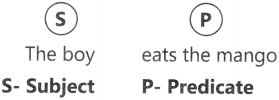
  • A simple sentence has one subject part and one predicate part. Example:
    Simple and Compound Sentences Exercises for Class 5 CBSE with Answers 1
  • In a compound sentence, two independent clauses can be joined by a comma and a conjunction i.e. and, but, or Example:
    Simple and Compound Sentences Exercises for Class 5 CBSE with Answers 2

Presentation
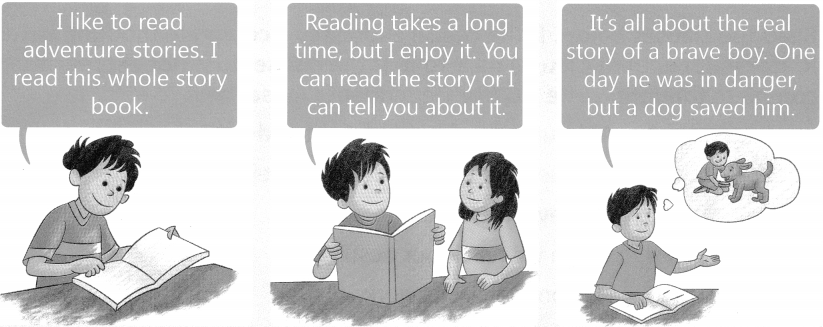
Read the picture story.
Simple and Compound Sentences Exercise for Class 5 CBSE with Answers

A. Answer the following questions as per the story.

1. What does narrator like to read? ____________
2. Does he enjoy while reading? ____________
3. What does narrator tell about the story he read? ____________

B. Read the story again and identify the simple and compound sentences.

Simple SentencesCompound Sentences
……………………………………………..
……………………………………………..
……………………………………………..
……………………………………………..
……………………………………………..
……………………………………………..
……………………………………………..
……………………………………………..
……………………………………………..
……………………………………………..

Simple and Compound Sentences Exercises with Answers for Class 5 CBSE PDF

A. Read each sentence below. If it is a simple sentence then write simple sentence. If it is a compound sentence, write compound sentence.

For example:

  • Savita walked in the library. Simple sentence

1. John went to the show but he forgot his wallet.
____________________________________

2. The basketball players stretched before the game.
____________________________________

3. The team should play together or they will lose the game.
____________________________________

4. The class should keep quiet during the test or they shall not pass.
____________________________________

5. My mother makes me breakfast in the morning.
____________________________________

B. Create a compound sentence by combining the two simple sentences with conjunction (and, or, but).
Example:

  • Rahul likes to swim. Rahul likes to hike.
    Answer:
    Rahul likes to swim, and he likes to hike.

1. John likes video games. John likes reading.
____________________________________

2. Sandeep must study. Sandeep will not pass the test.
____________________________________

3. Jiwan should show up on time. Jiwan will not be able to enter.
____________________________________

4. The boy plays basketball. The boy plays soccer.
____________________________________

5. My mom will sleep. My mom will rest.
____________________________________

6. He likes me. I don’t like him.
____________________________________

C. Combine each pair of simple sentences to make a compound sentence. Use the conjunction in brackets. The first one has been done for you.

1. A small kitten followed me home. I gave it a bowl of milk. (so)
A small kitten followed me home so I gave it a bowl of milk.

2. We were lost in the woods. My brother had a map in his backpack. (but)
____________________________________
____________________________________

3. The girls were painting animal pictures. Katrina spilled the paint. (and)
____________________________________
____________________________________

4. Would you like to go to the movies? Would you rather stay home tonight? (or)
____________________________________
____________________________________

5. Mr. Mathur loved his new office. He didn’t like the view. (but)
____________________________________
____________________________________

6. Anu’s bicycle had a flat tire. She had to walk to the grocery store. (so)
____________________________________
____________________________________

7. Nimish wants to be an astronaut when he grows up. Meena wants to be a nurse. (and)
____________________________________
____________________________________

8. Dr. Sukreja told Rohit to floss his teeth every day. He didn’t listen. (but)
____________________________________
____________________________________

9. The tigers at the zoo are always sleeping. The penguins are fun to watch. (but)
____________________________________
____________________________________

Clause and Phrase Exercises for Class 5 CBSE with Answers

This grammar section explains English Grammar in a clear and simple way. There are example sentences to show how the language is used.

Clause and Phrase Exercises for Class 5 CBSE with Answers PDF

Fundamentals
A clause is defined as a group of related words which forms part of a sentence and contains a subject and predicate (verb). For example: he came. A phrase is defined as a group of related words does not contain a subject and a verb.
For example:

  • on the table.
  • Example He is standing near a wall.
    (Clause) (Phrase)

There are two major types of clauses main (or independent) clause and subordinate (or dependant) clause. A sentence may have one clause or two clauses. A sentence with two clauses is linked by a conjunction – if, but, because, so, although, before, when, while, wherever
For example:

  • I met the boy who had helped me.
  • Main Clause Dependent Clause

Mohan is buying a watch which looks very nice.
The above sentence has two clauses “Mohan is buying a watch” and “which looks very nice”. The clause “Mohan is buying a watch” expresses a complete thought and can alone stand as a sentence. Such a clause is called main or independent clause. While the clause “which looks very nice” does not express a complete thought and can’t stand as a sentence. It depends on another clause (main clause) to express complete idea. Such a clause is called subordinate or dependent clause.

Presentation
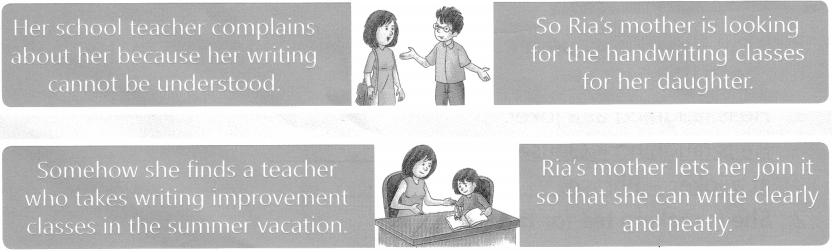
Read the picture story.
Clause and Phrase Exercises for Class 5 CBSE with Answers 1 Clause and Phrase Exercises for Class 5 CBSE with Answers 2

A. Answer the following questions from the story above.

1. What is Ria’s mother planning for her daughter? ___________
2. Why does Ria’s teacher complain about her? ___________
3. Why does Ria’s mother let her join the handwriting classes? ___________

B. Read the story again and identify whether the following group of words is a clause or phrase.

1. Ria’s mother is planning handwriting improvement classes. ___________
2. in the summer vacation ___________
3. for her daughter ___________
4. Ria has a poor handwriting. ___________

C. Identify the main and dependent clause in the following sentences of the story.

1. Her school teacher complains about her because handwriting cannot be understood.
2. She gets a teacher who is taking classes in the summer vacation.
3. Ria’s mother lets her join the handwriting classes so that she can write neatly.

Phrases And Clauses Exercises With Answers For Class 5 CBSE PDF

A. Pick out the clause and phrase from the following sentences. The first one has been done for you.

1. He is laughing at a joker.
He is laughing – Clause
at a joker. – Phrase

2. She is making tea for the guests.
___________________
___________________

3. I saw a girl with blue eyes.
___________________
___________________

4. He always behaves in a strange way.
___________________
___________________

5. The boy in the red shirt is my cousin.
___________________
___________________

6. The boy, with a book in his hand, won a prize.
___________________
___________________

7. He is wearing a nice read shirt.
___________________
___________________

8. The people at the party were dancing.
___________________
___________________

9. The man in the room is our teacher.
___________________
___________________

10. He returned in a short while.
___________________
___________________

B. Underline the clause in the following sentences.

1. He reached school in time.
2. I was standing near a wall.
3. They are singing loudly.
4. She made tea for the guests.
5. He bought a book for his friend.
6. I will meet him in my office.
7. You look handsome in this picture.

C. Read each of the following groups of words and decide if the group of words is a clause or a phrase. Write C for the groups that are clauses and P for the groups that are phrases.

____________ 1. In the rain
____________ 2. When he finished.
____________ 3. Because the movie is over.
____________ 4. Tina screamed.
____________ 5. While he was jogging home.
____________ 6. Over the rainbow.

D. Read the clauses below. If the clause expresses a complete thought, write IC (for Independent Clause) next to it. If the clause does not express a complete thought, write DC (for Dependent Clause) next to it.

____________ 1. Although the day was bright and sunny
____________ 2. Because she is so vain and conceited
____________ 3. I believe in ghosts.
____________ 4. When we reach our destination
____________ 5. He completed his work.
____________ 6. If the recession ever ends
____________ 7. Before the play starts
____________ 8. The cat climbed the oak tree.
____________ 9. While Anu was driving east
____________ 10. She received an “A” Grade in English.

Sentences Exercise for Class 5 CBSE with Answers

Sentences Exercise for Class 5 CBSE with AnswersThis grammar section explains English Grammar in a clear and simple way. There are example sentences to show how the language is used.

Sentence Exercise for Class 5 CBSE with Answers PDF

  • A sentence is a group of words in the correct order that makes sense.
  • Letters form words and words make the sentences.
  • A sentence always begins with capital letter and mostly ends with a full stop.
  • Sentence always has two parts- Naming and Doing.
  • Naming part tells about people, places, animals and things which are also called Noun.
  • Doing part tells what a person, an animal or thing does, which is also called Verb.
  • Naming part is called the subject of the sentence.
  • Doing part is called the predicate of the sentence. The subject tells you who or what the sentence is about.
  • The rest of the sentence including verb is called Predicate.
    Sentence Exercise for Class 5 CBSE with Answers
  • The subject and verb in a sentence must match even when the tense of the verb changes.
  • A singular subject must have singular verb.
    Example: I am a good student. , Singular subject => singular verb
  • A plural subject must have plural verb. Plural subject => plural verbs
    Example: We are good students.

There are five types of sentences: Assertive or declarative, Negative, Interrogative, Imperative and Exclamatory. The declarative or assertive sentence merely makes a statement. It ends with full stop(.).
Example:

  • The Earth revolves round the Sun.
  • Delhi is the Capital of India.

The interrogative sentence asks a question. It ends with question mark(?)
Example:

  • Does he study in the morning?
  • Which is his book?

The negative sentence expresses a negative statement, using not or never.
Example:

  • He does not work.
  • I never eat avocados.

The imperative sentence expresses a command, order or request.
Example:

  • Bring a cup of tea.
  • Meena has not worked.

The exclamatory sentence expresses a sudden emotion. It ends with an exclamation mark. (!)
Example:

  • What an idea! How cold the night is!

Sentences Exercises for Class 5 with Answers CBSE PDF

A. Look at the following sentences. Write ‘A’ for assertive, T’ for Interrogative, ‘E’ for exclamatory and ‘Im’ for Imperative.

1. Today is Babita’s birthday ___________________
2. Babita is eating a cake. ___________________
3. These flowers are colourful. ___________________
4. Why were you late to work? ___________________
5. Please sit down.

B. Write whether the sentence fragment is missing a subject or a predicate, and complete the sentences.

1. ____________ is my role model. Is the sentence missing a subject or a predicate?
____________________________________

2. Chota Bheem, the cartoon character, ____________
Is the sentence missing a subject or a predicate?
____________________________________

3. Mr. Singh ____________
Is the sentence missing a subject or a predicate?
____________________________________

4. ____________ went to the park.
Is the sentence missing a subject or a predicate?
____________________________________

5. My favourite food ____________
Is the sentence missing a subject or a predicate?
____________________________________

6. ____________ is my favourite musician. Is the sentence missing a subject or a predicate?
____________________________________

7. My favourite game ____________
Is the sentence missing a subject or a predicate?
____________________________________

8. _____________ is my favourite movie.
Is the sentence missing a subject or a predicate?
____________________________________

C. Circle the subjects and underline the predicates.

1. I went to Great America.
2. We should go to the movies.
3. She knows how to make jewelry.
4. We play basketball every Tuesday.
5. My pencil broke into pieces.
6. Sahil told me to read.
7. Alok stayed up late doing his homework.
8. Homework makes me happy.
9. I put my name on top of the paper.
10. The Cheetah is the fastest land animal.

D. Change each assertive sentence into an interrogative sentence. The first one has been done for you.

1. Parrot is a beautiful bird. Is Parrot a beautiful bird?
2. Ganguli is a fine batsman. ____________
3. The distance between India and Japan is 8000 kms. ____________
4. I am writing a letter. ____________
5. The judge is hearing the case tomorrow. ____________
6. We are waiting for the guests. ____________

E. Change the exclamatory sentences into assertive sentences. The first one has been done for you.

1. How wisely he planned!
He planned very wisely.

2. How lovely her face is!
________________________

3. What a certain matter it is!
________________________

4. How confusing the project was!
________________________

5. What a terrible relationship he developed!
________________________

6. What an excellent photograph he got!
________________________

7. How lovely the park is!
________________________

8. What a marvelous age we live in!
________________________

Statistics Class 10 Extra Questions Maths Chapter 14 with Solutions Answers

Here we are providing Statistics Class 10 Extra Questions Maths Chapter 14 with Answers Solutions, Extra Questions for Class 10 Maths was designed by subject expert teachers.

Extra Questions for Class 10 Maths Statistics with Answers Solutions

Extra Questions for Class 10 Maths Chapter 14 Statistics with Solutions Answers

Statistics Class 10 Extra Questions Very Short Answer Type

Question 1.
Find the class mark of the class 10 – 25.
Solution:

Statistics Class 10 Extra Questions Maths Chapter 14 with Solutions Answers 1

Question 2.
Find the mean of the first five natural numbers.
Solution:

Statistics Class 10 Extra Questions Maths Chapter 14 with Solutions Answers 2

Question 3.
A data has 13 observations arranged in descending order. Which observation represents the median of data?
Solution:
Total no. of observations = 13, which is odd

Statistics Class 10 Extra Questions Maths Chapter 14 with Solutions Answers 2
i.e., 7th term will be the median.

Question 4.
If the mode of a distribution is 8 and its mean is also 8, then find median.
Solution:
Mode = 8; Mean = 8; Median = ?
Relation among mean, median and mode is
3 median = mode + 2 mean
3 × median = 8 + 2 × 8
Median = \(\frac{8+16}{3}\) = \(\frac{24}{3}\) = 8

Question 5.
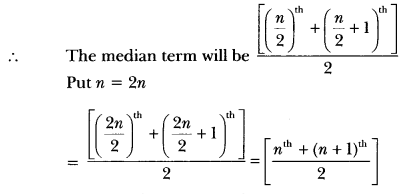
In an arranged señes of an even number of 2n terms which term is median?
Solution:
No. of terms = 2n which are even
Statistics Class 10 Extra Questions Maths Chapter 14 with Solutions Answers 4
i.e., the mean of nth and (n + 1)th term will be the median.

Question 6.
What does the abscissa of the point of intersection of the less than type and of the more than type cumulative frequency curves of a grouped data represent?
Solution:
The abscissa of the point of intersection of the less than type and of the more than type cumulative frequency curves of a grouped data gives its median.

Question 7.
Name the graphical representation from which the mode of a frequency distribution is obtained.
Solution:
The mode of frequency distribution is determined graphically from Histogram.

Question 8.
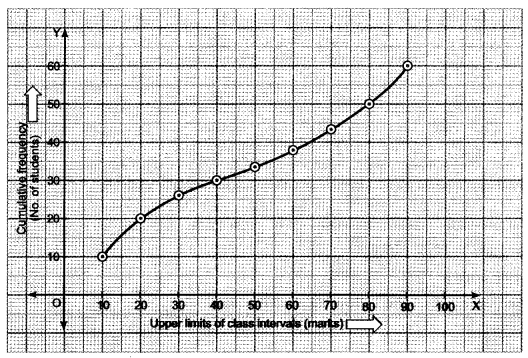
A student draws a cumulative frequency curve for the marks obtained by 60 students of a class as shown below. Find the median marks obtained by the students of the class.
Statistics Class 10 Extra Questions Maths Chapter 14 with Solutions Answers 5
Solution:
Here n = 60
\(\frac{n}{2}\) = 30
Corresponding to 30 on y-axis, the marks on x-axis is 40.
∴ Median marks = 40.

Question 9.
Write the modal class for the following frequency distribution:

Statistics Class 10 Extra Questions Maths Chapter 14 with Solutions Answers 6
Solution:
Maximum frequency, i.e., 65 corresponds to the class 30 – 40
∴ Modal class is 30 – 40.

Statistics Class 10 Extra Questions Short Answer Type 1

Question 1.
If xi‘s are the mid-points of the class intervals of a grouped data. fi‘s are the corresponding frequencies and is the mean, then find Σfi (xi – \(\bar{x}\)).
Solution:
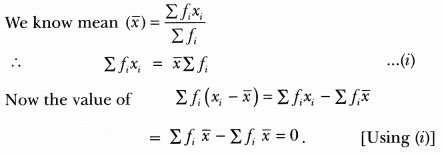
Statistics Class 10 Extra Questions Maths Chapter 14 with Solutions Answers 7

Question 2.
Consider the following frequency distribution.

Statistics Class 10 Extra Questions Maths Chapter 14 with Solutions Answers 8
Solution:
Classes are not continuous, hence make them continuous by adding 0.5 to the upper limits and subtracting 0.5 from the lower limits.
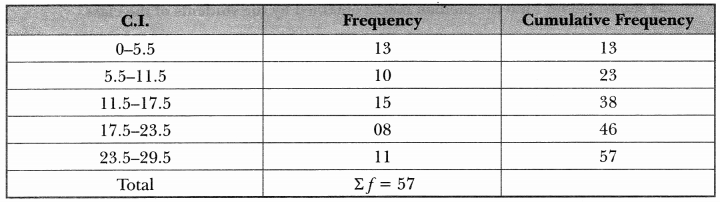
Statistics Class 10 Extra Questions Maths Chapter 14 with Solutions Answers 9
Class interval can’t be negative hence the first CI is starting from 0.
Now to find median class we calculate \(\frac{\Sigma f}{2}\) = \(\frac{57}{2}\) = 28.5
∴ Median class = 11.5 – 17.5.
So, the upper limit is 17.5

Question 3.
Find the median class of the following distribution:

Statistics Class 10 Extra Questions Maths Chapter 14 with Solutions Answers 10
Solution:
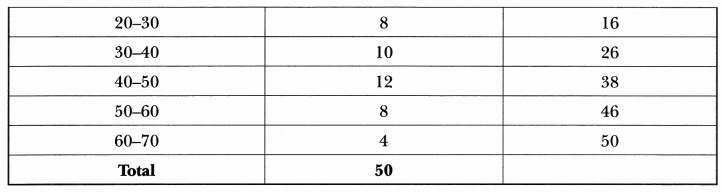
First we find the cumulative frequency

Statistics Class 10 Extra Questions Maths Chapter 14 with Solutions Answers 11
Statistics Class 10 Extra Questions Maths Chapter 14 with Solutions Answers 12
Here, \(\frac{n}{2}\) = \(\frac{50}{2}\)
∴ Median class = 30 – 40.

Question 4.
Find the class marks of classes 15.5 – 18.5 and 50 – 75.
Solution:
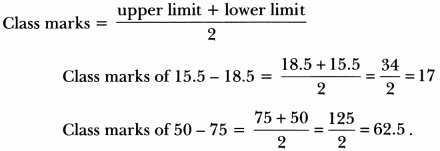
Statistics Class 10 Extra Questions Maths Chapter 14 with Solutions Answers 13

Statistics Class 10 Extra Questions Short Answer Type 2

Question 1.
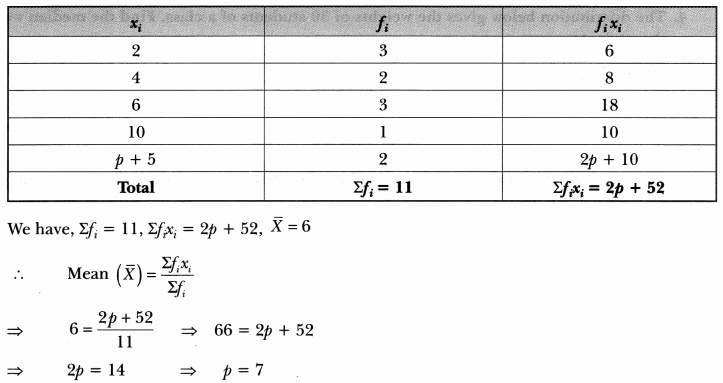
If the mean of the following distribution is 6, find the value of p.

Statistics Class 10 Extra Questions Maths Chapter 14 with Solutions Answers 14
Solution:
Calculation of mean
Statistics Class 10 Extra Questions Maths Chapter 14 with Solutions Answers 15

Question 2.
Find the mean of the following distribution:

Statistics Class 10 Extra Questions Maths Chapter 14 with Solutions Answers 16
Solution:
Calculation of arithmetic mean
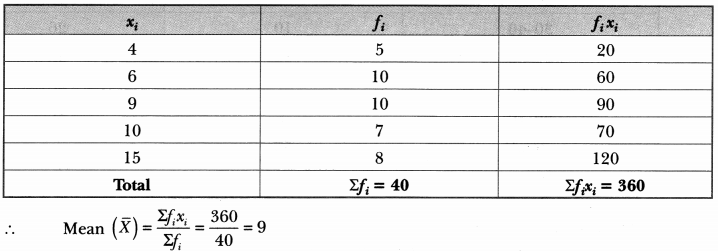
Statistics Class 10 Extra Questions Maths Chapter 14 with Solutions Answers 17

Question 3.
The following data gives the information on the observed lifetimes (in hours) of 225 electrical components:

Statistics Class 10 Extra Questions Maths Chapter 14 with Solutions Answers 18
Determine the modal lifetimes of the components.
Solution:
Here, the maximum class frequency is 61 and the class corresponding to this frequency is 60 – 80.
So, the modal class is 60 – 80.
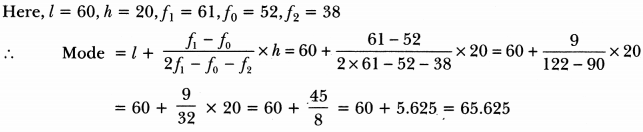
Statistics Class 10 Extra Questions Maths Chapter 14 with Solutions Answers 19
Hence, modal lifetime of the components is 65.625 hours.

Question 4.
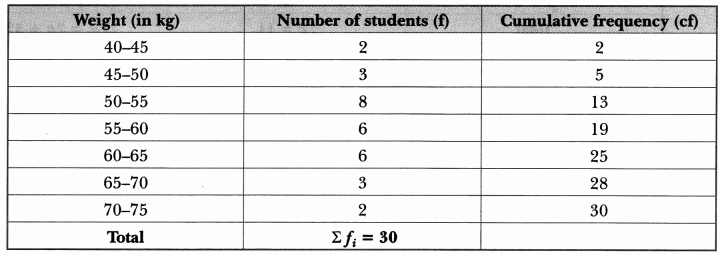
The distribution below gives the weights of 30 students of a class. Find the median weight of the students.

Statistics Class 10 Extra Questions Maths Chapter 14 with Solutions Answers 20
Solution:
Calculation of median
Statistics Class 10 Extra Questions Maths Chapter 14 with Solutions Answers 21
The cumulative frequency just greater than \(\frac{n}{2}\) = 15 is 19, and the corresponding class is 55 – 60.
∴ 55 – 60 is the median class.
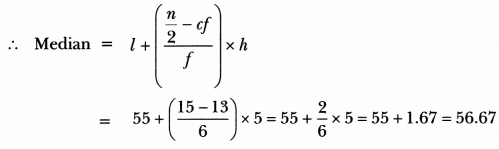
Statistics Class 10 Extra Questions Maths Chapter 14 with Solutions Answers 22
Hence, median weight is 56.67 kg.

Question 5.
The lengths of 40 leaves of a plant are measured correctly to the nearest millimetre, and the data obtained is represented in the following table:

Statistics Class 10 Extra Questions Maths Chapter 14 with Solutions Answers 23
Find the median length of the leaves.
Solution:
Here, the classes are not in inclusive form. So, we first convert them in inclusive form by subtracting \(\frac{h}{2}\) from the lower limit and adding \(\frac{h}{2}\) to the upper limit of each class, where h is the difference between the lower limit of a class and the upper limit of preceding class.
Now, we have
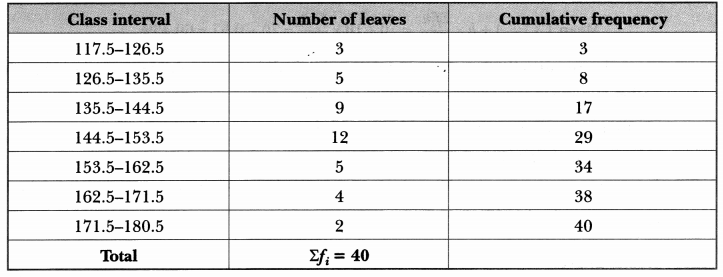
Statistics Class 10 Extra Questions Maths Chapter 14 with Solutions Answers 24
We have, n = 40
⇒ \(\frac{n}{2}\) = 20 .
And, the cumulative frequency just greater than \(\frac{n}{2}\) is 29 and corresponding class is 144.5 – 153.5.
So median class is 144.5 – 153.5.
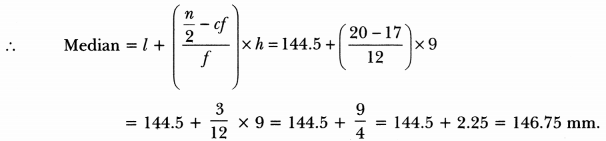
Statistics Class 10 Extra Questions Maths Chapter 14 with Solutions Answers 25
Hence, the median length of the leaves is 146.75 mm.

Statistics Class 10 Extra Questions Long Answer Type

Question 1.
The following table gives the literacy rate (in percentage) of 35 cities. Find the mean literacy rate.

Statistics Class 10 Extra Questions Maths Chapter 14 with Solutions Answers 26
Solution:
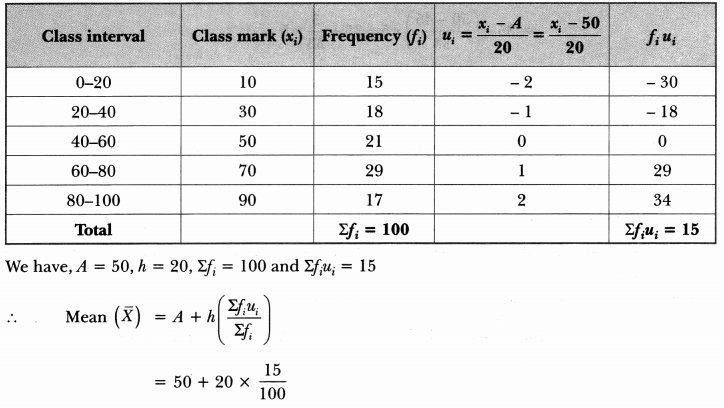
Here, we use step deviation method to find mean.
Let assumed mean A = 70 and class size h = 10
So, ui = \(\frac{x_{i}-70}{10}\)
Now, we have
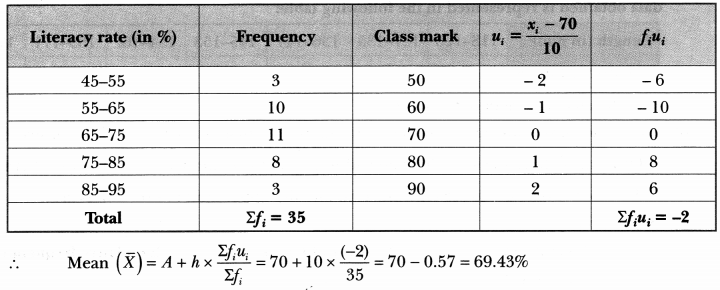
Statistics Class 10 Extra Questions Maths Chapter 14 with Solutions Answers 27

Question 2.
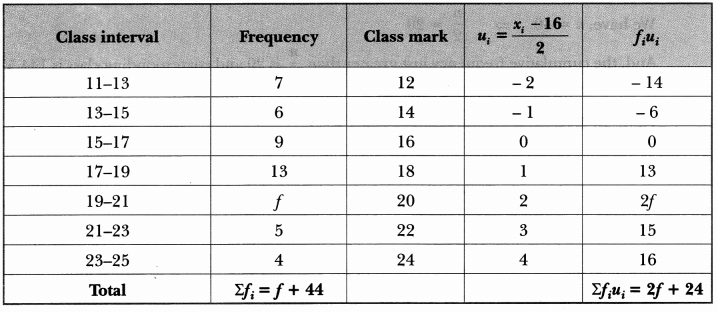
The following distribution shows the daily pocket allowance of children of a locality. The mean pocket allowance is ₹ 18. Find the missing frequency f.

Statistics Class 10 Extra Questions Maths Chapter 14 with Solutions Answers 28
Solution:
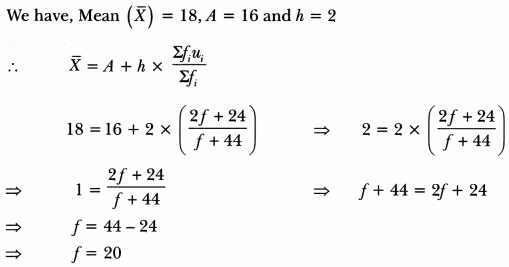
Let the assumed mean A = 16 and class size h = 2, here we apply step deviation method.
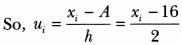
Statistics Class 10 Extra Questions Maths Chapter 14 with Solutions Answers 1.3
Now, we have,
Statistics Class 10 Extra Questions Maths Chapter 14 with Solutions Answers 29
Statistics Class 10 Extra Questions Maths Chapter 14 with Solutions Answers 30
Hence, the missing frequency is 20.

Question 3.
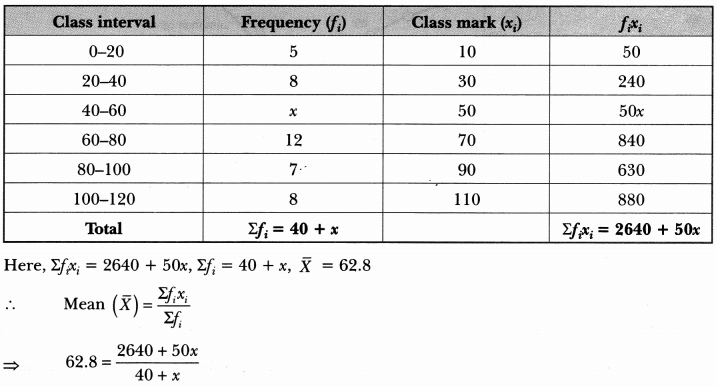
The mean of the following frequency distribution is 62.8. Find the missing frequency x.

Statistics Class 10 Extra Questions Maths Chapter 14 with Solutions Answers 31
Solution:
We have
Statistics Class 10 Extra Questions Maths Chapter 14 with Solutions Answers 32
⇒ 2512 + 62.8x = 2640 + 50x
⇒ 62.8x – 50x = 2640 – 2512
⇒ 12.8x = 128
∴ x = \(\frac{128}{12.8}\) = 10
Hence, the missing frequency is 10.

Question 4.
The distribution below gives the marks of 100 students of a class.

Statistics Class 10 Extra Questions Maths Chapter 14 with Solutions Answers 33
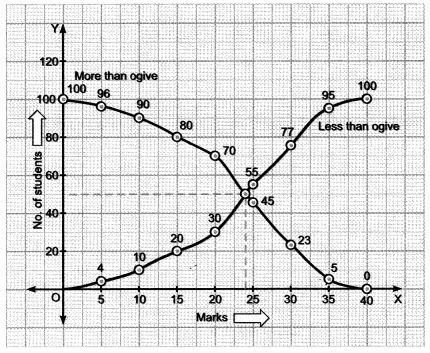
Draw a less than type and a more than type ogive from the given data. Hence, obtain the median marks from the graph.
Solution:
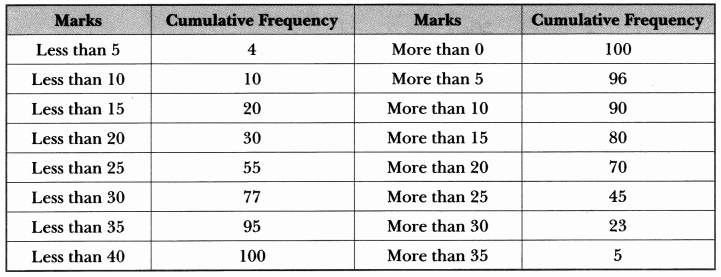
Statistics Class 10 Extra Questions Maths Chapter 14 with Solutions Answers 34
Statistics Class 10 Extra Questions Maths Chapter 14 with Solutions Answers 35
Hence, median marks = 24

Question 5.
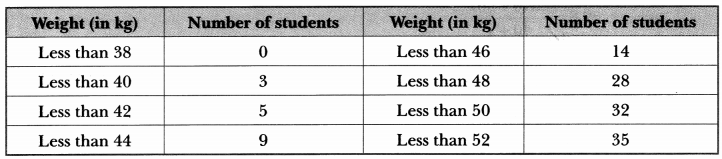
During the medical check-up of 35 students of a class, their weights were recorded as follows:
Statistics Class 10 Extra Questions Maths Chapter 14 with Solutions Answers 36
Draw a less than type ogive for the given data. Hence, obtain the median weight from the graph and verify the result by using the formula.
Solution:
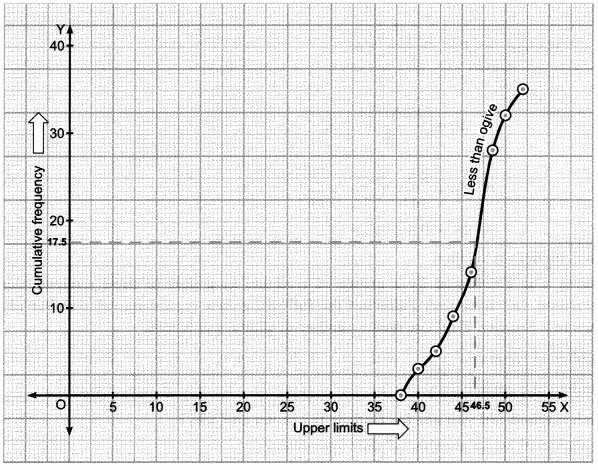
To represent the data in the table graphically, we mark the upper limits of the class interval on x-axis and their corresponding cumulative frequency on y-axis choosing a convenient scale. Now, let us plot the points corresponding to the ordered pair given by (38,0), (40,3), (42,5), (44, 9), (46, 14), (48, 28), (50, 32) and (52, 35) on a graph paper and join them by a freehand smooth curve.
Thus, the curve obtained is the less than type ogive.
Statistics Class 10 Extra Questions Maths Chapter 14 with Solutions Answers 37
Now, locate \(\frac{n}{2}\) = \(\frac{35}{2}\) = 17.5 on the y-axis,
We draw a line from this point parallel to x-axis cutting the curve at a point. From this point, draw a perpendicular line to the x-axis. The point of intersection of this perpendicular with the x-axis gives the median of the data. Here it is 46.5.
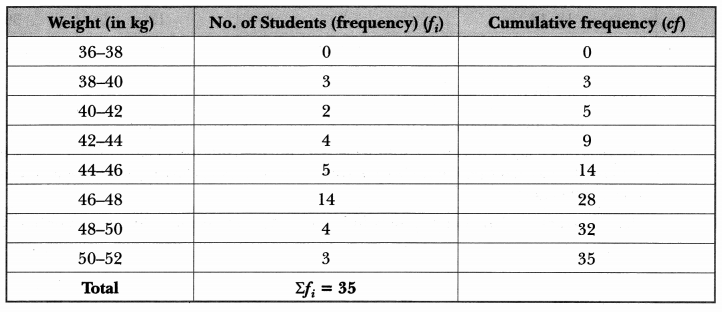
Let us make the following table in order to find median by using formula.
Statistics Class 10 Extra Questions Maths Chapter 14 with Solutions Answers 38
Here, n = 35, \(\frac{n}{2}\) = \(\frac{35}{2}\) = 17.5, cumulative frequency greater than \(\frac{n}{2}\) = 17.5 is 28 and corresponding class is 46 – 48. So median class is 46 – 48.
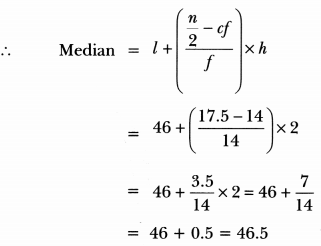
Now, we have l = 46, \(\frac{n}{2}\) = 17.5, cf = 14, f = 14, h = 2
Statistics Class 10 Extra Questions Maths Chapter 14 with Solutions Answers 39
Hence, median is verified.

Question 6.
A survey was conducted by a group of students as a part of their environment awareness programme, in which they collected the following data regarding the number of plants in 20 housesin a locality. Find the mean number of plants per house.

Statistics Class 10 Extra Questions Maths Chapter 14 with Solutions Answers 40
Which method did you use for finding the mean and why?
Solution:
Calculation of mean number of plants per house.
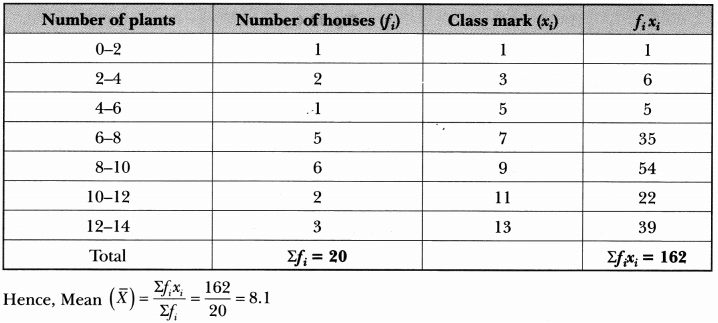
Statistics Class 10 Extra Questions Maths Chapter 14 with Solutions Answers 41
Here, we used direct method to find mean because numerical values of x; and fi are small.

Question 7.
A life insurance agent found the following data for distribution of ages of 100 policy holders. Calculate the median age, if policies are given only to persons having age 18 years onwards but less than 60 years.
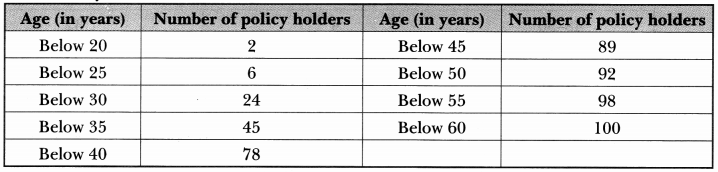
Statistics Class 10 Extra Questions Maths Chapter 14 with Solutions Answers 42
Solution:
We are given the cumulative frequency distribution. So, we first construct a frequency table from the given cumulative frequency distribution and then we will make necessary computations to compute median.
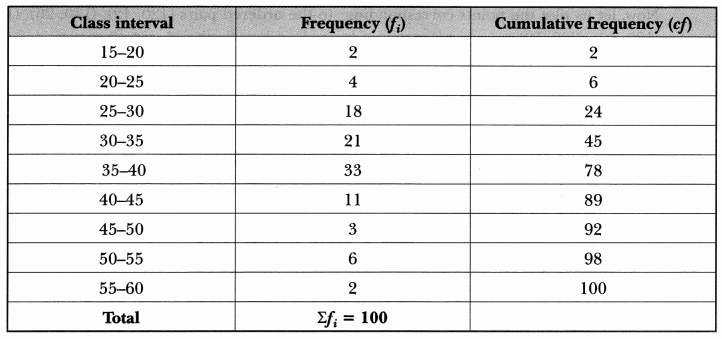
Statistics Class 10 Extra Questions Maths Chapter 14 with Solutions Answers 43
Here, n = 100
⇒ \(\frac{n}{2}\) = 50

And, cumulative frequency just greater than \(\frac{n}{2}\) 50 is 78 and the corresponding class is 35 – 40.
So 35 – 40 is the median class.
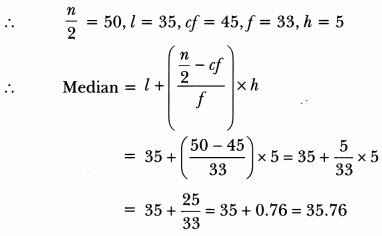
Statistics Class 10 Extra Questions Maths Chapter 14 with Solutions Answers 44
Hence, the median age is 35.76 years.

Question 8.
The following distribution gives the daily income of 50 workers of a factory.

Statistics Class 10 Extra Questions Maths Chapter 14 with Solutions Answers 45
Convert the distribution above to a less than type cumulative frequency distribution, and draw its ogive.
Solution:
Converting given distribution to a less than type cumulative frequency distribution, we have,
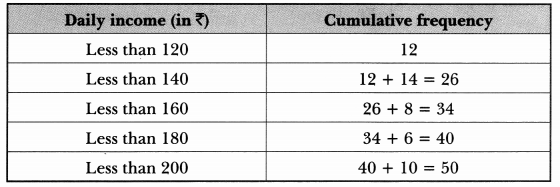
Statistics Class 10 Extra Questions Maths Chapter 14 with Solutions Answers 46
Now, let us plot the points corresponding to the ordered pairs (120, 12), (140, 26), (160, 34), (180, 40), (200, 50) on a graph paper and join them by a freehand smooth curve.
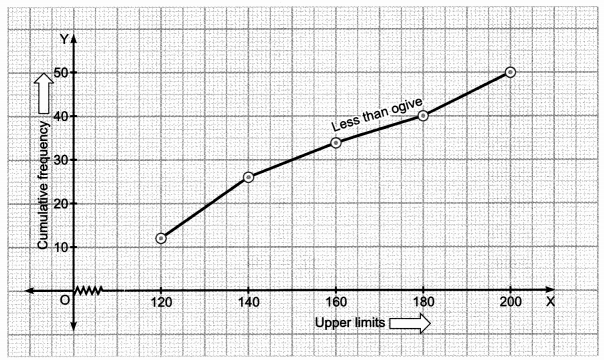
Statistics Class 10 Extra Questions Maths Chapter 14 with Solutions Answers 47
Thus, obtained curve is called the less than type ogive.

Question 9.
Find the mean of the following frequency distribution:

Statistics Class 10 Extra Questions Maths Chapter 14 with Solutions Answers 48
Solution:
Calculation of mean
Statistics Class 10 Extra Questions Maths Chapter 14 with Solutions Answers 49

Statistics Class 10 Extra Questions HOTS

Question 1.
The mean of the following frequency table is 50. But the frequencies f1 and f2 in class 20 – 40 and 60 – 80 respectively are missing. Find the missing frequencies.

Statistics Class 10 Extra Questions Maths Chapter 14 with Solutions Answers 50
Solution:
Let the assumed mean A = 50 and h = 20.
Calculation of mean
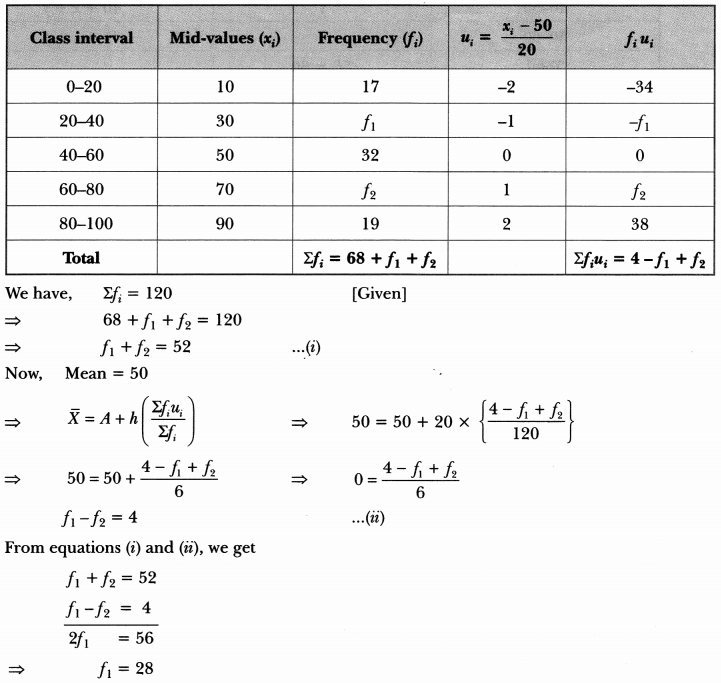
Statistics Class 10 Extra Questions Maths Chapter 14 with Solutions Answers 51
Putting the value of f1 in equation (i), we get
28 + f2 = 52
⇒ f2 = 24
Hence, the missing frequencies f1 is 28 and f2 is 24.

Question 2.
If the median of the distribution given below is 28.5, find the values of x and y.

Statistics Class 10 Extra Questions Maths Chapter 14 with Solutions Answers 52
Solution:
Here, median = 28.5 and n = 60
Now, we have
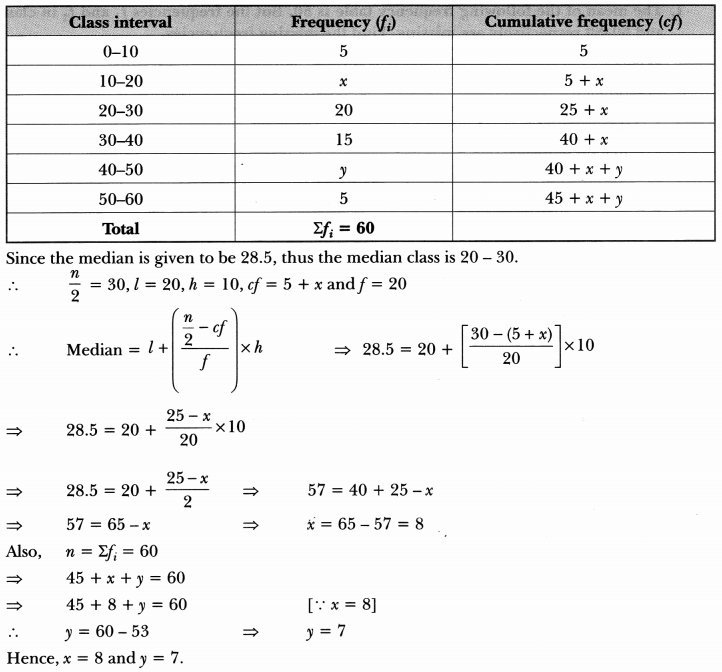
Statistics Class 10 Extra Questions Maths Chapter 14 with Solutions Answers 53

Conjunctions Exercises for Class 5 CBSE with Answers

Conjunctions Exercises for Class 5 CBSE with AnswersA conjunction is a part of speech that is used to connect words, phrases, clauses, or sentences. Conjunctions are considered to be invariable grammar particles, and they may or may not stand between items they conjoin. Conjunctions are words which join together words, sentences, and part of sentences.
This grammar section explains English Grammar in a clear and simple way. There are example sentences to show how the language is used.

Conjunctions Exercises for Class 5 CBSE with Answers PDF

  • Joining Words are called Conjunctions.
  • And, Or, But, Because and so are also called Conjunctions.
  • Use and to connect similar ideas.
  • Use but to connect contrasting ideas.
  • Use because to show the reason.
  • Use so to show the effect.
  • Use or to show choices.
  • Other words for Or used as conjunctions- neither-nor, either-or, both

Conjunctions Exercises with Answers Pdf for Class 5 CBSE

A. Rewrite each of these sentences as one sentence, using the conjunctions and’, ‘or’, ‘but. The first one has been done for you.

1. The sky was covered with clouds. It became dark.
The sky was covered with clouds and it became dark.

2. He is a poor man. He is honest.
______________________________________________
3. I like biscuits. I like chocolate.
______________________________________________
4. Take this book. Return it to the library.
______________________________________________
5. Is the story true? Is the story false?
______________________________________________
6. It is time to leave. I will finish my work first.
______________________________________________
7. You can travel by land. You can travel by air.
______________________________________________
8. He tried. He did not succeed.
______________________________________________
9. Everybody was present. Abhinav was absent.
______________________________________________
10. Tell me the truth. Go to the Principal.
______________________________________________

B. Complete the following sentences with both, neither or either.

1. _____________ cars are very expensive.
2. _____________ of us wanted to go to the restaurant.
3. Would _____________ of you like to come out in the car?
4. She’s _____________ sociable and sensitive.
5. He plays _____________ tennis nor squash.
6. I haven’t seen _____________ of those pots for ages.
7. _____________ of my brothers work in the city.
8. _____________ of them want to go bowling.

C. Rewrite these sentences using both…and/either…or/neither…nor:

1. He didn’t write. He didn’t telephone.
______________________________________________
2. It was a very boring film and it was very long, too.
______________________________________________
3. He gave up his job because he needed a change. Also because the pay was low.
______________________________________________
4. We can leave today or tomorrow, whichever you prefer.
______________________________________________
5. I haven’t got the time to go on holiday and I haven’t got the money.
______________________________________________

D. Fill in the blanks with “both, either, neither” to complete the sentences below.

1. That’s enough! _____________ you pay your debt to me or I take you to court
2. When we heard the good news, we were _____________ happy and excited.
3. They had _____________ food to eat nor money to go to a restaurant.
4. Mr. Gupta wants to have _____________ vanilla and chocolate in his ice-cream.
5. You should stop making up excuses. _____________ you study hard or you will fail in the Maths exam tomorrow.
6. _____________ of the two students had books with them so the teacher got very angry.
7. We have _____________ bread nor cheese so we can’t make a cheese sandwich.
8. She can _____________ buy a laptop or a tablet pc. She has got enough money.
9. I like _____________ the green and the blue t-shirt, but I don’t have enough money to buy two t-shirts.
10. The sports car was _____________ nice and cheap so my father decided to buy it.

Conjunctions Worksheets with Answers for Grade 5 CBSE PDF

Fundamentals

  • The conjunctions before, after, since, until, till, when, while, as and as soon as are used to say when something happens.
  • They are called conjunctions of time.
  • The conjunctions where and wherever are used to talk about places.
  • They are called conjunctions of place.
  • The conjunctions because, since, as and in case tell why someone does something.
  • They are called conjunctions of reason.
  • The conjunctions so, so that and in order to tell what the purpose of something is.
  • They are called conjunctions of purpose.

A Presentation
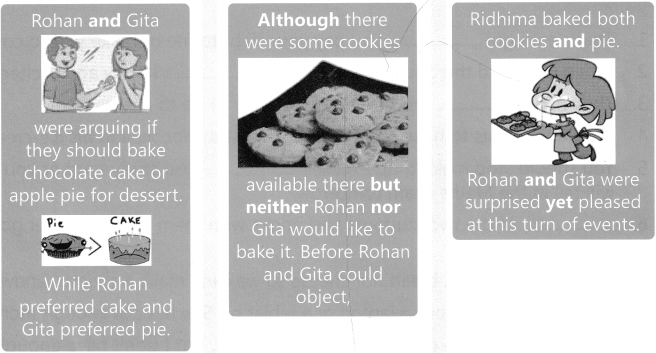
Read the picture story.
Conjunctions Exercises for Class 5 CBSE with Answers

A. Answer the following questions as per the story.

1. On which subject Rohan and Gita were arguing?
2. What did Rohan and Gita not want to bake?
3. How did Ridhima surprise everyone in the story above?

B. Fill in the blanks with suitable conjunctions.

1. I will not speak to you ___________ you don’t obey me.
2. Nalini went to school ___________ Manav stayed at home.
3. He must be tired ___________ he has been working the whole day.
4. You will not go to play ___________ you finish your home work.
5. He found his book. ___________ he had left it.
6. Make hay ___________ the sunshines.
7. He is short ___________ he runs very fast.
8. We cannot leave ___________ the bell rings.
9. We eat ___________ we may live.
10. Finish your breakfast. ___________ you leave.

Conjunctions Worksheets for Grade 5 with Answers PDF CBSE

A. Fill in the blanks with conjunctions of time.

1. Take the toy out of the box ___________ you throw the box away.
2. I usually do my homework ___________ I have my dinner.
3. We’ve moved to a new house ___________ I last wrote to you.
4. You can’t watch TV ___________ you’ve done your homework.
5. ___________ the rice is cooked, we can’t eat dinner.
6. I’ll call you ___________ I get home.
7. Dad watches TV ___________ he does his exercises.
8. People stand back as the train goes ___________ the station.
9. We went inside ___________ it started to rain.
10. ___________ you’ve finished your homework, let me see it.

B. Fill in the blanks with conjunctions of place.

1. Does anybody know ___________ Mr. Arora lives?
2. ___________ the road is narrow, big trucks can’t get through.
3. The dog follows Sandy___________ he goes.
4. ___________ there are mountains, you will also find streams.

C. Fill in the blanks with conjunctions of reason.

1. I sat down ___________ I was feeling tired.
2. ___________ we arrived late, we missed the beginning of the play.
3. I took an apple ___________ it was the only fruit in the bowl.
4. ___________ you have finished your homework, you can help me make dinner.
5. Mom switched off the TV ___________ it was past my bedtime.
6. ___________ you’re my best friend, I’ll lend you my new bike.
7. Take an umbrella ___________ it rains.
8. ___________ you forget the number, I’ve written it on this piece of paper.

D. Fill in the blanks with conjunctions of purpose.

1. The children are wearing hats ___________ they won’t get sunburned.
2. John finished his homework before dinner ___________ he could watch his favourite TV program.
3. Let’s write down the address ___________ we don’t forget it.
4. We left early ___________ that we wouldn’t be late.
5. Manish took a map ___________ that he wouldn’t get lost.
6. I hid the comics under the bed ___________ nobody could find them.
7. She goes jogging every morning ___________ keep fit.
8. ___________ get to sleep, he reads a really boring book at bedtime.
9. Dad painted the walls white. ___________ make the room look brighter.

E. Select the suitable conjunction from the brackets to fill in the blanks.

1. ___________ she works hard, she does not do well. (though, but)
2. You will fail ___________ you are not serious. (if, unless)
3. I will not lend you my book ___________ you promise to look after it. (if, till)
4. They approved ___________ we had left. (after, while)
5. I will be happy ___________ you come to my party. (because, if)
6. The money has been stolen ___________ lost. (and, or)
7. He stayed at home ___________ he was unwell. (when, and)
8. We couldn’t see the game ___________ we reached late. (because, but)
9. She is beautiful ___________ she is very proud. (but, and)
10. The girls worked ___________ the boys were playing. (while, if)

F. The following passage has a word missing in the place where a slash ( ) has been put. Write the missing word in the spaces provided. Take help from the aid box given below.

We were very tense/the final day was ___________
nearing. We had practised hard/we were sure ___________
we would lose the match. /we had some good ___________
players the chances of winning were less. ___________
Only/we were not so unlucky. One player ___________
was injured/another was ill. ___________
/our captain was very encouraging ___________
/others had lost hope. He kept telling ___________
us that we would win. /the final day ___________
arrived we played like never?. We won ___________
the match. /Ravi had not encouraged us ___________
we would not have even played the match. ___________

Hint: as, although, while, before, if, but, if, though, when, but