Crop Production and Management Class 8 Extra Questions and Answers Science Chapter 1

In this page, we are providing Crop Production and Management Class 8 Extra Questions and Answers Science Chapter 1 pdf download. NCERT Extra Questions for Class 8 Science Chapter 1 Crop Production and Management with Answers will help to score more marks in your CBSE Board Exams.

Class 8 Science Chapter 1 Extra Questions and Answers Crop Production and Management

Extra Questions for Class 8 Science Chapter 1 Crop Production and Management with Answers Solutions

Crop Production and Management Class 8 Extra Questions Very Short Answer Type

Question 1.
What is the name of the undesirable plants that grow among the crops?
Answer:
Weeds

Question 2.
Name one weed.
Answer:
Wild oat

Question 3.
Name the methods applied for weeding.
Answer:

  • Manual method
  • Chemical method
  • Biological method

Question 4.
Name the chemicals that are used to remove weeds.
Answer:
Weedicides

Question 5.
Name a tool which is used for removing weeds and for loosening soil.
Answer:
Hoe

Question 6.
What is the process of loosening and turning of the soil called?
Answer:
Tilling or ploughing

Question 7.
What are the substances which are added to the soil in the form of nutrients called?
Answer:
Manure and fertilisers

Question 8.
What is the process of supplying water to crops at different intervals is called?
Answer:
Irrigation

Question 9.
What are the sources of irrigation?
Answer:
Wells, tubewells, ponds, lakes, etc.

Question 10.
What is the process of separation of grain from chaff called?
Answer:
Winnowing

Question 11.
Name two crops belonging to rabi crop.
Answer:
Pea, gram

Question 12.
Name the ideal months for the harvesting of rabi crops.
Answer:
March/April

Question 13.
Name two kharif crops.
Answer:
Soybean, groundnut

Question 14.
Name the ideal months for sowing kharif crops.
Answer:
June/July

Question 15.
Name any two fertilisers.
Answer:
NPK, Diammonium phosphate

Crop Production and Management Class 8 Extra Questions Short Answer Type

Question 1.
What is a crop?
Answer:
Crop is the term used to describe a plant that is grown in a field on a large scale. For example, cereal crops, wheat crops.

Question 2.
What do you mean by produce?
Answer:
The products obtained from the crops are called produce.

Question 3.
What do you mean by the term agricultural practice?
Answer:
Agricultural practices are those practices which involve the necessary steps to be taken during production of crops.

Question 4.
Explain the term levelling.
Answer:
Levelling is the process of breaking down the larger lumps of soil, and then levelling them by using a leveller.

Question 5.
What are the advantages of levelling?
Answer:
Following are the advantages of levelling:

  • Levelling helps to prevent soil erosion caused by wind or air.
  • It helps in sowing the seeds uniformly, and thus helps the plants to grow uniformly too.
  • It helps in proper irrigation by allowing the water to get distributed uniformly throughout the soil.

Question 6.
What is a plough?
Answer:
A plough is an equipment for ploughing. It is mainly made of a wooden shaft called a plough-shaft, attached to a triangular iron blade called ploughshare.

Question 7.
What is a cultivator?
Answer:
Cultivator is a farm implement used for stirring and pulverizing the soil for planting crops.

Question 8.
Explain the term transplantation.
Answer:
Some of the crops are first grown in the nurseries and then transferred to the main field. This process is known as transplantation.

Question 9.
What are the advantages of manure?
Answer:
Following are some advantages of manure:

  • It enhances water-holding capacity of soil.
  • It improves soil quality.
  • It promotes the growth of soil friendly microbes.
  • It is renewable, biodegradable and eco-friendly.

Question 10.
What are weedicides? Give some examples.
Answer:
Weedicides are the chemicals that are used to remove weeds. Some commonly used weedicides are 2, 4-D and metachlor.

Crop Production and Management Class 8 Extra Questions Long Answer Type

Question 1.
What do you mean by the term crop? Explain briefly the types of crops.
Answer:
Crop is the term used to describe a plant that is grown in a field on a large scale. For example, cereal crops, pulses and fruit crops. The crops grown in India can be classified as kharif and rabi.

Kharif crops are sown in the rainy season by June/July and are harvested by September/October. Thus they are also known as summer season crops. For example, rice, maize, etc.

Rabi crops are sown in the winter season in October or November and are harvested by March/April. Thus, they are also called winter season crops. For example, mustard, wheat, potato, etc.

Question 2.
What is ploughing or tilling? State its advantages.
Answer:
The process of loosening and turning of the soil is called tilling or ploughing. This is done by using a plough. Ploughs are made of wood or iron. Following are the advantages of ploughing or tilling:

  • Ploughing loosens the soil and makes it aerated.
  • It helps in mixing organic matter with the soil uniformly.
  • It initiates the growth of natural agents and microorganisms and thus, keeps the soil fertile.
  • It increases the water holding capacity of soil.
  • It helps in easy penetration of root into the soil.

Question 3.
Define the term agricultural practices and also state the important steps taken during crop production.
Answer:
Agricultural practices are those practices which involves the necessary steps to be taken during production of crops. There are number of steps of crop production which are to be done very carefully to ensure that crops get produced timely. Some of the most important steps taken during crop production are as under:

  • Soil preparation
  • Sowing
  • Adding manure and fertilisers
  • Irrigation
  • Weeding
  • Harvesting
  • Threshing and winnowing
  • Storage of grains

Question 4.
What is irrigation? Name the two main methods of irrigation and define them briefly.
Answer:
The artificial method of watering the plants for assisting in the growth of the plants is called irrigation. The two main methods of irrigation are:
(i) Traditional method: The traditional method of irrigation is very less expensive and they often lead to wastage of water. Traditional method of irrigation involves chain pump, dhekli, moat (the pulley system) and rahat (lever system).

(ii) Modern method: Modern methods of irrigation are more inclined towards the use of diesel, bio¬gas, solar energy and electricity for lifting water.
The two most important modern system of irrigation are:

  • Sprinkler irrigation system
  • Drip irrigation system

Question 5.
What do you mean by weeding? Why the process of weeding necessary? Name the methods applied for weeding.
Answer:
The undesirable plants that grow among the crops are called weeds. The process of removing these weeds is known as weeding. Weeds compete with the crop plants for nutrients and space. They grow much rapidly than the crop plant. So weeding is necessary.

Methods applied for weeding are as follows:
(i) Manual method: Manual method of removing weeds is the most time consuming method. In this system weeds are controlled by hand pulling, digging, shallow tillage, etc., by using certain implements like khurpi, hoe, etc.

(ii) Chemical method: In this method chemicals called, weedicides are used to remove weeds. For example, metachlor and 2, 4-D.

(iii) Biological control method: This method is the most commonly used method of weed control. It involves the use of some specific insects that destroy the growth of some specific weeds. For example, leafy spurge, a weed, is controlled by using flea beetles.

Question 6.
Write short note on the terms:
(i) Storage
(ii) Harvesting
Answer:
(i) Storage: Storage of produce is an important task. If the crop grains are to be kept for longer time, they should be safe from moisture, insects, rats and microorganisms. Before storing, the grains are properly dried in the sun to reduce the moisture in them. This prevents the attack by insect pests, bacteria and fungi. Grains are stored by farmers in jute bags or metallic bins. However, large scale storage of grains is done in silos and granaries to protect them from pests like rats and insects.

(ii) Harvesting: After maturation of crop, harvesting is an important task. In harvesting, crops are pulled out or cut close to the ground. It usually takes 3 to 4 months for a cereal crop to mature. Harvesting in our country is either done manually by sickle or by machine called harvester.

Crop Production and Management Class 8 Extra Questions HOTS

Question 1.
Why the depth at which seeds are planted is important?
Answer:
If the seed is planted too deep then it will not get enough sunlight to germinate. If the seed is planted too shallow then it will not get enough soil to support germination. The depth for sowing seed also depends upon the seed size.

Question 2.
Why sowing seeds with seed drill is better than broadcasting?
Answer:
Seed drill sows the seeds uniformly at proper distances and depths, whereas broadcasting of seeds scatter them non-uniformly on the ground surface which are susceptible to be picked up by birds.

Question 3.
How can nitrogen be replenished in soil naturally?
Answer:
Through crop rotation with a leguminous crop the nitrogen can be replenished in soil naturally. The leguminous plants, like peas, beans, soybeans, peanuts, etc., have nitrogen-fixing bacteria in their root nodules. The nitrogen-fixing bacteria, viz., Rhizobium, fixes atmospheric nitrogen (N2) into ammonium (NH4+) which is used by the plants.

Question 4.
Why is it advisable to wash fruits and vegetables before using them?
Answer:
Fruits and vegetables may contain many pesticides, used during the crop production practices, on them along with other germs and dust.

Question 5.
What is biological control of pest? How is it beneficial?
Answer:
Method of controlling pests including insects, mites, weeds, etc., with the help of other living organisms are known as biological control of pest. The controlling agents are very much particular of their host pest. For example, lady bugs controls aphids, mites, scale insects, etc., which harm the crops. A wasp eats up bollworms or other caterpillars on cotton plant.
Benefits of biocontrol agents are:

  • Less costly
  • Give protection to the crop throughout the crop period
  • Eco-friendly
  • Harmless to human beings and beneficial to flora and fauna

Crop Production and Management Class 8 Extra Questions Value Based (VBQs)

Question 1.
Rajan felt worried about the condition of water scarcity in his village during the cropping season. He went to Ministry of Agriculture and Farmers Welfare of his area to get the solution of this problem. There he came to know about effective method of irrigation and drought resistant varieties of crop. He requested the head of department of the ministry to arrange some workshop on this topic to educate the farmers in these methods.
(a) Name modern methods of irrigation that help us to use water economically.
(b) What is drought resistant varieties of crop?
(c) Can you name some crops that require less amount of water?
(d) What value of Raj is shown here?
Answer:
(a) Drip irrigation system and sprinkler method.
(b) Crops that need very little amount of rainfall or irrigation to grow are called drought resistant varieties of crop.
(c) Sorghum, pearl millet, chickpea, groundnut, etc.
(d) Rajan is concerned, aware, sensitive and intelligent.

Question 2.
Krishi Vigyan Kendra (KVK), a constituent extension centre of Tamil Nadu Veterinary and Animal Sciences University, organised a farmer’s workshop on organic farming in vegetable cultivation at Kalayarkoil to commemorate the World Soil Day.
(a) What is organic farming?
(b) What is the advantage of organic farming?
(c) What are the health benefits of organic farming?
(d) What values of KVK are shown here?
Answer:
(a) Organic farming is a form of agriculture that relies on techniques such as crop rotation, green ma-nure, compost and biological pest control.

(b) Advantages of organic farming are:

  • Do not use any harmful chemicals
  • Crops have better taste and nutrition
  • Eco-friendly
  • Cost effective

(c) Organic farming uses all the natural ways to provide nutrients and to get rid of the pests. So it reduces the harmful effects of pesticides and fertilisers on human beings.

(d) Krishi Vigyan Kendra shows concern about the growing use of pesticides, fertilisers, etc., and their adverse effect on human health. It is spreading awareness amongst farmers about eco-friendly ways of cultivating crops.

Nutrition in Plants Class 7 Extra Questions with Answers Science Chapter 1

In this page, we are providing Nutrition in Plants Class 7 Extra Questions and Answers Science Chapter 1 pdf download. NCERT Extra Questions for Class 7 Science Chapter 1 Nutrition in Plants with Answers will help to score more marks in your CBSE Board Exams.

Class 7 Science Chapter 1 Extra Questions and Answers Nutrition in Plants

Extra Questions for Class 7 Science Chapter 1 Nutrition in Plants with Answers Solutions

Extra Questions for Class 7 Science Chapter 1 Very Short Answer Type

Question 1.
Name the components of food.
Answer:
Carbohydrates, fats, proteins, vitamins, and minerals.

Question 2.
What are stomata?
Answer:
Tiny pores on the leaves are known as stomata.

Question 3.
Name the pigment which makes leaves green.
Answer:
Chlorophyll

Question 4.
State the function of chlorophyll.
Answer:
It captures energy of sunlight.

Question 5.
Name the unit which makes the bodies of living organisms.
Answer:
Cell

Question 6.
Give an example of an insectivorous plant.
Answer:
Sundew plant

Question 7.
What is the mode of nutrition of Cuscuta?
Answer:
Parasitic

Question 8.
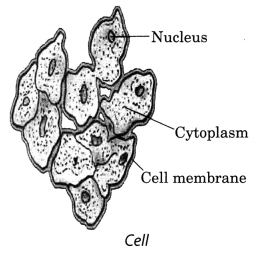
What are the main parts of a cell?
Answer:

  • Cell membrane
  • Nucleus
  • Cytoplasm

Question 9.
Which mode of nutrition is used by green plants?
Answer:
Autotrophic mode

Question 10.
Why insectivorous plants feed on insects?
Answer:
Insectivorous plants feed on insects to fulfill their nitrogen needs.

Question 11.
What are the raw materials for photosynthesis?
Answer:

  • Water
  • CO2
  • Sunlight
  • Chlorophyll

Question 12.
What is autotrophic nutrition?
Answer:
The type of nutrition in which organism prepare their own food is known as autotrophic nutrition.

Question 13.
What is photos3mthesis?
Answer:
The process by which green plants prepare their own food using CO2 and water in the presence of sunlight and chlorophyll is called photosynthesis.

Question 14.
What are heterotrophs?
Answer:
The type of organisms which depend on other organisms for their food are known as heterotrophs.

Question 15.
What do you mean by saprophytic nutrition?
Answer:
The type of nutrition in which organisms depend upon dead and decaying matter for their food is known as saprophytic nutrition.

Question 16.
Name two plants that have a symbiotic relationship with Rhizobium bacteria.
Answer:
Peas and moong

Question 17.
What are insectivorous plants? Give an example.
Answer:
The plants which trap insects for feeding are called insectivorous plants. For example, pitcher plant.

Question 18.
What are parasites?
Answer:
The organisms which obtain nutrients from other organisms are called parasites.

Question 19.
What is host?
Answer:
The organisms which provide nutrients to another organism, known as parasites, is called host.

Extra Questions for Class 7 Science Chapter 1 Short Answer Type

Question 1.
What is haustoria?
Answer:
Haustoria is the root of a parasitic plant that penetrates the host’s tissue and draws nutrients from it.

Question 2.
Differentiate between parasitism and symbiosis.
Answer:
Parasitism

  • It is a relationship between two organisms which is beneficial to one and harmful to the other.
  • One of the partner which draws food is called parasite and the other which provide nutrients is called host.
  • Example: Cuscuta

Symbiosis:

  • It is a relationship in which two organisms live together in a manner benefited.
  • Each partner of the relationship is called a symbiont.
  • Example: Lichen

Question 3.
List some harmful effect of fungi.
Answer:

  • They cause diseases in crops, animals and humans.
  • They spoil fruits, vegetables and all kinds of foodstuff.
  • They spoil leather items and clothes.

Question 4.
How does a pitcher plant trap insects?
Answer:
The leaf of pitcher plant is modified into a pitcher-like structure. The apex of the leaf forms a lid over it which can open and close. Inside the pitcher, there are hair which are directed downwards. When an insect lands in the pitcher, the lid closes and the insect get trapped into the hair and then insect is digested by the digestive juice secreted by the pitcher.

Question 5.
From where do the plants obtain nitrogen?
Answer:
Soil has certain bacteria that convert gaseous nitrogen into a usable form and release it into the soil. These soluble forms are absorbed by the plants along with water. Plants also obtain nitrogen from the fertilizers added by the farmers.

Question 6.
Explain the symbiotic relationship in lichens.
Answer:
In lichens, a chlorophyll-containing partner, an alga, live together with a fungus. The fungus provides shelter, water, and minerals to the alga and in return, the alga provides food which it prepares by photosynthesis.

Question 7.
Explain the symbiotic relationship between Rhizobium bacteria and leguminous plants.
Answer:
Nitrogen gas is available in plenty in the air but plants cannot use it in manner they can use carbon dioxide. They need nitrogen in soluble form. The bacterium called Rhizobium can take atmospheric nitrogen and convert it into soluble form. But Rhizobium cannot make its own food. So it lives in the roots of leguminous plants and provide them with nitrogen and in turn gets food and shelter from the plant.

Extra Questions for Class 7 Science Chapter 1 Long Answer Type

Question 1.
Differentiate between autotrophic and heterotrophic modes of nutrition.
Answer:
Autotrophic:

  • This type of nutrition is found in green plants.
  • Autotrophic organism can prepare their own food.
  • In this mode of nutrition, carbon dioxide is utilized to prepare food in presence of sunlight.

Heterotrophic:

  • This type of nutrition is found in some plants and all animals.
  • Heterotrophic organisms cannot prepare their own food.
  • They cannot use carbon dioxide to prepare food in presence of sunlight.

Question 2.
What is photosynthesis? Draw a schematic diagram to show photosynthesis.
Answer:
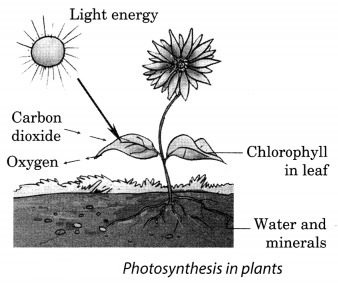
The process by which green plants containing chlorophyll prepare their own food with the help of sunlight, water and carbon dioxide is called photosynthesis.

Carbon dioxide from air is taken in through the tiny pores present on the surface of leaves. Water and minerals absorbed by the roots are transported to the leaves by the vessels which run throughout the plant.

The process can be represented as:
Nutrition in Plants Class 7 Extra Questions with Answers Science Chapter 1, 1
During the process of photosynthesis oxygen is released.
The carbohydrate so formed in the above process is ultimately converted into starch.
Nutrition in Plants Class 7 Extra Questions with Answers Science Chapter 1, 2

Question 3.
What is saprotrophic nutrition? Define the term saprotrophs.
Answer:
Organisms secrete digestive juices on the dead and decaying matter and convert it into a solution. Then they absorb the nutrients from it. This mode of nutrition in which organisms take in nutrients in solution form from dead and decaying matter is called saprotrophic nutrition.
Plants which use saprotrophic mode of nutrition are called saprotrophs.

Question 4.
Explain with the help of a labelled diagram ‘structure of a cell’.
Answer:
Nutrition in Plants Class 7 Extra Questions with Answers Science Chapter 1, 3
The body of a living organisms are made of tiny units called cells.
Cells can be seen only under the microscope. Some organisms are made of only one cell. The cell is enclosed by a thin outer boundary, called the cell membrane. Most cells have a distinct, centrally located spherical structure called the nucleus. The nucleus is surrounded by a jelly-like substance called cytoplasm.

Question 5.
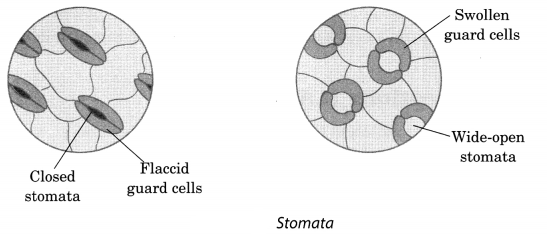
Describe the function of stomata.
Answer:
The leaves take in carbon dioxide from the air through the small openings present on the surface of leaf called stomata (singular: stoma). Each stoma is bound by two crescent-shaped guard cells.

These cells draw water from the neighboring cells and swell up allowing the stomata to open. This allows carbon dioxide to enter the cells of the leaf through the stomata.
Nutrition in Plants Class 7 Extra Questions with Answers Science Chapter 1, 4

Question 6.
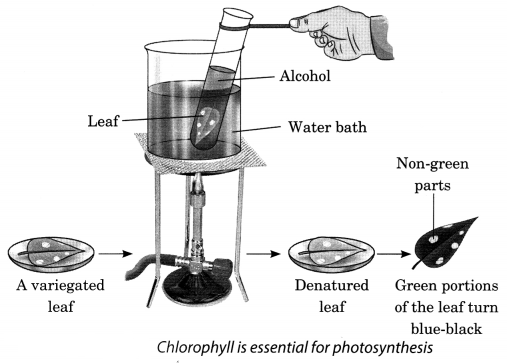
With the help of an experiment show that chlorophyll is necessary for photosynthesis.
Answer:
Nutrition in Plants Class 7 Extra Questions with Answers Science Chapter 1, 5
Take a variegated leaf like that of garden corton or Coleus. Boil the leaf in a test tube containing water and then alcohol in a water bath. Take out the leaf and wash it with warm water. Keep the leaf in a Petri plate and add 4-5 drops of iodine solution on it.

You will observe that only those portions of the leaf will turn blue-black which were green. The non-green part did not show any colour change. This shows chlorophyll is necessary for photosynthesis.

Nutrition in Plants HOTS Questions With Answers

Question 1.
Why most of the things are spoiled by fungi during rainy season only?
Answer:
Spores of fungi germinate and grow when they get wet and warm conditions. Rainy season provides them the hostile condition, so they grow and spoil most of the things in rainy season only.

Question 2.
Do leaves other than green color also have chlorophyll?
Answer:
Yes, leaves other than green color also have chlorophyll. A large amount of red, brown and other pigments mask the green color. Photosynthesis takes place in these leaves also.

Question 3.
If pitcher plant is green and carries out photosynthesis, then why does it feed on insects?
Answer:
Generally, pitcher plants grow in locations where the soil is too poor in minerals, particularly in nitrogen and phosphorous. So to fulfill its mineral requirements it feed on insects.

Question 4.
Potato and ginger are both underground parts that store food. Where is the food prepared in these plants?
Answer:
Food is prepared in the leaves of these plants and then it is transported to underground parts for storage.

Question 5.
Why farmers do not add fertilizers during cultivation of leguminous crop?
Answer:
Farmers do not add fertilisers during cultivation of leguminous crop because roots of leguminous plants have symbiotic association with a bacterium called Rhizobium which fixes atmospheric nitrogen into the soil.

Question 6.
Why Cuscuta have parasitic mode of nutrition?
Answer:
Cuscuta does not have chlorophyll, so it cannot synthesize its own food. Thus it obtains nutrition from its host through modified roots called haustoria. Haustoria penetrate into the host cell and derive their nutrition from there.

Extra Questions for Class 7 Science Chapter 1 Value Based Questions

Question 1.
During a rainy season Radhika’s, mother seems to be very busy in cleaning and keeping things in proper places. Radhika being feeling bored went to her mother and asked her what she is up to. Her mother affectionately explained her that this is the time when fungus grow very much. So she is keeping all things safe from their attack. Radhika on understanding this started helping her mother.
(a) What is fungi?
(b) What is the mode of nutrition in fungi?
(c) Why fungi appear suddenly during rainy season?
(d) How can you keep your things safe from fungi?
(e) What value of Radhika is shown here?
Answer:
(a) Fungi is single-celled or multicelled, spore-producing organisms which feed on organic matter.
(b) Fungi feed on dead and decaying matter so their mode of nutrition is saprotrophic.
(c) Spores of fungi germinate and grow when they get hot and wet condition. This condition is met during rainy season.
(d) We can keep our things safe from fungi by

  • Keeping them in dry and clean places.
  • Putting or wrapping them with suitable materials.
  • Keeping food items in refrigerator and closing them with proper lids.

(e) Radhika is inquisitive, enthusiastic, and helpful.

Question 2.
Raman once saw Raghav planning of cutting all the trees around his house. Raman asked Raghav the reason for this step. Raghav replied that these trees do not provide him anything like fruits, timber, etc., so he is cutting them. Raman explained him though they are not providing him fruits, timber, flower, etc., but still they are very useful to all.
(a) How plants are still useful to all?
(b) List some items we get from plants.
(c) A cow ate all the leaves of a small plant but then also new leaves seen sprouting after a few days. How did the plant survived without leaves?
(d) What values of Raman and Raghav is shown here?
(e) What will you do if you also have a tree near your house which is of no use to you?
Answer:
(a) Plants give out oxygen and takes in carbon dioxide during the process of photosynthesis. Thus helps to keep the atmosphere clean.
(b) We get food, clothes, timber, fuel, medicines, fruit, flower, etc., from plants.
(c) Plant survived on the food stored in plant stem and roots for that time being still the leaves started sprouting.
(d) Raman is a good thinker, intelligent, eco-friendly with future vision. Whereas Raghav is self-oriented and ignorant.
(e) If it is of no use then also I will try to guard it because at least it will provide us with fresh air and shade.

Preposition Exercises for Class 4 CBSE With Answers

Preposition Exercises for Class 4 CBSE With AnswersDefinition: A preposition is a word placed before a noun or a pronoun to show in what relation the person or thing denoted by it stands in regard to something else.

This grammar section explains English Grammar in a clear and simple way. There are example sentences to show how the language is used.

Preposition Exercises for Class 4 CBSE With Answers PDF

It shows relations between the naming words, describing words etc.

A preposition that tells where something or someone is placed is called preposition of place. Across, around, between, in front of, next to, behind, over are the prepositions of place.

A preposition that shows when the things happen is called the preposition of time. In, On and At are the prepositions of time.

Preposition Exercises with Answers for Class 4 CBSE PDF

A. Underline the prepositions in the following sentences.

1. He dived in the pond and swam across it in five minutes.
2. The climber took the rope from his bag and tied it round the rock.
3. The cat squeezed through the small window, jumped onto the ground and ran along the path.
4. It was windy during the night, so I couldn’t sleep at night and got up late in the morning.

B. Choose from the following prepositions- across, at, from, in, on, to and complete the sentences.

1. My parents got married _____________ 2010.
2. The police station is _____________ the right.
3. We’re going _____________ Italy for our holiday

C. Which of the following prepositions (at, in or on) can be put before the following words or phrases?

More about Prepositions Exercises for Class 4 CBSE With Answers

  • We use preposition of place to show position and direction also.
  • Up, down, to, with, until, besides, near, from are the preposition of place and direction.

Presentation
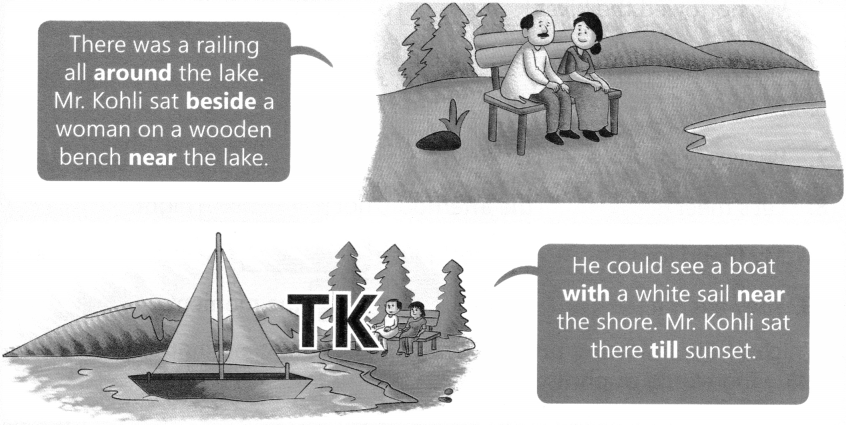
Read the picture story.
Preposition Exercises for Class 4 CBSE With Answers 1
Preposition Exercises for Class 4 CBSE With Answers 2

A. Answer the following questions as per the story.
1. What did Mr. Kohli see while walking?
2. Where did Mr. Kohli sit near the lake?
3. What did Mr. Kohli see while sitting near the lake?

Prepositions Exercises with Answers PDF for Class 4 CBSE

A. Use prepositions from the box to complete the sentences. Write ‘Place’ in the box if the prepositions show place. Write ‘Time’ in the box if it shows time.

at – up – until – near – in – to – from – by

1. Her house is _____________ the school, so she walks _____________ school. _____________
2. The monkey climbed _____________ the tree and jumped _____________ branch _____________ branch. _____________
3. You must finish your work _____________ fifteen minutes. It is 12: 00 now, the so you should complete it _____________ 12:15. _____________.
4. I attend music class _____________ three _____________ five _____________ the evening. _____________
5. I usually get up six _____________ the morning, so don’t disturb me _____________ six. _____________

B. Fill in the blanks with correct preposition from the brackets.

1. Tail is the opposite _____________ short, (to/of)
2. What was the cause _____________ the accident? (of/about)
3. This film is different _____________ that one. (to/from)
4. They watched TV _____________ three hours, (for/during)
5. I am sorry _____________ making a mistake, (to/for)

C. Fill in the blanks with by on.

1. Long ago people didn’t travel _____________ bus or train; they travel _____________ foot and _____________ horseback.
2. She goes to school _____________ a bicycle.
3. Have you ever travelled _____________ plane?
4. He went to office _____________ his motorbike.
5. I go to school _____________ foot but Susan goes bus.

Focus of Prepositions

a. The object of a preposition is the noun or pronoun that follows the preposition.
b. A prepositional phrase is a group of words that begins with a preposition and ends with the object of the preposition.
Example:

  • John leaned against the tree.
  • The preposition is against.
  • The object of the preposition is tree.
  • The prepositional phrase is against the tree.

D. Identify the preposition, object and prepositional phrase.

1. Rosie walked her dog across the street.
The preposition is _____________
The object of the preposition is _____________
The prepositional phrase is _____________

2. Nancy put her toys under the bed.
The preposition is _____________
The object of the preposition is _____________
The prepositional phrase is _____________

3. There are four books in the bin.
The preposition is _____________
The object of the preposition is _____________
The prepositional phrase is _____________

Fibre to Fabric Class 6 Extra Questions and Answers Science Chapter 3

In this page, we are providing Fibre to Fabric Class 6 Extra Questions and Answers Science Chapter 3 pdf download. NCERT Extra Questions for Class 6 Science Chapter 3 Fibre to Fabric with Answers will help to score more marks in your CBSE Board Exams.

Class 6 Science Chapter 3 Extra Questions and Answers Fibre to Fabric

Extra Questions for Class 6 Science Chapter 3 Fibre to Fabric with Answers Solutions

Fibre to Fabric Class 6 Extra Questions Very Short Answer Type

Question 1.
What are fabrics?
Answer:
Fabrics mean a woven material, textile or other materials resembling woven cloth.

Question 2.
Name two synthetic fibres.
Answer:
Polyester and nylon

Question 3.
What are fibres?
Answer:
The thread-like materials used to make cloth or fabric are called fibres.

Question 4.
Name some natural fibres.
Answer:
Wool, jute, cotton, flax, etc.

Question 5.
Name two varieties of cloth materials which are commonly used.
Answer:
Cotton and wool

Question 6.
Name the thing which is used to make fabric.
Answer:
Yarns

Question 7.
How many types of fibres are there?
Answer:
There are two types of fibres:
(a) Natural fibres
(b) Synthetic fibres

Question 8.
What are yarns made up of?
Answer:
Yarns are made up of thin strands called fibres.

Question 9.
Name the four types of fabrics which are still used in un-stitched form in our country.
Answer:
Dhoti, saree, lungi and turban.

Question 10.
Where was cotton cultivated for clothes for the first time?
Answer:
India

Question 11.
Name two products obtained by weaving ‘twigs’ and ‘grass’.
Answer:
Mats and baskets

Question 12.
What type of soil is used to grow cotton plants called?
Answer:
Black soil

Question 13.
What is ginning?
Answer:
Ginning is the process of separating fibres from the seeds of cotton.

Question 14.
What are fruits of cotton plants called?
Answer:
Cotton bolls

Question 15.
Name two hand-operated devices used for spinning.
Answer:
Takli and charkha.

Question 16.
Name the states where jute plants are mainly grown in India.
Answer:
Bihar and West Bengal.

Question 17.
What is spinning?
Answer:
The process of making yarns from fibres is called spinning.

Question 18.
What is the colour of cotton flowers?
Answer:
Yellow

Question 19.
Which country is the largest producer of jute?
Answer:
Bangladesh

Question 20.
List one use of jute.
Answer:
Jute is mainly used as a packaging material.

Question 21.
Which jute is used as a herb in Middle Eastern and African countries?
Answer:
Tossa jute

Question 22.
Name the animal fibre.
Answer:
Wool

Question 23.
What is sericulture?
Answer:
The rearing of silk moths for the production of silk is called sericulture.

Question 24.
Which fibre is the expensive fibre?
Answer:
Silk

Question 25.
Which country is the leading producer of wool?
Answer:
Australia

Fibre to Fabric Class 6 Extra Questions Short Answer Type

Question 1.
Why do we need clothes?
Answer:
We need clothes because of the following reasons:

  1. Clothes protect our body from extreme weather conditions, like heat, cold, rain, etc.
  2. They protect us from harmful insects, bacteria and dirt, wind and injury.
  3. They protect us from foreign, harmful substances falling on our body.
  4. Clothes help us to maintain body heat.

Question 2.
What are natural fibres? Give some examples of natural fibres.
Answer:
The fibres that are obtained from natural sources, i.e., plants and animals are called natural fibres. For example, cotton, jute, wool, etc.

Question 3.
List three uses of cotton.
Answer:
The three uses of cotton are:

  1. Cotton is useful to make bed sheets, curtains, upholstery, etc.
  2. Cotton oil is extracted from its seeds, which is refined to use as a cooking oil.
  3. Cotton is also used to make some artificial fibres like rayon.

Question 4.
List the steps involved in the preparation of fabric.
Answer:
The steps involved in the preparation of fabrics are:

  1. Obtaining fibre.
  2. Preparation of yarn from fibres by spinning.
  3. When two sets of yarn are involved, yarns are woven on looms to make fabric. When a single yarn is used, the fabric is prepared by knitting.

Question 5.
What are synthetic fibres?
Answer:
The fibres which are made from chemical substances or which are not obtained from the plant and animal sources are called synthetic fibres.

Question 6.
List three qualities of cotton fibre.
Answer:
The three qualities of cotton fibre are:

  1. It can absorb water and sweat.
  2. It can be dyed in different colours and has good colour retention.
  3. It is a soft and smooth fibre.

Question 7.
Explain how jute is obtained from the jute plant.
Answer:
The jute plant is normally harvested at flowering stage. The stems of harvested plants are bundled and immersed in water for 10 to 15 days. The stems rot and fibres are separated by hand. These fibres are converted into yarns to make fabrics.

Question 8.
List some qualities of jute.
Answer:
The qualities of jute are:

  1. It is 100% biodegradable and recyclable.
  2. It is strong and durable.
  3. It can easily be blended with other fibres.

Question 9.
State the two steps involved in making fabrics from fibres.
Answer:
The fabrics are made from fibres in the following two steps:

  • Fibres are first converted to yarn by the process of spinning.
  • Fabric is made from yam by the process of weaving or knitting.

Question 10.
Why are cotton and woollen clothes rough whereas silk, rayon, nylon and polyester smooth to touch?
Answer:
Roughness of cotton and woollen fibre is due to presence of many folds and uneven surfaces in it. Silk, rayon, nylon and polyester are smooth because they have long plain, fibre structure.

Question 11.
Why primitive life was confined to the tropics? When it was possible for the people to migrate to colder regions?
Answer:
Primitive men and women had no idea about clothes and were at the mercy of their environment. Primitive life was confined mostly to the tropics where the climate was warm and no clothing was needed. Only after the invention of fire, it became possible for people to migrate to colder regions.

Question 12.
How are fibres classified?
Answer:
Fibres are classified on the basis of their origin and are mainly divided into two types:

  • Natural fibres
  • Synthetic fibres

Question 13.
What were the wearing of the people of Stone Age?
Answer:
During the Stone Age, people wore bark, leaves of trees or animal skins to keep themselves warm.

Question 14.
Explain about spinning.
Answer:
Spinning is the process of converting fibres into yarn by twisting the fibres using various machines. It is done in the way as the wicks are made from cotton wool at homes. Fibres are drawn out and twisted. It can be done both by hands and by machines. Manually, it is done with a hand spindle called takli or on a spinning wheel called charkha.

Question 15.
What is knitting?
Answer:
Knitting is usually done with a single yarn with the help of knitting needles to make a piece of fabric.

Fibre to Fabric Class 6 Extra Questions Long Answer Type

Question 1.
Differentiate between natural fibres and synthetic fibres.
Answer:

Natural fibresSynthetic fibres
(i) Fibres obtained from natural resources are called natural fibres.

(ii) It can absorb water and sweat.

(iii) It takes long time to be converted from raw form to usable form.

(iv) Some examples are cotton, wool, silk, jute, flax, etc.

(i) Fibres that are manufactured artificially in factories using different chemicals are called synthetic fibres.

(ii) It cannot absorb water and sweat.

(iii) It can be easily converted from raw form to usable form.

(iv) Some example are rayon, nylon, terylene, polyester, etc.

Question 2.
Differentiate between cotton and jute fibre.
Answer:

Cotton fibreJute fibre
(i) Cotton fibre is obtained from the flowers of cotton plants.(i) Jute fibre is obtained from the stem of jute plants.
(ii) Black soil is most suitable for growing cotton plants.(ii) Alluvial soil is most suitable for growing jute plants.
(iii) The cotton plant requires warm climate.(iii) Jute plant requires warm and humid climate.
(iv) Cotton is mainly cultivated in Punjab, Rajasthan, Gujarat, Tamil Nadu, Karnataka, Andhra Pradesh, etc.(iv) Jute is mainly cultivated in Bihar, Assam, Odisha, Andhra Pradesh, West Bengal, etc.
(v) Cotton is used to make clothes, bedsheets, cooking oil and artificial fibres like rayon.(v) Jute is used to make ropes, mats, packaging, material, sacks.

Question 3.
In which season is cotton planted? What is its course of growth?
Answer:
It is planted in early spring. Cotton plants grow steadily and soon become bushes of 3 to 6 feet high. After about 2 months, they bear white or yellowish flowers which turn pink or red after a few days. The petals of the flowers fall, leaving behind tiny green seeds. This later grows into spherical shaped structure of the size of wallnut, which is called cotton ball.

As the cotton balls grow steadily the seeds and fibres grow inside. On maturing, the green balls begin to turn brown. On complete maturation, they become ready to burst open, exposing the white fibres. As the fibres dry in the sun, they become fluffy.

Question 4.
What is retting? Explain how fibres are obtained from the jute plants.
Answer:
Jute plants are cut at the flowering stage when plants are 8-10 feet high. The cut plants are grouped at different places in the field for few days when most of the leaves dry up and fall down. The plants are now tied into small bundles.

The bundles are made to sink in stagnant water of a pond for few days when the gummy skin rots out to separate fibres. This process is called retting. Fibre is extracted from the retted jute by hand, with jerks and pulls. The dried fibres are then tied together in small bundles.

Question 5.
What is a loom? For what purpose is it used? What is the difference between handloom and power loom?
Answer:
A device which is used for making fabrics by weaving yarn or threads is called a loom. The weaving of yarn to make fabrics is done by using looms.

The difference between handloom and power loom are:

  • Handloom: It is a cloth weaving machine which is manually operated. In many parts of our country, handloom cloth is produced in large quantities.
  • Powerloom: It is a medium-sized weaving machine that run on power supply. It is used to produce cloth on large scale in cloth producing industries.

Question 6.
What is meant by fibre and fabric? Describe the process of making fabrics from fibre.
Answer:
Fibre: A very thin, thread like strand from which cloth is made is called fibre.
Fabric: Fabric means a woven material resembling woven cloth. Fabric is made up of yarns.
Making Fabric: The two main processes used for making fabrics are knitting and weaving.

  1. Knitting: The process of making fabric by forming a series of connected loops of yarn is called knitting. This process is used for making sweaters, woollen caps, gloves, etc.
  2. Weaving: The process of making fabric by crossing two sets of yarns over and under each other is called weaving. This process is used for making shirts, trousers, T-shirts, etc.

Question 7.
What are the three stages in history of the development of clothing material?
Answer:
In terms of raw materials, cloth making was developed in three stages. The first stage was cloth from plant fibres, such as flax, cotton, nettles and inner bark of the trees. The second stage began with the use of animal fibres especially wool and silk. Silk came to various parts of the world from China.

The third stage in the history of clothing began in the late 19th century with the development of man-made or synthetic fibres like rayon, nylon and polyester. Now man-made fibres combined with other animals with or without plant fibres are used for making clothes for improved strength, wearing ability and other qualities.

Fibre to Fabric Class 6 Extra Questions HOTS

Question 1.
While going to kitchen for cooking, which natural fibre do you think is best to wear? Why?
Answer:
Cotton fibre is the best fibre to wear during cooking because in case of any accidental fire it does not stick with the body.

Question 2.
Which type of dress material would you like to wear in summer?
Answer:
In summer we would like to wear dress materials made up of cotton and having light colour.

Question 3.
Which fibre do you think absorb the water most-cotton, nylon, polyester, wool and silk?
Answer:
Wool have maximum water absorbing capacity.

Question 4.
Why burning of silk and wool gives odour of hair and charred meat but burning of synthetic yarn gives odour that of plastics?
Answer:
Silk or wool are obtain from animals so they have characteristic odour of burning meat and hair respectively. Synthetic fibres are artificial fibre made up of polymers as in case of plastics so they also smell like plastics.

Question 5.
Why the process of retting is needed in process of harvesting jute?
Answer:
Process of retting helps in separation of pulpy material of the stem from the jute fibres.

Fibre to Fabric Class 6 Extra Questions Value Based (VBQs)

Question 1.
Class VI students were going to a picnic in the month of June. Shalini wore a beautiful synthetic dress. When Shalini’s friend Ria arrived, she praised her dress and suggested that though her dress is very beautiful but she won’t feel comfortable in the picnic. She must wear a cotton dress.
(a) Write some properties of cotton cloth.
(b) Write some properties of synthetic cloth.
(c) Why do you think Ria suggested Shalini to wear cotton cloth?
(d) What value of Ria is shown here?
Answer:
(a) Cotton cloth are good absorbent of moisture, comfortable, soft, have no pronounced lustre and easily creasable.
(b) Synthetic cloth are less absorbent of moisture, not skin friendly, durable, have lustre, crease- resistant, moth resistant, cheap, etc.
(c) Ria suggested Shalini to wear cotton cloth because it was the summer season and synthetic clothes are less absorbent of moisture due to which Shalini might not feel comfortable.
(d) Ria is bothering, caring, helpful with scientific temperament.

Question 2.
While doing an experiment to see burning characteristics of various fibre Prakash hold the cotton fibre in his hand and was about to burn it on the burner. On seeing this, his classmate Ratan stopped him immediately and asked to use tong to hold the fibres.
(a) What is fibre?
(b) Name any three natural fibres.
(c) What are the burning characteristics of the above three fibres?
(d) What value of Prakash is shown here?
Answer:
(a) Fibres are the thread-like structures that are obtained from animals or plants sources or are synthesised artificially.
(b) Cotton, silk and jute.
(c) Cotton and jute burn with the odour of burning paper while silk burns with a characteristic smell of charred meat. Prakash lacks scientific aptitude, careless, not attentive in class.

Management of Natural Resources Class 10 Extra Questions with Answers Science Chapter 16

In this page, we are providing Management of Natural Resources Class 10 Extra Questions and Answers Science Chapter 16 pdf download. NCERT Extra Questions for Class 10 Science Chapter 16 Management of Natural Resources with Answers will help to score more marks in your CBSE Board Exams.

Class 10 Science Chapter 16 Extra Questions and Answers Management of Natural Resources

Extra Questions for Class 10 Science Chapter 16 Management of Natural Resources with Answers Solutions

Extra Questions for Class 10 Science Chapter 16 Very Short Answer Type

Question 1.
List any two causes for deforestation taking place.  (CBSE 2009)
Answer:

  1. Meeting the needs of growing population and using land for housing.
  2. Setting up industries.
  3. Converting into agricultural land.

Question 2.
Name any two forest products each of which is the basis for some industry. (CBSE 2009)
Answer:

  1. Timber wood: Used in making paper and furniture.
  2. Latex of rubber plant: In making tyres.
  3. Resins and gums: Used in paints and varnishes.

Question 3.
Mention any one negative effect of our affluent life style on the environment.  (CBSE 2013, 2014)
Answer:
Chlorofluorocarbons used in refrigerators causing ozone hole. Carbon dioxide released on burning fossil fuels causing global warming.

Question 4.
List any two measures that you suggest for better management of water resources.  (CBSE 2013, 2014)
Answer:

  1. Rainwater harvesting.
  2. Reusing the rinsed water from washed clothes for cleaning or mopping the house.

Question 5.
Give one example each from your daily life where the household waste can be effectively reused and recycled respectively.  (CBSE 2013, 2014)
Answer:
Reuse: Empty plastic or glass bottles of jams and pickles
Recycle: Paper and empty polypacks of milk.

Question 6.
Name any two items which can be easily recycled but are generally thrown in the dustbins by us.  (CBSE 2013, 2014)
Answer:
Paper, polypacks of milk, cold drink cans, etc.

Question 7.
Write the main objective of conservation of biodiversity.  (CBSE 2013)
Answer:
To maintain ecological balance as loss of biodiversity leads to ecological instability.

Question 8.
Water is a valuable resource. List two ways that you would suggest every family member to save this resource. (CBSE 2014)
Answer:

  1. Prevent leakage from tap and ensure timely repairs.
  2. Reuse the rinsed water from washed clothes for watering plants in garden.

Question 9.
“We need to manage our resources”. List two reasons to justify this statement.  (CBSE 2014)
Answer:

  1. For equitable distribution of resources so that all people get their benefits.
  2. Many resources are limited and would exhaust due to overexploitation.

Extra Questions for Class 10 Science Chapter 16 Short Answer Type I

Question 1.
List any four measures for conserving forests.  (CBSE 2009)
Answer:

  1. Reduce the indiscriminate felling of trees.
  2. Create awareness among people for conservation of forests.
  3. Involving local people in management and conservation of forests.
  4. Reforestation by promoting silviculture.
  5. Providing protection to wildlife and endangered plants.
  6. Making strict laws for conservation of forests.

Question 2.
List any four advantages of water harvesting.  (CBSE 2009)
Answer:

  1. Helps to recharge ground water.
  2. Underground water does not act as breeding ground of mosquitoes.
  3. Underground water does not get contaminated by human and animal wastes.
  4. Provides moisture to the soil and crops.

Question 3.
We often observe domestic waste decomposing in the by lanes of residential colonies. Suggest ways to make people realise that the improper disposal of waste is harmful to the environment.  (CBSE 2013)
Answer:

  • Create awareness through campaigns and road rallies on the issue.
  • Impose penalty on those found throwing wastes on the road.

Question 4.
List two environment-friendly practices or habits which need to be followed by every member of a family / community. Explain how these practices will support the “save the environment” mission. (CBSE 2014)
Answer:

  • Segregation of wastes into biodegradable and non-biodegradable and ensuring their reuse and recycling, if possible.
  • Less use of fossil fuels and switching to environment friendly alternatives like use of solar energy and wind energy, etc.

Question 5.
What is meant by “Sustainable Management”? Why is reuse considered better than recycling?  (CBSE 2015)
Answer:
The judicious and wise use of resources to cater to the current basic needs and preserving the resources for the needs of future generations is called as Sustainable Management.
Recycling requires more amount of energy and money while no energy is required for the reuse of materials. So, reuse is better than recycling.

Question 6.
List two advantages associated with water harvesting at the community level. (CBSE 2015)
Answer:
Water harvesting at community level is advantageous as:

  • It recharges the ground water and helps in increasing the vegetation around the area.
  • It mitigates the chances of droughts and floods. It also increases income of farmers by increasing agricultural production in rural areas.

Question 7.
Everyone of us can do something to reduce our personal consumption of various natural resources. List four such activities based on 3R’s approach.  (CBSE 2013, 2015)
Answer:

  • Reduce wastage of water by repairing leaking taps.
  • Recycle the wastes like paper, empty polypacks of milk, etc.
  • Reuse the aluminium cans of cold drink, glass bottles of pickles, etc.
  • Reduce the use of fossil fuels by switching over to cleaner and renewable sources of energy like solar energy.

Question 8.
List two main causes of the pollution of water of the river Ganga. State how pollution and
contamination of river water prove harmful for the health of the people of neighbouring areas. (CBSE 2015)
Answer:
The two main causes of pollution of water of river Ganga are:

  1. Disposal of domestic and industrial effluents into it.
  2. Human activities like washing clothes, bathing, etc.

The harm to the people of neighbouring areas are:

  1. Leads to water-borne diseases like cholera, typhoid, etc.
  2. Harms the aquatic plants and animals in the water body.

Question 9.
List any two advantages associated with water stored in the ground.  (CBSE 2015)
Answer:
The water stored in ground

  1. does not evaporate
  2. does not act as breeding ground of mosquitoes.

Question 10.
What steps have been taken by West Bangal Government to protect badly degraded sal forests?
Answer:
By the efforts of A.K . Banerjee in Arabari forest range of Midnapore district the badly degraded sal forests were revived with the involvement and participation of local villagers. The villagers were in return given employment and were allowed to collect firewood and fuelwood at a nominal fee.

Question 11.
Why are forests considered ‘biodiversity hot spots’? What would happen due to loss of biodiversity?
Answer:
Wide variety of plants, animals, microorganisms are found in forests. So they act as biodiversity hotspots. Loss of biodiversity disturbs ecological balance.

Question 12.
Prepare a list of five items that you use daily in the school. Identify from the list such items that can be recycled. (NCERT Exemplar)
Answer:
Paper, Plastic pencil box or Tiffin box, Steel spoon, Scale, Eraser.

Question 13.
List two advantages associated with water harvesting at the community level.  (NCERT Exemplar)
Answer:

  1. Recharging of wells leads to increase in ground water level.
  2. Ground water does not evaporates and keeps the layers of soil above it moist.
  3. The water stored during rainy season can be used when required.

Question 14.
What measures would you take to conserve electricity in your house?  (NCERT Exemplar)
Answer:

  • Switch off the fans and lights when they are not required.
  • Use solar water heaters during winters.
  • Use LED lights instead of normal bulbs or tube lights.

Question 15.
Although coal and petroleum are produced by degradation of biomass, yet we need to conserve them. Why? (NCERT Exemplar)
Answer:
It takes millions of years to form coal and petroleum and their reserves are limited. Due to this they would get exhausted very soon if utilised at a faster rate. Hence, they should be conserved for the needs of the future generations too.

Question 16.
Suggest a few measures for controlling carbon dioxide levels in the atmosphere.  (NCERT Exemplar)
Answer:

  • Plant more and more trees.
  • Using cleaner fuels like CNG.
  • Make manure from litter instead of burning it.
  • The harmful effluents from industries should be treated before discharging them into the atmosphere.
  • Less use of fossil fuels.

Extra Questions for Class 10 Science Chapter 16 Short Answer Type II

Question 1.
What are natural resources? State two factors that work against an equitable distribution of these resources. (CBSE 2009)
Answer:
The stock of nature such as air, water, soil, minerals, forests and wildlife are called as natural resources. The two factors that work against their equitable distribution are

  1. Overuse of resources and their overexploitation.
  2. Human activities like cutting of trees, hunting, etc. which disturbs ecological balance.

Question 2.
What is water harvesting? Mention any two water harvesting structures.  (CBSE 2009)
Answer:
Capturing rainwater where it falls or capturing the run-off water so that it can be made available throughout the year for various purposes is called water harvesting.
Some traditional water harvesting structures are:

  1. Khadins, tanks and nadis in Rajasthan
  2. Kulhs in Himachal Pradesh.

Question 3.
How can we as an individual help in reducing the use of fossil fuels? Mention two ways.
Answer:
We can reduce the use of fossil fuels by .

  1. Switching over to renewable sources of energy like solar energy, wind energy, etc.
  2. Use public transport instead of private vehicles,
  3. Ensure proper servicing and tuning of vehicles to increase fuel efficiency.

Question 4.
What is meant by exploitation of resources with short aims? List its four advantages.  (CBSE 2009)
Answer:
Use of resources for the benefit of a few rich and powerful people in order to fulfil short-term aims and the present needs is called exploitatation of resources with short aims. Its advantages are:

  1. Maximises profit without any accountability.
  2. Increases growth rate of economy for that duration.
  3. They fulfil the needs of the present generation.
  4. Ensures availability of a variety of raw materials for human use.

Question 5.
(a) List any two disadvantages of using fossil fuels for the production of energy.
(b) Give two examples each of the following:
(i) Renewable sources of energy. 3
(ii) Non-renewable sources of energy.  (CBSE 2011)
Answer:
(a) Disadvantages of using fossil fuels:

  • The oxides of nitrogen and sulphur released on burning fossil fuels reacts with water vapour in air and falls in the form of harmful acid rain.
  • Carbon dioxide released on burning them causes greenhouse effect which leads to global warming.
  • Carbon monoxide releases on their combustion is toxic and can be fatal.
  • They are limited, non-renewable resources which may get exhausted soon.

(b) (i) Examples of renewable sources of energy are

  • Solar energy
  • Wind energy

(ii) Examples of non-renewable sources of energy are

  • Petrol
  • Diesel

Question 6.
Dams are useful for the society but there is public opposition to the construction of large dams. Justify your answer by giving three problems.  (CBSE 2011)
Answer:

  • Social problems: Large number of human settlements gets submerged in water during construction of dam.
  • Environmental problems: Loss of vast variety of flora-fauna due to deforestation and biodiversity loss during construction of dams.
  • Economic problems: Huge amount of public money is spent without getting proportionate benefits from such dams.

Question 7.
List the products of combustion of fossil fuels. What are their adverse effects on the environment?  (CBSE 2012)
Answer:
Carbon dioxide, sulphur dioxide, nitrogen oxide, water, carbon monoxide are the products of combustion of fossil fuels.
Their adverse effects on the environment are:

  • Carbon dioxide is a greenhouse gas which leads to global warming.
  • Oxides of nitrogen and sulphur react with water vapour present in air to form acids which fall in the form of acid rains and harms life.
  • Carbon monoxide is a toxic gas which creates respiratory problems.

Question 8.
What is environmental planning? List any four human activities that are directly connected to influence the environment of a region.
Answer:
Various steps taken to reduce pollution and conserve natural resources for long term use is called environmental planning. It is necessary to maintain ecological balance. Human activities that are directly connected to influence the environment of a region are:

  • Large scale deforestation for agricultural land or housing needs of growing population.
  • Discharge of domestic wastes and industrial effluents into water bodies.
  • Excessive use of fossil fuels which causes air pollution.
  • Excessive use of non-biodegradable materials, plastics, detergents, etc. which harm the environment.

Question 9.
What is the full form of GAP? Why was it started? What is the main cause of abundant coliform in the river Ganga?
Answer:
GAP-Ganga Action Plan:
GAP was started to ensure the cleaning of water of river Ganga and reduce the pollution levels of Ganga. Main cause of abundant coliform bacteria in river Ganga is due to high amount of organic wastes disposed in the form of unburnt corpses into the water.

Question 10.
In a village in Karnataka, people started cultivating crops all around a lake which was always filled with water. They added fertilisers to their field in order to enhance the yield. Soon they discovered that the waterbody was completely covered with green floating plants and fishes started dying in large numbers.
Analyse the situation and give reasons for excessive growth of plants and death of fish in the lake. (NCERT Exemplar)
Answer:
The fertilisers containing high amount of phosphates and nitrates got carried down by rainwater into the lake which led to nutrient enrichment of water in lakes. This caused excessive growth of aquatic plants which ultimately covered the whole surface of the water body. Due to this insufficient amount of light entered the water body and levels of oxygen became low. This led to death of fishes in the water body.

Question 11.
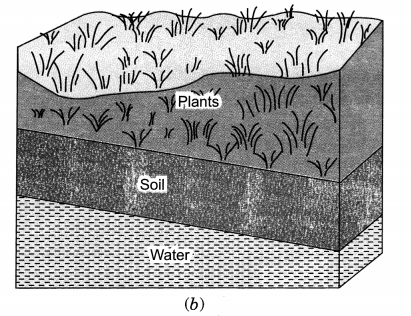
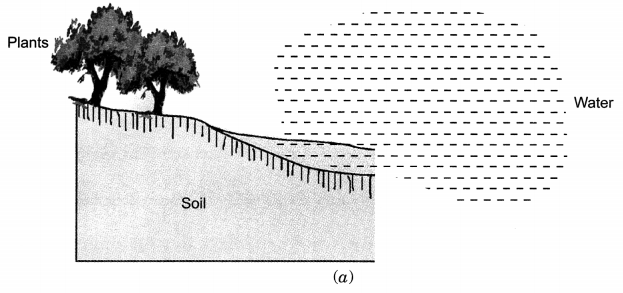
(a) Locate and name the water reservoirs in Figures (a) and (b).
(b) Which has an advantage over the other and why?
Management of Natural Resources Class 10 Extra Questions with Answers Science Chapter 16, 1
Management of Natural Resources Class 10 Extra Questions with Answers Science Chapter 16, 2
Answer:
(a) The water reservoir in Figure (a) is a pond.
The water reservoir in Figure (b) is an underground water body.

(b) Figure (b) has more advantage than Figure (a), because the advantages of water stored in the ground are many. For example

  • It does not evaporate.
  • Spreads out to recharge wells and provides moisture for vegetation over a wide area.
  • Does not provide breeding grounds for mosquitoes like stagnant water.

Extra Questions for Class 10 Science Chapter 16 Long Answer Type

Question 1.
What is a dam? Write two main advantages and two ill-effects of constructing big dam.  (CBSE 2009)
Answer:
Dams are constructed across the rivers to regulate the flow of water and store the huge amounts of water in large reservoirs. This ensures the supply of water for irrigation and other purposes.

Advantages of Dams:

  • Ensures water availability for irrigation of fields.
  • Water can be used to generate electricity in Hydel power stations by using turbines.

Disadvantages of dams:

  • Social problems: Human settlements get submerged under water.
  • Environmental problems: Large scale loss of biodiversity and deforestation.
  • Economic problems: Huge amount of public money utilised in their construction but benefits are not proportionate.

Question 2.
Define Reduce, Recycle and Reuse with reference to the environment. Which is better strategy among recycle and reuse? Why?
Answer:
Recycle: Recycling wastes like paper, plastic and glass to obtain materials for use.
Reduce: Minimise the use of natural resources.
Reuse: Encourage the use of things again and again instead of throwing them away.
Reuse is better than recycling.

Recycling requires large amount of energy and money whereas reuse does not require any energy. So, reuse is better than recycling.

Question 3.
Prepare a list of five activities that you perform daily in which natural resources can be conserved or energy utilisation can be minimised.  (NCERT Exemplar)
Answer:

  • Taking a bus, public transport or walking/cycling instead of a private vehicle.
  • Using LED bulbs in homes instead of normal bulbs.
  • Talking the stairs instead of lift.
  • Using fan and light only when required.
  • Using solar water heating devices.

Question 4.
Is water conservation necessary? Give reasons.  (NCERT Exemplar)
Answer:
The total amount of fresh water is more than enough to meet the needs of human beings. But due to its uneven distribution, wide seasonal, as well as yearly fluctuation in rainfalls and wastage, water shortage is a chronic problem inmost parts of the world.

Management of Natural Resources HOTS Questions With Answers

Question 1.
What is meant by ‘Sustainable Management’? The environmentalists are insisting upon sustainable natural resources management. State its four advantages.  (CBSE 2009)
Answer:
The judicious and wise use of resources to cater to the current basic needs and preserving the resources for the needs of the future generations is called sustainable management. Its advantages are:

  1. Prevents exploitation of resources for short term gains and targets the long term aims.
  2. Ensures equitable distribution of resources.
  3. Minimises the harm caused to the environment.
  4. Ensures the availability of resources for their use by the future generations in order to fulfil their needs.

Question 2.
With the help of an example show that ‘reuse’ strategy is better than recycling.  (CBSE 2010)
Answer:
Recycling involves use of energy and money whereas no energy is used in ‘reuse’, so reuse is better than recycling.

For example,
The plastic bottles can be recycled by heating them and remoulding them into different shapes. But, this would require the use of energy resources for getting heat required for remoulding plastic. Also, cost of the energy resource will have to be met. Instead of this, the plastic bottles can be reused for different purposes which will save both money and energy.

Question 3.
Prejudice against traditional use of forests areas has no basis. Explain with an example.
Answer:
Local people were not allowed by the Government to use the forests in the traditional ways they had been using for generations. This has led to harmful effects on the sustainability of forests and its resources. A striking example of such case is: Nomadic shepherds used to take their sheep for grazing in the alpine meadows of Great Himalayan Peak during summers. But when they were not allowed to take sheep for grazing, it was seen that grass in the region grew very tall and then fell over preventing fresh growth, which proved harmful for the biodiversity of the region.

Question 4.
Suggest a few useful ways of utilising waste water.  (NCERT Exemplar)
Answer:
Ways of utilising waste water are:

  • Ground water level can be recharged.
  • Can be used for construction purposes.
  • Washing cars and watering gardens by treated waste water.
  • Organic wastes in waste water may be used as fertilisers for crops.

Question 5.
What is the importance of forest as a resource?  (NCERT Exemplar)
Answer:
Forest are important as a resources because they

  • Provide shelter and food to wildlife.
  • Maintain balance of oxygen and carbon dioxide in the atmosphere.
  • Increase water holding capacity of soil and prevent soil erosion.
  • Help to regulate the water cycle.
  • Products like fuel, wood, timber, paper, etc. are obtained.
  • Products like fruits, resins, gums, essential oils, etc. used in various industries are obtained.

Question 6.
Why are the Arabari forests of Bengal known to be a good example of conserved forest?  (NCERT Exemplar)
Answer:
Due to efforts of forest officer A.K. Banerjee, the Sal forests in Arabari forests of West Bengal were revived with the active participation of the local people in their conservation. In return the villagers were given employment in both silviculture and harvesting operations, 25 per cent of the final harvest, and allowed fuel wood and fodder collection on payment of a nominal fee.

By 1983, due to the active and willing participation of the villagers, the previously worthless Sal forests in Arabari forest range of Midnapore district Underwent a remarkable recovery and were valued ₹ 12.5 crores.

Extra Questions for Class 10 Science Chapter 16 Value Based Questions

Question 1.
An environmentalist on visit to your school suggested the use of three R’s to save the environment. Explain what he meet by three R’s and how would you follow his advice at home. What values will be evident in this? (CBSE 2009)
Answer:
The three R’s are Reduce, Recycle and Reuse.
Reduce: It means to minimise the use of natural resources.
Recycle: It means to recycle the wastes to obtain materials again for use.
Reuse: It means to use the things again and again instead of throwing them way.

We would follow his advice at home by reducing use of fossil fuels, recycle the non-biodegradable materials and reuse the plastic and glass bottles of jams and pickles.
The values evident are: Awareness, Eco-friendly care for Nature and environment, Scientific aptitude.

Question 2.
Subhash has started the project of constructing his building. His architect suggested that he should add a system of rainwater harvesting in his building. He thought by adopting water harvesting in his project, he can solve his water crisis problem in the years to come.
(i) Is Subhash correct in his approach? Support your answer.
(ii) Give the values shown by Subhash.  (CBSE 2012)
Answer:
(i) Yes, Subhash is correct in adopting water harvesting in his project because the rainwater falling on the roof can be collected and used for recharging the ground water instead of flowing into drains. This would increase the ground water as it neither evaporates nor acts a breeding ground for mosquitoes like the water stored on surface. It also does not get contaminated by the human or animal wastes.

(ii) The values shown by Subhash:

  • Scientific aptitude, Decision-Making
  • Environment Friendly, Care for Nature.