Fibre to Fabric Class 7 Extra Questions and Answers Science Chapter 3

In this page, we are providing Fibre to Fabric Class 7 Extra Questions and Answers Science Chapter 3 pdf download. NCERT Extra Questions for Class 7 Science Chapter 3 Fibre to Fabric with Answers will help to score more marks in your CBSE Board Exams.

Class 7 Science Chapter 3 Extra Questions and Answers Fibre to Fabric

Extra Questions for Class 7 Science Chapter 3 Fibre to Fabric with Answers Solutions

Fibre to Fabric Class 7 Extra Questions Very Short Answer Type

Question 1.
Of which nutrient silk fibre is made?
Answer:
Protein

Question 2.
What are silkworms?
Answer:
Silkworm are caterpillars of silk moth.

Question 3.
What are larvae called?
Answer:
Caterpillars or silkworms

Question 4.
What is the process of taking out silk threads from the cocoon called?
Answer:
Reeling the silk

Question 5.
Where is reeling done?
Answer:
In special machines

Question 6.
What spins the cocoons inside which develops the silk moth?
Answer:
Caterpillar or silkworm

Question 7.
How many eggs do a female silk moth lay at a time?
Answer:
Hundreds of eggs.

Question 8.
Where are the eggs stored?
Answer:
The eggs are stored on strips of cloth or paper

Question 9.
Why are moths reared?
Answer:
Moth are reared for obtaining silk.

Question 10.
Why are cocoons collected?
Answer:
Cocoons are collected to get silk threads.

Question 11.
Where are larvae kept in the process of rearing?
Answer:
Larvae are kept in clean bamboo trays.

Question 12.
In which country silk industry begun?
Answer:
China

Question 13.
What is silk route?
Answer:
The route, the traders and travellers travelled to introduce silk to other countries is called silk route.

Question 14.
Which country leads the world in silk production?
Answer:
China

Question 15.
Name two varieties of silk.
Answer:
Tassar silk and mooga silk

Question 16.
What is the nature of silk fibre obtained from the cocoon of mulberry silk moth?
Answer:
It is soft, lustrous and elastic.

Question 17.
What is pupa?
Answer:
The next stage of caterpillar in the life cycle of silk moth is called pupa.

Question 18.
What is sericulture?
Answer:
The rearing of silkworms for obtaining silk is called sericulture.

Question 19.
What is cocoon?
Answer:
The silky covering spun by the larvae of silkmoth for protection as pupae is called cocoon.

Question 20.
Name two wool yielding animals.
Answer:
Yak, sheep.

Question 21.
Name two finished products of wool.
Answer:
Sweater, shawl.

Question 22.
Name two types of fibres of the hairy skin of the sheep.
Answer:
The coarse beard hair and the fine soft under-hair close to the skin.

Question 23.
What are occupational hazards?
Answer:
Risks faced by the workers in any industry are called occupational hazards.

Fibre to Fabric Class 7 Extra Questions Short Answer Type

Question 1.
What keeps the wool yielding animals warm?
Answer:
The wool yielding animals like sheep, goat, yak, etc., have a thick hair on their body. Hair trap a lot of air. Air is a poor conductor of heat, which does not allow the heat absorbed to release from their body and keeps them warm.

Question 2.
Explain selective breeding.
Answer:
In some animals, to get desired characters in offsprings parents are selected having that desired characters for breeding. This process is known as selective breeding. For example, some breed of sheep are selected for their soft under-hair.

Question 3.
There are other sources of wool except sheep. Explain.
or
Mention other sources of wool than sheep.
Answer:
The fleece of sheep is not the only source of wool. There are some other sources for obtaining wool. Such as yak wool is common in Tibet and Ladakh. Angora wool is obtained from angora goats found in hilly regions. Wool is also obtained from camel hair. Llama and Alpaca found in South America also yield wool.

Question 4.
Explain rearing and breeding of sheep.
Answer:
Sheep are reared in many parts of the country for obtaining wool. Sheep are herbivores and so they feed on grass and leaves and other products like pulses, corn, jowar, oil cakes, etc. In winter season, they are kept indoors and feed on leaves, grain and dry fodder. Some sheep are ‘selectively bred, with one parent being a sheep of good breed for obtaining specific characteristics in their off spring.

Question 5.
What is shearing? Explain.
Answer:
Once the reared sheep have developed a thick growth of hair, it is shaved off for getting wool. The process of removing the fleece (hair) of the sheep along with a thin layer of skin from its body is called shearing. It does not hurt the sheep.

Question 6.
What is scouring? Explain.
Answer:
In the process of making wool from fibres, scouring is done after shearing. The sheared skin with hair is thoroughly washed in tanks to remove grease, dust and dirt. This is called scouring. Nowadays, it is done by machines.

Question 7.
Define sericulture.
Answer:
Silk fibres are animal fibres obtained from cocoons of the silkworm. The rearing of silkworms for obtaining silk is called sericulture. It is a very old occupation in India.

Question 8.
What is called reeling the silk?
Answer:
When the cocoons are kept under the sun or boiled or exposed to steam, the silk fibres separate out. The process of taking out threads from the cocoons for use as silk is called reeling the silk. It is done in special machines, which unwind the thread or fibres of silk from the cocoon.

Question 9.
How are the silkworms reared?
Answer:

Silk moths are reared and their cocoons are collected to get silk threads. The eggs laid by a female silk moth are stored carefully on strips of cloth or paper and sold to silkworm farmers. The farmers keep eggs under hygienic and suitable conditions of temperature and humidity.

Fibre to Fabric Class 7 Extra Questions Long Answer Type

Question 1.
Describe in brief about the animals that yield wool.
Answer:
The animals that yield wool are sheep, yak, goat, camel, etc. The wool commonly available in the market is sheep wool. Yak wool is common in Tibet and Ladakh. Angora goats yield angora wool, which are found in hilly areas such as Jammu and Kashmir.

The under fur of Kashmiri goat is soft and so it is woven into fine shawls called Pashmina shawls. The hair on the body of camels is also used as wool. Llama and Alpaca also yield wool. They are found in South America. Wool obtained from different animals and based on their quality are used to make different kinds of woollen things.

Question 2.
What are the various steps for processing fibres into wool?
Answer:
The processing of fibres into wool involves various steps such as shearing, scouring sorting, dyeing and rolling. They have been discussed below in brief:

Step 1. Shearing: First of all, the woollen coat or fleece from the animals along with a thin layer of skin is removed from their body. The process is called shearing.
Step 2. Scouring: The sheared skin with hair is thoroughly washed in tanks to remove grease, dust and dirt from the wool. This is called scouring.
Step 3. Sorting: It is done after scouring. The hairy skin is sent to a factory where hair of different textures are separated or sorted.
Step 4. The small fluffy fibres called burrs, are picked out from the hair. The fibres are scoured again and dried. Now the wool is ready to be drawn into fibres.
Step 5. The fibres are dyed in various colours because the natural fleece of sheep and goats is black, brown or white.
Step 6. Finally the fibres are straightened, combed and rolled into yarn. The longer fibres are made into wool for sweaters and the shorter ones are spun and woven into the woollen cloth.

Question 3.
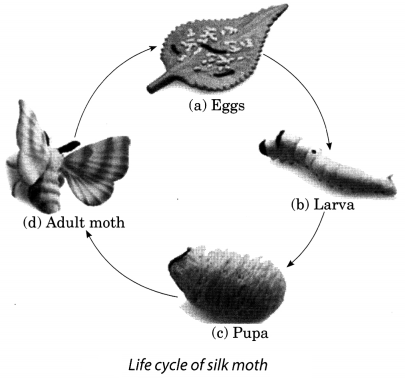
Describe the life history of a silk moth with the help of figures of each stage.
Answer:
Silk fibres are also known as animal fibres. They are soft, light in weight and strong. Silk fibres are obtained from the cocoons of the silk moth or silkworm. The life history of silk moth involves mainly four stages:

Eggs ➝ Caterpillars or Silkworms ➝ Pupa ➝ Adult silk moth

The female silk moth lays eggs, from which hatch larvae called caterpillars or silkworms. They grow in size and when they are ready to enter the next stage called pupa, they first weave a net to hold themselves. Then they swing their heads from side to side in the form of the figure 8.

During these movements, they secret fibres made of a protein which hardens on exposure to air and becomes silk fibre. Soon the caterpillars completely cover themselves by silk fibres and turn into pupae. This covering is known as cocoon. The further development of the pupae into moths continue inside the cocoons. Moths are reared and their cocoons are collected to get silk thread for obtaining silk.
Fibre to Fabric Class 7 Extra Questions and Answers Science Chapter 3

Question 4.
Describe how silkworms are reared and silk is processed.
or
Mention the process of getting silk from cocoon.
Answer:
Silk moths are reared and then cocoons are collected to get silk threads for obtaining silk. A female silk moth lays hundreds of eggs which are stored carefully on strips of cloth or paper and sold to farmers. The farmers keep the eggs under hygienic conditions and under suitable conditions of temperature and humidity.

The eggs are warmed at certain temperature for the larvae to hatch from eggs. This is done when mulberry trees bear a fresh crop of leaves. The larvae called caterpillars or silkworms, eat up these leaves and grow rapidly and increase enormously in size. The larvae are kept in clean bamboo trays along with freshly chopped mulberry leaves.

After 25 to 30 days, the caterpillars stop eating and move to a small chamber in the tray to spin cocoons. The caterpillars or silkworms spin the cocoons inside which develops the silk moth. The cocoons are kept under the sun or boiled or exposed to steam. The silk fibres separate out. Silk fibres are then spun into silk threads, which are finally woven into silk cloth by weavers.

Fibre to Fabric Class 7 Extra Questions HOTS

Question 1.
Why is silk obtained by mulberry silk moth most popular?
Answer:
Silk obtained by mulberry silk moth is most popular because of its shimmering appearance which produces different colours.

Question 2.
You have been asked to buy a woollen sweater from the market. How will you check its purity.
Answer:
We can test the purity of the woollen sweater by burning it. Take about 10 cm long thread (spare one). Hold it with the help of a tong and burn its one end. If the fibre smells like burning hair, it is wool but if . the fibre smells like chemicals or burning plastic, it is artificial wool.

On blowing out of the flame touch the end of the fibre. If the end turn to dust on touching then it is pure wool but if the end has melted and turned hard, then it is not pure wool.

Question 3.
Why natural fibres are costlier than synthetic fibres?
Answer:
Natural fibres are obtained either from plants or animals. The process of obtaining fibres from these natural sources is comparatively labour intensive process than production of synthetic fibres on large scale from other raw materials or chemicals.

Question 4.
Compare the properties of silk and wool.

SilkWool
(i) Silk is smooth, soft and lustrous.(i) Wool is dense, soft, curly, elastic and resilent.
(ii) It is more sensitive to heat.(ii) It is less sensitive to heat.
(iii) It is made up of protein called fibroin.(iii) It is made up of protein called keratin.
(iv) It is strongest natural fibre.(iv) It is stronger but less than silk.
(v) Silk can be worn in both hot and winter season.(v) Wool is worn only in winter season because it traps body heat and keep us warm.

Question 5.
What are occupational hazards? What occupational hazards are linked with wool and silk production?
Answer:
Health risks faced by the workers of a particular occupation or industry are called occupational hazards. In wool industry, wool sorter’s can get infected by a bacterium which causes fatal blood disease, called anthrax or sorter’s disease. In silk industry workers handling dead worms with bare hands may get infection. Fine hair on caterpillars may cause asthma or conjunctivitis.

Fibre to Fabric Class 7 Extra Questions Value Based (VBQs)

Question 1.
Sania got upset on learning that for obtaining 1 kg of raw silk around 5,000 cocoons are killed. But her mother explained her that silkworms are also conserved in this process for obtaining silk next time. Also it is the source of income to many rural and needy person.
(a) Why silk are famous?
(b) Whom do you agree- Sania or her mother? Why?
(c) If you get an option to select between a silk dress and a dress made of synthetic fibre which one will you select and why?
(d) What value of Sania is shown here?

Answer:
(a) Silk are famous for its smooth and lustrous fibre which is also strong.
(b) Do it yourself.
(c) Hint: While selecting dress one should always keep in mind the advantages and disadvantages of natural and synthetic fibres.
(d) Sania is eco-friendly, sensitive and concern for other creatures.

Question 2.
Many occupational hazards are associated with wool and silk production. Most of these hazards can be prevented by just having a proper awareness and knowledge of how to tackle such conditions. The main reason for occupational hazards in India is due to poverty, illiteracy and poor hygienic conditions.
(a) What occupational hazards are associated with wool and silk industries?
(b) How can most of the occupational hazards be minimised?
(c) What values of people are shown here?

Answer:
(a) 1. Wool industry: Anthrax or sorter’s disease
2. Silk industry: Infections, asthama and conjunctivitis

(b) Occupational hazards can be minimised by
1. taking precaution while handling animals like wearing gloves, mask, using disinfectants, washing hands, etc.
2. having proper knowledge and awareness of signs and symptoms of diseases of human and animal.

(c) People are ignorant, careless and illiterate.

Introduction to Euclid’s Geometry Class 9 Extra Questions Maths Chapter 5 with Solutions Answers

Here we are providing Introduction to Euclid’s Geometry Class 9 Extra Questions Maths Chapter 5 with Answers Solutions, Extra Questions for Class 9 Maths was designed by subject expert teachers.

Extra Questions for Class 9 Maths Introduction to Euclid’s Geometry with Answers Solutions

Extra Questions for Class 9 Maths Chapter 5 Introduction to Euclid’s Geometry with Solutions Answers

Introduction to Euclid’s Geometry Class 9 Extra Questions Very Short Answer Type

Question 1.
Give a definition of parallel lines. Are there other terms that need to be defined first ? What are they and how might you define them?
Solution:
Two coplanar lines in a plane) which are not intersecting are called parallel lines. The other term intersecting is undefined.

Question 2.
Give a definition of perpendicular lines. Are there other terms that need to be defined first ? What are they and how might you define them?
Solution:
Two coplanar (in a plane) lines are perpendicular if the angle between them at the point
of intersection is one right angle. The other terms point of intersection and one right angle are undefined.

Question 3.
Give a definition of line segment. Are there other terms that need to be defined first ? What are they and how might you define them ?
Solution:
A line segment PQ of a line ‘l is the continuous part of the line I with end points P and Q.
Introduction to Euclid’s Geometry Class 9 Extra Questions Maths Chapter 5 with Solutions Answers 1
Here, continuous part of the line ‘l is undefined.

Question 4.
Solve the equation a – 15 = 25 and state which axiom do you use here.
Solution:
a – 15 = 25
On adding 15 to both sides, we obtain
a – 15 + 15 = 25 + 15 [using Euclid’s second axiom]
a = 40

Question 5.
Ram and Ravi have the same weight. If they each gain weight by 2 kg, how will their new weights be compared ?
Solution:
Let x kg be the weight each of Ram and Ravi.
On adding 2 kg,
Weight of Ram and Ravi will be (x + 2) kg each.
According to Euclid’s second axiom, when equals are added to equals, the wholes are equal.
So, weight of Ram and Ravi are again equal.

Question 6.
If a point C be the mid-point of a line segment AB, then write the relation among AC, BC and AB.
Solution:
Here, C is the mid-point of AB
⇒ AC = BC
⇒ AC = BC = \(\frac{1}{2}\)AB
Introduction to Euclid’s Geometry Class 9 Extra Questions Maths Chapter 5 with Solutions Answers 2

Question 7.
If a point P be the mid-point of MN and C is the mid-point of MP, then write the relation between MC and MN.
Solution:
Here, P is the mid-point of MN and C is the mid-point of MP.
Introduction to Euclid’s Geometry Class 9 Extra Questions Maths Chapter 5 with Solutions Answers 3
∴ MC = \(\frac{1}{4}\)MN

Question 8.
How many lines does pass through two distinct points ?
Solution:
One and only one.

Question 9.
In the given figure, if AB = CD, then prove that AC = BD. Also, write the Euclid’s axiom used for proving it.
Introduction to Euclid’s Geometry Class 9 Extra Questions Maths Chapter 5 with Solutions Answers 4
Solution:
Here, given that
AB = CD
By using Euclid’s axiom 2, if equals are added to equals, then the wholes are equal, we have
AB + BC = CD + BC
⇒ AC = BD

Introduction to Euclid’s Geometry Class 9 Extra Questions Short Answer Type 2

Question 1.
Define :
(a) a square (b) perpendicular lines.
Solution:
(a) A square : A square is a rectangle having same length and breadth. Here, undefined terms are length, breadth and rectangle.
(b) Perpendicular lines : Two coplanar (in a plane) lines are perpendicular, if the angle between them at the point of intersection is one right angle. Here, the term one right angle is undefined.

Question 2.
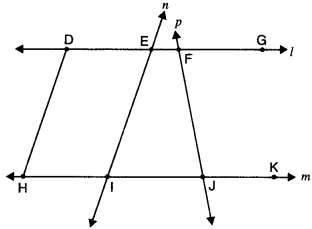
In the given figure, name the following :
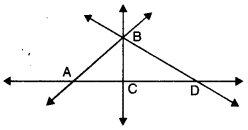
(i) Four collinear points
(ii) Five rays
(iii) Five line segments
(iv) Two-pairs of non-intersecting line segments.
Introduction to Euclid’s Geometry Class 9 Extra Questions Maths Chapter 5 with Solutions Answers 5
Solution:
(i) Four collinear points are D, E, F, G and H, I, J, K
(ii) Five rays are DG, EG, FG, HK, IK.
(iii) Five line segments are DH, EI, FJ; DG, HK.
(iv) Two-pairs of non-intersecting line segments are (DH, EI) and (DG, HK).

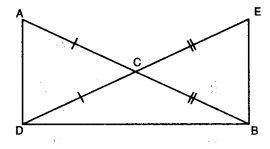
Question 3.
In the given figure, AC = DC and CB = CE. Show that AB = DE. Write the Euclid’s axiom to support this.
Introduction to Euclid’s Geometry Class 9 Extra Questions Maths Chapter 5 with Solutions Answers 6
Solution:
We have
AC = DC
CB = CE
By using Euclid’s axiom 2, if equals are added to equals, then wholes are equal.
⇒ AC + CB = DC + CE
⇒ AB = DE.

Question 4.
In figure, it is given that AD=BC. By which Euclid’s axiom it can be proved that AC = BD?
Introduction to Euclid’s Geometry Class 9 Extra Questions Maths Chapter 5 with Solutions Answers 7
Solution:
We can prove it by Euclid’s axiom 3. “If equals are subtracted from equals, the remainders are equal.”
We have AD = BC
⇒ AD – CD = BC – CD
⇒ AC = BD

Question 4.
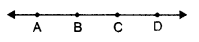
If A, B and C are any three points on a line and B lies between A and C (see figure), then prove that AB + BC = AC.
Introduction to Euclid’s Geometry Class 9 Extra Questions Maths Chapter 5 with Solutions Answers 8
Solution:
In the given figure, AC coincides with AB + BC. Also, Euclid’s axiom 4, states that things
which coincide with one another are equal to one another. So, it is evident that:
AB + BC = AC.

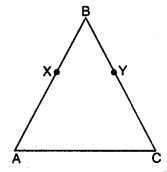
Question 5.
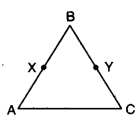
In the given figure, AB = BC, BX = BY, show that
AX = CY.
Introduction to Euclid’s Geometry Class 9 Extra Questions Maths Chapter 5 with Solutions Answers 9
Solution:
Given that AB = BC
and BX = BY
By using Euclid’s axiom 3, equals subtracted from equals, then the remainders are equal, we have
AB – BX = BC – BY
AX = CY

Question 6.
Introduction to Euclid’s Geometry Class 9 Extra Questions Maths Chapter 5 with Solutions Answers 10
In the above figure, if AB = PQ, PQ = XY, then AB = XY. State True or False. Justify your answer.
Solution:
True. ∵ By Euclid’s first axiom “Things which are equal to the same thing are equal to one another”.
∴ AB = PQ and XY = PQ ⇒ AB = XY

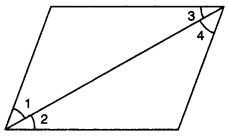
Question 7.
In the given figure, if ∠1 = ∠3, ∠2 = ∠4 and ∠3 = ∠4, write the relation between ∠1 and ∠2, using an Euclid’s axiom.
Introduction to Euclid’s Geometry Class 9 Extra Questions Maths Chapter 5 with Solutions Answers 11
Solution:
Here, ∠3 = ∠4, ∠1 = ∠3 and ∠2 = ∠4. Euclid’s first axiom says, the things which are equal to equal thing are equal to one another. So ∠1 = ∠2.,

Question 8.
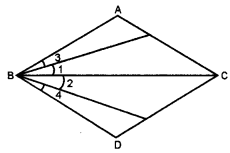
In the given figure, we have ∠1 = ∠2, ∠3 = ∠4. Show that ∠ABC = ∠DBC. State the Euclid’s Axiom used.
Solution:
Here, we have 1 = ∠2 and ∠3 = ∠4. By using Euclid’s Axiom 2. If equals are added to
equals, then the wholes are equal..
∠1 + ∠3 = ∠2 + ∠4
∠ABC = ∠DBC.

Question 9.
In the figure, we have BX and \(\frac{1}{2}\) AB =\(\frac{1}{2}\) BC. Show that BX = BY.
Introduction to Euclid’s Geometry Class 9 Extra Questions Maths Chapter 5 with Solutions Answers 12
Solution:
Here, BX = \(\frac{1}{2}\) AB and BY = \(\frac{1}{2}\) BC …(i) [given]
Also, AB = BC [given]
⇒ \(\frac{1}{2}\)AB = \(\frac{1}{2}\)BC …(ii)
[∵ Euclid’s seventh axiom says, things which are halves of the same thing are equal to one another]
From (i) and (ii), we have BX = BY

Question 10.
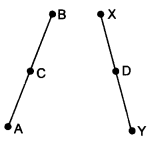
In the given figure, AC = XD, C is mid-point of AB and D is mid-point of XY. Using an Euclid’s axiom, show that AB = XY.
Introduction to Euclid’s Geometry Class 9 Extra Questions Maths Chapter 5 with Solutions Answers 13
Solution:
∵ C is the mid-point of AB
AB = 2AC
Also, D is the mid-point of XY
XY = 2XD
By Euclid’s sixth axiom “Things which are double of same things are equal to one another.”
∴ AC = XD = 2AC = 2XD ⇒ AB = XY

Introduction to Euclid’s Geometry Class 9 Extra Questions HOTS

Question 1.
For given four distinct points in a plane, find the number of lines that can be drawn through :
(i) When all four points are collinear.
(ii) When three of the four points are collinear.
(iii) When no three of the four points are collinear.
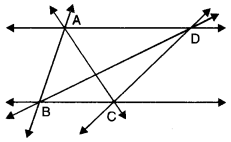
Introduction to Euclid’s Geometry Class 9 Extra Questions Maths Chapter 5 with Solutions Answers 14
Solution:
Introduction to Euclid’s Geometry Class 9 Extra Questions Maths Chapter 5 with Solutions Answers 15
(i) Consider the points given are A, B, C and D.
When all the four points are collinear :
One line \(\overrightarrow{\mathrm{AD}}\).
Introduction to Euclid’s Geometry Class 9 Extra Questions Maths Chapter 5 with Solutions Answers 16
(ii) When three of the four points are collinear :
4 lines
Here, we have four lines \(\stackrel{\leftrightarrow}{A B}, \stackrel{\leftrightarrow}{B C}, \stackrel{\leftrightarrow}{B D}, \stackrel{\leftrightarrow}{A D}\) (four).

(iii) When no three of the four points are collinear :
6 lines Here, we have
\(\stackrel{\leftrightarrow}{A B}, \stackrel{\leftrightarrow}{B C}, \stackrel{\leftrightarrow}{A C}, \stackrel{\leftrightarrow}{A D}, \stackrel{\leftrightarrow}{B D}, \stackrel{\leftrightarrow}{C D}\) (six).
Introduction to Euclid’s Geometry Class 9 Extra Questions Maths Chapter 5 with Solutions Answers 17

Question 2.
Show that : length AH > sum of lengths of AB + BC + CD.
Introduction to Euclid’s Geometry Class 9 Extra Questions Maths Chapter 5 with Solutions Answers 18
Solution:
We have
AH = AB + BC + CD + DE + EF + FG + GH
Clearly, AB + BC + CD is a part of AH.
⇒ AH > AB + BC + CD
Hence, length AH > sum of lengths AB + BC + CD.

Introduction to Euclid’s Geometry Class 9 Extra Questions Value Based (VBQs)

Question 1.
Rohan’s maid has two children of same age. Both of them have equal number of dresses. Rohan on his birthday plans to give both of them same number of dresses. What can you say about the number of dresses each one of them will have after Rohan’s birthday? Which Euclid’s axiom is used to answer this question? What value is Rohan depicting by doing so ? Write one more Euclid’s axiom.
Solution:
Here, Rohan’s maid has two children of same age group and both of them have equal number of dresses. Rohan on his birthday plans to give both of them same number of dresses.
∴ By using Euclid’s Axiom 2, if equals are added to equals, then the whole are equal. Thus, again both of them have equal number of dresses. Value depicted by Rohan are caring and other social values. According to Euclid’s Axiom 3, if equals are subtracted from equals, then the remainders
are equal.

Question 2.
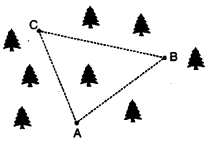
Three lighthouse towers are located at points A, B and C on the section of a national forest to protect animals from hunters by the forest department as shown in figure. Which value is department exhibiting by locating extra towers ? How many straight lines can be drawn from A to C? State the Euclid Axiom which states the required result. Give one more. Postulate.
Introduction to Euclid’s Geometry Class 9 Extra Questions Maths Chapter 5 with Solutions Answers 19
Solution:
One and only one line can be drawn from A to C. According to Euclid’s Postulate, “A straight line may be drawn from any point to any other point:” An other postulate : “A circle may be described with any centre and any radius.” Wildlife is a part of our environment and conservation of each of its element is important for ecological balance.

Possessive Pronouns Exercises for Class 4 CBSE with Answers

Possessive Pronouns Exercises for Class 4 CBSE with AnswersThis grammar section explains English Grammar in a clear and simple way. There are example sentences to show how the language is used.

Possessive Pronouns Exercises for Class 4 CBSE with Answers

  • Possessive pronouns are used to talk about things that belong to a person.
  • The words mine, yours, his, hers, ours and theirs are possessive pronouns.
  • We do not use an apostrophe with possessive pronouns.
    Examples:

    • This book is mine.
    • Have you lost yours, Manish?
    • This pen is mine and that one is his.
    • Sarika has lost her cat. Is this cat hers?

Here is a table to help you remember which possessive pronoun to use with which personal pronoun.

Singular Personal pronounsPossessive Pronouns
I, meMine
YouYours
He, himHis
She, herHers
Plural Personal pronounsPossessive Pronouns
We, usOurs
YouYours
They, themTheirs

Presentation
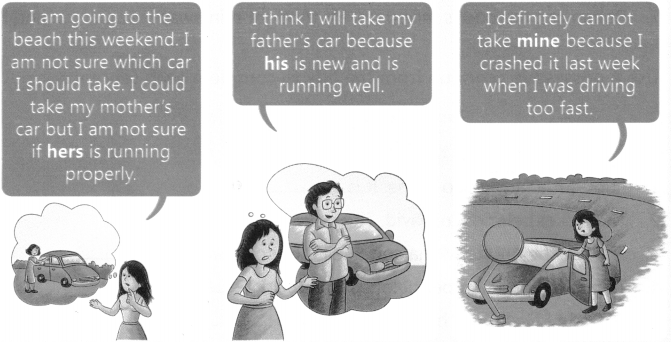
Read the picture story.
Possessive Pronouns Exercises for Class 4 CBSE with Answers

A. Answer the following questions as per the story.

1. Why doesn’t Molly prefer to go in her mother’s car? _____________
2. Why is Molly confident about her father’s car? _____________
3. Why doesn’t Molly prefer to go in her own car? _____________

B. Which possessive pronoun ¡s used for the following from the story above.
Father __________
Mother __________
Molly __________

Possessive Pronouns Worksheet for Grade 4 with Answers CBSE PDF

A. Write the missing possessive pronouns in the blank spaces to complete the sentences.

1. I chose this seat first so it’s _____________
2. Can we borrow your colouring pens? We’ve lost _____________
3. We live in the city and they live in the countryside. Our house is smaller than _____________
4. John, is this pencil _____________?
5. Nancy is looking for her gloves. Are these gloves _____________?
6. Can Suresh use your bike? _____________ is broken.
7. Rohan got the books mixed up. He thought mine was _____________ and his was _____________.

B. Use a possessive pronoun from the box to complete each sentence.
Possessive pronouns include:
mine, yours, his, hers, its, ours, theirs

1. I bought a new video game. It is _____________.
2. The jacket belongs to David. The jacket is _____________.
3. The cats belong to Mona and Sheila. The cats were _____________.
4. This telephone number belongs to Rupa. It is _____________.
5. You and I live in this house. The house is _____________.
6. My dog is bigger than your dog. The larger dog is _____________.

Pollution of Air and Water Class 8 Extra Questions and Answers Science Chapter 18

In this page, we are providing Pollution of Air and Water Class 8 Extra Questions and Answers Science Chapter 18 pdf download. NCERT Extra Questions for Class 8 Science Chapter 18 Pollution of Air and Water will help to score more marks in your CBSE Board Exams.

Class 8 Science Chapter 18 Extra Questions and Answers Pollution of Air and Water

Extra Questions for Class 8 Science Chapter 18 Pollution of Air and Water with Answers Solutions

Pollution of Air and Water Class 8 Extra Questions Very Short Answer Type

Question 1.
What is cause for starting of melting of Gangotri glacier?
Answer:
Global warming

Question 2.
Which health problem arises by air pollution?
Answer:
Respiratory problems like asthma, breathlessness, bronchitis, etc.

Question 3.
What is global warming?
Answer:
Increasing temperature in atmosphere.

Question 4.
Which gas is responsible for depletion of ozone layer?
Answer:
Chloroflurocarbons (CFC’s).

Question 5.
What does SPM stand for?
Answer:
Solid particulate matter.

Question 6.
What is the role of activated charcoal in purification of water?
Answer:
It removes finest particles suspended in water.

Question 7.
Name a greenhouse gas.
Answer:
Carbon dioxide, methane, water vapour (any one)

Question 8.
What is the formula of ozone?
Answer:
O3

Question 9.
Name the agents that pollute air and water.
Answer:
Pollutants

Question 10.
Name the main air polluting gases.
Answer:
Sulphur dioxide, carbon monoxide and nitrogen oxides.

Question 11.
Which radiations are absorbed by CO2?
Answer:
Infrared radiations

Question 12.
Define eutrophication.
Answer:
Enrichment of water bodies with nutrients like nitrates and phosphates is known as eutrophication.

Question 13.
Name one major source of water pollution.
Answer:
Untreated sewage

Question 14.
What is the function of ozone layer?
Answer:
Ozone layer protects us from ultraviolet rays of the sun.

Question 15.
Name diseases spread through drinking of contaminated water.
Answer:
Diarrhoea, typhoid, etc.

Question 16.
When was the Ganga action plan launched?
Answer:
In 1985

Question 17.
What is smog?
Answer:
The combination of smoke and fog is basically known as smog.

Pollution of Air and Water Class 8 Extra Questions Short Answer Type

Question 1.
What do you mean by water pollution?
Answer:
When water get contaminated by unwanted substances which have a harmful effect on both living and non-living things is referred to as water pollution.

Question 2.
What is the greenhouse effect?
Answer:
The reflected sun rays are trapped by the earth’s atmosphere. The trapped radiation warms the earth.
This process by which the temperature of the earth’s atmosphere rises is called greenhouse effect.

Question 3.
What are the main causes of air pollution?
Answer:
Following are the main causes of air pollution:

  • Poisonous gases which are expelled by various industries.
  • Gases emitted by vehicles.
  • Smoke and dust which are arising day by day due to human activities.
  • Smoke emitted by forest fire.

Question 4.
What do you mean by air pollution?
Answer:
When air is contaminated by unwanted substances which have a harmful effect on both living and non¬living things then it is referred as air pollution.

Question 5.
What are the factors that are responsible for water pollution?
Answer:
Water gets polluted when unwanted and harmful substances are added to the water. Discharging of untreated sewage into the river, leaching of chemicals from agricultural practices and industries, oil spills, etc., causes water pollution.

Question 6.
What are the harmful effects of global warming?
Answer:
Following are the harmful effects of global warming:

  • It will increase the earth’s temperature.
  • Increase in earth’s temperature may lead to rise in sea level due to melting of glaciers.
  • Rise in sea level will flood the coastal and low-lying areas.
  • Global warming may lead to extreme weather other than cold or heat extremes.
  • It may also affect many flora and fauna which are sensitive to temperature and their extinction.

Question 7.
Which factors decides quality of potable water?
Answer:
Potable water is clear, tasteless, odourless, have no contaminants and right pH. It has no harmful minerals or their level is too low to affect human health.

Question 8.
What’is global warming?
Answer:
Carbon dioxide is increasing day by day and it is a warm gas, which increases the temperature of the earth’s atmosphere. It is called global warming.

Pollution of Air and Water Class 8 Extra Questions Long Answer Type

Question 1.
What do you mean by acid rain? How does it affect both living and non-living things?
Answer:
Due to fossil fuel and industrial combustions that mostly emits nitrogen oxides (NOx) and sulphur dioxide (SO2) into the atmosphere. Water vapour present in atmosphere reacts with these gases to form nitric acid and sulphuric acid. Normal rain water is slightly acidic with a pH range of 5.3-6.0, because carbon dioxide and water present in the air react together to form carbonic acid, which is a weak acid. When the pH level of rain water falls below this range due to combining with these acids in atmosphere, it becomes acid rain. Acid rain has significant effects on the world environment and public health.

Effect on aquatic environment: Acid rain lowers pH level below 5, most fish eggs cannot hatch. Lowering in pH can also kill adult fish.

Effect on forests: It makes trees vulnerable to disease, extreme weather, and insects by destroying their leaves, damaging the bark and arresting their growth.

Effect on soil: Acid rain highly impacts soil microbes and biological activity as well as soil chemical compositions. Thus affecting crop production.

Effect on architecture and buildings: Acid rain on buildings, especially those constructed with limestone, react with the minerals and corrode them away. This leaves the building weak and susceptible to decay. Irreplaceable damage can be caused to the old heritage buildings.

Effect on public health: When in atmosphere, sulphur dioxide and nitrogen oxide gases, degrades visibility and can cause accidents, leading to injuries and deaths. Intensified levels of acid depositions in dry form in the air can cause lung and heart problems such as bronchitis and asthma.

Other effects: Acid rain leads to weathering of buildings, corrosion of metals, and peeling of paints on surfaces. Acid rain also corrodes metals like steel, bronze, copper and iron.

Question 2.
What is eutrophication? How does it affect aquatic organisms?
Answer:
Enrichment of an ecosystem with nutrients, typically compounds containing nitrogen, phosphorous or both, is known as eutrophication. Eutrophication in lakes, ponds or rivers encourages the growth of algae and other aquatic plants. These algae grow rapidly in the water system and forms algal bloom. They compete for sunlight, oxygen and space. This badly affect the aquatic life and deteriorates water quality. This is also responsible for the large scale death of aquatic plants and animals.

Question 3.
Write a short note on water pollution.
Answer:
Water pollution is the contamination of water bodies (e.g., lakes, rivers, oceans, aquifers and groundwater). This form of environmental degradation occurs when pollutants are directly or indirectly discharged into water bodies without adequate treatment to remove harmful compounds.

Water is available both on surface and under the ground. The major pollutants of surface water are toxic and poisonous wastes from households, industries, nuclear wastes, oil spills, agricultural waste, accumulation of heavy metals, chemicals from chemical factories, microorganisms from human faeces, etc.

Groundwater is mainly contaminated by leaching of harmful chemicals into the soil. Seepage of sewer near groundwater aquifer contaminates with disease causing microorganisms. Accumulation of heavy metals in soil may also lead to groundwater pollution.

Water pollution affects the entire biosphere plants and organisms living in these bodies of water. In almost all cases the effect is damaging not only to individual species and population, but also to the natural biological communities.

Question 4.
How can you prevent water pollution?
Answer:

  • Be careful about what you throw down your sink or toilet. Don’t throw paints, oils or other forms of litter down the drain.
  • Use enyironment-friendly household products, such as washing powder, household cleaning agents and toiletries.
  • Take great care not to overuse pesticides and fertilisers. This will prevent runoffs of the material into nearby water sources.
  • By having more plants in your garden you are preventing fertiliser, pesticides and contaminated water from running off into nearby water sources.
  • Don’t throw litter into rivers, lakes or oceans. Help to clean up any litter you see on beaches or in rivers and lakes, make sure it is safe to collect the litter and put it in a nearby dustbin.

Question 5.
How can you prevent air pollution?
Answer:

  • Conserve energy-remember to turn off lights, computers, and electric appliances when not in use.
  • Use energy efficient light bulbs and appliances.
  • Limit driving by carpooling, using public transportation, biking and walking.
  • Combine errands for fewer trips.
  • Keep your automobile well-tuned and maintained. Follow the manufacturer’s instructions on routine maintenance, such as changing the oil and filters, and checking tyre pressure and wheel alignment.
  • Choose environment-friendly appliances.
  • Petrol can be substituted with CNG.
  • Make fertilisers of biodegradable wastes instead of burning them.
  • Plant more and more trees.
  • Scrubbers need to be used in the smokestacks to reduce the amount of sulphur dioxide emission in air.

Question 6.
Name various techniques used for purification of water.
Answer:
Water which looks clean may still have disease carrying microorganisms and dissolved impurities. So, it is essential to purify water before drinking. Municipal bodies uses various physical and chemical processes before supplying water into households.

  • Boiling: It is a very common practice use for obtaining safe drinking water. Boiling kills the germs present in the water.
  • Filtration: This is a physical method of removing impurities and in some cases germs also. A popular household filter is a candle type filter.
  • Chlorination is a commonly used chemical method for purifying water. It is done by adding chlorine tablets or bleaching powder to the water.
  • Now-a-days filter with reverse osmosis (RO) which causes desalination of water along with activated charcoal (to filter impurities) and ultraviolet lamp (to kill microorganisms) are also used for purification of water.

Pollution of Air and Water Class 8 Extra Questions HOTS

Question 1.
Name any two sources which cause air pollution due to suspended particulate matter.
Answer:
Combustion of fuels and industrial activities.

Question 2.
Name three alternative sources of energy which do not cause any pollution.
Answer:
Wind energy, solar energy and hydropower.

Question 3.
The quality of air at various locations is monitored regularly by government and other agencies. In what way can you use these data?
Answer:
These data can be used to generate awareness about air pollution among people and to take immediate action to control it causes.

Question 4.
What is the best way to dispose off dry leaves? Why?
Answer:
Dry leaves can be converted into compost which is good for maintaining soil nutrients. Secondly, it does not cause pollution.

Question 5.
We should plant trees and nurture the ones already present in the neighbourhood. Why?
Answer:
Plants absorb carbon dioxide gas and releases oxygen. Thus, they play important role in purifying the earth’s atmosphere. By absorbing CO2 they also reduces the chance of global warming. Trees provide habitat to many birds and animals. They maintain water cycle in the nature and also prevent soil erosion.

Question 6.
Why is it advised that industries should switch over to cleaner fuels such as CNG and LPG in the Taj Mahal Zone in Agra?
Answer:
With mushrooming industries and oil refineries suspended particulate matter is increasing in the air. These suspended particulate matter, dust and dirt get settle on the marble giving the Taj Mahal a yellowish appearance. This is reducing the aesthetic value of one of the seven wonders of the world.

Pollution of Air and Water Class 8 Extra Questions Value Based (VBQs)

Question 1.
If we look at our daily routine, it will be observed that we use many chemicals which pollutes water bodies. But all these chemicals have become inseparable part of our daily life like detergents, toothpastes, soaps, shampoos, dish wash liquids and bars, disinfectants, etc. If this sewage from our house is discharged in water bodies untreated causes havoc.
(a) What is water pollution?
(b) What are the major pollutants of sewage from houses?
(c) Do you think we can do something in our end to reduce pollution from household?
(d) What values do we acquire from this?
Answer:
(a) Water pollution is the contamination of water bodies by directly or indirectly discharging pollutants without adequate treatment to remove harmful compounds.
(b) Grey water (from sinks, tubs, washing machines, etc.), soap, detergents, toilet paper, disinfectants, etc.
(c) Yes, we can minimise the use of many chemicals. We can use natural soaps, shampoos, toothpastes and detergents which are easy to decompose.
(d) Awareness that how day-to-day activities is also degrading the nature.

Nutrition in Animals Class 7 Extra Questions and Answers Science Chapter 2

In this page, we are providing Nutrition in Animals Class 6 Extra Questions and Answers Science Chapter 2 pdf download. NCERT Extra Questions for Class 6 Science Chapter 2 Nutrition in Animals with Answers will help to score more marks in your CBSE Board Exams.

Class 7 Science Chapter 2 Extra Questions and Answers Nutrition in Animals

Extra Questions for Class 7 Science Chapter 2 Nutrition in Animals with Answers Solutions

Nutrition in Animals Class 7 Extra Questions Very Short Answer Type

Question 1.
Do all animals have the same mode of nutrition?
Answer:
No

Question 2.
Name the mode of nutrition in which solid whole food particles is ingested.
Answer:
Holozoic

Question 3.
Name the chambers in the stomach of a ruminant.
Answer:
Rumen, reticulum, omasum and abomasum

Question 4.
Name the organ which identifies the taste of different food materials.
Answer:
Tongue

Question 5.
What is the other name of foodpipe?
Answer:
Oesophagus

Question 6.
Name the hard outer surface layer of your teeth.
Answer:
Enamel

Question 7.
Name some parasites of human body.
Answer:
Tapeworm and roundworm

Question 8.
What is the other name of digestive tract?
Answer:
Alimentary canal

Question 9.
Which is the largest gland of the human body?
Answer:
Liver

Question 10.
What are taste buds?
Answer:
Taste buds are the receptor cells which helps us in recognising taste of the food.

Question 11.
Apart from tasting food what are the other functions of tongue?
Answer:
Helps in chewing food and speaking.

Question 12.
What is the function of oesophagus?
Answer:
The wall of oesophagus pushes the food down to the stomach.

Question 13.
State the functions of molar and premolar teeth.
Answer:
The functions of molar and premolar teeth are to chew and grind the ingested food.

Question 14.
What is mastication?
Answer:
Mastication or chewing is the process of crushing and grinding of food by teeth.

Question 15.
Name the various types of teeth.
Answer:

  1. Incisors
  2. Canines
  3. Premolars
  4. Molars

Question 16.
What are milk teeth?
Answer:
The set of teeth that grows during infancy are called milk teeth. They fall off at the age of 6-8 years.

Question 17.
What is peristalsis?
Answer:
A series of contraction and relaxation in alimentary canal which helps in movement of food is called peristalsis.

Question 18.
Define nutrition.
Answer:
The process of intake of food and its utilisation by an organism is known as nutrition.

Question 19.
What is assimilation?
Answer:
Assimilation is the process by which the absorbed food is utilised to build up complex substances (like protein and fat) and to give energy.

Question 20.
Define absorption.
Answer:
The digested food gets absorbed by the inner walls of small intestine and passes into the blood vessels. This process is known as absorption.

Question 21.
Why is digestion of fats difficult as compared to that of other nutrients?
Answer:
Fats cannot be digested easily because they are insoluble in water and are present as large globules.

Question 22.
Does bile juice digest fat completely?
Answer:
No. Bile juice only breaks down big fat droplets into smaller droplets which can be easily digested by the enzymes released from the pancreas.

Nutrition in Animals Class 7 Extra Questions Short Answer Type

Question 1.
Write about pseudopodia.
Answer:
The finger-like projections in Amoeba are called pseudopodia. These projections are not permanent. They are formed out of the body of Amoeba, whenever they are needed. Pseudopodia helps in movement and capturing food.

Question 2.
Name some of the components of food.
Answer:
Some of the important components of food are:

  1. carbohydrates
  2. proteins
  3. minerals
  4. fats
  5. vitamins
  6. water and roughage

Question 3.
What is animal nutrition?
Answer:
Animal nutrition includes nutrient requirement, mode of intake of food and its utilisation in the body for growth, repair and its functioning.

Question 4.
Write the names of various digestive organs of the body.
Answer:

  1. buccal cavity
  2. oesophagus
  3. stomach
  4. small intestine
  5. large intestine
  6. rectum
  7. anus

Question 5.
Explain the mode of feeding of starfish.
Answer:
Starfish feeds on the animals covered with hard shells of calcium carbonate. After opening the shell, starfish pops out its stomach and eats the soft animal present inside the shell. Then the stomach goes back into the body and the food slowly gets digested.

Question 6.
Explain the process of digestion in stomach.
Answer:
Partial digestion of food takes place here. Stomach releases gastric juice, which mainly contains hydrochloric acid and pepsin. Hydrochloric acid kills germ entering with the food and makes the food acidic. Pepsin helps in digestion of protein. Churning of stomach muscles physically breaks down food and mix it with the gastric juice and convert it into a semi-fluid called chyme.

Question 7.
Write the functions of different types of teeth in human beings.
Answer:

  1. Incisors: They help in cutting and biting food.
  2. Canines: They help in piercing and tearing food.
  3. Premolars: They help in chewing and grinding food.
  4. Molars: They also help in chewing and grinding food.

Question 8.
Explain rumination.
Answer:
The grass-eating animals quickly swallow the grass while eating which gets stored in a separate part of their stomach called ‘rumen’. Here, the food gets digested partially and is called ‘cud’. Later, this cud again returns to the mouth in small lumps and the animal chews it properly. This process is called ‘rumination’.

Question 9.
Define tongue. What are its functions?
Answer:
The fleshy muscular organ attached at back to the floor of the buccal cavity is called tongue. It is free at front and can move in all directions.
The functions of tongue are:

  • It mixes saliva with food.
  • It helps in swallowing the food.
  • It helps in identifying the various tastes of different food materials, as it has various taste buds which help in detecting them.

Question 10.
Write about Amoeba.
Answer:
Amoeba is a small microscopic, single-celled organism found in pond water. It has a cell membrane, a dense and round nucleus, and many small bubble-like vacuoles in its cytoplasm. Amoeba can change its shape and position constantly.

Question 11.
Explain digestion of food in mouth.
Answer:
Food enters the buccal cavity through mouth. Here it is chewed by teeth, and gets mixed with saliva with the help of tongue. Saliva contains an enzyme called ptyalin (salivary amylase). This enzyme converts complex carbohydrates like starch into sugars. Saliva moistens the food and changes it into a round bolus.

Question 12.
Write about pancreas.
Answer:
Pancreas is a large cream-coloured gland, which is located just below the stomach. It secretes pancreatic juice into the small intestine which acts on carbohydrates, fats and proteins and changes them into simpler forms.

Question 13.
Why the large intestine is shorter and wider than small intestine?
Answer:
In large intestine only absorption of water takes place from the undigested food so it is shorter and wider. In small intestine, digestion takes place therefore more surface area is needed for nutrient absorption. Hence, small intestine is narrower and longer.

Question 14.
Write about large intestine.
Answer:
Large intestine begins with the caecum and ends with the rectum. It includes the caecum and the colon and the rectum. It extracts moisture from food residues which are later excreted as faeces. It is wider and shorter than small intestine; so its length is about 1.5 metre.

Nutrition in Animals Class 7 Extra Questions Long Answer Type

Question 1.
Define dental plaque. What harm can it cause? How can the formation of plaque be prevented?
Answer:
If teeth are not cleaned regularly and properly they get covered with a sticky, yellowish layer of food particles and bacteria. This is called ‘dental plaque’.

Because plaque entirely covers the teeth by its layer, the alkaline saliva cannot reach their surface to neutralise the acid formed by bacteria. Hence, tooth decay is caused. Tooth decay can be prevented by brushing and cleaning the teeth as well as mouth properly and regularly.

Question 2.
What is diarrhoea? How is it caused? How can it be prevented?
Answer:
Diarrhoea is the frequent and watery bowel movement. It could be caused by infection or food poisoning or indigestion. It can be fatal under severe conditions. This disease causes excessive loss of water and salts from the body.

It can be prevented by taking plenty of boiled and cooled water, along with a pinch of salt and sugar dissolved in it. This is called Oral Rehydration Solution (ORS).

Question 3.
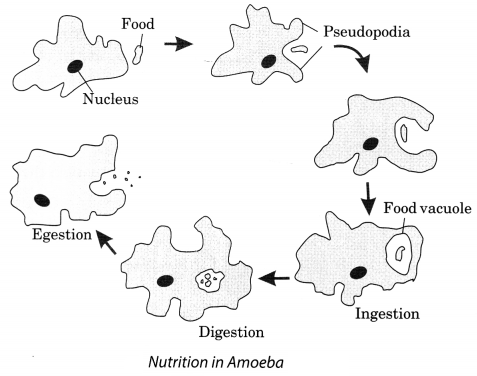
Explain feeding and digestion in Amoeba with a labelled diagram.
Answer:
Amoeba feeds on microscopic organisms. When it senses food, it pushes out pseudopodia around the food particle and engulfs it. The food becomes trapped in a food vacuole. Digestive juices are secreted into the food vacuole which act on the food and break down it into simpler substances. Digested food is absorbed into the cell and undigested food is expelled outside by the vacuole.
Nutrition in Animals Class 7 Extra Questions and Answers Science Chapter 2 1

Question 4.
Explain the process of nutrition in human beings from ingestion to egestion.
Answer:
(i) Ingestion: It is the process of taking food into the mouth; i.e., starting point of the alimentary canal.
(ii) Digestion: Digestion is the process of breaking of ingested food into simpler substances. Digestion occurs through two processes, i.e., mechanical (chewing, grinding, mixing, churning) and chemical (enzymes, bile, acid). Mechanical processes helps in breaking the large food particles into smaller ones and mixing them well with the chemicals secreted by alimentary canal.

Digestion of starch starts at mouth with the action of salivary amylase. Digestion of protein starts in stomach with the help of enzyme pepsin and digestion of all the three components of food, viz., carbohydrate, protein and fat is completed in the small intestine.
(iii) Absorption: Digested food is absorbed into the blood through finger-like structures, called villi, present in the small intestine.
(iv) Assimilation: It is the process where absorbed substances are transported to different organs of the body via blood vessels to build complex substances like protein, enzyme, etc.
(v) Egestion: The process of elimination of undigested food through anus is called egestion.

Question 5.
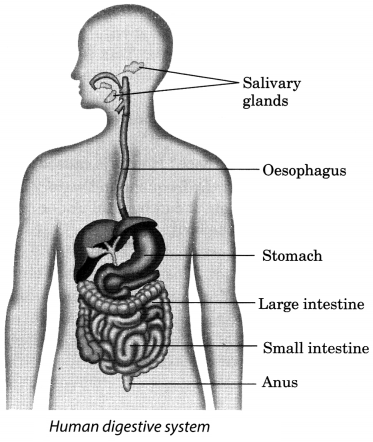
Explain human digestive system with a labelled diagram.
Answer:
Nutrition in Animals Class 7 Extra Questions and Answers Science Chapter 2 2
The digestive system in humans consists of an alimentary canal and digestive glands which help in
digestion. Different parts of alimentary canal are:

  1. Mouth: Digestion begins in mouth. Teeth cuts the food into small bits. Saliva digest starch in food and softens the food to pulp. Tongue helps to mix the food with saliva and converting food into bolus.
  2. Oesophagus: Wall of oesophagus contracts and transports food from mouth to stomach.
  3. Stomach: It is a big muscular bag which secretes digestive juice. Hydrochloric acid in digestive juice kill germs and enzyme pepsin breaks protein to amino acids. In stomach food get converted into a semi-fluid, chyme.
  4. Small intestine: Secretions from liver and pancreas act on the food in small intestine. Bile helps in breaking large fat molecules into tiny droplets. Pancreatic juice helps in digestion of starch and protein. Intestinal juice acts on starch, protein and fat and completes the digestion. Villi in small intestine absorbs these digested nutrients into the blood vessels.
  5. Large intestine: Large intestine absorbs water and some useful nutrients from the undigested food. The undigested food is then eliminated as faeces from the anus.

Question 6.
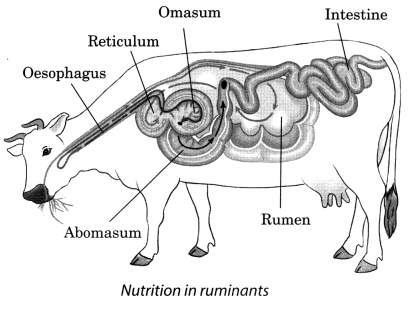
Write a short note on nutrition in ruminants.
Answer:

  1. grass-eating animals swallow the food quickly and store it in the rumen. Rumen inhabits cellulose digesting bacteria.
  2. The partially digested food then goes to next chamber of the stomach the reticulum.
  3. Digestive juices of the reticulum turns food into cud.
  4. While resting, cow brings back the cud into mouth for regurgitation.
  5. Food is chewed completely and swallowed into omasum for further digestion.
  6. Then the food moves into abomasum for digestion brought about by digestive juices.
  7. A large sac-like structure called the caecum lies between the small and large intestines.
  8. The symbiotic bacteria present in the caecum help incomplete digestion of cellulose. Digestion of food is completed in the small intestine.

Nutrition in Animals Class 7 Extra Questions and Answers Science Chapter 2 3

Question 7.
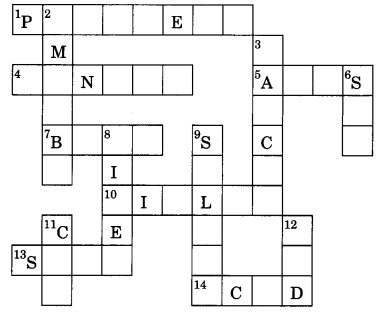
Solve the crossword given below:
Nutrition in Animals Class 7 Extra Questions and Answers Science Chapter 2 4
Answer:

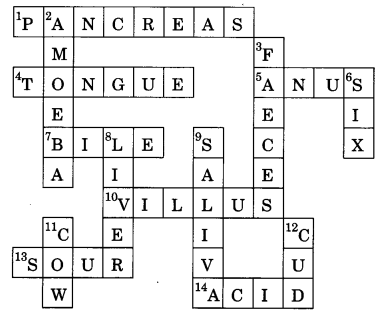
Across:
1. Cream-coloured digestive gland
4. Organ that mixes saliva with the food
5. Point of defaecation
7. Stored in gall bladder
10. Finger-like outgrowth in the small intestine
13. Kind of taste buds
14. Kills bacteria in the stomach

Down:
2. Feeds with the help of pseudopodia
3. Undigested excretory solid residues
6. Total number of molars in one jaw of an adult
8. Largest gland
9. Watery secretion in the mouth
11. A ruminant
12. Form of food chewed by ruminants
Answer:
Nutrition in Animals Class 7 Extra Questions and Answers Science Chapter 2 5

Nutrition in Animals Class 7 Extra Questions HOTS

Question 1.
Can you tell which kind of food items are not digested easily when gall bladder of a person is removed surgically? Why?
Answer:
Food items rich in fats cannot be digested easily when gall bladder of a person is removed. Gall bladder stores bile juice in concentrated form which is secreted in small intestine when needed. Bile juice breaks the larger molecules of fats into smaller one.

Question 2.
Name the part of alimentary canal where

  1. water gets absorbed from undigested food.
  2. digested food gets absorbed.
  3. bile juice is produced.
  4. taste of the food is perceived.
  5. germs get killed.
  6. undigested food is removed.
  7. food is converted into bolus.
  8. food is converted into chyme.

Answer:

  1. Large intestine
  2. Small intestine
  3. Gall bladder
  4. Tongue
  5. Stomach
  6. Anus
  7. Mouth
  8. Stomach

Question 3.
What is the role of fibrous food in bowel movement?
Answer:
Fibrous food increases the stool bulk, so it ease the bowel movement and reduce constipation.

Question 4.
How food moves in the opposite direction during vomiting?
Answer:
When food is not accepted by our stomach, then the wall of the alimentary canal pushes back the food in upward direction and it is vomited out.

Question 5.
Why it is advised not to eat hurriedly and talk or laugh while eating.
Answer:
This is because inside the throat, air and food share a common passage. When we talk flap-like valve of wind pipe opens and when we eat or swallow food it remains close. When we eat hurriedly and talk or laugh while eating, the valve of windpipe get open or does not close properly. If, by chance food particles enter the windpipe, we feel choking or get hiccups.

Nutrition in Animals Class 7 Extra Questions Value Based (VBQs)

Question 1.
In a birthday party, Ram filled his plate with oily and sugary food. His elder sister Sarita on seeing this interrupted him. She told him that it is not good to eat too much of this kind of food. She asked him to share that plate with his friends and suggested to include some vegetables and salads also.
(a) Why eating oily and sugary food not good for health?
(b) What is the effect of sugary food on our teeth? How we can prevent it?
(c) Where do sugary food get digested in alimentary canal?
(d) What value of Sarita is shown here?

Answer:
(a) Too much sugary food and oily foods are not good for health as it causes secretion of much acid from stomach and thus causes indigestion. Sugary foods causes tooth decay, makes our stomach feel full and in long term obesity. Oily food also cause obesity and thus many health problems.
(b) Sugary food sticking to our teeth facilitates growth of harmful bacteria which break down the sugars into acids. This acid gradually damage the teeth causing tooth decay. We can prevent tooth decay by brushing our teeth at least twice a day and rinse the mouth after every meal. We must also avoid too much chocolates, sweets or sugar products as they are the major cause of tooth decay.
(c) Sugary food gets digested in small intestine.
(d) Sarita is intelligent, understanding and knows value of food so instead of throwing oily and sugary food she asked Ram to share it with his friends.