Present Participle Exercises for Class 4 CBSE with Answers

Present Participle Exercises for Class 4 CBSE with Answers 1
This grammar section explains English Grammar in a clear and simple way. There are example sentences to show how the language is used.

Present Participle Exercises for Class 4 CBSE with Answers

  • -ing form of verb is called present participle.
  • It can be used in the continuous tenses. For example: driving a car, walking to the park.
  • It can be used as an adjective. For example: an amazing movie, a learning lesson

Presentation
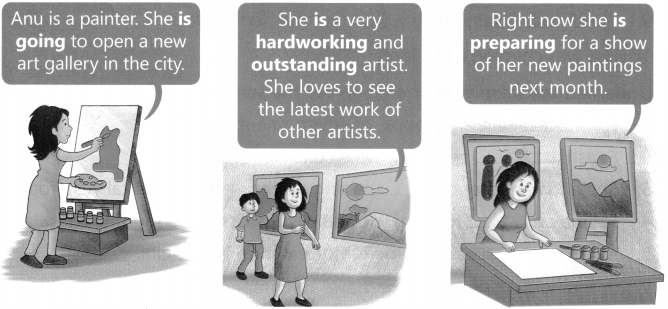
Read the picture story.
Present Participle Exercises for Class 4 CBSE with Answers 2

A. Answer the following questions as per the story.

1. What is Anu going to open in the city? ___________
2. What does she love to see? ___________
3. What is she preparing for right now? ___________

B. Write two of the following.
Examples of Present participle from the story above.
1. ___________ 2. ___________

Examples of Participles adjectives from the story above.
1. ___________ 2. ___________.

Present Participle Exercises with Answers for Class 4 CBSE PDF

A. Fill in the blanks by changing the verbs in the brackets with Present Participle.

1. ___________ dogs (bark)
2. ___________ children (play)
3. ___________ girls (scream)
4. ___________ cowboys (dance)
5. ___________ ducks (swim)
6. ___________ babies (cry)
7. ___________ water (run)
8. ___________ teachers (sing)
9. ___________ leaves (fall)

B. Using the picture on the left, form a sentence using the words provided along with helping verbs and ing form of present participles. Remember the sentence should be in Present Continuous tense.

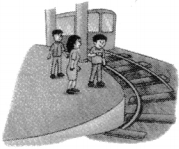
1. Present Participle Exercises for Class 4 CBSE with Answers 3 They / wait / for the train
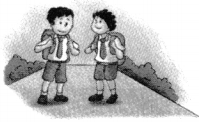
2. Present Participle Exercises for Class 4 CBSE with Answers 4 We / walk / to school
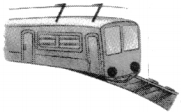
3. Present Participle Exercises for Class 4 CBSE with Answers 5 The train/ come
4. Present Participle Exercises for Class 4 CBSE with Answers 6 I / have / a good time
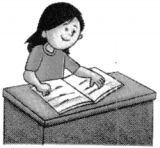
5. Present Participle Exercises for Class 4 CBSE with Answers 7 I/study
6. Present Participle Exercises for Class 4 CBSE with Answers 8 We / plan / our work
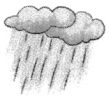
7. Present Participle Exercises for Class 4 CBSE with Answers 9 It / rain / today
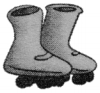
8. Present Participle Exercises for Class 4 CBSE with Answers 10 She / wear / skates

C. Choose the correct participle adjective form in each of the sentences below.

1. I don’t understand chess. The rules are very confused/confusing.
2. There is a new movie playing in the theatre. The movie is interested or interesting?
3. My little brother makes too much noise. He is annoyed/annoying.
4. I like my new chair. It’s quite relaxing/relaxed.
5. I think insects are fascinating/fascinated. I love to study them.

D. Make a sentence with the present participles. Use the following words as a verb and as an adjective.

1. Interesting
As a Verb ____________________
As an Adjective ____________________

2. Shocking
As a Verb ____________________
As an Adjective ____________________

3. Thrilling
As a Verb ____________________
As an Adjective ____________________

4. Fascinating
As a Verb ____________________
As an Adjective ____________________

Lines and Angles Class 9 Extra Questions Maths Chapter 6 with Solutions Answers

Here we are providing Lines and Angles Class 9 Extra Questions Maths Chapter 6 with Answers Solutions, Extra Questions for Class 9 Maths was designed by subject expert teachers.

Extra Questions for Class 9 Maths Lines and Angles with Answers Solutions

Extra Questions for Class 9 Maths Chapter 6 Lines and Angles with Solutions Answers

Lines and Angles Class 9 Extra Questions Very Short Answer Type

Question 1.
If an angle is half of its complementary angle, then find its degree measure.
Solution:
Let the required angle be x
∴ Its complement = 90° – x
Now, according to given statement, we obtain
x = \(\frac{1}{2}\)(90° – x)
⇒ 2x = 90° – x
⇒ 3x = 90°
⇒ x = 30°
Hence, the required angle is 30°.

Question 2.
The two complementary angles are in the ratio 1 : 5. Find the measures of the angles.
Solution:
Let the two complementary angles be x and 5x.
∴ x + 5x = 90°
⇒ 6x = 90°
⇒ x = 15°
Hence, the two complementary angles are 15° and 5 × 15° i.e., 15° and 75°.

Question 3.
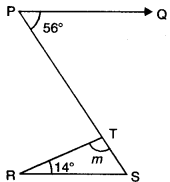
In the given figure, if PQ || RS, then find the measure of angle m.
Lines and Angles Class 9 Extra Questions Maths Chapter 6 with Solutions Answers 1
Solution:
Here, PQ || RS, PS is a transversal.
⇒ ∠PSR = ∠SPQ = 56°
Also, ∠TRS + m + ∠TSR = 180°
14° + m + 56° = 180°
⇒ m = 180° – 14 – 56 = 110°

Question 4.
If an angle is 14o more than its complement, then find its measure.
Solution:
Let the required angle be x
∴ Its complement = 90° – x
Now, according to given statement, we obtain
x = 90° – x + 14°
⇒ 2x = 104°
⇒ x = 52°
Hence, the required angle is 52o.

Question 5.
If AB || EF and EF || CD, then find the value of x.
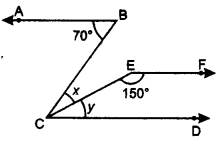
Lines and Angles Class 9 Extra Questions Maths Chapter 6 with Solutions Answers 2
Solution:
Since EF || CD ∴ y + 150° = 180°
⇒ y = 180° – 150° = 30°
Now, ∠BCD = ∠ABC
x + y = 70°
x + 30 = 70
⇒ x = 70° – 30° = 40°
Hence, the value of x is 40°.

Question 6.
In the given figure, lines AB and CD intersect at O. Find the value of x.
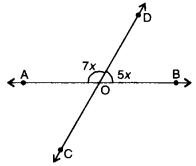
Lines and Angles Class 9 Extra Questions Maths Chapter 6 with Solutions Answers 3
Solution:
Here, lines AB and CD intersect at O.
∴ ∠AOD and ∠BOD forming a linear pair
⇒ ∠AOD + ∠BOD = 180°
⇒ 7x + 5x = 180°
⇒ 12x = 180°
⇒ x = 15°

Question 7.
In the given figure, PQ || RS and EF || QS. If ∠PQS = 60°, then find the measure of ∠RFE.
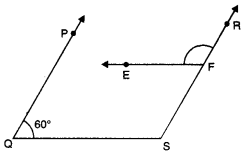
Lines and Angles Class 9 Extra Questions Maths Chapter 6 with Solutions Answers 4
Solution:
Since PQ || RS
∴ ∠PQS + ∠QSR = 180°
⇒ 60° + ∠QSR = 180°
⇒ ∠QSR = 120°
Now, EF || QS ⇒ ∠RFE = ∠QSR [corresponding ∠s]
⇒ ∠RFE = 120°

Question 8.
In the given figure, if x°, y° and z° are exterior angles of ∆ABC, then find the value of x° + y° + z°.
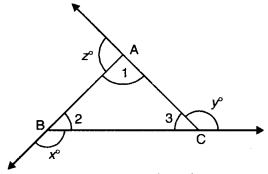
Lines and Angles Class 9 Extra Questions Maths Chapter 6 with Solutions Answers 5
Solution:
We know that, an exterior angle of a triangle is equal to sum of two opposite interior angles.
⇒ x° = ∠1 + ∠3
⇒ y° = ∠2 + ∠1
⇒ z° = ∠3 + ∠2
Adding all these, we have
x° + y° + z° = 2(∠1 + ∠2 + ∠3)
= 2 × 180°
= 360°

Lines and Angles Class 9 Extra Questions Short Answer Type 1

Question 1.
In the given figure, AB || CD, ∠FAE = 90°, ∠AFE = 40°, find ∠ECD.
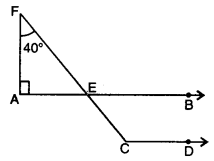
Lines and Angles Class 9 Extra Questions Maths Chapter 6 with Solutions Answers 6
Solution:
In AFAE,
ext. ∠FEB = ∠A + F
= 90° + 40° = 130°
Since AB || CD
∴ ∠ECD = FEB = 130°
Hence, ∠ECD = 130°.

Question 2.
In the fig., AD and CE are the angle bisectors of ∠A and ∠C respectively. If ∠ABC = 90°, then find ∠AOC.
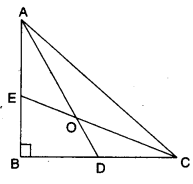
Lines and Angles Class 9 Extra Questions Maths Chapter 6 with Solutions Answers 7
Solution:
∵ AD and CE are the bisector of ∠A and ∠C
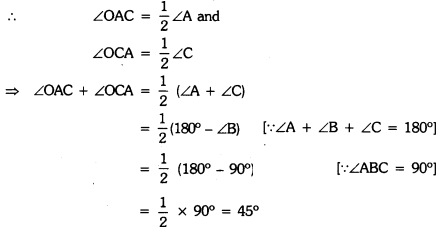
Lines and Angles Class 9 Extra Questions Maths Chapter 6 with Solutions Answers 8
In ∆AOC,
∠AOC + ∠OAC + ∠OCA = 180°
⇒ ∠AOC + 45o = 180°
⇒ ∠AOC = 180° – 45° = 135°.

Question 3.
In the given figure, prove that m || n.
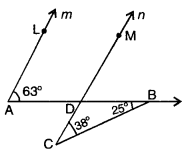
Lines and Angles Class 9 Extra Questions Maths Chapter 6 with Solutions Answers 9
Solution:
In ∆BCD,
ext. ∠BDM = ∠C + ∠B
= 38° + 25° = 63°
Now, ∠LAD = ∠MDB = 63°
But, these are corresponding angles. Hence,
m || n

Question 4.
In the given figure, two straight lines PQ and RS intersect each other at O. If ∠POT = 75°, find the values of a, b, c.
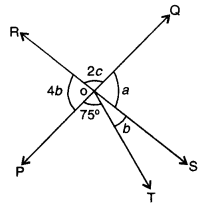
Lines and Angles Class 9 Extra Questions Maths Chapter 6 with Solutions Answers 10
Solution:
Here, 4b + 75° + b = 180° [a straight angle]
5b = 180° – 75° = 105°
b – \(\frac{105^{\circ}}{5}\) = 21°
∴ a = 4b = 4 × 21° = 84° (vertically opp. ∠s]
Again, 2c + a = 180° [a linear pair]
⇒ 2c + 84° = 180°
⇒ 2c = 96°
⇒ c = \(\frac{96^{\circ}}{2}\) = 48°
Hence, the values of a, b and c are a = 84°, b = 21° and c = 48°.

Question 5.
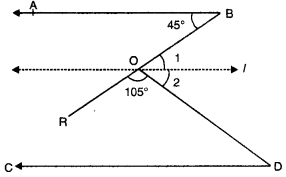
In figure, if AB || CD. If ∠ABR = 45° and ∠ROD = 105°, then find ∠ODC.
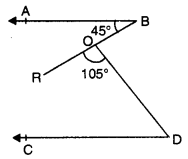
Lines and Angles Class 9 Extra Questions Maths Chapter 6 with Solutions Answers 11
Solution:
Lines and Angles Class 9 Extra Questions Maths Chapter 6 with Solutions Answers 12
Through O, draw a line ‘l’ parallel to AB.
⇒ line I will also parallel to CD, then
∠1 = 45°[alternate int. angles]
∠1 + ∠2 + 105° = 180° [straight angle]
∠2 = 180° – 105° – 45°
⇒ ∠2 = 30°
Now, ∠ODC = ∠2 [alternate int. angles]
= ∠ODC = 30°

Question 6.
In the figure, ∠X = 72°, ∠XZY = 46°. If YO and ZO are bisectors of ∠XYZ and ∠XZY respectively of ∆XYZ, find ∠OYZ and ∠YOZ.
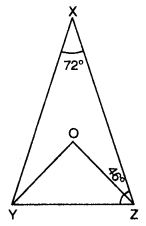
Lines and Angles Class 9 Extra Questions Maths Chapter 6 with Solutions Answers 13
Solution:
In ∆XYZ, we have
∠X + XY + ∠Z = 180°
⇒ ∠Y + ∠Z = 180° – ∠X
⇒ ∠Y + ∠Z = 180° – 72°
⇒ Y + ∠Z = 108°
⇒ \(\frac{1}{2}\) ∠Y + \(\frac{1}{2}\)∠Z = \(\frac{1}{2}\) × 108°
∠OYZ + ∠OZY = 54°
[∵ YO and ZO are the bisector of ∠XYZ and ∠XZY]
⇒ ∠OYZ + \(\frac{1}{2}\) × 46° = 54°
∠OYZ + 23° = 54°
⇒ ∠OYZ = 549 – 23° = 31°
In ∆YOZ, we have
∠YOZ = 180° – (∠OYZ + ∠OZY)
= 180° – (31° + 23°) 180° – 54° = 126°

Lines and Angles Class 9 Extra Questions Short Answer Type 2

Question 1.
Prove that if two lines intersect each other, then the bisectors of vertically opposite angles are in the same line.
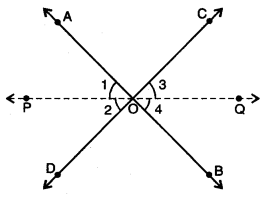
Lines and Angles Class 9 Extra Questions Maths Chapter 6 with Solutions Answers 14
Solution:
Let AB and CD be two intersecting lines intersecting each other in O.
OP and OQ are bisectors of ∠AOD and ∠BOC.
∴ ∠1 = ∠2 and ∠3 = ∠4 …(i)
Now, ∠AOC = ∠BOD [vertically opp. ∠s] ……(ii)
⇒ ∠1 + ∠AOC + ∠3 = ∠2 + ∠BOD + ∠4 [adding (i) and (ii)]
Also, ∠1 + ∠AOC + ∠3 + ∠2 + ∠BOD + ∠4 = 360° (∵ ∠s at a point are 360°]
⇒ ∠1 + ∠AOC + ∠3 + ∠1 + ∠AOC + ∠3 = 360° [using (i), (ii)]
⇒ ∠1 + ∠AOC + ∠3 = 180°
or ∠2 + ∠BOD + ∠4 = 180°
Hence, OP and OQ are in the same line.

Question 2.
In figure, OP bisects ∠BOC and OQ bisects ∠AOC. Prove that ∠POQ = 90°
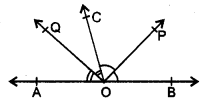
Lines and Angles Class 9 Extra Questions Maths Chapter 6 with Solutions Answers 15
Solution:
∵ OP bisects ∠BOC
∴ ∠BOP = ∠POC = x (say)
Also, OQ bisects. ∠AOC
∠AOQ = ∠COQ = y (say) .
∵ Ray OC stands on ∠AOB
∴ ∠AOC + ∠BOC = 180° [linear pair]
⇒ ∠AOQ + ∠QOC + ∠COP + ∠POB = 180°
⇒ y + y + x + x = 180°.
⇒ 2x + 2y = 180°
⇒ x + y = 90°
Now, ∠POQ = ∠POC + ∠COQ
= x + y = 90°

Question 3.
In given figure, AB || CD and EF || DG, find ∠GDH, ∠AED and ∠DEF.
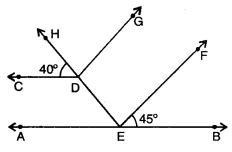
Lines and Angles Class 9 Extra Questions Maths Chapter 6 with Solutions Answers 16
Solution:
Since AB || CD and HE is a transversal.
∴ ∠AED = ∠CDH = 40° [corresponding ∠s]
Now, ∠AED + ∠DEF + ∠FEB = 180° [a straight ∠]
40° + CDEF + 45° = 180°
∠DEF = 180° – 45 – 40 = 95°
Again, given that EF || DG and HE is a transversal. .
∴ ∠GDH = ∠DEF = 95° [corresponding ∠s]
Hence, ∠GDH = 95°, ∠AED = 40° and ∠DEF = 95°

Question 4.
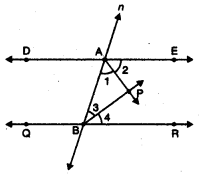
In figure, DE || QR and AP and BP are bisectors of ∠EAB and ∠RBA respectively. Find ∠APB.
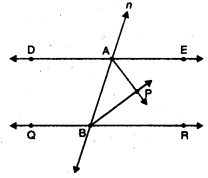
Lines and Angles Class 9 Extra Questions Maths Chapter 6 with Solutions Answers 17
Solution:
Lines and Angles Class 9 Extra Questions Maths Chapter 6 with Solutions Answers 18
Here, AP and BP are bisectors of ∠EAB and ∠RBA respectively.
⇒ ∠1 = ∠2 and ∠3 = ∠4
Since DE || QR and transversal n intersects DE and QR at A and B respectively.
⇒ ∠EAB + ∠RBA = 180°
[∵ co-interior angles are supplementary]
⇒ (∠1 + ∠2) + (∠3 + ∠4) = 180°
⇒ (∠1 + ∠1) + (∠3 + ∠3) = 180° (using (i)
⇒ 2(∠1 + ∠3) = 180°
⇒ ∠1 + ∠3 = 90°
Now, in ∆ABP, by’angle sum property, we have
∠ABP + ∠BAP + ∠APB = 180°
⇒ ∠3 + ∠1 + ∠APB = 180°
⇒ 90° + ∠APB = 180°
⇒ ∠APB = 90°

Question 5.
In the given figure, POQ is a line. Ray OR is perpendicular to line PQ. OS is another ray lying between rays OP and OR. Prove that ∠ROS = \(\frac{1}{2}\) (∠QOS – ∠POS).
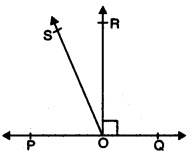
Lines and Angles Class 9 Extra Questions Maths Chapter 6 with Solutions Answers 19
Solution:
Given that OR is perpendicular to PQ
⇒ ∠POR = ∠ROQ = 90°
∴ ∠POS + ∠ROS = 90°
⇒ ∠ROS = 90° – ∠POS
Adding ∠ROS to both sides, we have
∠ROS + ∠ROS = (90° + ∠ROS) – ∠POS
⇒ 2∠ROS = ∠QOS – ∠POS
⇒ ∠ROS = \(\frac{1}{2}\) (∠QOS – ∠POS).

Question 6 .
If two parallel lines are intersected by a transversal, then prove that the bisectors of any two corresponding angles are parallel.
Solution:
Given : AB || CD and transversal PQ meet these lines at E and F respectively. EG and FH are
the bisectors of pair of corresponding angles ∠PEB and ∠EFD.
To Prove : EG || FH Proof
∵ EG and FH are bisectors of ∠PEB respectively.
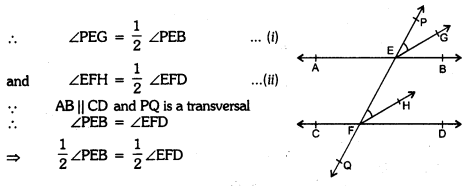
Lines and Angles Class 9 Extra Questions Maths Chapter 6 with Solutions Answers 20
∠PEG = ∠EFH
Which are corresponding angles of EG and FH
∴ EG || FH.

Question 7.
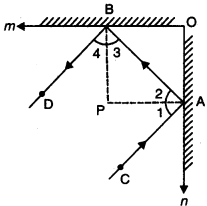
In the given figure, m and n are two plane mirrors perpendicular to each other. Show that incident rays CA is parallel to reflected ray BD.
Lines and Angles Class 9 Extra Questions Maths Chapter 6 with Solutions Answers 21
Solution:
Let normals at A and B meet at P.
As mirrors are perpendicular to each other, therefore, BP || OA and AP || OB.
So, BP ⊥ PA i.e., ∠BPA = 90°
Therefore, ∠3 + ∠2 = 90° [angle sum property] …(i)
Also, ∠1 = ∠2 and ∠4 = ∠3 [Angle of incidence = Angle of reflection]
Therefore, ∠1 + ∠4 = 90° [from (i)) …(ii]
Adding (i) and (ii), we have
∠1 + ∠2 + ∠3 + ∠4 = 180°
i.e., ∠CAB + ∠DBA = 180°
Hence, CA || BD

Lines and Angles Class 9 Extra Questions Long Answer Type

Question 1.
If two parallel lines are intersected by a transversal, prove that the bisectors of two pairs of interior angles form a rectangle.
Solution:
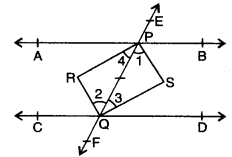
Given : AB || CD and transversal EF cut them at P and Q respectively and the bisectors of
pair of interior angles form a quadrilateral PRQS.
Lines and Angles Class 9 Extra Questions Maths Chapter 6 with Solutions Answers 22
To Prove : PRQS is a rectangle.
Proof : ∵ PS, QR, QS and PR are the bisectors of angles
∠BPQ, ∠CQP, ∠DQP and ∠APQ respectively.
∴∠1 =\(\frac{1}{2}\) ∠BPQ, ∠2 = \(\frac{1}{2}\)∠CQP,
∠3 = \(\frac{1}{2}\)∠DQP and ∠4 = \(\frac{1}{2}\)∠APQ
Now, AB || CD and EF is a transversal
∴ ∠BPQ = ∠CQP
⇒ ∠1 = ∠2 (∵∠1 \(\frac{1}{2}\) ∠BPQ and ∠2 = \(\frac{1}{2}\)∠QP)
But these are pairs of alternate interior angles of PS and QR
∴ PS || QR
Similarly, we can prove ∠3 = ∠4 = QS || PR
∴ PRQS is a parallelogram.
Further ∠1 + ∠3 = \(\frac{1}{2}\)∠BPQ + \(\frac{1}{2}\)∠DQP = \(\frac{1}{2}\) (∠BPQ + ∠DQP)
= \(\frac{1}{2}\) × 180° = 90° (∵ ∠BPQ + ∠DQP = 180°)
∴ In ∆PSQ, we have ∠PSQ = 180° – (∠1 + ∠3) = 180° – 90° = 90°
Thus, PRRS is a parallelogram whose one angle ∠PSQ = 90°.
Hence, PRQS is a rectangle.

Question 2.
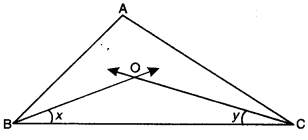
If in ∆ABC, the bisectors of ∠B and ∠C intersect each other at O. Prove that ∠BOC = 90° + \(\frac{1}{2}\)∠ A.
Lines and Angles Class 9 Extra Questions Maths Chapter 6 with Solutions Answers 23
Solution:
Let ∠B = 2x and ∠C = 2y
∵OB and OC bisect ∠B and ∠C respectively.
∠OBC = \(\frac{1}{2}\)∠B = \(\frac{1}{2}\) × 2x = x
and ∠OCB = \(\frac{1}{2}\)∠C = \(\frac{1}{2}\) × 2y = y
Now, in ∆BOC, we have
∠BOC + ∠OBC + ∠OCB = 180°
⇒ ∠BOC + x + y = 180°
⇒ ∠BOC = 180° – (x + y)
Now, in ∆ABC, we have
∠A + 2B + C = 180°
⇒ ∠A + 2x + 2y = 180°
⇒ 2(x + y) = \(\frac{1}{2}\)(180° – ∠A)
⇒ x + y = 90° – \(\frac{1}{2}\)∠A …..(ii)
From (i) and (ii), we have
∠BOC = 180° – (90° – \(\frac{1}{2}\)∠A) = 90° + \(\frac{1}{2}\) ∠A

Question 3.
In figure, if I || m and ∠1 = (2x + y)°, ∠4 = (x + 2y)° and ∠6 = (3y + 20)°. Find ∠7 and ∠8.
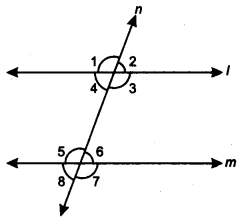
Lines and Angles Class 9 Extra Questions Maths Chapter 6 with Solutions Answers 24
Solution:
Here, ∠1 and ∠4 are forming a linear pair
∠1 + ∠4 = 180°
(2x + y)° + (x + 2y)° = 180°
3(x + y)° = 180°
x + y = 60
Since I || m and n is a transversal
∠4 = ∠6
(x + 2y)° = (3y + 20)°
x – y = 20
Adding (i) and (ii), we have
2x = 80 = x = 40
From (i), we have
40 + y = 60 ⇒ y = 20
Now, ∠1 = (2 x 40 + 20)° = 100°
∠4 = (40 + 2 x 20)° = 80°
∠8 = ∠4 = 80° [corresponding ∠s]
∠1 = ∠3 = 100° [vertically opp. ∠s]
∠7 = ∠3 = 100° [corresponding ∠s]
Hence, ∠7 = 100° and ∠8 = 80°

Question 4.
In the given figure, if PQ ⊥ PS, PQ || SR, ∠SQR = 28o and ∠QRT = 65°. Find the values of x, y and z.
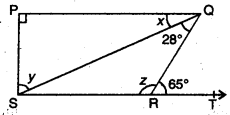
Lines and Angles Class 9 Extra Questions Maths Chapter 6 with Solutions Answers 25
Solution:
Here, PQ || SR .
⇒ ∠PQR = ∠QRT
⇒ x + 28° = 65°
⇒ x = 65° – 28° = 37°
Now, in it. ∆SPQ, ∠P = 90°
∴ ∠P + x + y = 180° [angle sum property]
∴ 90° + 37° + y = 180°
⇒ y = 180° – 90° – 37° = 53°
Now, ∠SRQ + ∠QRT = 180° [linear pair]
z + 65° = 180°
z = 180° – 65° = 115°

Question 5.
In figure, AP and DP are bisectors of two adjacent angles A and D of a quadrilateral ABCD. Prove that 2∠APD = ∠B + ∠C.
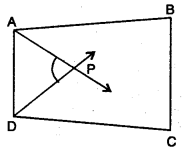
Lines and Angles Class 9 Extra Questions Maths Chapter 6 with Solutions Answers 26
Solution:
In quadrilateral ABCD, we have
∠A + ∠B.+ ∠C + ∠D = 360°
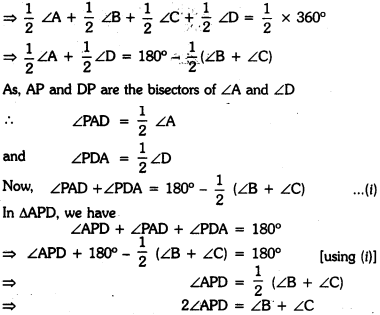
Lines and Angles Class 9 Extra Questions Maths Chapter 6 with Solutions Answers 27

Question 6.
In figure, PS is bisector of ∠QPR ; PT ⊥ RQ and Q > R. Show that ∠TPS = \(\frac{1}{2}\)(∠Q – ∠R).
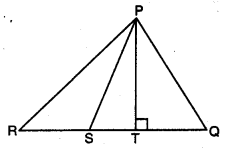
Lines and Angles Class 9 Extra Questions Maths Chapter 6 with Solutions Answers 28
Solution:
Since PS is the bisector of ∠QPR
∴∠QPS = ∠RPS = x (say)
In ∆PRT, we have
∠PRT + ∠PTR + ∠RPT = 180°
⇒ ∠PRT + 90° + ∠RPT = 180°
⇒ ∠PRT + ∠RPS + ∠TPS = 90°
⇒ ∠PRT + x + ∠TPS = 90°
⇒ ∠PRT or ∠R = 90° – ∠TPS – x
In ΔΡQT, we have
∠PQT + ∠PTQ + ∠QPT = 180°
⇒ ∠PQT + 90° + ∠QPT = 180°
⇒ ∠PQT + ∠QPS – TPS = 90°
⇒ ∠PQT + x – ∠TPS = 90° [∵∠QPS = x]
⇒ ∠PQT or ∠Q = 90° + ∠TPS – x …(ii)
Subtracting (i) from (ii), we have
⇒ ∠Q – ∠R = (90° + ∠TPS – x) – 190° – ∠TPS – x)
⇒ ∠Q – ∠R = 90° + ∠TPS – X – 90° + ∠TPS + x
⇒ 2∠TPS = 2Q- ∠R
⇒ ∠TPS = \(\frac{1}{2}\)(Q – ∠R)

Lines and Angles Class 9 Extra Questions HOTS

Question 1.
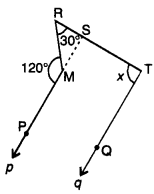
In the given figure, p ll q, find the value of x.
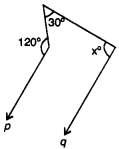
Lines and Angles Class 9 Extra Questions Maths Chapter 6 with Solutions Answers 29
Solution:
Lines and Angles Class 9 Extra Questions Maths Chapter 6 with Solutions Answers 30
Extend line p to meet RT at S.
Such that MS || QT
Now, in ARMS, we have
∠RMS = 180° – ∠PMR (linear pair]
= 180° – 120°
= 60°
∠RMS + ∠MSR + ∠SRM = 180° [by angle sum property of a ∆]
⇒ 60° + ∠MSR + 30o = 180°
⇒ MSR = 90°
Now, PS || QT – ∠MSR = ∠RTQ
⇒ ∠RTQ = x = MSR = 90° (corresponding ∠s]

Question 2.
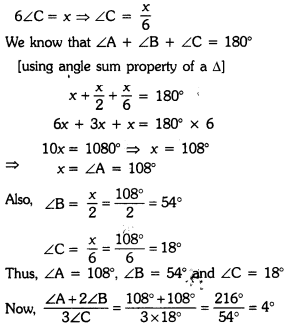
In a triangle, if ∠A = 2∠B = 6∠C, find the measures of ∠A, ∠B and ∠C and find the value of \(\frac{\angle A+2 \angle B}{3 \angle C}\).
Solution:
Let us consider ∠A = 2∠B = 6∠C = x
∴∠A = x
2∠B = x = ∠B = \(\frac{1}{2}\)
Lines and Angles Class 9 Extra Questions Maths Chapter 6 with Solutions Answers 31

Lines and Angles Class 9 Extra Questions Value Based (VBQs)

Question 1.
Students in a school are preparing banner for a rally to make people aware for saving electricity. What value are they exhibiting by doing so ? Parallel lines I and m are cut by transversal t, if ∠4 = ∠5 and ∠6 = ∠7, what is measure of angle 8 ?
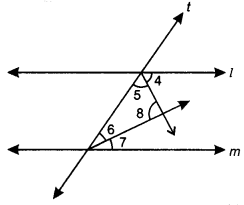
Lines and Angles Class 9 Extra Questions Maths Chapter 6 with Solutions Answers 32
Solution:
Here, given that ∠4 = ∠5 and ∠6 = ∠7
Now, I || m and t is a transversal
∴ ∠4 + ∠5 + ∠6 + ∠7 = 180° [∵ co-interior angles are supplementary]
∠5 + ∠5 + ∠6 + ∠6 = 180° [using (i)]
2(∠5 + ∠6) = 180°
∠5 + ∠6 = 90°
We know that, sum of all interior angles of a triangle is 180°
∴ ∠8 + ∠5 + ∠6 = 180°
⇒ ∠8 + 90° = 180° [using (ii)]
⇒ ∠8 = 180° – 90° = 90°
Save electricity, save energy.

Question 2.
To protect poor people from cold weather, Ram Lal. has given his land to make a shelter home for them. What value is being exhibited by him? In the given figure, ‘sides QP and RQ of ∆PQR are produced to point S and T respectively. If ∠PQT = 110° and ∠SPR = 135°, find ∠PRQ.
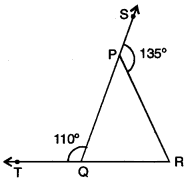
Lines and Angles Class 9 Extra Questions Maths Chapter 6 with Solutions Answers 33
Solution:
Here,
∠SPR + ∠QPR = 180° [a linear pair]
135° + ∠QPR = 180° [∵ ∠SPR = 135°]∠
⇒ ∠QPR = 180° – 135° = 45°
In ∆PQR, by exterior angle property, we have
∠QPR + ∠PRQ = ∠PQT
45° + ∠PRQ = 110°
∠PRQ = 110° – 45° = 65°
Helpful nature, service of mankind and helping the needy people.

Question 3.
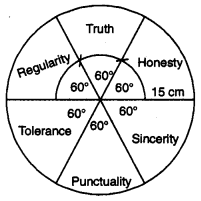
In an activity of mathematics, a teacher ask students to divide a circular sheet of radius 15 cm into 6 equal parts to write 6 values they like. What is the central angle subtended by each part ? Give the six values of your preference.
Solution:
Lines and Angles Class 9 Extra Questions Maths Chapter 6 with Solutions Answers 34
Draw a circle of radius 15 cm and divide the circular region into six equal parts by constructing an angle of measure 60° at the centre.
Central angle subtended by each part
= \(\frac{360^{\circ}}{6}\) = 60°
The six values are : Honesty, Truth, Regularity, Tolerance, Punctuality and Sincerity.

Helping Verb and Main Verbs Exercises for Class 4 CBSE with Answers

Main and Helping Verbs Worksheets with Answers CBSE PDFThis grammar section explains English Grammar in a clear and simple way. There are example sentences to show how the language is used.

Helping Verb and Main Verbs Exercises for Class 4 CBSE with Answers PDF

  • A main verb tell us about the action or state of being in a sentence.
  • Sometimes a verb cannot work alone. It needs a helper. These helpers are called helping verbs.
  • Action words like eat, cry, walk are all main verbs.
  • Is, am, are, has, have are the helpers of present tense, Was and Were, had are the helpers of Past tense, Will, shall are the helper of Future tense. All together are called helping verbs.
    Example:
    We are walking to the park.
    The word walking is the main verb.
    The word are is a helping verb.

Presentation
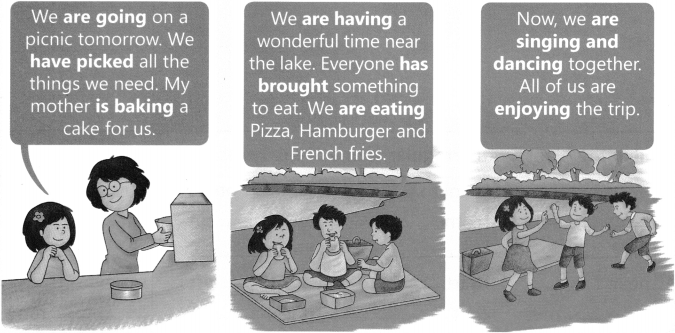
Read the picture story.
Main and Helping Verbs Worksheets with Answers CBSE PDF

A. Answer the following question from the story above.

1. What is the mother doing in the picture story? ____________________
2. Where are the friends going for a picnic? ____________________
3. What are the friends doing near the lake? ____________________
4. What are the friends eating together? ____________________

B. Underline the helping verbs in the following sentences from the story above.

1. They are going for a picnic.
2. The mother is baking a cake.
3. They are singing and dancing.
4. All the friends are having a wonderful time.

Main and Helping Verbs Worksheets with Answers CBSE PDF

A. Underline the main verb in each sentence and circle the helping verb. The first one has been done for you.

1. I am going hiking next Saturday.
2. My father and my brother, George, are coming with me.
3. We have gathered all the equipment we need.
4. We will walk for almost ten miles.
5. The three of us might sing while we walk.
6. I am looking forward to this trip.
7. Martin and his parents were watching the dogs play.
8. His parents were selecting a dog from the city animal shelter.
9. Martin was hoping they would find the perfect dog.
10. Lisa was chirping like a bird.

B. Underline the main verb and complete the sentences using helping verb.

1. I ___________ reading a book of environmental science.
2. Satish ___________ practicing exercises for his leg.
3. She and her sister ___________ going to the nearest hospital yesterday.
4. Fatima ___________ fighting with deadly disease three months ago.
5. My mother ___________ come tomorrow from New Delhi.

C. Write the helping verb ‘has’ or ‘have’ to complete each sentence.

1. We ___________ been telling the truth, the whole time.
2. They ___________ gone the wrong way again.
3. He ___________ given all his time to the team.
4. My parents ___________ gone above and beyond for me.
5. You ___________ given me a great surprise.
6. She ___________ told the truth,
7. I ___________ heard a lot about you.
8. He ___________ shared his food with me.

Verbs Exercises for Class 4 CBSE with Answers

Verbs Exercises for Class 4 CBSE with Answers

This grammar section explains English Grammar in a clear and simple way. There are example sentences to show how the language is used.

Verbs Exercises for Class 4 CBSE with Answers PDF

  • Action, doing and being words are called verbs.
  • Verbs have forms called tenses that tell us when the action happens.
  • There are three forms of tenses. Present Tense, Past tense, Future Tense
  • Simple Present tense talks about things as they happen.
  • We add s-or es with an action verb in a sentence that comes with singular nouns.
  • Simple Past tense talks about things that happened in the past.
  • The simple past tense is usually made by adding ‘ed’ to the verb.
  • Simple Future tense talks about things that will happen in the future.
  • We use either Shall or Will with main verb.
  • Present Continuous tense: We use present continuous tense when actions are happening now.
  • We use Is, Am, Are as helping verbs+ing with the main verb.
  • Past Continuous tense: We use past continuous tense when actions were happening in the past.
  • We use Was and Were as helping verbs+ing with the main verb.
  • Regular verbs add -d or -ed to refer to the past. Example- walk-walked, jump-jumped.
  • Irregular verbs change their spellings when they refer to the past.
  • sit-sat, come- came, stand-stood, go-went

Verbs Exercises for Class 5 with Answers CBSE PDF

A. Underline the verb in each sentence. Write whether the verb is past tense, present tense, or future tense.

1. Daniel will choose a baseball bat ___________________
2. He steps up to the plate. ___________________
3. The pitcher tossed the ball ___________________
4. Daniel will swing hard ___________________
5. The ball struck the bat. ___________________
6. The ball flies through the air. ___________________
7. It landed over the fence ___________________
8. Daniel will run around the bases ___________________
9. The crowd cheers loudly ___________________
10. He will slide into home plate ___________________
11. Daniel’s teammates cheered ___________________
12. Daniel smiled proudly. ___________________

B. In the following sentences, choose the correct tense of the highlighted verb.

1. Shyam played with his dog.
Present ( )
Past ( )
Future ( )

2. Harry will go with Bob to the movie.
Present ( )
Past ( )
Future ( )

3. Anita sings in the choir.
Present ( )
Past ( )
Future ( )

4. Poonam writes stories for her friends.
Present ( )
Past ( )
Future ( )

5. Tom sold his baseball cards.
Present ( )
Past ( )
Future ( )

C. Fill in the blanks with a suitable form of tense.

1. I ___________ (do) many things every day.
2. She ___________ (cook) at the moment.
3. They ___________ (have) a party last Sunday.
4. We ___________ (do) ¡t tomorrow.
5. She ___________ (write) this exercise two weeks ago.
6. He usually ___________ (buy) modern clothes.
7. Look! The children ___________ (play) with snowballs.
8. They ___________ (attempt) a test yesterday.
9. They sometimes ___________ (break) their toys.
10. The boy ___________ (get) good marks last year.

D. Rewrite the complete phrases in Simple Past.
1. We visit → ___________
2. They like → ___________
3. She dances → ___________
4. I play → ___________
5. You carry → ___________
6. He stops → ___________
7. You change → ___________
8. We enjoy → ___________
9. She uses → ___________
10. You try → ___________

E. Use the word ‘will’ along with the verbs given ¡n the brackets to complete the sentences.

1. Tomorrow it ____________ ¡n the north-west. (to rain)
2. My friend ____________ 12 next Monday. (to be)
3. The teacher told. me she ____________ a word with my mother. (to have)
4. She ____________ her boss next week. (to contact)
5. I think you ____________ this job. (to get)
6. TheyL laround6pm.(toarrive)
7. The teacher ____________ this exercise. (to explain)
8. He ____________ you the bottle of water. (to give)
9. Lots of accidents ____________ ¡n that weather. (to happen)
10. She ____________ if you show her the spider. (to scream)

F. Fill in the blanks with the simple present with a third person.

1. I sing → she ___________
2. I play → she
3. I read → she ___________
4. I go she ___________
5. I ask → she ___________
6. I carry → she ___________
7. I enjoy → she ___________
8. I wash → she ___________
9. I call → she ___________
10. I cry → she ___________

G. Fill in the blanks with present continuous tense of the verbs given in the brackets.

1. It ___________ outside. (rain)
2. Ravi ___________ to his friend. (talk)
3. He ___________ tennis there. (play)
4. They ___________ noise in the class. (make)
5. I ___________ my doctor tonight.(visit)
6. We ___________ the door. (close)
7. Sita ___________ in the library. (study)
8. She ___________ a sweater for her son. (knit)

H. Use the following words to make sentences in past continuous tense. The first one has been done for you.

1. My mother / read / a novel My mother was reading a novel.
2. My father / watch / a movie ___________
3. My elder sister / writing / in her diary ___________
4. My two brothers / listen / to the radio ___________
5. My younger sister and I / not / watch / a movie ___________
6. We / talk / about school ___________

I. Put the regular verbs in the correct category.
cry – like – stop – wait – stay – fail
enjoy – label – agree – marry – explain – hop
care – bury – use – jog – clap – prefer

-d only-ed only-ied onlyDouble consonant+ed
LivedCleanedStudiedShopped
……………………………………….……………………………………….……………………………………….……………………………………….

J. Fill in the blanks with irregular forms of the verbs.
be ____________
____________ could
fall ____________
hear ____________
____________ met
____________ sent
take ____________
begin ____________
come ____________
____________ got
hurt ____________
put ____________
sit ____________
wake ____________
____________ broke
____________ cut
give ____________
____________ left
ride ____________
____________ slept
write ____________
buy ____________
eat ____________
____________ had
make ____________
____________ ran
stand ____________

Weather, Climate and Adaptations of Animals to Climate Class 7 Extra Questions and Answers Science Chapter 7

In this page, we are providing Weather, Climate and Adaptations of Animals to Climate Class 7 Extra Questions and Answers Science Chapter 7 pdf download. NCERT Extra Questions for Class 7 Science Chapter 7 Weather, Climate and Adaptations of Animals to Climate with Answers will help to score more marks in your CBSE Board Exams.

Class 7 Science Chapter 7 Extra Questions and Answers Weather, Climate and Adaptations of Animals to Climate

Extra Questions for Class 7 Science Chapter 7 Weather, Climate and Adaptations of Animals to Climate with Answers Solutions

Weather, Climate and Adaptations of Animals to Climate Class 7 Extra Questions Very Short Answer Type

Question 1.
Why desert animals live in burrows?
Answer:
To escape hot and dry weather they live in burrows.

Question 2.
Name some animals found in polar regions.
Answer:
Penguins, polar bears, foxes and walrus.

Question 3.
The weather pattern of nearly how many years is called the climate of the place?
Answer:
25 years

Question 4.
Name some countries which belong to polar regions.
Answer:
Canada, Greenland, Sweden, Norway, etc.

Question 5.
Name the two regions of the earth having extreme climatic conditions.
Answer:
(i) Tropical region
(ii) Polar region

Question 6.
Name the major types of animals living in the rainforests.
Answer:
Monkeys, apes, gorillas, lions, etc.

Question 7.
Name an instrument used to measure rainfall.
Answer:
Rain gauge

Question 8.
What is weather?
Answer:
The day-to-day condition of the atmosphere at a place is called weather.

Question 9.
When does the minimum temperature of the day occur?
Answer:
In the early morning.

Question 10.
What does the daily weather report predict?
Answer:
The weather for the day.

Question 11.
Which department does prepare the weather reports?
Answer:
The Meteorological Department of the Government.

Question 12.
Who record the weather everyday?
Answer:
Meteorologists

Question 13.
What are the sources of getting daily weather reports?
Answer:
Television, radio and newspapers.

Weather, Climate and Adaptations of Animals to Climate Class 7 Extra Questions Short Answer Type

Question 1.
What is climate?
Answer:
The average weather pattern taken over a long time, say 25 years is called climate of the place. If we find that the temperature at a place is high most of the time, then we say that the climate of that place is hot.

Question 2.
How does the sun cause the change in the weather?
Answer:
The sun is a sphere of hot gases which is burning at a very high temperature. Shape of Earth is round and not flat so the sun’s ray don’t fall evenly on the land and oceAnswer:These differences in temperature create wind and water movement and play important role in determining the weather at any place.

Question 3.
What do you mean by the term adaptation?
Answer:
The modifications of the features and the functions of the body of plants and animals according to the climatic condition of a place where they are living is called adaptation.

Question 4.
Describe the climate of polar regions.
Answer:
The polar regions are covered with snow and it is very cold for most parts of the year. The sun does not set for six months and does not rise for six months. In winters, the temperature can be as low as -37°C. These regions are dominated by Earth’s polar ice caps.

Question 5.
How is the mean temperature for a given month calculated?
Answer:
The mean temperature for a given month is found in two steps. First we find the average of the temperatures recorded during the month. Second, we calculate the average of such average temperatures over many years. That gives the mean temperature.

Question 6.
What is a rain gauge?
Answer:
Rain gauge is an instrument to measure rainfall. It is basically a measuring cylinder with a funnel on top to collect rainwater.

Question 7.
What informations does the daily weather report give?
Answer:
The daily weather report gives information about the temperature, humidity and rainfall during the past 24 hours.

Question 8.
Why do we feel so miserable in the summer afternoon and comparatively comfortable early in the morning?
Answer:
The maximum temperature of the day occurs generally in the afternoon while the minimum temperature occurs generally in the early morning. We, therefore, feel so miserable in the summer afternoon and comparatively comfortable early in the morning.

Question 9.
Describe the climatic condition of the western region of India with the example of that of Rajasthan.
Answer:
The climatic condition of the western part of India, for example Rajasthan shows that the temperature is high during most part of the year. But during winter, which lasts only for a few months, the temperature is quite low. This region, receives very little rainfall. This is the typical desert climate. It is hot and dry.

Weather, Climate and Adaptations of Animals to Climate Class 7 Extra Questions Long Answer Type

Question 1.
Answer:

WeatherClimate
(i) The day-to-day condition of atmosphere at a place is called weather. We say that the weather is not good today.(i) The average weather pattern taken for over a long time is called climate. We can say that the climate of Ranchi is better than that of Delhi.
(ii) It can vary over a very short period of time. So it is recorded at very short interval on daily basis.(ii) It does not vary in a short period of time. So it is recorded over a long time.

Question 2.
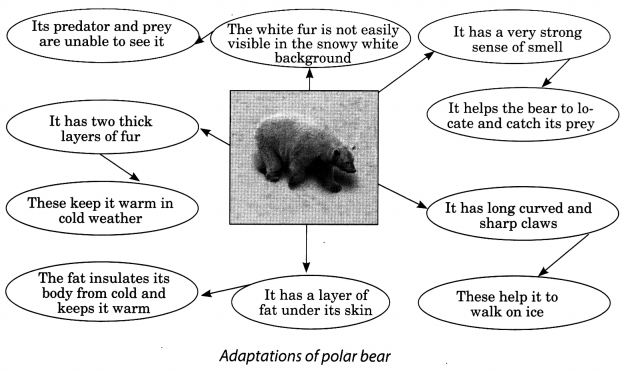
Explain the adaptations of polar bears to live in polar regions. Give the flow chart also.
Answer:
The adaptations that make the polar bears suitable to live in polar region are:

  1. The long curved and sharp claws help polar bear to walk on ice.
  2. They also have a layer of fat under their skin. In fact, they are so well insulated that they have to move slowly and rest, often to avoid getting overheated.
  3. Polar bears have white fur on their body so that they are not easily visible in the snowy background.
  4. The two thick-layers of furs on the body of polar bear protects them from extreme cold.
  5. They have a strong sense of smell so that it can catch its prey for food.
    The flow chart below clearly explain the adaptations of polar bears.

Weather, Climate and Adaptations of Animals to Climate Class 7 Extra Questions and Answers Science Chapter 7 1

Question 3.
How are penguins adapted for cold climate?
Answer:
Following are the characteristics that make them suitable to live in cold climate.

  1. Penguins have a thick skin and lot of fat under them to protect them from cold.
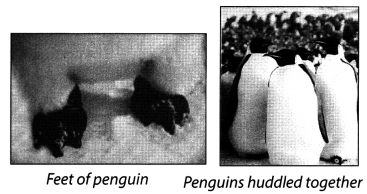
  2. Their bodies are streamlined and their feet have webs, making them good swimmers (Fig. 7.2)
  3. Penguin have thick skin and a lot of fat to protect it from cold. It has white coat that merges well with the white background.
  4. They often huddled together to remain warm. (Fig. 7.3)

Weather, Climate and Adaptations of Animals to Climate Class 7 Extra Questions and Answers Science Chapter 7 2

Question 4.
Write a short note on migration.
Answer:
Migration is physical movement of birds or animals from one area to another for food, space, breeding, escaping harsh condition, etc. Migration is commonly seen in birds living in extreme cold climate to long distances for warmer places during the winter season.

Siberian crane and Arctic tern are some of the migratory birds. Mammals, many types of fish and insects are also known to migrate seasonally in search of more hospitable climates.

Question 5.
Explain the climate of tropical regions.
Answer:
The tropical region has generally a hot climate because of its location around the equator. Even in the coldest month, the temperature is generally higher than about 15°C. During hot summers, the temperature may cross 40°C. Days and nights are almost equal in length throughout the year.

These region get plenty of rainfall. An important feature of the tropical region is the tropical rainforests. Tropical rainforests are found in Western Ghats and Assam in India, Southeast Asia, Central America and Central Africa.

Due to continuous warmth and rain, this region supports variety of animals and plants. For example, monkeys, apes, gorillas, tigers, elephants, leopards, lizards, snakes, birds, insects, etc. Many animals are adapted to living on the trees. Red-eyed frog has developed sticky pads on its feet to help it climb trees on which it lives.

To help them live on the trees, monkeys have long tails for grasping branches. Thus, many other animals have adapted to live in the tropical rainforests in tropical regions because of their characteristics like living on the trees, development of strong tails, long and large beaks, bright colours, sharp patterns, loud voice, diet of fruits, sensitive hearing, sharp eyesight, thick skin, ability to camouflage in order to protect themselves from predators, etc.

Weather, Climate and Adaptations of Animals to Climate Class 7 Extra Questions HOTS

Question 1.
Give one example of an animal that can live both in water and on land.
Answer:
Frog.

Question 2.
Write two common adaptive features of a polar bear which help in keeping it warm./
Answer:

  • Thick layer of fat under its skin which insulates its body from cold and keeps it warm.
  • Two thick layers of fur which keeps it warm.

Question 3.
What is huddling? How it keeps penguin warm in extreme cold climate?
Answer:
Huddling means to come together closely. When it is very cold, penguins huddle together in groups. Warm air gets trapped between the feathers and they get shielded from the full force of the cold wind outside. The penguins standing at the outside of the group continuously shuffle themselves inside to keep them warm. Thus, all penguins remain warm from extreme cold climate.

Question 4.
Mention two adaptive features in penguin which help it in swimming.
Answer:
Penguin have streamlined body and webbed feet which help it in swimming.

Question 5.
Why is it difficult to predict the weather of a place while it is easy to predict its climate?
Answer:
Climate is the average weather pattern taken over a long time, of a place so it is easy to predict. Weather is a complex phenomenon which can vary over a short period of time and thus is difficult to predict.

Weather, Climate and Adaptations of Animals to Climate Class 7 Extra Questions Value Based (VBQs)

Question 1.
A private zoo in tropical region thought of housing penguins to attract more tourists to its place. They arrange an artificial condition to keep them.
(a) Do you think penguins will be able to survive? Why?
(b) What is the difference between the two habitats, i.e., where penguins live and where they will be shifted?
(c) What kind of artificial conditions will be needed to house penguins in tropical region?
(d) Do you agree with the steps taken by the zoo?
(e) What value of private zoo is shown here?

Answer:
(a) No, because they are adaptive to extreme cold climate.
(b) Temperature is the main difference between the two habitat.
(c) Cold temperature, fish, length of days, climate and vegetation, etc.
(d) No because they are doing for their private profit and risking the lives of penguins.
(e) They seems to be money minder, selfish, etc.