Adverbs Worksheet Exercises for Class 3 CBSE with Answers

Adverbs Worksheet Exercises for Class 3 CBSE with Answers 1
This grammar section explains English Grammar in a clear and simple way. There are example sentences to show how the language is used.

Adverbs Worksheet Exercises for Class 3 CBSE with Answers PDF

  • Words that tells us more about the doing words are called How Words.
  • They show how an action is done.
    These how words are called Adverbs. Adverbs end in-ly. For example: slow – slowly, loud – loudly, brave – bravely, sweet – sweetly, sad – sadly
  • We can often convert a describing word into a how word by adding -ly.
  • An adverb is generally placed after the verb it is describing. For example: Arun ran swiftly.
  • An adverb can also be placed away from the verb. For example: Arun ran to the door swiftly.

Adverbs Worksheet Exercises for Grade 3 with Answers CBSE PDF

A. Underline the adverbs that describe the verbs in the following sentences.

1. My grandpa snored loudly. Adverbs Worksheet Exercises for Class 3 CBSE with Answers 2
2. My sheepdog sat lazily in the pool. so Adverbs Worksheet Exercises for Class 3 CBSE with Answers 3

3. Nitin placed a card slowly on the house of cards.
4. Naveen stamped his feet angrily. Adverbs Worksheet Exercises for Class 3 CBSE with Answers 4
5. Neerja waited patiently for the computer to load.Adverbs Worksheet Exercises for Class 3 CBSE with Answers 5

B. Fill in the blanks with suitable adverbs from the word bank.

1. The lion roared ___________
2. I am tired. Let’s walk ___________
3. I woke up because the phone rang ___________
4. She does not complain about the food. Angrily She eats ___________
5. The children are reading ___________
6. He finished his homework ___________

C. Change the adjectives into adverbs. Then write a sentence about each picture using the adverb.

1. strong – strongly
Adverbs Worksheet Exercises for Class 3 CBSE with Answers 6
The boy kicked the ball strongly.

2. happy – ___________
Adverbs Worksheet Exercises for Class 3 CBSE with Answers 7
______________________

3. beautiful – ___________
Adverbs Worksheet Exercises for Class 3 CBSE with Answers 8
______________________

4. loud – ___________

Adverbs Worksheet Exercises for Class 3 CBSE with Answers 8
______________________

5. soft – ___________
Adverbs Worksheet Exercises for Class 3 CBSE with Answers 10
______________________

Fibre to Fabric Class 6 Notes Science Chapter 3

On this page, you will find Fibre to Fabric Class 6 Notes Science Chapter 3 Pdf free download. CBSE NCERT Class 6 Science Notes Chapter 3 Fibre to Fabric will seemingly help them to revise the important concepts in less time.

CBSE Class 6 Science Chapter 3 Notes Fibre to Fabric

Fibre to Fabric Class 6 Notes Understanding the Lesson

1. Clothes are one of our basic needs.

2. Clothes protect us from heat, cold, dirt and dust.

3. The style of clothing differs from place to place.

4. Clothes also differ according to weather conditions.

5. In summer, mostly the cotton clothes of light colours are worn while in winters, mostly woollen clothes like sweaters, caps and gloves are worn.

6. The material that is used to make clothes is called

7. Fabric is woven from various kinds of fibres through various processes with the help of different machines.

8. Fibres are the thread-like structures that are obtained from animals or plants sources or synthesised artificially.

9. Fibre is the basic unit of a fabric.

10. Fabrics are of many types depending on the fibre they are made up of.

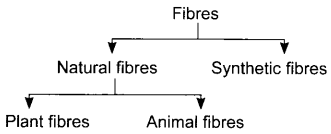
11. Fibres are classified on the basis of their origin and are mainly divided into two types: Natural fibres and synthetic fibres.

Fibre to Fabric Class 6 Notes Science Chapter 4

12. Fibres obtained from natural sources are called natural fibres.

13. Cotton, jute, wool, silk, fur, etc., are some of the examples of natural fibres.

14. Natural fibres are further classified into two types- animal fibres and plant fibres.

15. We use fleece of such animals that have special types of hair and fur on their body to make our clothes.

16. For example, wool is obtained from the fleece of sheep, cashmere wool is obtained from cashmere goat, the hair of yak, camel are also used to make woollen clothes.

17. Main plant fibres are cotton, jute, flax, hemp, etc.

18. In addition to these, coconut fibres are also taken in various uses.

19. Fibres that are manufactured artificially in factories using different chemicals are called synthetic fibres. Examples are rayon, terylene, nylon, polyester, etc.

20. Among all the fibres, cotton is produced in the largest quantity in India.

21. Cotton plants are usually grown at places having black soil and warm climate because black soil has capacity to retain water.

22. Cotton is mainly cultivated in Punjab, Gujarat, Rajasthan, Tamil Nadu, Andhra Pradesh, Madhya Pradesh and Karnataka.

23. The fruits of the cotton plant are known as cotton bolls which are about the size of a lemon.

24. On maturing, these bolls burst open and white fluffy mass is revealed.

25. In this white mass, there are cotton seeds covered with cotton fibres.

26. These white masses of cotton are handpicked from bolls. Then they are passed through various processes.

27. All the fibres are removed from the bolls through a process called

28. Machines are also used for ginning.

29. Jute is the cheapest and most affordable fibre. It is called the ‘golden fibre’.

30. fibre is obtained from the stem of the jute plant. It is cultivated during the rainy season in India.

31. In India, jute is mainly grown in Bihar, Assam and West Bengal.

32. The jute plant is normally harvested when it is at flowering stage.

33. The stems of the harvested plants are immersed in water for a few days.

34. The stems rot and fibres are separated by hand.

35. All these fibres are first converted into yarns to make fabrics.

36. Spinning is the process of converting fibres into yarn by twisting the fibre using various machines.

37. Spinning is done in the same way as the wicks are made from cotton wool at homes.

38. Spinning can be done both by hands and by machines.

39. Manually, it is done with a hand spindle called takli or on a spinning wheel called

40. Mahatma Gandhi was a great supporter of spinning on the charkha.

41. Once the yarn is obtained, it could be converted into fabric by either of the following two processes- weaving and knitting.

42. Weaving is the process of interlocking two sets of yarns at right angle to each other to form a fabric.

43. Weaving is done on the looms.

44. If looms are manually operated, they are called handlooms and if these are power operated then they are called power looms.

45. The process of making fabric from single yarn is called

46. Knitting can be done either by hands or by machines.

47. Knitting is mostly done for making woollen clothes.

48. In ancient times, people used the bark and big leaves of trees or animal skins and furs to cover themselves.

49. After people began to settle in agricultural communities, they learnt to weave twigs and grass into mats and baskets.

50. The early Indians wore fabrics made out of cotton that grew in the regions near the river Ganga.

51. Flax also a plant that gives natural fibres. In ancient times, cotton as well as flax were cultivated near the river Nile and were used for making fabrics.

52. In those days, stitching was not known. People simply draped the fabrics around different parts of their body.

53. With the invention of sewing needle, people started stitching fabrics to make clothes.

54. Stitched clothes have gone through many variations since this invention.

55. Just as there is a large variety in the food eaten all over the country, a large variety exists also in fabrics and clothing items.

Class 6 Science Chapter 3 Notes Important Terms

Cotton wool: Cotton wool is obtained from cotton plants. It is made up of thin cotton fibres.

Fabric: The woven materials which are used to make clothes are called fabrics.

Fibre: A long hair-like structure which is the basic unit of a fabric is called fibre.

Knitting: The process of making a piece of fabric from a single yam is called knitting.

Spinning: The process of converting fibres into yarn by twisting the fibre using various machines are called spinning.

Weaving: The process of arranging two sets of yarns together to make a fabric is called weaving.

Yam: A long strand which are made up of fibre is called yarn.

This That These Those Worksheet Exercises for Class 3 CBSE with Answers

This That These Those Worksheet Exercises for Class 3 CBSE with Answers
This grammar section explains English Grammar in a clear and simple way. There are example sentences to show how the language is used.

This That These Those Worksheet Exercises for Class 3 CBSE with Answers PDF

Fundamentals

  • This, That, These, Those are called demonstrative adjectives.
  • We use these adjectives to point out specific people or things.
  • This and that modify singular nouns. This is used to point out something that is nearby.
  • That is used to point out something that is far away.
  • These and Those are used for plural nouns. These is used for things that are nearby.
  • Those is used for things that are far away.

Presentation
Read the picture story.
This That These Those Worksheet Exercises for Class 3 CBSE with Answers 1

A. Answer the following questions from the story above.

1. What is ‘that’ referring to in the story?
_______________________________________

2. Which demonstrative adjectives are used for the items?
_______________________________________

3. Which demonstrative adjective is used for the word ‘opportunity’?
_______________________________________

B. Circle the correct option and write DA for demonstrative adjectives and DP for demonstrative pronouns. The first one has been done for you.

1. This/These are pretty flowers. DA
2. That/Those is my brother. ___________
3. This/These is a beautiful day. ___________
4. These/This shoes are mine. ___________
5. Those/That is my father’s car. ___________
6. These/This pencils are new. ___________
7. That/Those house is new. ___________
8. That/Those presents are for you. ___________

This That These Those Worksheet Exercises with Answers for Class 3 CBSE PDF

A. Tick the correct option.

1. (Those/That) man really loves the comic book store.
2. (These/This) apples are ready to be shipped.
3. (These/That) friend of mine is very reliable.
4. (These/That) fence needs another coat of paint.
5. Did you write (these/this) song?
6. (Those/That) movie was very realistic.

B. Convert these sentences to the plural form. The first one has been done for you.

1. This mouse is grey. These mice are grey.
2. That child is very cute. ___________
3. This apple tastes yummy. ___________
4. This pencil is not mine. ___________
5. That cherry is sweet and red. ___________
6. That baby is sleeping. ___________

How Much and How Many Worksheet Exercises for Class 3 CBSE with Answers

How Much and How Many Worksheet Exercises for Class 3 CBSE with Answers 1
This grammar section explains English Grammar in a clear and simple way. There are example sentences to show how the language is used.

How Much and How Many Worksheet Exercises for Class 3 CBSE with Answers

Fundamentals

  • Describing words which describe the amount or quantity of something without knowing its exact number is called adjectives of quantity.
  • Some, any, much, many, lots of, plenty of, a few, a little.
  • We use ‘Some’ with countable and uncountable nouns.
  • We use ‘Any’ with negative words or after not. We also use ‘any’ with questions usually.
  • We use ‘Many’ with countable nouns.
  • We use ‘Much’ with uncountable nouns.
  • We use ‘A few’ with countable nouns.
  • We use ‘A little with uncountable nouns.
  • We use ‘A lot of’ and ‘A plenty of’ with both countable nouns and uncountable nouns.

Presentation
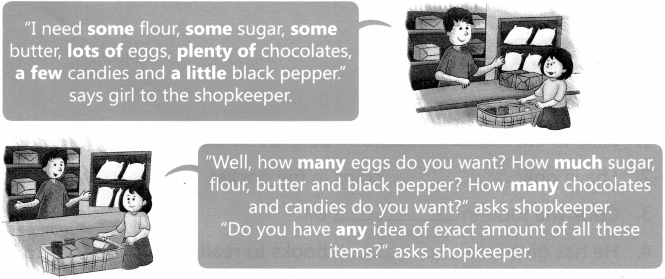
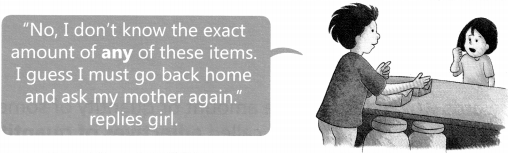
Read the picture story.
How Much and How Many Worksheet Exercises for Class 3 CBSE with Answers 2
How Much and How Many Worksheet Exercises for Class 3 CBSE with Answers 3

A. Answer the following questions as per the story.

1. How much sugar does a girl need? _____________
2. Which describing word is used for candies? _____________
3. Does a girl have any idea of exact amount of grocery items? _____________

B. Match the following describing words used with the items given in the story above.

  • Some – Eggs
  • Many – items
  • Much – Black pepper
  • Any – Sugar
  • A few – Flour
  • A little – Candies

How Much and How Many Worksheet Exercises with Answers for Class 3 CBSE PDF

A. Fill in the blanks with ‘a few’ or ‘a little’.

1. I like to eat _____________ food before I sit down to study.
2. I have only _____________ coins in my pocket.
3. COOK the food in _____________ oil.
4. He has given me _____________ books to read.
5. There is _____________ milk left for making tea.

B. Fill in the blanks with ‘some’, ‘any’, ‘a lot of’, ‘plenty of’.

1. I would like _____________ more chocolates, please.
2. I don’t want _____________ apples.
3. Is there _____________ money in the bag?
4. I can’t find _____________ money in the bag.
5. I think there is _____________ money in the box.
6. We ate _____________ food and nothing was left for Rani.
7. We had _____________ fun at the picnic.

C. Fill in the blanks with ‘much’ or ‘many’.

1. How _____________ legs does a spider have?
2. How _____________ milk does your cow give?
3. The game will be over soon. There isn’t _____________ time left.
4. I have told you this _____________ times before.
5. There’s not _____________ food in the fridge for you.
6. Her mother added _____________ items to the list later.
7. He is getting bald. He doesn’t have _____________ hair left on his head.
8. _____________ people drive cars these days.
9. I don’t have _____________ money in my pocket.
10. _____________ animals live in the jungle.

Components of Food Class 6 Notes Science Chapter 2

On this page, you will find Components of Food Class 6 Notes Science Chapter 2 Pdf free download. CBSE NCERT Class 6 Science Notes Chapter 2 Components of Food will seemingly help them to revise the important concepts in less time.

CBSE Class 6 Science Chapter 2 Notes Components of Food

Components of Food Class 6 Notes Understanding the Lesson

1. Our meals usually consist of a variety of food items.

2. Each dish is usually made up of different ingredients which contain some substances needed by our body. These substances are called nutrients.

3. Our food has five major nutrients: Carbohydrates, Fats, Proteins, Vitamins and Minerals.

4. Water and roughage (dietary fibres) are also important part of our food.

5. Carbohydrates provide energy to our body.

6. Some common sources of carbohydrates in our food are sweet potatoes, sugar, wheat, honey, rice, maize, millet, etc.

7. Fats also provide energy to our body. In fact, fats provide us twice as much energy as that provided by the same amount of carbohydrates.

8. Some common sources of fats in our food are: butter, ghee, milk, cheese, egg yolk, sunflower oil, mustard oil, etc.

9. Both fats and carbohydrates are called ‘energy-giving foods’.

10. Proteins supply the materials that are needed to make new cells by the body.

11. The various foods which are rich in proteins are milk, cheese, pulses, peas, beans, soybeans, fish, meat, chicken, eggs, etc.

12. Foods containing proteins are known as ‘bodybuilding foods’.

13. Vitamins are important for the normal growth and development of the body.

14. Vitamins are represented by the capital letters of the English alphabet such as A, B, C, D, E and K.

15. Some of the important vitamins are: Vitamin A, Vitamin B-complex, Vitamin C, Vitamin D, Vitamin E and Vitamin K.

16. The main sources of vitamins are milk, butter, carrot, eggs, green leafy vegetables, mango, orange, etc.

17. Our body needs minerals for its proper functioning, normal growth and good health.

18. Some of the important minerals needed by our body are calcium, phosphorus, iron, iodine, sodium and potassium.

19. The sources of minerals in our food are cheese, milk, fish, leafy vegetables, pulses, lobsters, iodised salts, etc.

20. Water is needed by our body:

  • to transport digested food to the body.
  • to transport important chemicals such as hormones around the body.
  • to get rid of waste products from the body.

21. Many food materials themselves contain some water. Fresh fruits and vegetables also provide us a lot of water.

22. Fruits and vegetables which provide water are tomatoes, melons, cabbages, etc.

23. The loss of water from the body causes dehydration.

24. Roughage is the fibrous matter in food which cannot be digested.

25. Roughage is also called ‘dietary fibre’.

26. Roughage provides bulk to the food, keeps the food and waste materials moving through the intestines and helps to prevent constipation.

27. The diet which contains adequate amounts of all the nutrients such as carbohydrates, fats, proteins, vitamins and minerals sufficient for the normal growth and development of the body is called a balanced diet.

28. Balanced diet includes a number of different food items in our daily meals, which when taken together, provide us all the nutrients in adequate amount.

29. Some nutrients presents in food materials are lost during the pre-cooking and cooking practices, which should be avoided.

30. Repeated washing of rice and pulses removes the water soluble vitamins and some minerals.

31. Cooking improves the taste of food and makes food easier to digest.

32. Vitamin C gets destroyed easily by heat during cooking.

33. If any of the nutrients is either less than the required amount from our diet over a long period of time, it can cause a disease or disorder in our body. These diseases are called deficiency diseases.

34. The deficiency of proteins in the diet of small children causes a disease known as

35. The deficiency of proteins, as well as carbohydrates in the diet of very small children, causes a disease known as

36. Deficiency of various vitamins in the human diet gives rise to a number of diseases such as night-blindness, beriberi, scurvy, rickets, etc.

37. Deficiency of minerals in the human diet also gives rise to a number of diseases such anaemia, rickets, cretinism, goitre, etc.

Class 6 Science Chapter 2 Notes Important Terms

Nutrients: The components of food that are necessary for growth and development of our body are called nutrients.

Carbohydrates: Carbohydrates provide energy to our body. The main carbohydrate that we eat in our food is starch and it comes from cereals.

Proteins: The nutrients which repair the damaged body cells during the healing of wounds and are need­ed to make new cells are called proteins. The main sources of protein in our food are fish, meat, chicken, peas, eggs, etc.

Fats: The nutrients which provide us twice as much energy as that provided by the same amount of carbo­hydrates are called fats. The main sources of fats in our food are meat, egg, yolk, groundnut, soybean, etc.

Vitamins: The nutrients which help in protecting our body against diseases and are important for the normal growth and development are called vitamin. The main sources of vitamins are milk, butter, carrot, papaya, etc.

Minerals: The nutrients which are needed to build bones and teeth; formation of haemoglobin in blood; coagulation of blood; and functioning of muscles, nerves and thyroid glands are called minerals. The important minerals are calcium, phosphorus, iron, sodium, potassium and iodine.

Dietary fibre: Dietary fibre or roughage is the indigestible portion of food derived from plants. The main sources of roughage are pulses, fresh fruits, potatoes, whole grains, etc.

Balanced diet: A diet that contains adequate amount of all the nutrients sufficient for the normal growth and development of the body is called balanced diet.

Obesity: The state of being grossly fat or overweight by eating too much fat rich foods is called obesity.

Deficiency disease: A disease that is caused by the lack of nutrients in our diet over a long period of tima is called deficiency disease.

Energy: The capacity to do work is called energy. We need energy for our various activities.

Starch: An odourless, tasteless white substance occurring widely in plant tissue and obtained chiefly from cereals and potatoes is called starch.

Scurvy: Scurvy is a disease caused due to deficiency of vitamin C. Bleeding gums are its main symptoms.