NCERT Class 7 History Chapter 10 Notes Eighteenth-Century Political Formations

On this page, you will find NCERT Class 7 History Chapter 10 Notes Pdf free download. CBSE Class 7 Social Science Notes History Chapter 10 SST Eighteenth-Century Political Formations will seemingly help them to revise the important concepts in less time.

Eighteenth-Century Political Formations Class 7 Notes Social Science History Chapter 10

CBSE Class 7 History Chapter 10 Notes Understanding The Lesson

1. Significant happening occurred in the subcontinent during the first half of the 18th century.

2. Boundaries of the Mughal Empire were reshaped by the emergence of a number of independent kingdom.

3. The British had successfully grabbed major chunks of territory in eastern India, by 1765.

4. The Mughal Empire started facing a variety of crises towards the closing years of the 17th These were caused by a number of factors.

5. Emperor Aurangzeb had depleted the military and financial resources of his empire by fighting a long war in the Deccan. Under his successors, the efficiency of the imperial administration broke down and it became difficult for the Mughal emperors to keep a check on their powerful mansabdars.

6. Nobles appointed as governors (subadars) often controlled the offices of revenue and military administration (diwani and faujdari) as well. As the governors consolidated their control over the provinces, the periodic remission of revenue to the capital declined.

7. In the northern and western India, the Mughals faced many rebellions including revolts of peasant and zamindari. These groups were now able to seize the economic resources of the region to consolidate their positions. After Aurangzeb, Mughal were unable to arrest the shifting of political and economic authority into the hand of provincial governors, local chieftains and other groups.

8. Ruler of Iran, Nadir Shah sacked and plundered the city of Delhi in 1739 and took away immense amounts of wealth.

9. Afghan ruler Ahmad Shah Abdali invaded north India five times between 1748 and 1761.

10. The worst possible humiliation came when two Mughal emperors, Farrukh Siyar and Alamgir II were assassinated and two others Ahmad Shah and Shah Alam II were blinded by their nobles.

11. With the decline in the authority of the Mughal emperors, the governors of large provinces, subadars, and the great zamindars consolidated their authority in different parts of the subcontinent.

12. Through the eighteenth century, the Mughal Empire gradually fragmented into a number of independent, regional states.

13. States of the 18th century can be divided into three overlapping groups:

14. States that were old Mughal provinces like Awadh, Bengal and Hyderabad. They were extremely powerful and quite independent, the rulers of these states did not break their formal ties with the Mughal emperor. All three states were founded by members of the high Mughal nobility who had been governors of large provinces-Sa’adat Khan (Awadh), Murshid Quli Khan (Bengal) and Asaf Jah (Hydrabad). All three had occupied high mansabdari positions and enjoyed the trust and confidence of the emperors. The two of them had zat rank of 7,000 each.

15. States had enjoyed considerable independence under the Mughals as watan jagirs. These included several Rajput kings.

16. States under the control of Marathas, Sikhs and others like the Jats had seized their independence from the Mughals after a long-drawn armed struggle.

17. Amber and Jodhpur had served under the Mughals. In exchange, they were permitted to enjoy considerable autonomy in their watan jagirs.

18. Ajit Singh, the ruler of Jodhpur, was also involved in the factional politics at the Mughal court. He held the governorship of Gujarat and Sawai Raja Jai Singh of Amber was governor of Malwa.

19. Sawai Raja Jai Singh founded his new capital at Jaipur and was given the subadari of Agra in 1722.

20. The Sikhs organization helped in regional state-building in the Punjab. Several battles were fought by Guru Gobind Singh against the Rajput and Mughal rulers, both before and after the institution of the Khalsa in 1699.

21. Several battles were founght by Guru Gobind Singh against the Rajput and Mughal rulers.

22. Under Banda Bahadur’s leadership Khalsa declared their sovereign rule by striking coins in the name of Guru Nanak and Guru Gobind Singh and established their own administration between the Sutlej and the Jamuna. Banda Bahadur was captured in 1715 and executed (death sentence) in 1716.

23. The Sikhs organized themselves into a number of bands called ‘jathas’ and later on ‘misls’. Their combined forces were known as the grand army i.e. dal khalsa.

24. A system called rakhi was introduced offering protection to cultivators on the payment of a tax of 20 per cent of the produce.

25. The Maratha kingdom was another powerful regional kingdom to arise out of a sustained opposition to Mughal rule. Shivaji carved out a stable kingdom with the support of powerful warrior families (deshmukhs).

26. Groups of highly mobile peasants, pastoralists provided the backbone of the Maratha army. These forces used to challenge the Mughals in the peninsula. Chitpavan Brahmanas who served Shivaji’s successors as Peshwa (principal minister). Poona became the capital of the Maratha kingdom.

27. Under the Peshwas, the Marathas developed a very successful military organization. Malwa and Gujarat were seized from the Mughals by the 1720s. By the 1730s the Maratha king was recognized as the overlord of the entire Deccan peninsula. He possessed the right to levy chauth and sardeshmukhi in the entire region.

28. The frontier of Maratha domination expanded into Rajasthan, Punjab, Bengal, Orissa and Karnataka, Tamil and Telugu region in the South.

29. Agriculture was encouraged and trade revived. This allowed Maratha chiefs (sardars) like Sindhia (Gwalior), Gaekwad (Baroda) and Bhonsle (Nagpur) the resources to raise powerful armies. Ujjain expanded under Sindhia’s patronage and Indore under Holkar’s. These cities were large and prosperous and functioned as important commercial and cultural centres. The silk produced in the Chanderi region now founded a new outlet in Poona.

30. Under the leadership of Churaman Jats acquired control over territories situated to the west of the city of Delhi and began dominating the region between the two imperial cities of Delhi and Agra.

31. The Jats were prosperous agriculturists and towns like Panipat and Ballabhgarh became important trading centres in the areas dominated by them. Under Suraj Mai the kingdom of Bharatpur emerged as a strong state.

The Making of Regional Cultures Class 7 CBSE Notes Important Terms

Faujdar: Mughal military commander.

Subadar: Governor of Province.

Jagirdar: Landowner.

Peshwa: Maratha minister.

Kunbis: Maratha peasant warriors.

Chauth: A Maratha tax.

Misls: Group of Sikh warriors.

Watan Jagirs: These states under the Mughals enjoyed independence.

Sardeshmukhi: A Maratha Tax

Notes of History Class 7 Chapter 10 Time Period

1699: Khalsa was formed by Guru Gobind Singh.

1707: Aurangzeb died.

1708: Guru Gobind Singh died.

1715- 1716: Banda Bahadur was captured and executed.

1719: Farrukh Siyar was assassinated.

1722: Sa’adat Khan appointed subadar of Awadh. Sawai Raja Jai Singh founded his new capital at Jaipur and he became Subadar of Agra.

1739: Nadir Shah attacked on Delhi.

1759: Alamgir-II assassinated.

1748-1761: Afghan ruler Ahmad Shah Abdali invaded north India 5 times.

1761: Third battle of Panipat.

1765: British had grabbed major chunks of territory in eastern India.

1799: Maharaja Ranjit Singh established his capital in Lahore.

Statistics Class 9 Extra Questions Maths Chapter 14 with Solutions Answers

Here we are providing Statistics Class 9 Extra Questions Maths Chapter 14 with Answers Solutions, Extra Questions for Class 9 Maths was designed by subject expert teachers.

Extra Questions for Class 9 Maths Statistics with Answers Solutions

Extra Questions for Class 9 Maths Chapter 14 Statistics with Solutions Answers

Statistics Class 9 Extra Questions Very Short Answer Type

Question 1.
The points scored by a basketball team in a series of matches are follows:
17, 7, 10, 25, 5, 10, 18, 10 and 24. Find the range.
Solution:
Here, maximum points = 25 and
minimum points = 5
Range = Maximum value – Minimum value
= 25 – 5 = 20

Question 2.
The points scored by a basketball team in a series of matches are as follows:
17, 2, 7, 27, 25, 5, 14, 18, 10. Find the median.
Solution:
Here, points scored in ascending order are 2, 5, 7, 10, 14, 17, 18, 25, 27, we have n = 9 terms
Statistics Class 9 Extra Questions Maths Chapter 14 with Solutions Answers 1

Question 3.
The scores of an English test (out of 100) of 20 students are given below :
75, 69, 88, 55, 95, 88, 73, 64, 75, 98, 88, 95, 90, 95, 88, 44, 59, 67, 88, 99. .:: Find the median and mode of the data.
Solution:
The scores of an English test (out of 100) in ascending order are
44, 55, 59, 64, 67, 69, 73, 75, 75, 88, 88, 88, 88, 88, 90, 95, 95, 95, 98, 99
Here, n = 20
Statistics Class 9 Extra Questions Maths Chapter 14 with Solutions Answers 2
= Mean of 10th and 11th term Median
= Mean of 88 and 88 = 88
Mode = 88 [∵ 88 occured max. no. of times i.e., 5 times]

Question 4.
Mean of 20 observations is 17. If in the observations, observation 40 is replaced by 12, find the new mean.
Solution:
Since mean of 20 observations is 17
∴ Sum of the 20 observations = 17 × 20 = 340
New sum of 20 observations = 340 – 40 + 12 = 312
New mean = \(\frac{312}{20}\) = 15.6

Question 5.
Mean of 36 observations is 12. One observation 47 was misread as 74. Find the correct
mean.
Solution:
Mean of 36 observations = 12
Total of 36 observations = 36 × 12 = 432
Correct sum of 36 observations = 432 – 74 + 47 = 405
Correct mean of 36 observations = \(\frac{405}{36}\) = 11.25

Question 6.
The median of the data 26, 56, 32, 33, 60, 17, 34, 29, 45 is 33. If 26 is replaced by 62, then
find the new median.
Solution:
Here, the given data in ascending order is 17, 29, 32, 33, 34, 45, 56, 60, 62
Statistics Class 9 Extra Questions Maths Chapter 14 with Solutions Answers 3
Hence, new median is 34.

Question 7.
There are 50 numbers. Each number is subtracted from 53 and the mean of the numbers so obtained is found to be – 3.5. Find the mean of the given numbers.
Solution:
Let x be the mean of 50 numbers.
i. Sum of 50 numbers = 50x
Since each number is subtracted from 53.
According to question, we have
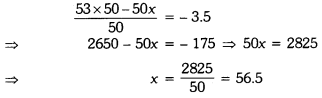
Statistics Class 9 Extra Questions Maths Chapter 14 with Solutions Answers 4

Question 8.
To draw a histogram to represent the following frequency distribution :
Statistics Class 9 Extra Questions Maths Chapter 14 with Solutions Answers 5
Find the adjusted frequency for the class 25-45.
Solution:
Adjusted frequency of a class
Statistics Class 9 Extra Questions Maths Chapter 14 with Solutions Answers 6

Statistics Class 9 Extra Questions Short Answer Type 1

Question 1.
For a particular year, following is the distribution of ages (in years) of primary school teachers in a district :
Statistics Class 9 Extra Questions Maths Chapter 14 with Solutions Answers 7
(i) Write the lower limit of first class interval.
(ii) Determine the class limits of the fourth class interval.
(iii) Find the class mark of the class 45 – 50.
(iv) Determine the class size.
Solution:
(i) First class interval is 15 – 20 and its lower limit is 15.
(ii) Fourth class interval is 30 – 35
Lower limit is 30 and upper limit is 35.
(iii) Class mark of the class 45 – 50 = \(\frac{45+50}{2}\) = \(\frac{95}{2}\) = 47.5
(iv) Class size = Upper limit of each class interval – Lower limit of each class interval
∴ Here, class size = 20 – 15 = 5

Question 2.
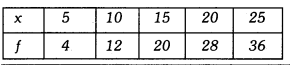
Find the mean of the following distribution :
Statistics Class 9 Extra Questions Maths Chapter 14 with Solutions Answers 8
Solution:
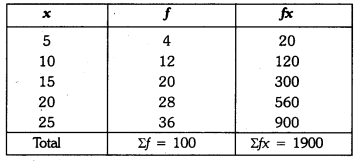
Statistics Class 9 Extra Questions Maths Chapter 14 with Solutions Answers 9
Statistics Class 9 Extra Questions Maths Chapter 14 with Solutions Answers 10

Question 3.
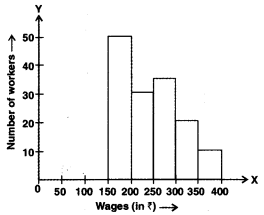
In figure, there is a histogram depicting daily wages of workers in a factory. Construct the frequency distribution table.
Statistics Class 9 Extra Questions Maths Chapter 14 with Solutions Answers 11
Solution:
Statistics Class 9 Extra Questions Maths Chapter 14 with Solutions Answers 12

Question 4.
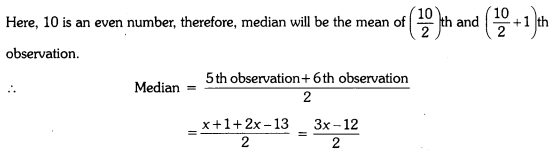
Ten observations 6, 14, 15, 17, x + 1, 2x – 13, 30, 32, 34, 43 are written in ascending
order. The median of the data is 24. Find the value of x.
Solution:
Here, the arranged data is 6, 14, 15, 17, x + 1, 2x – 13, 30, 32, 34, 43
Total number of observations = 10
Statistics Class 9 Extra Questions Maths Chapter 14 with Solutions Answers 13
But median of data is 24 (given)
⇒ \(\frac{3 x-12}{2}\) = 24
⇒ 3x – 12 = 48
⇒ 3x = 60
⇒ x = 20
∴ The value of x = 20

Statistics Class 9 Extra Questions Short Answer Type 2

Question 1.
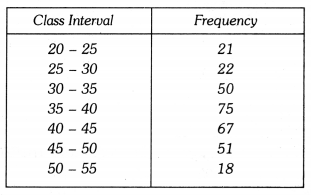
Draw a histogram for the given data :
Statistics Class 9 Extra Questions Maths Chapter 14 with Solutions Answers 14
Solution:
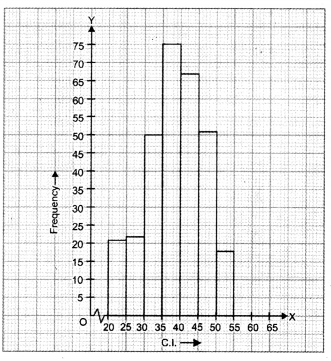
Let us represent class-intervals along x-axis and corresponding frequencies along y-axis on
a suitable scale, the required histogram is as under :
Statistics Class 9 Extra Questions Maths Chapter 14 with Solutions Answers 15

Question 2.
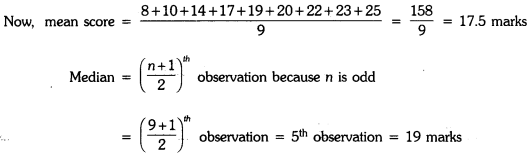
Given are the scores (out of 25) of 9 students in a Monday test :
14, 25, 17, 22, 20, 19, 10, 8 and 23
Find the mean score and median score of the data.
Solution:
Ascending order of scores is :
8, 10, 14, 17, 19, 20, 22, 23, 25
Statistics Class 9 Extra Questions Maths Chapter 14 with Solutions Answers 16

Question 3.
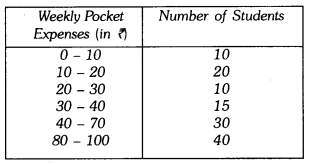
Draw a histogram of the weekly pocket expenses of 125 students of a school given below :
Statistics Class 9 Extra Questions Maths Chapter 14 with Solutions Answers 17
Solution:
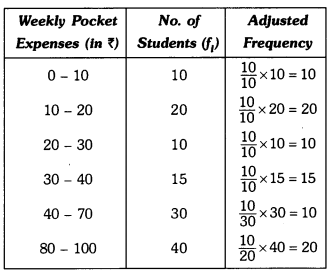
Here, the class sizes are different, so calculate the adjusted frequency for each class by using the formula.
Minimum class size Frequency density or adjusted frequency for a class
Statistics Class 9 Extra Questions Maths Chapter 14 with Solutions Answers 18
Here, the minimum class size = 10 – 0 = 10
Statistics Class 9 Extra Questions Maths Chapter 14 with Solutions Answers 19
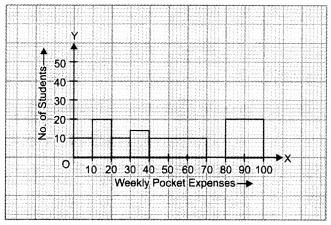
Let us represent weekly pocket money along x-axis and corresponding adjusted frequencies along y-axis on a suitable scale, the required histogram is as given below :
Statistics Class 9 Extra Questions Maths Chapter 14 with Solutions Answers 20

Question 4.
The weight in grams of 35 mangoes picked at random from a consignment are as follows:
131, 113, 82, 75, 204, 81, 84, 118, 104, 110, 80, 107, 111, 141, 136, 123, 90, 78, 90, 115, 110, 98, 106, 99, 107, 84, 76, 186, 82, 100, 109, 128, 115, 107, 115 From the grouped frequency table by dividing the variable range into interval of equal width of 20 grams, such that the mid-value of the first class interval is 70 g. Also, draw a histogram.
Solution:
It is given that the size of each class interval = 20 and the mid-value of the first class interval is 70.
Let the lower limit of the first class interval be a, then its upper limit = a + 20.
\(\frac{a+(a+20)}{2}\) = 70
⇒ a = 70 – 10 = 60
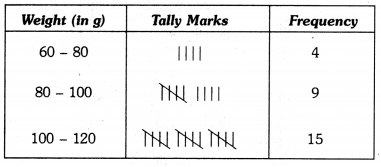
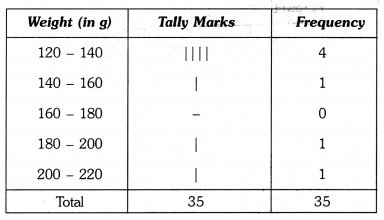
Thus, the first class interval is 60 – 80 and the other class-intervals are 80 – 100, 100 – 120, 120 – 140, 140 – 160, 160 – 180, 180 – 200 and 200 – 220.
So, the grouped frequency table is as under :
Statistics Class 9 Extra Questions Maths Chapter 14 with Solutions Answers 21
Statistics Class 9 Extra Questions Maths Chapter 14 with Solutions Answers 22
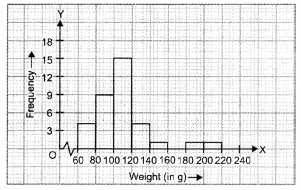
Let us represent weight (in g) along x-axis and corresponding frequencies along y-axis on a suitable scale, the required histogram is as under :
Statistics Class 9 Extra Questions Maths Chapter 14 with Solutions Answers 23

Statistics Class 9 Extra Questions Long Answer Type

Question 1.
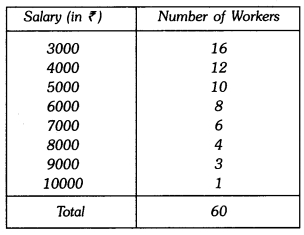
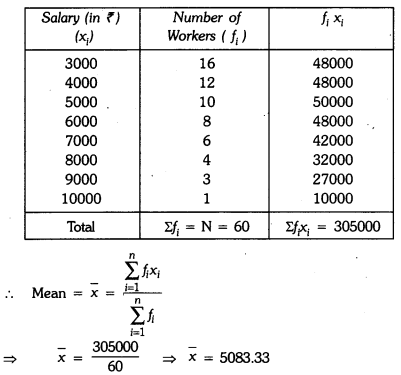
Find the mean salary of 60 workers of a factory from the following table :
Statistics Class 9 Extra Questions Maths Chapter 14 with Solutions Answers 24
Solution:
Statistics Class 9 Extra Questions Maths Chapter 14 with Solutions Answers 25
Hence, mean salary of 60 workers is ₹5083.33.

Question 2.
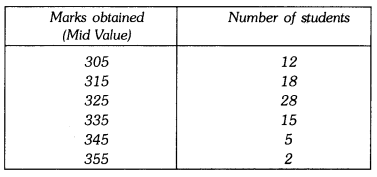
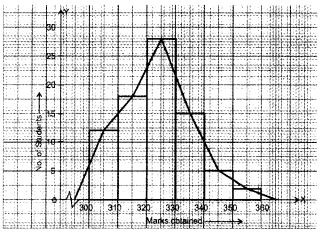
In a school marks obtained by 80 students are given in the table. Draw a histogram. Also,
make frequency polygon.
Statistics Class 9 Extra Questions Maths Chapter 14 with Solutions Answers 26
Solution:
∴ Lower limit of first class interval is 305 – \(\frac{10}{2}\) = 300
Upper limit of first class interval is 305 + \(\frac{10}{2}\) = 310
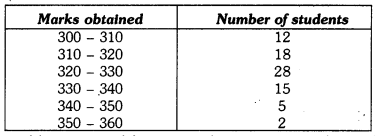
Thus, first class interval is 300 – 310
Statistics Class 9 Extra Questions Maths Chapter 14 with Solutions Answers 27
Required histogram and frequency polygon is given on the graph paper.
Statistics Class 9 Extra Questions Maths Chapter 14 with Solutions Answers 28

Question 3.
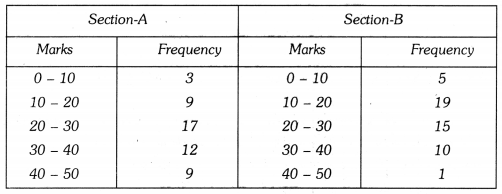
The following two tables gives the distribution of students of two sections according to the marks obtained by them :
Statistics Class 9 Extra Questions Maths Chapter 14 with Solutions Answers 29
Represent the marks of the students of both the sections on the same graph by two frequency polygons. From the two polygons compare the performance of the two sections.
Solution:
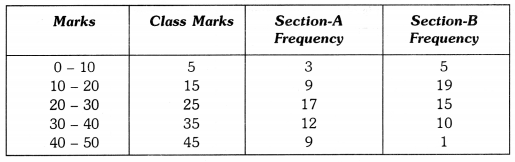
The class marks are as under :
Statistics Class 9 Extra Questions Maths Chapter 14 with Solutions Answers 30
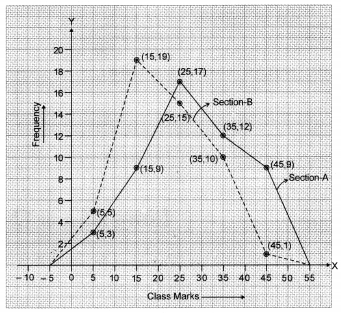
Let us take class marks on X-axis and frequencies on Y-axis. To plot frequency polygon of Section-A, we plot the points (5, 3), (15, 9), (25,17), (35,12), (45, 9) and join these points by (15,19). line segments. To plot frequency polygon of Section-B, we plot the points (5, 5), (15, 19), (25, 15), (35, 10), (45, 1) on the same scale and join these points by dotted line segments.
Statistics Class 9 Extra Questions Maths Chapter 14 with Solutions Answers 31
From the above two polygons, clearly the performance of Section A is better.

Statistics Class 9 Extra Questions HOTS

Question 1.
The mean weight of 60 students of a class is 52.75 kg. If mean weight of 25 students of this class is 51 kg, find the mean weight of remaining 35 students of the class.
Solution:
Total weight of 60 students = 60 × 52.75 kg = 3165 kg
Total weight of 25 students = 25 × 51 kg = 1275 kg
∴ Total weight of 35 students = (3165 – 1275) kg = 1890 kg
∴ Mean weight of 35 students = \(\frac{1890}{35}\) = 54 kg

Question 2.
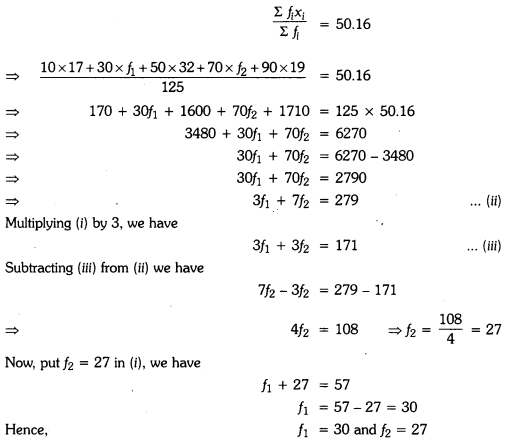
Find the missing frequencies in the following frequency distribution. If it is known that the mean of the distribution is 50.16 and the total number of items is 125.
Statistics Class 9 Extra Questions Maths Chapter 14 with Solutions Answers 32
Solution:
Since total number of items = 125
∴ 17 + f1 + 32 + f1 + 19 = 125
f1 + f2 = 125 – 17 – 32 – 19
f1 + f2 = 57 …..(i)
Now, mean of data = 50.16
We know that
Statistics Class 9 Extra Questions Maths Chapter 14 with Solutions Answers 33

Statistics Class 9 Extra Questions Value Based (VBQs)

Question 1.
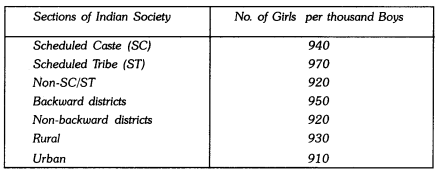
The following data on the number of girls (to the nearest ten) per thousand boys in different sections of the Indian society is given below :
Statistics Class 9 Extra Questions Maths Chapter 14 with Solutions Answers 34
(i) Represent the information above by a bar graph.
(ii) In the classroom, discuss what conclusions can be arrived at from the graph.
(iii) What steps should be taken to improve the situation ?
Solution:
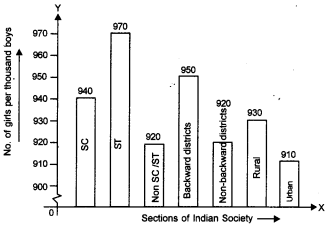
(i) The required graph is given below :
Statistics Class 9 Extra Questions Maths Chapter 14 with Solutions Answers 35
In the graph, different sections of the society is taken on X-axis and number of girls per thousand boys is taken on the Y-axis.
[Scale : 1 cm = 10 girls.]
(ii) From the graph, the number of girls to the nearest ten per thousand boys are maximum in scheduled tribes whereas they are minimum in urban.
(iii) Pre-natal sex determination should strictly banned in urban.

Question 2.
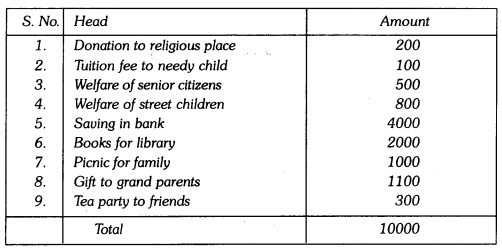
Shimpi, a class IX student received cash award of 10000 (Ten thousand) in the singing competition. Her father advised her to make a budget plan for spending this amount. She
made the following plan :
Statistics Class 9 Extra Questions Maths Chapter 14 with Solutions Answers 36
Make a bar graph for the above data.
From above answer the following questions :
(i) Which mathematical concepts have been covered in this ?
(ii) How will you rate her budget plan ? In your opinion which head has been given
(a) more than deserved and (b) less than it deserved ?
(iii) Which values are depicted in her plan?
Solution:
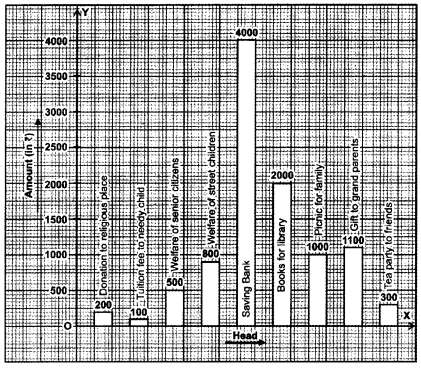
The bar graph of given data is given below :
Statistics Class 9 Extra Questions Maths Chapter 14 with Solutions Answers 37
In the graph, head is taken on X-axis and amount is taken on Y-axis.
(i) Representation of data using bar graph.
(ii) Very good
(a) Picnic for family
(b) Tuition fee for needy child
(iii) Help the needy people and respect the elders.

NCERT Class 7 History Chapter 9 Notes The Making of Regional Cultures

On this page, you will find NCERT Class 7 History Chapter 9 Notes Pdf free download. CBSE Class 7 Social Science Notes History Chapter 9 SST The Making of Regional Cultures will seemingly help them to revise the important concepts in less time.

The Making of Regional Cultures Class 7 Notes Social Science History Chapter 9

CBSE Class 7 History Chapter 9 Notes Understanding The Lesson

1. India is a vast country. Its rich traditions, cultures, languages, food, clothes, poetry, dances, music and paintings also tend to associate with each region.

2. These traditions and cultures are intermixed. Thus, some traditions appear specific to some regions, others seem to be similar across regions and sometimes older practices take a new form in other regions.

3. The Chera kingdom of Mahodayapuram is one of the best examples of the connection between language and region.

4. Malayalam was spoken in this area and it was used as an official language by the Chera kingdom.

5. In some regions, regional cultures grew around religious traditions. The best example of this process is the cult of Jagannatha (Vishnu) at Puri, Orissa (now Odisha).

6. Anantavarman, ruler of the Ganga dynasty decided to erect a temple for Purushottama Jagannath at Puri.

7. Ananagabhima III dedicated his kingdom to the deity and proclaimed himself as the ‘deputy5 of the god.

8. All those who conquered Orissa, such as the Mughals, the Marathas and the English East India Company, attempted to gain control over the temple. They felt that this would make their rule acceptable to the local people.

9. Rajasthan was called Rajputana by the British. This was an area that was inhabited mainly by the Rajputs, but there were several people other than Rajputs who lived in Rajasthan.

10. State of Rajasthan was ruled by various Rajput families. Prithviraj was one such ruler. These rulers cherished the ideal of the hero who fought valiantly, often choosing death on the battlefield rather than face defeat.

11. Stories about Rajput heroes were recorded in poems and songs which were recited by specially trained minstrels. Ordinary people were also attracted by these stories which often depicted dramatic situations, and a range of strong emotions-loyalty, friendship, love, valour, anger etc.

12. Women are also depicted as following their heroic husbands in both life and death. Those who followed the heroic ideal often had to pay for it with their lives. The practice of sati or the immolation on the funeral pyre of their husbands show their devotion.

13. Kathak was associated with several parts of north India. The term kathak is derived from katha which meant story. The kathaks were originally a caste of storytellers in temples of north India, who embellished their performances with gestures and songs.

14. Kathak began evolving into a distinct mode of dance with the spread of the bhakti movement. The legends of Radha-Krishna were enacted in folk plays called rasa lila, which combined folk dance with the basic gestures of the kathak story-tellers.

15. Under the Mughal emperors, Kathak was performed in the court. It developed in two traditions, one in the courts of Rajasthan (Jaipur) and the other in Lucknow. Under the patronage of Wajid Ali Shah, the last Nawab of Awadh, it grew into a major art form. Kathak, like several other cultural practices, was viewed with disfavor by most British administrators.

16. Miniature painting was also developed in different ways. Miniatures are small-sized paintings and generally done in water color on cloth or paper. The earliest miniatures were on palm leaves or wood.

17. The Mughal emperors Akbar, Jahangir and Shah Jahan patronized highly skilled painters.

18. In the courts of the Deccan and the Rajput courts of Rajasthan, miniature painting developed their distinctive characteristics. Themes from mythology and poetry were depicted at centres such as Mewar, Jodhpur, Bundi, Kota and Kishangarh.

19. Miniature paintings also attracted the state of Himachal Pradesh and developed a bold and intense style called Basohli.

20. The language, Bengali originated from Sanskrit but later on developed its own identity and literature.
21. From 16th century, people migrated in large numbers from less fertile western Bengal to the forested and marshy regions of south-eastern Bengal.

22. A cult of pir became popular in Bengal and their shrines can be found there. Many temples were constructed in Bengal and local deities began to worshipped in temples. Fish and rice are two important foods of the Bengalis. Brahmanas of Bengal also eat fish.

The Making of Regional Cultures Class 7 CBSE Notes Important Terms

Miniature: Miniature is a small-sized painting. These paintings are made with the help of water colour on cloth or paper.

Pir: A Persian word meaning a spiritual guide.

Sati: It is an act of immolation of wife on the funeral pyre of her husband.

Kathak: This is a form of dance together with story.

Rasa Lila: Folk plays of Radha and Krishna.

Gharana: Tradition of classical dance and music.

Lilatilakam: A text of grammar and poetics which took shape in Manipravalam.

Notes of History Class 7 Chapter 9 Time Period

1230: King Anangabhima III dedicated his kingdom to the deity Purushottama Jagannatha and pro­ claimed as the deputy of the God.

1739: Nadir Shah attacked Delhi and conquered it.

NCERT Class 7 History Chapter 8 Notes Devotional Paths to the Divine

On this page, you will find NCERT Class 7 History Chapter 8 Notes Pdf free download. CBSE Class 7 Social Science Notes History Chapter 8 SST Devotional Paths to the Divine will seemingly help them to revise the important concepts in less time.

Devotional Paths to the Divine Class 7 Notes Social Science History Chapter 8

CBSE Class 7 History Chapter 8 Notes Understanding The Lesson

1. People performed various kinds of bhakti and rituals of worship or singing bhajans, kirtans or qawwali or even repeating the name of God in silence.

2. Different groups of people worshipped their own gods and goddesses.

3. The idea that all living things pass through countless cycles of birth and rebirth performing good deeds and bad came to be widely accepted.

4. The belief that social privileges came from birth in a ‘noble’ family or a ‘high’ caste was the subject of many learned texts.

5. Many people turned to the teachings of the Buddha or the Jainas according to which it was possible to overcome social differences and break the cycle of rebirth through personal effort.

6. Others felt attracted to the idea of a Supreme God who could deliver humans free from such bondage if approached with devotion (or bhakit). This idea, advocated in the Bhagavadgita, grew in popularity.

7. The idea of bhakti became so popular that even Buddhists and Jainas adopted these beliefs.

8. New religious movements, led by the Nayanars (saints devoted to Shiva) and Alvars (devoted to Vishnu) emerged 7th to 9th Saints and followers of these religious movements had all castes including untouchable like the Pulaiyar and the Panars.

9. Nayanars and Alvars were sharply critical of the Buddhists and Jainas and preached ardent love of Shiva or Vishnu as the path to salvation.

10. The Nayanars and Alvars went from place to place composing exquisite poems in praise of the deities enshrined in the villages they visited, and set them to music.

11. There were 63 Nayanars, who belonged to different caste backgrounds such as potters, untouchables workers, peasants, hunters, soldiers, Brahmanas and chiefs. The best known among them were Appar, Sambandar, Sundarar and Manikkavasagar. There are two sets of compilations of their songs-Tevaram and Tiruvacakam.

12. There were 12 Alvars, who came from equally divergent backgrounds, the best known being Periyalvar, his daughter Anda, Tondaradippodi Alvar and Nammalvar. Their songs were compiled in the Divya Prabandham.

13. Chola and Pandya kings built huge temples around many of the shrines visited by the saint-poets, strengthening the links between the bhakti tradition and temple worship.

14. One of the most influential philosophers of India Shankara was bom in Kerala in the 8th century. He was an advocate of Advaita or the doctrine of the oneness of the individual soul and the Supreme God which is the ultimate reality. He taught that Brahman, the only or ultimate reality, was formless and without any attributes.

15. Ramanuja, bom in Tamil Nadu in the 11th century, was deeply influenced by the Alvars. Intense devotion to Vishnu was means of attaining salvation. He followed doctrine of Vishishtadvaita. His doctrine greatly inspired the new strand of bhakti which developed in north India subsequently.

16. Virashaiva movement was initiated by Basavanna and his companions Allama Prabhu and Akkamahadev in Karnataka in mid-12th century. They argued strongly for equality of all human beings, opposed Brahmanical ideas on caste and treatment of women. They were also against all forms of ritual and idol worship.

17. Jnaneshwar, Namdev, Eknath, Tukaram, Sakhubai and the family of Chokhamela focused on the bhakti of Vitthala (a form of Vishnu). All these were saints of Maharashtra. They rejected all forms of ritualism, outward display of piety and social differences based on birth. Some saints belonged to lower castes. The idea of renunciation was rejected and preferred to live with their families.

18. Nathpanthis, Siddhacharas and Yogis that emerged during this period criticized the ritual and other aspects of conventional religion and the social order, using simple, logical arguments. They advocated renunciation of the world. To achieve the salvation, they advocated intense training of the mind and body through practices like yogasanas, breathing exercises and meditation. It became popular among ‘low’ castes.

19. Sufis were Muslim mystics. They rejected outward religiosity and emphasized love and devotion to God and compassion towards all fellow human beings. Islam emphasizes monotheism (one God). It rejected idol worship and highlights into collective prayers. Sufis composed poems expressing their feelings and a rich literature in prose, including anecdotes and fables, developed around them.

20. Ghazzali, Rumi and Sadi was the great Sufis in Central Asia and in India there were Khwaja Muinuddin Chishti of Ajmer, Qutbuddin Bakhtiar Kaki of Delhi, Baba Farid of Punjab, Khwaja Nizamuddin Auliya of Delhi and Bandanawaz Gisudaraz of Gulbarga. They developed elaborate methods of training using zikr, contemplation, sama, raqs discussion of parables, breath control etc., under the guidance of a master or pir.

21. The tomb or dargah of a Sufi saint became a place of pilgrimage to which thousands of people of all faiths thronged.

22. In North India, after 13th century there was a new movement of bhakti. Kabir and Baba Guru Nanak rejected all orthodox religions. Otheres like Tulsidas and Surdas accepted existing beliefs and practices.

23. Kabir was brought up in a family of Muslim julahas or weavers near the city of Benares. His ideas are found in the form of sakhis and pads. Kabir’s verses are also in the Guru Granth Sahib, Panch Vani and Bijak which is collection of Kabir’s verses.

24. Kabir’s teachings openly ridiculed all forms of external worship of both Brahmanical Hinduism and Islam, the pre-eminence of the priestly classes and the caste system. The language of his poetry was a form of spoken Hindi widely understood by ordinary people.

25. Tulsidas conceived God in the form of Rama while Surdas in the form of Krishna. Ramcharitmanas was written by Tulsidas in Awadhi language. Sursagara, Surasaravali and Sahitya, Lahari, express devotion of Surdas. He was contemporary of Shankaradeva of Assam who emphasized devotion to Vishnu.

26. Bhakti tradition also included saints like Dadu Dayal, Ravidas and Mirabai. Mirabai was a Rajput princess married into the royal family of Mewar in the 16th century. She was devoted to Krishna and composed innumerable bhajans expressing her intense devotion.

27. The unique feature of most of the saints is that their works were composed in regional languages and could be sung. These transmitted orally by most deprived communities and women.

28. Baba Guru Nanak born at Talwandi (presently in Pakistan). He established a centre at Kartarpur (Dera Baba Nanak) on the bank of river Ravi. The sacred space thus created by Baba Guru Nanak was known as dharmsal. It is now known as Gurdwara.

29. Guru Angad compiled the compositions of Baba Guru Nanak, to which he added his own in a new script known as Gurmukhi. The three successors of Guru Angad also wrote under the name of “Nanak” and all of their compositions were compiled by Guru Aijan in 1604. Later, this holy scripture of the Sikhs called as Guru Granth Sahib. This was authenticated by Guru Gobind Singh.

Devotional Paths to the Divine Class 7 CBSE Notes Important Terms

Virashaivism: A movement initiated by Basavanna and his companions.

Khanqahs: It is a place where people flocked, discussed spiritual matters, sought the blessings of the saints in solving their worldly problems etc.

Hagiography: Hagiography is the writing of saints’ lives.

Dargah: Where the body of Sufi is cremated is called dargah.

Vitthala: A form of Vishnu.

Dharmsal: A sacred space created by Guru Nanak. Now, it is called Gurdwara.

Bhakti: devotion to God.

Sufi: Muslim mystic.

Shariat: Holy law made by the Muslim scholars.

Gurmukhi: A script introduced by Guru Angad.

Notes of History Class 7 Chapter 8 Time Period

1469-1539: Period of Guru Nanak.

1604: All of compositions were compiled by Guru Arjan.

NCERT Class 7 History Chapter 7 Notes Tribes, Nomads and Settled Communities

On this page, you will find NCERT Class 7 History Chapter 7 Notes Pdf free download. CBSE Class 7 Social Science Notes History Chapter 7 SST Tribes, Nomads and Settled Communities will seemingly help them to revise the important concepts in less time.

Tribes, Nomads and Settled Communities Class 7 Notes Social Science History Chapter 7

CBSE Class 7 History Chapter 7 Notes Understanding The Lesson

1. New arts, crafts and production activities flourished in towns and villages.

2. Over the centuries, important political, social and economic developments had taken place.

3. Social change was not the same everywhere, because different kinds of societies evolved differently.

4. Society was already divided according to the rules of vama. The rules of vama was prescribed by the Brahmanas and accepted by the rulers of large kingdoms.

5. The difference between the high and low, and between the rich and poor, increased.

6. Many societies in the subcontinent did not follow the social rules and rituals prescribed by the Brahmanas and nor were they divided into numerous unequal classes. Such societies are often called tribes.

7. Tribes were united by kinship bonds. Tribes obtained their livelihood from agriculture, herders. Some tribes were nomadic and moved from one place to another.

8. A tribal group controlled land and pastures jointly, and divided these amongst households according to its own rules.

9. Many tribes usually lived in forests, hills, deserts and places difficult to reach.

10. The tribes retained their freedom and preserved their separate culture.

11. Caste-based and tribal societies also depended on each other for their diverse needs. This relationship, of conflict and dependence, gradually caused both societies to change.

12. Mostly tribal people did not keep written records, but they preserved rich customs and oral traditions. These were passed down to each new generation.

13. Some powerful tribes controlled large territories. In Punjab, the Khokhar tribe was very influential during the 13th and 14th Later, the Gakkharas became more important. Their chief, Kamal Khan Gakkhar was made a ‘mansabdar’ by Emperor Akbar.

14. Langahs and Arghuns tribals dominated extensive regions in Multan and Sind.

15. The Balochis were another large and powerful tribe in the north-west. They were divided into many smaller clans under different chiefs.

16. In the western Himalaya lived the shepherd tribe of Gaddis.

17. The north-eastern part of the subcontinent too was entirely dominated by tribes—the Nagas, Ahoms and many others.

18. In many areas of present-day Bihar and Jharkhand, Chero Chiefdoms had emerged by the 12th The Mundas and Santals tribes lived in this region and also in Orissa and Bengal.

19. Kolies, Berads and others belonged to Maharashtra highlands and Karnataka.

20. Kolis also lived in many areas of Gujarat.

21. In South, there were large tribal populations of Koragas, Vetars, Maravars and others.

22. The large tribe of Bhils was spread across western and central India. Many of them had become settled agriculturists and some even zamindars.

23. The Gonds were found in great numbers across the present day states of Chhattisgarh, Madhya Pradesh, Maharashtra and Andhra Pradesh.

24. Nomadic pastoralists moved over long distances with their animals. They lived on milk and other pastoral products. They exchanged wool, ghee etc., for grain, cloth, utensils and other products.

25. The Banjaras were the most important trader nomads. Their caravan was called tanda. Sultan Alauddin Khalji used the Banjaras to transport grain to the city markets. They transported food grain for the Mughal army during military campaigns.

26. Many pastoral tribes reared and sold animals such as cattle and horses to the prosperous people.

27. Different castes of petty pedlars also travelled from village to village. They made and sold ropes, reeds, straw matting and coarse sacks.

28. Some castes were entertainers who performed in different towns and villages for their livelihood.

29. Among the Kshatriyas, new Rajput clans became powerful by the 11th and 12th They belonged to different lineages, such as Hunas, Chandelas, Chalukyas and others. Some of these had been tribes earlier. Many of these clans came to be regarded as Rajputs.

30. Some leading tribal families could join the ruling class while many tribes became part of the caste system.

31. The Gonds lived in a vast forested region called Gondwana. They practiced shifting cultivation. They had many clans and each clan had its own raja or rai. In the Akbar Nama it has been mentioned that the Gond kingdom of Garha Katanga had 70,000 villages. The kingdom was divided into garhs. This was further divided into units of 84 villages called chaurasi. The Chaurasi was subdivided into barhots which were made up of 12 villages each.

32. The Ahoms migrated to the Brahmaputra valley from present-day Myanmar in the 13th During the 16th century they annexed the kingdoms of the Chhutiyas and Koch-Hajo and subjugated many other tribes.

33. The Ahoms built a large state and for this they used firearms and high quality gunpowder and cannons.

34. Almost all adult males served in the army during war. There were engaged in building dams, irrigation systems and other public works.

35. The Ahoms also introduced new methods of rice cultivation.

36. The Ahom society was divided into clans or khels and a Khel controlled over several villages.

37. There were very few artisans’ castes, so they came from adjoining kingdoms.

38. The Ahoms worshipped their own tribal gods however, the influence of Brahmanas increased. Temples, Brahmanas, poets and scholars were granted land by the king. In the reign of Sib Singh, Hinduism became the predominant religion, but the Ahom kings did not completely give up their traditional beliefs after adopting Hinduism.

39. Theatre was encouraged. Important works of Sanskrit were translated into the local language. Historical works, known as buranjis were also written first in the Ahom language and then in Assamese.

40. In 1662, the Mughals under Mir Jumla attacked the Ahom kingdom and controlled the region.

Towns, Traders, and Craftsperson Class 7 CBSE Notes Important Terms

Clan: A group of families or households claiming descent from a common.

Nomads: People who are always moving from one place to another for their livelihood.

Tanda: The Caravan of the Banjaras was called tanda.

Itinerant group: Groups of craftspersons, pedlars and entertainers travelling from place to place practicing their different occupations are called itinerant groups.

Shifting cultivation: In the Shifting cultivation trees and bushes in a forest area are first cut and burnt. The crop is sown in the ashes. When this land loses its fertility, another plot of land is cleared and planted in the same way.

Notes of History Class 7 Chapter 7 Time Period

1523: The Ahoms annexed the kingdoms of the Chhutiyas.

1581: The Ahoms annexed the kingdoms of the Koch-Hajo

1591: Raja Man Singh attacked and defeated the Cheros.

1662: Mir Jumla attacked the Ahom kingdom.