Probability Class 9 Extra Questions Maths Chapter 15 with Solutions Answers

Here we are providing Probability Class 9 Extra Questions Maths Chapter 15 with Answers Solutions, Extra Questions for Class 9 Maths was designed by subject expert teachers.

Extra Questions for Class 9 Maths Probability with Answers Solutions

Extra Questions for Class 9 Maths Chapter 15 Probability with Solutions Answers

Probability Class 9 Extra Questions Very Short Answer Type

Question 1.
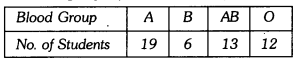
The blood groups of some students of Class IX were surveyed and recorded as below :
Probability Class 9 Extra Questions Maths Chapter 15 with Solutions Answers 1
If a student is chosen at random, find the probability that he/she has blood group A or AB.
Solution:
Here,
total number of students = 19 + 6 + 13 + 12 = 50
Number of students has blood group A or AB = 19 + 13 = 32
Required probability = \(\frac{38}{50}\) = \(\frac{16}{25}\)

Question 2.
A group of 80 students of Class X are selected and asked for their choice of subject to be
taken in Class XI, which is recorded as below :

Probability Class 9 Extra Questions Maths Chapter 15 with Solutions Answers 2
If a student is chosen at random, find the probability that he/she is a student of either commerce or humanities stream.
Solution:
Here, total number of students = 80
Total number of students of Commerce or Humanities stream = 33
Required probability = \(\frac{33}{80}\)

Question 3.
A box contains 50 bolts and 150 nuts. On checking the box, it was found that half of the bolts and half of the nuts are rusted. If one item is chosen at random, find the probability that it is rusted.
Solution:
Total number of nuts and bolts in the box = 150 + 50
= 200
Number of nuts and bolts rusted = \(\frac{1}{2}\) × 200 = 100
P(a rusted nut or bolt) = \(\frac{100}{200}\) = \(\frac{1}{2}\)

Question 4.
A dice is rolled number of times and its outcomes are recorded as below:

Probability Class 9 Extra Questions Maths Chapter 15 with Solutions Answers 3
Find the probability of getting an odd number.
Solution:
Total number of outcomes = 250
Total number of outcomes of getting odd numbers = 35 + 50 + 53 = 138
∴ P(getting an odd number) = \(\frac{138}{250}\) = \(\frac{69}{125}\)

Question 5.
The probability of guessing the correct answer to a certain question is \(\frac{x}{2}\) If probability of
not guessing the correct answer is \(\frac{2}{3}\), then find x.
Solution:
Here, probability of guessing the correct answer = \(\frac{x}{2}\)
And probability of not guessing the correct answer = \(\frac{x}{2}\)
Now, \(\frac{x}{2}\) + \(\frac{2}{3}\) = 1
⇒ 3x + 4 = 6
⇒ 3x = 2
⇒ x = \(\frac{2}{3}\)

Question 6.
A bag contains x white, y red and z blue balls. A ball is drawn at the random, then what is the probability of drawing a blue ball.
Solution:
Number of blue balls = Z
Total balls = x + y + Z
∴ P(a blue ball) = \(\frac{z}{x+y+z}\)

Probability Class 9 Extra Questions Short Answer Type 1

Question 1.
750 families with 3 children were selected randomly and the following data recorded:

Probability Class 9 Extra Questions Maths Chapter 15 with Solutions Answers 4
If a family member is chosen at random, compute the probability that it has :
(i) no boy child
(ii) no girl child
Solution:
(i) P(no boy child) = \(\frac{100}{750}\) = \(\frac{2}{15}\)
and P (no girl child) = \(\frac{120}{750}\) = \(\frac{4}{25}\)

Question 2.
If the probability of winning a race of an athlete is \(\frac{1}{6}\) less than the twice the probability of losing the race. Find the probability of winning the race.
Solution:
Let probability of winning the race be p
∴ Probability of losing the race = 1 – p
According to the statement of question, we have
p = 2 (1 – p) – \(\frac{1}{6}\)
⇒ 6p = 12 – 12p – 1
⇒ 18p = 11
⇒ p = \(\frac{11}{18}\) .
Hence, probability of winning the race is \(\frac{11}{18}\).

Question 3.
Three coins are tossed simultaneously 150 times with the following frequencies of different outcomes :

Probability Class 9 Extra Questions Maths Chapter 15 with Solutions Answers 5
Compute the probability of getting :
(i) At least 2 tails
(ii) Exactly one tail
Solution:
Here, total number of chances = 150
(i) Total number of chances having at least 2 tails = 32 + 63 = 95
∴ Required probability = \(\frac{95}{150}\) = \(\frac{19}{30}\)
(ii) Total number of chances having exactly one tail = 30
∴ Required probability = \(\frac{30}{150}\) = \(\frac{1}{5}\)

Probability Class 9 Extra Questions Short Answer Type 2

Question 1.
The table shows the marks obtained by a student in unit tests out of 50 :

Probability Class 9 Extra Questions Maths Chapter 15 with Solutions Answers 6
Find the probability that the student get 70% or more in the next unit test. Also, the probability that student get less than 70%.
Solution:
Here, the marks are out of 50, so we first find its percentage (i.e., out of 100)

Probability Class 9 Extra Questions Maths Chapter 15 with Solutions Answers 7
Total number of outcomes = 5
Probability of getting 70% or more marks = \(\frac{3}{5}\)
Probability of getting less than 70% = \(\frac{2}{5}\)

Question 2.
Books are packed in piles each containing 20 books. Thirty five piles were examined for defective books and the results are given in the following table :

Probability Class 9 Extra Questions Maths Chapter 15 with Solutions Answers 8
One pile was selected at random. What is the probability that it has :
(i) no defective books ?
(ii) more than 0 but less than 4 defective books ?
(iii) more than 4 defective books ?
Solution:
Total number of books = 700
(i) P(no defective books) = \(\frac{400}{700}\) = \(\frac{4}{7}\)
(ii) P(more than 0 but less than 4 defective books) = \(\frac{269}{700}\)
13 (iii) P(more than 4 defective books) = \(\frac{13}{700}\)

Probability Class 9 Extra Questions Short Answer Type 1 and 2

Question 1.
Two coins are tossed simultaneously for 360 times. The number of times ‘2 Tails’ appeared was three times ‘No Tail’ appeared and number of times ‘1 Tail’ appeared is double the number of times ‘No Tail’ appeared. Find the probability of getting ‘Two tails’.
Solution:
Total number of outcomes = 360
Let the number of times ‘No Tail’ appeared be x
Then, number of times 2 Tails’ appeared = 3x
Number of times ‘1 Tail’ appeared = 2x
Now, x + 2x + 3x = 360
⇒ 6x = 360
⇒ x = 60
P(of getting two tails) = \(\frac{3 \times 60}{360}\) = \(\frac{1}{2}\)

Question 2.
A die was rolled 100 times and the number of times, 6 came up was noted. If the experimental probability calculated from this information is \(\frac{2}{5}\), then how many times 6 came up ? Justify your answer.
Solution:
Here, total number of trials = 100
Let x be the number of times occuring 6.
We know, probability of an event
= \(\frac { Frequency\quad of\quad the\quad event\quad occuring }{ Total\quad number\quad of\quad trails }\)
⇒ \(\frac{x}{100}\) = \(\frac{2}{5}\) [∵ Probability is given)
⇒ x = 40

Probability Class 9 Extra Questions Long Answer Type

Question 1.
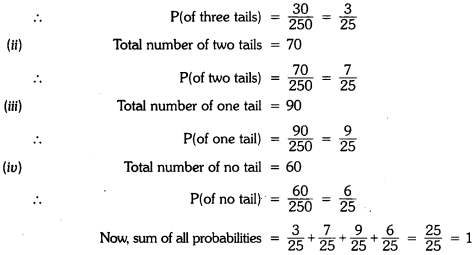
Three coins are tossed simultaneously 250 times. The distribution of various outcomes is listed below :
(i) Three tails : 30,
(ii) Two tails : 70,
(iii) One tail : 90,
(iv) No tail : 60
Find the respective probability of each event and check that the sum of all probabilities is 1.
Solution:
Here, the total number of chances = 250
Total number of three tails = 30
Probability Class 9 Extra Questions Maths Chapter 15 with Solutions Answers 9

Question 2.
A travel company has 100 drivers for driving buses to various tourist destination. Given
below is a table showing the resting time of the drivers after covering a certain distance (in km).

Probability Class 9 Extra Questions Maths Chapter 15 with Solutions Answers 10
What is the probability that the driver was chosen at random :
(a) takes a halt after covering 80 km?
(b) takes a halt after covering 115 km?
(c) takes a halt after covering 155 km?
(d) takes a halt after crossing 200 km?
Solution:
Total number of drivers = 100
(a) P (takes a halt after covering 80 km) = \(\frac{13}{100}\)
(b) P (takes a halt after covering 115 km) = \(\frac{60}{100}\) = \(\frac{3}{5}\)
(c) P (takes a halt after covering 155 km) = \(\frac{90}{100}\) = \(\frac{9}{10}\)
(d) P (takes a halt after crossing 200 km) = \(\frac{10}{100}\) = \(\frac{1}{10}\)

Question 3.
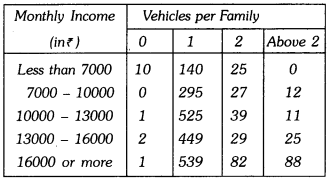
A company selected 2300 families at random and surveyed them to determine a relationship between income level and the number of vehicles in a home. The information gathered is listed in the table below :
Probability Class 9 Extra Questions Maths Chapter 15 with Solutions Answers 11
If a family is chosen at random, find the probability that the family is :
(i) earning ₹7000 – ₹13000 per month and owning exactly 1 vehicle.
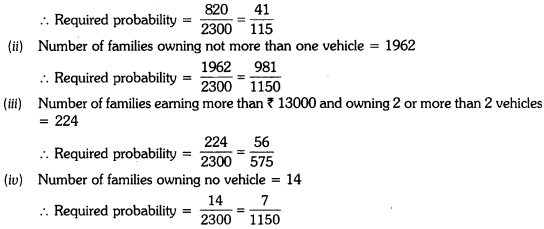
(ii) owning not more than one vehicle. (iii) earning more than ₹13000 and owning 2 or more than 2 vehicles. (iv) owning no vehicle
Solution:
Here, we have a total number of families = 2300
(i) Number of families earning ₹7000 to ₹13000 per month and owning exactly 1 vehicle = 295 + 525 = 820
Probability Class 9 Extra Questions Maths Chapter 15 with Solutions Answers 12

Question 4.
A survey of 2000 people of different age groups was conducted to find out their preference
in watching different types of movies :
Type I + Family Type II → Comedy and Family
Type III → Romantic, Comedy, and Family 242.
Type IV → Action, Romantic, Comedy and Family

Probability Class 9 Extra Questions Maths Chapter 15 with Solutions Answers 13
Find the probability that a person chosen at random is :
(a) in 18-29 years of age and likes type II movies
(b) above 50 years of age and likes all types of movies
(c) in 30-50 years and likes type I movies. :
Solution:
(a) Let E1 be the event, between the age group (18 – 29) years and liking type II movies
Favourable outcomes to event E1 = 160
∴ P(E1) = \(\frac{160}{2000}\) = \(\frac{160}{2000}\)
(b) Let E2 be the event, of age group above 50 years and like all types of movies
Favourable outcomes to event E2 = 9
∴ P(E2) = \(\frac{9}{2000}\)
(c) Let E3 be the event, between age group (30 – 50) years and liking type I movies
Favourable outcomes to event E3 = 505
∴ P(E3) = \(\frac{505}{2000}\) = \(\frac{101}{400}\)

Probability Class 9 Extra Questions HOTS

Question 1.
In a kitchen, there are 108 utensils, consisting of bowls, plates, and glasses. The ratio of bowls, plates the glasses is 4:2:3. A utensil is picked at random. Find the probability that :
(i) it is a plate.
(ii) it is not a bowl.
Solution:
Total utensils in the kitchen = 108
Let number of bowls be 4x, number of plates be 2x and number of glasses be 3x
∴ 4x + 2x + 3x = 108
9x = 108
x = \(\frac{108}{9}\) = 12
Thus, number of bowls = 4 × 12 = 48
Number of plates = 2 × 12 = 24
Number of glasses = 3 × 12 =
(i)P (a plate) = \(\frac{24}{108}\) = \(\frac{2}{9}\)
(ii) P (not a bowl) = \(\frac{24+36}{108}\) = \(\frac{60}{108}\) = \(\frac{5}{9}\)

Question 2.
A bag contains 20 balls out of which x are white.
(a) If one ball is drawn at random, find the probability that it is white.
(b) If 10 more white balls are put in the bag, the probability of drawing a white ball will be double that in part (a), find x.
Solution:
Here, total no. of balls = 20
No. of white balls = x
∴ P(white ball) = \(\frac{x}{20}\)
Now, 10 more white balls are added
∴ Total no. of balls = 20 + 10 = 30
Total no. of white balls = x + 10
According to statement of question, we have
\(\frac{x+10}{30}\) = 2 × \(\frac{x}{20}\)
⇒ \(\frac{x+10}{3}\) = x
⇒ x + 10 = 3x
⇒ 2x = 10
⇒ x = 5

Question 3.
Here is an extract from a mortality table.
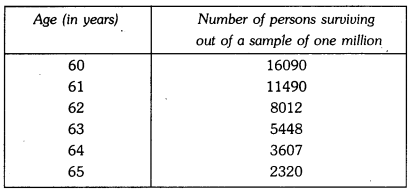
Probability Class 9 Extra Questions Maths Chapter 15 with Solutions Answers 14
(i) Based on this information, what is the probability of a person aged 60′ of dying within a year ?
(ii) What is the probability that a person aged 61′ will live for 4 years ?
Solution:
(i) Clearly 16090 persons aged 60, (16090 – 11490), i.e., 4600 died before reaching their 61st birthday.
Therefore, P (a person aged 60 die within a year) = \(\frac{4600}{16090}\) = \(\frac{460}{1609}\)
(ii) Number of persons aged 61 years = 11490
Number of persons surviving for 4 years = 2320
P (a person aged 61 will live for 4 years) = \(\frac{2320}{11490}\) = \(\frac{232}{1149}\)

Probability Class 9 Extra Questions Value Based (VBQs)

Question 1.
An insurance company selected 2000 drivers at random (i.e., without any preference of one driver over another) in a particular city to find a relationship between age and accidents. The data obtained are given in the following table :
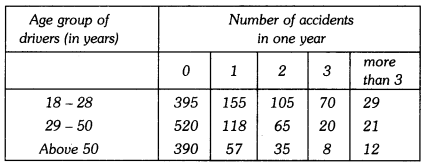
Probability Class 9 Extra Questions Maths Chapter 15 with Solutions Answers 15
Find the probability of the following events for a driver-selected at random from the city :
(i) being 18 – 29 years of age and having exactly 3 accidents in one year.
(ii) being 30 – 50 years of age and having one or more accidents in a year.
(iii) having no accident in one year.
(iv) Which value would you like to remember from this data?
Solution:
Here, total number of drivers = 2000
(i) The number of drivers in the age group 18 – 29 having exactly 3 accidents = 70
So, P (driver in age group 18 – 29 having exactly 3 accidents in one year) = \(\frac{70}{2000}\) = 0.035
(ii). The number of drivers in the age group 30 – 50 and having one or more than one accidents in one year = 118 + 65 + 20 + 21 = 224
P (driver in age group 30 – 50 having one or more accidents in one year) = \(\frac{224}{2000}\) = 0.112
(iii) The number of drivers having no accident in one year = 395 + 520 + 390 = 1305
So, P (driver having no accident) = \(\frac{1305}{2000}\) = 0.6525
(iv) Most people in India died or injured due to accidents as compared to any other country. So, we should obey the traffic rules as life is very precious.

Question 2.
100 plants were sown in six different colonies A, B, C, D, E, and F. After 31 days, the number of plants survived as follows :

Probability Class 9 Extra Questions Maths Chapter 15 with Solutions Answers 16
What is the probability of :
(i) more than 80 plants survived in a colony?
(ii) less than 82 plants survived in a colony?
(iii) which values are depicted from the above data?
Solution:
Here, we have total number of colonies = 6
(i) Number of colonies in which more than 80 plants survived = 4 (i.e., B, C, E and F)
∴ P(more than 80 plants survived in a colony) = \(\frac{4}{6}\) = \(\frac{2}{3}\)
(ii) Number of colonies in which less than 82 plants survived = 2 (i.e., A and D)
∴ P (less than 82 plants survived in a colony) = \(\frac{2}{6}\) = \(\frac{1}{3}\)
(iii) In order to keep environment safe, clean and green, we should grow more and more plants.
NCERT Class 7 Civics Chapter 8 Notes A Shirt in the Market

On this page, you will find NCERT Class 7 Civics Chapter 8 Notes Pdf free download. CBSE Class 7 Social Science Notes Civics Chapter 8 SST A Shirt in the Market will seemingly help them to revise the important concepts in less time.

A Shirt in the Market Class 7 Notes Social Science Civics Chapter 8

CBSE Class 7 Civics Chapter 8 Notes Understanding The Lesson

1. Buying and selling take place at every step in the chain.

2. Swapna is a small farmer in Kumool, Andhra Pradesh who grows cotton on her small piece of land. She supplies cotton to the trader. It takes four months to grow the cotton.

3. Cultivation of cotton requires high levels of inputs as fertilizers and pesticides and the farmers have to incur heavy expenses on account of these. Most often, the small farmers need to borrow money to meet these expenses.

4. Erode’s bi-weekly cloth market in Tamil Nadu is one of the largest cloth markets in the world. A large va­riety of cloth is sold in this market. Clothes are made by weavers in the villages around and0 also brought here for sale.

5. Weavers bring cloth that has been made on order from the merchant. These merchants supply cloth on order to garment manufacturers and exporters around country. They purchase the yam and give instructions to the weavers about the kind of cloth that is to be made.

6. Weavers get the yarn from the merchants and supply them the clothes. This arrangement has two advantages. The weavers do not have to spend their money on purchase of yam. Secondly, the weavers know from the outset what cloth they should make and how much of it is to be woven.

7. At the cloth market, the merchants sell the cloth to the garment factories. In this way, the market works more in favour of the merchants.

8. Weavers are required to invest a lot of money to buy looms. The weavers invest their savings or borrow money at high-interest rates. One loom cost is around 20,000/- and they require atleast two looms. These looms cannot be operated alone and hence their family members work together. They earn about 3,500/­per month.

9. A variety of sarees, towels, shirts, ladies dress material and bed-sheets are produced in these looms. The arrangement between the merchant and the weavers is an example of putting-out system whereby the merchant supplies the raw material and receives the finished product. It is prevalent in the weaving in­dustry in most regions of India.

10. Weaver are paid very little by the merchant under the putting-out system. Weaver’s cooperatives are one way to reduce the dependence on the merchant and to earn a higher income for the weavers.

11. The garment exporting factory use the cloth to make shirts. The shirts are exported to foreign buyers. The exporter tries his best to meet the conditions set by these powerful buyers.

12. In the garment factory many workers work. Most of these workers are employed on a temporary basis. Whenever the employer feels that a worker is not needed, the worker can be asked to leave.

13. Worker’s wages are fixed according to their skills. In most of the cases women are employed as helpers for thread cutting, buttoning, ironing and packaging. These jobs have the lowest wages.

14. The foreign businessperson makes huge profits in the market. The garment exporter make only moderate profits. The small farmers and the weaver do not get a fair price in the market. The merchants or traders are somewhere in between.

Markets Around Us Class 7 CBSE Notes Important Terms

Ginning mill: A factory where seeds are removed from cotton balls.

Exporter: A person who sells goods abroad.

Profit: The amount that is left or gained from earnings after deducting all the costs. If the costs are more than the earnings, it would lead to a loss.

Opposite Words Worksheet Exercises for Class 2 Examples with Answers CBSE

Opposite Words Worksheet Exercises for Class 2 Examples with Answers CBSE 1

This grammar section explains English Grammar in a clear and simple way. There are example sentences to show how the language is used.

Opposite Words Worksheet Exercises for Class 2 Examples with Answers CBSE PDF

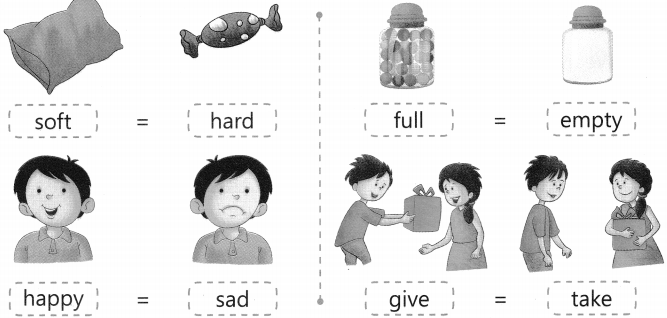
Words that have a completely different meanings are called opposite words.
Opposite Words Worksheet Exercises for Class 2 Examples with Answers CBSE 2

Look at the list of opposite words.

abovebelow
absencepresence
activelazy
afraidbrave
againstfor
alwaysnever
answerquestion
awakesleep
badgood
beautifulugly
body soul
bottom top
brother sister
clean dirty
close open
coo! warm
daughter son
devil angel
deep shallow
distant near
even odd
far near
fast slow
female male
friend enemy
guest host
hell heaven
high low
kind cruel
less more

Opposite Exercise Worksheets with Answers for Class 2 CBSE PDF

A. Write the opposite of the underlined word in each sentence.
1. My teacher gives hard homework. ____________
2. We live far from my grandmother. ____________
3. Have you lost your pencil? ____________
4. School starts too late. ____________
5. My dog climbs under the fence. ____________
6. I like a cold lunch. ____________
7. Mohan is the shortest boy in your class. ____________
8. Today it will be warm outside. ____________
9. Mita is sad about the party. ____________
10. I am slow at running the race. ____________

B. Using the word bank write the opposites of the words given below.
Bad – ___________________ (Good)
Bitter – ___________________ (Shallow)
Begin – ___________________ (Awake)
Build – ___________________ (Common)
Bent – ___________________ (Destroy)
Lend – ___________________ (Sweet)
Worst – ___________________ (Straight)
Rare – ___________________ (Cruel)
Deep – ___________________ (Best)
Sleep – ___________________ (Borrow)
Kind – ___________________ (End)

NCERT Class 7 Civics Chapter 7 Notes Markets Around Us

On this page, you will find NCERT Class 7 Civics Chapter 7 Notes Pdf free download. CBSE Class 7 Social Science Notes Civics Chapter 7 SST Markets Around Us will seemingly help them to revise the important concepts in less time.

Markets Around Us Class 7 Notes Social Science Civics Chapter 7

CBSE Class 7 Civics Chapter 7 Notes Understanding The Lesson

1. Man has many needs. These needs can be fulfilled from the markets.

2. There are many kinds of markets such as weekly market, a large shopping complex, perhaps even a mall; that we may visit for our everyday needs.

3. A weekly market is so-called because it is held on a specific day of the week. Weekly markets do not have permanent shops. Next day they set up their shops at next place. There are thousands of such markets in India. People come here for their everyday requirements.

4. In the weekly markets, the things are available on cheaper rates. This is because when shops are located in permanent buildings, they incur a lot of expenditure—rent, electricity, helper’s wage etc.

5. In the weekly market, a variety of goods are sold in a small area. Therefore, all the things can be pur­chased here on cheaper rates. Comparison of cost and quality can be made very easily.

6. There are many shops that sell goods and services in our neighbourhood. We may buy milk, groceries, stationery, medicines, eatables etc., from shops. Many of these are permanent shops, while others are roadside stalls such as vegetable hawker, the fruit vendor etc.

7. Shops in the neighborhood are useful in many ways. They are near to our home and we can go there on any day of the week. These shops also provide goods on credit.

8. In the urban areas, there are shopping complexes that have many shops with variety of things. There are also large multi-storeyed air-conditioned buildings with shops on different floors, known as malls.

9. In these urban markets, you get both branded and non-branded goods. Branded goods are expensive, often promoted by advertising and claims of better quality. As compared to non-branded goods, fewer people can afford to buy branded ones.

10. Goods are produced in factories, on farms and in homes. The wholesale trader first buys goods in large quantities. These will then be sold to other traders. The trader, who finally sells this to the consumer, is the retailer.

11. city has areas for wholesale markets. This is the place where goods first reach and are then supplied to other traders. The city wholesale trader would have bought a large quantity of plastic items from the factory and stored them in a godown. In this way, a chain of markets is set up.

12. All these markets are located in a specific locality and work in a particular manner and time. You can place orders for a variety of things through the phone and these days through the internet, and the goods are delivered at home.

13. All markets work in a space in a particular manner and time.

14. There are even markets we may not be aware of. This is because a large number of goods that we don’t use directly are also bought and sold.

Markets Around Us Class 7 CBSE Notes Important Terms

Market: Market is a place where things are sold.

Weekly market: It is held on a specific day of the week.

Mall: Malls are the commercial buildings with many floors that have shops, restaurants and at times even a cinema theatre.

Wholesale: When the products are bought and sold in large quantities it is called wholesale.

Retailer: The trader, who finally sells products to the consumer, is called retailer.

Chain of markets: A series of markets that are connected like links in a chain because products pass from one market to another.

NCERT Class 7 Civics Chapter 1 Notes On Equality

On this page, you will find NCERT Class 7 Civics Chapter 1 Notes Pdf free download. CBSE Class 7 Social Science Notes Civics Chapter 1 SST On Equality will seemingly help them to revise the important concepts in less time.

On Equality Class 7 Notes Social Science Civics Chapter 1

CBSE Class 7 Civics Chapter 1 Notes Understanding The Lesson

1. The key elements of a democratic government include people’s participation, the resolution of conflict, and equality and justice.

2. Equality is a key feature of democracy and influences all aspects of its functioning.

3. Universal adult franchise is an essential aspect of all democracies. The idea of universal adult franchise is based on the idea of equality because it states that every adult in a country, irrespective of their wealth and the communities she/he belongs to, has one vote.

4. One of the more common forms of inequality in India is the caste system. Caste system can be seen clearly in the rural areas while is hidden in the cities.

5. The term Dalits’ is used for the so-called lower castes people. Dalit means ‘ broken’.

6. Ompraksh Valmiki was being treated unequally on the basis of differences of caste whereas Mr Ansari on the basis of religion.

7. The Indian Constitution recognizes every person as equal. This means that every individual in the country is recognized equal irrespective of castes, religion, or any background.

8. This recognition of equality includes some of the provisions in the Constitution-

  • Every person is equal before the law;
  • No person can be discriminated against on the basis of their religion, race, caste, place of birth or whether they are female or male;
  • Every person has access to all public places including playgrounds, hotels, shops, markets, wells, roads and bathing Ghats and
  • Untouchability has been abolished.

9. There are several laws in India that protect every person’s right to be treated equally. There are two ways whereby the Government tries to implement the equality-(i) through laws; and (ii) through government programmes or schemes to help disadvantaged communities.

10. In addition to laws, the government has also set up several schemes to improve the lives of communities and individuals who have been treated unequally for several centuries including mid-day meal scheme. This scheme was very first time started in the State of Tamil Nadu in the year 2001.

11. In many democratic countries around the world, the issue of equality continues to be the key issue including USA, where the Civil Rights Act was enacted in 1964 after a long Civil Rights Movement.

On Equality Class 7 CBSE Notes Important Terms

Universal Adult Franchise: This is called right to vote to all adults irrespective of their social or

economic backgrounds.

Constitution: A constitution is a set of fundamental principles or established precedents according to which a state is governed. These rules together make up constitution.

Dalit: It means broken.

Civil Rights Movement: A movement of USA for equal rights.