Determiners Exercises for Class 10 CBSE With Answers

Determiners Class 10

Determiners are words placed before nouns or pronouns to decide or fix their meaning. They tell us ‘how many’ or ‘how much’. Determiners are words which come before nouns. They contain several classes of words, including pronouns and adjectives. They determine or limit the noun by giving some additional information about it. Determiners show whether a noun refers to is a general or a specific object, person or place. They indicate which or how many things the noun refers to. Determiners define or limit a noun to the singular or plural. They indicate amount or quantity. Determiners and nouns together make noun phrases. They make noun phrases with adjectives too. Determiners may precede numerals too.

This grammar section explains English Grammar in a clear and simple way. There are example sentences to show how the language is used. NCERT Solutions for Class 10 English will help you to write better answers in your Class 10 exams. Because the Solutions are solved by subject matter experts.

Determiners Exercises for Class 10 CBSE With Answers PDF

Determiners are words that precede and modify nouns. They tell us how many or how much. Selecting the correct determiner depends on your understanding of the distinction between countable and uncountable nouns.

Countable Nouns
Countable nouns refer to things that we can count. Such nouns can take either singular or plural form. Concrete nouns may be countable.
Examples:

  • There are a dozen apples in the basket.
  • He ate an egg for breakfast.

Collective nouns are countable.
Examples:

  • We saw a herd of elephants in the forest yesterday.
  • Paris is home to several orchestras.

Uncountable Nouns
Uncountable nouns refer to things that we cannot count. Such nouns take only singular form. Abstract nouns are uncountable.
Examples:

  • The price of freedom is constant vigilance.
  • Her writing shows maturity and intelligence.

Some concrete nouns are uncountable (when understood in their undivided sense).
Examples:

  • The price of oil is rising constantly.
  • Would you like some rice?

While uncountable nouns do not generally take a plural form, sometimes they may be pluralised when used in a countable sense. The difference between the uncountable and countable meanings of nouns that are used in either sense can be seen in the following table:

Uncountable SenseCountable Sense
Art is often called an imitation of life.I read a book about the folk arts of Bengal.
Life is precious.A cat has nine lives.
They like to eat pizza.How many pizzas have you eaten?
Religion has often been used to divide people.India is a country of many religions.
She has always had beautiful skin.The cavemen dressed in animal skins.
She uses only recycled paper to write letters.Have you filed in your nomination papers?

Determiners Solved Exercise With Answers for Class 10 CBSE

Fill in the blanks using suitable determiners.

(a) …………………………….. (a/an/the) man went for (b) …………………………….. (a/an/the) holiday to (c) …………………………….. (a/an/the) place near (d) …………………………….. (a/an/the) sea., (e) …………………………….. (every/all/some) morning he went for a swim in the sea. On (f) …………………………….. (all/most/every) days the sea was rough, but on (g) …………………………….. (every/most/some) days it was calm.
Answer:
(a) a
(b) a
(c) a
(d) the
(e) every
(f) most
(g) some

Read the following paragraphs and fill in the blanks with the appropriate determiner.

Question 2.
Savita has lost the (a) …………………………. pens she had. Now she has spent the (b) …………………………. money she had on buying more. So she is giving (c) …………………………. worried look.
Answer:
(a) few
(b) little
(c) a

Question 3.
There are so (a) …………………………. ways of entertainment in life. (b) …………………………. circus is one of the most entertaining media. Last Sunday (c) …………………………. of (d) …………………………. friends went to see the Diamond Circus. My uncle took us there. (e) …………………………. one paid for (f) …………………………. ticket.
Answer:
(a) many
(b) The
(c) some
(d) our
(e) Every
(f) his

Question 4.
(a) …………………………. is one of (b) …………………………. most memorable trips. At Rameshwaram we saw (c) …………………………. ancient temples, which gave (d) …………………………. idea of our glorious past. It added (e) …………………………. to (f) …………………………. knowledge.
Answer:
(a) This
(b) the
(c) a few
(d) some
(e) a lot
(f) our

Question 5.
Sahil: Meet him, (a) …………………………. is (b) …………………………. brother.
Rohan: You resemble (c) …………………………. (d) ………………………….
Sahil: No, you are wrong, (e) …………………………. of us resembles.
In fact, there is hardly (f) …………………………. resemblance.
Answer:
(a) he
(b) my
(c) each
(d) Other
(e) neither m any

Question 6.
Mukna Kangjei is (a) …………………………. very popular game in Manipur. It enjoyed (b) …………………………. royal patronage in (c) …………………………. olden days. Manipur is known for several games that developed over (d) …………………………. period of time. It is (e) …………………………. indigenous game. In the beginning, it was very popular but now slowly (f) …………………………. game is fading away.
Answer:
(a) a
(b) the
(c) the
(d) a
(e) an
(f) the

Question 7.
The interact club of ABC Public School recently organised (a) …………………………. voluntary blood donation …………………………. event was (c) …………………………. initiative of (d) …………………………. Rotary Club of Delhi. As (e) …………………………. part of the drive (f) …………………………. students took out a rally in the vicinity of the school.
Answer:
(a) a
(b) The
(c) an
(d) the
(e) a
(f) the
Modals Exercises for Class 10 CBSE With Answers

Modals Exercises for Class 10

Modal Auxiliaries that express the mode of action denoted by the main verbs are called Modals. Modal verbs, also called modal auxiliary verbs, are like auxiliary verbs, used in combination with lexical verbs. Lexical verbs are action verbs, as well as linking verbs.

This grammar section explains English Grammar in a clear and simple way. There are example sentences to show how the language is used. NCERT Solutions for Class 10 English will help you to write better answers in your Class 10 exams. Because the Solutions are solved by subject matter experts.

Modals Exercises for Class 10 CBSE With Answers

Lexical verbs are of two kinds:
(a) action verbs
(b) linking verbs

1. Action verbs denote physical activity such as

drink
jump
stand
eat
kick
swim
hit
run
walk

2. Action verbs also represent mental activities or states such as:

forget
know
think
guess
love
wonder
hate
remember
worry

Or

Modals are the modified forms of helping verbs, i.e. they modify the mood of the action verb.

The main modals are as follows:

Shall, will, should, would, can, could, may, might, must, ought to, used to, need, has/had/have to, etc.

♦ Features of Modals:

  1. Modals always express the imaginary actions like ability, power, permission, request, possibility, willingness, certainty, right and wrong, necessity, etc.
  2. Modals do not come alone, they always take the 1st form of the verb with them.
  3. Modals are never affected by the person, number and gender of the subject.
ModalWhat it Expresses
Shall
  • Simple future (When used with 1st person i.e., I/we)
  • Threat, Promise, determination, command when used with 2nd or 3rd person (you, he, she, it, they)
Will
  • Simple future when used with 2nd or 3rd person
  • Threat, Promise, determination, command when used with 1st person
Should
  • Duty, Obligation, advice, suggestion, request, surprise, purpose, etc.
  • Past form of ‘shall’
Would
  • Past form of ‘will’
  • Willingness, past habit, determination, suggestion, polite request, wish or desire, unreal condition
Can
  • Ability, a strong possibility, permission
Need
  • Principal as well as a defective verb. As a defective verb used in weakness, necessity, obligation (Negative and Interrogative sentences)
Could
  • Past form of can, Ability of past, polite request, possibility, etc.
May
  • Formal permission, doubtful possibility, purpose, wish
Might
  • Past form of ‘May’
  • Possibility, purpose
Must
  • Necessity, compulsion, obligation, determination, certainty, emphatic advice, prohibition, etc.
Ought to
  • Moral duty, obligation, advice, strong probability
Used to
  • Past habit
Has to/Have to/Had to
  • Forced action of future or past

1. Fill in the blanks with appropriate modals.

1. I borrow your pencil, please?
2. There be a number of people at the airport today.
3. I reach the restaurant in five minutes.
4. we postpone the picnic to next week?
5. She never eats so much again.
6. You report this matter to your boss immediately.
7. The government considers increasing the number of schools in this village.
8. I see you tomorrow again?

Question 2.
Fill in the blanks with appropriate modals choosing from ‘have to’ ‘has to’ or ‘had to’.
(a) Prachi …………….. work hard as one week is left for her CA Final Examination.
(b) We …………….. borrow money as there was lack of funds.
(c) All the children of class tenth will …………….. go to the principal’s office to collect their mark sheets.
(d) Nowadays the women have dual responsibilities as they …………….. work at home and office as well.
(e) The government …………….. give up as Anna Hazare was determined to fight corruption in his own way.
(f) Rakesh …………….. work hard to clear his exams this time.
(g) Kartik …………….. help his mother as all their servants were on leave.
(h) Garima …………….. go to the market to buy the grocery as the guests are arriving now.
(i) The masons …………….. complete the construction today.
(j) Prema cannot accompany them as she …………….. wind up with her work.

Answer:
(a) has to
(b) had to
(c) have to
(d) have to
(e) had to
(f) has to
(g) had to
(h) has to
(i) have to
(j) has to

Question 3.
Fill in the blanks with appropriate modals.

Ram (a) …………….. keep his word as he (b) …………….. repay all his loan. He (c) …………….. be seventeen next week. I am certain that you (d) see that how successfully he has …………….. accomplished his mission. (e) …………….. he live long ! You (f) …………….. not worry. Your
money is safe.

Answer:
(a) should
(b) has to
(c) will
(d will
(e) May
(f) need

Question 4.
A person with a fragile ego (a) …………….. take anything you say personally. They not only (b) …………….. a hard time ahead, but (c) …………….. also feel insulted. They (d) …………….. get hurt and in return they (e) …………….. injure others. They are called sadists who (f) …………….. certainly mar others’ reputation.

Answer:
(a) would
(b) have
(c) may
(d) can
(e) can
(f) can

Question 5.
In India, the death toll due to road accidents (a) …………….. increased drastically. Most of them (b) …………….. have been averted. Wider road awareness among road users (c) …………….. be taught. Separate lanes for heavy vehicles (d) …………….. be made. More stringent laws (e) …………….. be enforced while issuing licenses. If we do not follow this, the degrading society like ours (f) …………….. fail the next day.

Answer:
(a) has
(b) could
(c) ought to
(d) should
(e) must
(f) will

Question 6.
Cross-Border terrorism (a) …………….. increase if there is no check now. The prime cause is, anybody who enters the state illegally (b) …………….. be permitted to stay. Our government (c) …………….. undertake strong measures so that this act could be prevented. I hope the terrorists. (d) …………….. realise their moral obligation. Kill the sin and not the sinner, hence the terrorists (e) …………….. not be punished rather they (f) …………….. to be rehabilitated.

Answer:
(a) will
(b) should not
(c) should
(d) would
(e) should
(f) ought/need

Question 7.
Complete the dialogue, filling in the blanks.
Frog: You (a) practise for longer hours as it will make your voice grow stronger.
Nightingale: But I (b) as the weather is bad.
Frog: If you don’t then you (c) lose your audience. You (d) to
make them happier.
Nightingale: No, I am leaving your Bingle Bog Jungle right now, I (e) not sing at any
cost.
Frog: You (f) …………….. not or else I will kill you.

Answer:
(a) must
(b) can’t
(c) shall
(d) ought
(e) would
(f) dare

Question 8.
Kinshuk: Doctor, I am not feeling well, (a) …………………. you please issue me a medical certificate?
Dr.Anil: Yes, certainly I(b) ……………….. if you (c) ………………. tell me your ailment.
Kinshuk: Sir, I(d) ……………….. go to Simla as I am suffering from workaholism.
Dr.Anil: This is no ailment. Sorry, in that case I (e) ……………….. You (f) ……………… leave now.

Answer:
(a) could
(b) will
(c) can
(d) need to
(e) cannot
(f) may

Question 9.
Prachi: (a) ……………….. I remind you that tomorrow we (b) ……………….. go for a movie?
Rashmi: No, you (c) ……………….. I (d) ………………..ask Namrata to remind me.
Prachi: I (e) ……………….. be happy if you bring your sister along.
Rashmi: OK. I(f) ……………….. certainly.

Answer:
(a) should
(b) have to
(c) need not
(d) shall
(e) would
(f) would

Question 10.
Vedant: Mom, (a) ……………….. I go for a picnic tomorrow with my friends?
Mom: Yes, you (b) ……………….. but you (c) ……………….. be very careful to carry your water
bottle along.
Vedant: Ma, I(d) ……………….. certainly do that.
Mom: I am a little perturbed about your health, (e) ……………….. you carry your mobile in case I(f) ……………….. communicate with your teacher?

Answer:
(a) can
(b) can
(c) should
(d) will
(e) could
(f) need to

Question 11.
Fill in the blanks with the appropriate modal.

Mohan is not keeping well nowadays. He (a) ……………….. see the doctor immediately. He
(b) ……………….. get well unless he visits a doctor. He (c) ……………….. be suffering from viral fever. He (d) ……………….. take proper medicine and rest lest he (e) ……………….. fall seriously ill. It (f) ……………….. affect not only his health but studies also.

Answer:
(a) must
(b) can’t/won’t
(c) may
(d) should
(e) should
(f) may

Tenses Exercises for Class 10 CBSE With Answers

Tenses Exercises for Class 10

This grammar section explains English Grammar in a clear and simple way. There are example sentences to show how the language is used. NCERT Solutions for Class 10 English will help you to write better answers in your Class 10 exams. Because the Solutions are solved by subject matter experts.

Tenses Exercises for Class 10 CBSE With Answers

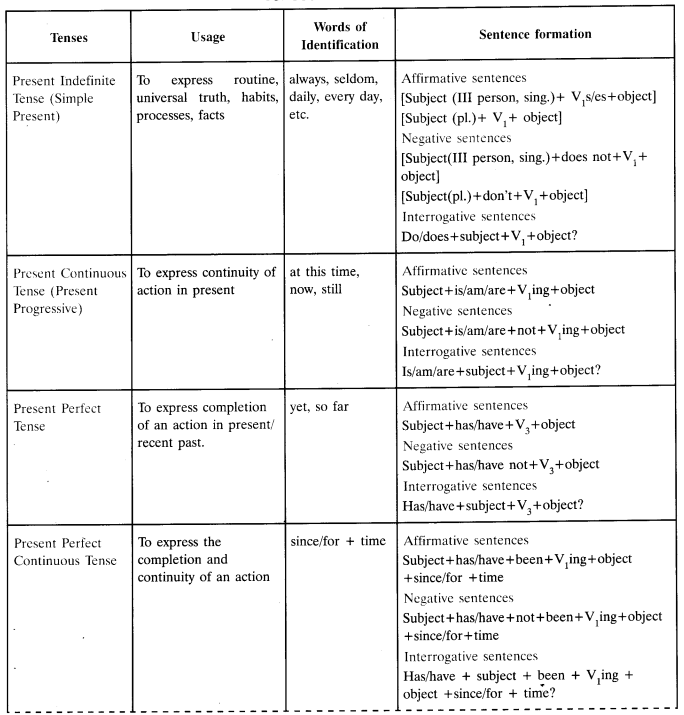
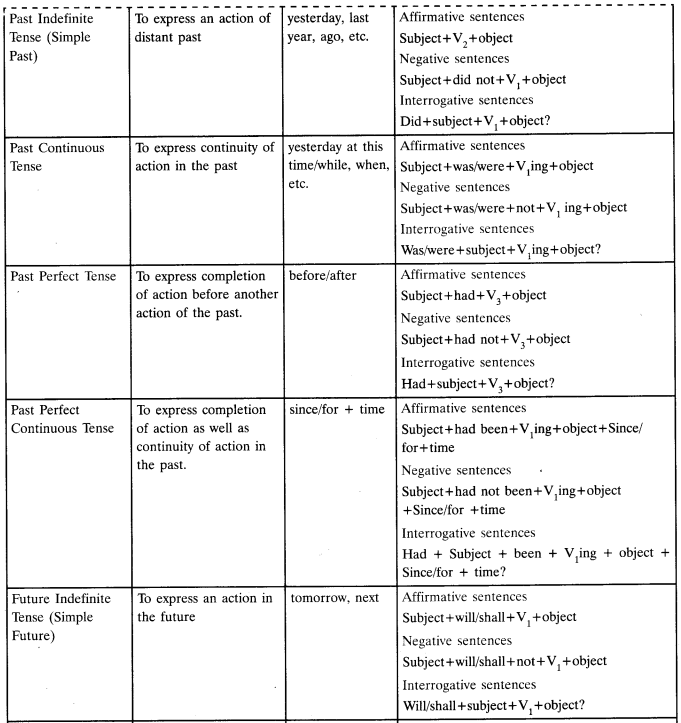
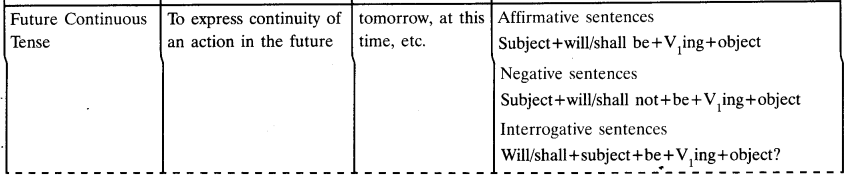
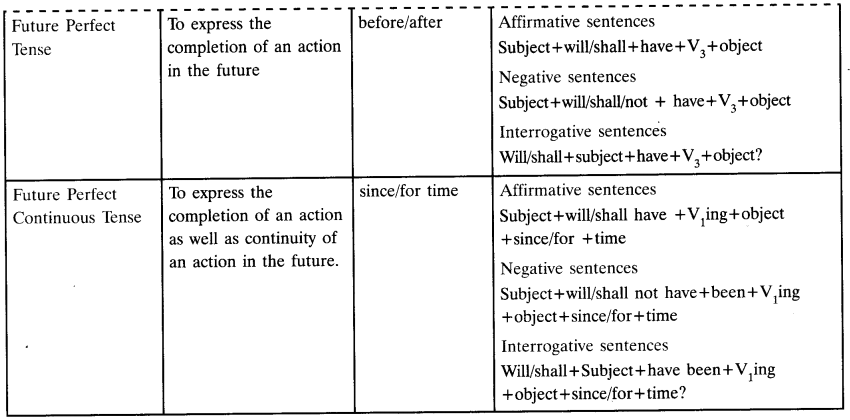
Tenses at a Glance

Tenses Exercieses for Class 10 CBSE 1
Tenses Exercieses for Class 10 CBSE 2
Tenses Exercieses for Class 10 CBSE 3
Tenses Exercieses for Class 10 CBSE 4

♦ Sequence of Tenses:

1. According to the Sequence of Tenses the tense of the verb in a subordinate clause follows the tense of the verb in the Principal Clause.

2. There are two main rules for the Sequence of Tenses.
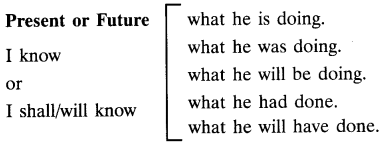
Rule No. 1. If the verb in the Principal Clause is in the Present or Future Tense, the verb in the Subordinate Clause may be in any tense, according to the sense; for example:

Tenses Exercieses for Class 10 CBSE 5

Rule No. 2. If the verb in the Principal Clause is in the Past Tense, the verb in the Subordinate Clause must also be written in the corresponding Past Tense, for example:

  1. I knew he was telling a lie.
  2. He worked hard so that he might pass.
    There are, however, some exceptions to this rule.

(i) If the verb in the Subordinate Clause expresses some universal truth or habitual action, it is always in the Present Tense, even if the verb in the Principal Clause is in the Past Tense; for example:

  1. The old father told his sons that union is strength.
  2. I was sorry to hear that he has a bad temper.

(ii) If the verb in the Subordinate Clause is introduced by the conjunction of comparison ‘than’, the verb may be of any tense, even though there is Past Tense in the Principal Clause, for example:

  1. She liked him more than she likes you.
  2. He helped us more than he helps his relatives.

Note 1. If the comparison is expressed by “as well as” instead of “than”, the same rule holds good. Any tense may be followed by any tense, according to the sense intended by the speaker. For example,

  1. He likes you as well as he liked me.
  2. He will like you as well as he has liked me.

Note 2. If no verb is expressed after “than” or after “as well as”, the tense of the verb understood in the subordinate clause is the same as that of the verb expressed in the principal clause. For example,

  1. He liked you better than (he liked) me.
  2. He will like you as well as (he will like) me.

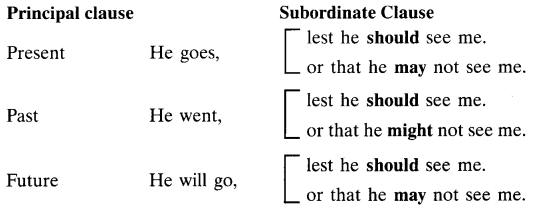
Note 3. The word “lest”-“that not”. The only auxiliary verb that can be used after “lest” is should, whatever may be the tense of the verb in the principal clause. For example,

Tenses Exercieses for Class 10 CBSE 6

(iii) If the Subordinate Clause is an adverbial clause of place or reason, sequence of tenses may be in any tense according to the tense/sense implied, for example:
He failed because he has weak health.

Rule No. 3. The conjunctions ‘as if and ‘as though’ always take ‘were’ in the subordinate clause, whatever the tense in the Principal Clause, for example:

  1. He talks as if he was mad.
  2. He worked as though he were a giant.

Fill up the blanks by using the correct tense form of the verbs given in brackets.

Question 1.
(a) We …………… (go) to Guwahati by Rajdhani Express last month.
(b) Rajdhani train …………… (be) a fully air-conditioned train.
(c) It …………… (provide) food, cold drinks, water, and the blankets at night.
(d) The journey …………… (be) cool. It imparted solace to the soul and mind.
(e) On the opposite, there …………… (be) a priest.
(f) He …………… (be) in the church of Patna for the past twenty years.
(g) I was informed that he …………… (read) a book.
(h) He did not say when he …………… (come).
(i) I hope that you …………… (pardon) me soon.
(j) He taught me that good deeds …………… (b) never lost.

Answer:
(a) went
(b) is
(c) provides
(d) was
(e) was
(f) has been
(g) had been reading
(h) would come
(i) will pardon
(j) are

Question 2.
(a) Arjun …………… (be) a good friend of Lord Krishna.
(b) He never …………… (want) to fight with his brother Duryodhan.
(c) It was Krishna who …………… (inspire) Arjun by giving him Upadesas of Gita.
(d) Arjun …………… (bow) before his Guru and then he started fighting.
(e) The Mahabharata …………… (write) by Ved Vyasji.
(f) The Mahabharata …………… (be) an epic.

Answer:
(a) was
(b) wanted
(c) inspired
(d) bowed
(e) was written
(f) is

Question 3.
(a) Malaria …………… (be) caused by female Anopheles mosquito.
(b) They …………… (be) also called carriers.
(c) When a Mosquito …………… (bite) a person, the microbes enter into the bloodstream.
(d) We should …………… (keep) the surrounding clean to avoid the breeding of mosquitoes.
(e) Disease-causing microbes …………… (be) called pathogens.
(f) Yeast …………… (be) a friendly microbe.

Answer:
(a) is
(b) are
(c) bites
(d) keep
(e) are
(f) is

Question 4.
Last week I (a) ……………. (visit) the trade fair. It (b) ……………. (inaugurate) by the President of India. I (c) ……………. (accompany) by my friend who (d) ……………. (come) from the U.S.A. last week. He (e) ……………. (live) in the U.S.A. since last five years. He (f) ……………. (do) his M.B.A. from the New York University.

Answer:
(a) visited
(b) was inaugurated
(c) was accompanied
(d) had come
(e) has been living
(f) is doing

Question 5.
Kate Middleton may (a) …………….(be) looked dainty and fairy-like in her wedding gown but (b) ……………. (talk) doing the rounds (c) ……………. (be) that the‘dress bore a striking similarity with Grace Kelly’s wedding outfit. Royal wedding fans couldn’t (d) ……………. (help) noticing that both the brides (e) ……………. (wear) dramatic gowns with similar V-shaped necklines and long white lace sleeves at their respective weddings, (f) ……………. (report) the New York Daily.

Answer:
(a) have
(b) talks
(c) are
(d) help
(e) wore
(f) reports

Question 6.
(a) Mrs Talwar ………………. (live) in a village.
(b) She ………………. (be) three children.
(c) Her hobby………………..(be) singing and praying in solitude.
(d) She ……………………. (love) to look after the poor children.
(e) Her children ………………. (be) abroad.
(f) She ………………. (be) a staunch devotee of Lord Krishna.

Answer:
(a) lives
(b) has
(c) is
(d) loves
(e) are
(f) is

Question 7.
Honey, amla, gums, resins, tubers and tamarind; all these and more (a) ………………. (come) fromforests and (b) ………………. (find) their way into our lives. But the tribals who (c) ………………. (pluck), dig and extract them get a pittance. Now, the government (d) ………………. (decide) to provide a minimum support price (MSP) for some select forest produce on the lines of wheat and paddy. The step could (e) ………………. (help) around 40 million tribal families which still (f) ………………. (depend) part or whole year on income from forests.

Answer:
(a) come
(b) have found
(c) pluck
(d) has decided
(e) help
(f) depend

Question 8.
A new study has (a) ………………. (find) that birds living in cities (b) ………………. (be) larger brains while species with smaller brains (c) ………………. (find) almost exclusively in rural locations. Researchers at Sweden’s Uppsala University (d) ………………. (look) at 82 bird species in central. European cities and in the surrounding countryside and (e) ………………. (found) that birds with relatively large brains, such as crows and magpies (f) ………………. (inhabit) urban areas.

Answer:
(a) found
(b) have
(c) are found
(d) have looked
(e) have found
(f) inhabit

Question 9.
When I (a) ………………. (be) sixty years old, I (b )………………. (be) open a club. All the members (c) ……………… (be) a share in it. It (d) ………………. (be) comprise forty members who should be fifty-plus in age. Health centre, swimming pool, and a dancing floor (e) ………………. (be) be the features of that club. Membership fees (f) ………………. (be) 5 lacs.

Answer:
(a) will be
(b) will
(c) will have
(d) will
(e) will
(f) will be

Question 10.
Peddacheppalli (a) ………………. (become) a habitation after Pakistani Kapu brothers who (b) ………………. (come) from Northern India, (c) ………………. (cut) down a forest and (d) ………………. (level) it, and hence the village (e) ………………. (name) Peddacheppalli after the eldest of the brothers. Sage Agastya (f) ………………. (live) here for some time.

Answer:
(a) became
(b) came
(c) cut
(d) levelled
(e) was named
(f) lived

Question 11.
With the onset of Kaliyuga, none (a) ……………… (perform) pooja and the area (b) ……………. (turn) into a forest with wild shrubs and mud hills (c) ………………. (form) on the Shivlingam. When chappals (d) ………………. (get) trees cut down for (e) ………………. (form) a village, a valmeekam (f) ………………. (surface) and local people offered prayers.

Answer:
(a) performed
(b) turned
(c) formed
(d) got
(e) forming
(f) surfaced

Editing Exercises for Class 9 CBSE With Answers

Editing Exercises for Class 9

The following passage has not been edited. There is an erpr in each line against which a blank is given. Write the incorrect word and the corrected word in your answer sheet against the blank as given in the example. Underline the corrected word that has been supplied.

Editing Exercises for Class 9 CBSE With Answers PDF

This grammar section explains English Grammar in a clear and simple way. There are example sentences to show how the language is used. You can also visit the most accurate and elaborate NCERT Solutions for Class 9 English. Every question of the textbook has been answered here.

Editing Solved Exercise With Answers for Class 9 CBSE

Question 1.
The following passage has not been edited. There is one error in each of the lines. Write the incorrect word and the correction in your notebooks as given below against the correct blank numbers. Remember to underline the word that you have supplied.

 IncorrectCorrect
All of us enjoy the excitement of the cinema. Anthe
We don’t think about how a film was created………………
while we’re watching them. However, behind every………………
success film there is a lengthy, creative process………………
who involves a variety of different activities.………………
Usually, the process begins by what is called the………………
‘treatment’. This is the basic outline off the film story.………………

Question 2.

ErrorCorrection
A one-eyed man was travelinge.gAnA
through a bus one day. He was(a)____________________________
carrying a huge bag on him(b)____________________________
shoulder. Anyone sitting next to him(c)____________________________
said, “Why didn’t you keep your bag(d)____________________________
beneath the seat?” The man smiled(e)____________________________
and said, “It is too big to be kept their”.(f)____________________________

Answer:
(a) through – by
(b) him – his
(c) Anyone – Somebody
(d) didn’t – don’t
(e) beneath – under
(f) their – there

Question 3.

ErrorCorrection
Kashmir is right called the e.g. right rightlye.grightrightly
“Paradise in Earth”, Its beauty(a)____________________________
is to be see to be believed.(b)____________________________
The rivers, hill, mountains and(c)____________________________
gardens are the tourist attract.(d)____________________________
The snow-clad mountains is(e)____________________________
a treat for.the eyes.(f)____________________________

Answer:
(a) in – on
(b) see – seen
(c) hill – hills
(d) attract – attractions
(e) is – are
(f) for – to

Question 4.

ErrorCorrection
The more important advantagee.gmoremost
of a nuclear family are that(a)____________________________
people get his privacy.(b)____________________________
In a joint family, their are(c)____________________________
restrictions which todays(d)____________________________
generation do not like.(e)____________________________
They disregard the disadvantages of a joint family.(f)____________________________

Answer:
(a) are – is
(b) his – their
(c) their – there
(d) todays – today’s
(e) do – does
(f) disadvantages – advantages

Question 5.
There is an error in each line. Underline the incorrect word and write the correct word in the blank given. The first one has been done for you as an example. I entered the manager’s office and sat down, (entered)

I have just lost five hundred rupees and I felt very upset, (a) __________ “I leave the money in my desk,” I said, (b) __________ “and it is not there now”. The manger was very sympathetic but he can do nothing, (c) __________ “Everyone loses money theses days,” (d) __________ he said. He start to complain about this wicked world, (e) __________ but is interrupted by a knock at the door, (f) __________.
Answer:
(a) was feeling
(b) left
(c) could
(d) is losing, these
(e) started
(f) was

Reported Speech Exercises for Class 10 CBSE With Answers

Reported Speech Exercises for Class 10

When we want to tell somebody else what another person said, we can use either direct speech and reported speech. When we use direct speech, we use the same words but use quotation marks, For example: Scott said, “I am coming to work. I will be late because there is a lot of traffic now.”

When we use reported speech, we usually change the verbs, specific times, and pronouns. For example: Scott said that he was coming to work. He said that he would be late because there was a lot of traffic at that time.

Reported Speech Exercises for Class 10 CBSE With Answers Pdf

This grammar section explains English Grammar in a clear and simple way. There are example sentences to show how the language is used. NCERT Solutions for Class 10 English will help you to write better answers in your Class 10 exams. Because the Solutions are solved by subject matter experts.

Rules for Reported Speech
While changing direct speech into reported speech or vice-versa the following changes occur:

1. Changes In Reporting Verb
Affirmative sentences: said, told (object), asserted, replied, assured, informed, responded, whispered, alleged, believed, assumed, thought
Interrogative sentences: asked, enquired, wanted to know
Imperative sentences: ordered, begged, pleaded, implored, advised, demanded

2. Change Of Pronouns
Direct Speech: Johnny said, ‘I am playing.’
Indirect Speech: Johnny said that he was playing.
First-person generally changes to third person {depending upon the subject of the reporting verb).

3. Change Of Tenses

Direct SpeechIndirect Speech
Johnny said, ‘I like to play.’Johnny said that he liked to play.
Johnny said, ‘I am playing.’Johnny said that he was playing.
Johnny said, ‘I have played this game.’Johnny said that he had played that game.
Johnny said, ‘I have been playing this game.’Johnny said that he had been playing that game.
Johnny said, ‘I played this game last week. ’Johnny said that he had played that game the previous week.
Johnny said, ‘I was playing this game when Mohan came home.’Johnny said that he had been/was playing that game when Mohan came home.
Johnny said, ‘I had played this game before you came.’Johnny said that he had played that game before he came.
Johnny said, ‘I will play this game.’Johnny said that he would play that game.

In general, present tense becomes past tense; past tense and present perfect become past perfect.

4. Change of situations
Example:
Nagesh said, ‘I read this book last week. (direct speech)
Nagesh said that he had read that book the previous week, (indirect speech)

  • ‘this’ becomes ‘that’
  • ‘last week’ becomes ‘the previous week’
  • here – there
  • now – then
  • today – that day
  • yesterday – the day before/the previous day
  • tomorrow – the next day/the coming day
  • last week – the week before/the previous week
  • next month – the next month/the coming month

5. In case of questions and answers
Examples:

  • Nagesh asked, ‘Have you read this book?’ (direct speech)
  • Nagesh asked if’ whether I had read that book, (indirect speech)
  • Nagesh asked, ‘Where is the book?’ (direct speech)
  • Nagesh asked where the book was. (indirect speech)

(a) For yes/no questions – use if/whether
(b) For wh- questions – use the wh-word

Word Order:

  • Nagesh asked, ‘What’s the matter?’
  • Nagesh asked what the matter was. (what + the matter + was)
  • Nagesh asked what was the matter, (what + was + the matter)
  • The word order can be either:
  • who/which/what + complement + be or ‘
  • who/which/what + be + complement

6. Reported Speech using present and future tenses
Examples:

  • Nagesh said, ‘The sun rises in the east.’ (direct speech)
  • Nagesh said that the sun rises in the east, (indirect speech)
  • Nagesh said, ‘I will read this book.’ (direct speech)
  • Nagesh said that he will read that book, (indirect speech)
  • If the original speaker’s present and future is still present and future, the tense remains unchanged.

7. In case of modal verbs
can becomes could

  • will – would
  • shall – should
  • may – might

would, should, could, might, ought to and must are unchanged.
Example:

  • Nagesh said, ‘I can solve this sum.’ (direct speech)
  • Nagesh said that he could solve that sum. (indirect speech)

Reported Speech Solved Examples Exercises for Class 10 CBSE

Read the dialogue given below and then complete the passage that follows.

Question 1.
Read the dialogue and complete the passage given below.

Interviewer: So, why do you want to be a computer programmer?
Ravi: Well, I have always been interested in computers.
Interviewer: I see. Do you have any experience?
Ravi: No, but I’m a fast learner.
Interviewer: What kind of a computer do you use?
Ravi: Computer? Uhm, let me see. I can use a Mac. I also used Windows 10 once.
Interviewer: That’s good.

Ravi recently attended an interview for the selection of a computer programmer. At the interview, he was asked
(a) ……………………….. To this question he replied that he wanted to change his job because (b) ……………………….. When the interviewer asked him (e) ………………………. he replied that he (d) ……………………….. Finally, the interviewer wanted to know (e) ………………………. . Ravi replied that he could use a Mac and had also used Windows 10 once in the,.past. The interviewer seemed to be pleased with his answers.
Answer:
(a) why he wanted to be a computer programmer
(b) he had always been interested in computers
(c) whether he had any experience
(d) didn’t but that he was a fast learner
(e) the kind of computer he used

Question 2.
Manu: Where are you going to?
Annu: I am going to the market. Do you want anything?

Manu asked Annu (a) …………………… Annu replied (b) …………………… Annu replied (b) …………………… and she further asked (C) ……………………
Answer:
(a) where she was going.
(b) that she was going to the market
(c) if/whether she wanted anything.

Question 3.
Sunita: Tomorrow is your birthday, what do you want as a gift?
Neetu: That is a lovely thought but I don’t want anything.

Sunita asked Neetu since the next day was her birthday, (a) …………………… Neetu replied that (b) …………………… but (C) ………………….. . Answer:
(a) what she wanted as a gift
(b) that was a lovely thought
(c) she did not want anything.

Question 4.
Gardener: Did you water the plant today?
Dev: No, but I will, today.
Gardener: Then tomorrow I will get a sapling of sunflower.

The Gardener asked Dev (a) …………………… Dev replied negatively but (b) …………………… Then the gardener said that (c) ………………….. . Answer:
(a) if/whether he had watered the plant that day.
(b) said he would that day.
(c) he would get a sapling of a sunflower the next day.

Question 5.
Mr. Harish: Can you polish my shoes?
Cobbler: Yes sir. But I will take 10 for each shoe.

Mr. Harish: I will not mind as long as it is done. Mr. Harish asked the cobbler (a) …………………… The cobbler replied affirmatively but (b) …………………… Mr. Harish said that (C) …………………….
Answer:
(a) if/whether he could polish his shoes.
(b) said that he would take 10 for each shoe
(c) he would not mind as long as it was done.

Question 6.
Electrician: When did your electricity go?
Mohan: It is not working since evening.
Electrician: Sorry sir, in this case, I will have to check the fuse now.

The electrician asked Mohan (a) …………………… Mohan replied that (b) …………………… The electrician apologetically said that in that case (c) ……………………
Answer:
(a) when his electricity had gone.
(b) it was not working since evening.
(c) he would have to check the fuse then.

Question 7.
Teacher : Children, let us all pledge to save trees.
Children : Yes, mam, we all pledge to save our trees as the trees are the lungs of the city.
Teacher : Let us start today by planting a sapling.

The teacher asked all the children to pledge to save trees. The children replied affirmatively (a) …………………… as the (b) …………………… Then the teacher said that (c) ………………….. .
Answer:
(a) saying that they all pledged to save trees
(b) trees are the lungs of the city.
(c) they should start by planting a sapling that day.

Question 8.
Buddha : Honesty is the best policy.
Disciple : Does honesty always pay?
Buddha : It may or may not, but at least you will never feel guilty.

Buddha in his preaching said that (a) …………………… the best policy. A disciple asked him if (b) …………………… always pays, Buddha replied (c) …………………… but at least he would never feel guilty.
Answer:
(a) Honesty is
(b) honesty
(c) that it might or might not

Question 9.
Doctor : You should take this medicine every day.
Patient : Should I take it before dinner or after dinner?
Doctor : No, you should take it after breakfast.

The Doctor advised the patient that (a) …………………… The patient further asked (b) …………………… The doctor replied negatively and then said (c) ………………….. .
Answer:
(a) he should take that medicine every day.
(b) if/whether he should take it before dinner or after dinner.
(c) that he should take it after breakfast

Question 10.
Reena : Do you know how to swim?
Surbhi : Yes I know. I have learnt it during this summer vacation.

Reena asked Surbhi (a) …………………… Then Surbhi replied (b) …………………… and also added that (c) ………………….. .
Answer:
(a) if/whether she knew how to swim
(b) in affirmative
(c) she had learnt it during the summer vacation.