Introduction to Euclid’s Geometry Class 9 Notes Maths Chapter 3

Introduction to Euclid’s Geometry Class 9 Notes

On this page, you will find Introduction to Euclid’s Geometry Class 9 Notes Maths Chapter 3 Pdf free download. CBSE NCERT Class 9 Maths Notes Chapter 3 Introduction to Euclid’s Geometry will seemingly help them to revise the important concepts in less time.

CBSE Class 9 Maths Chapter 3 Notes Introduction to Euclid’s Geometry

Introduction to Euclid’s Geometry Class 9 Notes Understanding the Lesson

1. The word ‘geometry is derived from the Greek Word ‘Geo’ means Earth and ‘matrein’ means to measure,

2. In India the excavations of Harappa and Mohenjo-daro show the industrially civilisation (about 300 BCE) made use of geometry.

3. Sulbasutras were the manuals of geometrical constructions in (800 BCE to 500 BCE)

4. The Sriyantra (given in Atharvaveda) which consist 9 interwoven isosceles triangles. These triangles are arranged in such a way that they produce 43 subsidiary triangles.

5. Thales was a great mathematician who gives the proof and statement that a circle is bisected by its diameter.

6. Thales famous pupil was Pythagoaras (572 BCE). He and his group developed the theory of geometry to a great extent.

7. Euclid was a teacher of mathematics at Alexandria in Egypt collect all the famous work and arranged it in his famous treatise called ‘Elements’. He divided the elements in thirteen chapters which are each called a book. These books influenced the whole worlds to understand geometry.

Definitions which are given by Euclid

  • Point-, a point is that which has no part.
  • Line: A line is breadthless length.
  • The ends of a line are points.
  • Straight line: It is a line which lies evenly with the points on itself.
  • Surface: A surface is that which has length and breadth only.
  • Edge: The edges of a surface are lines.
  • Plane surface: A plane surface is a surface which lies evenly with the straight lines on itself

If we study these definitions, we find the some of terms like part, length, breadth, evenly, etc. need to be further described clearly. Euclid assumed certain properties, which were not to be proved. Euclid’s assumptions are universal truths,

  • Axiom: The basic facts which are taken for granted without proofs are called axiom.
  • Statement: A sentence which is either true or false but both is called a statement.
  • Theorem: A statement which requires proof.

Euclid’s Axioms

  • Things which are equal to the same thing are equal to one another.
  • If equals are added to equals, the wholes are equal.
  • If equals are subtracted from equals the remainders are equal.
  • Things which coincide with one another are equal to one another.
  • The whole is greater than the part.
  • Things which are double of the same things are equal to one another.
  • Things which are halves of the same things are equal to one another.

Collinear points: Three or more points are said to be collinear, if they all lie in the same line.

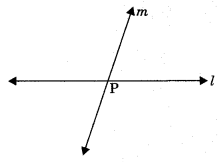
Plane: A plane is a flat, two dimensional surface that extends infinitely in all directions. Intersecting lines: Two lines land m are said to be intersecting lines if l and m have only one point common.

Playfair Axiom: Two intersecting lines cannot both be parallel to a same line.

Plane figure: A figure that exist in a plane is called a plane figure.
Introduction to Euclid’s Geometry Class 9 Notes Maths Chapter 3

Note:

  • Common notions often called axioms.
  • Postulates were the assumptions that are specific for geometry.

Axiom 5.1: There is a unique line that passes through two distinct points.
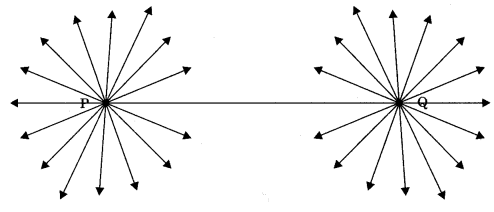
Introduction to Euclid’s Geometry Class 9 Notes Maths Chapter 3 .1
1. Through a given point infinitely many lines can be drawn.
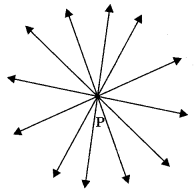
Introduction to Euclid’s Geometry Class 9 Notes Maths Chapter 3 .2
2. A line contains infinitely many points.

Euclid’s five postulates
Postulate 1: A straight line may be drawn from any one point to any other point.
Note: This postulate tells us that one and only one (unique) line passes through two distinct points.

Postulate 2: A terminated line can be produced indefinitely.
This postulate tells us that a line segment can be extended on either side to form a line.
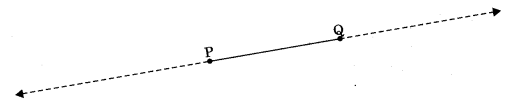
Introduction to Euclid’s Geometry Class 9 Notes Maths Chapter 3 .3

Postulate 3: A circle can be drawn with any centre and any radius.

Postulates 4: All right angles are equal to one another.

Postulate 5: If a straight line falling on two straight lines makes the interior angles on the same side of it taken together less than two right angles, then the two straight lines if produced indefinitely, meet on that side on which the sum of angles is less than two right angles.

Example: Sum of ∠1 and ∠2 is less than 180°. Therefore, the lines AB and CD will enventually intersect on the left side of PQ. Nowadays, axioms and postulates are used in same sense.
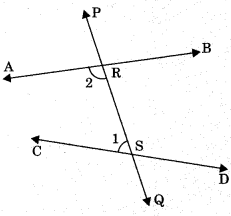
Introduction to Euclid’s Geometry Class 9 Notes Maths Chapter 3 .4


Note: The statements that were proved are called propositions or theorems.
I Euclid deduced 465 propositions in a logical chain by using his axioms,

Theorem 5.1
Two distinct lines can not have more than one point in common,
Proof: Let us suppose that two lines l and m intersect in two distinct points say P and Q. Therefore two lines passing through two distinct points P and Q. But our assumption clashes with the axiom that only one line can pass through two distinct points. So, the assumption was wrong that we started with, that two lines can pass through two distinct points is wrong. Hence two distinct lines can passe through one common point.
Polynomials Class 9 Notes Maths Chapter 2

Polynomials Class 9 Notes

On this page, you will find Polynomials Class 9 Notes Maths Chapter 2 Pdf free download. CBSE NCERT Class 9 Maths Notes Chapter 2 Polynomials will seemingly help them to revise the important concepts in less time.

CBSE Class 9 Maths Chapter 2 Notes Polynomials

Polynomials Class 9 Notes Understanding the Lesson

1. An expression which is the combination of constants and variables and are connected by some or all the operations addition, subtraction, multiplication and division is known as an algebraic expression.
Example: 7 + 9x – 2x2 + \(\frac{5}{6}\) xy

2. Constant: Which has fixed numerical value.
Example: 7, -4, \(\frac{3}{4}\) , n etc.

3. Variable: A symbol which has no fixed numerical value is known as a variable.
Example: 2x, 5x2

4. Terms: These are the parts of an algebraic expression which are separated by operations, like addition or subtraction are known as terms.
Example: In the expression 5x3 + 9x2 + 7x – 3, terms are 5x3, 9x2, 7x and -3

5. Polynomial: An algebraic expression of which variables have non-negative integral powers is called a polynomial.
Example:
(a) 5x2 + 7x + 3
(b) 9y3 – 7y2 + 3y + 7

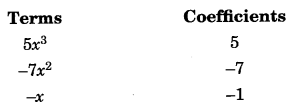
6. Coefficient: A coefficient is the numerical value in a term.
Note: If a term has no coefficient, the coefficient is an unwritten 1.
Example: 5x3 – 7x2 – x + 3
Polynomials Class 9 Notes Maths Chapter 2

7. Degree of a polynomial (in one variable): The highest power of the variable is called the degree of the polynomial.
Example: 5x + 4 is a polynomial in x of degree 1.

8. Degree of a polynomial in two or more variables: The highest sum of powers of variables is called the degree of the polynomial.
Example: 7x3 + 2x2y2 – 3ry + 8

9. Degree of polynomial = 4 (Sum of the powers of variables x and y )

10. Types of Polynomial

(i) Linear polynomial: A polynomial of degree one is called a linear polynomial.
Example: 2x + 3 is a linear polynomial in x.

(ii) Quadratic polynomial: A polynomial of degree 2 is called a quadratic polynomial.
Example: 5x2 – 7x + 4 is a quadratic polynomial.

(iii) Cubic polynomial: A polynomial of degree 3 is called a cubic polynomial.
Example: 3x3 + 7x2 – 4x + 9 is a cubic polynomial.

(iv) Biquadratic polynomial: A polynomial of degree 4 is called a biquadratic polynomial.
Example: 7x4 – 2x3 + 4x + 9 is a biquadratic polynomial.

11. Number of Terms in a Polynomial
Categories of the polynomial according to their terms:

(i) Moflomil A polynomial which has only one non-zero term is called a monomial.
Example: 7, 4x, \(\frac{4}{5}\) xy, 7x2y3z5, all are monomials.

(ii) Binomial: A polynomial which has only two non-zero terms is called binomial.
Example: 2x + 7, 9x2 + 3, 3x2yz + 4x3y3z2, all are binomials.

(iii) Trinomial: A polynomial which has only three non-zero terms is called a trinomial.
Example: 5x2 + lx + 9, 5xy + 7xy2 + 3x3yz, all are trinomials.

(iv) Constant polynomial: A polynomial which has only one term and that is a constant is called a constant polynomial.
Example: \(\frac{-3}{4}\), 7, 5 all are constant polynomials. 4
Note: The degree of constant non-zero polynomial is zero.

(v) Zero polynomial. A polynomial which has only one term i.e., 0 is called a zero polynomial.
Note: Degree of a zero polynomial is not defined.

12. Value of a Polynomial

Value of a polynomial is obtained, when variable of a given polynomial is interchanged or replaced by a ; constant.    Let p(x) is a polynomial then value of polynomial at x = a is p(a).
Zero or root of a polynomial: A zero or root of a polynomial is the value of that variable for which value of polynomial p(x) becomes zero i.e., p(x) = 0.
Let p(x) be the polynomial and x – a.
If p(a) = 0 then real value a is called zero of a polynomial.

13. Remainder Theorem
Let p(x) be a polynomial of degree ≥ 1 and a be any real number. If p(x) is divided by the linear polynomial x-a, then the remainder is p(a).

Proof: Let p(x) be any polynomial of degree greater than or equal to 1. When p(x) is divided by x – a, the quotient is q(x) and remainder is r(x).
i.e.,p(x) = (x-a) q(x) + r(x)
Since degree of x – a is 1 and the degree of r(x) is less than the degree of x – a so the degree of r(x) = 0.
It: means r(x) is a constant, say r.
Therefore, for every value of x,  r(x) = r
then   p(x) = (x-a) q(x) + r
When x = a, then  p(a) = (a – a) q(x) + r ⇒ p(a) = r

14. Factor Theorem
If p(x) is a polynomial of degree greater than or equal to 1 and a be any real number, then

  • x – a is a factor of p(x) i.e., p(x) – (x-a) q(x) which shows x – a is a factor of p(x)
  • Since x – a is a factor of p(x)
    p(x) = (x-a)g(x) for same polynomial g(x). In this case,p(a) = (a-a) g (a) = 0

15. Factorisation of the Polynomial ax2 + bx + c by Splitting the Middle Term
Let           p(x) = ax2 + bx + c
and factor of polynomial p(x) = (px + q) and (rx + s)
then   ax2 + bx + c = (px + q) (rx + s) = prx2 + (ps +qr)x+ qs
Comparing the coefficient of x2 on both sides
a = pr …………. (1)
Comparing the coefficient of x
b =ps + qr …………. (2)
and comparing the constant terms
c = qs ……………..(3)
which shows that b is the sum of two numbers ps + qr.
Product of two numbers ps x qr =pr x qs = ac
So for factors ax2 + bx + c, we should write b as sum of two numbers whose product is ac.
Example: Factorise 6x2 + 17x + 5
Here,  b = p + q = 17
and   ac = 6 x 5 = 30 (= pq)
then we get factors of 30,      1 x 30, 2 x 15, 3 x 10, 5 x 6,
Among above factors of 30, the sum of 2 and 15 is 17
i.e.,p + q = 2 + 15 = 17
∴ 6x2 + 17x + 5 = 6x2 + (2 + 15)x + 5 = 6x2 + 2x + 15x + 5
= 2x(3x + 1) + 5(3x + 1) = (3x + 1) (2x + 5)

16. Algebraic Indentities
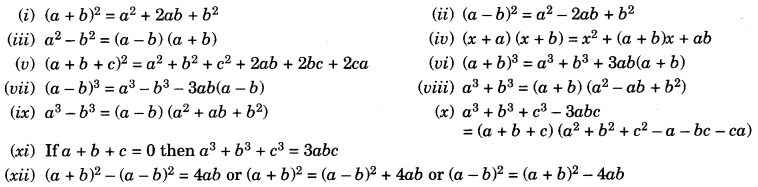
Polynomials Class 9 Notes Maths Chapter 2 1

Triangles Class 10 Notes Maths Chapter 6

Triangles Class 10 Notes

On this page, you will find Triangles Class 10 Notes Maths Chapter 6 Pdf free download. CBSE NCERT Class 10 Maths Notes Chapter 6 Triangles will seemingly help them to revise the important concepts in less time.

CBSE Class 10 Maths Chapter 6 Notes Triangles

Triangles Class 10 Notes Understanding the Lesson

In X standard we have learnt about congruent figures.

Congruent figure: Those two geometric figures having the same shape and size are known as congruent figures.

Rules of Congruency

1. SAS (Side-Angle-Side): Two triangles are congruent if two sides and the included angle of one triangle are equal to the two sides and the included angle of the other triangle.

2. ASA (Angle-Side-Angle): Two triangles are congruent if two angles and the included side of one triangle are equal to two angles and the included side of other triangle.

3. AAS (Angle-Angle-Side): Two triangles are Congruent if any two pairs of angles and a pair of corresponding sides are equal.

4. SSS (Side-Side-Side): If three sides of one triangle are equal to the three sides of another triangle, then the two triangles are congruent.

5. RHS (Right angle-Hypotenuse-Side: In two right angle triangles, the hypotenuse and one side of one triangle are equal to the hypotenuse and one side of the other triangle, then the two triangles are congruent.

Note: All congruent figures or triangles are similar.

Similar Figure: Two figure which are of same shape (but not necessarily the same size) are called similar figures. For example,

  • All line segments are similar.
  • All circles are similar.
  • Two or more squares are similar.
  • Two or more equilateral triangles are similar.

Note:

  • All rectangles are not similar.
  • All triangles are not similar.

Similar Polygons: Two polygons with the same number of sides are similar, if (1) their corresponding angles are equal. (2) their corresponding sides in the same ratio.

Similarity of Triangles

Two triangles are similar if

  • Their corresponding angles are equal; and
  • Their corresponding sides are in the same ratio

Famous Greek mathematician Militus Thales gives the relation to the two equiangular triangle is known as BPT or Thales theorem.

Equiangular triangles: If corresponding angles of two triangles are equal then they are equiangular triangles

Theorem 6.1: If a line is drawn parallel to one side of a triangle to intersect the other two sides in distinct points, the other two sides are divided in the same ratio.

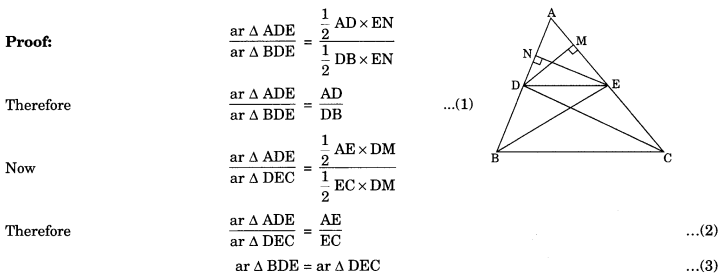
Given: A AABC in which a line DE || BC intersects the other two sides AB and AC at D and E respectively.
To Prove that \(\frac{A D}{D B}=\frac{A E}{E C}\)
Construction: Join BE and CD and draw DM ⊥ AC and EN ⊥ AB
Triangles Class 10 Notes Maths Chapter 6 1
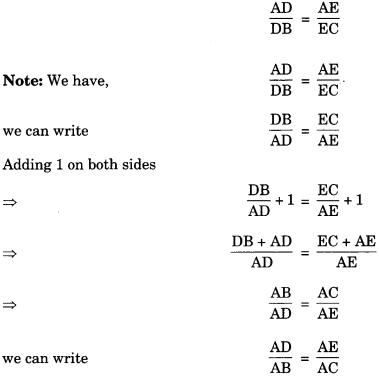
(Because both are on the same base DE and between the same parallels BC and DE) from eqn (1), (2) and (3) AD AE
Triangles Class 10 Notes Maths Chapter 6 2

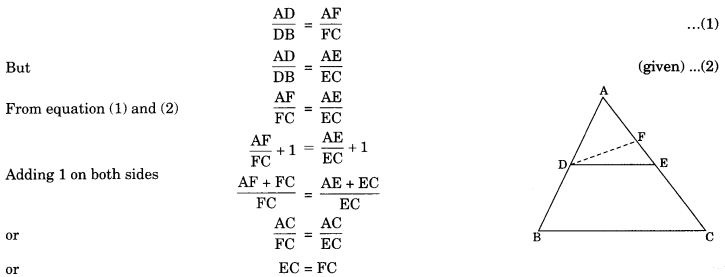
Theorem 6.2: If a line divides any two sides of a triangle in the same ratio, then the line is parallel to the third side.

AD AE Given: In ΔABC, \(\frac{\mathrm{AD}}{\mathrm{DB}}=\frac{\mathrm{AE}}{\mathrm{EC}}\)
To prove: DE || BC

Construction: Let us suppose that DE is not parallel to BC, so we draw a line DF || BC
Proof: DF || BC
Therefore by Basic Proportionality Theorem,
Triangles Class 10 Notes Maths Chapter 6 3

which is not possible. We come at the contradiction. So our supposition was wrong, it is only possible, if point F will coincide the point E.
Therefore DE || BC.

Criteria for Similarity of Triangles

In previous section, we have studied that two triangles are similar, if (I) their corresponding angles are similar (II) their corresponding sides are proportional (or are in the same ratio).

Theorem 6.3: AAA Criterion: If in two triangles, corresponding angles are equal, then their corresponding sides are in the same ratio (or proportion) and hence the two triangles are similar.

In ΔABC and ΔDEF,
Triangles Class 10 Notes Maths Chapter 6 4

Remark : AA Similarity Creterian: If two angles of a triangle are equal to two angles of another triangle, then their corresponding angles are equal and the triangles are similar.

In ΔABC and ΔDEF
∠A =∠D, ∠C = ∠F then ΔABC ~ ΔDEF (by AA similarity)

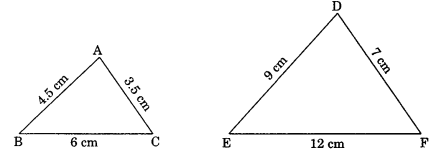
Theorem 6.4: SSS Similarity Criterion: If the corresponding sides of two triangles are proportional (i.e. in the same ratio), then their corresponding angles are equal and the triangles are similar.

In ΔABC and ΔDEF
\(\frac{A B}{D E}=\frac{B C}{E F}=\frac{A C}{D F} DF \)then ∠A = ∠D, ∠B = ∠E, ∠C = ∠F
Hence ΔABC ~ ΔDEF

Triangles Class 10 Notes Maths Chapter 6 5
Theorem 6.5: SAS Similarity Criterion: If one angle of a triangle is equal to one angle of the other and the sides including these angles are proportional, the triangles are similar.

In ΔABC and ΔDEF
∠BAC = ∠EDF
\(\frac{A B}{D E}=\frac{A C}{D F}\)
Hence ΔABC ~ ΔDEF

Areas of Similar Triangles
We have study in two similar triangles. Ratio of the corresponding sides of two similar triangles is same.

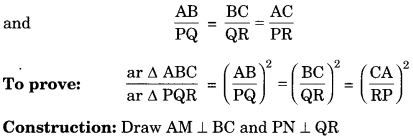
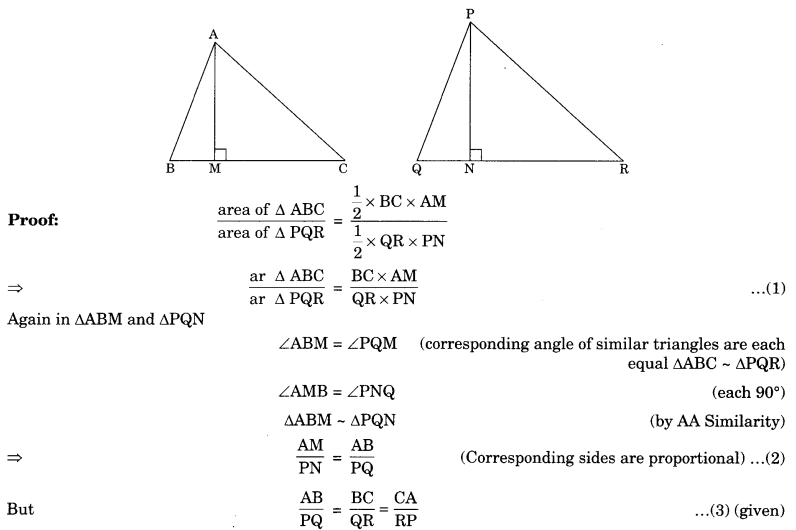
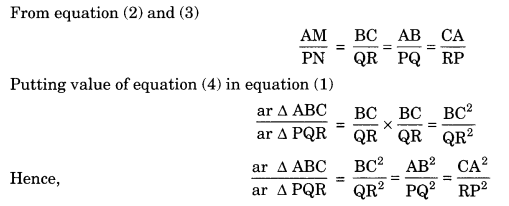
Theorem 6.6: The ratio of the areas of two similar triangles is equal to the square of the ratio of their corresponding sides.

Given: ΔABC ~ ΔPQR
Triangles Class 10 Notes Maths Chapter 6 7
Triangles Class 10 Notes Maths Chapter 6 8

Triangles Class 10 Notes Maths Chapter 6 9

Theorem 6.7: If a perpendicular is drawn from the verities of the right angle of a right triangle to the hypotenuse then triangles on both sides of the perpendicular are similar to the whole triangle and to each other.

  • ΔADB ~ ΔABC
  • ΔBDC ~ ΔABC
  • ΔADB ~ ΔBDC

Theorem 6.8: In a right triangle, the square of the hypotenuse is equal to the sum of the squares of the other two sides.

Given: ABC is a right angle triangle which is right angled at B.
To prove:  AC2 = AB2 + BC2
Construction: Draw BD ⊥  AC
Proof:  ΔADB ~ ΔABC
(If a perpendicular is drawn from the vertex of the right angle of a right triangle to the hypotenuse then triangles on both sides of the perpendicular are similar to the whole triangle and to each other)

From equation (2) and (3)
Adding eqn (1) and (2)
(If a perpendicular is drawn from the vertex of the right angle of a right triangle to the hypotenuse than triangles on both sides of the perpendicular are similar to the whole triangle and to each other)
AB2 + BC2 = AD . AC + CD . AC
⇒ AB2 + BC2 = AC (AD + CD)
⇒ AB2 + BC2 = AC x AC
⇒ AB2 + BC2 = AC2
⇒ AC2 = AB2 + BC2

Theorem 6.9: In a triangle, if square of one side is equal to the sum of the squares of the other two sides. Then the angle opposite the first side is a right angle.

Given: We have ΔABC in which
AC2 = AB2 + BC2
To prove: ∠ABC = 90°
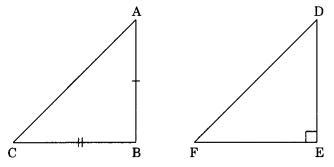
Construction: Construct a ΔDEF right angled at E such that EF = BC and DE = AB
Triangles Class 10 Notes Maths Chapter 6 10

Proof: In ΔDEF
DF2 = EF2 + DE2 (Pythagoras theorem) (given)
DF2 = BC2 + AB2…(1) (by construction)
But AC2 = BC2 + AB2…(2)

From eqn (1) and (2)
AC2 = DF2
⇒ AC = DF… (3)

In ΔABC and ΔDEF
AB = DE(by construction)
BC = EF(by construction)
AC = DF(proved above in eqn (3))
ΔABC ≅ ΔDEF(by SSS congruence)
⇒ ∠ABC = ∠DEF (by CPCT)
Therefore ∠ABC = 90°

Number Systems Class 9 Notes Maths Chapter 1

Number Systems Class 9 Notes

On this page, you will find Number Systems Class 9 Notes Maths Chapter 1 Pdf free download. CBSE NCERT Class 9 Maths Notes Chapter 1 Number Systems will seemingly help them to revise the important concepts in less time.

CBSE Class 9 Maths Chapter 1 Notes Number Systems

Number Systems Class 9 Notes Understanding the Lesson

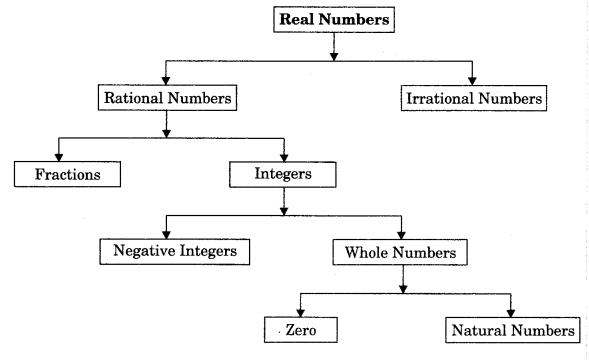
1. Number: A number is a mathematical object which is used in counting and measuring.

2. Number system: A number system defines a set of values used to represent a quantity.

3. Natural numbers: A set of counting numbers is called the natural numbers.
N = {1,2, 3, 4, 5,…}
These are infinite in number. Here first natural number is 1 whereas there is no last natural number.

4. Whole numbers: A set of natural numbers including zero is called the whole numbers.
W = {0, 1, 2, 3, 4, 5,…}

Note: All natural numbers are whole numbers but all whole numbers are not natural numbers.
Integers: A set of all whole numbers including negative of all the natural numbers.
Z = {…, – 7, – 6, – 5, – 4, – 3, – 2, – 1, 0, 1, 2, 3, 4, 5, 6, 7, …}

5. Rational Numbers
A number is called rational number if it can be expressed in the form of \(\frac{p}{q}\), where p and q are integers and q≠ 0.
Example: \(\frac{1}{2}, \frac{2}{3}, \frac{3}{4}, \frac{7}{9}, \text { etc. }\)

Note:

  • Every fractional number and integer is a rational number because they can be expressed in the form\(\frac{p}{q}\)
  • Between two rational numbers, infinite number of rational numbers can be possible. A rational number between two rational numbers a and b can be found as \(\frac{1}{2}\)(a + b)by using mean method.
  • The sum, difference and product of the rational numbers is always a rational number.
  • The quotient of a division of one rational number by a non-zero rational number is a rational number.

6. Types of Rational Numbers
1. The natural numbers form a subset of the integers.
2. Natural numbers with zero are referred to as non-negative integers.
3. The natural numbers without zero are known as positive integers.
4. When negative of a positive integer is added to the corresponding positive integer then it produces 0.

  • Terminating decimal: It has a finite number of digits after the decimal point.
    \(\frac{3}{8}\)=0.375
  • Non-terminating recurring decimal or repeating decimal: It has a digit or group of digits after the decimal point that repeat endlessly.
    Number Systems Class 9 Notes Maths Chapter 1

7. Irrational Numbers
Those numbers which cannot be expressed in the form of \(\frac{p}{q}\), where p and q are integers and
q ≠0. They neither terminate nor do they repeat. They are also known as non-terminating non-repeating numbers. Example: \(\sqrt{2}, \sqrt{3}, \sqrt{5}, \sqrt{7}, \sqrt{13}, \sqrt{\frac{7}{3}}, \ldots 5+\sqrt{7}\) are irrational numbers.
An irrational number between two rational numbers a and b can be found as the square root of their product \(\sqrt{a b}\)

Note:

  • Euler’s number ‘e’ is an irrational whose first few digits are 2.71828….
  • The sum, difference, multiplication and division of irrational numbers are not always irrational.
  • Rational number and irrational number can be represented on a number line.
  • Irrational numbers like \(\sqrt{2}, \sqrt{3}, \sqrt{5}\) etc. can be represented on a number line by using Pythagoras theorem.

8. Number line: A number line is a line which represent all the numbers. It is a picture of a straight line on which every point is assumed to correspond to a real number and every real number to a point.

Number Systems Class 9 Notes Maths Chapter 2

9. Real Numbers”
The union of the set of rational numbers and the set of irrational numbers.
A group of rational or irrational numbers is called real numbers. It can be represented on a number line.

10. Successive Magnification

  • Let us suppose we locate 4.46 on the number line. We know 4.46 lies between 4 and 5.
  • Now let us divide the portion between 4 and 5 into 10 equal parts and represent 4.1, 4.2, 4.3, …, 4.9.
  • We know that 4.46 lies between 4.4 and 4.5 so further divide the portion into 10 equal parts, then these points will represent 4.41, 4.42, 4.43, …, 4.49 on number line. Thus we can locate the given number 4.46 on the number line.

Number Systems Class 9 Notes Maths Chapter 4

Number Systems Class 9 Notes Maths Chapter 3

Arithmetic Progressions Class 10 Notes Maths Chapter 5

Arithmetic Progressions Class 10 Notes

On this page, you will find Arithmetic Progressions Class 10 Notes Maths Chapter 5 Pdf free download. CBSE NCERT Class 10 Maths Notes Chapter 5 Arithmetic Progressions will seemingly help them to revise the important concepts in less time.

CBSE Class 10 Maths Chapter 5 Notes Arithmetic Progressions

Arithmetic Progressions Class 10 Notes Understanding the Lesson

We have observed many things in our daily life, follow a certain pattern.
(a) 1, 4, 7, 10, 13, 16, …….
(b) 15, 10, 5, 0, -5, -10,………….
(c) 1,\(\frac{1}{2}\),0,\(-\frac{1}{2}\)………………
These patterns are generally known as sequence. Two such sequences are arithmetic and geometric sequences. Let us investigate the Arithmetic sequence.

1. Sequence: A sequence is a ordered list of numbers.
Terms: The various numbers occurring in a sequence are called its terms. Terms of sequence are denoted by a1 a2, a3, …………… an.

2. Arithmetic Progression: An arithmetic progression is a sequence of numbers such that the difference between the consecutive terms are equal.

3. Common difference: The difference between two consecutive terms of an arithmetic progression is called common difference.
d = a2 – a1
d  = a3 – a2
d = a4 – a3
……………..
……………..
d = a– an-1

4. Finite Arithmetic Progression: A sequence which has finite or definite number of terms is called finite sequence.
Example, (1, 3, 5, 7, 9)… which has 5 terms.

5. Infinite Arithmetic Progression: A sequence which has indefinite or infinite number of terms is called infinite arithmetic progression.
Example, 1, 2, 3, 4, 5, …

In general, arithmetic progression can be written as a, a + d, a + 2d, where a is the first term and d is called the common difference i.e. difference between two consecutive terms.

6. General form of an AP: Let a be the first term and d is the common difference then the AP is

Here
a1 = a (we take) (a is first term of AP)
a2 = a1 + d = a + d
a3 = a2 + d = a + d + d = a + 2d
a4 = a3+ d = a + 2d + d = a + 3d
…………….
……………
an = a + (n – 1) d
i.e. AP is a, a + d, a + 2d, a + 3d,………… , a + (n – 1)d.
nth term of AP = a + (n -1)d
Note: Common difference of AP can be positive, negative or zero.

1. nth term or General term of an AP
nth term of an AP = a + (n – 1) d where
a → first term of the AP
n → number of terms
d→common difference of an AP.

2. nth term of an AP from the end: Let us consider an AP where first term a and common difference is If m is number of terms in the AP. then
nth term from the end = [m – n + 1]th term from the beginning.
nth term from the end = a + (m-n +1 – 1)d – a + (m – n) d
It  l is the last term of the AP, then nth term from the end is the nth term of an AP where first term is l and common difference is – d
nth term from the end – 1 + (n – 1) (-d)
= 1 – (n – 1) d

Sum of first n terms of an AP
Let Sn denote the sum of first n terms of an AP
Sn = a + a + d + a + 2d + a + 3d …. + a + (n – 1)d ……….. (1)
Rewriting the terms in reverse order.
Sn = a + (n – 1)    + a + (n – 2)d + a + (n-3)d + ………….+a ……… (2)
Adding equations (1) and (2)
2Sn = [2a + (n – 1)d] + [2a + (n-1)d] + … + [2a + (n – 1)d]
2Sn = n[2a + (n – 1)d]
Sn=\(\frac{n}{2}\)[2a+(n-1)d]
We can Write
Sn=\(\frac{n}{2}\)[a+a+(n-1)d] [l=a+(n-1)d]
Sn=\(\frac{n}{2}\)[a+l]

Note:
(i) The Tith term of an AP = Sn – Sn-1 or an = Sn+1 – Sn
Sum of first n positive integer
\(S_{n}=\frac{n(n+1)}{2}\)
(iii) Sum of n odd positive integer = n2
(iv) Sum of n even positive integer = n(n + 1)