Linear Equations in Two Variables Class 9 Notes Maths Chapter 8

Linear Equations in Two Variables Class 9 Notes

On this page, you will find Linear Equations in Two Variables Class 9 Notes Maths Chapter 8 Pdf free download. CBSE NCERT Class 9 Maths Notes Chapter 8 Linear Equations in Two Variables will seemingly help them to revise the important concepts in less time.

CBSE Class 9 Maths Chapter 8 Notes Linear Equations in Two Variables

Linear Equations in Two Variables Class 9 Notes Understanding the Lesson

1. Equation: An equation is a mathematical statement that two things are equal. It consists of two expressions one on each side of an equals sign. For example,7x + 9 = 0

2. An equation in a statement of an equality containing one or more variables.
7x + 3y = 10

3. Linear equation in one variable: A linear equation or first degree equation, in the single variable x is an equation that can be written in the form ax + b = 0 where a, and b are equal numbers, when a≠0.
Examples:

  • 2x+3=0
  • 3y + 4 = \(\frac{y}{3}\)
  • 7x-\(\frac{9}{2}\) =0
  • 3x -7y = 73

These equations are solved by applying the properties of real numbers and properties of equality.

4. Solution of a linear equation: The value of the variable which when substituted in place of variable makes both sides of the given equation equal, is called the solution of given equation. These values of variables is also known as root of the equation.
Example:
3x + 4y – 5
Let x – 3, and y = -1
Putting x- 3 and y = -1 in the given equation 3 x 3 + 4 x (-1) = 5
⇒ 9 – 4 = 5
⇒ 5 = 5
∴ LHS = RHS
Hence (3, -1) is a solution of given equation.

5. Linear equation in two variables: A linear equation in two variables is a first degree equation which can be written in the form ax + by + c – 0 and a, b both are non-zero real number. Where a, b and c are real numbers.
Examples:

  • 3x + 2y – 9 = 0
  • 7x – 4y + 6 = 0

6. Graph of a Linear Equation in two Variables
Graph of a linear equation in two variables is a straight line.

Steps of graphing a line

  • If the equation is not in slope intercept form, i.e., y = mx + c, then write the equation in such form.
  • Plot they intercept at (0, 6).
  • Plot two or three more points by counting the rise and run from the y intercepts.

While solving the equation we should put the following points in our mind.                         •

  • We should add or subtract the same number on both the sides of the equation.
  • We should multiply or divide by the same non-zero real number on both sides of the equation.

Note:

  • A linear equation in one variable has only one solution.
  • A linear equation in two variables has infinitely many solutions.

(a) If the slope is positive, count upward for the rise and to the right for the run (also down and left)
Example;    y = \(\frac{2}{3}\) x + 1

(b) If the slope is negative, count downward for the rise and to the right for the run (also up and left)                  Example:    y =\(\frac{2}{3} \)x + 1

7. Draw a line through the points and place arrows on the ends. Extend the line to cover the whole grid (not just connect the two points)

Note:

  • The graph of every first degree equation in two variables is a straight line.
  • Equation of x-axis is y = 0 (:Hi) Equation of y-axis is x = 0
  • The graph of x = a is a straight line parallel to y-axis.
  • The graph of y = b is a straight line parallel to x-axis.
  • Graph of the equation y = mx (i.e., has no intercepts) is a straight line passing through origin.
    Every point which lies on the graph of the linear equation in two variables is a solution of linear equation.
  • Graph of linear equation in one variable
  • If given equation is in variable x only then its value represented graphically is on x-axis.
  • If the given equation is in variable y only then its value represented graphically is on y-axis.

8. Graph of linear equation in one variable

  • If given equation is in variable x only then its value represented graphically is on x-axis.
  • If the given equation is in variable y only then its value represented graphically is on y-axis.

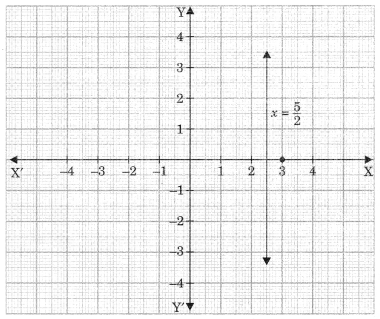
For example, 2x = 5 ⇒ x=\(\frac{5}{2}\)
Representation: In one variable,

Linear Equations in Two Variables Class 9 Notes Maths Chapter 8
In Cartesian plane or in two variables,
Linear Equations in Two Variables Class 9 Notes Maths Chapter 8 .1

Draw a line through \(x=\frac{5}{2}\) parallel to y-axis. In such representation, the equation has many solutions.
Heron’s Formula Class 9 Notes Maths Chapter 7

Heron’s Formula Class 9 Notes

On this page, you will find Heron’s Formula Class 9 Notes Maths Chapter 7 Pdf free download. CBSE NCERT Class 9 Maths Notes Chapter 7 Heron’s Formula will seemingly help them to revise the important concepts in less time.

CBSE Class 9 Maths Chapter 7 Notes Heron’s Formula

Heron’s Formula Class 9 Notes Understanding the Lesson

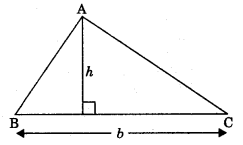
1. Area of triangle with base ‘b’ and altitude ‘h’ is
Area = \(\frac{1}{2}\)(b x h)

Heron’s Formula Class 9 Notes Maths Chapter 7 1

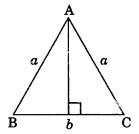
2. Area of an isosceles triangle with equal sides ‘a’ each and third side b is
Area \(=\frac{b}{4} \sqrt{4 a^{2}-b^{2}}\)
Heron’s Formula Class 9 Notes Maths Chapter 7 .2

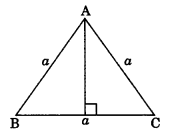
3. Area of an equilateral triangle with side ‘a’ each is
Area=\(\frac{\sqrt{3}}{4} a^{2}\)
Heron’s Formula Class 9 Notes Maths Chapter 7 .3

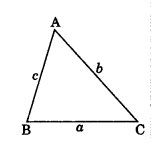
4. Area of a triangle by Heron’s formula when sides a, b and c are given is
Area = \(\sqrt{s(s-a)(s-b)(s-c)}\)
Where s = semi-perimeter = \frac{a+b+c}{2}
Heron’s Formula Class 9 Notes Maths Chapter 7 .4

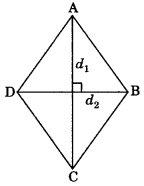
5. Area of rhombus
Area= \(\frac{1}{2} d_{1} \times d_{2}\)
where d1 and d2 are the lengths of its diagonals.
Heron’s Formula Class 9 Notes Maths Chapter 7 .5

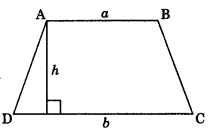
6. Area of trapezium
Area=\(\frac{1}{2}\) (a+b) h
where a and b are parallel sides and h is distance between two parallel sides.

Heron’s Formula Class 9 Notes Maths Chapter 7 .6

Coordinate Geometry Class 9 Notes Maths Chapter 6

Coordinate Geometry Class 9 Notes

On this page, you will find Coordinate Geometry Class 9 Notes Maths Chapter 6 Pdf free download. CBSE NCERT Class 9 Maths Notes Chapter 6 Coordinate Geometry will seemingly help them to revise the important concepts in less time.

CBSE Class 9 Maths Chapter 6 Notes Coordinate Geometry

Coordinate Geometry Class 9 Notes Understanding the Lesson

Rene Descartes was a French mathematician. He introduced an idea of Carterian Coordinate System for describing the position of a point in a plane. The idea which has given rise to an important branch of Mathematics known as Coordinate Geometry.

1. Cartesian coordinate system: A system which describe the position of a point in a plane is called Cartesian system.

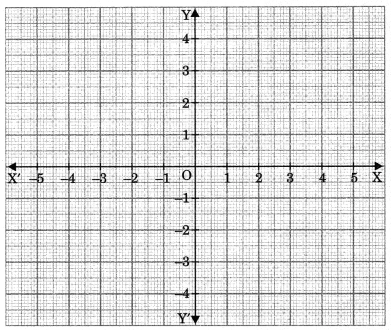
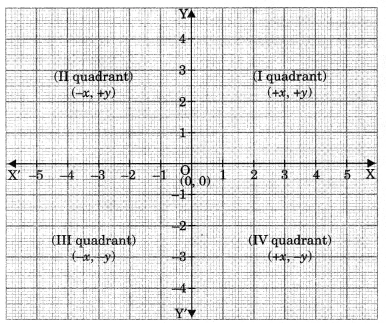
2. Cartesian coordinate axis: Let us draw a horizontal line XX’ and a vertical line YY’ in a plane. Both the lines intersect each other at 90°, then the plane is divided into four parts.

Coordinate Geometry Class 9 Notes Maths Chapter 6

The lines XX’ and YY’ are called axes i.e., XX’ is the x-axis and YY’ is y-axis.
Coordinate Geometry Class 9 Notes Maths Chapter 6 .1
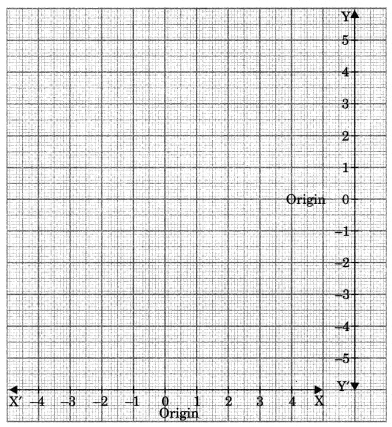
3. Origin: The point where both the axis intersect each other is known as origin.

4. Quadrant
When XX’ and YY’ intersect each other then the plane is divided into four parts. These parts are called quadrants. The plane is known as Cartesian plane or XY plane.

Coordinate Geometry Class 9 Notes Maths Chapter 6 .2

5. Coordinate Geometry: It is a branch of geometry in which geometric problems are solved through algebra by using coordinate system.

6. Cartesian Coordinate (Rectangular Coordinate) System

In this system, the position of a point P is determined by knowing the distances from two perpendicular lines passing through the fixed point O is called origin.
The position of the point P from origin on x-axis is called x-coordinate and the position of P from origin on y-axis is called y-coordinate.

Abscissa: The distance of a point P from y-axis is called abscissa.

Ordinate: The distance of a point P from x-axis is called its ordinate.

Abscissa and ordinate together determine the position of a point in a plane, and it is called coordinates of the point. If a and b are respectively abscissa and ordinate, then the coordinates are (a, b).

Coordinate Geometry Class 9 Notes Maths Chapter 6 .3
Note:

  • In first quadrant values of x and y are both positive.
  • In second quadrant value of x is negative whereas the value of y is positive.
  • In third quadrant value of x and y both are negative.
  • In fourth quadrant, the value of x is positive and value ofy is negative.
  • Perpendicular distance of a point from x-axis = (+)y-coordinate.
  • Perpendicular distance of a point from y-axis = (+)x-coordinate.
  • A point which lies on x-axis has coordinates of the form (a, 0).
  • A point which lies on y-axis has coordinates of the form (0, b).
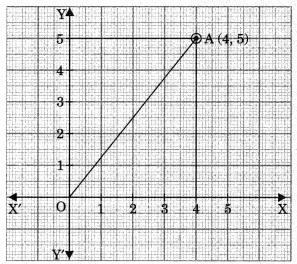
  • Distance of a point P(x, y) from origin 0(0, 0) =\(\sqrt{x^{2}+y^{2}}\)
    e.g., distance of a point A(4,5) from origin, OA = \(\sqrt{4^{2}+5^{2}}\)
    \(=\sqrt{16+25}=\sqrt{41}\)units

Triangles Class 9 Notes Maths Chapter 5

Triangles Class 9 Notes

On this page, you will find Triangles Class 9 Notes Maths Chapter 5 Pdf free download. CBSE NCERT Class 9 Maths Notes Chapter 5 Lines and Angles will seemingly help them to revise the important concepts in less time.

CBSE Class 9 Maths Chapter 5 Notes Triangles

Triangles Class 9 Notes Understanding the Lesson

Two geometric figures are said to be congruent if they have exactly the same shape and size.
Note: Congruent means equal in all respect. When one figure is kept over another then it should superimpose on the other to cover it exactly.

If a 500-rupee note is placed over another 500-rupee note then they cover each other.
If 5-rupee coin is placed over another 5-rupee coin of same year, then they cover each other completely.
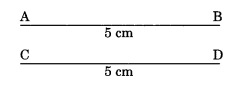
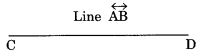
Congruence of line segments: Two line segments are congruent if they are of the same length. Length of AB = length of CD
Triangles Class 9 Notes Maths Chapter 5

Hence, \(\overline{\mathrm{AB}} \cong \overline{\mathrm{CD}}\)

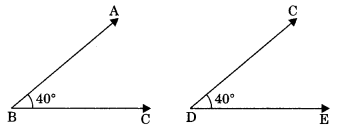
Congruence of angles: Two angles are congruent if they have equal degree measures.
Triangles Class 9 Notes Maths Chapter 5 .1

Hence, \(\angle \mathrm{ABC} \cong \angle \mathrm{CDE}\)

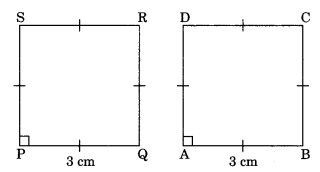
Congruence of squares: Two squares are said to be congruent, if they have equal sides.
Hence,
Triangles Class 9 Notes Maths Chapter 5 .31
Triangles Class 9 Notes Maths Chapter 5 .3

Note: Congruent plane figures are equal in area.

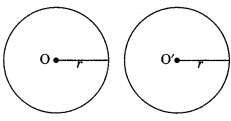
Congruence of circles: Two circles are congruent if they have equal radii.
Hence, Circle C1 ≅ Circle C2
Triangles Class 9 Notes Maths Chapter 5 .4

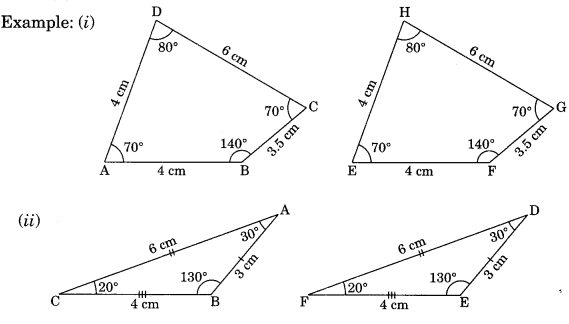
Congruent Polygons
Two polygons are said to be congruent if they are the same size and shape. For existence of congruency,
(a) their corresponding angles are equal, and
(b) their corresponding sides are equal.

Triangles Class 9 Notes Maths Chapter 5 .5

Congruence Triangles
Two triangles are congruent if they will have exactly the same three sides and three angles.

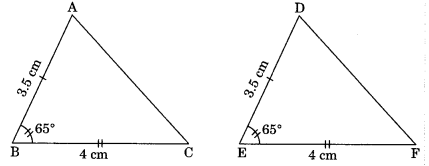
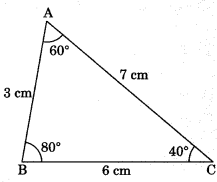
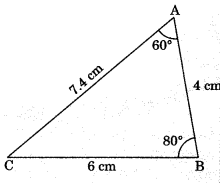
Axiom 7,1: SAS (Side-Angle-Side) Congruence rule: Two triangles are said to be congruent if two sides and the included angle of one triangle are equal to A D
the two sides and the included angle of the other.
Triangles Class 9 Notes Maths Chapter 5 .6
In ΔABC and ΔDEF,
AB = DE
∠ABC = ∠DEF
BC = EF
ΔABC ≅ ΔDEF (by SAS)

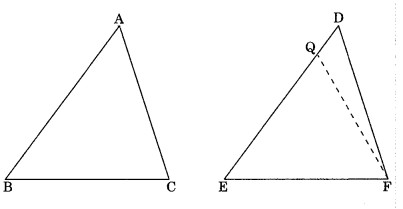
Theorem 7.1: ASA (Angle-Side-Angle)
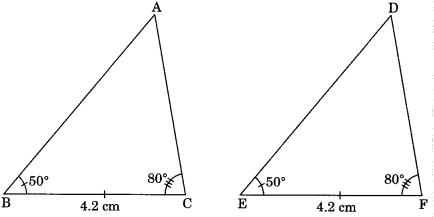
Congruence rule: Two triangles are said to be congruent, if two angles and the included side of one triangle are equal to two angles and the included side of other triangle.
In Δ ABC and Δ DEF,
∠ABC = ∠DEF
BC = EF
∠ACB = ∠DFE
∴ΔABC = ΔDEF (by ASA)
Triangles Class 9 Notes Maths Chapter 5 .7
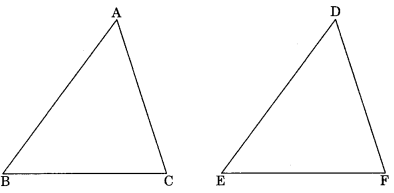
Given: AABC and ADEF in which
∠ABC = ∠DEF, ∠ACB = ∠DFE and BC = EF
To Prove: ΔABC = ΔDEF
Proof: There are three cases arises for primary two congruence of the two triangles.
Triangles Class 9 Notes Maths Chapter 5 .8
Case I: Let AB = DE
In ΔABC and ΔDEF,
AB = DE (assumed)
∠ABC = ∠DEF (given)
BC = EF (given)
So ΔABC ≅ ΔDEF (by SAS congruency)

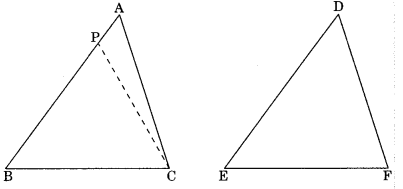
Case II: Let AB > DE. So we can take a point P on AB such that PB = DE.
Now in ΔPBC and ΔDEF
PB = DE (by construction)
∠PBC = ∠DEF (given)
BC = EF (given)
∴ ΔPBC ≅ ΔDEF (by SAS Congruency)
∠PCB = ∠DFE …(1) (by CPCT)
∴ ∠ACB = ∠DFE …(2)
From eqn (1) and (2),
∠PCB = ∠ACB
which is not possible. This is only possible if point P coincides with A.
Hence AB = DE (PB=AB)
So ΔABC = ΔDEF (by SAS congruency)
Triangles Class 9 Notes Maths Chapter 5 .9

Case III: If AB < DE, so we take a point Q on DE such that QE = AB
Now in ΔABC and ΔQEF,
AB = QE (by construction)
∠ABC = ∠QEF (given)
BC = EF (given)
Hence ΔABC = ΔQEF (by SAS congruency)
∠ACB = ∠QFE (by CPCT)
But ∠ACB = ∠DFE
Hence ∠QFE = ∠DFE
which is only possible if point Q coincides with D.
∴ AB = DE
Hence ΔABC ≅ ΔDEF (by SAS congruency)
Triangles Class 9 Notes Maths Chapter 5 .10

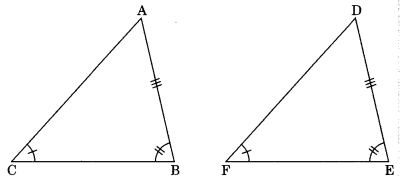
Corollary: AAS (Angle-Angle-Side) congruence rule:
Two triangles are said to be congruent if two angles and one side of one triangle is equal to two angles and one side of another triangle.
In A ABC and A DEF,
∠ACB = ∠DFE . ∠ABC – ∠DEF
AB = DE
∴ ΔABC = ΔDEF (by AAS)
Triangles Class 9 Notes Maths Chapter 5 .11

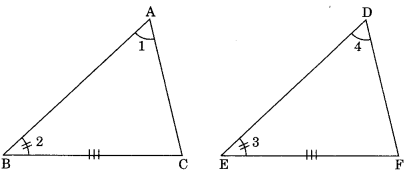
Given: ΔABC and ΔDEF
In which ∠A = ∠D, ∠B = ∠E
and BC = EF
To Prove: ΔABC ≅ ΔDEF
Proof: In ΔABC and ΔDEF
∠1 = ∠4 … (1) (given)
and ∠2 = ∠3 … (2) (given)
Adding eqn. (1) and (2),
∠1 + ∠2 = ∠3 + ∠4
⇒ 180° – (∠1 + ∠2) = 180° – (∠3 + ∠4) (by angle sum property)
∠ACB = ∠DFE
Hence ΔABC ≅ ΔDEF
Triangles Class 9 Notes Maths Chapter 5 .12

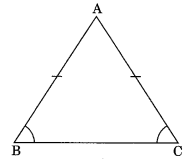
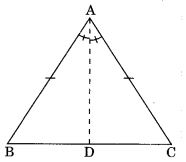
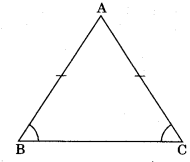
Theorem 7.2 Angle opposite to equal sides of an isosceles triangle are equal.
If AB = AC, then
∠ABC = ∠ACB
Given: ABC is a triangle in which
AB = AC
To Prove: ∠B = ∠C
Triangles Class 9 Notes Maths Chapter 5 .13
Triangles Class 9 Notes Maths Chapter 5 .14
Construction:
Draw AD angle bisector of ∠A.
Proof: In ΔBAD and ΔCAD,
AB = AC (given)
∠BAD = ∠CAD (by construction)
AD = AD (common)
.∴ΔBAD = ΔCAD (by SAS)
Hence ∠B = ∠C (by CPCT)

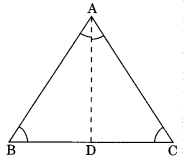
Theorem 7.3. The sides opposite to equal angles of a triangle are equal.
Given: ΔABC in which ∠B = ∠C
To Prove: AB = AC
Construction:
Draw AD bisector of ∠A which meets BC at D.
Proof: In ΔBAD and ΔCAD,
∠B = ∠C
∠BAD – ∠CAD
AD = AD
∴ΔBAD ≅ ΔCAD
Hence AB – AC
Theorem SSS (Side-Side-Side)
Triangles Class 9 Notes Maths Chapter 5 .15

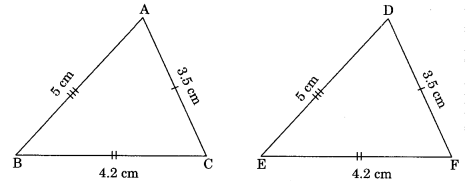
Congruence rule: Two triangles are said to be congruent if all sides (three) of one triangle are equal to the all sides (three sides) of another triangles then the two triangle are congruent.
In Δ ABC and Δ DEF,
AB = DF
BC = EF
AC = DE
ΔABC ≅ΔDEF
Triangles Class 9 Notes Maths Chapter 5 .16

Theorem 7.5: RHS (Right angle-Hypotenuse-Side)
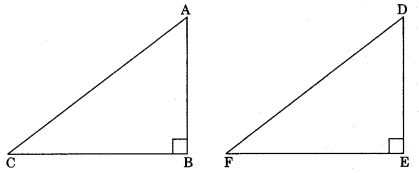
Congruence rule: If in two right triangles the hypotenuse and one side of one triangle are equal to the hypotenuse and one side of another triangle, their the two triangles are congruent.
Triangles Class 9 Notes Maths Chapter 5 .17
In ΔABC and ΔDEF,
∠ABC = ∠DEF
AC = DF
AB = DE
∴ ΔABC ≅ ΔDEF (by R.H.S)

Inequalities in a Triangle
Theorem 7.6: If two sides of a triangle are unequal, the angle opposite to the longer side is greater.
∠ABC > ∠BAC
∴ AC > BC
Given: ΔABC in which
AC > AB
To Prove:
∠ABC > ∠ACB
Triangles Class 9 Notes Maths Chapter 5 .18
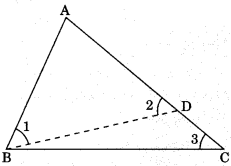
Construction:
Take a point D on AC such that AD = AB and join BD.
Proof: In Δ ABD,
AB – AD (by construction)
∴  ∠1 = ∠2 …(1) (Angle opposite to equal sides are equal)
∠2 > ∠3 ……..(2)  ∠1 is exterior angle of ΔBCD)
Triangles Class 9 Notes Maths Chapter 5 .19
From eqn. (1) and (2),
∠1 > ∠3
Hence ∠ABC > ∠ACB.

Theorem 7.7: In a triangle, side opposite to greater angle is longer.
If ∠ABC > ∠BAC
∴ AC > BC
Given: Δ ABC in which
∠ABC > ∠ACB
To Prove: AC > AB
Triangles Class 9 Notes Maths Chapter 5 .20
Proof: Here three cases arises.

  • AC = AB
  • AC < AB
  • AC < AC

Case I: If AC = AB
∠ABC – ∠ACB (Angle opposite to equal sides are equal)
But ∠ABC > ∠ACB (given)
This is a contradiction.
Hence AC ≠AB
∴ AC > AB

Case II: AC < AB
∠ACB > ∠ABC (Angle opposite to longer side is greater)
This is contradiction of given hypothesis.
Hence only one possibility is left.
i.e. AC > AB (It must be true)
Hence AC > AB
Triangles Class 9 Notes Maths Chapter 5 .21

Theorem 7.8: The sum of any two sides of a triangle is greater than the third side.
(i) AB + AC > BC
(ii) AB + BC > AC
(iii) BC + AC > AB
Given: ΔABC
Prove that:
(i) AB + BC > AC
(ii) AB + AC > BC
(iii) AC + BC > BC
Triangles Class 9 Notes Maths Chapter 5 .22
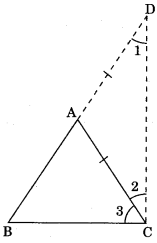
Construction: BA produce to D such that AD = AC. Join CD.
Proof: In ΔACD,
AC = AD (by construction)
∠2 = ∠1 (Angle opposite to equal sides are equal)
∠2 + ∠3 > ∠1 (∠2 + ∠3 = ∠BCD)
Hence ∠BCD > ∠BDC
Triangles Class 9 Notes Maths Chapter 5 .23
Hence BD > BC
⇒ AB + AC > BC (AD = AC by construction)
Similarly, AB + BC > AC
and AC + BC > AB

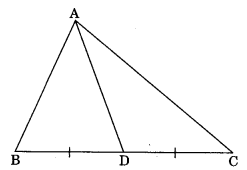
Median of a triangle: A line segment which joins the mid-point of the side to the opposite vertex. AD is median. D is the mid-point of BC.
Triangles Class 9 Notes Maths Chapter 5 .24

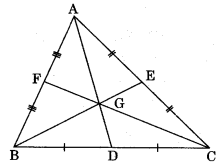
Centroid: The point of intersection of all three medians of a triangle is known as its centroid.
Note: Centroid G divides the medians in the ratio 2: 1, i.e., AG : GD = 2: 1
Triangles Class 9 Notes Maths Chapter 5 .25

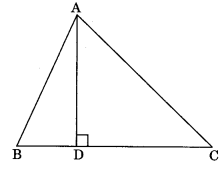
Altitude: Perpendicular drawn from a vertex to the opposite side.
Triangles Class 9 Notes Maths Chapter 5 .26

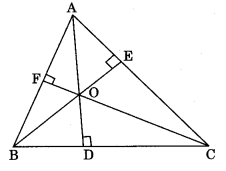
Orthocentre: The point at which all the three altitudes intersect each other is known as orthocentre.
Triangles Class 9 Notes Maths Chapter 5 .27

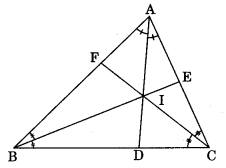
Incentre: The point at which the bisectors of internal angles of a triangle intersect each other is called incentre.

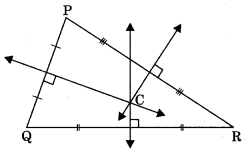
Circumcentre: The point at which perpendicular bisectors of the sides of a triangle intersect each other is called circumcentre.
Triangles Class 9 Notes Maths Chapter 5 .29

Lines and Angles Class 9 Notes Maths Chapter 4

Lines and Angles Class 9 Notes

On this page, you will find Lines and Angles Class 9 Notes Maths Chapter 4 Pdf free download. CBSE NCERT Class 9 Maths Notes Chapter 4 Lines and Angles will seemingly help them to revise the important concepts in less time.

CBSE Class 9 Maths Chapter 4 Notes Lines and Angles

Lines and Angles Class 9 Notes Understanding the Lesson

Point: A point is a dot made by a sharp pen or pencil. It is represented by capital letter.

Line: A straight and endless path on both the directions is called a line.
Lines and Angles Class 9 Notes Maths Chapter 4.1


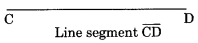
Line segment: A line segment is a straight path between two points.
Lines and Angles Class 9 Notes Maths Chapter 4.2

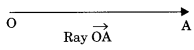
Ray: A ray is a straight path which goes forever in one direction.

Lines and Angles Class 9 Notes Maths Chapter 4.3

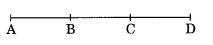
Collinear points: If three or more than three points lie on the same line, then they are called collinear points.

Lines and Angles Class 9 Notes Maths Chapter 4.4

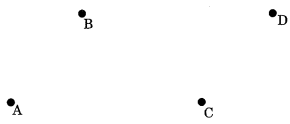
Non-collinear points: If three or more than three points does not lie on the same line, then they are called non-collinear points.

Lines and Angles Class 9 Notes Maths Chapter 4.5

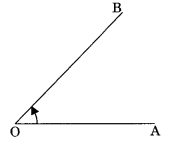
Angle: The space between two straight lines that diverge from a common point or between two planes that extend from a common line.

Lines and Angles Class 9 Notes Maths Chapter 4.6
Types of Angles
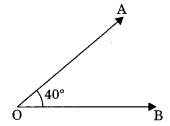
1. Acute angle: An angle between 0° and 90° is called acute angle.

Lines and Angles Class 9 Notes Maths Chapter 4.7

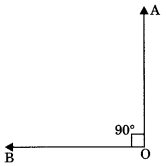
2. Right angle: An angle which is equal to 90° is called right angle.

Lines and Angles Class 9 Notes Maths Chapter 4.8

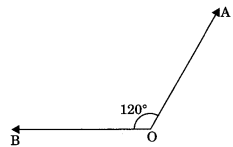
3. Obtuse angle: An angle which is more than 90° but less than 180° is called obtuse angle.

Lines and Angles Class 9 Notes Maths Chapter 4.9

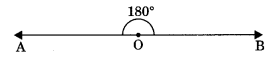
4. Straight angle: An angle whose measure is 180° is called straight angle.

Lines and Angles Class 9 Notes Maths Chapter 4.10

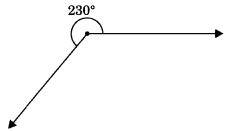
5. Reflex angle: An angle whose measure is between 180° and 360° is called reflex angle.

Lines and Angles Class 9 Notes Maths Chapter 4.11

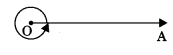
6. Complete angle: An angle which is equal to 360° is called complete angle

Lines and Angles Class 9 Notes Maths Chapter 4.12

Pairs of Angles

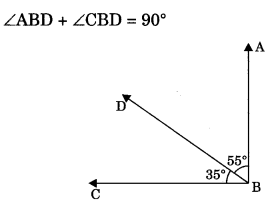
1.Complementary angles: Two angles are said to be complementary if the sum of their degree measure is 90°.

Lines and Angles Class 9 Notes Maths Chapter 4.13

For example, pair of complementary angles are 35° and 55°.

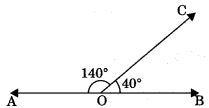
2. Supplementary angles: Two angles are said to be supplementary if the sum of their degree measure is 180°.
∠AOC + ∠BOC = 180°

Lines and Angles Class 9 Notes Maths Chapter 4.14

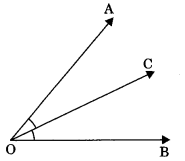
3. Bisector of angle: A ray which divides an angle into two equal parts is called bisector of the angle.
∠AOC = ∠BOC

Lines and Angles Class 9 Notes Maths Chapter 4.15

4. Adjacent angles: Two angles are said to be adjacent angles if

  • They have a common vertex (O)
  • They have a common arm (OC)
  • and their non-common arms are on either side of common arm (OA and OB).
    ∠AOB = ∠AOC +∠BOC

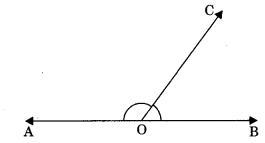
5. Linear pair: Two adjacent angles are said to be linear pair if their sum is equal to 180°.

Lines and Angles Class 9 Notes Maths Chapter 4.16
∠AOC + ∠BOC = 180°
Axiom 6.1: If a ray stands on a line, then the sum of two adjacent angles so formed is 180°.
Axiom 6.2: If the sum of two adjacent angles is 180°, then the non-common arms of the angles form a line.

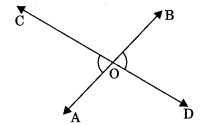
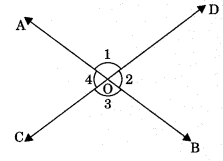
6. Vertically opposite angles: Vertically opposite angles are those angles which are opposite to each other (or not adjacent) when two lines cross each other.

Lines and Angles Class 9 Notes Maths Chapter 4.17
Theorem 6.1: If two lines intersect each other, then the vertically opposite angles are equal.
To prove: If lines AB and CD mutually intersect at point O, then
(a) ∠AOC = ∠BOD (Vertically opposite angles)
(b) ∠AOD = ∠BOC

Lines and Angles Class 9 Notes Maths Chapter 4.18

Proof: Lines AB intersect CD at O.
∠1 + ∠2 = 180° (Linear pair)
∠2 + ∠3 = 180° (Linear pair)
From eqn. (1) and (2), ∠1 + ∠2 = ∠2 + ∠3
⇒ ∠1 = ∠3 ⇒ ∠AOD = ∠BOC
Similarly, ∠AOC = ∠BOD

Parallel Lines
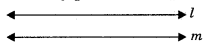
If distance between two lines is the same at each and every point on two lines, then two lines are said to be parallel.
If lines l and m do not intersect each other at any point then l || m.

Lines and Angles Class 9 Notes Maths Chapter 4.19

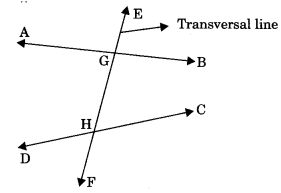
Transversal line: A line is said to be transversal which intersect two or more lines at distinct points.

Lines and Angles Class 9 Notes Maths Chapter 4.20

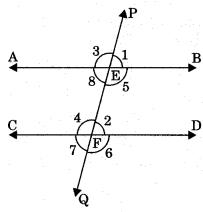
1. Corresponding angles: Pair of angles having different vertex but lying on same side of the transversal are called corresponding angles. Note that in each pair one is interior and other is exterior angle.

  • ∠1 and ∠2
  • ∠3 and ∠4
  • ∠5 and ∠6
  • ∠1 and ∠8

These angles are pair of corresponding angles.

Lines and Angles Class 9 Notes Maths Chapter 4.21

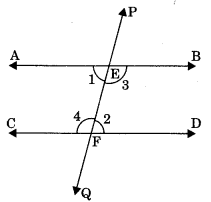
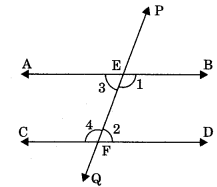
2. Alternate interior angles: Pair of angles having distinct vertices and lying can either side of the transversal are called alternate interior angles.

  • ∠1 and ∠2
  • ∠3 and ∠4

Lines and Angles Class 9 Notes Maths Chapter 4.22

These angles are alternate interior angles

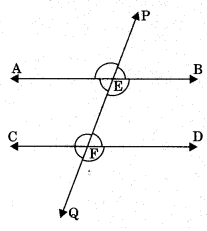
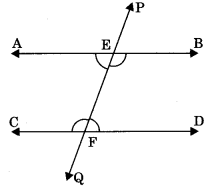
3. Consecutive interior angles: Pair of interior angles of same side of transversal line.

  • ∠1 and ∠2
  • ∠2 and ∠4

These angles are consecutive interior angles or co-interior angles

Lines and Angles Class 9 Notes Maths Chapter 4.23

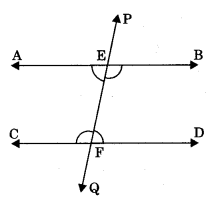
Axiom 6.3: If two parallel lines are intersected by a transversal then each pair of corresponding angles are equal.
If AB || CD, then

  • ∠PEB = ∠EFD
  • ∠PEA = ∠EFC
  • ∠BEF = ∠DFQ
  • ∠AEF = ∠CFQ

Lines and Angles Class 9 Notes Maths Chapter 4.24

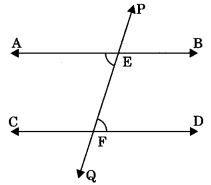
Theorem 6.2: If two parallel lines are intersected by a transversal then pair of alternate interior angles are equal.
If AB || CD, then ?

  • ∠AEF = ∠EFD
  • ∠BEF = ∠CFE

Lines and Angles Class 9 Notes Maths Chapter 4.25


Theorem 6.3: If two parallel lines are intersected by a transversal then the ! sum of consecutive interior angles of same side of transversal is equal to 180°. If AB || CD then
(i) ∠BEF + ∠DFE = 180°
(ii) ∠AEF + ∠CFE = 180°

Lines and Angles Class 9 Notes Maths Chapter 4.26

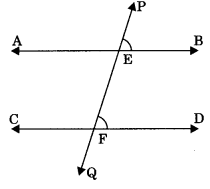
Axiom 6.4: If two lines are intersected by a transversal and a pair of corresponding angles are equal, then two lines are parallel.
(i) If ∠PEB = ∠EFD (corresponding angles), then AB || CD

Lines and Angles Class 9 Notes Maths Chapter 4.27
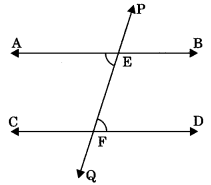
Theorem 6.4: If two lines intersected by a transversal and a pair of alternate interior angles are equal, then two lines are parallel. If ∠AEF = ∠EFD (alternate interior angles), then AB || CD.

Lines and Angles Class 9 Notes Maths Chapter 4.28

Theorem 6.5: If two lines are intersected by a transversal and the sum of consecutive interior angles of same side of transversal is equal to 180°, the lines are parallel. If ∠AEF + ∠CFE = 180°, then AB || CD.

Lines and Angles Class 9 Notes Maths Chapter 4.28

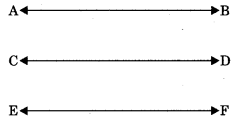
Theorem 6.6: Lines which are parallel to the same line are parallel to each other.
If AB || EF and CD || EF then AB || CD

Lines and Angles Class 9 Notes Maths Chapter 4.30


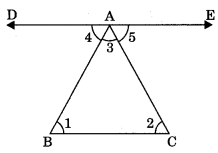
Theorem 6.7: The sum of the angles of a triangle is equal to 180°.
Given: ΔABC
To prove: ∠A + ∠B + ∠C = 180°
Construction: Draw DE || BC
Proof: DE || BC
then ∠1 = ∠4 …(1) (alternate interior angles)
∠2 = ∠5 …(2) (alternate interior angles)
Adding equations (1) and (2),
∠1 + ∠2 = ∠4 +∠5
Adding ∠3 on both sides,
∠1 +∠2 + ∠3 = ∠3 + ∠4 + ∠5
⇒ ∠A + ∠B + ∠C = 180° (Sum of angles at a point on same side of a line is 180°)

Theorem 6.8: If a side of a triangle is produced, then the exterior angle so formed is equal to the sum of the two interior opposite angles.
Given: AABC in which, side BC is produced to D.
To Prove: ∠ACD = ∠BAC + ∠ABC
Proof: ∠ACD + ∠ACB = 180° …(1) (Linear pair)
∠ABC + ∠ACB + ∠BAC = 180° …(2)
From eqn. (1) and (2), ∠ACD + ∠ACB
= ∠ABC + ∠ACB + ∠BAC
= ∠ACD = ∠ABC + ∠BAC

Lines and Angles Class 9 Notes Maths Chapter 4.31