Quadratic Equations Class 10 Notes Maths Chapter 4

Quadratic Equations Class 10 Notes Maths Chapter 4

On this page, you will find Quadratic Equations Class 10 Notes Maths Chapter 4 Pdf free download. CBSE NCERT Class 10 Maths Notes Chapter 4 Quadratic Equations will seemingly help them to revise the important concepts in less time.

CBSE Class 10 Maths Chapter 4 Notes Quadratic Equations

Quadratic Equations Class 10 Notes Understanding the Lesson

1. Quadratic Equation: A quadratic equation in the variable x is of the form ax2 + bx + c = 0, where a, b, c are real number and a ≠ 0.

2. Roots (or zeroes of a quadratic equation): A real number a is called the root of the quadratic equation
ax2 + bx + c = 0 if aα2 + bα + c = 0.

Alternatively, any equation of the form p(x) = 0, where p(x) is a quadratic polynomial is a quadratic equation and if p(α) = 0 for any real number a; the a is said to be the root (or zero) of p(x).

Solution of a quadratic equation by factorization
Finding the roots of a quadratic equation by the method of factorization means finding out the linear factors of the quadratic equation and equating it to zero, the roots can be found. i.e. ax2 + bx + c = 0
(Ax + B) (Cr + D) = 0
where A, B, C and D are real numbers, A, C≠ 0.
We get Ax + B = 0 or Cx + D = 0
x =\(-\frac{B}{A}\) or x =\(-\frac{D}{C}\)
x =\(-\frac{\mathrm{B}}{\mathrm{A}},-\frac{\mathrm{D}}{\mathrm{C}}\) are the two roots of quadratic equation.

Solution of a quadratic equation by completing the square
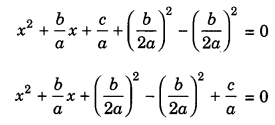
For given quadratic equation ax2+ bx + c = 0
Divide the equation by a, so that the coefficient of x2 becomes 1.
\(x^{2}+\frac{b}{a} x+\frac{c}{a}=0\)
Quadratic Equations Class 10 Notes Maths Chapter 4
Quadratic Equations Class 10 Notes Maths Chapter 4 1

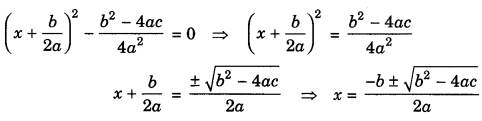
Adding and subtracting \(\left(\frac{b}{2 a}\right)^{2}\) i.e., square of the half of the coefficient of x.
This formula is known as quadratic formula.
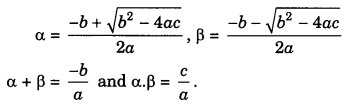
If α and β are roots of the given equation, then
Quadratic Equations Class 10 Notes Maths Chapter 4 2

ax2 + bx + c = 0,
a ≠ 0, a, b, c ∈ R

Discriminant D = b2 – 4ac

Condition exists  Nature of roots
(i) b2 – 4ac > 0    Real and unequal
(ii) b2 – 4ac = 0   Real and equal
(iii) b2 – 4ac < 0  No real roots


Pair of Linear Equations in Two Variables Class 10 Notes Maths Chapter 3

Pair of Linear Equations in Two Variables Class 10 Notes

On this page, you will find Pair of Linear Equations in Two Variables Class 10 Notes Maths Chapter 3 Pdf free download. CBSE NCERT Class 10 Maths Notes Chapter 3 Pair of Linear Equations in Two Variables will seemingly help them to revise the important concepts in less time.

CBSE Class 10 Maths Chapter 3 Notes Pair of Linear Equations in Two Variables

Pair of Linear Equations in Two Variables Class 10 Notes Understanding the Lesson

Two linear equations in the same two variables are called a pair of linear equations in two variables. The most general form of a pair of linear equation is
a1x + b1y + c1 = 0
a2x+ b2y + c2 = 0
where a1,a2, b1,b2, c1 c2 are real numbers. For the pair of linear equations, the following situations can arise:
(i) \(\frac{a_{1}}{a_{2}} \neq \frac{b_{1}}{b_{2}}\) In this case, the pair of linear equations is consistent.

(ii) \(\frac{a_{1}}{a_{2}}=\frac{b_{1}}{b_{2}} \neq \frac{c_{1}}{c_{2}}\) The pair of linear equations in inconsistent.

(iii) \(\frac{a_{1}}{a_{2}}=\frac{b_{1}}{b_{2}}=\frac{c_{1}}{c_{2}}\) The pair of linear equations is consistent.

2. A pair of linear equations in two variables, can be represented, and solved by the

  • Graphical method
  • Algebraic method

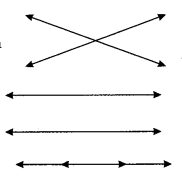
3. Graphical Method: The graph of a pair of linear equations in two variables is represented by two lines, following three possibilities can occur.

  • Two lines intersect at one point, then that point gives the unique solution of the two equations and the pair of equations is consistent.
  • Two lines will not intersect, i.e. they are parallel, the pair of linear equations is inconsistent and the pair of equations will have no solution.
    Pair of Linear equations in Two Variables Class 10 Notes Maths Chapter 3
  • The graph will be a pair of coincident lines. Each point on the lines will be a solution, so the pair of equations will have infinitely many solution and is consistent.

4. Algebraic Method: A pair of linear equations can be solved by any of the following three methods:

  • Substitution method
  • Elimination method
  • Cross-multiplication method

5. Graphical Method of Solution of a pair of Linear Equations:

If the lines represented by the pair of linear equations in two variables are given by
a1x + b1y + c1 = 0
a2x+ b2y + c2 = 0

Following are the cases:

(i) If \(\frac{a_{1}}{a_{2}} \neq \frac{b_{1}}{b_{2}}\) then the lines are intersecting lines and intersect at one point. In this case, the pair of  linear equations in consistent.

(ii) If \(\frac{a_{1}}{a_{2}}=\frac{b_{1}}{b_{2}}=\frac{c_{1}}{c_{2}}\), then the lines are coincident. In this case, the pair of linear equation is consistent  (dependent)

(iii) If \(\frac{a_{1}}{a_{2}}=\frac{b_{1}}{b_{2}} \neq \frac{c_{1}}{c_{2}}\) then the lines are parallel to each other. In this case, the pair of linear equations inconsistent.

Polynomials Class 10 Notes Maths Chapter 2

Polynomials Class 10 Notes

On this page, you will find Polynomials Class 10 Notes Maths Chapter 2 Pdf free download. CBSE NCERT Class 10 Maths Notes Chapter 2 Polynomials will seemingly help them to revise the important concepts in less time.

CBSE Class 10 Maths Chapter 2 Notes Polynomials

Polynomials Class 10 Notes Understanding the Lesson

1. The value of the polynomial p(x) at x = a is p(a).

2. Zeroes of the polynomial p(x) can be find by equating p(x) to zero and solving the equation for

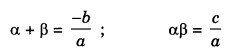
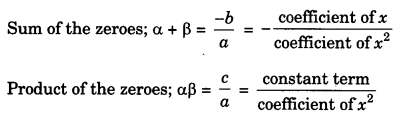
3. If for p(x) = ax2 + bx + c = 0, a ≠ 0; α and β are the zeroes, then

Polynomials Class 10 Notes Maths Chapter 2 1

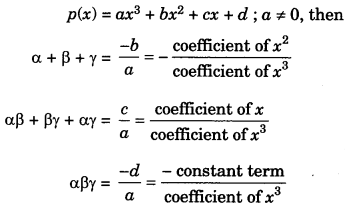
4. If for p(x) = ax3 + bx2 + cx + d = 0; a ≠ 0; α, β,γ are the zeroes, then
α + β + γ = \(\frac{-b}{a}\)
αβ+βγ + αγ = \(\frac{c}{a}\)
αβγ =\(\frac{-d}{a}\)

5. If α and β are the zeroes; then quadratic polynomial will be given by K[x2 – Sx + P]
where
S = α +β
P = αβ
K (≠0) is real.

6. The cubic polynomial with zeroes α, β and γ is given by
K[x3 – S1x2 + S1x2 S3]
where
S1 = α + β + γ
S2 = αβ + βγ + αγ
S3= αβγ
K(≠ 0) is real.

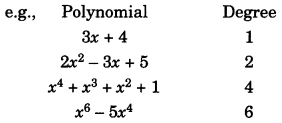
Degree of a Polynomial:

1. The degree of a polynomial p(x) in x is the highest power of x in p(x)
Polynomials Class 10 Notes Maths Chapter 2 3
Note: Expressions like \(\frac{1}{\sqrt{x}}, \frac{1}{x^{2}+1}, \sqrt{x+2}\)

2. (i) Polynomial with degree 1, i.e., polynomial of the form ax + b; a ≠ 0 is called linear polynomial.
(ii) Polynomial with degree 2, i.e., polynomial of the form ax2 + bx + c; a ≠ 0 is called quadratic polynomial.
(iii) Polynomial with degree 3, i.e. polynomial of the form ax3 + bx2 + cx + d ; a ≠ 0 is called cubic polynomial.
(iv) Polynomial with degree 4, i.e. polynomial of the form ax4 + bx3 + cx2 + dx + e; a ≠ 0 is called biquadratic polynomial.

Geometrical Meaning of the Zeroes of a Polynomial:

1. For any polynomial y = f(x), the number of points on which the graph of y = f(x) intersects at x-axis is called the number of the zeroes of the polynomial and the x-coordinates of these points are called the zeroes of the polynomial y = f(x).

2. Polynomial with degree ‘n’ has maximum ‘n’ number of zeroes. A constant polynomial has no zeroes.

3. Geometrical representation of a linear polynomial is always a straight line.

4. Geometrical representation of a quadratic polynomial is the graph of the shape either open upwards like ‘∪’ or open downwards like ‘∩’ according to a > 0 or a < 0. These curves are called Parabola.

Relationship Between Zeroes and Coefficient of a Quadratic Polynomial:

1. If α and β are the zeroes of the quadratic polynomial  p(x) = ax2 + bx + c a≠0 then
Polynomials Class 10 Notes Maths Chapter 2 4
Relationship Between Zeroes and Coefficient of a Cubic Polynomial

1. If α, β and γ are the zeroes of the cubic polynomial
Polynomials Class 10 Notes Maths Chapter 2 5

2. A quadratic polynomial p(x) with zeroes α and β is given by
p(x) = K[x2 – (α + β)x + αβ]
where K(≠0) is real.

3. A cubic polynomial p(x) with α, β and γ as zeroes is given by
p(x) = K[x3 – (α + β + γ)x2 + (αβ +βγ + αγ)x – αβγ
where K(≠0) is real.

Division Algorithm for Polynomials:
If p(x) and g(x) are any two polynomials where g(x) ≠ 0. Then on dividing p(x) by g(x), we find other two polynomials q(x) and r(x) such that
p(x) = g(x) x q(x) + r(x);
where deg. of r(x) < deg. of gix)
or Dividend = Divisor x Quotient + Remainder

Note:

  • If r(x) = 0, then g(x) will be a factor of p(x) otherwise not.
  • If any real number ‘a’ is a zero of the polynomial p(x), then (x – a) will be a factor of p(x).

Real Numbers Class 10 Notes Maths Chapter 1

Real Numbers Class 10 Notes

On this page, you will find Real Numbers Class 10 Notes Maths Chapter 1 Pdf free download. CBSE NCERT Class 10 Maths Notes Chapter 1 Real Numbers will seemingly help them to revise the important concepts in less time.

CBSE Class 10 Maths Chapter 1 Notes Real Numbers

Real Numbers Class 10 Notes Understanding the Lesson

In class X, we have study about real numbers and encountered irrational numbers. In this chapter we want to know about natural numbers, whole numbers, integers, rational numbers, irrational numbers and real numbers.

1. Natural numbers: Natural numbers are those used for counting. e.g.: 1, 2, 3, 4, 5,… (and so on).
Natural numbers are denoted by N.

2. Whole numbers: Whole numbers are simply the numbers 0, 1, 2, 3, 4, 5,… (and so on).
Counting numbers are whole numbers. Without zero we cannot count. Whole numbers are denoted by W.

3. Integer: The set of integers consist of zero 0, the natural numbers and the negative of natural numbers.
e.g.: …-5, -4, -3, -2, -1, 0, 1, 2, 3, 4, 5, … The integers are sometimes also called rational integers. Integers are denoted by Z. (Zahlen means to count)

4. Rational number: A rational number is any real number that can be expressed in the form \(\frac{p}{q} \)of R where q ≠ 0. Every integer is a rational number, the set of rational numbers is usually denoted by Q.
e.g : \(\frac{1}{2}, \frac{5}{1}, \frac{7}{9}\)
Note : The decimal expansion of rational number always either terminates after a finite number of digits, or they are non terminating and repeating decimals.

5. Irrational number: An irrational number is any real number that cannot be expressed as ratio of integers.
e.g : \(\sqrt{2}, \sqrt{3},\)π ,0.340440444…….. .These numbers cannot be represented as terminating or
repeating decimals.

6. Real number: The real number include all the rational numbers such as integers -5, -4, -1, 0, 1, 2,… and all fractions \(\frac{4}{3}, \frac{5}{11}, \ldots\) and all the irrational numbers such as \(\sqrt{2}, \sqrt{3}, \pi, \ldots\)

Real Numbers Class 10 Notes Maths Chapter 1

7. Algorithm: A set of rules for solving a problem in a finite number of steps.

8. Lemma: A lemma is a proven statement used for proving another statement.

9. Euclid Division Lemma: Euclid’s division lemma states that, for any two positive integers ‘o’ and ‘b’ there exists unique whole numbers q and r such that
a = bq + r, where 0 < r < b and a = dividend, b = divisor
q = quotient, r = remainder
i.e., Dividend = Divisor x Quotient + Remainder.
Euclid division lemma can be used to find the highest common factor (HCF) of any two positive integers.

9. Steps to obtain HCF using Euclid’s division lemma :
(i) Let us consider two positive integer a and b such that a >b.
Apply Euclid’s division lemma to the given integers a and b. Find two whole numbers q and r such that a = bq + r.

(ii) Now Check the value of r if r = 0 then b is the HCF of the given numbers. If r 0 then again apply Euclid’s division lemma to find the new divisor b and remainder r.

(iii) Continue the process till the remainder becomes zero. In that case the value of the divisor b is the HCF of a and b.
Note:

  • HCF (a, b) = HCF (b, r)
  • Euclid’s division algorithm can be extended for all integers except zero.
  • Euclid’s division lemma and algorithm are so interlinked that people often call former as the division algorithm also.

10. Prime number: Any natural number which has exactly two factors is called prime number. e.g. 2, 3, 5, 7, 11, 13, 17, 19, 23, 29, … etc.

11. Composite number: A composite number is a positive integer that has at least one positive divisor other than one or the number itself.
OR
A composite number is any positive integer greater than one that is not a prime number. e.g.: 4, 6, 8, 9, 10, 12, 14, 15, 16,… etc.

12. Co-prime numbers: A set of numbers which do not have any common factor other than one are called co-prime numbers.
Note: Two numbers are said to be co-prime if their HCF is 1. e.g. 1. All prime numbers are co-prime to each other

13. Consecutive integers are always co-prime.
Statement of fundamental theorem of arithmetic : Every composite number can be expressed as a product of primes and this factorisation is unique apart from the order in which the prime factors occur.
Note:

  • The prime factorisation of natural number is unique except for the order of its factors.
  • HCF of two numbers is equal to the product of the terms containing least power of common prime factors of the two numbers.
  • The LCM of two number is equal to the product of the terms containing the greatest power of all prime factors of the two numbers.
  • For any two positive integers a and b HCF (a, b) x LCM (a,b) = a x b
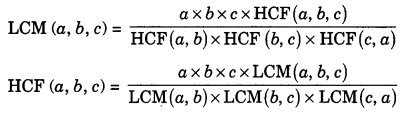
  • For any three positive numbers a, b and c
    Real Numbers Class 10 Notes Maths Chapter 2

Revisiting Irrational Numbers: We have already studied irrational numbers and many of their properties. Now in this section, we will prove \(\sqrt{2}, \sqrt{3}, \sqrt{5}, \sqrt{7} \)and in general, √P is irrational, where p is a prime.

(1) A number π is called irrational, if it can not be written in the form \(\frac{p}{q}\) where p and q are integers and q≠ 0.  An irrational number is a real number that can not be written as simple fraction.

Theorem: Let p be a prime number. If p divides a2, then p divides a, where a is a positive integer.

Revisiting Rational Numbers and their Decimal Expansions

(1) Every rational number can be expressed as either terminating or non-terminating repeating decimal.

(2) Decimal expansion of every irrational number is non-terminating and non repeating.

(3) If the prime factorisation of denominator is of the form 2n x 5m where n and m are non-negative integers, then rational number will have terminating decimal expansion.

(4) Let x be a rational number whose decimal expansion terminates. Then x can be expressed in the form x=\(\frac{p}{q}\), where p and q are co-prime and the prime factorisation of q is of the form 2n x 5m where n and mare non-negative integers.

(5) Let x=\(\frac{p}{q}\) be a rational number, such that the prime factorisation of q is of the form 2n x 5m, where Q n, m are non-negative integers, then the decimal expansion of x terminates. e.g :\(\frac{3}{8}=\frac{3 \times 5^{3}}{2^{3} \times 5^{3}}=\frac{375}{10^{3}}=0.375\)

(6) Let x=\(\frac{p}{q}\) be a rational number, such that the prime factorisation of q is not of the form 2n x 5m , where n, m are non-negative integers, then x has a decimal expansion which is non-terminating (recurring) e.g : \( \frac{1}{7}=0 . \overline{142857}\)
Note: We conclude that decimal expansion of every rational number is either terminating or non-terminating recurring.

 

Practical Geometry Class 6 Notes Maths Chapter 14

On this page, you will find Practical Geometry Class 6 Notes Maths Chapter 14 Pdf free download. CBSE NCERT Class 6 Maths Notes Chapter 14 Practical Geometry will seemingly help them to revise the important concepts in less time.

CBSE Class 6 Maths Chapter 14 Notes Practical Geometry

Practical Geometry Class 6 Notes Conceptual Facts

1. The shortest distance between two point is called line segment.

2. Length of the line segment can be measured with the help of ruler and divider.

3. Circle can be drawn with the help of compass.

4. Divider is used to compare the lengths of two line segments.

5. To measure angles, we use protractor.

6. To draw perpendiculars and parallel lines, we use set squares.