Surface Areas and Volumes Class 9 Notes Maths Chapter 13

Surface Areas and Volumes Class 9 Notes

On this page, you will find Surface Areas and Volumes Class 9 Notes Maths Chapter 13 Pdf free download. CBSE NCERT Class 9 Maths Notes Chapter 13 Surface Areas and Volumes will seemingly help them to revise the important concepts in less time.

CBSE Class 9 Maths Chapter 13 Notes Surface Areas and Volumes

Surface Areas and Volumes Class 9 Notes Understanding the Lesson

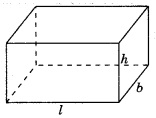
Cuboid: With length T, breadth ‘b’ and height ‘h’
(a) Volume = lbh
(b) Total surface area = 2(lb + bh + hl)
(c) Lateral surface area = 2h(l + b) (c)
Surface Areas and Volumes Class 9 Notes Maths Chapter 13 1
(d) Diagonal = \(\sqrt{l^{2}+b^{2}+h^{2}}\)
(e) Perimeter = 4(l + b + h)

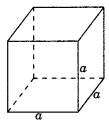
Cube: With side ‘a’
(a) Volume = a3
(b) Total surface area = 6a2
(c) Lateral surface area = 4a2

Surface Areas and Volumes Class 9 Notes Maths Chapter 13 2
(d) Diagonal = \(\sqrt{3} a\)
(e) Perimeter = 12a

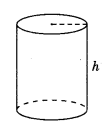
Right circular cylinder: With radius ‘r’ and height ‘h’
(a) Volume = πr2h
(b) Curved surface area = 2πrh
Surface Areas and Volumes Class 9 Notes Maths Chapter 13 3
(c) Total surface area = 2πr(h + r)

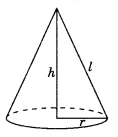
Right circular cone: With radius ‘r’, height ‘h’ and slant height ‘l’
(a) Volume = \(\frac{1}{3}\) πr2 h or \(\frac{1}{3}\) x (Area of the base) x height
Surface Areas and Volumes Class 9 Notes Maths Chapter 13 4
(b) Curved surface area = πrl, where \(l=\sqrt{h^{2}+r^{2}}\)
(c) Total surface area = πr(l + r)

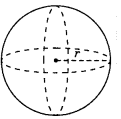
Sphere: With radius ‘r’
(a) Volume =\(\frac{4}{3}\) πr3
Surface Areas and Volumes Class 9 Notes Maths Chapter 13 5
(b) Surface area = 4πr2

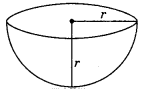
Hemisphere: With radius ‘r’
(a) Volume = \(\frac{2}{3}\)πr3
(b) Curved surface area = 2πr2

Surface Areas and Volumes Class 9 Notes Maths Chapter 13 6
(c) Total surface area = 3πr2

Constructions Class 9 Notes Maths Chapter 12

Constructions Class 9 Notes

On this page, you will find Constructions Class 9 Notes Maths Chapter 12 Pdf free download. CBSE NCERT Class 9 Maths Notes Chapter 12 Constructions will seemingly help them to revise the important concepts in less time.

CBSE Class 9 Maths Chapter 12 Notes Constructions

Constructions Class 9 Notes Understanding the Lesson

  • Geometrical construction means using only a ruler and a pair of compasses as geometrical instruments.
  • Protractor may be used for drawing non-standard angles.

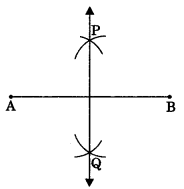
Construction of bisector of a line segment using compass

  • Draw a line segment, say AB.
  • With both the end points (A and B) of line segment as centre and taking radius of more than half of the measure of line segment, draw the arcs on both sides, which cut at two points on opposite side, say P and Q.
    Construction of a triangle is possible when its perimeter 1
  • Join these two points.
    This line (PQ) is the required bisector.

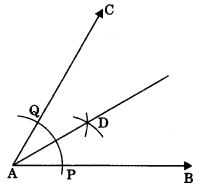
Construction of the bisector of a given angle (say ∠ABC)

  • With A as centre and a small radius draw an arc, cutting AB at P and AC at Q.
  • With P as centre and the same radius as above, draw an arc.
  • With Q as centre and with same radius, draw another arc, cutting the previous arc at D.
    Construction of a triangle is possible when its perimeter 2
  • Join AD.

AD is the required bisector of ∠BCA.

  • Construction of some Angies and Triangles ;
  • Constructions of some standard angles such as 30°, 45°, 60°, 75°, 90°, 120° etc. are possible using a
    ruler and a pair of compasses. :
  • Construction of a triangle is possible, when its base, a base angle and the sum of other two sides are given.
  • Construction of a triangle is possible, when its base, a base angle and the difference of other two sides are given.
  • Construction of a triangle is possible when its perimeter

Circles Class 9 Notes Maths Chapter 11

Circles Class 9 Notes

On this page, you will find Circles Class 9 Notes Maths Chapter 11 Pdf free download. CBSE NCERT Class 9 Maths Notes Chapter 11 Circles will seemingly help them to revise the important concepts in less time.

CBSE Class 9 Maths Chapter 11 Notes Circles

Circles Class 9 Notes Understanding the Lesson

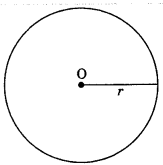
Circle is the collection of all points in a plane, which are equidistant from a fixed point in the plane. The fixed point is called the centre O and the given distance is called the radius r of the circle.
Areas of Parallelograms and Triangles Class 9 Notes Maths Chapter 10.1

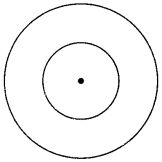
Concentric circles: Circles having same centre and different radii are called concentric circles.
Areas of Parallelograms and Triangles Class 9 Notes Maths Chapter 10.2

Arc: A continuous piece of a circle is called an arc of the circle.

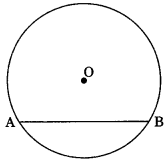
Chord: A line segment joining any two points on a circle is called the chord of the circle.
Areas of Parallelograms and Triangles Class 9 Notes Maths Chapter 10.3

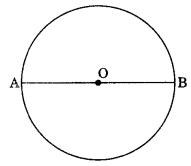
Diameter: A chord passing through the centre of a circle is called the diameter of the circle.
Areas of Parallelograms and Triangles Class 9 Notes Maths Chapter 10.4

  • Semicircle: A diameter of a circle divides it into two equal parts which are arc. Each of these two arcs is called semicircle.
  • Angle of semicircle is right angle.
  • If two arcs are equal, then their corresponding, chords are also equal.

Theorem 10.1: Equal chords of a circle subtend equal angle at the centre of the circle.
Theorem 10.2: If the angles subtended by the chords of a circle at the centre are equal, then the chords are equal.
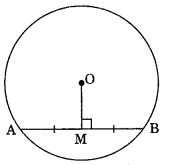
Theorem 10.3: The perpendicular drawn from centre to the chord of circle bisects the chord.
Areas of Parallelograms and Triangles Class 9 Notes Maths Chapter 10.5
Theorem 10.4: The line drawn through the centre of a circle to bisect a chord is perpendicular to the chord. Theorem 10.5: There is one and only one circle passing through three non-collinear points.
Theorem 10.6: Equal chords of circle are equidistant from centre.

Theorem 10.7: Chords equidistant from the centre of a circle are equal in length.

  • If two circles intersect in two points, then the line through the centres is perpendicular to the common chord.

Theorem 10.8: The angle subtended by an arc at the centre of circle is twice the angle subtended at remaining part of circumference.
Theorem 10.9: Any two angles in the same segment of the circle are equal.
Theorem 10.10: If a line segment joining two points subtends equal angles at two other points on the same side of the line containing the line segment, the four points lie on a circle (i.e., they are concyclic).

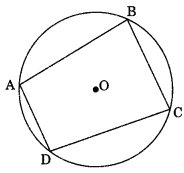
Cyclic Quadrilateral: If all the vertices of a quadrilateral lie on the circumference of circle, then quadrilateral is called cyclic.
Areas of Parallelograms and Triangles Class 9 Notes Maths Chapter 10.6

Theorem 10.11: In a cyclic quadrilateral the sum of opposite angles is 180°.
Theorem 10.12: In a quadrilateral if the sum of opposite angles is 180°, then quadrilateral is cyclic.

  • The exterior angle of a cyclic quadrilateral is equal to the interior opposite angle.

Areas of Parallelograms and Triangles Class 9 Notes Maths Chapter 10

Areas of Parallelograms and Triangles Class 9 Notes

On this page, you will find Areas of Parallelograms and Triangles Class 9 Notes Maths Chapter 10 Pdf free download. CBSE NCERT Class 9 Maths Notes Chapter 10 Areas of Parallelograms and Triangles will seemingly help them to revise the important concepts in less time.

CBSE Class 9 Maths Chapter 9 Notes Areas of Parallelograms and Triangles

Areas of Parallelograms and Triangles Class 9 Notes Understanding the Lesson

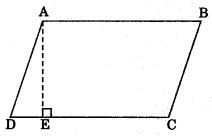
1. Area of a parallelogram = base x height
= DC x AE
Areas of Parallelograms and Triangles Class 9 Notes Maths Chapter 10 1

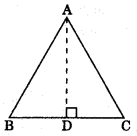
2. Area of a triangle = \(\frac{1}{2}\)base x height
\(\frac{1}{2}\) BC x AD
Areas of Parallelograms and Triangles Class 9 Notes Maths Chapter 10 2

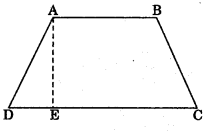
3. Area of a trapezium = x (Sum of parallel sides) x Distance between them
\(\frac{1}{2}\) (AB + DC) x AE
Areas of Parallelograms and Triangles Class 9 Notes Maths Chapter 10 3
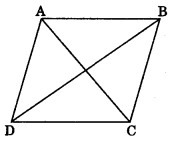
4. Area of a rhombus =\(\frac{1}{2}\) \(\frac{1}{2}\) x product of diagonals A B
\(\frac{1}{2}\) x AC x BD
Areas of Parallelograms and Triangles Class 9 Notes Maths Chapter 10 9

5. Two figures are said to be on the same base and between the same parallels, if they have a common side (base) and the vertices (or the vertex) opposite to the common base of each figure He on a line parallel to the base.

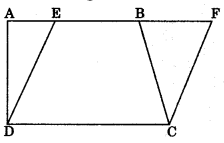
Theorem 9.1: Parallelograms on the same base and between the same parallels are equal in area.
ar(ABCD) = ar(EFCD)
Areas of Parallelograms and Triangles Class 9 Notes Maths Chapter 10 5

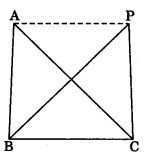
Theorem 9.2: Triangles on the same base and between the same parallels are equal in area.
ar(ΔABC) = ar(ΔPBC)
Areas of Parallelograms and Triangles Class 9 Notes Maths Chapter 10 4

Theorem 9.3: Two triangles having the same base and equal areas lie between the same parallels.
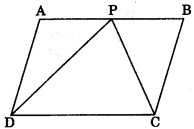
If a triangle and a parallelogram are on the same base and between the same parallels, then

(i) Area of triangle = \(\frac{1}{2}\) x area of the parallelogram
ar(ΔPDC) = \(\frac{1}{2}\) ar(||gmABCD)
Areas of Parallelograms and Triangles Class 9 Notes Maths Chapter 10 6

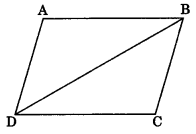
(ii) A diagonal of parallelogram divides it into two triangles of equal areas.
ar(ΔABD) = ar(ΔBCD)
Areas of Parallelograms and Triangles Class 9 Notes Maths Chapter 10 7

(iii) If each diagonal of a quadrilateral separates it into two triangles of equal area, then the quadrilateral is a parallelogram.

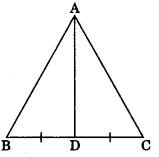
(iv) A median AD of a ΔABC divides it into two triangles of equal areas.
ar(ΔABD) = ar(ΔACD)
Areas of Parallelograms and Triangles Class 9 Notes Maths Chapter 10 8

Quadrilaterals Class 9 Notes Maths Chapter 9

Quadrilaterals Class 9 Notes

On this page, you will find Quadrilaterals Class 9 Notes Maths Chapter 9 Pdf free download. CBSE NCERT Class 9 Maths Notes Chapter 9 Quadrilaterals will seemingly help them to revise the important concepts in less time.

CBSE Class 9 Maths Chapter 9 Notes Quadrilaterals

Quadrilaterals Class 9 Notes Understanding the Lesson

Quadrilateral
A plane figure bounded by four line segments is called quadrilateral.

Properties:

  • It has four sides.
  • It has four vertices or comers.
  • It has two diagonals.
  • The sum of four interior angles is equal to 360°.
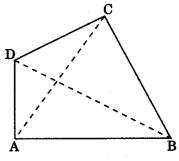
Quadrilaterals Class 9 Notes Maths Chapter 9.1

In quadrilateral ABCD, AB, BC, CD and DA are sides; AC and BD are diagonals and
∠ABC + ∠BCD + ∠CDA + ∠DAB = 360°.

Types of Quadrilaterals
1. Parallelogram: A quadrilateral whose each pair of opposite sides are parallel.
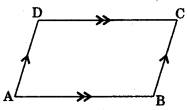
  • AB || DC
  • AD || BC

Quadrilaterals Class 9 Notes Maths Chapter 9.2

2. Rectangle: A parallelogram whose one angle is 90°. Diagonals are equal.
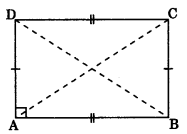
Quadrilaterals Class 9 Notes Maths Chapter 9.3

3. Rhombus: A parallelogram whose adjacent sides are equal.
Note: Diagonal bisect each other at 90°.
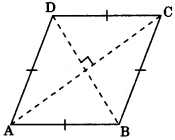
Quadrilaterals Class 9 Notes Maths Chapter 9.4

4. Square: A rectangle whose adjacent sides are equal (four sides are equal). Diagonal bisect each other at 90°.
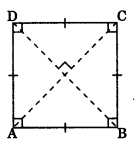
Quadrilaterals Class 9 Notes Maths Chapter 9.5

5. Trapezium: A quadrilateral whose one pair of opposite sides are parallel. AB || DC
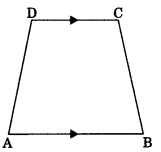
Quadrilaterals Class 9 Notes Maths Chapter 9.6

6. Kite: It has two pair of adjacent sides that are equal in length but opposite sides are unequal.
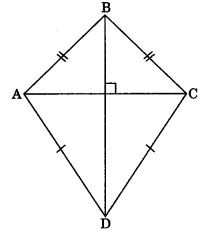
Quadrilaterals Class 9 Notes Maths Chapter 9.7

Note:

  • One of the diagonal bisects the other at right angle.
  • One pair of opposite angles are equal.

Properties of a Parallelogram

  • Opposite sides are equal.
    e.g., AB = DC and AD = BC
  • Consecutive angles are supplementary.
    e.g., ∠A + ∠D = 180°
  • Diagonals of parallelogram bisect each other.
  • Diagonal divide it into two congruent triangles. A B
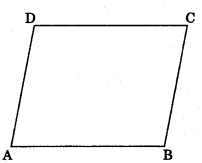
Quadrilaterals Class 9 Notes Maths Chapter 9.8

Theorem 8.1: A diagonal of a parallelogram divides it into two congruent triangles.
Theorem 8,2: In a parallelogram, opposite sides are equal.
Theorem 8.3: If each pair of opposite sides of a quadrilateral is equal, then it is a parallelogram.
Theorem 8.4: In a parallelogram, opposite angles are equal.
Theorem 8.5: If in a quadrilateral, each pair of opposite angles of a quadrilateral is equal then it is a parallelogram.
Theorem 8.6: The diagonals of a parallelogram bisect each other.
Theorem 8.7: If the diagonals of quadrilateral bisect each other, then it is a parallelogram.
Theorem 8.8: A quadrilateral is a parallelogram if a pair of opposite sides is equal and parallel.

Mid-point Theorem
Theorem 8.9: The line segment joining the mid-points of two sides of a triangle is parallel to the third.
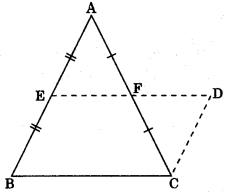
Given: A triangle ABC, E and F are mid-points of sides AB and AC respectively.
i.e., AE = EB and AF = FC
To Prove:
(i) EF || BC
(ii) EF = \(\frac{1}{2}\) BC
Construction: Draw a line through C parallel to AB and extend EF which intersect at D.
Quadrilaterals Class 9 Notes Maths Chapter 9.9
Proof: (i) In AAEF and ACDF,
AF = CF (F is the mid-point of AC)
∠AFE = ∠CFD (Vertically opposite angles)
∠EAF = ∠DCF (Alternate interior angles)
∴ ΔAEF = ΔCDF (by ASA congruency)
∴ AE = CD (by CPCT)
and BE = CD (AE = BE)
EF = FD (by CPCT);
Hence, BCDE is a parallelogram.
ED || BC )
∴ EF || BC

(ii) BCDE is a parallelogram.
DE = BC
EF + FD = BC
2EF = BC
EF=\(\frac{1}{2}\)BC

Converse of Mid-Point Theorem

Theorem 8.10: The line drawn through the mid-point of one side of a triangle, parallel to another side  bisects the third side. ‘
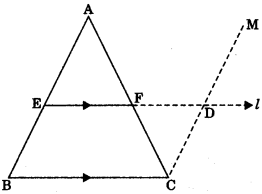
Given: ΔABC in which E is the mid point of AB.
EF || BC
To Prove: AF = FC
Construction: Draw CD || AB and extend EF which intersect at D.
Proof: EF || BC
∴ ED || BC
AB || CD
⇒ BE || CD
∴ BCDE is a parallelogram.
Quadrilaterals Class 9 Notes Maths Chapter 9.10
Now in ΔAEF and ΔCDF, ∠AFE = ∠CFD (Vertically opposite angles)
∠EAF = ∠DCF (Alternate interior angles)
AE = CD (BE = AE opposite side of a parallelogram and BE = CD
∴ AAEF ≅ ACDF (by AAS congruency)
Hence AF = FC (by CPCT)