Some Applications of Trigonometry Class 10 Notes Maths Chapter 9

Some Applications of Trigonometry Class 10 Notes

On this page, you will find Some Applications of Trigonometry Class 10 Notes Maths Chapter 9 Pdf free download. CBSE NCERT Class 10 Maths Notes Chapter 9 Some Applications of Trigonometry will seemingly help them to revise the important concepts in less time.

CBSE Class 10 Maths Chapter 9 Notes Some Applications of Trigonometry

Some Applications of Trigonometry Class 10 Notes Understanding the Lesson

Trigonometry is the study of relationships between the sides and angles of a triangle. In this chapter you will study about some ways in which trigonometry is used:

  • It is used in geography and in navigation.
  • It is used in constructing maps, determine the position of an island in relation to the longitudes and latitudes.
  • It is used for calculating the height and distance of various objects without measuring it.

Terms related to height and distance:

1. Line of sight: The line joining the eyes of the observer and the objects which he/she observes is called line of sight.
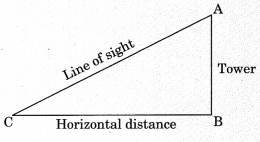
Some Applications of Trigonometry Class 10 Notes Maths Chapter 9 1
2. Angle of elevation: (When object is above the horizontal)
The angle between the line of sight and the horizontal is called the angle of elevation.
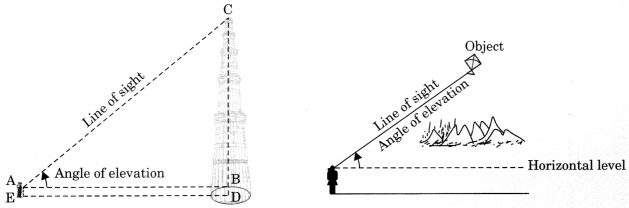
Some Applications of Trigonometry Class 10 Notes Maths Chapter 9 2

3. Angle of depression: (When object is below the horizontal)
The angle between the horizontal line and the line of sight is called the angle of depression.
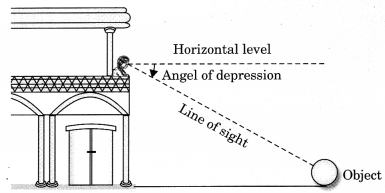
Some Applications of Trigonometry Class 10 Notes Maths Chapter 9 3

Trigonometric formulae used:
Some Applications of Trigonometry Class 10 Notes Maths Chapter 9 4

Introduction to Trigonometry Class 10 Notes Maths Chapter 8

Introduction to Trigonometry Class 10 Notes

On this page, you will find Introduction to Trigonometry Class 10 Notes Maths Chapter 8 Pdf free download. CBSE NCERT Class 10 Maths Notes Chapter 8 Introduction to Trigonometry will seemingly help them to revise the important concepts in less time.

CBSE Class 10 Maths Chapter 8 Notes Introduction to Trigonometry

Introduction to Trigonometry Class 10 Notes Understanding the Lesson

The word trigonometry is derived from the Greek words ‘Tri’ which means three, ‘gon’ means sides and metron meaning measure.

It means trigonometry is the study of relationship between the sides and angles

  • The earliest work on trigonometry was recorded in Egypt and Babylon.
  • Trigonometry was used by early astronomers to find out the distance of stars and planets from the earth.

Trigonometric Ratios

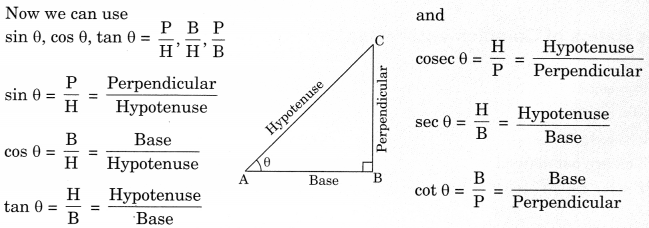
The ratios of the sides of a right triangle with respect to its acute angles are called trigonometric ratios.

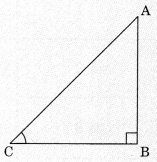
  1. In right triangle, side opposite to given acute angle will always be perpendicular.
  2. Side opposite 90° will always be hypotenuse.
  3. Remaining side will be base.
  4. The sum of two angles (except right angle) is 90°
    i.e.,      ∠A + ∠C = 90°           ( ∵ ∠B = 90°)
    Introduction to Trigonometry Class 10 Notes Maths Chapter 8 1

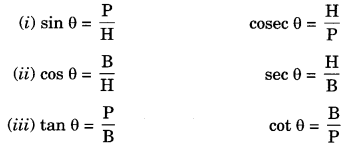
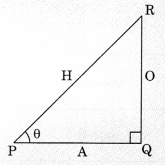
1. sin θ = sin θ = \(\frac{0}{\mathrm{H}}\) (O- side opposite to given angle i.e., acute angle)

2. cosine θ = cos θ = \(\frac{\mathrm{A}}{\mathrm{H}} \)(A-adjacent side) (H-Hypotenuse)

3. Tangent θ = tan θ =\(\frac{\mathrm{O}}{\mathrm{A}}\)
(O-side opposite to acute angle, A-adjacent side)
Introduction to Trigonometry Class 10 Notes Maths Chapter 8 2

4. cosecant θ = cosec θ= \(\frac{\mathrm{H}}{\mathrm{O}}\)

5. secant θ = sec θ =\(\frac{\mathrm{H}}{\mathrm{A}}\)

6. cotangent θ= cot θ =\(\frac{\mathrm{A}}{\mathrm{O}}\)
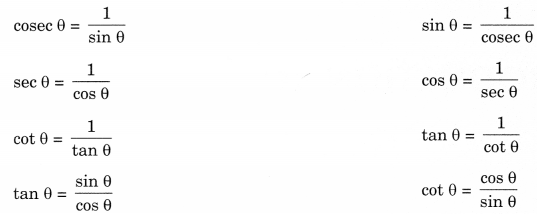
Introduction to Trigonometry Class 10 Notes Maths Chapter 8 3
Introduction to Trigonometry Class 10 Notes Maths Chapter 8 4

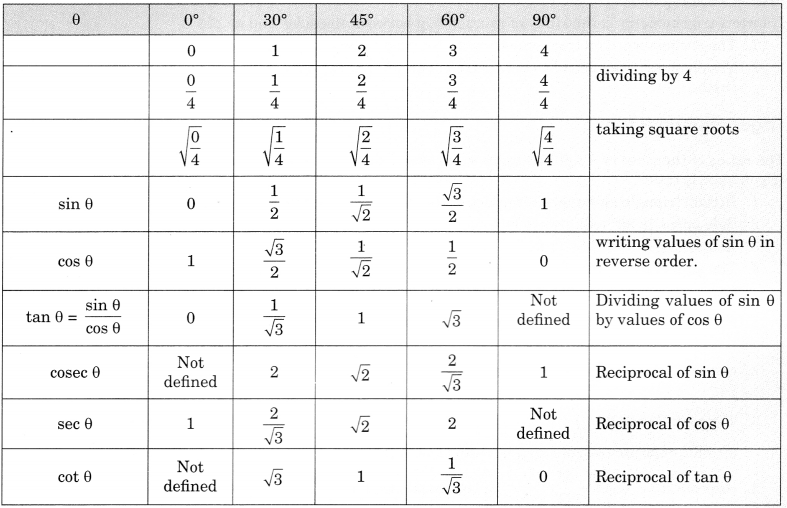
Trigonometric angles for some specific angles

Also we can find values for some special angles as follows:
Introduction to Trigonometry Class 10 Notes Maths Chapter 8 5

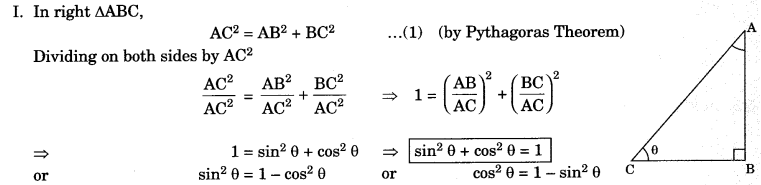
Trigonometric Identities

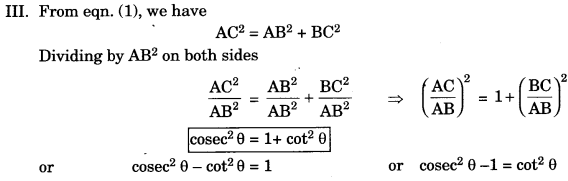
Identity: That equation is called an identity. If it is true for all values of the variables which involved. I. In right ΔABC,
Introduction to Trigonometry Class 10 Notes Maths Chapter 8 6
Introduction to Trigonometry Class 10 Notes Maths Chapter 8 7
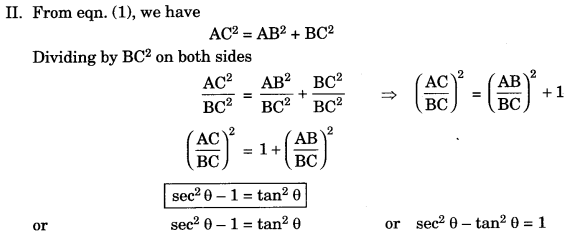
Introduction to Trigonometry Class 10 Notes Maths Chapter 8 8

Coordinate Geometry Class 10 Notes Maths Chapter 7

Coordinate Geometry Class 10 Notes

On this page, you will find Coordinate Geometry Class 10 Notes Maths Chapter 7 Pdf free download. CBSE NCERT Class 10 Maths Notes Chapter 7 Coordinate Geometry will seemingly help them to revise the important concepts in less time.

CBSE Class 10 Maths Chapter 7 Notes Coordinate Geometry

Coordinate Geometry Class 10 Notes Understanding the Lesson

Distance formula

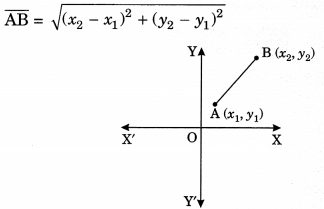
1. The distance between two points A(x1, y1) and B(x2, y2) is
Coordinate Geometry Class 10 Notes Maths Chapter 7 1

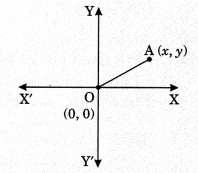
2. The distance of point A(x, y) from origin 0(0, 0) is
\(\mathrm{AO}=\sqrt{x^{2}+y^{2}}\)
Coordinate Geometry Class 10 Notes Maths Chapter 7 2
3. Three given points will form:

  • Right angled triangle if sum of squares of any two sides is equal to the square of third (largest) side.
  • Equilateral triangle if length of all three sides are equal.
  • Isosceles triangle if length of any two sides are equal.
  • A line or collinear if sum of two sides is equal to third side.

4. Four given points will form:

  • Square if length of all four sides are equal and diagonals are equal.
  • Rhombus if length of all four sides are equal.
  • Rectangle if opposite sides are equal and diagonals are equal.
  • Parallelogram if opposite sides are equal.

Section formula
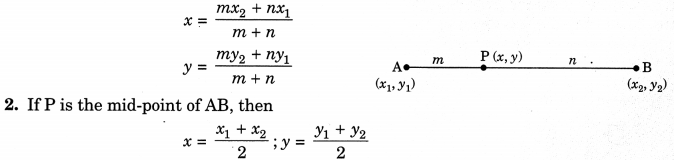
I. If A(x1, y1) and BB(x2, y2)) are two points on a plane and P(x, y) divides AB internally in the ratio m : n, then co-ordinates of P are given by
Coordinate Geometry Class 10 Notes Maths Chapter 7 3

Area of a Triangle

1. Area of ΔABC formed by vertices A(x1, y1), B(x2, y2) and C(x3, y3) is given by
Ar(ΔABC) =\(\frac{1}{2}\) (- y3) + x2 (y3 – y1)+ x3(y1 – y2)]
[Only positive numerical value to be taken]

2. If Ar(ΔABC) = 0, then A, B and C are collinear points.
Coordinate Geometry Class 10 Notes Maths Chapter 7 4

3. If‘C’ is centroid of a triangle, the median is divided in the ratio 2 : 1 by C and coordinates of C are
\(\left(\frac{x_{1}+x_{2}+x_{3}}{3}, \frac{y_{1}+y_{2}+y_{3}}{3}\right)\)

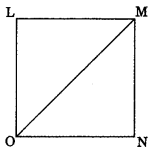
4. Area of quadrilateral LMNO = ar(ΔLMO) + ar(ΔNMO)

Probability Class 9 Notes Maths Chapter 15

Probability Class 9 Notes

On this page, you will find Probability Class 9 Notes Maths Chapter 15 Pdf free download. CBSE NCERT Class 9 Maths Notes Chapter 15 Probability will seemingly help them to revise the important concepts in less time.

CBSE Class 9 Maths Chapter 15 Notes Probability

Probability Class 9 Notes Understanding the Lesson

1. Experiment: A procedure which produces some well-defined possible outcomes.

2. Random experiment: An experiment which when performed produces one of the several possible outcomes called a random experiment.

3. Trial: When we perform an experiment it is called a trial of the experiment.

4. Event: The set of outcomes of an experiment to which probability is assigned.

5. The empirical (or experimental) probability P(E) of an event E is given by
\(\mathrm{P}(\mathrm{E})=\frac{\text { Number of trials in which } \mathrm{E} \text { has happened }}{\text { Total number of trials }}\)
So, Probability of not happening an event \(\mathrm{P}(\overline{\mathrm{E}})\)= 1 – P(E)

6. The probability of an event lies between 0 and 1 (0 and 1 are included).

7. Impossible event: An event which never happens.

8. Certain event : An event which definitely happens.

Statistics Class 9 Notes Maths Chapter 14

Statistics Class 9 Notes

On this page, you will find Statistics Class 9 Notes Maths Chapter 14 Pdf free download. CBSE NCERT Class 9 Maths Notes Chapter 14 Statistics will seemingly help them to revise the important concepts in less time.

CBSE Class 9 Maths Chapter 14 Notes Statistics

Statistics Class 9 Notes Understanding the Lesson

There are two types of data:

  • Primary
  • Secondary.

We can represent the data by:

  • Ungrouped and
  • Grouped frequency distribution.

Data can also be represented by:

  • Bar graph
  • Histogram
  • Frequency polygons.

Class mark of grouped data
\(=\frac{\text { lower limit }+\text { upper limit }}{2}\)

Measure of central tendencies are mean, median and mode.

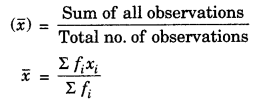
Mean:
Statistics Class 9 Notes Maths Chapter 14 1
where, Σfixi = Sum of all observations
Σfi = Total frequency.

Median: Arrange the observations in ascending or descending order,

(i) If numbers of observations (x) are odd, then median \(\left(\frac{n+1}{2}\right)^{t h}\) terms

(ii) If number of observations (x) are even, then median \(\frac{n^{t h}}{2} \text { and }\left(\frac{n}{2}+1\right)^{t h}\)

Mode: The observation whose frequency is highest.

Relationship between mean, median and mode:
Mode = 3 Median – 2 Mean.

Graphical Representation of Data

  • Bar graphs: A bar graph is a pictorial representation of the numerical data by a number of bars (rectangles) of uniform width erected horizontally or vertically with equal space between them. Each rectangle or bar represents only one value of the numerical data and the height or length of bar indicates the corresponding value of the numerical data.
  • Histogram: A histogram or frequency histogram is a representation of a frequency distribution in the form of rectangles such that there is no gap between any two successive rectangles.
  • Frequency polygon: It is another method of representing frequency distribution graphically.