Gravitation Class 9 Notes Science Chapter 10

Gravitation Class 9 Notes

On this page, you will find Gravitation Class 9 Notes Science Chapter 10 Pdf free download. CBSE NCERT Class 9 Science Notes Chapter 10 Gravitation will seemingly help them to revise the important concepts in less time.

CBSE Class 9 Science Chapter 10 Notes Gravitation

Gravitation Class 9 Notes Understanding the Lesson

1. Newton’s law of gravitation
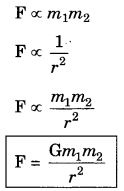
“Every particle in the universe attracts every other particle with a force, which is directly proportional to the product of their masses and inversely proportional to the square of the distance between the two masses. The direction of force is along the line joining the two particles.”
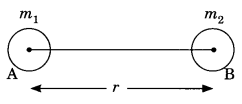
Gravitation Class 9 Notes Science Chapter 10 1
Force of attraction between A and B
Gravitation Class 9 Notes Science Chapter 10 2

Where G is constant of proportionality called universal gravitational constant.

2. Universal gravitational constant
\(\mathrm{G}=\frac{\mathrm{F} r^{2}}{m_{1} m_{2}}\)
SI unit of G is Nm2 kg-2
Value of G = 6.67 x 10⁻¹¹ Nm2 kg-2.

3. Properties of gravitational force

  • It is always attractive in nature.
  • It obeys inverse square law  \(\mathrm{F} \alpha \frac{1}{r^{2}}\)
  • Gravitational force is independent of the medium.
  • It is a long range force.
  • It is a weak force.
  • Force of gravitation due to the Earth is called gravity.

4. Definition of G
Take = m2 = m = 1 kg r = 1 m
Hence, the force of attraction between two point masses separated by a unit distance is called universal gravitational constant.

5. Importance of the universal law of gravitation:
The universal law of gravitation successfully explained several phenomena

  • The force that binds us to the Earth.
  • The motion of the moon around the Earth.
  • The motion of planets around the Sun; and
  • The tides due to the moon and the Sun.

6. Free fall
Whenever objects fall towards the Earth under gravitational force alone, we say that the objects are in free fall.

7. Acceleration due to gravity (g):
The acceleration with which a body falls towards the Earth due to Earth’s gravitational pull is known as acceleration due to gravity. It is denoted by ‘g’.

8. Expression for acceleration due to gravity on the surface of the Earth:
The gravitational force between a body of mass ‘m’ and the Earth (of mass M) can be represented as
\(\mathbf{F}=\frac{\mathrm{G} \mathrm{Mm}}{r^{2}}\) …………….. (1)
Force of gravity is expressed as, F=Mg ……………(2)
From (1) and (2),\(g=\frac{\mathrm{GM}}{r^{2}}\)
The Earth is not a perfect sphere. As the radius of Earth increases from the poles to the equator, the value of g becomes greater at the poles than at the equator.

9. Calculate the value of g on the Earth:
\(g=\frac{G M}{r^{2}}\)
By putting the value of mass, radius of Earth and universal gravitational constant we can find out the value of acceleration due to gravity on the Earth.
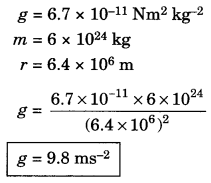
Gravitation Class 9 Notes Science Chapter 10 3

10. Acceleration due to gravity at

  • the surface of the Earth, g = 9.8 m/s2
  • the centre of the Earth, g = 0.

11. Mass
Mass of a body is the quantity of matter contained in it.

  • Mass of an object is constant and does not change from place to place.
  • SI unit of mass is kilogram (kg).
  • Mass of an object is a measure of its inertia.

12. Weight
The weight of an object is the force with which it is attracted towards the Earth.
w = mg

  • SI unit of weight is newton (N).
  • Weight is a vector quantity.
  • Weight is directly proportional to mass of the body. So at a given place, weight of a body is a measure of its mass. w α m.
  • Weight of a body changes from place to place because, acceleration due to gravity varies with position and location of a body.

13. Weight of an object on the moon
The acceleration due to gravity of moon is one sixth of Earth.
\(g_{\text {moon }}=\frac{1}{6} g_{\text {Earth }}\)
Due to this, the weight of an object on the moon is one sixth of the weight of the object on the Earth.
\(\frac{\text { Weight of the object on the moon }}{\text { Weight of the object on the Earth }}=\frac{1}{6}\)
Weight of the object on the moon = 1/6 x weight of the object on the Earth.

14. Gravitation (Flotation)
Thrust: The force acting on an object perpendicular to its surface is called thrust.

  • SI unit of thrust is newton (N).

Pressure: The thrust on unit area is called pressure.

  • SI unit of pressure is N/m2 or Nm-2.
  • In honour of scientist Blaise pascal, the SI unit of pressure is called pascal (pa).
    1 pa = 1 N/m2
    Pressure = Thrust/Area

15. Consequences of pressure

(i) Nails and pins have painted ends so that these can be fixed with minimum force because the pressure on the painted ends would be large.

(ii) Wide wooden or metal or concrete sleepers are kept below railway lines to reduce pressure on the railway tracks and prevent them from sinking into the ground.

(iii) The foundation of a building or a dam has a large surface area so that the pressure exerted by it on the ground is less. This is done to prevent the sinking of the building or dam into the ground.

(iv) Skiers use flat skies to slide over snow as the long flat skies increase the area of contact, which reduces pressure exerted by the skier on the snow enabling the skier to slide over the snow without sinking.

(v) Broad handles are provided in bags and suitcases. Due to broad size of the handles, the area of contact increases which reduces the pressure exerted by the weight of the bag or suitcase.

(vi) A camel walks easily on the sandy surface than a man inspite of the fact that a camel is much heavier than a man. This is because their legs are padded and flat which provides greater surface area of contact with the sand and hence exerts less pressure on the sand. On the other hand, a man has very small surface area, so he exerts greater pressure and is likely to sink in sand.

16. Pressure in fluids
A substance which can flow is called a fluid. All liquid and gasses are fluids.

  • A fluid contained in a vessel exerts pressure at all points of the vessel and in all directions.
  • Pascal’s law: In an enclosed fluid, if pressure is changed in any part of the fluid, then this change in pressure is transmitted undiminished to all the other parts of the fluid.

17. Buoyancy
When a body is partially or wholly immersed in a fluid, an upward force acts on it which is called upthrust or buoyant force. The property of the fluids responsible for this force is called buoyancy.

18. Why do objects float or sink when placed on the surface of a fluid?

1. A body sinks if its weight is greater than the buoyant force acting on it.
Weight > buoyant force
Apparent weight = weight – buoyant force

2. A body floats if buoyant force balance the weight of the body.
A body having an average density greater than that of water (fluid), sinks into it while a body of average density smaller than that of water (fluid), floats on it.

19. Archimedes principle
When a body is immersed fully or partially in a fluid, it experiences an upward force that is equal to the weight of the fluid displaced by it.
20. Density and relative density
Density: Density of a substance is defined as its mass per unit volume.
\(\text { Density }=\frac{\text { Mass }(\mathrm{M})}{\text { Volume }(v)} \text { or, } d=\frac{\mathrm{M}}{\mathrm{V}}\)
SI unit of density is kg/m3 or kg m-3

21. Relative density: The relative density of a substance is the ratio of its density to that of water.
Relative density = Density of substance/Density of water.
It has no unit.

Class 9 Science Chapter 10 Notes Important Terms

Newton’s law of gravitation: Every particle in the universe attracts every other particle with a force, which is directly proportional to the product of their masses and inversely proportional to square of distance between the two masses.

Freefall: Whenever objects fall towards the Earth under gravitational force alone, we say that the objects are in free fall.

Acceleration due to gravity: The acceleration with which a body falls towards the Earth due to Earth’s gravitational pull is known as acceleration due to gravity.

Mass: Mass of a body is the quantity of matter contained in it.

Weight: The weight of an object is the force with which it is attracted towards the Earth.

Density: Density of a substance is defined as its mass per unit volume.

Relative density: The relative density of a substance is the ratio of its density to that of water.

Thrust: The force acting on an object perpendicular to the surface is called thrust.

Pressure: The thrust per unit area is called pressure.

Pascal’s law: In an enclosed fluid, if pressure is changed in any part of the fluid, then this change in pressure is transmitted undiminished to all the other parts of the fluid.

Buoyancy: When a body is partially or wholly immersed in a fluid, an upward force acts on it which is called upthrust or buoyant force.

Archimedes principle: When a body is immersed fully or partially in a fluid, it experiences an upward force that is equal to the weight of the fluid displaced by it.

Force and Laws of Motion Class 9 Notes Science Chapter 9

force and laws of motion class 9 notes

On this page, you will find Force and Laws of Motion Class 9 Notes Science Chapter 9 Pdf free download. CBSE NCERT Class 9 Science Notes Chapter 9 Force and Laws of Motion will seemingly help them to revise the important concepts in less time.

CBSE Class 9 Science Chapter 9 Notes Force and Laws of Motion

Force and Laws of Motion Class 9 Notes Understanding the Lesson

1. Force
It is entity which when applied on a body changes or tends to change a body’s

  • state of rest
  • state of uniform motion
  • direction of motion
  •  shape

2. Balanced forces
When a number of forces acting simultaneously on a body do not bring about any change in state of rest or of uniform motion along a straight line, then forces acting on a body are said to be balanced forces.

3. Unbalanced forces
When a number of forces acting simultaneously on a body bring about a change in its state of rest or of uniform motion along a straight line, then these forces acting on the body are said to be unbalanced forces.

4. Newton’s first law of motion
An object remains in a state of rest or of uniform motion in a straight line unless compelled to change that state by an applied force.

5. Inertia
Inertia is the natural tendency of an object to resist a change in its state of motion or of rest.

6. The mass of an object is a measure of its inertia.
Examples:

  • Passenger tends to fall backward, when a bus starts suddenly.
  • Falling of fruits and leaves by a shaking tree.
  • When a carpet is beaten with a stick, dust particles come out.
  • When the card covering a glass tumbler is flicked with the finger coin placed over it falls in the tumbler.

7. Momentum (P)

  • Momentum gives an idea about the quantity of motion contained in a body.
  • The momentum (P) of an object is defined as the product of its mass (m) and velocity (v).
    P = mv
  • Momentum is vector quantity and its unit is kg ms-1.

8. Second law of motion
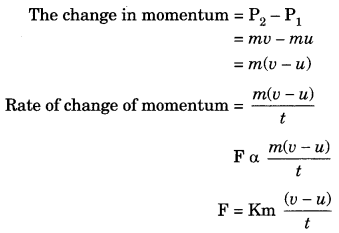
The second law of motion states that the rate of change of momentum of an object is proportional to the applied unbalanced force in the direction of force.

9. Mathematical formulation of second law of motion
Suppose an object of mass, m is moving along a straight line with an initial velocity, v. It is uniformly accel-erated to velocity, v in time, t by application of constant force F throughout the time, t. The initial and final momentum of the object will be, P1 = mu and P2 = mv
respectively.
Force and Laws of Motion Class 9 Notes Science Chapter 9
Force and Laws of Motion Class 9 Notes Science Chapter 9 1
∴ F =ma
K is proportionality constant and the value So,
SI unit of force is newton.

10. First law of motion can be stated from the second law
F = ma
\(F=\frac{m(v-u)}{t}\)
Ft = mv – mu
when F = 0, v – u. This means that the object will continue moving with uniform velocity, u throughout the time, t. If u is zero then v will also be zero. That is, the object will remain at rest.

11. Example of second law of motion:
As we know that \(\text { F } \alpha \frac{1}{t}\)

  • A cricket players lowers his hand while catching the ball to increase the time so that impact of force decreases.
  • A karate player can break a pile of tiles with a single blow of his hand. This is because, as time decreases impact of force increases.
  • Vehicles are fitted with shockers. The shockers increase the time of transmission of the force of the jerk to reach the floor of the vehicle. Hence less jerk is experienced by the passengers.

12. Third law of motion
According to the third law of motion, every action there is an equal and opposite reaction and they act on two different bodies.

Example of third law of motion:

  • Recoiling of gun.
  • When a man jumps out from a boat, the boat moves backward.

13. Conservation of momentum
In an isolated system (where there is no external force), the total momentum remains conserved.
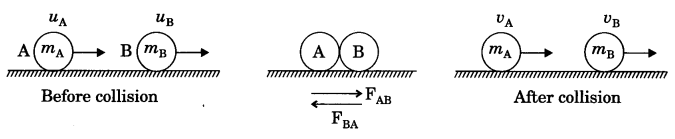
mAuA + mBuB = mAvA + mBvB
Force and Laws of Motion Class 9 Notes Science Chapter 9 2

14. Derivation
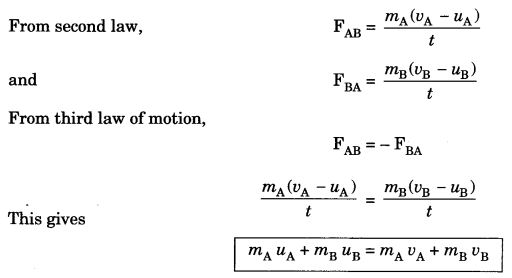
Suppose two objects of mass mA and mB are travelling in the same direction along a straight line at different velocity uA and uB respectively, and there are no external unbalanced forces acting on them. Let uA > uB and two balls collide each other. During collision which last for a time t, ball A exerts force on ball B and ball B exerts force FBA on ball A. Suppose vA and i>B are the velocities after collision.
Force and Laws of Motion Class 9 Notes Science Chapter 9 3

15. Illustration of conservation of momentum

  • Recoil of gun.
  • Rocket propulsion.
  • Inflated balloon lying on the surface of a floor moves forward when pierced with a pin.

Class 9 Science Chapter 9 Notes Important Terms

Force: It is entity which when applied on a body changes or tends to change a body’s.

  • state of rest
  • state of uniform motion
  • direction of motion
  • shape

Balanced forces: When a number of forces acting simultaneously on a body do not bring about any change in state of rest or of uniform motion along a straight line, then forces acting on a body are said to be balanced forces.

Unbalanced forces: When a number of forces acting simultaneously on a body bring about change in its state of rest or of uniform motion along a straight line, then these forces acting on the body are said to be unbalanced forces.

Inertia: Inertia is the natural tendency of an object to resist a change in its state of motion or of rest.

Momentum: Momentum of a body is product of its mass and velocity.

Conservation of momentum: In an isolated system the total momentum remains conserved.

Statistics Class 10 Notes Maths Chapter 14

Statistics Class 10 Notes

On this page, you will find Statistics Class 10 Notes Maths Chapter 14 Pdf free download. CBSE NCERT Class 10 Maths Notes Chapter 14 Statistics will seemingly help them to revise the important concepts in less time.

CBSE Class 10 Maths Chapter 14 Notes Statistics

Statistics Class 10 Notes Understanding the Lesson

The measures of central tendency are:

  • Arithmetic mean or mean
  • Median
  • Mode

Mean of Raw Data

Mean of n observations x1; x2, x3, ..xn is given by
\(\bar{x}=\frac{x_{1}+x_{2}+x_{3}+\ldots+x_{n}}{n}=\frac{\Sigma x_{i}}{n}\)
where ∑ (sigma) means “summation of’.

1. Mean of Grouped Data

(i) Direct method:
\(\bar{x} \doteq \frac{\Sigma f_{i} x_{i}}{\Sigma f_{i}}\)
For each class interval, Class mark = \(\frac{\text { Lower limit }+\text { Upper limit }}{2}\)

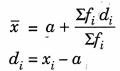
(ii) Short-cut method or assumed mean method:
Statistics Class 10 Notes Maths Chapter 14 3
Where a = assumed mean

(iii) Step-deviation method:
Statistics Class 10 Notes Maths Chapter 14 4
h=Class-Size

2. Mode of Groped Data
Class with the maximum frequency is called the modal class.
\(\text { Mode }=l+\left[\frac{f_{1}-f_{0}}{2 f_{1}-f_{0}-f_{2}}\right] \times h\)

Where l = lower limit of the modal class
h = size of the class-interval
f1 = frequency of the modal class
f0 – frequency of the class preceeding the modal class
f2 = frequency of the class succeeding the modal class

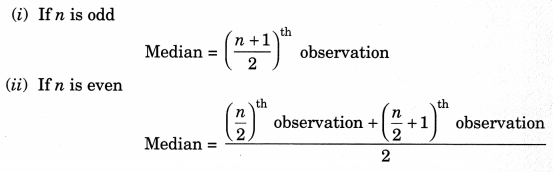
3. Median of Ungrouped Data
To find the median of ungrouped data, first arrange the data values of the observations in the ascending or descending order. Then,
Statistics Class 10 Notes Maths Chapter 14 5

4. Median of Grouped Data
\(\text { Median }=l+\left[\frac{\frac{n}{2}-c \cdot f \cdot}{f}\right] \times h\)
l – lower limit of median class.
n = number of observation
c.f. = cumulative frequency of the class preceeding the median class
f = frequency of the median class
h = class size

Median class: Class whose cumulative frequency is greater than (and nearest to) \(\frac{n}{2}\)

Motion Class 9 Notes Science Chapter 8

motion class 9 notes

On this page, you will find Motion Class 9 Notes Science Chapter 8 Pdf free download. CBSE NCERT Class 9 Science Notes Chapter 8 Motion will seemingly help them to revise the important concepts in less time.

CBSE Class 9 Science Chapter 8 Notes Motion

Motion Class 9 Notes Understanding the Lesson

1. Rest: A body is said to be at rest if its position does not change with respect to a fixed point taken as a reference point in its surrounding with the passage of time.

2. Motion: A body is said to be in motion if its position is changes with respect to a fixed point taken as a reference point in its surrounding with the passage of time.

3. Scalar quantity: A physical quantity which is described completely by its magnitude only, is called a scalar quantity.

4. Vector quantity: A physical quantity that has magnitude as well as direction is called a vector quantity. Distance: The total path length travelled by a body in a given interval of time is called distance. Displacement: The shortest distance measured from initial to the final position of an object is known as displacement.

5. Difference between distance and displacement

DistanceDisplacement
1.   It is the actual length of the path covered by a moving body.
2.   It is always positive or zero.
3.   It is a scalar quantity.
1.    It is the shortest distance measured between the initial and final position.
2.    It may be positive, negative or zero.
3.    It is a vector quantity.

SI unit of distance and displacement is metre (m).

6. Uniform motion: A body moving in straight line has a uniform motion if it travels equal distance in equal intervals of time.

7. Non-uniform motion: A body has a non-uniform motion if it travels unequal distances in equal intervals of time.

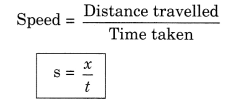
8. Speed: The speed of a body is defined as distance travelled by it per unit time.
Motion Class 9 Notes Science Chapter 8 5
Speed is scalar quantity and SI unit of speed is m/s.

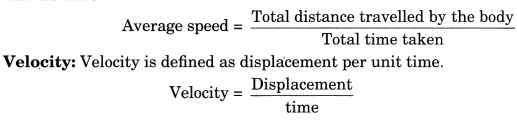
9. Average speed: It is defined as the total distance travelled by a body divided by the total time taken to cover this distance.
Motion Class 9 Notes Science Chapter 8 6
SI unit of speed and velocity is same.

Difference between speed and velocity

SpeedVelocity
1.   Speed is the ratio of distance and time.
2.   Speed is always positive.
3.   Speed is a scalar quantity.
1.  Velocity is ratio of displacement and time.
2.  Velocity may be negative or positive.
3.  Velocity is a vector quantity.

10. Acceleration: The rate of change of velocity of a body with respect to time is called its acceleration.

\(\text { Acceleration }=\frac{\text { Change in velocity }}{\text { time taken }}\)
\(a=\frac{v-u}{t}\)

Here, u – initial velocity
v = final velocity
t = time

11. Acceleration is a vector quantity and its SI unit is m/s2.

12. If a body is travelling with uniform acceleration then its average velocity can be expressed as

\(v_{\text {avg }}=\frac{u+v}{2}\)
Here, u = initial velocity
v – final velocity

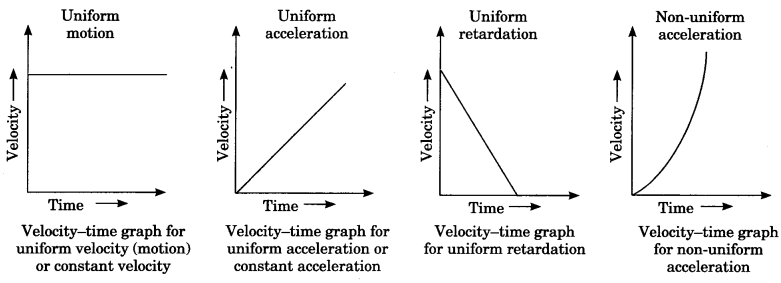
13. If the speed of a body is continuously increasing, the body is said to be continuously accelerating. If the speed of body is continuously decreasing, the body is said to be retarding.

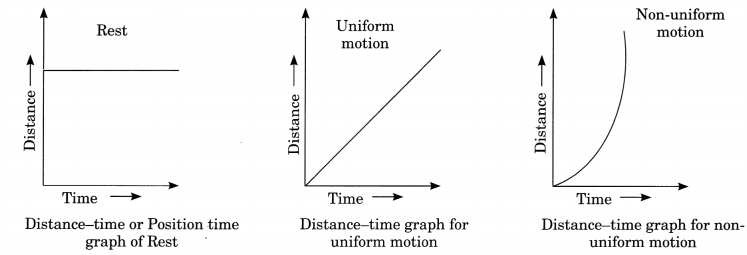
14. Graphical Representation of Motion
Distance-time graph (Position time graph)
Motion Class 9 Notes Science Chapter 8
15. Slope of velocity-time graph gives speed and velocity

16. velocity-time graph
Motion Class 9 Notes Science Chapter 8 1

17. Slope of velocity-time graph gives distance and displacement.

18. Equation of motion by graphical method
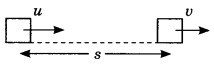
Let us consider a body moving with acceleration a where u is initial velocity and v is final velocity, s is displacement of the object and t is time interval.

Motion Class 9 Notes Science Chapter 8 2

(i) v = u + at
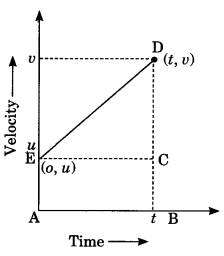
We know that slope of v – t graph gives acceleration so slope
\(=a=\frac{v-u}{t-o}\)
\(\begin{array}{l}
a=\frac{v-u}{t} \\
v=u+\text { at }
\end{array}\)
Motion Class 9 Notes Science Chapter 8 3

(ii) \(s=u t+\frac{1}{2} a t^{2}\)
We know that area under v -1 graph gives displacement.
Area = s = area of triangle CDE + area of rectangle ABCE
\(s=u t+\frac{1}{2} \times t \times(v-u)\)
Putting the value of v – u.
\(s=u t+\frac{1}{2} \mathrm{at}^{2}\)

(iii) v2 – u2 = 2as
a where u is initial velocity and v is final velocity, s is displacement of the object and t is time interval.
\(s=\frac{1}{2} \times(v+u) \times t\)
\(\text { from } 1\left(t=\frac{v-u}{a}\right)\)
Putting the value of t.
v2 – u2 = 2as

19. Uniform circular motion
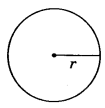
When an object moves in a circular path with uniform speed, its motion is called uniform circular motion.
\(v=\frac{2 \pi r}{t}\)
Motion Class 9 Notes Science Chapter 8 4
If a body is moving in a circular path and completes one round (2πr distance) in time, speed is given by
Uniform circular motion is accelerated motion.

Class 9 Science Chapter 8 Notes Important Terms

State of rest: A body is said to be at rest if it does not change its position with respect to a fixed point taken as a reference point in its surroundings with passage of time.

State of motion: A body is said to be in motion if it changes its position with respect to a fixed point as a reference point in its surroundings with the passage of time.

Scalar quantity: A physical quantity which is described completely by its magnitude only, is called scalar quantity.

Vector quantity: A physical quantity which has magnitude as well as direction and obeys the vector addition is called vector quantity.

Distance: The total path length travelled by a body in a given interval of time is called distance.

Displacement: The shortest distance measured from initial to the final position of an object is known as displacement.

Uniform motion: A body moving in a straight line has a uniform motion, if it travels equal distance in equal intervals of time.

Non-uniform motion: A body has a non-uniform motion, if it travels unequal distances in equal intervals of time.

Speed: The speed of a body is defined as distance travelled by it per unit time.

Velocity: Velocity is defined as displacement per unit time.

Acceleration: The rate of change of velocity of a body with respect to time is called its acceleration.

Retardation: When acceleration of a body is opposite to its velocity, it is called retardation.

Uniform circular motion: When an object is moving in a circular path with a constant speed, the motion of the object is said to be uniform circular motion.

Diversity in Living Organisms Class 9 Notes Science Chapter 7

Diversity in Living Organisms Class 9 Notes

On this page, you will find Diversity in Living Organisms Class 9 Notes Science Chapter 7 Pdf free download. CBSE NCERT Class 9 Science Notes Chapter 7 Diversity in Living Organisms will seemingly help them to revise the important concepts in less time.

CBSE Class 9 Science Chapter 7 Notes Diversity in Living Organisms

Diversity in Living Organisms Class 9 Notes Understanding the Lesson

1. What is classification?
Grouping the organisms on the basis of their similarities and differences is called classification.

2. Need for classification

  • To provide information regarding diversity of plants and animals on the Earth.
  • Understand the interrelationship between different groups of plants and animals.
  • To find similarities or dissimilarities in their characteristic features.
  • To identify the organism.
  • To indicate evolutionary trends.

3. Characteristics or criteria of classification

  • Complexity of structure: Prokaryotes or Eukaryotes
  • Body organisation: Unicellular or Multicellular
  • Mode of obtaining Nutrition: Autotrophic or Heterotrophic
  • Evolutionary relationship
  • Presence or absence of cell wall

4. Kingdom
It is the highest category of classification. Each kingdom has some similar fundamental characteristics in all organisms grouped under that kingdom. The five-kingdom classification was given by R.H. Whittaker.

CharacteristicsMoneraProtistaFungiPlantaeAnimalia
Complexity of structureProkaryotesEukaryotesEukaryotesEukaryotesEukaryotes
Body organisationUnicellularUnicellularMulticellular (at some stage of life)MulticellularMulticellular
Mode of nutritionAutotrophic or HeterotrophicAutotrophic or HeterotrophicHeterotrophic
Parasitic
Saprophytic
Symbiotic
AutotrophicHeterotrophic


CharacteristicsMoneraProtistaFungiPlantaeAnimalia
Cell wallPresent or absentPresent or absentPresent (made up of chitin)Present (made up of cellulose)Absent
AppendagesCilia or flagella for movementCilia, flagella or pseudopodia for movementDo not moveDo not move

Different
appendages

e.g., Bacteriae.g., Amoebae.g., Mushroome.g., Rosee.g., Monkey

Differentiate between:

S. No.ThallophytaBryophytaPteridophyta
1.Plant body thallus like, not differentiated into root, stem or leaf.Plant body does not have true root, stem or leaf but shows root­like and leaf-like structures.Plants have true root stem or leaf.
2.Vascular system absent.True vascular system is absent.True vascular system is present.
3.Predominantly aquatic.They live on land and in water. They are known as the Amphibians of the plant kingdom.They are terrestrial, i.e., they live on land.
4.No embryo formation after fertilization.
e.g., Algae
Embryo formed after fertilisation.
e.g., Mosses, liverworts .
Embryo formed after fertilisation.
e.g., Ferns


S. No.CryptogamaePhanerogamae
1.Reproductive organs are hidden.Reproductive organs are visible.
2.Fertilisation results in the formation of a naked embryo called spores.Fertilisation results in the formation of seeds which consists of embryo and cotyledons.
3.Water is required for fertilisation.Water is not required for fertilisation always except for aquatic phanerogams.
e.g., Thallophyta, Bryophyta, Pteridophytae.g., Gymnospermae and Angiospermae


S. No.GymnospermaeAngiospermae
1.Plants bear naked seeds.Seeds are present inside fruits.
2.Xylem is without vessels and phloem is without companion cells.Well developed vascular tissue present.
3.Plants are perennial, woody and evergreen.Plants are annual, biennial, perennial, woody or green.
e.g., Pinus, Cycase.g., Neem, Rose, Mango


S. No.Monocotyledonous PlantsDicotyledonous Plants
1.Single cotyledon in seeds.Two cotyledons in seeds.
2.Fibrous roots.Tap roots.
3.Parallel venation.Reticulate venation.
e.g., Lily, Rice, Wheate.g., Hibiscus, Pea, Gram

5. Characteristic features of different Phyla of Kingdom Animalia Porifera

  • Porifera means organisms with holes.
  • Non-motile animals attached to solid support
  • Holes or pores all over body
  • Have canal system that helps in circulating water throughout the body to bring in food and oxygen.
  • Body covered with hard outside layer or skeleton
  • Minimal differentiation of body and division into tissues
  • Commonly called sponges found in marine habitats
  • Acoelomate (without body cavity)
    Examples: Euplectella, Sycon, Spongilla

6. Coelenterata

  • Animals living in water
  • More body design differentiation
  • Diploblastic body
  • Some species live in colonies (corals) while others have a solitary life span (Hydra)
    Examples: Jelly fish, Sea Anemone, Hydra

7. Platyhelminthes

  • Body is complexly designed
  • Bilaterally symmetrical body
  • Triploblastic body
  • Acoelomate
  • Body flattened dorsi-ventrally, so called flatworms
  • Free living or parasitic
    Examples: Planarian (free living) liver flukes, tapeworms (Parasitic)

8. Nematodes

  • Bilaterally symmetrical
  • Triploblastic body
  • Cylindrical body
  • Tissues present but no real organs
  • Presence of pseudo coelom, a sort of body cavity
  • Familiar as parasitic worms causing diseases, present in intestines
    Examples: Ascaris, Wucheraria

9. Annelida

  • Bilaterally symmetrical
  • Triploblastic
  • Coelomate (having a body cavity or coelon)
  • Extensive organ differentiation
  • Segmented body (Metamerism)
  • Found in fresh water, marine and on land
    Examples: Earthworms, Leech, Nereis

10. Arthropoda

  • Largest group of animals
  • Bilaterally symmetrical
  • Segmented body
  • Open circulatory system
  • Coelomate
  • Arthropoda means jointed legs
    Examples: Prawns, Butterflies, Housefly, Cockroach

11. Mollusca

  • Bilaterally symmetrical
  • Coelomic cavity is reduced
  • Little segmentation
  • Open circulatory system
  • Kidney like organ for excretion
  • There is a foot like structure for moving around
    Examples: Snails, mussels, Chiton, Octopus, Unio, Pila

12. Echinodermata

  • They are spiny skinned organisms
  • Echinos’ means hedgehog and ‘Derma’ means skin.
  • Exclusively free living marine animals
  • Triploblastic
  • Acoelomate
  • Peculiar water driven tube system
  • Hard calcium carbonate structures as skeleton
    Examples: Star fish, sea urchin, feather star, sea cucumber

13. Protochordate

  • Bilaterally symmetrical
  • Triploblastic
  • Coelomate
  • Notochord present during larval stage
  • Provides place for muscles to attach for easy movement
  • Marine animals
    Examples: Balanoglossus, Herdmania, Amphioxu

14. Vertebrata

  • Have a true vertebral column and internal skeleton
  • Bilaterally symmetrical
  • Triploblastic
  • Coelomate and segmented
  • Complex differentiation of body tissues and organs

15. All chordates possess the following features:

  • Have a notochord
  • Have a dorsal nerve cord
  • Are triploblastic
  • Have paired gill pouches in some stage of their life cycle
  • Are coelomate

16. Vertebrates are grouped into 5 classes
Pisces

  • Exclusively aquatic animals
  • Skin covered with scales or plates
  • Obtain oxygen dissolved in water
  • Streamlined body and muscular tail for movement in water
  • Cold-blooded
  • Two-chambered heart
  • Lays eggs in water

17. Are of two types:

  • Cartilaginous fish (skeleton made entirely of cartilage), e.g., Shark
  • Bony fish (skeleton made of both cartilages and bones), e.g., Rohu, Tima

18. Amphibia

  • Lack scales
  • Have mucus glands in skin
  • Cold-blooded
  • Three-chambered heart
  • Respiration through gills, lungs or skin
  • Lay eggs in water
  • Live both on land and in water
    Examples: Frogs, toads, salamander, etc.

19. Reptilia

  • Have scales
  • Three-chambered heart but crocodiles have four chambered heart
  • Cold-blooded
  • Breathe through lungs
  • Lay eggs with tough coverings so they do not lay eggs in water
    Examples: Snakes, turtles, lizards, crocodiles, chameleon

20. Aves

  • Outside covering of feathers
  • Four-chambered heart
  • Warm-blooded
  • Breathe through lungs
  • Lay eggs
  • Two forelimbs modified into wings for flight
    Examples: All birds like crow, pigeon, peacock, etc.

21. Mammalia

  • Skin has hairs, oil and sweat glands
  • Four-chambered heart
  • Warm-blooded.
  • Most of them give birth to young ones
  • Few like Platypus and Echidna lay eggs
  • Some like kangaroos give birth to poorly developed young ones
  • Mammary glands present for production of milk to nourish their young ones
    Examples: Cat, human, rat, bat, whale, etc.

21. Nomenclature: System of assigning names or terms to the organisms is called as nomenclature. The names given to the organism can be

  • Common name or
  • Scientific name.

Common names cannot be used in the same way by the scientist world over and can often result in confusion. To avoid this, a system of scientific names has been proposed.

Binomial System of Nomenclature: The binomial system of nomenclature assigns two names to the organism in order to identify it first is the generic name (genus) and the second is the specific epithet (species). This system of nomenclature was given by Carolus Linnaeus.

22. Convention for writing the scientific names:

  • The name of the genus begins with a capital letter.
  • The name of the species begins with a small letter.
  • When printed, the scientific name is given in italics.
  • When written by hand, the genus name and the species name have to be underlined separately.

23. Scientific names of some organisms:

  • Tiger – Panthera tigris
  • Peacock – Pauo cristatus
  • Mango – Mangifera indica
  • Lotus – Nelumbo nucifera
  • Neem – Azadiraehta indica
  • Potato – Solanum tuberosum
  • Ant – Hymenopetrous formicidae
  • Frog – Rana tigrina
  • Rose – Rosa indica
  • Pea – Pisum sativum

Class 9 Science Chapter 7 Notes Important Terms

Prokaryotes: Organisms which do not have a clearly demarcated nucleus and other organelles.

Eukaryotes: Organisms having membrane bound cell organelles and a well-defined nucleus.

Unicellular: Organisms having only one cell in their body.

Multicellular: Organisms having many cells in their body.

Autotrophs: Organisms synthesising their own food by photosynthesis.

Heterotrophs: Organisms which depend on other organisms for their food.

Bilateral symmetry: The body organisation in which the left and right halves have same body design.

Radial symmetry: Arrangement of similar parts around a central body axis as in a wheel.

Diploblastic: Animals having a body made up of two layers of cells i.e., ectoderm and endoderm.