Improvement in Food Resources Class 9 Notes Science Chapter 15

Improvement in Food Resources Class 9 Notes

On this page, you will find Improvement in Food Resources Class 9 Notes Science Chapter 15 Pdf free download. CBSE NCERT Class 9 Science Notes Chapter 15 Improvement in Food Resources will seemingly help them to revise the important concepts in less time.

CBSE Class 9 Science Chapter 15 Notes Improvement in Food Resources

Improvement in Food Resources Class 9 Notes Understanding the Lesson

1. The population of India is more than one billion people, and it is still growing. So, the need of the hour is to increase the food production. This can be done by farming on more land. India is already intensively cultivated, so the only way out is to increase our production efficiency for both crops and livestock.

2. There is a need for sustainable practices in agriculture and animal husbandry to increase food production without degrading our environment and disturbing the balances maintaining it.

3. Types of Revolutions Related to Increase in Food Production

  • Green revolution: increase in food grain production.
  • White revolution: increase in milk production.
  • Blue revolution: increase in fish production.
  • Yellow revolution: increase in oilseed crops production.
  • Golden revolution: increase in pulse production.

4. Kharif season crops: These are grown in rainy season from the month of June to October. Paddy, soyabean, pigeon pea, maize, cotton, green gram and black gram are kharif crops.

5. Rabi season crops: These are grown in winter season from November to April. Wheat, gram, peas, mustard and linseed are Rabi crops.

6. Msyor groups of activities for improving crop yields

  • Crop variety improvement
  • Crop production improvement
  • Crop protection management

7. Hybridisation: A crossing between genetically dissimilar plants is called hybridisation.

8. Types of hybridisation

  • Intervarietal: crossing between different varieties.
  • Interspecific: crossing between two different species of the same genus.
  • Intergeneric: crossing between different genera.

9. Ways of improving crop: Hybridisation, polyploidy, recombinant DNA technology, genetic manipulation, mutation breeding, etc.

10. Some of the factors for which variety improvement is done are

  • Higher yield
  • Improved quality
  • Biotic and abiotic resistance
  • Change in maturity duration
  • Wider adaptability
  • Desirable agronomic characteristics
  • Higher yield
  • Improved quality
  • Biotic and abiotic resistance
  • Change in maturity duration
  • Wider adaptability
  • Desirable agronomic characteristics

11. Nutrients
There are sixteen nutrients which are essential for plants. Carbon and oxygen supplied by air, hydrogen comes from water, and the other thirteen nutrients supplied by soil to plants.

12. Types of Nutrients:

  • Macronutrients: The nutrients which are required in large quantities. They are six.
  • Micronutrients: The nutrients which are required in small quantities. They are seven.

13. Manure
Manure is prepared by the decomposition of animal excreta and plant waste and contains a lot of organic matter which helps in enriching soil with nutrients and increasing soil fertility. It is classified on the basis of kind of biological material used as:

  • Compost: Compost is prepared by decomposition of the farm waste material like livestock excreta (cow dung etc.), vegetable waste, animal refuse, domestic waste, sewage waste, straw, eradicated weeds, etc., in pits.
  • Vermi-compost: The compost is called as vermicompost if it is prepared by using earthworms to hasten the process of decomposition of plant and animal refuse.
  • Green manure: Green plants like sun hemp or guar are grown and then mulched by ploughing them into the soil prior to the sowing of the crop seeds to enrich the soil in nitrogen and phosphorus.

14. Fertilisers: They are commercially produced plant nutrients which supply nitrogen, phosphorus and potassium to soil in order to increase the crop yield.

15. Organic farming: It is a farming system which focuses on the minimal or no use of chemicals like fertilisers, herbicides, pesticides, etc., and with a maximum input of organic manures, recycled farm-wastes (straw and livestock excreta), use of bio-agents, etc.

16. Irrigation systems
Wells, canals, river lift system, tank, etc., are used for irrigation. Some new initiatives like rainwater harvesting and watershed management are being used. For this small check-dams are constructed to stop the rainwater from flowing and lead to an increase in ground water levels.

17. Cropping Patterns

  • Mixed cropping: Growing two or more crops simultaneously on the same piece of land.
  • Inter-cropping: Growing two or more crops simultaneously on the same field in a definite pattern.
  • Crop rotation: Growing two or more crops on a piece of land in a pre-planned succession.

18. Crop Protection Management

Weeds: The unwanted plants in the cultivated field which compete for food, space and light with the crop plant and reduce the growth of the crop. For example, Xanthium (gokhroo), Parthenium (gajar ghas), Cyperinus rotundus (motha).

Weed control methods: Mechanical removal, spray of chemicals called weedicides and preventive methods like proper seed bed preparation, timely sowing of crops, intercropping and crop rotation.

Three ways in which insect pests attack the plants

  • They cut the root, stem and leaf,
  • They suck the cell sap from various parts of the plant, and
  • They bore into stem and fruits.

19. Insect and Pest control methods: Spray of chemicals like insecticides, pesticides, use of resistant varieties and summer ploughing in which fields are ploughed deep in summers to destroy weeds and pests, crop rotation and cropping systems.

Ways to reduce loss during storage of grains

  • Proper treatment and systematic management of warehouses.
  • They include strict cleaning of the produce before storage,
  • Proper drying of the produce first in sunlight and then in shade
  • Fumigation using chemicals that can kill pests.

Animal Husbandry

  • The scientific management of animal livestock is called animal husbandry.
    Cattle husbandry is done for two purposes: milk and draught labour for agricultural work.
  • Two species of Indian cattle: Bos indicus of cows and Bos bubalis of buffaloes.
  • Milch animals: Milk-producing females of cattle are called milch animals (dairy animals).
  • Draught animals: Animals used for farm labour are called draught animals.
  • Lactation period: The period of milk production after the birth of a calf is called lactation period. Milk
  • production can be increased by increasing the lactation period.
  • Exotic or foreign breeds of cow: Jersey, Brown Swiss are selected for long lactation periods while Local breeds of cow: Red Sindhi, Sahiwal show excellent resistance to diseases.

Food requirements of dairy animals:
Their food requirements are of two types:

  • Maintenance requirement, which is the food required to support the animal to live a healthy life.
  • Milk producing requirement, which is the type of food required during the lactation period.

Two types of feed for animals are

  • Roughage, which is largely fibre.
  • Concentrates, which are low in fibre and have high levels of proteins and other nutrients.

20. Poultry farming: It is undertaken to raise domestic fowl called layers for egg production and the broilers for chicken meat.

21. Indigenous breed: Aseel; Exotic or foreign breed: Leghorn

Desirable traits of poultry

  • number and quality of chicks;
  • dwarf broiler parent for commercial chick production;
  • summer adaptation capacity/tolerance to high temperature;
  • low maintenance requirements;
  • reduction in the size of the egg-laying bird with ability to utilise more fibrous cheaper diets formulated using agricultural by-products.

22. Fish production: It includes the finned true fish as well as shellfish such as prawns and molluscs.

23. Two ways of obtaining fish

  • Capture fishery: Fish are obtained from natural resources in capture fishery.
  • Culture fishery: Fish farming is called culture fishery.

24. Types of fish: The fish can be classified according to the water source from which they are obtained as Freshwater fishery and Marine fishery.

25. Inland or freshwater fisheries: Fresh water resources include canals, ponds, reservoirs and rivers. Example- Catla, Rohu, etc.

26. Marine fisheries: Marine fishery resources include 7500 km coastline and the deep seas beyond it. Some marine fish varieties are pomphret, mackerel, tuna, sardines and Bombay duck. Fishes like mullets, bhetki and pearl spots; shellfish such as prawns, mussels and oysters as well as seaweed are of high economic value.

27. Composite fish culture systems: A combination of five or six fish species is used in a single fish pond in the composite fish culture system. The selected species do not compete for food among them as they have different types of food habits.

28. The types of fishes used are:
Catlas are surface feeders, Rohus feed in the middle-zone of the pond, Mrigals and Common Carps are bottom feeders, and Grass Carps feed on the weeds. As a result, the food available in all the parts of the pond is used.

29. Bee Keeping: It is done for obtaining honey which is used in many medicinal preparations and bee wax which is used in cosmetics.

30. Local variety of bee: Apis cerana indica, commonly known as the Indian bee, Apis dorsata, the rock bee and Apis florae, the little bee.

31. Italian bee variety: Apis mellifera is the Italian variety of bee. It has the following advantages:

  • They have high honey collection capacity.
  • They sting somewhat less.
  • They stay in a given beehive for long periods, and breed very well.

Class 9 Science Chapter 15 Notes Important Terms

Green revolution: The increase in food grain production is called green revolution.

White revolution: The increase in milk production is called white revolution.

Blue revolution: The increase in fish production is called as blue revolution.

Yellow revolution: The increase in oilseed crops production is called yellow revolution.

Golden revolution: The increase in pulse production is called golden revolution.

Kharif season crops: These crops are grown in rainy season from the month of June to October. Rabi season crops: These crops are grown in winter season from November to April.

Hybridisation: A crossing between genetically dissimilar plants is called as hybridisation. Macronutrients: The nutrients which are required in large quantities.

Micronutrients: The nutrients which are required in small quantities.

Manure: Manure is prepared by the decomposition of animal excreta and plant waste and helps in increasing soil fertility.

Vermi-compost: The compost prepared by using earthworms to hasten the process of decomposition of plant and animal refuse.

Fertilisers: They are commercially produced plant nutrients which supply nitrogen, phosphorus and potassium to soil in order to increase the crop yield.

Organic farming: The farming system which focuses on the minimal or no use of chemicals like fertilisers, herbicides, pesticides etc. and with a maximum input of organic manures, recycled farm- wastes (straw and livestock excreta), use of bio-agents, etc.

Mixed cropping: Growing two or more crops simultaneously on the same piece of land.

Inter-cropping: Growing two or more crops simultaneously on the same field in a definite pattern.

Crop rotation: Growing two or more crops on a piece of land in a pre-planned succession.

Weeds: The unwanted plants in the cultivated field which compete for food, space and light with the crop plant and reduce the growth of the crop.

Animal husbandry: The scientific management of animal livestock is called animal husbandry. Milch animals: Milk-producing females are called milch animals (dairy animals).

Draught animals: Animals used for farm labour are called draught animals.

Lactation period: The period of milk production after the birth of a calf is called lactation period. Capture fishing: Fish obtained from natural resources is capture fishing.

Culture fishery: Fish farming is called culture fishery.

Composite fish culture systems: A combination of five or six fish species is used in a single fish pond in the composite fish culture system.


Natural Resources Class 9 Notes Science Chapter 14

Natural Resources Class 9 Notes

On this page, you will find Natural Resources Class 9 Notes Science Chapter 14 Pdf free download. CBSE NCERT Class 9 Science Notes Chapter 11 Natural Resources will seemingly help them to revise the important concepts in less time.

CBSE Class 9 Science Chapter 14 Notes Natural Resources

Natural Resources Class 9 Notes Understanding the Lesson

1. Natural resource: Any substance or material derived from nature that humans can use for their benefit. The resources on the Earth are land, water and air.

2. The outer crust and the upper mantle of the Earth is called lithosphere.

3. All the water on, under and above the surface of the Earth comprises the hydrosphere.

4. The blanket of air that covers the whole of the Earth is called atmosphere.

5. The atmosphere, the hydrosphere and the lithosphere interact to constitute biosphere which is the life-supporting zone of the Earth i.e., living things are found where these three exist.

6. The two components of the biosphere are

  • Biotic component: comprises of living things.
  • Abiotic component: comprises of non-living things like air, water and soil.

7. Air is a mixture of gases like nitrogen, oxygen, carbon dioxide and water vapour.

8. Carbon dioxide constitutes up to 95-97% of the atmosphere on planets—Venus and Mars.

9. Carbon dioxide is produced by activities like:

  • Respiration in eukaryotic cells and prokaryotic cells.
  • Combustion (it includes burning of fuels to get energy and forest fires).

10. Carbon dioxide is ‘fixed’ in two ways:

  • By green plants during photosynthesis to make glucose.
  • Carbonates dissolved in sea water are used by many marine animals to make their shells.

11. Role of atmosphere:

  • It keeps the average temperature of the Earth fairly constant.
  • It prevents the sudden increase in temperature during the daylight hours.
  •  It slows down the escape of heat into outer space during night.

12. The temperature ranges from -190°C to 110°C in the moon as it does not have atmosphere.

13. Changes occur in the atmosphere due to:

  • Heating of air
  • The formation of water vapour.

14. Convection currents are set up in air when the atmosphere gets heated from below by the radiation that is reflected back by the land or water bodies.

15. During the day in the coastal regions, the air above the land gets heated faster and warm air being lighter rises up thereby creating a region of low pressure. The air over the sea then moves towards the area of low pressure. The movement of air from one region to the other creates winds. At night, water cools down slower than the land, so the air above water would be warmer than the air above the land. This causes air over the land to move towards the region of low pressure over water.

16. Two main factors which influence winds:

  • the rotation of the Earth
  • the presence of mountain ranges in the paths of wind

17. Heating of water bodies and the activities of living organisms result in evaporation of water and formation of water vapour.

18. As the air containing water vapour rises up, it expands and cools to condense in the form of tiny droplets. This condensation of water is facilitated if particles like dust and other suspended particles act as the ‘nucleus’ for these drops to form around. Once the water droplets are formed, they grow bigger by the ‘condensation’ of these water droplets. These drops grow big and heavy and then fall down in the form of rain.

19. If the temperature of air is low, then precipitation may occur in the form of snow, sleet or hail.

20. The prevailing wind patterns in an area decide the rainfall patterns there.

21. The rains in India are mostly brought by the southwest or north-east monsoons.

22. The burning of fossil fuels like coal and petroleum releases:

  • Oxides of nitrogen and sulphur which dissolve in rain to give rise to acid rain.
  • Suspended particles which are unburnt carbon particles or substances called hydrocarbons. In cold weather conditions, high levels of these pollutants cause visibility to be lowered when water condenses out of air. This phenomenon is known as smog.

23. Most of the water on the Earth’s surface is found in seas and oceans and is saline.

24. Fresh water is found frozen in the ice-caps at the two poles and on snow covered mountains.

25. The underground water and the water in rivers, lakes and ponds is also fresh.

26. Water is essential for the various metabolic and the biochemical processes taking place in a living organism.

27. Water pollution is caused due to:

  • Addition of undesirable substances (like pesticides, fertilisers, disease causing organisms)
  • removal of desirable substances (like dissolved oxygen)
  • Change in temperature of water (e.g., addition of hot water released from industries into rivers or the water released from dams into rivers which would be colder than water on the surface).

28. The outermost layer of our Earth is called the crust and the minerals found in this layer supply a variety of nutrients to life-forms.

29. Soil is a mixture of minerals, organic matter, gases, liquids, and various organisms that together support life on Earth.

30. Soil is formed due to various physical, chemical and biological processes which result in breakdown of rocks into fine particles of soil over millions of years. The formation of soil occurs due to factors and processes like Sun, water, wind, living organisms and lichens.

31. Removal of useful components from the soil and addition of undesirable substances into it which adversely affect the fertility of the soil and kill the diversity of organisms that live in it, is called soil pollution.

32. Constant recycling of nutrients and materials occurs between the biotic and the abiotic components in an ecosystem. The pathway by which a chemical substance moves through biotic and abiotic components of the Earth is called biogeochemical cycle.

33. Nitrogen gas constitutes 78% of our atmosphere and is a part of many molecules like proteins, nucleic acids (DNA and RNA) and some vitamins which are essential for life.

34. Legumes (like pulses) have nitrogen-fixing bacteria in their root nodules which convert the nitrogen molecules into nitrites and nitrates.

35. The high temperatures and pressures created in the air during lightning convert nitrogen into oxides of nitrogen which dissolve in water to give nitric and nitrous acids. They can be utilised by various living organisms when they fall on land along with rain.

36. The phenomenon in which the incoming sunlight is allowed to pass through the atmosphere but heat radiated back from the planet’s surface is trapped by the gases like carbon dioxide, water vapour and methane present in the atmosphere is called as greenhouse effect.

37. Increase in percentage of the gases like carbon dioxide and methane prevents escape of heat from the Earth. Greenhouse effect is responsible for the increase in average temperature worldwide and is causing global wanning.

38. Ozone is a molecule containing three atoms of oxygen with a formula of 03 and contains three atoms of oxygen. It is a poisonous gas but does not harm us as it is present in the upper reaches of the atmosphere. It plays an important role as it absorbs harmful radiations from the Sun which can harm living organisms.

39. Ozone layer is getting depleted due to the use of CFCs. CFCs are carbon compounds having both fluorine and chlorine which are very stable and not degraded by any biological process. These react with the ozone molecules and result in its reduction.

40. An ozone hole caused due to the reduction of ozone molecules has been discovered above the Antarctica.

Class 9 Science Chapter 14 Notes Important Terms

Natural resource: Anything that comes from nature and can be used by humans for various purposes is called a natural resource.

Lithosphere: The outer crust and the upper mantle part of the Earth is called the lithosphere.

Hydrosphere: All the water on, under and above the surface of the earth comprises the hydrosphere.

Atmosphere: The blanket of air that covers the whole of the Earth is called atmosphere.

Biosphere: The region comprising of lithosphere, hydrosphere and the atmosphere which can sustain life or living organisms is called biosphere.

Components of biosphere: The two components of biosphere are biotic (living) component and abiotic (non living) component.

Wind: Moving air is called wind.

Air pollution: The addition of undesirable substances in air which adversely affect its physical, chemical or biological characteristics is called air pollution.

Pollutant: The undesirable substances added to air, water or land which pollutes them is called pollutant.

Biodiversity: The variety of life forms present on Earth constitutes its biodiversity.

Water pollution: The addition of undesirable substances in water which adversely affect its physical, chemical or biological characteristics is called water pollution.

Biogeochemical cycle: The pathway by which a chemical substance moves through biotic and abiotic components of the Earth is called biogeochemical cycle.

Greenhouse effect: The phenomenon in which the incoming sunlight is allowed to pass through the atmosphere but heat radiated back from the planet’s surface is trapped by the gases like carbon dioxide, water vapour and methane present in the atmosphere is called greenhouse effect.

Ozone: The triatomic molecule of oxygen with formula 03 which prevents the harmful UV radiation of the Sun from reaching the earth’s surface.

Sound Class 9 Notes Science Chapter 12

Sound Class 9 Notes

On this page, you will find Sound Class 9 Notes Science Chapter 12 Pdf free download. CBSE NCERT Class 9 Science Notes Chapter 12 Sound will seemingly help them to revise the important concepts in less time.

CBSE Class 9 Science Chapter 12 Notes Sound

Sound Class 9 Notes Understanding the Lesson

1. Sound
Sound is a form of energy which produces a sensation of hearing in our ears.

2. Production of sound
Sound is produced by vibration of objects.

  • The sound of human voice is produced due to vibration in the vocal chord.

3. Propagation of sound
Sound propagates in the form of longitudinal waves and these waves require material medium to propagate. Hence sound waves are mechanical waves.

  • A wave is a disturbance that moves through a medium when the particles of the medium set neighbouring particles into motion.
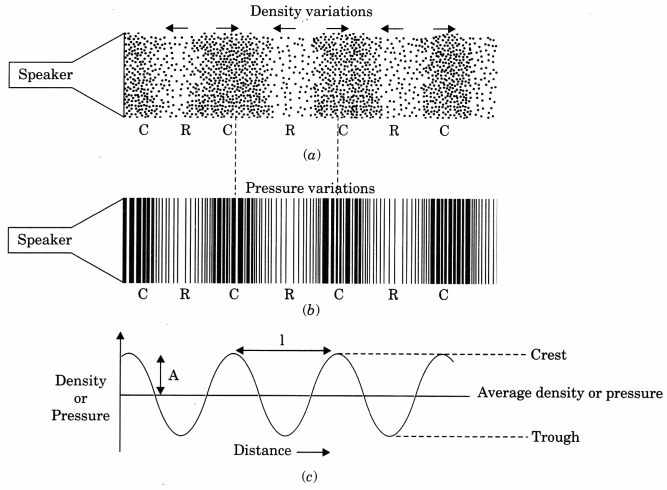
  • The longitudinal wave of sound travels in the form of compression and rarefaction. Compression is the region of high pressure and rarefaction is the region of low pressure.
  • The propagation of sound can be visualised as propagation of density variations or pressure variation in the medium.

4. Sound needs a medium to travel
Sound is a mechanical wave and need a material medium for its propagation.

  • Longitudinal wave
    A wave in which the particles of the medium oscillate to and fro in the same direction in which the wave is moving is called longitudinal wave.
  • Transversal wave
    A wave motion is said to transverse if the particles of the medium through which the wave propagates vibrate in the direction perpendicular to the direction of propagation of the wave.

5. Some important terms and Relations for longitudinal wave
Frequency: The frequency of wave is defined as the number of waves produced per second.
Or
The frequency of a sound wave is defined as the number of complete oscillations made by the particle of medium in one second.

  • It is denoted by greek letter u (nu). Its SI unit is hertz (Hz).

(ii) Wavelength: The distance between two consecutive compressions or two consecutive rarefactions is called wavelength.

  • It is usually represented by X (Greek letter lambda). Its SI units is metre (m).

(iii) Time period: The time taken by two consecutive compressions or rarefactions to cross a fixed point is called time period of wave.
Or

  • Time taken by particle of medium to complete one oscillation is known as time period.
  • It is represented by the symbol T. Its SI unit is second (s).

8. Amplitude: The magnitude of the maximum disturbance in the medium on either side of the mean value is called amplitude of wave. It is usually represented by the letter A. For sound its unit will be that of density or pressure.

9. Speed: The speed of sound is defined as the distance which a point on a wave, such as a compression or a rarefraction, travels per unit time.

10. Relations

  • Relation between time period (T) and frequency (u)
    \(T=\frac{1}{v}\)
  • Relation between speed of wave (υ), wavelength (λ) time period (T) and frequency (υ)
    υ = υλ

Sound Class 9 Notes Science Chapter 12 1

Sound propagates as density or pressure variations as shown in (a), (b) and (c) represents graphically the density and pressure variations.

11. Characteristics of a sound wave
We can describe a sound wave by

  • Frequency
  • Amplitude
  • Speed

12. Frequency-pitch:

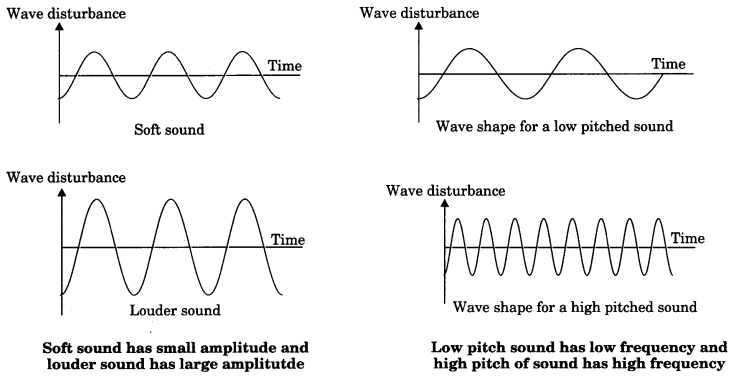
  • How the brain interprets the frequency of an emitted sound is called its pitch. The faster the vibration of the source, the higher is the frequency and the higher is the pitch.
  • The pitch of sound produced by an object of low frequency is low and the source described as flat sound.
  • The pitch of sound produced by an object vibrating with high frequency is high and the sound is described as shrill sound.

13. Amplitude-loudness:

  • The loudness or softness of a sound is determined by its amplitude. Greater the amplitude of vibration of source, greater is the loudness of sound.
  • Loud sound can travel a larger distance as it is associated with high energy.
  • A sound wave moves away from the source, its amplitude as well as its loudness decreases.

14. Quality-timber:

  • The quality or timber of sound is that characteristics which enables us to distinguish one sound from an¬other having same loudness and pitch.
  • A sound of single frequency is called a tone. The sound which is produced due to a mixture of several fre¬quencies is called a note and is pleasant to listen to.
  • Quality of sound is represented by waveform.
  • Noice is unpleasant to ear. Music is pleasant to hear and is of rich quantity.

15. Speed of sound in different media

  • Speed of sound in a medium depends on inertia and elasticity of the medium.
  • Speed of sound increases with increase in temperature.
  • The speed of sound decreases when we go from solid to gaseous state.
    Speed of sound in solids > Speed of sound in liquids > Speed of sound in gases
  • Speed of sound in air is 331 ms-1 at 0°C and 344 ms-1 at 22°C.

Sound Class 9 Notes Science Chapter 12 2

16. Reflection of sound
Sound is reflected in same way as light. Incident and reflected ray make equal angles with the normal to the reflecting surface at the point of incidence and three are in the same plane.

17. Echo
An echo is the phenomenon of repetition of sound by reflection from an obstacle.

  • The sensation of sound lasts in brain for (1/10) of a second. This property is called persistence of hearing. To hear a distinct echo the time interval between the original sound and the reflected one must be at least
    0. 1 second.
  • For hearing a distinct echo, the minimum distance of the obstacle from the source of sound should be 17.2 m.

Take speed of sound = 344 m/s
(at temperature 20°C)
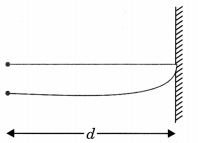
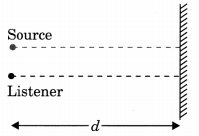
2d = v x t
v = 344 m/s
\(t=\frac{1}{10} \mathrm{s}\)
d=17.2m
Sound Class 9 Notes Science Chapter 12 3

18. Reverberation
A sound created in a big hall will persist by repeated reflection from the walls until it is reduced to a value where it is no longer audible. The repeated reflection that results in the persistence of sound is called reveberation.

Excessive reveberation is highly undesirable. To reduce reverberation, the roof and walls of the auditorium are generally covered with sound absorbent materials like compressed fibre board, rough plaster or draperies. The seat materials are also selected on the basis of their sound absorbing properties.

Reflection of sound
d – distance of person from obstacle
v = velocity of sound
t = time after echo is heard
2d = v x t
t = 2 dlv and d = vt/2
Sound Class 9 Notes Science Chapter 12 4

19. Uses of multiple reflection of sound
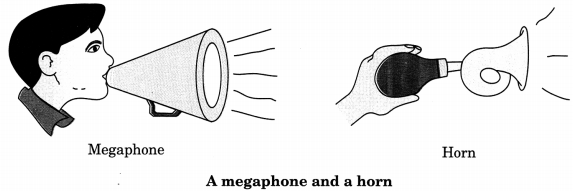
(i) Megaphones, horns, musical instruments such as trumpets and shehnais are all designed to send sound in a particular direction. In these instruments, a tube followed by a conical opening reflects sound successively to guide most of sound successively to guide most of sound from the source in the forward direction towards the audience.
Sound Class 9 Notes Science Chapter 12 5

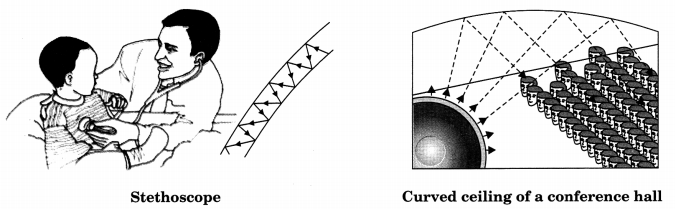
2. Stethoscope is a medical instrument used for listening to sounds produced within the body, chiefly in the heart or lungs
Sound Class 9 Notes Science Chapter 12 6
In stethoscopes the sound of the patient’s heartbeat reaches the doctor’s ears by multiple reflection of sound.

3. Generally the ceiling of concert halls, conference halls and cinema halls are curved so that sound after reflection reaches all corners of the hall.
Sometimes curved sound board may be placed behind of the stage so that the sound after reflecting from the sound board, spreads evenly across the width of the hall.

20. Range of Hearing

  • Audible range: The sound whose frequency lies between 20 Hz and 20,000 Hz which we are able to hear is called audible sound.
    Inaudible range
  • Infrasonic sound: Sound of frequencies below 20 Hz is called infrasonic sound or infra sound.
  • Ultrasonic sound: Frequency higher than 20 KHz is called ultrasonic sound or ultrasound.

21. Uses of Ultrasound in Communication
Sonar
The acronym sonar stands for sound navigation and ranging.
Sonar is a device that uses ultrasonic waves to measure the distance, direction and speed of underwater objects.

22. Components of sonar system
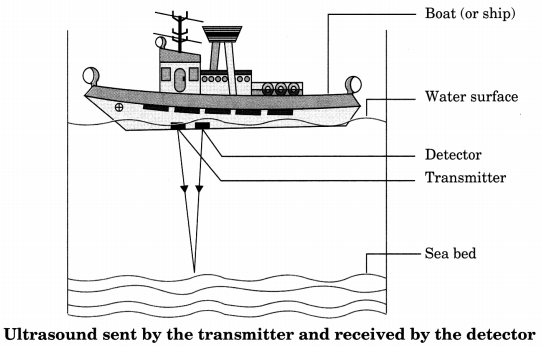
Sonar consists of a transmitter and a detector and is installed in a boat or a ship.

23. Working
The transmitter produces and transmits ultrasound waves. These waves travel through water and after striking the object on the sea bed, get reflected back and are sensed by the detector. The detector converts the ultrasonic waves into electrical signals which are appropriately interpreted.

24. Calculation of distance : The distance of the object that reflected the sound wave can be calculated by knowing the speed of sound in water and the time interval between transmission and reception of the ultrasound
Sound Class 9 Notes Science Chapter 12 7
Let the time intervel between transmission and reception of ultrasound signal be t and speed of sound through sea water be υ. The total distance, 2d, travelled by the ultrasound.

  • Rhinoceroses communicate using infra sound of frequency as low as 5 Hz.
  • Whales and elephants produce sound in infrasonic wave.
  • Children under five and some animals, such as dogs can hear infrasonic sound.

Earthquake produces infrasonic waves.

  • Ultrasound is produced by dolphines, bats and porpoises. R
  • Moths of certain families can hear high frequency waves.

25. Application of Ultrasound
Industrial uses of ultrasound

(i) Cleaning instruments and electronic components
Ultrasound is generally used to clean parts located in hard to reach places, for example, spiral tube, odd shaped parts, electronic component, etc. Objects to be cleaned are placed in a cleaning solution and ultrasonic waves are sent into the solution. Due to the high frequency, the particles of dust, grease and dirt get detached and drop out. The objects are thus thoroughly cleaned.

(ii) Detecting flaw and cracks in metal blocks
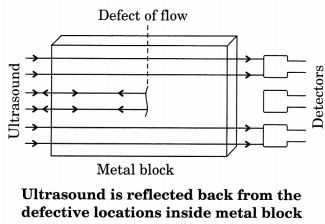
Ultrasounds can be used to detect crack and flaws in metal blocks. Metallic components are generally used in the construction of big structures like buildings, bridges, machines and also scientific equipments. The cracks or holes inside the metal blocks, which are invisible from outside reduces the strength of the structure. Ultrasonic waves are allowed to pass through the metal block and detectors are used to detect the transmitted waves. If there is even a small defect, the ultrasound gets reflected back indicating the presence of flaws or defect.

Medical uses of ultrasound
(i) Ultrasonography: The technique of obtaining of images of internal organs of the body by using ultrasonic waves is called ultrasonography. An ultrasound scanner is a medical instrument which is used by doctors to detect abnormalities such as stones in gall bladder and kidney or tumours in different organs. In this technique, the ultrasound scanner produces ultrasounds which travel through the tissues of the body, and if there are stones in the gall bladder or kidney or there is tumour in any internal organ, then the ultrasound waves get reflected from these regions due to the change in tissue density. These reflected ultrasound waves are converted into electrical signals and fed to the computer generating a three dimension images of the organ on the monitor of the computer.

Sound Class 9 Notes Science Chapter 12 8

(ii) Echocardiography: The technique of obtaining images of the heart by using reflection of ultrasonic waves from various parts of the heart is called echocardiography.

(iii) Breaking of kidney stones: Ultrasound can be used to break small stones formed in the kidney into fine grains. These grains later get flushed out of with urine.
2d = v x t

(iv) Use of ultrasound by bats for determining distance
Bats search out prey and fly in dark night by emitting and detecting reflections of ultrasonic waves. The high pitched ultrasonic squeaks of the bat are reflected from the obstacles or prey and returned to bat’s ear. The nature of reflection tells the bat where the obstacle or pray is and what it is like.

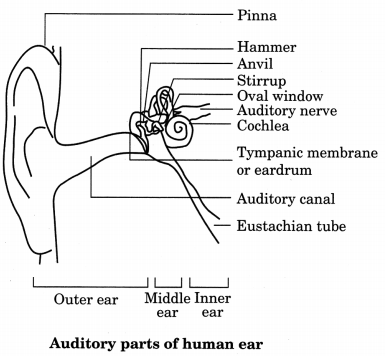
26. Structure of the Human Ear
Introduction
The outer ear is called ‘pinna’. It collects the sound from the surroundings. The collected sound passes through the auditory canal. At the end of the auditory canal there is a thin membrane called the eardrum or tympanic membrane. When compression of the medium reaches the eardrum the pressure on the outside of the membrane increases and forces the eardrum inward.
Sound Class 9 Notes Science Chapter 12 9
Similarly, the eardrum moves outward when a rarefraction reaches it. In this way the eardrum vibrates. The vibrations are amplified several times by three bones (the hammer, anvil and stirrup) in the middle ear. The middle ear transmits the amplified pressure variations received from the sound wave to the inner ear. In the inner ear, the pressure variations are turned into electrical signals by the cochlea. These electrical signals are sent to the brain via the auditory nerve, and the brain interprets them as sound.

PartsFunction
1. PinnaCollects sound from surroundings
2. Hammer, anvil and stirrupAmplifies vibration or pressure wave
3. CochleaConverts pressure variation into electrical signal
4. EardrumThin membrane vibrates when sound reaches inside ear
5. Auditory nerveElectrical signals are sent to brain from cochlea via auditory nerve.

Class 9 Science Chapter 12 Notes Important Terms

Sound: Sound is a form of energy which produces a sensation of hearing in our ears.

Longitudinal wave: A wave in which the particles of the medium oscillate to and fro in the same direction in which the wave is moving is called longitudinal wave.

Transverse wave: A wave in which particles of the medium vibrate at right angles to the direction of the propagation of the the wave.

Echo: The repetition of sound caused by the reflection of sound waves is called an echo.

Reverberation: The persistence of sound in a big hall due to repeated reflection of sound from the walls, ceiling and floor of the hall is called reverberation.

Stethoscope: Stethoscope is a medical instrument used for listening to sounds produced within the body, chiefly in the heart or lungs.

Sonar: Sonar is a device that uses ultrasonic wave to measure the distance, direction and speed of underwater object.

ultrasonography: The technique of obtaining images of internal organs of the body by using echoes of ultrasound wave is called ultrasonography.

Echo cardiography: The technique of obtaining images of the heart by using reflection of ultrasonic waves from various parts of the heart is called echo cardiography.

Work, Power And Energy Class 9 Notes Science Chapter 11

Work, Power And Energy Class 9 Notes

On this page, you will find Work, Power And Energy Class 9 Notes Science Chapter 11 Pdf free download. CBSE NCERT Class 9 Science Notes Chapter 11 Work, Power And Energy will seemingly help them to revise the important concepts in less time.

CBSE Class 9 Science Chapter 11 Notes Work, Power And Energy

Work, Power And Energy Class 9 Notes Understanding the Lesson

1. Work done by a constant force
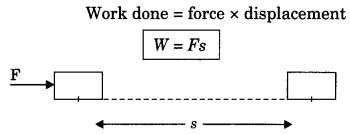
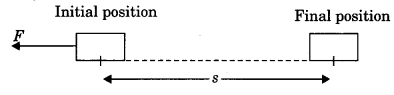
Work done by a force acting on an object is equal to the magnitude of the force multiplied by the distance moved in the direction of the force.
Work done = force x displacement
Work, Power And Energy Class 9 Notes Science Chapter 11 1

  • Work done has only magnitude and no direction i.e., work is a scalar quantity.
  • SI unit of work is joule (J).
  • 1 joule (one joule)

W = Fs
If F = 1 N and s = 1 m
W= 1 N x 1 Nm
W =  1 Nm
1j =1 Nm
1 J is the amount of work done on an object when a force of 1 N displaces it by 1 m along the line of action of the force.

2. Conditions that need to be satisfied for work to be done

  • Force should act on an object.
  • The object must be displaced.

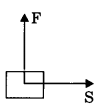
3. Zero work, Positive and Negative work
(i) Zero work: If the angle between force and displacement is 90°, then work done is said to be zero work.
Example: When a man carries a load on his hand and moves on a level road, work done by the man on the load is zero.
Work, Power And Energy Class 9 Notes Science Chapter 11 2

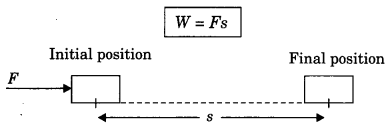
(ii) Positive work: Work done is said to be positive if force applied on an object and displacement are in the same direction.
Work, Power And Energy Class 9 Notes Science Chapter 11 3
Example: Work done by the force of gravity on a falling body is positive.

(iii) Negative work: Work done is said to be negative if the applied force on an object and displacement are in opposite direction.
W = -Fs
Here displacement is taken to be negative (-s).
Work, Power And Energy Class 9 Notes Science Chapter 11 4

Example: Work done by friction force is usually negative on a moving body.

4. Energy
Energy of a body is defined as the capacity or ability of a body to do work.
The SI unit of energy is joule (J) (unit of energy and work is same).

5. Forms of energy
There are various forms of energy in the nature, few of them are mechanical energy (potential energy + kinetic energy) heat energy, chemical energy and light energy.

6. Mechanical energy
Mechanical energy includes kinetic energy and potential energy.

7. Kinetic energy
The energy possessed by a body by the virtue of its motion is called kinetic energy.
Kinetic energy possessed by a body can be calculated by
\(E_{K}=\frac{1}{2} m v^{2}\)
m = mass of body
V = velocity of body

8. Derivation of kinetic energy (work energy theorem)
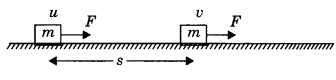
Let us consider an object lying on a frictionless surface having mass ‘m’
Work, Power And Energy Class 9 Notes Science Chapter 11 5
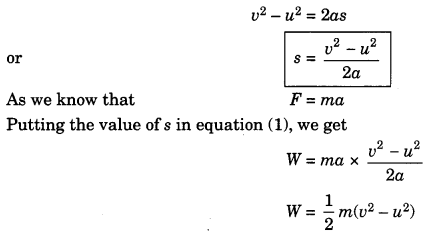
A force of constant magnitude F is acting on the body. Here initial velocity of the body is u and final velocity is v. As there is no dissipative forces, work done on the body will be stored in the form of change in kinetic energy.
W=Fs
Work, Power And Energy Class 9 Notes Science Chapter 11 6
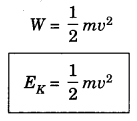
If the object is starting from a stationary position u = 0, then
Work, Power And Energy Class 9 Notes Science Chapter 11 7

9. Potential energy
The energy possessed by a body due to its position or configuration is called potential energy.

10. Gravitational potential energy
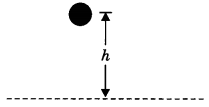
Potential energy at any height (h) from a reference can be calculated by formula
Ep = mgh
where, m = mass of object
v = height from reference
The gravitational potential energy of an object at a point above the ground is defined as the work done in raising it from the ground to that point against gravity.
Work, Power And Energy Class 9 Notes Science Chapter 11 8

11. Derivation of potential energy
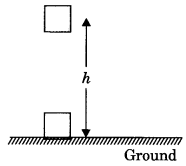
When work is done on the body, the work is stored in the form of energy. Consider an object of mass, m. Let it be raised through a height, h from the ground. A force is required to do this. The minimum force required to raise the object is equal to the weight of the object, mg. The object gains energy equal to the work done on it. Let the work done on the object against gravity be W.
Work, Power And Energy Class 9 Notes Science Chapter 11 9
That is W = force x displacement
= mgh .
Since work done on the object is equal to mgh, an energy equal to mgh units is gained by the object. This is the potential energy (Ep) of the object.
Ep = mgh

12. Law of conservation of energy
Energy can neither be created nor be destroyed, it can only be transformed from one form to another. The total energy before and after the transformation always remains constant.

13. Transformation of energy in nature
The change of one form of energy into another form of energy is known as transformation of energy.
Example:

  • Potential energy of water is converted into electricity in dams.
  • Electricity is converted into heat energy in heaters.
  • Chemical energy of fuel is converted into mechanical energy in engines.

14. Conservation of mechanical energy
Mechanical energy is the sum of kinetic energy and potential energy.
If there is no loss, then mechanical energy of a system is always constant.
Potential energy + kinetic energy = constant.
or
\(m g h+\frac{1}{2} m v^{2}=\text { constant }\)

15. Power (P)
Power is defined as the rate of doing work or rate of transfer of energy.
Power = work/time
P=W/T

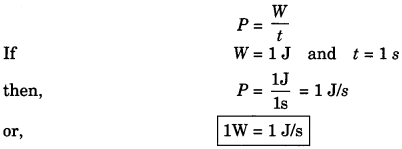
  • Unit of power is watt (W).

16. Watt
Work, Power And Energy Class 9 Notes Science Chapter 11 10

17. Commercial unit of energy
Kilowatt hour (kWh) or 1 unit
The energy used in households, industries and commercial establishments are usually expressed in kilowatt hour.
1 kWh is the energy used in one hour (1 h) at the rate of 1000 J/s or (1 kW).
∴1 kWh =lkWxU = 1000 W x 3600 s = 3600000 J
1 kWh = 3.6 x 10⁶ J = 1 unit

18. Power can also be represented as,
P = Fv
F = force applied
v = velocity of object
\(P=\frac{W}{t}=\frac{F s}{t}=F v\)

Class 9 Science Chapter 11 Notes Important Terms

Work done: Work done by a force acting on an object is equal to the magnitude of the force multiplied by the distance moved in the direction of the force.

Energy: Energy of a body is defined as the capacity or ability of the body to do work.

Mechanical energy: Mechanical energy of a body is the sum of its kinetic energy and potential energy. Kinetic energy: The energy possessed by a body by the virtue of its motion.

Potential energy: The energy possessed by a body due to its position or configuration.

Law of conservation of energy: Energy can neither be created nor be destroyed, it can only be transformed from one form to another.

Conservation of mechanical energy: If there is no loss of energy, then mechanical energy of a system is always constant.

Power: Power is defined as the rate of doing work or rate of transfer of energy.

Commercial unit of energy: The energy used in households, industries and commercial establishment are usually expressed, in kilowatt hour. 1 kWh = 1 unit = 3.6 x 10⁶

Probability Class 10 Notes Maths Chapter 15

Probability Class 10 Notes

On this page, you will find Probability Class 10 Notes Maths Chapter 15 Pdf free download. CBSE NCERT Class 10 Maths Notes Chapter 15 Probability will seemingly help them to revise the important concepts in less time.

CBSE Class 10 Maths Chapter 15 Notes Probability

Probability Class 10 Notes Understanding the Lesson

Theoretical probability: The theoretical (or classical) probability of an event E [denoted by P(E)] is given by
\(\mathrm{P}(\mathrm{E})=\frac{\text { Number of outcomes favourable to } \mathrm{E}}{\text { Number of all possible outcomes of the experiment }} \text { i.e., } \frac{n(\mathrm{A})}{n(\mathrm{S})}\)

Number of all possible outcomes of the experiment when the outcomes of the experiment are equally likely.

Equally likely outcomes: All the outcomes of an experiment are said to be equally likely when the chances of there occurrence are equal.
e.g. When a coin is tossed, the two possible outcomes are head and tail, which are equally likely.

Elementary event: An outcome of a random experiment is called an elementary event. e.g. In tossing a coin, possible outcomes are head and tail.
⇒ H and T are elementary events.

  • The sum of the probabilities of all the elementary events of an experiment is 1.
  • For an events E, P(E) + P(\(\overrightarrow{\mathrm{E}}\)) = 1, where \(\overrightarrow{\mathrm{E}}\) is the event ‘Not E’. E and \(\overrightarrow{\mathrm{E}}\) are called complementary events.
  • If P(E) = 1, then E is called ‘sure or certain event’.
  • If P(E) = 0, then E is impossible event.
  • For any event E,
    0 < P(E) <1