Tissues Class 9 Notes Science Chapter 6

Tissues Class 9 Notes

On this page, you will find Tissues Class 9 Notes Science Chapter 6 Pdf free download. CBSE NCERT Class 9 Science Notes Chapter 6 Tissues will seemingly help them to revise the important concepts in less time.

CBSE Class 9 Science Chapter 6 Notes Tissues

Tissues Class 9 Notes Understanding the Lesson

1. A single cell performs all the basic functions like digestion, respiration, excretion, etc. in order to sustain life in the unicellular organisms like Amoeba. In multicellular organisms like human beings, each specialised function to sustain life is taken up by a different group of cells.

2. Division of labour: The multicellular organisms show division of labour as each function is carried out by a cluster of specialised cells at a definite place in the body.
For example:
In human beings, muscle cells contract and relax to cause movement, nerve cells carry messages, blood flows to transport oxygen, etc. In plants, vascular tissues called xylem and phloem conduct water and food respectively from one part of the plant to the other parts.

3. Tissue: A group of cells that are similar in structure and/or work together to achieve a particular function forms a tissue. Example: Blood, phloem and muscle. Plant tissues are classified as growing or meristematic tissue and permanent tissue.

4. Meristematic tissue: This tissue consists of cells which continuously divide to produce new cells. The cells of this tissue are very active, lack vacuoles, have dense cytoplasm, thin cellulosic cell walls and prominent nuclei.

5. Location of meristematic tissue: This tissue is present only at specific regions of the plant like the root tip, shoot tip and at the base of intemodes and leaves.

6. Types of meristematic tissue: They are classified as apical, lateral and intercalary meristematic tissue based on the region where they are present.

  • Apical meristem: It is present at the growing tips of stems and roots and results in increase in the length of the stem and the root.
  • Lateral meristem (cambium): It helps to increase the girth of the stem or root.
  • Intercalary meristem: It is present at the base of the leaves or intemodes.

5. Permanent tissue: Consists of cells which have taken up a specific role and lost the ability to divide.
It is of two types:

  • Simple tissue: It is made up of only one type of cells. Its three types are: parenchyma, collenchyma and sclerenchyma.
  • Complex tissue: It is made up of more than one type of cells. They are the conducting tissues called xylem and phloem.

6. Differentiation: The process of taking up a permanent shape, size, and a function by the cells is called differentiation.

7. Types of simple tissue:
(a) Parenchyma: They are loosely packed living cells, with thin cell walls and large intercellular spaces. They provide support to plants and store food. It is called chlorenchyma if it contains chlorophyll and performs photosynthesis. The parenchyma of aquatic plants have large cavities to provide buoyancy to the plants to help them float. Such type of parenchyma is called aerenchyma.

(b) Collenchyma: It consists of living, elongated cells that are irregularly thickened at the corners and have a very little intercellular space. It allows easy bending in various parts of a plant (leaf, stem) without breaking. It also provides mechanical support to plants like in the leaf stalks below the epidermis.

(c) Sclerenchyma: This tissue consists of dead cells which makes the plant hard and stiff. The cells are long and narrow as the walls are thickened (often so thick that there is no internal space inside the cell) due to lignin (a chemical substance which acts as cement and hardens them). This tissue provides strength to the plants and is present in stems, around vascular bundles, in the veins of leaves and in the hard covering of seeds and nuts.

8. Epidermis: The outermost layer of cells covering an organism is called epidermis. It is usually made up of a single layer of cells and gives protection. The epidermis may be thicker in some plants living in dry habitats or often secrete a waxy, water-resistant layer on their outer surface called cutin (chemical substance with waterproof quality) to prevent water loss.

The epidermis of leaves have small pores called stomata which are enclosed by two kidney shaped cells called guard cells. Stomata help in gaseous exchange and transpiration. The epidermal cells of roots bear root hairs that greatly increase the total absorptive surface area of the roots for absorption of water.

9. Cork: A strip of secondary meristem replaces the epidermis of the older stem and cuts off cells towards outside to form a several-layer thick cork or the bark of the tree. Cells of cork are dead, compactly arranged without intercellular spaces and have a chemical called suberin in their walls that makes them impervious to gases and water.

10. Complex Permanent Tissue: These tissues are made of more than one type of cells which coordinate to perform a common function, e.g., Xylem and phloem. They are mainly conducting tissues and constitute a vascular bundle.

(a) Xylem: Xylem consists of tracheids, vessels, xylem parenchyma and xylem fibres. All the cells of xylem except the xylem parenchyma are dead. Xylem helps to transport water and minerals. Tracheids and vessels help in vertical transport whereas the parenchyma stores food and helps in the sideways conduction of water. Fibres are mainly supportive in function.

(b) Phloem: Phloem has four elements called sieve tubes, companion cells, phloem fibres and the phloem parenchyma. All cells of phloem are living except the phloem fibres. Phloem transports food from leaves to other parts of the plant.

11. Animal Tissues: The animal tissues are of four types: epithelial tissue, connective tissue, muscular tissue and nervous tissue.

12. Epithelial Tissue: They are the covering or protective tissues and cover most organs and cavities in the animal body. These cells are tightly packed, form a continuous sheet and are almost without any intercellular spaces between them. e.g., skin, the lining of the mouth, the lining of blood vessels, lung alveoli and kidney tubules are all made of epithelial tissue. All epithelium is usually separated from the underlying tissue by an extracellular fibrous basement membrane. The types of epithelium on the basis of their structure and functions are:

(a) Squamous epithelium: Consists of flattened cells. Present in oesophagus and lining of the mouth. Skin epithelial cells are arranged in many layers to prevent wear and tear and are called as stratified squamous epithelium.

(b) Columnar epithelium: Has tall or ‘pillar-like’ cells. It forms inner lining of the intestine.

(c) Cuboidal epithelium: Has cube-shaped cells. It forms the lining of kidney tubules and ducts of salivary glands, where it provides mechanical support.

(d) Ciliated epithelium: Have cilia on the outer surfaces of epithelial cells. The cilia can move and their movement pushes the mucus in the respiratory tract forward to clear it.

(e) Glandular epithelium: Has gland cells which secrete substances at the epithelial surface.

13. Connective Tissue: The cells of connective tissue are loosely spaced and embedded in an intercellular matrix which may be jelly like, fluid, dense or rigid, e.g., blood, bone, cartilage, etc.

(a) Blood: It has a fluid (liquid) matrix called plasma having red blood cells (RBCs), white blood cells (WBCs) and platelets. Blood helps in the transport of gases, digested food, hormones and waste materials to different parts of the body.

(b) Bone: It has bone cells embedded in a hard matrix composed of calcium and phosphorus compounds. It is a strong and non-flexible tissue which forms a framework that supports the body, anchors the muscles and supports the main organs of the body.

(c) Cartilage: It has widely spaced cells and a solid matrix composed of proteins and sugars. It helps to smoothen bone surfaces at joints and is also present in the nose, ear, trachea and larynx.

(d) Areolar connective tissue: It fills the space inside the organs, supports internal organs and helps in repair of tissues. It is found between the skin and muscles, around blood vessels and nerves and in the bone marrow.

(e) Adipose tissue: It is a fat storing tissue having cells filled with fat globules. It is found below the skin and between the internal organs.

(f) Ligament: It is the connective tissue which connects two bones. This tissue has very little matrix, is very elastic and has considerable strength.

(g) Tendon: It is the connective tissue which connects muscles to bones. It is a fibrous tissue with great strength but limited flexibility.

14. Muscular Tissue: This tissue is responsible for movement in our body and consists of elongated cells, also called muscle fibres. Muscles contain special proteins called contractile proteins, which contract and relax to cause movement.

(а) Striated Muscles: These muscles are also called skeletal muscles as they are mostly attached to bones and help in body movement. These muscles show alternate light and dark bands. These are long, cylindrical, unbranched and multinucleate. These are voluntary muscles as we can move them by conscious will, e.g., muscles of our limbs.

(b) Unstriated Muscles: They are also called smooth muscles or unstriated muscles as they do not have light and dark bands. The cells are long, uninucleate, involuntary in nature and spindle shaped. They are present in iris of the eye, ureters, blood vessels, alimentary canal and bronchi of lungs.

(c) Cardiac Muscles: These are the muscles of the heart which show rhythmic contraction and relaxation throughout life. They are involuntary, cylindrical, branched and uninucleate.

15. Nervous Tissue: The cells of this tissue are called nerve cells or neurons. Each neuron consists of a cell body with a nucleus and cytoplasm, a single long part called the axon, and many short branched parts called dendrites. The cells of the nervous tissue are highly specialised for transmitting the stimulus from one place to another within the body on being stimulated. The brain, spinal cord and nerves are composed of the nervous tissue. A nerve consists of many nerve fibres bound together by connective tissue.

Class 9 Science Chapter 6 Notes Important Terms

Tissue: A group of cells that are similar in structure and/or work together to achieve a particular function.

Meristematic tissue: This tissue that consists of cells which continuously divide to produce new cells.

Permanent tissue: The tissue which consists of cells which have taken up a specific role and lost the ability to divide.

Differentiation: The process of taking up a permanent shape, size, and a function by the cells is called differentiation.

Chlorenchyma: Parenchyma which contains chlorophyll and performs photosynthesis.

Aerenchyma: Parenchyma which contains large cavities to provide buoyancy to the aquatic plants to help them float.

Cambium: It is a lateral meristem which helps in increasing the girth of the stem or root.

Lignin: A chemical substance which acts as cement and hardens the cells of sclerenchyma.

Cutin: A chemical substance with waterproof quality present in epidermis of leaves to prevent water loss by transpiration.

Suberin: A chemical present in the walls of cork cells that makes them impervious to gases and water.

Adipose tissue: It is a fat storing tissue having cells filled with fat globules.

Ligament: It is the connective tissue which connects two bones. This tissue has very little matrix, is very elastic and has considerable strength.

Tendon: It is the connective tissue which connects muscles to bones. It is a fibrous tissue with great strength but limited flexibility.

Contractile proteins: Special proteins present in muscles which contract and relax to cause movement of body parts.

Nerve: A nerve consists of many nerve fibres bound together by connective tissue.
Surface Areas and Volumes Class 10 Notes Maths Chapter 13

Surface Areas and Volumes Class 10 Notes

On this page, you will find Surface Areas and Volumes Class 10 Notes Maths Chapter 13 Pdf free download. CBSE NCERT Class 10 Maths Notes Chapter 13 Surface Areas and Volumes will seemingly help them to revise the important concepts in less time.

CBSE Class 10 Maths Chapter 13 Notes Surface Areas and Volumes

Surface Areas and Volumes Class 10 Notes Understanding the Lesson

Surface area: Surface area of an object is the measure of the total area that the surface of an object occupies.

Volume: Volume of an object is the measure of space occupied by the object.

Basic Solids: In standard X, we have studied the surface area and volume of solids. Here we will study more about them.

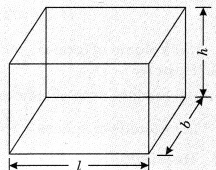
1. Cuboid
(i) Surface area of cuboid = 2(lb + bh + lh) sq.unit
where l is the length
b is the breadth
h is the height

Surface Areas and Volumes Class 10 Notes Maths Chapter 13 1

(ii) Area of four walls of cuboid
= 2(l + b) x h
= [Perimeter of floor x Height] sq. unit

(iii) Surface area of cuboid without roof or lid
= lb + 2 [bh + Ih] sq. unit

(iv) Volume of cuboid = l x b x h unit

(v) Diagonal of cuboid or length of longest rod kept =\(\sqrt{l^{2}+b^{2}+h^{2}}\)unit

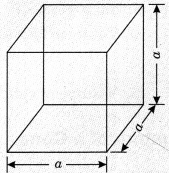
2. Cube
Let each edge of a cube be of length a unit. Then
(i) Surface area of cube = 6 side2 = 6a2 unit
Surface Areas and Volumes Class 10 Notes Maths Chapter 13 2
(ii) Surface area of four walls of cube = 4 side2
= 4a2 sq. unit

(iii) Surface area of a cube without lid (or rod) of a cube
= 5a2 sq. unit.

(iv) Length of longest diagonal (or rod) of a cube
\(=\sqrt{a^{2}+a^{2}+a^{2}}=\sqrt{3}\) aunit

(v) Volume of cube = a3 unit

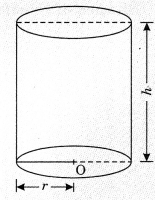
3. Cylinder

(i) Curved surface area of cylinder = 2πr x h
= Perimeter of base x height sq. unit

(ii) Total surface area of cylinder
= CSA + Area of 2 circular ends of cylinder
= 2πrh + 2πr2 = 2πr (r + h)
Surface Areas and Volumes Class 10 Notes Maths Chapter 13 3

(iii) Volume of cylinder =πr2h

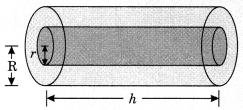
(iv) Volume of material in hollow pipe = Exterior volume – Interior volume
= πR2h – πr2h = πh [R2 – r2]

(v) Total surface area of hollow cylinder
= CSA of outer and inner cylinder + 2(area of base ring)
= 2πRh + 2πrh + 2(πR2 – πr2)
= 2π(R + r)h + 2π(R2 – r2) = 2π(R + r) (h + R – r)
Surface Areas and Volumes Class 10 Notes Maths Chapter 13 4

Note:

  • Two ends of cylinder are circles having each area = πr2
  • Mass of cylinder = Volume of cylinder x Density
    M = V x ρ

4. Cone

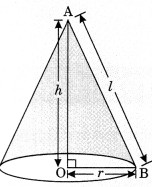
h – OA = height of cone
r = OB = radius of cone
l = AB = slant height of cone

Surface Areas and Volumes Class 10 Notes Maths Chapter 13 5

(i) \(l=\sqrt{r^{2}+h^{2}}\) units

(ii) Curved surface area of cone or lateral
surface area of cone = πrl sq. unit

(iii) Total surface area of cone = CSA + Area of circular base
= πrl + πr2 – πr(r + l) sq. unit

Surface Areas and Volumes Class 10 Notes Maths Chapter 13 6

(iv) Volume of cone =\( \frac{1}{3}\) πr2h cu.unit

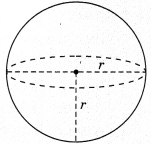
5. Sphere

  • Surface area of sphere = 4πr2 unit
  • Volume of sphere = \( \frac{4}{3}\)cu.unit

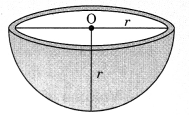
6. Hemisphere

Surface Areas and Volumes Class 10 Notes Maths Chapter 13 7

  • Curved surface area of hemisphere = 4πr2 sq unit
  • Volume of hemisphere = \( \frac{2}{3}\) πr2 cu unit
  • Total surface area of hemisphere = 2πr2 + πr2 = 3πr2 sq. unit

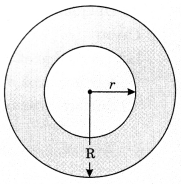
7. Spherical shell

(i) Total surface area of spherical shell = 4πR2 + 4πr2
= 4πr(R2 + r2) sq. unit
Surface Areas and Volumes Class 10 Notes Maths Chapter 13 8

(ii) Volume of spherical shell = \( \frac{4}{3}\)π(R3– r3) cu . unit

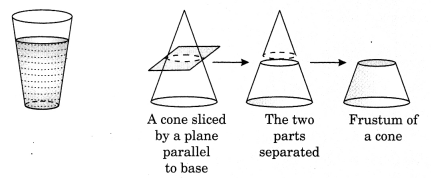
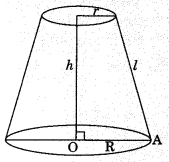
Shapes of Frustum
Surface Areas and Volumes Class 10 Notes Maths Chapter 13 9

(i) Slant height of frustum = \(\sqrt{(\mathrm{R}-r)^{2}+h^{2}}\) unit
(ii) Curved surface area of frustum = π(R + r)l sq. unit
(iii) Total surface area of frustum of cone
= πl (R + r) + πR2 + πr2 sq. unit
Surface Areas and Volumes Class 10 Notes Maths Chapter 13 10

(iv) Volume of frustum of cone = \(\frac{1}{3}\)πh (R2 + r2 + Rr) sq. unit

Volume of Combination Solids

The volume of the solid formed by joining two basic solids will actually be the sum of the volumes of the two basic solids.

Conversion of Solid from One Shape to Another

If we melt the candle in the shape of cylinder and pour it into a conical vessel, then it changes into the conical shape. Thus, volume of cylindrical candle = Volume of conical solid.

The Fundamental Unit of Life Class 9 Notes Science Chapter 5

The Fundamental Unit of Life Class 9 Notes

On this page, you will find The Fundamental Unit of Life Class 9 Notes Science Chapter 5 Pdf free download. CBSE NCERT Class 9 Science Notes Chapter 5 The Fundamental Unit of Life will seemingly help them to revise the important concepts in less time.

CBSE Class 9 Science Chapter 5 The Fundamental Unit of Life

The Fundamental Unit of Life Class 9 Notes Understanding the Lesson

1. Robert Hooke: In 1665, he discovered cell in a thin slice of cork (bark of cork tree) by using a self designed microscope. The structure consisted of many little compartments which resembled the structure of a honeycomb. He called boxes as ‘cell’ which is Latin word for ‘a little room’.

2. Leeuwenhoek: In 1674, discovered the free-living cells in pond water for the first time by using an improved microscope.

3. Robert Brown: In 1831, discovered the nucleus in the cell.

4. Piirkinje: In 1839, coined the term ‘protoplasm’ for the fluid substance of the cell.

5. Schleiden (1838) and Schwann (1839): Put forth the cell theory, which said that:

  • all the plants and animals are composed of cells and
  • cell is the basic unit of life.

6. Virchow: In 1855, expanded the cell theory by suggesting ‘Omni cellula-e-cellula’ which means all cells arise from pre-existing cells.

7. Unicellular organisms: Organisms which have only a single cell, e.gAmoeba, Paramecium, Chlamydomonas, bacteria, etc.

8. Multicellular organisms: Organisms which consist of more than one cell e.g., Plants, animals, fungi, etc.

9. Cell division: It is the process by which a cell divides to form new cells. This supports the fact that, all cells arise from the existing cells.

10. The shape and size of cells are related to the specific function they perform: Amoeba can change its shape as per the conditions or its need whereas for most of the other cases, the cell shape is more or less fixed, e.g., nerve cells have a typical shape.

11. Division of Labour: In all multicellular organisms there is a division of labour. This means that different parts of the body perform different functions. For example, the stomach helps in digestion; blood is pumped by the heart, etc. Division of labour can also be seen within a single cell.

12. Three main parts of a cell: Most cells (excluding bacteria) have three main parts:

  • Plasma membrane/Cell Membrane
  • Nucleus
  • Cytoplasm

13. Plasma Membrane or Cell Membrane

  • It is the outermost covering of the cell.
  • It separates the contents of the cell from its external environment.
  • It is mainly composed of lipids and proteins.
  • It is called selectively permeable as it permits the entry and exit of only some materials in and out of the cell.

14. Diffusion: The movement of a substance from a region of its high concentration to the region of its low concentration is called diffusion. Diffusion helps in gaseous exchange between the cells as well as the cell and its external environment.

15. Osmosis: The spontaneous movement of water molecules from a region of its high concentration to the region of its low concentration through a selectively permeable membrane is called osmosis.

Effect on animal cell or a plant cell put into a solution of sugar or salt in water

Kind of solutionNature of surrounding mediumEffect on cellResult
Hypotonic solutionMedium surrounding the cell has a higher water concentration than the cell (outside solution is very dilute).Water will enter the cell by osmosis.Cell is likely to swell up.
Isotonic solutionMedium surrounding the cell has exactly the same water concentration as the cell.There is no overall movement of water.Cell will stay the same size.
Hypertonic solutionMedium surrounding the cell has a lower concentration of water than the cell (very concentrated solution).Cell will lose water by osmosis.Cell will shrink.

16. Cell Wall

  • It is a rigid outer covering which lies outside the plasma membrane.
  • It is made of cellulose which provides structural strength to plants.
  • The shrinkage or contraction of the contents of the cell away from the cell wall when a living plant cell loses water through osmosis is known as plasmolysis.

17. Nucleus

  • It is a dark coloured, spherical or oval, dot-like structure near the centre of each cell.
  • It is the control centre of the cell as it controls all the activities of the cell.
  • It has a double-layered covering called nuclear membrane.
  • The nuclear membrane has pores which allow the transfer of materials from inside the nucleus to its outside, that is, to the cytoplasm.
  • The nucleus plays a central role in cellular reproduction (process by which a single cell divides and forms two new cells).
  •  Nucleus along with the environment directs the chemical activities of the cell to determine the way the cell will develop and the form it will exhibit at maturity.
  • Nuclear region of the cell may be poorly defined due to the absence of a nuclear membrane in some organisms like bacteria. Such an undefined nuclear region containing only nucleic acids is called a nucleoid.

18. Chromosomes

  • The nucleus contains chromosomes, which are visible as rod-shaped structures only when the cell is about to divide.
  • Chromosomes contain information for inheritance of features from parents to next generation in the form of DNA (Deoxyribo Nucleic Acid) molecules.
  • Chromosomes are composed of DNA and protein.

19. Genes
Functional segments of DNA are called genes.
Chromatin Material:

  • DNA is present as part of chromatin material in the cells which are not dividing.
  • Chromatin material is visible as entangled mass of thread-like structures.
  • Chromatin material gets organised into chromosomes, when the cell is about to divide.

20. Types of organisms on the basis of the nature of nucleus and nuclear membrane

ProkaryotesEukaryotes
(i) Organisms whose cells lack a well defined
nuclear membrane.
(i) Organisms with cells having a well defined nuclear membrane.
(ii) They lack membrane bound cell organelles.(ii) They have membrane bound cell organelles.
(iii) Size is generally small (1-10 pm).(iii) Size is generally large (5-100 pm).
(iv) Have a single chromosome.(iv) Have more than one chromosome.

20. Cytoplasm

  • It is the fluid content enclosed by the plasma membrane.
  • It contains many specialised cell organelles.

21. Cell Organelles
Cell organelles are parts of the cell which are specialised for carrying out one or more vital functions, analogous to the organs of the human body.

22. A. Endoplasmic Reticulum (ER)
(i) Consists of a large network of membrane-bound tubes and sheets which appear as long tubules or round or oblong bags (vesicles).

(ii) ER serves as channels for the transport of materials (especially proteins) between various regions of the cytoplasm or between the cytoplasm and the nucleus.

(iii) It also functions as a cytoplasmic framework providing a surface for some of the biochemical activities of the cell.

(iv) ER are of two types:
Rough endoplasmic reticulum (RER) and
Smooth endoplasmic reticulum (SER).

(v) Rough endoplasmic reticulum

  • It looks rough as it has particles called ribosomes attached to its surface. Ribosomes are the site of protein synthesis.

(vi) Smooth endoplasmic reticulum

  • It helps in the manufacture of fat molecules, or lipids, important for cell function.
  • Some proteins and lipids made by SER help in building the cell membrane and this process is known
    as membrane biogenesis.
  • Helps in detoxifying many poisons and drugs in the liver cells of the group of vertebrates.

B. Golgi Apparatus

  • First described by Camillo Golgi.
  • It has membrane-bound vesicles arranged approximately parallel to each other in stacks called cisterns.
  • They constitute another portion of a complex cellular membrane system as their membranes often have connections with the membranes of ER.
  •  Its functions include storage, modification and packaging of products in vesicles.
  • Golgi apparatus packages and dispatches the material synthesised near the ER to various targets inside and outside the cell.
  • They are also involved in the formation oflysosomes.

C. Lysosomes

  • They are membrane-bound sacs filled with digestive enzymes made by RER.
  • They are waste disposal system of the cell as they help to keep the cell clean by digesting any foreign material as well as worn-out cell organelles.
  • Lysosomes have powerful digestive enzymes capable of breaking down all organic materials.
  • Lysosomes are also known as the ‘suicide bags’ of a cell because if the cell gets damaged during disturbance in cellular metabolism, the lysosomes may burst and its enzymes digest their own cell.

D. Mitochondria

  • Also known as the powerhouses of the cell as the energy required for various chemical activities needed for life is released by mitochondria in the form of Adenosine triphosphate – ATP (ATP is known as the energy currency of the cell).
  • Mitochondrion is a double-membrane structure whose outer membrane is very porous while the inner
    membrane is deeply folded to form cristae. Cristae are folds which create a large surface area for ATP’ generating chemical reactions.
  • Mitochondria have their own DNA and ribosomes so they can make some of their own proteins.

E. Plastids

  • Plastids are present only in plant cells and are of two types – chromoplasts (coloured plastids) and leucoplasts (white or colourless plastids).
  • Chlorophyll containing plastids are known as chloroplasts and help in photosynthesis.
  • Leucoplasts store starch (amyloplast), oils (elaioplasts) and protein granules (aleuroplasts).
  • The plastids internally consist of numerous membrane layers embedded in a material called the stroma.
  • Plastids have their own DNA and ribosomes so they can make some of their own proteins.

F. Vacuoles

  • Vacuoles are storage sacs for solid or liquid contents like amino acids, sugars, various organic acids and some proteins.
  • Small-sized vacuoles are present in animal cells while plant cells have very large vacuoles. A large central vacuole may occupy 50-90% of the cell volume in some plant cells.
  • The vacuoles are full of cell sap and provide turgidity and rigidity to the cell in plant cells.
  • Food vacuole found in Amoeba contains the food items that the Amoeba has consumed.
  • Contractile vacuole found in some unicellular organisms help in expelling excess water and some wastes f from the cell.

Class 9 Science Chapter 5 Notes Important Terms

Unicellular organisms: They are single-celled organisms, e.g., Amoeba, Paramecium, Chlamydomonas, bacteria, etc.

Multicellular organisms: They are composed of more than one cell, e.g., plants, animals, fungi, etc. Diffusion: The movement of a substance from a region of its high concentration to the region of its low concentration is called diffusion.

Osmosis: The spontaneous movement of water molecules from a region of its high concentration to the region of its low concentration through a selectively permeable membrane is called osmosis.

Hypotonic solution: If the medium surrounding the cell has a higher water concentration than the cell i.e., outside solution is very dilute, then it is called a hypotonic solution.

Isotonic solution: If the medium surrounding the cell has exactly the same water concentration as the cell, then it is called isotonic solution.

Hypertonic solution: If the medium surrounding the cell has a lower concentration of water than the cell i.e., very concentrated solution, then it is called hypertonic solution.

Plasmolysis: The shrinkage or contraction of the contents of the cell away from the cell wall when a living plant cell loses water through osmosis is known as plasmolysis.

Genes: Functional segments of deoxyribonucleic acid (DNA) are called genes.

Prokaryotes: The single celled organisms which lack a well-defined nuclear membrane are called prokaryotes.

Eukaryotes: The single celled or multicellular organisms which have a well defined nuclear membrane are called eukaryotes.

Membrane biogenesis: Some proteins and lipids made by SER help in building the cell membrane and this process is known as membrane biogenesis.

Amyloplast: The starch containing leucoplasts are called amyloplast.

Elaioplast: The oil containing leucoplasts are called elaioplasts.

Aleuroplast: The protein containing leucoplasts are called aleuroplasts.

Areas related to Circles Class 10 Notes Maths Chapter 12

Areas related to Circles Class 10 Notes

On this page, you will find Areas related to Circles Class 10 Notes Maths Chapter 12 Pdf free download. CBSE NCERT Class 10 Maths Notes Chapter 12 Areas related to Circles will seemingly help them to revise the important concepts in less time.

CBSE Class 10 Maths Chapter 12 Notes Areas related to Circles

Areas related to Circles Class 10 Notes Understanding the Lesson

1. Circle: Circle is set of all points in a plane which are at the fixed distance from a fixed point i.e., centre. Centre: Mid-point of a circle is called centre of a circle.

2. Radius: The distance between the centre of a circle to the circumference of the circle.
It is denoted by r or R.

3. Chord: A line segment which joins the two points in the circumference of the circle.

4. Diameter: It is the longest chord which passes through the centre of a circle. It is denoted by d or D.
Diameter = 2 x radius
\(\text { Radius }=\frac{\text { Diameter }}{2}\)

5. Circumference of a Circle (or Perimeter)
A perimeter is a path that surrounds a two dimensional shape.
The perimeter of a circle is called its circumference. Circumference
\(\frac{\text { Circumference }}{\text { Diameter }}=\pi\)
Circumference = n x diameter = π x 2r = 2πr
or
The value of π is \(\frac{22}{7}\) or 3.14 (approximately)

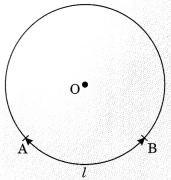
6. Arc: An arc is the part of the circumference of a circle.
An arc AB is denoted as \(\widehat{\mathrm{AB}}\)
Areas related to Circles Class 10 Notes Maths Chapter 12 1
Length of arc AB is l \(\widehat{\mathrm{AB}}\) or l.
Length of an arc of a sector of angle
\(\theta=\frac{2 \pi r \theta}{360^{\circ}}\)

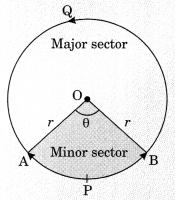
7. Sector: The portion (or part) of circular region enclosed by two radii and the corresponding arc is called a sector of the circle.

8. Minor and Major sector of the circle: Shaded region OAPB is called sector or minor sector of a circle with centre O.
∠AOB is called angle of the sector.

Areas related to Circles Class 10 Notes Maths Chapter 12 2
And OAQB is called major sector.
Angle of major sector = 360° – ∠AOB.

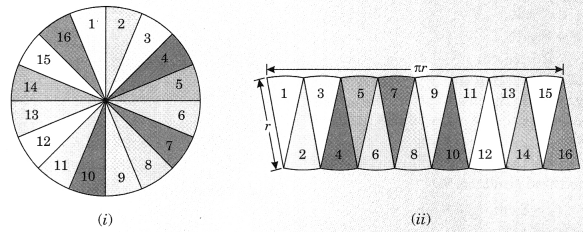
9. Area of Circle
Areas related to Circles Class 10 Notes Maths Chapter 12 3
Let r be the radius of circle. If we cut the circle in sectors and arrange then we see this figure like a rectangle whose length is \(\frac{1}{2}\) 2πr = πr and breadth is r.
Hence,
Area of circle = Area of rectangle
= l x b = \(\frac{1}{2}\) 2πr = r
Area of circle = πr2

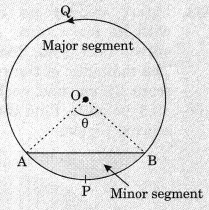
10. Segment: The portion or part of a circular region enclosed between a chord and the corresponding arc is called a segment of the circle.
The shaded region APB is the minor segment.
And the region AQB is the major segment.
Area of circle = πr2
Area of the sector of an angle \(\theta=\frac{\pi r^{2} \theta}{360^{\circ}}\)
Areas related to Circles Class 10 Notes Maths Chapter 12 4
Area of major sector = Area of circle – Area of minor sector
Area of minor segment = Area of sector – Area of ΔOAB\(\frac{\pi r^{2} \theta}{360^{\circ}}\)– area of ΔOAB
Area of major segment = Area of circle – Area of minor segment

11. Area of Combinations of Plane Figures
In our daily life we have observed various plane figures which are combinations of two or more figures and i also in the form of various interesting designs like flower beds, curtains, drain covers, window designs, ] designs on table covers.  To calculate areas of such figures, we field the area of shapes used and then and/subtract as per need.

Structure of the Atom Class 9 Notes Science Chapter 4

Structure of the Atom Class 9 Notes

On this page, you will find Structure of the Atom Class 9 Notes Science Chapter 4 Pdf free download. CBSE NCERT Class 9 Science Notes Chapter 4 Structure of the Atom will seemingly help them to revise the important concepts in less time.

CBSE Class 9 Science Chapter 4 Notes Structure of the Atom

Structure of the Atom Class 9 Notes Understanding the Lesson

1. Discovery of electron: Study of cathode rays.

  • On electrical discharge through gases at very low pressure, cathode rays are produced.
  • Cathode rays move in straight line.
  • Cathode rays have some mechanical energy.
  • Cathode rays consist of negatively charged particles, i.e., electrons.

2. Electron: An electron is the sub-atomic or fundamental particle which carries one unit negative charge.
It is represented by e.
Mass of one electron = 9.11 x 10⁻³¹ kg.
Charge of one electron = – 1.6 x 10⁻¹⁹ C.

3. Proton: Discovered by Goldstein (1886) anode ray or canal ray experiment.
Mass of proton = 1.67 x 10⁻²⁴ kg.
One proton is 1840 times heavier than electron.
Charge on proton = + 1.6 x 10⁻¹⁹ C.

4. Thomson’s model of an atom
He proposed that:

  • An atom consists of a uniform sphere of positive electricity in which the electrons are distributed more or less uniformly.
  • The negative and the positive charge are equal in magnitude. Thus, the atom as a whole is electrically neutral.

5. Rutherford’s model of an atom
Rutherford observed that:

  • Most of the a-particles (nearly 99%) passed through the gold foil undeflected.
  • Some of the a-particles (about one in every 20,000) were deflected by small angles.
  • A few particles (1 in about 106) were either deflected by very large angles or were actually reflected back along their path.

In order to explain the observation of his scattering experiment, Rutherford assumed that the solid gold foil consists of layers of individual atoms touching each other so that there is hardly any empty space between them. Rutherford explained his observation as follows:

  • Most of the space inside the atom is empty because most of the a-particles passed through the gold foil without getting deflected.
  • Very few particles were deflected from their path, indicating that the positive charge of the atom occupies very little space
  • A very small fraction of a-particles was deflected by 180°, indicating that all the positive charge and mass of the gold atom were, concentrated in a very small volume within the atom.

On the basis of his experiment, Rutherford put forward the nuclear model of an atom, which had the following features:

  • There is a positively charged centre in an atom called the nucleus. Nearly all the mass of an atom resides in the nucleus.
  • The electrons revolve around the nucleus in circular paths.
  • The size of the nucleus is very small as compared to the size of the atom.

6. Drawbacks of Rutherford’s model of the atom
Rutherford’s model could not explain the stability of the atom. This is because according to Rutherford’s model, an atom consists of a small heavy positively charged nucleus in the centre and the electrons revolve around it.

However, whenever a charged particle like an electron revolves around a central force like that of a nucleus, it loses energy continuously in the form of radiations. Thus, the orbit of the revolving electron will keep on becoming smaller and smaller and ultimately the electron should fall into the nucleus.

7. Discovery of Neutrons
Neutron may be defined as subatomic particle which had no charge and a mass nearly equal to that of proton:

  • Mass of neutron = 1.676 x 10⁻²⁴
  • Charge of neutron = 0 (zero).

8. Bohr’s atomic model

  • Electron revolves around nucleus only in certain selected circular orbits with definite energies and are called energy shells or energy levels.
  • While revolving around the nucleus in an orbit, an electron does not lose energy nor does it gain energy.
  • Different shells or orbits are numbered as 1, 2, 3, 4…………………… or designated as K, L, M, N……………….
  • Every orbit is associated with a fixed amount of energy, so on gaining a certain amount of energy e~, jumps to the higher orbit.

9. How are electrons distributed in different orbit (shells)?
Answer:
The distribution of the electrons in the shells is known as electronic configuration. It is based on certain guide­lines or rules given by Bohr and Bury. This is known as Bohr-Bury scheme. According to this scheme,

1. The maximum number of electrons present in a shell is given by the formula 2n2, where ‘n’ is the orbit number of energy level index, 1, 2. 3,………………… Hence the maximum number of electrons in different shells are as follows:

  • First orbit or K-shell will be = 2 x 12 = 2,
  • Second orbit or L-shell will be = 2 x 22 = 4,
  • Third orbit or M-shell will be = 2 x 32 = 18,
  • Fourth orbit or N-shell will be = 2 x 42 = 32 and so on.

3. The maximum number of electrons that can be accommodated in the outermost orbit is 8.

4. Electrons are not accommodated in a given shell, unless the inner shells are filled. That is, the shells are filled in a step-wise manner.
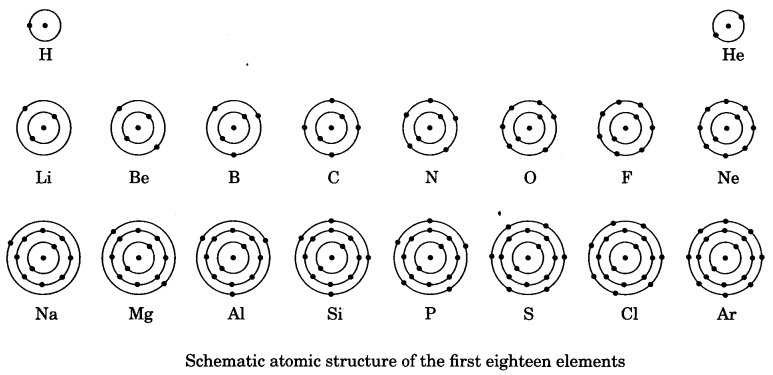
Atomic structure of first eighteen elements is shown schematically in the figure given below.
Structure of the Atom Class 9 Notes Science Chapter 4

10. Valency
The electrons present in the outermost shell of an atom are known as the valence electrons.
From the Bohr-Bury scheme, the outermost shell of the an atom can accommodate a maximum of 8 electrons. The combining capacity or valency of elements having a completely filled outermost shell is zero. Inert elements, like helium atom has two electrons in its outermost shell and all other elements have atoms with eight electrons in their outermost shell.

The combining capacity of the atoms of other elements was explained in terms of their tendency to attain a fully-filled outermost shell (stable octect or dulpet). The atoms which do not have their outermost shell fully filled enter into bond formation with other atoms in order to achieve an octet (or duplet) of electrons in their outermost shells. They do so either by sharing, losing or gaining electrons.

If the number of electrons in the outermost shell of an atom is close to its full capacity, then valency is determined in a different way.

11. Atomic number (Z)
The number of unit positive charges present in the nucleus of an atom is known as atomic number of the element.
It is denoted by the symbol Z.
Atomic no. (Z) = No. of protons = No. of electrons.
For example: Hydrogen, Z = 1 because in hydrogen atom, only one proton is present in the nucleus.
Similarly, for carbon Z = 6.

12. Mass number
The mass number is defined as the sum of the total number of protons and neutrons present in the nucleus of an atom. For example, mass of carbon is 12u because it has 6 protons and 6 neutrons, 6u + 6u = 12u. Similarly, the mass of aluminium is 27u because it has 13 protons and 14 neutrons.

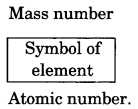
The atomic number, mass number and symbol of the element are to be written as:
Structure of the Atom Class 9 Notes Science Chapter 4.1

For example: Nitrogen is written as \({ }_{7}^{14} \mathrm{N}\).

13. Isotopes
The different atoms of the same element having same atomic number but different mass numbers.
For example: Hydrogen atom, has three isotopes, namely protium \(\left({ }_{1}^{1} \mathrm{H}\right)\), deuterium and tritium \(\left({ }_{1}^{3} \mathrm{H} \text { or } \mathrm{T}\right)\)

14. Applications of isotopes:

  • An isotope of Uranium (U-235) is used as a fuel in nuclear reactors.
  • An isotope of cobalt (C-60) is used in treatment of cancer by radiation therapy.
  • An isotope of iodine is used in the treatment of goitre.
  • Ages of old wooden articles are determined by observing the radioactivity of C-14 isotope of carbon.

15. Isobars:
Atoms of different elements with different atomic numbers which have the same mass number are known as isobars.

For example: Two elements – calcium, atomic number 20, and argon, atomic number 18 are isobars. The number of electrons in these atoms is different, but the mass number of both of these elements is 40.

Class 9 Science Chapter 4 Notes Important Terms

Cathode rays: It consist of negatively charged particles (electrons) emitted by passing electricity through gases at low pressure.

Anode rays: These rays are produced along with cathode rays and move towards cathode. They consist of positively charged ions.

Electrons: Electrons are fundamental particles carrying a unit negative charge and are a common constituent of all atoms.

Protons: (This positively charged particle was characterised in 1919). The fundamental particle which carries one unit of positive charge and has a mass nearly equal to that of an H-atom. Mass of proton = 1.6726 x 10⁻²⁴ g.

Neutron: The fundamental particle, which has a mass nearly equal to that of an H atom but has no charge.
Mass of neutron = 1.6749 x 10⁻²⁴ g.

Valency: It is the capacity of atoms of a given element to combine with, or replace atoms of hydrogen. In HCl gas, valency of chlorine is 1.

Nucleons: Protons and neutrons together are known as nucleons.

Isobars: Atoms having the same mass number but different atomic numbers.
For example, K – 40 and Ar – 40.

Isotopes: Atoms with identical atomic number but different mass numbers.
For example,\({ }_{1}^{1} \mathrm{H},{ }_{1}^{2} \mathrm{H} \text { and }{ }_{1}^{3} \mathrm{H}\)