Data Handling Class 8 Notes Maths Chapter 5

Data Handling Class 8 Notes

On this page, you will find Data Handling Class 8 Notes Maths Chapter 5 Pdf free download. CBSE NCERT Class 8 Maths Notes Chapter 5 Data Handling will seemingly help them to revise the important concepts in less time.

CBSE Class 8 Maths Chapter 5 Notes Data Handling

Data Handling Class 8 Notes Conceptual Facts

1. Data: Collection of information as numerical facts about the objects or events is called Data.

2. Types of Data: Discrete and continuous.

3. Frequency: The number of times each score occurs is called frequency.

4. Range: The difference between the greatest and the least observations is called the Range.

5. Relative Frequency: The ratio of the frequency of each item to the sum of all frequencies is called Relative frequency.
\(\text { Relative frequency }=\frac{\text { Frequency of an object }}{\text { Total frequency }}\)

6. Class-size: Difference between upper and lower limits of a class interval is called class-size.

7. Class-mark: Mid value of class interval is called its class-mark.
\(\text { Class-mark }=\frac{\text { Upper limit }+\text { Lower limit }}{2}\)

8. Class-frequency: The frequency of a particular class-interval is called class-frequency.

9. Bar Graph: Horizontal and vertical Histogram: Horizontal and vertical

10. Pie chart: Pie chart is a way of representing the data in the form of sectors of a circle.
Central angle for a sector = \(\left(\frac{\text { Value of the component }}{\text { Total value }} \times 360\right)^{\circ}\)

Practical Geometry Class 8 Notes Maths Chapter 4

Practical Geometry Class 8 Notes

On this page, you will find Practical Geometry Class 8 Notes Maths Chapter 4 Pdf free download. CBSE NCERT Class 8 Maths Notes Chapter 4 Practical Geometry will seemingly help them to revise the important concepts in less time.

CBSE Class 8 Maths Chapter 4 Notes Practical Geometry

Practical Geometry Class 8 Notes Conceptual Facts

Construction of four-sided figures when

  • Four sides and one diagonal are given.
  • Two diagonals and three sides are given.
  • Two adjacent sides and three angles are given.
  • Three sides and two included angles are given.

Some special cases:

  • To construct a square when only one side is given.
  • To construct a trapezium.

Quadrilaterals basically has ten parts in all, four sides, four angles and two diagonals.

To construct a quadrilateral, we need the measurement of five specified parts.

Before constructing a figure, we need to draw a rough free hand sketch.

Using the properties of the quadrilateral, we can construct parallelograms, squares, rectangles, rhombuses and trapeziums.

Understanding Quadrilaterals Class 8 Notes Maths Chapter 3

Understanding Quadrilaterals Class 8 Notes

On this page, you will find Understanding Quadrilaterals Class 8 Notes Maths Chapter 3 Pdf free download. CBSE NCERT Class 8 Maths Notes Chapter 3 Understanding Quadrilaterals will seemingly help them to revise the important concepts in less time.

CBSE Class 8 Maths Chapter 3 Notes Understanding Quadrilaterals

Understanding Quadrilaterals Class 8 Notes Conceptual Facts

Polygon: A simple closed curve made up of only line segments is called a polygon.
Examples of Polygons:
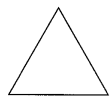
(i) Triangle
Understanding Quadrilaterals Class 8 Notes Maths Chapter 3 1

(ii) Quadrilateral

Understanding Quadrilaterals Class 8 Notes Maths Chapter 3 .2

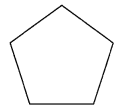
(iii) Pentagon

Understanding Quadrilaterals Class 8 Notes Maths Chapter 3 .3

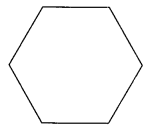
(iv) Hexagon

Understanding Quadrilaterals Class 8 Notes Maths Chapter 3 .4

Convex and concave polygons

Understanding Quadrilaterals Class 8 Notes Maths Chapter 3 .5

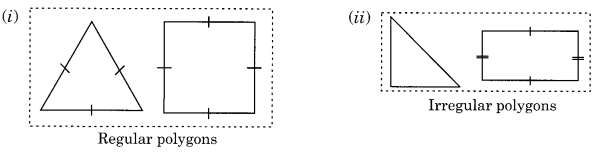
Regular and irregular polygons

Understanding Quadrilaterals Class 8 Notes Maths Chapter 3 .6

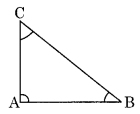
Angle sum property: The sum of three angles of a triangle is 180° In AABC, ∠A + ∠B + ∠C = 180°

Understanding Quadrilaterals Class 8 Notes Maths Chapter 3 .7

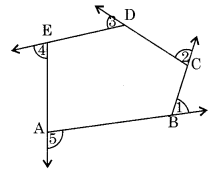
Sum of all the exterior angles of a polygon is 360°. In the given polygon ABODE, exterior angles ∠1 + ∠2 + ∠3 + ∠4 + ∠5 = 360°.

Understanding Quadrilaterals Class 8 Notes Maths Chapter 3 .8

Kind of Quadrilaterals

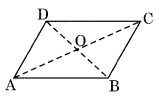
(i) Parallelogram

Understanding Quadrilaterals Class 8 Notes Maths Chapter 3 .9

Properties
(a) Opposite angles are equal
(b) Opposite sides are equal
(c) Diagonals bisect each other

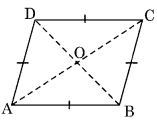
(ii) Rhombus:

Understanding Quadrilaterals Class 8 Notes Maths Chapter 3 .10

(a) All sides are equal
(b) Opposite angles are equal
(c) Diagonals bisect each other at 90°

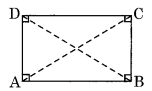
(iii) Rectangle

Understanding Quadrilaterals Class 8 Notes Maths Chapter 3 .11

(a) It is a parallelogram having each angle of 90°
(b) Opposite sides are equal
(c) Diagonals are equal

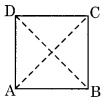
(iv) Square:

Understanding Quadrilaterals Class 8 Notes Maths Chapter 3 .12

(a) All sides are equal
(b) Each angle is of 90°
(c) Diagonals are equal and bisect each other at 90°

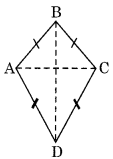
(v) Kite:

Understanding Quadrilaterals Class 8 Notes Maths Chapter 3 .13

(a) Diagonals are perpendicular to each other.
(b) One of the diagonals bisects the other
(c) m∠A = m∠C but m∠B ≠ m∠D

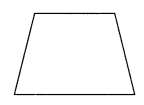
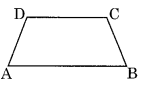
(vi) Trapezium:

Understanding Quadrilaterals Class 8 Notes Maths Chapter 3 .14
A pair of opposite sides is parallel to each other.

Linear Equations in One Variable Class 8 Notes Maths Chapter 2

Linear Equations in One Variable Class 8 Notes

On this page, you will find Linear Equations in One Variable Class 8 Notes Maths Chapter 2 Pdf free download. CBSE NCERT Class 8 Maths Notes Chapter 2 Linear Equations in One Variable will seemingly help them to revise the important concepts in less time.

CBSE Class 8 Maths Chapter 2 Notes Linear Equations in One Variable

Linear Equations in One Variable Class 8 Notes Conceptual Facts

1. Statement of equality containing one or more variable (unknown quantity) is called an equation.
For example: 3x – 5 = 6, x – 3y = 7, \(\frac{x}{2}+\frac{y}{3}=5\) , x2 + 5 = y2 are all equations.

2. Linear equations of one variable contains only one variable.
For example: \(3 x-1=\frac{1}{2}, 5-x=\frac{3}{2}, \frac{6 x}{5}-3=0\)

3. The value of the variable which makes an equation true is called the solution of the equation.
x2 + y2 = 7 type equations are not linear equations.
(i) Rules for solving an equation.

  • Same number can be added to both sides of equality sign (=).
  • Same number can be subtracted from both the sides of equality sign (=).
  • Same number can be multiplied to both the sides of equality sign (=).
  • Both sides of the equation can be divided by the same number.

For example:
3x – 4 = 7
⇒ 3x- 4 + 4- 7+ 4 (adding 4 to both sides)
⇒ 3x = 11
⇒ 3x÷3 = 11÷3 (dividing the both sides by 3)
\(x=\frac{11}{3}\)
Thus, \(x=\frac{11}{3}\) is the solution or root of the equation.

(ii) Rule of transpositions: Any term can be transposed from one side of the equation to the other side by changing its sign, i.e. (+) to (-), (-) to (+), (x) to (-r) and (v) to (x).

Rational Numbers Class 8 Notes Maths Chapter 1

Rational Numbers Class 8 Notes

On this page, you will find Rational Numbers Class 8 Notes Maths Chapter 1 Pdf free download. CBSE NCERT Class 8 Maths Notes Chapter 1 Rational Numbers will seemingly help them to revise the important concepts in less time.

CBSE Class 8 Maths Chapter 1 Notes Rational Numbers

Rational Numbers Class 8 Notes Conceptual Facts

1. A number which is in the form of \(\frac{p}{q}\), where p and q are co-primes integers and q ≠ 0 is called rational number.
For example, \(\frac{2}{3}, \frac{1}{2}, \frac{4}{5}, 2,-\frac{6}{7}\)

2. Every fraction is a rational number but every rational number need not to be a fraction.
For example: \(\frac{2}{3}\) is a fraction as well as a rational number, o
Whereas -5 is a rational number but it is not a fraction.

3. Standard form of a rational number may be identified when its denominator is positive.
For example: Standard form of is \(\frac{18}{-24} \text { is } \frac{-3}{4}\)

4. Equivalent fraction of \(\frac{p}{q}\) may be denoted by \(\frac{p \times m}{q \times m} \text { or } \frac{p \div n}{q \div n}\)
For example: Equivalent fractions of  \(\frac{12}{16} \text { are } \frac{12+4}{16 \div 4}=\frac{3}{4}\)
or \(\frac{12 \times 2}{16 \times 2}=\frac{24}{32}\)

5. The rational numbers can be compared as:

  • \(\frac{a}{b}>\frac{c}{d}\) if and only if ad > bc
  • \(\frac{a}{b}=\frac{c}{d}\) if and only if ad = bc
  • \(\frac{a}{b}<\frac{c}{d}\) if and only if ad < bc

Properties of rational numbers:
(а) Closure property additions
If a and b are two rational numbers, then a + b will also a rational number
For example: \(\frac{1}{2}+\frac{1}{3}=\frac{1 \times 3+1 \times 2}{6}=\frac{5}{6}\) a rational number.

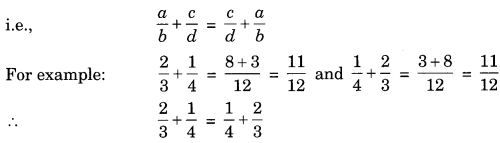
(b) Commutative property of addition
Two rational numbers can be added in any manner.
Rational Numbers Class 8 Notes Maths Chapter 1
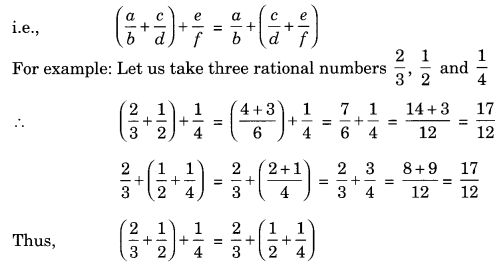
(c) Associative property for addition:
While adding three or more rational numbers, they can be grouped in any order.
Rational Numbers Class 8 Notes Maths Chapter 2

(d) Additive identity: The sum of any rational number and 0 is always equal to the rational number itself.
Zero is additive identity
For example: 0 + a = a or a + 0 = a

(e) Additive inverse
Additive inverse of \(\frac{a}{b}=-\frac{a}{b}\)
0 is the additive inverse of itself.

Properties of multiplication of rational numbers.
(a) Closure property: The product of two rational number is always a rational number.
For example: Take two rational numbers \(\frac{1}{2} \text { and } \frac{1}{3}\)
∴ \(\frac{1}{2} \times \frac{1}{3}=\frac{1}{6}\) which is also a rational numbers.

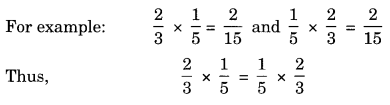
(b) Commutative property: The two rational numbers can be multiplied in any order,
i.e. a x b =b x a
Rational Numbers Class 8 Notes Maths Chapter 3
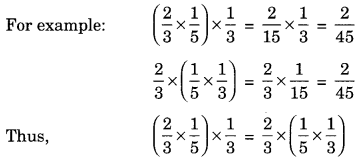
(c) Associative property: Three or more rational numbers can be multiplied by grouping in different order,
i.e. (a x b) x c = a x (b x c)
Rational Numbers Class 8 Notes Maths Chapter 4

(d) Multiplicative identity: If \(\frac{a}{b}\) is a rational number, then \(\frac{a}{b} \times 1=1 \times \frac{a}{b}=\frac{a}{b}\)
For example: \(\frac{2}{3} \times 1=1 \times \frac{2}{3}=\frac{2}{3}\)
1 is called the multiplicative identity of a rational number.

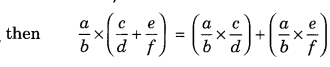
(e) Distributive property of multiplication over addition.
If \(\frac{a}{b}, \frac{c}{d} \text { and } \frac{e}{f}\) are three rational number,
For example:
Rational Numbers Class 8 Notes Maths Chapter 5
For example: Let us consider three rational numbers \(\frac{2}{3}, \frac{4}{5} \text { and } \frac{5}{6}\)

Rational Numbers Class 8 Notes Maths Chapter 6

Existence of multiplicative inverse (i.e. Reciprocal)
For every non-zero rational number \(\frac{a}{b}\), there exists its multiplicative inverse \(\frac{a}{b}\).

  • i.e… \(\frac{a}{b} \times \frac{b}{a}=1\)
  • Reciprocal of zero (0) is not defined.
  • 1 and -1 are the only two rational numbers which are Reciprocal of their own.
  • Reciprocal of a reciprocal of a number is the number itself.

Representation of rational numbers on number line.

Rational Numbers Class 8 Notes Maths Chapter 7

Here A represents \(\frac{1}{3}\) and B represents \(\frac{-2}{3}\) on the given number line.

Rational numbers between two given rational numbers:

Let us consider the rational numbers \(\frac{3}{10} \text { and } \frac{7}{10}\)

So, the rational numbers between \(\frac{3}{10} \text { and } \frac{7}{10} \text { may be } \frac{4}{10}, \frac{5}{10} \text { and } \frac{6}{10}\)