NCERT Class 10 Geography Chapter 7 Notes Lifelines of National Economy

NCERT Class 10 Geography Chapter 7 NotesOn this page, you will find NCERT Class 10 Geography Chapter 7 Notes Pdf free download. CBSE Class 10 Social Science Notes Geography Chapter 7 SST Lifelines of National Economy will seemingly, help them to revise the important concepts in less time.

Lifelines of National Economy Class 10 Notes Social Science Geography Chapter 7

CBSE Class 10 Geography Chapter 7 Notes Understanding the Lesson

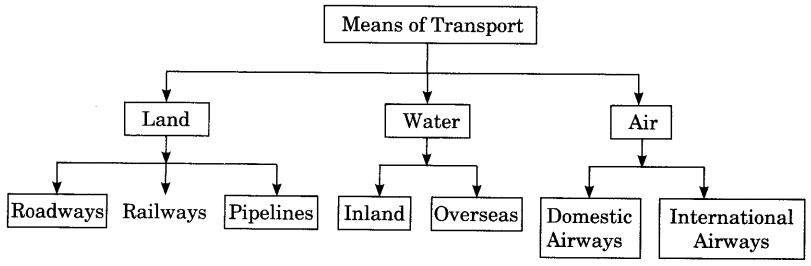
1. Movement of goods and services can be other three important domains of our earth-land, water and air. Based on these, transport is classified into land, water and air transports.
NCERT Class 10 Geography Chapter 7 Notes Lifelines of National Economy

2. Today, the world has been converted into a large village with the help of efficient and fast-moving transport. A well-developed communication system has contributed a lot in this regard.

3. Railways, airways, waterways, newspapers, radio, television, cinema and interest, etc., have been contributing to India’s socio-economic progress in many ways.

4. India has one of the largest road networks in the world, aggregating to about 2.3 million km at present. Roads in India are classified in the following classes according to their capacity-Golden Quadrilateral Super Highways, National Highways, State Highways, District Roads, Border Roads.

5. Roads can also be classified on the basis of the type of material used for their construction such as metalled and unmetalled roads. Metalled roads are all weathered roads whereas unmetalled roads get out of use in the rainy season.

6. Distribution of roads is not uniform in the country. Density of all roads varies from only 12.14 km in Jammu and Kashmir to 517.77 km in Kerala as on 31 March, 2011.

7. Railways are the important mode of transportation for goods and passengers in India. They play a major role in activities like business, sightseeing, pilgrimage along with transportation of goods over longer distances.

8. The northern plains of India have a good network of railways. But the hilly terrains of the peninsular region and the Himalayas mountainous regions are unfavourable for the construction of railway lines. It was also difficult to lay railway lines on the sandy plain of western Rajasthan, swamps of Gujarat, forested tracks of Madhya Pradesh, Chhattisgarh, Odisha and Jharkhand.

9. Pipeline transport network is a new arrival on the transportation map of India. These are used for transporting crude oil, petroleum products and natural gas from oil and natural gas fields to refineries, fertiliser factories and big thermal power plants.

10. Waterways are the cheapest means of transport. They are most suitable for carrying heavy and bulky goods. It is a fuel-efficient and environment-friendly mode of transport.

11. Mandavi, Zuari and Cumberjua, Sunderbans, Barak, backwaters of Kerala and tidal stretches of some other rivers are important inland waterways on which substantial transportation takes place.

12. India’s trade with foreign countries is carried from the ports located along the coast. Some major seaports of India are Kandla in Kuchchh, Mumbai, Marmagao, New Mangalore, Tuticorin, Chennai, Vishakhapatnam, Paradwip, etc.

13. Airways are the fastest and the most comfortable mode of transport. It can cover very difficult terrains, dreary deserts, dense forest and long oceanic stretches with great ease. Air India provides international air services. Pawanhans Helicopters Ltd. Provides helicopter services.

14. Modern means of communication serve as lifelines of our national and its modern economy. Personal communication and mass communication including television, radio, press, films etc., are the major means of communication in the country.

15. The Indian postal network handles parcels as well as personal written communications. Cards and envelopes are considered first-class mail and book packets, registered newspapers and periodicals are considered second class mail.

16. India has one of the largest telecom networks in Asia. Not only urban places but even villages in India have been covered with Subscriber Trunk Dialling or STD telephone facility. There is a uniform rate of STD facilities all over India.

17. Mass communication provides entertainment and creates awareness among people about various national programmes and policies. Doordarshan, the national television channel of India, is one of the largest terrestrial networks in the world. It broadcasts a variety of programmes for people of different age groups.

18. International trade takes place through sea, air or land routes. Advancement of international trade of country is an index to its economic prosperity.

19. India has trade relations with all the major trading blocks and all geographical regions of the world. The commodities imported to India include petroleum and petroleum products, chemicals and machinery.

20. Tourism in India is well developed. More than 15 million people are directly engaged in tourism industry. Tourism also promotes national integration, provides support to local handicrafts and cultural pursuits.

Lifelines of National Economy Class 10 CBSE Notes Important Terms

Transport: Act of carrying goods or passengers from one place to another.

Linguistic: Of language.

Lifeline: A thing on which someone or something depends or which provides a means of escape from a difficult situation.

Mass communication: Means of communication through which one can communicate with several people at the same time.

Golden quadrilateral: A network of roads which connects Delhi-Kolkata-Chennai-Mumbai and Delhi by six-lane Super Highways.

National Highways: Broad roads which connect extreme parts of the country.

Road density: The length of road per 100 sq. km of area.

Export: Sending goods or services to another country for sale.

Import: Bringing goods or services into a country from abroad for sale.

Hinterland: The remote areas of a country away from the coast or the banks of major rivers.

Trade: The exchange of goods among people, states and countries.

Harbour: A deep coast of the sea which provides shelters to the seagoing vessels.

Tourism: The commercial organisation and operation of holidays and visits to places of interest.
NCERT Class 10 Geography Chapter 6 Notes Manufacturing Industries

NCERT Class 10 Geography Chapter 6 Notes

On this page, you will find NCERT Class 10 Geography Chapter 6 Notes Pdf free download. CBSE Class 10 Social Science Notes Geography Chapter 6 SST Manufacturing Industries will seemingly, help them to revise the important concepts in less time.

Manufacturing Industries Class 10 Notes Social Science Geography Chapter 6

CBSE Class 10 Geography Chapter 6 Notes Understanding the Lesson

1. Manufacturing sector is the backbone of economic development. Manufacturing industries not only help in modernising agriculture, they also reduce the heavy dependence of people on agricultural income by providing them jobs in secondary and tertiary sectors.

2. Agriculture and industry move hand in hand. Development and competitiveness of manufacturing industry has helped agriculturists in increasing their production. It has also made the production processes very efficient.

3. The trend of growth rate in manufacturing over the last decade has been around 7 per cent per annum. The desired growth rate over the next decade is 12 per cent. Since 2003, manufacturing is once again growing at the rate of 9 to 10 per cent per annum.

4. Industrial locations are influenced by availability of raw material, labour, capital, power and market, etc. The places where industries are located, urbanisation takes place. Cities provide markets and also provide services like banking, insurance, etc.

5. image

6. Agro-based industries such as cotton, jute, silk, sugar, etc., are based on agricultural raw materials.

7. The textile industry occupies unique position in the Indian economy. It is the only industry in the country, which is self-reliant and complete in the value chain i.e. from raw material to the highest value added products.

Note: Content Mentioned On Page No. 74-75 Ncert, Geograpy Textbook i.e. Aluminum smelting, Chemical industries, Fertilizer industry, Cement industry is not required to be delivered in calss room during instruction.

8. The cotton textile industry, mainly located in Maharashtra and Gujarat, has close links with
agriculture and provides a living to farmers, cotton boll pluckers and workers engaged in ginning, spinning, weaving etc. This industry supports many other industries such as chemicals and dyes, mill stores, packaging materials, etc.

9. India exports yarn to Japan, USA, UK, Russia, France, East European countries, Nepal, Singapore, etc. The country has a large share in the world trade of cotton yarn, accounting for one fourth of the total trade.

10. India is the largest producer of raw jute and jute goods and stands at second place as an exporter after Bangladesh. The first jute mill was set up near Kolkata in 1859 at Rishra. After partition in 947, the jute mills remained in India but most jute-producing areas went to East Pakistan, which is now Bangladesh.

11. India ranks second as a world producer of sugar but occupies the first place in the production of gur and khandsari. In 2010-11, there were over 662 sugar mills in the country spread over Uttar Pradesh, Bihar, Maharashtra, Karnataka, Tamil Nadu, Andhra Pradesh, Gujarat, Punjab, etc. This industry is seasonal in nature.

12. The iron and steel industry is the basic industry since all the other industries depend on it for their machinery. This is also a heavy industry because all the raw materials as well as finished goods are : heavy and bulky.

13. In 2010-11, India ranked fourth among the world crude steel producers. It is the largest producer of sponge iron. In 2010-11, per capita consumption of steel in the country was only around 49 kg per annum against the world average of 182 kg.

14. The automobile industry enjoys key importance in India. Trucks, buses, cars, motor cycles, scooters, three-wheelers and multi-utility vehicles are manufactured in India at various centres. After the liberalisation, this industry got a jump.

15. The electronics industry is associated with a wide range of products from transistor sets to television, telephones, cellular telecom, pagers, telephone exchange, etc. Bangalore is the electronic capital of India.

16. Industries play a significant role in India’s economic growth. But at the same time they have degraded environment by polluting land, water, air and noise. Air pollution is caused by the presence of high proportion of undesirable gases such as sulphur dioxide and carbon monoxide.

17. Water pollution is caused by organic and inorganic industrial wastes and affluents discharged into rivers. Thermal power plants also pollute water.

18. To control environmental degradation, it is essential to reduce industrial pollution of fresh water, Overdrawing of ground water reserves by industry also needs to be regulated legally. Smoke can be reduced by using oil or gas instead of coal in factories.

Manufacturing Industries Class 10 CBSE Notes Important Terms

Industrial agglomeration or agglomeration economies: Agglomeration economies are the benefits that come when firms and people locate near one another together in cities and industrial clusters.

Agro-based industry: The industry that converts the agricultural products into industrial products.

Mineral-based industry: The industry that uses mineral and metals as raw materials.

Basic or key industry: The industry that supplies its products or raw materials to manufacture other goods.

Consumer industry: The industry that produces goods for direct use by consumers.

Small-scale industry: The industry that invests capital of about one crore.

Public sector industry: The industry owned and operated by government agencies.

Private sector industry: The i4ndustry owned and operated by individuals or a group of individuals.

Light industry: The industry that uses light raw materials and produces light goods.

Yarn: Spun thread used for knitting, weaving, or sewing.

NCERT Class 10 Geography Chapter 5 Notes Minerals and Energy Resources

NCERT Class 10 Geography Chapter 5 NotesOn this page, you will find NCERT Class 10 Geography Chapter 5 Notes Pdf free download. CBSE Class 10 Social Science Notes Geography Chapter 5 SST Minerals and Energy Resources will seemingly, help them to revise the important concepts in less time.
Minerals and Energy Resources Class 10 Notes Social Science Geography Chapter 5

CBSE Class 10 Geography Chapter 5 Notes Understanding the Lesson

1. Minerals are important for our life. Life processes cannot occur without them. Almost everything we use is made of minerals.

2. Geologists define mineral as a ‘homogeneous, naturally occurring substance with a definable internal structure’. Minerals are found in varied forms in nature, ranging from the hardest diamond to the softest talc.

3. Minerals are usually found in ores which are accumulations of minerals with other elements. The mineral content of the ore must be in sufficient concentration to make its extraction commercially viable.

4. Minerals occur in various forms. In igneous and metamorphic rocks, minerals may occur in the cracks, crevices, faults or joints. In sedimentary rocks, a number of minerals occur in beds or layers. Another mode of formation involves the decomposition of surface rocks, and the removal of soluble constituents, leaving a residual mass of weathered material containing ores. Some minerals may occur as alluvial deposits in sands of valley floors and the base of hills. The ocean waters contain vast quantities of minerals.

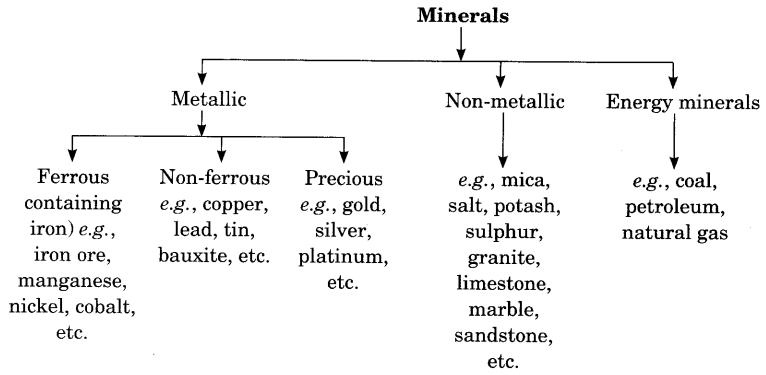
5. Minerals are classified as following:

NCERT Class 10 Geography Chapter 5 Notes Minerals and Energy Resources 1

6. Iron ore is the basic mineral and the backbone of industrial development. India is rich in good quality iron ores. Magnetite is the finest iron ore and is valuable in the electrical industry. There are four major iron ore belts in India – Odisha-Jharkhand belt, Durg-Bastar-Chandrapur belt, Bellary- Chitradurga-Chikkamagaluru-Tumakuru belt and Maharashtra-Goa belt.

7. India’s reserves and production of non-ferrous minerals is not very satisfactory. However, these minerals play a vital role in a number of metallurgical, engineering and electrical industries.

8. Mica is a non-metallic mineral which is found in the northern edge of the Chotanagpur plateau. Koderma-Gaya-Hazaribagh belt of Jharkhand is the leading producer.

9. Limestone is a rock mineral. It is the basic raw material for the cement industry and is essential for smelting iron ore in the blast furnace.

10. Mineral resources are finite and non-renewable. Hence, their conservation is important. Recycling of metals, using scrap metals and other substitutes are steps in conserving our mineral resources for the future.

Energy Resources

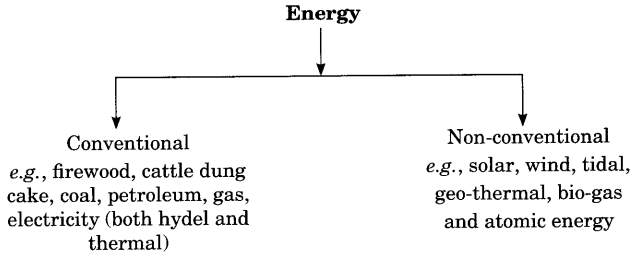
11. We are heavily dependent on energy resources. We need it for cooking, lighting, heating, propelling vehicles and for driving machinery in industries. We can classify energy resources in the following ways:

NCERT Class 10 Geography Chapter 5 Notes Minerals and Energy Resources 2

12. Coal provides a substantial part of the nation’s energy needs. It is used for power generation, to supply energy to industry as well as for domestic needs. There are four types of coal-peat, lignite, bituminous and anthracite. Bituminous coal is commercially valuable. Anthracite is the highest quality hard coal

13. Petroleum, also known as mineral oil is the next major energy source in India after coal. It provides fuel for heat and lighting, lubricants for machinery and raw materials for a number of manufacturing industries.

14. Natural gas is used as a source of energy as well as an industrial raw material in the petrochemical industry. It is considered an environment-friendly fuel because of low carbon dioxide emissions.

15. We are heavily dependent on electricity. It is generated mainly in two ways – by running water which drives hydro turbines to generate hydroelectricity, and by burning other fuels such as coal, petroleum and natural gas to drive turbines to produce thermal power.

16. Solar energy, wind, tide, biomass and energy from waste material are renewable and therefore, they should be used more and more. India has the largest programmes for these renewable energies resources.

17. Energy is the basic requirement for economic development of a country. Since its consumption in all forms has been steadily rising all over the country, so there is an urgent need to develop a sustainable path of energy development.

18. India is one of the least energy-efficient countries in the world. So, it is important for us to adopt a cautious approach for the judicious use of our limited energy resources.

Minerals and Energy Resources Class 10 CBSE Notes Important Terms

Mineral: A homogenous, naturally occurring substance with a definable internal structure.

Ferrous mineral: Minerals having iron contents.

Non-ferrous mineral: Minerals having no iron contents.

Mineral ore: The raw metal extracted from the earth mixed with soil and other impurities.

Mining: An economic activity of extracting minerals from the earth.

Metallic mineral: Minerals having metal contents.

Ore: An accumulation of any mineral mixed with other elements.

Hydroelectricity: Electricity generated by running water.

Thermal electricity: Electricity generated by burning other fuels such as coal, petroleum and natural gas.

Biogas: A mixture of different gases produced by the breakdown of organic matter in the absence of oxygen.

Geologist: A scientist who studies origin and structure of earth.

Fossil fuel: Buried combustible geologic deposits of organic materials, formed from decayed plants and animals that have been converted to crude oil, coal, natural gas, or heavy oils by exposure of heat and pressure in the earth’s crust over hundreds of millions of years.

Lignite: Low-grade brown coal.

Anthracite: The highest quality hard coal.

Geothermal energy: The heat and electricity produced by using the heat from the interior of the earth.

NCERT Class 10 Geography Chapter 4 Notes Agriculture

NCERT Class 10 Geography Chapter 4 Notes

On this page, you will find NCERT Class 10 Geography Chapter 4 Notes Pdf free download. CBSE Class 10 Social Science Notes Geography Chapter 4 SST Agriculture will seemingly, help them to revise the important concepts in less time.

Agriculture Class 10 Notes Social Science Geography Chapter 4

CBSE Class 10 Geography Chapter 4 Notes Understanding the Lesson

1. Agriculture is a primary activity in India. Two-thirds of the country’s population depends on agricultural activities.

2. At present, several farming systems are practised in different parts of India. These include primitive subsistence farming, intensive subsistence farming, commercial farming and plantation farming.

3. Primitive subsistence farming is practised on small patches of land with the help of primitive tools like hoe, dao and digging sticks, and family or community labour. It is also known as ‘slash and burn’

4. Intensive subsistence farming is done in areas of high population pressure on land. It is labour­intensive farming. Farmers generally use high doses of biochemical inputs and irrigation in their fields to get good production.

5. In commercial farming, higher doses of modern inputs such as HYV seeds, chemical fertilisers, etc. are used to get higher production.

6. Plantation is a type of commercial farming in which a single crop is grown on a large area. In India, tea, coffee, rubber, sugarcane, etc. are major plantation crops.

7. India has three cropping patterns – rabi, kharif and Rabi crops such as wheat, barley, peas, gram, etc. are sown in winter from October to December and harvested in summer from April to June. Kharif crops such as paddy, maize, jowar, bajra, etc. are sown in the rainy season and harvested in September-October. Zaid crops are watermelon, muskmelon, cucumber, etc.

8. A variety of food and non-food crops are grown in different parts of India. Rice, wheat, millets, pulses, maize, etc. are major food crops. Sugarcane, tea, coffee, oilseeds are food crops other than grains. Rubber and fibre crops like cotton, jute, hemp and natural silk are non-food crops.

9. Although India is an agriculturally important country but it has not achieved agricultural development in required potential. Most of the farmers in large parts of the country still depend upon monsoon and natural fertility in order to carry on their agriculture.

10. Agriculture in India needs some serious technical and institutional reforms, collectivisation, consolidation of holdings, cooperation and abolition of zamindari, were given priority to bring about institutional reforms in the country after Independence.

11. Agricultural reforms were introduced to improve Indian agriculture in the 1960s and 1970s. The success stories of the Green Revolution and the White Revolution or Operation Flood can be mentioned in this regard.

12. In the 1980s and 1990s, a comprehensive land development programme was initiated, which included both institutional and technical reforms. Provision for crop insurance, against natural calamities, establishment of Grameen banks, etc. were some important steps in this direction.

Note: Please note as per CBSE Curriculum 2017-18, content of pages 44-47 of NCERT TEXT BOOK has been deleted. Hence, in this book we have also excluded content and the questions related to this content.

Agriculture Class 10 CBSE Notes Important Terms

Agriculture: A primary activity which produces food that we consume.

Plantation: A type of farming in which a single crop is grown on a large scale.

Horticulture: Intensive cultivation of vegetables, fruits and flower crops.

Sericulture: Rearing of silk worms for the production of silk fibre.

Jhumming: Burning a piece of land for cultivation.

Globalization: The working of whole world together with cooperation and coordination in the form of a market.

Gramdan: Some Zamindars and owners of many villages offered to distribute some villages among the landless.

NCERT Class 10 Geography Chapter 3 Notes Water Resources

NCERT Class 10 Geography Chapter 3 Notes

On this page, you will find NCERT Class 10 Geography Chapter 3 Notes Pdf free download. CBSE Class 10 Social Science Notes Geography Chapter 3 SST Water Resources will seemingly, help them to revise the important concepts in less time.

Resource and Development Class 10 Notes Social Science Geography Chapter 3

CBSE Class 10 Geography Chapter 3 Notes Understanding the Lesson

1. Water is a valuable resource. It is essential for life on the earth. Human body contains 70% of water. Plants cannot grow without water. Other living beings including micro-organisms cannot survive without water.

2. Three-fourth of the earth’s surface is covered with water and water is a renewable resource. Still there are many countries and regions around the globe that suffer from acute water crisis. The reason is that only a small proportion of it accounts for freshwater (2.5 per cent) that we can put to use.

3. The freshwater is mainly obtained from surface run off and groundwater that is continually being renewed and recharged through the hydrological cycle.

4. India receives nearly 4 per cent of the global precipitation and ranks 133 in the world in terms of water availability per person per annum. By 2025, it is predicted that large parts of India will live in absolute water scarcity.

5. Although the availability of water resources varies over space and time, water scarcity in most cases is caused by over-exploitation, excessive use and unequal access to water among different social groups.

6. Water scarcity may be an outcome of large and growing population and consequent greater demand for water. A large population means more water for domestic use as well as to produce more food grain. To facilitate higher food grain production, water resources are being over-exploited to expand irrigated areas and dry-season agriculture. This leads to falling groundwater levels.

7. The growing number of industries has made matter worse by exerting pressure on existing freshwater resources. Multiplying urban centres with large and dense populations and urban lifestyles have also aggravated the problem.

8. There are many regions in India where scarcity is due to bad quality of water. Water in these regions get polluted by domestic and industrial wastes, chemicals, pesticides, and fertilisers used in agriculture.

9. Now it has become essential to conserve and manage our water resources, to safeguard ourselves from health hazards, to ensure food security and so on. Over-exploitation and mismanagement of water resources will impoverish this resource and cause ecological crisis.

10. Previously dams were seen as a way to conserve and manage water. Dams were traditionally built to impound rivers and rainwater that could be used later to irrigate agricultural fields. Today, the purpose behind building dams has been multiplied. Dams are built not just for irrigation but for electricity generation, water supply for domestic and industrial uses, flood control, etc.

11. In recent years, people have opposed multi-purpose projects and large dams due to a variety of reasons. Regulating and damming of rivers affect their natural flow causing several problems for human beings as well as for aquatic life. Also, big dams have mostly been unsuccessful in controlling floods at the time of heavy rainfall.

12. Water harvesting system is considered both socio-economically and environmentally viable. In ancient India, along with sophisticated hydraulic structures, there existed an extraordinary tradition of water-harvesting system. Roof-top rainwater harvesting was commonly practised to store drinking water particularly in Rajasthan.

13. In the semi-arid and arid regions of Rajasthan, almost all the houses traditionally had underground tanks or tankas for storing drinking water.

14. Rainwater stored in tankas can be an extremely reliable source of drinking water when all other sources are dried up, particularly in the summers.

15. Rooftop rainwater harvesting is being successfully adapted in many parts of rural and urban India to store and conserve water. Tamil Nadu is the first state in India which has made rooftop rainwater harvesting structure compulsory to all the houses across the state.

Water Resources Class 10 CBSE Notes Important Terms

Glacier: A mass or river of ice moving very slowly.

Aquifer: A layer of water-bearing rock or soil.

Dam: A barrier across flowing water that obstructs, directs or retards the flow, often creating a reservoir, lake or impoundment.

Groundwater: Water obtained from a depth of more than 15 metres.

Multi-purpose project: A large-scale hydro project serving a number of purposes such as irrigation, flood control, etc.

Rainwater harvesting: A technique of gathering, accumulating and storing of rainwater for different uses.

Hydro-electricity: Electricity produced by using water power.

Drip irrigation: A type of irrigation in which water gets dropped in the form of drips close to roots of the plants in order to conserve the moisture.

Water Scarcity: A situation in which water is not sufficiently available to meet the needs of the people.