Visualising Solid Shapes Class 8 Notes Maths Chapter 10

Visualising Solid Shapes Class 8 Notes

On this page, you will find Visualising Solid Shapes Class 8 Notes Maths Chapter 10 Pdf free download. CBSE NCERT Class 8 Maths Notes Chapter 10 Visualising Solid Shapes will seemingly help them to revise the important concepts in less time.

CBSE Class 8 Maths Chapter 10 Notes Visualising Solid Shapes

Visualising Solid Shapes Class 8 Notes Conceptual Facts

3-D figures: Any shape which occupies space and has three dimensions, i.e., length, breadth and heights is called 3-D solid or a figure.

Parts of a solid objects:

  • Face
  • Vertex
  • Edge

Types of Solids:

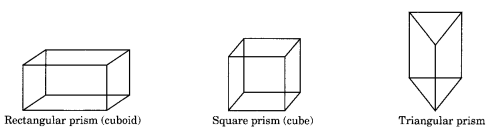
(i) Prism:
Visualising Solid Shapes Class 8 Notes Maths Chapter 10 .1
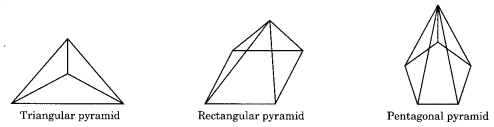
(ii) Pyramids:
Visualising Solid Shapes Class 8 Notes Maths Chapter 10 .2
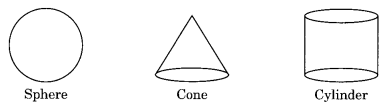
(iii) Other Solid
Visualising Solid Shapes Class 8 Notes Maths Chapter 10 .3

Euler’s Formula:
Number of faces + Number of vertices – Number of edges = 2

Algebraic Expressions and Identities Class 8 Notes Maths Chapter 9

Algebraic Expressions and Identities Class 8 Notes

On this page, you will find Algebraic Expressions and Identities Class 8 Notes Maths Chapter 9 Pdf free download. CBSE NCERT Class 8 Maths Notes Chapter 9 Algebraic Expressions and Identities will seemingly help them to revise the important concepts in less time.

CBSE Class 8 Maths Chapter 9 Notes Algebraic Expressions and Identities

Algebraic Expressions and Identities Class 8 Notes Conceptual Facts

1. Algebraic Expression: A combination of numbers which includes literal number connected by the
symbols +, -, x and + is called an algebraic expression.

For example: 5x, 8x -3, 2x + 3y, \(\frac{3}{4}\)x2 4xyz are some algebraic expressions.
Here. 5, 8, 3, 2. and 4 are constants and the literal numbers are x, y and z.

The different parts of the expression are called terms.
5x, 8x, 2x, 3y, \(\frac{3 x^{2}}{4}\) etc., are all the terms.

2. Coefficient: A coefficient is a multiplicative factor in some term of a polynomial. It is usually a number,
but may be only expression along.

For example in 7x2 – 3xy + y + 3. The first three terms respectively have coefficient 7, -3 and 3 is a
constant in given polynomial.

3. Monomial: The expression having only one term is called monomial.
For example: 3x, 8xy, 6×2, 11xyz, etc.

4. Binomial: The expression containing two terms is called binomial.
Forexample: 2x +y,x +y, 3xy-5z, \(\frac{1}{2}\) xy + 5, etc.

5. Trinomial: The expression containing three terms is called trinomial.
For example: x + 2y + 3, xy – z +\(\frac{1}{2}\) , \(\frac{1}{2}\) x2+ 2x + 5, etc.

6. Polynomial: Algebraic expression containing one or more terms with non-zero coefficient is called a
polynomial.
For example: 2+3x, x+y+3z-5, \(\frac{1}{2}\) x2+yz -5, etc.

7. Like and Unlike Terms: Algebraic expressions having same combination of literal numbers are called
like terms.
For example: 4xy, -5xy, –\(\frac{17}{3}\) xy, are like terms.

8. Algebraic expressions having different combinations of literal numbers are called unlike terms.
For example: (xy, yz, zx), (2x2, – 5xy2, 7xyz), (3, – 5x, 7yz) etc.

9. Degree of Algebraic Expression: Highest power of the variable of an algebraic expression is called its degree.
For example: Degree of 3x2 – 7x + 5 is 2.

Addition or Subtraction of two or more polynomials:

  • Collect the like terms together.
  • Find the sum or difference of the numerical coefficients of these terms.

For example:
(i) Add: 2x2y3, -5x2y3 + \(\frac{11}{2}\)x2yz
Answer:

Algebraic Expressions and Identities Class 8 Notes Maths Chapter 9

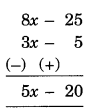
(ii) Subtract: (3x – 5) from (8x – 25)
Answer:
Algebraic Expressions and Identities Class 8 Notes Maths Chapter 9 1
[Arrange the terms columnwise and change the sign of and add]

Multiplication Rule of Signs:
(+x) x (+y) = (+xy)
(+x) x (-y) = (-xy)
(-x) x (y) = (-xy)
(-x) x (-y) = (+xy)

 

Comparing Quantities Class 8 Notes Maths Chapter 8

Comparing Quantities Class 8 Notes

On this page, you will find Comparing Quantities Class 8 Notes Maths Chapter 8 Pdf free download. CBSE NCERT Class 8 Maths Notes Chapter 8 Comparing Quantities will seemingly help them to revise the important concepts in less time.

CBSE Class 8 Maths Chapter 8 Notes Comparing Quantities

Comparing Quantities Class 8 Notes Conceptual Facts

1. In every hundred or per hundred is called as percent. For example: 30% means 30 in every hundred.
To change a percentage to a fraction:
40% \(\frac{40}{100}\)=0.4 , 125% = \(\frac{125}{100}\)=1.25

2. Percentage increase and decrease
Increase 240 by 10% = 240 + \(\frac{10}{100}\) x 240 = 240 + 24 = 264
Decrease 180 by 18% = 180 – \(\frac{18}{100}\) x 180 = 180 – 32.4 = 147.6

3. Profit and Loss
Profit = SP – CP,Loss= CP – SP
Comparing Quantities Class 8 Notes Maths Chapter 8 1

4. Profit and Loss are always calculated on CP.
Comparing Quantities Class 8 Notes Maths Chapter 8 2
5. Marked Price: The printed or the tagged price of an article is known as marked price or MP.

6. Discount: The deduction allowed on the market price is called Discount. It is generally given in percent.

7. Net Price: The selling price after the discount to an article is called its Net Price.

SP = MP – Discount
\(\mathrm{MP}=\left(\frac{100 \times \mathrm{SP}}{100-\mathrm{Discount} \%}\right)\)

8. Sales Tax: Sales tax is a tax levied by the Government on the selling price of an article at a rate given by the Government.

9. Value Added Tax (VAT): VAT is an extra tax which is levied and collected by State Government in lieu of State Tax.

10. Simple Interest:
\(\mathrm{SI}=\frac{\text { Principal } \times \text { Rate } \times \text { Time }}{100}\)

11. Compound Interest: Cl = Amount – Principal
\(\mathrm{CI}=\mathrm{P}\left(1+\frac{r}{100}\right)^{n}-\mathrm{P}\)

Amount = \(\mathrm{P}\left(1+\frac{r}{100}\right)^{n}\) where n represent time in years.

12. Conversion of Period:

  • If interest is calculated half-yearly or semi-annually, then ‘r’ is halved and T is doubled.
  • If interest is calculated quarterly, then V’ is one-fourth and T is four times.

Cubes and Cube Roots Class 8 Notes Maths Chapter 7

Cubes and Cube Roots Class 8 Notes

On this page, you will find Cubes and Cube Roots Class 8 Notes Maths Chapter 7 Pdf free download. CBSE NCERT Class 8 Maths Notes Chapter 7 Cubes and Cube Roots will seemingly help them to revise the important concepts in less time.

CBSE Class 8 Maths Chapter 7 Notes Cubes and Cube Roots

Cubes and Cube Roots Class 8 Notes Conceptual Facts

  • A natural number n is a perfect cube if there exists a natural number m such that m x m x m = n For example: 1, 8, 27 …. are all perfect cubes

Properties of Cubes of Numbers:

  • Cubes of all odd numbers are odd. Thus 33 = 27, 53 = 125, etc.
  • Cubes of all even numbers are even. Thus 23 = 8, 43 = 64, 63 = 216, etc.
  • Cubes of all negative numbers are always negative. Thus (-1)3 = -1, (-2)3 = -8, (-3)3 = -27, etc.
  • \(\left(\frac{a}{b}\right)^{3}=\frac{a^{3}}{b^{3}}\)

Properties of Cube Roots:

(i) \(\sqrt[3]{-a^{3}}=-a\)

(ii) \(\sqrt[3]{a b}=\sqrt[3] a^{a} \sqrt[3]{b}\)

(iii) \(\sqrt[3]{\frac{a}{b}}=\frac{\sqrt[3]{a}}{\sqrt[3]{b}}, b \neq 0\)

A Pattern of Cube:

13 = 1
22 = 8 = 3 + 5
33 = 27 = 7 + 9 + 11
43 = 64 = 13 + 15 + 17 + 19
53 = 125 = 21 + 23 + 25 + 27 + 29


Squares and Square Roots Class 8 Notes Maths Chapter 6

Squares and Square Roots Class 8 Notes

On this page, you will find Squares and Square Roots Class 8 Notes Maths Chapter 6 Pdf free download. CBSE NCERT Class 8 Maths Notes Chapter 6 Squares and Square Roots will seemingly help them to revise the important concepts in less time.

CBSE Class 8 Maths Chapter 6 Notes Squares and Square Roots

Squares and Square Roots Class 8 Notes Conceptual Facts

1. If a number is multiplied by itself, the product that we get is called the square of the number.
For example:
4 x 4 = 42 = 16                                                                 (16 is square of 4)
20 x 20 = 202 = 400                                                         (400 is square of 20)
\(\frac{3}{5} \times \frac{3}{5}=\left(\frac{3}{5}\right)^{2}=\frac{9}{25}\) \(\left(\frac{9}{25} \text { is square of } \frac{3}{5}\right)\)

2. Square of a number is represented as the number raised to the power 2.

3. A perfect square is a number that can be expressed as the product of two equal integers.
For example: 1, 4, 9, 16, 25, …, are all perfect square numbers.

4. Properties of square numbers:
(i) No square number ends with the digits 2, 3, 7 or 8 at its unit places.

(ii) The square numbers must end with the digits 0, 1, 4, 5, 6, 9 but the number ending with 0, 1, 4, 5, 6, 9 may or may not be a perfect number.
For example: 36 is a perfect square but 56 is not.
256 is a perfect square but 346 is not.

(iii) Square of even number is always an even and the square of odd number is odd.
For example:
42 = 16(even)
52 = 25(odd)

(iv) A perfect square can never be a negative number.

(v) For every natural number n, (n + 1)2 – n2 – (n + 1) + n
For example: 142 -132 = (13 + 1) + 13 = 14 + 13 = 27
262 – 252 = (25 + 1) + 25 = 26 + 25 = 51

5. Pythagorean Tripletr: A triplet (m, n,p) is called a Pythagorean triplet if m2 + n2 = p2
For example: (3, 4, 5), (8, 15, 17) and (20, 21, 29)
Product of two consecutive even or odd natural numbers:
Example:
11 x 13 = 143 – 122 – 1 (product of odds)
13 x 15 = 195 = 142 – 1 (product of odds)
44 x 46 = 2024 = 452 – 1 (product of evens)

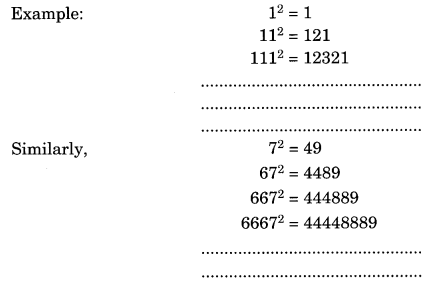
Some Patterns in square numbers:
Squares and Square Roots Class 8 Notes Maths Chapter 6