Movements of Ocean Water Class 11 Important Extra Questions Geography Chapter 14

Here we are providing Class 11 Geography Important Extra Questions and Answers Chapter 14 Movements of Ocean Water. Important Questions for Class 11 Geography are the best resource for students which helps in class 11 board exams.

Important Questions for Class 11 Geography Chapter 14 Movements of Ocean Water

Movements of Ocean Water Important Extra Questions Very Short Answer Type

Question 1.
What is inner space?
Answer:
The world of oceans and seas is referred to as “inner space,”

Question 2.
What are the important mechanisms by which ocean currents are generated?
Answer:
The important mechanisms are:

  1. The drag of winds over the ocean surface, and
  2. Unequal forces set up by differences in water density.

Question 3.
Classify the ocean currents.
Answer:
The ocean currents may broadly be classified into cold currents and warm currents.

Question 4.
Give the other name of tropical easterlies.
Answer:
Tropical easterlies are also known as trade winds.

Question 5.
Name the force that changes the direction of water drift in oceans.
Answer:
The Coriolis force changes the direction of water drift in oceans.

Question 6.
What kind of currents results due to differences in water density?
Answer:
Differences in water density set currents in a motion described as thermocline currents.

Question 7.
What is ‘gyre’?
Answer:
Due to the Coriolis effect, the moving water turns and follows an elliptical path and it is known as a gyre.

Question 8.
Which current flows as Kuroshio current after reaching the coasts of Taiwan and Japan?
Answer:
The North equatorial current flows as Kuroshio current after reaching the coasts of Taiwan and Japan.

Question 9.
Name the northern and southern branches of North Pacific current.
Answer:
Alaska and California currents respectively.

Question 10.
Define waves.
Answer:
Waves are oscillatory movements in water, where its particles move in a vertical plane, up and down.

Question 11.
What are the progressive waves?
Answer:
Ocean waves produced by winds are called progressive waves.

Question 12.
What is the difference between flood tide and ebb tide?
Answer:
Rise of sea level is called the flood tide and fall is called ebb tide.

Question 13.
Which is the birthplace of common eels?
Answer:
The Sargasso in the western North Atlantic is surrounded by the Florida current. It is often windless and is clocked with seaweed. It is the birthplace of common eels.

Question 14.
Up to what depth in water, the photosynthesis is possible for plants?
Answer:
The sunlight penetrates water up to 900 metres, but only in the top 100 metres is there enough light for plants to do photosynthesis.

Question 15.
When do the tides attain maximum height?
Answer:
Twice a month, when the earth, the moon and the sun are in a straight line.

Question 16.
At what interval of time do the tides occur on each meridian and why?
Answer:
Each meridian has a high and a low tide at an interval of 12 hrs. and 26 minutes, due to rotation of the earth.

Question 17.
Name two types of waves.
Answer:

  1. Transverse waves, and
  2. Longitudinal waves.

Question 18.
What is the main cause of the tide?
Answer:
The gravitational interaction of the earth, the moon and the sun is the main cause of tide.

Question 19.
What are the main processes of cooling of ocean water?
Answer:
Back radiation of heat from the sea surface, convection and evaporation.

Question 20.
What are ocean currents?
Answer:
The ocean currents are the regular movement of the surface of the water in a particular direction.

Question 21.
When does spring tide occur?
Answer:
Springtide occurs in the first and last quarter of the moon and sun are almost in a line.

Question 22.
Where does neap tide occur?
Answer:
When the sun and the moon are at right angles at the earth’s centre, neap tide occurs in the first and the last quarter of the moon.

Question 23.
What is the drift?
Answer:
The motion of the ocean water, generally at low velocity, as a result of surface friction from the prevailing winds.

Question 24.
What is salinity?
Answer:
It is the degree to which water contains dissolved salts.

Movements of Ocean Water Important Extra Questions Short Answer Type

Question 1.
Describe the types of ocean currents and their flow mechanism.
Answer:
Ocean currents are of two types: warm and cold currents. The main currents flow from the low latitudes in tropical zones towards high latitudes in the temperate and sub-polar zones. The cold currents flow from high latitudes to low latitudes.

Question 2.
Give reasons why the height of tidal waves varies from place to place?
Answer:
The height of the tidal waves varies from place to place because of the following reasons:

  1. The relative position of the moon and the sun with respect to the earth,
  2. Distribution of land and ocean on the earth’s surface, and
  3. Irregularities in the configuration of oceans.

Question 3.
What are tides?
Answer:
Tides are periodic rise and fall in the level of water in seas and oceans caused by the differential attraction of the moon and the sun. Twice a day, about every 12 hrs and 26 minutes, the sea level rises and falls. The rise of sea level is called the flood tide and the fall is called the ebb tide.

Question 4.
What is a tidal bore?
Answer:
‘The tidal waves follow the direction of the moon. In certain inland seas, where tidal waves reach from different directions, one can find a number of high tides and low tides. When such waves enter a gulf or river mouths, the tidal crests look like a vertical wall of water rushing upstream, which is known as the tidal bore.

Question 5.
Discuss the impact of prevailing winds on the motion of currents.
Answer:
Air flowing over the water surface exerts a dragging force upon that surface, setting the surface water layer in motion. Prevailing winds, such as the tropical easterlies (trade winds), blowing from east to west, and the middle-latitude westerlies, blowing from west to east, exert a one-way drag on sea surface over a vast expanse of oceans. This drag produces a system of drift currents.

Question 6.
Explain how differences in water density set currents in motion?
Answer:
Differences in water density can also set currents in motion These are described as thermocline currents. A surface water layer in one place may be less dense because it is warmer, or lower in density than the water layer in adjacent place that is colder or has a higher density. The water then moves gently from the region of less to the higher density.

Question 7.
Why the circulation of currents in the Indian ocean is different from the Atlantic and the Pacific oceans?
Answer:
The circulation of currents in the Indian ocean is characteristically different from the Atlantic and Pacific oceans because the Indian ocean is landlocked in the north. The circulation pattern in the northern portion of the Indian ocean changes its direction in response to the seasonal rhythm of the monsoons. There is a clear reversal of currents between winter and summer.

Question 8.
Describe the mechanism of origin of sea waves.
Answer:
It is commonly believed that the waves are generated due to friction on water surface caused by winds. The height of sea waves depends on:

  1. The wind speed,
  2. The duration of wind from a particular direction, and
  3. The fetch or the expanse of water surface over which the wind blows.

Question 9.
Distinguish between progressive and oscillatory waves.
Answer:
The ocean waves produced by winds rapidly through the water are called progressive waves, whereas in oscillatory waves each wave passes a fixed reference point, and the water particles travel through a vertical cycle of motion and return approximately to their original position.

Question 10.
Discuss the properties of waves.
Answer:
Waves are oscillatory movements in water, where its particles move in a vertical plane, up and down. The upper part of the wave is called the crest, and the lower part is called the trough. Each wave has a wavelength, velocity, height and wave period. The distance between two successive crests or two successive troughs is the wavelength. The time taken by a wavelength to pass a fixed point is known as the wave period. The vertical distance between a trough and a crest is called the wave height. The ratio of wavelength to the wave period gives the velocity of the wave.

Question 11.
Distinguish between Swell and Surf.
Answer:

SwellSurf
(1) Swells are the wind-generated waves in the

open sea.

(1) Surf also generated by winds but near the beach.
(2) They move in a uniform pattern of equivalent period and height.(2) This is foaming water which results from highly dynamic wave capacity.
(3) They are generated in the

open ocean

(3) These occur in the breaker zone of a shoreline.

Question 12.
What are the disadvantages of tides?
Answer:

  1. Tides are sometimes harmful to ships and boats.
  2. Tides check the formation of deltas.
  3. Marshes are formed due to accumulation of tidal water.
  4. Tides also hinder fishing.

Question 13.
Why does the temperature of seawater decrease with depth?
Answer:
The temperature of seawater is the same as that of the surface water up to a height of 100 metres. The surface of seawater receives, maximum insolation. As the rays penetrate the water, the heat is reduced by scattering, reflection and diffusion.

Question 14.
How can the velocity of the ocean currents be measured?
Answer:
The ocean currents flow like extensive rivers in the ocean. The rate of flow and the width of the currents, however, are not uniform. The Gulf stream, for example, is 80 km. wide and 1.6 km. deep. The Florida current has a velocity of 10 km. per hour on the surface and 3.5 km. at a depth of 200 m.

Movements of Ocean Water Important Extra Questions Long Answer Type

Question 1.
Write a short note on the vertical circulation of ocean water.
Answer:
Besides the horizontal movement, the vertical circulation of ocean water is also an important phenomenon. Ocean surface is marked with sinking and upwelling caused by wind action, evaporation of surface water, the addition of surface water by rainfall and changes in density due to cooling or warming of the surface layer. A most important cause of the sinking of ocean water on a large scale is cooling of the surface layer by loss of heat to the overlying atmosphere in high latitudes.

During long winters, much heat is lost to space than is gained by solar ^ radiation, thereby the relatively warm surface waters brought polewards v by ocean currents are drilled and increased in density. This water, generally close to the freezing point, sinks to the ocean floor, causing vertical circulation of the water.

Question 2.
Describe the currents of the Pacific ocean in brief.
Answer:
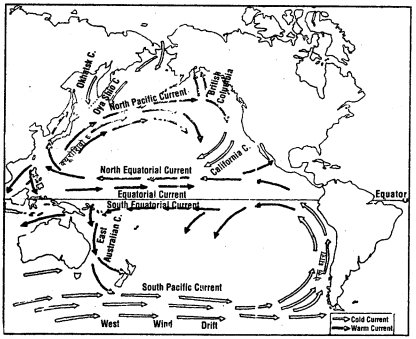
The important currents of the Pacific ocean are North equatorial, Kuroshio current, Alaska current, California current, Oyashio current, Okhotsk current, South equatorial current, South. Pacific current and Peru current.

The North equatorial current from the west coast of Central America reaches the Philippine Island, flowing from east to west in the north Pacific ocean.

Turning northward, the North equatorial current flows along Taiwan and Japan to form Kuroshio current. The currents are influenced by the westerlies from the south-east coast of Japan and tend to flow from west to east as North Pacific current. The current gets bifurcated into the northern and southern branches, called Alaska and California currents respectively after reaching the west coast of N&rth America.

The Alaska current flows anti-clockwise above the coast of British Columbia and Alaska, whereas the California current flows along the coast of California. The cold current, the Oyashio, flows in the North Pacific. Another cold current, named Okhotsk flows in the north Pacific and merges with Oyashio current, which finally sinks beneath the warmer waters of the Kuroshio.
Class 11 Geography Important Questions Chapter 14 Movements of Ocean Water im-1
Fig.14.3 current of the Pacific Ocean

The South equatorial current flows in the south Pacific ocean. It flows southward as the East Australian current before meeting the South Pacific current near Tasmania, which flows west to east. Near the south-western coast of South America, it turns north as the Peru Current. It is a cold current that feeds the South equatorial, thus completing the circle.

Question 3.
Distinguish between swash and backwash.
Answer:
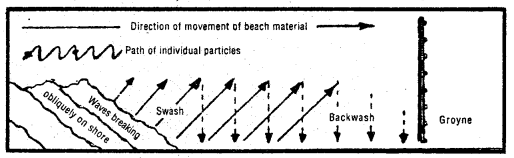
When ocean waves arrive at the coast of a continent or island, they encounter shallow Water. The configuration of coast interferes with the progress of the waives. Waves in shallow water are modified into ellipses that become progressively flattered as the coast is approached, As the steeping waves continue to travel shoreward, encountering still shallower water, the crest height increases sharply and the forward slope of the wave becomes greatly steepened. At a critical point, the ‘ waveform disintegrates into a mass of turbulent water called the breaker. Thereafter, it becomes a landward moving sheet of highly turbulent water known as the swash or uprush.

The water then begins to pour seaward down the slope in a reverse flow termed as backwash or back rush. Thus, backwash is the seaward flow of a body of water down the slope after a wave has broken on the beach, in contrast to swash. It may also be called the drag of a recording wave.
Class 11 Geography Important Questions Chapter 14 Movements of Ocean Water im-2
Fig. 14.4: Longshore drift showing wave action and the movement of beach materials

Question 4.
Write a short note on a spring tide and neap tide.
Answer:
Tides are the periodic rise and fall in the level of water in seas and oceans caused by the differential attraction of the moon and the sun. Twice a day, about every 12 hrs and 26 minutes, the sea level rises and falls.

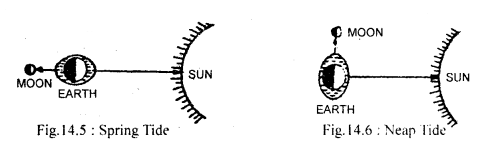
Tides do not rise to the same height every day. The relative position of the moon and the sun with respect to the earth is responsible for this variation in the height of tides. On the full moon and the new moon, the moon and the sun are almost in line with the earth, and hence, they exert their combined puli. Therefore, on these two days, tides are the highest and are known as spring tides.

On half-moon, the sun and the moon make a right angle at the earth’s centre. The pulls of the moon and the sun partly cancel each other out. as a result of which there are usually low tides called neap tides. This happens on the first and the last quarter of the lunar month when due to their right angular position to the attraction1 and centrifugal forces of the sun and the moon do not combine. This reduces the height of the tides to the minimum.
Class 11 Geography Important Questions Chapter 14 Movements of Ocean Water im-3

Question 5.
If there were no ocean currents, what would have happened to the world? Discuss.
Answer:
The oceans contain about 3% of the total water on earth. This water is always available for evaporation into the atmosphere and its subsequent precipitation on the land and the seas.

The general movement of a mass of ocean water in a fairly defined direction over great distances is called the ocean current. Current ranges in scale from ocean-wide flow system to local currents of small extent and can be generated by several mechanisms.’ Ocean currents are broad of two types: warm and cold currents. The warm currents flow from the low latitudes in tropical zones towards the high latitudes in the temperate and polar zones. The cold currents flow from high latitudes to low latitudes.

Water has an exceptionally great capacity for absorbing heat. The circulation of ocean water through currents helps in distribution of heat received in low latitudes to certain areas of high latitudes. In this way, the oceans modify the climate of the earth. Without ocean currents, this modification of climate would not have been possible.

The distribution of rich fishing grounds in the oceans and seas depends upon the circulation of water of the oceans as they bring nutrients to the surface in some areas. This process of bringing nutrients – both mineral and organic to the surface through the upwelling of water and its circulation is known as the ploughing action of the seas. Ocean currents aid in these processes. The absence of ocean currents would have hampered this process.

Ocean surface is marked with sinking (surges) and upwelling (swells) caused by wind action, evaporation of surface water, the addition of surface water by rainfall and changes in density due to cooling or warming of the surface layer. A most important cause of the sinking of ocean water on a large scale is cooling of the surface layer by loss of heat to the overlying atmosphere in high altitudes.

During long winters, much heat is lost to space, than is gained by solar radiation, thereby relatively warm surface waters brought poleward by ocean currents are chilled and increased in density. This water may be close to the freezing point and, therefore, sinks to the ocean floor. Without ocean currents, all the above activities of the ocean water would not have taken place.
Class 12 Hindi Important Questions Vitan Chapter 4 डायरी के पन्ने

Here we are providing Class 12 Hindi Important Extra Questions and Answers Vitan Chapter 4 डायरी के पन्ने. Important Questions for Class 12 Hindi are the best resource for students which helps in class 12 board exams.

डायरी के पन्ने Class 12 Important Extra Questions Hindi Vitan Chapter 4

प्रश्न 1.
ऐन को किस कारण लगा था कि उसकी दुनिया पूरी तरह से उलट-पुलट गई थी ?
उत्तर
ऐन के घर बुधवार 8 जुलाई, 1942 को संदेश आया था कि उसकी सोलह वर्षीय बहन मार्गोट को ए०एस०एस० से बुलावा आया था। इस बुलावे का अर्थ उसे यातना शिविर से बुलाया जाना था जिसमें उसे जर्मन सैनिकों की दया पर छोड़ देना था। ऐन के माता-पिता को यह बिल्कुल भी स्वीकार नहीं था इसलिए उन्होंने तुरंत भूमिगत हो जाने का निश्चय कर लिया था। इससे ऐन को लगा था उसकी दुनिया पूरी तरह से उलट-पुलट हो गई थी।

प्रश्न 2.
अज्ञातवास की बात सुनकर ऐन के मन में छिपने की कौन-सी जगह आई थी ?
उत्तर
वे कहाँ छिपेंगे-किसी के घर में? शहर में ? किसी परछत्ती पर? यहाँ? कहाँ? वह यह किसी से पूछ नहीं सकती थी पर ये प्रश्न उसके मन में उठ रहे थे।

प्रश्न 3.
ऐन ने अपने थैले में क्या-क्या भरा था? क्यों?
उत्तर
ऐन ने अपने थैले में डायरी, कलर, रूमाल, स्कूली किताबें, कंघी और पुरानी चिट्ठियाँ भरी थीं। वह कपड़ों की तुलना में स्मृतियों को अधिक महत्व देना चाहती थी।

प्रश्न 4.
अज्ञातवास पर जाते समय परिवार के चारों लोगों ने क्या पहना था ? क्यों ?
उत्तर
अज्ञातवास पर जाते समय उन चारों ने इतने अधिक कपड़े पहने थे मानो वे अपनी रात फ्रिज में गुजारने जा रहे हों। वे अपने साथ अधिक-से-अधिक कपड़े ले जाना चाहते थे। सबने दो बनियानें, तीन पैंटें, एक ड्रेस, उसके ऊपर एक स्कर्ट, एक जैकेट, एक बरसाती, दो जोड़ी स्टाकिंग्स, भारी जूते, एक केस, एक स्कार्फ और इनके अतिरिक्त और भी बहुत कुछ पहना था।

प्रश्न 5.
ऐन ने अपनी बिल्ली को कहाँ और किसकी देख-रेख में छोड़ दिया था ?
उत्तर
उन्होंने अपनी बिल्ली को पड़ोसियों के यहाँ छोड़ दिया था। वे ही अब उसकी देखभाल करने वाले थे। वे रसोई में बिल्ली के लिए सेर भर मीट भी छोड़ गए थे।

प्रश्न 6.
लोग चाहकर भीगने वाले ऐन के परिवार की सहायता क्यों नहीं कर सकते थे ?
उत्तर
9 जुलाई, 1942 की बरसात-भरी सुबह वह ढेर सारा सामान कंधों पर लादे हुए डरे-सहमे भाग रहे थे। सुबह काम पर जाते लोग उन्हें बेचारगी-भरी नजरों से देख रहे थे पर उनके सीने पर चमकते पीले रंग के सितारे को देखकर उनकी सहायता भी नहीं कर सकते थे क्योंकि हिटलर के शासन में यहूदियों को अपनी पहचान के लिए पीला सितारा पहनना आवश्यक था।

प्रश्न 7.
परिवार ने कहाँ छिपने का निर्णय किया था ?
उत्तर
पूरे परिवार ने पापा के ऑफिस की इमारत को ही चुना था क्योंकि वहाँ काम करने वाले लोगों की संख्या बहुत ही कम थी। वहाँ मिस्टर कुगलट, मिस्टर क्लीमेन, मिएप और बेय वोस्कुइल नामक चार लोग ही थे, जिन्हें इनके वहाँ छिपने के विषय में बताया गया था।

प्रश्न 8.
अंधेरे में छिपे हुए वे लोग अपना समय कैसे बिताते थे ?
उत्तर
लगभग चार बजे ही अंधेरा हो जाता था और वे पढ़ नहीं पाते थे इसलिए ऊल-जुलूल हरकतों में ही अपना समय बिताया करते थे। वे अंधेरे में व्यायाम करते, पहेलियाँ बुझाते, अंग्रेज़ी या फ्रैंच बोलते और किताबों की समीक्षा किया करते थे। इसके अतिरिक्त अंधेरे में दूरबीन लगा कर पड़ोसियों को रोशनी वाले कमरों में झाँक लिया करते थे।

प्रश्न 9.
अज्ञातवास के दौरान टर्की से संबंधित कौन-सी उत्साहवर्धक अफ़वाह सुनी गई थी ?
उत्तर
अज्ञातवास के दौरान टर्की के एक केंद्रीय मंत्री ने कहा था कि टर्की जल्दी ही तटस्थता छोड़ देगा और इंग्लैंड के पक्ष में हो जाएगा, जिससे ऐन के परिवार वालों का उत्साह बढ़ गया था।

प्रश्न 10.
हज़ार गिल्डर के नोट अवैध घोषित करने का लोगों पर क्या प्रभाव पड़ा ?
उत्तर
हजार गिल्डर के नोट अवैध घोषित होते ही ब्लैक मार्केट का धंधा करने वालों को बहुत बड़ा झटका लगा। इससे बड़ा झटका उन लोगों को लगा जो भूमिगत हो गए थे या जिनके पास धन का हिसाब-किताब देने की क्षमता नहीं थी। नोट बदलवाने की स्थिति में सबूत देना पड़ता था कि यह उनके पास कहाँ से आया था।

प्रश्न 11.
गिएज एंड कंपनी ने हज़ार गिल्डर के अपने नोटों के संकट से किस प्रकार छुटकारा पा लिया था?
उत्तर
गिएज एंड कंपनी के पास हज़ार गिल्डर के कुछ नोट थे जिनका हिसाब-किताब उनके पास नहीं था। उन्होंने इन नोटों से आगामी वर्षों के लिए अनुमानित कर की अदायगी करके इनसे छुटकारा पा लिया था।

प्रश्न 12.
हिटलर अपने सैनिकों से मुख्य रूप से क्या पूछा करता था और उसके सैनिक किस प्रकार उत्तर दिया करते थे ?
उत्तर
हिटलर अपने घायल सैनिकों से प्रायः पूछा करता था कि युद्ध में वे कहाँ घायल हुए थे और उन्हें कहाँ चोट लगी थी। सैनिक उत्साहपूर्वक अपने जख्मों को दिखाकर वह घटना सुनाते थे, जिस के कारण वे जख्मी हुए थे। वे सब हिटलर से हाथ मिलाने के लिए उत्साहित दिखाई देते थे।

प्रश्न 13.
अज्ञातवास के समय ऐन की रुचियाँ क्या थीं ?
उत्तर
ऐन को पत्रिकाओं से फ़िल्मी कलाकारों के चित्र इकट्ठे करने की रुचि थी। वह फ़िल्मों के बारे में ज्ञान इकट्ठा करती थी; उनकी समीक्षा करती थी; प्रति सप्ताह प्रकाशित होने वाली सिनेमा एंड थियेटर पत्रिका ध्यान से पढ़ती थी। वह फ़िल्मी अभिनेत्रियों की तरह अपने बाल सँवारा करती थी और उन्हें अपना स्टाइल बनाया करती थी। कुछ ही देर बाद फिर से वह अपने घुघराले बालों वाले स्टाइल में ही आ .. जाया करती थी।

प्रश्न 14.
अज्ञातवास काटते समय प्राय: कैसी बातें हुआ करती थीं और वे ऐन को कैसी लगा करती थीं ?
उत्तर
ऐन को अज्ञातवास काटते समय रोज़ एक-सी बातें नाली के सड़े पानी की तरह लगती थीं। खाने के वक्त मम्मी या मिसेज़ वान दान हजारों बार पहले सुना चुकी अपने बचपन की कहानियाँ सुनाया करती थीं। डसेल खूबसूरत रेस के घोड़ों, चालौट के महँगे वॉर्डरोव, लीक करती नावों, चार बरस की उम्र में तैर सकने वाले बच्चे, दर्द करती मांसपेशियों और डरे हुए मरीजों की बातें हुआ करती थीं। किसी भी लतीफ़े को सुनाने वाला बस स्वयं ही हँसता था क्योंकि कुछ भी तो नया सुनने-सुनाने को शेष नहीं बचा था।

प्रश्न 15.
हॉलैंड के प्रतिरोधी दल लोगों की किस प्रकार सहायता किया करते थे ?
उत्तर
फ्री नीदरलैंड्स दल के लोग जर्मन लोगों के अत्याचारों से राहत पाने के लिए पीड़ितों के लिए नकली पहचान-पत्र बनाते थे; उन्हें आर्थिक सहायता दिया करते थे और कार्य कर सकने वाले युवा ईसाइयों के लिए काम ढूँढ़ने में सहायता करते थे। वे पुरुषों के साथ राजनीति और काम-धंधे की बातें करते थे, तो औरतों के साथ भोजन और कष्ट के समय की बातें करते थे। सदा सहायक और खुशदिल दिखाई देने वाले वे लोग बच्चों से अखबारों और किताबों की बातें करते थे। वे हर अवसर पर फूल और उपहार दिया करते थे और कष्ट में पड़े अज्ञातवास काटने वालों की सहायता कर उनका दिल जीत लेते थे।

प्रश्न 16.
कैबिनट मंत्री मिस्टर बोल्के स्टीन ने क्या घोषित किया था जिससे ऐन को खुशी मिली थी ?
उत्तर
कैबिनट मंत्री मिस्टर बोल्के स्टीन ने लंदन से उस प्रसारण में कहा था कि जब युद्ध समाप्त हो जाएगा तब युद्ध का वर्णन करने वाली डायरियों और पत्रों का संग्रह किया जाएगा। ऐन खुश हो गई थी कि वह गुप्त एनेक्सी के बारे में सब छपवाएगी।

प्रश्न 17. ऐन ने एक ही दिन में हुए हवाई हमलों के विषय में क्या बताया था ?
उत्तर
ऐन ने बताया कि पिछले ही रविवार 350 ब्रिटिश वायुयानों ने इज्मुईडेन पर 550 टन गोला-बारूद बरसा कर तबाही मचाई थी जिससे सभी घर ऐसे काँप उठे थे जैसे हवा में घास की पत्तियाँ काँप उठती हैं।

प्रश्न 18.
युद्ध-काल में लोगों को किन-किन कष्टों से गुजरना पड़ रहा था ?
उत्तर
(i) खाद्य पदार्थों तथा अन्य सामग्रियों के लिए लोगों को लाइनों में खड़ा होना पड़ता था।
(ii) चोरियों की संख्या अत्यधिक बढ़ गई थी। पीठ मोड़ते ही कारें, मोटर-साइकिलें आदि चुरा लिए जाते थे।
(iii) आठ-दस वर्ष के छोटे-छोटे बच्चे भी चोरी करने में निपुण हो गए थे।
(iv) गली-नुक्कड़ पर लगी बिजली से चलने वाली घड़ियों और सार्वजनिक टेलीफ़ोनों तक का पुर्जा-पुर्जा चुरा लिया ।
(v) लोग फटे-हाल हो गए थे।
(vi) पुलिस अधिकारी किसी पर भी आरोप लगा कर जेल भेज देते थे।
(vii) खाद्य-सामग्री घटिया मिलती थी और बहुत महँगी भी हो गई थी।

प्रश्न 19.
चर्चिल को जन्मजात बहादुर क्यों कहा गया है ?
उत्तर
चर्चिल अपने साथियों स्मट्स, आइजनहावर और आर्नोल्ड के साथ उन फ्रांसीसी गाँवों में गए थे जिन पर पहले ब्रिटिश सैनिकों ने कब्जा कर लिया था और फिर मुक्त कर दिया था। चर्चिल एक टॉरपीडो नाव पर थे जिससे तटों पर गोलाबारी की जाती थी। उन्हें डर नाम की चिड़िया का पता तक नहीं था इसीलिए उन्हें जन्मजात बहादुर कहा गया है।

प्रश्न 20.
ऐन ने कितने समय बाद रात का आमने-सामने साक्षात्कार किया था? उसे तब कैसा अनुभव हुआ था?
उत्तर
ऐन ने डेढ़ वर्ष बाद खुली खिड़की के माध्यम से रात के समय की प्रकृति का आमने-सामने साक्षात्कार किया था। गहरी साँवली . बरसात की रात थी और तेज हवाएँ चल रही थीं। बादलों के बीच लुका-छिपी हो रही थी जिसने ऐन को मंत्रमुग्ध कर दिया था।

प्रकृति से साक्षात्कार की उसकी इच्छा बढ़ गई थी। वह पुलिस, चोर-उचक्कों और मोटे-काले चूहों से डरे बिना ही नीचे चली – गई थी। वह रसोई और प्राइवेट ऑफ़िस की खिड़की से प्रकृति के नजारे देखती रही थी। प्रकृति प्राणियों का अनूठा उपहार है और वह ग़रीब-अमीर के बीच अंतर नहीं करती।

प्रश्न 21.
पुरुष-स्त्री अधिकारों के विषय में ऐन के क्या विचार हैं ?
उत्तर
संभवतः शारीरिक बल, धन कमाने और परिवार चलाने के कारण पुरुष शुरू से ही औरतों पर शासन करने लगे थे, जो ऐन के अनुसार ठीक नहीं था। आधुनिक महिलाएं पूरी तरह स्वतंत्र होने का हक पाना चाहती हैं। महिलाओं का पूरा सम्मान किया ही जाना चाहिए। उन्हें भी सैनिक बनने का दर्जा मिलना चाहिए। औरतें ही मानव जाति की निरंतरता को बनाए रखने के लिए संघर्ष करती हैं; कष्ट झेलती हैं, मेहनत करके खाती हैं, तो वे सम्मान की भी अधिकारिणी हैं।

प्रश्न 22.
पीटर के स्वभाव की दो विशेषताओं का उल्लेख कीजिए जो ऐन को याद नहीं है।
उत्तर
पीटर नास्तिक था। उसे चर्च के प्रति घृणा थी। वह ऐन से अपने हृदय से जुड़ी बातें नहीं करता था। वह ऐसा कोई अवसर ऐन को नहीं देता था जिससे वह उसके हृदय में छिपे भावों को समझ सकती।

प्रश्न 23.
ऐन किस कारण से महिलाओं को सम्मानीय मानती थी? (C.B.S.E. 2012, Set-1)
उत्तर
ऐन का मानना था कि वह संतान को जन्म देती है, प्रसव पीड़ा झेलती है, जो प्रशंसनीय है। कोई सैनिक भी युद्ध में इतनी पीड़ा नहीं झेलता जितनी किसी भी महिला को प्रसव के समय झेलनी पड़ती है।

निबंधात्मक प्रश्नोत्तर

प्रश्न 1.
ऐन फ्रैंकले मिस्टर डसेल का चरित्र-चित्रण किस प्रकार किया है ?
उत्तर
मिस्टर डसेल ऐन के पिता के साथ काम करते थे। विश्वयुद्ध के समय जब ऐन के परिवार को अज्ञातवास के रूप में दो वर्ष बिताने पड़े थे तो मिस्टर डसेल भी उनके साथ पिता के कार्यालय और गोदाम में रहे थे। ऐन और मिस्टर डसेल दोनों एक लंबे और सँकरे कमरे में रूममेट थे। ऐन डसेल के चरित्र के बारे में बताती है कि वैसे तो मिस्टर डसेल बच्चों के साथ खुश रहते हैं तथा उन्हें खूब प्यार करते हैं, परंतु अनुशासन के मामले में वे एक बाबा आदम की सोच रखते थे।

वे लंबे-लंबे उबाऊ भाषण दिया करते जिन्हें सुनकर नींद ही आ सकती थी। चूंकि ऐन और मिस्टर डसेल एक कमरे को शेयर करतेथ इसलिए मिस्टर के लंबे-लंबे उबाऊ भाषण उसे अधिक सुनने पड़ते थे। चूँकि ऐन उनके भाषणों को ध्यान से नहीं सुनती थे इसलिए वे उसे अक्सर डाँट-फटकारा करते थे। ऐन मिस्टर डसेल के बारे में कहती है कि वे एक अच्छे खासे चुगलखोर थे। वे जान-बूझकर ऐन की झूठी सच्ची बातें मम्मी को किया करते थे और माँ भी ऐन को ही एक लंबा उपदेश दिया करती थी। इस प्रकार इस अज्ञातवास में मिस्टर डसेल का चरित्र भी ऐन के लिए एक सिरदर्द था।

प्रश्न 2.
ऐन की डायरी में लिखित द्वितीय विश्वयुद्ध के समय चोरी की घटनाओं का वर्णन कीजिए।
उत्तर
ऐन ‘किट्टी’ को संबोधित करते समय बताती है कि लोगों को सब्जी खरीदने के लिए भी सारा दिन खड़ा होना पड़ता है। डॉक्टर अपने मरीजों को ठीक से नहीं देख पाते क्योंकि गर्दन घुमाते ही उनकी कारें अथवा मोटर साइकिलें चोरी हो जाती हैं। चोरी की घटनाएँ इतनी अधिक बढ़ गई हैं कि डच लोगों ने अंगुलियों में अंगूठी पहनना ही छोड़ दिया है। आभूषण पहनने की प्रथा अब वहाँ खत्म हो रही है। छोटे-छोटे आठ-दस वर्ष के बच्चे भी अब चोरी करने लगे हैं।

वे घरों, दुकानों की खिड़कियाँ तोड़कर अंदर घुस जाते हैं और जो कुछ भी उनके हाथ लगता है सब कुछ चुरा ले जाते हैं। लोग अगर पाँच मिनट के लिए अपना घर छोड़ दें तो सारा घर साफ हो जाता है। गली-नुक्कड़ों पर लगी बिजली से चलने वाली घड़ियाँ चोर उतार ले जाते हैं तथा सार्वजनिक टेलीफोन के पुर्जे गायब हो जाना आम बात हो गई है। चोरी गए टाइपराइटरों, ईरानी कालीनों, बिजली से चलने वाली घड़ियाँ, कपड़ों आदि के लौटाने के लिए इनाम के विज्ञापन अखबारों में अब आए दिन छपने लगे। इस प्रकार इस द्वितीय विश्वयुद्ध से जूझते आम लोगों को चोरी की घटनाओं ने बुरी तरह प्रभावित किया था।

प्रश्न 3.
‘ऐन फ्रैंक की डायरी’ के आधार पर ‘ऐन’ के चरित्र की विशेषताओं का वर्णन कीजिए।
उत्तर
ऐन फ्रैंक डायरी की केंद्र-बिंदु है। दवितीय विश्वयुद्ध के समय बिताए अज्ञातवास की मानसिक एवं शारीरिक पीड़ाओं का वर्णन ऐन अपनी डायरी में दर्ज करती है। इसी आधार पर उसके चरित्र की विशेषताएँ निम्नलिखित हैं

(i) भावुक- ऐन एक भावुक बालिका है। वह अपने माता-पिता के प्रति बहुत प्यार करती है। छोटी-छोटी बातें भी वह दिल से लगा लेती है। मिस्टर डसेल जब उसकी शिकायत मम्मी को करते हैं तो बहुत भावुक हो जाती है। वह इस बात से परेशान है कि प्रत्येक सदस्य उसको तुनकमिजाज और अक्खड़ समझता है। जब उसका मूड खराब हो जाता है तो रात को सोने से पहले अपनी खामियां, जो माँ को बढ़ा-चढ़ा कर बतायी गई थी, के बारे में सोचकर कभी हँसती है कभी रोना शुरू कर देती है।

(ii) अभिनेत्री-ऐन को फ़िल्मी पत्रिका पढ़ने का अत्यंत शौक है। वह हर शनिवार की फ़िल्मी पत्रिका से नायक और नायिकाओं के चित्र काट कर संकलित करती थी। वह आने वाली फ़िल्मी नायक और नायिकाओं के नाम तथा समीक्षाएँ फरटेि से बोलती थी। वह अपने बाल फिल्मी नायिकाओं की तरह सँवारती थी। जब वह केश सज्जा को नए स्टाइल में बनाकर बाहर निकलती तो कोई-न-कोई उसे ज़रूर टोक देता था कि वह फलाँ फ़िल्म स्टार की नकल कर रही है। यह सुनते-सुनते जब वह बोर हो जाती तो वह सीधे गुसलखाने में जाती और उसके बाल पहले की तरह उलझकर धुंघराले बना लेती थी।

(iii) परिश्रम ऐन एक परिश्रमी बालिका है। जब उसे पता चलता है कि अब अज्ञातवास के लिए घर छोड़ना पड़ेगा तो वह अपने थैले सामान से भर लेती है। इन भारी थैलों को अपने कंधों पर उठाकर अपने पिता के कार्यालय तक ले जाती है। जब मार्गोट और माँ थककर सो चुकी थी। तब ऐन अपने पिता के लगातार गोदाम के कमरों की सफाई करती है। चारों तरफ बिखरे सामान को व्यवस्थित करती है। वह बिना इसकी परवाह किए कि उसने पूरे दिन एक बार भी खाना नहीं खाया है, फिर भी लगातार सारे सामान को ठीक से सजाती है।

(iv) प्रकृति प्रेमी-ऐन प्रकृति से अत्यधिक प्रेम करती है। प्रकृति को निहारना उसे अच्छा लगता है। चूंकि रात को रोशनी बंद कर दी जाती है तो वह अपने कमरे की खिड़कियों से पर्दे हटाकर चाँदनी रात में घंटों चाँद-सितारों को देखती है। आसमान, चाँद, बादल, तारों आदि की ओर देखना उसे शांति और आशा से भर देता है। प्रकृति उसे विनम्रता प्रदान करती

(v) नारी के अधिकारों के प्रति सचेत-ऐन एक जागरूक किशोरी है। वह नारी के अधिकारों की पक्षधर है। वह चाहती .. है कि नारी को भी पुरुषों के बराबर सम्मान और अधिकार मिले। उसे भी वीर सैनिकों की भांति अलंकृत किया जाए। प्रल वह पुरुषों की भाँति अपने अधिकारों के प्रति सचेत बने। उसे यह आशा है कि वह अगली सदी में नारी इतनी ताकतवर
बन जाएँगी कि लोग उसका सम्मान करने लगेंगे।

(vi) अतृप्त प्रेमिका-ऐन पीटर को प्रेम करती है। वह ‘किट्टी’ को लिखी एक चिट्ठी में व्यक्त भी करती है, “मैं अगर पीटर के कमरे में एक-दो दिन न जा पाऊँ तो मेरी बुरी हालत हो जाती है। मैं उसके लिए तड़पने लगती हूँ। पीटर एक अच्छा और भला लड़का है लेकिन उसने मुझे कई तरह से निराश किया है।” पीटर और ऐन दोनों बैठकर भविष्य, वर्तमान और अतीत की बातें करते हैं लेकिन ऐन एक असल चीज़ की कमी महसूस करती है और वह उसका पीटर के रति प्रेम है, परंतु पीटर उसे प्यार करते हुए भी उसके सामने प्यार को व्यक्त नहीं करता है। यह बात उसे निराश कर चटा


Class 12 Hindi Important Questions Vitan Chapter 3 अतीत में दबे पाँव 

Here we are providing Class 12 Hindi Important Extra Questions and Answers Vitan Chapter 3 अतीत में दबे पाँव . Important Questions for Class 12 Hindi are the best resource for students which helps in class 12 board exams.

अतीत में दबे पाँव Class 12 Important Extra Questions Hindi Vitan Chapter 3

प्रश्न 1.
हड़प्या शहर के साक्ष्यों की पूर्ण रूप से प्राप्ति क्यों नहीं हो पाई है ?
उत्तर
हड़प्पा शहर के अधिकांश साक्ष्य रेल लाइन बिछाने के दौरान पूरी तरह से नष्ट हो गए थे। वे आधुनिक काल के विकास की भेंट चढ़ गए हैं।

प्रश्न 2.
मोहनजोदड़ो शहर की व्यापकता के विषय में लिखिए। (C.B.S.E. Delhi 2013, Set-II, III)
उत्तर
मोहनजोदड़ो शहर अपने समय में बहुत ही बड़ा रहा होगा। लगभग पाँच सौ वर्ष पहले यह आज के ‘महासागर’ से भी बड़ा रहा होगा। यह शहर दो सौ हेक्टर क्षेत्र में फैला हुआ था और इसकी जनसंख्या लगभग पचासी हजार थी। यह घाटी भी सभ्यता का केंद्र रही होगी।

प्रश्न 3.
मोहनजोदड़ो कहाँ बसा हुआ था ? इस शहर के नाम का अर्थ क्या है और इसे अब किस नाम से पुकारते हैं ?
अथवा
मोहनजोदड़ो का शाब्दिक अर्थ क्या है? यह कहाँ स्थित है? (A.I. C.B.S.E. 2014, Set-I, II, III)
उत्तर
मोहनजोदड़ो पाकिस्तान के सिंध प्रांत में स्थित पुरातत्विक स्थान पर बसा हुआ था जहाँ कभी सिंधु घाटी सभ्यता थी। ‘मुअनजो-दड़ो’ का शाब्दिक अर्थ है-मुदों का टीला। वर्तमान में इसे मोहजोदड़ो नाम से पुकारा जाता है।

प्रश्न 4.
मोहनजोदड़ो कहाँ बसा हुआ था ? इसे विशेष प्रकार से क्यों बसाया गया था ? यह क्यों प्रसिद्ध है? (C.B.S.E. 2011. A.I. C.B.S.E. 2011 Set-1, 2012. Set-1)
उत्तर
मोहनजोदड़ो सिंधु घाटी सभ्यता के समय छोटे-मोटे टीलों पर बसा हुआ था। ये टीले प्राकृतिक नहीं थे। ईंटों से धरती की सतह को ऊँचा उठाकर इसे बसाया गया था। इसे टीलों पर इसलिए बनाया गया था कि बाढ़ आदि के कारण सिंधु नदी के जल से इसे बचाया जा सके। यह अपनी ऐतिहासिकता और सांस्कृतिक प्रतीक होने के कारण प्रसिद्ध है।

प्रश्न 5.
वर्तमान में सिंधु घाटी सभ्यता को किस रूप में देखा और महसूस किया जा सकता है ?
उत्तर
वर्तमान में सिंधु घाटी सभ्यता को इसकी सूनी पड़ी गलियों-सड़कों पर घूमकर देखा जा सकता है। इसकी टूटी-फूटी दीवारों, खंडहरों, घरों, दहलीजों, सीढ़ियों, पायदानों आदि को देखा और महसूस किया जा सकता है। इसके माध्यम से इतिहास के पार झाँका जा सकता है।

प्रश्न 6.
मोहनजोदड़ो के अवशेष कितने पुराने हैं ? इन्होंने भारत को प्राचीन सभ्यताओं की किस श्रेणी में ला खडा किया है ?
उत्तर
मोहनजोदड़ो के अवशेष ईसा पूर्व के हैं। इसके सबसे बड़े चबूतरे पर बने बौद्ध स्तूप में छब्बीस सदी पहले की ईंटें लगी हुई हैं जिसमें भिक्षुओं के भी कमरे है। इस खोज ने भारत को मिस्र और मेसोपोटामिया (इराक) की प्राचीन सभ्यताओं के समकक्ष खड़ा कर दिया है।

प्रश्न 7.
इस आदिम शहर की सभ्यता-संस्कृति की अधिकांश वस्तुएँ अब कहाँ हैं ?
उत्तर
इस आदिम शहर की सभ्यता-संस्कृति से संबंधित वस्तुएँ अब कराची, लाहौर, दिल्ली और लंदन के संग्रहालयों में सुरक्षित हैं।

प्रश्न 8.
सिंध क्षेत्र में सरदियों में वातावरण कैसा होता है?
उत्तर
सिंधु घाटी की सभ्यता का क्षेत्र सिंध राजस्थान से कुछ मिलता-जुलता है। सर्दियों में भी दोपहर के समय धूप चौंधियानी वाली होती है। वह राजस्थान की धूप की तरह पारदर्शी नहीं है जिस कारण सारा वातावरण और दिशाएँ फीके-से रंग में रंगी हुई प्रतीत होती हैं। रेत के टीले नहीं हैं और खेतों में हरियाली है। खुला आसमान, सूना परिवेश, धूल, बबूल और अधिक गर्मी और सर्दी यहाँ के वातावरण की विशिष्टताएँ हैं।

प्रश्न 9.
मोहनजोदड़ो में कौन-सा निर्माण अभी भी अपने मूल स्वरूप के बहुत नजदीक दिखाई देता है? अन्य संरचनाओं की स्थिति कैसी है?
उत्तर
मोहनजोदड़ो में ‘अनुष्ठानिक महाकुंड’ ही अभी तक अपने मूल स्वरूप के बहुत निकट दिखाई देता है जो अद्वितीय वस्तु कला का नमूना है। अन्य इमारतें और संरचनाएँ इतनी उजड़ी हुई हैं कि कल्पना से ही उनके उपयोग का अंदाजा लगाया जा सकता है।

प्रश्न 10.
मोहनजोदड़ो की सड़कों की क्या विशेषता है ?
उत्तर
मोहनजोदड़ो की लगभग सभी सड़कें सीधी या फिर आड़ी। आज के वास्तुकारक इसे ‘ग्रिड प्लान’ कहते हैं।

प्रश्न 11.
विश्व के कौन-से नगर ‘ग्रिड प्लान’ के अनुसार बने हुए हैं ?
उत्तर
विश्व के प्रसिद्ध नगर ब्रासीलिया, चंडीगढ़ और इस्लामाबाद ‘ग्रिड’ शैली के शहर हैं जो आधुनिक नगर नियोजन के प्रतिमान ठहराए जाते हैं।

प्रश्न 12.
महाकुंड की विशेषताएँ लिखिए। (C.B.S.E. Outside Delhi 2013, Set-I)
उत्तर
स्तूप की दाईं तरफ एक लंबी गली के आगे महाकुंड है। गली को दैव मार्ग (डिविनिटि स्ट्रीट) नाम दिया गया है। माना जाता है कि उस सभ्यता में सामूहिक स्नान किसी अनुष्ठान का हिस्सा होता था। कुंड चालीस फुट लंबा और पच्चीस फुट चौड़ा और सात फुट गहरा है। इसमें उत्तर और दक्षिण की ओर से सीढ़ियाँ उतरती हैं। इसके तीन तरफ़ साधुओं के लिए कमरे बने हैं। उत्तर दिशा में दो पंक्तियों में आठ स्नानघर हैं और इसमें से किसी का भी दरवाजा दूसरे दरवाजे के सामने नहीं खुलता।

इस कुंड में पक्की ईंटों का जमाव है जिससे पानी रिस न सके और बाहर का गंदा पानी भीतर न जा सके। कुंड के तल और दीवारों पर ईंटों के बीच चूने और चिरोड़ी के गारे का प्रयोग किया गया है। पीछे की दीवारों के साथ दूसरी दीवार खड़ी की गई है जिसमें सफ़ेद डामर का प्रयोग है। कुंड के जल के लिए दोहरे घेरेवाला एक कुआँ है। कुंड से पानी को बाहर निकालने के लिए पक्की ईंटों से बनी हुई नालियाँ हैं जो ढकी हुई हैं।

प्रश्न 13.
‘कोठार’ क्या थे? इनका निर्माण क्यों किया गया था ?
उत्तर
‘कोठार’ अनाज इकट्ठा करने के लिए भंडार थे जिनमें शायद ‘कर’ के रूप में प्राप्त किया गया अनाज रखा जाता था। यहाँ नौ-नौ चौकियों की तीन कतारें हैं। उत्तरी दिशा में एक गली बनी हुई है जहाँ ढुलाई के लिए शायद बैलगाड़ियाँ लाई जाती होंगी।

प्रश्न 14.
कृषि के लिए इस क्षेत्र का उपयोग कैसे होता था ?
अथवा
सिंधु घाटी सभ्यता में किन-किन कृषि उपजों उत्पादन के प्रमाण प्राप्त होते हैं? ‘अतीत में दवे गंव के 50-5 पर लिखिए।
(C.B.S.E. 2014, Set-IT)
उत्तर
प्रसिद्ध इतिहासकार इरफान हबीब का मानना है कि यहाँ के लोग रबी की फसल लेते थे। कपास, गेहूँ, जौ, सरसों और चने की रोटी के प्रमाण मिले हैं। विद्वानों का मानना है कि यहाँ ज्वार, बाजरा और रागी भी पैदा की जाती थी। खजूर, खरबूजे और अंगूर भी उगाए जाते थे। झाड़ियों से बेर इकट्ठे किए जाते थे। कपास की खेती भी होती थी। कपास को छोड़कर अन्य सभी फ़सलों के तो बीज भी यहाँ से प्राप्त हुए हैं।

प्रश्न 15.
‘कॉलेज ऑफ़ प्रीस्ट्स’ किसे कहा गया है ? इसका निर्माण क्यों किया गया होगा ?
उत्तर
महाकुंड के उत्तर-पूर्व में एक बहुत बड़ी इमारत के अवशेष हैं जिसके तीन तरफ़ बरामदे और बीचोंबीच खुला स्थान है। इसमें बीस खंभों वाला एक बड़ा हॉल है। दक्षिण की तरफ़ एक ओर टूटी-फूटी इमारत है। माना जाता है कि बरामदों के साथ अनेक छोटे-छोटे कमरे होंगे। पुरातत्व शास्त्री मानते हैं कि धार्मिक अनुष्ठानों में ज्ञानशालाएँ साथ-साथ सटाकर बनाई जाती थीं इसलिए इसे ‘कॉलेज ऑफ़ प्रीस्ट्स’ कहते हैं। यह भी अनुमान लगाया जाता है कि यह राज्य सचिवालय सभा-भवन या कोई सामुदायिक केंद्र रहा होगा।

प्रश्न 16.
मोहनजोदड़ो की भवन-निर्माण कला की कौन-सी विशेषता चंडीगढ़ के संरचनाकार काबूजिए ने आपकी वास्तुकला में सम्मिलित की थी ?
उत्तर
मोहनजोदड़ो में सड़क के दोनों ओर घर हैं पर सड़क की ओर सब घरों की पीठ दिखाई देती है। कोई भी घर मुख्य सड़क की ओर नहीं खुलता। उस सबके दरवाजे अंदर गलियों की ओर हैं। चंडीगढ़ के संरचनाकार काबूजिए ने भी 50 वर्ष पहले यही किया था। वहाँ किसी भी घर में प्रवेश करने के लिए मुख्य सड़क से पहले सेक्टर के भीतर जाना पड़ता है। फिर गली में और फिर घर में जा सकते हैं। शायद का«जिए की वास्तुकला में भी कोई प्रेरणा चेतन-अवचेतन में इसी प्रकार सफ़र करके पहुँची हो।

प्रश्न 17.
मोहनजोदड़ो में जल निकासी की व्यवस्था किस प्रकार की गई थी?
उत्तर
मोहनजोदड़ो में सभी नालियाँ ढकी हुई थीं जो सड़क के दोनों तरफ़ समांतर बनी हुई थीं। हर घर में एक स्नानघर था। घरों के भीतर से गंदा पानी नालियों से बाहर हौदी तक आता था और फिर नालियों के जाल में मिल जाता था। कहीं-कहीं नालियाँ बिना ढकी हुई थीं।

प्रश्न 18.
मोहनजोदड़ो को ‘जल संस्कृति’ का नाम क्यों दिया जाता है ?
उत्तर
मोहनजोदड़ो में जल का प्रबंधन बहुत अच्छे और सुविचारित ढंग से किया गया था। इतिहासकारों के अनुसार सिंधु घाटी सभ्यता पहली ऐसी ज्ञात संस्कृति है जिन्होंने कुएँ खोदकर भू-जल तक पहुँचने की क्षमता प्राप्त की थी। केवल मोहनजोदड़ो में ही लगभग सात सौ कुएँ थे। नदी, कुएँ, कुंड, स्नानागार और बेजोड़ जल-निकासी के कारण ही मोहनजोदड़ो को ‘जल संस्कृति’ का नाम दिया जाता है।

प्रश्न 19.
मोहनजोदड़ो में ‘मुखिया’ के घर की क्या विशेषता है ?
उत्तर
मोहनजोदड़ो में अधिकतर घर तीस-गुणा-तीस फुट के हैं और कुछ घर इसमें दुगुने-तिगुने भी हैं पर सबकी न्यूनाधिक वास्तु शैली एक-सी है। पर जिसे ‘मुखिया’ का घर कहते हैं उसमें करीब बीस कमरे और दो आँगन हैं।

प्रश्न 20.
‘नर्तकी’ का प्रसिद्ध शिल्प कहाँ से प्राप्त हुआ था ? अब यह कहाँ पर है ?
उत्तर
हेरल्ड ग्रीव्ज ने मुख्य सड़क के दक्षिण की ओर खुदाई करवाई थी। एक छोटे घर से ‘नर्तकी’ शिल्प प्राप्त हुआ था जिसके विषय में पुरातत्वविद मार्टिमर वीलर ने कहा था कि ‘संसार में इसके जोड़ की दूसरी चीज़ शायद ही होगी। अब यह मूर्ति दिल्ली के राष्ट्रीय संग्रहालय में सुरक्षित है।

प्रश्न 21.
मोहनजोदड़ो में सब कुछ का आधार कैसा है ?
उत्तर
मोहनजोदड़ो में कुओं को छोड़कर सब कुछ वर्गाकार या आयताकार है। नगर की योजना, बस्तियाँ, घर, कुंड, छोटी-बड़ी इमारतें, ठप्पेदार मुहरें, चौपड़ का खेल, गोटियाँ, तौलने के बट आदि सब चौकोर या आयताकार ही हैं।

प्रश्न 22.
मोहनजोदडो में पर्याप्त वर्षा और जंगलों का अनुमान किन आधारों पर लगाया जाता है?
उत्तर
1. घरों में खिड़कियाँ या दरवाजों पर छज्जों के चिह्न न होने से उन दिनों शायद बहुत तेज़ धूप नहीं पड़ती होगी क्योंकि कड़ी धूप से बचने के लिए छाया के लिए छज्जे बनाने का प्रचलन अब भी है।
2. जानी-मानी मुहरों पर शेर, हाथी, गेंडा आदि के चित्र होने के कारण, जो मरुभूमि पर नहीं पाए जाते।
3. किसी भी नहर के प्रमाण न मिलने से।

प्रश्न 23.
लेखक को मोहनजोदड़ो के सूनेपन को देखकर जैसलमेर के कुलधरा की याद क्यों आ गई थी ?
उत्तर
जैसलमेर के मुहाने पर पीले पत्थरोंवाला गाँव कुलधरा खूबसूरत है पर वहाँ सब लोग नहीं रहते। सभी गाँववासी डेढ़ सौ वर्ष पहले तत्कालीन राजा से हुई तकरार के कारण अपने स्वाभिमान की रक्षा के लिए रातोंरात गाँव छोड़कर चले गए थे। वे अपना सारा सामान तो ले गए थे पर उनके खंडहर हो चुके घर अभी भी ज्यों-के-त्यों खड़े हैं। लेखक को मोहनजोदड़ो के खंडहर देखकर वही दृश्य याद आ गया था।

प्रश्न 24.
मोहनजोदड़ो की सभ्यता के भग्नावशेषों में किसी भी हथियार का न मिलना क्या सिद्ध करता है?
उत्तर
मोहनजोदड़ो की सभ्यता के भग्न अवशेषों में से 50,000 से अधिक वस्तुएँ प्राप्त हो चुकी हैं। पर उनसे हथियार एक भी प्राप्त नहीं हुआ। साथ ही राजसत्ता या स्वामित्व प्रदर्शित करनेवालों को अवशेष प्राप्त हुए हैं। इससे ऐसा प्रतीत होता है कि सिंधु घाटी सभ्यता का समाज अति अनुशासित और मजबूत था जिसे राजसत्ता की आवश्यकता ही नहीं थी। सबका समाज न तो धर्म द्वारा शासित था और न ही राजनीति के द्वारा चालित वह अपने ही बल पर अनुशासित था।

प्रश्न 25.
मोहनजोदड़ो की सभ्यता कैसी रही होगी? पाठ के आधार पर अनुमान से लिखिए। (C.B.S.E. 2011, 2014 Set-1)
उत्तर
मोहनजोदड़ो की सभ्यता भव्यता और उच्चता की पुजारी नहीं थी। वह निम्न या मध्यवर्गीय थी जिसकी भव्यता उनके भीतरी अनुशासन में छिपी हुई थी। वे लोग सभ्य, धर्म-प्रेमी, कला-प्रेमी और सुसंस्कृत थे पर उनकी सभ्यता ‘लो प्रोफाइल’ थी।

प्रश्न 26.
मोहनजोदड़ो की सभ्यता से हमारा युग आज भी कुछ-कुछ जुड़ा हुआ था। कैसे?
उत्तर
मोहनजोदड़ो से जुड़ी सिंधु घाटी सभ्यता के समय ठोस पहियोंवाली बैलगाड़ियाँ चला करती थीं, जिनके अवशेष प्राप्त हुए हैं। ऐसी ही बैलगाड़ियाँ कुछ वर्ष पहले तक गाँवों में चला करती थीं। लेखक का मानना है कि उनके गाँव में दुल्हन पहली बार ससुराल में ऐसी बैलगाड़ियों में ही आया करती थीं।

निबंधात्मक प्रश्नोत्तर

प्रश्न
1. मोहनजोदड़ो की नगर-योजना का वर्णन कीजिए।
अथवा
“सिंधु सभ्यता एक नगर-संस्कृति थी” वर्णन करें।
अथवा
मोहनजोदड़ो का अनूठा नगर नियोजन आधुनिक नगर नियोजन के प्रतिमान नगरों से बेहतर क्यों है? स्पष्ट कीजिए। (C.B.S.E. Outside Delhi 2013, Set-III)
उत्तर
सिंधु घाटी की खुदाई से मिले अवशेषों से यह तथ्य स्पष्ट हो जाता है कि सिंधु सभ्यता एक नगर संस्कृति थी। जिस योजना के अनुसार मोहनजोदड़ो नगर बसा हुआ था यह योजना अपने आप में एक अनूठी योजना थी। यहाँ की सभी सड़कें सीधी हैं या फिर आड़ी। इस नगर में प्रशासनिक इमारतें, सभा भवन, ज्ञानशाला और कोठार हैं। सड़क के दोनों ओर घर हैं। लेकिन सड़क की ओर किसी भी घर का दरवाजा नहीं खुलता। सभी घर सड़क की ओर पीठ करके बनाए गए हैं।

यही शैली आधुनिक काल में चंडीगढ़ शहर को बसाने में इस्तेमाल की गई है। आपको किसी के घर जाने के लिए मुख्य सड़क से पहले सेक्टर के भीतर दाखिल होना पड़ता है; फिर गली में और फिर घर में प्रवेश किया जा सकता है। घर छोटे भी और बड़े भी हैं। लेकिन सभी घर कतार में खड़े हैं। अधिकतर घरों का आकार तीस गुणा तीस फुट का है। कुछ घर इससे बड़े भी हो सकते हैं। ये सभी घर नियोजित एवं व्यवस्थित थे।

नगर में एक बड़ा घर भी है शायद यह घर ‘मुखिया’ का घर रहा होगा। इस घर में दो आँगन और लगभग बीस कमरे रहे होंगे। इस नगर में उपासना केंद्र भी है और ‘रंगरेज़ का कारखाना’ भी। दो मंजिला घरों की संख्या भी काफ़ी है। यह भी अनुमान लगाया जा सकता है कि भूमि तल के मकानों में मजदूर आदि रहते थे और प्रथम तल पर मकान मालिक रहा करते थे। कुछ बड़े घरों में छोटे कमरे भी हैं।

इसका अर्थ यह हो सकता है कि शहर की जनसंख्या काफ़ी रही होगी। बड़े घरों के आँगन में चौड़ी सीढ़ियाँ हैं। कुछ घर दो मंजिला तो दिखते हैं परंतु उनपर सीढ़ियों के निशान नहीं हैं शायद ऊपर चढ़ने के लिए लकड़ी की सीढ़ियों का प्रयोग किया जाता होगा जो कालांतर में नष्ट हो गई होंगी।’ छोटे घरों की बस्ती में छोटी या संकरी सीढ़ियाँ हैं। उनके पायदान जरा ऊँचे हैं। ऐसा शायद जगह की कमी के कारण किया गया होगा। इस प्रकार सिंधु सभ्यता एस एक नगर संस्कृति पर आधारित सभ्यता थी। किती

प्रश्न 2.
मोहनजोदड़ो के अजायबघर में खुदाई के समय मिली कौन-कौन सी चीजें रखी हैं?
उत्तर
लेखक ओम थानवी जब मोहनजोदड़ो की यात्रा पर गए तो उनके गाइड ने एक छोटा अजायबघर भी दिखाया था। लेखक के अनुसार-“यह अजायबघर छोटा है जैसे किसी कस्बाई स्कूल की इमारत हो, सामान भी ज्यादा नहीं है।” इस अजायबघर में रखी चीजों की संख्या पचास हजार से अधिक रही होगी। मोहनजोदड़ो की खुदाई से मिली अहम चीजें अब कराची, दिल्ली और लंदन के अजायबघरों में रखी हुई हैं। इस अजायबघर में जो चीजें रखी गई हैं वे सिंधु सभ्यता के साक्षात दर्शन करवा देती हैं।

काला पड़ गया गेहूँ, ताँबे और काँसे के बरतन, मुहरें, वाद्य, चाक पर बने विशाल मृद-भांड, उनपर काले-भूरे चित्र, दो तीये के आइने, कंघी, मिटी के बरतन, दो पाटन की चक्की, मिट्टी की बैलगाड़ी और दूसरे खिलौने। रंग-बिरंगे पत्थरों के मनकोंवाले हार, चौपड़ की गोटियाँ, कंगन और सोने के कंगन। सोने के कंगन अब शायद चोरी हो गए हैं। इस प्रकार सभ्य समाज का जो साजो-सामान होता है वह सब सिंधु घाटी की सभ्यता में देखने को मिलता है। इस प्रकार सिंधु सभ्यता दुनिया की प्राचीनतम सभ्यताओं में सबसे अनूठी एवं संस्कृति प्रधान सभ्यता है।

प्रश्न 3.
दुनिया के सबसे पुराने शहरों में दो भारतीय नगरों के नामों का उल्लेख कर उनकी प्रमुख विशिष्टताएं लिखिए।
अथवा
मोहनजोदड़ो कहाँ है? वह क्यों प्रसिद्ध है?
अथवा
मोहनजोदड़ो क्यों प्रसिद्ध है? दो कारण लिखिए। (C.B.S.E. 2012,A.I.C.B.S.E. 2012, Set-1)
उत्तर
‘मोहनजोदड़ो’ और ‘हड़प्पा’ भारत के वे प्राचीन शहर हैं जो दुनिया के सबसे पुराने शहरों में प्रमुख स्थान रखते है। ये दोनों सिंधु घाटी के परिपक्व दौर के शहर है। मोहनजोदड़ो तान युग के शहरों में सबसे बड़ा है। इसकी खुदाई से बड़ी संख्या में इमारतें, सड़कें, धातु-पत्थर की मूर्तियाँ, मुहरें, खिलौने, चाक पर बने चित्रित भांडे, साजो-सामान आदि मिलते हैं।

प्रश्न 4.
‘अतीत में दबे पाँव’ पाठ के आधार पर स्पष्ट करें कि ध्वस्त खंडहर अपने समय की सभ्यता और संस्कृति के जीवंत दस्तावेज होते हैं। (IC.B.S.E. 2012)
अथवा
सिंधु घाटी के लोगों में कला या सुरुचि का महत्व ज्यादा था-टिप्पणी कीजिए। (A.I. C.R.S.E. 2014, Set-I, II, III)
उत्तर
सिंधु घाटी की खदाई में मिले स्तूप, गह, स्नानागार, टूटे-फूटे घर, चौडी और कम चौडी सडकें. गलियाँ. बैलगाडियाँ, सिलाई-कदाई की सूया, छोटी-छोटी नावे किसी भी सभ्यता एवं संस्कृति का इतिहास कही जा सकती हैं। इन टूटे-फूटे घरों के खंडहर उस सभ्यता की ऐतिहासिक कहानी बयान करते हैं। मिट्टी के बरतन, मूर्तियाँ, औजार आदि चीरों उस सभ्यता की ऐतिहासिक पृष्ठभूमि को नापने का हो सकते हैं परंतु मोहनजोदड़ो के ये टूटे-फूटे घर अभी इतिहास नहीं बने हैं।

इन घरों में अभी धड़कती जिंदगियों का अहसास होता है। संस्कृति और सभ्यता से जुड़ा सामान भले ही अजायबघर में रख दिया हो परंतु शहर अभी वहाँ है जहाँ कभी था। अभी भी आप इस शहर की किसी दीवार के साथ पीठ टिकाकर सुस्ता सकते हैं। वे घर अब चाहे खंडहर बन गए हों परंतु जब आप इन घरों की देहरी पर कदम रखते हैं तो आप थोड़े सहम जाते हैं क्योंकि यह भी किसी का घर रहा होगा। जब प्रवेश करते है तो डर लगना स्वाभाविक है।

आप किसी रसोई की खिड़की के साथ खड़े होकर उसमें पकते पकवान की गंध ले सकते है। अभी सड़कों के बीच से गुजरती बैलगाड़ियों की रुन-झुन की आवाज़ सुन सकते हैं। ये सभी घर टूटकर खंडहर बन गए है परंतु इनके बीच से गुजरती साँय-सॉय करती हवा आपको कुछ कह जाती है। अब ये सब घर एक बड़ा घर बन गए हैं। सब एक-दूसरे में खुलते हैं। लेखक का मानना है कि “लेकिन घर एक नक्शा ही नहीं होता। हर घर का एक चेहरा और संस्कार होता है। भले ही यह पाँच हजार साल पुराना घर क्यों न हो।”

इस प्रकार लेखक इन टूटे-फटे खंडहरों से गजरते हए इन घरों में किसी मानवीय संवेदनाओं का संस्पर्श करते हैं। इस प्रकार कहा जा सकता है कि टूटे-फूटे खंडहर, सभ्यता और संस्कृति के इतिहास होने के साथ-साथ जीवंत दस्तावेज भी होते हैं।

प्रश्न 5.
‘अतीत में दबे पाँव’ पाठ के आधार पर सिंधु घाटी सभ्यता की विशेषताओं का उल्लेख कीजिए। (A.I.C.B.S.E.2016, Set-11,Outside Delhi, 2017)
उत्तर
“अतीत में दबे पाँव’ साहित्यकार ओम थानवी की विरचित एक यात्रा वृतांत है। इसमें लेखक ने सिंधु घाटी सभ्यता की निम्नांकित विशेषताओं का उल्लेख किया है
(1) अनुशासन प्रिय- सिंधु घाटी की सभ्यता एक अनुशासन प्रिय सभ्यता है। इसके महानगरों मोहनजोदड़ो एवं हड़प्पा के अवशेषों को देखकर प्रतीत होता है कि इस सभ्यता के लोग अनुशासनबद्ध होकर जीवनयापन करते थे।
(2) समाज पोषित- सिंधु घाटी की सभ्यता राजपोषित या धर्मपोषित न होकर समाजपोषित सभ्यता थी। यहाँ के निवासी सामाजिक रूप से परस्पर अवरुद्ध थे।
(3) मानवता पर आधारित- सिंधु घाटी की सभ्यता मानवता पर आधारित थी। यहाँ के अर अनुमान लगाया जा सकता है। यहाँ की सामाजिक, आर्थिक, धार्मिक एवं सांस्कृतिक परिस्थितियाँ मानवता पर आधारित थीं।
(4) कृषि पर आधारित सिंधु घाटी की सभ्यता का मुख्य व्यवसाय कृषि एवं पशुपालन था। इसमें पशुओं के साथ सहज जीवन जिया जाता था। यहाँ की खुदाई से मिली बैलगाड़ी तथा कृषि यंत्र इसके प्रमाण हैं।
(5) जल संस्कृति-सिंधु घाटी की सभ्यता को जल संस्कृति की सभ्यता माना जाता था क्योंकि इसकी जल व्यवस्था अति उत्तम एवं श्रेष्ठ थी। मोहनजोदड़ो में ही लगभग 700 कुएँ थे। इस सभ्यता में जल-निवासी का बेजोड़ नमूना था।

Water (Oceans) Class 11 Important Extra Questions Geography Chapter 13

Here we are providing Class 11 Geography Important Extra Questions and Answers Chapter 13 Water (Oceans). Important Questions for Class 11 Geography are the best resource for students which helps in class 11 board exams.

Important Questions for Class 11 Geography Chapter 13 Water (Oceans)

Water (Oceans) Important Extra Questions Very Short Answer Type

Question 1.
What are brines?
Answer:
Brines are salt solutions commonly containing a higher portion of dissolved salt than that occurring in seawater.

Question 2.
How would you classify the large water bodies?
Answer:
The large water bodies can be classified into four groups, viz., oceans, intercontinental seas, enclosed seas and fringing seas.

Question 3.
Name four major oceans of the earth.
Answer:
The four major oceans of the earth are the Pacific Ocean, Atlantic Ocean, Indian Ocean and the Arctic Ocean.

Question 4.
Give three examples of intercontinental seas.
Answer:
They are Malays Sea, Central American Sea and the Mediterranean Sea.

Question 5.
Give a few examples of enclosed seas.
Answer:
Baltic Sea, Red Sea, Hudson Bay and the Persian Gulf are some examples of enclosed seas.

Question 6.
Identify some fringing seas.
Answer:
Baring Sea, Japan Sea, East China Sea, Andaman, California, North Sea, Laurentian Sea, Bass Sea, English Channel and Irish Seas.

Question 7.
What are the factors on which the amount of rainfall entering the soil depends?
Answer:
The amount of rainfall entering the soil depends upon the rate of rainfall and the infiltration rate of the soil.

Question 8.
What are the first order relief features of the earth?
Answer:
Continents and ocean basins are the first order relief features of the earth.

Question 9.
“The continental margins consists of two major submarine features.” Name them.
Answer:
They are the continental shelf and the continental slope.

Question 10.
Mention three types of features of the ocean basin floor.
Answer:
The ocean basin floor contains three types of features, viz.,

  1. abyssal plains and hills,
  2. oceanic rise and
  3. seamounts.

Question 11.
Name the second layer of oceans identified on the basis of their temperature structure.
Answer:
It is Theraseoline.

Question 12.
What is the major salt presents in the seawater?
Answer:
The major salt present in seawater is sodium chloride.

Question 13.
Name the deepest part of the ocean.
Answer:
The deepest part of the ocean is the Mariana Trench in the Pacific Ocean. It is from 11,034 m. deep below the sea level.

Question 14.
Where is the tallest sea mount situated?
Answer:
The tallest seamount is situated between Samoa and New Zealand which is 8690 m. high from the surrounding ocean floor.

Question 15.
What are the factors determining the salinity of seawater?
Answer:
The salinity of seawater depends upon the extent of evaporation, river discharge and precipitation.

Question 16.
What is residence time?
Answer:
The average time that an element remains dissolved in the ocean before removal is known as residence time.

Question 17.
How do you measure the salinity of seawater?
Answer:
It is measured in gm. of salt per thousand gm of seawater.

Question 18.
Why is the earth called Blue planet?
Answer:
Because of the abundance of water on its surface, the earth is often called a Blue planet.

Question 19.
What are oceanic deeps?
Answer:
Trough like depressions or trenches in the seafloor is called oceanic deeps. Deeps occur mostly at the convergence of plates in subduction zones.

Question 20.
How is the hydrological cycle expressed mathematically?
Answer:
The hydrological cycle is expressed mathematically as:

RF = RO + ET

RF includes all types of precipitations, RO is round off and ET is evapotranspiration.

Question 21.
Which is the largest ocean in the world?
Answer:
The Pacific Ocean.

Question 22.
Which sea has the maximum salinity?
Answer:
Dead Sea – 238 per thousand.

Question 23.
How much part of the earth is covered by the Pacific Ocean?
Answer:
1/3 part.

Question 24.
How much percentage of the earth is covered with water?
Answer:
71 % of the surface of the earth is covered with water.

Question 25.
What is the average salinity of ocean water?
Answer:
35 per thousand.

Question 26.
Name the two main banks of the world.
Answer:

  1. The Duggar bank,
  2. The Grand bank,

Question 27.
What percentage of the ocean floor is covered by the continental shelf?
Answer:
7.6%.

Water (Oceans) Important Extra Questions Short Answer Type

Question 1.
Why is earth called the ‘Blue Planet’?
Answer:
The earth is called a Blue planet because of the abundance of water found on the surface of the earth. Water covers 71 % of the earth surface.

If we take into account only the water surface of the earth, then 43% lies in the northern hemisphere and 57% in the southern hemisphere.

Question 2.
What are oceanic deeps?
Answer:
The oceanic deeps are deeper than the abyssal plains. They occupy 2% of the oceanic area. Although deeps are found in the Pacific ocean. Mariana deep is the deepest deep in the Pacific Ocean.

Question 3.
Name the most common features found on the ocean floor.
Answer:
The most common features found on the ocean floor are:

  1. Continental shelf
  2. Continental slope
  3. Submarine canyon
  4. Abyssal plains
  5. Submarine ridge
  6. Ocean deeps
  7. Troughs

Question 4.
Define the continental shelf.
Answer:
From the coasts towards the open sea, there often exists a stretch of the shallow sea. The bed of this shallow sea bordering the continental platform is known as the continental shelf. It is a continuation of the continental block submerged below the sea. It slopes gently towards the sea, the angle of slope usually being less than one degree. The depth of the shallow seas rushing over a continental shelf varies from low tide to about 100 fathoms. Along the eastern coast of India, there exists a fairly wide strip of the continental shelf.

Question 5.
What are oceanic deeps?
Answer:
Trough like depressions or trenches in the seafloor is called oceanic deeps. Deeps occur mostly at the convergence of plates in subduction zones.

Question 6.
What are seamounts?
Answer:
Seamounts are topographical features rising from the ocean floor. A seamount is an isolated peak, usually a volcano, with a pointed summit, usually lies below the ocean surface, sometimes 3000 m. below.

Question 7.
What is an abyssal plain?
Answer:
Abyssal plain is a deep-sea plain. It is a very large and relatively level area of the ocean floor, covered with a thin layer of sediment. Thus abyssal plain is an area of the deep ocean floor having a flat bottom with a very’ faint slope. Characteristically situated at the foot of the continental rise, the abyssal plain is present in all ocean basins. It is formed by long-continued deposition of very’ fine sediments and, therefore, has a nearly perfect flatness.

Question 8.
Write a short note on the continental rise.
Answer:
Continental rise is a submarine feature of the continental margins. Along its seaward margin, the continental shelf gives way to the continental slope. The slope is abruptly replaced by the continental rise. Continental rise is a surface of much gentler slope decreasing in steepness toward the ocean basin floor. It generally has a moderate to low relief.

Question 9.
What is runoff? How does it occur?
Answer:
Runoff is th§ water flowing from a drainage area. It is that part of precipitation which run off the land surface into streams. Runoff occurs when precipitation, that does not have an opportunity to infiltrate into the soil, flows across the land surface. However, most of it enters the stream channel ultimately, which carries it to the oceans. A part of precipitation that infiltrates the soil percolates downward to the water table through springs. Broadly speaking, runoff is composed of water from both surface flow and seepage flow. It is an extremely important-segment of hydrological cycles.

Question 10.
Discuss the factors affecting the distribution of temperature of the ocean water.
Answer:
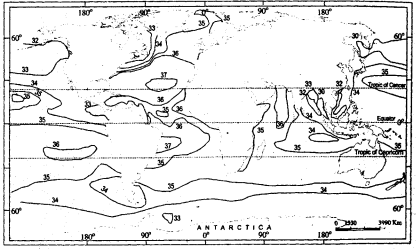
The salinity of seawater varies from place to place. At the equator, the salinity is somewhat lower due to abundant rains, greater cloudiness and low rate of evaporation. In latitudes about 20° in both the hemispheres, where evaporation is more intense and precipitation is lower, salinity is greater and in the temperate latitudes, where evaporation is less and rains. are more abundant, salinity is lower.

In Red sea, where no river flows, the salinity is 40 to 41 per thousand. In the Black sea, in which numerous rivers discharge, the salinity is 17 to 18 per thousand. In the White sea. it is between 25 and 26 per thousand, while in the Baltic sea it is 3 to 4 per thousand on an average.
Class 11 Geography Important Questions Chapter 13 Water (Oceans) im-2
Fig. 13.4: Distribution of surface water salinity in oceans

Question 11.
Why is the seawater saline?
Answer:
The seawater is saline because a number of salts are dissolved in it. The total weight of salts dissolved in the sea is 4800 million tonnes. Of these, sodium chloride, or common salt, accounts for 3800 million tonnes, sulphate for 3000 million tonnes, magnesium for 1600 million tonnes, potassium for 480 million tonnes and bromide for 83 million tonnes. The seawater may be less saline or more saline depending upon the extent of evaporation, river discharge and precipitation, but salt composition remains invariable.

Question 12.
What are the direct and indirect uses of oceans to man?
Answer:
Oceans are directly or indirectly useful to man in many ways:
Direct uses of the oceans:

  1. Oceans are the storehouse of fishes.
  2. They are a storehouse of minerals.
  3. They provide the cheapest route for transportation.

Indirect uses: Indirectly-oceans control the climate.

Question 13.
How is the depth of seafloor measured?
Answer:
The depth of seafloor is measured with sound waves. A depth recorder is used for this purpose. The echo of the sound returning after striking the sea bottom forms the basis of it. It helps to measure the velocity and depth.

Question 14.
What do you understand by hydrosphere?
Answer:
The hydrosphere is the part of the earth submerged by oceans and seas. The vast oceans cover a total area of about 71% of the total earth’s surface. Earth is called a blue planet. Approximately 61% of the northern hemisphere and 81 % of the southern hemisphere is known as water hemisphere. The distribution of land and water is antipolar on earth. The Arctic Ocean surrounds the north pole and the Antarctic continent encircles the south pole.

Water (Oceans) Important Extra Questions Long Answer Type

Question 1.
Prepare a map of the Atlantic Ocean floor, mentioning ocean basins and mid-Atlantic ridges.
Answer:
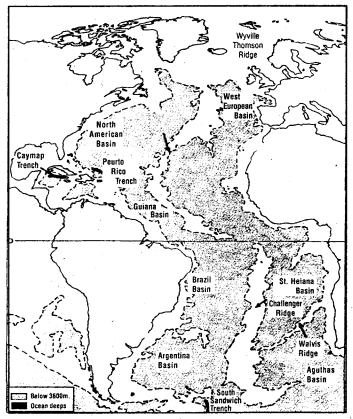
The Atlantic Ocean covers about one-sixth of the earth’s area. Resembling ‘S’ in shape, the ocean is bounded on the west by North America and South America, and On the east by Europe and Africa. To the south, it extends up to Antarctica and in the north, it is bounded by Greenland and Iceland.

The mid-Atlantic ridge, running from north to south in ‘S’ form is about 14,450 km. long and about 4000 m. high. The ridge has a broad fracture in the middle and slopes on both sides gently. The mid-oceanic ridge in the North Atlantic is known as Dolphin Ridge, and that in the South Atlant ic as the Challenger Ridge. A number of islands are located on the ridge.

The mid-Atlantic ridge divides the ocean into two major basins, namely, the East and West Atlantic basins. Some other basins in the Atlantic are the North American basin, The Labrador basin, The Brazil basin. The Argentina, Agulhas, Angola, and the West.
Class 11 Geography Important Questions Chapter 13 Water (Oceans) im-1
Fig. 13.3: Major Relief features of the Atlantic Ocean

Question 2.
What type of relief features exists in the ocean basin floor?
Answer:
The ocean basin is an extensive region of the basin floor, generally lying at a depth ranging between 2,500 and 6,000 m. It covers about 76.2% of the ocean’s area.

The ocean basin floor contains three types of relief features:

  1. abyssal plains and hills,
  2. oceanic rise and
  3. seamounts.

An abyssal plain is an area of the deep ocean floor having a flat bottom with a very faint slope. Characteristically situated at the foot of the continental rise, the abyssal plain is present in all ocean basins. Abyssal plains are surfaces formed by long-continued deposition of very fine sediments and, therefore, have a nearly perfect flatness. Abyssal hills are small hills rising to heights of a few tens of metres to a few hundred metres above the sea basin floor.

The ocean rise is an area hundreds of km. in the breadth over which the surface rises several hundred metres above the surrounding abyssal plain. Within the rise, the relief may range from subdued to very rugged.

Seamounts are the isolated peaks that rise 1000 ms. or more above the seafloor. Many of the seamounts are conspicuously flat-topped and extremely steep riched, named guyot.

Question 3.
Identify various layers of the ocean based on the level of salinity.
Answer:
The salinity of the water is the ratio of the total weight of dissolved
solids to the weight of water. It is variable in quantity, differentiating in value from place to place over the oceans and at various depths. The average salinity is 35 per thousand. The relationship of salinity to depth is analogous with the three-layer temperature systems.

  1. First and the topmost layer is the shallow surface layer of high salinity (35.0 to 36.5 per thousand)
  2. Below this layer is a zone of the rapid decrease in salinity, called a halocline. It corresponds with the thermocline.
  3. Below the halocline, differences in salinity’ are very small and salinity lies in the range of 34.6 to 34.9 per thousand for most of the ocean body. Thus, the salinity decreases with the increasing depth.

Question 4.
Discuss the longitudinal variation in the salinity of ocean water.
Answer:
The salinity of seawater varies from place to place. At the equator, the salinity is somewhat lower due to abundant rains, greater cloudiness and low rate of evaporation. In latitudes about 20° in both the hemispheres, where evaporation is more intense and precipitation is lower, salinity is greater and in the temperate latitudes, where evaporation is less and rains. are more abundant, salinity is lower.

In Red sea, where no river flows, the salinity is 40 to 41 per thousand. In the Black sea, in which numerous rivers discharge, the salinity is 17 to 18 per thousand. In the White sea. it is between 25 and 26 per thousand, while in the Baltic sea it is 3 to 4 per thousand on an average.
Class 11 Geography Important Questions Chapter 13 Water (Oceans) im-2
Fig. 13.4: Distribution of surface water salinity in oceans

Question 5.
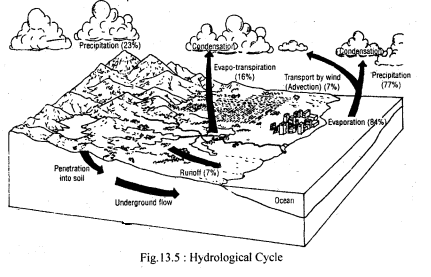
Describe the hydrological cycle in brief.
Answer:
The hydrological cycle is the continuous circulation of water from the earth’s surface to the atmosphere. Water from the oceans is evaporated and lifted into the atmosphere. It is eventually condensed and is returned back to the earth’s surface in the form of rain, hail, snow or sleet.

Some of the precipitation, after wetting the foliage and ground, runs off over the surface to the streams. It is the water that sometimes causes erosion and is the main contribution to floods. Of the precipitation that soaks into the ground, some are available for growing plants and for evaporation. Some reach the deeper zones and percolates through springs and seeps to maintain streams during the dry period. The streams, in turn, eventually return the water back to the oceans where it originated. It is because of this never-ending circulation that the process has come to be known as the hydrological cycle.

The hydrological cycle is mathematically expressed as:

RF = RO + ET, where RF-includes all types of precipitation, RO is runoff and ET is evapotranspiration.

Runoff occurs when precipitation, that does not have an opportunity to infiltrate into soil, flows across the land surface. However, most of it enters the stream channel ultimately, which carries it to the oceans. A part of precipitation that infiltrates the soil percolates downward to the water table through springs. Broadly speaking, runoff is composed of water from both surface flow and seepage flow. It is an extremely important segment of the hydrological cycle. Rainwater that reaches the soil surface is wholly or partly absorbed by the soil in the process of infiltration. The amount of rainfall entering the soil depends upon the s* rate of rainfall and infiltration rate of the soil.
Class 11 Geography Important Questions Chapter 13 Water (Oceans) im-3

Class 12 Hindi Important Questions Vitan Chapter 2 जूझ

Here we are providing Class 12 Hindi Important Extra Questions and Answers Vitan Chapter 2 जूझ. Important Questions for Class 12 Hindi are the best resource for students which helps in class 12 board exams.

जूझ Class 12 Important Extra Questions Hindi Vitan Chapter 2

प्रश्न 1.
‘जूझ’ पाठ का मुख्य भाव स्पष्ट कीजिए।
उत्तर
जूझ का शाब्दिक अर्थ है-संघर्ष। इस पाठ में लेखक ने एक बच्चे की पाठशाला जाने की दृढ़ इच्छाशक्ति तथा इच्छापूर्ति के लिए किए जानेवाले संघर्ष का चित्रण किया है। वह अपने संघर्ष को सफल बनाना चाहता है। वह अपनी स्कूल जाने की इच्छा को सफल बनाता है और एक सफल कवि बनता है। यहाँ कथा-नायक के जीवन के संघर्षों का मार्मिक चित्रांकन दर्शनीय है। इस उपन्यास का कथा-नायक कोमलावस्था से निरंतर संघर्ष करता रहता है।

प्रश्न 2.
कथा-नायक की माँ ने दत्ता जी राव को अपने बेटे की पढ़ाई छुड़वाने का क्या कारण बताया ?
उत्तर
कथा-नायक की माँ ने दत्ता जी राव को बताया कि दाऊ सारा दिन रखमाबाई के पास गुजार देता है। खेती के काम में हाथ नहीं लगाता। वह सारे गाँव में आजादी से घूमता रहता है। इस कारण आनंद को खेतों में काम करना पड़ता है। इसलिए माँ को अपने बेटे की पढ़ाई छुड़वानी पड़ी।

प्रश्न 3.
दादा ने कथा-नायक से क्या वचन लिया ?
उत्तर
दादा ने कथा-नायक से यह वचन ले लिया कि उसे दिन निकलते ही खेत पर हाजिर होना चाहिए। उसे ग्यारह बजे पाठशाला का समय होने तक खेत में पानी लगाना चाहिए। खेत से ही सीधे पाठशाला जाना होगा। छुट्टी होते ही घर में थैला रखकर सीधे खेत पर आकर घंटा भर ढोर चराना। सभी खेतों में ज्यादा काम होने पर पाठशाला में गैर-हाजिर होना।

प्रश्न 4.
कथा-नायक की कक्षा का मॉनीटर कौन था और क्यों ? ।
उत्तर
कथा-नायत की कक्षा का मॉनीटर बसंत पाटिल नामक छात्र था। वह बहुत होशियार और मेहनती था। उसका स्वभाव बहुत शांत था। वह सदा तैयारी में लगा रहता था इसलिए वह मॉनीटर था।

प्रश्न 5.
पाठशाला में मास्टर कथा-नायक को किस नाम से पुकारते थे? उसका विश्वास कैसे बढ़ने लगा?
उत्तर
पाठशाला में मास्टर कथा-नायक को आनंदा कहकर पुकारते थे। आनंदा कभी-कभी अपने मॉनीटर के साथ बच्चों के सवाल जाँचने लगा तो उन दोनों की दोस्ती हो गई। वे दोनों कक्षा में अनेक काम करने लगे। मास्टर उससे अच्छा व्यवहार करने लगे। मास्टरों के अपनेपन के व्यवहार तथा मॉनीटर बसंत पाटिल की दोस्ती के कारण कथानायक का पाठशाला में विश्वास बढ़ने लगा।

प्रश्न 6.
लेखक को मराठी कौन पढ़ाते थे और कैसे?
उत्तर :
लेखक को श्री सौंदलगेकर नामक मास्टर मराठी पढ़ाते थे। वे पढ़ाते समय स्वयं रम जाते थे। विशेषकर वे कविता को बहुत ही अच्छे ढंग से पढ़ाते थे। वे सुर, लय, छंद के साथ आनंदमय ढंग से पढ़ाया करते थे। पहले वे एकाध कविता गाकर सुनाते थे। फिर बैठे-बैठे अभिनय के साथ कविता का भाव ग्रहण करवाते थे। उसी भाव की किसी अन्य कवि की कविता भी सुनाते। बीच में यशवंत, वोरकर, ताँबे, गिरीश, केशव कुमार आदि कवियों से अपनी मुलाकात के संस्मरण भी सुनाते थे। कभी-कभी स्वरचित कविता भी सुना देते थे।

प्रश्न 7.
लेखक सुबह-शाम खेतों पर पानी लगाते या ढोर चराते समय क्या करते थे?
उत्तर :
लेखक सुबह-शाम खेतों पर पानी लगाते समय मास्टर के ही हाव-भाव, लय, ताल, छंद, आरोह-अवरोह के अनुसार गाते रहते थे। वे अपने मास्टर के अनुसार ही अभिनय करते थे।

प्रश्न 8.
लेखक का अकेलापन कैसे गायब हो गया? (HR. 2010, Set-B)
उत्तर
लेखक अपने अकेलेपन में कविताओं को लय, ताल, छंद, यति-गति के साथ गाया करता। वह बहुत ऊँची आवाज़ में गाकर अभिनय करने लगा था। वह कविता गाते-गाते शुई-मुई करके नाचने लगता था। उन्होंने अनेक कविताओं को स्वयं की चाल में गाना शुरू कर दिया। इस प्रकार लेखक का अकेलापन गायब हो गया।

प्रश्न 9.
मास्टर के अनुसार कविता रचने के क्या नियम होने चाहिए?
उत्तर मास्टर के अनुसार कविता रचने के निम्नलिखित नियम होने चाहिए
(i) स्पष्ट शुद्ध लेखन होना चाहिए।
(ii) कवि की भाषा शुद्ध होनी चाहिए।
(iii) अलंकार-छंद आदि का प्रयोग शुद्ध होना चाहिए।
(iv) कठिन भाषा का प्रयोग नहीं करना चाहिए।

प्रश्न 10.
यह खेती हमें गड्ढे में ढकेल रही है-बालक आनंद यादव के इस कथन के पक्ष या विपक्ष में दो तर्क दीजिए।
उत्तर
बालक आनंद यादव का कथन सत्य था क्योंकि
(i) खेती से प्राप्त कमाई घर के खर्च के लिए पर्याप्त नहीं होती।
(ii) ऋण के बोझ के कारणों से किसानों को आत्महत्या के लिए विवश होना पड़ता है।

निबंधात्मक प्रश्नोत्तर

प्रश्न 1.
कथा-नाषक (आनंद) के पिता उसे स्कूल क्यों नहीं भेजना चाहते ? समीक्षा करें।
अथवा
पिता बेटे की पढ़ाई-लिखाई के पक्ष में क्यों नहीं था? (C.R.S.E. 2014, Set-III, A.I. C.B.S.E. 2014)
उत्तर
कथानायक एक किसान के बेटे हैं जो पढ़-लिखकर कोई नौकरी करना चाहते हैं। कथानायक का मानना है कि नौकरी प्राप्त कर वे अपने जीवन को सफल बना सकते हैं अथवा कोई व्यापार कर अपने जीवन में खुशहाली ला सकते हा कथानायक के पिता दीवाली के एक महीना बाद ही ईख पेरने का कोल्हू चलाना चाहते हैं।

पिता जी का मानना है कि अगर कोल्लू जल्दी शुरू हो गया तो ईख की अच्छी-खासी रकम मिल जाएगी। उनकी समझ थी कि अगर सबने अपने कोल्हू चला दिए तो बाजार में गुड़ की बहुतायत हो जाएगी और भाव नीचे गिर जाएंगे क्योंकि बाजार में बदिया गुड़ आ जाएगा और हमारे गुड की कीमत घट जाएगी।

इसके विपरीत कथा-नायक की सोच थी कि ईख पकने के बाद ही गह अधिक निकलेगा क्योंकि देर तक खड़ी ईख में रस की मात्रा बढ़ जाती है। इस प्रकार गुड़ भी अधिक निकलेगा और मेरी पढ़ाई भी हो जाएगी, परंतु कथा-नायक के पिता अपनी सोच के अनुसार काम करना चाहते हैं इसलिए वे कथा-नायक को स्कूल जान से मना कर देते हैं।

प्रश्न 2.
कथा-नायक के फिर से स्कूल जाने में दत्ता जी राव की भूमिका का वर्णन करें।
उत्तर
कथा-नायक के दादा (पिता जी) उसे खेती के काम में लगाना चहाते हैं। पढ़ाई को समय खराब करने जैसा मानते हैं इसलिए कथा-नायक (आनंद) को पांचवी कक्षा से हटा देते हैं परंतु अभी भी कथानायक में पढ़ने की उत्कुंठा बनी हुई है। वे अपनी माँ को यह समझाते हैं कि दत्ता जी राव ही मेरी पढ़ाई फिर से शुरू करवा सकते हैं। इसलिए माँ-बेटा दोनों दत्ता जी राव के पास जाकर पूरी बात बताते है। दत्ता जी राव कथा नायक को बुलाकर खूब डाँटते हैं। वे उसे कहते हैं “फिर तू क्या करता है?” जब दत्ता जी राव ने कथा-नायक के पिता से बहस करना शुरू किया तो सारी बात सामने आ गई।

उन्होंने दादा से कहा कि मैं देख रहा हूँ कि तुम आजकल खेती में बिलकुल ध्यान नहीं दे रहे हो। तुमने उन माँ बेटे को आजकल बैल की तरह खेतों में जोत रखा है और स्वयं सारा दिन गांव में घूमते रहते हो। दत्ता जी राव यह भी कहते हैं कि अगर बच्चे की फीस नहीं दे सकता तो मैं इसकी फीस के पैसे भर दिया करुंगा। इसलिए कल से इसको स्कूल भेजो। इस प्रकार कथानायक की पढ़ाई एक बार फिर शुरू हो जाती है।