Drainage System Class 11 Important Extra Questions Geography Chapter 3

Here we are providing Class 11 Geography Important Extra Questions and Answers Chapter 3 Drainage System. Important Questions for Class 11 Geography are the best resource for students which helps in class 11 board exams.

Important Questions for Class 11 Geography Chapter 3 Drainage System

Drainage System Important Extra Questions Very Short Answer Type

Question 1.
What is drainage?
Answer:
The flow of water through well-defined channels is known as drainage.

Question 2.
Where is the dendritic drainage pattern found in India?
Answer:
In Great plains of North India.

Question 3.
Give the name of two rivers of Central India.
Answer:
Godavari and Krishna.

Question 4.
Name the three rivers that flow into the Arabian Sea.
Answer:
Narmada, Tapi and Mahi.

Question 5.
What type of drainage pattern is found in the Thar desert?
Answer:
In Thar desert centripetal drainage pattern is found.

Question 6.
Give two examples of antecedent rivers.
Answer:
Brahmaputra and Kosi are the two antecedent rivers.

Question 7.
What do you mean by water regime?
Answer:
The seasonal flow of water in a river is called its water regime.

Question 8.
Name two rivers of Central India.
Answer:
Sind and Chambal.

Question 9.
When do peninsular rivers have maximum flow?
Answer:
The peninsular rivers have maximum flow in the rainy season.

Question 10.
Name the main watershed of peninsular rivers.
Answer:
The Western Ghats.

Question 11.
Name the two west-flowing rivers Qf peninsular India.
Answer:
Narmada and Tapi are the west-flowing rivers.

Question 12.
Which river falls into the Gulf of Khambat?
Answer:
Mahi river falls into the Gulf of Khambat.

Question 13.
Name the three types of Himalayan river systems.
Answer:

  1. The Indus system,
  2. The Ganga system,
  3. The Brahmaputra system.

Question 14.
What is a river basin?
Answer:
The watersheds of large rivers are called river basins.

Question 15.
Name the two sections of the western coastal plain.
Answer:
Konkan coast and Malabar coast are the two sections of the western coastal plain.

Question 16.
What is cuspate deltas?
Answer:
The rivers like Ebro of Spain which form the tooth-like delta at their mouth is known as cuspate delta.

Question 17.
What is a radial pattern of drainage?
Answer:
When the river radiates from a hill, the pattern is called radial.

Question 18.
Why the Himalayan rivers are perennial?
Answer:
Because the Himalayan rivers rise from glaciers.

Question 19.
Why the rivers meander and change their courses?
Answer:
Variable nature of the terrain and geological conditions cause the rivers to meander and change their courses.

Question 20.
Name the five main tributaries of the Indus river.
Answer:
The Chenab, the Ravi, the Beas, the Satluj and the Jhelum.

Question 21.
What do you mean by ‘punched’?
Answer:
‘Punched’ is the name given to the rivers of Punjab – the Satluj, the Beas, the Ravi, the Chenab and the Jhelum.

Question 22.
Name two streams which form the Chenab river.
Answer:
Chandra and Bhaga.

Question 23.
Which states are drained by the river Ganga?
Answer:
Uttranchal, Uttar Pradesh, Bihar and West Bengal are drained by the river Ganga.

Question 24.
Name the main river basins of the peninsula.
Answer:
Mahanadi, Godavari, Krishna and Kaveri are the four main basins of the peninsula.

Question 25.
Give the three important utilities of the Indian rivers.
Answer:

  1. Irrigation,
  2. Navigation, and
  3. Water power generation.

Drainage System Important Extra Questions Short Answer Type

Question 1.
Define a drainage system.
Answer:
The flow of water through well-defined channels is known as drainage. The network of such channels is called a drainage system. The drainage system includes the area drained by the river and its tributaries. The drainage pattern is of various types. The drainage pattern of an area is the product of the natural drainage pattern.

Question 2.
What are the various types of drainage patterns?
Answer:
The drainage pattern is of various types:

  1. Dendritic-When the drainage develops similar to branches of a tree.
  2. Radial – When the rivers radiate from a hill.
  3. Centripetal – When the rivers flow into a lake or a depression
  4. Trellis – When primary tributaries flow more or less parallel to one another and the secondary tributaries join from sides more or less a right angle.

Question 3.
Classify the Indian drainage on the basis of discharge of water,
Answer:
It may be classified into:

  1. The Arabian Sea drainage,
  2. Bay of Bengal drainage.

These two groups are separated from each other through the Delhi Ridge, the Aravallis, the Sahyadri and Amarkantak known as water divide.

Question 4.
What are the river basin and watershed?
Answer:
A river basin is a form of natural or artificial depression. The total area of the land drained by a river and its tributaries is known as a river basin. On the other hand, watershed means water-parting. Watershed may or may not be sharply defined, separating two continuous drainage areas from the head-stream flow in different directions into different river systems or river basins.

Question 5.
Give some characteristic features of the Kaveri basin.
Answer:
The Kaveri rises in Brahamgiri hills of Coorg district in Karnataka. It is 800 km. long and drains an area of67900 km2. The river carries water throughout the year with comparatively less fluctuation than other peninsular rivers.

Question 6.
Why flood is a frequent feature in the Brahmaputra basin?
Answer:
The Brahmaputra is one of the largest rivers in the world. It is a trans-Himalayan river. It rises in Kailash range near Mansarovar lake. It flows eastward longitudinally covering a distance of 1200 km. It forms a gorge in Namcha Barwa mountains. In India, it enters forming a gorge. It receives Dihang and Lohitas its tributaries. The characteristic feature of Brahmaputra is its flood. It is due to the fact that both the Purvanchal Himalayas and the Shillong plateau receive heavy rainfall.

Question 7.
Why do the rivers on the western coast have no deltas?
Answer:
The rivers over the western coast transport lot of sediment with them but do not form a delta, because they are unable to deposit this sediment at the coast. They are very swift due to the deep slope of the ghats and narrow coastal plain. Therefore they do not form deltas.

Question 8.
What is the difference between delta and estuary?
Answer:

DendriticTrellis
In the dendritic pattern, the drainage develops similar to the branches of a tree.In this pattern, the primary tributaries flow more or less parallel to one another and secondary tributaries join from the side.

Question 9.
What are the east-flowing rivers?
Answer:
The Mahanadi, Godavari, Krishna and Kaveri are east-flowing rivers. These rivers are generally large and form huge deltas near their mouths. These rivers discharge themselves into the Bay of Bengal. These rivers do not flow through troughs.

Question 10.
What do you mean by cusecs and comes?
Answer:
The discharge of the volume of water flowing in the river is measured overtimes. It is measured either in cusecs or incomes. When the water is measured in cubic feet per second it is called cusecs. On the other hand, when the flowing water is measured in cubic metre per second it is called comes.

Question 11.
What are the characteristic features of west-flowing rivers?
Answer:
The Narmada and Tapi are the west-flowing rivers.

  1. These rivers do not form deltas.
  2. They flow westward on the peninsular plateau, are small but known as rivers.
  3. Narmada and Tapi flowthrough troughs which have been formed due to faulting.
  4. These rivers discharge themselves into the Arabian Sea.

Question 12.
What do you mean by consequent rivers?
Answer:
The Indus, Satluj, Kosi are the trans-Himalayan rivers. These rivers are known as consequent rivers. These rivers maintain their originals shape, deposit. The rise of the land due to folding rivers keep on flowing in the original direction. These rivers are older than the fold mountains. Rivers cut deep gorges due to down-cutting.

Drainage System Important Extra Questions Long Answer Type

Question 1.
Why do the rivers on the western coast have no deltas, even though they transport a lot of sediment with them? State three main characteristics of Himalayan and peninsular rivers.
Answer:
The rivers over the western coast transport lot of sediment with them but do not form a delta, because they are unable to deposit this sediment at the coast. They are very swift due to the deep slope of the ghats and narrow coastal plain. Therefore they do not form deltas.

Characteristics of Himalayan rivers – The characteristics of the Himalayan rivers are:

  1. The Himalayan river system consists of some longest rivers.
  2. The catchment areas and river basins of Himalayan rivers are large.
  3. These rivers originate from the snow-covered areas and receive water from rainfall as well as from snowmelt. They are periodic.
  4. These rivers are useful for irrigation and navigation.

Question 2.
Differentiate between Himalayan rivers and the Peninsular rivers.
Answer:

The Himalayan Riversthe Peninsular rivers
(1) The catchment area of the Himalayan river system is very large spreading over hundreds of square metres.(1) The peninsular rivers have catchment area comparative to the Himalayan rivers.
(2) The Himalayan rivers flow into deep gorges in the mountainous regions and show meandering. These rivers have the intensive erosional capacity and carry huge loads of silt and sands annually.(2) Peninsular rivers have the erosional capacity and flow in large graded slow valleys. These rivers flow over hard rock beds and show very little meandering.
(3) These rivers are perennial because they derive their water from snow and rainfall. The Himalayan rivers consist of three systems. The Indus system rivers flow towards the south-west and drain into the Arabian Sea. The rivers of Ganga and Brahmaputra systems flow eastward into drain into the Bay of Bengal. They form deltas.(3) These rivers are seasonal. They are rainfed. They flow eastward on the plateau and drain into the Bay of Bengal. Narmada and Tapi are west-flowing rivers which flow into rift valleys.

Question 3.
Write a short note on Balanced water on the Ganga basin.
Answer:
Ganga is the most important river of the northern plain, from both the point of view of its basin and cultural significance. It rises in the Gangotri glacier nearGomukh in Uttarkashi district of Uttranchal. Here it is known as Bhagirathi. At Dev Prayag, the Bhagirathi meets the Alaknanda and it is named as Ganga. Ganga enters the plains at Haridwar and flows southwards and south-east splitting into two distributaries namely Bhagirathi and the Hugh: The river is 2,525 km in length. The Ganga basin covers about 9,52,000 km2 in India alone.

Question 4.
Describe the formation of meanders.
Answer:
A river in its flood plain develops loops in its course and shows characteristic features. When water flows under gravity, it seldom flows straight for any long-distance and a winding course develops. The irregularities of the ground force the river to swing in loops. These loops are known as meanders. The ‘meander’ is a term derived from the winding river.

Thus meander is t. loop-like structure or curves in the river course. It is developed by lateral erosion.

Question 5.
The Indian rivers are useful for the country. Comment on the statement.
Answer:
A large number of rivers carry the rainwater of India into the sea. The total volume of annual precipitation in our country is approximately 37,00,400 million cubic metres. Out of this 45% flows through 113 rivers. However, for uneven topography and flow characteristics, all of this is not usable. 33% of the water from the annual flow is used for irrigation.

Large rivers have great water potential. 60% of the total river flow is concentrated in the Himalayas, 16% in the central Indian rivers (the Narmada, Tapi and Mahanadi). The country has an exploitable power potential of about 41 million km.

The Ganga and Brahmaputra in the north and north-eastern part, Mahanadi in Orissa, Krishna in Andhra, Narmada and Tapi in Gujarat possess some of the important and useful waterways in the country. The most important navigation rivers are the Ganga, the Brahmaputra and the Mahanadi. The Godavari, the Krishna, the Narmada and Tapi are navigable near their mouths only.

Thus, the major usability of Indian rivers is for irrigation, power generation and navigation. Besides, the rivers also supply water to cities, villages and industrial installations.
Structure and Physiography Class 11 Important Extra Questions Geography Chapter 2

Here we are providing Class 11 Geography Important Extra Questions and Answers Chapter 2 Structure and Physiography. Important Questions for Class 11 Geography are the best resource for students which helps in class 11 board exams.

Important Questions for Class 11 Geography Chapter 2 Structure and Physiography

Structure and Physiography Important Extra Questions Very Short Answer Type

Question 1.
Where did the Tethys sea exist?
Answer:
Tethys was present there where the Himalayas and northern plains are present today.

Question 2.
What are the main physical divisions of India?
Answer:

  1. Northern mountains,
  2. The Great Plains,
  3. Peninsular Plateau,
  4. Coastal Plains and
  5. Islands

Question 3.
What is the length and breadth of the Himalayas?
Answer:
Length is 2,500 km, breadth is 150 km to 400 km.

Question 4.
Name the four largest glaciers of India.
Answer:
Siachin, Hispar, Baii’o and Baltoro.

Question 5.
What do you mean by ‘duns’?
Answer:
These are the flat-floored valleys between Sivalik and Himachal.

Question 6.
What type of sand dunes are present in the ‘Thar desert’?
Answer:
Longitudinal, Barkhans, and Transverse type.

Question 7.
Name two passes of the Western Ghats.
Answer:
Thai Ghat and Bhor Ghat.

Question 8.
Name two rift valleys found in India.
Answer:
Narmada and Tapti.

Question 9.
Which plateau is found in the northeast of the peninsula?
Answer:
Shillong plateau.

Question 10.
What is the height of three peaks of Himalaya, having a height of more than 8,000 m.?
Answer:

  1. Mount Everest 8,848 m.
  2. Kanchenjunga 8,598 m.
  3. Annapurna 8,078 m.

Question 11.
Name the highest peak of the Alps mountain.
Answer:
Mont Blanc.

Question 12.
What is the name of the outer Himalaya?
Answer:
Shivalik.

Question 13.
Name the highest plateau of India?
Answer:
Ladakh.

Question 14.
Name the largest physiographic division of India.
Answer:
Peninsular plateau.

Question 15.
Name the important passes in the Himalayas.
Answer:
Jelepa, Nathula, Chola, Zojila, Patkoi, Bomdila, Changla, Karakoram, etc.

Question 16.
Which rivers drain in the Punjab plains?
Answer:
Satluj and Beas drain in Punjab.

Question 17.
What is ‘Marusthal’?
Answer:
The land which is inhabited by the Gonds, Santhali, Oraons, and Bhils is known as Marshal.

Question 18.
Name two Saline lakes of Rajasthan.
Answer:
Sambhar and Didwana are two saline lakes of Rajasthan.

Question 19.
Name the two major island groups in India.
Answer:
The Bay of Bengal and the Arabian Sea.

Question 20.
Where is Barren island located in India?
Answer:
It is located on the Nicobar Islands.

Question 21.
Name the important peaks of Nicobar islands.
Answer:
Saddle peak, Mount Diavolo, Mount Koyob, and Mount Thuiller.

Question 22.
Name the submerged coastal plain.
Answer:
Dwarak is the submerged coastal plain.

Question 23.
Which part of the north-western plateau has a complex relief of ravines and gorges?
Answer:
Chambal, Bhind, and Morena have complex relief of ravines and gorges.

Question 24.
In which period were the Aravallies uplifted?
Answer:
Vindhyan period.

Question 25.
Name the eastern boundary of the Deccan plateau.
Answer:
Rajmahal Hills.

Structure and Physiography Important Extra Questions Short Answer Type

Question 1.
“The peninsular plateaus and the Himalayas mountains are quite different from each other in respect of stratigraphy, geological structure, and physiography.” Comment.
Answer:
The northern mountains are young, weak, and flexible and have suffered from folding and deformation. The peninsula contains mostly residual mountains. Here, the river valley is shallow having low gradients. On the other hand, the Himalayas mountains are tectonic and rivers are torrential. The formation and development of the surface of the land like mountains, plateaus, and plains are called physiography.

Question 2.
What is Bhangar?
Answer:
The south of Terai is a belt consisting of old and new alluvial deposits known as Bhangar. These areas stand above the level of floodwater and the flood plains. This land is made up of clay pebbles and gravel. In Gangetic plains, these alluvial lands have been formed by the deposition of sandbars by the river.

Question 3.
What is Doab? Give few examples from India.
Answer:
The plain formed between two rivers is known as Doab. It separates two rivers but maintains its uniform character over the whole area. In Punjab, Doabs maintain the physical characteristics of the Punjab plain.

  1. Best Jalandhar Doab
  2. Bari Doab
  3. Chaz Doab
  4. Sind Sagar Doab

Question 4.
What is Karewas?. Where do they found?
Answer:
In the valley of Kashmir, the lake deposits comprise thick deposits of glacial clay and other materials embedded with maintaining, These deposits occur in the valleys within the Himalayan mountain where there was once glacial action and deposition of Morain.

Question 5.
State two important characteristics of the topographic complexity of the Himalayas.
Answer:
The young mountains of the Himalayas are formed by the internal horizontal earth movements. They have characteristic topographic. complexity.

  1. The Greater Himalayas, the Lesser Himalayas, and Shivalik are three main parallel ranges.
  2. These ranges have striking contrasts in their altitudes with snow-capped peaked, deep valleys, gorges, hanging valleys, ridges, etc.

Question 6.
Give three characteristics of the Himalayas, which indicate their youthful stage.
Answer:
There are many pieces of evidence collected by various geologists and archeologists to prove the youthfulness of the Himalayas. The follow ing evidence is given here :

  1. The presence of Karewas.
  2. In the sub-Himalayan region, fossils of post-tertiary mammals have been found which points to the upliftment during the Pleistocene times.
  3. The archeologists have collected curious stone tools that represent the paleolithic times, an early man in the terraces of Himalayan rivers.

Question 7.
Give the main points of difference in Himalaya mountains with Indian plateau.
Answer:

Himalayan MountainsIndian Plateau
(i) These are young new fold mountains.(i) Indian plateau is an ancient crystalline land
(ii) These mountains have been formed by the folding of earth.(ii) It has been formed as a horst.
(iii) The relief features of the young age of the Himalayas.(iii) Plateau is old and well dissected.
(iv) There are parallel mountain ranges formed.(iv) Rift valleys are formed.

Question 8. What is the difference between Eastern Himalaya and Western Himalaya?
Answer:

Eastern HimalayaWestern Himalaya
(i) Eastern Himalayas are extended from Sikkim to Assam between Tista and Brahmaputra river.(i) Western Himalayas are extended between Indus and Kali.
(ii) Strong monsoon brings heavy rainfall.(ii) Summers are warm and winter is vigorous cold.
(iii) Tropical wet evergreen forests grow.(iii) Area is snow-covered.
(iv) Relief features are relatively lesser complex.(iv) Alpine and temperate vegetation are found.

Question 9. Differentiate the Western Ghats and Vindhya Mountains.
Answer:

Western GhatsVindhya Mountains
(i) These are the extension of the south of the Malwa plateau.(i) They are flank the Deccan lava plateau on the west.
(ii) It is running to the Narmada river.(ii) They have altitude ranges from 900 to 1100 meters.
(iii) These are composed of sandstones, limestones, and shales.(iii) They are generally forested with a variety of vegetation.

Question 10.
What are the characteristics of the Andaman and Nicobar Islands?
Answer:
The main characteristics are :

  1. The Great Andaman is a collection of three islands, north, middle, and south.
  2. These are a group of islands.
  3. The south coast is very indented and has the highest hill ranges,
  4. There are 19 islands in Nicobar islands.

Question 11.
In which part of India, faulting evidence are found?
Answer:
The faulting has taken place on the Deccan plateau. The trough faulting is found in the valleys of Godavari, Mahanadi, Damodar, Tapi, and Narmada valleys are rift valleys. Faulting evidence is found on the Malabar coast and the Markan coast.

Question 12.
What is horst?
Answer:
A horst is the uplift land between two parallel faults. The central mass of the land keeps standing while the adjoining areas are thrown down. It forms the shape of a block mountain or a horst. For example Vindhyan and Vosges.

Structure and Physiography Important Extra Questions Long Answer Type

Question 1.
Describe in short the major physical division of India.
Answer:
India can be divided into the following physical divisions :

  1. The Great Mountains
  2. The Great Northern Plain
  3. The Great Peninsular
  4. The Great Indian Desert Plateau

1. The Great Mountains – These are formed by the continuous stretch of the mountain from Kashmir to Assam. It acts as a wall. They arc the Karakoram and the Himalayas. The Karakoram mountains lie between the Pamir plateau and the Indus River in the west. Baltoro is the famous glacier of the Karakoram range. They are very high mountains. The second Himalayas mountain chain stretch from the Indus river in the west to the Brahmaputra river in the east. Indus and Brahmaputra divide them into the main Himalayas, the western Himalayas, and the eastern Himalayas. The Garo hills, the Khasi hills, the Jaintia hills, and the Mikir hills form the Eastern Himalayas. They fall in the states of Arunachal Pradesh, Nagaland, Manipur, Assam, Mizoram, Tripura, and Meghalaya.

2. The Great Northern Plain – The great plains are composed of sediments deposited by rivers. They are quite extensive. The central and eastern parts of the plains have been formed by the tributaries of the Ganga and Brahmaputra rivers. Half of the Great plain lies in Uttar Pradesh and half in the state of Bihar.

3. The Great Peninsular Plateau – The peninsular plateau forms the largest physiographic division facing towards the Bay of Bengal and the Arabian Sea. It stretches from the Satpura range (north) to Kanyakumari (south) and from the Sahyadri (Western Ghats) to Rajmahal hills in the east. It is triangular in shape having four physiographic divisions: the Western Ghats, the Deccan Plateau, the Eastern Ghats, and Eastern Plateau.

4. The Greatest Indian Desert – It lies to the west of the Aravali ranges in Rajasthan. This is the region of moving sand and low rainfall, known as Marusthali. It was drained by the Saraswati, Drisadvati, and Satluj rivers. But today Llini is the only river. There are numerous salt lakes of which Sambhar is the largest.

5. Coastal Plains: The peninsular plateaus are bordered on the east and the west by the coastal plains. There are two well-known peninsulas, Kathiawar and Kachchh, on the west coast and an extensive plain of Gujarat. The east coast has a number of deltas. The west coast has no delta.

6. Island Groups – Arabian Sea and Bay of Bengal have a number of islands. They are called Lakshadweep, Andaman, and Nicobar islands. Andaman and Nicobar islands are the elevated portions of submarine mountains while the Lakshadweep Islands are built of coral deposits.

Question 2.
Write a short note on the saline lakes of Rajasthan.
Answer:
Rajasthan lies in the desert area to the west of the Aravali hills. This region has very low rainfall. The groundwater in this region is impregnated with salt, therefore various saline lakes are found. Out of these, there are two well-known saline lakes on the eastern edge of the Thar Desert. They are known as Sambhar end the Didwana. Both of these are the sources of common salts. The Sambhar is an example of a boson. Bolson is an extensive flat depression surrounded by hills in which the drainage is centripetal. The smaller lakes with flat floors are undrained basins in which water collects after rains and evaporates quickly are called Playas. The Didwana lake is a playa.

There are four theories about the origin of these salt lakes :

  1. The salt comes from the underlying beds.
  2. The lakes are the relics of the receding sea.
  3. The salt is transported from Kachchh by the wind.
  4. The salt is obtained from the surrounding rocks.

Question 3.
Describe in short, how the Himalayas were formed?
Answer:
The Himalayas have been formed due to folding by different mountain building movements. The major areas of the Himalayas have been formed by folding while minor has been formed as a result of weathering and other agents of changes. It had been uplifted from the Great Geosyncline known as Tethys sea in the folded form. These uplifted ranges had been denuded by the weathering and the other agents such as rivers and glaciers. These agents of changes carved the physical features i.e. gorges, U-shaped valleys, hanging valleys, and ridges. The Indus gorge is formed as a result of erosion and weathering.

There are many U-shaped and hanging valleys which are the result of the erosional work of glaciers and ice. The complexity of the Himalayas is achieved by the various process of weathering and the cycle of erosion. The fertile valley of Kashmir represents the depositional work of the agents of change. Ganga, Indus, and their tributaries rise from the Himalayas. They are busy carving the minor physical features. The Himalayas peaks are snow-covered. They represent the work done by earth movements.

Question 4.
What is ‘KARE WAS’? Where are they found? Describe in short
Answer:
Kare was are the thick deposits of glacial clay and other materials embedded with moraine. The Kashmir Himalayas are famous for Karewas formations which are useful for the cultivation of Zafran, which is a local variety of saffron. Kashmir or the north-western Himalayas comprise a series of ranges such as the Karakoram, the Ladakh, the Zaskar, and the Pir-Punjab. The north-eastern part of the Kashmir Himalayas is a cold desert that lies between the Greater Himalayas and the Karakoram ranges. Between the Great Himalayas and the Pir- Punjab lies the famous valley of Kashmir and Dal Lake, important glaciers Baltoro and Siachin are also found here. Kare was formed in the valleys within the Himalayan mountain where there was once glacial action and deposition of Morain.

Question 5.
Describe the two island groups of India.
Answer:
There are two major island groups in India. One in the Bay of Bengal and the other in the Arabian Sea. The Bay of Bengal groups of islands consists of 572 islands approximately. These are situated between 6°N to 14°N and 92°E to 94°E. Richie’s archipelago and Labyrinth are the two principal groups of islands.

The entire group of islands is divided into two categories:
Andaman (north) and Nicobar (south). They are separated by a water body called 10° Channel. Some smaller islands are volcanic in origin. A barren island the only active volcano in India is situated in the Nicobar Islands. Some important peaks of this island are saddle peak, Mount Diavolo, Mount Koyob, and Mount Thuiller. The coastal line has beautiful beaches. These islands receive conventional rainfall and have an equatorial type of vegetation.

Lakshadweep islands lie in the Arabian Sea. They are scattered between 8°N to 12°N and 71 °E to 74°E longitude. These are located at a distance of 280 km to 480 km from the Kerala coast. The entire island group is built of coral deposits. They are approximately 36, out of which 11 are inhabited. Minicoy is the largest island. The entire group of islands is broadly divided by 11° Channel, north of which is Amini Island and south is Canannore Island. The Islands of this archipelago have storm beaches having pebbles, shingles, cobbles, and boulders on the eastern seaboard.

India: Location Class 11 Important Extra Questions Geography Chapter 1

Here we are providing Class 11 Geography Important Extra Questions and Answers Chapter 1 India: Location. Important Questions for Class 11 Geography are the best resource for students which helps in class 11 board exams.

Important Questions for Class 11 Geography Chapter 1 India: Location

India: Location Important Extra Questions Very Short Answer Type

Question 1.
What is the location of India?
Answer:
India’s location is in between 8°4′ and 37°6’N latitudes (Mainland) and 68°7’ and 97°25’E longitudes.

Question 2.
Why is there the sun almost overhead all the year-round at Kanyakumari and the southernmost tip of the great Nicobar island?
Answer:
Because of their proximity of the equator.

Question 3.
What is the Standard Meridian of India?
Answer:
82°30′ East.

Question 4.
Name the two parts of the Northern portion of the Indian ocean which are divided by the Indian peninsula?
Answer:

  1. Arabian sea,
  2. The Bay of Bengal.

Question 5.
How long is India’s land frontiers?
Answer:
15,200 km.

Question 6.
Name the island groups which are a part and parcel of the Indian Union?
Answer:

  1. The Lakshadweep Island,
  2. The Andaman and Nicobar Island.

Question 7.
Name the countries which have common boundaries with India?
Answer:

  1. Afghanistan,
  2. Pakistan,
  3. Nepal,
  4. Bhutan,
  5. Myanmar,
  6. Bangladesh,
  7. China.

Question 8.
Who is the closest neighbour of India in the south?
Answer:
Sri Lanka (separated from India by the Palk strait).

Question 9.
How large is our country in the world?
Answer:
India is the 7th largest country in the world.

Question 10.
What are the main physical divisions of India?
Answer:

  1. The great mountains of the North.
  2. The great plains of Northern India.
  3. The great plateau of peninsular India.

Question 11.
Name the highest mountain peak of peninsular India.
Answer:
Anaimudi in Kerala.

Question 12.
Name the longest river in the south?
Answer:
The Godavari.

Question 13.
Which rivers size beyond the Himalayas?
Answer:

  1. The Indus,
  2. The Brahmaputra.

Question 14.
What is the total area of India?
Answer:
The total area of India is about 32,87,263 sq. km.

Question 15.
Which line of the latitude passes through the centre of India?
Answer:
Tropic of Cancer (passes through the centre of India).

Question 16.
What is the length of the coastal line of India?
Answer:
6,100 km.

Question 17.
Which ocean route links India with Europe?
Answer:
Suez canal.

Question 18.
What is the speciality of -India?
Answer:
Unity in diversity.

Question 19.
Name the southern of most point of the Indian mainland.
Answer:
Kanyakumari.

Question 20.
Name the northern of most point of India?
Answer:
Indira point.

India: Location Important Extra Questions Short Answer Type

Question 1.
What are two geographical features which have played a great unifying role in strengthening Indian people?
Answer:
The two features are:

  1. The great mountainous wall of Himalayas on the north,
  2. The peninsular part of India, the Indian Ocean, the Arabian sea and the Bay of Bengal on the south.

These are the two geographical features acted as a physical barrier and kept Indian culture in a unified nature.

Question 2.
What is the position of India in the world in terms of size, area and population?
Answer:
India is the 7th largest country in the world having an area of 32,87,263 PQ. km. It is the second-largest country in population. The population of India is 103,00,00,000 next to China. India has 2% of the total area of the world while the population is 16% of the world.

Question 3.
Why India (subcontinent) show a distinct geography? Give reason in support of your answer.
Answer:
The Indian subcontinent has considered a distinct geographical unit. Because it is separated from the rest of the Asia continent by Hindukush in the north-west and in the north by Himalayan ranges. On the southern side, it is isolated by the Indian ocean from the rest of the world.

It has a distinct type of climate which is not found beyond the Himalayas.

It shows unity in diversity which is quite unique.

Question 4.
What do you mean by MacMohan line? What does it signify?
Answer:
The MacMohan line is a dividing line between India and China realms. Between India and China, the crest of Himalayas stand. It separates China and India. This crest of high Himalayas is known as the MacMohan line. It is to the East of Bhutan.

Question 5.
There is a difference of two hours in local time between the easternmost part and the westernmost part. Give reason.
Answer:
The difference in local time between the easternmost part and the westernmost part is for two hours. Because there is a longitudinal distance of 30° longitudes. This distance makes a difference of 2 hours. Hence, when it is 6 a.m. in Arunachal Pradesh (eastern part) the local time at Saurashtra (western part) is supposed to be behind 2 hours as compared to Arunachal Pradesh. Therefore, it is correct that when the sun has already risen in Arunachal Pradesh, it is still night in Saurashtra.

Question 6.
What is the importance of India in the eastern world? Describe in short.
Answer:
India has great importance in the eastern world. It lies between West Asia and East Asia, The trans-oceanic routes connecting Africa, Europe, West Asia and South-east Asian countries pass through India. The sea plays an important role in India’s relations with the external world. The Indian and Chinese cultures meet in south-east Asia and their local culture reflected in terms like Indo-China.

Question 7.
Which countries share their international boundaries with India?
Answer:
The long international boundary of India is shared in the East by Bangladesh (4,096 km), on the north by China (3,917 km), Afghanistan (80 km) and on the north-west by Pakistan (3,310 km). It also has borders with Nepal (1,752 km), Myanmar (1,458 km) and with Bhutan (587 km) India has a land frontier of about 15,200 km. and coastline of 6,100 km.

Question 8.
Write a short note on the peninsular river system in India.
Answer:
The peninsular river system is divided into two:
(a) Rivers flowing into the Arabian sea.
(b) Rivers flowing in the Bay of Bengal

Rivers flowing into the Arabian sea are Narmada and Tapi.’ They originate from Deccan plateau and flow westwards into the Arabian sea. These rivers form estuaries and not delta.

Rivers flowing into the Bay of Bengal are Mahanadi, Godavari, Krishna and Kaveri. These rivers form deltas. Most of these peninsular rivers flow rapidly and they are ideal for generating hydel power.

Question 9.
Distinguish between Latitudes and Longitudes.
Answer:

LatitudesLongitudes
1. The imaginary lines running east-west are known as parallels of latitudes.1. The vertical lines running north-south joining two poles are called meridians of longitude.
2. These are circular and make a complete circle.2. They are halves of the great circle.
3. They run parallel to each other.3. They all meet at the poles.
4. All are similar in size.4. All are not similar in size.

Question 10.
What is the difference between local time and standard time?
Answer:
Local time of a place is the time of its meridian. All places on a meridian have same local time. Each place has its own local time. The place in the east is ahead of the west in time.

Standard time is the time of central meridian of an area. All places have a uniform time. It has no relation with the moon or height of the sun. There is no change in time. So it is known as standard time.

Question 11.
What is meant by local time?
Answer:
The local time of a place is the time of its meridian. The old method of determining the time was to adjust the clock at noon when the sun would cross the local meridian and shadows would be at their shortest. Time calculated by the position of the sun at noon at a given place is called local time.

Question 12.
What do you mean by standard time?
Answer:
It is the standard time of central meridian of an area. To maintain the uniformity of time as far as possible, within the territorial limits of a country, the time at central meridian of the country is taken as the standard meridian and its local time is taken as the standard time for the whole country. The standard meridian is selected in such a manner that it is divisible by 15° or by 7°30′. The difference between its standard time and Greenwich mean time may be expressed as multiples of an hour.

India: Location Important Extra Questions Long Answer Type

Question 1.
What is a subcontinent? India is a subcontinent. Prove it.
Answer:
India has a well-knit independent geographical unit. A subcontinent is a vast independent geographical unit. India is separated from the main continent. It is a vast country that produces diversity in economic, social and cultural conditions.

It is a land of towering mountains, beautiful valleys, magnificent culture and birthplace of numerous religious faiths. Geographically it stretches from the Himalayas in the north to the Indian Ocean in the south, but in terms of its cultural, economic, political influences, it has an emphatic presence in the south and southeast Asia and at the international level. India is the only land with a vast diverse geographic culture which is woven by the strong bond of nationhood and belongingness. India is described as a subcontinent. Other countries that are included are Pakistan, Bangladesh, Nepal, Bhutan, Sri Lanka, and the Maldives. Many factors which prove that India is a subcontinent are:

  1. Natural frontiers of India.
  2. India is surrounded by the major realness of Asia on all sides. The% great mountain wall gives it an independent shape.
  3. India is the 7th largest country in the world in area.
  4. India is a land of rivers but it has cultural unity behind this diversity.
  5. Monsoon climate determines the life of people and the economic development of the country. It givei^a a distinct character of the subcontinent to this landmass.

Question 2.
Explain the term unity in diversity.
Answer:
In India, many diversities are found but India exhibits a high degree of unity in diversity. The factors which are responsible for this unique feature of the Indian polity are much large geographical spread of the subcontinent provides fertile grounds for germination and blossoming of regional diversities in the social setup. Differentiation in the physical landscape has contributed to the emergence of different ways and pattern of human interaction with nature. People led to the concentration of diverse elements in different regions.

The factors which are responsible for the unity of social character in the country are:

  1. Monsoonal season.
  2. The horizontal spread of cultural and socio-economic attributes from different parts of the country.

The strong bond generated by nationhood and belongingness. The development of regional linkages and emergence of a regional home market during the British rule in India.

Question 3.
How the central position of India is beneficial to us? Explain it.
Answer:
Geographically India occupies a central position in the Asia continent.

This position is beneficial to us in many ways:

  1. India is located on the Eastern hemisphere, Europe and Eastern part of America are at equal distance from India.
  2. The tropic of cancer passes through the centre of India. So that India is a tropical country.
  3. India has a long coastline which provides many deep and natural harbours.
  4. Indian ocean provides a favourable route for international trade.
  5. The natural boundaries are favourably located from a different point of view.
  6. Indian ocean is the origin of monsoons.
  7. The chain of towering Himalayas acts as a climatic barrier. It protects northern India from polar cold winds and forces the monsoon to give rainfall.

Question 4.
What are the three major physical divisions of India? Describe one of them in detail:
(i) The great mountain of north.
Answer:
The great mountains of the north: This physical part lie between the great mountains of the north and the peninsular plateau. It has been built by the deposition of the sediments brought by the rivers. It is alluvial and extremely level. It extends from east to west, about 2,500 km! in length.

(ii) The great plains.
Answer:
The plains consist of the two river basins – Indus and the Ganga- Brahmaputra basins. The Indus and its tributaries The Jhelum, The Chenab, The Ravi, The Beas and the Sutlej flow into The Arabian sea through Pakistan.

(iii) The great plateau Of peninsular India.
Answer:
The Ganga, Brahmaputra and their tributaries flow into the Bay of Bengal. Indus and Brahmaputra originated beyond the Himalayas.

The entire plain region is very fertile and the major occupation of the people is agriculture. A large number of industries come up in the region. This region has a dense network of transport. This region is densely populated.

Question 5.
Describe the changing pattern of human activities in India.
Answer:
The human activities in India have developed in stages. Because many racial stocks came to India at different periods of history and they influence the human activities in India. They had developed various human activities from food gathering to the modem industries. This oldness and continuity of changing human activities of cultural and civilisation areas:
(a) The Negritos represented the food gatherer of the stone age. They had led their life completely on nature. They are still surviving in Andaman and Nicobar Islands.
(b) The Dravidian presented the farmer. They came from the Mediterranean lands. They started agriculture and led a settled life. They tilled their land with ordinary instruments and produced various crops. They loved their motherland.
(c) The Aryans represented the artisans and handcraftsman. They started cottage industries. They were more civilised people and knew the art of iron smelting. They made canals from the rivers. They developed cities on the lands of Ganga and Yamuna. They prepared the multicoloured cloth from the silk-threads.

Biodiversity and Conversation Class 11 Important Extra Questions Geography Chapter 16

Here we are providing Class 11 Geography Important Extra Questions and Answers Chapter 16 Biodiversity and Conversation. Important Questions for Class 11 Geography are the best resource for students which helps in class 11 board exams.

Important Questions for Class 11 Geography Chapter 16 Biodiversity and Conversation

Biodiversity and Conversation Important Extra Questions Very Short Answer Type

Question 1.
Name some biogeographic zones.
Answer:
The lakes, deserts, coasts, estuaries, etc. are some biogeographic zones.

Question 2.
What does the term ‘primitive’ refer to?
Answer:
The term ‘primitive’ refers to early humans who were hunters and gatherers.

Question 3.
During which geological period the mammals go extinct from the earth?
Answer:
The mammals got extinct from the earth during the Pleistocene age about 2 million years ago.

Question 4.
What is the goal of conservation strategy?
Answer:
The goal of conservation strategy is to ensure that evolution continues allowing natural forces to maintain and evolve species.

Question 5.
Name some national parks of the country.
Answer:
Some important national parks of the country are Kaziranga National Park, Sundarbans, Hazaribagh National Park, and Corbett National Park.

Question 6.
Name the two sources providing food to man.
Answer:
Plants and animals.

Question 7.
What do you understand by species diversity?
Answer:
The variation in the physical features of the species.

Question 8.
What are the different types of biodiversity?
Answer:
There are three types of biodiversity: Genetic, Ecosystem, and Species diversity.

Question 9.
What were the main causes of the extinction of mammals in the Pleistocene period?
Answer:
The main causes were:

  1. Over killing of animals by humans.
  2. Deterioration in climate.

Question 10.
How much percentage of the known plants and animals of the world are at risk of extinction?
Answer:
About 8% of wild plants and 22% of animals are at the risk of extinction.

Question 11.
What are the major determinants of nature and the extent of a biome?
Answer:
The rainfall, temperature range, nature, soil, barriers, latitude, and altitude are the major determinants of the nature and extent of a biome.

Question 12.
Where would you find the greatest variety of hoofed herbivore species?
Answer:
The greatest variety of hoofed herbivorous species is found in tropical savanna.

Question 13.
Give some examples of hoofed herbivore species.
Answer:
They include zebra, giraffe, elephant, kangaroos, and several kinds of antelopes.

Question 14.
Which areas in the world consist of deciduous forests?
Answer:
The deciduous forests are found in the temperate regions of north-central Europe, eastern Asia, and the eastern United States

Question 15.
Name the principal grasslands of the world.
Answer:
The principal grasslands of-the world include Prairies to Canada and the USA, the Pampas of South America, the Steppes of Europe and Asia, and Veldts of Africa.

Question 16.
What constitutes the dominant vegetation of Taiga?
Answer:
Pine, fir, cedar, hemlock, and spruce constitute the dominant vegetation of Taiga.

Question 17.
Identify the important determinants of marine ecosystems.
Answer:
The important determinants of marine ecosystems are depth of water, distance from the snow, and drainage of glaciers and rivers.

Question 18.
Mention three vertical zones of the ocean on the basis of the availability of light for photosynthesis.
Answer:
The three zones of oceans on the basis of the availability of light for photosynthesis are photic, aphotic, and abyssal zones.

Question 19.
Define agro-ecology.
Answer:
The study of the relationship between agricultural scope and environment is called agro-ecology.

Question 20.
What is ecology?
Answer:
Ecology is the science that studies the interaction of organisms with their environment.

Question 21.
Name the positive biotic interactions.
Answer:
Mutualism and communalism are two positive biotic interactions.

Question 22.
Give two examples of fungi,
Answer:
Yeasts and mushrooms are two examples of fungi.

Question 23.
How many species of living organisms exist today?
Answer:
Over5 million species of living organisms exist in the world today.

Question 24.
Name some important abiotic factors of the environment.
Answer:
Temperature, water, light, humidity, wind, topography, and mineral elements are some of the important factors of the environment.

Question 25.
Give two examples of herbivores and carnivores each.
Answer:
Cattle and deer are herbivores, whereas tigers and lions are carnivores.

Biodiversity and Conversation Important Extra Questions Short Answer Type

Question 1.
What is meant by “Homosapien”?
Answer:
‘Homo’ means ‘man’ and ‘sapient’ means ‘wise’. Homosapien is one of the species of the animal kingdom to which human beings belong. Because of their unique characteristic of wisdom’, human beings are separated from other animal species.

Question 2.
Define ‘ecosystem’ with examples.
Answer:
The biotic community, along with the physical environment forms an interacting system called the ecosystem. An ecosystem can be natural or artificial, temporary or permanent. A large grassland or a forest, a small 1 tract in a forest or a single log, an edge of a pond, a village, an aquarium, or a manned spaceship can all be regarded as an ecosystem.

Question 3.
Describe various structural components of an ecosystem.
Answer:
Various structural components of an ecosystem are classified into two main groups:

  1. biotic or living, and
  2. abiotic or non-living.

The biotic component of an ecosystem comprises the kinds, numbers, and distribution of living organisms. The abiotic component consists of the kinds, quantity, and distribution of living organisms. The abiotic component consists of the kinds, quantity, and distribution of physical and chemical factors such as light, temperature, water, oxygen, carbon, nitrogen, and minerals.

Question 4.
How does the background of the habitat determine the distribution of animals?
Answer:
The background of the habitat determines the distribution of animals by enabling them to camouflage against the color, general texture, and pattern. Desert animals like the lion and the camel are sand-colored. Most of the jellyfish, sea cucumbers are lassy. The chameleon changes its color according to its background.

Question 5.
How are plants important to human beings?
Answer:
Plants produce substantial volumes of food for human beings. Besides producing varieties of food crops for man, plants also provide food to their domesticated animals. They also supply timber to serve various requirements of human beings.

Question 6.
What are different types of biodiversity?
Answer:
Biodiversity exists at three levels, viz.,

  1. Species diversity, which is reflected by morphological, physiological, and genetic features,
  2. Genetic diversity, which comprises genetic or other variations within a species, and
  3. Ecosystem diversity, which is reflected in diverse bio-geographic zones such as lakes, deserts, coasts, estuaries,
    etc.

Question 7.
What is meant by eutrophication?
Answer:
Eutrophication is a process that leads to the destruction of the biotic life of water bodies due to the flow of rich effluents into the nutrient water bodies. This destroys or kills the animal and plant life by the deprivation of oxygen.

Question 8.
Give examples of few sanctuaries of the country.
Answer:
Some important sanctuaries of the countries are:

  • Annalia Sanctuary (Tamil Nadu)
  • Jaldapara Sanctuary (West Bengal)
  • Keoladeo Ghana Bird Sanctuary (Rajasthan)
  • Sultanpur Lake Bird Sanctuary (Haryana)
  • Nagarjun Sagar Sanctuary (Andhra Pradesh)
  • Chilka Lake Bird Sanctuary (Orissa).

Question 9.
What kind of people the early humans were from an ecological point of view?
Answer:
The early humans were hunters and gatherers. They may be called primitive. But they were not backward from the ecological point of view. Because their lifestyle was a successful adaptation to the call of nature given the knowledge and technology of life.

Question 10.
When and why did the mammals go extinct from the earth?
Answer:
The prehistoric overkill by early humans in association with deterioration in climate has been recognized as the principal causes for the mammal extinction during the geological period of the Pleistocene, some 2 million years ago.

Question 11.
What purpose was behind the Wild Life (Protection) Act?
Answer:
The Wild Life Act was passed by the Government of India in 1972. The purpose was to protect, preserve and propagate varied natural bounty. Therefore, several national parks and sanctuaries were established to serve this purpose. There are 66 national parks and 368 sanctuaries in India today.

Question 12.
What is the conservation of biodiversity?
Answer:
Conservation means ‘preservation’ of bio-diversity. The goal of conservation strategy is to ensure that evolution continues allowing natural forces to maintain and evolve species. It will maintain gene pools and retain genetic traits that may prove valuable in the future. Conservation also includes future efforts to protect species and to prevent rare ones from extinction.

Question 13.
What is meant by ‘Green Revolution’?
Answer:
Green Revolution is related to agricultural development in India. It came in the 1970s when due to the planned efforts of the government of India, new varieties of seeds, fertilizers, insecticides, and pesticides were introduced to the farmers. This resulted in surplus agricultural production, particularly of foodgrains like wheat and rice.

Question 14.
What are the different types of biodiversity?
Answer:
The green revolution is the outcome of a new variety of seeds and fertilizers. It is also the source of air, water, and land pollution.

Question 15.
Describe the flora and fauna of deciduous forests.
Answer:
The flora (vegetation) of deciduous forests comprises broad-leaved, hardwood trees such as oak, elm, birch, maple, and hickory.

The fauna includes frogs, salamanders, turtles, snakes, lizards, squirrels, rabbits, deer, bears, raccoons, foxes, and songbirds.

Biodiversity and Conversation Important Extra Questions Long Answer Type

Question 1.
Discuss the human developments that led to a negative impact on the biotic resources of the earth in the modern period.
Answer:
The modem period is the age of industry and urbanization. The population is growing enabled with more lands being cleared of their forests, more soils being filled to grow crops, and more areas being used to erect homes, construct roads, build parking lots, and all the activities that channel resources toward urban locations. The loss of soil, movement of nutrients, and contamination of the environment with tonic materials are syrup to make of the excessive use of energy and unchecked outputs. Virtually every urban and industrial activity has a negative impact on water quality. Industrial and urban sewerage contain hazardous substances and cause eutrophication, diminishing the quality of the freshwater system. Human manipulation of nature has resulted in fragmented and incomplete systems. All these developments have a negative impact on the biotic resources of the earth.

Question 2.
Distinguish between exploitation and conservation of forest.
Answer:
Both the acts are related to human usage of forests as a resource and are contradictory to each other. Exploitation means the usage of forests by human beings in an unfair and selfish manner for one’s own advantage or profit. On the contrary, conservation means the protection of forests. Here also man exploits the forest resources, but with a cautious
effort, i.e. in such a manner that the evolution of species continues, preventing rare ones from extinction.

There are two levels of biodiversity. Genetic diversity comprises the genetic and related variations within the plant or animal species. It is concerned with their origin and evolution. On the other hand, species diversity is reflected by morphological and physiological features of the plant and animal species. It is related to the form and structure.

Question 3.
Distinguish between a National Park and a Sanctuary.
Answer:
National Parks: A national park is an area that is strictly reserved for the betterment of the wildlife and where activities like presenting, grazing, or cultivation are not permitted. In these parks, ‘ even the private ownership rights are not allowed. There are 66 national parks in India. Some important national parks are Kaziranga National Park (Assam), Sunderbans (West Bengal), Hazaribagh National Park (Jharkhand), Corbett National Park (Uttaranchal).

Sanctuary: Some important sanctuaries of the countries are:

  • Annalia Sanctuary (Tamil Nadu)
  • Jaldapara Sanctuary (West Bengal)
  • Keoladeo Ghana Bird Sanctuary (Rajasthan)
  • Sultanpur Lake Bird Sanctuary (Haryana)
  • Nagarjun Sagar Sanctuary (Andhra Pradesh)
  • Chilka Lake Bird Sanctuary (Orissa).

Question 4.
Write a short note on the man-made ecosystems.
Answer:
Humans have changed the environment to a far greater .p extent than any other species. In some instances, the modification is so profound that we call them man-made or artificial ecosystems. These are of variable stability and duration. Villages and cities, orchards and plantations, gardens and parks with their plants and animals are familiar; examples of the man-made terrestrial ecosystem. Large dams and reservoirs, lakes, canals, small fishery, tanks, and aquarium are examples of the man-made aquatic ecosystem.

The most important man-made modifications in the biotic community came with the use of fire, cultivation of plants, and domestication of animals.

All man-made ecosystems including agroecosystems are simpler and highly efficient. They lack the diversity of natural ecosystems. The consequence of diversity is stability. A simple system, on the other hand, is more vulnerable to sudden changes. A single crop agrosystem, for example, may be totally destroyed by drought, floods, diseases, pests, etc. A diversified system, on the other hand, has scope for many adjustments and substitutions.

Question 5.
What do you know about the boundaries of the ecosystem?
Answer:
An ecosystem is an area in which the inputs and outputs can be studied across its boundaries. It is only for convenience that it is considered as a separate entity. Otherwise, ecosystems are not strictly isolated. Their boundaries are indistinct and overlapping. Some movement always occurs in their materials. This movement may be from an adjacent or distinct ecosystem. For instance, a pond may be separated from an adjoining grassland, but some birds may break the barrier and feed on the fish and crabs of the pond. The movement of energy and material can be achieved by biological climate or geological processes.

Life on the Earth Class 11 Important Extra Questions Geography Chapter 15

Here we are providing Class 11 Geography Important Extra Questions and Answers Chapter 15 Life on the Earth. Important Questions for Class 11 Geography are the best resource for students which helps in class 11 board exams.

Important Questions for Class 11 Geography Chapter 15 Life on the Earth

Life on the Earth Important Extra Questions Very Short Answer Type

Question 1.
Name three natural realms of the earth.
Answer:
The three natural realms of the earth are the atmosphere, lithosphere, and hydrosphere.

Question 2.
What is ecology?
Answer:
Ecology is the science that studies the interaction of organisms with their environment.

Question 3.
Who is known as the father of Ayurveda?
Answer:
Charak is known as the father of Ayurveda.

Question 4.
What is ‘Charak Samhita’?
Answer:
It is the book of Indian medicine written by Charak, the first century A.D. scholar, who has listed over 200 kinds of animals and, about 340 kinds of plants in this book,

Question 5.
How many species of living organisms exist today?
Answer:
Over 5 million species of living organisms exist in the world today.

Question 6.
What is the science of classification of organisms called?
Answer:
The science of the classification of organisms is called taxonomy.

Question 7.
Define ecosystem.
Answer:
The biotic community along with the physical environment forms an interacting system is called the ecosystem.

Question 8.
Name the positive biotic interactions.
Answer:
Mutualism and communalism are two positive biotic • interactions.

Question 9.
Name some abiotic factors of the environment.
Answer:
Temperature, water, light, humidity, wind, topography and mineral elements,

Question 10.
Give two examples of fungi.
Answer:
Yeast and mushrooms are two examples of fungi.

Question 11.
Give two examples of herbivores and carnivores each.
Answer:
Cattle and deer are herbivores, whereas tigers and lions are carnivores.

Question 12.
What are the major determinants of nature and the extent of a biome?
Answer:
Rainfall, temperature range, nature, soil, barriers, latitude, and altitude are the major determinants of the nature and extent of a biome.

Question 13.
Where would you find the greatest variety of hoofed herbivore species?
Answer:
The greatest variety of hoofed herbivorous species is found in tropical savanna.

Question 14.
Give some examples of hoofed herbivore species.
Answer:
They include zebra, giraffe, elephant, kangaroos, and several kinds of antelopes.

Question 15.
Which areas in the world consist of deciduous forests?
Answer:
The deciduous forests are found in the temperate region of north-central Europe, eastern Asia, and the eastern United States.

Question 16.
Name the principal grasslands of the world.
Answer:
The principal grasslands of the world include prairies of Canada and the USA, the pampas of South America, the steppes of Europe and Asia, and veldts of Africa.

Question 17.
What constitutes the dominant vegetation of Taiga?
Answer:
Pine, fir, cedar, hemlock, and spruce constitute the dominant vegetation of Taiga.

Question 18.
What kind of topography characterizes Tundra?
Answer:
Tundra is a region characterized by snow, ice, and frozen soil for the most part of the year.

Question 19.
Identify the important determinants 6f marine ecosystems.
Answer:
The important determinants of marine ecosystems are depth of water, distance from the snow, and drainage of glaciers and rivers.

Question 20.
Mention three vertical zones of the ocean on the basis of the availability of light for photosynthesis.
Answer:
The three zones of oceans on the basis of availability of light for photosynthesis are: photic, aphotic, and abyssal.

Question 21.
Name the water bodies which form the freshwater environment.
Answer:
The freshwater environment is formed by stagnant water bodies like lakes and ponds, and flowing water bodies like rivers and streams.

Question 22.
Name the major grasslands of the world.
Answer:
Prairies, pampas, steppes, veldts, and downs.

Question 23.
What is an estuary?
Answer:
The estuary is a zone of mixing of fresh and salty water.

Question 24.
What are lianas?
Answer:
The jungle edge is a tangle of sun-loving woody climbers called lianas.

Question 25.
What are xerophytes?
Answer:
Plants that are able to survive in dry regions are called xerophytes.

Life on the Earth Important Extra Questions Short Answer Type

Question 1.
What is a bio in?
Answer:
Natural ecological groups of plants and animals extend over large areas. Each of these major terrestrial ecosystems or distinctive terrestrial areas with their group of plants and associated animals are recognized as biomes. A biome is, therefore, the largest terrestrial community of plants and associated animals in interaction with the environment.

Question 2.
What kind of animals live in tropical rain forests?
Answer:
The animals living in tropical rain forests include monkeys, snakes, ant-eaters, tropical birds, bats, large carnivorous animals, and a variety of fish in the rivers. Of all the species of insects known nearly 70 to S0% occur in the tropical rain forests.

Question 3.
What kind of flora and fauna characterize the deserts?
Answer:
Deserts are characterized by scanty flora and fauna. Desert plants include different kinds of acacias, cacti, euphorbias, and other succulents. Ants, locusts, wasps, scorpions, spiders, lizards, rattlesnakes, a large number of insect-eating birds such as swifts and swallows, seed-eating quails, doves, desert rats, rabbits, foxes, jackals, and various cats are the common desert animals.

Question 4.
What kind of plant and animal life is supported by tropical savanna?
Answer:
Savannas are characterized by coarse grass and scattered trees on the margins of the tropics where rainfall is seasonal. Wet seasons alternate with dry seasons. Plants and animals are drought-tolerant and do not show much diversity. This biome supports the greatest variety of hoofed herbivore species including the zebra, giraffe, elephant, and several kinds of antelopes. Kangaroos are found in the savannas of Australia.

Question 5.
What are the important features of the Mediterranean scrub forest as a biome?
Answer:
This biome is also known as Chapparal. This is marked by very limited winter rain followed by drought in the rest of the year. The temperature is moderate under the influence of the cool, moist air of the oceans. The biome is characterized by broad-leaved evergreen vegetation. It is made up of fire-resistant resinous plants and drought-adapted animals.

Question 6.
Write a note on deciduous forests.
Answer:
The deciduous forests are found in the temperate regions of north-central Europe, eastern Asia, and the eastern United States. The annual precipitation ranges between 75-150 cm. With the onset of autumn, most of the trees and shrubs become leafless. The vegetation comprises broad-leaved, hardwood trees such as oak, elm, beech, maple, and hickory. The fauna includes frogs, salamanders, turtles, snakes, lizards, squirrels, rabbits, deer, bears, raccoons, foxes, and songbirds.

Question 7.
Describe various vertical zones of the ocean.
Answer:
The vertical zones of the ocean can be determined by the availability of light for photosynthesis. The lighted upper 200 meters form the photic or euphotic zone. The next zone, up to the depth of 2000 meters, gets less light which is insufficient for photosynthesis. This layer is called an aphotic zone. Below 2000 meters is the area of perpetual darkness, called the abyssal zone.

Question 8.
Distinguish between food chain and food web.
Answer:
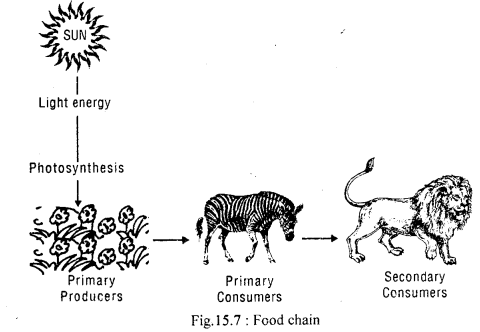
The food relation in its simplest form representing a producer, a primary consumer (herbivore), a secondary consumer (carnivore), and a decomposer is called a food chain. The next circle of such a food chain is called the food web.
Class 11 Geography Important Questions Chapter 15 Life on the Earth im-1

Question 9.
Describe various structural components of an ecosystem.
Answer:
Various structural components of an ecosystem are classified into two main groups:

  1. biotic or living, and
  2. abiotic or non-living.

The biotic component of an ecosystem comprises the kinds, numbers, and distribution of living organisms. The abiotic component consists of the kinds, quantity, and distribution of physical and chemical factors such as light, temperature, water, oxygen, carbon, nitrogen, and minerals.

Question 10.
Define ‘ecosystem’ with examples.
Answer:
The biotic community, along with the physical environment, forms an interacting system called the ecosystem. An ecosystem can be natural or artificial, temporary or permanent. A large grassland or a forest, a small tract in a forest or a single log, an edge of the pond, a village, an aquarium, or a manned spaceship can all be regarded as ecosystems.

Question 11.
Distinguish between biotic and abiotic factors.
Answer:
They are two components of an ecosystem. The biotic component comprises the kinds, numbers, and distribution of living organisms. The abiotic component, on the other hand, consists of the kinds, quantity, and distribution of physical and chemical factors such as light, temperature, water, oxygen, carbon, nitrogen, and minerals.

Question 12.
Explain with examples the role of members of the fungi kingdom of organisms.
Answer:
The fungi kingdom includes diverse kinds of multicellular heterotrophic organisms. There are over 100,000 species of fungi. Some are unicellular like yeast, others are complex like mushrooms. The fungi are the major decomposers and their activity is essential for the recycling of inorganic resources in the biosphere.

Question 13.
What do you understand by biogeochemical cycles?
Answer:
The balance of the chemical elements in the atmosphere and hydrosphere is maintained by a cyclic passage through the tissues of plants and animals. The cycle starts by absorbing chemical elements by the organism and returned back to air, water, and soil through decomposition. These cycles are energized by solar insolation. These cyclic movements of chemical elements of the biosphere between the organism and the environment are referred to as biogeochemical cycles.

Question 14.
What is the hydrologic cycle?
Answer:
All living organisms, the atmosphere, and the lithosphere maintain between them a circulation of water in solid, liquid, or gaseous form, referred to as water or hydrologic cycle.

Question 15.
What is denitrification?
Answer:
Herbivorous animals feeding on plants in turn consume some of it. Dead plants and animals, excreted nitrogenous wastes are converted into nitrites by the attachment of bacteria present in the soil. Some bacteria can even convert nitrites into nitrates that can be used again by the green plants. There are still other types of bacteria capable of converting nitrates into free nitrogen, a process known as denitrification.

Life on the Earth Important Extra Questions Long Answer Type

Question 1.
“Food chains are not isolated linear chains of trophic levels.” Comment.
Answer:
In nature, the food relationship cannot be explained only in terms of a single food chain. A herbivore consumes many types of plants or plant products. Many kinds of animals, other than tiger, derive food from herbivorous animals. Ticks and mites, leeches, and blood-sucking insects are dependent on herbivores and even on carnivores. Thus, food chains are not isolated linear chains of trophic levels.

Depending upon the availability and choice of food, different organisms at each level have a food relationship with more than one organism at the lower levels. A rat, for example, feeds on various kinds of stem, roots, fruits, and grains. In turn, it is consumed by a snake which is eaten by a falcon. The snakes feed on both, frogs and rats. Then, a network of food chains exist, which is called a food web. The food web becomes more complicated when taste and preference, availability, and compulsion are involved.

Question 2.
Describe the functions of various biotic components.
Answer:
Various biotic components include producers, herbivores, carnivores, and decomposers. All organisms require energy for their life processes. Food supplies both energy and materials for the sustenance of life. Green plants produce carbohydrates by photosynthesis and also synthesize proteins and fats. The green plants, therefore, are called producers. The animals that consume this energy are called consumers.

The herbivores like cattle, deer, and goats derive their food or energy directly from plants and are called the first-order consumers. The carnivores like tiger and lion depend on herbivores for their food and energy and are therefore called the secondary or second-order consumers. The non-green organisms like fungi and some bacteria, which do not produce their own food, live on the dead and decaying plants or animals and are consumers of a special type called decomposers.

Question 3.
Distinguish between Taiga and Tundra biome.
Answer:

Question 4.
Describe the energy flow in the biosphere.
Answer:
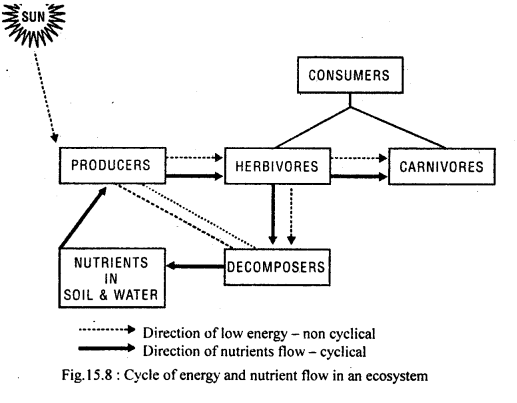
Energy from the sun enters the living world through photosynthetic organisms and passes on from one organism to another in the form of food.
Class 11 Geography Important Questions Chapter 15 Life on the Earth im-2
The organisms which trap solar energy and act as producers also use some energy for their own life processes. Only a portion of the energy trapped is taken by the primary consumers. Animals being more active than plants use much of the energy acquired before they are consumed by the next trophic level. At each stage of energy transfer, some amount of energy is lost from the food chain. The amount of energy transferred to the next higher level thus gradually decreases. The decomposition of dead organisms also releases chemical energy. Eventually, all this solar energy that entered the living system through the producers goes back into the non-living world, not as light but as heat.

Question 5.
Describe the carbon cycle in brief.
Answer:
Carbon is one of the basic elements of all living organisms. It forms the basic constituent of all organic compounds. The biosphere contains over half a million carbon compounds. The carbon cycle is mainly the conversion of carbon dioxide. This conversion is initiated by the fixation of carbon dioxide from the atmosphere through photosynthesis. Such conversion results in the production of carbohydrates, glucose that may be converted to other organic compounds such as starch, cellulose, etc. Here, some of the carbohydrates are utilized directly by the plant itself. During this process, more carbon dioxide is generated and is released through its leaves or roots during the day. The remaining unutilized carbohydrates become part of the plant tissue.

The plant tissues are either eaten by the herbivorous animals or get decomposed by micro-organisms. The herbivores convert some of the consumed carbohydrates into carbon dioxide for release into the air through respiration. The micro-organisms decompose the remaining carbohydrates after the animal dies. The carbohydrates that are decomposed get oxidized into carbon dioxide and are returned back to the atmosphere.