Federalism Class 11 Important Extra Questions Political Science Chapter 7

Here we are providing Class 11 Political Science Important Extra Questions and Answers Chapter 7 Federalism. Political Science Class 11 Important Questions with Answers are the best resource for students which helps in class 11 board exams.

Class 11 Political Science Chapter 7 Important Extra Questions Federalism

Federalism Important Extra Questions Very Short Answer Type

Question 1.
What is federalism?
Answer:
Federalism is a system of government in which powers are distributed between the centre and states according to constitutional schemes. It ‘ is based on the territorial distribution of powers. This system of-Governance is considered essential in the plural societal states ie; where people of diverse. culture, religion, language and direct reside for their fuller development.

Question 2.
Name some countries with the Federal system of Government.
Answer:
There is a number of countries with the Federal system. Here we are naming four states.

  1. India
  2. U.S.A. (United States of America)
  3. Canada
  4. Switzerland and Australia

Question 3.
Write five essential features of a federal government.
Answer:

  1. Written constitution
  2. Supremacy of constitution
  3. Bicameral Legislature
  4. Independent and impartial Judiciary
  5. Double Government.

Question 4.
What is the utility of a federal Government?
Answer:

  1. It is based on the decentralisation
  2. It is more democratic and natural
  3. It gives an opportunity for better representatives and the development of regional and local areas.
  4. It checks the authoritarian tendency of Central Government

Question 5.
What are the demerits of the Federal Government?
Answer:
Followings are the main demerits of the federal government:

  1. It generates parochialism
  2. It breeds competition among the states.
  3. It generates secessionist trends.
  4. It is harmful for national integration
  5. It delays the decisions
  6. It is a costly system of government

Question 6.
Write four federal features of the Indian constitution.
Answer:

  1. Written and rigid Constitution:
  2. The supremacy of the Constitution
  3. Division of powers between centre and states.
  4. Bicameral Legislature in the centre.
  5. Independent Judiciary.

Question 7.
Why the Federal system of Government is necessary for India?
Answer:
India is a country of a plural society. There are people of several castes religions, regions, language, dialects and geography. For the fuller development of the people of these different complexions, the federal system is necessary which will generate unity in diversity. Therefore the federal system is necessary for India.

Question 8.
What is the nature of Indian federation?
Answer:
Although India has structural features of federalism there is no word federation in the Constitution. Article 1st the Indian Constitution says, “India, that is Bharat shall be the union of states” These words indicate the nature of Indian federal system. The word ‘union of states’ means that the centre will not be the creation of states. On the contrary, the states will be created by the centre.

Question 9.
How the powers are divided between the centre and states?
Answer:
The powers are divided between the centre and states on the basis of the following three lists.

  1. Central list with 97 subjects
  2. State list with 66 subjects
  3. Concurrent list with 47 subjects
  4. Residual powers rest with the centre.

Question 10.
Write four unitary features of Indian constitution.
Answer:

  1. Single constitution and single citizenship
  2. Unequal distribution of powers between centre and states. This distribution is twisted toward the centre.
  3. Emergency powers of the President. Art 352
  4. President rule in states under Art 356
  5. Governor is the appointment by President and his role as an agent of the centre.

Question 11.
What is the demand for provisional autonomy?
Answer:
Since in the Constitution of India the division of powers between the centre and states is tilted towards the centre, the states are dependent on the centre in administrative, legislative and financial matters. In their years there is a strong demand to review this existing position of distribution of powers from the different states and want more and more freedom of action. This is called as provisional autonomy.

Question 12.
What is co-operation federalism?
Answer:
Noted political scientist K. C. Where says that Indian federal system is a co-operative federal system in which there is a lot of co-operation between the centre and states for their mutual benefits.

Question 13.
What is the role of Governor in the State?
Answer:
Governor is given double responsibility in the states. First, he is the nominal executive head of the state. Secondly, he is made an agent of the centre who will see that national interest remain safe in that state. He sees all the laws and policies of the central government are implemented in the state and all her central property is safe.

Question 14.
Explain special provisions for some states.
Answer:
Some of the states are given special considerations, therefore special provisions are made for them in the contribution. It is done due to peculiar circumstances of few states and historical necessity in the case of Jammu and Kashmir.

Most of the special provisions pertaining to the North-Eastern States like Assam, Nagaland, Arunachal Pradesh and Mizoram etc. Under Art 371 Art 370 provides the special status of Jammu & Kashmir. Accordingly, Jammu & Kashmir has its own Constitution and its concurrence is required before any law is implemented there.

Question 15.
What is bargaining federal system?
Answer:
Different people say differently about the nature of the Indian federal system. Some say it completely Unitary system, others say it federal system with strong unitary features. K.C. Where calls it as a co-operative system based as cooperation. But Morris Jones calls it a Bargaining system which works on the basis of bargaining positions of centre and states which is competitive in nature.

Federalism Important Extra Questions Short Answer Type

Question 1.
Define federalism. Why it is needed in a plural society?
Answer:
Federalism is a system of government in which powers are divided between the centre and the states. In a true federation, the states surrender their certain powers and create a centre to administer on the issues which are of national and international importance. On local issues the states Government administrate. Such a system of Governance becomes necessary in a plural society because a number of states are formed on the basis of administration convince.’The regional aspirations and centres of the people of such formed states are realised in federal aspirations of the people remain unfulfilled and unrealised. Therefore for a fuller development of linguistic and cultural aspirations, the federal system is necessary.

Question 2.
Compare the federal system of India with a federal system of the United States of America.
Answer:
India and the United States of America both are the federal systems of Government but both have a different system. The USA is said to be a true federal system while different people say differently about the nature of the Indian federal system. Followings are the difference between India and USA

  1. In America centre is the creation of states while in India states are the creation of the centre.
  2. In the Constitution of India, the USA is described as a federation. In the Indian Constitution, India is described as Union of States.
  3. In the USA more powers are given to states. In India, the centre is given more powers.
  4. In USA residual powers are with states. In India, residual powers are given to the centre.

Question 3.
Explain the unity in diversity in India.
Answer:
It is rightly said about India that India is not a country, it is a continent. There are more than 20 major languages and several hundred minor ones. It has several major regions of different geography and Culture. In climate changes after every twenty kilometres. In spite of all such diversities, we share many common values, history and ethos. We all fought for national independence jointly in which Hindu, Muslim, Sikh and Christians participated. We do not share common part only we cherish common hopes and aspirations. This has led to national leaders to visualise India as a country where there is unity in diversity. India in its last 60 years of journey of the post-independent period has stood the test of this slogan ie, unity in diversity.

Question 4.
Write the main features of a federal system.
Answer:
Federalism, as a principle of Government, has evolved differently in different situations yet there are some basic features which are generally considered essential for a federal system. These areas under.

  1. Written Constitution & double Constitution
  2. Rigid Consitution
  3. The institutional mechanism to accommodate two sets of politics.
  4. Two sets of identities and loyalties of the people to their region as well as their nation.
  5. Distribution of powers between two sets of Government one at centra! level and other at the state level.
  6. Bicameral legislative
  7. Independent Judiciary
  8. Double Citizenship
  9. Supremacy of Constitution
  10. Residual powers with the states

Question 5.
Write federal features of the Indian constitution.
Answer:
Indian society is a plural society so there is a plural polity in India. Followings are the main dominant features in the Indian Constitution on the basis of which we can term the Indian Constitution as a federal system:

  1. Written Constitution
  2. Rigid Constitution
  3. Supremacy of Constitution
  4. Divisions of Powers between centre and states.
  5. Double sets of polity
  6. Double set of loyalties of the people. One for their regions and others for the nation
  7. Bicameral Legislature
  8. Independent judiciary to settle the dispute between the centre and states.

Question 6.
Write the main unitary features of Indian constitution.
Answer:
Structurally Indian Constitution appears to be federal but there are some features in Indian Constitution which make it unitary. These are as under:

  1. There is no word federation in the Indian constitution. Rather it is the union of states.
  2. Unequal distribution of powers between the centre and states.
  3. Unequal representation of the states in the upper House.
  4. Emergency powers of the President
  5. Integrated judiciary
  6. President Rule in the states
  7. Important appointment by the President
  8. Governor as the agent of centre in States.
  9. Single Constitution
  10. Single Citizenship
  11. The dominance of centre on Election Commission, Planing commission and NDC
  12. The increasing role of All India Government Service

Question 7.
Write Legislative relations between the centre and states.
Answer:
Subjects are divided between the centre and states for this purpose three lists are formed which areas:

  1. Central list 96 subjects (Parliament Legislates on their subjects)
  2. State list 66 subjects (State legislative legislates these subjects
  3. Concert List 47 subjects (on these issues central Parliament, as well as the state legislature, can legislate on their issue but in case of conflict central view will prevail)
  4. Residual powers rest with the centre.
  5. In Emergency Parliament can Legislate on any subject of state list
  6. In President Rule, Parliament will make law for a state w. which President Rule is in force.
  7. To fulfil international commitment Parliament can make law on a state subject.
  8. Governor can refer to President any bill which is passed by the State Assembly.

Question 8.
What is President Rule?
Answer:
Under Art 356 of the Indian Constitution Governor can recommend President Rule in the state in the following circumstances:

  1. If the law and order is broke down in the state
  2. There is political instability in the state
  3. No party has secured a majority for the formation of a Government and there is political hoarding
  4. If the constitutional machinery has failed and the government is not being run according to the provisions of the Constitution.

It is the discretionary power of the Governor to see that such a situation has arisen or not as to warrant the imposition of President Rule.

Question 9.
Explain the executive relations between the centre and states.
Answer:

  1. Art 257 of the Constitution says that the executive power of every state shall be so exercised as not to implode or prejudice the exercise of the executive powers of the union and the executive powers of the Union shall extend to the giving of such directions to a State as may appear to- the government of India to be necessary for that purpose.
  2. States will make their policies as per in tune with the policies of the central government.
  3. During an emergency, the President may give any direction to the states as seems necessary. During an emergency, the administration of the states comes in the hands of President Rule because it becomes unitary in Emergency.
  4. Governor is the agent of the centre and he can recommend imposition of President Rule in the state in the given circumstances.
  5. All India Service (IAS and IPS other) control the states development and law and order.

Question 10.
Write the discretionary powers of the Governor.
Answer:
Governors are appointed by the President of India. He is given two roles in the states. No.l. He acts as nominal head of the states and No. 2. He acts as an agent of the centre. For this he is given discretionary powers which are as under:

  1. To refer a bill to the President which is passed by the state legislature.
  2. When no party gets the majority it is the discretion of Governor whom to call to form the Government.
  3. To judge the existence of political instability.
  4. Recommendation of the composition of President rule in the state

Question 11.
Enumerable main demands for provisional autonomy.
Answer:
In the last forty years, several demands have been raised in different states in the name of provisional autonomy. Main demands are as under:

  1. Division of powers in favour of states and not in favour of the centre which exists today.
  2. Independent source of revenue for the states and control of states on the source and resources.
  3. More and more powers are being demanded by the states, particularly in developmental and administrative fields.
  4. More rights are being demanded by the states for their cultural and linguistic development.
  5. More autonomy in financial and commercial matters.

Question 12.
Do you support the creation of new states?
Answer:
The demand for the creation of new states is becoming more and more vocal. In fact, there are several factors which are responsible for such frequent and strong demands. Misuse of constitutional measures and provisions and tension between the centre and states are responsible for such demand. Recently three new states Uttaranchal from Uttar Pradesh, Jharkhand from Bihar and Chattishgarh from M.P. have already been formed. Ther is the demand of Harit Pradesh, Gorkhaland and Telangana and other such numbers of states. At this stage, it is very difficult to check and control such demands. In the name of administrative convenience, we can justify the creation of new small states but ultimately it may force threat to national integration.

Question 13.
Discuss the controversy regarding the role of Governors in the state.
Answer:
Today the post of Governor is the most controversial post in India because of the dubious role played by most of the Governors in the last thirty years. The p9St of Governor is not elected These days Governors are appointed by violating the will established conventions. Sarkaria Commission has also suggested that appointments of Governors should be strictly non-partisan. Rejected politicians have occupied the post of Governor and they have worked in a partisan manner and thus have attracted criticism and controversy.

Names like Ram Lai Chauhan, J.D. Tapas, Rizvi and Buta Singh can be quoted who become the target of criticism due to their partisan role. The use of Art 356 dealing with the imposition of the President role in the states has created maximum controversy. Use of discretionary powers by the Governor has also been questionable. Some Governor behaved differently in similar conditions. It is also seen that the Governments enjoying a majority in the house have been dismissed on the recommendation of the Governor. It is due to all these factors the post of Governor has been in controversies.

Question 14.
Discuss the working of the federal system in India under the era of coalition Government.
Answer:
Gone are the days when there used to be the dominance of a single party, particularly the Congress party. Now the number of political parties has gone up very sharply in the wake of politics of populism. Regional parties have assumed power not only in the states but also in the centre.

All those developments have given a new direction to the Indian federal system. All there political parties like DMK AIDMK, Akali Dal and Left parties who have been demanding more and more powers for the states and reviewing the existing structure are at the helm of affairs at centre. The Janata Dal, National Front, United Front, NDA and UPA Government are alliances of the regional parties and one or more national parties. This is a situation of the cooperative federal system.

Question 15.
Mention special provisions in the Constitution for some states.
Answer:
The most extraordinary feature of Indian federal arrangement created in India is that many states have been given special status on this reason or that reason. The constitution has some special provisions for some states due to their peculiar social and cultural and historical circumstances. Most of such special provisions pertain to the North Eastern States like Assam, Nagaland, Arunachal Pradesh and Mizoram (Art 371) Jammu and Kashmir are also given special states under Art 370 due to historical compulsions. Jammu and Kashmir have their own Constitution and enjoys a lot of autonomy and control in most of the areas.

Federalism Important Extra Questions Long Answer Type

Question 1.
Explaining the measuring bf federalism, discuss the features and nature of Indian federalism.
Answer:
Federalism is a system of government where powers are divided between the centre and states. It involves the territorial distribution of powers.

It is very much needed for a divine plural society. Since India is also a plural society, the Indian constitution-makers also introduced dominant features of a federal Government like the written constitution, division of powers between the centre and states, bicameral legislature and independent judiciary. At /the same time many threats were emerging for national integration. Therefore they introduced the provision for national integration and a strong centre.

They adopted the concept of the union of states which crates federal structure with the strong unitary feature. The concept of the union of states was adopted from Canada. The most important unitary, the feature is:

  1. Unequal distribution of powers between the centre and states.
  2. Residual powers are with the centre
  3. Provision of Emergency powers for the President (Art 352)
  4. Provision of President rule in the states Art 356
  5. Integrated judiciary
  6. Integrated bureaucracy and dominance of All India Services in the states.
  7. Appointment of Governor by the President
  8. Governor’s role as the agent of the centre.
  9. Amendment powers are with the centre.
  10. The dominance of centre over NDC, planing commission UPSC and Finance Commission and Election Commission;

Therefore India is a federal system with strong unitary feature^ on the basis of its working during the last 60 years. K.C. Where has termed as the co-operative federal system and Morris Jones has termed it a Bargaining system.

Judiciary Class 11 Important Extra Questions Political Science Chapter 6

Here we are providing Class 11 Political Science Important Extra Questions and Answers Chapter 6 Judiciary. Political Science Class 11 Important Questions with Answers are the best resource for students which helps in class 11 board exams.

Class 11 Political Science Chapter 6 Important Extra Questions Judiciary

Judiciary Important Extra Questions Very Short Answer Type

Question 1.
What is Judiciary?
Answer:
Judiciary is the important organ of the Government which is concerned with settling the disputes and dispensation of Justice at different levels for justice. Earlier all the judicial powers used to be vested in the king under the Monarchy system but now in democratic setup Judiciary is structural as a separate organ of the Government.

Question 2.
Why we need Judiciary?
Answer:
In any group or society, disputes are bound to occur due to different individual and group interests of the people which need to be settled up to the satisfaction of all the concerned by an independent competent and impartial body. To serve these needs, a separate organ of the Government is structural as the judiciary in modern democracies. Judiciary, besides settling the disputes, performs a number of other functions for the society.

Question 3.
Write three main functions of the Judiciary
Answer:

  1. Settling the disputes among the people
  2. It protects the Rule of Law and to ensure the supremacy of Law
  3. Safeguarding the rights of the people and the constitution.

Question 4.
What do you mean by the independence of the judiciary?
Answer:
Basically, independence of judiciary means that judiciary is allowed to work independently, impartially without undue interference of executive and legislature. Independence of Judiciary also means that the judges should be appointed on merit with definite qualifications and experience and they should enjoy long tenure. They should not be removed in an arbitrary manner. The judges should be paid good salaries and facilities. The decisions should be respected.

Question 5.
How the judges are appointed in India?
Answer:
The judges are appointed for Supreme court and“High Court by the President of India with the consultation of the Chief Justice of India and the Chief Justice of concerned High Court (in a case of High Court Judges) The constitution of India has provided, qualification and experience for the appointment of judges.

Question 6.
How the judges can be removed?
Answer:
It is provided in the Constitution that the judges can be removed from the office by impeachment in which the charges are levelled in one house of the Parliament and are listened and examined in next house. If the charges are proved correct, the judges stand impeached.

Question 7.
What do you mean by the integrated judiciary?
Answer:
We in India have integrated judiciary which means that at the apex is the Supreme Court and at the bottom is the lower court (District Court). It is a Pyramid (ladder) like structure. The Supreme Court has administrative and supervisory control on lower courts and it listens to the appeal against the decisions of the lower courts.

Question 8.
Discuss the composition of the Supreme Court of India.
Answer:
Supreme Court of India consists of 26 judges including Chief Justice, who are appointed by the President of India. To become a judge in the Supreme Court one should have experience of Judge for 5 years in the High Court or 10 years of an advocate in the Supreme Court. He should be a distinguished jurist in the eye of President.

Question 9.
What is original jurisdiction of Supreme Court of India?
Answer:
In original jurisdiction of Supreme Court of India following cases are taken up.

  1. Disputes between Centre and State Governments.
  2. Disputes between the two states.
  3. Disputes related to Fundamental Rights
  4. Disputes in which issue of interpretation of the constitution is involved.

Question 10.
What is the jurisdiction of the High Court?
Answer:
Almost every state has its High Court. It stands in the middle of the judicial system. High Courts have the following jurisdiction:

  1. Original Jurisdiction
  2. Appellate Jurisdiction
  3. Supervisory Jurisdiction
  4. Administrative Jurisdiction
  5. Court of record

Question 11.
What is District Court?
Answer:
District Court is at the lowest level of Indian judicial system. Its judges are appointed by the Governor with the consultation of Chief Justice of High Courts. Its functions are as under:

  1. Deals with the cases arising in the District
  2. Considers appeals on decisions given by lower courts
  3. Decides cases involving serious criminal offences.
  4. District Cases have administrative control on subordinate courts.

Question 12.
What is the role of Indian Judiciary?
Answer:

  1. It settles disputes
  2. It interprets the Constitution and acts its guardian
  3. It protects the Fundamental Rights of the people.
  4. It protects the federal system.
  5. It helps in the development of the constitution

Question 13.
What do you understand by Judicial activism?
Answer:
The term Judicial activism refers to the working of Judiciary beyond its given area. It is said that when executive and legislature fail, the judiciary start. It is called Judicial activism. In our constitution procedure established by law is allowed under which the judiciary can examine whether a particular law is according to the provisions of the Constitution or not. But our judiciary is going beyond its limit and is commenting on every policy and political matter which is referred to as Judicial activism.

Question 14.
What is the Power of Judicial Activism?
Answer:
The power of Judicial Review is the power of judiciary under which it can examine the constitutional validity of an order issued by the executive and legislation passed by the legislature. If the court finds it contrary to the provisions of the Constitution it can declare them as unconstitutional. On the basis of this power judicial is playing a very effective role in checking the executive and legislature but in the process, it is going beyond its jurisdiction Hence it is called as Judicial activism.

Question 15.
What is PIL Public Interest Litigation?
Answer:
PIL Public’ Interest Litigation means taking up the case of such weaker and poor people to the court who are unable to take up their case themselves due to some reasons.

Judicial activism has a manifold impact on the Indian Political System. It has democratised the Judicial systems. It has forced accountability and terror.

Judiciary Important Extra Questions Short Answer Type

Question 1.
Mention essential conditions for the independence of the judiciary.
Answer:
Following are some main essential conditions for the independence of the judiciary.

  1. The judiciary should be the product of constitutional law.
  2. Judiciary should be free from undue interference of Executive and Legislature.
  3. High qualifications and experiences should be set for the appointment of judges.
  4. The judge’s pay and allowance and other service conditions should be attractive so that man of high integrity enters in this profession.
  5. The tenure of the service of the judges should be long and for the security of service, they should not be dependent on the where is and fancies of the executive and Legislature.
  6. The decisions of the Judiciary should be respected and accepted.

Question 2.
How the constitution of India has ensured independent of the judiciary?
Answer:
Constitution of India has ensured the independence of the judiciary by the following provisions:

  1. The legislature is not involved in the appointment of Judges
  2. The judges have fixed and long tenure and the process of removal of judges by impeachment is long and difficult.
  3. Judiciary is not financially dependent on the executive or legislature.
  4. Judiciary has the power to penalise those who commit contempt of Court.
  5. Parliament cannot discuss the conduct of judges.
  6. Decisions of the judiciary are immense from personal criticism.

Question 3.
How Indian Judiciary is integrated Judiciary?
Answer:
Integrated Judiciary is one which is structurally and functionally. related at different levels. India judiciary is also integrated because it is also a ladder-like structure. At its apex in the Supreme Court of India.

In the middle (State Level) are the High Courts and the Lower Level (District Level) and the District and other local courts. The Supreme Court of India which is at the apex of the Judicial system exercises, administrative, supervisory control in the Lower Courts. It has also appellate jurisdictions on lower courts. It has also appellate jurisdiction on lower courts. Its decisions are binding on all courts. It can transfer judges from one court to another. It can transfer a case from one court to another court. It can more any case from any court to itself.

Question 4.
Write the composition of the Supreme Court of India.
Answer:
Supreme Court of India consists of 26 judges including one Chief Justice. To became the Judge one should have following qualifications

  1. He should be a citizen of India.
  2. He should have worked as a judge in any High Court for five years.
  3. He should have worked as an advocate in the Supreme court for 10 years.
  4. He should be a distinguished judge in the eye of the President.

All the judges of Supreme Court are appointed by the President of India with the consultation of Chief Justice of India.

The Judges of the Supreme Court get retirement at the age of 65 years.

Question 5.
Explain the Jurisdiction of the Supreme Court of India.
Answer:
Supreme Court of India has the following Jurisdiction:

1. Original Jurisdiction Under this jurisdiction the Supreme Court listens to the case related to
a. Dispute between centre and state
b. Dispute between two states
c. Fundamental Rights
4. Interpretation of the constitution

2. Appellate Jurisdiction: Under this jurisdiction Supreme Court listen to the appeal against the decisions of the High Courts in all the civil, criminal and constitutional matters.

3. Advisory Jurisdiction: Under this jurisdiction, the Supreme Court can give its opinion to the President on any issue on which he seeks its opinion.

Question 6.
Write the functions of High Courts.
Answer:
Almost every state has its own High Court. Its main functions are as under:

  1. It can hear the appeals against the decisions of the lower courts
  2. It can issue writs for restoring Fundamental Rights
  3. It can deal with cases which fall within the jurisdiction of the State.
  4. It has supervisory and administrative jurisdiction over the lower courts under which it exercises, superintendence and control over courts below it.
  5. It decides the service conditions of the employees of the lower courts.

Question 7.
What is impeachment?
Answer:
Impeachment is a method of removal of the judges by the Parliament on the charges like corruption, misuse of power and violation of the Constitution.

The impeachment motion of the removal of the judge with the charges is introduced in either house. If that motion is passed by 2/3 majority of the present and voting of the members, then it is sent to another house when it is heard. The judge can explain his/her position in that house. If the charges levelled in the previous house are proved in the second house by 2/3 majority of the present and voting and majority of the house. The judge stands impeached and he has to vacate the office. So far only one case of the removal of a judge of Supreme Court came up for consideration before the Parliament which could not get the support of the majority of the total strength of the House.

Question 8.
What is Judicial Review? How does it work in India?
Answer:
Judicial Review is the power of the judiciary to test the constitutional validity which means it tests whether a law or executive is in accordance with the provisions of the Constitution. If the imposed legislation or order of the executive is not according to the provisions of the constitution, it can declare them as unconstitutional.

In India judicial review is borrowed from the USA but with a difference. In the USA the power of Judicial review works on the principle of Due process of Law, while in India the power of Judicial review works on the Principle of Procedure established by Law. On the process of Due process of Law Supreme Court of USA can comment on Justness and Unjustness of the policy matters while as per the procedure established by Law Indian Judiciary is not supposed to comment on policy matters.

Question 9.
What is the role of the Supreme Court in India?
Answer:
Oft the basis of the power of Judicial review the Supreme Court is playing a very effective role in a different way on which we can enumerate as following

  1. It is the final authority of the interpretation of the constitution.
  2. It checks the arbitrariness of executives and legislature.
  3. It protects the Fundamental Rights of the people.
  4. It strengthens democracy.
  5. It protects the Indian Federal System
  6. It checks the bureaucracy
  7. It acts as guardian of the constitution
  8. It helps in the evolution of the Constitution.

Question 10.
Explain the Advisory Jurisdiction of Supreme Court of India.
Answer:
Besides the original and appellate jurisdiction, the Supreme Court of India possesses Advisory Jurisdiction also. Under this jurisdiction, the President of India can seek opinion on any matter which involves the interpretation of the Constitution. However, the Supreme Court of India is not bound to give its advice nor the President of India is bound to accept the advice of the Supreme Court which he has sought. The utility of this jurisdiction is twofold. Number one it gives the opportunity to government to seek the legal opinion of the Supreme Court on the matter of greater importance and consequences. Secondly in the light of the advice of Supreme Court government can make necessary changes.

Question 11.
What do you mean by Judicial Activism?
Answer:
The term Judicial activism is much talked about in legal, political and academic circle in India. On the basis of Judicial activism, the courts have given revolutionary decisions is different areas which have demoralised the legislature and executive who are particularly vocal infusing the concept of Judicial activism. However, it is found to be more people-friendly.

Judicial activism means working of Judiciary beyond its limit, which is permitted under the principle of procedure established by law which says

Under this jurisdiction, the Supreme Court listens to the case related to
a. Dispute between the centre and state
b. The dispute between two states
c. Fundamental Rights
d. Interpretation of the constitution

2. Appellate Jurisdiction: Under this jurisdiction Supreme Court listen to the appeal against the decisions of the High Courts in all the civil, criminal and constitutional matters.

3. Advisory Jurisdiction: Under this jurisdiction, the Supreme Court can give its opinion to the President on any issue on which he seeks its opinion.

Question 12.
What are PIL(Public Interest Litigation) cases?
Answer:
PIL (Public Interest Litigation) is the chief instrument through which the Judicial activism has flourished in India.

PIL are those, cases which have been filed not by the aggrieved persons or parties but by the other, spirited persons and organisations on their behalf in Larger Public interests. Supreme Court of India took up the cases about rights of Prisoners which opened the gates for others.

Many Voluntary organisations have sought judicial intervention for the protection of existing rights and interest of the poor people and for improving the conditions of the poor people, protection of the environment and may other issues in the interest of public and \yeaker sections of the society. Justice P.N. Bhagwati had played a pioneering role in. the field of PIL (Public Interest Litigation case).

Question 13.
What is the importance and impact of PIL Public Interest Litigation Court?
Answer:
PIL is a revolutionary development in Indian Judiciary and is the consequence of Judicial activism and is an indicator of the changes which are taking place in social and economic set up in India.

Through the PIL, the courts have expanded the idea of rights, clean air, pure drinking water, decent living and dignified living are accepted as the essential rights of every man in the society. It was therefore felt by the courts that the individuals are part of the society must have the right to seeks Justice when such rights are involved. Through PIL Judiciary has become more liberal and human.

Judicial activism has a manifold impact on Indian Political System. People have largely found it and accepted as people-friendly. It has also made the executive more conscious and accountable to the people. Transparency in official working is the impact of Judicial activism; In fact, through Judicial activism, Judiciary has put the executives on their toes.

Question 14.
Mention some negative impact of Judicial activism.
Answer:
No doubt that Judicial activism in India is people friendly but it is certainly a violation of the principle procedure established by law because judicial activism is based on the process of law which does not prevail in India.

There is the negative side of Judicial activism which are as under:

  1. It is the violation of principle separation of power
  2. It is an attack on the autonomy of executive and legislative.
  3. An ultimate representative of the people of the interest of the people is legislative which are elected by the people.
  4. It will lead to high handedness of Judiciary.
  5. It will lead to conflict between the legislature and judiciary and will be a hindrance in the working of the Government.

Question 15.
Explain the conflict between the Judiciary and Parliament over the issue of amendment of Fundamental Rights.
Answer:
Since the very implementation of the Constitution, there has been conflicting between the Parliament and Judiciary over the amendment of Fun-damental Rights. Some of the causes of this conflict are used under.

  1. Shankari Prasad Case 1951
  2. Golak Nath case 1967
  3. Keshwanand Bharti Case 1973
  4. Minerva Mill Case 1980

Now it is the latest position that Parliament can amend every part of the Constitution including the Fundamental Rights but cannot amend the basic structure of the constitution.

Judiciary Important Extra Questions Long Answer Type

Question 1.
Write the composition and role of the Supreme Court of India.
Answer:
Judiciary in India occupies the place of dignity and prestige. We have an independent, impartial and powerful judiciary. It is an integrated one. At its apex is Supreme Court which has administrative and Supervisory control on the lower courts.

The Supreme Court consists of 26 Judges including the Chief Justice of India. The Chief Justice of India is appointed by the President of India by the principle of seniority. Other Judges are appointed by the President with the consultation of Chief Justice of India. The Judges of the Supreme Court enjoy long tenure. They get retirement at the age of 65 years. They can be removed from the officers by way of impeachment by Parliament. Supreme Court of India has a power of Judicial review and exercises the jurisdiction in the following areas:

  1. Original Jurisdiction
  2. Appellate Jurisdiction
  3. Advisory Jurisdiction
  4. Miss.

Supreme Court of India has assumed more and m^fe powers and role in Indian Political System. It is working beyond its/jurisdiction and has the renowned name of Judicial activism. L.N. Bhagwati has filter done revolutionary step by accepting the principle ofPIL (Public Interest Litigations) which means by filing the case by an others-the aggrieved person who an unable to move to the courts themselves. Judiciary has played’ important role in

  1. Checking the arbitrations of executive/ln India
  2. It is defending the democracy in India
  3. It is protecting the Fundamental Rights of the people.
  4. It is working as guardian of the Constitution

Legislature Class 11 Important Extra Questions Political Science Chapter 5

Here we are providing Class 11 Political Science Important Extra Questions and Answers Chapter 5 Legislature. Political Science Class 11 Important Questions with Answers are the best resource for students which helps in class 11 board exams.

Class 11 Political Science Chapter 5 Important Extra Questions Legislature

Legislature Important Extra Questions Very Short Answer Type

Question 1.
What is Legislature?
Answer:
The legislature is one of the three organs of the Government of the modern state. Although its main function is to make a law it performs a number of other functions like representational and deliberate functions. The legislature has financial and administrative control over the executive.

Question 2.
How do you role the importance of the Legislature?
Answer:
The work, role, and importance of the legislature are on increase. It is the platform of high kind of discussions, debate, deliberations, discussions co-operation and opposition. All the decisions and policy matters are dis¬cussed and debated here. All these activities of the legislature serve vital purposes. -Indeed a genuine democracy is inconceivable without represen¬tative efficient and responsible legislature. The legislature also helps people in holding the representatives accountable. Therefore we can say legislature has high importance in a representative democracy.

Question 3.
What constitutes the Indian parliament?
Answer:
Followings are known as three organs of Indian Parliament:

  1. Indian President
  2. Lok Sabha (House of people)
  3. Rajya Sabha (Council of states)

Question 4.
What is a bicameral legislature?
Answer:
There are two types of legislatures. Where there is only one house, they are known as the unicameral legislature, and where there are two houses they are known as a bicameral legislature. India has a bicameral legislature in the center and in five states.

Question 5.
Give four arguments in favor of the bicameral legislature.
Answer:

  1. It gives the opportunity to re-discuss in detail a bill that is passed in haste in the lower house.
  2. It helps in making a public opinion.
  3. It is an essential federal system of government.
  4. A bicameral legislature is necessary to give representation to the minorities.

Question 6.
Give four arguments against the bicameral legislature.
Answer:
1. Bicameral legislatures are unnecessary
2. They cause avoidable delays.
3. They cause unnecessary expenditure and computation
4. They are unrepresentative in nature

Question 7.
Name the states which have bicameral legislation.
Answer:
Following five states of India have bicameral legislation

  1. Jammu & Kashmir.
  2. Bihar
  3. Karnataka
  4. Maharashtra
  5. Uttar Pradesh

Question 8.
Write the composition of Lok Sabha.
Answer:
Lok Sabha is the lower house of the Indian Parliament. It has a total strength of 543 members. However, it has a maximum of 550 members which is fixed on the basis of population. The members are elected directly by the people. The minimum age to became a member of the Lok Sabha is 25 years. Eligible voter of a minimum of 18 years cast their votes in this election.

Question 9.
What are the functions of the speaker of Lok Sabha?
Answer:
The presiding officer of the Lok Sabha is known as the speaker of Lok Sabha who is elected by the members of Lok Sabha from themselves. Speaker conducts the proceeding of the house and maintains discipline and decorum in the house.

Question 10.
How the Rajya Sabha is compared?
Answer:
Rajya Sabha is the upper house of the Indian Parliament. It is known as the council of states because it represents the interest of the states.-Its maximum capacity is 250 members, out of it238 an elected by the members of state assemblies, and 12 members are nominated by the President of India from the people who have earned the name in different fields like science, literature, art, social service, cinema, and sports.

Question 11.
In which areas Rajya Sabha is weak in comparison to Lok sabha.
Answer:
Rajya Sabha is weaker in comparison to Lok Sabha in the following areas:-

  1. Legislative field (It can delay a bill only for 6 months)
  2. Financial field (It can delay money bill only for 14 days)
  3. Executive field (It can bring a no-confidence motion against the executive)

Question 12.
Who presides over the meetings of the Rajya Sabha?
Answer:
Vice President of India is the Capacity of ex-officio Chairman of Rajya Sabha who presides over, the meetings of Rajya Sabha and conducts the proceedings of the Rajya Sabha.

Question 13.
What is Bill and when it becomes Law?
Answer:
The proposal to make a law is called a bill. When it is passed by both the Houses of Parliament and get the assent of the Indian President it became law.

Question 14.
Who amends the Indian constitution?
Answer:
Parliament has the power to amend the constitution by following the definite procedure given in Art 368. State Assemblies have limited power in the amendment of the Constitution.

Question 15.
Write two special power of Rajya Sabha.
Answer:

  1. It can declare a subject of National importance by 2/3 majority resolution.
  2. It can declare a service as AH India service by 2/3 majority resolution.

Legislature Important Extra Questions Short Answer Type

Question 1.
What is the main function of the Legislature in the modern state?
Answer:
Legislatures of modem state perform the following functions whatever may be the forms of government:

  1. Discussion, debate, and deliberations on public issues.
  2. Legislative function:- Enactment of law is the primary function of legislation.
  3. Financial functions:- Legislatures control the expenditure. The executive cannot spend even a single penny without the approval of the Legislature.
  4. Executive functions:- Executive is controlled by the legislature by different methods.
  5. Constitutional amendment functions
  6. Judicial functions.
  7. Electoral functions
  8. Emergency powers.
  9. Miscellaneous functions

Question 2.
Discuss the compositions of Lok Sabha and Rajya Sabha.
Answer:
Lok Sabha and Rajya Sabha are two houses of the Indian Parliament. Lok Sabha is the Lower house and Rajya Sabha is the upper house. Lok Sabha has a maximum capacity of 550 members which are elected by the people by direct elections. A person of a minimum of 25 years of age can be a member of the Lok Sabha. Every person 18 years of age is eligible to cast his vote in this election.

Rajya Sabha is a permanent house and cannot be dissolved Every member enjoys the tenure of 6 years. Its one-third of members are retired after every second year and new members are elected by the respective state assembly by a single transferable vote system.

Its total strength is 250 members out of where 238 members are elected and the rest 12 members are nominated by the President of India. To become a member of the Rajya Sabha one should be a member of a minimum of 30 years of age. Vice President of India acts as ex-officio Chairman Parliament of Rajya Sabha and conducts its meetings.

Question 3.
What are the main functions of the Lok Sabha speaker?
Answer:
The speaker of Lok Sabha performs the following functions:

  1. To preside over the meetings of Lok Sabha.
  2. To maintain discipline and decorum in the house
  3. To allow the introductions of the bill in the house.
  4. To decide the nature of the bill
  5. To interpret the rules of the house
  6. To constitute different committees.
  7. To safeguard the privilege of the member of the parliament and house itself.
  8. To refer the bills to different committees.
  9. To conduct the business of the house and decide the term of the speakers.
  10. To exercise the casting vote in case of a tie on a bill.

Question 4.
How the parliament exercises control over the executive?
Answer:
The Parliament exercises administrative and financial control as the executive in the following ways:

  1. It discusses, debate and make a public opinion on different policy matters of the executive.
  2. It molds the decisions of the government.
  3. It controls the arbitrariness of the government.
  4. Executive can not make any expedition without the approval of the Parliament
  5. The executive has to give the report of expenditure before the Parliament.

Question 5.
Write main functions of Parliament.
Answer:
Parliament performs the following functions:-

  1. It discusses the issues of public importance
  2. It makes laws.
  3. It discusses, approves, and passes the budget.
  4. It exercises control on the executive.
  5. Parliament members take part in the election of President and Vice-President.
  6. Parliament makes amendments in the Constitution.
  7. Parliament brings and listens and passes the improvement against the President, Vice-Present, and judges of Supreme court and High Courts.
  8. Parliament approves the decision of declaration of emergency.

Question 6.
Tell the areas in which Rajya Sabha has equal powers.
Answer:
Rajya Sabha enjoys equal powers with Lok Sabha in the following areas:

  1. In discussion and debate on the issues of public interest and to help in making a public opinion.
  2. In the area of a constitutional amendment, Lok Sabha and Rajya Sabha have equal power. No amendment bill will become Act until and unless it is passed by both houses separately. Amendment bill can be introduced in either house of Parliament.
  3. In judicial matters also Lok sabha and Rajya sabha have equal powers as Lok Sabha and Rajya Sabha can initiate impeachment proceedings against the President, Vice President, and judges of the Supreme court and High court.
  4.  Rajya Sabha has also emergency powers which it shares with Lok Sabha.

Question 7.
Write the various steps in the Lawmaking process.
Answer:
Followings are various stages in the law-making process:

  1. Preparation of the bills
  2. Introduction of the bill in either House (First reading)
  3. Second Reading
  4. Committee stage
  5. Report stage
  6. Introduction of the bill in the second house.
  7. President’s assent.

Question 8.
Name the states which have a bicameral legislature and how bicameral legislature can be introduced.
Answer:
The following five states have bicameral legislature:

  1. Uttar Pradesh
  2. Bihar
  3. Jammu & Kashmir
  4. Maharashtra.
  5. Karnataka

The Upper house in a state can be withdrawn or introduced at the request of the concerned state by constitutional amendment

Question 9.
Differentiate between
1. Government bilk and Private member bill
2. Ordinary bill and a money bill
3. Private bill and ordinary bill
Answer:

  1. Government billAll the bills; which are introduced by the ministers are called Government bill while bills which are introduced by ordinal members are called private member bill.
  2. Ordinary bills and money billAll the bills which are dealing with income and expenditure are called money bills and all other rum-money bills are called ordinary bills.
  3. Private bill and an ordinary bill:-The bill that is related to a particular area, person a group is a private bill, and a bill that is related to the common general public is known as the General bill.

Question 10.
What is the importance of the committee system in the Indian parliamentary system?
Answer:
A significant feature of the legislative process is the appointment of different committees for a different purpose. These committees play a vital role not merely in law-making but also in day to day business of the house. Since the business of the Parliament is limited, it remains to enable to go into every detail of the bill.

Due to increasing demands also Parliament gets limited time for a bill. It is because of this committees are appointed to deal with different kinds of bills and examine these in detail and in all aspects like administrative, political, financial, and technical. These committees are very powerful and can ask for any detail from the concerned department. They can investigate corruption cases also. At present, there are much more than twenty department-related committees.

Besides the standing committees, there is also some Joint parliament committee (appointed for a specific function). They are appointed to discuss particular bills or for the purpose of investigating financial irregularities. Members of joint committees are selected from both houses.

The Committee system has definitely reduced the burden of Parliament and has helped a great deal in studying and examining the bills minutely, thus helped in making good laws.

Question 11.
How the business of the house is conducted?
Answer:
Parliament is a very auspicious forum for discussing, debating, and policy-making. Therefore it is very necessary that such discussions and debates must be meaningful and in an orderly manner so that functions of the Parliament are carried out in a smooth and dignified manner.

The Constitution has itself made certain provisions to ensure smoothness. conduct of business. Every house is presided by presiding offers who are the final authority in matters of regulating the business, of the house. There are many ways are which the presiding officer controls the behavior of the members and maintains the discipline of the house.’

The business of the house is carried out according to the well-established traditions, rules, and regulations of the house. The business of the house is conducted according to the well-established procedure. As said the presiding officer plays a decisive role in conducting the house in a given manner and maintains discipline and decorum of the house. He has weaponry in his arms for this purpose. He gives the rules on every issue as per his interpretation of a bill related to the business of the house.

Question 12.
What is defection? What are the provisions of the Anti-Defection law?
Answer:
Defection is a major disease of the Indian party system which has caused other ills in the Indian system.

The tendency and practice of the political leaders to change their political party on the tidal of which they have been elected to a house in search of better political and material fortunes are called Defection. For a lap time efforts were going on to check this menace. It is only in 1985, Rajiv Gandhi government passed the 52nd amendment in the constitution to have a check on the tendency of defections. This Amendment is known as the Anit- Defection law which provides the following features.

  1. A person elected on a ticket of a particular party will lose his or her membership if he/she joins another party after the election.
  2. If a person is elected as independent or nominated may have free membership may lose his/her seat if he/she joins any political party.
  3. It is also provided that in case of merger and split which will require ’necessary majority, the membership will not be affected.
  4. Speaker or other presiding officers of the house will have final decisions on the issue of deciding the merger or split.

This law has been further modified in the 91st Constitutional amendment.

Question 13.
What impressions you get on seeing the telecast of the proceeding of parliament.
Answer:
On watching the proceedings of the parliament of TV we feel that it is truly a rainbow of colorful dresses symbolizing the different regions of the country. Members of different regions speak different languages and wear different dresses. It appears that the whole of India is sitting here debating and deciding on different issues in a definite manner.

The speaker (presiding officer) is seen on his toes in conducting and controlling the behavior of the members to maintain discipline and decorum of the house. Members raise their questions as per their turn and put pressure on the minister concerned in particular and on the government in general. Another sad part is that there is a constraint increase in the unruly scenes in the house. Members often behave in an unruly manner. Sometimes violence also occurs. Allegations and counter-allegations seem to be the order of the house. It sends the wrong message to the people. There is a need to change this part of ‘ Parliamentary working. Ultimately this house represents the virtues of the people, occupies the highest position of power and responsibility.

Question 14.
Should Rajya Sabha be scrapped?
Answer:
Rajya Sabha is the upper house of Parliament. It is known as the permanent house as it is not subjected to dissolution. It is known as the council of the state as it is the representative of the interests of the Sates. Due to the weakness of the Rajya Sabha in the number of areas like legislative financial and executive, it is considered that Rajya Sabha is a useless and unnecessary house, therefore it should be scrapped. B.ut this demand or proposition does not carry any weight because of the following reasons.

  1. India has a federal system and every federal system of Government needs an upper house in Parliament (Legislature).
  2. Rajya Sabha has equal powers with Lok Sabha in a number of houses.
  3. Rajya Sabha has some special powers in many areas.
  4. It is the house of elders and experienced persons.

Question 15.
Write the legislative powers of the Indian President.
Answer:
President is the essential organ of the Indian Parliament and has power over the legislative process. Some of their powers are as under:

  1. He Summons prorogues and dissolves the Parliament.
  2. A bill passed by the Parliament becomes law only when it is signed by the President.
  3. President can send any message to the Parliament.
  4. He nominates two members of the Anglo Indian Community to Lok Sabha (if they do not get an adequate representation in the election) and 12 members to Rajya Sabha.
  5. He can issue an ordinance if Parliament is not a session.
  6. He can ask for the joint session and headdress the joint sessions of the Parliament.

Legislature Important Extra Questions Long Answer Type

Question 1.
Discuss the powers and decline of the Indian Parliament.
Answer:
We haVe supremacy of the Constitution. Indian Parliament is the product of the constitution. It is the most powerful institution. Due to the Parliamentary system of Government, the power and prestige of the Parliament are further increased. Parliament is the representative of the people. It performs deliberative functions and makes a public opinion by enlightening discussion and debate. Parliament is called the soul of the people.

Parliament exercises control on the executive by a number of methods which are as under

  1. Deliberations and discussion on the policies of the Government
  2. Approval on the refusal of Laws.
  3. Financial control on the executive
  4. No-confidence motion against the Government

The executive is responsible to Parliament for every omission and commission. They are accountable to the people through the Parliament. The government cannot make any expenditure without the approval of Parliament. Parliament can remove even the President, Vice President, and judges from their offices by means of impeachment. The executive is the order of declaration of Emergency cannot last long without the approval of the Indian Parliament within a specific period.

Over the years the powers and prestige of Parliament are on the decline. The sitings of the Parliament are reduced. The atmosphere of the Parliament is polluted by ugly sums. Allegations and counter-allegations are exchanged. Due to the criminalization of politics, people of criminal backgrounds have entered Parliament. The commercialization of politics has also polluted the atmosphere of Parliament.

Due to frequent disturbances, a lot of valuable time of parliament is wasted for which people have to pay. The seriousness of the business of the house also is on the decline. There is no doubt that houses of the parliament have been plagued by the absence of a quorum, a boycott of sessions by members of opposition which deprive the house to control the executive through discussion.

Executive Class 11 Important Extra Questions Political Science Chapter 4

Here we are providing Class 11 Political Science Important Extra Questions and Answers Chapter 4 Executive. Political Science Class 11 Important Questions with Answers are the best resource for students which helps in class 11 board exams.

Class 11 Political Science Chapter 4 Important Extra Questions Executive

Executive Important Extra Questions Very Short Answer Type

Question 1.
What is the principal function of Executive?
Answer:
The executive is the very important organ of the three organs of the government. Other organs of the government are legislature and judiciary. The executive executes ie; implements the laws and policies of the government Executive are mainly responsible, for administration, development and the welfare of the people. The executive makes an important appointment and is also responsible for the security of the state and maintained the external relations.

Question 2.
Write types of Executive?
Answer:
There are many types of the executive. It is the political executive which include the President, Prime-minister and ministers and monarchs also. Another main executive is the permanent executive which includes administrative machin¬ery like civil servants who are responsible for making and implementing the governmental policies and programmes of the country. Sonja effective like President in India are nominal while others like the Prime-Minister and President of India are real executives.

Question 3.
Write four features of Parliamentary democracy
Answer:
Four important features of Parliamentary executive are:

  1. Two types of executive 1. Nominal 2. Real
  2. The leadership of Prime-minister as a real head
  3. Class relationship between executive and legislature
  4. Executive in individually and collectively responsible for the legislative.
  5. Political homogeneity
  6. Uncertain Tenure

Question 4.
Write four features of Presidential executive.
Answer:
Following are main for features of Presidential executive

  1. Single executive
  2. President as the real head.
  3. The separation between Executive and Legislative
  4. The executive is not responsible for the legislature
  5. Definite Tenure

Question 5.
Explain the composition of Executive in India.
Answer:
India has adopted a parliamentary system of Executive which includes the following officers

  1. President
  2. Vice-president
  3. Prime-minister
  4. Council of Ministry
  5. Civil Servants (Bureaucracy)

Question 6.
How the President of India is elected?
Answer:
Indian President is Chief Executive. It is an elected post because India is Republic President is elected indirectly by the people of India.

Question 7.
What is the required qualification of President?
Answer:
Following are the required qualifications to become Indian President.

  1. He/She should be a citizen of India
  2. He should be of “the age of 35 or above
  3. He should not be a member of Parliament
  4. He should not hold any office of profit

Question 8.
How the Prime-minister of India is appointed?
Answer:
Prime-minister is the real head in India. He is a leader of ministers. He is appointed by the President of India. The person who is elected leader of the majority party in the- .election is appointed as Prime-Minister by the President of India.

Question 9.
How the council of ministers is-constituted?
Answer:
The ministers are also appointed by the President of India on’ the advice of Prime-minister. In fact, it is the prerogative of the Prime-minister to include any member in his council of ministers or not. He submits his selected list to the President who administer& them the oath of secrecy. To become minister one should be a member of either house ie; Lok Sabha and Rajya Sabha.

Question 10.
Name the services in India?
Answer:
Followings are three types of services in India

  1. All India Government Service
  2. Central Services
  3. State Services

Question 11.
What are the functions of President of India?
Answer:
President performs a number of functions in the following areas.

  1. Legislative functions
  2. Executive functions
  3. Financial functions
  4. Judicial functions

President has Emergency power Which an explained in art. 352, Art 356 and Art -360 of the Indian Constitution.

Question 12.
Explain the functions of the Vice-President of India?
Answer:
Vice President of India is given two responsibilities. Firstly he acts’ as ex-office Chairman of Rajya Sabha. In this capacity, he conducts the proceedings of Rajya Sabha.

Secondary he acts as President in the absence of the President due to leave, resignation or death.

Question 13.
What is UPSC?
Answer:
UPSC stands for Union Public Service Commission which is a statutory body and makes a recommendation for the appointment for different posts in the central services and all India services. For this, it conducts examinations and interviews and sets different educational and other conditions.

Question 14.
What is the State Public Service Commission?
Answer:
Almost every state is given a state public service commission like that of UPSC at the centre. The members of Public Service Commissions are appointed for a fixed period. PSCS conduct recruitment for the state Service. PSCS also conducts interviews and exams and set all conditions related to services.

Question 15.
What are the main functions of Bureaucracy?
Answer:
Bureaucracy means civil services. Bureaucracy includes all the civil servants in different departments. Bureaucracy includes from peon to Chief Secretary. In a modern state, the functions of the bureaucracy are increasing in the following areas.

  1. Policymaking
  2. Policy implementation
  3. Developmental functions
  4. Welfare Functions
  5. Appointments

Executive Important Extra Questions Short Answer Type

Question 1.
Differentiate between parliamentary Executive and Presidential Executives.
Answer:
Parliamentary executive and Presidential executive are two different types of the executive which are found in most of the countries of the world suiting their conditions. Differences between Parliamentary executive and President executive are as under

Parliamentary ExecutivePresidential Executive
1. Two types of Executive-one is real arid other is nominal1. One executive and that is the real executive
2. Leadership of Prime-minister2. Leadership of President
3. Based on the close relationship between executive and legislative.3. There is a separation between the executive and the legislative.
4. Executive is responsible to the legislature4. Executive is not responsible’ to the legislative.
5. Individual and collective responsibility of ministers5. Ministers are not responsible for the legislative.
6. Political Homogeneity6. No political Hamogenity

Question 2.
Why India adopted a Parliamentary system?
Answer:
There was a debate in Constituent Assembly whether to adopt a Parliamentary system of government or Presidential system. Some members were in favour of the Parliamentary system and others were for the Presidential system. ‘But ultimate constitution-makers took the decision in favour of Parliamentary system as we had already experience of running a Parliamentary system under the Government of India Act 1919 and 1935.

This experience had shown that in the Parliamentary system executive is effectively controlled by the legislature. Constitution makers wanted a responsible and responsive Government for India which can be answerable to the people and could serve the need of the people. The parliamentary system provides an effective mechanism to check the executives by the people in the Parliamentary system.

Question 3.
Explain the process of Presidential Election.
Answer:
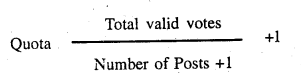
The President of India is the highest executive in India. His election is indirect. He is sleeted by an elected college which consists of elected members of Lok Sabha and Rajya Sabha and elected members of all the state Assembly. This election is conducted by a single transferable vote system which every vote can express as many preferences as there are candidates in the election. The person who gets the desired quota on the basis of counting of the first preference is elected the President. The formula for getting the desired quota is
Class 11 Political Science Important Questions Chapter 4 Executive 1

To become the President of India one should attain the age of 35 years and should not hold any office of profit under the Central Government or State Government.

Question 4.
How the President can be removed.
Answer:
The President of India has the tenure of five years but he can be removed by the method of impeachment in which changes are levelled is one house of the Parliament and are examined in the second house of the Parliament. President is given 14 days notice to explain his position.

If changes are proved by 2/3 majority the present and voting members the President stands impeached and he has to vacate the office.

Question 5.
Write the legislative Functions of Indian President.
Answer:
Followings are the legislative functions of President of India:

  1. President is part of the Indian Parliament
  2. He summons prorogues and dissolves the Parliament.
  3. He gives an asset to the bills passed by Parliament to make the laws.
  4. He gives assent for the introduction of the budget and finance bill and gives final approval.
  5. He nominates two members to Lok Sabha and 12 members to Rajya Sabha.
  6. He can send message ho the Parliament.
  7. He issues ordinances when the Parliament is not in session.

Question 6.
Write the Executive functions of Indian President.
Answer:
Indian President is Chief Executive. All the executives’ powers are vested in his name. His powers can be studied as under:

  1. He appoints Prime ministers and ministers.
  2. He makes all. important appointments like Governors and Chairman.
  3. He implements laws and policies.
  4. He appoints high commissions, ambassadors and receives the credentials of foreign dignitaries. He represents India abroad.
  5. He is Supreme Commander of Indian Army.
  6. He declares war and peace.
  7. He has the right to be informed and to be consulted.

Question 7.
How the Prime-minister of India is appointed?
Answer:
The Prime-minister is appointed by the President. After the election to the Lok Sabha, the leader of the political party or group of parties is invited to form the Government by the President. If he agrees, the President admin¬isters them the secrecy and oath of the office of Prime Minister. In case no party gets the majority in the Lok Sabha the discretion is used by the President is choosing the Prime-Minister. It is his satisfaction in whom leader or party he considers his faith to give a stable and efficient government. But when any party gets a clear out majority in Lok Sabha, he has no choice except to invade the leader of such majority party to form the Government.

Question 8.
Write the main functions of Indian Prime-minister.
Answer:
Indian Prime-minister is a very powerful post and has a free hand in a number of areas as. We Can understand his functions in the following points

  1. Formation of cabinet
  2. Distribution of Portfolio among different ministers.
  3. To preside over the meetings of the cabinet.
  4. To coordinate among different ministries and departments.
  5. To act as an advisor to the President
  6. To act as the link between cabinet and President
  7. To act as the architect of foreign policy
  8. He acts as the leader of the house
  9. He acts as the important leader of the party
  10. He leads the country

Question 9.
How the council of ministers is constituted?
Answer:
Council of the minister is a real political executive who works under the leadership and guidance of the Prime-minister. They are appointed by the President of India in the advice of the Prime-minister. They remain in the office at the pleasure of President. However it the prerogative of Prime-minister to includes any member of his party in his council of ministers or not. Prime Minister submits the selected list to the President who administers the oath of secrecy to the members of the list. The ministers can be removed from the council of ministers on the advice of Prime-minister. To become the minister one should be a member of either house of the Parliament.

Question 10.
Compare the powers and position of Prime-minister of India with the powers and position of US president.
Answer:
India has a Parliamentary system where Prime-minister is a real executive who discharges all powers and responsibilities written in the name of Indian President in the Indian Constitution. While in USA President is the real head who uses the powers which are written in his name in the US Constitution. Both offices have their own strong and weak areas. Both posts are powerful parts of the world. We can compare them in the following points.

  1. The tenure of Indian PM is uncertain while the president of the USA enjoys fixed tenure.
  2. The Prime-minister his fewer powers over his ministers in comparison to the ministers of USA
  3. Prime-minister can dissolve Parliament but USA President cannot dissolve Parliament.
  4. The PM can implement his decision more effectively if he has the majority in the Lok Sabha but US president cannot as he is more dependent on all the consent of the US Senate.
  5. Our Rajya Sabha has no control over Prime-minister. In USA senate has control over the execution of the policies by the President.

Question 11.
What are the functions of the council of ministers?
Answer:
The cabinet is the real political executive who has vast powers and is responsible for the total administration in all the spheres of national life. The functions and powers can be explained in the following points.

  1. Policymaking
  2. Policy implementation
  3. Legislative function ie; making bills and getting them passed in the parliament.
  4. Financial functions (Making a budget and getting it passed).
  5. Developmental functions
  6. Welfare functions.
  7. To act as the political executive

Question 12.
How the Governor is appointed? What are its functions?
Answer:
Since the state has also Parliamentary system of Government they also need a nominal head. He is appointed as the nominal head of state by the President of India. As head of State, Governor performs a formal function in the legislative field, executive and judicial fields. Governor also acts as an agent of the centre and as this capacity, he acts as a watchdog of the national and central interest in the states. Governor is also given some discretionary powers which he uses himself without the aid and advice of council ministers and chief minister. He sends the report to the centre under Art 356 for the imposition of President rule as the situation demands so.

Question 13.
How the Chief Minister is appointed and what are his main functions?
Answer:
Chief Minister is the real executive head at the state level. He is the leader of the Council of ministers. He is appointed by the’ Governor in the same manner in which Prime-minister is appointed in the centre by the President of India. The leader of the majority party in the state assembly is appointed as chief minister by the Governor. If no party gets a clear majority in the election then he can use his discretion and may use the number of options before him but he has to explore all the possible probabilities to formal state Government.

Chief minister performs the following functions:

  1. Formation of cabinet and distribution of portfolios among the ministers.
  2. To preside over the meetings of the cabinet.
  3. To act as an advisor to the Governor
  4. To act as the leader of the house
  5. To act as a link between the cabinet and Governor
  6. To act as leader of the party
  7. To act as leader of the state.

Question 14.
Discuss the composition and functions of UPSC and SPSCS. (State Public Service Commission).
Answer:
The Constitution has provided for UPSC (Union Service Commission) at the central level and PSCS (Public Service Commission) at State level. They have been entrusted with the task of conducting the process of recruitment of the civil servants for the Government of India and State respectively. The Chairman and members of UPSC are appointed by the President and the Chairman and member of State Public Service Commissions are appointed by the concerned state. They can be removed from the office through an enquiry made by a judge of the Supreme Court and High Court respectively. The UPSC conducts the exams and interviews for different all India and Central Services. Similarly, State PSCs make necessary arrangements for the appointment of State Services.

Question 15.
Discuss the role of civil services in India.
Answer:
India has established professionally qualified administrative machinery when is supposed to be politically neutral. They are expert in their areas to play a decisive role in the policymaking, policy implementation areas. The success of the Government depends upon the active and faithful role of the civil servants who manage every’ department from top to bottom. Bureaucracy is an instrument through which welfare and development policies should reach the people. Bureaucracy is the advisor of the political executives. Civil servants are known as the servants of the people.

Executive Important Extra Questions Long Answer Type

Question 1.
Discuss the increasing role of Executive in the modern state.
Answer:
The executive is one of the main organs of the Government. The executive has entrusted the task of policymaking, policy implementation and law imple¬mentation and making an appointment. There are many types of the executive. They may be civil or military, they may be hereditary (Monarchy) or they may be elected (Republican) They may be political executive (Cabinet) or they may be permanent and expert executive (Civil Service) They may be Parliamentary executive or they may be Presidential executive.

Whatever may be the nature of executive, due to the welfare nature of the modern State the executive’s role has increased much fold. There is no area of national life where the executive has no interference and role.

Every society is in a transitional stage where the urges and demands challenges and problems of the people are increasing which are supposed to be looked after the executive. The executive has guidelines not only in exclusive areas like implementation of policies and programmes but also have a significant role in legislative financial and judicial areas. For the development and welfare of the people, everybody looks after the executive. With a new dimension of change and development and increasing globalisation and internationalism the role of executive increases.

Election and Representation Class 11 Important Extra Questions Political Science Chapter 3

Here we are providing Class 11 Political Science Important Extra Questions and Answers Chapter 3 Election and Representation. Political Science Class 11 Important Questions with Answers are the best resource for students which helps in class 11 board exams.

Class 11 Political Science Chapter 3 Important Extra Questions Election and Representation

Election and Representation Important Extra Questions Very Short Answer Type

Question 1.
What is democracy?
Answer:
Democracy is a form of government in which ultimate power rests with the people. Broadly speaking it is a system of governance in which the all-round development of the people is possible because they are the real governor.

Question 2.
Differentiate between Direct democracy and Indirect democracy.
Answer:
Indirect democracy people participate directly in the affairs of the state. They discuss, debate, and take the final decisions directly in the issues of administration while in Indirect democracy people participate in the affairs of the state through their representatives. Direct democracy is possible only in the smaller states while Indirect democracy is run in bigger states in sizes and populations.

Question 3.
What is Election and why it is necessary?
Answer:
The method which is followed to choose their representative in Indirect democracy is known as Election. It is very necessary for Indirect democracy because it is the only thing that the people participate in the matters of administration. All major decisions are taken by these elected representatives on behalf of the people.

Question 4.
What is Adult Franchise?
Answer:
The right to vote for every adult person irrespective of his caste, color, region religion, language, and sex is known as Adult Franchise. The age of adulthood may be different for different societies. In Britain, it is 17 years. In India the age of adulthood is 18 years initially it was 21 years. In this principle, fall faith has been, expressed in the sense of decisions and capabilities, and capacities of every adult.

Question 5.
What do you mean by territorial Representation?
Answer:
When the whole state is divided into a number of territorial constituencies and all the people, living in that constituency elect their one representative it is known as Territorial representation.

Question 6.
What is Functional Representation?
Answer:
When the whole area of the state is divided into occupational considerations and every occupational group-elect their own representative, it is known as Functional Representation. In such a system businessmen elect their own representatives, farmers elect their own representatives and women elect their own representatives.

Question 7.
Write five features of India’s electoral system.
Answer:
Following are the main features of India’s electoral system

  1. Adult Franchise
  2. Territorial representation
  3. Multi-member Election Commission.
  4. Reservation for Scheduled Castes and Scheduled Tribes
  5. Joint Electoral system
  6. Secret Ballot paper.
  7. A decision by majority votes.

Question 8.
What is the First Part of the Past System?
Answer:
In this system of election whoever has more votes than all the other candidates, is declared elected. The winning candidate need not secure a majority of the votes. In the electoral race, the candidate who is ahead of others and who secures the winning post first fall is the winner. This method is also known as the plurality system.

Question 9.
Explain the Proportional method of Representation (PIR system).
Answer:
It is a method that is used in multi-member constituencies. Here every voter can express as many preferences as there are candidates in the election. The value of each vote will be equal. The person who will secure the definite quota on the basis of counting of first preference is declared elected. It ensures the representation of different social & minority groups in proportion to their population.

Question 10.
Why the FPTP system (First point the post system), was adopted in India?
Answer:
India FPTP system was adopted in India because of two factors.

  1. India has a single-member constituency where the P.R. system cannot be used.
  2. The second reason is FPTP system is simple while the PR system is complex, so for the people of India who are maximum illiterate PR system would
  3. In the FPTP system, people have a clear choice to opt.
  4. FPTP system offers a choice of candidates.

Question 11.
What is Election Commission?
Answer:
Election Commission is a constitutional body who referred in Art 324 of the Indian Constitution which provides for an Independent Election Commission for the superintendent, directions and control of the electoral, and the conduct of the election in India. In the beginning, it was made a single-member commission but Constitutional amendment this commission is made multi member commission with one Chief Election Commissioner and two other Election Commissioners. All have equal powers.

Question 12.
Write five steps of the election process.
Answer:

  1. Preparation of electro constituencies and voter’s lists.
  2. Notification and filing of nominations.
  3. Scrutiny, withdrawals, and finalization of the candidates.
  4. Preparation of Ballot papers.
  5. Preparation of necessary arrangements and conduct of the elections.
  6. Counting of the votes and declaration of the results.

Question 13.
Write five defects of the Indian electoral system.

  1. The minority is ruling over a majority
  2. The problem of impersonations
  3. Booth capturing
  4. Use of black money in the elections.
  5. All the sections of society are not properly represented.
  6. The entry of the people of criminal background in the Parliament and assemblies.
  7. Political Instability

Question 14.
Write some electrical reforms.
Answer:
To remove the electoral defects certain measures have been taken up and certain reforms have been suggested by different committees and commissions. The main reforms are as under:

  1. Use of EVM (Electronic Voting Machines.)
  2. Compulsory use of photo identity cards
  3. Women should be given reservations in Parliament and Assemblies.
  4. There should be state funding to check the use of black money in the elections.
  5. The number of political, parties should be checked.

Question 15.
Discuss the role of people in the elections.
Answer:
Besides the governmental machinery, the people have equalrespon¬sibility to ensure free and fair, and peaceful elections at different levels. People should be more vigilant and more actively involved in political activities. There should be some political institutions and voluntary organizations who could act as watchdogs in the functioning of the governmental machinery and ensure free and fair elections in the country.

Election and Representation Important Extra Questions Short Answer Type

Question 1.
Explain the merits and demerits of Direct democracy and Indirect democracy.
Answer:
Direct democracy is one form of a democratic form of government in which people participate directly in the process of governance. The people of state sit together in person, discuss the issues and make final decisions about old matters like policymaking, making rules, making appointments, and giving punishment. It has two important merits

No.1. People take part in the discussion and decisions directly.

No. 2. The decisions are taken quickly and no time is wasted.

It has some demerits also which are as under:

  1. It is not feasible in bigger states,
  2. Common people are not competent to taken technical decisions. Indirect democracy is another form of democracy where people do not participate directly but indirectly i.e. through their representative. The elected representatives act on behalf of the people and take part in the matter of administration.

It has two main merits which are as under.

  1. It is possible in big states.
  2. Elected people are responsible to the people.

Its demerits are as under.

  1. A lot of expenditure has to be incurred on elections
  2. Representatives are unable to keep all the interest of the people.

Question 2.
What is the election? What are the requisites of an election?
Answer:
The election is a method of choosing one’s representative. In a representative democracy, the election becomes a necessity because people cannot take part in administration directly. It is an elected representative who works on behalf of the common people. There is a number of requisitions for an election.

These requisites are as under

  1. It is to be decided that who will be eligible for vote.
  2. There should be free and fair elections for which a competent body has to be constituted to conduct free and fair elections.
  3. The basis of constituency formation has to be decided
  4. The method of election has to be decided.
  5. Election results are decided.

Question 3.
Write main features of the Indian electoral system.
Answer:
Following are the main features of the Indian electoral system:

  1. Adult Franchise: Every person above the age of 18years has been given the rights to Vote.
  2. Multimember Election Commissioner: Indian Constitution has pro¬vided a multimember (Now three members) Election Commission to conduct free and fair elections.
  3. Joint Electorate: Joint electorate is a very important feature of the Indian electoral system. In this system, all the persons irrespective of their caste or occupation, elect their representative jointly.
  4. Temporal representation: In India Territorial representation has been adopted which means the country has been divided into territorial constituencies (Now 5.43). Each such Territorial constituency will send one represen¬tative.
  5. reservation ensure the adequate representation of each minority social groups some seats have been reserved for Scheduled Castes and Scheduled tribes in Parliament and State Assemblies.
  6. Secret ballot papers.
  7. First Past the Post system
  8. Election Petitions

Question 4.
Describe various steps in the Election Process of India.
Answer:
Following are the stages of the Election process in India:

  1. Formation & Electoral Territorial constituencies by the commission.
  2. Updating and finalizing the voter’s list
  3. Notification of declaration of Elections
  4. Nomination of candidates
  5. Scrutiny of the forms of candidates
  6. Time for withdrawal of the candidature
  7. Finalization of the total candidates in the Electron and publication of such a list.
  8. Printing of the ballot papers
  9. The proportion of EVM (Electronic Voting Machine) or the ballot box.
  10. Constitution of Polling booths in different constitutions
  11. Constitution of polling parties
  12. Preparation of poHingJiags with necessary election material for each polling booth.
  13. Conducting of the elections
  14. Counting of the votes
  15. Declaration of the result.
  16. Settlement of Election petitions

Question 5.
Distinguish between FPTP and PR system.
Answer:
FPTP system stands for First Post the post system which means
that candidate, who secures the highest vote among the total candidates in the election is declared elected. It is not necessary for him to get even 50% of the total votes. It means that in the electorate race, the candidate who is ahead of others and who crosses the winning post, first of all, is the winner.

In the PR system i.e the Proportional Representation method, multi-member constituencies are made. It is of two types 1. Single Transferable vote system and No.2. is the list system. In this system, it is ensured that minority social groups are duly represented as per the proportion of their qualifications. Similarly, all political parties are given a number of seats in proportion to the votes they have received in the election.

Question 6.
Discuss the composition of the Election Commission of India.
Answer:
Now Election Commission of India is a three-member body with one Chief Election Commissioner and two other election commissioners. Each election commissioner has equal power and pay. However, Chief Election Commissioner provides the meetings of the commission and discharges the formal duties of the Election Commission. He also acts as spokesman of the commission. Every Election Commissioner enjoys the tenure of six years or up to the attainment of the age of 65 years whichever is earlier.

To assist the Election Commissioner of India there is a chief electoral officer in every state. State Election Commissioner is responsible for conducting the local body elections and is independent of the Election Commission of India. When elections are declared every State and Central Government employee comes under the jurisdiction of’Election Commissioner under the Representation of people’s Act 1951 which makes it obligatory for every employee to perform the election duty assigned to him by the commission.

Question 7.
Write main functions of the Election Commissioner.
Answer:
The Election Commissioner has a wide range of functions which are as under.

  1. The election Commissioner supervises the preparation of updated voter’s list in every state.,
  2. It also determines the timings of the election and prepares the schedules of the election. lt also notifies the schedule which includes filling up of nomination form, last date of scripting, last date of withdrawals, date of polling, date of counting, and declaration to the result.
  3. Its main duty is to conduct free and fair poll:
  4. It has the power to implement the model code of elections and it punishes those who try to violate it.
  5. It takes the decision regarding repel! in any constituency.
  6. The Election Commission accord recognition to political parties and allocates flaps, symbols to the candidates and political parties.
  7. Election Commission monitor and supervise the election and takes a decision about any dispute related, with the election. „

Question 8.
Discuss the position of the Election Commission of India.
Answer:
Chief Election Commissioner has a wide range of powers so is its role and position. Once the years the Election Commission of India has emerged as an independent authority and has exercised its powers and authority to ensure free and fair elections.

When Chief Election Commissioners like T.N. Susan, B.B. Lyndog were at the helm of authority it has acquired more and more teeth. It is widely agreed that Election Commission is more independent and assertive now than it was ever. The Election Commission has started using more effectively its powers that it has been given by the Constitution makers. Many political leaders call it judicial activism also but it is not so.

Over the years Election Commission has conducted the election of 14 Lok Sabhas and-many more state assembly elections and bye-elections have been conducted. Election Commission has conducted the elections in the most difficult situations. Generally, its decisions have been accepted and its impartiality has never been questioned. Its authority has been appreciated even in other countries also.

Question 9.
Mention some Election defects in our Election system.
Answer:
In spite of the smooth functionary of our electoral democracy, our electoral system is not free from defects. It has some structural and functional defects which are as under.

  1. The multiplicity of the political parties and candidates
  2. Rigging in the elections
  3. FPTP system is defective because it ensures the win of a candidate even if he or she does not get the majority of the votes.
  4. Booth capturing
  5. The minority is ruling over the majority
  6. Hung Assemblies and hung Parliament
  7. Impersonation
  8. Use of black money in the elections
  9. Crimmalisatiort Or politics.
  10. Lack of political training.

Question 10.
Explain Single Transferable Vote System.
Answer:
A single Transferable system is a proportional method of representation. It is used in multi-member constituencies. In this system, every voter can express as many preferences as there are candidates in the election. A person who secures the desired quotas on basis of counting of votes of first preference is declared elected. The formula of getting the quota is as under.
Class 11 Political Science Important Questions Chapter 3 Election and Representation 1

If no person does not get the definite Quota in first counting the remaining votes of other candidates are transferred to the nearest candidate till he gets desired Quota.

Question 11.
Explain the List System.
Answer:
It is also another method of Proportional method of representation. It is also used in multi-member constituencies. In this system, each party is allotted the share of seats in the Parliament in Proportion to its share of votes. Each party fills its Quota of seats by picking many of its nominees from a preference list that has been declared before the elections. In this system, a party gets the same proportion of seats as its proportion of votes. The voter expresses his preference for the list of the party and not for the candidate. Here also a definite Quota is used.

Question 12.
Why Reservation is necessary.
Answer:
Since Indian Society has been in grip of several socio-economic disparities and inequalities. Many social groups remained socially and politically and culturally backward. To ensure their representation in democratic institutions like Parliament, assemblies they provided the reservation of the same seats for Scheduled Castes (79) and Scheduled Tribes (41). The reservation was necessary for the fair and definite representation of their socially backward groups.

Question 13.
Give some suggestions for election reforms.
Answer:
On the basis of discussion and debate about various election reforms of different platforms and on the basis of the recommendation of various committees and commission some of the important suggestions for election reformers are as under:-

  1. FPTP system is faulty, therefore it should be repeated by the PR system.
  2. There, should be reservation for women in Parliament and State assemblies as has been done in rural and urban local bodies.
  3. Roll of money should be checked for that there should be state funding.
  4. EVM (Electronic Voting Machines) should be used in all the constituencies.
  5. Candidates having criminal background should be strictly debarred to contest the elections.
  6. Campaigning on the basis of caste and religion should be punishable.
  7. A multiplicity of political parties and independent candidates should be checked.
  8. Election photo cards should be made compulsory so that impersonation could be checked.
  9. There should be a transparent-audit of the funds of all political parties.
  10. The voter list should be made up to date.

Question 14.
What is the role of political parties in the elections?
Answer:
In most democracies, the political parties are extra-constitutional growths and have emerged in the political process as a matter of Fundamental Rights. But political parties play a significant role in making the elections meaningful. Political parties offer attractive policies and programs before the voters and ask for their votes. Political parties offer choices before the voters. Political parties educate the people and promote the participation of the people in the election process. More responsible are the political parties more meaningful is the election. Political parties also help in the formation of governments. The negative aspect of the political parties is that they demand the votes on parochial likes hence divide the society. But we can say that political parties never became essential for the smooth conduct of the elections. They cannot be separated from the election process.

Question 15.
Why women could not be given reservation in parliament and State Assemblies so far?
Answer:
The issue of women’s reservation in Parliament and State Assemblies has been agitating the mind of the political leadership of almost all the political parties. No party opposes the reservation of-woman. Even several consti¬tutional amendments have been introduced in the Parliament but unfortu¬nately this bill could not become law because of the hypocrisy of the political leadership of all the political parties.

In spite of the fact that almost all the political parties have given their issue place in their election manifesto but when the bill is introduced for this purpose, most of the political parties take the opposite position and the result is that it remained only a cry. Many parties demand reservation within reservation i.e. separate reservation of SCs and SCs women. It is becoming of this situation it could not become a law.

Election and Representation Important Extra Questions Long Answer Type

Question 1.
Describe the election system in India.
Answer:
India is-a representative democracy in which election is a must. To conduct free and fair elections at the different levels an Election Commission is provided by the Constitution (Art 324 of Indian Consitution). We have adopted Adult Franchise which means every person who is an adult (18 years of age) irrespective of his caste, color, status, and sex is eligible to exercise his franchise.

We have adopted territorial representation instead of functional representation. All the persons of different castes, classes, and occupations living in a definite geographical area (Constituency) elect only one representative. Therefore it is a joint system. Another very important feature of our electoral system is the FPTP system (First Past the Post system) It means the person who gets the maximum votes among the contesting candidates is declared elected However for the same posts like President, Vice President, and Rajya Sabha. The Proportional Representation method (Single Transferable vote system is used.

Keeping our historical background in view constitution-makers reserved certain seats in Parliament and State Assemblies for Scheduled Castes and Scheduled Tribes to ensure their fair representation. However, women could not get any reservation in Parliament and State Assemblies. Efforts are going in this direction. Indian electoral system has been proved successful and up to the expectations of the Consitution makers. Since 1952, fourteen Lok Sabha elections have been constituted. Election Commissioner has worked in a free and fair manner even in most difficult situations. Its credibility and reputation. has been acknowledged in other countries also. It is not a perfect system, therefore some reforms are underway to make it more effective.