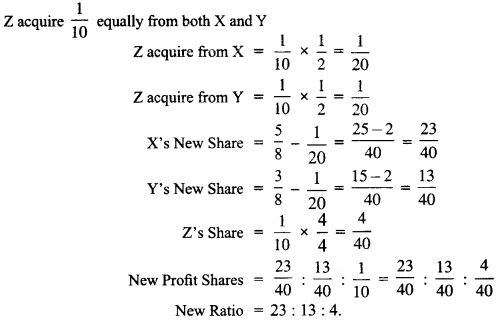
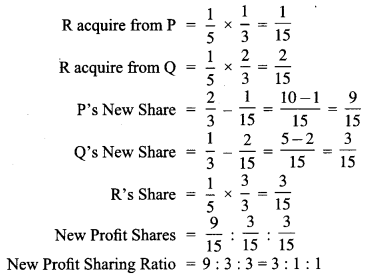
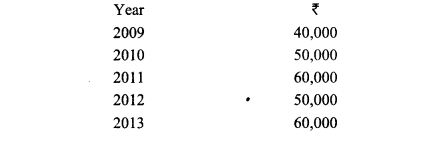
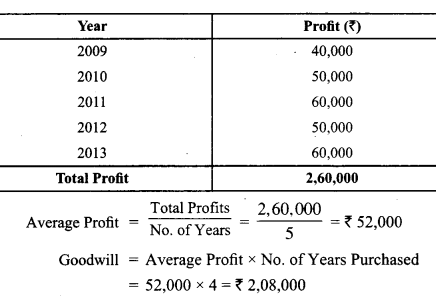
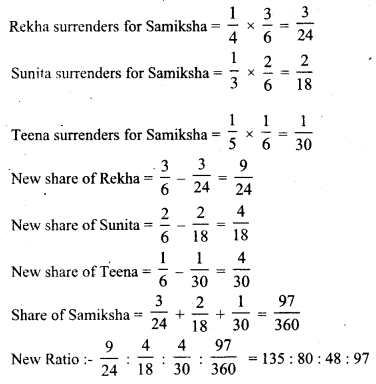
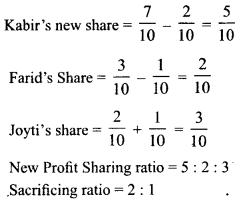
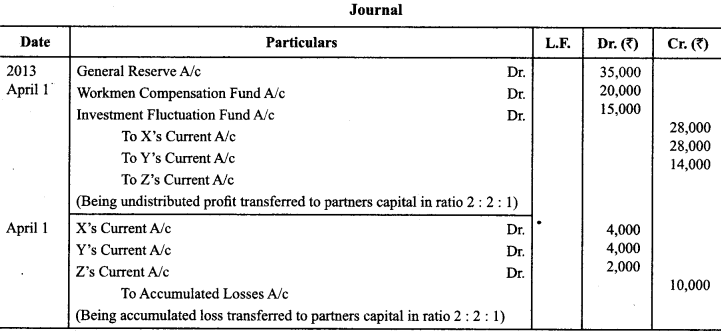
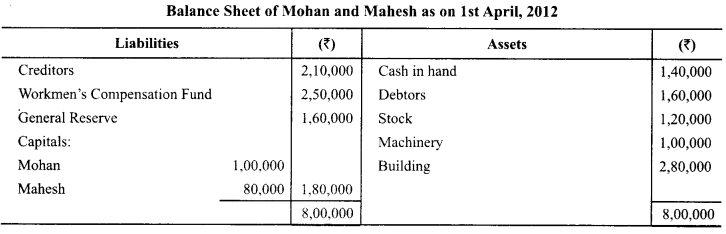
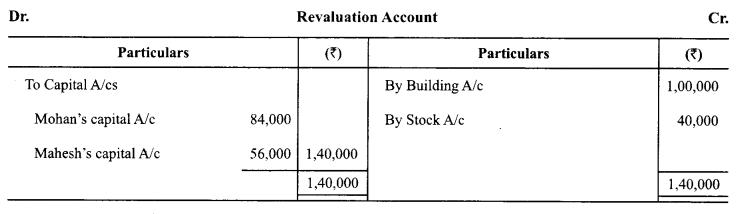
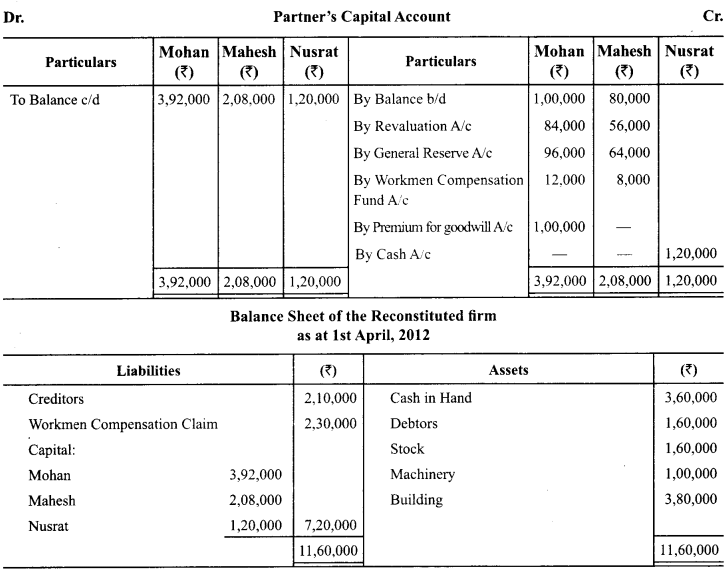
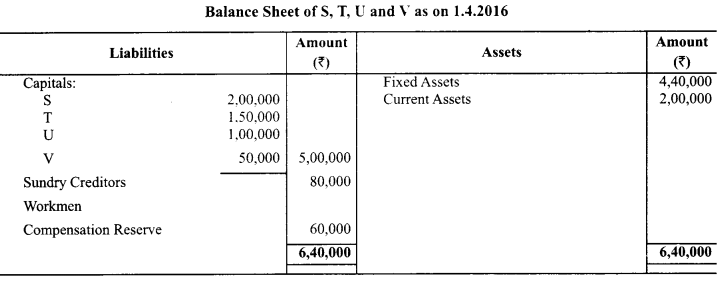
Reconstitution of Partnership Firm: Retirement/Death of a Partner Class 12 Important Questions Accountancy Chapter 4

Here we are providing Class 12 Accountancy Important Extra Questions and Answers Chapter 4 Reconstitution of Partnership Firm: Retirement/Death of a Partner. Accountancy Class 12 Important Questions and Answers are the best resource for students which helps in class 12 board exams.

Class 12 Accountancy Chapter 4 Important Extra Questions Reconstitution of Partnership Firm: Retirement/Death of a Partner

Reconstitution of Partnership Firm: Retirement/Death of a Partner Important Extra Questions Very Short Answer Type

Question 1.
What is meant by ‘Gaining Ratio’ on retirement of a partner?
Or
P, Q and R were partners in a firm. On 31st March, 2018 R retired. The amount payable to R ₹ 2,17,000 was transferred to his loan account. R agreed to receive interest on this amount as per the provisions of Partnership Act, 1932. State the rate at which interest will be paid to R. (CBSE Delhi 2019)
Answer:
The ratio in which retiring Partner’s Share is distributed between remaining Partner is called gaining ratio.
Or
Rate of interest will be 6% p.a.

Question 2.
Aman, Bimal and Deepak are partners sharing profits in the ratio of 2 : 3 : 5. The goodwill of the firm has been valued at ₹ 37,500. Aman retired. Bimal and Deepak decided to share profits equally in future. Calculate gain/sacrifice of Bimal and Deepak on Aman’s retirement and also pass necessary journal entry for the treatment of goodwill. (CBSE Outside Delhi 2019)
Answer:
Old Ratio = 2:3:5
New Ratio =1:1 (on Aman’s Retirement)
Bimal’s Gain = 1/2 – 3/10 = 2/10
Deepak’s Gain = 1/2 – 5/10 = nil
Firm’s Goodwill = 37,500 .
A man’s share = 2/10 x 37,500 = 7,500
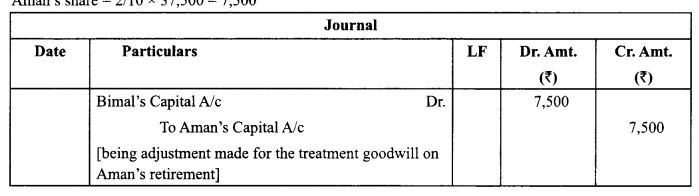
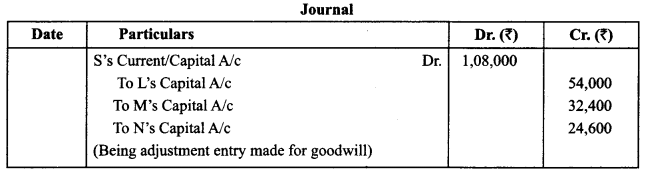
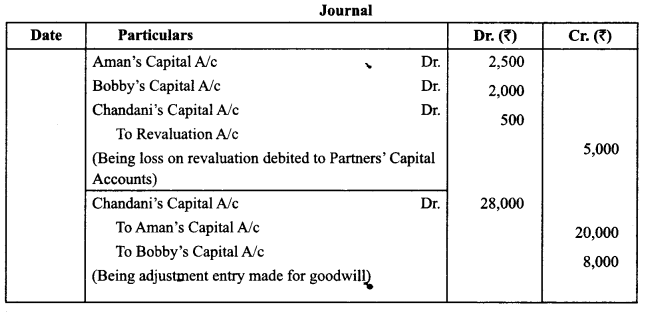
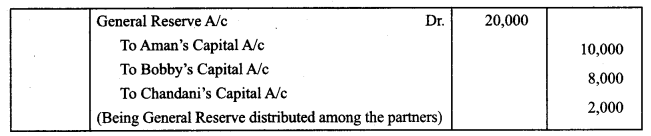
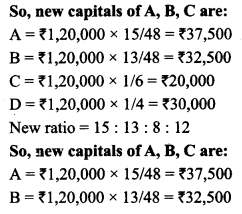
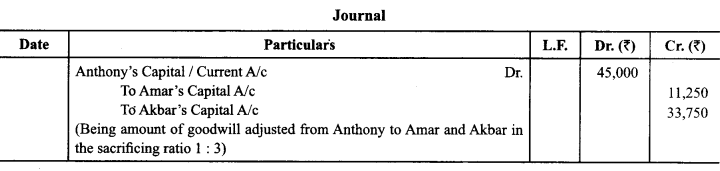
Class 12 Accountancy Important Questions Chapter 4 Reconstitution of Partnership Firm Retirement Death of a Partner 1

Question 3.
Riyansh, Garv and Kavleen were partners in a firm sharing profit and loss in the ratio of 8 : 7 : 5. On 2nd November 2018, Kavleen died. Kalveen’s share of profits till the date of her death was calculated at ₹ 9,375. Pass the necessary journal entry. (CBSE Sample Paper 2019-20)
Answer:
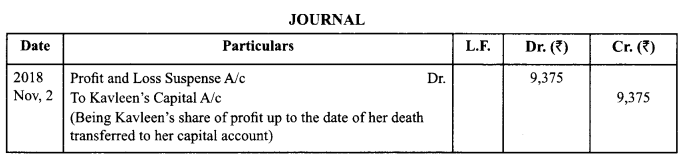
Class 12 Accountancy Important Questions Chapter 4 Reconstitution of Partnership Firm Retirement Death of a Partner 2

Question 4.
At the time of retirement how is the new profit sharing ratio among the remaining partners calculated₹ (CBSE Compt. 2019)
Answer:
The new share of each of the remaining partner is calculated as his/her own share in the firm plus the share acquired from the retiring partner.

Question 5.
In which ratio do the remaining partners acquire the share of profit of the retiring partner? (CBSE Compt. 2017)
Answer:
Gaining ratio.

Question 6.
At the time of retirement of a partner, state the condition when there is no need to compute gaining ratio. (CBSE 2013 Compartment OD)
Answer:
When the remaining partners share profits in old ratio.

Question 7.
On the retirement of a partner, how is the profit sharing ratio of the remaining partners decided?
Answer:
On the basis of old profit sharing ratio.

Question 8.
Why is gaining ratio of the remaining partners calculated at the time of retirement/death of a partner?
Answer:
Gaining ratio of the remaining partners is calculated to determine amount of goodwill payable by them to retired/deceased partner.

Question 9.
State the ratio in which share of goodwill of the retiring partner is debited to Capital Accounts of the remaining partners.
Answer:
In their gaining ratio.

Question 10.
Abha and Beena were partners sharing profits and losses in the ratio of 3 : 2 on April 1st 2013, they decided to admit Chanda for l/5th share in the profits. They had a reserve of ₹ 25,000 which they wanted to show in their new balance sheet. Chanda agreed and the necessary adjustments were made in the books. On October 1st 2013, Abha met with an accident and died. Beena and Chanda decided to admit Abha’s daughter Fiza in their partnership, who agreed to bring ₹ 2,00,000 as capital. Calculate Abha’s share in the reserve on the date of her death. (CBSE Sample Paper 2015)
Answer:
₹ 12,000

Question 11.
X, Y and Z were partners sharing profits and losses in the ratio of 3:2:2. Z retired and the amount due to him was ₹ 85,000. He was paid ₹ 5,000 immediately. The balance was payable in three equal annual instalments carrying interest @ 6% p.a. Pass necessary journal entry for recording the same on the date of Z’s retirement.
(Compt. Delhi 2017)
Answer:
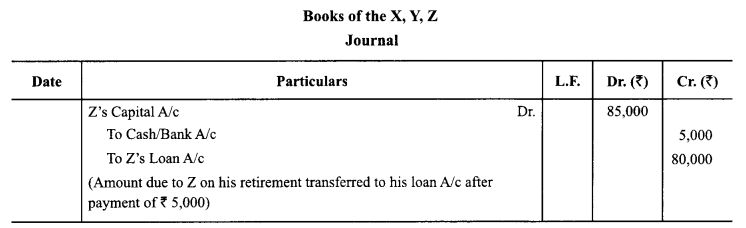
Class 12 Accountancy Important Questions Chapter 4 Reconstitution of Partnership Firm Retirement Death of a Partner 3

Question 12.
Ram, Mohan and Sohan were partners in a firm sharing profits in the ratio of 4 : 3 : 1. Mohan retired. His share was taken over equally by Ram and Sohan. In which ratio will the profit and loss on revaluation of assets and liabilities on the retirement of Mohan be transferred to capital accounts of the partners?
(CBSE 2010 Compartment Delhi)
Answer:
In old profit sharing ratio.

Reconstitution of Partnership Firm: Retirement/Death of a Partner Important Extra Questions Short Answer Type

Question 1.
Danish, Ana and Pranjal are partners in a firm sharing profits and losses in the ratio of 5:3:2. Their books are closed on March 31 st every year.
Danish died on September 30th , 2019, The executors of Danish are entitled to: (CBSE Sample Paper 2019-20)
(i) His share of Capital i.e. ₹ 5,00,000 along-with his share of goodwill. The total goodwill of the firm was valued at ₹ 60,000.
(ii) His share of profit up to his date of death on the basis of sales till date of death. Sales for the year ended March 31, 2019 was ₹ 2,00,000 and profit for the same year was 10% on sales. Sales shows a growth trend of 20% and percentage of profit earning is reduced by 1%.
(iii) Amount payable to Danish was transferred to his executors.
Pass necessary Journal Entries and show the workings clearly.
Answer:
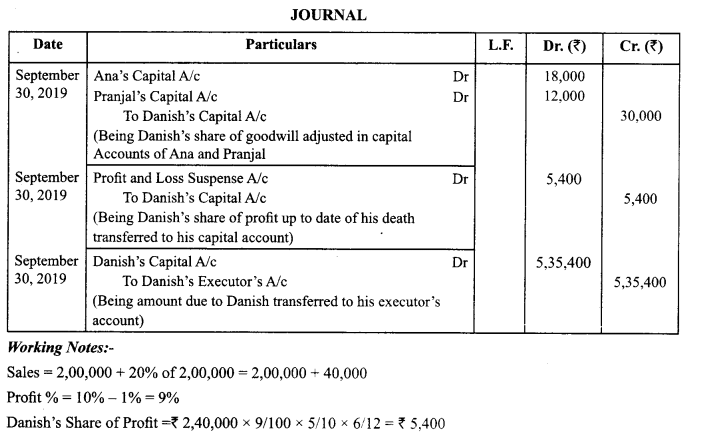
Class 12 Accountancy Important Questions Chapter 4 Reconstitution of Partnership Firm Retirement Death of a Partner 4

Question 2.
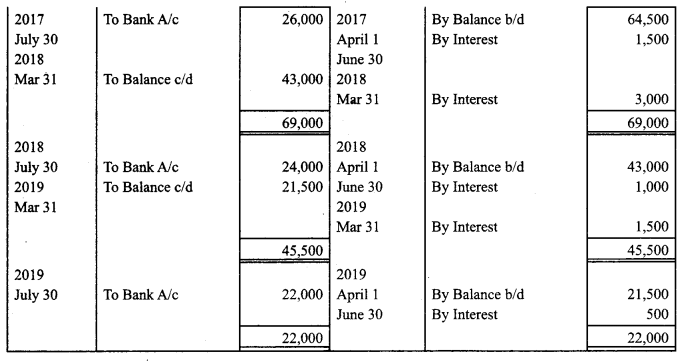
A, B and C were partners in a firm sharing profits and losses in the ratio of 3 : 2 : 1. C dies on 30th June, 2016. After all the necessary adjustments, his capital account showed a credit balance of ₹ 70.600. C’s executor was paid ₹ 10,600 on 1st July, 2016 and the balance in three equal yearly instalments starting from 30th June, 2017 with interest @ 10% p.a. on the unpaid amount. The firm closes its books on 31st March every year.
Prepare C’s Executor’s Account till the amount is finally paid. (CBSE Compt. 2019)
Answer:
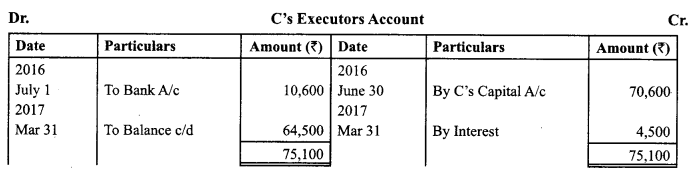
Class 12 Accountancy Important Questions Chapter 4 Reconstitution of Partnership Firm Retirement Death of a Partner 5
Class 12 Accountancy Important Questions Chapter 4 Reconstitution of Partnership Firm Retirement Death of a Partner 6

Question 3.
X, Y and Z were partners in a firm sharing profits in the ratio of 3 : 3 : 4. Z died on 31st March, 2016. The amount payable to Z’s executor K was ₹ 1,09,000. ₹ 19,000 were paid to K immediately and the balance was paid in three equal yearly instalments starting from 31st March, 2017 with interest @ 13% p.a. The firm ‘ closes its books on 31st March every year.
Prepare K’s account till he is finally paid.
Answer:
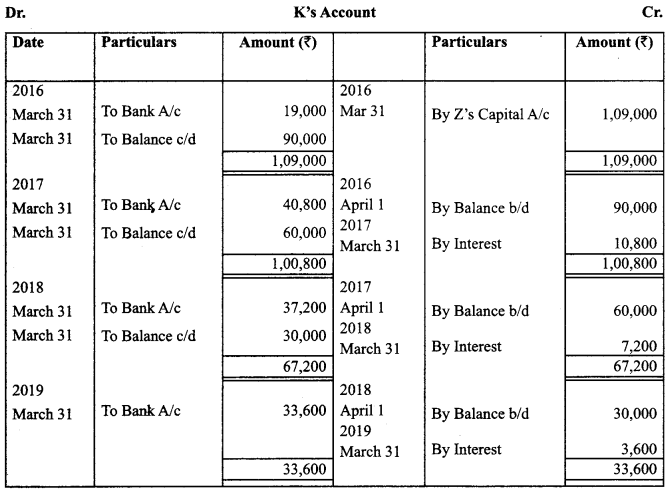
Class 12 Accountancy Important Questions Chapter 4 Reconstitution of Partnership Firm Retirement Death of a Partner 7

Question 4.
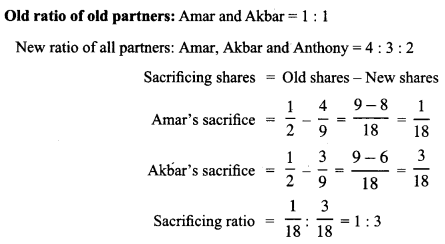
Apama, Manisha and Sonia are partners sharing profits in the ratio of 3 : 2 : 1. Manisha retires and goodwill of the firm is valued at ₹ 1,80,000. Apama and Sonia decided to share future in the ratio of 3:2. Pass necessary journal entries.
Answer:
(i) Old profit sharing ratio of Apama, Manisha and Sonia = 3 : 2 : 1
New Profit sharing ratio of Aparna and sonia = 3 : 2
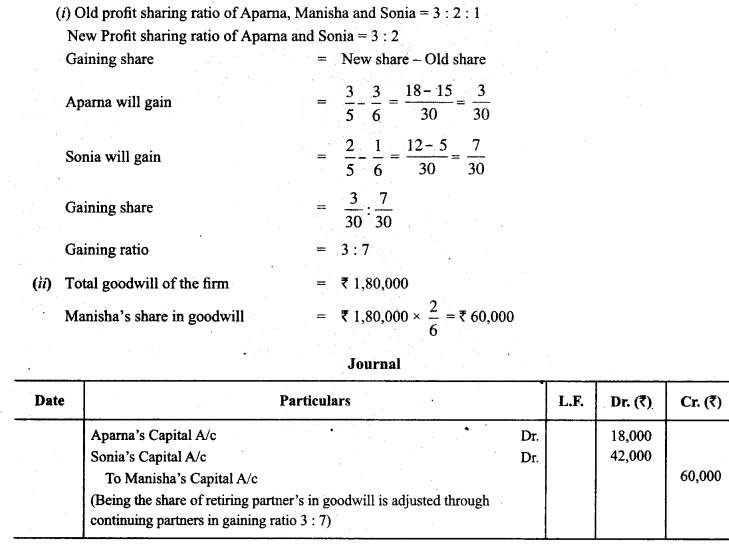
Class 12 Accountancy Important Questions Chapter 4 Reconstitution of Partnership Firm Retirement Death of a Partner 8

Question 5.
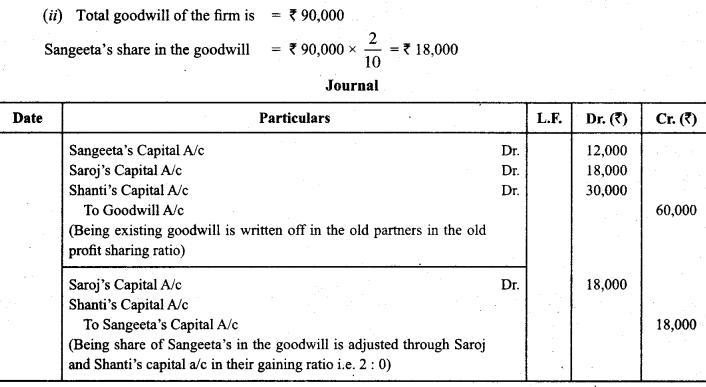
Sangeeta, Saroj and Shanti are partners sharing profits in the ratio of 2 : 3 : 5. Goodwill is appearing in the books at a value of ₹ 60,000. Sangeeta retires and goodwill is valued at ₹ 90,000. Saroj and Shanti decided to share future profits equally. Record necessary journal entries.
Answer:
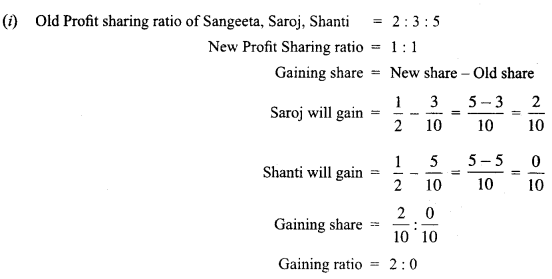
Class 12 Accountancy Important Questions Chapter 4 Reconstitution of Partnership Firm Retirement Death of a Partner 9
Class 12 Accountancy Important Questions Chapter 4 Reconstitution of Partnership Firm Retirement Death of a Partner 10

Question 6.
Naresh, Raj Kumar and Bishwajeet are equal partners. Raj Kumar decides to retire. On the date of his retirement, the Balance Sheet of the firm showed the following : General Reserves ₹ 36,000 and Profit and Loss Account (Dr.) ₹ 15,000.
Pass the necessary journal entries to the above effect.
Answer:
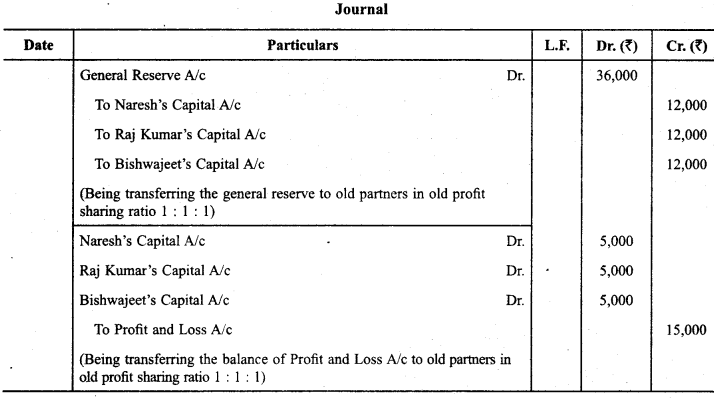
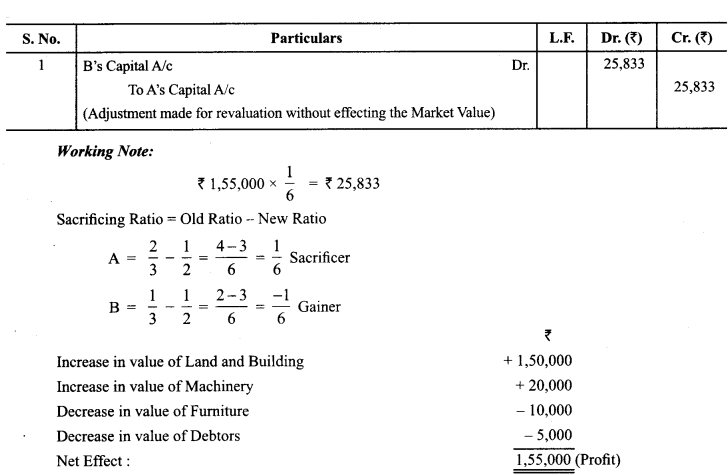
Class 12 Accountancy Important Questions Chapter 4 Reconstitution of Partnership Firm Retirement Death of a Partner 11

Question 7.
Amar, Ram, Mohan and Sohan were partners in a firm sharing profits in the ratio of 2 : 2 : 2 : 1. On 31st January, 2017 Sohan retired. On Sohan’s retirement the goodwill of the firm was valued at ₹ 70,000. The new profit sharing ratio between Amar, Ram and Mohan Was agreed as 5 : 1 : 1.
Showing your working notes clearly, pass necessary Journal Entry for the treatment of goodwill in the books of the firm on Sohan’s retirement. [CBSE Delhi 2017]
Answer:
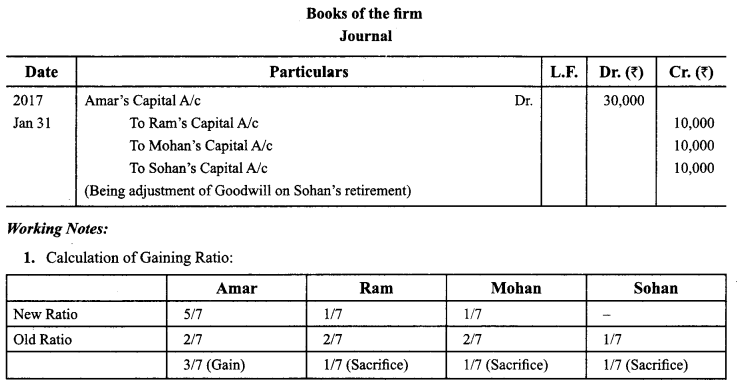
Class 12 Accountancy Important Questions Chapter 4 Reconstitution of Partnership Firm Retirement Death of a Partner 12

Question 8.
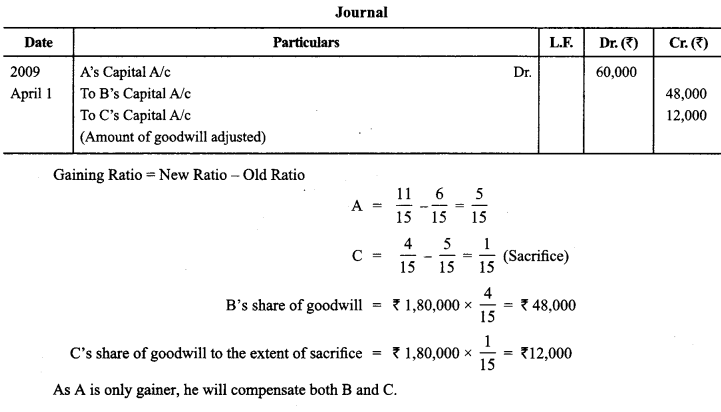
A, B and C were partners sharing profits in the ratio of 6:4:5. Their capitals were A₹ 1,00,000, B ₹ 80,000 and C ₹ 60,000. On 1 st April 2009, B retired from the firm and the new profit sharing ratio between A and C was decided as 11 : 4. On B’s retirement the goodwill of the firm was valued at ₹ 1,80,000. Showing your calculations clearly, pass necessary journal entry for the treatment of goodwill on B’s retirement.
Answer:
Class 12 Accountancy Important Questions Chapter 4 Reconstitution of Partnership Firm Retirement Death of a Partner 13

Question 9.
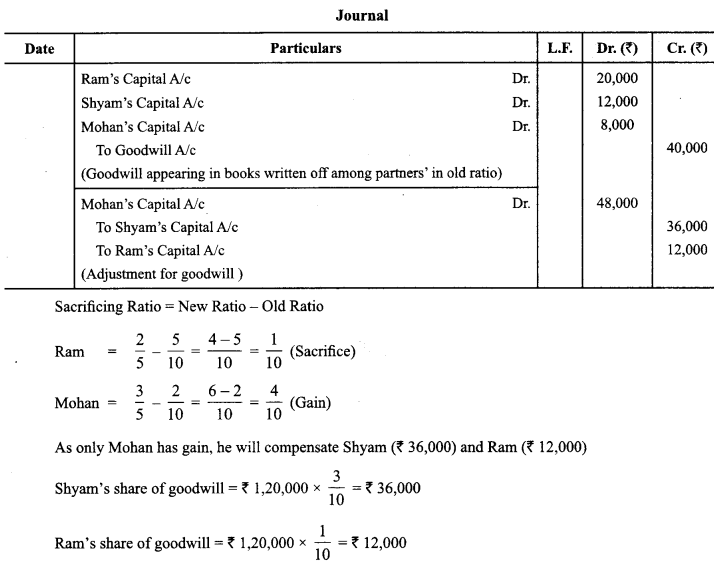
Ram, Shyam and Mohan are partners sharing profits in the ratio of 5 : 3 : 2. Shyam retired, and goodwill is valued at ₹ 1,20,000. Ram and Mohan decided to share future profits in the ratio of 2 : 3. Pass necessary journal entries for treatment of goodwill, if goodwill appears in the books at ₹ 40,000.
Answer:
Class 12 Accountancy Important Questions Chapter 4 Reconstitution of Partnership Firm Retirement Death of a Partner 14

Question 10.
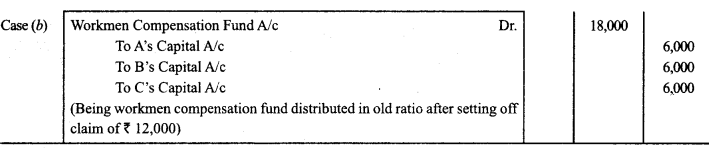
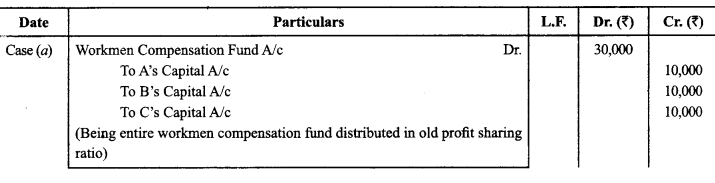
A firm of A, B and C has Workmen Compensation Fund of₹ 30,000. On retirement of a partner, how ₹ 20,000 will be treated in the following cases:
(a) There is no claim against Workmen Compensation fund.
(b) There is a claim of₹ 12,000 against Workmen Compensation Fund.
Journalise.
Answer:
Journal Entries
Class 12 Accountancy Important Questions Chapter 4 Reconstitution of Partnership Firm Retirement Death of a Partner 15
Class 12 Accountancy Important Questions Chapter 4 Reconstitution of Partnership Firm Retirement Death of a Partner 16

Question 11.
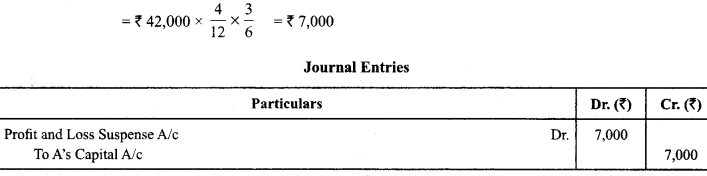
A, B and C are partners sharing profits in the ratio of 3 : 2 : l.A dies on 31st July 2011. The profits of the firm for the year ending 31st March 2011 were 42000. Calculate A’s Share for the period from 1st April to 31st July 2011 on the basis of last year’s profits. Pass necessary journal entry also.
Answer:
A’s profit = Preceding year’s profit x Proportionate Period x Share of A
Class 12 Accountancy Important Questions Chapter 4 Reconstitution of Partnership Firm Retirement Death of a Partner 17

Question 12.
If in the example-1 given above, the sales for the last year are ₹ 2,10,000 and for the current year upto 31st July are say ₹ 90,000, what would be the Profits from 1st April to 31st July 2011.
Answer:
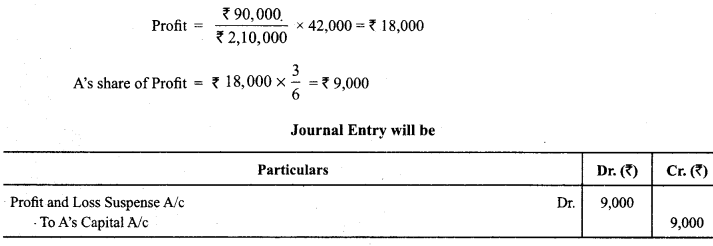
Class 12 Accountancy Important Questions Chapter 4 Reconstitution of Partnership Firm Retirement Death of a Partner 18

Question 13.
On December 31, 2014, the Balance Sheet of Pinki. Qureshi and Rakesh showed as under:
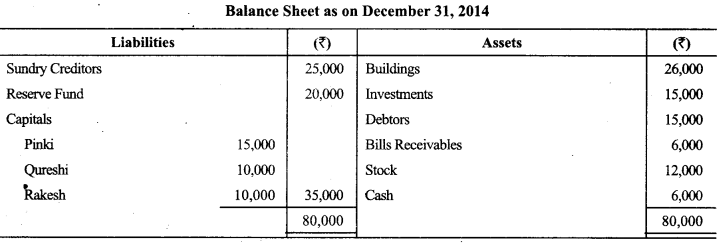
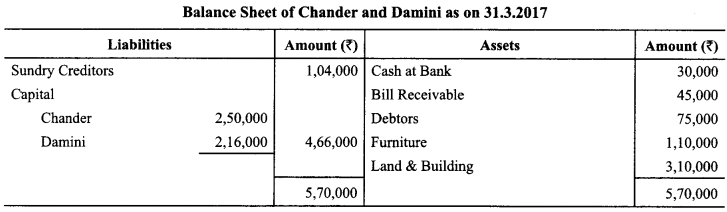
Class 12 Accountancy Important Questions Chapter 4 Reconstitution of Partnership Firm Retirement Death of a Partner 19
The partnership deed provides that the profit be shared in the ratio of 2 : 1 : 1 and that in the event of death of a partner, his executors be entitled to be paid out:
(a) The capital of his credit at the date of last Balance Sheet.
(b) His proportion of reserves at the date of last Balance Sheet.
(c) His proportion of profits to the date of death based on the average profits of the last three completed years, plus 10%.
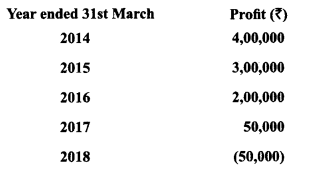
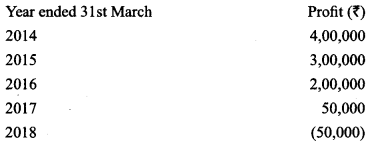
(d) By way of goodwill, his proportion of the total profits for the three preceding years. The net profit for the last three years were:
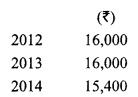
Class 12 Accountancy Important Questions Chapter 4 Reconstitution of Partnership Firm Retirement Death of a Partner 20
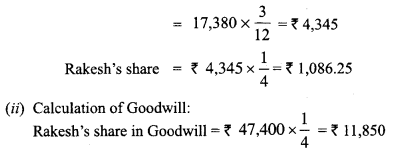
Rakesh died on April 1, 2015. He had withdrawn 5,000 to the date of his death. The investment were sold at par and R’s Executors were paid off. Prepare Rakesh’s Capital Account that of his executors.
Answer:
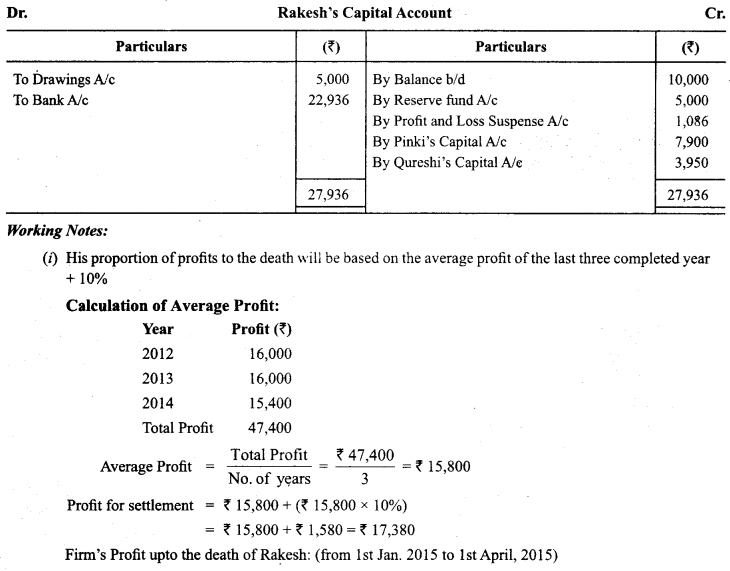
Class 12 Accountancy Important Questions Chapter 4 Reconstitution of Partnership Firm Retirement Death of a Partner 21
Class 12 Accountancy Important Questions Chapter 4 Reconstitution of Partnership Firm Retirement Death of a Partner 22
Note: Cash required to make payment is not enough even after selling the investment. Therefore, the payment has been made through bank.

Question 14.
Vikas, Vishal and Vaibhav were partners in a firm sharing profits in the ratio of 2 : 2 : 1 ..The firm closes its books on 31 st March every year. On 31.12.2015 Vaibhav died. On that date his Capital account showed a credit balance of ₹ 3,80,000 and Goodwill of the firm was valued at ₹ 1,20,000. There was a debit balance of ₹ 50,000 in the profit and loss account. Vaibhav’s share of profit in the year of his death was to be calculated on the basis of the average profit of last five year. The average profit of last five years was ₹ 75,000.
Pass necessary journal entries in the book of the firm on Vaibhav’s Death. (CBSE Outside Delhi 2016)
Answer:
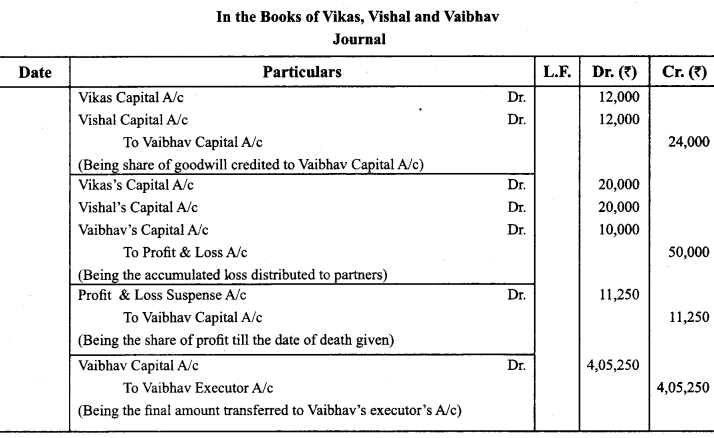
Class 12 Accountancy Important Questions Chapter 4 Reconstitution of Partnership Firm Retirement Death of a Partner 23

Question 15.
A, B, C and D were partners sharing profits in the ratio of 1 : 2 : 3 : 4. D retired and his share was acquired by A and B equally. Goodwill was valued at 3 year’s purchase of average profits of last 4 years, which were 40,000. General Reserve showed a balance of 1,30,000 and D’s Capital in the Balance Sheet was 3,00,000 at the time of D’s retirement. You are required to record necessary Journal entries in the books of the firm and prepare D’s capital account on his retirement.
Answer:
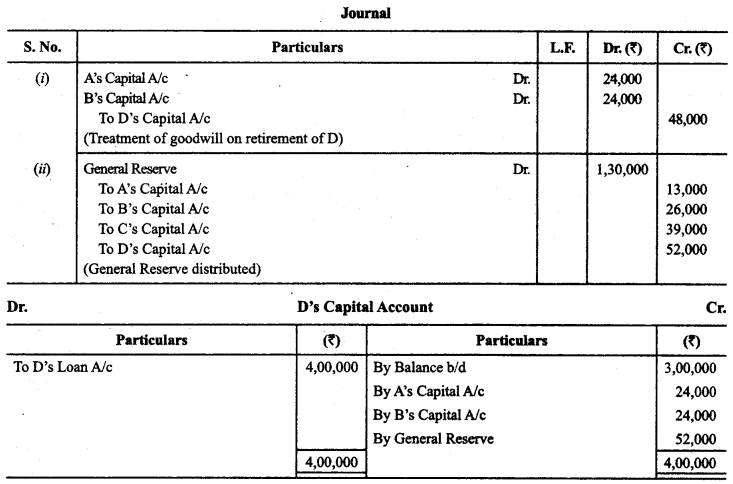
Class 12 Accountancy Important Questions Chapter 4 Reconstitution of Partnership Firm Retirement Death of a Partner 24

Question 16.
P, Q and R were partners sharing profits in the ratio of 2 :2 :1. The firm closes its books on March 31 every year. On June 30,2017, R died. The following information is provided on R’s death:
(i) Balance in his capital account in the beginning of the year was ₹ 6,50,000.
(ii) He withdrew ₹ 60,000 on May 15,2017 for his personal use.
On the date of death of a partner the partnership deed provided for the following:
(a) Interest on capital @ 10 % per annum.
(b) Interest on drawings @ 12 % per annum.
(c) His share in the profit of the firm till the date of death, to be calculated on the basis of the rate of Net Profit on Sales of the previous year, which was 25 %. The Sales of the firm till June 30, 2017 were ₹ 6,00,000.
Prepare R’s Capital Account on his death to be presented to his executors. (CBSE Sample Paper 2017-18)
Answer:
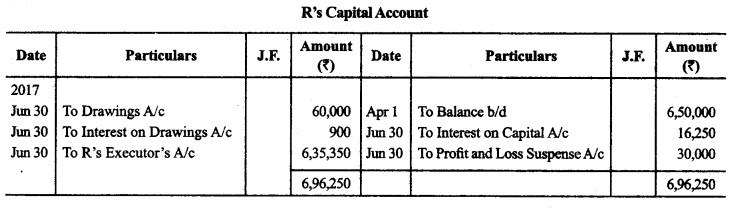
Class 12 Accountancy Important Questions Chapter 4 Reconstitution of Partnership Firm Retirement Death of a Partner 25

Reconstitution of Partnership Firm: Retirement/Death of a Partner Important Extra Questions Long Short Answer Type

Question 1.
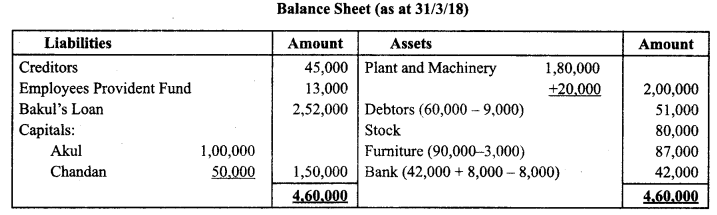
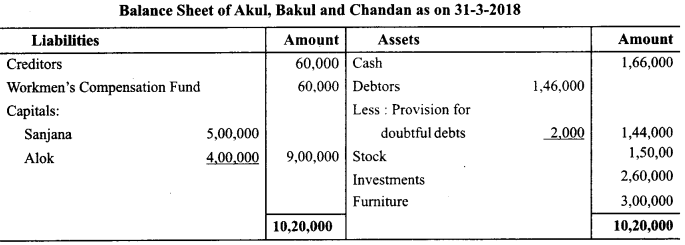
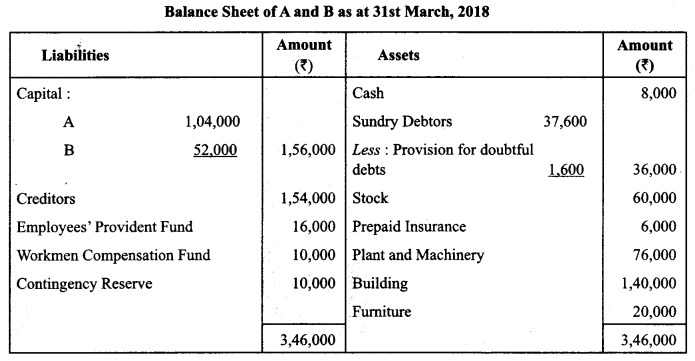
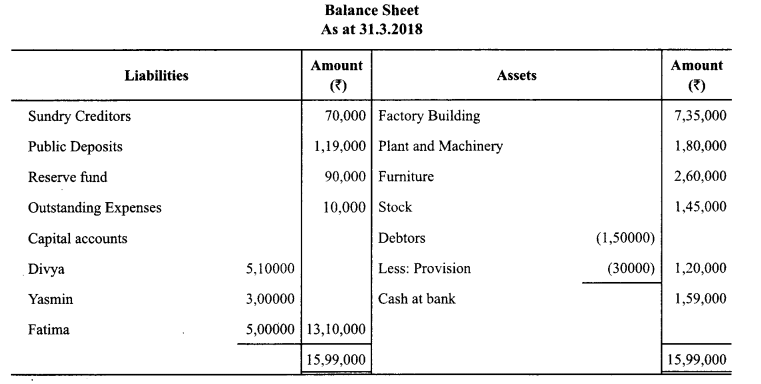
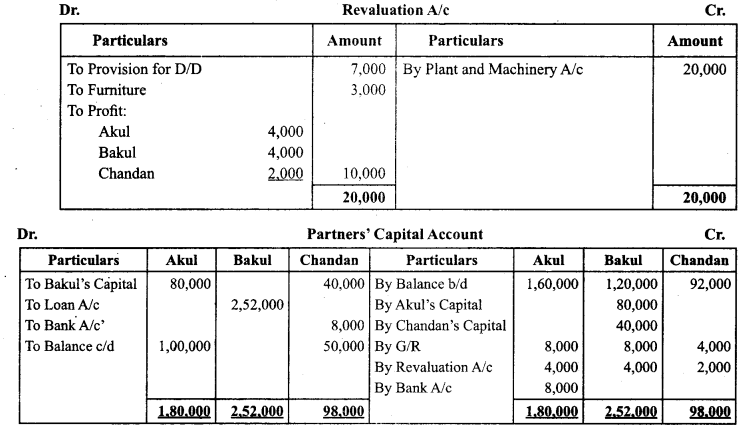
Akul, Bakul and Chan dan were partners in a firm sharing profits in the ratio of2:2: 1. On 31 st March, 2018 their Balance Sheet was as follows:
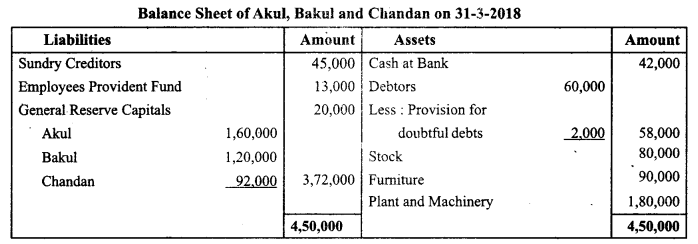
Class 12 Accountancy Important Questions Chapter 4 Reconstitution of Partnership Firm Retirement Death of a Partner 26
Bakul retired on the above date and it was agreed that:
(i) Plant and Machinery was undervalued by 10%.
(ii) Provision for doubtful debts was to be increased to 15% on debtors.
(iii) Furniture was to be decreased to ₹87,000.
(iv) Goodwill of the firm was valued at ₹3,00,000 and Bakul’s share was to be adjusted through the capital accounts of Akul and Chandan.
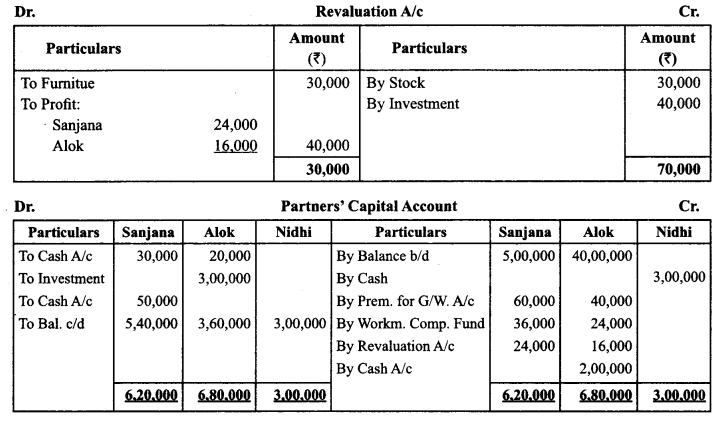
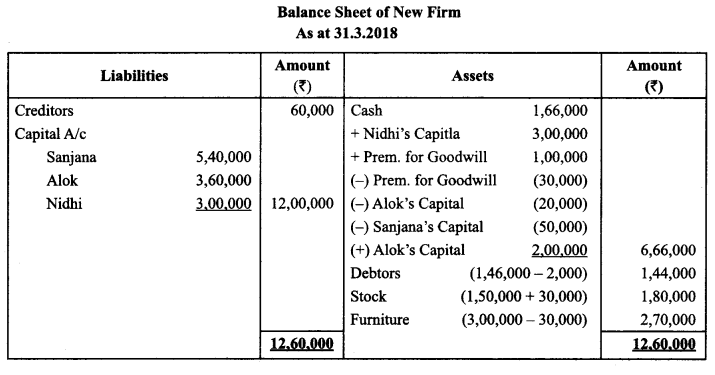
(v) Capital of the new firm was to be in the new profit sharing ratio of the continuing partners. Prepare Revaluation account, Partners’ Capital accounts and the Balance Sheet of the reconstituted firm. (CBSE Delhi 2019)
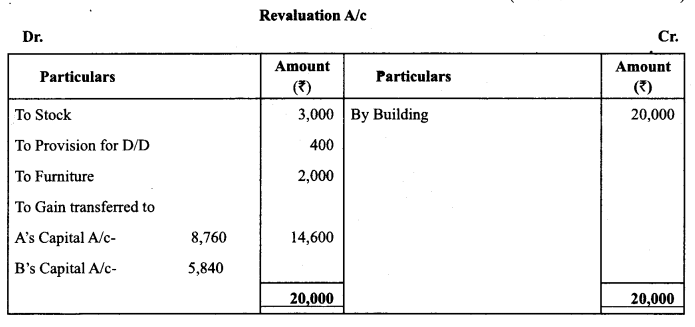
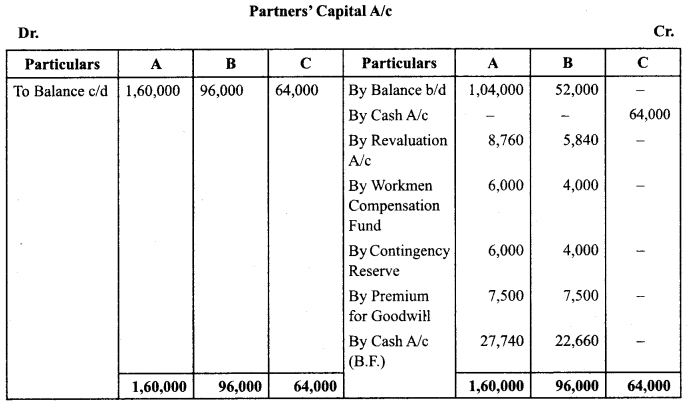
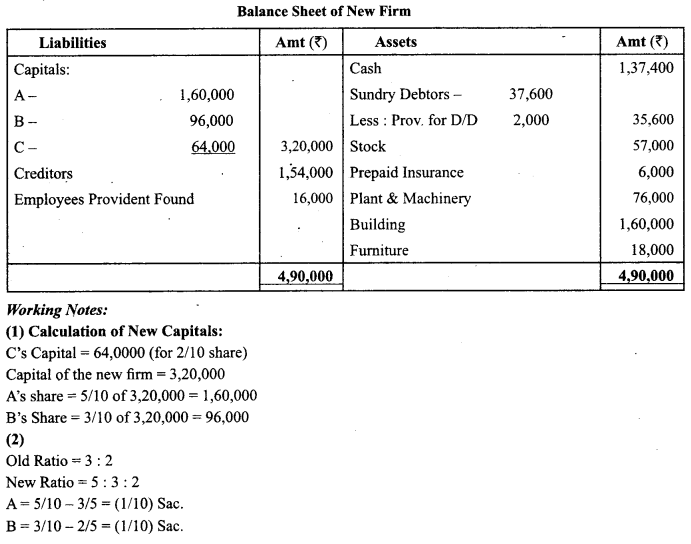
Answer:
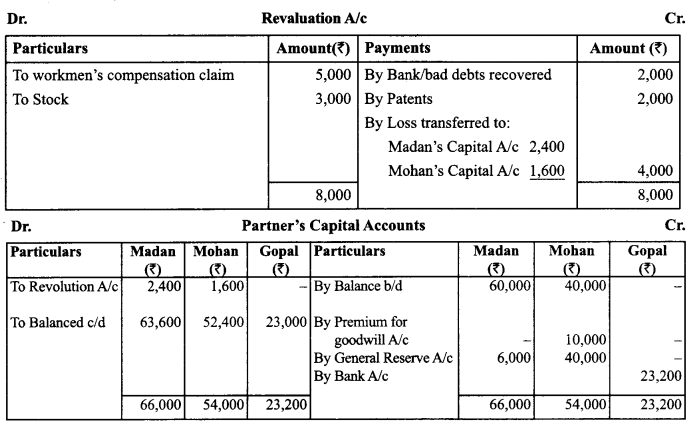
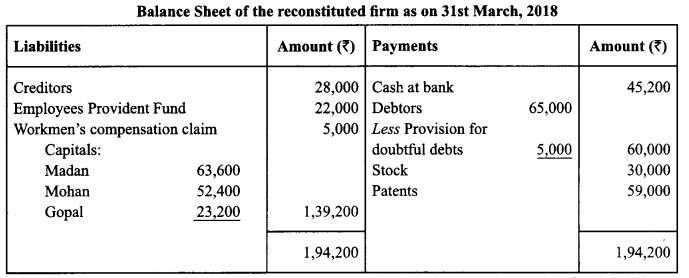
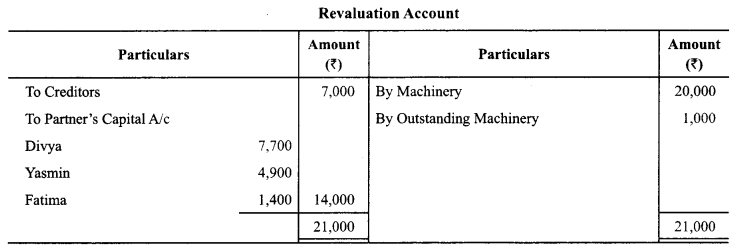
Class 12 Accountancy Important Questions Chapter 4 Reconstitution of Partnership Firm Retirement Death of a Partner 27
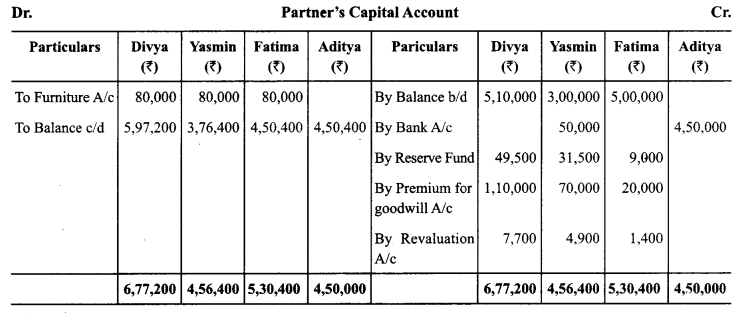
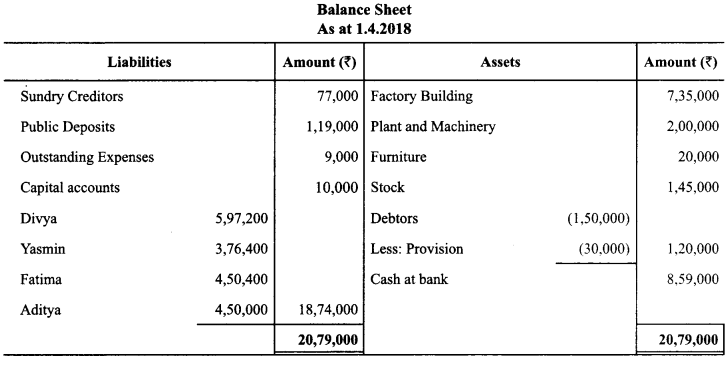
Class 12 Accountancy Important Questions Chapter 4 Reconstitution of Partnership Firm Retirement Death of a Partner 28

Question 2.
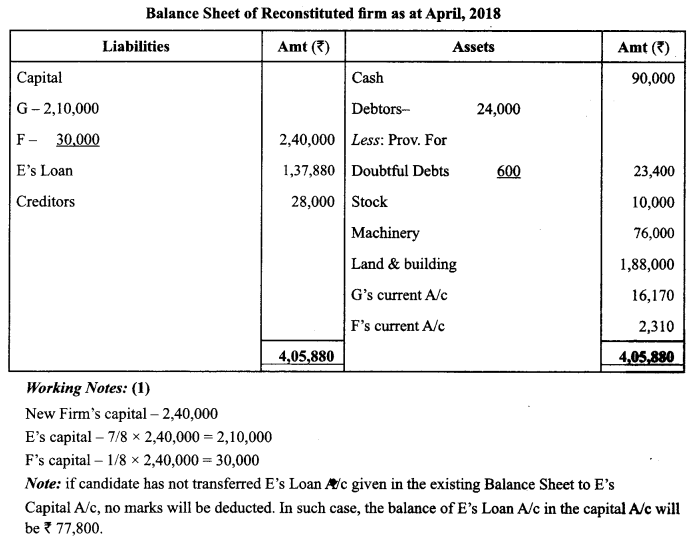
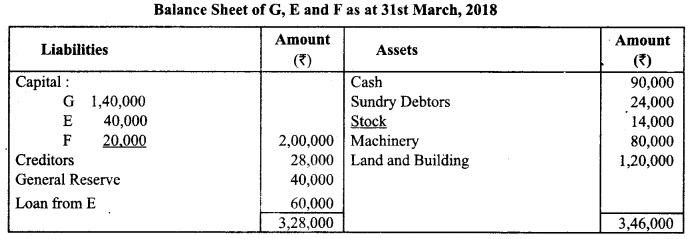
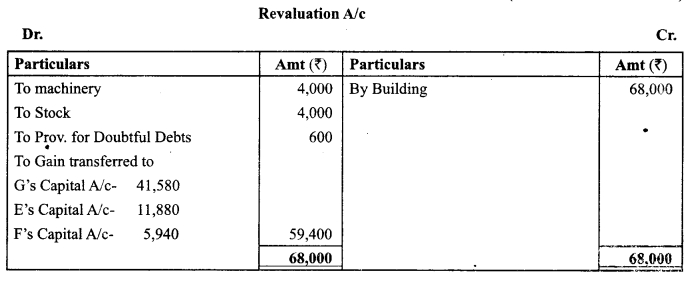
G, E and F were partners in a firm sharing profits in the ratio of 7 : 2 : 1. The Balance Sheet of the firm as at 31 st March, 2018, was as follows :
Class 12 Accountancy Important Questions Chapter 4 Reconstitution of Partnership Firm Retirement Death of a Partner 29
E.retired on the above date. On E’s retirement the following was agreed upon :
(i) Land and Building were revalued at ₹ 1,88,000, Machinery at ₹ 76,000 and Stock at ₹ 10,000 and goodwill of the firm was valued at X 90,000.
(ii) A provision of 2-5% was to be created on debtors for doubtful debts.
(iii) The net amount payable to E was transferred to his loan account to be paid later on.
(iv) Total capital of the new firm was fixed at ₹ 2,40,000 which will be adjusted according to their new profit sharing ratio by opening current accounts.
Prepare Revaluation Account, Partners’ Capital Accounts and the Balance Sheet of reconstituted firm.
(CBSE Outside Delhi 2019)
Answer:
Class 12 Accountancy Important Questions Chapter 4 Reconstitution of Partnership Firm Retirement Death of a Partner 30
Class 12 Accountancy Important Questions Chapter 4 Reconstitution of Partnership Firm Retirement Death of a Partner 31
Class 12 Accountancy Important Questions Chapter 4 Reconstitution of Partnership Firm Retirement Death of a Partner 32

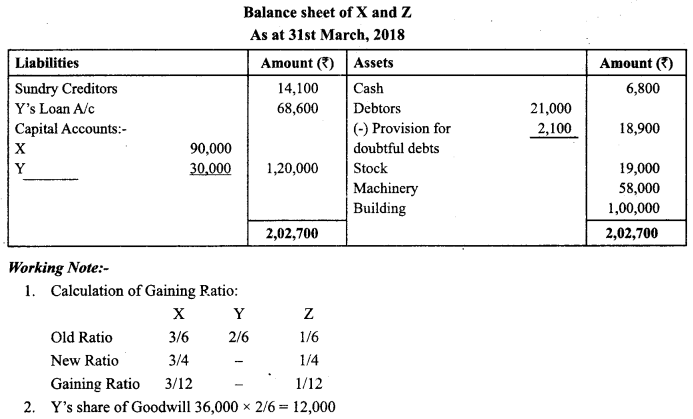
Question 3.
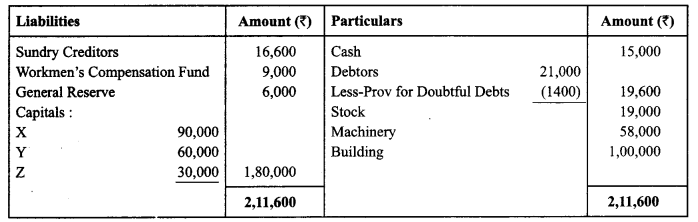
X,Y and Z were in partnership sharing profits in proportion to their capitals. Their Balance Sheet as on 31 st March, 2018 was as follows:
Class 12 Accountancy Important Questions Chapter 4 Reconstitution of Partnership Firm Retirement Death of a Partner 33
On the above date, Y retired owing to ill health. The following adjustments were agreed upon for calculation of amount due to Y.
(a) Provision for Doubtful Debts to be increased to 10% of Debtors.
(b) Goodwill of the firm be valued at ₹ 36,000 and be adjusted into the Capital Accounts of X and Z, who will share profits in future in the ratio of 3:1.
(c) Included in the value of Sundry Creditors was ₹ 2,500 for an outstanding legal claim, which will not arise.
(d) X and Z also decided that the total capital of the new firm will be ₹ 1,20,000 in their profit sharing ratio. Actual cash to be brought in or to be paid off as the case may be.
(e) Y to be paid ₹ 9,000 immediately and balance to be transferred to his Loan Account. Prepare Revaluation Account, Partner’s Capital Accounts and Balance Sheet of the new firm after Y’s retirement. (CBSE Sample Paper 2019-20)
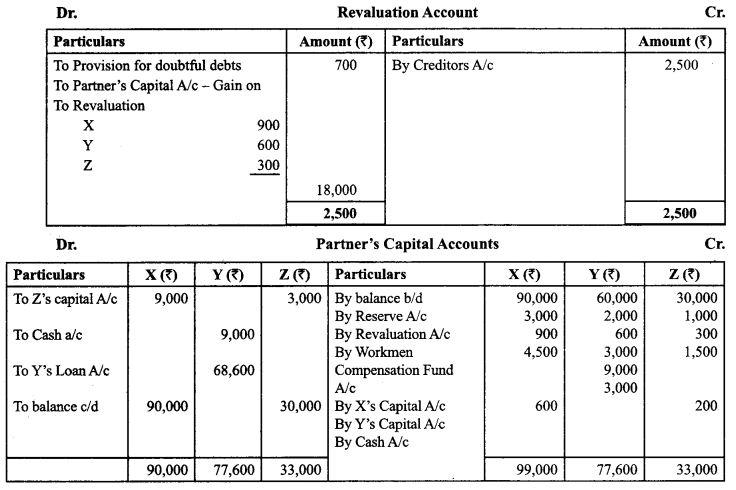
Answer:
Class 12 Accountancy Important Questions Chapter 4 Reconstitution of Partnership Firm Retirement Death of a Partner 34
Class 12 Accountancy Important Questions Chapter 4 Reconstitution of Partnership Firm Retirement Death of a Partner 35

Question 4.
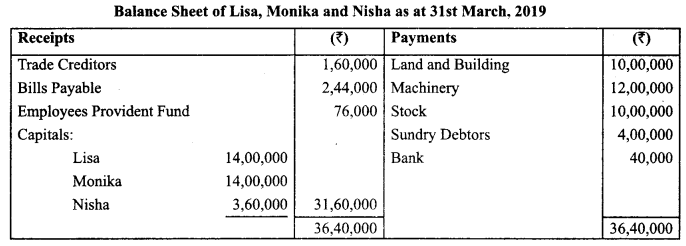
Lisa, Monika and Nisha were partners in a firm sharing profit and losses in the ratio of 2 : 2 : 1. On 31st March, 2019, their Balance Sheet was as follows :
Class 12 Accountancy Important Questions Chapter 4 Reconstitution of Partnership Firm Retirement Death of a Partner 36
On 31st March, 2019 Monika retired from the firm and the remaining partners decided to carry on the business. It was agreed that:
(i) Land and building be appreciated by ₹ 2,40,00 and machinery be depreciated by 10%.
(ii) 50% of the stock was taken over by the retiring partner at book value.
(iii) Provision for doubtful debts was to be made of 5% on debtors.
(iv) Goodwill of the firm be valued at ₹ 3,00,000 and Monika’s share of goodwill be adjusted in the accounts of Lisa and Nisha.
(v) The total capital of the new firm be fixed at ₹ 27,00,000 which will be in the proportion of the new profit sharing ratio of Lisa and Nisha. For this purpose, current accounts of the partners were to be opened.
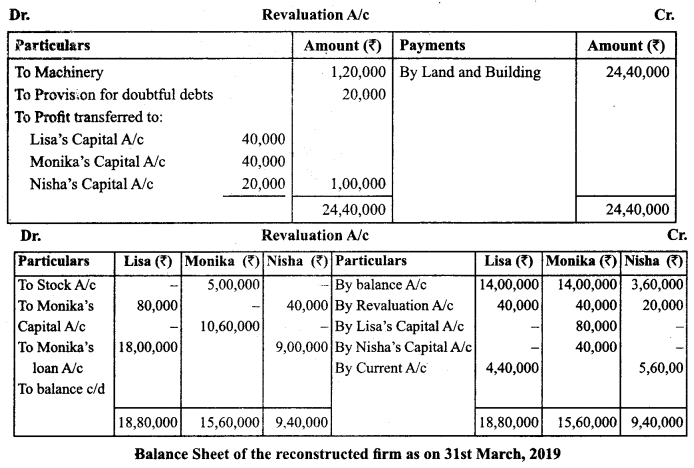
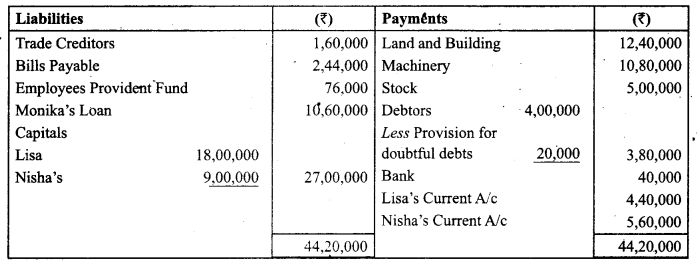
Prepare Revaluation Account, Partners’ Capital Accounts and the Balance sheet of the reconstituted firm on Monika’s retirement. (CBSE Compt. 2019)
Answer:
Class 12 Accountancy Important Questions Chapter 4 Reconstitution of Partnership Firm Retirement Death of a Partner 37
Class 12 Accountancy Important Questions Chapter 4 Reconstitution of Partnership Firm Retirement Death of a Partner 38

Question 5.
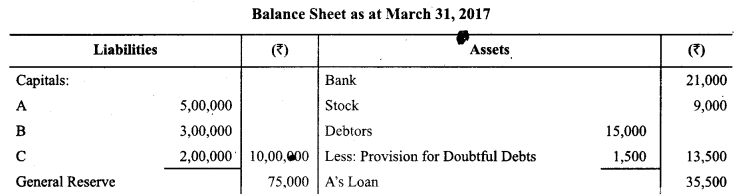
A, B & C were partners in a firm sharing profits & losses in proportion to their fixed capitals. Their Balance Sheet as at March 31, 2017 was as follows
Class 12 Accountancy Important Questions Chapter 4 Reconstitution of Partnership Firm Retirement Death of a Partner 39
Class 12 Accountancy Important Questions Chapter 4 Reconstitution of Partnership Firm Retirement Death of a Partner 40
On the date of above Balance Sheet, C retired from the firm on the following terms:
(i) Goodwill of the firm will be valued at two years purchase of the Average Profits of last three years. The Profits for the year ended March 31, 2015 & March 31, 2016 were ₹ 4,00,000 & ₹ 3,00,000 respectively.
(ii) Provision for Bad Debts will be maintained at 5% of the Debtors.
(iii) Land & Building will be appreciated by ₹ 90,000 and Plant & Machinery Will be reduced to ₹ 1,80,000.
(iv) A agreed to repay his Loan.
(v) The loan repaid by A was to be utilized to pay C. The balance of the amount payable to C was transferred to his Loan Account bearing interest @ 12% per annum.
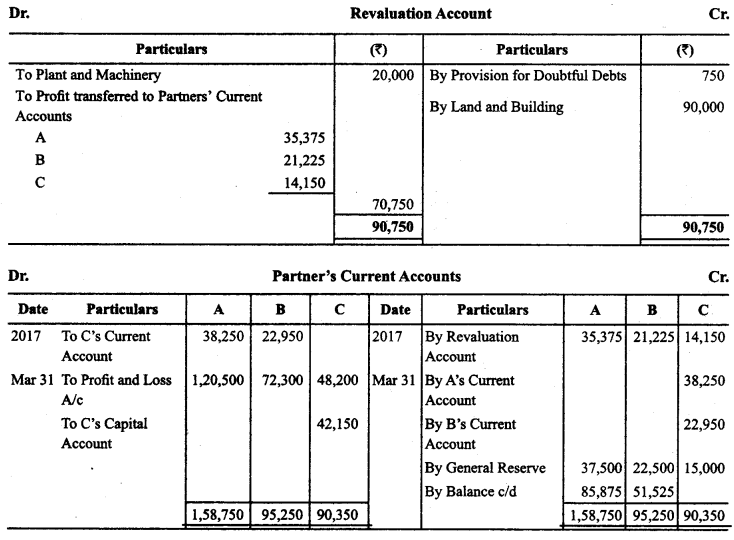
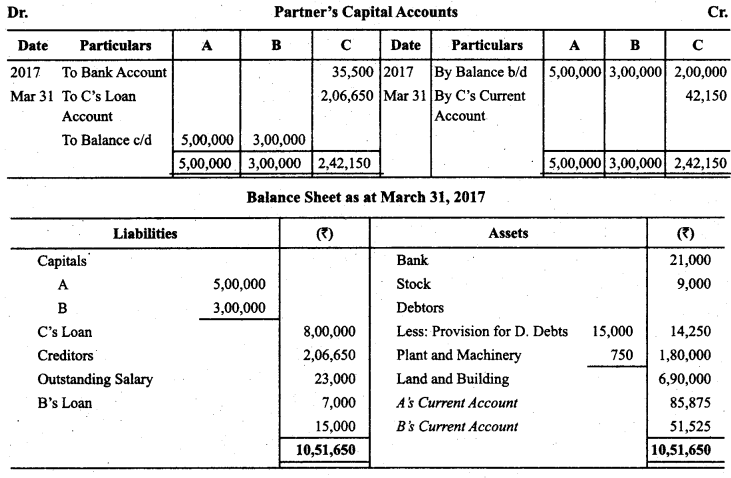
Prepare Revaluation Account, Partners’ Capital Accounts, Partners’ Current Accounts and the Balance Sheet of the reconstituted firm. (CBSE Sample Paper 2017-18)
Answer:
Class 12 Accountancy Important Questions Chapter 4 Reconstitution of Partnership Firm Retirement Death of a Partner 41
Class 12 Accountancy Important Questions Chapter 4 Reconstitution of Partnership Firm Retirement Death of a Partner 42

Question 6.
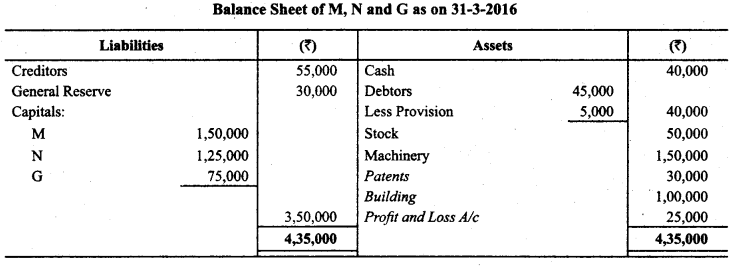
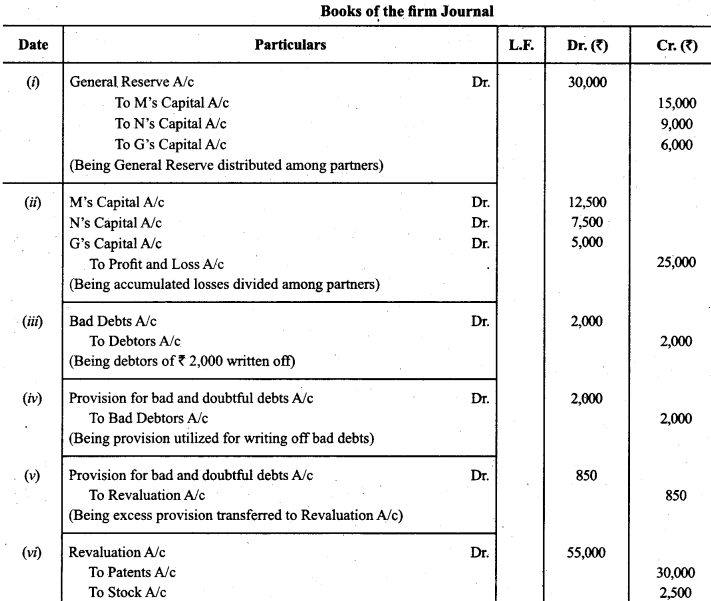
M, N and G were partners in a firm sharing profits and losses in the ratio of 5:3:2. On 31-3-2016 their Balance Sheet was as under:
Class 12 Accountancy Important Questions Chapter 4 Reconstitution of Partnership Firm Retirement Death of a Partner 43
M retired on the above date and it was agreed that:
(i) Debtors of ₹ 2,000 will be written off as bad debts and a provision of 5% on debtors for bad and doubtful debts will be maintained.
(ri) Patents will be completely written off and stock, machinery and building will be depreciated by 5%.
(iii) An unrecorded creditor of ₹ 10,000 will be taken into account.
(iv) N and G will share the future profits in the ratio of 2 : 3.
(v) Goodwill of the firm on M’s retirement was valued at ₹ 3,00,000.
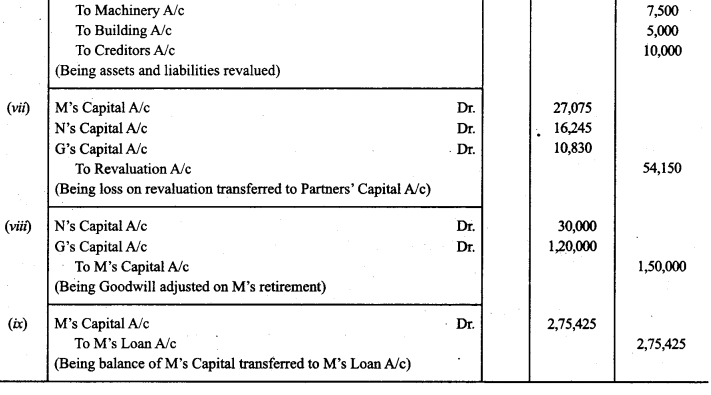
Pass necessary Journal Entries for the above transactions in the books of the firm on M’s retirement. [CBSE Delhi 2017]
Answer:
Class 12 Accountancy Important Questions Chapter 4 Reconstitution of Partnership Firm Retirement Death of a Partner 44
Class 12 Accountancy Important Questions Chapter 4 Reconstitution of Partnership Firm Retirement Death of a Partner 45

Question 7.
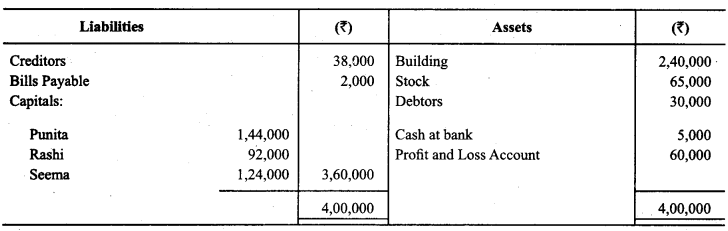
Following is the Balance Sheet of Punita, Rashi and Seema who are sharing profits in the ratio 2:1:2 as on 31st March 2013.
Class 12 Accountancy Important Questions Chapter 4 Reconstitution of Partnership Firm Retirement Death of a Partner 46
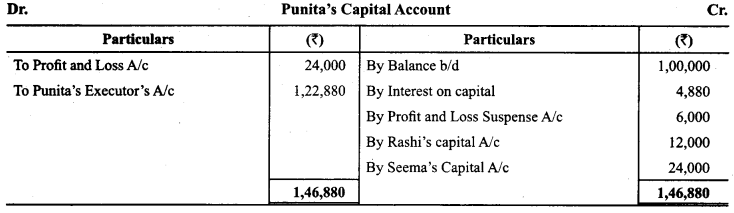
Punita died on 30th September 2013. She had withdrawn 44,000 from her capital on July 1, 2013. According to the partnership agreement, she was entitled to interest on capital @8% p.a. Her share of profit till the date of death was to be calculated on the basis of the average profits of the last three years. Goodwill was to be calculated on the basis of three times the average profits of the last four years. The profits for the years ended 2009-10, 2010-11 and 2011-12 were ₹ 30,000, ₹ 70,000 and₹ 80,000 respectively.
Prepare Punita’s account to be rendered to her executors.
Class 12 Accountancy Important Questions Chapter 4 Reconstitution of Partnership Firm Retirement Death of a Partner 47

Question 8.
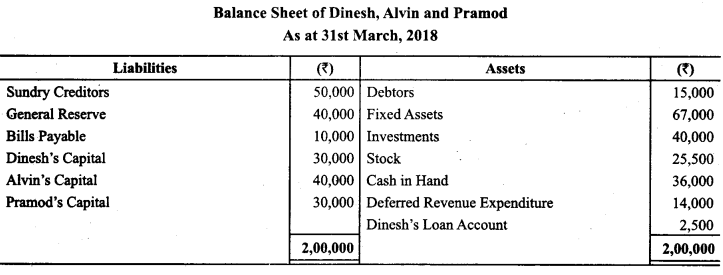
Dinesh, Alvin and Pramod are partners in a firm sharing profits and losses in the ratio of 5:3:2.Their Balance Sheet as at March 31,2018 was as follows:
Class 12 Accountancy Important Questions Chapter 4 Reconstitution of Partnership Firm Retirement Death of a Partner 48
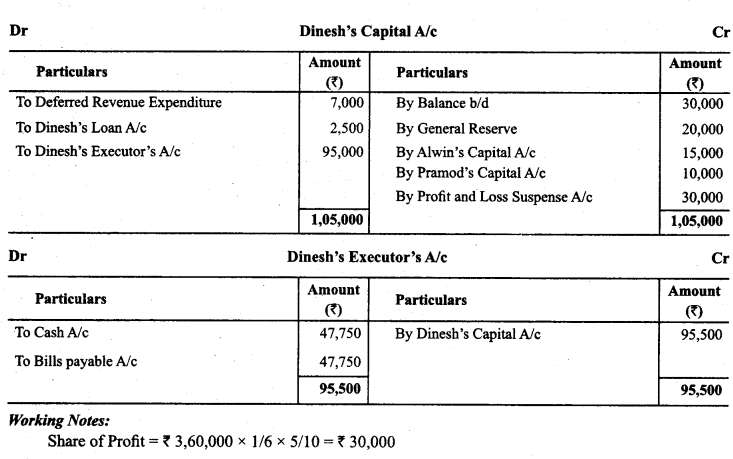
Dinesh died on July 1,2018, The executors of Dinesh are entitled to:
(i) His share of goodwill. The total goodwill of the firm valued at ₹ 50,000.
(ii) His share of profit up to his date of death on the basis of actual sales till date of death. Sales for the year ended March 31, 2018 was ₹ 12, 00,000 and profit for the same year was ₹ 2,00,000. Sales shows a growth trend of 20% and percentage of profit earning remains the same.
(iii) Investments were sold at par. Half of the amount due to Dinesh was paid to his executors and for the balance, they accepted a Bills Payable.
Prepare Dinesh’s Capital account to be rendered to his executors.
Answer:
Class 12 Accountancy Important Questions Chapter 4 Reconstitution of Partnership Firm Retirement Death of a Partner 49

Question 9.
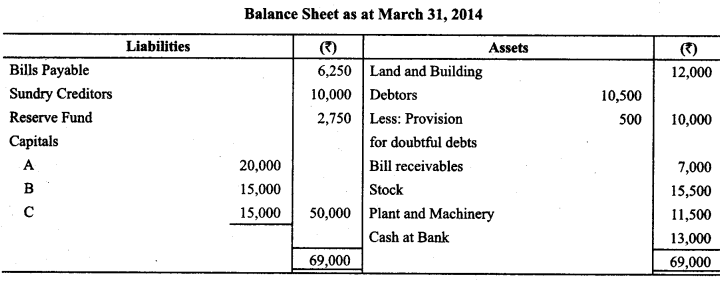
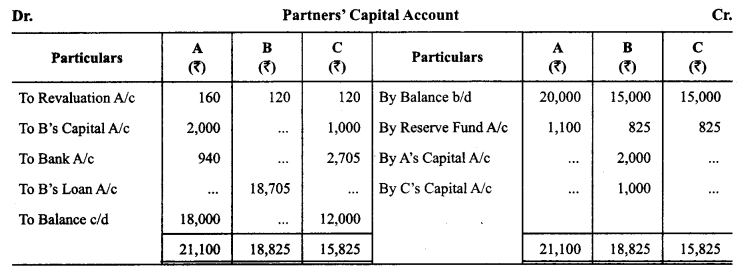
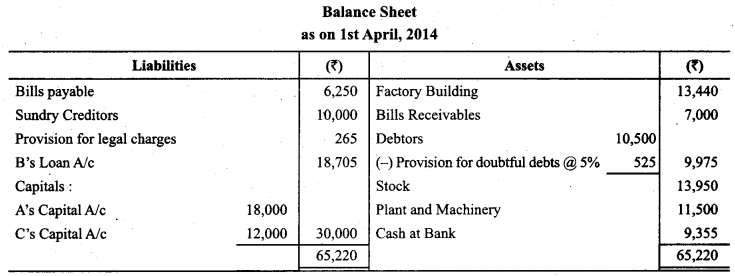
The Balance Sheet of A, B and C who were sharing the profits in proportion to their capitals stood as on March 31,2014,
Class 12 Accountancy Important Questions Chapter 4 Reconstitution of Partnership Firm Retirement Death of a Partner 50
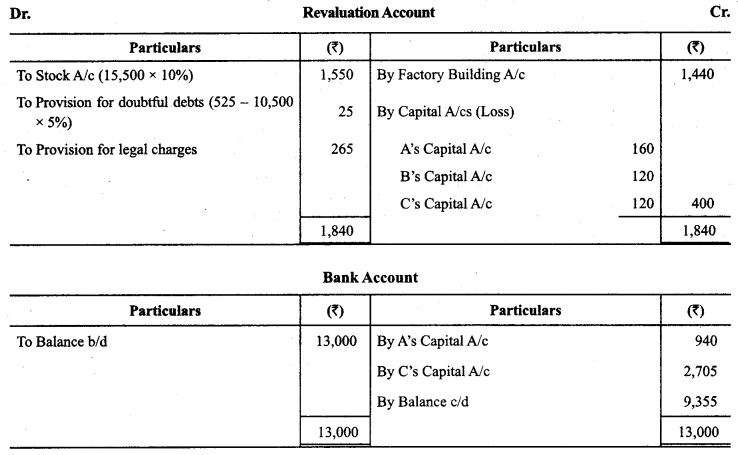
B retired on the date of Balance Sheet and the following adjustments were to be made:
(a) Stock was depreciated by 10%.
(b) Factory building was appreciated by 12%.
(c) Provision for doubtful debts to be created up to 5%.
(d) Provision for legal charges to be made at X 265.
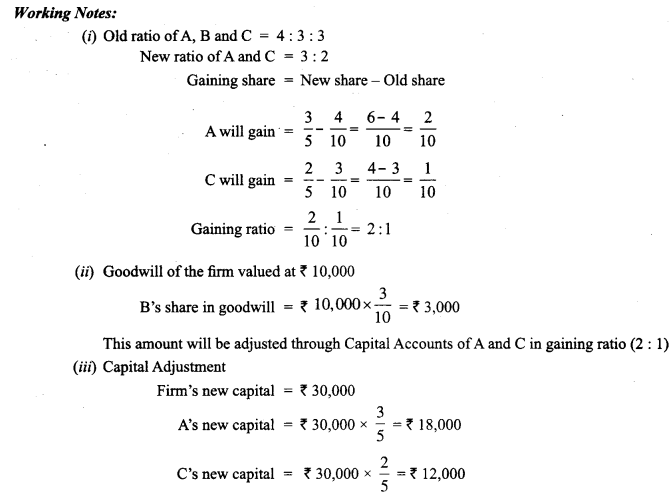
(e) The goodwill of the firm to be fixed at X 10,000.
(f) The Capital of the new firm to be fixed at X 30,000. The continuing partners decided to keep their capitals in the new profit sharing ratio of 3 : 2.
Work out ‘he final balances in capital accounts of the firm, and the amounts to be brought in and/or withdrawn by A and C to make their capitals proportionate to their new profit sharing ratio.
Answer:
Class 12 Accountancy Important Questions Chapter 4 Reconstitution of Partnership Firm Retirement Death of a Partner 51
Class 12 Accountancy Important Questions Chapter 4 Reconstitution of Partnership Firm Retirement Death of a Partner 52
Class 12 Accountancy Important Questions Chapter 4 Reconstitution of Partnership Firm Retirement Death of a Partner 53
Class 12 Accountancy Important Questions Chapter 4 Reconstitution of Partnership Firm Retirement Death of a Partner 54

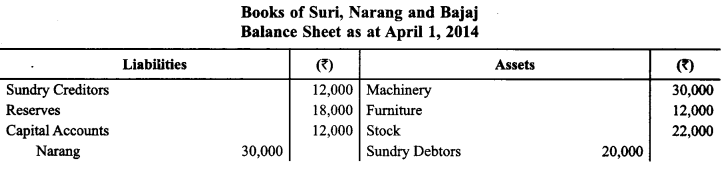
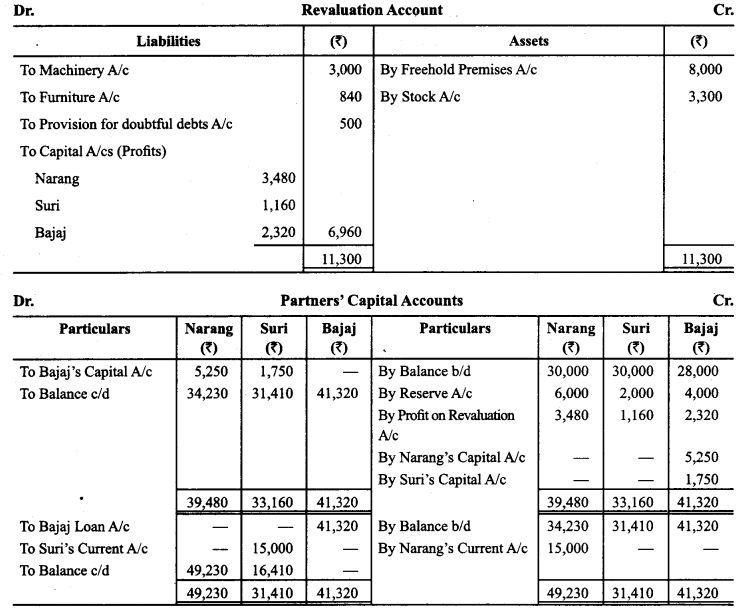
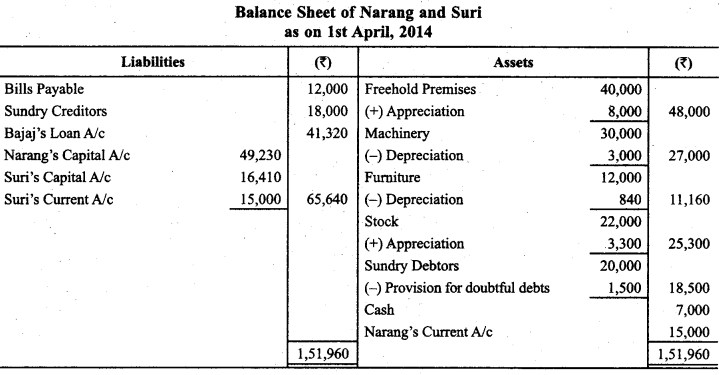
Question 10.
Narang, Suri and Bajaj are partners in a firm sharing profits and losses in proportion of 1/2, 1/6 and 1/3 respectively. The Balance Sheet on April 1, 2014 was as follows:
Class 12 Accountancy Important Questions Chapter 4 Reconstitution of Partnership Firm Retirement Death of a Partner 55
Class 12 Accountancy Important Questions Chapter 4 Reconstitution of Partnership Firm Retirement Death of a Partner 56
Bajaj retires from the business and the partners agree to the following:
(a) Freehold premises and stock are to be appreciated by 20% and 15% respectively.
(b) Machinery and furniture are to be depreciated by 10% and 7% respectively.
(c) Bad Debts reserve is to be increased to ₹ 1,500.
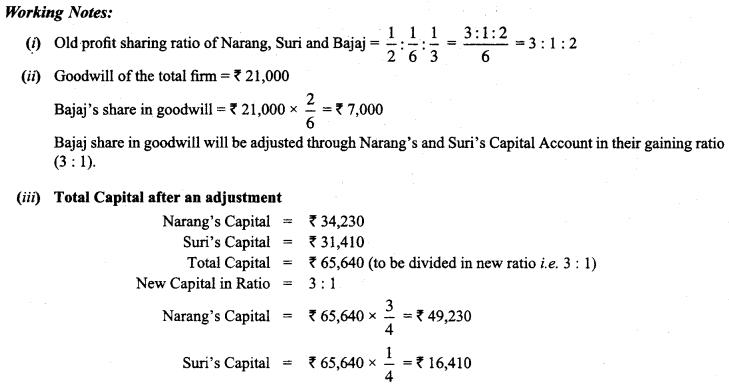
(d) Goodwill is valued at ₹ 21,000 on Bajaj’s retirement.
(e) The continuing partners have decided to adjust their capitals in their new profit sharing ratio after retirement of Bajaj Surplus/deficit, if any, in their capital accounts will be adjusted through current accounts.
Prepare necessary ledger accounts and draw the Balance Sheet of the reconstituted firm.
Answer:
Class 12 Accountancy Important Questions Chapter 4 Reconstitution of Partnership Firm Retirement Death of a Partner 57
Class 12 Accountancy Important Questions Chapter 4 Reconstitution of Partnership Firm Retirement Death of a Partner 58
Class 12 Accountancy Important Questions Chapter 4 Reconstitution of Partnership Firm Retirement Death of a Partner 59

Question 11.
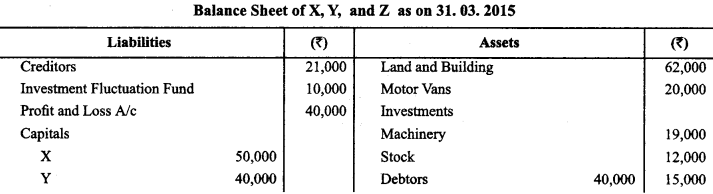
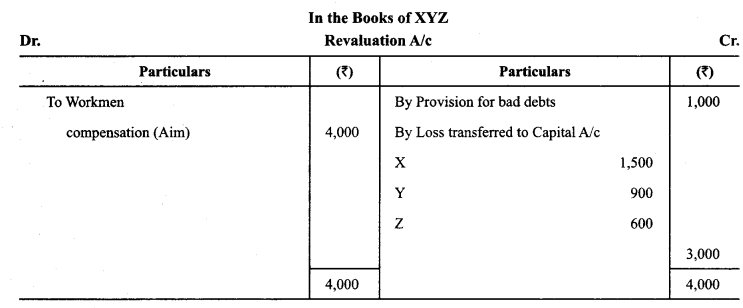
X, Y and Z were partners in a firm sharing profits in the ratio of 5 : 3 : 2. On 31.3.2015 their Balance Sheet was as follows:
Class 12 Accountancy Important Questions Chapter 4 Reconstitution of Partnership Firm Retirement Death of a Partner 60
Class 12 Accountancy Important Questions Chapter 4 Reconstitution of Partnership Firm Retirement Death of a Partner 61
On the above date Y retired and X and Z agreed to continue the business on the following terms :
(i) Goodwill of the firm was valued at ₹ 51,000.
(ii) There was a claim of ₹ 4,000 for workmen’s compensation.
(iii) Provision for bad debts was to be reduced by ₹ 1,000.
(iv) Y will be paid ₹ 8,200 in cash and the balance will be transferred in his loan account which will be paid in four equal yearly instalments together with interest @ 10% p.a.
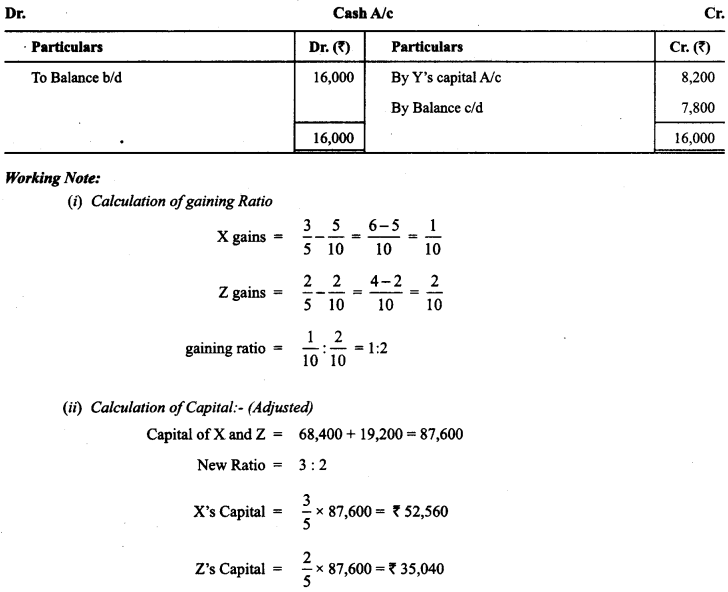
(v) The new profit sharing ratio between X and Z will be 3 : 2 and their capitals will be in their new profit sharing ratio. The capital adjustments will be done by opening current accounts.
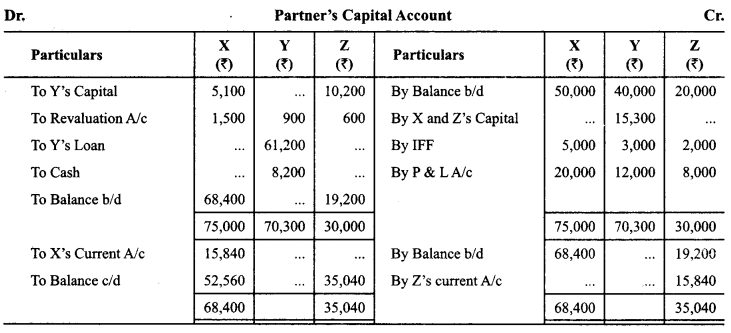
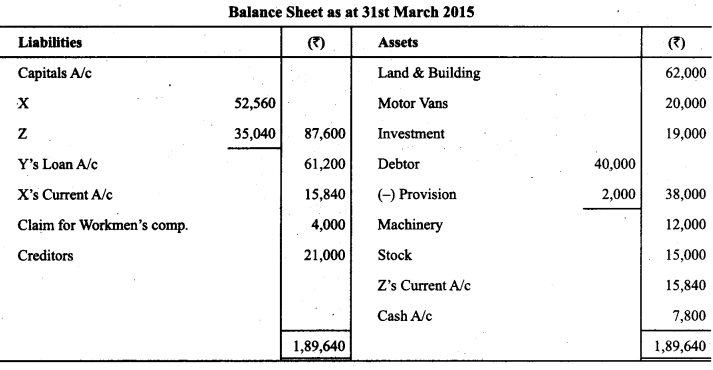
Prepare Revaluation Account, Partner’s Capital Accounts and the Balance Sheet of the reconstituted Firm. (CBSE Outside Delhi 2016)
Answer:
Class 12 Accountancy Important Questions Chapter 4 Reconstitution of Partnership Firm Retirement Death of a Partner 62
Class 12 Accountancy Important Questions Chapter 4 Reconstitution of Partnership Firm Retirement Death of a Partner 63
Class 12 Accountancy Important Questions Chapter 4 Reconstitution of Partnership Firm Retirement Death of a Partner 64
Class 12 Accountancy Important Questions Chapter 4 Reconstitution of Partnership Firm Retirement Death of a Partner 65

Question 12.
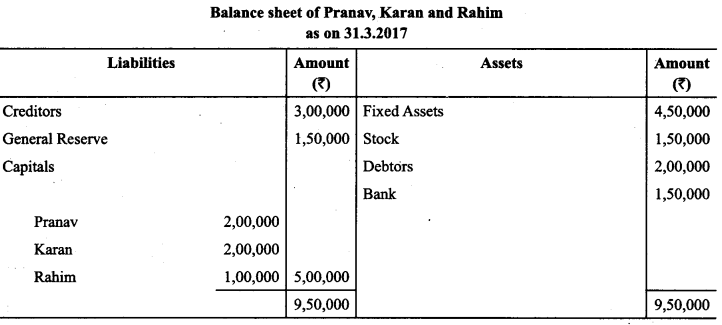
Pranav, Karan and Rahim were partners in a firm sharing profits and losses in the ratio of 2 : 2 : 1. On 31 st March, 2017 their Balance Sheet was as follows :
Class 12 Accountancy Important Questions Chapter 4 Reconstitution of Partnership Firm Retirement Death of a Partner 66
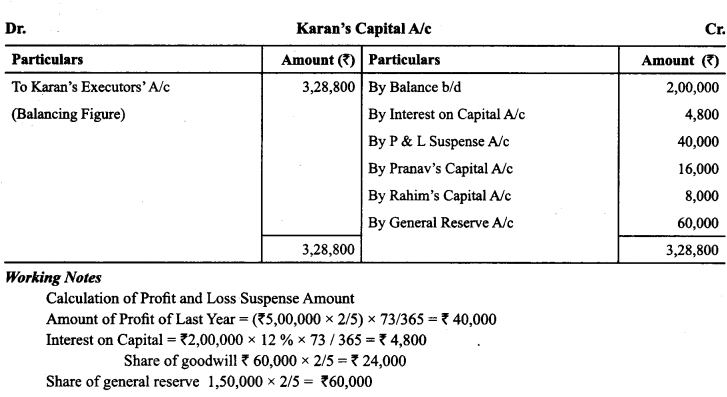
Karan died on 12.6.2017. According to the partnership deed, the legal representatives of the deceased partner were entitled to the following :
(i) Balance in his Capital Account.
(ii) Interest on Capital @ 12% p.a.
(iii) Share of goodwill. Goodwill of the firm on Karan’s death was valued at ₹ 60,000.
Share in the profits of the firm till the date of his death, calculated on the basis of last year’s profit. The profit of the firm for the year ended 31.3.2017 was ₹ 5,00,000. Prepare Karan’s Capital Account to be presented to his representatives. (CBSE 2018-19)
Answer:
Class 12 Accountancy Important Questions Chapter 4 Reconstitution of Partnership Firm Retirement Death of a Partner 67

The Philosophy of the Constitution Class 11 Important Extra Questions Political Science Chapter 10

Here we are providing Class 11 Political Science Important Extra Questions and Answers Chapter 10 The Philosophy of the Constitution. Political Science Class 11 Important Questions with Answers are the best resource for students which helps in class 11 board exams.

Class 11 Political Science Chapter 10 Important Extra Questions The Philosophy of the Constitution

The Philosophy of the Constitution Important Extra Questions Very Short Answer Type

Question 1.
What is the need for political philosophy for Constitutions?
Answer:
The constitution is not only a framework of government but also an instrument of socio-economic transformation for which it needs direction and that direction is provided by political philosophy. It is because of this we need a political philosophy for every Constitution. It is the political philosophy that shows the- path and helps the society and government to set the objective and values.

Question 2.
What is the significance of political philosophy for a Constitution?
Answer:
The political philosophy to the constitution is needed not only to find out the moral content expressed in it and to evaluate its claims but possibly to use it to arbitrate between varying interpretations of many core values in our polity. Every Constitution of the world has philosophic content and base to move society in the desired direction.

Question 3.
Discuss the Constitution as an arbitrator?
Answer:
Constitutions are the product of the theory of constitutionalism which stands for the check arbitrariness of ruler and it facilitates the rule of .reason and rational deliberations. It is widely accepted that our reason for having constitutions is the need to restrict the exercise of irrational and arbitrary power.

Question 4.
Discuss the Constitution as a mean of the transformation of society
Answer:
Constitutions provide peaceful, democratic means to bring about social and economic transformation. It has philosophic backing which sets the direction and objectives of the society.

Question 5.
How the Constituent Assembly was constituted?
Answer:
During the National Movement, the demand for a Constituent Assembly was raised. It was a collective demand for self-determination. They argued that only a Constituent Assembly of elected representatives of the Indian people had the right to frame India’s Constitution. It was set up or per Cabinet Mission Plan 1946. The majority of the members were indirectly elected and others were nominated from different sections of the society.

Question 6.
Was the Constituent Assembly a sovereign body?
Answer:
In a technical sense, the Constituent Assembly was not sovereign because it was set up as per terms and conditions set by the British Government and Constitution will be approved by the British Government before the implementation. But we can say it a Constituent Assembly which was represented only by Indians and there was no kind of interference of the British Government. It was adopted and implemented on behalf of the people of India.

Question 7.
What is the preamble of the Indian Constitution?
Answer:
The preamble of the Constitution is the introductory part of the constitution which includes the terms of Government, social, economic, and religious system. It also includes the philosophy of the constitution and values and direction and objectives of the Constitution.

Question 8.
What is Liberalism?
Answer:
Liberalism is one of the main philosophic content of the Indian Constitution. It seeks to liberate the Indian society from the shackles of social and economic backwardness and to take in the area of freedom, equality, and justice.

Question 9.
What are the main contents of the political philosophy of the Constitution?
Answer:
The main contents of the political philosophy of the Indian Constitution are as under.

  1. Liberalism
  2. Egalitarianism
  3. Social justice
  4. Secularism
  5. Federalism

Question 10.
What do you mean by Liberalism?
Answer:
Liberalism means openers and decisions by rational thinking, discussions, and debates. The liberalism of the Indian constitution differs from western liberalism in many ways. Indian liberalism seeks to achieve the goal of social justice for Indian society through the provision to achieve Fundamental Rights of equality and liberty and by the reservation of seats.

Question 11.
What is a federation?
Answer:
Since Indian society is a plural one, therefore it needs federal polity and economy. Federation stands for decentralization. India is a multilingual federation. All the major linguistic groups are politically recognized and all are treated as equals. A Federation is a group of equal units with decentralized powers.

Question 12.
What is Secularism?
Answer:
Secularism is important philosophic and idealistic content of Indian society and polity. It is a positive concept which does not stand on the complete separation of state and religion. It allows the state for positive intervention in religious matters.

Question 13.
What is national integration?
Answer:
National integration is both philosophies as well as the objectives of the Indian Constitution which are mentioned in the Indian Constitution. It is been the fundamental duty of every citizen of India to protect and deferred the national integration and not to harm it in any way. National integration means emotional, psychological, and intellectual unification of people of India and not allow, caste, color, sex and status, and region in its way.

Question 14.
What do you mean by individually and Dignity?
Answer:
Individual freedom and dignity of men are two important values of the Indian Constitution .which are based on Liberal Political Philosophy. Indian Constitution is committed to the individual freedom and dignity of men which are mentioned in the Preamble of the Constitution. It is the result of continuous intellectual discussion and debate. The dignity of man means respect for human personality and human feelings. The state must be responsive to the needs of the people. It is for this that freedom of expression is an integral part of the Constitution.

Question 15.
On what basis the Constitution of India is criticized?
Answer:
The Indian Constitution is criticized on the following bases:

  1. It was written by a Constituent Assembly which was not representative.
  2. The Constituent Assembly was not sovereign
  3. The Procedure of taking the decisions was defective.
  4. The constitutional provisions have been borrowed from different countries.

The Philosophy of the Constitution Important Extra Questions Short Answer Type

Question 1.
What do you mean by the philosophy of the Constitution?
Answer:
The constitution is not merely an aggregation of rules, regulations, and laws. The constitution is not only a legal document but also has a moral and philosophic base and contents. Most of the laws are connected with the customs and values of society. Every Constitution is value ridden which provides the philosophy base to the Constitution. Philosophy provides the moral vision of the constitution. An attempt is made to work out a coherent vision of society and polity conditional upon an interpretation of the key concepts of the Constitution. Philosophy of the Constitution includes the set of ideas embedded in the Constitution. Political philosophy is needed not only to find out the moral content expressed in it and to evaluate its claims but possibly to use it to calibrate between varying interpretations of the many core values of our polity.

Question 2.
How the constitution is an instrument of socio-economic transformation?
Answer:
Constitution provides the framework of government to run the polity on a definite philosophical base. Constitution also provides the mechanism to bring about socio-economic transformation of the society. Constitution keeps a check on the arbitrariness of the ruler and paves the way for achieving the goals of the society set on the basis of a particular philosophy. To bring about the socio-economic transformation of the society, philosophic and value system support is a must which is provided by the political philosophy of the Constitution. For example, the Indian constitution is designed on such a philosophic base so as to get Indian society of age-old evils like illiteracy, casteism, peasantry, and exploitation.

Question 3.
What was the nature of the Constituent Assembly?
Answer:
Constituent Assembly was constituted as per the recommenda¬tions of the Cabinet Mission Plan 1946 in response to the demand of the leaders of the National Movement who were demanding the right to self-determination. Following are the features of the Constituent Assembly:

  1. Constituent Assembly was constituted on the principle of self-determination.
  2. It was constituted as per the terms and conditions set by the British Government.
  3. Constituent Assembly was constituted by indirect election which was not based on the adult franchise but on the limited right of vote.
  4. Most of the decisions were taken by consensus and accommodation.
  5. Many representatives of some groups were nominated
  6. It was made to write the Constitution of India.

Question 4.
Explain the main features of the Political philosophy of the Constitution of India.
Answer:
Following were some important elements of the political philosophy of the Indian constitution:

  1. Liberalization
  2. Social Justice
  3. Protection of rights and interests of minorities.
  4. Federation
  5. Individual freedom
  6. The dignity of man.
  7. National integration
  8. Democracy
  9. Secularism
  10. Universal Franchise

Question 5.
Explain social justice as the value of the Indian Constitution?
Answer:
Social value is the highly cherished value of the Indian Constitution for which various measures have been incorporated in different parts of the Constitution. The value of social justice is referred to in the preamble. The other related values are as under:-

  • Justice Social:- economic and political
  • Liberty:- Thought and expression
  • Equality:- Status and opportunity

All these values are complementary to the1 value of Justice. For social justice economic and political justice are necessary. The value of Liberty and equality are also necessary to achieve the objectives of social justice which seeks to achieve egalitarian society free front inequality, exploitation, and wants.

Question 6.
How the Indian constitution seeks to achieve unity in diversity?
Answer:
It is said about India that India is not a country, it is a continent because there are numerous languages and dialects, regions, and religions. It has a multi-cultural society. People have different dress patterns, different food habits, different traditions, and different festivals but in spite of this diversity in socio, economic set up there is the threat of unity. This unity is achieved by the spirit of nationalism which is all-pervasive.

Indian Constitution is made on such values that spread equality, brotherhood and promote a sense of equality which strengthens nationalism. Therefore there is unity in diversity.

Question 7.
What is the importance of individual freedom?
Answer:
Indian Constitution is committed to individual freedom. Individual dignity found the place of importance m the preamble of the Indian constitution. Rights of individual expression are given in Art 19 of the Constitution Many social reformers like Raja Ram Mohan Roy fought for the cause of individual freedom. Western liberal thinkers also influenced the cause of individual rights and expression. Therefore, the right to individual expression is an essential element of democracy. It is an integral part of the Constitution element of democracy. The individual expression has been the part and parcel of the charters of demand of self-determination and democracy. It is very necessary for the fuller development of an individual.

Question 8.
Define secularism as the value of the Indian Constitution.
Answer:
India is a country where people of different religions and faith life together. Art 25 of the Indian Constitution clearly gives the message of secularism. It is provided here that the state will neither patronize any religions nor will become the hindrance of any religion. In 1926 by the 42nd Constitutional amendment the word secularism was added in the Preamble of the Constitution to make it clear that India is a secular state. Our secularism is humanistic scientific and positive. The state is allowed to intervene in religious affairs for a positive purpose.

Question 9.
Explain Universal franchise.
Answer:
Constitution makers provided for Universal Adult Franchise which means that every adult person has been given the right to vote irrespective of his caste, color, sex, status, and religion. It is done in reference to the sense of decisions of a human being. It is trusted that man can take rational decisions.

Question 10.
Explain the provision of reservation for social justice in the Indian constitution.
Answer:
To achieve social justice the Constitution makers made the provision of reservation in services for the people of Scheduled castes and Scheduled tribes. They were of the view that more granting right of. equality will not help in achieving the cause of social justice, special constitutional measures were required to advance the interests of weaker sections. They also provided reservation of seats in Parliament and state legislatures.

Question 11.
Write the features of the Indian Federation.
Answer:
Indian society is plural therefore its polity is also federal which requires the development of unions and states in their respective areas. Its essential features are incorporated in the Indian Constitution which is as under

  1. Written constitutional with the supremacy of the constitution
  2. Division of powers between the center and the status as per the constitutional scheme.
  3. Bicameral Legislature in the center.
  4. Independent and strong judiciary.

Question 12.
Mention some unitary features of the Indian Constitution.
Answer:
Indian Constitution is based on federal value. It is federal in structure but unitary in spirit. Its striking unitary features are as under:

  1. Strong center pro center distribution of powers.
  2. Provision of Emergency power to center under Art 352
  3. President rule in States as per Art 356
  4. Unequal representation of States in Parliament
  5. Control of States by center by All India Government Service
  6. Provision of special status for some states under Art 370 to Jammu & Kashmir and under Art 371 to Northern Eastern State.

Question 13.
Comment on the Procedural achievements of the Indian Constitution and Constituent Assembly.
Answer:
Besides various achievement of the different values and features of the Indian Constitution there are some procedural achievements also which are as under:

  1. Decisions are taken by discussions, debate, and rational deliberation collectively. Public opinions are given due weight in the decision-making process. Constituent Assembly reflecting the different sections of the society also reflect different shades of opinion and different interest groups. There is the full scope of differing and dissent.
  2. There was a remarkable spirit of compromise and accommodation to create consensus on controversial issues. Besides a commitment to the idea that decisions on the most important issues must be arrived at consensually rather than by majority vote is equally morally commendable. Most of the controversial and thorny issues introduced in the best spirit of accommodation and consensus.

Question 14.
Comment upon the negative features of the Constituent Assembly.
Answer:
Constituent Assembly was constituted in 1966. It took two years, eleven months, and eighteen days to complete the constitution which indicates, how difficult work was to write the Constitution. Some of the negative features of Constituent Assembly are as under

  1. It was not a sovereign body
  2. It was an unrepresentative body
  3. It was Congress dominated
  4. It was Hindu dominated.

Ultimately it was the best option in the given circumstances and made a wonderful Constitution.

Question 15.
How far do you agree that the Indian Constitution is a borrowed bag?
Answer:
It is said about the Indian Constitution is an alien document. It is also said that it is a borrowed bag. These statements are correct to some extent. When we got independence and the Constitution was being written we did not have our own trusted institutions. Therefore we searched for the constitutions from different countries of the world suiting our requirement.

Since we were familiar with the working of the Parliamentary system of Britain. Therefore we adopted the Parliamentary system of Britain and also took other institutions and features from different countries, for example, we adopted, the post of Vice President, Fundamental Rights, power of judicial review from the USA. We took the Directive Principles of State Policy from Ireland. We took the concept of the Union of States from Canada. We took Emergency powers from the Constitution of Germany. In this sense, it is called a borrowed bag. But we did not have just carbon copies of these institutions and features. We . took them and modified them according to our situations and requirements.

Secondly, we have many things of our own that shaped and influenced the Constitution, our traditions, our past, and mainly the Government of India Act 1935 and Nehru Report also made the base of the Indian Constitution., Many-members of the Constituent Assembly also acknowledge the fact that our Constitution is a borrowed bag.

The Philosophy of the Constitution Important Extra Questions Long Answer Type

Question 1.
Explain the values and philosophy of the Indian constitution as given in the Preamble of the Constitution.
Answer:
The Preamble of the Indian Constitution is the introductory part of the Constitution. It is an integral part of the Constitution. It helps in the explanation and interpretations of different provisions of the Constitution.

It starts with the people of India. It means that this Constitution which is written by Constituent Assembly is being adopted on behalf of the people. Further, it says that India will be sovereign, socialistic, secular, democratic. republic. It means that it clearly tells that the form of government will be democratic Republican, it will be based on socialistic economy and as regards the place of religion, it will be secular.

Further, it says that there will be

  • Justice – social, economic and Political
  • Liberty – of thought and expression
  • Equality – of status and opportunity.

These values of justice, liberty, and equality tell the liberal content of the political philosophy of the Constitution. Its preferences are to achieve social justice, economic justice, and political justice, where there will be liberty of expression and thought and equality of status and opportunity. All these values are ensured through Fundamental Rights and Directive Principles of state policy.

The other values are dignity and national unity and integrity of the nation. Thus preamble speakers of forms of the social, economic, and political system. It speaks of the philosophy, values, and objectives of the Constitution.

Constitution as a Living Document Class 11 Important Extra Questions Political Science Chapter 9

Here we are providing Class 11 Political Science Important Extra Questions and Answers Chapter 9 Constitution as a Living Document. Political Science Class 11 Important Questions with Answers are the best resource for students which helps in class 11 board exams.

Class 11 Political Science Chapter 9 Important Extra Questions Constitution as a Living Document

Constitution as a Living Document Important Extra Questions Very Short Answer Type

Question 1.
What do you know by the amendment of the Constitution?
Answer:
The amendment of the constitution means to change, adapt and adopt the provisions of the Constitution according to the demands of the new situations and circumstances-Amendment indicates the flexibility in the document of the constitution. Amendment also indicates the dynamism of society to which it represents.

Question 2.
Differentiate between a flexible and rigid Constitution. What is the nature of the Indian constitution?
Answer:
The flexible Constitution is one that can be amended easily i.e; by a simple method and the rigid constitution is one which is difficult to be amended ie; for which amendment a long and difficult procedure is adopted. Indian constitution is both flexible as well as rigid because some of the articles of the Constitution can be amended by a simple majority while other parts of the Constitution need a special majority and ratification by the 50% State Assembly.

Question 3.
What precaution is taken by the constitution-makers while giving the provisions of amendment in Art 368?
Answer:
The constitution-makers wanted to strike a balance. They wanted constitutional amendment when it becomes necessary but they wanted it protected from unnecessary and frequent changes. Therefore they made the constitution both flexible as well as rigid.

Question 4.
Describe Art 368?
Answer:
Art 368 of the Constitution, deals with the amendment of the Constitution. Parliament may in the exercise of its constituent power amend by way of addition, variation, or repeal any provision of this Constitution in accordance with the procedure laid down in this constitution.

Question 5.
What is special majority needed for amendment?
Answer:
Amendment of some of the articles (11 Art) needs the special majority of the Parliament which means the majority of the total members of the house and 2/3 majority of present and voting on the constitutional amendment bill.

Question 6.
Who is involved in the constitutional amendment?
Answer:
Following process/constitution are involved in the process of a constitutional amendment.

  1. Parliament
  2. State legislature
  3. President

Question 7.
When is the ratification of a constitutional amendment required?
Answer:
For the amendment of some articles, only a special majority is not sufficient. When the amendment aims to modify an article related to the distribution of power between the states and the central government or articles related to representation. The states must be consulted and they give their consent. The Constitution has ensured this by providing that legislatures of half the states have to pass the amendment bill before the amendment comes into effect.

Question 8.
Name the amendment which has been passed through political consensus.
Answer:
There is a large group of amendments that have been made as a result of consensus among the political parties. Some of them are as under.

  • 52 Amendment 1985
  • 61 Amendment 1988
  • 73 Amendment 1992
  • 74 Amendment 1992
  • 77, 8.1 & 82 Amendments.

Question 9.
What is the role of the President of India in the matter of constitutional amendment?
Answer:
President has a limited role in the matters of the constitutional amendment. He has no discretion and has to go by the advice of the council of ministers, as per Art. 74 (1) of the Constitution. A constitutional bill, after having passed by both the houses of the Parliament separately as per required procedure is sent to the President for his assent. President has no other choice but to give his assent. After his ascent, it comes in force.

Question 10.
What is the 52nd amendment?
Answer:
52amendment of the constitution was effected in 1985 by Rajiv Gandhi’s government to curb the evil of defection in Indian politics: Rajiv Gandhi was committed to check defection. This amendment made several provisions to check defection.

Question 11.
What were the main provisions of the 52 constitutional amendments?
Answer:
Followings were the main provisions of 52 amendments of the Constitution:

  1. A member elected on a political party’s Ticket will lose his membership if he joins another party.
  2. If an independent candidate joins a political party, he will lose his membership.
  3. In case of a merger of political parties and a split in the party, anti-defection, the law will not apply.
  4. The Speaker of the house will decide the split or merger of the political parties.

Question 12.
Why the 42nd amendment remained controversial?
Answer:
The 42nd constitutional amendment is known to be the most controversial. amendment due to the following reasons.

  1. It was enacted when the internal emergency was in force.
  2. When it was passed most of the top political leaders of all political parties were in jail.
  3. By this amendment, the Constitution was subverted.

Question 13.
What was the decision in the Keshwa Nand Bharti case 1973?
Answer:
In the Keshwa Nand Bharti case 1973 Supreme Court ruled that Parliament can amend any part of the constitution, including Fundamental Rights but cannot change the basic structure of the Constitution.

Question 14.
What was the aim of the 73rd and 74th constitutional amendments?
Answer:
When Narasimha Government assumed office in 1991 it brought the 73rd and 74th constitutional amendment for which necessary political consensus was created. The purpose of this amendment was to restructure the local government by giving adequate representation to women and other weaker sections of the society and to make then local bodies more vibrant and functional.

Question 15.
What do you know about the constitutional review commission?
Answer:
For a long time, the need is being felt to switch over from the Parliamentary system to the Presidental system and to review the entire Constitution. When the NDA government assumed office under the leadership of Shri Atal Bihari Vajpayee in 1999, it set up a National Constitution Review commission in 2000. Former Chief Justice Venkatechillia was made the Chairman of the Commission.

Constitution as a Living Document Important Extra Questions Short Answer Type

Question 1.
Define constitutionalism and constitution.
Answer:
Constitutionalism stands for a check on the arbitrariness of the ruler. Constitutionalism stands for rule of law and seeks to check the rule of whims and fancies of the rulers. Constitutionalism stands for discussion and debate on the issues of government. Constitutional development is a part of constitutionalism. Which is meant for evolving the norm and regulations for administrators.

The constitution can be defined as a body of rules and regulations which provide a framework for governance in a democratic setup. It defines the area of work for different organs of the government. It also decides the made and norms and philosophy and direction of the government as well as ‘ society.

Question 2.
Discuss how the Constitution is a living document.
Answer:
A constitution is a living document because it reflects the aspirations of living beings. This is a document-which keeps on responding to the situations and circumstances arising from time to time. Like a living being the constitution responds to experience. A constitution is a dynamic document reflecting the movement and dynamism of the society. It continues to work for society effectively because of its dynamism and response to the changing situations and the demand of the circumstances. The constitution protects the democracy and Fundamental Rights of the people and the existence of different constitutions. The constitution allows the evolution of new practices and also needs respect from the citizens.

Question 3.
Explain the contribution of the judiciary in the development of the Constitution.
Answer:
Judiciary plays important role in the development of the Constitution. Judiciary is the final authority in the matter of interpretation of the constitution. Judiciary examines and interprets the laws made by the parlia¬ment and state legislature and gives a final ruling on different issues which becomes the source of law and part of the Constitution. Judiciary ensures that all the laws of the legislatures and policies and programs of the executives are made within the framework of the constitution. Sometimes this leads to controversy between the judiciary and Parliament.

It has happened many times on different occasions when the Judiciary declared the laws of the Parliament as unconstitutional and Parliament amended the Constitution to nullify the ruling of the Judiciary. For example in 1967 in the Golakhnath case, the judiciary gave the ruling that Parliament cannot amend the Fundamental Rights but Parliament brought the 38th and 39th Amendments to nullify the effect of that ruling.

Question 4.
What is the basic structure theory case?
Answer:
To nullify the effect of the ruling in the Golakhnath case, the Parliament passed 38th and 39th amendments in the constitution in 1971. In 1973, in the Keshwananda Bharti case, these amendments were challenged by the Supreme Court, The court ruled that Parliament can amend any part of the Constitution, including Fundamental Rights but cannot amend the basic structure of the constitution. This particular case ie; Keshwananda Bharti Case is known as the Basic Structure Theory case.

Question 5.
Make a distinction between the letter and spirit of the Constitution.
Answer:
In the interpretation of the Constitution and in giving its ruling in different cases, the judiciary has made a distinction between the letter and spirit of the constitution. The court is of the view that in reading a text of a document, we must respect the intention behind that document. A mere text of the law is not so important as the social circumstances and aspirations that has produced that law or document or the aspiration which are reflected by that document. The circumstances and the background of the law or document can indicate the real intention and purpose of the document. Therefore spirit is more important than the letter of the Constitution.

Question 6.
Discuss the circumstances and main provisions of the 42nd amendment.
Answer:
42 amendment of the constitution is known to be the most con¬troversial amendment and it was passed in the most controversial circumstance. 42nd amendment was passed in 1976 when an internal Emergency was in force and top opposition leaders were in jail.

The main provisions 42nd Amendment are as under:

  1. The term of Parliament and state legislature were extended for six years in place of 5. years.
  2. Fundamental Rights were made. inferior to Directive Principles of State Policy.
  3. Important institutions like Judiciary were made weak and subordinate
  4. Two new words socialism and secularism were added in the Preamble of the Constitution.
  5. The position of the President is also reduced.
  6. The powers of the press were snatched
  7. Restrictions were put on the judiciary
  8. Chapter 10 of Fundamental Duties were added.

Question 7.
How far the Constitution should be flexible and rigid.
Answer:
The Constitution provides the framework of the government which is most suitable and responsive for the present and future society. The Constitution has to be. able to respond to the challenges that may arise in the future. Therefore it must be the quality and characteristic of the consti¬tution- that it has something that is contemporary and something that has a more durable importance suiting to the needs of the future. It should also show some rigidity also so that the Constitution does not become a plaything in the hands of the ruling, party and it is not misused at any stage.

Question 8.
Indian Constitution is both flexible as well as rigid. Explain.
Answer:
The makers of the Indian constitution were aware of both the needs of the Constitution ie; flexibility as well as rigidity. Therefore they struck a balance. They made the Constitution above law and expected that the future generation will respect this document. At sometimes were aware that in the future this document will require modifications because circumstances are bound to change according to the needs of the time. Due to differences of Opinion also change would become necessary. It is because of this they made it flexible and to save the Constitution from the atrocity of the ruling party they made it rigid.

Question 9.
Explain the significance of the 44th constitutional amendment.
Answer:
42nd amendment distorted the entire Constitution during the Emergency in 1976. In 1977 elections were held in which the Congress party under Mrs. Indira Gandhi was badly ruled out and Janata Party come to power under the Prime- ministership of Shri Morarji Desai. Janata Party Government was committed to correct the distortions of the 42nd amendment. Therefore the 44th constitutional amendment was passed by Janata Party Government in 1979 for this purpose its main provisions are as under:

  1. The tenure of Parliament and State legislature were again deduced to five years.
  2. The status and position of the President and judiciary were restored to them by this amendment.
  3. Fundament Rights were given primary position.
  4. The fundamental Right of the property was deleted from the Constitution.

Question 10.
Mention the main provisions of the 52 amendments of the Constitution.
Answer:
52nd amendment was passed in 1985 by Rajiv Gandhi Government to check the evil of defection in Indian politics. The main provisions of this Act are as under: It was based on the consensus of all political parties.

  1. A person who is elected on a ticket of a particular party will lose his/her membership if he/she joins another party after the election
  2. An independently elected member will also lose the membership if he/she joins any political party of the election.
  3. If a nominated member joins any political party he/she will also lose the membership of the house.
  4. However, in the case of a split and merger of the political parties, the membership will not be affected. For split 1/3 membership will be required and for a merger 2/3 majority of the legislative group of the party will be required.
  5. Speaker will be the final authority to decide the split or merger of the political parties.

Question 11.
What is the procedure of constitutional amendment as given in Art 368?
Answer:
The procedure of constitutional amendment is given in Art 368 of the Indian Constitution. There are two methods of amending the constitution and they apply two different sets of articles of the constitution. One method is that when some articles of the Constitution are amended by a simple majority of the Parliament for example changing the boundaries of the state, creation of new states, and increasing the pay and allowances of the members of parliament.

The other method of amendment is related to those articles of the constitution in which a special majority is required. Special majority includes

  1. Majority of the total membership of the house.
  2. 2/3 majority of the present and voting of the members on that particular bill.
  3. Some of the articles which are related to the distribution of power in states need the satisfaction by at least 50% of state legislature besides the requirement given in point 2.

Question 12.
Write some important features of a constitutional amendment in India
Answer:
Followings can be given as important features of a constitutional amendment

  1. We have adopted the process of constitutional amendment from South Africa.
  2. The procedure is given in Art 368 of the Constitution
  3. States have a limited role in the matter of constitutional amendment as the process of the amendment cannot be initiated in the state assemblies.
  4. There cannot be a joint session of Parliament to resolve the difference, between Lok Sabha and Rajya Sabha.
  5. President cannot send back a constitutional amendment bill after reconsideration which is passed by the Parliament.
  6. Three methods are used separately to amend three different categories of the Constitution.

Question 13.
Describe the amendments through political Consensus.
Answer:
There is a large group of amendments that have been made as a result of the consensus among the main political parties of that time. This consensus made it necessary that some changes had to be made in order to reflect the prevailing political philosophy and aspirations of the Society. This consensus was also obtained during the era of coalition politics. The followings are some important amendments that may be put in this category.

  • 52nd Amendments as Anti defection Act 1985
  • 61st Amendment 1988 bringing down the minimum age of voting from 21 to 18 years.
  • 73rd Amendment 1992 empowering and restructure rural local government.
  • 74th Amendment 1992 empowering and restructuring the urban local government.

Question 14.
Describe the significance of the Basic Structure Theory Case.
Answer:
Kesha Nand Bharti case 1973 is popularly known as Basic Structure Theory Case in which it was ruled by Judiciary that Parliament can amend any part of the Constitution including Fundamental Rights of the Constitution but cannot amend the Basic structure of the Constitution. The followings are the main significance of this case.

  1. It has set specific limits to the Parliaments’ power to amend the Constitution. It means that no amendment can violate the basic structure of the Constitution.
  2. It allows the Parliament to amend any and all parts of the Constitution (within this limit)
  3. It places the judiciary as the final authority in deciding if any amendment has violated the basic structure and what constitutes the basic structure.
  4. The theory of basic structure has emerged with the interpretation of the Constitution.

Question 15.
Describe the main features of the 73rd and 74th constitutional amendment
Answer:
Following are the features of the 73rd and 74th constitutional amend¬ments.

  1. The local governments have been given constitutional status.
  2. Fixed tenure and uniform tenure of local bodies in all states.
  3. 1/3 seats of the local governments are reserved for women and l/3rd seats are reserved for scheduled castes in membership as well in the part of President and Sarpanches.
  4. The powers of the local bodies are increased
  5. Provision of State Election Commission
  6. Provision of State Finance Commission.

Constitution as a Living Document Important Extra Questions Long Answer Type

Question 1.
Explain the meaning, need of the amendment of the Constitution. Reflect the conflict between Judiciary and Parliament.
Answer:
The Constitution is a living and dynamic document hence needs an addition, change modification as per the demand of the situation which keeps on changing from time to time When these modifications and changes are effected in the Constitution it is called an amendment.

The constitution needs to be amended because it is dynamic and not a closed and static rule book. The constitution needs to reflect the efforts to take the problems that the society is facing at the time of the making of the society and in the time to come also. Constitution has to be able to respond to the challenges that may arise in the future. The Constitution is not a frozen document. It is a document made by human beings and for human beings therefore it needs amendments. ‘

The first amendment of the Constitution was effected in 1951 itself when the land reform laws were challenged in the court. The conflict between the judiciary and the Parliament became open in 1967 when the judiciary ruled that Parliament cannot amend the Fundamental Rights in the Golak Nath case in 1967. To overcome the ruling in this case, Parliament passed 38th and 39th con¬stitutional amendments in 1971, and again there amendments were challenged in the court in Keshwa Nand Bharti \case. In the face of the power of Judicial review and PI (Public Interest litigation) the conflict between the Parliament and Judiciary has become more bitter.

Local Governments Class 11 Important Extra Questions Political Science Chapter 8

Here we are providing Class 11 Political Science Important Extra Questions and Answers Chapter 8 Local Governments. Political Science Class 11 Important Questions with Answers are the best resource for students which helps in class 11 board exams.

Class 11 Political Science Chapter 8 Important Extra Questions Local Governments

Local Governments Important Extra Questions Very Short Answer Type

Question 1.
What is Local Government?
Answer:
Local Government refers to the Government institutions at the local level which is very close to the people. Local Governments is about Government that involves the day to day life and problems of the people. The local government discusses and decides the local issues and problems with more and more involvement of the people of the area. Local governments include people friendly administration. It also involves the decentralization of powers and resources.

Question 2.
What is Grass-root democracy?
Answer:
Grass root democracy means strengthening the democratic process at the local level.

Grass root democracy ensures the meaningful participation of the people and also promote the accountability of the administration. For this strong and vibrant local governmental institutions are made.

Question 3.
What is the utility of the Local Governments?
Answer:
As Local governments involve the participation of the local people, therefore it ensures the solving the local problems with the involvement of the local people themselves. It is the mechanism of decentralization and efficient administration. -It gives the opportunity to the people to discuss and decide their own affairs. In this way it strong than democracy.

Question 4.
Who introduced the Gram Panchayat system in India?
Answer:
In 1882 Lord Rippon, who was the Viceroy of India at that time took the initiative in creating local governments in India. At that time they were called the Local boards. Lord Rippon is called the pioneer of Local governments in India. He wanted more and more involvement of the local people in solving the local problems. He was also in favor of the decentralization of the administration.

Question 5.
How Local governments strengthen democracy?
Answer:
In a democracy, the issues and problems should be given to the hands of the local people and their representatives because they are more familiar with their affairs and problems. They can have better control over the decision-makers and local administrators. We can say that strengthening local government means strengthening bf local democracy.

Question 6.
Discuss Mahatma Gandhi’s concept of Local government.
Answer:
Mahatma Gandhi was a very strong supporter of grass-root democracy for which he advocated the organization of local governments in rural and urban areas. He wanted to achieve economic and political decentralization through there; local governments. It is because of the wish of Mahatma Gandhiji that the concept of local government was introduced in the chapter of Directive Principles of State Policy.

Question 7.
Write the Government structure in rural areas per Balwant Rai Mehta Committee Recommendation.
Answer:
Governments of India appointed a committee under the Presidentship of Balwant Rai Mehta to go into the issue of organization and powers of the local governments in rural areas. This gave its recommendation in 1957 and suggested following a three-tier structure in rural areas.

  1. Village Panchayats at the village level.
  2. Block Samiti at Block level.
  3. Zila Parishad at the district level

Question 8.
What attention was given to local governments in the constitution?
Answer:

  1. Local governments did not get due attention in the Constitution
  2. The issue of local governments was left for the State governments
  3. The issue of Local governments was added in the chapter of Directive Principles of State Policy which is non-justiciable and primarily advisory in nature.
  4. Location was considered a threat to national integration.

Question 9.
Give four lessons for their poor functioning.
Answer:
In post-independent India, in many states, local governments were organized in rural and urban areas but they did not get the desired results became of the following reasons:

  1. Factional politics in the village
  2. Caste ridden society of the village
  3. Financial problems
  4. Bureaucratic apathy
  5. Violence

Question 10.
What was the position of women and scheduled castes in local governments?
Answer:

  1. Women were inadequately represented
  2. Women were discouraged in raising any local issue particularly related to the women.
  3. There were social taboos which became a hindrance in the participation of woman.
  4. Scheduled castes were also poorly represented as there was upper caste domination in rural society.

Question 11.
Write four main provisions of the 73rd amendment of the constitution.
Answer:

  1. Local governments were given a constitutional base.
  2. Elections to the local governments were made direct.
  3. The tenure of these elected bodies was fixed.
  4. 33% seats were reserved for women and 33% seats were reserved for the scheduled castes.

Question 12.
What is Block Samiti and what is its function?
Answer:
There is a three-tier structure in rural areas. At the village level, there is Gram Panchayats. At block, the level is the Block Samiti and at the district level, Zila Parishad works. Therefore Block Samiti stands between Village Panchayat and Zila Parishad.

The main concern and responsibility of the Block Samiti is the development of rural area block level and fulfill the agriculture needs of the people. It acts as a link between Zila Parishads and village Panchayats. It controls and supervises the village Panchayats in Block.

Question 13.
Write the function of Panchayats.
Answer:

  1. To discuss the issues and problems of the village
  2. To maintain law and order and co-operation in the village.
  3. To fulfill the agriculture-based needs of the village
  4. To co-ordinate with the government through the Block Samitis and Zila Parishad for the development of the village.
  5. To get and utilize the aids from the government
  6. To decide the disputes of the village.

Question 14.
How the reservations of women in local government have improved the status of women.
Answer:
The rural society is male-dominated which is why so far there is no adequate representation of women in local government. To ensure adequate representation of the women 33% reservation is made which has certainly helped in increasing the participation of women in politics and democratic institutions. Now there is a change in socio, economic status of women.

Question 15.
What are the powers of Local government?
Answer:
The Constitutional amendments (73rd and 74th) assigned as many as 29 subjects to the local governments. All these subjects are related to functions linked to local welfare and developmental needs of the people. But still lot of work is to be done to make their local governments truly representative functional and powerful.

Local Governments Important Extra Questions Short Answer Type

Question 1.
Discuss the meaning of Local Government.
Answer:
The local government refers to the institutionalized structures for governance at the local level both in rural as well as urban areas. Local governments are the mechanism of decentralized administration with the joint co-operation and co-ordination between the government’s machinery (Bu-reaucracy) and the people themselves. The concept of local government is based on the thesis that the local issues and problems of the people should be solved by the local people themselves because they know their problems better. The role of the Government should be only of facilitator and advisor.

As a part of democratic decentralization, the government should allow the local governments to raise and utilize their resources. The concept of local government aims at strengthening the people and democracy.

Question 2.
What is the significance of the Local government?
Answer:
Local governments can play a significant role in strengthening Grass-root democracy and so the state and national democracy. Local Governments promote responsibility and accountability. These institutions provide opportunities for active participation and involvement of the local people in the decision-making process. Local government is significant in the promotion of efficiency and decentralization of administration. This institution helps in solving the local people by their cooperation. Local people get the oppor¬tunity to control the administration. ‘ ‘

Question 3.
Trace the development of local governments in India.
Answer:
The concept and existence of Local governments are not new to India. There has been the existence of Local governments in different names in ancient India. They enjoyed good position and powers. In the course of time, ) these village bodies took the shape of Panchayats (an assembly of five persons) and there five persons solved the issues at the local level. Their role and position kept on changing at different points in time. However, in medieval periods the status and significance of the Local governments eroded due to changes in socio-economic and political scenarios.

During the British period, the significance of the Local government got the attention of Lord Rippon (Then Viceroy of India) who tried to strengthen them. During the independence movement, many leaders including Mahatma Gandhi demanded the strengthing of Local government. After Independence, we have the existence of Local governments but it is the subject of the state.

Question 4.
Discuss the constitutional position of the Local government.
Answer:
The issue of local governments was also discussed in the Constituent Assembly but the idea of decentralization of powers did not get adequate favor because of turmoil due to the partition of India. Most of the leaders wanted a strong center. Too much localism was considered a threat to national integration. At the same time, many leaders wanted decentralized administration and the participation and involvement of the people involving the local issues. Therefore the subject of local government is added in the chapter of Directive Principles of State Policy in part in the Constitution.

Question 5.
Discuss the working of local government in the post-independence period.
Answer:
As said earlier that local government becomes the state subject but this did not get the proper attention of the local government, so could not produce results due to the following reasons :

  1. Bureaucratic apathy
  2. Poor financial position
  3. Dy-functional for long times
  4. Poor representation of women and scheduled caste
  5. The dominance of upper castes
  6. Inadequate powers
  7. The dominance of anti-social elements
  8. Political interference
  9. No recognition of local initiatives
  10. Dependence of Local government on State and Centre.

Question 6.
What was Balwant Rai Mehta Committee? Report?
Answer:
After the implementation of the Indian Constitution, the Indian government appointed a committee under the Chairmanship of Balwant Rai Mehta to study the issue of Local government in the light of the issue of Local government given in the IVth Part of the Constitution in the chapter of Directive Principles of State Policy and recommended the mode of structure and function of these local governments in a rural area. Balwant Rai Mehta committee studied and discussed the issue in detail and gave its recommen¬dation which included three-tier structure in a rural area as under.

  1. Village Panchayat at the village level
  2. Block Samiti at the block level
  3. Zila Parishad at the district level

Question 7.
Discuss the background of the 73rd and 64th constitutional amendments.
Answer:
As the Local governments were not doing well in most of the states^ except Gujarat and Rajasthan, the issue of strengthening the focal Government by restructuring them had always invited the attention of the political leadership states as well as the center. Many times this issue was raised at different levels.

When Narshima’s Congress Government came to power in 1991, he took the issue of strengthening and restructuring the Local government seriously.

In fact, he meant business. He brought two constitutional amendments which were passed in 1992 and came into force in 1993. All the states were directed to change their laws of Local government as per the provisions of the 73rd and 74th amendments.

Question 8.
Write main features of 73rd and 74th constitutional amendments.
Answer:
It was an exhaustive amendment and brought about far-reaching changes in the existing structure and status of the local governments. The main provisions are as under:

  1. The Local Governments were given constitutional status.
  2. Elections for these local governments were made direct.
  3. The tenure of these local government was fixed for five years.
  4. 33% reservation was made in total seats for. woman and 33% seats reserved for .the Scheduled castes.
  5. Provision of state Election Commissioner was made.
  6. Provision of the setting of state finance commission was made.

Question 9.
Discuss the utility of reservation of seats for women and scheduled castes and OBC in Local Government.
Answer:
Before the 73rd amendment and 74th amendment, women and weaker sections did not get adequate representation in proportion to thick numerical strength in the Local government because of the socio-economic structure’ at the grass-root level.

It is because of the provision of 33% reservation for women and 33% reservation for Scheduled castes in the 73rd and 74th amendment, these people have started to get the due representation in the local government. As a result of this representation, the^ have got empowered and are actively participating in the decision-making process. It has promoted their political recruitment and also has enhanced their social and economic status.

Question 10.
Discuss the composition of the state finance commission.
Answer:
As per the 73rd constitutional amendment, the state government is also required to appoint a state finance commission once in five years. This commission would examine the financial position of the local government in the state. It would also review the distribution of revenue between the state and local government on one hand and between rural and urban local government on the other hand. State Finance will monitor the financial health of the local government and will ensure the proper allocation and utilization of funds. It will also use the misuse of funds at the political and bureaucratic levels.

Question 11.
Discuss the main provisions of the 74th amendment.
Answer:
Local bodies at the urban level are organized to meet the needs of the urban areas. Since the needs of urban areas are different, their composition and functions are a bit different. 28% people in India like in urban area as per census 200%. The urban local Government is organized on the basis of population. The census of India defines an urban area as having.

  1. a minimum population of 5000
  2. 75% of the male working population engaged in non-agricultural occupations
  3. a density of population of a learned 400 persons per sq km.

74th amendment is a repetition of the 73rd amendment in matters of the election, tenure, reservation, transfer of subject, state Election Commissioner, and Finance Commissioner. Functions of the Local Governments have been listed in the Eleventh Schedule of the Constitution.

Question 12.
Discuss the implementation of the 73rd and 74th Amendments of the constitution.
Answer:
Local Government has been given constitutional status therefore as per the 73rd and 74th Amendments it has become mandatory for all states to changes their laws about local Government accordingly. Today there are nearly 500 Zila Parishad, about 6000- Block Samitis, and about 2.50,000 gram panchayats in rural areas in India. There are about 100 city corporations, 1400 town municipalities, and over 2000 Nagar Panchayats in urban India. More than 32 lakh members are elected to these local bodies for five years out of this 32 lakh, 10 lakh members are women 73rd and 74th amendments have brought uniformity in urban and rural local Governments.

Question 13.
State the improvement in the status of women as a result of reservation in seats in Local government.
Answer:
The provision of reservation for women at the Panchayat and Nagar Palika has ensured the presence of a significant number Of women in local bodies. As this provision of the reservation is also applicable for the position of Sarpanch and Presidents a large number of women elected representatives have been able to occupy these positions. This could become possible only because of the provision of reservation. There are at least 200 women Presidents in Zila Parishad another 2000 women are the Presidents of Block Samitis and more than8000 women are occupying the position of Sarpanch in Gram Panchayat.

Similarly, we have 30 women Mayors in corporations over 500 women our President of Town municipalities, and nearly 650 Nagar Panchayats are headed by women. This shows the sharp rise in the status of women as a result of reservation by the 73rd and 74th Amendments.

Question 14.
State the improvement in the status of scheduled castes and scheduled tribes as a result of reservation by the 73rd and 74th Amendments.
Answer:
Before the 73rd and 74th amendment, certain seats were reserved for Scheduled castes and Scheduled tribes in Lok Sabha, Rajya Sabha, and State Assemblies. There was no reservation for Scs. and Sts. in Local Government. In spite of adult Franchise, the Scheduled castes and Scheduled tribes remained underrepresented due to socio-economic structure. Liberal economic and social policies also did not ensure adequate representation of scheduled castes and tribes in social government. But now due to the provision of reservation of 33% seats reserved for Scheduled caste, the situation is changed appreciably and the people of Scheduled castes and

Scheduled tribes have been able to occupy the positions in local bodies. As the Indian population has 16.2 percent Scheduled castes and 8.2 percent Scheduled tribes, about 6.6 lakh elected members in the urban and local bodies • to belong to their two communities. This shows the rise of the status of the people of their two communities as a result of the 73rd and 74th Amendments.

Question 15.
Assess the performance of local government after the 73rd and 74th amendments.
Answer:
Local Governments are subjected not only to structure changes but wide powers are also given to them through 73rd and 74th subjects over the local resources. Now many important subjects have been brought up in the presence of local governments. Now there is real decentralization of powers and responsibility which is the result of democracy.

Now the structure of the local Government includes all the elected persons. Scheduled castes, back¬ward castes, women, bureaucratic officers, and politicians with combined opinions and co-operation of all the decisions are taken. With the addition of new subjects, the area of activities of local bodies is increased. Therefore we can say that the laws about the local governments are an important step in the direction of democratization and decentralization. We should make these provisions more and more real and practical.

Local Governments Important Extra Questions Long Answer Type

Question 1.
Discuss the main provisions of the 73rd and 74th amendments and also assess their significance.
Answer:
73rd and 74th amendments regarding the local government were passed in 1992 by the Narsimha Government and they came into force in 1993. The main provisions of these amendments are as under

  1. Direct election to the local government at different levels.
  2. It also provided a three-tier structure at the rural level
  3. It also provided fixed and uniform tenure for local governments
  4. It provided 33% reservation of seats for women and 33% reservation of seats for Scheduled castes.
  5. Constitutional status for local bodies
  6. Constitution for state Election commissioner
  7. Composition for state Finance commissioner
  8. Transfer of subjects to local bodies means giving more powers

Impact of these amendments

  1. Due to constitutional status, all the states were made to make their laws of local governments as per the provision of the 73rd and 74th Amendments.
  2. Now elections are held at regular intervals in all the states and their tenure is fixed uniformly.
  3. Women have got adequate representation
  4. Scheduled caste also have got adequate representation
  5. The status of women and scheduled castes is improved
  6. The local bodies have become more function
  7. Grass root democracy is strengthened.
  8. They have become the instrument of decentralization.

Reconstitution of Partnership Firm: Admission of a Partner Class 12 Important Questions Accountancy Chapter 3

Here we are providing Class 12 Accountancy Important Extra Questions and Answers Chapter 3 Reconstitution of Partnership Firm: Admission of a Partner. Accountancy Class 12 Important Questions and Answers are the best resource for students which helps in class 12 board exams.

Class 12 Accountancy Chapter 3 Important Extra Questions Reconstitution of Partnership Firm: Admission of a Partner

Reconstitution of Partnership Firm: Admission of a Partner Important Extra Questions Very Short Answer Type

Question 1.
What is meant by Issued Capital ? (CBSE Delhi 2019)
Answer:
Issued capital means such capital as the company issues from time to time for subscription-section 2(50) of the companies Act 2013.

Question 2.
What is meant by ‘ Employees Stock Option Plan? (CBSE Delhi 2019)
Answer:
FSOP means an option granted by the company to its employees & employee directors to subscribe the share at a price that lower than the market price i.e., fair value. It is an option granted by the company but it is not an obligation on the employee to subscribe it.

Question 3.
A and B were partners in a firm sharing profits in the ratio of 3 : 2. C and D were admitted as new partners.
A sacrificed ith of his share in favour of C and B sacrificed 50% of his share in favour of D. Calculate the 4 new profit sharing ratio of A, B, C and D.(CBSE Outside Delhi 2019)
Answer:
Old ratio = 3:2
A’s Sacrifice (in favour of C) = 1/4 x 3/5 = 3/20
B’s Sacrifice (in favour of D) = 1/2 x 2/5 = 2/10
A’s New Share = 3/5 – 3/20 = 9/20
B’s New Share = 2/5 – 2/10 = 2/10

Question 4.
Ankit, Unnati and Aryan are partners sharing profits in the ratio of 5:3:2. They decided to share future profits in the ratio of 2:3:5 with effect from 1st April, 2018. They had the following balance in their balance sheet, passing necessary Journal Entry:
Class 12 Accountancy Important Questions Chapter 3 Reconstitution of Partnership Firm Admission of a Partner 1
Answer:
Class 12 Accountancy Important Questions Chapter 3 Reconstitution of Partnership Firm Admission of a Partner 2

Question 5.
A and B are partners in a firm. They admit C as a partner with l/5th share in the profits of the firm. C brings ₹ 4,00,000 as his share of capital. Calculate the value of C’s share of Goodwill on the basis of his capital, given that the combined capital of A and B after all adjustments is ₹ 10,00,000. (CBSE Sample Paper 2019-20)
Answer:
Class 12 Accountancy Important Questions Chapter 3 Reconstitution of Partnership Firm Admission of a Partner 3

Question 6.
A and B are partners in a firm sharing profits and losses in the ratio of 3:2.On 1st April, 2019 they decided to admit C their new ratio is decided to be equal. Pass the necessary journal entry to distribute Investment Fluctuation Reserve of ₹ 60,000 at the time of C’s admission, when Investment appear in the books at ₹ 2,10,000 and its market value is ₹1,90,000.
Answer:
Class 12 Accountancy Important Questions Chapter 3 Reconstitution of Partnership Firm Admission of a Partner 4

Question 7.
A and B are in partnership sharing profits and losses in the ratio of 3:2. They admit C into partnership with 1/5th share which he acquires equally from A and B. Accountant has calculated new profit sharing ratio as 5:3:2. Is accountant correct:
Answer:
Class 12 Accountancy Important Questions Chapter 3 Reconstitution of Partnership Firm Admission of a Partner 5
New Profit Sharing ratio of A: B: C ¡s 5:3: 2
Yes, new profit sharing ratio is 5:3:2

Question 8.
A, B and C were partners sharing profits in the ratio of 5 : 4 : 3. They decided to change their profit sharing ratio to 2:2:1 w.e.f. 1st April, 2019. On that date, there was a balance of ₹ 3,00,000 in General Reserve and a debit balance of ₹ 4,80,000 in the Profit and Loss Account.
Pass necessary journal entries for the above on account of change in the profit sharing ratio.
Answer:
Class 12 Accountancy Important Questions Chapter 3 Reconstitution of Partnership Firm Admission of a Partner 6

Question 9.
At the time of admission of a partner, who decides the share of profit of the new partner out of the firm’s profit? (CBSE Compartment 2019)
Answer:
It is decided mutually among the old partners and the new partner.

Question 10.
Hari and Krishan were partners sharing profits and losses in the ratio of 2 : 1. They admitted Shyam as a partner for 1/5th share in the profit. For this purpose the Goodwill of the firm was to be value on the basis of three years’s purchase of last five years average profits. The profits for the last five years were:
Class 12 Accountancy Important Questions Chapter 3 Reconstitution of Partnership Firm Admission of a Partner 7
Calculate Goodwill of the firm after adjusting the following:
The profit of 2014-15 was calculated after charging ₹ 10,000 for abnormal loss of goods by fire.
Answer:
Class 12 Accountancy Important Questions Chapter 3 Reconstitution of Partnership Firm Admission of a Partner 8

Question 11.
Amit and Beena were partners in a firm sharing profits and losses in the ratio of 3 : 1. Chaman was admitted as a new partner for 1/6th share in the profits. Chaman acquired 2/5th of his share from Amit. How much share did Chaman acquired from Beena? (CBSE 2018-19)
Answer:
Chaman acquired 1/6 – (1/6 x 2/5) = 3/30 from Beena.

Question 12.
Ritesh and Hitesh are childhood friends. Ritesh is a consultant whereas Hitesh is an architect. They contributed equal amount and purchased a building for ₹2 crore. After 10 years they sold it for ₹3 crore and shared the profit equally. Are they doing the business in partnership.
Answer:
No.

Question 13.
Pawan and Jayshree are partners. Bindu is admitted for l/4th share. State the ratio in which Pawan and Jayshree will sacrifice their share in favour of Bindu? (CBSE Sample Paper 2014)
Answer:
Old ratio i.e. 1 : 1

Question 14.
X and Y are partners. Y wants to admit his son K into business. Can K become the partner of the firm?
Answer:
Yes, if X agrees to it otherwise not.

Question 15.
Name any one factor responsible which affect the value of goodwill.
Answer:
Location of a business.

Question 16.
Vishal & Co. is involved in developing computer software which is a high value added product and Tiny & Co. is involved in manufacturing sugar which is a low value item. If capital employed of both the firms is same, value of goodwill of which firm will be higher?
Answer:
Vishal & Co.

Question 17.
State a reason for the preparation of ‘Revaluation Account’ at time of admission of a partner.
Answer:
To record the effect of revaluation of assets and liabilities.

Question 18.
In which ratio is the profit or loss due to revaluation of assets and liabilities transferred to capital accounts?
Answer:
Old Ratio of existing partners.

Question 19.
Change in Profit Sharing Ratio amounts to dissolution of partnership or partnership firm?
Answer:
Dissolution of partnership.

Question 20.
State one occasion on which a firm can be reconstituted. (CBSE 2012, Delhi)
Answer:
Change of profit sharing ratio among the existing partners.

Question 21.
What is the formula of calculating sacrificing ratio? (CBSE 2011, Outside Delhi)
Answer:
Sacrificing Ratio = Old Ratio-New Ratio.

Question 22.
By which name the profit sharing ratio in which all partners, including the new partner, will share fixture profits?
Answer:
New profit sharing ratio.

Question 23.
If the new partner acquires his share in profits from all the old partners in their old profit sharing ratio, by which ratio will the old partners sacrifice their profit sharing ratio?
Answer:
Old profit sharing ratio.

Question 24.
Name the accounting standard, issued by the Institute of Chartered Accountants of India, which deals with treatment good will.
Answer:
AS 26.

Question 25.
When the new partner brings amount of premium for goodwill, by which ratio is this amount credited to old partners’ Capital Accounts?
Answer:
Sacrificing ratio.

Question 26.
What is the formula for calculating inferred goodwill?
Answer:
Net worth of business on the basis of new partner’s capital minus net worth of business in new firm.

Reconstitution of Partnership Firm: Admission of a Partner Important Extra Questions Short Answer Type

Question 1.
Atul and Neera were partners in a firm sharing profits in the ratio of 3 : 2. They admitted Mitali as a new partner. Goodwill of the firm was valued at ₹ 2,00,000. Mitali brings her share of goodwill premium of ₹ 20,000 in cash, which is entirely credited to Atul’s Capital Accoum. Calculate the new profit sharing ratio.
Answer:
Class 12 Accountancy Important Questions Chapter 3 Reconstitution of Partnership Firm Admission of a Partner 9

Question 2.
The capital of the firm of Anuj and Benu is ₹ 10,00,000 and the market rate of interest is 15%. Annual salary to the partners is ₹ 60,000 each. The profit for the last three years were ₹ 3,00,000,13,60,000 and ₹ 4,20,000. Goodwill of the firm is to be valued on the basis of two years purchase of last three years average super profits. Calculate the goodwill of the firm.
Answer:
Class 12 Accountancy Important Questions Chapter 3 Reconstitution of Partnership Firm Admission of a Partner 10

Question 3.
Radhika, Bani and Chitra were partners in a firm sharing profits and losses in the ratio of 2:3 :1. With effect from 1 st April, 2018 they decided to share future profits and losses in the ratio of 3 : 2 : 1. On that date their Balance Sheet showed a debit balance of ₹ 24,000 in Profit and Loss Account and a balance of ₹ 1,44,000 in General Reserve. It was also agreed that:
(a) The goodwill of the firm be valued at ₹ 1,80,000.
(b) The Land (having book value of ₹ 3,00,000) will be valued at ₹ 4,80,000.
Pass the necessary journal entries for the above changes.
Answer:
Class 12 Accountancy Important Questions Chapter 3 Reconstitution of Partnership Firm Admission of a Partner 11
Class 12 Accountancy Important Questions Chapter 3 Reconstitution of Partnership Firm Admission of a Partner 12

Question 4.
A firm earned average profit of ₹3,00,000 during the last few years. The normal rate of return of the industry is 15%. The assets of the business were ₹ 17,00,000 and its liabilities were ₹2,00,000. Calculate the goodwill of the firm by capitalisation of average profits. (CBSE Delhi 2019)
Answer:
Actual profits = ₹3,00,000
Net Tangible Assets = Assets – Liabilities
= ₹ 17,00,000 -₹ 2, oo, ooo
= ₹ 15,00,000
Capitalised value of the firm = (Average Profits x 100)/Normal rate of return
= (₹3,00,000 x 100)/15
= ₹20,00,000
Goodwill = Capitalised value of the firm – Net Tangible Assets
= ₹20,00,000-₹15,00,000
= ₹5,00,000

Question 5.
P, Q and R were partners in a firm sharing profits in the ratio of 1 : 1 : 2. On 31st March, 2018, their balance sheet showed a credit balance of ₹9,000 in the profit and loss account and a Workmen Compensation Fund of ₹64,000. From 1st April, 2018 they decided to share profits in the ratio of 2:2: 1. For this purpose it was agreed that:
(a) Goodwill of the firm was valued at ₹4,00,000.
(b) A claim on account of workmen compensation of ₹30,000 was admitted.
Pass necessary journal entries on reconstitution of the firm. (CBSE Delhi 2019)
Answer:
Class 12 Accountancy Important Questions Chapter 3 Reconstitution of Partnership Firm Admission of a Partner 20
Class 12 Accountancy Important Questions Chapter 3 Reconstitution of Partnership Firm Admission of a Partner 21

Question 6.
L, M and N were partners in a firm sharing profits and losses in the ratio of 5 : 3 : 2. On 1st April, 2018 they admitted S as a new partner in the firm for 1/5th share in the profits. On. S’ admission the goodwill of the firm was valued at 3 years purchase of last five years average profits. The profits during the last five years were:
Class 12 Accountancy Important Questions Chapter 3 Reconstitution of Partnership Firm Admission of a Partner 22
Calculate the value of the goodwill of the firm. Pass necessary journal entry for the treatment of goodwill on S’s admission.
Answer:
Average profits = ₹ 1 ,80,000
Goodwill = Average profits x Number of years purchase
= 1,80,000 x 3
= ₹ 5,40,000
S’s share of Goodwill = 5,40,000/5
= 1,08,000
Class 12 Accountancy Important Questions Chapter 3 Reconstitution of Partnership Firm Admission of a Partner 23

Question 7.
A man, Bobby and Chandani were partners in a firm sharing profits and losses in the ratio of 5 : 4 : 1. From 1st April, 2018 they decided to share profits equally. The revaluation of assets and re-assessment of liabilities resulted in a loss of ₹5,000. The goodwill of the firm on its reconstitution was valued at ₹ 1,20,000. The firm had a balance of ₹ 20,000 in General Reserve. (CBSE Delhi 2019)
Answer:
Showing your workings clearly pass necessary journal entries on the reconstition of the firm.
Class 12 Accountancy Important Questions Chapter 3 Reconstitution of Partnership Firm Admission of a Partner 24

Question 8.
A firm earned average profit of₹ 3,00,000 during the last few years. The normal rate of return of the industry is 15%. The assets of the business were ₹ 17,00,000 and its liabilities were ₹ 2,00,000. Calculate the goodwill of the firm by capitalisation of average profits. (CBSE Outside Delhi 2019)
Answer:
Actual profits = ₹3,00,000
Net Tangible Assets = Assets – Liabilities
= ₹ 17,00,000 – ₹2,00,000
= ₹ 15,00,000
Capitalised value of the firm = (Average Profits x 100)/ Normal rate of return
= (₹3,00,000 x 100)/15
= ₹20,00,000
Goodwill = Capitalised value of the firm – Net Tangible Assets = ₹20,00,000 – ₹ 15,00,000
= ₹5,00,000

Question 9.
L, M andN were partners in a firm sharing profits and losses in the ratio of 5 : 3 : 2. On 1st April, 2018 they admitted S as a new partner in the firm for 1/5th share in the profits. On. S’ admission the goodwill of the firm was valued at 3 years purchase of last five years average profits. The profits during the last five years were :
Class 12 Accountancy Important Questions Chapter 3 Reconstitution of Partnership Firm Admission of a Partner 25
Calculate the value of the goodwill of the firm. Pass necessary journal entry for the treatment of goodwill on S’s admission. (CBSE Outside Delhi 2019)
Answer:
Average profits = ₹ 1,80,000
Goodwill = Average profits x Number of years purchase
= 1,80,000 x 3
= ₹ 5,40, 000
S’s share of Goodwill = 5,40,000/5 = ₹ 1,08,000
Class 12 Accountancy Important Questions Chapter 3 Reconstitution of Partnership Firm Admission of a Partner 26

Question 10.
A man, Bobby and Chandani were partners in a firm sharing profits and losses in the ratio of 5 : 4 : 1. From 1 st April, 2018 they decided to share profits equally. The revaluation of assets and re-assessment of liabilities resulted in a loss of ₹5,000. The goodwill of the firm on its reconstitution was valued at ₹1,20,000. The firm had a balance of ₹20,000 in General Reserve.
Showing your workings clearly pass necessary journal entries on the reconstitution of the firm. (CBSE Outside Delhi 2019)
Answer:
Class 12 Accountancy Important Questions Chapter 3 Reconstitution of Partnership Firm Admission of a Partner 27
Class 12 Accountancy Important Questions Chapter 3 Reconstitution of Partnership Firm Admission of a Partner 28

Question 11.
A, B and C were partners in a firm sharing profits in the ratio of 3 : 2 : 1. D was admitted into the firm with 1/4th share in profit, which he got 3/16th from A and 1/16th from B. The total capital of the firm as agreed upon was ₹ 1,20,000 and D brought in cash equivalent to 1/4th of this amount as his capital. The capital of other partners also had to be adjusted in the ratio of their respective share in profits by bringing in or paying cash. The capitals of A, B and C after all adjustments related to revaluation of assets and reassessment of liabilities were ₹ 40,000; ₹ 35,000 and ₹ 30,000 respectively.
Calculate the new capitals of A, B and C and record the necessary journal entries for the above transactions.
Answer:
Class 12 Accountancy Important Questions Chapter 3 Reconstitution of Partnership Firm Admission of a Partner 29
Class 12 Accountancy Important Questions Chapter 3 Reconstitution of Partnership Firm Admission of a Partner 30
Class 12 Accountancy Important Questions Chapter 3 Reconstitution of Partnership Firm Admission of a Partner 31

Question 12.
P, Q and R were partners in a firm sharing profits and losses equally. S was admitted as a new partner for 1/4th share in the profits. The total capital of the new firm as agreed between P, Q, R and S was ₹ 2,00,000 and S brought in cash equivalent to 1/4th of this amount as his capital. The capitals of P, Q and R were also to be adjusted in their profit sharing ratio by bringing in or paying off cash as the case may be. The capitals of P, Q and R after doing adjustments related to revolution of assets and reassessment of liabilities were ₹ 40,000; ₹ 50,000 and ₹ 60,000 respectively.
Calculate the new capital of P, Q and R pass necessary journal entries for the above transactions in the books of the firm.
Answer:
Class 12 Accountancy Important Questions Chapter 3 Reconstitution of Partnership Firm Admission of a Partner 32

Question 13.
Anita, Geeta, Sunita and Lata were partners in a firm. They admitted Kavita as a new partner for 1/5th share in the profits. Kavita acquired her share equally from Anita, Geeta, Sunita and Lata. The total capital of the new firm was agreed at ₹ 4,00,000. Kavita brought cash equal to 1/5th of the total capital as her capital and the capital of Anita, Geeta, Sunita and Lata were to be adjusted according to the new profit sharing ratio. For this necessary cash was to be brought by or paid to Anita, Geeta, Sunita and Lata as the case may be. After doing necessary adjustments related to revaluation of assets and reassessment of liabilities the balances in the capital accounts of Anita, Geeta, Sunita and Lata were Anita ₹ 80,000; Geeta ₹ 85,000; Sunita ₹ 75,000 and Lata ₹ 80,000.
Calculate the new capitals of Anita, Geeta, Sunita and Lata and pass necessary journal entries for the above transactions in the books of the firm.
Answer:
Class 12 Accountancy Important Questions Chapter 3 Reconstitution of Partnership Firm Admission of a Partner 33

Question 14.
A business earned average profits of ₹ 6,00,000 during the last few years. The normal rate of profits in the similar type of business is 10%. The total value of assets and liabilities of the business were ₹ 22,00,000 and ₹ 5,60,000 respectively. Calculate the value of goodwill of the firm by super profit method if the good will is
valued at 2 1/2 years’ purchase of super profits. (CBSE Outside Delhi 2014)
Answer:
Class 12 Accountancy Important Questions Chapter 3 Reconstitution of Partnership Firm Admission of a Partner 34

Question 15.
Geeta, Sunita and Anita were partners in a firm sharing profits in the ratio of 5 : 3 : 2. On 1.1.2015 they admitted Yogita as a new partner for 1/10 th share in the profits. On Yogita’s admission, the Profit and Loss Account of the firm was showing a debit balance of ₹ 20,000 which was credited by the accountant of the firm to the capital accounts of Geeta, Sunita and Anita in their profit sharing ratio. Did the accountant give correct treatment₹ Give reason in support of your answer. (CBSE Outside Delhi 2015)
Answer:
No, the accountant didn’t give correct treatment as capital account of the partners are to be debited.

Question 16.
On 1-4-2010 Sahil and Charu entered into partnership for sharing profits in the ratio of 4 : 3. They admitted Tanu as a new partner on 1-4-2012 for 1/5 th share which she acquired equally from Sahil and Charu. Sahil,
Charu and Tanu earned profits at a higher rate than normal rate of return for the year ended 31-3-2013. Therefore, they decided to expand their business. To meet the requirements of additional capital they admitted Puneet as a new partner on 1-4-2013 for 1/7 th share in profits which he acquired from Sahil and Charu in 7 : 3 ratio.
Calculate:
(i) New profit sharing ratio of Sahil, Cham and Tanu for the year 2012-13.
(ii) New profit sharing ratio of Sahil, Cham, Tanu and Puneet on Puneet’s admission. (CBSE Delhi 2015)
Answer:
Class 12 Accountancy Important Questions Chapter 3 Reconstitution of Partnership Firm Admission of a Partner 35
Class 12 Accountancy Important Questions Chapter 3 Reconstitution of Partnership Firm Admission of a Partner 36
Class 12 Accountancy Important Questions Chapter 3 Reconstitution of Partnership Firm Admission of a Partner 37

Question 17.
A and B were partners in a firm. They admitted C as anewpartnerfor20% share in theprofits. Afterall adjustments regarding general reserve, goodwill, gain or loss on revaluation, the balances in capital accounts of A and B were ₹ 3,85,000 and ₹ 4,15,000 respectively. C brought proportionate capital so as to give him 20% share in the profits. Calculate the amount of capital to be brought by C. (CBSE Sample paper 2016)
Answer:
Class 12 Accountancy Important Questions Chapter 3 Reconstitution of Partnership Firm Admission of a Partner 38

Question 18.
Tvisha and Divya were partners in a firm carrying on a tiffin service in Hyderabad. Divya noticed that a lot of food is left at the end of the day. To avoid wastage, she suggested that the same may be distributed among the needy. Tvisha wanted it to be mixed with the food to be served the next day.
Tvisha then gave a proposal that if her share in the profit is increased, she will not mind free distribution of left over food. Divya happily agreed. So, they decided to change their profit sharing ratio to 3 : 2 with immediate effect. On the date of change in the profit-sharing ratio, the goodwill of the firm was valued at ₹ 50,000. Pass the necessary adjustment entry for the treatment of goodwill. (Compt. Delhi 2017)
Answer:
Class 12 Accountancy Important Questions Chapter 3 Reconstitution of Partnership Firm Admission of a Partner 39

Question 19.
A, B and C are the partners sharing profits and losses in the ratio of 5:3:2. C retired and his capital balance after adjustments regarding Reserves, Accumulated profits/losses and gain/loss on revaluation was 2,50,000. C was paid 3,00,000 in full settlement. Afterwards D was admitted for 1/4xshare. Calculate the amount of goodwill premium brought by D. (CBSE Sample Paper 2016-17)
Answer:
Goodwill share of C = 3,00,000 – 2,50,000 = 50,000 Firm’s Goodwill = 50,000 x 10/2 = 2,50,000 D’s share in Goodwill = 2,50,000 x 1/4 = 62,500

Question 20.
A firm’s profits for the last three years are ₹ 5,00,000, ₹ 4,00,000 and ₹ 6,00,000. Calculate value of firm’s goodwill on the basis of four years purchase of the average profits for the last three years.
Answer:
Class 12 Accountancy Important Questions Chapter 3 Reconstitution of Partnership Firm Admission of a Partner 40

Question 21.
A firm’s profits for the last five years were ₹ 20,000, ₹ 30,000, ₹ 40,000, ₹ 50,000 and ₹ 60,000. Calculate the value of firm’s goodwill on the basis of three years’ purchase of weighted average profits after using weight of 1,2,3,4 and 5 respectively
Answer:
Class 12 Accountancy Important Questions Chapter 3 Reconstitution of Partnership Firm Admission of a Partner 41

Question 22.
Based on the data given in the above question, calculate goodwill by capitalisation of super profits method. Will the amount of goodwill be different if it is computed by capitalisation of average profits₹ Confirm your answer by numerical verification.
Answer:
Class 12 Accountancy Important Questions Chapter 3 Reconstitution of Partnership Firm Admission of a Partner 42

Question 23.
Giri and Shanta are partners in a firm sharing profits equally. They admit Ram into partnership who, in addition to capital, brings ₹ 20,000 as goodwill for 1/5 th share of profits in the firm. What shall be journal entries if
(a) no goodwill appears in the books of the firm.
(b) goodwill appears in the books of the firm at ₹ 40,000₹
Answer:
(a) No goodwill appears In the hooks of the tirm.
Class 12 Accountancy Important Questions Chapter 3 Reconstitution of Partnership Firm Admission of a Partner 43
(b) Goodwill appears in the books of the firm at 40,000.
Class 12 Accountancy Important Questions Chapter 3 Reconstitution of Partnership Firm Admission of a Partner 44

Question 24.
Ashoo and Rahul are partners sharing profits in the ratio of 5 : 3. Gaurav was admitted for 1/5 share and was asked to contribute proportionate capital and ₹ 4,000 for premium (goodwill). The capitals of Ashoo and Rahul, after all adjustments relating to revaluation, goodwill etc., worked out to be ₹ 45,000 and ₹ 35,000 respectively.
Calculate new profit sharing ratio, capital to be brought in by Gaurav and record necessary journal entries for the same.
Answer:
Class 12 Accountancy Important Questions Chapter 3 Reconstitution of Partnership Firm Admission of a Partner 45

Question 25.
X and Y are partners sharing profits in the ratio of 5 : 3. They admitted Z for 1/10 share which he acquired equally for X and Y. Calculate new profit sharing ratio.
Answer:
Class 12 Accountancy Important Questions Chapter 3 Reconstitution of Partnership Firm Admission of a Partner 46

Question 26.
P and Q are partners sharing profits in 2 :1 ratio. They admitted R into partnership giving him 1/5 share which he acquired from P and Q in the ratio of 1 : 2. Calculate new profit sharing ratio.
Answer:
Old ratio of old partners of P and Q = 2 : 1
R acquire 1/5 from old partners (P and Q) in the ratio 1 : 2
Class 12 Accountancy Important Questions Chapter 3 Reconstitution of Partnership Firm Admission of a Partner 47

Question 27.
Compute the value of goodwill on the basis of four years’ purchase of the average profits based on the last five years. The profits for the last five years were as follows:
Class 12 Accountancy Important Questions Chapter 3 Reconstitution of Partnership Firm Admission of a Partner 108
Answer:
Class 12 Accountancy Important Questions Chapter 3 Reconstitution of Partnership Firm Admission of a Partner 109

Question 28.
Rajan and Rajani are partners in a firm. Their capitals were Rajan ₹ 3,00,000; Rajani ₹ 2,00,000. During the year 2014 the firm earned a profit of₹ 1,50,000. Calculate the value of goodwill of the firm assuming that the normal rate of return is 20%.
Answer:
Class 12 Accountancy Important Questions Chapter 3 Reconstitution of Partnership Firm Admission of a Partner 49
Class 12 Accountancy Important Questions Chapter 3 Reconstitution of Partnership Firm Admission of a Partner 50

Question 29.
Amar and Samar were partners in a firm sharing profits and losses in 3 : 1 ratio. They admitted Kanwar for 1/4 share of profits. Kanwar could not bring his share of goodwill/premium in cash. The goodwill of the firm was valued at ₹ 80,000 on Kanwar’s admission. Record necessary journal entries for goodwill on Kanwar’s admission.
Answer:
Class 12 Accountancy Important Questions Chapter 3 Reconstitution of Partnership Firm Admission of a Partner 51

Question 30.
Amar and Akbar are equal partners in a firm. They admitted Anthony as a new partner and the new profit sharing ratio is 4 : 3 : 2. Anthony could not bring his share of goodwill ₹ 45,000 in cash. It is decided to do adjustment for goodwill without opening goodwill account. Pass the necessary journal entry for the treatment of goodwill.
Answer:
Old ratio of old partners: Amar and Akbar =1:1
New ratio of all partners: Amar, Akbar and Anthony = 4:3:2
Class 12 Accountancy Important Questions Chapter 3 Reconstitution of Partnership Firm Admission of a Partner 52
Class 12 Accountancy Important Questions Chapter 3 Reconstitution of Partnership Firm Admission of a Partner 53

Question 31.(a)
Rckha, Sunita and Teena are partners in a firm sharing profits in the ratio of 3 : 2 : 1. Samiksha joins the firm. Rekha surrenders l/4th of her share; Sunita surrenders 1/3rd of her share and Teena 1/5th of her share in favour of Samiksha. Find the new Profit sharing ratio.
Answer:
Class 12 Accountancy Important Questions Chapter 3 Reconstitution of Partnership Firm Admission of a Partner 54

Question 31. (b)
Kabir and Fand are partners sharing profits and losses in the ratio of 7 : 3. Kabir surrenders 2/10th from his share and Farid surrenders 1/10th from his share in favour of Jyoti, a new partner. Calculate new profit sharing ratio and sacrificing ratio. (CBSE Sample Paper 2015)
Answer:
Class 12 Accountancy Important Questions Chapter 3 Reconstitution of Partnership Firm Admission of a Partner 55

Question 32.
New Profit Sharing ratio = 5:2:3 .Sacrificing ratio = 2:1 .On April 1, 2018, a firm had assets of₹ 1,00,000 excluding stock of ₹ 20,000. The current liabilities were ₹ 10,000 and the balance constituted Partners’ Capital Accounts. If the normal rate of return is 8%, the Goodwill of the firm is valued at ₹ 60,000 at four years purchase of super profit, find the actual profits of the firm.
Answer:
Total Assets ₹ 1,20,000
Capital Employed Total Assets — Current Liabilities
= 1,20,000 – 10,000 =₹ 1,10,000
Normal Profits 8% of 1,10,000 ₹ 8,800
Goodwill = Super Profits x No. of Years Purchase
Super Profits = Actual Average Profits — Normal Profits
Given Goodwill = ₹ 60,000
60,000 4 (Average Actual Profits – Normal Profits)
15000 = Average Actual Profits — 8,800
Average Actual Profits = 15,000 + 8,800 = ₹ 23,800

Question 33.
X, Y and Z are partners in a firm sharing profits and losses in 2 : 2 : 1 ratio. On April 1, 2013, they admitted A as a partner for 1/5th share in profits. On that date, the firm has general reserve of ₹ 35,000, Workmen Compensation Fund of ₹ 20,000, Investments Fluctuation Fund of ₹ 15,000 and accumulated losses of ₹ 10,000. The partners decided to transfer reserves and accumulated losses in their Current Accounts. Pass necessary adjustment entry.
Answer:
Class 12 Accountancy Important Questions Chapter 3 Reconstitution of Partnership Firm Admission of a Partner 57

Question 34.
John, Brown and Smith are partners in a firm sharing profit and losses in 3 : 2 : 1 ratio. On April 1, 2013, they changed their profit sharing ratio as 4 : 3 : 2. On that date, the firm has general reserve of ₹ 50,000 and accumulated profits of ₹ 40,000. The partners decided to show reserves and accumulated profits in the existing manner. Pass necessary adjustment entry and show your working.
Answer:
Class 12 Accountancy Important Questions Chapter 3 Reconstitution of Partnership Firm Admission of a Partner 58

Question 35.
Benu and Sunil are partners sharing profits and losses in the ratio of 3 :2. On April 1,2013, Ina was admitted for 1/4 share who paid ₹ 2,00,000 as capital and ₹ 1,00,000 for premium in cash. At the time of admission, general reserve amounting to ₹ 1,20,000 and profit and loss account amounting to ₹ 60,000 appeared on the asset side of the balance sheet.Record necessary journal entries to record the above transactions.
Answer:
Class 12 Accountancy Important Questions Chapter 3 Reconstitution of Partnership Firm Admission of a Partner 59

Question 36.
A and B are partners sharing profits and losses in the ratio of 3 : 1. On 1st Jan. 2014 they admitted C as a new partner for 1/4 share in the profits of the firm. C brings ₹ 20,000 as for his 1/4 share in the profits of the firm. The capitals of A and B after all adjustments in respect of goodwill, revaluation of assets and liabilities, etc. has been worked out at ₹ 50,000 for A and ₹ 12,000 for B. It is agreed that partner’s capitals will be according to new profit sharing ratio. Calculate the new capitals of A and B and pass the necessary journal entries assuming that A and B brought in or withdrew the necessary cash as the case may be for making their capitals in proportion to their profits sharing ratio.
Answer:
Class 12 Accountancy Important Questions Chapter 3 Reconstitution of Partnership Firm Admission of a Partner 60
Class 12 Accountancy Important Questions Chapter 3 Reconstitution of Partnership Firm Admission of a Partner 61
Class 12 Accountancy Important Questions Chapter 3 Reconstitution of Partnership Firm Admission of a Partner 62

Question 37.
Bhavya and Sakshi are partners in a firm, sharing profits and losses in the ratio of 3 : 2. On 31 st March, 2018 their Balance Sheet was as under:
Class 12 Accountancy Important Questions Chapter 3 Reconstitution of Partnership Firm Admission of a Partner 63
Class 12 Accountancy Important Questions Chapter 3 Reconstitution of Partnership Firm Admission of a Partner 64
The partners have decided to change their profit sharing ratio to 1: 1 with immediate effect. For the purpose,
they decided that:

  • Investments to be valued at 20.000
  • Goodwill of the firm valued at 24,000
  • General Reserve not to be distributed between the partners.

You are required to pass necessary journal entries in the books of the firm. Show workings.
(CBSE Sample Paper 2018-19)
Answer:
Class 12 Accountancy Important Questions Chapter 3 Reconstitution of Partnership Firm Admission of a Partner 65

Question 38.
A and B are partners in a firm having 2 : 1 profit sharing ratio. OnApril 1, 2013, they agreed to share profits and losses equally. On this date, they decided to revalue assets as follows:
Class 12 Accountancy Important Questions Chapter 3 Reconstitution of Partnership Firm Admission of a Partner 66
Partners also decided to record net effect of the revaluation of assets and reassessment of liabilities without affecting their book value by passing a single adjustment entry. Pass the adjustment entry.
Answer:
Class 12 Accountancy Important Questions Chapter 3 Reconstitution of Partnership Firm Admission of a Partner 67

Reconstitution of Partnership Firm: Admission of a Partner Important Extra Questions Long Answer Type

Question 1.
Sanjana and Alok were partners in a firm sharing profits and losses in the ratio 3 : 2. On 31st March, 2018 their Balance Sheet was as follows:
Class 12 Accountancy Important Questions Chapter 3 Reconstitution of Partnership Firm Admission of a Partner 68
On 1st April, 2018, they admitted Nidhi as a new partner for l/4th share in the profits on the following terms:
(a) Goodwill of the firm was valued at ₹4,00,000 and Nidhi brought the necessary amount in cash for her share of goodwill premium, half of which was withdrawn by the old partners.
(b) Stock was to be increased by 20% and furniture was to be reduced to 90%.
(c) Investments were to be valued at ₹3,00,000. Alok took over investments at this value.
Nidhi brought ₹3,00,000 as her capital and the capitals of Sanjana and Alok were adjusted in the new profit sharing ratio.
Prepare Revaluation Account, Partners Capital Accounts and the Balance Sheet of the reconstituted firm on Nidhi’s admission. (CBSE Delhi 2019)
Class 12 Accountancy Important Questions Chapter 3 Reconstitution of Partnership Firm Admission of a Partner 69
Class 12 Accountancy Important Questions Chapter 3 Reconstitution of Partnership Firm Admission of a Partner 70

Question 2.
A and B were partners sharing profits and losses in the ratio of 3 : 2. Their Balance Sheet as at 31st March, 2018, was as follows :
Class 12 Accountancy Important Questions Chapter 3 Reconstitution of Partnership Firm Admission of a Partner 71
C was admitted as a new partner and brought ₹ 64,000 as capital and ₹ 15,000 for his share of goodwill premium. The new profit sharing ratio was 5:3:2.
On C’s admission the following was agreed upon :
(i) Stock was to be depreciated by 5%.
(ii) Provision for doubtful debts was to be made at ₹ 2,000.
(iii) Furniture was to be depreciated by 10%.
(iv) Building was valued at ₹ 1,60,000.
(v) Capitals of A and B were to be adjusted on the basis of C’s capital by bringing or paying of cash as the case may be.
Prepare Revaluation Account, Partners’ Capital Accounts and the Balance Sheet of reconstituted firm. (CBSE Outside Delhi 2019)
Answer:
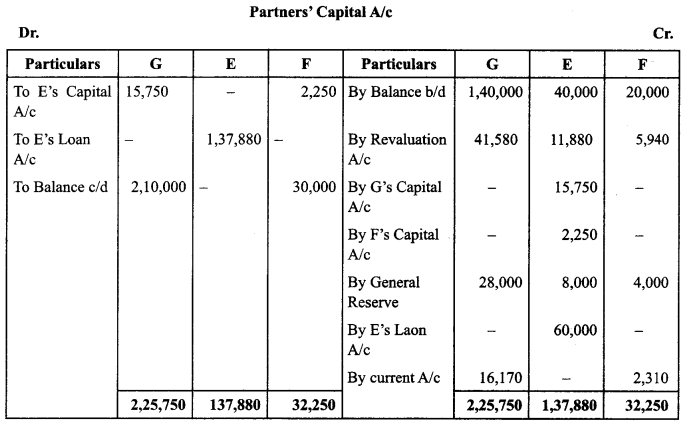
Class 12 Accountancy Important Questions Chapter 3 Reconstitution of Partnership Firm Admission of a Partner 72
Class 12 Accountancy Important Questions Chapter 3 Reconstitution of Partnership Firm Admission of a Partner 73
Class 12 Accountancy Important Questions Chapter 3 Reconstitution of Partnership Firm Admission of a Partner 74

Question 3.
Gautam and Yashica are partners in a firm, sharing profits and losses in 3:1 respectively. The balance sheet of the firm as on 31st March 2018 was as follows:
Class 12 Accountancy Important Questions Chapter 3 Reconstitution of Partnership Firm Admission of a Partner 75
Asma is admitted as a partner for 3/8th share in the profits with a capital of ₹2,10,000 and ₹50,000 for her share of goodwill. It was decided that:

  • New profit sharing ratio will be 3:2:3
  • Machinery will depreciated by 10% and Furniture by ₹5,000.
  • Stock was re-valued at ₹ 2,10,000.
  • Provision for doubtful debts is to be created at 10% of debtors.
  • The capitals of all the partners were to be in the new profit sharing ratio on basis of capital of new partner any adjustment to be done through current accounts.

Prepare Revaluation Account, Partners Capital Account and the Balance Sheet of the new firm. (CBSE Sample Paper 2019-20)
Answer:
Class 12 Accountancy Important Questions Chapter 3 Reconstitution of Partnership Firm Admission of a Partner 76
Class 12 Accountancy Important Questions Chapter 3 Reconstitution of Partnership Firm Admission of a Partner 77

Question 4.
On 31st March, 2019 the Balance Sheet of Madan and Mohan who share profits and losses in the ratio of 3 : 2 was as follows:
Class 12 Accountancy Important Questions Chapter 3 Reconstitution of Partnership Firm Admission of a Partner 78
They decided to admit Gopal on 1st April, 2019 for l/5th share which Gopal acquired wholly from Mohan on the following terms:

  • Gopal shall bring ₹ 10,000 as his share of premium for Goodwill.
  • A debtor whose dues of₹ 3,000 were written off as bad debt paid ₹ 2,000 in full settlement.
  • A claim of₹ 5,000 on account of workmen’s compensation was to be provided for.
  • Patents were undervalued by ₹ 2,000. Stock in the books was valued 10% more than its market value.
  • Gopal was to bring in capital equal to 20% of the combined capitals of Madan and Mohan after all adjustments.

Prepare Revaluation Account, Capital Accounts ®f the Partners and the Balance Sheet of the new firm. (CBSE Compt. 2019)
Answer:
Class 12 Accountancy Important Questions Chapter 3 Reconstitution of Partnership Firm Admission of a Partner 79
Class 12 Accountancy Important Questions Chapter 3 Reconstitution of Partnership Firm Admission of a Partner 80

Question 5.
Karan and Varan were partners in a firm sharing profits and losses in the ratio of 1:2. Their fixed capitals were ₹ 2,00,000 and ₹ 3,00,000 respectively. On 1st April, 2016 Kishore was admitted as a new partner for 14th share in the profits. Kishore brought ₹ 2,00,000 for his capital which was to be kept fixed like the capitals of Karan and Varan. Kishore acquired his share of profit from Varan.
Calculate goodwill of the firm on Kishore’s admission and the new profit sharing ratio of Karan, Varan and Kishore. Also, pass necessary Journal Entry for the treatment of Goodwill on Kishore’s admission considering that Kishore did not bring his share of goodwill premium in Cash. [CBSE Delhi 2017]
Answer:
(a) Calculation of Hidden Goodwill:
Kishore’s share = 1/4 Kishore’s Capital = ₹2,00,000
(a) Total capital of the new firm = ₹2,00,000 x 4 = ₹8,00,000
(b) Existing total capital of Karan, Varan and Kishore = ₹2,00,000 + ₹ 3,00,000 + ₹ 2,00,000 = ₹ 7,00,000
(c) Goodwill of the firm = ₹8,00,000 – ₹7,00,000 = ₹ 1,00,000 Thus, Kishore’s share of goodwill = 1/4 x ₹ 1,00,000 = ₹25,000

(b) Calculation of New Profit Sharing ratio:
Karan’s new share = 1/3 i.e. 4/12, Varun’s new share = 2/3 – 1/4 = 5/12 Kishore’s share = 1/4 x 3/3 = 2/12 New Ratio = 4:5:3

(c)
Class 12 Accountancy Important Questions Chapter 3 Reconstitution of Partnership Firm Admission of a Partner 81

Question 6.
Chander and Damini were partners in a firm sharing profits and losses equally. On 31st March, 2017 their Balance Sheet was as follows:
Class 12 Accountancy Important Questions Chapter 3 Reconstitution of Partnership Firm Admission of a Partner 82
On 1.4.2017, they admitted Elina as a new partner for l/3rd share in the profits on the following conditions :

(i) Elina will bring ₹3,00,000 as her capital and ₹ 50,000 as her share of goodwill premium, half of which will be withdrawn by Chander and Damini.
(ii) Debtors to the extent of ₹5,000 were unrecorded.
(iii) Furniture will be reduced by 10% and 5% provision for bad and doubtful debts will be created on bills receivables and debtors.
(iv) Value of land and building will be appreciated by 20%.
(v) There being a claim against the firm for damages, a liability to the extent of ₹8,000 will be created for the same. Prepare Revaluation Account and Partners’ Capital Accounts. (CBSE 2018-19)
Answer:
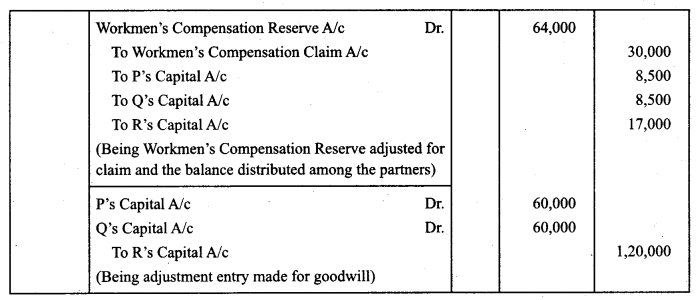
Class 12 Accountancy Important Questions Chapter 3 Reconstitution of Partnership Firm Admission of a Partner 83
Class 12 Accountancy Important Questions Chapter 3 Reconstitution of Partnership Firm Admission of a Partner 84

Question 7.
P & K were partners in a firm. On March 31, 2017 their Balance Sheet was as follows: Balance Sheet as at March 31, 2017.
Class 12 Accountancy Important Questions Chapter 3 Reconstitution of Partnership Firm Admission of a Partner 85
On April 1,2017, they decided to admit C as a new partner for 1/4th share in profits on the following terms:

(i) C’s Loan will be converted into his capital.
(ii) C will bring his share of goodwill premium by cheque. Goodwill of the firm will be calculated on the basis of Average Profits of previous three years. Profits for the year ended March 31, 2015 and March 31, 2016 were ₹ 55,000 and ₹ 1,00,000 respectively.
(iii) 10% depreciation will be charged on Plant & Machinery and Land & Building will be appreciated by 5%.
(iv) Capitals of P & K will be adjusted on the basis C’s capital. Adjustments be done through bank and in case required overdraft facility be availed.
Pass necessary Journal entries on C’s admission. (CBSE Sample Paper 2017-18)
Answer:
Class 12 Accountancy Important Questions Chapter 3 Reconstitution of Partnership Firm Admission of a Partner 86
Class 12 Accountancy Important Questions Chapter 3 Reconstitution of Partnership Firm Admission of a Partner 87

Question 8.
Ashish and Dutta were partners in a firm sharing profits in 3 : 2 ratio. On Jan. 01,2014 they admitted Vimal for 1/5 share in the profits. The Balance Sheet of Ashish and Dutta as on Dec. 31, 2013 was as follows:
Class 12 Accountancy Important Questions Chapter 3 Reconstitution of Partnership Firm Admission of a Partner 88
Class 12 Accountancy Important Questions Chapter 3 Reconstitution of Partnership Firm Admission of a Partner 89
It was agreed that:
(i) The value of Land and Building be increased by ₹ 15,000.
(ii) The value of plant be increased by ₹ 10,000.
(iii) Goodwill of the firm be valued at ₹ 20,000.
(iv) Vimal to bring in capital to the extent of l/5th of the total capital of the new firm. Record the necessary journal entries and prepare Balance Sheet after Vimal’s admission.
Answer:
Class 12 Accountancy Important Questions Chapter 3 Reconstitution of Partnership Firm Admission of a Partner 90
Class 12 Accountancy Important Questions Chapter 3 Reconstitution of Partnership Firm Admission of a Partner 91
Class 12 Accountancy Important Questions Chapter 3 Reconstitution of Partnership Firm Admission of a Partner 92
Class 12 Accountancy Important Questions Chapter 3 Reconstitution of Partnership Firm Admission of a Partner 93

Question 9.
Divya, Yasmin and Fatima are partners in a firm, sharing profits and losses in 11 : 7 : 2 respectively. The balance sheet of the firm as on 31st March 2018 was as follows:
Class 12 Accountancy Important Questions Chapter 3 Reconstitution of Partnership Firm Admission of a Partner 94
On 1.4.2018, Aditya is admitted as a partner for one-fifth share in the profits with a capital of ₹4,50,000 and necessary amount for his share of goodwill on the following terms:
(i) Furniture of ₹2,40,000 were to be taken over Divya, Yasmin and Fatima equally.
(ii) A creditor of ₹ 7,000 not recorded in books to be taken into account.
(iii) Goodwill of the firm is to be valued at 2.5 years purchase of average profits of last two years. The profit of the last three years were:
2015-16 ₹6,00,000; 2016-17 ₹2,00,000; 2017-18 ₹6,00,000
(iv) At time of Aditya’s admission Yasmin also brought in 50,000 as fresh capital
(v) Plant and Machinery is re-valued to ₹ 2,00,000 and expenses outstanding were brought down to ₹ 9,000. Prepare Revaluation Account, Partners Capital Account and the balance sheet of the reconstituted firm. (CBSE Sample Paper 2018-19)
Answer:
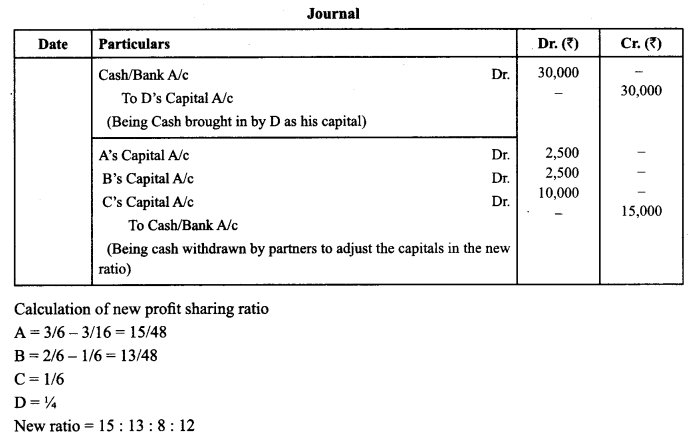
Class 12 Accountancy Important Questions Chapter 3 Reconstitution of Partnership Firm Admission of a Partner 95
Class 12 Accountancy Important Questions Chapter 3 Reconstitution of Partnership Firm Admission of a Partner 96
Class 12 Accountancy Important Questions Chapter 3 Reconstitution of Partnership Firm Admission of a Partner 97
Class 12 Accountancy Important Questions Chapter 3 Reconstitution of Partnership Firm Admission of a Partner 98

Question 10.
P and Q were partners in a firm sharing profits in 3 : 2 ratio. R was admitted as a new partner for 1/4x share in the profits on April 1, 2015. The Balance Sheet of the firm on March 31, 2015 was as follows:
Class 12 Accountancy Important Questions Chapter 3 Reconstitution of Partnership Firm Admission of a Partner 99
The terms of agreement on R’s admission were as follows:
(a) R brought in cash 60,000 for his capital and 30,000 for his share of goodwill.
(b) Building was valued at 1,00,000 and Machinery at 36,000.
(c) The capital accounts of P and Q were to be adjusted in the new profit-sharing ratio. Necessary cash was to be brought in or paid off to them as the case may be.
Prepare Revaluation Account, Partner’s Capital Account and the Balance Sheet of P, Q and R. (CBSE Sample Paper 2016)
Answer:
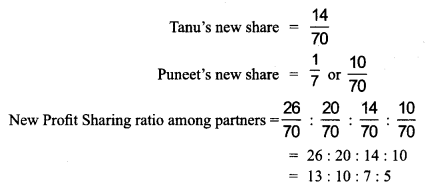
Class 12 Accountancy Important Questions Chapter 3 Reconstitution of Partnership Firm Admission of a Partner 100
Class 12 Accountancy Important Questions Chapter 3 Reconstitution of Partnership Firm Admission of a Partner 101

Question 11.
Mohan and Mahesh were partners in a firm sharing profits in the ratio of 3 : 2. On 1st April, 2012 they admitted Nusrat as a partner in the firm. The Balance Sheet of Mohan and Mahesh on that date was as under:
Class 12 Accountancy Important Questions Chapter 3 Reconstitution of Partnership Firm Admission of a Partner 102
It was agreed that:
(i) The value of Building and Stock be appreciated to ₹ 3,80,000 and ₹ 1.60,000 respectively.
(ii) The liabilities of workmen’s compensation fund was determined at ₹ 2,30,000.
(iii) Nusrat brought in her share of goodwill ₹ 1,00,000 in cash.
(iv) Nusrat was to bring further cash as would make her capital equal to 20% of the combined capital of Mohan and Mahesh after above revaluation and adjustments are carried out.
(v) The future profit sharing ratio will be Mohan 2/5th. Mahesh 2 ‘5th. Nusrat 1/5th.
Prepare Revaluation Account, Partner’s Capital Accounts and Balance Sheet of the new firm. Also show clearly the calculation of Capital brought by Nusrat. (CBSE Delhi 2014, Set I, II)
Answer:
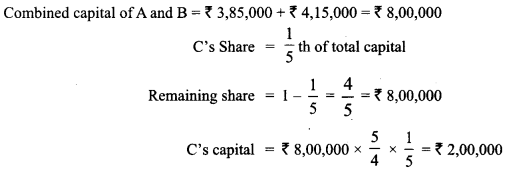
Class 12 Accountancy Important Questions Chapter 3 Reconstitution of Partnership Firm Admission of a Partner 103
Class 12 Accountancy Important Questions Chapter 3 Reconstitution of Partnership Firm Admission of a Partner 104
Working Notes: Capital Adjustment
Nusrat’s Capital (Mohan’s capital + Mahesh’s capital) 20/100
= ( ₹ 3,92,000 + ₹ 2,08,000) x ₹ 20/100
= ₹ 6,00,000 x 20/100 = ₹ 1,20.000

Question 12.
S, T, U and V were partners in a firm sharing profits in the ratio of 4: 3 : 2 : 1. On 1.04.2016 their Balance Sheet was as follows:
Class 12 Accountancy Important Questions Chapter 3 Reconstitution of Partnership Firm Admission of a Partner 105
From the above date partners decided to share the future profits in 3 : 1 : 2 : 4 ratio. For this purpose the goodwill of the firm was valued at ₹ 90,000. The partners also agreed for the following:
(i) The claim for workmen compensation has been estimated at ₹ 70,000.
(ii) To adjust the capitals of the partners according to new profit sharing ratio by opening partners current accounts.
Prepare Revaluation Account, Partners’ Capital Accounts and the Balance Sheet of the reconstituted firm. [Delhi 2017]
(CBSE Sample Paper 2017-18)
Answer:
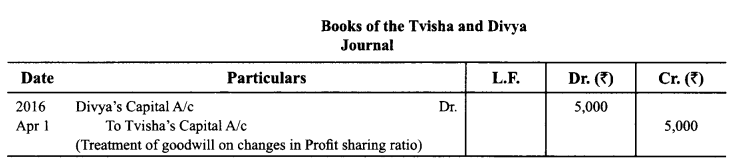
Class 12 Accountancy Important Questions Chapter 3 Reconstitution of Partnership Firm Admission of a Partner 106
Class 12 Accountancy Important Questions Chapter 3 Reconstitution of Partnership Firm Admission of a Partner 107