Accounting for Partnership: Basic Concepts Class 12 Important Questions Accountancy Chapter 2

Here we are providing Class 12 Accountancy Important Extra Questions and Answers Chapter 2 Accounting for Partnership: Basic Concepts. Accountancy Class 12 Important Questions and Answers are the best resource for students which helps in class 12 board exams.

Class 12 Accountancy Chapter 2 Important Extra Questions Accounting for Partnership: Basic Concepts

Accounting for Partnership: Basic Concepts Important Extra Questions Very Short Answer Type

Question 1.
Chhavi and Neha were partners in a firm sharing profits and losses equally. Chhavi withdrew a fixed amount at the beginning of each quarter. Interest on drawings is charged @ 6% p.a. At the end of the year, interest ‘ on Chhavi’s drawings amounted to ₹ 900. Pass necessary journal entry for charging interest on drawings.
Answer:

Class 12 Accountancy Important Extra Questions Chapter 2 Accounting for Partnership Basic Concepts 1

Question 2.
Dev withdrew ₹ 10,000 on 15th day of every month. Interest on drawings was to be charged @ 12% per
annum. Calculate interest on Dev’s drawings. (CBSE Outside Delhi 2019)
Answer:
Interest On Drawings = 1,20,000 x 12/100 x 6 x 12 = 7,200

Question 3.
Amit, a partner in a partnership firm withdrew ₹ 7,000 in the beginning of each quarter. For how many months would interest on drawings be charged₹ (CBSE SP 2019-20)
Answer:
7 1/2 months.

Question 4.
Raj and Seema started a partnership firm on 1st July, 2018. They agreed that Seema was entitled to a commission of 10% of the net profit after charging Raj’s salary of ₹ 2,500 per quarter and Seema’s commission. The net profit before charging Raj’s salary and Seema’s commission for the year ended 31st March, 2019 was ₹ 2,27,500. Calculate Seema’s commission. (CBSE Compt. 2019)
Answer:
Net profit before salary and commission = ₹ 2,27,500
Net Raj’s salary ₹ 2,500 x 3 = ₹ 7,500
Net profit after Raj’s salary but before Seema’s commission = ₹ 2,20,000
Seema’s commission = 10/110 of ₹ 2,20,000
= ₹ 20,000

Question 5.
A and B are partners in a firm sharing profits and losses in the ratio of 7 : 3. Their fixed capitals were : A ₹ 9,00,000 and B ₹ 4,00,000. The partnership deed provided the following: (CBSE Compt. 2019)
(i) Interest on capital @ 10% p.a.
(ii) A’s salary ₹ 50,000 per year and B’s salary ₹ 3,000 per month.
Profit for the year ended 31st March 2019 ₹ 2,78,000 was distributed without providing for interest on capital and partner’s salary.
Showing your working clearly, pass the necessary adjustment entry for the above omissions.
Answer:
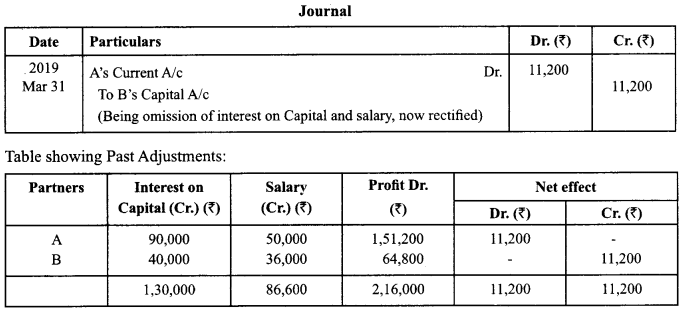
Class 12 Accountancy Important Extra Questions Chapter 2 Accounting for Partnership Basic Concepts 2

Question 6.
Partners of ABC Corporation have agreed that D, a minor, should be admitted as a partner in the firm. What will be liability of D?
Answer:
Limited.

Question 7.
X, Y and Z are partners in a firm. The firm had adopted fixed capital method. Mention the account in which the interest on capital will be recorded:
Answer:
Capital Account.

Question 8.
A partnership deed provides for the payment of interest on capital but there was a loss instead of profits during the year 2010-11. Will the interest on capital be allowed?
Answer:
No.

Question 9.
Where is interest on a partner’s loan debited to Profit and Loss Account or Profit and Loss Appropriation Account?
Answer:
Profit and loss Account.

Question 10.
Is interest on a partner’s loan is payable even in case of loss to the firm?
Answer:
Yes.

Question 11.
Net profit of a firm is ₹ 30,000, partners’ salary is ₹ 12,000 and interest on capital is ₹ 20,000. Mention the amount of partners’ salary and interest on capital which should be debited to Profit and Loss Appropriation Account if both items are treated as appropriation.
Answer:
Partners’ salary ₹ 11,250, Interest on capital ₹ 18,750.
Note: In the ratio of salary and interest on capital i.e. 12,000 : 20,000 = 3:5.

Question 12.
Ram and Shyam are partners sharing profits/losses equally. Ram withdrew ₹ 1,000 p.m. regularly on the first day of every month during the year 2013-14 for personal expenses. If interest on drawings is charged @ 5% p.a. Calculate interest on the drawings of Ram.
Answer:
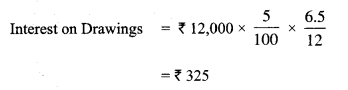
Class 12 Accountancy Important Extra Questions Chapter 2 Accounting for Partnership Basic Concepts 46

Question 13.
Verma and Kaul are partners in a firm. The partnership agreement provides that interest on drawings should be charged @ 6% p.a. Verma withdraws X 2,000 per month starting from April 01, 2013 to March 31, 2014. Kaul withdraw ₹ 3,000 per quarter, starting from April 01, 2013. Calculate interest on partner’s drawings.
Answer:
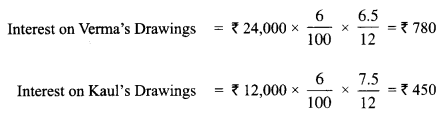
Class 12 Accountancy Important Extra Questions Chapter 2 Accounting for Partnership Basic Concepts 3

Question 14.
Himanshu withdraws ₹ 2,500 at the end of each month. The partnership deed provides for charging the interest on drawings @ 12% p.a. Calculate interest on Himanshu’s drawings for the year ending 31st December, 2013.
Answer:

Class 12 Accountancy Important Extra Questions Chapter 2 Accounting for Partnership Basic Concepts 47

Question 15.
Bharam is a partner in a firm. He withdraws ₹ 3,000 at the starting of each month for 12 months. The books . of the firm closes on March 31 every year. Calculate interest on drawings if the rate of interest is 10% p.a.
Answer:
Bharam withdraws ₹ 3,000 at the starting of each month.

Class 12 Accountancy Important Extra Questions Chapter 2 Accounting for Partnership Basic Concepts 48

Question 16.
Amit and Bhola are partners in a firm. They share profits in the ratio of 3 : 2. As per their partnership agreement, interest on drawings is to be charged @ 10% p.a. Their drawings during 2013 were ₹ 24,000 and ₹ 16,000, respectively. Calculate interest on drawings based on the assumption that the amounts were withdrawn evenly, throughout the year.
Answer:
Amit’s Drawings = ₹ 24,000
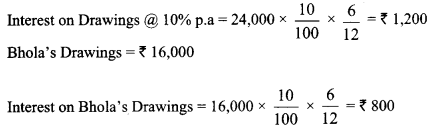
Class 12 Accountancy Important Extra Questions Chapter 2 Accounting for Partnership Basic Concepts 4
Note: In the absence of date of drawings, it is assumed drawings have been made in the middle of each month/period.

Question 17.
A, B and C were partners in a firm sharing profits in the ratio of 3 : 2 : 1. B was guaranteed a profit of X 2,00,000. During the year the firm earned a profit of ₹ 84,000. Calculate the net amount of Profit/Loss transferred to the capital accounts of A and C. (CBSE Sample Paper 2017-18)
Answer:
Net Amount of Loss transferred to:

  • A’s Capital Account: ₹ 87,000
  • C’s Capital Account: ₹ 29,000

Accounting for Partnership: Basic Concepts Important Extra Questions Short Answer Type

Question 1.
A and B were partners in a firm sharing profits in the ratio of 5 : 3. Their fixed capitals on 31st March, 2017 were: A ₹ 60,000 and B ₹ 80,000. They agreed to allow interest on capital @ 12% p.a. The profit of the firm for the year ended 31st March, 2018 before allowing interest on capitals was ₹ 12,600.
Pass necessary journal entries for the above transactions in the books of A and B. Also show your working notes clearly.
Answer:
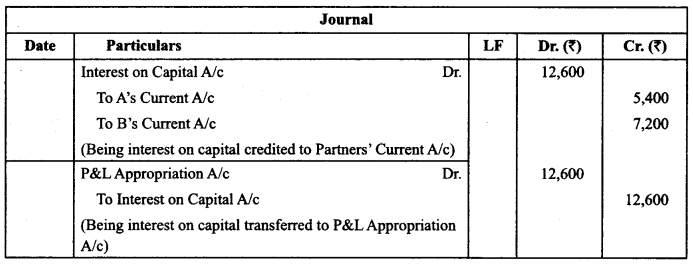
Class 12 Accountancy Important Extra Questions Chapter 2 Accounting for Partnership Basic Concepts 5
Working Notes:
Interest on Capital:
A= 12% of 60,000 = 7,200
B = 12% of 80,000 = 9,600
Total interest = 16,800
Since profits are insufficient interest on capital will be distributed in the ratio of 7,200:9,600 i.e. 3:4
A = 3/7 of 12,600 = 5,400
B = 4/7 of 12,600 = 7,200

Question 2.
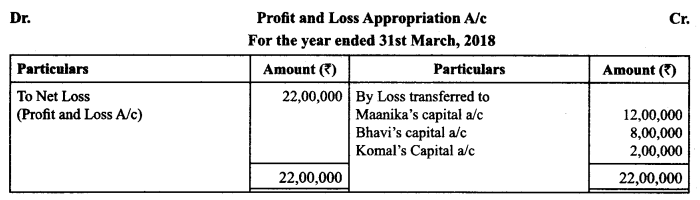
Maanika, Bhavi and Komal are partners sharing profits in the ratio of 6:4:1. Komal is guaranteed a minimum profit of ₹ 2,00,000. The firm incurred a loss of ₹22,00,000 for the year ended 31st March, 2018. Pass necessary journal entry regarding deficiency borne by Maanika and Bhavi and prepare Profit and Loss Appropriation Account. (CBSE SP 2019-20)
Answer:
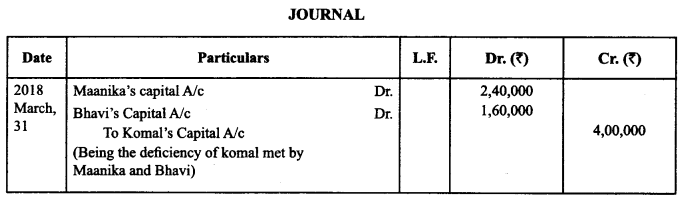
Class 12 Accountancy Important Extra Questions Chapter 2 Accounting for Partnership Basic Concepts 6
Class 12 Accountancy Important Extra Questions Chapter 2 Accounting for Partnership Basic Concepts 7
Working Note:
Loss of the firm = 22,00,000
Komal’s share of loss = 22,00,000 x 1/11 = 2,00,000
Guaranteed minimum profit = 2,00,000

Question 3.
A, B and C were partner in a firm. On 1st April, 2018, their capitals stood at ₹ 4,00,000, ₹ 3,00,000 and ₹2,00,000 respectively. As per the provisions of the partnership deed.
(i) A was entitled to a salary of ₹ 5,000 per month.
(ii) Partner were entitled to interest on capital @ 10% p.a.
The net profit for the year ended 31st March 2019, ₹ 3,00,000 was divided among the partners without providing for the above items.
Showing your working clearly, pass an adjustment entry to rectify the above error.
Answer:
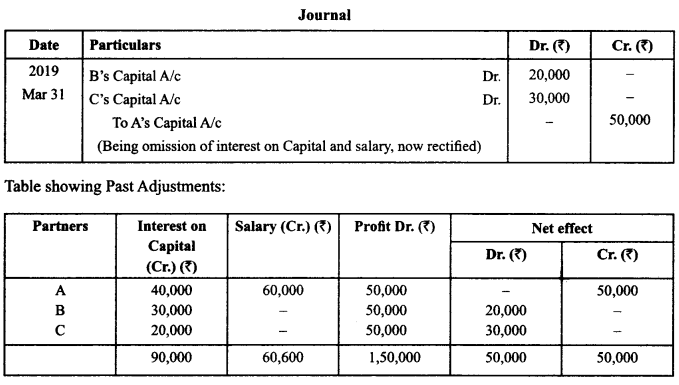
Class 12 Accountancy Important Extra Questions Chapter 2 Accounting for Partnership Basic Concepts 8

Question 4.
Rani and Suman are in partnership with capitals of ₹ 80,000 and ₹ 60,000, respectively. During the year 2013 – 2014, Rani withdrew ₹ 10,000 and Suman withdrew ₹ 15,000 from their capital profits before charging interest on capital was ₹ 50,000. Ravi and Suman shared profits in the ratio of 3: 2. Calculate the amounts of interest on their capitals @ 12% p.a. for the year ended March 31,2014.
Answer:
Interest on capital is always calculated on opening balance of capital.
Rate of interest = 12% p.a.
Rani’s opening capital = ₹ 80,000
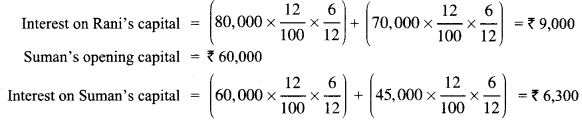
Class 12 Accountancy Important Extra Questions Chapter 2 Accounting for Partnership Basic Concepts 9
Note:
Date of capital withdrawn is not given in the question, it has been assumed that the same have been done in the mid of the accounting year.

Question 5.
Krishna, Sandeep and Karim are partners sharing profits in the ratio of 3 : 2 : 1. Their fixed capitals are: Krishan ₹ 1,20,000, Sandeep ₹ 90,000 and Karim ₹ 60,000. For the year 2013-14, interest was credited to them @ 6% p.a. instead of 5% p.a. Record adjustment entry.
Answer:
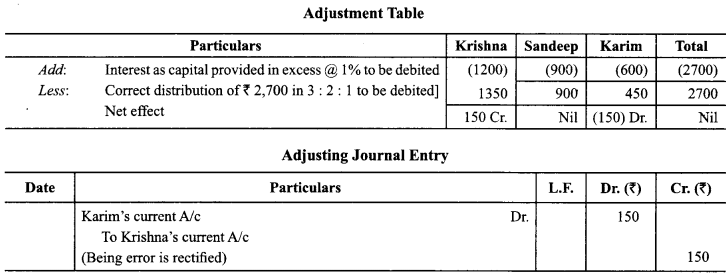
Class 12 Accountancy Important Extra Questions Chapter 2 Accounting for Partnership Basic Concepts 10

Question 6.
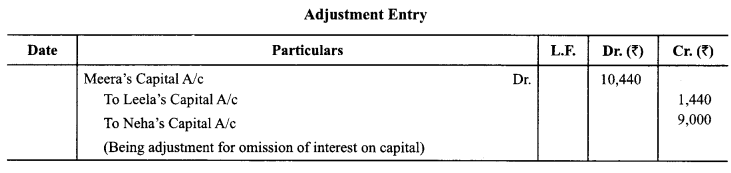
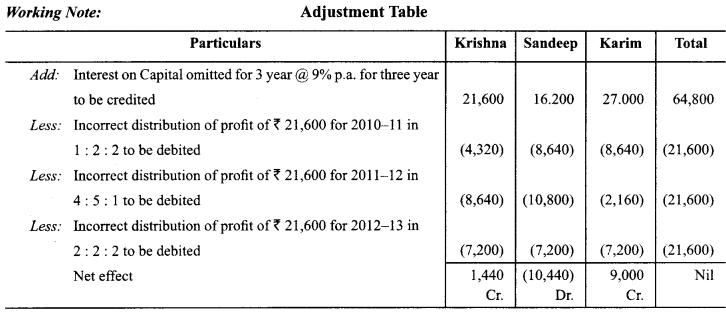
Leela, Meera and Neha are partners and have omitted interest on capital @ 9% p.a. for three years ended March 31, 2013. Their fixed capitals on which interest was to be allowed throughout were: Leela ₹ 80,000, Meera ₹ 60,000 and Neha ₹ 1,00,000. Their profit sharing ratio during the last three years were:
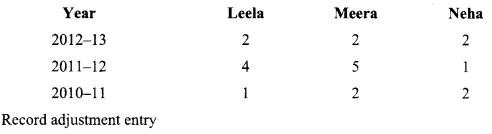
Class 12 Accountancy Important Extra Questions Chapter 2 Accounting for Partnership Basic Concepts 11
Answer:
Class 12 Accountancy Important Extra Questions Chapter 2 Accounting for Partnership Basic Concepts 12
Class 12 Accountancy Important Extra Questions Chapter 2 Accounting for Partnership Basic Concepts 13

Question 7.
Anubha and Kajal are partners of a firm sharing profits and losses in the ratio of 2 : 1. Their capital were ₹ 90,000 and ₹ 60,000. The divisible profit during the year were ₹ 45,000. According to partnership deed, both partners are allowed salary @ ₹ 700 per month to Anubha and ₹ 500 per month to Kajal. Interest allowed on capital @ 5% p.a. The drawings at the end of the period were ₹ 8,500 for Anubha and ₹ 6,500 for Kajal. Interest is to be charged @ 5% p.a. on drawings. Prepare partners capital accounts, assuming that the . capital accounts are fluctuating.
Answer:
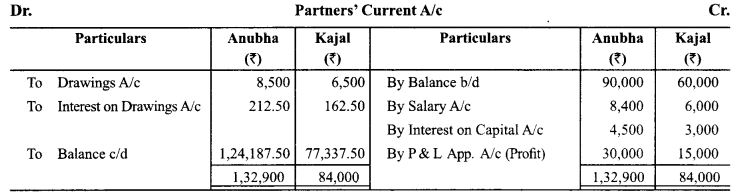
Class 12 Accountancy Important Extra Questions Chapter 2 Accounting for Partnership Basic Concepts 14
Note:
(1) It has been assumed that profit given is divisible profit.
(2) It has been assumed drawings have been made in the middle of the year. Normally, in the absence of date, drawings are assumed to have been made in the middle of the year.

Question 8.
Harshad and Dhiman are in partnership since April 01, 2013. No Partnership agreement was made. They contributed ₹ 4,00,000 and 1,00.000 respectively as capital. In addition, Harshad advanced an amount of ₹ 1,00,000 to the firm, on October 01, 2013. Due to long illness, Harshad could not participate in business activities from August 1, to September 30. 2013. The profits for the year ended March 31, 2014 amounted to ₹ 1,80,000.
Dispute has arisen between Harshad and Dhiman.
Harshad Claims:

  1. He should be given interest @ 10% per annum on capital and loan
  2. Profit should be distributed in proportion of capital

Dhiman Claims:

  1. Profits should be distributed equally
  2. He should be allowed ₹ 2,000 p.m. as remuneration for the period he managed the business, in the absence of Harshad
  3. Interest on capital and loan should be allowed @ 6% p.a.

You are required to settle the dispute between Harshad and Dhiman. Also prepare P&L Appropriation Account.
Answer:
Harshad’s Claims

(i) Harshad’s claim that he should be given interest @ 10% p.a. on capital is not justified. According to the provisions of Partnership Act, 1932, he is not entitled to receive interest on loan @ 10% but only entitled to receive @ 6% p.a.

(ii) His second claim that profits should be distributed in proportion of capital does not fall within the provisions of Partnership Act, 1932. Act provides for equal distribution of profits among partners.

Dhiman’s Claims

(i) His claim to distribute the profits equally is right as per the provisions of Partnership Act, 1932.

(ii) His claim for remuneration for managing the business is not justified because Partnership Act, 1932 does not allow any such remuneration.

(iii) His claim that interest on capital should be allowed @ 6% p.a. is wrong but his claim to provide interest on loan @ 6% p.a. is a right claim as per the provisions of Partnership Act., 1932.
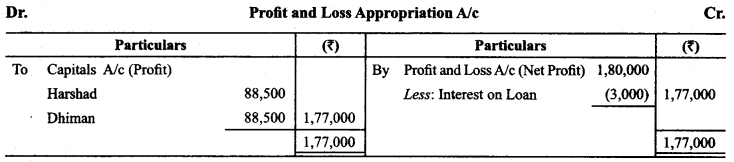
Class 12 Accountancy Important Extra Questions Chapter 2 Accounting for Partnership Basic Concepts 15
Note: Since interest on loan is charged against the profit, it can be shown on the debit side of profit and loss account or as a deduction from the pro fit on the credit side of Profit and Loss Appropriation Account.

Question 9.
Aakriti and Bindu entered into partnership for making garment on April 01, 2013 without any partnership agreement. They introduced capitals of₹ 5,00,000 and ₹ 3,00,000 respectively on October 01,2013. Aakriti Advanced. ₹ 20,000 by way of loan to the firm without any agreement as to interest. Profit and Loss account for the year ended March 2014 showed profit of ₹ 43,000. Partners could not agree upon the question of interest and the basis of division of profit. You are required to divide the profits between them giving reason for your solution.
Answer:
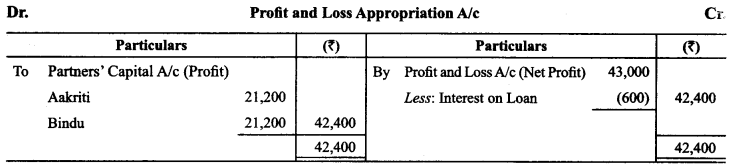
Class 12 Accountancy Important Extra Questions Chapter 2 Accounting for Partnership Basic Concepts 16
Reason:
(1) In the absence of any partnership deed, the provisions of Partnership Act, 1932 is applied. According to the provisions, no interest on capital, no salary, no commission will be allowed to the partners They will also share the profits equally. The interest on loan also will be provided at 6% p.a.

(2) Since interest on loan is charged against the profit, it can be shown on the debit side of profit and loss account or as a deduction from the profit on the credit side of Profit and Loss Appropriation Account.

Question 10.
Rahul, Rohit and Karan started partnership business on April 1, 2013 with capitals of ₹ 20,00,000, ₹ 18,00,000 and ₹ 16,00,000, respectively. The profit for the year ended March 2014 amounted to 7 1,35,000 and the partner’s drawings had been Rahul 7 50,000, Rohit 7 50,000 and Karan 7 40,000. The profits are distributed among partner’s in the ratio of 3 : 2 : 1. Calculate the interest on capital @ 5% p.a.
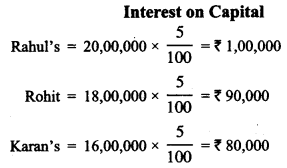
Class 12 Accountancy Important Extra Questions Chapter 2 Accounting for Partnership Basic Concepts 17
Note:
As interest on capital is calculated on the opening capitals, rest of the information apart from opening capitals is irrelavant.

Question 11.
Following is the extract of the Balance Sheet of Neelkant and Mahadev as on March 31,2013:
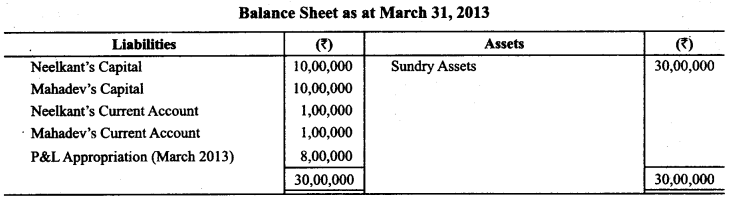
Class 12 Accountancy Important Extra Questions Chapter 2 Accounting for Partnership Basic Concepts 18
During the year Mahadev’s drawings were 7 30,000. Profits dining 2013 is 7 10,00,000. Calculate interest on capital @ 5% p.a. for the year ending March 31,2013.
Answer:
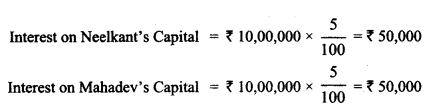
Class 12 Accountancy Important Extra Questions Chapter 2 Accounting for Partnership Basic Concepts 50
Note:
Since the capitals are fixed, profit and drawings must have been transferred to Current Accounts. Therefore, capitals must be fixed in beginning as well as at the end.

Question 12.
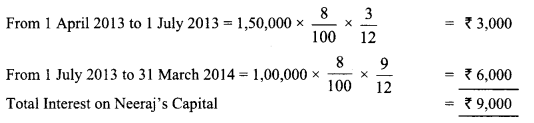
Raj and Neeraj are partners in a firm. Their capitals as on April 01, 2013 were 72,50,000 and 71,50,000, respectively. They share profits equally. On July 01, 2013, they decided that their capitals should be 71,00,000 each. The necessary adjustment in the capitals were made by introducing or withdrawing cash by the partners Interest on capital is allowed @ 8% p.a. Compute interest on capital for both the partners for the year ending on March 31,2014.
Answer:
Interest on Ram’s Capital @ 8% p.a.
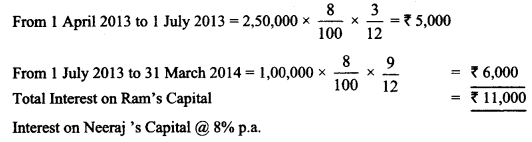
Class 12 Accountancy Important Extra Questions Chapter 2 Accounting for Partnership Basic Concepts 19
Class 12 Accountancy Important Extra Questions Chapter 2 Accounting for Partnership Basic Concepts 20

Question 13.
On March 31, 2013, after the close of books of accounts, the capital accounts of Ram, Shyam and Mohan showed a balance of₹ 24,000 ₹ 18,000 and ₹ 12,000, respectively. It was later discovered that interest on capital @ 5% had been omitted. The profit for the year ended March 31,2013, amounted to ₹ 36,000 and the partner’s drawings had been Ram, ₹ 3,600; Shyam, ₹ 4,500 and Mohan, ₹ 2,700. The profit sharing ratio of Ram, Shyam and Mohan was 3:2:1. Calculate interest on capitals.
Answer:
Note. Interest on Capital is always calculated on Opening Capital.
Opening Capital = Closing Capital + Drawings – Share of Profit
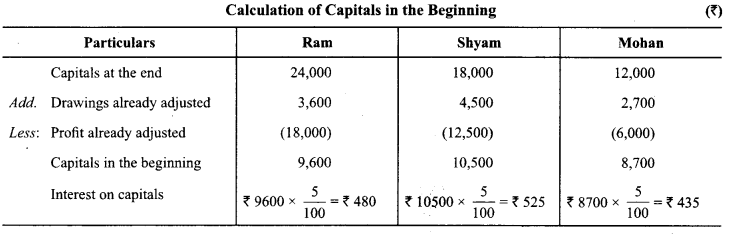
Class 12 Accountancy Important Extra Questions Chapter 2 Accounting for Partnership Basic Concepts 21

Question 14.
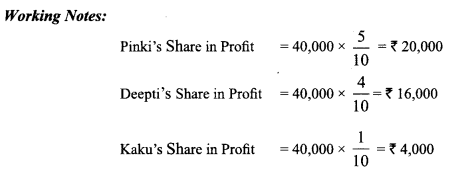
Pinki, Deepti and Kaku are partner’s sharing profits in the ratio of 5 : 4 : 1. Kaku is given a guarantee that his share of profits in any given year would not be less than ₹ 5,000. Deficiency, if any, would be borne by Pinki and Deepti equally. Profits for the year amounted to ₹ 40,000. Record necessary journal entries in the books of the firm showing the distribution of profit.
Answer:
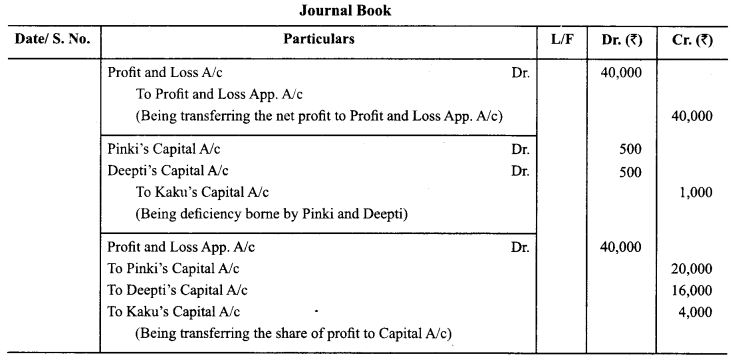
Class 12 Accountancy Important Extra Questions Chapter 2 Accounting for Partnership Basic Concepts 22
Class 12 Accountancy Important Extra Questions Chapter 2 Accounting for Partnership Basic Concepts 23
There is deficiency in Kaku’s Share of₹ 1,000 (5,000 – 4,000). It will be borne by Pinki and Deepti equally.

Question 15.
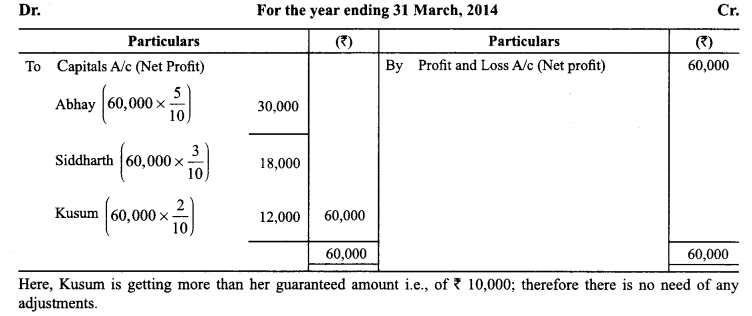
Abhay, Siddharth and Kusum are partners in a firm, sharing profits in the ratio of 5 : 3 : 2. Kusum is guaranteed a minimum amount of₹ 10,000 as per share in the profits. Any deficiency arising on that account shall be met by Siddharth. Profits for the years ending March 31, 2013 and 2014 are ₹ 40,000 and 60,000 respectively. Prepare Profit and Loss Appropriation Account.
Answer:
Profit and Loss Appropriation A/c
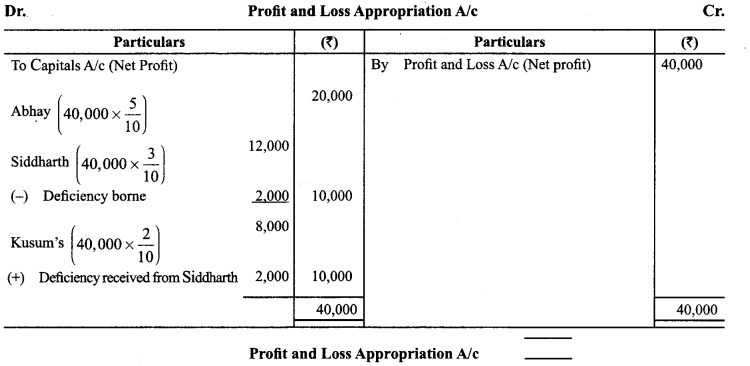
Class 12 Accountancy Important Extra Questions Chapter 2 Accounting for Partnership Basic Concepts 24
Class 12 Accountancy Important Extra Questions Chapter 2 Accounting for Partnership Basic Concepts 25

Question 16.
Radha, Mary and Fatima are partners sharing profits in the ratio of 5 :4 : 1 Fatima is given a guarantee that her share of profit, in any year will not be less than ₹ 5,000. The profits for the year ending March 31,2013 amounts to ₹ 35,000. Shortfall if any, in the profits guaranteed to Fatima is to be borne by Radha and Mary in the ratio of 3 : 2. Record necessary journal entry to show distribution of profit among partner.
Answer:
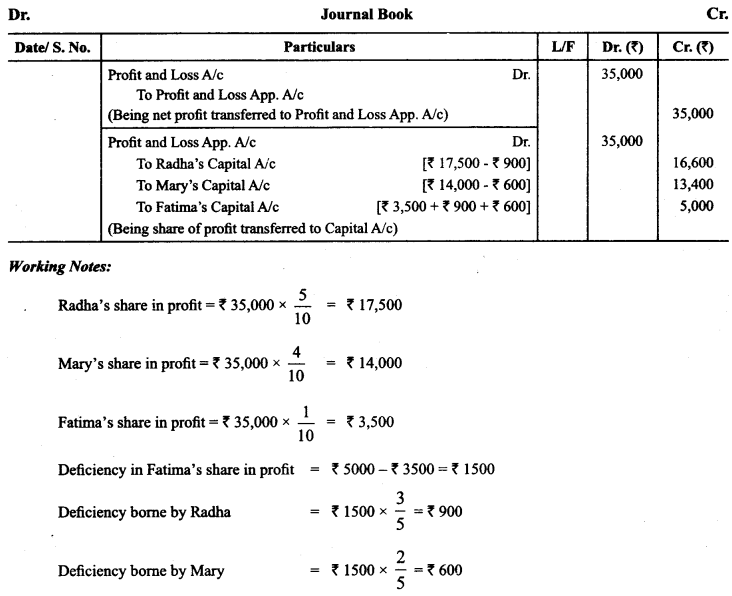
Class 12 Accountancy Important Extra Questions Chapter 2 Accounting for Partnership Basic Concepts 26

Question 17.
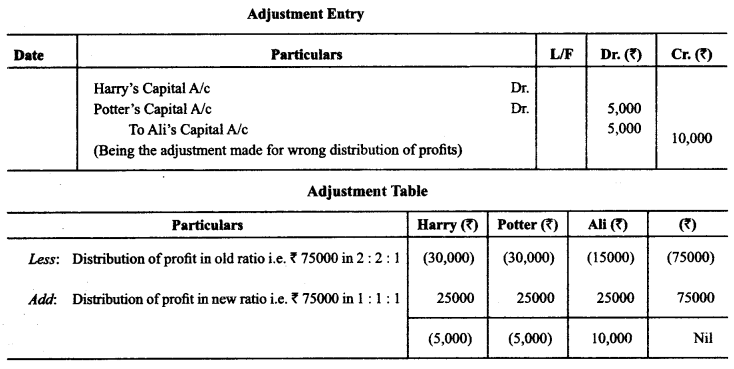
The firm of Harry, Potter and Ali who have been sharing profits in the ratio of 2 :2 :1, have existed for some years Ali wants that he should get equal share in the profits with Harry and Potter and he further wishes that the change in the profit sharing ratio should come into effect retrospectively for the last three years Harry and Potter have agreement on this account.
The profits for the last three years were:
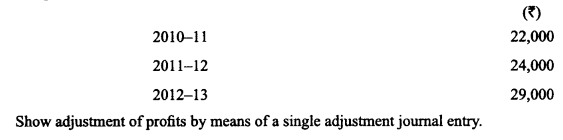
Class 12 Accountancy Important Extra Questions Chapter 2 Accounting for Partnership Basic Concepts 27
Answer:
Class 12 Accountancy Important Extra Questions Chapter 2 Accounting for Partnership Basic Concepts 28

Question 18.
On 1.4.2013 Jay and Vijay, entered into partnership for supplying laboratory equipments to government . schools situated in remote and backward areas. They contributed capitals of ₹ 80,000 and ₹ 50,000 respectively and agreed to share the profits in the ratio of 3 : 2 The partnership deed provided that interest on capital shall be allowed at 9% per annum. During the year the firm earned a profit of ₹ 7,800. Showing your calculations clearly, prepare ‘Profit and Loss Appropriation Account’ of Jay and Vijay for the year ened 31-3-2014. (CBSE Delhi 2015)
Answer:
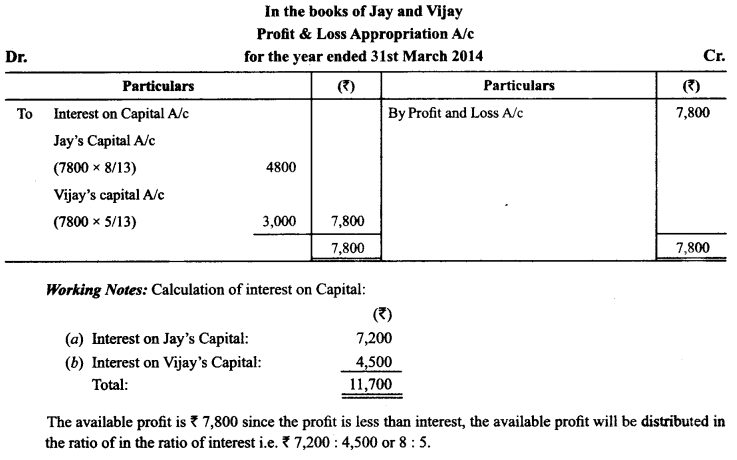
Class 12 Accountancy Important Extra Questions Chapter 2 Accounting for Partnership Basic Concepts 29

Question 19.
Ram, Mohan and Sohan are partners with capitals of ₹ 5,00,000, ₹ 2,50,000 and 2,00,000 respectively. After providing interest on capital @ 10% p.a. the profits are divisible as follows:
Ram 1/2, Mohan 1/3 and Sohan 1/6. But Ram and Mohan have guaranteed that Sohan’s share in the profit shall not be less than ₹ 25,000, in any year. The net profit for the year ended March 31, 2013 is ₹ 2,00,000, before charging interest on capital.
You are required to show distribution of profit.
Answer:
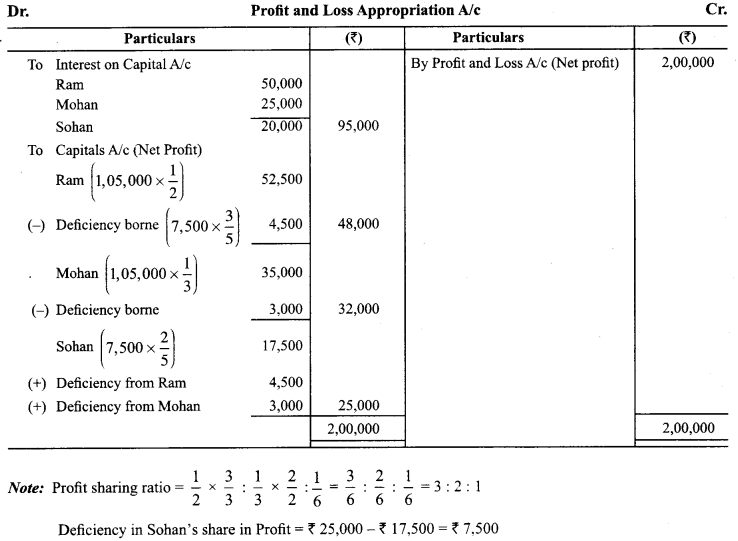
Class 12 Accountancy Important Extra Questions Chapter 2 Accounting for Partnership Basic Concepts 30

Question 20.
Kanika and Gautam are partners doing a dry cleaning business in Lucknow, sharing profits in the ratio 2 : 1 with capitals ₹ 5,00,000 and ₹4,00,000 respectively, Kanika withdrew the following amounts during the year to pay the hostel expenses of her son.
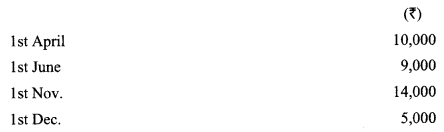
Class 12 Accountancy Important Extra Questions Chapter 2 Accounting for Partnership Basic Concepts 31
Gautam withdrew ₹ 15,000 on the first day of April, July, October and January to pay rent for the accommodation of his family. He also paid ₹ 20,000 per month as rent for the office of partnership which was in a nearby shopping complex. Calculate interest on Drawings @ 6% p.a. (CBSE Sample Paper 2015)
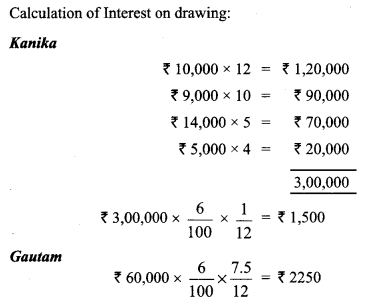
Class 12 Accountancy Important Extra Questions Chapter 2 Accounting for Partnership Basic Concepts 32

Question 21.
Ankur and Bobby were into the business of providing software solutions in India. They were sharing profits and losses in the ratio 3 : 2. They admitted Rohit for a 1/5 share in the firm. Rohit, an alumni of IIT, Chennai would help them to expand their business to various South African countries where he had been working earlier. Rohit is guaranteed a minimum profit of₹ 2,00,000 for the year. Any deficiency in Rohit’s share is to . be borne by Ankur and Bobby in the ratio 4:1. Losses for the year ₹ 10,00,000. Pass the necessary journal entries. (CBSE Sample Paper 2015)
Answer:
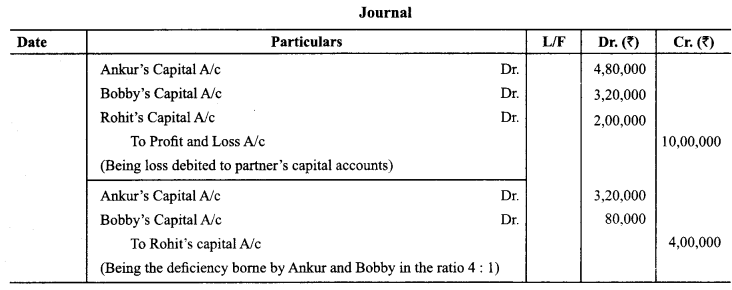
Class 12 Accountancy Important Extra Questions Chapter 2 Accounting for Partnership Basic Concepts 33

Question 22.
Rehman, Suleman and Hanuman were partners in a firm sharing profits in the ratio of 3 : 2 : 1 respectively. Their fixed capitals were as follows: Rehman ₹ 3,00,000, Suleman ₹ 2,00,000 and Hanuman ₹ 1,00,000. The partnership deed provided for the following for the division of profit:
(i) 10% of trading profit will be transferred to Reserve Account.
(ii) Hanuman was guaranteed a profit of ₹ 50,000. Any loss because of guarantee to Hanuman will be shared by Rehman and Suleman equally.
The trading profit of the firm for the year ended 31. 12. 2012 was ₹ 2,00,000.
Prepare the Profit and Loss Appropriation Account of Rehman, Suleman and Hanuman for the year ended 31. 12. 2012. (CBSE 2013 Compartment OD)
Answer:
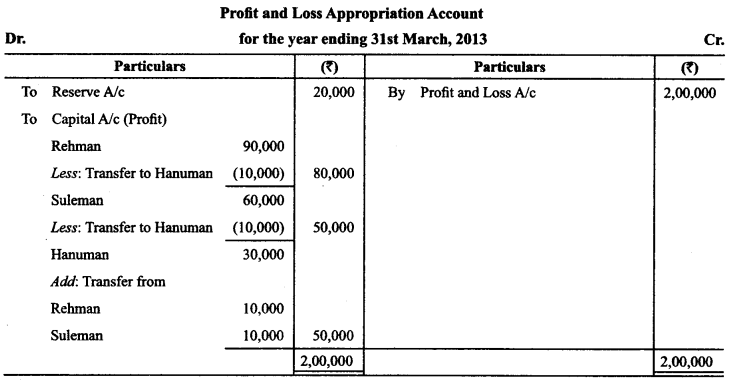
Class 12 Accountancy Important Extra Questions Chapter 2 Accounting for Partnership Basic Concepts 34

Question 23.
The net profit of X, Y and Z for the year ended March 31,2014 was ₹ 60,000 and the same was distributed among them in their agreed ratio of 3 : 1 : 1. It was subsequently discovered that the under mentioned transactions were not recorded in the books:

  1. Interest on capital @ 5% p.a.
  2. Interest on drawings amounting to X ₹ 700, Y ₹ 500 and Z ₹ 300.
  3. Partner’s salary: X ₹ 1,000 p.a., Y ₹ 1,500 p.a.

The capital accounts of partners were fixed as: X ₹ 1,00,000, Y ₹ 80,000 and Z ₹ 60,000. Record the adjustment entry.
Answer:
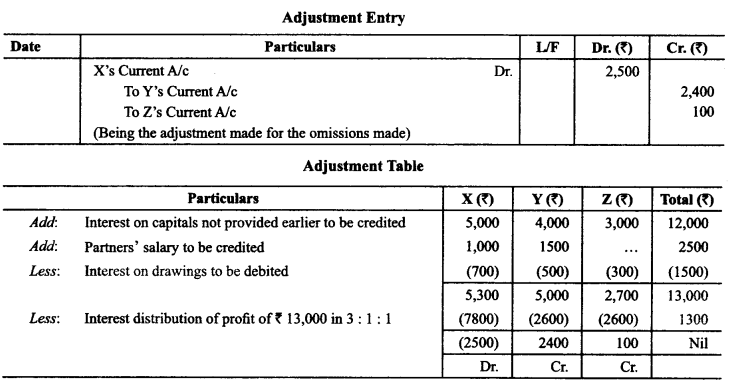
Class 12 Accountancy Important Extra Questions Chapter 2 Accounting for Partnership Basic Concepts 35

Question 24.
Mannu and Shristhi are partners in a firm sharing profit in the ratio of 3 :2. Following is the balance sheet of firm as on March 31,2013.
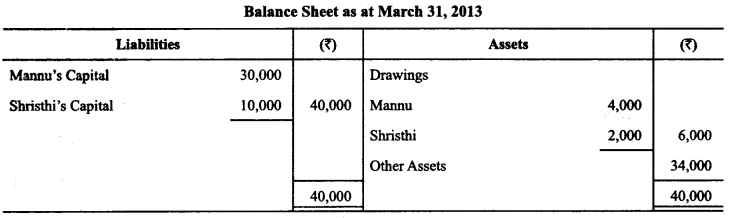
Class 12 Accountancy Important Extra Questions Chapter 2 Accounting for Partnership Basic Concepts 36
Profit for the year ended March 31, 2013 was ₹ 5,000 which was divided in the agreed ratio, but interest @ 5% p.a. on capital and @ 6% p.a. on drawings was inadvertently ignored. Adjust interest on drawings on an average basis for 6 months. Give the adjustment entry.
Answer:
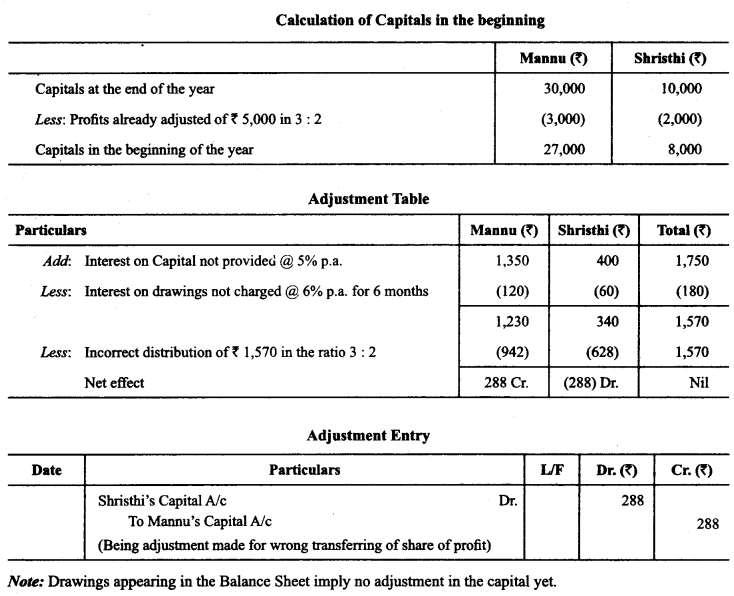
Class 12 Accountancy Important Extra Questions Chapter 2 Accounting for Partnership Basic Concepts 37

Question 25.
L, M and N are partners in a firm sharing profits & losses in the ratio of 2 : 3 : 5.
On April 1, 2016 their fixed capitals were ₹ 2,00,000, ₹ 3,00,000 and ₹ 4,00,000 respectively. Their partnership deed provided for the following:

  1. Interest on capital @ 9% per annum.
  2. Interest on Drawings @ 12% per annum.
  3. Interest on partners’ loan @ 12% per annum.

On July 1, 2016, L brought ₹ 1,00,000 as additional capital and N withdrew ₹ 1,00,000 from his capital. During the year L, M and N withdrew ₹ 12,000, ₹ 18,000 and ₹ 24,000 respectively for their personal use. On January 1, 2017 the firm obtained a Loan of ₹ 1,50,000 from M. The Net profit of the firm for the year ended March 31, 2017 after charging interest on M’s Loan was ₹ 85,000.
Prepare Profit & Loss Appropriation Account and Partners Capital Account. (CBSE Sample Paper 2017-18)
Answer:
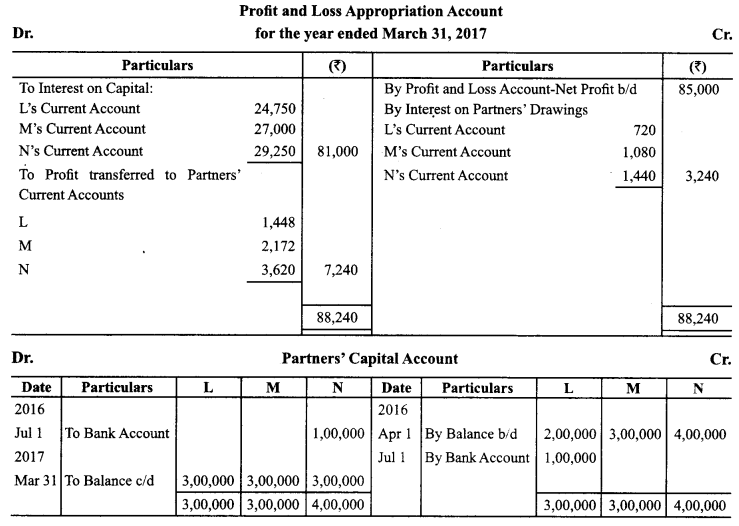
Class 12 Accountancy Important Extra Questions Chapter 2 Accounting for Partnership Basic Concepts 38

Question 26.
The partners of a firm, Alia, Bhanu and Chand distributed the profits for the year ended 31st March, 2017, ₹ 80,000 in the ratio of 3:3:2 without providing for the following adjustments:

  • Alia and Chand were entitled to a salary of₹ 1,500 each p.a.
  • Bhanu was entitled for a commission of ₹ 4,000
  • Bhanu and Chand had guaranteed a minimum profit of ₹ 35,000 p.a. to Alia any deficiency to borne equally by Bhanu and Chand.

Pass the necessary Journal entry for the above adjustments in the books of the firm.
Show workings clearly. (CBSE Sample Paper 2018-19)
Answer:
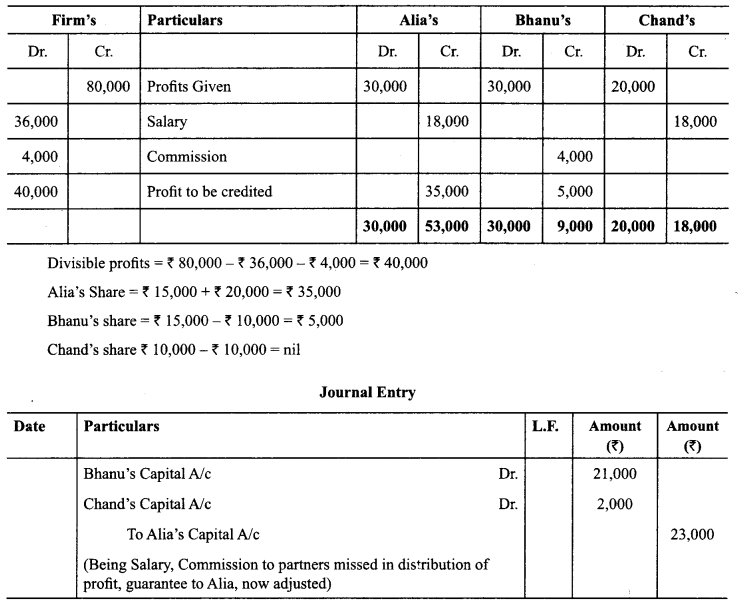
Class 12 Accountancy Important Extra Questions Chapter 2 Accounting for Partnership Basic Concepts 49

Question 27.
Piya and Bina are partners in a firm sharing profits and losses in the ratio of 3 : 2. Following was the Balance Sheet of the firm as on 31-3-2016.
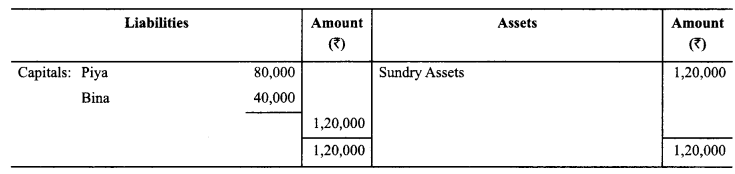
Class 12 Accountancy Important Extra Questions Chapter 2 Accounting for Partnership Basic Concepts 40
The profits ₹ 30,000 for the year ended 31-3-2016 were divided between the partners without allowing interest on capital @ 12% p.a. and salary to Piya @ ₹ 1,000 per month. During the year Piya withdrew ₹8,000 and Bina withdrew ₹4,000.
Showing your working notes clearly, pass the necessary rectifying entry. (Compt. Delhi 2017)
Answer:
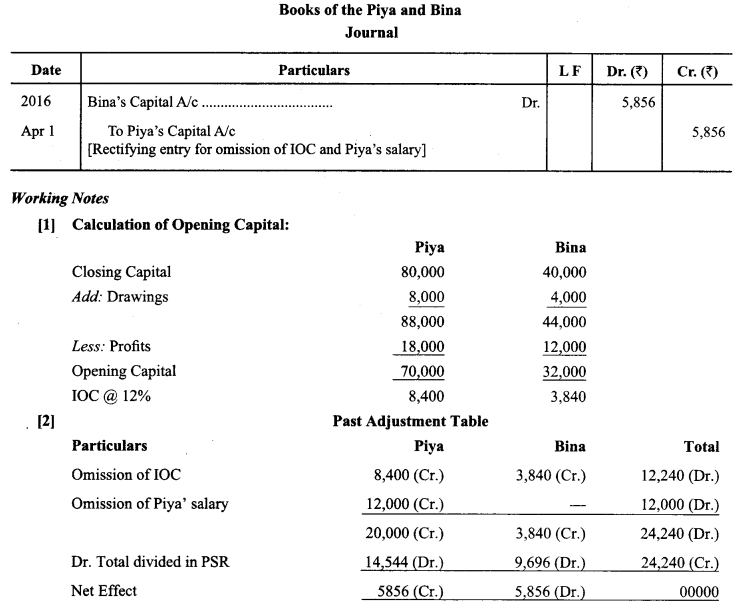
Class 12 Accountancy Important Extra Questions Chapter 2 Accounting for Partnership Basic Concepts 41

Accounting for Partnership: Basic Concepts Important Extra Questions Long Answer Type

Question 1.
Moli, Bhola and Raj were partners in a firm sharing profit and losses in the ratio of 3 : 3 : 4. Their partnership deed provides for the following:

  • Interest on Capital @ 5% p.a.
  • Interest on Drawing @ 12% p.a.
  • Interest on Partner’s Loan @ 6% p.a.
  • Moli was allowed an annual salary of ₹4,000.

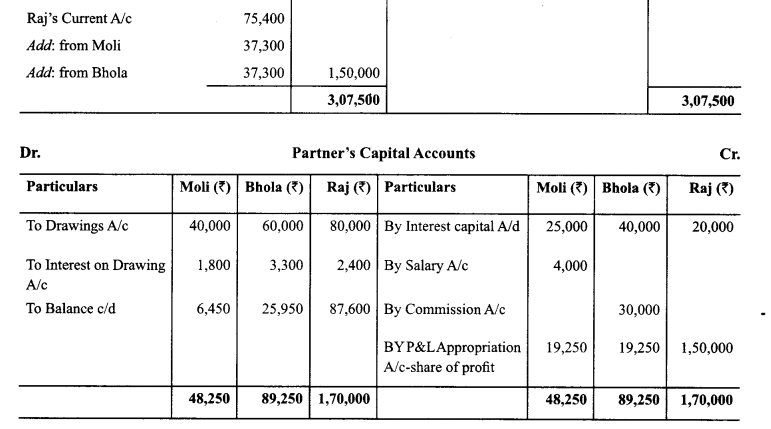
Bhola was allowed a commission of 10% of net profit as shown by Profit and Loss Account and Raj was guaranteed a profit ₹ 1,50,000 after making all the adjustments as provided in the partnership agreement. Their fixed capital were Moli ₹5,00,000, Bhola ₹8,00,000 and Raj ₹4,00,000. On 1st April 2016 Bhola extended a loan of ₹ 1,00,000 to the firm. The net profit for the year en ded 31st March 2017 before interest on Bhola’s Loan was ₹3,06,000. Prepare Profit and Loss Appropriation Account of Moli, Bhola and Raj for the year ended 31 st March 2017 and their Current Account assuming that Bhola withdrew ₹ 5,000 at the end of each month. Moli withdrew ₹ 10,000 at the end of each quarter and Raj withdrew ₹40,000 at the end of each half year.
(CBSE 2018-19)
Answer:
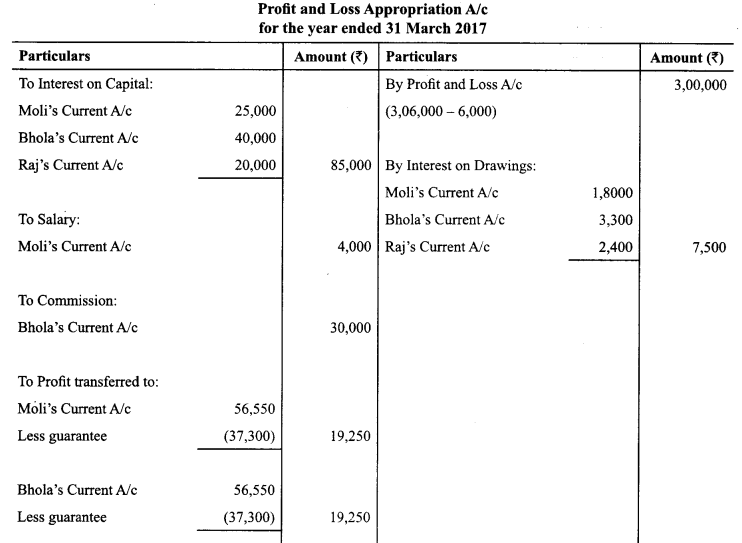
Class 12 Accountancy Important Extra Questions Chapter 2 Accounting for Partnership Basic Concepts 42
Class 12 Accountancy Important Extra Questions Chapter 2 Accounting for Partnership Basic Concepts 43

Question 2.
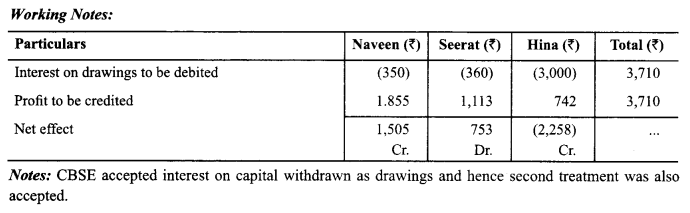
Naveen, Seerat andHina were partners in a firm manufatcturing blankets. They were sharing profits in the ratio of 5:3:2. Their capitals on 1st April, 2012 were ₹ 2,00,000; ₹ 3,00,000 and ₹ 6,00,000 respectively. After the floods in Uttaranchal, all partners decided to help the flood victims personally.
For this Naveen withdrew ₹ 10,000 from the firm on 1st September, 2012. Seerat, instead of withdrawing cash from the firm, took blankets amounting to ₹ 12,000 on 1st October, 2012 from the firm and distributed to the flood victims. On the other hand, Hina withdrew ₹ 2,00,000 from her capital on 1st January, 2013 and set up a centre to provide medical facilities in the flood affected area.
The partnership deed provides for charging interest on drawings @ 6% p.a. After the Final Accounts were prepared, it was discovered that interest on drawings had not been charged. Give the necessary adjusting journal entry and show the working notes clearly. (Delhi Compartment 2014, Modified)
Answer:
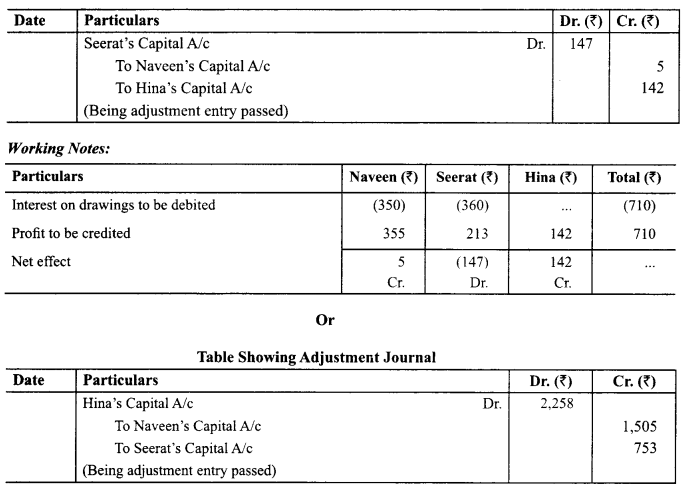
Class 12 Accountancy Important Extra Questions Chapter 2 Accounting for Partnership Basic Concepts 44
Class 12 Accountancy Important Extra Questions Chapter 2 Accounting for Partnership Basic Concepts 45

Rights and Duties in the Indian Constitution Class 11 Important Extra Questions Political Science Chapter 2

Here we are providing Class 11 Political Science Important Extra Questions and Answers Chapter 2 Rights and Duties in the Indian Constitution. Political Science Class 11 Important Questions with Answers are the best resource for students which helps in class 11 board exams.

Class 11 Political Science Chapter 2 Important Extra Questions Rights and Duties in the Indian Constitution

Rights and Duties in the Indian Constitution Important Extra Questions Very Short Answer Type

Question 1.
What is Fundamental Right?
Answer:
Fundamental Rights are those rights, claims, and facilities that have been considered very essential for the development of the citizens by the state and have been ensured by the constitution-making them justiciable.

Question 2.
Why Fundamental Rights are necessary?
Answer:
Fundamental Rights are necessary for the all-around development of the citizens. They are also necessary for the success of democracy. Fundamental Rights put a check in the rules. Fundamental Rights are fundamental in governance.

Question 3.
What is Legal Right?
Answer:
Legal rights are those claims, demands, and facilities which have been allowed and protected by the ordinary Law of the Legislature and which varies from time to time.

Question 4.
What are equality before the law and equal protection of Law?
Answer:
Equality before the law means that every person irrespective of his caste, race, color, and status will be considered equal before Law. Equal protection of Law means that Law will be enforced uniformly.

Question 5.
Which right removes the untouchability?
Answer:
Art-17 of Fundamental Right of Equality provides for the removal of untouchability which has been practiced for a long time in our society.

Question 6.
Write four main features of our Fundamental Rights;
Answer:

  1. Our Fundamental Rights are not absolute. Some reasonable restrictions can be imposed upon them.
  2. Fundamental Rights are justiciable.
  3. Fundamental Rights can be amended and can be snatched in an emergency.
  4. Fundamental Rights make difference between citizens and aliens.

Question 7.
Which Fundamental Rights protects these Rights?
Answer:
Fundamental Rights of Constitutional Remedies protect other rights because they enable the citizens to move to courts if any of the rights are denied or violated. It. is considered the most important right and has been considered as heart and soul of the Constitution by Dr. B.R. Ambedkar.

Question 8.
Which liberties are givens in Art 19?
Answer:
People enjoy six liberties in the Right of speech and expression given in Art-19 of the Constitution. Their liberties are as under-

  1. Right of speech and expression, the way they like.
  2. Right to assemble peacefully.
  3. Right to form an association.
  4. Right to move freely throughout the territory of India.
  5. Reside and settle in any part of India.
  6. Practice any profession, any occupation, trade, or business.

Question 9.
What is given in Art 16 (4)
Answer:
This article in part of the Right of Prohibition of discrimination in the matter of employment. This provides that nothing in this article shall prevent the state from making any provision for the reservation of appointment or posts in favor of the state, is not adequately represented in the services under the state.

Question 10.
What right is given in Art 21 of the constitution?
Answer:
This article provides for the protection of life and personal liberty. It says that no person shall be deprived of his life or personal liberty except according to* procedure established by Law. This means the life and liberty of a person cannot be taken arbitrarily.

Question 11.
What is Habeas corpus?
Answer:
A writ of Habeas corpus means that the court orders that the arrested person should be presented before it. It can also order to get free an arrested person if the manner or grounds of arrest are not lawful or satisfactory.

Question 12.
Why and when were Fundamental Duties added to the Constitution?
Answer:
As we know that in the original Constitution Fundamental Duties were not added to Constitution. When the emergency was imposed by the Indira Gandhi government in 1975 the need for Fundamental Duties was felt hence ten Fundamental Duties were added in the Constitution by 42nd Amendment 1976 in the IVth A part of the Constitution in 51 A article.

Question 13.
What do you mean by Directive Principles of State Policy?
Answer:
Directive Principles are the socio, economic conditions, facilities that are to be kept in mind by the central and state governments while making policies. They have been named as Directive Principles because they will be guiding principles of policies of the government of the day.

Question 14.
What is the importance of the Directive Principles of State Policies?
Answer:

These principles are the pious fishes of. the constitution-makers which they wanted to give the citizens but could not make guarantee because of the paucity of resources. Hence they left these on the will of the coming governments as per the availability of resources. The purpose of their principles is to build socio, economic democracy.

Question 15.
Write three principles
Answer:

  1. Upliftment of weaker sections of the society.
  2. Educational and health development of the people.
  3. To implement Question Gandhian principles. ,
  4. To have independent foreign policy and to promote international peace.

Rights and Duties in the Indian Constitution Important Extra Questions Short Answer Type

Question 1.
From where our constitutibiMoakers took the Fundamental Rights and with what difference?
Answer:
During the freedom struggle itself, the need for Fundamental Rights was realized because of the colonial legacy of India. For the first time, this demand of Fundamental Rights was put in Nehru Report 1928. After national inde¬pendence it was natural to include and protect Fundamental Rights in the Constitution. The Constitution listed seven Fundamental Rights that would bo-protected through Judicial interference. However basic idea was borrowed from the U.S.A. which had included the Bill of Rights.

We adopted Fundamental Rights from the U.S.A. but with the following differences:

  1. The Fundamental Rights are scattered in the Constitution of the U.S.A, while in our constitution, they are described in one chapter only from Art-13 to Art 35.
  2. Our Fundamental Rights are not absolute while the Fundamental Rights given in the USA are absolute which means they cannot be suspended or amended.

Question 2.
Explain the Right of Equality.
Answer:
Right of Equality is the first Fundamental Right described from Art 14 to Art 18. This is the most significant right for the development of a citizen.

Art 14 – gives Equality before the law and Equal Protection of law which means no one will be discriminated before the law, on the ground of caste, color, and status, and the law will be implemented in a uniform way.

Art 15 – Prohibition of Discrimination which means no one will be discriminated at a public place, on any ground of sex, caste, color, or region.

Art 16 – Prohibition of Discrimination in a matter of Employment.

It means that no one will be discriminated in matter of employment on any ground of each, color, sex or region and all will get equal opportunities but there can be positive discrimination to uplift these people,.who have been traditionally exploited and backward.

Art 17 – It seeks to abolish untouchability.

Art 18 – Abolition of titles

With the purpose of establishing an egalitarian society, unwanted titles and privileged classes are to be abolished.

Question 3.
Explain Right against Exploitation.
Answer:
Right against Exploitation is of great significance and is explained in Art 23 and 24. Art 23 provides for prohibition of forced labor like bonded labor, beggary, and human trafficking

Art 24 – It prohibits the employment of children below the age of 14 years in hazardous jobs in hotels, machines, mines, and industries. Child labor has been made illegal. The right to Education has been made Fundamental Right for children.

Question 4.
Explain Light of Liberty
Answer:
Fundamental Right of Liberty is related to political and civic liberties. It has been described from Art 19 to Art 22.

Art 19 give

  1. Right of expression and speech.
  2. Right to assemble peacefully
  3. Right to form an association.
  4. Right to move anywhere in Indian territory.
  5. Right to settle anywhere in India.
  6. Right to choose any occupation, business, or trade.

Art 20. This article gives three rights.

  1. A person can be punished for an offense only by law which was in force at the time of the commission of an offense.
  2. No person can be punished twice for the same offense.
  3. No person can be compelled to be a witness against himself.

Art 21- It gives life and liberty. It says that the life and liberty of a person cannot be taken except with the procedure established by law.

Art 22 – It gives rights to defenses.

  1. No one can be arrested without telling him the reason for the arrest.
  2. A detained person has to be produced before a first-class magistrate within 24 hours for a fair trial.
  3. Such detained person has the right to have his defense through a lawyer.

Question 5.
Explain Right of Religions Liberty
Answer:
India is a country of people of different religions and beliefs. . Constitution makers have given all citizens the right of religious liberties. This right is described from Art 25 to Art 28

Art 25 – Gives religious liberty to every citizen i.e., to profess and practice any religion as a personal matter. The state will neither patronize any religion now discriminate against. This right establishes the secular credentials of India.

Art 26 – Liberty of managing own religious affairs and to own, acquire, and to administer properties for a charitable purpose.

Art 27 – It prohibits compulsory religious instructions in an educational institution maintained, recognized, or aided by the state.

Art 28 – It gives liberty to religious institutions to take aid from the state on an equal basis.

Question 6.
Explain the Right of Education and Culture.
Answer:
India is a multiple society with people of different caste, color, culture, races and directs, languages and geographies. To promote their aspirations and identities the Constitution makers have given this Fundamental Right of Education and Culture which has been described in the Constitution from Art 29 to Art 30.

Art 29 – It is provided in this Constitution that no minority whether based on religion, community, language shall be discriminated against and all minorities will be given full opportunities for their fuller development.

Art 30 – It is provided that to promote their culture and identities, all the minorities can open educational institutions and can get financial aid from the state on the basis of equality.

Question 7.
Explain Fundamental Right of Constitutional Remedies. Why it is called as heart and soul of the constitution by Dr. B.R. Ambedkar?
Answer:
Fundamental Right of Constitutional Remedy is given in Art 32 of the Constitution. It gives the status of justiciability to the Fundamental Rights given in the third part of the Constitution. It is rightly called the heart and soul of the constitution by Dr. B.R. Ambedkar. Without this fight, other rights would have been meaningless because this right gives the right to the people to go to court if their other Fundamental Rights are violated or denied by the Executive or Legislature.

Question 8.
Explain following terms
1. Habeas Corpus
2. Mandamus
3. Prohibition
4. Certiorari
5. quo Warranty

Answer:
1. Habeas Corpus: It is the order of the court to present the arrested person before it for a fair trial. It can also order to set free such an arrested person if the manner or ground of arrest .are not lawful or satisfactory.

2. Mandamus: This writ is issued when the court finds that a particular officeholder is not doing legal duty and thereby is violating the right of an individual

3. Prohibition: This writ is issued by a higher court (High court or Supreme court) when a lower court, has considered a case beyond its jurisdiction.

4. Certiorari: In this writ court orders a lower court or another authority •to transfer a matter pending before it to a higher authority or court.

5.  quo-Warranto: If the court finds that a person is holding office but is not entitled to hold that office, it issues orders of quo-Warranto to restrict that person from acting as an office holder of that office or position.

Question 9.
Describe Fundamental Duties of the Constitution.
Answer:
Ten Fundamental Duties have been added in the Vlth Part Art 51A of the Constitution by 42nd Amendment of the Constitution in 1976. In the original Constitution, there was no chapter of Fundamental duties.

Followings are Ten Fundamental duties.

  1. To abide by the Constitution and respect the national Flag and National Anthem.
  2. To cherish and follow the noble ideals which inspired the National movement,
  3. To protect the sovereignty, unity, and integrity of India.
  4. To depend on the country.
  5. To promote the spirit of common brotherhood amongst all the people.
  6. To preserve the rich heritage of our common culture.
  7. To protect and improve the natural environment
  8. To develop a scientific temper and spirit of inquiry.
  9. To safeguard public policy.
  10. To starve towards excellence in all spheres of undivided and collective life:

Question 10.
What do you mean by Directive Principles of State Principles? What is their significance?
Answer:
Directive Principles are guidelines regarding socio-economic policies that are to be kept in mind by central governments and state governments while making various welfare policies. These Directive Principles have been described in the IVth part of the Constitution from Art 36 to Art 51 of the constitution. In a way, they are pious intentions and moral guidelines of Constitution makers. The very purpose of these directions is to establish economic democracy by improving the standard of the people. These Directive Principles are a source of inspiration for the government. However, their principles are not made justiciable which means they cannot be claimed in the court of law. They are-at the will of the government.

They are of four types which ar6 as under:

  1. Socio-economic principles
  2. Liberal principles
  3. Gandhian principles
  4. International Principles

These directive principles have changed the face of society.

Question 11.
Differentiate between Fundamental Rights and Directive Principles of State Policy.
Answer:
The followings are the main differences between Fundamental Rights and Directive Principles of State Policy.

  1. Fundamental Rights are justiciable while Directive Principles are not justiciable.
  2. The purpose of Fundamental Right is to establish political democracy while the purpose of the Directive Principle of State Policy is to establish economic democracy.
  3. The language of Fundamental Rights is legal while the language of Directive principles is not legal.
  4. Fundamental Rights make a distinction between citizens and aliens but Directive Principles of State Policy does not make any distinction.
  5. Fundamental Rights are guarantees while the Directive Principles of State Policy are just assurances.

Question 12.
In brief, explain the conflict between Fundamental Right and Directive Principles of State Policy.
Answer:
Although Constitution makers added the chapters of Fundamental Rights and Directive principles as complementary to each other some controversy developed when land reforms were introduced, Litigations were started on the ground of violation of Fundamental Rights. The honorable court held that Parliament can amend the Fundamental Rights, but this position was reversed in the Golakhnath case in 1967 in which it was held that parliament cannot amend Fundamental Rights. To nullity the effect of the decision of the Golakhnath case, the government brought a constitutional amendment, which was again challenged in the Keshwanand case 1973.

In this case, the Supreme court held that Parliament can amend any part of the constitution including Fundamental Rights but cannot change the basic structure of the Constitution. By 42nd amendment in 1976, the Fundamental Rights were made inferior to the Directive Principles of State Policy. With the increasing welfare policies of the gov¬ernment, Directive Principles have become more important. But ultimately Fundamental Rights and Directive Principles are not against each other but are complementary to each other as the purpose of both is the welfare and devel¬opment of a citizen of India.

Question 13.
Write some measures of government as part of Directive Principles of State Policy.
Answer:

  1. Land reforms
  2. The ceiling on an urban and rural property
  3. Nationalization of Banks
  4. Abolition of the princely purse
  5. An old-age pension scheme
  6. Fixed minimum wage
  7. Enactment of factory laws
  8. Cottage and small scale factory
  9. GraminRojgar Yojna
  10. Women empowerment
  11. Insurance schemes
  12. Housing development
  13. Removal of untouchability.
  14. Reservation for the upliftment of Sc’s, St’s, and backward classes.
  15. To check Environment pollution.

Question 14.
Explain the socio-economic principles of the chapter of Directive Principles of State Policy.
Answer:
Main guidelines regarding socio-economic upliftment of the people are contained in Art 38 and Art 39 of the Constitution which is as under.

  1. To secure a social order for the promotion of the welfare of the people and to minimize inequalities of income and status.
  2. To build a socialistic pattern of society.
  3. Equal-pay for equal work.
  4. That the ownership and control of the material resources of the community are so distributed as best to serve the purpose of the common good.
  5. There should not be a concentration of wealth and were in few hands.
  6. To raise the standard of living of people of Sc’s, St’s and backward castes and handicaps and aged persons.
  7. Protection of children, women, and workers from exploitation and to ensure proper working conditions for the laborers.
  8. To ensure minimum wages for the workers.

Question 15.
Explain the Liberal Principles given in the chapter of Directive Principles of State Policy. –
Answer:
Followings are Liberal Principles which are given as guidelines in the chapter of the Directive principle of State Policy.

  1. To secure for the citizens a uniform civil code throughout the territory of India Art 44.
  2. To provide for provision for free and compulsory education for children Art 45.
  3. To provide educational and economic interests of scheduled castes, scheduled tribes, and weaker sections.
  4. To protect and improve the environment and to safeguard the forests and wildlife of the country.
  5. To protect monuments and places and objects of national importance.
  6. To take steps to separate the judiciary from the executive.

Rights and Duties in the Indian Constitution Important Extra Questions Long Answer Type

Question 1.
Discuss the importance of Fundamental Rights and Directive Principles in the development of Indian democracy and people’s welfare.
Answer:
After independence, the nation faced two important tasks ahead. First was the national reconstruction and development and the second task was to improve the socio-economic, cultural, moral, psychological standard of the people of India who have been victims of untold sufferings in the era of colonialism.

Keeping in new this fact, the Constitution makers had introduced the chapter of Fundamental Rights in tire Hard part of the Constitution for the purpose of political democracy, and the chapter of Directive Principles of State Policy in the IVth part of the Constitution for the purpose of economic democracy.

With the enjoyment of Fundamental Rights, the people of India have attained new confidence and a sense of belongingness. Right of Equality has given a new face to Indian society. The sense of law vanishes. Untouchability is abolished. Equalitarian society is built up by removing the titles and privileged class.

Exploitation in any form banned. As a mark of secularism people are given liberty in matters of Religion. To strengthen unity in diversity, the Right of. Education and Culture are given to linguistic, geographical .and religious minorities to ensure the availability of the rights, Art 32 Right of Constitutional Remady has made Fundamental Rights justiciable.

Similarly, Directive Principles of State Policy has helped in raising the standard of living of people, particularly of weaker sections of society like Scheduled castes, Scheduled tribes, women, backward castes, handicapped, aged, laborers and farmers. The central government and state governments respecting the directions of constitution-makers and as per welfare nature of India state, have started many welfare measures to meet the end of Directive ‘ Principles.

Some of these measures are:

  1. To build a socialistic pattern of society, to secure the cause of the common good.
  2. Removal of concentration of wealth.
  3. Minimum wages of laborers are fixed.
  4. Old age Pension Schemes.
  5. To improve the health of children and women.
  6. Protection of the environment and to provide? drinking water.
  7. Land Reforms implement and ceiling op property.
  8. Equal pay for equal work.
  9. Bank nationalization and Loan on cheaper rates
  10. Gramin Rojgar Yojna.

In this way, we can say that Fundamental Rights and Directive Principles have helped in making India a welfare state.

Constitution: Why and How? Class 11 Important Extra Questions Political Science Chapter 1

Here we are providing Class 11 Political Science Important Extra Questions and Answers Chapter 1 Constitution: Why and How?. Political Science Class 11 Important Questions with Answers are the best resource for students which helps in class 11 board exams.

Class 11 Political Science Chapter 1 Important Extra Questions Constitution: Why and How?

Constitution: Why and How? Important Extra Questions Very Short Answer Type

Question 1.
What is society?
Answer:
Society is a group of people of the same race, socio, economic background, and cherishes common aspirations. Due to social instinct when they come together and their relationship gets institutionalized, it constitutes a society.

Question 2.
Why certain rules are necessary for society?
Answer:
Certain rules and understandings are very necessary for observance by the members of society so that their relationship is properly maintained. These rules will help in maintaining the discipline and realizing the objectives of the society.

Question 3.
What is Constitution?
Answer:
The constitution is a body of rules and regulations, understandings, and modes of behavior on the basis of which the government is constituted and run. The constitution specifies the areas of functions between the organs of the government. It also sets the mode of .relationship between citizens and the state.

Question 4.
Why is the Constitution needed?
Answer:
As said the Constitution is the body of rules, regulations, and common understanding, it is very much needed to achieve definiteness in the relations of citizens and different organs of the government. The Constitution may be written or unwritten. Constitution also put the check on rulers.

Question 5.
What is Constitutionalism?
Answer:
Constitutionalism stands for the check on arbitrariness and whimsical behavior of the ruler and to ensure rule by rational decisions. It seeks to establish the rule of law for the welfare of the people. The constitution is the product of constitutionalism. Constitutionalism also stands for rule by rational discussion, debate, and consent.

Question 6.
What is Constituent Assembly?
Answer:
A constituent assembly is a body of renowned persons who are engaged in discussion debate and decision-making process and then drafting the Constitution. Most of the constitutions of world countries are written by the Constituent Assemblies.

Question 7.
How much time was taken by Constituent Assembly to write the Constitution?
Answer:
The Constituent Assembly to write the Indian Constitution was constituted in 1946 and it completed the work on 26th November 1949. It took two years, eleven months, and eighteen days to complete the Constitution of India.

Question 8.
What are the main functions of the Constitution?
Answer:
The Constitution is the DQ document whose main function is to demarcate the jurisdiction of organs of the government. It also suggests the composition of the government. It also sets the relationship between the state and citizens. The main function of the Constitution is to limit the powers of the government.

Question 9.
What is an unwritten constitution?
Answer:
A written Constitution is in the form of a document while an unwritten constitution is based on understandings, traditions, usages, and convention. An unwritten constitution means observance of certain accepted modes of behavior.

Question 10.
Name main countries from where institutions and features are taken for the Indian Constitution.
Answer:
It is said that the Indian Constitution is a borrowed bag because this Constitution has many foreign sources. Britain has the maximum impact on the Indian Constitution. Besides Britain, the USA, Canada, Ireland, Australia, and South Africa are the countries that have influenced the Indian constitution. It is rightly said that the Indian Constitution is a borrowed bag.

Question 11.
How the decisions were taken by Constituent Assembly?
Answer:
Taking decisions in the Constituent Assembly was not easy because of thorny issues. There were many people and groups of divergent opinions. But all the members were fired with a high sense of patriotism. Therefore all the decisions were taken by consensus which could be possible by the spirit of accommodation. ,

Question 12.
What is the Preamble of the Constitution?
Answer:
A preamble is the introductory part of the Constitution which gives the idea of forms of government, values, philosophy, and commitment of the Constitution. Preamble helps in the interpretation of the Constitution.

Question 13.
What was the significance of the Cabinet Mission Plan?
Answer:
Cabinet Mission Plan was appointed by the British Government in 1946 to discuss the modalities of the Constituent Assembly with the Indian leaders. With the discussion by Indian leaders, the Cabinet Mission plan gave its recommendations on the basis of which the Constituent Assembly was constituted.

Question 14.
From where the Constitution drew its authority?
Answer:
The Constitution drew its authority from the Constituent Assembly which was representative of the people. Therefore ultimately the people are /the source of the authority of the Constitution. In Preamble the stating words are We the people of India, which means to say that people support this Constitution.

Question 15.
How India is Republic?
Answer:
India is Republic. It is very much given in the Preamble of the Constitution. India has an elected head in the form of a President. Therefore India is Republic.

Constitution: Why and How? Important Extra Questions Short Answer Type

Question 1.
What do you mean by Constitution? How it performs its role for society?
Answer:
A Constitution is fundamental law of the land. It can be defined as the body of rules, regulations, and understandings on the basis of which state is’ constituted and governed. The Constitution is also the instrument of realizing the aspirations of the people. It plays a vital role for society as it specifies the basic allocations of power in society. The Constitution of a country indicates the framework of the government with the respective role of each organ of the government. The Constitution influences society and in turn is influenced by society. Indian Constitution represents the ethos, values, and preferences of Indian people and at the same time has successfully given the direction to Indian society to become a liberal, secular, democratic, and modern society. The constitution plays this role in all societies. We can take the example Of Chinese and Russian Constitutions also.

Question 2.
Discuss the importance of a written constitution.
Answer:
The constitution explains the structure of government and the mode of governance. Generally, the constitution is to be taken as a written one but it does not mean that there cannot be an unwritten constitution. British Consti¬tution is the example of the unwritten constitution which is working on the basis of unwritten understandings, traditions, and conventions. But in most of the countries of the world, there are written constitutions which are in the form of a document written by a specially constructed Constituent Assembly. The written constitution has its own utility and importance. The written part of the constitution is a clear indicator of the jurisdiction or powers of a particular organ. There cannot be any ambiguity in a written constitution if it is, it can be explained. A written constitution is generally available in the form of a document that is prepared by continuous discussions and debate and with due process of decision making. It may be the majority method or it can be based on consensus. Therefore a written constitution is more popular.

Question 3.
Write the composition of the Constituent Assembly of India.
Answer:
Indian Constitution is written by a specially constituted Constituent Assembly. This Constituted Assembly had a total strength of 389 members, whose composition was as follows:

  1. 292 members from British ruled states
  2. 93 members from Princely states
  3. 4 members of minorities like Sikh and Anglo Indians

The elected members were to be indirectly elected by the state Assemblies which were constituted by the election of 1946 to the states on the basis of the Government of India Act 1935. Therefore this Constituent Assembly was constituted by indirect elections and nomination. It was constituted as per recommendations of the Cabinet Mission Plan 1946 which came to India after the formation of a new government led by Mr. Atlee in Britain. The Constituent Assembly enacted this Constitution on 26 November 1949 by taking the time of two years, eleven months, and eighteen days. The idea of a Constituent Assembly had come to prevail largely as an article of faith in almost all the politically minded classes in the country.

Question 4.
Write important features of the Indian Constitution.
Answer:
The main features of the Indian Constitution are as under:-

  1. Written Constitution
  2. Flexible and rigid Constitution
  3. The preamble of the Constitution
  4. Liberal Constitution.
  5. Parliamentary form of government
  6. Federal system of government
  7. Republican system
  8. Fundamental Rights
  9. fundamental Duties
  10. Directive Principles of State Policy
  11. Secularism
  12. Bicameral Legislature of center
  13. Adult Franchise
  14. Multi-Party System
  15. Power of Judicial Review to the Judiciary
  16. Mixed economy
  17. Single citizenship
  18. Supremacy of Constitution

Question 5.
How the powers are demarcated in Indian Constitution?
Answer:
The important base of the effectiveness of a constitution is a balanced arrangement of the distributions of power and allocation of areas of work (jurisdiction) among the institutions and organs of the government. The basic principle on which the constitution worked was that the government must be democratic and committed to the welfare of the people. The constitution-makers, for the purpose of evolving the right balance among the various institutions like the executive, the legislature, and the judiciary, adopted parliamentary form government and federal-arrangement between the center and states. This will lead to the distributions of power between the legislature and executive on the one hand and between the central government and the state governments. For this purpose the powers were distributed on the basis of three lists as under :

  1. Union list 96 subjects
  2. State list 66 subjects
  3. Concurrent list 47 subjects. The residual powers rest with the center

Question 6.
Write four important functions of the Constitution.
Answer:
As the constitution is a framework of Government and embodiment of ethos, values, goals, and commitments of the people, it performs a number of functions for the society and the rulers i.e. government. Its main functions are as under:

1. The first function of a constitution is to provide a set of basic rules that allow for minimum co-ordination and assurance amongst members of society. Constitutions provide authority to the government for framing rules, regulations, and their issuance and implementation for the purposes of main co-ordination among the people of the people and to establish discipline.

2. the Second function is to provide the framework of government and decide the area of jurisdictions of each organ of the government to make the decisions, about the people. It also decides, how the government will be constituted.

3. The third function of a constitution is to set some limits on what a government can impose on its citizens. These limits are not to be violated by the organs of the government and the people. Citizens are given four Fun-damental Rights that cannot be violated by the government. So these fundamental rights are given protections.

4. The fourth important function of the constitution is to ensure the fulfillment of the aspiration of the people and the governmental system.

Question 7.
How far you agree that the Indian Constituent Assembly was a representative body?
Answer:
Although members of the Constituent Assembly were not directly elected by the people there was a serious effort and intention to make the Assembly a representative body. In fact, at that time adult franchise’ was not prevailing, and also the situation k that time was conducive to hold the elections directly. Therefore it was decided that members of the Constituent Assembly be elected by the members of legislative Assefnblies of the states. Besides this through the process of nomination efforts were made to give representation to all shades and opinions. In the election also members of all religions were given due representation.

In terms of Political parties, the Congress party which dominated -the’- political scene at that time, also dominated the composition of the Constituent Assembly. The Congress itself was such a party that managed to accommodate almost all sections of the society. Therefore we can conclude that CoristituenK Assembly was a representative body.

Question 8.
How Parliament is subordinate to that of the Constitution in India?
Answer:
In India, Parliament is certainly subordinate to the Constitution because Parliament is the product of the Constitution which has set the composition and jurisdiction of the Parliament. In India, we have the supremacy of the Constitution and not of Parliament. Parliament will discharge its duty on the areas, assigned by the Constitution. Parliament can make laws on the issues which are given in the centralized and some times on the issues of stateliest also. But its laws are open for judicial review. Therefore we can say that in India, Parliament is subordinate to Constitution which can be altered only by the Constituent Assembly.

Question 9.
What goals are set in the Indian Constitution?
Answer:
Indian society inherited inequality, discrimination, illiteracy, and injustices as a legacy of British imperialism. After independence, the people of India had high hopes. Constitution makers were aware’ of these needs and aspirations of the people. Therefore new goals for the society were set to be realized through the governmental machinery. These objectives were incorporated in the Preamble of the Constitution. The framers of the Indian constitution thought that each individual in the society should have all that which is necessary for them to lead a life of minimum dignity and social self-respect and also minimum material well-being. Therefore to achieve egalitarianism is the first goal of the Constitution. To achieve these goals, related values like justice equality, liberty, the dignity of the individual, fraternity among the people of the country are incorporated. National integrations are also the goal of the Constituent.

Question 10.
On which philosophy our Constitutions is based?
Answer:
The preamble of the Indian Constitution explains the philosophic basis. It is based on socialist, secular, and democracy: Constitution seeks to build the society on the socialistic pattern which means the availability of minimum needs of everyone and the removal of disparity among people. Socialism means each according to his ability and to each according to, his needs. This philosophy of socialism seeks to build an egalitarian society. Another philo¬sophic base is secularism which means freedom to citizens in matter or religion. It stands for no state religion because religion is a personal matter of man.

Another philosophy that seeks to achieve is democracy i.e. full participation of the people on the matter of administration and decision-making process.

Question 11.
How our constitution is an instrument of socio-economic change?
Answer:
Keeping in view the socio-economic fabric of society which we inherited from the British Raj over Constitution makers set the objectives of the Constitution is the Preamble of the constitution and chapters like of Fun¬damental Right and Directive Principles of State Policy were added in the Constitution.

On close observation and study of the performance of the working of the Constitution, we find that there is a vast change in the socio-economic scenario. Liberal and democratic cultures seem to be pervasive. The literary percentage is increased many folds. There is an appreciable improvement in health, housing, and drinking water. quality of life is improved. Social evils like untouchability and sense of high and low status are diminishing. Per Capita income has increased and employment opportunities are also increased. Democracy is mattering. It is definitely because of the triple mentality constitutional provisions.

Question 12.
How the Constitution make the people one collective entity?
Answer:
In fact, a constitution expresses the fundamental identity of people, and people as a collective entity comes into being only through the basic constitutions. It’ is by agreeing to a basic set of norms about how one should be governed and who should be governed that one forms a collective identity. One has many sets of identities on the basis of race, caste, color, language, and the area which exists prior to the constitution, but by agreeing to certain basic norms and principles, one assumes one’s basic political identity. Secondly, values and norms set in the constitution provide a framework within which one pursues individual aspirations, goals, and freedom.

Therefore constitution provides social, political, and also ethical identity to the people. It is therefore through the constitution people get collective identities. institutions like the Executive, Legislative, and Judiciary. It means that all above institutions will draw their authority and Jurisdiction from the constitution. They will discharge their powers as had been given and allowed by the constitution. The Judiciary will have the final word on the interpretation of the constitution. But Judiciary will also work as per provisions of the constitution. No one is above the constitution. Parliament will make law as per area and subjects allowed by the constitution. The basic structure of the constitution cannot be changed by Parliament. However, it can be changed by Constituent Assembly only. The supremacy of the constitution means that no person or authority or institution is above the constitution.

Question 14.
What features we have borrowed from the USA and Britain for our constitution.
Answer:
As said the Indian Constitution is a borrowed bag because our constitution is indebted to many countries from we have a number of features. From the USA we have borrowed the following features:

  1. Written Constitution
  2. The preamble of the Constitution
  3. Fundamental Rights
  4. The post of Vice-President
  5. Power of Judicial review for our Judiciary.

Britain: From Britain, we have borrowed the following features:

  1. Single citizenship
  2. Bureaucracy
  3. The parliamentary system of Government
  4. Rule of law
  5. Integrated judiciary
  6. Bicameral legislative

Question 15.
How we can ensure the success of a Constitution?
Answer:
For the success and faithful obedience of the constitution, there should be some kind of internal mechanisms that no group of the society or no organ of the government become so powerful who could think of subverting the Constitution.

For example, American Constitution has such a mechanism as American Constitution is based on the theory of separation of power with a check and balance system which ensures that no organ will become arrogant and monopolistic in its jurisdiction because there is another organ to check it. Indian Consti¬tution also has fragmented the powers across different institutions like the legislature, executive, judiciary, and even some other constitutional indepen¬dent bodies like the Election commission. Secondly, to obtain the regular support of the people, the constitution must strike the right balance between certain values, norms, and procedures as authoritative and at the same time allow enough flexibility in its operation to adopt the changing needs and circum¬stances.

Question 16.
Write some features of the Cabinet Mission Plan?
Answer:
The Constituent Assembly which framed the Indian Constitution was constituted on the basis of the cabinet mission plan’s recommendations. Its main recommendations are as under:

  1. Each province and princely state Were allowed seats proportional to their respective population roughly in the ratio of 1: 10,00,000. Which divided 292 members from British states and 93 seats from the Princely states.
  2. Seats in each province were distributed among the three main com¬munities i.e. Muslims, Sikhs, and general.
  3. Members of each community in the Provincial Legislative Assembly
    elected their own representatives.
  4. The method of selection was to be determined by consultation.

Constitution: Why and How? Important Extra Questions Long Answer Type

Question 1.
Giving a brief history of the demand of the Constituent Assembly, explain the theoretical and constitutional framework of the Indian Constitution.
Answer:
During the national movement, there has been a persistent demand for the composition of a Constituent Assembly. Such demand was first of all raised in Nehru Report in 1928.’vWhen after, Second World War, the British government put the demand for co-operation in the war through August offer 1940, Cripp’s Mission 1942 and Wavel Plan 1945.

Every time Congress raised the demand of setting up of a Constituent Assembly. Which was ultimately accepted through the cabinet Mission Plan 1946. Gandhi had aired the demand of the Constituent Assembly several times in strong words. This was referred by Dr. Rajendra Prashad as the first Chairman of Constituent Assembly on 9th December 1946 as that Swaraj would mean wishes of the people as expressed through their freely chosen representative. The idea of a Constitu¬ent Assembly had come to prevail largely as an article of faith in almost all the politically minded classes in the country.

The Constituent Assembly was constituted by indirect election. An attempt was made to make this body representative of the body. It took the decisions by accommodation and consensus. It took two years, eleven months and eighteen days to complete this Constitution on 26th November 1949 and which was adopted on 26th January 1950, which we celebrate as Republic day because in this Constitution we are given the provisions of an elected President. Before this, there was the post of nominated Governor-General.

The preamble of the Constitution is a very significant part of the Constitution. By going through the Preamble one can understand the theoretical and institutional framework. The Preamble of the Indian Constitution speaks like this: “We the people of India. Solemnly resolve to constitute India a ‘Sovereign, Secular Socialistic, Democratic, Republic, there will be Justice – Social-economic and political

Liberty – of thought and expression EQuestion equality – of status and opportunity and dignity, fraternity, and national integration will be the ultimate objectives.

The above description of the Preamble tells the nature of the state which is sovereign, the nature of society i.e socialistic and secular, and the nature of the polity which is the Democratic Republic. It is the institutional framework of the con¬stitution.

The theoretical framework is also given in the Preamble of the consti¬tution. The critical framework includes all those values, commitments philosophy, and goals. The Constitution seeks to establish an equalized society by removing the glaring inequalities prevailing in the society to achieve the value of justice. Seemed important value is the liberty of thought and expression. The institution seeks liberty for every citizen so that he or she may feel confident and independent and sense responsibility and sense of belonging guess. Another value is equality of status and opportunity which is needed for the dignity of man.

To achieve national integration and human dignity is the ultimate aim of the Constitution.

Accounting for Not for Profit Organisation Class 12 Important Questions Accountancy Chapter 1

Here we are providing Class 12 Accountancy Important Extra Questions and Answers Chapter 1 Accounting for Not for Profit Organisation. Accountancy Class 12 Important Questions and Answers are the best resource for students which helps in class 12 board exams.

Class 12 Accountancy Chapter 1 Important Extra Questions Accounting for Not for Profit Organisation

Accounting for Not for Profit Organisation Important Extra Questions Very Short Answer Type

Question 1.
How are specific donations treated while preparing final accounts of a ‘Not-For-Profit Organisation’ (CBSE Delhi 2019)
Answer:
Specific donation is treated as capital receipt & it is shown on liabilities side of Balance Sheet.

Question 2.
State the basis of accounting of preparing ‘Income and Expenditure Account’ of a ‘Not-For-Profit Organisation. (CBSE Delhi 2019)
Answer:
Accrual basis.

Question 3.
Differentiate between ‘Receipts and Payments Account’ and ‘Income and Expenditure Account’ on the basis of ‘Period’. (CBSE Outside Delhi 2019)
Answer:

Class 12 Accountancy Important Extra Questions Chapter 1 Accounting for Not for Profit Organisation 1

Question 4.
What is meant by ‘Life membership fees’ ₹ (Outside Delhi 2019)
Answer:
Membership fee paid in lump stun to become a life member of a not-for-profit organisation.

Question 5.
How are the following items presented in financial statements of a Not-for-Profit organisation: (CBSE Delhi 2019)
(a) Tournament Fund 80,000
(b) Tournament expenses 14,000
Answer:
Class 12 Accountancy Important Extra Questions Chapter 1 Accounting for Not for Profit Organisation 2

Question 6.
How are general donations treated while preparing financial statements of a not-for-profit organisation (CBSE Compt. 2019)
Answer:
General donations are treated as revenue receipts.
or
How are general donations treated while preparing financial statements of a not-for-profit organisation (CBSE Compt. 2019)
Answer:
Life membership fee is the membership fee paid by some members as a lump sum amount instead of a periodic subscription.

Question 7.
State the basis of accounting on which ‘Receipt and Payment Account’ is prepared in case of Not-for Profit Organisation. (CBSE Sample Paper 2018-19)
Answer:
Cash basis of accounting.

Question 8.
Where will you show the ‘Subscription received in advance’ during the current year in the Balance Sheet of a Not-For-Profit Organisation₹ (CBSE Sample Paper 2018-19)
Answer:
Liability side of current year’s balance sheet.

Question 9.
A not-for-profit organisation sold its old furniture. State whether it will be treated as revenue receipt or capital receipt.
Answer:
Revenue.

Question 10.
Mention a fund who are specific in nature.
Answer:
Sports fund.

Question 11.
Income and Expenditure Account of a not-for-profit organisation has shown credit balance of ₹ 1,20,000 during 2012-13. When will you show it
Answer:
It will be added in the capital fund on the liability side.

Question 12.
Do not for profit organisation maintain proper system of accounts
Answer:
No.

Question 13.
Name any one account prepared by not for profit organisations.
Answer:
Receipts and Payment Account, Income and Expenditure Account and Balance Sheet.

Question 14.
Give one example of not for profit organisations.
Answer:
Charitable dispensaries, schools, educational institutions, trusts, societies etc.

Question 15.
State one source of not for profit organisations.
Answer:
Subscriptions, donations, legacies, government grant etc.

Question 16.
State the receipts relating to non-recurring in nature.
Answer:
Capital receipts.

Question 17.
State the payments relating to non-recurring in nature.
Answer:
The payments can be classified into capital payment and revenue payment.

Question 18.
Give an example of revenue receipt.
Answer:
Subscription.

Question 19.
Give an example of capital receipt.
Answer:
Government grant.

Question 20.
Give an example of capital payments.
Answer:
Purchase of assets.

Question 21.
What name is used for the cash book in case of not for profit organisations?
Answer:
Receipts and Payments Account.

Question 22.
Which side the revenue receipts are transferred in the income and enpenditure account?
Answer:
Credit side.

Question 23.
When the capital receipts are shown?
Answer:
Liabilities side.

Question 24.
Where the capital payments are shown?
Answer:
Assets side.

Question 25.
In which account the funds are transferred in case of not for profit organisation?
Answer:
Capital Fund.

Question 26.
What is the major source of income for not for profit organisations?
Answer:
Subscription.

Question 27.
What name is used for profit in case of not for profit organisations?
Answer:
Surplus.

Question 28.
What name is used for loss in case of not for profit organisations?
Answer:
Deficit.

Question 29.
Is the surplus or deficit in case of not for profit organisations distributed among members?
Answer:
No.

Question 30.
What type of rec eipts are recorded in the income and expenditure account?
Answer:
Revenue Receipts.

Question 31.
What type of payments are recorded in the income and expenditure account?
Answer:
Revenue Payments.

Question 32.
Which system of accountancy is followed to prepare receipts and payments account?
Answer:
Cash system of accounting.

Question 33.
Which system of account is followed to prepare income and expenditure account.
Answer:
Accrual system of accounting.

Accounting for Not for Profit Organisation Important Extra Questions Short Answer Type

Question 1.
How the following items for the year ended 31st March, 2018 will be presented in the financial statements of Aisko Club: (CBSE Delhi 2019)
Class 12 Accountancy Important Extra Questions Chapter 1 Accounting for Not for Profit Organisation 3
Additional information:
Interest Accrued on Tournament Fund Investments ₹ 6,000
Answer:
Class 12 Accountancy Important Extra Questions Chapter 1 Accounting for Not for Profit Organisation 4

Question 2.
Present the following information for the year ended 31st March, 2018 in the financial statements of a not-for-profit organisation. (CBSE Delhi 2019)
Class 12 Accountancy Important Extra Questions Chapter 1 Accounting for Not for Profit Organisation 5
Answer:
Income and Expenditure A/c for the year ended 31st March, 2018
Class 12 Accountancy Important Extra Questions Chapter 1 Accounting for Not for Profit Organisation 6
Class 12 Accountancy Important Extra Questions Chapter 1 Accounting for Not for Profit Organisation 7

Question 3.
From the following information calculate the amount of ‘Sports Material’ to be debited to Income and Expenditure Account of Young Football Club for the year ended 31st March, 2018. {CBSE Delhi 2019)
Class 12 Accountancy Important Extra Questions Chapter 1 Accounting for Not for Profit Organisation 45
Answer:
Class 12 Accountancy Important Extra Questions Chapter 1 Accounting for Not for Profit Organisation 8

Question 4.
From the following information, calculate the amount of subscriptions received by Happy Sports Club during the year ended 31st March, 2018.
Class 12 Accountancy Important Extra Questions Chapter 1 Accounting for Not for Profit Organisation 9
The Club has 2000 members each paying an annual subscription of ₹ 500.
Answer:
Class 12 Accountancy Important Extra Questions Chapter 1 Accounting for Not for Profit Organisation 10

Question 5.
Present the following information for the year ended 31st March, 2018 in the financial statements of a not-for-profit organisation.
Class 12 Accountancy Important Extra Questions Chapter 1 Accounting for Not for Profit Organisation 11
Answer:
Income and Expenditure A/c for the year ended March 31,2018
Class 12 Accountancy Important Extra Questions Chapter 1 Accounting for Not for Profit Organisation 12

Question 6.
From the following information calculate the amount of ‘Sports Material’ to be debited to Income and Expenditure Account of Young Football Club for the year ended 31st March, 2018. (CBSE Outside Delhi 2019)
Class 12 Accountancy Important Extra Questions Chapter 1 Accounting for Not for Profit Organisation 13
Answer:
Class 12 Accountancy Important Extra Questions Chapter 1 Accounting for Not for Profit Organisation 15

Question 7.
Calculate the amount of medicines consumed during the year ended 31 st March, 2019
Class 12 Accountancy Important Extra Questions Chapter 1 Accounting for Not for Profit Organisation 16
Answer:
Class 12 Accountancy Important Extra Questions Chapter 1 Accounting for Not for Profit Organisation 17

Question 8.
Distinguish between Income and Expenditure Account and Receipt and payment Account on basis of:
(i) Nature
(ii) Nature of items
(iii) Period
Answer:
Class 12 Accountancy Important Extra Questions Chapter 1 Accounting for Not for Profit Organisation 18

Question 9.
Present the following items in dic Balance Sheet of Queens Club as at 31st March. 2019: (CBSE Comp. 2019-20)
Class 12 Accountancy Important Extra Questions Chapter 1 Accounting for Not for Profit Organisation 19
Expenditure on construction of building ₹ 3,60,000. The construction work is in progress and has not yet been completed.
Answer:
Class 12 Accountancy Important Extra Questions Chapter 1 Accounting for Not for Profit Organisation 20

Question 10.
Following is the Receipts and Payments Account of Bharti Club for the year ended 31 st March, 2019.
Receipts and Payments Account of Bharti Club for the year ended 31st March, 2019 (CBSE Comp. 2019-20)
Class 12 Accountancy Important Extra Questions Chapter 1 Accounting for Not for Profit Organisation 21
Answer:
Class 12 Accountancy Important Extra Questions Chapter 1 Accounting for Not for Profit Organisation 22
Class 12 Accountancy Important Extra Questions Chapter 1 Accounting for Not for Profit Organisation 23

Question 11.
Subscriptions received by the health club during the year 2013 were as under:
Class 12 Accountancy Important Extra Questions Chapter 1 Accounting for Not for Profit Organisation 24
Answer:
Class 12 Accountancy Important Extra Questions Chapter 1 Accounting for Not for Profit Organisation 25

Question 12.
Calculation of amount of sports material to be transferred to Income and Expenditure Account of Raman Bhalla Sports Club, Ludhiana for the year ended on 31 st March, 2018
Class 12 Accountancy Important Extra Questions Chapter 1 Accounting for Not for Profit Organisation 26
Answer:
Calculañon of amount of sports material to bc transferred to Income and Expenditure Account of Raman Bhalla Sports Club. Ludhiana for the year ended on 31st March, 2018
Class 12 Accountancy Important Extra Questions Chapter 1 Accounting for Not for Profit Organisation 27

Question 13.
From the following particulars taken from the cash book of a health club, prepare a Receipts and Payments Account.
Class 12 Accountancy Important Extra Questions Chapter 1 Accounting for Not for Profit Organisation 28
Class 12 Accountancy Important Extra Questions Chapter 1 Accounting for Not for Profit Organisation 29
Answer:
Class 12 Accountancy Important Extra Questions Chapter 1 Accounting for Not for Profit Organisation 30

Question 14.
From the following particulars, prepare Income and Expenditure Account:
Class 12 Accountancy Important Extra Questions Chapter 1 Accounting for Not for Profit Organisation 31
Answer:
Class 12 Accountancy Important Extra Questions Chapter 1 Accounting for Not for Profit Organisation 32

Question 15.
Following is the information given in respect of certain items of a sports club. Show these items in the Income and Expenditure Account and the Balance Sheet of the club:
Class 12 Accountancy Important Extra Questions Chapter 1 Accounting for Not for Profit Organisation 33
Answer:
Class 12 Accountancy Important Extra Questions Chapter 1 Accounting for Not for Profit Organisation 34
Class 12 Accountancy Important Extra Questions Chapter 1 Accounting for Not for Profit Organisation 35

Question 16.
How will you deal with the following items while preparing for the Bombay Women Cricket Club, its Income and Expenditure Account for the year ending 313.2013 and its Balance Sheet as on 31.3.2013
Class 12 Accountancy Important Extra Questions Chapter 1 Accounting for Not for Profit Organisation 36
Answer:
(a) Donation received of ₹ 12,25,000 for the construction of a permanent pavilion is a type of specific donation. Therefore, it is to be capitalised and shown on the liability side of Balance Sheet. Expenditure incurred on the construction of pavilion upto 3 13.2013 is ₹ 10,80,000 will be deducted from the donation received during the year. But the estimated expenditure on construction of pavilion will not be shown in Income and Expenditure Account and Balance Sheet of the club. It is also to be noted that when the construction work will be completed, any balance leftover will be transferred to the “Capital Fund.”
Class 12 Accountancy Important Extra Questions Chapter 1 Accounting for Not for Profit Organisation 37
(b) Tournament Fund is a type of Special Fund. Therefore, it will be shown on the liability side of the Balance Sheet. Any receipt for tournament i.e., subscription for tournament will be added to the fund and any expenditure on tournament i.e., expenditure incurred on conducting tournaments will be deducted from that specific fund.
Class 12 Accountancy Important Extra Questions Chapter 1 Accounting for Not for Profit Organisation 38
Class 12 Accountancy Important Extra Questions Chapter 1 Accounting for Not for Profit Organisation 39
(c) Life membership fees is to be capialised unless it is stated otherwise in the Question. Therefore, life membership fees will be shown on liability side of the Balance Sheet at the end of the year on 31st March, 2013.
Class 12 Accountancy Important Extra Questions Chapter 1 Accounting for Not for Profit Organisation 40

Question 17.
Following is the information in respect of certain items of a Sports Club. You are required to show them in the Balance Sheet.
Class 12 Accountancy Important Extra Questions Chapter 1 Accounting for Not for Profit Organisation 41
Answer:
Class 12 Accountancy Important Extra Questions Chapter 1 Accounting for Not for Profit Organisation 42

Question 18.
How will you deal with the following items while preparing the income and expenditure account of a club for the year ending 31st December 2017 ?
Class 12 Accountancy Important Extra Questions Chapter 1 Accounting for Not for Profit Organisation 43
Answer:
Class 12 Accountancy Important Extra Questions Chapter 1 Accounting for Not for Profit Organisation 44

Accounting for Not for Profit Organisation Important Extra Questions Long Answer Type

Question 1.
From the following Receipts and Payments Account and additional information of Swachh Bharat Club, New Delhi for the year ended 31st March, 2018, prepare Income and Expenditure Account and Balance Sheet.
Class 12 Accountancy Important Extra Questions Chapter 1 Accounting for Not for Profit Organisation 46
Additional Information:
Assets on 1.4.2017 were : Books 50.000; Computers 75.000. Liabilities and Capital fund on 1.4.2017 were : Creditors 60.000; Capital fund 1.28.000.
Answer:
Class 12 Accountancy Important Extra Questions Chapter 1 Accounting for Not for Profit Organisation 47

Question 2.
From the following Receipts and Payments Accounts of Rolaxe Club, for the year ended 31st March, 2019. Prepare Income and Expenditure Account for the year ended 31st March, 2019.
Class 12 Accountancy Important Extra Questions Chapter 1 Accounting for Not for Profit Organisation 48
AddiLional Information :-
(i) Depreciate furniture by 15% p.a.
(ii) There were 416 Life Members on 31.3.2018 the subscription payable by each member, to be a life time member is ₹ 125
(iii)
Class 12 Accountancy Important Extra Questions Chapter 1 Accounting for Not for Profit Organisation 49
Answer:
Class 12 Accountancy Important Extra Questions Chapter 1 Accounting for Not for Profit Organisation 50

Question 3.
From the following Receipts and Payments Account and additional information of Modem Health Club, prepare Income and Expenditure Account for the year ended 31st March, 2019 and the Balance Sheet as at 31st March, 2019.
Class 12 Accountancy Important Extra Questions Chapter 1 Accounting for Not for Profit Organisation 51
Class 12 Accountancy Important Extra Questions Chapter 1 Accounting for Not for Profit Organisation 52
Answer:
Class 12 Accountancy Important Extra Questions Chapter 1 Accounting for Not for Profit Organisation 53
Class 12 Accountancy Important Extra Questions Chapter 1 Accounting for Not for Profit Organisation 54

Question 4.
The Receipt and Payment Account of Harimohan Charitable Institution is given:
Class 12 Accountancy Important Extra Questions Chapter 1 Accounting for Not for Profit Organisation 55
Prepare the Income and Expenditure Account for the year ended on March 31,2013 after considering thc following:
(i) It was decided to treat fifty pcrccnl of the amount received on account of Legacies and Donations as income,
(ii) Liabilities to be provided for are :
Rent ₹ 800; Salaries ₹ 1200 Advertisement ₹ 200
(iii) ₹2,000 due for interest on investment was not actually received.
Answer:
Income and Expenditure Account Harimohan charitable institution For the year ending March 31,2013
Class 12 Accountancy Important Extra Questions Chapter 1 Accounting for Not for Profit Organisation 56

Question 5.
The following is the account of cash transactions of the Nan Kalayan Samittee for the year ended December 31. 2013:
Class 12 Accountancy Important Extra Questions Chapter 1 Accounting for Not for Profit Organisation 57
You are required to prepare an Income and Expenditure Account after the following adjustments :
(i) Subscription still to be received are ₹ 750, but subscription include ₹ 500 for the year 2013.
(ii) In the beginning of the year the Sangh owned Building ₹ 20,000 and furniture ₹ 3,000 and Books ₹ 2,000.
(iii) Provide depreciation on Furniture @ 5% (including purchase), books @ 10% and building @ 5%.
Answer:
Income and Expenditure Account of Nari Kalayan Samittee
For the year ending 31 December, 2012.
Class 12 Accountancy Important Extra Questions Chapter 1 Accounting for Not for Profit Organisation 58
Class 12 Accountancy Important Extra Questions Chapter 1 Accounting for Not for Profit Organisation 59

Question 6.
Following is the receipt and payment account of Indian sports club, prepared income and expenditure account, balance sheet as on December 31,2006.
Class 12 Accountancy Important Extra Questions Chapter 1 Accounting for Not for Profit Organisation 60
Other informations:
Subscription outstanding was on 31 December 2013, ₹ 1,200 and ₹ 3,200 on 31 December 2013; Locker Rent outstanding on 31 December, 2013 ₹ 250. Salary outstanding on 31 December, 2013 ₹ 1,000.
On January 1, 2013, club has building ₹ 36,000, Furniture ₹ 12,000. Sports Equipments ₹ 17,500. Depreciation charged on these items @ 10% (including purchase).
Answer:
Class 12 Accountancy Important Extra Questions Chapter 1 Accounting for Not for Profit Organisation 61
Class 12 Accountancy Important Extra Questions Chapter 1 Accounting for Not for Profit Organisation 62
Class 12 Accountancy Important Extra Questions Chapter 1 Accounting for Not for Profit Organisation 63

Question 7.
Receipt and Payment Account of Shankar Sports Club is given below, for the year ended December 31, 2013:
Class 12 Accountancy Important Extra Questions Chapter 1 Accounting for Not for Profit Organisation 64
Prepare the Income and Expenditure Account and Balance Sheet with the help of the following informations :
Subscription outstanding on 31. Dec., 2012 is ₹ 1,200 and ₹ 2,300 on 31.12.2013, opening stock of postage stamps is ₹ 300 and closing stock is ₹ 200, Rent ₹ 1,500 related to 2012 and ₹ 1,500 is still unpaid.
On January 1, 2006 the club owned furnitures ₹ 15,000, Furniture valued at ₹ 22,500 on 31.12.2013. The club took a loan of ₹ 20,000 @ 10% p.a. in 2012.
Answer:
Class 12 Accountancy Important Extra Questions Chapter 1 Accounting for Not for Profit Organisation 65
Class 12 Accountancy Important Extra Questions Chapter 1 Accounting for Not for Profit Organisation 80

Class 12 Accountancy Important Extra Questions Chapter 1 Accounting for Not for Profit Organisation 67

Question 8.
Prepare Income and Expenditure Account and Balance Sheet for the year ended December 31,2013 from the following Receipt and Payment Account and Balance Sheet of Culture Club.
Class 12 Accountancy Important Extra Questions Chapter 1 Accounting for Not for Profit Organisation 68
Class 12 Accountancy Important Extra Questions Chapter 1 Accounting for Not for Profit Organisation 69
Class 12 Accountancy Important Extra Questions Chapter 1 Accounting for Not for Profit Organisation 70
Answer:
Class 12 Accountancy Important Extra Questions Chapter 1 Accounting for Not for Profit Organisation 71
Class 12 Accountancy Important Extra Questions Chapter 1 Accounting for Not for Profit Organisation 72

Question 9.
Following is the Receipt and Payment Account of Women’s Welfare Club for the year ended 31 Dec., 2013:
Class 12 Accountancy Important Extra Questions Chapter 1 Accounting for Not for Profit Organisation 73
Class 12 Accountancy Important Extra Questions Chapter 1 Accounting for Not for Profit Organisation 74
Answer:
Class 12 Accountancy Important Extra Questions Chapter 1 Accounting for Not for Profit Organisation 75
Class 12 Accountancy Important Extra Questions Chapter 1 Accounting for Not for Profit Organisation 76
Class 12 Accountancy Important Extra Questions Chapter 1 Accounting for Not for Profit Organisation 77

Question 10.
Prepare Income and Expenditure Account from the following particulars of Youth Club, for the year ended on 31st March, 2018:
Class 12 Accountancy Important Extra Questions Chapter 1 Accounting for Not for Profit Organisation 78
Additional Information:
(i) Subscription outstanding as at March 31st 2018 ₹ 16,200
(ii) ₹ 1200 is still in arrears for the year 2016-17 for subscription
(iii) Value of sports material at the beginning and at the end of the year was ₹ 3,000 and ₹ 4,500 respectively.
(iv) Depreciation to be provided @ 10% p.a. on furniture.
Answer:
Class 12 Accountancy Important Extra Questions Chapter 1 Accounting for Not for Profit Organisation 79
Working Notes:
(i) Consumption of Sports Material Opening stock of sports material + Purchases of sports material during the year – Closing stock of sports material
= ₹ 3,000 + ₹ 11,500 – ₹ 4,500 = ₹ 10,000
(ii) Depreciation of Furniture = ₹ 20,000 x (6/12) x (10/100) = ₹ 1,000
(iii) Interest on Investment = ₹ 70,000 x (10/100) x (6/12) = ₹ 3,500

Paths to Modernization Class 11 Important Extra Questions History Chapter 11

Here we are providing Class 11 History Important Extra Questions and Answers Chapter 11 Paths to Modernization. Class 11 History Important Questions with Answers are the best resource for students which helps in class 11 board exams.

Class 11 History Chapter 11 Important Extra Questions Paths to Modernization

Paths to Modernization Important Extra Questions Very Short Answer Type

Question 1.
Why was China a source of Culture and ideals to Japan?
Answer:
It was because of China’s being a large nation and Japan, a small island country, and proximity of both nations brought in perpetual intercourse of cultures.

Question 2.
Why did the Chinese react slowly?
Answer:
They found difficulties in redefining their traditions to cope with the modem world, in rebuilding its national strength, and in winning freedom from British and Japanese rule.

Question 3.
What did the Chinese leaders feel by the end of the 1970s?
Answer:
They felt the ideological system was retarding economic growth and development.

Question 4.
When did a more democratic political system begin in Japan?
Answer:
It was just after the US occupation which enabled Japan to emerge as a major economic power by the decade of 1970.

Question 5.
Who is considered the greatest historian of early China?
Answer:
It was Sima Qian (145-90 BCE).

Question 6.
Why did the Meiji Government in Japan appoint a bureau in 1869?
Answer:
It was appointed for the collection of records and to write a victors version of the Meiji Restoration.

Question 7.
Mention the range of written material found in Japan?
Answer:
It is in the form of official histories, scholarly writings, literature, and religious books.

Question 8.
Write the names of historians famous in China and Japan.
Answer:
These were-

  1. Kume Kunitake,
  2. Marco Polo,
  3. Mateo Ricci (Jesuit Priest) and
  4. Luis Frois. These were written in Chinese.

Question 9.
What is a physical contest between China and Japan?
Answer:
China is a vast continental country while Japan is a string of islands. China is having stable landforms while Japan is a country vulnerable to earthquakes. China has three river systems while Japan has no such drainage system. China has several nationalities i.e. Uighur, Hui, Manchu, and Tibetan but Japan has a single majority of Japanese.

Question 10.
What kind of regional diversity in Chinese food is seen?
Answer:
Chinese food is in variety. Generally, there are four types / of dishes:-

  1. Cantonese Cuisine,
  2. Staple food like wheat,
  3. Fiery Cuisine and
  4. Rice and wheat.

Question 11.
Write the names of four large islands forming Japan?
Answer:

  1. Honshu,
  2. Kyushu,
  3. Shikoku and
  4. Hokkaido

Question 12.
Who had held the position of Shogun in Japan and when?
Answer:
The members of the Tokugawa family held the position of Shogun (regent) from 1603 to 1867 in Japan.

Question 13.
Who was Samurai?
Answer:
It was the warrior class who served the Shoguns and Daimyo (the ruler of a domain).

Question 14.
Which measure had proved good to check frequent Chaos within Japan?
Answer:
Earlier, the farmers had to participate in defense sendees hence, arms were supplied to them by the administration. However, those arms and weapons were used in internal conflicts. The peasantry ’ was disarmed and it proved non-repetition of those internal clashes ‘ and conflicts.

Question 15.
What was the achievement of Japan by the mid-seventeenth century?
Answer:
Japan had grown in the three most populated and vast cities viz. Edo (Presently Tokyo), Osaka, and Kyoto.

Question 16.
How can you state that Japan achieved economic growth during the regime of Shoguns?
Answer:
It is because

  1. Silk Industry was developed in Nishijin,
  2. Use of money increased,
  3. The stock market in rice created,
  4. Theatres and movies established,
  5. Books were published.

Question 17.
What does the Tale of Genji reveal?
Answer:
It reveals that Japanese culture was more ancient or older than that of Chinese. It was a fictionalized diary written by Murasaki Shikibu.

Question 18.
What is assumed about the origin of Japan?
Answer:
It was assumed that Japan was created by God and its emperor was a descendant of the Sun goddess.

Question 19.
Why would the USA have seen Japan as a major market?
Answer:
It was because Japan falls on the route to China.

Question 20.
Describe the commotion created in Japan when China, was defeated by the British?
Answer:
The news of China’s subordination by the British generated, a wave of fear among the Japanese. They sent some people to Europe to study Imperialism and its strategies.

  1. They were ready to adopt
  2. Modern military force was developed.
  3. The legal system for political groups, public gatherings, and scrutiny of all affairs.
  4. Japanese students were sent abroad to develop their technical know-how in the institutions there.
  5. Subsidies and tax benefits are given to shipbuilding companies.

Question 27.
Why did the Meiji Government face opposition?
Answer:
It was because the military and bureaucracy were kept outside the Constitution. Hence, these organs of government began to give stiff opposition.

Question 28.
What acts did exhibit the modernization of the Japanese economy?
Answer:

  1. Agriculture tax was imposed for capital-formation.
  2. Railway line laid between Tokyo and Yokohama.
  3. Textile machinery was imported from Europe and foreign technicians were appointed in order to impart education in technology.
  4. Japanese students were sent abroad to develop their technical know-how in the institutions there.
  5. Subsidies and tax benefits are given to shipbuilding companies.

Question 29.
What measures did the government of Japan adopt for the reduction Of population pressure?
Answer:

  1. Allowed migration to Hokkaido (an island), Hawaii, and Brazil.
  2. Launched war-campaigns to establish colonies in other countries.

Question 30.
Mention the pace of population increase in Japanese cities during 1925-1935?
Answer:
It was 21 percent of the total population in 1925 but within a span of a single decade, if increased to 32 percent (22.5 million) in 1935.

Question 31.
Write the series of increases in the number of factories in Japan between 1909 to 1940.
Answer:
A number of factories employing more than one hundred workers-was 1,000 in 1909 spurt up to 2,000 by 1920, 4,000 by 1930, and 5,50,000 by 1940.

Question 32.
Mention the main characteristics of the Meiji Constitution?
Answer:

  1. It was based on a restricted franchise.
  2. Parliament (Diet) was not given wider powers/

Question 33.
Who was Tanaka Shozo and why is he so popular in Japan’s politics?
Answer:

  1. He participated in the Popular Rights Movement in 1880.
  2. He was elected member of the first Diet (Parliament).
  3. He forced the in charge of The Ashio Mine to use – pollution-control devices in order to protect the Watarase river from pollution.

Question 34.
What were the major background factors responsible for the strengthening of the military and expansion of Japan’s colonial empire?
Answer:
These were-

  1. the Army and Navy were given independent control,
  2. Services as generals and admirals in the past were made a condition to become a minister,
  3. Higher Taxes imposed to compensate for the expenditure on defense.

Question 35.
Who was Fukuzawa Yukichi?
Answer:
He was a leading Meiji intellectual who advocated westernization for Japan. He was from Samurai (warrior) family. He had established Keio University and served as a translator for the first Japanese embassy to the U.S.A. He promoted western learning.

Question 36.
Who was opposite to the complete westernization of Japan in line with the USA and Western European countries?
Answer:
Those learned people were-Miyake set Suri and Ueki Emon, a leader of the Popular Rights Movement. They were demanding a constitutional Government. Their statements were-” To devote oneself to one’s country is to devote oneself to the world.” “Japan should be based not on the military but on democracy. ”

Question 37.
What were the effects observed in Japanese society with the adoption of modernization?
Answer:
These effects were-

  1. Joint family system dissolved and nuclear family system preferred,
  2. Demand for housing, consumer goods, domestic appliances, etc. increased and industries concerned had prospered,
  3. New forms of travel (trams line) developed, Departmental stores opened and public parks were opened,
  4. Radio Station opened, movies began to be made and traditional norms gradually disappeared.

Question 38.
How had Nishitani Keiji defined the term “Modem”?
Answer:
This term was defined as the unity of three streams of Western thought-

  1. the Renaissance,
  2. The Protestant Reformation and
  3. The rise of natural sciences.

Question 39.
Why did Nishitani Keiji state Japan’s moral energy helpful to escape colonization?
Answer:
Japan’s moral energy was nothing else but her strong faith in indigenous norms of society. She studied western culture, strategies, policies, and manners of living but adopted only useful in the situations of Japan. He further says that a fine blend of science and religion will help her in establishing a greater East Asia.

Question 40.
What was discussed in Japan in a symposium on “Overcoming Modernity” in 1943?
Answer:
The measures decided were pertaining to modernize with tools taken from Western Countries but apply them consciously and cautiously on Japanese land viz. affirming with the real situations in Japan.

Question 41.
What was the essence of the new constitution formed in Japan after her defeat in the hands of the USA?
Answer:
It was-

  1. No war clause was introduced in state policy,
  2. Agriculture will be made a priority area for reclamation and investment,
  3. Trade unions will be re-established,
  4. The monopoly of Zaibasth or industrial Houses holding control on economy shall be checked,
  5. The election shall be held in 1946 with men as well as women voters.

Question 42.
What will you say to a post-war miracle in Japan?
Answer:
It was Japan’s age-long experience of struggles, a historic tradition, and intellectual pursuits.

Question 43.
Which are the premier or cardinal points of China’s modern history?
Answer:
These are-

  1. Region of sovereignty after long strife,
  2. Get-rid of humiliation caused by foreign rule,
  3. Measure to bring about equality and development.

Question 44.
Who has ascribed fame for the modernization of China?
Answer:
Those learned people were-

  1. Kan Youwei and Liang Qichao.
  2. Sun-Yat-Sen and
  3. Mao-Zedong. Kan Youwei used traditional ideas in new and different ways. Sun-Yat-Sen establishes the first republic and whose middle-way of Japan and the western traditions and practices. Mao-Zedong fought for the removal of inquiries and foreign rule. He was the great leader of C.C.P.

Question 45.
How could England gather the courage to force the opium trade in China?
Answer:
England had pre-planned in the sixteenth and seventeenth centuries when missionaries were sent to China. They collected information on the weaknesses of China and reported them in their country. On the basis of it, England could gather the courage to challenge China in the opium war which had run continuously for three years i.e. 1839-1842.

Question 46.
What style of the opium trade was adopted by the British?
Answer:
Opium was collected by East India Company and issued a letter of credit to her agent against the payment, they had received ‘ in China and the silver was used to buy tea, silk, and porcelain for export in Britain. It was a triangular trade between Britain, India, and China.

Question 47.
What did Kang Youwei and Liang Qichao realize in respect of the developments in China?
Answer:
In order to protect China from colonization, they felt the need for a modem administrative system, a new army, and educated. system and setting-up of local assemblies to establish constitutional government.

Question 48.
What were the three essential factors of Confucianism?
Answer:
Those were-

  1. good conduct,
  2. practical wisdom and
  3. proper social relationship.

Question 49.
What was the outcome of sending students of Japan, Britain, and France to study?
Answer:
The Chinese could understand the implication of justice, rights, and revolution and they used them to reverse traditional relationships.

Question 50.
Why did the examination system in China meet to abolition?
Answer:
The only literary skill was required to attend these exams for Civil Services resulting in a rapid increase of unemployment problem c for the educated youth. Hence, this system was abolished.

Question 51.
What was the program implemented by Sun-Yat- Sen, the founder of modem China?
Answer:
It was called San-min-Chui or Three principles. These were

  1. To overthrow foreign dynasty (Manchu)
  2. To establish democratic government or democracy and
  3. To bring socialism to regulate capital and equalize landholdings.

Question 52.
What were the avowed aims of revolutionaries when China was made a colony by the British?
Answer:

  1. To drive out the foreigners from China,
  2. To remove inequalities and
  3. to reduce poverty.

Question 53.
What were the reforms necessary as per the revolutionaries in China?
Answer:
According to revolutionaries, the reforms needed were-

  1. Use of Simple language in writing,
  2. Abolition of the practice of foot-binding and subordination of women,
  3. Equality in marriage,
  4. Economic development to end poverty.

Question 54.
What for a military campaign was launched by Chiang- Kai-Shek?
Answer:
He was the leader of NPP or Guomindang. after Sun-Yat- Sen. He wanted to control the warlords and powerful regional leaders and to eliminate the communists.

Question 55.
What were the views of Chiang-Kai-Shek for women’s welfare?
Answer:
According to Chiang-Kai-Shek, women should cultivate in themselves, the four virtues i.e. Chastity, appearance, speech, and work, and recognize their role as confined to the household. A dress code was also suggested by him.

Question 56.
Who were the supporters of Guomindang (NPP)?
Answer:
These were slum dwellers (Xiao-Shimin), traders, and shopkeepers in cities.

Question 57.
Which were the factors bringing in social and political change?
Answer:
These factors were-

  1. The spread of schools and colleges,
  2. Journalism preferred by the mass,
  3. The activities of Mahatma Gandhi and Kernel Ataturk (the modernist leader of Turkey) as a stimulus to follow for the independence of China.

Question 58.
Why did Buck Clayton extend his favor to the Chinese in their fight for discrimination against white Americans?
Answer:
Actually, Buck Clayton was black-American, and once some white Americans assaulted him in Shanghai. That event melted his heart for black-Chinese and being resourceful, he had assisted those people in the removal of likewise discrimination.

Question 59.
Write the causes of failures faced by the Guomindang?
Answer:
These were-

  1. Overlooked mass problems,
  2. An imposed military order,
  3. Neither capital was regulated under socialism nor land holdings distributed equally.

Question 60.
Why did Comintern or the Third International Organisation constituted by Lenin and Trotsky meet to dissolution?
Answer:
It was made a tool for soviet interests otherwise, it could support Communist Party in China.

Question 61.
What were the thoughts of Mao Zedong?
Answer:
He was a great and veteran leader of C.C.P. and his thoughts were-

  1. Party should make its rural base,
  2. Independent government and Army to be organized,
  3. Women associations to be formed in order to forbid arranged marriages, abolish marriage contracts, and process of divorce to be made easier than existing.

Question 62.
What was new democracy and when was it established in Japan?
Answer:
New Democracy was Communism but women dictatorship of the proletariat. It was an alliance of all social classes. Core areas of the economy were put under government control and private enterprise and private ownership of land were gradually ended.

Question 63.
What were Communes?
Answer:
Communes were formed in rural areas where a group of people began forming inland collectively owned by them. There were 26,000 communes in 1958 covering 98% of the farm population.

Question 64.
Why did Mao launch the Great Proletarian Cultural Revolution in 1965?
Answer:
Among some Chinese, there were critics of the.CCP and its leader Mao-Zedong. They did not like the commune system, steel production in the backward furnaces, and the organization which was constituted by him. In order to satisfy through dialogue or face to face debate, Mao launched the Great Proletarian Cultural Revolution.

Question 65.
What were the Four Modernisations of the Communist Party of China?
Answer:
Under the leadership of Deng Xiaoping, the Communist Party of China introduced a socialist market economy. Four modernizations were the four thrust areas i.e. Science, industry, agriculture, and defense. The aim was to promote these areas for modernization.

Question 66.
What had happened on the seventieth anniversary of the May Fourth movement?
Answer:
The Chinese populace was raising demands continuously for several years in the past but left without explanation thereon by the Party. When the people demonstrated at Tiananmen Square in Beijing, they were mercilessly beaten.

Question 67.
What was the political status of Taiwan?
Answer:
It was transferred to the sovereignty of Japan after the 1894-95 war with China but subsequently, the Cairo Declaration of 1943 and the Potsdam Proclamation of 1949 gave it back under the sovereignty of China.

Question 68.
Who had founded the Republics of China in Taiwan?
Answer:
It was Chiang Kai-Shek the leader of N.P.P. or the Guomindang. It was in the year 1942 when Taiwan was under China’s Sovereignty.

Question 69.
What was done by GMD Under Chiang Kai-Shek in Taiwan than the republic of China?
Answer:

  1. It repressed mercilessly, the demonstrations in, Feb. 1947.
  2. It prohibited freedom to press and political opposition as also declined authorities of people in higher positions were thrown to demotion, humiliation. Carried out land-reforms that had modernized the economy.
  3. Helped in creating an environment in which the gap between rich and poor sharply receded. It was only good the Party had done.

Question 70.
What has been done in Taiwan after the death of Chiang Kai-shek in 1975?
Answer:

  1. It is climbing on democratic steps.
  2. Martial law was lifted in 1987.
  3. Opposition parties are legally permitted.
  4. The election has been conducted beyond any reservations or restrictions or discrimination with the local people.

Question 71.
Do you think Taiwan will get merged with China?
Answer:
It is the demarcation of a strait between China and Taiwan. Taiwan is a semi-autonomous state under China. There is an improvement in relations, trade and investment have been improved and travel has also become easier i.e. free from acute inquiries by authorities.

Paths to Modernization Important Extra Questions Short Answer Type

Question 1.
What were the questions in debate ringing in the minds of the populace in China?
Answer:
These were-

  1. Whether Party’s strong political control, economic liberalization, and integration into the global market have not generated the virus of inequalities between social groups, between regions, and between men and women resulting in mass tension.
  2. Whether heavy emphasis on market and open sanction would not crush the recognition of Chinese culture and manners as well?
  3. Whether copying others is not suicidal China should better peep into Confucianism containing and concerned with good conduct, practical and proper social relationship.

Question 2.
Do you think modernization can be brought in personality, in ways of thinking, in appearance, in behavioral pattern, etc. merely by direct copying siblings, great men, etc? Discuss.
Answer:
When we see, the children taught by a single teacher, appear with different portfolios in their youth, any society maker should not think that his speech/action and temperament is equally accepted by all the populace amid which he is heard, behaved, and faced. Modernization in western countries should be first studied from electronic and print media and observed with its common reflection on the masses and the thorough cycle of study not less than a decade and situations at one’s home, village, town, and a country worth reminiscence or worth recollection. An introspection and review comparative are then made before framing generalization and riding at the stair of conclusion.

“Copying is fatal and suicidal” one should keep in mind or be ready to repent after three or four decades, as it is an inevitable after-effects/strokes.

Question 3.
Why d,o you think Japan is progressing?
Answer:
Each progress stands on degrees to the existing systems. It depends on the adoption of that change, to what extent observation is made, experiments/trials are done and its generalization X-rayed. Japan is an export country brimmed with actual intellectual property, not pseudo stifling minds, hence, tangible progress of Japan is owed to that intangible property, she had. We can highlight some tangible attitudes of Japan as under-

  1. Japan cooked the bread of her modernization program on the heat of Imperial powers galloping and gobbling the sovereignty of countries like China and India, both her neighbors. It was the challenge where she had to make her way to keep its sovereignty intact.
  2. It proceeded on sending students abroad, promoting an atmosphere of reading-habits, setting-up up libraries, licensing associations, symposiums, seminars, summits frequently, and allowing the press to come for public awareness.
  3. Japanese ancient literature, remains, scriptures, etc. were made subject to the curriculum for schools and colleges.
  4. Give special emphasis on industrialization with Research and Development infrastructure made available. Science and technology began to be taught by experts from abroad. Thus, Japan had arranged the men, machines, and means with skilled enterprise, hence, she is duly progressing.

Question 4.
Analyze the path chosen by China for her modernization?
Answer:
Existing situations and circumstances-

  1. China was under British rule,
  2. Japan also had defeated China,
  3. Qing dynasty had weakened the control.

Result-Political and Social order failed to keep the masses at ease and with comforts. Situations had taken a toll of several thousand lives in the course of internal (civil) unrest and invasion by foreign powers. Epidemics had further aggravated the pains of the public.

Owing to these circumstances, China could see the light of progress later than Japan.

Inherent Causes-

  1. Only literary meaning, not an implication of the doctrines or principles were taken care of.
  2. CCP and N.P.P. irrespective of almost equal aims generated internal unrest for several years.
  3. The general public took the negative example of colonized countries. They could understand slavery only when the British used Indian soldiers in the opium war with China.
  4. China could see reformers like Sun-Yat-Sen, politicians, and revolutionaries like Mao-Zedong (CPP) and Deng Xiaoping only in the nineteenth century.

Question 5.
Do you think old traditions and habits were the main deterrents to the modernization of China? Discuss.
Answer:
Old Traditions and Habits-

  1. Confucianism was concerned with good conduct, practical wisdom, and proper social relationship.
  2. Customs which were painful to the woman.
  3. A Socialist man was taken to a person who has five loves: fatherland, people, labor, science, and public property.

Confucianism, no doubt a great stimulus but not understood in its implied meaning. It was taken as a synonym to cowardice, loathsome and a device to intrigue Eg. Two parties conflict with each other. Hence, the above were the traditions that could not modernize China.

Question 6.
Give a brief account of C.C.P?
Answer:

  1. It was founded in 1921.
  2. Initially, ft followed the organization Comintern propounded by Lenin and Trotsky.
  3. Mao-Zedong was the leader of CCP who studied levels of exploitation practiced on the masses in Xunwn and some other places. His base of program was rural.
  4. He organized a strong peasant’s council (Soviet) united through confiscation and redistribution of land.
  5. Under his leadership, CCP faced NPP boldly and on strong ground. Finally, it was won.
  6. CCP fought against foreign rule, carried out land reforms, and took stem action to end warlordism.

Question 7.
Who were the leaders of the Guomindang or N.P.P. and C.C.P. What they did?
Answer:
CCP’s founder was Mau-Zedong and other leaders were Liu- Shao-chi and Deng Xiaoping. It was founded in 1921.
NPP’s founder was Sun-Yat-Sen who had to establish the first republic of China. Its other leader was Chiang Kai-Shek.

Activities-C.C.P.-It organized a strong peasant’s council (Soviet) between 1928 to 1934. It stressed the need for an independent government and army. It needed the women’s problems and in order to empower them, he made their associations. It also took causes of child labor and other issues. Under C.C.P, All-China Democratic Women’s Federation and All-China students Federation became popular. This party students Federation became popular. This party won the NPP and Chiang-Kai-Shek had to slide at Taiwan, a territory semi-autonomous under China’s sovereignty. Its leader was Mao Zedong.

N. P. P.-It was based on the principle of Confucious followed by Sun-Yat-Sen the republican. Chiang-Kai-Shek was another leader. It identified four needs i.e. clothing, food, housing, and transportation. It was against landlords, regional leaders who had usurped authority and to eliminate the communists. It made Confucianism rational and secular and thought better, the military rule for the country. Schools and Universities were opened in China/women’s rights were advocated and the working-class in factories increased in number.

Question 8.
Contrast the encounter of the Japanese and the Aztecs with the Europeans.
Answer:
Encounter by Japan-

  1. (i) Propagated information on European Imperialism and Colonies formed under that approach.
  2. A number of articles written, magazines published, and public awareness was created.
  3. Students were sent to Britain, Germany, and France to study politics, ethics, social affairs in those countries.
  4. Employed foreign experts for teaching science and technologies in schools and colleges.
  5. Took technical know-how on installation and operations in factories in Japan.
  6. Slogans like Fukoku Kyohei (rich country, strong army) were sounded among the masses.
  7. Created a sense of nationhood among citizens.
  8. European system understood consisting of emperor, bureaucracy, and military.

Encounter by Aztecs-

  1. They (the Tax clans) fought bravely but massacred by Cortes and his soldiers as Totonacs, an organization, an enemy to the Aztec dynasty but under her rule that time was befriended by Spaniards.
  2. Montezuma was god-fearing King of the Aztec dynasty as he took Cortes reincarnation of an exiled god and thought, he had reappeared to take revenge.
  3. The King allowed Cortes to enter the capital and gave him grand reception so that he would return without bloodshed but he remained there in months, interfered with the administration, and one day detained him. It ashamed the King and he committed suicide.

Question 9.
Would you agree with Nishitani’s definition of “Modem”?
Answer:
The term “Modern” as defined by Nishitani, a philosopher was composed of crystal of the Renaissance, the Protestant Reformation, and the rise of natural sciences all western thought.

In my opinion, that scholar was all true. It was actually, an exercise to integrate science and religion. These two things are as essential and inevitable as the relation of the body (a crystal made of matters i.e. solid, liquid, and gas) and the soul (emotions, instincts, temperament, and discretion). Science is boon and curses simultaneously depending on its application and, that is possible only when the individual is abreast with biology, botany, environment, the ethics, interrelation of human beings with the environment, etc. On one side, science provides the populace with comforts and ease, while on the other, it spreads devastation; if applied in the manufacture of hydrogen, nuclear bombs. The consequence of the renaissance, the protestant reformations, and the contribution of science to them were, therefore, worth noticing and comparing with the circumstances that existed in Japan.

Question 10.
Does the following painting give you a clear sense of the significance of the opium war?
Class 11 History Important Questions Chapter 11 Paths to Modernization 1
The Opium Trade

The demand for Chinese goods such as tea, silk, and porcelain created a serious balance-of-trade problem. Western goods did not find a market in China, so payment had to be in silver. The East India Company found a new option – opium, which grew in India. They sold the opium in China and gave the silver that they earned to company agents in Canton in return for letters of credit. The company used the silver to buy tea, silk, and porcelain to sell in Britain. This was the ‘triangular trade’ between Britain, India, and China.
Answer:
Visible things in the paintings

  1. A huge fleet of ships on the sea.
  2. Some ships are immersed and some others almost drown in the sea.
  3. There appears an explosion perhaps that of cannons exploded. Its reflection can be seen on the surface of the sea-water. Smoke shows arson and loot.
  4. There are ripples up and down on the surface of sea-water. It shows an acute commotion as generally takes place when war is fought.
  5. Lastly, we see soldiers on Plymouth or small boats rowed from all directions.

Conclusion-On the basis of the above five visions/pictures that are seen on this painting, depicting a war being fought from the sea.

Question 11.
How does a sense of discrimination unite people?
Answer:
1. As the development and destruction run simultaneously, equality and discrimination are like two aspects of the same coin. For instance, Buck Clayton in this theme has been told a black American but a wealthy man. By chance, he had to meet insults and humiliations in the hands of White Americans in Shanghai. The apology was, however, asked by them in his matter but he since that day, became a friend to all Chinese and protested against that discrimination viz. he was united with the entire community of black-people.

2. Discrimination is that pleasing thing that receives a wider response from the person who is discriminated against. On such occasions, boundaries of territories, differences due to Social and Economic status are forgotten and the man discriminated against intakes the issue in-depth and joins himself with the community, so discriminated.

Question 12.
Why did the Guomindang fail in China?
Answer:

  1. Its base was confined to the urban population and never raised the issues pertaining to the common masses.
  2. Its political vision was very limited as Chian-Kai-Shek wanted his rule in China. His visit to Taiwan and the Constitution of the Republic of China there is all apparent.
  3. It favored military campaigns against foreigners as also against CPP who was also dedicated to win freedom for China and modernize her. It reveals the narrow-mindedness of Guomindong under Chiang-kai- Shek.
  4. It sought military rule for China which was never possible in the prime of democracy.
  5. It never took positively, the women’s cause. It instead, made some stiff rules for women and favored their confinement within four walls of the house.

Question 13.
Why did the examination system in China appear as a barrier to the development of Science and Technology?
Answer:
The examination system till 1850 in China had the following characteristics-

  1. It was arranged for the selection of top-class officials and bureaucrats.
  2. The examination was held twice every three years.
  3. There were different levels.
  4. It could be passed only by 1-2 percent of the total examinees.
  5. There were 27,000 official positions but the degree holders were about 5,26,869 civil and 2,12,330 military provincial degree holders. It caused gross unemployment.
  6. It demanded only literary skills that had no use in science and technology. Owing to the above characteristics, this system was abolished in 1905.

Question 14.
Give a brief account of Fukuzawa Yukichi?
Answer:
He was one of the highest intelligent members of the Meiji family. He is born in a poor Samurai family. He acquired higher education in Dutch, western sciences, and English in Nagasaki and Osaka. He was a translator for the first Japanese embassy to the USA. He had composed a hook on The Encouragement to Learning (Gakumon no Susume) not in classical but in the spoken style that became extremely popular. He established a school promoted today as the Keio University. He was a member of the society Meirokusha, engaged in the promotion of Western learning. He had advocated not just modem factories and institutes but the cultural essence of the west, the spirit of colonization. His doctrine was-Heaven did not create men above men nor set men below men.

Paths to Modernization Important Extra Questions Long Answer Type

Question 1.
Describe the theme “Paths to modernization” taking two countries i.e. China and Japan, striving for modernization. Mention „ the political thoughts, society and law and orders, and essence of modernization adopted by Japan a smaller country than China.
Answer:

Pathfinders social reformers and revolutionaries in japan.Two Countries i.e. Japan and China.Social reformers Murasaki Shikibu (an author of Tale of Genji), Commodore Matthew Perry (the messenger from the USA), Fukuzawa Yukichi, Miyake Setsurei, Ueki Emori, and Nishitani Keiji.
Social reformers in chinaKang Yonwai, Liang Qichao, Sun- Yat-Sen, (the first President of a republic), Chiang- Kai-Shek, Mao- Zedong, Deng Xiaoping, and Liu Shao-chi.

Views of Japanese reformers and revolutionists
(a) Murasaki Shikibu-She had written a fictionalized diary of
the Heian Court. She wrote in Japanese. She had raised the issue of women’s rights and the ways for their empowerment.

(b) Commodore Matthew Perry-He was an ambassador sent from the USA in order to persuade the Japanese for making bilateral trade ties. He guided the emperor of Kyoto and he became able to overthrow the Shogun dynasty from power. Edo was renamed Tokyo and made the capital.

(c) Fukuzawa Yukichi-He wrote a book The Encourgenent Of Learning which proved very useful in the propagation of westernization in Japan. He thought the USA and Western European Countries at the highest point of civilization. He had suggested Japanese shed their Asian characteristics and become part of the west.

(d) Miyake Setsurei-He stated that each nation must develop its special talents in the interests of world civilization. He added that to devote oneself to one’s country is to devote oneself to the world.

(e) Ueki Emori-He was the leader of the Popular Rights Movement. He demanded constitutional government, favored the natural rights of man as per the French Revolution. He told that democracy is a must for wealth development in all fields and liberal education will able to generate intellectuals. He emphatically declared-“Freedom is more precious than order.”

(f) Nishitani Kaiji-He was a philosopher and defined the term modern as the unity of three streams of western thought viz. Renaissance, the Protestant Reformation, and the rise of natural sciences. He put his feet in the shoes of a German Philosopher when saying that Japan’s moral energy had helped it to escape colonization and it was its duty to establish a new world order, a greater East Asia but it will possible only when science and religion are duly intertwined.

Views of Chinese reformers and revolutionaries
(a) Kang Youwei-He tried to use traditional ideas in new and different ways to meet the challenges posed by the west.

(b) Lian Qichao-He also realized the need to strengthen the system and initiated policies to build a modem administrative system, a new army, an educational system, and the setting-up of local assemblies to establish constitutional government.

(c) Sun-Yat-Sen-He was the first Republican leader and regarded as the founder of modem China. He had acquired education from a missionary school hence, democracy and Christianity were in essence known to him. His three principles were-Nationalism, Democracy, and Socialism interpreted as overthrowing the Manchu (looked as foreign dynasty) and other imperialists, establishing democratic government and regulating capital, and equalizing landholdings. Fie identified four needs i.e. clothing, food, housing, and transportation.

Under his leadership, reforms such as the use of simple language in writing, the abolition of the practice of foot-binding and the subordination of women, equality in marriage, and economic developments to end poverty, were made.

(d) Chian-Kai-Shek-He was the leader of N.P.P. or the Guomindang. He favored military rule for China and put a check on Warlords, the pressure groups, and the elimination of the communists. He was favoring secular and rational Confucianism but thrusting military power in its womb. NPP does possible attempt to unite the country but failed due to the narrow-mindedness of its leader, social base being confined to urban people, and passion to establish a military rule. N.P.P. aroused tensions in China as it took CPP as its rival while so far their objectives were concerned, those were identical. Finally, Chiang-Kai-Shiek had. to leave China and settle in Taiwan, the semi-autonomous state under China, and established the Republic of China there.

Percussions of the efforts made by revolutionaries and social reformers:
(a) Japan-

  1. Studies of ancient Japanese literature proliferated and people could know that their culture is older than China.
  2. Schools and Colleges were opened and scholars were sent abroad to study politics especially, imperialism and its consequences or its after-effect.
  3. Emperor system adopted. The Government had thus, three components i.e. the emperor, the bureaucracy, and the Army.
  4. Two phonetic alphabets (Hiragana and Katakana) were developed.
  5. Military being made an integral part of the govt., it posed hurdles for some years in the spread of democracy.
  6. A textile industry developed, cities’ population – increased and Railway lines were laid.
  7. Fear of falling into the trap of Imperial power gave birth to aggressive nationalism.
  8. Westernization put its step in Japan as leading Meiji intellectual Fukuzawa Yukichi said-“Japan must expel Asia”.
  9. The joint family system dissolved and nuclear families gathered momentum.
  10. A turn of thinking for the populace as to how to combat the West while being modern came in offing. Refer to Nishitani Keiji’s statement.

(b) China-
1. Modernisation began with the arrival of Jesuit missionaries who entered China and opened Schools there.

2. Missionaries took notice of China’s territories and administrative processes which encouraged Britishers to push the opium trade into China. It resulted in three opium wars between 1839-42. These were fought between China and England (Britain). China defeated and made a colony by Britain.

3. Two countries i..e India and China, both British colonies were befooled by Britain in opium trade resulting in Britain’s coffer grew fat win hard currency.

4. Missionaries injected the virus of rabbles into the veins of the Chinese as they acclaimed the British when Poland was partitioned.

5. Gradually, the. the populace could understand the reality of the British when schools and colleges were opened and a number of students were sent to Britain, Germany, America, France, and Russia in order to understand the lands and people with their diversities in physical forms, as also temperature and temperament (of people).

6. Examination System for civil and military officials was withdrawn as classical learning was found unsuitable to administrative and regularity authorities.

7. Manchu empire was overthrown and a republic came into existence in 1911. Sun-Yat-Sen was its founder.

8. Post-war peace conference could not provide China with liberty for which anti-war was promised by Britishers. Hence, revolution and movements came in offing and shortly swung on and against Britishers.

9. N.P.P and CPP formed, stood as a rival, NPP caused several encounters with CPP. Finally, CPP won
and NPP sheltered to Taiwan, a quasi-autonomous territory under China. Thus, Chiang-Kie-Shek formed the Republic of China there.

10. The Peoples’ Republic of China government was formed in 1949 and called New Democracy in which critical areas handled by the Government, Private ownership of land, and private enterprises were ended-up.

11. Mao-Zedong got acclamation for his expertise and enterprise to the Communist Party of China as its founder leader.

12. Traditional views and values recently, are reviving since last a decade and modernization reconciled with specific recognition to China’s traditional moral values being given.

13. CCP under the Leadership of Deng Xiaoping declared. its goal as the four modernizations i.e. Science, industry, agriculture, and defense will be the thrust or priority areas.

14. Without Democracy, the other modernizations would do no good, was the thought echoing in the minds of the populace and it had been accepted as the Fifth Modernisation. Demands were, crushed but the administration was challenged again on the seventieth anniversary of the May Fourth Movement.

Conclusion-An X-ray on this entire theme makes it ex -facie that a drive to modernization was rationally and the scientific way [Thorough observation, experiment (trial application), generalization and conclusion] adopted by Japan while China, on the other side, a larger and continental country with mushrooming population could understand the real meaning of the term “modem” in 1978 i.e. 35 years later than Japan. Japan rose like a rocket but dashed with USA body, lost Nagasaki and Hiroshima parts, shortly repaired in her ‘workshop during the post-war period and with precautions and invincible speed; ag^in took-off at the stratosphere.

It’s all phenomenon of the genesis of thoughts and thinkers, their experiments with the masses, coordinating and annihilating, selection of potentials and means at the national level and get it done by masses with success, always invincible when scientific way conclusion on the project arrives as we could learn this fact by virtue of this theme.