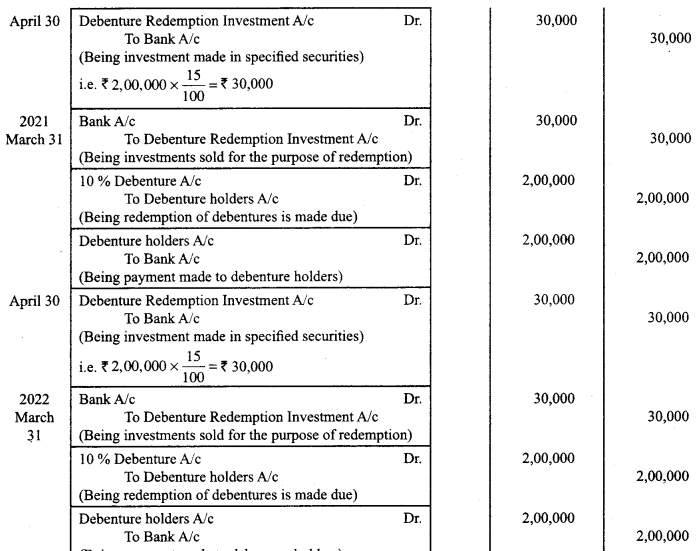
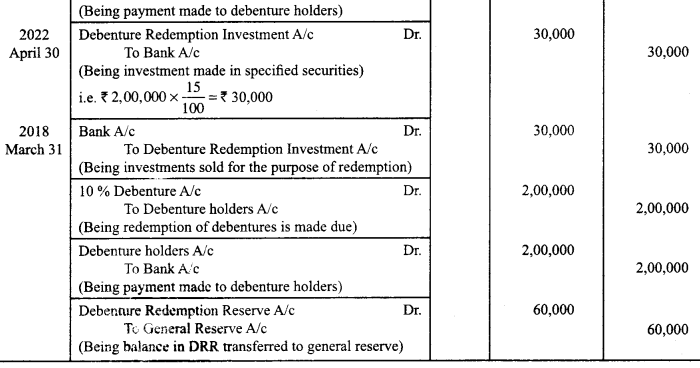
Principles of Management Class 12 Important Extra Questions Business Studies Chapter 2

Here we are providing Class 12 Business Studies Important Extra Questions and Answers Chapter 2 Principles of Management. Business Studies Class 12 Important Questions are the best resource for students which helps in class 12 board exams.

Class 12 Business Studies Chapter 2 Important Extra Questions Principles of Management

Principles of Management Important Extra Questions Short Answer Type

Question 1.
Explain the term Principles of Management?
Answer:
Principles of Management:
A Principle is a fundamental statement of truth that provides a guideline to thought and action. It is a universal truth that establishes a cause and effect relationship between two or more variables. These fundamental truths are applicable in specific circumstances and are capable of predicting the result of any Managerial action. Principles are both ‘descriptive’ and Prescriptive’ in nature.

A principle is descriptive if it simply describes the relationship between the variables. It is prescriptive if it indicates what should be done in a given situation. The principle of management lays down guidelines for improving management practice. These principles are the result of the long experience of managers in different fields of organized effort. Most of these principles are applicable in all kinds of managerial situations, be it a government organization, a business enterprise, a religious foundation, or an educational institution.

Question 2.
Why the principles of Management needed?
Answer:
According to Terry, “Principles of management are to a manager as a table of the strength of materials is to a civil engineer,” The utility of principles lies in the foundation they provide for its efficient conduct, by making out the basic features that must characterize the practice of management, irrespective of where it is occurring. By means of the principle of Management, a manager can avoid the fundamental mistakes in his job and foretell the results of his action with confidence.

Question 3.
Explain in brief the major criticisms of scientific management.
Answer:
Demerits or Criticisms of Scientific Management:- Although there are many advantages of Taylor’s scientific management yet it has also been severely criticized. Following are the main points of criticism.

Criticisms by Employers:

  1. Costly/Expensive System: In this scientific management system, much cost is required. More capital has to be invested to implement scientific management. It is a very expensive system.
  2. Time-Consuming: This system is very time-consuming. It takes too much time to implement scientific management.
  3. The fault of Specialisation: The excess specialization creates faults. The problem of certification also arises. It is not suitable for small industrial units.
  4. Lack of Freedom: With the appointment of specialists, the producers cannot take decisions freely as most of the responsibilities fall on specialists. So, they feel hesitant in adopting the scientific technique.
  5. Unsuitable for Small Scale Business: As the technique of scientific management is much expensive, only large scale enterprises can implement it. It is impossible for small-scale businesses to adopt these techniques.

Criticisms by Employees:

  1. Fear of Unemployment
  2. Indifference of Work
  3. Exploitation
  4. End of Initiative
  5. Criticism by Labour Unions
  6. Bad effect on health
  7. Excessive work land

Question 4.
What is the differential piece wage system advocated by F.W. Taylor and also gives an illustration?
Answer:
Differential piece wage system Taylor was a strong advocate of the piece wage system. He wanted to differentiate between efficient and inefficient workers. The standard time and other parameters should be determined on the basis of the work-study discussed above. The workers can then be classified a$ efficient or inefficient on the basis of these standards. He wanted to reward efficient workers.

So he introduced the different rates of wage payment for those who performed above standard and for those who performed below standard. For example, it is determined that standard output per worker per day is unit, and those who made standard or more than standard or more than standard will get Rs 60 per unit and those below will get Rs 30 per unit. Now an efficient worker making 10 units will get 10×60 = Rs 600/- per day whereas a worker who makes 6 units will get 6 × 30 = Rs 180 per day.

According to Taylor, the difference of Rs 420 should be enough for the inefficient worker to be motivated to perform better. It is important to have a re-look at the techniques of scientific management as comprising a unified whole of Taylorian prescription of efficiency. Therefore, the sum and substance of Taylorism lie not in the disjointed description of principles and techniques of scientific management, but in the change in the mindest, which he referred to as mental revolution.

Principles of Management Important Extra Questions Long Answer Type

Question 1.
Name the main principles of Management propounded by Henri Fayol and explain any two?
Answer:
Development of Management Principles: It was Henri Fayol a French mining engineer and chief executive who for the first time stated a set of 14 principles of management. Fayol wrote these principles on the basis of his practical experience as a manager. According to him, these principles can be applied in all types, functions, levels, and sizes of organizations. This had earned him the title universalist’. For a long time, Fayol’s list was accepted as ‘Complete and Comprehensive. A description of these principles follows.

  1. Division of Work
  2. Authority and Responsibility
  3. Discipline
  4. Unity of command
  5. Unity of direction
  6. Subordination of individual interests to the general interests
  7. Remuneration
  8. Centralization
  9. Scalar chain hierarchy
  10. Order
  11. Equity
  12. Stability of personnel
  13. Initiative
  14. Esprit de corps

1. Division of Work – This is the principle of specialization which applies to all kinds of work. The more people specialize, the more efficiently they can perform their work. Specialization increases output by making employees more efficient.

2. Authority and Responsibility – Authority is the right to give orders and the power to exact obedience. Managers need authority to get things done. According to Fayol, responsibility is a corollary and a natural consequence of authority. Responsibilities an obligation to perform the tasks in a satisfactory manner.

Question 2.
Give reasons for or against the Universality of the principle of Management?
Answer:
University of Management principles Universality of management suggests that the manager uses the same managerial skills and principles in each managerial position held in various organizations. Accordingly, an industrial manager could manage a philanthropic organization, a retired army general could manage a university, a civil servant could manage an industrial organization, and so on.

Universality implies transferability of Managerial skills across industries, countries, countries. It means that management is generic in content and applicable to all types of organizations. Lawrence A. Appley declared that ‘He who can manage, can manage anything.’ Let us examine the factors that have contributed to the universal application of management in every level of organization and at every level of organizations.

Arguments for Universality:
1. Managers perform the same functions irrespective of their level in the organization, industry, or country. The functions performed by the company president and the office supervisors .are the same Regardless of the label-all managers plan, organize, lead and control. The difference lies in such things as the breadth of the objectives, the magnitude of the decision taken, the organization’s relationships affected, and so on.

2. Classical writers like Fayol, Urwick, and others believed that there are certain principles in management that are universally applicable.

3. The fundamentals governing the management of a business, a Church, or a university are the same, the differences lie in the techniques employed and practices followed. All managers accountable for the performance of other people, they plan, make decisions, organize work, motivate people and implements control, and so forth. In order to achieve the results the techniques employed might differ depending on situational factors like culture, tradition, attitudes, etc.

4. The very fact that managers regularly move from public to private sector organizations bears ample testimony to the fact that management concepts are universal across organizational types.

Arguments against the Universality This is –
1. The universal thesis implies complete substitutability of managerial skills which is rarely found in actual practice. It seems improbable that the captain of a hockey team would excel equally as the president of the charitable agency or as the vice-chancellor of a university. It is true that the manager’s job becomes almost universal in content at the upper levels of organizations. At a lower level of organization, however, transferability of managerial skills may not be possible.

2. Universality thesis presupposes the existence of predictability regarding the outcomes of management actions. A manager working in firm A must be able to predict the likely consequences of his actions in firm B where he is likely to join. And he may have to face serious problems in case the underlying philosophies of these organizations were to differ.

Nature and Significance of Management Class 12 Important Extra Questions Business Studies Chapter 1

Here we are providing Class 12 Business Studies Important Extra Questions and Answers Chapter 1 Nature and Significance of Management. Business Studies Class 12 Important Questions are the best resource for students which helps in class 12 board exams.

Class 12 Business Studies Chapter 1 Important Extra Questions Nature and Significance of Management

Nature and Significance of Management Important Extra Questions Short Answer Type

Question 1.
Distinguish between coordination and cooperation.
Answer:

Co-ordinationCooperation
1. It is an orderly arrangement of a group effort to provide for unity of action.1. It is a voluntary desire to help each other
2. Co-ordination includes cooperation, hence it is a wider term.2. Co-operation is a narrow term as it is a part of co-ordination.
3. It is a deliberate effort made by the management to balance interrelated activities.3. It is the voluntary effort made by a group of people depending on their mental needs or liking
4. It is a technique.4. It is an attitude.

Question 2.
Write the characteristics of management and explain any two.
Answer:
Characteristics The key features of management are –

  1. Goal-oriented process,
  2. all-pervasive,
  3. multidimensional,
  4. Continuous process,
  5. group activity
  6. dynamic function,
  7. tangible force.

1. Management is a goal-oriented process:  An organization has a set of basic goals which are the basic reason for its existence. These should be simple and clearly stated.

2. Management is all-pervasive: The activities involved in managing an enterprise are common to all organizations whether economic, social, or political Thus it is all-pervasive.

Question 3.
“Lack of proper management results in wastage of time money and efforts.” Do you agree with this statement? Give reasons in support of your answer. (2003)
Answer:
Yes, the above-mentioned statement holds true as the reasons are as follows.

  1. Means to accomplishing goals:  Management is important because it helps in achieving group goals, increases efficiency, and creates a dynamic organization.
  2. Unified direction: Management motivates and directs the workforce by unifying goals with the group goals.
  3. Establishes sound industrial relations: The success of any organization depends upon its workforce. It is the only factor of production which is movable in nature. Effective management tries to build a feeling of team and loyalty towards the organization.
  4. It looks after for future uncertainties: An effective management prepares the organization for future contingencies and paved the way for its survival and growth. In the ‘ absence of this foresightedness, an organization may be forced to wind up its operations resulting in wastage of time, efforts, and resources.

Question 4.
State two objectives of management. (1993, 1996, 1998)
Answer:
The main two objectives of management are –

  1. Maximization of profits at minimum cost.
  2. Optimum utilization of the given resources by the organization.

Question 5.
What is meant by Administration? (1992, 1999)
Answer:
Administration means a determination of overall policies, the setting of major objectives, the identification of general-purpose, the laying out of broad programs, etc. It is determinative in nature.

Question 6.
Name any two activities undertaken at the top-level management. (1995, 2001, 2004)
Answer:
The two main functions or activities of top-level management are.

  1. It does long-term planning and formulating suitable policies, organizing (determination of organization structure), and controlling.
  2. It maintains cordial relations with all outside parties like the shareholders, the government, etc.

Question 7.
State two functions of lower-level management. (1992-1994)
Answer:
The main functions are as follows –

  1. It translates the intermediate plan of middle-level management into day to day operating plan.
  2. It gives directions to operating employees by assigning jobs, evaluating and correcting their performance and sends information and progress reports to higher management.

Nature and Significance of Management Important Extra Questions Long Answer Type

Question 1.
Do you think proper Management is an important part of an organization?
or
Explain the importance of management.
Answer:
Yes, management is a universal activity that is integral to any organization. We now examine some of the reasons that have made management so important.

1. Management helps in achieving group goals: Management is required not for itself but for achieving the goals of the organization, the task of a manager is to give a common direction to all.

2. Management increases efficiency:  The aim of a manager is to reduce costs and increase productivity ” through better planning, organizing directing, staffing, and controlling the activities of the organization.

3. Management creates a dynamic organization: All organizations have to function in an environment that is constantly changing.

4. Management helps in achieving personal objectives: A manager motivates and leads his team in such a manner that individual members are able to achieve personal goals while contributing to the overall organizational objective.

5. Management helps in the development of society: An organization has multiple objectives to serve the purpose of the different groups that constitute it. In the process of fulfilling all these management helps in the development of the organization and through that it helps in the development of society. It helps to provide good ‘ quality products and services, creates employment opportunities, and leads the path towards growth and development.

Question 2.
Explain the level of management and their main functions.
Answer:
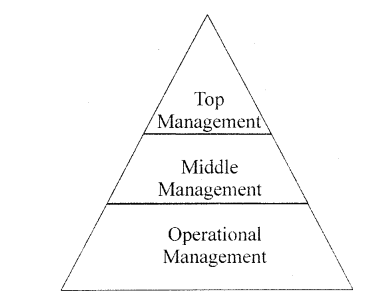
Level of Management.
Class 12 Business Studies Important Questions Chapter 1 Nature and Significance of Management 1

Generally speaking, there are three levels in the hierarchy of an organization.

1. Top Management:
They consist of the senior-most executives of the organization by whatever name they are called. They are usually referred to as the chairman, the chief executive officer, chief operating officer, president, and vice-president. Top management is a team consisting of managers from different functional levels. Their basic task is to integrate diverse elements and coordinate the activities of different departments according to the overall objectives of the organization. They are responsible for the welfare and survival of the organization. Their job is complex and stressful.

2. Middle Management:
It is the link between top and lower-level management. They are subordinate to top managers and superior to the first-line managers. They are usually known as division heads, operation managers, or plant superintendent. They are responsible for implementing and controlling plans developed by top management. At the same time, they are responsible for all the activities of first-line management. Their main task is to carry out the plans formulated by the top management and at the same time, they are responsible for all the activities of first-line managers.

3. Operational Management:
Foreman and supervisors comprise the lower level in the organization. Supervisors directly oversee the efforts of the workforce. Their authority and responsibility are limited according to the plans drawn by the top management. They play a very important role in the organization since they interact with the actual workforce and pass on instructions of the middle management to the Workers. Through the quality of their efforts of output is maintained. Wastage of materials is minimized and safety standards are maintained.

Issue and Redemption of Debentures Class 12 Important Questions Accountancy Chapter 7

Here we are providing Class 12 Accountancy Important Extra Questions and Answers Chapter 7 Issue and Redemption of Debentures. Accountancy Class 12 Important Questions and Answers are the best resource for students which helps in class 12 board exams.

Class 12 Accountancy Chapter 7 Important Extra Questions Issue and Redemption of Debentures

Issue and Redemption of Debentures Important Extra Questions Very Short Answer Type

Question 1.
What is meant by ‘Issue of Debentures as Collateral Security’ ? (CBSE Outside Delhi 2019)
Answer:
Debenture issued as secondary security/additional security over and above the primary security is known as Issue of Debentures as Collateral Security.

Question 2.
State the provision of the Companies Act, 2013 for the creation of Debenture Redemption Reserve. (CBSE Outside Delhi 2019)
Answer:
Where a company has issued Debentures, it shall create a DRR equivalent to at least 25% of the nominal value of debentures outstanding for the redemption of such debentures.

Question 3.
Profit arisen on account of buying an existing business at profit is transferred to which account?
Answer:
Capital Reserve.

Question 4.
Name the debentures which continue till the continuity of the company.
Answer:
Irredeemable.

Question 5.
Name the debenture which may be converted into equity shares at specified time.
Answer:
Convertible debentures.

Question 6.
Name the debentures which have charge on the company’s assets.
Answer:
Secured debentures (also known as mortgaged debentures).

Question 7.
When a debenture is issued at a price less than its face value or nominal value, what does such difference represent?
Answer:
Discount.

Question 8.
When debentures are redeemed more than the face value of debenture, What does the difference between face value of debenture and redeemed value of debenture is called?
Answer:
Premium on redemption of debentures.

Question 9.
Name the head under which ‘discount on issue of debentures’ appears in the Balance Sheet of a company.
Answer:
Head ‘Current Assets’ and sub-head ‘Other Current Assets’.

Question 10.
What does the repayment or discharge of liability on account of debentures is called?
Answer:
Redemption of debentures.

Question 11.
Under which head is the ‘Debenture Redemption Reserve’ shown in the Balance Sheet?
Answer:
‘Reserve & Surplus’.

Question 12.
When the company issues debentures to the lenders as an additional/secondary security, in addition to other assets already pledged/ some primary security. What does such issue of debentures is called? (CBSE 2018)
Answer:
Issue of dedentures as collateral security.

Question 13.
It is a written instrument acknowledging a debt under the common seal of the company, name the term.
Answer:
Debenture.

Question 14.
State an exception to the creation of Debenture Redemption Reserve as per Companies (Share Capital and Debentures) Rules 18(7). (CBSE Sample Paper 2014 Modified)
Answer:
Banking Companies

Question 15.
Mention the type of debentures whose ownership passes on mere delivery of debenture certificates.
Answer:
Bearer debentures.

Question 16.
Can ‘Securities Premium’ be used as working capital?
Answer:
No.

Question 17.
A company purchased net assets of another company worth ₹ 20,00,000 and issued debentures worth ₹ 19,00,000. What type of profit has the buying company made?
Answer:
Capital Profit.

Question 18.
Vikas Infrastructure Ltd. has issued 50,000, 10% debentures of ₹ 100 each at par redeemable after the end of 7th year. Mention the amount by which the company should create Debenture Redemption Reserve as per Companies (Share Capital and Debentures) Rules 2014 before starting redemption of debenture. Answer with giving reason.
Answer:
₹ 12,50,000.

Question 19.
Axis Ltd. has issued 8,000, 10% debentures of₹ 100 at a premium of ₹ 5 per debenture redeemable at the end of 5 years. The company has created Debenture Redemption Reserve with ₹ 4,00,000. After 5 years, the company redeemed all the debentures ₹ Where should the company transfer the amount of Debenture Redemption Reserve?
Answer:
General Reserve.

Issue and Redemption of Debentures Important Extra Questions Short Answer Type

Question 1.
Garvit Ltd. invited applications for issuing 3,000, 11% Debentures of₹ 100 each at a discount of 6%. The full amount was payable on application. Applications were received for 3,600 debentures. Applications for 600 debentures were rejected and the application money was refunded. Debentures were allotted to the remaining applicants.
Pass the necessary journal entries for the above transactions in the books of Garvit Ltd. (CBSE Delhi 2019)
Answer:
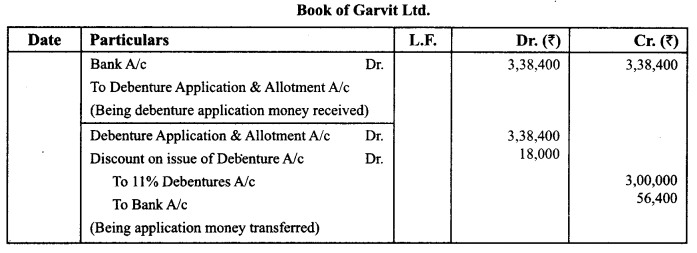
Class 12 Accountancy Important Questions Chapter 7 Issue and Redemption of Debentures 1

Question 2.
On 1st April 2015, P Ltd. Issued 6,000 12% Debentures of ₹ 100 each at par redeemable at a premium of 7%. The Debentures were to be redeemed at the end of third year. Prepare Loss on issue of 12% Debentures Account. (CBSE Delhi 2019)
Answer:
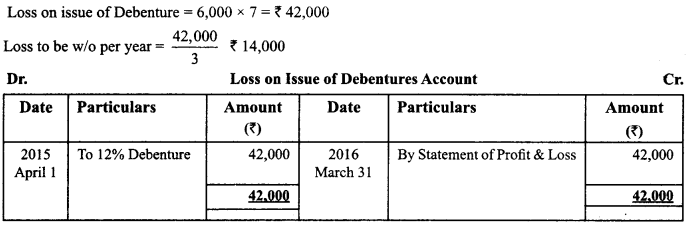
Class 12 Accountancy Important Questions Chapter 7 Issue and Redemption of Debentures 2

Question 3.
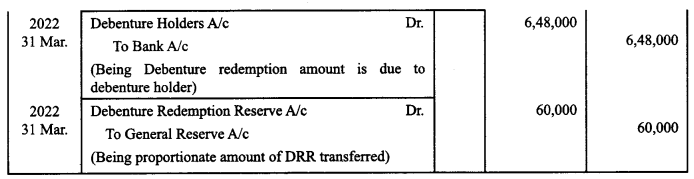
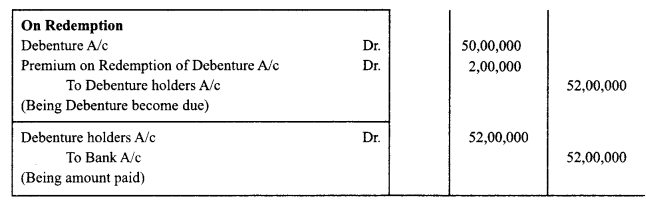
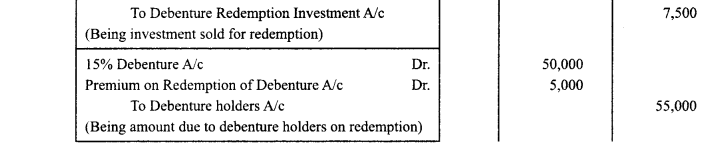
Unilink Ltd. (An unlisted company) had outstanding ₹ 12,00,000, 9% debentures on 1st April, 2020 redeemable at a premium of 8% in two equal annual instalments starting from 31st March, 2022. The company had a balance of₹ 1,20,000 in Debenture Redemption-Reserve on 31st March, 2020. Pass the necessary journal entries for redemption of debentures in the books of Unilink Ltd. for the year ended 31st March, 2022. . (CBSE Delhi 2019, Modified)
Answer:
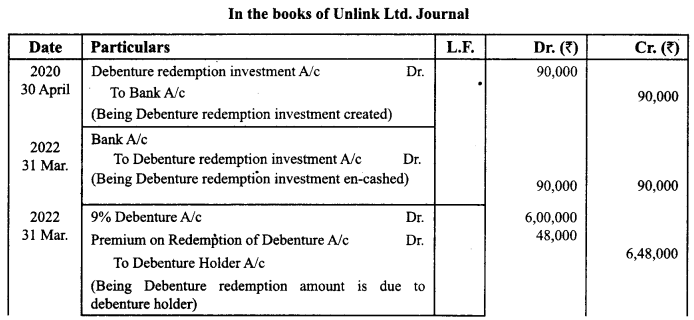
Class 12 Accountancy Important Questions Chapter 7 Issue and Redemption of Debentures 3
Class 12 Accountancy Important Questions Chapter 7 Issue and Redemption of Debentures 4
Note: This question has been updated as per Companies (Share Capital and Debentures) Amendment Rules, 2019.

Question 4.
Krishna Ltd. (An unlisted company) had outstanding 20,000,9% debentures of₹ 100 each on 1st April, 2014. These debentures were redeemable at a premium of 10% in two equal instalments starting from 31 st March, 2021. The company had a balance of ₹2,00,000 in Debenture Redemption Reserve on 31 st March, 2020.
Pass necessary journal entries for redemption of debentures in the books of Krishna Ltd. for the year ended 31st March, 2018. (CBSE Delhi 2019, Modified)
Answer:
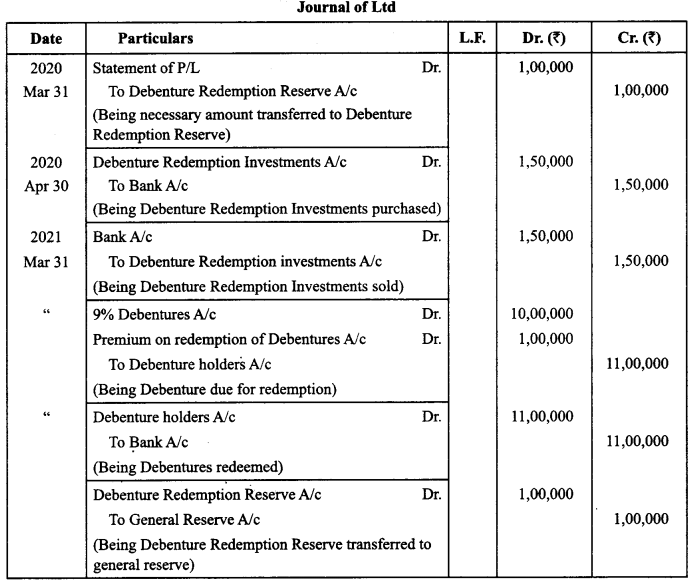
Class 12 Accountancy Important Questions Chapter 7 Issue and Redemption of Debentures 5
Note: This question has been updated as per Companies (Share Capital and Debentures) Amendment Rules, 2019.

Question 5.
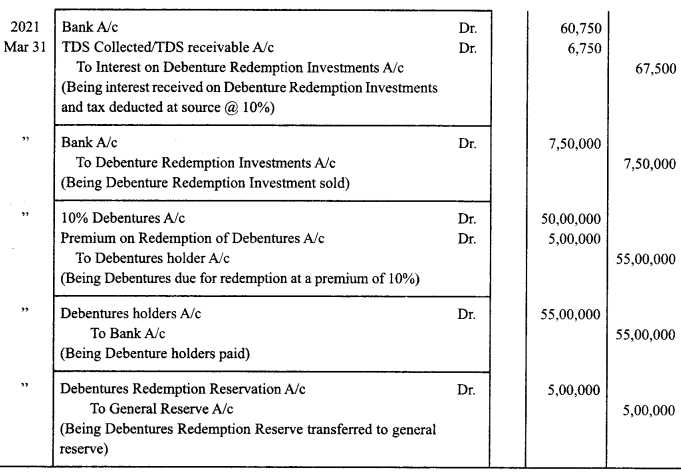
On 1st April, 2013 Anushka Ltd. (An unlisted companies) issued ₹70,00,000, 9% debentures of ₹ 100 each at par, redeemable at a premium of 5% on 31 st march, 2021. The company created the necessary, minimum amount of debenture redemption reserve and purchased debenture redemption reserve investments. The debentures were redeemed on 31 st March, 20121. Pass necessary journal entries for the redemption of debentures, in the books of the company.
(CBSE Delhi 2019, Modified)
Answer:
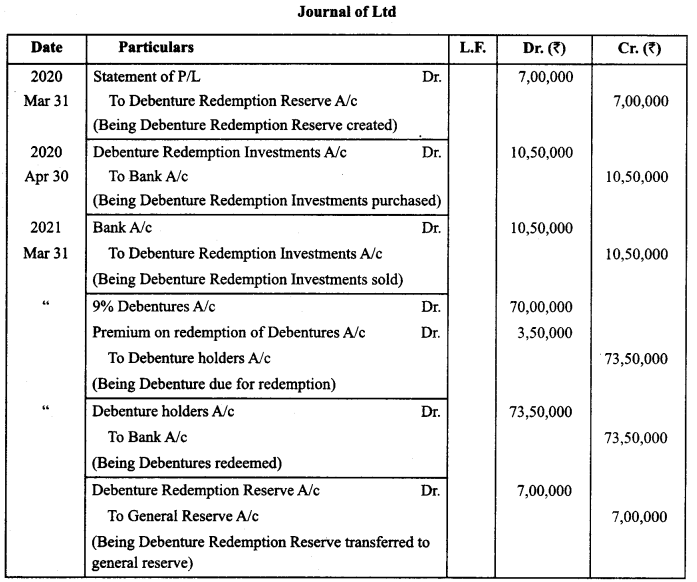
Class 12 Accountancy Important Questions Chapter 7 Issue and Redemption of Debentures 6
Note: This question has been updated as per companies (Share capital and debentures) Amendment Rules, 2019.

Question 6.
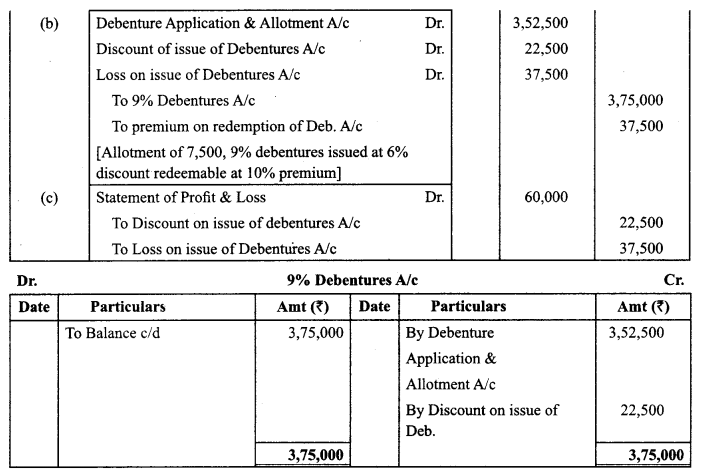
Pass necessary journal entries and prepare 9% Debentures Account for the issue of 7,500,9% Debentures of ₹ 50 each at a discount of 6%, redeemable at a premium of 10%. (CBSE Delhi 2019, Modified)
Answer:
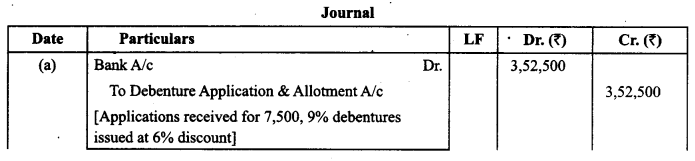
Class 12 Accountancy Important Questions Chapter 7 Issue and Redemption of Debentures 7
Class 12 Accountancy Important Questions Chapter 7 Issue and Redemption of Debentures 8

Question 7.
Krishna Ltd. had (an unlisted company) outstanding 20,000, 9% debentures of₹ 100 each on 1st April, 2014.. These debentures were redeemable at a premium of 10% in two equal instalments starting from 31st March, 2021.
The company had a balance of₹ 1,80,000 in Debenture Redemption Reserve on 31st March, 2020.
Pass necessary journal entries for redemption of debentures in the books of Krishna Ltd. for the year ended 31 st March, 2021. (CBSE Outside Delhi 2019, Modified)
Answer:
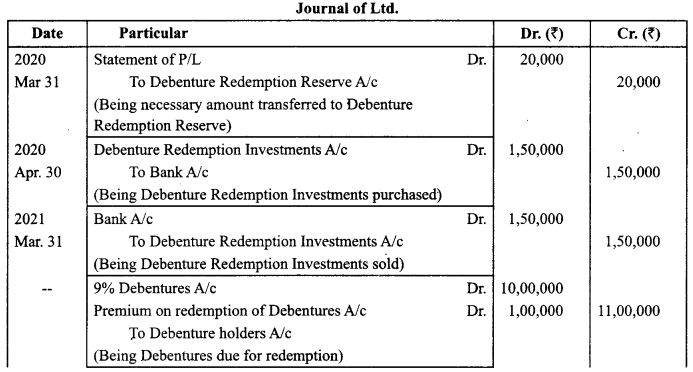
Class 12 Accountancy Important Questions Chapter 7 Issue and Redemption of Debentures 9
Class 12 Accountancy Important Questions Chapter 7 Issue and Redemption of Debentures 10
Note: This question has been updated as per companies (Share capital and debentures) Amendment Rules, 2019.

Question 8.
On 1 st April, 2013 Anushka Ltd. (unlisted company) issued ₹70,00,000, 9% debentures of ₹ 100 each at par, redeemable at a premium of 5% on 31 st march, 2021. The company created the necessary, minimum amount of debenture redemption reserve and purchased debenture redemption reserve investments. The debentures were redeemed on 31st March, 2021.
Pass necessary journal entries for the redemption of debentures, in the books of the company.
Answer:
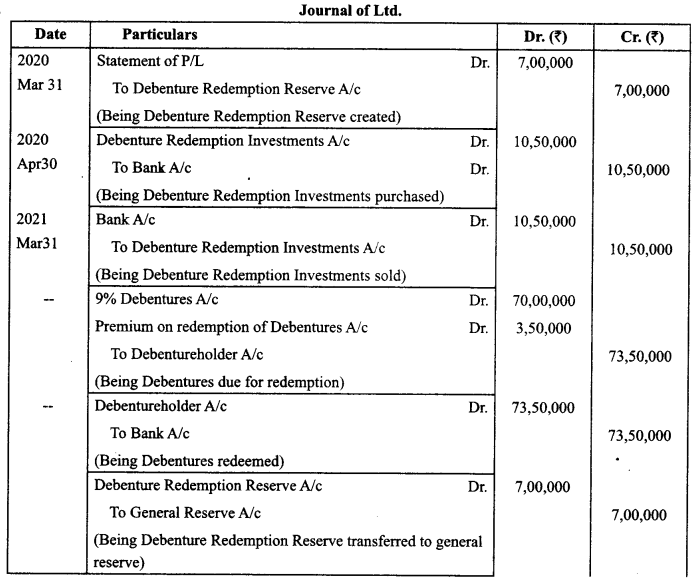
Class 12 Accountancy Important Questions Chapter 7 Issue and Redemption of Debentures 11
Note: This question has been updated as per companies (Share capital and debentures) Amendment Rules, 2019.

Question 9.
Complete the following Journal Entries
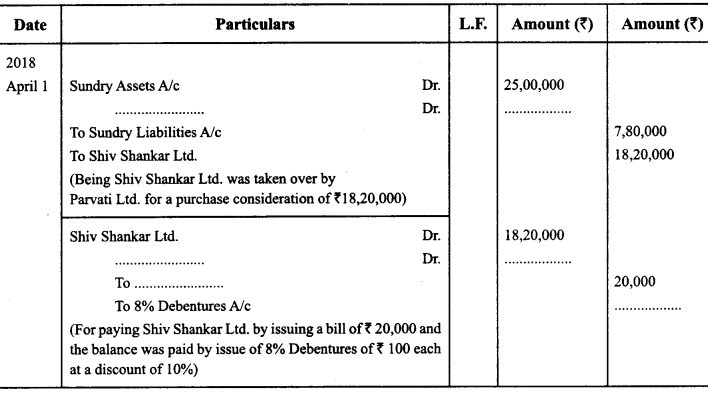
Class 12 Accountancy Important Questions Chapter 7 Issue and Redemption of Debentures 12
Answer:
Class 12 Accountancy Important Questions Chapter 7 Issue and Redemption of Debentures 13

Question 10.
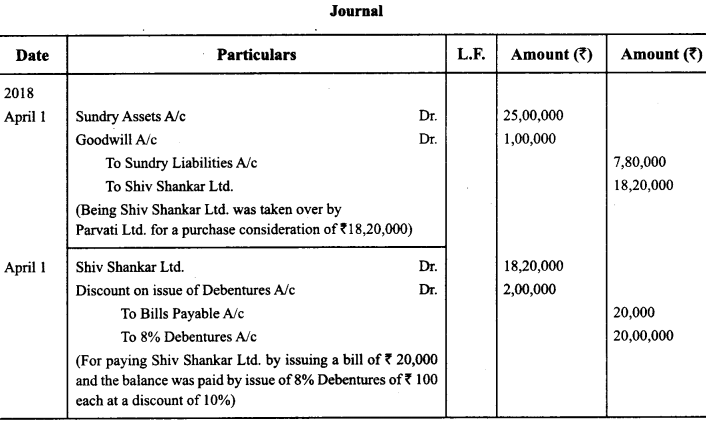
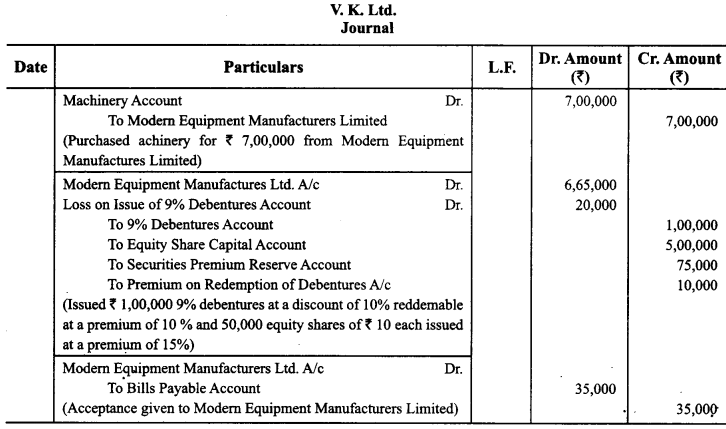
V K Limited purchased machinery from Modem Equipment Manufacturers Limited. The company paid the vendors by issue of some equity shares and debentures and the balance through an acceptance in then- favour payable after three months. The accountant of the company, while Journalising the above mentioned transactions, left some items blank. You are required to fill in the blanks.
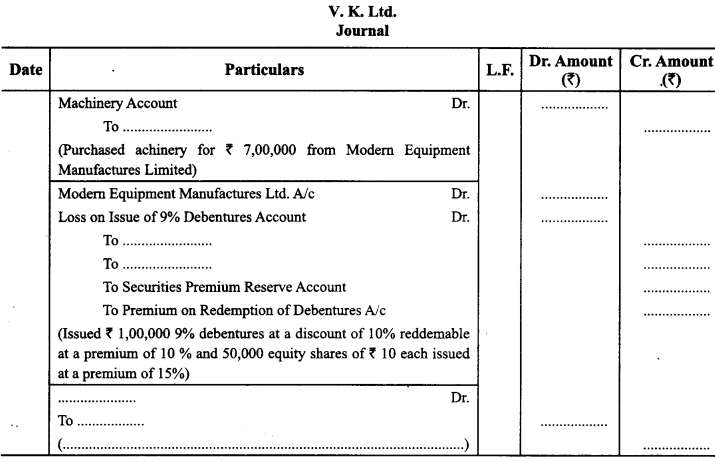
Class 12 Accountancy Important Questions Chapter 7 Issue and Redemption of Debentures 14
Answer:
Class 12 Accountancy Important Questions Chapter 7 Issue and Redemption of Debentures 15

Question 11.
‘sangam Wooilens Ltd’, Ludhiana, are the and exporters of garments. The company decided to distribute free of cost oUes. garments to 10 villages of lahual and spiti district of Himachal Pradesh. The company also decided to employ 50 young persons from these villages in its newly established factory. The company issued 40,000 equity shares of’ 10 each and 1,000 9% debentures of’ 100 each to the vendors for the purchase of machinery of’ 5,00,000.
Pass necessary Journal Entries. (Dehli 2015, Modified)
Answer:
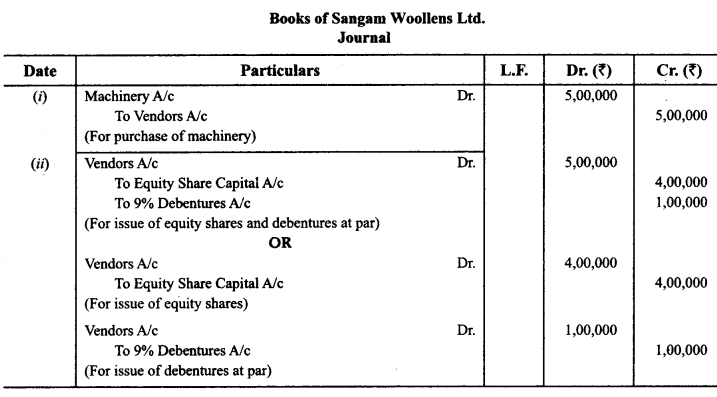
Class 12 Accountancy Important Questions Chapter 7 Issue and Redemption of Debentures 16

Question 12.
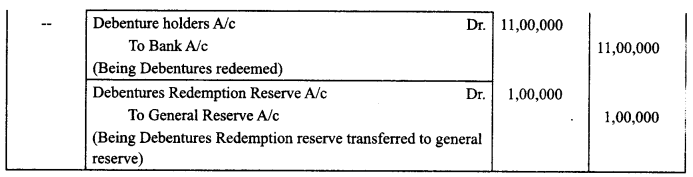
Anirudh Limited (Listed company) has 4,000, 8% debentures of₹ 100 each due for redemption on March 31, 2022. The company has a DRR of ₹ 20,000 on that date. Assuming that no interest is due. Record the necessary journal entries at the time of redemption of debentures.
Answer:
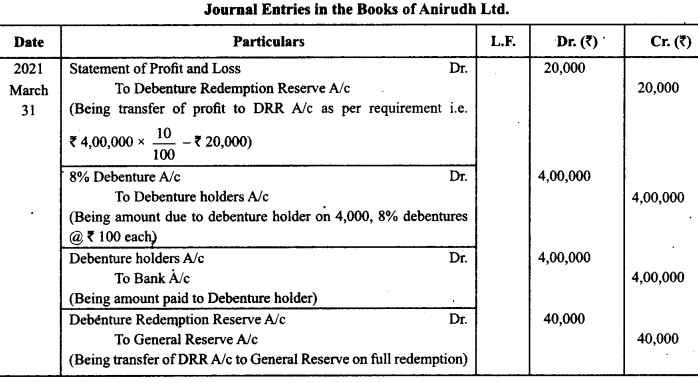
Class 12 Accountancy Important Questions Chapter 7 Issue and Redemption of Debentures 17
Note: This question has been updated as per companies (Share capital and debentures) Amendment Rules, 2019.

Question 13.
R. Ltd. offered 20,00,000,10% Debenture of₹ 200 each at a discount of redeemable at premium of 8% after 9 years. Record necessary entries in the book of R. Ltd.
Answer:
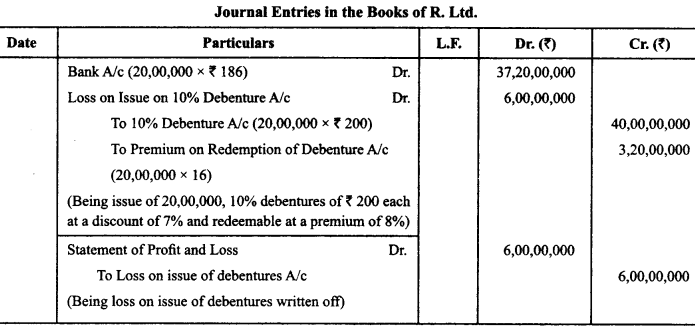
Class 12 Accountancy Important Questions Chapter 7 Issue and Redemption of Debentures 18

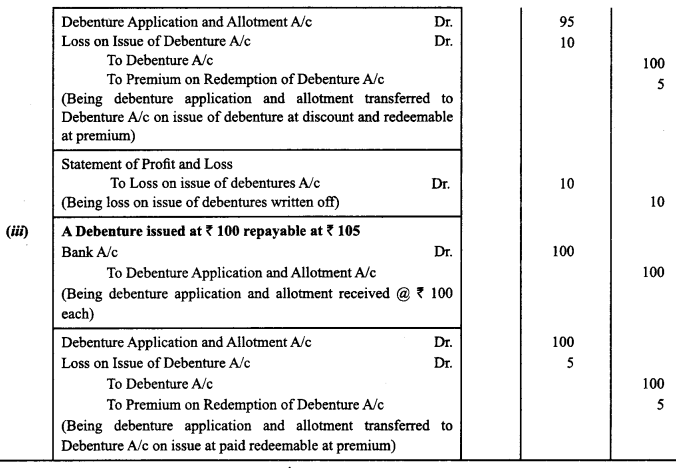
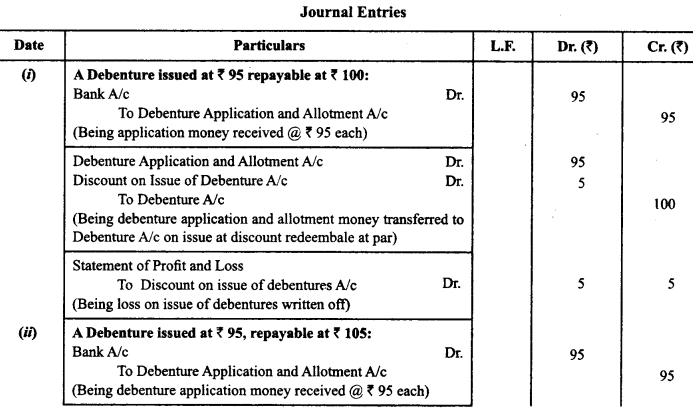
Question 14.
Journalise the following:
(i) A debenture issued at ₹ 95, repayable at ₹ 100;
(ii) A debenture issued at ₹ 95, repayable at ₹ 105; and
(iii) A debenture issued at ₹ 100 repayable at ₹ 105;
The face value of debenture in each of the above cases is ₹ 100.
Answer:
Class 12 Accountancy Important Questions Chapter 7 Issue and Redemption of Debentures 19
Class 12 Accountancy Important Questions Chapter 7 Issue and Redemption of Debentures 20

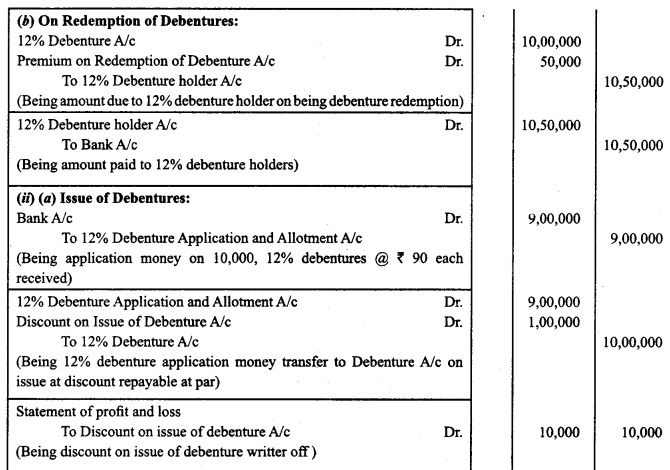
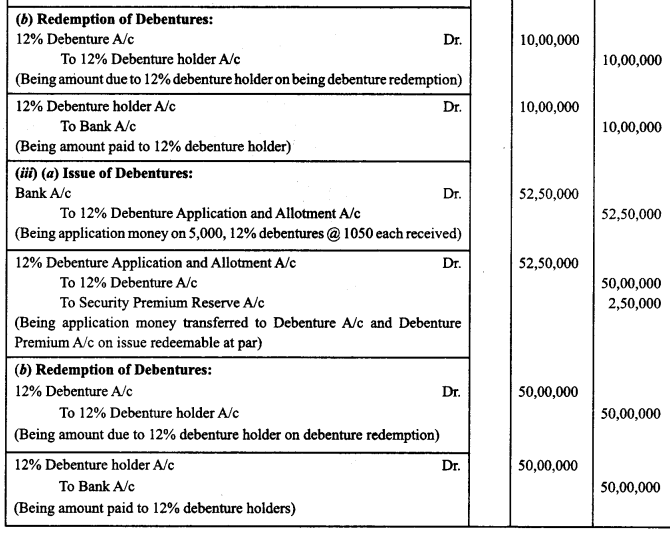
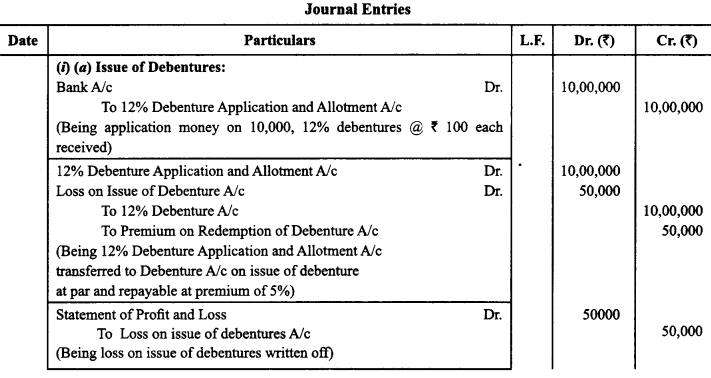
Question 15.
A Company issues the following debentures:
(i) 10,000,12% debentures of₹ 100 each at par but redeemable at premium of 5% after 5 years;
(ii) 10,000,12% debentures of₹ 100 each at a discount of 10% but redeemable at par after 5 years;
(iii) 5,000,12% debentures of₹ 1,000 each at a premium of 5% but redeemable at par after 5 years;
Answer:
Class 12 Accountancy Important Questions Chapter 7 Issue and Redemption of Debentures 21
Class 12 Accountancy Important Questions Chapter 7 Issue and Redemption of Debentures 22
Class 12 Accountancy Important Questions Chapter 7 Issue and Redemption of Debentures 23

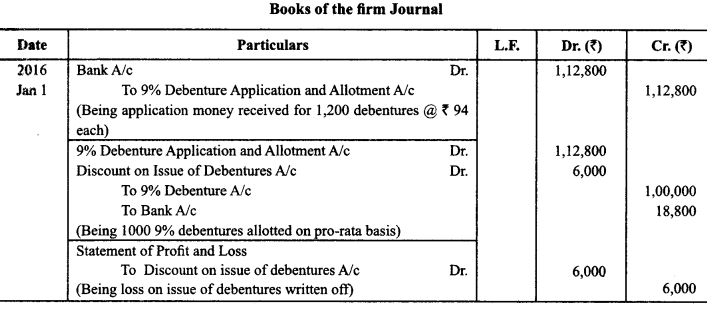
Question 16.
X Ltd. invited applications for issuing 1000,9% debentures of₹ 100 each at a discount of 6%. Applications for 1,200 debentures were received. Pro-rata allotment was made to all the applicants. Pass necessary Journal Entries for the issue of debentures assuming that the whole amount was payable with applications. [Delhi 2017]
Answer:
Class 12 Accountancy Important Questions Chapter 7 Issue and Redemption of Debentures 24

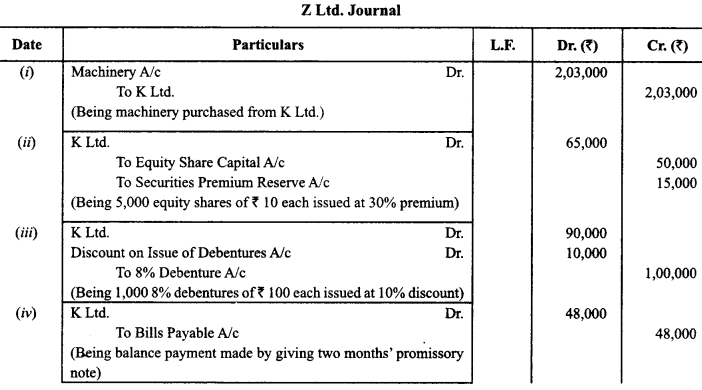
Question 17.
Z Ltd. purchased machinery from K Ltd. Z Ltd paid K Ltd as follows:
(i) By issuing 5,000 equity shares of ₹ 10 each at a premium of 30%.
(ii) By issuing 1000, 8% Debentures of₹ 100 each at a discount of 10%.
(iii) Balance by giving a promissory note of ₹ 48,000 payable after two months.
Pass necessary journal entries for the purchase of machinery and payment to K Ltd. in the books of Z Ltd. [Delhi 2017]
Answer:
Class 12 Accountancy Important Questions Chapter 7 Issue and Redemption of Debentures 25
Class 12 Accountancy Important Questions Chapter 7 Issue and Redemption of Debentures 26

Question 18.
K K Limited obtained a loan of₹ 10,00,000 from State Bank of India @ 9 % interest. The company issued ₹ 15,00,000, 9 % debentures of₹ 100/- each, in favour of State Bank of India as collateral security. Pass necessary Journal entries for the above transactions:
(i) When company decided not to record the issue of 9 % Debentures as collateral security.
(ii) When company decided to record the issue of 9 % Debentures as collateral security. (CBSE Sample Paper 2018-19, 2017-18)
Answer:
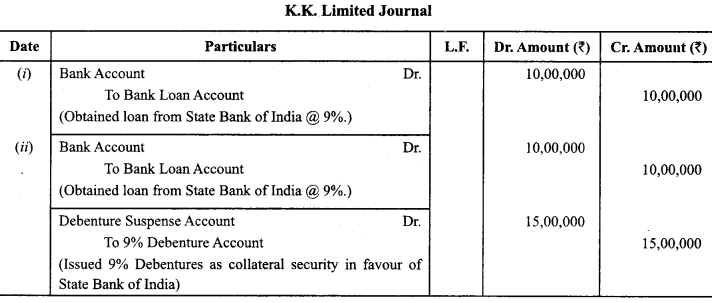
Class 12 Accountancy Important Questions Chapter 7 Issue and Redemption of Debentures 27

Question 19.
Explain with an imaginary example how issue of debenture as collateral security is shown in the balance sheet of a company when it is recorded in the books of accounts. (CBSE Sample Paper 2016, 2017)
Answer:
Alfa Ltd. obtained Loan of 1,00,000 from Indian Bank and issued 1200, 10% Debentures of 100 each as Collateral security.
Treatment: An extract of Balance sheet of Alfa Ltd.
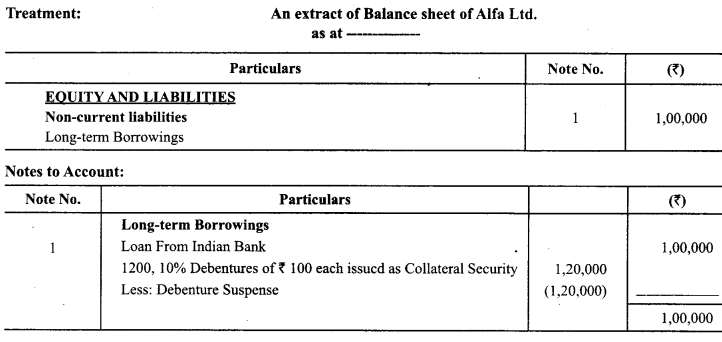
Class 12 Accountancy Important Questions Chapter 7 Issue and Redemption of Debentures 28

Question 20.
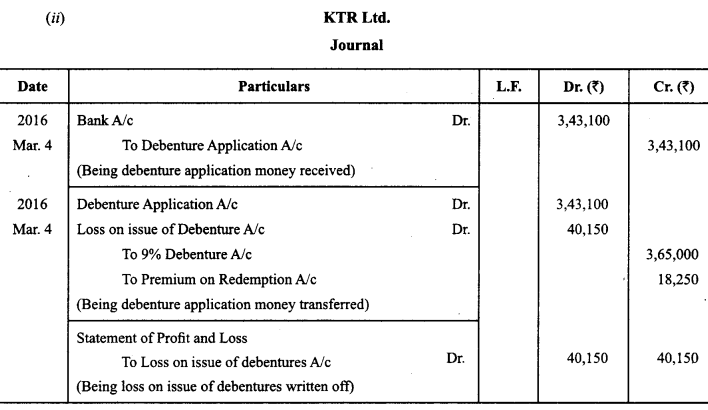
KTR Ltd., issued 365, 9% Debenture of 7’1,000 each on 4.3.2016. Pass necessary journal entries for the issue of debenture in the following situations : (CBSE Outside Delhi 2016)
(i) When debentures were issued at per redeemable at a premium of 10%.
(ii) When debentures were issued at 6% discount redemable at 5% premium.
Answer:
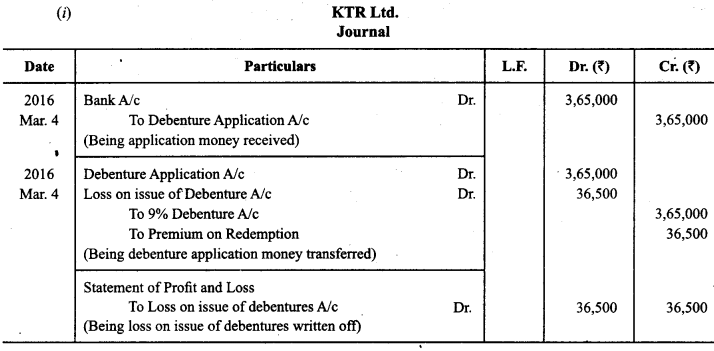
Class 12 Accountancy Important Questions Chapter 7 Issue and Redemption of Debentures 29
Class 12 Accountancy Important Questions Chapter 7 Issue and Redemption of Debentures 30

Question 21.
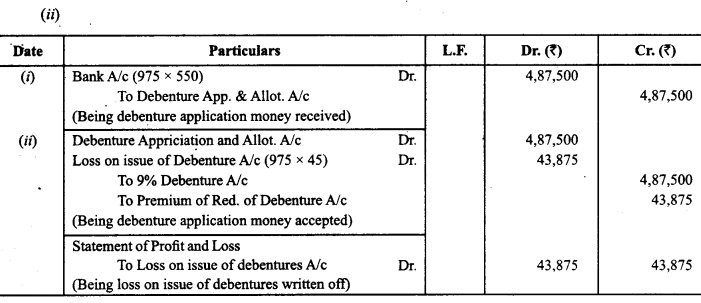
VKR Ltd. issued 975; 9% Debentures of 7 500 each on 4.3.2016. Pass necessary journal entries for the issue of debentures under the following situations:
(i) When debentures were issued at a premium of 10% redeemable at a premium of 6%.
(ii) When debentures were issued at a par redeemable at 9% premium. (CBSE Outside Delhi 2016)
Answer:
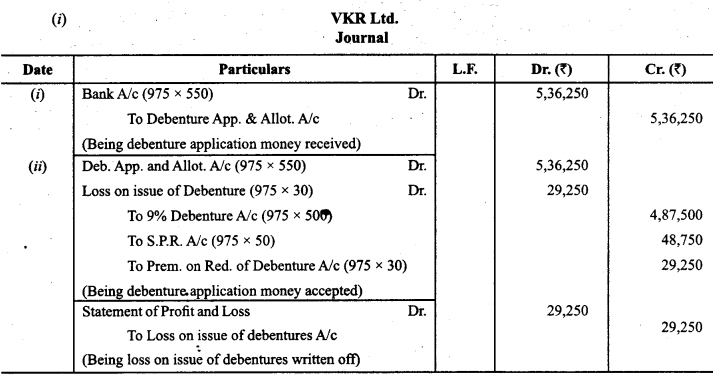
Class 12 Accountancy Important Questions Chapter 7 Issue and Redemption of Debentures 31
Class 12 Accountancy Important Questions Chapter 7 Issue and Redemption of Debentures 32

Question 22.
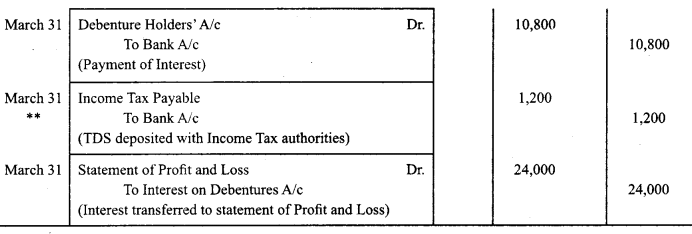
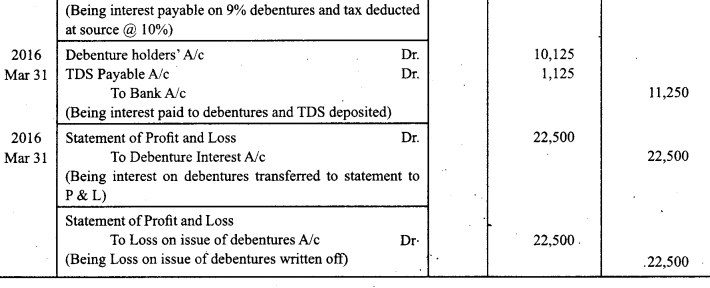
BG. Ltd. issued 2,000, 12% debentures of (100 each on 1st April 2012. The issue was fully subscribed. According to the terms of issue, interest on the debentures is payable half-yearly on 30s1 September and 31st March and the tax deducted at source is 10%. Pass necessary journal entries related to the debenture interest for the half-yearly ending 3151 March, 2013 and transfer of interest on debentures of the year to the Statement of Profit & Loss. . (CBSE Delhi 2014, Set I, II)
Answer:
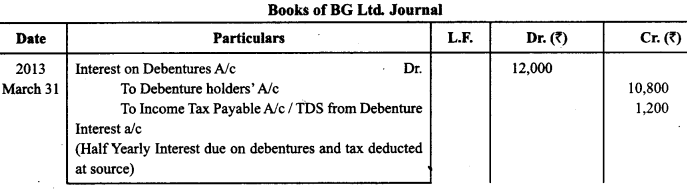
Class 12 Accountancy Important Questions Chapter 7 Issue and Redemption of Debentures 33
Class 12 Accountancy Important Questions Chapter 7 Issue and Redemption of Debentures 34
Question 23.
Jan Dhan Bank, an All India Financial Institution, had 10,000,12% debentures of₹ 100 each, outstanding as at 31st March, 2022. These debentures were due for redemption on 30th June, 2023. Pass necessary Journal Entries for redemption of debentures. Also, state the amount of Debenture Redemption Reserve to be created for the purpose of redemption. (CBSE Sample Paper 2018-19, Modified)
Answer:
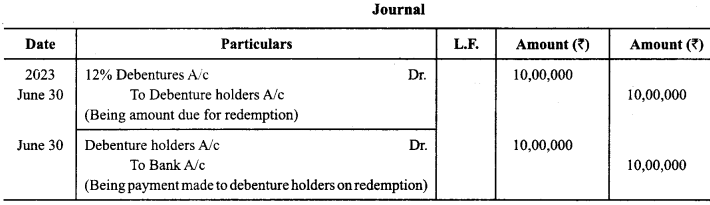
Class 12 Accountancy Important Questions Chapter 7 Issue and Redemption of Debentures 35
Note:
According to Section 71(4) of the Companies Act, 2013 and Companies (Share Capital & Debentures) Amendment Rules, 2019, an All India Financial Institution is not required to create Debenture Redemption Reserve.

Question 24.
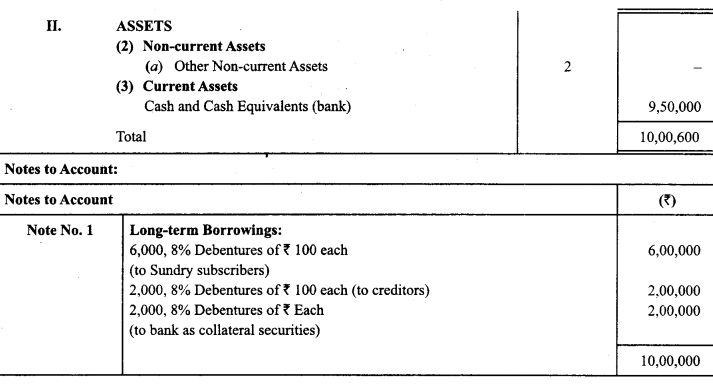
Raghuveer Limited created 10,00,000, 8% debentures stock which was issued as follows to:
1. Sundry subscribers for cash at 90%
2. Creditors for ₹ 2,00,000 capital expenditure in satisfaction of his claim
3. Bankers as collateral securities for a bank loan
worth ₹ 20,00,000 for which principal security is business premises worth
The issue (1) and (2) are redeemable at the end of 10 years at par. State how the debenture stock be dealt with while preparing the balance sheet of a company.
Answer:
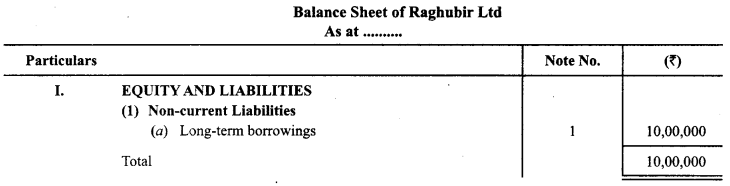
Class 12 Accountancy Important Questions Chapter 7 Issue and Redemption of Debentures 36
Class 12 Accountancy Important Questions Chapter 7 Issue and Redemption of Debentures 37

Question 25.
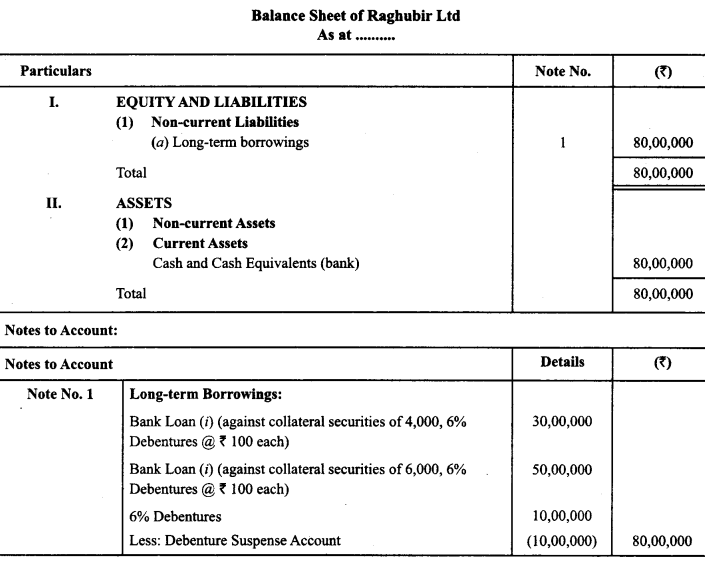
Hassan Limited took a loan of ₹ 30,00,000 from a bank against primary security worth ₹ 40,00,000 and . issued 4,000, 6% debentures of₹ 100 each as a collateral security. The company again after one year took a loan of ₹ 50,00,000 from bank against plant as primary security and deposited 6,000, 6% debentures of₹ 100 each as collateral security. Record necessary journal entries and prepare balance sheet of the company.
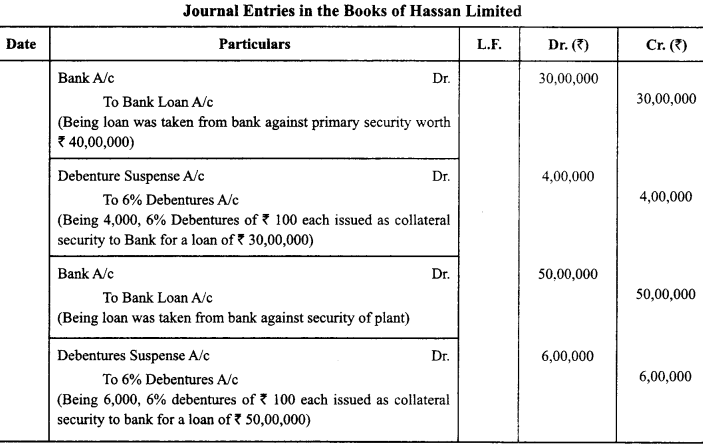
Class 12 Accountancy Important Questions Chapter 7 Issue and Redemption of Debentures 38
Answer:
Class 12 Accountancy Important Questions Chapter 7 Issue and Redemption of Debentures 39

Question 26.
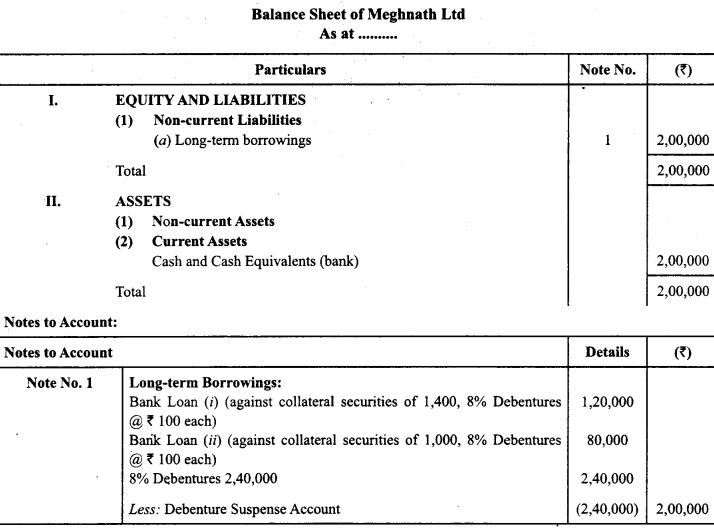
Meghnath Limited took a loan of ₹ 1,20,000 from a bank and deposited 1,400, 8% debentures of ₹ 100 each as collateral security along with primary security worth ₹ 2 Lakhs. Company again took a loan of ₹ 80,000 after two months from a bank and deposited 1,000, 8% debentures of ₹ 100 each as collateral security. Record necessary journal entries and prepare a balance sheet of a company.
Answer:
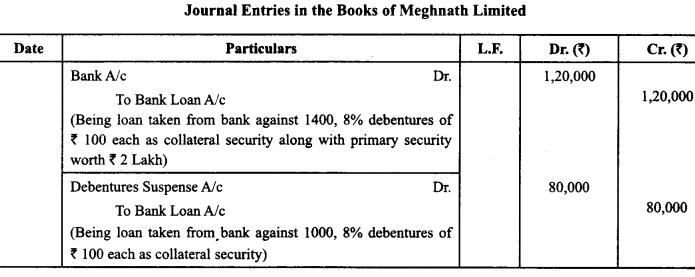
Class 12 Accountancy Important Questions Chapter 7 Issue and Redemption of Debentures 40
Class 12 Accountancy Important Questions Chapter 7 Issue and Redemption of Debentures 41

Question 27.
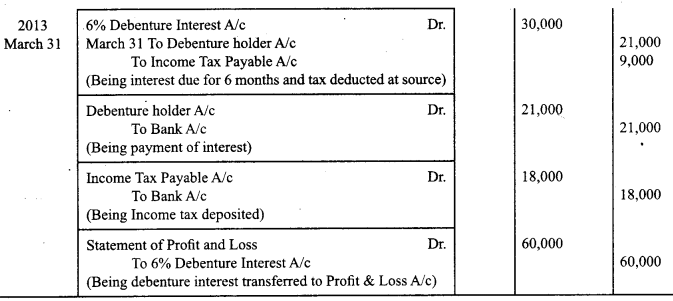
Diwakar Enterprises Ltd. issued 10,00,000, 6% debentures on April 1, 2008. Interest is paid on September 30, 2012 and March 31, 2013.
Record necessary journal entries assuming that income tax is deducted @ 30% of the amount of interest.
Answer:
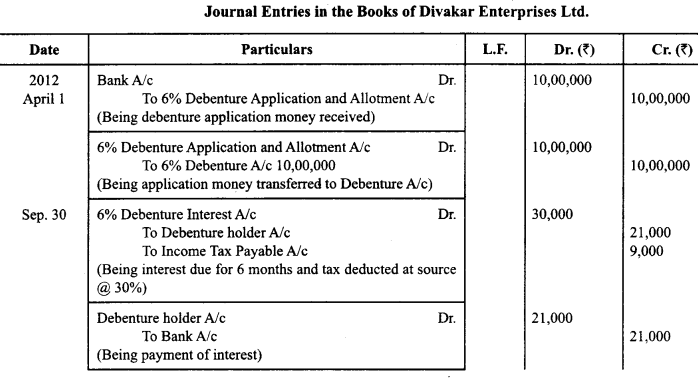
Class 12 Accountancy Important Questions Chapter 7 Issue and Redemption of Debentures 42
Class 12 Accountancy Important Questions Chapter 7 Issue and Redemption of Debentures 43

Question 28.
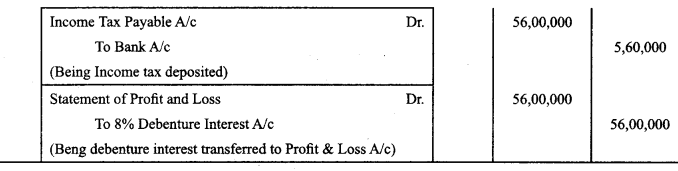
Laser India Ltd. issued 7,00,000, 8%. debentures of₹ 100 each at par. Company deducts income tax from the interest of these debentures at source. Interest is to be paid on these debentures half yearly on September 30 and March 31, every year. Amount of income tax deducted half yearly is ₹ 2,80,000.
Answer:
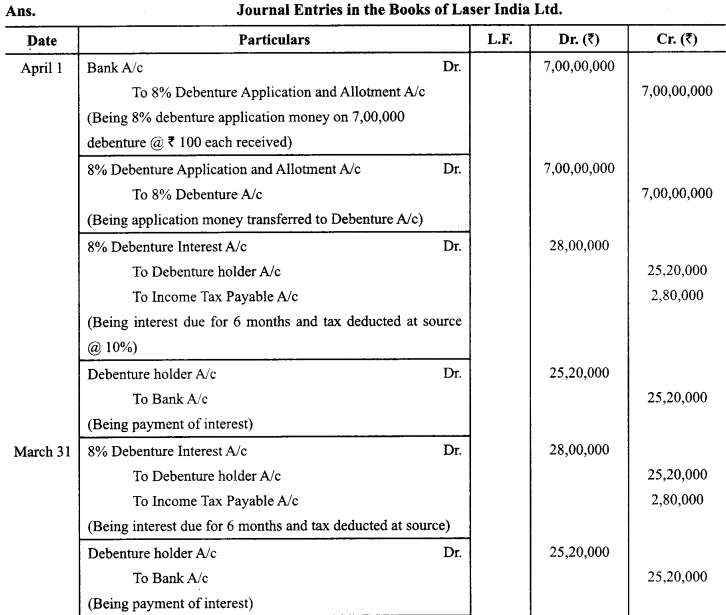
Class 12 Accountancy Important Questions Chapter 7 Issue and Redemption of Debentures 44
Class 12 Accountancy Important Questions Chapter 7 Issue and Redemption of Debentures 45

Question 29.
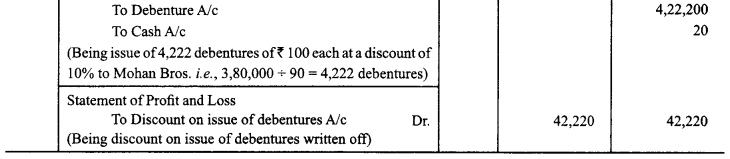
B. Ltd. purchased assets of the book value of ₹ 4,00,000 and took over the liability of ₹ 50,000 from Mohan Bros. It was agreed that the purchase consideration settled at ₹ 3,80,000 be paid by issuing debentures of₹ 100 each.
What journal entries will be made in the following three cases, if debentures are issued: (a) at par; (b) at a discount of 10%, (c) at a premium of 10%₹ It was agreed that a fraction of debentures be paid in cash.
Answer:
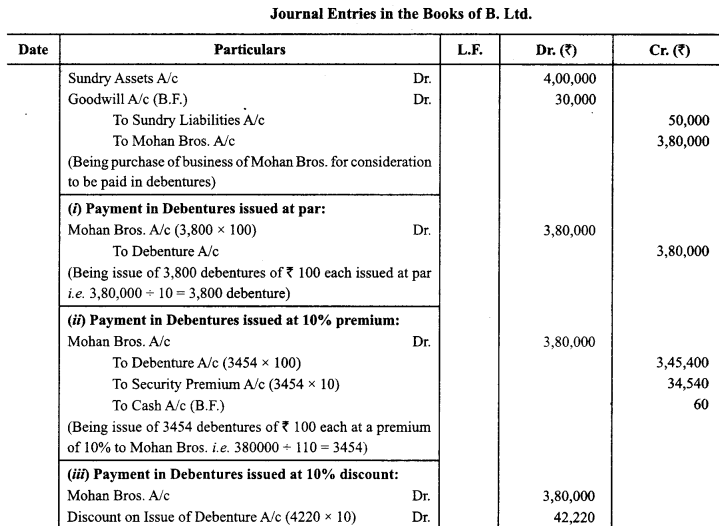
Class 12 Accountancy Important Questions Chapter 7 Issue and Redemption of Debentures 46
Class 12 Accountancy Important Questions Chapter 7 Issue and Redemption of Debentures 47

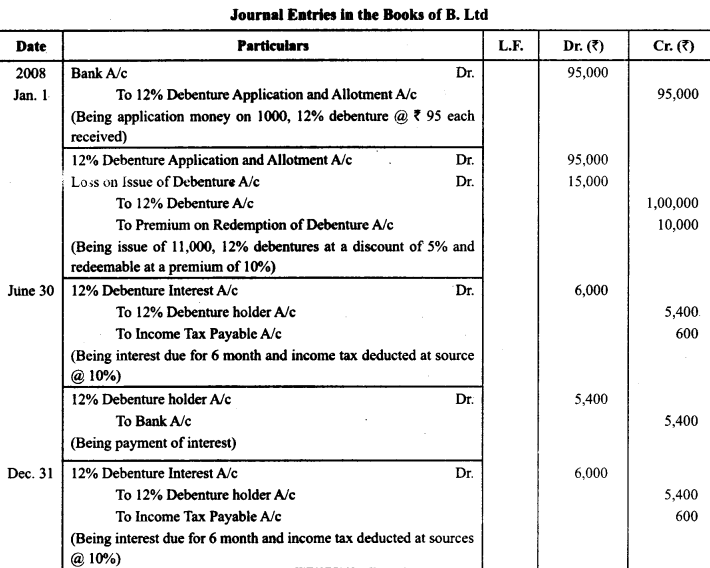
Question 30.
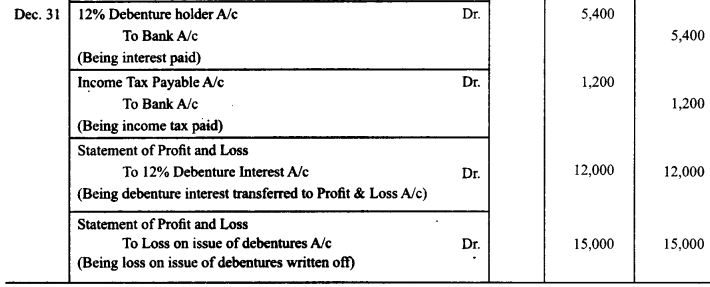
B. Ltd. issued 1,000,12% debentures of₹ 100 each on January 01,2008 at a discount of 5% redeemable at a premium of 10%.
Give journal entries relating to the issue of debentures and debentures interest for the period ending December 31,2008 assuming that interest is paid half yearly on June 30 and December 31 and tax deducted at sources is 10%. B. Ltd. follows calendar year as its accounting year.
Answer:
Class 12 Accountancy Important Questions Chapter 7 Issue and Redemption of Debentures 48
Class 12 Accountancy Important Questions Chapter 7 Issue and Redemption of Debentures 49

Issue and Redemption of Debentures Important Extra Questions Long Answer Type

Question 1.
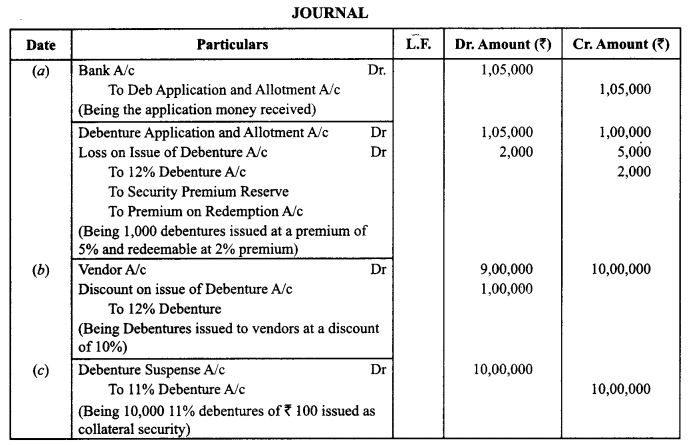
Journalise the following transactions
(a) Mehar Ltd. issued ₹ 1,00,000, 12% Debentures of ₹ 100 each at a premium of 5% redeemable at a premium of 2%
(b) 12% Debentures • were issued at a discount of 10% to a vendor of machinery for payment of ₹ 9,00,000
(c) Issue of 10,000 11% debentures of₹ 100 each as collateral in favour of State Bank of India. Company
opted to pass necessary entry for issue of debentures. (CBSE Sample Paper 2019-20)
Answer:
Class 12 Accountancy Important Questions Chapter 7 Issue and Redemption of Debentures 50

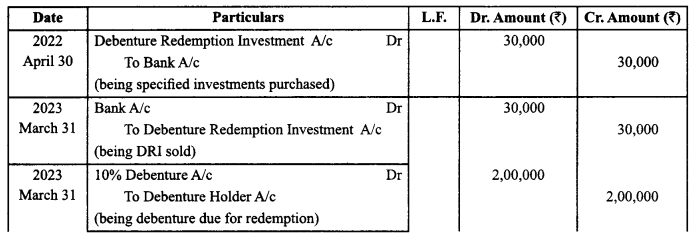
Question 2.
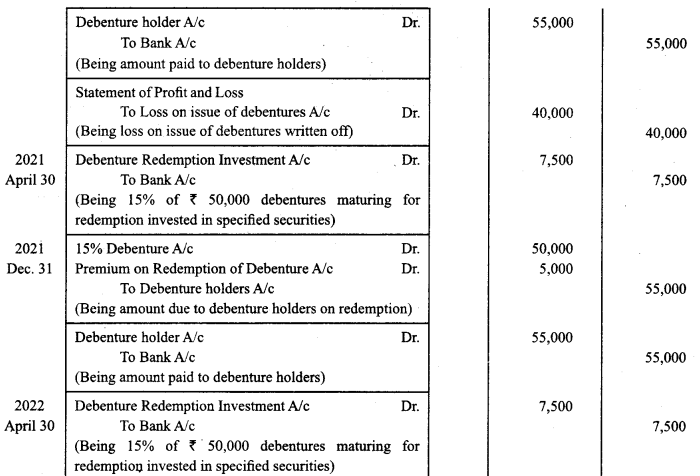
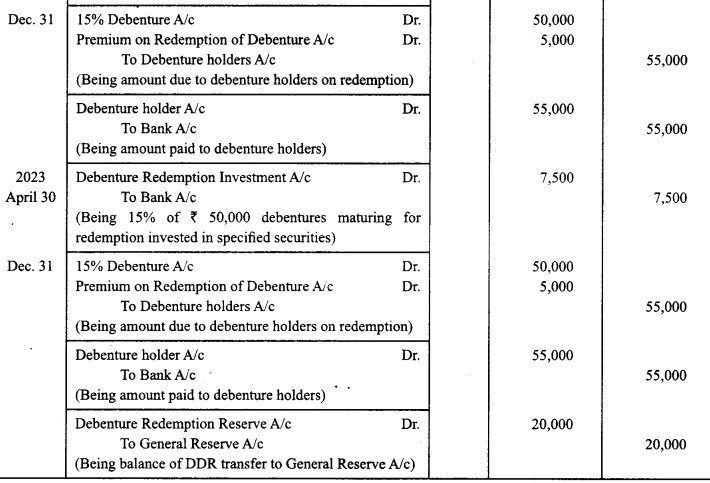
Faith and Belief Ltd has total redeemable debentures of₹ 5,00,000. It decides to redeem these debentures in two instalments of₹ 3,00,000 and ₹ 2,00,000 on December 31st 2021 and March 31st 2023 respectively. Assuming that the Company has sufficient funds in Debenture Redemption Reserve Account, pass necessary journal entries for the year ending March 31st 2020. (CBSE Sample Paper 2019-20, Modified)
Answer:
Class 12 Accountancy Important Questions Chapter 7 Issue and Redemption of Debentures 51
Class 12 Accountancy Important Questions Chapter 7 Issue and Redemption of Debentures 52
Note:
This question has been updated as per companies (Share capital and debentures) Amendment Rules, 2019.

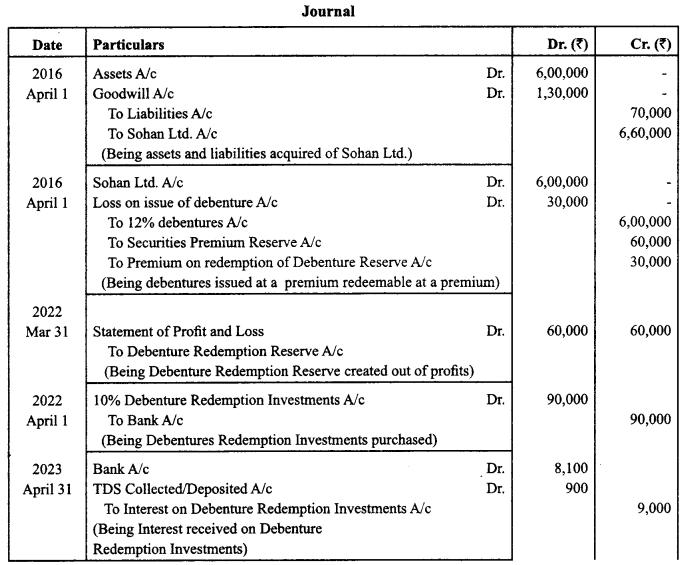
Question 3.
On 1st April, 2016, Ganesh Limited (An Unlisted Company) acquired assets of₹ 6,00,000 and took over liabilities of₹ 70,000 of Sohan Ltd. at an agreed value of₹ 6,60,000 Ganesh Ltd. issued 12% Debentures of ₹ 100 each at a premium of 10% in Ml satisfaction of purchase consideration. The debentures were redeemable after three years at a premium of 5%. The company decided to transfer the minimum required amount to Debenture Redemption Reserve of 31st March, 2022. It also made the required investment in Government securities earning interest @ 10% p.a. on IstApril, 2022. Tax was deducted on interest earned @ 10%.
Ignoring entries relating to writing off loss on issue of debentures and interest paid on debentures, pass the necessary journal entries to record the issue and redemption of debentures. (CBSE Compt. 2019, Modified)
Answer:
Class 12 Accountancy Important Questions Chapter 7 Issue and Redemption of Debentures 53
Class 12 Accountancy Important Questions Chapter 7 Issue and Redemption of Debentures 54

Question 4.
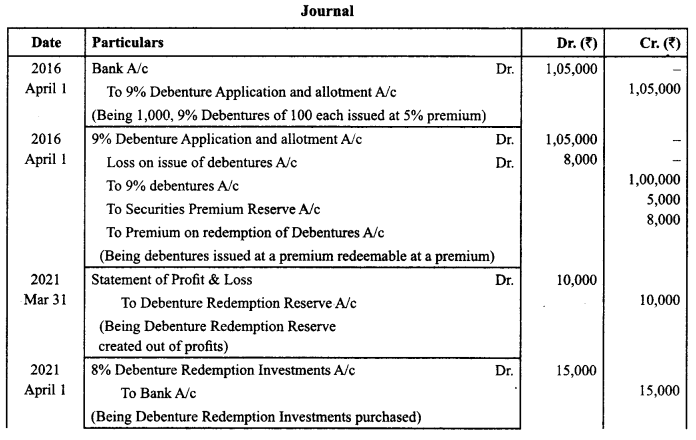
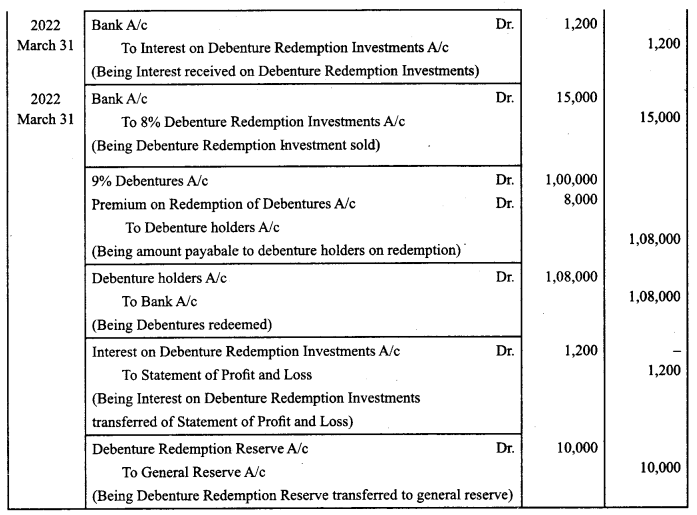
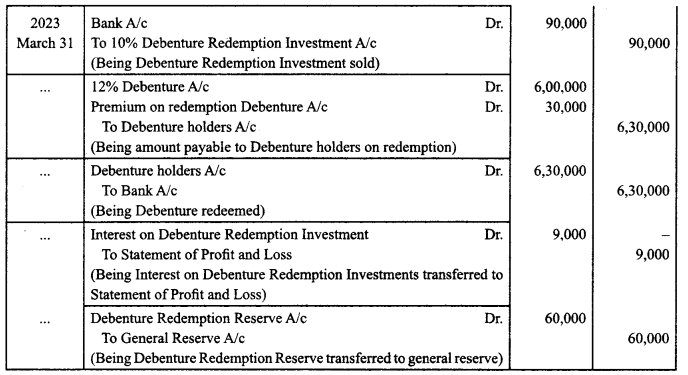
On 1st April, 2016 X Ltd. (An unlisted company) issued 1000; 9% debentures of₹ 100 each at a premium of ₹ 5 per debenture and redeemable on 31 st March, 2022 at a premium of ₹ 8 per debenture. The company created the minimum amount of debenture redemption reserve as per the amended provisions of the Companies Act, 2013 on 31 st March, 2021 and made investments in 8% p.a. fixed deposits in State Bank of India on 1 st April, 2021.
Excluding the entries for writing off loss on issue of debentures and interest on debentures, pass necessary journal entries for the above transactions in the books of X Ltd. (CBSE Compt. 2019, Modified)
Answer:
Class 12 Accountancy Important Questions Chapter 7 Issue and Redemption of Debentures 55
Class 12 Accountancy Important Questions Chapter 7 Issue and Redemption of Debentures 56
————-

Question 5.
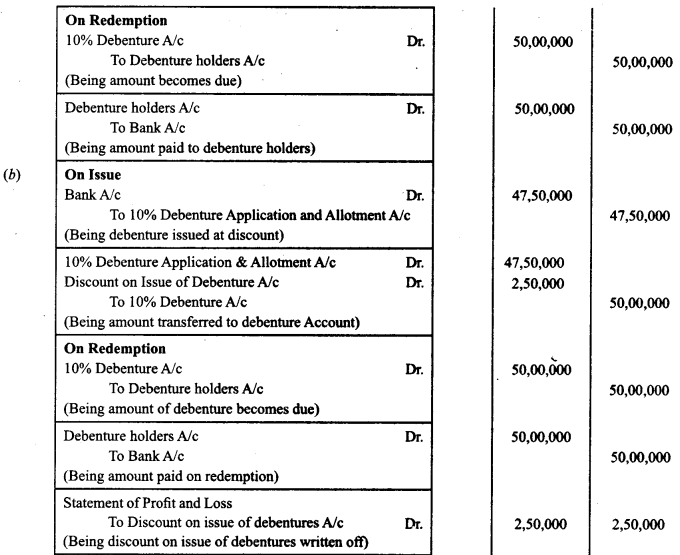
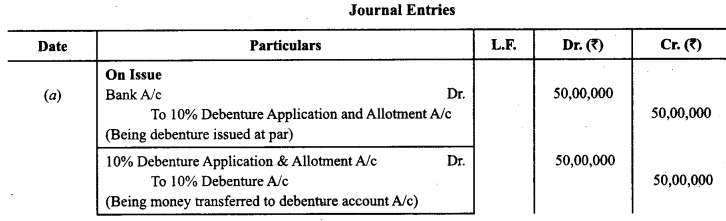
Nena Limited issued 50,000, 10% debentures of₹ 100 each on the basis of the following conditions:
(a) Debentures issued at par and redeemable at par.
(b) Debentures issued at discount @ 5% & redeemable at par.
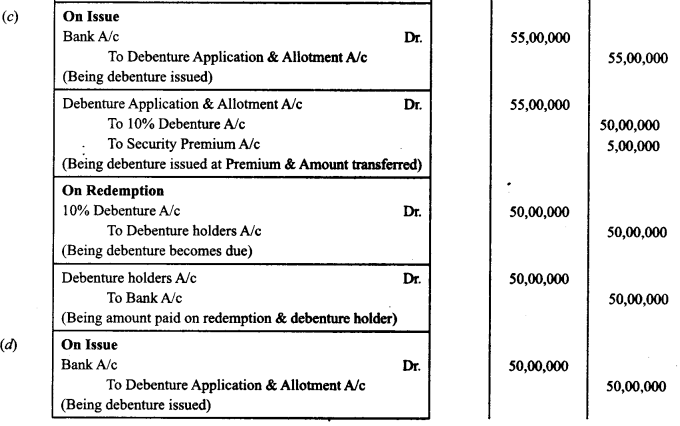
(c) Debentures issued at a premium @ 10% & redeemable at par.
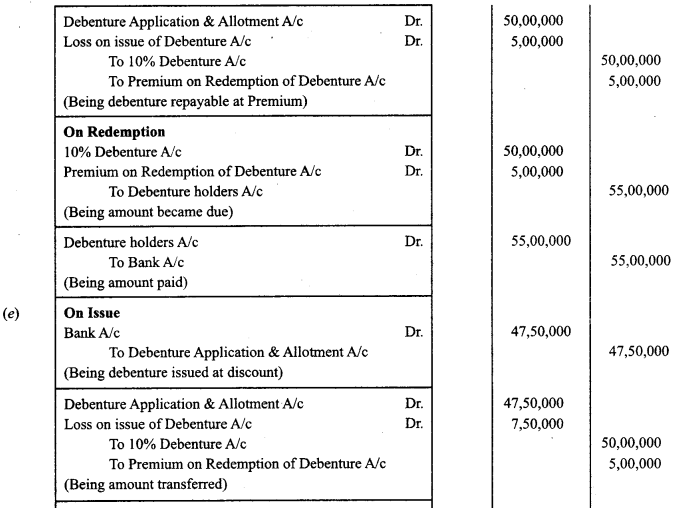
(d) Debentures issued at par & redeemable at premium @ 10%.
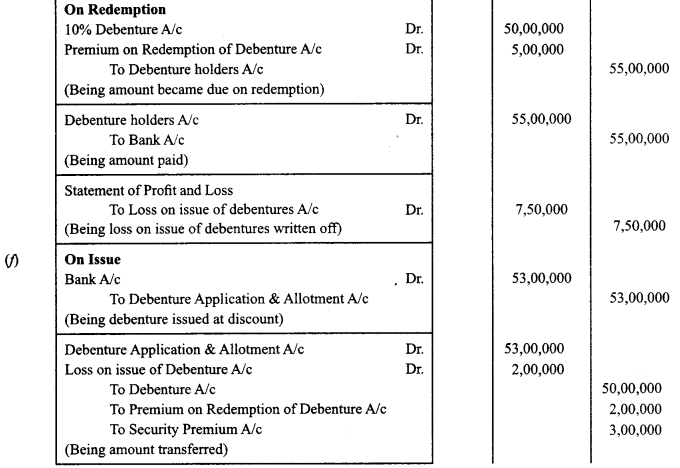
(e) Debentures issued at discount of 5% and redeemable at a premium of 10%.
(f) Debentures issued at premium of 6% and redeemable at a premium of 4%.
Record necessary journal entries in the above mentioned cases at the time of issue and redemption of debentures.
Answer:
Class 12 Accountancy Important Questions Chapter 7 Issue and Redemption of Debentures 57
Class 12 Accountancy Important Questions Chapter 7 Issue and Redemption of Debentures 58
Class 12 Accountancy Important Questions Chapter 7 Issue and Redemption of Debentures 59
Class 12 Accountancy Important Questions Chapter 7 Issue and Redemption of Debentures 60
Class 12 Accountancy Important Questions Chapter 7 Issue and Redemption of Debentures 61
Class 12 Accountancy Important Questions Chapter 7 Issue and Redemption of Debentures 62

Question 6.
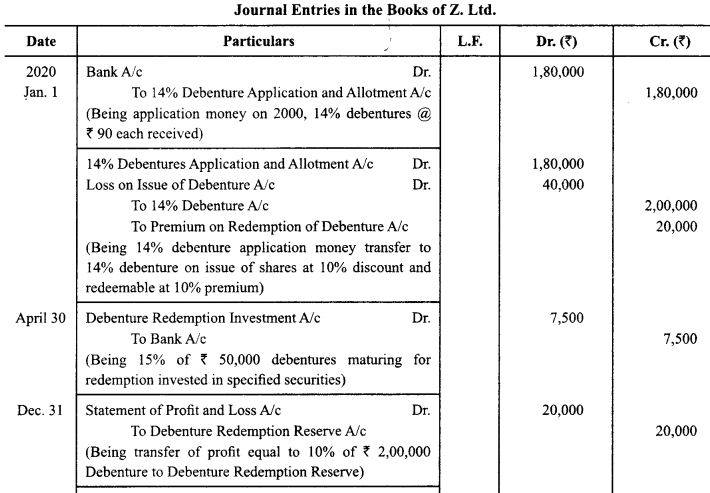
Z. Limited (An unlisted company) issued, 2,000, 14% debentures of₹ 100 each on January 01, 2020 at a discount of 10%, redeemable at a premium of 10% in equal annual Drawings in 4 years out of profits. Give journal entries both at the time of issue and redemption of debentures.
(Ignore the treatment of loss on issue of debentures and interest.)
Answer:
Class 12 Accountancy Important Questions Chapter 7 Issue and Redemption of Debentures 63
Class 12 Accountancy Important Questions Chapter 7 Issue and Redemption of Debentures 64
Class 12 Accountancy Important Questions Chapter 7 Issue and Redemption of Debentures 65
Class 12 Accountancy Important Questions Chapter 7 Issue and Redemption of Debentures 66

Question 7.
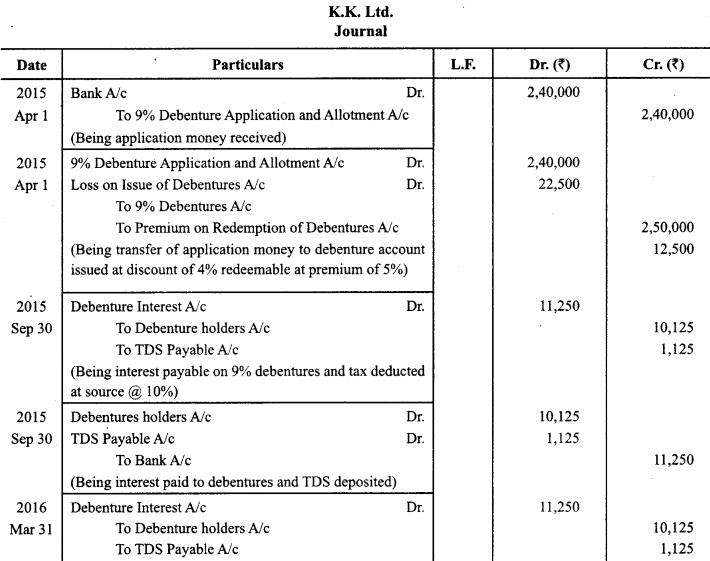
On 1-4-2015 K.K. Ltd. issued 500, 9% Debentures of ₹ 500 each at a discount of 4%, redeemable at a premium of 5% after three years.
Pass necessary Journal Entries for the issue of debentures and debenture interest for the year ended 31 -3-2016 assuming that interest is payable on 30th September and 31 st March and the rate of tax deducted at source is 10%. The company closes its books on 31st March every year. [Delhi 2017]
Answer:
Class 12 Accountancy Important Questions Chapter 7 Issue and Redemption of Debentures 67
Class 12 Accountancy Important Questions Chapter 7 Issue and Redemption of Debentures 68

Question 8.
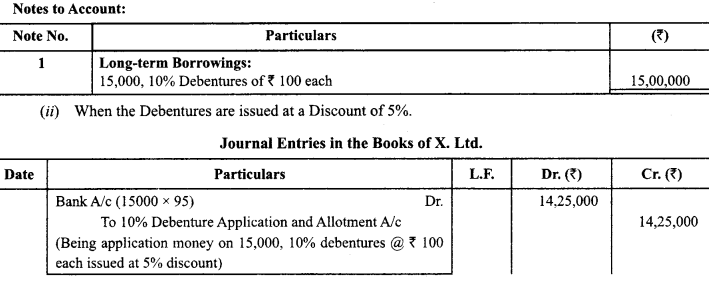
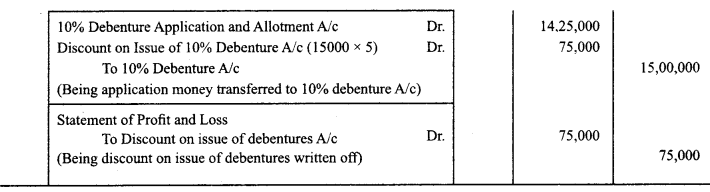
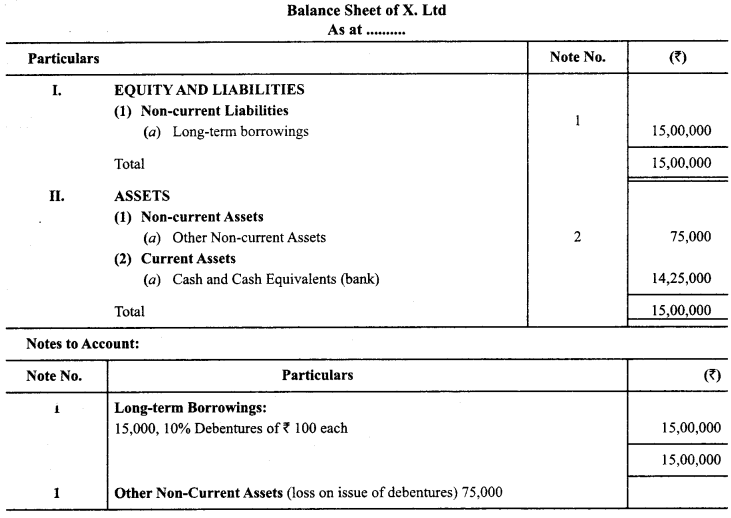
X. Ltd. issued 15,000, 10% debentures of₹ 100 each. Give journal entries and the Balance Sheet in each of the following cases:
(i) The debentures are issued at a premium of 10%.
(ii) The debentures are issued at a discount of 5%.
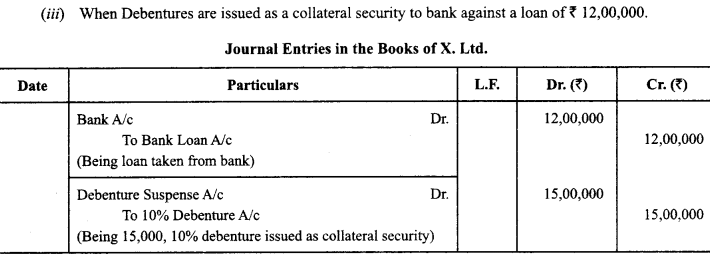
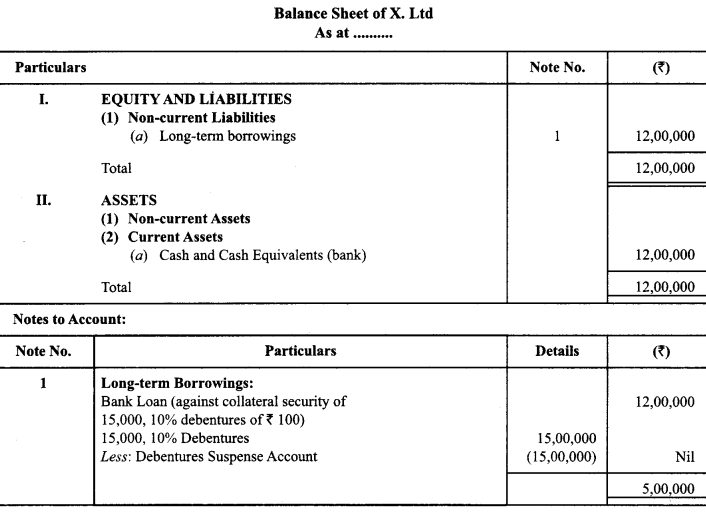
(iii) The debentures are issued as a collateral security to bank against a loan ₹ 12,00,000.
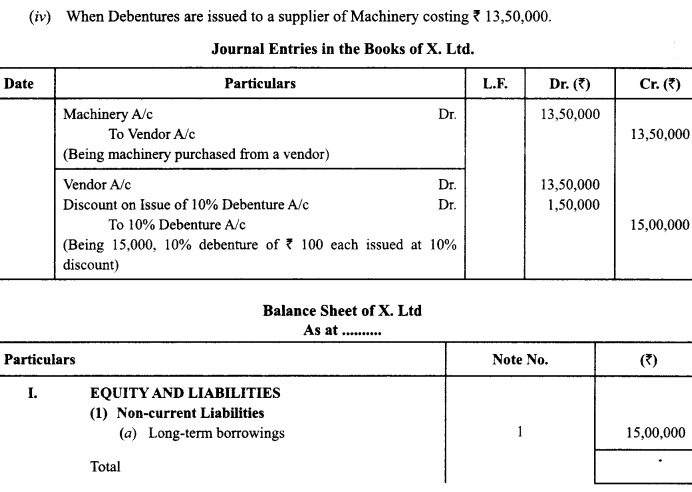
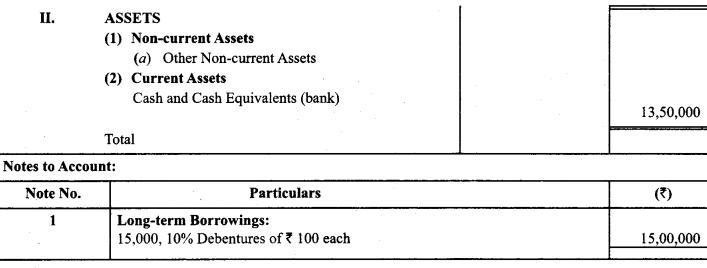
(iv) The debentures are issued to a supplier of machinery costing ₹ 13,50,000.
Answer:
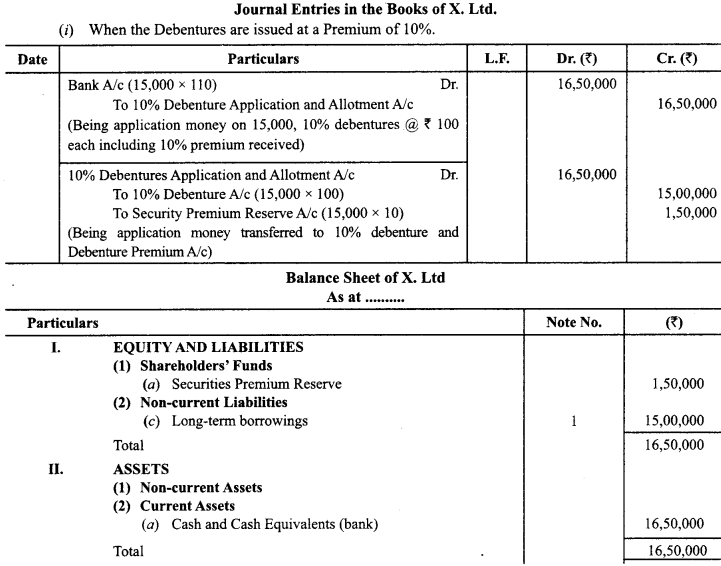
Class 12 Accountancy Important Questions Chapter 7 Issue and Redemption of Debentures 69
Class 12 Accountancy Important Questions Chapter 7 Issue and Redemption of Debentures 70
Class 12 Accountancy Important Questions Chapter 7 Issue and Redemption of Debentures 71
Class 12 Accountancy Important Questions Chapter 7 Issue and Redemption of Debentures 72
Class 12 Accountancy Important Questions Chapter 7 Issue and Redemption of Debentures 73
Class 12 Accountancy Important Questions Chapter 7 Issue and Redemption of Debentures 74
Class 12 Accountancy Important Questions Chapter 7 Issue and Redemption of Debentures 75
Class 12 Accountancy Important Questions Chapter 7 Issue and Redemption of Debentures 76

Question 9.
On 1st April, 2018, KK Ltd. (An unlisted company) invited applications for issuing 5,000 10% debentures of₹ 1,000 each at a discount of 6%. These debentures were payable at the end of 3rd year at a premium of 10%. Applications for 6,000 debentures were received and the debentures were allotted on pro-rata basis to all the applicants. Excess money received with applications was refunded. The directors decided to transfer the minimum amount to Debenture Redemption Reserve on 31.3.2020. On 1.4.2020, the company invested the necessary amount in 9% bank fixed deposit as per the amended provisions of the Companies Act, 2013. Tax was deducted at source by bank on interest @ 10% p.a. Pass the necessary journal entries for issue and redemption of debentures. Ignore entries relating to writing off loss on issue of debentures and interest paid on debentures. (CBSE 2018, Modified)
Answer:
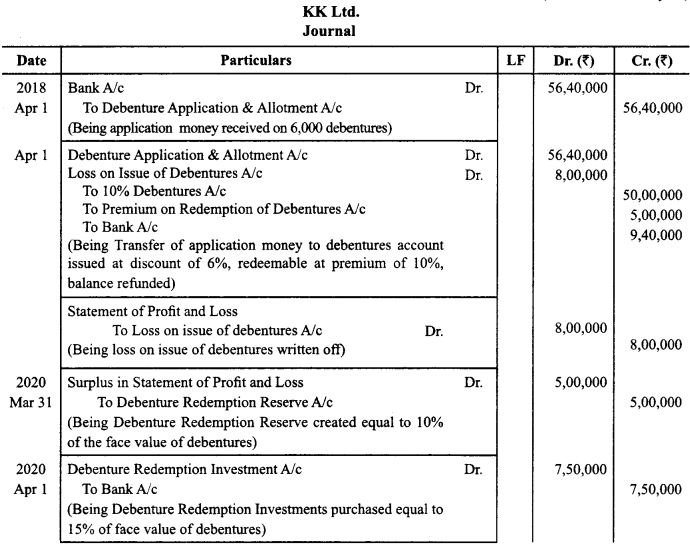
Class 12 Accountancy Important Questions Chapter 7 Issue and Redemption of Debentures 77
Class 12 Accountancy Important Questions Chapter 7 Issue and Redemption of Debentures 78

Question 10.
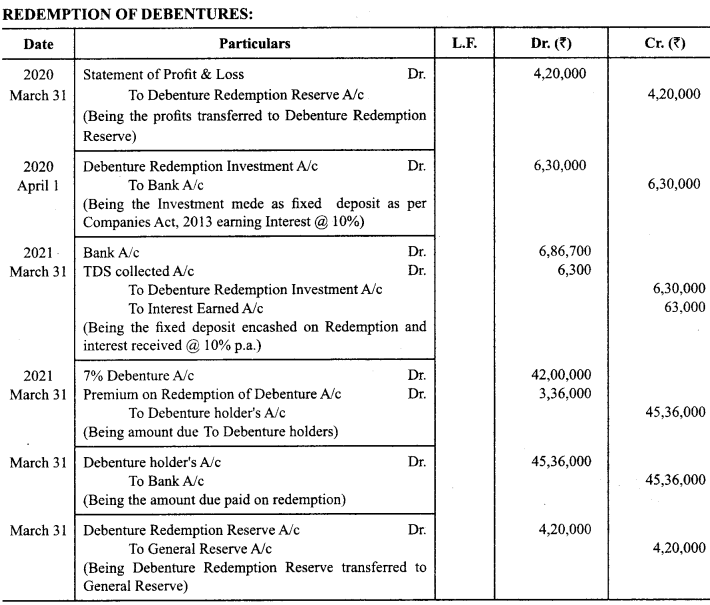
Ruchi Ltd (An unlisted company) issued 42,000,7% Debentures of 100 each on 1st April, 2015, redeemable at a premium of 8% on 31st March 2021. The Company decided to create required Debenture Redemption Reserve on 31st March 2020. The company invested the funds as required by law in a fixed deposit with State Bank of India on 1st April, 2021 earning interest @ 10% per annum. Tax was deducted at source by the bank on interest @ 10% per annum. Pass necessary Journal Entries regarding issue and redemption of debentures.
(CBSE Sample Paper 2016, 2017, Modified)
Answer:
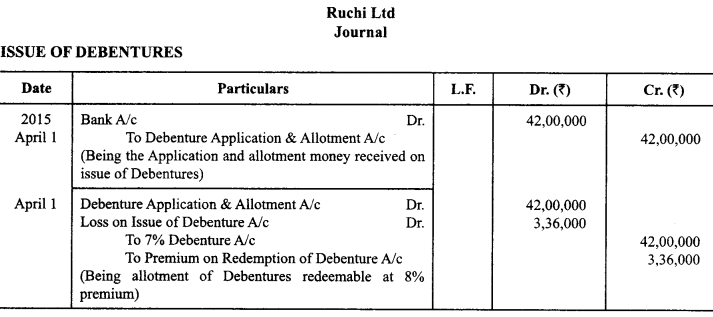
Class 12 Accountancy Important Questions Chapter 7 Issue and Redemption of Debentures 79
Class 12 Accountancy Important Questions Chapter 7 Issue and Redemption of Debentures 80

Question 11.
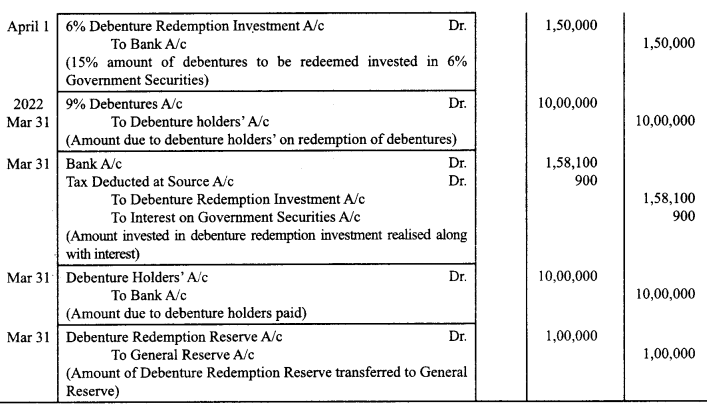
(Lump-sum Method): Alibaba Ltd. (An unlisted company) issued 20,000, 9% debentures of ₹ 50 each on April 1, 2022 redeemable at par on March 31, 2022. All the debentures were subscribed and allotted. Investment of the required amount in securities is subject to deduction of 10% tax at source. Pass journal entries for issue and redemption of debentures assuming required investments were made in 6% specified securities.
Answer:
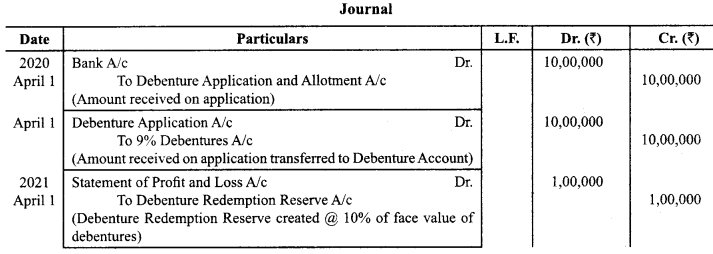
Class 12 Accountancy Important Questions Chapter 7 Issue and Redemption of Debentures 81
Class 12 Accountancy Important Questions Chapter 7 Issue and Redemption of Debentures 82

Question 12.
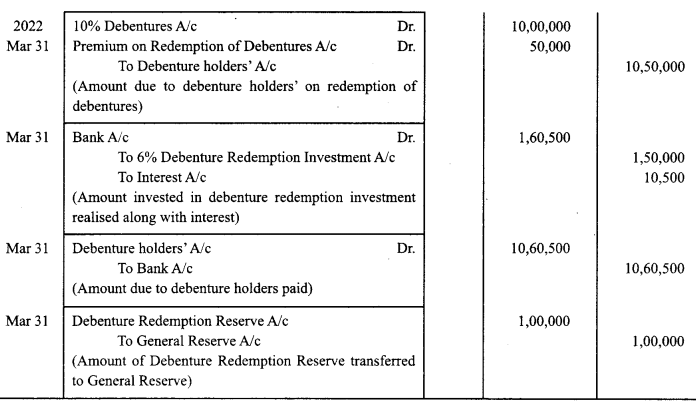
(Lump-sum Method): On April 1, 2020, Nelson and Tubro Ltd. (An unlisted company) issued 10,000, 10% debentures of₹ 100 each redeemable at 5% premium on March 31, 2022. Debentures were fully subscribed and allotted. Pass necessary journal entries for issue and redemption of debentures assuming necessary amount was invested in 7 % specified securities.
Answer:
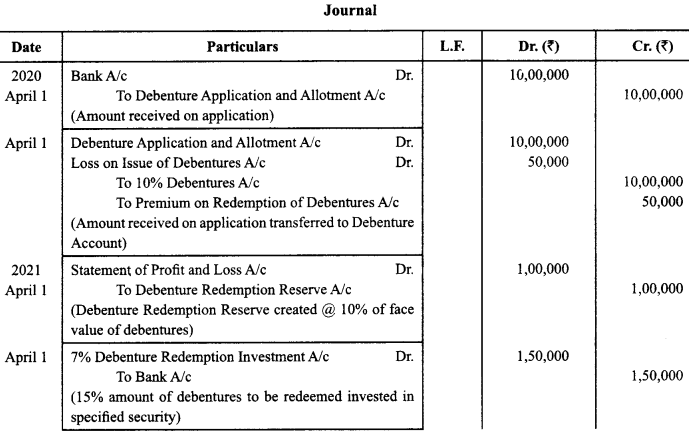
Class 12 Accountancy Important Questions Chapter 7 Issue and Redemption of Debentures 83
Class 12 Accountancy Important Questions Chapter 7 Issue and Redemption of Debentures 84
Note: This question has been updated as per companies (Share capital and debentures) Amendment Rules, 2019.

Question 13.
(Instalments or Draw a Lot Method): Neelgiri Limited issued 6,000, 10% debentures of ₹ 100 each on April 01, 2018 redeemable in 3 three equal instalments commeucing with March 31, 2021. The board of directors decided to transfer the required amount to Debenture Redemption Reserve in 2 equal instalments. Company also complied with Companies (Share Capital and Debentures) Amendment Rules, 2019.
Answer:
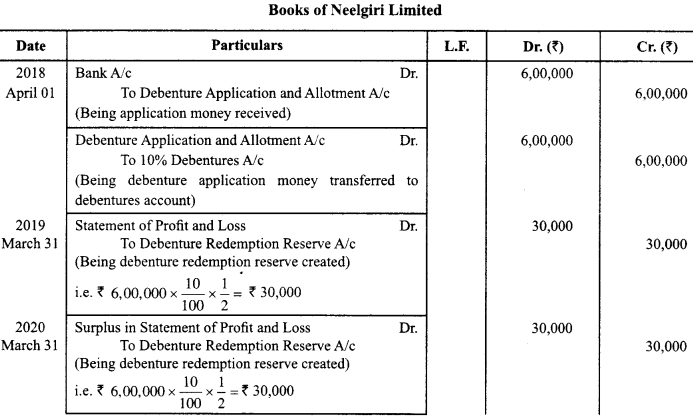
Class 12 Accountancy Important Questions Chapter 7 Issue and Redemption of Debentures 85
Class 12 Accountancy Important Questions Chapter 7 Issue and Redemption of Debentures 86
Class 12 Accountancy Important Questions Chapter 7 Issue and Redemption of Debentures 87

Development Class 11 Important Extra Questions Political Science Chapter 10

Here we are providing Class 11 Political Science Important Extra Questions and Answers Chapter 10 Development. Political Science Class 11 Important Questions with Answers are the best resource for students which helps in class 11 board exams.

Class 11 Political Science Chapter 10 Important Extra Questions Development

Development Important Extra Questions Very Short Answer Type

Question 1.
Explain the concept of development.
Answer:
The word ‘Development’ carries many connotations. It is a very wide concept with different aspects. The very purpose of the development is to build a modem society, to change the face of not only every section of the society but of every man by taking the fruits of development to the last man. It seeks to make maximum utilization of all the resources and to make their just distribution. It is opposed to the concentration of resources in few hands or the resources remain unexploited. Therefore it is a very positive concept, however, it has been understood in a negative sense only.

Question 2.
Mention some main objectives of the development.
Answer:
Although the concept of development is a wide term with broader objectives. Its main objectives can be specified as under

  1. Identification of unexploited resources.
  2. Maximum utilization of available resources.
  3. To build a modern society by transforming the traditional and backward society.
  4. To ensure that fruits of development reach the last man in the queue.
  5. To make the change and growth human-oriented.

Question 3.
What are the targets of Development?
Answer:
Followings are the areas of targets of Development:

  1. Poverty
  2. Unemployment
  3. Unexploited Resources
  4. Industrialization
  5. Modernisation of agriculture
  6. Illiteracy
  7. Low per capita income and low per capita consumptions.

Question 4.
What are the main challenges of Development?
Answer:
Followings are the challenges of development in developing countries of Asia and Africa

  1. The low standard of living
  2. Illiteracy
  3. Poor health
  4. Malnutrition
  5. Lack of basic amenities
  6. Feudal agrarian system
  7. Legacy of colonial economies of under-developed countries.

Question 5.
What are the main features of the development model of India?
Answer:
India has adopted a socialistic pattern of society which is based on the principle of From each according to his ability and to each according to his ability. We have a mixed economy in which some economic activities are to be undertaken in the public sector and others are taken in the private sector. We have adopted planned economic development with a five-year plan system. Some targets are fixed for realization in every plan. Economic pursuits are undertaken in different fields with the collaborations.

Question 6.
What are the social costs of development?
Answer:
The process of development has its social cost which can be mentioned as under

  1. Displacement of the people from their homes
  2. Change in culture
  3. Illiteracy
  4. Adoption of a new culture
  5. Loss of livelihood
  6. A search for a new identity
  7. a Large number of rural and urban poor.

Question 7.
Explain in brief tire environmental costs of development.
Answer:
The unplanned development has definitely rather, unfortunately, has its environmental cost which can be understood as under

  1. Environmental degradation.
  2. Displacement of the people from one area to another area.
  3. Natural disasters like Tsunami and earthquakes etc.
  4. Global warming.
  5. Greenhouse effects.
  6. Water pollution.
  7. Air pollution.
  8. Sound pollution.
  9. Ecological disorder.
  10. Energy crisis.

Question 8.
What is sustainable development?
Answer:
The present model of developments seems to be oriented to the present needs of mankind, neglecting the needs of the future generation. Sustainable development is an approach to development that seeks to use the presently available resources in such a way that:

  1. There should not be misuse and wastage of present resources.
  2. All the resources should be exploited fully.
  3. There should be conservations of energy.
  4. Policies should be future-oriented.

Question 9.
What do you understand by the term environmentalism?
Answer:
Environmentalism stands for environmental movement which works to protect natural resources and the eco-system. It emphasizes that human beings should learn to live in harmony with the requirements of the eco-system and should not manipulate the natural environment to serve the personal petty interests which harm nature and the cause of future generations.

Question 10.
Discuss the impact of environmental movements.
Answer:
The different environmental movements started in different parts of the world have been able to evoke public consciousness and awareness and also successfully pressuring to modify the governmental policies in the light of environmental goals and sustainable development.

The roots of environmentalism can be traced back to the nineteenth century. Today the environmental movement has become a worldwide phenomenon with thousands of Non-governmental groups and even some green political parties are pursuing the cause of protection of the environment. In India Chipko movement started by Sunder, Lai Bahuguna has been playing an effective role.

Question 11.
How growth and development are related?
Answer:
Growth related to the advancement in agricultural and industrial areas and progress in infrastructure and production in agriculture and industrial areas thereby affecting all other aspects of human life but it does not necessarily ensure the just and equal distribution of the fruits of such growth. Development seeks to ensure this distribution of progress and change of material development and development in infrastructure when economic growth and redistribution of the benefits do not go together, the benefits are cornered by few development seekers to break this chain for improving the standard of living of underprivileged.

Question 12.
What are social indicators of development?
Answer:
Followings are the main social indicators of development:-

  1. Literacy and education level.
  2. Life expectancy.
  3. Maternal mortality rates.
  4. Housing.

Question 13.
What do you understand by the basic need approach?
Answer:
The human development report of the United Nations Development Programme (UNDP) ranks countries on the basis of their performance in social indicators like literacy, life expectancy, and maternal mortality rates which are called as Human Development Index. According to these parameters, the development should be a process that allows more and more people to make meaningful choices. For this fulfillment of basic needs like education, health, and shelter. This approach is called as basic needs approach.

Question 14.
What do you mean by right claims?
Answer:
Since the fruits of development have not reached the people for whom the development meant. It is desirable that people should be given the right to claim their dues from the state and society. It is necessary to check the process of concentration of resources in the hands of few privileged sections of society. It becomes more essential in the democratic framework of the government where people have the right to be consulted in the decision-making process, which is related to them.

Question 15.
How the democratic participation is useful for development?
Answer:
Democratic participation ensures the maximum involvement of maximum people in the decision-making process in the democratic framework of the government. Democratic participation is useful to the development. Both democracy and development are concerned with the realization of the common good and the welfare of maximum people. The people’s participation in the decision-making process makes the development people’s oriented. A decentralized approach can bring, people’s participation and development together.

Development Important Extra Questions Short Answer Type

Question 1.
Explain the meaning of the term ‘Development.
Answer:
The meaning of the concept of development is different for different people. One thing is definitely common that development means the diffusion of growth to all sections of the society to raise the standard of life of the people. The development conveys the ideas of improvement, progress well-being, and inspiration for a better life. Through the process of development, society seeks to achieve the vision of the future for the future generation.

The development has also been Understood and used in a narrow sense y understanding it related with limited goals such as increasing the .ate of economic growth or modernizing the society. In fact, the development is not concerned with just achieving the present targets or completing projects like dams and factories i.e. growth of infrastructure but it is more concerned with realizing the broader vision of society. We can say that development is a value ridden concept.

Question 2.
Explain various issues that are involved in the process of development.
Answer:
Since the concept of development is very wide, a number of issues are involved in it which are as under

  1. The rights of the people should be taken into account during the course of development.
  2. To make development more pervasive, there should be the democratization of the social, economic, and political environment.
  3. The benefits of development should reach all sections of society.
  4. There should be qualitative improvement in the lives of the people.

Question 3.
Explain socialist, communist, and capitalistic model of development.
Answer:
Every state has its own model of development. Every state is concerned with the welfare of its people and raising the standard of living of its people. Although the number of models has been evolved there have been three main models of development in prevalence. These models are as under

  1. Socialistic model
  2. Communistic model
  3. Capitalist model

1. Socialistic model:- Socialist pattern of development prevailed in developing countries of Asia and Africa to make distribution of resources as per the reeds of the people and to exploit the potentialities of the people to the fullest.

2. Communist model:- Communist model of development initially started in the countries of Eastern Europe and then spread to some other countries. It was based on the principles of Marxism.

3. Capitalist model:- This model of development become popular in the USA. and European countries which are based on the principle of economic pursuits on competition basis and profit basis with the minimum role of the state.

Question 4.
What are the main targets of development?
Answer:
The process of development seeks to achieve positive changes and improvement in the following areas

  1. Poverty
  2. Unemployment
  3. Illiteracy
  4. Unexploited resources
  5. Regional imbalances
  6. Social backwardness.
  7. Fatalism
  8. Impact of colonialism.

Question 5.
Enumerate certain features of development undertaken in different parts of the world.
Answer:
The process of development has undergone many changes over the years in different countries as it is understood in its meaning. Initially, it was linked with the economic growth and social development with the purpose of modernization of societies. The main features and activities undertaken were as under:

  1. Industrialization
  2. Commercialization
  3. Urbanization
  4. Agrarian reforms
  5. Use of science and technology
  6. Educational development
  7. Secularisation
  8. Democratization.

In the process of development, the state was given a leading role to play in the above areas.

Question 6.
Explain the mode of development in India.
Answer:
After independence, India got the colonial legacy at the social, economic, and political levels. India adopted a mixed economy for its development. Planning Commission was set to start planned economic development. The first five-year plan was started in 1951-56. So far we have successfully completed the ten five years plan which has helped in transforming the Indian society and economy to an appreciable extent. Today India is on its way to being a modernized society. The process of liberalization, globalization, and privatization has fastened the pace of development. In India, the process of development is going in Libera secular democratic framework. All efforts are being made to take the benefits of development to all sections of the society through their participation at all levels.

Question 7.
What is the impact of development in India?
Answer:
India, through its planned socio-economic development, has achieved tremendous growth in different areas i.e. agriculture, roads, housing, industry, medicine, health, raising employment opportunities, education, and developing infrastructure. Through the doses of modernization, India has been able to transform Indian society in the last sixty years. In fact through the development face of India is changed from an agrarian, traditional and backward, and undeveloped society to a modem, secular, democratic, and developing society.

But still, we have not been able to achieve the goals of development in the real sense and as per the true meaning of development. We are still in grip of inequalities, disparities, and imbalance. Still, we have 26% of people who are yet to reach the level of subsistence needs. Still, we have situations of excess and deprivation. The ultimate objective of development is rational utilization of the resource and to take the fruits of development to the last man. We feel that we are far away from these two goals of development.

Question 8.
What are the main hindrances in achieving the goals of development in developing countries like India?
Answer:
Almost every society is in the process of development and is trying to get the goals of development. But there are certain structural hindrances in the path of development, particularly in developing countries. Some of the hindrances are as under:-

  1. Lack of definite and relevant model of development.
  2. Lack of political will.
  3. Lack of people’s awareness.
  4. Traditional social structure.
  5. Traditional occupations.
  6. Lack of people-oriented approach of bureaucracy.

Question 9.
What do you know about the social cost of development?
Answer:
The process of development involves a lot of desirable and undesirable activities with negative and positive consequences which can be called social costs. These social costs can be understood as under

  1. Displacement of persons due to developmental projects like bridges and dams and other such projects.
  2. Migration of people in search of better opportunities and better quality of life in which they lose their old identities and due course of time acquire new values and new identities.
  3. Pressure on urban civic amenities due to the process of urbanization in the wake of development.
  4. Loss of traditional skills acquired in a long time.
  5. Loss of culture.
  6. Regional and cultural confrontations.
  7. Social agitations.
  8. Unemployment and uncertainties.

Question 10.
Explain the environmental costs of development.
Answer:
The environmental cost of development can be measured in the following ways.

  1. Pollution.
  2. Ecological crisis.
  3. Environmental degradation by the phenomenon like depletion of ozone, ozone hole, global warming, and Green House effects.
  4. Natural disasters like earthquakes and Tsunami.
  5. Loss of human life.
  6. Loss of forest due to deforestation cause havoc.
  7. Loss of subsistence needs of the poor.
  8. Wastage of medicinal plants.
  9. Loss of traditional sources of energy, therefore, leading to the energy crisis.
  10. Dirty drinking water.

Question 11.
What is the meaning and objectives of Environmentalism?
Answer:
The thinking and supporting, the thinking of protecting the environment and environmental life is known as environmentalism. It is therefore as an urge and passion to save the environment and human life from the hazards which are being played in the name of development.

Environmentalists maintain that human beings should learn to live in harmony with the rhythms of the eco-system and should not indulge in such selfish activities that are destroying the beauty and utility of the eco-system and environment. It is a fact that if this trend is not checked/stopped, we will get barren earth, poisoned rivers, and polluted air for future generations. Due to this fear, the environmental movement has become a worldwide movement with the support of government and non-governmental organization who have been successful in modifying
the government’s industrial and developmental policies in the right of goals of protection of the environment.

Question 12.
Explain the relationship between growth and development.
Answer:
Although the two concepts i.e. growth and development are very frequently used for each other and simultaneously but there is a perceptible difference between the two, although both are related to the welfare of man and society. Growth denotes a change in infrastructure and progress in different areas. The growth has not been able to achieve the goals of social justice. It is largely material development. On the other hand, the concept of development is broader than growth and can be understood as a process that seeks to improve the quality of life of the people at large. Growth is not an indicator of social justice. It is the development that is an instrument and measure of social justice and quality of life of the people.

Question 13.
How the development can be measured?
Answer:
Measuring economic growth is not adequate as the indicator of social and economic progress and social justice. The need of measuring the development was felt. Several attempts have been made in this direction. One such attempt is the Human Development Re| which is annually brought out by the United Nation Development Programme (UNDP) which ranks the different countries of the two, on the basis of their performance in social indicators like education, lii expectancy, and maternal mortality rates. This measure is called the Human Development Index. This proves that the development revolves around the basic needs of man. Thus development is a process which allows more and more people to make meaningful life with the minimum adequate availability of basic needs like food, education, shelter, and health.

Question 14.
What do you mean by the Top-down approach of development? What changes does it need?
Answer:
There has been the social and environmental cost of development at different levels, due to which the development could not bring the desired results. The benefits of development have not been evenly distributed among the people. It has been due to the ‘Top-down’ approach, which has been the strategy of development. The very important feature of the Top-down approach has been the selection of priorities and preferences and methods of implementation of the decisions and project^ were all generally decided by the top bureaucrats, politicians, executives, and technocrats with the actual participation of those for whom these decisions are taken. This was the scenario of both the democratic and non-democratic countries. Thus the need for alternate model development is felt.

Question 15.
What do you understand by the Concept of Right Claims?
Answer:
In most of the models of development the benefits of change, progress and development have not been reached to the people for which they were meant and are cornered by the privileged sections of the society. It has been due to the Top-down approach in the developmental models. Now the time has come and which duly accepted and recognized that the aspirations and needs of the affected people should be taken into account. People should be allowed to put up their views, rights, and claims before the decision-makers.

In a democratic framework, people have the right to be consulted in the exercise of decision making and in the process of development. The people have their natural; rights on the available resources for developmental activities. Therefore on the fruits of development, local people have a natural claim which should be duly given to make development meaningful.

Question 16.
What is the significance of Democratic Participation in the process of development?
Answer:
Democracy is a system of government that provides an opportunity to the people to participate in the decision-making process and the developmental activities which are a pre-requisite of the success of democracy. Democracy also aims to provide a better quality of life by establishing equality, justice, fairness, brotherhood, the dignity of man, and ensuring people’s participation.

Democracy and development, both are concerned with realizing the common good. The most important relationship between democracy and development is that development is supposed to be undertaken by people’s participation at the micro-level and macro-level.

Development Important Extra Questions Long Answer Type

Question 1.
Define development, its objective and suggest the best modes of development.
Answer:
Lucian Pye, a great politician scientist explained the idea of development in his famous book ‘Aspects of Development’ “as a process of rational utilization of the available resources to establish modern society. In the contemporary world, however, the word of development has been used for progress, change, modernization, and growth. In fact” Lucian Pye explained the concept of development in terms of socialization, modernization, democratization, secularisation, and people’s participation.

As far as the objectives are concerned, they are not just material progress in different fields like production, goods, amenities, dams, projects, and the well-being of a few. In fact, its objectives are wide. The ultimate objective of the development is as under:-

  1. To make the best use of the resources by identifying them properly.
  2. To ensure the fair distribution of fruits of development to all sections of society, particularly up to the underprivileged class.
  3. To raise the standard of living of the people.
  4. To achieve the common good of the people.

There have been different models of development in different parts of the world with democratic and dictatorial governmental structures In all these models of development, there has been the Top-down approach in decision making which prohibited the local initiative and participation in policymaking and decision-making process. To achieve the desired goals of development, there is a need to adopt such a system or model of development which ensure the people’s participation up to a desirable extent and recognizes their rights and claims.

Peace Class 11 Important Extra Questions Political Science Chapter 9

Here we are providing Class 11 Political Science Important Extra Questions and Answers Chapter 9 Peace. Political Science Class 11 Important Questions with Answers are the best resource for students which helps in class 11 board exams.

Class 11 Political Science Chapter 9 Important Extra Questions Peace

Peace Important Extra Questions Very Short Answer Type

Question 1.
What is Peace?
Answer:
Peace is one of the most desired situations not only by the saints and philosophers but also by every ordinary person. Even those who get indulged in violence do the violence in search of peace. The concept of peace has been conceived and understood differently by the people of different ages. Generally, peace has been defined as the absence of war. But this definition of peace is incomplete and misleading. Peace is something mental and psychological. Peace is freedom from unnecessary tensions and worries at the individual level as well as collective level. It is also a fact that peace is a personal and relative matter. At the individual level, peace depends, how he/she takes the things!

Question 2.
What do you mean by structural violence?
Answer:
When the conflict, exploitation and tensions are at the institutional level in perpetuation, it is called as the structural violence. In, such structural violent situation, peace will the immediate causality. For example, the traditional Indian caste system which was based on hierarchic system disclosed a group of people as untouchable and put them at the lowest ladder of the society. It naturally bred hatred, tension and conflict. Similar is the situation of colonialism, where one country dominated, exploited and subjected enter country leading to violence and revolt.

Question 3.
How inequality harms the cause of peace?
Answer:
Inequality in any form is certainly injurious to the cause of health. Any social order based on inequalities will not have peaceful and harmonious relationship^imong the members of that society because’ these will be tension, competition, dominance and hatred.

Question 4.
Give the names of the system of structured violence.
Answer:
There can be any system of structural violence. Following are the examples from history in which structural violence prevailed.

  1. Traditional Indian social order in which a group of people was declared untouchable.
  2. Indian family system, where women were declared inferior and incapable.
  3. Colonialism which institutionalised group exploitation of other countries.
  4. Racism, where a group of other caste and race was exploited.
  5. Communalism, where people of another religion were exploited.

Question 5.
How structural violence caused harm to peace?
Answer:
Different forms of structural violence like colonialism, racism, communalism, hierarchic social order and low status of women prolonged the tension and make a particular type of psyche which institutionalised not only inequalities and exploitation but tension and conflict also. Psychological and tangible harm suffered by the victims of violence created grievances which were transmitted from generation to generation. In this way, such structural violence harmed peace for a long time to come.

Question 6.
How the violence can be eliminated?
Answer:
It seems to be difficult if the not impossible proposition that violence can be eliminated from society totally. It needs healthy psyche, mind frame built-in a congenial and healthy environment. Several age-old spiritual principles like compassions, meditations and preachings have been playing their role in their own way to make healthy psyche and thinking of man to establish peace.

Question 7.
Can violence be helpful in the establishment of peace?
Answer:
Although, it is generally thought that violence is used to establish peace. Particularly at the state level, it is used for establishing peace. It is because of this the army and police are maintained and is trained in the use of weapons for violence and wars, But it is all superficial view. The everlasting peace can only be achieved by the positive makeup of mind frame which can be possible with the positive environment built on the basis of harmonies and cooperative relations among the people of the society.

Question 8.
What are the reasons for the growing violence in our society?
Answer:
There are a number of reasons for the present growing state of violence in the present-day society, but we can give some of them, which are as under

  1. Intolerance
  2. Increasing selfishness
  3. Excessive view of casteism, communalism and regionalism
  4. Increasing culture of consumerism and naturalism
  5. Criminalisation of politics
  6. Corruption in society
  7. Lust for power and money
  8. Structural violence.

Question 9.
What exactly is peace? Why it is fragile in today.
Answer:
Peace is in fact a state of mind free from worry, tension, hatred and fear. It is related to the framework of mind and mindset. Peace is a very positive situation in life. In today’s world, it is found to be very fragile i.e. it is in a disturbing state. The environment of societies has become violent and uncertain. There is a situation of mistrust and distrust. Most of the people are in mental tension in such situation peace has become very much unachievable.

Question 10.
How does the human mind help in establishing peace?
Answer:
Human mind shapes the behaviour of man and behaviour of man creates peace or tension therefore mind plays a significant role in establishing peace. The Constitution of the United Nations Educational, Scientific and Cultural Organisation rightly observes “Since war begins in the minds of men, it is in the minds of men that the defences of peace must be constructed.” For this several sages and saints preached the spiritual principles of tolerance and compassion and practices of meditation were followed to make a mindset so as to establish and promote peace.

Question 11.
Do you agree that non-violence means weakness?
Answer:
The main reason for increasing violence in society is a misunderstanding about non-violence. Many people equate non-violence with weakness, which is totally fallacious. In fact, weak people resort to war and violence. It is the quality of strong persons to be tolerant and non-violent. Gandhiji gave a broad meaning of non-violence. For him non¬violence meant not just refraining from causing physical harm but also includes the thought of causing physical or mental harm to anybody. It is the task of only the strong person. A weak person cannot have this quality.

Question 12.
How Gandhiji experimented with non-violence?
Answer:
Many people think it is the violence which can bring the just ends, but it is again fallacious. The ultimate result will come only thing non-violence which is proved by Gandhi’s experiments in South Africa and India. Gandhiji made India independent only through non-violence. Violence can bring results for short devotion but .ultimate just end is brought only through the non-violence.

Question 13.
How the state is related to peace?
Answer:
In today’s world, there are sovereign nation-states which are inspired with narrow nationalism. Each modem nation-state is organised on the basis of nationality Every nation-state behaves like a human being. As the behaviour of men is shaped by his personal interest in a similar way the behaviour of a nation is shaped on the basis of his national interest. Since the national interests of the states, a leads to differences leading to clashes and conflicts which ultimately poses threat to peace at the individual level as well as collective level. To protect its interest every state uses the force. Each state has police and army as the instrument of coercion.

Question 14.
What do you mean by Pacifism?
Answer:
Pacifism denotes thinking which opposes war and violence for settling differences and disputes. It prefers to settle the disputes through discussion, negotiation and dialogue and not through violence or war. Pacifism is a principle which is based on pragmatism. The supporters of Pacifism believe that use of force and resort to war is morally wrong. They prefer peaceful means like the negotiation for settling the disputes than the war which, they say will never just end.

Question 15.
What are the main challenges to peace in the modern world?
Answer:
Followings are the main challenges for peace

  1. Intolerance
  2. Materialism
  3. Increasing consumerism.
  4. Terrorism
  5. The criminalisation of society and polity.

Peace Important Extra Questions Short Answer Type

Question 1.
Define the concept of peace.
Answer:
There has a number of persons as champions of peace. Many saints, philosophers and statesman have also championed the cause of peace. Although there have also been many philosophers, warriors and army Generals who have glorified war and did not value peace because they believed that only conflict could facilitate the growth of civilisation. Several thinkers have condemned peace and commended violence and conflict as essential vehicles of individual heroism and social vitality.

Peace is the situation of no war, no tension and no conflict of any kind. Peace is a state of mind. The essential elements of peace are justice, tolerance, truth and compassion. Peace is something eternal and pious ultimate happiness of mankind lies in the peace. There have been ardent supporters of peace such as M.K. Gandhi, Gautam Buddha etc. who denounced war and violence.

Question 2.
Name the factors which have been threatening international peace.
Answer:
Peace at an individual level, national level and international level has been facing threats from different sides. Nation-states have been engaged in conflicts, tensions and wars like the ordinary human beings over petty issues. These issues have been posing threats to international peace.

The post-war period of the world has been marked by intense rivalry’ between two superpowers i.e. Capitalist USA and Communist USSR. There are have been a number of wars and tensions in different parts of the world which threatened international peace. Many wars on the planet have caused the destruction of human life and property.

Question 3.
What do you mean by structural violence? Explain with example.
Answer:
Violence occurs in society at various levels in different forms. It occurs at the individual level, collective level, in an unorganised way and also organised way. An organised form of violence is called structural violence. Traditional caste system treated certain groups of people of a particular caste as untouchables, who were subjected to collective humiliation and exploitation and deprivation. Only after independence, Art. 17 of Indian Constitution abolished it but, still, we have scars of this evil till today.

Similarly, women have been treated badly in a male-dominated society. They were considered inferior and incapable and unworthy of doing any great thing. They have also b.een subjected to hard atrocities.

Another example of structural violence in colonialism which prevailed for a long time in different parts of the world. Racism and communalism were also systems of structural violence.

Question 4.
Discuss racism as structural violence.
Answer:
Racism prevailed as the system Of oppression of an entire racial group or community in South Africa and Negro slavery in the United States of America and the slaughter of Jews in Germany. Apartheid (a policy of racial discrimination) was followed in South Africa by the white-controlled government which treated the black people of the country as second class citizens. Such structural violence continues from one generation to another generation. Continuous exploitation creates grievances that persist over generations and are provoked on slightest incident or remark.

Question 5.
How the violence can be eliminated?
Answer:
It is said that war and tensions lie in the mind of man. Violence is the expression and manifestation of tensions of the human mind. Therefore if the violence is to be eliminated i.e. removed that there should be peace in mind.

The Constitution of United Nation Educational Scientific and Cultural Organisation rightly observes as “Since wars begin in the minds of men, it is in the minds of men that the defences of peace must be constructed.” At the same time, it is also the fact that mindsets are shaped by the socio, economic and political environment of the society. Therefore to eliminate tension and violence, the healthy and positive environment has to be built up. Violence is not the product of individual psyche but is the result of group and collective psyche of the society which also needs reform for peace.

Question 6.
Can violence ever promote peace?
Answer:
Many people think that by mean of violence we can get just ends and also we can establish peace. Many people consider violence for the establishment and promotion of peace. The state is created only on this thesis. Hobbes, Locke and Rousseau have created state to get rid of violence at a natural stage and to establish peace in which life and liberty of the people could be protected. It is argued that tyrants and oppressors can be checked and removed only by force and by using violence. In different parts of the world imperialism and colonialism have been removed by violent Liberation movements. Different terrorist organisations and militants work on this thesis that just cause of self-rule can be achieved only by violent movements.

Question 7.
Discuss the role of the state in establishing and maintaining peace.
Answer:
It is often said that the division of the world into a large number of independent sovereign states is a big obstacle as the hindrance in realising the peace. The state is sovereign and independent identity. It has its own interest and it pursues it. The behaviour and actions of the state revolve around the national interest of the state while for the pursuit of large peace, it is necessary that one should think of larger humanity.

States make a distinction between its citizens and the regions. For the protection of the interests of its citizens, they may harm the interests of the citizens of other states which will naturally lead to clash and conflict in which the cause of peace would suffer. In this way state itself is responsible for the harming the cause of peace while initially the state cause into existence for the building of peace. The state has become an instrument of coercion and force. Peace needs a congenial atmosphere, balanced behaviour of the people for which there should be a peaceful environment.

Question 8.
Explain the approaches to the pursuit of peace.
Answer:
There are mainly three approaches to the realisation of peace. The first approach attaches maximum importance to the states, respect their sovereignty and treats competition among them as a fact of life. It aims at the management of the competition among various people.

The second approach grants the deep-rooted nature of state rivalry. It stresses the positive presence and possible inter-dependence. It underscores the growing social and economic co-operation.

The third approach considers the system to be a passing phase of human history. It envisages the emergence of supranational order and sees the fastening of the community as the surest guarantee of peace.

Question 9.
Explain the philosophy of Pacifism.
Answer:
Pacifism is thinking which is opposed to war-violence as a means of settlement of disputes. It advocates the settlement of disputes by negotiations and other such peaceful methods. Pacifism is a philosophy which denounces war because it considers any form of war as immoral. Pragmatic pacifism does not adhere to such an absolute principle but holds that there are bitter ways of solving the disputes. They say that war and violence have an only a negative impact and no any positive aspect. It is quite fallacious that wars settle the disputes and bring desired ends. In general, other pacifists follow the principle of non-violence. It is therefore Pacifism follows peace and non-violence and make every effort to establish and maintain peace in the world.

Question 10.
Explain various challenges to peace in the present-day world.
Answer:
Today’s world is increasingly becoming more and more violent in which peace is the ultimate target. Peace is diminishing at the individual level, collective level, at the national level and international level. Problems like pollution, terrorism have made human behaviour vulnerable and unbalanced which results in frequent violent events. Followings are main factors which have provoked violence and wars:

  1. Increasing population
  2. Increasing materialism
  3. Increasing consumerism
  4. Lust for power
  5. Lust for money
  6. Increasing means of communication
  7. Prolonging of differences on a certain national and international issue.
  8. Religious fundamentalism.

Question 11.
Discuss the role of the UN in establishing peace.
Answer:
UNO came into existence on 24th October 1945 after the end of the Second World War which played havoc with mankind, particularly When an atom bomb was used in Japan. Various wars of regional levels and First World War and the Second World War changed the international environment with the violence and tensions.

UNO in its charter made the foremost objective to establish the International Peace and Security Council took this sole responsibility to establish and maintain international peace. UNO through its several specialised agencies tried to transform international security through mutual co-operation. It is through the mutual co-operation, that UN has made effort to built understanding among the countries of the world so as to make the congenial atmosphere for the promotion of international peace. It is to the credit of UN that it has been able to check the out-break of Third World War and the contending parties to the disputes have agreed to come to the negotiation with the various types of efforts and decisions, the tension in international relations is reduced.

Question 12.
How terrorism has disturbed the peace?
Answer:
Terrorism is a menace which is disturbing the human psychology in a big way. The terrorism porter is emerging in the behaviour of man as well as in the behaviour of states. The rise of terrorism is partly a response to the self-serving conduct of the aggressive states. In today’s world, it is posing a maximum threat to peace. Religious fanatism and fundamentalism are the big instruments of terrorism which are found in many parts of the world. The human community has suffered a lot due to terrorist attack in different parts of the world.

Question 13.
Can war be justified to achieve peace?
Answer:
At different quarters it is thought that to achieve the just ends, the war is a desirable weapon or a method. In the history of the world, a large number of wars have been fought on the basis of the thesis. But history bears the proof that no war has ever been produced the desired result except the destruction and tensions. Iraq and Iran fought for eleven years together for their viewpoints but no state could get anything except loss of face and destruction. Iraq invaded Kuwait and occupied its territory claiming to be it’s own but ultimately Iraq had to withdraw from Kuwait in the wake of the Gulf war in 1990 which was masterminded by the USA. Peace can only be achieved only by love, compassion, non-violence and tolerance.

Question 14.
Discuss the relevance of Gandhian principles for peace.
Answer:
M.K. Gandhi was one of the great champions of the peace who advocated the need for establishing peace for the welfare of the whole of mankind. In preaching the peace, he was internationalist because he thought of whole mankind. He experimented with his concept of truth non-violence while giving the generalisation.

Gandhian philosophy of satyagraha and non-violence is more relevant and needed than ever before because today the whole world is in the grip of materialism and is threatened by the evils like terrorism and fanaticism. Gandhi said that truth is the ultimate reality which must be pursued by the man at every cost. It will only bring ultimate peace and inner happiness. Tolerance is a must for peace and non-violence because intolerance will lead to tensions and wars. Gandhi said that to be non¬violent does not mean weakness. In fact, it is the strengths of a man if he is tolerant.

Question 15.
How and why the war had been glorified by different persons?
Answer:
Whereas the peace has been cherished by different philosophers, saints and thinkers, it is the war which has also been glorified at different levels by different thinkers, philosophers and the rulers. George Bernard Shah glorified war and had said that war is necessary for the sustenance of patriotism and keeping the army men and arms active.

The 19th-century German philosopher Friedrich Nietzsche was one of those who glorified war. Nietzsche did not value peace because he believed that only conflict brings dynamism and growth of civilisation. Similarly, many other thinkers have also glorified and condemned peace. They were of the view that peace brings inaction and war brings action. Nationalist thinkers and warriors also command war:

Question 16.
What have been the main reasons for war in the world?
Answer:
If we look and examine the history of various disputes and the wars which took place in different parts of the world we find the following factors were largely responsible for war and tensions.

  1. Racism
  2. Extreme Nationalism.
  3. Greed of rulers
  4. Colonialism
  5. Imperialism
  6. Religious fanatism
  7. Religious fundamentalism
  8. False pride
  9. Non-availability of the sources
  10. Internationalism.

Peace Important Extra Questions Long Answer Type

Question 1.
Define the concept of peace, its forms and methods by which peace can be achieved.
Answer:
Peace has ever been an important concept as many other concepts like democracy and secularism. Peace has been the ultimate object of every system. Peace is not just the end of war and tension it is something more. A just and lasting peace can be attained only by articulating and removing the hidden grievances and causes of conflict through a process of dialogue and understanding. The peace can also be understood as the absence of violent conflict of all kinds including war riot, massacre and assassination. Peace in the above definitions is partly true.

Peace is related not to just the physical world it is also related to spiritual and psychological world. It is the outcome of mental saturation and mental satisfaction. Peace is concerned more with the inner behaviour of man. Peace is related to the balanced relationship of the socio-economic environment of the society. If there are any kind of imbalances in society, peace will be elusive. Violence is certainly the negation of peace which has been in existence in the society in different forms.

In Indian society, it is found in caste hierarchy which was based on caste subordinations leading to tensions and violence among different castes.

Women as a social group had been considered inferior and were subjected to humiliation leading to tensions in social relations.

At political level imperialism, colonialism exploited the political communities leading to violent revolts. In such cases, peace has been the victim.