Organising Class 12 Important Extra Questions Business Studies Chapter 5

Here we are providing Class 12 Business Studies Important Extra Questions and Answers Chapter 5 Organising. Business Studies Class 12 Important Questions are the best resource for students which helps in class 12 board exams.

Class 12 Business Studies Chapter 5 Important Extra Questions Organising

Organising Important Extra Questions Short Answer Type

Question 1.
Explain the term organization structure in brief.
Answer:
Organization structure: The organization structure can be defined as the framework within which managerial and operating tasks are performed. It specifies the relationships between people, work, and resources. It allows coordination among human, physical and financial resource to accomplish the desired goals.

An organization structure provides the framework which enables the enterprise to function as an integrated unit by regulating and coordinating the responsibilities of individuals and departments.

According to Peter Drucker, the Organization structure is an indispensable means, and the wrong structure wins seriously impair business performance and even destroy it.

The organization structure can be categorized as –

  1. Functional structure
  2. Divisional structure.

Question 2.
Explain the terms authority, responsibility, and accountability?
Answer:
Meaning and definition of Authority: Management is getting work done through others. This is not possible unless the managers get the adequate authority to get work done through others. No manager can get work successfully executed through his subordinates in the absence of suitable authority. Authority refers to the right to make decisions and to get the decisions carried out. It is the right to act.

In the field of management, authority means the right to give orders to the subordinates and the power to get them executed for the attainment of organizational goals. Various scholars have defined authority in the following different ways

According to Henry Fayol, “Authority is the right to give orders and the power the exact obedience.”

According to George R. Terry, “Authority is the power to exact other to take actions considered appropriate for the achievement of predetermined objectives.”

According to Herbert A. Simon, “Authority may be defined as the power to make decisions which guide the actions of another. It is a relationship between two individuals, one superior; the other subordinate. The superior frames and transmits decisions with the expectation that these will be accepted by the subordinate. The subordinate executes such decisions and his conduct is determined by them.”

Responsibility: According to Theo Hamman, “Responsibility is the obligation of the subordinate to perform the duty as required by his superior.”

According to Davis, “Responsibility is an obligation of the individuals to perform assigned duties to the best of his ability under the direction of his executive.”

Thus, responsibility is the obligation of an individual to perform a particular work that arises from the formal relationship of a superior and a subordinate in an organization.

Accountability: When an individual works under some other person, he also becomes answerable to such officer for the proper discharge of his responsibilities. A superior can requisite an account of results from his subordinate of the duties assigned to him. The subordinate has a responsibility to give information and render a report of the task performed by him. Such responsibility is known as accountability.

According to Davis and Filley, “Each member in the organization is obliged to report to his superior how well he has exercised responsibility and made use of authority delegated to him.”

Thus, it is clear that accountability arises out of responsibility and goes hand in hand with it.

Question 3.
Explain in brief the principles of delegation of authority?
Answer:
Delegation is an important instrument in the process of organization and management, requires a few precautions and principles to be followed on the part of the delegator and the delegatee. Some principles are as follows

1. Principle of Parity of Authority and Responsibility:
When somebody is assigned any task, he must also be given adequate authority to perform such a task. For example, if a sales manager is assigned the task of doubling the sales, he must also be given the authority of advertising, appointing salesmen, selecting the channel of distribution, deciding the discount on sales, and incurring selling expenses. The parity of authority and responsibility does not mean that if sales are to be doubled, the selling expenses should be commensurate with the responsibility. If the authority is more than responsible, it shall lead to its misuse.

2. Responsibilities cannot be delegated:
No superior can evade his responsibilities simply by delegating his authority to subordinates. The ultimate responsibility lies with the superior who delegates the authority. The flow of responsibility is from bottom to top, thus after delegating authority superior remains accountable for the activities of his subordinates towards his own superiors. Similarly, the subordinates remain accountable to their superiors for the performance of assigned duties.

3. Principle of Clarity of Authority and Responsibilities:
It is a very important concept in the area of delegation. The subordinates should be well clear about their rights and responsibilities. It will help them in knowing their area of operation and the extent of freedom of action. So, that there shall arise no conflict between different persons.

4. Principle of the standard of performance:
A subordinate can be self-responsible for failure only when certain standards are established for measuring his performance and such standards are made clear to the subordinates while assigning the work. The subordinate should be well aware of what is expected of him and what type of results should be shown. A delegation without control is like a wild horse without reins. Determination of the standards of performance helps the subordinate in being alert and prudent towards his responsibilities.

5. Principle of Unity of Command:
According to Earnest Dale, every individual should receive orders from only one individual and he should be responsible only towards him. If an employee receives orders from many individuals then he shall get confused about whose orders to obey and whom to report to. A person with more than one boss is like a pawn in a game of chess.

6. Authority level principle:
This principle implies that a subordinate should have complete authority to make decisions at his level or position. If the subordinate has to take the approval of his superior even for small matters then his performance shall be hampered. This is also known as the exception principle.

7. Scalar principle:
According to this principle, authority and responsibility should; move in a straight line from the superior to the subordinate. This principle should be well considered while resorting to the delegation. For example, if there are four persons A, B, C, and D in a straight line and ‘ if A wants to delegate to C or D, he cannot do so. As per the principle of Scalar chain, A will first have to delegate to B, who in turn will delegate to C and then C will delegate to D. If a superior delegates some work to the subordinate next to the most immediate one then the immediate subordinates shall have an inferiority complex and will not cooperate fully.

8. Principle of completeness of Delegation:
Once a decision is taken as to which tasks are to be assigned, it is important that an individual should be assigned an entire task. There should be ho splits i.e., the responsibility for the same task should not be assigned to more than one individual. Otherwise, there will be confusion of authority and responsibility.

Question 4.
Differentiate between Formal organization and Informal organization?
Answer:

BasisDelegation of authorityDecentralization
1. NatureIt is the first step towards decentralizationDecentralization is the last step in the process of delegation. It includes delegation.
2. Freedom to make decisionsUnder delegation, subordinates have to follow the directions given by their superiors while making decisions.Under decentralization, subordinates are free to take decisions
3. ScopeIts scope is limited since it refers to entrusting some part of the authority by the superior to his nearest subordinate on a personal basis.Its scope is wide since it refers to the wide dispersal of authority to all levels in the entire organization.
4. Routine or importantIt is considered to be the routine task of managers.It is considered to be the very important decision of organizational arrangement.
5. Transfer of ResponsibilityUnder it, only the authority is transferred and not the responsibility. The ultimate responsibility lies with the delegator.Under it, authority, as well as responsibility, is transferred. Subordinates are independently responsible for their performance.
6. Power to ControlIn it superior has the power to exercise control over his subordinates.In it superior losses the power to control his subordinates.
7. Temporary or permanentIt is a temporary arrangement where the authority is taken back after the assigned task is completed.It is a permanent feature where the authority is granted for the future also.
8. Essential or optionalIt is essential for all types of organizations because no superior can get the things done from his’ subordinates without delegating sufficient authority to them.It is optional because it is not necessary’ that the superior must disperse his authority in a systematic manner throughout the entire organization.
9. DependenceDecentralization is not essential for delegation i.e. delegation does not depend on decentralizationDelegation is essential for decentralization, i.e. it depends on delegation.

Question 5.
Differentiate between a delegation of authority and Decentralization?
Answer:
The distinction between Decentralisation and Delegation of authority. Though decentralization is the expanded form of delegation, there is a considerable difference in them. Decentralization is much more than delegation. Louis A. Allen says, when a person hands over his work to others it is known as delegation but it will be known as decentralization only when the authority to complete the entire work is handed over to them.

For example, when the chief executive of a company hands over the responsibility to make appointments in h:s department to a particular manager, it is known as delegation. But when all the departmental managers are given authority to make appointments in their respective departments, it is known as decentralization. The extent of decentralization increases when the departmental managers extend this authority to the executives below them:

The distinction between Delegation of authority and Decentralisation. Delegation of authority

BasisFormal organizationInformal organizations
(1) FormationIt is formed by the top management in a thoughtful and organized way.It is formed automatically due to the social relationship.
(2) PurposeIts main purpose is the achievement of the objectives of the organization eff’içieñtly.Its main purpose is the fulfillment of individual needs and to protect their mutual interests.
(3) Nature or StructureThe activities, rights, and responsibilities are clearly defined in suçh organizations.The rules are neither written nor clearly defined.
(4) AuthorityIn such an organization authority ¡s derived from assigned positions and from above.In this authority is derived from the acceptance and capabilities of an individual.
(5) Flow of authority or CommunicationThis authority flows from top to bottom.This authority flows from top to bottom or horizontally.
(6) Behaviour of MembersIn this organization, the relation among employees is according to the position and functions. Thus, the behavior is highly formal.In this organization, there exists a personal relationship among members. Thus the behavior among them is informal.
(7) TenureDue to the establishment of the organization on some logical planning, the tenure is relativelySince it is based on personal and mutual relationships it is highly flexible and temporary.
(8) Use of organization chartsIn this, an organization chart is prepared to present the position of authority and responsibility.No organization chat is prepared
(9) SizeThey can be huge in size.They are mainly small in size.

Question 6.
Explain in brief the matrix or Grid organization? Also, mention its merits and demerits.
Answer:
Matrix or Grid organization:
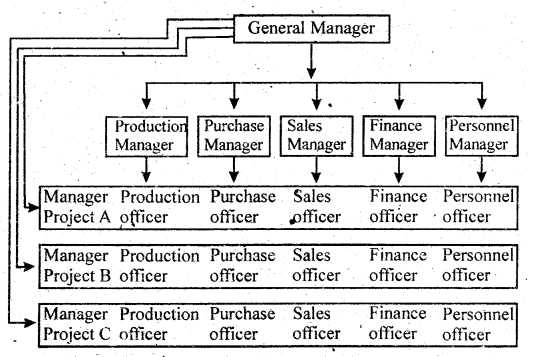
When the size and operational field of any organization are too wide and the number of products produced by it and its number of customers is large, it cannot be divided on any of the bases mentioned above. In such a situation, a matrix organization is established. Such organizations are divided on the basis of functions like the production department, purchase department, sales department, finance department, personnel department, etc. Besides this, a separate Project Manager is appointed for different projects.

This is explained through the diagram given below –
Class 12 Business Studies Important Questions Chapter 5 Organising 1
From the above diagram, it is clear that a separate Project Manager is appointed to complete the project quickly like Project A, Project B, Project C, etc. The project manager is given full responsibility for that particular project and all the other departmental; officers are instructed to co-operate with him. Project Managers make plans for the project and undertake all the functions of organizing, control, direction, etc. The project manager is responsible for the success or failure of the project. The middle level and lower level officers work under the control of the project manager until the completion. of the project and get involved in their normal activities after the completion of the project.

Thus in a matrix organization, two types of organizational structures work together – Functional and Project. Project managers do not wholly use the services of middle level and lower level officers but make use of their services temporarily according to their needs.

Advantages of Matrix Organisation:

  1. Quick Completion of the Project: The project manager makes plans for all the activities of the project like giving orders, direction, etc. Thus the project gets completed quickly.
  2. Advantages of Functional as well as project departmentation: Advantages of two types of organization-functional and project, can be availed of Project managers are the experts in their own field and they have the full co-operation of other officers.
  3. Flexibility: Such type of organization is flexible as it can be easily implemented without bringing many changes in the existing organizational structure.
  4. The economy in costs: There is no need of appointing special staff for each project. Services of departmental officers can be utilized as and when needed by the project manager which leads to economy in costs.

Disadvantages of Matrix organization:

  1. Violation of the Principle of Unity of Command: The principle of unity of command is not followed because the officers are responsible to their superior as well as to the project manager. Thus they have to follow more than one boss.
  2. The problem of coordination: There is a problem of coordination between the functions of departmental officers and project managers. There arises a conflict between the functions of the two because departmental officers give priority to the activities of their own department whereas project managers give priority to their project work.
  3. Lack of Fixation of Responsibility: On non-completion of the project, in time, the project managers normally complain of non-cooperation of the departmental officers.
  4. The problem of communication: The problem of internal communication arises.

Organising Important Extra Questions Long Answer Type

Question 1.
Explain the term Decentralization and mention its importance in business activities?
Answer:
Decentralization:
Decentralisation of authority means systematic dispersal of authority in all departments and at all levels of management. According to Louis Allen decentralization is “the systematic effort to delegate to the lowest levels all authority, except that which can be exercised at central points”. An organization is said to be decentralized when managers at middle and lower levels are given the authority to make decisions and actions on matters relating to their respective areas of work. The top management retains the authority for taking major decisions and formulating policies for the organization as a whole. Top management also retains authority for overall coordination and control of the organization.

For example, let us take the case of a large steel manufacturing company. The board of directors and managing director of the company lay down the overall objectives and policies of the enterprise. Major decisions on product lines, capital investment, marketing methods are taken by the respective heads of departments. The marketing manager, for instance, is authorized to decide the quality and prices of products, channels of distribution, advertising methods, and organizing sales campaigns. The top management of the company does not interfere with his authority. However, departmental managers are required to keep in view the overall policies of the company while making decisions on matters within their authority. This is how a decentralized organization works.

Centralization and decentralization are opposite terms. They should not be confused with the location of work. An organization having ‘ branches in different cities may be centralized. Similarly, a company; maybe decentralized even though all its offices are located in one budding. Centralization and decentralization are relative terms. No organization can be completely centralized or completely decentralized. They exist together.

For example, even in a decentralized organization, the top management retains the authority for-overall policy decisions to ensure coordination and control. The degree of centralization and decentralization differs from one organization to another. According to Henri Fayol, “Everything which goes to increase the subordinates. the role is decentralization; everything which goes to decrease it is centralization.”

Importance of Decentralisation:
The main benefits of decentralization are as follows –
1. Reduction in Burden of Top Executives: Decentralisation helps to reduce the workload of top executives.
They can devote greater time and attention to important policy matters by decentralizing authority for routine operational decisions.

2. Motivation of subordinates: Decentralisation helps to improve the job satisfaction and morale of lower-level managers by satisfying their needs for independence, participation, and status. It also fosters team-spirit and group cohesiveness among the subordinates.

3. Better Decisions: Under decentralization, the authority to make decisions is placed in the hands of those who are responsible for executing the decisions, as a result, more accurate and faster decisions can be taken as the subordinates are well aware of the realities of the situation. This avoids red-tapism and delays.

4. Growth and Diversification: Decentralisation facilitates the growth and diversification of the enterprise. Each product division is given sufficient autonomy for innovations and creativity. The top management can extend leadership over a giant enterprise. A sense of competition can be created among different divisions or departments.

5. Development of managers: When authority is decentralized, subordinates get the opportunity of exercising their own judgment. They learn how to decide and develop managerial skills. As a result, the problem of succession is overcome and the continuity and growth of the organization are ensured. There is a better utilization of lower-level executives.

6. Effective communication: Under decentralization, the span of an organization is wider and there are fewer levels of an organization. Therefore, the communication system becomes more effective. Intimate relationships between superiors and subordinates can be developed.

7. Efficient supervision and control: Managers at lower levels have adequate authority to make changes in work assignments, rechange production-schedules, recommend supervision, and take disciplinary actions. Therefore, more effective supervision can be exercised. Control can JiS-Jnade effective by evaluating the performance of each decentralized unit in the light of clear and predetermined standards. Decentralization permits management by objectives and self-control.

8. Democratic Management: Decentralisation of authority distributes decision making authority at all levels and in all departments. Therefore, it creates democracy in the management of an organization. People at all levels are involved in decision making.

Decentralization, may, however, create problems of coordination and control. It is costly to set up semiautonomous departments and divisions. Lack of competent managers at middle and lower levels hinders decentralization. The degree of decentralization varies from one organization to another. It may also change from one time period to another in the same organization.

Question 2.
Give the meaning of delegation of authority and its importance?
Answer:
Meaning of Delegation of Authority:
Delegation of authority takes place when a manager assigns a .part of his work to others and gives them the authority to perform the assigned tasks. The manager who delegates authority holds his subordinates responsible for the proper performance of the assigned tasks. Thus, the process of delegation involves assigning duties, entrusting authority, and imposing responsibility on subordinates.

Some popular definitions of the delegation are given below –

  • Delegation of authority merely means granting of authority to subordinates to operate within prescribed limits. Theo Haimann
  • Authority is delegated when enterprise discretion is vested in a subordinate by a superior. The entire process of delegation involves the determination of results expected, assignment of tasks, transfer of authority for the accomplishment of these tasks, and the exaction of responsibility for their accomplishment. – Koontz and O’ Donnell.

Importance of Delegation:
When the size of an organization expands, a manager alone cannot do all the work himself. He has to share his work and authority with others. An executive can extend his personal capacity through delegation of authority. Delegation is the means by which a manager can get results through others. Failure to delegate reduces the efficiency of the individual and blocks the development of his juniors. How one delegate determines how one manages. Just as authority is the key to the manager’s job, delegation is the key to the organization.

The main advantages of the delegation are as follows –
1. Relief to Top Executives: Delegation of authority enables a manager to share his workload with his subordinates. It reduces the burden of work on senior executives. By transferring routine work to subordinates, a manager can concentrate on important policy matters. He can, therefore, make better use of his valuable time and ability. Delegation facilitates the proper distribution of workload as it takes place at all levels. The manager who delegates authority can achieve greater results than the one who does not. This is because by delegating authority, a manager secures the cooperation and participation of his subordinates.

2. Scalar Chain: Delegation of authority creates a chain of superior-subordinate relationships among managers. It provides meaning and content to managerial jobs. It also directs and regulates the flow of authority from the top to the bottom of an organization. It serves as a basis of superior-subordinate relations.

3. Specialization: Through delegation, an executive can assign jobs to his subordinates according to abilities and experience. In this way, he can obtain the benefits of the division of work.

4. Quick Decisions: When authority is delegated, lower-level employees can take decisions quickly without consulting senior executives. Subordinates are better in touch with local conditions and can take more practicable decisions within the policy framework laid down by top management.

5. Motivation: Delegation provides a feeling of status and importance to subordinates. Their independence and job satisfaction increase due to the authority they enjoy. They become more willing to work hard and achieve the targets laid down by higher authorities. Thus, delegation promotes a sense of initiative and responsibility among employees. It inspires employees to make full use of their skills.

6. Executive Development: Delegation gives an opportunity to employees to learn decision-making and leadership skills by exercising authority. It helps to improve the quality of personnel at lower levels because they are required to handle situations and solve managerial problems. They acquire competence and problems and can take up higher responsibilities in course of time. In this way, the delegation of authority is a means of developing future managers.

7. Growth and Diversification: Delegation of authority facilitates expansion and growth of the organization. As the quality of managerial talent improves, the organization can face future challenges better. It can grow and expand to a bigger size.
Analysis of Financial Statements Class 12 Important Questions Accountancy Chapter 9

Here we are providing Class 12 Accountancy Important Extra Questions and Answers Chapter 9 Analysis of Financial Statements. Accountancy Class 12 Important Questions and Answers are the best resource for students which helps in class 12 board exams.

Class 12 Accountancy Chapter 9 Important Extra Questions Analysis of Financial Statements

Analysis of Financial Statements Important Extra Questions Very Short Answer Type

Question 1.
State any one limitation of Financial Statement Analysis. (CBSE Compartment Delhi 2014, 2015)
Answer:
Historical Analysis of financial Statement.

Question 2.
State any one objective of analysis of financial statements. (CBSE Compartment Delhi 2014)
Answer:
To measure earning capacity of business.

Question 3.
State the type of Financial Statement Analysis in which figures of the same items of various years are compared.
Answer:
Horizontal analysis.

Question 4.
Which type of financial statement analysis helps a company to establish the relationship between different items financial statement of a same year?
Answer:
Vertical analysis.

Question 5.
“One of the objectives of Financial Statement Analysis is to assess solvency of business”. What does the term ‘solvency’ mean here ?
Answer:
Solvency means ability to pay the debts.

Analysis of Financial Statements Important Extra Questions Short Answer Type

Question 1.
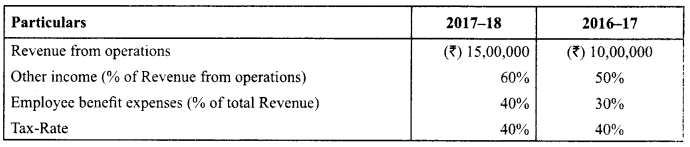
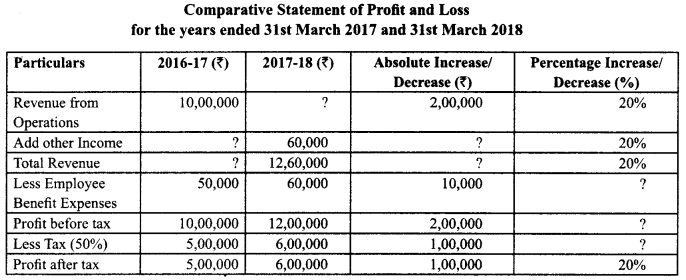
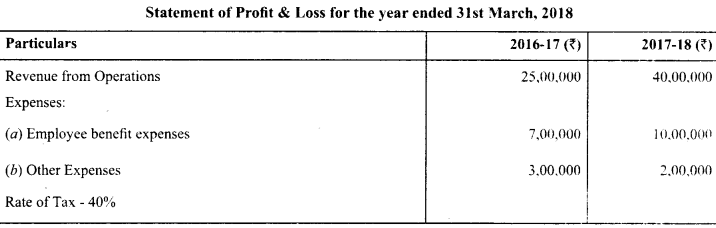
From the following information extracted from the Statement of Profit and Loss for the years ended 31st March, 2017 and 2018, prepare a Comparative Statement of Profit & Loss. (CBSE Delhi 2019)
Class 12 Accountancy Important Questions Chapter 9 Analysis of Financial Statements 1
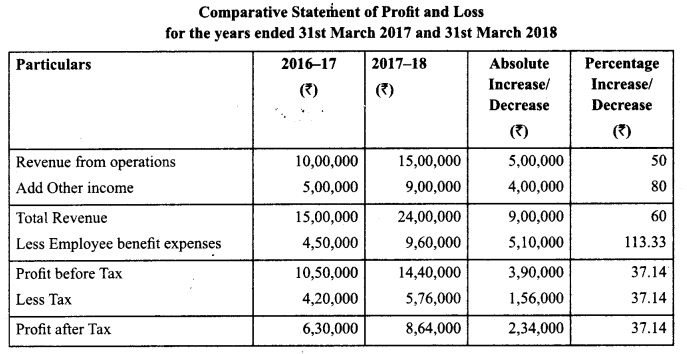
Answer:
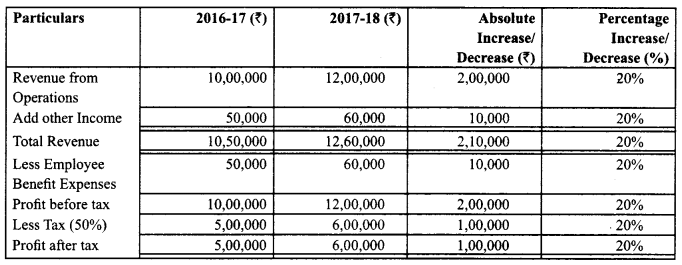
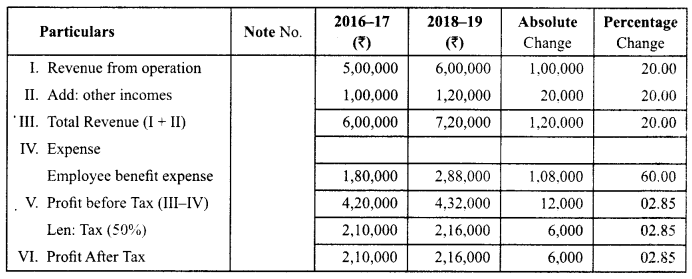
Comparatwe statement of profit & loss for the year ended 31st March 17 & 18.
Class 12 Accountancy Important Questions Chapter 9 Analysis of Financial Statements 2

Question 2.
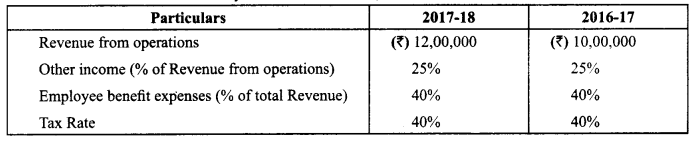
Prepare a comparative statement of Profit and Loss from the information extracted from the statement of Profit and Loss for the year ended 31st March, 2017 and 2018.
Class 12 Accountancy Important Questions Chapter 9 Analysis of Financial Statements 3
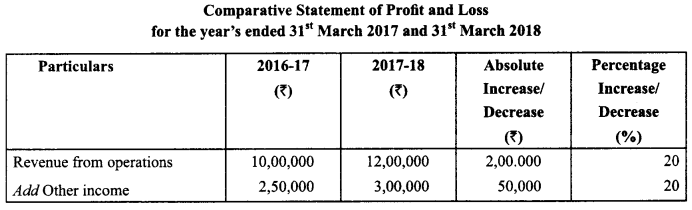
Answer:
Class 12 Accountancy Important Questions Chapter 9 Analysis of Financial Statements 4

Question 3.
Explain the importance of financial analysis for
(i) labour unions, and
(ii) creditors. (CBSE Outside Delhi 2019) ‘
Answer:
(i) Importance for Labour Unions: Labour unions analyse the financial statements to assess whether it can presently afford a wage increase and whether it can absorb a wage increase through increased productivity or by raising the prices.

(ii) Importance for Creditors: Creditors through an analysis of Financial Statements appraises not only the ‘ ability of the company to meet its short term obligations but also judges the probability of its continued ability to meet its financial obligations in future.

Question 4.
Prepare a comparative statement of Profit and Loss from the following information extracted from the statement of Profit and Loss for the year ended 31st March, 2017 and 2018.
Class 12 Accountancy Important Questions Chapter 9 Analysis of Financial Statements 5
Answer:
Class 12 Accountancy Important Questions Chapter 9 Analysis of Financial Statements 6
Class 12 Accountancy Important Questions Chapter 9 Analysis of Financial Statements 7

Question 5.
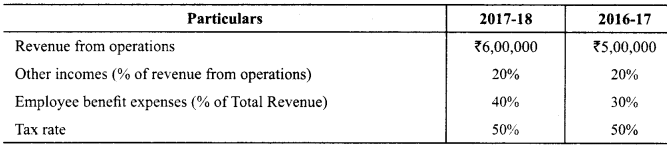
Following information is extracted from the Statement of Profit and Loss of Crypto Finance Ltd. For the year ended 31st March 2017 and 31st March 2018. Fill in the missing figures. (CBSE SP 2019-20)
Class 12 Accountancy Important Questions Chapter 9 Analysis of Financial Statements 8
Answer:
Class 12 Accountancy Important Questions Chapter 9 Analysis of Financial Statements 9

Question 6.
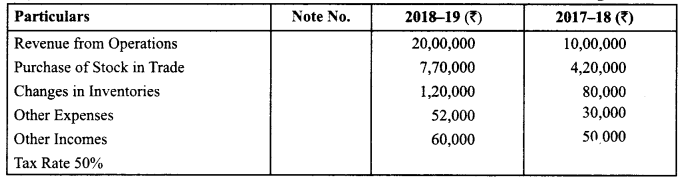
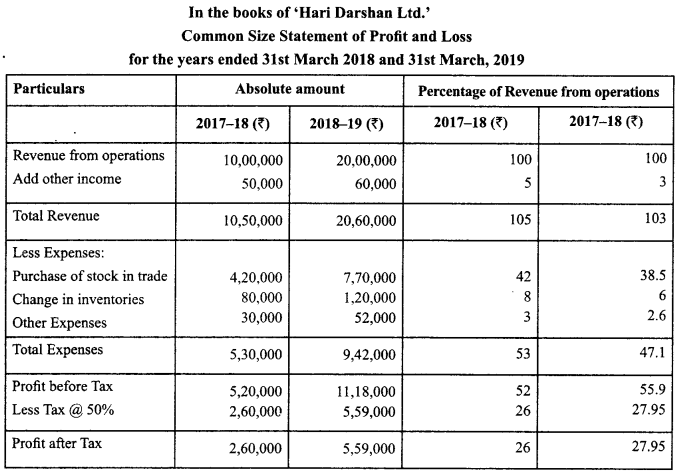
Prepare a Common-size Statement of Profit and Loss of ‘Hari Darshan Ltd.’ from the following information:
Class 12 Accountancy Important Questions Chapter 9 Analysis of Financial Statements 10
Answer:
Class 12 Accountancy Important Questions Chapter 9 Analysis of Financial Statements 11

Question 7.
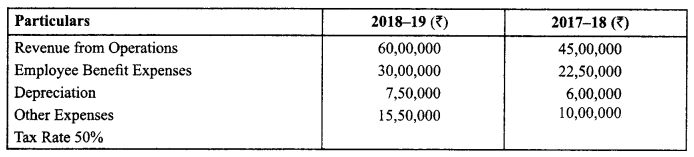
Following information is extracted from the Statement of Profit and Loss of Delko Ltd. for the year ended 31st March, 2019:
Class 12 Accountancy Important Questions Chapter 9 Analysis of Financial Statements 12
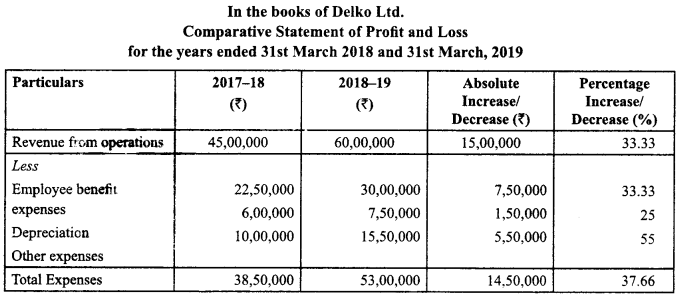
Answer:
Class 12 Accountancy Important Questions Chapter 9 Analysis of Financial Statements 13
Class 12 Accountancy Important Questions Chapter 9 Analysis of Financial Statements 14

Question 8.
What is meant by ‘Analysis of Financial Statements’? State any two objectives of such analysis. (CBSE Outside Delhi 2017, Modified)
Answer:
Meaning of analysis of financial statements: Analysis of Financial Statements is the process of critical evaluation of the financial information contained in the financial statements.

Question 9.
State the objectives of ‘Analysis of Financial Statements’. (Delhi 2017)
Answer:
Objectives of‘Financial Statements Analysis’:

  1. Assessing the earning capacity or profitability of the firm as a whole as well as its different departments so as to judge the financial health of the firm.
  2. Assessing the managerial efficiency by using financial ratios to identify favourable and unfavourable variations in managerial performance.

Question 10.
State any four limitations of analysis of financial statements. [Delhi 2017]
Answer:
Limitations of ‘Financial Statements Analysis’:
(a) Different Accounting Principles and Practices. Financial analysis is subject to limitations inherent in the financial statements like following different accounting principles or practices regarding depreciation methods, inventory valuation and pricing, etc.

(b) Ignores the Quality Elements. Financial statements contain only financial data and exclude from the preview of qualitative information, which cannot be expressed in money terms. Thus, analysis of such financial statements will also lack quality element.

(c) Ignores Price Level Changes. Transactions, in financial statements, are recorded on historical cost basis and generally no adjustment is made for price level changes. Thus, the analysis of financial statement will not yield comparable results due to lack of adjustments for the price level changes.

(d) Affected by Window Dressing. Some firms may resort to window dressing (showing better picture) to cover-up bad financial position. For example, closing stock may be overstated. In such case, the results of analysis will also be misleading.

Question 11.
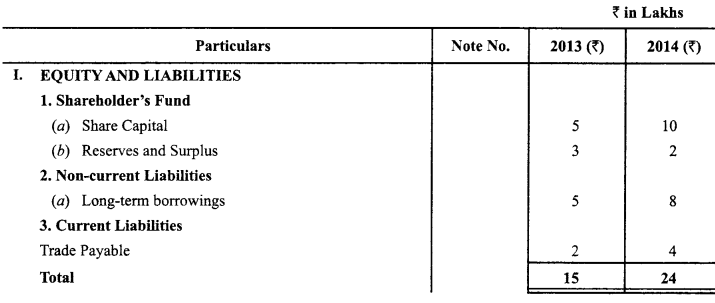
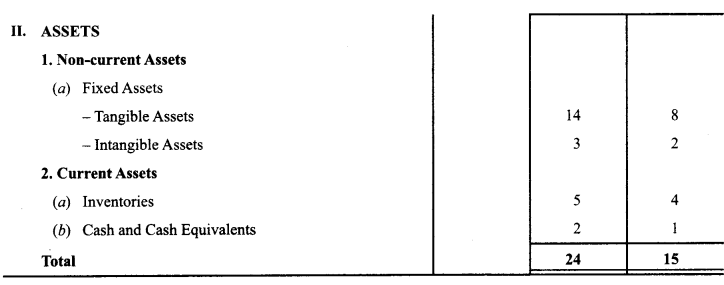
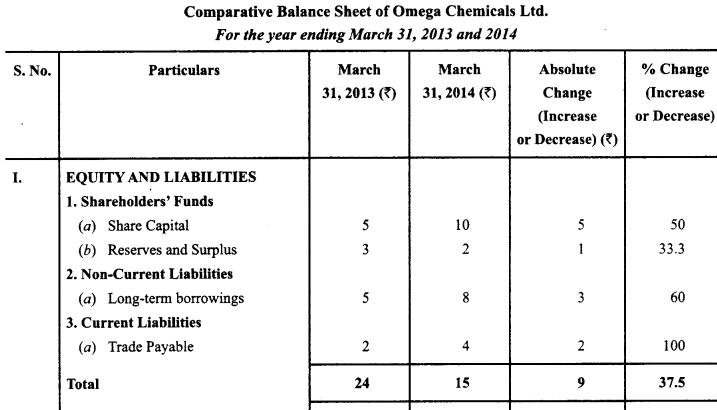
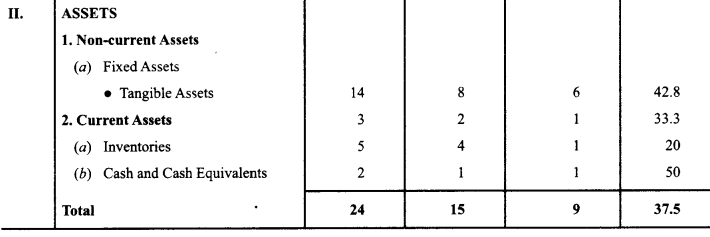
From the Balance Sheets for the year ended March 31, 2013 and 2014. prepare the Comparative Balance Sheet of Omega Chemicals Ltd.:
Class 12 Accountancy Important Questions Chapter 9 Analysis of Financial Statements 15
Class 12 Accountancy Important Questions Chapter 9 Analysis of Financial Statements 16
Answer:
Class 12 Accountancy Important Questions Chapter 9 Analysis of Financial Statements 17
Class 12 Accountancy Important Questions Chapter 9 Analysis of Financial Statements 18

Question 12.
Prepare the Common Size Balance Sheet of KJ Ltd. from the following information.
Class 12 Accountancy Important Questions Chapter 9 Analysis of Financial Statements 19
Answer:
Class 12 Accountancy Important Questions Chapter 9 Analysis of Financial Statements 29

Question 13.
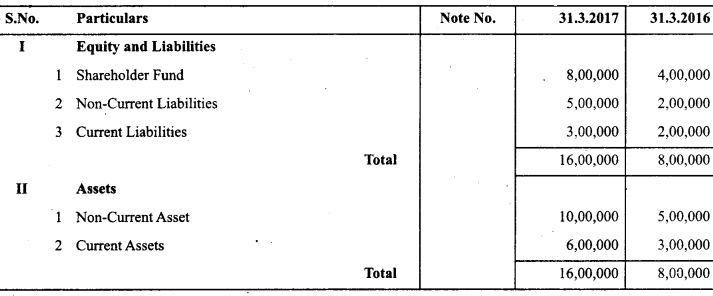
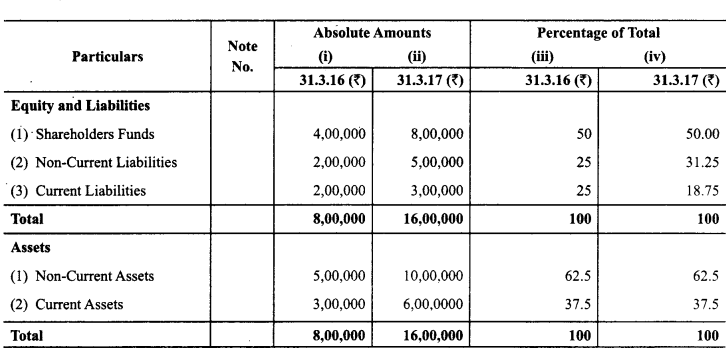
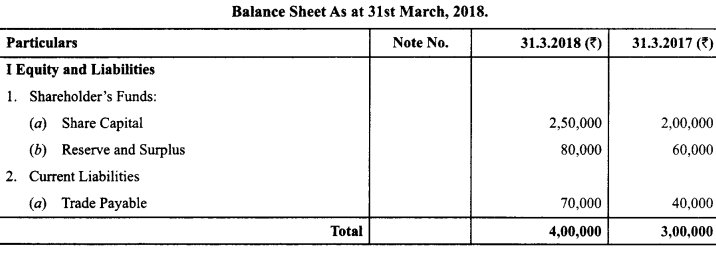
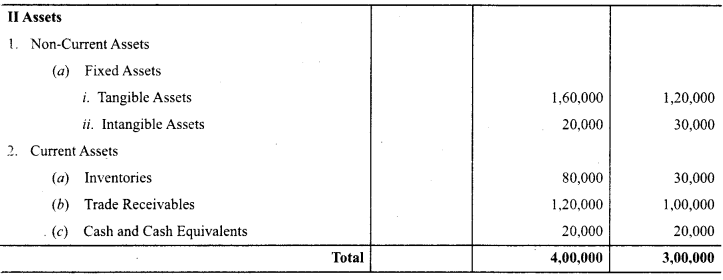
From the following Balance Sheet of R Ltd., Prepare a Common Size Statement
Class 12 Accountancy Important Questions Chapter 9 Analysis of Financial Statements 21
Class 12 Accountancy Important Questions Chapter 9 Analysis of Financial Statements 22
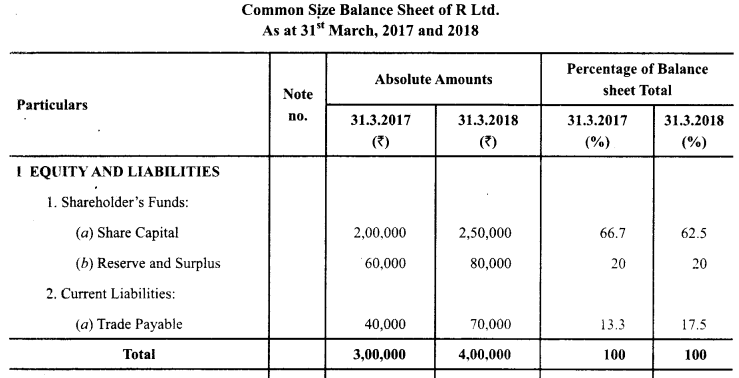
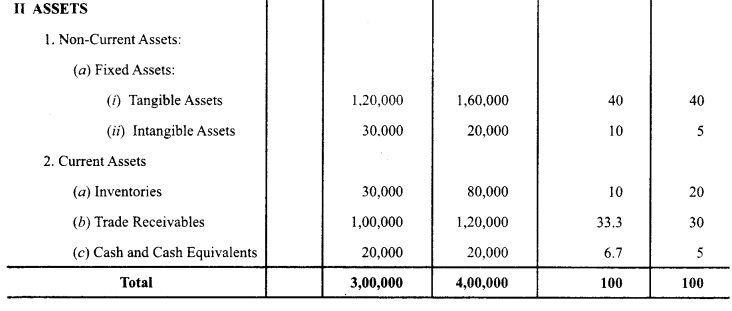
Answer:
Class 12 Accountancy Important Questions Chapter 9 Analysis of Financial Statements 23
Class 12 Accountancy Important Questions Chapter 9 Analysis of Financial Statements 24

Question 14.
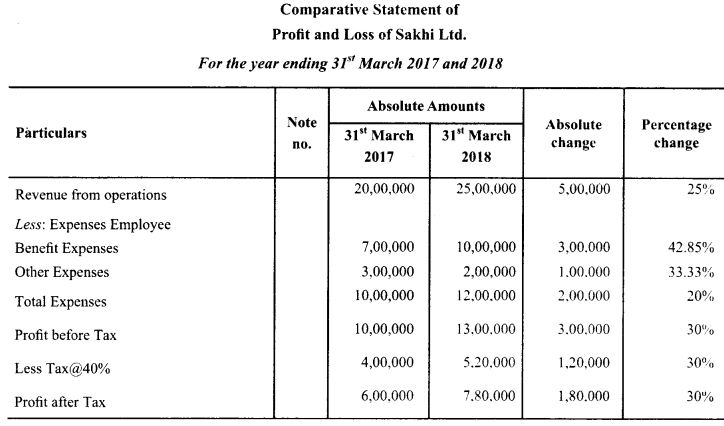
From the following Statement of Profit and Loss of the Sakhi Ltd. for the year ended 31st March 2018, prepare Comparative Statement of Profit & Loss.
Class 12 Accountancy Important Questions Chapter 9 Analysis of Financial Statements 25
Answer:
Class 12 Accountancy Important Questions Chapter 9 Analysis of Financial Statements 27

Planning Class 12 Important Extra Questions Business Studies Chapter 4

Here we are providing Class 12 Business Studies Important Extra Questions and Answers Chapter 4 Planning. Business Studies Class 12 Important Questions are the best resource for students which helps in class 12 board exams.

Class 12 Business Studies Chapter 4 Important Extra Questions Planning

Planning Important Extra Questions Short Answer Type

Question 1.
Why is planning regarded as a pervasive function of management? (1992,1999,2002)
Answer:
Planning is needed for all activities at all levels although the nature and extent of planning vary with the delegated authority, or position a person is holding in the organizational hierarchy and with the broad guidelines outlined by his superiors. Thus planning is a pervasive function of Management.

Question 2.
What are the key elements in the concept-of Planning? (2001)
Answer:
The key elements in. the concept of planning is –

  1. Establishing clear, precise, and realistic objectives.
  2. Determining and evaluating the various available alternatives of doing the task.
  3. Selecting the most suitable alternative.

Question 3.
“Planning restricts creativity” Explain. (2000,2002)
Answer:
Planning involves deciding in advance what is to be done, how it is to be done and when it is to be done, and by whom. Thus all organizational activities are pre-conceived and pre-determined at the stage of planning itself and there is very little or no scope for deviating from the plans due to factors like capital investments, government policies, and so on. This blind conformity with predetermined guidelines discourages individual initiative and freedom.

Question 4.
“Planning is a basic function of management” Explain. (2001)
Answer:
Among various functions of management, planning occupies the foremost position. It precedes the execution of all other managerial functions because it provides the frame of reference for future decisions, reduces the overall impact of changes, and allows managers to organize, staff direct, and control the activities necessary.

Question 5.
Distinguish between goals and objectives.
Answer:

GoalsObjectives
1. Goals are the overall or collective ends of the organization.1. Objectives are specific and particular ends of the organization.
2. Goals are not expressed in numerical terms.2. Objectives are always expressçd in numerical terms.
3. Goals are generally made for the long term.3. Objectives are mostly made for the short term and these must be achieved within a specific time limit.
4. Example – Increase in sales or becoming the leader in the market.4. Increase in sales by 10% in 6 months’ time or increase in market share by 20% in 1 year.

Question 6.
“Planning is not a guarantee of success of a business.” Comment.
Answer:
It is right to say that planning is not a guarantee of the success of a business because the planning function is based on certain assumptions regarding the future and no one care to give a guarantee that assumptions regarding the future are a hundred percent accurate. The planning function suffers from certain limitations which may be lack of accuracy, cost problem, delay in action, etc.

Planning Important Extra Questions Long Answer Type

Question 1.
Explain the nature and characteristics of planning.
Or
“No enterprise can achieve its objective without systematic planning”. Do you agree with the statement?(1990, 1992, 1993, 1995, 1996, 1997, 1999, 2004) (2003)
Answer:
Characteristics of Planning:
1. Goal Oriented: Goals or objectives are the end results towards which activity is directed. The first stage of planning is the conscious and explicit statement of the ultimate objectives.

2. Primacy of Planning: Among various functions of management planning occupies the foremost position. Planning precedes the execution of all other managerial functions because it provides a frame of reference for future decisions. Allows managers to organize staff directly and control the activities necessary to achieve the organizational goals.

3. Pervasiveness of Planning: Planning is needed for all activities at all levels although the nature and extent of planning vary with the delegated authority or position a person is holding in the organizational hierarchy and with the board guidelines provided by his superiors.

4. Intellectual Process: Planning involves logical thinking and decision making. It implies determining what is to be done; how and when it is to be done and by whom. All these decisions require ability, experience, and foresightedness on the part of the management.

5. Continuous function: Planning is a continuous activity. As a matter of fact, the planning process continues so long as an enterprise is in existence.

6. Flexibility: Effective plans have an element of flexibility! Management can’t afford to follow rigid plans in the era of fast changes in the technology market, government policy, etc.

As we all know, the resources of an organization are limited. Planning aims at providing the blueprints to optimum utilization of given resources to achieve the desired goals. Thus it can be concluded that no enterprise can achieve its objectives without systematic planning.

Question 2.
Why is planning necessary for effective management? Give reasons. (1993,1994,1996,1997,2004)
Answer:
Planning is important for better management of business planning determines objective, decides the course of action, removes uncertainty results in economics in operation, and makes control possible its importance is analyzed as below.
1. Takes care of future uncertainties: Future is full of uncertainties planning takes care of all future uncertainties and minimizes business risks since it makes effective use of forecasting techniques.

2. Focuses attention on objectives: All planning is directed towards achieving the objectives of an enterprise. Planning makes these objectives more concrete and tangible by determining the program’s policies, procedures that provide guidelines to the employees to achieve these objectives.

3. Facilitates decision making: Decision making is the core of planning. It is the process of developing and selecting a course of action from among the various alternatives available. Planning provides a framework for decision-making by specifying the organizational objectives and planning premises.

4. Facilitates Control: Controlling is the process that measures current performance against desired standards to ensure that the objectives are attained according to plans. Control is always exercised in the light of planning which provides performance standards in quantitative terms.

5. Promotes efficiency: Proper planning ensures better utilization of organizational resources. Planning involves the selection of the best or most profitable course of action. This reduces the idle time for workers, machines, and so on.

6. Helps in Co-ordination: Planning is necessary for the organization as a whole. Derivative plans are prepared for each department within the limits of the master plan. Thus planning leads to the coordination of activities of all the departments in order to achieve the basic objective of the organization.

Financial Statements of a Company Class 12 Important Questions Accountancy Chapter 8

Here we are providing Class 12 Accountancy Important Extra Questions and Answers Chapter 8 Financial Statements of a Company. Accountancy Class 12 Important Questions and Answers are the best resource for students which helps in class 12 board exams.

Class 12 Accountancy Chapter 8 Important Extra Questions Financial Statements of a Company

Financial Statements of a Company Important Extra Questions Very Short Answer Type

Question 1.
State the importance of financial analysis for labour unions. (CBSE SP 2019-20)
Answer:
Labor unions analyse the financial statements to assess whether an enterprise can increase their pay.

Question 2.
If operating is not given, what is the time for the operating cycle assumed?
Answer:
12 months.

Question 3.
If the operating cycle is given for 12 months and the payment cycle for trade payables is 15 months, how will you classify the liability?
Answer:
Non-current Liability.

Question 4.
Name any one line item that can be shown under the major heading ‘Equity and Liabilities’ in a company’s Balance Sheet.
Answer:
Shareholders’Funds

Question 5.
Name any one item that can be disclosed under ‘Short Term Provisions’.
Answer:
Provision for Doubtful debts.

Question 6.
How would you treat preliminary expenses?
Answer:
Preliminary expenses are written off in the year in which they are incurred.

Question 7.
Give one example of unamortised expenses.
Answer:
Discount on issue of shares / debentures.

Question 8.
State any one component of shareholders’ funds.
Answer:
Reserves & Surplus.

Question 9.
How would you treat share forfeiture account?
Answer:
Added in the subscribed.

Question 10.
Mention one component of Reserves and Surplus.
Answer:
Securities Premium Reserves.

Question 11.
Pratiksha Cartons Limited has given guarantee of ₹ 75,00,000 to a bank for raising loans from the bank by its subsidiary’ company. Where will this be shown in books of the company?
Answer:
This will be mentioned in Notes to Accounts.

Financial Statements of a Company Important Extra Questions Short Answer Type

Question 1.
Explain briefly any four objectives of ‘Analysis of Financial Statements’.
Answer:
Four objective of ‘Analysis of Financial statements are as follows:

  • To assess the current profitability and operational efficiency of the firm as a whole as well its different departments so as to judge the financial health of firm.
  • To ascertain the financial position of firm.
  • To identify the reasons for change in the profitability and financial position of the firm.
  • To Judge the ability of the firm to repay its debt and assessing the short-term as well as the long-term liquidity position fo the firm.

Question 2.
State under which major headings and sub-headings will the following items be presented in the Balance
Sheet of a company as per Schedule-Ill, Part-I of the Companies Act, 2013. (CBSE Delhi 2019)
(i) Prepaid Insurance
(ii) Investment in Debentures
(iii) Calls-in-arrears
(iv) Unpaid dividend
(v) Capital Reserve
(vi) Loose Tools
(vii) Capital work-in-progress
(viii) Patents being developed by the company.
Answer:

ItemsMajor headsSub-heads
1. Prepaid insuranceCurrent AssetsOther curretn Assets
2. Investment in debentureNon-current AssetsNon-current investment
3. Calls in ArrearsShareholders FundSubscribed capital (less from subscribe but not fully paid)
4. Unpaid dividendCurrent liabilitiesOther current liabilities
5. Capital ReserveShareholder FundReserve and Surplus
6. Loose toolsCurrent AssetsInventories
7. Capital work in progressNon-current AssetsFixed Assets (Capital work in progress)
8. Patent being developed by the companyNon-current AssetsFixed Assets (intangible asset under development

Question 3.
Under which major heads and sub-heads will the following items be placed in the Balance Sheet of the company as per Schedule III, Part I of the Companies Act, 2013 ? (CBSE Outside Delhi2019)
(i) Cheques and Bank Drafts in Hand
(ii) Loose tools
(iii) Securities Premium Reserve
(iv) Long-Term Investments with maturity period less than six months
(v) Work-in-Progress
(vi) Mining Rights
(vii) Publishing titles
(viii) Debtors
Answer:

ItemsHeadsSub-heads
Cheques and Bank Drafts in HandCurrent AssetsCash & Cash Equivalents
Loose ToolsCurrent AssetsInventories
Securities Premium ReserveShareholders’ FundsReserves & Surplus
Long term Investments with maturity period less than six monthsCurrent AssetsCurrent Investments
Work-in-ProgressCurrent AssetsInventories
Mining RightNon Current AssetsFixed Assets-Intrangible
Publishing TitlesNon Current AssetsFixed Assets-Intangible
DebtorsCurrent AssetsTrade Receivables

Question 4.
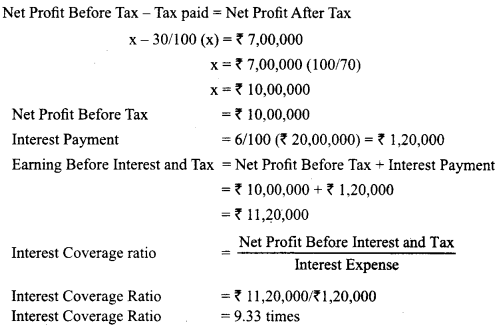
From the following details calculate Interest Coverage Ratio:
Net profit after tax – ₹ 7,00,000
6 % debentures of – ₹ 20,00,000
Tax Rate 30%
Answer:
Class 12 Accountancy Important Questions Chapter 8 Financial Statements of a Company 3

Question 5.
Under which major heads and sub-heads will the following items be placed in the Balance Sheet of the company as per Schedule III, Part I of the Companies Act, 2013? (CBSE SP2019-20)
(i) Debentures with maturity period in current financial year
(ii) Securities Premium Reserve
(iii) Provident Fund
Answer:

S. No.ItemMajor HeadSub Head
(i)Debentures with maturity period in current financial yearCurrent LiabilitiesOther Current Liabilities
(ii)Securities Premium ReserveShareholder’s FundReserves and Surplus
(iii)Provident FundNon-Current LiabilitiesLong Term Provision

Question 6.
Under which sub-headings will the following items be placed in the Balance Sheet of a company as per Schedule-Ill, Part-I of the Companies Act, 2013? (CBSE Compt.2019)
(i) Prepaid Expenses
(ii) Loose Tools
(iii) Loans Repayable on Demand
(iv) Provision for Employee Benefit
(v) Negative Balance in the Statement of Profit and Loss
(vi) Bank Overdraft
(vii) Bills Receivables
(viii) Trade Marks
Answer:

ItemsSub-Head
(i)Prepaid ExpensesOther Current Assets
(ii)Loose ToolsInventories
(iii)Loans repayable on demandShort Term borrowings
(iv)Provision for employees benefitLong term provisions
(v)Negative balance in Statement of Profit and LossReserves and Surplus
(vi)Bank OverdraftShort Term borrowings
(vii)Bills ReceivableTrade Receivables
(viii)Trade MarksFixed assets Intangible

Question 7.
(a) Classify the following items under Major Head and Sub-Head (if any) in the Balance Sheet of a company as per Schedule III of the Companies Act, 2013.
(i) Capital Work in progress; and
(ii) Provision for warranties.
(b) State any two objectives of ‘Analysis of Financial Statements’. (Compt. Delhi 2017)
Answer:
(i) Classification of items

S.No.ItemsHeadingsSub-headings
(i)Capital work in progressNon-current assetsFixed assets
(ii)Provision for warrantiesNon-current liabilitiesLong term provisions

(ii) Objectives of analysis of financial statements

Question 8.
(i) One of the objectives of analysis of financial statement is to ascertain the relative importance of the different components of the financial position of the firm’. State two other objective of this analysis.
(ii) List any four items of ‘reserve’ that are shown under the headings ‘Reserves and Surplus’ in the Balance Sheet of a company as per scheduel III of the Companies Act 2013.
(CBSE Outside Delhi 2016)
Answer:
(i) Objectives of Analysis of Financial Statement:

  • Assessing the earning capacity or profitability of the firm as a whole as well as its different departments so as to judge the financial health of the firm.
  • Judging the ability of the firm to repay its debts and assessing the short term as well as long term liquidity position of the firm.

(ii) Reserve and Surplus

  • Capital Reserve
  • Securities Premium Reserve.
  • Revaluation Reserve.
  • Capital Redemption Reserve.

Question 9.
(i) One of the objectives of ‘financial Statement Analysis, is to identify the reasons for change in the financial position of the enterprise. State two more objectives of this analysis.
(ii) Name any two items that are shown under the head ‘Other Current Liabilities’ and any two items that are shown under the head ‘Other Current Assets’ in the Balance Sheet of a company as per Schedule III of the Companies Act, 2013. (CBSE Outside Delhi 2016)
Answer:
(i) Objectives

  • To evaluate the business in Terms of profit in present and future.
  • To evaluate the efficiency of various parts or departments of the business.

(ii) Other Current Liability

  • Unpaid dividend
  • Current maturity of long term debts.

Other Current Assets.

  • Discount in issue of debentures (to be written off within 12 months).
  • Accrued incomes.

Question 10.
List the major heads under which the ‘Equity and Liabilities’ are presented in the balance sheet of a company as per Schedule III Part I of the Companies Act, 2013. (CBSE Guidance Notes July 2013)
Answer:
The major heads under which ‘Equity and Liabilities’ are presented:

  • Share holders Fund
  • Share Application Money Pending allotment
  • Non-Current liabilities
  • Current Liabilities

Question 11.
List the major heads under which the ‘Assets’ are presented in the balance sheet of a company as per Schedule III Part I of the Companies Act, 2013. (CBSE Guidance Notes July 2013)
Answer:
The major heads under which the ‘Assets’ are presented:
(a) Non-current Assets
(b) Current Assets

Question 12.
Name the sub-heads under the head
(a) shareholders Funds’ and
(b) Non-Current Liabilities as per Schedule III Part I of the balance sheet. (CBSE Guidance Notes July 2013)
Answer:
(a) The sub-heads under‘Shareholders Funds’are

  • Share Capital
  • Reserves and surplus
  • Money received against share warrants

(b) The sub-heads under ‘Non-current liabilities’ are

  • Long-term Borrowings
  • Deferred Tax Liabilities (Net)
  • Other Long-term Liabilities
  • Long-term Provisions

Question 13.
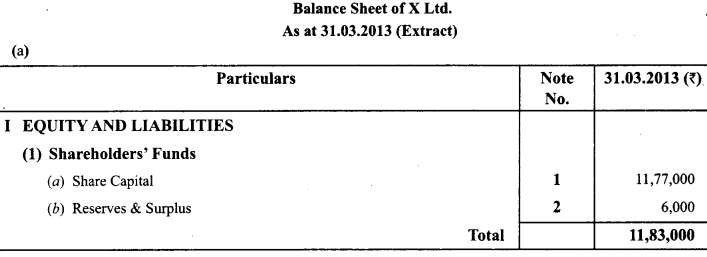
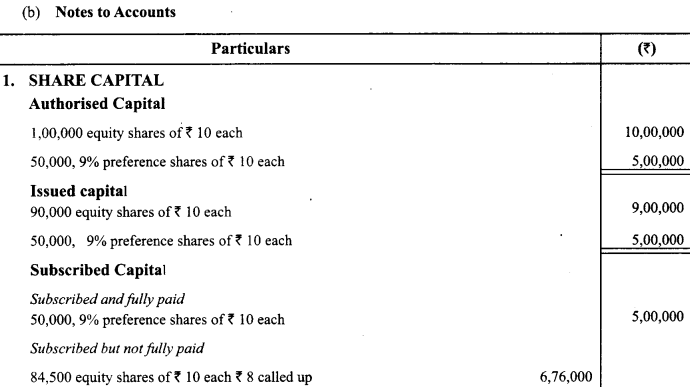
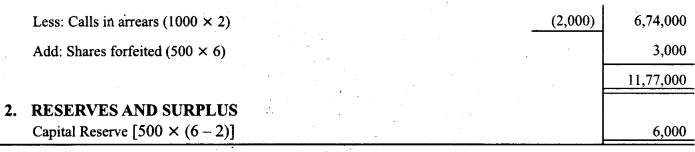
X Ltd. has an authorized capital of₹ 15,00,000 divided into 1,00,000 equity shares of ₹ 10 each and 50,000, 9% preference shares of ₹ 10 each. The company invited applications for all the preference shares but only 90,000 equity shares. All the preference shares were subscribed, called and paid while subscriptions were received for only 85,000 equity shares.
During the first year ₹ 8 per share were called.
Ram holding 1,000 shares and Shyam holding 2,000 shares did not pay first call of ₹ 2.
Shyam’s shares were forfeited after the first call and later on 1,500 of the forfeited shares were reissued at ₹ 6 per shares ₹ 8 called up.
(a) Show share capital in the Balance Sheet as per revised Schedule VI as at 31st March 2013.
(b) Prepare relevant ‘Notes to Accounts’ (CBSE Guidance Notes July 2013)
Answer:
Class 12 Accountancy Important Questions Chapter 8 Financial Statements of a Company 6
Class 12 Accountancy Important Questions Chapter 8 Financial Statements of a Company 7
Class 12 Accountancy Important Questions Chapter 8 Financial Statements of a Company 8

Question 14.
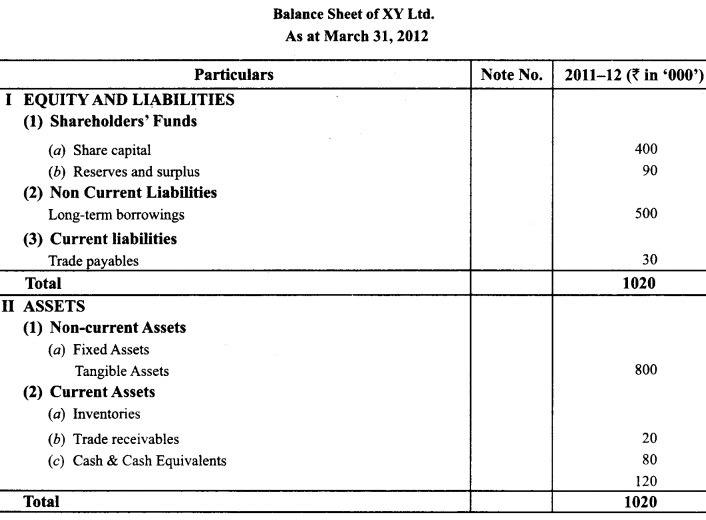
From the following information extracted from the books of XY Ltd., prepare a Balance sheet of the company as at March 31, 2012 as per Schedule III of the Companies Act, 2013.

ParticularsAmount in ‘000’ (₹)
Long-Term Borrowings500
Trade Payable300
Share Capital400
Reserve and surplus90
Fixed assets (angible)800
Inventories20
Trade receivables80
Cash and cash equivalents120

Answer:
Class 12 Accountancy Important Questions Chapter 8 Financial Statements of a Company 9

Question 15.
JW Ltd was a company manufacturing geysers. As a part of its long term goal for expansions, the company decided to identify the opportunity in rural area. Initial plan was rolled out for Bhiwani village in Haryana. Since, the village did not have regular supply of electricity, the company decided to manufacture solar geysers. The core team consisting of the Regional Managers, Accountant and the Marketing Manager was taken from the Head office and the remaining employee were selected from the village and neighbourhood area. At the time of preparation of financial statement the accountant of the company fell sick and the company deputed a junior accountant temporarily from the village for two months. The Balance Sheet prepared by the junior accountant showed the following items against the Major heads and sub-head mentioned which were not as per Schedule III of the Companies Act 2013. Items Major Head

  • Loose Tools Trade Receivable
  • Cheque in Hand Current Investment
  • Term Loan from Bank Other long Term Liabilities
  • Computer Software Tangible Fixed Assets

Present the above items under the correct major head and sub-head as per the Schedule III of Companies Act 2013. (CBSE Delhi 2018)
Answer:

ItemHeadsSub-heads
Loose ToolsCurrent assetsInventories
Cheques in handCurrent assetsCash and Cash Equivalent
Term loan from BankNon-Current LiabilitiesLong Term Borrowings
Computer SoftwareNon-Current assetsFixed Assets-Intangible Assets

Question 16.
M K Limited is a computer hardware manufacturing company. While preparing its accounting records it takes into consideration the various accounting principles and maintains transparency. At the end of the accounting year, the company follows the ‘Companies Act, 2013 and Rules there under’ for the preparation of its Financial Statements. It also prepares its Income Statement and Balance Sheet as per the format provided in Schedule III to the Act. Its Financial Statements depict its true & fair financial position. For the financial year ending March 31,2017, the accountant of the company is not certain about the presentation of the following items under relevant Major Heads & Sub Heads, if any, in its Balance Sheet:

  • Securities Premium Reserve
  • Calls in Advance
  • Stores & Spares

Advice the accountant of the company under which Major Heads and Sub Heads, if any, he should present the above items in the Balance Sheet of the company, (CBSE Sample Paper 2017-18, Modified)
Answer:

S. No.ItemsMajor HeadSub Head
(i)Securities Premium ReserveShareholders’ FundsReserves & Surplus
(ii)Calls in AdvanceCurrent LiabilitiesOther Current Liabilities
(iii)Stores & SparesCurrent AssetsInventory

Question 17.
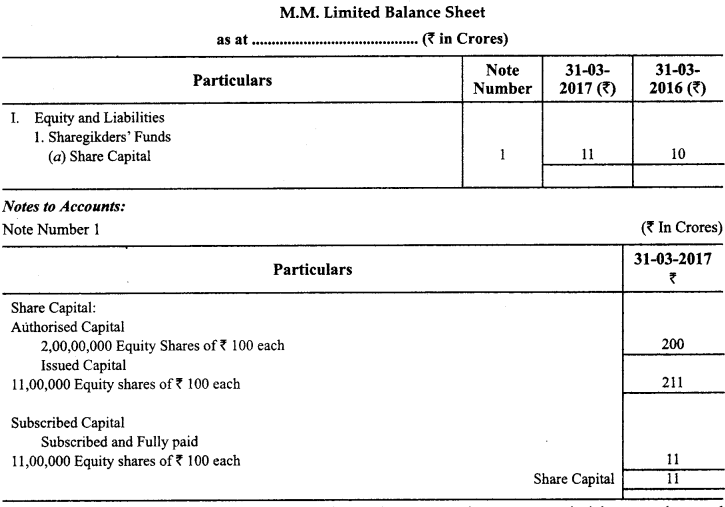
M.M. Limited is registered with an Authorised capital of ₹ 200 Crores divided into equity shares of ₹ 100 each. On 1st April 2016 the Subscribed and Called up capital of the company is ₹ 10,00,00,000. The company decided to help the unemployed youth of the naxal affected areas of Andhra Pradesh, Chhattisgarh and Odisha by opening 100 ‘Skill Development Centres’. The company also decided to provide free medical services to the villagers of these states by starting mobile dispensaries. To meet the capital expenditure of these activities the company further issued 1,00,000 equity shares during financial year 2016-17. These shares were fully subscribed and paid.
Present the share capital of the company in its Balance Sheet. (CBSE Sample Paper 2017-18 Modified)
Answer:
Class 12 Accountancy Important Questions Chapter 8 Financial Statements of a Company 12

Question 18.
Financial statements are prepared following the consistent accounting concepts, principles, procedures and also the legal environment in which the business organizations operate. These statements are the sources of information on the basis of which conclusions are drawn about the profitability and financial position of a company so that their users can easily understand and use them in their economic decisions in a meaningful way.
State under which major headings and sub-headings the following items will be presented in the balance sheet of a company as per Schedule III of the Companies Act 2013.

  • General Reserves,
  • Short term loans and advances,
  • Capital work in progress and
  • Design.

Answer:

HeadsSub-head
General ReservesShareholders’ FundsReserves and Surplus
Short term loans and advancesCurrent assets
Capital work in progressNon current assetsFixed assets
DesignNon current assetsFixed assets/intangible assets

Question 19.
Mudra Ltd. is in the process of preparing its Balance Sheet as per Schedule III, Part I of the Companies Act, 2013 and provides its true and fair view of the financial position.
(a) Under which head and sub-head will the company show ‘Stores and Spares’ in its Balance Sheet₹
(b) What is the accounting treatment of ‘Stores and Spares’ when the Company will calculate its Inventory Turnover Ratio?
(c) The management of Mudra Ltd. want to analyse its Financial Statements. State any two objectives of such analysis. (CBSE Sample Paper 2016, 2017, Modified)
Answer:
(a) Head: Current Assets Sub head; Inventories
(b) While calculating Inventory Turnover Ratio it is not included in Inventories
(c) Objectives – Assessing the ability of the enterprise to meet its short term and long term commitments, Assessing the earning capacity of the enterprise

Question 20.
(a) Under which major headings and sub-headings the following items will be shown in the Balance Sheet of a company as per Schedule VI, Part I of the Companies Act, 2013.
(i) Bank Overdraft
(ii) Cheques in Hand
(Hi) Loose Tools
(iv) Long term provisions
(b) State any two limitations of Financial Statement Analysis.
Answer:

S. No.ItemsHeadingsSub Headings
1.Bank overdraftCurrent liabilitiesShort term borrowings
2.Cheques in handCurrent assetsCash and cash equivalents
3.Loose ToolsCurrent assetsInventories
4.Long Term ProvisionsNon current liabilities

Historical Analysis: Financial statements are based on fast figures. So, we cannot predict about the future accurately.
Ignores price level changes: Financial statements are prepared at the end of year. When these are analysed, values of figures tend to change.

Question 21.
Under which major heads and subheads of the Balance Sheet of a company, will the following items be shown:
(i) Loose Tools
(ii) Retirement Benefits Payable to employees
(iii) Patents
(iv) Interest on Calls in Advance (CBSE Sample Paper 2018-19)
Answer:

S. No.ItemsMajor Head of Balance SheetSubHead of Balance Sheet
(i)Loose ToolsCurrent AssetsInventories
(ii)Retirement Benefits Payable to employeesNon-Current LiabilitiesLong Term Provisions
(iii)PatentsNon-Current AssetsFixed Asset (Intangible)
(iv)Interest on Calls in AdvanceCurrent LiabilitiesOther current Liabilities

Question 22.
(a) Name the sub-heads under the head ‘Current Liabilities’ in the Equity and Liabilities part of the Balance Sheet as per Schedule III of the Companies Act 2013.
(b) State any two objectives of Financial Statements Analysis. (CBSE Sample Paper 2015)
Answer:
(a) Current Liabilities:

  • Short Term Borrowings
  • Trade Payables
  • Other Current Liabilities
  • Short Term Provisions

(b) Objectives of financial statement analysis

  • Helps in assessing financial earning capacity of a company
  • Helps in assessing managerial efficiency

Question 23.
Name the sub-heads under the head ‘Non-Current Assets’ in the Balance Sheet under Schedule III of the Indian Companies Act, 2013. (CBSE Guidance Notes July 2013)
Answer:
The sub-heads under ‘Non-current assets’ are

  • Fixed Assets
  • Non-Current Investments
  • Deferred Tax Assets (Net)
  • Long-term loans and advances
  • Other Non-current Assets

Question 24.
Under which major headings and sub-headings the following items will be shown in the Balance Sheet of a company as per Schedule III, Part I of the Companies Act, 2013.
(i) Bank Overdraft
(ii) Cheque in hand
(iii) Loose tools
(iv) Long term provisions
Answer:

ItemsHeadingsSub-headings
Bank OverdraftCurrent liabilitiesShort term borrowings
Cheques in handCurrent assetsCash and cash equivalents
Loose ToolsCurrent assetsInventories
Long Term ProvisionsNon-Current liabilities

Question 25.
Under which heads the following items will be placed in the Balance Sheet of a company as per Schedule III Part I of the Companies Act, 2013.
(a) Cash in hand
(b) Mining rights
(c) Short term deposits
(d) Debenture redemption reserve
(e) Income received in advance
(f) Balance in statement of profit and loss
(g) Office equipment
(h) Work in progress (CBSE Delhi 2015)
Answer:

ItemsMajor Heads
Cash in handCurrent Assets
Mining rightsNon Current Assets
Short term depositsCurrent Assets
Debenture redemption reserveShareholders’ Funds
Income received in advanceCurrent Liabilities
Balance in the statement of profit and lossShareholders’ Funds
Office equipmentNon Current Assets
Work in progressCurrent Assets

Question 26.
Under which headings the following items will be presented in the Balance Sheet of a company as per Schedule III Part I of the Companies Act, 2013₹ [Any four]
(a) Loans provided repayable on demand
(b) Goodwill
(c) Copyrights
(d) Loose tools
(e) Cheques
(f) General reserve
(g) Stock of finished goods and
(h) 9% Debenture repayable after three years
Answer:

ItemsMajor Heads
Loans provided repayable on demandCurrent Liabilities
GoodwillNon Current Assets
CopyrightsNon Current Assets
Loose toolsCurrent Assets
ChequesCurrent Assets
General reserveShareholders’ Funds
Stock of finished goodsCurrent Assets
9% Debenture repayable after three yearsNon current Liabilities

Question 27.
Under which head the following items will appear in case of financial company₹
(i) Interest Received
(ii) Dividend Received
(iii) Profit and sale of securities
(iv) Loss an sale of plot
(y) Wages paid
(vi) Depreciation on building
Answer:

ItemsHeadings
Interest ReceivedRevenue from operations
Dividend ReceivedRevenue from operations
Profit and sale of securitiesRevenue from operations
Loss an sale of plotOther Income
Wages paidEmployee Benefit Expenses
Depreciation on buildingDepreciation and Administration Expenses

Question 28.
Under which head the following items will appears in case of non-financial company₹
(i) Sales
(ii) Sale of scrap
(iii) Interest received
(iv) Profit and sale of Investments
(v) Bonus
(vi) Interest paid on loans
(vii) Administration Expenses
(viii) Excess Provision written bank
(ix) Raw Material
(x) Leave encashment
Answer:

ItemsHeadings
SalesRevenue from operations
Sale of scrapRevenue from operations
Interest receivedOther Incomes
Profit on sale of InvestmentsOther Incomes
BonusEmployee benefit Expenses
Interest paid on loans.Finance Cost
Administration ExpensesOther Expenses
Exam Provision written bankOther Incomes
Raw MaterialCost of Material
Leave encashmentEmployee benefit Expenses

Question 29.
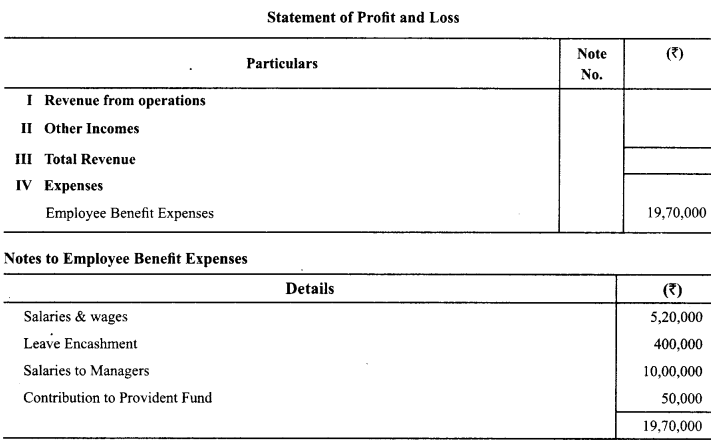
How would you show ‘Employee Benefit Expenses with the help of Notes to Accounts in the Statement of Profit & Loss₹
(i) Salaries & wages ₹ 5,20,000
(ii) Dividend received ₹ 5000,
(iii) Leave encasement ₹ 400,000
(iv) Salaries to manages ₹ 10,00,000
(v) Depreciation on fixed assets ₹ 200,000
(vi) Contribution to provident fund ₹ 5000.
Answer:
Class 12 Accountancy Important Questions Chapter 8 Financial Statements of a Company 15

Question 30.
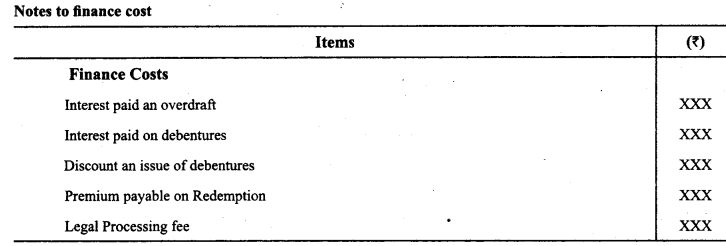
Which of the following items will form the part of Notes to Accounts on Finance Costs₹
(i) Interest paid an overdraft
(ii) Interest paid on debentures
(iii) bank charges
(iv) Discount an issue of debentures
(v) Premium payable an redemption of debentures
(vi) Discount allowed to debtors
(vii) Bad-debts
(viii) Bonus
(ix) Interest Received on fined deposits
(x) Legal processing fee
Answer:
Class 12 Accountancy Important Questions Chapter 8 Financial Statements of a Company 16
Please note that bank charges are not related to raising finance. So, bank charges, discount allowed to debtors, Bad-debts are the part of finance cost. Interest received is the part of other incomes & bonus is the part of employee benefits expenses.

Business Environment Class 12 Important Extra Questions Business Studies Chapter 3

Here we are providing Class 12 Business Studies Important Extra Questions and Answers Chapter 3 Business Environment. Business Studies Class 12 Important Questions are the best resource for students which helps in class 12 board exams.

Class 12 Business Studies Chapter 3 Important Extra Questions Business Environment

Business Environment Important Extra Questions Short Answer Type

Question 1.
Give your views on ‘Economic Environment in India.
Answer:
The economic environment in India consists of various macro-level factors related to the means of production and distribution of wealth which have an impact on business. These are

  1. Stage of economic development of the country.
  2. The economic structure in the form of a mixed economy.
  3. Economic policies of Government including industrial monetary and fiscal policy.
  4. Economic planning including five-year plans etc.
  5. Infrastructural factors such as financial institutions.

Question 2.
State briefly the influence of the technological environment on business and industries.
Answer:
Positive effects:

  1. The efficiency of business increases tremendously to face global competition.
  2. The firm is able to produce better quality products at a cheaper price.

Negative effects:

  1. Continuous up-gradation as per the changing environment has become a necessity to remain competitive in the market.
  2. Small and medium enterprises find it difficult to invest in the new technologies due to limited funds available.

Question 3.
Do you agree with the statement that “Environment offers opportunities as well as threats”? Discuss.
Answer:
Yes, the statement that the business environment offers opportunities, as well as threats, holds true. Threats to the domestic industry can be in the form of increased or cutthroat competition, no availability of a trained workforce.

Shortage of raw materials, a shift in consumer demand to other products, etc. For example, Chinese toy manufacturers have taken over the world toy market. Now they almost have taken monopoly in this sector.

The opportunities can be experienced in the form of easy accessibility to new technology, opening, up of new investment avenues increased orders, world quality products due to competition, etc. For example, there is increased demand for environment-friendly products.

Question 4.
Explain the Environment analysis and its Diagnosis with SWOT analysis.
Answer:
Environment Analysis is the study of various factors of l environment affecting the business, like economic factors, political factors, technological factors, global factors, etc. Environment analysis helps to anticipate opportunities and to plan to take appropriate actions to avail these opportunities. By careful analysis of the environment, the business comes to know the opportunities provided and threats posed by the environment.

However, in general, the manager takes the help of SWOT analysis to analyze the environment. SWOT analysis has have been discussed below:

Swot analysis: Swot Analysis is an analysis of the strengths and weaknesses of the organization and the opportunities and threats in the: environment. SWOT-analysis helps in the formulation of business policy.

Two parts of SWOT analysis are

1. Strengths and Weaknesses: Strengths and weaknesses are related to internal factors such as finance, technology, production facilities, personnel capabilities, etc. of the business organization. The ability of a business organization to exploit the available environmental opportunities depends upon the strength of these internal factors. An organization should concentrate on such business for which it is most competent in case if it does not possess the necessary strength to exploit the opportunities.

2. Opportunities and Threats: Opportunities and threats are related to the external environment. Good opportunities are provided to the business by changes in the external environment. Similarly, the same is responsible for posing threats to the business. Lower rate of interest, development of new market new innovations, etc. are some forms of opportunities. Threats may in the form of increased competition decreasing demand, obsolete technology, etc.

Business Environment Important Extra Questions Long Answer Type

Question 1.
What is Environmental Scanning? Explain the SWOT technique of Environmental scanning.
Answer:
Environmental Scanning: The first and foremost step in corporate planning is environmental scanning. Every organization functions within a specific environment and the various elements of the environment have a significant influence – on its functioning.

SWOT stands for
S – Strengths,
W – Weakness,
O – Opportunities, and
T – Threats.

Strength: Strength is an inherent capacity that an organization can use to gain a strategic advantage over its competitors. For example, superior research and development facilities enable a firm to develop new products and there by gain a competitive advantage:

Some of the examples of a company’s strength are:

  1. Management
  2. Marketing
  3. Finance
  4. Production
  5. Personal

Weakness: Weakness is an inherent limitation or constraint which creates a strategic disadvantage. For example, over-dependence on a single product is potentially very risky.

Some of the examples of the weakness of a company are:

  1. Management
  2. Marketing
  3. Finance
  4. Production
  5. Personnel

Opportunity: Opportunity is a favorable condition in the environment. It enables an enterprise to consolidate its position. For exam growth of the demand is an opportunity for the company to grab.

Threat: Threat is an unfavorable condition in the environment. It creates a risk to the business. For example, growing competition is a threat to the business.

Thus we can see that SWOT Analysis helps an enterprise in matching its strengths and weakness with the opportunities and threats operating in the environment.

Question 2.
Explain in detail the External Environment and affecting factors.
Answer:
External Environment: External Environment consists of all the forces, institutions, and events that are relevant to an organization’s operations but which are absolutely beyond the control of the enterprise. It includes all the outside factors that provide opportunities and pose threats to the organization. The main components of the external environment are:

  • Micro Environment includes competitors, suppliers, consumers, the public at large, and marketing intermediaries.
  • Macro Environment includes economic environment, socio-cultural environment, political environment, legal environment, and technological environment.
  • Micro Environment Micro environment includes all those factors which are closely related to the business. These factors have a different effect on various types of enterprises. Every enterprise has its unique dealing with all these factors. The various factors included in the microenvironment are

1. Competitors Every business enterprise and its policies are affected by the competitors to a great extent. The policies of the competitors can affect the pricing of the product, quality, and quantity of the product, the advertising pattern and budget, etc.

2. Suppliers Business enterprise is very much affected by its relationship with its suppliers. It is in the hands of the suppliers to make the uninterrupted supply of raw materials at a reasonable price.

3. Consumers: The satisfaction of the consumers is one of the main aims of a business enterprise. Different types of consumers are of different importance to the enterprise. The business enterprise must be able to provide goods according to the tastes and preferences of different types of consumers.

4. Public at Large The attitude and behavior of different constituents of the public at large like the local public, trade unions, press, etc. affect the business enterprises.

5. Marketing Intermediaries The marketing intermediaries like agents, whole-sellers, retailers, etc. also affect the business enterprises to a great extent. They act as a link between the manufacturer and the ultimate consumer and can be an important factor in the business.