Secularism Class 11 Important Extra Questions Political Science Chapter 8

Here we are providing Class 11 Political Science Important Extra Questions and Answers Chapter 8 Secularism. Political Science Class 11 Important Questions with Answers are the best resource for students which helps in class 11 board exams.

Class 11 Political Science Chapter 8 Important Extra Questions Secularism

Secularism Important Extra Questions Very Short Answer Type

Question 1.
What do you mean by Secularism?
Answer:
Secularism is a high doctrine about the relations of state and religion. There is a Western, American, and Indian view of secularism in the world. The very essential and common feature of secularism is the separation of state and religion. People must be left free in matters of religion to profess and practice any religion of their choice. The state should not have its own religion. It should neither patronize any religion nor it should discriminate against any religion. Western secularism does not allow minority rights, however, the Indian view of religion allows minority rights and positive interference.

Question 2.
How the secularism promotes justice and equality?
Answer:
Secularism is not a simple separation of politics and religion, it is something humane, democratic, and natural concept based on broad philosophy. Its purpose is to remove the inequalities, domination and discrimination, and exploitation in inter and inter-religious and social groups. Secularism is the most powerful philosophy which opposes all forms of undue domination. It seeks to promote justice and equality by humanizing and educating and enlightening society.

Question 3.
What are intra-religious dominations?
Answer:
All the societies are full of not only inter-religious domination and exploitation, but it also takes another conspicuous form which is intra- religious domination in which we find the domination, exploitation, and discrimination within the same religious groups. Secularism is opposed to all such forms of exploitation everywhere. It seeks to promote freedom within religion.

Question 4.
Write some basic features of a secular state.
Answer:
Followings are certain basic features of a secular state:-

  1. The state should not be a theocratic state.
  2. It should not have its own religion.
  3. It should not be governed by any religious man.
  4. There should be a complete separation between state and religion.
  5. The state should not patronize any religion.
  6. The state should not discriminate against any religion.
  7. The state should promote equality and justice within and without the social and religious groups.

Question 5.
What should be the ultimate aim of Secularism?
Answer:
The separation of state and religion is not the only aim of the secular state. In fact it the means to the end (ultimate goal) which is to make a domination-free, exploitation-free, and discrimination-free society based on justice, freedom, and equality. A secular state must be committed to principles and goals which are at least partly derived from non¬religious sources. These ends should include, peace, religious freedom, freedom from religious oppression, discrimination, and exclusions in inter and inter-religious groups.

Question 6.
What type of Secularism was practiced by Kemal Ataturk in Turkey?
Answer:
Kemal Ataturk came to power in Turkey after First World War. He had a different view of secularism which he had practiced there and which was not based on the principled distance between the state and religion. Instead, it supported active involvement and intervention of religion. He was determined to put an end to the institution of Khalifa in public life. Through this type of secularism, he wanted to modernize the society of Turkey.

Question 7.
Write the main features of the Western View of Secularism.
Answer:
It is said that secularism has western and American origin followings are main features of the western view of Secularism:-

  1. Complete separation of state and religion.
  2. No state interference in the matters of religion.
  3. No interference of religion in state affairs.
  4. Independent and exclusive jurisdictions of both i.e. state and religion.
  5. No religious classification of any Public policy.
  6. The state cannot aid any religious institutions.

Question 8.
What is the Indian View of Secularism?
Answer:
Followings are the main features of Indian secularism out of these features, some are similar to that of western view but some are their own.

  1. Separation of state and religion to certain limits.
  2. Inter-religious equality.
  3. Removing the inter and intra-religious dominations and exploitation.
  4. Promotion of minority rights.
  5. Giving aid to religious educational institutions on the basis of equality.
  6. Positive interference in the management of religious affairs.

Question 9.
What are the common features of Western View and Indian View of Secularism?
Answer:
Reading of the Indian Constitution shows that Indian Secularism is fundamentally different from western secularism. Yet it has many things in common.

  1. Separation of state and religion.
  2. No state religion.
  3. No patronage to any religion and no discrimination against any religion.
  4. Promotion of equality and justice.

Question 10.
Write in brief the views of Pt. Jawahar Lai Nehru on Secularism.
Answer:
Nehru had some different and peculiar and personal views on Secularism. His thesis of secularism was equal protection to all religions but not favoring any religion at die expense of others and forbids the state from having its own state religion. He gave the foundation of the Indian view of secularism. For him, secularism also does not mean being irreligious or hostile to any religion. In this way, he was altogether different from Ataturk of Turkey. Nehru also did not support the complete separation between state and religion.

Question 11.
Discuss the impact of Western Liberalism on Indian secularism.
Answer:
The Western Liberal thinking changed the concept of equality prevailing in Indian ancient society. It brought to focus the neglected and marginalized nations of equality. It also helped in promoting inter¬community equality to replace the notion of hierarchy. All this change of notion of equality brought about a change in Indian secularism, which was the result of an interaction between what already existed in a society that had religious diversity and the ideas that came from the west. It resulted in an equal focus on intra-religious and inter-religious domination.

Question 12.
On what grounds the Indian Constitution is criticized?
Answer:
Indian secularism is criticized on the following grounds:

  1. As Anti-religious.
  2. Western import (Idea is taken from the west).
  3. Minorities (It is based on the appeasement of minorities).
  4. Interventionist (Excessive intervention in religious affairs).
  5. Vote bank politics.
  6. Unpracticable.

Question 13.
Do you agree that Indian? Secularism is an interventionist?
Answer:
Indian secularism is criticized by the critics arguing that Indian secularism is interventionist because it is coercive and it interferes excessively with the religious freedom of communities. In fact, Indian secularism allows interference in religious affairs, particularly in the management of religious activities of the communities. But this interference is not negative, it is positive. Indian secularism rejects non-interference in religion but it does not mean that it is excessively interventionist. Indian secularism follows the concept of principled distance.

Question 14.
How far it is correct to say that Indian secularism is anti-religious?
Answer:
It is said that secularism in India is anti-religious. This is fallacious. Indian secularism may be against institutionalized religious domination but it cannot be referred to as the anti-religions. It is also argued that Indian secularism threatens religious identity but the fact is that Indian secularism promotes religious freedom and equality. Therefore it does not threaten religious identity, but on the contrary, it protects the religious identity. If it threatens any form of religious identity, it is dogmatism fundamentalism and the narrowness of any religion.

Question 15.
What is a Minority?
Answer:
Indian secularism is charged with Minoritism which means that Indian secularism advocates minority rights. It is a fact that it is only Indian secularism that advocates minority rights. Minority means to suggest that in Indian secularism gives special privilege to the minorities which is a sort of appeasement of the minorities. This charge also does not hold any ground.

Secularism Important Extra Questions Short Answer Type

Question 1.
Explain the meaning of Secularism.
Answer:
Secularism is a philosophy that is concerned with the relationship between state and religion. Secularists think that religion is a personal matter of a person, the state has nothing to do with religion. Hence it should neither patronize any particular religion nor it should discriminate against any religion. A man should be left free to profess and practice any religion of his or her choice. Secularism does not mean to be irreligious or anti religiousness.

In fact, Secularism means respect to all religions and ways of life because ultimately religion’s a way of life. Secularism is not a narrow philosophy, it is a broader view of life and ways of leading life which have been interpreted differently in different areas in different periods. This is a philosophy based on human and democratic values that seek to achieve equality, justice, and freedom and try to remove discrimination, exploitation, and domination within and outside the social and communal groups.

Question 2.
What do you mean by inter-religious domination and intra-religious domination?
Answer:
Although religion is a positive and pious feeling and viewpoint it has been in grip of a number of negative feelings of hatred, suspiciousness, negative competition, and urges for dominance within religions and without religions i.e. inter-religious groups and intra-religious. There are hatred and communal riots between Hindus and Muslims. They fight for dominance over each other. Similarly, there is a sense of inferiority and superiority within religions.in Hindus, women and SCs have been dominated by male and upper castes. Similar are the examples in Muslims, Christians, and Sikhs.

Question 3.
Explain the essential elements of a secular state.
Answer:
A state-organized on the basis of the doctrine of secularism is called a secular state. Generally, the state with the separation of religion is called the secular state. But the mere separation of state and religion is not a sufficient requirement for a secular state because there are many states which are non-theocratic and continue to have a close alliance with a particular religion.

To be truly secular, a state must not only refuse to be theocratic but also have no formal, legal alliance with any religion. The separation of religion and state is not a sufficient condition but a very much a necessary condition of a secular state. A secular state must be committed to principles and goals which are at least partly derived from non-religious sources. These goals should include peace, religious freedom, and freedom from exploitation, discrimination, and exclusions. It also seeks to remove inter and intra-religious dominance and exploitation. A secular state allows its citizen full freedom in religious and social matters without the interference of the state.

Question 4.
Discuss India as a secular state.
Answer:
India is a secular state as conceived by the architect of modem India, Pt. Jawahar Lai Nehru. India does not have any state religion but supports all the religions. It has the followings features of a secular state:-

  1. There is no state religion in India.
  2. It neither patronizes any religion nor it becomes a hindrance in the way of any religion.
  3. Citizens are free to profess any religion in which they have failed.
  4. Indian secular inter-religious exploitation.
  5. Indian secular state religions affairs.

Question 5.
Discuss the Western model of Secularism.
Answer:
It is said that secularism is of Western and American in origin. Followings are the main features of the Western model of secularism:

  1. Complete separation of religion and state.
  2. No interference in the matters of each other. All the states and religions have their own jurisdiction.
  3. Neither state will interfere in the matters of religion nor religion will interfere in the affairs of the state.
  4. No policy of a state can have an exclusive rationale.
  5. No religious classification can be the basis of any Public policy.
  6. The state cannot aid any religious institution.
  7. It cannot give financial aid to educational institutions run by religious communities.
  8. Citizens are free to profess and practice any religion of their choice.
  9. It emphasizes individual liberty.

Question 6.
What are the merits of secularism?
Answer:
Human history has witnessed a lot of religious fundamentalism and fanaticism which had caused harassment and exploitation of man by man. But the development of science, technology, education, and press and with the development of democratic culture, people have become rational and broadminded. All these developments have brought the idea of secularism. It has the following merits.

  1. It is based on a broader outlook.
  2. It is more democratic.
  3. It is more scientific and based on rationalism.
  4. It is more humane.
  5. It is a more natural philosophy.
  6. It is a more acceptable and popular philosophy.

Question 7.
Who was Kemal Ataturk? What was his view of Secularism?
Answer:
Kemal Ataturk was a Turkish philosopher who propounded his own theory of secularism which was practiced in Turkey. It was altogether different from the western and Indian views of secularism. His secularism was not about the separation of state and religion, instead, it involved active intervention in and suppression of religion.

He came to power in Turkey after First World War. He was determined to put an end to the institution of Khalifa in the public life of Turkey. He wanted to break Turkey all traditional thinking to make it modem one. He set out as an aggressive Wanner to modernize and secularise Turkey. He encouraged western manner thinking and clothing for men and women to change the traditional and orthodox view of life and religion.

Question 8.
Explain the views of Pt. Jawahar Lai Nehru on secularism.
Answer:
Pt. Jawahar Lai Nehru was a great philosopher, humanitarian, and a democrat by heart. He gave his doctrine of secularism on the basis of these referred values. His doctrine of secularism is the part of the Indian Consitution. The main features of Nehru’s doctrine of secularism are as under:-

  1. Separation of state and religion.
  2. No state religion.
  3. Equal protection by the state to all religions.
  4. Neither patronage to any religion nor discrimination against any religion.
  5. All people are free to profess and practice any religion.
  6. Positive interference of the state in religious affairs, particularly the management of religious activities and social reforms.
  7. Complete opposition to communalism.
  8. The purpose was to establish equality, freedom, and justice.

Question 9.
Describe the characteristics of Indian secularism.
Answer:
It is said that Indian secularism is an imitation of western secularism. It is far from the reality that Indian secularism is fundamentally different from western secularism. Indian secularism does not only emphasize the separation of religion and politics but the idea of inter-religious equality is crucial to Indian views of secularism. India has already a culture of inter-religious tolerance. The liberal values of the west brought ideas of inter communitarian equality to replace the notion of hierarchy which prevailed in India for a long time.

Indian secularism is equally opposed to the oppression of weaker sections within a society. Indian secularism allows positive interference in religious matters. It also allows the minority rights. Indian secularism gives citizens to profess and practice any religion of their choice. It is a personal matter of the citizen. Secularism does not mean to be irreligious or to be anti-religious or to oppose the religion. It supports all the religion. ,

Question 10.
On what grounds the Indian secularism is criticized? Are they justified?
Answer:
Indian secularism is criticized in different quarters on the following grounds:-

  1. It is said to be anti-religious.
  2. It is considered as an imitation of western secularism.
  3. It is said to be based on minorities.
  4. It is called interventionist because it allows interference in religious matters.
  5. It is based on vote bank politics.
  6. It is criticized for being impracticable.

A careful study of Indian secularism concludes that all the above charges are far from reality and are not justified for being based on a poor understanding of Indian secularism.

Question 11.
Explain the constitutional position of Indian secularism.
Answer:
India is a secular state. The nature of Indian secularism is based on the doctrine of Pt. Jawahar Lai Nehru about secularism. Following is the constitutional position of Indian features

  • In the Preamble of the Indian Constitution, the word secular is given which declares India as a secular state.
  • Art. 25 of the Indian Constitution states:
    a. Every one will be free to profess and propagate any religion or not to have any religion.
    b. There, will not be a state religion.
  • Art. 26. Every religious community has to right to have educational institutions for the propagation of their religion.
  • Art. 27. Amount inverted on the religious matters cannot be taxed.
  • Art. 28. No religious education can be given in the educational institutions which are run by the state.
  • The state can interfere to manage religious affairs.

Question 12.
What is the ultimate objective of Secularism?
Answer:
Secularism which prevailed in different forms in different parts of the world has broader objectives. It seeks to realize a secular society that is free from all forms of domination in inter and inter-religious communities. It seeks to promote freedom within religions and equality between, as well as within religions. All these goals of secularism can be realized only in a state which is secular, democratic, and free from intolerance, fundamentalism, and fanaticism. There should be a relation among the communities based on mutual understanding and a sense of togetherness. There should not be any religious discrimination.

Question 13.
Differentiate between the Indian view of secularism and the western view of secularism.
Answer:
In the following areas, both views differ from each other. However, they have one similarity that there should not be a state religion in a secular state.

Western viewIndian view
1. It supports the complete separation between state and religion.1. It does not support a complete separation between state and religion.
2. State cannot interfere in each other’s matters as both have their own separate jurisdiction.2. State can interfere in the affairs of the religion but this interference will not be negative, it will be positive.
3. Here state cannot aid any religious institutions run by the religious communities.3. Here state can aid the religious institution on the basis of equality.
4. It does not seek to promote minority rights.4. In India, Constitution has provided for the promotion of minority rights.

Question 14.
What makes Indian secularism distinctive?
Answer:
It is a fact that Indian secularism is based on high philosophy. Its following features make it distinctive

  1. It arose in the context of deep religious diversity.
  2. It is influenced by western modern ideas and nationalism.
  3. India had a culture of inter-religious tolerance for a very long time.
  4. Impact of western modernity and values neglected and marginalized values of equality which helped in replacing the notion of hierarchy.
  5. It is a mixture of Indian religious diversity and the ideas of the west which resulted in the removal of intra-religious and inter-religious dominations.

Question 15.
How far do you agree with the criticism of Indian secularism that it is based on Minoriticism or is pseudo-secularism?
Answer:
A very serious charge against Indian secularism is that it is pseudo-secularism. It is based on minorities i.e. the appeasement of minorities keeping in view the vote banks of minorities. India seems to be divided between genuine secularists and pseudo-secularists. It is true that Indian secularism advocates and supports minority rights but not for any special reason.

India is a plural society where people of different dialects, languages, and religions live together. In this situation some are in majority’ and some are in minority. In this situation, there may be fear of inter religions and intra-religious domination and exploitation. India is a democratic country therefore for the purpose of infusing confidence and a sense of belongingness, minority rights are given. But they are not given any special or privileged position. Therefore the charge of pseudo-secularism is not correct. Indian secularism aims to build a society based on harmonious relations between the majority groups and minorities.

Question 16.
Do you agree that the Indian view of Secularism is interventionist?
Answer:
Although separation of state and religion is the main characteristic of Indian secularism it does not emphasize the complete separation rather it advocates support to all religions. It also allows interference in religious affairs and the management of religious activities. But this interference is positive and not negative. India secularism allows interference for reforms and to establish equality and justice and remove the inter and inter-religious group’s domination and exploitation. Therefore if it is interventions, it is for good reasons.

Secularism Important Extra Questions Long Answer Type

Question 1.
Explain the main features of Western View and Indian View of Secularism critically.
Answer:
It is said that Indian secularism is originated from the west, therefore it has certain similarities with the western view of secularism but it is also very much different from the western view in a number of ways.

Western view of secularism:
Followings are certain features of the western view of secularism:

  1. Complete separation of state and religion.
  2. The state and religion will not interfere in each other’s affairs. Both have their respective jurisdiction.
  3. No religious classification can be the basis of any public policy.
  4. The state cannot aid any religious institutions.
  5. Its conception of equality and liberty is an individualist manner.
  6. There is no scope for minority rights.

The Indian view of secularism:
Followings are the main features of the Indian view of secularism:-

  1. The separation between religion and states but support to all the religions.
  2. Indian secularism allows positive interference in the matter of religious affairs and management of regions’ activities.
  3. A state can aid religious institutions.
  4. A state can give financial assistance to educational institutions run by the states.
  5. Its conception of equality and liberty is community-based.
  6. It allows minority rights.

Indian secularism is criticized on the following bases:-

  1. Anti-religious
  2. Western origin
  3. Minorities
  4. Interventionist
  5. Based on vote bank politics
  6. Impracticable.
Nationalism Class 11 Important Extra Questions Political Science Chapter 7

Here we are providing Class 11 Political Science Important Extra Questions and Answers Chapter 7 Nationalism. Political Science Class 11 Important Questions with Answers are the best resource for students which helps in class 11 board exams.

Class 11 Political Science Chapter 7 Important Extra Questions Nationalism

Nationalism Important Extra Questions Very Short Answer Type

Question 1.
What do you mean by Ration?
Answer:
The nation is a territory or a state which is organised on the basis of nationality. A nationality is a group of people of common history, traditional culture, language, dialects, future aspirations and geography. In the nation, people are more patriotic and nationalists. They are emotionally and psychologically linked together with the national glory, national honour and national cause. The nation is not just a group of people. It is more cohesive organisation and is different from all other human groupings.

Question 2.
What is Nationalism?
Answer:
Nationalism is a feeling for the commitment and sacrifice among the people. It is the feeling which attaches the people for the national honour, national glory, national cause, national interests. The feeling of nationalism subordinates the individual and regional interests to the national interests. Nationalism is a creed which is generated in the number of circumstances. Nationalism has a deep impact on the structure of the world. Decolonisation is the result of nationalism developed in Asian and African states which led to the emergence of newly independent nations in Asia and Africa.

Question 3.
Write the impact of Nationalism in the world.
Answer:
Nationalism is the result of a number of negative and positive factors in different parts of the world which have mainly following impacts.

  1. The emergence of the nation-state.
  2. The disintegration of empires.
  3. Development of democracy.
  4. Social and religions integration of society.

Question 4.
Write some factors of rising of nationalism.
Answer:
There are a number of circumstances/factors which give rise to the feeling of nationalism

  1. Common culture.
  2. Emotional attachment for territory.
  3. Common future aspiration.
  4. Common history.
  5. The threat to national integration.
  6. The glorification of the national flag, national symbols and national songs and past glory and achievements.

Question 5.
What are the main elements of the Nation?
Answer:
Followings are some important elements or we can say the assumption of Nation which is not only a piece of land or group of people, it is something more than that.

  1. The common belief of the people living on that land.
  2. All the people share a common history to which they glorify.
  3. Territory to which people are emotionally and spiritually attached.
  4. A common culture which includes their traditions, faith, festivals, dress pattern and habitations.
  5. Group of people.

Question 6.
Mention some factors responsible for the rise of Indian nationalism.
Answer:
India has been the victim of British colonialism which ultimately came to end in 1947. India fought a national war for independence and national movements, which was the result of Indian nationalism which was evoked through following main factors

  1. Impact of socio, religious and educational reforms.
  2. Impact of a British education.
  3. Impact of science and technological development.
  4. Impact of the press and other means of communication.
  5. Dedicated and enlighted leadership.
  6. Excess of the British government.
  7. Injustice and exploitation of Indians.

Question 7.
What do you understand by national self-determination?
Answer:
The theory national self-determination was given by former President of USA, W. Wilson after the end of First World War and in the wake of the emergence of new states as a result of the disintegration of Europe. This theory says that every nationality should have the right of law. administration and government of their choice which reflect their interests, ethos, culture and future aspirations for their fuller development. It says that every social group should have the right to govern themselves and determine their future development.

Question 8.
Write the utility of right of National self-determination.
Answer:
Right of self-determination means every nationality or social group should have the right to determine the law and government and mode of governance of their choice. It has the following merits

  1. It will ensure the fuller development of the social group.
  2. It is more democratic.
  3. It is more natural.
  4. It will promote social integration.
  5. It will strengthen national unity.

Question 9.
What are the negative features of National self-determination theory?
Answer:
Whereas the right of national self-determination has many positive features, it has some negative features also. Some of the negative features are as under:-

  1. It leads to parochialism.
  2. There is no end to this of right.
  3. It leads to mutual hatred and social disharmony.
  4. It leads to national disintegration.
  5. It is harmful for federation.

Question 10.
Write the impact of the theory of National self-Determination.
Answer:
This theory of National self-determination was propounded by former President of USA during the First World War. In the post First World War period this theory had a profound impact in raising the number of nation-states in different parts of the world. The Right to National Self-determination has also evoked national liberation movements in Asia and Africa against colonial domination. Many countries achieved independence and emerged as nation-states on the map of the world. Socio-cultural and political unity among different nationality was the consequence of this theory’ of National Self-determination.

Question 11.
Discuss the demand for nation among nations as a consequence of the right of self-determination.
Answer:
In most of the states of the world, society is plural i.e. diverse i.e. people of different nationalities. It is also a fact that today every state in the world faces the dilemma of dealing with the movements who are raising the demand of either an autonomous state or separate nation-state on the basis of their right of self-determination. It is also being realised that a solution does not lie in accepting all such demands. After all, there has to be the same check on this right.

Question 12.
What do you mean by pluralism?
Answer:
Pluralism means living together of social groups of a different culture, religion, dialect, language and geographies as a nation. Pluralism stands for a diverse society. Today all the nation-states have diverse society i.e. plural society living together with regional aspirations and national objectives.

Question 13.
How the feeling of nationalism and pluralism are reconciled in today’s modern nation-states?
Answer:
Today most of the nation-states have a plural society which has different cultures and communities which survive and flourish within the boundary of Nation-states. It is in pursuit of this goal of reconciliation most of the democratic states have started to take the measures for recognizing and protecting the identity of cultural minority communities living within the territory of a nation-state. This reconciliation had become necessary for the state as a nation and also for the minorities living in the territory of that state.

Question 14.
What provisions Indian Constitution has for the protection of identity and rights of the minorities?
Answer:
The Indian Constitution has an elaborate set of provisions for the protection of religious, linguistic and cultural minorities. Indian Constitution has provided for a secular state which is given in Art 25 of the Constitution that every person will be free in a matter of religion and state will neither protect any religion nor it will become a hindrance of any religion. The state will not have its religion. Art. 29 and Art. 30 provides for the protection of minorities by giving them the right to maintain their cultural identities and to run educational institutions for the promotion of their culture and identity.

Question 15.
What rights should be given to the minority social and cultural groups?
Answer:
Most of the social and cultural groups have been given Constitutional rights which includes the protection of language and religion of minority groups. Minority communities have also the right to representation as a group in legislative bodies and other state institutions. They are also given equal treatment and protection of the law for the cultural identity of such group.

Nationalism Important Extra Questions Short Answer Type

Question 1.
What do you mean by Nationalism? Explain the history of the development of Nationalism in different countries.
Answer:
Nationalism is a very powerful force or feeling which unite the people of the nation to the glorious history, dignity, interests and objectives of the Nation-state. It is a feeling which subordinates the individual and regional feelings and interests to the national feelings and national interests. It is generated among the people of our nationality.

Nationalism has been the result of many factors and developments in the field of science technology, press, education and other means of communication. Nationalism has passed through many phases in the 19th century. It was developed in Europe which lead to the unification of Italy and Germany and the number of small kingdoms into larger nation-states. A large number of new states were also founded in Latin America. In 20th Century number of national movements were started as a result of nationalism which resulted in a number of newly independent states.

Question 2.
Explain the meaning and attributes of Nation.
Answer:
Nations are the states which are organised on the basis of nationality i.e. social groups of common identity. We can define the nations as the states constituted by a group of people who share common descent, language, religion or ethnicity. There may be some exception because there are many states who do not have a common language. In such Nations, there is a number of nationalities which live in the same territory. Canada is such an example which has English speaking persons as well as French-speaking people. India also has a large number of social and cultural groups which have a common political identity and living in the territory of India.

Question 3.
Explain some important elements of Nations.
Answer:
The nation is a community which is held together by the collective beliefs, aspirations and imaginations of its members. It is based on certain assumptions which unite the people as a whole with which they identify themselves. The main assumptions are as under

  1. Common beliefs:- Nation is a group of people who share common beliefs, collective identity and vision for the future to have an independent political existence.
  2. History:- The people of a nation share common history i.e. the past record of happiness and sufferings, wars and peace and victory and defeat.
  3. Territory:- Nation is a group of people who occupy a piece of land with which people have an emotional and spiritual attachment.
  4. Future aspirations.
  5. Common culture.

Question 4.
What were the main factors which were responsible for the rise of Indian Nationalism?
Answer:
Rise of Indian nationalism led to the war of independence and starting of a national movement for the independence which ultimately got success in 1947. Following were the main factors responsible for Indian Nationalism:-

  1. Injustice and unequal treatment and exploitations of Indians.
  2. Development of science, technology and means of communication.
  3. The spread of education and development of Press.
  4. Role of social and religious reforms movements.
  5. Rise of the middle class.
  6. Impact of international events.
  7. Impact of English literature.
  8. Role of nationalist leaders.

Question 5.
Discuss India as a Nation.
Answer:
About India, it is said that India is not a country, it is a continent. It means it is a nation of the nations. All these ethics about the nature of Indian states are attributed because India is a plural society in which people of different caste, colour, race, regions, religions, faith and beliefs reside within the territory of India. All these nationalities have their political and cultural identity and all have contributed during the struggle for national independence. They are well-recognised identity. They have full support for the national song, national festivals, national celebrations and national Constitution, which has given all the rights and protection to all the minorities. All the part and parcel of national ethos and objectives. India has unity in diversity. Therefore we can say that India as a political unity is a unique nation. From Kashmir to Kanyakumari, people are linked together with the feeling of Indianness.

Question 6.
Mention the contribution of social reformers in the rise of Indian nationalism.
Answer:
Although there are a number of factors which have contributed to the rise of Indian nationalism the contribution of these following social reformers is unique:-

  • Raja Ram Mohan Rai:- He was a social reformer of liberal thinking. He wanted to build Indian society on the edifice of British culture. He started Brahma Samaj.
  • Swami Dayanand:- Swami Dayanand started Arya Samaj. He wanted to build Indian on the edifice of Indian culture.
  • Swami Vivekanand:- He wanted to build the character of Indians particularly of youth.

Question 7.
Discuss how the territory acts as an important attribute of Nation and nationalism?
Answer:
The territory is one of the most important and effective attributes of the nation. It acts as a deep source of patriotism and nationalism. Sharing a common past and living together on particular territory over a long period of times creates a sense of common identity and collectivity. They start to imagine themselves as one. Territory i.e. the land which they occupy and live upon has a special significance for them. It is not just a piece of land. They attach emotional and spiritual significance to that part of the land. They call it Maa or motherland for which they guard and become ready to sacrifice anything for it. For example, Jewish people, in spite of being dispersed for a long time in different parts of the world, still claim that their original homeland is in Palestine. Indian have special significance for its rivers like Ganga, Saraswati etc, mountains and regions of the Indian subcontinent.

Question 8.
How nationalism poses a threat to democracy?
Answer:
Nationalism is a positive and desirable rather natural feeling with attaching the people with the national objective and nation’s glorious past. But nationalism is negative and harmful when it assumes extreme form i.e. chauvinism. Most societies are culturally diverse where people have different languages and religions living together in the same territory. To impose religious or linguistic identity in the name of nationalism will certainly be the violation of the principle of equal treatment and liberty for all and it will also be the negation of democracy. Therefore the democracies need to emphasize and expect loyalty to a set of values incorporated in the Consitution rather than adherence to a particular religion, race and language.

Question 9.
What is the theory of National Self-determination?
Answer:
The theory of self-determination means the right to social and cultural groups to govern themselves and determine their future development. It is also right of the political community to be governed by the law which reflects their social-economic, political and cultural interests and aspirations. This theory was propounded by the former President; of USA, W. Wilson at the end of First World War.

As a result of this theory, a number of nation-states emerged in Europe after the disintegration of big empires and reorganisation of the boundaries of the states. The nation of one culture, one state began to gain acceptability at the time. The Treaty of Versailles established a number of small newly independent states. In making the claim of the right of self-determination, the nation seeks recognition and acceptance by the international community of its status as a distinct political entity.

Question 10.
Discuss the impact of self-determination theory on the colonialism.
Answer:
As after the end of First World War and as a result of the Treaty of Versailles in 1919, Europe saw the reorganisation of states and emergence of new nation-states. Similarly, after the end of Second World War in 1945, the process of Decolonialism started with the reorganisation of the world and creation of new world order under UN supervision who had accepted the theory of self-determination. Asa result of the breakdown of empiricism and colonialism large number of independent new states emerged oh the map of the world in Asia and Africa and Latin American countries. National movements had started as the impact of the theory of self-determinations.

Question 11.
Discuss the limitation of the theory of self-determination.
Answer:
Most of the national movements were inspired by the theory of self-determination which gave the right to choose law and administration of their choice in which they found the reflection of their culture, ethos, aspirations and interests. Such national movements brought the end of colonialism and helped in the creation of a large number of new nation-states.

Most of the national movements were inspired by the goal of bringing justice rights and prosperity to the nation. But it became virtually impossible to ensure that each cultural group could achieve political independence and statehood Thus paradoxical situation developed when those countries refused to accept the demand of minorities, who themselves had received their own statehood on the right of self¬determination. In fact, this right cannot be absolute. It has to be accepted in relativity.

Question 12.
What rights are given to minorities in the Indian Constitution?
Answer:
Indian society is a plural society with people of different colour, region, language, geographies and religion are living together as a political community. To ensure the development of the minorities, Constitution makers had given certain Fundamental Rights to the people of minorities. All the people have the right to have a choice of religion, culture, language and region. Right of choice in the matter of religion is given in Chapter III of the Indian Constitution.

Similarly in Art 23 Right of Equality is given by Right of Expression. Every minority has the right to build and maintain their educational institutions and to get the aid of government on the basis of their consent of the state.

Question 13.
Discuss the factors responsible for the rise of Indian nationalism.
Answer:
There is a large number of factors which have contributed to the rise of Indian nationalism which ultimately brought the end of colonialism and India’s independence as a sovereign state. Some of the factors are as under:-

  1. Excess of British administration.
  2. Role of social reformers like Swami Dayanand, Swami Vivekanand and Raja Ram Mohan Rai.
  3. The spread of Education.
  4. Respect of British Literature.
  5. Development of Press.
  6. Development of science and technology and means of communication.
  7. Impact of world events.
  8. Glorification of histoiy.

Question 14.
Discuss Indian has unity in diversity.
Answer:
It is rightly said about India that India has unity in diversity. Indian society is a plural society which means it has diverse society having people of different caste, colour, regions, climate, traditions, culture and geographies but are linked together with the feeling of oneness which is generated with a common history and common future aspirations. This kind of feeling has helped immensely in generating nationalism which led to the organising national movement against British colonialism and ultimately got independence. Still, India is plural, secular and democratic, people and are linked together with the feeling of oneness on account of nationalism and patriotism. Therefore it is right that India has unity in diversity.

Question 15.
Discuss the negative impact of the right of self-determination.
Answer:
Whereas the right of self-determination has a number of positive features but it has created a number of problems also for the political communities in the matter of state organisation on the basis of the right of self-determination of different nationalities living together on a particular territory. It is also true that people had to suffer a lot for reordering boundaries in the way that culturally distinct communities could form separate nation-states.

It is not possible to ensure that the newly created states have only one ethenic community or the people of one nationality. In every nation-state, there is a number of sub-nationalities who in the course of time start to nurse their grievances and start to demand a separate state on the basis of the right of self-determination. Therefore this right of self-determination poses danger for national integration.

Question 16.
Discuss the merit of Right of Self-determination.
Answer:
The theory of the right of self-determination is given by the former President of USA, W. Wilson, thus this theory became very popular and accepted in most of the parts of the world. This has a number of positive features. Some of these positive features are as under:-

  1. This is more democratic.
  2. This is more natural.
  3. Thisismorehumonistic.
  4. This promotes national integration.
  5. This checks the centralisation of powers.
  6. This promotes social and cultural integration.
  7. This promotes the development of the political community.

Nationalism Important Extra Questions Long Answer Type

Question 1.
What is Nationalism? Discuss various factors of rising of nationalism in India. How it has affected the world structure?
Answer:
Nationalism is generally considered as the love and dedication for one’s nation which is organised on the basis of common nationality i.e. common history, common culture, common future aspirations and common geography. Nationalism is in fact a feeling which attaches a person to the national, cause, national interests and nationalism objectives. This is the feeling which makes the national interests more important than the personal and regional interest.

Nationalism leads to patriotism which makes men emotional about the nation. It leads to a number of agitations and movements against the nation’s exploitation and political subjugation.

Nationalism has been resulting in the number of factors which has inspired to start movements in different parts of the world to change the structure of the world. India has been one such country who witnessed the rise of nationalism and national movement as its impact.

Following are some important factors of rising of Indian Nationalism:-

  1. The exploitation of Indians in the hands of British administration.
  2. The spread of education and means of communication.
  3. Role of social and religious reformers.
  4. Impact of world events.
  5. Dedicated and visionary leadership.
  6. Role of the middle and intellectual class.

As a result of nationalism number of the national movement for national independence started in Asia, Africa and Latin American countries which changed the map of the world as the number of new nation-states appeared on the map of the world.

Accounting for Share Capital Class 12 Important Questions Accountancy Chapter 6

Here we are providing Class 12 Accountancy Important Extra Questions and Answers Chapter 6 Accounting for Share Capital. Accountancy Class 12 Important Questions and Answers are the best resource for students which helps in class 12 board exams.

Class 12 Accountancy Chapter 6 Important Extra Questions Accounting for Share Capital

Accounting for Share Capital Important Extra Questions Very Short Answer Type

Question 1.
What is meant by over subscription of shares? (CBSE Compt. 2019)
Answer:
Oversubscription of shares means that the company receives applications for more than the number of shares offered to the public for subscription.

Question 2.
What is meant by ‘par value’ of a share? (CBSE Compt. 2019)
Answer:
Par value is the nominal value or the face value of the share.

Question 3.
Is Reserve Capital a part of Unsubscribed Capital or Uncalled Capital? (CBSE Delhi 2018)
Answer:
Yes.

Question 4.
A company issued 25,000 equity shares of ₹ 10 each but received applications for.30,000 shares. Name the case of subscription.
Answer:
Over subscription

Question 5.
Neelam Limited has the following balances appearing in the balance sheet:
Class 12 Accountancy Important Questions Chapter 6 Accounting for Share Capital 1
The company decided to redeem its 9% debentures at a premium of 10%. You are required to state how much securities premium amount can be used for redemption of debentures.
Answer:
₹ 12,00,000.

Question 6.
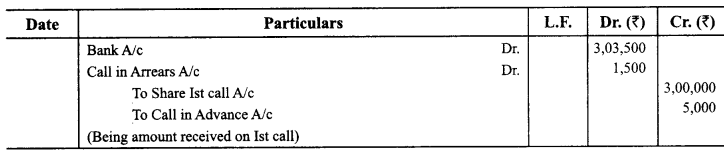
On 1.1.2016 the first call of ₹ 3 per share became due on 1,00,000 equity shares issued by Kamini Ltd. Karan a holder of 500 shares did not pay the first call money. Arjun a shareholder holding 1000 shares paid the second and final call of ₹ 5 per share along with the first call.
Pass the necessary journal entry for the amount received by opening ‘Calls-in-arrears’ and ‘Calls-in- advance’ account in the books of the company. (CBSE Outside Delhi 2016)
Answer:
Class 12 Accountancy Important Questions Chapter 6 Accounting for Share Capital 2

Question 7.
Where will you show call in arrears in the balance sheet?
Answer:
As deduction from the subscribed but not fully paid share capital.

Question 8.
Where will you show call in advance in the balance sheet?
Answer:
It is shown under other current liabilities.

Question 9.
At what rate of interest, interest on call in arrears, is charged? .
Answer:
10%p.a.

Question 10.
At what rate interest on calls-in-advance is paid by the company according to Table F of Companies Act, 2013? ’ (CBSE Delhi Compt.2014)
Answer:
As per Table F, company is required to pay interest on the amount of calls in advance @ 12% p.a.

Question 11.
How would you deal in a situation where the value of purchase considerations is more than the value of net assets while acquiring a business? .
Answer:
It would refer to loss.

Question 12.
How will you deal in a situation where the value of net assets is more than the value of purchase consideration while acquiring a business?
Answer:
It would refer to gain .

Question 13.
Which account will you debit while issuing the shares to the promoters of a company against their services?
Answer:
Goodwill Account or Incorporation Expenses Account.

Question 14.
When can shares held by a shareholder be forfeited?. (CBSE Delhi 2017)
Answer:
On the non-payment of call money due.

Question 15.
A Ltd forfeited a share of 100 issued at a premium of 20% for non-payment of first call of 30 per share and’ final call of 10 per share. State the minimum price at which this share can be reissued. (CBSE Sample Paper 2016)
Answer:
₹ 40 per share!

Question 16.
Give the meaning of forfeiture of share.
Answer:
Cancellation of shares.

Question 17.
At the time of forfeiture of shares, what amount is credited to share forfeiture account?
Answer:
The amount already received.

Question 18.
Where will you show the share forfeited account in the balance sheet of a company?
Answer:
As an addition in the subscribed capital.

Question 19.
What amount of share capital is debited when the shares are forfeited?
Answer:
Called up money.

Question 20.
What amount of share capital is credited when the forfeited shares are reissued?
Answer:
Paid up capital of shares at the time of reissue.

Question 21.
Y Ltd. forfeited 100 equity shares of ₹ 10 each for the non-payment of first call of ₹ 2 per share. The final call of ₹ 2 per share was yet to be made.
Calculate the maximum amount of discount at which these shares can be re-issued. (CBSE Delhi 2017)
Answer:
₹ 6 per share or ₹ 600.

Question 22.
If a question is silent on the question of excess money received with application, how would you treat it?
Answer:
In the absence of any information, excess money over the amount due on allotment shall be refunded.

Accounting for Share Capital Important Extra Questions Short Answer Type

Question 1.
What is meant by ‘over-subscription’ of shares ? With the help of an example, briefly explain the alternatives available for allotment of shares in case of over-subscription. (CBSE Outside Delhi 2019)
Answer:
When the no. of shares applied is more than the no. of shares offered by the co., it is said to be case of over-subscription.
For Example: A company invited applications for 1,00,000 shares and received applications for 4,00,000 shares. Three alternatives are available for allotment of shares:

  • To allot 1,00,000 shares in full to selected applicants and the remaining 3,00,000 applications were rejected outright.
  • To make pro-rata allotment to all applicants.
  • Totally reject applications for 2,00,000 shares, accept full applications for 80,000 shares and make pro-rata allotment for 20,000 shares to remaining 1,20,000 applicants.

Question 2.
What is meant by ‘Forfeiture of shares’ ₹ When does ‘gain on forfeited shares’ arise and when is it transferred to capital reserve ? (CBSE Outside Delhi 2019)
Answer:
Cancellation of shares for the non payment of called up amount is termed as Forfeiture of shares.
Gain on Forfeited shares arises on reissue.
It is transferred immediately on the reissue of forfeited shares.

Question 3.
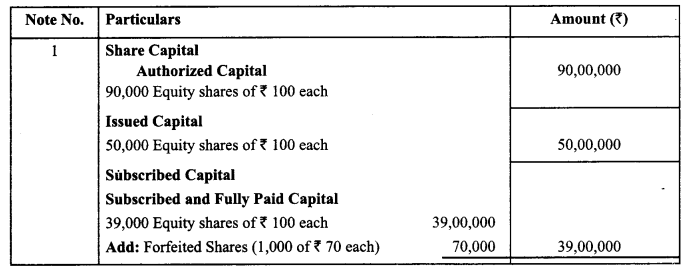
Bliss Products Ltd. registered with capital of ₹ 90,00,000 divided into 90,000 equity shares of₹ 100 each. The company issued prospectus inviting applications for 50,000 equity shares of ₹ 100 each payable as ₹ 20 on application, ₹ 30 on allotment, ₹ 20 on first call and balance on second call.
Applications were received for ₹ 40,000 shares. Raman to whom 1600 shares were allotted failed to pay final call money and these shares were forfeited. Of the forfeited shares, 600 shares were reissued to Sukhman, credited as fully paid for ₹ 90 per share.
Present the Share Capital as per Schedule III of Companies Act, 2013. (CBSE Sample Paper 2019-20)
Answer:
Class 12 Accountancy Important Questions Chapter 6 Accounting for Share Capital 3
Class 12 Accountancy Important Questions Chapter 6 Accounting for Share Capital 4

Question 4.
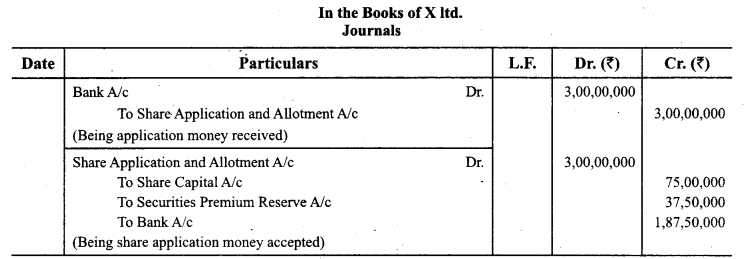
To provide employment to the youth and to develop the Naxal affected backward areas of Chattisgarh. X Ltd. decided to set-up a power plant. For raising funds the company decided to issue 7,50,000 equity shares of ₹ 10 each at a premium of 50%. The whole amount was payable on application. Application for 20,00,000 shares were received. Applications for 50,000 shares were rejected and shares were allotted to the remaining application on pro-rata basis.
Pass necessary journal entries for the above transactions in the books of the company.
(CBSE Outside Delhi 2016, Modified)
Answer:
Class 12 Accountancy Important Questions Chapter 6 Accounting for Share Capital 5

Question 5.
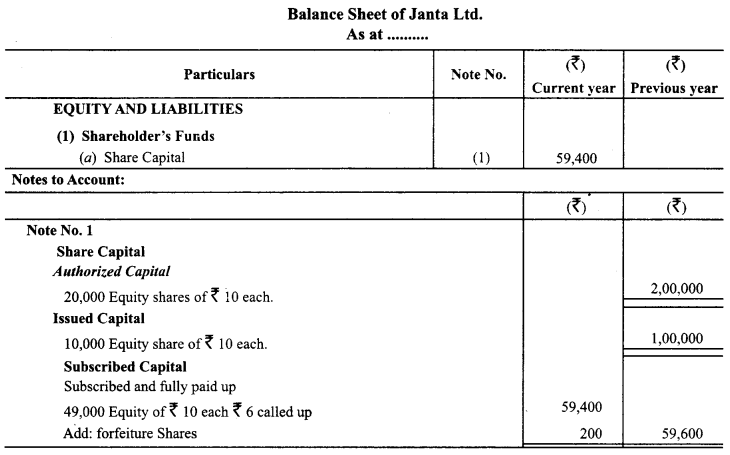
Janta Ltd. had an authorized capital of ₹ 2,00,000 divided into equity shares of ₹ 10 each. The company offered for subscription of ₹ 10,000 shares. The issue was fully subscribed. The amount payable on application was ₹ 2 per share. ₹ 4 per share were payable each on allotment and first and final call. A share holder holding 100 shares failed to pay the allotment money. His shares were forfeited. The company did not make the final call. How the ‘share capital’ will be presented in the company’s balance-sheet?
Also prepare Notes to Accounts for the same. (CBSE Sample paper 2014 Modified)
Answer:
Class 12 Accountancy Important Questions Chapter 6 Accounting for Share Capital 6

Question 6.
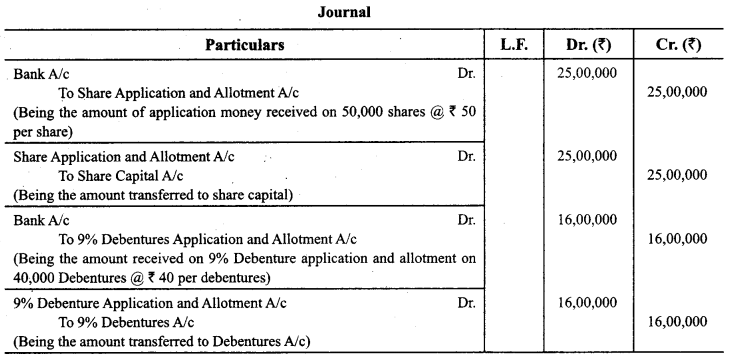
Drumbeats Ltd. had a prosperous shoe business. They were manufacturing shoes in India and exporting to Italy. Being a socially aware organization, they wanted to pay back to the society. They decided to not on supply free shoes to 50 orphanages in various parts of the country but also give employment to children from those orphanages who were above 18 years of age. In order to meet the fund requirements, they decided to raise 50,000 equity shares of ₹ 50 each and 40,000. 9% debentures of ₹ 40 each. Pass the necessary journe entries for issue to shares and debentures. (CBSE Sample Paper 2015, Modified)
Answer:
Class 12 Accountancy Important Questions Chapter 6 Accounting for Share Capital 7

Question 7.
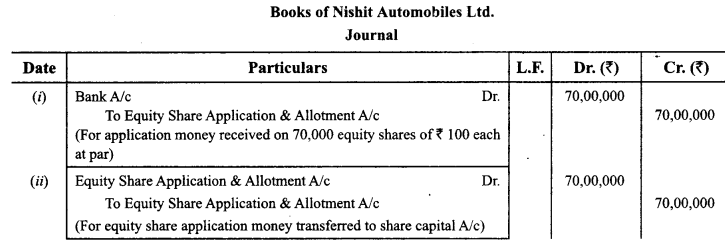
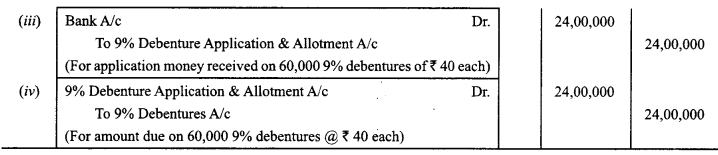
Nishit Automobiles Co. is an manufacture of low cost cars in India. It has a strong sales and distribution network spread across the country. It follows high standards in environmental safety in various processes of car manufacturing. It runs a school to provide quality education to the children of employees of the company and an ‘Adult Education Centre’ to help adults learn reading and writing and to acquire basis literacy. The company is doing well and anticipates a higher demand for its products in the future. For the same, it decides to set up a new manufacturing unit in a backward area of Orissa creating livelihood for people, especially those from disadvantaged sections of society in rural India. In order to raise fund requirements they decided to issue 70,000 equity shares of ₹ 100 each at par and 60,000. 9% Debentures of ₹ 40 each. Pass necessary Journal Entries for the issue of shares and 9% debentures in the books of the company and also identify.
Answer:
Class 12 Accountancy Important Questions Chapter 6 Accounting for Share Capital 8
Class 12 Accountancy Important Questions Chapter 6 Accounting for Share Capital 9

Question 8.
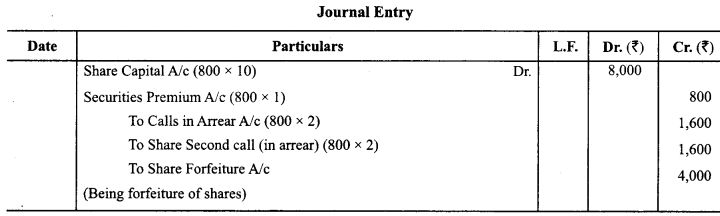
A Company forfeited 800 equity shares of ₹ 10 each issued at a discount of 10% for non-payment of two calls of ₹ 2 each. Calculate the amount forfeited by the company-and pass the journal entry for forfeiture of the shares.
Answer:
Class 12 Accountancy Important Questions Chapter 6 Accounting for Share Capital 10

Question 9.
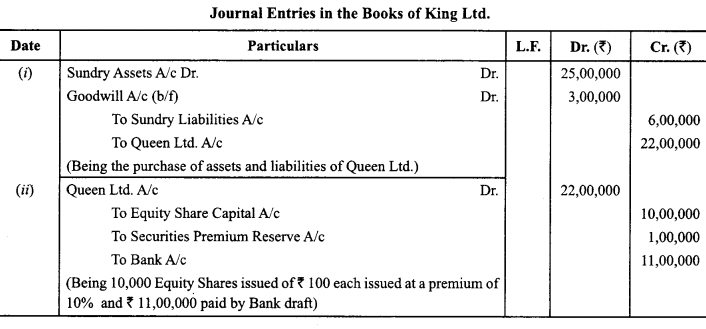
King Ltd took over Assets of 25,00,000 and liabilities of 6,00,000 of Queen Ltd. King Ltd paid the purchase consideration by issuing 10,000 equity shares of 100 each at a premium of 10% and 11,00,000 by Bank Draft.
Calculate Purchase consideration and pass necessary Journal entries in the books of King Ltd. (CBSE Sample Paper 2016, 2017)
Answer:
Calculation of Purchase Consideration:
Nominal Value of Shares issued = 10000 x ₹ 100 = ₹ 10,00,000
Securities Premium Reserve = ₹ 1,00,000
Bank draft = ₹ 11,00,000
Purchase consideration = ₹ 22,00,000
Class 12 Accountancy Important Questions Chapter 6 Accounting for Share Capital 11

Question 10.
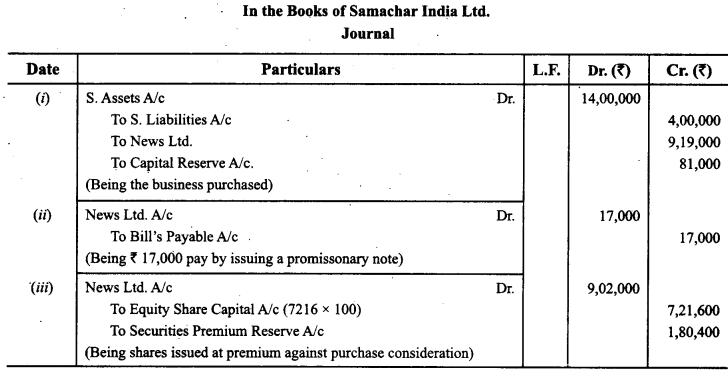
Samachar India Ltd. took over the assets of ₹ 14,00,000 and liabilities of ₹ 4,00,000 from News Ltd. for a purchase consideration of ₹ 9,19,000. Samachar India Ltd. issued a promissory note of ₹ 17,000 payable after 60 days in favour of News Ltd. and the balance amount was paid by issue of equity shares of ₹ 100 each at a premium of ₹ 25 per share.
Pas necessary Journal entries for the above transactions in the book of Samachar India Ltd. (CBSE Outside Delhi 2016)
Class 12 Accountancy Important Questions Chapter 6 Accounting for Share Capital 12

Question 11.
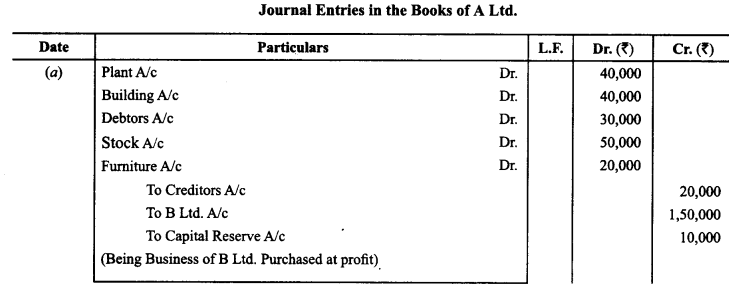
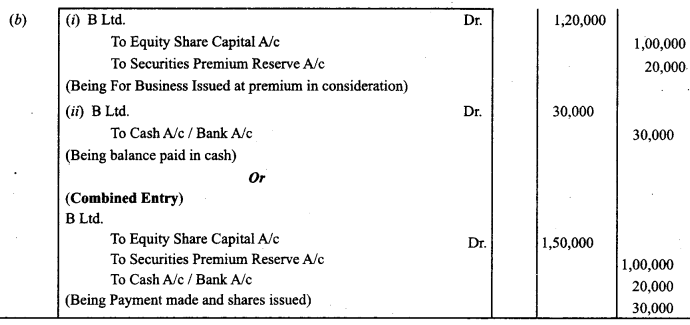
A Ltd. purchased a running business from B Ltd. for a sum of ₹ 1,50,000 payable by issue of 10,000 equity shares of ₹ 10 each at a premium of ₹ 2 per share and balance in cash. The assets and liabilities taken over were:
Plant – ₹ 40,000;
Building – ₹ 40,000;
Debtors – ₹ 30,000;
Stock – ₹ 50,000;
Furniture – ₹ 20,000;
Creditors – ₹ 20,000
You are required to pass necessary journal entries for the above transactions in the book of A Ltd.
(CBSE Delhi Compartment 2014)
Answer:
Class 12 Accountancy Important Questions Chapter 6 Accounting for Share Capital 13
Class 12 Accountancy Important Questions Chapter 6 Accounting for Share Capital 14

Question 12.
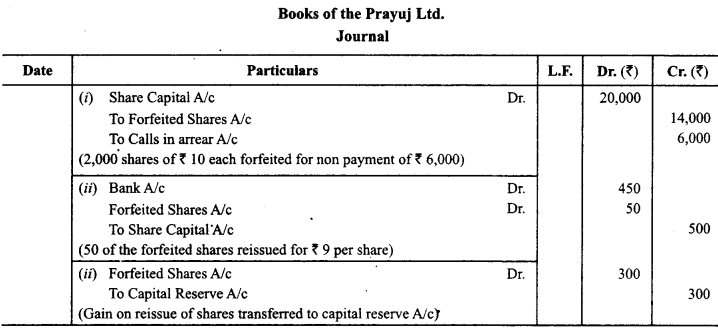
Prayuj Ltd. forfeited 2,000 shares of ₹ 10 each, fully called up, on which they had received only ₹ 14,000.50 of the forfeited shares were reissued for ₹ 9 per share fully paid up.
Pass necessary journal entries for forfeiture and re-issue of shares. Also prepare share forfeited account.
(Compt. Delhi 2017)
Class 12 Accountancy Important Questions Chapter 6 Accounting for Share Capital 15

Question 13.
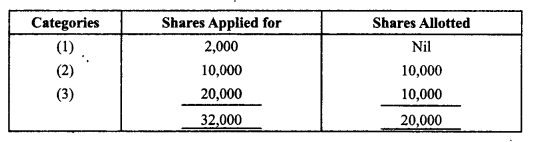
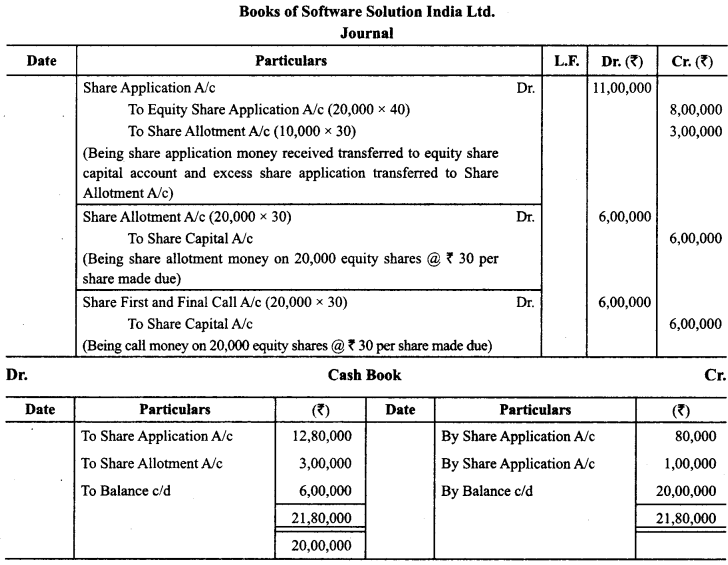
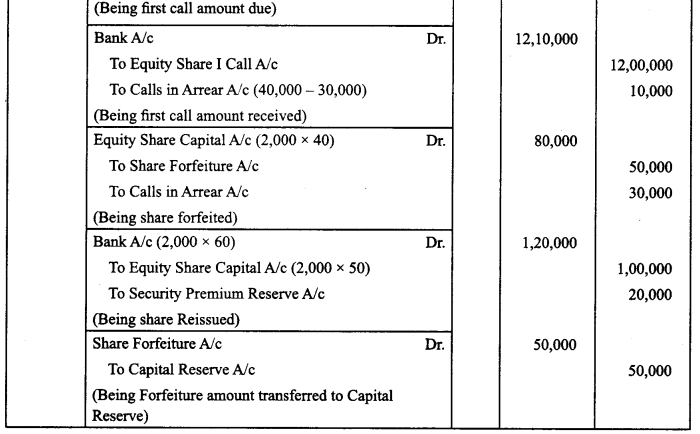
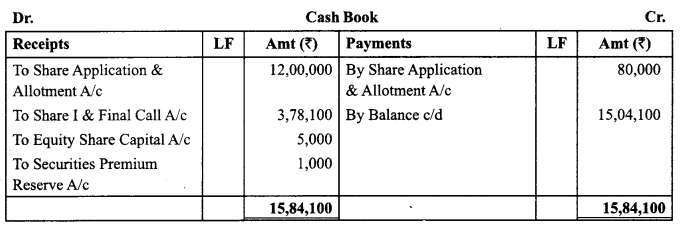
Software Solution India Ltd. inviting application for 20,000 equity share of ₹ 100 each, payable ₹ 40 on application. ₹ 30 on allotment and ₹ 30 on call. The company received applications for 32,000 shares. Applications for 2,000 shares were rejected and money returned to applicants. Applications for 10,000 shares were accepted in full and applicants for 20,000 share allotted half of the number of shares applied and excess application money adjusted into allotment. All money received due on allotment & call. Prepare journal and cash book.
Answer:
Class 12 Accountancy Important Questions Chapter 6 Accounting for Share Capital 16
Class 12 Accountancy Important Questions Chapter 6 Accounting for Share Capital 17

Accounting for Share Capital Important Extra Questions Long Answer Type

Question 1.
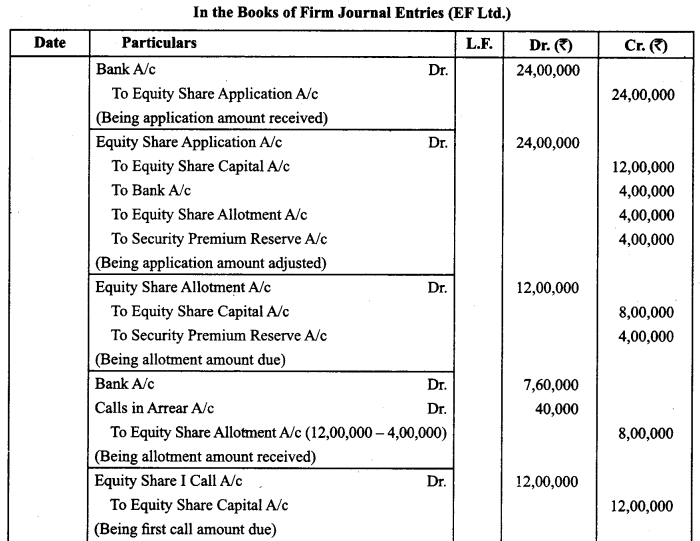
EF Ltd. invited applications for issuing 80,000 equity shares of ₹50 each at a premium of 20%. The amount was payable as follows:
On Application : ₹ 20 per share (including premium ₹ 5)
On Allotment : ₹ 15 per share (including premium ₹ 5)
On First Call : ₹ 15 per share
On Second and Final call : Balance amount
Applications for 1,20,000 shares were received. Applications for 20,000 shares were rejected and pro-rata allotment was made to the remaining applicants.
Seema, holding 4,000 shares failed to pay the allotment money. Afterwards the first call was made. Seema paid allotment money along with the first call. Sahaj who had applied for 2,500 shares failed to pay the first call money. Sahaj’s shares were forfeited and subsequently reissued to Geeta for ₹ 60 per share, ₹ 50 per share paid up. Final call was not made.
Pass necessary journal entries for the above transactions in the books of EF Ltd. by opening calls-in-arrears account. (CBSE Delhi 2019)
Answer:
Class 12 Accountancy Important Questions Chapter 6 Accounting for Share Capital 18
Class 12 Accountancy Important Questions Chapter 6 Accounting for Share Capital 19

Question 2.
S Ltd. invited applications for issuing 1,00,000 equity shares of ₹ 10 each. The shares were issued at a premium of ₹ 5 per share. The amount was payable as follows :
On Application and Allotment – ₹ 8 per share (including premium ₹ 3)
On the First and Final call – Balance including premium
Applications for 1,50,000 shares were received. Applications for 10,000 shares were rejected and pro-rata allotment was made to the remaining applicants on the following basis :
(I) Applicants for 80,000 shares were allotted 60,000 shares, and
(II) Applicants for 60,000 shares were allotted 40,000 shares.
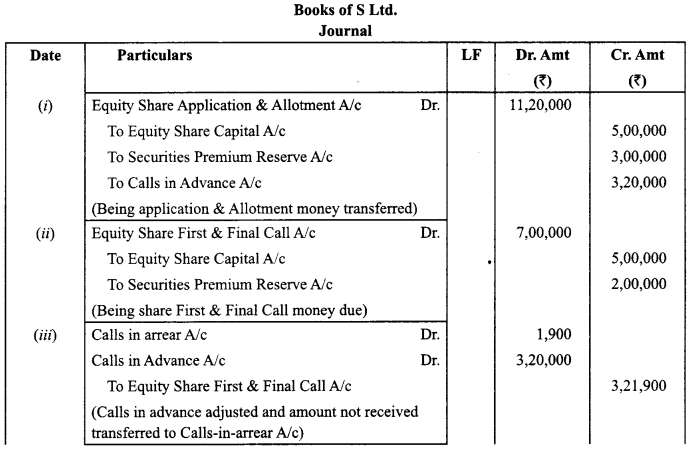
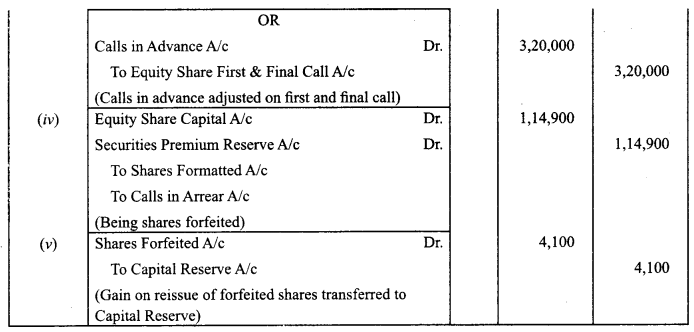
Excess amount received on application and allotment was to be adjusted against sums due on call. X, who belonged to the first category and was allotted 300 shares, failed to pay the first and final call money. Y, who belonged to the second category and was allotted 200 shares, also failed to pay the first and final call money. Their shares were forfeited. The forfeited shares were reissued @ ₹ 12 per share as fully paid-up.
Pass necessary cash book and journal entries for the above transactions in the books of the company. (CBSE Outside Delhi 2019)
Answer:
Class 12 Accountancy Important Questions Chapter 6 Accounting for Share Capital 20Class 12 Accountancy Important Questions Chapter 6 Accounting for Share Capital 21
Class 12 Accountancy Important Questions Chapter 6 Accounting for Share Capital 22

Question 3.
Saregama Ltd invited applications for issuing 80,000 equity shares of ₹ 100 each at a premium of ₹ 10. The amount was payable as follows On Application – ₹ 30
On allotment – ₹ 30 (including a premium of ₹ 10)
On 1st call – ₹ 30
On Final Call Balance
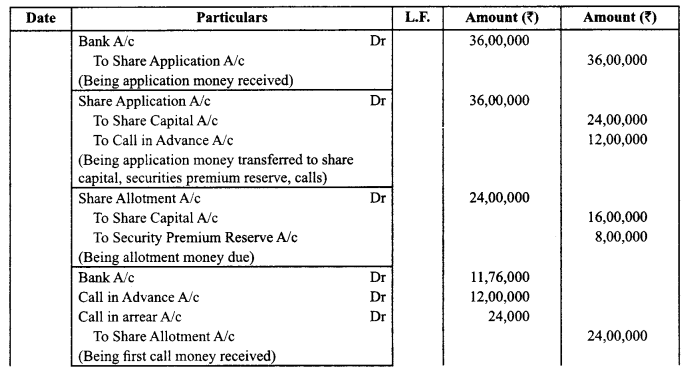
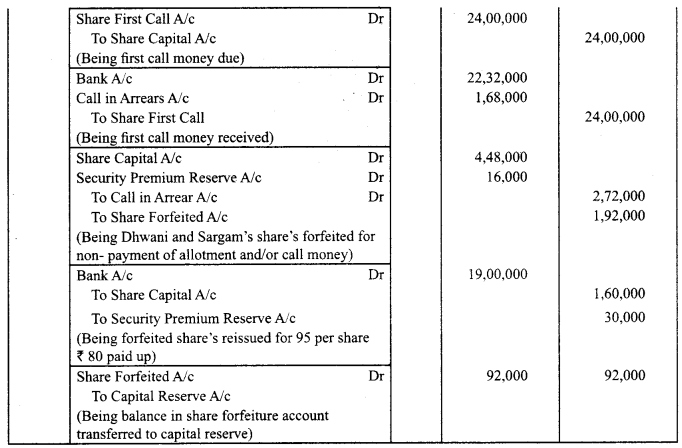
Applications of 1,20,000 shares were received. Allotment was made on pro rata basis to all applicants. Excess money received on application was adjusted on sums due on allotment. Dhwani, who was allotted 1,600 shares, failed to pay allotment money and Sargam who applied of 6,000 shares did not pay 1st call money. These shares were forfeited immediately after 1st call. 2,000 of these shares (including all shares of Dhwani were issued to Tarang for ₹ 95 per share as 80 paid up. Pass necessary journal entries in books of Saregama Ltd. by opening call in arrear, call in advance account, if final call has not been made. (CBSE Sample Paper 2019-20)
Answer:
Class 12 Accountancy Important Questions Chapter 6 Accounting for Share Capital 23
Class 12 Accountancy Important Questions Chapter 6 Accounting for Share Capital 24

Question 4.
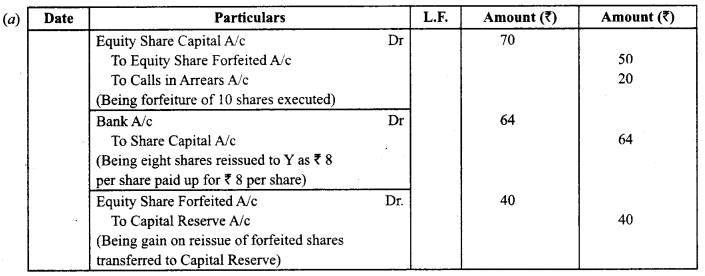
(a) X Ltd. forfeited 10 shares of ₹ 10 each, ₹ 7 called up on which the shareholder had paid application and allotment money of ₹ 5 per share. Out of these, 8 shares were re-issued to Y for ₹ 8 per share at ₹ 8 per paid up per share. Record the journal entries for forfeiture and reissue of shares by opening call in arrear, call in advance account.

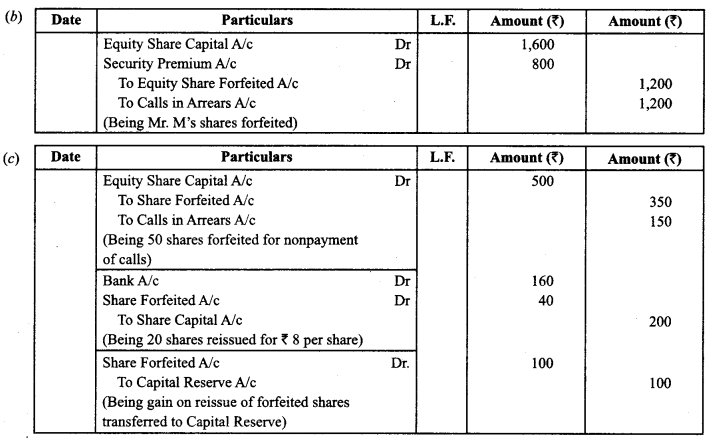
(b) L ltd forfeited Mr M’s shares who has applied for 600 shares and was allotted 400 shares failed to pay allotment money of ₹ 4 per share including premium of ₹ 2 on which he had paid application money of ₹ 2 only. Pass necessary journal entries for forfeiture of shares by opening call in arrear, call in advance account.

(c) Crown Ltd forfeited 50 shares of ₹ 10 each, for non-payment of final call money of ₹ 3 per share. Out of these 20 shares were reissued to Taj at ₹ 8 per share. Record the journal entries for forfeiture and reissue of shares assuming that the company maintains call in arrear, call in advance account. (CBSE Sample Paper 2019-20)
Answer:
Class 12 Accountancy Important Questions Chapter 6 Accounting for Share Capital 25
Class 12 Accountancy Important Questions Chapter 6 Accounting for Share Capital 26

Question 5.
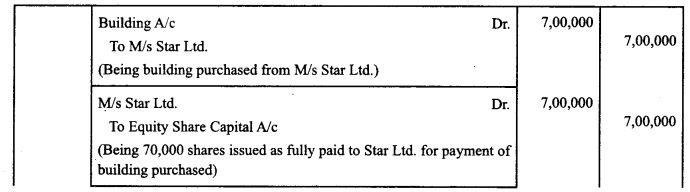
Venus Ltd’ was registered with an authorised capital of ₹ 40,00,000 divided into 4,00,000 equity shares of 10 each. 70,000 of these shares were issued as fully paid to ‘M/s. Star Ltd.’ for building purchased from them. 2,00,000 shares were issued to the public and the amounts were payable as follows:
On Application – ₹ 3 per share
On Allotment – ₹ 2 per share
On First Call – ₹ 2 per share
On Second and Final Call – ₹ 3 per share
The amounts received on these shares were as follows:
On 1,00,000 shares – Full amount called
On 60,000 shares – ₹ 1 per share
On 30,000 shares – ₹ 5 per share
On 10,000 shares – ₹ 3 per share
The directions forfeited 10,000 shares on which only ₹ 3 per share were received. These shares were reissued at ₹ 12 per share fully paid. Pass necessary journal entries for the above transactions in the books of ‘Venus Ltd’. (CBSE Compt. 2019)
Answer:
Class 12 Accountancy Important Questions Chapter 6 Accounting for Share Capital 27
Class 12 Accountancy Important Questions Chapter 6 Accounting for Share Capital 28
Class 12 Accountancy Important Questions Chapter 6 Accounting for Share Capital 29
Class 12 Accountancy Important Questions Chapter 6 Accounting for Share Capital 30

Question 6.
(a) AX Limited forfeited 6,000 shares of ₹ 10 each for non-payment of First call of ₹ 2 per share. The Final call of ₹ 3 per share was yet to be made. The Final call was made after Forfeited of these shares.. Of the forfeited shares, 4,000 shares were reissued at ₹ 9 per share as fully paid up. Assuming that the company maintains ‘Calls in Advance Account’ and ‘Calls in Arrears Account’, prepare “Share Forfeited Account” in the books of AX Limited.

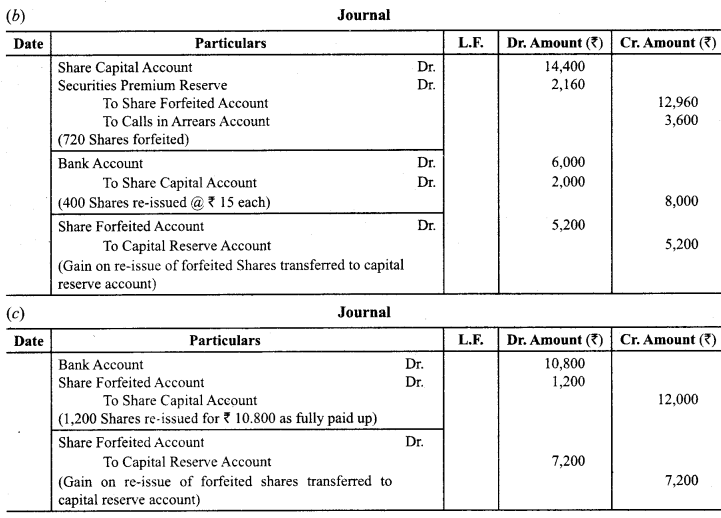
(b) BG Limited issued 2,00,000 equity shares of₹ 20 each at a premium of ₹ 5 per share. The shares were allotted in the proportion of 5 : 4 of shares applied and allotted to all the applicants. Deepak, who had applied for 900 shares, failed to pay Allotment money of ₹ 7 per share (including premium) and on his failure to pay ‘First & Final Call’ of ₹ 2 per share, his shares were forfeited. 400 of the forfeited shares were reissued at ₹ 15 per share as fully paid up. Showing your working clearly, pass necessary Journal entries for the Forfeited and reissue of Deepak’s shares in the books of BG Limited. The company maintains‘Calls in Arrears’Account’.

(c) ML Limited forfeited 1,200 shares of₹ 10 each allotted to Ravi for Non-payment of‘Second & Final Call’ of ₹ 5 per share (including premium of ₹ 2 per share). The forfeited shares were reissued for ₹ 10,800 as fully paid up. Pass necessary Journal entries for reissue of shares in the books of ML Limited. (CBSE Sample Paper 2017-18)
Answer:
Class 12 Accountancy Important Questions Chapter 6 Accounting for Share Capital 31
Class 12 Accountancy Important Questions Chapter 6 Accounting for Share Capital 32

Question 7.
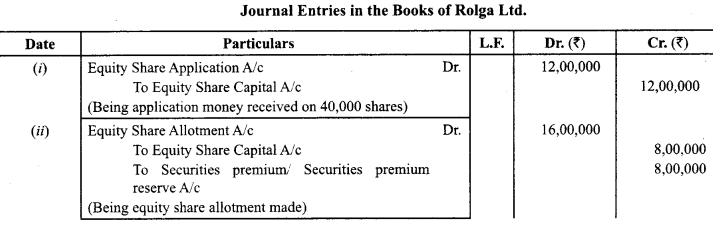
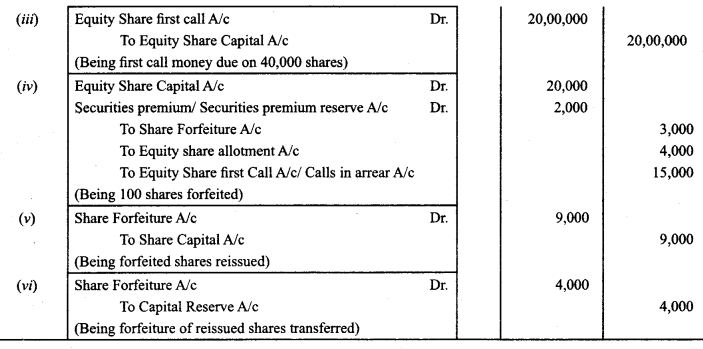
Rolga Ltd. is having an authorized capital of ₹ 50,00,000 divided into equity shares of ₹ 100 each. The company offered 42,000 shares to the public. The amount payable was as follows:
On Application – ₹ 30 per share
On Allotment –  ₹ 40 per share (including premium)
On First and Final Call  – ₹ 50 per share
Application were received for 40,000 shares.
All sums were duly received except the following:
Lai, a holder of 100 shares did not pay allotment and call money.
Pal, a holder of 200 shares did not pay call money.
The company forfeited the shares of Lai and Pal. Subsequently the forfeited shares were reissued for ₹ 70 per share as fully paid-up. Show the entries for the above transactions in the cash book and journal of the company. (CBSE Delhi Compartment 2015)
Answer:
Class 12 Accountancy Important Questions Chapter 6 Accounting for Share Capital 33
Class 12 Accountancy Important Questions Chapter 6 Accounting for Share Capital 34
Class 12 Accountancy Important Questions Chapter 6 Accounting for Share Capital 35

Question 8.
X Ltd. invited application for issuing ₹ 50,000 equity shares of ₹ 10 each. The amount was payable as follows: On Application ₹ 2 per share on Allotment ₹ 2 per share on First Call ₹ 3 per share on Second Call Balance Amount.
Applications for 70,000 shares were received. Applications for 10,000 shares were rejected and the application money was refunded. Shares were allotted to the remaining applicants on pro-rata basis and the excess money received on applications was transferred towards the sum due on allotment and calls (If any). Gopal who applied for 600 shares paid his entire share money with applications. Ghosh, who had applied for 6,000 shares failed to pay the allotment money and his shares were immediately forfeited. These forfeited shares were re-issued to Sultan for ₹ 20,000 ₹ 4 per share paid up. The first call money and the second call money was called and duly received. Pass the journal entry for the above transactions in the books of accounts of X Ltd. Open Calls in Arrear and Calls in Advance wherever necessary. (CBSE 2018)
Answer:
Class 12 Accountancy Important Questions Chapter 6 Accounting for Share Capital 36
Class 12 Accountancy Important Questions Chapter 6 Accounting for Share Capital 37
Class 12 Accountancy Important Questions Chapter 6 Accounting for Share Capital 38

Question 9.
Khyati Ltd. issued a prospectus inviting applications for 80,000 equity shares of ₹ 10 each payable as follows:
₹2 on application
₹ 3 on allotment
₹ 2 on first call
₹ 3 on final call
Applications were received for 1,20,000 equity shares. It was decided to adjust the excess amount received on account of over subscription till allotment only. Hence allotment was made as under:
(i) To applicants for 20,000 shares – in full
(ii) To applicants for 40,000 shares – 10,000 shares
(iii) To applicants for 60,000 shares – 50,000 shares
Allotment was made and all shareholders except Tammana, who had applied for 2,400 shares out of the group (iii), could not pay allotment money. Her shares were forfeited immediately, after allotment. Another shareholder Chaya, who was allotted 500 shares out of group (ii), failed to pay first call. 50% of Tamanna’s shares were reissued to Satnaam as ₹ 7 paid up for payment of ₹ 9 per share.
Pass necessary journal entries in the books of Khyati Ltd. for the above transactions by opening calls in arrears and calls in advance account wherever necessary. (CBSE Sample Paper 2018-19)
Answer:
Class 12 Accountancy Important Questions Chapter 6 Accounting for Share Capital 39
Class 12 Accountancy Important Questions Chapter 6 Accounting for Share Capital 40

Citizenship Class 11 Important Extra Questions Political Science Chapter 6

Here we are providing Class 11 Political Science Important Extra Questions and Answers Chapter 6 Citizenship. Political Science Class 11 Important Questions with Answers are the best resource for students which helps in class 11 board exams.

Class 11 Political Science Chapter 6 Important Extra Questions Citizenship

Citizenship Important Extra Questions Very Short Answer Type

Question 1.
What do you mean by citizenship?
Answer:
Citizenship implies full and equal members of a political community. The theories given by different liberal political thinkers suggest that citizenship should be universal. This means that every member of the community should be given citizenship. It also means that every person irrespective of his caste, color, sex, and status should be considered worthy of giving rights and duties. In fact, citizenship is a qualification that makes a man worthy of getting the rights and discharging of duties and responsibilities.

Question 2.
Mention some essential characteristics of citizenship.
Answer:

  • Citizenship is membership of the political community.
  • Citizenship is a qualification.
  • Citizenship is based on equality and freedom.
  • Citizenship involves rights and facilities.
  • Citizenship also involves duties and obligations.
  • Citizenship creates trust and confidence among the members of the community.
  • The contents and idea is expanding as per the democratic development.

Question 3.
How did citizenship explain the relationship between the citizens and the state?
Answer:
Citizenship is not concerned with the technical relationship between the states and the people, it has a number of aspects-like legal aspect, political aspect, socio-economic aspect, moral aspect, and psychological aspects also. It is also citizen to citizen rather people to people relationship and involves certain duties and obligations of citizens for the states and also for themselves. Citizens are also considered inherits and trustees of the culture and natural resources of the country.

Question 4.
Explain the idea of fall and equal membership.
Answer:
The concept of full and equal membership means that all citizens rich or poor should be guaranteed certain basic rights and a minimum standard of living by the state. In the wake of the right of movement people of different strata and different occupations move from one place to another, from one region to another region in search of better job opportunities make the combination of insider and outsider population which likely creates the feeling of hardness and conflict.

To check it the idea of full equal membership can be very useful which will give equal opportunities and status to all.

Question 5.
Explain the T. H. Marshall view of citizenship.
Answer:
T.H. Marshall a British sociologist has given a new dimension to the definition of citizenship. He defines citizenship as a “Status bestowed on those who are full members of a community. All who possess the status are equal with respect to the rights and duties with – which the status is endowed.”Equality is the key concept of the idea of citizenship as given by T.H. Marshall. Marshall sees citizenship in terms of three rights i.e. civil rights, political rights, and social rights who are necessary for a citizen to lead a dignified life.

Question 6.
Explain civil, political, and social rights that are considered necessary for the dignified life of a man.
Answer:
T. H. Marshall considered civil rights, political rights, and social rights as very necessary for a man to lead a dignified life. The contents and essential elements of these rights are as under –

  • Civil rights protect the individual’s life, liberty, and property.
  • Political rights enable the individual to participate in the process of governance
  • Social rights give the individual access to education and employment.

Question 7.
What is the importance of citizenship?
Answer:
Citizenship is a decoration, it is trust, it is recognition of one’s ability and capacities and on that basis, it is respectable involvement of the people in collective affairs of the society and political community. It ensures the integration of the various hierarchic socio-economic groups of the society. Thus it helps in building the harmonious relations of the community. Citizenship is not merely a legal concept. It is also closely related to the ideal concepts of equality and rights. It helps the people in leading a dignified life.

Question 8.
How the equal rights can be ensured?
Answer:
The provision of equal rights is considered an essential feature for the accomplishment of citizenship. However to ensure equal rights and opportunities for all citizens cannot be a simple matter and easy for any government because different people and different social and occupational groups may have different needs and different demands. Moreover, equal rights for citizens do not mean that uniform policies have to be adopted for all the people of different sections of the society. The different needs and claims of people should have to be taken into account while framing the policies, because for all the citizens the rights are to accepted in relativity, of course not in totality.

Question 9.
Discuss the verdict of the Supreme Court regarding the rights of slum dwellers.
Answer:
In response to a Public Interest Litigation filed by a social activist OlgaTellis against Bombay Municipal Corporation in 1985, the Supreme Court of India accepted the right to live on pavements or in slums because there was no alternative accommodation available close to their work. If they are forced to move from there, they would lose their livelihood. The Supreme Court concluded that Art. 21 of the Indian Constitution which deals with the right to life also includes the right to livelihood.

Question 10.
Explain the expanding meaning of citizenship.
Answer:
The idea of citizens adds citizenship has been under the evolution and expansion with the development and evolution of the society and states. In small city-states are the members of the village were the responsible citizens of the state or we should say political community with the expansion of the state in size, population and activities citizenship, became selective on a number of bases in different societies. With the emergence of democratic sovereign states, the idea of citizenship assumed a number of dimensions. Mow citizenship is not merely a legal concept it involves social, economic, moral as well as psychological aspects. Now citizenship is considered for more and more people on the basis of equality of status and rights.

Question 11.
Explain the idea of citizenship in Nation-states.
Answer:
Modem Nation-states are evolved and organized on the basis of common nationality i.e. common identity of history, race, culture, traditions, and geography which produce political identity with common political objectives and aspirations. The national identity of a democratic state is supposed to provide citizens with a political identity that can be shared by all the members of the state. This makes it easier for the state to extend citizenship to a maximum number of people of the state. In a democratic and secular state like India, citizenship is inclusive.

Question 12.
What is apartheid? Discuss its impact on citizenship.
Answer:
Apartheid means racial discrimination that prevailed in South Africa. The black people of South Africa became the victim of apartheid (racial discrimination) on the basis of which they were denied equal and full citizenship.

Question 13.
Discuss the criterion of citizenship in India.
Answer:
The criterion for granting citizenship to new applicants vary from country to country. India itself is a democratic, secular state with a diverse society with different religions, regions, and cultures.

The Indian Constitution attempted to accommodate every section of this diverse society. It has attempted to give full and equal citizenship to such sections as scheduled castes and women who earlier did not join equal rights and the people of remote areas who had little contact with modem civilization. In India citizenship can be acquired by birth, descent, registration, and naturalization.

Question 14.
Discuss the problem of stateless people.
Answer:
People in the world get displaced due to wars, famine, or other natural calamities. Several states refuse to accept them due to their personal reasons and state policies and they are not in a position to return to their homes. They become stateless and refugees. They may be forced to live in refugee camps. They cannot legally work and educate their children or acquire the property. The problem of stateless people is an important one and confronting the world community.

Question 15.
Discuss the idea of Global citizenship.
Answer:
Today, with new means of communication such as the internet, television, and cell phones and with the increasing interdependence of states on each other and also with the promotion of internationalism, the world is shrinking to a global village. In such a scenario, the national boundaries are diluted. People’s approach has become global and humane. We have now become more international. In such a situation, the idea of global citizenship is gaining ground with wide support.

Citizenship Important Extra Questions Short Answer Type

Question 1.
Discuss the concept and need for citizenship.
Answer:
A person who is a member of a political community and enjoys certain rights from the society and political community and he/she discharges his duties for the community faithfully is called as the citizen. The characteristic or the qualification which makes a person eligible to perform the duties and enjoy certain rights from society is known as citizenship. Citizenship has been defined as full and equal members of a political community. In the present day world, all states provide a collective political identity to their members as well as rights and duties.

The need for citizenship has become more strong in the contemporary aware and complex world. It is citizenship that provides the opportunity to the people to ensure their fuller development and to lead a decent and dignified life. Without the citizenship, people remain stateless and has to lead the life of refugees.

Question 2.
Discuss the importance of citizenship.
Answer:
As we know that citizenship ensures rights and duties to the citizens enabling them to lead a respectable and dignified life. Citizenship provides rights of varying importance. The nature of rights given to the citizens may vary from state to state and society to society. In most democratic states political rights like the right to vote, civil rights like the freedom of speech or belief, socio-economic rights like rights to a minimum wage, or the right of education are given. Equality of rights and states is one of the basic rights of citizenship. It is citizenship that integrates society on the basis of equality.

Question 3.
Discuss the development of the nation of citizenship.
Answer:
The development of the concept of citizenship has been corresponding to the development of state and state. The development of democracy and level of awareness has brought structural and functional changes in the relations between man to man and man to state. Increased mobility in the society has helped in building a new relationship among the people which gave new meaning to the concept of citizenship. More and more people have come into the periphery of the state. Now the citizenship is no more limited to certain sections of society. It is more and more involvement of the people of all sections of the society in the affairs of state in a responsible way. Today citizenship is considered as full and equal members of a political community.

States provide a collective political identity to their members as well as certain rights which gives the citizens dignity and respectability.

Question 4.
Discuss the struggle for citizenship in different parts of the world.
Answer:
Human society has witnessed a long struggle against the domination of colonial, imperialist exploitation. In such systems vast section of the society had been denied, Inequalities and discrimination was the order of that society. With the passage of time, people become intolerant of the inequalities and injustices. Struggles for equal states and participation in the affairs of the state started in different parts of the world. French Revolution, Russian Revolution, and Chinese, Revolution are examples of this trend. In Asia, Africa, and Latin countries nationalistic movements started against the colonial rules which prevailed there. In South Africa, the black African population started ‘ against the apartheid policy of the white government for equality and, justice.

Question 5.
How does citizenship explain the relationship between the people and the states?
Answer:
Citizenship is the characteristics; it is a qualification that enables a person to get involved in affairs with rights, dignity, and obligation. Therefore citizenship provides equal and full membership of the state or the political community. It is definitely the characteristics that determine the relationship between man and the state.

Citizenship is definitely more than the technical and legal relationship between the states and the people, it is also about citizen-citizen relations and involves certain obligations of citizens to each other and to the society. Citizenship is not concerned just about the legal obligations of man towards the state but also has moral obligations also for the state people and society. It provides the opportunity to share the common experiences of each other which generate a sense of togetherness.

Question 6.
Discuss the freedom of movement.
Answer:
One of the important rights which has become very important in recent years is the right of movement. This is freedom of the citizens from one place to another in search of occupation and to settle there adopting a particular occupation. This right has become particularly useful for the laborer and people of special fields who tend to migrate from one place to another. Some people may even travel outside the country in search of jobs. Markets for skilled and unskilled workers have developed in different parts of the country. IT workers have more opportunities in towns like Bangalore, nurses from Kerela are found working all over the country. Indian Constitution has given the right of movement in different parts of the world.

Question 7.
Do you think full and equal membership means equal rights?
Answer:
Citizenship is considered as full and equal membership means equal rights for every member of the political community. Through citizenship, full and equal membership is given to everyone who is worthy of it and it ensures that all the people irrespective of their socio¬economic status, should be guaranteed certain basic rights and a minimum standard of living.

But the situation seems to be different. All the members of the politicians do not enjoy equal status. There are people who are involved in petty jobs like hawkers, plumbers, mechanics and masons, etc. who live in slum-like conditions in different urban and rural areas and do not get equal rights. Their living conditions are horrible and they are seen with contempt by other people. Although they do the useful service to the society and contribute significantly to the economy of the state.

Question 8.
Explain the concept of citizenship as explained by T.H. Marshall.
Answer:
T.H. Marshall a great British sociologist gave a new orientation to the meaning of citizenship and defined it a status bestowed on those who are full members of a community. All who possess the status are equal with respect to the rights and duties with which the status is endowed. The key idea of T.H. Marshall’s concept of citizenship is that of equality. He considered citizenship as leveling process breaking the hierarchic inequalities. In fact, T.H. Marshall defined the idea of citizenship in modem liberal state give due regards to human personality and to promote the people’s participation in the affairs of state.

Question 9.
Discuss two essential features of citizenship as discussed by T.H. Marshall.
Answer:
As said earlier, that T.H. Marshall considered equality as the essential elements of the concept of citizenship which means two things which are as under:-

  1. It should improve the quality of rights and duties given to the people.
  2. It should improve the number of people upon whom these duties and rights are given.

Through his concept of citizenship, T.H. Marshall seeks to remove the inequalities which exist in the different social classes. In this way through his idea of citizenship, he wants to establish an equalitarian and integrated society in which all the people are given respectable status and all the citizens exercise their rights and duties in a responsible way.

Question 10.
Which rights are considered most important by T.H. Marshall in his idea of citizenship?
Answer:
T.H. Marshall emphasized three rights in his idea of citizenship which is as under

  1. Civil Rights
  2. Political Rights
  3. Social Rights.

1. Civil Rights:- Civil rights provide the citizen’s rights of equality and liberty and right of expression.

2. Political Rishts:-Political rights enable people to participate in the process of governance, and also the right to vote, the right to be elected, and the right of forming an association.

3. Social Rights:- Social rights give individuals opportunities for education and, employment to earn their livelihood.

Question 11.
Explain the idea of equal rights of citizens in the state.
Answer:
As discussed above the condition of equal rights for all citizens is necessary to condition for the idea of citizenship as discussed by T.H. Marshall and accepted by most of the academicians for a liberal modem democratic state. When we talk of equal rights, they should not be – understood in an absolute sense. In society, there are people of a different class, economic groups, income groups, and occupational groups who may need different socio-economic conditions and facilities, and wages.

We cannot equalize these unequal groups. That does not mean the negation of citizenship. It is, therefore, the rights should be accepted in the relative sense. Equal rights for citizens need not mean that uniform policies have to be applied to all the people since different groups of having different needs. It is therefore for providing equal rights as per the needs of the people the government should frame the policies keeping ‘ in view the needs of the people which are bound to be different as per their different occupations and backgrounds.

Question 12.
Define the concept of Nation.
Answer:
A state formed on the basis of nationality is called a Nation. Nationality can be defined as a group of people of the same race, history, culture, geography with the same future aspirations. When the people of the same nationality are organized, it is called a Nation-State.

In fact, the concept of the nation-state is evolved in the modem period. Nation-states claim that their boundaries define not just territory but also a unique culture and shared history. The national identity of a democratic state is supposed to provide citizens with a political identity that can be shared by all the members of the society and state.

Question 13.
Discuss the criterion of providing citizenship in India.
Answer:
As citizenship seeks to bring all the sections of the society together and contribute to the affairs of the state as per their capabilities and capacities. The Indian Constitution has also accommodated all sections of the society in providing full and equal citizenship. Traditionally backward and discarded sections of the society like scheduled castes, scheduled tribes, women, and the people of remote areas also have been given full and equal citizenship. Indian Constitution has also provided equal rights to all without forcing the people to give their personal beliefs, languages, and cultural practices.

Indian Constitution adopted an essentially democratic and inclusive notion of citizenship. In India, citizenship can be acquired by birth, descent registration, naturalization, or inclusion of territory. The rights and obligations of the citizens are given in the Constitution.

Question 14.
Define the concept of Universal Citizenship.
Answer:
The philosophy behind the need for citizenship is that full and equal members of a state should be available to all those, who ordinarily live and work in the country as well as to those who apply; for citizenship. In the wake of increasing international most of the support the idea of universal and inclusive citizenship, at the same time each country also fixes the criterion for the grant of citizenship which makes them part of their Constitution and written laws, keeping unwanted visitors out.

Question 15.
Discuss the problem of statelessness in the world.
Answer:
In spite of the increasingly adopted liberal approach by the nation-states in giving full and equal citizenship to people of different sections n of the society and also to them, who enter the states from other states due to different reasons, there is a problem of statelessness, which the world community is facing. Borders of the states are still being redefined by war as political disputes. In such political disputes, the people have to face severe consequences. In such uncertainties, people lose their homes, their security, and political identities and are forced to migrate.

In hard laws of the concerned states, the affected people become stateless and are forced to lead the miserable life of tents in search of their own state, home, and political identity. There is a large number of such 1 stateless people living in different parts of the world. Many of these people remain stateless for many years and for generations.

Question 16.
What is Global citizenship? Is it feasible?
Answer:
New means of communication such as the internet, mobile phones, and satellite systems and also due to increasing interdependence, of states in different areas have brought major changes in the structure of – the world. In fact, the world has shrunken to a global village. The people of the world have developed a global vision breaking the barriers of regions and national boundaries. In this scenario, the idea of global citizenship is giving momentum and acceptance at a wider level. This means people should be allowed to move internationally with some kind of permission in the form of global citizenship. Supporters of global citizenship argue that although a world community and global society does not yet exist, people already feel linked to each other across national boundaries.

Citizenship Important Extra Questions Long Answer Type

Question 1.
What is the meaning of citizenship? What are its need and significance? Explain it with reference to the views of T. H. Marshall.
Answer:
Citizenship is the characteristics or qualification that makes a person of a political community worthy of getting rights and doing his/ her duties in that political community. Citizenship ensures the active and positive participation of the people of all classes in national affairs. In this way, citizenship implies full and equal members of a political community. In the contemporary world, states provide a collective political identity to their members as well as certain rights.

The precise nature of the rights granted as a result of citizenship may vary from state to state but most of the democratic and liberal and secular states grant civil, political, and social rights to all sections of the society as a result of the provision of citizenship. It will be wrong to understood citizenship as the relationship between the people and state. It is also a relationship between citizen to citizen involving certain obligations of citizens to each other and to the society. Therefore the idea of citizenship is useful for both i.e. for states\society and the people.

Citizenship is not only a legal concept, it is closely related to the notions of equality and rights. Great British sociologist, T.H. Marshall has defined citizenship as “a status bestowed on those who are full members of a community. AJTwtio possesses the status are equal with respect to the rights and duties with which the status is endowed.” According to the-Trier Marshall, citizenship is useful because it ensures equality by removing the diverse effects of the class hierarchy. It thus helps in the creation of an equalitarian and integrated society.

Rights Class 11 Important Extra Questions Political Science Chapter 5

Here we are providing Class 11 Political Science Important Extra Questions and Answers Chapter 5 Rights. Political Science Class 11 Important Questions with Answers are the best resource for students which helps in class 11 board exams.

Class 11 Political Science Chapter 5 Important Extra Questions Rights

Rights Important Extra Questions Very Short Answer Type

Question 1.
What do you mean by Rights?
Answer:
Rights are the claims, demands, circumstances, facilities and demands of the people which they make on families, institutions, societies and state and to whom they consider very necessary for their around the development. A right is essentially an entitlement or a justified claim. Rights are those conditions which we consider as our dues. Every expectation cannot be called as the right. These are primarily those facilities which are regarded as necessary for leading a decent, respected and dignified life. Right, are facilities which are accepted by society and granted by the state.

Question 2.
What are the characteristics of the state?
Answer:
On the basis of definitions and understanding of the rights, followings are the main characteristics of the rights:

  1. Rights are necessary conditions.
  2. Rights are necessary for the development,
  3. Right, are claims on society and state.
  4. Rights are allowed by society.
  5. Rights put limits on the sovereignty of the state.
  6. Rights of the people and their duties are linked with each other.
  7. Rights are variable from place to place and from time to time.

Question 3.
What do you mean by universal rights? Name them.
Answer:
That minimum socio, economic, cultural conditions which are demanded and expected by the people of all time and societies universally are called as the universal rights: In fact, universal rights are those rights which are considered basic for a decent and dignified life.

Followings are the three main universal rights:

  1. Right of Livelihood.
  2. Right of Expression.
  3. Right of Education.

Question 4.
Why the rights are necessary?
Answer:
Rights are necessary conditions for our well-being. They help individuals to develop the talents and skills of the citizens. Without the availability of the rights, the fuller development of the citizens is not possible. Rights not only provide necessary conditions and facilities for the development but also promote confidence among the citizens. Many states make distinctions and discriminations in providing rights.

Question 5.
What do you mean by Fundamental Rights?
Answer:
Fundamental Rights are those conditions, facilities and rights which are considered very necessary for the development of its citizens and which are given a place in the Constitution and which are fundamental in governance. Fundamental Rights and democratic governments have become synonymous. All the liberal democratic states provide Fundamental Rights to its citizen. Fundamental rights are generally; justiciable which means if the Fundamental Rights are denied by the state, the citizens can move to the court. In this way, Fundamental Rights put check on the arbitrariness of the citizens.

Question 6.
What do you mean by Human Rights?
Answer:
Human Rights are those conditions, mode of behaviour which one expects and demands being a human being, The assumption behind human rights is that all persons are entitled to certain things, ‘ mode of behaviour, working and living conditions because they are human beings. A human being is emotional and intellectual, hence he needs behaviour accordingly. As a human being, each person is unique and valuable.
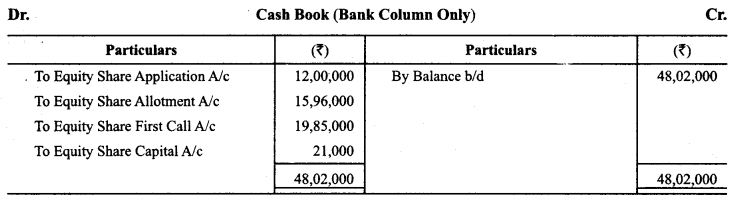
Question 7.
Name the Fundamental Rights which are given in the Indian Constitution.
Answer:
In the beginning, the Indian Constitution had seven Fundamental Rights but one Right i.e. Right of Property was deleted in 1979 by 99th constitutional amendment. Now there are six Fundamental Rights which are as under:

  1. Right of Equality
  2. Right of Liberty
  3. Right against Exploitation
  4. Right of Religious Liberty.
  5. Right of Education and Culture
  6. Right of Constitutional Remedies:

Question 8.
What do you mean by Political Rights?
Answer:
Political Rights are those rights which enable the people to express their views on a different issue, and allow them to participate in the democratic process like, right to vote, right to contest, right to form an association and political parties, right to oppose. Political Rights are also a necessary part of the democratic process. Political Rights also include the right of a fair trial, the right to equality before the law. Political rights are linked with civil liberties. Rights to protest and express dissent is also political right.

Question 9.
How do rights affect the state?
Answer:
Political and all other rights are demands and claims from the state. Therefore these rights in the form of demand limit and check the authority of the state. Rights mould the state to do or not to do things. The rights place an obligation upon the state to act to certain kind of ways. Rights suggest state, what it should refrain from doing and what it should do for the people. It is through the rights, that the demands are put on the state. Therefore rights are directly related to the working of state.

Question 10.
What are Economic Rights?
Answer:
Economic Rights are the most important rights for sustaining life. These are the demands and claims which are required for leading a decent and qualitative life. Important economic rights are:

  1. Right of livelihood
  2. Right of minimum adequate wages
  3. Right of leisure
  4. Right of having minimum basic needs of shelter, food, clothes and wages
  5. Right of compensation GTC.

Without these economic conditions, life is miserable.
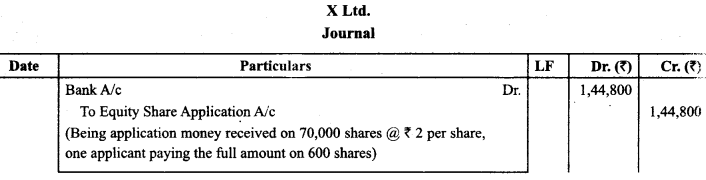
Question 11.
What do you mean by Cultural Rights?
Answer:
Man is the product of his cultural background therefore for his emotional and psychological development he needs cultural rights which are the condition of culture, dress, festivals, direct, language, dress pattern, foods and customs. Without the availability of rights in these areas, no fuller development of man is possible. Aman becomes complete only by his cultural development which inculcates manners and etiquettes in him and promotes his personality development.
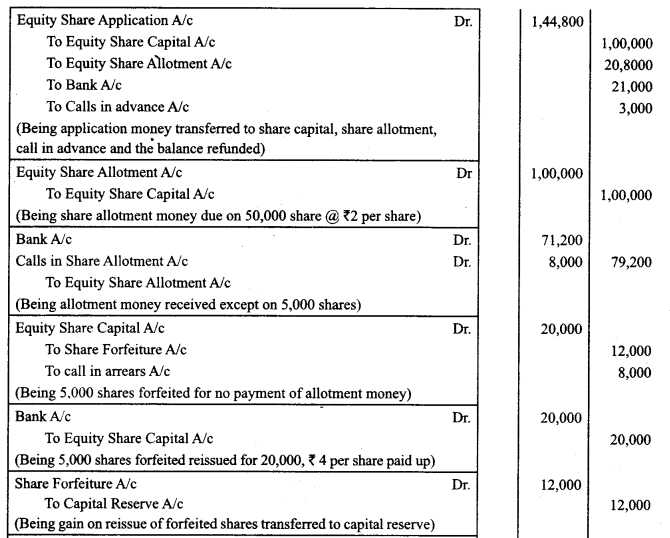
Question 12.
Explain the importance of Right of Education.
Answer:
The awareness of the right of education is on increase in the whole international community. It has become an international commitment. All the states are making every effort to promote their literacy percentage. Educational rights help individuals to develop their talents and skills. Education brightens reasons and mental facilities of man and gives us useful skill. Considering the importance of education, the right to education is becoming a universal right.
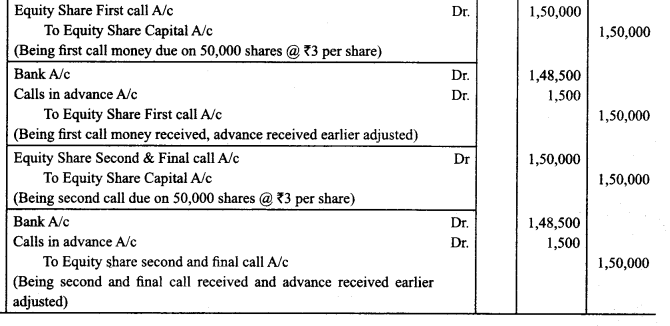
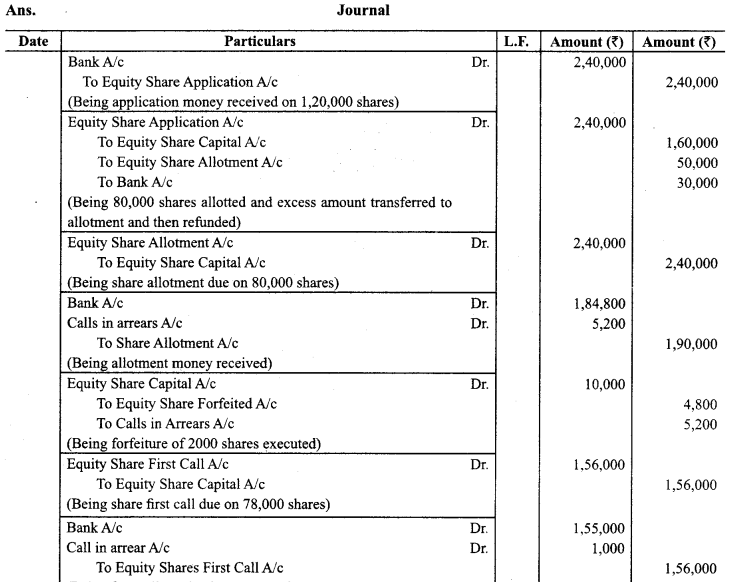
Question 13.
How the rights limit the authority of the state?
Answer:
The state has sovereign authority over the people living in the given territory of the state. But rights are the demands and claims bn the state which put the state to do certain things or not to do certain things. Therefore rights put a check on the authority of the state. In fact, the authority of the state is influenced by the obligation put by the demands of the people in the form of rights. These rights place an obligation upon the state to act in certain kinds of ways. Each right indicates what the state must do as well as what it must not do. In this way, rights limit the authority of the state.

Question 14.
What is the natural theory of rights?
Answer:
Supporters of the natural theory of rights argue that rights are given to us by nature. It means we had rights when we are born. These rights of men were derived from the natural law and not the creation of state OF society. These rights are natural, which cannot be taken by anyone in any circumstance. Supporters of this theory consider three important basic rights:

  1. Right to life
  2. Right to liberty
  3. Right to property.

They say that all other rights are derived from these rights.

Question 15.
What do you mean by Moral Rights?
Answer:
Certain expectations, demands and expectations are made on the basis of moral ground. These are known as moral rights. They do not carry compulsion or any kind of legality. These rights are based on the appeal to the moral self. For example, it is the moral right of the old age people and a disabled person or blind person to expect support from the abled person. Similarly, it is the right of parents, teachers and elders to expect respect from the younger generation.

Rights Important Extra Questions Short Answer Type

Question 1.
Explain the meaning of the concept of rights.
Answer:
Everybody irrespective of his socio, economic and educational status, talks of his/her rights but only a few people know the real meaning of the concept of rights. People generally understand the rights in terms of their claims, expectations, necessities and demands but know little about obligations related to it.

Rights are certain circumstances, facilities which we can say as demands and claims which are necessary for the all-round development of man. Rights have been viewed differently in different ages and in different circumstances. Rights are the product of circumstances and the nature of society. Therefore the rights are essentially the entitlement or we can say justified claims. Laski has defined rights as the essential conditions which are necessary for human development and welfare.

Question 2.
Write the main essential features of rights.
Answer:
Rights are universally accepted as the socio, economic conditions, circumstances in the form of claims and demands, which are necessary .for human development and welfare. These are to be accepted by society and state. Followings are the main essential features of Rights:

  1. Rights are available in collective or group life only.
  2. Rights are the socio, economic or environmental conditions.
  3. Rights are necessary for man’s development and welfare.
  4. Rights cannot be absolute in collective life.
  5. Rights are not stationary, they are changeable from time to time and place.
  6. Rights and duties are two sides of the same coin.
  7. Rights are obligations on the state.

Question 3.
Differentiate between Liberal and Marxist theories of Rights.
Answer:
In the seventeenth and eighteenth century, political theorists argued that rights are given by nature or God. The rights of men are derived from nature i.e. man got his rights with his birth which cannot be taken by anyone. Liberal thinkers consider the rights as the product of circumstances which are of varied nature. Naturalists consider right of life, right to liberty and right of property as the natural rights, while the liberal thinkers, appreciating the importance of these natural rights, keep the emphasis on political rights like rule of law, right of equality, right to vote, right of election and formation of the association and political parties.

They have priority for civic rights. On the other hand Marxist regard the rights of the economic environment and give importance to economic rights as more necessary for man’s development and welfare. For them, economic rights like the right to work, equal and adequate wages, compensation, leisure and property are more necessary than political rights.

Question 4.
Discuss the importance of Rights.
Answer:
As discussed earlier the rights are conditions of life demands and expectations, which a person has from the family, society and state. v Without these rights man’s development is not possible. We can understand the importance of rights in the following points:

  1. Rights are necessary for man’s personality development.
  2. Rights are necessary for the welfare of the people.
  3. Rights keep the man’s moral high and strengthen him psychologically also.
  4. Rights put check on the state.
  5. Rights evoke duties on others.

Question 5.
What do you mean by Universal Rights? Explain them.
Answer:
Certain rights are those conditions which are universally expected, demanded and claimed by the people of all the societies as basic conditions for the personality development, moral and psychological development and welfare of the people. Following are considered as universal rights:

  1. The right to Livelihood – It is considered very necessary because it gives man gainful employment and economic independence which is necessary for leading life and dignity.
  2. The right of Expression – This right gives us the opportunity to express us freely and gives us the opportunity to be creative and original. It gives us the freedom to express us by speaking, writing, dancing or by any artistic method.
  3. The right of Education – It is another important right which is considered as universal because it helps in the development of talents and skills of man. It brings refinement, enlightenment and empowerment in man. It helps in the development of capacities of reasons.

Question 6.
How the rights limit the state?
Answer:
Rights are claims and demands of the people against the state. Rights are necessary conditions and circumstances which a state is supposed to give to its citizens for their development and welfare. It is therefore these rights are obligations of the state which certainly limit the authority and working of the state. Rights in a way direct the state to do certain things in a way, the people expect and demand. Rights put the state to think and act as per the desired level of living of the people.

Question 7.
Explain the meaning and importance of Fundamental Rights.
Answer:
Fundamental Rights are those rights which have been considered very important and necessary by the state for the development and welfare of the citizens. Fundamental Rights are those rights which are placed in the Constitution by the states and are fundamental in governance. Fundamental Rights’ importance lies in the fact that these are basic socio, cultural and political and religious conditions of life which gives confidence among the citizens. These rights promote the personality of citizens and empower them.

In most of the democracies, Fundamental Rights are made justiciable which means that if the Fundamental Rights are violated at any level by the executive or legislatures, one can move to the courts for their enforcement. Fundamental Rights are thus protector of citizen’s liberties and also democracy. Fundamental Rights have become synonyms of democracy. The level of democracy is judged by the kind of Fundamental Rights available in that society.

Question 8.
Describe the Fundamental Rights available in Indian Constitution.
Answer:
Indian society has been the victim of exploitation and injustice in the hands of British colonial rule in which common man suffered a lot. Constitution-makers feel the need of Fundamental Rights for the people and incorporated these fundamental rights in the third part of the Constitution.

  1. Right of equality
  2. Right of liberty
  3. Right against exploitation
  4. Right of religious liberty
  5. Right of education and culture
  6. Right of property (Now it is only legal right)
  7. Right of constitutional remedies.

Question 9.
Write the importance of Fundamental Right of Constitutional remedies as given in the Indian Constitution.
Answer:
Right of Constitutional Remedies which is the last right given in the Indian Constitution and is the most important right because it the right which makes the Fundamental Rights justiciable. It is this right of Constitutional Remedies which enables the citizens to move to the court if any of the Fundamental Right is violated by the executive, legislature or by the bureaucracy. In this way, this is the right which put check on the arbitrariness of the state. A citizen of India can move to the Supreme Court under Art. 32 and can move to the High Courts if Fundamental Rights are violated which give necessary directions to the respondent for giving remedy to the appellant.

Question 10.
What do you mean by Human Rights? What is its importance?
Answer:
Mode of behaviour, facilities, living conditions and working conditions which are expected, demand and claim for being a human being are called the Human Rights. The assumption behind human rights is that all persons are entitled to certain things simply because they are human beings. As a human being, each person is unique and equally valuable. Therefore human beings irrespective of their caste, colour and sex need humane treatment. All persons should be given equal opportunities and proper working conditions for the expression and exploitation of the potentials. Development and promotion of Human Rights have become an international concern and the UN is playing a very useful role in promoting awareness about Human Rights for leading a life of dignity and self-respect.

Question 11.
Discuss the role of UN in the promotion of Human, Rights.
Answer:
With the development of democracy and education, the concern for the realisation of Human Rights has become a global issue. Urge for a better life and better living is on increase. UN has become the instrument of strengthening the demand and urge for Human Rights. UN has passed an international Human Rights Declaration-1948 in which it has set up certain norms for the cause of Human Rights. All the signatories of the declaration are supposed to provide necessary conditions for the realisation of norms of Human Rights.

International Human Rights Commission has been set up to promote and monitor the level of Human Rights in different parts of the world. The important areas in which the human conditions are expected and demanded are N employment, working conditions, health, food, housing, drinking water and other environmental and ecological order. UN has become the forum of international discussion, debate and recommendations and follows up actions.

Question 12.
What do you mean by Moral Rights?
Answer:
Moral Rights are those expectations which we have on moral grounds. As we know that groups provide the necessary conditions for realising the idea of rights. Moral rights do not have legal binding, they have just moral binding which has little acceptance in the eye of law.

A poor man, a disabled man, an old man need the help of society on the moral ground because of their disabilities. Fathers, mothers and elders need a particular type of behaviour from the younger generation on moral grounds. A teacher expects obedience and regards from the students on moral grounds.

Question 13.
Explain important Political Rights.
Answer:
Political Rights have become more important and popular rather universal with the development of democracy in the world. Every democracy gives the citizens number of political rights which gives the right to equality before the law and the right to participate in the political process. Political rights are as under:

  1. Right to vote
  2. Right to elect a representative.
  3. Right to contest elections.
  4. Right to form political parties
  5. Right to oppose and differ
  6. Right of expression
  7. Right of a free and fair trial
  8. Right to protest
  9. Right of civil liberties.

Political liberties and rights form the basis of the democratic system and human development.

Question 14.
Explain the importance of Economic Rights.
Answer:
Economic rights are those conditions and demands which are 4 needed for sustaining life. These are very important for the physical development of man. Marxists give priority to economic rights in comparison to political rights. Followings are the main economic rights:

  1. Right of employment
  2. Right of the fulfilment of basic needs like food, shelter, clothing, health and clean drinking water
  3. Right of proper working conditions
  4. Right of adequate wages
  5. Right of leisure
  6. Right of property
  7. Right of compensation.

Question 15.
How Rights and Liberties are linked together?
Answer:
The idea and conception of rights are conceivable only in groups and society. The realisation of right is not possible in isolation.

The rights are those claims, expectations which are demanded by others. In this situation, the right of one person is the duty of others. If the other person does not performs his or her duty the first person cannot get the right. Similarly, if one person does not perform his/her duty the other person cannot get this duty. In his way, we can say that one’s right – is another’s right and another’s duty is the first person’s right. It is rightly said that rights and duties are the two sides of the same coin. This is applicable in every group life whether it is a group of friends, family, society, nation or the international community. The rights do not place obligations on the state only to act in a certain way, but they also place obligations upon the man to think not just for his\ her rights and interests \ but also for the rights and interests of others also.

Question 16.
Cultural rights are in increasing demand. Explain.
Answer:
Besides the political and economic rights, cultural rights have assumed more and more important in the era of the welfare state and global awareness. People have become more and more aware of their region, language, culture, dresses, dialects, language and festivals. Most of the democratic states have given more and more cultural rights to their citizens considering the importance of these rights for their psychological and moral development. The list of such rights has increased in democracies. These have become necessary for human development.

Rights Important Extra Questions Long Answer Type

Question 1.
Explain the meaning and development of rights in modern welfare states.
Answer:
Since the beginning of human life man always expected, demanded and claimed certain basic things to lead a decent and dignified life. These are known as rights. These rights varied from time to time and place to place as per the availability of resources and level of awareness of the people. Welfare nature of the state development of education and global democratic culture has made the people more and more aware of their rights and level of rights has also changed manifold.

The states are increasingly adopting democratic systems and are giving more and more rights to the citizens. Some rights have been accepted as Fundamental in the governance considering very essential for human development and giving them a decent and dignified life. Economic rights, political rights and cultural rights have been listed out for achieving them. Since rights like the right of expression, the right of adequate wages and employment and right of education have been declared as universal rights.

In today’s world, not only basic conditions of life and fundamental rights have become important but human dignity and human personality have assumed importance, and a new concept of Human Right has emerged on the scene. Human rights are demanded on the basis of an assumption that human beings need certain basic needs, mode of behaviour and treatment because they are human beings. They have emotions, feelings and dreams. As a human being, they need respect for their personality and wishes. Human is unique and valuable. Thus there rights have become more and more important in the present-day world. UN is playing important role in achieving Fundamental Rights and Human Rights.