Biotechnology and its Applications Class 12 Important Extra Questions Biology Chapter 12

Here we are providing Class 12 Biology Important Extra Questions and Answers Chapter 12 Biotechnology and its Applications. Important Questions for Class 12 Biology are the best resource for students which helps in Class 12 board exams.

Class 12 Biology Chapter 12 Important Extra Questions Biotechnology and its Applications

Biotechnology and its Applications Important Extra Questions Very Short Answer Type

Question 1.
What is a transgenic organism?
Answer:
An organism that carries a foreign functional gene in its genome is termed a transgenic organism.

Question 2.
Write two applications of biotechnology.
Answer:

  1. Treatment of diseases.
  2. Preparation of processed fortified food.

Question 3.
What are probes?
Answer:
It is a single-stranded DNA or RNA, tagged with a radioactive molecule, which is complementary to the DNA in a clone of cells. It is used for detecting the presence of nucleotides complementary to the probe.

Question 4.
Name two diseases that can be treated by producing biological compounds in transgenic animals.
Answer:
Cystic fibrosis, rheumatoid arthritis, Alzheimer’s disease, cancer, and emphysema.

Question 5.
Name the toxin produced by Bacillus Thurinsiensis.
Answer:
Bt Toxin.

Question 6.
What is the utility of the Bt-toxin gene?
Answer:
Bt-Toxin gene provides Bt-toxin which is involved in providing resistance to cotton plants against insects.

Question 7.
Bt-toxin protein exists in which form?
Answer:
Inactive protoxins.

Question 8.
How is inactive Bt-toxin converted into active form? (CBSE Outside Delhi 2019)
Answer:
The inactive toxin is converted into active form due to the alkaline pH of the gut of insects which solubilizes the crystal converting the toxin to its active form.

Question 9.
How does Bt toxin cause the death of insects?
Answer:
Activated Bt toxin binds to the surface of midgut epithelial cells and creates pores in it that cause cell swelling and lysis. It finally leads to the death of the insect.

Question 10.
Name a few forms of cry gene.
Answer:
cry I Ac, cry II Ab, cry III Ab, and cry III Bb.

Question 11.
List the specific insects killed by:
(i) cry I Ac and
(ii) cry II Ab.
Answer:
cry I Ac, cry II Ab-both control cotton bollworm.

Question 12.
Name the insects killed by proteins coded by cry III Ab and cry III Bb.
Answer:

  1. Colorado potato beetle
  2. corn rootworm.

Question 13.
What is unique about transgenic animals?
Answer:
Animals that have their DNA manipulated to possess and express a foreign gene are known as transgenic animals. e.g. Rabit, sheep, cows, fish, etc.

Question 14.
How infestation of Meloidogyne incognita was prevented in the Tobacco plant?
Answer:
An infestation of Meloidogyne incognita was prevented on the basis of RNA interference. This method involves the silencing mRNA by complementary dsRNA molecule that binds to mRNA and prevents its translation.

Question 15.
What is the silencing of mRNA?
Answer:
The binding of single-stranded mRNA with complementary and double-stranded RNA to prevent translation of mRNA is called silencing of mRNA.

Question 16.
What is the source of the complementary strand in mRNA silencing?
Answer:

  • Viruses having RNA genomes.
  • Mobiles genetic elements (transposons).

Question 17.
How is dsRNA prepared?
Answer:
Reverse transcription.

Question 18.
Name the genetically engineered insulin.
Answer:
Humulin.

Question 19.
Write the name of the transgenic protein used to treat emphysema.
Answer:
Alpha-1-antitrypsin.

Question 20.
How is Indian basmati unique?
Answer:
It is unique for its aroma and flavor.

Question 21.
What is complementary DNA (cDNA)?
Answer:
DNA synthesized on RNA template with the help of reverse transcriptase.

Question 22.
Mention the chemical change that proinsulin undergoes, to be able to act as mature insulin. (CBSE 2018)
Answer:
The proinsulin is cleaved to remove extra stretch called the C-peptide to form mature insulin having only A-chain and B-chain joined by a disulfide bond.

Question 23.
What is the application of genetically engineered bacterium namely Pseudomonas Putidal?
Answer:
Pseudomonas putida is used for scavenging oil spills by digesting hydrocarbons of crude oil.

Question 24.
How did the first transgenic cows Rosie differ from other cows with respect to the quality of milk? (CBSE 2008)
Answer:
Rosie produced a human protein (alpha-lactalbumin) enriched milk which is nutritionally a more balanced product for human babies.

Question 25.
State the role of C-peptide in human insulin. (CBSE 2014)
Answer:
C-peptide maintains its nature as pro-hormone (pro-insulin) and during maturation, it is removed. Thus proinsulin matures into insulin.

Biotechnology and its Applications Important Extra Questions Short Answer Type

Question 1.
List three critical research areas of biotechnology.
Answer:
Three critical research areas of biotechnology are:

  1. Providing the best catalyst in the form of an improved organism usually a microbe or pure enzyme.
  2. Creating optimal conditions through engineering for a catalyst to act, and
  3. Downstream processing technologies to purify the protein/organic compound.

Question 2.
Give the few characteristics of GMOs. (CBSE Delhi 2019)
Answer:
Genetically modified organisms:

  1. They are capable of producing pharmaceutically useful proteins.
  2. They are capable of producing en¬hanced, modified, or new metabolites.
  3. They can be used for crop protection by control of insects, fungal diseases, frost damage, etc.
  4. They degrade non-biological wastes and detoxify toxic wastes.
  5. They show enhanced nitrogen fixation.

Question 3.
List a few transgenic organisms and their potential application. (CBSE Delhi 2019)
Answer:
Transgenics and their potential applications:

TransgenicsUseful Applications
Bt CottonPest resistance, herbicide tolerance, and high yield
Flavr Savr TomatoIncreased shelf life (delayed ripening) and better nutrient quality.
Golden RiceVitamin A-rich
Cattles (cow, sheep, goat)Therapeutic human proteins in their milk
pigOrgan transplantation without risk of rejection.

Question 4.
In view of the current food crisis, it is said that we need another green revolution. Highlight the major limitations of the earlier green revolution.
Answer:

  1. Excessive use of fertilizers and pesticides which are polluting the water bodies, soil, and food items.
  2. It was related to better management practices that can improve food availability to a limited extent.
  3. Genetic cap for improvement in food yield.

Question 5.
Differentiate between diagnostics and therapeutics. Give one example for each category.
Answer:
Difference between diagnostics and therapeutics:

DiagnosticsTherapeutics
1. It finds out the cause and nature of the disease.1. It treats patients to cure them of the disease.
2. It provides a logical basis for treatment. Example: ELISA test or HIV.2. It provides relief from the disease. Example: Antibiotic for bacterial infection.

Question 6.
Gene therapy can cure important genetic disorders in humans. Comment.
Answer:
Through the “human genome project,” most human genes and sequences have been identified, genetic disorders such as Eczema, cancer, hemophilia, thalassemia, and cystic fibrosis can be cured by the insertion of correct genes into these patients.

Question 7.
What are the advantages of molecular diagnostic over conventional methods?
Answer:
Advantages of molecular diagnostics:

  1. Early diagnosis is not possible using conventional methods, but by using rDNA technology and PCR, early diagnosis is possible.
  2. It is also a powerful technique to identify many genetic disorders.
  3. It is used to detect mutations in suspected cancer patients.

Question 8.
List two uses of cloned genes in molecular diagnostics.
Answer:

  1. Cloned genes, when expressed to pro¬duce recombinant proteins, help in developing sensitive diagnostic techniques.
  2. Cloned genes are used as probes to detect the presence of its complementary DNA strand; mutated genes will not hybridize with the probe and hence do not appear on the photographic film.

Question 9.
How is early detection of infectious diseases possible by molecular diagnostics?
Answer:
Molecular diagnostic of early detection of infectious diseases:

  1. A low concentration of viral or bacterial DNA in a host body can be detected (much before the symptoms of the disease appear) by polymerase chain reaction (amplification).
  2. Clones of genes can be used as probes to detect the presence of complementary (normal) strands of DNA in a mutant-clone. Hybridization does not occur and hence the radioactivity does not appear in the (autoradiography) photographic films.

Question 10.
How was insulin obtained before the advent of rDNA technology? What were the problems encountered?
Answer:
Before the advent of rDNA technology, insulin was obtained from slaughtered cattle and pigs.
Problems:

  1. Insulin obtained from slaughtered cattle and pigs was slightly different from human insulin. It had a harmful effects over long periods.
  2. The drug has been eliciting an immune response in some patients.

Question 11.
Why has the Indian Parliament cleared the second amendment of the country’s patents bill?
Answer:
The major change in the patent regime achieved through the second amendment is not in the area of medicine and drugs but in the area of seeds and plants, especially genetically engineered seeds. It has opened the flood gates for patenting genetically engineered seeds.

Question 12.
Give any two reasons why the patent on Basmati should not have gone to an American Company.
Answer:

  1. In India, Basmati rice is being cultivated for several years.
  2. American company by producing hybrids of this scented (basmati) rice cannot claim to have the patent rights.

Question 13.
What is a gene library?
Answer:
Gene Library: Several clones of cells each containing one of a few foreign genes are finally obtained, representing almost all the genes of an organism, it is termed the gene library of that organism. From that gene library, it is possible to identify a clone containing the gene of interest.

In order to obtain the gene library of an organism, its genome is first to cut into smaller DNA fragments containing one or a few genes, and such fragments can be cloned in the cell where such a cell multiplies to form a group of cells, all cells have same foreign DNA and are termed clone.

Question 14.
What is a reporter or marker gene?
Answer:
A reporter or marker gene produces a phenotype that is either easily and specifically detected or which allows a differential multiplication of the cells.

Question 15.
Why is the use of probes considered better than conventional diagnostic tools for disease diagnosis?
Answer:
Probes are better than conventional diagnostic tools because:

  1. They are highly specific, relatively rapid, and much simpler.
  2. They are extremely powerful especially when combined with PCR, even a single molecule in the test sample can be detected.
  3. Since the culture of microbe is not required, the risk of accidental infection to laboratory personnel is eliminated.

Question 16.
Name different transfection methods.
Answer:
Calcium phosphate precipitation, direct microinjection, retrovirus infection, lipofection, particle gun delivery, and electroporation.

Question 17.
Why mice are considered the most suitable animals for transgenic production?
Answer:
The mouse is preferred for studies of gene transfers due to its many favorable features like a short estrous cycle and gestation period, production of several offspring per pregnancy, convenient in vitro fertilization, production, and maintenance of embryonic stem cell lines.

Question 18.
Define ‘Germline gene therapy.
Answer:
It is a therapy in which germ cells, i.e. sperms or eggs (even zygotes) are modified by the introduction of functional genes which are ordinarily integrated into their genomes. Therefore, the change due to therapy is heritable and passed on to later generations.

Question 19.
Write the advantages of recombinant therapeutics. How many of them have been approved the world over for human use and how many are available in the Indian market?
Answer:
Advantages of Recombinant Therapeutics:

  1. The recombinant therapeutics do not induce unwanted immunological responses like similar products of non-human origin.
  2. About 30 recombinant therapeutics have been approved the world over.
  3. 12 of them are being marketed in India.

Question 20.
What is interest-sensitive speciesism? Is it one of the ethical issues related to transgenic animals?
Answer:
The use of animals in biotechnological research causes greater suffering to the animals. But most people seem to accept some animal suffering to serve the basic interest and welfare of mankind; this attitude has been termed as interest-sensitive speciesism. It is one of the most common ethical issues.

Question 21.
Name a few useful products obtained from animal cell lines.
Answer:
Useful products obtained from animal cell lines:

  1. Production of vaccines for influenza, measles, and mumps from chick embryo fluid.
  2. Production of vaccines for rabies and rubella from duck embryo fluid.

Question 22.
Can you suggest a method to remove oil (hydrocarbon) from seeds based on your understanding of DNA technology and the chemistry of oil?
Answer:
The genes for the formation of oil in the seed should be identified. The specific gene can be removed by using enzyme restriction endonucleases. Such DNA molecules should be treated with DNA ligases to seal at the broken ends. These cells when grown in a minimum nutrient medium, under aseptic conditions will differentiate into a new plant whose seeds will not have oil in them.

Question 23.
Find out from the Internet what is Golden Rice.
Answer:
Golden Rice. It is genetically engineered rice rich in Vitamin A. It was prepared by introducing three genes involved in the biosynthetic pathway for carotenoid, the precursor of vitamin A. The color of golden rice is yellow due to the synthesis of provitamin A in the entire grain.

Question 24.
Describe the responsibility of GEAC, set up by the Indian Government. (CBSE 2009)
Answer:

  1. Genetic Engineering Approval Committee (GEAC) makes decisions regarding the validity of GM research.
  2. It also ensures the safety of introducing GM organisms for public services.

Question 25.
Why insulin is being extracted from bacteria rather than animal sources?
Or
Name the source from which insulin was extracted earlier. (CBSE 2011)
Answer:
Insulin for the use of diabetic patients was earlier extracted from the pancreas of slaughtered cows and pigs. It caused allergy and other reactions in patients, due to foreign proteins. So these days insulin is being extracted from bacteria.

Question 26.
What are embryonic stem cells? What stages of early embryonic development are important for generating embryonic stem cells?
Answer:
Embryonic stem cells, as their name suggests, are derived from embryos. Most embryonic stem cells are derived from embryos that develop from eggs that have been fertilized in vitro-in an in vitro fertilization clinic and then donated for research purposes with the informed consent of the donors. They are not derived from eggs fertilized in a woman’s body. Embryonic stem cells are obtained from the inner cell mass of the blastocyst stage of the embryo.

Question 27.
Name the first transgenic cow developed and state the improvement in the quality of the product produced by it. (CBSE Sample Paper 2018)
Answer:

  • Name of the first transgenic cow developed: Rosie
  • Advantage: It produced human protein-enriched milk (2.4 grams per liter).

Question 28.
What are cry genes? In which organism are they present? (CBSE 2017)
Answer:
Cry genes code for a toxin that is poisonous to some insects thus making plant insect resistant. They are present in the bacterium Bacillus Thuriengiensis.

Question 29.
Name one toxin gene isolated from B. Thuringiensis and its target pest. (CBSE Delhi 2019 C)
Answer:
Cry I AC is a toxin isolated from B. Thuringiensis and its target pest is cotton bollworm.

Question 30.
Why does the toxin produced by B. Thuringiensis not kill the Bacillus? (CBSE Delhi 2019 C)
Answer:
The toxin produced is in inactive form as protoxin. It does not kill the bacteria and attacks only its target pest because protoxin is activated in the optimum pH medium of the gut of insect pest.

Biotechnology and its Applications Important Extra Questions Long Answer Type

Question 1.
Expand GMO. How is it different from a hybrid?
Answer:

  • GMO – Genetically modified organism.
  • Differences between GMO and Hybrid.
GMOHybrid
1. Formation of GMO does not require crossing between different organisms.1. It is formed as a result of crossing between two different organisms.
2. One or more foreign genes are incorporated into GMOs.2. It contains complete genomes of two different organisms.
3. A completeLy new trait has been introduced.3. OnLy the existing traits are improved.

Question 2.
Mention any six fields of application of biotechnology for human welfare.
Answer:
Applications of Biotechnology:

  1. Therapeutics
  2. Genetically modified crops
  3. Molecular diagnostics
  4. Processed food items
  5. Bioremediation
  6. Biological waste treatment
  7. Energy production.

Question 3.
“Specific Bt Toxin gene is incorporated into the cotton plant so as to control the infestation of Bollworm”. Mention the organism from which the gene was isolated and explain its mode of action. (CBSE Sample paper 2019-20)
Answer:

  • Specific Bt toxin genes isolated from Bacillus Thuringiensis are incorporated into cotton. Cry I AC and Cry II AC control the bollworm.
  • Bt gene forms protein crystals that contain a toxin insecticidal protein.
  • It is in an inactive state.
  • The inactive toxin is converted into active form due to the alkaline pH of the gut which solubilizes the crystal.
  • Activated Bt-toxin binds to the surface of midgut epithelial cells and creates pores that cause cell swelling and lysis. It finally leads to the death of the insect.

Question 4.
How is the ELISA test carried out?
Answer:
ELISA (Enzyme-Linked Immunosorbent Assay Test):

  1. It is a technique of detecting a very small amount of protein (antibody or antigen) with the help of enzyme peroxidase or alkaline phosphatase and stain-producing substrates like 5-aminosalicylic acid or orthophenylene diamine.
  2. The serum is sorbed to the surface of the ELISA plate.
  3. An antibody is specific to the antigen for diagnosis placed over an immobilized antigen.
  4. The spot is washed to remove the free antibody.
  5. Antibody bound to the enzyme is poured over the spot so as to react with com¬plex antibody.
  6. The area is washed again to remove the free antibody-enzyme complex.
  7. Chromagen is added. It will produce a stain showing the antigen was present.
  8. ELISA is a quick method of diagnosis of pregnancy (by detection hCG in urine), AIDS, hepatitis, STDs, thyroid disorder, and Rubella virus.

Question 5.
While creating genetically modified organisms, genetic barriers are not respected. How this can be dangerous in the long run?
Answer:

  1. Genetic pollution. The ecological imbalance may occur due to transferring of transgenes from one organism to another.
  2. Formation of Superweeds. Due to the introduction of weedicide genes in crops, there is a danger that any such crop may itself become superweed.
  3. Formation of super insecticides.
  4. Foreign proteins formed with foreign genes may get attacked by the defense system of the organism leading to the formation of defective biochemicals,
  5. Transgenes may exhibit changes in their expressivity after attaining certain age and change in environment.

Question 6.
Explain the structure of Insulin. How insulin is synthesized in humans (or mammals)? (CBSE Outside Delhi 2011) Answer:
(i) Insulin is made up of two short polypeptide chains; A and chain B which are linked together by disulfide bridges.
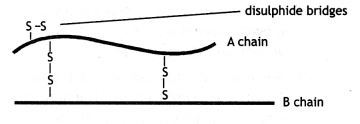
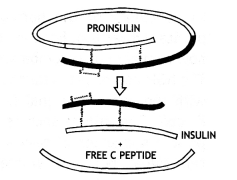
Class 12 Biology Important Questions Chapter 12 Biotechnology and its Applications 1
Class 12 Biology Important Questions Chapter 12 Biotechnology and its Applications 2
(A), (B) Conversion of proinsulin after removal of C-peptide.

(ii) Insulin is synthesized as pro-hormone (i.e. which is to be processed before becoming functional) which contains an extra stretch called C-peptide which is usually removed during the maturation of insulin.

Question 7.
Explain the social, economical, and environmental implications of genetic engineering techniques.
Answer:

  1. Genetically prepared human insulin and edible vaccines will be readily available and also will be economical.
  2. Transgenic crop plants for human consumption may cause concern for safety due to unwanted properties they may have.
  3. Some people believe that transgenic plants and animals can solve many human problems especially hunger and disease.

Question 8.
Write a short note on:
(i) Production of human growth hormone by E. coli.
Answer:
Production of human growth hormone by E. coli. The Human growth hormone is produced commercially by transgenic Escherichia coli. The pituitary gland of humans produces growth hormones that regulate growth and development. However, in children stunted growth occurs due to deficiency of the hormone called pituitary dwarfism. For this, the hGH is now available as a recombinant protein.

The high-coding DNA sequence is linked with the bacterial signal sequence of E. coli. The hGH is secreted into the periplasmic space of bacterial cells by the signal peptides wherefrom the protein is purified.

(ii) Animals as organ donors for humans.
Answer:
Animals as organ donors for humans. Organ transplantation from animals to humans is called xenotransplantation. The first experiment was done in 1906 by French Surgeon Mathieu Jaboulay who implanted a pig’s kidney into one woman and a goat’s liver into another woman, but it was not successful.

Though now, organ transplantation from animals has been made possible in America and the United Kingdom. Of all, baboons and pigs have favored xenotransplant donors. Pig organs have been transplanted to humans several times in the last few years. Baboons are genetically close to humans, so they are most often used. Six baboon kidneys were transplanted into humans in 1964. Today, however, xenotransplantation is still experimental and there is a serious risk to the procedures.

(iii) Plant Variety Protection and Farmers’ Right Act.
Answer:
Plant Variety Protection and Farmers’ Right Act. This act provides the establishment of an effective system for the protection of plant breeder’s rights. It gives concurrent attention to the right of farmers, breeders and researchers, and the protection of public interest. Public interest is related to issues like compulsory licensing of rights and to the import of varieties incorporating Genetic Use Restriction Technology.

Question 9.
Explain the following terms in one or two sentences: intellectual property rights, humulin, and biofortified foods.
Answer:
1. Intellectual Property Rights: It is the general term covering patents, copyright, trademark, industrial designs, geographical indications, protection of layout designs of integrated circuits, and protection of undisclosed information (trade secrets).

2. Humulin: It is a crystalline suspension of human insulin. It is made using a chemical process called recombinant DNA technology and is of various types (Humulin R, U, N, L, 70/30, 50/50) depending on the percentage of insulin present in suspension. Humulin does not come from human beings, but they are synthesized in special non¬disease producing special lab strains of E. coli which are genetically altered by the addition of the gene for human insulin production. Humulin is identical in chemical structure to human insulin and is made in a factory by recombinant DNA technology.

3. Biofortified foods: They are the modified food rich in nutritional values. Biofortification is the process of breeding food crops that are rich in bioavailable micronutrients. These crops fortify themselves, they toad high levels of minerals and vitamins in their seeds and roots, which are harvested and eaten.

Question 10.
What are transgenic bacteria? Illustrate using any one example.
Answer:
Those bacteria whose DNA is manipulated to possess and express an extra (foreign) gene are known as transgenic bacteria.
Example: Human Growth hormone production by transgenic Escherichia coli.

  1. The pituitary gland of humans produces growth hormones that regulate growth and development.
  2. However, in children stunted growth occurs due to deficiency of the hormone which is called pituitary dwarfism.
  3. For this, the hGH is now available as a recombinant protein.
  4. The hGH-coding DNA sequence is linked with the bacterial signal sequence of E. coli.
  5. The hGH is secreted into the periplasmic space of bacterial cells by the signal peptides wherefrom the protein is purified.

Question 11.
Write properties of stem cells. How is the population of stem cells maintained?
Answer:
Properties of stem cells:
The classical definition of a stem cell requires that it possess two properties:

  1. Self-renewal: The ability to go through numerous cycles of cell division while maintaining the undifferentiated state,
  2. Potency: The capacity to differentiate into specialized cell types. In the strictest sense, this requires stem cells to be either totipotent or pluripotent- to be able to give rise to any mature cell type, although multipotent or unipotent progenitor cells are sometimes referred to as stem cells. Apart from this, it is said that stem cell function is regulated in a feedback mechanism.

1. Self-renewal:
Two mechanisms exist to ensure that a stem cell population is maintained:

  • Obligatory asymmetric replication: A stem cell divides into one mother cell that is identical to the original stem cell, and another daughter cell that is differentiated.
  • Stochastic differentiation: When
    one stem cell develops into two differentiated daughter cells, another stem cell undergoes mitosis and produces two stem cells identical to the original.

2. Totipotency
They have the potential to develop into any cell found in the human body.

Question 12.
Show with a simple sketch the location of stem cells and their role in treatment.
Answer:
Stem cells:
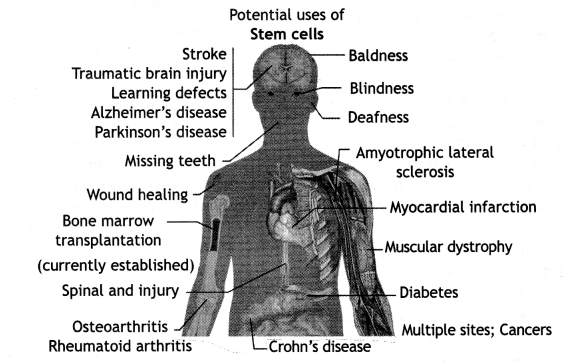
Class 12 Biology Important Questions Chapter 12 Biotechnology and its Applications 3
Diseases and conditions where stem cell treatment is being investigated.

Question 13.
(i) Why are transgenic animals so called?
Answer:
Animals that have had their DNA manipulated to possess and express (foreign) genes are called transgenic animals.
Example: Transgenic mice, transgenic rabbits.

(ii) Explain the role of transgenic animals in (a) vaccine safety (b) biological products with the help of an example for each.
Answer:
(a) Role of transgenic animals in vaccine safety:

  • Transgenic mice are being developed for use in testing the safety of vaccines before they are used on humans.
  • Transgenic mice are being used to test the safety of the polio vaccine.

(b) Role of transgenic animals in biological products: In 1997, the first transgenic cow, Rosie, produced human protein-enriched milk of 2.4 gm per liter. The milk contained the human alpha-lactalbumin and was a more balanced product for human babies.

Question 14.
Name the genes responsible for making Bt cotton plants resistant to bollworm attack. How do such plants attain resistance against bollworm attacks? Explain. (CBSE 2012)
Answer:

  1. Genes for making Bt cotton resistant to bollworm attack:
    1. acrylic
    2. cry IIAb
  2. Specific Bt toxin genes are isolated from Bacillus Thurinsiensis and incorporated into the cotton plant.
  3. The toxin is coded by a gene name cry.
  4. The protein synthesized by these is insecticidal protein. It is present as an inactive protoxin.
  5. Once the insect ingests the protoxin it is converted into the active form of toxin due to the alkaline medium of the gut.
  6. The activated toxin binds to the surface of midgut epithelial cells and creates pores in them.
  7. It causes swelling and breakdown and eventually leads to the death of the insect.

Question 15.
Explain the various steps involved in the production of artificial insulin. (CBSE 2017)
Or
Explain how Eli Lilly, an American company, produced insulin by recombinant DNA technology. (CBSE Delhi 2018C)
Answer:
Genetically engineered insulin:

  1. Insulin contains two short polypeptide chains: chain A and chain Blinked together by disulfide bridges.
  2. In mammals, insulin is synthesized as a pro-hormone. It contains an extra stretch called C-peptide.
  3. C-peptide is absent in the mature insulin and is removed during maturation into insulin.
  4. Production of insulin by rDNA techniques was achieved by an American company, Eli Lilly in 1983. It prepared two DNA sequences corresponding to A and B, chains of human insulin, and introduced them in plasmids of E. coli for production.
  5. The Aand B chains produced were separated, extracted and combined, by creating disulfide bonds to form human insulin.

Question 16.
(i) What are transgenic animals?
Answer:
Animals whose DNA has been manipulated to possess and express an extra/foreign gene are known as transgenic animals.

(ii) Name the transgenic animal having the largest number amongst all the existing transgenic animals.
Answer:
Mice

(iii) Mention any three purposes for which these animals are produced. (CBSE Delhi 2018C)
Answer:
(a) Transgenic animals are designed to allow the study of how genes are regulated and how they affect the normal functions of the body and its developments, e.g. information is obtained as to how insulin has a role as a growth factor.
(b) Transgenic animals are designed to increase our understanding of how genes control the development of diseases; they serve as models for human diseases.
(c) Transgenic mice are being developed to test the safety of vaccines, e.g. polio vaccine has been tested on mice.

Question 17.
Explain the following terms in not more than 70 words.
(i) Single-cell proteins (SCP)
Answer:
Cells from different kinds of organisms such as bacteria, filamentous fungi, yeast, and algae are treated in different ways so that they are used as food or feed, are called single-cell protein. The biomass is obtained from both unicellular and multicellular microorganisms. The common substrate used for preparing such food containing SCP ranges from whey sawdust, and paddy straw. SCP provides a valuable protein-rich supplement in the human diet.

(ii) Biopatent
Answer:
A patent is a right granted by a Government to an inventor to prevent others to make commercial use of such an invention. At present patents that are granted for biological entities and the various products obtained from these organisms, are termed as biopatent.

Biopatents are being granted for the following:
(1) Strains of microorganisms
(2) Cell lines
3) Genetically modified strains of living organisms
(4) DNA sequences
(5) The proteins prepared by DNA sequences
(6) Biotechnological process
(7) Production process
(8) Products
(9) Product application.

(iii) Bioethics
Answer:
Bioethics is a set of standards that may be used to regulate our activities in relation to biological works.

The major bioethical concerns are as follows:
(a) Introduction of transgenes from one species to another violates the integrity of species.
(b) Transfer of human genes to other animals and vice versa is against ethics.
(c) Making of the clone.
(d) May cause risk to biodiversity.
(e) Suffering from animals used in biotechnology will increase.

(iv) Biopiracy
Answer:
The exploitation of patent biological resources without proper permission is called biopiracy. The collection of such material without a benefit-sharing agreement is likely to find its way into the list of criminal violations in many countries.

(v) Genetically modified food
Answer:
The food prepared from the production of genetically modified crops is called genetically modified food (GM food). It contains proteins produced by a transgene.

Question 18.
Briefly explain why are Transgenic animals produced? (CBSE Delhi 2013)
Answer:
Transgenic animals:
Transgenic animals are produced for the following purposes:

  1. Transgenic animals are designed to allow the study of how genes are regulated and how they affect the normal functions of the body and its developments, e.g. information is obtained as to how insulin has a role as a growth factor.
  2. Transgenic animals are designed to increase our understanding of how genes control the development of diseases; they serve as models for human diseases.
  3. Transgenic animals that produce useful biological compounds are created by introducing a portion of the DNA that codes for that product, e.g. a-1 antitrypsin is produced for curing emphysema.
  4. Transgenic mice are being developed to test the safety of vaccines, e.g. polio vaccine has been tested on mice.
  5. Transgenic animals with more sensitivity to toxic substances are being developed to test the toxicity of drugs.

Question 19.
Describe the hazards of transgenic animals.
Answer:
Hazards of transgenic animals:

  1. Proteins: Genes introduced in various organisms operate through the synthesis of polypeptide proteins and enzymes. However, foreign proteins are generally attacked by the defense system resulting in damaged biochemicals which may prove harmful and in the long term produce allergy.
  2. Human organs: Replaceable human organs like kidneys, liver, heart, pancreas, etc. can be obtained only from autografts and isografts. Will it be ethical to grow the human body, human body organs for obtaining the required organs?
  3. Human cloning: This can solve the problem of infertility. However, such a method of human reproduction will destroy the family system, fine human feelings, and the fabric of human society.
  4. Recreation: It is not only a fancy but also the desires of numerous children, adults, and elders to see dinosaurs live.

Question 20.
Compare and contrast the advantages and disadvantages of the production of genetically modified crops.
Or
Write advantage of GM crops. (CBSE Outside Delhi 2019)
Answer:
The advantages of the production of genetically modified crops are:

  1. They have proved to be extremely valuable tools in studies on plant molecular biology, regulation of gene action, identification of regulatory/ promontory sequences.
  2. Genetically modified crops have improved agronomic and other features such as resistance to biotic and abiotic stresses.
  3. Over-ripening losses can be reduced, e.g. flavor saves tomato.
  4. Nutritional values are improved, e.g. Golden rice has high vitamin A content.
  5. Viral resistance can be introduced.
  6. The number of pharmaceuticals like insulin, interferon, blood clotting factors are improved.
  7. Insect resistance can be introduced, e.g. cry gene can be introduced into cotton, wheat, and rice from Bacillus Thuringiensis.

The main disadvantages of the production of genetically modified crops are:

  1. Many transgenes are expressed at low levels which usually limit their usefulness.
  2. Sometimes, the expression of transgenes is suppressed in transgenic plants, this is called gene silencing.
  3. The undesirable features are also carried along with desirable features in transgenic plants such as necrosis, reduced growth, sterility, etc.
  4. Genetic pollution can be there.
  5. Weeds also become resistant.
  6. Bt cotton, Bt wheat also destroy pollinators and disseminators.
  7. The product of transgene may be allergic or toxic.

Question 21.
Why is the introduction of genetically engineering lymphocyte into an ADA deficiency patient, not a permanent cure? Suggest a possible permanent cure. (CBSE 2010, 2011)
Or
Explain how a hereditary disease can be corrected? Give an example of the first successful attempt made towards this objective. (CBSE 2011, 2019 C)
Or
Explain enzyme replacement therapy to treat ADA deficiency. (CBSE Outside Delhi 2016, 2019 C)
Or
What is gene therapy? Illustrate using the example of adenosine deaminase (ADA) deficiency? (CBSE Delhi 2011, 2013, 2016)
Or
Two children A and B aged 4 and 5 years respectively visited a hospital with a similar genetic disorder. Girl A was provided enzyme-replacement therapy and was advised to revisit periodically for further treatment. Girl B was, however, given therapy that did not require a revisit for further treatment.
(a) Name the ailments the two girls were suffering from.
(b) Why did the treatment provided to girl A require repeated visits?
(c) How was girl B cured permanently? (CBSE Delhi 2019)
Answer:
Gene Therapy. It is defined as the introduction of a normal functional gene into cells that contain the defective allele of the concerned gene with the objective of correcting a genetic disorder or an acquired disorder.

Treatment of ADA deficiency:

  1. Gene therapy was used to correct the genetic disorder called Severe Combined Immunodeficiency (SCID) syndrome produced by adenosine deaminase (ADA) deficiency.
  2. In this, Normal ADA gene copies were produced by cloning.
  3. Packed into a retrovirus, most of the viral genes were replaced by the ADA gene.
  4. Lymphocytes were isolated from the patients.
  5. Recombinant DNA of the recombinant retroviruses was used to infect the lymphocytes.
  6. The infected cells expressing the ADA gene were injected back into the patients.
  7. The normal ADA gene was then expressed in the patients and ADA deficiency is partially corrected. If the gene isolated from bone marrow cells producing ADA is introduced into embryonic cells at early stages, it could provide a permanent cure.

Question 22.
How is the transgenic tobacco plant protected against Meloidogyne incognita? Explain the process? (CBSE 2009)
Or
Explain the process of RNA interference. (CBSE Delhi 2011, 2016)
Or
How has the use of Agrobacterium as vectors helped in controlling Meloidogyne incognita infestation in tobacco plants? Explain in the correct sequence. (CBSE 2018, Sample paper 2020)
Answer:
Protection of tobacco plant against Nematodes, Meloidogyne incognita:

  1. A nematode Meloidogyne incognita infects tobacco plants and reduces their yield.
  2. The specific genes (in the form of cDNA) from the parasite are introduced into the plant using Agrobacterium as the vector.
  3. The genes are introduced in such a way that both sense/coding RNA and antisense RNA (Complementary to the sense/coding RNA) are produced.
  4. Since these two RNAs are complementary, they form a double-stranded RNA (ds RNA)
  5. This neutralizes the specific RNA of the nematode, by a process called RNA- interference.
  6. As a result, the parasite cannot live in the transgenic host, and the transgenic plant is protected from the pest.

Question 23.
What are the ethical concerns of biotechnology?
Answer:

  1. Biotechnology is producing newer genotypes. Some of them can be extremely harmful due to intragenomic interactions and mutations.
  2. It introduces unfamiliar proteins into transgenics which may react to form toxins and allergens.
  3. The genes introduced into crops can pass into weeds through pollen transfer. It will produce superweeds.
  4. It is going to cause genetic pollution which is likely to disturb natural balance in a big way.
  5. Animals employed in experiments of biotechnology are made to suffer.
  6. Animals being used to produce particular structures and pharmaceutical proteins are reduced to the status of factories.
  7. As a gene is introduced from outside into an organism, its integrity as a species is violated.
  8. Transfer of genes from human beings to specific animals or vice-versa violates the concept of humanness.
  9. Biotechnology has no respect for living beings. Its only goal is to exploit them for commercial use in benefitting human society.
  10. In their race to gain supremacy over others, companies and individuals are rushing for biopatents even of those products which are produced through the traditional knowledge of tribals, communities, and societies.

Question 24.
The Green Revolution succeeded in increasing the yield of crops but it is not sufficient to feed the growing human population. Thus there is a need for another green revolution.
(i) Name the technique which will help in increasing the yield of crops.
Answer:
Genetic engineering (Recombinant DNA technology).

(ii) Name any two genetically modified crops.
Answer:
(a) Bt cotton
(b) ‘Flavr Savr Tomato’

(iii)What is golden Rice’?
Answer:
Golden rice is a transgenic variety of rice (Oryza sativa) that contains good quantities of (3-carotene (provitamin A – inactive state of vitamin). Since the grains of the rice are yellow in color due to [3-carotene, the rice is called golden rice.

(iv) Name a natural genetic engineer.
Answer:
Agrobacterium tumefaciens.

Question 25.
How have transgenic animals proved to be beneficial in:
(i) Production of biological products
(ii) Chemical safety testing. (CBSE 2014)
Answer:
(i) Production of biological products:
(a) Medicines required for treating human diseases are obtained by genetic engineering.
(b) a-1-antitrypsin used to treat emphysema.
(c) Transgenic cow ‘Rosie’ produces human-protein enriched milk.
(ii) Chemical safety (Toxicity/safety testing) Transgenic animals are made that carry genes that make these more sensitive toxic substances than non-transgenic animals.

Question 26.
List the disadvantages of insulin obtained from the pancreas of slaughtered cows and pigs.
Answer:

  1. A slaughtered animal produces very little hormone so that the demand was always higher than the supply.
  2. It is unethical to slaughter animals for obtaining the drug.
  3. Contamination was quite common.
  4. The immune response is common.

Question 27.
List the advantages of recombinant insulin.
Answer:

  1. Recombinant insulin is exactly similar to human insulin and is, therefore, also called humulin.
  2. It is available in pure form with little chances of contamination.
  3. There is no slaughtering of animals.
  4. There is no immune response or any other side effect.
  5. There is enough manufacturing capacity so that the chances of short supply are few.

Question 28.
Explain the process of synthesis of insulin.
Answer:
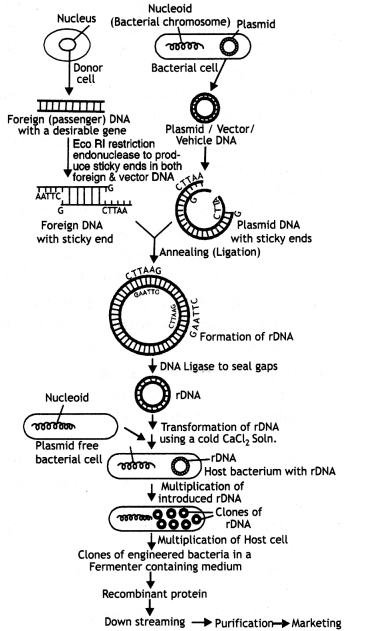
Production of human insulin: Gene transfer involves essentially the following stages:
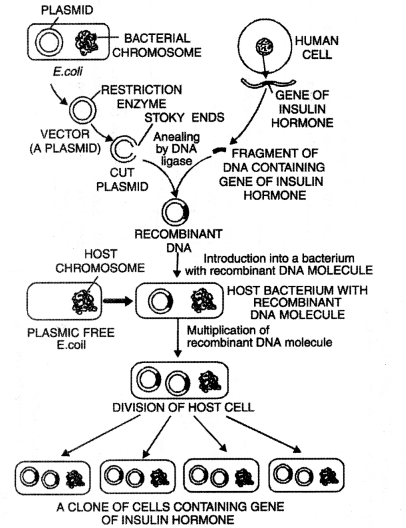
Class 12 Biology Important Questions Chapter 12 Biotechnology and its Applications 4
Steps involved in gene transfer for the production of human insulin:

  1. Isolation of donor or DNA segment. A useful DNA segment is isolated from the donor organism.
  2. Formation of Recombined DNA (rDNA). Both the vector and donor DNA segments are cut in the presence of restriction endonuclease. In the presence of ligase DNA segments of both are joined to form rDNA.
  3. Production of Multiple Copies of rDNA. The next step in the process is the production of multiple copies of this recombinant DNA.
  4. Introduction of rDNA in the recipient organism. This rDNA is inserted into a recipient organism.
  5. Screening of the transformed cells. The recipient (host) cells are screened for the presence of rDNA and the product of the donor gene. The transformed cells are separated and multiplied, using an economical method for its mass production.
Biotechnology: Principles and Processes Class 12 Important Extra Questions Biology Chapter 11

Here we are providing Class 12 Biology Important Extra Questions and Answers Chapter 11 Biotechnology: Principles and Processes. Important Questions for Class 12 Biology are the best resource for students which helps in Class 12 board exams.

Class 12 Biology Chapter 11 Important Extra Questions Biotechnology: Principles and Processes

Biotechnology: Principles and Processes Important Extra Questions Very Short Answer Type

Question 1.
What is genetic engineering?
Answer:
Genetic engineering. It is a technique for artificially and deliberately modifying DNA (genes) to suit human needs. It is also called recombinant DNA technology or DNA splicing. It is a kind of biotechnology.

Question 2.
Define recombinant DNA.
Answer:
Recombinant DNA. They are molecules of DNA that are formed through genetic recombination methods.

Question 3.
What is the role of restriction endonuclease?
Answer:
Restriction endonucleases are specific enzymes which can cleave double-stranded DNA at the specific site.

Question 4.
What are BACs and YACs? (CBSE 2016)
Answer:
BACs and YACs are artificial chromosomes from bacteria and yeast efficient for gene transfer. They are vectors.

Question 5.
Name the soil bacterium which contains the gene for production of endotoxins.
Answer:
Agrobacterium tumefaciens.

Question 6.
Name a technique by which DNA fragments can be separated. (CBSE Delhi 2008)
Answer:
Gel electrophoresis.

Question 7.
What is the principle of Gel electrophoresis?
Answer:
DNA fragments are negatively charged so they move to anode under electric field through the matrix (usually agarose). This matrix gel acts as sieve and DNA fragments resolve according to their size.

Question 8.
Name the compound used for staining DNA to be used in Recombinant Technology. What is the colour of such stained DNA?
Answer:
The compound used for staining DNA is ethidium bromide. Stained DNA becomes orange.

Question 9.
Name the technique for vector less direct gene transfer.
Answer:
Gene gun.

Question 10.
What is the role of ‘Ori’ in any plasmid?
Answer:
The plasmid is prokaryotic circular DNA which has a sequence of nucleotides from where the replication starts. This is called the origin of replication.

Role of Ori is to start replication. Also, the copy number of linked DNA is controlled by Ori.

Question 11.
Do normal £. coli cells have any gene resistance against antibiotics?
Answer:
No.

Question 12.
What is the function of TPA?
Answer:
TPA (Tissue plasminogen activator) dissolves blood clots after a heart attack and stroke.

Question 13.
Give an example in which recombinant DNA technology has provided a broad range of tool in the diagnosis of diseases.
Answer:
Construction of probes, which are short segments of single-stranded DNA attached to a radioactive or fluorescent marker.

Question 14.
Give the full form of PCR. Who developed it? (CBSE Delhi 2013)
Answer:
PCR is a polymerase chain reaction. It was developed by Kary Mullis in 1985.

Question 15.
What is the source of DNA polymerase, i.e. Taq polymerase? (CBSE Outside Delhi 2013)
Answer:
Taq polymerase is isolated from the bacterium Thermus Aquaticus.

Question 16.
Define “melting of target DNA”.
Answer:
The target DNA containing the sequence to be amplified is heat-denatured (around 94° C for 15 seconds) to separate its complementary strands. This process is called melting of target DNA.

Question 17.
Expand ELISA. Write one application. (CBSE Delhi 2013)
Answer:
ELISA-Enzyme Linked ImmunoSorbent Essay. Importance-lt is used for the diagnosis of AIDS.

Question 18.
What are transgenic animals? Give one example. (CBSE Outside Delhi 2016)
Answer:
Transgenic animals: The animals obtained by genetic engineering containing transgenes are known as transgenic animals.
Example. Transgenic cow ‘Rosie’.

Question 19.
How many PCR cycles are adequate for proper amplification of DNA segment?
Answer:
20-30 cycles.

Question 20.
Define gene therapy.
Answer:
Gene Therapy: It is the replacement of a faulty gene by normal healthy functional gene.

Question 21.
What is the importance of gene bank?
Answer:
It provides a stock from which genes can be obtained for improving the varieties or used in genetic engineering.

Question 22.
What can be the source of thermostable DNA?
Answer:
Thermostable DNA is obtained from a bacterium Thermus Aquaticus.

Question 23.
What are selectable markers?
Answer:
Genes which are able to select transformed cell from the non-recombinant cells are called selectable markers.

Question 24.
Why is enzyme cellulase used for isolating genetic material from plant cells and not from animal cells? (CBSE 2010)
Answer:
Cellulase is used for breaking the cell wall of plant cells whereas animal cells lack a cell wall. The cell wall is made of cellulose which can be broken down by cellulase.

Question 25.
Give one example each of transgenic plant and transgenic animal.
Answer:

  1. Transgenic tomato plant called Flavor Savr.
  2. A transgenic mouse called Supermouse.

Question 26.
What would be the molar concentration of human DNA in a human cell?
Answer:
Humans have 3 M of DNA per cell, i.e. the molar concentration is 3.

Question 27.
Do eukaryotic cells have restriction endonucleases?
Answer:
Yes, eukaryotic cells possess restriction endonucleases. They are involved in editing (Proofreading) and DNA repairs during DNA replication.

Question 28.
Name a technique by which DNA fragments can be separated. (CBSE Delhi 2008)
Answer:
Get electrophoresis.

Question 29.
Biotechnological techniques can help to diagnose the pathogen much before the symptoms of the disease appear in the patient. Suggest any two such techniques. (CBSE Outside Delhi 2019)
Answer:
PCR – Polymerase chain reaction
ELISA – Enzyme-linked immunosorbent assay

Question 30.
Why is it not possible for an alien DNA to become part of chromosome anywhere along its length and replicate? (CBSE 2014)
Answer:
For multiplication of any alien DNA, it needs to be a part of a chromosome which has a specific sequence known as the origin of replication.

Question 31.
Mention the type of host cells suitable for the gene guns to introduce an alien DNA. (CBSE Delhi 2014)
Answer:
Plant cells.

Question 32.
Name the enzymes that are used for isolation of DNA from bacterial and fungal cells for rDNA technology. (CBSE 2014)
Answer:
Lysozyme for bacterial cell and chitinase for the fungal cell.

Question 33.
What is EcoRI? How does EcoRI differ from an exonuclease? (CBSE Outside Delhi 2015)
Answer:
EcoRI is an endonuclease restriction enzyme which cut both the stands of palindromic DNA at a specific position of nitrogen base 5′ (GAATTC) 3′ while exonuclease removes nucleotides from terminals of DNA strands.

Biotechnology: Principles and Processes Important Extra Questions Short Answer Type

Question 1.
(i) While cloning vectors, which of the two will be preferred by biotechnologists, bacteriophages or plasmids. Justify with reason.
Answer:
Biotechnologists prefer bacteriophages for cloning over plasmids because they have very high copy numbers of their genome within the bacterial cells whereas some plasmids may have only one or two copies per cell and others may have 15-100 copies per cell. Phage vectors are more efficient than plasmids for cloning large DNA fragments.

(ii) Name the first transgenic cow developed and state the Improvement In the quality of the product produced by it. (CBSE Sample paper 2018-19)
Answer:
Transgenic cow Rosie produced human protein-enriched milk (2.4 grams per litre).

Question 2.
What are the two core techniques that enabled the birth of biotechnology?
Answer:
The two core techniques that enabled the birth of modern biotechnology are:

  1. Genetic engineering techniques to alter the chemistry of genetic material (DNA and RNA), to introduce these into host organisms and thus change the phenotype of the host organism.
  2. Maintenance of sterile (microbial contamination-free) ambience in chemical engineering processes to enable the growth of only the desired microbe/eukaryotic cell in large quantities for the manufacture of biotechnological products like antibiotics, vaccines, enzymes, etc.

Question 3.
Make a list of tools of recombinant DNA technology. (CBSE Delhi, 2011)
Answer:
Key tools of recombinant DNA technology:

  1. Restriction enzymes
  2. Polymerase enzymes
  3. Ligases
  4. Vectors
  5. Host organism.

Question 4.
What does EcoRI signify? How its name is derived?
Answer:
EcoRI signifies the name of restriction endonuclease:

  1. First capital letter of the name that comes from the genus Escherichia is ‘E’.
  2. Second two small letters come from the species Coli of prokaryotic cells from which they are isolated, i.e. ‘co’.
  3. Letter R is derived from the name of the strain, i.e. Escherichia coli Ry 13.
  4. The Roman number indicates the order in which enzymes were isolated from that strain of bacteria.

Question 5.
What are recognition sequences or recognition sites?
Answer:
The sites recognised by restriction endonucleases are called recognition sites. The recognition sequences are different and specific for the different restriction endonucleases. These sequences are palindromic in nature.

Question 6.
Define vector. Give the properties of a “Good Vector”.
Answer:
A vector is a DNA molecule that has the ability to replicate in an appropriate host cell, and into which the DNA fragment to be cloned is integrated for cloning.

A good vector must have the following properties:

  • It should have an origin of replication so that it is able to replicate autonomously.
  • It should be easy to isolate and purify.
  • It should get easily introduced into the host cells.

Question 7.
What is the difference between cloning and expression vectors?
Answer:
All vectors that are used for propagation of DNA inserts in a suitable host are called cloning vectors. When a vector is designed for the expression of, i.e. production of the protein specified by, the DNA insert, it is termed as an expression vector.

Question 8.
What do you understand by the term selectable marker?
Answer:
Selectable marker:

  1. A marker is a gene which helps in selecting those host cells which contain the vector (transformant) and eliminating the non-transformants. It selectively permits the growth of transformants.
  2. Common selectable markers for E. coli include the genes encoding resistance to antibiotics such as ampicillin. chloramphenicol tetracycline and kanamycin or the gene for (i-galactosidase which can be identified by a colour reaction. Normal E.Coli do not carry resistance against any of these antibodies.

Question 9.
Explain the principle that helps in separation of DNA fragments in Gel electrophoresis. (CBSE Delhi 2009 C)
Answer:
Get electrophoresis is a technique of molecules such as DNA/RNA/protein on the basis of their size under the influence of the electric field so that they migrate in the direction of electrode bearing the opposite charge. Positively charged molecules move towards cathode (-ve electrode) and vice versa. These molecules move through a medium or matrix and can be separated on the basis of their size.

Question 10.
Give the applications of PCR technology. (CBSE, Delhi 2013)
Answer:

  1. Amplification of DNA and RNA.
  2. Determination of orientation and location of restriction fragments relative to one another.
  3. Detection of genetic diseases such as sickle cell anaemia, phenylketonuria and muscular dystrophy.

Question 11.
Why is “Agrobacterium-mediated genetic transformation” in plants described as natural genetic engineer of plants? (CBSE Delhi 2011)
Answer:
Agrobacterium tumefaciens is a plant pathogenic bacterium which can transfer part of its plasmid DNA because it infects host plants. Agrobacterium produces crown gall in most of the dicotyledonous plants. These bacteria contain large tumours inducing plasmid (Ti-plasmids) which pass on their tumour causing gene into the genome of the host plant. Thus gene transfer is happening in nature without human involvement hence Agrobacterium-mediated genetic transformation is described as natural genetic engineering in plants.

Question 12.
Differentiate gene therapy and gene cloning.
Answer:
Differences between gene therapy and gene cloning:

Gene therapyGene cloning
It is the replacement and/ or alteration of defective genes responsible for hereditary diseases by normal genes.It is the technique of obtaining identical copies of a particular segment of DNA or a gene.

Question 13.
From what you have learnt, can you tell whether enzymes are bigger or DNA is bigger in molecular size? How did you know?
Answer:
DNA molecules are bigger in size as compared to the molecular size of enzymes. Enzymes are proteins. Protein synthesis occurs from a small portion of DNA called genes.

Question 14.
How does restriction endonuclease work? (CBSE Delhi 2013, 2014, Outside Delhi 2019)
Or
What are molecular scissors? Explain their role. (CBSE 2009)
Answer:
Restriction endonuclease enzymes are called molecular scissors which can cut double-stranded DNA at specific sites.

Role of restriction endonuclease:

  • Restriction endonuclease inspects the length of DNA sequence.
  • It finds specific recognition sequence, i.e. palindromic nucleotide sequence in DNA.
  • These enzymes cut the strand of DNA a little away from the centre of palindromic sites.
  • Thus restriction endonucleases leave overhanging stretches called sticky ends on each strand.

Question 15.
How and why is the bacterium Thermus Aquaticus employed in recombinant DNA technology? Explain. (CBSE Delhi 2009)
Answer:
Thermus Aquaticus bacterium is employed in recombinant DNA technology because it has thermostable DNA polymerase (Taq. Polymerase) that remains active during high temperature-induced denaturation of a step of PCR.

This enzyme is employed during amplification of gene using PCR (Polymerase Chain Reaction). The amplified fragment can be used to ligate with a vector for further cloning.

Question 16.
Name the source of Taq polymerase. Explain its advantages. (CBSE Outside Delhi 2009)
Answer:
Taq Polymerase is extracted from Thermostable bacteria, namely Thermus Aquaticus. It remains active at a higher temperature and is used for denaturation of DNA during PCR.

Question 17.
What are recombinant proteins? How do bioreactors help in their production? (CBSE Outside Delhi 2009, 2015)
Answer:
Recombinant proteins. When any protein-encoding gene is expressed in a heterologous host, it is called recombinant protein. Bioreactors help in the production of recombinant proteins on large scale. A bioreactor provides optimal conditions for achieving the desired recombinant protein by biological methods.

Question 18.
What is meant by gene cloning?
Answer:
Formation of multiple copies of a particular gene is called gene cloning. A gene is separated and ligated to a vector-like plasmid. The recombinant plasmid is introduced into a plasmid-free bacterium through transformation. The transformed bacterium is made to multiply and form a colony. Each and every bacterium of the colony has a copy of the gene.

Question 19.
Both the wine marker and a molecular biologist who has developed a recombinant vaccine claim to be biotechnologist. Who in your opinion is correct?
Answer:
Both are considered biotechnologists. Wine marker utilises a strain of yeast which produces wine by fermentation. The molecular biologist uses a cloned gene for the antigen. The antigen is used as a vaccine. This permits the formation of antigen in huge quantity. Both generate products and services using living organisms useful to mankind.

Question 20.
You have created a recombinant DNA molecule by ligating a gene to a plasmid vector. By mistake, your friend adds an exonuclease enzyme to the tube containing the recombinant DNA. How will your experiment get affected as you plan to go to the transformation now?
Answer:
The experiment is not likely to be affected as the recombinant DNA molecule is circular and closed, with no free ends. Hence, it will not be a substrate for exonuclease enzyme which removes nucleotides from the free ends of DNA.

Question 21.
Explain the work carried out by Cohen and Boyer that contributed immensely to biotechnology. (CBSE2012)
Answer:
Work of Cohen and Boyer:

  1. Discovery of restriction endonuclease, an enzyme of E.coli which cut DNA at palindromic sequence.
  2. Preparation of recombinant DNA (Plasmid and DNA of interest.)
  3. Their work established recombinant DNA (rDNA) technology also called genetic engineering.

Question 22.
How are ‘Sticky ends’ formed on a DNA strand? Why are these so-called? (CBSE Delhi 2014)
Answer:
1. Restriction enzymes cut the strand of DNA a little away from the centre of palindrome site, but between the same two bases on opposite strands. As a result, single-stranded portions are left at each end. These overhanging stretches of DNA are called ‘Sticky ends’.

2. The Sticky ends are named so because they form hydrogen bonds with their complementary cut counterparts. The stickiness helps in the action of DNA ligase.

Question 23.
How is a continuous culture system maintained in bioreactors and why? (CBSE Delhi 2019)
Answer:
In order to maintain a continuous culture system, the used medium is drained out from one side of the bioreactor and the fresh medium is added from one side. This type of culturing method produces larger biomass leading to higher yields of the desired product.

Question 24.
Galactosidase enzyme is considered a better selectable marker. Justify the statement. (CBSE Delhi 2019)
Answer:
Recombinant strains can be differentiated from the non-recombinants ones easily by using this selectable marker. The selection is done on the basis of the colour change. All are grown on a chromogenic substance. Non-recombinants will change from colourless to blue while in recombinants insertional inactivation of galactosidase gene occurs.

Hence, recombinants showed no colour change. This is a single step, an easy method for selection.

Biotechnology: Principles and Processes Important Extra Questions Long Answer Type

Question 1.
What is genetic engineering? Explain briefly the distinct steps common to all genetic engineering technology.
Or
With the help of diagrams show the different steps in the formation of recombinant DNA by the action of restriction endonuclease. (CBSE 2011)
Answer:
Genetic engineering: It is a technique for artificially and deliberately modifying DNA (genes) to suit human needs. It is also called recombinant DNA technology or DNA splicing.

It is a kind of biotechnology:

  1. Isolation of genetic material which has the gene of interest.
  2. Cutting of gene of interest from genome and vector with the same restriction endonuclease enzyme. Amplifying gene of interest (PCR).
  3. Ligating gene of interest and vector using DNA ligase forming rDNA.
  4. Transformation of rDNA into the host cell.
  5. Multiplying host cell to create clones.

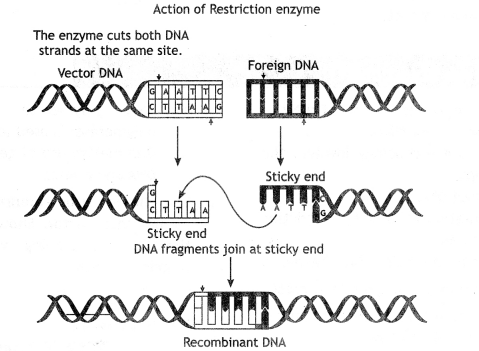
Class 12 Biology Important Questions Chapter 11 Biotechnology 1
Diagram showing various steps Involved in DNA recombinant technology for the production of a recombinant protein.

Question 2.
List three important features necessary for preparing a genetically modifying organism.
Answer:
Conditions necessary for preparing:

  1. Identification of DNA with desirable genes.
  2. Introduction of the identified DNA into the host.
  3. Maintenance of introduced DNA in the host and transfer of the DNA to its progeny.

Question 3.
How are restriction endonuclease enzymes named? Write examples. (CBSE 2014
Answer:
The naming of restriction enzymes is as follows:

  1. The first letter of the name comes from the genus and the next two letters from the name of the species of the prokaryotic cell from which they are isolated.
  2. The next letter comes from the strain of the prokaryote.
  3. The roman numbers following these four letters indicate the order in which the enzymes were isolated from that strain of the bacterium.

Examples:

  1. EcoR I is isolated from Escherichia coli RY 13.
  2. Hind II is from Haemophilus influenza.
  3. Bam H I is from Bacillus amylotiquefaciens.
  4. Sal I is from Streptomyces Albus
  5. Pst I is from Providencia stuartii.

Question 4.
Explain any three methods of vector less gene transfer. (CBSE Outside Delhi 2013)
Answer:
Vectors of gene transfer. Following are common methods of vectors gene transfer.

  1. Microinjection: Microinjection is the process/technique of introducing foreign genes into a host cell by injecting the DNA directly into the nucleus by using microneedle or micropipette.
  2. Electroporation: Electroporation is the process by which transient holes are produced in the plasma membrane of the (host) cell to facilitate entry of foreign DNA.
  3. Gene Gun: Gene gun is the technique of bombarding microprojectiles (gold or tungsten particles) coated with foreign DNA with great velocity into the target cell.

Question 5.
Write a note on the cloning vector.
Answer:
Cloning vectors:

  1. Plasmids and bacteriophages are the commonly used vectors
  2. Presently genetically engineered/ synthetic vectors are also used for easily linking the foreign DNA and selection of recombinants from non-recombinants.
  3. The following features are required to facilitate cloning in a vector:
    (a) Origin of replication (Ori)
    (b) Selectable marker
    (c) Cloning (Recognition) site
    (d) Small size of the vector.

Question 6.
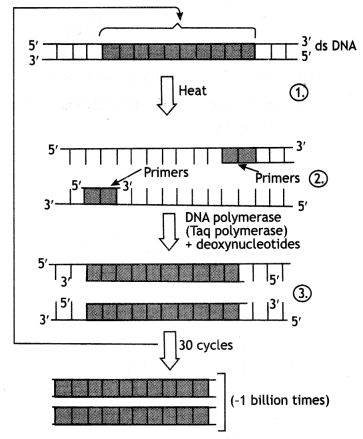
What is PCR? List the three main steps. Show the steps with a diagrammatic sketch.
Answer:

  1. PCR. Polymerase Chain Reaction.
  2. Three steps of PCR.
    (a) Denaturation
    (b) Primer annealing and
    (c) Extension of primers.

Class 12 Biology Important Questions Chapter 11 Biotechnology 2
The three steps of PCR

Question 7.
Name the various cloning vectors and explain how a plasmid can be used for genetic engineering.
Answer:
Cloning vectors:

  • Plasmids
  • Bacteriophages
  • Plant and animal vectors
  • Jumping genes (Transposons)
  • Artificial chromosomes of bacteria, yeast and mammals (BAC, YAC).

Use of plasmid as genetic material Plasmids are obtained from bacteria. They are treated with a restriction endonuclease enzyme to obtain the fragments of the desired genome. They are allowed to fuse with the help of a DNA ligase enzyme. The recombinant plasmids thus formed are used as genetic material.

Question 8.
Give various means by which a competent host is formed for recombinant DNA technology. Why and how bacteria can be made ‘competent’? (CBSE Delhi 2013)
Answer:
A host cell should be competent enough to take the DNA molecule for the transformation as the following methods can be used.

  1. Using divalent cations: Bacteria are treated with Ca2+, etc. so that DNA enters the bacterium through pores in its cell wall.
  2. Heat shock: Cells can be incubated on ice and then at 42°C for a heat shock and then again put on ice.
  3. Microinjection: Recombinant DNA is directly injected into the nucleus of an animal cell.
  4. Biolistic. Cells bombarded with high- velocity micro-particles of gold or tungsten coated with DNA is known as a gene gun.

Question 9.
How is recombinant DNA transferred to host?
Answer:
Transfer of recombinant DNA into the host:

  1. The bacterial cells must be made competent to take up DNA; this is done by treating them with a specific concentration of calcium, that increases the efficiency with which DNA enters the cell through the pores in its cell wall.
  2. Recombinant DNA can then be forced into such cells by incubating the cells with recombinant DNA on ice followed by placing them at 42°C and then putting them back on ice (heat shock treatment),
  3. Microinjection is a method in which the recombinant DNA is directly injected into the nucleus of the animal cell with the help of microneedles or micropipettes.
  4. Gene gun or biolistics is a method suitable for plant cells, where cells are bombarded with high-velocity microparticles of gold or tungsten coated with DNA.
  5. Disarmed pathogens are used as vectors; when they are allowed to infect the cell, they transfer the recombinant DNA into the host.

Question 10.
Why DNA cannot pass through the cell membrane? How can the bacteria be made competent to take up a plasmid? Explain a method for the introduction of alien DNA into a plant host cell. Name a pathogen that is used as a disarmed vector. (CBSE Outside Delhi 2019)
Answer:
DNA is a hydrophilic molecule thus it cannot pass through the cell membrane.

Bacterial cells are made ‘competent’ by treating them with a specific concentration of divalent cation such as calcium in order to take up the plasmid. The divalent cation increases the efficiency with which DNA enters the bacterium through the pores of the cell wall.

Procedure: Recombinant DNA is forced into ‘competent’ bacterial host cells by incubating them on the ice. It is followed by placing them briefly at 42°C. It is termed ‘heat stock’ treatment. Again they are placed back on ice. This process allows bacteria to take up the recombinant DNA.

Gene gun or biolistic method is used for the introduction of alien DNA into a plant host cell. Here, the plant cells are bombarded with high-velocity micro-particles of gold or tungsten coated with DNA. Agrobacterium tumefaciens or Retroviruses can be used as a disarmed vector.

Question 11.
Write a note on vectors used during recombinant DNA technology. (CBSE Delhi 2008)
Answer:
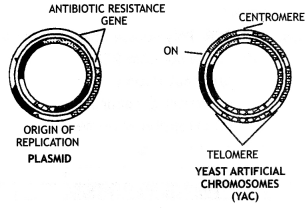
A vector or vehicle DNA is used as a carrier for transferring selected DNA into cells. A plasmid with its small DNA from a bacterium is a good choice for indirect gene transfer because it can move from one cell to another and make several copies of itself. However, artificial chromosomes from bacteria and yeast called BACs and YACs respectively are more efficient for eukaryotic gene transfers.
Class 12 Biology Important Questions Chapter 11 Biotechnology 3

Plasmid and Yeast Artificial Chromosome

Question 12.
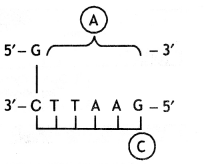
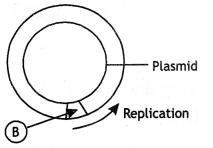
(i) Identify A and B illustrations in the following:
(a)Class 12 Biology Important Questions Chapter 11 Biotechnology 4
(b)Class 12 Biology Important Questions Chapter 11 Biotechnology 5
Answer:
A= 5′ GAATTC 3′
B marks for ORI (origin of replication).

(ii) Write the term given to A and C and why?
Answer:
A represents a nucleotide palindromic sequence. C-sticky end.

(iii) Expand PCR. Mention its importance in biotechnology. (CBSE Delhi 2011)
Answer:
PCR, Polymerase chain reaction. It helps in gene amplification.

Question 13.
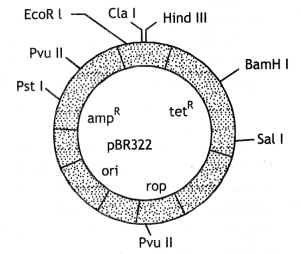
Write the role of the following sites in pBR322 cloning vector:
(a) rop
Answer:
Role of rop, ori and selectable marker in pBR322 cloning vector.

Role of rop: Rop gene regulates copy number. Rop process is involved in stabilising the interaction between RNA I and RNA II which in turn prevents replication of pBR322.

(b) ori
Answer:
Origin of replication (Ori):

  • It is a specific sequence of DNA bases, which is responsible for initiating replication.
  • An alien DNA for replication should be linked to the origin of replication.
  • A prokaryotic DNA has normally a single origin of replication, while eukaryotic DNA may have more than one origin of replication.
  • The sequence is responsible for controlling the copy number of linked DNA.

(c) selectable marker (CBSE Delhi 2019 C)
Answer:
Selectable marker:

  • A marker is a gene which helps in selecting those host cells which contain the vector (transformant) and eliminating the non-transformants.
  • Common selectable markers for E. coli include the genes encoding resistance to antibiotics such as ampicillin. Chloramphenicol, tetracycline and kanamycin or the gene for B-galactosidase can be identified by a colour reaction.

Question 14.
(i) Explain the significance of palindromic nucleotide sequence in the formation of recombinant DNA.
Answer:
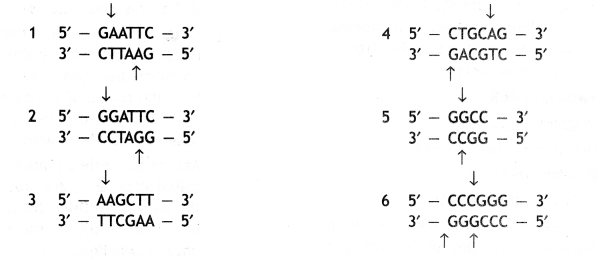
The palindromic sequences, i.e. the sequence of base pairs read the same on both the DNA strands when the orientation of reading is kept the same, e.g.
5’ — GAATTC — 3’
3’ — CTTAAG — 5’

Every endonuclease inspects the entire DNA sequence for palindromic recognition sequence.

(ii) Write the use of restriction endonuclease in the above process. (CBSE 2017)
Answer:
On finding the palindrome, the endonuclease binds to the DNA. It cuts the opposite strands of DNA, but between the same bases on both the strands and forms sticky ends. This sticky ends facilitate the action of enzyme DNA ligase and help in the formation of recombination DNA.

Question 15.
Describe the roles of heat, primers and the bacterium Thermus Aquaticus in the process of PCR. (CBSE 2017)
Answer:
Role of heat: Heat helps in the denaturation process in PCR. The double-stranded DNA is heated in this process at very high temperature (95°C) so that both the strands separate.

Role of primers: Primers are chemically synthesised small oligonucleotides of about 10-18 nucleotides. These are complementary to a region of template DNA and helps in the extension of the new chain. Rote of Bacterium Thermus

Aquaticus: A thermostable Taq DNA polymerase is isolated from this bacterium, which can tolerate high temperatures and forms new strand.

Question 16.
How has the use of Agrobacterium as vectors helped in controlling Meloidogyne incognita infestation in tobacco plants? Explain in the correct sequence. (CBSE 2018, Outside Delhi 2019)
Or
(a) Write the mechanism that enables Agrobacterium tumefaciens to develop tumours in their host dicot plant.
(b) State how Agrobacterium tumefaciens and some retroviruses have been modified as useful cloning vectors. (CBSE Delhi 2019 C)
Answer:
(a) Cloning
(b) A nematode Meloidogyne incognita infects the roots of tobacco plants and causes a great reduction in yield.

To prevent this infestation a novel strategy was adopted which was based on the process of RNA interference (RNAi).

Nematode-specific genes were introduced into the host plants using Agrobacterium vectors. The introduction of DNA was such that it produced both sense and anti-sense RNA in the host cells. These two RNAs, being complementary to each other, formed a double-stranded RNA (dsRNA) that initiated RNAi and thus, silenced specific mRNA of the nematode. Due to this the parasite could not survive in a transgenic host by expressing specific interfering RNA. The transgenic plant, therefore, got itself protected from the parasite.

Question 17.
Explain the roles of the following with the help of an example each in recombinant DNA technology:
(i) Restriction Enzymes
Answer:
Restriction enzymes :
(a) Restriction enzymes belong to nucleases class of enzymes which breaks nucleic acids by cleaving their phosphodiester bonds.
(b) Since restriction endonucleases cut DNA at a specific recognition site, they are used to cut the donor DNA to isolate the desired gene.
(c) The desired gene has sticky ends which can be easily ligated to cloning vector cut by same restriction enzymes having complementary sticky ends to form recombinant DNA.
(d) An example is EcoR1 which is obtained from E.coli bacteria “R” strain which cuts DNA at specific palindromic recognition site.
5‘ GAATTC 3‘
3‘ CTTAAG 5‘

(ii) Plasmids (CBSE 2018)
Answer:
Plasmids: Plasmids are autonomous, extrachromosomal circular double-stranded DNA of bacteria. They are used as cloning vectors in genetic engineering because they are small and self-replicating. Some plasmids have antibiotic resistance genes which can be used as marker genes to identify recombinant plasmids from non-recombinant ones.

To obtain the desired products, plasmids are cut and ligated with desired genes and transformed into a host cell for amplification. An example of artificially modified plasmids is pBR322 (constructed by Bolivar and Rodriguez) or pUC (constructed at University at California).

Question 18.
When the gene product is required in large amounts, the transformed bacteria with the plasmid inside the bacteria are cultured on a large scale in an industrial fermenter which then synthesises the desired protein. This product is extracted from the fermenter for commercial use.
(a) Why is the used medium drained out from one side while the fresh medium is added from the other? Explain.
Answer:
In the bioreactor used medium is drained out and the fresh medium is added to maintain the cells in their physiologically most active log / experimental phase,

(b) List any four optimum conditions for achieving the desired product in a bioreactor. (CBSE Sample Paper 2020)
Answer:
Condition for obtaining the desired product in a bioreactor:

  • Temperature
  • Substrates
  • SaLts
  • pH
  • Oxygen

Question 19.
List the steps in the formation of rDNA.
Answer:
Steps in formation of rDNA:
Recombined DNA technology involves the following steps:

  1. Isolation of DNA.
  2. Fragmentation of DNA by restriction endonucleases.
  3. Isolation of the desired DNA fragment.
  4. Amplification of the gene of interest.
  5. Ligation of the DNA fragment into a vector using DNA ligase.
  6. Transfer of DNA fragment into the vector using DNA ligase.

Question 20.
How is the isolated gene of interest amplified? (CBSE Delhi 2019, 2019 C)
Answer:
Amplification of the DNA/gene of interest:

  1. Amplification refers to the process of making multiple copies of the DNA segment in vitro.
  2. It employs the polymerase chain reaction (PCR).
  3. The process was designed by K. Mullis,
  4. This technique involves three main steps:
    (a) Denaturation
    (b) Primer annealing and
    (c) Extension of primers.
  5. The double-stranded DNA is denatured by subjecting it to high temperatures.
  6. Two sets of primers are used; primers are the chemically synthesised short segments of DNA (oligonucleotides), that are complementary to the segment of DNA (of interest).
  7. DNA polymerase enzyme (Taq polymerase) is used to make copies of DNA making use of genomic template DNA and primer.

Question 21.
List the features required to facilitate cloning into a vector. Show with a sketch the E. coli cloning vector showing restriction sites.
Or
Sketch pBR322. (CBSE 2012, Outside Delhi 2019)
Answer:
Features required to facilitate cloning vector.

  1. Origin of replication (Ori)
  2. Selectable marker
  3. Cloning sites
  4. Vectors for cloning genes in plants and animals
    Sites of cloning vector

Class 12 Biology Important Questions Chapter 11 Biotechnology 6

E. coli Cloning Vector pBr322 showing restriction sites (Hindlll, EcoRI, BamHI, Sal I, Pvu II, Pst I, ClaI), oriV and antibiotic resistance genes (ampR and tetR). Rop codes for the proteins involved in the replication of the plasmid.

Question 22.
With the help of simple sketch show the action of restriction enzyme (EcoR1).
Answer:
The action of restriction enzyme.
Class 12 Biology Important Questions Chapter 11 Biotechnology 7

Ecol cuts the DNA between bases G and A only when the sequence GAATTC is present in the DNA.

Question 23.
Explain the importance of (a) ori, (b) ampR and (c) rop in the E. colt vector. (CBSE Outside Delhi 2009, Outside Delhi 2019)
Answer:

  1. Importance of ori: This is a sequence from where replication starts and any piece of DNA, when linked to this sequence, can be made to replicate within the host cells, it allows multiple copies per cell.
  2. Importance of ampR: It is the antibiotic resistance gene for ampicillin. It helps in the selection of transformer cells.
  3. Importance of rop: It codes for the proteins involved in the replication of plasmid.

Question 24.
Name any two cloning vectors. Describe the features required to facilitate cloning into a vector. (CBSE Sample Paper)
Answer:
Plasmids and bacteriophages are two examples of the cloning vector. A vector is a DNA molecule that has the ability to replicate in an appropriate host cell and into which the DNA fragment to be cloned is integrated for cloning.

A good vector must have the following properties:

  • It should be able to replicate autonomously.
  • it should be easy to isolate and purify,
  • It should be easily introduced into the host cells.

Cloning vectors: All vectors that are used for propagation of DNA inserts in a suitable host are called cloning vectors. When a vector is designed for the expression of, i.e. production of the protein specified by, the DNA insert, it is termed as an expression vector.

Question 25.
What are bioreactors? Sketch the two types of bioreactors. What is the utility? Which is the common type of bioreactors? (CBSE Delhi 2013)
Or
How do bioreactors help in the production of recombinant proteins? (CBSE Outside Delhi 2009)
Or
(i) How has the development of bioreactor helped in biotechnology?
(ii) Name the most commonly used bioreactor and describe its working. (CBSE Delhi 2018, 2019 C)
Answer:
Small volume cultures cannot yield appreciable quantities of products. To produce these products in large quantities the development of ‘bioreactors’ was required where large volumes (100-1000 litres) of culture can be processed. Thus bioreactors can be thought of as vessels in which raw materials are biologically converted into specific products, using microbial, plant, animal or human cells or individual enzymes.

Role. A bioreactor provides the optimal conditions for achieving the desired product by providing optimum growth conditions (temperature, pH, substrate, salts, vitamins, oxygen).

One of the most commonly used bioreactors is of stirring type.

A stirred tank reactor is cylindrical or a container with a curved base which facilitate the mixing of the reactor contents. The stirrer facilitates even mixing and oxygen availability throughout the bioreactor. Alternatively, air can be passed through the reactor. It consists of agitator system, an oxygen delivery system, a foam control system, a temperature control system, pH control system and sampling ports so that small volumes of the culture can be withdrawn periodically.

Class 12 Biology Important Questions Chapter 11 Biotechnology 8

(a) Simple stirred-tank bioreactor (b) Sparged stirred-tank bioreactor through which sterile air bubbles are sparged

Question 26.
Describe briefly the following:
(i) Origin of replication (Ori).
Answer:
(a) It is a specific sequence of DNA bases, which is responsible for initiating replication.
(b) An alien DNA for replication should be linked to the origin of replication.
(c) A prokaryotic DNA has normally a single origin of replication, while eukaryotic DNA may have more than one origin of replication.
(d) The sequence is responsible for controlling the copy number of linked DNA.

(ii) Bioreactor.
Answer:
(a) They are vessels in which raw materials are biologically converted into specific products using microbial, plant or human cells.
(b) A bioreactor provides optimal conditions for achieving the desired product by providing optimum growth conditions, pH, substrate salts, vitamins, oxygen, etc.
(c) The commonly used bioreactors are of stirring type.
(d) A stirred-tank reactor is usually cylindrical or with a curved base to facilitate the mixing of the contents.
(e) The stirrer facilitates the even-mixing and oxygen availability throughout the bioreactor.
(f) The bioreactor has the following components:

  • An agitator system.
  • An oxygen delivery system.
  • A foam control system.
  • A temperature control system.
  • pH control system and
  • Sampling ports.

(iii) Downstream processing.
Answer:
(a) It refers to the series of processes, to which a genetically modified product has to be subjected before it is ready to be marketed.
(b) The processes include two processes:

  1. separation and
  2. purification.

(c) The product has to be formulated with suitable preservatives.
(d) Such formulation has to undergo thorough clinical trials in the case of drugs. Strict quality control testing is also required.
(e) A proper quality controlled testing of each product is also required.

Question 27.
Besides better aeration and mixing properties, what other advantages do stirred tank bioreactors to have over shake flasks?
Answer:
Shake flasks are the conventional flasks for fermentation studies during secondary screening or laboratory process development. So, stirred-tank bioreactors are used to produce the product in large quantities.

Besides aeration and mixing:

  1. it also helps in providing optimum growth conditions (temperature, pH, substrate, salts, vitamins, oxygen) to achieve the desired product.
  2. cost-effective
  3. due to baffles, the oxygen transfer rate is very high
  4. the capacity of fermenters is more.

Question 28.
Explain briefly the following
(i) PCR
(ii) Restriction enzymes and DNA
(iii) Chitinase. (CBSE 2012)
Or
Explain the three steps involved in a polymerase chain reaction. (CBSE Delhi 2018C)
Answer:
(i) PCR-Polymerase Chain Reaction; It is the process in which multiple copies of the gene or segment of DNA of interest are synthesised in vitro using primers and DNA polymerase.

Working Mechanism of PCR: A single PCR amplification cycle involves three basic steps: denaturation, annealing and extension (polymerisation).
(a) Denaturation. In the denaturation step, the target DNA is heated to a high temperature (usually 94°C), resulting in the separation of the two strands. Every single strand of the target DNA then acts as a template for DNA synthesis.

(b) Annealing (Anneal = Join). In this step, the two oligonucleotide primers anneal (hybridize) to each of the single-stranded template DNA since the sequence of the primers is complementary to the 3’ ends of the template DNA. This step is carried out at a lower temperature depending on the length and sequence of the primers.

(c) Primer Extension (Polymerisation): The final step is an extension, wherein Taq DNA polymerase (of a thermophilic bacterium Thermus aquatics) causes synthesis of the DNA region between the primers, using dNTPs (deoxynucleoside triphosphates) and Mg2+. It means the primers are extended towards each other so that the DNA segment lying between the two primers is copied.

The optimum temperature for this polymerisation step is 72°C. To begin the second cycle, the DNA is again heated to convert all the newly synthesised DNA into single strands, each of which can now serve as a template for synthesis of more new DNA. Thus the extension product of one cycle can serve as a template for subsequent cycles and each cycle essentially doubles the amount of DNA from the previous cycle. As a result, from a single template molecule, it is possible to generate 2n molecules after n number of cycles.

Applications of PCR:

  • Diagnosis of pathogen
  • Diagnosis of the specific mutation
  • DNA fingerprinting
  • Detection of plant pathogens
  • Cloning of DNA fragments from mummified remains of humans and extinct animals.

(ii) Restriction enzymes:
(a) They are called “molecular scissors” or chemical scalpels.
(b) Restriction enzymes, synthesised by micro-organisms as a defence mechanism, are specific endonucleases, which can cleave double-stranded DNA.
(c) Restriction enzymes belong to a class of enzymes called nucleases.
(d) They are of two kinds:

  • Exonucleases, which remove nucleotides from the ends of DNA.
  • Endonucleases, which cut the DNA at specific positions anywhere in its length (within).

(e) The recognition sequence is a palindrome, where the sequence of base pairs reads the same on both the DNA strands when the orientation of reading is kept the same, i.e. 5′ → 3′ direction or 3′ → 5′ direction.
e.g. 5′ – GAATTC – 3′
3′ – CTTAAG – 5′

(f) Each restriction endonuclease functions by inspecting the length of a DNA sequence and binds to the DNA at the recognition sequence.
(g) It cuts the two strands of the double helix at specific points in their sugar-phosphate backbones, a little away from the centre of the palindrome sites, but between the same two bases on both the strands.
(h) As a result, single-stranded portions called sticky ends are produced at the ends of the DNA; this stickiness of the end facilitates the action of enzyme DNA ligase.

  1. When cut by the same restriction endonuclease, the DNA fragments (of the donor as well as the host/ recipient) yield the same kind of ‘sticky ends’ which can be joined end-to-end by DNA ligases.
  2. Chitinase. This cell wall in fungi is made of chitin. The enzyme is used in fungi to break open the cell to release DNA along with their macromolecules like RNA proteins, lipids and polysaccharides.

Question 29.
Discuss with your teacher and find out how to distinguish between
(i) Plasmid DNA and chromosomal DNA
Answer:
Differences between plasmid DNA and chromosomal DNA:

Plasmid DNAChromosomal DNA
1. It is self-replicating, DNA molecule found naturally in many bacteria and yeast.1. Chromosomal DNA present in chromosomes of all organisms.
2. It is not essential for normal growth and division.2. It Is essential for growth and division.
3. It contains information for a few traits.3. It contains information for all traits.

(ii) Exonuclease and Endonuclease (CBSE, Delhi 2013)
Answer:
Differences between Exonuclease and Endonuclease:

EndonucleaseExonuclease
It cuts the DNA at a specific position of nitrogen bases anywhere within the length of DNA except the ends.This enzyme removes nucleotides from the terminals from 5’ or 3’ ends of DNA molecules.

Question 30.
Collect the examples of palindromic sequences by consulting your teacher. Better try to create a palindromic sequence by following base pair rules.
Answer:
Class 12 Biology Important Questions Chapter 11 Biotechnology 9

Question 31.
Can you list 10 recombinant proteins which are used In medical practice? Find where they are used as therapeutics (use the Internet).
Answer:

Recombinant ProteinTherapeutic Use
1. InsulinFor the treatment of diabetes Mellitus
2. Human Growth HormoneFor the treatment of dwarfism
3. InterferonsFor the treatment of viral diseases, cancer and AIDS.
4. StreptokinaseFor treating thrombosis.
5. Tumour Necrosis factorFor treating sepsis and cancer
6. InterleukinsFor treating various cancers.
7. Hepatitis-B Surface AntigenThe vaccine against Hepatitis- B
8. Granulocyte Colony-stimulating factorFor treating cancer and AIDS and in bone marrow transplantation
9. Granulocyte-macrophage Colony-stimulating factorFor treating cancer and AIDS
10. Bovine growth hormoneFor increasing milk yield.

Question 32.
How is DNA isolated in a purified form? (CBSE Outside Delhi 2009)
Answer:
Isolation of DNA in the purified form:

  1. DNA has to be isolated in pure form for the action of restriction enzymes.
  2. DNA can be released from the cells by digesting the cell envelope by the use of enzymes like lysozyme for bacterial cells, chitinase for fungal cells and cellulase for plants cells.
  3. Since DNA is intertwined with histone proteins and RNAs, proteins are removed by treatment with proteases and RNAs by ribonucleases.
  4. Other impurities are removed by employing suitable treatments.
  5. The purified DNA is precipitated by the addition of chilled ethanol. It is seen as fine threads in suspension.

Question 33.
How is isolation and Fragmentation of DNA of interest carried out in recombinant DNA technology? (CBSE Outside Delhi 2009, 2019)
Answer:
1. Fragmentation DNA: Fragmentation of DNA is carried out by incubating the purified DNA molecules with suitable restriction enzymes at optimal conditions of temperature and pH.

2. Isolation of DNA (gene) of Interest:
(a) The fragments of DNA are separated by a technique called gel electrophoresis.
(b) The DNA is cut into fragments by restriction endonucleases.
(c) These fragments are separated by a technique called gel electrophoresis.
(d) Agarose, the natural polymer obtained from seaweeds, is used as the matrix.
(e) DNA fragments being negatively charged are separated by forcing them to move through the matrix towards the anode under an electric field.
(f) The DNA fragments separate/ resolve according to their size.
(g) The separated molecules are stained by ethidium bromide and visualised by exposure to UV radiation, as bright orange coloured bands.
(h) The separated bands of DNA (on the gel) are cut from the gel and extracted from the gel piece (elution).
(i) Such DNA fragments are purified and used for constructing recombinant DNA by joining them with cloning vectors.

CBSE Sample Papers for Class 10 Science Set 2 with Solutions

Students can access the CBSE Sample Papers for Class 10 Science with Solutions and marking scheme Set 2 will help students in understanding the difficulty level of the exam.

CBSE Sample Papers for Class 10 Science Set 2 with Solutions

Time: 3 Hours
Maximum Marks: 80

General Instructions:

(i) The question paper comprises four sections A, B, C and D. There are 36 questions in the question paper. All questions are compulsory.
(ii) Section-A – question no. 1 to 20 – all questions and parts there of are of one mark each.
These questions contain multiple choice questions (MCQs), very short answer questions and assertion – reason type questions. Answers to these should be given in one word or one sentence.
(iii) Section-B – question no. 21 to 26 are short answer type questions, carrying 2 marks each. Answers to these questions should in the range of 30 to 50 words.
(iv) Section-C – question no. 27 to 33 are short answer type questions, carrying 3 marks each.
Answers to these questions should in the range of 50 to 80 words. :
(v) Section—D – question no. – 34 to 36 are long answer type questions carrying 5 marks each. Answer to these questions should be in the range of 80 to 120 words.
(vi) There is no overall choice. However, internal choices have been provided in some questions. A student has to attempt only one of the alternatives in such questions.
(vii) Wherever necessary, neat and properly labelled diagrams should be drawn.

Section-A

Question 1.
List any two observations when ferrous sulphate is heated in a dry test tube?
OR
Identify the products formed when 1 mL of dil. hydrochloric acid is added to 1g of sodium metal?
Answer:

  • Initial light green colour changes to reddish-brown colour
  • Colourless gas is evolved
  • Gas with choking smell is evolved (Any two)
    OR
  • Sodium chloride and hydrogen gas

Question 2.
Write the chemical name and chemical formula of the salt used to remove the permanent hardness of water.
Answer:
Sodium carbonate decahydrate, Na2CO3.10H2O

Question 3.
Which of the following is not observed in a homologous series? Give reason for your choice,
(a) Change in chemical properties
(b) Difference in -CH2 and 14u molecular mass
(c) Gradation in physical properties
(d) Same functional group
Answer:
(a) It does not occur due to the presence of the same functional group.

Question 4.
Why does the sun appear white at noon?
Answer:
The light is least scattered at noon.

Question 5.
Both a spherical mirror and a thin spherical lens have a focal length of (-)15 cm. What type of mirror and lens are these?
Answer:
Both are concave.
Alternative answer that should be given credit: Plano-concave lens.

Question 6.
The image formed by a concave mirror is observed to be real, inverted and larger than the object. Where is the object placed?
OR
Name the part of a lens through which a ray of light passes without suffering any deviation.
Answer:
Between the principal focus and the centre of curvature.
OR
Optical centre.

Question 7.
In the arrangement shown in figure there are two coils wound on a nonconducting cylindrical rod. Initially the key is not inserted in the circuit. Later the key is inserted and then removed shortly after.
CBSE Sample Papers for Class 10 Science Set 2 with Solutions 1
What are the two observations that can be noted from the galvanometer reading?
Answer:
There are momentary galvanometer deflections that die out shortly; the deflections are in opposite directions.

Question 8.
Draw the magnetic field lines around a straight current carrying conductor.
Answer:
The field consists of concentric circles centred on the wire
CBSE Sample Papers for Class 10 Science Set 2 with Solutions 2

Question 9.
Two unequal resistances are connected in parallel. If you are not provided with any other parameters (eg. numerical values of I and R), what can be said about the voltage drop across the two resistors?
OR
Some work is done to move a charge Q from infinity to a point A in space. The potential of the point A is given as V. What is the work done to move this charge from infinity in terms of Q and V?
Answer:
Voltage-drop is same across both OR W = QV

Question 10.
Veins are thin walled and have valves. Justify.
Answer:
Veins have thin walls because the blood there is no longer under pressure and they have valves to ensure blood flow in one direction.

Question 11.
How is the wall of small intestine adapted for performing the function of absorption of food?
OR
Out of a goat and a tiger, which one will have a longer small intestine? Justify your answer.
Answer:
The inner lining of the small intestine has numerous finger-like projections called villi which increase the surface area for absorption.
OR
Goat because herbivores eating grass need a longer small intestine to allow the cellulose to be digested.

Question 12.
Explain how ozone being a deadly poison can still perform an essential function for our environment.
OR
Give reason why a food chain cannot have more than four trophic levels.
Answer:
Ozone layer protects us from harmful effects of UV radiation.
OR
The loss of energy at each step is so great that very little usable energy remains after four trophic levels.

Question 13.
State the role of pancreas in digestion of food.
Assertion (A) and Reason (R)
For question numbers 14,15 and 16, two statements are given- one labeled Assertion (A) and the other labeled Reason (R).

Select the correct answer to these questions from the codes (i), (ii), (iii) and (iv) as given below:
(i) Both A and R are true, and R is correct explanation of the assertion.
(ii) Both A and R are true, but R is not the correct explanation of the assertion.
(iii) A is true, but R is false.
(iv) A is false, but R is true.
Answer:
The pancreas secretes digestive juice which contains enzymes like trypsin for digesting proteins and lipase for breakdown of emulsified fats.

Question 14.
A. After white washing the walls, a shiny white finish on walls is obtained after two to three days. R. Calcium oxide reacts with carbon dioxide to form calcium hydrogen carbonate which gives a shiny white finish.
Answer:
(iii)

Question 15.
A. Food chain is responsible for the entry of harmful chemicals in our bodies. R. The length and complexity of food chains vary greatly.
OR
A. Greater number of individuals are present in lower trophic levels.
R. The flow of energy is unidirectional.
Answer:
(ii) OR (ii)

Question 16.
A. A geneticist crossed a pea plant having violet flowers with a pea plant with white flowers, he got all violet flowers in first generation. R. White colour gene is not passed on to next generation.
Answer:
(i)

Answer Q. No 17 – 20 contain five sub-parts each. You are expected to answer any four sub¬parts in these questions.

Question 17.
Read the following and answer any four questions from 17 (i) to 17 (v) (4 x 1 = 4)
All living cells require energy for various activities. This energy is available by the breakdown of simple carbohydrates either using oxygen or without using oxygen. 4 x 1 = 4
(i) Energy in the case of higher plants and animals is obtained by
(a) Breathing
(b) Tissue respiration
(c) Organ respiration
(d) Digestion of food
Answer:
(b) Tissue respiration

(ii) The graph below represents the blood lactic acid concentration of an athlete during a race of 400 m and shows a peak at point D. Respiration in athletics: The blood of an athlete was tested before, during and after a 400 m race:
CBSE Sample Papers for Class 10 Science Set 2 with Solutions 3

Lactic acid production has occurred in the athlete while running in the 400 m race. Which of the following processes explains this event?
(a) Aerobic respiration
(b) Anaerobic respiration
(c) Fermentation
(d) Breathing
Answer:
(b) Anaerobic respiration

(iii) Study the graph below that represents the amount of energy supplied with respect to the time while an athlete is running at full speed.
CBSE Sample Papers for Class 10 Science Set 2 with Solutions 4
Choose the correct combination of plots and justification provided in the following table.

Plot APlot BJustification
(a)AerobicAnaerobicAmount of energy is low and inconsistent in aerobic and high in anaerobic
(b)AerobicAnaerobicAmount of energy is high and consistent in aerobic and low in anaerobic
(c)AnaerobicAerobicAmount of energy is high and consistent in aerobic and low in anaerobic
(d)AnaerobicAerobicAmount of energy is high and inconsistent in anaerobic and low in aerobic

Answer:
(b)

(iv) The characteristic processes observed in anaerobic respiration are
(1) presence of oxygen
(2) release of carbon dioxide
(3) release of energy
(4) release of lactic acid
(a) (1), (2) only
(b) (1), (2), (3) only
(c) (2), (3), (4) only
(d) (4) only
Answer:
(c) (2), (3), (4) only

(v) Study the table below and select the row that has the incorrect information.

AerobicAnaerobic
(a)LocationCytoplasmMitochondria
(b)End ProductCO2 and H2OEthanol and CO7
(c)Amount of ATPHighLow
(d)OxygenNeededNot needed

Answer:
(d)

Question 18.
Read the following and answer any four questions from 18 (i) to 18 (v). (4 x 1 = 4)
Answer:
Metallic Character
The ability of an atom to donate electrons and form positive ion (cation) is known as electropositivity or metallic character. Down the group, metallic character increases due to increase in atomic size and across the period, from left to right electropositivity decreases due to decrease in atomic size.

Non-Metallic Character
The ability of an atom to accept electrons to form a negative ion (anion) is called non-metallic character or electronegativity. The elements having high electronegativity have a higher S tendency to gain electrons and form anion. Down the group, electronegativity decreases due to increase in atomic size and across the period, from left to S right electronegativity increases due to decrease in atomic size.

(i) Which of the following correctly represents the decreasing order of metallic character of alkali metals plotted in the graph?
CBSE Sample Papers for Class 10 Science Set 2 with Solutions 5
(a) Cs > Rb > Li > Na > K
(b) K > Rb > Li > Na > Cs
(c) Cs > Rb > K > Na > Li
(d) Cs > K > Rb > Na > Li
Answer:
(c) Cs > Rb > K > Na > Li

(ii) Hydrogen is placed along with alkali metals in the modem periodic table though it shows non-metallic character
(a) as hydrogen has one electron & readily loses electron to form negative ion
(b) as hydrogen can easily lose one electron like alkali metals to form positive ion
(c) as hydrogen can gain one electron easily like halogens to form negative ion
(d) as hydrogen shows the properties of non-metals
Answer:
(b) as hydrogen can easily lose one electron like alkali metals to form positive ion

(iii) Which of the following has highest electronegativity?
(a) F
(b) Cl
(c) Br
(d) I
Answer:
(a) F

(iv) Identify the reason for the gradual change in electronegativity in halogens down the group.
(a) Electronegativity increases down the group due to decrease in atomic size
(b) Electronegativity decreases down the group due to decrease in tendency to lose electrons
(c) Electronegativity decreases down the group due to increase in atomic radius/ tendency to gain electron decreases
(d) Electronegativity increases down the group due to increase in forces of attractions between nucleus & valence electrons
Answer:
(c) Electronegativity decreases down the group due to increase in atomic radius/ tendency to gain electron decreases

(v) Which of the following reason correctly justifies that “Fluorine (72pm) has smaller atomic radius than Lithium (152pm)”?
(a) F and Li are in the same group. Atomic size increases down the group
(b) F and Li are in the same period. Atomic size increases across the period due to increase in number of shells
(c) F and Li are in the same group. Atomic size decreases down the group
(d) F and Li are in the same period and across the period atomic size/radius decreases from left to right.
Answer:
(a) F and Li are in the same group. Atomic size increases down the group

Question 19.
Read the following and answer any four questions from 19 (1) to 19 (v). (4 x 1 = 4)
Sumati wanted to see the stars of the night sky. She knows that she needs a telescope to see those distant stars. She finds out that the telescopes, which are made of lenses, are called refracting telescopes and the ones which are made of mirrors are called reflecting telescopes.
CBSE Sample Papers for Class 10 Science Set 2 with Solutions 6
So she decided to make a refracting telescope. She bought two lenses, Lj and L2. out of which Lj was bigger and L2 was smaller. The larger lens gathers and bends the light, while the smaller lens magnifies the image. Big, thick lenses are more powerful. So to see far away, she needed a big powerful lens.

Unfortunately, she realized that a big lens is very heavy. Heavy lenses are hard to make and difficult to hold in the right place. Also since the light is passing through the lens, the surface of the lens has to be extremely smooth. Any flaws in the lens will change the image. It would be like looking through a dirty window.

(i) Based on the diagram shown, what kind of lenses would Sumati need to make the telescope?
(a) Concave lenses
(b) Convex lenses
(c) Bifocal lenses
(d) Flat lenses

(ii) If the powers of the lenses L1 and L2 are in the ratio of 4:1, what would be the ratio of the focal length of L1 and L2?
(a) 4:1
(b) 1:4
(c) 2:1
(d) 1:1

(iii) What is the formula for magnification obtained with a lens?
(a) Ratio of height of image to height of object
(b) Double the focal length.
(c) Inverse of the radius of curvature.
(d) Inverse of the object distance.

(iv) Sumati did some preliminary experiment with the lenses and found out that the magnification of the eyepiece (L2) is 3. If in her experiment with L2 she found an image at 24 cm from the lens, at what distance did she put the object?
(a) 72 cm
(b) 12 cm
(c) 8 cm
(d) 6 cm

(v) Sumati bought not-so-thick lenses for the telescope and polished them. What advantages, if any, would she have with her choice of lenses?
(a) She will not have any advantage as even thicker lenses would give clearer images.
(b) Thicker lenses would have made the telescope easier to handle.
(c) Not-so-thick lenses would not make the telescope very heavy and also allow considerable amount of light to pass.
(d) Not-so-thick lenses will give her more magnification.
Answer:
CBSE Sample Papers for Class 10 Science Set 2 with Solutions 7

Question 20.
Read the following and answer any four questions from 20 (i) to 20 (v). (4 x 1 = 4)
A solenoid is a long helical coil of wire through which a current is run in order to create a magnetic field. The magnetic field of the solenoid is the superposition of the fields due to the current through each coil.

It is nearly uniform inside the solenoid and close to zero outside and is similar to the field of a bar magnet having a north pole at one end and a south pole at the other depending upon the direction of current flow. The magnetic field produced in the solenoid is dependent on a few factors such as, the current in the coil, number of turns per unit length etc.

The following graph is obtained by a researcher while doing an experiment to see the variation of the magnetic field with respect to the current in the solenoid.

The unit of magnetic field as given in the graph attached is in milli-Tesla (mT) and the current is given in Ampere.
CBSE Sample Papers for Class 10 Science Set 2 with Solutions 8

(i) What type of energy conversion is observed in a linear solenoid?
(a) Mechanical to Magnetic
(b) Electrical to Magnetic
(c) Electrical to Mechanical
(d) Magnetic to Mechanical
Answer:
(c) Electrical to Mechanical

(ii) What will happen if a soft iron bar is placed inside the solenoid?
(a) The bar will be electrocuted resulting in short-circuit.
(b) The bar will be magnetised as long as there is current in the circuit.
(c) The bar will be magnetised permanently.
(d) The bar will not be affected by any means.
Answer:
(b) The bar will be magnetised as long as there is current in the circuit.

(iii) The magnetic field lines produced inside the solenoid are similar to that of…
(a) a bar magnet
(b) a straight current carrying conductor
(c) a circular current carrying loop
(d) electromagnet of any shape
Answer:
(a) a bar magnet

(iv) After analysing the graph a student writes the following statements.
I. The magnetic field produced by the solenoid is inversely proportional to the current.
II. The magnetic field produced by the solenoid is directly proportional to the current.
III. The magnetic field produced by the solenoid is directly proportional to square of the current.
IV. The magnetic field produced by the solenoid is independent of the current.
Choose from the following which of the following would be the correct statement(s).
(a) Only IV
(b) I and III and IV
(c) I and II
(d) Only II
Answer:
(d) Only II

(v) From the graph deduce which of the following statements is correct.
(a) For a current of 0.8 A the magnetic field is 13 mT
(b) For larger currents, the magnetic field increases non-linearly.
(c) For a current of 0.8A the magnetic field is 1.3 mT
(d) There is not enough information to find the magnetic field corresponding to 0.8A current.
Answer:
(a) For a current of 0.8 A the magnetic field is 13 mT

Section-B

Question 21.
Bile juice does not have any digestive enzyme but still plays a significant role in the process of digestion. Justify the statement.
OR
In birds and mammals the left and right side of the heart are separated. Give reasons.
Answer:
Bile juice makes the acidic food coming from the stomach alkaline for the action of pancreatic enzymes. Bile salts break the large globules of fat in the intestine to smaller globules increasing the efficiency of enzyme action. This is similar to the emulsifying action of soaps on dirt.
OR
The separation keeps oxygenated and deoxygenated blood from mixing allowing a highly efficient supply of oxygen to the body. This is useful in animals that have high energy needs (birds and mammals) which constantly use energy to maintain their body temperature.

Question 22.
State the events occurring during the process of photosynthesis. Is it essential that these steps take place one after the other immediately?
Answer:
CBSE Sample Papers for Class 10 Science Set 2 with Solutions 14
Absorption of light energy by chlorophyll.

  • Conversion of light energy to chemical energy and splitting of water molecules into hydrogen and oxygen.
  • Reduction of carbon dioxide to carbohydrates.

These steps need not take place one after the other immediately. For example, desert plants take up carbon dioxide at night and prepare an intermediate which is acted upon by the energy absorbed by the chlorophyll during the day

Question 23.
Give a test that can be used to confirm the presence of carbon in a compound. With a valency of 4, how is carbon able to attain noble gas configuration in its compounds?
OR
The number of carbon compounds is more than those formed by all other elements put together. Justify the statement by giving two reasons.
Answer:
A bum compound in air/ oxygen; Gas evolved turns lime water milky
By sharing its four valence electrons with other elements.
OR

  • Due to self linking ability of carbon/catenation
  • Since carbon has a valency of four it can form bonds with four other atoms of carbon or atoms of some other mono-valent element.
  • Due to small size of carbon it forms very strong and (or) stable bonds with other elements

Question 24.
The following observations were made by a student on treating four metals P, Q, R and S with the given salt solutions:

SampleMgS04(aq)Zn(NO3)2(aq)CaS04(aq)Na2S04(aq)
PNo reactionReaction occursReaction occursNo reaction
QReaction occursReaction occursReaction occursReaction occurs
RNo ReactionReaction occursNo ReactionNo Reaction
SNo ReactionNo ReactionNo ReactionNo Reaction

Based on the above observations:
(i) Arrange the given samples in the increasing order of reactivity
(ii) Write the chemical formulae of products formed when Q reacts with CuS04 solution.
Answer:
(i) S > R > P > Q
(ii) Cu and QSO4

Question 25.
A student observes the given phenomenon in the lab as a white light passes through a prism. Among many other colours, he observed the position of the two colours red and violet. What is the phenomenon called? What is the reason for the violet light to bend more than the red light?
CBSE Sample Papers for Class 10 Science Set 2 with Solutions 9
Answer:

  • The phenomenon is called dispersion.
  • Speed of violet light inside the prism is slowest and that of red is highest. Hence, the deviation of violet light is maximum and that of red is minimum.

Question 26.
A student has two resistors- 2 Q and 3 Q. She has to put one of them in place of R2 as shown in the circuit. The current that she needs in the entire circuit is exactly 9A. Show by calculation which of the two resistors she should choose.
CBSE Sample Papers for Class 10 Science Set 2 with Solutions 10
Answer:
The overall current needed = 9A. The voltage is 12V Hence by Ohm’s law V=IR,
R2 = 2Q
The resistance for the entire circuit = \(=\frac{12}{9}=\frac{4}{3} \Omega=\mathrm{R}\)
R1 and R2 are in parallel.
Hence, R = \(R=\frac{\left(R_{1} R_{2}\right)}{\left(R_{1}+R_{2}\right)}=\frac{4 R_{2}}{\left(4+R_{2}\right)}=\frac{4}{3}\)

Section-C

Question 27.
After self-pollination in pea plants with round, yellow seeds, following types of seeds were obtained by Mendel:

SeedsNumber
Round, yellow630
Round, green216
Wrinkled, yellow202
Wrinkled, green64

Analyse the result and describe the mechanism of inheritance which explains these results.
OR
In humans, there is a 50% probability of the birth of a boy and 50 % probability that a girl will be born. Justify the statement on the basis of the mechanism of sex-determination in human beings.
Answer:
The ratio obtained is 9:3:3:1 in which parental as well as new combinations are observed. This indicates that progeny plants have not inherited a single whole gene set from each parent. Every germ cell takes one chromosome from the pair of maternal and paternal chromosomes. When two germ cells combine, segregation of one pair of characters is independent of other pair of characters.
OR
In human beings, the genes inherited from our parents decide whether we will be boys or girls. Women have a perfect pair of sex chromosomes (XX). But, men have a mismatched pair (XY).

All children will inherit an X chromosome from their mother regardless of whether they are boys or girls. Thus, the sex of the children will be determined by what they inherit from their father. A child who inherits an X chromosome from her father will be a girl, and one who inherits a Y chromosome from him will be a boy.

Question 28.
Plastic cups were used to serve tea in trains in early days- these could be returned to the vendors, cleaned and reused. Later,Kulhads were used instead of plastic cups. Now, paper cups are used for serving tea. What are the reasons for the shift from Plastic to Kulhads and then finally to paper cups?
Answer:

  • Use of Plastic cups raised the concern towards hygiene thus they were replaced by disposable plastic cups.
  • Plastic cups are non-biodegradable and harm the environment. They were thus replaced by Kulhads.
  • Making Kulhad made of clay on a large scale resulted in the loss of top fertile soil.
  • Now, disposable paper cups are used because – the paper can be recycled, it is biodegradable and is eco-friendly material which does not cause environmental pollution.

Question 29.
Explain where and how urine is produced?
Answer:
Blood passes through filtration units in the kidney called nephron

  • Passes through glomerulus in the Bowman’s capsule – Ultra filtration
  • Filtrate initially has glucose, amino acids, water, salts and nitrogenous waste
  • Reabsorption – Water (as per the need of the body), Glucose and amino acids are all reabsorbed
  • Secretion of excess water, salts and urea (nitrogenous waste) which makes up the urine.

Question 30.
(i) Which of the following reactions is/ are an endothermic reaction(s) where decomposition also happens?
• Respiration
• Heating of lead nitrate
• Decomposition of organic matter
• Electrolysis of acidified water
(ii) Silver chloride when kept in the open turns grey. Illustrate this with a balanced chemical equation.
Answer:
(i) Heating of lead nitrate; and electrolysis of acidified water

(ii) \(2 \mathrm{AgCl}(\mathrm{s}) \stackrel{\text { Sunlight }}{\longrightarrow} 2 \mathrm{Ag}(\mathrm{s})+\mathrm{Cl}_{2}(\mathrm{~g})\)
(No deduction for not mentioning state of reactants and products.)

Question 31.
The following table shows the position of five elements A, B, C, D and E in the modem periodic table.
CBSE Sample Papers for Class 10 Science Set 2 with Solutions 11
Answer:
(i) D, As it is on the left side of the table in group 2.
(ii) C, as it is in the group 18/ Noble gas.
(iii) E, as we move from left to right across a period, atomic radius decreases.

Question 32.
(i) Explain the formation of calcium chloride with the help of electron dot structure. (At numbers: Ca = 20; Cl = 17)
(ii) Why do ionic compounds not conduct electricity in solid state but conduct electricity in molten and aqueous state?
Answer:
CBSE Sample Papers for Class 10 Science Set 2 with Solutions 15
(ii) Ionic compounds do not conduct in solid state due to absence of free ions but they conduct electricity in molten and aqueous state due to presence of free ions.

Question 33.
Refractive index of water with respect to air is 1.33 and that of diamond is 2.42.
(i) In which medium does the light move faster, water or diamond?
(ii) What is the refractive index of diamond with respect to water?
Answer:
Refractive index = speed of light in vacuum / speed of light in medium.
Since the refractive index of diamond is more, hence the speed of light is lesser in diamond.
Let speed of light in water be vw and in diamond be vd.
Refractive index of diamond w.r.t water is say n = speed of light in water / speed of light in diamond
n = vwvd
Dividing both numerator and denominator by speed of light [c] we get
n = (vw/c) (vd/c)
= Inverse ratio of refractive index of water and diamond.
n = 2.42/1.33 = 1.82 (approx.)

Section-D

Question 34.
Match the following pH values 1,7, 10, 13 to the solutions given below:
• Milk of magnesia
• Gastric juices
• Brine
• Aqueous sodium hydroxide
Amit and Rita decided to bake a cake and added baking soda to the cake batter.

Explain with a balanced reaction, the role of the baking soda. Mention any other use of baking soda. 5
OR
(i) Four samples A, B, C and D change the colour of pH paper or solution to green, reddish- pink, blue and orange. Their pH was recorded as 7,2, 10.5 & 6 respectively. Which of the samples has the highest amount of hydrogen ion concentration? Arrange the four samples in the decreasing order of their pH.

(ii) Rahul found that the Plaster of Paris, which he stored in a container, has become very hard and lost its binding nature. What is the reason for this? Also, write a chemical equation to represent the reaction taking place.

(iii) Give any one use of Plaster of Paris other than for plastering or smoothening of walls.
Answer:

  • Milk of magnesia – 10
  • Gastric juices – 1
  • Brine – 7
  • Aqueous sodium hydroxide – 13

Baking soda undergoes thermal decomposition to form Na2CO3, CO2 and H2O; CO2 makes the cake fluffy & soft
\(\mathrm{NaHCO}_{3} \stackrel{\text { Heat }}{\longrightarrow} \mathrm{Na}_{2} \mathrm{CO}_{3}+\mathrm{CO}_{2}+\mathrm{H}_{2} \mathrm{O}\)

Uses:
Used in fire extinguishers/ antacid to neutralize excess acid in stomach / to neutralize the effect of acid in insect sting.
OR
(i) (a) B
(b) C,A,D,B
(ii) Due to moisture in the atmosphere it converted into gypsum
\(\mathrm{CaSO}_{4} \cdot 1 / 2 \mathrm{H}_{2} \mathrm{O}+1 / 2 \mathrm{H}_{2} \mathrm{O} \rightarrow \mathrm{CaSO}_{4} \cdot 2 \mathrm{H}_{2} \mathrm{O}\)
(iii) Making toys/dolls or statues /fixing broken limbs/making decorative materials.

Question 35.
Trace the changes that take place in a flower from gamete formation to fruit formation.
Answer:
[Diagram drawn and annotated with the following points will also be considered]

CBSE Sample Papers for Class 10 Science Set 2 with Solutions 16

  • Stamen is the male reproductive part and it produces pollen grains.
  • The ovary contains ovules and each ovule has an egg cell.
  • The pollen needs to be transferred from the stamen to the stigma.
  • If this transfer of pollen occurs in the same flower, it is referred to as self-pollination.

On the other hand, if the pollen is transferred from one flower to another, it is known as cross-pollination.
After the pollen lands on a suitable stigma, it has to reach the female germ-cells which are in the ovary. For this, a tube grows out of the pollen grain and travels through the style to reach the ovary/Figure

  • The male germ-cell produced by pollen grain fuses with the female gamete present in the ovule.
  • This fusion of the germ-cells or fertilisation gives the zygote.
  • After fertilisation, the zygote divides several times to form an embryo within the ovule.
  • The ovule develops a tough coat and is gradually converted into a seed. The ovary grows rapidly and ripens to form a fruit.
  • Meanwhile, the petals, sepals, stamens, style and stigma may shrivel and fall off.

Question 36.
In the given circuit, A, B, C and D are four lamps connected with a battery of 60V.
CBSE Sample Papers for Class 10 Science Set 2 with Solutions 12
Analyse the circuit to answer the following questions.
(i) What kind of combination are the lamps arranged in (series or parallel)?
(ii) Explain with reference to your above answer, what are the advantages (any two) of this combination of lamps?
(iii) Explain with proper calculations which lamp glows the brightest?
(iv) Find out the total resistance of the circuit.
OR
PQ is a current carrying conductor in the plane of the paper as shown in the figure below.
(i) Find the directions of the magnetic fields produced by it at points R and S?
(ii) Given r1> r2 where will the strength of the magnetic field be larger? Give reasons.
(iii) If the polarity of the battery connected to the wire is reversed, how would the direction of the magnetic field be changed?
CBSE Sample Papers for Class 10 Science Set 2 with Solutions 13
(iv) Explain the rule that is used to find the direction of the magnetic field r2 for a straight current carrying conductor.
Answer:
(i) The lamps are in parallel.

(ii) Advantages:
If one lamp is faulty, it will not affect the working of the other lamps.
They will also be using the full potential of the battery as they are connected in parallel.

(iii) The lamp with the highest power will glow the brightest.
P= VI
In this case, all the bulbs have the same voltage. But lamp C has the highest current. Hence, for lamp C, P = 5 x 60 Watt = 300 W. (the maximum).

(iv) The total current in the circuit = (3 + 4 + 5 + 3) A = 15A
The Voltage = 60V
V = IR and hence R = V/I
R= 60/15 Ω = 4Ω

OR

(i) The magnetic field lines produced is into the plane of the paper at R and out of it at S.

(ii) Field at S > Field at P Magnetic field strength for a straight current carrying conductor is inversely proportional to the distance from the wire.

(iii) The current will be going from top to bottom in the wire shown and the magnetic field lines are now in the clockwise direction on the plane which is perpendicular to the wire carrying current.

(iv) Right hand thumb rule. The thumb is aligned to the direction of the current and the direction in which the fingers are wrapped around the wire will give the direction of the magnetic field.

Microbes in Human Welfare Class 12 Important Extra Questions Biology Chapter 10

Here we are providing Class 12 Biology Important Extra Questions and Answers Chapter 10 Microbes in Human Welfare. Important Questions for Class 12 Biology are the best resource for students which helps in Class 12 board exams.

Class 12 Biology Chapter 10 Important Extra Questions Microbes in Human Welfare

Microbes in Human Welfare Important Extra Questions Very Short Answer Type

Question 1.
Which bacterium Is responsible for the formation of curd from milk?
Answer:
Lactobacillus but Agaricus (Lactic acid bacteria).

Question 2.
What is brewing?
Answer:
Brewing is a complex fermentation process, which involves the production of malt beverages such as beer, ale, porter, and stout with the help of strains of Saccharomyces cerevisiae.

Question 3.
Name the type of association that genus Glomus exhibits with the higher plant. (CBSE2014)
Answer:
Mycorrhiza- Symbiotic association.

Question 4.
Which one of the following is the baker’s yeast used in fermentation-Saccharum Barberi, Saccharomyces cerevisiae or Sonalika? (CBSE2009)
Answer:
Saccharomyces cerevisiae.

Question 5.
Milk starts to coagulate when Lactic Acid Bacteria (LAB) is added to milk as a starter. Mention two benefits that LAB provides. (CBSE 2009)
Answer:

  1. LAB checks the growth of disease-causing microbes.
  2. LAB converts milk into curd and also increases nutritional quality by increasing vitamin B12.

Question 6.
Give the scientific name of the source organism from which the first antibiotic was produced. (CBSE Sample paper 2018-19)
Answer:
Penicillium Notatum

Question 7.
Name the different vitamins which are produced by micro-organisms.
Answer:

  1. Riboflavin or Vitamin B2 is produced by yeast and bacteria.
  2. Vitamin B12 or cobalamine is produced by bacteria and actinomycetes.

Question 8.
Name the original wild strain of the mold by which vitamin B2 is produced.
Answer:
Ashbya Gossypii.

Question 9.
What is a single-cell protein (SCP)?
Answer:
Single-cell protein (SCP) refers to any microbial biomass produced by uni and multi-cellular organisms and can be used as food or feed additives.

Question 10.
Name a microbe used for statin production. How do statins lower blood cholesterol levels?
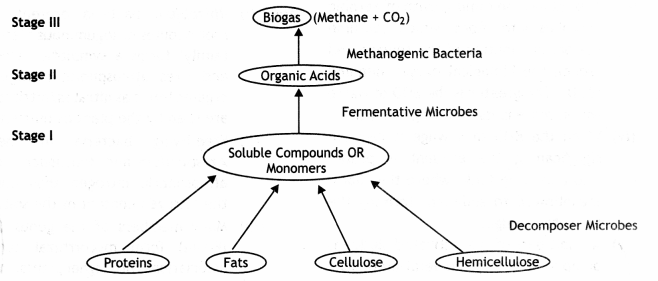
Answer:
Microbe:
Monascus Purpureus Mechanism: Statins are competitive inhibitors of enzymes required for cholesterol synthesis. Therefore, play role in decreasing cholesterol level in the body.

Question 11.
‘Swiss cheese’ is characterized by the presence of large holes. Name the bacterium responsible for it. (CBSE Delhi Outside 2019)
Answer:
Propionibacterium sharmanii

Question 12.
What for Nudeopolyhedra viruses (NVP) are being used nowadays? (CBSE, Delhi 2014, 2019C)
Answer:
Nudeopolyhedro viruses are being used to kill insects and other arthropods pests of crops. The viruses have no effect on plants and non-target animals. Thus used in biological control of pests.

Question 13.
How has the discovery of antibiotics helped mankind in the field of medicine?
Answer:
Antibiotics have helped mankind in treating most of the deadly bacterial and fungal diseases of humans.

Question 14.
Why is distillation required for producing certain alcoholic drinks?
Answer:
For increasing the alcohol strength or concentration of the drinks.

Question 15.
What is the primary sludge?
Answer:
All the solids that settle from the sewage on primary treatment constitute primary sludge.

Question 16.
What is the relationship between BOD and organic matter in sewage?
Answer:
The greater the BOD of wastewater more is the amount of organic matter in sewage.

Question 17.
Name two gases produced during secondary treatment by sewage.
Answer:

  1. Carbon dioxide and
  2. Hydrogen sulfide.

Question 18.
What are bioreactors?
Answer:
In the pilot plant, the glass vessels are replaced by stainless steel vessels. They are called bioreactors.

Question 19.
Name the bacteria which can be used for yogurt formation.
Answer:

  1. Lactobacillus bulsaricus.
  2. Streptococcus Thermophilus.

Question 20.
What is Bacitracin?
Answer:
It is an antibiotic obtained from Bacillus Licheniformis.

Question 21.
Name the group of organisms and the substrate they act on to produce biogas. (CBSE 2009)
Answer:
Methanogens such as Methanol bacterium act on activated sludge to produce biogas.

Question 22.
WrIte the scientific name of the microbe used for fermenting malted cereals and fruit juices. (CBSE 2011)
Answer:
Saccharomyces cerevisiae

Question 23.
Write an alternate source of protein for animal and human nutrition. (CBSE 2014)
Answer:
Single-cell proteins.

Question 24.
How are the members of the genus Glomus useful to organic farmers? (CBSE Delhi Outside 2019)
Answer:
Many members of the genus Glomus form mycorrhizae- symbiotic associations with roots of higher plants. The fungal component of these associations helps in the absorption of phosphorus from soil. It also makes the plant drought-resistant.

Microbes in Human Welfare Important Extra Questions Short Answer Type

Question 1.
Expand the ‘LAB’. How are LABs beneficial to humans? (Write any two benefits) (CBSE 2019 C)
Answer:
LAB-Lactic Acid Bacteria Benefits:

  • Found in curd. They improve the nutritional quality of food.
  • Yogurt is prepared from milk by Lactobacillus Bulgaricus.

Question 2.
What is cyclosporin A? What is its importance?
Answer:
Cyclosporin A. It is an eleven-membered cyclic oligopeptide obtained through the fermentative activity of fungus Trichoderma Polysporum.

Importance. It has antifungal, anti-inflammatory, and immunosuppressive properties. It inhibits the activation of T-cells and therefore, prevents rejection reactions in organ transplantation.

Question 3.
How do antibiotics act?
Answer:
Antibiotics do not have identical effects on all harmful microbes. All of them inhibit growth or destroy bacteria, viruses, and fungi. Actually, antibiotic molecules should disrupt a vital link in the microbe’s metabolism and this link is their target or point of impact.

Question 4.
Write the various steps of fermentation.
Answer:
The major steps of fermentation are:

  1. Sterilization of the fermenter and medium in steam. It is carried out under pressure and high temperature.
  2. Inoculation of a selected strain of the yeast.
  3. Recovery of the product.

Question 5.
What are the two ways by which micro-organisms can be grown in bioreactors?
Answer:
Micro-organisms can be grown in the bioreactors in two ways:

  1. As a layer or film on the surface of the nutrient medium. It is known as a support growth system.
  2. By suspending cells or mycelia in a liquid medium contained in the growth vessel. It is known as a suspended growth system.

Question 6.
What is sewage? In which way can this be harmful?
Answer:
Sewage is used and wastewater consisting of human excreta, wash waters, industrial and agricultural wastes that enter the sewage system. In general, sewage contains 95.5% water and 0.1 to 0.5% organic and inorganic matter. They are very harmful to us due to the presence of a variety of micro¬organisms in them, most of which are highly pathogenic. Sewage has a high BOD value, which develops anaerobic conditions in water resulting in the death of water animals and emitting foul smell due to incomplete oxidation of organic materials in the sewage.

Question 7.
What is the key difference between primary and secondary sewage treatment?
Answer:
Primary treatment of wastes is the screening and removal of insoluble particulate materials, by addition of alum and other coagulants. It is the physical removal of 20-30% of organic materials present in sewage in particulate form. Secondary treatment of waste is the biological removal of dissolved organic matter through trickling filters, activated sludge, lagoons, extended aeration systems, and anaerobic digestors.

Question 8.
Draw a simple diagram to show an anaerobic sludge digester.
Answer:
Class 12 Biology Important Questions Chapter 10 Microbes in Human Welfare 1
Anaerobic sludge digester.

Question 9.
GIve the full form of Bt. Name the insects killed by It.
Answer:
The full form of Bt is Bacillus Ttiuringiensis. It kills a wide range of Insects Like moths, beetles, mosquitoes, aphids, and termites.

Question 10.
Why are biofertilizers or biopesticides preferred to chemical fertilizers or pesticides? (CBSE Delhi 2011)
Answer:
Biofertilizers or biopesticides are preferred to chemical fertilizers or pesticides because

  • They are safe to use and are biological in origin.
  • They do not spoil the quality of the soil and are target-specific.
  • They do not pollute the atmosphere and are non-poisonous.
  • They are less expensive and are biodegradable.

Question 11.
Name the blank spaces a, b, c, and d from the table given below: (CBSE 2008)

Type of microbeScientific  nameProductMedical application
(i) FungusaCyclosporinB
(ii) cMascus PurpureusStatind

Answer:
(a) Trichoderma polypore
(b) Organ transplantation (Immunosuppressant)
(c) Yeast
(d) Blood cholesterol-lowering agent

Question 12.
How does the addition of a small amount of curd to fresh milk help the formation of curd? Mention a nutritional quality that gets added to the curd. (CBSE Delhi 2010 and Outside Delhi 2019)
Answer:

  1. Curd is prepared from milk.
  2. Microorganisms such as Lactobacillus and others commonly called lactic acid bacteria (LAB) grow in milk and convert it to curd.
  3. During growth, the LAB produces acids that coagulate and partially digest the milk proteins.
  4. A small amount of curd added into the fresh milk as inoculum or starter contains millions of LAB which at suitable temperatures multiply, thus converting milk to curd, which also improves its nutritional quality by increasing vitamin B12.
  5. In our stomach too, the LAB plays a very beneficial role in checking disease-causing microbes.

Question 13.
Name a free-living and symbiotic bacterium that serves as a biofertilizer. Why are they called so? (CBSE Outside Delhi 2016)
Answer:
Free-living nitrogen-fixing bacteria Azotobacter and Bacillus Polymyxa Symbiotic nitrogen-fixing bacteria. Rhizobium.

These micro-organisms enrich the soil by fixing nitrogen. They enhance the availability of nutrients to crops, thus called biofertilizers.

Question 14.
(i) Why are fruit juices bought from the market clearer as compared to those made at home?
Answer:
Bottled juices are clarified by the use of pectinases and proteases.

(ii) Name the bioactive molecules produced by Trichoderma Polysporum and Monascus Purpureus. (CBSE Delhi 2013)
Answer:
(a) Bioactive molecules produced by Trichoderma polypore are cyclosporin A. It is used as an immunosuppressive agent in organ- transplant patients.
(b) Bioactive molecules produced by Monascus Purpureus are statins. It is a blood cholesterol-lowering agent.

Question 15.
Your advice is sought to improve the nitrogen content of the soil to be used for the cultivation of a non-leguminous terrestrial crop.
(i) Recommend two microbes that can enrich the soil with nitrogen.
Answer:
Azospirillum, Azotobacter, Anabaena, Oscillatoria (Any two)

(ii) Why do leguminous crops not require such enrichment of the soil? (CBSE 2018)
Answer:
Leguminous crops do not require such enrichment of the soil because they have a symbiotic association with Rhizobium bacteria which traps nitrogen directly from the atmosphere and provides it to the plant and in turn gets food and shelter.

Question 16.
What are ‘floes’, formed during secondary treatment of sewage? (CBSE Delhi 2019)
Answer:
Floes are masses of bacteria, associated with fungal filaments to form mesh-like structures.

Question 17.
Write any two places where methanogens can be found. (CBSE Delhi 2019)
Answer:
Methanogens can be found in the following places:

  1. In anaerobic sludge (digester) of a sewage treatment plant
  2. In rumen (gut/stomach) of cattle or ruminants
  3. Marshy areas
  4. Flooded paddy fields
  5. Biogas plant Methane, H2S, and C02 are produced during microbial digestion of organic compounds in case of secondary treatment of sewage.
  6. The dung of the cattle produces methane gas in the biogas plants.

Microbes in Human Welfare Important Extra Questions Long Answer Type

Question 1.
Give examples to prove that microbes release gases during metabolism.
Answer:

  1. Large holes in ‘Swiss Cheese’ are due to the production of a large amount of C02 by a bacterium named Propionibacterium shamanic.
  2. The puffed-up appearance of dough is due to the production of C02 gas by yeast, Saccharomyces cerevisiae.
  3. Methane, H2S, and CO2 are produced during microbial digestion of organic compounds in the case of secondary treatment of sewage.
  4. The dung of the cattle produces methane gas in the biogas pLants.

Question 2.
Make a table showing industrial products obtained from activities of bacteria.
Answer:
industrial products obtained from use activities of Bacteria:

Products

Bacteria

Acetone, butanolClostridium Aceto bretylium
Acetic acid, VinegarAcetobacter acetic
Curing of tobaccoBacillus megatherium micrococcus
Curing of tea leavesMicrococcus conditions
Lactic acidLactobacillus Delbreuckii
LysineMicrococcus glutamic
Retting of fibersClostridium but lyricism
Riboflavin (Vitamin B2)Clostridium but lyricism
Cobalamin (Vit. B17)Bacillus megatherium

Question 3.
What are Baculo viruses? Write their significance.
Answer:
Baculoviruses are those viruses, which attack insects and other arthropods, e.g. Nuclepolyhedrovirus.

Significance:

  • Baculoviruses are species-specific and narrow-spectrum insecticides.
  • They have no negative impacts on plants, birds, mammals, or even other non-target insects.
  • The desirable aspect In conservation of beneficial insects in overall integrated pest management (IPM) program as in an ecologically sensitive area.

Question 4.
Which nitrogen fixers are available on a commercial basis In the market? Also, name the beneficial crop.
Answer:

Products

Microbe used

Beneficial crop

1. Nitragin TMRhizobiumSoybean
2. RhizocoteRhizobiumLegumes
3. NodositRhizobiumLegumes

Question 5.
Distinguish between the roles of floes and anaerobic sludge digester in sewage treatment. (CBSE Delhi 2016)
Answer:
Floes are masses of bacteria associated with fungal filaments to form mesh-like structures. These microbes digest a lot of organic matter, converting it into microbial biomass and releasing a lot of minerals. Anaerobic sludge digester is a large tank in which anaerobic microbes digest the anaerobic mass as well as aerobic microbes of sludge. Biogas is produced by methanogens. It is inflammable and a source of energy.

Question 6.
Tabulate the list of common antibiotics, organisms producing them, and organisms sensitive to these antibiotics.
Answer:

Name of Antibiotic

Name of Producing Organism

Sensitive Organisms

(i) PenicillinPenicilliumMost of the Gram+ve bacteria, Clostridium actinomycetes, Spirochaetae, and Corynebacterium.
(ii) StreptomycinStreptomyces griseusGram + ve and Gram – ve bacteria; Mycobacterium tuberculosis
(iii) BacitracinBacillus licheniformisTreponema, Histoplasma, Clostridium.
(iv) Tetracycline and ChlorotetracyclineStreptomyces aureofaciensRickettsiae, Klebsiella pneumonia, Streptococcus.
(v) SynthromycinStreptomyces erythematousGram+ve; Gram-ve bacteria and many viruses.
(vi) ChloromycetinStreptomyces VenezuelaeGram+ve; Gram-ve bacteria; Entamoeba, Borrelia.

Question 7.
Give a flow chart of sewage treatment.
Answer:
Flow chart of sewage treatment:
Class 12 Biology Important Questions Chapter 10 Microbes in Human Welfare 2

Flow chart of sewage treatment

Question 8.
List the events that lead to the production of biogas from wastewater whose BOD has been reduced significantly. (CBSE Dethi 2016)
Answer:

  1. During secondary treatment of wastewater, sewage fungus forms focus.
  2. BOD decreases. As it decreases to 10-15% of originaL sewage, the wastewater Is taken to a Large settling tank where the focus of sewage fungus settles down.
  3. The supernatant can be passed into water bodies or treated further.
  4. The organic sediment is passed into an anaerobic sludge digester where anaerobic microbes methanogens decompose organic matter.
  5. It is accompanied by the production of blogs and the formation of manure or compost.

Question 9.
Explain the basis of biological control of weeds.
Answer:
Basis of biological control of weeds:

  1. Biological control of weeds involves breeding of insects that would feed selectively a weed or use of certain micro-organisms which will produce diseases in the weeds and eliminate them.
  2. Certain crop plants do not allow the growth of weeds nearby. They are called smoother plants such as Barley, Rye, Sorghum, Millet, etc. They eliminate weeds through chemicals.
  3. In some cases, specially tailored plants called transgenic plants have been introduced which have tolerance against weeds.
  4. In India and Australia, the overgrowth of cacti was checked by the introduction of the cochineal insect (Cactoblastis cactorum).
  5. The latest technique is to use fungal spores to control weeds. These are suitable because they can be kept for a long time and also resist adverse conditions.

Question 10.
What are biofertilizers? What are the main sources of biological nitrogen fixation? Name two organisms that fix nitrogen symbiotically and two organisms that fix symbiotically.
Answer:
Biofertilizers are organisms that can bring about soil nutrient enrichment by their biological activity.

  • Sources of biofertilizers: Bacteria, cyanobacteria, and fungi.
  • Biological nitrogen fixation: The conversion of atmospheric nitrogen into nitrogenous compounds through the agency of living organisms is called biological nitrogen fixation.

Symbiotically nitrogen-fixing organisms:

  • Rhizobium leguminosarum, Frankia Bacillus radicicola.
  • Free-living/Asymbiotic nitrogen-fixing organisms-Cyanobacteria, Azotobacter.

Question 11.
(a) What is biogas? What are its components? What is the calorific value of biogas? (CBSE Outside Delhi 2013)
Answer:
Biogas is a methane-rich fuel gas produced by anaerobic breakdown or digestion of biomass with the help of methanogenic bacteria.

Components of biogas: Methane, Carbon dioxide, Hydrogen sulfide, hydrogen, and nitrogen.
Calorific value 23-28 MJ/m3.

(b) Why is a slurry of cattle dung (gobar) added to bio-wastes in the tank of a gobar gas plant for the generation of biogas? (CBSE Delhi 2019 C)
Answer:
Slurry consisting of excreta dung of cattle commonly called gobar is rich in methanogen bacteria. It is used for the generation of biogas. These bacteria called methane bacterium grow anaerobically and break down the cellulose of dung to liberate gases such as methane, C02, and H2.

Question 12.
(?) Name the toxin produced by B. Thuringiensis.
Answer:
∝-exotoxin, β-exotoxin, γ-exotoxin, and louse factor

(ii) Nitrogen fixers are available on a commercial basis in the market? Also, name the beneficial crop and microbes used in the following table.

Product

Microbe used

Beneficial crop

1. NitraginTM(A)Soybean
2. RhizocoteRhizobium(B)
3. NodositRhizobium(C)

Answer:
A. Rhizobium B. Legume C. Legume

(iii) Expand BOD and COD
Answer:
BOD- Biological Oxygen Demand COD- Chemical Oxygen Demand

Question 13.
By a flow chart showing the stages in anaerobic digestion during the production of biogas.
Answer:

Class 12 Biology Important Questions Chapter 10 Microbes in Human Welfare 3
Stages in Anaerobic Digestion during biogas formation

Question 14.
Given below is a list of six microorganisms. State their usefulness to humans.
(i) Nucleopolyhedrovirus
(ii) Saccharomyces cerevisiae
(iii) Monascus Purpureus
(iv) Trichoderma polypore
(v) Penicillium Notatum
(vi) Propionibacterium shamanic. (CBSE Delhi 2016)
Answer:

Name of Micro-organisms

Uses

(i) NucleopolyhedrovirusUsed in biocontrol of insects
(ii) Saccharomyces cerevisiaeBread making, Ethanol making
(iii) Monascus PurpureusProduces Statin used as blood cholesterol-lowering agent
(iv) Trichoderma polyporePreparation of cyclosporin having antifungal, anti-inflammatory, immuno-suppressive properties
(v) Penicillium NotatumProduction of antibiotic, Penicillin
(vi) Propionibacterium shamanicPreparation of large-holed swiss cheese.

Question 15.
Explain the different steps involved in the secondary treatment of sewage. (CBSE Sample paper 2018—19)
Or
Secondary treatment of sewage is also called biological treatment. Justify this statement and explain the process. (CBSE 2018)
Answer:

  1. Secondary treatment of sewage is a biological process that employs the heterotrophic bacteria naturally present in the sewage.
  2. The effluent from the primary treatment is passed into large aeration tanks, where it is constantly agitated and the air is pumped into it.
  3. This allows the rapid growth of aerobic microbes into ‘floes’ which consume the organic matter of the sewage and reduce the biological oxygen demand (BOD). The greater is the BOD of wastewater, the more is its polluting potential.
  4. When the BOD of sewage is reduced significantly, the effluent is passed into a settling tank, where the ‘floes’ are allowed to sediment forming the activated sludge.
  5. A small part of the activated sludge is pumped back into the aeration tanks.
  6. The remaining major part of the sludge is pumped into anaerobic sludge digesters, where the anaerobic bacteria digest the bacteria and fungi in the sludge-producing methane, hydrogen sulfide, and carbon dioxide,
    i. e. biogas. This is why secondary treatment of sewage is also called biological treatment.
  7. The effluent after secondary treatment is released into water-bodies like streams or rivers.

Question 16.
Microbes can be used to decrease the use of chemical fertilizers. Explain how this can be accomplished. (CBSE Delhi 2019)
Answer:

  1. Rhizobium bacteria present in the root nodules of leguminous plants (pea family) forms a symbiotic association and fixes atmospheric nitrogen into organic forms as nitrates/nitrites which are used by the plant as nutrient.
  2. Free-living bacteria in the soil Azospirillum and Azotobacter can fix atmospheric nitrogen thus enriching the nitrogen content of the soil.
  3. Many members of the genus Glomus (Fungi) form mycorrhizal symbiotic associations with higher plants. In these, the fungal symbiont absorbs phosphorus from soil and passes it to the plant.

Question 17.
(?) Organic farmers prefer biological control of diseases and pests to the use of chemicals for the same purpose. Justify.
Answer:
Chemical methods often kill both useful and harmful living beings indiscriminately. The organic farmer holds the view that the eradication of the creatures that are often described as pests is not only possible but also undesirable, for without them the beneficial predatory and parasitic insects which depend upon them as food or hosts would not be able to survive. Thus, the use of biocontrol measures will greatly reduce our dependence on toxic chemicals and pesticides.

(ii) Give an example of a bacterium, a fungus, and an insect that are used as biocontrol agents. (CBSE 2018)
Answer:
Insects = Ladybird and Dragonflies. Bacteria = Bacillus thuringiensis. Fungus = Trichoderma

Question 18.
The three microbes are listed below. Name the product produced by each one of them and mention their use.
(i) Aspergillus niger
(ii) Trichoderma polypore
(iii) Monascus Purpureus (CBSE Delhi 2018C)
Or
(i) A patient had suffered myocardial infarction and clots were found in his blood vessels. Name a ‘clot buster’ that can be used to dissolve clots and the microorganism from which it is obtained.
(ii) A woman had just undergone a kidney transplant. A bioactive molecular drug is administered to oppose kidney rejection by the body. What is the bioactive molecule? Name the microbe from which this is extracted.
(iii) What do doctors prescribe to lower the blood cholesterol level in patients with high blood cholesterol? Name the source organism from which this drug can be obtained. (CBSE Outside Delhi 2019)
Answer:
(i) Aspergillus niger produces citric acid. Citric acid is used as a flavoring agent and as a food preservative.
(ii) Trichoderma Polysporum produces a bioactive molecule cyclosporin A. It is used as an immunosuppressive agent in organ transplant patients.
(iii) Monascus Purpureus produces statins. Statins are capable of competitive inhibition of enzymes required for cholesterol synthesis. Hence, it is used as blood cholesterol-lowering agents.
Or
(i) Streptokinase-‘Clot buster’ can be used to dissolve clots. It is obtained from the bacteria Streptococcus.
(ii) The bioactive molecule is Cyclosporin A which is used as an immunosuppressive agent in organ transplantation. It is produced by the fungus Trichoderma Polysporum.
(iii) Doctors prescribe Statins to lower blood cholesterol. It is obtained from the fungus Monascus Purpureus.

Question 19.
Baculoviruses are good examples of biocontrol agents. Justify giving reasons. (CBSE Delhi 2018C)
Answer:
Baculoviruses kill insects and other arthropods, hence they are used as biocontrol agents especially Nucleopolyhedrovirus.

Reasons for their use:

  • These viruses are species-specific and have narrow spectrum insecticidal applications.
  • They do not harm non-target organisms like other harmless insects, birds, animals, etc.
  • It is very useful in integrated pest management programs or treatment of ecologically sensitive areas.

Question 20.
Describe the primary and secondary treatment of domestic sewage before it is released for reuse. (CBSE, 2014)
Answer:
Treatment of domestic sewage. The municipal wastewaters are treated in Effluent Treatment Plant (ETP) prior to disposal in water bodies.

It consists of 3 steps: primary, secondary, and tertiary.
1. Primary treatment. It includes physical processes, such as sedimentation, floatation, shredding (fragmenting and filtering). These processes remove most of the large debris.

2. Secondary treatment. It is a biological method. Activated sludge method. Sewage, after primary treatment, is pumped into aeration tanks or oxidation ponds. Here, it is mixed with air and sludge containing algae and bacteria. Bacteria consume organic matter. The process results in the release of C02 and the formation of sludge or biosolid. Algae produce oxygen for the bacteria. The water, which is now almost clear of organic matter, is chlorinated to kill microorganisms.

3. Tertiary treatment. It involves. removal of nitrates and phosphates. The water, after the above treatment, is then released. It can be reused.

Question 21.
Explain biological control of pests and plant pathogens with examples.
Answer:
The very familiar beetle with red and black markings the Ladybird, and Dragonflies are useful to get rid of aphids and mosquitoes, respectively.

Role of Bacillus Thuringinesis:
Bt Coming to microbial biocontrol agents that can be introduced in order to control butterfly caterpillars is the bacteria Bacillus thuringiensis (often written as Bt). These are available in sachets of dried spores which are mixed with water and sprayed onto vulnerable plants such as Brassica and fruit trees, where these are eaten by the insect larvae. In the gut of the larvae, the toxin is released and the larvae get killed.

The bacterial disease will kill the caterpillars, but leave other insects unharmed. Because of the development of the methods of genetic engineering in the last decade or so, scientists have introduced B. thuringiensis toxin genes into plants. Such plants are resistant to attack by insect pests. Bt-cotton is one such example which is being cultivated in some states of our country.

Biological control of plant pathogens: A biological control developed for use in the treatment of plant disease is the fungus Trichoderma. Trichoderma sp. are free-living fungi that are very common in soil and root ecosystems. They are effective biocontrol agents of several plant pathogens.

Baculoviruses are pathogens that attack insects and other arthropods. The majority of baculoviruses used as biological control agents are in the genus Nucleopolyhedrovirus. These viruses are excellent candidates for species-specific, narrow spectrum insecticidal applications.

They have been shown to have no negative impacts on plants, mammals, birds, fish, or even on non-target insects. This is especially desirable when beneficial insects are being conserved to aid in an overall IPM (integrated pest management) program, or when an ecologically sensitive area is being treated.

Question 22.
How do biofertilizers enrich the soil?
Answer:
Biofertilizers play a vital role to solve the problems of soil fertility and soil productivity.

  1. Anabaena azollae, a cyanobacterium, lives in symbiotic association with the free-floating water fern, Azolla. The symbiotic system Azolla-Anabaena complex is known to contribute 40-60 mg N ha-1 per rice crop. In addition to this, cyanobacteria add organic matter, secretes growth-promoting substances like auxins and vitamins, mobilizes insoluble phosphate, and thus improves the physical and chemical nature of the soil.
  2. Rhizobium Leguminoserum and Azospirillum fix atmospheric nitrogen as nitrates and nitrites.
  3. Mycorrhizae formed by an association of bacteria and roots of higher plants increase soil fertility.

Question 23.
Discuss the role of Microbes as Biofertilizers. (CBSE Delhi 2011, 2015, 2019)
Answer:
Role of microbes as biofertilizers:
Bacteria, cyanobacteria, and fungi (mycorrhiza) are the three groups of organisms used as biofertilizers.
1. Bacteria:
(a) Symbiotic bacteria Rhizobium.
(b) Free-living bacteria Azospirillum and Azotobacter.
(c) They fix the atmospheric nitrogen and enrich soil nutrients.

2.  Cyanobacteria, e.g. Anabaena, Nostoc, Aulosira, Oscillatoria, etc.
(a) They function as biofertilizers by fixing atmospheric nitrogen and
(b) Increasing the organic matter of the soil through their photosynthetic activity.

3. Fungi/mycorrhizae:
(a) Fungi form a symbiotic association with roots of higher plants (mycorrhizae), e.g. Glomus.
(b) The fungus absorbs phosphorus and passes it on to the plant.
(c) Other benefits of mycorrhizae are :

  • resistance to root-borne pathogens.
  • tolerance to salinity.
  • tolerance to drought.
  • the overall increase in the plant growth and development

Question 24.
You have been deputed by your school principal to train local villagers in the use of biogas plants. With the help of a labeled sketch explain the various parts of the biogas plant. (CBSE Outside Delhi 2013)
Answer:
Biogas plant:
Class 12 Biology Important Questions Chapter 10 Microbes in Human Welfare 4

Biogas plant

  1. The plant consists of a well-like underground tank made of bricks. This tank is called a digester.
  2. The roof of the digester is dome-shaped made of cement and bricks. The dome of the digester tank acts as a gas holder (or storage tank for biogas). Thus, the gas holder in this type of gas-plant is fixed.
  3. There is a gas outlet at the top of the dome for the supply of biogas.
  4. On the one side of the digester tank, there is a slopping inlet tank and on the other side, there is a rectangular outlet tank or overflow tank. Both these tanks are made of cement and bricks.
  5. The mixing tank is connected with a slopping inlet chamber (or tank) while the outflow tank is connected with a rectangular outlet chamber (or tank).
  6. The inlet-chamber is for introducing fresh dung slurry into the main digester tank whereas the outlet chamber is for taking out spent dung slurry after extraction of biogas.

Strategies for Enhancement in Food Production Class 12 Important Extra Questions Biology Chapter 9

Here we are providing Class 12 Biology Important Extra Questions and Answers Chapter 9 Strategies for Enhancement in Food Production. Important Questions for Class 12 Biology are the best resource for students which helps in Class 12 board exams.

Class 12 Biology Chapter 9 Important Extra Questions Strategies for Enhancement in Food Production

Strategies for Enhancement in Food Production Important Extra Questions Very Short Answer Type

Question 1.
Define the livestock.
Answer:
Domesticated animals reared to provide milk, hide, flesh, etc.

Question 2.
What do you mean by the white revolution?
Answer:
Increased production of milk.

Question 3.
Who is called the Father of the White revolution?
Answer:
Dr. V. Kurien.

Question 4.
Give one example of each of the indigenous and exotic milch breeds of cow.
Answer:
Indigenous breed: Sahiwal; Exotic breed: Brown swiss.

Question 5.
Name one bacterial and one viral disease of cattle.
Answer:
Bacterial disease: Anthrax ;
Viral disease: foot and mouth disease.

Question 6.
What are the main advantages of cross-breeds of fowls over indigenous breeds?
Answer:
These consume less feed and produce more eggs.

Question 7.
Name two high-yielding cross-breeds of fowls.
Answer:
“B-77” and “HH-260”.

Question 8.
What is meant by ‘hidden hunger’?
Answer:
It is the consumption of food that is deficient in some essential nutrients like micronutrients, proteins, and vitamins.

Question 9.
Why are plants obtained by protoplast culture called somatic hybrids?
Answer:
Plants obtained from protoplast culture are called somatic hybrids because they are formed from hybrid cells developed through the fusion of genetically different somatic cells.

Question 10.
A person who is allergic to pulses was advised to take a capsule of Spirulina daily. Give the reasons for the advice.
Answer:
Spirulina is rich in proteins. Thus it overcomes the protein deficiency due to non-eating of pulses.

Question 11.
Give examples of some microorganisms working for SCP.
Answer:
Spirulina maxima, Methylophilus methylotrophs, Candida utilize, Paecilomyces variety.

Question 12.
What is the importance of male sterility in plant breeding?
Answer:
Plant breeders use male-sterile plants in artificial hybridization to avoid self-pollination.

Question 13.
Give the significance of superovulation.
Answer:
It increases the production of eggs (6-8) per cycle. Thus it helps in increasing herd size in a short time.

Question 14.
What is the economic value of Spirulina? (CBSE 2008, 2009)
Answer:
Spirulina can be grown on easily available cheap materials like wastewater from potato processing plants, molasses, and even sewage. They provide a large quantity of protein-rich food. Hence it also minimizes pollution.

Question 15.
List the products obtained from bee-keeping. (CBSE Delhi 2008)
Answer:
Honey, wax, royal jelly, and bee venom.

Question 16.
What is the importance of MOET? (CBSE Delhi 2013)
Answer:
MOET is multiple ovulation embryo transfer technologies.

Importance:

  1. It is used to increase herd size in short term.
  2. It is also meant for the successful production of hybrids.

Question 17.
Name any two diseases the ‘Himgiri’ variety of wheat is resistant to. (CBSE Outside Delhi 2013)
Answer:

  1. Leaf and stripe rust
  2. Hill bunt.

Question 18.
Name the following:
(a) The semi-dwarf variety of wheat is high-yielding and disease-resistant.
Answer:

  1. Sonalika and
  2. Kalyan Sona

(b) Anyone inter-specific hybrid mammal. (CBSE 2012)
Answer:
Mule.

Strategies for Enhancement in Food Production Important Extra Questions Short Answer Type

Question 1.
What is animal breeding? Name two main methods.
Answer:
Animal breeding: The main aim of animal breeding is to produce more milk-yielding cows with longer lactation periods and sturdier work animals. So animal breeding is an important aspect of animal husbandry. Two main methods are inbreeding and outbreeding.

Question 2.
A farmer was facing the problem of low yield from his farm. He was advised to keep a beehive in the vicinity. Why? How would the beehive help in enhancing yield?
Answer:
The honeybee is the major pollinator of several crop plants. Keeping a beehive near the farm will ensure proper pollination of crop plants. Therefore, crop yield will be ensured.

Question 3.
List three scientific approaches to obtain a high yield of crops.
Answer:

  1. Crop production management
  2. Crop improvement for higher yield through genetic manipulation
  3. Crop protection management.

Question 4.
List the main steps of plant breeding. (CBSE2014)
Answer:

  1. Collection of variability.
  2. Evaluation and selection of parents.
  3. Cross-hybridisation among selected parents.
  4. Selection and testing of superior recombinations.
  5. Testing, release, and commercialization of new cultivars.

Question 5.
Suggest two features of plants that will prevent insect and pest infestation.
Answer:

  1. Increasing hair growth on aerial parts of plants.
  2. Rendering the flowers nectar less.
  3. Enabling plants to secrete insect-killing chemicals (toxins).

Question 6.
Briefly explain hybridization. Give one example.
Answer:
For the process of hybridization, selected parents are crossed to combine useful characters in the progeny. Heterosis is exploited in augmenting yields in several commercial crops. A high-yielding variety of wheat is a classical example of hybridization in crop evolution.

Question 7.
How is a disease-resistant plant selected for successful breeding? (CBSE Delhi 2013)
Answer:
Successful breeding for disease resistance depends mainly on two factors:

  1. A good source of resistance.
  2. A dependable disease test.

Question 8.
Define germplasm. How is it maintained? (CBSE Delhi 2014)
Answer:
Germplasm is the sum total of all the alleles of the genes present in a crop and its related species. Germplasm collections are usually maintained at low temperatures in the form of seeds. In the case of fruit trees, the germplasm is maintained as trees grown in the field.

Question 9.
Name any five varieties of crop plants that have been developed in India.
Answer:

  1. Himgiri variety of wheat.
  2. Pusa Swarnim variety of Brassica.
  3. Pusa Shubhra variety of Cauliflower.
  4. Pusa Komal variety of Cowpea.
  5. Pusa Sadabahar variety of Chilli.

Question 10.
What is inbreeding depression and how is it caused in organisms? Write any two advantages of inbreeding. (CBSE Delhi 2011)
Or
Explain inbreeding depression. (CBSE Delhi 2011)
Answer:
Inbreeding depression. Continued inbreeding especially close inbreeding, usually reduces fertility and even productivity. It is termed inbreeding depression.

Advantages of inbreeding:

  1. Evolve and maintain a pure line in any animal.
  2. It helps in the accumulation of superior genes and the elimination of less desirable genes.

Question 11.
List the four objectives with which bio-fortification has been carried out to improve public health. (CBSE Delhi 2019 C)
Answer:
The method of breeding crops with higher levels of vitamins and minerals or higher protein and healthier fats is called biofortification. It is one of the most important methods for improving public health.

Objective:

  • In the recent past, many varieties of crop plants such as rice, carrots, spinach, pumpkin, and bathua have been developed which possess several times more nutritive value and vitamins as compared to existing varieties.
  • High protein content and quality
  • High oil content and quality
  • Micronutrient and minerals content.

Question 12.
Why is animal husbandry essential?
Or
What are the objectives of animal breeding? (CBSE 2014)
Answer:

  • To increase milk production.
  • To increase egg production.
  • To increase meat production.
  • To increase fish production.
  • For proper utilization of animal wastes.

Question 13.
(a) What is the breeding of crops for enhancing their nutritional value called? Why is the need felt for enhancing the nutritional value of the crops?
Or
How have these grains improved in their nutritional value in comparison to their conventional varieties? (CBSE Outside Delhi 2019)
Answer:
Iron-fortified rice variety contains over five times as much iron as compared to commonly consumed rice.

(b) Rice, wheat, and maize are the most commonly used food grains the world over.
Answer:

  1. Iron-fortified rice variety contains over five times as much iron as compared to commonly consumed rice.
  2. Wheat variety Atlas-66 has huge protein content.
  3. Maize hybrids have twice the amount of lysine and tryptophan amino acid.

Question 14.
Name any two common Indian millet crops. State one characteristic of millets that has been improved as a result of hybrid breeding to produce high-yielding millet crops. (CBSE Delhi 2015)
Answer:
Hybrid varieties of maize, Jower, and Bajra have been developed in India by plant breeders. Hybrid breeding has led to the development of several high-yielding varieties resistant to water stress.

Question 15.
Enumerate four objectives for improving the nutritional quality of different crops for the health benefits of the human population by the process of “Biofortification.” (CBSE Delhi 2015)
Answer:
Objectives:

  • Protein content and quality.
  • Oil content and quality.
  • Vitamin content.
  • Micronutrient and mineral content.

Question 16.
(i) Why are the plants raised through
micropropagation termed as some clones 1(CBSE Outside Delhi 2015)
Answer:
Plants raised by the tissue culture method are genetically identical to the original plant from which they were grown hence called some clones.

(ii) Mention two advantages of their technique.
Answer:
(a) Plants can be produced on a commercial scale.
(b) Recovery of healthy plants from diseased plants.

Question 17.
(i) Name any two fowls other than chicken reared in a poultry farm.
Answer:
Fowls other than chickens :

  1. Turkeys,
  2. Geese,
  3. Swans,
  4. Guinea fowls,
  5. Peafowls.

(ii) Enlist four important components of poultry farm management. (CBSE Delhi 2016)
Answer:
Important components of poultry farm management:
(a) Selection of disease-free and suitable breeds.
(b) Brood house should be crowd-free.
(c) Sanitation and hygiene. The brooding house should be cleaned, disinfected, and with the proper drainage system.
(d) Care of chicken during brooding.

Question 18.
Explain the process of artificial hybridization to get improved crop variety in
(i) plants bearing bisexual flowers and
Answer:
In plants bearing bisexual flowers, the anthers are removed from the flower before they dehisce. This is called emasculation. The emasculated flowers are covered with a bag of butter paper to prevent contamination of stigma with unwanted pollen. This process is called bagging. When this stigma attains receptivity, mature pollen grains are dusted on the stigma and the flowers are rebagged to allow the fruits to develop.

(ii) female parent producing unisexual flowers. (CBSE Outside Delhi 2010)
Answer:
If the female parent produces unisexual flowers, emasculation is not done. The flower buds are bagged before the flowers open. When the stigma becomes receptive, pollen is dusted on the stigma and the flower is rebagged.

Question 19.
(i) Mention the property that enables the explants to regenerate into a new plant.
Answer:
Totipotency is the ability of a cell to grow or generate the whole plant.

(ii) A banana herb is virus-infected. Describe the method that will help in obtaining healthy banana plants from this diseased plant. (CBSE Outside Delhi 2010, Delhi 2019)
Answer:
Healthy banana plants can be obtained from diseased plants by meristem culture. Although the plant is virus-infected, the apical and axillary meristems are free of virus. The meristem is removed from the plant and is grown in vitro by micropropagation. The plants produced are virus-free.

Question 20.
You have obtained a high-yielding variety of tomatoes. Name and explain the procedure that ensures retention of the desired characteristics repeatedly in large populations of future generations of the tomato crop. (CBSE Delhi 2018)
Answer:
The retention of the desired characteristics in a large population of crops can be done by micropropagation, which is a type of vegetative propagation.

In this process, a small part of the plant is excised and grown under a sterile condition in a special nutrient medium to obtain many such plants that would be genetically identical to the original plants.

Question 21.
A herd of cattle is showing reduced fertility and productivity. Provide one reason and one suggestion to overcome this problem. (CBSE Delhi 2017)
Answer:
The cattle’s productivity is decreased due to inbreeding depression. A single outcross, i.e. breeding with animals of the same breed but should not have a common ancestor on either side up to 4-6 generations, can restore its fertility.

Question 22.
Why are microbes like Spirulina being produced on a commercial scale? Mention its two advantages. (CBSE Delhi 2018C)
Answer:
25% of the human population suffers from hunger and malnutrition. Single-cell protein (SCP) is the solution to this problem. Spirulina is a rich source of protein, so it is grown on a commercial scale for SCP production.

Advantages:

  1. It utilizes cheap substrate like raw material like animal manure, wastewater from potato processing plants, straw molasses, and even sewage, therefore incidentally cleaning the environment and reducing pollution.
  2. A small amount of microbe can produce a huge quantity of protein.

Question 23.
“Modern methods of breeding animals and plants can alleviate the global food shortage”. Comment on the statement and give suitable examples.
Answer:
Several new techniques like inbreeding, outbreeding, artificial insemination, MOET, somatic hybridization, and tissue culture are playing important role in enhancing global food production. Because all these techniques aim at increasing productivity.

Strategies for Enhancement in Food Production Important Extra Questions  Long Answer Type

Question 1.
What is apiculture? How is it important in our lives? (CBSE Delhi 2019 C)
Or
Beekeeping practice is a good income-generating industry. Write the different points to be kept in mind for successful beekeeping. Write the scientific name of the most common Indian species used for the purpose. (CBSE Delhi 2019)
Answer:
Apiculture is the maintenance of hives of honeybees for commercial purposes. It is also called Beekeeping. Apiculture is very important in our lives because it produces products of high economic and nutritive value:

  1. The main product of beekeeping is honey which is a highly nutritious edible product. It replaces the use of sugar in many industries.
  2. Honey is used as a part of many indigenous medicines.
  3. Another product called beeswax is also produced which is used in the cosmetic and polish industry.
  4. Honeybees are chief pollinating agents so helpful in improving the plant yield.
  5. The most commonly used species in the wild state is Apis Indica and in the domestic state Apis mellifera.

Question 2.
What is plant breeding? (CBSE Delhi 2013)
Answer:
Plant breeding is the genetic improvement of the crop in order to create desired plant types that are better suited for cultivation, give better yields, and are disease resistant. Conventional plant breeding is in practice from 9,000 to 11,000 years ago. Most of our major food crops are derived from domesticated varieties.

But now due to advancements in genetics, molecular biology, and tissue culture, plant breeding is being carried out by using molecular genetic tools. Classical plant breeding includes hybridization (crossing) of pure lines, artificial selection to produce plants with desirable characters of higher yield, nutrition, and resistance to diseases.

Question 3.
What is a hybrid? Explain the procedure of obtaining a hybrid.
Answer:
Hybrid: A progeny obtained by crossing two varieties or species having desired genes thus showing required characters.

Process of hybridization:
This technique involves the following steps:

  1. Removal of undehisced anthers from the bisexual flower of a plant to be used as female. This is called emasculation.
  2. The emasculated flowers are covered by butter paper to avoid pollination by an undesirable pollen grain. It is also termed bagging.
  3. Pollen grains from known seeds of desirable plants are used to pollinate these emasculated flowers.
  4. They are collected, multiplied and their desirable characters are determined.

Question 4.
(i) Give the scientific name of the soil bacterium which produces crystal (Cry) proteins.
Answer:
A soil bacterium Bacillus thuringiensis (Bt) produces a crystal (Cry) protein.

(ii) How are these proteins useful in agriculture?
Answer:
A crop expressing cry gene is usually resistant to a group of insects for which the concerned Cry protein is toxic.

(iii)What do the different written terms “Cry” and “cry” represent respectively?
Answer:
The first letter of the protein symbol is always capital and always written in roman letters, i.e. Cry. However, the gene symbol usually has small letters and written in italics, i.e. cry. So Cry represents protein and cry represents a gene.

Question 5.
Differentiate between inbreeding and outbreeding in cattle. State one advantage and one disadvantage for each one of them. (CBSE Delhi 2013)
Or
How is inbreeding advantageous as well as disadvantageous in cattle breeding programs? (Mention any two advantages and two disadvantages.) (CBSE Sample Paper 2019-20)
Answer:
Differences between inbreeding and outbreeding:

Inbreeding

Outbreeding

1. Breeding between animals of the same breed for 4-6 generations.1. Breeding between unrelated animats.
2. Continuous inbreeding leads to inbreeding depression, i.e. reduced fertility and productivity.2. It leads to heterosis or hybrid vigor.
3. Advantages of inbreeding: It helps in restoring fertility and yield.3. Advantage of outbreeding: It causes hybrid vigor.
4. Disadvantages of inbreeding: Continued inbreeding reduces fertility and even productivity. It is called inbreeding depression.4. Disadvantage of outbreeding: It is costly and a difficult procedure.

Question 6.
What are superovulation and embryo transfer?
Or
Explain the strategy used for herd improvement in cattle. (CBSE Delhi 2019 C)
Or
Expand MOET. Explain the procedure of this technology in cattle improvement. (CBSE Delhi 2008, 2012, Outside Delhi 2019)
Answer:
MOET (Multiple Ovulation and Embryo Transplantation Technique). It is the latest technique to produce super milch cows.

  1. Superovulation: It involves the stimulation of high milk-producing cows to ovulate more eggs by hormonal stimulation. Fertilization is done by artificial insemination. In this way, 4 to 10 embryos are developed in such cows.
  2. Embryo transfer: In this, embryos are collected from superovulated cows. Each embryo is transplanted in the uterus of surrogate cows of inferior quality to produce a large number of calves with good germplasm. It can also be done in sheep, goats, and other livestock animals as well.

Question 7.
Why does a beekeeper keep beehives in crop fields during the flowering periods? State any two advantages. (CBSE Sample Paper)
Or
Honey collection improves when beehives are kept in crop fields during the flowering season. Explain. (CBSE 2010)
Answer:

  1. Bees act as pollinating agents.
  2. Bees bring about cross-pollination. Thus the productivity of crops increases. This in turn is beneficial to bees too as they get nectar to make honey.

Question 8.
Give a brief account of the cultivation of sugarcane and millets. (CBSE Delhi 2011, 2015)
Or
Write the scientific name of the sugarcane variety that was originally grown in North India. Why was this variety hybridized with the tropical variety of sugarcane grown in South India? (CBSE Delhi 2019 C)
Answer:
Cultivation of sugarcane:

  1. Saccharum Barberi, originally grown in North India, had poor sugar content.
  2. Saccharum officinarum, grown in South India, has thicker stems and higher sugar content but could not grow properly in North India.
  3. A cross has been made between these species and the hybrid variety, combining the desirable qualities like thick stem, high sugar content, and higher yield is being grown in North India.

Cultivation of millets:

  1. Several hybrid varieties of maize, bajra, and Jowar have been developed in India.
  2. These breeding programs have resulted in the development of high-yielding varieties that are resistant to water stress.

Question 9.
Explain out-breeding, out-crossing, and cross-breeding practices in animal husbandry. (CBSE Delhi 2018)
Or
Differentiate between out-crossing and cross breeding. (CBSE Delhi 2018C)
Answer:
Out-breeding: Out-breeding is the breeding of unrelated animals, which may be between individuals of the same breed but having no common ancestors for 4-6 generations or between different breeds or different species.

Out-crossing: Out-crossing is the practice of mating animals within the same breed, but having no common ancestors on either side of their pedigree, up to 4-6 generations. It is the best breeding method for animals that are below average in milk productivity.

Cross-breeding: Cross-breeding allows the desirable qualities of two different breeds to be combined. In this method, superior males of one breed are mated with superior females of another breed. The progeny hybrid animals may be used for commercial production or they may be subjected to some form of inbreeding and selection to develop new stable breeds that may be superior to the existing breeds. Many new animal breeds have been developed by this approach.

Question 10.
(i) Write the desirable characters a farmer looks for in his sugarcane crop,
Answer:
The desirable characters that should be present in the sugarcane crop are:
(a) High yield,
(b) thick stem,
(c) high sugar content and
(d) ability to grow in North India.

(ii) How did plant breeding techniques help north Indian farmers to develop cane with desired characters? (CBSE Delhi 2017)
Answer:
Cultivation of sugarcane:

  1. Saccharum Barberi, originally grown in North India, had poor sugar content.
  2. Saccharum officinarum, grown in South India, has thicker stems and higher sugar content but could not grow properly in North India.
  3. A cross has been made between these species and the hybrid variety, combining the desirable qualities like thick stem, high sugar content, and higher yield is being grown in North India.

Cultivation of millets:

  1. Several hybrid varieties of maize, Bajra, and Jowar have been developed in India.
  2. These breeding programs have resulted in the development of high-yielding varieties that are resistant to water stress.

Question 11.
(i) Lifestyle diseases are increasing alarmingly in India. We are also dealing with large-scale malnutrition in the population. Suggest a process by which we can address both these problems.
Answer:
These problems can be addressed by the process termed biofortification,

(ii) Give any three examples to support your answer. (CBSE Sample Paper 2018-19)
Answer:
Biofortification can be done:
(a) by enhancing food quality with respect to protein, e.g. improved wheat, maize varieties, etc.
(b) by cultivating vitamin-enriched vegetables, e.g. vitamin A enriched carrots, spinach, pumpkin, etc
(c) by enriching micronutrient and mineral content in vegetables, e.g. iron and calcium-enriched spinach and bathua

Question 12.
What is biofortification? Mention the contribution of the Indian Agricultural Research Institute towards it with the help of any two examples. (CBSE Delhi 2018C)
Answer:
It is an improvement in the nutritional quality of food crops by breeding. Through this, levels of vitamins, minerals, proteins, and healthier fats are enriched in crops. Indian Agricultural Research Institute released several vitamin and mineral enriched vegetable crops like vitamin A enriched carrots and spinach; Vitamin C enriched bitter guard, mustard, tomato; iron and calcium-enriched spinach and bathua; protein-enriched broad lablab, French and garden peas.

Question 13.
(i) What is artificial insemination? Give its significance.
Answer:
Artificial insemination:

  • It is the process in which the semen collected from a superior quality male is injected into the reproductive tract of the selected female by the breeder.
  • The advantages of artificial insemination are as follows:
  • Semen can be used immediately or stored/frozen and used at a later date when the female is in the right reproductive phase.
  • Semen can be transported in the frozen form to a distant place where the selected female animals are present.
  • Semen from one selected male animal can be used on a number of female animals.
  • The disadvantage is that the success rate is fairly low.

(ii) Write a note on MOET. (CBSE Delhi 2008)
Answer:
Multiple Ovulation Embryo Transfer Technology (MOET):

  1. It is a method to improve the herds and their size.
  2. The steps in the method are as follows:
  3. A cow is administered hormones (like FSH) to induce follicular maturation and superovulation, i.e. production of 6-8 ova in one cycle.
  4. The cow is mated with the selected bull or artificially inseminated.
  5. The fertilized eggs at 8-32 celled stages are recovered and transferred to surrogate mothers.
  6. This technology has been used for cattle, rabbits, mares, etc.
  7. High milk-yielding breeds of females and high-quality meat-yielding bulls have been bred successfully to increase the herd size in a short time.

Significance:

  • Several cows (up to 3,000) can be inseminated by the semen of a single pedigree bull of good quality.
  • Avoid the transportation of animals,
  • The quality and quantity of progeny can be improved.
  • New characters can be introduced in the progeny.
  • It is economical.

Question 14.
What are the practices adopted to improve crop production?
Answer:
The practices adopted to improve crop production are as follows:

  1. Addition of fertilizers to the soil.
  2. Selective breeding.
  3. Weed control.
  4. Control of plant diseases.
    (a) Fertilisers: These are the chemical compounds that are added to the soil to increase fertility. They make up for the deficiency of the required nutrients and help in increasing crop production.
    (b) Selective breeding: Disease-resistant seeds are produced by selective breeding. Regular use of high yield variety results in better crop production.
    (c) Weed control: The unwanted plants or weeds are controlled by using certain chemicals called weedicides.
    (d) Control of plant diseases: Crops should be protected from insects, fungi, animals, and other diseases. It is very useful for increasing crop production. Insects are very harmful to crops. So insecticides should be used to kill insects.

Question 15.
Discuss the role of plant tissue culture in increasing food production. (CBSE Delhi 2011)
Answer:
Applications of tissue culture technique:

  1. This technique is applied for the rapid multiplication of desirable and rare plants.
  2. By this technique, an indefinite number of plants can be produced.
  3. From the culturing of virus-free tissues of the shoot apex of an infected plant, it becomes possible to obtain virus-free plant in sufficient stock. The tissue culture technique has been used to obtain virus-free potatoes and sugarcane.
  4. The technique (Embryo culture) is useful in overcoming seed dormancy, but also in producing viable plants from the crosses which normally fail due to the death of immature embryos.
  5. The technique has been applied for obtaining a large number of haploid and homozygous diploids.
  6. Somatic hybridization helps the fusion of cells belonging to different families.
  7. This technique is also useful for the genetic improvement of useful plants.

Question 16.
“The benefits of a new variety can be achieved only if farmers grow the variety”. Explain.
Answer:
The seed of new variety must be multiplied and made available to the farmers. In-plant breeding, seed means any plant part that is used to grow a crop. Thus ‘seed’ would include grains of wheat, rice, etc. tubers of the potato, stems of sugarcane, etc., provided they are used for producing new plants.

Therefore, wheat grains used as food cannot be termed as seeds, whereas those used for raising a crop are called seeds. A seed of a variety with superior traits is called an improved seed, which must be of high purity and have a high germination percentage. It must also be free from weed seeds and from diseases.

Question 17.
(a) What is mutation breeding? Give an example of a crop and disease to which resistance was induced by this method.
Answer:
(a) Mutation breeding involves the following steps:

  1. Inducing mutation(s) through various methods/ mutagens.
  2. Screening the plant materials for disease resistance.
  3. Multiplication of these selected plants for direct use or for use inbreeding.
  4. Hybridization of the selected plant materials.
  5. Selection for disease resistance, testing, and release as a variety.
  6. Through mutation breeding, varieties of mung bean have been developed that are resistant to yellow mosaic virus and powdery mildew.

(b) Differentiate between pisciculture and aquaculture. (CBSE Sample Paper 2020)
Answer:

Aquaculture

Pisciculture

It involves the rearing all types of aquatic organisms to obtain products of economic value.Pisciculture involves the rearing of fishes for obtaining food and fishery by-products such as fish oil, fish glue, fish manure, shagreen, leather, etc.

Question 18.
How can crop varieties be made disease resistant to overcome the food crisis in India? Explain. Name one disease-resistant variety in India of:
(i) Wheat to leaf and stripe rust
Answer:
Mutation breeding involves the following steps:
(a) Inducing mutation(s) through various methods/mutagens.
(b) Screening the plant materials for disease-resistance.
(c) Multiplication of these selected plants for direct use or for use inbreeding.
(d) Hybridisation of the selected plant materials.
(e) Selection for disease resistance, testing, and release as a variety.
(e) Through mutation breeding, varieties of mung bean have been developed that are resistant to yellow mosaic virus and powdery mildew.

(ii) Brassica to white rust (CBSE 2011)
Answer:
(a) Himgiri variety of wheat
(b) Pusa swarm of Brassica

Question 19.
(i) Name the technology that has helped the scientists to propagate on a large scale the desired crops in a short duration. List the steps carried out to propagate the crops by the said technique.
(ii) How are somatic hybrids obtained?
Or
Scientists tried to develop a single plant exhibiting the characteristic of tomato and potato by using cells from tomato and potato plants respectively. Name the procedure and list the steps to achieve this. (CBSE Delhi 2014, Outside Delhi 2019, Sample Paper 2020)
Answer:
1. Tissue culture:
(a) It is the technique of regeneration of whole plants from any part of a plant by growing it on a suitable culture/nutrient medium under aseptic/sterile conditions in vitro.
(b) The culture medium must supply the energy, inorganic nutrients, vitamins, amino acids, and growth regulators like cytokinins and auxins.
(c) By this method, called micropropagation, thousands of plants can be grown in a short period of time.

The advantages of micropropagation are:
(a) The plants produced are genetically identical and constitute some clones.
(b) A number of plants can be grown in a short period of time.
(c) Healthy, disease-free plants can be grown by meristem culture.
(d) Somatic hybrids can be raised by tissue culture, where sexual hybridization is not possible.

2. Somatic Hybridization: Fusion of isolated protoplasts from two different plant varieties each having desirable characters is called somatic hybridization. The resultant hybrid is called somatic hybrids. This somatic hybrid can be grown into a new plant carrying all desirable qualities.