CBSE Sample Papers for Class 10 Maths Standard Set 1 with Solutions

Students can access the CBSE Sample Papers for Class 10 Maths Standard with Solutions and marking scheme Set 1 will help students in understanding the difficulty level of the exam.

CBSE Sample Papers for Class 10 Maths Standard Set 1 with Solutions

Time: 3 Hours
Maximum Marks: 80

General Instructions:

1. This question paper contains two parts, A and B.
2. Both Part A and Part B have internal choices.

Part-A:
1. It consists of two sections, I and II.
2. Section I has 16 questions of 1 mark each. Internal choice is provided in 5 questions.
3. Section II has 4 questions on case study. Each case study has 5 case-based sub-parts. An examinee is to attempt any 4 out of 5 sub-parts.

Part-B:
1. It consists of three sections III, IV and V.
2. In section III, Question Nos. 21 to 26 are Very Short Answer Type questions of 2 marks each.
3. In section IV, Question Nos. 27 to 33 are Short Answer Type questions of 3 marks each.
4. In section V, Question Nos. 34 to 36 are Long Answer Type questions of 5 marks each.
5. Internal choice is provided in 2 questions of 2 marks, 2 questions of 3 marks and 1 question of 5 marks.

Part – A
Section-I

Section 1 has 16 questions of 1 mark each. Internal choice is provided in 5 questions.

Question 1.
Find the zeroes of the of the polynomials p(x) = 4x2 – 12x + 9
Solution :
CBSE Sample Paper 2020 Class 10 Maths Standard with Solution Set 1.1

Question 2.
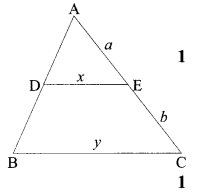
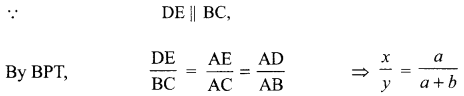
In the given figure, DE || BC. Find \(\frac{x}{y}\) DE || BC
CBSE Sample Paper 2020 Class 10 Maths Standard with Solution Set 1.3
Solution :
CBSE Sample Paper 2020 Class 10 Maths Standard with Solution Set 1.2

Question 3.
If 2k + 1, 6, 3& + 1 are in AP, then find the value of k.
OR
If the sum of n terms of an AP is 2n2 + 5n, then find the 2nd term
Solution :
For an AP a, b, c; 2b = a + c ⇒ (2k + 1) + (3k + 1) = 2×6
5k+2=12
⇒ 5k = 10
⇒ k = 2
CBSE Sample Paper 2020 Class 10 Maths Standard with Solution Set 1.54

Question 4.
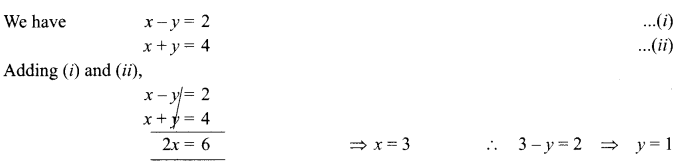
If x = a, y = b is the solution of the pair of equations x-y-2 and x + y = 4, then find the values of a and b.
Solution :
CBSE Sample Paper 2020 Class 10 Maths Standard with Solution Set 1.4

Question 5.
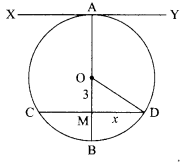
At one end A of a diameter AB of a circle of radius 5 cm, tangent XAY is drawn to the circle (see figure). Find the length of the chord CD parallel to XY and at a distance 8 cm from A.
CBSE Sample Paper 2020 Class 10 Maths Standard with Solution Set 1.5
Solution :
OD2 = OM2 + DM2
⇒ 52 = 32 + x2
x2 = 25 – 9 = 16
x = 4
CD =2 x = 2 × 4 = 8 cm

Question 6.
Find the radius of the largest right circular cone that can be cut out from a cube of edge 4.2 cm.
Solution :
Edge of the cube = 4.2 cm
∴ Radius of the largest right circular cone \(\frac{1}{2}\) (Edge of the Square) \(=\frac{4.2}{2}=2.1 \mathrm{~cm}\)

Question 7.
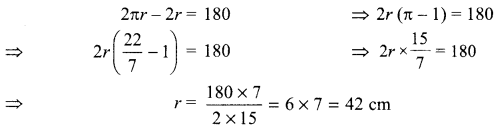
The circumference of a circle exceeds its diameter by 180 cm. Find its radius
Solution :
CBSE Sample Paper 2020 Class 10 Maths Standard with Solution Set 1.6

Question 8.
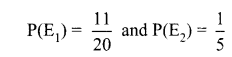
A bag contains 40 balls out of which some are red, some are blue and remaining are black. If the probability of drawing a red ball is \(\frac{11}{20} \) and that of blue ball is \(\frac{1}{5} \) , then find the number of black balls.
OR
Rahim tosses two different coins simultaneously. Find the probability of getting at least one tail.
Solution :
CBSE Sample Paper 2020 Class 10 Maths Standard with Solution Set 1.7

Let the number of black balls = x.

Total number of balls = Total possible outcomes = 40

CBSE Sample Paper 2020 Class 10 Maths Standard with Solution Set 1.8
⇒ Number of black balls =10
OR
Number of possible outcomes = 4 as possible outcomes are HH, HT, TH, TT. Favourable outcomes for getting at least one tail are HT, TH, TT No. of favourable outcomes = 3
∴ P(getting at least one tail) =\(\frac{3}{4}\)

Question 9.
If Cos θ \(\frac{7}{8}\) then find the value of \(\frac{(1+\cos \theta)(1-\cos \theta)}{(1-\sin \theta)(1+\sin \theta)}\)
Solution :
CBSE Sample Paper 2020 Class 10 Maths Standard with Solution Set 1.9

Question 10.
Write whether the rational number \(\frac{7}{75}\) will have a terminating decimal expansion or a non-terminating repeating decimal expansion.
OR
Write the HCF of the smallest composite number and the smallest prime number.
Solution :
\(\frac{7}{75}=0.0933333 \ldots \ldots=0.09 \overline{3}\)
So, it is a non-terminating repeating decimal expansion.
OR
The smallest composite number is 4 and the smallest prime number is 2.
The prime factorisation of 4 = 2 x 2 = 22 and the prime factorisation of 2 = 21
Now, the HCF of 2 and 4 is the product of smallest power of each common prime factor in . the numbers.
HCF (2, 4) = 21 = 2

Question 11.
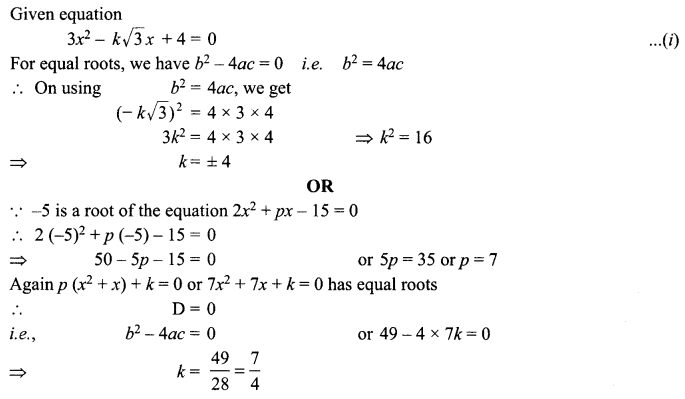
Find the value(s) of k, if the quadratic equation 3x2 – k √3x + 4 = 0 has equal roots.
OR
If -5 is a root of the quadratic equation 2x2 + px – 15 = 0 and the quadratic equation p(x2 + x) + k = 0 has equal roots, then find the value of k.
Solution :
CBSE Sample Paper 2020 Class 10 Maths Standard with Solution Set 1.10

Question 12.
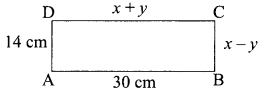
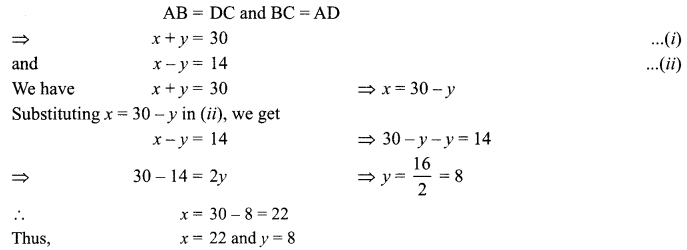
In the given figure, ABCD is a rectangle. Find the values of x and y.
CBSE Sample Paper 2020 Class 10 Maths Standard with Solution Set 1.11
Solution :
CBSE Sample Paper 2020 Class 10 Maths Standard with Solution Set 1.12

Question 13.
If ax2 + bx + c = 0 has equal roots, find the value of
Solution :
For equal roots D = 0
i.e., b2 – 4ac =0
⇒ b2 = 4ac
\(c=\frac{b^{2}}{4 a}\)

Question 14.
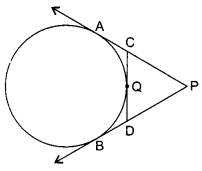
In the given figure, PA and PB are tangents to the circle drawn from an external point P. CD is the third tangent touching the circle at Q. If PA = 15 cm, find the perimeter of APCD.
CBSE Sample Paper 2020 Class 10 Maths Standard with Solution Set 1.13
OR
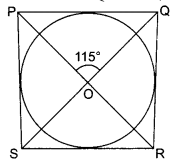
In the given figure, the quadrilateral PQRS circumscribes a circle with centre O. If ∠POQ = 115°, then find ∠ROS.
CBSE Sample Paper 2020 Class 10 Maths Standard with Solution Set 1.14
Solution :
Since PA and PB are tangents from same external point P.
PA = PB = 15 cm
Now, Perimeter of APCD = PC + CD + DP = PC + CQ + QD + DP
= PC + CA + DB + DP = PA + PB = 15 cm +15 cm = 30 cm
OR
Solution :
Since  ∠POQ = ∠ROS   (Vertically opposite angles)
⇒ ∠ROS = 115°

Question 15.
To divide a line segment AB in the ratio 5 : 7, first a ray AX is drawn such that ∠BAX is an acute angle and then at equal distances points are marked on the ray. Find the minimum number of these points.
Solution :
Since 5+ 7 = 12
So, the number of points marked on ray AX = 12.

Question 16.
Find the value of (sin 30° + cos 60°).
Solution :
sin 30° + cos 60° \(=\frac{1}{2}+\frac{1}{2}=\)

Section-II

Question 17.
Case Study Based-1
Medicinal Garden
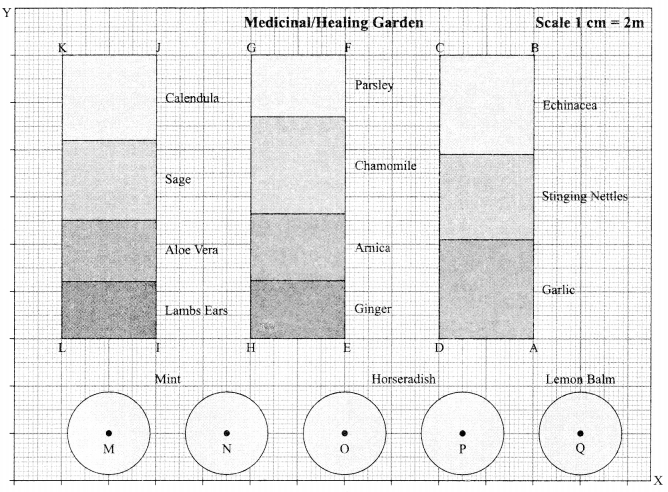
A medicinal garden is a garden in which different kinds of medicinal plants, like Aloe Vera, Mint, Lemon Balm, etc. are planted with the goal of serving the need of general health maintenance. Observe the following diagram.
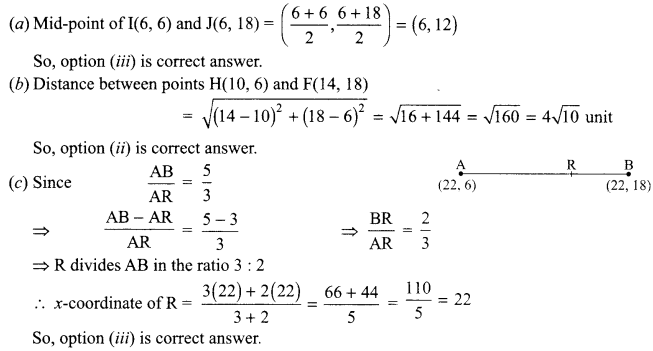
CBSE Sample Paper 2020 Class 10 Maths Standard with Solution Set 1.15

Refer to IJKL
(a) The mid-point of the segment joining the points 1(6, 6) and J(6, 18) is
(i) (7,9)
(ii) \(\left(12, \frac{11}{2}\right) \)
(iii) (6, 12)
(iv) (12,24)

Refer to EFGH
(b) The distance between points H(10, 6) and F(14, 18) is
(i) \(8 \sqrt{5}\)unit
(ii) \(4 \sqrt{10}\) unit
(iii) 18 unit
(iv) 24 unit

Refer to ABCD

(c) The coordinates of the points A and B are (22,6) and (22,18) respectively. The x-coordinate of a point R on the line segment AB such that \(\frac{A R}{A B}=\frac{3}{5}\) is…………….
(i) 18
(ii) 24
(iii) 22
(iv) 31

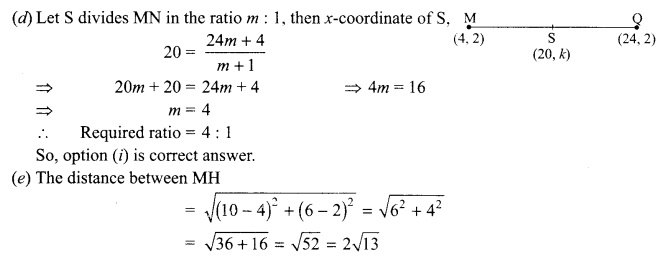
Refer to MQ

(d) The ratio in which the points (20, k) divides the line segment joining the points M(4, 2) and Q(24, 2) is
(i) 4 : 1
(ii) 16 : 15
(iii) 8 : 21
(iv) 10 : 17

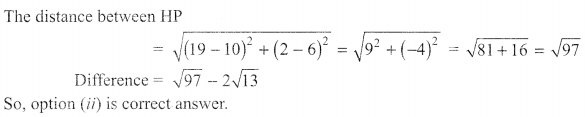
Refer to MH and HP

How much longer is HP than MH given that coordinates of H(10, 6), M(4, 2) and P(19,2)
(i) \((\sqrt{95}-2 \sqrt{3}) \text { unit }\)
(ii) \((\sqrt{97}-2 \sqrt{13}) \text { unit }\)
(iii) \((\sqrt{61}-4 \sqrt{5}) \text { unit }\)
(iv) None of there.
Solution:
CBSE Sample Paper 2020 Class 10 Maths Standard with Solution Set 1.16
CBSE Sample Paper 2020 Class 10 Maths Standard with Solution Set 1.17

CBSE Sample Paper 2020 Class 10 Maths Standard with Solution Set 1.18

Question 18.
Case Study Based-2
A Frame House
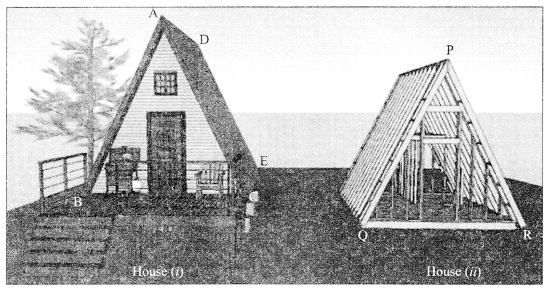
A frame-house is a house constructed from a wooden skeleton, typically covered with timber board. The concept of similar triangles is used to construct it. Look at the following picture:
CBSE Sample Paper 2020 Class 10 Maths Standard with Solution Set 1.19
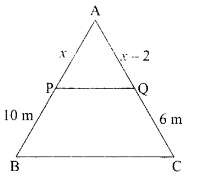
Refer to House (i)
(a) The front view of house (7) is shown below in which point P on AB is joined with point Q
CBSE Sample Paper 2020 Class 10 Maths Standard with Solution Set 1.21

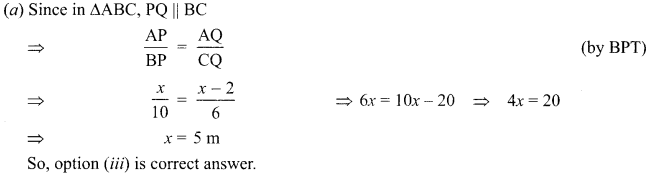
If PQ || BC, AP = x m  PB = 10 m. AQ = (x – 2) m, QC = 6 m, then the value of a is
(i) 3m
(ii) 4m
(iii) 5m
(iv) 8 m

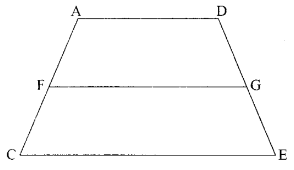
(b) The side vies of house (i) is shown below in which point F on AC is joined with point G on DE.

CBSE Sample Paper 2020 Class 10 Maths Standard with Solution Set 1.22

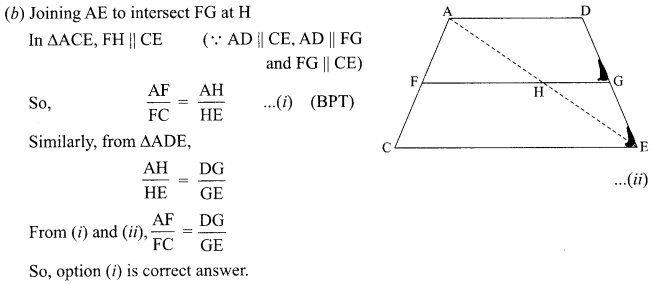
If ACED is a trapezium with AD || CE, F and G are points on non-parallel sides AC and AF
DE respectively such that FG is parallel to AD, then =\(\frac{\mathrm{AF}}{\mathrm{FC}}=\)
(i) \(\frac{\mathrm{DG}}{\mathrm{GE}}\)
(ii) \(\frac{\mathrm{AD}}{\mathrm{CE}}\)
(iii) \(\frac{\mathrm{AF}}{\mathrm{GE}}\)
(iv) \(\frac{\mathrm{DG}}{\mathrm{FC}}\)

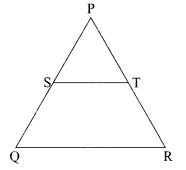
(c) The front view of house (ii) is shown below in which point S on PQ is joined with point T on PR.
CBSE Sample Paper 2020 Class 10 Maths Standard with Solution Set 1.23
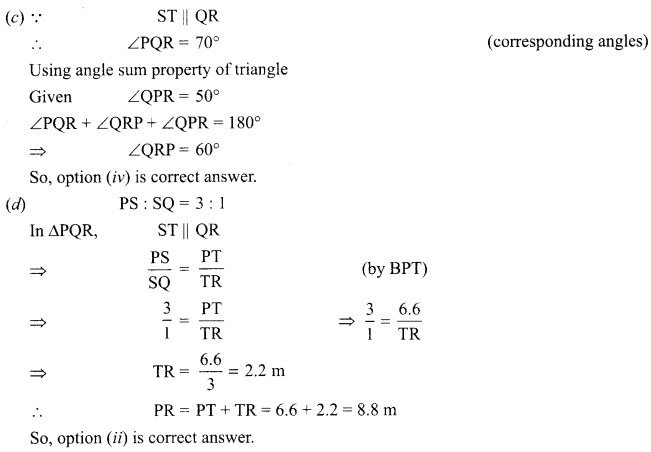
\(\frac{\mathrm{PS}}{\mathrm{QS}}=\frac{\mathrm{PT}}{\mathrm{TR}} \text { and } \angle \mathrm{PST}=70^{\circ}, \angle \mathrm{QPR}=50^{\circ}\) then the angle ∠QRP =
(i) 70°
(ii) 50°
(iii) 80°
(iv) 60°

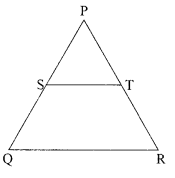
(d) Again consider the front view of house (ii). If S and T are points on side PQ and PR respectively such that
ST || QR and PS : SQ = 3 : 1. Also TP = 6.6 m, then PR is
CBSE Sample Paper 2020 Class 10 Maths Standard with Solution Set 1.24
(i) 6.9 m
(ii) 8.8 m
(iii) 10.5m
(iv) 9.4 m

(e) Sneha has also a frame house whose front view is shown below
CBSE Sample Paper 2020 Class 10 Maths Standard with Solution Set 1.25
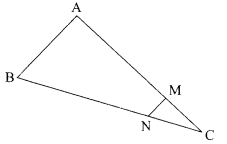
If MN || AB, BC = 7.5 m, AM = 4 m and MC = 2 m, then length of BN is
(i) 5 m
(ii) 4 m
(iii) 8 m
(iv) 9 m
Solution :
CBSE Sample Paper 2020 Class 10 Maths Standard with Solution Set 1.26
CBSE Sample Paper 2020 Class 10 Maths Standard with Solution Set 1.27
CBSE Sample Paper 2020 Class 10 Maths Standard with Solution Set 1.28
CBSE Sample Paper 2020 Class 10 Maths Standard with Solution Set 1.29
Question 19.
Case Study Based-3
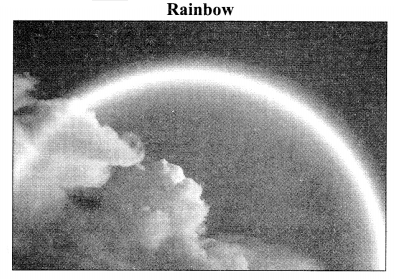
CBSE Sample Paper 2020 Class 10 Maths Standard with Solution Set 1.30

Rainbow is an arch of colours that is visible in the sky, caused by the refraction and dispersion of the sun’s light after rain or other water droplets in the atmosphere. The colours of the rainbow are generally said to be red, orange, yellow, green, blue, indigo and violet.

Each colour of rainbow makes a parabola. We know that for any quadratic polynomial ax2 + bx + c, a ≠ 0, the graph of the corresponding equation y = ax2 + bx + c has one of the two shapes either open upwards like ∪ or open downwards like ∩ depending on whether a > 0 or a < 0. These curves are called parabolas.

(a) A rainbow is represented by the quadratic polynomial x2 + (a + 1 )x + b whose zeroes are 2 and-3. Then
(i) a = -7, b   = -1
(ii)  a = 5, b =-1
(iii)  a – 2, b = – 6
(iv)   a – 0, b = – 6

(b) The polynomial x2 – 2x – (7p + 3) represents a rainbow.   If -4 is zero of it, then the value of p is
(i) 1
(ii)  2
(iii) 3
(iv)  4

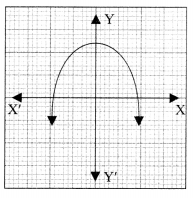
(c) The graph of a rainbow y=f(x) is shown below.
CBSE Sample Paper 2020 Class 10 Maths Standard with Solution Set 1.31
The number of zeroes of f(x) is
(i) 0
(ii) 1
(iii) 2
(iv) 3

(d) If graph of a rainbow does not intersect the x-axis but intersects y-axis in one point, then number of zeroes of the polynomial is equal to
(i) 0
(ii) 1
(iii) 0 OR 1
(iv) none of these

(e) The representation of a rainbow is a quadratic polynomial. The sum and the product of its zeroes are 3 and -2 respectively. The polynomial is 1
(i) k(x2 – 2x – 3), for some real k.
(ii) k(x2 – 5x – 9), for some real k.
(iii) k(x2 – 3x – 2), for some real k.
(iv) k(x2 – 8x + 2), for some real k.
Solution :
(a) x2 + (a + 1)x + b =(2)2 + (a + 1)2 + b = 0 and (-3)2 + (a + l)(-3) + b = 0
⇒ 4 + 2a + 2 + 6=0 and 9 — 3a — 3 + 6 = 0
⇒ 2a + b=-6      … (i)
and  -3a + b=-6   …(ii)
Solving (i) and (ii), we get a = 0 and b = -6
So, option (iv) is correct answer.

(b) p(-4) = 0 ⇒ (-4)2 – 2(-4) – (7p + 3) = 0
⇒ 16 + 8 – 7p-3 = 0    ⇒ 21 – 7p = 0
⇒ p = 3
So, option (iii) is correct answer.

(c) ∵ Graph f(x) intersects x-axis at two different points.
∴  Number of zeroes of f(x) = 2.
So, option (iii) is correct answer.

(d) We know that the number of zeroes of a polynomial is equal to number of points of intersection of the graph of polynomial with x-axis.
Since the graph of rainbow does not intersect the x-axis, so it has no zeroes.
So, option (i) is correct answer.

(e) Let the required polynomial be f(x).
Then f(x) = k(x2 – 3x – 2) for some real k.
So, option (iii) is correct answer.

Question 20.
Case Study Based-4

Cost of Living Index140-150150-160160-170170-180180-190190-200Total
Number of weeks5102096252

(a) The mid-value (class-mark) of 160-170 is ……..
(i) 140
(ii) 145
(iii) 155
(iv) 165

(b) The approximate mean weekly cost-of-living index is 1
(i) 166.4
(ii) 184.5
(iii) 190
(iv) 201.8

(c) The sum of lower and upper limits of modal class is
(i) 290
(ii) 310
(iii) 330
(iv) 350

(d) Mode is the value of the variable which has
(i) maximum frequency
(ii) minimum frequency
(iii) mean frequency
(iv) middle most frequency

(e) The median class of above data is
(i) 150-160
(ii) 160-170
(iii) 170-180
(iv) 190-200

Solution :
(a) Class-mark of 160-170 = \(160-170=\frac{160+170}{2}=\frac{330}{2}=165\)
So, option (iv) is correct answer.

Cost of Living IndexNo. of Weeks (fi)Mid-point (xi)fixi
140-1505145725
150-160101551550
160-170201653300
170-18091751575
180-19061851110
190-2002195390
Totaln = 528650

\(\text { Mean }=\frac{\sum f_{i} x_{i}}{\sum f_{i}}=\frac{8650}{52}=166.4(\text { approx. })\)
So, option (i) is correct answer.

(c) Maximum frequency is 20
∴ Modal class = 160-170
Lower limit of modal class = 160
Upper limit of modal class =170
Sum of lower and upper limits = 160 + 170 = 330
So, option (iii) is correct answer.

(d) (i) Maximum frequency

Cost of Living Indexfcf
140-15055
150-1601015
160-1702035
170-180944
180-190650
190-200252

n= 52 \(\Rightarrow \frac{n}{2}=26\)
Median class is 160-170.
So, option (ii) is correct answer.

Part-B
Section-III

Question 21.
If two positive integers p and q are written as p = a2b2 and q = a3b; a, b are prime numbers, then verify: LCM (p, q) x HCF (p, q) =pq.
Answer:
LCM (p, q) =a3b3 and HCF (p, q) = a2b
LCM (p, q) x HCF (p, q) =a5b4 = (a2b3) (a3 b) = pq

Question 22.
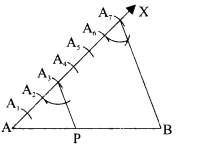
Draw a line segment of length 6 cm. Using compass and ruler, find a point P on it which divides it in the ratio 3:4.
CBSE Sample Paper 2020 Class 10 Maths Standard with Solution Set 1.32
Solution :
Steps of construction:
1. Draw a line segment AB = 6 cm.
2. Draw an acute angle <BAX.
3. Along AX take 7 points, such that
AA1 — A1 A2 — A2 A3 — A3A4 — A4A5 – A5A6 — A6A7
4. Join BA7
5. Through A3 draw A3P A7B which meets AB at P.
6. AP: PB = 3 : 4 and P is the required point.

Question 23.
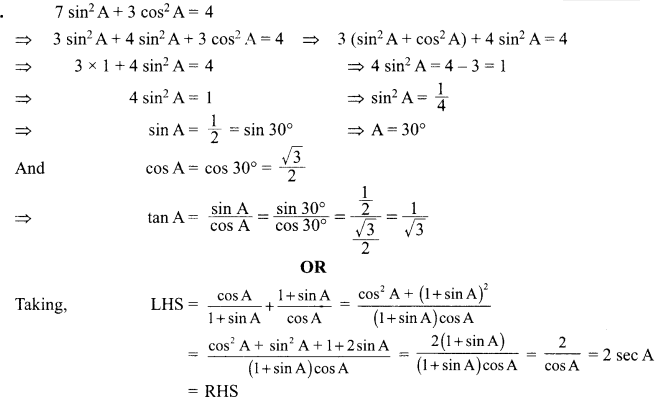
If 7 sin2 A + 3 cos2 A = 4, show that tan \(A=\frac{1}{\sqrt{3}}\)
OR
Prove that \(\frac{\cos A}{1+\sin A}+\frac{1+\sin A}{\cos A}=2 \sec A\)
Solution :
CBSE Sample Paper 2020 Class 10 Maths Standard with Solution Set 1.33

Question 24.
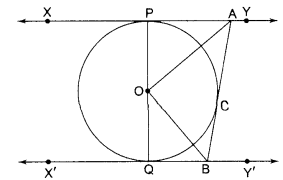
In the given figure, XY and XT’ are two parallel tangents to a circle with centre O and another tangent AB with point of contact C intersecting XY at A and XT’ at B. Prove that ∠AOB = 90°.
CBSE Sample Paper 2020 Class 10 Maths Standard with Solution Set 1.34
Solution :
CBSE Sample Paper 2020 Class 10 Maths Standard with Solution Set 1.35

Question 25.
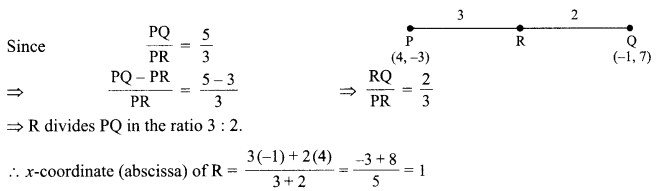
The coordinates of the points P and Q are respectively (4,—3) and (—1, 7). Find the x-coordinate (abscissa) of a point R on the line segment PQ such that \(\frac{P R}{P Q}=\frac{3}{5}\)
OR
Find the ratio in which the point (—3, k) divides the line segment joining the points (—5, —4) and (—2, 3). Also find the value of k.
Solution :
CBSE Sample Paper 2020 Class 10 Maths Standard with Solution Set 1.36
CBSE Sample Paper 2020 Class 10 Maths Standard with Solution Set 1.37

Question 26.
Find k, if the sum of the zeroes of the polynomial x2 – (k + 6) x + 2 (2k – 1) is half of their product.
Answer:
CBSE Sample Paper 2020 Class 10 Maths Standard with Solution Set 1.38

Section-IV

Question 27.
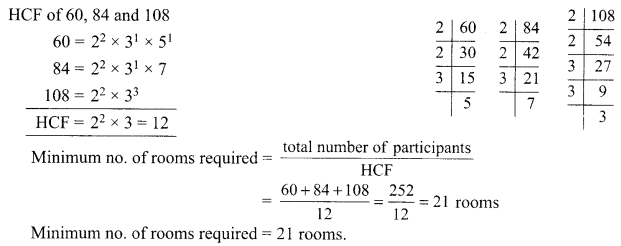
In a seminar, the number of participants in Hindi, English and Mathematics are 60, 84 and 108 respectively. Find the minimum number of rooms required if in each room the same number of participants are to be seated and all of them being of the same subject.
Solution :
CBSE Sample Paper 2020 Class 10 Maths Standard with Solution Set 1.39

Question 28.
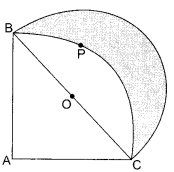
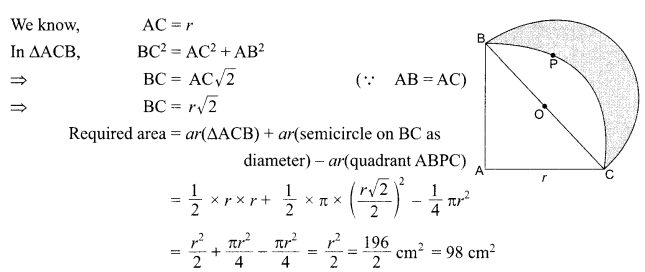
In the given figure, ABPC is a quadrant of a circle of radius 14 cm and a semicircle is drawn with BC as diameter. Find the area of the shaded region.
CBSE Sample Paper 2020 Class 10 Maths Standard with Solution Set 1.40
Solution :
CBSE Sample Paper 2020 Class 10 Maths Standard with Solution Set 1.41

Question 29.
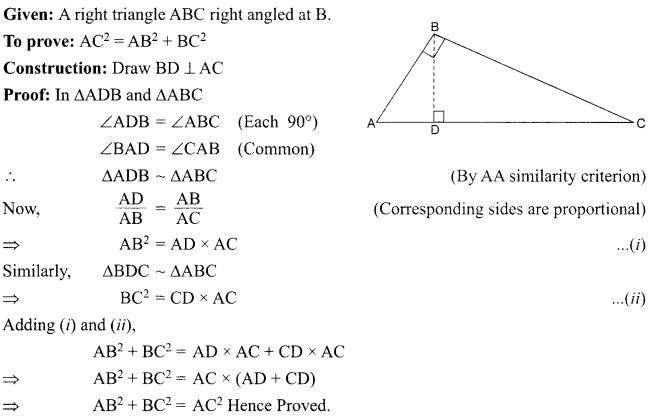
Show that in a right triangle, the square of the hypotenuse is equal to the sum of the squares
of the other two sides.
OR
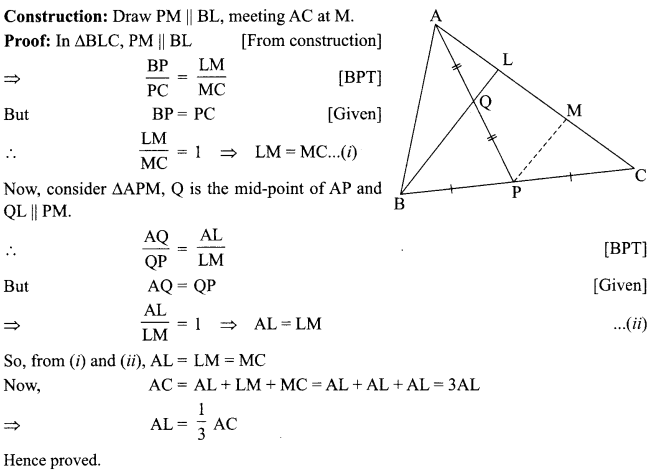
P is the mid-point of side BC of AABC, Q is the mid-point of AP, BQ when produced meets AC at L. Prove that AL = \(\frac{1}{3} \) AC.
Solution :
CBSE Sample Paper 2020 Class 10 Maths Standard with Solution Set 1.42

CBSE Sample Paper 2020 Class 10 Maths Standard with Solution Set 1.43
CBSE Sample Paper 2020 Class 10 Maths Standard with Solution Set 1.53

Question 30.
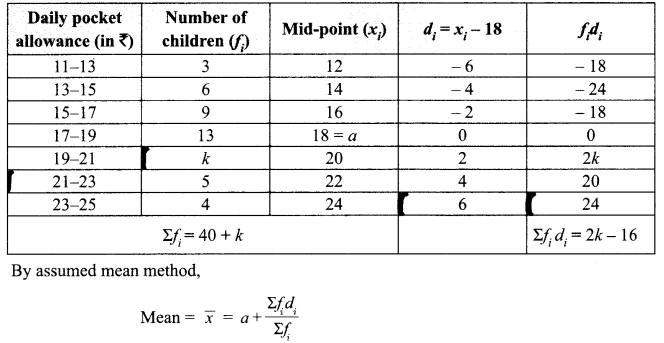
The following distribution shows the daily pocket allowance of children of a locality. The mean pocket allowance is ₹ 18. Find the missing frequency k.

Daily pocket allowance
(in ₹)
11-1313-1515-1717-1919-2121-2323-25
Number of children36913k54

Solution :
CBSE Sample Paper 2020 Class 10 Maths Standard with Solution Set 1.46
CBSE Sample Paper 2020 Class 10 Maths Standard with Solution Set 1.47

Question 31.
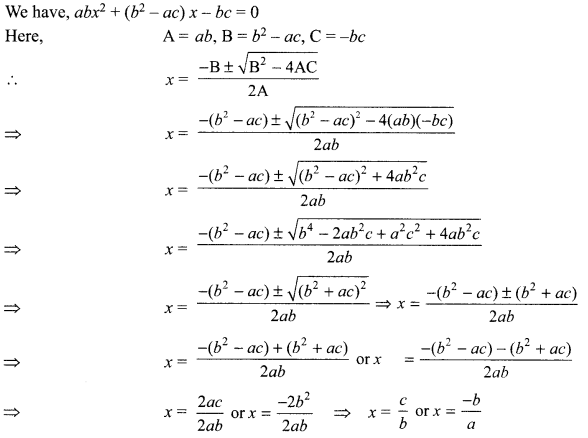
Using quadratic formula, solve the following equation for X:
abx2+(b2—ac)x—bc=O
OR
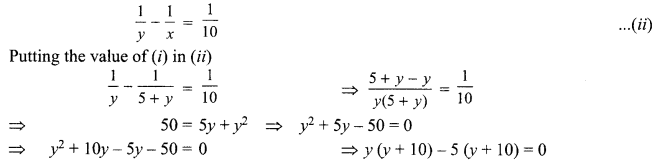
The difference of two natural numbers is 5 and the difference of their reciprocals is \(\frac{1}{10}\). Find the numbers.
Solution :
CBSE Sample Paper 2020 Class 10 Maths Standard with Solution Set 1.48

Let the two natural numbers be x and y such that x >y
According to the question,
Difference of numbers,
x – y =  5    ⇒  x = 5 +y ……………(1)
Difference of their reciprocals,
\(\frac{1}{y}-\frac{1}{x}=\frac{1}{10}\)
CBSE Sample Paper 2020 Class 10 Maths Standard with Solution Set 1.62
= (y – 5)(y + 10) = 0  ∴ y = 5  or y = – 10
y is a natural number. ∴ y = 5
Putting the value of)’ in (i), we get
x= 5+5=10
Thus, the required numbers are 10 and 5.

Question 32.
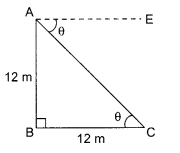
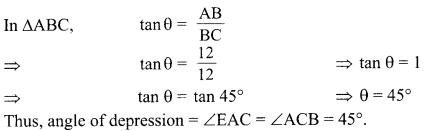
Find the angle of depression from the top of 12m high tower of an object lying at a point 12 m away from the base of the tower.
Solution :
Let AB be the tower of 12 m height and B its base. Let C be a point A 12 m away from base B of tower AB where an object situated.
CBSE Sample Paper 2020 Class 10 Maths Standard with Solution Set 1.50
CBSE Sample Paper 2020 Class 10 Maths Standard with Solution Set 1.51

Question 33.
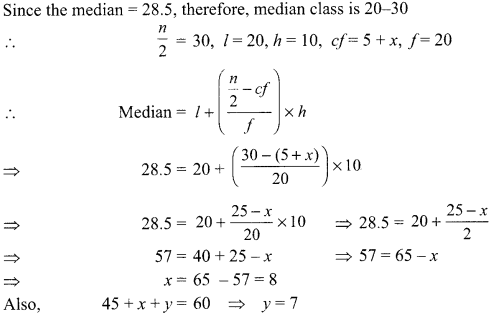
If the median of the distribution given below is 28.5, find the values of x and y.

Class interval0-1010-2020-3030-4040-5050-60Total
Frequency5X2015y560

Solution :
Here, median = 28.5, n = 60

Class intervalFrequency (f)Cumulative frequency (cf)
0-1055
10-20X5 + x
20-302025 + x
30-101540+ x
40-50y40 + x + y
50-60545+x + y
Total∑ fi = 60

CBSE Sample Paper 2020 Class 10 Maths Standard with Solution Set 1.52

Section – V

Question 34.
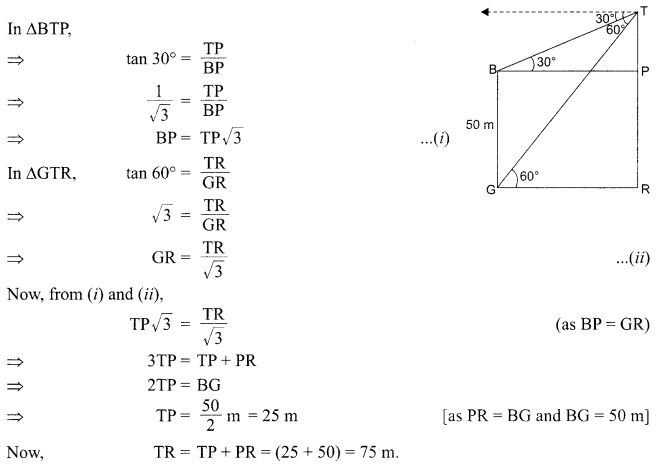
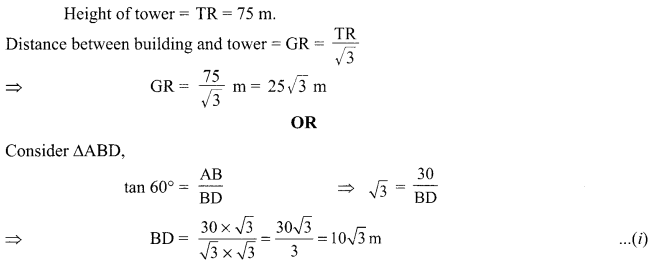
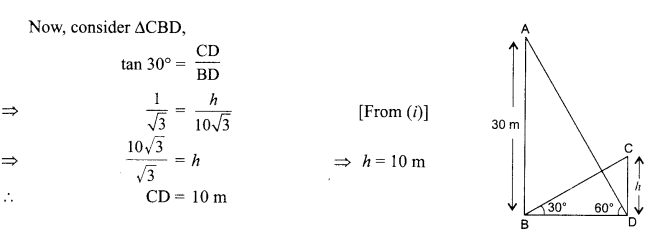
The angles of depression of the top and bottom of a building 50 metres high as observed from the top of a tower are 30° and 60°, respectively. Find the height of the tower and also the horizontal distance between the building and the tower.
OR
The angle of elevation of the top of a tower 30 m high from the foot of another tower in the same plane is 60° and the angle of elevation of the top of the second tower from the foot of the first tower is 30°. Find the distance between the two towers and also the height of the other tower.
Solution :
CBSE Sample Paper 2020 Class 10 Maths Standard with Solution Set 1.56
CBSE Sample Paper 2020 Class 10 Maths Standard with Solution Set 1.57
CBSE Sample Paper 2020 Class 10 Maths Standard with Solution Set 1.58

Thus, height of the other tower = 10 m and the distance between two towers = BD = 10√3 m.

Question 35.
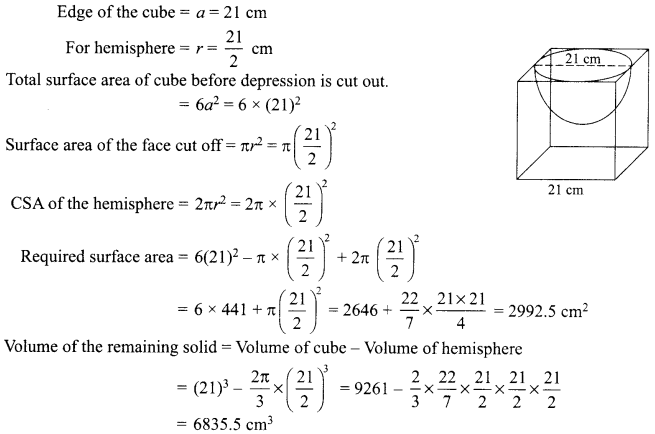
A hemispherical depression is cut out from one face of a cubical wooden block of edge 21 cm, such that the diameter of the hemisphere is equal to the edge of the cube. Determine the volume and total surface area of the remaining block.
Solution :
CBSE Sample Paper 2020 Class 10 Maths Standard with Solution Set 1.59

Question 36.
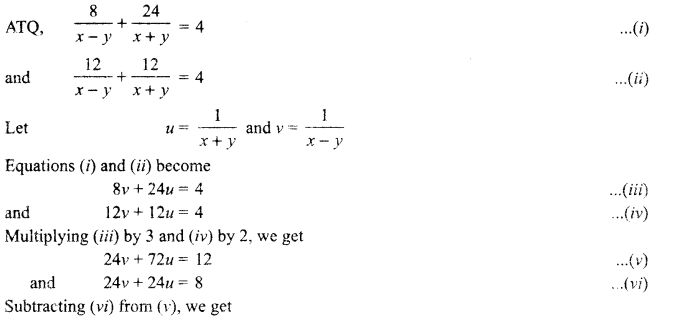
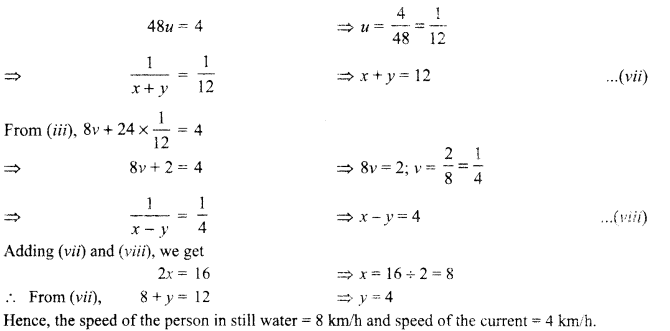
A person can row 8 km upstream and 24 km downstream in 4 hours. He can row 12 km downstream and 12 km upstream in 4 hours. Find the speed of the person in still water and also the speed of the current. 5
Solution :
Let the person’s speed of rowing in still water be, x km/h and speed of the current y km/h.
∴ Speed of boat in downstream = (x + y) km/h
and speed of boat in upstream = (x -y) km/h
Since \(\text { Time }=\frac{\text { Distance }}{\text { Speed }}\)
CBSE Sample Paper 2020 Class 10 Maths Standard with Solution Set 1.60
CBSE Sample Paper 2020 Class 10 Maths Standard with Solution Set 1.61

Ecosystem Class 12 Important Extra Questions Biology Chapter 14

Here we are providing Class 12 Biology Important Extra Questions and Answers Chapter 14 Ecosystem. Important Questions for Class 12 Biology are the best resource for students which helps in Class 12 board exams.

Class 12 Biology Chapter 14 Important Extra Questions Ecosystem

Ecosystem Important Extra Questions Very Short Answer Type

Question 1.
What is an ecosystem?
Answer:
Ecosystem. It is a functional unit of nature where living organisms interact among themselves and also with the physical environment.

Question 2.
Who coined the term ecosystem?
Answer:
Sir Arthur Tansley (1935).

Question 3.
Name two major kinds of ecosystems.
Answer:

  1. Terrestrial ecosystem.
  2. Aquatic ecosystem.

Question 4.
Write three examples of terrestrial ecosystems.
Answer:
Forests, grasslands, and deserts ecosystem.

Question 5.
Give one example of the smallest and another of large-sized ecosystems.
Answer:

  1. Pond
  2. Forest.

Question 6.
Give three examples of freshwater ecosystems.
Answer:
Ponds, Lakes, and Streams ecosystems.

Question 7.
Name two saltwater ecosystems.
Answer:
Marine and estuaries ecosystems.

Question 8.
Name two man-made ecosystems.
Answer:

  1. Spacecrafts
  2. Aquarium
  3. Crop field.

Question 9.
Write two examples where man has interfered in the ecosystem.
Answer:

  1. Cutting of forests
  2. Construction of dams.

Question 10.
How do decomposers obtain food?
Answer:
Decomposers release their enzymes into dead and decaying plants and animal remains and absorb the simple inorganic substances.

Question 11.
Give two examples where there is the transfer of matter from terrestrial to the aquatic ecosystem or vice-versa.
Answer:

  1. Dropping of leaves of riverbank trees into the water.
  2. Terrestrial birds diving into the water to catch fish.

Question 12.
Write the equation that helps in deriving the net primary productivity of an ecosystem. (CBSE Delhi 2013)
Or
How will you calculate net productivity?
Answer:
GPP – R = NPP

Gross primary productivity – Respiratory processes (loss) = Net primary productivity
Or
Net primary productivity = Gross productivity – respiration loss.

Question 13.
Why are green plants not found beyond certain depths in the ocean? (CBSE 2011)
Answer:
The sunlight cannot penetrate beyond certain depths in the ocean.

Question 14.
Why are green algae not likely to be found in the deepest strata of the ocean? (CBSE Outside Delhi 2013)
Answer:
Green algae are not likely to be found in the deepest strata of the sea because the environment is perpetually dark and the sun as a source of energy is not available.

Question 15.
Name two aquatic ecosystems which have a rich diversity of macrophytes.
Answer:
Wetlands and lakes.

Question 16.
Name two structural features of the ecosystem.
Answer:

  1. Species composition
  2. Stratification.

Question 17.
How does the standing state of nutrients differ?
Answer:
The standing state of nutrients differs from one ecosystem to another or with the season in the same ecosystem.

Question 18.
Define detritus.
Answer:
Dead plant and animal remains are called detritus.

Question 19.
Name above ground and below ground detritus.
Answer:

  1. Dried plant parts and dead animals.
  2. Dead roots (root detritus).

Question 20.
What is nutrient immobilization?
Answer:
Soil nutrient gets tied up with biomass of microbes and is not available for other organisms.

Ecosystem Important Extra Questions Very Short Answer Type

Question 1.
List the abiotic components of an ecosystem.
Answer:
The abiotic components of an ecosystem are of four types:

  1. Inorganic substances like C, N2, O2, C02, H20, etc.;
  2. Organic compounds like carbohydrates, proteins lipids, etc.;
  3. Climatic factors (including temperature, light, wind, gases, humidity, rain, and water) (also wave action, water currents),
  4. the edaphic factor which includes soil.

Question 2.
List the differences between biotic and abiotic components of the ecosystem.
Answer:
Differences between Biotic and Abiotic Components of the ecosystem:

Biotic componentsAbiotic components
1. Biotic components of an ecosystem are those Living organisms that are different members of a community.1. Abiotic components are non-living factors.
2. Biotic components of an ecosystem are:
(i) Producers
(ii) Consumers
(iii) Decomposers.
2. It includes water, minerals, salts, humidity, light, temperature, pH, wind, topography, and background.

Question 3.
List the kinds of ecosystems.
Answer:
An ecosystem can be as small as an aquarium in the house or as big as an ocean. The biotic community is spread everywhere. Land, water, and air show the presence of living things.

The major ecosystems of the world are:

Aquatic ecosystemTerrestrial ecosystemMan-made ecosystem
[A] Marine
(i) Oceans
(ii) Seashore
(iii) Brackish[B] Fresh Water
(i) Lakes and rivers
(ii) Spring and ponds
(iii) Swamp
[A] Forest
(i) TropicaL
(ii) Temperate
(iii) Taiga[B] Grassland
(i) Tropical
(ii) Temperate[C] Desert
[D] Tundra
(i) Aquarium
(ii) Crop fields
(iii) Spaceship
(iv) Garden and parks
(v) Small fishery tanks
(vi) Animal husbandry
(vii) Dams and reservoirs

Question 4.
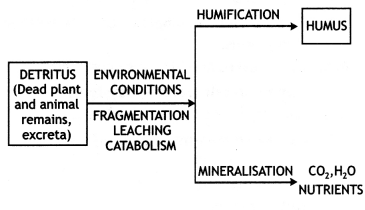
Show the processes involved in the decomposition of detritus.
Or
Describe the process of decomposition of detritus under the following heads: Fragmentation, Leaching, Catabolism, Humification, and Mineralisation. (CBSE 2010)
Answer:
Process of decomposition:

Class 12 Biology Important Questions Chapter 14 Ecosystem 1Processes involved in the decomposition of detritus

  1. Fragmentation: Detrivores break down detritus in small particles.
  2. Leaching: Water-soluble inorganic nutrients seep inside the soil and get precipitated as unavailable salt.
  3. Catabolism: Here, bacteria and fungus degrade detritus by their enzymes into simple inorganic ions.
  4. Humification: Formation of hummus at a slow rate.
  5. Mineralization: Release of minerals from humus by microbes.

Question 5.
What are the functions of the ecosystem?
Answer:
Functions of the ecosystem. Ecosystems possess a natural tendency to persist. This is made possible by a variety of functions (activities undertaken to ensure persistence) performed by the structural components.

The key functions of the ecosystem are:

  • Productivity;
  • Energy flow;
  • Nutrient cycling;
  • Decomposition

Question 6.
What is a food chain? List the kinds of food chains.
Answer:
Food Chain: A nutritive interaction among biotic communities (organisms) involving a producer, various levels of consumers, and a decomposer forms a food chain. Each step in a food chain is called a trophic level. Kinds of the food chain. There are 3 kinds of food chains: predator, parasitic and saprophytic chains.

Question 7.
In relation to energy transfer in the ecosystem, explain the statement “10 kg of deer’s meat is equivalent to 1 kg of lion’s flesh”.
Answer:
Passage of food energy from lower trophic level to higher trophic level follows 10% law. 10% law states that only 10% of total energy is transmitted from one trophic level to another. The rest of the energy is dissipated. A lion feeds on deer (lower trophic level). So 10 kg of meat of deer will form only 1 kg of lion’s flesh. The rest of the food energy present in deer meat is wasted and dissipated.

Question 8.
Primary productivity varies from ecosystem to ecosystem. Explain.
Answer:
Primary productivity depends upon the producers (plant species), their photosynthetic potential, soil, climate, and other environmental factors of an ecosystem. They are seldom similar in different ecosystems. Therefore, primary productivity varies from ecosystem to ecosystem.

Question 9.
What is an incomplete ecosystem? Explain with the help of a suitable example.
Answer:
An ecosystem comprises biotic and abiotic components. Abiotic components include light, air, water, temperature, humidity, etc., while biotic factor comprises all living organisms. The absence or limited availability of any component (either abiotic or biotic) makes an ecosystem incomplete like the profundal and benthic zones in an aquatic ecosystem.

Question 10.
What are the shortcomings of ecological pyramids in the study of ecosystems?
Answer:
Ecological pyramids are the graphical representation of ecological parameters. These are characterized by a pyramid of the number, the pyramid of mass, and the pyramid of energy in an ecosystem. The assumption of a simple food chain is the major shortcoming of ecological pyramids.

If we do not provide a food web, a clear position of the trophic levels of an organism cannot be given. Saprophytic organisms are not given any place in the ecological pyramid, though they are an important component in an ecosystem.

Question 11.
Write a note on secondary productivity.
Answer:
Secondary productivity. It refers to synthesized biomass at different trophic levels beginning from primary consumer level to top-level carnivores. At each consumer level, a part of the energy is used for respiration and a part of it is stored. If there is more storage than consumption, the biomass of the population would be higher at the end of a time period than at the beginning. This rate of increase in biomass of heterotrophs is called secondary productivity.

Question 12.
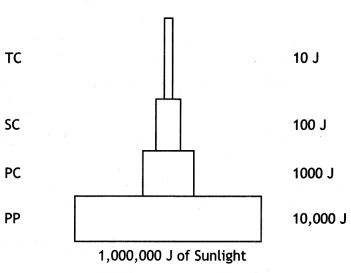
Sketch Pyramid of energy. Why is pyramid energy upright? (CBSE Delhi 2019 C)
Answer:
A pyramid of energy is always upright: It is a graphic representation of energy, amount of energy trapped per unit time, and area in different trophic levels of a food chain with producers forming the base and top consumer at the top.
Class 12 Biology Important Questions Chapter 14 Ecosystem 2
An ideal pyramid of energy. Observe that primary producers convert only 1% of the energy from the sunlight available to them into NPP.

There is the unidirectional flow of energy in a food chain. As the energy passes from one trophic level to a higher trophic level along the food chain, its amount decreases. So, the pyramid of energy is always upright.

Question 13.
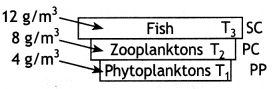
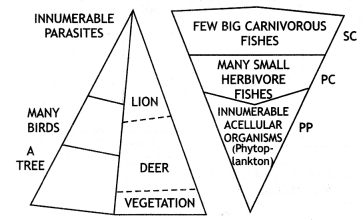
Construct a pyramid of biomass starting with phytoplankton. Label its three trophic levels. Is the pyramid upright or inverted? Justify your answer. (CBSE Sample Paper 2020)
Answer:
A pyramid of biomass is an aquatic ecosys¬tem and is always inverted. The biomass of primary producer (PP) phytoplankton is smaller than the biomass of zooplankton. The latter constitute primary consumers (PC). The biomass of carnivores, i.e. fish, a secondary consumer (SC), is more than the biomass of the primary consumer. So the pyramid of the biomass of the aquatic ecosystem is inverted.

Class 12 Biology Important Questions Chapter 14 Ecosystem 3Pyramid of biomass

Question 14.
What is eco-succession? Write its kinds and pattern.
Answer:
A continuous change in a biotic community is called biotic or eco-succession. A stage of climax is also achieved in the process of succession. Succession is of two types primary and secondary. The pattern of succession in any community is decided by pre-existing conditions of that place.

Three kinds of patterns have been observed:

  1. Xerosere,
  2. Hydrosere and
  3. Merosere.

Question 15.
What are the causes of ecological succession?
Answer:

  • Biotic and physiographic factors operating simultaneously are the causes of ecological succession.
  • Biotic factors, direct succession, and physiographic factors include the climate and other physical factors such as erosion of hills, filling up of lakes and streams.

Question 16.
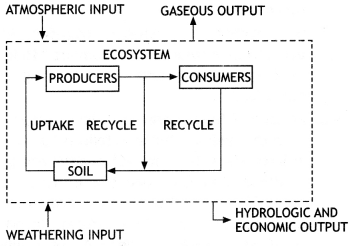
Give a generalized mode of ecosystem nutrient cycling.
Answer:
A generalized model of ecosystem nutrient cycling:

Class 12 Biology Important Questions Chapter 14 Ecosystem 4

A generalized model of ecosystem nutrient cycling: Nutrients are brought in (input), moved out (output), and cycled internally in the ecosystem. Boxes represent ecosystem components and arrows show the pathways of nutrient transfers.

Question 17.
Where would you look for signs of secondary succession? When does secondary succession end?
Answer:
Secondary succession occurs where an early community has been damaged leaving a few organisms and considerable organic matter. A destroyed grassland, destroyed forest, or destroyed area by fire or floods will be the site for secondary succession. The development of climax forests marks the end of secondary succession. A destroyed grassland takes 50 to 100 years to recuperate and a destroyed forest takes 200 years to fully recover.

Question 18.
Name the pioneer and the climax species in a waterbody. Mention the changes observed in the biomass and biodiversity of the successive serai communities developing in the waterbody. (CBSE 2009)
Answer:

  1. Pioneer communities are the small phytoplankton, which is replaced with time by rooted-submerged plants, rooted-floating angiosperms followed by free-floating plants, then reed swamp, marsh-meadow, scrub, and finally the trees.
  2. The climax again is forest.

Ecosystem Important Extra Questions Long Answer Type

Question 1.
What is an ecosystem? Write its main components.
Answer:
Ecosystem. A stable, self-supporting ecological unit resulting from an interaction between a biotic community (living organisms) and its abiotic environment is called an ecosystem.

An ecosystem comprises two main components:

  1. biotic including plants, animals, and microorganisms and
  2. abiotic mainly including substratum, water, minerals, temperature, carbon dioxide, and oxygen. It must also receive a constant supply of energy (light).

Question 2.
Briefly describe the biotic components of an ecosystem.
Answer:
Biotic components: Of an ecosystem’s biotic components, the plants are producers as they introduce food materials and energy into the living world. The animals are consumers because they get food and energy by consuming plants directly thus called primary consumers (herbivores); secondary/ tertiary consumers (carnivores) obtain energy and food indirectly from plants, and microorganisms are decomposers for they flourish by breaking dead organic matter to simple substances that are returned to environment for reuse by plants.

In an ecosystem, nutrients are used again and again in a cyclic manner, whereas energy trapped from sunlight is lost as heat.

Question 3.
Give an account of factors affecting the rate of decomposition.
Answer:
Factors affecting decomposition:

  1. The upper layer of soil is the main site of decomposition processes in the ecosystem.
  2. The rate of decomposition of detritus is affected by climatic factors and the chemical quality of detritus.
  3. Temperature and soil moisture affect the activities of root microbes.
  4. The chemical quality of detritus is determined by the relative proportion of water-soluble substances, polyphenols, lignin, and nitrogen.

Question 4.
List the important differences between producers and decomposers.
Answer:
Differences between producers and decomposers:

ProducersDecomposers
(i) These are organisms that synthesize their own food by the process of photosynthesis. These are also called autotrophs.(i) These organisms feed on the dead bodies of plants and animals.
(ii) They convert the raw materials in the earth and water into carbohydrates which give them food.(ii) They enrich the earth with raw materials trapped in dead bodies of plants and animals.
(iii) They are dependent on decomposers for soil nutrients.(iii) They are dependent on plants and animals for their food.

Question 5.
Explain the terms standing crop, biomass, and standing state.
Or
State what does a standing crop of a trophic level represent? (CBSE Outside Delhi 2013)
Answer:
Standing crop: Each trophic level has a certain mass of living material at a particular time called the standing crop. Biomass. The standing crop is measured as the mass of living organisms (biomass) or the number in a unit area. The biomass of a species is expressed in terms of fresh or dry weight. Measurement of biomass in terms of dry weight is more accurate as the moisture content of biomass fluctuates greatly.

Standing State: Organisms need a constant supply of nutrients to grow, reproduce and regulate various body functions. The amount of nutrients, such as carbon, nitrogen, phosphorus, calcium, etc. present in the soil at any given time, is referred to as the standing state. It varies in different kinds of ecosystems and also on a seasonal basis.

Question 6.
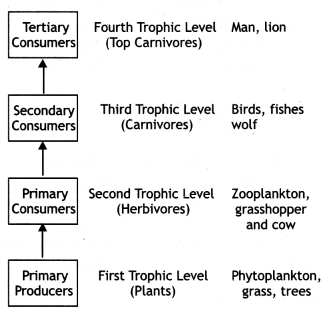
Give a diagrammatic representation of trophic levels in an ecosystem.
Answer:
Class 12 Biology Important Questions Chapter 14 Ecosystem 5
Diagrammatic representation of trophic levels in an ecosystem.

Question 7.
Sometimes due to biotic/abiotic factors, the climax remains in a particular serai stage (pre-climax) without reaching climax. Do you agree with this statement? If yes give a suitable example.
Answer:
Sometimes pre-climax stage remains in a particular serai stage without reaching the climax because during ecological succession any change in abiotic and biotic components may affect the particular serai stage, leading to the pre-climax stage before the climax is achieved.

This type of condition occurs in the presence of seeds and other propagules. This secondarily based area may be invaded by moss or exotic weeds thus exhibiting succession seriously and the climax community is never regenerated.

Question 8.
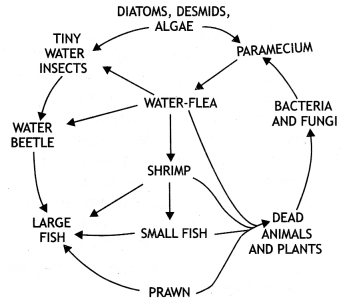
Explain the meaning of the food web and illustrate with a ray diagram.
Answer:
Food web. In nature, the food chains are not strictly linear, but are interrelated and interconnected with one another. Generally, the various food chains in a community are so interlinked as to form a sort of web. As a result, one animal may be a link in more than one food chain.

A network of food chains in a community is referred to as a food web. A food web may have all or some of the three types of food chains, i.e. detritus, predator, and parasitic. The food webs become more complicated because of the variability of taste and preference, availability and compulsion, and several other factors at each level. For example, tigers normally do not eat fish or crab, but they are forced to feed on them in the Sundarbans.

Class 12 Biology Important Questions Chapter 14 Ecosystem 6

Question 9.
Starting from a bare rock or a site of volcanic eruption, trace the organisms that participate in the process of succession. (CBSE Delhi 2011)
Or
Describe the process of succession on a base rock. (CBSE 2012)
Answer:

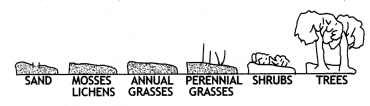
  1. Simple organisms appear first of all on such an exposed site as lichens. Lichens make conditions suitable for mosses (bryophytes).
  2. Gradually a variety of complex organisms join the community.Class 12 Biology Important Questions Chapter 14 Ecosystem 7
    Stages of biotic succession.
  3. Finally, large plants, trees, etc. appeared. It can be illustrated that lichens are pioneers, followed by mosses, annual grasses, perennial herbs, shrubs, and finally trees along with their characteristic animal populations.

Question 10.
How does succession differ in terrestrial and aquatic systems? Give salient points. (CBSE Delhi 2019)
Answer:
Differences between terrestrial and aquatic succession:

Succession on land/rockSuccession In Water
1. lichens and mosses are the pioneer community.1. Phytoplankton is a pioneer community.
2. Soil is formed by the action of lichens.2. Waterbodies are prone to silting due to soil erosion.
3. There is a deficiency of water.3. Water is abundant.
4. The various stages are crustose lichen stage, foliose lichen stage, moss stage, herb stage, shrub stage, and forest stage.4. The various stages are the plankton stage, floating stage, rooted stage, swamp stage, woodland stage, and forest stage.

Question 11.
Explain the difference between the serai stage and climax community during succession.
Answer:
Change during succession:

CharacteristicsSeralClimax
Community structure:
Size of individuals Ecological niches
Small
Few, generalized
large
Many specialized
Community organization:SimpleComplex
Community functions:
Food chains and food Efficiency of energy use Nutrient conservation
Simple
low
low
Complex
High
High

Question 12.
(a) Write the pioneer species each of xerarch and Hydr-arch successions. Which type of climax community is attained by both these successions?
Answer:

  • Pioneer species of xerarch succession: Wind-borne lichen propagules settle on wet rock soon after rain or heavy dew. Pioneer lichens are crustose lichens. Examples: Graphis, Rhizocarpon.
  • Climax stages of xerarch succession: Trees growing in areas occupied by shrubs.
  • Pioneer species of Hydr-arch succession: Phytoplankton examples are diatoms, green flagellates, single-celled or filamentous green algae as well as blue-green algae.
  • Climax stages of hydra succession: Climax forest of trees

(b) Why is secondary succession faster than primary succession? Explain. (CBSE 2019 C)
Answer:
Secondary succession is faster than primary succession:

  • It has a secondarily based area built-in soil organic matter.
  • It is biologically fertile.
  • Underground parts, some seeds, and remnant species quickly give rise to a new community.

Secondary succession takes 50-100 years to complete in grassland and 100—200 years for the development of the forest. It takes short time as com¬pared to primary succession.

Question 13.
Outline the salient features of the ecosystem nitrogen cycling.
Answer:
Salient features of the ecosystem nitrogen cycle are listed below.

  1. The ultimate source of nitrogen is an atmosphere that cannot be directly metabolized by living organisms.
  2. Nitrogen-fixing bacterial activities facilitate the entry of nitrogen into biological pathways.
  3. Azotobacter and Clostridium are the major free nitrogen-fixing bacteria in the soil.
  4. Ammonification is done by many bacteria.
  5. Ammonia is converted into nitrate by a group of chemoautotrophic bacteria through a two-step process called nitrification.
  6. Denitrifying bacteria transform nitrate nitrogen to nitrous and nitric oxides ultimately to gaseous nitrogen.
  7. Most plants absorb nitrate from soil.

Question 14.
List the features of the phosphorus cycle.
Answer:
Features of the phosphorus cycle are listed below.

  1. The natural reservoir of phosphorus is a rock in the form of phosphates.
  2. Minute quantities of phosphates get dissolved in the soil solution during weathering of rocks.
  3. Phosphates enter the plants through their roots and then the food chain.
  4. The organic wastes and dead organisms are decomposed by phosphate-solubilizing bacteria, which release phosphorus back into the soil.
  5. The atmospheric input of phosphorus through rainfall or gaseous exchange of phosphorus between organisms and the environment is negligible.

Question 15.
“In a food-chain, a trophic level represents a functional level, not a species. Explain.” (CBSE Delhi 2016)
Answer:
In a food chain, a trophic level represents a functional level:

  1. Trophic level is a step or division of the food chain. It is characterized by the method of obtaining food.
  2. The number of trophic levels is equal to the number of steps in the food chain.
  3. The two fundamental trophic levels are producers and consumers.
  4. Producers are autotrophic organisms found in the ecosystem which synthesize food from raw materials. There are many such organisms at this level that comprise the first trophic level and not just one species, e.g. green algae plant, phytoplankton, etc.
  5. Consumers are heterotrophic organisms. Herbivores are primary consumers. In a pond ecosystem many crustaceans, larvae of insects constitute this trophic level.

Similarly, at the next trophic level, a number of small fishes, not just one species consist of the secondary consumer.

Question 16.
Explain the impact of human activities on the carbon cycle in nature and list its harmful effects. (CBSE Delhi 2019 C)
Answer:
Impact of human activities on the carbon cycle: Carbon is a component of all living organic compounds of protoplasm. It constitutes 49% of dry weight. C02 is present in the air. It is dissolved in water as carbonic acid and bicarbonates. It is also present in fossil fuels and graphite in rocks.

There is a regulation of the carbon cycle in nature. Rapid deforestation and the massive burning of fossil fuel for energy and transport have significantly increased the rate of releasing C02 into the atmosphere. Harmful effect. Greenhouse effect and global warming.

Question 17.
What are ecosystem services? Briefly explain. (CBSE Delhi 2019)
Answer:
Ecosystem Services. The products of ecosystem processes are named ecosystem services.
Examples:
The following services are provided by the forest ecosystem.
They are:

  • purify air,
  • mitigate droughts and floods,
  • help in the cycling of nutrients,
  • provide habitat to a number of the wildlife,
  • act as a storehouse of carbon,
  • influence the hydrological cycle and
  • maintain biodiversity.

The value of services of biodiversity is difficult to determine. Robert Constanza et al. have tried to put price tags on nature’s life-support services. Researchers have estimated them to be 33 trillion US dollars a year, while our global gross production is only 18 trillion US dollars.

Question 18.
What are the two main components of an ecosystem? Describe the physical factors which affect the distribution of organisms in different habitats.
Answer:
Abiotic (physical) and biotic components are the two main components of an ecosystem.
Abiotic components or physical factors:
1. Temperature: The physiological and behavioral adaptations of most animals depend upon the changes in the environmental temperature. The rates of photosynthesis and respiration in plants also fluctuate depending upon the change in temperature.

2. Water: The extent to which an organism is dependent on an abundant water supply depends on its requirements and its ability to conserve it in adverse conditions. Organisms living in dry habitats generally have good water conservation such as in cacti and camels.

3. Light: This is essential for all green plants and photosynthetic bacteria, and for all the animals dependent on the plants.

4. Humidity: This is important because it can affect the rate at which water evaporates from the surface of an organism, which in turn influences its ability to withstand drought.

5. Wind and air currents: This particularly applies to plants. Only plants with strong root systems and tough stems can live in exposed places where winds are fierce. The wind is also instrumental in the dispersal of spores and seeds.

6. pH: This influences the distribution of plants in soil and fresh-water ponds. Some plants thrive in acidic conditions others in neutral or alkaline conditions. Most are highly sensitive to changes in pH.

7. Soil nutrients: These particularly affect the distribution of plants in the soil.

8. Water currents: Particularly in rivers and streams. Only organisms capable of swimming or avoiding strong currents can survive.

9. Topography. Minor topographical differences may be just as important in influencing the distribution of organisms as wide geographical separation.

10. Background. The distribution of organisms whose shape or coloration is such that they are camouflaged when viewed against a particular background is related to the general texture and pattern of the environment.

Question 19.
Name the two fundamental trophic levels and describe the general makeup of each.
Answer:
The two fundamental trophic levels include the following:
1. Producers (Autotrophic organisms): Green plants are the producers in any ecosystem. They also include photosynthetic bacteria. The producers use radiant energy of the Sun during photosynthesis whereby carbon dioxide is assimilated and the light energy is covered into chemical energy.

This energy is locked up into the energy-rich carbon compounds i.e. carbohydrates. The oxygen that is evolved as a by-product in photosynthesis is used in respiration by all living organisms.

2. Consumers (Heterotrophic organisms): They are the living members of the ecosystem which consume the food synthesized by the producers. All living animals are thought to be consumers.

The consumers may be of the following types:
(a) Primary consumers (also called first-order consumers) which are purely herbivorous and depend upon green plants i.e. on producers for their food e.g., Cow, Goat, Rabbit, Deer, Grasshopper, and other insects.
(b) Secondary consumers (also called second-order consumers) are carnivorous animals and eat the flesh of herbivorous animals e.g., Tiger, Lion, Dog, Cat, Frog, etc.
(c) Tertiary consumers are the carnivorous animals that eat other carnivores e.g. Snake eats a frog, birds eat fishes
(d) Top consumers are carnivores of an ecosystem that are not killed and eaten by other animals e.g. Lions, vultures, etc.

Question 20.
Explain the meaning of biotic succession taking an example of succession in a hydrosere.
Answer:
Biotic Succession: The organisms interact among themselves. They not only influence their community but also change their physical or abiotic environment. The alteration in the physical environment is such as to continually favor another set of organisms till a stable community is formed.

Such a biologically controlled modification in the composition of a community of a particular area is called biotic succession or ecological succession. Biotic succession is also known as a successive development of different communities in a particular area till a climax community is formed.

The following seven stages of the hydrosere pattern of succession can be observed:

  1. Phytoplanktonic stage (Free-floating angiosperm)
  2. Rooted submerged stage
  3. Rooted floating stage
  4. Amphibian or Reed Swamp stage
  5. Sedge meadow stage
  6. Woodland stage
  7. Forest stage.

Question 21.
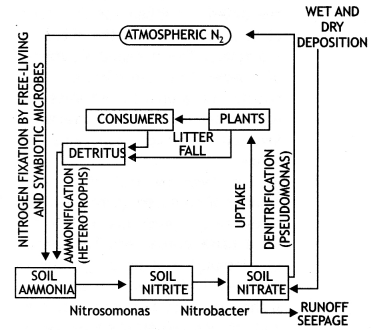
Give the graphic representation of the nitrogen cycle.
Answer:
Class 12 Biology Important Questions Chapter 14 Ecosystem 8
Nitrogen Cycle in Nature.

Question 22.
Distinguish between the following:
(i) Grazing food chain and detritus food chain (CBSE 2008)
Answer:
Differences between grazing food chain and detritus food chain:

grazing food chaindetritus food chain
1. Primary source of energy is solar radiation.1. It is detritus.
2. First trophic level is formed of all producers (plants).2. Detritus Food Chain (DFC) begins with detritus or dead organic matter. Detrivores or decomposers feed over it.
3. long-sized food chains.3. Small-sized food chains.
4. Examples: Predatory food chains on land and in water.4. Examples: Fallen leaves of mangroves in the brackish zone of South Florida.

(ii) Production and decomposition
Answer:
Differences between production and decomposition:

ProductionDecomposition
1. It is the process of formation of organic food material by the process of photosynthesis.1. It is the process by which complex organic compounds are broken into simpler inorganic substances.
2. It is done by green plants (producers).2. It is done by bacteria and fungi (decomposers).

(iii) Upright and inverted pyramid
Answer:
Differences between Upright pyramid and Inverted pyramid:

Upright PyramidInverted Pyramid
In a terrestrial habitat, the pyramid of biomass is maximum at the level of producers and there is a progressive decrease in biomass from lower to higher trophic levels.In aquatic habitats, the pyramid of biomass is inverted or spindle-shaped whereas the biomass of a trophic level depends upon the reproductive potential and longevity of the members because the biomass of phytoplankton is less than that of zooplanktons.

(iv) Food chain and food web
Answer:
Differences between food chain and food web:

food chainfood web
1. A single energy path where energy is transferred from producer to successive order of consumers.1. It is the network of various food chains which are interconnected with each other like an interlocking pattern.
2. All food chain starts from plants that are the original source of food.2. It has many linkages and intercrossing among the producers and consumers.

(v) Litter and detritus
Answer:
Difference between Litter and detritus:

LitterDetritus
1. It refers to discarded paper and plastics.1. Dead plant remains like leaves, bark, flowers, and remains of dead animals including fecal matter is catted detritus.
2. It cannot be decomposed.2. It can be decomposed.

(vi) Primary and secondary productivity.
Answer:
Differences between primary productivity and secondary productivity:

primary productivitysecondary productivity
The amount of biomass or organic matter produced per unit area over a time period by plants during photosynthesis is catted primary productivity.The rate of formation of new organic matter by consumers is called secondary productivity.

Question 23.
Define ecological pyramid and describe pyramids of number and biomass.
Or
Construct a pyramid of biomass starting with phytoplankton. Label three trophic levels. Is the pyramid upright or inverted? Why? (CBSE 2009)
Answer:
Definition: An ecological pyramid is a graphical/mathematical representation of an ecological parameter, like a number or biomass or accumulated energy at different trophic levels in a food chain in an ecosystem.
1. Pyramid of number: The pyramid is the graphical/mathematical representation of a number of organisms present at each trophic level in a food chain of a particular ecosystem.

When the number of organisms at successive levels are calculated mathematically and plotted, they assume the shape of a pyramid. This is called a pyramid of numbers. The base represents the number of producers whereas the tip is represented by top consumers; inverted pyramids can also be formed.

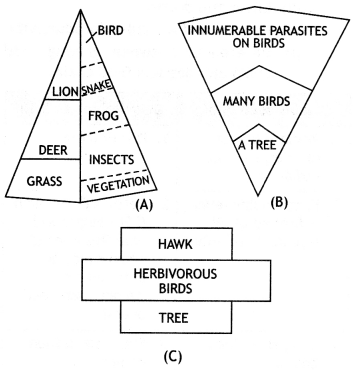
In the given pyramid of the number, the number of producers (here grass and trees are the producers) will be far more than any other level. The number of consumers will be comparatively less than herbivores. You can guess if the number of carnivores increases and exceeds the herbivores then what the result will be?

The figure shows an inverted pyramid and there you can see producer is one tree and dependents like primary and secondary consumers are many. Parasite insects of birds will be definitely more than the number of birds.

Class 12 Biology Important Questions Chapter 14 Ecosystem 9

Pyramid of Numbers:
A. Straight—Forest and Water ecosystem
B. Inverted—Tree Ecosystem.
C. SpindLe shaped

2. Pyramid of Biomass: Biomass is defined as the total weight of dry matter present in an ecosystem at a given time. Graphical measurement of biomass is called the pyramid of biomass. Trophic levels at the base represent biomass as numbers in a pyramid of numbers. Here also you can obtain an upright and inverted pyramid.

Class 12 Biology Important Questions Chapter 14 Ecosystem 10

Pyramid of biomass Upright-Tree and forest ecosys¬tem. Inverted-Aquatic ecosystem.

The aquatic pyramid of biomass is always inverted because the biomass of fishes far exceeds the biomass of phytoplankton.

Question 24.
What is primary productivity? Give a brief description of factors that affect primary productivity. (CBSE Delhi 2011)
Answer:
The amount of biomass or organic matter produced per unit area over a time period by plants during photosynthesis is called primary productivity.

It is expressed in terms of gm-2yr-1 or kcal m-2yr-1. Primary productivity depends upon a number of environmental factors like:

  1. Availability of nutrients which varies in different types of ecosystem.
  2. Photosynthetic capacity of plants.
  3. The plant species inhabiting a particular area.
  4. Environmental factors.

Question 25.
Define decomposition and describe the processes and products of decomposition.
Answer:
Decomposition is defined as the process by which complex organic compounds are broken down into simpler inorganic substances that can be reutilized by plants for their growth.

Decomposition involves the following processes:

Decomposition processEnd products
1. Fragmentation of detritus by the detritivorous invertebrates.1. Increases the surface area of detritus for the action of microbes.
2. lead, Ingor Eluviation.2. Carrying away soluble nutrients from the A-horizon of soil by downward-moving gravitational water.
3. CatabolIsm involves the breakdown of detritus in the presence of extracellular enzymes released by the decomposers.3. Simple organic compounds and Inorganic substances are formed.
4. Humlfication involves the transformation of simplified detritus into fully decomposed, dark-colored, and amorphous humus.4. Humus acts as a reservoir of nutrients.
5. Minerailsatlon5. Release of inorganic substances like CO2, water, etc., and minerals like K+, Mg++, Ca++, NH+4, etc. In the soil by the action of microbes.

Question 26.
Give an account of energy flow in an ecosystem.
Answer:
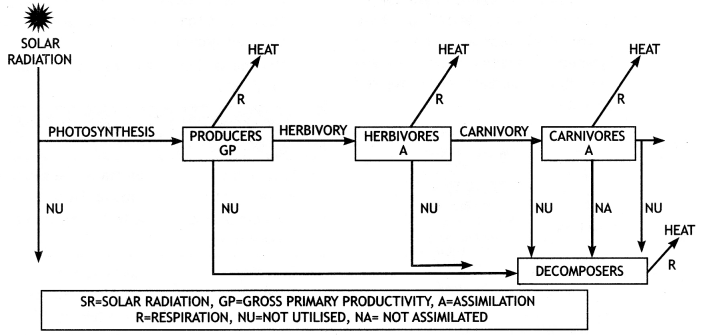
Different components for a universal model of energy flow are shown below:Class 12 Biology Important Questions Chapter 14 Ecosystem 11
A generated energy flow model of ecosystem-Boxes represent biotic components and the arrows show the pathways of energy transfer

When a herbivore eats a plant, then it digests and oxidizes the ingested food to liberate energy which is equal to that used in synthesizing the organic biomass by the plant. Some of the released energy is lost as heat while only a part of the energy is used in building the biomass of the herbivore, which is called gross secondary productivity.

The same is repeated when the herbivore is eaten by a primary carnivore and so on. At each transfer, about 80-90% of potential energy is dissipated as heat while only 10-20% of energy is available to the next trophic level.

Thus, there is a decline in the amount of energy passing from one trophic level to the next trophic level. The study of energy transfer is called bioenergetics. Secondary productivity tends to be about 10 percent at the herbivore level, although efficiency may be higher, 20 percent at the carnivore level.

So regarding the energy flow, an ecosystem is characterized by the following:

  • Unidirectional flow of energy.
  • The decrease in useful energy.
  • Return of radiant energy of the Sun to the non-living system as heat.

Question 27.
Outline salient features of carbon cycling in an ecosystem. (CBSE Delhi 2012)
Answer:
The reservoirs of carbon are listed below:

  1. Carbon dioxide present in the air.
  2. Carbon dioxide dissolved in water.
  3. Carbonates in the earth’s crust.
  4. Fossil fuels like coal and petroleum,
  5. Bicarbonates in oceans.

The carbon cycle is the simplest of all nutrient cycles. Its salient features are listed below:
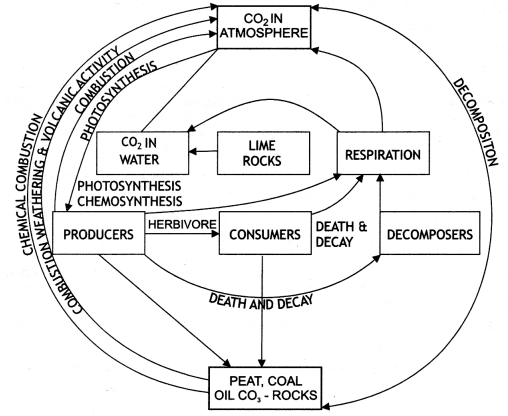
1. CO2 utilization: Carbon dioxide is used by green plants for the process of photosynthesis, and oxygen is released as a by-product. The fixed carbon enters the food chain and is passed to herbivores, carnivores, and decomposers. About 4 x 10¹³ kg of carbon is fixed in the biosphere through photosynthesis annually.

Class 12 Biology Important Questions Chapter 14 Ecosystem 12
Carbon cycle in nature.

2. C02 production and return to the atmosphere:
(a) Carbon dioxide is released into the atmosphere by the respiration of producers and consumers.
(b) It is also released by the decomposition of organic wastes and dead bodies by decomposers by the action of bacteria and fungi of decay.
(c) Burning of wood and fossil fuels also releases C02 into the atmosphere.
(d) Volcanic eruptions and hot springs also release C02 into the atmosphere.
(e) Weathering of carbonate-containing rocks by the action of acids also adds C02 to the atmosphere.

Question 28.
Name the pioneer species on a bare rock. How do they help in establishing the next type of vegetation? Mention the type of climax community that will ultimately get established. (CBSE 2009)
Answer:

  1. Lichens and mosses are the pioneer community. Lichens secrete acids which dissolve the rocks and helps in weathering rocks to form soil.
  2. Soil is formed by the action of lichens.
  3. Invasion is the successful establishment of species.
  4. The reaction is most important in succession. It is the mechanism of modification of the environment due to the influence of living organisms. Changes take place; annual grasses, perennial herbs, shrubs, and finally trees appear along with animal communities.
  5. Angiosperms trees forming forests will form climax communities.

Question 29.
(i) What is an ecological pyramid? Compare the pyramids of energy, biomass, and numbers.
Answer:
Ecological pyramid: An ecological pyramid is a graphical representation of an ecological parameter, like a number or biomass or accumulated energy at different trophic levels in a food chain in an ecosystem.

Ecological pyramids are of three types:

  1. Pyramid of number
  2. Pyramid of biomass
  3. Pyramid of energy
Pyramid of energyPyramid of biomassPyramid of number
(i) The relationship between producers and consumers in an ecosystem represented in the form of a pyramid in terms of the flow of energy is called the pyramid of energy.(i) The relationship between producers and consumers in an ecosystem represented in the form of a pyramid in terms of biomass is called the pyramid of biomass.(i) The relationship between producers and consumers in an ecosystem represented in the form of a pyramid in terms of number is called the pyramid of number.
(ii) It is always upright.(ii) It can be upright or inverted.(ii) It can be upright or inverted.

(ii) Write any two limitations of ecological pyramids. (CBSE 2017)
Answer:
Limitations of ecological pyramids:
(a) Ecological pyramid never takes into account the same species belonging to two or more trophic levels.
(b) It assumes a simple food chain, which never exists in nature.

Organisms and Populations Class 12 Important Extra Questions Biology Chapter 13

Here we are providing Class 12 Biology Important Extra Questions and Answers Chapter 13 Organisms and Populations. Important Questions for Class 12 Biology are the best resource for students which helps in Class 12 board exams.

Class 12 Biology Chapter 13 Important Extra Questions Organisms and Populations

Organisms and Populations Important Extra Questions Very Short Answer Type

Question 1.
Define microclimate.
Answer:
Microclimate represents the climatic

Question 2.
Define habitat and niche.
Answer:
Habitat is the native environment of conditions that prevail at a local scale or in animal or place. area of limited size. Niche is the position or function of an organism in a community of plants and animals.

Question 3.
How is thermoregulation achieved in polar bears?
Answer:
Thermoregulation in the polar bear. By developing blubber in a subcutaneous zone prevents loss of body heat.

Question 4.
What are osmoconformers? Give one example.
Answer:
Osmoconformers. Animals that can change the osmolarity of their body fluids according to that of the surrounding medium are termed osmoconformers, e.g. Myxine.

Question 5.
What factors cause annual variations in the intensity and duration of temperature?
Answer:

  1. Rotation of the earth around the Sun.
  2. The tilt of the earth on its axis.

Question 6.
Species that can tolerate a narrow range of temperature are called ………………..
Answer:
Stenothermic.

Question 7.
What are eurythermic species?
Answer:
Species that can tolerate a wide range of temperature variations are called eurythermic.

Question 8.
Species that can tolerate a wide range of salinity are called ……………………
Answer:
Euryhaline.

Question 9.
Define stenohaline species.
Answer:
It is a species that lives within a narrow range of salinity.

Question 10.
Name two factors that cause the formation of major biomes.
Answer:

  1. Variation in the intensity and duration of temperature.
  2. Variation in precipitation.

Question 11.
What is the main cause of salinity?
Answer:
Salinity is due to the accumulation of soluble minerals on the surface or beneath the surface of the earth.

Question 12.
What does the stratification of community depict?
Answer:
Stratification of a community depicts vertical layering of vegetation.

Question 13.
From where are individual organisms derived?
Answer:
Individual organisms are always derived from pre-existing organisms through the mechanism of reproduction-may be vegetative, asexual or sexual.

Question 14.
List two negative interactions between two species.
Answer:
Parasitism, Predation.

Question 15.
What is the other term for facultative mutualism?
Answer:
Protocooperation.

Question 16.
Name the association in which one species produces a poisonous substance or a change in environmental conditions that is harmful to another species. (CBSE Delhi 2019)
Answer:
Amensalism.

Question 17.
What is mycorrhiza?
Answer:
It is a symbiotic or mutually beneficial association between a fungus and roots of higher plants.

Question 18.
Emergent land plants that can tolerate the salinity of the sea are called ………………..
Answer:
Mangrove plants.

Question 19.
Give an example of a commensal relationship.
Answer:

  1. Epiphytes and tree,
  2. Remora fish and shark.

Question 20.
Define community periodicity.
Answer:
The recurrence of daily or seasonal or lunar changes in a community is called community periodicity.

Question 21.
Mention any two significant roles predation plays in nature. (CBSE 2008)
Answer:
Role of predators:

  1. Transferring energy to a higher trophic level.
  2. They keep the prey population under control.

Question 22.
Why is the polar region not a suitable habitat for a tiny hummingbird? (CBSE 2008)
Answer:
Tiny animals like hummingbird have more surface area compared to their volume. So heat loss may occur which will not be good for the tiny bird in polar regions.

In polar regions, only animals with a thick layer of fat below the skin can survive.

Question 23.
Between birds and amphibians which will be able to cope with global warming? Give reason. (CBSE2008)
Answer:
Birds will be able to cope with global warming because they are homeotherms as body temperature remains constant irrespective to change in surroundings.

Question 24.
Which one of the two stenothermal or eurythermal shows a wide range of distribution on the earth? (CBSE 2008)
Answer:
Eurythermal shows a wide range of distribution on the earth because they can tolerate a wide range of temperature.

Question 25.
In a pond, there were 30 Hydrilla plants. Through reproduction 10 new Hydrilla plants were added in a year. Calculate the birth rate of the population. (CBSE 2010)
Answer:
A number of individuals added = 10 per 20 Hydrilla plants.

\frac{10}{30}= 0.33 offspring per hydrilla plant per year.

Question 26.
How is ‘stratification’ represented in a forest ecosystem? (CBSE Outside Delhi 2014)
Answer:
Stratification is a grouping of plants in a forest into two or more well-defined layers depending upon height like tall trees, medium-sized trees, small trees, bushes and herbs. In the rainforest, it is multi-storeyed.

Question 27.
Give an example of an organism that enters ‘diapause’ and why? (CBSE Delhi 2014)
Answer:
Under unfavourable conditions, many zooplanktonic species in lakes and ponds enter a stage of suspended development called diapause.

Organisms and Populations Important Extra Questions Short Answer Type

Question 1.
Certain species of wasps are seen to
frequently visit flowering fig trees. What type of interaction is seen between them and why? (CBSE 2008, 2014)
Answer:

  1. Mutualism.
  2. Flowers of a fig tree can only be pollinated by wasp species. In return, female wasp visits the fruit of fig as not only an egg-laying site but also uses the developing seed in fruit for nourishing its larvae.

Question 2.
Write a short note on microclimate.
Answer:
Microclimate: It represents the climatic conditions that prevail at a local scale, or in areas of limited size such as the immediate surroundings of plants and animals. Microclimate generally differs from the prevailing regional climatic conditions. For example, in a forest, dense foliage reduces the amount of light reaching the ground. This also results in a changed air temperature profile. The day-time air temperature inside the forests is lower than the outside temperature. Also, the interior of a forest may be more humid than a nearby non-forested area.

Question 3.
What are the effects of organisms on habitat?
Answer:
Effects of organisms on habitat:

  1. Excessive growth may lead to the death of the habitat as in the case of water hyacinth- an increase in population had led to the death of Hussain Sagar lake of Hyderabad.
  2. The predominance of a predator will reduce the population of prey.
  3. Man manipulates the habitat and has affected the forest causing serious problems due to deforestation. More so man has created pollution of air, water and land.

Question 4.
How do you differentiate habitat from the environment?
Answer:
Differences between habitat and environment:

HabitatEnvironment
(i) It is the living place of organisms.(i) It Is a specific region surrounding the population of organisms.
(ii) It is a part of the total environment.(ii) It is larger than a habitat.
(iii) It must offer food, shelter and climate condition suitable for the organism to live and flourish.(iii) It has a special condition suitable for specific organisms. Example. Desert rats of Rajasthan are not found in plains of U.P and M.P

Question 5.
Differentiate microhabitat. between habitat and
Answer:
Differences between habitat and microhabitat:

HabitatMicrohabitat
(i) It is a living place of an organism.(i) It is a more localised part of the habitat.
(ii) It is a part of the total environment of the region.(ii) It is a part of the habitat.
(iii) It has a common climate for all organisms. Example. Sundarban forests are the habitat of Bengal tigers.(iii) It is mostly suited for specific animals, e.g. sediments of pond or togs.

Question 6.
List the means by which organisms survive at freezing temperatures.
Answer:

  1. The animals are usually white or light coloured. The light colouration of animals helps in camouflage with snow and thermal regulation.
  2. Animals are thickly coated with fur.
  3. Presence of a thick layer of fat below the skin.

Question 7.
Differentiate eurythermal, stenothermal and euryhaline animals.
Answer:
Differences between eurythermal, stenothermal and euryhaline animals:

Eurythermal AnimalsStenothermal AnimalsEuryhaline Animals
These are the animals/ organisms which can tolerate a wide range of temperatures.These are the animals/ organisms which can tolerate only: a narrow range of temperatures.These are the animals that can tolerate a wide range of salinity of the medium.

Question 8.
Explain how is an orchid plant adapted to changes in temperature and humidity.
Answer:
An orchid plant, e.g.Venda, an epiphyte, is a native of tropical forests of India and South Asia.

Its adaptations are:

  • Stem stores water and leaves are adapted to keep water in and dryness out.
  • Roots of the plant secure their attachment to the bark of the tree and help in the absorption of moisture from humid air or rain.

Question 9.
Why do submerged plants receive weaker illuminations than exposed floating plants in a lake?
Answer:
Because light intensities of stronger illuminations are absorbed by the exposed floating plants of the lake/water-bodies, so only the weaker illuminations reach the submerged, Some light is reflected at the water surface and a part is absorbed by upper layers of water.

Question 10.
Categorise the following plants into hydrophytes, halophytes, mesophytes and xerophytes. Give reasons for your answers.
(i) Salvinia
Answer:
Hydrophyte. Because it is not able to tolerate deficiency of water. It is partially or completely submerged.

(ii) Opuntia
Answer:
Xerophyte. Because it prefers a dry and hot climate with low rainfall, thus has succulent leaves.

(iii) Rhizophora
Answer:
Halophyte. Because it grows in a saline habitat.

(iv) Marigifera
Answer:
Mesophyte. Because it prefers areas with high moisture content.

Question 11.
If a freshwater fish is placed in an aquarium containing seawater, will the fish be able to survive? Explain giving reasons. (CBSE Delhi 2015)
Answer:
No, a freshwater fish placed in the aquarium containing sea-water will not be able to survive. Because its body system is adapted to function normally in a narrow range of salinity and it cannot survive in the high salinity of sea-water.

Question 12.
Distinguish between population and community.
Answer:
Differences between population and community:

PopulationCommunity
(i) Group of individuals of same species inhabiting the same area.(i) Group of species lying in the same area.
(ii) Organism in a population undergoes the same life cycle.(ii) Different species have a different life cycle.

Question 13.
How does population size increase or decrease?
Answer:

  • Population (size/density) increases by birth, hatching, germination and immigration that add individuals.
  • Population (size/density) decreases by death and emigration. The population is regulated by food, space, disease, natural calamities and environmental factors.

Question 14.
Differentiate between natality rate and death/mortality rate.
Answer:
Differences between natality rate and mortality rate:

Character

Natality rate  

Morality rate

(i) DefinitionA number of births per 1,000 individuals of a population per year.A number of death per 1,000 individuals of a population per year.
(ii) Population size and population density.IncreasesDecreases

Question 15.
Discuss the role of predators in an ecosystem.
Answer:
Predators are of great importance as they play the following important roles in an ecosystem:

  1. They act as ‘conduits’ for energy transfer to higher trophic levels.
  2. They keep the prey population under control, which otherwise can reach very high population density and cause an imbalance in the ecosystem,
  3. They help in maintaining species diversity in a community by reducing the intensity of competition among the competing prey species.

Question 16.
What is brood parasitism? Give an example.
Answer:
Brood parasitism. It refers to the phenomenon in which one (parasitic) bird species lays its eggs in the nest of another bird species.

Evolution has occurred in such a way that the eggs of the parasitic birds resemble those of the host bird in size, colour, etc. to avoid the host bird detecting the foreign eggs and ejecting them from the nest. Example. Cuckoo birds lay eggs in the nests of crows.

Question 17.
List a few adaptations that parasites have developed. (CBSE Delhi 2019)
Answer:
Parasites have evolved one or more of the following adaptations:

  1. Loss of unnecessary sense organs.
  2. Presence of hooks/adhesive organs and suckers.
  3. Loss of digestive system.
  4. High reproductive capacity.
  5. Produces antitoxins to counter toxins to the host.

Question 18.
How do parasites harm the host?
Answer:
The parasites harm the host in the following ways:

  1. Reduces the survival of the host.
  2. Growth and reproductive rates of hosts are reduced.
  3. Render the most vulnerable to its predators by making them physically weak.

Question 19.
Justify the statement “Predators and scavengers are markedly different.”
Answer:
Predators feed on another organism, i.e. prey, whereas scavenger feeds on dead animals or an animal killed by another animal. A predator can be a prey also, e.g. a frog eats insects and the frog may be eaten by a snake. But a scavenger such as jackals, hyenas and vultures cannot kill zebra or giraffe or deer but a lion kills them and leaves a part of it to be eaten by such scavengers.

Question 20.
Mention any two significant roles predators play in nature. (CBSE 2008, 2016)
Answer:
Role of predators:

  1. Transferring energy to a higher trophic level.
  2. Keeping the prey population under control.

Question 21.
How do organisms manage stressful conditions existing in their habitat for a short duration? Explain with the help of one example each. (CBSE (Delhi) 2008)
Answer:
Physiological adaptations allow some organisms to respond quickly to stressful conditions. At high altitude, mountain (altitude) sickness is experienced resulting in nausea, fatigue and heart palpitations. It is due to low atmospheric pressure at high altitude and the body does not receive the proper amount of oxygen. It is accommodated by increasing RBC production, decreasing the binding capacity of haemoglobin and increasing breathing rate.

Question 22.
Explain with the help of an example each of any three ways the ecologists use to measure the population density of different organisms rather than by calculating their absolute number. (CBSE Delhi 2019 C)
Answer:
Method to measure population density: Population density is the number of individuals of a species per unit area or volume.

PD= N/S

Where N = The no. of the individual in the region
S = No. of the unit area in a region

  1. Number of animals per square kilometre
  2. Number of trees per hectare
  3. A number of phytoplanktons per cubic litre of water. Sometimes the relative densities also serve the purpose, that is
  • The number of fish caught per trap is good enough to measure the population of fish.
  • Tiger census is based on pug marks and faecal pellets.

Question 23.
Name the interaction in each of the following:
(i) The cuckoo lays her eggs in the crow’s nest.
Answer:
Brood parasitism.

(ii) Orchid grows on a mango tree.
Answer:
Commensalism.

(ii) Ticks live on the skin of dogs.
Answer:
Parasitism.

(iv) Sea anemone is often found on the shell of a hermit crab. (CBSE Delhi 2008)
Answer:
Mutualism.

Question 24.
Name the interaction in each of the following:
(i) Cuscuta growing on a shoe flower plant.
Answer:
Parasitism.

(ii) Mycorrhizae living on the roots of higher plants.
Answer:
Mutualism.

(iii) Clownfish living among the tentacles of a sea anemone.
Answer:
CommensaLism.

(iv) Koel laying its eggs in the crow’s nest. (CBSE Delhi 2011)
Answer:
Brood parasitism.

Question 25.
Name the interaction In each of the following:
(i) Ascaris worms living in the intestine of human.
Answer:
ParasItism

(ii) Suckerfish attached to the shark.
Answer:
Commensalism

(iii) Smaller barnacles disappeared when Balanus dominated the coast of Scotland.
Answer:
Competition

(iv) Wasp pollinating fig inflorescence. (CBSE 2008)
Answer:
Mutualism.

Question 26.
Why do clownfish and sea anemone pair up? What is this relationship called? (CBSE 2012)
Answer:

  1. Commensalism,
  2. Interaction between sea-anemone that has stinging tentacles and the clownfish that lives among them in which fish gets protection from predators. The anemone does not appear to derive any benefit from the clownfish.

Question 27.
Some organisms suspend their metabolic activities to survive in unfavourable conditions. Explain with the help of any four examples. (CBSE 2012)
Answer:

  1. Thick-walled spores of bacteria and fungi help them to overcome unfavourable conditions.
  2. Frogs and lizards undergo hibernation during the winter season.
  3. Snails and fish undergo aestivation during summer to avoid summer-related problems of heat and desiccation.
  4. Species of zooplankton are known to enter a suspended state of development termed-diapause.

Question 28.
A moss plant is unable to complete its life cycle in a dry environment. State reason. (CBSE Delhi 2015)
Answer:

  1. Due to the absence of vascular tissue, water and minerals cannot be transported to various parts.
  2. Transfer of flagellated antherozooids to oospore of archegonium depends upon water.

Question 29.
Plants that inhabit a rain-forest are not found in wetlands. Explain. (CBSE Delhi 2016)
Answer:
A habitat is a specific place or area or locality having a combination of factors, physical features and barrier where a community resides. In rainforest plants adapt themselves to the specific conditions of their habitat and the characteristics adaptations related to a particular habitat are not found in those plants living in wetland and vice versa. Thus they can not inhabit a new habitat.

Question 30.
Answer:
In certain seasons we sweat profusely while in some other season we shiver. Explain. (CBSE Delhi 2016)
Answer:
Humans are a warm-blooded or homeothermic or endothermal organism. They maintain a fixed body temperature despite changes in the surrounding. The optimum temperature for maximum efficiency of enzymes is 37°C. Thus the human body maintains a body temperature near it.

Homoeostasis is the phenomenon of maintaining a constant internal environment. Thus during heavy exercise or summer, sweating occurs. It helps in cooling the body. During winter, shivering helps in retaining heat within the body.

Question 31.
How did David Tillman show that the “Stability of a community depends on its species richness”? Explain. (Outside Delhi 2019)
Answer:
The stability of a community depends on its species richness. David Tilman’s long-term ecosystem experiments using outdoor plots provided the answer for species richness. Tilman found that plots with more species showed less year-to-year variations in total biomass. He also showed that increased diversity contributed to higher productivity.

Thus he established that the stability of a community depends on its species richness.

Organisms and Populations Important Extra Questions Long Answer Type

Question 1.
(i) “Organisms may be conformers or regulators.” Explain this statement and give one example of each.
(ii) Why are there more conformers than regulators in the animal world? (CBSE 2017)
Or
Human is categorised as ‘regulators’. Explain how they maintain a constant body temperature. (CBSE Outside Delhi 2019)
Answer:
(i) Regulators are organisms that are able to maintain homoeostasis by physiological and behavioural means. All birds and mammals and few lower vertebrate and invertebrate species maintain homoeostasis by thermoregulation and osmoregulation, e.g. birds and mammals.

However, a majority (99%) of animals and nearly all plants cannot maintain a constant internal environment, i. e. their body temperature is not constant. They are conformers, e.g. fishes, frogs, etc.

(ii) There are more conformers than regulators in the animal world because conformers lack the capability to maintain a constant internal environment or homoeostasis. It is limited to birds, mammals and few lower vertebrate and invertebrate species only because it is a very energy-expensive process.

Question 2.
Explain the ecological hierarchy.
Answer:
Ecological hierarchy: It is a series of graded ecological categories.
Characteristics of ecological hierarchy:

  1. A biological unit at each level has a specific structure and function.
  2. In this hierarchy, smaller biological units coordinate to form the next higher level of organisation.
  3. Only the organisms show free existence.
  4. Organisms cannot live in isolation.
  5. At each level, different units show interdependence.
  6. At each level, the unit shows interaction with the physical environment (energy and matter).
  7. The biological units are successfully adapted to their environment.

Question 3.
In a seashore, the benthic animals live in sandy, muddy and rocky substrata and accordingly developed the following adaptations.
Find suitable substratum against each adaptation.
(i) Burrowing
Answer:
In a seashore, the benthic animals adapt to their mode of life according to the nature of the seafloor, e.g. Benthic animals become fossorial (burrowing) in the sandy substratum, e.g. tube worm.

(ii) Building cubes
Answer:
Benthic animals build cubes in the muddy substratum.

(iii) Holdfasts/peduncle
Answer:
Benthic animals develop holdfast/ peduncle if the substratum is rocky.

Question 4.
In a pond, we see plants that are free. floating, rooted-submerged, rooted-emergent, rooted with floating leaves. Write the type of plant against the following examples:
(i) Hydrilla
Answer:
Hydrilla is Rooted submerged.

(ii) Typha
Answer:
Typha is Rooted emergent.

(iii) Nymphaea
Answer:
Nymphaea is Rooted with floating leaves.

(iv) Lemna
Answer:
Lemna is Free-floating.

(v) Vallisneria.
Answer:
Vallisneria is Rooted submerged.

Question 5.
Why do all the freshwater organisms have contractile vacuoles whereas the majority of marine organisms lack them?
Answer:
Contractile vacuole helps in maintaining salt and water level called osmoregulation. Because of the cellular environment of a freshwater organism such as Amoeba, Paramecium etc. being hypertonic, the water diffuses inside the cell constantly and gets collected in the contractile vacuole, which squeezes the extra water out of the cell periodically.

While in the case of marine protozoans organisms, this does not occur due to high salt concentration. These organisms live in isotonic conditions in seawater. Thus there is no need for contractile vacuole.

Question 6.
Explain the following terms:
(i) Mimicry
Answer:
Mimicry: It is a phenomenon in which a living organism modifies its form, appearance, structure or behaviour and looks like another living organism or some inanimate (non-living) object so as to defend from its predators, or to increase the chances of capturing the prey.

The individual which shows mimicry is called a mimic, while the animate or inanimate object with which a mimic resembles is called a model. The concept of mimicry was first observed by an English naturalist, Henry Bates (1862 A.D.), so the phenomenon is also called Batesian mimicry.

Types: Mimicry is of three types:
(a) Protective mimicry,
(b) Aggressive mimicry,
(c) Feigning death or Conscious mimicry.

(ii) Acclimatisation
Answer:
Acclimatisation: The gradual physiological adjustment to slowly changing new environmental conditions is known as acclimatisation. If some factors shift beyond the tolerance range, the organism can come to a tolerance range or migrate to acclimatise.

Question 7.
DepIct the temperature-based thermal stratification in lakes.
Answer:
Thermal stratification in Lakes:
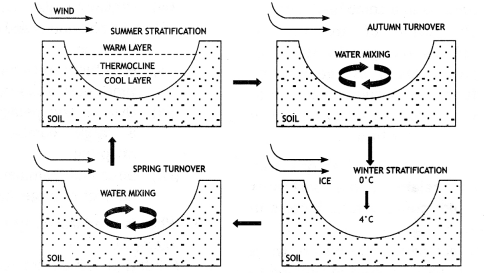
Class 12 Biology Important Questions Chapter 13 Organisms and Populations 1

Thermal stratification occurs in lakes, the seasonal mixing patterns of a lake are determined by its temperature profile.

Question 8.
1. How does age distribution help in the study of the population?
2. How does an age pyramid, for the human population at a given point of time helps the policymakers in planning the future? (CBSE Delhi 2016)
Or
Draw a stable human age pyramid. (CBSE Outside Delhi 2019)
Answer:
Age distribution (Age composition). The relative abundance of the organisms of various age groups in the population is called the age distribution of the population. With regard to age distribution, there are three kinds of populations:

1. Rapidly growing population. It has a high birth rate and low death rate, so there is more number of young individuals in the population. According to a recent survey, more than 42% of the Indian population consists of children below the age of 14 years, so the Indian population is called the young population.
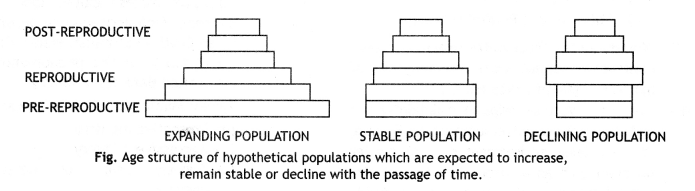
Class 12 Biology Important Questions Chapter 13 Organisms and Populations 2
2. Stationary population: It has equal birth and death rates, so the population shows zero population growth.

3. Declining population. It has a higher death rate than the birth rate, so the population of young members is lower than that of old members.
(a) For the human population, the age pyramids generally show the age distribution of males and females in a combined diagram.
(b) The shape of the age pyramid reflects the growth status of the population. Thus age pyramid for the human population at a given time helps the policymakers in planning for the future.

Question 9.
Discuss life-history traits of an organism that have evolved in relation to the constraints imposed by biotic and abiotic factors in their habitat.
Answer:
According to ecologists, life-history traits of an organism have evolved in relation to the constraints imposed by the biotic and abiotic factors in their habitats.

  1. It can be illustrated with vast variations and life history.
  2. The evolution of populations aims at improving reproductive fitness or Darwinian fitness to the maximum in their habitats.
  3. They evolve towards the most efficient reproductive strategy.
  4. Organisms like Pacific Salmon fish and bamboo breed only once in their lifetime.
  5. Most birds and mammals breed many times during their lifetime.
  6. Oysters and pelagic fishes produce a large number of small-sized offspring.
  7. Birds and mammals produce a small number of large-sized offspring.

Question 10.
What is the predator-prey relationship? Give example. (CBSE 2016)
Answer:
Predation. It is an interspecific interaction, where one animal (called predator) kills Organisms and Populations and consumes the other weaker animal (called prey). Herbivores are predators of plants.

Predator-prey relationship. It is a kind of direct food relationship between two species of animals in which larger species, called predator, attacks, kills and feeds on the smaller species, called prey. It was proved by G.F. Gause (1934).

Although predation and competition appear to be very harmful processes, they are essential to keep a check on the size of the population of other species.

Predation is nature’s way of transferring the energy fixed by plants, to higher trophic levels.
Examples:

  1. A tiger killing and eating a deer.
  2. A snake eating a frog.
  3. A sparrow eating a fruit/seed.

Question 11.
Many prey organisms have developed different defence mechanism. Give a few examples.
Answer:
Prey species have developed various defence mechanisms to reduce the impact of predation; some of them are listed below:

  1. Certain insect species and frogs have camouflage (cryptic colouration) to avoid detection by their predators.
  2. Some animals (e.g. monarch butterfly) are highly distasteful to their predators. This butterfly species accumulates a chemical by feeding on a poisonous weed during its caterpillar stage.
  3. Some prey species are poisonous and hence are avoided by predators, e.g. Dart frogs like Phyllobates bicolour and Dendrobats.

Question 12.
“Herbivores are the predators of plants”. Discuss a few defence mechanisms of plants against herbivory.
Or
Write what do phytophagous insects feed on? (CBSE2012)
Answer:
Herbivores are the predators of plants. The problem of predation is more severe for plants than animals as the plants cannot move away from the predators. About 25% of the known insects are phytophagous and feed on the sap and other parts of plants.

Plants have developed certain morphological and chemical defence mechanisms against herbivores; a few of them are listed below:

  1. Morphological: Thorns (Bougainvillaea) and spines (Acacia, Cactus, etc.) are the most common morphological means of defence.
  2. Chemical: Plants produce and store certain chemicals which function in one or more of the following ways:
    (a) They make the animal feel sick.
    (b) They inhibit them from feeding.
    (c) They interfere with digestion.
    (d) They even directly kill them, e.g. Calotropis produces a highly poisonous glycoside, that is a cardiac poison.
    (e) Nicotine, strychnine, opium, quinine, etc. are the chemicals produced by plants for their defence against herbivores.

Question 13.
What is parasitism? Define parasite and host. What are the kinds of parasite?
Answer:
Parasitism: This is a relationship between two organisms in which one obtains its nourishment from the other and harms it at the same time.

Parasite: The organism which obtains its food from the other without directly killing it is known as a parasite. Parasites are host specific and parasite and host tend to co-evolve.

Host: The second organism which provides food to the parasite is named the host. Endoparasite. The parasite that lives inside the body of the host is known as endoparasite.

Ectoparasite. The parasite lives on the outside of the body of the host, e.g. Leech, Louse, Bedbug.

Question 14.
Define commensalism. Give examples.
Answer:
Commensalism: It is defined as the interspecific interaction where one species is benefitted while the other species is neither benefitted nor harmed.
Examples:

  1. Orchids grow as epiphytes on mango or other fruit trees. Orchids are benefitted by getting shelter, while the tree is neither benefitted nor harmed.
  2. The clownfish living among sea anemones get protection from their predators, which stay away from the stinging tentacles of the sea anemone.
  3. Barnacles growing on the whale are benefitted to move to where food is available.
  4. The cattle egrets always forage near where the cattle are grazing. As the cattle animals stir up, the insects are flushed out from the vegetation. The egrets are benefitted from this as otherwise, it might be difficult for the birds to detect and catch the insects.

Question 15.
Differentiate between the following:
(i) Mutualism commensalism.
Answer:
Differences between mutualism and commensalism:

Mutualismcommensalism
(i) It is the inter-specific interaction, in which both the interacting species are benefitted.(i) It is the interspecific interaction, in which one species is benefitted white the other is neither benefitted nor harmed.
(ii) It may or may not involve physical association.(ii) The two individuals come in close physical contact.

(ii) Commensalism and amensalism.
Answer:
Differences between commensalism and amensalism:

CommensalismAmensalism
It is the interspecific interaction in which one species is benefitted while the other one is neither harmed nor benefitted.It is the interspecific interaction in which one species is harmed I affected, while the other is neither benefitted nor harmed.

(iii) Predators and parasites.
Answer:
Differences between predators and parasites:

PredatorsParasites
(1) Predators are Larger and stronger animals that kill and consume the prey.(i) Parasites are small or microscopic organisms that depend on the host.
(ii) They do not take shelter on the prey(ii) They take shelter on the host.
(iii) Their biotic potential is Low.(iii) They have higher biotic potential.
(iv) They are mobile to capture the prey.(iv) They have poor means of dispersal.
(v) They are not specific for the Prey(v) They are host-specific.

Question 16.
Study the graph given below and answer the questions that follow:
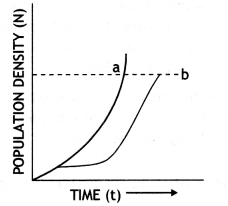
Class 12 Biology Important Questions Chapter 13 Organisms and Populations 3

(i) Write the status of food and space in the curves (a) and (b).
Answer:
Food and space are unlimited in the curve (a), while they are limited in the curve (b).

(ii) In the absence of predators, which one of the two curves would appropriately depict the prey population?
Answer:
In the absence of a predator, any species will grow exponentially and show curve (b).

(iii) Time has been shown on X-axis and there is a parallel dotted line above it. Give the significance of this dotted line. (CBSE 2014)
Answer:
The dotted line represents (k). It is carrying capacity.

Question 17.
Explain parasitism and co-evolution with the help of one example of each. (CBSE Outside Delhi 2016)
Answer:

  1. Many parasites have evolved to be host-specific. They can live as parasite only in a single species of host.
  2. These organisms parasitize in such a way that both the host and the parasite tend to co-evolve; that is if the host evolves a special mechanism for rejecting or resisting the parasite, in such conditions parasite has to evolve a mechanism to counteract and neutralise them, in order to be successful with the same host species.
  3. In accordance with their mode of living, parasites evolve special adaptations such as loss of unnecessary sense organs, presence of adhesive organs or sucker so as to cling to the host. It also loses the digestive system. Parasites have a high reproductive capacity.
  4. The human liver fluke depends on the intermediate host (a snail and a fish ) to complete the life cycle.
  5. The malarial parasite needs a female anopheles mosquito as a vector to spread to other hosts.

Question 18.
(i) In a pond, there were 200 frogs. 40 more were born in the year. Calculate the birth rate of the population.
Answer:
Birth rate = No. of individuals born/ Total no. of individuals = 40/200 = 0.2 = 0.2 frog per year.

(ii) Population in terms of number is not always a necessary parameter to measure population density. Justify with two examples. (CBSE Outside Delhi 2019)
Answer:
To measure population density, the number is not always a necessary parameter.

For example:
(a) If there are 200 Parthenium plants but only a single huge banyan tree with a large canopy, the population density of banyan is low relative to that of Parthenium which amounts to underestimating the enormous role of the banyan in that community. In such cases, the per cent cover or biomass is a more meaningful measure of the population size.
(b) In a dense laboratory culture of a microbial population in a Petri dish, the total number of microbes is again not an easily adaptable measure because as the population is huge, counting is impossible and time¬consuming.

Question 19.
How do organisms which cannot migrate tend to overcome adverse environ¬mental conditions? Explain taking one example each from vertebrates and angiosperms respectively. (CBSE Delhi 2009)
Answer:
Organisms that cannot migrate tend to overcome adverse environmental conditions by developing several methods/ features. For example, some vertebrates escape the stress caused by unfavourable environmental conditions by escaping in time like bears go into hibernation during the winter months.

In angiosperms, seeds and some other vegetative reproductive structures serve as means to tide over periods of stress. They reduce their metabolic activity and go into an inactive, i.e. ‘dormant’, state. They germinate to form new plant when the favourable conditions return.

Question 20.
Explain how tolerance to environmental factors determines the distribution of species.
Answer:
Range of tolerance: Biological species can show a range of tolerance to environmental factors. These factors show variation in their effects and anyone who is present in the least amount may become limiting. The response of an organism to a range of gradient of a single environmental factor such as temperature, sunlight or nutrient concentration forms a bell-shaped curve as shown in the figure.
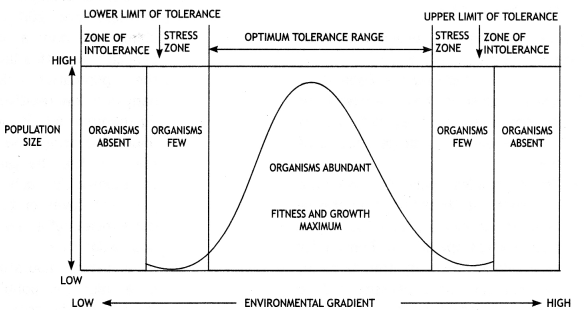
Class 12 Biology Important Questions Chapter 13 Organisms and Populations 4
The response of an organism to a range or gradient of an environmental factor, (temperature, Light, nutrient)

Question 21.
Discuss in detail various adaptations found in plants and animals in snowy winter of polar regions.
Answer:
Adaptations in plant and animals of polar regions:

  1. Organisms living in polar regions have to face the severe snowy winter and show entirely different types of adaptations. Animals in polar regions are generally white or tight coloured. This light colouration helps in camouflage and in thermal regulation.
  2. During extreme winter they undergo hibernation.
  3. Animals eat a lot of food during summer and autumn and store a lot of energy in the form of fat.
  4. During hibernation, their metabolic activities are reduced considerably,
  5. The plants growing in these regions remain dormant during extreme winter months.
  6. They bear narrow leaves, spines, etc. which are shed easily and rapidly,
  7. Plants remain dwarf. Trees are usually not found in these regions as they cannot withstand the low temperatures.

Question 22.
How do desert plants prevent loss of water?
Answer:
Xeric adaptations of desert plants:

  1. Some xerophytes remain dormant either as seeds or as roots and during rains, they sprout up. It is termed ephemerals, e.g. Cassia, Argemone.
  2. Some desert plants develop succulent organs (stems, leaves and roots), e.g. Asparagus, Begonia, Bryophyilum.
  3. Presence of extensive root system.
  4. Either leaf is absent or small¬sized leaves present to minimise the rate of transpiration.
  5. The stomata get sunken to reduce the rate of transpiration.
  6. Presence of thick cuticle on stem and leaf surfaces. This reduces the rate of transpiration.
  7. Shedding of leaves in some desert plants. This helps in reducing the surface area and water loss.

Question 23.
(i) What is the competition?
Answer:
Competition is an interaction between organisms for life requirements (nutrition, shelter, sunlight, etc.). It is of two types: intraspecific and interspecific. The effort of a tiger and a leopard for prey is an interspecific competition. In general, it is believed that competition occurs among closely related species when they compete for the same resources that are limited.

(ii) Why is it not true always?
Answer:
But it is found to be not true always for the following reasons:
(a) Completely unrelated species can also compete for the same sources. For example in certain shallow lakes of South America, the visiting flamingoes and the native fishes compete for the same zooplankton as their food.

(b) Resources need not be limiting for the competition to occur, the feeding efficiency of one species might be reduced due to the interfering and inhibitory presence of the other species, even if resources are plenty.

For example, the Abingdon tortoise in Galapagos island became extinct within a decade after goats were introduced into the island: this was due to the fact that the goats had greater browsing efficiency than the tortoise.

(iii) Explain competitive release and Gause’s competitive exclusion principle.
Answer:
Another evidence for the competition is competitive release, a phenomenon in which a species whose distribution is restricted to a small geographical area due to the presence of a competitively superior species, expands its distributional range when the competing species is experimentally removed.

Gause’s competitive exclusion principle states that two closely related species competing for the same resources cannot exist together as the competitively inferior one will be eliminated, but this is true only when the resources are limiting and not otherwise.

They have also pointed out that species facing competition might evolve mechanisms that promote co¬existence, rather than exclusion.

(iv) Write contribution of Mac Arthur.
Answer:
Mac Arthur had shown that five closely related species of warblers living on the same tree were able to avoid competition and co-exist to behavioural differences in their foraging activities.

Question 24.
Illustrate symbiosis with any four examples.
Answer:
Symbiosis: It is the relationship between two individuals where both partners are benefited.

That following are examples of symbiosis:

  1. The Rhizobium bacteria present in the root nodules of leguminous plant roots are an example of symbiosis. Bacteria live in the roots in the form of nodules and avail carbohydrate and other food substances. In exchange, bacteria fix the nitrogen present in the atmosphere and make it useful for plants.
  2. Trichonympha, a protozoan parasite, lives inside the intestine of termites. The presence of this protozoan helps the termites to digest the cellulose food and the parasite gets food and shelter.
  3. Lichen plants. Lichen is the result of a symbiotic relationship between algae and fungi. In this, algae depend on fungi for water, minerals, salts and safety, whereas fungi get food material prepared by algae.
  4. The human intestine contains a large number of symbiotic bacteria that help in the synthesis of vitamin B-complex. Bacteria get necessary nutritional substances from the human intestine and a safe place for living.

Question 25.
Define phenotypic adaptation. Give one example.
Answer:
Phenotypic adaptation involves non-genetic changes in individuals such as physiological modifications, acclimatisation or behavioural changes. Some organisms possess adaptations that are phenotypic, which allow them to respond quickly to a stressful situation.

Example. If a person had ever been to any high altitude place (Rohtang pass near Manali or Mansrover in Tibet), he or she must have altitude sickness because the body does not get enough oxygen at such a height and protect itself from atmospheric hypoxia. But after some time, the body acclimatises itself to the situation by increasing the number of RBC and decreasing the binding affinity of Hb and oxygen.

Question 26.
Name important defence mechanisms in plants against herbivores.
Answer:
Defence mechanisms of plants against herbivorous animals:

  1. Formation of thick cuticle on their leaf surface.
  2. Formation of leaf spines, e.g. leaf spines in opuntia
  3. Modification of leaves into thorns, e.g. Bougainvillea and Duranta
  4. Development of spiny margins on leaves.
  5. Development of sharp silicated edges in leaves.
  6. Many plants produce and store toxic chemicals which cause discomforts to herbivores, e.g. cardiac glucoside by Calotropis, nicotine by tobacco.

Question 27.
Distinguish between the following:
(i) Hibernation and aestivation
Answer:
Differences between hibernation and aestivation:

HibernationAestivation
(i) Spending the winter in an inactive? dormant state, Is called hibernation (winter sleep).(i) Spending dr hot period (summer) in an inactive period is called aestivation (summer sleep).
(ii) Example. Northern ground squirrels.(ii) Example. Ground squirrels in the South West deserts.

(ii) Ectotherms and endotherms.
Answer:
Differences between ectotherms and endotherms:

EctothermsEndotherms
Ectotherms are those animals whose body temperature changes to match with that of the surroundings, in which they are living. They cannot maintain their internal environment constant.Endotherms are those animals whose body temperature is maintained relatively constant by physiological regulation.

Question 28.
Write short notes on:
(i) adaptations of desert plants and animals. (CBSE2011)
Answer:
Adaptations of desert plants and animals:
(a) Adaptations of desert animals.

  • Animals faced with water scarcity as found in arid or desert areas, show two types of adaptations, reducing water loss and the ability to tolerate arid conditions. Kangaroo/Desert rat seldom drinks water. It has a thick coat to minimise evaporative desiccation. The animal seldom comes out of its comparatively humid and cool burrow during the daytime. 90% of its water requirement is met from metabolic water (water produced by respiratory breakdown) while 10% is obtained from food.
  • Loss of water is minimised by producing nearly solid urine and faeces.
  • Spiny skin and highly cornified in Phrynosoma (horned toad) and Moloch horridus.
  • Camels have long legs to stay away from the hot desert surface.

(b) Adaptations of desert plants.

  • Plants have thick cuticle, succulent organs where water and mucilage are stored.
  • Stomata are sunken to prevent water loss.
  • They have a well-developed branched root system.
  • They possess a waxy coating on the surface.
  • Crassulacean pathway of photosynthesis.

(ii) behavioural adaptations in animals. (CBSE 2011)
Answer:
Adaptations of plants to water scarcities. They are called xerophytes. The above-mentioned adaptation of plants are applicable (see part (a)).

(iii) Behavioural adaptations in animals,
(a) Hibernation
(b) Aestivation
(c) Periodic activity
(d) Camouflage
(e) Migration.

(iv) importance of light to plants.
Answer:
Importance of light to plants.
(a) Source of energy for photosynthesis
(b) Photoperiodism
(c) Pigmentation
(d) Daily rhythm
(e) Plant movements and (f) Growth.

(v) effect of temperature or water scarcity and the adaptation of animals.
Answer:
Effect of temperature or water scarcity and adaptation of animals. Optimum temperature is necessary for animals, survival as all the metabolic activities are driven by enzymes. And enzymes work actively only in a certain optimum range of temperature. Regulators can regulate their body temperature in case of temperature fluctuations in the external environment. Conformers also try to maintain temperature by certain methods but not internally.

Similarly, water is also necessary for the metabolic activities of animals. Various adaptations seen in animals to deal with temperature fluctuations are

  • thick fur,
  • sweating, short limbs and ears.

Various adaptation to counter the scarcity of water is the ability to use metabolic water, store water, reduced water loss, etc.

Question 29.
With the help of a suitable diagram describe the logistic population growth curve. (CBSE Delhi 2019 C)
Answer:
Logistic popuLation growth curve.
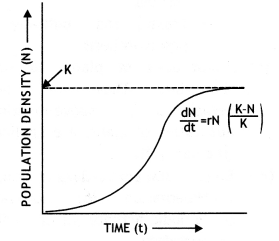
Class 12 Biology Important Questions Chapter 13 Organisms and Populations 5

S-shaped Population growth curve (Verhulst-Pearl logistic growth curve)

Unlimited resources result in exponential growth. Many countries have realised this fact and introduced various restraints to limit human population growth. In nature, a given habitat has enough resources to support a maximum possible number, beyond which no further growth is possible. This limit is called carrying capacity (K) for that species in that habitat.

A population growing in a habitat with limited resources shows initially a lag phase, followed by phases of increase and decrease and finally the population density reaches the carrying capacity. A plot of N in relation to time (t) results in a sigmoid curve. This type of population growth is called Verhulst-Pearl Logistic Growth as explained by the following equation:

\(\frac{d \mathrm{~N}}{d t}=r \mathrm{~N}\left(\frac{\mathrm{K}-\mathrm{N}}{\mathrm{K}}\right)\)

where N = Population density at a time t; r = Intrinsic rate of natural increase and K = Carrying capacity,

\(\left[\frac{k-N}{k}\right]\) = Environmental resistance.

Since resources for growth for most animal populations become limiting sooner or later, the logistic growth model is considered a more realistic one.

Question 30.
List any three important characteristics of a population and explain. (CBSE Delhi 2019)
Answer:
Three important characteristics of a population are:

  1. Population size and population density
  2. Birth or natality rate
  3. Death or mortality rate.
  • Population size: It is the actual number of individuals in the population. The size of the population keeps changing with time depending on the factors like:
    (a) Food availability
    (b) Weather
    (c) Predation pressure and
    (d) Competition.

Population density is a measure of population size per unit area. The population density in a given habitat during a given period changes due to four basic processes, namely

  1. Natality,
  2. Mortality,
  3. Immigration and
  4. Emigration.

While natality and immigration contribute to an increase in the size and density of a population, mortality and emigration contribute to a decrease in them.

So the equation for population growth is: Nt + 1 = Nt + [(B + I) – (D + E)],
where Nt = population density at time t.
B = No of birth I = No of Immigration D = No of death E = No of emigration

  • If B + I is more than D – E, the population density increases.
  • If B + I is less than D – E, the population density decreases.

Birth or Natality rate. It is generally expressed as the number of births per 1,000 individuals of a population per year. It increases the population size (total number of individuals of a population) and population density. Natal or Birth Rate =
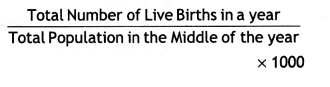
Class 12 Biology Important Questions Chapter 13 Organisms and Populations 6

Death or Mortality rate. It is the opposite of the natality rate. It is commonly expressed as the number of deaths per 1,000 individuals of a population per year.
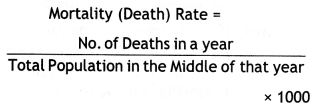
Class 12 Biology Important Questions Chapter 13 Organisms and Populations 7

Question 31.
Define mutualism. Give examples.
Answer:
Mutualism: It is a symbiotic relationship between the members of two species in which the two partners are mutually benefited. There is a complete dependence of the partners on each other, and one cannot survive in the absence of the other.

Sometimes the term symbiosis is used as a synonym with mutualism.
Examples:
(a) Mutualism between animal and bacteria. Symbiotic bacteria like Ruminococcus are found in the rumen part of the compound stomach of cud-chewing mammals like cattle, sheep, goat, camel, etc. and secrete cellulase enzyme to digest the cellulose of plant food eaten by the ruminants which provide food and shelter to the bacteria.

(b) Mutualism between crab and sea anemone. In this case, a sea anemone gets attached to the back of the hermit crab.

(c) The Mediterranean orchid, Ophrys, employs sexual deceit to get its flowers pollinated. In this orchid, one petal of the flower resembles the female of a bee species in size, colour, markings, etc. The male bee perceives it as a female and pseudo copulate with it. During the process, the pollen grains get dusted on its body.

Question 32.
It is observed that plant-animal interactions often involve co-evolution. Explain with the help of a suitable example. (CBSE Delhi 2019 C)
Or
Mention four significant services that a healthy forest ecosystem provides. (CBSE Delhi 2019)
Answer:
Plants and animals interact for mutual ben¬efit. Plant-animal interactions often involve co-evolution of mutualism, that is, the evolution of flower and its pollinator species are tightly linked with one another. In many species of fig trees, there is a tight one to one relationship with the pollinator species of wasp. It means that a given fig species can be pollinated only by its partner wasp species and no other species.

The female wasp uses the fruit not only at the oviposition site but also uses the developing seeds within the fruit for nourishing its larvae. The wasp pol¬linates the fig inflorescence while searching for suitable egg-laying sites. In return for the favour of pollination, the fig offers the wasp some of its developing seeds as food for the developing wasp larvae.

Question 33.
(i) Compare, giving reasons, the J-shaped and S-shaped models of population growth of a species.
Answer:
There are two models of population growth-exponential growth and logistic growth.
(a) Exponential growth: This growth occurs where the resources, i.e. food and space, are unlimited. The equation can be represented as follows:
\(\frac{\mathrm{dN}}{\mathrm{dt}}\) = (b-d) x N

Let (b-d) = r
\(\frac{\mathrm{dN}}{\mathrm{dt}}\) = rN or Nt=Noert

N = population size
Nt = population density after time t.
No = population density at time zero
r = growth rate
e = base of natural log (2.71828)
b = birth rate
d = death rate
In this growth, when N in relation to time is plotted on a graph, the curve becomes J-shaped.

(b) Logistics growth model: This is a realistic approach as the resources become limited at a certain point in time.
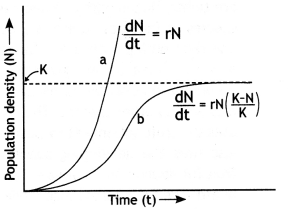
Class 12 Biology Important Questions Chapter 13 Organisms and Populations 8

(a) J-shaped curve exponential growth
(b) S-shaped curve logistics growth Every ecosystem has limited resources to support a particular maximum carrying capacity (K). When N is plotted in relation to time t, a sigmoid S-shaped curve is obtained. It is also called Verhulst-Pearl logistic growth.

The equation is:
\(\frac{\mathrm{dN}}{\mathrm{dt}}\)=rN\(\left(\frac{K-N}{K}\right)\)

N = population density at time t
r = growth rate
K = carrying capacity.

(ii) Explain “fitness of a species” as mentioned by Darwin. (CBSE 2017)
Answer:
According to Darwin “Fitness of a species” means reproductive fitness. All organisms after reaching reproductive age have a varying degree of reproductive potential. Some organisms produce more offspring, whereas some organisms produce few offspring only. This phenomenon is also called differential reproduction. The species which produces more offspring are selected by nature.

Question 34.
(i) The following are the responses of different animals to various abiotic factors. Describe each one with the help of an example.
(a) Regulate
Answer:
Regulate: Some organisms are able to maintain homoeostasis by regulating their body temperatures. The mechanisms used by most mammals to regulate their body temperature are similar to what we humans use.

For example, our body temperature remains constant at 37°C. In summer, when the outside temperature is more than our body temperature, we sweat profusely to cool down and when the temperature is much lower than 37° C, we shiver to generate heat. Thus body temperature remains constant.

(b) Conform
Answer:
Confirm: Most of the animals cannot maintain a constant internal environment. Their body temperature changes with the ambient temperature. These are called conformers. Heat loss or heat gain is a function of surface area. Since small animals have a larger surface area relative to their volume, they tend to lose body heat very fast when it is cold outside, for example, shrews and hummingbirds.

(c) Migrate
Answer:
Migrate: Organism can move away temporarily from the stressful habitat to a more hospitable area and then return when the stressful period is over.

For example, every winter, the famous Keoladeo National Park in Bharatpur hosts thousands of migratory birds coming from Siberia and other northern regions,

(d) Suspend
Answer:
Suspend: Bacteria, fungi and some lower plants survive unfavourable conditions by forming thick-walled spores. In higher plants, seeds and some other vegetative reproductive structures serve as means to tide over periods of stress. They do so by reducing their metabolic activity and going into a state of dormancy.

(ii) If 8 individuals in a population of 80 butterflies die in a week, calculate the death rate of the population of butterflies during that period. (CBSE 2018)
Answer:
Death Rate = \(\frac{8}{80}\) = 0.1 per week

Question 35.
(a) Identify the features of a stable biological community.
Answer:
(a) Features of the stable biological community.

  • It is stable.
  • A stable biological community is not replaced by any other community.
  • The environment becomes moister and shadier.
  • Communities should have greater biodiversity for greater stability.
  • It should be able to prevent invasion by alien species.
  • It should be able to restore itself in a short period of time.

(b) How did David Tilman’s findings link the stability of a biological community to its species richness? (CBSE Delhi 2019 C)
Answer:
David Tilman’s with his experiments established that the stability of a community depends on its species richness.

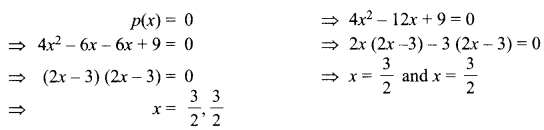
CBSE Sample Papers for Class 10 Science Set 5 for Practice

Students can access the CBSE Sample Papers for Class 10 Science with Solutions and marking scheme Set 5 will help students in understanding the difficulty level of the exam.

CBSE Sample Papers for Class 10 Science Set 5 for Practice

Time: 3 Hours
Maximum Marks: 80

General Instructions:

(i) The question paper comprises four sections A, B, C and D. There are 36 questions in the question paper. All questions are compulsory.
(ii) Section-A – question no. 1 to 20 – all questions and parts there of are of one mark each.
These questions contain multiple choice questions (MCQs), very short answer questions and assertion – reason type questions. Answers to these should be given in one word or one sentence.
(iii) Section-B – question no. 21 to 26 are short answer type questions, carrying 2 marks each. Answers to these questions should in the range of 30 to 50 words.
(iv) Section-C – question no. 27 to 33 are short answer type questions, carrying 3 marks each.
Answers to these questions should in the range of 50 to 80 words. :
(v) Section—D – question no. – 34 to 36 are long answer type questions carrying 5 marks each. Answer to these questions should be in the range of 80 to 120 words.
(vi) There is no overall choice. However, internal choices have been provided in some questions. A student has to attempt only one of the alternatives in such questions.
(vii) Wherever necessary, neat and properly labelled diagrams should be drawn.

Section – A

1. If an element X is placed in group 14, what will be the formula and the nature of bonding of  its chloride?

2. Where should an object be placed from a converging lens of focal length 15 cm, so as to obtain the image of same size and real.

3. A solution of a substance ‘X’ is used in white washing.
(i) Name the substance ‘X’ and write its formula.
(ii) Write the reaction of the substance ‘X’ named in (i) above with water.
OR
What happens chemically, when quicklime is added to water filled in a bucket?

4. Three acidic solutions A, B and C have pH = 0, 3 and 5 respectively:
(i) Which solution has the highest concentration of H+ ions?
(ii) Which solution has the lowest concentration of H+ ions?

5. Generally, when metals are treated with mineral acids, hydrogen gas is liberated, but when metals (except Mn and Mg) are treated with HNO3, hydrogen is not liberated, why?

6. The volume of glomerular filtrate produced is 18 L but the volume of urine excreted is just 1 – 2 L. Give a suitable reason for this statement.

7. Ozone is deadly poisonous, still it performs an essential function. How?
OR
Write the appropriate names of trophic level ‘Z’ and ‘X’ in the figure given below.
CBSE Sample Papers for Class 10 Science Set 5 for Practice 1

8. Covalent compounds have low melting and boiling point. Why?

9. Give an example of a flower which contains both stamens and carpels.
OR
What are sexually transmitted diseases? Name a STDs which damages the immune system of human body.

10. What is the nature of the image formed by a concave mirror, if the magnification produced by the mirror is +4?    OR
The outer surface of a hollow sphere of aluminium of radius 50 cm is to be used as a mirror. What will be the focal length of this mirror? What type of spherical mirror will it provide?
Answer:
OR 25

11. Let the resistance of an electrical component remain constant, while the potential difference across the two ends of the component decreases to half of its former value. What change will occur in the current through it?
OR
If the charge on an electron is 1.602 x 10⁻¹⁹ C, find the approximate number of electrons in 1C.
Answer:
OR 6.25 × 10¹⁸

12. Imagine that you are sitting in a chamber with your back to one wall. An electron beam, moving horizontally from the back wall towards the front wall, is deflected by a strong magnetic field to your right side. What is the direction of the magnetic field?

13. What will be the amount of energy available to the organisms of secondary consumer trophic level of food chain, if the energy available to producer level is 10000 Joules.

Assertion (A) and Reason (R)
For question numbers 14,15 and 16, two statements are given- one labeled Assertion (A) and the other labeled Reason (R). Select the correct answer to these questions from the codes (i), (ii), (iii) and (iv) as given below:
(i) Both A and R are true, and R is correct explanation of the assertion.
(ii) Both A and R are true, but R is not the correct explanation of the assertion.
(iii) A is true, but R is false.
(iv) A is false, but R is true.
Answer:
100 J

14. A. The extent of refraction is different for different medium.
R. Different medium have different refractive index.
Answer:
(i)

15. CBSE Sample Papers for Class 10 Science Set 5 for Practice 2
R. It is a combination reaction because CO combines with H2 to form CH3OH i.e., two substances combine to form a single compound.
Answer:
(i)

16. A. The sex of a child in human beings will be determined by the type of chromosome he/she inherits from the father.
R. A child who inherits ‘X’ chromosome from his father would be a girl (XX), while a child who inherits a ‘Y’ chromosome from the father would be a boy (XY).
OR
A. Two pink coloured flowers on crossing resulted in 1 red, 2 pink and 1 white flower progeny. R. It is due to double fertilisation.
Answer:
(i) OR (iii)

Answer Q. No 17 – 20 contain five sub-parts each. You are expected to answer any four sub¬parts in these questions.

17. Read the following and answer any four questions from 17 (i) to 17 (v) (4 x 1 = 4)
The splitting of a beam of white light into its seven constituent colours, when it passes through a glass prism, is called the dispersion of light.

When a beam of white light enters a prism, it gets refracted and splits into its seven constituent colours, viz. violet, indigo, blue, green, yellow, orange, and red. This splitting of the light ray occurs because of the different angles of bending for each colour. Hence, each colour while passing through the prism bends at different angles with respect to the incident beam. This gives rise to the formation of the coloured spectrum.

(i) What is the cause of dispersion of light by prism?
I. Different colours move with different speed in the prism.
II. Emergent ray bent to different extent towards the base of prism.
III. Different colours move with same speed in the prism but cover different distance.
IV. Emergent ray bent to different extent away from the base of prism.
(a) I only
(b) I and II
(c) III and IV
(d) II and III
Answer:
(b) I and II

(ii) Which colour of white light suffers least deviation when a beam of white light is passed through the prism?
(a) Blue
(b) Red
(c) Violet
(d) Green
Answer:
(b) Red

(iii) Which of the following colours viz., A, B, C and D has more speed in the prism?
CBSE Sample Papers for Class 10 Science Set 5 for Practice 3
(a) A
(b) B
(c) C
(d) D
Answer:
(d) D

(iv) How will you use two identical prisms P1 and P2 so that a narrow beam of white light incident on one prism emerges out of the second prism as white light?
CBSE Sample Papers for Class 10 Science Set 5 for Practice 4
Answer:
(c)

(v) Among the seven colours visible due to splitting of white light through prism which colour has shortest wavelength?
(a) Red
(b) Blue
(c) Violet
(d) Yellow
Answer:
(c) Violet

18. Read the following and answer any four questions from 18 (i) to 18 (v) (4 x 1 = 4)

More than a million Americans die of cardiac diseases each year. One of the major causes is high cholesterol levels in the blood. The National Cholesterol Education Program suggests that total blood cholesterol level should be:

Blood Cholesterol Level Chart
DesirableBorderline (high)High Risk
Total Cholesterol<200200-240>240
Triglycerides< 150150-500>500
Low Density Cholesterol< 130130-160>160
High Density Cholesterol>5050-35<35

Given below are blood report of two persons

Total CholesterolTriglyceridesLow density cholesterol
Patient A356180150
Patient B18010090

(i) Which of the organ can be affected in patient A?
(a) Heart
(b) Kidney
(c) Lungs
(d) Brain
Answer:
(a) Heart

(ii) What information is left out for the blank column?
(a) Total cholesterol
(b) Triglycerides
(c) Low density cholesterol
(d) High density cholesterol
Answer:
(d) High density cholesterol

(iii) A person with high risk category have to be suggested a suitable diet? Which of the following are correct guidelines for the patient
(a) High sugar and starch
(b) Low salt and fats
(c) High proteins
(d) Low sugar and proteins
Answer:
(b) Low salt and fats

(iv) Apart from following a prescribed diet, some other changes should be brought in the lifestyle to avoid aggravation of symptoms in a patient who is already suffering from high blood cholesterol-
A. Yoga and exercise
B. Quitting smoking and alcohol
C. Walking and doing small chores on your own
D. Enjoying loud music
Which of the following is the correct option
(a) A ,C
(b) B,C,D
(c) A,B,C
(d) A, D
Answer:
(c) A,B,C

(v) Which of the following is correct for patient B?
(a) High total cholesterol but triglycerides in normal range
(b) Total cholesterol in normal range but triglycerides are high
(c) Total cholesterol in normal range but low density cholesterol are high
(d) Total cholesterol, triglycerides and low density cholesterol are in normal range
Answer:
(d) Total cholesterol, triglycerides and low density cholesterol are in normal range

19. Read the following and answer any four questions from 19 (i) to 19 (v) (4 x 1 = 4)

Most of the characters or traits of an organism are controlled by the genes. Genes are actually segments of DNA guiding the formation of proteins by the cellular organelles. These proteins may be enzymes, hormones, antibodies, and structural components of different types of tissues. In other words, DNA/ genes are responsible for structure and functions of a living body. Genotype of an individual controls its phenotype.
CBSE Sample Papers for Class 10 Science Set 5 for Practice 5
CBSE Sample Papers for Class 10 Science Set 5 for Practice 6

(i) Select the statements that describe characteristics of genes
I. Genes are specific sequence of bases in a DNA molecule
II. A gene does not code for proteins
III. In individuals of a given species, a specific gene is located on a particular chromosome
IV. Each chromosome has only one gene
(a) I and II
(b) I and III
(c) I and IV
(d) III and IV
Answer:
(b) I and III

(ii) A Mendelian experiment consisted of breeding tall pea plants bearing violet flowers with short pea plants bearing white flowers. In the progeny, all bore violet flowers, but almost half of them were short. This suggests that the genetic makeup of tall plant can be depicted as
(a) TTWW
(b) TTww
(c) TtWW
(d) TtWw
Answer:
(c) TtWW

(iii) Two pea plants one with round green seeds (RRyy) and another with wrinkled yellow (rrYY) seeds produce Fj progeny that have round, yellow (RrYy) seeds. When F1 plants are selfed, the F2 progeny will have new combination of characters. Choose the new combination from the following.
I. Round, yellow
II. Round, green
Wrinkled, yellow IV. Wrinkled, green
(a) I and II
(b) I and IV
(c) II and III
(d) I and III
Answer:
(b) I and IV

(iv) A section of DNA providing information for one protein is called—
(a) Nucleus
(b) Chromosomes
(c) Trait
(d) Gene
Answer:
(d) Gene

(v) Which one of the following is present in the nucleus?
(a) Gene
(b) DNA
(c) Chromosomes
(d) All of these
Answer:
(d) All of these

20. Read the following and answer any four questions from 20 (i) to 20 (v) (4 x 1 = 4)
Answer the question numbers 3(a) to 3(d) on the basis of your understanding of the following paragraph and the related studied concepts.

Atomic size refers to radius of atom. The atomic size may be visualised as the distance between the centre of the nucleus and the outermost shell of an atom.
CBSE Sample Papers for Class 10 Science Set 5 for Practice 7

(i) How does atomic size vary along period 2 from left to right and why?
(a) Atomic size increases as atomic number increases
(b) Atomic size increases as number of protons increases
(c) Atomic size decreases as electrons added to same shell and with increase in number of protons, nuclei attracts electrons more
(d) Atomic size decreases as proton has higher positive charge than negative charge on electron and thus protons pulls electrons towards nucleus.
Answer:
(c) Atomic size decreases as electrons added to same shell and with increase in number of protons, nuclei attracts electrons more

(ii) How does atomic size vary in group 1 and group 17 and why?
(a) Atomic size increases because electrons added to the penultimate shell
(b) Atomic size increases because electrons added to next higher energy shell
(c) Atomic size decreases because electrons added to penultimate shell
(d) Atomic size decreases because electrons added to same shell
Answer:
(b) Atomic size increases because electrons added to next higher energy shell

(iii) Which group elements have largest size in periodic table?
(a) Group 1
(b) Group 2
(c) Group 17
(d) Group 18
Answer:
(d) Group 18

(iv) Which element of group 17 is most reactive?
(a) F
(b) Cl
(c) Br
(d) I
Answer:
(a) F

(v) Which of the following has higher distance between the centre of the nucleus and the outermost shell of an atom?
(a) Li
(b) C
(c) Be
(d) I
Answer:
(a) Li

Section-B

21. The resistance of a wire of 0.01 cm radius is 10Ω. If the resistivity of the material of the wire is 50 x 10-8 Ωm, find the length of the wire.
Answer:
62.8cm

22. Foetus derives its nutrition from the mother.
(i) Identify the tissue used for above purpose. Explain its structure.
(ii) Explain how wastes generated by developing embryo are removed.
OR
Why do we need to adopt contraceptive measures?

23. A coil of insulated copper wire is connected to a galvanometer. What will happen if a bar magnet is
(i) pushed into the coil
(ii) held stationary inside the coil?

24. Give reason for the following:
(i) Element carbon forms compounds mainly by covalent bonding.
(ii) Kerosene does not decolourise bromine water while cooking oils do.

25. An alpha particle (positively charged) enters a magnetic field at right angle to it as shown in figure. Explain with the help of relevant rule, the direction of force acting on the alpha particle.
CBSE Sample Papers for Class 10 Science Set 5 for Practice 8
OR
Identify the poles of the magnet in the given figure (i) and (ii).
CBSE Sample Papers for Class 10 Science Set 5 for Practice 9

26. In a test tube A and B shown below, yeast was kept in sugar solution. What products of respiration would you expect in tubes A and B?
CBSE Sample Papers for Class 10 Science Set 5 for Practice 10

Section-C

27. Draw a circuit diagram of an electric circuit containing a cell, a key, an ammeter, a resistor of 4D. in series with a combination of two resistors (80 each) in parallel and a voltmeter across parallel combination. Each of them dissipates maximum energy and can withstand a maximum power of 16W without melting. Find the maximum current that can flow through the three resistors.
Answer:
1 A

28. Find the current drawn from the battery by the network of four resistors shown in the diagram.
CBSE Sample Papers for Class 10 Science Set 5 for Practice 11
Answer:
0.4A

29. In the electrolysis of water,
(i) Name the gas collected at anode and cathode
(ii) Why is the volume of gas collected at one electrode double than the other?
(iii) What would happen if dil H2S04 is not added to water?

30. A student records the observation to study the rate of respiration in three different people. Study the data collected and answer the questions given below:

ActivityPerson 1 (breathing in one minute)Person 2 (breathing in one minute)Person 3 (breathing in one minute)
(i) Walking20 times24 times26 times
(ii) Running35 times37 times34 times
(iii) Climbing 20 stairs by running40 times30 times45 times

(i) Which variable is kept constant?
(ii) Which reading is anomalous?
(iii) Suggest one improvement in this experiment.

31. The electrons in the atoms of four elements A, B, C and D are distributed in three shells having 1, 3, 5 and 7 electrons in outermost shell respectively. State the period in which these elements can be placed in the modem periodic table. Write the electronic configuration of the atoms A and D and the molecular formula of compound formed when A and D will combine.

32. (i) Construct a terrestrial food chain comprising four trophic levels.
(ii) What will happen if we kill all the organisms in one trophic level?
(iii) Calculate the amount of energy available to the organisms at the fourth trophic level if the energy available to the organisms at the second trophic level is 2000 J.
Answer:
(iii) 2 J

33. “pH has a great importance in our daily life” explain by giving three examples.
OR
A compound which is prepared from gypsum has the property of hardening when mixed with a proper quantity of water. Identify the compound and write its chemical formula. Write the chemical equation for its preparation. Mention any one use of the compound.

Section – D

34. You are given balls and stick model of six carbon atoms and fourteen hydrogen atoms and sufficient number of sticks. In how many ways one can join the models of six carbon atoms and fourteen hydrogen atoms to form different molecules of C6H
OR
(i) Give a chemical test to distinguish between saturated and unsaturated hydrocarbons.
(ii) What is meant by a functional group in an organic compound? Name the functional group present in
(a) CH3CH2OH
(b) CH3COOH
(iii) What is the difference in the molecular formula of any two consecutive members of a homologous series of organic compounds?

35. A student wants to project the image of candle flame on the wall of school laboratory by using a lens:
(i) which type of lens should be used and why?
(ii) at which distance in term of focal length F of the lens should be placed the candle flame so as to get
(a) a magnified and
(b) a diminished image respectively on the wall?
OR
(i) Complete the following ray diagrams:
CBSE Sample Papers for Class 10 Science Set 5 for Practice 12
(ii) A ray of light travelling in air enters obliquely into water. Does the light ray bend towards or away from the normal? Why? Draw a ray diagram to show the refraction of light in this situation.

36. (i) To study the respiration of germinating seeds:
CBSE Sample Papers for Class 10 Science Set 5 for Practice 13

(a) Name two chemicals that are kept in the test tube to absorb carbon dioxide gas released in the conical flask.
(b) Explain why the level of water in the bent tube rises in the set up A
(c) State the observation in set up B:

(ii) What do the following transport:
(a) Xylem
(b) Pulmonary artery
(c) Pulmonary vein
(d) Vena cava

CBSE Sample Papers for Class 10 Science Set 3 with Solutions

Students can access the CBSE Sample Papers for Class 10 Science with Solutions and marking scheme Set 3 will help students in understanding the difficulty level of the exam.

CBSE Sample Papers for Class 10 Science Set 3 with Solutions

Time: 3 Hours
Maximum Marks: 80

General Instructions:

(i) The question paper comprises four sections A, B, C and D. There are 36 questions in the question paper. All questions are compulsory.
(ii) Section-A – question no. 1 to 20 – all questions and parts there of are of one mark each.
These questions contain multiple choice questions (MCQs), very short answer questions and assertion – reason type questions. Answers to these should be given in one word or one sentence.
(iii) Section-B – question no. 21 to 26 are short answer type questions, carrying 2 marks each. Answers to these questions should in the range of 30 to 50 words.
(iv) Section-C – question no. 27 to 33 are short answer type questions, carrying 3 marks each.
Answers to these questions should in the range of 50 to 80 words. :
(v) Section—D – question no. – 34 to 36 are long answer type questions carrying 5 marks each. Answer to these questions should be in the range of 80 to 120 words.
(vi) There is no overall choice. However, internal choices have been provided in some questions. A student has to attempt only one of the alternatives in such questions.
(vii) Wherever necessary, neat and properly labelled diagrams should be drawn.

Section – A

Question 1.
Name a cyclic unsaturated carbon compound.
Answer:
Cyclopentene / Cyclohexene-formula or structure (or any other).

Question 2.
The change in magnetic field lines in a coil is the cause of induced electric current in it. Name the underlying phenomenon.
Answer:
Electromagnetic Induction

Question 3.
Why do we store silver chloride in dark coloured bottles?
Answer:
It is because it undergoes photochemical decomposition reaction in the presence of sunlight.

Question 4.
How many male gametes are produced by pollen grains?
Answer:
Two

Question 5.
Two beakers with chemicals are shown below. Name the beaker which will show exothermic reaction and the one which will be endothermic in nature.
CBSE Sample Papers for Class 10 Science Set 3 with Solutions 1
Answer:
Exothermic : Beaker A
Endothermic : Beaker B

Question 6.
What will happen, if a solution of sodium hydrogen carbonate is heated? Give the equation of the reaction involved.
OR
How chloride of lime differs chemically from calcium chloride?
Answer:
Sodium carbonate, carbon dioxide and water will be formed.
\(2 \mathrm{NaHCO}_{3}(\mathrm{~s}) \stackrel{\text { Heat }}{\longrightarrow} \mathrm{Na}_{2} \mathrm{CO}_{3}(\mathrm{~s})+\mathrm{CO}_{2}(\mathrm{~g})+\mathrm{H}_{2} \mathrm{O} \text { ( } \mathrm{l}\)

Question 11.
What will happen to a plant if its xylem is removed?
OR
Why is it advisable to breathe through nose?
Answer:
If xylem is removed from a plant, transport of water and nutrients will stop and plant will die.
OR
There are fine hair and mucus gland in the inner lining of nose which can filter the incoming air from germs and dust. Moreover, the air attains the optimum temperature before reaching the lungs.

Question 12.
An element ‘X’ on reacting with oxygen forms an oxide X2O. This oxide dissolves in water and turns blue litmus red. State whether ‘X’ is metal or non-metal.
Answer:
Non-metal

Question 13.
What is the speed of blue light travelling in vacuum?
Answer:
The speed of blue light is same as that of light i.e. 3 x 10⁸ m s1.
Assertion (A) and Reason (R)
For question numbers 14,15 and 16, two statements are given- one labeled Assertion (A) and the other labeled Reason (R). Select the correct answer to these questions from the codes (i), (iii) and (iv) as given below:

(i) Both A and R are true, and R is correct explanation of the assertion.
(ii) Both A and R are true, but R is not the correct explanation of the assertion.
(iii) A is true, but R is false.
(iv) A is false, but R is true.

Question 14.
A. The element carbon forms the basic structural framework of more compounds than any other element.
R. The carbon-carbon bond is ionic.
Answer:
(iii)

Question 15.
A. Pollination is different from fertilisation.
R. The process of transfer of pollens from anther to stigma is called pollination which takes place in plants.
Answer:
(iv)

Question 16.
A. A 200 W bulb glows with more brightness than 100 W bulb.
R. 100 W bulb has more resistance than 200 W bulb.
OR
A. When two resistances of 4Ω are connected in series, total resistance is 8Ω.
B. When two resistances of 4Ω are connected in parallel total resistance is 2Ω.
Answer:
(i) OR (ii)

Answer Q. No 17 – 20 contain five sub-parts each. You are expected to answer any four sub­parts in these questions.

Question 17.
Read the following and answer any four questions from 17 (i) to 17 (v) (4 × 1 = 4)

The growing size of the human population is a cause of concern for all people. The rate of birth and death in a given population will determine its size. Reproduction is the process by which organisms increase their population. The process of sexual maturation for reproduction is gradual and takes place while general body growth is still going on. Some degree of sexual

chemicals are not biodegradable, they get accumulated progressively at each trophic level. The maximum concentration of these chemicals gets accumulated in our bodies and greatly affects the health of our mind and body.
CBSE Sample Papers for Class 10 Science Set 3 with Solutions 2

(i) Why is the maximum concentration of pesticides found in human beings?
(a) Humans are at the top level in any food chain
(b) Major part of crops cultivated using pesticides are consumed by humans
(c) Pesticides are stored in different organs of humans
(d) None of these
Answer:
(a) Humans are at the top level in any food chain

(ii) Which method could be applied to reduce our intake of pesticides through food to some extent.
(a) Washing crops thoroughly
(b) Organic fanning
(c) Use of bio-pesticides
(d) All of these
Answer:
(d) All of these

(iii) Various steps in a food chain represent:
(a) Food web
(b) Trophic level
(c) Ecosystem
(d) Biomagnification
Answer:
(b) Trophic level

(iv) With regard to various food chains operating in an ecosystem, man is a:
(a) Consumer
(b) Producer
(c) Producer and consumer
(d) Producer and decomposer
Answer:
(a) Consumer

(v) Food web is constituted by
(a) relationship between the organisms and the environment.
(b) relationship between plants and animals.
(c) various interlinked food chains in an ecosystem.
(d) relationship between animals and environment
Answer:
(c) various interlinked food chains in an ecosystem.

Question 19.
Read the following and answer any four questions from 19 (i) to 19 (v) (4 × 1 = 4)

Electrical resistivity and its inverse, electrical conductivity are fundamental properties of a material that quantifies how strongly it resists or conducts electric current. A low resistivity indicates a material that readily allows electric current to flow.

Resistance is defined as the ratio of potential difference across a conductor to the current passing through it. Resistance is the property of a conductor to resist the flow of charges through it.

CBSE Sample Papers for Class 10 Science Set 3 with Solutions 3

Both resistance and resistivity describe how difficult it is to G make electrical current flow through a material, but unlike w resistance, resistivity is an intrinsic property. This means that g all pure copper wires irrespective of their shape and size, have the same resistivity, but a long, thin copper wire has a much larger resistance than a thick, short copper wire. Every material has its own characteristic resistivity. For example, rubber has a far larger resistivity than copper. The resistivity of metals also varies with temperature.

The resistance of almost all alloys increases with increase in temperature but the rate of change of resistance is less than that of metals. In fact, the resistance of certain alloys such as Manganin, Eureka and Constantan show practically no change in resistance to a considerable range of temperature.                        ‘

(i) What happens to the resistivity of a wire if it is stretched?
(a) It will increase
(b) It will decrease
(c) First increases then decreases
(d) Remains the same
Answer:
(d) Remains the same

(ii) Though silver is a good conductor, why it is not an ideal choice for transmission of electricity?
1. It is expensive
2. It oxidizes and tarnishes when it comes in contact with air
3. Its resistivity decreases with increase in temperature
(a) Only 1
(b) Only 2
(c) Both 1 and 2
(d) Only 3
Answer:
(c) Both 1 and 2

(iii) The area of cross section of a wire becomes half when its length is stretched to double. How the resistance of the wire is affected in the new condition?
(a) Resistance of the wire remains unchanged
(b) Resistance of the wire decreases to half
(c) Resistance of the wire increases to double
(d) Resistance of the wire increases four times
Answer:
(d) Volume of the wire remains the same before and after stretching. Assuming wire to be cylindrical in shows them  volume = Area of base x height/length
Due to stretching if length is increased, area will decrease.
R = ρl/A
New length = 2l
New area = A/2
Resistance increases four times.

(iv) If there are two wires, W1 and W2 of same material and same length but have radius r and 2r respectively, then which wire will have more resistance?
(a) Wire W1 has more resistance as compare to W2
(b) Wire W2 has more resistance as compare to W1
(c) Both the wires have same resistance
(d) Wire W2 has three times resistance than wire W1
Answer:
(a) Wire W1 has more resistance as compare to W2

(v) Ajay made the following conclusions regarding resistance of metals/alloy. Which one would you disagree with?
(a) The resistivity of a metal decreases with temperature
(b) A thick copper wire has less resistance than a thin copper wire of the same length
(c) Alloys are often used in the manufacture of standard resistors
(d) Low resistivity means the material easily allow the flow of electric current
Answer:
(a) The resistivity of a metal decreases with temperature

Question 20.
Read the following and answer any four questions from 20 (i) to 20 (v) (4 × 1 = 4)
The following graph shows the volume of hydrogen collected in four different experiments when dil. hydrochloric acid was reacted with zinc, copper, magnesium and iron metal.
CBSE Sample Papers for Class 10 Science Set 3 with Solutions 4
(i) Name the graph that produces hydrogen gas faster.
(a) Graph 1
(b) Graph 2
(c) Graph 3
(d) Graph 4
Answer:
(d) Graph 4

(ii) Name the metal used in experiment that gave the result for graph-4.
(a) Mg
(b) Zn
(c) Fe
(d) Cu
Answer:
(a) Mg

(iii) Ways to speed up the slow reaction are
1. heating the reactants
2. cooling the reactants
3. using more diluted acid
4. using more concentrated acid
(a) 1 only
(b) 1 and 4
(c) 1 and 3
(d) 2 and 4
Answer:
(b) 1 and 4

(iv) The amount of zinc metal used for the above reaction is same but the concentration of acid is changed, what would be the effect on the rate of reaction?
(a) no change
(b) the speed will increase
(c) the speed will decrease
(d) the information is incomplete
Answer:
(d) the information is incomplete

(v) Which of the following metal liberates hydrogen gas on reaction with dilute HNO3.
(a) Zn
(b) Cu
(c) Mg
(d) Fe
Answer:
(c) Mg

Section – B

Question 21.
The period 3 oxides are given below.
[Na2O, MgO] [Al2O3]……………………. [SO2, Cl2O]
A                               B                                           C
State 2 characters of these oxides grouped as A & C
Answer:
Oxide A: Na2O, MgO are basic in nature and ionic Oxide C : SO2, Cl2O are acidic in nature and covalent

Question 22.
Name two human organs that perform dual function and explain their functions to justify their dual nature.
Answer:
Two human organs with dual nature are pancreas and gonads. Pancreas secretes insulin hormone and digestive enzymes like trypsin ( pancreatic enzyme) similarly human gonads like testis and ovaries secretes the gametes like sperms and ovum respectively along with the sex hormones.

Question 23.
Why are small number of surviving tigers a cause of worry from genetics point of view?
Answer:
(i) Tigers may get extinct in near future due to natural calamities, lack of available food and due to their small number.
(ii) Cross breeding may be less possible. Variations will not occur, which is essential for the survival.
(iii) Adaptation due to changing environment, like cutting of forests, global warming becomes difficult.
(iv) Protection from enemies is easy if they are more in number.

Question 24.
An object is placed at a distance of 15 cm from a concave lens of focal length 30 cm. List four characteristics (nature, position, etc.) of the image formed by the lens.
Answer:
CBSE Sample Papers for Class 10 Science Set 3 with Solutions 5

The image will be formed at 10 cm from ‘O’ on the same side as the object. It will be virtual, erect and diminished.

Question 25.
Write chemical equation for the reaction when
(i) Steam acts on red hot iron.
(ii) Zinc is added to iron(II) sulphate solution.
OR
State two reasons for the following facts:
(i) Sulphur is a non-metal.
(ii) Magnesium is a metal.
One of the reason must be supported with a chemical equation.
Answer:
(i) \(3 \mathrm{Fe}(s)+4 \mathrm{H}_{2} \mathrm{O}(g) \underset{\text { steam }}{\longrightarrow} \mathrm{Fe}_{3} \mathrm{O}_{4}(s)+4 \mathrm{H}_{2}(g)\)
(ii) Zn(s) + FeSO4(aq) → ZnSO4(aq) + Fe(s)
OR
(i) Sulphur is a poor conductor of electricity.
It reacts with oxygen to form SO2 which forms acidic solution in water.
S + O2 → S02
SO2 + H2O →H2SO3

(ii) Magnesium is a metal because it is a good conductor of electricity.
It forms basic oxide with oxygen
\(2 \mathrm{Mg}+\mathrm{O}_{2} \stackrel{\text { Burning }}{\longrightarrow} 2 \mathrm{MgO}\)
\(\mathrm{MgO}+\underset{(\mathrm{Hot})}{\mathrm{H}_{2} \mathrm{O}} \rightarrow \underset{(\text { Base })}{\mathrm{Mg}(\mathrm{OH})_{2}}\)

Question 26.
Study the following circuit and answer the questions that follows:
CBSE Sample Papers for Class 10 Science Set 3 with Solutions 6
(i) How much current is flowing through
(a) 10 Q and
(b) 15 Q resistor?
(ii) What is the ammeter reading?
OR
Find the current drawn from the battery by the network of four resistors shown in the figure.
CBSE Sample Papers for Class 10 Science Set 3 with Solutions 7
Answer:
(i) Current through
CBSE Sample Papers for Class 10 Science Set 3 with Solutions 8
CBSE Sample Papers for Class 10 Science Set 3 with Solutions 9

Question 27.
1 g of copper powder was taken in a China dish and heated. What change takes place on heating? When hydrogen gas is passed over this heated substance, a visible change is seen in it. Give the chemical equations of reactions, the name and the color of the products formed in each case.
Answer:
A black colour is formed on the surface
CBSE Sample Papers for Class 10 Science Set 3 with Solutions 10

Original/brown colour is restored
CBSE Sample Papers for Class 10 Science Set 3 with Solutions 11

Question 28.
List the important products of the Chlor-alkali process. Write one important use of each.
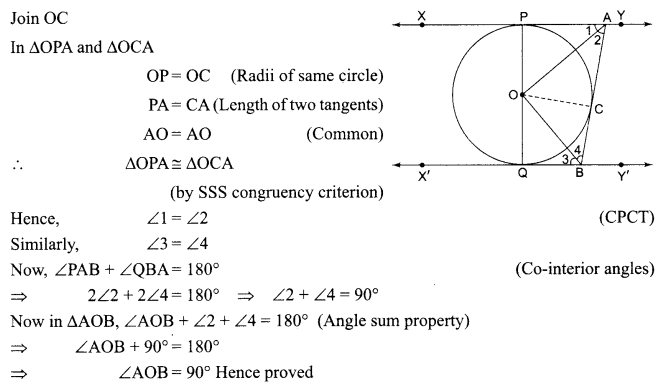
OR
How is washing soda prepared from sodium carbonate? Give its chemical equation. State the type of this salt. Name the type of hardness of water which can be removed by it?
Answer:
Products: Hydrogen, Chlorine, Sodium hydroxide Uses:
Hydrogen: In the production of margarine/ammonia/as a fuel
Chlorine: Water treatment / swimming pools / production of PVC / Disinfectants / CFCs / Pesticides
Sodium hydroxide: For degreasing metal surface / in making soaps and detergents / paper making / artificial fibres.
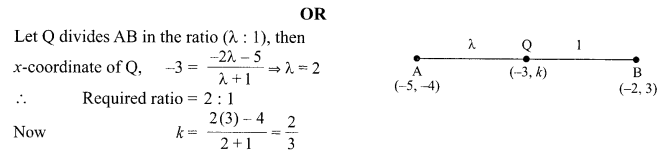
OR
1. By recrystallisation of sodium carbonate
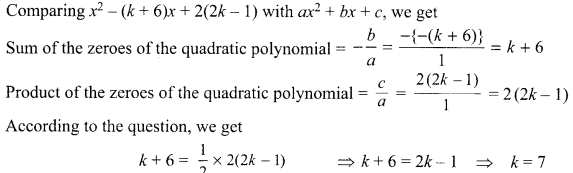
2. Na2CO3 + 10H2O → Na2CO3.10H2O
3. Basic Salt
4. Permanent hardness

Question 29.
Study the following cross showing self pollination in F1, fill in the blank and answer the question that follow:
CBSE Sample Papers for Class 10 Science Set 3 with Solutions 12
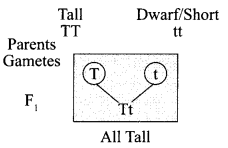
What are the combinations of character in the F2 progeny? What are their ratios?
Answer:
F1 progeny is Rr Yy-Round, Yellow
Combinations of character in the F2 progeny are:

  • Round yellow — 9 (Both dominant traits)
  • Round green — 3 (One recessive, one dominant)
  • Wrinkled yellow — 3 (One dominant, one recessive)
  • Wrinkled green — 1 (both recessive traits)

The ratio is 9 : 3 : 3 : 1

Question 30.
Define the term pollination. Differentiate between self pollination and cross pollination. What is the significance of pollination?
Answer:
Pollination is the transfer of pollen from another to stigma.

Self PollinationCross Pollination
Transfer of pollen in the same flower.Transfer of pollen from one flower to another.

• Pollination leads to fertilization resulting in the formation of zygote.

Question 31.
Why is Tyndall effect shown by colloidal particles? State four instances of observing the Tyndall effect.
Answer:
Because of the scattering of light.
Instances:

  • When a fine beam of light enters a smoke-filled dark room through a small hole.
  • When sunlight passes through a canopy of dense forest in foggy/ misty conditions.
  • Blue colour of sky.
  • Red colour of the sun during sunrise or sunset.

Question 32.
A V-I graph for a nichrome wire is given below. What do you infer from this graph? Draw a labelled circuit diagram to obtain such a graph.
CBSE Sample Papers for Class 10 Science Set 3 with Solutions 13
Answer:
V α I or Potential difference is directly proportional to current
CBSE Sample Papers for Class 10 Science Set 3 with Solutions 14
Note: If circuit diagram is correct but labelling of ammeter and voltmeter are incorrect, deduct 1 mark.

Question 33.
(i) Write the mathematical expression for Joule’s law of heating.
(ii) Compute the heat generated while transferring 96000 coulombs of charge in two hours through a potential difference of 40 V.
Answer:
(i) H = I2Ri
(ii) H = V.I.t = V.Q
Given:     V = 40 volts, Q = 96000 C
H = 40 V x 96000 C
= 3.84 x 10⁶ J

Section – D

Question 34.
The position of certain elements in the Modem Periodic Table are shown below.
CBSE Sample Papers for Class 10 Science Set 3 with Solutions 15
Using the above table answer the following questions giving reasons in each case:
(i) Which element will form only covalent compounds?
(ii) Which element is a non-metal with valency 2?
(iii) Which element is a metal with valency 2?
(iv) Out of H, C and F which has largest atomic size?
(v) To which family does H, C and F belong?
OR
Define atomic size. Give its unit of measurement. In the modem periodic table what trend is observed in the atomic radius in a group and a period and why is it so?
Answer:
(i) E, it has 4 valence electrons.
(ii) B, it needs only 2 electrons to attain stable configuration.
(iii) D, it loses two electrons to attain stable configuration.
(iv) F, it has the largest size since size increases down the group.
(v) Noble gases, outermost shell is complete.
OR

  • Atomic size is the distance between the centre of the nucleus and the outermost shell of an isolated atom.
  • Picometer /pm
  • Trends in Atomic radius
    In a group: increases down the group; due to addition of a new shell.
    In a period: atomic radius decreases from left to right; due to increase in pulling power of nucleus / due to addition of electrons in the same shell.

Question 35.
(i) What is the law of dominance of traits? Explain with an example.
(ii) Why are the traits acquired during the life time of an individual not inherited? Explain.
Answer:
(i) Law of dominance of traits: In a cross between a pair of contrasting characters, only one parental character will be expressed in F1 generation which is called dominant trait and the other is called a recessive trait.
For example – in pea plants.
CBSE Sample Papers for Class 10 Science Set 3 with Solutions 16

All plants in F1 generation were tall proving that the gene for tallness is dominant over the gene for dwarfness/short, which is not able to express itself in the presence of dominant trait.

(ii) Traits acquired by an organism during its lifetime are known as aquired traits. These traits are not inherited because they occur in somatic cells only/do not cause any change in the DNA of the germ cells.

Question 36.
Draw a ray diagram in each of the following cases to show the formation of image, when the object is placed:
(i) between optical centre and principal focus of a convex lens.
(ii) anywhere in front of a concave lens.
(iii) at 2F of convex lens.
State the signs and values of magnifications in the above mentioned cases (i) and (ii).
OR
An object 4.0 cm in size, is placed 25.0 cm in front of a concave mirror of focal length 15.0 cm.
(i) At what distance from the mirror should a screen be placed in order to obtain a sharp image?
(ii) Find the size of the image.
(iii) Draw a ray diagram to show the formation of image in this case.
Answer:
CBSE Sample Papers for Class 10 Science Set 3 with Solutions 17
CBSE Sample Papers for Class 10 Science Set 3 with Solutions 18
CBSE Sample Papers for Class 10 Science Set 3 with Solutions 19
CBSE Sample Papers for Class 10 Science Set 3 with Solutions 20
CBSE Sample Papers for Class 10 Science Set 3 with Solutions 21