Human Health and Disease Class 12 Important Extra Questions Biology Chapter 8

Here we are providing Class 12 Biology Important Extra Questions and Answers Chapter 8 Human Health and Disease. Important Questions for Class 12 Biology are the best resource for students which helps in Class 12 board exams.

Class 12 Biology Chapter 8 Important Extra Questions Human Health and Disease

Human Health and Disease Important Extra Questions Very Short Answer Type

Question 1.
What is health?
Answer:
It is a state of complete physical, mental and social well-being of a person.

Question 2.
What is a disease?
Answer:
Malfunctioning of one or more organs characterised by signs and symptoms is called disease.

Question 3.
Write the role of interferons. (CBSE Delhi 2019(C))
Answer:
Role of interferon. These are glycoprotein released by virus-infected cells. They protect the adjoining cells from the attack of the virus.

Question 4.
Define autoimmunity.
Answer:
It is an abnormality which sometimes occurs in the immune system and instead of destroying foreign molecules, it attacks the body’s own cells.

Question 5.
A boy of ten years had chickenpox. He is not expected to have the same disease for the rest of his life. Mention how it is possible. (CBSE 2009)
Answer:
The body will acquire active immunity as the antibodies formed will protect him from the attack of microbes of chickenpox.

Question 6.
What is it that prevents a child to suffer from a disease he/she is vaccinated against? Give one reason. (CBSE 2010)
Answer:

  1. Antibodies
  2. These antibodies neutralise the action of antigens.

Question 7.
Name the pathogen which causes Typhoid. Name the test that confirms the disease. (CBSE Delhi 2019 (C))
Answer:
Causative pathogen: Salmonella typhi Test: Widal test

Question 8.
Name two types of cells in which the HIV multiplies after gaining entry into the human body. (CBSE 2008)
Answer:

  1. T-Lymphocytes
  2. White Blood Corpuscles (Macrophages).

Question 9.
Why is a secondary immune response more intense than the primary immune response in human? (CBSE 2014)
Answer:
It is because the human body appears to have more memory of the first encounter.

Question 10.
When does a human body elicit an anamnestic response? (CBSE (Outside Delhi) 2013)
Answer:
The primary immune response is of low intensity; a subsequent encounter with the same pathogen elicits a highly intensified anamnestic or secondary response.

Question 11.
Name the two intermediate hosts which the human liver fluke depends on to complete its life cycle so as to facilitate parasitisation of its primary host. (CBSE Delhi 2014)
Answer:

  1. Freshwater Snail
  2. Fish

Question 12.
Indiscriminate use of X-rays for diagnoses should be avoided. Give reason. (CBSE (Delhi) 2015)
Answer:
X-rays cause mutation thus may lead to cancer.

Question 13.
Give the scientific name of the source organism from which the first antibiotic was produced. (CBSE Sample paper 2018-19)
Answer:
Penicillium Notatum

Question 14.
Name two diseases whose spread can be controlled by the eradication of Aedes mosquitoes. (CBSE 2018)
Answer:
Dengue and chikungunya

Question 15.
How do cytokine barriers provide innate immunity in humans? (CBSE 2018)
Answer:
Cytokine barriers: Cytokines inhibit viral replication. Virus-infected cells secrete proteins called interferons which protect non-infected cells from virus.

Question 16.
Name two recent incidences of wide-spread diseases caused by Aedes mosquitoes. (CBSE Delhi 2008)
Answer:

  1. Dengue
  2. Chikungunya

Question 17.
How does the human body respond when haemozoin produced by Plasmodium is released in its blood? (CBSE Delhi 2019 (C))
Answer:
As haemozoin is released in the blood, the patient shows symptoms of malaria such as restlessness, sleeplessness, muscular pain and chilliness. In response to chill, the body temperature rises.

Question 18.
How does saliva act in body defence? (CBSE Delhi 2004)
Answer:
Human saliva contains lysozyme, a lytic enzyme, which kills the germs in the food.

Question 19.
Name the type of cells that produce antibodies. (CBSE 2004)
Answer:
Lymphocytes which is a form of leucocytes (white blood cells) produce antibodies.

Question 20.
Why sharing injection needles between two individuals is not recommended? (CBSE Delhi 2013)
Answer:
Sharing of injection needles between two individuals may cause the transmission of AIDS and Hepatitis B.

Question 21.
How do monocytes act as a cellular barrier in humans to provide innate immunity? (CBSE Delhi 2018C)
Answer:
Monocytes kill bacteria by the process of phagocytosis.

Human Health and Disease Important Extra Questions Short Answer Type

Question 1.
Make a list of common infectious diseases.
Answer:
Common infectious diseases: Depending on the pathogen, infectious diseases are as follows:
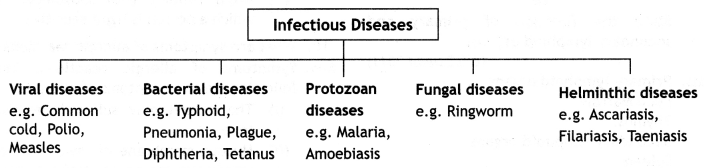
Class 12 Biology Important Questions Chapter 8 Human Health and Disease 1

Question 2.
Given below are pairs of pathogens and diseases caused by them. Which of these is not a matching pair and why?
(i) Virus Common Cold
(ii) Salmonella Typhoid
(iii) Microsporum Filariasis
(iv) Plasmodium Malaria
Answer:

  1. (iii) is not matching.
  2. Microsporum is a fungus which causes ringworm disease. Filariasis is caused by Wuchereria bancrofti and W. Malayi (roundworm).

Question 3.
Differentiate between antibodies and interferons.
Answer:
Differences between antibodies and interferons:

AntibodiesInterferons
1. They are slow-acting and long-lasting.1. They are quick acting and temporary.
2. They act outside the cells.2. They act inside the cells.
3. They act against bacterial and viral infections.3. They act against the virus only.

Question 4.
(i) Name the source plants of heroin drug. How is it obtained from the plants?
Answer:
Papaver somniferum is the source plant of heroin drug. It is obtained by acetylation of morphine, which is extracted from the latex of poppy plant (Papaver somniferum).

(ii) Write the effects of heroin on the human body. (CBSE 2018)
Answer:
Heroin is depressant and slows down body functions.

Question 5.
Mention one application for each of the following:
(i) Passive immunisation
Answer:
(i) Passive Immunisation: When ready¬made antibodies are introduced into the body, it is called passive immunisation. Passive immunisation provides a quick immune response in the body.

(ii) Antihistamine
Answer:
Anti-Histamines: Anti-Histamines are the chemicals which are given against allergic reactions.

(iii) Colostrum (CBSE 2017, 2019)
Answer:
Colostrum: Colostrum is the yellow fluid produced during the initial days of lactation. It is rich in antibodies and is essential to develop resistance in a newborn baby.

Question 6.
What is a vaccine? (CBSE Delhi 2019 C)
Answer:
Vaccine: It is a preparation of dead or altered (weakened) germs of a disease which on entry into the body of a healthy person provide temporary or permanent active/passive immunity by inducing antibody formation. Thus antibody provoking agents are called vaccines. The vaccine provides artificial active immunity.

Question 7.
Name the primary and secondary lymphoid organs. (CBSE Delhi 2019 C)
Or
State the function of primary and secondary lymphoid organs. (CBSE Delhi 2011)
Answer:
Primary lymphoid organs:

  • Bone Marrow
  • Thymus.

Secondary lymphoid organs:

  • Spleen
  • Lymph nodes
  • Tonsils
  • Peyer’s Patches of the small intestine.

Or

Primary lymphoid organs are the sites where immature lymphocytes differentiate and become antigen-sensitive mature lymphocytes.

However, secondary lymphoid organs provide site/location for mature lymphocyte & antigen interaction.

Question 8.
Explain what is meant by metastasis. (CBSE 2009)
Answer:
Metastasis. Small pieces of primary tumour break off and are carried to other body parts by the blood or lymph where these form the secondary tumours. This process is called metastasis. So metastasis is the process of transference of cancerous cells from the site of origin to distant parts of the body. The most frequent sites of metastasis are lymph nodes, lungs, long bones, liver, skin and brain. Metastasis is the most feared property of malignant tumours.

Question 9.
A person shows strong unusual hypersensitive reactions when exposed to certain substances present in the air. Identify the condition. Name the cells responsible for such reactions. What precaution should be taken to avoid such reactions?
Answer:
The condition is called allergy. Mast cells are responsible for such reactions. To avoid such reactions, the following precautions must be taken:

  • Use of drugs like antihistamine, adrenalin and steroids quickly reduces the symptoms.
  • Avoid contact with substances to which a person is hypersensitive.

Question 10.
What are the symptoms of allergic reactions?
Answer:
Symptoms of allergic reactions.
The following are the symptoms of allergies:

  • The person may suffer from high fever
  • The mucous membrane of the lower part of the respiratory tract gets affected which leads to cough and asthma.
  • Reddening of the skin, the appearance of blisters on the skin.
  • Accumulation of tissue fluid below the skin.
  • Watering of eyes and inability to breathe.
  • Sneezing, running nose, etc.

Question 11.
In the metropolitan cities of India, many children are suffering from allergy asthma. What are the main causes of this problem? Give some symptoms of allergic reactions.
Answer:

  1. Allergy is the exaggerated (hypersensitive) response of the immune system to certain antigens present in the environment. These certain antigens are called allergens. Our immune system responds to it by releasing histamines and serotonin from mast cells. Common allergens are mites in the dust, pollens and animal dander (material shed from animals),
  2. Lifestyle in metro cities is making them sensitive to allergens.
  3. The symptoms are sneezing, watery eyes, running nose and difficulty in breathing.

Question 12.
Drugs and alcohol give short-term ‘high’ and long-term ‘damages’. Discuss.
Answer:
Mostly stimulant drugs (caffeine) and alcohol (depressant) give a feeling of intoxication and euphoria for only a brief period soon after use. However, prolonged use for long-term causes permanent damage to vital body parts like liver, kidneys, lungs, cardiovascular system, etc.

Question 13.
List any two adaptive features evolved in parasites enabling them to live successfully on their hosts. (CBSE Delhi 2008)
Answer:
Adaptations of parasites:

  1. Presence of adhesive organs or suckers to cling to the host.
  2. Loss of unnecessary sense organs.

Question 14.
What is dengue fever? List two symptoms.
Answer:
Dengue fever: Dengue fever is caused by an RNA containing arbovirus of flavivirus group which also causes yellow fever (not found in India). Thus, the virus which causes dengue fever is a mosquito-borne flavi-ribo virus. The virus of dengue fever is transmitted by the bite of Aedes aegypti (mosquito). The incubation period is 3-8 days.

Symptoms:

  • Abrupt onset of high fever.
  • Severe frontal headache and pain behind eyes which worsens with eye movement.

Question 15.
Why is the structure of an antibody molecule represented as H2L2? Name any two types of antibodies produced in humans. (CBSE Delhi 2018C)
Answer:

  • The antibody molecule is made up of four peptide chains-two small chains are called light chains and two longer chains are called heavy chains. Hence it is represented as H2L2.
  • Ig G, Ig A, Ig M. and Ig E are the antibodies produced in humans.

Question 16.
What are the preventive measures of dengue fever? Is there any vaccine available?
Answer:
Prevention and treatment:

  1. Mosquitoes and their eggs should be eliminated. Put wire mesh on doors and windows.
  2. No specific treatment is available.
  3. Symptomatic care including bed rest, intake of adequate fluid and pain killer medicines are recommended.
  4. Do not take Aspirin and Aspirin. Give plenty of liquids to the patient.
  5. No vaccine for Dengue fever is available.

Question 17.
Differentiate between the roles of B-lymphocytes and T-lymphocytes in generating immune responses. (CBSE Delhi 2019)
Answer:
Role of B-lymphocytes and T-lymphocytes in the immune response:

  1. B-cells (B-lymphocytes) and T-cells (T lymphocytes) comprising the immune system are produced in the bone marrow. T-cells differentiate in the thymus.
  2. B-lymphocytes produce antibodies in response to foreign substances (antigens) such as pathogens and pollen. Antibodies are immunoglobulins. They are specific for each antigen. There is more than one antibody for an antigen. Antibodies bind antigens but do not destroy them. This is attacked through other mechanisms. Allergens which are weak antigens cause allergy.
  3. T-cells respond to pathogens by producing three types of cells: killer T-cells, helper T-cell and suppressor T-cells. T lymphocytes either help B-lymphocytes to produce antibodies or kill the pathogen directly (killer T-cells). Both B- and T-cells produce memory cells when stimulated. These have long lives and form the basis of acquired immunity.

Question 18.
Why is tobacco smoking associated with rising in blood pressure and emphysema? Explain. (CBSE Outside Delhi 2019)
Answer:
Nicotine, an alkaloid present in tobacco, stimulates the adrenal gland to release adrenaline and nor-adrenaline into blood circulation. Both these hormones increase blood pressure and heart rate.

Smoking causes emphysema. Tobacco smoke damages the air sacs (alveoli) of the lungs. Thus surface area for exchange of gases becomes less and disorder emphysema is caused.

Question 19.
Write the scientific names of the causal organisms of elephantiasis and ringworm in humans. Mention the body parts affected by them. (CBSE DeLhi 2012)
Answer:

Name of diseaseCausative organismOrgan affected
1. Elephantiasis(i) Wuchereria bancrofti
(ii) Wuchereria malayi Fungi namely
Genital organs, swelling of lower limbs.
2. Ringworm(i) Microsporum
(ii) Trichophyton
(iii) Epidermophyton
Skin, nails and scalps.

Human Health and Disease Important Extra Questions Long Answer Type

Question 1.
(i) How and at what stage does Plasmodium enter a human body?
Answer:
Sporozoite stage enters human body aLong with saLiva of female anopheLes mosquito as ii
bites to suck bLood.

(ii) With the help of a flow chart only shows the stages of asexual reproduction in the life cycle of the parasite in the infected human.
Answer:
Asexual phases of the life history of plasmodium in the body of a human
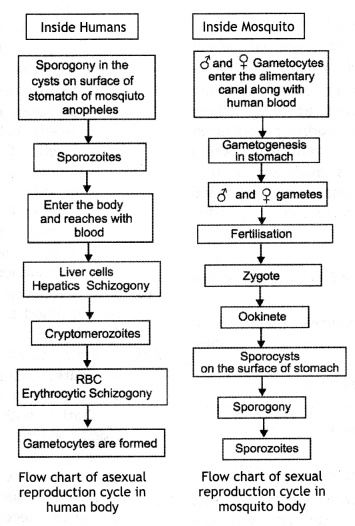
Class 12 Biology Important Questions Chapter 8 Human Health and Disease 2

(iii) Why does the victim show symptoms of high fever? (CBSE Delhi 2008, 2013)
Answer:
When the parasite attacks red blood cells, it leads to its rupture with the release of haemozoin, which is a toxin. As the haemozoin is released into blood, symptoms (high fever) of malaria appear.

Question 2.
What is Immune system? Mention the two types of the immune system. (CBSE Delhi 2011)
Answer:
The system which protects our body from pathogens and other foreign invaders is called the immune system. It is of two types.

  1. Innate
  2. Acquired

Innate immunity is non-specific and is present by birth. It includes physical barriers, physiological barriers, cellular and cytokinin barriers.

Acquired immunity is pathogen-specific and is obtained with experience. It is of two types- Humoral and cell-mediated

Question 3.
Distinguish between B-cells and T-cells.
Answer:
Differences between B-cells and T-cells:

B-cellsT-cells
1. They are produced in cells of bone marrow and remain there and later migrate to lymphoid tissues.1. They are produced in cells of bone marrow and migrate to the thymus and differentiate under the influence of thymus.
2. These crafts produce plasma cells, once triggered off by the antigens.2. These cells are responsible for recognising a specific antigen and attack it by releasing chemicals.
3. They are part of a humoral system.3. They are part of the cell-mediated immune system.
4. They act against viruses and bacteria and do not react against transplants and cancer cells.4. They act against pathogenic microorganism, organ transplants and cancer cells.
5. No inhibitory effect on the immune system.5. Suppressor cells inhibit the immune system.

Question 4.
(i) Name the infective stage of Plasmodium which Anopheles mosquito takes in along with the blood meal from an infected human.
Answer:
Gametocytes

(ii) Why does the infection cause fever in humans?
Answer:
Due to the release of haemozoin toxin in the blood.

(iii) Give a flow chart of the part of the life cycle of this parasite passed in the insect. (CBSE (Delhi) 2008, 2011)
Answer:
Class 12 Biology Important Questions Chapter 8 Human Health and Disease 2

Question 5.
(i) Why do the symptoms of malaria not appear immediately after the entry of sporozoites into the human body when bitten by female Anopheles? Explain.
Answer:
As the sporozoites enter the human body along with saliva of female anopheles mosquito, these parasites pass through hepatic schizogony in liver cells and erythrocytic schizogony in RBCs. Haemozoin present in unused cytoplasm of RBC is released, followed by the appearance of malarial symptoms. This period is also called the incubation period.

(ii) Give the scientific name of the malarial parasite that causes malignant malaria in humans. (CBSE 2009)
Answer:
Plasmodium falciparum. Causes malignant malaria in human.

Question 6.
Give the scientific name of the parasite that causes malignant malaria in humans. At what stage does this parasite enter the human body? Trace its life cycle in the human body. (CBSE 2009, 2012)
Answer:

  • Plasmodium falciparum
  • Sporozoites enter the human body along with saliva of the female anopheles mosquito.
  • The life cycle of Plasmodium in the human body
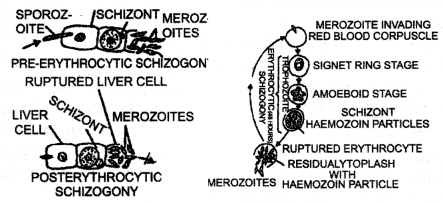
Class 12 Biology Important Questions Chapter 8 Human Health and Disease 3Life Cycle of Plasmodium

Question 7.
A 17-year-old boy is suffering from high fever with profuse sweating and chills. Choose the correct option from the following diseases which explains these symptoms and rule out the rest with adequate reasons.
(i) Typhoid
Answer:
If the boy is suffering from typhoid, then he should have sustained high fever (39° to40°C), weakness, stomach pain, constipation and headache. So it cannot be typhoid.

(ii) Viral Fever
Answer:
If the boy is suffering from viral fever, he will suffer from high fever, joint pain, weakness and headache. So it cannot be a viral fever.

(iii) Malaria (CBSE Sample paper 2018-19)
Answer:
If the boy is suffering from malaria, he should have high fever recurring with profuse sweating every three to four days associated with chills and headache. There is a possibility that he is suffering from malaria because high fever associated with chills is possible with malaria.

Question 8.
Medically it is advised to all young mothers that breastfeeding is the best for their newborn babies. Do you agree? Give reasons in support of your answer. (CBSE 2018)
Answer:
Yes, I do agree with the fact that breastfeeding is the best for newborn babies. Mammary glands start producing milk at the end of pregnancy. The milk produced during the initial few days of lactation is called colostrum which contains several antibodies. It helps in developing resistance for newborn baby against diseases. It helps the baby fight off viruses and bacteria. Thus breast milk is packed with a disease-fighting substance that protects newborn babies from illness. Breast milk also naturally contains many of the vitamins and minerals that a newborn requires. It is easily digested as well. There is no constipation, diarrhoea and upset stomach.

Question 9.
Name a human disease, its causal organism, symptoms (any three) and vector, spread by intake of water and food contaminated by human faecal matter. (CBSE 2017)
Answer:

  • Amoebic dysentery [Amoebiasis]
  • Causal Organism: Entamoeba historlytica, protozoa.

Symptoms:

  • Abdominal pain
  • Constipation
  • Cramps.

Vector: Housefly.

Question 10.
(i) Why is there a fear amongst the guardians that their adolescent wards may get trapped in drug/alcohol abuse?
Answer:
Reasons for alcohol abuse in adolescents:
(a) Curiosity for adventure, excitement and experiment
(b) Social pressure
(c) To escape from stress, depression and frustration
(d) To overcome hardships of life
(e) Unstable or unsupportive family structure, etc.

(ii) Explain ‘addiction’ and dependence’ in respect of drug/alcohol abuse in youth. (CBSE 2017)
Answer:
Addiction is the psychological attachment to certain effects such as euphoria and a temporary feeling of well-being, associated with drugs and alcohol. The addicted person cannot manage him/herself without drug or alcohol.

Dependence: Dependence is the tendency of the body to manifest a characteristic and unpleasant withdrawal syndrome on abrupt discontinuation of a regular dose of drug/alcohol.

Question 11.
What is the basic principle of vaccination? How do vaccines prevent microbial infections? Name the organism from which the hepatitis B vaccine is produced.
Or
Principle of vaccination is based on the property of “memory” of the immune system. Taking one suitable example, justify the statement. (CBSE Delhi 2019)
Answer:
Principle of vaccination is based on the property of ‘memory’ of the immune system.

In vaccination, a preparation of antigenic proteins of pathogens or inactivated/live but weakened pathogens is introduced into the body. The antigens generate a primary immune response by producing antibodies along with forming memory B-cells and T-cells. When the vaccinated person is attacked by the same pathogens, the existing memory B-cells and T-cells recognise the antigen and overwhelm the invaders with massive production of lymphocytes and antibodies. The hepatitis-B vaccine is produced from yeast.

Question 12.
Prior to a sports event blood and urine samples of sportspersons are collected for drug tests.
(i) Why is there a need to conduct such tests?
Answer:
Drugs are consumed by sportspersons to enhance their performance. It is necessary to test the blood and urine of sportspersons to analyse the presence of any performance-enhancing drug.

(ii) Name the drugs the authorities usually look for.
Answer:
Narcotic analgesics, anabolic steroids, diuretics.

(iii) Write the generic names of two plants from which these drugs are obtained. (CBSE Delhi 2016)
Answer:
(a) Cocaine is obtained from Erythroxylum coca
(b) Caffeine is obtained from Coffea arabica and narcotics from Papaver somniferum.

Question 13.
Explain the following terms:
(i) Benign tumour
Answer:
A benign tumour (Non-malignant tumour). Such tumours grow slowly but become quite large. It remains restricted to the place of origin and does not spread to other areas of the body. Most tumours are of this type and do not give rise to cancer.

(ii) Cancerous tumour
Answer:
A cancerous tumour (Malignant tumour): It begins as a small tumour growth at first, grows slowly in the starting and more rapidly later on. The tumour ultimately spreads to the neighbouring tissue like the roots of a tree. Later on, cancerous cells separate off from the original site and migrate through the blood to the other sites and they divide and redivide to form a secondary tumour.

(iii) Metastasis.
Answer:
Metastasis: The stage when the secondary tumour is formed and accumulated by repeated division, is called metastasis. This stage is fatal and causes death sooner or later.

Question 14.
Why cannabinoids are banned in sports and games?
Answer:
Cannabinoids are hallucinogenic chemicals obtained from leaves, resins and inflorescence of Hemp plant, Cannabis sativa. They are used by sportspersons to increase their athletic performance. Intake of cannabinoids results in rapid heartbeat decreased vital capacity of the lung. But their misuse is associated with a number of problems in both sportsmen and sportswomen, e.g. these cause masculinisation, increased aggressiveness, mood swings, abnormal menstrual cycles, enlarged clitoris in sportswomen, while their misuse in sportsmen is known to cause acne, mood swings, reduced testicular size, decreased spermatogenesis, enlarged breasts and prostate gland, dysfunctioning of liver and kidney, etc.

Question 15.
The outline structure of a drug is given below:
1. Which group of drugs does this represent?
2. What are the modes of consumption of these drugs?
3. Name the organ of the body which is affected by the consumption of this drug.
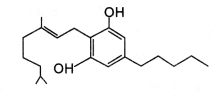
Class 12 Biology Important Questions Chapter 8 Human Health and Disease 4

Answer:

  1. Cannabinoids.
  2. By smoking or oral ingestion.
  3. Cannabinoids generally affect the cardiovascular system of the body.

Question 16.
What is cannabis? List its main derivatives.
Answer:
Cannabis: It is the most ancient drug and is obtained from hemp plants.
The following three kinds of drugs are obtained from these plants (Derivative of Cannabis indica):

  1. Hashish or Charas is obtained from flowering tops of female plants.
  2. Bhang is obtained from dry leaves.
  3. Ganja is obtained from small leaves and bracts of inflorescence.

Marijuana is another drug obtained from Cannabis sativa. The common reaction of these drugs is relaxation, euphoria, laughing tendency and rise in blood sugar level.

Question 17.
Why is using tobacco in any form injurious to the health? Explain. (CBSE Delhi 2008, Outside Delhi 2011)
Answer:
Tobacco is injurious to health:

  1. Nicotine present in tobacco is toxic and addictive. It causes coronary diseases.
  2. Heat irritants and carcinogens cause mouth cancer and lung cancer.
  3. Tobacco leads to male infertility.
  4. in pregnant women, nicotine causes decreased foetal growth and development.
  5. Tobacco addiction often leads to gastric and duodenal ulcers.
  6. It is an expensive habit causing staining of teeth and fingers and making breath unpleasant.
  7. Swelling of respiratory tract leads to chronic bronchitis.

Question 18.
Give reasons for the following:
(a) Antibody-mediated immunity is called humoral immunity.
Answer:
(a) Antibodies produced by plasma cells are present in the blood, the response is called humoral, immunity response. Thus it is termed humoral immunity.

(b) How is a child protected from a disease for which he/she is vaccinated?
Answer:
The principle of vaccination is based on the property of the ‘memory’ of the immune system. As during vaccination, antigens are introduced in the body. In response to antigens, antibodies are produced in the body against them. They neutralise the pathogen during actual infection.

(c) Name the type of cells the AIDS virus enters after getting into the human body. (CBSE Outside Delhi 2019)
Answer:
HIV enters macrophages. Simultaneously HIV enters T helper- Lymphocytes.

Question 19.
(a) Write the scientific names of the source plants from where opioids and cannabinoids are extracted.
Answer:
Opioids are obtained from the opium plant Papaver somniferous. Cannabinoids are extracted from Cannabis sativa.

(b) Write their receptor sites in the human body. How do these drugs affect human beings? (CBSE Outside Delhi 2019)
Answer:
Receptors of opioids are present on the central nervous system and gastrointestinal tract. They are a depressant and slow down the body functions. Receptors of cannabinoids are present in the brain. They affect the cardiovascular system of the body.

Question 20.
Briefly describe the life history of the malarial parasite.
Answer:

  1. Malarial parasite (Plasmodium) completes its life cycle in two hosts., i.e. female anopheles mosquito and humans.
  2. Sporozoites are the infective stage.
  3. The sporozoites enter the human body, reach the liver through blood and multiply within the liver cells.
  4. Such liver cells burst and release the parasites (Cryptomerozoites) into the blood.
  5. Then they attack RBCs, multiply and cause their rupture.
  6. The rupture of RBCs is associated with the release of a toxin called haemozoin, which is responsible for the high recurring fever and the chill/ shivering and causing malaria.
  7. Sexual stages (gametocytes) develop in the red blood cells.
  8. The parasite then enters the female Anopheles mosquito along with the blood when it bites the infected person.
  9. Further development occurs in the stomach wall of the mosquito.
  10. The gametes fuse to form a zygote. It takes the worm-like shape called ookinete as it pierces the wall of the stomach.
  11. The zygote undergoes further development in the body of the mosquito to form sporozoites.
  12. Sporozoites are transported to and stored in the salivary glands of mosquitoes and are transferred to a human body during the bite of the mosquito.
  13. Female mosquito sucks human blood because it requires blood proteins for the development of its eggs.

Question 21.
Describe the effects of drug and alcohol abuse.
Answer:
Effects of drug/alcohol abuse:

  1. The immediate effects of drugs/ alcohol abuse are manifested as reckless behaviour, vandalism and violence.
  2. Excess doses can lead to coma and death due to cerebral haemorrhage, respiratory and heart failure.
  3. A combination of drugs or their intake of alcohol leads to death.
  4. The most common warning signals of drug/alcohol abuse include:
    (a) Drop in academic performance.
    (b) Lack of interest in personal hygiene.
    (c) Withdrawal and isolation from family and friends.
    (d) Aggressive and rebellious behaviour.
    (e) Lack of interest in hobbies.
    (f) Change in sleeping and eating habits.
    (g) Fluctuations in weight, etc.

Question 22.
Name the type of immunity that is present at the time of birth in humans. Explain any two ways by which it is accomplished. (CBSE 2008)
Answer:
Innate immunity: It is also called inborn or non-specific immunity. It is the first line of defence. It is composed of the following steps:
1. Anatomic barriers: The skin and mucous membranes secrete certain chemicals which dispose of pathogens. Specific cases of this defence are cited below: The oil and sweat secreted by sebaceous and sudoriferous glands contain lactic acid and fatty acids, which make the skin surface acidic (pH 3 to 5). This does not allow the microorganisms to establish.

2. Physiological barrier: Body temperature, pH and various body secretions like saliva prevent the growth of many pathogenic microorganisms. Pyrogens and interferons aid in fighting infections.

Question 23.
On what basis diagnosis of cancer is made?
Answer:
Diagnosis of cancer:

  1. Blood and bone marrow tests are done for increased cell counts in case of leukaemia.
  2. Histopathological study or biopsy: In a biopsy, a piece of the suspected tissue cut into thin sections is stained and examined under a microscope by a pathologist.
  3. Radiography: X-rays are used to detect cancer of the internal organs
  4. Computed tomography: It uses X-rays to generate a three-dimensional internal image of an object.
  5. Resonance imaging: Non-ionising radiation and strong magnetic field are used in MRI to accurately detect pathological and physiological changes in the living tissue.
  6. Monoclonal antibodies: Antibodies against cancer-specific antigens are also used for the detection of certain cancers.

Question 24.
Explain with the help of sketch the action of HIV in the body. (CBSE Delhi 2011)
Or
Name the cells HIV (Human Immuno Deficiency Virus) gains entry into after infecting the human body. Explain the events that occur in these cells. (CBSE Outside Delhi 2016)
Or
Trace the events that occur in the human body to cause immunodeficiency when HIV gains entry into the body. (CBSE 2011, 2014)
Answer:
The action of HIV in the body. After getting into the body of the person, the virus enters into macrophages where RNA genome of the virus replicates to form viral DNA with the help of the enzyme reverse transcriptase. This viral DNA gets incorporated into the host cell’s DNA and directs the infected cells to produce virus particles. The macrophages continue to produce virus and in this way acts as an HIV factory.

Simultaneously, HIV enters into helper (Th) T-lymphocytes (a type or subset of T-lymphocytes about which you have read above, in the immune system), replicates and produces progeny viruses. The progeny viruses released in blood attack other helper T-lymphocytes. This is repeated leading to a progressive decrease in the number of helper T-lymphocytes in the body of the infected person.

During this period, the person suffers from bouts of fever, diarrhoea and weight loss. Due to the decrease in the number of helper T-lymphocytes, the person starts suffering from an infection due to bacteria such as Mycobacterium, viruses, fungi and even parasite Toxoplasma. The patient becomes so much immunologically deficient and unable to fight against such infections.
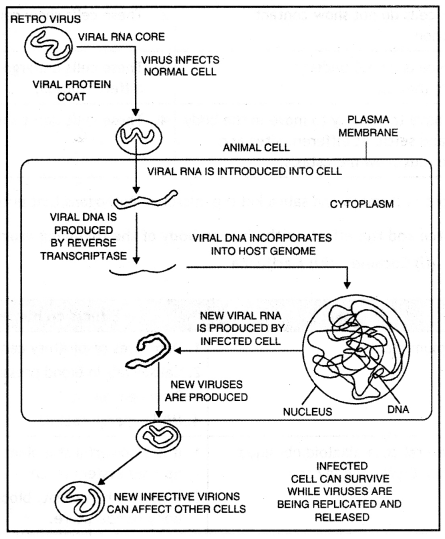
Class 12 Biology Important Questions Chapter 8 Human Health and Disease 5The action of HIV in the body cells.

Question 25.
(a) If a patient is advised anti-retroviral drug, name the possible infection he/ she is likely to be suffering from. Name the causative organism.
Answer:
The person may be suffering from AIDS. It is caused by HIV (Human Immunodeficiency Virus).

(b) How do vaccines prevent subsequent microbial infection by the same pathogen?
Answer:
Antibody-provoking agents are called a vaccine. They prevent microbial infection by initiating production of antibodies to act against antigens to neutralise the pathogenic agents during later actual infection.
The vaccine also generates memory B-cells and T-cells that actually recognise the pathogen quickly in case of infection at later stages of life.

(c) How does a cancerous cell differ from a normal cell?
Answer:
Differences between the cancerous cell and normal cell:

Cancerous cellsNormal cells
1. These cells divide in an uncontrolled manner and rate of division is high.1. These cells divide in a regulated and controlled manner.
2. These cells do not show contact inhibition.2. These cells show contact inhibition.
3. These cells do not undergo differentiation.3. These cells undergo programmed differentiation.
4. They have the ability to move in the body fluid and settle at different sites and divide thus show metastasis.4. These cells don’t show metastasis.

(d) Many microbial pathogens enter the gut of humans along with food. Name the physiological barrier that protects the body from such pathogens. (CBSE Sample Paper 2020)
Answer:
The acid present in the stomach and saliva kills the microbial pathogens that enter along with food.

Question 26.
Write the source and the effect on the human body of the following drugs:
(i) Morphine
(ii) Cocaine
(iii) Marijuana (CBSE Delhi 2011)
Answer:

Name of drugSourceEffects on the human body
1. MorphineOpium plant1. Depresses respiratory centre.
2. Causes fall in blood pressure.
3. Slow heartbeat.
4. Mild hyperglycaemia
2. CocaineNatural coca alkaloid obtained from Erythroxylon coca1. It is a powerful stimulant of the central nervous system (CNS)
2. Increases heartbeat, blood pressure and body temperature.
3. MarijuanaDried flowers and top leaves of female plant of Cannabis Sativa1. It causes psychosis
2. Raises blood sugar and increases the frequency of urination


Evolution Class 12 Important Extra Questions Biology Chapter 7

Here we are providing Class 12 Biology Important Extra Questions and Answers Chapter 7 Evolution. Important Questions for Class 12 Biology are the best resource for students which helps in Class 12 board exams.

Class 12 Biology Chapter 7 Important Extra Questions Evolution

Evolution Important Extra Questions Very Short Answer Type

Question 1.
When did life appear on earth?
Answer:
Life originated sometimes 3600 million years ago.

Question 2.
Arrange the following substances in a proper sequence with regard to the formation of chemical constituents at the time of origin of life: Sugar, methane, nucleic acid, and amino acid.
Answer:
Methane-sugar-amino acid-nucleic acid.

Question 3.
Mention the type of nutrition in the cells that originated first during the origin of life.
Answer:
Heterotrophic nutrition.

Question 4.
Which group of organisms were responsible for the appearance of free oxygen in the atmosphere of the primitive earth?
Answer:
Oxygenic photosynthetic bacteria resembling the present-day blue-green algae or cyanobacteria.

Question 5.
Give the three key factors of the modern concept of evolution.
Answer:
Genetic variations, natural selection, and isolation.

Question 6.
What is the ultimate source of organic variation?
Answer:
Genetic variations due to mutations, recombination, and polyploidy.

Question 7.
What is proved by the phenomenon of resistance to DDT in mosquitoes?
Answer:
Natural selection.

Question 8.
Attempt giving a clear definition of the term species.
Answer:
The members of a species that resemble structurally and functionally are able to interbreed freely and produce fertile offspring of their own kind and share a common gene pool.

Question 9.
What causes speciation according to Hugo de Vries? (CBSE Delhi 2008)
Answer:
Mutations.

Question 10.
How did Charles Darwin express ‘fitness’? (CBSE Delhi 2019)
Answer:
Charles Darwin expressed ‘fitness’ as reproductive fitness. The adaptive ability of an organism is inherited. The best-adapted species increase their population by reproduction.

Question 11.
Name the scientist who disproved spontaneous generation theory. (CBSE 2010)
Answer:
Louis Pasteur.

Question 12.
Mention the type of evolution that has brought the similarity as seen in potato tuber and sweet potato. (CBSE 2009)
Answer:
Convergent evolution.

Question 13.
Briefly explain the theory of biogenesis. (CBSE 2012)
Answer:
According to this theory, life originated from pre-existing life forms.

Question 14.
Write the probable difference in eating habits of Homo habilis and Homo erectus. (CBSE Outside Delhi 2016)
Answer:
Homo habilis was carnivorous. Homo erectus was omnivorous.

Question 15.
How do we compute the age of a living tree?
Answer:
By determining the number of annual rings in the lower part of its trunk, called dendrochronology.

Evolution Important Extra Questions Short Answer Type

Question 1.
What are we referring to when we say “simpler organisms” or “complex organisms”?
Answer:
By “simpler organisms”, we mean those organisms which are primitive with simple organization and simple metabolic pathways, structural and functional. “By complex organisms”, we mean those organisms which are more evolved, have a complex level of structural and functional organization and complex metabolic pathways.

Question 2.
Louis Pasteur’s experiments, if you recall, proved that life can arise from only pre-existing life. Can we correct this as life evolves from pre-existent life or otherwise we will never answer the question as to how the first forms of life arose? Comment.
Or
State the two principal outcomes of the experiments conducted by Louis Pasteur on the origin of life. (CBSE Delhi 2019)
Answer:

  1. Dismissed theory of spontaneous generation of life.
  2. Yes, we can correct this as life evolves from pre-existent life.

The first life that appeared on the earth was apparently the result of chemical evolution, i.e. the life originated from inorganic molecules that formed organic molecules, further forming complex compounds.

This finally resulted in simple cells and then simple organisms, where-in complexity developed with time. However, once life originated, abiogenesis could not follow, and hence, life evolved further only through biogenesis, i.e. pre-existent life gave rise to new life.

Question 3.
What is convergent evolution?
Answer:
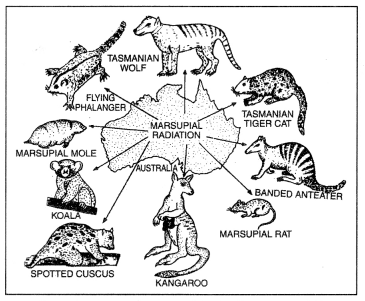
Convergent evolution. When adaptation for survival in similar habitats is similar, then this form of evolution is called convergent evolution or parallel evolution. Examples: Some of the marsupials of Australia resemble placental mammals that live in similar habitats to other continents. Australia separated about 50 million years ago. Marsupials arrived here before the separation from Antarctica and evolved in isolation earlier than placental mammals.

Question 4.
What are analogous organs? Give examples. (CBSE 2016)
Answer:
Analogous organs: The organs which are similar in appearance and perform the same function but differ in their fundamental structure and origin are called analogous organs.

Examples:

  1. Wings of birds and insects.
  2. Leaves of a plant and cladodes of Ruscus are also analogous organs.

Question 5.
What are vestigial organs? Give examples.
Answer:
Vestigial organs are non-functional organs in an organism that are functional in related animals and were functional in the ancestors. There are 90 vestigial organs in the human body and mainly include coccyx (tail bone); nictitating membrane (3rd eyelid); caecum and vermiform appendix; canines; wisdom teeth; body hair; auricular muscles; mammary glands in male; etc. Vestigial organs are also present in some other animals, e.g. splint bones in the horse; hind-limbs and pelvic girdles in python; wings and feathers in flightless birds; etc.

Question 6.
Write the significance of vestigial organs.
Answer:
Significance of vestigial organs. Organic evolution states that these vestigial organs were functional in the ancestral forms but have become non-functional due to changes in their function and may finally disappear. So the presence of vestigial organs is convincing evidence of organic evolution and is supported by Lamarck’s theory of use and disuse of organs.

Question 7.
What are fossils?
Answer:
Fossils. The remnants or impressions of living organisms from the remote past may be regarded as fossils. Fossil formation involves the burial of dead organisms. Layer after layer of sediment is laid above the dead organisms. It is only on this account that the oldest fossils are found in the deepest layers of the earth’s surface, while the fossils of recent origin are found in the upper layers. Thus by examining the various layers of the earth from the deepest to the most superficial strata for the fossil record, the story of life in the correct historical sequence can be known.

Question 8.
Why is Archaeopteryx called a connecting link between reptiles and birds?
Or
What is the significance of Archaeopteryx in the study of organic evolution?
Answer:
Importance of Archaeopteryx as connecting link. The fossil forms representing the characters of the two distinct groups of living animals are known as missing links. The best example of connecting link is afforded by a fossil bird, Archaeopteryx. It was the size of a crow. Archaeopteryx is decidedly a bird as it has feathers and a beak. But like reptiles, it has a long tail, jaws full of teeth, claws on forefingers, and keelless sternum. Thus it represents a stage between reptiles and birds through Archaeopteryx-like intermediate form.

Question 9.
What is adaptive radiation? (CBSE Delhi 2016)
Or
Describe one example of adaptive radiations. (CBSE Delhi 2008 S, 2010, 2015, 2019 C, Outside Delhi 2014)
Or
How did Darwin explain the existence of different varieties of finches on the Galapagos Islands? (CBSE Outside Delhi 2009, Delhi 2010)
Answer:
Adaptive radiation: It is the process of divergent evolution in which members of the same ancestral species of a large taxonomic group are evolved along different lines in different habitats of the same geographical area.

Example: Darwin’s Finches are an example of adaptive radiation.

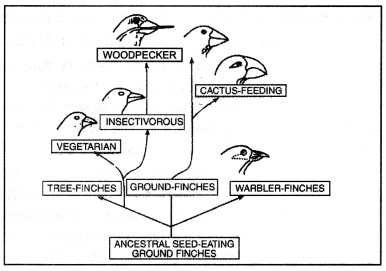
There were many varieties of small blackbirds in the Galapagos Islands. Darwin reasoned that after originating from a common seed-eating stock, the finches must have radiated to different geographical locations in the same island and undergone adaptive changes, especially in the type of beak. Living in isolation for long, the new kinds of finches emerged that could survive and function in the new habitats.

Question 10.
List the main points of Lamarck’s theory.
Answer:
Lamarck’s theory of evolution:

  1. Effect of environment.
  2. Effect of use and disuse of organs.
  3. The inheritance of acquired characters.
  4. The origin of new species.

Question 11.
Give the main points of Darwin’s Theory of Evolution. (CBSE Outside Delhi 2019)
Answer:
Darwin’s Theory of Evolution may be summed up as follows:

  1. Rapid multiplication/overproduction
  2. Struggle for existence.
  3. Variations.
  4. Natural selection or survival of the fittest.
  5. Inheritance of useful variations.
  6. Origin of new species.

Alfred Wallace also arrived at the same conclusion as that of Charles Darwin.

Question 12.
Name the following:
(i) Who conceived the idea of the chemosynthetic hypothesis of the origin of life on earth?
Answer:
Oparin and Haldane

(ii) Who proved that spontaneous generation does not occur?
Answer:
Francesco Redi, Spallanzani, and Louis Pasteur

(iii) Who experimentally proved that life develops from pre-existing life only?
Answer:
Pasteur

(iv) Who gave the theory of organic evolution? (CBSE 2010)
Answer:
Charles Darwin.

Question 13.
Describe De Vries Mutation theory. (CBSE Delhi 2011)
Answer:
De Vries Mutation Theory: Hugo de Vries (1848-1935) was a Dutch Botanist. He performed experiments on the Evening Primrose (Oenothera Lamarckian). According to this theory, new species arise suddenly showing abrupt deviations in characters from the normal forms. These sudden deviations are because of mutation. Thus evolution is not a slow and gradual process but a sudden discontinuous and jerky process.

Question 14.
State a reason for the increased population of dark-colored moths coinciding with the loss of lichens (on tree barks/during industrialization period in England). (CBSE Delhi 2015)
Answer:
Soot evolved from coal-based industries deposited on tree bark of oak plants and darkened it, which is called industrial melanism. Dark-colored moth (Bistort Carbonaria) had more chances of survival so increased in number. Before industrialization, white-colored thick lichens grew on tree barks. In that background, white-winged moths survived but dark moths were picked out by predators.

But post-industrialization, lichens disappeared and tree trunks became dark due to the deposition of soot evolved from coal-based industries. Now white moths became easy prey compared to dark ones. Thus dark moths survived and increased their population.

Question 15.
Select the homologous structures from the combinations given below:
1. Fore-limbs of whale and bats
2. A tuber of potato and sweet potato
3. Eyes of Octopus and Mammals
4. Thorn of Bougainvillea and Tendril of Cucurbita. (CBSE Outside Delhi 2015)
Answer:

  1. Because both of them share similarities in the pattern of bones of forelimbs, though they perform different functions like forelimb of whale helps in swimming, while that in bats it helps in flying.
  2. Because both are modified stem branches (axillary buds) but are differently modified to perform different functions, e.g. thorns for protection from grazing animals and tendrils for climbing.

Question 16.
According to Hardy-Weinberg’s principle, the allele frequency of a population remains constant. How do you interpret the change of frequency of alleles in a population? (CBSE 2009)
Answer:
Disturbances in genetic equilibrium or Hardy-Weinberg equilibrium lead to a change of frequency of alleles in a population which results in evolution.

Question 17.
With the help of two suitable examples, explain the effect of anthropogenic actions on organic evolution. (CBSE Delhi 2013)
Answer:
Effect of anthropogenic actions on organic evolution:

  1. Creation of breeds by artificial or selective breeding programs.
  2. (a) Excess use of herbicides, pesticides, etc. has resulted in the selection of resistant varieties in a much lesser time.
    (b) Selection of drug-resistant microbes.
  3. Survival of dark-winged (melanized) moths after industrialization in England.

Question 18.
Can we call human evolution adaptive radiation?
Answer:
No, we cannot call human evolution adaptive radiation. It is the case of descent with modification in which more advanced types are evolved from the simple forms. In the case of human evolution, there appears to be parallel evolution of the human brain and language.

Question 19.
State two postulates of Oparin and Haldane with reference to the origin of life. (CBSE Delhi 2017)
Answer:
Oparin and Haldane proposed that:

  1. life originated from pre-existing non¬living organic molecules.
  2. the diverse organic molecules were formed from inorganic constituents by chemical evolution.

Question 20.
Write the names of the following:
(i) A 15 mya primate that was ape-like
Answer:
Dryopithecus

(ii) A 2 mya primate that lives in East African grasslands (CBSE Delhi 2018)
Answer:
Australopithecus

Question 21.
(i) Write two differences between Homo erectus and Homo habilis.
Answer:
Differences between Homo erectus and Homo habilis:

Homo erectusHomo habilis
1. Brain capacity is 900 cc.1. Brain capacity is 900 cc.
2. Probably ate meat.2. Probably ate meat.

(ii) Rearrange the following from early to late geologic periods: Carboniferous, Silurian, Jurassic. (CBSE Delhi 2019)
Answer:
Silurian, Carboniferous, Jurassic.

Evolution Important Extra Questions Long Answer Type

Question 1.
What are homologous organs? Give similar or different functions are catted examples. (CBSE 2016) homologous organs.
Answer:
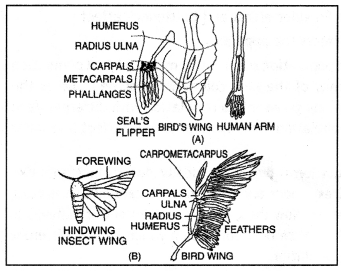
Homologous organs: Organs that have a common origin, embryonic development, and the same fundamental structure but perform similar or different functions are catted homologous organs.

Examples of homologous organs:
1. The wings of bird and bat, flipper embryonic development, and same (fin) of whale and human forearm are fundamental structures but perform differently in forms because these have to perform different functions. Studies of the bones forming the skeleton of these organs would reveaL similarity in construction. In fact, these are the forms of forearms that have originated from pentadactyl forms and due to the different functions they are performing, they transformed into different forms.

2. In plants, the homologous organs may be a thorn of Bougainvillea or a tendriL of Cucurbita both arising in axillary position. Both have different forms depending on their function to perform.

Question 2.
How has the study of fossils helped in convincing scientists that organisms have come into existence through evolution? (CBSE Outside Delhi 2019)
Answer:
Fossils are important for man because of many reasons:

  1. They provide evidence of past life.
  2. They furnish direct and most convincing proofs in favor of organic evolution.
  3. They afford some information of ancient environment and climate.
  4. The most primitive forms of life are in the oldest rocks.
  5. Ancient forms were simpler than those found today.
  6. None of the plants and animals of the past were exactly similar to those found today.
  7. A complete fossil record has been found in the evolution of horses.

Question 3.
Explain antibiotic resistance observed in light of Darwinian selection theory.
Answer:
Antibiotics were considered to be very effective against diseases caused by bacteria. But within two or three years of the introduction of antibiotics, new antibiotic-resistant bacteria appeared in the population. Sometimes a bacterial population happens to contain one or a few bacteria having mutations that make them resistant to the antibiotic. Such resistant bacteria survive and multiply quickly as the competing bacteria have died.

Soon the resistance-providing genes become widespread and the entire bacterial population becomes resistant. Some hospitals harbor antibiotic-resistant bacteria due to the extensive use of antibiotics.

Question 4.
How does natural selection operate according to Darwin’s theory of natural selection? (CBSE Delhi 2016, 2019 C)
Answer:
Natural selection operates in the following ways according to Darwin’s theory:

  1. All plants and animals reproduce in a geometrical pattern. The number of organisms produced is much more than that can survive due to limited space and food.
  2. Due to the same basic requirement, competition between organisms takes place and those who are better adapted to the environment survive while the rest die.
  3. The individuals having useful variation overpower those without such variations. These variations are transmitted to future generations.

Question 5.
Distinguish between microevolution and macroevolution. Narrate the significance of population genetics in evolution.
Answer:
Evolution on the grand scale of geological time is called macroevolution, while evolution at the genetic level is microevolution. Microevolution is actually operative at genetic level change within a population. Significance of population genetics.

The gene frequency of a population is called population genetics. Evolution occurs within populations as the relative frequencies of different variations of DNA change over time. If genes change, then enzymes automatically change and represent two different forms of individuals and definitely result in evolution.

Question 6.
Compare and contrast the theories of evolution proposed by Darwin and Hugo De Vries. (CBSE Sample Paper 2018-19, Outside Delhi 2019)
Answer:

Darwin’s Theory of Natural Selection

De Vries Theory of Mutation

1. Minor variations cause evolution.1. Mutation causes evolution.
2. Darwinian variations are small and directional.2. Mutations are random and directionless.
3. Evolution is gradual.3. Sudden mutations cause evolution.

Question 7.
How would the gene flow or genetic drift affect the population in which either of them happens to take place? (CBSE Delhi 2019)
Answer:
Gene flow is the transfer of genetic variations from one population to another. As a result of gene flow, the gene frequencies change in the original as well as in the new population. New genes or alleles are added to the new population and lost from the old population. If such a change in genes/alleles happens by chance, it is called genetic drift. In this case, the allelic frequency of the population will be affected. Such changes in allelic or gene frequencies lead to evolution, speciation, or founder effect.

Question 8.
Using the Internet and discussing with your teacher, trace the evolutionary stages of any one animal, say, a horse.
Answer:
The major evolutionary trend of horses:

  1. General increase (with occasional decrease) in size.
  2. The progressive loss of toes.
  3. Lengthening of toes that are retained.
  4. Lengthening of limbs in general.
  5. Enlargement of the brain (especially cerebral hemisphere).
  6. Increase in height.
  7. Increase in the complexity of molar teeth and an enlargement of the last two and, eventually, the last three premolars until they came to resemble molars.

Question 9.
Summarise Milter’s simulation experiment for organic synthesis. Comment on its efficacy. (CBSE Delhi 2012)
Answer:
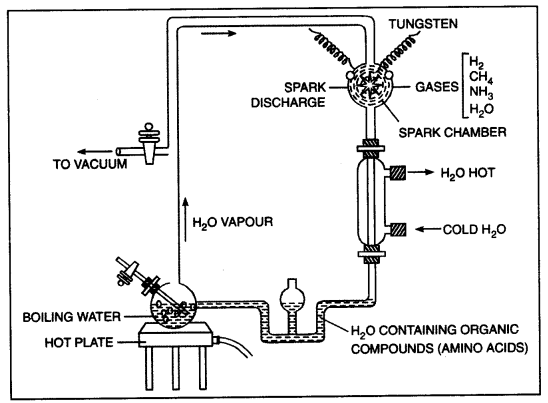
Miller’s experiment. Milter (1953) made the first successful simulation experiment to assess the validity of the claim for the origin of organic molecules. Miller sealed in a spark chamber a mixture of water, methane, ammonia, and hydrogen gas. He made arrangements for boiling water.

The trap in turn was connected with the flask for boiling water. After 18 days, a significant amount of simple major organic compounds, such as amino acids, such as glycine, alanine, and aspartic acid, and peptide chains, began to appear. Simple sugars, urea, and short-chain fatty acids were also formed. In the atmosphere, this spark is provided by U.V. light or other energy sources.
Class 12 Biology Important Questions Chapter 7 Evolution 1
Stanley Miller’s Experiment in the artificial production of organic compounds.

Question 10.
With the help of an algebraic equation, how did Hardy-Weinberg explain that in a given population the frequency of occurrence of alleles of a gene is supposed to remain the same through generations? (CBSE Delhi 2018)
Or
Explain Hardy-Weinberg’s principle. (CBSE Delhi 2019 C)
Answer:
In a given population, one can find out the frequency of occurrence of alleles of a gene or a locus. This frequency is supposed to remain fixed and even remain the same through generations. Hardy-Weinberg’s principle stated it using algebraic equations. According to this principle, allele frequencies in a population are stable and are constant from generation to generation. The gene pool (total genes and their alleles in a population) remains constant. This is called genetic equilibrium.

Sum total of all the allelic frequencies is 1. Individual frequencies, for example, can be named as p, q, etc. In a diploid, p and q represent the frequency of allele A and allele a, respectively. The frequency of AA individuals in a population is simply p2. This is simply stated in another way, i.e. the probability that an allele A with a frequency of p appears on both the chromosomes of a diploid individual is simply the product of the probabilities, i.e. p2. Similarly of aa is q2, of Aa 2pq. Hence, p2 + 2pq + q2 = 1. This is a binomial expansion of (p + q)2. When the frequency measured is different from expected values, the difference (direction) indicates the extent of evolutionary change.

Disturbance in genetic equilibrium, or Hardy-Weinberg equilibrium, i.e. change of frequency of alleles in a population, would then be interpreted as resulting in evolution.

Question 11.
(i) Differentiate between analogous and homologous structures.
Answer:

Analogous organsHomologous organs
(i) Organs that are structurally dissimilar but functionally similar are called analogous organs.
Example: wings of birds and insects.
(i) Organs that are structurally similar but functional dissimilar are called homologous organs.
Example: forelimbs of frog, lizard, bird, bat, horse, man, etc.
(ii) They lead to convergent evolution.(ii) They lead to divergent evolution.

(ii) Select and write analogous structures from the list given below:
(o) Wings of butterfly and birds
(b) Vertebrate hearts
(c) Tendrils of Cucurbita and thorns of Bougainvillea
(d) Tubers of sweet potato and potato (CBSE Delhi 2018)
Answer:
(a) Wings of butterflies and birds.
(b) Tubers of sweet potato and potato.

Question 12.
Write thecharacteristicsofRamapithecus, Dryopithecus, and Neanderthal man. (CBSE Delhi 2017)
Answer:
Characteristics of Ramapithecus:

  • They evolved around 15 mya.
  • They were more man-like, walked more erect, and had teeth like modern men.

Characteristics of Dryopithecus:

  • They evolved around 5 mya.
  • They were ape-like, having hairy arms and legs of the same length, large brains. They used to eat soft fruits and leaves and walked like gorillas and chimpanzees.

Characteristics of Neanderthal Man:

  • They evolved around 1,00,000-40,000 years ago.
  • Fossil found in east and central Asia had brain size 1400 cc. They used hides to protect their body. They buried their dead.

Question 13.
How does the process of natural selection affect Hardy-Weinberg equilibrium? List the other four factors that disturb the equilibrium. (CBSE Outside Delhi 2013)
Or
Write Hardy-Weinberg principle.
Or
How can Hardy-Weinberg equilibrium be affected? Explain giving three reasons. (CBSE Delhi 2018C)
Answer:
Hardy-Weinberg Principle states that the sum of allelic frequencies in a population is stable and is constant from generation to generation, i.e. the gene pool (total genes and their alleles) in a population remains constant. This is called genetic equilibrium. The sum total of all the allelic frequencies is

Hardy-Weinberg’s Equilibrium p2+ q2 + 2pq =

Five factors that influence these values are:
The five factors which affect Hardy- Weinberg’s equilibrium is as follows:

  1. Gene migration: When some individuals of a population migrate to other populations or when certain individuals come into a population (i.e. migration and immigration), some genes are lost in the first case and added in the second.
  2. Genetic drift: Random changes in the allele frequencies of a population occurring only by chance constitute genetic drift. The change in allele frequency may become so drastically different that they form a new species.
  3. Mutations: The mutations are random and directionless. They are sufficient to create a considerable genetic variation for speciation to occur.
  4. Recombination: New combinations of genes occur due to crossing over in meiosis during gametic formation.
  5. Natural selection: It is the most critical evolutionary process that leads to changes in allele frequencies
    and favors adaptation as a product of evolution.

Question 14.
Define genetic drift. How does it produce the founder effect and genetic bottleneck?
Or
How does the original drifted population become a founder? (CBSE 2019 C)
Answer:
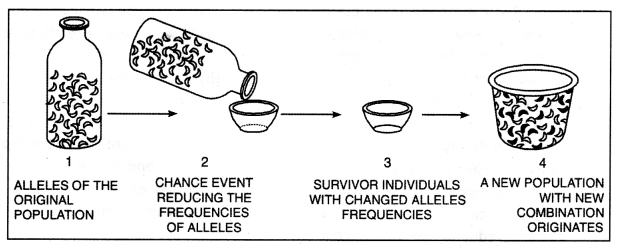
Genetic drift: Random change occurring in the allele frequency by chance alone is called genetic drift. It is due to habitat fragmentation, isolation, natural calamities, or any epidemics.

Founder effect: When a section of the population gets separated from the original population, then this section becomes genetically different from the original population due to a change in alleles frequency. The original population becomes the founder of the new population. This is called the founder effect which is the result of genetic drift, i.e. by chance. Genetic bottleneck.

When in a season one population died leaving few individuals of the population which become the founder of the new population, then it will produce only a few genes by selection only, i.e. by chance new population is emerged and it is similar to a bottle in which only certain population is allowed to flow as in the neck of a bottle.

Class 12 Biology Important Questions Chapter 7 Evolution 2
Bottleneck effect

Question 15.
How does Darwin’s theory of natural selection explain new forms of life on earth? (CBSE 2008, 2016)
Answer:
Darwin’s Theory of evolution may be summed up as follows:
Darwin’s Theory of natural selection. Charles Darwin (1809 – 1882), a naturalist, proposed a theory to explain the process of evolution. His theory was published in his famous book “Origin of Species” published in 1858.

His theory of natural selection is termed Darwinism:

  • Rapid multiplication
  • Struggle for existence
  • Variations
  • Natural selection or survival of the fittest
  • Inheritance of useful variations
  • Origin of new species.

Evidence in favor of Darwin’s theory: Darwin’s theory is supported by natural selection, phenomena of mimicry and protective coloration, and the correlation between nectaries of flowers and proboscis of pollinating insects.

Darwin’s theory fails to explain the perpetuation of vestigial organs and over-specialization of organs.
Darwin’s theory has since been modified in the light of progress in genetics.

Question 16.
Describe the present-day concept of evolution.
Answer:
1. Modern concept of evolution: The modern concept of evolution is a modified form of Darwin’s theory of natural selection and is often called Neo-Darwinism. It comprises genetic variation, natural selection, and isolation.
(a) Mutations: These have been recognized as the ultimate source of biological changes and hence the raw material of evolution. The mutation in chromosomes may be due to changes in structure, number, or gene.

(b) Gene Recombination takes place during crossing over in meiosis. New combinations of genes produce new phenotypes.

(c) Hybridisation is the intermingling of the genes of the members of closely related species.

(d) Genetic drift is the elimination of the genes of some original characteristics of a species by extreme reduction due to different reasons.

In Monoparental reproduction, only chromosomal and gene mutation are sources of genetic variation,

2. Natural Selection: If differential reproduction (i.e. some individuals produce abundant offspring, some only a few, and some organisms none) continues for many generations, genes of the individuals which produce more offspring will become predominant in the gene pool of the population. Thus natural selection occurs through differential reproduction in successive generations. The migration of individuals from one to another population is an accessory factor for speciation (origin of new species).

3. Isolation: By selecting the most suitable genotypes, natural selection guides different populations into different adaptive channels. The reproductive isolation between the populations due to certain physical barriers or others leads to the formation of new species. Isolation plays a significant role in evolution.

Question 17.
(i) Name the primates that lived about 15 million years ago. List their characteristic features.
Answer:
Primates Dryopithecus and Ramapithecus lived about 15 mya.

Features:
(a) Hairy and walked like gorillas and chimpanzees. Height up to 4 feet but walked upright.

(ii) (a) Where was the first man-like animal found?
Answer:
Ethiopia and Tanzania

(b) Write the order in which Neanderthals, Homo habilis, and Homo erectus appeared on the earth. State the brain capacity of each one of them.
Answer:

  • Homo habilis – 700 cc
  • Homo erectus – 900 cc
  • Neanderthals man – 1300-1600 cc

(c) When did modern Homo sapiens appear on this planet ? (CBSE Delhi 2011)
Answer:
Homo sapiens appeared about 34000 years ago.

Very Importance Figures:

Class 12 Biology Important Questions Chapter 7 Evolution 3
(A) Foretimbs of vertebrates as homologous organs.
(B) AnaLogous organs. Wings of insect and bird.

Class 12 Biology Important Questions Chapter 7 Evolution 4
Darwin finches

Class 12 Biology Important Questions Chapter 7 Evolution 5
Adaptive radiations of Australian marsupials

Class 12 Biology Important Questions Chapter 7 Evolution 6
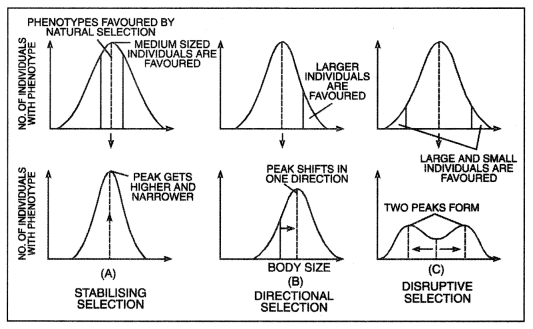
Kinds of selection

Molecular Basis of Inheritance Class 12 Important Extra Questions Biology Chapter 6

Here we are providing Class 12 Biology Important Extra Questions and Answers Chapter 6 Molecular Basis of Inheritance. Important Questions for Class 12 Biology are the best resource for students which helps in Class 12 board exams.

Class 12 Biology Chapter 6 Important Extra Questions Molecular Basis of Inheritance

Molecular Basis of Inheritance Important Extra Questions Very Short Answer Type

Question 1.
Name the genetic material for the majority of organisms.
Answer:
DNA (Deoxyribose nucleic acid)

Question 2.
List the function of RNA.
Answer:
RNA acts as genetic material in viruses and also functions as an adapter, structural, and in some cases as a catalytic molecule.

Question 3.
How many nucleotides are present in a bacteriophage Φ × 174?
Answer:
5386.

Question 4.
List the number of base pairs in:
(i) lambda bacteriophage
Answer:
48502 bp

(ii) E.coli and
Answer:
4.6 × 10⁶bp

(iii) haploid content of human DNA.
Answer:
3.3 × 10⁹bp.

Question 5.
Comment two chains of DNA have antiparallel polarity.
Answer:
If one chain has 5′ → 3′ polarity, the other chain has 3′ → 5′ polarity.

Question 6.
What is the difference between DNA and DNAase?
Answer:
DNAs are the number of molecules of DNA and DNAase is an enzyme that digests DNA.

Question 7.
What made DNA as genetic material?
Answer:
As RNA was unstable, it evolved further with certain chemical modifications and formed DNA. DNA became more stable.

Question 8.
What is the average rate of polymerization?
Answer:
2000 bp per second.

Question 9.
List three components of the transcription unit.
Answer:

  1. A promoter,
  2. The structural gene,
  3. A terminator.

Question 10.
What is the term used for fully processed hn RNA?
Answer:
A messenger RNA (mRNA).

Question 11.
What is splicing?
Answer:
It is the removal of introns and the joining of exons in a definite manner.

Question 12.
Where are UTRs present in mRNA strand?
Answer:
UTRs (Untranslated region) are present at both 5′ end (before start codon) and at the 3′ end (after stop signal).

Question 13.
Write the significance of UTRs.
Answer:
They are required for the regulation of an efficient translation process.

Question 14.
Name any two non-sense codons (stop signal).
Answer:

  1. UGA (Opal)
  2. UAA (Ochre).

Question 15.
What are the exceptions to the general rule that DNA is the genetic material in all organisms? Give evidence that supports these exceptions.
Answer:
Some animal viruses and all plant viruses contain RNA as their genetic material.

Question 16.
What is a replication fork? (CBSE, Delhi 2011)
Answer:
When replication starts the two strands of DNA unwind to form a Y-shaped structure called the replication fork.

Question 17.
Name the technique by which Gene expression can be controlled with the help of RNA molecule. (CBSE Sample Paper 2018-19)
Answer:
Northern blotting

Question 18.
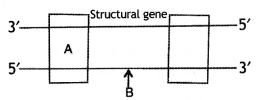
Name the parts ‘A’ and ‘B’ of the transcription unit given below. (C.B.S.E. Delhi 2008)
Answer:
Class 12 Biology Important Questions Chapter 6 Molecular Basis of Inheritance 1
A-Promoter
B-Coding strand.

Question 19.
Mention the role of the codons AUG and UGA during protein synthesis. (CBSE 2011, 2016)
Or
Mention two functions of codon AUG. (CBSE 2010)
Answer:

  1. AUG acts as a start signal and also code for methionine amino acid.
  2. UGA acts as a stop signal.

Question 20.
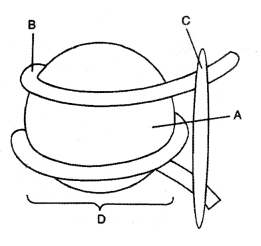
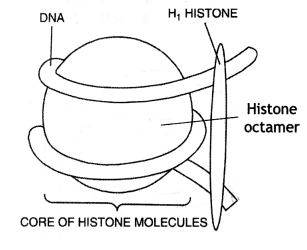
How do histones acquire positive charge? (CBSE Delhi 2011)
Answer:
A histone protein acquires a positive charge because they are rich in basic amino acid residues such as lysine, arginine, and histidine. All are positively charged in their side chains.

Question 21.
Why do DNA fragments move towards the anode during gel electrophoresis? (CBSE Delhi 2018C)
Answer:
DNA molecule is negatively charged. When placed in an electric field it moves towards a positively charged anode.

Question 22.
Name one amino acid which is coded by only one codon. (CBSE Delhi 2018 C)
Answer:
Methionine – AUG/ Tryptophan – UGG

Molecular Basis of Inheritance Important Extra Questions Short Answer Type

Question 1.
If the sequence of coding strand In a transcription unit Is written as follows: (CBSE Delhi 2011)
5′- A T G C A T G C A T G C A T G C A T G C A T G C A T G C – 3′
Write down the sequence of mRNA.
Answer:
The sequence of mRNA shall be:
5′ – U A C G U A C G U A C G U A C G U A C G U A C G U A C G – 3′.

Question 2.
What is Chargaff rule? (CBSE Delhi 2011)
Answer:
Chargaff Rules:

  1. In DNA molecule, A — T base pairs equals in number to G — C base pairs.
  2. A + G = T + C, i.e. purines and pyrimidines equal in amount.
  3. A = T and C = G (Amount).
  4. The base ratio A + T/G + C may vary from one species to another but is constant for each species. It helps in identifying the source of DNA.
  5. The deoxyribose sugar and phosphate component occur in equal proportions.

Question 3.
(a) Name the component of a nucleotide responsible for giving 5’— 3′ polarity to a polynucleotide.
Answer:
A polymer has at one end a free phosphate moiety at 5′- end of ribose sugar which is referred to as 5′-end of a polynucleotide chain. Similarly, at the other end of the polymer, the ribose has a free 3-OH group which is referred to as the 3′-end of a polynucleotide chain.

(b) Where in a nucleotide is the glycosidic bond present? (CBSE Delhi 2019 C)
Answer:
A nitrogenous base is linked to pentose sugar through an N-glycosidic linkage to form nucleoside.

Question 4.
Which property of DNA double helix led Watson and Crick to hypothesize a semi-conservative model of DNA replication? Explain.
Or
Write a note on the semi-conservative mode of DNA replication. (CBSE Delhi 2008; Delhi 2011, 2014)
Answer:
The semi-conservative model of DNA replication hypothesized by Watson and Crick was based upon the property that during replication, the two strands would separate and act as a template for the synthesis of new complementary strands. After the completion of replication, each DNA molecule would have one parental and one newly synthesized strand. This scheme was termed as ‘Semi-conservative’ DNA replication.

Question 5.
RNA was the first genetic material, DNA evolved later on. Explain.
Or
Why is RNA considered the first genetic material? (CBSE, 2009 2012)
Answer:
RNA was the first genetic material. There is now enough evidence to suggest that essential life processes (such as metabolism, translation, splicing, etc.) evolved around RNA. RNA used to act as a genetic material as well as a catalyst (there are some important biochemical reactions in living systems that are catalyzed by RNA catalysts and not by protein enzymes). But, RNA being a catalyst was reactive and hence unstable. Therefore, DNA has evolved from RNA with chemical modifications that make it more stable. DNA being double-stranded and having complementary strands further resists changes by evolving a process of repair.

Question 6.
Discuss the significance of the heavy isotope of nitrogen in Meselson and Stahl’s experiment.
Answer:

  1. By using the heavy isotope of nitrogen, they could find out the semiconservative nature of DNA replication as the densities of DNA having 15N in both the strands 15N/14N DNA and 14N/14N DNA were all different.
  2. The hybrid DNA (15N/14N DNA) had a density intermediate between that of heavy DNA (15N/15N DNA) and that of light/normal DNA (14N/14N DNA).

Question 7.
Differentiate polycistronic mRNA and monocistronic mRNA.
Answer:
Differences between polycistronic mRNA and monocistronic mRNA:

Polycistronic mRNAMonocistronic mRNA
1. It is the mRNA that can code for only one polypeptide, i.e. it has one cistron1. It is the mRNA that can code for more than one polypeptide, i.e. it has more than one cistron.
2. It is normally found in eukaryotic cells.2. It is found in prokaryotic cells.

Question 8.
You are repeating the Hershey-Chase experiment and are provided with two isotopes 32p and 15N (in place of 35S in the original experiment). How do you expect your results to be different?
Answer:

  1. The use of 15N will not give any conclusive result because it is only a heavy isotope of nitrogen.
  2. In the original experiment, 35S was detected only in the supernatant as it was incorporated in protein only, while 15N will be incorporated into proteins as well as in DNA and hence it would appear both in the supernatant and in the sediment as well.

Question 9.
What is DNA fingerprinting? Mention its applications.
Or
List any two applications of the DNA fingerprinting technique. (CBSE Delhi 2018)
Answer:
DNA fingerprinting: The technique of using DNA fragments, resulting from restriction endonuclease enzyme cleavage to identify particular individuals, is called DNA fingerprinting.

Applications of DNA Fingerprinting:

  1. Paternity disputes can be solved by DNA fingerprinting.
  2. It can solve the problems of evolution.
  3. It can be used to study the breeding patterns of animals facing the danger of extinction.
  4. It is useful in restoring the health of the patients suffering from leukemia (blood cancer).
  5. It is very useful in the detection of crime and legal pursuits.

Question 10.
What are the major enzymes of DNA replication? (CBSE 2009)
Answer:
Enzymes of DNA Replication:

  1. DNA-dependent DNA polymerase. It catalyzes the polymerization of deoxynucleotides,
  2. Okazaki fragments, which are then quickly joined together by an enzyme known as DNA ligase.
  3. The discovery of helicases and topoisomerase enzymes explains the unwinding of the DNA helix.

Question 11.
One of the codons on mRNA is AUG. Draw the structure of the tRNA adapter molecule for this codon. Explain the uniqueness of this tRNA. (CBSE Delhi and Outside Delhi, 2008)
Answer:
Transfer RNA or soluble RNA or Adapter RNA (tRNA or sRNA). It constitutes 15% of total RNA and is the smallest out of three with only 70-85 nucleotides having a sedimentation coefficient of 45.

It is unique because it has double specificity, one for codon on mRNA strand and the other for the corresponding amino acid.

Class 12 Biology Important Questions Chapter 6 Molecular Basis of Inheritance 2
Structure of tRNA adapter

Question 12.
Briefly describe the termination of a polypeptide chain. (C8SE 2009)
Answer:
Termination of polypeptide synthesis:

  1. When one of the termination codons (UAA, UAG, UGA) comes at the A-site, it does not code for any amino acid and there is no tRNA molecule for it.
  2. As a result, the polypeptide synthesis (or elongation of the polypeptide) stops.
  3. The polypeptide synthesized is released from the ribosome, catalyzed by a ‘release factor’.

Question 13.
Write the dual purpose served by Deoxyribonucleoside triphosphates in polymerization. (CBSE Delhi 2018)
Answer:
Deoxyribonucleoside triphosphates serve as substrates, i.e. nucleotides during replication, and also provide energy for polymerization reaction by cleavage of high energy terminal phosphates bond. Thus they serve dual purposes.

Question 14.
Although a prokaryotic cell has no defined nucleus, yet DNA is not scattered throughout the cell. Explain. (CBSE Delhi 2018)
Answer:
In the nucleoid region, DNA that is negatively charged is held with some proteins that are positively charged. The DNA in the nucleoid is organized in large loops held by proteins. And the DNA in the form of single chromosomes is attached to the mesosome at a point. 15

Question 15.
Differentiate between the genetic codes given below:
(i) Unambiguous and Universal
Answer:

  • Unambiguous: The code is specific, i.e. one Condon code for onLy one amino acid.
  • Universal: The code is the same in aLL organisms.

(ii) Degenerate and Initiator (CBSE Delhi 2017)
Answer:

  • Degenerate: When an amino acid is coded by more than one codon, it is said to be degenerate.
  • Initiator: AUG is an initiator codon, i.e. it initiates the translation process and also codes for methionine.

Question 16.
Why does the lac operon shut down sometime after the addition of lactose in the medium where E.coti was growing? Why low-level expression of the lac operon is always required? (CBSE Sample Paper 2018-19)
Answer:
After the addition of lactose, a complete breakdown of lactose to glucose and galactose takes place. Therefore, there is no more lactose to bind to the repressor protein and the lac operon shuts down.

A very low level of expression of lac operon has to be present in the cell all the time, otherwise, lactose cannot enter the cells.

Question 17.
Carefully examine structures A and B of pentose sugar given below. Which one of the two is more reactive? Give reasons. (CBSE Sample Paper 2019-20)

Class 12 Biology Important Questions Chapter 6 Molecular Basis of Inheritance 3


Answer:
The pentose sugar of figure A is more reactive.
Reasons:


  1. There are two -OH groups present in the pentose sugar.
  2. It makes it more labile.
  3. It is easily degradable.

Molecular Basis of Inheritance Important Extra Questions Long Answer Type

Question 1.
(i) How are the following formed and involved in DNA packaging in a nucleus of a cell?
(a) Histone octamer
(b) Nucleosome
(c) Chromatin
Answer:
Packaging of DNA.
(a) Histone octamer: Five types of histone proteins (H1, H2A, H2B, H3, and H4) are involved. Out of these, four of them H1 A, H2 B, H3, and H4 occur in pairs to produce histone octamer also called the nu body. Histones are organized in a form of a compact unit formed of 8 molecules hence called histone octamer.

(b) Nucleosome: The unit of compaction of DNA is the nucleosome. About 146 bp of DMA is wrapped
over histone octamer for 1 \(\frac{3}{4}\) turn to form nucleosome of the size 110 × 60 A.

(c) Chromatin: Linker DNA connects two adjacent nucleosomes. It bears H1 protein. As a result, a chain is formed called chromatic. Nucleosome chain gives ‘beads on string’ appearance under the electron microscope. Chromatin are repeating units of a structure located on the nucleosome.

(ii) Differentiate between Euchromatin: 1 and Heterochromatin. (CBSE Delhi 2016)
Answer:

HeterochromatinEuchromatin
1. Darkly stained.1. lightly stained.
2. Condensed regions of chromatin fibers.2. less tightly coiled regions of chromatin fibers.
3. Transcriptionatty inactive or less active.3. Transcnptionally active.
4. less affected by temperature, sex, or age. it is not acetylated.4. More affected by temperature, sex, or age. It is acetylated during interphase.

Question 2.
Distinguish between heterochromatin and euchromatin. Which of the two is transcriptionally active?
Answer:
Differences between heterochromatin and euchromatin:

HeterochromatinEuchromatin
1. Darkly stained.1. lightly stained.
2. Condensed regions of chromatin fibers.2. less tightly coiled regions of chromatin fibers.
3. Transcriptionatty inactive or less active.3. Transcnptionally active.
4. less affected by temperature, sex, or age. it is not acetylated.4. More affected by temperature, sex, or age. It is acetylated during interphase.

Euchromatin is more active transcriptionally.

Question 3.
Write a note on messenger RNA.
Answer:
Messenger RNA (mRNA).
It forms only 5% of total RNA but is the longest of all. It brings instructions from DNA for the formation of a particular polypeptide. The instructions are coded in the form of a base sequence called genetic code. Three adjacent nitrogen bases specify a particular amino acid. The formation of polypeptides occurs over the ribosomes. mRNA gets attached to ribosomes.
Class 12 Biology Important Questions Chapter 6 Molecular Basis of Inheritance 4

mRNA.

It starts as a cap for attachment with the ribosome. It is followed by an initiation codon (AUG) either immediately or after a small non-coding region. It is followed by the coding region followed by the termination codon (UAA, UAG, and UGA). Then there is a small non-coding region and poly-A area at 3 termini. The mRNA may specify only a single polypeptide or a number of them called monocistronic and polycistronic respectively.

The life span of mRNA maybe a few minutes to an hour or even days in the case of RBC.

Question 4.
What is genetic code? List the properties of genetic code.
Answer:
The code language of DNA and mRNA is complementary. So, genetic code is the sequence of nucleotides in DNA and RNA that determines the amino acid sequence in proteins. Some amino acids are specified by more than one codon. The sequence of nucleotide on the tRNA molecule which complements the codon is called anticodon, e.g. one of the codons for the amino acid leucine is CUG and the anticodon is GAC. Similarly, the codon for phenylalanine is UUU, while the anticodon is AAA.

Properties of genetic code:
The following properties of genetic code have now been proved by experimental evidence.

  1. The code is a triplet.
  2. The code is degenerate.
  3. The code is non¬overlapping.
  4. The code is commaless.
  5. The code is non-ambiguous.
  6. The code is universal,
  7. Collinearity.

Both polypeptide and DNA or mRNA have a linear arrangement of their components.

The term code letter stands for a nucleotide A, T, G, or C in DNA and A, U, G, or C in RNA. The sequence of three does not code for any amino acid, such codons are called a non-sense codon, e.g. UGA.

Question 5.
What is the role of ribosomes during translation? Ribosomes move along mRNA molecules and catalyze the assembly of amino acids into protein chambers. (CBSE Outside Delhi 2019)
Answer:
Role of ribosomes: Ribosomes usually form linear or helical groups during active protein synthesis called polyribosomes or polysomes. The mRNA strand having coded information joins along with smaller subunits of ribosomes. The adjacent ribosomes are 360 A apart.

The different parts of the ribosome connected with protein synthesis are:

  1. A tunnel for mRNA.
  2. A groove for the passage of newly synthesized polypeptide (larger subunit).
  3. Two active sites (P-site-peptidyl transfer or donor site and A-site or aminoacyl or acceptor site).
  4. A binding site for tRNA near A-site.
  5. Presence of enzyme peptidyl transferase.
  6. Recognition point of smaller subunit for mRNA.
  7. Presence of GTP-ase, binding sites for elongation factors, and translocases.

Question 6.
Describe the steps in the sequencing of the human genome.
Answer:
Sequencing of a genome.
The method involved two major approaches:

  1. Expressed Sequence Tags (ESTs): It is focused on identifying all the genes that are expressed as RNAs.
  2. Sequence Annotation: It involves simply sequence the whole set of the genome that included all the coding and non-coding sequences and then assigning functions to different regions in the sequence.

HGP followed the second technique:

  1. The total DNA from the cell is isolated and converted into random fragments of relatively smaller sizes.
  2. These fragments are then cloned in suitable hosts using specialized vectors; the commonly used hosts are bacteria and yeast and the vectors are bacterial artificial chromosomes (BAC) and yeast artificial chromosomes (YAC).
  3. The fragments are then sequenced using automated DNA sequences.
  4. The sequences were then arranged on the basis of certain overlapping regions present in them; this required the generation of overlapping fragments for sequencing.
  5. These sequences are annotated and assigned to the respective chromosomes.

Question 7.
(i) Why is DNA molecule a more stable genetic material than RNA? Explain.
Answer:
There is now enough evidence to suggest that essential life processes (such as metabolism, translation, splicing, etc.) revolved around RNA. RNA used to act as a genetic material as well as a catalyst (there are some important biochemical reactions in living systems that are catalyzed by RNA catalyst and not by protein enzymes). But, RNA being a catalyst was reactive and hence unstable. Therefore, DNA has evolved from RNA with chemical modifications that make it more stable. DNA being double-stranded and having complementary strands further resists changes by evolving a process of repair.

(ii) ‘Unambiguous’, ‘degenerate’ and ‘universal’ are some of the salient features of genetic code. Explain. (CBSE 2008, 2011, Delhi 2014, 2016)
Answer:
Unambiguous: Each codon codes for one amino acid, none for more than one.

Degenerate: One amino acid often has more than one triplet codon; only methionine and tryptophan have a single triplet codon.

Universal: The genetic code is universal. A given codon in DNA and m RNA specifies the same amino acid in all organisms from viruses, bacteria to human beings.

Question 8.
Explain the role of tRNA in the initiation of protein synthesis. (CBSE 2012)
Answer:
Role of tRNA’ in the initiation of protein synthesis:

  1. tRNA is an adapter molecule that on one hand would bind to a specific amino acid.
  2. The tRNA then called sRNA (soluble RNA).
  3. tRNA has an anticodon loop that has bases complementary to the code.
  4. It has an amino acid acceptor end to which it binds to an amino acid.
  5. tRNAs are specific for each amino acid.
  6. For initiation, there is another tRNA, that is referred to as initiator tRNA.
  7. Amino acids are activated in the presence of ATP and joined to their corresponding tRNA it is called charging of tRNA or aminoacylation of tRNA.
  8. Two such charged tRNAs are brought close and the formation of peptide bond occurs.

Question 9.
List the criteria that can act as genetic material must fulfill. Which one of the criteria is best fulfilled by DNA or RNA thus making one of them a better genetic material? Explain. (CBSE (Delhi) 2016)
Answer:
Essential requirements of genetic material:

  1. A genetic material should be able to store and express information to confer the heritable characters of living organisms.
  2. It should be capable to make its own replica.
  3. Genetic material should also have the mechanism to undergo mutations that will generate variations.

Question 10.
A small stretch of DNA strand that codes for a polypeptide are shown below:
3’— — — — CAT CAT AGA TGA AAC — — — — 5’
(a) Which type of mutation could have occurred in each type resulting in the following mistakes during rep¬lication of the above original se¬quence?
(i) 3’ … … … … CAT CAT AGA TGA ATC … … … 5’
Answer:
A point mutation (single base substitution)

(ii) 3’ … … … … CAT ATA GAT GAA AC … … … 5’
Answer:
A point mutation (single base deletion)

(b) How many amino acids will be translated from each of the above strands (i) and (ii)? (CBSE Sample Paper 2019-20)
Answer:
(i) 4 amino acids
(ii) 4 amino acids

Question 11.
(i) In the human genome which one of the chromosomes has the most genes and which one has the fewest?
Answer:
Chromosome 1 has the most genes (2968) and Y-chromosome has the least gene (231).

(ii) Scientists have identified about 1.4 million single nucleotide polymorphs in the human genome. How is the information of their existence going to help the scientists? (CBSE2009)
Answer:
This information promises to revolutionize the processes of finding the chromosomal location for disease-associated sequences and tracing human history.

Question 12.
Describe the structure of an RNA polynucleotide chain having four different types of nucleotides. (CBSE Delhi 2013, 2019)
Answer:

Class 12 Biology Important Questions Chapter 6 Molecular Basis of Inheritance 5
RNA polynucleotide

RNA polynucleotide:

  1. RNA is formed of polynucleotides of ribose series.
  2. Each nucleotide is formed of a nitrogen base, ribose sugar (pentose), and phosphoric acid.
  3. There are two types of nitrogen bases-purines and pyrimidines.
  4. Adenine (A) and Guanine (G) are purines.
  5. Cytosine (C) and Uracil (U) are pyrimidines.
  6. The nitrogen base is linked to pentose sugar by N-glycosidic linkage to form nucleoside.
  7. When a phosphate group is linked to 5′ -OH of a nucleoside through phosphodiester linkage thus forms nucleotide.
  8. Nucleotides of ribose series present are AMP, GMP, CMP, and UMP.
  9. Two nucleotides are linked through 3′ – 5′ phosphodiester linkage to form dinucleotides.
  10. More nucleotides can be joined in such a manner to form a polynucleotide chain.

Question 13.
Describe the initiation process of transcription in bacteria. (CBSE 2010, 2016, 2019)
Answer:
Initiation of transcription in bacteria:

  1. The process of copying genetic information from antisense or template strands of DNA into RNA is called transcription.
  2. The segment of DNA that takes part in transcription is called the transcription unit. It has three components
    (a) a promoter,
    (b) the structural gene and
    (c) a terminator.
  3. The structural gene is composed of that strand of DNA that has 3′ → 5′ polarity as transcription can occur only in the 5′ → 3′ direction.
  4. Transcription requires a DNA-dependent-RNA polymerase and initiation factor.
  5. Bacteria have only one type of RNA polymerase which transcribes all three types of RNAs.
  6. Ribonucleotides of ribose series are activated through phosphorylation (ATP, GTP, CTP, UTP).
  7. Transcription begins at the initiation site. A promotor has an RNA polymerase recognition site and it binds to the specific site.
  8. Enzymes required for the unwinding of the chain are unwound and single-stranded binding proteins.
  9. Nucleotides are added as per the base-pairing rule.

Question 14.
State the role of VNTRs in DNA fingerprinting. (CBSE Outside Delhi 2013)
Answer:
Role of Variable Number of Tandem Repeats (VNTRs) Short nucleotide repeats in the DNA are very specific in each individual and vary in number from person to person but are inherited. These are the ‘Variable Number Tandem Repeats’ (VNTRs). These are also called ‘minisatellites. Each individual inherits these repeats from his/her parents which are used as genetic markers in a personal identity test.

For example, a child might inherit a chromosome with six tandem repeats from the mother and the same tandem repeated four times in the homologous chromosome inherited from the father. The half of VNTR alleles of the child resemble that of the mother and half that of the father.

Question 15.
(i) List the two methodologies which were involved in the human genome project. Mention how they were used.
Answer:
(a) Expressed Sequence Tags (ESTs): This method focuses on identifying all the genes that are expressed as RNA.
(b) Sequence Annotation: It is a method of simply sequencing the whole set of the genome that contains all the coding and non-coding sequences, and then assigning different regions in the sequence with functions.

(ii) Expand ‘YAC’ and mention what it was used for. (CBSE Delhi 2017)
Answer:
‘YAC’ is an abbreviated form of ‘Yeast Artificial Chromosome’. It is used as a cloning vector for cloning DNA fragments in a suitable host so that DNA sequencing can be done.

Question 16.
Summarise the process by which the sequence of DNA bases in the Human Genome Project was determined using the method developed by Frederick Sanger. Name a free-living non-pathogenic nematode whose DNA has been completely sequenced. (CBSE Sample Paper 2019-20)
Answer:
(a) The HGP strategy:

Class 12 Biology Important Questions Chapter 6 Molecular Basis of Inheritance 6

(b) Chromosome 1
(c) Caenorhabditis elegans

Question 17.
Why is a DNA molecule considered a better hereditary material than an RNA molecule? (CBSE Delhi 2018C
Answer:
DNA is the better hereditary material compared to RNA because of the following features:

  1. DNA molecule is more stable tha> RNA (as thymine is present here instead of uracil found in RNA).
  2. DNA is less reactive than RNA (a- does not have 2’ OH group wl makes RNA very reactive).
  3. Since DNA is less reactive so it is t easily degradable.
  4. Chances of mutation are less. compared to RNA.

Question 18.
Name the three RNA polymerases found in eukaryotic cells and mention their functions. (CBSE Delhi 2018C)
Answer:

  • RNA polymerase I – It transcribes ribosomal RNAs (28S, 18S, 5.8S rRNAs)
  • RNA polymerase II – It transcribes precursors of mRNA – heterogeneous nuclear RNA (hnRNA)
  • RNA polymerase III – It transcribes transfer RNA (tRNA), 5SrRNAand small nuclear RNAs (snRNAs)

Question 19.
Explain the post-transcriptional modifications the hn-RNA undergoes in eukaryotic cells. (CBSE Delhi 2018C)
Answer:
In eukaryotes, the primary transcript is not functional due to the presence of exons and introns. Therefore it requires certain modifications to make it functional. First of all, introns are removed and the remaining exons are joined together in order by the process called Splicing.

Then the hnRNA undergoes capping followed by tailing. In capping, methyl guanosine triphosphate is added to the 5’ end of hnRNA. In tailing 200 -300 adenylate residues are added to 3’ end in a template-independent manner. Now the hnRNA has been processed into mRNA.

Question 20.
What are the aims of bioinformatics?
Answer:
Aims of bioinformatics:

  1. To spread scientifically investigated knowledge for the benefit of the research community.
  2. To transform the biological polymeric sequences into sequences of digital symbols and to store them as databases.
  3. To develop a variety of methods and tools of software for data analysis.

Question 21.
Describe Griffith’s experiment to demonstrate that DNA is the basic genetic material. What explanation for Griffith’s observation was given by Avery, McCarty, and MacCleod? (CBSE Delhi 2008, 2009, 2012)
Answer:
Griffith’s experiment demonstrates DNA as genetic material. Transformation experiments were initially conducted by F. Griffith in 1928.

  1. He injected a mixture of two strains of Pneumococcus (Diplococcus pneumoniae) into mice. One of these two strains S III was virulent and the other strain All was non-virulent.
  2. The S III type bacteria when injected into mice cause pneumonia and ultimately to death. The R II type bacteria when injected, no pneumonia occurred.
  3. The S III bacteria, prior to injection are killed by heating. It is then injected into the mice. It did not cause the disease.
  4. Heat killed S III and RII (non-virulent) bacteria, when injected into mice, causing pneumonia. Finally, death occurred.

Class 12 Biology Important Questions Chapter 6 Molecular Basis of Inheritance 7

Griffith’s experiment demonstration transformation in Pneumococcus.

This proved that the DNA of S III type bacteria has transformed the DNA of R II type bacteria into virulent type S III. This phenomenon of transferring characters of one strain to another by using a DNA extract of the former is called transformation. Conclusion. Griffith concluded that virulence was transferred from S-Type dead cells to R-Type living cells in the form of a capsule (some component of a cell) rather than the whole cells.

Contribution of Avery, MacCleod, and MacCarty: Avery, MacCleod, and McCarty gave the proof that the “transforming agent” is DNA. They carried out the experiments with Diplococcus and showed the transformation of type R-ll to type S-III. They found that proteases and RNases did not affect transformation but DNAses affect it. Thus they gave proof that the active component was DNA and not the RNA, proteins, or polysaccharides.

Question 22.
How did Hershey and Chase differentiate between DNA and protein in their experiment while proving that DNA is the genetic material? (CBSE 20015)
Or
Why did Hershey and Chase use 35S and 32P in their experiment? Explain. State the importance of blending and centrifugation in their experiment. Write the conclusion they arrived at after completing their experiment. (CBSE 20019 C)
Or
Hershey and Chase carried out their experiment under three steps: (a) Infection, (b) Blending, and (c) Centrifugation.
Or
Explain each one of these steps that helped them to prove that DNA is the hereditary material. (CBSE (Outside Delhi) 2019)
Answer:
1. Alfred Hershey and Martha Chase (1952) worked with viruses that infect bacteria called bacteriophages.

2. They used radioactive sulfur (35S) to identify protein and radioactive phosphorus (32P) to identify the components of nucleic acid.

3. The tadpole-shaped bacteriophage attaches to the bacteria. Its genetic material enters the bacterial cell by dissolving the cell wall of bacteria. The bacterial cell treats the viral genetic material as if it was it’s own and subsequently manufactures more virus particles.

4. Infection: They grew some viruses on a medium that contained radioactive phosphorus and others on a medium that contained radioactive sulfur.

Class 12 Biology Important Questions Chapter 6 Molecular Basis of Inheritance 8
The Hershey—Chase Experiment

5. Viruses grown in the presence of radioactive phosphorus contained radioactive DNA but not radioactive protein because DNA contains phosphorus but protein does not. Similarly, viruses grown on radioactive sulfur contained radioactive protein but not radioactive DNA because DNA does not contain sulfur.

6. Radioactive phages were allowed to attach to E. co/i bacteria. Then as the infection proceeded, the viral coats were removed from the bacteria by agitating them in a blender. The virus particles were separated from the bacteria by spinning them in a centrifuge.

7. Bacteria that were infected with viruses that had radioactive DNA were radioactive, indicating that DNA was the material that passed from the virus to the bacteria.

8. Bacteria that were infected with viruses that had radioactive proteins were not radioactive.

9. This indicates that proteins did not enter the bacteria from the viruses.

10. DNA is, therefore, the genetic material that is passed from virus to bacteria.

Question 23.
List the characteristics of DNA molecules.
Answer:
Characteristics of DNA molecule:

  1. The two chains are spirally coiled about around a common axis to form a regular, right-handed double helix.
  2. The double helix has a major groove and minor groove alternately.
  3. The helix is 20Å wide; it’s one complete turn is 34Å long, and has 10 base pairs, and the successive base pairs are 3.4Å apart.
  4. The two chains are complementary to each other with respect to base sequence.
  5. The two strands are hydrogen-bonded: A on one chain is joined to T on the other chain by 2 hydrogen
    bonds; C on one chain is linked to G on the other chain by 3 hydrogen bonds.
  6. The two strands run in an antiparallel direction.
  7. The amount of A + G = the amount of T + C; the amount of A = the amount of T: the amount of G = the amount of C. Sugar and phosphate groups occur in equal proportion.
  8. The DNA molecule is remarkably stable due to hydrogen bonding and hydrophobic interactions.
  9. The DNA molecule undergoes denaturation and renaturation easily.
  10. The denatured DNA strands are hyperchromic.
  11. The DNA molecule can replicate and repair itself, and can also transcribe RNAs.
  12. The base sequence of one chain serves as the genetic code.
  13. The DNA can function in vitro.
  14. The amount of DNA per nucleus is constant in all the body cells of a given species.

Question 24.
How is a long DNA molecule adjusted in a nucleus? (CBSE Delhi 2008)
Or
(i) What is this diagram representing?
(ii) Name the parts A, B, and C.
(iii) In the eukaryotes, the DNA molecules are organized within the nucleus. How is the DNA molecule organized in a bacterial cell in the ab¬sence of a nucleus? (CBSE 2009)

Class 12 Biology Important Questions Chapter 6 Molecular Basis of Inheritance 9

Answer:
The distance between two consecutive base pairs is 0.34 nm (0.34 × 10⁻⁹ m). If the length of DNA double helix in a typical mammalian cell is calculated (simply by multiplying the total number of bp with the distance between two consecutive bp, that is, 6.6 × 109 bp × 0.34 × 1(T9 m/bp), it comes out to be approximately 2.2 meters. A length that is far greater than a dimension of a typical nucleus (approx 10-6 m).

In eukaryotes, this organization is much more complex. There is a set of positively charged, basic proteins called ‘histones’. A protein acquires charge depending upon the abundance of amino acid residues with charged side chains. Histones are rich in amino acid residues lysines and arginines. Both the amino acid residues carry positive charges in their side chains. Histone organized to form a unit of eight histone molecules called ‘histone octamer’. The negatively charged DNA is wrapped around positively charged histone-octamer to form a structure called ‘Nucleosome’.

A typical nucleosome contains 200 bp of DNA helix. Nucleosomes constitute the repeating unit of a structure in the nucleus called ‘Chromatin’, thread-like stained (colored) bodies seen in the nucleus. The nucleosomes in chromatin are seen as a “beads-on-string” structure when viewed under an electron microscope (EM).
Or
(i) Nucleosome

(ii)

Class 12 Biology Important Questions Chapter 6 Molecular Basis of Inheritance 10

(iii) Organization of DNA molecule in bacteria. In prokaryotes like bacteria which lacks a nucleus, DNA is not scattered. The negatively charged DNA binds with positively charged proteins in a region called a nucleoid.

Question 25.
Describe briefly the mechanism of DNA replication. (CBSE (Delhi) 2019)
Or
Draw a labeled diagram of the replication fork. (CBSE 2011)
Or
Draw a neat labeled sketch of replicating fork of DNA.
Or
(a) Why does DNA replication occur within a replication fork and not in its entire length simultaneously?
(b) “DNA replication is continuous and discontinues on the two strands within the replication fork.” Give reasons. (CBSE (Outside Delhi) 2019)
Answer:
Mechanism of DNA replication. Watson and Crick, while explaining their model of DNA structure, suggested the semi-conservative mechanism of its replication. The quality and quantity of DNA in parent and daughter cells must be the same.

Replication is one of the most important properties of DNA and forms the very basis of life:
1.  Replication takes place during the S-phase of the interphase between two mitotic cycles.

2. Replication is a semi-conservative process in which each of the two double helices formed from the parent double strand has one old and one new strand. Repair replication is non-conservative.

3. DNA replication requires a DNA template, a primer, deoxyribonucleoside triphosphates (dATP, dGTP, dTTP, dCTP), Mg++, DNA unwinding protein, superhelix relaxing protein, a modified RNA polymerase to synthesize the RNA primer, a joining polynucleotide ligase, enzyme.

4. Watson and Crick suggested that the two strands of DNA molecules uncoil and separate, and each strand serves as a template for the synthesis of a new strand alongside it.

5. The sequence of bases which should be present in the new strands can be easily predicted because these would be complementary to the bases present in the old strands. A will pair with T, T with A, C with G, and G with C.

6. Thus, two daughter molecules are formed from the parent molecule and these are identical to the parent molecule.

7. Each daughter DNA molecule consists of one old (parent) strand and one new strand.

Class 12 Biology Important Questions Chapter 6 Molecular Basis of Inheritance 11Continuous and discontinuous synthesis of DNA.

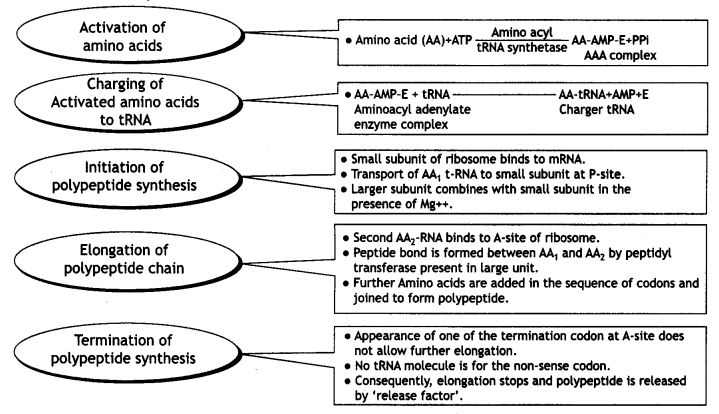
8. Since only one parent strand is conserved in each daughter molecule, this mode of replication is said to be semiconservative.

9. In one strand replication takes place discontinuously and short pieces called Okazaki fragments are synthesized. One strand may synthesize a continuous strand and the other Okazaki fragments. Both new strands are synthesized in the 5’ → 3’ direction. Thus one strand is synthesized forward and the other backward.

10. The Okazaki pieces are joined by polynucleotide ligase, a joining enzyme, to form continuous strands.

Question 26.
Provide experimental evidence for the semi-conservative mode of replication of DNA. (CBSE 2008 (Outside Delhi) 2012, 2016, 2019 C)
Answer:
Meselson and Stahl (1958) experimentally proved that DNA replication is semi-conservative.

  1. E. coli bacterium was grown for many generations in a culture medium in which the nitrogen source contained heavy isotope N15 thus the labeling of bacterial DNA was done.
  2. Later on, these bacteria were cultured in N14 non-radioactive isotope.
  3. DNA was analyzed to determine the distribution of radioactivity.
  4. The experiment showed that one strand of each daughter DNA molecule was radioactive whereas the other was non-radioactive.
  5. During the second replication in the N14 medium, the radioactive and non-radioactive strands separated and served as the template for the synthesis of non-radioactive strands.
  6. Out of four DNA molecules, two are completely non-radioactive and the other two have half of the molecule as non-radioactive.
  7. This evidence shows that DNA replication is semi-conservative.
  8. This biochemical evidence was supported by the direct cytological observation of duplicating DNA of E. coli.

Question 27.
(i) State the ‘Central dogma’ as proposed by Francis Crick. Are there any exceptions to it? Support your answer with a reason and an example.
Answer:
Francis Crick proposed the Central dogma in molecular biology, which states that the genetic information

Class 12 Biology Important Questions Chapter 6 Molecular Basis of Inheritance 12

Central dogma
In some viruses, central dogma is seen in the reverse direction, that is from RNA to DNA as RNA is the main genetic material. Example: Retrovirus (HIV) and the process is reverse transcription.

(ii) Explain how the biochemical characterization (nature) of the ‘Transforming Principle’ was determined, which was not defined from Griffith’s experiments. (CBSE Delhi 2018)
Answer:
Transforming principle: In 1928, Frederick Griffith, in a series of experiments with Streptococcus pneumonia which is a bacterium responsible for pneumonia, witnessed a miraculous transformation in the bacteria. During the experiment, a living organism (bacteria) changed its physical form. He concluded that the R strain bacteria had somehow been transformed by the heat-killed S strain bacteria.

Some ‘transforming principle’, transferred from the heat-killed S strain, had enabled the R strain to synthesize a smooth polysaccharide coat and become virulent. This must be due to the transfer of the genetic material. However, the biochemical nature of genetic material was not defined from his experiments.

Oswald Avery, Colin MacLeod, and Maclyn McCarty worked to determine the biochemical nature of the ‘transforming principle’ in Griffith’s experiment. They purified biochemicals (proteins, DNA, RNA, etc.) from the heat-killed S cells to see which ones could transform live R cells into S cells. They discovered that DNA alone from S bacteria caused R bacteria to become transformed.

They also discovered that protein-digesting enzymes (proteases) and RNA-digesting enzymes (RNases) did not affect transformation, so the transforming substance was not a protein or RNA. Digestion with DNase did inhibit transformation, suggesting that the DNA caused the transformation. They concluded that DNA is the hereditary material, but not all biologists were convinced.

Question 28.
(a) Write the contributions of the following scientists in deciphering the genetic code: George Gamow; Hargobind Khorana; Marshall Nirenberg; Severo Ochoa.
Answer:
Contributions of scientists:

  1. George Gamow: He suggested that in order to code for all the 20 Amino acids, the code should be made up of three nucleotides. He proved that the codon is a triplet.
  2. Hargobind Khorana: He provided experimental proof that genetic codon is always triplet. He was able to synthesize RNA molecules with a defined combination of bases (homopolymers and copolymers)
  3. Marshall Nirenberg: He prepared a cell-free system for protein synthesis and finally deciphered the genetic code.
  4. Severe Ochoa: He established that enzyme polynucleotide phosphorylase was helpful in RNA synthesis with a defined sequence in a template-independent manner.

(b) State the importance of a Genetic code in protein biosynthesis. (CBSE Delhi 2019)
Answer:
Importance of Genetic code: Genetic code codes for a specific amino acid that is required for protein synthesis. (CBSE Outside Delhi 2018)

Question 29.
Explain translation in detail.
Or
Explain the process of charging tRNA.
Answer:
Translation: During the translation process, proteins are made by the ribosomes on the mRNA strand:
The main steps are:

Class 12 Biology Important Questions Chapter 6 Molecular Basis of Inheritance 13

Class 12 Biology Important Questions Chapter 6 Molecular Basis of Inheritance 14

Continuous and discontinuous synthesis of DNA:

  1. Activation of amino acid.
  2. Transfer of activated amino acid to tRNA.
  3. Initiation of synthesis.
  4. Elongation of a polypeptide chain.
  5. Termination of a chain.

Question 30.
Explain the steps involved in DNA fingerprinting. (CBSE 2009)
Answer:
Steps of DNA fingerprinting:
The steps/procedure in DNA fingerprinting include the following:

  1. Extraction: DNA is extracted from the cells in a high-speed, refrigerated centrifuge.
  2. Amplification: Many copies of the extracted DNA are made by a polymerase chain reaction.
  3. Restriction Digestion: DNA is cut into fragments with restriction enzymes into precise reproducible sequences.
  4. Separation of DNA sequences/ restriction fragments: The cut DNA fragments are introduced and passed through an electrophoresis setup containing agarose polymer gel; the separated fragments can be visualized by staining them with a dye that shows fluorescence under ultraviolet radiation.
    Class 12 Biology Important Questions Chapter 6 Molecular Basis of Inheritance 15
    Lac operon
  5. Southern Blotting: The separated DNA sequences are transferred onto a nitrocellulose or nylon membrane.
  6. Hybridization: The nylon membrane is immersed in a bath and radioactive probes (DNA segments of known sequence) are added: these probes target a specific nucleotide sequence that is complementary to them.
  7. Autoradiography: The nylon membrane is pressed on an X-ray film and dark bands develop at the probe sites.

Question 31.
What is the inducer in the lac operon? How does it ensure the “switching on” of genes?
(i) Draw a schematic representation of the Lac operon.
Answer:
Inducer. It is a chemical that may be a substrate, hormone, or some other metabolite which after coming in contact with the repressor, changes the latter into the non-DNA binding state so as to free the operator gene. Thus the “switch on” occurs.

(ii) Explain how does this operon gets switched ‘on’ or ‘off’.
Answer:
The expression of the genes is usually controlled to achieve maximum cellular economy. This means that the gene will be turned on or off as per requirement. A set of genes will be switched on when there is the necessity to handle and metabolize a new substrate. When these genes are turned on enzymes are produced, which metabolize the new substrate. The phenomenon is known as induction.

(iii) What is the role of a regulatory gene? (CBSE Delhi 2012, 2019 C)
Answer:
Role of the regulatory gene in a lac operon: It synthesizes a biochemical or regulator protein that can act positively as an activator and negatively as a repressor. It controls the activity of the operator gene.

Question 32.
(i) Describe the structure and function of a tRNA molecule. Why is it referred to as an adapter molecule?
Answer:
t-RNA (transfer RNA) reads the genetic code on one hand and transfers amino acids on the other hand. So it was called adapter molecule by Francis Crick. It is also called soluble RNA (SRNA).

Note: For the figure, please see the answer of Q. no. 11 short answer type question. The secondary structure of tRNA is clover leaf-like but the 3-D structure is inverted L-shaped. t-RNA has five arms or loops:

  • Anticodon loop: It has bases complementary to the code.
  • Amino acid acceptor end: Amino acid binds to it.
  • T-loop: It helps in binding to ribosomes.
  • D-loop: It helps in binding aminoacyl synthetase.
  • Variable loop: Its function is not known.

(ii) Explain the process of splicing of hn-RNA in a eukaryotic cell. (CBSE Delhi 2017)
Answer:
The primary transcript formed in eukaryotes is non-functional, containing both the coding region exon and non-coding region intron in RNA and are called heterogeneous RNA or hn-RNA. hn-RNA undergoes a process where the introns are removed and exons are joined to form mRNA by the process called splicing.

Question 33.
(i) Why does replication occur in small replication forks and not in entire lengths?
Answer:
Replication occurs in a small opening of a DNA helix called replication forks for very long DNA molecules. The reason is in the case of long DNA molecules, the two strands of DNA cannot be separated in their entire length due to very high energy demand.

(ii) Why is DNA replication continuous and discontinuous in a replication fork?
Answer:
DNA-dependent DNA polymerase catalyzes DNA polymerization only in one direction, that is, 5′ → 3′. DNA strands are anti-parallel and have opposite polarity. So on template strand with polarity 3′ → 5′ DNA replication is continuous white on the template strand with polarity 5′ → 3′ replication is discontinuous.

(iii) State the importance of the origin of replication in a replication fork. (CBSE Delhi 2018C)
Answer:
Replication cannot start randomly at any point in DNA. It requires a definite region of sequences where the replication originates. This site is called the origin of replication.

Question 34.
Compare the processes of DNA replication and transcription in prokaryotes. (CBSE Delhi 2019C)
Answer:

ReplicationTranscription
(i) It is a synthesis of DNA from DNA.(i) It is a synthesis of RNA from DNA.
(ii) Both strands take part in replication.(ii) Only one strand functions as a template.
(iii) It forms double-stranded DNA.(iii) It forms single-stranded RNA.
(iv) RNA primer is essential for initiation.(iv) No primer Is required.
(v) Occurs in the S phase of the cell cycle.(v) Occurs in the G1 and G2 phases of the cell cycle.
(vi) Catalysed by DNA polymerase enzymes.(vi) Catalysed by RNA polymerase enzymes.
(vii) Deoxyribonucteoside triphosphates (dATP, dGTP, dCTP, dTTP) serve as raw materials.(vii) Ribonucleoside triphosphates (ATP, GTP, CTP, UTP) serve as raw materials.
(viii)Involves unwinding and splitting of the entire DNA molecule (chromosome).(viii) Involves unwinding and splitting of only those genes which are to be transcribed.
(ix) Two double-stranded DNA molecules are formed from one DNA molecule.(ix) A single one-strand RNA molecule is formed from a segment of one DNA strand.

Question 35.
Write the different components of a lac operon in E. coil. Explain its expression while in an ‘open’ state. (CBSE Delhi 2017, 2019 C)
Answer:
The Lac operon (Inducible operon): The concept of the operon was first proposed in 1961 by Jacob and Monod.
Components of an operon:

  1. Structural genes: It Is the fragment of DNA that transcribes mRNA for polypeptide synthesis.
  2. Promoter: It Is the sequence of DNA where RNA poLymerase binds and initiates transcription.
  3. Operator: It is the sequence of DNA adjacent to the promoter.
  4. Regulator gene: It is the gene that codes for repressor protein which binds to the operator due to which operon Is switched “off”.
  5. Inducer: Lactose Is an Inducer that helps in switching “on” of an operon. Lac operon consists of three structural genes (z, y, a), operator (o), promoter (p), regulatory gene (r).

(a)Class 12 Biology Important Questions Chapter 6 Molecular Basis of Inheritance 16

(b) Class 12 Biology Important Questions Chapter 6 Molecular Basis of Inheritance 17

  • Gene z codes for p-galactosidase
  • Gene y codes for permease.
  • Gene codes for enzymes transacetylase. When lactose is absent:

When lactose is absent, i.e. gene produces repressor protein.

This repressor protein binds to the operator and as a result, prevents RNA polymerase to bind to the operon, and the operon is switched off.

When lactose is present:

  • Lactose acts as an inducer that binds to the repressor and forms an inactive repressor.
  • The repressor cannot bind to the operator.
  • Now the RNA polymerase binds to the operator and transcribes lac mRNA.
  • Lac mRNA is polycistronic, i.e. produces all three enzymes p-galactosidase, permease, and transacetylase.
  • The lac operon is switched on.

Question 36.
What is the human genome project (HGP)? Write salient features of the human genome project.
Answer:
Human Genome Project. It is a mega project involving a lot of money, the most advanced techniques, numerous computers, and scientists at work. The magnitude of the project can be imagined that if the cost of sequencing a bp is 3 dollars, sequencing of 3 × 10⁹ bp would be a billion dollars. If the data is to be stored in books, with each book having 1000 pages and each page with 1000 letters, some 3300 books will be required. Here bioinformatics databasing and other high-speed computational devices have helped in the analysis, storage, and retrieval of information.

Salient features of the human genome:

  1. The human genome contains 3164.7 million nucleotides (base pairs).
  2. The size of the genes varies; an average gene consists of 3000 bases, while the largest gene, dystrophin, consists of 2.4 million bases.
  3. The total number of genes is estimated to be 30000 and 99.9% of the nucleotides are the same in humans.
  4. The functions of over 50% of the discovered genes are not known.
  5. Only less than 2% of the genome codes for proteins.
  6. Repetitive segments made up a large portion of the human genome.
  7. Repetitive sequences throw light on chromosome structure and dynamics and evolution, though they are thought to have no direct coding functions.
  8. (Chromosome 1 has 2968 genes and Y-chromosome has the least number (231 genes).
  9. Scientists have identified about 1.4 million locations, where DNA differs in a single base in human beings. These are called single nucleotide polymorphisms (SNPs).
  10. Repeated sequences make up a large portion of the human genome.

Very Important Figures:

Class 12 Biology Important Questions Chapter 6 Molecular Basis of Inheritance 18Unidirectional repLication

Class 12 Biology Important Questions Chapter 6 Molecular Basis of Inheritance 19BidirectionaL replication

Class 12 Biology Important Questions Chapter 6 Molecular Basis of Inheritance 20The flow of genetic information.

Class 12 Biology Important Questions Chapter 6 Molecular Basis of Inheritance 21Transcription in eukaryotes
Principles of Inheritance and Variation Class 12 Important Extra Questions Biology Chapter 5

Here we are providing Class 12 Biology Important Extra Questions and Answers Chapter 5 Principles of Inheritance and Variation. Important Questions for Class 12 Biology are the best resource for students which helps in Class 12 board exams.

Class 12 Biology Chapter 5 Important Extra Questions Principles of Inheritance and Variation

Principles of Inheritance and Variation Important Extra Questions Very Short Answer Type

Question 1.
Name one trait that does not blend.
Answer:
Sex does not blend.

Question 2.
Give one example of a genetic trait for each of the following in humans:
1. Lethality
Answer:
Lethality: Homozygous sickle cell anaemia.

2. Multiple allelism.
Answer:
Example of Multiple allelism: ABO blood groups.

Question 3.
What for symbols AA and Aa stand?
Answer:

  • AA: Homozygous dominant,
  • Aa: Heterozygous dominant.

Question 4.
Name the plant that shows incomplete dominance in respect to the colour of its flower.
Answer:
Mirabilis jalapa.

Question 5.
Write the genotypes of a man with blood group A.
Answer:
lAlA, lAl0

Question 6.
What is Mendel’s monohybrid ratio for phenotypes?
Answer:
3:1.

Question 7.
Write down Mendel’s dihybrid ratio for phenotypes.
Answer:
9: 3: 3: 1.

Question 8.
Who were the discoverers of Mendelism?
Answer:
Hugo de Vries, Karl Correns, Erich von Tschermak were the rediscoverers of Mendelism.

Question 9.
What are the real determinants of what an organism will become?
Answer:
The complex interaction between genes and their environment really determine what an organism will become.

Question 10.
Name the disorder in humans with the following karyotype:
(a) 22 pairs of autosomes + XO
(b) 22 pairs of autosomes + 21 st chromosome + XY (CBSE Outside Delhi 2019)
Answer:

KaryotypeName of Disorder
(a) 22 pairs of autosomes + XOTurner’s syndrome
(b) 22 pairs of autosomes + 21st chromosome + XYDown’s syndrome (MongoLism inmate)

Question 11.
What wilt is the genetic makeup of an organism which suffers from sickle cell anaemia?
Answer:
Homozygous (HbS HbS).

Question 12.
Name the type of cross that would help to find the genotype of a pea plant bearing violet flowers. (CBSE Delhi 2017)
Answer:
Test cross.

Question 13.
What term is used for the two chromatids resulting from the interchange of segments during crossing over?
Answer:
Recombinants (cross overs).

Question 14.
Write one example of each of organisms exhibiting
(i) male heterogamety
Answer:
Male heterogamety: Drosophila and humans

(ii) female heterogamety. (CBS£ Delhi 2019 C)
Answer:
Female heterogamety: Birds and some reptiles

Question 15.
A geneticist is interested in study variations and pattern in living being preferred to choose an organism with the short life cycle. Provide a reason. (CBSE Delhi 2015)
Answer:
An organism with a shorter life cycle is helpful in rapid study and analysis of hereditary pattern in many generations, e.g. Drosophila, Neurospora.

Question 16.
Give an example of a human disorder that is caused due to a single gene mutation. (CBSE Delhi 2016)
Answer:
Phenylketonuria.

Question 17.
Write the sex of human having XXY chromosomes with 22 pairs of autosomes. Name the disorder this human suffers from. (CBSE Delhi 2016)
Answer:
The human is male (as Y chromosome is present). He is suffering from Klinefelter’s syndrome

Principles of Inheritance and Variation Important Extra Questions Short Answer Type

Question 1.
State the Mendelian principle which can be derived from a dihybrid cross and not from monohybrid cross.
Or
State Mendel’s Law of Independent Assortment. CBSE Sample Paper 2018-19)
Answer:
From the dihybrid cross, the law of independent assortment can be derived which states that, when two pairs of traits are combined in a hybrid, segregation of one pair of characters is independent of the other pair of characters.

Question 2.
In a cross between two tall pea plants, some of the offsprings produced pure dwarf. Show with the help of Punnett square how this is possible. (CBSE (Delhi) 2013)
Answer:
Class 12 Biology Important Questions Chapter 5 Principles of Inheritance and Variation 1

Question 3.
What is a dihybrid cross?
Answer:
Dihybrid cross. A cross in which two characters are taken into consideration during experimentation, such a cross is called dihybrid cross. A cross between a pea plant with yellow smooth seeds and a pea plant with green, wrinkled seeds is a dihybrid cross.

From the dihybrid cross, it can be derived that each gene is assorted independently of the other during its passage from one generation to the other or Law of independent assortment.

Question 4.
In order to obtain the E, generation, Mendel pollinated a pure breeding tall plant with a pure breeding dwarf plant. But forgetting the F2 generation, he simply self-pollinated the tall F1 plants. Why?
Answer:

  1. He made crosses to study the pattern of inheritance of a few characters over generations.
  2. Initially, he made pure lines.
  3. To create a heterozygote or hybrid, he had to cross two different plants (pure lines).
  4. To study the inheritance pattern; it is enough if the hybrids are self – pollinated, thus the segregation of factors can be studied.

Question 5.
A cross between a red flower-bearing plant and a white flower-bearing plant of Antirrhinum majus produced all plants having pink flowers. Work out across, to explain how is this possible? (CBSE Outside Delhi 2013)
Answer:
Class 12 Biology Important Questions Chapter 5 Principles of Inheritance and Variation 2

Question 6.
Differentiate gene and allele.
Answer:
Difference between gene and allele:
Allele (allelomorphs) refers to the alternate form of a gene pair present on the same loci in the homologous chromosome, whereas gene is the smallest unit of an organism capable of transmitting genetic information and expressing the same.

Question 7.
In Snapdragon, a cross between true-breeding red-flowered (RR) plants and true-breeding white-flowered (RR) plants showed a progeny of plants with all pink flowers.
(i) The appearance of pink flowers is not known as blending. Why?
Answer:
It is not a case of blending. In this case, R gene was not completely dominant over r gene and this made genotype Rr to distinguish as pink.

(ii) What is this phenomenon known as? (CBSE 2014)
Answer:
Incomplete dominance.

Question 8.
With the help of one example, explain the phenomena of co-dominance and multiple allelism in the human population. (CBSE 2014)
Answer:
In the case of co-dominance, two alleles for a trait are equally expressed.

Example: ABO blood groups are controlled by the gene I. The gene I have three alleles lA, lB and lO. These alleles determine the type of sugar on the RBC surface. Alleles lA and lB are co-dominant and express the AB blood group.

Since there are three different alleles and express themselves on the basis of dominance recessiveness and co-dominance, it is a case of multiple allelism.

Question 9.
The child has a blood group of O. If the father has blood group A and mother has blood group B, work out the genotypes of the parents and the possible genotypes of the other offsprings. (CBSE Outside Delhi, 2015, 2019)
Answer:

  1. Genotypes. Man (lA lO) Mother lB lO and child lO lO.
  2. The blood group of the future offspring. A type, B type, 0 types and AB type. It is based on the following cross:

Class 12 Biology Important Questions Chapter 5 Principles of Inheritance and Variation 3
Inheritance of blood groups A, B, O, AB

Question 10.
Give examples of sex-linked inheritance in Drosophila. During his studies on genes in Drosophila that were sex-linked T.H. Morgan found F2 population phenotypic ratios deviated from expected 9: 3: 3: 1. Explain the conclusion he arrived at. (CBSE 2010)
Answer:
Examples of sex-linked inheritance in Drosophila (Morgan’s conclusion).

  1. Genes for white eye colour is located in the X-chromosome and Y-chromosome is empty carrying no normal allele for white eye colour.
  2. The white-eyed female possesses a gene for white eye colour (W) on both of its X-chromosomes.
  3. The white-eyed males receive X-chromosome with (W) gene from mother and (Y) from father with no gene.
  4. The daughter receives one X-chromosome with (W) gene from mother and one X-chromosome with dominant (W+).

Question 11.
Briefly explain XX-XO (a type of sex determination).
Answer:
In the case of roundworms, true bugs, grasshoppers and cockroaches the females have two sex chromosomes XX, whereas the males have only one X-chromosome. The male has no second chromosome thus designated as XO. The sex ratio of 1: 1 is produced as shown in the figure below.

Class 12 Biology Important Questions Chapter 5 Principles of Inheritance and Variation 4
XX-XO determination of sex in the cockroach.

Question 12.
Explain the mechanism of ‘sex determination’ in birds. How does it differ from that of human beings? (CBSE Delhi 2018)
Answer:
Sex determination is of ZW-ZZ type in birds.
In this type, the males are homogametic and have ZZ sex chromosomes, and females are heterogametic with ZW pair of sex chromosomes.

Class 12 Biology Important Questions Chapter 5 Principles of Inheritance and Variation 5
In human beings, the chromosomal mechanism of sex determination is of XX- XY type. The human male is heterogametic and has XY sex chromosomes, whereas the human female is homogametic with XX sex chromosomes.

Question 13.
Write a note on ZO-ZZ type of sex determination.
Answer:
In case of ZO-ZZ type of sex determination the female produces two types of eggs. The one-half of eggs is with Z-chromosome and the other half without Z-chromosome. The male has homomorphic sex chromosomes and is homogametic. It forms only one kind of sperms each with Z-chromosome. On fertilisation by a sperm with Z-chromosome, the Z-containing egg gives rise to male offspring ZZ and Z- lacking egg produces female offspring ZO. Such type of sex determination is found in the case of butterflies and moths.

Question 14.
Give an example of an autosomal recessive trait in humans. Explain its pattern of inheritance with the help of a cross. (CBSE Delhi 2016)
Answer:
Autosomal recessive trait. Sickle-cell anaemia is caused by autosomal recessive trait. The disease is controlled by a single pair of alleles HbA and HbS. Only the homozygous individuals for HbsHbs show the disease. The heterozygous individuals are carriers (HbA Hbs)

Class 12 Biology Important Questions Chapter 5 Principles of Inheritance and Variation 6

Question 15.
How would you find the genotype of a tall pea plant bearing white flowers? Explain with the help of a cross. Name the types of the cross you would use. (CBSE Delhi 201i 5)
Answer:
In order to find the genotype of a given plant, one has to breed it with plenty of oic recessive individual. It is called test CRC is. Tall and white plant TTww or Ttww / is crossed with dwarf white plant ttww TTww x ttww

Class 12 Biology Important Questions Chapter 5 Principles of Inheritance and Variation 7
(All tall white plants indicate that the genotype is TTww)

Class 12 Biology Important Questions Chapter 5 Principles of Inheritance and Variation 8
This ratio indicates that the genotype is Ttww

Depending on the resuLt we can determine the genotype of the flower.

Question 16.
How is polygenic inheritance different from pleiotropy? Give one example of each.
Answer:

polygenic inheritancepleiotropy
It is a type of inheritance in which. a single dominant gene contributes a part of the trait. Thus dominant alleles have a cumulative effect.It is a condition in which a single gene influence more than one trait.
Example:
1. Cob length in maize
2. Skin colour in human
Example:
1. In Drosophila, white eye mutant causes depigmentation in many parts of the body.
2. Sickle cell anaemia

Question 17.
Why is it not possible to study the pattern of inheritance of traits in human beings, the same way as it is done in pea plant? Name the alternate method employed for such an analysis of human traits.
Answer:

  1. Control cross cannot be performed in human as in other organisms.
  2. The generation time is long. Pedigree analysis is the alternative method to study the inheritance of human traits in several generations.

Question 18.
A man with blood group A married a woman with a B group. They have a son with AB blood group and a daughter with blood group 0. Work out the cross and show the possibility of such inheritance. (CBSE Delhi and Outside Delhi 2008)
Answer:

Class 12 Biology Important Questions Chapter 5 Principles of Inheritance and Variation 9
Blood groups of progeny A, B, AB and O.

Question 19.
A haemophilic father can never pass the gene for haemophilia to his son. Explain. (CBSE Delhi 2016)
Answer:
Haemophilia is a sex-linked recessive disorder where X chromosome carries the defective haemophilic gene and Y chromosome is healthy. And son inherits only the Y chromosome from his father which is not carrying the gene for haemophilia. Therefore, the haemophilic father can never pass haemophilia to his son.

Principles of Inheritance and Variation Important Extra Questions Long Answer Type

Question 1.
Study the given pedigree chart and answer the questions that follow:
1. Is the trait recessive or dominant?
Answer:
Dominant.

2. Is the trait sex-linked or autosomal?
Answer:
Autosomal.

3. Give the genotypes of the parents shown in generation I and their third child is shown in generation II and the first grandchild shown in generation III. (CBSE Sample Paper 2018-19)
Class 12 Biology Important Questions Chapter 5 Principles of Inheritance and Variation 10

Answer:
The genotype of parents in generation I – Female: aa and Male: Aa
The genotype of a third child in generation II-Aa Genotype of the first grandchild in generation III – Aa

Question 2.
Haemophilia is a sex-linked recessive disorder of humans. The pedigree chart given below shows the inheritance of Haemophilia in one family.

Study the pattern of inheritance and answer the questions given.
1.Give all the possible genotypes of the members 4, 5 and 6 in the pedigree chart.
2. A blood test shows that the individual 14 is a carrier of haemophilia. The member numbered 15 has recently married the member numbered 14. What is the probability that their first child will be a haemophilic male?
(CBSE 2009, CBSE Sample Paper 2018-19)

Class 12 Biology Important Questions Chapter 5 Principles of Inheritance and Variation 11
Answer:

  1. Genotypes of member 4 – XX or XXh Genotypes of member 5 – XhY Genotypes of member 6 – XY
  2. The probability of first child to be a haemophilic male is 50%.

Question 3.
Mention the advantages of selecting a pea plant for the experiment by Mendel.
Answer:
Advantages of selecting pea plant as experimental material:

Mendel selected pea plant (Pisum sativum) because:

  1. Many varieties were available with observable alternative forms for a trait or a characteristic.
  2. Peas normally self-pollinate; as their corolla completely encloses the reproductive organs until pollination is complete.
  3. It was easily available.
  4. It has pure lines for experimental purpose, i.e. they always breed true.
  5. It has contrasting characters. The traits were seed colour, pod colour, pod shape, flower shape, the position of flower, seed shape and plant height.
  6. Its life cycle was short and produced a large number of offsprings.
  7. The plant can be grown easily and does not require care except at the time of pollination.

Question 4.
Differentiate between the following:
(i) Dominance and recessiveness
Answer:
Differences between dominance and recessiveness:

DominanceRecessiveness
(1) Dominant gene or factor is able to express itself even in the presence of its recessive allele.(1) Recessive gene or factor is unable to express itself in the presence of dominant allele.
(2) It expresses itself because it forms complete polypeptide or enzyme for expressing its effect.(2) The recessive gene forms an incomplete or defective polypeptide or enzyme thus fails to express its effect.

(ii) Homozygous and heterozygous
Answer:
Differences between homozygous individual and a heterozygous individual:

homozygous individualheterozygous individual
(1) In a homozygous individual (homo-zygote) the two genes for a particular character are identical (TT) or (tt).(1) The heterozygous individual (hetero zygote) possesses contrasting genes of a pair çrt).
(2) They form identical gametes for a particular character.(2) They form dissimilar gametes for a particular character.
(3) They breed true for a specific trait.(3) They do not breed true.

Question 5.
Explain the law of dominance using a monohybrid cross.
Answer:
Law of Dominance. According to this law, when two factors of a character are unlike, one of them will manifest in the body and is called dominant while the other remains hidden and is termed recessive factor.

The law can be well explained by the monohybrid cross by studying the following crosses:
(i) Pure tall = TT, Hybrid tall = Tt

Gametes of TT parent = \(\frac { 1 }{ 2 }\)T + \(\frac { 1 }{ 2 }\)T
Gametes of Tt parent = \(\frac { 1 }{ 2 }\)T + \(\frac { 1 }{ 2 }\)t

The 50% are pure tall and 50% hybrid tall. Then pure tall plants will produce 100% tall in F2 generation and hybrid plants will produce in the ratio of 1: 2: 1 in the F2 generation.

(ii) When the cross is made between pure tall and pure dwarf, we get results as follows (Fig.).

Class 12 Biology Important Questions Chapter 5 Principles of Inheritance and Variation 12
A Punnett square used to understand a typical monohybrid cross conducted by Mendes between true-breeding tall plants and true-breeding dwarf plants

Question 6.
Define and design a test cross.
Answer:
Test Cross: It is a cross between an organism of an unknown genotype and a homozygous recessive organism.

Results of a Test Cross: If the test cross yields offspring of which 50% show the dominant character and 50% show the recessive character, i.e. F1 ratio is 1: 1, the individual under test is heterozygous (see fig.). This is so because the individual showing the recessive trait (say white coat colour in the guinea pig, dwarf size in pea plant) must have received one recessive allele (b in a guinea pig, t in pea plant) from each parent.

Class 12 Biology Important Questions Chapter 5 Principles of Inheritance and Variation 13
Genetics of a test cross

If all the offspring of the test cross show the dominant trait, the individual being tested is homozygous dominant with genotype BB for a guinea pig and TT for pea plant (fig.).

Question 7.
When a cross is made between a tall plant with yellow seeds (TtYy) and tall plant with green seeds (Ttyy), what proportions of phenotype In the offspring could be expected to be
(i) tall and green
(ii) dwarf and green?
Answer:

Class 12 Biology Important Questions Chapter 5 Principles of Inheritance and Variation 14
Cross between a tall plant with yellow seeds

Question 8.
Differentiate back cross and test cross.
Answer:
Differences between the back cross and test cross:

Back crossTest cross
1. It is the hybridisation process between F1 progeny and one of its parents.

Class 12 Biology Important Questions Chapter 5 Principles of Inheritance and Variation 15

1. It represents the hybridisation between F1 progeny with the homozygous recessive parent.

Class 12 Biology Important Questions Chapter 5 Principles of Inheritance and Variation 16

2. The ratio of F2 progeny maybe 1: 1.2. The ratio of F2 progeny is 1:1.
3. It is used to develop a good hybrid particularly through recurring back cross.3. It is used to testify the genotype of the F1 progeny.

Question 9.
Differentiate incomplete dominance and codominance.
or
Explain the following terms with an example:
(i) Codominance
(ii) Incomplete dominance (CBSE Outside Delhi 2008; Delhi 2011, 2019)
Answer:
Differences between incomplete dominance and codominance:

Incomplete DominanceCodominance
(1) Effect of one of the two alleles is more prominent.(1) The effect of both the alleles is equally prominent.
(2) It produces a fine mixture of the expression of two alleles.(2) There is no mixing of the effect of the two alleles.
(3) The effect in hybrid is intermediate of the expression of the two alleles, e.g. pink coloured snapdragon obtained as a result of cross-pollination between red and white snapdragon flowers.(3) Both the alleles produce their effect independently, e.g. IA and lB, HbS and HbA.

Question 10.
(i) Why is the human ABO blood group gene considered a good example of multiple alleles?
Answer:
A B O blood groups are controlled by a single gene: (I) The plasma membrane of the red blood cells has sugar polymers that protrude from its surface and is controlled by the gene. The gene (I) has three alleles lA, lBand lO. Presence of more than two types of alleles at the same locus governing the same character is called multiple alleles.

(ii) Work out across up to F2 generation only, between a mother with blood group A (Homozygous) and the father with blood group B (Homozygous). Explain the pattern of inheritance exhibited. (CBSE (Delhi) 2013)
Or
Describe the mechanism of a pattern of inheritance of ABO blood groups in human. (CBSE 2011)
Answer:
Patterns of inheritance of the ABO blood group.

Class 12 Biology Important Questions Chapter 5 Principles of Inheritance and Variation 17
F1 generation. All with blood group AB. It is a case of co-dominance.

Question 11.
(i) What is polygenic inheritance? Explain with the help of a suitable example, (ii) How are pleiotropy and Mendelian pattern of inheritance different from the polygenic pattern of inheritance? (CBSE Outside Delhi 2016)
Or
Certain phenotypes in the human population are spread over a gradient and reflect the contribution of more than two genes. Mention the term used for the type of inheritance. Describe it with the help of an example in the human population. (CBSE Sample Paper 2019-20)
Answer:
(i) Polygenic inheritance. It is a type of inheritance controlled by three or more genes in which the dominant alleles have a cumulative effect. Each dominant allele expresses a part or unit of a trait. It is also called quantitative inheritance or multiple factor inheritance. The genes involved in such kind of inheritance are termed polygenes.

Examples:

  1. Kernel colour in wheat
  2. Cob length in maize
  3. Skin colour in human
  4. Human intelligence Human Skin Colour. It is caused by the pigment melanin.

The quantity of melanin is due to three pairs of polygenes (A, B and C). The genotype of black will be (AA BB CC) and white will have (aa bb cc). Marriage between two such persons will show variations. In progeny (Aa Bb CC) there will be 7 types of phenotypes i.e. very dark, 6 dark, 15 fairly dark, 20 intermediates, 15 family light, 6 light and have very light.

(ii) How are pleiotropy and Mendelian pattern of inheritance different from the polygenic pattern of inheritance? (CBSE Outside Delhi 2016)
Answer:

1. Pleiotropy and Mendelian pattern of inheritance: In the case of pleiotropy one gene has an effect on two on more traits. One effect is more evident in the case of one trait (major effect) and less evident in the case of others (secondary effect). The mendelian pattern of inheritance is monogenic.

2. In pleiotropism and monogenic inheritance no intermediates are produced and show discontinuous variations in the expression of a trait. Intermediates are quite common in polygenic inheritance and produce continuous variations in the expression of a trait.

Question 12.
(i) Write the scientific name of the organism Thomas Hunt Morgan and his colleagues worked with for their experiments. Explain the correlation between linkage and recombination with respect to genes as studied by them.
Answer:
Thomas Hunt Morgan and his colleagues worked with Drosophila melanogaster. They carried out several dihybrid crosses in Drosophila to study gens that were sex-linked.

Morgan and his group knew that the genes were located on the X chromosome and noticed that when the two genes in a dihybrid cross were situated on the same chromosome, the proportion of parental gene combinations were much higher than the non-parental type.

Morgan attributed this due to the physical association or linkage of th< two genes. He coined the term links to describe this physical associate of genes on a chromosome and t/ term recombination to describe t generation of non-parental age combination. Morgan and his also found that even when genes w grouped on the same chromos or some genes were very tightly linked, they showed very low recombine while others were loosely linked.

(ii) How did Sturtevant explain gene mapping while working with Morgan? (CBSE Delhi 2018)
Answer:
Alfred Sturtevant was Morgan’s student. He used the frequency of recombination between gene pairs on the same chromosome as a measure of the distance between genes and ‘mapped’ their position on the chromosome. Today genetic mappings are extensively used as a starting point in the sequencing of the whole genomes.

Question 13.
What is recombination? Discuss the applications of recombination from the point of view of genetic engineering.
Answer:
Recombination refers to the generation of a new combination of genes which is different from the parental types. It is produced due to crossing over that occurs during meiosis prior to gamete formation.

Applications of recombination:

  1. It is a means of introducing new combinations of genes and hence new traits.
  2. It increases variability which is useful for natural selection under changing environment.
  3. It is used for preparing linkage chromosome maps.
  4. It has proved that genes lie in a linear fashion in the chromosome.
  5. Breeders have to select small or large population for obtaining the required cross-overs. For obtaining cross-overs between closely linked genes, a very large population is required.
  6. Useful recombinations produced by crossing over are picked up by breeders to produce useful new varieties of crop plants and animals. Green revolution and white revolution were implemented using the selective recombination technique.

Question 14.
How is sex determined? (CBSE Delhi 2015)
Answer:
Determination of the sex of the child. Sex chromosomes determine sex in human beings. In males, there are 44+XY chromosomes, whereas in female there are 44+XX chromosomes. Here X and Y chromosomes determine sex in human beings.

Two types of gametes are formed in male, one type is having 50% X-chromosome, whereas another type is having Y-chromosome. In a female, gametes are of one type and contain X-chromosome. Thus females are homogametic and males are heterogametic. If male gamete having Y-chromosome (endosperm) undergoes fusion with female gamete having X-chromosome, the zygote will have XY chromosome and this gives rise to a male child.

If male gamete having X-chromosome (gymnosperm) undergoes fusion with female gamete having X-chromosome, the zygote will be having XX-chromosome and this gives rise to the female child.

Class 12 Biology Important Questions Chapter 5 Principles of Inheritance and Variation 18
Genetics of sex in human beings. The letter A represents autosomes.

Question 15.
Both haemophilia and thalassemia are blood-related disorders in human. Write their causes and the difference between the two. Name the category of genetic disorder they both come under. (CBSE Delhi 2017)
Answer:
Both haemophilia and thalassemia are Mendelian disorders:

  • Haemophilia is a sex-linked recessive disorder. The gene for haemophilia is located on X-chromosome. The gene passes from a carrier female to her son.
  • Thalassemia is an autosomal-linked recessive disease.
  • It occurs due to either mutation or deletion resulting in the reduced rate of synthesis of one of the globin chains of haemoglobin.
  • Difference between Haemophilia and Thalassemia. In haemophilia, clotting is affected, i.e. there can be a non-stop bleeding even after a minor cut.
  • In Thalassemia anaemia is the characteristic of this disease. It is caused by faulty haemoglobin synthesis.

Question 16.
Differentiate male and female heterogamety. (CBSE Delhi 2015, 2019 C)
Answer:
Differences between male and female heterogamety:

Male heterogametyfemale heterogamety
(1) Mate heterogamety refers to the phenomenon, where mates produce two (more than one) types of sperms.(1) Female heterogamety refers to the phenomenon, where females produce two (more than one) types of ova.
(2) Sex of the individual is determined by the type of sperm fertilising the ovum.(2) Sex of the individual is determined by the type of ovum that is fertilisers.
(3) XX female XY male(3) ZZ male and ZW female.

Question 17.
Why Drosophila has been used extensively for genetical studies? (CBSE 2014, 2019 C)
Answer:
Advantages of using Drosophila as genetic material:
Drosophila is a very useful organism for genetical experiments because:

  1. A very large number of offsprings are produced after each mating.
  2. It can be cultured in large number in laboratory and animals can be easily examined under a hand lens.
  3. Its life cycle is very short and is completed in 10-12 days. A new generation can be obtained every two weeks.
  4. It has four pairs of chromosomes all different in size and easily distinguishable.
  5. They produce numerous variants.
  6. It has heteromorphic (XY) chromosomes in the male.
  7. Female Drosophila flies can be easily differentiated from the males by the large body size and presence of ovipositor in the abdomen.

Question 18.
Mendel published his work on the inheritance of characters in 1865, but it remained unrecognised till 1900. Give three reasons for the delay in accepting his work. (CBSE Delhi 2014)
Answer:
Mendel’s work published as “Experiments on plant hybridisation” remained unnoticed and unappreciated for some 34 years due to:

  1. Limited circulation of the “Proceedings of Brunn Natural Science Society” in which it was published.
  2. He could not convince himself about his conclusions being universal since Mendel failed to reproduce the results on Hawkweed (Hieracium) undertaken on the suggestion of Naegeli. It was due to non-availability of pure lines.
  3. Absence of aggressiveness in his personality.
  4. The scientific world was being rocket^ at that time by Darwin’s theory c}f Natural Selection.

Question 19.
Compare in any three ways the chromosomal theory of inheritance as proposed by Sutton and Boveri with that of experimental results on pea pie int presented by Mendel. (CBSE Delhi 2019)
Answer:

Sutton and BoveriMendel
(1) Chromosomes occur in pairs.(1) Factors occur in pairs.
(2) Chromosomes segregate during gamete formation such that only one of each pair is transmitted to a gamete.(2) Factors segregate during gamete formation stage and only one of each pair is transmitted to a gamete.
(3) Independent pairs of chromosomes segregate independently of each other.(3) One pair of factors segregate independently of another pair.

Question 20.
(a) Explain linkage and recombination as put forth by T.H. Morgan based on his observations with Drosophila melanogaster crossing experiment.
(b) Write the basis on which Alfred Sturtevant explained gene mapping. (CBSE Delhi 2019)
Answer:
(a) Linkage and recombination:

  • Morgan is called the father of experimental genetics.
  • Morgan used Drosophila for experiments of genetics.
  • Linkage: It is the phenomenon of certain genes staying together during inheritance through several generations without any change or separation of these being present on the same chromosome. The two genes do not segregate independently of each other. So, F2 generation deviates significantly from 9:3:3:1.
  • Recombination: Loosely linked genes show a higher frequency of recombinant frequency which is around 37.2%. Tightly linked genes tend to show fewer recombinant frequency which is around 1.3%.

(b) Morgan’s student Alfred Sturtevant used the frequency of recombination between gene pairs on the same chromosome as a measure of the distance between genes and mapped their position on a chromosome.

Question 21.
ExplaIn how a test cross can be conducted to distinguish between a homozygous and heterozygous dominant genotype. What is the test cross? How can it decipher heterozygosity of a plant? (CBSE Delhi 2016)
Or
How will you find out whether a given plant is homozygous dominant? (CBSE 2008)
Or
You are given a tall pea plant and asked to find its genotype. How will you find it? (CBSE Outside Delhi 2019)
Answer:
Test Cross. When an individual is crossed to recessive parent it is called a test cross. The results can be easily analysed. If you follow the monohybrid cross where the FT is test crossed, a ratio of 1:1 will be obtained. On the same basis, you can work out that in a dihybrid case, the test cross ratio will be 1:1:1:1. Test cross can also be used for another purpose.

You must have understood by now that the homo and heterozygous genotypes for a dominant trait cannot be differentiated because they show the same phenotype. If we put them through a test cross, you will see that all homozygous dominant combinations will breed true but heterozygous genotypes will follow the segregation.

Class 12 Biology Important Questions Chapter 5 Principles of Inheritance and Variation 19
A test cross can be conducted to differentiate between a homozygous and heterozygous dominant genotype.

Question 22.
Explain the law of independent assortment with a dihybrid cross. (CBSE Outside Delhi, 2013, 2014)
Answer:
Law of independent assortment: According to this law, the factors of different pairs of contrasting characters do not influence each other. They are independent of one another in their assortment to form a new combination during gamete formation. Dihybrid cross. A cross in which two characters are taken into consideration during experimentation, such a cross is called dihybrid cross.

A cross between a pea plant with yellow smooth and a pea plant with green, wrinkled seeds is considered. Explanation. When a cross is made between pea plant having yellow smooth seeds (YYSS) and a pea plant with green wrinkled seeds (yyss). At the time of cross-pollination, yellow smooth (YYSS) produces gametes with genes (YS) and green wrinkled will produce gametes with gene (ys). Gametes unite at random. The seeds obtained when placed in the soil will grow to form plants and produce seeds which are yellow smooth (YySs) because yellow and smooth characters are dominant over green and wrinkled. These are called plants of F1 generation.

When plants of F1 generation are allowed to self-pollinate gametes formed YS, Ys, yS and ys by meiosis, they unite at random forming seeds. The plants thus obtained are called F2 generation. They are Yellow smooth (YYSS, YySS, YySs, YYSs); yellow wrinkled (YYss, Yyss), green smooth (yySS, yySs) and green wrinkled (yyss) in the ratio of 9: 3: 3: 1. The result of a dihybrid cross can be shown in Fig. on the chequerboard.

Class 12 Biology Important Questions Chapter 5 Principles of Inheritance and Variation 20
Result of a dihybrid cross.

From the above dihybrid cross, it can be derived that each gene is assorted independently of the other during its passage from one generation to the other or law of independent assortment is justified.

Question 23.
In four o’clock plants, red colour (R) is incompletely dominant over white (r), the heterozygous having pink colour. What will be the offspring in a cross between a red flower and a pink flower? (CBSE Outside Delhi, 2013)
Answer:

  1. In the monohybrid cross, red is incompletely dominant over white.
  2. Red flowered plants have genotype RR and white-flowered plants have genotype rr.
  3. Pink flowers have a genotype Rr.
  4. Red flowering plants will form gametes with R genes and pink flowers will produce two types of gametes with R gene and r gene.
  5. Arrangement of gametes in chequerboard.

Class 12 Biology Important Questions Chapter 5 Principles of Inheritance and Variation 21

Question 24.
Explain the pattern of inheritance of haemophilia in humans. Why is the possibility of a human female becoming a haemophilic extremely rare? Explain. (CBSE Delhi, 2008; Outside Delhi 2011)
Or
Why is human female rarely haemophilic? Explain how do haemophilic patients suffer? (CBSE Outside Delhi 2013)
Answer:
A pattern of inheritance of haemophilia:

  1. It is the sex-linked recessive trait which is known as bleeder’s disease because the exposed blood does not readily clot due to deficiency of plasma thromboplastin (haemophilia B/ Christmas disease) or Antihaemophilia globulin (haemophilia A)
  2. The defect has been inherited in the family of British Crown through Queen Victoria.
  3. In females, haemophilia appears when both the sex chromosomes carry its recessive gene, Xh Xh. Such females die before birth.
  4. A woman having a single allele of the trait appears normal but is a carrier of the disease XXh
  5. For sex-linked genes, human males are hemizygous. Therefore, Xh Y is haemophilic.
  6. Marriage between haemophilic male and carrier female produces haemophilic sons (XhY, 50%), normal sons (XY, 50%), carrier daughters (XXh, 50%) and haemophilic daughters (XhXh, 50%, die before birth).
  7. Haemophilic man (XhY) and normal woman (XX) produce carrier girls (XXh) and normal boys (XY).
    Class 12 Biology Important Questions Chapter 5 Principles of Inheritance and Variation 22
  8. Marriage between carrier woman and normal man produce 50% carrier girls (XXh), 50% normal girls (XX), 50% normal boys (XY) and 50% haemophilic boys (XhY).
    Class 12 Biology Important Questions Chapter 5 Principles of Inheritance and Variation 23
    Sons- 50% normaL 50% heamophitic
    Daughters- 50% normaL 50% camer
  9. The possibility of a female becoming haemophilic is very rare because the mother of such a female has to be at least a carrier and father should be haemophilic.

Question 25.
A colourblind child is born to a normal couple. Work out a cross to show how is it possible. Mention the sex of this child. (CBSE Delhi 2014, 2016)
Answer:
(a) Colourblindness is an X-linked recessive disease

Class 12 Biology Important Questions Chapter 5 Principles of Inheritance and Variation 24
So, the sex of the child is male.

Question 26.
1. How does a chromosomal disorder differ from a Mendelian disorder?
2. Name any two chromosomal aberra¬tion associated disorders.
3. List the characteristics of the disorders mentioned above that help in their diagnosis. (CBSE 2010)
Or
How does gain or loss of chromosome(s) take place in humans? Describe one example each of chromosomal disorder along with the symptoms involving an autosome and a sex chromosome. (CBSE Sample Paper 2019-20)
Answer:
1. Mendelian disorders are mainly determined by alteration or mutation in a single gene. These disorders are transmitted to the offspring on the basis of Mendelian inheritance, e.g. haemophilia, sickle cell anaemia. Chromosomal disorders are caused due to absence or excess or abnormal arrangement of one or more chromosomes. They are caused due to failure of segregation of chromatids during cell division or due to polyploidy. e.g. Down’s syndrome, Klinefelter syndrome.

2. Chromosomal aberration associated disorders.
(a) Down’s syndrome
(b) Klinefelter syndrome.

3. (a) Down’s syndrome. It is caused due to an additional copy of chromosome number 21 (Trisomy).
Symptoms: Short statured body, small rounded head, furrowed tongue, partially open mouth.

(b) Klinefelter syndrome. It is caused due to an additional copy of X-chromosomes (47 chromosome XXY).
Symptoms. Overall masculine development but the development of breast also occurs. These individuals are sterile.

Question 27.
A true-breeding pea plant, homozygous for inflated green pods (FFGG) is crossed with another pea plant with constricted yellow pods (ffgg). What would be the phenotype and genotype  F1 and F2 genotype? Give the phenotype ratio of F2 generation. (CBSE Delhi 2008)
Answer:

Class 12 Biology Important Questions Chapter 5 Principles of Inheritance and Variation 25

Class 12 Biology Important Questions Chapter 5 Principles of Inheritance and Variation 26

Question 28.
A true-breeding pea plant homozygous for axial violet flowers (AAW) crossed with another pea plant with terminal white flowers (aaw).
(i) What would be phenotype and genotype of F1 and F2 generations
Answer:

Class 12 Biology Important Questions Chapter 5 Principles of Inheritance and Variation 27

(ii) Give the phenotype ratio of F2 generations. (CBSE Delhi. 2008)
Answer:

Class 12 Biology Important Questions Chapter 5 Principles of Inheritance and Variation 28

Question 29.
A child suffering from Thalassemia is born to a normal couple. But the mother is being blamed by the family for delivering a sick baby.
(i) What is Thalassemia?
Answer:
Thalassemia: It is an autosomal recessive blood disease that appears in children of two unaffected carriers, heterozygote parents. The defect occurs due to mutation or deletion of the genes controlling the formation of globin chain (commonly a and P) of haemoglobin. Imbalanced synthesis of globin chains of haemoglobin causes anaemia. Thalassemia is of three types a, p, and 8.

(ii) How would you counsel the family not to blame the mother for delivering a child suffering from this disease? Explain.
Answer:
I would explain to the people around that this disease can be caused due to the presence of a defective gene in both the parents or it may be caused due to certain changes with the genetic setup.

(iii) List the values your counselling can propagate in the families. (CBSE Delhi 2013)
Answer:
People had a good understanding and had to realize the situation. They become supportive and made joint efforts to help the patients.

Question 30.
In a dihybrid cross, white-eyed, yellow-bodied female Drosophila was crossed with red-eyed, brown-bodied male Drosophila. The cross produced 1.3 per cent recombinants and 98.7 progeny with parental type combinations in the F2 generation. Analyse the above observation and compare with the Mendelian dihybrid cross. (CBSE Sample Paper 2018-19)
Answer:
Morgan observed that the two genes did not segregate independently of each other and the F2 ratio deviated vary significantly from the 9:3:3:1 ratio.

He attributed this to physical association or linkage of two genes and coined the term linkage and the term recombination to describe the generation of non-parental gene combinations.

Morgan and his group found that even when the genes are grouped on the same chromosome, some genes are very tightly linked (show very low recombination) while others were loosely linked (showed higher recombination). in the Mendelian dihybrid cross, the phenotypes round, yellow; wrinkled, yellow; round, green and wrinkled, green appeared in the ratio 9:3:3:1.

Wrinkled, yellow and round, green is possible because the distance between two genes is more. Therefore, recombination of parental type is possible.

Class 12 Biology Important Questions Chapter 5 Principles of Inheritance and Variation 29

Question 31.
Aneuploidy of chromosomes in human beings results in certain disorders. Draw out the possibilities of the karyotype in common disorders of this kind in human beings and its consequences in individuals. (CBSE Sample Paper 2018-19)
Or
A doctor after conducting certain tests on a pregnant woman advised her to undergo M.T.P., as the foetus she was carrying showed trisomy of 21st chromosome.
(a) State the cause of trisomy of the 21 st chromosome.
Answer:
(a) Down’s syndrome, Turner’s syndrome, Klinefelter’s syndrome are common examples of Aneuploidy of chromosomes in human beings.

  • Down’s syndrome results in the gain of the extra copy of chromosome 21- trisomy.
  • Turner’s syndrome results due to the loss of an X chromosome in human females- XO monosomy.
  • Klinefelter’s syndrome is caused due to the presence of an additional copy of X- chromosome resulting in XXY condition.

(b) Why was the pregnant woman advised to undergo M.T.P. and not to complete the full term of her pregnancy? Explain. (CBSE Delhi 2019 C)
Answer:
Down’s Syndrome: The affected individual is

  • short statured with small round head furrowed tongue and partially open mouth
  • Palm is broad with characteristic palm crease
  • Physical, psychomotor, and mental development is retarded.

Klinefelter’s Syndrome: The affected individual is

  • a male with development of breast, i.e. Gynecomastia
  • Such individuals are sterile.

Turner’s Syndrome: The affected individual shows the following characters:

  • Females are sterile as ovaries are rudimentary
  • lack of other secondary sexual characters

Very Important Figures:

Class 12 Biology Important Questions Chapter 5 Principles of Inheritance and Variation 30
XX-XO determination of sex in the cockroach.

Class 12 Biology Important Questions Chapter 5 Principles of Inheritance and Variation 31
Formation of recombinant as well as non-recombinant (parental type) gametes.Class 12 Biology Important Questions Chapter 5 Principles of Inheritance and Variation 32
Forms of chromosomal mutations.

Answer:

S. No Blood groups of  parentsBlood groups possible in childrenBlood groups not possible in children
1. O × OOA, B, AB
2. O × AO, AB, AB
3. O × BO, BA, AB
4. O × ABA, BO, AB
5. A × AO, AB, AB
6. A ×  BO, A, B, ABNone
7. A  ×  ABA, B, ABO
8. B ×  BO, BA, AB
9. B  ×  ABA, B, ABO
10. AB  × ABA, B, ABO

Accountancy Class 12 Important Questions and Answers Chapter Wise

Accountancy Class 12 Important Questions and Answers Chapter Wise Pdf: Here we are providing CBSE Important Extra Questions for Class 12 Accountancy Chapter Wise Pdf download of Not-for-Profit Organisation and Partnership Accounts, Company Accounts and Analysis of Financial Statements in Hindi and English Medium. Students can get Class 12 Accountancy NCERT Solutions, Accountancy Class 12 Important Extra Questions and Answers designed by subject expert teachers.

CBSE Accountancy Class 12 Important Extra Questions and Answers Chapter Wise Pdf

Accountancy Important Questions Class 12 2020 Part 1 Not-for-Profit Organisation and Partnership Accounts

Important Questions of Accountancy Class 12 Part 2 Company Accounts and Analysis of Financial Statements

We hope the given CBSE Important Questions for Class 12 Accountancy Chapter Wise State Board Pdf download in Hindi and English Medium will help you. If you have any queries regarding NCERT Accountancy Class 12 Extra Important Questions and Answers, drop a comment below and we will get back to you at the earliest.

FAQ’s on Important Questions for Class 12 Accountancy

Question 1.
Can I pass my exams with the help of Important Questions for Class 12 Accountancy?

Answer:
Yes by practising given Important Questions for Class 12 Accountancy with solutions will help in scoring more marks in your CBSE Board Examinations.

Question 2.
Where can I get Chapter Wise Important Questions for Class 12 Accountancy?

Answer:
Download CBSE Chapter Wise Important Questions for Class 12 Accountancy with answers pdf from Learninsta.com

Question 3.
What is the use of Important Questions for Class 12 Accountancy Chapter Wise?

Answer:
Important Questions for Class 12 Accountancy are prepared by the subject matter experts from the latest version of CBSE syllabus. It is suggested for the students to follow our class 12 Accountancy topic wise important questions with the answers.

Question 4.
What are some tips to complete Accountancy Important Questions for 12th Board Exams?

Answer:
Studying Accountancy Important Questions for 12th Class is easy if you find the subject interesting and can complete the syllabus in less time without any difficulty.