Electric Charges and Fields Class 12 Important Extra Questions Physics Chapter 1

Here we are providing Class 12 Physics Important Extra Questions and Answers Chapter 1 Electric Charges and Fields. Important Questions for Class 12 Physics with Answers are the best resource for students which helps in Class 12 board exams.

Class 12 Physics Chapter 1 Important Extra Questions Electric Charges and Fields

Electric Charges and Fields Important Extra Questions Very Short Answer Type

Question 1.
What is the value of the angle between the vectors \(\vec{p}\) and \(\vec{E}\) for which the potential energy of an electric dipole of dipole moment \(\vec{p}\), kept in an external electric field \(\vec{E}\), has maximum value.
Answer:
P.E. = –pEcos θ
P.E. is maximum when cos θ = – 1, i.e.
θ = 180°

Question 2.
Define electric field intensity at a point.
Answer:
Electric field intensity at a point is defined as the force experienced by a unit test charge placed at that point. Mathematically
we have
Class 12 Physics Important Questions Chapter 1 Electric Charges and Fields 1
Question 3.
Two equal point charges separated by 1 m distance experience force of 8 N. What will be the force experienced by them, if they are held in water, at the same distance? (Given: Kwater = 80) (CBSE Al 2011C)
Answer:
The force in water is given by
Fw = \(\frac{F_{\text {air }}}{K}=\frac{8}{80}\) = 0.1 N

Question 4.
A charge ‘q’ is placed at the center of a cube of side l. What is the electric flux passing through each face of the cube? (CBSE AI 2012) (CBSE Sample Paper 2019)
Answer:
Φ = q/6ε0

Question 5.
Why do the electric field lines not form closed loops? (CBSE Al 2012C)
Answer:
It is due to the conservative nature of the electric field.

Question 6.
Two equal balls having equal positive charge ‘q’ coulomb are suspended by two insulating strings of equal length. What would be the effect on the force when a plastic sheet is inserted between the two? (CBSE AI 2014)
Answer:
It decreases because force ∝= \(\frac{1}{k}\) and k > 1.

Question 7.
What is the electric flux through a cube of side l cm which encloses an electric dipole? (CBSE Delhi 2015)
Answer:
Zero

Question 8.
Why are electric field lines perpendicular at a point on an equipotential surface of a conductor? (CBSE Al 2015C)
Answer:
So that no net force acts on the charge at the equipotential surface and it remains stationary.

Question 9.
What is the amount of work done in moving a point charge Q. around a circular arc of radius ‘r’ at the centre of which another point charge ‘q’ is located? (CBSE Al 2016)
Answer:
Zero.

Question 10.
How does the electric flux due to a point charge enclosed by a spherical Gaussian surface get affected when its radius is increased? (CBSE Delhi 2016)
Answer:
No change, as flux does not depend upon the size of the Gaussian surface.

Question 11.
Draw the pattern of electric field lines, when a point charge –Q is kept near an uncharged conducting plate. (CBSE Delhi 2019)
Answer:
The pattern is as shown.
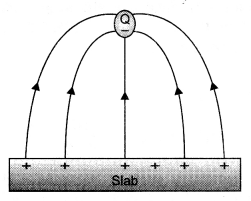
Class 12 Physics Important Questions Chapter 1 Electric Charges and Fields 2
Question 12.
Draw a plot showing the variation of the electric field with distance from the center of a solid conducting sphere of radius R, having a charge + Q on its surface. (CBSE Delhi 2017C)
Answer:
The plot is as shown.
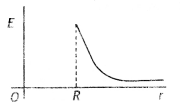
Class 12 Physics Important Questions Chapter 1 Electric Charges and Fields 3
Question 13.
Draw a graph to show the variation of E with perpendicular distance r from the line of charge (CBSE Delhi 2018)
A
Answer:
E = \(\frac{\lambda}{2 \pi \varepsilon_{0} r}\)
E ∝ \(\frac{1}{r}\)
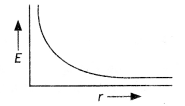
Class 12 Physics Important Questions Chapter 1 Electric Charges and Fields 4
The graph between E and r is as shown.

Question 14.
Define the term ‘electric flux’. Write its S.I. unit. (CBSE Delhi 2018)
Answer:
Electric flux: It is the measure of the number of electric field lines crossing a given area normally.

Mathematically the electric flux passing through an area \(\vec{dS}\) is given by
dΦ = \(\vec{E}\) . \(\vec{dS}\)

SI unit of electric flux is Nm2C-1 or Vm.

Question 15.
Why can the interior of a conductor have no excess charge in the static situation? (CBSE Ai 2019)
Answer:
Since the electric field inside the conductor is zero, electric flux through the closed surface is also zero. Hence by Gauss’s law, there is no net charge enclosed by the closed surface.

Question 16.
Two field lines never cross each other. Why?
Answer:
It is because at the point of intersection two perpendiculars can be drawn. Thus there will be two directions of the electric field at that point which is not possible.

Question 17.
In an electric field, an electron is kept freely. If the electron is replaced by a proton, what will be the force experienced by the proton?
Answer:
The magnitude of force will be the same but the direction will be reversed.

Question 18.
Consider the situation shown in the figure given below. What are the signs of q1 and q2?
Answer:
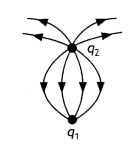
Class 12 Physics Important Questions Chapter 1 Electric Charges and Fields 5
q1 is negative and q2 is positive.

Question 19.
In the figure given below, at which point electric field is maximum?
Answer:
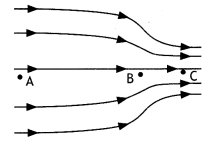
Class 12 Physics Important Questions Chapter 1 Electric Charges and Fields 6
The electric field is maximum at point C.

Question 20.
An uncharged insulated conductor A is brought near a charged insulated conductor B. What happens to the charge and potential of B?
Answer:
On bringing uncharged conductor A near a charged conductor B, charges are induced on A as shown in the figure below. As a result, the potential of conductor B is slightly lowered but the charge on it remains unchanged.
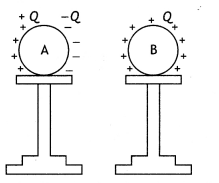
Class 12 Physics Important Questions Chapter 1 Electric Charges and Fields 7

Question 21.
In a medium the force of attraction between two point electric charges, distance ‘d’ apart, is F. What distance apart should these be kept in the same medium so that the force between them becomes 3F?
Answer:
Let the new distance be ‘d’, since F ∝\(\frac{1}{r^{2}}\) ,
therefore \(\frac{F}{3 F}=\frac{r^{2}}{d^{2}}=\frac{1}{3} \Rightarrow r=\frac{d}{\sqrt{3}}\)

Question 22.
Find the value of an electric field that would completely balance the weight of an electron.
Answer:
mg = eE ⇒ E = \(\frac{m g}{e}\)
= \(\frac{9.1 \times 10^{-31} \times 9.8}{1.6 \times 10^{-19}}=5.57 \times 10^{-11} \mathrm{Vm}^{-1}\)

Question 23.
Two charges, one +5 µC, and the other -5 µC are placed 1 mm apart. Calculate the electric dipole moment of the system.
Answer:
p = q × 2a = 5 × 10 -6 × 10-3 = 5 × 10⁻⁹ Cm

Question 24.
Two-point charges of+3 µC each are 100 cm apart. At what point on the line joining the charges will the electric intensity be zero?
Answer:
At the mid-point of the line joining the two point charges.

Question 25.
Four charges of came magnitude and same sign are placed at the corners of a square, of each side 0.1 m. What is electric field intensity at the center of the square?
Answer:
Zero.

Question 26.
Why should the electrostatic field be zero ‘ inside a conductor? (CBSE Delhi 2012)
Answer:
Because it does not contain any charge.

Question 27.
A metallic spherical shell has an inner radius R1 and outer radius R2. A charge Q is placed at the center of the shell. What will be the surface charge density on the (i) inner surface, and (ii) the outer surface of the shell? (CBSE Delhi 2018)
Answer:
On inner surface
Class 12 Physics Important Questions Chapter 1 Electric Charges and Fields 8
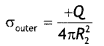
On the outer surface,
Class 12 Physics Important Questions Chapter 1 Electric Charges and Fields 9
Question 28.
An arbitrary surface encloses a dipole. What is the electric flux through this surface? (NCERT Exemplar)
Answer:
Zero.

Electric Charges and Fields Important Extra Questions  Short Answer Type

Question 1.
(a) Electric field inside a conductor is zero. Explain.
(b) The electric field due to a point charge at any point near it is given as
E  =
Class 12 Physics Important Questions Chapter 1 Electric Charges and Fields 10
what is the physical significance of this limit?
Answer:
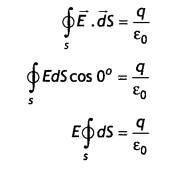
(a) By Gauss theorem \(\phi \vec{E} \cdot \overrightarrow{d S}=\frac{q}{\varepsilon_{0}}\). Since there is no charge inside a conductor therefore in accordance with the above equation the electric field inside the conductor is zero.
(b) It indicates that the test charge should be infinitesimally small so that it may not disturb the electric field of the source charge.

Question 2.
Define the electric line of force and give its two important properties.
Answer:
It is a line straight or curved, a tangent to which at any point gives the direction of the electric field at that point.
(a) No two field lines can cross, because at the point of intersection two tangents can be drawn giving two directions of the electric field which is not possible.
(b) The field lines are always perpendicular to the surface of a charged conductor.

Question 3.
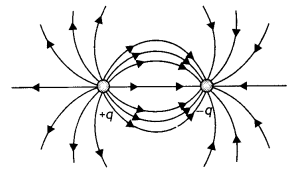
Draw electric field lines due to (i) two similar charges, (ii) two opposite charges, separated by a small distance.
Answer:
(a) The diagram is as shown.
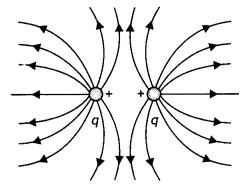
Class 12 Physics Important Questions Chapter 1 Electric Charges and Fields 11
(b) The diagram is as shown.
Class 12 Physics Important Questions Chapter 1 Electric Charges and Fields 12
Question 4.
An electric dipole is free to move in a uniform electric field. Explain what is the force and torque acting on it when it is placed
(i) parallel to the field
Answer:
When an electric dipole is placed parallel to a uniform electric field, net force, as well as net torque acting on the dipole, is zero and, thus, the dipole remains in equilibrium.

(ii) perpendicular to the field
Answer:
When the dipole is placed perpendicular to the field, two forces acting on the dipole form a couple, and hence a torque acts on it which aligns its dipole along the direction of the electric field.

Question 5.
A small metal sphere carrying charge +Q. is located at the center of a spherical cavity in a large uncharged metallic spherical shell. Write the charges on the inner and outer surfaces of the shell. Write the expression for the electric field at the point P1(CBSE Delhi 2014C)
Answer:
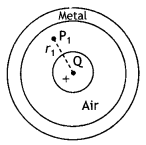
Class 12 Physics Important Questions Chapter 1 Electric Charges and Fields 13
Charge on inner surface – Q.
Charge on outer surface + Q,
Electric field at point P = E = k\(\frac{Q}{r_{1}^{2}}\)

Question 6.
Two-point charges q and –2q are kept ‘d’ distance apart. Find the location of the point relative to charge ‘q’ at which potential due to this system of charges is zero. (CBSE Al 2014C)
Answer:
Let the potential be zero at point P at a distance x from charge q as shown
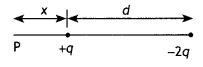
Class 12 Physics Important Questions Chapter 1 Electric Charges and Fields 14
Now potential at point P is
V = \(\frac{k q}{x}+\frac{k(-2 q)}{d+x}\) = 0

Solving for x we have
x = d

Question 7.
Two small identical electrical dipoles AB and CD, each of dipole moment ‘p’ are kept at an angle of 120° as shown in the figure. What is the resultant dipole moment of this combination? If this system is subjected to the electric field (\(\vec{E}\)) directed along +X direction, what will be the magnitude and direction of the torque acting on this? (CBSE Delhi 2011)
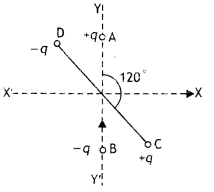
Class 12 Physics Important Questions Chapter 1 Electric Charges and Fields 15
Answer:
The resultant dipole moment of the combi-nation is
PR = \(\sqrt{p^{2}+p^{2}+2 p^{2} \cos 120^{\circ}}\) = p

since cos 120° = -1/2
This will make an angle of 30° with the X-axis, therefore torque acting on it is
τ=PE sin 30° = pE/2 (Along Z-direction)

Question 8.
A metallic spherical shell has an inner radius R1 and outer radius R2. A charge Q is placed at the center of the spherical cavity. What will be surface charge density on (i) the inner surface, and (ii) the outer surface? (NCERT Exemplar)
Answer:
The induction of charges is as shown.
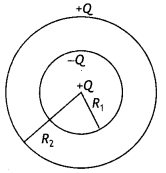
Class 12 Physics Important Questions Chapter 1 Electric Charges and Fields 16
Therefore surface charge density on the inner and the outer shell is on the outer surface is
Class 12 Physics Important Questions Chapter 1 Electric Charges and Fields 17
Class 12 Physics Important Questions Chapter 1 Electric Charges and Fields 18

Question 9.
If the total charge enclosed by a surface is zero, does it imply that the electric field everywhere on the surface is zero? Conversely, if the electric field everywhere on a surface is zero, does it imply that the net charge inside is zero. (NCERT Exemplar)
Answer:
No, the field may be normal to the surface. However, the converse is true i.e. when the electric field everywhere on the surface be zero then the net charge inside it must be zero.

Electric Charges and Fields Important Extra Questions Long Answer Type

Question 1.
(a) State Gauss theorem in electrostatics. Using it, prove that the electric field at a point due to a uniformly charged infinite plane sheet is independent of the distance from it.
Answer:
It states, “The net electric flux through any Gaussian surface is equal to \(\frac{1}{\varepsilon_{0}}\) times the net electric charge enclosed by the surface.

Mathematically, Φ =\( \phi \vec{E} \cdot d \vec{A}=\frac{q_{i n}}{\varepsilon_{0}}\)

Consider an infinite plane sheet of charge. Let a be the uniform surface charge density, i.e. the charge per unit surface area. From symmetry, we find that the electric field must be perpendicular to the plane of the sheet and that the direction of E on one side of the plane must be opposite to its direction on the other side as shown in the figure below. In such a case let us choose a Gaussian surface in the form of a cylinder with its axis perpendicular to the sheet of charge, with ends of area A.

The charged sheet passes through the middle of the cylinder’s length so that the cylinder’s ends are equidistant from the sheet. The electric field has a normal component at each end of the cylinder and no normal component along the curved surface of the cylinder. As a result, the electric flux is linked with only the ends and not the curved surface.
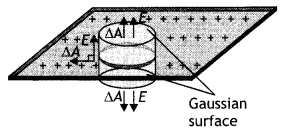
Class 12 Physics Important Questions Chapter 1 Electric Charges and Fields 19
Therefore by the definition of eLectric flux, the flux Linked with the Gaussian surface is given by
Φ = \(\oint_{A} \vec{E} \cdot \vec{\Delta} A\)
Φ = EA + EA = 2EA … (1)

But by Gauss’s Law
Φ = \(\frac{q}{\varepsilon_{0}}=\frac{\sigma A}{\varepsilon_{0}}\) [∵ q = σA] … (2)

From equations (1) and (2), we have
2EA = \(\frac{\sigma A}{\varepsilon_{0}}\) … (3)
E = \(\frac{\sigma}{2 \varepsilon_{0}}\) …. (4)

This gives the electric field due to an infinite plane sheet of charge which is independent of the distance from the sheet.

(b) How is the field directed if (i) the sheet is positively charged, (ii) negatively charged? (C8SE Delhi 2012)
Answer:
(a) directed outwards
(b) directed inwards.

Question 2.
Use Gauss’s law to derive the expression for the electric field (\(\vec{E}\) ) due to a straight uniformly charged infinite line of charge λ Cm-1. (CBSE Delhi 2018)
Answer:
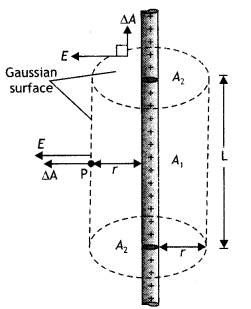
Class 12 Physics Important Questions Chapter 1 Electric Charges and Fields 20
Consider an infinitely Long, thin wire charged positively and having uniform Linear charge density λ. The symmetry of the charge distribution shows that must be perpendicular to the tine charge and directed outwards. As a result of this symmetry, we consider a Gaussian surface in the form of a cylinder with arbitrary radius r and arbitrary Length L. with its ends perpendicular to the wire as shown in the figure. Applying Gauss’s theorem to curved surface ΔA1 and circular surface ΔA2.

Φ EΔA1 cos 0°+ EΔA2 cos 90° = \(\frac{q}{\varepsilon_{0}}\) = \(\frac{\lambda l}{\varepsilon_{0}}\) [∵ λ = \(\frac{q}{e}\)]
Or
E . 2πrl = \(\frac{\lambda l}{\varepsilon_{0}}\) ⇒ E = \(\frac{1}{2 \pi \varepsilon_{0}} \frac{\lambda}{r}\)

This is the expression for the electric field due to an infinitely long thin wire.
The graph is as shown.
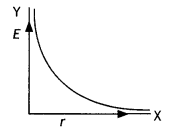
Class 12 Physics Important Questions Chapter 1 Electric Charges and Fields 21
Question 3.
Obtain the expression for the potential energy of an electric dipole placed with its axis at an angle (θ) to an external electric field (E). What is the minimum value of the potential energy? (CBSE 2019C)
Answer:
The torque x acting on an electric dipole of dipole moment p placed in a uniform electric field E is given by:
τ = pEsinθ …(i)
where θ is the angle made by the dipole with the electric field E. The torque tends to align the dipole along the direction of the field. If the dipole is rotated through a small angle dθ against the torque, work has to be done, which is stored in the form of the potential energy of the dipole.
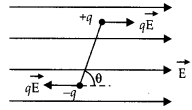
Class 12 Physics Important Questions Chapter 1 Electric Charges and Fields 22
Work done in rotating the dipole through the angle dθ against the torque τ is given by dw = τ dθ = pE sin θ dθ

If the dipole is rotated from θ1 to θ2, then
Total work is done,
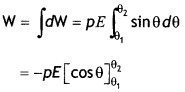
Class 12 Physics Important Questions Chapter 1 Electric Charges and Fields 23
W = – pE(cos θ2 – cos θ1)

This work done is stored as potential energy U.

U = – pE(cos θ2 – cos θ1)
If the dipole is rotated from θ1 = \(\frac{\pi}{2}\) to θ2 =θ, then

U = – pE(cos θ – cos \(\frac{\pi}{2}\) )
= – pE(cos θ – 0)

U = – pE cos θ
minimum value of potential energy
U = – pE When θ = 0°

Question 4.
Why does the electric field inside a dielectric decrease when it is placed in an external electric field?
Answer:
When a dielectric is placed in an electric field (E0), it gets polarised, i.e. within the dielectric, an electric field (E) is induced in a direction opposite to that of the external field. Therefore, the net field within the dielectric decreases to \(\vec{E}_{0}\) – \(\vec{E}\)

Question 5.
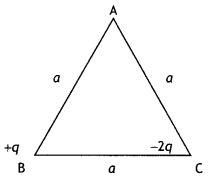
Two-point charges +q and -2q are placed at the vertices ‘B’ and ‘C’ of an equilateral triangle ABC of side ‘a’ as given in the figure. Obtain the expression for (i) the magnitude and (ii) the direction of the resultant electric field at vertex A due to these two charges. (CBSE Al 2014 C)
Class 12 Physics Important Questions Chapter 1 Electric Charges and Fields 24
Answer:
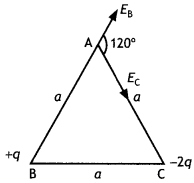
The electric fields due to the two charges placed at B and C are inclined at an angle θ = 120° as shown
Now in magnitude, we have

EB = k\(\frac{q}{a^{2}}\) and
EC = k\(\frac{2q}{a^{2}}\) = 2 EB
Class 12 Physics Important Questions Chapter 1 Electric Charges and Fields 25
Hence E = \(\sqrt{E_{B}^{2}+E_{c}^{2}+2 E_{B} E_{c} \cos \theta}\)
Or E = \(\sqrt{E_{B}^{2}+\left(2 E_{B}\right)^{2}+2 E_{B}\left(2 E_{B}\right) \cos 120^{\circ}}\)

On Solving we have
E = \(\sqrt{3} E_{B}\) = \(\sqrt{3} \frac{k q}{a^{2}}\)

Direction

Class 12 Physics Important Questions Chapter 1 Electric Charges and Fields 26
Therefore B = 90°, the resultant is inclined at an angle of 90° with EB.

Question 6.
Four-point charges Q, q, Q, and q are placed at the corners of a square of side ‘a’ as shown in the figure.Class 12 Physics Important Questions Chapter 1 Electric Charges and Fields 27
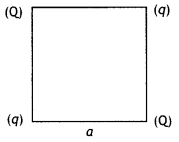
Find the
(a) the resultant electric force on a charge Q and
(b) the potential energy of this system. (CBSEAI, Delhi 2018)
Answer:
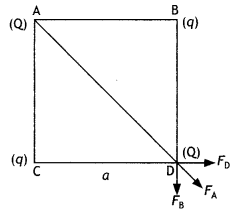
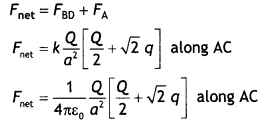
(a) Let us find the force on charge Q at point C.
Class 12 Physics Important Questions Chapter 1 Electric Charges and Fields 28
Force due to charge Q placed at point A is
FA = k\(\frac{Q^{2}}{(a \sqrt{2})^{2}}\) =k\(\frac{Q^{2}}{2 a^{2}}\) along AC

Force due to the charge q placed at D
FD = k\(\frac{q Q}{a^{2}}\) alongDA

Force due to the charge q placed at B
FB = k \(\frac{q Q}{a^{2}}\) along BC

The resuLtant of FD and FB is
FBD = K\(\frac{q Q \sqrt{2}}{a^{2}}\) along AC

∴ net force of charge Q placed at point C is
Class 12 Physics Important Questions Chapter 1 Electric Charges and Fields 29
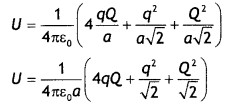
(b) PotentiaL energy of the system
Class 12 Physics Important Questions Chapter 1 Electric Charges and Fields 30
Question 7.
A charge +Q is uniformly distributed within a sphere of radius R. Find the electric field, distant r from the center of the sphere where: (1) r < R and (2) r > R. (CBSEAI 2016C)
Answer:
For a solid sphere p = \( \frac{q}{\frac{4}{3} \pi R^{3}}\) = \(\frac{q}{\text { volume }}\)

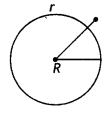
Case 1. 0 < r < R The point Lies within the sphere.
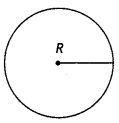
Class 12 Physics Important Questions Chapter 1 Electric Charges and Fields 31
Using Gauss’s theorem
Let Q’ be the charge encLosed by Gaussian’s surface of radius r < R.

E(4πr²)=\(\frac{Q^{\prime}}{\varepsilon_{0}}=\frac{Q^{\prime}}{4 \pi \varepsilon_{0} r^{2}}\)

From (i) and (ii)
E = \(\frac{Q r^{3}}{4 \pi \varepsilon_{0} r^{2} R^{3}}=\frac{1}{4 \pi \varepsilon_{0}} \frac{Q r}{R^{3}}\)
Class 12 Physics Important Questions Chapter 1 Electric Charges and Fields 32

Case 2. For r > R
\(\oint \vec{E} \cdot \overrightarrow{d s}\) = \(\frac{q_{\text {enclosed }}}{\varepsilon_{0}}\)

E(4πr²) = \(\frac{Q}{\varepsilon_{0}}\)
E = \(\frac{Q}{4 \pi \varepsilon_{0} r^{2}}\)

Question 8.
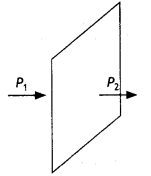
(a) An electric dipole is kept first to the left and then to the right of a negatively charged infinite plane sheet having a uniform surface charge density. The arrows p1 and p2 show the directions of its electric dipole moment in the two cases. Identify for each case, whether the dipole is in stable or unstable equilibrium. Justify each answer.Class 12 Physics Important Questions Chapter 1 Electric Charges and Fields 33
Answer:
p1: stable equilibrium, p2: unstable equilibrium. The electric field, on either side, is directed towards the negatively charged sheet and its magnitude is independent of the distance of the field point from the sheet. For position P1 dipole moment and electric field are parallel. For position p2, they are antiparallel.

(b) Next, the dipole is kept in a similar way (as shown), near an infinitely long straight wire having uniform negative linear charge density. Will the dipole be in equilibrium at these two positions? Justify your answer. (CBSE Sample Paper 2018-2019)
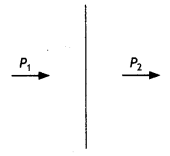
Class 12 Physics Important Questions Chapter 1 Electric Charges and Fields 34
Answer:
The dipole will not be in equilibrium in any of the two positions.
The electric field due to an infinite straight charged wire is non-uniform (E ∝ 1/r).
Hence there will be a net non-zero force on the dipole in each case.

Question 9.
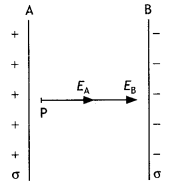
Two large parallel plane sheets have uniform charge densities +σ and -σ. Determine the electric field (i) between the sheets, and (ii) outside the sheets. (CBSE Delhi 2018)
Answer:
Let us consider two parallel planes charged conductors A and B carrying +ve and -ve charge density σ (charge per unit area). According to Gauss’ theorem, the electric intensity at P due to the charge on sheet A is

EA = \(\frac{\sigma}{2 \varepsilon_{0}}\) (From A and B)
Class 12 Physics Important Questions Chapter 1 Electric Charges and Fields 35
The electric field at P due to charge on sheet B is
E= \(\frac{\sigma}{2 \varepsilon_{0}}\) (From A to B)

The electric field at P is
E = EA + EB
= \(\frac{\sigma}{\varepsilon_{0}}\)

Question 10.
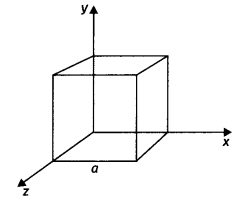
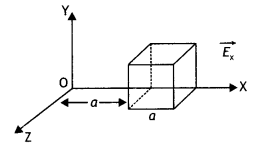
Define electric flux and write its SI unit. The electric field components in the figure shown are : Ex = αx, Ey = 0, Ez = 0 where α = 100N/cm. Calculate the charge within the cube, assuming a = 0.1 m. (CBSE Sample Paper 2019)Class 12 Physics Important Questions Chapter 1 Electric Charges and Fields 36
Or
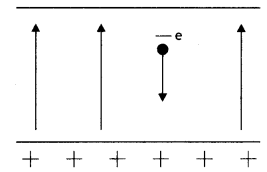
An electron falls through a distance of 1.5 cm in a uniform electric field of magnitude 2.0 × 10⁴ N/C (figure a)
Class 12 Physics Important Questions Chapter 1 Electric Charges and Fields 37
(a) Calculate the time it takes to fall through this distance starting from rest.
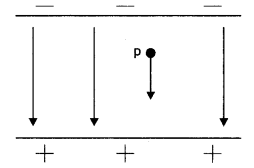
Class 12 Physics Important Questions Chapter 1 Electric Charges and Fields 38
(b) If the direction of the field is reversed (figure b) keeping its magnitude unchanged, calculate the time taken by a proton to fall through this distance starting from rest. (CBSE Delhi 2018C)
Answer:
Electric Flux is the dot product of the electric field and area vector.
Φ = \(\oint \vec{E} \cdot \overrightarrow{d s}\)

SI Unit: Nm2/C or Vm

For a given case
Φ = Φ1 – Φ2 = [Ex(atx= 2a) – Ex (atx = a)]a2
= [α(2a)-α(a)]a2 = αa3
= 104 × (0.1 )3 = 10 Nm2/C
But
Φ = \(\frac{q}{\varepsilon_{0}}\)

∴ q = ε0Φ = 8.854 × 10-12 × 10 C = 8.54 pC
Or
We have
F = qE

Acceleration, a = \(\frac{q E}{m}\)

Also
s = \(\frac { 1 }{ 2 }\) at2 [u = 0]
∴ t = \(\sqrt{\frac{2 s}{a}}\)

(i) For the electron
a = \(\frac { eE}{ m }\)

∴ t = \(\sqrt{\frac{2 s m}{e E}}\)

∴ t = \(\sqrt{\frac{3 \times 10^{-2} \times 9.1 \times 10^{-31}}{1.6 \times 10^{-19} \times 2.0 \times 10^{4}}}\) = 2.92 ns

(ii) for proton
t = \(\sqrt{\frac{2 \times 1.5 \times 10^{-2} \times 1.67 \times 10^{-27}}{1.6 \times 10^{-19} \times 2 \times 10^{4}}}\)
= -.125 μs

Question 11.
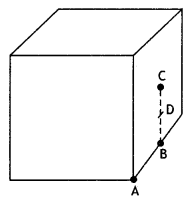
What will be the total flux through the faces of the cube (figure) with the side of length ‘a’ if a charge q is placed at
(a) A: a corner of the cube.
(b) B: mid-point of an edge of the cube.
(c) C: center of the face of the cube.
(d) D: mid-point of B and C. {NCERJ Exemplar)
Class 12 Physics Important Questions Chapter 1 Electric Charges and Fields 39
Answer:
(a) The charge wilt is shared by eight cubes if it has to be enclosed. Therefore the flux through the cube will be one-eighth of the total flux. Φ = q/8ε0
(b) The charge will be shared by four cubes if it has to be enclosed. Therefore the flux through the cube will be one-fourth of the total flux. Φ = q/ 4ε0
(c) The charge will be shared by two cubes if it has to be enclosed. Therefore the flux through the cube will be one-half of the total flux. Φ = q/ 2ε0
(d) The charge will be shared by two cubes if it has to be enclosed. Therefore the flux through the cube will be one-half of the total flux. Φ = q/ 2ε0

Question 12.
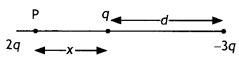
Two charges q and -3q are placed fixed on the x-axis separated by distance ‘d’. Where should a third charge 2q be placed such that it will not experience any force? (NCERT Exemplar)
Answer:
The situation is as shown.
Class 12 Physics Important Questions Chapter 1 Electric Charges and Fields 40
Let the charge 2q be placed at a distance ‘x’ from charge q. For the charge 2q to experience zero force we have
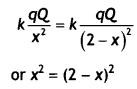
\(\frac{2 q^{2}}{4 \pi \varepsilon_{0} x^{2}}=\frac{6 q^{2}}{4 \pi \varepsilon_{0}(d+x)^{2}}\)
(d + x)2 = 3x2

Solving for x we have
x = \(\frac{d}{2} \pm \frac{\sqrt{3} d}{2}\)
(-ve sign would be between q and -3q and hence is unacceptable.)

Therefore, we have
x = \(\frac{d}{2}+\frac{\sqrt{3} d}{2}=\frac{d}{2}(1+\sqrt{3})\) to the left of q.

Question 13.
(a) State Gauss’s law. Use it to deduce the expression for the electric field due to a uniformly charged thin spherical shell at points (i) inside and (ii) outside the shell. Plot a graph showing the variation of the electric field as a function of r > R and r < R. (r being the distance from the center of the shell) (CBSE Delhi 2011, Al 2013)
Answer:
Gauss’s law states that the net outward flux through any closed surface is equal to 1 /ε0 times the charge enclosed by the closed surface.

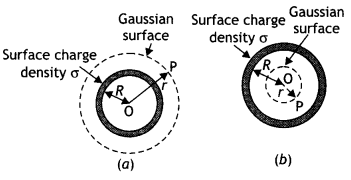
Consider a thin spherical shell of radius R and center at O. Let σ be the uniform surface charge density (charge per unit surface area) and q be the total charge on it. The charge distribution is spherically symmetric. Three cases arise

Case 1: at a point outside the spherical shell
In order to find the electric field at a point P outside the shell let us consider a Gaussian surface in the form of a sphere of radius r (r >>R).
Class 12 Physics Important Questions Chapter 1 Electric Charges and Fields 41
By symmetry, we find that the electric field acts radially outwards and has a normal component at alt points on the Gaussian sphere. Therefore by definition of electric flux we have

Φ = E × A, where A is the surface area of the Gaussian sphere therefore
Φ = E × 4πr² …(1)

But by Gauss’s law
Φ = \(\frac{Q}{\varepsilon_{0}}=\frac{\sigma A}{\varepsilon_{0}}=\frac{\sigma \times 4 \pi R^{2}}{\varepsilon_{0}}\) … (2)

from equations (1) and (2) it follows that
E × 4πr² = \(\frac{Q}{\varepsilon_{0}}\) Or E = \(\frac{1}{4 \pi \varepsilon_{0}} \frac{Q}{r^{2}}\)

E × 4πr² = \(\frac{\sigma \times 4 \pi R^{2}}{\varepsilon_{0}}\)

Ē = \(\frac{\sigma R^{2}}{\varepsilon_{0} r^{2}}\) … (3)

It follows that the electric field due to a spherical shell outside it is same as that due to a point charge. Therefore for points Lying outside the spherical shell the shell behaves as if the entire charge is concentrated at the centre.

Case 2: at a point inside the spherical shell
In this case, the Gaussian surface Lies inside the shell. Since no charge is enclosed In this surface therefore we have

E × 4πr²=q00 [∵ q=0]
Therefore E = 0
Class 12 Physics Important Questions Chapter 1 Electric Charges and Fields 42
(b) Two identical metallic spheres A and B having charges +4Q. and -10 Q are kept a certain distance apart. A third identical uncharged sphere C is first placed in contact with sphere A and then with sphere B. Spheres A and B are then brought in contact and then separated. Find the charges on the spheres A and B. (CBSEAI 2011C)
Answer:
The initial charge on the sphere A = + 4 Q.
The initial charge on the sphere B = -10 Q.

Since all the three spheres are identical, i.e. they have the same capacity, therefore when uncharged sphere C is placed in contact with A, the total charge is equally shared between them.

Charge on C after contact with A
= \(\frac{0+4 Q}{2}\) = 2Q

Charge on A after contact with C is 2Q.
When sphere C carrying a charge 2Q is placed in contact with B, again charges are equally shared between C and B equally.

Charge on C after it is in contact with B
= \(\frac{2 Q-10 Q}{2}\) = -4Q

Now when sphere A with a charge of 2Q. is placed in contact with B, with charge -4Q.

Charge are again shared
∴ charge on A or B = \(\frac{2 Q-4 Q}{2}\) = -Q.

Question 14.
(a) Define electric dipole moment. Is it a scalar or a vector? Derive the expression for the electric field of a dipole at a point on the equatorial plane of the dipole.
Answer:
It is defined as the product of the magnitude of either of the two charges and the distance between them.
For derivation see sol. 9(a) of LA-II.

(b) Draw the equipotential surfaces due to an electric dipole. Locate the points where the potential due to the dipole is zero. (CBSE Al 2013)
Answer:
The diagram is as shown
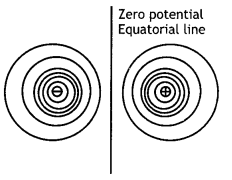
Class 12 Physics Important Questions Chapter 1 Electric Charges and Fields 43
The zero potential points lie on the equatorial line.

Question 15.
(a) Using Gauss’s law obtain expressions for the electric field (i) inside, and (ii) outside a positively charged spherical shell.
(c) A Square plane sheet of side 10 cm is inclined at an angle of 30° with the direction of a uniform electric field of 200 NC“1. Calculate the electric flux passing through the sheet. (CBSE 2019C)
Answer:
(a) Spherical Shell
Consider a spherical shell of radius R. Let q be a charge on the shell. Let us find the electric field at a point P at a distance r from the center 0 of the spherical shell.

Case (i): When point P lies inside the spherical shell
From the point, P draws a Gaussian surface which will be a sphere of radius r.

From the Gauss’s Theorem,
\(\oint_{s} \vec{E} \cdot \vec{d} S=\frac{0}{\varepsilon_{0}}\) [∵ No charge exists inside the spherical shell]
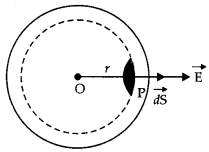
Class 12 Physics Important Questions Chapter 1 Electric Charges and Fields 44
Or
E = 0
i. e. electric field inside the charged spherical shell is zero.

Case (ii): When point P is lying outside the shell (i.e. r > R)
From point P, draw a Gaussian surface which will be a spherical shell of radius r. Let dS be a small area element on the Gaussian surface P.
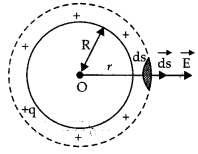
Class 12 Physics Important Questions Chapter 1 Electric Charges and Fields 45
Class 12 Physics Important Questions Chapter 1 Electric Charges and Fields 46
Or
Class 12 Physics Important Questions Chapter 1 Electric Charges and Fields 47

i. e. the electric field outside the spherical shell behaves as if the whole charge is concentrated at the center of the spherical shell.

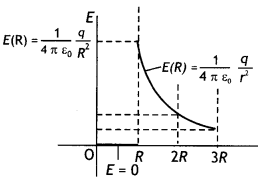
(b) Show graphically variation of the electric field as a function of the distance r from the center of the sphere.
Answer:
Variation of electric field E with distance
The given figure shows the variation of an electric field with distance from the center of the charged spherical shell.
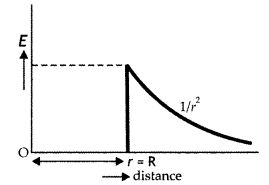
Class 12 Physics Important Questions Chapter 1 Electric Charges and Fields 48
(c) Here E = 200 N/C, S = 0.1 × 0.1 = 0.01 m2
And θ = 90° – 30° = 60°

The electric flux linked with the square sheet
Φ = E S cos 60°
= 200 × 0.01 × \(\frac { 1 }{ 2 }\) = 1.0 Nm2 C-1

Question 16.
A charge is distributed uniformly over a ring of radius ‘a’. Obtain an expression for the electric intensity E at a point on the axis of the ring. Hence show that for points at a large distance from the ring, it behaves like a point charge. (CBSE Delhi 2016)
Answer:
Consider a uniformly charged ring of radius ‘a’. Let the total charge on the ring be Q, Let us find the electric field on the axis of the ring at point P distance x from the center of the ring. Consider a segment of charge dQ as shown in the figure.
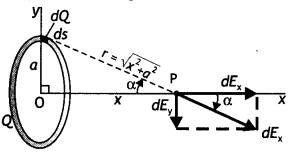
Class 12 Physics Important Questions Chapter 1 Electric Charges and Fields 49

The magnitude of etectñc field at P due to the segment is
dE=k\(\frac{d Q}{r^{2}}\) …(1)

This field can be resolved into its components: x component dEx = dE cos α an along the axis of the ring and y component dE perpendicular to the axis. Since these perpendicular components, due to alt the charge segments, are equal and opposite, therefore they cancel out each other. From the diagram we have r = \(\sqrt{x^{2}+a^{2}}\) and cos α = x/r, therefore we have
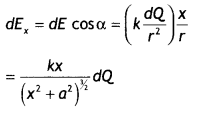
Class 12 Physics Important Questions Chapter 1 Electric Charges and Fields 50 …(2)

In this case, all the segments of the ring give the same contribution to the field at P since they are all equidistant from this point. Thus we can easily sum over all segments to get the total electric field at point P
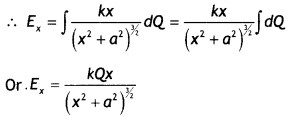
Class 12 Physics Important Questions Chapter 1 Electric Charges and Fields 51
If the point of observation is far away, i.e. x >> a, then E = \(\frac{1}{4 \pi \varepsilon_{0}} \frac{Q}{x^{2}}\). This is the same as that for a point charge. Thus at far-off axial points, a charged ring behaves as if a point charge is situated at the center of the ring.

Question 17.
Two thin concentric and coplanar spherical shells, of radii ‘a’ and ‘b’ (b > a), carry charges, q, and Q respectively. Find the magnitude of the electric field, at a point distant x, from their common center for
(i) O < x < a
(ii) a ≤ x < b
(iii) b ≤ x < ∞ (CBSE Delhi 2016C)
Answer:
The diagram is as shown.
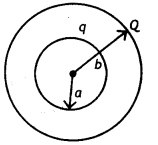
Class 12 Physics Important Questions Chapter 1 Electric Charges and Fields 52
(i) For 0 < x < a
Point Lies inside both the spherical shells.

∴ charge enclosed = 0
Hence, E(x) = 0

(ii) For a < x < b
Point is outside the spherical shell of radius ‘a’ but inside the spherical Shell of radius ‘b’.
Therefore
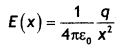
Class 12 Physics Important Questions Chapter 1 Electric Charges and Fields 53

(iii) For b ≤ x< ∞
The point is outside of both the spherical shells. The total effect we charge at the center equals (Q + q).
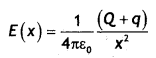
Class 12 Physics Important Questions Chapter 1 Electric Charges and Fields 54
Question 18.
(a) Define electric flux. Is It a scalar or a vector quantity?
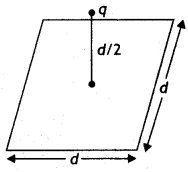
Class 12 Physics Important Questions Chapter 1 Electric Charges and Fields 55
A point charge q is at a distance of d/2 directly above the center of a square of side d, as shown In the figure. Us. Gauss’s law to obtain the expression for the electric flux through the square.
Answer:
The electric flux through a given surface is defined as the dot product of the electric field and area vector over that surface. It is a scalar quantity.

Constructing a cube of side ‘d’ so that charge ‘q’ gets placed within this cube (Gaussian surface)
According to Gauss’s law the electric flux
Φ = \(\frac{q}{\varepsilon_{0}}\)
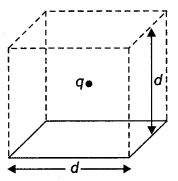
Class 12 Physics Important Questions Chapter 1 Electric Charges and Fields 56
This is the total flux through all the six faces of the cube.

Hence electric flux through the square (one face of the cube)
Φ = \(\frac{1}{6} \frac{q}{\varepsilon_{0}}\)

(b) If the point charge is now moved to a distance ‘d’ from the center of the square and the side of the square is doubled, explain how the electric flux will be affected. (CBSE Al, Delhi 2018)
Answer:
If the charge is moved to a distance ‘d’ and the side of the square is doubled the cube will be constructed to have a side 2d but the total charge enclosed in it will remain the same. Hence the total flux through the cube and therefore the flux through the square will remain the same as before.

Question 19.
(a) Draw a graph to show the variation of E with perpendicular distance r from the line of charge.
Answer:
The required graph is
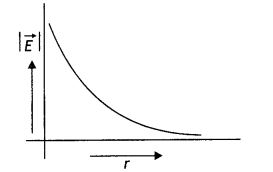
Class 12 Physics Important Questions Chapter 1 Electric Charges and Fields 57
(b) Find the work done in bringing a charge q from perpendicular distance r1 to r2 (r2 > r1). (CBSEAI, Delhi 2018)
Answer:
Work done in moving the charge “q”. through a smaLL displacement ‘dr’

dW = \(\vec{F}\) . \(\vec{dr}\) =q\(\vec{E}\) .\(\vec{dr}\)
dW = qE dr cos 0 = qEdr
dW= q x \(\frac{\lambda}{2 \pi \varepsilon_{0} r}\) dr

Hence work done in moving the charge from r1 to r2 (r2 > r1)
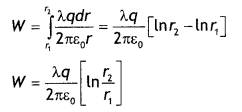
Class 12 Physics Important Questions Chapter 1 Electric Charges and Fields 58

Question 20.
Derive an expression for the torque acting on an electric dipole of dipole moment \(\vec{p}\) placed in a uniform electric field \(\vec{E}\). Write the direction along which the torque acts.
OR
Derive an expression for the electric field at a point on the axis of an electric dipole of dipole moment \(\vec{p}\). Also, write its expression when the distance r >> a the length ‘a’ of the dipole. (CBSEAI 2019)
Answer:
Consider an electric dipole consisting of charges -q and +q and dipole length d is placed in a uniform electric field E as shown in the figure.

Let the dipole moment makes an angle θ with the direction of the electric field. The two charges experience force qE each.

These forces are equal, parallel, and opposite. Therefore, the net force acting on the dipole is
Fn = qE – qE = 0

Thus the net force acting on the dipole is zero.

These two forces constitute a couple. This applies a torque on the dipole given by
τ = either force × arm of the couple
τ = qE × d sin θ, where d sin θ is the arm of the couple.
τ = q d Esin θ, where p = qd, dipole moment
τ = pE sin θ.
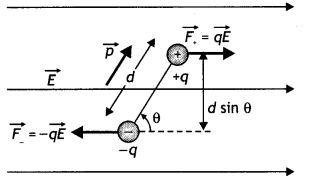
Class 12 Physics Important Questions Chapter 1 Electric Charges and Fields 59
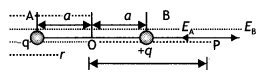
Consider an electric dipole consisting of -q and +q charges separated by a distance 2a as shown in the figure. Let P be the point of observation on the axial Line where the electric field has to be found. Let it be at a distance r from the center O of the dipole. Let us suppose that the dipole is placed in a vacuum.

Let E and EB be the electric fields at point P due to the charges at A and B respectively. Therefore,Class 12 Physics Important Questions Chapter 1 Electric Charges and Fields 60

Class 12 Physics Important Questions Chapter 1 Electric Charges and Fields 61
The two fields at P are in opposite directions. Thus the resultant electric field at P is given by
E = \(\sqrt{E_{A}^{2}+E_{B}^{2}-2 E_{A} E_{B} \cos \theta}=\sqrt{\left(E_{B}-E_{A}\right)^{2}}\) = EB – EA

since θ = 1800 Therefore, the resultant electric field is
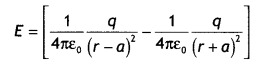
Class 12 Physics Important Questions Chapter 1 Electric Charges and Fields 62
Class 12 Physics Important Questions Chapter 1 Electric Charges and Fields 63

Solving we have
Class 12 Physics Important Questions Chapter 1 Electric Charges and Fields 64
where p = q 2a.
If the dipole is short then r >> a, therefore, ‘a’ is neglected as compared to r, hence
Class 12 Physics Important Questions Chapter 1 Electric Charges and Fields 65

This field is in the direction of the dipole moment.

Question 21.
(a) Derive the expression for the electric field at a point on the equatorial line of an electric dipole. (CBSE 2019C)
Answer:
Consider an electric dipole consisting of charges -q and +q separated by a distance 2a as shown in the figure. Let the point of observation P lie on the. right bisector of the dipole AB at a distance r from its midpoint 0. Let EA and EB be the electric field intensities at point P due to charges at A and B, respectively.

The two electric fields have magnitudes
Class 12 Physics Important Questions Chapter 1 Electric Charges and Fields 66
in the direction of AP

Class 12 Physics Important Questions Chapter 1 Electric Charges and Fields 67
in the direction of PB.

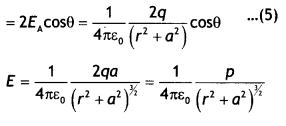
The two fields are equal in magnitude but have different directions. Resolving the two fields EA and EB into their rectangular components, i.e. perpendicular to and parallel to AB. The components perpendicular to AB, i.e EA sinG and EB sinG being equal and opposite cancel out each other while the components parallel to AB, i.e. EA cos θ and EB cos θ being in the same direction add up as shown in the figure. Hence the resultant electric field at point P is given by
Class 12 Physics Important Questions Chapter 1 Electric Charges and Fields 68
E = EAcosθ + EBcosθ
Class 12 Physics Important Questions Chapter 1 Electric Charges and Fields 69
∵ cos θ = \(\frac{a}{\left(r^{2}+a^{2}\right)^{1 / 2}}\) and q 2a = p

For a short dipole r²,>>a² therefore
E = \(\frac{1}{4 \pi \varepsilon_{0}} \frac{p}{r^{3}}\)

(b) Discuss the orientation of the dipole in (a) stable, (b) unstable equilibrium in a uniform electric field. (CBSE Delhi 2017)
Answer:
For stable equilibrium \(\vec{P}\) is along \(\vec{E}\)
θ = 0°, τ = PE sin 0°, Torque alligns the dipole in the direction of field

For unstable equilibrium \(\vec{P}\) is antiparallel to \(\vec{E}\)
∵ θ = 180°, τ = PE sin 180° = 0, Torque alligns the dipole in a direction opposite to \(\vec{E}\).

Question 22.
(a) An electric dipole of dipole moment \(\vec{p}\) consists of point charges +q and -q separated by a distance 2a apart. Deduce the expression for the electric field due to the dipole at a distance x from the center of the dipole on its axial line in terms of the dipole moment. Hence show that in

the limit r >> a, \(\vec{E}\) → \(\frac{2 \vec{p}}{4 \pi \varepsilon_{0} r^{3}}\)
Answer:

Consider an electric dipole consisting of charges -q and +q and dipole length d is placed in a uniform electric field E as shown in the figure.

Let the dipole moment makes an angle θ with the direction of the electric field. The two charges experience force qE each.

These forces are equal, parallel, and opposite. Therefore, the net force acting on the dipole is
Fn = qE – qE = 0

Thus the net force acting on the dipole is zero.

These two forces constitute a couple. This applies a torque on the dipole given by
τ = either force × arm of the couple
τ = qE × d sin θ, where d sin θ is the arm of the couple.
τ = q d Esin θ, where p = qd, dipole moment
τ = pE sin θ.
Class 12 Physics Important Questions Chapter 1 Electric Charges and Fields 59
Consider an electric dipole consisting of -q and +q charges separated by a distance 2a as shown in the figure. Let P be the point of observation on the axial Line where the electric field has to be found. Let it be at a distance r from the center O of the dipole. Let us suppose that the dipole is placed in a vacuum.

Let E and EB be the electric fields at point P due to the charges at A and B respectively. Therefore,Class 12 Physics Important Questions Chapter 1 Electric Charges and Fields 60
Class 12 Physics Important Questions Chapter 1 Electric Charges and Fields 61
The two fields at P are in opposite directions. Thus the resultant electric field at P is given by
E = \(\sqrt{E_{A}^{2}+E_{B}^{2}-2 E_{A} E_{B} \cos \theta}=\sqrt{\left(E_{B}-E_{A}\right)^{2}}\) = EB – EA

since θ = 1800 Therefore, the resultant electric field is
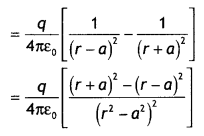
Class 12 Physics Important Questions Chapter 1 Electric Charges and Fields 62
Class 12 Physics Important Questions Chapter 1 Electric Charges and Fields 63

Solving we have
Class 12 Physics Important Questions Chapter 1 Electric Charges and Fields 64
where p = q 2a.
If the dipole is short then r >> a, therefore, ‘a’ is neglected as compared to r, hence

Class 12 Physics Important Questions Chapter 1 Electric Charges and Fields 65

This field is in the direction of the dipole moment.

(b) Given the electric field in the region E = 2xî, find the net electric flux through the cube and the charge enclosed by it. (CBSE Delhi 2015)
Class 12 Physics Important Questions Chapter 1 Electric Charges and Fields 70
Answer:
Since the electric field has only an x component, for faces perpendicular to the x-direction, the angle between E and ΔS is ± π/2.

Therefore, the flux Φ = E.ΔS is separately zero for each face of the cube except the two faces along the X-axis.

Now the magnitude of the electric field at the left face is
EL= 0 (x = 0 at the left face)

The magnitude of the electric field at the right face is
ER = 2x = 2a (x = a at the right face)

The corresponding fluxes are
ΦL = EL.ΔS = ΔS (\(\vec{E}_{L} \cdot \hat{n}_{\mathrm{L}}\)) = ELΔS COS θ
= – EL ΔS = 0, since θ =180°

ΦR = ER.ΔS = ERΔS cos θ = E ΔS = (2a)a2, since θ = 0°

Net flux through the cube
Φ = -ΦR + ΦL = 2a3 -0 = 2a3

We can use Gauss’s law to find the total charge q inside the cube.
We have Φ = q/ε0 or q = Φε0. Therefore, q = 2a3 × 8.854 × 10-12C

Question 23.
(a) Derive an expression for the electric field at any point on the equatorial line of an electric dipole.
Answer:
Consider an electric dipole consisting of charges -q and +q separated by a distance 2a as shown in the figure. Let the point of observation P lie on the. right bisector of the dipole AB at a distance r from its midpoint 0. Let EA and EB be the electric field intensities at point P due to charges at A and B, respectively.

The two electric fields have magnitudes

Class 12 Physics Important Questions Chapter 1 Electric Charges and Fields 66
in the direction of AP

Class 12 Physics Important Questions Chapter 1 Electric Charges and Fields 67
in the direction of PB.

The two fields are equal in magnitude but have different directions. Resolving the two fields EA and EB into their rectangular components, i.e. perpendicular to and parallel to AB. The components perpendicular to AB, i.e EA sinG and EB sinG being equal and opposite cancel out each other while the components parallel to AB, i.e. EA COS θ and EB cos θ being in the same direction add up as shown in the figure. Hence the resultant electric field at point P is given by
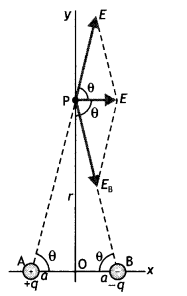
Class 12 Physics Important Questions Chapter 1 Electric Charges and Fields 68
E = EA cos θ + EB cos θ
Class 12 Physics Important Questions Chapter 1 Electric Charges and Fields 69
∵ cos θ = \(\frac{a}{\left(r^{2}+a^{2}\right)^{1 / 2}}\) and q 2a = p

For a short dipole r²,>>a² therefore
E = \(\frac{1}{4 \pi \varepsilon_{0}} \frac{p}{r^{3}}\)

(b) Two identical point charges, q each, are kept 2 m apart in the air. A third point charge Q of unknown magnitude and sign is placed on the line joining the charges such that the system remains in equilibrium. Find the position and nature of Q. (CBSE Delhi 2019)
Answer:
The third charge Q. wilt is in equilibrium if it experiences zero net force. Let it be placed at a distance x meter from the charge q.
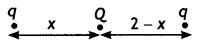
Class 12 Physics Important Questions Chapter 1 Electric Charges and Fields 71
Class 12 Physics Important Questions Chapter 1 Electric Charges and Fields 72

Solving for x, we have x= 1 m

For the equilibrium of charges “q”, the nature of charge Q must be opposite to the nature of charge q and should be placed at the center of two charges.

Question 24.
(a) Define electric flux. Write its S.I. unit.
Answer:
It is defined as the total number of electric field lines crossing a given area. The electric flux can be found by multiplying the component of the electric field in the direction of the area vector (or perpendicular to the area) with the area of the closed surface. It is measured in Nm2C--1.

(b) A small metal sphere carrying charge +Q is located at the center of a spherical cavity inside a large uncharged metallic spherical shell as shown in the figure. Use Gauss’s law to find the expressions for the electric field at points P1 and P2.
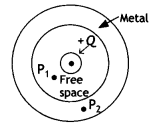
Class 12 Physics Important Questions Chapter 1 Electric Charges and Fields 73
Answer:
For point P, using Gauss law we have
Class 12 Physics Important Questions Chapter 1 Electric Charges and Fields 74

Since E and dA are in the same direction therefore we have E = \(\frac{Q}{\varepsilon_{0} A}\)

Point P2 lies inside the metal, therefore the Gaussian surface drawn at P2 does not include a charge, hence the electric field at P2 is zero.

(c) Draw the pattern of electric field lines in this arrangement. (CBSEAI 2012C)
Answer:
The electric field lines are as shown.
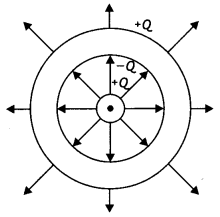
Class 12 Physics Important Questions Chapter 1 Electric Charges and Fields 75

Question 25.
(a) Deduce the expression for the torque acting on a dipole of dipole moment \(\vec{P}\) in the presence of a uniform electric field \(\vec{E}\)
Answer:

Consider an electric dipole consisting of charges -q and +q and dipole length d is placed in a uniform electric field E as shown in the figure.

Let the dipole moment makes an angle θ with the direction of the electric field. The two charges experience force qE each.

These forces are equal, parallel, and opposite. Therefore, the net force acting on the dipole is
Fn = qE – qE = 0

Thus the net force acting on the dipole is zero.

These two forces constitute a couple. This applies a torque on the dipole given by
τ = either force × arm of the couple
τ = qE × d sin θ, where d sin θ is the arm of the couple.
τ = q d Esin θ, where p = qd, dipole moment
τ = pE sin θ.
Class 12 Physics Important Questions Chapter 1 Electric Charges and Fields 59
Consider an electric dipole consisting of -q and +q charges separated by a distance 2a as shown in the figure. Let P be the point of observation on the axial Line where the electric field has to be found. Let it be at a distance r from the center O of the dipole. Let us suppose that the dipole is placed in a vacuum.

Let E and EB be the electric fields at point P due to the charges at A and B respectively. Therefore,Class 12 Physics Important Questions Chapter 1 Electric Charges and Fields 60
Class 12 Physics Important Questions Chapter 1 Electric Charges and Fields 61
The two fields at P are in opposite directions. Thus the resultant electric field at P is given by
E = \(\sqrt{E_{A}^{2}+E_{B}^{2}-2 E_{A} E_{B} \cos \theta}=\sqrt{\left(E_{B}-E_{A}\right)^{2}}\) = EB – EA

since θ = 180° Therefore, the resultant electric field is
Class 12 Physics Important Questions Chapter 1 Electric Charges and Fields 62
Class 12 Physics Important Questions Chapter 1 Electric Charges and Fields 63

Solving we have
Class 12 Physics Important Questions Chapter 1 Electric Charges and Fields 64
where p = q 2a.
If the dipole is short then r >> a, therefore, ‘a’ is neglected as compared to r, hence
Class 12 Physics Important Questions Chapter 1 Electric Charges and Fields 65

This field is in the direction of the dipole moment.

(b) Consider two hollow concentric spheres S1 and S2 and enclosing charges 2Q and 4Q. respectively as shown in the figure, (i) Find out the ratio of the electric flux through them, (ii) How will the electric flux through the sphere S1 change if a medium of dielectric constant ‘er’ is introduced in the space inside S1 in place of air? Deduce the necessary expression. (CBSE Al 2014)
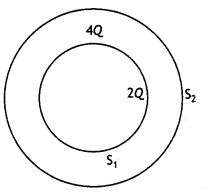
Class 12 Physics Important Questions Chapter 1 Electric Charges and Fields 76
Answer:
Φ1 = \(\frac{2 Q}{\varepsilon_{0}}\) and Φ2 = \(\frac{2 Q+4 Q}{\varepsilon_{0}}=\frac{6 Q}{\varepsilon_{0}}\)

Hence ratio Class 12 Physics Important Questions Chapter 1 Electric Charges and Fields 77
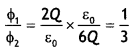
When a dielectric of dielectric constant εr is introduced then we have
Φ1 = \(\frac{2 Q}{\varepsilon}=\frac{2 Q}{\varepsilon_{r} \varepsilon_{0}}\)

Question 26.
(a) Use Gauss’s theorem to find the electric field due to a uniformly charged infinitely large plane thin sheet with surface charge density σ.
Answer:
It states, “The net electric flux through any Gaussian surface is equal to \(\frac{1}{\varepsilon_{0}}\) times the net electric charge enclosed by the surface.

Mathematically, Φ =\( \phi \vec{E} \cdot d \vec{A}=\frac{q_{i n}}{\varepsilon_{0}}\)

Consider an infinite plane sheet of charge. Let a be the uniform surface charge density, i.e. the charge per unit surface area. From symmetry, we find that the electric field must be perpendicular to the plane of the sheet and that the direction of E on one side of the plane must be opposite to its direction on the other side as shown in the figure below. In such a case let us choose a Gaussian surface in the form of a cylinder with its axis perpendicular to the sheet of charge, with ends of area A.

The charged sheet passes through the middle of the cylinder’s length so that the cylinder’s ends are equidistant from the sheet. The electric field has a normal component at each end of the cylinder and no normal component along the curved surface of the cylinder. As a result, the electric flux is linked with only the ends and not the curved surface.

Class 12 Physics Important Questions Chapter 1 Electric Charges and Fields 19

Therefore by the definition of eLectric flux, the flux Linked with the Gaussian surface is given by
Φ = \(\oint_{A} \vec{E} \cdot \vec{\Delta} A\)

Φ = EA + EA = 2EA … (1)

But by Gauss’s Law

Φ = \(\frac{q}{\varepsilon_{0}}=\frac{\sigma A}{\varepsilon_{0}}\) [∵ q = σA] … (2)

From equations (1) and (2), we have

2EA = \(\frac{\sigma A}{\varepsilon_{0}}\) … (3)

E = \(\frac{\sigma}{2 \varepsilon_{0}}\) …. (4)

This gives the electric field due to an infinite plane sheet of charge which is independent of the distance from the sheet.

(b) An infinitely large thin plane sheet has a uniform surface charge density +σ. Obtain the expression for the amount of work done in bringing a point charge q from infinity to a point, distant r, in front of the charged plane sheet. (CBSE Al 2017)
Answer:
Work done
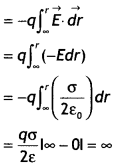
Class 12 Physics Important Questions Chapter 1 Electric Charges and Fields 78

Numerical Problems:

Formulae for solving numerical problems

  • q = ±ne
  • F = \(\frac{1}{4 \pi \varepsilon_{0}} \frac{q_{1} q_{2}}{r^{2}}\)
  • Fmed = \(\frac{1}{4 \pi \varepsilon_{0} K} \frac{q_{1} q_{2}}{r^{2}}\) where K is dielectric constant.
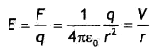
  • Class 12 Physics Important Questions Chapter 1 Electric Charges and Fields 79
  • E = \(\frac{1}{4 \pi \varepsilon_{0}} \frac{2 p}{r^{3}}\) for an electric dipole on its axial line.
  • E = \(\frac{1}{4 \pi \varepsilon_{0}} \frac{p}{r^{3}}\) for an electric dipole on its equitorial line.
  • Torque on an electric dipole in a uniform electric field, τ = PE sin θ.
  • U = -pE cos θ, the potential energy of an electric dipole.
  • Φ = \(\oint \vec{E} \cdot d \vec{A}=\frac{q_{\text {in }}}{\varepsilon_{0}}\)
  • E = \(\frac{\sigma}{2 \varepsilon_{0}}\) , electric field due to an infinite plane sheet of charge.

Question 1.
An electric dipole of length 2 cm is placed with its axis making an angle of 60° to a uniform electric field of 105 NC-1. If it experiences a torque of 8\(\sqrt{3}\) Nm, calculate the (i) magnitude of the charge on the dipole and (ii) potential energy of the dipole.
Answer:
(i) Using
q = τ / L E sin Φ

we have
q = 8N\(\sqrt{3}\) × 2 / 2 × 10-2 × 105 × \(\sqrt{3}\) = 8 × 10⁻³ C

(ii) Using U = -pE cos θ, we have
U = – 8 × 10-3 × 0.02 × 105 × 0.5 = – 8 J

Question 2.
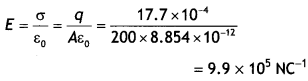
A charge of 17.7 × 10⁻⁴ C is distributed uniformly over a large sheet of area 200 m2. Calculate the electric field intensity at a distance of 20 cm from it in the air.
Answer:
Given q = 17.7 × 10⁻⁴C, A = 200 m2, r = 20cm = 0.2 m

Using the relation
Class 12 Physics Important Questions Chapter 1 Electric Charges and Fields 80

Question 3.
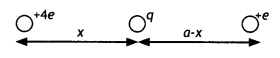
Two fixed point charges +4e and +e units are separated by a distance ‘a’. Where should the third point charge be placed for it to be in equilibrium?
Answer:
The third charge will be in equilibrium if it experiences zero net force. Let it be placed at a distance x from the charge 4e.
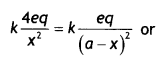
Class 12 Physics Important Questions Chapter 1 Electric Charges and Fields 81
Class 12 Physics Important Questions Chapter 1 Electric Charges and Fields 82

4(a – x)2 = x2 solving for x we have
2 (a – x) = x or x = a/3

Question 4.
An electric field along the x-axis is given by \(\vec{E}\) = 100 îN/C for x > 0 and \(\vec{E}\) = -100 îN/C for x < 0. A right circular cylinder of length 20 cm and radius 5 cm lies parallel to the x-axis with its centre at the origin and one face at x = +10 cm, the other face at x = -10 cm. Calculate the net outward flux through the cylinder. (CBSE 2019C)
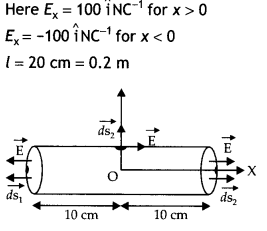
Class 12 Physics Important Questions Chapter 1 Electric Charges and Fields 83

r = 5 cm = 0.05 m
Φ = ?

Net outward flux through the cylinder
Φ = Φ1 + Φ2 + Φ3
= \(\vec{E} \cdot \overrightarrow{d s}_{1}+\vec{E} \cdot \overrightarrow{d s}_{2}+\vec{E} \cdot \overrightarrow{d s}_{3}\)

= Eds1 cos 180° + Eds2 cos 90° + Eds3 cos 0°
= – Eds1 + Eds2 (0) + Eds cos 0°
= – (-100) ds + 100 ds
= (100 +100) ds
= 200 × πr² = 200 × 3.14 × (0.05)²
= 1.57 Nm2 C-1

Question 5.
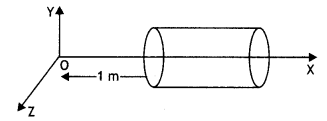
A hollow cylindrical box of length 1m and area of cross-section 25 cm2 is placed in a three-dimensional coordinate system as shown in the figure. The electric field
in the region is given by \(\vec{E}\) = 50x î, where E is in NC-1 and x is in meters. Find

(i) Net flux through the cylinder.
Answer:
We can see from the figure that on the left face E and dS are antiparallel. Therefore, the flux is
ΦL = \(\vec{E}\).\(\vec{dS}\) = E dS cos 180°
= -50 × 1 × 25 × 10-4 = -0.125 N m2 C-1

On the right face, E and dS are parallel and therefore
ΦR = \(\vec{E}\).\(\vec{ds}\) = EdS cos 0°
= 50 × 2 × 25 × 10-4 = 0.250 N m2 C-1

Therefore net flux is – 0.125 + 0.250 = + 0.125 N m2 C-1

(ii) Charge enclosed by the cylinder. (CBSE Delhi 2013)
Class 12 Physics Important Questions Chapter 1 Electric Charges and Fields 84
Answer:
q = Φε0 = 0.125 × 8.854 × 10-12 = 1.1 × 10⁻¹²C

Question 6.
(i) Define electric flux. Write its SI units,
Answer:
(i) It is defined as the number of electric field lines crossing a unit area perpendicular to the given area. It is measured in N m2 C-1

(ii) Consider a uniform electric field \(\vec{E}\) = 5 × 10³î NC-1. Calculate the flux of this field through a square surface of area 12 cm2 when
(a) its plane is parallel to the Y – Z plane, and
(b) the normal to its plane makes a 60° angle with the x-axis. (CBSE Delhi 2013C)
Answer:
Given \(\vec{E}\) = 5 × 10³î N C-1, A = 12 cm2 = 12 × 10-4 m2

(a) Here \(\vec{E}\) = 5 × 10³î N C-1
Area of square = 12 × 10-4 m2

The plane of surface area being parallel to YZ plane, hence
A = 12 × 10-4 î m2

Electric flux of the field
Φ = \(\vec{E}\) \(\vec{A}\) = (5 × 10³ î). (12 × 10-4î) = 6 N C-1 m2
(b) When normal to the plane of surface area makes an angle of 60° with the X-axis, the flux is given by
Φ = EA cos 0 = 5 × 103 × 12 × 10-4 × 0.5
= 3 NC-1 m2
CBSE Sample Papers for Class 10 Maths Standard Set 3 with Solutions

Students can access the CBSE Sample Papers for Class 10 Maths Standard with Solutions and marking scheme Set 3 will help students in understanding the difficulty level of the exam.

CBSE Sample Papers for Class 10 Maths Standard Set 3 with Solutions

Time: 3 Hours
Maximum Marks: 80

General Instructions:

1. This question paper contains two parts, A and B.
2. Both Part A and Part B have internal choices.

Part-A:
1. It consists of two sections, I and II.
2. Section I has 16 questions of 1 mark each. Internal choice is provided in 5 questions.
3. Section II has 4 questions on case study. Each case study has 5 case-based sub-parts. An examinee is to attempt any 4 out of 5 sub-parts.

Part-B:
1. It consists of three sections III, IV and V.
2. In section III, Question Nos. 21 to 26 are Very Short Answer Type questions of 2 marks each.
3. In section IV, Question Nos. 27 to 33 are Short Answer Type questions of 3 marks each.
4. In section V, Question Nos. 34 to 36 are Long Answer Type questions of 5 marks each.
5. Internal choice is provided in 2 questions of 2 marks, 2 questions of 3 marks and 1 question of 5 marks.
Part – A
Section-I

Section I has 16 questions of 1 mark each. Internal choice is provided in 5 questions.

Question 1.
If one of the zeroes of the quadratic polynomial x1 + 3x + k is 2, then find the value of k
Solution :
Since 2 is a zero of p(x) = x2 + 3x + k, then p(x) =0
⇒(2)2 + 3 x 2 + k = 0
⇒ 4 + 6 + k = 0
⇒ k = -10

Question 2.
Find the total number of factors of a prime number.
OR
Find the HCF and the LCM of 12, 21, 15.
Solution :
We know that prime number is a number which has exactly two factors, i.e., 1 and the number itself. So, the total number of factors of a prime number is 2.
OR
12 = 2 x 2 x 3 = 22 x 31
15 = 3 x 5 = 31 x 51 21 = 3 x 7 = 31 x 71 HCF(12, 15,21)= 3
LCM(12, 15, 21) = 22 x 31 x 51 x 71 = 4 x 3 x 5 x 7 = 420

Question 3.
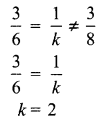
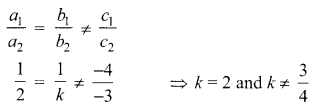
Find the value of k for which the system of equations x + y – 4 = 0 and 2x + ky = 3, has no solution.
Solution :
For the equations, x + y -4 = 0 and 2x + ky = 3
⇒ 2x + ky  –  3 = 0
CBSE Sample Papers for Class 10 Maths Standard Set 3 with Solutions 1

Question 4.
Find the value of x for which 2x, (x + 10) and (3x + 2) are the three consecutive terms of an AP.
OR
The first term of an AP is p and the common difference is q. Find its 10th term.
Solution :
2x (x + 10) and (3x + 2) are three consecutive terms of an AP.
Then, (x+10)-2x= (3x + 2)-(x+10)
⇒ x + 10 – 2x = 3x + 2 – x – 10
⇒ -x + 10 = 2x- 8
⇒ 3x = 18
⇒ x = 6
an = a + (n – 1 )d  ⇒ am =p + (10 – 1 )q =p + 9q
a10 = p + 9q

Question 5.
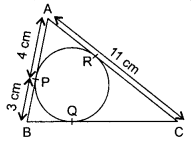
In figure, ΔABC is circumscribing a circle. Find the length of BC.
CBSE Sample Papers for Class 10 Maths Standard Set 3 with Solutions 2
Solution :
Line segments AB, BC and AC are tangents of the circle.
AP = AR = 4 cm     …(i)
[Tangents drawn from the same point to a circle are equal]
Similarly, BP = BQ = 3 cm ……………… (ii)
and   CQ = CR     ………….. (iii)
Since, AC =11 cm  ⇒ AR + CR = 11 cm
⇒ 4 cm + CR = 11 cm [from (i)]
⇒ CR = 7 cm ……………… (iv)
BC = BQ + CQ = 3 cm + 7 cm  [From (ii),(iii) and (iv)]
= 10 cm

Question 6.
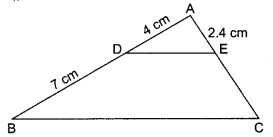
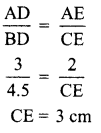
If in the given figure, DE || BC, then find EC.
CBSE Sample Papers for Class 10 Maths Standard Set 3 with Solutions 3
Solution :
CBSE Sample Papers for Class 10 Maths Standard Set 3 with Solutions 4

Question 7.
Find the value of  \(\left(\sin ^{2} \theta+\frac{1}{1+\tan ^{2} \theta}\right)\)
Solution :
\(\sin ^{2} \theta+\frac{1}{1+\tan ^{2} \theta}=\sin ^{2} \theta+\frac{1}{\sec ^{2} \theta}=\sin ^{2} \theta+\cos ^{2} \theta=1\)

Question 8.
Find the value of (1 + tan2 θ) (1 – sin θ) (1 + sin θ).
Solution :
(1 + tan2 θ)(1 – sin θ)(1 + sin θ) = (1 + tan2 θ)(1 – sin2 θ)
\(=\sec ^{2} \theta \cos ^{2} \theta=\frac{1}{\cos ^{2} \theta} \times \cos ^{2} \theta=1\)

Question 9.
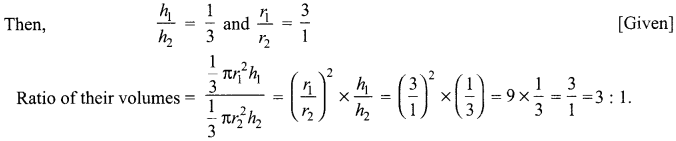
Two cones have their heights in the ratio 1 : 3 and radii in the ratio 3:1. What is the ratio of their volumes? 1
Solution :
Let h1 and h2 be the heights of two cones and r1 and r2 by the radii
CBSE Sample Papers for Class 10 Maths Standard Set 3 with Solutions 5

Question 10.
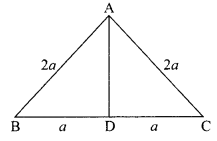
If ABC is an equilateral triangle of side 2a, then find the length of one of its altitudes.
OR
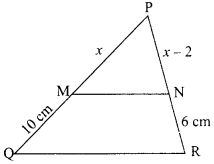
In the given figure, MN || QR. If PM = x cm, MQ = 10 cm, PN = (x – 2) cm, NR = 6 cm, then find the
CBSE Sample Papers for Class 10 Maths Standard Set 3 with Solutions 6
Solution :
In ∠ADB and ∠ADC,
AB = AC [Sides of equilateral triangle ABC]
AD = AD [Common]
∠ADB = ∠ADC [90°, AD ⊥ BC]
ΔADB ≅ ΔADC
ABC is an equilateral triangle such that each side is 2a and AD ⊥ BC.
CBSE Sample Papers for Class 10 Maths Standard Set 3 with Solutions 7
CBSE Sample Papers for Class 10 Maths Standard Set 3 with Solutions 8

Question 11.
Base of an isosceles triangle is \(\frac{2}{3}\) times its congruent sides. Perimeter of the triangle is 32 cm.
Formulate this problem as a pair of equations.
Solution :
Let the congruent side of isosceles triangle be x cm and its base be y cm.
Then \(y=\frac{2}{3} x\)
2x – 3y = 0 ……………. (i)
Also,   x + x + y=32  ⇒ 2x + y = 32 ………….. (ii)

Question 12.
Check whether x(x + 2) – 3 = (x+ 4)x is a quadratic equation.
Solution :
Since  x(x + 2) – 3 = x(x + 4)
⇒ x2 + 2x – 3 = x2 + 4x
⇒ 2x + 3 = 0
This is linear equation not a quadratic equation.

Question 13.
Is x = -2 a solution of 3x2 + 13x + 14 = 0?
OR
State whether the equation (x + 1) (x – 2) + x = 0 has two distinct real roots or not. Justify your answer.
Solution :
Putting the value of x in the quadratic equation,
LHS = 3x2 + 13x + 14 = 3 (-2)2 + 13 (-2) + 14
= 12 – 26 + 14 = 0 = RHS
Hence, x = -2 is a solution.
OR
We have (x + 1) (x – 2) + x = 0
⇒ x2-x-2 + x= 0  ⇒ x2-2 = 0
D = b2 – 4ac = 0 – 4(1) (-2) = 8 > 0
∴ Given equation has two distinct real roots.

Question 14.
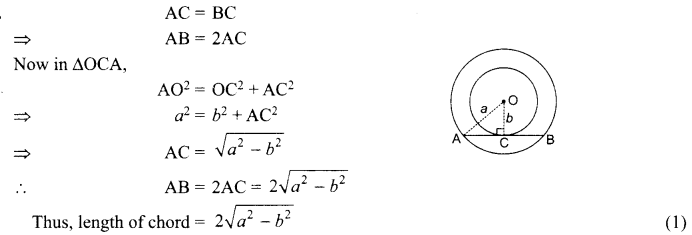
Two concentric circles of radii a and b (a> b) are given. Find the length of the chord of the larger circle which touches the smaller circle.
OR
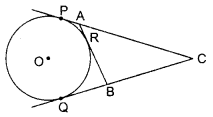
In the given figure, CP and CQ are tangents from an external point C to a circle with centre O. AB is another tangent which touches the circle at R. If CP = 11 cm and BR = 4 cm, find the length of BC.
CBSE Sample Papers for Class 10 Maths Standard Set 3 with Solutions 9
Solution :
CBSE Sample Papers for Class 10 Maths Standard Set 3 with Solutions 10

OR
In the given figure, CP = CQ  [tangents drawn from an external point are equal]
So,  CP = CQ = 11 cm
Also,   BR = BQ   [tangents drawn from an external point are equal]
So,  BR = BQ = 4 cm
∴ Now, BC = CQ – BQ
= (11 -4) cm = 7 cm

Question 15.
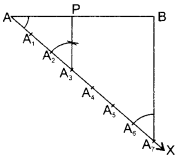
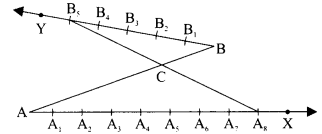
Draw a line segment of length 6 cm. Using compasses and ruler, find a point P on it which divides it in the ratio 3:4.
Solution :
CBSE Sample Papers for Class 10 Maths Standard Set 3 with Solutions 11
Steps of construction:
1. Draw a line segment AB = 6
2. Draw any ray AX making an acute angle XAB with AB.
3. Along AX mark 7 (3 + 4) points A1 A2, A3, A4,……………, A7 at equal distances such that
AA1 = A1A2 = A6A7
4. Join A7B
5. From A3, draw A3P parallel to A7B (by making an angle equal to ∠AA7B at A3) to meet AB at point P.
Then  AP : PB = 3 : 4.

Question 16.
The radius of a circle is 5 cm. Find the circumference of the circle whose area is 49 times the area of given circle.
Solution :
The area of the given circle = πr2 = π(5)2 = 25π sq. cm
Area of the other circle = 49 × 25π
Let the radius of this circle be R Then
Then πR2 = 49 x 25 x π  ⇒ R2 = (7)2 x (5)2
R = 7 x 5 = 35 cm
The required circumference = 2πR = 2 x \(\frac{22}{7}\) x 35 = 220 cm

Section-II

Case Study based questions are compulsory. Attempt any four sub-parts of each question. Each sub-part carries 1 mark.

Case Study Based-1

Question 17.
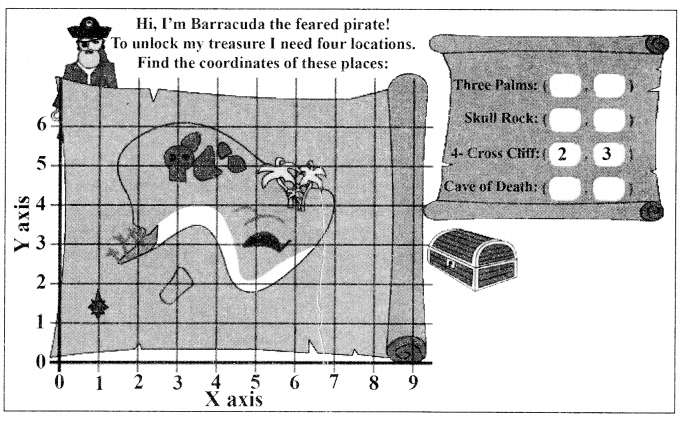
Treasure Island Shikha and Sanjana are playing a board game of

Treasure Island.
Shikha and Sanjana are playing a board game of Treasure Island.
CBSE Sample Papers for Class 10 Maths Standard Set 3 with Solutions 12
Refer to Skull Rock and Cave of Death
(a) The mid-point of the segment joining A(3, 5) and C(5, 3) is……..
(i) (2,3)
(ii) (3,5)
(iii) (4,3)

Refer to Three Palms
(b) The distance of point D(6, 4) from origin is
(i) \(5 \sqrt{7}\)units
(ii) \(7 \sqrt{5}\) units
(iii) \(4 \sqrt{10}\) units
(iv) \(2 \sqrt{23}\) units

Refer to 4-Cross Cliffs and Three Palms
(c) The distance between the points B(2,3)and D(6, 4) is
(i) \(\sqrt{13} \text { units }\)units
(ii) 4 units
(iii) \(5 \sqrt{3}\)units
(iv) \(\sqrt{17}\)units

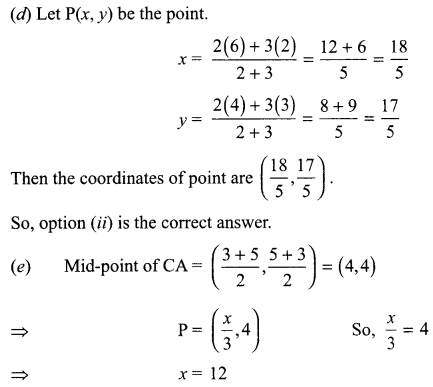
(d) The coordinate of the point which divides the join of B(2,3) and D(6,4) in the ratio 2 : 3 is
(i) \(\left(\frac{13}{4}, \frac{19}{4}\right)\)
(ii) \(\left(\frac{18}{5}, \frac{17}{5}\right)\)
(iii) \(\left(\frac{11}{8}, \frac{13}{8}\right)\)
(iv) \(\left(\frac{19}{3}, \frac{16}{3}\right)\)

(e) If \(P\left(\frac{x}{3}, 4\right)\) is the mid-point of the line segment joining the points C(5,3) and
A(3, 5), then
(i) 8
(ii) 10
(iii) 12
(iv) 16
Solution :
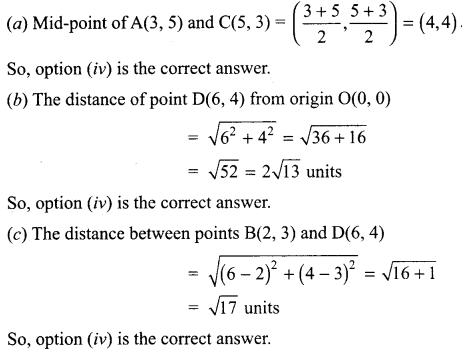
CBSE Sample Papers for Class 10 Maths Standard Set 3 with Solutions 13
CBSE Sample Papers for Class 10 Maths Standard Set 3 with Solutions 14

Case Study Based-2

Question 18.
What are you Smoking?
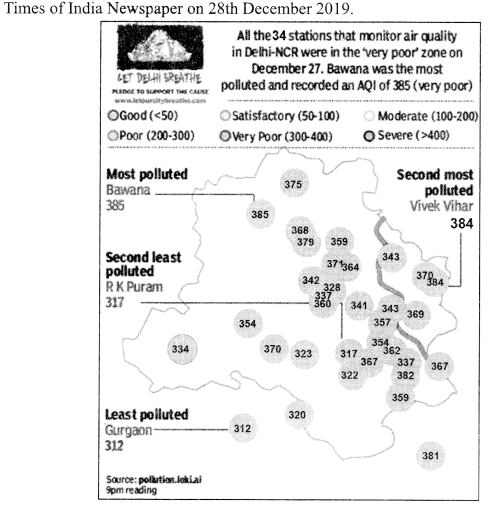
Given below is Air Quality Index of different localities of Delhi on 27th December 2019 by Times of India Newspaper on 28th. December 2019
CBSE Sample Papers for Class 10 Maths Standard Set 3 with Solutions 15
The data recorded from above AQI (Air Quality Index) is given below:

AQI310-320320-330330-340340-350350-360360-370370-380380-390
Frequencies24345754

(a) The sum of the lower limits of the median class and modal class is ……………
(i) 650
(ii) 660
(iii) 750
(iv) 710

(b) The modal class is …………
(i) 310-320
(ii) 330-340
(iii) 360-370
(iv) 380-390

(c) The upper limit of the median class is ………
(i) 330
(ii) 350
(iii) 360
(iv) 390

(d) The difference of the upper limit of the median class and the lower limit of the modal class is ……..
(i) 0
(ii) 1
(iii) 2
(iv) 3

(e) The mean AQI is ……..
(i) 335.8
(ii) 354.7
(iii) 360.4
(iv) 395.9
Solution :

ClassFrequencyCumulative Frequency
310-32022
320-33046
330-34039
340-350413
350-360518 ← Median Class
360-370725 ← Model Class
370-380530
380-390434
n= 34

We have \(n=34, \frac{n}{2}=\frac{34}{2}=17\)

∴ The sum of the lower limits of the median class and modal class = 350 + 360 = 710 So, option
(iv) is the correct answer.

(b) Here, the maximum frequency is 7 and the corresponding class is 360-370.
So, modal class is 360-370. So, option (iii) is the correct answer.

(c) The median class is 350-360 which has upper limit 360. So, option (iii) is the correct answer.

(d) The difference between upper limit of the median class and the lower limit of the modal class = 360 – 360 = 0. So, option (i) is the correct answer.

(e)

ClassFrequency (fi)Class Mark (xi)

fi xi

310-3202315630
320-33043251300
330-34033351005
340-35043451380
350-36053551775
360-37073652555
370-38053751875
380-39043851540
∑fi = 34∑fxi = 12060

\(\text { Mean }=\frac{\sum f_{i} x_{i}}{\sum f_{i}}=\frac{12060}{34}=354.7(\text { approx. })\)
So, option (ii) is the correct answer.

Case Study Based-3

Question 19.
Skipping Rope
Skipping rope is a good exercise. It bums calories, makes bones strong and improves heart health.

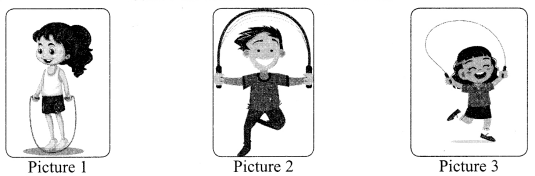
During skipping, when rope goes up and down it makes the shape of parabolas (graphs of quadratic polynomials). Observe the following skipping pictures.
CBSE Sample Papers for Class 10 Maths Standard Set 3 with Solutions 16

Refer Picture 1
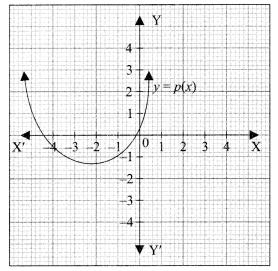
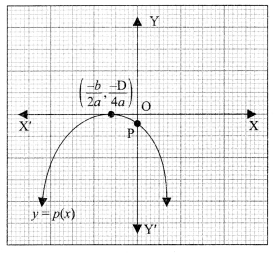
(a) The graph of polynomial p(x) represented by Picture 1 is shown below. The number of zeroes of the polynomial is
CBSE Sample Papers for Class 10 Maths Standard Set 3 with Solutions 17
(i) 0
(ii) 1
(iii) 2
(iv) 4

Refer Picture 2
(b) The graph of polynomial p(x) represented by Picture 2 is shown below. Which of the following has negative (-) sign?
CBSE Sample Papers for Class 10 Maths Standard Set 3 with Solutions 18
(i) a
(ii) b
(iii) c
(iv) All of there

(c) If \(\frac{1}{4}\) and 1 are the sum and product of zeroes of a polynomial whose graph is represented by Picture (3), the quadratic polynomial is
(i) \(k\left(x^{2}-\frac{1}{4} x-1\right)\)
(ii) \(k\left(\frac{1}{4} x^{2}-x-1\right)\)
(iii) \(k\left(x^{2}+\frac{1}{4} x+1\right)\)
(iv) \(k\left(\frac{1}{4} x^{2}+x+1\right)\)

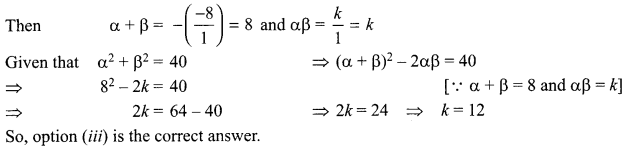
(d) Let the Picture (1) represent the quadratic polynomial f(x) = x2 – 8x + k whose sum of the
squares of zeroes is 40, The value of k is
(i) 8
(ii) 10
(iii) 12
(iv) 20

(e) Let the Picture (3) represent the quadratic polynomial f(x) = x2 + 7x + 10. Then its zeroes are
(i) -1, -5
(ii) -2, -5
(iii) 1, 5
(iv) 2, 5
Solution :
(a) Since the graph y p(x) cuts the x-axis at two different points, so the polynomial has two zeroes. So, option (iii) is the correct answer.

(b) The parabola)’ = ax2 + bx + c open downwards. Therefore, a <O. The vertex \(\left(\frac{-b}{2 a}, \frac{-\mathrm{D}}{4 a}\right)\) of the parabola is on OX1.
\( \quad \frac{-b}{2 a}<0 \quad \Rightarrow b<0\)
Parabola y =p(x) cuts y-axis at P(O, c) which lies on OY’. Therefore e <O.
Hence, O, b <O and c< O.
So, option (iv) is the correct answer.

(c) We have sum \(\frac{1}{4}\) and product
\(f(x)=k\left(x^{2}-\frac{1}{4} x-1\right)\)
So, option (iii) is the correct answer.

(d) CBSE Sample Papers for Class 10 Maths Standard Set 3 with Solutions 46

(e) We have
x2 + 7x + 10 =x2 + 5x + 2x + 10 = x(x + 5) + 2(x + 5) = (x + 2)(x + 5)
Now, when x + 2 = 0 or x + 5 = 0, i.e., whenx = -2 andx = -5
Therefore, the zeroes of x2 + lx + 10 are -2 and -5

Question 20.

Fair Play
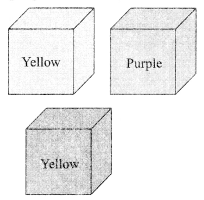
Garima has two children, Tapan and Maya. Every Sunday is a game night in the family. Tonight Garima has planned for a game with three cubes, one purple and two yellow. She placed the three cubes in a bag and called for her children.
Garima: Do you want to play a game of probability?
Maya: What is probability?
Garima: Let me ask you something before I answer you. Can you predict what is in this bag?
Tapan: I cannot guess that!
Maya: I am 100% sure it is a toy!
Garima: I am glad you think that Maya. Just now you used the concept of probability.
Whether an event can happen or not, can’t be predicted with total certainty. But we can always predict how- likely or unlikely it is for an event to happen.
And for predicting that, we use a concept called probability.
\(\text { Probability (an event to happen) }=\frac{\text { Number of ways event can happen }}{\text { Total number of ways all events can happen }}\)
Placing the bag of cubes in the centre, Garima explained the rules of the game to the children. Garima: Without looking, the first player will pick out a cube from the bag and then the second player will also pick out one cube without looking. If the two cubes picked out were the same colour, then the first person will win the game. If the boxes picked out are of two differently coloured cubes, then the second player will be the winner.

CBSE Sample Papers for Class 10 Maths Standard Set 3 with Solutions 19

(a) In the first round, Maya pulled out a cube, which was yellow. What is the probability that Tapan will win the game?
(i) \(\frac{1}{2}\)
(ii) \(\frac{1}{3}\)
(iii) \(\frac{2}{3}\)
(iv) 0

(b) in the second round, Tapan started by picking out a purple cube. What is the probability for Tapan to win the round?
(i) 1
(ii) \(\frac{1}{3}\)
(iii) 0
(iv) \(\frac{2}{3}\)

(c) In the third round, Maya pulled out a cube. The probability that the pulled out cube is not of yellow colour is
(i) 1
(ii) \(\frac{1}{2}\)
(iii) \(\frac{1}{3}\)
(iv) \(\frac{2}{3}\)

(d) In the fourth round, Tapan pulled out a cube. The probability that the pulled out cube is either purple or yellow is
(i) 1
(ii) \(\frac{1}{2}\)
(iii) \(\frac{1}{3}\)
(iv) \(\frac{2}{3}\)

(e) In the last round, Maya pulled out a cube. The probability that the pulled out cube is of green colour is
(i) 1
(ii) \(\frac{1}{2}\)
(iii) \(\frac{1}{3}\)
(iv) 0
Solution :
(a) After taking out one yellow cube, the bag is left with 1 yellow cube whose probability of pulling out \(\frac{1}{2}\) So, option (i) is the correct answer.

(b) After taking out one purple cube, the bag has no purple cube. So, the probability for Tapan to win the round is
\(\frac{0}{3}\) = 0
So, option (iii) is the correct answer.

(c) The number of yellow cube is 1. So, the probability of pulling out a cube not of yellow colour is \(\frac{1}{3}\)
So, option (iii) is the correct answer.

(d) The number of purple and yellow cubes =1 + 2 = 3.
∴ The required probability =\(\frac{3}{3}\) = 1
So, option (i) is the correct answer.

(e) The number of green cube = 0
.’. The required probability = \(\frac{0}{3}\) = 0
So, option (iv) is the correct answer.

Part-B
Section-III

All questions are compulsory. In case of internal choices, attempt any one.

Question 21.
Write a rational number between \(\sqrt{2} \text { and } \sqrt{3}\)
Solution :
We have  √2 =1.4142135…. and √3 = 1.7320508…
Since every terminating decimal or repeating decimal represents a rational number.
So, 1.666666… is a rational number between \(\sqrt{2} \text { and } \sqrt{3}\)
Also 1.5, 1.6, 1.7 are rational numbers between \(\sqrt{2} \text { and } \sqrt{3}\)

Question 22.
Find the ratio in which the point (-3, p) divides the line segment joining the points (-5,-4) and (-2,3).
Hence find the value of p.
OR
If the point C(-1, 2) divides internally the line segment joining A(2, 5) and B(x, y) in the ratio 3 : 4, find the coordinates of B.
Solution :
CBSE Sample Papers for Class 10 Maths Standard Set 3 with Solutions 20

Question 23.
Find a quadratic polynomial whose zeroes are reciprocals of the zeroes of the polynomial f(x)=ax2+bx+c,a≠0,c≠0.
Solution :
Let the zeroes of the polynornial f(x) = ax2 + bx + c be α and β.
Then \(\alpha+\beta=\frac{-b}{a} \text { and } \alpha \beta=\frac{c}{a}\)
Now, the zeroes of the required polynomial are reciprocals of a and p.
∴ The required quadratic polynomial is given by
CBSE Sample Papers for Class 10 Maths Standard Set 3 with Solutions 21

Question 24.
Draw a line segment AB of length 7 cm. Taking A as centre, draw a circle of radius 3 cm and taking B as centre, draw another circle of radius 2 cm. Construct tangents to each circle from the centre of the other circle.
Solution :
CBSE Sample Papers for Class 10 Maths Standard Set 3 with Solutions 22
Steps of construction:
1. Draw a line segment AB of length 7 cm.
2. With A as centre, draw a circle of radius 3 cm.
3. With B as centre, draw a circle of radius 2 cm.
4. Draw the perpendicular bisector of AB. Let P be the mid-point of segment AB.
5. With P as centre and radius PA draw a circle which intersects the circle with centre A at M and the circle with centre B at R and S.
6. Join BM and BN. Also join AR and AS. Then, BM, BN, AR and AS are required tangents.

Question 25.
The rod AC of a TV disc antenna is fixed at right angles to the wall AB and a rod CD is supporting the disc as shown in figure. If AC = 1.5 m and CD = 3 m, then find
(a) tan θ
(b) sec  θ + cosec θ
CBSE Sample Papers for Class 10 Maths Standard Set 3 with Solutions 23
If sin θ + cosθ = √3, then prove that tan θ + cot θ = 1.
Solution :
CBSE Sample Papers for Class 10 Maths Standard Set 3 with Solutions 24

Question 26.
In the given figure, two tangents TP and TQ are drawn to a circle with centre O from an external point T
CBSE Sample Papers for Class 10 Maths Standard Set 3 with Solutions 25
Prove that: ∠PTQ = ∠OPQ.
Solution :
We know that, tangents drawn from same external point are equal.
CBSE Sample Papers for Class 10 Maths Standard Set 3 with Solutions 26
CBSE Sample Papers for Class 10 Maths Standard Set 3 with Solutions 27

Section-IV

Question 27.
Find HCF and LCM of 404 and 96 and verify that HCF x LCM = product of the two given numbers.
Solution :
404 = 2 x 2 x 101 =22 x 101
96 = 2 x 2 x 2 x 2 x 2 x 3 = 25 x3
∴ HCF of 404 and 96 = 22 = 4
LCM of 404 and 96 = 101 x 25 x 3 = 9696 HCF x LCM
= 4 x 9696 = 38784
Also   404 x 96 = 38784
Hence HCF x LCM = Product of 404 and 96.

Question 28.
If the roots of the equation (a – b)x2 + (b – c )x + (c – a) = 0 are equal, prove that 2a = b + c.
OR
The sum of the squares of two consecutive odd numbers is 394. Find the numbers.
Solution :
For real and equal roots, D = 0 ⇒ (b – c)2 – 4(a – b)(c -a) = 0
⇒ b2 + c2 – 2be – 4ac + 46c + 4a2 – 4ab = 0
⇒ 4a2 + b2 + c2 – 4ab + 2 be – 4ac = 0
⇒ (-2a)2 + (b)1 + (c)2 + 2(-2 a)b + 2 (b)(c) + 2c(-2a) = 0
⇒ ( – 2a + b + c)2 = 0  ⇒ – 2a + b + c = 0
⇒ 2 a = b + c
OR
Let the two consecutive odd numbers be x and x +2
x2 + (x + 2)2 = 394                                ⇒ x2 + x2 + 4 + 4x = 394
⇒ 2x2 + 4x + 4 = 394                            ⇒ 2x2 + 4x – 390 = 0
⇒  x2 + 2x – 195 = 0                               ⇒ x2 + 15x – 13x – 195 = 0
⇒ x (x + 15) – 13 (x + 15) = 0                ⇒ (x- 13) (x+ 15) = 0
x – 13 = 0                                                  ⇒ or x + 15 = 0
⇒  x= 13                                                   ⇒ or x = – 15 (neglected)

When the first number x = 13, then the second number x + 2 = 13 + 2= 15.

Question 29.
ABCD is a square of side 4 cm. At each comer of the square, a A quarter circle of radius 1 cm, and at the centre, a circle of radius 1 cm, are drawn, as shown in the given figure. Find the area of the shaded region.
CBSE Sample Papers for Class 10 Maths Standard Set 3 with Solutions 28
Solution :
Area of the shaded portion
= Area of given square ABCD
– 4 x area of each quarter circle
– area of the circle at the centre.
CBSE Sample Papers for Class 10 Maths Standard Set 3 with Solutions 29

Question 30.
In the given figure, \(\angle \mathrm{D}=\angle \mathrm{E} \text { and } \frac{\mathrm{AD}}{\mathrm{DB}}=\frac{\mathrm{AE}}{\mathrm{EC}}\) prove that ΔBAC is an isosceles triangle.
CBSE Sample Papers for Class 10 Maths Standard Set 3 with Solutions 30
OR
Prove that the sum of squares of the sides of a rhombus is equal to the sum of the squares of its diagonals.
CBSE Sample Papers for Class 10 Maths Standard Set 3 with Solutions 31
CBSE Sample Papers for Class 10 Maths Standard Set 3 with Solutions 33

[ ∴ AB = BC = CD = AD, sides of a rhombus]
Hence, the sum of the squares of the sides of a rhombus is equal to the sum of the squares of its diagonals.

Question 31.
In the given figure, PA, QB, RC and SD are all perpendiculars to a line l, AB = 6 cm, BC = 9 cm, CD = 12 cm and SP = 36 cm. Find PQ, QR and RS.
CBSE Sample Papers for Class 10 Maths Standard Set 3 with Solutions 34

Solution :
If three or more line segments are perpendiculars to one line, then they are parallel to each other.
CBSE Sample Papers for Class 10 Maths Standard Set 3 with Solutions 35

Question 32.
The angle of elevation of the top of a tower from a certain point is 30°. If the observer moves 20 metres towards the tower, the angle of elevation of the top increases by 15°. Find the height of the tower.
Solution:
Let AB be the tower and angle of elevation from point C = 30°
CBSE Sample Papers for Class 10 Maths Standard Set 3 with Solutions 36

Question 33.
The median of the following data is 525. Find the values ofx andy, if total frequency is 100.

Class0-100100-200200-300300-400400-500500-600600-700700-800800-900900-1000
Frequency25X121720y974

Solution:

ClassFrequencycf
0-10022
100-20051
200-300X7 + x
300-4001219+x
400-5001736+x
500-6002056 +x
600-700y56 + x +y
700-800965 + x + y
800-900772 +x+y
900-1000416+ x + y

CBSE Sample Papers for Class 10 Maths Standard Set 3 with Solutions 37

Section – V

Question 34.
A vertical tower stands on a horizontal plane and is surmounted by a vertical flag-staff of height 6 m. At a point on the plane, the angle of elevation of the bottom and top of the flag­staff are 30° and 45° respectively. Find the height of the tower. (Take 73 = 1.73)
OR
A vertical tower stands on a horizontal plane and is surmounted by a flag-staff of height 5 m. From a point on the ground the angles of elevation of the top and bottom of the flag-staff are 60° and 30° respectively. Find the height of the tower and the distance of the point from base of the tower.
Solution :
CBSE Sample Papers for Class 10 Maths Standard Set 3 with Solutions 38
Or

Let height of tower (TR) be x m, distance (RP) of a point from the base of tower be y m, height of the flag-staff (QT) be 5 m. Then in the ΔTRP,
CBSE Sample Papers for Class 10 Maths Standard Set 3 with Solutions 39

Question 35.
A toy is in the form of a right circular cylinder with a hemisphere on one end and a cone on the other. The height and radius of the cylindrical part are 13 cm and 5 cm respectively. The radii of the hemispherical and conical parts are the same as that of the cylindrical part. Calculate the surface area of the toy if the height of the conical part is 12 cm.
CBSE Sample Papers for Class 10 Maths Standard Set 3 with Solutions 40
Solution :
Let r be the radius and h the height of the cylindrical part of the toy.
Then, r = 5 cm and h = 13 cm.
Let, r1 be the radius of the conical part, h1 its height and 1 its slant height.
CBSE Sample Papers for Class 10 Maths Standard Set 3 with Solutions 41
CBSE Sample Papers for Class 10 Maths Standard Set 3 with Solutions 42

Question 36.
A boat goes 30 km upstream and 44 km downstream in 10 hours. In 13 hours, it can go 40 km upstream and 55 km downstream. Determine the speed of the stream and that of the boat in still water.
Solution :
Let the speed of the boat in still water be x km/h and the speed of the stream be y km/h.
∴ Speed of the boat going upstream = (x-y) km/h and
speed of the boat going downstream = (x + y) km/h
CBSE Sample Papers for Class 10 Maths Standard Set 3 with Solutions 43
CBSE Sample Papers for Class 10 Maths Standard Set 3 with Solutions 44
CBSE Sample Papers for Class 10 Maths Standard Set 3 with Solutions 45
On solving (v) and (vi), we get x = 8, y = 3
Hence, speed of the boat in still water = 8 km/h and speed of the stream = 3 km/h.

CBSE Sample Papers for Class 10 Maths Standard Set 2 with Solutions

Students can access the CBSE Sample Papers for Class 10 Maths Standard with Solutions and marking scheme Set 2 will help students in understanding the difficulty level of the exam.

CBSE Sample Papers for Class 10 Maths Standard Set 2 with Solutions

Time: 3 Hours
Maximum Marks: 80

General Instructions:

1. This question paper contains two parts, A and B.
2. Both Part A and Part B have internal choices.

Part-A:
1. It consists of two sections, I and II.
2. Section I has 16 questions of 1 mark each. Internal choice is provided in 5 questions.
3. Section II has 4 questions on case study. Each case study has 5 case-based sub-parts. An examinee is to attempt any 4 out of 5 sub-parts.

Part-B:
1. It consists of three sections III, IV and V.
2. In section III, Question Nos. 21 to 26 are Very Short Answer Type questions of 2 marks each.
3. In section IV, Question Nos. 27 to 33 are Short Answer Type questions of 3 marks each.
4. In section V, Question Nos. 34 to 36 are Long Answer Type questions of 5 marks each.
5. Internal choice is provided in 2 questions of 2 marks, 2 questions of 3 marks and 1 question of 5 marks.

Part – A
Section-I

Section 1 has 16 questions of 1 mark each. Internal choice is provided in 5 questions.

Question 1.
If xy = 180 and HCF(x, y) = 3, then find the LCM(x, y).
OR
The decimal representation of will terminate after how many decimal places?
Solution :
(LCM)(3)= 180
LCM = 60
OR
Four decimal places.

Question 2.
If the sum of the zeroes of the quadratic polynomial 3×2 – kx + 6 is 3, then find the value of k.
Solution :
Maths Sample Paper Class 10 2020 Standard Solution Set 2.15

Question 3.
For what value of k, the pair of linear equations 3x + y = 3 and 6.x + ky = 8 does not have a solution.
Solution :
Maths Sample Paper Class 10 2020 Standard Solution Set 2.16

Question 4.
If 3 chairs and 1 table costs ₹ 1500 and 6 chairs and 1 table costs ₹ 2400, form linear equations to represent this situation.
Solution :
Let the cost of 1 chair = ₹ x
And the cost of 1 table = ₹ y
3 x + y= 1500
6x + y = 2400

Question 5.
Which term of the AP 27, 24, 21, is zero?
OR
In an Arithmetic Progression, if d = -4, n = 7, an = 4, then find a.
Solution :
an = a + (n – 1) d
0= 27 + (n-1)(-3)
30= 3n
n= 10
10th term.
OR
an= a + (n — 1 )d
4 = a + 6 X (—4)
a = 28

Question 6.
For what values of k, the equation 9x2 + 6kx + 4 = 0 has equal roots?
Solution :
9x2 +6kx + 4 = 0
(6k)2-4 x 9 x 4 = 0
36k2 = 144
⇒ k= 4
k = ±2

Question 7.
Find the roots of the equation x2 + 1x + 10 = 0.
OR
For what value(s) of ‘a’ quadratic equation 3ax2 – 6x + 1 = 0 has no real roots?
Solution :
x2 + 7x+ 10= 0
x2 + 5x + 2x+ 10= 0
(x + 5)(x + 2) = 0
x = -5, x = -2
OR
3ax2 – 6x + 1 = 0
(-6)2– 4(3a)(1) < 0
12a > 36
⇒ a > 3

Question 8.
If PQ = 28 cm, then find the perimeter of ΔPLM.
Maths Sample Paper Class 10 2020 Standard Solution Set 2.1
Answer:
PQ = PT

PL + LQ= PM + MT
PL + LN = PM + MN
Perimeter (ΔPLM) = PL + LM + PM
= PL + LN + MN + PM = 2 (PL + LN) = 2(PL + LQ)
= 2 x 28 = 56 cm

Question 9.
If two tangents inclined at 60° are drawn to a circle of radius 3 cm, then find length of each tangent.
OR
PQ is a tangent to a circle with centre O at point P. If ∠OPQ is an isosceles triangle, then find ∠OQP.
Answer:
Maths Sample Paper Class 10 2020 Standard Solution Set 2.17

Question 10.
In the AABC, D and E are points on side AB and AC respectively such that DE || BC. If
AE = 2 cm, AD = 3 cm and BD = 4.5 cm, then find CE.
Answer:
Maths Sample Paper Class 10 2020 Standard Solution Set 2.18

Question 11.
In the figure, if B1, B2, B3,…. and A1, A2, A3,….. have been marked at equal distances. In what ratio C divides AB?
Maths Sample Paper Class 10 2020 Standard Solution Set 2.2
Answer:
8:5

Question 12.
sin A + cos B =1, A = 30° and B is an acute angle, then find the value of B.
Answer:
Maths Sample Paper Class 10 2020 Standard Solution Set 2.19

Question 13.
If x = 2 sin2 θ and y = 2 cos2 θ + 1, then find x + y
Answer:
x + y = 2sin2
0 + 2 cos2 9 + 1
= 2(sin2 0 + cos2 0) + 1
= 3

Question 14.
In a circle of diameter 42 cm,if an arc subtends an angle of 60° at the centre where n = then what will be the length of arc?
Answer:
Maths Sample Paper Class 10 2020 Standard Solution Set 2.20

Question 15.
12 solid spheres of the same radii are made by melting a solid metallic cylinder of base diameter 2 cm and height 16 cm. Find the diameter of the each sphere.
Answer:
Maths Sample Paper Class 10 2020 Standard Solution Set 2.21

Question 16.
Find the probability of getting a doublet in a throw of a pair of dice.
OR
Find the probability of getting a black queen when a card is drawn at random from a well- shuffled pack of 52 cards.
Answer:
Maths Sample Paper Class 10 2020 Standard Solution Set 2.22

Section-II

Case Study based questions are compulsory. Attempt any four sub-parts of each question. Each sub-part carries 1 mark.

Case Study Based-1 Sun Room

Question 17.
The diagrams show the plans for a sun room. It will be built onto the wall of a house. The four walls of the sun room are square clear glass panels. The roof is made using four clear glass panels, trapezium in shape, all the same size

  • one tinted glass panel, half a regular octagon in shape.

Maths Sample Paper Class 10 2020 Standard Solution Set 2.3

Refer to Top View
(a) Find the mid-point of the segment joining the points J (6, 17) and I (9, 16).
(i) \(\left(\frac{33}{2}, \frac{15}{2}\right)p\)
(ii) \(\left(\frac{3}{2}, \frac{1}{2}\right)\)
(iii) \(\left(\frac{15}{2}, \frac{33}{2}\right)\)
(iv) \(\left(\frac{1}{2}, \frac{3}{2}\right)\)
Solution:
(iii) \(\left(\frac{15}{2}, \frac{33}{2}\right)\)

Refer to Front View
(b) The distance of the point P from the y-axis is
(i) 4
(ii) 15
(iii) 19
(iv) 25
Solution:
(i) 4

Refer to Front View
(c) The distance between the points A and S is
(i) 4
(ii) 8
(iii) 16
(iv) 20
Solution:
(iii) 16

Refer to Front View
(d) Find the coordinates of the point which divides the line segment joining the points A and B in the ratio 1 : 3 internally.
(i) (8.5, 2.0)
(ii) (2.0, 9.5)
(iii) (3.0, 7.5)
(iv) (2.0, 8.5)
Solution:
(iv) (2.0, 8.5)

Refer to Front View
(e) If a point (x,v) is equidistant from the Q(9. 8) and S( 17, 8), then 1
(i) x + y = 13
(ii) x – 13 = 0
(iii) x – 13 = 0
(iv) x – y – 13
Solution:
(ii) x – 13 = 0

Case Study Based-2

Question 18.
Scale Factor and Similarity
Scale Factor
Maths Sample Paper Class 10 2020 Standard Solution Set 2.4
Solution :
A scale drawing of an object is the same shape as the object but a different size.
The scale of a drawing is a comparison of the length used on a drawing to the length it represents. The scale is written as a ratio.

Similar Figures

The ratio of two corresponding sides in similar figures is called the scale factor.
Maths Sample Paper Class 10 2020 Standard Solution Set 2.5
If one shape can become another using resizing, then the shapes are similar.
Maths Sample Paper Class 10 2020 Standard Solution Set 2.6
Hence, two shapes are similar when one can become the other after a resize, flip, slide or turn.
(a) A model of a boat is made on the scale of 1 : 4. The model is 120 cm long. The full size of the boat has a width of 60 cm. What is the width of the scale model?
(i) 20 cm
(ii) 25 cm
(iii) 15 cm
(iv) 240 cm
Solution :
(iii) 15 cm

(b) What will effect the similarity of any two polygons?
(i) They are flipped horizontally.
(ii) They are dilated by a scale factor.
(iii) They are translated down.
(iv) They are not the mirror image of one another.
Solution :
(iv) They are not the mirror image of one another.

(c) If two similar triangles have a scale factor of a : b, which statement regarding the two triangles is true?
(i) The ratio of their perimeters is 3a : b
(ii) Their altitudes have a ratio a : b
(iii) Their medians have a ratio \(\frac{a}{2}: b\)
(iv) Their angle bisectors have a ratio a2: b2
Solution :
(ii) Their altitudes have a ratio a : b

(d) The shadow of a stick 5 m long is 2 m. At the same time, the shadow of a tree 12.5 m high is
Maths Sample Paper Class 10 2020 Standard Solution Set 2.7
(i) 3 m
(ii) 3.5 m
(iii) 4.5 m
(iv) 5 m
Solution :
(iv) 5 m

(e) Below you see a student’s mathematical model of a farmhouse roof with measurements. The attic floor, ABCD in the model, is a square. The beams that support the roof are the edges of a rectangular prism, EFGHKLMN. E is the middle of AT, F is the middle of BT, G is the middle of CT. and H is the middle of DT. All the edges of the pyramid in the model have length of 12 m.
Maths Sample Paper Class 10 2020 Standard Solution Set 2.8

What is the length of EF, where EF is one of the horizontal edges of the block?
(i) 24 m
(ii) 3 m
(iii) 6 m
(iv) 10 m
Solution :
(iii) 6 m

Case Study Based-3

Question 19.
Applications of Parabolas-Highway Overpasses/Underpasses A highway underpass is parabolic in shape.
Maths Sample Paper Class 10 2020 Standard Solution Set 2.9
Answer:
Parabola: A parabola is the graph that results from p(x) — ax2 + bx + c. Parabolas are symmetric about a vertical line known as the Axis of Symmetry. The Axis of Symmetry runs through the maximum or minimum point of the parabola which is called the vertex.
Maths Sample Paper Class 10 2020 Standard Solution Set 2.10

(a) If the highway overpass is represented by x2 – 2x – 8, then its zeroes are
(i) (2. -4)
(ii) (4, -2)
(iii) (-2, -2)
(iv) (-4, -4)
Answer:
(ii) (4, -2)

(b) The highway overpass is represented graphically. Zeroes of a polynomial can be expressed graphically. Number of zeroes of polynomial is equal to number of points where the graph of polynomial
(i) intersects x-axis
(ii) intersects y-axis
(iii) intersects y-axis or x-axis
(iv) None of the above
Answer:
(i) intersects x-axis

(c) Graph of a quadratic polynomial is a
(i) straight line.
(ii) Circle
(iii) Parabolla
(iv) ellipse
Answer:
(iii) Parabolla

(d) The representation of Highway Underpass whose one zero is 6 and sum of the zeroes is 0, is 1
(i)  x2 – 6x + 2
(ii) x2 – 36
(iii) x2 – 6
(iv) x2 – 3
Answer:
(ii) x2 – 36

(e) The number of zeroes that polynomial f(x) = (x – 2)2 + 4 can have is:
(i) 1
(ii) 2
(iii) 0
(iv) 3
Answer:
(iii) 0

Case Study Based-4

Question 20.
Maths Sample Paper Class 10 2020 Standard Solution Set 2.11

(a) Estimate the mean time taken by a student to finish the race.
(i) 54
(ii) 63
(iii) 43
(iv) 50
Solution :
(iii) 43

(b) What will be the upper limit of the modal class?
(i) 20
(ii) 40
(iii) 60
(iv) 80
Solution :
(iii) 60

(c) The construction of cumulative frequency table is useful in detennining the
(i) mean
(ii) median
(iii) mode
(iv) All of the above
Solution :
(ii) median

(d) The sum of lower limits of median class and modal class is
Solution :
(i) 60
(ii) 100
(iii) 80
(iv) 140
Solution :
(iii) 80

(e) How many students finished the race within 1 minute?
(i) 18
(ii) 37
(iii) 31
(iv) 8
Solution :
(iii) 31

Part-B
Section-III

All questions are compulsory. In case of internal choices, attempt anyone.

Question 21.
3 bells ring at an interval of 4, 7 and 14 minutes. All three bell rang at 6 am, when the three balls will the ring together next?
Solution :
4 = 2 x 2
7 =7 x 1
14 = 2 x 7
LCM = 2 x 2 x 7 = 28
The three bells will ring together again at 6 : 28 am

Question 22.
Find the point on x-axis which is equidistant from the points (2, -2) and (-4, 2).
OR
P(-2, 5) and Q(3, 2) are two points. Find the coordinates of the point R on PQ such that PR = 2QR
Solution:
Maths Sample Paper Class 10 2020 Standard Solution Set 2.23

Question 23.
Find a quadratic polynomial whose zeroes are \(5-3 \sqrt{2} \text { and } 5+3 \sqrt{2}\)
Solution:
Maths Sample Paper Class 10 2020 Standard Solution Set 2.24

Question 24.
Draw a line segment AB of length 9 cm. With A and B as centres, draw circles of radius 5 cm and 3 cm respectively. Construct tangents to each circle from the centre of the other circle.
Solution:
Maths Sample Paper Class 10 2020 Standard Solution Set 2.25

Question 25.
If \(tan \mathrm{A}=\frac{3}{4}\), find the value of \(\frac{1}{\sin A}+\frac{1}{\cos A}\) and 3 cm respectively. Construct tangents to each circle from the centre of the other circle. If \(\sqrt{3} \sin \theta-\cos \theta=0 \text { and } 0^{\circ}<\theta<90^{\circ} \) find the value of θ.
Solution:
Maths Sample Paper Class 10 2020 Standard Solution Set 2.26
Maths Sample Paper Class 10 2020 Standard Solution Set 2.37

Question 26.
In the figure, quadrilateral ABCD is circumscribing a circle with centre O and AD ⊥ AB. If radius of incircle is 10 cm, then find the value of x.
Maths Sample Paper Class 10 2020 Standard Solution Set 2.12
Solution:
Maths Sample Paper Class 10 2020 Standard Solution Set 2.36

Question 27.
Prove that 2 – √3 is irrational, given that √3 is irrational.
Solution:
Maths Sample Paper Class 10 2020 Standard Solution Set 2.28

Question 28.
If one root of the quadratic equation 3x2 + px + 4 = 0 is \(\frac{2}{3}\), then find the value of p and the other root of the equation.
OR
The roots α and β of the quadratic equation x2 – 5x + 3(k – 1) = 0 are such that α – β = 1. Find the value k.
Solution :
Maths Sample Paper Class 10 2020 Standard Solution Set 2.29
Maths Sample Paper Class 10 2020 Standard Solution Set 2.30

Question 29.
In the figure, ABCD is a square of side 14 cm. Semicircles are drawn with each side of square as diameter. Find the area of the shaded region.
Maths Sample Paper Class 10 2020 Standard Solution Set 2.13
Solution:
Maths Sample Paper Class 10 2020 Standard Solution Set 2.31

Question 30.
The perimeters of two similar triangles are 25 cm and 15 cm respectively. If one side of the first triangle is 9 cm, find the length of the corresponding side of the second triangle.
OR
In an equilateral triangle ABC, D is a point on side BC such that BD = -BC. Prove that 9 AD2 = 7 AB2.
Solution:
Maths Sample Paper Class 10 2020 Standard Solution Set 2.32
Maths Sample Paper Class 10 2020 Standard Solution Set 2.33
Maths Sample Paper Class 10 2020 Standard Solution Set 2.34

Question 31.
The median of the following data is 16. Find the missing frequencies a and b, if the total of the frequencies is 70.

Class0-55-1010-1515-2020-2525-3030-3535-40
Frequency12Cl1215b664

Solution:

ClassFrequencyCumulative Frequency
0-51212
5-10a12 + a
10-151224 +a
15-201539 + a
20-25b39 + a + b
25-30645 + a + b
30-35651+0 + 6
35-40455 + o + 6
TotalN = 70

Maths Sample Paper Class 10 2020 Standard Solution Set 2.35

Question 32.
If the angles of elevation of the top of the candle from two coins distant ‘a’ cm and ‘b’ cm (a > b) from its base and in the same straight line from it are 30° and 60°, then find the height of the candle.
Maths Sample Paper Class 10 2020 Standard Solution Set 2.14
Solution:
Maths Sample Paper Class 10 2020 Standard Solution Set 2.38

Let AB = candle
C and D are two coins

Maths Sample Paper Class 10 2020 Standard Solution Set 2.39
Maths Sample Paper Class 10 2020 Standard Solution Set 2.40
Question 33.
The mode of the following data is 67. Find the missing frequency x:
Solution:
Maths Sample Paper Class 10 2020 Standard Solution Set 2.41

Question 34.
The two palm trees are of equal heights and are standing opposite to each other on either side of the river, which is 80 m wide. From a point O between them on the river, the angles of elevation of the top of the trees are 60° and 30° respectively. Find the height of the trees and the distances of the point O from the trees.
OR
The angles of depression of the top and bottom of a building 50 metres high as observed from the top of a tower are 30° and 60° respectively. Find the height of the tower, and also the horizontal distance between the building and the tower.
Solution:
Maths Sample Paper Class 10 2020 Standard Solution Set 2.42
Maths Sample Paper Class 10 2020 Standard Solution Set 2.43
Maths Sample Paper Class 10 2020 Standard Solution Set 2.44
Maths Sample Paper Class 10 2020 Standard Solution Set 2.45

Hence, height of the tower = h = 75 m
Distance between the building and the tower = 25 √3 = 43.25 m

Question 35.
Water is flowing through a cylindrical pipe of internal diameter 2 cm, into a cylindrical tank of base radius 40 cm at the rate of 0.7 m/sec. By how much will the water rise in the tank in half an hour?
Solution:
For pipe, r = 1cm
Length of water flowing in 1 sec, h = 0.1 m = 70 cm
Cylindrical Tank, R = 40 cm, rise in water level = H
Volume of water flowing in 1 sec = n×h = a × 1 x 1 × 70 = 70a
Volume of water flowing in 60 sec = 70a: x 60
Volume of water flowing in 30 minutes = 70a × 60 ×30
Volume of water in Tank = ar2H = a × 40 × 40 × H
Volume of water in Tank = Volume of water flowing in 30 minutes
a × 40 × 40 × H = 70a x 60 x 30

Question 36.
A motorboat covers a distance of 16 km upstream and 24 km downstream in 6 hours. In the same time, it covers a distance of 12 km upstream and 36 km downstream. Find the speed of the boat in still water and that of the stream.
Solution:
Let speed of the boat in still water = x km/hr,
and Speed of the stream = y km/hr
Downstream speed = (x + y) km/hr
Upstream speed = (x – y) km/hr 24
Maths Sample Paper Class 10 2020 Standard Solution Set 2.46
Maths Sample Paper Class 10 2020 Standard Solution Set 2.47

Thus, speed of the boat in still water = 8 km/hr,
Speed of the stream = 4 km/hr

Environmental Issues Class 12 Important Extra Questions Biology Chapter 16

Here we are providing Class 12 Biology Important Extra Questions and Answers Chapter 16 Environmental Issues. Important Questions for Class 12 Biology are the best resource for students which helps in Class 12 board exams.

Class 12 Biology Chapter 16 Important Extra Questions Environmental Issues

Environmental Issues Important Extra Questions Very Short Answer Type

Question 1.
What are pollutants?
Answer:
The substances causing pollution are termed pollutants.

Question 2.
What is the source of aerosols?
Answer:
Smoke, ash, soot.

Question 3.
What photochemical oxidants pollute the air?
Answer:
Peroxyacetyl nitrate, ozone, and aldehyde.

Question 4.
The use of lead-free petrol or diesel is recommended to reduce the pollutants emitted by automobiles. What role does leadership play?
Answer:
Lead inactivates the catalytic converter.

Question 5.
In which year was the Air (Prevention and Control of Pollution) Act amended to include noise as an air pollutant?
Answer:
In 1987.

Question 6.
Name the city in our country where the entire public road transport runs on CNG.
Answer:
Delhi.

Question 7.
It is a common practice to undertake desilting of overhead water tanks. What is the possible source of silt that gets deposited in the water tanks?
Answer:
The soil particles carried by water from a source of the water supply.

Question 8.
What is cultural eutrophication?
Answer:
Faster aging of a lake due to the presence of large amounts of industrial, agricultural wastes, and domestic sewage produced by human activities is called cultural or accelerated eutrophication.

Question 9.
List any two adverse effects of particulate matter on human health.
Answer:

  1. Breathing and respiratory problems like bronchitis, asthma, inflammation of lungs, etc.
  2. Cardiovascular disorders and premature death.

Question 10.
Why are tall chimneys recommended for factories?
Answer:
To reduce air pollution at ground level.

Question 11.
Name the biggest source of air pollution in large cities.
Answer:
Automobiles.

Question 12.
Why is CNG better than diesel? (CBSE Outside Delhi 2016)
Answer:
CNG burns most efficiently in automobiles and very little of it is left unburnt. It is cheaper and cannot be easily adulterated.

Question 13.
What is the frequency of infrasound and ultrasound?
Answer:

  1. Infrasound below 50 Hz.
  2. Ultrasound-Above 20000 Hz.

Question 14.
Name the layer of atmosphere that is associated with ‘good ozone’.(CBSE 2019)
Answer:
Stratosphere

Question 15.
What would have been the temperature at the surface of the earth without the greenhouse effect? (HOTS)
Answer:
18°C as compared to the present average of 15°C.

Question 16.
How much average global temperature will rise by the year 2100?
Answer:
1.4 – 5.8°C.

Question 17.
What are Dobson units? (CBSE Delhi 2011)
Answer:
Dobson units (DU) measure the thickness of ozone in a column of air from the ground to the top of the atmosphere.

Question 18.
Explain polar vortex.
Answer:
Antarctic air is completely isolated from the rest of the world by the natural circulation of wind called the polar vortex.

Question 19.
Name the world’s most problematic aquatic weed. What is the nature of the water body in which the weeds grow abundantly? (CBSE Delhi 2008)
Answer:

  1. Eichhornia
  2. Highly polluted freshwater bodies containing organic waste.

Question 20.
Write the name of the organism that is referred to as ‘Terror of Bengal’. (CBSE Delhi 2014)
Answer:
Eichhornia (Water hyacinth).

Question 21.
State the cause of Accelerated Eutrophication. (CBSE Delhi 2014)
Answer:
Nutrient enrichment due to the addition of pollutants from industries and homes into water bodies causes accelerated eutrophication.

Environmental Issues Important Extra Questions Short Answer Type

Question 1.
An electrostatic precipitator in a thermal power plant is not able to generate a high voltage of several thousand. Write the ecological implication because of it. (CBSE 2017)
Answer:
It will not be able to remove particulate matter present in the exhaust of thermal power plants. Hence it cannot control pollution as dust particles will be released into the air.

Question 2.
List four benefits to human life by eliminating the use of CFCs. Suggest two practices giving one example of each that helps protects rare or threatened species. (CBSE 2017)
Answer:
Benefits to human life by eliminating the use of CFCs:

  1. Ozone depletion will be prevented.
  2. The greenhouse effect will be controlled.
  3. Global warming will be controlled.
  4. It will prevent old climatic changes that take place due to a rise in temperature.

Two practices that help, protect rare or threatened species are:

  1. Ex-situ conservation: In this, organisms are taken out of their natural habitat and kept at a special care location. Example: Botanical garden, zoo, etc.
  2. In situ conservation: Here the species are conserved in their natural habitat. Example: Natural park, sanctuaries.

Question 3.
Why are microbes like Spirulina being produced on a commercial scale? Mention its two advantages. (CBSE Delhi 2018C)
Answer:
Spirulina is produced on a commercial scale due to the following reasons:

  1. Spirulina is a rich source of protein. It can be used to solve the problem of hunger and malnutrition.
  2. It also reduces environmental pollution as it utilizes the waste as raw material which otherwise pollutes the environment.

Question 4.
Classify pollution on the basis of origin.
Answer:
Types of pollution on the basis of origin:

  1. Natural, e.g. volcanic eruption.
  2. Anthropogenic, e.g. man-made such as industrial pollution.

Question 5.
What are the two main sources of air pollution?
Answer:

  1. Fixed sources: Which include large factories, electrical power plants, mineral smelters, small industries.
  2. Mobile sources: They include all sorts of transports.

Question 6.
What are the effects of carbon monoxide?
Answer:
Carbon monoxide (CO) is a product of the incomplete combustion of fossil fuels. Nearly 50% of all CO emission originates from automobiles. It is also present in cigarette smoke. CO is short-lived in the atmosphere and gets oxidized to CO2. Carbon monoxide is highly poisonous to most animals. When inhaled, CO reduces the oxygen-carrying capacity of the blood.

Question 7.
Write the names of four main gases which pollute the air.
Answer:
C02, CO, N02, and S02 pollute the air.

Question 8.
Differentiate between primary air pollutants and secondary air pollutants.
Answer:
Differences between primary air pollutants and secondary air pollutants:

Primary air pollutantSecondary air pollutant
1. Pollutant persists in the form in which it is released in the environment.1. It is formed from another pollutant due to change or reaction.
2. Example. Glass, D.D.T., Carbon monoxide, Nitrogen oxide, Hydrocarbons.2. Example. Ozone, Peroxyacyl nitrate (PAN)

Question 9.
What are the effects of air pollution? How can it be minimized?
Answer:
Effects of air pollution: Atmospheric pollution causes respiratory and vascular diseases in humans, produces fluorosis in livestock, adversely affects plants and buildings, and poses a threat to the climate.

Control of air pollution: Air pollution can be minimized by separating pollutants from harmless gases, or by converting them to harmless substances before releasing the industrial and motor vehicle exhausts into the atmosphere.

Question 10.
What is particulate matter? How does particulate matter affect the biological world?
Answer:
Suspended Particulate Matter (SPM): The solid particles or liquid droplets (aerosols) remain suspended in the air. For example, smoke, soot, dust, asbestos, etc. SPM above the size of 10 mm is trapped by nasal hair, pharyngeal, tracheal, and bronchial mucus. The same is coughed out or deposited in the nose as nasal scales. Smaller particles of SPM reach the alveoli.

There they may be attacked by phagocytes or pass into living cells. SPM causes irritation in the respiratory tract, bronchitis, and lung diseases. These particles may cause asbestosis, pneumoconiosis, etc. They also result in reduced visibility.

Question 11.
What is photochemical smog? How smog affects the biological world?
Answer:
1. Photochemical Smog: It is a secondary pollutant. It is yellowish-brown smog that is formed under oxidizing conditions and high temperatures over cities and towns that are releasing a lot of nitrogen oxides and unburnt hydrocarbons. In still air, the two interact photochemically to produce photochemical oxidants-ozone, PAN, aldehydes, and phenols. Photochemical smog does not have any appreciable amount of primary pollutants. It is also called Los Angeles smog.

2. Effect on the biological world: It causes bleaching of foliage of certain plants. It also causes silvering, glazing, and necrosis of the leaves. It causes respiratory problems in animals.

Question 12.
What is acid rain? What are its effects on plants?
Answer:
Acid rains: Sulphur dioxide and sulfur trioxide are produced by the oxidation of sulfur in fossil fuels. Similarly, nitrogen dioxide or nitrogen monoxide are released through vehicular emissions. These gases react with water and form sulphuric acid, sulfurous acid, or nitric acid. These acids when precipitated as rain or snow create acid rain or acid precipitation. The pH of acid rain is less than 5-6 and could be as low as 4. Acid rain adversely affects plant vegetation by causing chlorosis and necrosis.

Question 13.
Write the effects of hydrocarbons (HCs).
Answer:
Effects of hydrocarbons:

  1. Benzene and its derivatives are carcinogens.
  2. Formaldehyde causes indoor pollution. It contributes to photochemical smog. Inhaling formaldehyde can cause respiratory irritation.
  3. Some reactive HCs contribute to the formation of secondary pollutants.

Question 14.
What is the relation between epiphytic lichen and air pollution?
Answer:
Epiphytic lichens are reliable indicators of air pollution and can often be ranked on a sensitivity scale to estimate changing level of atmospheric pollution, especially of S02. The presence or absence of certain epiphytic lichens in a given locality and the pattern of their distribution can be related to the extent of pollution in the area.

Question 15.
How is air pollution responsible for changing the ill effects of ultraviolet radiation?
Answer:
Air pollution is enhancing the ill effects of UV radiation. Fluorocarbons are threatening and depleting the ozone layer of the stratosphere, thus allowing the UV radiations to reach this planet. The UV radiations cause serious damages to life by damaging nucleic acids in living organisms.

Question 16.
Mention any two examples of plants used as windbreakers in the agricultural fields.
Answer:
Windbreakers or shelterbelts provide shelter from wind and protect soil from erosion. Jamun and Imli and some other trees like Babul, Lawsonia, Thevetia, and Calotropis act as windbreakers in the agricultural field.

Question 17.
It is true that carpets and curtains/drapes placed on the floor or wall surfaces can reduce the noise levels. Explain briefly.
Answer:
Yes, it is true that placing carpets on the floor and curtains on the wall surface, windows, reduce the noise level. This is because the curtains and carpets on the wall surface act as muffling devices and absorb sounds of moderate level.

Question 18.
What is hybrid vehicle technology? Explain its advantages with a suitable example.
Answer:
The technology used to run vehicles on dual-mode like petrol or compressed natural gas is said to be hybrid vehicle technology. These vehicles run on either petrol or CNG. As CNG is a clean and green fuel so it is helpful to reduce environmental pollution and also to conserve petrol and other fossil fuels.

Question 19.
Is it true that if the dissolved oxygen level drops to zero the water will become septic? Give an example that could lower the dissolved oxygen content of an aquatic body.
Answer:
Yes, the water becomes septic if the dissolved oxygen drops to zero. Organic pollution (biodegradable) is an example.

Question 20.
Name any one of the greenhouse gases and their possible source of production on a large scale. What is the harmful effect of it?
Answer:
C02 and Methane. C02 levels are increasing due to the burning of fossil fuels leading to global warming.

Question 21.
It is a common practice to plant trees and shrubs near the boundary walls of buildings. What purpose do they serve?
Answer:
The plants growing near the boundary wall act as barriers to sound pollution and act as dust catchers.

Question 22.
Why has the National Forest Commission of India recommended a relatively larger forest cover for hills than the plains?
Answer:
National Forest Commission in its National Forest Policy (1988) has recommended 33 percent forest cover for the plains and 67 percent for the hills because plains mainly provide land for human settlements. Forests on the hills prevent soil erosion and landslides.

Question 23.
How can slash and burn agriculture become environment-friendly?
Answer:
Slash and burn agriculture can become environment-friendly if rows of trees and shrubs are left intact while clearing the area for cultivation. This will prevent soil erosion and the invasion of weeds. There will be a quicker recovery of the forest after the area is abandoned.

Question 24.
What is the main idea behind the “Joint Forest Management Concept” introduced by the Government of India?
Answer:
It is government-private entrepreneurship for upkeeping forests. The forest department prepares the plan, procures saplings and equipment for planting and plant protection. The locals take care of the plants till they become mature. For this, they get an honorarium and share in plant products. This sort of management provides livelihood to locals and protection to plants against stealing and illegal felling of trees.

Question 25.
What do you understand by snow blindness?
Answer:
Snow blindness is temporary blindness caused by inflammation of the cornea due to absorption of UV-B radiations. It is accompanied by photo burning and dimming of eyesight after which cataract develops. Regular exposure to UV-B radiations causes permanent damage to the cornea resulting in blindness.

Question 26.
What is water pollution?
Answer:
Water pollution: The addition of harmful materials to water is termed water pollution. The sources of inland water pollution are community wastewater (sewage) and wastes from industries and agricultural practices. Water pollutants include organic matter, pathogens, chemicals and minerals, solid particles, radioactive wastes, and heat.

Question 27.
What are two serious problems with the use of nuclear energy?
Answer:
Nuclear energy has two most serious problems:

  1. The accidental leakage of radioactivity
  2. The safe disposal of radioactive wastes.

Question 28.
Particulate and gaseous pollutants along with harmless gases are released from the thermal power plants.
(i) Name any two harmless gases released.
Answer:
Nitrogen and oxygen.

(ii) Name the most widely used device for removing particulate pollutants from the air. Explain how the device is used? (CBSE 2009)
Answer:
Electrostatic precipitator: Working of electrostatic precipitator The device has electrode wires kept at very high voltage in order to produce corona that releases electrons. These electrons provide dust particles a negative charge. The device has a collecting plate that is grounded. So when air with dust rushes through the device, the negatively charged dust is trapped at the collecting plate.

Question 29.
Study the graph given below and answer the questions that follow:
(i) What is the relationship between dissolved oxygen and biochemical oxygen demand (BOD)?
(ii) Mention their effect on aquatic life in the river. (CBSE 2008)

Class 12 Biology Important Questions Chapter 16 Environmental Issues Bio 1

Answer:
(i) BOD indicates the quantity of wastewater. BOD refers to the amount of dissolved oxygen required by bacteria in decomposing oxygen.

Thus greater the BOD, the lesser will be dissolved oxygen. A sudden decline in dissolved oxygen causes the death of many aquatic organisms.

(ii) There is a sharp decline in the dissolved organic waste downstream from the point of discharge. More the dissolved oxygen, the healthier will be the aquatic life and vice versa.

Question 30.
A crane had a DDT level of 5 ppm in its body. What would happen to the population of such birds? Explain giving reasons. (CBSE 2009)
Answer:

  1. Fish-eating bird crane has a DDT level of 5 ppm due to biomagnification.
  2. The high concentration of DDT disturbs calcium metabolism in birds.
  3. It causes thinning of eggshells and premature breaking of the egg.
  4. There will be a decline in the bird population.

Question 31.
Study the graph given below. Explain how is oxygen concentration affected in the river when the sewage is discharged into it. (CBSE Delhi 2011)
Answer:
The figure shows the changes as a result of sewage discharged into the river. Micro-organisms involved in the biodegradation of organic matter in the receiving water body consume a lot of oxygen. As a result, there is a sharp decline in dissolved oxygen downstream. It causes the death of a large number of fishes and other aquatic creatures.

Class 12 Biology Important Questions Chapter 16 Environmental Issues Bio 2

Question 32.
“Determination of Biochemical Oxygen Demand (BOD) can help in suggesting the quality of a water body” Explain. (CBSE Delhi 2015)
Answer:
The quality of the water body depends upon the organic wastes present in it. More is the amount of organic wastes present, poorer is the quality of water body for human consumption. The number of organic wastes can be determined by the BOD of that water body, e.g. BOD of pure drinking water is less than one, below 1500 mg/liter for weak organic wastewater but is more than 4000 mg/liter for a highly polluted water body.

Question 33.
Discuss the role of women and communities in the protection and conservation of forests.
Answer:
Role of women and communities in the protection and conservation of forests:

  1. In 1731, the Bishnoi community led by a woman Amrita Devi obstructed the cutting of trees by hugging the tree and asked the workers of the king to cut her before cutting the tree. Her three daughters and hundreds of other Bishnois lost their lives in saving trees.
  2. Chipko movement started by Chandi Prasad Bhatt and Sunder Lai Bahuguna of Silyara in the Tehri region when workers of the contractor were not allowed to cut the trees by village people by hugging around them.

Question 34.
Explain the different steps involved during the primary treatment phase of sewage. (CBSE Delhi 2015)
Answer:
Primary treatment of wastewater in sewage treatment plants involves mechanisms like floatation, Alteration, and sedimentation so as to remove insoluble and stable solid wastes. The final product after primary treatment is called primary sludge.

Question 35.
How have human activities caused desertification? Explain. (CBSE Delhi 2013)
Answer:
Desertification caused by human activities. The development of the fertile topsoil takes centuries. But it can be removed very easily due to human activities.

  • Over-cultivation
  • Unrestricted grazing
  • Deforestation
  • Poor irrigation practices.

All these human activities result in arid patches on land. When large barren patches extend and meet over time a desert is created.

Thus desertification is a major problem particularly due to increased urbanization.

Environmental Issues Important Extra Questions Long Answer Type

Question 1.
Define pollution. Compare the biodegradable and non-biodegradable pollutants.
Answer:
Pollution: “Environmental pollution is an unfavorable alteration of our surroundings largely as a by-product of man’s actions through direct or indirect effects of changes in energy patterns, radiation levels, chemical and physical conditions and abundance of organisms.”

Differences between biodegradable and non-biodegradable pollutants:

Biodegradable PollutantsNon-biodegradable Pollutants
1. These wastes can be broken down into harmless substances naturally.1. These cannot be broken down into harmless substances naturally.
2. The disposal of biodegradable wastes is easy and therefore, maintains balance in the ecosystem. Example. Cattle dung2. Their disposal is not easy and is a problem. Example. D.D.T., plastics.

Question 2.
What is air pollution? List various air pollutants.
Answer:
Air pollution: The release of harmful materials into the air is called air or atmospheric pollution. It is the degradation of air quality and atmospheric conditions.

Air pollutants include gaseous materials, suspended particles, and radioactive substances.
1. The gaseous pollutants of the air come from combustion in motor vehicles and industries. These include CO, C02, NO, N02, S02, S03, hydrocarbons, fluorides, and photochemical oxidants such as peroxyacetyl nitrate (PAN), ozone (03), and aldehydes. PAN is a secondary pollutant formed in the air by the interaction between nitrogen oxides and hydrocarbons in the presence of sunlight. It is more toxic than the primary pollutants. An increase in toxicity by the reaction among pollutants is called synergism.

2. The particulate contaminants of air also come from industries and automobiles. These include fly-ash, soot, metal dust, cotton fibers, asbestos, fibers, lead, aerosols (chlorofluorocarbons or CFCs), polychlorinated biphenyls (PCBs), tobacco smoke, smog, pollen, spores, cysts, and bacteria.
(in) Radioactive substances released by nuclear explosions and war explosives are also very harmful air pollutants.

Question 3.
Define a pollutant. How many types of pollutants are there?
Answer:
Pollutant: It is a substance (e.g. dust, smoke), chemical (e.g. S02), or factor (e.g. heat, noise) that on release into the environment has an actual or potentially adverse effect on human interests. A pollutant can also be defined as a constituent in the wrong amount, at the wrong place, or at the wrong time.Class 12 Biology Important Questions Chapter 16 Environmental Issues Bio 3

Question 4.
What measures do you suggest to control pollution from automobile exhaust?
Answer:
Control of pollution from automobile exhaust:

  1. Efficient engines can reduce the number of unburnt hydrocarbons from vehicuLar emissions.
  2. Use of cataLytic converters to convert harmful gases to harmless.
  3. Use of good quality fuel.
  4. Unleaded petroL can reduce the amount of lead in the exhaust.
  5. The use of CNG (compressed natural gas) Lowers the toxic contaminants in the exhaust.

Question 5.
Blends of polyblend and bitumen, when used, help to increase road life by a factor of three. What is the reason?
Answer:
Polyblend is a fine powder of recycled modified plastic. The binding property due to increased cohesion and enhanced water-repelling property of plastic makes the road last longer besides giving added strength to withstand more loads.

This is because:

  • Plastic increases the melting point of the bitumen which would prevent it from melting in India’s hot and extremely humid climate, where temperature frequently crosses 45°C.
  • Rainwater will not seep through because of the plastic in the tar.

Question 6.
“Indiscriminate human activities have strengthened the greenhouse effect resulting in Global Warming.” Give the relative contribution of various Greenhouse Gases in the form of a pie chart and explain the rate of the energy of sunlight reaching the earth’s surface contributing towards Global Warming. (CBSE Sample Paper 2020)
Answer:
a)Class 12 Biology Important Questions Chapter 16 Environmental Issues Bio 4
(b) Rate of the energy of sunlight:

  • Clouds and gases reflect one-fourth of incoming solar radiations.
  • Some of the energy is absorbed by clouds and gases.
  • Thus only half of the solar energy falls on the surface of the earth.
  • The small amount of energy is reflected back.
  • Earth surface re-emits heat in the form of infrared radiations.
  • The major fraction of solar energy is absorbed by atmospheric gases.

Question 7.
How does a scrubber function?
Answer:
Scrubber: A scrubber can remove gases like sulfur dioxide. In a scrubber, the exhaust is passed through a spray of water or lime. Water dissolves gases and lime reacts with sulfur dioxide to form a precipitate of calcium sulfate or sulfite.
Class 12 Biology Important Questions Chapter 16 Environmental Issues Bio 5

Question 8.
Discuss the causes and effects of global warming.
Answer:
Global warming: The increase in global mean temperature due to the enhanced greenhouse effect is called global warming.

Effects of global warming:
1. Effect on weather and climate.
(а) The average temperature of the earth may increase by 1.4° to 5.8°C by the year 2100.
(б) Winter precipitation may decrease at lower altitudes.
(c) Frequency of droughts, floods may increase.
(d) Climatic change is a threat to human health in tropical and subtropical countries.

2. Sea level change. Sea level had been raised by 1 to 2 mm per year during the 20th century. It is predicted that by the year 2100, the global mean sea level can increase up to 0.88 m over the 1990 level. Global warming may contribute to sea-level rise due to the thermal expansion of the ocean.

3. Effect on a range of species distribution. Vegetation may extend 250-600 km poleward with a global rise in temperature by 2 to 5°C during the 21st century.

4. Effect on food production. Increased temperature will cause an eruption of plant diseases and pests and vast growth of weeds.

Question 9.
Show the relative contribution of greenhouse gases to total global warming.
Answer:
Greenhouse gases:
Class 12 Biology Important Questions Chapter 16 Environmental Issues Bio 6
The relative contribution of various greenhouse gases to total Global warming.

Question 10.
Make a chart illustrating the kinds of water pollutants.
Answer:
Classification of water pollutants:Class 12 Biology Important Questions Chapter 16 Environmental Issues Bio 7

Question 11.
List four laws that enforce control of pollution.
Answer:
1. The Environment (Protection) Act, 1986: This act clearly brings the protection of air, water, and soil quality, and the control of environmental pollutants including noise under its purview.

2. The Insecticide Act, 1968: This act deals with the regulation of import, manufacture, sale, transport, distribution, and use of insecticides with a view to preventing risk to human health and other organisms.

3. The Water (Prevention and Control of Pollution) Act, 1974: This act deals with the preservation of water quality and the control of water pollution with a concern for the detrimental effects of water pollutants on human health and also on the biological world.

4. The Air (Prevention and Control of Pollution) Act, 1981: The act deals with the preservation of air quality and the control of air pollution with a concern for the detrimental effects of air pollutants on human health and also on the biological world. In 1987, important amendments of the Air Act 1981 were made and the noise was recognized as an air pollutant.

5. Many countries have enacted legislation to control noise. India enacted the Air (Prevention and Control of Pollution) Act, 1981 and as per this, noise pollution has been declared as an offense.

Question 12.
A factory drains its wastewater into the nearby lake causing algal bloom.
(i) How was the algal bloom caused?
Answer:
An algal bloom is caused due to enrichment of water with nutrients such as nitrogen and phosphorus. As fertility increases plant life increases.

(ii) What would be the consequences?
Answer:
Water becomes unfit for aquatic fauna because of scum and unpleasant odors. The fish and other organisms die because of a shortage of oxygen.

(iii) Name the phenomenon that caused it. (CBSE2008)
Answer:
Eutrophication.

Question 13.
Explain accelerated eutrophication. Mention any two consequences of this phenomenon. (CBSE 2009)
Answer:
Accelerated eutrophication: The natural aging of a lake by the biological enrichment of its water is called eutrophication. However, if pollutants from man’s activities like effluents from industries and homes radically accelerate the aging process, it is called accelerated cultural eutrophication.

Consequences:

  • There is excess growth of algae causing algal bloom that gives an unpleasant odor.
  • There is a shortage of oxygen which causes the death of the fauna of the water body.
  • Ultimately death of the lake occurs.

Question 14.
How does algal bloom destroy the quality of a freshwater body? Explain. (CBSE Delhi 2013)
Answer:
Algal bloom destroys the quality of the freshwater body. Phosphorus and nitrates dissolved in polluted water act as nutrients for the green algal plants. These pollutants accelerate the growth of algae that may form a mat on the water surface. It is termed an algal bloom.

Effect:

  1. The algae use oxygen at night and deoxygenate the water enough to kill the fish and other aquatic animals.
  2. The algal mat on the water surface blocks light, making it unavailable for submerged plants.
  3. The algae and dead organisms feed the oxygen-consuming bacteria.
  4. Silt and decaying matters accumulate and finally fill the water body (lake or pond). This process is called senescence.
  5. It is a natural stage in the change of water body into dry land and it becomes barren. Ultimately death of the water body occurs.

Question 15.
How did a citizen group called Friends of Areata March, Areata, California, USA, help to improve the water quality of the marshland using Integrated Waste Water Treatment? Explain in four steps. (CBSE 2018)
Answer:
Wastewater including sewage can be treated in an integrated manner by utilizing a mix of artificial and natural processes, which are as follows:

  1. First of all the conventional sedimentation, filtering, and chlorine treatments are given. However, after this stage, a lot of dangerous pollutants like dissolved heavy metals still remain.
  2. To combat this, an innovative approach was taken. The biologists developed a series of six connected marshes over 60 hectares of marshland.
  3. Appropriate plants, algae, fungi, and bacteria were seeded into this area, which neutralizes, absorbs, and assimilates the pollutants. Hence, as the water flows through the marshes, it gets purified naturally.
  4. The marshes also constitute a sanctuary, with a high level of biodiversity in the form of fishes, animals, and birds.

Question 16.
List the control measures for minimizing air pollution.
Answer:
Control measures for minimizing air pollution:

  1. Simple combustible solid wastes should be burnt in incinerators.
  2. Automobiles must be either made to eliminate the use of gasoline and diesel oil or complete combustion is obtained in the engine so that harmful products are omitted.
  3. There should be a cut in the use of agricultural sprays.
  4. Excessive and undesirable burning of vegetation should be stopped.
  5. Smoking should be stopped.
  6. Use of electrostatic precipitators and filters in the factories to minimize atmospheric pollution.
  7. The use of tall chimneys can substantially reduce the concentration of pollutants at the ground level.
  8. Weather forecasts can help in controlling air pollution as the meteorological conditions affect the dispersion, dilution, and mixing of various emissions and proper operation of factory schedule, e.g. when atmospheric stagnation or calm is predicted, a power plant should switch over from coal to gas.
  9. Separation of pollutants from harmless gases.
  10. Dispersion of pollutants to innocuous (harmless) products before releasing into the atmosphere.

Question 17.
Why is the ozone layer in the stratosphere called a protective layer?
Answer:
Ozone layer as a protective layer: The ozone layer in the stratosphere is very useful to human beings because it absorbs the major part of harmful ultraviolet radiation coming from the sun. Therefore, it is called a protective layer. However, it has been observed that the ozone layer is getting depleted. One of the reasons for the depletion of the ozone layer is the action of aerosols spray propellants.

Chemicals such as fluorocarbons and chlorofluorocarbons are used as aerosol propellants. These compounds react with ozone gas in the atmosphere thereby depleting it. Scientists all over the world are worried about the destruction of the ozone layer. If the ozone layer in the atmosphere is significantly decreased, these harmful radiations would reach the earth and would cause many damages such as skin cancer, genetic disorders in man and other living forms. Efforts are being made to find substitutes for these chemicals that do not react with ozone.

Question 18.
Why industrial effluents are more difficult to manage than municipal sewage? Name a disease that is caused by heavy metal contamination.
Answer:
Industrial effluents released into water contain toxic substances, such as arsenic, cadmium, lead, zinc, copper, mercury, and cyanides, besides some salts, acids, and alkalies. All these materials can prove harmful to health. They may reach the human body. Minamata is a disease caused by heavy metal (Mercury) contaminated water.

Question 19.
What is deforestation? List the causes of deforestation.
Answer:
Deforestation: According to an estimate, almost 40% of forests have been lost in the tropics and 1% of forests in the temperate region. In India, at the beginning of the twentieth century, forests covered about 30% of land whereas, by the end of the century, it reduced to 19.4%. The National Forest Policy (1988) has recommended 33% forest cover for plains and 67% for hills.

Causes of Deforestation:

  • Forests are converted into agricultural land to feed the growing human population.
  • Forests are cleared for making homes and establishing industries.
  • Trees are felled for timber, firewood, etc.
  • Jhum cultivation in the north¬eastern states has contributed to deforestation.

Question 20.
List all the wastes that you generate, at home, school, or during your trips to other places that you could very easily reduce. Which would be difficult or rather impossible to reduce?
Answer:
List of wastes:

  1. Papers, clothes, polythene bags
  2. Disposable crockery
  3. Aluminum foil, cans
  4. Leftover of tiffins
  5. Wood
  6. Sewage

Wastes that can be reduced:

  1. Papers, clothes,
  2. Leftover of tiffins.

Wastes that cannot be reduced:

  1. Aluminum foil cans
  2. Disposable crockery
  3. Polythene bags

Question 21.
Why ozone hole form over Antarctica? How will enhanced UV radiations affect us?
Answer:
Ozone hole: During the period 1956-1970 the springtime O3 layer thickness above Antarctica varied from 280 to 325 Dobson unit. Thickness was sharply reduced to 225 DU in 1979 and 136 DU in 1985. Antarctic air is completely isolated from the rest of the world by the natural circulation of wind called the polar vortex. The decline in ozone layer thickness during that springtime is called ozone hole. It was first noted in 1985 over Antarctica.

Effects of UV radiation on humans:

  • In humans, the increase in UV radiation increases the incidence of cancer (including melanoma).
  • Reduces the functioning of the immune system.
  • The cornea absorbs UV-B radiations, and a high dose of UV-B causes inflammation of the cornea called snow blindness, cataract, etc. Exposure may permanently damage the cornea and cause blindness.

Question 22.
Write critical notes on:
(i) Eutrophication
Answer:
Eutrophication: The process by which a body of water becomes barren either by natural means or by pollution, extensively rich in dissolved nutrients. It results in the increased primary productivity that often leads to seasonal deficiency in dissolved oxygen. Less dissolved oxygen ultimately affects aquatic life.

Algal bloom: Phosphorus and nitrates dissolved in water act as nutrients and accelerate the growth of algae that may form a mat on the water surface. It is termed algal bloom.

Effects: The algae use oxygen at night and may deoxygenate the water enough to kill the fish and other animals. The algal mat at the water surface may block light to the submerged plants. The algae may die and sink, and feed the oxygen-consuming bacteria. They may be pushed onto the shore by wind and decompose, releasing foul gases, such as hydrogen sulfide. Silt and decaying matter may accumulate and finally fill the lake or pond. This process is called senescence. It is a natural stage in the change of a lake into dry land and it becomes barren.

(ii) Biological magnification (CBSE 2015, 2019 C)
Answer:
Biological magnification: The phenomenon in which the harmful pollutants (such as pesticides) enter the food chain and get concentrated more and more at each successive trophic level of organisms is called biological magnification.

This phenomenon is well known for mercury and DDT. The figure given ahead shows the biomagnification of DDT in an aquatic food chain. Zooplankton (tiny floating animals in the food chain), accumulated modest levels of DDT. However, small fish, forming the next level of the food chain, must eat zooplankton several times their own weight, and thus they accumulated more DDT.

In this manner, the concentration of DDT magnified at successive trophic levels, starting with 0.003 ppb (ppb = parts per billion) in water it ultimately reached 25 ppm (ppm = parts per million) in fish-eating birds. High concentrations of DDT disturb calcium metabolism in birds, which causes thinning of eggshells and their premature breaking eventually causing a decline in the bird population.
Class 12 Biology Important Questions Chapter 16 Environmental Issues Bio 8
Biomagnification of DDT in an aquatic food chain.

(iii) Groundwater depletion and ways for its replenishment. (CBSE 2012)
Answer:
Groundwater depletion and ways for its replenishment: Underground water is most pure and safe for drinking. It is getting polluted particularly in industrial towns. The common sources of underground water pollution are sewage and industrial effluents spilled over the ground. The fertilizers and pesticides used in fields also act as pollutants. Pollution is also increased due to seepage from refuse dumps, septic tanks, and seepage pits. Method to control. Sewage and factory wastes should be treated to clean them before their release into water sources.

Question 23.
List various measures for control of noise pollution.
Answer:
Control of noise pollution:

  1. Construction of soundproof rooms for noisy machines in industries.
  2. Radios and transistors should be kept at low volume.
  3. The use of horns with jarring sounds should be banned.
  4. Noise-producing industries, aerodromes, railway stations, etc. should be shifted away from the inhabited areas.
  5. Proper laws should be enforced to check the misuse of loudspeakers and public announcement systems,
  6. Need to enforce a silence zone around institutions like educational institutes, residential areas, hospitals, etc.
  7. Sound-absorbing techniques like acoustical furnishing should be extensively employed.
  8. Noise should be deflected away from the receiver by using mechanical devices.
  9. The green muffler scheme involves growing green plants along roadsides to reduce noise pollution.

Question 24.
What measures, as an individual, you would take to reduce environmental pollution? (CBSE Delhi 2011)
Answer:
Role of individuals in reducing pollution:

  1. Use of unleaded petrol or CNG in vehicles as fuel.
  2. Use of reformulated gasoline to save ozone in the atmosphere.
  3. The use of power generators in residential areas should be avoided.
  4. Plantation of trees.
  5. Excessive and unplanned use of fertilizers should be avoided.
  6. Biodegradable material should be used.
  7. Do not blow the horn with a jarring sound.
  8. Radio, transistors, T.V., Music systems should be kept at low volume to control noise pollution.

Question 25.
Discuss briefly the following:
(i) Radioactive wastes
Answer:
(i) Radioactive wastes: Radioactive wastes are of three types depending on the amount of radioactivity.
(a) Low-level radioactive wastes.
(b) Intermediate level radioactive wastes.
(c) High-level radioactive wastes.

The use of nuclear energy has two most serious problems. The first is accidental leakage and the second is safe disposal of radioactive wastes. Wastes from atomic power plants come in the form of spent fuels of uranium and plutonium. People working in such power plants, nuclear reactors, fuel processors, etc. are vulnerable to their exposure. These also undergo biological magnification and may reach 75,000 times in birds.

Radioisotopes. Many radioactive isotopes like C14, I125, P32, and their compounds are used in scientific researches. The wastewater of these research centers contains radioactive elements which may reach human beings through water and food chains.

Disposal of radioactive wastes. Such wastes are first concentrated to reduce the volume and then kept for 50-100 years in small ponds within the premises of nuclear power plants. This interim storage causes considerable decay of radioactivity and lessening of heat problem. It has been recommended that subsequent storage should be done in suitably shielded containers buried within the rocks, about 500 m deep inside Earth. However, this method of disposal is meeting stiff opposition from the public.

(ii) Defunct ships and e-wastes.
Answer:
Defunct ships and e-wastes: Defunct ships are a kind of solid waste requiring proper disposal. Such ships are broken down in developing countries because of cheap labor and scrap metal. They often contain toxic substances such as asbestos, polychlorinated biphenyls, tributyltin, lead, and mercury.

Similarly, irreparable computers and electronic goods are known as electronic wastes of e-wastes. Most of them are shipped to developing countries for metals like copper, nickel, silicon, gold and are recovered by recycling. Recycling is the only solution for the treatment of such wastes, provided it is carried out in an environment-friendly manner. An international treaty called Basel Convention drafted in Basel (Switzerland) as a result of great demand from developing countries.

(iii) Municipal solid wastes.
Answer:
Municipal Solid Wastes: Solid wastes refer to everything that goes out in the trash. Municipal solid wastes are wastes from homes, offices, stores, schools, etc. that are collected and disposed of by the municipality. The municipal solid wastes generally comprise paper, food wastes, glass, metals, rubber, leather, textile, etc. Burning reduces the volume of the wastes, although it is generally not complete and open dumps often serve as the breeding ground for rats and flies.

Management of municipal solid wastes:

  1. Sanitary landfills were adopted as the substitute for open-burning dumps. In a sanitary landfill, wastes are dumped in a depression or trench after compaction and covered with dirt every day.
  2. Municipal solid wastes, containing biodegradable organic wastes, can be transformed into organic manure for agriculture.
  3. Sewage sludge and industrial solid wastes are used as landfills.
  4. Hazardous metal-containing wastes are used as bedding material for road construction.
  5. Other options are incineration of wastes and using emitted heat in electricity generation, and recycling various components of wastes.

Question 26.
What initiatives were taken for reducing vehicular air pollution in Delhi? Has the air quality improved in Delhi?
Or
Explain any three measures which will control vehicular air pollution in Indian cities. (CBSE 2009)
Answer:
Automobiles are the major sources of air pollution in Delhi because it has a very high number of cars.

Some specific measures taken to reduce vehicular air pollution are as follows.

  • Use of CNG (Compressed Natural Gas) for its public transport system.
  • Phasing out of old vehicles.
  • Use of unleaded petrol.
  • Use of low sulfur petrol and diesel.
  • Use of catalytic converter in vehicles.
  • Application of Euro II norms for vehicles.

Because of the above-mentioned steps taken up by the Government, the air quality of Delhi has improved with a substantial fall in carbon monoxide, oxides of sulfur, and nitrogen levels between 1997 and 2005.

Question 27.
Discuss briefly the following:
(i) Greenhouse effect
Answer:
Greenhouse effect: Earth’s temperature is maintained by reradiated infrared radiations by CO2, CH4, O3, NO, and N02 and slightly by water vapors in the atmosphere. These gases prevent heat from escaping to outer space, so are functionally comparable to glass panels of a greenhouse and are called greenhouse gases (GHGs) and phenomena called the greenhouse effect. The CO2 is added to the atmosphere mainly by burning fossil fuels, volcanic activities, etc.

Greenhouse gases are useful in keeping the earth warm with an average temperature of 15° C. In their absence, the surface temperature of the earth will be as low as 18° C. This temperature will freeze all water and kill most life. However, excess greenhouse gases are equally harmful. Over 7 × 10¹² kg of CO2 is being added annually to the atmosphere by the burning of fossil fuels. As a result, the CO2 concentration of the atmosphere has risen from 0.028% in 1800 to .0359% in 1994. Now enhanced greenhouse effect is resulting in Global Warming.

(ii) Catalytic converters
Answer:
Catalytic converters: Catalytic converters, having expensive metals namely platinum-palladium and rhodium as catalysts, are fitted into automobiles for reducing the emission of harmful gases. As the exhaust passes through the catalytic converter, unburnt hydrocarbons are converted into carbon dioxide and water, and carbon monoxide and nitric oxide are changed to carbon dioxide and nitrogen gas, respectively. Motor vehicles equipped with catalytic converters should use unleaded petrol because leaded petrol inactivates the catalyst.

It has been established that the installation of catalytic converters can slash carbon monoxide emissions from 90 grams to 3.4 grams per mile run. So if half the vehicles on Delhi and Mumbai roads are made to install such catalytic converters, then total CO emission in India can be reduced by 70 percent.

(iii) Ultraviolet B
Answer:
Ultraviolet-B radiations: These are high energetic UV-radiations that are mostly blocked by the ozonosphere located in the stratosphere of the atmosphere. But due to the increased production of ozone-depleting substances (ODS) like CFCs, halons, etc., the ozone shield is becoming thinner and thinner. This is increasing the amount of UV-B radiations reaching the earth’s surface. These radiations are carcinogenic.

The cornea absorbs UV-B radiation. High dose of UV-B causes inflammation of the cornea called snow blindness cataract. Exposure may permanently damage the cornea.

Question 28.
Looking at the deteriorating air quality because of air pollution in many cities of the country, the citizens are very much worried and concerned about their health. The doctors have declared a health emergency in the cities where the air quality is very severely poor.
(i) Mention any two major causes of air pollution.
Answer:
Two causes of air pollution are:
(a) Burning of fossil fuels.
(b) Industrial effluents

(ii) Write the two harmful effects of air pollution on plants and humans.
Answer:
Harmful effects of air pollution are:
(a) It affects the respiratory system of humans and animals.
(b) It also reduces the growth and yield of crops and causes premature death of plants.

(iii) As a captain of your school Eco¬club, suggest any two programs you would plan to organize in the school so as to bring awareness among the students on how to check air pollution in and around the school. (CBSE2018)
Answer:
As a captain of your school Eco-club, I shall suggest:
(a) Encouraging public transport, i.e. buses, metro, etc and using CNG/electric vehicles instead of diesel and petrol vehicles.
(b) Planting more trees to curb pollution.

Question 29.
While studying pollution of water, a group of students observed mortality of fish in the river flowing through the city and also in the pond which was away from the city but was adjacent to the crop fields. They further found that drains of the city discharged sewage into the river and the water from farms flowed into the pond. Explain how these could be the cause of fish mortality. (CBSE Delhi 2019 C)
Answer:

  • Pollutants from man’s activities cause eutrophication in ponds and rivers.
  • The prime contaminants are nitrates and phosphate which act as plant nutrients.
  • They overstimulate the growth of algae causing the formation of a thick layer of scum on the surface and an unpleasant odor.
  • The dissolved oxygen in the water decreases. It is essential for all forms of aquatic life.
  • At the same time, other pollutants flowing from farms into pond poison the whole population of fish.
  • As the decomposition of dead fish occurs, the dissolved oxygen content of water further decreases.
  • Ultimately pond chokes to death.

Question 30.
A young sperm whale, 33-foot long was found dead off the coast. It had a large amount of human trash like trash bags, polypropylene sacks, ropes, net segments, etc. amounting to 29 kilograms in its digestive system. The whale died because of inflammation of the abdominal lining. Analyze the possible reasons for such mishaps and suggest measures that can be taken to reduce such incidents. (CBSE Sample Paper 2018-19)
Answer:

  1. We are increasing the use of non-biodegradable products. In most of the products we buy, there is at least one layer of plastic in it.
  2. We have started packaging even our daily use products like milk and water in polybags.
  3. In cities, fruits and vegetables are packed in polystyrene and plastic packaging and we contribute heavily to environmental pollution.
  4. Most of the wastes are dumped in water bodies without segregation and treatment. One has to reduce the generation of non-biodegradable wastes and stop the irresponsible dumping of wastes into water bodies.

Biodiversity and Conservation Class 12 Important Extra Questions Biology Chapter 15

Here we are providing Class 12 Biology Important Extra Questions and Answers Chapter 15 Biodiversity and Conservation. Important Questions for Class 12 Biology are the best resource for students which helps in Class 12 board exams.

Class 12 Biology Chapter 15 Important Extra Questions Biodiversity and Conservation

Biodiversity and Conservation Important Extra Questions Very Short Answer Type

Question 1.
Define biodiversity.
Answer:
It refers to the totality of genes, species, and ecosystem of a region, e.g. Forest.

Question 2.
Is biodiversity the same from place to place?
Answer:
No, it differs from one place to another place.

Question 3.
What is the advantage of genetically uniform crop plants?
Answer:
The monoculture of crop plants will give a high yield.

Question 4.
What is the disadvantage of genetically uniform crop plants?
Answer:
Such crop plants are highly prone to diseases.

Question 5.
What is the total number of species discovered and described presently on earth? What is the predicted number?
Answer:
1.7 million and 50 million, respectively.

Question 6.
What are the characteristics that make a community stable?
Answer:
The stability of an ecosystem is controlled by:

  1. Carrying capacity,
  2. Recycling of wastes,
  3. Density-related self-regulation and
  4. Feedback system.

Question 7.
What accounts for the greater ecological diversity of India?
Answer:
India has high ecological diversity due to a variety of topography, soil types, climates, rainfall zones, sea coasts, islands, etc. Ten well-demarcated biogeographical zones with different biota occur in India.

Question 8.
What is the difference between endemic and exotic species?
Answer:
Endemic species belong to a local area and are of limited distribution due to biotic and abiotic regulations, e.g. Lion Tailed Macaque.

Exotic species enter from outside with under distribution due to non-control of biotic and abiotic factors. They face little resistance by endemic species, e.g. Eucalyptus.

Question 9.
How does species diversity differ from ecological diversity?
Answer:
Species diversity is the occurrence of variety and abundance of species in a community while ecological diversity is the occurrence of different ecosystems and communities in a geographical area.

Question 10.
Why is genetic variation important in the plant Rauwolfia vomitoria?
Answer:
It results in differences in the potency and concentration of drug reserpine in the plant Rauwolfia vomitoria found in different regions of the Himalayas.

Question 11.
What is the advantage to a species having more genetic diversity?
Answer:
It enables the species to adjust and adapt to changed environmental conditions.

Question 12.
What are the consequences of lower genetic diversity?
Answer:
Lower genetic diversity leads to uniformity.

Question 13.
Coin a term for the following:
(i) Within community diversity
Answer:
Alpha diversity.

(ii) Between community diversity.
Answer:
Beta diversity.

Question 14.
What is the approximate drop of temperature with a corresponding increase/decrease of about 1000 m in altitude?
Answer:
There is about a 6.5° drop in temperature.

Question 15.
What is the cause of mortality of ducks, swans, and cranes?
Answer:
Lead poisoning as they take in spent gunshots that fall into lakes and marshes.

Question 16.
List two uses of the Red List.
Answer:

  1. Developing awareness about the importance of threatened biodiversity.
  2. Identification and documentation of endangered species.

Question 17.
The red list contains an assessment of how many species?
Answer:
18,000 species out of which 11,000 are threatened.

Question 18.
What could have triggered mass extinctions of species in the past?
Answer:
Glaciation, melting of snow, the eruption of large volcanoes, earthquakes, movement of continents, large meteorites falling on the earth, drought, etc. could have triggered mass extinctions.

Question 19.
What does ‘red’ indicate in the IUCN red list (2004)?
Answer:
‘Red’ in IUCN red list (2004) indicates the threatened species, i.e. the species under varying degrees of extinction risk categories.

Question 20.
What is the importance of cryopreservation in the conservation of biodiversity? (CBSE (Delhi) 2015)
Answer:
It serves the purpose of ex situ conservation.

Question 21.
Name the type of biodiversity represented by the following:
(a) 50,000 different strains of rice in India.
Answer:
Genetic diversity

(b) Estuaries and alpine meadows in India. (CBSE (Delhi) 2013)
Answer:
Ecological diversity.

Question 22.
Write the basis on which an organism occupies a space in its community-natural surrounding. (CBSE Outside Delhi 2013)
Answer:
Alexander von Humboldt observed that within a region species richness increased with increasing explored area up to a limit.

Question 23.
Mention the kind of biodiversity of more than a thousand varieties of mangoes in India. How is it possible? (CBSE (Delhi) 2015)
Answer:

  1. Genetic diversity
  2. (a) It is the measure of variation in genetic information contained in the organism.
    (b) It enables a population to adapt to the environment.

Biodiversity and Conservation Important Extra Questions Short Answer Type

Question 1.
What will be the consequences of the loss of biodiversity?
Answer:
Consequences of loss of biodiversity:

  1. It would check the evolutionary capability of biota to cope up with environmental changes.
  2. It would result in the extinction of species.
  3. As man is dependant on food and other necessities, its loss will be hard-pressed for mankind.

Question 2.
What are the causes of the loss of biodiversity?
Answer:
Biological diversity is lost before its size is known. Causes of the toss of biodiversity:

  1. Increased human population.
  2. Increased consumption of resources.
  3. Pollution due to human activities.

Question 3.
How many genes are present in mycoplasma, E. coli, Drosophila, Oryza sativa, and Homo sapiens?
Answer:

Name of organismNumber of genes
1. Mycoplasma450-700
2.E.coli3,200
3. Drosophila13,000
4. Oryza sativa32,000-50,000
5. Homo sapiens31,000.

Question 4.
List three levels of biodiversity.
Answer:
Biodiversity can be studied at the following levels:

  1. Genetic diversity
  2. Species diversity
  3. Ecological/Ecosystem diversity.

Question 5.
What is the basis of speciation?
Answer:
Basis of speciation. The amount of genetic variation is the basis of speciation (evolution of new species). It has a key role in the maintenance of diversity at species and community levels. The total genetic diversity of a community will be greater if there are many species, as compared to a situation where there are only a few species.

Genetic diversity within a species often increases with environmental variability.

Question 6.
Write a note on ecological diversity.
Answer:
Ecological diversity. It is related to species diversity and genetic diversity. India has a greater ecosystem diversity than a Scandinavian country. India has several ecosystems/biomes like alpine meadows, rain forests, deserts, wetlands, mangroves, coral reefs, etc.

Question 7.
List the Natural World Heritage sites of India.
Answer:
Natural World Heritage sites of India:

SiteLocation
Kaziranga National ParkAssam
Keoladeo Ghana National ParkRajasthan
Manas Wildlife SanctuaryAssam
Nanda Devi National ParkPunjab
Sundarban National ParkWest Bengal.

Question 8.
Depict with the help of simple sketches the representation of global biodiversity of major taxa of plants, invertebrates, and vertebrates. (CBSE 2009)
Answer:
Class 12 Biology Important Questions Chapter 15 Biodiversity and Conservation 1
Representation of global biodiversity of major taxa of plants, invertebrates, and vertebrates

Question 9.
Elaborate how invasion by an alien species reduces the diversity of an area.
Answer:
This may be due to any of the following reasons:

  1. Fast-growing species may compete with less vigorous local species.
  2. Alien species will proliferate in that area if their natural pests and predators are not present.
  3. By amensalism, i.e. it may harm local species by producing chemicals.
  4. Such species may grow vigorously and may form conditions unfavorable for the growth of local native species like Eichhornia.

Question 10.
Broadly classify the extinction processes.
Answer:
Classification of extinction processes:

  1. Natural extinction: It is due to a change in environmental conditions. It is at a very slow rate.
  2. Mass extinction: Mass extinction occurs due to catastrophes. In this case, a large number of species became extinct in millions of years.
  3. Anthropogenic extinction: Extinction of species is due to man’s activities. It is occurring in a short period of time.

Question 11.
What is an endangered species? Give an example of an endangered plant and animal species each.
Answer:
An endangered species is a population of organisms, which is facing a high risk of becoming extinct because

  • Its number is very low.
  • It is threatened by changing environment.
  • It is facing a predator threat. Endangered plant species-Venus fly trap Endangered animal species-Siberian tiger.

Question 12.
List the benefits of protected areas for the conservation of biodiversity.
Answer:
Benefits of protected areas:

  1. Maintaining viable populations of all native species and subspecies.
  2. Maintaining the number and distribution of communities and habitats, and conserving the genetic diversity of all the present species.
  3. Preventing the human-caused introduction of alien species.
  4. Making it possible for species/ habitats to shift in response to changes in the environment.

Question 13.
List the biosphere reserves of India.
Answer:
Biosphere reserves of India:

  1. Nanda Devi
  2. Nokrek
  3. Manas
  4. Dibru Saikhowa
  5. Dean Debang
  6. Sunderbans
  7. Gulf of Mannar
  8. Nilgiri
  9. Great Nicobar
  10. Simitipal
  11. Ichanghendzonga
  12. Pachmarhi
  13. Agasthyamatai

Question 14.
Write a note on sacred forests.
Answer:
Sacred forests: These are forest patches protected by tribal communities in India and other Asian countries due to religious belief. These are undisturbed forests having no human intervention and frequently surrounded by highly degraded landscapes. Such forests are located in many states of India and have a number of rare, endangered, and endemic species. Likewise, Khecheopalri which contains several aquatic fauna and flora is declared as a sacred lake in Sikkim.

Question 15.
Differentiate between in situ and ex situ conservation. (CBSE Delhi 2011, Sample Paper 2020)
Answer:
Differences between in situ conservation and ex situ conservation:

In situ ConservationEx-situ Conservation
1. It is the conservation of endangered species in their natural habitat.1. It is the conservation of endangered species outside their natural habitat.
2. Protection from predators is ensured.2. Protection from all adverse factors is ensured.
3. The population recovers in its natural habitat.3. Offsprings produced in captive breeding are released in natural habitats for acclimatization.

Question 16.
(i) Explain the ‘Ex situ’ conservation of Biodiversity. How is the In situ conservation different from it? (CBSE Delhi 2018 C)
Answer:

  • It is the conservation of endangered species outside their natural habitat.
  • Protection from all adverse factors is ensured.
  • Offsprings produced in captive breeding are released in natural habitats for acclimatization.

(ii) Which one of the two in situ or ex situ biodiversity conservation measures helps the larger number of species to survive? Explain. (Outside Delhi 2019)
Answer:

  1. In situ, biodiversity conservation measures will help the larger number of species to survive.
  2. In situ is onsite conservation, i.e. it is the conservation of endangered species in their natural habitat. Whereas ex situ conservation is the conservation of endangered species outside their natural habitat.
  3. To conserve species in their natural habitat, the entire ecosystem has to be conserved including all the biotic and abiotic components of the ecosystem that are associated with the target species.
  4. In situ conservation helps in the restoration of degraded ecosystems and habitats that are means of conserving genetic resources species ecosystems and landscapes, without uprooting the local people.

Question 17.
Compare the ecological biodiversity existing in India and Norway. (CBSE Outside Delhi 2019)
Answer:
At the ecosystem level, India is far more diverse than the Scandinavian country Norway with its deserts, rain forests, mangroves, coral reefs, wetlands, estuaries, and alpine meadows.

Question 18.
What are Ramsar sites?
Answer:
Ramsar sites are wetlands spread over a wide area. These sites support a wide range of flora and fauna. There are about 25 Ramsar sites in India. Conservation of wetland is the main mission. World wetland day is observed on 2nd February.

Question 19.
Among the ecosystem services are control of floods and soil erosion. How is this achieved by the biotic components of the ecosystem?
Answer:

  1. Earth’s rich biodiversity is vital for indirect benefits like control of floods and soil erosion. Species richness checks soil erosion by binding the soil particles thereby reducing the rate of water velocity, hence reducing the chances of floods.
  2. The roots of plants make the soil porous.

Question 20.
The species diversity of plants at 22% is much less than that of animals. What could be the explanation of how animals achieved greater diversification?
Answer:

  1. Since plants cannot move from their predators and harsh treatment of environmental conditions, thus have become extinct.
  2. As the animals can move away from such conditions, the evolution of favorable characters has taken place in them.

Question 21.
Suggest two practices giving one example of each that helps protects rare or threatened species. (CBSE 2017)
Answer:

  1. By using the cryopreservation (preservation at -196°C) technique, sperms, eggs, tissues, and embryos can be stored for long period in gene banks, seed banks, etc.
  2. Plants are propagated in vitro using tissue culture methods.

Question 22.
Pollen banks are playing a very important role in promoting plant breeding programs the world over. How are pollens preserved in the pollen banks? Explain. How are such banks benefitting our farmers? Write any two ways. (CBSE Delhi 2019)
Answer:
Preservation of pollen is done in the pollen banks: Pollen grains of a large number of species can be preserved for years in liquid nitrogen at a temperature of -196°C. It is called cryopreservation. Pollen remains viable for a very long duration.

It helps to conserve a large number of species. It can prevent the complete extinction of many species and help to maintain biodiversity.

Question 23.
What is cryopreservation? Mention how it is used in the conversation of biodiversity. (CBSE Outside Delhi 2019)
Answer:
Cryopreservation or cryo conservation is a process where organelles, cells, tissues, extracellular matrix, organs, or any other biological structures are preserved by cooling to very low temperatures, i.e. 196°C in liquid nitrogen.

Role in the conservation of biodiversity: It is an ex-situ method of conservation of biodiversity. Gametes of threatened species are preserved in viable and fertile conditions for long period. They can be used as and when required.

Biodiversity and Conservation Important Extra Questions Long Answer Type

Question 1.
What is biodiversity? Why has it become important recently?
Answer:
Biodiversity: The term biodiversity was coined by W.G. Rosen in 1985. It is the occurrence of different kinds of organisms and the complete range of varieties adapted to different climates, environments, and areas being constituents of food chains and food webs of biotic interrelationships. Biodiversity refers to the totality of genes, species, and ecosystems of a region. Biodiversity differs from place to place.

Significance of biodiversity: As there is a continuous loss of biodiversity due to increasing population, resource consumption, urbanization, and pollution, it is important to conserve it. The basic reason for concern is that biodiversity is being lost even before it attains its size. Loss of biodiversity would check the evolutionary capability of biota to cope up with an environmental loss.

Question 2.
Explain what is meant by species diversity? (CBSE 2010)
Answer:
Species diversity. The diversity includes the whole range of organisms found on earth. The number of identified species worldwide is between 1.7 and 1.8 million. However, the estimates of total known species maybe 50 million. A large number of plant and animal species are yet to be identified. There are many more species present in the tropics.

The two important measures of species diversity are:

  1. Species richness: It refers to the number of species per unit area.
  2. Species evenness: It refers to the relative abundance with which each species is represented in an area.
  3. The variety and number of individuals determine the level of diversity of an ecosystem.
  4. The Western Ghats have a greater diversity of amphibian species than the Eastern Ghats.

Question 3.
What is genetic diversity? Explain. (CBSE 2010)
Answer:
Genetic diversity:

  1. The greater the genetic diversity among organisms of a species, the more sustenance it has against environmental perturbations. The genetically uniform populations are highly prone to diseases and harsh environments.
  2. The genetic variation shown by Rauwolfia can be in terms of the concentration and potency of the chemical reserpine.
    There are more than 50,000 genetically different strains of rice and 1,000 varieties of mango in India.

Question 4.
Describe the ecological role of biodiversity.
Answer:
The ecological role of biodiversity:

  1. Biodiversity provides plant pollinators, predators, decomposers and contributes to soil fertility.
  2. It helps in the purification of air and water, management of flood, drought, and other environmental disasters,
  3. Ecosystems with more diversity can withstand the environmental challenges better because genetically diverse species present in the ecosystem will have different tolerance ranges for a given environmental stress, hence they cannot be easily eliminated by any single stress at a time. However, if the ecosystem contains only a few species, it will become a fragile or unstable ecosystem.
  4. The species with high genetic diversity and the ecosystems with high biodiversity have a greater capacity for adaptation against environmental perturbations.

Question 5.
Write a short note on three perspectives of community and ecosystem level of diversity.
Answer:
The three perspectives of diversity at the level of community and ecosystem are:

  1. Alpha diversity
  2. Beta diversity and
  3. Gamma diversity.

1. Alpha diversity: It refers to the diversity of organisms sharing the same community. It has been found that there is an increase in diversity with a decrease in latitude.

2. Beta diversity: The rate of replacement of species along a gradient of habitat or communities is called beta diversity.

3. Gamma diversity: It is the rate at which additional species are found as a replacement in different localities of the same habitat.

Question 6.
Give an account of global biodiversity.
Answer:
Global biodiversity:
1. According to IUCN (2004), the total number of plant and animal species described is about 1.5 million. The species inventories for taxonomic groups in temperate countries/ regions are more complete than those in tropical countries/regions.

2. A more conservative and scientifically sound estimate has been made by Robert May; it puts the global species diversity at about seven million. More than 70% of all the species recorded are animals and plants account for about 22%; 70% of the animals are insects.

These estimates do not give any figure for prokaryotes for the following reasons:

  • The conventional taxonomic methods are not suitable/sufficient for identifying these microbial species,
  • Many of these species cannot be cultured under laboratory conditions.
  • Biochemical and molecular biology techniques would put their diversity into millions.

Question 7.
Describe the species-area relationship.
Answer:
Species-Area relationship
Alexander Von Humboldt has observed that within a region, species richness increased with the increased explored area, but only up to a limit.

The relationship between species richness and area for a number of taxa like angiosperms plants, freshwater fishes, and birds is found to be a rectangular hyperbola.

On a log scale, the relationship becomes linear (straight line) and is described by the equation.Class 12 Biology Important Questions Chapter 15 Biodiversity and Conservation 2
Species area relationship

log S = log C + Z log A, where,
S = Species Richness
Z = Slope of the line (regression coefficient)
A = area and
C = y-intercept Ecologists have found out that the value of the Z-line ranges between 0.1 and 0.2 irrespective of the taxonomic group or the region.

But this analysis in very large areas like a continent, the Z value ranges between 0.6 and 1.2. The Z value for frugivorous birds and mammals in the tropical forests is found to be 1.15.

Question 8.
What kinds of threats to biodiversity may lead to its loss?
Answer:
Threats to biodiversity:

  1. Habitat loss. In order to utilize the resources there occurs the destruction of habitat.
  2. Disturbance and pollution. A large number of organisms are destroyed due to natural disturbances such as fire, tree fall, defoliation by insects. Man’s activities are causing pollution.
  3. Introduction of exotic species. The introduction of new species into an area causes disturbances that may lead to the disappearance of native species.
  4. The extinction of species is a natural process.

Question 9.
Give a brief account of the loss of biodiversity at the global level.
Answer:
The colonization of the tropical Pacific Islands by human beings has led to the extinction of more than two thousand species of native birds.

IUCN red list (2004) documents the extinction of 784 species in the last 500 years that include 359 invertebrates, 338 vertebrates, and 87 plants.

Some of the animals that have become extinct in recent times are given below:

  1. Steller’s sea cow (Russia)
  2. Dodo (Mauritius)
  3. Thylacine (Australia)
  4. Quagga (Africa)
  5. Three subspecies (Bali, Javan, Caspian) of the tiger.
  6. 27 species have become extinct in the last twenty years alone.
  7. Amphibians are more vulnerable to extinction.

Though about 15,5000 species are facing extinction, at present following the face the threat of extinction:

  • 31% of gymnosperms
  • 32% of amphibians
  • 12% of bird species
  • 23% of mammals

Since the origin of life on earth and evolution, three have been five episodes of mass extinction, but the current rate of extinction is 100-1000 times faster than them, due to human activities.

Question 10.
Write an explanatory note on the efforts for the conservation of biodiversity in India.
Answer:
Conservation of biodiversity in India:

  1. In situ conservation is carried out through biosphere reserves, national parks and wildlife sanctuaries, and other protected areas by the Ministry of Environment and Forest reserve.
  2. The National Bureau of Plants, Animals, and Fish Genetic Resources collects, conserves and stores germplasms of plants and animals in seed gene banks or field gene banks.
  3. Botanical Gardens and Zoological Parks have a large collection of plant and animal species.

Question 11.
Explain the following:
(a) IUCN Red List
Answer:
IUCN Red List: It is a catalog of taxa that are facing the risk of extinction.

The uses of the red list are:

  • developing awareness about the threat of loss of biodiversity
  • identification and documentation of endangered species
  • providing a global index of the decline of biodiversity
  • defining conservation.

IUCN has recognized eight red list categories of species.
They are:

  1. Extinct
  2. Extinct in wild
  3. Critically endangered
  4. Endangered
  5. Vulnerable
  6. Lower risk
  7. Data deficient and
  8. Not evaluated.

The 2000 red list contains an assessment of more than 18,000 species, 11,000 of which are threatened.

(b) Protected areas.
Answer:
Protected areas: These areas are land or sea and are dedicated to the protection and maintenance of biological diversity. They include National Parks, Sanctuaries, and Biosphere reserves. As of September 2002, India has 581 protected areas.

National parks: A national park is an area that is strictly reserved for the betterment of the wildlife and where activities like forestry, grazing, or cultivation are not permitted. In these parks, even private ownership rights are not allowed. Sanctuaries. A sanctuary is a protected area that is reserved for the conservation of only animals and human activities like harvesting of timber, collection of minor forest products and private ownership is allowed so long as they do not interfere with the well-being of animals.

A biosphere reserve is a specified area in which multiple uses of the land are permitted by dividing it into certain zones, each zone is specified for a particular activity.

Question 12.
What is a biosphere reserve? Show the zonation of the biosphere reserve.
Answer:
Biosphere Reserves. Biosphere reserves are a special category of protected areas of land and/or coastal environments, wherein people are an integral component of the system. These are representative examples of natural biomes and contain unique biological communities.
Class 12 Biology Important Questions Chapter 15 Biodiversity and Conservation 3
The zonation in a terrestrial Biosphere Reserve

Question 13.
Show the in situ and ex situ approaches of conserving biodiversity in India.
Answer:
Class 12 Biology Important Questions Chapter 15 Biodiversity and Conservation 4
The In situ and ex situ approaches of conserving biodiversity in India.

Question 14.
Write critical notes on the following:
1. Hot spots of biodiversity.
2. Ex-situ conservation.
3. India’s effort in biodiversity. (CBSE Delhi 2019)
Or
States any two criteria for determines biodiversity hotspots. Name any two hotspots of India. (CBSE Sample Paper 2020)
Answer:
1. Hot spots of biodiversity: The concept of ‘Hotspots’ was developed by Norman Myers (1988) to designate specific areas for in situ conservation. The hotspots are the richest and most threatened reservoirs of plant and animal life on earth.

The criteria for determining hotspots are:
(a) Number of endemic species.
(b) Degree of threat which is measured in terms of habitat loss.

There are 25 hotspots in the world out of which two are in India. They are the Western Ghats and Eastern Himalayas.

Hotspot of Eastern Himalayas is active centers of evolution and rich in diversity of flowering angiosperms. The Western Ghats have semi-evergreen forests.

The Western Ghats include two main centers of biodiversity:

  • Aqastyamatai hills
  • Silent valley.

2. Ex-situ conservation: It means maintenance of off-site collections either in gardens by farmers, botanical garden or storing seeds, genes, pollen, tissue culture, etc. The rare plants have been found to flourish in large numbers under the care and protection of gardeners and nature lovers.

The farmers have been maintaining genetic diversity (enormous varieties) of crop plants since ancient times by saving seeds or other components for the next plantings.

Collection of samples of cultivated and wild varieties of plants and storing them in botanical gardens is another method of conservation of germplasm.

In seeds, the living material remains in a metabolically suspended state. When the seeds are to be stored for longer periods, it is necessary to avoid conditions that favor respiration and enzymatic action.

Advantages of ex situ conservation:

  • Threatened and endangered species can be conserved.
  • Genetic strains of commercially important plants can be preserved for a long time (seed banks).
  • Gametes of threatened species can be preserved in viable and fertile conditions for a longer duration by the cryopreservation technique.
  • Loss of biodiversity can be reduced.
  • Eggs can be fertilized in-vitro.
  • Can conserve a large number of species and the aesthetic value.

3. India’s effort in biodiversity conservation: India has greatly contributed to the conservation of biodiversity owing to its great utility and need for conservation.

The following measures have been taken for this purpose:
(a) Setting up of bodies like Indian Board for Wildlife, Bombay Natural History Society, etc.
(b) Observation of the first week of October as national wildlife week.
(c) introduction of the Wildlife Protection Act in 1972.
(d) Setting up of sanctuaries, national parks, and biosphere reserves.

Question 15.
(i) Why should we conserve biodiversity?
Answer:
We should conserve biodiversity for the following reasons:
(a) Narrow utilitarian arguments Human beings draw direct economic benefits from nature like food, firewood, fiber, construction materials, industrial products, medicines, etc.

(b) Broadly utilitarian arguments. Biodiversity plays a major role in maintaining and sustaining the supply of goods and services

  • Amazon forests provide 20% of the oxygen present in the atmosphere.
  • The ecosystem provides pollinators.

(c) Ethical reasons. Every organism has intrinsic value even if there is no economic value. Conservation of biodiversity.

(ii) Explain the importance of biodiversity hotspots and sacred groves. (CBSE Delhi 2016)
Answer:
Importance of biodiversity hotspots and sacred groves They provide protection of species richness and a high degree of endemism in natural habitat. Hotspots are regions of the high level of species in their natural habitat. Sacred groves are forest tracts set aside and all trees and wildlife within the area are given total protection.

Question 16.
What is the ES Nino effect? Explain how it accounts for biodiversity loss. (CBSE Delhi 2011)
Answer:
1. El Nino: It is an abnormal warming of surface ocean waters in the eastern tropical Pacific. It is called the Southern Oscillation. The Southern Oscillation is the see-saw pattern of reversing surface air pressure between the eastern and western tropical Pacific.

When the surface pressure is high in the eastern tropical Pacific it is low in the western tropical Pacific, and vice versa. Because ocean warming and pressure reversals are, for the most part, simultaneous, scientists call this phenomenon the El Nino/Southern Oscillation or ENSO for short.
Class 12 Biology Important Questions Chapter 15 Biodiversity and Conservation 5

Class 12 Biology Important Questions Chapter 15 Biodiversity and Conservation 6
El Nino Effect
Unfortunately not all El Ninos are the same nor does the atmosphere always react in the same way from one El Nino to another. This is why NASA’s Earth scientists continue to take part in international efforts to understand El Nino events. Hopefully, one day scientists will be able to provide sufficient warning so that we can be better prepared to deal with the damages and changes that El Nino causes in the weather.

Question 17.
Can you think of a situation where we deliberately want to make a species extinct? How would you justify it? (CBSE Delhi 2011)
Answer:

  1. Human effort to eradicate disease-causing organisms (Poliovirus).
  2. This situation may appear when alien species are introduced unintentionally or deliberately into an area. Some of them may become invasive and cause damage to indigenous species.
  3. Example: Nile perch introduced into lake Victoria in East Africa led to the extinction of 200 species of cichlid fish in the lake. The introduction of African catfish Clarias gariepinus for aquaculture is threatening the indigenous catfishes in rivers of India.

Question 18.
Explain biodiversity as sources of food and improved varieties.
Or
State the uses of biodiversity in modern agriculture. (CBSE 2011)
Answer:
Use of biodiversity in agriculture:

  • As a source of new crops.
  • As source material for breeding varieties.
  • As a source of new biodegradable pesticides.

Only 20% of total plant species are cultivated to produce 85% of the world’s food.

Wheat, corn, and rice, the three major carbohydrate crops, yield nearly two-third of the food sustaining the human population. Fats, oils, fibers, etc. are other uses for which more and more new species need to be investigated.

Question 19.
(i) “India has a greater ecosystem diversity than Norway.” Do you agree with the statement? Give reasons in support of your answer.
Answer:
Yes. I agree with the statement. India has greater ecosystem diversity than Norway because it has deserts, rain forests, mangroves, coral reefs, wetlands, estuaries, and alpine meadows.

(ii) Write the difference between genetic biodiversity and species biodiversity that exists at all the levels of biological organization. (CBSE 2018)
Answer:
Genetic diversity:

  1. Genetic diversity is the total number of genetic characteristics in the genetic makeup of a species.
  2. A single species might show high diversity at the genetic level, e.g. Man: Chinese, Indian American, African, etc. India has more than 50,0 genetically different strains of rice and 1,000 varieties of mango.
  3. Genetic diversity allows species to adapt to changing environments. This diversity aims to ensure that some species survive drastic changes and thus carry on desirable genes.

Specific diversity:

  1. Specific diversity is the ratio of one species population over a total number of organisms across all species in the given biome. ‘Zero’ would be infinite diversity, and ‘one’ represents only one species present.
  2. Species diversity is a measure of the diversity within an ecological community that incorporates both species richness, i.e. the number of species in a community and the evenness of species.

Question 20.
Give the approximate numbers of species that have been described and identified all over the world.
Answer:
An approximate number of species that have been described and identified from all over the World:

GroupNumber of species
Higher plants2,70,000
Algae40,000
Fungi72,000
Bacteria (including cyanobacteria)4,000
Viruses1,550
Mammals4650
Birds9700
Reptiles7150
Fish26,959
Amphibians4780
Insects10,25,000
Crustaceans43,000
Molluscs70,000
Nematodes and worms25,000
Protozoa40,000
Others1,10,000

Question 21.
Give an account of latitudinal gradients of biodiversity.
Answer:
Latitudinal gradients of biodiversity:

  1. Species diversity decreases from the equator towards the poles.
  2. The tropics (between 23.5°N to 23.5°S) harbor more species than temperate and polar regions.
  3. For example, the Western Ghats have a greater amphibian species diversity than the Eastern Ghats. There are more than 2,00,000 species in India of which several are confined to India (endemic).
  4. For example, Columbia situated near the equator has about 1400 species of birds, while Hew York (41 °N) has 105 species, Greenland (70°N) has about 56 species and India (in the equator region) has 1200 species.
  5. The number of species of vascular plants in the tropics is about ten times more than that of temperate forests.
  6. The Amazonian rain forest in South America has the greatest biodiversity on earth; it harbors about 40,000 species of plants, 1,25,0 species of insects, 3000 fishes, 427 amphibians, 378 reptiles, 1300 birds, and 427 mammals.

Question 22.
Discuss the characteristics of India’s biodiversity.
Answer:
Characteristics of India’s biodiversity. Biodiversity is not uniformly distributed in space and time. It is rich in tropics.

India’s biodiversity is characterized by the following:
1. India contains 10 bio-geographic regions which include the Himalayan, Trans-Himalayan, the Indian desert, the Semi-arid zone, the Western Ghats, the Deccan Peninsula, the Gangetic Plain, North-East India, and the Islands and Coasts which possess different biodiversity levels.

2. India is one of the world’s 12 leading biodiversity centers of the origin of cultivated plants.

3. Though India has only 2.4% of the land area of the world, it has 8.1% of the global species biodiversity.

4. There are about 45,000 species of plants and 90,000-1,00,000 species of animals; many more species are yet to be discovered and named.

5. If we apply Robert May’s global estimate that only 22% of the total species have been recorded, India probably has more than 1,00,000 species of plants and 3,00,000 species of animals to be discovered and described.

6. India has five natural world heritage sites, 14 biosphere reserves, 89 national parks, 492 wildlife sanctuaries, and 2 hotspots. Heritage sites are places that attract tourists.

7. About 33 percent of the country’s recorded flora are endemic to India and concentrated in the North-East, Western Ghats, North-West Himalaya, and Andaman and Nicobar islands.

Question 23.
(a) List any two ways biodiversity loss affects any region.
Answer:
Effects of biodiversity loss:

  1. The decline in plant production
  2. Lowered resistance to environmental perturbations such as drought
  3. Increased variability in certain ecosystem processes.

(b) Explain any two causes of biodiversity loss, with the help of suitable examples. (CBSE Outside Delhi 2019)
Answer:
Causes of loss of biodiversity:
(A) Habitat fragmentation:

  1. Habitat loss and fragmentation create barriers that limit the potential of species to disperse and colonize new areas.
  2. Species get divided into smaller populations that are unable to sustain themselves.
  3. Migratory birds lose their seasonal habitats.
  4. It increases edge areas thus making the species more vulnerable to predators as well as wind and fire.

Thus there is the loss of biodiversity because a large number of animals, e.g. elephants, lions, bears, and large cats require big territories to move around and live in. Likewise, some birds reproduce successfully only in deep forests.

(B) Introduction of exotic species leading to endangering the species Exotic species are having a large impact especially in the island ecosystem, which harbor much of the world’s threatened biodiversity.

A few examples are:

  1. Nile perch, an exotic predatory fish introduced into Lake Victoria (South African), threatens the entire ecosystem of the lake by eliminating several native species of the small Cichlid fish species that were endemic to this freshwater aquatic system.
  2. Water hyacinth clogs rivers and lakes and threatens the survival of many aquatic species in lakes and river flood plains in several tropical countries including India.

Question 24.
List the uses of biodiversity.
Answer:
Uses of biodiversity:

  1. As a source of food and improved varieties.
  2. As a source of drugs and medicines.
  3. Aesthetic and cultural benefits. Examples of aesthetic rewards include ecotourism, bird watching, wildlife, pet-keeping, gardening, etc. Throughout human history, people have related biodiversity to the very existence of the human race through cultural and religious beliefs.
  4. Biodiversity is essential for the maintenance and sustainable utilization of goods and services from the ecological systems as well as from individual species.

Question 25.
What are the uses of IUCN Red list categories?
Answer:
Uses of Red list categories:

  • Developing awareness about the importance of threatened biodiversity.
  • Identification and documentation of endangered species.
  • Providing a global index of the decline of biodiversity.
  • Defining conservation priorities at the local level and guiding conservation action.

Question 26.
How is the “sixth episode of extinction” of species on earth, now currently in progress, different from the five earlier episodes? What is it due to? Explain the various causes that have brought about this difference.
Answer:
Earth is heading for sixth extinction due to human activities.

Anthropogenic extinction. An increasing number of species are disappearing from the face of the earth due to human activities. This man-made mass extinction represents a very severe depletion of biodiversity, particularly because it is occurring within a short period of time.

It has been estimated at World Conservation Monitoring Centre that about 384 plant species (mostly phanerogams) and 533 animal species (mostly vertebrates) have become extinct since the year 1600. This rate of extinction of species is 1000 to 10,000 times higher than the earlier rate.

A few interesting points of extinction of species noticed are:

  • Tropical forests are losing 14,000-40,0 species per year, i.e. at the rate of 2-5 species per hour.
  • Near about 50 percent of species may become extinct at the end of the 21st century, if the present rate does not retard.
  • Loss of 17,000 endemic plant species and 350,000 endemic animals may take place in the near future from 10 high diversity localities in tropical forests.

It seems that earth is heading for the sixth extinction.

Causes:

  • Increase in human population and settlements.
  • Hunting.
  • ver-exploitation of natural resources.
  • Destruction of habitat.

Question 27.
Give three hypotheses for explaining, why tropics show the greatest levels of species richness.
Answer:
The following three hypotheses explain how tropics show the greatest level of species richness:
1. Undisturbance in the tropics: Speciation is usually a function of time, unlike temperate areas subjected to frequent glaciations in the past. This type of disturbance has not occurred or remained relatively undisturbed in tropical latitudes for millions of years. Tropical regions, thus, got a long evolutionary time for species diversification.

2. Constancy in season: In tropical regions, the environment is more constant, less seasonal, and predictable. This is not so in temperate regions. Due to this stability and constancy, niche speciation takes place at a faster rate and leads to species richness.

3. Availability of more solar energy: Due to more availability of solar energy in the tropics, productivity is higher. This contributes indirectly to greater species diversity.

Question 28.
How is biodiversity important for Ecosystem functioning?
Answer:
Importance of biodiversity to the ecosystem:

  1. Ecologists believe that communities with more species tend to be more stable than those with fewer species,
  2. A stable community has the following attributes.
    (a) It shall not show too many variations in the year-to-year productivity.
    (b) It must be either resistant or resilient to seasonal disturbances.
    (c) It must be resistant also to invasion by alien species.
  3. David Tilman had shown through his ecology experiments using outdoor plots the following features.
    (a) The plots with more species showed less year-to-year variation in the total biomass.
    (b) Plots with increased diversity showed higher productivity.
  4. It is now realized that species richness and diversity are essential for ecosystem health as well as the survival of the human race on the earth.

Question 29.
What are sacred groves? What is their role in conservation? (CBSE Outside Delhi 2016)
Answer:
Sacred Groves are the secret forest patches around places of worship. They are of great religious value among tribal communities.

In such cases, nature is protected by prevailing religious and cultural traditions. Here tracts of forests are set aside and all plants and animals are venerated and provided with complete protection. Examples of sacred groves are Khasi and Jaintia hills in Meghalaya, Aravali hills in Rajasthan, Western Ghat regions of Karnataka, Maharashtra and Sargiya, Chanda and Bastar areas of M.P. In Sikkim, Khecheopalri lake is declared sacred lake by people, thus protecting the aquatic flora and fauna.

Role in conservation. Many rare and threatened plants have been protected in the sacred groves of Meghalaya. Such areas have been found to be most undisturbed and they are usually surrounded by the most degraded landscapes.

Question 30.
What is Ramsar’s mission? Explain the ‘Wise Use concept’?
Answer:
The Ramsar mission.
The Convention’s mission is “the conservation and wise use of all wetlands through local and national actions and international cooperation, as a contribution towards achieving sustainable development throughout the world”.

The Convention uses a broad definition of the types of wetlands covered in its mission, including lakes and rivers, swamps and marshes, wet grasslands and peatlands, oases, estuaries, deltas and tidal flats, near-shore marine areas, mangroves, and coral reefs, and human-made sites such as fish ponds, rice paddies, reservoirs, and salt pans. The Wise Use concept At the center of the Ramsar philosophy is the “wise use” concept.

The wise use of wetlands is defined as “the maintenance of their ecological character, achieved through the implementation of ecosystem approaches, within the context of sustainable development”. “Wise use” therefore has at its heart the conservation and sustainable use of wetlands and their resources, for the benefit of humankind.

Ramsar commitments The Ramsar Contracting Parties, or the Member States, have committed themselves to implement the “three pillars” of the Convention: to designate suitable wetlands for the List of Wetlands of International Importance (“Ramsar List”) and ensure their effective management; to work towards the wise use of all their wetlands through national land-use planning, appropriate policies and legislation, management actions, and public education; and to cooperate internationally concerning transboundary wetlands, shared wetland systems, shared species, and development projects that may affect wetlands.

Question 31.
Sanctuaries are tracts of land where animals are protected from all types of exploitation. Private ownership is permitted. Collection of minor forest products are allowed.
(i) How many sanctuaries are present in India?
Answer:
India has 551 sanctuaries.

(ii) How much land area they cover?
Answer:
3.6% of geographical area.

(iii) Name any three sanctuaries.
Answer:
(a) Keoladeo Ghana Bird Sanctuary, Bharatpur, Rajasthan
(b) Sultanpur Lake Bird Sanctuary, Gurgaon, Haryana
(c) Periyar Sanctuary, Kerala

(iv) List any three human activities which are allowed In sanctuaries.
Answer:
(a) CoLLection of forest products
(b) Harvesting of timber
(C) Tilling of Land
(d) Private ownership of Land.

Question 32.
Make a list of Ramsar Sites In India.
Answer:
A-List of Ramsar sites in India is as following:

Sr Name of Ramsar SiteLocation
1. Ashtamudi WetlandKerala
2. Bhitarkanika MangrovesOdisha
3. Bhoj WetlandMadhya Pradesh
4. Chandra TaalHimachal Pradesh
5. Chitika lakeOdisha
6. Deepor BeetAssam
7. East Calcutta WetlandsWest Bengal
8. Harike WetlandPunjab
9. Hokersar WetlandJammu and Kashmir
10. Kanji WetlandPunjab
11. Keoladeo National ParkRajasthan
12. Kolleru lakeAndhra Pradesh
13. Loktak lakeManipur
14. Nalsarovar Bird SanctuaryGujarat
15. Point Calimere Wildlife and Bird SanctuaryTamil Nadu
16. Pong Dam lakeHimachal Pradesh
17. Renuka WetlandHimachal Pradesh
18. RoparPunjab
19. Rudrasagar lakeTripura
20. Sambhar lakeRajasthan
21. Sasthamkotta lakesKerala
22. SurinsarMansar lakesJammu and Kashmir
23. TsomoririJammu and Kashmir
24. Upper Ganga River (Brljghat to Narora Stretch)Uttar Pradesh
25. Vembanad-Kol WetlandKerala
26. Wular lakeJammu and Kashmir