पर्यावरणम् Summary Notes Class 9 Sanskrit Chapter 11

By going through these CBSE Class 9 Sanskrit Notes Chapter 11 पर्यावरणम् Summary, Notes, word meanings, translation in Hindi, students can recall all the concepts quickly.

Class 9 Sanskrit Chapter 11 पर्यावरणम् Summary Notes

पर्यावरणम् Summary

प्रस्तुत पाठ पर्यावरण की समस्या को ध्यान में रखकर लिखा गया एक लघु निबंध है। आज मनुष्य का वातावरण बुरी तरह प्रदूषित हो गया है। पर्यावरण को प्रदूषित करने में मानव का सर्वाधिक योगदान है। मनुष्य ने अपनी दुर्बुद्धिवश जल, मृदा, वायु आदि को प्रदूषित कर दिया है। कारखानों का विषाक्त कचरा जल में डाला जाता है।
पर्यावरणम् Summary Notes Class 9 Sanskrit Chapter 11

इससे जल पीने योग्य नहीं रह जाता है, जबकि जल मनुष्य की महती आवश्यकता है। प्रतिदिन वृक्षों को काटा जा रहा है। इस प्रकार हरियाली का नाश हो रहा है। इससे मनुष्य को शुद्ध वायु उपलब्ध नहीं होती है। वाहनों की होड़ भी वायु को प्रदूषित कर रही है। वाहनों के धुएँ से वायु अत्यधिक जहरीली हो चुकी है।

इसमें न केवल मानव अपितु अन्य जीवों का भी जीवित रहना कठिन हो गया है। मनुष्य को प्रकृति की रक्षा करनी चाहिए। अधिकाधिक वृक्षों का रोपण करना चाहिए। वृक्षों की कटाई शीघ्र बंद करनी चाहिए। जल के स्रोतों को प्रदूषण मुक्त करना चाहिए। ऊर्जा का संरक्षण करना चाहिए। सभी प्राणियों की रक्षा करनी चाहिए। इन कदमों से ही मानव-जीवन सुखद बनेगा।

पर्यावरणम् Word Meanings Translation in Hindi

1. प्रकृतिः समेषां प्राणिनां संरक्षणाय यतते। इयं सर्वान् पुष्णाति विविधैः प्रकारैः, सुखसाधनैः च तर्पयति ।
पृथिवी, जलं, तेजः, वायुः, आकाशः च अस्याः प्रमुखानि तत्त्वानि। तान्येव मिलित्वा पृथक्तया वाऽस्माकं पर्यावरणं रचयन्ति। आवियते परितः समन्तात् लोकः अनेन इति पर्यावरणम्। यथा अजातश्शिशुः मातृगर्भे सुरक्षितः तिष्ठति तथैव मानवः पर्यावरणकुक्षौ। परिष्कृतं प्रदूषणरहितं च पर्यावरणम् अस्मभ्यं सांसारिक जीवनसुखं, सद्विचारं, सत्यसङल्पं माङ्गलिकसामग्रीञ्च प्रददाति। प्रकृतिकोपैः आतङितो जनः किं कर्त प्रभवति? जलप्लावनैः, अग्निभयैः, भूकम्पैः, वात्याचक्रैः, उल्कापातादिभिश्च सन्तप्तस्य मानवस्य क्व मङ्गलम्?

शब्दार्था:-
यतते-कोशिश करती है, संरक्षणाय-रक्षा के लिए, पुष्णाति-पुष्ट करता है, तर्पयति-तृप्त (संतुष्ट) करती है, तेज-अग्नि, आवियते-आच्छादित किया जाता है, परितः-चारों तरफ से, समन्तात्-चारों तरफ से, अजातः शिशुः-अजन्मा शिशु, मातृगर्भे-माता के गर्भ में, कुक्षौ-गर्भ में, परिष्कृतं-शुद्ध, लोकः-संसार, सुरक्षितः-सुरक्षित, प्रदूषणरहितम्-प्रदूषण से रहित, सद्विचारं-अच्छे विचार, सत्यसङ्कल्पम्-अच्छे संकल्प, माङ्गलिकसामग्रीम्-मंगल सामग्री, प्रकृतिकोपैः-प्रकृति के गुस्से से, अतङ्किकतः-व्याकुल, प्रभवति-समर्थ है, जलप्लावनैः-बाढ़ों से, भूकम्पैः-भूचालों से, वात्यचक्रैः-आँधी, बावंडर, उल्कापातादिभिः-उलका आदि के गिरने से, सन्तप्त-दुखी, क्व-कहाँ, मङ्गलम्-कल्याण।

अर्थ-
प्रकृति सब प्राणियों की रक्षा के लिए प्रयत्न करती है। यह विभिन्न प्रकार से सबको पुष्ट करती है तथा सुख-साधनों से’ तृप्त करती है। पृथ्वी, जल, तेज़, वायु और आकाश ये इसके प्रमुख तत्व हैं। ये ही मिलकर या अलग-अलग हमारे पर्यावरण को बनाते हैं। संसार जिसके द्वारा सब ओर से आच्छादित किया जाता है, वह ‘पर्यावरण’ कहलाता है। जिस प्रकार अजन्मा (जिसने जन्म नहीं लिया है) शिशु अपनी माता के गर्भ में सुरक्षित रहता है, उसी प्रकार मनुष्य पर्यावरण की कोख में (सुरक्षित रहता है)।

परिष्कृत (शुद्ध) तथा प्रदूषण से रहित पर्यावरण हमें सांसारिक जीवन-सुख, अच्छे विचार, अच्छे संकल्प तथा मांगलिक सामग्री देता है। प्रकृति के क्रोधों से व्याकुल मनुष्य क्या कर सकता है? बाढ़, अग्निभय, भूकंपों, आँधी-तूफानों तथा उल्का आदि के गिरने से संतप्त (दुखी) मानव का कहाँ कल्याण है? अर्थात् कहीं नहीं।

विशेषण-विशेष्य-चयनम्
विशेषणम् – विशेष्यः
विविधैः – प्रकारैः
प्रमुखानि – तत्त्वानि
आतङ्कितः – जनः
समेषां – प्राणिनां
विशेषणम् – विशेष्यः
विविधैः – सुखसाधनैः
सांसारिकं – जीवनसुखं
सन्तप्तस्य – मानवस्य
इयं – प्रकृतिः

अव्ययानां वाक्येषु प्रयोगः
पदानि च (और) – प्रकृतिः विविधैः पकारैः सर्वान् पुष्णाति तर्पयति च।
यथा-तथा (जैसा-वैसा) – यथा परिश्रमं तथा फलम्।
एव (ही) – सः एवम् एव करिष्यति।

पर्यायपदानि
पदानि – पर्यायपदानि
समेषां – सर्वेषां
तर्पयति – संतुष्टं करोति
आवियते – आच्छादितं क्रियते
कुक्षौ – गर्भ
परितः – समन्तात्
जलप्लावनैः – जलौघैः
यतते – प्रयत्नं करोति
पुष्णाति – पोषणं करोति
अजात:शिशुः – अनुत्पन्नः जातकः
लोकः – संसारः –
परिष्कृतम् – शुद्धम्
वात्याचक्रैः – वातचक्रैः

विलोमपदानि
पदानि – विलोमपदानि
तर्पयति – अतर्पयति
सुरक्षितः – असुरक्षितः
परिष्कृतं – अपरिष्कृतं
सांसारिकम् – असांसारिकम्
सद्विचारम् – कुविचारम्
माङ्गलिकम् – अमाङ्गलिकम्
आतङ्किकतः – अभयः
अजातशिशुः – विलोमपदानि
मानवः – पशुः/दानवः
प्रदूषणरहितः – प्रदूषितः
सुखम् – दुखम्
सत्यम् – असत्यम्
प्रददाति – ग्रह्णाति

2. अत एव अस्माभिः प्रकृतिः रक्षणीया। तेन च पर्यावरणं रक्षितं भविष्यति। प्राचीनकाले लोकमङ्गलाशंसिनः ऋषयो वने निवसन्ति स्म। यतो हि वने सुरक्षितं पर्यावरणमुपलभ्यते स्म। विविधा विहगाः कलकूजिश्रोत्ररसायनं ददति। सरितो गिरिनिर्झराश्च अमृतस्वादु निर्मलं जलं प्रयच्छन्ति। वृक्षा लताश्च फलानि पुष्पाणि इन्धनकाष्ठानि च बाहुल्येन समुपहरन्ति। शीतलमन्दसुगन्धवनपवना औषधकल्पं प्राणवायु वितरन्ति।

शब्दार्थाः-
अत एव-इसलिए, रक्षणीया-रक्षा करने योग्य, प्राचीनकाले-पुराने समय में, लोकमङ्गलाशासिनः-जनता का कल्याण चाहने वाले, ऋषयः-ऋषि (सारे), निवसन्ति स्म- रहते थे, यतः-क्योंकि, उपलभ्यते-प्राप्त होता है, विहगाः-पक्षी, कलकूजितैः-मधुर कूजन से, श्रोत्ररसायनम्-कानों को अच्छा लगने वाला, ददति-देते हैं, सरितः-नदियाँ, गिरिनिर्झरा-पर्वतीय झरने, अमृतस्वादु-अमृत के समान स्वादिष्ट, निर्मलम्-पवित्र, बाहुल्येन-अधिकता, औषधकल्पम्-दवाई के समान, वितरन्ति-बाँटते हैं, इन्धन काष्ठानि-जलाने की लकड़ियाँ।

अर्थ- इसलिए हमें प्रकृति की रक्षा करनी चाहिए। उससे पर्यावरण अपने-आप सुरक्षित हो जाएगा। प्राचीनकाल में जनता का कल्याण चाहने वाले ऋषि वन में ही रहते थे क्योंकि वन में ही सुरक्षित पर्यावरण प्राप्त होता था। अनेक प्रकार के पक्षी अपने मधुर कूजन से वहाँ कानों को अन्त प्रदान करते हैं।

नदियाँ तथा पर्वतीय झरने अमृत के समान स्वादिष्ट और पवित्र जल देते हैं। पेड़ तथा लताएँ फल, फूल तथा इंधन की लकड़ी बहुत मात्राा में देते हैं। वन की शीतल (ठंडी), मंद तथा सुगंधित वायु औषध के समान प्राण-वायु बाँटते हैं।

विशेषण-विशेष्य चयनम्
विशेषणम् – विशेष्य:
विविधाः – विहगाः
शीतल:/मन्दः – वनपवनः
निर्मलम् – जलम
सुगन्धः – विशेष्यः

अव्ययानां वाक्येषु प्रयोगः
पदानि – वाक्येषु प्रयोगः
अतएव (इसलिए) – अतएव प्रकृतिः अस्माभिः रक्षणीया अस्ति।?
यतः (क्योंकि) – यतः सः वने एव सुरक्षितम् अस्ति।

विलोमपदानि
पदानि – विलोमपदानि
अस्माभिः – युष्माभिः
प्राचीनकाले – आधुनिक काले
बाहुल्येन – अल्पेन/अल्पतया
भविष्यति – आसीत्
सुरक्षितम् – असुरक्षितम्

3. परन्तु स्वार्थान्धो मानवः तदेव पर्यावरणम् अद्य नाशयति। स्वल्पलाभाय जना बहमल्यानि वस्तुनि नाशयन्ति। जनाः यन्त्रागाराणां विषाक्तं जलं नद्यां निपातयन्ति। तेन मत्स्यादीनां जलचराणां च क्षणेनैव नाशो भवति। नदीजलमपि तत्सर्वथाऽपेयं जायते। मानवा: व्यापारवर्धनाय वनवृक्षान् निर्विवेकं छिन्दन्ति। तस्मात् अवृष्टिः प्रवर्धते, वनपशवश्च शरणरहिता ग्रामेषु उपद्रवं विदधति। शुद्धवायुरपि वृक्षकर्तनात् सङ्कटापन्नो जायते। एवं हि स्वार्थान्धमानवैः विकृतिम् उपगता प्रकृतिः एव सर्वेषां विनाशकी भवति। विकृतिमुपगते पर्यावरणे विविधाः रोगाः भीषणसमस्याश्च सम्भवन्ति तत्सर्वमिदानी चिन्तनीयं प्रतिभाति।

शब्दार्था:-
अद्य-आज, नाशयति-नष्ट कर रहा है, स्वल्पलाभाय-थोड़े से लाभ के लिए, यन्त्रागाराणाम्-कारखानों के, विषाक्तम्-विषैला, जलचराणां-पानी में रहने वाले जीवों का, अपेयम्-न पीने योग्य, जायते-हो जाता है, वनवृक्षाः-जंगल के पेड़; निर्विवेकम्-अकारण, अवृष्टि:-वर्षा की कमी, प्रवर्धते-बढ़ती है, वनपशवः-जंगली पशु, शरणरहिता:-बिना शरण के, वृक्षकर्तनात्-पेड़ों के काटने से, उपद्रवं-भय, विदधति-करते हैं, सङ्कटापन्नो-संकटयुक्त, जायते-होती है, विकृतिम्-विकारयुक्त, उपगता-हो गई है, विनाशकी-विनाश करने वाली, भवति–हो गई है, इदानीम्-अब, चिन्तनीयम्-चिंता से युक्त, प्रतिभाति-प्रतीत हो रहा है।

अर्थ –
किंतु स्वार्थ में अंधा हुआ मनुष्य उसी पर्यावरण को आज नष्ट कर रहा है। थोड़े से लाभ के लिए लोग बहुमूल्य वस्तुओं को नष्ट कर रहे हैं। कारखानों का विषैला जल नदियों में गिराया जा रहा है, जिससे मछली आदि जलचरों का क्षणभर में ही नाश हो जाता है। नदियों का पानी भी सर्वथा (हर प्रकार से) न पीने योग्य (अपेय) हो जाता है। वन के पेड़ व्यापार बढ़ाने के लिए अंधाधुंध काटे जाते हैं, जिससे अवृष्टि (वर्षा न होना) में वृद्धि होती है तथा वन के पशु असहाय (बिना सहायता के) होकर गाँवों में उपद्रव उत्पन्न करते हैं। पेड़ों के कट जाने से शुद्ध वायु भी दुर्लभ हो गई है। प्रकार स्वार्थ में अंधे मनुष्यों के द्वारा विकारयुक्त प्रकृति ही उनकी विनाशिनी हो गई है। पर्यावरण में विकार आ जाने से
विभिन्न रोग तथा भयंकर समस्याएँ उत्पन्न हो रही हैं। इसलिए अब सब कुछ चिंतायुक्त प्रतीत हो रहा है।

विशेष्यः
विशेषण-विशेष्य-चयनम्
विशेषणम् – विशेष्यः
बहुमूल्यानि – वस्तूनि
विविधाः – रोगाः
विनाशकी – प्रकृतिः
विषाक्तम् – जलम्
उपगता – प्रकृतिः
सङ्कटापन्नः – शुद्धवायुः

यन्त्रागाराणाम् – यन्त्रालयानाम्
वृक्षकर्तनात् – वृक्षाणाम् उच्छेदात्
मत्स्यः – मीन:
निर्विवेकम् – विवेकम् रहितम्
जातः – अभवत्
इदानीम् – अधुना
अपेयम् – पातुम् आयोग्यम्
अद्य – अधुना
नाशः – नष्टम्
अवृष्टि – वर्षा रहितः
भीषणः – भयङ्करः
चिन्तनीयम् – शोचनीयम्
स्वार्थ – परार्थ
अद्य – पुरा
विषाक्तम् – अविषाक्तम्
निर्विवेकम् – सविवेकम्
अवष्टिः – वृष्टिः
अन्धः – नेत्रयुक्तः
बहुमूल्यानि – अल्पमूल्यानि
अपेयम् – पेयम्
विनाशकी – उपकर्त्री

4. धर्मो रक्षति रक्षितः इत्यार्षवचनम्। पर्यावरणरक्षणमपि धर्मस्यैवाङ्गमिति ऋषयः प्रतिपादितवन्तः। अत एव वापीकूपतडागादिनिर्माणं देवायतन-विश्रामगृहादिस्थापनञ्च धर्मसिद्धेः स्रोतो रूपेण अङ्गीकृतम्। कुक्कुर-सूकर-सर्प-नकुलादि-स्थलचराः, मत्स्य-कच्छप-मकरप्रभृतयः जलचराश्च अपि रक्षणीयाः, यतः ते स्थलमलानाम् अपहारिणश्च। प्रकृतिरक्षया एव लोकरक्षा सम्भवति इत्यत्र नास्ति संशयः।

शब्दार्थाः
रक्षित-रक्षा किया गया, रक्षति-रक्षा करता है, आर्षवचनम्-ऋषियों के वचन, प्रतिपादितवन्तः-प्रतिपादित किया है, वापी-बावड़ी, कूप-कुएँ, तडाग-तालाब, देवायतन-मंदिर, विश्रामगृहादिस्थापन-विश्रामगृह बनवाना, संशयः-संदेह, धर्मसिद्धेः-धर्म की सिद्धि के, अङ्गीकृतम्-माने गए हैं, कुक्कुरः-कुत्ता, नकुलः-नेवला, सर्पः-साँप, स्थलचरः-पृथ्वी पर रहने वाले जीव, सूकरः-सूअर, मत्स्यः-मछली, कच्छपः-कछुआ, मकर:-मगरमच्छ, जलचरः-पानी में रहने वाली जीव। स्थलमलानाम् अपनोदिनः-पृथ्वी की गंदगी को दूर करने वाले, सम्भवति-संभव है।

अर्थ-
‘रक्षा किया गया धर्म रक्षा करता है’-ये ऋषियों के वचन हैं। पर्यावरण की रक्षा करना भी धर्म का ही अंग है-ऐसा ऋषियों ने प्रतिपादित किया है। इसीलिए बावड़ी, कुएँ, तालाब आदि बनवाना, मंदिर, विश्रामगृह आदि की स्थापना धर्मसिद्धि के साधन के रूप में ही माने गए हैं। कुत्ते, सूअर, साँप, नेवले आदि स्थलचरों तथा मछली, कछुए, मगरमच्छ आदि जलचरों की भी रक्षा करनी चाहिए, क्योंकि ये पृथ्वी तथा जल की मलिनता को दूर करने वाले हैं। प्रकृति की रक्षा से ही संसार की रक्षा हो सकती है। इसमें संदेह नहीं है।

विशेषण-विशेष्य चयनम्
विशेषणम् – विशेष्यः
रक्षितः – धर्मों

अव्ययानां वाक्येषु प्रयोगः
पदानि – वाक्येषु प्रयोगः
इति (ऐसा) – धर्मों रक्षति रक्षितः इति आर्ष वचनम्।
ततः (उसके बाद) – ततः स अगच्छत्।
एव (ही) – सः मालाकारः एव अस्ति।

पर्यायपदानि
पदानि – पर्यायपदानि
आर्षः – ऋषयः
देवायतनम् – देवालयः, मन्दिरम्
कुक्कुरः – श्वानः
मत्स्यः – मीन:
अङ्गीकृतम् – स्वीकृतम्
प्रतिपादितवन्तः – कथितः
तडागः – सरोवरः
सर्पः – भुजंगः
स्थलमलापनोदिनः – भूमिमलापसारिणः

विलोमपदानि
पदानि – विलोमपदानि
धर्मः – अधर्मः
अङ्गीकृतम् – अनङ्गीकृतम्
रक्षणीयाः – अरक्षणीयाः
संशयः – असंशयः
रक्षितः – अरक्षितः
जलचराः – स्थलचराः
सम्भवति – असम्भवति


Locomotion and Movement Class 11 Important Extra Questions Biology Chapter 20

Here we are providing Class 11 Biology Important Extra Questions and Answers Chapter 20 Locomotion and Movement. Important Questions for Class 11 Biology are the best resource for students which helps in Class 11 board exams.

Class 11 Biology Chapter 20 Important Extra Questions Locomotion and Movement

Locomotion and Movement Important Extra Questions Very Short Answer Type

Question 1.
What is a tendon?
Answer:
The dense connective tissue joins bone and skeletal muscle.

Question 2.
What are antagonistic muscles?
Answer:
The. pair of muscles which at a joint produce opposite movements.

Question 3.
What is tetanus?
Answer:
The continued state of muscular contraction is called tetanus.

Question 4.
What is threshold stimulus?
Answer:
The stimulus of minimum strength which is required to bring about muscular contraction is called the threshold stimulus.

Question 5.
What is a muscle twitch?
Answer:
The single contraction of muscle upon receiving the stimulus is called muscle twitch. (Contraction is followed by relaxation).

Question 6.
What is sarcomere?
Answer:
The functional unit of myofibril contracts and causes the shortening of muscle fibre.

Question 7.
How many bones are present in the human skeleton?
Answer:
The human skeleton contains 206 bones.

Question 8.
What are synovial joints?
Answer:
These are freely movable joints due to the presence of synovial fluid in the synovial cavity.

Question 9.
What is locomotion?
Answer:
The bodily movement in animals from one place to the other is called locomotion.

Question 10.
What is rigour mortis?
Answer:
Stiffening of muscle after death.

Question 11.
Name the proteins which help in muscle contraction.
Answer:
Myosin and actin.

Question 12.
What is the function of synovial fluid?
Answer:
Synovial fluid acts as a lubricant.

Question 13.
What is a pivot joint?
Answer:
The joint allows the turning or rotational movements, e.g., between atlas and axis vertebra.

Question 14.
Which of the movable joint makes the hip joint?
Answer:
Ball and socket joint.

Question 15.
Which muscle contracts to make your palm face upwards?
Answer:
Supinator.

Question 16.
How many bones are there in the human skull?
Answer:
29

Question 17.
Which type of movable joint is the knee joint?
Answer:
Hinge joint.

Question 18.
Name the band of the skeletal joint which permits movements in a single plane only.
Answer:
Hinge joint.

Question 19.
Differentiate between A-band and I-band.
Answer:

  • A-band is a dark band having myosin filaments.
  • I-band is a light band having thin filaments.

Question 20.
What is the total number of bones in our body?
Answer:
206.

Question 21.
Name the five different categories of vertebrae in your backbone.
Answer:

  1. Cervical,
  2. thoracic,
  3. lumber,
  4. sacral and
  5. coccygeal.

Question 20.
Where inside the bones are blood cells produced?
Answer:
The bone marrow of long bones.

Question 23.
Give one example of a ball and socket joint.
Answer:
Shoulder joint.

Locomotion and Movement Important Extra Questions Short Answer Type

Question 1.
List the mechanical function of the skeleton.
Answer:

  1. It provides a rigid framework of the body and definite shape to organs.
  2. It supports the weight of the body.
  3. It protects the internal organs.
  4. Its long bones function as a lever.
  5. Skeletal muscles with flexible connective tissue bands called tendons in association with endoskeleton and joints give locomotion and movements to different body parts.

Question 2.
List some biological function of the skeleton.
Answer:

  1. Provides attachment surface to muscles.
  2. Serves as storage depot of calcium and phosphate minerals.
  3. Act in erythropoiesis.
  4. Ear ossicles help in sound wave propagation.
  5. Redbone marrow present inside the marrow cavity of long bones such as femur, humerus and in interstices of spongy bones of vertebrae, sternum, scapula etc. help in the formation of RBCs, WBCs and platelets of the blood. This process is known as Haemopoiesis.

Question 3.
List different modes of locomotion and movement in hydra.
Answer:

  1. Contraction and expansion
  2. Bending and swaying
  3. Looping
  4. Somersaulting.
  5. Floating
  6. Gliding
  7. Swimming
  8. Walking.

Question 4.
What are the different molecules present in muscles?
Answer:

  1. Contractile proteins viz. actin, myosin and tropomyosin.
  2. Enzymes and other proteins like troponin.
  3. Carbohydrate as a substrate for energy.
  4. Energy carries viz. ATP, ADP, AMP and CP.
  5. Ions viz. Na+, K+, Mg++, Ca+, CI+.

Question 5.
Differentiate between isotonic and isometric contraction
Answer:

Isotonic contractionIsometric contraction
1. There is a change in the shape of muscles.1. There is no change in the shape of muscles
2. Muscles maintains tension.2. Muscles maintains length.
3. Muscles contracts and the load is lifted3. Muscles contracts against a load that can’t be lifted.

Question 6.
A red muscles fibre works for a prolonged period, whereas a white muscle fibre gets fatigued, why?
Answer:
Red muscle fibres contain oxygen storing pigment myoglobin and a large number of mitochondria, so they can have O2 supply for aerobic respiration and release of energy for a longer period.

White muscles fibres do not have myoglobin pigment. They face a short supply of O2 and much depends on anaerobic respiration, so they get fatigued soon.

Question 7.
What are the main types of joints present in the human body?
Answer:
The types of joints present in the body of man are:
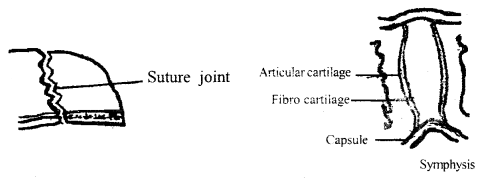
1. Fixed or fibrous joints: There is no movement at all in articulating joints, because of the presence of tough, inextensible, white fibrous tissue, e.g., skull bones.

2. Slightly movable or cartilaginous joints: A limited movement is possible in articulating bones. A dense disc of white cartilage joins the articulating surfaces, e.g., vertebrae and public symphysis.
Locomotion and Movement Class 11 Important Extra Questions Biology 1
Locomotion and Movement Class 11 Important Extra Questions Biology 2
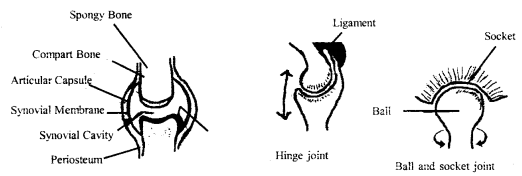
Different types of joints

3. Freely movable or synovial joints: Free movement is possible due to the presence of synovial fluid in the synovial cavity, between the articulating bones, e.g., hinge joint, ball and socket joint.

Question 8.
What are the advantages of the movement of body parts?
Answer:
The movement has the following advantages:

  1. With change in body posture and limb movement, equilibrium of the body is maintained.
  2. Limb movement causes locomotion.
  3. Food is captured by movement of tentacles, limbs, jaw, tongue etc. in different animals.
  4. Changes in environment surrounding can be sensed by the movement of the eyeball, pinna etc.
  5. Blood circulation is possible by heart movement.
  6. Movement of the diaphragm causes inhales and exhale (breathing).

Question 9.
What are the advantages of locomotion?
Answer:
The bodily movements or locomotion has the following advantages:

  1. It enables the body to shift it entirely from one place to the other.
  2. It protects the organism from predation.
  3. It helps the animals to make the search for their food and other nutritional requirements.
  4. It helps the animal to seek a mate for reproduction.

Question 10.
Draw a labelled diagram of the joint found between the pelvic girdle and femur. Also, write the type of this joint.
Answer:
Type of the joint: The joint between pelvic and femur bones is a ball and socket synovial joint.
Locomotion and Movement Class 11 Important Extra Questions Biology 3
Synovial ball and socket joint between pelvic and femur

Question 11.
Why movement and locomotion are necessary among animals?
Answer:
Movement and locomotion are necessary among animals for the survival of them. It enables, them to procure food, search for shelter, find mates, protect themselves from predatory and perform many other life activities.

Question 12.
Elucidate the types of movements found among the animals.
Answer:
Movements among animals vary greatly. Movement involves three basic mechanisms.
These are:

  1. amoeboid,
  2. ciliary and
  3. muscular.

Amoeboid movement is typical of Amoeba. Amoeba moves with the help of pseudopodia. Amoeboid movement helps in the food capture and change of place as well.

The same method of movement is also employed by the leucocytes, like phagocytes and macrophages of the human lymphatic system for engulfment of antigen and migration of circulatory fluid. In protozoan ciliary movement is seen. Muscular movement is the basic mechanism used in the majority of vertebrates including humans. Most multicellular animals possess muscle fibres for the movement of different organs and at¬taining locomotion.

Question 13.
What is muscle? Write the names of different types of muscles?
Answer:
Locomotion in humans depends on the movements of muscle fibres (muscle cells). Muscles are made up of contractile fibres which in turn formed of myofibrils. In humans, muscles constitute nearly 40 – 50 per cent of the total body weight.

Muscles are broadly classified into three categories.

  1. Skeletal muscles: These are attached to the bones by tendons and help in the movement of the part of the skeleton. These muscles are under the control of the conscious mind and can be moved to the wall.
    Skeletal muscles are termed voluntary muscles.
  2. Cardiac muscles: These are also striated and occur exclusively on the heart.
  3. Smooth muscles: These are involuntary and non-striated muscles and are innervated by the autonomic nervous system.

Question 14.
How the skeletal muscle contracts?
Answer:
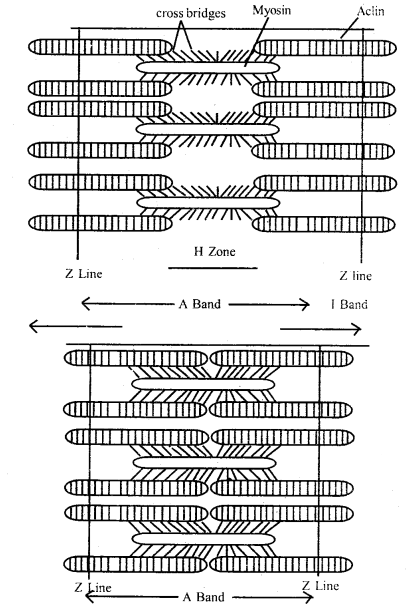
During contraction, the actin and myosin filaments slide past each other to reduce the length of the sarcomeres. The actin filaments move inwards towards the centre of the sarcomere. The heads of the myosin filaments operate as ‘hooks’, attaching to the F-actin they form cross-bridges, then change their relative configuration and pull the actin filaments.

As 3 result, the Z-lines limiting the sarcomeres are drawn closer together, but the length of A-bands remain unchanged. The I-bands reduce in length.

However, the net result is the shortening of the sarcomere. The actin filament slides out from the A-band resulting in the lengthening of the sarcomere.

Question 15.
What is arthritis? How is it caused?
Answer:
It is a disorder of bones in which fibrous tissues are attached with bones- and become ossified, making the joints immovable.

It is caused by the inflammation of the joints. It is of several types, e.g., rheumatoid arthritis, osteoarthritis ‘and gouty arthritis.

Question 16.
Write the names of the factors which are responsible for osteoporosis.
Answer:
Imbalances of hormones like thyrocalcitonin, parathyroid and sex hormones, deficiencies of calcium and vitamin D are the major Causativetors.

Question 17.
How do the joints help in the movement? Explain.
Answer:
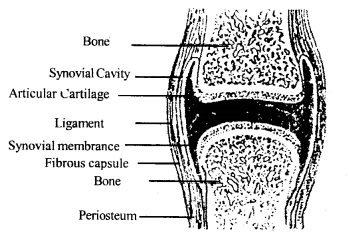
A synovial or movable joint is a joint which allows the movement of collating bones such that they can move extensively upon each other. In joints, there is a space called a synovial cavity. This cavity remains filled in a fluid called synovial fluid.

The movement of an organ occurs due to the pulling of bones. Movement takes place along the joints which act as the fulcrum of the liver. In fact, the joints function as a lever. Due to the presence of a number of joints movement of the different body parts and the whole body is possible.

Question 18.
How calcium affects the process of muscle contraction?
Answer:
Muscle fibres are excitable. Normally, a nerve impulse arriving at the neuromuscular junction initiates a contractile response. A neurotransmitter released at the neuromuscular junction enters into the sarcomere through its membrane channel. The opening of the channel also results in the inflow of Na+ inside the sarcomere and generates an action potential in the muscle fibre.

The sarcoplasmic reticulum releases the stored Ca++, which binds with the specific sites present on the troponin component of the thin filament. As a result, the active sites present on the F-actin molecules are exposed. These sites are specific to the myosin head, which exhibits Mg++ dependent ATP as activity.

During relaxation of the muscle, the Ca++ is pumped back into the sarcoplasmic reticulum. As a result, the troponin component becomes free. The cross-bridge breaks and the thin filament occupies its normal position. The muscle relaxes.

Question 19.
Write the difference between movable and immovable joints.
Answer:

Movable jointsImmovable joints
1. The articulating surfaces are kept in close contact by a fibrous capsule and a slippery synovial fluid occurs in the space between the articulating surfaces of the bone.1. The articulating bones at this joint are firmly held together by dense bands of tough inextensible white fibrous tissue.
2. It permits considerable movement of the articulating bones.2. It does not permit any movement of the articulating bones.

Question 20.
Fill in the blanks:
Answer:

  1. Troponin is a part of Myosin filament.
  2. The Head of the myosin has AT passive activity.
  3. Humerus Radius and Ulna bones are found in the forearm.
  4. The acetabulum is present in the Pelvic girdle.
  5. The ball and socket joint is a Movable girdle.

Question 21.
Match column I with column II

Column IColumn- II
(a) Smooth muscle(i) Myoglobin
(b) Tropomyosin(ii) Third class lever
(c) Red muscle(iii) Thin filament
(d) Skull(iv) Sutures
(e) Forearm(v) Involuntary

Answer:

Column IColumn- II
(a) Smooth muscle(v) Involuntary
(b) Tropomyosin(iii) Thin filament
(c) Red muscle(i) Myoglobin
(d) Skull(iv) Sutures
(e) Forearm(ii) Third class lever

Question 22.
What is a joint? Write its type with an example.
Answer:
Joints are the place of articulation between two or more bones or between a bone and cartilage. Due to the presence of a number of joints, the movement of the different body parts and the whole body is possible.

There are three types of joints:

  1. Fixed or immovable joints: There is no space between the bones. They are attached very tightly with the help of white fibrous connective tissue.
  2. Slightly movable or cartilaginous: It is an articulation between the bones that allow a very little movement.
  3. Movable joints or synovial: It is a joint which allows the movement of articulating bones such that they can move extensively upon each other. In such joints a synovial vanity is present.

Question 23.
What is the role of the girdle in the skeleton?
Answer:
Girdle bones provide a connection between the axial skeleton and limbs. The two girdles are named pectoral and pelvic girdles. Each girdle is formed of two halves.

Locomotion and Movement Important Extra Questions Long Answer Type

Question 1.
(a) During muscular contraction what are the chemical changes that take place. Describe in a listed form.
Answer:
The main chemical events that happen during muscular contraction described by Albert Szent Gyorgi are
1. Acetylcholine is released from vesicles at the neuromuscular junction. It stimulates the muscle.

2. Hydrolysis of ATP in the presence of Ca++ and Mg++ Energy used up in muscle contraction.

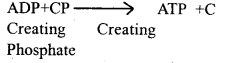
3. ADP is charged again by taking phosphate from creatine phosphate (CP).
Locomotion and Movement Class 11 Important Extra Questions Biology 4
4. During relaxation, creatine is phosphorylated, energy being provided by anaerobic conversion of muscle glycogen into lactic acid.
Creatine + ATP— Creating-phosphate + ADP

5. Energy released by hydrolysis of ATP causes rotation of myosin heads and bring near the actin filaments, actomyosin complex is formed, eventually, sarcomere shortens.

6. Ca++ are actively transported to the sarcoplasmic reticulum, no more Ca++ available for ATP breakdown, no further energy available for further contraction of the sarcomere.

7. Part of the energy is utilized by breaking of cross-bridges and the muscle relaxes.

(b) What are the main groups of vertebrae in the vertebral column of man?
Answer:
There are 5 groups of vertebrae namely cervical, thoracic, lumbar, sacral and coccygeal vertebral.
(The vertebral formula is C7, T12, L5, C3-5 = 32 – 34).

Question 2.
(a) What purposes does movement of external body parts in relation to body axis serve in animals?
Answer:

  1. The movement of limbs, appendages, head and trunk serves to change the body posture to maintain equilibrium against gravity.
  2. Limb movements are prerequisites for carrying out locomotion.
  3. Prehension of food involves movement of tongue, jaws, snout, tentacles, limbs and appendages in different animals.
  4. Movement of eyeballs and pinna of ear help to collect information from the external environment.

(b) What are fibrous joint and cartilaginous joints and their biological function?
Answer:

  1. Fibrous joint: The articulating bones are firmly held together by the dense bands of tough, inextensible white fibrous tissues. They provide strength and support for the body or protection of delicate structures which cannot withstand any kind of deformation.
  2. Cartilaginous joints: In cartilaginous joints, a dense disc of white fibrocartilage joins the opposing surfaces of the articulating bones to each other. This allows a limited movement at the joints.

(c) Explain Antagonistic muscles.
Answer:
Antagonistic muscles: Antagonistic muscles are those which contract to produce opposite movements at the same joint. When a muscle contract to produce a movement, its antagonistic must relax to allow that movement to take place, e.g., the bicep is a FLEXER for the elbow joint and the tricep is it’s antagonistic and an EXTENSOR for that joint.

During flexion at the elbow, the biceps contract and the tricep relax, during extension at the same joint the tricep contracts and the biceps relaxes.

(d) Distinguish between muscles twitch and tetanus or explain muscle twitch and tetanus.
Answer:
A single isolated contraction caused by a single nerve impulse or electric shock is called a muscle twitch. Immediately after the brief twitch, the muscle fibres relax.

Tetanus is a continued state of concentration caused by many repeated stimuli. Much higher tension is developed in tetanus than in an isolated twitch. Almost all our daily activities are carried out by tetanic contractions of muscles.

Question 3.
How thick and thin filaments are arranged in a muscle fibre?
Locomotion and Movement Class 11 Important Extra Questions Biology 5
relationship between actin and myosin filaments in stretched and contracted states
Answer:
Each striated muscle contains thin actin and thick myosin filaments. These filaments are longitudinally arranged inside light I bands and dark A bands respectively. The actin and myosin filaments remain cross-linked with each other in the myofibril. Sarcomeres are the rows of functional unit in each myofibril, each extending from the dark Z- line of the next I band. Each sarcomere thus comprises of A band in the middle with 2 half I band on its two sides.

From each Z line, the actin filaments through half of the I band intermingles with the ends of myosin filaments in the A band. The myofibril is surrounded at each I band by the tubules and cisternae of sarcoplasmic reticulum and at each junction of A and I bands by a TI tubule communicating with the cell exterior, which is shown in the figure. The relationship between actin (thin filament) and myosin (thick filament).

भूकंपविभीषिका Summary Notes Class 10 Sanskrit Chapter 10

By going through these CBSE Class 10 Sanskrit Notes Chapter 10 भूकंपविभीषिका Summary, Notes, word meanings, translation in Hindi, students can recall all the concepts quickly.

Class 10 Sanskrit Chapter 10 भूकंपविभीषिका Summary Notes

भूकम्पविभीषिका पाठपरिचयः
हमारे वातावरण में भौतिक सुख-साधनों के साथ-साथ अनेक आपदाएँ भी लगी रहती हैं। प्राकृतिक आपदाएँ जीवन को अस्त-व्यस्त कर देती हैं। कभी किसी महामारी की आपदा. बाढ़ तथा सूखे की आपदा या तूफ़ान के रूप में भयङ्कर प्रलय-ये सब हम अपने जीवन में देखते तथा सुनते रहते हैं। भूकम्प भी ऐसी आपदा है, जिस पर यहाँ दृष्टिपात किया गया है। इस पाठ के माध्यम से यह बताया गया है कि किसी भी आपदा में बिना किसी घबराहट के, हिम्मत के साथ किस प्रकार हम अपनी सुरक्षा स्वयं कर सकते हैं।
भूकंपविभीषिका Summary Notes Class 10 Sanskrit Chapter 10

भूकंपविभीषिका Word Meanings Translation in Hindi

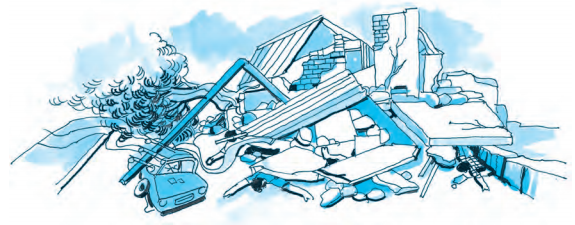
1. एकोत्तर द्विसहस्त्रख्रीष्टाब्दे (2001 ईस्वीये वर्षे) गणतन्त्र-दिवस-पर्वणि यदा समग्रमपि भारतराष्ट्र नृत्य-गीतवादित्राणाम् उल्लासे मग्नमासीत् तदाकस्मादेव गुर्जर- राज्यं पर्याकुल, विपर्यस्तम्, क्रन्दनविकलं, विपन्नञ्च जातम्। भूकम्पस्य दारुण- विभीषिका समस्तमपि गुर्जरक्षेत्रं विशेषेण च कच्छजनपदं ध्वंसावशेषु परिवर्तितवती। भूकम्पस्य केन्द्रभूतं भुजनगरं तु मृत्तिकाक्रीडनकमिव खण्डखण्डम् जातम्। बहुभूमिकानि भवनानि क्षणेनैव धराशायीनि जातानि। उत्खाता विद्युद्दीपस्तम्भाः। विशीर्णाः गृहसोपान-मार्गाः। फालद्वये विभक्ता भूमिः। भूमिग दुपरि निस्सरन्तीभिः दुर्वार-जलधाराभिः- महाप्लावनदृश्यम् उपस्थितम्। सहस्रमताः प्राणिनस्तु क्षणेनैव मृताः। ध्वस्तभवनेषु सम्पीडिता सहस्रशोऽन्ये सहायतार्थं करुणकरुणं क्रन्दन्ति स्म। हा दैव! क्षुत्क्षामकण्ठाः मृतप्रायाः केचन शिशवस्तु ईश्वरकृपया एव द्वित्राणि दिनानि जीवन धारितवन्तः।

शब्दार्थाः
द्विसहस्त्रखीष्टाब्द: – दो हजार ईस्वीय वर्ष में। पर्वणिः – उत्सव पर। समग्रम् – सारा। नृत्य-ग्रीवादित्राणाम् – नाचने, गाने बजाने के। क्रन्दनविकलम् – रोने-चिल्लाने से दु:खी। जातम् – हो गया। दारुण-विभीषिका – भयानक मुसीबत ने। विशेषण – विशेष करके। वंसावशेषु – खंडहर के रूपों में। परिवर्तितवती – बदल दिया। केन्द्रभूतम् – केन्द्र रहे। मृत्तिकाक्रीडनम् – मिट्टी के खिलौने। खण्डखण्डम् – टुकड़े-टुकड़े। बहुभूमिकानि – बहुमंजिले। उत्खाता: – उखड़ गए। विद्युद्दीपस्तम्भाः – बिजली के खंभे। विशीर्णाः – बिखर गए। गृहसोपान-मार्गाः – घर की सीढ़ियों के मार्ग। फालद्वये – दो भागों में। विभक्ता – बँट गई। भूमिगर्भात् – धरती के अन्दर से। निस्सरन्तीभिः – निकलती हुई। दुर्वार – कठिन (भयानक)। सहस्रमिता – हजारों की संख्या वाले। क्षणेनैव – क्षण भर में ही। मृता: – मर गए। सम्पीडिता – दुःखी। सहस्रशः – हज़ारों लोग। करुणकरुणम् – दुःख से भरे। मृतप्रायाः – लगभग मरे हुए। द्विवाणि – दो-तीन। धारितवन्तः – धारण किए।

हिन्दी अनुवाद
सन् दो हजार एक के साल (26 जनवरी 2001 ई०) गणतन्त्र-दिवस-पर्व पर जब सारा भारत देश नाचने-गाने और बजाने की खुशी में मग्न था तब अचानक ही गुजरात राज्य चारों ओर से व्याकुल, अस्त-व्यस्त, रोने-चिल्लाने से दु:खी और मुसीबत में फँस गया। भूकम्प की भयानक मुसीबत ने सम्पूर्ण गुजरात क्षेत्र को विशेषकर कच्छ जिले को विनाश के बाद बची हुई वस्तु के रूप में बदल दिया था। भूकम्प का केन्द्र रहा भुज शहर तो मिट्टी के खिलौने की तरह टुकड़े-टुकड़े हो (टूट-फूट) गया। बहुमंजिली इमारतें तो क्षण भर में ही धराशायी (गिर) हो गईं। बिजली के खंभे उखड़ गए। घर की सीढ़ीनुमा रास्ते बिखर गए थे। धरती दो भागों में बँट गई थी। धरती के अन्दर से ऊपर की ओर निकलती हुई जलधाराओं ने तो महाप्रलय का दृश्य उपस्थित कर दिया था। हजारों की संख्या में प्राणी क्षणभर में ही मर गए थे। टूटे हुए भवनों में दु:खी हजारों दूसरे लोग सहायता के लिए करुण विलाप कर रहे थे। भूख से दुर्बल (सूखे) कण्ठ वाले लगभग मरे हुए (मरे हुए से) कुछ बच्चों ने तो ईश्वर की कृपा से दो-तीन दिन ही जीवन धारण किए।

सन्धिः-विच्छेदो वा
पदानि – सन्धिं / सन्धिविच्छेदं
समग्रमपि = समग्रम् + अपि
मग्नमासीत् = मग्नम् + आसीत्
तदाकस्मादेव = तदा + अकस्मात् + एव
विपन्नञ्च = विपत् + नम् + च
समस्तमपि = समस्तम् + अपि
ध्वंसावशेषु = ध्वंस + अवशेषु
क्षणेन + एव = क्षणेनैव
विद्युद्दीपस्तम्भाः = विद्यत् + दीप + स्तम्भाः
भूमिगर्भादुपरि = भूमि-गर्भात् + उपरि
प्राणिनः + तु = प्राणिनस्तु
सहस्त्रशोऽन्ये = सहस्त्रशः + अन्ये
क्षुत्क्षामकण्ठः = क्षुधा + क्षाम् + कण्ठः
शिशवस्तु = शिशवः + तु

समासो-विग्रहो वा
पदानि = समासः/विग्रहः
क्षुत्क्षामकण्ठः = क्षुधा क्षामः कण्ठाः येषाम् ते
महत् प्लावनम् = महाप्लावनम्
बहुभूमिकानि भवनानि = बहव्यः भूमिकाः येषु तानि भवनानि
मृत्तिकाक्रीडनकमिव = मृत्तिकायाः क्रीडनकम् इव

प्रकृति-प्रत्ययोः विभाजनम्
पदानि = प्रकृतिः + प्रत्ययः
जातम् – जन + क्त
परिवर्तितवती = परिवर्तन + क्तवतु
उत्खाला = उत् + खन् + क्त
विभक्ता – वि + भज् + क्त
उपस्थितम् = उप + स्था + क्त
मृताः = मृ + क्त
सम्पीडिता – सम् + पीड् + क्त
धारितवन्तः = धारय + क्तवतु

अव्ययपद-चयनम् वाक्य प्रयोगश्चः
अव्ययः = अर्थः = वाक्येषु प्रयोगः
यदा = जब = यदा समग्र भारत राष्ट्र-गीत अगायत्।
तु = तो = भुजनगरं तु मृत्तिका क्रीडनकामिव खण्डखण्डम् जातम्।
एव = ही = ईश्वरः सर्वत्र एव अस्ति।

पर्यायपदानि
पदानि = पर्यायाः
पर्वणि = उत्सवे
समग्रम् – सकलम्, सम्पूर्णम्
राष्ट्रम् = देशम्
मग्नम् = लीनम्
अकस्मात् = सहसा
पर्याकुलं = परितः आकुलम्
विपर्यस्तम् = अस्त-व्यस्तम्
विपन्नम् = विपत्ति-युक्तम्
गुर्जर = गुजरात
ध्वंसावशेषु = नाशोपरान्तम अवशिष्टेषु
बहुभूमिकानि = बहवः भूमिकाः
फालद्वये = खण्ड द्वये
विशीर्णाः = नष्टाः
उत्खाताः = उत्पाटिताः
निस्सरन्तीभिः – निर्गच्छन्तीभिः
दुवरि = दुखेन निवारयितुं योग्यः
मृताः = दिवंगताः
ध्वस्तम् = नष्टम्

विपर्ययपदानि
पदानि = विपर्ययाः
दिवस = रात्रि
उल्लासे – अनुल्लासे
आसीत् – अस्ति
परिवर्तितवती = अपरिवर्तितवती
खण्डम् = अखण्डम्
जातम् = अजातम्
उपरि = अधः
उपस्थितम् = अनुपस्थितम्
सहायतार्थ = असहायतार्थ
मृताः = जीविताः

2. इयमासीत् भैरवविभीषिका कच्छ-भूकम्पस्य। पञ्चोत्तर-द्विसहस्रख्रीष्टाब्दे (2005 ईस्वीये वर्षे) अपि कश्मीर-प्रान्ते पाकिस्तान-देशे च धरायाः महत्कम्पनं जातम्। यस्मात्कारणात् लक्षपरिमिताः जनाः अकालकालकवलिताः। पृथ्वी कस्मात्प्रकम्पते वैज्ञानिकाः इति विषये कथयन्ति यत् पृथिव्या अन्तर्गर्भे विद्यमानाः बृहत्यः पाषाण-शिलाः यदा संघर्षणवशात् त्रुट्यन्ति तदा जायते भीषणं संस्खलनम्, संस्खलनजन्य कम्पनञ्च। तदैव भयावहकम्पनं धरायाः उपरितलमप्यागत्य महाकम्पनं जनयति येन महाविनाशदृश्यं समुत्पद्यते।

शब्दार्थाः
भैरवविभीषिका – भयानक विपत्ति। पञ्चोत्तर – पाँच अधिक। द्विसहस्र – दो हजार। धरायाः – धरती का। महत्कम्पनम् – महान कम्पन (कँपकँपी)। जातम् – हुआ। लक्षपरिमिता: – लाख तक। अकाल काल कवलिता: – असमय ही मौत के मुँह में चले गए। पृथिव्या – पृथ्वी के। अन्तर्गर्भे – अन्दर। बृहत्यः – बड़ी-बडी। पाषाणशिला: – पत्थर की शिलाएँ। संघर्षणवशात् – घिसने (कम्पन) के कारण। त्रुट्पन्ति – टूटती हैं। संस्खलनम् – पतन/क्षरण। तदैव – तभी। भयावहकम्पनम् – भयानक कम्पन। जनयति – पैदा करता है। समुत्पद्यते – उत्पन्न होता है। उपरितलम् – ऊपरी तल पर।

हिन्दी अनुवाद
यह कच्छ के भूकम्प की भयानक विभीषिका थी। दो हजार पाँच ईस्वीय वर्ष (2005 ई.) में भी कश्मीर राज्य और पाकिस्तान देश में धरती का महा कम्पन्न हुआ था। जिसके कारण से लाखों लोग असमय ही मौत की भेंट चढ़ गए थे। धरती कैसे काँपती है वैज्ञानिक इस विषय में कहते हैं कि पृथ्वी के अन्दर विद्यमान (स्थित) बड़ी-बड़ी पत्थर की शिलाएँ जब घर्षण (कम्पन) के कारण टूटती हैं तब भयंकर स्खलन (क्षरण / पतन) और स्खलन से उत्पन्न (होने वाला) कंपन पैदा होता है। तभी भयंकर कंपन धरती के ऊपरी तल पर आकर महान कँपकँपी पैदा करता है जिससे महाविनाश का दृश्य पैदा होता है।

सन्धिः-विच्छेदो वा
पदानि = सन्धि/सन्धिविच्छेद
इयमासीत् = इयम् + आसीत्
पञ्चोत्तर = पञ्च + उत्तर
महत्कम्पन्नं = महत् + कम्पनं
यस्मात्कारणात् – यस्मात् + कारणात्
अन्तर्गर्भ – अन्तः + गर्भ
संस्खलनम् = सम् + स्खलनम्
कम्पनम् + च = कम्पनञ्च
तदा + एव = तदैव
उपरितलमप्यागत्य = उपरि + तलम् + अपि + आगत्य

समासो-विग्रहो वा
पदानि = समासः/विग्रहः
महाकम्पनं = महान् कम्पनम्
महान् विनाश = महाविनाश

प्रकृति-प्रत्ययोः विभाजनम्
पदानि – प्रकृतिः + प्रत्ययः
जातम् = जन् + क्त
आगत्य = आ + गम् + ल्यप्
समुत्पद्यते = सम् + उत् + पत् + ल्यप्
जायते – जन् + यत्

अव्ययपद-चयनम् वाक्य प्रयोगश्च:
अव्ययः – अर्थः – वाक्येषु प्रयोगः
अपि – भी – अहम् अपि त्वया सह चलिष्यामि।
च – और – कश्मीर प्रान्ते पाकिस्तान देशे च धरायाः महत्कम्पनं जातम्।
यत् – कि – सर्वेजनाः कपयन्ति यत् सत्यमेव जयते।
यदा-तदा – जब-तक – यदा मेघाः गर्जन्ति तदाः मयूराः नृत्यन्ति।

पर्यायपदानि
पदानि = पर्यायाः
कालकवलिताः = मृताः
पृथ्वी = धरा
जनाः = मनुष्याः
पृथिव्या = भूमौ
जायते = उत्पन्नः भवति
भीषणं = भयङकरम्
उपरि = उच्चैः
जनयति = उत्पन्न करोति
संस्खलनम् = विचलनम्
वैज्ञानिकाः = विज्ञानं जानाति ये ते

विपर्ययपदानि
पदानि = विपर्ययाः
आसीत् = अस्ति
धरायाः = गगने
वैज्ञानिकाः = अवैज्ञानिकाः
अन्तः = बहिः
बृहत्यः = लघुः
त्रुट्यन्ति = संयोजयन्ति
उपरि = अधः
आगत्य = अनागत्य
महान् = लघु:

3. चालामुखपर्वतानां विस्फोटैरपि भूकम्पो जायते इति कथयन्ति भूकम्पविशेषज्ञाः। पृथिव्याः गर्भे विद्यमानोऽग्निर्यदा खनिजमृत्तिकाशिलादिसञ्चयं क्वथयति तदा तत्सर्वमेव लावारसताम् उपेत्य दुर्वारगत्या धरा पर्वतं वा विदार्य बहिर्निष्क्रामति। धूमभस्मावृतं जायते तदा गगनम्। सेल्सियश-ताप-मात्राया अष्टशताङ्कतामुपगतोऽयं लावारसो यदा नदीवेगेन प्रवहति तदा पार्श्वस्थग्रामा नगराणि वा तदुदरे क्षणेनैव समाविशन्ति। निहन्यन्ते च विवशाः प्राणिनः। ज्वालामुगिरन्त एते पर्वता अपि भीषणं भूकम्पं जनयन्ति।

शब्दार्थाः
ज्वालामुखपर्वतानाम् – ज्वालामुखी पर्वतों के। जायते – उत्पन्न होता है। गर्भे – अन्दर। विद्यमानः – स्थित। खनिजमृत्तिका शिलादि – खनिज पदार्थ, मिट्टी, शिला (पत्थरों की चट्टानों के)। सञ्चयम् – संचय को। क्वथयति – तपाती है। लावारसताम् – अंगारों के रूप को। उपेत्य – धारण (प्राप्त) करके। दुर्वारंगत्या – तेज गति से। विदार्य – फोड़ कर। धूमभस्मावृतम् – धुएँ और राख से ढका। मात्राया – मात्रा से (का)। अष्टशताङ्कताम् – आठ सौ की संख्या को। उपगतः – प्राप्त। नदीवेगेन – नदी के तेज वेग से। पार्श्वस्थग्रामा: – पास में स्थित गाँवों (गाँव)। तदुदरे – उसके पेटे में (अन्दर)। निहन्यन्ते – मारे जाते हैं। ज्वालाम् उगिरन्तः – ज्वालाओं (अंगारों) को उगलते हुए।

हिन्दी अनुवाद
ज्वालामुखी पर्वतों के विस्फोटों से भी भूकम्प उत्पन्न होता है ऐसा भूकम्प के विशेषज्ञ कहते हैं। पृथ्वी के अन्दर (गर्भ में) स्थित आग जब खनिजों, मिट्टी और शिला (पत्थर) आदि को तपाती (उबालती) है तब वह सब अंगारों का रूप धारण करके तेज़ गति से धरती अथवा पहाड़ को फोड़कर (फाड़कर) बाहर निकलता है। तब आकाश धुएँ और राख से ढक जाता है। सेल्सियस की गर्मी मात्रा के आठ सौ (800) अंकों (आठ सौ डिग्री सेल्सियस) को प्राप्त यह लावा (अंगारे) जब नदी की गति से (नीचे) बहता है तब पास में स्थित गाँव अथवा शहर क्षण भर में ही उसके पेट में समा जाते हैं और विवश (बेचारे) प्राणी मारे जाते हैं। ज्वालाओं को उगलते हुए ये पहाड़ भी भयानक भूकम्प को पैदा करते हैं।

सन्धिः-विच्छेदो वा
पदानि = सन्धिं/सन्धिविच्छेद
विस्फोटैरपि = विस्फोटैः + अपि।
विद्यमानोऽग्निर्यदा = विद्यमानः + अग्निः + यदा
शिलादिसञ्चयं – शिला + आदि + सञ्चयं।
तत्सर्वमेव = तत् + सर्वम् + एव।
बहिर्निष्क्रामति = बहिः + निस्क्रामति।
अष्टशताङ्कतामुपगतोऽयम् = अष्ट + शताङ्क + ताम् + उपगतः + अयम्
पार्श्वस्थग्रामा = पार्श्वस्थ + ग्रामा
तदुदरे = तत् + उदरे
क्षणेन + एव = क्षणेनैव
ज्वालामुगिरन्त = ज्वालाम् + उगिरन्त

समासो-विग्रहो वा
पदानि = समासः / विग्रहः
भूकम्पविशेषज्ञाः = भुवः कम्पनरहस्यस्यं ये जाति
पृथिव्याः गर्भ = पृथ्वीगर्भ

प्रकृति-प्रत्ययोः विभाजनम्
पदानि = प्रकृतिः + प्रत्ययः
उपेत्य = उप + इ + ल्यप्
आगत्या = आ + गम् + ल्यप्
विदार्य = वि + दृ + ल्यप्
उगिरन्तः = उत् + गिर् + शत् प्रत्यय

पर्यायपदानि
पदानि = पर्यायाः
भूकम्पविशेषज्ञाः = भुवः कम्पनरहस्यस्य ज्ञातार:
खनिजम् = उत्खननात् प्राप्तं द्रव्यम्
क्वथयति = उत्तप्तं करोति
विदार्य = विदीर्णं कृत्वा, भित्वा, संत्रोट्य
पार्श्वस्थग्रामा = निकटस्थग्रामाः, समीपस्थग्रामा
उदरे = कुक्षौ
समाविशन्ति = अन्तः गच्छन्तिं
उगिरन्तः = प्रकटयन्तः
पर्वतानाम् = शैलानाम्
भूकम्पः = पृथिव्याम् कम्पन्नः जातः
निहन्यन्ते = म्रियन्ते

विपर्ययपदानि
पदानि = विपर्ययाः
बहिः = अन्तः
क्षणेनैव = सुचिरेणैव
ग्रामम् = नगरम्
अग्नि = जलम्
कम्पन्नः = स्थिर:
सर्वमेव = एकमेव
निहन्यन्ते = जन्यन्ते

4. यद्यपि दैवः प्रकोपो भूकम्पो नाम, तस्योपशमनस्य न कोऽपि स्थिरोपायो दृश यते। प्रकृतिसमक्षमद्यापि विज्ञानगर्वितो मानवः वामनकल्प एव तथापि भूकम्परहस्यज्ञाः कथयन्ति यत् बहुभूमिकभवननिर्माणं न करणीयम्। तटबन्धं निर्माय बृहन्मानं नदीजलमपि नैकस्मिन् स्थले पुञ्जीकरणीयम् अन्यथा असन्तुलनवशाद् भूकम्पस्सम्भवति। वस्तुतः शान्तानि एव पञ्चतत्त्वानि क्षितिजलपावकसमीरगगनानि भूतलस्य योगक्षेमाभ्यां कल्पन्ते। अशान्तानि खलु तान्येव महाविनाशम् उपस्थापयन्ति।

शब्दार्थाः
यद्यपि – जबकि। दैवः – प्राकृतिक/दैवीय। प्रकोप: – क्रोध/मुसीबत। उपशमनस्य – शान्त करने का। स्थिर उपाय: – कारगर उपाय। विज्ञानगर्वितः – विज्ञान के ज्ञान से घमंडी। वामनकल्पः – बौने की तरह। बहुभूमिक भवननिर्माणम् – बहुमंजिलें भवन का निर्माण। तटबन्धम् – बाँध को। निर्माय – बनाकर। बृहन्मात्रम् – बड़ी मात्रा में। असन्तुलनवशात् – असंतुलन के कारण से। शान्तानि – शान्त। वस्तुतः – वास्तव में। भूतलस्य – धरती के। कल्पन्ते – समर्थ कहलाते हैं। अशान्तानि – अशान्त। महाविनाशम् – महाविनाश को। उपस्थापयन्ति – पैदा करते हैं। तान्येव – वे ही।

हिन्दी अनुवाद
जबकि भूकम्प दैवीय (प्राकृतिक) प्रकोप (मुसीबत) है, अतः उसके निराकरण (शान्ति) का कोई स्थिर (कारगर) उपाय नहीं दिखाई देता है। प्रकृति के सामने आज भी विज्ञान के ज्ञान से घमण्डी मनुष्य बौने की तरह ही है तो भी भूकम्प के रहस्यों को जानने वाले विद्वान कहते हैं कि बहुमंजिले भवन को नहीं बनाना चाहिए। बाँध बनाकर बड़ी मात्रा में नदी के जल को भी एक स्थान पर नहीं रोकना चाहिए। नहीं तो असन्तुलन के कारण भूकम्प सम्भव है। वास्तव में शान्त पाँचों ही तत्व पृथ्वी, जल, अग्नि, वायु और आकाश धरती के योग-क्षेम (अप्राप्त की प्राप्ति और प्राप्ति की रक्षा) के लिए समर्थ कहलाते हैं। निश्चय से अशान्त वे ही महाविनाश को पैदा करते हैं।

सन्धिः-विच्छेदो वा
पदानि = सन्धिं/सन्धिविच्छेद
यद्यपि = यदि + अपि
तस्योपशमनस्य = तस्य + उपशमनस्य
कोऽपि = कः + अपि
स्थिरोपायो = स्थिरः + उपाय:
समक्षमद्यापि = समक्षम् + अद्य + अपि
बृहन्मात्रं = बहत् + मात्रम्
नदीजलमपि = नदी + जलम् + अपि
नैकस्मिन् = न + एकस्मिन्
भूकम्पस्सम्भवति = भूकम्पः + सम्भवति
तान्येव = तानि + एव

समासो-विग्रहो वा
पदानि = समासः / विग्रहः
योगक्षेमाभ्याम् = अप्राप्तस्य प्राप्तिः योगः प्राप्तस्य रक्षण क्षेमः ताभ्याम् इतियोगक्षेमाभ्याः
महान् विनाशम् = महाविनाशम्

प्रकृति-प्रत्ययोः विभाजनम्
पदानि = प्रकृतिः + प्रत्ययः
करणीयम् = कृ + अनीयर
निर्माय = नि + मृ + ल्यप्

पर्यायपदानि
पदानि = पर्यायाः
उपशमनस्य = शान्ते:
मानव: – नरः
न करणीयम् – अकरणीयम्
स्थले = थले, क्षत्रे
वामनकल्प = वामनसदृशः
निर्माय = निर्माणं कृत्वा
पुञ्जीकरणीयम् = संग्रहणीयम्
समक्षम् = अग्रे, पुरतः
वस्तुतः = यर्थाथ:

विपर्ययपदानि
पदानि = विपर्ययाः
स्थिरः = अस्थिरः
जलम् = अग्निः
सम्भवति = असम्भवति
उपायः = अनुपाय:
स्थले = जले
अशान्तानि = शान्तानि
करणीयम् = उपकरणीयम्
असन्तुलन = सन्तुलन

NCERT Solutions for Class 8 Sanskrit Chapter 7 भारतजनताऽहम्

We have given detailed NCERT Solutions for Class 8 Sanskrit Ruchira Chapter 7 भारतजनताऽहम् Questions and Answers come in handy for quickly completing your homework.

NCERT Solutions for Class 8 Sanskrit Ruchira Chapter 7 भारतजनताऽहम्

Class 8 Sanskrit Chapter 7 भारतजनताऽहम् Textbook Questions and Answers

1. पाठे दत्तानां पद्यानां सस्वरवाचनं कुरुत-
उत्तराणि:
(पाठ में दिए गए पद्य को स्वर में पढ़िए)

2. प्रश्नानाम् उत्तराणि एकपदेन लिखत
(निम्नलिखित प्रश्नों के उत्तर एकपद में लिखो)

(क) अहं वसुन्धरां किं मन्ये?
उत्तराणि:
(क) कुटुम्बम्

(ख) मम सहजा प्रकृति का अस्ति?
उत्तराणि:
(ख) मैत्री

(ग) अहं कस्मात् कठिना भारतजनताऽस्मि?
उत्तराणि:
(ग) वज्रात्

(घ) अहं मित्रस्य चक्षुषां किं पश्यन्ती भारतजनताऽस्मि?
उत्तराणि:
(घ) संसारम्

3. प्रश्नानाम् उत्तराणि पूर्णवाक्येन लिखत –
(निम्नलिखित प्रश्नों के उत्तर पूर्ण वाक्य में लिखिए)

(क) भारतजनताऽहम् कैः परिपूता अस्ति?
उत्तराणि:
भारतजनताऽहम् अध्यात्मसुधातटिनीस्नानैः परिपूता अस्ति।

(ख) समं जगत् कथं मुग्धमस्ति?
उत्तराणि:
समं जगत् गीतैः मुग्धमस्ति।

(ग) अहं किं किं चिनोमि?
उत्तराणि:
अहं श्रेयः प्रेयश्च चिनोमि।

(घ) अहं कुत्र सदा दृश्ये?
उत्तराणि:
अहं विश्वस्मिन् जगति सदा दृश्ये।

(ङ) समं जगत् कैः कैः मुग्धम् अस्ति?
उत्तराणि:
समं जगत् काव्यैः नृत्यैः मुग्धम् अस्ति।

4. सन्धिविच्छेदं पूरयत
(संधि विच्छेद करके रिक्त स्थान की पूर्ति कीजिए)

(क) विनयोपेता = विनय + उपेता
(ख) कुसुमादपि = ……….. + …………..
(ग) चिनोम्युभयम् = चिनोमि + …………….
(घ) नृत्यैर्मुग्धम् =………….. + मुग्धम्
(ङ) प्रकृतिरस्ति = प्रकृतिः + ……………..
(च) लोकक्रीडासक्ता = लोकक्रीडा + ……….
उत्तराणि:
(क) विनयोपेता = विनय + उपेता
(ख) कुसुमादपि = कुसुमात् + अपि
(ग) चिनोम्युभयम् = चिनोमि + उभयम्
(घ) नृत्यैर्मुग्धम् = नृत्यैः + मुग्धम्
(ङ) प्रकृतिरस्ति = प्रकृतिः + अस्ति
(च) लोकक्रीडासक्ता = लोकक्रीडा + आसक्ता

5. विशेषण विशेष्य पदानि मेलयत
(विशेषण और विशेष्य पदों का मेल कीजिए)

विशेषण-पदानि – विशेष्य-पदानि
सुकुमारा – जगत्
सहजा – संसारे
विश्वस्मिन् – भारतजनता
समम् – प्रकृति
समस्ते – जगति
उत्तराणि:
विशेषण-पदानि – विशेष्य-पदानि
सुकुमारा – भारतजनता
सहजा – प्रकृति
विश्वस्मिन् – जगति
समम् – जगत्
समस्ते – संसारे

6. समानार्थकानि पदानि मेलयत –
(समानार्थक शब्दों को मिलाइए)

जगति – नदी
कुलिशात् – पृथ्वीम्
प्रकृति – संसारे
चक्षुषा – स्वभावः
तटिनी – वज्रात्
वसुन्धराम् – नेत्रेण
उत्तराणि:
जगति – संसारे
कुलिशात् – वज्रात्
प्रकृति – स्वभावः
चक्षुषा – नेत्रेण
तटिनी – नदी
वसुन्धराम् – पृथ्वीम्

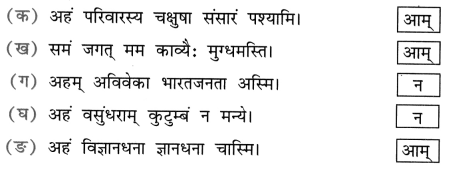
7. उचितकथानां समक्षम् (आम्) अनुचितकथनानां समक्षं च (न) इति लिखत –
(उचित कथन के सामने आम् तथा अनुचित कथन के सामने न लिखिए)

(क) अहं परिवारस्य चक्षुषा संसारं पश्यामि।
(ख) समं जगत् मम काव्यैः मुग्धमस्ति।
(ग) अहम् अविवेका भारतजनता अस्मि।
(घ) अहं वसुन्धराम् कुटुम्बं न मन्ये।
(ङ) अहं विज्ञानधना ज्ञानधना चास्मि।
उत्तराणि:
NCERT Solutions for Class 8 Sanskrit Chapter 7 भारतजनताऽहम् 1

Class 8 Sanskrit Chapter 7 भारतजनताऽहम् Additional Important Questions and Answers

अधोलिखितं श्लोकं पठित्वा निर्देशानुसारं प्रश्नान् उत्तरत –

(क) निवसामि समस्ते संसारे। मन्ये च कुटुम्बं वसुन्धराम्॥
प्रेयः श्रेयः च चिनोम्युभयं। सुविवेका भारतजनताऽहम्॥

I. एकपदेन उत्तरत –

(क) भारतजनता कुत्र निवसति?
उत्तराणि:
समस्ते संसारे

(ख) भारतजनता वसुन्धरां किं मन्यते?
उत्तराणि:
कुटुम्बम्

II. पूर्णवाक्येन उत्तरत

(क) भारतजनता कीदृशी अस्ति?
उत्तराणि:
भारतजनता सुविवेका अस्ति।

(ख) भारतजनता किं चिनोति?
उत्तराणि:
भारतजनता श्रेयः प्रेयश्च चिनोति।

III. यथानिर्देशम् उत्तरत

(क) ‘निवसामि समस्ते संसारे’ इत्यत्र क्रियापदं किम्?
उत्तराणि:
चित्रसामि

(ख) ‘मन्ये कुटुम्बं वसुन्धराम्’ इत्यत्र कर्तृपदं किम्?
उत्तराणि:
अहम्

(ग) ‘चिनोमि’ इत्यत्रं कः लकार:?
उत्तराणि:
लट

(घ) ‘सुविवेका’ इत्यस्य विलोमपदं लिखत।
उत्तराणि:
अविवेका

अधोलिखितस्य अन्वयं लिखित्वा स्थानपूर्तिं कुरुत –

मम गीतैर्मुग्धं समं जगत्।
मम नृत्यैर्मुग्धं सममं जगत्।

भावः-मम ……….. समं जगत् मुग्धम्। ………… नृत्यैः ………… जगत् …….
उत्तराणि:
मम गीतैः समं जगत् मुग्धम्। मम नृत्यैः समं जगत् मुग्धम्।

रेखांकित पदम् आधृत्य प्रश्ननिर्माणं कुरुत –

प्रश्नाः

(क) अहं वसुन्धरां कुटुम्ब मन्ये।
उत्तराणि:
अहं वसुन्धरां किं मन्ये?

(ख) भारतजनता सविवेका अस्ति।
उत्तराणि:
भारतजनता कीदृशी अस्ति?

(ग) मम गीतैः जगत् मुग्धम्।
उत्तराणि:
मम गीतैः किं मुग्धम्?

1. उचितविकल्पं श्लोकं चित्वा प्रश्नान् उत्तरत –

मैत्री मे सहजा प्रकृतिरस्ति। नो दुर्बलतायाः पर्यायः॥
मित्रस्य चक्षुषा संसारं। पश्यन्ती भारतजनताऽहम्॥

I. एकपदेन उत्तरत

(क) सहजा प्रकृतिः किम् अस्ति?
(i) शत्रुता
(ii) मैत्री
(iii) संगतिः
(iv) भक्तिः
उत्तराणि:
(ii) मैत्री

(ख) कस्य चक्षुषा संसारं पश्यति?
(i) शत्रोः
(ii) मित्रस्य
(iii) गुरोः
(iv) बान्धवस्य
उत्तराणि:
(ii) मित्रस्य

II. यथानिर्देशम् उत्तरत

(क) ‘सहजा प्रकृतिः’ इत्यत्र विशेषणपदं लिखत
(i) प्रकृतिः
(ii) मैत्री
(iii) सहजा
(iv) मम।
उत्तराणि:
(iii) सहजा

(ख) ‘मैत्री’ इत्यस्य कोऽर्थः?
(i) भक्तिः
(ii) शत्रुता
(iii) मित्रता
(iv) संगतिः।
उत्तराणि:
(iii) मित्रता

(ग) ‘चक्षुषा’ इत्यत्र का विभक्तिः ?
(i) प्रथमा
(ii) तृतीया
(iii) षष्ठी
(iv) चतुर्थी।
उत्तराणि:
(ii) तृतीया

(घ) ‘पश्यन्ती’ इत्यत्र कः प्रत्ययः?
(i) न्ती
(ii) यन्ती
(iii) अन्ती
(iv) शतृ।
उत्तराणि:
(iv) शतृ।

Excretory Products and their Elimination Class 11 Important Extra Questions Biology Chapter 19

Here we are providing Class 11 Biology Important Extra Questions and Answers Chapter 19 Excretory Products and their Elimination. Important Questions for Class 11 Biology are the best resource for students which helps in Class 11 board exams.

Class 11 Biology Chapter 19 Important Extra Questions Excretory Products and their Elimination

Excretory Products and their Elimination Important Extra Questions Very Short Answer Type

Question 1.
What is a nephron?
Answer:
The functional unit of the kidney.

Question 2.
What is a flame cell?
Answer:
The excretory unit in planaria, tapeworm, and liver fluke.

Question 3.
What is micturition?
Answer:
It is the act of void of the urinary bladder, the activity under nervous and voluntary control.

Question 4.
What are ammonotelic animals?
Answer:
The animals which excrete nitrogenous wastes as ammonia are ed ammonotelic animals, e.g., certain fishes.

Question 5.
What is a green gland and in which animal it is found?
Answer:
It is an excretory structure found in prawns.

Question 6.
What is an antidiuretic hormone?
Answer:
It is the hormone that helps in the reabsorption of water in the nephron, also called vasopressin (Secreted by post pituitary gland).

Question 7.
Define excretion.
Answer:
Excretion is the process of elimination of metabolic wastes from the body.

Question 8.
What is the color rendering substance found in urine?
Answer:
Urochrome.

Question 9.
What are diuretics?
Answer:
The substances which increase the volume of water, to be excreted as urine, are called diuretics, e.g., tea, coffee, alcoholic beverages.

Question 10.
What is osmoregulation?
Answer:
It is the maintenance of water and osmotic concentration of blood.

Question 11.
Name the organ of the excretory system, which stores urine before its removal from the body.
Answer:
Urinary bladder.

Question 12.
In which part of the nephron does filtration occur?
Answer:
Glomerulus.

Question 13.
What happens to the useful substances that get filtered into the renal tubule?
Answer:
They are reabsorbed into the blood.

Question 14.
Point out the main excretory organ?
Answer:
Kidney.

Question 15.
Write down the products excreted by the following organs.
(a) Lung
Answer:
Lung: Carbon dioxide and water vapor

(b) Skin,
Answer:
Skin: Urea, water, and some salts

(c) Intestine.
Answer:
Intestine: Some salts like calcium and iron.

Question 16.
What is excreted by the kidney in urine?
Answer:
Urea.

Question 17.
In which part of the nephron does filtration occur?
Answer:
Glomemle.

Question 18.
Who filters the blood?
Answer:
The kidney filters the blood, which takes place between the glomerulus and Bowman’s capsule.

Question 19.
Why it is necessary to remove waste products by excretion?
Answer:
It is essential and necessary because all waste products are toxic and harmful.

Excretory Products and their Elimination Important Extra Questions Short Answer Type

Question 1.
Differentiate between sweat and sebum.
Answer:

SweatSebum
1. It is a liquid state excretion of tin.1. It is semisolid excretion
2. NaCl. urea, amino-acids are excreted.2. Waxes, fatty acids, and sterol are excreted.
3. Excreted in large amounts3. Excreted in small amounts
4. Also thermoregulatory role.4. No thermoregulatory role.

Question 2.
What consequences will follow with the failure of tubular reab¬sorption in nephrons?
Answer:
Nephrons are the structural and functional units of each kidney. With the failure of reabsorption in nephrons, much-needed substances like glucose, amino acids, water, salts, etc. will be excreted along with urine.

The biological functioning of organs and body will be impaired, ultimately death will occur.

Question 3.
How the net filtration pressure is obtained?
Answer:
The pressure of blood in afferent arterioles is (+ mm Hg 75). This is opposed by the osmotic pressure of plasma proteins by (-) 30 mm Hg and intertubular pressure of (-) 20 mm Hg. The net filtration pressure is (+) 25 mm Hg that acts in glomerular filtration as a driving force. About 172 liters of glomerular filtrate are produced in 24 hrs. which is nearly 4-1/ 2 times the total fluid in the human body.

Question 4.
List some important functions of kidneys?
Answer:
Kidneys play a vital role as follows:
(a) It removes nitrogenous wastes from the blood.
(b) It regulates fluid balance, between intake and fluid loss.
(c) It removes drugs, penicillin, poisons, etc. from blood.
(d) It maintains acid-base (pH) balance
(e) It regulates electrolyte balance.

Question 5.
Differentiate between ureter and urethra?
Answer:

UreterUrethra
1. It is a muscular tube.1. It is a membranous tube.
2. It is long.2. It is short.
3. It arises from the renal pelvis of the kidney.3. It arises from the urinary bladder.
4. It carries urine to the urinary bladder.4. It eliminates stored urine of the exterior.
5. No muscular splincter.5. Muscular splinter keeps urethra-closed except for micturition.

Question 6.
How does the excretion of uric acid take place in birds and reptiles?
Answer:
In birds and reptiles, uric acid is formed mostly in the liver, transported to the kidney through blood. It is separated by renal tubules and temporarily stored in cloacae. Water is absorbed by cloacal walls, needing only a minimum amount of water for excretion. In birds, urine is eliminated in a paste-like form along with feces.

Question 7.
Name and state in brief the processes involved in the formation of urine.
Answer:
The urine is formed by the combined processes as follows:
(a) Glomerular filtration: Metabolism wastes and other substances are filtered out by glomerulus due to the generation of net filtration pressure.
(b) Re-absorption: Water and other required substances are selectively reabsorbed from the filtrate, so that urine becomes concentrated.
(c) Tubular secretion: Tubules secrete certain ions (like K+ in exchange for Na+), urea, creatinine, uric acid, ammonia, etc. This process is of more significance in marine fishes and desert amphibians than mammals.

Question 8.
Differentiate between ureotelism and Uricotelism.
Answer:

UreotelismUricotelism
1. The process of elimination of main urea.1. The process of elimination of mainly uric acid.
2. Water moderately required for excretion.2. Much less water required for excretion.
3. Synthesis of urea requires less energy expenditure.3. Synthesis of uric acid needs more energy expenditure.

Question 9.
What is Polynephritis? What is uremia?
Answer:
It is a bacterial infection that causes inflammation of the renal pelvis, nephrons, and medullary tissues of the kidney. It affects the counter-current mechanism. Its main symptoms are frequent and painful urination, fever, and pain in the lumbar region.

A high concentration of urea, uric acid, creatinine, etc. in the blood due to some bacteria infection or some obstruction in the passage of the urinary system is called uremia.

Question 10.
Indicate whether the following statements are True or False
(a) Micturition is carried out by a reflex.
Answer:
True

(b) ADH helps in water elimination, making the urine hypotonic.
Answer:
False

(c) Protein-free fluid is filtered from blood plasma into the Bowman’s capsule
Answer:
True

(d) Henle’s loop plays an important role in concentrating the urine.
Answer:
True
(e) Glucose is actively reabsorbed in the proximal convoluted tubule.
Answer:
True

Question 11.
Match the items of Column I with these of Column II.

Column IColumn-II
(a) Ammonotelism(i) Birds
(b) Bowman’s Capsule(ii) Hypertonic   urine
(c) Micturition(iii) Counter-current system
(d) Uricotelism(iv) Bony fish
(e) Vasa recta(v) Urinary bladder
(f) Sebum(vi) Glucose
(g) ADH(vii) Glomerular Alteration
(h) Tubular reabsorption(viii) Skin

Answer:

Column IColumn-II
(a) Ammonotelism(iv) Bony fish
(b) Bowman’s Capsule(vii) Glomerular Alteration
(c) Micturition(v) Urinary bladder
(d) Uricotelism(i) Birds
(e) Vasa recta(iii) Counter-current system
(f) Sebum(viii) Skin
(g) ADH(ii) Hypertonic   urine
(h) Tubular reabsorption(vi) Glucose

Question 12
Fill in the blanks with appropriate words:
(a) During micturition, the urinary bladder, and the urethral sphincters contract, and relax
(b) Flame cells and malpighian tubules are found in and Bowman’s capsule and glomerulus respectively.
(c) Blood enters the glomerulus through the renal arteriole and leaves via the afferent arteriole.
(d) Two counter-current systems formed in the kidney are the Renal medulla and the renal cortex
(e) Sweat serves to eliminate mainly water and salt

Question 13.
Compare and contrast the osmoregulatory problems and adaptations of a marine bony fish with a freshwater bony fish.
Answer:
Osmoregulation in freshwater Marine bony fish, do not drink water to reduce the need to expel excess water. In this case, water uptake and salt loss are minimized by a specialized body covering. Freshwater animals have the ability to take up salts from the environment. The active transport of ions takes place against the concentration gradient, specialized cells called monocytes or chloride cells in the gill membrane of freshwater fish. These can import Na+ and CI from the surrounding water containing less than 1 mm NaCl when their plasma concentration of NaCl exceeds 100 mm.

Osmoregulation in marine environment Seawater has an osmolarity of about 1000m Osm L The osmoregulatory problems in marine water are opposite to those in a freshwater environment. Marine bony fish have the body fluids hypotonic to seawater and thereby, they tend to lose water from the body through permeable surfaces.

To compensate for the water loss, marine bony fish drink seawater, which results in a gain of excess salts. The monocytes or chloride cells of the gill membrane of marine bony fish help to eliminate excess monovalent ions from the body fluid to the seawater. Divalent cations are generally eliminated with feces.

Question 14.
State the importance of counter-current systems in renal functioning.
Answer:
Vasa rectal is responsible for the concentration of urine. The vase rectal is in the form of loops. Therefore, the blood flows in the opposite directions in two limbs of each vasa Fecta; the blood entering its descending limb comes into close contact with the outgoing blood in the ascending limb. This is called a Counter-Current System. The two limbs of the loops of Henle form another Counter-Current System.

Importance: The counter-current system significantly contributes to concentrating urine in mammals.

Question 15.
State the position and function of the juxtaglomerular apparatus?
Answer:
This is a specialized cellular apparatus located where the distal convoluted tubule passes close to the Bowman’s capsule between the afferent and efferent arterioles. JGA cells secrete substance like renin that modulates blood pressure and renal blood flow and thus, GFR is regulated.

Question 16.
Describe the hormonal feedback circuits in controlling renal functions.
Answer:
Two important hormonal control of the kidney function by negative feedback circuits can be identified:
1. Control by Antidiuretic Hormone ADH: ADH produced in the hypothalamus of the brain and released into the blood from the pituitary gland, enhances fluid retention by making the kidneys reabsorb more water. The release of ADH is triggered when osmoreceptors in the hypothalamus detect an increase in the osmolarity of the blood.

The osmoreceptors cells also promote thirst. Drinking reduces the osmolarity of the blood which inhibits the secretion of ADB, thereby completing the feedback circuit.

2. Control by Juxtaglomerular Apparatus (JGH): It operates a multihormonal Renin-Angiotensin-Aldosterone System (RAAS). JGA responds to decrease the blood pressure and release enzyme renin into the blood. In the blood, the enzyme initiates chemical reactions that convert a plasma protein called angiotensinogen to a peptide called angiotensin II which works as a hormone.

Angiotensin II increases blood pressure and stimulates the adrenal gland to release aldosterone, a hormone. This leads to an increase in blood volume and pressure completing the feed¬back circuit by supporting the release of renin.

Still another hormone, a peptide called Atrial Natriuretic Factor ANF), opposes the regulation by RAAS.

Thus, ADH, the RAAS, and ANF provide an elaborate system of checks and balance that regulate the kidney functioning to control body fluid, osmolarity, salt concentration, blood pressure, and blood volume.

Question 17.
State the normal and abnormal constituents of human urine.
Answer:
Urine is a pale yellow colored slightly acidic watery fluid.

  • Abnormal Urine: Various metabolic errors of kidney malfunctioning changes the composition of urine.
  • Proteinuria: Excess of protein level.
  • Albuminuria: The presence of albumin, usually occurs in nephritis.
  • Glycosuria: Presence of glucose in urea as in case of diabetes mellitus.
  • Ketonuria: Presence of abnormally high ketone bodies.
  • Hematuria: Presence of blood or blood cells in urine.
  • hemoglobinuria: Presence of hemoglobin in urine.
  • Uremia: Presence of excess urea.
  • Normal Urine: Normal urine is slightly heavier than water. It gives an aromatic odor due to the presence of volatile, bad-smelling organic substances, the ruined water, organic and inorganic materials are the main constituents of normal urine.

The other nitrogenous constituents of normal urine are ammonia, uric acid, hippuric acid, and creatinine.

Non-nitrogenous substances are vitamin C, oxalic acid, phenolic substances. In inorganic substances, sodium chloride is the principal mineral salt in the urine.

Question 18.
State the role of skin and lungs in excretion.
Answer:
Role of Skin: Human skin possesses glands for secreting sweat and sebum (from the sebaceous gland). Sweat contains NaCl, lactic acid, urea, amino acids, and glucose. The volume of sweat various negligible to 14 L a day. The principal function of sweat is the evaporative cooling of the body surface.

Sebum is a waxy protective secretion to keep the skin oily and this secretion eliminates some lipids, such as waxes, sterols, other hydrocarbons, and fatty acids. Integument in many animals is excreting ammonia into the surrounding by diffusion.

Role of lungs in excretion: Human lungs eliminate around 18L of CO2 per day and about 400 ml of water in normal resting conditions. Water loss via lungs is small in hot humid climates and large in cold dry climates. The rate of ventilation and ventilation pattern also affects the water loss through the lungs. Different volatile materials are also readily eliminated through the lungs.

Excretory Products and their Elimination Important Extra Questions Long Answer Type

Question 1.
Briefly state the mechanism of urine formation in the human kidney.
Answer:
Three main processes are involved in urine formation
1. Glomerular filtration: Kidneys filter the equivalent of blood volume every 4 – 5 minutes. Filtration slits are formed by the assemblages of fine cellular processes of podocytes (foot cells). The process of ultra-filtration depends upon two main factors, first the net hydrostatic pressure difference between the lumen of the capillary and the lumen of the Bowman’s capsule favor filtration.

The glomerular ultrafiltrate contains essentially all the constituents of the blood except for blood corpuscles and plasma proteins. Nearly 15% – 25% of the water and salutes are removed from the plasma that flows through the glomerulus. The glomerular filtration rate is about 125 ml min1 or about 180 L day-1 in human kidneys.

2. Two important intrinsic mechanisms provide autoregulation of glomerular filtration rate.
(a) Myogenic mechanism: Increase in blood pressure will tend to stretch the efferent arteriole, which would increase the blood flow to the glomerulus. The diameter of the arteriole is reduced, increasing the resistance to flow. This myogenic mechanism thus reduced variations inflow to the glomerulus in case of fluctuations in blood pressure.

(b) Juxtaglomerular apparatus (JGA): This specialized cellular apparatus is located where the distal convoluted tubule passes close to the Bowman’s capsule between the afferent and efferent arterioles. JGA cells secrete substances like renin that modulate blood pressure and renal blood flow and GFR are regulated.

Myogenic and juxtaglomerular mechanisms work together to autoregulate the GFR over a wide range of blood pressure. In addition to these extrinsic neural control also regulates the filtration rate.

3. Tubular re-absorption: The selective transport of substances across the epithelium of the excretory tubule from the ultrafiltrate to the interstitial fluid is called re-absorption. Nearly all the sugar, vitamins, organic substances (nutrients), and most of the water are reabsorbed.

4. Tubular secretion: It is a very selective process involving both passive and active transport. The filtrate travel through the nephron, substances that are transported across the epithelium from the surrounding interstitial fluid and join it. The net effect of renal secretion is the addition of plasma solutes to the filtrate within the tubule.

Question 2.
Explain the following:
(a) Skin functions as an accessory excretory organ.
Answer:
The skin retains some excretory role in many animals. Human skin possesses two glands for secreting fluid on its surface. These are; sweat from sweat glands and sebum from sebaceous glands.

(b) Mammals can eliminate hypotonic and hypertonic urine according to body needs.
Answer:
When the animal takes a large quantity of water the kidneys excrete a very high amount of hypotonic urine. At the same time when the animal takes a small number of water kidneys to excrete a very high amount of hypertonic urine.

At the same time when the animal takes a small number of water kidneys to excrete a small amount of hypertonic urine, as kidneys need to conserve water. In this way, the osmotic concentration of blood is maintained by the kidneys. This flexibility of kidney nephrons is highly observed in mammals.

Hypotonic urine removes excess water from the body in order to raise the osmotic concentration of the blood to normal. Excess of water in body fluids generally lowers the osmotic pressure of blood and increases the volume of blood. This increase in the volume of blood raises the blood pressure and hydrostatic pressure which increases the rate of ultrafiltration. In this way, a large amount of hypotonic urine is produced in order to bring the volume of fluids to normal.

(c) Micturition is a reflex process but is under some voluntary control.
Answer:
It is the process of passing out urine. Nephrons produce urine and drain. When enough urine collects in the bladder the distension of its walls raises enough pressure which generates a spontaneous nervous activity under the stimulation of the sympathetic and parasympathetic nervous system. This nervous stimulation causes the smooth muscles on the urinary bladder to rise too high to control.

Similarly, micturition can voluntarily be initiated even before enough urine has accumulated in the bladder. Backflow of the urine into the ureters from the urinary bladder is prevented because the terminal part of each ureter passes through the bladder and gets closed as soon as the contraction of the bladder occurs.

(d) Mammals are ureotelic, but birds are uricotelic.
Answer:
Mammals are ureotelic animals as they eliminate nitrogen mainly urea. It is very soluble in water and needs a considerable amount of water for its elimination. Mammals can thus form hypertonic urine which they excrete. While the birds cannot excrete urine as hypertonic since nitrogen occurs mainly in the form of uric acid. The uric acid is insoluble in water and does not require much water for its elimination.

Question 3.
Describe the functional anatomy of a human nephron.
Answer:
Nephrons are structural and functional units of each kidney to form the urine. Each nephron is fine; microscopic highly coiled tubular structure differentiated into malpighian body and the renal tubule. The malpighian body comprises a large double-walled cup-shaped structure the Bowman’s capsule present in the renal cortex. It is lined by thin, semipermeable epithelial cells, the podocytes. Bowman’s capsule receives the blood supply through a branch of the renal artery.

The afferent arteriole forms a fine capillary network in the form of glomerules with high hydrostatic pressure. The lumen between two layers of Bowman’s capsule is continuous with the lumen of the tubule. The Bowman’s capsule and the glomerulus together form a globular body, the Malpighian body or the renal capsules.

The capillaries forming the glomerulus at the exit of Bowman’s capsule unite to form a narrow efferent arteriole which breaks up into a peritubular network of capillaries with low hydrostatic pressure.

The renal tubule is a long highly coiled tubular structure differentiated into proximal convoluted tubule (PCT) Henle’s loop, distal convoluted tubule (DCT). The U-shaped loop-like structure, descending and ascending from the renal tubule is called Henle’s loop.

Collecting tubules of several nephrons open into a wider duct called the collecting duct. A number of collecting ducts unite with each other in the medulla to form the ducts of Bellini, which drains down the urine into the ureter from each kidney to be stored in the urinary bladder.

The efferent arteriole emerges out from the glomerules breaks up into a peritubular capillary network around the renal tubule in the cortex. These capillaries also form a thin-walled, straight capillary the vasa recta. The vasa recta help in retaining the reabsorbed ions and urea in medullary interstitial fluid to maintain high osmotic pressure in kidneys.

Glomerular filtrate undergoes tubular reabsorption and tubular secretion for the formation of urine. (See diagram opposite page)
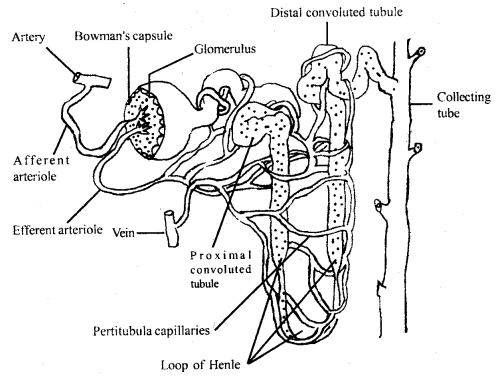
Excretory Products and their Elimination Class 11 Important Extra Questions Biology 1
Uriniferous tubules Or nephron of the kidney

Question 4.
Describe the gross anatomical features of the human kidney with a suitable diagram.
Answer:
Kidney: Kidney is chocolate brown, bean-shaped, large-sized about 10 cm long and 5 – 7 cm broad, 3 – 4cm thick flattened, metamorphic. The weight of each kidney is 150 to 170 gm. They are situated against the back wall of the abdominal cavity, just below the diaphragm, between the 12th thoracic and 3rd lumbar vertebrae.

The outer margin is convex. The inner concave presents a longitudinal opening called the hilum. The renal artery and renal vein respectively enter and leave the kidney through its hilum.

The two kidneys are slightly asymmetrical in position because the right kidney is slightly at a lower level than the left. Kidneys are held in position by a mass of adipose tissue called Renal fat. These rest against the abdominal muscles. Each kidney is covered on the ventral side by the peritoneum and is thus retroperitoneal in nature.

Surrounding the kidneys and the renal fat is a sheath of fibro elastic tissue known as renal fascia or capsule. They protect the kidney. The renal fat forms a shock-absorbing cushion. The renal fascia fixes the kidney to the abdominal wall.
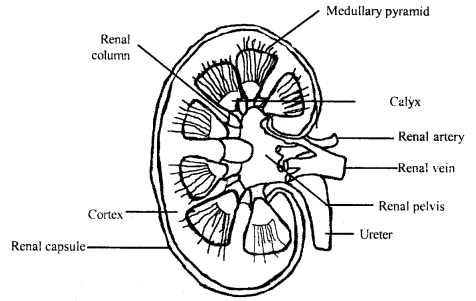
Excretory Products and their Elimination Class 11 Important Extra Questions Biology 2
Longitudinal section (Diagrammatic of Kidney)

Question 5.
(a)What is the role of the liver in excretion in mammals?
Answer:
Role of liver in excretion: The liver changes ammonia into urea which is less toxic than ammonia. Urea is eliminated from the body by the kidneys through urine.

The liver is the principal organ of excretion of cholesterol, bile pigments (bilirubin and biliverdin) some vitamins, drugs, and inactivated products of steroid hormones. The liver excretes these substances in the bile which carries them to the small intestine. Ultimately, these substances get eliminated along with feces.

(b) What are the diseases associated with the urinary system?
Answer:
Diseases associated with the urinary system:
1. Polynephritis: It is a bacterial infection, which causes inflammation of renal pelvic nephrons and medullary tissues of the kidney. It affects the counter-current mechanism. Its main symptoms are frequent and painful urination, fever, and pain in the lumbar region.

2. Uremia: It causes the presence of a high concentration of urea, uric acid, creatinine, etc, in the blood due to some bacterial infection or some obstruction in the passage of the urinary system. Urea poisons the cells. It is not passed in the urine and accumulates in the blood.

3. Renal stones: When uric acid precipitates and accumulates in the nephrons of kidneys in the form of renal stones or when calcium phosphates and oxalates accumulate in the nephrons of the kidneys in the form of renal stones. It causes blockage or frequent painful urination along with blood in the urine. Renal stone causes severe colic pain starting in the back and radiating down to the front of the thigh or vulva or testicle on that side.

4. Glomerulonephritis: It is characterized by the inflammation of Glomeruliduct, some injury to the kidney, abnormal allergic reaction, or by some streptococci bacteria infection. Proteins and red blood corpuscles become filtered into the glomerular filtrate. It may lead to kidney failure in severe infection.

5. Oedema: It is characterized by the increased volume of interstitial fluid mainly caused by retention of excess Na+ ions which in turn causes water retention. Blood pressure increases dining edema.

Question 6.
Write a short account on hemodialysis.
Answer:
In case of renal failure, an artificial kidney is used for removing excess urea from the blood of the patient by a process called hemodialysis. Blood is taken out from the artery of the patient, cooled to 0°C, mixed with an anticoagulant such as heparin, and then pumped into the apparatus called artificial kidney. In this apparatus, blood flows through channels
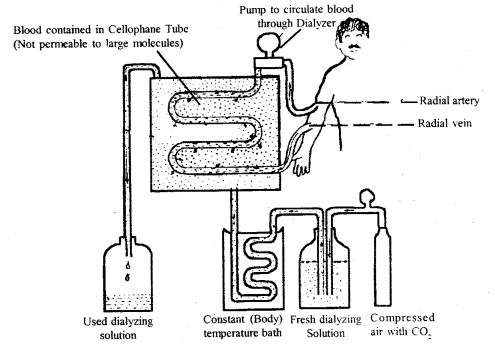
Excretory Products and their Elimination Class 11 Important Extra Questions Biology 3
Working of artificial kidneys for hemodialysis

bounded by cellophane membrane. The membrane is impermeable to macromolecules but permeable to small solutes. The membrane separates the blood flowing inside the channels from a dialyzing fluid flowing outside the membrane. The wastes like urea, uric acid, and creatinine diffuse from the blood to the dialyzing fluid across the cellophane membrane.

Thus the blood is considerably cleared of nitrogenous waste products without losing plasma proteins. Such a processor separation of macromolecules from small solute particles with the help of a permeable membrane is called dialysis. The blood coming out of the artificial kidney is warmed to body temperature, mixed with an Antiheparin to restore its normal coagulability, and returned to a vein of the patient.

Haemodialysis saves and prolongs the life of many uremic patients.