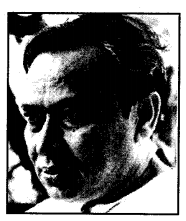
Class 12 Hindi Aroh Chapter 5 Summary सहर्ष स्वीकारा है 

By going through these CBSE Class 12 Hindi Notes Chapter 5 सहर्ष स्वीकारा है  Summary, Notes, students can recall all the concepts quickly.

सहर्ष स्वीकारा है Summary Notes Class 12 Hindi Aroh Chapter 5

सहर्ष स्वीकारा है  कविता का सारांश

गजानन माधव मुक्तिबोध नई कविता के प्रमुख कवि हैं। वे लंबी कविताओं के कवि हैं। ‘सहर्ष स्वीकारा है’ मुक्तिबोध की छोटी कविता है जो छायावादी चेतना से प्रेरित है। इस कविता में कवि ने जीवन में मनुष्य को सुख-दुख, राग-विराग, हर्ष-विषाद, आशा-निराशा, संघर्ष-अवसाद, उठा-पटक आदि भावों को सहर्ष अंगीकार करने की प्रेरणा प्रदान की है। इसके साथ यह कविता उस विशिष्ट व्यक्ति या सत्ता की ओर संकेत करती हैं जिससे कवि को प्रेरणा प्राप्त हुई है।

कवि उस विशिष्ट सत्ता को संबोधन करके कहता है कि मेरे जीवन में जो कुछ भी सुख-दुख, राग-विराग, संघर्ष-अवसाद, हर्ष-विषाद आदि मिला है उसको मैंने सहर्ष भाव से अंगीकार किया है। इसलिए वह जीवन में सब कुछ उसी सत्ता का दिया हुआ मानता है। गर्वयुक्त गरीबी, गंभीर अनुभव, भव्य विचार, दृढ़ता हृदय रूपी सरिता सब कुछ उनके जीवन में मौलिक हैं, बनावटी कुछ भी नहीं। इसलिए उन्हें गोचर जगत अदृश्य शक्ति का भाव लगता है।

वे सोचते हैं कि न जाने उस असीम सत्ता से उनका क्या रिश्ता-नाता है कि बार-बार वे उनके प्रति प्रेम रूपी झरने को ख़त्म करना चाहते हैं लेकिन वह बार-बार अपने-आप भर जाता है, जिसे चाहकर भी वे समाप्त नहीं कर सकते। उन्हें रात्रि में धरती पर मुसकुराते चाँद की भाँति अपने ऊपर असीम सत्ता का चेहरा मुसकुराता हुआ दिखता है। कवि बार-बार उस प्रभु से अपनी भूल के लिए दंड चाहते हैं। वे दक्षिण ध्रुव पर स्थित अमावस्या में पूर्ण रूप से डूब जाना चाहते हैं क्योंकि उन्हें अब प्रभु द्वारा ढका और घिरा हुआ रमणीय प्रकाश सहन नहीं होता। अब उन्हें ममता रूपी बादलों की कोमलता भी हृदय में पीड़ा पहुँचाती है।

उनकी आत्मा कमजोर और शक्तिहीन हो गई है। इसलिए होनी को देखकर उनका हृदय छटपटाने लगता है। अब तो स्थिति यह है कि उन्हें दुखों को बहलाने व सहलानेवाली आत्मीयता भी सहन नहीं होती। कवि वास्तव में उस असीम, विशिष्ट जन से दंड चाहता है। ऐसा दंड जिससे कि वह पाताल लोक की गहन गुफाओं, बिलों और धुएँ के बादलों में बिलकुल खो जाए। लेकिन वहाँ भी उन्हें प्रभु का ही सहारा दिखता है। इसलिए वह अपना सब कुछ उसी सत्ता को स्वीकार करते हैं और जो कुछ उस सत्ता ने सुख-दुख, राग-विराग, संघर्ष-अवसाद, आशा-निराशा आदि प्रदान किए हैं उन्हें खुशी-खुशी स्वीकार करता है।

इस कविता के माध्यम से कवि मनुष्यों को भी यही प्रेरणा देते हैं कि जीवन में मनुष्य को प्रभु प्रदत्त राग-विराग, सुख-दुख, आशा-निराशा आदि भाव सहर्ष भाव से या निर्विवाद रूप से स्वीकार कर लेने चाहिए।

सहर्ष स्वीकारा है  कवि परिचय
जीवन परिचय-श्री गजानन माधव मुक्तिबोध आधुनिक हिंदी साहित्य की नई कविता के बेजोड़ 0 कवि थे। ये एक संघर्षशील साहित्यकार थे जो आजीवन समाज, इतिहास और स्वयं से संघर्ष करते रहे। इनका जन्म 13 नवंबर, सन् 1917 ई० को मध्य प्रदेश के ग्वालियर जिले के श्योपुर नामक स्थान पर हुआ था। इनके पूर्वज पहले महाराष्ट्र में रहते थे जो बाद में मध्य प्रदेश में आकर रहने लगे। इनके पिता का नाम माधव मुक्तिबोध था। वे पुलिस में सिपाही थे।
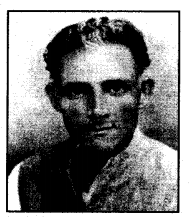
Class 12 Hindi Aroh Chapter 5 Summary सहर्ष स्वीकारा है 

इनकी माँ बुंदेलखंड के एक किसान की बेटी थी। मुक्तिबोध जी एक विचारक एवं घुमक्कड़ प्रवृत्ति के व्यक्ति थे। ये अपने भाइयों में सबसे बड़े थे। ये शांता नामक लड़की से प्रेम करते थे। बाद में इन्होंने परिवार की मरजी के खिलाफ़ शांता जी से शादी कर ली थी। इस घटना से इनका परिवार के सदस्यों से मतभेद हो गया। मुक्तिबोध की प्रारंभिक शिक्षा उज्जैन में हुई। ये मिडिल की परीक्षा में एक बार अनुत्तीर्ण हुए लेकिन निरंतर परिश्रम करते हुए सन् 1953 ई० में नागपुर विश्वविद्यालय से एम० ए० की परीक्षा पास की। बाद में जीविकोपार्जन के लिए मध्य प्रदेश के एक मिडिल स्कूल में अध्यापक नियुक्त हुए किंतु चार मास के बाद ही यह नौकरी छोड़ दी।

तत्पश्चात शुजालपुर में शारदा शिक्षण सदन में रहे। फिर दौलतगंज मिडिल स्कूल उज्जैन में आ गए। इस प्रकार ० कवि ने आजीविका हेतु कोलकाता, इंदौर, मुंबई, बंगलौर (बेंगलुरु), बनारस, जबलपुर, राजनाँद गाँव आदि स्थानों पर कार्य किया। इन्होंने अनेक पत्र-पत्रिकाओं का संपादन भी किया। सन 1945 ई० में ‘हँस’ पत्र के संपादक मंडल के सदस्य के रूप में कार्य किया। 0 सन् 1956 से 1958 तक ‘नया खून’ नामक पत्र के संपादन कार्य से जुड़े रहे। इस प्रकार मुक्तिबोध जी को जीवन में दर-दर की ठोकरें खानी पड़ी। अंत में ये बीमार रहने लगे। ‘मैनिन जाइटिस’ नामक रोग ने इनके शरीर को जकड़ लिया।

उन्हें उपचार के लिए भोपाल और दिल्ली लाया गया किंतु वे स्वस्थ नहीं हुए। अंततः 11 सितंबर सन् 1964 ई० को नई दिल्ली में इनका देहांत हो गया। रचनाएँ-मुक्तिबोध जी एक संघर्षशील साहित्यकार थे। ये बहुमुखी प्रतिभा से ओत-प्रोत रचनाकार थे। जो संघर्ष इनके जीवन में रहा
वही इनके साहित्य में भी दृष्टिगोचर होता है। इनकी प्रमुख रचनाएँ निम्नलिखित हैं

(i) काव्य-संग्रह-चाँद का मुँह टेढ़ा है (सन 1964), भूरी-भूरी खाक धूल (सन 1964)।
(ii) कहानी-संग्रह-काठ का सपना, सतह से उठता आदमी।
(iii) उपन्यास-विपात्र।
(iv) समीक्षात्मक ग्रंथ-कामायनी-एक पुनर्विचार, नई कविता का आत्म-संघर्ष, नए साहित्य का सौंदर्यशास्त्र, एक साहित्यिक डायरी, ० समीक्षा की समस्याएँ, भारत : इतिहास और संस्कृति।

साहित्यिक विशेषताएँ-‘मुक्तिबोध’ के साहित्य में सामाजिक चेतना, लोक-मंगल की भावना तथा जीवन के प्रति व्यापक दृष्टिकोण विद्यमान ० हैं। इनके काव्य में प्रगतिवादी तथा प्रयोगवादी संवेदनाओं का चित्रण मिलता है। इनके काव्य की प्रमुख विशेषताएँ निम्नलिखित हैं

(i) शोषक वर्ग के प्रति घृणा-मुक्तिबोध जी मार्क्सवादी चिंतन से प्रेरित कवि हैं। इन्होंने समाज के पूँजीपति वर्ग के प्रति घृणा-भाव व्यक्त किए हैं। इनकी अनेक कविताओं में उस व्यवस्था के प्रति गहन आक्रोश अभिव्यक्त किया गया है जो मजदूरों, निर्धनों का शोषण करके ऐशो-आराम का जीवन जी रहे हैं। पूँजीवादी समाज के प्रति’ इनकी ऐसी ही कविता है जिसमें प्रगतिवादी भावना दृष्टिगोचर होती है। ये पूँजीवादियों की मनोवृत्ति पर कटाक्ष करते हुए कहते हैं

तू है मरण, तू है रिक्त, तू है व्यर्थ
तेरा ध्वंस केवल एक तेरा अर्थ।

कवि शहरी सभ्यता को भी सुविधा भोगी वर्ग की देन मानते हैं। यहाँ एक ओर शोषक समाज की चमक-दमक झूठी शान की जिंदगी है तो दूसरी ओर दीन-हीन मजदूर वर्ग की विवशतापूर्ण जिंदगी। इस दोहरी नागरिकता से परिपूर्ण जीवन पर कवि ने गहन आक्रोश व्यक्त किया है। जैसे

पाउडर में सफ़ेद अथवा गुलाबी
छिपे बड़े-बड़े चेचक के दाग मुझे दीखते हैं
सभ्यता के चेहरे पर।

(ii) शोषित वर्ग के प्रति सहानुभूति-मुक्तिबोध ने शोषक वर्ग के प्रति गहन आक्रोश तथा शोषित वर्ग के प्रति विशेष सहानुभूति प्रकट की है। कवि समाज के दीन-हीन निर्धन लोगों को आर्थिक शोषण से मुक्त करना चाहता है। इन्होंने अपनी अनेक कविताओं में शोषण के शिकार नारी, शिशु और मजदूरों का सजीव और मार्मिक अंकन किया है। ये शोषित समाज के प्रति संवेदना व्यक्त करते हुए कहते हैं

गिरस्तिन मौन माँ बहनें
उदासी से रंगे गंभीर मुरझाए हुए प्यारे
गऊ चेहरे
निरखकर
पिघल उठता मन।

(iii) समाज का यथार्थ चित्रण-मुक्तिबोध जी भ्रमणशील व्यक्ति थे। अतः इन्होंने समाज को बहुत नजदीकी से देखा। इसलिए इनके काव्य में समाज का यथार्थ बोध होता है। इनके काव्य में भोगे हुए यथार्थ की अभिव्यंजना हुई है। कवि ने समकालीन समाज में | फैली विसंगतियों, कुरीतियों, शोषण, अमानवीय मूल्यों का यथार्थ चित्रण किया है।

ये ‘चाँद का मुंह टेढ़ा’ में समकालीन समाज के प्रति चिंता व्यक्त करते हुए कहते हैं
आज के अभाव के और कल के उपवास के
व परसों की मृत्यु के
दैन्य के महा अपमान के व क्षोभपूर्ण
भयंकर चिंता के उस पागल यथार्थ का
दीखता पहाड़ स्याह।

(iv) निराशा, वेदना एवं कुंठा का चित्रण-मुक्तिबोध की प्रारंभिक रचनाओं में उनका व्यक्तिगत चित्रण हुआ है। इसी प्रवृत्ति के कारण इनकी अनेक कविताओं में निराशा, वेदना, कुंठा आदि का चित्रण हुआ है। मुक्तिबोध आजीवन संघर्षरत रहे। इन्हें पग-पग पर ठोकरें खानी पड़ी। इसी संघर्ष और वेदना के उनके काव्य में दर्शन होते हैं। कवि ने अपनी वेदना को संत-चित वेदना इसलिए कहा है क्योंकि ये समाज की विसंगतियों, शोषण वेदना को अपने भीतर घटित होते देखते हैं। इन्होंने आजीवन जिस वेदना, कुंठा, दुख, पीड़ा को झेला उसी का सजीव चित्रांकन अपनी कविताओं में किया है

दुख तुम्हें भी है,
दुख मुझे भी है
हम एक ढहे हुए मकान के नीचे
दबे हैं।
चीख निकालना भी मुश्किल है
असंभव
हिलना भी।

‘अँधेरे में मुक्तिबोध का आस्थावादी दृष्टिकोण अभिव्यक्त हुआ है। इन्होंने निराशा-वेदना के अंधकारमय वातावरण में भी आशा का दीपक जलाए रखा है।

(v) वैयक्तिकता-छायावादी कवियों की भाँति मुक्तिबोध की अनेक कविताओं में व्यक्तिवादिता का भाव अभिव्यक्त हुआ है। इनकी वैयक्तिकता व्यक्तिगत होते हुए भी समाजोन्मुख है। ‘तारसप्तक’ में संकलित इनकी अधिकांश कविताएँ इसी छायावादी भावना से ओत-प्रोत हैं। इनकी अनेक कविताएँ छायावादी भावना और प्रगतिशीलता का अनूठा समन्वय लिए हुए हैं।
कहीं-कहीं अकेलेपन की प्रवृत्ति झलकती है लेकिन वह भी समाज से उन्मुख होती दिखाई पड़ती है। कवि ‘चाँद का मुँह टेढ़ा’ में कहते हैं याद रखो कभी अकेले में मुक्ति नहीं मिलती
यदि वह है तो सब के साथ ही।

(vi) वर्गहीन समाज का चित्रण-मुक्तिबोध मार्क्सवादी चेतना से प्रेरित कवि हैं। ये समाज से शोषक वर्ग को समाप्त कर वर्गहीन समाज की स्थापना करना चाहते हैं। यही भावना इनकी अनेक कविताओं में प्रकट होती है। जहाँ ये पूँजीपति समाज का साम्राज्य समाप्त करना चाहते हैं। इनकी कविताएँ जन-विरोधी समाज व्यवस्था के विरुद्ध संघर्षशील हैं। कवि ने अपने काव्य में शोषण, वर्ग-भेद को मिटाकर एक स्वस्थ एवं वर्गहीन समाज की कल्पना की है। ये वर्तमान समाज के प्रति चिंता व्यक्त करते हुए कहते हैं कविता में कहने की आदत नहीं, पर कह दूँ वर्तमान समाज चल नहीं सकता।

(vii) भाषा-शैली-मुक्तिबोध की काव्य-कला की महत्त्वपूर्ण विशेषता है कि इन्होंने मानव-जीवन की जटिल संवेदनाओं और अंतवंवों की सृजनात्मक अभिव्यक्ति के लिए फैटेसियों का कलात्मक उपयोग किया है। मुक्तिबोध सामान्य जन-जीवन में प्रचलित शब्दावली से युक्त भाषा का प्रयोग किया है। भाषा की मौलिकता इनकी काव्य-कला की प्रमुख विशेषता है। इनकी भाषा में संस्कृत की तत्सम शब्दावली का प्रयोग है तो अंग्रेजी, उर्दू, अरबी, फ़ारसी आदि भाषाओं के शब्दों का प्रयोग भी हुआ है। इनकी भाषा पाठक को वास्तविक मर्म सौंपने का कार्य करती है। इनकी शैली भावपूर्ण है। इसके साथ-साथ आत्मीय व्यंजनात्मक, चित्रात्मक, व्यंग्यात्मक, प्रतीकात्मक आदि शैलियों के भी दर्शन होते हैं।

(viii) बिंब-विधान-मुक्तिबोध का बिंब-विधान अत्यंत श्रेष्ठ है। इस दृष्टि से इनका काव्य अत्यंत समृद्ध है। इनकी संपूर्ण कविताएँ बिंबमयी हैं। इन्होंने सामाजिक यथार्थ, विसंगति, त्रासदी, वेदना आदि के सजीव चित्र उपस्थित किए हैं। इन्होंने अपने काव्य में दृश्य, ध्वनि, स्पर्श, स्थिर, गत्यात्मक, प्राकृतिक, वैज्ञानिक आदि अनेक बिंबों का सजीव चित्रण किया है।

जैसे
सामने मेरे
सरदी में बोरे को ओढ़ कर
कोई एक अपने
हाथ-पैर समेटे
काँप रहा, हिल रहा-वह मर जाएगा।

(ix) प्रतीक विधान-मुक्तिबोध ने अपने काव्य में प्रतीकों का प्रचुर प्रयोग किया है। इन्होंने अपने काव्य में परंपरावादी प्रतीकों की अपेक्षा नए, जीवंत और सामान्य जन-जीवन के प्रतीकों का प्रयोग किया है। ब्रह्मराक्षस, ओरांग, उटांग, बावड़ी कवि के प्रिय प्रतीक हैं। इसलिए इनका उन्होंने बार-बार प्रयोग किया है। मुक्तिबोध की लंबी कविता ‘अँधेरे में’ समकालीन मनुष्य के संघर्ष का प्रतीक है जिसमें प्रयुक्त चरित्र ‘गांधी और तिलक’ दो। विचारधाराओं के प्रतीक हैं। इसके साथ-साथ इन्होंने पौराणिक प्रतीकों का भी प्रयोग किया है।

(x) छंद-मुक्तिबोध ने अपनी काव्य-रचना के लिए मुख्यतः मुक्तक छंद का प्रयोग किया है। इनके काव्य में लय और ताल का अनूठा संगम दिखाई देता है। इसके साथ तुकांत, अतुकांत छंदों के भी दर्शन होते हैं। अष्टक इनका प्रिय छंद है। इन्होंने लंबी कविताओं में इस छंद का प्रयोग किया है।

(xi) अलंकार-योजना-मुक्तिबोध की अलंकार योजना अत्यंत सुंदर है। इन्होंने परंपरागत उपमानों की अपेक्षा नवीन उपमानों का प्रचुर प्रयोग किया है। इनके काव्य में अनुप्रास, पदमैत्री, स्वरमैत्री, उपमा, रूपक, उत्प्रेक्षा, संदेह, उल्लेख, मानवीकरण’ रूपकातिशयोक्ति आदि अलंकारों का सुंदर एवं सजीव प्रयोग हुआ है। रूपक अलंकार का उदाहरण दृष्टव्य है

रवि निकलता
लाल चिंता की रुधिर-सरिता
प्रवाहित कर दीवारों पर
उदित होता चंद्र
ब्रज पर बाँध देता
श्वेत धौली पट्टियाँ।

वस्तुतः गजानन माधव मुक्तिबोध आधुनिक हिंदी काव्य की नई कविता के प्रमुख कवि माने जाते हैं। इनका हिंदी साहित्य में प्रमुख स्थान है।
Atoms Class 12 Notes Physics Chapter 12

By going through these CBSE Class 12 Physics Notes Chapter 12 Atoms, students can recall all the concepts quickly.

Atoms Notes Class 12 Physics Chapter 12

→ From α-particle scattering, it can be concluded that:

  1. the atom is mostly neutral.
  2. the whole of the positive charge is concentrated in a small volume at the center of the atom called the nucleus.

→ In case a proton is moving towards a stationary proton, at the point of the closest approach, the initial kinetic energy of the moving proton is equal to the K.E. of both protons plus the electrostatic potential energy.

→ Wavelength/frequencies/wavenumbers of radiations emitted by the excited H-atom are not continuous.

→ Bohr’s theory is applicable to all one-electron (hydrogenic) atoms
such as He+, Li++, ………..
According to it:

  1. rn = a0 \(\frac{n^{2}}{Z}\) Å
    Where a0 = 0.53 Å = radius of first Bohr’s orbit of the hydrogen atom,
  2. The total energy is negative, so the system is a bound one.

→ B.E. = ground state energy.

→ Ionisation energy = – B. E.

→ If a hydrogen atom in the ground state absorbs a photon of energy hv and is excited to nth state, then
– 13.6 + hv = – \(\frac{13.6}{n^{2}}\)

→ Distance of closest approach (= r0) gives an idea about the size of the nucleus.

→ Spectral lines of the Lyman series are found to lie in the UV region.

→ The longest wavelength of this series (= 1216 Å) is due to 2 → 1
transition.

→ The shortest wavelength of this series (= 912 Å) is due to ∞ → 1 transition.

→ Spectral lines of the Balmer series are found to lie in the visible region

→ Bohr’s model is not applicable to even two-electron atoms such as He.

→ The shortest wavelength of this series (3648 Å) is due to ∞ → 1 transition.

→ 1st, 2nd, 3rd members of this series are called Hα, Hβ, Hγ lines.

→ Spectral lines of the Paschen series lie in the infrared region.

→ The longest wavelength of this series (18761 Å) is obtained due to 4 → 3 transitions.

→ The shortest wavelength of this series (8208 Å) is obtained due to ∞ → 1 transition.

→ Stationary orbits do not mean that the electron is stationary but it means that the energy of the electron remains constant as long as it keeps on moving in the same orbit.

→ When external energy is supplied to the atom, an electron in any orbit absorbs this energy and goes to the higher energy orbit. After 10-8 s, the electron jumps back to the original orbit by emitting the absorbed energy in the form of a photon.

→ The speed of an electron in an orbit is inversely proportional to the
principal quantum number.

→ Ionisation energy of H-atom = E – E1 = = 0 – (- 13.6) = 13.6 eV.

→ The ionization potential of H-atom = 13.6 V.

→ Bohr laid the foundation of the quantum theory by postulating specific orbits in which electrons don’t radiate.

→ Bohr’s model includes only one quantum number n.

→ Bohr modified the Rutherford model of the atom by introducing quantum ideas known as Bohr’s postulates.

→ Rutherford’s atomic model could not explain the stability of the atom.

→ Rutherford concluded that electrons are not stationary but they are moving around the nucleus in circular orbits.

→ Emission or absorption of energy takes place only when an electron jumps from one stationary orbit to the other stationary orbit.

→ The energy of the electron is greater in the outer orbits than in the inner orbit.

→ The energy of the electron for orbit with n = ∞ is maximum and is equal to zero.

→ Spectra is of two types:

  1. Emission spectrum
  2. Absorption spectrum.

→ Emission spectrum results when there is the transition from a high energy state to a lower energy state.

→ Absorption spectrum results when energy is absorbed by the atom and goes from a lower energy state to a higher energy state.

→ Fraunhofer’s lines in the sun’s spectra are the absorption lines.

→ There appears a dark line corresponding to photons absorbed in the spectrum.

→ The election may be seen to be at a distance from the nucleus of about 104 to 105 times the size of the nucleus itself. Thus the distance of the closest approach helps us to estimate the size of the nucleus (R).
i. e. r0 = 104 to 105 R.
∴ R = 10-4 to 10-5 r0.

→ Size of atom = 104 to 105 times the size of the nucleus (R).

→ r0 is of the order of size of the atom.

→ The nucleus of gold is about 50 times heavier than an α-particle, thus it (Au nucleus) remains at rest during α-particle scattering.

→ Bohr’s radius: It is the radius of the innermost orbit in the hydrogen atom. It is denoted by r1 or a0.

→ Permitter orbits: They are defined as the orbits for which the angular momentum is an integral multiple of \(\frac{\mathrm{h}}{2 \pi}\) i.e.,
L = mvr = n \(\frac{\mathrm{h}}{2 \pi}\)

→ Impact Parameter: It is the perpendicular distance of the velocity vector of the a-particle from the central line of the nucleus when the particle is far away from the nucleus of the atom.

→ Distance of closest approach: It is the minimum distance up to which an energetic a-particle traveling towards the nucleus can move before coming to rest and then retracing its path.

→ Ground state: It is defined as the energy state of electron corresponding to n = 1.

→ Excited states: They are the energy states of electrons corresponding to n = 2,3, 4. When an electron in the innermost orbit jumps to higher orbits after absorbing the energy.

→ Spectral line: When an electron jumps from a higher energy state to the lower energy state in the hydrogen atom, the radiation of a particular wavelength or frequency is emitted which is called a spectral line.

→ Energy level diagram: The energy of an electron corresponding to each orbit (energy state) can be represented by the horizontal lines.

→ Excitation potential: It is defined as the potential difference through which an electron in an atom must be accelerated so that it may go from the ground state to the excited state. It corresponds to the excitation energy.

→ Excitation: It is the process of absorption of energy by an electron when it goes from a lower energy state to a higher energy state.

→ Ionization: It is the process of detaching or knocking out an electron from the atom.

→ Ionization energy: The energy required to knock out an electron from an atom i.e., from the ground state (n = 1) to energy state n = ∞.

→ Ionization potential: It is defined as the potential difference through which an electron of an atom is accelerated so that it is knocked out of the atom.

Important Formulae

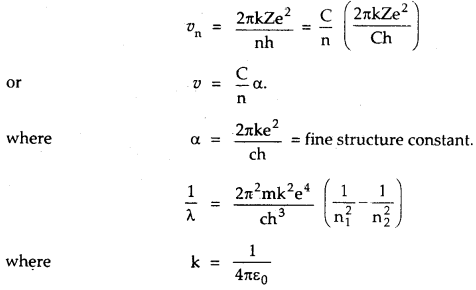
→ Speed of an electron revolving in nth orbit is given by
νn = \(\frac{2 \pi \mathrm{k} \mathrm{Ze}^{2}}{\mathrm{nh}}\)

→ Angular momentum of the electron is given by
m vn rn = \(\frac{\mathrm{nh}}{2 \pi}\)
where vn = Velocity of electron in nth orbit.
rn = radius of orbit of electron in nth orbit,
n = 1, 2, 3, …………..

hv = Ef – Ei
= \(\frac{2 \pi^{2} \mathrm{k}^{2} \mathrm{Z}^{2} \mathrm{me}^{4}}{\mathrm{~h}^{2}}\left(\frac{1}{\mathrm{n}_{\mathrm{i}}^{2}}-\frac{1}{\mathrm{n}_{\mathrm{f}}^{2}}\right)\)

→ Rydberg constant is given by
R = \(\frac{2 \pi^{2} m k^{2} e^{4}}{c h^{3}}\)

→ Velocity in terms of fine structure constant is given by
Atoms Class 12 Notes Physics 1
→ Impact parameter is given by
b = \(\frac{\mathrm{Ze}^{2} \cot \frac{\theta}{2}}{4 \pi \varepsilon_{0} . \mathrm{E}}\)
where θ = angle of scattering.
E = \(\frac{1}{2}\) mv2 = K.E. of α-particle.

→ Ionisation potential is given by
V = \(\frac{13.6 \mathrm{Z}^{2}}{\mathrm{n}^{2}}\)
Where Z = an atomic number of the atom.
n = number of orbit from which electron is to be removed.

→ Rydberg formula for spectrum of H-atom is
\(\bar{v}\) = R\(\left(\frac{1}{n_{1}^{2}}-\frac{1}{n_{2}^{2}}\right)\)
= wave number of radiation emitted.

→ Ionisation energy of Hydrogen atom is
E = E – E1 = 13.6 eV,

→ Total energy of electron in nth orbit of hydrogen atom is given by
E = – \(\frac{2 \pi^{2} m k^{2} e^{4}}{n^{2} h^{2}}\)
= – \(\frac{13.6}{\mathrm{n}^{2}}\) eV.

→ For H-like atoms
E = \(\frac{13.6}{\mathrm{n}^{2}}\) Z2(eV).

→ The energy of electron in various stationary orbits for H-atom is
E1 = -13.6 eV
E2 = – 3.4 eV
E3 = -1.51 eV
E4 = -0,85eV
E5 = -0.54 eV.
…………………..
…………………..

→ For the Lyman series,
\(\bar{v}\) = \(\frac{1}{λ}\) = R(\frac{1}{1^{2}}-\frac{1}{n^{2}})

→ For Balmer series,
\(\bar{v}\) = \(\frac{1}{λ}\) = R(\frac{1}{Z^{2}}-\frac{1}{n^{2}})
where n = 3, 4, 5, ….n.

→ For Paschen series,
\(\bar{v}\) = \(\frac{1}{λ}\) = R(\frac{1}{3^{2}}-\frac{1}{n^{2}})
where n = 4, 5, 6, …. n.

→ For Pfund series,
\(\bar{v}\) = \(\frac{1}{λ}\) = R(\frac{1}{4^{2}}-\frac{1}{n^{2}})
where n = 5, 6, ….n.

→ radius of nth orbit is given by
rn = \(\frac{n^{2} h^{2}}{4 \pi^{2} m k Z e^{2}}\)
= \(\frac{n^{2} h^{2}}{4 \pi^{2} m k e^{2}}\) for H-atom.

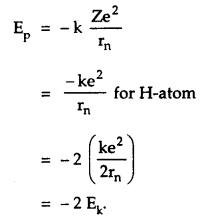
→ K.E. of electron revolving in nth orbit is
Ek = \(\frac{1}{2}\) . \(\frac{\mathrm{kZe}^{2}}{\mathrm{r}_{\mathrm{n}}}\)
for H-atom
Ek = \(\frac{1}{2}\) . \(\frac{\mathrm{ke}^{2}}{\mathrm{r}_{\mathrm{n}}}\)

P.E. of an electron in nth orbit is
Atoms Class 12 Notes Physics 2
→ Total energy in nth orbit is
E = KE. + P.E.
= Ek – 2Ek
= – Ek = \(\frac{\mathrm{ke}^{2}}{2 \mathrm{r}_{\mathrm{n}}}\)

→ Distance of closest approach is α-particle is given by
r0 = \(\frac{(\mathrm{Ze}) \cdot(2 \mathrm{e})}{4 \pi \varepsilon_{0} . \mathrm{E}}=\frac{2 \mathrm{Ze}^{2}}{4 \pi \varepsilon_{0}\left(\frac{1}{2} \mathrm{mv}^{2}\right)}\)

→ Ionisation potential = \(\frac{\text { ionisation energy }}{\mathrm{e}}\)

→ Excitation potential = \(\frac{\text { excitation energy }}{\mathrm{e}}\)

→ The number of a-particles per unit area that reach the screen at a scattering angle θ are found to vary as:
N(θ) ∝ \(\frac{1}{\sin ^{4}\left(\frac{\theta}{2}\right)}\)

Class 12 Hindi Aroh Chapter 4 Summary कैमरे में बंद अपाहिज

By going through these CBSE Class 12 Hindi Notes Chapter 4 कैमरे में बंद अपाहिज Summary, Notes, students can recall all the concepts quickly.

कैमरे में बंद अपाहिज Summary Notes Class 12 Hindi Aroh Chapter 4

कैमरे में बंद अपाहिज कविता का सारांश

कैमरे में बंद अपाहिज कविता रघुवीर सहाय के काव्य-संग्रह ‘लोग भूल गए हैं से संकलित की गई है। इस कविता में कवि ने शारीरिक चुनौती को झेलते व्यक्ति से टेलीविजन कैमरे के सामने किस तरह के सवाल पूछे जाएंगे और कार्यक्रम को सफल बनाने के लिए उससे कैसी भंगिमा की अपेक्षा की जाएगी इसका लगभग सपाट तरीके से बयान करते हुए एक तरह से पीड़ा के साथ दृश्य संचारमाध्यम के संबध को रेखांकित किया है।

साथ ही कवि ने व्यंजना के माध्यम से ऐसे व्यक्ति की ओर इशारा किया है जो अपनी दुःख-दर्द, यातनावेदना को बेचना चाहता है। इस कविता में कवि ने शारीरिक चुनौती झेलते हुए लोगों के प्रति संवेदनशीलता व्यक्त की है। कवि ने इस कविता में बताया है कि अपने कार्यक्रम को सफल बनाने तथा किसी की पीड़ा को बहुत बड़े दर्शक वर्ग तक पहुँचाने के लिए दरदर्शनवाले किसी दल और शारीरिक रूप से कमजोर व्यक्ति को अपने कैमरे के सामने प्रस्तुत करते हैं। उससे अनेक तरह से सवाल पर सवाल पूछते हैं। उसे कैमरे के आगे बार-बार लाया जाता है। बार-बार उससे अपाहिज होने के बारे में सवाल पूछे जाते हैं

कि आपको अपाहिज होकर कैसा लगता है तथा उस कार्यक्रम को रोचक बनाने के लिए दूरसंचारवाले स्वयं प्रतिक्रिया व्यक्त करके बताते स हैं। अनेक ऐसे संवेदनशील सवालों को पूछ-पूछकर वे उस व्यक्ति को रुला देते हैं। दूरदर्शन के बड़े परदे पर उस व्यक्ति की आँसूभरी ” आँखों को दिखाया जाता है। इस प्रकार दूरदर्शनवाले बार-बार एक ऐसे अपाहिज व्यक्ति की पीड़ा को दर्शकों के समक्ष प्रस्तुत करते हैं।

कैमरे में बंद अपाहिज कवि परिचय

कवि-परिचय जीवन-परिचय-रघुवीर सहाय समकालीन हिंदी कविता के संवेदनशील कवि हैं। उनका जन्म सन् 1929 ई० में उत्तर प्रदेश के लखनऊ में हुआ था। उन्होंने लखनऊ विश्वविद्यालय से 1951 में एम० ए० अंग्रेजी की परीक्षा उत्तीर्ण की। एम० ए० करने के पश्चात ये पत्रकारिता क्षेत्र में कार्य करने लगे। इन्होंने ‘प्रतीक’, ‘वाक् और ‘कल्पना’ अनेक पत्रिकाओं के संपादक मंडल के सदस्य के रूप में भी कार्य किया।

Class 12 Hindi Aroh Chapter 4 Summary कैमरे में बंद अपाहिज

ततपश्चात कुछ समय तक आकाशवाणी में ऑल इंडिया रेडियो के हिंदी समाचार विभाग से भी सबद्ध रहे। ये 1971 से 1982 तक प्रसिद्ध पत्रिका दिनमान के संपादक रहे। इनको कवि के रूप में ‘दूसरा सप्तक’ से विशेष ख्याति प्राप्त हुई। इनकी साहित्य सेवा भावना के कारण ही इनको साहित्य अकादमी सम्मान से सम्मानित किया गया। अंत में दिल्ली में सन् 1990 ई० में ये अपना महान साहित्य संसार को सौंपकर चिरनिद्रा में लीन हो गए।

रचनाएँ-रघुवीर सहाय हिंदी साहित्य के सफल कवि हैं। इन्होंने समकालीन समाज पर अपनी लेखनी चलाई है। इन्होंने समकालीन अमानवीय दोषपूर्ण राजनीति पर व्यंग्योक्ति तथा नए ढंग की कविता का आविष्कार किया है। इनकी प्रमुख रचनाएँ निम्नलिखित हैं

काव्य-संग्रह-सीढ़ियों पर धूप में, आत्महत्या के विरुद्ध, हँसो, हँसो जल्दी हँसो, लोग भूल गए हैं, आत्महत्या के विरुद्ध इनका प्रसिद्ध काव्य-संग्रह है। सीढ़ियों पर धूप में ‘कविता-कहानी-निबंध’ का अनूठा संकलन है। काव्यगत विशेषताएँ-रघुवीर सहाय समकालीन हिंदी जगत के प्रसिद्ध कवि हैं। उनका काव्य समकालीन जगत का यथार्थ चित्रण प्रस्तुत करता है। उनके काव्य की प्रमुख विशेषताएँ निम्नलिखित हैं

(i) समाज का यथार्थ चित्रण-रघुवीर सहाय जी ने समकालीन समाज का यथार्थ चित्रण प्रस्तुत किया है। इनके काव्य में सामाजिक यथार्थ के प्रति विशिष्ट सजगता दृष्टिगोचर होती है। इन्होंने सामाजिक अव्यवस्था, शोषण, विडंबना आदि का यथार्थ चित्रण किया है।

(ii) अदम्य जिजीविषा का चित्रण-रघुवीर सहाय ने अपने काव्य में अदम्य जिजीविषा का वर्णन किया है। इन की अनेक कविताओं में इस विशेषता का अनूठा चित्रण हुआ है। ‘सीढ़ियों पर धूप में’ काव्य-संग्रह की प्रायः सब कविताओं में अदम्य जीने की इच्छा। की सफल अभिव्यक्ति हुई है।

“और जिंदगी के अंतिम दिनों में काम करते हुए बाप काँपती साइकिलों पर
भीड़ से रास्ता निकाल कर ले जाते हैं।
तब मेरी देखती हुई आँखें प्रार्थना करती हैं
और जब वापस आती हैं अपने शरीर में
तब दे दिया जा चुका होता है।”

(iii) मध्यवर्गीय जीवन का चित्रण-कवि ने समकालीन समाज के मध्यवर्गीय जीवन का यथार्थ चित्रांकन प्रस्तुत किया है। इन्होंने अपने काव्य में मध्यवर्गीय जीवन में परिव्याप्त तनावों और विडंबनाओं का वर्णन किया है। वह कवि और शेष दुनिया के बीच का अनुभूत तनाव है। जो कवि को निरंतर आंदोलित करता रहता है। इसके साथ-साथ कवि ने कुछ व्यक्ति और समूह के मध्य तनाव का चित्रांकन भी किया है।

(iv) भ्रष्टाचार का चित्रण-रघुवीर सहाय ने अपने काव्य में समकालीन समाज में फैले भ्रष्टाचार का यथार्थ चित्रण किया है। इन्होंने लोकतंत्र में व्याप्त भ्रष्टाचार की प्रत्येक गतिविधि का मार्मिक वर्णन किया है। ‘आत्महत्या के विरुद्ध’ एक नाटकीय एकालाप है | जिसमें भ्रष्टाचार को ध्वन्यात्मक रूप से अंकित किया गया है। इस संग्रह में कवि ने ‘समय आ गया है’ वाक्यांश के माध्यम से

Dual Nature of Radiation and Matter Class 12 Notes Physics Chapter 11

By going through these CBSE Class 12 Physics Notes Chapter 11 Dual Nature of Radiation and Matter, students can recall all the concepts quickly.

Dual Nature of Radiation and Matter Notes Class 12 Physics Chapter 11

→ Radiation has dual nature i.e., it behaves both as a particle and a wave.

→ Energy greater than work function (Φ0 or ω) required for ejection of electrons from the metal surface can be supplied by heating or irradiating it by the light of frequency greater than threshold frequency or applying a strong electric field.

→ The stopping potential (V0) depends on the frequency of incident light, nature of the material on the surface of the cathode.

→ V0 is directly related to the maximum kinetic energy (\(\frac{1}{2}\) mV2max) of the emitted electrons i.e., eV0 = Emax = \(\frac{1}{2}\) m V2max).

→ V0 is independent of the intensity of incident light for a given frequency.

→ Below the threshold frequency (v0), no photoelectric emission takes place whatever may be its intensity.

→ Photoelectric emission is an instantaneous process.

→ The photoelectric current depends on the potential difference applied between the cathode and anode, the nature of the material of the cathode, and the intensity of incident light.

→ The photoelectric emission follows the law of conservation of energy.

→ Each photon absorbed ejects an electron from a metal surface. Einstein’s photoelectric equation is in accordance with the law of conservation of energy.

→ The dualism of matter is inherent in the de-Broglie relation which contains a wave concept (λ) and a particle concept (p).

→ The de-Broglie wavelength (λ) associated with a moving particle is related to its momentum (p) as
λ = \(\frac{h}{p}\)

→ The de-Broglie wavelength is independent of the charge and nature of the material particle.

→ The wave nature of electrons has been verified and confirmed using Davisson and Germer’s experiments.

→ Free electrons in a metal are free in the sense that they move inside the metal in a constant potential.

→ Plank’s constant is the bridge between the particle aspect and wave aspect of radiation and matter.

→ The wave-particle duality is not the sole monopoly of e.m. waves.

→ Even a material particle in motion according to de-Broglie will have a wavelength.

→ The photoelectric effect was discovered by Hertz in 1887.

→ The photoelectric effect was demonstrated by Hallwach in 1888.

→ Work function is least for Caesium (i.e Φ0 = 2.14 eV)

→ Absorption of energy takes place in discrete units of hv.

→ Platinum has the highest value of work function.

→ Zn, Cd, Mg, etc. respond only to UV light (having a short wavelength) to cause electron emission from the surface.

→ Alkali metals such as Li, Na, K, Caesium, and rubidium are sensitive even to visible light.

→ The number of photoelectrons emitted per second is directly proportional to the intensity of incident radiation.

→ Work function: It is defined as the minimum energy required by an electron to come out from a metal surface.

→ Photo electrons: The electrons ejected out of a metal surface under the action of light of a short wavelength are called photoelectrons.

→ Photoelectric effect: It is defined as the phenomenon of ejection of electrons from a metal surface when the light of very high frequency falls upon it.

→ Photon: It is a packet of energy.

→ Photoelectric cell: ft is a device that converts light energy into electrical energy.

→ Matter waves or de-Broglie waves: They are defined as the waves associated with every moving matter particle.

→ Cutoff potential or Retarding potential or stopping potential: It is defined as the minimum value of negative potential which has to be applied on the anode in a photocell so that the photoelectric current becomes zero. It is denoted by V0.

→ Saturation Current: It is the maximum value of the photoelectric current.

Important Formulae
→ For a relativistic particle moving with a speed v comparable to the speed of light c, de-Broglie wavelength is given by
λ = \(\frac{h}{m v}\)
where m = \(\frac{m_{0}}{\sqrt{1-\frac{v^{2}}{c^{2}}}}\), m0 being the rest mass of the particle.

→ deBroglie wavelength of a particle is
λ = \(\frac{\mathrm{h}}{\mathrm{p}}=\frac{\mathrm{h}}{\mathrm{m} v}=\frac{\mathrm{h}}{\sqrt{2 \mathrm{mE}}}=\frac{\mathrm{h}}{\sqrt{2 \mathrm{meV}}}\)
where p = momentum of particle of mass m, its velocity = v
E = K.E. of particle.
V = accelerating potential difference applied (V).

→ For an electron,
λ = \(\frac{12.27}{\sqrt{V}}\) A°
where \(\frac{\mathrm{h}}{\sqrt{2 \mathrm{me}}}\) = 12.27 × 10⁻¹⁰ for an electron

→ Vertical deflection of electron due to \(\overrightarrow{\mathrm{E}}\) between its plates is
y = \(\frac{1}{2}\) at2 = \(\frac{1}{2}\) . \(\frac{\mathrm{e} \mathrm{E}}{\mathrm{m}} \cdot \frac{\mathrm{x}^{2}}{v^{2}}\)

→ Total deflection of the charge on the screen is
y0 = \(\frac{\mathrm{eEx}}{\mathrm{m} v^{2}}\left(1+\frac{\mathrm{x}}{2}\right)=\left(1+\frac{\mathrm{x}}{2}\right)\) tan θ
where l = distance of screen from the end of plates.
x = length of plates
tan θ = \(\frac{v_{\mathrm{y}}}{v_{x}}=\frac{y_{0}}{\left(l+\frac{x}{2}\right)}\)

→ Einstein’s photoelectric equation is
hv = hv0 + \(\frac{1}{2}\) m v2max
or
\(\frac{hv}{λ}\) = W + eV0, where the symbols have their usual meanings.

→ At the threshold frequency v^ the emitted phtoelectrons will have no K.E.
∴ 0 = hv0 – ω
or
ω = hv0.

→ At stopping potential, \(\frac{1}{2}\) m v2 max = eV0.

→ Be v max = \(\frac{m v_{\max }^{2}}{r}\)

→ p = \(\frac{hv}{C}\) = momentum of a photon

→ Slope of V – ν curve = \(\frac{\mathrm{V}}{\mathrm{ν}}=\frac{\mathrm{h}}{\mathrm{e}}\)

→ Number of photons per sec per unit area = \(\frac{Φ}{E}\)
= \(\frac{\text { energy flux }}{\text { energy of photons per sec per unit area }}\)

= \(\frac{\text { Energy radiated/sec }}{\text { Energy of each photon }}=\frac{\mathrm{P}}{\mathrm{E}}\)

Wave Optics Class 12 Notes Physics Chapter 10

By going through these CBSE Class 12 Physics Notes Chapter 10 Wave Optics, students can recall all the concepts quickly.

Wave Optics Notes Class 12 Physics Chapter 10

→ Optics is that branch of physics that deals with the nature, sources, properties and effects of light.

→ Light is that form of energy that makes the object visible.

→ Wave optics treat the light as e.m. waves.

→ Light does not require any material medium for propagation.

→ Photographic plates are sensitive to the violet colour and least sensitive to the red colour.

→ Angular fringe width i.e., θ is independent of the distance between the screen and the plane of the slits i.e., D.

→ Speed of light is maximum for violet colour (7.5 × 10¹⁴ Hz) and minimum for red colour (4.3 × 10¹⁴ Hz).

→ Objects are visible from all directions due to the scattering of light.

→ The velocity of light of all wavelengths is the same in free space or vacuum.

→ Hie velocity of light of different colours will be different in media other than vacuum.

→ Our eye fails to see two points separately if they subtend an angle equal to or less than 1 minute and it is called resolving power of the eye.

→ Light of single frequency is called monochromatic.

→ The wavefront due to a point source is spherical and due to a line source, it is cylindrical.

→ The wavefront corresponding to a parallel beam of a light ray is plane.

→ The direction of propagation of light is perpendicular to the wavefront.

→ Each point on a wave point acts as a source of new disturbance and is called a secondary wavelet.

→ Polaroids allow the light oscillations parallel to the transmission axis to pass through them.

→ If the transmission axis of the analyser is perpendicular to that of the polariser, then no light passes through the analyser.

→ If the transmission axis of the polarizer and analyser are parallel, then the whole of the polarised light passes through the analyser.

→ The optical axis is the plane in a polariser or analyser parallel to which the oscillations of light are transmitted through the crystal without change in intensity.

→ Sound waves in the air cannot be polarised as they are longitudinal waves.

→ The tire angle between the direction of propagation and the plane of polarisation or plane of oscillation is 0°.

→ The angle between the direction of oscillation and the direction of propagation is 90°

→ The polarization of light is determined by the change in \(\overrightarrow{\mathrm{E}}\) field vector only.

→ The light is polarised in the plane of incidence by reflection.

→ In the interference, the energy is not destroyed but is redistributed.

→ The sustained interference is obtained by using coherent sources.

→ The order of the central maximum in the interference pattern is zero (i.e., n = 0).

→ When a transparent sheet or film of thickness t is introduced in the path of a ray of light from one slit, the interference pattern is shifted to the same side and an additional path difference of (μ – 1) t is introduced.

→ The interference occurs due to the superposition of wavelets from two wavefronts and the diffraction occurs due to the superposition of wavelets from two parts of the same wavefront.

→ The degree of diffraction is higher for longer wavelengths and thus greater is the deviation of the light waves from the rectilinear path.

→ Due to a lower degree of diffraction, the light waves appear to be travelling in straight lines.

→ The intensity of diffraction fringes decreases as the order of the maximum increases.

→ All interference fringes are of the same intensity

→ Coherent sources can be obtained by reflection, refraction or by the partial reflection of light.

→ Central fringe is always white surrounded by some coloured fringes when monochromatic light is replaced by white light

→ Wavefront: It is defined as the locus of all the particles of a medium vibrating in the same phase,

→ Unpolarised light: It is the light having electric field oscillations in all directions perpendicular to the direction of propagation,

→ Polaroids: They are defined as thin films of ultramicroscopic crystals of quinine idosulphate (called herpathite) with their optic axis parallel to each other.

→ Polarisers: They are defined as the crystals or polaroids on which unpolarised light is incident.

→ Analysers: They are defined as the crystals on which polarised light is incident.

→ Diffraction is the phenomenon of bending waves around the comers of the obstacles or apertures.

→ The resolving power of an optical instrument is its ability to show two closely placed point objects as just separate.

→ Limit of resolution: It is defined as the reciprocal of the resolving power.

→ Fringe Width: It is defined as the spacing between any two consecutive dark or bright fringes. It is denoted by β.

Important Formulae and Laws

→ Doppler’s shift for light is given by :
Δλ = ± \(\frac{λ}{c}\) u
where u is the speed of the source or the observer,
c is the speed of light,
λ is the original wavelength.

→ Malus law:
I = I0 cos2 θ.
where I0 is the intensity of the polarised light incident on the analyser.
θ = angle between the transmission axes of the polariser and analyser.

→ I = \(\frac{\mathrm{I}_{\mathrm{i}}}{2}\) cos2 θ
where Ii is the intensity of the unpolarised light incident on the polariser and
I = intensity of the light transmitted through the analyser.
and I0 = \(\frac{\mathrm{I}_{\mathrm{i}}}{2}\)

→ Polarisation by reflection is given by
μ = tan ip.
where ip is the Brewster’s angle

→ Phase difference and path difference (Δx) are related as:
ΔΦ = \(\frac{2 \pi}{\lambda}\) Δx

→ \(\frac{I_{\max }}{I_{\min }}=\frac{\left(a_{1}+a_{2}\right)^{2}}{\left(a_{1}-a_{2}\right)^{2}}\)

→ The fringe width is given by
β = \(\frac{\lambda \mathrm{D}}{\mathrm{d}}\)

→ The location of nth bright fringe on the screen is given by
yn = nβ = n\(\frac{\lambda \mathrm{D}}{\mathrm{d}}\)

→ The distance of nth dark fringe is given by
yn = (2n – 1)\(\frac{\lambda}{2 \mathrm{~d}}\)

→ The angular, separation for
1. nth bright fringe is given by
θn = \(\frac{\mathrm{n} \beta}{\mathrm{D}}=\frac{\mathrm{n} \lambda}{\mathrm{d}}\)

2. for nth dark fringe :
θn = (2n – 1)\(\frac{\lambda}{2 d}\)

→ Path difference for maximum of interference pattern is :
Δx = 2n\(\frac{λ}{2}\)

→ Path difference for minimum of interference pattern is :
Δx = \(\frac{(2 n+1) \lambda}{2}\)

→ Limit of resolution of telescope is given by
θ = \(\frac{1.22 \lambda}{\mathrm{d}}\)
where d = diameter of the aperture of the objective.

→ The number of fringes and wavelength of light used are related as
n1λ1 = n2λ2

→ Slit width and intensity are related as
\(\frac{\mathrm{W}_{1}}{\mathrm{~W}_{2}}=\frac{\mathrm{I}_{1}}{\mathrm{I}_{2}}\)

→ The amplitude of light wave and the slit width are related as :
\(\frac{\mathrm{I}_{1}}{\mathrm{I}_{2}}=\frac{\mathrm{A}_{1}^{2}}{\mathrm{~A}_{2}^{2}}=\frac{\mathrm{W}_{1}}{\mathrm{~W}_{2}}\)
or
\(\frac{W_{1}}{W_{2}}=\left(\frac{A_{1}}{A_{2}}\right)^{2}\)

→ Wavelength in a medium is given by
λ’ = \(\frac{λ}{μ}\)

→ Fringe width in the medium of R.I. p is given by
β’ = \(\frac{\lambda^{\prime} D}{d}=\frac{\lambda D}{\mu d}\)

→ Width of central diffraction maximum, β0 = \(\frac{2 \lambda \mathrm{D}}{\mathrm{d}}\)

→ HaLf angular width of central maximum,
θ1 = \(\frac{λ}{a}\)

→ Fresnel distance,
Zf = \(\frac{a^{2}}{\lambda}\)

→ R.P. of microscope = 2 \(\frac{\mu \sin \theta}{\lambda}\)

→ Angular limit of resolution of telescope, dθ = \(\frac{1.22 \lambda}{\mathrm{D}}\)

→ Angular position of nth secondary minimum,
θn = \(\frac{nλ}{a}\)

→ Distance of nth secondary maximum from centre of screen,
yn = \(\frac{\mathrm{n} \lambda \mathrm{D}}{\mathrm{a}}\)
where a = slit width.