Class 12 Hindi Aroh Chapter 3 Summary कविता के बहाने, बात सीधी थी पर

By going through these CBSE Class 12 Hindi Notes Chapter 3 कविता के बहाने, बात सीधी थी पर Summary, Notes, students can recall all the concepts quickly.

कविता के बहाने, बात सीधी थी पर Summary Notes Class 12 Hindi Aroh Chapter 3

कविता के बहाने, बात सीधी थी पर कविता का सारांश

श्री कुँवर नारायण की इस कविता की रचनात्मकता और उसमें छिपी अपार ऊर्जा को प्रतिपादित करने में सक्षम है। कविता के लिए शब्दों : । का संबंध सारे जड़-चेतन से है। यह अतीत, वर्तमान और भविष्य से जुड़ी हुई है। इसकी व्यापकता अपार है। इसकी कोई सीमा नहीं है। । यह किसी प्रकार के बंधन में बँधती नहीं। इसके लिए न तो भाषा का कोई बंधन है और न ही समय का। ‘कविता के बहाने’ नामक कविता | आकार में छोटी है पर भाव में बहुत बड़ी है। आज का समय मशीनीकरण और यांत्रिकता का है जिसमें सर्वत्र भाग-दौड़ है। मनुष्य का मन :

इस बात से आशंकित रहता है कि क्या कविता रहेगी या मिट जाएगी। क्या कविता अस्तित्वहीन हो जाएगी ? कवि ने इसे एक यात्रा माना। – है जो चिड़िया, फूल से लेकर बच्चे तक है। चिड़िया की उड़ान सीमित है, पर कविता की उड़ान तो असीमित है। भला चिड़िया की उड़ान ।

कविता जैसी कैसे हो सकती है। कविता के पंख तो सब जगह उसे ले जा सकते हैं पर चिड़िया के पंखों में ऐसा बल कहाँ है! कविता :
का खिलना फल के खिलने का बहाना तो हो सकता है पर फल का खिलना कविता जैसा नहीं हो सकता। फ – कुछ ही देर बाद मुरझा जाता है लेकिन कविता तो भावों की महक लेकर बिना मुरझाए सदैव प्रभाव डालती रहती है। कविता तो बच्चों के – खेल के समान है जिसकी कोई सीमा ही नहीं है। जैसे बच्चों के सपनों की कोई सीमा नहीं, वे भविष्य की ओर उड़ान भरते हैं वैसे ही कविता भी शब्दों का ऐसा अनूठा खेल है जिस पर किसी का कोई बंधन नहीं है। कविता का क्षेत्र सीमा-रहित है। वह किसी भी सीमा से – पार निकली हुई राह में आने वाले सभी बंधनों को तोड़ कर आगे बढ़ जाती है।

बात सीधी थी पर कविता का सारांश

‘बात सीधी थी पर’ कविता में कुँवर नारायण ने यह स्पष्ट किया है कि जब भी कवि कोई रचना करने लगता है तो उसे अपनी बात को सहज भाव से कह देना चाहिए, न कि तर्क-जाल में उलझाकर अपनी बात को उलझा देना चाहिए। आडंबरपूर्ण शब्दावली से युक्त रचना कभी भी प्रभावशील तथा प्रशंसनीय नहीं होती। इसके लिए कवि ने पेंच का उदाहरण दिया है।

पेंच को यदि सहजता से पेचकस से कसा जाए वह कस जाती है। यदि उसके साथ जबरदस्ती की जाए तो उसकी चूड़ियाँ घिस कर मर जाती हैं और उसे ठोंककर वहीं दबाना पड़ता है। इसी प्रकार से अपनी अभिव्यक्ति में यदि कवि सहज भाषा का प्रयोग नहीं करता तो उसकी रचना प्रभावोत्पादक नहीं बन पाती। सही बात को सही शब्दों के माध्यम से कहने से ही रचना प्रभावशाली बनती है।

कविता के बहाने, बात सीधी थी पर कवि परिचय

कवि-परिचय जीवन-परिचय-कुँवर नारायण आधुनिक हिंदी साहित्य में नई कविता के प्रमुख कवि माने जाते हैं। इनका अज्ञेय के तारसप्तक’ में महत्वपूर्ण स्थान है। इनका जन्म उत्तर प्रदेश के फैजाबाद जिले में 19 सितंबर, 0 1927 को हुआ था। इनकी प्रारंभिक शिक्षा स्थानीय स्कूल में हुई। इन्होंने लखनऊ विश्वविद्यालय से उच्च o शिक्षा ग्रहण की। कुछ दिनों तक ‘युग चेतना’ नामक प्रसिद्ध साहित्यिक मासिक पत्रिका का संपादन किया।

Class 12 Hindi Aroh Chapter 3 Summary कविता के बहाने, बात सीधी थी पर

ये एक भ्रमणशील व्यक्ति थे। इन्होंने चेकोस्लोवाकिया, पोलैंड, रूस, चीन आदि देशों का भ्रमण किया। रचनाएँ- श्री कुँवर नारायण अज्ञेय द्वारा संपादित तीसरे सप्तक के प्रमुख कवि हैं। ये बहुमुखी प्रतिभा के धनी साहित्यकार हैं। इन्होंने साहित्य की अनेक विधाओं पर सफल लेखनी चलाई है, लेकिन एक कवि रूप में अधिक प्रसिद्ध हुए हैं। इनकी प्रमुख रचनाएँ निम्नलिखित हैं
(i) काव्य-संग्रह-चक्रव्यूह (1956), परिवेश : हम-तुम, अपने सामने, कोई दूसरा नहीं, इन दिनों आदि।
(ii) प्रबंध काव्य-आत्मजयी।
(iii) कहानी संग्रह-आकारों के आस-पास।
(iv) समीक्षा-आज और आज से पहले।
(v) साक्षात्कार-मेरे साक्षात्कार।

साहित्यिक विशेषताएँ-
कुँवर नारायण का काव्य संबंधी दृष्टिकोण अत्यंत उच्च एवं श्रेष्ठ है। तीसरे सप्तक में कुँवर नारायण ने जो वक्तव्य ० दिया है उसके आधार पर उनकी भव्य-दृष्टि को बखूबी समझा जा सकता है। उनकी काव्य-चेतना अत्यंत उत्तम है। उनके साहित्य की प्रमुख विशेषताएँ निम्नलिखित हैं

(i) वैज्ञानिक दृष्टिकोण-कुँवर नारायण एक भ्रमणशील व्यक्ति हैं। उनकी इसी भ्रमणशीलता तथा पाश्चात्य साहित्य के अध्ययन के फलस्वरूप कविता के प्रति इनका वैज्ञानिक दृष्टिकोण है। उन्होंने अपने काव्य में वैज्ञानिक दृष्टिकोण को प्रमुखता प्रदान की है। उन्होंने वैज्ञानिक दृष्टिकोण को स्पष्ट करते हुए कहा है कि ‘यह वह दृष्टि है जो सहिष्णु और उदार मनोवृत्ति से जुड़ी हुई है। वैज्ञानिक दृष्टि जीवन को किसी पूर्वाग्रह से पंगु करके नहीं देखती, बल्कि उसके प्रति एक बहुमुखी सतर्कता बरतती है।’

(ii) विचार पक्ष की प्रधानता-कुँवर नारायण का साहित्य जहाँ एक ओर वैज्ञानिक दृष्टिकोण से ओत-प्रोत है, वहीं दूसरी ओर उसमें विचार पक्ष की भी प्रधानता है। इसी प्रधानता के कारण वे कविता को कोरी भावुकता का पर्याय नहीं मानते। उन्होंने अपने काव्य में विचारों को अधिक महत्व दिया है, उसके बाह्य आकर्षण पर नहीं। यही कारण है कि इनकी कविता गंभीरता लिए हुए हैं।

(iii) प्रतीकात्मकता-कवि ने अपनी संवेदना को अभिव्यक्त करने के लिए प्रतीकात्मकता का सहारा लिया है। उनका चक्रव्यूह काव्यसंग्रह एक प्रतीकात्मक रचना है जिसमें कवि ने समकालीन समस्याओं में डूबे मानव को विघटनकारी सात महारथियों से घिरे हुए अभिमन्यु के रूप में चित्रित किया है।

(iv) नगरीय संवेदना का चित्रण-कुँवर नारायण को नगरीय संवेदना का कवि माना जाता है। यह पक्ष उनके काव्य में स्पष्ट झलकता है। उन्होंने नगर तथा महानगरीय सभ्यता का अपने काव्य में यथार्थ चित्रण किया है।

(v) सामाजिक चित्रण-कुँवर नारायण जी सामाजिक चेतना से ओत-प्रोत कवि हैं। उन्होंने अपनी रचनाओं में समकालीन समाज की। यथार्थ झाँकी प्रस्तुत की है। ‘आत्मजयी’ प्रबंध काव्य में नचिकेता के मिथक के माध्यम से उन्होंने सामाजिक जीवन का सजीव चित्रांकन किया है। सामाजिक रहन-सहन, उहापोह आदि का इनके काव्य में यथार्थ चित्रण हुआ है।

(vi) मानवतावाद-कुँवर नारायण के काव्य में मानवतावादी विराट भावना के दर्शन भी होते हैं। उन्होंने वैज्ञानिक युग की भागदौड़ में फँसे सामान्य जन-जीवन का चित्रण किया है। ‘चक्रव्यूह’ काव्य संग्रह में कवि ने समकालीन मानव को विघटनकारी सात-सात महारथियों से घिरे हुए अभिमन्यु के रूप में चित्रित किया है।

(vii) भाषा-शैली-भाषा और विषय की विविधता कुँवर नारायण की कविताओं के विशेष गुण हैं। उन्होंने विषय-विविधता के साथ साथ अनेक भाषाओं का प्रयोग भी किया है। उनके काव्य की प्रमुख भाषा साहित्यिक खड़ी बोली है जिसमें अंग्रेजी, उर्दू, फ़ारसी, तत्सम और तद्भव शब्दावली का प्रयोग है। उनकी शैली विषयानुरूप है जो अत्यंत गंभीर, विचारात्मक तथा प्रतीकात्मक है।

(viii) अलंकार-कुँवर जी के साहित्य में विचारों की प्रधानता है इसलिए सौंदर्य की ओर इनका ध्यान कम ही गया है। इनके काव्य में अलंकारों का स्वाभाविक प्रयोग हुआ है। अनुप्रास, यमक, उपमा, पदमैत्री, स्वरमैत्री, रूपक आदि अलंकारों का प्रयोग हुआ है। . मुक्तक छंद का प्रयोग है। बिंब योजना अत्यंत सुंदर एवं सटीक है। निष्कर्ष रूप में हम कह सकते हैं कि कुँवर नारायण आधुनिक हिंदी साहित्य के प्रमुख कवि हैं। उनका साहित्यिक दृष्टिकोण अत्यंत वैज्ञानिक है, अतः उनका आधुनिक काव्यधारा में प्रमुख स्थान है।


Ray Optics and Optical Instruments Class 12 Notes Physics Chapter 9

By going through these CBSE Class 12 Physics Notes Chapter 9 Ray Optics and Optical Instruments, students can recall all the concepts quickly.

Ray Optics and Optical Instruments Notes Class 12 Physics Chapter 9

→ The image formed by a concave mirror cannot lie beyond the focus.

→ Real images are always inverted.

→ Virtual images are always erect.

→ The minimum distance between an object and its real image formed by a concave mirror is zero.

→ The angle of deviation on refraction of light from a plane surface is given by δ = |i – r|.

→ The absolute R.I. of any medium is always greater than one.

→ The frequency of light does not change during the refraction of light.

→ When light travels from rarer to denser medium its wavelength decreases as λm = \(\frac{\lambda}{\mu}\) and μ > 1, so λm < λ. where λm is the wavelength of light in the denser medium.

→ If the critical angle for water is C, then the fish just below the surface of the water can see in an angular range of 2C.

→ When i = r = 0, then refraction takes place without a change in the path of the ray of light.

→ The value of the refractive index depends on the following:
(a) Nature of the media of incidence and refraction.
(b) Temperature of media.
(c) Colour of light or wavelength of light.

→ ‘μ’ decreases with the increase in temperature.

→ μ is independent of the angle of incidence.

→ The transmission involves two refractions.

→ The maximum value of μ is for diamond (μ = 2.46).

→ The critical angle for the red rays is more than that for blue rays.

→ The critical angle increases with temperature.

→ Critical angle depends on the refractive index, the colour of light and temperature of the medium.

→ Air bubbles in glass appear silvery-white due to the total internal reflection from them.

→ Critical angles for water-air, glass-air and diamond-air are 45° 42° and 24° respectively.

→ The critical angle for ordinary glass is 42°

→ Thicker is the lens, more is the bending of light rays, thus lesser is its focal length and hence more is the power of the lens and vice-versa for a thin lens i.e., the thin lens has less power and longer focal length.

→ To produce dispersion without deviation, the angle of crown glass prism has to be greater than that of flint glass prism i.e., A > A’ and (μ’ – 1) > (μ’ – 1).

→ For no dispersion, the materials and the angles of the two prisms should be chosen so that their dispersive powers are in the inverse ratio of the deviations suffered by mean light through the prism. To produce deviation without dispersion, the angle of the crown glass prism has to be greater than that of the flint glass prism.

→ As μv, μr and μ are constant for a given material, so dispersive power (ω) of given material of a prism cannot be changed. But if glass material is chosen in such a way that μv is greater and μr is lower, then co can be higher.

→ A single lens cannot be free from chromatic aberration as it has different focal length for different colours and thus they are focused at different points.

→ To compare the size of the two objects, they should be placed at the least distance of distinct vision i.e. D = 25 cm.

→ The magnifying power of the simple microscope is small.

→ For greater magnification, a compound microscope is used which has net magnifying power as the product of linear magnifications or magnifying powers of each lens.

→ The image formed by the simple microscope is erect and magnified while the image formed by the compound microscope is inverted.

→ A simple microscope is also called a reading lens and is also used for repair of small instruments while compound microscope cannot be used for these purposes.

→ Magnifying power of an astronomical telescope is greater in case of the image formed at the least distance of distinct vision than in case of normal adjustment i.e, \(\frac{\mathrm{f}_{0}}{\mathrm{f}_{\mathrm{e}}}\)(1 + \(\frac{\mathrm{f}_{\mathrm{e}}}{\mathrm{D}}\)) > \(\frac{\mathrm{f}_{0}}{\mathrm{f}_{\mathrm{e}}}\)

→ The skin becomes visible before the actual sunrise and remains visible after actual sunset due to refraction. It increases the length of the day by nearly 4 minutes.

→ The image of an object when seen through a slab of thickness and R.I. μ is shifted by a distance, d = t(1 – \(\frac{1}{\mu}\))

→ When the object is in a denser medium, then its apparent depth is lesser than the actual depth if observed from the rarer medium.

→ When the object is in a rarer medium, then its apparent depth is greater than the actual depth if observed from the denser medium. The focal length of a lens immersed in water becomes four times the focal length in air.

→ Rainbow is seen only by a person with his back facing the sun and his eyes make an angle of 42° with the axis of the rainbow.

→ The nature of the lens does not change if it is placed in a rarer medium i.e.,μg > μmed but the focal length in the medium becomes more than that in air i.e. fm > fa.

→ If μm > μg i.e. if it is placed in a denser medium, then the nature of the lens changes. Tire focal length may increase or decrease depending on the value of \(\frac{\mu_{g}-\mu_{m}}{\mu_{m}}\) as compared to (μg – 1).

→ fm increases if \(\frac{\mu_{\mathrm{g}}-\mu_{\mathrm{m}}}{\mu_{\mathrm{m}}}\) > (μg – 1)

→ fm decreases if \(\frac{\mu_{\mathrm{g}}-\mu_{\mathrm{m}}}{\mu_{\mathrm{m}}}\) < (μg – 1)

→ fm = fa, if \(\frac{\mu_{\mathrm{g}}-\mu_{\mathrm{m}}}{\mu_{\mathrm{m}}}\) = (μg – 1)

→ The lens becomes invisible if μm = μg and behaves as a plain glass with no refraction.

→ Amplitude, intensity, velocity and wavelength of the wave change on refraction.

→ In a denser medium, refraction does not occur when the angle of incidence is greater than the critical angle.

→ Rainbow is caused by the combined effect of refraction, total internal reflection and dispersion of sunlight by the raindrops suspended in the air.

→ Black is not the colour of light. It shows the absence of light.

→ White is also not the colour of light. It depicts the presence of all the colours.

→ Blue, green and red is primary colours.

→ Our eye is not sensitive to UV and infrared light.

→ Tire final image formed by the reflecting telescope is free from chromatic aberration. Also, the brightness of the image formed is higher.

→ The far point of the normal eye is at infinity.

→ Far Point: The farthest point up to which the eye can see clearly is called the far point.

→ Least distance of distinct vision: It is defined as the distance at which the eye can see the objects clearly. For a normal eye, it is 25 cm.

→ Small deviation produced by a prism is independent of the angle of incidence.

→ A pure spectrum is defined as that spectrum in which there is no missing constituent colour.

→ An impure spectrum is one in which there is overlapping of almost all the colours so at the centre of the spectrum we obtain a white spot with edges coloured with red and violet.

→ Transmission: It is defined as the passing of a ray of light through the medium.

→ Optical path: It is the product of the refractive index of the medium (μ) and the distance covered in it (n).
i. e., optical path = μx = μ (geometrical path).

→ For refraction from rarer to denser medium, r < i.

→ Critical angle: It is defined as the angle of the incidence in the denser medium for which the angle of refraction is 90° in the rarer medium.

→ Dispersion: It is defined as the process of splitting up white light into its constituent colours on passing through the prism.

→ Cauchy’s Formula: It states that the R.I. of a material depends on the wavelength (λ) as:
μ = a + \(\frac{b}{\lambda^{2}}+\frac{c}{\lambda^{4}}\)

→ Spectrum: It is defined as the band of colours that are obtained due to the dispersion of light.

→ Rainbow: Beautiful colours seen in the sky when the sun shines after the rain.

→ Fraunhofer lines: They are defined as the large number of dark lines observed in the spectrum of sunlight which corresponds to the absorption spectrum.

→ Primary rainbow: It is the rainbow in which the violet and red rays make angles 410 and 43° respectively with the axis of the rainbow. The red colour lies at the top while violet at the bottom.

→ Secondary rainbow: It is the rainbow in which the violet and red colours make angles 54° and 51° respectively with its axis. It is less bright than a primary rainbow. The violet colour lies on the outer edge while red on the inner edge.

→ The primary rainbow is formed due to two refractions and one total internal reflection of light incident on the droplet while the secondary rainbow is formed due to two refractions and two total

→ internal reflections of the light incident on the droplets.

→ Angular dispersion: It is defined as the difference between the angles of deviation for the extreme colours.

→ Dispersive power: It is defined as the ratio of angular dispersion to the mean deviation.

→ Chromatic aberration: It is defined as the process due to which a lens forms images of different colours at different distances from the lens.

→ Chromatic aberration = fr – fv.

Important Formulae

→ μ = \(\frac{C}{v}=\frac{\sin \mathrm{i}}{\sin \mathrm{r}}\),
where i = angle of incidence,

aμw = \(\frac{\text { Real depth }}{\text { apparent depth }}\)

→ μ =\(\frac{1}{\sin C}\) when C = critical angle

wμg = \(\frac{{ }^{a} \mu_{g}}{{ }^{a} \mu_{w}}\)when wμg is the R.I. of glass w.r.t. water.

aμb = \(\frac{1}{{ }^{b} \mu_{a}}\)

→ Refraction formula when the refraction takes place at convex spherical surface from rarer to denser medium for real image of object is:
– \(\frac{\mu_{1}}{u}+\frac{\mu_{2}}{v}=\frac{\mu_{2}-\mu_{1}}{R}\)

→ For virtual image, it is again same.

→ When refraction takes place from denser to rarer medium; it is given by
– \(\frac{\mu_{2}}{u}+\frac{\mu_{1}}{v}=\frac{\mu_{1}-\mu_{2}}{R}\)

→ Lens formula is
– \(\frac{1}{\mathrm{u}}+\frac{1}{\mathrm{v}}=\frac{1}{\mathrm{f}}\)

→ Lens Maker’s formula is
\(\frac{1}{f}\) = (μ – 1)(\frac{1}{R_{1}}-\frac{1}{R_{2}})

→ Power of a lens is given by
P = \(\frac{1}{\mathrm{f}(\mathrm{m})}\) (Dioptre) or D

→ Linear magnification produced by a lens:
m = \(\frac{1}{\mathrm{O}}=\frac{v}{\mathrm{u}}=\frac{\mathrm{f}}{\mathrm{f}+\mathrm{u}}=\frac{\mathrm{f}-v}{\mathrm{f}}\)

→ Focal length of combination of two lenses placed in contact is
\(\frac{1}{\mathrm{~F}}=\frac{1}{\mathrm{f}_{1}}+\frac{1}{\mathrm{f}_{2}}\)

→ Power of combination is
P = P1 + P2

→ When the two lenses are placed at a distance ‘d’; then
\(\frac{1}{\mathrm{~F}}=\frac{1}{\mathrm{f}_{1}}+\frac{1}{\mathrm{f}_{2}}-\frac{\mathrm{d}}{\mathrm{f}_{1} \mathrm{f}_{2}}\)

→ Power of spherical refracting surface is
P = \(\frac{\mu_{2}-\mu_{1}}{R}\)

→ Lateral shift is given by
d = \(\frac{t}{\cos r}\) sin (i – r)

→ Magnification produced by lens combination is
m = m1 × m2

→ For a prism,

  1. A = r1 + r2
  2. μ = \(\frac{\sin \left(\mathrm{A}+\delta_{\mathrm{m}}\right) / 2}{\sin \frac{\mathrm{A}}{2}}\)
  3. A + δ = i + e.
  4. For small angled prism, δ = (μ – 1)A.

→ Dispersive power is
W = δv – δr /δ = \(\frac{\mu_{v}-\mu_{r}}{\mu-1}\)

→ Condition for no deviation:
\(\frac{\mathrm{A}^{\prime}}{\mathrm{A}}=-\frac{(\mu-1)}{(\mu-1)}\)
net angular dispersion = δ (ω – ω’)

→ Condition for no dispersion:
1. \(\frac{\mathrm{A}^{\prime}}{\mathrm{A}}=-\frac{\mu_{\mathrm{v}}-\mu_{\mathrm{r}}}{\mu_{\mathrm{v}}-\mu_{\mathrm{r}}}\)

2. \(\frac{\omega}{\omega^{\prime}}=-\frac{\delta^{\prime}}{\delta}\)
Net deviation = δ(1 – \(\frac{\omega}{\omega^{\prime}}\))

→ Chromatic aberration is
fr – fv = w × f

→ Magnifying power of simple microscope is given by:
m = \(\frac{\beta}{\alpha}\) = 1 + \(\frac{\mathrm{D}}{\mathrm{f}}\)

When image is formed at infinity, then M = \(\frac{\mathrm{D}}{\mathrm{f}}\)

→ For compound microscope
M = \(\frac{v_{0}}{u_{0}}\)(1 + \(\frac{D}{f_{e}}\)) = – \(\frac{\mathrm{L}}{\mathrm{f}_{0}}\)(1 + \(\frac{D}{f_{e}}\))

→ Magnifying power of astronomical telescope for
1. nor mal adjustment is:
M = – \(\frac{\mathrm{f}_{0}}{\mathrm{f}_{\mathrm{e}}}\)

2. When final image is formed at least distance of distinct vision:
M = – \(\frac{\mathrm{f}_{0}}{\mathrm{f}_{\mathrm{e}}}\)(1 + \(\frac{\mathrm{f}_{\mathrm{e}}}{\mathrm{D}}\))
where f0, fe are the focal lengths of objective and eye piece respectively.
D = least distance of distinct vision.

→ Length of: (a) astronomical telescope tube for normal adjustment is given by
L = f0 + fe

(b) Terrestrial telescope is
L = fo + 4f + fee
where f is the focal length of the erecting lens.

→ For a mirror, f = \(\frac{\mathrm{R}}{2}\) , where f, R are the focal length and radius of
curvature of the spherical mirror.

→ Mirror formula is \(\frac{1}{f}=\frac{1}{u}+\frac{1}{v}\)

→ Linear magnification produced by a mirror is
m = \(\frac{\mathrm{I}}{\mathrm{O}}=-\frac{\mathrm{v}}{\mathrm{u}}=\frac{\mathrm{f}}{\mathrm{f}-\mathrm{u}}=\frac{\mathrm{f}-\mathrm{v}}{\mathrm{f}}\)

→ Resolving power of telescope is given by
R.P = \(\frac{\mathrm{d}}{1.22 \lambda}\)

→ Angular limit of resolution of a telescope is
dθ = \(\frac{1}{\text { R.P. }}=\frac{1.22 \lambda}{d}\)

→ Brightness of telescope ∝ πr² ∝ \(\frac{\pi \mathrm{d}^{2}}{4}\)
where d = diameter of the objective lens.

→ Areal magnification = \(\frac{\text { Area of image }}{\text { Area of object }}=\frac{\mathrm{I}^{2}}{\mathrm{O}^{2}}\) = m2

Class 12 Hindi Aroh Chapter 2 Summary पतंग

By going through these CBSE Class 12 Hindi Notes Chapter 2 पतंग Summary, Notes, students can recall all the concepts quickly.

पतंग Summary Notes Class 12 Hindi Aroh Chapter 2

पतंग कविता का सारांश

श्री आलोक धन्वा दवारा रचित ‘पतंग’ कविता उनके काव्य-संग्रह ‘दुनिया रोज बनती है’ में संकलित है। इस कविता में कवि ने बाल-सुलभ इच्छाओं एवं उमंगों का सुंदर एवं मनोहारी चित्रण किया है। कवि ने बाल क्रियाकलापों तथा प्रकृति में आए परिवर्तन को अभिव्यक्त करने के लिए अनेक सुंदर बिंबों का समायोजन किया है। पतंग बच्चों की उमंगों का रंग-बिरंगा सपना है, जिसमें वे खो जाना चाहते हैं। आकाश में उड़ती हुई पतंग ऊँचाइयों की वे हदें हैं, जिन्हें बाल-मन छूना चाहता है और उसके पार जाना चाहता है।

कविता एक ऐसी नई दुनिया की सैर कराती है, जहाँ शरद ऋतु का चमकीला सौंदर्य है; तितलियों की रंगीन दुनिया है; दिशाओं के नगाड़े – बजते हैं, छत्तों के खतरनाक कोने से गिरने का भय है तो दूसरी ओर इसी भय पर विजय का ध्वज लहराते बच्चे हैं। ये बच्चे गिर-गिरकर

संभलते हैं तथा पृथ्वी का हर कोना इनके पास आ जाता है। वे हर बार नई पतंग को सबसे ऊँचा उड़ाने का हौसला लिए भादो के बाद शरद की प्रतीक्षा कर रहे हैं। कवि के अनुसार सबसे तेज़ बौछारों के समय का अंधेरा व्यतीत हो गया है और खरगोश की आँख के समान लालिमा – से युक्त सौंदर्यमयी प्रकाशयुक्त सवेरा हो गया है। शरद अनेक झड़ियों को पार करते हुए तथा नई चमकदार साइकिल तेज गति से चलाते हुए जोरों से घंटी बजाते आ गया है। वह अपने सौंदर्य से युक्त चमकीले इशारों से पतंग उड़ाने वाले बच्चों के समूह को बुलाता है।

वह आकाश को इतना सुंदर तथा मुलायम बना देता है कि पतंग ऊपर उठ सके। पतंग जिसे दुनिया की सबसे हल्की और रंगीन वस्तु माना जाता है, वह इस असीम आकाश में उड़ सके। इस हसीन दुनिया का सबसे पहला कागज़ और बाँस की पतली कमानी आकाश में उड़ सके और इनके उड़ने : के साथ ही चारों ओर का वातावरण बच्चों की सीटियों, किलकारियों और तितलियों की मधुर ध्वनि से गूंज उठे।

कोमल बच्चे अपने जन्म से ही कपास के समान कोमलता लेकर आते हैं। ये पृथ्वी भी उनके बेचैन पाँवों के साथ घूमने लगती है। जब । ये बच्चे मकानों की छतों पर बेसुध होकर दौड़ते हैं तो छतों को नरम बना देते हैं। जब ये बच्चे झूला-झूलते हुए आते हैं तो दिशाओं के । नगाड़े बजने लगते हैं। प्राय: बच्चे छतों पर तेज गति से बेसुध होकर दौड़ते हैं तो उस समय उनके रोमांचित शरीर का संगीत ही उन्हें गिरने से बचाता है। उस समय मात्र धागे के सहारे उडते पतंगों की ऊँचाइयाँ उन्हें सहारा देकर थाम लेती हैं।

असीम आकाश में पतंगों की ऊँचाइयों के साथ-साथ ये कोमल बच्चे भी अपने रंध्रों के सहारे उड़ रहे हैं। कवि का मानना है कि अगर बच्चे छतों के खतरनाक किनारों से गिरकर बच जाते हैं तो उसके बाद वे पहले से ज्यादा निडर होकर स्वर्णिम सूर्य के सामने आते हैं। तब उनके इस साहस, धैर्य | और निडरता को देखकर यह पृथ्वी भी उनके पैरों के पास अधिक तेजी से घूमती है।

पतंग कवि परिचय

जीवन-परिचय-श्री आलोक धन्वा समकालीन हिंदी साहित्य के प्रमुख कवि माने जाते हैं। ये सामाजिक ० चेतना से ओत-प्रोत कवि हैं। इनका जन्म सन् 1948 ई० में बिहार राज्य के मुंगेर जिले में हुआ था। इनकी साहित्य-सेवा के कारण इन्हें राहुल सम्मान से अलंकृत किया गया। इन्हें बिहार राष्ट्रभाषा परिषद 10 का साहित्य सम्मान और बनारसी प्रसाद भोजपुरी सम्मान से भी सम्मानित किया गया है।

Class 12 Hindi Aroh Chapter 2 Summary पतंग

रचनाएँ-आलोक धन्वा एक कवि के रूप में उन्हें विशेष ख्याति प्राप्त हैं। उनकी लेखनी अबाध गति से साहित्य-सृजन हेतु चल रही है। उनकी प्रमुख रचनाएँ निम्नलिखित हैं

(i) काव्य-जनता का आदमी (उनकी पहली कविता है, जो सन् 1972 में प्रकाशित हुई) भागी हुई लड़कियाँ, ब्रूनों की बेटियाँ, गोली दागो पोस्टर आदि। ब्रूनों की बेटियाँ से कवि को बहुत 10 प्रसिद्धि प्राप्त हुई है।

(ii) काव्य-संग्रह-दुनिया रोज बनती है (एकमात्र संग्रह)। साहित्यिक विशेषताएँ–आलोक धन्वा समकालीन काव्य-जगत के विशेष हस्ताक्षर हैं। ये एक संवेदनशील व्यक्ति हैं। इनका साहित्य समकालीन समाज की संवेदना से ओत-प्रोत है। ये सातवें-आठवें दशक के जन-आंदोलनों से अत्यंत प्रभावित हुए, इसलिए इनके काव्य में समाज का यथार्थ चित्रण मिलता है। इनके साहित्य में राष्ट्रीय चेतना का भाव प्रमुखता से झलकता है।

इन्होंने अपने साहित्य में भारतीय संस्कृति एवं समाज का अनूठा चित्रांकन प्रस्तुत किया है। इनके मन में अपने देश के प्रति गौरव की भावना है। यही गौरवपूर्ण भावना इनके साहित्य में झंकृत होती है। आलोक धन्वा बाल मनोविज्ञान के कवि हैं। इन्होंने भाग-दौड़ की जिंदगी में उपेक्षित बाल-मन को जाँच-परखकर उसका अनूठा चित्रण किया है। ‘दुनिया रोज बनती है’ काव्य-संग्रह की ‘पतंग’ कविता में बाल-सुलभ चेष्टाओं एवं क्रियाकलापों का सजीव एवं मनोहारी अंकन हुआ है।  इन्होंने अपने साहित्य में शुद्ध साहित्यिक खड़ी बोली भाषा का प्रयोग किया है।

इसके साथ-साथ इसमें संस्कृत के तत्सम, तद्भव, साधारण बोलचाल और विदेशी भाषाओं के शब्दों का भी प्रयोग हुआ है। इनके काव्य में कोमलकांत पदावली का भी सजीव चित्रण हुआ है। इनकी अभिधात्मक शैली भावपूर्ण है। प्रसाद गुण के साथ-साथ माधुर्य गुण का भी समायोजन हुआ है। इनकी भाषा-शैली में अनुप्रास, स्वभावोक्ति, पदमैत्री, स्वरमैत्री, यमक, उपमा, रूपक, मानवीकरण आदि अलंकारों का प्रयोग मिलता है। आलोक धन्वा समकालीन काव्यधारा के प्रमुख कवि हैं। इनका समकालीन हिंदी कविता में प्रमुख स्थान है।

Electromagnetic Waves Class 12 Notes Physics Chapter 8

By going through these CBSE Class 12 Physics Notes Chapter 8 Electromagnetic Waves, students can recall all the concepts quickly.

Electromagnetic Waves Notes Class 12 Physics Chapter 8

→ Displacement current is a 1 ways equal to charging (for discharging) current and lasts so long as the capacitor (producing varying electric field) is charged or discharged.

→ An accelerated charged particle emits e.m. waves.

→ \(\overrightarrow{\mathrm{S}}\) = \(\overrightarrow{\mathrm{E}}\) × \(\overrightarrow{\mathrm{B}}\) is called Poynting vector acts in a direction perpendicular to the plane of \(\overrightarrow{\mathrm{E}}\) and \(\overrightarrow{\mathrm{B}}\) .

→ The displacement current is named so because it is produced by the displacement of electrons caused by changing electric fields.

→ X-rays have the shortest wavelength (≈ 1 Å).

→ The charging or discharging current is called conduction current.

→ The amplitude of electric and magnetic fields in free space in e.m. waves are related as E = CB

→ Electric vector is called light vector as it is responsible for the optical effect of e.m. wave.

→ The energy of the e.m. wave is shared equally between the electric field vector and the magnetic field vector.

→ Microwaves are very commonly used in radar to locate flying objects like airplanes, jet planes, etc.

→ Tire earth’s atmosphere produces Green House effect. In the absence of the earth’s atmosphere, the temperature on earth during the day will increase and during the night it would decrease.

→ The ozone layer which is present in the stratosphere protects the earth from high-energy radiations coming from outer space.

→ The velocity of em. waves in a medium is given by
v = \(\frac{1}{\sqrt{\mu_{0} \varepsilon_{0} \mu_{\mathrm{r}} \varepsilon_{\mathrm{r}}}}=\frac{C}{\sqrt{\mu_{\mathrm{r}} \varepsilon_{\mathrm{r}}}}\)

→ There is no conduction current in a traveling e.m. wave.

→ Earth’s atmosphere is transparent to visible light and most of the infrared rays are absorbed by the atmosphere.

→ Radio waves were discovered by Hertz and are used in communication.

→ e.m. waves are transverse in nature.

→ e.m. waves exert pressure on the objects on which they fall as they carry energy and momentum.

→ The wavelength range of em. waves are from 10-15 m to 109 m and the frequency range is 1024 Hz to 1 Hz.

→ Green House Effect takes place due to the heating of the earth’s atmosphere due to the trapping of infrared rays by the CO2 layer in the atmosphere.

→ Modified Ampere Circuital law: It states that the line integral of the magnetic field around a closed path is always equal to μ0 times the sum of the conduction dnd displacement currents i.e.,
Electromagnetic Waves Class 12 Notes Physics 1
→ Displacement Current: It is defined as the current produced in a region where a change of electric flux takes place due to the change in electric field intensity in that region.

Important Formulae

→ Amper’s circuital law states that
∫ \(\overrightarrow{\mathrm{B}}\).\(\overrightarrow{\mathrm{dl}}\) = μ0 IC
where IC = conduction current Displacement current is given by

→ Displacement current is given by
ID = ε0 \(\frac{\mathrm{d} \phi_{\mathrm{E}}}{\mathrm{dt}}\)

→ C = \(\frac{E_{0}}{B_{0}}=\frac{1}{\sqrt{\mu_{0} \varepsilon_{0}}}\)

→ Energy density of electric field, UE = \(\frac{1}{2}\) ε0 E2

→ Energy density of electric field, UB = \(\frac{\mathrm{B}^{2}}{2 \mu_{0}^{2}}\)

→ Intensity of e.m. wave is given by
I = average energy density × speed of e.m. wave
= \(\frac{1}{2}\) ε0E2 × C = ρ/4πr²

→ \(\overrightarrow{\mathrm{B}}\) at a point between the plates of the capacitor at a distance r from its axis is given by.
B = \(\frac{\mu_{0} \mathrm{Ir}}{2 \pi \mathrm{R}^{2}}\)
Where R = radius of each circular plate of the capacitor.

→ Velocity of e.m. waves is
C = vλ

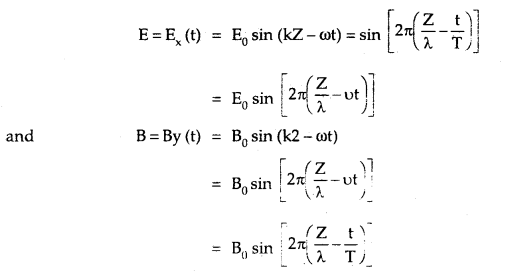
→ An electromagnetic wave of frequency v, wavelength λ propagating along the z-axis, we have
Electromagnetic Waves Class 12 Notes Physics 2
→ The speed of light or of electromagnetic waves in a material medium is given by
υ = \(\frac{1}{\sqrt{\mu \varepsilon}}\)
where μ is the permeability of the medium and ε is its permittivity.

→ Bmax = \(\frac{\mu_{0} I_{D}}{2 \pi R}\)

Alternating Current Class 12 Notes Physics Chapter 7

By going through these CBSE Class 12 Physics Notes Chapter 7 Alternating Current, students can recall all the concepts quickly.

Alternating Current Notes Class 12 Physics Chapter 7

→ In a pure ohmic resistance both alternating current and e.m.f. are in the same phase.

→ Alternating e.m.f. leads the alternating current by \(\frac{π}{2}\) in a pure inductance.

→ In a pure capacitor circuit, the alternating e.m.f. lags behind the alternating current by \(\frac{π}{2}\).

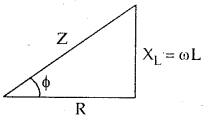
→ xL = ωL is called inductive reactance.

→ xC = \(\frac{1}{\omega C}\) is called capacitance reactance.

→ Resistance, reactance, and impedance all are measured in ohm.

→ The graph between xL and ω is a straight line.

→ The applied voltage is equal to the potential drop across the resistance R at the resonant frequency in the LCR circuit.

→ Power is dissipated only due to the ohmic resistance in an a.c. circuit.

→ Thus in an RC or RL a.c. the circuit power is dissipated only due to R and not due to its inductance or capacitance.

→ Resonant angular frequency is the same both for the series and parallel resonant circuit.

→ The graph between xC and w is a hyperbola.

→ The maximum value of current is I = \(\frac{E_{\mathrm{rms}}}{\mathrm{R}}\)at the resonant angular frequency W = W0.

→ As ω to increases, Z of parallel LCR resonant circuit first increases becomes maximum and then decreases.

→ For series LCR resonant circuit, Z first decreases become minimum and then increases.

→ The power rating of an element used in a.c. circuit refers to its average power rating.

→ The power consumed in an a.c. the circuit is never negative.

→ For very high frequency of a.c., the inductor behaves as an open circuit and the capacitor behaves as a conductor.

→ The impedance of the LR circuit depends upon the frequency of a.c. The phase angle between E and I in an LR circuit also depends upon the frequency.

→ As the frequency of a.e. increases, the impedance of the CR circuit decreases.

→ Electrical resonance takes place when the amplitude of the current in the circuit is maximum and impedance is minimum and the LCR circuit is a purely resistive circuit.

→ For purely resistive circuit, power factor = 1.

→ For purely inductive and capacitive circuits, the power factor is zero. Choke coil is used to control a.c. without much loss of electric power.

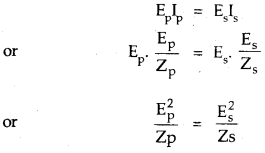
→ K > 1 for step-up transformer and K < 1 for step down transformer. Transformer works on the principle of mutual inductance. q = 100% and Eplp = EsIs for an ideal transformer.

→ The power consumed in a circuit is never negative.

→ A.C.: It is defined as the? electric current magnitude of which changes with time and reverses its direction periodically.

→ Average or Mean Value of A.C.: It is defined as that steady current which when passed through a circuit for a half time period of A.C. produces the same amount of charge as is being produced by A.C. in the same time and in the same circuit.

→ R.M.S. value or effective value of A.C.: It is defined as that steady current that produces the same amount of heat in resistance in a given time as is being done by a.c. passed through the same circuit for the same time.

→ Inductive reactance: It is the effective opposition offered by the inductor to the flow of a.c. in the circuit.

→ Capacitive reactance: -It is the effective opposition offered by the capacitor to the flow of a.c. in the circuit.

→ Q-factor of series LCR circuit: It is defined as the ratio of the voltage drop across inductor (or capacitor) to the applied voltage.

→ Power of an a.c. circuit: It is the product of instantaneous e.m.f. and instantaneous current in the circuit.

→ Power factor: It is defined as the ratio of average power to the apparent power.

→ Idle or wattless current: It is the current due to the flow of which no power is consumed in an a.c. circuit.

→ Transformer’s a device used to convert low alternating voltage at high current into a high voltage at low current or vice-versa.

Important Formulae

→ Erms = \(\frac{1}{\sqrt{2}}\) E0 = E virtual = Eeff

→ Irms = \(\frac{1}{\sqrt{2}}\) I0

→ Instantaneous e.m.f. is given by E = E0 sin ωt

→ In a purely inductive circuit, current lags behind E by \(\frac{π}{2}\)
I = I0 sin (ωt – \(\frac{π}{2}\))

→ In a purely capacitive circuit
I = I0 sin (ωt + \(\frac{π}{2}\))

→ XL = ωL = 2πvL = \(\frac{\mathrm{E}_{0}}{\mathrm{I}_{0}}=\frac{\mathrm{E}_{\mathrm{v}}}{\mathrm{F}_{v}}\)

→ XL = \(\frac{1}{\omega C}=\frac{1}{2 \pi v C}=\frac{E_{0}}{I_{0}}=\frac{E_{v}}{I_{v}}\)

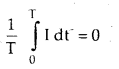
→ Average value of induced a.c. over a complete cycle is:
Alternating Current Class 12 Notes Physics 1
→ Average power = apparent power × power factor
or
Pav = Ev Iv cos Φ.

→ cos Φ = \(\frac{\mathrm{R}}{\mathrm{Z}}\)
Alternating Current Class 12 Notes Physics 2
→ Resonant angular frequency of LCR series circuit is given by
ω0 = \(\frac{1}{\sqrt{\mathrm{LC}}}\)
or
v0 = \(\frac{1}{2 \pi \sqrt{L C}}\)

→ Impedence of LCR series circuit is given by
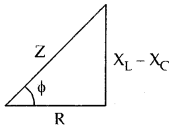
Z = \(\sqrt{R^{2}+\left(X_{L}-X_{C}\right)^{2}}\)
= \(\sqrt{R^{2}+\left(\omega L-\frac{1}{\omega C}\right)^{2}}\)

→ Tangent of the phase angle is given by .
tan Φ = \(\frac{X_{L}-X_{C}}{R}\)

→ Power factor of LR circuit is given by
cos Φ = \(\frac{R}{Z}=\frac{R}{\sqrt{R^{2}+X_{L}^{2}}}\)
tan Φ = \(\frac{\mathrm{x}_{\mathrm{L}}}{\mathrm{R}}=\frac{\omega \mathrm{L}}{\mathrm{R}}\)
Alternating Current Class 12 Notes Physics 3
→ For CR. circuit,
tan Φ = \(\frac{X_{C}}{R}=\frac{1}{R \omega C}\)
Z = \(\sqrt{R^{2}+X_{c}^{2}}=\sqrt{R^{2}+\left(\frac{1}{\omega C}\right)^{2}}\)

→ For a transformer,
K = \(\frac{\mathrm{N}_{\mathrm{s}}}{\mathrm{N}_{\mathrm{p}}}=\frac{\phi_{\mathrm{s}}}{\dot{\phi}_{\mathrm{p}}}=\frac{\mathrm{E}_{\mathrm{s}}}{\mathrm{E}_{\mathrm{p}}}=\frac{\mathrm{I}_{\mathrm{p}}}{\mathrm{I}_{\mathrm{s}}}\)

→ For an ideal transformer,
Alternating Current Class 12 Notes Physics 4
When Zp and Zs are called impedance of primary and secondary coil of the transformer.

→ Efficiency of a transformer is given by,
η = \(\frac{\text { output power }}{\text { input power }}\)
= \(\frac{\mathrm{E}_{\mathrm{s}} \mathrm{I}_{\mathrm{s}}}{\mathrm{E}_{\mathrm{p}} \mathrm{I}_{\mathrm{p}}}\).

→ Maximum e.m.f. induced in a coil is given by e0 = NBAω.
where N = No. of turns of the coil.
A = Area of the coil.
ω = angular frequency of rotation of the coil.
B = magnetic field.

→ Q.factor = \(\frac{\mathrm{X}_{\mathrm{L}} \mathrm{I}}{\mathrm{RI}}=\frac{\omega_{0} \mathrm{~L}}{\mathrm{R}}=\frac{1}{\omega_{0} \mathrm{CR}}=\frac{1}{\mathrm{R}} \sqrt{\frac{\mathrm{L}}{\mathrm{C}}}\)