Drugs Resistance Mechanisms

Learninsta presents the core concepts of Microbiology with high-quality research papers and topical review articles.

Drugs Resistance Mechanisms

Some microbes respond predictably to certain drugs making selection of treatment easy. Other microbes may vary in their responses, and laboratory tests are usually required to ensure that the selected therapy is appropriate.

Chemotherapeutic effectiveness depends upon the sensitivity of the pathogen to the agent. Antibiotic resistance, however, may develop in microbes within the population. In fact, the history of chemotherapy has been closely paralleled by the history of drug resistance.

None of the therapeutic drugs (antibiotic) inhibits all microbial pathogens and some microbial pathogens possess natural ability to resist to certain antibiotics.

Bacteria become drug resistant using several different resistance mechanisms. A particular type of resistance mechanism is not confined to a single class of drugs. Two bacteria may employ different resistance mechanisms to counter the same antibiotic.

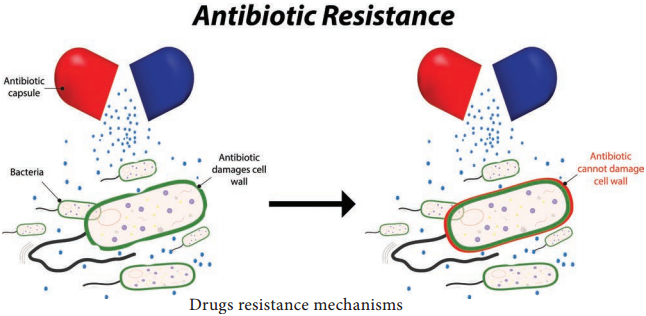
However, bacteria acquire drugs resistance using resistance mechanisms such as reduced permeability to antibiotic, efflux (pumping) antibiotic out of the cell, drug inactivation through chemical modification, target
modification and development of a resistant biochemical pathway (Figure 3.5).
Drugs Resistance Mechanisms img 1

Antimicrobial Susceptibility Testing

Learninsta presents the core concepts of Microbiology with high-quality research papers and topical review articles.

Antimicrobial Susceptibility Testing

Antimicrobial susceptibility tests are used to determine the type and quantity of antimicrobial agents used in chemotherapy. One of the most important functions of a clinical laboratory is to determine the antimicrobial susceptibility.

Antimicrobial susceptibility of pathogens refers to the limitation of pathogens to grow in the presence of effective antibiotics. There are two methods that can be used to determine the susceptibility of a potential pathogen to antimicrobial agents. They are:

  • Disk diffusion method
  • Tube dilution method

Disc Diffusion Method (Kirby – Bauer Test)

William Kirby and Alfred Bauer, in 1966 first introduced the principle of measuring zones of inhibition around antibiotic discs to determine antimicrobial agent susceptibilities. It is a rapid, convenient method to determine the susceptibilities of microorganisms to antimicrobial agents and a most common procedure used in susceptibility testing in clinical laboratory.

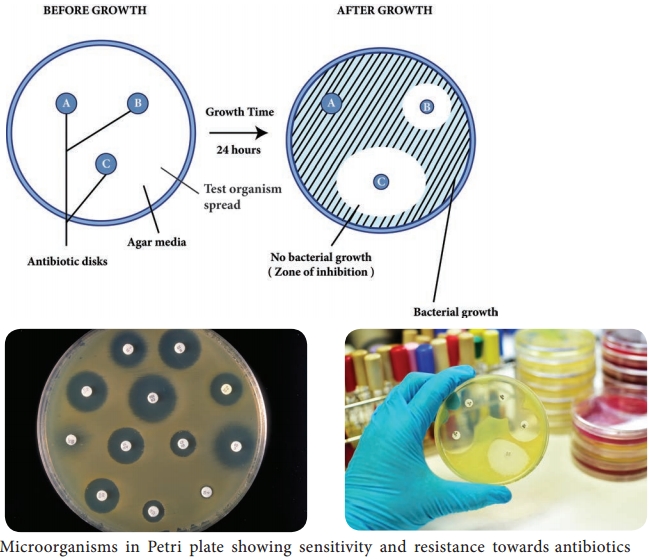
Filter paper discs containing known concentrations of antimicrobial agents are placed onto the surface of an agar plate (Muller – Hinton agar medium) inoculated with the test bacterium (Figure 3.3). The plate is incubated for 16 to 18 hours, and the zones of inhibition are read around each paper disc. During the incubation periods, the antimicrobial agent diffuses through the agar, and a concentration gradient of agent is established.

At some point in this gradient, growth of the susceptible bacteria is suppressed, and no growth is observed within a circular zone around disc. The size of a zone of inhibition must be compared to a standard Table for that particular drug before accurate comparisons can be made.

Thus, enabling to classify pathogens as susceptible (S), intermediate or resistant (R) to a drug. The procedure is highly regulated and controlled by the clinical and laboratory standards institute (CLSI) and must be accompanied by a rigorous quality assurance program including performance by certified and/or licensed personnel when the results are to be reported in clinical settings.
Antimicrobial Susceptibility Testing img 1

Minimal Inhibitory Concentration (MIC) Test

The potency of an effective antimicrobial agent is expressed in terms of minimal inhibitory concentration (MIC). It is the minimum concentration of drug that will inhibit the growth of pathogen. The MIC is determined by serial dilutions of antimicrobial agents in tubes with standard amount of bacteria. Turbidity (cloudiness) after incubation indicates bacterial growth and lack of turbidity indicates that the growth of bacteria is inhibited.

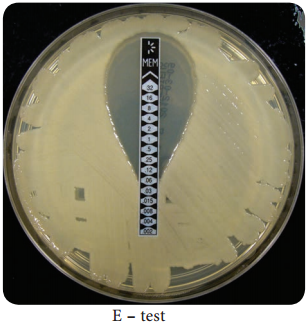
E – test

This is another test to determine the minimum inhibitory concentration where a plastic strip containing a gradient of the antimicrobial agent is used (Figure 3.4). An elliptical zone of inhibitory concentration can be noted with the help of a scale printed on the strip.
Antimicrobial Susceptibility Testing img 2

The Minimal Bactericidal Concentration (MBC) Test

MBC test is similar to MIC, the minimal bactericidal concentration test is used to determine the amount of antimicrobial agent required to rather kill the pathogen. In MBC test, samples taken from MIC tubes are transferred to drug free plates. Bacterial growth in these subcultures indicates that some bacterial cells have survived antimicrobial drug. The lowest concentration of drug for which no growth occurs is the minimum bactericidal concentration.

The tube dilution method is considered accurate for determining susceptibility of a pathogen to precise quantities of antimicrobial agent. However, the method is time consuming, expensive, and not practical for use in most clinical laboratories for routine susceptibility testing.

Evaluation of Antimicrobial Chemical Agents Antibiotics

Learninsta presents the core concepts of Microbiology with high-quality research papers and topical review articles.

Evaluation of Antimicrobial Chemical Agents Antibiotics

Testing of antimicrobial agents is a complex process regulated by two different federal agencies.

The U.S. Environmental Protection Agency regulates disinfectants, where as agents used on humans and animals are under the control of the Food and Drug Administration.

Testing of antimicrobial agents often begins with an initial screening test to see if they are effective and at what concentrations.

Laboratory techniques for the evaluation of antimicrobial chemical agents are conducted by one of the following three general procedures. In each procedure, the chemical agent is tested against a specific microorganisms referred to as the test organism.

Agar Plate Method

A plate of agar medium is inoculated with the test organism and the chemical agent is placed on the surface of the medium. The chemical solution is first impregnated in absorbent papers or confined by a hollow cylinder placed on the agar surface. Following incubation, the plate is observed for a zone of inhibition around the chemical agent. This is particularly suitable for semisolid preparations.

Tube Dilution Methods

Appropriately diluted water soluble liquid substances are dispensed into sterile test tubes and are inoculated with a measured amount of the test organism. At specified intervals, a transfer is made from this tube into tubes of sterile media that are then incubated and observed for the appearance of growth.

It is necessary in this type of procedure to ascertain whether the inhibitory action is bactericidal and not bacteriostatic. This approach can also be used to determine the number of organisms killed per unit time by performing a plate count on samples taken at appropriate intervals.

Phenol Coefficient Test

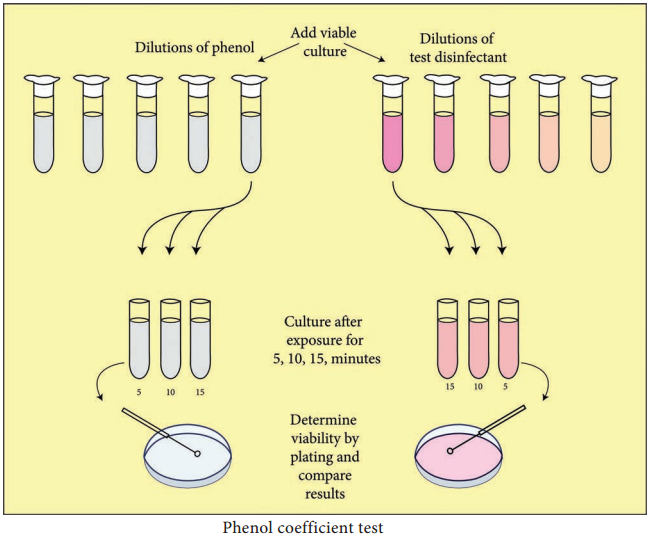
Phenol coefficient is a measure of the bactericidal activity of a chemical compound in relation to phenol. Phenol coefficient is calculated by dividing the concentration of test disinfectant at which it kills the organism in 10 minutes and not in 5 minutes under the same conditions. This method is used for evaluating the efficiency of watermiscible disinfectants.

Series of 10 test tubes with 2ml of distilled water is taken (Figure 3.1). Phenol is added to first test tube and dilution is made by transferring 1ml to next tube up to 5 dilutions. Similarly commercial disinfectant is also diluted. Pure culture of test organisms, such as Staphylococcus aureus or Salmonella typhi, is added to test tubes.

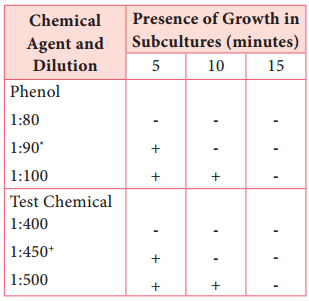
Subcultures from these tubes incubated at 37°C for 48 hours are examined for the presence or absence of growth at intervals of 5, 10 and 15 minutes. The highest dilution that kills the bacteria after 10 minutes, but not after 5 minutes is used to calculate the phenol coefficient (Table 3.3),

Evaluation of Antimicrobial Chemical Agents Antibiotics img 2

Illustration of phenol coefficient determination

Phenol dilution of 1:90 showed growth at 5 minutes but no growth at 10 minutes Test Chemical dilution of 1:450 showed growth at 5 minutes but no growth at 10 minutes phenol coefficient of test chemical as 450/90=5.

Antibiotics

The term ‘antibiotic’ was derived from ‘antibiosis’ which refers to the suppression of microorganisms due to secretion of toxic or inhibitory compounds by other microorganisms. Although antibiosis has been observed by many scientific workers fairly frequently towards the end of the nineteenth century, it was not until the discovery and development of Penicillin that a truly wide ranging search for antibiotics was initiated.

Historical Development

The first chemotherapeutic agent, discovered by Paul Ehrlich, was Salvarsan, used to treat syphilis. Alexander Fleming discovered the first antibiotic, penicillin, in 1929; its first clinical trails were done in 1940. Antibiotics are produced by species of Streptomyces, Bacillus, Penicillium and Cephalosporium.

Drugs such as the sulfonamides are sometimes called antibiotics although they are synthetic chemotherapeutic agents which are not synthesized using microbes.

Classification of Antibiotics

The antibiotics are usually classified on the basis of:-

• Target group of microorganisms
• Antimicrobial spectrum and
• Mode of action

Classification based on target group of microorganisms:-

Based on the target group, the antibiotics can be classified as antibacterial, antifungal and antiviral.

Classification based on Antimicrobial spectrum:-

Antimicrobial spectrum or antibiotic spectrum refers to the range of effectiveness of antibiotics on different kind of microorganisms, i.e. the range of different kind of microorganisms that can be inhibited, killed, or lysed by a particular type of antibiotic.

The susceptibility of microorganisms to individual antibiotic varies significantly and on account of this, the antibiotics can be classified in two groups as,

Broad – spectrum antibiotics:-

These attack different kinds of microbial pathogens and therefore find wider medical use. Antibacterial antibiotics of broad – spectrum are effective against both Gram positive and Gram negative bacteria.
They also attack pathogens belonging to Mycobacteria, Rickettsia, and Chlamydia. Similarly, broad – spectrum antifungal antibiotics attack different type of fungal pathogens.

Narrow – spectrum antibiotics:-

Narrow – spectrum antibiotics are categorized as those that are effective only against a limited variety of microbial pathogens. These antibiotics are quite valuable for the control of microbial pathogens that fail to respond to other antibiotics. For example, vancomycin is a narrow spectrum glycopeptide. It is an effective bactericidal agent for gram – positive penicillin resistant bacterial pathogens belonging to genera Staphylococcus, Bacillus, and Clostridium.

Mode of Action of Antibiotics

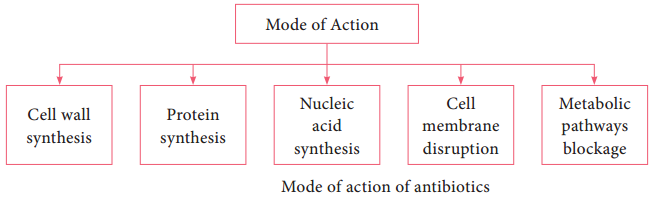
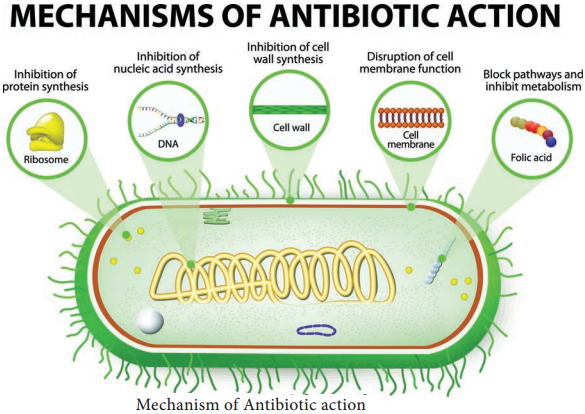
The mode of action of antibiotics varies as they damage pathogens in several ways (Flowchart 3.1). Some of the important actions of therapeutic drugs in microbial pathogens are as follows. Cell wall synthesis, Protein synthesis, Nucleic acid synthesis, Cell membrane disruption and Metabolic pathways blockage.
Evaluation of Antimicrobial Chemical Agents Antibiotics img 3

1. Inhibition of Cell Wall Synthesis

The most selective therapeutic antibiotics are those that interfere with the synthesis of bacterial cell walls. These drugs posses a high therapeutic index because bacterial cell walls have a unique structure which is not found in eukaryotic cells. The important cell wall attacking drugs are Penicillin, Cephalosporin, Ampicillin,
Methicillin and Vancomycin.

2. Inhibition of Protein Synthesis

Many therapeutic antibiotics discriminate between prokaryotic and eukaryotic ribosomes and inhibit protein synthesis. The therapeutic index of these drugs is fairly high, but not as favourable as that of cell wall synthesis inhibitors. Several of these drugs are medically useful and effective research tools because they block individual steps in protein synthesis. Some therapeutic drugs bind to 30S while others attach to 50S ribosomal subunits. Example Streptomycin, Chloramphenicol, Tetracyclin and Erythromycin.

3. Inhibition of Nucleic Acid Synthesis

Some antimicrobial drugs or antibiotics inhibit nucleic acid synthesis. These are not selectively toxic as other drugs. This is due to the fact that prokaryotic and eukaryotic nucleic acid synthesis mechanisms do not vary greatly. Example Quinolones, Novobiocin, Actinomycin and Rifampin

4. Disruption of Cell Membrane

There are some antimicrobial drugs or antibiotics that act as cell membrane disorganizing agents. Polymyxins are such drugs of clinical importance. E.g. Polymyxin B and Polymyxin E (colistin)

5. Blocking Metabolic Pathways

Some therapeutic drugs act as antimetabolites and block the functioning of metabolic pathways. They competitively inhibit the key enzymes in the metabolic pathway. Example Sulfonamides, Trimethoprim, Dapsone and Isoniazid (Figure 3.2).
Evaluation of Antimicrobial Chemical Agents Antibiotics img 4
Trimethoprim, Daspone and Isoniazid (Figure 3.2).

Major Groups of Antimicrobial Chemical Agents

Learninsta presents the core concepts of Microbiology with high-quality research papers and topical review articles.

Major Groups of Antimicrobial Chemical Agents

A large number of chemical agents are in common use. Some of the more common groups are listed below.

1. Phenol and Phenolics

Phenol was the first widely used chemical antiseptic and disinfectant. In 1867, Joseph Lister employed carbolic spray to reduce the risk of infection in surgical theatres. Phenol derivatives called phenolics contain altered molecules of phenol useful as antiseptics and disinfectants. The phenolics damage cell membranes and inactivate enzymes of microorganisms, while denaturing the proteins.

Phenolics includes cresols, such as Lysol, as well as several bisphenols, such as hexachlorophene. Today phenol and phenolics such as cresol, xylenol, and orthophenyl phenol are used as disinfectants in laboratories and hospitals.

The commercial disinfectant Lysol is made of mixture of phenolics. Phenolics are tuberculocidal, effective in the presence of organic material, and remain active on surfaces long after application. However, they have a disagreeable odour and can cause skin irritation.

Hexachlorophene is one of the most popular antiseptics because it persists on the skin once applied and reduces skin bacteria for a long period. It is mainly used in soaps and creams. It is an ingredient of various dermatological preparation used for skin disorders.

2. Alcohols

Alcohols are among the most widely used disinfectant and antiseptic. They are bactericidal and fungicidal but not sporicidal. Alcohols can destroy the lipid component of enveloped viruses. The two most popular alcoholic germicides are ethanol and isopropanol. They act by denaturing proteins and dissolving membrane lipids. The recommended optimum concentration of ethanol is 70%, but concentration between 60% and 95% are employed to kill germs as well. Thermometers and small instruments are disinfected by immersing in alcohol for 10 to 20 minutes.

3. Halogens

Halogen compounds are broad spectrum compounds that are considered low toxicity, low cost and easy to use. Among the halogens, iodine and chlorine are important antimicrobial agents. Small quantities of drinking water can be disinfected with halazone tablets.

a. Iodine:-

Iodine compound are broad spectrum and considered effective for a variety of bacteria, mycobacteria, fungi and viruses. The alcoholic tincture of iodine is highly active against gram positive organisms and so is used as a skin antiseptic. It stains the skin. Iodine combines with microbial protein and inhibits their function.

b. Chloride:-

Chloride is also used as a gas to maintain a low microbial count in drinking water. Chlorine together with ammonia called chloramines are used to sanitize glasswall and eating utensils. Sodium hypochlorite (NaOCl) is one of the most widely used chlorine containing disinfectants. Low concentrations (2-500ppm) are active against vegetative bacteria, fungi and most viruses.

Rapid sporicidal action can be obtained around 2500ppm, however this concentration is very corrosive so should be limited in its use. High concentrations are also irritating to the mucous membranes, eyes and skin. Chlorine compounds are rapidly inactivated by light and some metals so fresh solutions should always be used. Hypochlorites should never be mixed with acids or ammonia as this will result in the release of toxic chlorine gas.

c. Iodophores:-

The combinations of iodine and organic molecules are called Iodophores. They include wescodine, betadine and previdone. These iodophore contains surface active agents. They cause less irritation to the skin than free Iodine and do not stain. They are used for cleaning wounds and as a general purpose laboratory disinfectant for discarded jars.

4. Heavy Metals

For many years the ions of heavy metals such as mercury, silver, arsenic, zinc, and copper were used as germicides. More recently these have been superseded by other less toxic and more effective germicides. Many heavy metals are more bacteriostatic than bactericidal. There are a few exceptions. 1% solution of Silver nitrate is often applied to the eyes of infants to prevent ophthalmic gonorrhea. Silver sulfadiazine is used on burns. Copper sulfate is an effective algicide used in lake and swimming pools to retard the growth of algae.

Heavy metals combine with sulfhydryl (SH) groups of proteins and inactivate them. High concentration of metallic salts, particularly those of mercury, silver and copper coagulate cellular proteins that results in damage or death of the microbial cell. The most toxic heavy metals are the mercury, silver, and copper.

5. Quaternary Ammonium Compounds (Quats)

The most widely used surface active agents are the cationic detergents, especially the quaternary ammonium compounds (quats).

Quaternary Ammonium compounds are strongly bactericidal against Gram positive bacteria and less active against gram negative bacteria. These include agents such as cetrimide, bromide and benzalkonium chloride. Their antibacterial activity is antagonized by soaps and certain organisms like Pseudomonas.

They are useful for washing cutlery in catering industry and for cleaning wounds in hospitals. Savlon, a popular antiseptic, is a mixture of cetrimide and chlorohexidine and is active against Gram negative bacteria. They are used as skin disinfectants and as a preservative of ophthalmic solution.

The combined properties of germicidal activity and low toxicity, high solubility in water, stability in solution and non-corrosiveness have resulted in many applications of quaterneries as disinfectants and sanitizing agents.

Quats are also fungicidal, amoebicidal, and virucidal against enveloped viruses. They do not kill endospores or mycobacteria.

6. Aldehydes

Aldehydes are highly effective, broad spectrum disinfectant. The most which typically achieve its anitimicrobial action by denaturing proteins and disrupting nucleic acids. Commonly used aldehydes are formaldehyde and glutaraldehyde. Formaldehyde is usually dissolved in water or alcohol before use. Formaldehyde is used as a surface disinfectat and a fumigant and has been used to decontaminate in animate objects.

A concentration of 2% glutaraldehyde is an effective disinfectant. It is less irritating than formaldehyde and is used to disinfect hospital and laboratory equipments. Glutaraldehyde usually disinfects objects about 10 minutes but may require as long as 12 hours to destroy all spores.

These are highly reactive molecules that combine with nucleic acids and proteins and inactivate them. They disrupt the function of cell organelles and kill the cells probably by cross linking and alkylating the molecules. These are sporicidal and can be used as chemical sterilants.

7. Gaseous Sterilization

Gaseous disinfectants (alkylating agents) are used for the sterilization or disinfection of hospital equipment that is bulky or heat labile. The most widely used gases are ethylene oxide, formaldehyde and β Propiolactone.

Ethylene oxide (EtO):-

Ethylene oxide has a boiling point of 10.8°C. It is highly inflammable and explosive in pure form, but is safe to handle when mixed with Carbon dioxide. It is powerful in the killing of all bacteria, including tubercule bacilli and spores. It is an effective sterilizing agent because it rapidly penetrates packing materials, even
plastic wrappers. To be potent, however, the humidity and temperature must be carefully controlled within narrow limits.

It is highly toxic on contact with the skin or mucous membrane. Materials that have been sterilized with ethylene oxide must be set aside in detoxification chambers for a few days to allow the gases to dissipate. It is frequently used to sterilize heart lung machines and plastic items like catheters.

Formaldehyde:-

It is highly bactericidal. Formaldehyde is used as 40% formalin with humidity at around 50%. It causes irritation. It is used occasionally to fumigate rooms and disinfect respirators.

Betapropiolactone (BPL):-

This is occasionally employed as a sterilizing gas in the liquid form. It has been used to sterilize vaccines, tissue grafts, surgical instrument and enzyme as a sterilants of blood plasma, water, milk and as a vapour – phase disinfectant in enclosed spaces, short-term inhalation exposure to betapropiolactone causes
severe irritation of the eyes, nose, throat and respiratory tract in humans.

BPL decomposes to an inactive form after several hours and is therefore not difficult to eliminate. It destroys microorganisms more readily than ethylene oxide but does not penetrate materials well and may be carcinogenic. For these reasons, BPL has not been used as extensively as EtO.

Class 12 Hindi Vitan Chapter 4 Summary डायरी के पन्ने

By going through these CBSE Class 12 Hindi Notes Chapter 4 डायरी के पन्ने Summary, Notes, students can recall all the concepts quickly.

डायरी के पन्ने Summary Notes Class 12 Hindi Vitan Chapter 4

डायरी के पन्ने पाठ का सारांश

ऐन फ्रैंक की डायरी ‘ऐन फ्रैंक द्वारा रचित ‘डायरी’ विधा को एक सशक्त कृति है। यह डायरी दवितीय विश्व युद्ध के समय यहदियों पर ढाए गए जुल्मों और मानसिक यातनाओं का जीवंत दस्तावेज़ है। यहूदी समुदाय ऐसा समुदाय था जिसे द्वितीय विश्व युद्ध में सबसे ज्यादा कष्ट उठाने पड़े। उन्हें गुप्त तहखानों में लंबे-लंबे अरसे तक गुजर-बसर करना पड़ा। वहाँ उन्हें भूख, गरीबी, बीमारी, शारीरिक एवं मानसिक पीड़ाओं को सहते हुए पशुओं जैसा जीवन जीना पड़ा। जर्मनी के नाजियों के शिकंजे में फंसकर उन्हें अनेक अमानवीय यातनाओं से दो-चार होना पड़ा।

ऐन फ्रैंक की डायरी दो यहूदी परिवारों के अज्ञातवास की व्यथा-कथा है। एक था फ्रैंक परिवार, जिसमें माता-पिता और उनकी दो बेटियाँ मार्गोट और ऐन थीं। मार्गोट की उम्र सोलह साल और ऐन की आयु तेरह साल की थी। उनके साथ दूसरा परिवार था वान दान दंपती और उनका सोलह वर्षीय बेट पीटर। उनके साथ आठवाँ व्यक्ति था मिस्टर डसेल। इस आठ सदस्यीय परिवार की फ्रैंक साहब के कार्यालय में काम करने वाले ईसाई कर्मचारियों ने मानवीय स्तर पर मदद की थी।

ऐन ने इसी अज्ञातवास को कलमबद्ध किया। इस डायरी में भय, आतंक, बीमारी, भूख, प्यास, मानवीय संवेदनाएँ, प्रेम, घृणा, हवाई हमले का डर, पकड़े जाने का भय, बढ़ती उम्र की तकलीफें, सपने, कल्पनाएँ, बाहरी दुनिया से डरने की पीड़ा, मानसिक एवं शारीरिक आवश्यकताएं हंसी-मजाक, युद्ध की पीड़ा और अकेलेपन का दर्द सब कुछ लिपिबद्ध है। यह पीडाजन्य स्थितियों को दर्ज करती डायरी 2 जून, 1942 से शुरू होकर 1 अगस्त, 1944 के बीच लिखी गई है।

4 अगस्त, 1944 को किसी व्यक्ति की सूचना पर इन आठ लोगों को पकड़ लिया जाता है। सौभाग्य से यह डायरी पुलिस के हत्थे नहीं चढ़ी, वरना तो यह डायरी कहीं गुम होकर रह जाती। 1945 में ऐन की असमय मृत्यु के पश्चात उनके पिता ओरो फ्रैंक ने इसे 1947 में प्रकाशित करवाया। ऐन ने यह डायरी चिट्ठियों के माध्यम से लिखी थीं। ये चिटूठियाँ ऐन ने उपहार के रूप में मिली गडिया ‘किकी’ को संबोधित करके लिखी थीं।

8 जुलाई, सन 1942 दिन बुधवार को अपनी प्यारी किकी को संबोधित करके लिखी चिट्ठी में ऐन बताती है कि वह रविवार की दोपहर थी। मैं बाल्कनी में धूप से अलसाई-सी बैठी थी इसलिए मुझे दरवाजे की घंटी की आवाज सुनाई दी। वहाँ मेरी बड़ी बहन मार्गोट भी थी। वह गुस्से में दिख रही थी, क्योंकि युद्ध के दिनों में पापा को ए० एस० एस० से बुलाने का नोटिस मिला था। माँ उस समय पापा के बिजनेस पार्टनर मिस्टर वान दान को देखने गई हुई थी। यह सुनकर मैं हैरान रह गई थी। यह सब कोई जानता है कि ए० एस० एस० के बुलाने का अर्थ है कि यातना और बंद कोठरियों, परंतु हम सभी इस बात के लिए राजी नहीं थे कि पापा बंद कोठरी में यातनाएँ सहें।

इसलिए हम सभी ने यह निर्णय लिया कि सभी पापा के कार्यालय और उससे सटे गोदाम में अज्ञातवासी के रूप में रहेंगे। इसलिए हम सबने अपने दैनिक जीवन की जरूरतों के लिए आवश्यक सामान थैलों में भरा और पापा के कार्यालय के कमरों में रहने लगे। वहाँ चारों ओर अव्यवस्था तथा फाइलें और अलमारियों का साम्राज्य था। थोड़ा बहुत ठीक करके हम सब वहाँ हँसी-मजाक, रूठना-मनाना, जोक सुनना-सुनाना और बहसों आदि में समय व्यतीत करने लगे। दिन का उजाला हमारे लिए दूर की बात थी। रात के अंधेरे में दिन कटते थे। वहाँ एक-एक सप्ताह के लिए बिजली गुल हो जाती थी। चार बजते ही अंधेरा छा जाता था।

यह समय हम ऊल-जलूल की हरकतें करते गुजारते थे। हम पहेलियाँ बुझाते थे, अंधेरे में व्यायाम करते, अंग्रेजी और फ्रैंच में बातचीत करते तथा किताबों की समीक्षा किया करते थे। अब मैने समय गुजारने का नया तरीका ढूंढ़ निकाला था। मैंने दूरबीन लगाकर पड़ोसियों के रोशनी वाले कमरों में झाँकना शुरू किया। दिन में पर्दे नहीं हटा सकते थे परंतु रात के अंधेरे में पर्दे हटा दिए जाते थे। हमारे पड़ोसी बड़े दिलचस्प लोग थे। जब मैंने अपने पड़ोसियों को दूरबीन से देखा तो पाया कि कोई खाना खा रहा था, कोई फ़िल्म बना रहा था, तो सामने वाले घर में एक दंत चिकित्सक एक सहमी हुई बुढ़िया के दाँतों से जूझ रहा था।

मिस्टर डसेल बच्चों के साथ खूब आनंदपूर्ण रहते थे और उन्हें खूब प्यार करते थे। वे एक अनुशासन-प्रिय व्यक्ति थे और अनुशासन । पर लंबे-लंबे भाषण दिया करते थे। ये भाषण उबाऊ और नींद लाने वाले होते थे। मैं उनके भाषणों को केवल सुनने का अभिनय किया करती थी। वे मेरी इन सभी बातों को मम्मी को बताया करते और मम्मी मुझे खूब डाँटा करती थी फिर मुझे मिसेज वान अपने पास बुलाया करती थी। यह बात ऐन ने किकी को शनिवार 26 नवंबर, 1942 की चिट्ठी में लिखी थी।

शुक्रवार 19 मार्च, 1943 की चिट्ठी में ‘किकी’ को ऐन लिखती है कि हमें यह सुनकर निराशा हुई कि टर्की अभी युद्ध में शामिल नहीं हुआ है। यह भी खबर थी कि एक केंद्रीय मंत्री का बयान आया कि जल्द ही टर्की यह तटस्थता खत्म कर देगा और अखबार बेचने वाला चिल्ला रहा था कि ‘टर्की इंग्लैंड के पक्ष में और भी अनेक उत्साहवर्धक अफवाहें सुनने को मिल रही थीं। हजार गिल्डर के नोट अवैध मुद्रा घोषित कर दिए गए थे। काला धंधा करने वालों के लिए यह एक बड़ा झटका था। ये लोग अब भूमिगत हो गए थे। पाँच सौ गिल्डर के नोट भी अब बेकार हो गए थे। मार्गोट मिस्टर डसेल की डच अध्यापिका बन गई थी। वह उनके पत्र ठीक किया करती थी। पापा ।

के मना करने के बाद मार्गोट ने यह कार्य बंद कर दिया था परंतु मुझे फिर लगने लगा कि वह मिस्टर डसेल को चिट्ठियाँ लिखना फिर शुरू कर रही थी। मिस्टर हिटलर की घायल सैनिकों से बातचीत हमने रेडियो के माध्यम से सुनी थी। यह एक करुणाजनक अनुभव था। – ऐन ‘किकी’ को लिखी एक चिट्ठी में जिक्र करती है कि मुझे पिछले सप्ताहों से परिवार के वृक्षों और वंशावली तालिकाओं में खासी रुचि हो गई थी। यह काम करने मैं इस नतीजे पर पहुंची कि एक बार तुम खोजना शुरू कर दो तो तुम्हें अतीत में गहरे और गहरे उतरना पड़ेगा। मेरे पास फ़िल्मी कलाकारों की तस्वीरों का एक अच्छा खासा संग्रह हो गया था।

मिस्टर कुगलर हर सोमवार मेरे लिए एक ‘सिनेमा म एंड थियेटर’ पत्रिका की प्रति अवश्य लाते थे। मैं फ़िल्म के मुख्य नायकों और नायिकाओं के नाम और समीक्षा फरटि से करती थी। जब मैं नई केश-सज्जा बनाकर बाहर निकलती तो मुझे यह अंदेशा पहले ही रहता था कि लोग मुझे टोककर कहेंगे कि मैं फलाँ फ़िल्म की स्टार की नकल कर रही है। जब मैं यह कहती कि यह मेरा अपना आविष्कार है तो लोग मेरा मजाक करते थे। जहाँ तक मेरे हेयर स्टाइल का। सवाल है यह आधे घंटे से अधिक टिक नहीं पाता था। मैं इससे बोर हो जाती और सबकी टिप्पणियाँ सुनते-सुनते मेरे कान पकने लगते।। मैं सीधे गुसलखाने में जाती और मेरे बाल फिर से उलझकर धुंधराले हो जाते थे।

ऐन फ्रैंक बुधवार 28 जनवरी, 1944 को एक चिट्ठी के माध्यम से अपनी प्यारी गुड़िया ‘किकी’ को बताती है कि जान और मिस्टर क्लीमेन भी अज्ञातवास में छुपे अथवा भूमिगत हो गए थे। लोगों के बारे में कहना और सुनना अच्छा लगता था। हम सभी उनकी बातों को। ध्यान से सुना करते थे। वह कहा करते थे कि ‘हमें उन सबकी तकलीफों से हमदर्दी है जो गिरफ्तार हो गए हैं और उन लोगों की खुशी में ! हमारी खुशी है जो कैद से आजाद हो गए हैं।

भूमिगत होना या अज्ञातवास चले जाना अब आम बात हो गई है। कुछ लोग ऐसे भी हैं जो छुपे लोगों को वित्तीय सहायता पहुँचाते हैं। यह बात हैरान कर देने वाली है कि ये लोग अपनी जान जोखिम में डाल करीदूसरों की मदद। करते हैं। इसमें सबसे बढ़िया उन लोगों का है जो आज तक हमारी मदद कर रहे हैं और हमें उम्मीद है कि हमें सुरक्षित किनारे तक ले जाएँगे। वे प्रतिदिन ऊपर हमारे पास आकर कारोबार और राजनीति की बातें करते थे। वे हमारे जन्मदिनों पर फूल और उपहार लेकर आते । थे। वे हमें हमेशा खुश रखने के लिए कोशिश करते रहते थे। वे सदैव अपनी बेहतरीन भावनाओं और प्यार से हमारे दिल को जीत लेते थे।

4. ऐन ‘किकी’ को संबोधन करते हुए कहती है कि कैबिनेट मंत्री बाल्के स्टीन ने लंदन से डच प्रसारण में कहा है कि युद्ध के बाद । युद्ध का वर्णन करने वाली डायरियों और पत्रों का संग्रह किया जाएगा। यह सुनते ही हर कोई मेरी डायरी को पाने के लिए उत्सुक था। ऐन सोचती है कि दस साल बाद जब लोगों को पता चलेगा कि हम किस प्रकार अज्ञातवास में जी रहे थे, शायद लोग चकित रह जाएंगे। हवाई हमले के समय औरतें बुरी तरह से डर जाती थीं। जब ब्रिटिश लड़ाकू जहाज 550 टन गोला बारूद बरसाते थे तो हमारे घर घास की पत्तियों की तरह काँप जाते थे। हमारे घरों में अनेक अजीब तरह की महामारियाँ फैल रही थीं।

चोरी-चकारी की घटनाएं लगातार बढ़ रही थीं। डच लोगों में अंगूठी पहनने का रिवाज खत्म हो गया था। आठ-दस वर्ष के छोटे बच्चे घरों की खिड़कियाँ तोड़कर घरों में घुस जाते । थे। उनको जो चीज़ हाथ लगती थी, उसे चुरा ले जाते थे। अगर आप अपने घर से पाँच मिनट के लिए बाहर चले गए तो आपका घर पूरी तरह से साफ़ हो चुका होता था। गली नुक्कड़ों पर बिजली से चलने वाली घड़ियाँ चोरी हो जाती थीं तथा सार्वजनिक टेलीफोनों और उनके पुर्जे अचानक गायब हो जाते थे। डच लोग भूखे रहते थे। पुरुषों को जर्मनी भेजा जा रहा था। घर में बच्चे बीमार थे और भूख से बेहाल थे। सब लोग फटे-पुराने कपड़े पहनते थे तथा फटे जूतों को पहनकर काम चला रहे थे। बिल्कुल जीवन दूभर हो गया था।

मंगलवार 11 अप्रैल, सन् 1944 के दिन लिखी डायरी में ऐन लिखती है कि शनिवार के कोई दो बजे तेज गोलाबारी शुरू हो गई थी। मशीनगनें आग बरसा रही थीं। रविवार के दिन पीटर और मैं दूसरी मंजिल पर सटे बैठे थे। हम छह बजे ऊपर गए और सवा सात बजे तक एक-दूसरे से सटकर बैठे रहे क्योंकि कुशन बहुत छोटा था। रेडियो पर बहुत ही खूबसूरत भोजाई संगीत बज रहा था। मुझे रात को बजने वाला राग बहुत भाता है। यह संगीत मेरी आत्मा की गहराइयों में उतरता चला जा रहा था।

चूंकि हम मिस्टर डसेल का कुशन ऊपर ले गए थे और इसी बात को लेकर मि० डसेल नाराज हो रहे थे इसलिए हम जल्दी से भागकर नीचे उतर आए थे। हमने मिस्टर डसेल के कुशन में कुछ ब्रुश डाल दिए। हम यह अंदाजा लगा रहे थे कि मिस्टर डसेल इस पर बैठेंगे तो खूब हँसेंगे परंतु मिस्टर डसेल अपने कमरे । में जाकर बैठ गए और फिर हमने कुशन में डाले ब्रुशों को बाहर निकाला। इस छोटे से प्रहसन पर हँसते-हँसते हमारा बुरा हाल हो रहा था।

लेकिन जल्द ही यह हँसी-मज़ाक डर में तबदील हो गई जब यह अंदाजा लगाया गया कि पुलिस के आने की आशंका है। सभी मर्द लोग इस बात को लेकर नीचे चले गए थे और औरतें डर से सहमी हुई थीं। फिर बत्तियाँ बुझा दी गई थीं। देवी रात जब सभी मर्द एक बार । फिर नीचे गोदाम में गए तो सेंधमार अपने काम में लगे हुए थे। मर्दो को देखकर वे भाग गए थे। उनका यह प्रयास निष्फल कर दिया गया. था। यह घटना अपने आप में एक बड़ी मुसीबत थी।

13 जून, दिन मंगलवार, 1944 की चिट्ठी में ऐन ‘किकी’ को बताती है कि अब वह पंद्रह वर्ष की हो गई है। इस जन्मदिन पर सभी ने मुझे उपहार दिए थे। अब दुश्मन देशों के एक-दूसरे पर हमले तेज़ हो गए थे। बेहद खराब मौसम, लगातार वर्षा, तेज़ हवाएँ और समुद्र अपने पूरे उफान पर था। चर्चिल तथा अन्य अधिकारी उन गाँवों का दौरा कर रहे थे जिन पर ब्रिटिश सैनिकों ने कब्जा कर लिया तथा बाद के में मुक्त कर दिया था। चर्चिल एक जन्मजात बहादुर थे। वे टॉरपीड नाव में थे। इन्हीं टारपीड नावों के माध्यम से तटों पर गोलाबारी की जाती थीं। अगर ब्रिटिश ने जर्मनी के साथ संधि कर ली होती तो हालैंड और उसके पड़ोसी देशों के हालात खराब हो जाते। हालैंड जर्मनी 1 बन चुका होता और इस प्रकार उसका अंत भी हो सकता था।

ऐन अपनी निजी बात को सार्वजनिक करते हुए ‘किकी’ को कहती है कि “यह सच है कि पीटर मुझे प्यार करता है, गर्लफ्रेंड की। तरह नहीं बल्कि एक दोस्त की तरह। उसका स्नेह दिन पर दिन बढ़ता ही जा रहा है लेकिन कोई रहस्यमयी ताकत हम दोनों को पीछे की तरफ खींचती है। मैं नहीं जानती कि वो कौन-सी शक्ति है।” ऐन पीटर के प्रेम में दीवानी है। वह स्वयं कहती है ‘अगर मैं उसके कमरे में एक-दो दिन के लिए न जा पाऊँ तो मेरी बुरी हालत हो जाती है, मैं उसके लिए तड़पने लगती हूँ।’

पीटर एक सच्चा, अच्छा और ईमानदार लड़का है लेकिन वह मुझे कई तरह से निराश करता है। वह शांतिप्रिय, सहज, सरल, सहनशील एवं आत्मीय व्यक्ति था। उसका । एक मिशन था कि वह उन सभी इल्जामों को गलत साबित कर सके जो उसके ऊपर लगे हुए थे। उसके मन में मेरे प्रति जो बात थी वह कहना चाहता था परंतु पता नहीं क्यों वह इसे अभिव्यक्त नहीं करना चाहता था। हम दोनों अपने अतीत, वर्तमान और भविष्य की बातें किया करते थे, परंतु वह चीज़ (प्रेम) जो हम दोनों के मन में थी उसकी बात कभी नहीं किया करते थे।

हम अपने प्रकृति प्रेम के बारे में ऐन कहती हैं कि वह प्रकृति को निहारना चाहती है और यही सोचकर उन स्मृतियों में खो जाती है। – जब नीला आकाश, पक्षियों की चहचहाने की आवाजें, चाँदनी रात और खिली कलियाँ उस पर जादू-सा कर देती थीं। अब ये सभी चीजें बीते जमाने की हो गई हैं। वह आगे कहती है-“आसमान, बादलों, चाँद और तारों की तरफ देखना मुझे शांति और आशा की भावना से । सरोबार कर देता है।”

उसके दिमाग में कुछ इस प्रकार के प्रश्न उठते हैं जो उसे लगातार परेशान करते थे जैसे पुरुषों का औरतों पर शुरू। से शासन करना। सौभाग्य से शिक्षा, काम और प्रगति ने औरतों की आँखें खोल दी हैं। अब कई देशों में उन्हें बराबरी का दर्जा दिया जाता है। आधुनिक महिलाएँ अब स्वतंत्र होना चाहती हैं। वह चाहती है कि महिलाओं का पूरा सम्मान होना चाहिए। वह पुरुष की मानसिकता के बारे में कहती है कि “सैनिकों और युद्धों के वीरों का सम्मान किया जाता है, उन्हें अलंकृत किया जाता है, उन्हें अमर बना डालने । तक का शौर्य प्रदान किया जाता है, शहीदों को पूजा भी जाता है, लेकिन कितने लोग ऐसे हैं जो औरतों को भी सैनिक का दर्जा देते हैं ?”

लेखक श्री पोल दे क्रुइफ की ‘मौत के खिलाफ मनुष्य एक पुस्तक में जिक्र करते हुए वह कहती है कि आमतौर पर युद्ध में लड़ने वाले वीर सैनिक जितनी तकलीफ, पीड़ा, दर्द, बीमारी और यंत्रणा उठाते हैं उससे कहीं अधिक दर्द वे औरतें उठाती हैं जो बच्चे को जन्म देती हैं। जब बच्चा जनने के बाद औरत के शरीर का आकर्षण कम हो जाता है तो उन्हें उनके हाल पर छोड़ दिया जाता है। लोग शायद ये। भूल जाते हैं कि औरत ही मानव जाति की निरंतरता बनाए रखती है।

वह लगातार संघर्ष करती है शायद इतना संघर्ष सारे सिपाही मिलकर भी नहीं करते। वह अंत में कहती है कि मैं कदापि यह नहीं चाहती कि औरतें बच्चे जनना बंद कर दें, परंतु मैं उन लोगों के खिलाफ हूँ जो समाज में औरतों के सौंदर्यमयी योगदान को महान नहीं मानते। वह आशा के साथ अपने कथन को समाप्त करती है कि अगली सदी । में औरतें ज्यादा सम्मान और सराहना की हकदार बनेंगी।